Reflecting on the macro data

The Reserve Bank’s Monetary Policy Statement (Graeme Wheeler’s second to last) will be out on Thursday.  I’m not in the market economists’ game of trying to tell you what the Bank will do and say (although no one expects they will do anything concrete with the OCR this time).  I’m more interested in questions around what they should do.  In time, what they should do, they usually will do.  But sometimes not until they’ve tried the alternatives.

I wrote about last month’s CPI data a few weeks ago, concluding that there had been a welcome, and expected, increase in core inflation (it is what typically happens if inflation is below target and the OCR is cut fairly substantially) but that

With the unemployment rate still above estimates of the NAIRU, and most indicators of inflation suggesting that core is probably (a) still below target, and (b) not picking up very rapidly, it certainly isn’t time for hawkish talk about near-term OCR increases.

Not everyone agrees of course.  I noticed the BNZ’s economic commentary yesterday which opened with this confident assertion

There is no excuse for the cash rate to be just 1.75% in New Zealand.

I don’t think I’m unduly caricaturing their record to say that, for at least the last decade, the BNZ economics team has never seen an OCR increase they didn’t like, even –  or perhaps especially –  those which had to be quickly reversed.  But mindful that in the story of the boy who cried wolf, the wolf eventually did come, I thought it was worth having a look at the latest wave of data.  Last week, we got the full quarterly set of labour market data (HLFS, QES, and LCI), and the Reserve Bank’s quarterly expectations survey.  To cut a long story short, it doesn’t alter my view.

Take the expectations survey first.   The headline story was one in which the two year ahead expectations of the inflation rate (of a sample of moderately informed observers –  including me) rose quite materially, and now stand at 2.17 per cent (up from around 1.65 per cent in each quarter last year).
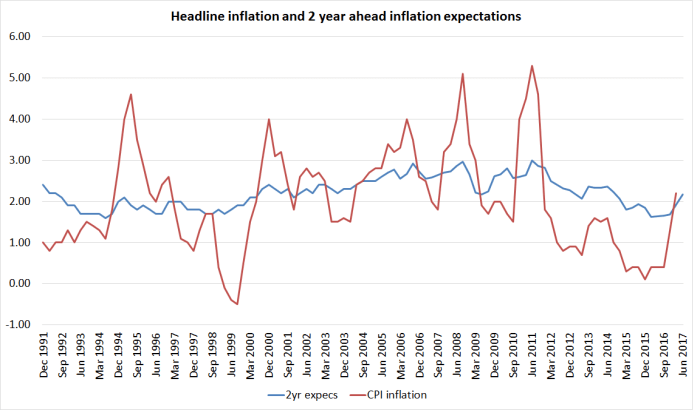
infl and expecs

This measure of expectations isn’t typically very volatile, but it is typically somewhat responsive to changes in headline CPI inflation.  We’ve just had quite a large change in headline inflation, so some increase in the expectations measure shouldn’t be surprising. It certainly shouldn’t be concerning.  After all, ideally, the Reserve Bank wants people to believe, and act as if they believe, that on average over time CPI inflation will average around 2 per cent –  the mid-point of the target range, and the explicit focus of the current (but about to expire) PTA.

In fact, no one really knows whether this survey measure captures how people actually think and behave in real transactions in the goods, labour and financial markets.   It might be as good a proxy as we have, but (a) we don’t know, and (b) it still might not be good at all.  Glancing at the time series, there is a tendency for falls and rise to be at least partly reversed quite quickly.

But if inflation expectations are really in some sort of 2 to 2.2 per cent range, I’d welcome that.  With repeated increase in tobacco excises –  not some underlying economic process –  there is a reasonable case, in terms of the PTA, that headline inflation should average a little higher than the mid-point, and than “true” core inflation.  Only if inflation expectations were to rise further from here might I start to get a little disquieted.

In trying to make sense of the inflation expectations numbers, one thing I haven’t seen mentioned is the Labour Party’s monetary policy release.   There was a quite a bit of focus last month on their pledge to add some sort of employment objective to the Reserve Bank Act, and concerned expressed in some quarters that that could lead to higher inflation over time.   If it was a factor, you’d presumably have to take the probability of Labour leading a new government (call it a coin toss at present?) and multiply that by the probability that the change in regime (and perhaps the sort of people a new government might appoint) would make a material difference over time.  I have no evidence one way or the other, but it wouldn’t surprise me if there was a small effect of this sort.   (My own two year ahead expectation in the survey was 1.5 per cent –  around the current rate of inflation in the Bank’s preferred sectoral factor model).

Not many commentators seem to pay much attention to the rest of the expectations survey, even though its strength is partly the range of macro questions that are asked (although I’ve suggested some modifications to the Bank in their review of the survey).

Take GDP for example. There is no sign of respondents expecting real growth to accelerate.  Two years out they expect annual real GDP growth of 2.6 per cent – down on the previous quarter, but not far from the average response over the last couple of years.    But the survey also asks for quarterly GDP predictions for the next couple of quarters, and year-ahead predictions.   That enables one to derive an implied six monthly growth rate for the second half of the coming year.  Here is the gap between the expected growth rates for the first six months and the second six months, going back to just prior to the 2008/09 recession.

expec GDP growthAs we headed into the recession there was a lot of expectation of a strong rebound.  Even up to around 2012, respondents expected growth to accelerate.   For the last few years they haven’t expected any acceleration, and now the expect it to slow.  To be specific, respondents expect 1.6 per cent total growth in the first half of this year, slowing to 1.2 per cent in the second half of this year.     We don’t know quite why –  perhaps they expect immigration numbers to slow –  but it doesn’t speak of a sense that things are getting away on the Reserve Bank.   Similarly, two years out respondents expected that the unemployment rate would still be 4.9 per cent.

Perhaps these respondents will be proved wrong –  they often are, forecasting is like that –  but at the moment it doesn’t look like an imminent risk of core inflation rising much further, or to levels that might prove problematic for a flexible inflation targeter focused on medium-term inflation outcomes around 2 per cent.

What of the actual labour market data?   We have some problems at present because of the breaks in various HLFS series that occurred when the revised survey questions were put in place last year.  I’m still staggered they could have made these changes without running the two sets of questions in parallel for perhaps a year, to allow robust adjustments to be made for the discontinuities.   HLFS hours worked measures, employment measures, and probably participation rate measures all seem to have been affected to some extent.   We are pretty safe in saying that the number of people employed in New Zealand did not grow by 5.7 per cent last year (as the HLFS suggests).

What of the simplest headline number, the unemployment rate?   There isn’t much doubt that the unemployment rate has been falling over the last few years.  It is what one should expect after a serious recession, and with the stimulus to demand provided by low interest rates and large migration inflows (given that immigration typically adds more to demand in the short-term than it does to supply, thus tending to lower unemployment and use up spare resources in the whole economy).

But what should be somewhat disconcerting is that the unemployment rate has (a) gone largely nowhere in the last year, and (b) is still well above pre-recession levels (unlike the situation in many other advanced countries with their own monetary policies).   In the prevous boom, the unemployment rate got down to around 4.9 per cent as early as the start of 2003.     The picture isn’t much different if one looks at the broader (not seasonally adjusted) SNZ underutilisation measure.

U and under U

There still appears to be some progress in using up spare capacity in the labour market, but not very much at all.

What about the rate of job growth.  Fortunately, we have two measures: the (currently hard-to-read) HLFS household survey measure of numbers of people employed, and the QES (partial) survey of employers asking how many jobs are filled.   Unsurprisingly, the trend in the two series are usually pretty similar, even if there is a fair bit of quarter to quarter volatility.

employment

Since we know there are problems in the HLFS, and the QES doesn’t look to be doing something odd, perhaps we are safest in assuming that the number of jobs has been growing at an annual rate of around 2.5 to 3 per cent.   That isn’t bad at all. But SNZ also estimates that the working age population has been growing at around 2.7 per cent per annum.  No wonder the unemployment rate is only inching down.

One can do a similar picture for the annual growth rates in the two (HLFS and QES) hours worked series.

hours qes and hlfs

It was pretty clear that there was around a 2 per cent lift in HLFS hours worked from last June, just on account of the new survey questions.  It seems safer to assume that total hours worked across the economy might have grown by around 3 per cent in the last year.   That is faster than the growth in the working age population, pointing to some increase in effective utilisation, but not a dramatic one.  For what it is worth, in the latest releases, the two hours measures were both quite weak in the March quarter.

(And remember that nothing in the expectations survey data suggested pressures were likely to intensify from here.)

And what of wages?    There is a variety of measures.  The QES measure is quite volatile –  there are issues of changing composition –  and I don’t put much weight on it.  But for what it is worth, average hourly earnings rose 1.6 per cent in the last year on this measure, around the lowest rate of increase seen for decades.    The Labour Cost Index measures should get more focus (but have some challenges of their own).

lci inflation 2Perhaps there is some sign of a possible pick-up in the analytical unadjusted series (which doesn’t try to correct – inadequately –  for productivity changes) but it is a moderately volatile series, and the most recent rate of increase is still below the peak in the last little apparent pick-up a year or two back.

A common response is “ah, but what about the lags?”.  But as we’ve shown, there is little sign of any material tightening occurring in the overall labour market, no sign of expectations that that is about to change, and so little reason to expect much different wage inflation outcomes over the next couple of years from what we’ve seen in the last couple.  At best, there might be some slight pick-up in wage inflation (especially if the increase in inflation expectations is real), but any pick-up is going to be from rates of increase that have, over the last couple of years, been consistent with disconcertingly low rates of core inflation.

So where does it all leave me?  Mostly content that an OCR around 1.75 per cent now is broadly consistent with core inflation not falling further, and perhaps continuing to settle back where it should be –  around 2 per cent.   Of course, there is a huge range of imponderables, domestic and foreign, so no one should be very confident of anything much beyond that.   But it is worth bearing in mind that the unexpectedly strong net migration over the last few years has been a significant source of stimulus to overall domestic demand (including demand for labour).  In the face of typically too-tight monetary policy, it is part of why the unemployment rate finally started gradually coming down again after 2012.

Whatever happens to the cyclical state of the Australian economy, the National government is already putting in place immigration policy changes that should be expected to lead to some reduction in the net inflow of non-citizens, and two of the main opposition parties are campaigning on promises of much sharper reductions than that.   If such policy changes come to pass then, all else equal, the OCR will need to be set lower than otherwise.  It isn’t something that Graeme Wheeler can or should actively factor into this week’s OCR decision, but it may well be something the acting Governor needs to think hard about (if any decisions he makes are in fact lawful) after the election.
The sort of productivity growth we once achieved

Over the weekend I was (as you do) dipping into the 1968 edition of the New Zealand Official Yearbook, in pursuit of some material I might write about later in the week.

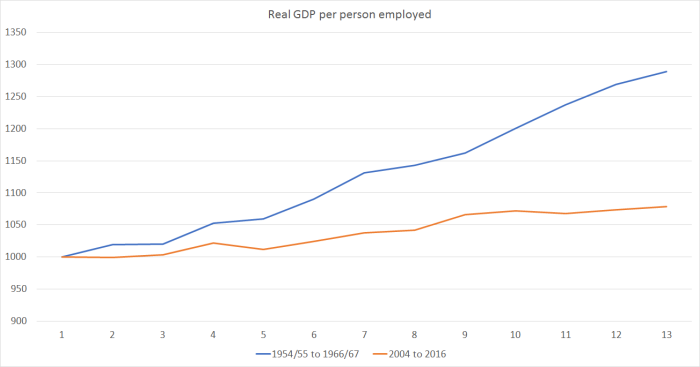
As I flicked through the pages, I stumbled on a table showing labour productivity for the previous 12 years.  It wasn’t an ideal measure.  There wasn’t a good series of hours worked nationwide in those days, so this series was a measure of real GDP per person employed.  But what really caught my eye was the numbers.  Over only 12 years, labour productivity was estimated to have increased by 28.9 per cent.  And this was in an era when experts, and official agencies, were starting to worry about New Zealand’s productivity growth, and to produce data showing that we were beginning to fall behind other advanced economies.

Here is the chart showing both the old data (for 1954/55 to 1967/68) and the same measure (real GDP per person employed) for the 12 years from 2004 to 2016.  For the more recent period I have (a) used an average of the production and expenditure GDP measures, and (b) adjusted for a lift in measured employment of around 2 per cent in June last year, solely because of the change in the HLFS itself.

real gdp per person employed

Over 12 years, they managed 28.9 per cent productivity growth in the 50s and 60s (with a fairly inward looking economy, with high levels of trade protection), and in our generation  in the same period we’ve seen only about 7.9 per cent growth.

Of course, much of the slowdown is a common phenomenon seen across the advanced world, so this isn’t intended mainly as a stick with which to beat New Zealand governments specifically.    But is a sobering reflection on how little material progress we, and other countries, are now making, relative to the astonishing progress seen in those post-war decades.

And, of course, we do have better data now.   A rising share of part-time workers tends to dampen GDP per person employed.  Here is real GDP per hour worked for the same modern period – ie 2004 to 2016.

real gdp per hour worked 04 to 16

Overall growth has been a bit stronger (12.1 per cent in total) on this better measure.  But this measure also puts the New Zealand specific problems into sharper relief.  We’ve had no productivity growth at all, on this measure, for four or five years.  And that isn’t a global phenomenon, just a New Zealand one.

Could we manage 28.9 per cent productivity growth over 12 years again?  It is only an average annual growth rate of a touch over 2 per cent, and the gaps now between New Zealand average productivity and that in the leading OECD economies are so large (they are more than 60 per cent higher than us) that it really should be achievable.   But it would probably require, as a first step, giving up the rhetoric suggesting that really everything is just fine in New Zealand, and starting to focus on measures that might make a real difference.


Full, accurate, and accessible records

That is what the Public Records Act 2005 requires of all “public offices”.    Specifically

Every public office and local authority must create and maintain full and accurate records of its affairs, in accordance with normal, prudent business practice, including the records of any matter that is contracted out to an independent contractor.

and

Every public office must maintain in an accessible form, so as to be able to be used for subsequent reference, all public records that are in its control,

Under the Act “public office”

a) means the legislative, executive, and judicial branches of the Government of New Zealand; and

(b) means the agencies or instruments of those branches of government;

I don’t think there would be any doubt that the Reserve Bank, and its Board, would qualify as “public offices”.  And yet the Board, in particular, appears to have, at best, a shaky grasp on its statutory responsibilities in this area.

As regular readers know, I’ve been trying to understand the process that led to the appointment in February of an acting Governor of the Reserve Bank, including understanding how, if at all, officials and ministers convinced themselves that the appointment is lawful.

As I noted in a recent post

Section 48 of the Act covers a vacancy in the office of Governor.    The key bits read as follows

If the office of Governor becomes vacant, the Minister shall, on the recommendation of the Board, appoint….[a person] to act as Governor for a period not exceeding 6 months or for the remainder of the Governor’s term, whichever is less.

The critical phrase here appears to be “whichever is less”.      When Don Brash resigned as Governor in April 2002, there was about sixteen months to run on his term.  The then Minister appointed Rod Carr to act as Governor.    He could be appointed for as long as six months, because there was still sixteen months to run on “the Governor’s term”.  By contrast, on 26 September this year there will be no days left on the Governor’s term.  Graeme Wheeler’s term will have expired at midnight the previous day.   So an acting Governor can only be appointed for…….. zero days, since there are no days left on “the Governor’s term”.  In other words, the Act simply does not appear to allow an acting Governor appointment along the lines of the (purported) Spencer appointment.

In an earlier post, I covered the extensive material The Treasury had released on the period leading up to the acting Governor appointment.

By contrast, the Reserve Bank Board released almost nothing.    I had lodged a pretty comprehensive request seeking

copies of all papers of the Reserve Bank Board relating to the end of Graeme Wheeler’s term as Governor, the process for appointing a permanent replacement, and the appointment of Grant Spencer as acting Governor.   This request includes papers on the Board’s agenda, minutes of relevant discussions, papers/letters sent to the Minister of Finance or Treasury, and filenotes of any relevant meetings.

I got back a copy of a single very brief letter from the chair of the Board to the Minister of Finance recommending the acting Governor appointment (with no supporting analysis or advice).    The only material they told me they were withholding was some Human Resources advice and some in-house legal advice.  The latter apparently covers the questions around the relevant provisions of the Reserve Bank Act, and I have appealed the Ombudsman the decision to withhold.   There was, if the Board was to be believed, nothing else at all.

But that seemed odd.  I knew that Board meetings had minutes, and if those minutes were often quite loosely written (in another context, I’m dealing with legal uncertainty created by loose Board minutes from 25 years ago), at least the minutes seemed likely to exist.  In fact, the letter from the Board chair to the Minister of Finance explicitly referred to an agreement by the Board on 30 January to make the acting Governor recommendation.  Surely there were minutes of that meeting (and the Bank’s Act explicitly covers both physical meetings and teleconference ones)?    They should have been captured in my earlier request, but perhaps there had been an adminstrative oversight?

I also knew from the papers Treasury had released that by late last year the Board had already been well-underway in getting going a process for appointing a new permanent Governor once Graeme Wheeler’s term expires in September, and had been told as late as the end of November by the then Minister of Finance to keep on with that process, apparently regardless of the election issue.  In fact, the Treasury papers referred to the Board already having appointed a search firm.  So out of curiousity, I lodged a new request, not just for the minutes of the 30 January meeting, but also for minutes of any Board meeting in the December quarter last year.

I got a response to that request yesterday.  They released in full the minutes of the half hour (teleconference) Board meeting held on 30 January.  They were brief, but of some interest.

The Board received advice from the Minister of Finance that, on advice the Cabinet Office and after consultation with Cabinet, he had decided to appoint an acting Governor for a six month period to cover the post-election caretaker period, allowing the next Government time to make a decision on the appointment of a permanent Governor for the next five-year term. The Minister asked the Board to recommend a candidate for acting Governor.

The Board agreed unanimously to recommend Grant Spencer, currently Deputy Governor and Head of Financial Stability, for the role of acting Governor. The Chair would forward this advice to the Minister.

The Board chair’s letter to the Minister, dated 31 January, had sought to imply that the initiative for the acting appointment recommendation had come from the Board itself (the Act certainly envisages the Board taking the lead).  That never seemed likely, given the material Treasury and the Minister of Finance had released.  These minutes confirm that the Board was simply told what to do, and complied.  It is a poor reflection on the Board  that they had simply seemed unbothered about moving ahead to make a long-term appointment, which would take effect around the time of the election, in a climate in which there was little cross-party consensus on Reserve Bank matters.  Fortunately they were stopped in their tracks by the Minister of Finance.

It is another illustration of the weakness of the Board (not necessarily the current individuals, but the structure).  It reinforces my call to remove the recommendation/appointment powers from them back to the (normal international) model in which the Minister of Finance simply appoints a Governor.   These people simply don’t have the background, or any legitimacy, to be making an appointment of one of the most powerful people in New Zealand.   If there is a change of government (in particular), amending this provision of the Reserve Bank Act should be an early legislative priority.

But what also caught my interest is that although the Board released the minutes of its three meetings held in the December quarter (I will post a link when the Bank puts the material on its website), there is no record at all of any of their deliberations or decisions around the process they had underway of moving towards appointing a new Governor.  We know a lot about it from the Treasury documents, but if these releases are to believed, the Reserve Bank’s Board simply kept no records.

There was plenty of material omitted from the minutes that were released, but all the headings of the individual items were released.  Some of the decisions to withhold look questionable, but since I wasn’t really interested in that other material, I won’t take that any further.

In the October 2016 meeting there is an item 8.3 “Director’s-only discussion”.    That may well have been an occasion on which they dealt with the coming gubernatorial appointment.  But, if so, we’ll never know.    The minutes of this discussion weren’t withheld (in which case that withholding could be challenged to the Ombudsman, and future historical researchers would probably get access anyway) but simply don’t exist at all.    Minutes are typically taken by the Board secretary, who is a Bank staff member, but there is no reason why one of the Board members themselves could not have minuted this discussion, and recorded them in a version of the minutes not given general circulation.  But there appears to be no record at all.

In the November 2016 meeting there was nothing similar at all, and no (apparent) discussion of these issues.   In the December 2016 meeting, despite coming only a couple of weeks after Bill English had told the Board chair he was comfortable with them moving ahead with selecting a Governor recommendation, there is also nothing recorded.  Again, there is an item 8.3 “Non-executive directors only Session”, but there are no minutes at all (again, to stress, the minutes aren’t withheld; they simply don’t seem to exist).

It is quite extraordinary, given that we know from the Treasury material that there had been interactions with the Minister of Finance, the directors had appointed a search firm, and were planning to start advertising in January, only a month later.  But where are records of any of this?  It is possible that some of the decisions had been made earlier, but it is simply inconceivable that there was no substantive discussion, and no decisions taken, in the last three months of last year.   But none of it appears to be recorded.

Now perhaps there are some secret records –  file notes, email exchanges among directors – that the Bank staff who handled my request were not aware of. But any such material would have been covered under one or both of my OIA requests, and when I lodged the OIA requests I was quite explicit that they were requests to the Board, not to the staff of the Bank.

We seem to be in the sad state of affairs where either the  powerful Board of a major government agency is denying the existence of records that do actually exist about the process they had underway, and had to call to a halt, to appoint a new Governor.   That would be in breach of the Official Information Act.    Or the same Board is so shoddy in its record-keeping that it would seem almost certain to be in breach of the Public Records Act.    I’m not quite sure which to believe (although I suspect it is mostly the latter explanation).  Neither seem remotely satisfactory.  Neither option seems like what one should expect from a government-appointed Board responsible for recommending the next Governor of the Reserve Bank, holder of the most powerful unelected role in New Zealand.

It is not even as though this is material about something under active consideration.    The search process they were working on late last year, apparently oblivious to the significance of the election, was called to a halt.    In fact, as the Bank told us last week

The Reserve Bank Board of Directors’ recruitment process to identify a successor to Mr Wheeler is to commence later in the year.

We have record-keeping requirements on public agencies, and disclosure requirements such as the OIA, in significant part to enhance accountability and

thereby to enhance respect for the law and to promote the good government of New Zealand

If records simply aren’t kept, we have no way of knowing whether public appointees have done their job adequately,  That doesn’t enhance respect for the law, or promote good government.  Specifically, we still have no basis for knowing how the Board of the Bank concluded, or whether they advised the Minister, that the appointment of an acting Governor in these circumstances was lawful.

Full, accurate, and accessible records are a statutory obligation.  The Reserve Bank’s Board doesn’t appear to have been complying, even though the appointment of a new Governor is one of the few areas in which the Act gives them explicit decisionmaking powers.   It simply isn’t good enough.

UPDATE: The Bank appears to have decided not to put this material on its website, contrary to their usual OIA practice.  Here are the minutes of the three December quarter meetings.

1.3 Board Minutes – 20 October 2016 – for release

1.3 Board Minutes – 17 November 2016 – for release

1.3 Board Minutes – 15 December 2016- for release

A world-leading debate on immigration?

Sometimes it can be hard to keep up with the flow of pro-immigration articles in the Herald.  At the moment of course, even they tend to be written with a defensive, more than celebratory, stance.

On Monday, the academic sociologist, Paul Spoonley –  who leads CaDDANZ the MBIE-funded academic immigration advocacy and research programme –  was out with a piece headed Xenophobia not welcome in migrant debate.     Hard to disagree with that.  Of course, not all fears are irrational, and political debate rarely occurs at the rarefied level of the fabled academic seminar room, but “deep-rooted fear towards foreigners” (the OED definition) doesn’t seem a particularly good basis for New Zealand’s immigration debate.  But what was a bit puzzling when I read the article, and then re-read it, was that Professor Spoonley offered no evidence that “xenophobia” was what was at work here.  And that’s good.  Presumably if there was such evidence he’d have mentioned it.

And despite generally being a champion of New Zealand’s non-citizen immigration policy, Spoonley himself has come to the conclusion that current immigration levels are “unsustainable” and some changes are needed.  Presumably he didn’t reach that conclusion based on “xenophobia”?

As it happens, most of the proposals he puts forward are pretty mild, or not even policies at all.

There is a case for revising aspects of the recruitment and approval of immigrants. The low value courses and qualifications offered by some educational providers puts New Zealand’s reputation at risk.

One could add that it is, in effect, an industry granted big export subsidies.   We’d sell more of any specific good or service, if doing so came attached with work rights or residence points.     Curiously, export education isn’t even that successful a subsidised industry.  The total number of people granted student visas in 2015/16 was only around 4 per cent higher than at the previous peak in 2002/03.

A more proactive regional focus. Canada and Australia allow regions to set their own targets and to recruit the skilled immigrants needed locally – without undermining local workers or wages. Up to a third of the points required for approval for permanent residence can be granted by regions.

This is even more daft, and dangerous, than the existing (quality-diluting) policy of giving additional points to people with jobs outside Auckland.  And since most local councils can’t even do well stuff they are already responsible for –  not making urban land unaffordable – I’m not sure I’d want to trust them with immigration policy.

Social cohesion. Positive settlement outcomes for both immigrants and host communities would benefit from a greater investment in helping transition immigrants to life in New Zealand – more generous provisions for English language acquisition, for example, would help.

Of course, we could spend even more taxpayers’ money, or we could simply require that people settling here –  refugees aside –  actually speak pretty good English.  These days, most really highly-skilled people –  the ones we might actually benefit from –  do.

And his final proposal

Let’s have a debate about population – its growth and distribution – as a context for decisions about immigration. And let’s not see immigration as a single causal factor or as a simple solution.

This is rhetoric rather than policy, but by all means have the debate.  I’m pretty wary of “population policy” myself, but some serious study of whether policy-driven rapid population growth over most of the period since World War Two has helped lift the material living standards of New Zealanders, or productivity in the New Zealand economy, would be a worthwhile subject for academic researchers.

In the end, Spoonley is mostly playing distraction.  He flings around the charge of “xenophobia,” without any substantiation, and then his own suggestions would make little useful difference in responding to the economic challenges, except by some tightening of rules around student visas (something the government has not yet addressed at all).

But the column that really grabbed my attention was one from the Herald business editor Liam Dann, headed Let’s lead the world on immigration debate.  A worthy aspiration no doubt.  But not, unfortunately, one the column contributed to. Instead, it is riddled with questionable claims and false comparisons, and at one point represents another example –  this time not from a government minister but from an acolyte –  of just making things up.

There is the weird opening.

It looks like immigration is going to be a big election issue.

That’s a shame.

He doesn’t like the way the debate has occurred in some other countries, so seems to think we should take some sort of self-denying ordinance, and not debate one of the larger government economic and social policy interventions there is.   Non-citizen immigration is, after all, far bigger here than in the UK, the US, or France.  Has been for a long time.

There have been a series of record highs for about a year. The numbers exceed even the great colonial influx into New Zealand in the 19th century.

On a per capita basis they exceed what the UK was experiencing pre-Brexit.

This is all rather misleading.   Considered per capita, the net inflow over the last year (New Zealander and non-citizens) hasn’t even exceeded levels seen 15 years ago, let alone at the peaks in the 19th century.  And, by contrast, every single year the number of non-citizens we let in far exceeds (per capita) the inflows to the UK.  So the analytical and policy issues shouldn’t be about this year’s PLT flow, but about the numbers (and terms on which) we allow non-citizens to settle and/or work here.

According to Dann

So we are vulnerable to populist political hijack.

Any world-leading debate on these topics would recognise that the essentials of our immigration policy haven’t changed much for 20 years at least.  Broadly speaking, we moved back to being a high (non-citizen) immigration country in the early 1990s.

I’m not even sure what “populist political hijack” really means, other “than some politician I really don’t like, responding to an issue of real public concern”.   Sounds like democracy to me, messy as it often is.

Funnily enough, Dann also thinks there are some real issues that need addressing.

Immigration policy of the past decade is not sustainable. Our infrastructure is under pressure and we are woefully behind in building to catch up. That’s not the fault of immigrants, of course. It is the fault of politicians and voters.

Not sure how this is all the fault of voters.   We were never asked if we wanted to have record rates of population growth, even though those in office knew that (say) the urban land markets were dysfunctional etc, so that importing lots of new people was only likely to exacerbate house price problems.

And, of course, the issues aren’t just about house prices or road congestion.  There is the small matter of the continuing poor productivity growth in New Zealand (none in the last five years), the shrinking (as a share of GDP) export sector, or the realities of living in a country at the ends of the earth where, for 40 years (with cyclical ups and downs) the natives have been leaving, pursuing better opportunities abroad.   Oh, and the highly misleading descriptions of the immigration programme –  we’ve repeatedly been told it was a skills-focused programme, helping lift productivity etc, and now MBIE’s own numbers show than more than more than half those applying for residence don’t have skills that command even $49000 per annum in the New Zealand labour market.

Dann continues

In other words, it’s our fault. We have been trying to have our cake and eat it too.

No, it isn’t “our” fault.  Voters didn’t ask for this.  Political leaders –  from both sides, but National is now in office –  made it happen.  And there is no “cake” for New Zealanders as a whole, only some nasty sectoral redistributions, and an overall economic performance that continues to underwhelm.   But apparently

One thing lost in the immigration debate at the moment is how successful the policies have been for New Zealand.

Really?

Economically, we have outshone our international peers. We have skipped the economic pain that most of the world felt after the global financial crisis.

That’s not all down to immigration but it has played a big part.

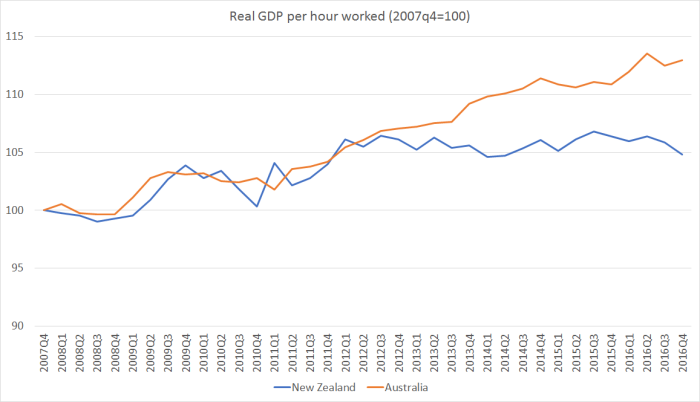
This is just making stuff up.  As I showed yesterday, we’ve done no better than the United States, which was the epicentre of the crisis –  and that despite having about three times the rate of legal immigration the US has (and other bonuses like a record average terms of trade).   We had a nasty recession, that took a long time to recover from –  and actually immigration policy in the “bust” period wasn’t materially different than it had been in the earlier “boom”.   We’ve underperformed Australia too.

real gdp phw dec 16 release

Sure, there are places that are worse still –  much of the euro area most notably –  but there is just nothing to back this claim that we have “outshone our peers”,  let alone that immigration policy has enabled us thus to shine.  Saying it often enough won’t make it true.   In fact, sometimes reality breaks through and even Dann seems embarrassed about channelling this stuff.

When you crunch the numbers on per capita GDP growth it has been far less flash.

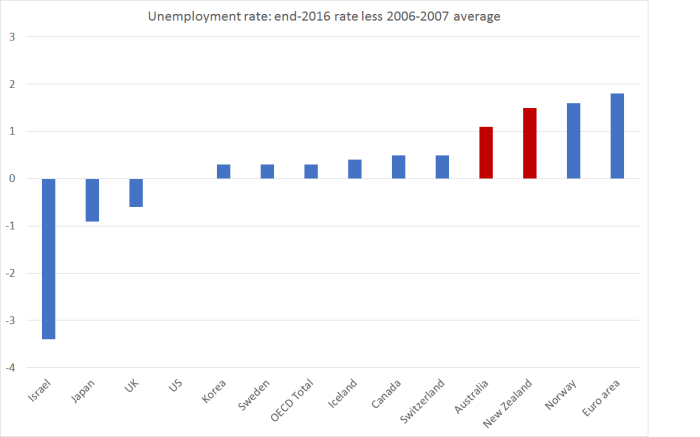
Indeed. And it is things like per capita income growth and productivity growth that count.   Even on the labour market side of things, the SNZ release this morning shows that most of the OECD countries that control their own monetary policy have lower unemployment rates than we do.

Culturally, too, New Zealand has grabbed global attention in a way unimaginable a generation ago.

This country used to be largely unknown outside the Commonwealth, where we were acknowledged as a backward British colony that was good at sport and had lots of sheep.

Since we still hold the record low test cricket score, racked up in the bad old days when we had some of the very highest material living standards in the world, I’m not even sure about that “good at sport”.

But, frankly, what is he talking about?

100 years ago, before the First World War, people flocked here – and not just from the Commonwealth – to study New Zealand’s economic and social reforms.  And they often marvelled at what had been created, so quickly, so far from the centres of the world ( including (but not limited to) the best material living standards in the world).

Actually, 30 years ago, before the great immigration resumed, people abroad were fascinated by New Zealand’s economic reforms.  It was a darker story by then, trying to pull back from decades of decline, but the interest was real nonetheless.

Does anyone remember Dame Edna’s tragic Kiwi bridesmaid Madge Allsop? She summed up our image pretty well.

Personally, I don’t remember this character, but I’m sure Dann isn’t trying to suggest that Australians have stopped making fun of New Zealanders (accent and all), or vice versa.

So what is he talking about?  Does he know?   Allegedly….

Against all odds, New Zealand became cool.

Where is the evidence?  What does “cool” mean in this context?  And what does it do, even if it is true, for the living standards of ordinary New Zealanders?  Dann doesn’t tell us.  And yet somehow

Our place in the world has changed and that warrants debate about the immigration policy settings we have in place.

Actually, if one takes any sort of longer view of modern New Zealand history, our place in the world is in decline.  That is more or less inevitable.  We were once one of the handful of (very successful) offshoots of the most powerful empire in the world.   100 years ago there weren’t many independent countries, and few as successful as we were.  Since then,  many more countries have emerged, and quite a few have got a lot richer.   The UK’s global position has declined, and even the US is no longer what it was (in say the decades from 1940).  We are neither powerful nor important –  no longer with automatic access to counsels of the great and powerful we once had –  and, worse, we aren’t even that successful economically any more.  That has real implications for our own people, especially the poorer of them.

So, I really have no idea what Dann is on about.  Perhaps he is thinking of some references in once-hip publications like Lonely Planet guides?  But to what end?  As I ‘ve shown previously, our exports of services –  the lure of tourism, export education etc –  are lower now as a share of GDP than it was 15 years ago, in an age when international trade in services globally has become ever more important.

Leaving aside the detached-from-reality rhetoric, Dann tries to come back to specifics

The Government has belatedly started to recognised that with policy tweaks that have not yet had time to show results.

We could go further and look at more fundamental changes – such as how we set the criteria for residency.

But it would be a terrible thing for the debate to play out here the way it has in other parts of the world.

Quite what does that mean?  You might approve or disapprove of the Brexit result (I approve), but the process was an open one, there were no riots on the streets, and views differ on quite how large a role immigration policy played anyway.

I reckon Donald Trump is fundamentally ill-equipped to be US President.  Then again, the choice was a poor one.  I couldn’t have voted for him or his principal opponent.  And is a physical wall a good solution?  Quite probably not.   But it was an open and democratic election, and there were plenty of other issues at play in the election.  And –  unlike us –  the US really does have a large stock of illegal migrants in the country.  

Alternatively, and optimistically, New Zealand is in a position to lead the world on the immigration debate. We could do this right.

But simply flinging around, as slurs, references to Brexit or Trump isn’t really a great start to the sort of debate Dann claims to want to have in New Zealand.  After all, if immigration is an issue in those countries, there are good reasons why it could be a much bigger issue here (we simply take more people, per capita).

We could pay close attention to the data, we could look at economic impact studies and we could have a frank and open discussion about the kind of country we want to build.

That would certainly be a novel (but welcome) approach.  Perhaps Dann could point us to the New Zealand specific studies illustrating how New Zealanders, and New Zealand productivity levels, have been raised by decades of large scale immigration, much of it simply not that skilled?  Other champions of immigration policy haven’t been able to.    There is plenty of theory, but not much grounded analysis that takes specific and detailed account of the circumstances of New Zealand.

Dann doesn’t like the idea of Labour promising to do something to markedly cut the non-citizen immigration flow.

It is difficult for Labour because the politics are polarising. Labour wants power, it sees a rich vein of discontent but in the current topsy-turvy political environment, it has to make careful choices.

Retaining a traditional, optimistic liberal view leans towards free and open borders. That now puts them on the side of the neo-liberal globalists – not a fashionable place for the centre-left these days.

But campaigning to radically slash immigrant numbers by unspecified amounts puts them in the camp of angry nationalists like Winston Peters, Donald Trump and Nigel Farage.

It would certainly be good to see some specifics from Labour –  it is after all only four and half months until the election.  But it is not as if Labour has always been some sort of “open borders” party.  It was the Labour icon, Norman Kirk, who in the 1970s put in place the biggest post-war adjustment to immigration policy, depriving people from the United Kingdom (then far and away the main source country) of their automatic right to move here.

For the last few decades, Labour and National have had much the same immigration policy –  believers, apparently, in the rhetoric of lifting productivity through immigration, and in the skill shortages, that never seem to ease no matter how many decades we wait.

Suggesting that Labour would cut immigration by tens of thousands certainly needs something concrete behind it –  and soon –  but I’m afraid that comparisons between Andrew Little (or Jacinda Ardern, Grant Robertson, David Parker and Phil Twyford) and Donald Trump simply aren’t worthy of a serious journalist, and especially not one making the high-minded call for a world-leading immigration debate.

Dann starts to come to the end of his column

We can’t let the politics become emotive. This is fundamentally about economics. It should be boring.

Not sure I entirely agree.  Politics is about conflicting world views and values.  There are, and inevitably will be, emotional dimensions about that.  Personally, I’m angry at the decades of failure by a succession of political leaders to really grapple with New Zealand’s economic underperformance.   And pretty upset about the apparent (practical) indifference to the housing disaster, all politically wrought.    But Dann asks

Can we quantify how much value immigrants add to the economy?

How does the added value compare with the economic cost of new infrastructure that we need to cope with increased population?

It isn’t really a fiscal question, but the honest answer to his first question is that “no, no one really has”.  It has been a programme based on faith and theory, and often the short-term self-interest of employers (especially those in the non-tradables sector).    The government does not know if large-scale immigration has added to New Zealand’s productivity over time.      For such a large experiment, that is an extraordinary failure.

Distributional issues matter.

The harder question is trying to understand how the value and costs are distributed.

Some established citizens will be bigger beneficiaries than others. There are different geographic impacts.

Given we’ve had an immigration policy that favours wealthy immigrants it is self-fulfilling that our policies have increased wealth in this country.

But they may also have exacerbated inequality

Again, he has lost me.  Most of our immigrants aren’t very skilled or wealthy at all –  most can’t even earn $49000 a year, the starting salary for a primary teacher with a basic degree.  So there is no automatic presumption that the country is wealthier as a result (again, per capita, the only measure that really counts).  And it shouldn’t really be news to the business editor of our largest-circulation paper that inequality hasn’t materially changed in New Zealand in the last couple of decades (at least if the distorted housing market is excluded).   The New Zealand Initiative, rightly, point it out repeatedly.

I’m all for a good quality debate about New Zealand’s immigration policy.  One is certainly well overdue.  But when Dann’s call for such a debate is so riddled with errors, misconceptions, and slurs, it is hardly a good start.      In the end, it is hard to avoid a conclusion that what Dann really wants is just a continuation of the status quo, with a few more houses and roads built, and the column is mostly an attempt to avoid the real debates.   It certainly isn’t the start of a world-leading debate, especially not one that engages seriously with the decades of serious economic performance, or with the revealed choices of New Zealanders –  for 40 years now –  to leave.

A government that simply makes things up

Perhaps all governments these days eventually do it, but one of the things that I’ve come to dislike most about our current government is the way they and their acolytes simply make stuff up.    I could, I suppose, understand them not actually doing anything much.  After all, they didn’t promise to do anything much.

But the endless spin, and stuff that is just made up, sickens me.  Apart from anything else, I try to bring up my kids heeding the biblical injunction to honour those in authority over us.  I don’t read that as suggesting people won’t disagree with those who hold office, but there is something quite sick about the political process –  and perhaps about a society that tolerates this stuff –  when so often one reads comments from senior ministers or the Prime Minister to which one can only  explain to kids interested in such things that “they are just making it up”.    We should expect much better than that.

I’ve written before about the current and former Prime Ministers’ dismissal of housing or conjestion problems as “quality problems” or “signs of success“.  And there are the repeated claims that New Zealand’s economy is doing better than almost any other advanced country –  a suggestion ably challenged in an article by journalist Graham Adams yesterday.   But today, since it is the day Murray McCully leaves ministerial office after a very long period in ministerial roles in two governments. I wanted to focus on an unfounded claim in a recent speech to the New Zealand Institute of International Affairs by the outgoing Minister of Foreign Affairs.

He begins with an unexceptionable observation

The key feature of the past decade has been the rise of China, in terms of both our bi-lateral relationship, and as a regional and global power.

Not just of the past decade, but the past several decades.

And, as the Minister notes, there has been a big growth in bilateral trade (goods and services).

In my eight and a half years in this role I have seen our exports to China increase from around $2 billion to nearly $10 billion, and visitor numbers more than quadruple from under 100,000 to over 400,000.

But then he dramatically over-reaches

Had it not been for the dramatic expansion of trade and economic relations with China in the early years of the Key Government, New Zealand would have suffered a long and sustained recession, and all of the associated social challenges that we have seen in some European nations.

There is simply no support for this proposition anywhere in the rest of the speech.

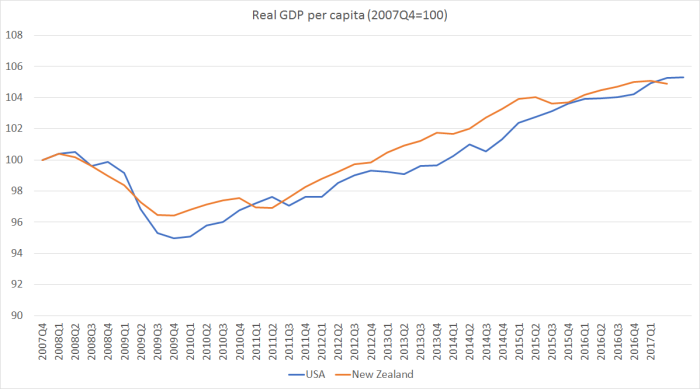
The implication, of course, is that New Zealand has done well over the term of this government.  But here is a chart of real GDP per capita for New Zealand and the United States, both normalised to 100 in the December quarter of 2007, just prior to the recession.

real GDP pc NZ and US

The United States, you will recall, was the epicentre of the financial crisis, and had a very nasty fall in house prices.  The United States cut interest rates as far as they then thought they could go.

New Zealand, by contrast, had a relatively modest home-grown financial crisis (localised in the non-systemic finance companies), never reached the limits of conventional monetary policy, and had a much stronger fiscal position going into the recession than the US (or most other advanced countries had).  Oh, and we the big bonus of a sharp fall in interest rates, as a country that had borrowed heavily from the rest of the world.

And yet look at the chart.  The initial recession was certainly a little deeper in the US than it was here –  but China wasn’t a significant influence on what was happening here in 2008/09.  But then we had a double-dip recession in 2010.

For a couple of years it looked as though we might be doing a bit better than the US, at least on this metric, but even that optimistic possibility has now faded away.  Over the nine years shown, real GDP per capita has grown almost exactly as slowly in New Zealand as it has in the United States (average growth rates of barely 0.5 per cent per annum).   You’d have to know economic data pretty well to be able to tell apart the US and New Zealand lines for the last six years or so.

So we had a pretty nasty recession, which we took years to recover from.  On some metrics – eg the unemployment rate –  we still haven’t.  And all that even though China took up a larger share of our exports.  It is so even though in those “early years of the Key government”, China was a big source of demand driving activity in our biggest trade and investment partner, Australia.

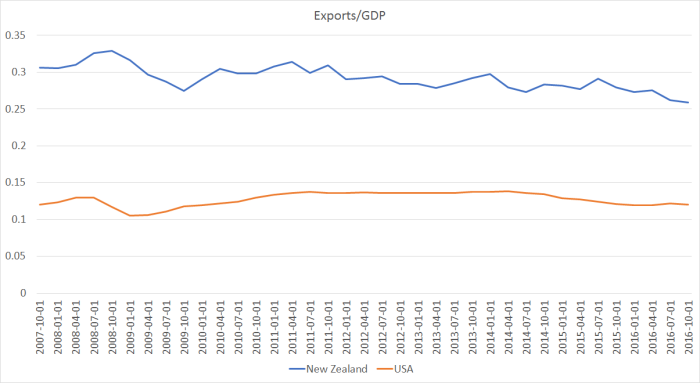
The Minister seemed to be telling a trade and exports story –  certainly those are the numbers he quoted.    But here are exports as a share of GDP for the two countries, again back to December 2007.

exports to GDP US and NZ

In both countries, exports took a hit during the recession – in the US’s case it was mostly volumes, while it our case much of it was prices (the fall in export prices).   But, despite all that additional trade between New Zealand and China, our export share of GDP has fallen quite a bit over the last few years, while that in the US (always much lower, given that the US is a large country) has held remarkably steady.

Perhaps this fawning “China our saviour” line went over well when the Premier of China was visiting recently, but it really doesn’t amount to much at all.  The country composition of our exports has changed –  and for a couple of years perhaps high prices out of China for milk powder lifted farmer incomes –  but as a share of the overall income, exports have been shrinking.  We produce stuff (mostly bulk commodities), and someone buys it.  In recent years, China has been a more important buyer –  although Australia remains our largest export market –  and the free trade market with China is likely to have been helpful, but it has hardly transformed our economic fortunes.

There are other differences between the US and New Zealand experiences.  The US unemployment rate went up much more than ours did during the recession, but then came down much more sharply and is now a bit lower than ours.

U rates in floaters

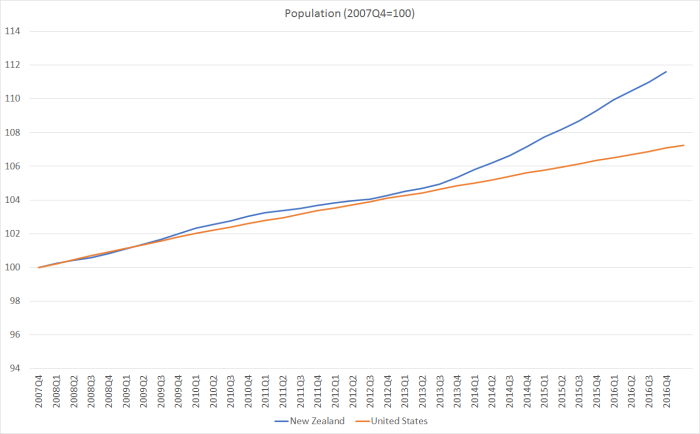
But one striking difference over the last few years is in the estimated population growth rates.

population US and NZ

Overall, ours is a story of little or no productivity growth (none for the last five years), of an economy that –  going by the headline statistics –  seems increasingly inward focused, reliant on population-fuelled (and earthquake rebuild fuelled) domestic demand.   And it is a pretty poor performance all round.

There are, of course, worse places among the advanced countries, and if that is all the Minister had wanted to say, no one could disagree.  But instead he over-reached, suggesting that somehow we’d done well.  We haven’t.  And mostly that is down to our own choices –  or, more specifically, those of the government in which Mr McCully has been a senior minister.

Brash vs Gould vs Brash

Former UK Labour MP (and academic administrator) Bryan Gould, and former Reserve Bank Governor (and political leader) Don Brash have been engaged in a fairly robust exchange of views in the op-ed pages of the Herald.

Gould began it a couple of weeks ago with a column, initially prompted by some combination of the initiatives from both the Minister of Finance, and the Labour Party, that may lead to governance reforms at the Reserve Bank, and Sonny Bill Williams’ Islam-inspired objections to interest, and hence to sponsorship by the BNZ.   The politicians being not very radical at all, Gould pointed us to Williams.

Sonny Bill, however, has succeeded, if we are thoughtful enough to recognise it, in throwing a spotlight on the entire role of the banks in our economy and our society.

Gould’s specific concern?

It is the willingness, not to say keenness, of the banks to lend on mortgage that provides the virtually limitless purchasing power that is constantly bidding up the prices of homes in Auckland and, now, elsewhere.

It is the banks that are fuelling the housing unaffordability crisis, a crisis that is leaving families homeless and widening the gap between rich and poor.

Gould isn’t keen on operational autonomy for the Reserve Bank, whether on monetary policy or banking regulation, at all.

Why should the Government be able to hide behind the Governor of the Reserve Bank and duck responsibility for a policy of the greatest importance to so many Kiwis? Why should ministers not be held to account in Parliament and to the country for failing to deliver outcomes they were elected to deliver?

And actually, I have some sympathy with him on that.   Banking regulation should be administered by the Reserve Bank, but approved by the Minister of Finance or Parliament itself.

But Gould’s argument isn’t some abstract one about the optimal assignment of powers within the Reserve Bank Act.     His concern is that banks create credit, and in so doing create new deposits, as a profit-making business.

They lend you money that they themselves create out of nothing, through the stroke of a pen or, today, a computer entry.

The banks make their money, in other words, by charging interest on money that they themselves create. Not surprisingly, they are keen to lend as much as possible.

In fact, most businesses are keen to increase volume, at least for as long as they can make money on the marginal addition to their sales.   Supermarkets are typically keen on selling you more groceries, health food shops on selling you more health food, fashion outlets on selling you more clothes etc.  But Gould’s bugbear is banks (and, presumably, other lending institutions).   To read Gould, you’d think that banks crammed money down the throats of unwilling borrowers.  There doesn’t seem to be any role for demand in his story (let alone for the regulatory restrictions that artificially inflate urban land values).  Banks, as currently structured, don’t appear to serve any socially useful purpose.

As you might expect, Don Brash –  a former Governor, a former ANZ director, and currently chair of one of the small Chinese banks in New Zealand –  disagreed.   Writing of Gould he notes

He then goes on to blame this money creation for the housing affordability crisis which Auckland now finds itself in, and to attack the Government for washing its hands of this aspect of the housing crisis.

Mr Gould is not alone in peddling this nonsense, but that certainly doesn’t make it correct.

Don Brash isn’t disputing the rather obvious point that the banking system, in the course of lending, also create deposits.  As he says

The banking system does create money.

But at this point he rather veers away from the substance of the issue (Gould’s claim that bank credit creation at the root cause of the housing affordability problems – dismissed by Brash as “peddling this nonsense”) to make a correct, and useful, but in this context perhaps subsidiary, point.    What is more or less true of the system as a whole, just isn’t true for any individual bank.

If individual banks really could create money by “the stroke of a pen or a computer entry”, as Mr Gould contends, why do they bother paying interest on deposits, why do they borrow funds from parent banks overseas, why do they borrow funds in the international market, why do they need to hold some funds in government securities as a liquidity reserve, why do some banks occasionally run out of money when customers lose confidence in them?

….I now chair the small New Zealand subsidiary of the Industrial and Commercial Bank of China….. It would certainly make life very much easier if we could, “by the stroke of a pen or a computer entry”, simply create the money which we lend out to New Zealand borrowers. Unfortunately, we can’t.

Individual banks, and their managers and boards, have to worry (sometimes a lot) about the funding side of their balance sheets.  If Don Brash’s bank increases lending to New Zealand borrowers, that process will indeed create new deposits for the New Zealand banking system as a whole.  But there is no guarantee any of those deposits will come back to his bank.  In the immediate term,  if one bank increases lending more than other banks do, that will lead to a loss of liquidity from the lending bank.  In boom times, it might be easy to fund such rapid lending growth.  In times of crisis, funding can be almost everything.  I was heavily involved in these issues in the midst of the 2008/09 financial crisis, and recall banks telling us then that no matter what initiatives the government or the Reserve Bank took, they’d be reluctant to increase lending if they couldn’t count on secure on-market funding.  Their Boards just wouldn’t let them.

But in a way, Brash’s response didn’t actually deal with Gould’s point –  that for the banking system as a whole, deposits don’t usually constrain lending. Rather the two typically grow as part of a simultaneous process (with some exceptions about changes in the current account deficit etc).  If so, perhaps the credit creation process could be the root cause of the (housing) problem?

Gould returned to the fray in a column in yesterday’s Herald.   But, oddly, he doesn’t attempt to defend his view that banks are the cause of the housing problem.  Rather he tries to teach the former Governor to suck eggs, offering lay lessons in monetary economics, and suggesting that Brash doesn’t really know what he is talking about.

In fact, he first misrepresents what Brash said

…..I said the vast majority of new money in circulation is created by the banks “by the stroke of a pen”, and they then make their profits by charging interest on the money they create.

If this is “nonsense”, the “peddlers” include some very distinguished economists.

But, as you can see from the quotes above, Brash seems to be mostly using the “peddling nonsense” phrase to respond to the housing affordability argument.  Moreover, he explicitly states (see above) that the banking system creates money  (personally, I’d prefer he’d used “deposits” rather than “money”).

In fact, in the entire latest Gould column there is not a single mention of the housing issue.  Instead, there are extensive quotes from a very good –  but entirely conventional –  Bank of England Bulletin article from a few years ago on how the credit and deposit creation process actually works, and how that process is quite different from the very stylised approach that often lingers in elementary economics textbooks.     In fact, our Reserve Bank made many of the same points in an article in their Bulletin a few years earlier.  A (then) Reserve Bank senior manager was making these points in a speech 15 years ago.  But the Bank of England article is very good.    Then again, recall that the Bank of England runs things pretty much exactly the same way our Reserve Bank does.    There simply isn’t any stunning fresh insight in the BOE piece to up-end how best to think about monetary policy and banking regulation.

So when Gould quotes the BOE piece

They then go on to say, “Another common misconception is that the central bank determines the quantity of loans and deposits in the economy by controlling the quantity of central bank money – the so-called ‘money multiplier’ approach…[but that] is not an accurate description of how money is created in reality.”

They go on. “Banks first decide how much to lend depending on the profitable lending opportunities available to them – which will, crucially, depend on the interest rate set… It is these lending decisions that determine how many bank deposits are created by the banking system.

Anyone who knows anything about this stuff is simply drumming their fingers, and going “yes, yes, tell us something we didn’t know”.   But do notice the mention of interest rates in that second paragraph.  The way central banks choose to manage the monetary system these days relies on adjusting an official interest rate, not on attempting to directly manage quantities (of base money, lending, deposits or whatever).   Demand for credit matters quite a lot, and the interest rate is a key rationing device.     When overall demand is weak at any given interest rate –  as has been the case for the last decade –  interest rates tend to fall, and official interest rates are typically cut.  Banks can’t just generate new demand out of thin air.

Gould concludes

But the capacity they [banks] have is hugely important. I concluded by asking whether it was wise to entrust such wide-ranging powers – so significant in their impact on the whole economy – to the banks, and then to arrange that the only person able to regulate that impact was himself a banker – the Governor of the Reserve Bank.

Reasonable people can differ on the extent to which banks should be regulated, and even on who should do the regulation (one should always cautious about the risk of capture, of bureaucrats/ministers by those they are supposed to be regulating).

But in his two articles put together, Gould has done nothing (at all) to substantiate his claim that banks are the prime (or even just a key) source of the housing affordability problems.    Simply describing the way in which credit and deposits are created, across the banking system as a whole, contributes little.

I would grant one point.  If banks could not create credit – in the process (simultaneously) allowing young generations to borrow from older ones – house price cycles would look rather different.  Perhaps house prices would be a little lower.  But the biggest change would probably be not in the level of house prices, but in who owned the houses.   Even more young people would be unable to purchase their own home, and more of those homes would be owned by those not constrained by access to credit (be it the evil “investors”, cashed-up foreigners, or institutional vehicles such as pension funds).  Systemic credit risks might be lower, but at what cost to individual families etc?  The fundamental factors that create (artificial) scarcity  –  land use restrictions running hard into rapidly rising population-fuelled demand –  wouldn’t have changed at all.

And for believers in the idea that the banking system is the source of the problem, it is often worth pointing them to the United States.    It has the same sort of banking system we do –  the banking system simulataneously creates loans and deposits –  and yet vast swathes of the country, including big cities often with quite rapid population growth, have had no problems with unaffordable house prices (as a resource on this, try this excellent interview with leading US housing academic Joseph Gyourko, which almost deserves its own post).  The private banking system isn’t the problem.  Land use and housing supply restrictions are.    The banking system certainly enables some people who would otherwise be squeezed out completely to purchase (in fact that is what it always did for first home buyers –  whether the “bank” was a private one, or the State Advances Corporation).  If house prices ever do fall back a long way, some borrowers might well regret having borrowed.   But in all sorts of areas of life, hindsight is like that. For now, they’ve made the best decisions they could for themselves, with the information they have,

Monetary reform ideas have a long tradition –  sometimes advocated by some pretty prominent economists (eg Laurence Kotlikoff, who came through New Zealand a few years ago).  Usually, there is (a lot) less there than the advocates make out.  Sometimes – as with Social Credit –  the analysis is simply misconceived, or even straight-out nutty.  I suspect Gould is in the former camp.  We could, if we wanted to, have a quite different system of monetary management.  I think we’d mostly be worse off if we did.  And since our system is the same system adopted now across virtually the entire world, the burden of proof should surely be on the advocates of change to demonstrate that the outcomes of their alternative visions would be demonstrably superior.  Gould hasn’t done that.  And it is no use simply going ‘but the 2008/09 crisis was so awful, anything has to be better’ without a great deal more supporting analysis, of the causes and consequences of those crisis episodes, than is on offer here.


France and some near-neighbours

After a run of posts on immigration, or indeed on Reserve Bank issues, I often feel like something completely different.  No doubt that is a relief to readers, but it also helps remind me that I intend to write about what takes my fancy and interests me, and not primarily pushing particular causes.

And it is not as if I want to weigh in to the Herald vs Winston Peters contretemps, in which (at least on my reading) the Herald was using numbers that were accurate but seriously misleading (whether with an agenda, or just because they weren’t famliar with the better data, or some combination of the two, I have no idea), while Winston Peters was also, as far as I can tell, factually accurate but really rather distasteful.

But France is coming towards the end of a fascinating election campaign, which (for political junkies) has meant lots of fascinating articles about French politics, French society, and so on.   It has resolved to a race between two unconventional candidates, neither with strong parliamentary support, and so potential challenges in governing.  And if, as seems likely, Macron wins, the challenge to the “globalist” establishment seems unlikely to go away any time soon.

No doubt there have been some articles around on the French economy, but I must have missed them.   So I decided to download some data, mostly from the IMF World Economic Outlook database, and amuse myself by looking at a few comparisons between France on the one hand, and Belgium, Netherlands, and Germany on the other (with a sideways glance at the rather different UK economy from time to time).  They seem like good comparators for France, as Australia often is for New Zealand.    References to New Zealand will be few and far between, but just note that these are all countries with materially higher real GDP per capita than New Zealand has.   And the productivity gaps –  using real GDP per hour worked –  are much larger again.    For those four continental countries, the OECD estimates that average GDP per hour worked is now more than 60 per cent higher than that in New Zealand.

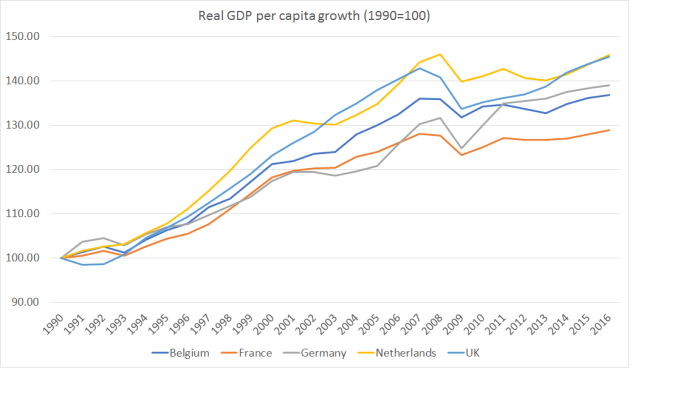
First up is a comparison of real per capita GDP growth, in national currency terms (although of course all four continental countries use the same currency now) since 1990.

real GDP pc growth Fr etc

Over that full period, France has been clearly the worst performer, but interestingly that has only been clear since about 2010.   Until then, on this measure Germany and France had been tracking very closely together.

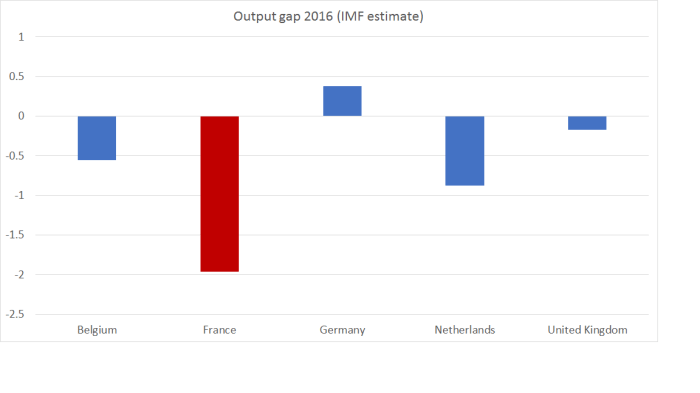
And some of the difference with Germany may still “just” be cyclical (things that economists put “just” in front of can still matter quite a bit in elections).  Here are the IMF estimates of the respective output gaps.

output gap fr

There is materially more excess capacity in France than in the other four countries.

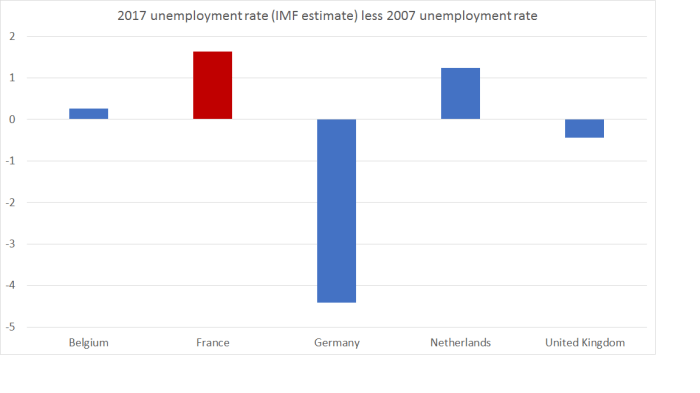
Consistent with this, the unemployment rate is materially higher in France than in the other countries.  It is about 10 per cent in France, compared with a range of 4 to 6 per cent for Germany, Netherlands and the UK (with Belgium in the middle). France probably has a higher NAIRU.    But here is the IMF estimate of this year’s unemployment rate, less the actual unemployment rate for 2007, the last year of the previous boom.

U rate FranceFrance is, again, the worst performer.
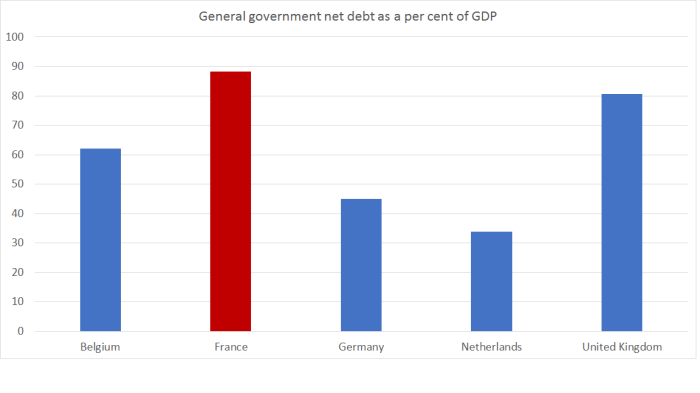
The government debt position is pretty poor too (although not that much worse than the UK’s).

govt debt fr

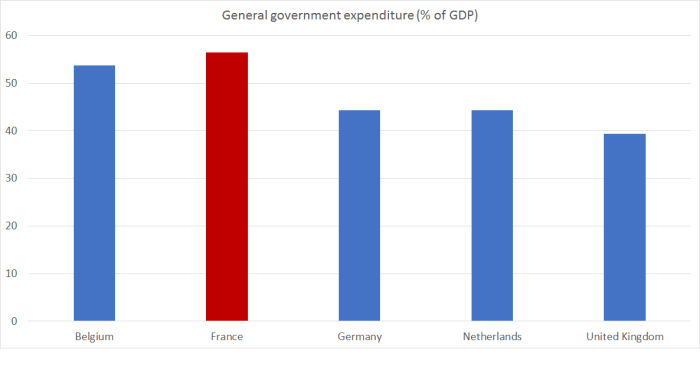
I’m never quite sure why people think Germany should increase government spending and increase its government debt –  especially in a country with little or no population growth.   France’s numbers –  among the very highest in any advanced country –  don’t look like something to emulate, no matter good the resulting school lunches might be.

govt spending france

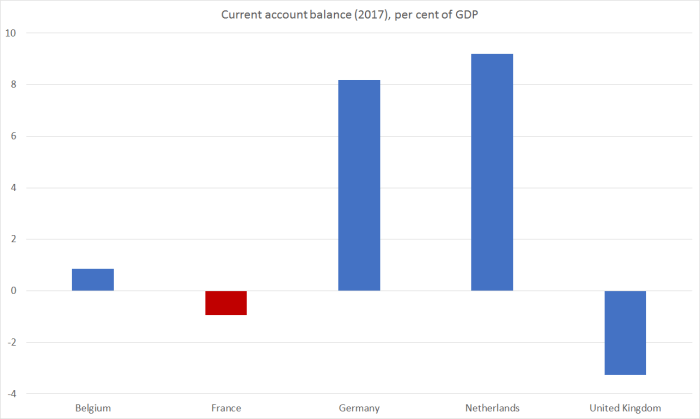
Current account numbers aren’t that easy to interpret without lots of context, but even for an advanced economy with modest population growth, surpluses the size of Germany’s (or the Netherlands) look, at very least, anomalous.   There isn’t anything inherently virtuous about France’s near-balance position, but it typically wouldn’t be an indicator of serious trouble either.

CAD Fr

With a bit more demand and a stronger cyclical position – hard to engineer with such high public debt, and no national monetary policy – the current account deficit would no doubt be a bit wider.

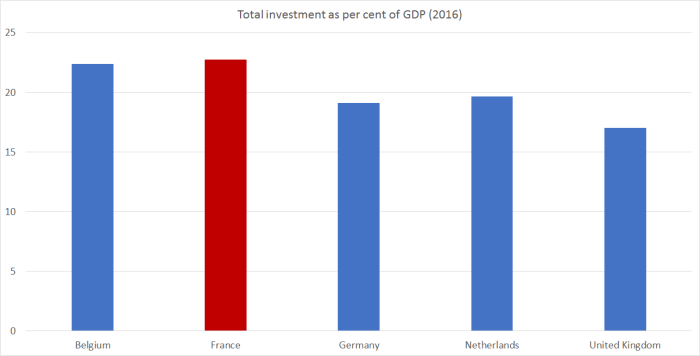
It isn’t all a bad news story.  Here, for example, is total investment as a share of GDP.

investment fr

The investment share of GDP in France last year was higher than that of any of these countries –  far higher, for example, than in cyclically more-stretched Germany.   At least some of those big, really successful, global French companies must have been seeing some good opportunities at home.

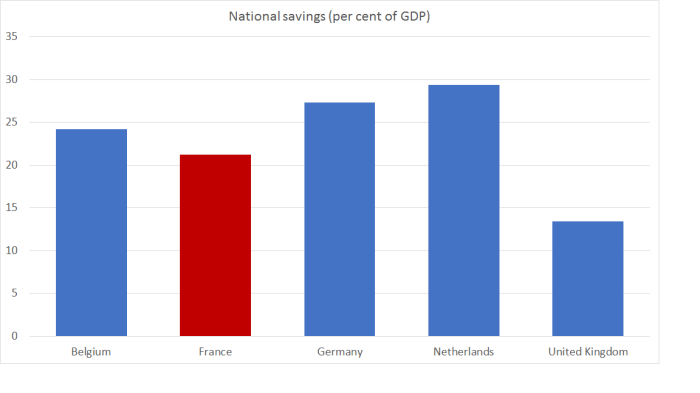
Despite all that government spending and generous welfare provision, nothing really stands out about the French national savings rate either.

savings fr

Even within common currency areas, real exchange rates can move – at times quite considerably. We saw that a lot in the run-up to the crisis, with real exchange rate appreciations in peripheral countries (such as Ireland) relative to core euro countries. Perhaps such movements help explain, or mitigate, France’s disappointing relative performance?

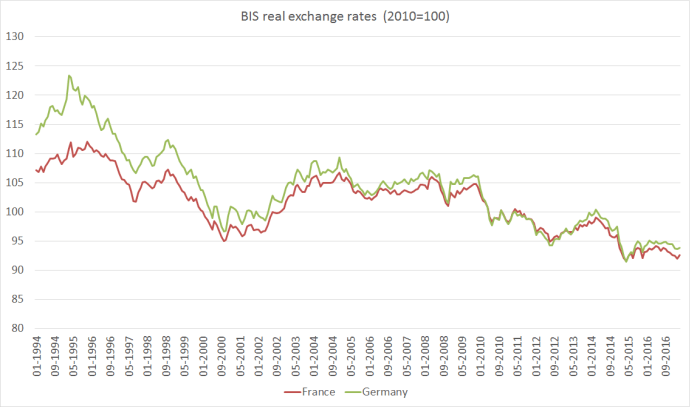
These are the BIS’s broad real exchange rate measures for France and Germany.

exch rate fr

The two countries’ real exchange rates have moved all but identically ever since the creation of the euro.    It isn’t clear why there hasn’t been more movement (especially in recent years) but it isn’t hard to suspect that if the franc and mark were again different currencies, we wouldn’t have seen anything like as strong a common trend.

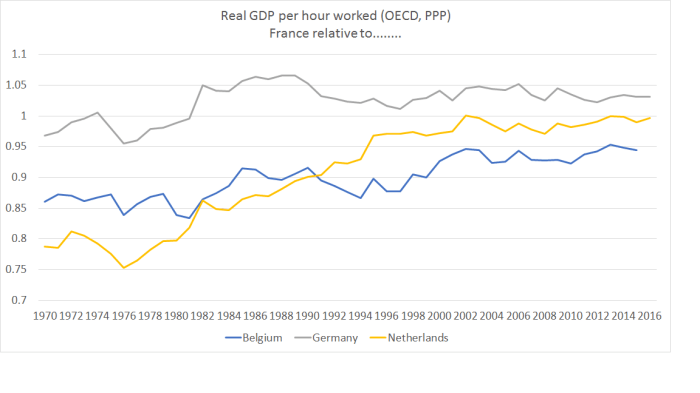
Over the longer-term, it is hardly as if France is some hopeless case.   If we look at meausures of labour productivity, real GDP per hour worked (in PPP terms)  in each of France, Belgium, Netherlands and Germany are among the highest anywhere, averaging something very similar to the US numbers  (the UK is quite a bit lower).   The OECD’s series for that data goes back to 1970.  Here is how France has done relative to the other three continentals.

fr real gdp phwFrance caught up over the first few decades and has largely held its own since, at least relative to these comparators.
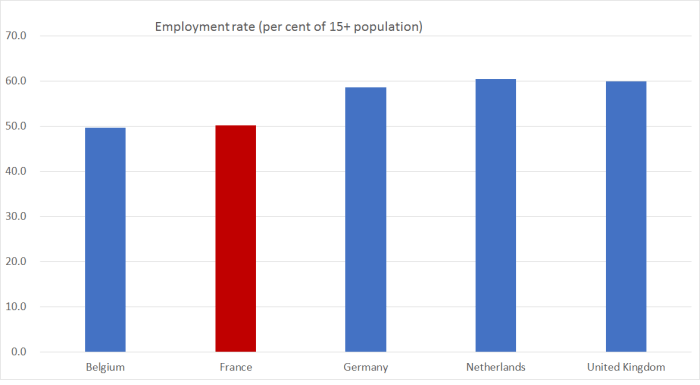
Of course, one of the striking things about France is how little labour input is used.

employment rates fr.png

Since, as we saw above, the French unemployment rate is higher than usual, the picture is slightly exaggerated at present.  but the difference between France (and Belgium) and the other three countries is stark.      (In New Zealand, by the way, the employment rate in the same quarter was 66.9 per cent, while the US is similar to Germany, Netherlands and the UK.)

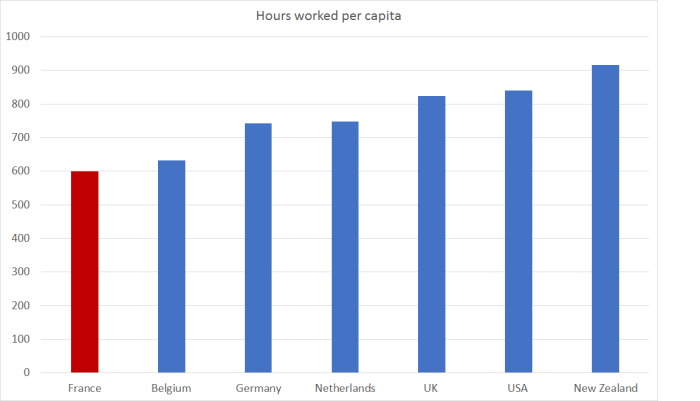
The differences are just as stark, if not more so, if we look at hours worked per capita.  Here I use the Conference Board’s Total Economy database.

hours worked per capita Fr

The average French person –  man, woman, child, young middle-aged and old –  worked around 600 hours last year.  The average New Zealander worked more than 50 per cent more –  and still managed clearly the lowest real GDP per capita of any country in this chart.   So little output for so much input.

There are lots of stories about the possible connections between hours and productivity.  If, for example, you impose tough regulations and make employing labour very expensive, firms will have to adapt such that the people who are employed are highly productive (they have to earn their keep).   The less productive firms and people are simply priced out.   But higher taxes –  certainly than somewhere like New Zealand –  and provisions of retirement income policies also play a part in discouraging French working hours, and not just from the unproductive.  Plenty of very capable people have long holidays, shortish work weeks, and relatively early retirements.   As a result, French GDP per capita is lower than those of the other continentals in this sample, even though productivity per hour worked is very similar.

I don’t have strong lessons to draw from this post –  it was a discursive tour, as much out of curiosity as anything.  But I’ve long been a sceptic of the euro and –  disruptive as a break-up or withdrawal inevitably would be –  it isn’t obvious that French voters could look on the single currency as any sort of unalloyed blessing for them, and their country, especially in the years since 2007.

There are good reasons to be glad not to be in France –  Islamic terorism among them. But when one looks as these data –  not just for France but for each of the continental countries here –  from a New Zealand perspective, aware of all the regulation and high taxes etc in France, it is a reminder of how much location really does seem to matter.  I’m in the middle of reading a wonderful new book by a leading academic expert on trade, convergence etc –  which I expect I will write about here soon.  As he notes, technological innovations made extensive trade in goods possible from the 19th century, and then trade in ideas (all that ICT), but if anything face-to-face contact now seems to matter more than ever, and firms and global economic activity seems increasingly concentrated in cities and regions like those of northern Europe (or east Asia, or North America), not in the isolated peripheries.


Which countries did Essential Skills visa grantees come from in the last year?

As I’ve said, MBIE do release approvals data monthly, but it is hard to use (at least for a lay person with a spreadsheet). The temporary approvals spreadsheet is some half a million lines long.

But I decided to brave it anyway.  The spreadsheet contains approvals up to the end of March 2017.  And I was curious as to whether there was anything in the Essential Skills approvals (those for some of the more –  supposedly –  skilled roles) to back the suggestions being made by the Herald and Professor Paul Spoonley.  To minimise my effort –  and the last column of this little table took the best part of an hour –  I focused just on approvals of people from the 10 countries that were top of the list in the latest summary MBIE data (that for the year to June 2016).

There is some overlap in the last two columns.  The first two columns are June years (the basis of MBIE’s summary data) and the final column is a March year (seeing as it is still April now).

Essential skills visas granted, by country
2006/07 2015/16 12mths to Mar 17
Philippines 1695 5,408 6174
India 1943 4,812 4904
UK 4692 3,686 4086
Fiji 2145 1,973 1756
China 2749 1,823 1801
South Africa 2003 1,382 1807
Ireland 481 969 824
Brazil 1376 923 1066
South Korea 1145 828 767
United States 1493 820 837
Total all countries 31015 31766 32775

But there isn’t much sign of the patterns having changed in the most recent year.  Of the European countries, UK approvals are up a bit, but still below where they were a decade ago, and Irish approvals are down a bit, but still above where they were a decade ago.  And by a clear margin, approvals of people from the Phippines and India top the list.

Two other things caught my eye.   Total approvals haven’t changed much  –  in the last year, or in the last decade (although they did dip during the recession).  And approvals for people from China have been tailing off.  The peak year for Chinese approvals was, in fact, 2004/05.


Questionable Herald analysis

I wasn’t going to write about immigration  today at all, but a radio station rang up last night and invited me to go on their show this morning to discuss an article in today’s Herald that runs under the headline Top source countries for migrant workers are not Asian.

Since I had to get up early anyway, and since the article gives me the chance to make two points, I thought I’d respond.

Perhaps my key point is that flawed articles like this really should reinforce the message to MBIE, that I made in a post the other day,  that while MBIE’s annual immigration approvals data are good and useful, they are only available with a long lag,  and the monthly data they provide is limited, little-known, difficult to use, and therefore largely overlooked.    If people can’t readily use that – accurate, official, adminstrative –  data they will use what they can easily get.  In this case, that is the permanent and long-term migration data derived from arrival and departure cards, and reliant on the self-reported intentions of people when they cross the border.  It is published monthly and hogs the headlines, but for actual analysis of immigration policy (which affects non-citizens) it just isn’t very good at all.

The Herald builds an article around this opening

A rise in work visas has been the driving force behind record immigration numbers but the main source countries are not from Asia.

A Herald analysis into immigration data found work visa arrivals increased from 16,787 in 2004 to 41,576 last year.

The top five source countries for work visas last year are the United Kingdom, Germany, Australia, South Africa and the United States of America.

They get those numbers not from data on the number of work visas issued, or outstanding, but on the basis of PLT arrivals data.   When people arrive at the airport they complete an arrivals card, indicate whether (at that time) they intend/expect to stay 12 months or more, and the reason for their visit.    The “reason for visit” isn’t tightly mapped to the various different visa classes, and all the non-New Zealand arrivals are grouped under four main headings (Residence, Student, Visitor or Work) and a small “Other” category.

So these data are correctly reported by the Herald, but:

  • SNZ only publish the data by previous country of residence, not country of citizenship (although they must have the latter data).   The Herald should have been a little wary when they noticed Australia high up on their list, since Australian citizens don’t need work visas to live and work here.  Published data don’t let us work out which country (citizenship) those people were actually from, but if someone worked in Australia for a couple of years and then came on to New Zealand there is no meaningful sense in which they are “Australian”.
  • The PLT data only attempt to capture the visa people held at the point they crossed the border.   Huge numbers of people change their visa while here –  more than 70 per cent of residence visas are granted to people who were already living here.  Perhaps more importantly in this context, many people who come on student visas –  probably almost all of those in the PLT (more than 12 months) category –  now have work rights while they are here.  And when they complete their qualification, many can acquire a “study to work” work visa.  So if we are trying to understand which country the migrants (temporary or permanent) who are working here come from, the PLT numbers are barely any use at all.

In fact, MBIE knows exactly who has an outstanding work visa (which doesn’t include students working while on a student visa), and which country those people are citizens of.  They now publish the data each year.  Here are the top 10 countries as at 30 June last year.

Outstanding temporary work visas by country, as at 30 June 2016
India 25,479
United Kingdom 15,040
China 12,192
Philippines 11,980
France 6,126
Germany 5,011
Fiji 4,912
United States 4,431
South Korea 3,443
Japan 3,102

The UK is still important, but it is swamped by people from India, and China and the Philippines aren’t far behind the UK.   We only have this particular data since 2009, but back then the UK was the largest source country for people with outstanding work visas.  Since then the UK numbers have only increased a little, while the Indian numbers have more than trebled.     And all that is so even though these stock numbers include the numbers here on working holiday (work) visas, where European countries (Germany, UK, and France) dominate the annual approvals numbers.

What about approvals data?  Here are the top 10 countries of people granted Essential Skills work visas in 2015/16.

Essential skills visas granted, by country, 2015/16
Philippines 5,408
India 4,812
United Kingdom 3,686
Fiji 1,973
China 1,823
South Africa 1,382
Ireland 969
Brazil 923
South Korea 828
United States 820

A decade ago, the UK was clearly the largest source country.

And here are the top 10 countries of people granted Family work visas (note, work visas –  these aren’t the residence approvals).

Family work visas granted, by country, 2015/16
India 7,720
China 4,012
Philippines 3,216
United Kingdom 2,566
Fiji 1,895
South Africa 1,407
United States 1,186
South Korea 865
Brazil 643
Sri Lanka 584

Again 10 years ago the UK was the largest single source country.

MBIE don’t provide this breakdown for those granted “study to work” visas, (even though the number of those visas granted has increased from around 6000 in 2005/06 to around 22000 last year.   And since student visa numbers are totally dominated by people from Asian countries

Student visas granted, by country, 2015/16
China 25,931
India 19,920
South Korea 4,888
Philippines 3,996
Japan 3,604
United States 2,914
Thailand 2,176
Brazil 1,961
Fiji 1,886
Germany 1,850

…we might reasonably assume that almost all of the study to work visas have gone to citizens of Asian countries.

And finally, of course, there is the residence approvals programme.     The overwhelming bulk of these approvals are granted to people already living in New Zealand, who arrived on one or other of the temporary visas programmes and eventually qualified for residence.  Here are the top 10 countries, for 2015/16 and for 2005/06 , 10 years earlier.

Residence approvals by source country
2005/06 2015/16
China 6,773 9,360
India 3,334 8,498
United Kingdom 14,674 4,934
Philippines 1,252 4,614
South Africa 4,033 2,970
Fiji 2,366 2,230
Samoa 2,188 2,156
United States 1,838 1,288
South Korea 2,260 1,125
Pakistan 140 882

Total approvals didn’t change much over that decade, but the composition (by source country) did.  One forgets I suppose, but I was a little surprised to realise that even 10 years ago the UK was still far and away the largest single source country.

Which country our temporary or permanent migrants come from isn’t a big concern of mine, and has never been a focus of my analysis of the possible connection between immigration and economic performance.  I don’t much care where migrants come from, but about what skills and talents they bring.   That said, I was interested in the new study by Harvard researchers that I linked to a few weeks ago, suggesting that if there were economic benefits from immigration (and that particular study reckoned there were) they were most evident when the migrants were from countries that are richer than the recipient country, or from countries with a degree of cultural similarity to the recipient country.   Perhaps that result won’t stand up to close scrutiny over time, but it does make quite a lot of intuitive sense.   On that residence approvals list, only the UK and the US are richer than us.

And as a final note, I repeat my plea to MBIE to markedly improve the availability of such summary data on immigration approvals (and outstanding visas).  They hold all the data, and there is no reason why these data could not be available, and easy to use, on a monthly or quarterly basis within a few days of the end of the relevant period.     Debate about immigration policy is often difficult enough, but it is made more so when the good timely data just aren’t made easily available, and people fall back on what they can find, inadequate for purpose as it often is.

Immigration thoughts over 40 years

Readers might suppose that I have always been sceptical of large scale immigration to New Zealand.  It would be more accurate to say that for most of my life I never gave it much thought.

I first remember being aware of immigration as a political issue when I was at intermediate school in Auckland in the early-mid 1970s  That was a period of very high immigration, and about the time of the big policy change initiated by the Kirk Labour government which removed from British citizens the automatic right they had previously had to settle here.  Pacific island immigration was also an issue.  But despite being a bit of a political nerd even then, my only perspective on it was that of a South Islander reluctantly resident in Auckland: I recall advocating a cap on Auckland’s population and forcing incomers to move elsewhere in the country.

There wasn’t much non-citizen immigration to New Zealand over the following 15 years, although the developing exodus of New Zealanders was an issue.   And even as policy changed in the late 80s and early 1990s, the high rate of unemployment still meant that non-citizen immigrant numbers were low.    As late as 1992 there was a net inflow of only around 13000 non-citizens.    I don’t recall immigration data ever getting much discussion around the Reserve Bank Monetary Policy Committee table, although the modellers had interesting equations to explain, in particular, the trans-Tasman flow.    I was the manager of the Bank’s forecasting team for a while, and I also don’t recall us ever paying much attention to immigration data then either (anyone else who was there can correct me if my memory is faulty).

I went overseas for a couple of years and when I came back we were in the midst of the first big inward wave of non-citizen migrants since liberalisation.     Those flows put a lot of pressure on house prices, especially in Auckland, and also on the economy’s real resources.    We were a bit slow to understand what was going on, but eventually appreciated (as our predecessors had in earlier decades) that the demand pressures from increased immigration typically exceeded the boost to supply, at least in the short-term.  Being the Reserve Bank we didn’t have much interest in (or any responsibility for) the longer-term issues, and certainly didn’t have an institutional view on whether in the longer-term large non-citizen immigration was of economic benefit to New Zealanders.

It was the 21st century before the issue came back to the fore again, with the sharp increase in non-citizen immigration numbers around 2002/03 –  some of it the increase in foreign students in response to the exchange rate.    The Bank was a bit gun-shy by this time, at having made some material monetary policy mistakes in the late 1990s, and I remember arguing (I wince at the memory) that there was a case to “look through” the net excess demand effects of increased immigration, because they were likely to be ‘one-off” in nature.  I certainly didn’t have a view, or much of an interest in, the longer-term issues.    Being a central banker, I was probably only interested in the monthly PLT numbers, and wasn’t even aware there was a residence approvals programme and a numerical target/”planning range”.

To cut the story short, I had little interest in the issues until I was involved with the 2025 Taskforce, set up to advise the government on why the large income and productivity gaps to Australia had opened up, and to recommend a policy programme that might close the gaps over the following 15 years.   I was seconded to Treasury at the time, and there was also quite a bit of interest there in why New Zealand’s interest rates were so high (relative to those abroad).   The 2025 Taskforce did not –  as readers might expect –  come out in favour of high rates of immigration.  One of the Taskforce members was the Australian economist Judith Sloan, who had lead the Australian Productivity Commission’s 2006 report on immigration.   She persuaded the Taskforce to adopt a line, consistent with that earlier report, suggesting that immigration was unlikely to offer much, if anything, in boosting medium-term GDP per capita (or productivity).

I came away from involvement with the Taskforce pretty supportive of the list of measures, and way of thinking about things, that they proposed.     But the more I reflected on the issues, the more it started to seem like a list of measures that, while useful, was unlikely to make a large enough difference to close the gap.   And as our exchange rate rebounded after the 2008/09 recession, I began to focus again on trying to understand why our real interest rates were still so high (relative to the rest of the world), noting that as a result of those high interest rates, the real exchange rate had averaged far higher than relative productivity underperformance might lead one to expect.   I was involved with a Treasury working paper published during this time arguing that the explanation for the high interest rates seemed most plausibly to lie in things affecting aggregate savings and investment preferences (demand for and supply of savings) in New Zealand.

It was only out of all that experience –  mostly down to the good fortune of the secondment to Treasury –  that my current way of thinking started to develop.  That was as recent as 2010.   I was fortunate enough that the Savings Working Group – another government appointed working group –  got interested in an early version of the ideas, and reflected some of them in their report.   And I was able to push them a little further in discussant comments, and then in a paper, in two conferences on macroeconomic and exchange rate issues sponsored by the Reserve Bank and Treasury.    But it wasn’t an issue that was of much interest, or importance, to the Reserve Bank (reasonably enough), and in fact the Bank became increasingly uneasy about my involvement in the area.  Immigration policy inevitably had political dimensions, and it wasn’t an issue the Bank was ever likely to take a preferred policy position on.

Through this period, my focus was very high-level and macroeconomic in nature.  I kept being told –  by Treasury and MBIE – that our immigration programme was one of the best in the world (and there were papers to prove it).   I didn’t have any reason to disagree (I didn’t have the detailed knowledge and my background was macroeconomics), but as I always stressed, if my argument/analysis was valid, it was so broadly speaking regardless of the quality of the individual immigrants.   Persistent excess demand pressures, in an economy with a pretty moderate savings rate, would put pressure on real interest rates and the real exchange rate and skew the economy away from business investment more generally, and that in the tradables sector more specifically.  It was simply cleaner to take as given the received notion among public sector economists that the quality of the immigration programme was pretty high.

The last couple of years, outside the public sector, have certainly been an eye-opener for me, on just how mediocre our immigration programme has actually been.  It may well be that our average non-native born worker has among the highest skills of any of those in the OECD.  It may even be that our immigration programme is better than those of most  –  in many ways it should be, as we have full effective control of our own borders.  But it simply isn’t very good.  Even on those OECD numbers, the average non-native born worker (immigrants past and present) has skill levels below those of natives (the latter being among the most skilled in the OECD).   There have been many very able migrants, but averages are averages, encompassing the excellent and the poor.  The average isn’t impressive.

We’ve seen quite a bit of that over the last few years:

  • only around 60 per cent of our residence approvals are to skilled or business migrants (and their spouses/partners/children), and all too many of those granted approvals in recent years have been in occupations that don’t strike most people as particularly highly-skilled –  not what people think of when they hear that MBIE sees our immigration programme as a “critical economic enabler”,
  • there were fairly large numbers of approvals granted to middle-aged and elderly parents and siblings of other migrants (people whose skills/qualifications would not qualify them directly), unlikely to make much contribution to New Zealand economic performance.
  • then there has been the big upsurge in student arrivals, concentrated in the lower-level private training establishments, the timing not coincidentally related to increased work rights for students in New Zealand.   Again, relative to our universities, the PTEs aren’t typically training the people most people have in mind when they think of highly-skilled foreigners.

And the disillusionment –  stripping away of the old illusions and official stories –  has continued even in the last week or two.

At a broader policy level, MBIE released data last week showing that

The Ministry undertook a random sample of more than 600 Skilled Migrant Category applications being considered as at 1 March this year. We found that 42.5 per cent of applicants earned over the New Zealand median income of $48,859 a year while 14 per cent of applicants earned over $75,000. These results have a margin of error of plus or minus 5 per cent.

57.5 per cent of those applying for residence under the Skilled Migrant category –  the most skilled bit of the residence approvals programme –  were earning less than $48859 per annum.  No doubt some of them would have been turned down, but the rejection rate of applications that get to this stage isn’t high.    On policy to date, a huge proportion of the so-called skilled migrants can’t even command that much income in the New Zealand labour market (and recall that 80 per cent of all residence approvals are granted to people already onshore, and I suspect that share is higher for the SMC category).

Perhaps I’m naively optimistic, but a week or so after these data came out, I’m still shocked at how low a skill level they reveal.   Our ministers and officials have repeatedly grossly misrepresented the programme and the number and sort of “skilled” people New Zealand is granting residence to.   If it were similar data on any other policy or economic topic, I suspect it would be front-page news in our media.

One of my readers (thanks Bob) took the huge unwieldy spreadsheet MBIE releases monthly and produced a summary of residence approvals over the 12 months to March 2017.  This table is in much the same format as MBIE uses in their annual Migration Trends and Outlook publication.

Residence Approvals: Year ended 31 March 2017
Application Substream Application Criteria Number approved
Skilled Migrant Skilled Migrant 25,357
Work to Residence Talent – Accredited Employer 1,464
Investor Category Investor 2 Category 1,404
Entrepreneur Category Entrepreneur category 740
Work to Residence Long Term Skill Shortage List Occupation 527
Investor Category Investor 1 Category 154
Partnership Deferral Skilled Skills/Business deferral 142
Work to Residence Religious Worker 122
Work to Residence Talent – Sports 27
Employee of businesses Employees of businesses 3
Business / Skilled Sub-total 29,940
Refugee 1,902
Samoa Quota 1,008
Pacific Access 607
Other Ministerial direction 295
Other Victims of Domestic Violence 28
Section 61 Section 61 133
International / Humanitarian Sub-total 3,973
Family Tier 1 & 2 Family Parent Tier 1 2,555
Parent Family parent 457
Sibling Family sibling 397
Adult Child Family child adult 47
Sibling Family sibling 2
Parent Sibling Adult Child Stream Sub-total 3,458
Partnership Partnership 9,439
Dependant Child Family child dependent 1,861
Partnership Partnership – Partner of an Expatriate 1,247
Parent Retirement Parent Retirement 37
Partnership Deferral Family Partnership deferral 23
Dependant Child Family Child dependent – Dependants of an Expatriate 11
Partnership Partnership 3
Uncapped Family Sponsored Stream Sub-total 12,621
Residence approvals Total 49,992

We now know how low the apparent level of skills has been in the skilled migrant category.  And that is the most skills-focused on any of these residence categories.  We can reasonably assume that the average skill levels across the other categories will be, perhaps materially, lower.

Of course, in some of the line items that shouldn’t be a concern.  We take refugees for humanitarian reasons, not domestic economic reasons.  But by and large our immigration programme has been sold as having an economic focus –  intended to lift productivity across the economy and benefit New Zealanders as a whole.    Standard economic theory will tell you that if the skill level of the migrants is low –  typically lower, especially at the margin, than the new native worker –  it could only benefit New Zealanders (on average) by driving down wages for relatively unskilled labour in New Zealand.    The evidence on whether it has done so is contested, but if it hasn’t, New Zealanders simply can’t have benefited.  And if we stand back and look at our productivity performance, business investment patterns, and tradables sector performance, there is no sign of such systematic benefits at all.

It looks increasingly like a costly sham.  New Zealanders have been sold the policy on one basis but –  whatever the merits of the policy they’ve been told we were running –  the actual policy looks to have been far worse than we were told.  And, I suspect, far worse than the people who first designed the more liberal immigration policy thirty years ago would have had in mind.

People will differ on how all this came to pass.  I’m not a conspiracy theorist, and suspect it mostly developed with the best of intentions all round (rather than, say, a deliberate attempt to drive up Auckland land prices and drive down lowly-skilled wages).   But good intentions don’t excuse shocking outcomes.  We simply don’t really have a skilled migration programme at all.  There are, and no doubt always will be, a few very highly-skilled people among the migrants –  and the issue here isn’t the migrants themselves (pursuing the best for themselves and their families) but the policymakers in successive governments –  but all too many have little to offer to benefit New Zealand.  For a country that hasn’t been doing that well economically for 50 years –  although there are cyclical ups and downs –  that simply isn’t an approach we can afford, if we want to offer our people some of the best material living standards in the world.  Perhaps it is partly a reluctance to accept that New Zealand just isn’t that attractive to very many of the sort of extremely able people we might genuinely benefit from.

And perhaps even more shocking than the skilled migrant applicant income data, was the news yesterday that our government is allowing someone who gained residence approval only five years ago, and has since committed several sexual offences, been in prison for them, made little apparent effort to rehabilitate, and remains (according to the experts) at high risk of reoffending, to remain in the country.  I’m not usually strongly sympathetic to “victims advocates” etc, or to those wanting to lock up even more people for longer, but I simply can’t believe that the government had let this chap stay.   Since such offenders don’t usually start offending in their 50s, you have wonder about the initial screening, but even set that to one side, how is this decision at all consistent with promoting the best interests of New Zealanders?   Individual decision it might be, but it looks too like a mentality in MBIE –  and their ministers? –  that simply doesn’t put the interests of New Zealanders first (whether in the economic aspects of the programme design and implementation, or others).      The specific decision might have been made by an official, but that person was operating only under the delegated authority of the Minister of Immigration.  The Minister now claims he’d have made a different decision, but if so perhaps he could release to us the guidelines he had laid down, that his officials were supposed to be working to when they made this egregious decision.    I’m quite sure Afghanistan would be an unpleasant place to be sent back too.    But Mr Akbari made his choices, breaking our law (and not simply traffic offences) not once but several times.  It isn’t clear why we owe him any further consideration, or why our people should be exposed to the risk of his further re-offending.   I don’t suppose Michael Woodhouse personally will be compensating future victims –  and of course with the best will in the world, he won’t be able to  put back together a life shattered by a further instance of such abuse by Mr Akbari.   Deportation then will be scant comfort to the victim.

As I like to stress, I try to be an equal opportunity sceptic.  Immigration policy has, for 30 years, been pretty much common ground between National and Labour.     The Donghua Liu case shouldn’t be quickly forgotten.