Bouquets and brickbats for the ANZ

In July last year, while the Reserve Bank was consulting on the latest extension in its (seemingly) ever-widening web of controls –  this one, restricting mortgages for residential investment properties to 60 per cent LVRs –  David Hisco, the chief executive of the local arm of the ANZ bank, went very public arguing that the Reserve Bank wasn’t going far enough.

Heavily increase LVR limits for property investors. The Reserve Bank wants most property investors around the country to have 40 percent deposits in future. We think they should go harder and ask for 60 percent. Almost half of house sales in Auckland are to property investors. Taking them out of the market will be unpopular amongst investors but it may end up doing them a favour. Of course this would mean less business for us banks but right now the solution calls for everyone to adjust.

It was an interesting stance.  As I noted at the time (a) there was nothing at all to stop the ANZ tightening up its lending conditions along those lines if they thought such restriction was prudent, but (b) the ANZ’s own economics team, in a piece issued the very same week, had been less than convinced of the case for even the Reserve Bank’s own more-modest proposed restrictions.

To us, the case for requiring investors to have a 40% deposit is not overly
strong. This is particularly considering the RBNZ’s own stress tests and the fact that most investor lending was already done at sub-70 LVRs anyway.

I noted then that

There must be some interesting conversations going on at the ANZ.  It would be very interesting to see the ANZ submission on the Reserve Bank’s proposals, and if the Reserve Bank won’t release it, there is nothing to stop ANZ itself doing so.  I’ll be surprised if they do, and even more surprised if the submission recommends limiting all investors throughout the country to LVRs not in excess of 40 per cent.

The Reserve Bank has long been quite resistant to releasing submissions made on regulatory proposals –  even though if, say, you make a submission to a select committee on a proposed new law that submission will routinely, and quite quickly, be published.  Under pressure, the Reserve Bank has slowly been backing away. First, they agreed to release submissions from entities they didn’t regulate, while refusing to release anything from regulated entities (banks in this case).  They rely in their defence on a provision of the Reserve Bank Act which, even if it legally means what the Bank has claimed it does, was never intended to enable permanent secrecy for submissions on general policy proposals.  The Bank has now reviewed its stance again, and has now agreed to release/publish submissions made by regulated entities but only if those entities themselves consent (and subject to normal provisions allowing commercially sensitive information to be withheld).  Partly presumably because I had appealed to the Ombudsman over the withholding of bank submissions on last year’s extension of the LVR controls, they have now decided to apply this new stance retrospectively.

Yesterday I received a letter from the Reserve Bank

The Reserve Bank has sought the consent of the registered banks to provide to you their submissions from the consultation on adjustments to restrictions on high-LVR residential mortgage lending. We have obtained consent from ANZ Bank to release its submission to the consultation. Accordingly, the submission from ANZ Bank is being provided to you under the provisions of section 105(2)(a) of the Reserve Bank of New Zealand Act 1989.  Some parts of the submission have been redacted by ANZ Bank as a condition of its consent.

Other registered banks have not provided consent and submissions provided by other registered banks continue to be withheld

Of course, ANZ could have released the submission itself months ago, but they still deserve credit for agreeing to the release even at this late date.   I hope this move foreshadows routine willingness to allow ANZ submissions to the Reserve Bank to be published.

The ANZ stance contrasts very favourably with that of the other banks.    Given the risks of regulators and the regulated getting too close to each other, at risk to the public interest, getting the submissions of regulated entities published should be a basic feature of open government, and the continued reluctance doesn’t reflect well on either the Reserve Bank or the other commercial banks.  What do they have to hide?

Apparently the Reserve Bank will be putting a link to the ANZ submission (as redacted) on their website shortly [now there, together with all the other LVR submissions and material they’ve released over the years] but for now here it is.

anz-response-to-lvr-consultation

Perhaps to no one’s surprise, there is nothing in the submission suggesting that ANZ would have favoured a more restrictive approach (of the sort outlined by the chief executive a few weeks earlier).

anz-on-lvr

It wouldn’t have cost them anything to have advocated the chief executive’s preferred position –  after all, it wasn’t likely that the Reserve Bank would adopt it anyway –  but there is no suggestion, not even a hint, that our largest commercial bank thought the Reserve Bank wasn’t going far enough.

I noted at the time

But I don’t suppose we will actually see ANZ move to ban all mortgages for residential investors with LVRs in excess of 40 per cent.  Instead, Hisco wants the Reserve Bank to do it for him.    That would enable him to tell his Board that he simply had no choice, and provide cover when profits fell below shareholder expectations.  That should be no way to run a business in a market economy –  although sadly too often it is.

Reality seems to be even worse, in some respects.   Not only did ANZ not pull its own LVR limits back to 40 per cent, they didn’t even take the opportunity of a (then) private submission to the regulator to make their case for a tougher policy.  Instead, it looks a lot like they were just going for the free publicity of a call for bold action, while never having had any intention of doing anything about it.   It isn’t exactly straightforward.  Of course, they are free to do it if they can get away with it, but it doesn’t look like the sort of ethical behaviour we might hope for from senior figures in major financial institutions.

Although the Reserve Bank was consulting on extending LVR restrictions, quite a lot of the ANZ’s submission is devoted to what appear to be mostly sensible concerns about the possible extension of the regulatory net to include debt to income limits.  The Reserve Bank is apparently about to launch a consultation on the possible addition of debt to income limits to its “approved” tool-kit (technically it doesn’t need anyone’s approval to use them).  I hope that the forthcoming consultative document takes seriously the practical problems various people, including the ANZ, have already raised.

I welcomed the recent decision of the Minister of Finance to require the Reserve Bank to undertake public consultation now, not just at the point they want to use DTIs.  Perhaps his motivations were somewhat mixed –  there is after all an election only a few months away –  but there is probably a better chance of the Governor taking submissions seriously now than at a point when the Governor has already decided he wants to use the tool, perhaps as a matter of urgency.    Having said all that, I was a little bemused at the suggestion from the Minister that the Reserve Bank should now do a cost-benefit analysis on the use of DTIs. I’m all in favour of such analysis, and am concerned that too often there is no attempt to quantify the costs and benefits of proposed interventions, but……it isn’t clear how one can do a cost-benefit analysis on an intervention except in the specific circumstances that might arguably warrant the deployment of the instrument.  One surely needs to know the specific threat to be able to evaluate the chance that a proposed intervention might mitigate the risks?

Experts

A few months ago, I wrote a post on the role of “experts”, responding to a British journalist and author’s lament for the apparent willlingness of voters/societies to downplay, or even dismiss, the role of experts when it comes to making significant public policy decisions.

In his column in yesterday’s Sunday Star-Times, local economist Shamubeel Eaqub returns to the theme.

Experts are increasingly side-lined. Political leaders openly ridicule them and the public emphatically ignore their advice when voting.

Our public servants at Treasury must have identified – “yes, someone feels our pain” – even unusually taking to Twitter over the weekend to draw attention to Eaqub’s column.

I’m not sure when this golden age was, when “experts” apparently held sway with voters. I can’t think of a time in New Zealand, or British, history and although I know the modern electoral history of other Anglo countries less well (and those of continential European countries hardly at all) I struggle to think of examples in those countries either.

One can’t help thinking that Eaqub’s complaint –  and that of various other writers abroad who run similar lines –  is mostly that the voters, and politicians. aren’t endorsing the particular expert opinion favoured by Mr Eaqub.  I can understand that: I’d prefer my “expert” opinions on various matters were taken up and embraced by the voters and politicians.   But if they aren’t, it tells one nothing obvious about the failure of the system.  Housing, for example, is one of those topics on which both Eaqub and I have written on and thought about –  even if perhaps neither of us would count as high-level experts.  But we reach quite different conclusions on what bits of policy should be tweaked to solve the problem.  If I understand him correctly, he would emphasise tax reform, state-house building and no doubt some freeing up of urban density restrictions.  I’d emphasise freeing up land use restrictions (while protecting the rights of individual residents/owners to act collectively to protect their interests), and a marked cut in the target level of non-citizen immigration.  The Productivity Commission, a body with some claims to expertise in the area, goes as far as to favour allowing government agencies to seize private property, as one means of assisting.  Ongoing research and analysis can, and should, shed some light on the implications of each of these options.  In some cases, such research might even suggest that a particular option was unlikely to achieve the desired end, but the really hard choices aren’t likely to be resolved in battles of the experts.  They are often more about the sort of society/polity different groups want – including the respective roles/powers of the collective and the individual.  Perhaps theologians and philosophers might be some help there.  Economists aren’t likely to offer much.

Eaqub falls back quite quickly on the Brexit example.

In the UK, expert consensus was that Brexit would be bad for the economy. They signed open letters and argued their case in media. Well-known experts like Bank of England governor Mark Carney, warned of the costs of Brexit.

Less of a servant of government, rather more of a prince – but even he could not convince the voters.

I’m not sure that the Governor of the Bank of England, a Canadian banker temporarily employed by the British government (and by a Chancellor who was one of the leading figures in the Remain cause), particularly counts as a disinterested expert on the interests of the British people.  But lets grant that most economists, even those close to the specific technical issues, thought that Brexit would come at some economic cost (lower future GDP per capita) to Britons.    Those views weren’t kept secret, and they weren’t only expressed in abstruse language.  And a small majority of British voters nonetheless favoured Brexit.

When the Australian federation was being devised in the 1890s, there was a real possibility that New Zealand could have joined –  after all, at the time, New Zealand was just one among the various British colonies of Australasia.   At the time, the average New Zealander had much more in common with the average citizen of New South Wales or Victoria than, say, the average Briton today has in common with the average Italian or Pole (almost whatever measure of homogenity/heterogeneity one wants to use).    And yet economists at the time could quite easily have pointed to the potential economic costs to New Zealand from staying out of the federation –  including facing external tariffs on exports to Australia rather than being part of the free trade area, and loss of potential economies of scale in central government functions.  Those seem like quite plausible arguments, and yet our ancestors chose to take their own path, and not join the federation.   Perhaps even today we are poorer as a result, but I suspect most New Zealanders don’t regret the choice.  If economists today were to, as I’m sure they could, produce model results suggesting that New Zealanders would be perhaps 5 per cent better off by joining Australia, I’d be surprised if that result shifted public opinion much –  not because people despised expert economists, but because other things matter more to them in the choice to be independent.

But Eaqub does have an interesting take on the issue, in that he appears to think that much of “the problem” is with how experts –  and especially expert economists –  communicate.

They often focused on very specific issues that could only interest other experts.

Worse, a lot of their writing was in expensive journals, accessed and read mainly by other experts. Academics’ performance is often linked to their volume of publications in expert journals – it’s a self-reinforcing isolation cycle. The writing is often in obtuse and highly technical language, designed to exclude non-experts.

Except for a handful, most academics are invisible in public life.

The absence of academic economists in public life has been filled by bank economists. Their brand of simplistic and high noise commentary on the to-ing and fro-ing of the economy, is the public understanding of economists. Rather than the more complex social and political aspects that relate to economics.

I have some sympathy, and probably many people do.   Whether it is the PBRF here, or similar mechanisms abroad,  the incentives seem to be to publish as many papers as possible, cited as often as possible, in technical journals –  however small the potential advance of knowledge might be.    Those reforms were well-motivated –  most reforms are – and probably did deal effectively with people like one Victoria University academic I recall from student days, who wasn’t much of a teacher and didn’t seem to have published anything in 20 years.  But they have had undesirable consequences.  I recall being on the organising committe a few years ago for a well-resourced conference The Treasury and the Reserve Bank were promoting, looking for authoritative insights on New Zealand’s long-term economic underperformance and threats to its macroeconomic stability.  We were commissioning papers, and offering a reasonable amount of money to potential authors.  We ended up with some pretty good foreign authors, but didn’t get a single substantive submission/proposal from a New Zealand based academic –  apparently, in part because for papers on some of these intractable issues, we couldn’t guarantee subsequent journal publication.

I think it is a shame that we don’t, at present, have much contribution to New Zealand public debate from academic economists –  although I’m less sure it is true of other disciplines (for good or ill, think of public health, climate change or child poverty).   There have been times in the past when it was different, but it isn’t clear that public policy –  or the interests of voters in deferring to “experts”  –  was much better/different then than now.

One of Eaqub’s other concerns is what “experts don’t take account of”

Experts’ increasing irrelevance has much to do with their tendency towards insularism. Their awful communication – they talk to each other in anachronistic and technical language – excludes a large majority of society.

Their theoretical models exclude obviously real-life things like politics.

In some areas no doubt, but his sweeping dismissal seems far too broad –   and gives no weight to the importance of trying to make issues tractable.  And economists have developed whole literatures around notions of “government failure” and difficulties people (including voters) have in getting those who notionally work for them to pursue the interests of the principal.  Our Reserve Bank Act is just one example of legislation influenced by a recognition that neither officials, politicians, or voters are saints or angels.    We have models like the Open Bank Resolution arrangements explicitly because expert advisers recognised the politicial incentives governments typically face in the midst of crises.

Towards the end of his column, Eaqub argues that

We have to understand that the role of the economist and expert is as a citizen and advocate for our society. Not simply as hired guns to advise political leaders or as technocratic rulers.

But I’m struggling to know what he means, or  at least how realistic his aspiration is.  I’m sure that all the so-called experts have the best interests of their country –  or perhaps the wider world –  at heart.  But they also approach issues with their own predispositions and background, typically have to feed themselves and their families, and have their own career interests to look to.   Who funds “experts” –  and especially in a small country?  Mostly, the public sector.  Who provides fora and venues within which expert voices, talking expertly, are heard?  Mostly the public sector.  Even in a US context –  with a rich hinterland of well-endowed universites and think-tanks –  I’ve read arguments previously about how much easier, and well-rewarded, it is likely to be to be producing research on monetary issues that is well-received at the Federal Reserve (with its huge body of researchers and network of conferences etc) than to step outside that mainstream.  It isn’t impossible to take an alternative view, and produce alternative results, but it results in a skew towards work supporting the interests and priors of powerful state agencies and their managers.  The process becomes self-selecting over time –  those disinclined to produce results supportive of the interests of the incumbents tend over time to go and do something else with their lives.  On policy issues,  (as distinct perhaps from a expert plumber, or expert oncologist) so-called “experts” –  all too often, even then expert on very narrow points –  are not, as a group, some disinterested group that citizens can, or should, rely on for guidance.

In a US context, for example, it is well-recognised that there is a massive imbalance among academics –  less so in economics than many other disciplines –  in favour of Democrats.  I’m not sure if there are comparable data in New Zealand, but it would be surprising if the picture were so very different.  We shouldn’t suppose that people’s political preferences, and the instinctive preferences that lead them one way rather than another, don’t also shape the sorts of issues they research, they questions they ask in framing that research, and even how they interpret and frame their results.

I’m not suggesting anything corrupt or inappropriate at an individual level, simply highlighting some of the ways in which the rise of big government-   often championed by technocrats and related “experts” – can become self-reinforcing over time.  All too often one technical problems begets proposals for yet more technical, intrusive, solutions –  doing so feeding the inclinations of the academic “experts” and the bureaucratic administrators.  If the public ever become suspicious, and unconvinced that the bureaucratic solutions are well- aligned with their own interests, there is little reason why they should be inclined to defer to the preferences of the same “experts” who helped devise what no longer satisfies them.


Trump and Muldoon

Over the last few days, a couple of local commentators (here and here) have been drawing parallels between Donald Trump and our own former Prime Minister, Sir Robert Muldoon.  I commented on one of those pieces, somewhat sceptically, and didn’t give it much more thought.    But yesterday Tyler Cowen devoted his Bloomberg column  to attempting to make exactly the same comparison, which prompted me to think about the case more carefully.

What would you think of a Western democratic leader who was populist, obsessed with the balance of trade, especially effective on television, feisty and combative with the press, and able to take over his country’s right-wing party and swing it in a more interventionist direction?

Meet Robert Muldoon, prime minister of New Zealand from 1975 to 1984. For all the comparisons of President Donald Trump to Mussolini or various unsavory Latin American leaders, Muldoon is a clearer parallel case.

I’m still not remotely convinced.  Any parallels seem superficial at best, and deeply unfair to Muldoon.  Without claiming any particular expertise in Italian politics/history, I’m not sure why Cowen would go past Silvio Berlusconi if he wants to find parallels among leaders in modern democratic states. –  and, even then, it is hard to believe that Italian governments were quite as shambolic as the Trump administration has been in its first few weeks.

If the similarities are few and superficial, the differences are pretty profound.  We can start with the personal:

  • Muldoon served in the army for several years in World War Two.  Like many prominent Americans (Cheney, Clinton) Trump avoided military service in wartime.
  • Despite suggestions of an extra-marital affair, Muldoon had one wife, for life.
  • Muldoon was neither a product of, nor revelled in, celebrity culture.
  • Muldoon wasn’t a wealthy man, and didn’t trade in influence or connections to build personal wealth.  He lived pretty modestly and his finances weren’t a secret.
  • Whatever people thought of him and his government’s policies, few doubted his genuine concern for New Zealanders, and no one ever thought that his motivation for being in politics was some sort of narcassism or craving for respect.

One can easily think of other differences.  Muldoon held high office for almost 15 years –  almost six years as Minister of Finance and then Deputy Prime Minister in governments led by other people, and eight and half years as Prime Minister (and Minister of Finance).  Ours is a parliamentary system, with no history of outsiders suddenly ascending to office  –  and so, for all the talk of “taking over his country’s right-wing party”, Muldoon joined it young, worked hard for it, rose gradually within it, had his undoubted talents recognised by those who worked closely with him, was selected (by his fellow members, all selected at a local constituency level), first as deputy leader, then as leader.  As leader of a parliamentary party –  able to be ousted at any week’s caucus meeting, at any time –  he won three general elections.  And Trump?   How many leading Republicans voluntarily chose him as their candidate?

As Cowen notes, Muldoon was also well-known for his fearsome command of detail.  He was a highly effective minister with a huge capacity for work.    And if he didn’t always agree with officials, those who worked for him recognised his respect for the role of public servants, as advisers.   Muldoon ran a disciplined administration –  in contrast, say, to the weak Prime Ministerial leadership and management in the administration that followed his.   Trump has published numerous books under his name, but Muldoon wrote books himself.

Of course, some of these sorts of comparisons aren’t new.   I pulled down from a box in the garage this morning, my copy of the Citizens for Rowling publication.   Six weeks or so before the 1975 election –  Muldoon’s first as party leader – a group of fairly prominent New Zealanders launched this high profile campaign, notionally in support of the then Labour Party Prime Minister, Bill Rowling.  In fact, it was pretty openly a “Citizens against Muldoon” movement –  people appalled at Muldoon’s pretty aggressive style, and at his popularity (“I ask the Nationals how they would feel if Mr Muldoon was the leader of the Labour Party” –  I imagine the answer would be “worried that we were about to lose badly”).  One of New Zealand’s leading journalists outdid himself lamenting the threats to individual freedom

“it happened in the United States during the era of Senator Joe McCarthy; it happened in Germany in the 1930s. I used to believe that it couldn’t happen in New Zealand.  Now I am not so sure.”

It didn’t of course.

Was Muldoon’s style one I was particularly comfortable with?  No, not really. He was a self-described “counter-puncher”, and willing to take on pretty aggressively those who challenged him.  Politicians like Muldoon’s predecessor as National Party leader, John Marshall, and his predecessor as Prime Minister, Bill Rowling, probably naturally appeal more readily.   But as party leaders, those two won no general elections at all.  Rowling, a profoundly decent person and effective minister, fought three elections against Muldoon, and lost them all.  The second and third were close, but the first wasn’t –  it was one of the biggest electoral reversals in New Zealand history (popular vote, and parliamentary seats), led by Muldoon, who was a fearsomely effective campaigner.   Not many people voted for Muldoon in 1975 because he “wasn’t Clinton” (or the New Zealand equivalent).

What of policy?   Muldoon became Minister of Finance in early 1967.  A year later, faced with a collapse in commodity prices, he oversaw a devaluation and an IMF-supported programme of macroeconomic stabilisation.  It was tough –  cuts to subsidy, fiscal restraint, markedly reduced access to credit –  and effective.  His first term as Minister of Finance saw a continuation of the slow progress towards financial sector liberalisation.

But when people focus they most often concentrate on his term as Prime Minister, in which he also served as Minister of Finance  (in New Zealand until the late 1980s it wasn’t uncommon for the Prime Minister to also hold a major portfolio –  Forbes and Holland has also been Ministers of Finance, several Prime Ministers had also been Minister of Foreign Affairs, and David Lange also served as Minister of Education).   Even then, the focus is often on the later years of his term –  and recall, by contrast, we are less than one month into the Trump presidency.

The external circumstances were probably the most difficult any New Zealand government has faced since the Great Depression.  The terms of trade had fallen very very substantially and New Zealand was grappling with reduced access to its major foreign market, the United Kingdom, following the UK entry to the EEC.  Official opinion was quite divided about the best way forward –  how temporary should the fall in the terms of trade be treated as for example.  In the earlier years of the Muldoon government, much of the policy news was  pretty positive:  elected on a mandate to “restore New Zealand’s shattered economy”, Muldoon markedly cut back key consumer subsidies, and –  over the doubts of some key officials –  undertook a quite far-reaching (for its time) liberalisation of the financial sector.  The fiscal deficit was reined in.   (A few years ago one pro-market former senior public servant, not exactly a fan of the Key government was to note to me his view that the first three years of Muldoon were materially better than the first three years of Key).

There were mistakes: the new public pension system, materially better in concept that what the previous government had put in place (and still the basis of our effective system) was excessively, and unnecessarily, generous.  But the details had been explicitly campaigned on –  policy wasn’t simply a matter of few idle phrases and atttitudes.

For those looking for direct parallels, the early days of the Muldoon government did see a defeat in the courts.  Having campaigned forthrightly on replacing the system of public pensions, Muldoon on assuming office indicated that contributions to the prevous system could now cease.  That hadn’t yet been legislated by Parliament, although with the huge parliamentary majority National had, there was never any doubt it would be.  In Fitzgerald v Muldoon the courts did their job in restraining executive over-reach.

The economists’ indictment of Muldoon mostly focuses on his second and third terms.  Fiscal deficits weren’t kept in check –  although the high rates of inflation then quite common in advanced countries (Muldoon’s biographer notes that as late as 1981, Australia, the US, the UK and New Zealand all had double-digit inflation) –  tended to exaggerate just how bad those deficits were.  And if I think Cowen is quite wrong to describe Muldoon as “favouring easy money” –  it was mostly a case for favouring low unemployment, in a country where for several decades there had been almost none, and where everyone accepted that getting on top of inflation might involve transitional unemployment costs –  there was no consistent sustained effort to get inflation down, even gradually.  He’d rather have had inflation down, and kept unemployment low –  thus his ill-fated heterodox approach in 1982 (a wage and price freeze, and a cessation of the continuous devaluation of the exchange rate, all designed to break the cycle of wage inflation expectations and high wage settlements).  But then not wildly dissimilar policies had been tried in the US only a decade earlier.

Cowen also calls Muldoon a protectionist.  There is little evidence for that claim.  He wasn’t the enthusiast who drove the CER agreement with Australia –  generally seen as material liberalising measure, even allowing for trade diversion risks –  but as the process went on he was instrumental in making it happen, despite the mutually disdainful relationship between Muldoon and his then Australian counterpart.  Initiatives that Prime Ministers really oppose typically don’t happen.  Muldoon recognised that an economically successful New Zealand required international trade, and more of it –  and his government was one constantly grappling with threats to access to the European markets for meat and dairy exports.  His government initiated industry studies to help wind back domestic protection for manufacturers servicing the domestic market (car assembly, TV assembly etc) and if the programmes of export incentives were expensive and misguided, the fundamental insight wasn’t –  a successful New Zealand was likely to be one in which New Zealand firms found competitive niches internationally, in a world in which we had no bargaining power and no one owed us any favours.

And what of Think Big?  Here is Cowen

His most significant initiative was called “Think Big,” and, yes, it was designed to make New Zealand great again. It was based on a lot of infrastructure and fossil fuels investment, including natural gas, and it was intended to stimulate the country’s exports and remedy the trade deficit. Because New Zealand’s parliamentary system of government has fewer checks and balances than the American system, Muldoon got more done than Trump likely will.

Yet this bout of industrial policy worsened the already precarious fiscal position of the government, and Muldoon’s public-sector investments did not impress.

Cowen elsewhere quotes Muldoon’s biographer, Gustafson, who makes it clear that Think Big was never primarily Muldoon’s project.  And while I won’t defend those projects, it is important to recognise some of the context: a take or pay agreement in respect of major gas resources that had been signed by the previous government, and yet another large upward shock to oil prices in 1979.  I’m deeply sceptical of most government investment projects –  perhaps especially those that rely on commodity price forecasts –  but I’m told that even within the Treasury at the time, a fairly large chunk of the staff were sympathetic to at least important parts of the set of projects eventually under the label “Think Big”.   It all ended up ruinously expensive, and Muldoon has to accept responsibility –  but it wouldn’t have happened without the able (if misguided) responsible senior minister at the time, Bill Birch.   And we run Cabinet government here.

New Zealand, of course, is rather unimportant to most people (New Zealanders aside).  The United States remains one of the most important international powers.  And so while our foreign policy doesn’t matter much to others, theirs does.   Whatever concerns people have about Trump’s knowledge of, or approach to, Russia, Iran, Saudi Arabia/Yemen, China, North Korea or wherever,  Muldoon was a consistent and fairly predictable member of the western alliance.  To the distaste of some, but consistent with our 30 year membership of ANZUS, he welcomed visiting American warships and –  whether he did it for reasons for sentiment or realpolitik trade considerations –  won my admiration for his military support for Britain in the Falklands conflict.

Even at this distance in time, I’d argue that Muldoon remains a profoundly ambivalent figure.  But I’d argue that, against extremely challenging circumstances, New Zealand moved forward rather than backwards under his stewardship.  There were plenty of backward steps, and quite a few mis-steps, and he was a politician not a saint –  so when Tyler Cowen writes of one policy that perhaps his “intentions might not have been entirely benign”, one might only observe that most politicians operate with the next election in mind –  but there was plenty of progress too.  Muldoon appointed plenty of able people as ministers (and some duds too), and if he was suspicious of some of them, he allowed or enabled a whole variety of useful reforms to happen –  small, certainly, on the scale of what came afterwards, but he was a product of his times, his party, and his background.

What do I have in mind?   Milk and bread were heavily subsidised when Muldoon took office, they weren’t when he left.   The CER agreement did facilitate a material opening of trade with Australia.   Saturday shopping was generally banned in 1975 –  it wasn’t by 1984.  Restrictions on road transport –  favouring rail –  had been materially woundback.  The Official Information Act was introduced on Muldoon’s watch.  The foreign exchange market was being freed up, and government bonds were being auctioned for the first time.  Even the price freeze had actually expired under Muldoon –  and official forecasts then suggested inflation subsequently could have been kept to 5-7 per cent.  Voluntary trade unionism became a reality late in Muldoon’s term, and one of his last acts as Minister of Finance had been to announce that subsidies to farmers would be wound back.

Was it a great record?  Probably not.  Were there mistakes?  For sure.   But was democracy, the rule of law, the freedom of the press, or the strong anti-corruption conventions that governed New Zealand society, government, and public sector seriously threatened or eroded?  Not at all.  Did he, or his ministers, enrich themselves or their families?  No.  And we had a Prime Minister with the attention span, and intellect, to make considered (if perhaps often wrong) decisions, and to defend them coherently.

From this standpoint, only a month in, Americans –  and the rest of the world –  should probably count themselves very fortunate if the Trump administration turns out anything like Muldoon’s.

And if people are still looking for precursors and comparators, the Berlusconi precedent looks more relevant, and frankly more disconcerting.


Reserve Bank Governor and governance: some considerations

Since the announcement last week that the Reserve Bank Governor is leaving at the end of his term, and that his senior deputy won’t be a candidate to replace him, there has been a lot of commentary around both about what the Board and the (post-election) Minister of Finance should be looking for in a Governor, and what changes might be made in the legislative arrangements under which the Reserve Bank operates.  As just one example, both the centre-left economics columnists in yesterday’s Sunday Star Times were writing about aspects of the topic.

That seems entirely appropriate.  The Reserve Bank exercises huge discretionary power in both monetary policy and financial regulation, and the once-vaunted accountability mechanisms have actually turned out to be quite weak.  And the basic structure of the legislation the Bank operates under is now getting on for 30 years old.   Much has changed in that time.

Finding the right individual for the job of Governor matters a lot.  Even within the limitations of the current legislation, the right individual (building the right new senior management team) can make a material difference, in revitalising the organisation, and putting it on a more open and transparent footing –  both as regards policy, and the conduct of the Bank’s own affairs.    Still, we should be careful of what we wish for.  The Herald’s editorial last Friday argued, writing about the monetary policy responsibilties, that “the next Governor will need to be bold”.  Well, perhaps.  But “boldness” isn’t a great quality unless one is sure (a) of to what end it is directed, and (b) of the judgement, capability and character of the person being bold.  If I think back over 30 years of New Zealand monetary policy, Alan Bollard’s deep cuts in the OCR in the crisis conditions of late 2008 probably qualify as bold.  But so did Don Brash’s MCI experiment and Graeme Wheeler’s 2014 tightening cycle.  Neither of those ended well.

In the Sunday Star Times, Rod Oram argued

So, the best we can hope for is the next government, regardless of which party leads it, has the courage to recruit a rare individual as the next Reserve Bank Governor – a person who is highly experienced in the intricacies of the job, yet insightful and brave enough to restore the institution to world leadership.

That last line or so seemed both unrealistic and somewhat ahistorical –  perhaps partly because Oram appears to have come to New Zealand only as the Reserve Bank’s “glory days” were already passing.

The Reserve Bank of New Zealand gets credit for being the first country in the world to introduce (modern) inflation targeting.  I was present at the creation, and am proud of having been part of that.  But it was at least as much accident as design   –  a Treasury that was determined we had to have a contractural arrangement (pretty much every other government agency was getting one), and a muddied post-liberalisation post financial crisis world in which nothing much else would work.  We weren’t forerunners in central bank independence, in getting on top of inflation, in the idea of announcing medium-term targets, or in the publication of accountability documents.  And most of the specific details of our model haven’t been followed when other countries came to revise their legislation.  And if you read our economic analysis during the late 1980s and 1990s it was mixed bag, to say the least.  If I recall with pride the day I read Samuel Brittan of the FT praise our second-ever Monetary Policy Statement, which I’d largely rewritten over a weekend after Saddam Hussein invaded Kuwait and oil prices rocketed, I read some of other stuff we (I) wrote and cringe at least a little.  We were doing some good stuff, but were rushing to catch up with what being a modern central bank really involved, and there were so little institutional resilience that we stumbled into the MCI debacle only a few years later.  (For those too young to understand the reference, (a) be thankful, and (b) I will do a proper post about it one day.)

And what of banking regulation?  After an extensive and acrimonious internal debate in the early 1990s, the Reserve Bank did change quite materially its approach to banking supervision and regulation.  Pulling back from the seemingly-inexorable pressures to become ever more intrusive and interventionist in our banking supervision, we adopted a model which emphasised director-responsibility, and public disclosure, with the aim of better aligning incentives, to strengthen market discipline and reduce the prospect of public bail-outs etc.  Capital requirements were left in place, but as much because the banks wanted them –  they feared they look “unregulated” without them – as because of any Reserve Bank preference.  I wasn’t that closely involved, but I mostly thought it was a step in the right direction –  and lament the way that the Reserve Bank has wound back on public disclosure requirements in recent years.   But if there were elements of the model that did, in small ways, influence the thinking and practice of other countries’ regulatory models, they weren’t very important.  It was innovative, and may even have been right, but it wasn’t really tested –  as the key institutions of our banking system became increasingly Australian-dominated (and hence under the overall oversight of Australian regulatory authorities).  And it hasn’t become the global model – bailouts abounded in 2008/09, no one thinks that problem has been solved, supervision and regulation is at least as intrusive and second-guessing as ever, and the Reserve Bank’s resistance to deposit insurance now looks more anomalous than ever.    There was some good and interesting stuff done, and some able people were involved in doing it, but it was never the basis of “world leadership”.

In any case, how realistic is the idea of “world leadership” in this area?  We are a small country, we don’t resource our central bank that generously (and I don’t think we should spend more), and central banking feels like one of those areas (risk management, crisis management etc) where one should be wary of the pathbreaking – after all, how do we distinguish it from what turns out to be a dead end?; isn’t this what we have academics and think-tanks for etc?  And realistically, if one looks through the lists of people talked about as potential candidates as Governor, be it Geoff Bascand or Adrian Orr (probably the names at the top of most lists) or others –  Rod Carr, John McDermott, Murray Sherwin, David Archer, Arthur Grimes, New Zealanders running economic advisory firms, New Zealanders who are past or present bank CEOs here or abroad etc –  very few look as though they have even the glimmerings of what Oram seems to be looking for.   And even those who just might, have other weaknesses.  For me, I’d settle for someone with the character, energy and judgement, backed up a solid underpinning of professional expertise, to revitalise the institution, rebuild confidence in it, and provide a steady hand on the policy levers, backed by high quality analysis and an openness to alternative perspectives, through both the mundane periods and the (hopefully rare) crises.  And all that combined with a fit sense of the limitations of what monetary policy and banking regulation/supervision can and should do (on which point, I’ll come back another day to Shamubeel Eaqub’s column – not apparently online – on what he thinks the Bank and the new Governor should be doing.)

Finding the right person is a challenge, but it is also highly desirable to take the opportunity now to think about the legislation under which the Bank operates –  in particular, the governance provisions.    Ours is quite an unusual model, whether one looks across other central banks and financial regulatory agencies, or across other New Zealand public sector institutions.  Under our law, all the extensive discretionary powers of the institution are vested in one individual –  him or herself unelected, and selected primarily by unelected people (the Board) –  and the range of powers the institution itself exercises is itself unusually wide.     And, as I’ve noted previously, there is no statutory requirement for the Reserve Bank to have, or publish, a budget, let alone anything of its medium-term financial plans, even though financial control of public spending is one of the cornerstones of democracy. Parliament has less control over the Reserve Bank’s spending than over that of, say, the SIS.       And the Reserve Bank takes an approach to the Official Information Act that suggests they still see themselves as somehow “different” and above the normal standards –  for them, transparency and accountability are about them telling us what they want us to see, not about citizens’ access to information and analysis generated at public expense.

So I was pleased to see the Dominion-Post’s editorial this morning, Good time to reform Bank.   In making their case, they quote me

“In New Zealand public life, it is difficult to think of any other position in which the holder wields as much individual power, without practical possibility of appeal,” Reddell has argued.

Joyce should also look to make the bank more transparent. It publicly releases official accounts of its forecasts and analysis reasonably regularly, but it seldom reveals anything of how its debates are conducted behind closed doors.

Again, this is not the case internationally. The US Federal Reserve releases the minutes of its regular meetings three weeks after they happen. New Zealand likes to brag about its open approach to official information, but in this sphere as in others, it has fallen behind the pack.

As they note, there has been reasonably widespread support for reform.  They note support from The Treasury, and from the Green Party (a recent post from James Shaw reaffirmed that support).  And when the Treasury looked at the issue a few years ago (before the Wheeler appointment), they found that most market economists also supported change.  The Labour Party has toyed with favouring change, and when the previous Labour government commissioned an inquiry 15 years ago, their reviewer Professor Lars Svensson also recommended change.     And we know that Graeme Wheeler himself favoured change –  he made the point again in the (rather soft) interview in Saturday’s Herald.

When Bill English was Minister of Finance, the government wasn’t willing to countenance change.  Having let the chance slip before Wheeler was appointed, going with any model other than Wheeler’s favourite one (legislate to give him and his deputies all the power) over the last few years, would probably have been a political negative for English.  And the Wheeler option is an unsatisfactory one on a number of counts –  since the Governor appoints and remunerates his deputies and assistant, it isn’t much protection against poor decisionmaking or a bad Governor.  But now the slate is clear: the Governor is moving on to new opportunities, and his deputy will simply be holding the fort for six months.   A decision now to think hard about reforming the governance model isn’t a reflection on the current Governor (not that Lars Svensson saw his recommendation in 2001 as being so either), and provides an opportunity for the government to provide a steer to the Board about what sort of Reserve Bank they want the new Governor to run.  It is unlikely new legislation could be put in place by next March (when Grant Spencer’s acting term runs out), but a new Governor could be appointed on the expectation that that person will lead the transition to a new, more modern and internationally comparable, governance model for the Bank.

Who knows if the new Minister of Finance is interested, but flicking through some old posts, I was encouraged to find one from September 2015, reporting an exchange in the House between then Associate Minister of Finance Steven Joyce and the Greens then finance spokesperson Julie Anne Genter.  In response to a question on governance, Joyce responded

Hon STEVEN JOYCE : The suggestion that the member makes, of having a panel of people making the decision, is, I have to say, not the silliest suggestion in monetary policy we have heard from the Greens over the years, and many countries—

A backhanded dig at the Greens at one level, but not an outright dismissal by any means.

Commissioning a background piece of analysis from, say, the Reserve Bank and Treasury, to review carefully, and neutrally, the issues and options, to be delivered to the Minister at the end of September, after Wheeler has left and the election is over, would be an appropriate step now.  Such a document –  which could later form the basis for a public consultative document –  would be a useful contribution to advancing the issue, and a resource that would enable any incoming government to work through the issues and analysis relatively quickly  –  consistent with the sort of timeframe relevant to the appointment of a new Governor.

Reform in this area is something I’ve championed for a long time, both inside and outside the Bank.  It isn’t primarily a matter for the Bank –  it is about how Parliament and the executive want a powerful public agency to be structured and governed –  although of course the Bank may have some specific insights on some of the relevant technical details (of which there are many –  reform in this area isn’t the stuff of some two page bill).

I’ve laid out my own arguments for reform more fully in past posts (eg here) and a discussion document of my own.

Making the case for change is, I think, relatively easy.      There is a much wider range of potential alternative models.   At one end, one could leave most other things intact, and simply shift the power from the Governor to a committee of him and his deputies/assistants.  At the other, one could perhaps break-up the Bank, creating a separate financial regulatory agency (paralleling the Australian approach) with separate governance structures for the Bank and the new successor institution.

I don’t have a strong view on whether the regulatory functions should be kept in the same institution as monetary policy –  there is a variety of models internationally.  But if the functions are kept in a single institution, I think there is a pretty strong case for separate governing bodies for each of the main functions –  both because different sets of expertise are required, but also to help manage the tensions and conflicts and strengthen accountability for the exercise of the various different parts of the Act(s).    This post covers some of that ground.   The key features of the governance model I propose would be:

  • The Reserve Bank Board would be reformed to become more like a corporate (or Crown entity) Board, with responsibility for all aspects of the Reserve Bank other than those explicitly assigned to others (NZClear, foreign reserves management, currency, and the overall resourcing and performance of the institution).
  •  Two policy committees would be established: a Monetary Policy Committee and a Prudential Policy Committee each responsible for those policy decisions in these two areas that are currently the (final) responsibility of the Governor.  Thus, the Monetary Policy Committee would be responsible for OCR decisions, for Monetary Policy Statements, for negotiating a PTA with the Minister, and for the foreign exchange intervention framework.  The Prudential Policy Committee would be responsible for all prudential matters, including so-called macro-prudential policy, affecting banks, non-bank deposit takers and insurance companies.  The PPC would also be responsible for Financial Stability Reports.
  •  Committees should be kept to a moderate size, and should comprise the Governor, a Deputy Governor, and between three and five others (non staff), all of whom (ie including the Governors)  would be appointed by the Minister of Finance and subject to scrutiny hearings before Parliament’s Finance and Expenditure Committee.  There should be no presumption in the amended legislation that the appointees would be “expert” –  however that would be defined – although it might be reasonable to expect that at least one person with strong subject expertise would be appointed to each committee.
  •  The Secretary to the Treasury, or his/her nominee, would be a non-voting member of each committee (the case is probably particularly strong for the Prudential Policy Committee).

In addition, the legislation should be amended to provide for the publication of (substantive) minutes of the meetings of these bodies (with suitable lags), and to require stronger parliamentary control, and public scrutiny, over the Bank’s spending plans.

It isn’t, of course, the only possible answer, but of those on offer I think it provides the best balance among the various considerations: providing internal expertise and external perspectives, clear lines of accountability for diverse functions, greater transparency and financial accountability, coordination across functions and arms of government, all while providing a significant role for the Governor as chief executive, and linch-pin, of the organisation, without anything like as dominant a personal policy role as there has been until now.

We won’t find –  and probably shouldn’t be seeking –  a Governor who walks on water.  But an able person who would effectively lead a revitalised Bank into a new era, with this sort of governance structure, would be making a very substantial contribution.  Change management skills and a commitment to organisation-building should be at least as important as personal technical expertise.  I hope that is the sort of person, and the sort of structure, that the post-election Minister of Finance, and the Board, end up looking for.



New Zealand Initiative on immigration: Part 1: The place of Maori

(This is not a new post.  It simply lifts the New Zealand Initiative focused material from a post I wrote on 7 February on Maori and immigration, so that all my comments on the Initiative report are in this numbered series, and are thus able to be tracked down –  including by me – in future.)

Last week, the New Zealand Initiative released their advocacy report, making the case for continued – or perhaps even increased –  high levels of non-citizen immigration.  It is an unsatisfactory report in several respects –  for example, the subtitle “Why migrants make good kiwis” seems to rather deliberately(?) miss the point that should guide policy; do migrants make existing New Zealanders better off –  and I’ll have quite a bit to say about various aspects of it over the next week or two.    But today I just wanted to focus on the treatment of the Maori dimension.

As the report notes

Many Maori too are concerned about immigration, seeing it as a threat to their unique position as the first people to settle in New Zealand

and

The Election Survey reveals that Māori are significantly less favourable towards immigration than other New Zealanders, and Māori are significantly more likely to want reduced immigration numbers. They are also less likely to think immigration is good for the economy, and more likely to see immigration as a threat. This finding remains even after controlling for age, religion, marital status, home ownership, household income, education, gender, and survey year.

The authors note

This is clearly a concern for New Zealand, where Māori and the Treaty of Waitangi occupy a special cultural and constitutional role in society and national identity. Given the low barriers to obtaining voting rights in New Zealand, there may be a fear that allowing migrants to express these views at the ballot box would dilute Māoridom’s special standing.

That is all fine, but what sort of response do they propose?

The range of policy responses to this problem are fairly limited. Cultural education programmes for migrants may sound appealing, but it is unclear how successful they would be in changing views. Some migrants may simply see it as a tick box exercise to be endured to gain entry into the country, and may not have the intended effect on
migrant attitudes towards Māori and their place in New Zealand.

Indeed, and even if it it had the “intended effect” that wouldn’t alter the inevitable shift in the population balance.  Maori –  like others –  might reasonably be assumed to want power/influence, not just understanding or consideration.

We have also considered a values statement, such as the one used in Australia. All visitors to the country are required to sign this document, affirming to abide by Australia’s largely Western values. Although this idea is appealing, it has two main weaknesses. First, New Zealand has yet to formally define its cultural values. Unlike Australia, or many other nation states, New Zealand does not have a single constitutional document. Instead, New Zealand’s constitutional laws are found in numerous documents, including the Constitution Act 1986, the Treaty of Waitangi, the Acts of Parliament, and so on. This allows the nation state of New Zealand to function, but does little to define what it is to be a New Zealander, and what set of national values need be upheld. Until this is done, it would be difficult to craft a robust and useful values statement. Even if it were possible, without constitutional protection, it would be subject to change according to political whim. Second, any values statement would still suffer from the pro forma weakness that a cultural education programme is subject to.

I don’t disagree that a “values statement” isn’t the answer, partly because in a bi-cultural nation there will be differing values –  things that count, ways of seeing and doing things –  even between the two cultures.    But they go on.

A partial answer to this problem may be to shift the burden from the immigration system to the education system. The national curriculum, which acts as a reference guide for schools in New Zealand, places significant emphasis on learning Te Reo and the cultural practices of Māori.   This may do little to address concerns about the attitudes primary migrants have towards Māori in New Zealand, but may influence the attitudes of second generation migrants. This is far from a complete solution, and monitoring attitudes of migrants to Māori, and vice versa, is advisable.

Indoctrination by the education system would seem equally likely to provoke backlashes, and –  of course –  does nothing to deal with the population imbalance issue.  As the final rather limp sentence concedes,  the report hasn’t actually got much to offer on this issue at all.  They go on to conclude

There are also cultural dilution concerns of the Māori community regarding high levels of immigration threatening their unique constitutional position in New Zealand. These areas require attention from policymakers if the current rates of immigration are to be maintained.

But surely if think-tank reports are to be of any real value they need to confront these issues and offer serious solutions, not just kick the issue back to busy and hard-pressed policymakers?

By the time we get to the conclusion of the whole report, things are weaker still

Māori views on immigration policy should be welcomed. A more inclusive process is needed to instruct migrants on the key place Māori hold in New Zealand society.

It is both condescending in tone –  both towards Maori and to migrants –  while not actually substantively addressing the real issues, which aren’t just about sensitivity, but about power.

It is difficult not to conclude that in putting the report together the New Zealand Initiative had a strong prior view on the merits of large scale immigration globally, but could do no more than handwaving when it came to an important consideration in thinking about immigration policy and its implication in New Zealand.   Of course, libertarians –  as most of the Initiative people would probably claim to be, or accept description as  –  tend to have little sense of national identity or sub-national cultural identity; their analysis all tends to proceed at the level of the individual.  But most citizens, and voters, don’t share that sort of perspective.

I don’t want to sound like a bleeding heart liberal in writing this, or to suggest a degree of identification with, or interest in, Maori issues and culture which I don’t actually have.  My family have been here since around 1850, but I have no family ties with Maori, whether by blood or by marriage, and am quietly proud of my own Anglo heritage.  In many respects I probably identify more easily with people and cultures in other traditionally Anglo countries than I do with Maori.  But this seems to me a basic issue of fairness, including a recognition that (empirically), there is such a meaningful group as Maori, and that on average they see some –  but far from all – issues differently than non-Maori.  No doubt there is about as much diversity among Maori as there is, say, among Anglo New Zealanders, but the differing identities are meaningful and show up in various places, including in voting behaviour.    And the inescapable point remains that New Zealand is the only long-term home of Maori.

I’m not one for apologising for history, and of course we can’t change history.  But current policies changes the present and especially the future.  Every temperate-climate region in the Americas and Australasia saw indigenous populations swamped in the last few centuries –  between the power of the gun, and the prospects of greater prosperity that superior technology and economic institutions offered.  Compared with, say, Canada, Australia, the United States, and Argentina, Uruguay and Chile, the indigenous population remained a larger share of the total in New Zealand.

This isn’t mostly a post about economics.  It is impossible to do a controlled experiment, but I think there is little doubt that the indigenous populations of all those countries of European settlement are better off economically today than they’d have been without the European migration –  even though in each of those countries indigenous populations tend to underperform other citizens economically.  But, those gains have been made, and at what cost have they come in terms of self-determination and control?    It isn’t easy for members of majority populations to appreciate what it must mean for a group to have become a disempowered minority in their own land.  For some it is probably not an issue at all, for others perhaps it is of prime importance, for most perhaps somewhere in between, important at some times and on some issues, and not important at all on others.

If there were demonstrably large economic gains now, to existing New Zealanders, from continued (or increased) large scale immigration there might be some hard choices to make.  Perhaps many Maori might even accept a further diminution of their relative position, as the price of much greater prosperty.   But there is simply no evidence of such economic gains –  whether in the New Zealand Initiative report or in other analysis of the New Zealand position.     If so, why should we ask of –  or simply impose on (we don’t have a federal system, with blocking power to minorities) –  Maori New Zealanders a continuing rapid undermining of their relative position in the population, and in voting influence in New Zealand?

Much of this comes to, as in many ways it always has, fairly crude power politics.  But the quality of a democracy should be judged in significant part by how it protects, and provides vehicles for the representation of the interests of, minorities.  A minority population, that was once the entire population of New Zealand, seems to have a reasonable claim to a particular interest in that regard.  Advocates of large scale immigration to New Zealand –  whether politicians or think tanks or business people-  might reasonably be asked to confront the issue, and our history, more directly.


Towards a new Reserve Bank Governor

The Prime Minister confirmed the other day that this year’s General Election will be held on 23 September.  The Governor of the Reserve Bank’s five year term expires on 25 September, the Monday after the election.  That is a far from ideal situation.

Graeme Wheeler is widely expected to confirm in the next few days (what he already apparently told some staff last year) that he won’t be seeking a second term.  Comments from the Minister of Finance the other day more or less confirmed it –  if he was going to have a second term there would typically be an announcement of the reappointment by the Minister himself, not a statement from the Governor.

But although the Governor’s likely departure adds a bit more colour, the issue I want to focus on here would be relevant whether or not the Governor was seeking reappointment.

There is no provision in the Reserve Bank Act for an acting Governor, other than to (at most) complete the term of a Governor who leaves early (thus, Rod Carr was appointed acting Governor for a time in 2002 when Don Brash resigned with immediate effect to go into politics).   If a Governor is to be in place on 26 September, the appointment will have to have been made before the election.    There are various practical reasons for that, some obvious and some less so.  Anyone appointed from outside the Bank would have to give notice from a current position, and before anyone can be formally appointed that person has to agree a Policy Targets Agreement with the Minister of Finance.  That simply isn’t going to happen on the Monday morning after the election.

And so an appointment must be made by the Minister of Finance in the current government, to take up a position three days after an election in which there could be a change of government.  The office of Governor cannot be left vacant for a few weeks –  since all powers in the Bank (including crisis response powers) are vested in the Governor.    And the Governor, personally, is the single most powerful unelected person in New Zealand –  his/her choices materially influence the short-term performance of the economy (short-term here including horizons of several years), and how the financial system is regulated, which under some models directly impinges on firms’ and households’ access to credit.

None of this might matter if (a) there were a stellar candidate to become the Governor, whom everyone across the political spectrum was happy with, and (b) if the major political parties/groupings had a common approach to monetary policy and financial regulation.   That isn’t so now –  whereas, say, when Don Brash was being reappointed in 1993 and 1998 it was nearer to being true (certainly any differences on monetary policy between National and Labour were of second order importance).   Since the Act came into effect in 1990, twice before a Governor has been appointed in election year. In 1993, the Governor’s new term began several months before the likely election data, and in 2002 the appointment of Alan Bollard was not made until a couple of months after the election.  We haven’t faced this particular set of circumstances previously, and it to my mind the position highlights several deficiencies in the governance provisions of the Reserve Bank Act.

None of this might matter if the things we sought from a Governor could be written down so explicitly that there was little or no room for discretion.  A new government could, of course, insist on a new Policy Targets Agreement, and the new Governor would simply have to go along, no matter what his/her personal sympathies might be.   But as the last five years have illustrated again there is huge scope for discretion even within a typical PTA, and there is nothing akin to the PTA to govern the financial regulatory activities of the Bank.

The situation is rendered even more unsatisfactory by the dominant role of the Reserve Bank Board in the process of appointing the Governor.  If, as is the case in most countries, the Minister of Finance had the lead role in appointing the Governor, an appointment like this –  needing to be made before the election but to take office after the election –  migth appropriately be made in consultation with the Opposition.  It would be inappropriate to install someone quite controversial in an appointment made pre-election.  But under our Reserve Bank Act, the Minister of Finance can only appoint someone the Board has recommended.  The Minister can reject a nominee but can never impose his own.  Minister and Prime Ministers have been known to send messages as to the sort of people they might think appropriate, or even those they wouldn’t accept, but the prerogative to nominate rest with the Board members, who can at times have a rather high view of their role (as is legally appropriate, if perhaps not politically).

This time, there isn’t a serious alignment issue between the Board and the government –  all Board members have been appointed or reappointed by the current government.  But it is easy to imagine a slightly different timing: the Governor’s term expires four months after the election, there is a significant change of government, and the incoming Minister of Finance is left with no choice but to appoint a Governor nominated by a Board appointed entirely by his/her political appointments.   There is, quite simply, a serious democratic deficit.  It is quite extraordinary that the government cannot install as Governor –  the person who will have the biggest policy influence on short-term macro outcomes, with quite limited effective accountability, for the following five years –  someone they are comfortable with.

These problems arise for several reasons.  One is simply that whatever the length of the Governor’s term (unless it was as short as three years) every so often the appointment will be due in election year, and election dates shift around (unlike, say, the US system).  But the other reason this matters here more than most places, is that our system vests so much power –  all of it on monetary policy, and most of it on financial regulation –  in a single individual, the Governor personally.  Hardly any other country (none that I’m aware of –  given that the Bank of Canada doesn’t do financial regulation) does that.  With, say, a five person committee, with one member appointed every year, far less hangs of any single appointment (although the Governor will always remain particularly important).  And the other reason is the (again unusual) New Zealand practice of tying the PTA to the Governor’s appointment/reappointment –  by contrast, in the UK the Chancellor sets the inflation target in each year’s Budget, and in Canada, the PTA-equivalent isn’t renewed when the Governor is appointed, but in the middle of his/her term.

I’ve argued for a long time that all of these issues need to be addressed legislatively.  Doing so would bring the governance of our central bank more into line with (a) international practice, and (b) how we govern other public sector agencies in New Zealand. Sadly, that isn’t going to happen before 26 September –  the current government, at least in public, has been reluctant to admit that there is any room for improvement in the governance model.  And so we are left with the near-certainty of a new Governor being appointed before the election, with a PTA set before the election, and the possibility of material change of government.  It seems unlikely that a National-ACT government wouldd be looking for the same sort of policy or person as, say, a Labour/Greens/NZF government.

There are not any easy answers to this problem –  but a first step would be an open recognition of the issue from the relevant parties (Board, Minister, key Opposition parties).  I’ve argued previously that perhaps the least bad way forward now would be for Graeme Wheeler to accept a reappointment for one year (or even six months).  As regular readers know I’m not one of Graeme’s bigger fans, but it would seem a fairer and more acceptable approach, allowing the longer-term appointment to be made by the incoming government (of whichever stripe) rather than risk an appointment to take effect three days after the election that a new government could have real difficulties with. There don’t appear to be any statutory obstacles to such a solution: new Governors have to be appointed for a five year term, but reappointments can be for any (shorter) term.

It doesn’t seem likely that route will be chosen.  And perhaps the Board/Minister will end up appointing someone fairly acceptable to all parties, but laws exist for hard cases, and this is one of those areas where legislative change is now well overdue.

As for who might become Governor, and what I think the Board should be looking for, that can be covered in a later post.   And as some people have asked, next week –  when perhaps the hyperventilation around Trump will have died down somewhat – I will offer some posts on the New Zealand Initiative’s immigration report.

A dynamic and diversified export sector or “alternative facts”?

The Prime Minister went to Auckland yesterday, accompanied by his Deputy and his Minister of Finance, to deliver what is popularly billed as a “state of nation” address at the Auckland Rotary Club.   I’m staggered that the Prime Minister could give such an address in Auckland and not once mention that house price debacle that his government, and the previous Labour government, have presided over, and done little to address.

But the bit of the speech that caught my eye was this

I’m proud that on the other side of the globe from the European capitals I visited a few weeks ago, New Zealanders have built a cohesive and globally competitive country that can provide valuable lessons to the rest of the world.

In recent years, New Zealand has dealt with the biggest financial crisis since the Great Depression, we’ve dealt with devastating earthquakes and we’ve made significant progress on deep-seated social and Treaty issues.

We now have a dynamic and diversified export sector,

In particular the suggestion that we have “built a globally competitive country” and as a result we “now have a dynamic and diversified export sector”.  (I wasn’t too sure about the “valuable lessons” we can apparently offer to the rest of the world, but I’ll leave that aside for now.)

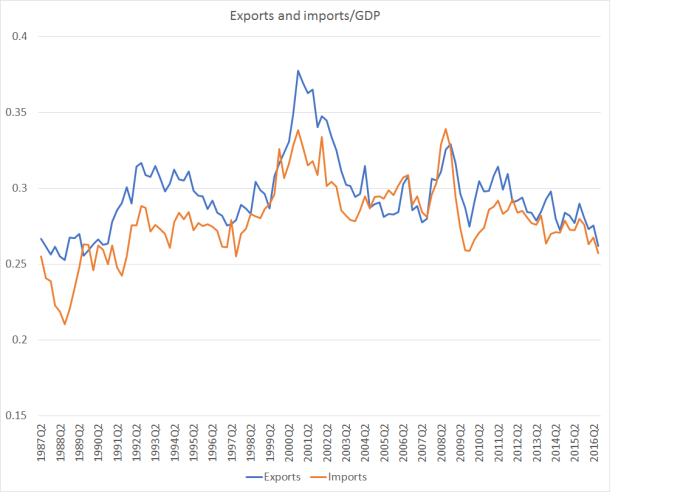
Statistics New Zealand typically advise that the best way to look at longer-term trends in components of the national accounts is to use ratios of the various nominal series.    Doing so avoids deflator problems, and also recognises that prices –  earned and paid –  matter.   Here is the chart showing exports –  and imports –  as a share of GDP.

exports-and-imports-over-gdp

Exports as a share of GDP are now below where they were when the Prime Minister was Minister of Finance/Treasurer in the last days of the Shipley government in the 1990s (and lower than at any time since then, under Labour or National governments).

In a thriving, globally competitive, economy one would more normally expect to see both exports and imports trending upwards as a share of GDP.  For small countries that is even more important than large countries.

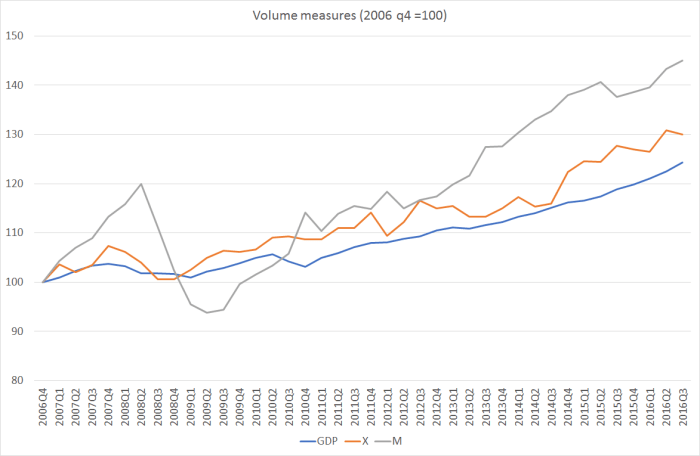
Out of curiosity I did dig out the data on export and import volumes and how they’ve grown relative to GDP.  Here is the chart for the last decade.

x-and-m-volumes

Export volumes have certainly increased a little faster than real GDP has, and import volumes more so.  But if the value of what we sell to the world (and then buy from it) hasn’t increased as a share of GDP, it doesn’t look like a particularly impressive story.

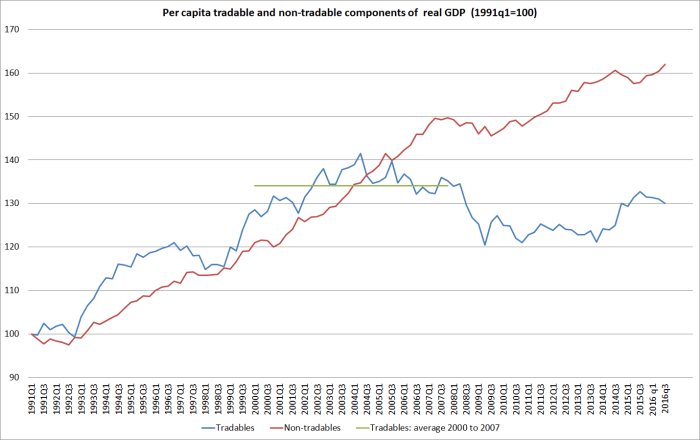
And finally, here is the chart I run every so often, showing an estimate of GDP broken down between the tradables sector (primary plus manufacturing plus export of services) and the non-tradable sector (the rest).  And I’ve presented both series in real per capita terms.  It isn’t a perfect proxy by any means, but it tries to get at the idea that domestic production for domestic consumption –  especially in the manufacturing sector – is often exposed to global competition too.

t-and-nt-gdp-feb-17

In real per capita terms, this estimate of tradables sector GDP hasn’t grown in more than 15 years.  The current estimated level is lower than the average for the 2000 to 2007 pre-recession period.

The evidence for this economy being globally competitive is slim at best.  There are no doubt plenty of individual firms doing well, but it doesn’t add up to much, especially as the starting point –  the initial share of exports (or export value-added) in our economy –  was already so low for a country our size.

In part, firms seeking to export –  or produce locally in competition with imports –  have been battling uphill.  The TWI measure of the exchange rate is around 79 this morning –  on the Reserve Bank’s real exchange rate measure only around 5 per cent off the post-float peak.    High real exchange rates can be a welcome thing, when they result from rapid productivity growth and the growing success of New Zealand firms in international markets. The high exchange rate rate then helps share the gains around.  But that simply isn’t –  and hasn’t for a long time –  been the New Zealand story.

I’m not entirely sure why politicians come out and say this sort of stuff (“globally competitive”, “dynamic and diversified export sector”).  It is particularly sad coming from the Prime Minister, who in his early years as Minister of Finance used to make exactly the sorts of points I’ve made in this post in speeches up and down the country: he was particularly fond of a version of the tradables/non-tradables chart.  And the government has long had as one of its targets a material increase in the share of exports in GDP, suggesting that they knew there was something not quite right about New Zealand’s economic performance.

But now, almost nine years in, they seem reduced to simply making up lines like these, that perhaps might feel or sound good, so long as no one actually looks into them.  Doing so discredits the speaker, and perhaps as importantly it further cheapens and debases political dialogue and debate.  Bill English should be better than that.

Peter Thiel and New Zealand citizenship

I offered a few initial thoughts the other day on the government’s decision in 2011 to grant citizenship to Peter Thiel.  The Department of Internal Affairs has now released large chunks of the material they hold on the Thiel case, although the minister at the time, Nathan Guy, remains unwilling to answer any serious questions on his exercise of discretion.  Unfortunately that refusal makes it look as though he has something to hide, which he probably doesn’t.

I remain uneasy about this specific exercise of the discretionary powers Parliament gave to the Minister, and perhaps more so about the provisions themselves and how they are being operated.  Having said that, it is far from the worst decision the current government has made in its time in office, and far from being the worst immigration/citizenship decision in recent times either –  the Labour Party’s continued refusal (as recently as on Morning Report this morning) to apologise for granting citizenship to Bill Liu, directly against the advice of officials counts as rather worse in my view.

I’d even grant Eric Crampton’s argument that of all the half-baked interventions governments like to do to help business, ones like this might be less costly than most.  But that isn’t really the point.  I think the issue should really turn on what it means to be a citizen.   Supporters of having granted citizenship to Thiel seem to see it as little more than a piece of paper –  cheap to issue, signifying little, and if a decent chap whom they like would like one of those pieces of paper, why not just give it to him.

But among the papers in the DIA release was material from Thiel’s lawyers that seemed to better capture what I think of when I think of citizenship.  I can’t now find the specific page again, but it was along the lines of Thiel recognising that “citizenship is irrevocable” [which it isn’t] and that it “signified a hallowed bond”.   The language was perhaps a little too sacramental even for me –  reminiscent of a liturgical description of a wedding ring –  but it seemed to capture something quite important.  Citizenship is expressive of a bond that has already formed, and  – when actively sought and assumed – of a commitment to continuing to foster and strengthen that bond.   We can’t easily look into the hearts and souls of men and women, and so our citizenship law relies largely on behavioural evidence, and particularly continued residence, and an affirmed attention to remain resident.

[UPDATE: I’ve now found the quote from the lawyers’ letter:   ‘Mr Thiel has advised that “citizenship is irrevocable.  It is the public recognition of a hallowed bond.  For that reason and others he is prepared to make this solemn allegiance and to thereby embrace and contribute to the life, history, and culture of New Zealand.”‘]

And yet we learn from the documents DIA released yesterday that Peter Thiel had been to New Zealand just four times prior to the grant of citizenship, had never lived here, and had no intention of living here.  He was apparently enamoured of various things about New Zealand –  some mix of landscape, character, government and business environment perhaps – and even declared that he had never found a country that accorded with his values etc as much as New Zealand did.

“I am happy to say categorically that I have found no other country that aligns more with my view of the future than New Zealand,”

Perhaps, but the most serious evidence that all that was true might have been taking up residence here, or even expressing some serious intention of doing so in future.  But Thiel and his lawyers were quite upfront about that: there was no such intention.

What remains unclear is what Thiel thought was in it for him in seeking to become a citizen.  Regrettably, he has been unwilling to answer media questions on that, or other aspects of the citizenship grant.  Such reluctance to front up isn’t really the New Zealand –  or American –  way, but perhaps fronting up to explain his deep and abiding commitment to New Zealand and all it stands for might undermine his domestic political/diplomatic aspirations in the US?     The two most obvious advantages to New Zealand citizenship seem to be that New Zealand passports get one into many countries more easily than US passports do –  although it is hard to imagine that is a huge issue for Thiel (who presumably has staff to do the donkey work of applying for visas etc)  –  and the ability to purchase land in New Zealand without (overseas investment) restriction.   Since Thiel has subsequently bought land that would otherwise have been subject to those (daft) restrictions, there is at least a plausible case that that was a significant part of Thiel’s motive.    Then again, a government that would give him citizenship (on the quiet) might just as easily have granted approval to buy the land (although perhaps that wouldn’t have been so quiet).

It is disconcerting that the Department of Internal Affairs shows few signs of having probed motivation, even though it seems a fairly obvious angle to pursue in gaining a complete picture when someone is seeking to have a minister exercise discretion in their favour.   In the released documents, there are statements from Thiel and his lawyers along the lines that if he was granted citizenship he would feel better able or more confident in representing New Zealand interests on the international stage.

“to be able to say he is a Kiwi will let him feel greater ease and confidence in mobilising New Zealand’s talented entrepreneurs.  It will allow him to represent then and their companies on the international stage not only as an investor but also as a fellow countryman. It will highlight the fact that his belief in New Zealand is so strong that he has made the commitment to take up residency and citizenship…”

But in what sense is he “a Kiwi”?  And quite what commitment is involved in taking up (legal) residency and citizenship when (for example) doing so does not even involve living here?   And if in the subsequent six years very few people  –  here or in the US –  were even aware that Thiel was a New Zealand citizen one has to wonder quite what content this statement had even had.

Another line in the documents that caught my eye was Thiel’s argument for why residence shouldn’t be a factor to be considered in his case.

“I appreciate that I would not ordinarily qualify fo a grant of citizenship under such circumstances, but believe I am an exception in that my business travel and range of interests is international and in that regard I believe I am in a similar category to other New Zealanders –  Douglas Myers, Graeme Hart, Chris Liddell are names that come to mind.”

There is, of course, a rather important difference: those three are New Zealanders (probably by birth in each case).  Thiel was not.  No one has a problem with business people travelling.  But his case would have been much stronger –  reasonably compelling –  if he had indicated an intention to take up residence in New Zealand.  But he didn’t.  And why not?  Presumably because, among other factors, the centre of gravity of his business interests is in the United States –  which makes a lot of sense in the industries he is involved in.   There is no substantive sense in which he was, or was about to become, a New Zealander.  But he has a piece of paper.

And it isn’t clear from any of the documents, or any of the subsequent material, what Thiel has done in or for New Zealand interests that he would not have done otherwise.  His investments here are presumably on the basis of looking for a good deal, and bring to the table his own expertise in combination with the domestic ideas.  Plenty of people invest abroad –  and perhaps even sing the praises of those locations –  without becoming (even on the cheap) citizens of those countries.  And, on the other hand, a citizenship that costs nothing is unlikely to be much of a signifier to others in the home country to whom Thiel’s investments and arguments might otherwise provide a lead.  Costly actions can provide valuable signals.  Cheap ones don’t.

It isn’t the worst grant of citizenship ever, but it cheapens what it means to be a New Zealander.  For Thiel it seems to mean little but, possibly, a way around some (daft, but lawful) land purchase restrictions, and some vague association with his image of New Zealand.  There is no commitment.   And it simply shouldn’t be a sufficient basis to obtain citizenship.  If he’d wanted to move here, and stay here, I’d be happy to have him –  there would be more prospect of him adding value to New Zealanders than is the case for most of those who have obtained citizenship in the last 25 years – but citizenship, especially that sought and granted discretionarily, should mean something.  Otherwise, we come perilously close to selling passports, or giving them away to people who happen to take the fancy of the powerful.

It still isn’t clear how many of these extraordinary grants of citizenship there are.  Last week, government sources suggested 200 to 300 a year, but apparently the DIA released documents now say there were only 92 in the last five years.  That seems a more acceptable and understandable number, and allays some of my concerns.  But the process seems weak and insufficiently transparent.  And there is too much risks of future ministers offering citizenship as a bauble to people who take their fancy, or otherwise gain influence with them.   As I noted last week, if there are rare cases where discretionary grants of citizenship are appropriate, lets have it all done openly.   Make any applications a matter of public record, and leave them open for two months, allowing public submissions to be made, and requiring the minister to have regard to those submissions.  Perhaps if that model had been followed, there wouldn’t have been much objection to Peter Thiel –  plenty of people are in the thrall of some vision of a high tech future, and New Zealanders tend to be rather pragmatic, for good and ill.

In the process of looking again at quite how we grant citizenship, perhaps a few other aspects of the process/law might be worth looking at.  Flicking through the DIA website, I found this extraordinary line

You might not get citizenship if you have:

  • ….
  • ever been involved in terrorism
  • ever committed a war crime or crime against humanity.

Now I know the old line about one person’s terrorist being another person’s freedom fighter, but really……why are our ministers and officials ever even considering granting citizenship to anyone who has ever committed a war crime or crime against humanity?

Inflation: monetary policy works

Next week will see the first Reserve Bank OCR announcement (and Monetary Policy Statement) for the year (and for some time, given the long summer break the Bank took).   They’ll be trying to make sense of a whole range of data, including no doubt the quarterly labour market data to be released tomorrow.  And while no one expects the OCR to be changed next week, some commentators (and markets) appear to have turned their attention to the question of when the OCR might be raised –  with some talking of that possibly happening later this year.  I’m sceptical of that: apart from anything else, whenever a central bank changes direction in a year (and it was only November 2016 when the OCR was cut to the current 1.75 per cent), it usually involves correcting a past mistake.  Perhaps last year’s OCR cuts will prove to have been a mistake.  If so, I (and, almost by definition, the Reserve Bank) will be surprised.

Inflation has picked up over the last few quarters.  But then it needed to.  Annual headline CPI inflation had been below 1 per cent for two years, and although headline inflation shouldn’t be (and typically isn’t) the focus of monetary policy, it wasn’t something that could be entirely ignored either, partly for the risk that people (households and firms) would increasingly come to treat inflation well below 2 per cent as normal –  the implicit assumption they use in economic behaviour.  As a reminder, the Governor and the then Minister of Finance made the 2 per cent midpoint of the target range the explicit focus for monetary policy in the 2012 Policy Targets Agreement.

Headline inflation isn’t the focus of policy, because it is thrown around by all sorts of things (some from the market, some from governments) that monetary policy either shouldn’t or can’t sensibly do much about.  There is no single or ideal measure of “core” or “underlying” inflation – which try to abstract from those one-offs and get at the medium-term trend in inflation.

But whichever of the many different measures one uses, there is little doubt that the medium-term trend rate of inflation was also well below 2 per cent for a prolonged period.  On some of those measures there were even concerns that underlying inflation might be falling away further, and that that process could, if things went really badly, become self-reinforcing.   In essence, that weakness in inflation was the justification for the succession of OCR cuts from mid 2015 to late last year.

Here are the six core measures I’ve used previously.

Annual inflation rate
Dec-14 Dec-15 Dec-16
CPI ex petrol 1 0.5 1.4
Weighted median 1.5 1.5 2
Trimmed mean 0.7 0.4 1.6
Factor model 1.2 1.1 1.5
Sectoral factor model 1.2 1.5 1.5
CPI ex food and energy 1 0.9 1.6
Median 1.10 1.00 1.55

At the low point, the median of these six measures was around 1 per cent, although it seems unlikely that policy was being made on that basis –  the Governor often talked of core measures being still comfortably inside the target range, and on occasion explicitly emphasised the sectoral factor model measure as his preferred indicator.  That measure is certainly the least volatile of all the underlying measures (over the whole history of the series), although it has its own limitations –  including that the series is prone to historical revision as new data about the present emerge.  But for what it is worth, here is the chart of the sectoral factor model measure.

sec-factor-model-to-dec-16The fact that this measure is not very volatile tends to mean more weight should be put on deviations from the target –  they aren’t likely to be simply “noise”.  Perhaps the latest estimates will eventually be revised up a little in time, but as it happens the sectoral factor model estimate is now around the median of the whole suite of core measures.  The medium-term trend in inflation was probably around 1.5-1.6 per cent late last year.
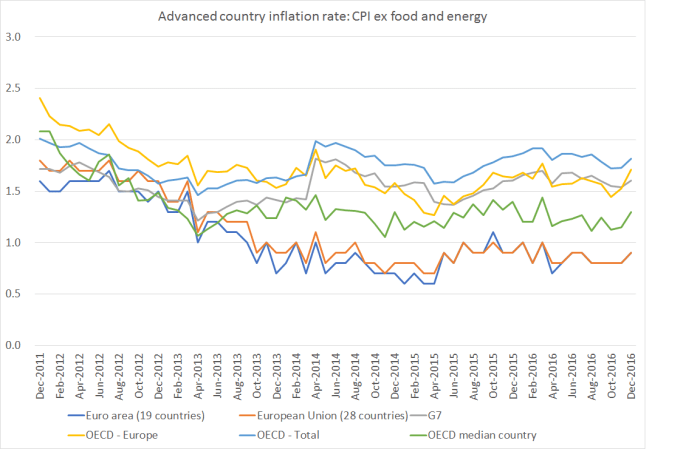
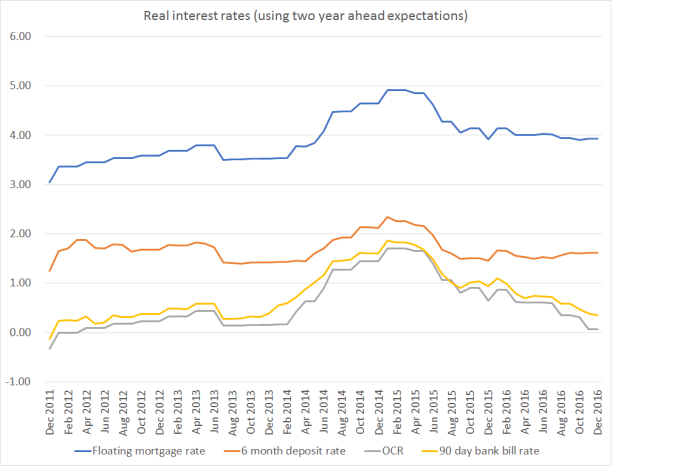
It is interesting that we don’t see a rise in core inflation in the other advanced economies taken as a group.  Headline inflation is rising somewhat on account of petrol prices, but exclude food and energy –  the most widely available core measure –  and here is what we find in the OECD data.

oecd-ex-food-and-energy-inflation

It is monthly data and there is a bit of month to month volatility, but no real sign of any sustained rise in this measure of core inflation.  I’d tend to put most weight on the green line –  the median inflation rate among all OECD countries.  In most countries, inflation also appears still to be below the respective inflation targets.

When the Reserve Bank was cutting the OCR last year, opponents of further cuts were sometimes heard arguing that “the case for cuts isn’t that good, and anyway, monetary policy isn’t likely to do much good [at such low interest rates/in this global climate]).  But the data suggest quite the opposite.    Here are a few measures of New Zealand real interest rates over the last five years.

real-int-rates-since-2011

Real interest rates rose in 2014 and into early 2015 as the Governor (supported by his advisers) raised the OCR by 100 basis points.  The medium term trend rate of inflation was low when the tightening phase started and, if anything went a bit lower subsequently.  It is likely that the weakness in inflation was the result of some combination of weak global inflation, the sharp fall in oil prices (spilling over into core measures) and the Reserve Bank’s monetary policy stance, which also helped drive the exchange rate up.  It is now generally accepted that the 2014 tightenings were simply unnecessary, although perhaps reasonable people can differ on the extent to which the mistake was foreseeable at the time.  But there is little doubt that the unnecessary tightenings stood in the way of inflation getting back to around the middle of the target range.

From mid 2015 the Reserve Bank was cutting the OCR.  The cuts were initially rather grudging –  the Bank was uncomfortable with recognising that they had got things wrong previously –  but in  total ended up being quite large.  A cumulative cut in the OCR of 175 basis points was needed simply to undo the effects of the 100 basis point tightening because expectations of future inflation fell quite materially, largely in response to the persistently low actual (headline and core) inflation.   Even now, real retail interest rates are not quite as low as they were when the tightening cycle began in early 2014.   The easier stance of monetary policy helped support growth in demand and activity –  although even now per capita GDP and income growth remains unspectacular.  And of course –  subject to data updates tomorrow –  there is still excess capacity in the labour market, with the unemployment rate  having been still well above Treasury’s estimate of the NAIRU.

Who knows what the outlook is from here.  If the TWI remains at current levels, the recovery in headline inflation could be shortlived.  Perhaps the medium-term trend in the rate of inflation will rise further.  We should hope so.  I wouldn’t be advocating further OCR cuts at present, but it seems to me that the best approach at present is to assume that we have little knowledge about the future, and that if an OCR change is required in the next 12-18 months it might as easily be a further cut as an increase.  Since the 2008/09 recession the Reserve Bank was twice started tightening phases that proved to be unnecessary and had to be reversed.  And in those cycles they typically had the support of market economists and financial markets.  Given that track record, the absence of any real rise in global inflation, and the difficulties of making sense of what has been going on, a prudent approach might be to wait to see core inflation actually at 2 per cent before looking to raise the OCR.   If the unemployment rate were to drop sharply further, or if per capita growth accelerated sharply, that stance might reasonably be reassessed.

Prices differentiated by location

We drove back to Wellington from Ohope yesterday and, having been intrigued by some incredibly low petrol prices in Otaki as we had driven north, my trusty research assistant set out to jot down all the petrol prices (for 91) we saw as we drove home again.  She only fell asleep once, necessitating a momentary stop in Foxton so that I could take down the  –  rather low – price there

To the owner of the G.A.S. outlet at Lake Rotoma I can only offer the advice that if you want passing motorists to buy your petrol, it probably pays to make the price visible from the road.

This is what we saw:

Whakatane           178.7/9

Awakeri                 188.9

Rotorua                  162.7/9    (this was three stations on the road to the airport; one other a few kms away by Whakarewarewa was advertising 182.9)

Waiotapu                178.9

Taupo                       185.9 to 190.9

Te Rangiita             192.9 and 194.9

Turangi                    194.9

Waiouru                   197.9

Taihape                    195.9

Hunterville             195.9/196.9

Bulls                          191.9

Sanson                      192.9

Foxton                       179

Levin                          176.7 to 180.9

Otaki                          205.9

Waikanae                  191.9/193.9

Paraparaumu           193.9

Plimmerton              206.9 to 208.9

Central Wellington   208.9

Given that the retail price of petrol has a very large tax component, it is an extraordinary range of prices: 46.2 cents from low to high.   The AA website tells me that on each litre of petrol there is a fixed 67.284 cents per litre tax component, with the variable (in terms of cents per litre) GST on top of that.    That means the price of petrol excluding excise is around 50 per cent higher in Wellington (141.6 cents per litre) than in Rotorua (95.4 cents per litre).  Yes, there are some differences in transport costs –  but not much between Whakatane and Awakeri, or between Levin and Otaki.  The biggest difference –  and the rather obvious one –  is the state of competition in the respective markets.  Gull (and Waitomo in Foxton) seems to more or less have guaranteed low prices.  Absent that sort of competition and prospects aren’t good at all.  Sadly for Wellingtonians there is no such aggressive competition here.

I don’t have a policy point to make, but surely there must be a market opportunity here? Levin just isn’t that far from Wellington, and they seem to manage.

On another topic, what to make of the Peter Thiel citizenship story?

Had the man wished to settle here I’d have had no objection.  He seems to be of good character, unlikely to burden the New Zealand taxpayer, and there might even be some of the famed spillover benefits (the immigration advocates are always championing) to New Zealanders had he done so.

But, and while the facts seem to be emerging quite slowly, there is no sign that he had ever intended to settle here. And, one would have to ask, why would someone like him seriously think of doing so –  being fully engaged in the US political processs, and heavily involved in industries that are centred in the US?

Against that backdrop, it looks as though we (well, the government) have simply “sold” him citizenship.     The sort of thing they used to do in places like Tonga and Panama –  and still apparently do in some otherwise respectable countries.

I’m not sure what advantages there are to a New Zealand passport for someone who doesn’t want to live here.  For some, perhaps it is the number of countries people can travel to visa-free.  For others perhaps, it is a way around the overseas investment restrictions on purchases of New Zealand land.  I think most of those restrictions should be abolished, but I don’t think our government should be offering sweetheart deals to wealthy foreigners to enable them to get around laws and restrictions that our Parliament has passed.

One of the newspapers today reports the government suggesting that up to 300 grants of citizenship are made each year under the “exceptional circumstances” provisions.  If so, that is extraordinary, and is being done with little or no transparency.  I’d have no problem with a very rare grant of citizenship to, say, an international human rights campaigner declared stateless (and passportless) by their own country –  which is the sort of circumstance a superficial reading of the statutory provision seems to suggest.

But citizenship is more than just a certificate of convenience.  It is about membership in a nation.  Mostly it comes by birth or descent.  For most others, it involves moving here, settling here, and intending to stay –  to become an ongoing part of the group of people who are New Zealand.    Sure, the boundaries can be fuzzy.    There are people who were born here, who no longer live here and have never paid New Zealand taxes, who are still New Zealand citizens.  But a relationship by birth/blood is different than one by administrative grant.

Thiel, it seems, has never lived here, and probably has no intention to do so.  By contrast, a typical migrant who moves here –  0r indeed someone who has citizenship by descent (including two of my children) but wishes to be a fully naturalised New Zealand – not only has to have lived here for a sustained period (typically five years) but must intend to keep living here.  As the Department of Internal Affairs website puts it

You have to plan to keep living in NZ. If you don’t, it has to be because you’ll be:

  • working overseas for the New Zealand government
  • working for an international organisation the NZ government is a member of (like the UN), or
  • employed by a person or organisation that’s based in NZ.

There is simply no sign that Peter Thiel would have met that test.   Again, perhaps there is a case for fast-tracking a grant of citizenship on rare occasions (eg to represent the country in an international event) but even then surely only for someone where there is an intention to stay living here.

It isn’t even clear what contribution Thiel has made that might have enabled the Minister to be satisfied that there were exceptional circumstances.  There are reports of a large donation to an earthquake charity in 2011 –  which looks uncomfortably like a “fee”, but with the benefit not even going to the public purse –  and talk of investment in some New Zealand companies, which seems mostly like private benefits all round (to the investor, and to the invested in).

At very least, if we are going to grant ministers of the Crown authority to make discretionary grants of citizenship, the public needs some more protections.    Perhaps in any case where the Minister proposes to exercise this discretionary power, the name of the person should be notified in the Gazette for, say, two months prior to the grant of citizenship? Ministers could be statutorily required to have regard to any submissions made on the proposed citizenship grants.

Granting citizenship to Thiel isn’t corruption in any direct sense –  no doubt it was done quite lawfully.  But the statutory provisions, when used in this way  –  even for an otherwise blameless individual – risk corrupting what it means to be a citizen, and gives too much discretionary power to ministers and their officials who can use the power of membership of this country to serve their own interests.  Citizenship is a privilege; one that should be secured by birth or prolonged residence (I’d probably favour a period longer than five years, but that is incidental).  And it should be a matter of entitlement once specific pre-specified detailed conditions are met.  Citizenship in a serious country shouldn’t be on offer to people with no familial connection to New Zealand, no evidence of having settled here and no plans to make New Zealand their primary location, and certainly not to people –  however able – who are willing to disburse money to favoured causes.

Finally, in a week when on the one hand “alternative facts” has entered the political lexicon, and on the other when the latest Demographia housing numbers are out, one is reminded that this citizenship grant occurred under a government led by a Prime Minister willing to assert, in defiance of all the facts, that high and rising house prices were simply a mark of how well New Zealand was doing, and how desirable New Zealand was as a place to live.  As distasteful as Trump’s are, alternative facts aren’t new.