Winston Peters on the economy

Winston Peters gave a speech on the economy yesterday to a Wellington business audience.   Going by Alex Tarrant’s report, the delivered version must have been quite a bit different than the prepared and published text, but here I’m going to focus on the published text.

When I first started thinking about the possible role of immigration policy in explaining New Zealand’s dismal long-term economic performance, the immediate response from the person I sat next to at Treasury was “careful, or you’ll be sounding like Winston Peters”.  In a similar vein (although I stress that it wasn’t the representative reaction –  most people were simply puzzled and didn’t know what to make of it) one manager  thumped the table and with the emotion very evident in his voice declared that it was disgraceful that we were even having such a discussion at The Treasury.

Peters has long been a polarising figure, and particularly so for the denizens of economic orthodoxy (of whom I generally counted myself as one).  And, of course, he has been around for a long time –  first becoming a Cabinet minister the same day in 1990 as Murray McCully, and presumably with aspirations to again becoming a senior minister after  this year’s election.  He has been Minister of Maori Affairs, Minister of Foreign Affairs, Treasurer, and Deputy Prime Minister.  Very few ministerial careers will have spanned a longer period –  Sir Keith Holyoake at 28 years is the longest I could think of.

And yet there has always been the question of what he has actually achieved, or delivered.  At present, the list of concrete New Zealand First achievements includes the Super Gold Card, some stuff about cheaper doctor’s visits for children, and……..well, not that much else.  That isn’t to say the presence of New Zealand First has had no other influence on policy over the years (quite possibly some of the government’s immigration policy changes last year and this have been partly pre-emptive measures).  But in office, Peters just has not accomplished much.

That is true of monetary policy –  long one of his bugbears.   He negotiated a new Policy Targets Agreement when he became Treasurer in 1996.  That agreement slightly increased the inflation target –  mostly reflecting actual outcomes which had been in the upper half of the previous range.  But even that agreement was a very long way short of the pre-election rhetoric.    And once the agreement was signed he never gave the Bank any subsequent trouble.   We managed to do some really daft stuff under his watch –  the infamous MCI experiment –  but he never called us out on it.  He served as Foreign Minister under Helen Clark, and while he seemed to be a safe pair of hands in that role, his biggest achievement seemed to be securing a much bigger budget for MFAT.  Somehow, I suspect that was not one of the priorities of his voter base.

And, of course, it is true of immigration policy.  As I wrote about here, despite all the rhetoric –  much of which I think was touching on, or prompted by, legitimate issues and concerns – there was nothing material in the detailed coalition agreement in 1996, and also nothing in the arrangement with Labour over 2005 to 2008.    Throw into the mix his opposition to asset sales, his unease about foreign investment, his opposition to raising the NZS age and so on, and I’ve long been pretty sceptical of Peters.

And so I turned to an election year speech on economic policy with wary interest.

I liked some of his lines (even recognised some of them).    He is totally right to call out the government for the way they make up lines to try to (a) pretend all is well (or even better) in the economy, and (b) to mask evident points of vulnerability (eg housing problems are “quality problems”).  In his words, from the title of the speech, “the facade of prosperity”.    Productivity is poor and per capita real GDP growth is pretty weak.

And while I wouldn’t word things quite this way

The fact is, massive immigration is neo-liberal, globalist voodoo.
It is an attack on those who believe in the nation state.

As a general proposition, I think the ideology of large-scale immigration in much of the advanced world isn’t far from that description.  Based on faith rather than sight.  Our politicians typically aren’t ideologues and like to think of themselves as practical people, but they’ve supped from the same streams of thought, and seem indifferent to the lack of hard New Zealand specific evidence on the benefits to New Zealanders of their preferred approach.  For many, as Peters put it,

In their make-believe world immigration is a free good – a gift.

I’ve been pretty critical of the ex post government “spin”, that attempts to suggest that all is rosy.   But Peters portrays it as the fruit of some deliberate and different economic strategy adopted by the current government.

Every country could flatter its economic growth by turning on the immigration tap.

But only NZ has seen governments reckless and irresponsible enough to try it.

In fact, to a considerable extent the current government has been running much the same immigration policy as its predecessors, including governments of which Peters was a part.

One can see it in the centrepiece of our immigration policy, the residence approvals target.  It hadn’t changed for years, until a modest cut was announced last year by the current government.  And what of actual approvals?

residence approvals 2017

For the 12 months to March 2017, the number of approvals is a bit lower than the last June year.   Overall approvals fluctuate from year to year, but average approvals under the current government are pretty similar to those under the previous government.

And here, using the MBIE data, is the numbers of people getting a first work visa in each year (excluding for the moment working holiday scheme people).
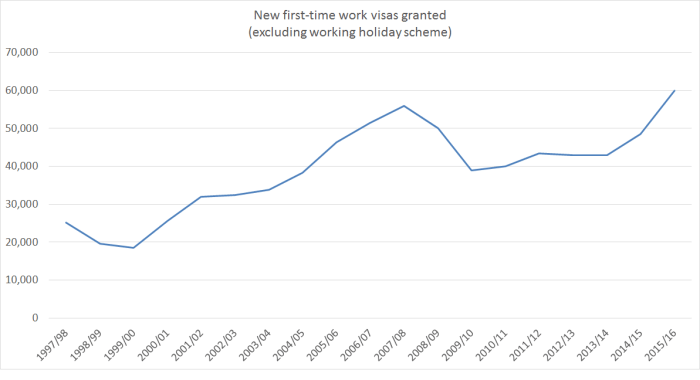
work visas granted

Not surprisingly, numbers dipped during the recession, but even with the increase in the last couple of years, the total number of people granted first-time work visas was still barely higher than in the last year of the previous government.

There are big differences in two areas.   The first is working holiday scheme arrivals.
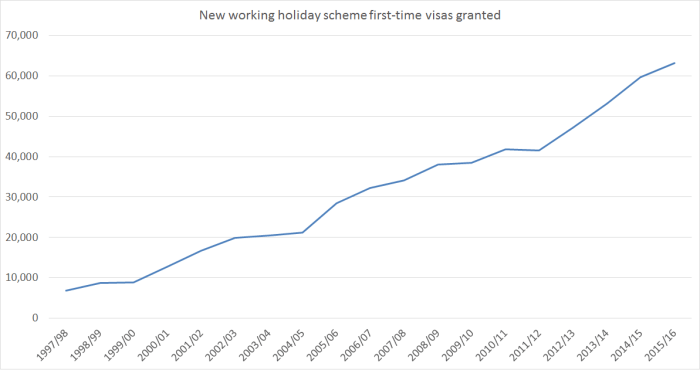
WHS

Even The Treasury has raised concern about the labour market impact of these visitors, but looking at the chart, it is a pretty strong and steady trend increase going back almost 20 years now.  It certainly doesn’t look like a whole new strategy by the current government.

Students are another matter.  There has been a recent big increase in student visa numbers, although still only back to around the 2002/03 peak.

student visas 17.png

Here, of course, there has been a deliberate policy change by the current government, in allowing many or most students significant work rights while they are in New Zealand.    It looked like, and was, an “export subsidy”, and has probably had adverse implications for New Zealanders at the lower end of the labour market (with commensurate gains to the students and their employers).   But this looks like the only significant liberalisation by the current government.  Otherwise, they’ve largely been running the same (misguided) immigration policy as their predecessors

The student issue aside, I suspect that most of what has happened isn’t strategy –  has there been any sign of a serious economic strategy? –  but of being overwhelmed by unexpected events (while the large scale mediocre New Zealand immigration policy ran on in the background).  In particular, the weakness of the Australian labour market (perhaps reinforced by the increasing recognition of the limited entitlements most New Zealanders have in Australia) means that the net outflow of New Zealanders has slowed markedly, and for longer than most had expected.   The escape valve for New Zealanders for the last 40 years or so isn’t working at present, and New Zealand has to cope somehow.

It is a bit like the larger influxes of settlers back to France, after Algeria gained independence, and to Portugal in the 1970s when Mozambique and Angola gained independence.  Opportunities that once existed abroad were no longer there, and a huge reflux of people put pressure on the home economy.  It boosted aggregate GDP quite a bit –  all these new people needed roofs over their heads –  but it didn’t do anything very evident for productivity or the per capita things that matter.

So I don’t buy the line that the current government set out to supercharge population growth.  It just happened.  Perhaps the protracted weakness of the Australian labour market was foreseeable, but it wasn’t widely foreseen.  If it had been the government could have wound back our non-citizen immigration programmes.   It probably wouldn’t have, because ministers still seem to believe the twin gospels of “productivity spillovers” and never-sated “skill shortages”, oblivious to the way that in aggregate immigration increases aggregate pressure on resources, not eases it. But they could have done something.

As it is, they seem mostly overwhelmed by events, without any real strategy other than a desperate hope that it will all come right, in the meantime all the “made up stuff” serves mostly to try to distract attention from the unbalanced, not very productive, mess the New Zealand economy is in.

The government might well be without a strategy, but you have to wonder if any other party has a serious alternative on offer.  Because in the Peters speech yesterday there was a lot of rhetoric about the past, and talk of how

New Zealand First has comprehensive, common sense economic policies designed to build a strong and resilient economy.

But there wasn’t a single word about they would actually do about immigration policy, in any of its dimensions.

I’ve heard Peters in the past talk of reducing the net PLT inflow to around 10000 to 15000 per annum.   But not even that was repeated in yesterday’s speech –  which, in a way, is welcome, because there is no meaningful way the net PLT inflow can be successfully targeted from year to year.  And there was nothing else, at all.  Even though it is only 4.5 months until the election.

Perhaps Peters thinks he can ride high simply on rhetoric.  And perhaps he can.  Perhaps he is concerned not to be outflanked by the Labour Party, which has also yet to release its immigration policy.  But there was nothing at all in the speech.   I’ve seen references to Peters wanting to set something around Pike River as some sort of “bottom line”, but (with due respect to the families of the victims) there are many more important issues in New Zealand.  Judging from his rhetoric, you might suppose Peters thinks immigration is one of those things.

And so I can’t help wondering if we are being set up for a repeat of the last two times Peters went into government: lots of talk in advance, and no action on immigration policy at all.   If it happens, of course, the establishment will be quietly content.  But nothing fundamental will have changed.

Of course, one can only hope that is true of another area of policy that he did discuss in some detail.

Since the Global Financial Crisis we have been in a new economic era that makes reform of the Reserve Bank Act urgent.

Updating the obsolete Reserve Bank Act is critical to take account of the realities of 2017 rather than using a tool that is now decades out of date.

While we cannot slavishly copy from others, in the area of monetary policy we can certainly learn from the experience of countries like Singapore.

The city-state of Singapore has a population of around 5.7 milllion people in a country hardly larger than Lake Taupo.

They don’t have our advantages but they have achieved an enviable record of growth and stayed competitive through using an exchange-rate based monetary policy.

Singapore has a managed float and has a good record in moderating short-term currency fluctuations to ensure that the Singaporean dollar reflects their economy’s fundamentals.

There is no magic wand to get the dollar down to an appropriate and competitive level – and we have never pretended that there is.

But in today’s environment of historically unprecedented low interest rates, failure to reform the Reserve Bank’s Act to make it fit for purpose is inexcusable.

Reduced exchange rate volatility might be helpful, but it simply isn’t the main game.  And Peters offers no thoughts at all on how the average level of the real exchange rate –  one of the critical symptoms of our economic problems –  might be lowered.    And even if you were after materially reduced exchange rate volatility, a Singapore style policy simply isn’t feasible in a country as dependent on foreign capital as New Zealand is.

All in all, it was pretty disappointing stuff –  the more so, because he isn’t far wrong in calling out the unreality of so much of emerges from the government on economic matters at present.
What (e/im)migration data to use when

I was having a conversation with someone the other day, trying to explain both what data there were on movements of people into (and out of) New Zealand, and which data was useful for what purpose.  Reflecting on that afterwards, it seemed that a post might be useful.  This follows on from my post last week on the Herald’s misleading article on “work visas”, but is intended to be much general, not aimed at anyone  or any recent comment in particular, and to be something I can refer (others) back to.

For those who find my discursive posts a bit trying the quick summary is that if you want to talk about immigration policy –  something that only affects non-citizen movements –  use the MBIE data.  MBIE, of course, could and should make it much easier to do so.

Being an island a long way from anywhere, it is pretty easy to count pretty reliably the number of people coming into or leaving New Zealand.   Perhaps there are a few illegals who never declare themselves, but even if so it is a trivial issue for us.

And, of course, when you enter or leave New Zealand you have to fill in, and hand over, an arrival or departure card before you can continue with your journey.  We know exactly how many people come in and go out.  In principle, the data could be available daily, but in practice monthly is just fine.  Statistics New Zealand publish that data.

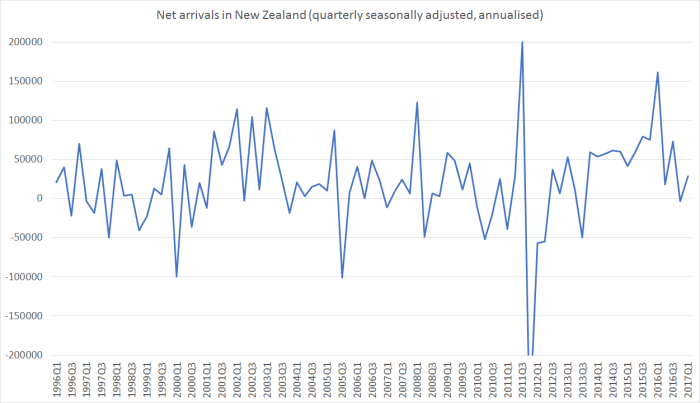
But these data often aren’t that useful for anything.     Even seasonally adjusted, this is what the quarterly data look like  (in all chart in this post, I’ve annualised any quarterly or monthly data, so that you can implicitly benchmark it against the headline net annual inflows people are most familiar with).

net arrivals

There is a huge amount of short-term volatility, and any new quarter’s information has almost no information value at all.   After the event you can see the big net inflow periods around 2002/03 and over the last few years, but it takes a lot of time to discern any trends.   Some of the volatility relates to identifiable one-off events: one can readily see the short-term inflows for the last Lions tour in 2005, and for the Rugby World Cup in 2011.  Much of the rest of the volatility can’t easily be pinned down, or adjusted for, at all.  So mostly (but see below) people don’t pay much attention to this series.   Using total movements data is made even harder by the fact that SNZ don’t publish a breakdown by citizenship (even though they have the data).

The permanent and long-term migration (PLT) data are a (largely successful) attempt to look through the noise, and provide a reasonable timely indicator of (changes in) the number of people coming and going fairly permanently.   If you say on your arrival/departure card that you are intending to come (or be away) for more than 12 months you end up in the PLT category.    This is what that data looks like (quarterly seasonally adjusted, and then annualised).

net PLT arrivals

There are still big cycles in this series, but the short-term volatility is much less than in the net total arrivals chart above  (and it would be even more obvious if the scale on the second chart was not much more compressed than that on the first chart).

What is more, SNZ publish this data by citizenship.  That enables us to separate out movements of New Zealand citizens, (who don’t permission at all to come and go), Australian citizens (who do need permission, but have been given ex ante blanket permission) and all other citizens, who need specific approval from the New Zealand government to come and stay.     I showed the chart of New Zealand and non-New Zealand citizens a week or so ago.

plt by citizenship apr 17

Both those series are also quite smooth.  Usually, it takes only a few quarters to see if the trends in these series have been changing.

That can be really useful, at least in principle, for some purposes.  If you are the Reserve Bank, trying to keep tabs on housing market pressures or overall pressure on resources, it is useful additional information.  It is more important here than in many countries both because immigration flows are so large, but also because the scale of the cyclical variations –  relative to the size of the economy –  are larger than in most advanced countries.

It is also useful information if you want to comment on the behaviour of New Zealanders (coming and going), because it is all the data we have.  New Zealanders don’t need permission to come and go  (it is also the only data on Australian citizen movements, but the size of those flows, and the variation in them, is quite small).

But the PLT data aren’t ideal by any means –  not even for the movements of New Zealanders.  As we’ll see below, they probably pick turning points quite well, but for levels they can at times be quite seriously misleading.

And that isn’t because of ill-will or malice on anyone’s part.  It simply reflects the fact the data rely on self-reported intentions.   Sometimes people aren’t sure of their plans, but even when (probably mostly) they are, plans change.   Plenty of New Zealanders head off to Australia, in particular, planning never to come back.  But some won’t find a job, and others will just miss friends and family, and they’ll be back within 12 months.  Others go, planning to be a way for only a few months, but they find they like it, a temporary turns more permanent, or perhaps they just fall in love.   And if they ever come back, it will be an absence much longer than 12 months.    And, even for New Zealanders, this all works in reverse: people come home, intending to stay, but actually…they miss the bright lights or whatever and are gone again a few months later.

Plans also change for non-citizens.  After a few months, some find New Zealand isn’t all it seemed on the brochure, and some go home again.  For others, they might have come for a few months, and then found opportunities for a work visa, or even eventually for residence.

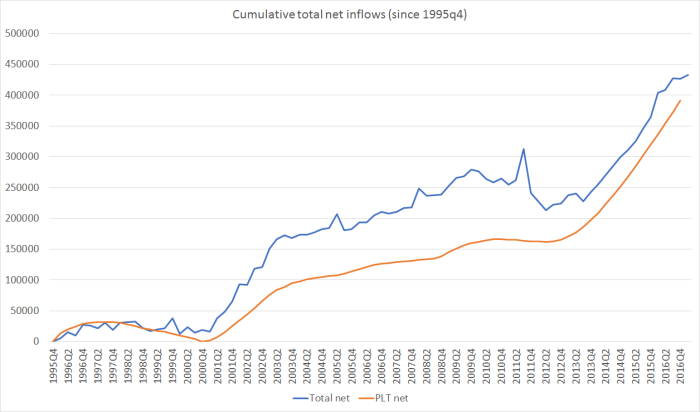
You might think the differences/errors would be small, but often they aren’t.  They probably don’t much affect the usefulness of a single quarter’s data, compared with that for the prevous quarter, and for macro forecasters that might be almost all that matters.   But over very long periods, the differences can be massive (and unpredictable).    Here is a chart showing the cumulative net arrivals for the last 20 years or so, from both the PLT data and the total migration data.

net immigration

With this particular starting point, the cumulative gap isn’t that large at present.  But at times it has been very large.   (And the big differences at times aren’t just changes in the stock of tourists in New Zealand, or New Zealand tourists abroad.)   Cumulatively, over this 20 year period we’ve a bit more actual permanent and long-term migration than the arrival and departure cards suggested.   But in the last decade or so, it has been the other way round (as the gap between the two lines has materially closed).   It isn’t easy to get a sense of how much of the differences are changes of plans by New Zealand citizens and how much by non-New Zealanders.

Statistics New Zealand recognise that the PLT numbers they publish –  and which they themselves use in publishing quarterly population estimates for the periods between censuses –  are no more than approximate indicators.  Prompted by the Reserve Bank, a  couple of years ago they published this note on work they had done on Alternative methods for measuring permanent and long-term migration.

Here is their opening chart, which highlights (in particular) the big gap between total migration (net passenger movements) and recorded PLT in the 2002 and 2003 period.

Graph, Comparison between net passenger movements and recorded net PLT migration, year ended June 2000 to 2013.

They identified three possible methods of working out (later) who actually was away for, or in New Zealand for, more than 12 months.  Those methods produced impressively consistent results

Graph, Comparison between net recorded PLT and alternative net PLT migration methods, year ended June 2000 to 2013.

As is clear in the chart, the actual PLT inflow over 2002 and 2003 was much larger than had been suggested by the reported intentions of travellers in the published PLT data (in fact, since New Zealand’s population was quite a bit smaller then, the net inflow as a share of population at peak was a bit larger than what we’ve seen  –  according to published data –  in the last year or so.)

The limitation of these alternative methods is that they can be done only after a year has passed since the initial arrivals/departures happened.  That is no small point, but it is hardly unique to immigration data. Our official GDP series are regularly revised for several years after the quarter to which they relate, as better annual data come available to Statistics New Zealand.

Unfortunately, Statistics New Zealand apparently has no money to update or report these better estimates on an ongoing basis.  That seems quite extraordinary –  although perhaps par for the course in underfunding important statistics in New Zealand –  for data that plays such a significant role in economic monitoring and public debate in New Zealand.

The alternative methods don’t invalidate the use of the published PLT numbers for short-term cyclical analysis.  Even though these are only annual charts, you can see that the turning points in the series are much the same as in the published PLT data.  But if the absolute level of the net numbers can be out by so much –   as SNZ themselves recognise in completing this analytical work –  so, inevitably, will the absolute levels of the many of the derivative series drawn from the PLT numbers.  Use the overall PLT numbers by all means for some short-term purposes (is the rate of population growth right now accelerating, slowing or holding roughly steady), but it is crucial to recognise the limitations of those data.

Perhaps the new Minister of Statistics could look at securing some budgetary funding for Statistics New Zealand, to enable them to move those alternative methods into becoming a regularly-published and updated part of the suite of official statistics?

But if you want to have an informed discussion about immigration policy –  the choices by the New Zealand government as to how many non-citizens to allow to live and work here, under what terms and programmes – the PLT numbers really aren’t very useful at all.    After all, the PLT data only capture visa types rather loosely, and many people change the visa they are on while onshore (including more than 70 per cent of those eventually granted New Zealand residence visas).

More importantly, we can use –  what surely government officials advising ministers on immigration policy mostly use –  direct administrative data generated by MBIE itself on the numbers and types of visas granted, and to whom they are granted.  MBIE administer the immigration programmes, and grant the visas that are issued.  They know exactly how many they have issued, and to whom.  And they know when those visas are cancelled, and thus can tell you how many are outstanding.     It is immeasurably superior data for discussions of immigration policy.

The problem is that although MBIE has this data, and presumably could update it every single day from its own systems, it is really quite hard for the public –  and even analysts –  to use it on a timely basis.

Once a year they publish Migration Trends and Outlook, chock-full of interesting charts and tables.  And at the same time they provide accompanying detailed summary spreadsheets of the annual data both on the residence approvals programme –  the centrepiece of our immigration policy –  and on the numerous temporary visa programmes.   Those tables are great.

But these publications are available only with quite a lag.  Last year’s report, for the year to June 2016, came out in late November.  Presumably the next issue is now at least six months away.  For some purposes it isn’t a problem.    For others, it is serious problem.  Analysts cannnot simply go to the MBIE website (let alone the Statistics New Zealand website, where much of this should be accessible) and find easy to use summary data on a monthly or quarterly basis, seasonally adjusted where appropriate.    Consider another set of administrative data.   Building permits are also granted by government entities: Statistics New Zealand collect them from 70 or TLAs and make the data available, readily usable, by the end of the following month.   Since only one agency issues visas, there is really no excuse for not having at least as good data (coverage and timeliness and accessibility) on immigration approvals.

MBIE do put out quite a lot of data on a monthly basis.  But it is a series of enormous (eg half a million lines long) spreadsheets here.    You could, if you wanted, produce your own summary tables, formatted along the lines of MBIE’s annual tables, on a monthly basis.  You could, if had the technical capability, seasonally adjust the data yourself.    But to do so is a major hassle for any ordinary analyst (public sector, media or whatever), the more so when one is used to statistical agencies providing accessible summary data, in usable formats and seasonally adjusted where appropriate.     As I noted the other day, it took me an hour or so to generate 10 numbers on how many Essential Skills visas had been granted to nationals of various countries in the last year.  By contrast, it took less than two minutes to download the comparable data for earlier years (from the MBIE summary tables).

It isn’t good enough.    The outgoing head of MBIE, David Smol, and the Minister of Immigration should really make it a matter of priority to get this data out there, in readily usable form, on a high frequency and timely basis.   It is inconceivable that it would cost much to do so, and by doing so they would help contribute to a much better informed debate on actual immigration policy.   It isn’t as if, as in some countries, immigration policy is minor matter in New Zeland –  like or not, even MBIE recognise that we have one of the largest per capita immigration programmes of any advanced country.

Now, it is true that for many of visa programmes, neither the numbers approved nor the make-up of those who receive approvals, change very much from year to year.    Mostly, if you want to know about how many people, and what sort of people, we are approving, whether as residents, students, or the various classes of work visas, looking at the last annual numbers will give you a reasonable picture.  There just isn’t that much noise in the series –  and I commend the Migration Trends and Outlook tables to those, perhaps including those in political parties, wanting to offer deeper analysis or policy alternatives.  But year old data simply isn’t good enough, when much more timely data are available internally –  and could readily be formatted to be more widely usable by non-government analysts and commentators.   Nature abhors a vacuum, and when it is so much easier simply to fall back on timely PLT data then, with all their limitations, too many people will do so.  And the debate will be the poorer for that.

It can easily be done.  For example, Education New Zealand gets the student visa data, apparently within a few days of the end of each month.   They in turn transform that data into a fascinating monthly “dashboard” (an example is here).   There is no reason why we couldn’t have official detailed tables, and a Hot off the Press from Statistics New Zealand, for these and the other visa categories.  After all, immigration policy is (concretely) about how many visas we issue, to whom, and on what terms.   When people want to talk about how many work visas have been issued, and to whom, they shouldn’t be going anywhere near the PLT data.  They should turning automatically and instinctively to accessible data from the visa-granting agency.

And when people want to debate the medium-term contribution of immigration policy to New Zealand population growth, again they shouldn’t be going anywhere near the PLT data, but turning to the rich data MBIE has, going back a large number of years now, on the total numbers and the various possible breakdowns (age, nationality, sex, occupation, approval stream etc).   These are people who will, in most cases, be future New Zealanders.  By comparison, PLT arrivals data will shed almost no useful light at all.

(Sometimes, of course, like all statistics, if they can’t be used for actual illumination the PLT numbers can still be (mis)used for support).

Because you can’t easily get it from MBIE, here is the table I ran last week on one breakdown of residence approvals for the year ending March 2017 (with thanks to the reader with MS Access who did generated them).

Residence Approvals: Year ended 31 March 2017
Application Substream Application Criteria Number approved
Skilled Migrant Skilled Migrant 25,357
Work to Residence Talent – Accredited Employer 1,464
Investor Category Investor 2 Category 1,404
Entrepreneur Category Entrepreneur category 740
Work to Residence Long Term Skill Shortage List Occupation 527
Investor Category Investor 1 Category 154
Partnership Deferral Skilled Skills/Business deferral 142
Work to Residence Religious Worker 122
Work to Residence Talent – Sports 27
Employee of businesses Employees of businesses 3
Business / Skilled Sub-total 29,940
Refugee 1,902
Samoa Quota 1,008
Pacific Access 607
Other Ministerial direction 295
Other Victims of Domestic Violence 28
Section 61 Section 61 133
International / Humanitarian Sub-total 3,973
Family Tier 1 & 2 Family Parent Tier 1 2,555
Parent Family parent 457
Sibling Family sibling 397
Adult Child Family child adult 47
Sibling Family sibling 2
Parent Sibling Adult Child Stream Sub-total 3,458
Partnership Partnership 9,439
Dependant Child Family child dependent 1,861
Partnership Partnership – Partner of an Expatriate 1,247
Parent Retirement Parent Retirement 37
Partnership Deferral Family Partnership deferral 23
Dependant Child Family Child dependent – Dependants of an Expatriate 11
Partnership Partnership 3
Uncapped Family Sponsored Stream Sub-total 12,621

And here is my own (time-consuming) table of the top 10 countries for people getting granted Essential Skills work visas, updated to include the year to March 2017.

Essential skills visas granted, by country
2006/07 2015/16 12mths to Mar 17
Philippines 1695 5,408 6174
India 1943 4,812 4904
UK 4692 3,686 4086
Fiji 2145 1,973 1756
China 2749 1,823 1801
South Africa 2003 1,382 1807
Ireland 481 969 824
Brazil 1376 923 1066
South Korea 1145 828 767
United States 1493 820 837
Total all countries 31015 31766 32775

You should really be able to get those, and so much more, readily from MBIE. Sadly, you can’t.

As a result, the debate –  whichever angle you find yourself inclining towards – is poorer than it could, and should, be.

UPDATE: I can also recommend Alex Tarrant’s amusing piece on some of the data issues.

When Australia’s unemployment drops, more people will go there again

I had things more interesting (at least to me) to write about today, but I heard the Minister of Finance on Morning Report talking up the alleged strength of the New Zealand economy, noting that we were now – in some way or another –  doing what south-east Queensland had done previously, becoming all that we always wanted to be, and so New Zealanders weren’t fleeing the country any more.  He was careful not to suggest that the diaspora is coming home –  they simply aren’t, and haven’t at any time in the 40 years since the large trend net outflow began.    As if it is somehow relevant to current New Zealand immigration policy debates – and recall that immigration policy is about non-citizens – he and others keep telling us “but they could”.    It can happen.  It did to some extent in Ireland, but it happened there after they structurally transformed their economy and successfully lifted their productivity performance.  There is no sign of such a successful transformation here, whether under this government or the long run of its predecessors.

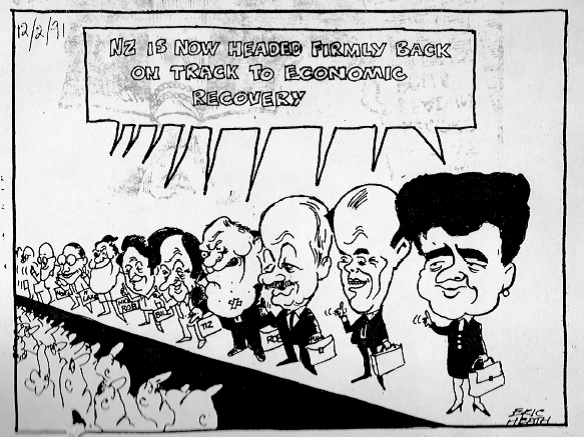
I’ve run this cartoon before
richardson

As I noted, since this was first run in early 1991

…. we’ve had Bill Birch, Winston Peters, Bill English, Michael Cullen, and Bill English again, and although we’ve had plenty of cyclical ups and downs, never at any time have we looked like successfully or sustainably reversing our relative economic decline.

And now we can add Steven Joyce to the list.

But what about those net migration flows to Australia that the Minister was talking about?

net PLT to Aus

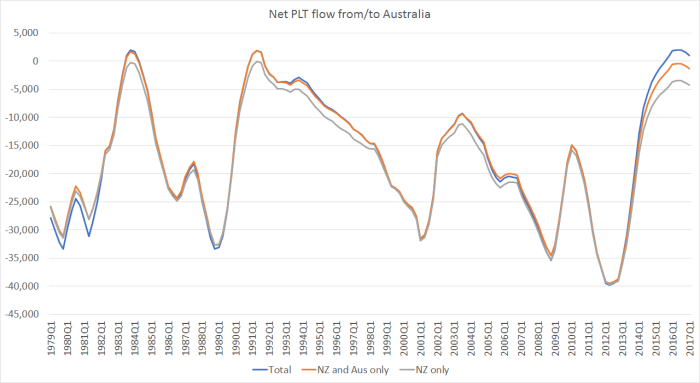
Going back 1978/79, I’ve shown three different measures of net outflow here:

  • New Zealand citizens only
  • New Zealand and Australian citizens (the group not requiring specific approval to move trans-Tasman)
  • all citizenships

Mostly the patterns are all but identical, and dominated by fluctuations in the movement of New Zealand citizens.  That makes sense: New Zealanders are free to move, and New Zealand has been materially poorer than  Australia throughout this almost 40 year period.     And over that period, there is no very obvious change in the trend –  just large average outflows, but very large cyclical fluctuations in those net outflows.

It is interesting that right at the end of the chart there is some divergence.  Over the last year, for the first time in 40 years, there has been a net inflow of around 2000 non New Zealand/non-Australian citizens from Australia.  I’m not quite sure why that is, but it is broadly consistent with the theme of this post.  Given a choice between going to Australia or staying in New Zealand, not many people tend to go when the Australian labour market is weak.     Over the last 12 months, a net 4206 New Zealanders left for Australia, but that is a lot lower than the average of around 25000 in a typical year.

In that chart above there have been five episodes when the net flow to Australia (on any of the measures shrunk a lot for a period).  The peaks were around:

  • 1982/83
  • 1991
  • 2002/03
  • 2009/10
  • the present.

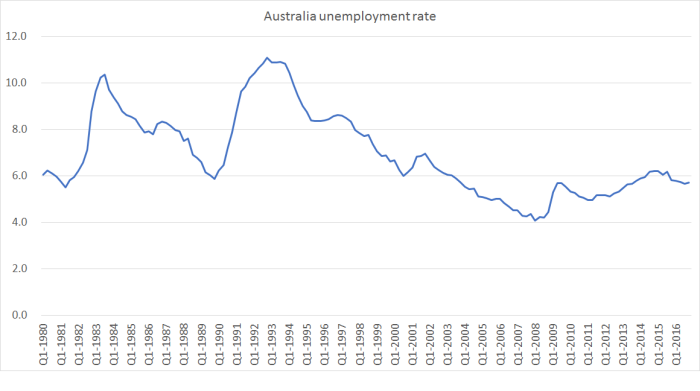
And here is a chart of Australia’s unemployment rate.

Aus U

It  shouldn’t be any great surprise that all those temporary reductions in the net outflow to Australia coincided with periods of increased unemployment in Australia.  If anything, the Australian unemployment rate looks more important as an explanatory factor than, say, the difference between the New Zealand and Australian unemployment rates.   In 1991, for example, both countries had very high unemployment  –  and at present both countries have unemployment rates well above pre-recession levels.

The greater importance of the Australian unemployment rate shouldn’t be a surprise.  New Zealanders don’t need to have a firm job offer, or advance approval, to move to Australia.  They can do so “on spec”, looking for work once they arrive.   But a typical person will be much less likely to take that risk if the search process in Australia is going to be long and arduous and might fail altogether.  And the risks have increased over the years, as Australian first tightened access to welfare for New Zealanders living in Australia, and then as people become more aware of the rather limited entitlements New Zealanders have there, even if they have been in Australia for some years.

It isn’t a mechanical relationship of course.  And the Australian unemployment rate now –  at around 6 per cent –  is a lot lower than it was in those 1983 and 1991 peaks.  But since the wage gaps between New Zealand and Australia haven’t narrowed at all, and the productivity gaps have continued to widen,  it seems only prudent to assume that as and when the Australian labour market improves, the net outflow to Australia will resume in something like full historical numbers.

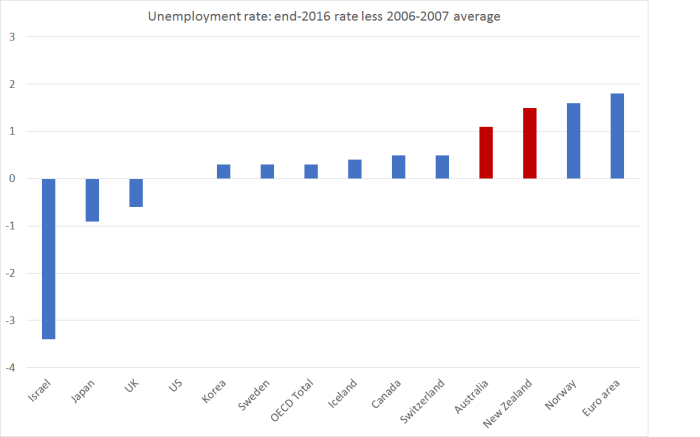
In the repeated burble from the government about the alleged strength of the New Zealand economy, it is often overlooked that while our unemployment rate is not high in absolute terms it is still well above what we experienced pre-recession, and more so than is the case for most other advanced countries that have control of their own monetary policy.   And Australia is in much the same position,

U rates in floaters

And even most of these countries largely ran out of conventional monetary policy room.  Neither New Zealand or Australia did.   Neither labour market is that strong.  Against that backdrop it shouldn’t really be surprising that the outflow to Australia has temporarily slowed.   It doesn’t reflect any credit (or discredit for that matter) on our government.  It looks like mostly a cyclical issue in Australia.  An easier stance of policy by the Reserve Bank of Australia  –  which would have been warranted with inflation persistently below target – would probably have seen rather stronger outflows even over the last couple of years.

UPDATE:  Just to reinforce the point about Australian unemployment, here is an ABS chart from a few months ago highlighting how their underemployment measure has not fallen even as the official unemployment rate has.

Graph 1, Unemployment and Underemployment rate, November 1980 to November 2016
Graph: Graph 1, Unemployment and Underemployment rate, November 1980 to November 2016


Work visas outstanding – a simple chart

To repeat my point in my earlier post, I don’t greatly care which country our economic immigrants come from.  The skills and ideas they bring are what matter most in terms of the prospect of economic benefits to New Zealanders.  The data suggest that typical skill level is a lot lower than successive governments have suggested.

But in this chart I simply take the annual MBIE data on the country of citizenship of holders of outstanding work visas (all types of work visas, but not including students here on student visas but with work rights) and group the countries by continent.   The data are all from MBIE’s Migration Trends and Outlook tables.

share of work visas

Over those years, the number of outstanding work visas increased from  94,370 to 132,781.

The advantage of these data is that they show outstanding stocks, so remove all those who have come and then gone again.   The disadvantages are that:

  • the most recent data relate to the year ending last June.  However, as the chart suggests, the patterns don’t seem to change that much from year to year.  The chart is unlikely to be misleading about the current position,
  • the chart includes people on working holiday visas.  Ideally, we would look at them separately, but for those focused on the Asia vs other split the working holiday vias numbers are dominated by European countries (UK, Germany, France, with only South Korea and Japn in the top 10, well behind the big three)
  • the chart doesn’t include those here on student visas exercising their legal rights to work.    Those numbers will be totally dominated by people from Asian countries.

To repeat again, I’m interested in the policy settings, and the overall (including distributional) economic effects.   But it is still worth clearing away attempts to muddy the water, and the Herald’s suggestion, using inadequate PLT data, that temporary migrants on work visas are not dominated by people from Asian countries, is misleading at very best.

Reducing non-citizen immigration by “tens of thousands”

Debate around New Zealand immigration policy continues to heat up.  That is what one should not only expect, but hope for, in an election year, especially in a country where non-citizen immigration is such a significant economic instrument, contributor to population growth etc, and even more so where –  despite all the talk of a skills-led immigration programme to lift overall New Zealand productivity – our productivity performance remains woeful.   And it isn’t as if the Think Big immigration experiment is a new thing, so that the gains might be just over the horizon (“the cheque is in the mail”).  Rather, the last few years have just been a somewhat intensified version of a strategy adopted for almost 30 years now.   Serious debate is long overdue.

Of course, some want to pretend that to pose any questions, raise any doubts, propose any cutbacks, about one of the most aggressive immigration programmes anywhere in the world is somehow “xenophobic”.  That’s just nonsense.  No doubt there are all sorts of reasons why some are in favour of large scale migration –  I’ve read New Zealand perspectives along those lines from libertarians and  from Marxists –  and all sorts of reasons why different people might now have some significant doubts.    Lack of any good robust evidence that New Zealanders have benefited economically from the large scale non-citizen immigration is only one of those reasons.     But when an experiment hasn’t shown clear signs of working after almost 30 years, it is almost a definition of insanity to expect different outcomes in future from keeping on doing the same thing.  And, while house prices shouldn’t be the main issue, for all the talk from the pro-immigration people that we should just “build more houses” (or free up the land) –  which I happen to agree with –  there is no sign at all of it happening to any great extent.  And it hasn’t in other places that got themselves into the mire of “town planning” and land use restrictions.

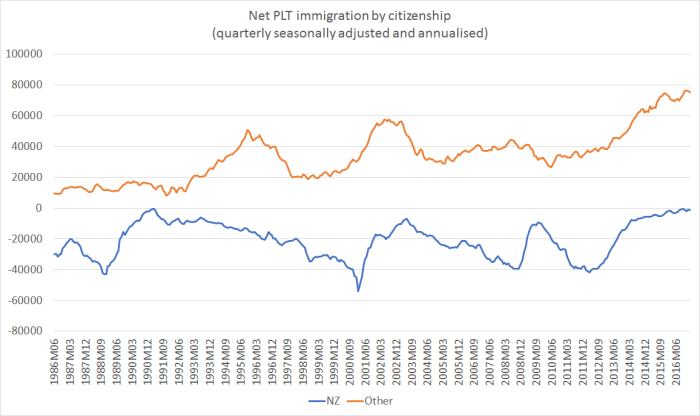
The government is keen to suggest that much of the high net migration numbers is about a return of New Zealanders from abroad.  In fact, of course, all that has happened is that the net flow of New Zealanders has slowed down (to near zero) at present.    Basically, all the 71000 or so net arrivals over the last year have been non-New Zealand citizens.   Here is the chart I’ve run many times before.

plt by citizenship apr 17

Over the last three months there has been an annualised net inflow (seasonally adjusted) of 75280 non-citizens, on a PLT basis.    (Relative to history it isn’t quite as high as it looks –  later SNZ research showed that in the 2002/03 boom there were more net permanent and long-term arrivals than the self-reported arrival/departure card estimates suggested –  but it is a large number, and large as a share of the population). That is around 35000 per annum more than were coming in, on average, in the decade prior to around 2012/13.       Almost all those non-citizens who come here require a discretionary decision by the New Zealand government (the exception being Australian citizens, for whom there is a long-term New Zealand government decision to allow free access).

Too few commentators focus on these non-citizen numbers.     Each of the main opposition parties seem to talk in terms of targeting the overall net PLT inflow.  NZ First talk in terms of, I think, 10000 to 15000, the Greens talk of 1 per cent of population, and now it appears that Andrew Little is talking of a target net inflow of around 20000 to 25000.      As I’ve noted before, and as many others have also argued, it is all but impossible, and not very sensible, to try to target the net PLT flow, and certainly not on a year to year basis.  The decisions of New Zealanders –  in turn heavily influenced by the state of the Australian labour market –  often play the largest role in fluctuations in the PLT numbers, and we don’t, can’t and shouldn’t try to control what New Zealanders do.

It is relatively straightforward, as a technical matter, to materially reduce (even by “tens of thousands”  –  Little’s language)  the net and gross inflow of non-citizens.  I outlined my own preferred approach in a post a week or two back.    Frankly, I’m a little sceptical that you could make quite that much difference if one focused narrowly on work visas, but even they offer a lot of potential.

The centrepiece of our medium-term immigration policy is the residence approvals programme.    Current policy is to offer around 45000 residence approvals each year.   Most of those approvals are offered to people who are already in New Zealand –  either on work or student visas  –  but over time it is the number of residence approvals on offer that largely determines the contribution of immigration policy to population growth (and, in the absence of good supply side policies) and to the pressure on roading infrastructure, house prices etc.    Many people only seek work or student visas to help them get points for residency.  If fewer residency places were on offer, there would be many fewer applicants for short-term positions.

The residence approvals target was reduced a little (from a range centred on 47500) last year.  But if I’ve done my calculations correctly on MBIE’s very unwieldy spreadsheet, 57623 people were approved for residence in the year to end of March 2017.     (UPDATE: I hadn’t done the calculations correctly, and the actual number seems to be 49991.  Readily accessible summary statistics – as we have in the rest of the economy –  would avoid such slips.)

Sometimes MBIE officials like to tell stories about being overwhelmed with good applicants in good times, whom it might be a shame to turn away.  But we now know, from MBIE’s own data, that that simply isn’t the situation.    Of the people applying for the most skilled stream in the residence approvals programme, more than half weren’t able to command an income as high as $49000 –  roughly what a starting primary school teacher earns – in the New Zealand labour market.    Our migrants might be more skilled than those in many other countries, but they aren’t very skilled at all, and most of them simply aren’t likely to be making a positive difference to the economic fortunes of New Zealanders (as a whole).

So let’s cut the target.  And in my view this is the nettle that the Labour Party really should grasp –  the key on which the whole programme turns.  If they want to look to their own past and their own traditions, it was one of the icons of the Labour movement, Norman Kirk who led the government that sharply cut back on non-citizen immigration, easing pressure on house prices and wider economic performance, in the mid 1970s.  Kirk did it by limiting open access for Britons.  In today’s term, the relevant metric is the residence approvals target (or “planning range”).

I’ve proposed pulling that target down to a range of 10000 to 15000 per annum.   But one doesn’t need to go that far to make a big difference.    For example, an incoming government could direct MBIE to ensure first that residence approvals for a year are capped at the upper end of the range (that would now be 47500 per annum).  Then they could, to provide a degree of certainty all round, announce that the target range would be reduced by another 20000, phased in evenly over a first electoral term, so that by the end of that term, the residence approvals target would be centred on 25000 people per annum.    That would still be getting on for twice as many approvals, per capita, as the number of green cards issued for US permanent residence.   It would be a thoroughly mainstream thing for a responsible centre-left party to do.    (As part of trying to refocus the programme on genuinely highly-skilled people I’d review and probably terminate the Pacific Access categories –  if we are serious about a skills-led economic programme we need to be hard-headed, but I don’t suppose a Labour Party with a big Pacific base could really do that.)

Of course, changing the residence approvals numbers doesn’t affect actual arrivals on day 1.  Even people approved overseas take some time to arrive, and I’m not suggesting cancelling approvals already granted.   But over time the reduced number of approvals will make a lot of difference (“tens of thousands” in fact) to the expected net inflows, even if all other visa programmes were unchanged.

But there are plenty of other changes that should be made.  We put far too much emphasis, in offering residence points, on people already having a job, or a firm job offer, in New Zealand.   Being at the ends of the earth, that isn’t always easy if you haven’t been willing to take the big risk and first relocate yourself and family to New Zealand (it isn’t exactly like moving from Brussels to Paris, or Dublin to London).  We probably do miss out on really skilled and innovative people who might otherwise come.  If we are going to give residence points for people already having a NZ job, or job offer, do it only for pretty highly paid roles –  perhaps those paying $100000 or more (you could age adjust it a bit too –  older people who are likely to be of real value as permanent residents should probably be earning rather more than that; younger people perhaps a bit less).    Again, changes like this will reduce the appeal of New Zealand work visas –  to what they should be (something where there is a specific short-term labour market need –  eg a temporary surge in demand like earthquake repairs).

What of short-term visas themselves?   A lot of government rhetoric has claimed that a huge upsurge in student numbers is a big part of the surge in net PLT immigration.    First, what we’ve seen in the last few years around students is as nothing compared to what saw 15 years ago.   Between 1997/98 and 2002/03 the number of people granted student visas increased by 70000.  Between 2012/23 and 2015/16 the increase was only 27000 (and MBIE data show that the number of valid student visas outstanding didn’t increase over the 12 months to February 2017).    As importantly, no one seriously questions that much of the increase in student visas –  mostly via lower-level PTE courses –  isn’t about the quality (or even cost) of our export education offerings, as about the residence points that such courses offer, both directly, and by providing access to a post-study “study to work” visa, which allows those completing these lower-level courses to work in any job they can find, no matter how relatively unskilled.      Severely cut back the ability of foreign students to work while doing lower-level courses, remove any residence points offered for such courses, and cut back on the “study to work” options and (the export incentives would drop away and) foreign student numbers would quite quickly fall back a long way.   One doesn’t even need to cut for every programme –  one can treat lower-level PTE courses differently to university degree courses, and even within university programmes treat post-graduate courses rather more generously.  We are happy to take –  even want –  really able people.  We shouldn’t be taking people who can’t even command $49000 per annum in the domestic labour market.

There were 25000 valid student visas outstanding earlier this year for PTE courses (and another 13000 or so for polytechs).  Halve those numbers and you make a material contribution to reducing the inflows of people (many of them working in quite lowly-skilled roles) by ”tens of thousands”.   It will be tough for those running the providers (the PTEs etc).  It was tough for many firms in the 1980s when export incentives and import protection were stripped away.  But they are changes that really need to be made.  Give some notice, sure, but many of the rule changes that facilitated the big inflows are themselves quite recent, so there shouldn’t be any sense of obligation to phase these concessions out very slowly.

I could go on, but won’t.   But as one last immigration thought for the day, I was rather puzzled by Fran O’Sullivan’s column in the Herald this morning.  Headed Forget immigration –  let’s talk wages, it was something of a mixed bag.    She seemed to recognise that immigration historically mostly raised total GDP and total population, and hadn’t been any sort of answer to New Zealand’s long-term productivity underperformance.    But her alternative was one that I suspect both pro-immigration economists like Eric Crampton, and sceptical ones like me, would both look at rather askance (to put in politely)

But if New Zealand is to evolve as a highly skilled economy it needs to set the bar higher, and pay decent wages which will also spur employers to take initiatives to drive greater movement on the productivity front.

This requires a major reset of the NZ economy – not simply using immigration to spur economic growth, then screwing the taps down when the cost of running things too hot becomes a political negative.

Where Labour is on point is with addressing the “Future of Work”.

Raising wages –  whether by government fiat (as in “pay equity” deals, or simply from employers swayed by the rhetoric) without the pre-conditions for growth in productivity is just a recipe for more unemployment (for New Zealanders), and the sort of insider/outsider bifurcated labour market that has given Spain what has long been one of the worst unemployment records anywhere.     We all want a high-wage high-productivity economy, but for everyone not just those who keep their jobs, and there is little evidence that putting the cart before the horse in the way O’Sullivan appears to suggest has ever worked on any sort of widespread basis.   The structural problems New Zealand faces aren’t mostly about bad choices by New Zealand firms (or indeed, foreign firms investing here) –  mostly they do their very best in the environment governments deliver to them –  but about that wider macro environment.

Higher real wages is a highly desirable outcome –  and on offer from policies that lead to closing the gap between New Zealand and world real interest rates (which, to be clear, has nothing to do with monetary policy) and allowing the real exchange rate to finally fall back to the sorts of levels that our dismal productivity performance suggests should have been warranted.  I hope that whatever Labour has in mind on the “future of work” it doesn’t involve leading with higher wage increases.  Rather, when they happen, consistent with low sustainable unemployment rates, it will be sign that we’ve got right much more of the rest of the policy mix.


Svensson and Labour’s monetary policy

In 1999, having been out of office for nine years, the Labour Party campaign platform included promises about monetary policy.  They undertook to change the Policy Targets Agreement –  and they did, adding the words (still) requiring the Bank to “seek to avoid unnecessary instability in output, interest rates and the exchange rate”.

But they also promised an independent inquiry into the operation of monetary policy.    It was then 10 years since the Reserve Bank Act had been passed, and we’d gone through both a wrenching but successful disinflation, and through one full business cycle since something like price stability had been established.    Some of elements of the management of that cycle hadn’t been the Reserve Bank at its finest:  use of the Monetary Conditions Index to guide short-term policy management had given us a (relatively short) period of quite astonishing interest rate volatility, not helped by being slow to appreciate the significance of the Asian financial crisis.

I don’t suppose Michael Cullen was ever a great fan of Don Brash’s.  But Brash had already been reappointed for a third term in 1998 (arguably fortunate that the reappointment was done before the nature of the MCI debacle was fully appreciated).   And Cullen was clearly uneasy about the volatility in New Zealand interest rates, and about the big cycles in the exchange rate.   There were also suggestions that he was a bit uneasy about the rule of a single unelected technocrat at the Reserve Bank of New Zealand, and Labour at times seemed to look longingly across the water at the Reserve Bank of Australia (with a higher target, more flexible rhetoric, and a reputation for being a steady hand).    And, of course, Labour was coming into government with Jim Anderton as Deputy Prime Minister.  Anderton had still not been reconciled to the Reserve Bank Act framework at all.   So it was, all round, opportune to have an inquiry.

But of course whenever one sets up an independent inquiry, the name of the person appointed to conduct the inquiry tells one a lot about what the appointer is looking for.    There were all sorts of names bandied about at the time, including (for example) Bernie Fraser who had until recently been Governor of the Reserve Bank of Australia, and whose centre-left sympathies were not exactly unknown.  But the government settled on Swedish academic Lars Svensson.  Perhaps being Swedish  –  home of centre-left big government – lulled some on the left of New Zealand politics.  But, more importantly, Svensson was also a leading academic author on aspects of the (then still relatively new) theory and practice of inflation targeting.  He’d also spent some time in New Zealand a couple of years earlier, as the Reserve Bank professorial fellow.    In other words, it was never likely to be a terribly radical report.

And it wasn’t.    Which is not to say that it wasn’t a useful exercise, or that Svensson did not make some useful recommendations.  He did.  Some of the less important recommendations –  eg around the make-up of the Bank’s Board, and the publication of a Board Annual Report –  were even adopted.    Some others that should have been adopted –  for example, the introduction of a monthly CPI –  still, unfortunately, haven’t been.  Svensson also proposed legislating for committee decision-making for monetary policy, but his proposal of a committee of insiders (including the role I then held) went nowhere: among other reasons no doubt, Michael Cullen hadn’t come into politics to give statutory power to more Reserve Bank pointy-heads.

I was quite heavily involved in the review, both in contributing to the Reserve Bank’s own substantial submission to the inquiry and –  along with a couple of Treasury economists –  as part of the secretariat to the inquiry itself.  For an inquiry into the Bank, it was a bit of an odd arrangement  –  shortly after the inquiry began I was promoted into one of the half dozen top policy/management roles in the Bank and did the two roles in tandem –  but I guess it is a small country, and there was never much doubt about the overall favourable stance Svensson was likely to take.  He was a big fan of Don Brash, and the conclusions were his not those of the secretariat (in fact, flicking through notes stapled in my copy of the report yesterday I noticed that in some places we –  and the Bank –  urged Svensson to toughen up his comments, lest the report look in places a bit like a whitewash.)

But the main point of this post isn’t about history.  It was initially prompted by an observation in a column in the Sunday Star-Times the other day, in which their resident right-wing columnist was quoting Svensson from 2001.  Damien Grant, in commenting sceptically on Grant Robertson’s proposals,

Robertson might find it useful to know that when Cullen became finance minister he commissioned a review of the Reserve Act by Swedish economist Lars Svensson who concluded:

“It is beyond the capacity of any central bank to increase the average level or the growth rate of real variables such as GDP and employment.”

The understanding that monetary policy can only influence the value of money and nothing else is one of the few untarnished successes of modern economic thought. It is deeply disturbing that Grant Robertson does not seem to appreciate this.

As a commenter observed yesterday, no mainstream economist believes that monetary policy can change the long-term level of employment/unemployment/real GDP or whatever.  In the long-term monetary policy can only affect nominal variables.   Svensson certainly believed that then and believes it now.   I don’t know whether Grant Robertson does, but I expect so.

But equally, not many mainstream economists believe that active monetary policy typically has no effect (short to medium term) on real variables.   There is pretty general acceptance, I think, that the depth and severity of the Great Depression was in substantial part a matter of monetary mismanagement.  That’s a deliberately extreme example, but it both illustrates the point and (historically) provides some of the backdrop to modern more active discretionary monetary policy.  In earlier decades, adjustments in central bank interest rates (where central banks existed at all) were mostly about maintaining the gold (or silver) convertibility of the currency.  Domestic economic conditions didn’t play much of a role.    Really bad experiences like the Depression, along perhaps with the rise of universal suffrage (the more marginal got a say in politics), helped change that focus.

Writing in 2001, reviewing New Zealand policy, Lars Svensson had no doubt about the importance of real variables in the management of monetary policy.   He didn’t question section 8 of the Reserve Bank Act –  the focus on price stability.  But his articulation of flexible inflation targeting –  what the Reserve Bank saw itself practising – involved short-term trade-offs between pursuit of the inflation target, and the variability of the real economy.  At the time, as an academic, he focused explicitly on the trade-off with variability in the output gap (the gap between actual and potential output), and devoted several pages of the report to a discussion of the issue, describing it not just as a very short-term matter, but as a “short and medium term” issue.    (For anyone interested, the full report and associated documents are here.)     What he was talking about wasn’t at all inconsistent with the 1999 addition to the PTA, quoted above, about seeking to “avoid unnecessary instability in output”).    And there was only one tool –  the OCR.

Standing back from his more theoretical perspective, there was good reason why one might want explicit consideration of real variables in the official articulation of what an independent central bank was asked to do.   One doesn’t need active monetary policy if all one is concerned about is long-term stability in the general level of prices –  something passive like the Gold Standard would do it.    But the Reserve Bank Act –  and other comparable legislation abroad –  was about a regime for governing the discretionary active use of monetary policy.   We had –  and have –  such a policy because it was believed that discretionary monetary policy could make a difference, over meaningful horizons, to real economic outcomes (GDP, unemployment or the like) even if not to the trend or potential levels of those variables.

Some years later Lars Svensson himself became a policymaker, as a fulltime member of the executive board of Sweden’s Riksbank.  The Executive Board makes the monetary policy decisions in Sweden.    Many of my old Reserve Bank colleagues don’t agree, but I think Svensson proved to be an ideal person to have on a monetary policy decisionmaking committee.   He had strong expertise in the subject – albeit initially at a rather abstract level –  and a cast of mind which meant that he wasn’t just going to fall into line with the preferences of the Governor and the long-term staff advisers.  He strongly and opened argued against the Riksbank’s strategy, adopted several years back in the wake of the global recession of 2008/09, of trying to use monetary policy to lean against the accumulation of household debt, even at the expense of inflation undershooting the target (and unemployment remaining very high).   It was a costly failed experiment, which the Riksbank eventually abandoned.

His experience as a policymaker led Svensson to recraft how he thinks about the objective of the central bank and explicit role that unemployment should have in that thinking.   He hasn’t, of course, changed by one iota his belief that in the long-term the level of real variables is determined by a whole bunch of regulatory, demographic etc factors, but not by monetary policy.    He reflected on these issues a couple of years ago in a lengthy lecture, Some Lessons from Six Years of Practical Inflation Targeting (of which only the first 10 pages are directly relevant to this post), and in another article How to weigh unemployment relative to inflation in monetary policy?

He notes

Flexible inflation targeting involves both stabilizing inflation around an inflation target and stabilizing the real economy.  A clear objective for monetary policy contributes to monetary policy being systematic and not arbitrary. Furthermore, for central-bank independence to be consistent with a democratic society, it must be possible to evaluate monetary policy and hold the central bank accountable for achieving its objective. This requires that the degree of achieving the objective can be measured. A numerical inflation target allows target achievement with regard to inflation to be measured and the central bank to be held accountable for its performance regarding inflation stabilization. But if monetary policy also has the objective of stabilizing the real economy, that part of the objective must also be measurable, in order for monetary policy to be evaluated and the central bank be held accountable. Given this, how should stabilization of the real economy be measured?

and

Stabilization of the real economy can be specified as the stabilization of resource utilization around an estimated sustainable rate of resource utilization, accepting the conventional wisdom that the sustainable rate of resource utilization is determined by nonmonetary factors and not monetary policy and therefore has to be estimated. But how should resource utilization be measured? More precisely, besides inflation, what target variable (or variables) should enter the monetary-policy loss function? One can answer this question by interpreting the legislated mandate for monetary policy and by examining what economic analysis suggests about a suitable measure of resource utilization.

In Sweden, the Riksbank’s own act mentions only price stability.  But

 The Riksbank’s mandate for monetary policy follows from the Sveriges Riksbank Act 1988:1385 and the preparatory works of the Act, the Government Bill 1997/98:4 to the Riksdag (Swedish Government 1997) that contained the proposal for this legislation. In Sweden, the preparatory works of laws carry legal weight, since they contain guidance on how the laws should be interpreted. According to the Riksbank Act, the objective of monetary policy is “to maintain price stability.” The Bill further states (p. 1): “As an authority under the Riksdag, the Riksbank should, without prejudice to the objective of price stability, support the objectives of the general economic policy with the aim to achieve sustainable growth and high employment.”

(I didn’t know this when in 2014 we wrote a Reserve Bank Bulletin article on the statutory goals for monetary policy in a range of countries, the Swedish entry in which thus should thus be discounted, or read in the light of these Svensson comments.)

Svensson continues

The idea in the Bill is hardly that there is any conflict or tradeoff between sustainable growth and high employment. Furthermore, for many years Swedish governments have emphasized full employment as the main objective for general economic policy.  Also, in this context, high employment should be interpreted as the highest sustainable rate of employment, if we accept that monetary policy cannot achieve any level of unemployment and that the sustainable rate of employment is determined by nonmonetary factors. According to this line of reasoning, the Riksbank’s mandate for monetary policy is price stability and the highest sustainable rate of employment.

In practice, he argues that the unemployment rate –  and in particular the gap between the actual unemployment rate and the long run sustainable rate of unemployment (LSRU, determined by those non-monetary factors) should be the focus.   15 years ago his focus was on the output gap but

What does economic analysis say about the output gap as a measure of resource utilization? Estimates of potential output actually have severe problems. Estimates of potential output requires estimates or assumptions not only of the potential labor force but also of potential worked hours, potential total factor productivity, and the potential capital stock. Furthermore, potential output is not stationary but grows over time, whereas the LSRU is stationary and changes slowly. Output data is measured less frequently, is subject to substantial revisions, and has larger measurement errors compared to employment and unemployment data. This makes estimates of potential output not only very uncertain and unreliable but more or less impossible to verify and also possible to manipulate for various purposes, for instance, to give better target achievement and rationalizing a particular policy choice. This problem is clearly larger for potential output than for the LSRU.

and

Compared to potential-output estimates, estimates of the LSRU are much easier to verify, more difficult to manipulate and can be publicly debated. Independent academic labor economists can and do provide estimates of the LSRU and can verify or dispute central-bank estimates. Several government agencies have labor-market expertise and provide verifiable estimates of the LSRU. One could even think of an arrangement where an independent committee rather than the central bank provides an estimate of the LSRU that the central bank should use as its estimate, to minimize the risk of manipulation by the central bank. Furthermore, unemployment is better known and understood by the general public than output and GDP.

He concludes

Most importantly, it has much more drastic effects on welfare. As expressed by [academic labour economist, and former Bank of England Monetary Policy Committee member]   Blanchflower (2009):

Unemployment hurts. Unemployment has undeniably adverse effects on those unfortunate enough to experience it. A range of evidence indicates that unemployment tends to be associated with malnutrition, illness, mental stress, depression, increases in the suicide rate, poor physical health in later life and reductions in life expectancy. However, there is also a wider social aspect. Many studies find a strong relationship between crime rates and unemployment, particularly for property crime. Sustained unemployment while young is especially damaging. By preventing labour market entrants from gaining a foothold in employment, sustained youth unemployment may reduce their productivity. Those that suffer youth unemployment tend to have lower incomes and poorer labour market experiences in later life. Unemployment while young creates permanent scars rather than temporary blemishes. 

When unemployment rises, the happiness of both workers and non-workers falls. Unemployment affects not only the mental wellbeing of those concerned but also that of their families, colleagues, neighbours and others who are in direct or indirect contact with them.

Thus, I think there are strong reasons to use the gap between unemployment and an estimated LSRU as the measure of resource utilization that the central bank should stabilize in addition to stabilizing inflation around the inflation target.

Svensson proposes reduces all this to a “loss function”, to which, in principle at least, central bank monetary policy decisionmakers can be held to account, with formal weights attached to each of the inflation gap (from target) and the unemployment gap (from the LSRU).

Personally, I think he is rather unrealistic in supposing such a formulation is possible, at least as the basis for formalised accountability.    But if it is practically challenging (or even impossible), the sort of analysis he advances here isn’t unorthodox or out of the mainstream.  It is simply one plausible extension of the conventional economics of modern monetary policy, from one of the leading contributors to the academic literature (and someone who has himself been exposed to the real world challenges of policymaking).

I don’t know specifically what Svensson would make of the current debate in New Zealand, or of what the Labour Party (at quite a high level of generality) is proposing.    What we do know is that Labour is proposing nothing nearly as specific or formal as Svensson argues for: there would be no numerical unemployment target or an official external assessment of the NAIRU (or LSRU).  My impression would be that his reaction would be along the lines of “well, of course the unemployment rate –  and short to medium term deviations from the long-run level, determined by non-monetary factors – should be a key consideration for monetary policymakers; in fact it is more or less intrinsic to what flexible inflation targeting is”.   He might suggest there are already elements of that in the PTA, but that making it a little more high profile, with an explicit reference to unemployment, might be helpful.     I might be wrong about, but it could be worth Robertson or his advisers getting in touch with Svensson –  who retains an interest in New Zealand, and gave a paper here only a couple of years ago –  and asking.


Grant Robertson made my day

In an address at Victoria University at lunchtime, Labour’s finance spokesperson Grant Robertson launched his party’s monetary policy reform programme.   In an interesting move, the incoming Acting Governor, Grant Spencer, who would have to manage (for the Bank) the early stages of Robertson’s reform process if Labour leads the new government, attended, sitting very visibly in the front row.

The two main aspects of Labour’s proposal are:

  • broadening the objective from just price stability “to also include a commitment to full employment”
  • changing the decision-making structure for monetary policy, so that a committee would have legislated responsibility.  That committee would comprise four internals (including the Governor) and three external experts who would be appointed by the Governor (but in consultation with the Minister of Finance).

Labour would also require the Bank to release the minutes of the Monetary Policy Committee, including the results of any votes, within three weeks of the relevant OCR decision being announced.

I was interested to note a press release from the Greens in which they state

Labour plans to change the way we do monetary policy in New Zealand and the Green Party supports them fully. We’re now of a single mind on this.

The Greens have previously favoured the Reserve Bank Board –  whose members are mostly non-experts –  making OCR decisions, so I’m not clear if the “single mind” James Shaw refers to extends to that level of detail, or just to a shared commitment to (a) reform, and (b) a decision-making committee that would involve non-executive outsiders.

Bill Rosenberg of the CTU and I were discussants following Robertson’s address.   I wrote this morning a fuller version than I could use of my thoughts on the Labour proposal.

Reflections on Grant Robertson on the RB VUW 10 April 2017

I opened observing that when I got an outline late last week of what Robertson was going to say, I had blurted out that “Grant Robertson has just made my day”.  I’ve been arguing for governance reform for at least 15 years, and between the report the Minister of Finance has commissioned, and the shared commitment to reform of the Greens and now Labour, it looks as though change might finally happen.   There was a certain logic to the current single decision-maker system in 1989, but if it had a logic then –  in how we understood monetary policy, and the nature of the Bank’s functions –  it simply looks wrong today.  Other countries don’t do things that way.  We don’t either in other areas of public life.

What I’m most encouraged by is the commitment to involve outsiders, not just to cement-in a position for insiders.  Having said that,  I raised two main areas of concern:

  • the first is the Robertson proposal that the Governor should continue to be (in effect) appointed by the Board (in turn appointed by the current government), and that all the other voting members (inside and out) would be appointed by the Governor.  He qualifies this by noting that these appointments would be made in consultation with the Minister of Finance.    But that is a recipe that risks the Governor surrounding him or herself, deliberately or unconsciously, with people who think like the Governor, and will be reluctant to challenge the Governor too much.   The Minister might raise a few questions about a proposed appointee, but will be reluctant to second guess the Governor, and cannnot overrule him in this model.   Frankly, it is a model with a yawning democratic chasm and not a model I’m aware of being used in any other country.  It is one thing to delegate operational decisions to independent boards, but the members of those Boards should be appointed by those whom we elect –  ministers –  and whom we can toss out.
  • the second concern is that under the proposed model there would be four insiders and three outsiders.  That is the wrong way round, and most likely would be a recipe for the marginalisation of the outsiders (since the insiders have no independent status, and all work for, and have their pay etc set by the Governor, they can easily caucus and out-vote the externals).   I’d prefer two internals and three externals, all directly appointed by the Minister of Finance.

In response, Robertson noted that he was open to looking again at the ministerial appointment option.  He noted that it was awkward as putative Minister to be talking of giving himself such extensive appointment powers.  Perhaps, but that is the way most public sector boards work.  If he wants Labour precedent, Gordon Brown introduced the Bank of England statutory Monetary Policy Committee, to which the Chancellor appoints most of the members directly, and has to be consulted on the remaining two.

Robertson explained that he preferred to keep a majority of insiders because one of his priorities was to preserve the operational independence of the Bank. I was, and am, puzzled by that response. I noted to him that the RBA has a substantial majority of outsiders on its decision-making Board, and that they had operational independence.  The same goes for Sweden’s Riksbank.  I’m less optimistic about a re-think there, as Robertson also stated that he did not envisage allowing MPC members to make speeches or comments on monetary policy without the explicit prior consent of the Governor.  It seems he still has in mind an excessively Governor-dominated institution, and one in which it would be hard to ensure transparecny and the regular injection of fresh perspectives and alternative views.  If so, that would be unfortunate.

I noted some unease about his proposal that all the external appointees would be “expert”, and perhaps had that concern somewhat allayed when he stressed that in this context he did not intend “expert” to mean simply a narrow expert in specific aspects of monetary economics or the like.

My other main observation in this area is that the Labour proposal (deliberately and consciously) does not yet address the governance and decisionmaking for the Bank’s extensive financial regulatory functions.

But the most important omission seems to me to be the governance provisions for the Reserve Bank’s extensive financial stability and regulatory functions, under various different pieces of legislation.   There is no precedent anywhere for so much regulatory power to be in one person’s hands.  It wasn’t even an outcome that was consciously deliberated on by Parliament –  rather it grew up with a succession of amendments to the Act, and changes in regulatory philosophy over the years. And whereas a regulating Cabinet minister can be reshuffled or dumped whenever the Prime Minister chooses, a Governor of the Reserve Bank is secure for five years.

If individuals matter in monetary policy, even with something like the PTA, they are likely to matter hugely in the financial regulatory area, where there is nothing like the PTA to constrain or guide the Bank/Governor.  The economic impact of regulatory choices can be as large –  if less visible –  than those around monetary policy.  I really hope that Labour will be thinking hard about how to extend their governance reform ideas into the financial regulatory field.  Personally I think there should be three strands to that:

  • Removing some of the high level policy-setting power back to the Minister of Finance (so that the RB applies the rules etc and mostly doesn’t make the high level rules),
  • Move responsibility for the various pieces of legislation out of the Reserve Bank, probably to Treasury. This matter is already being touched in the Rennie review commissioned by the current Minister of Finance, and
  • Establishing a Financial Policy Committee, paralleling the Monetary Policy Committee, as the entity empowered to exercise whatever policymaking powers reside with the Reserve Bank. Again, a five-person committee (Governor, Deputy Governor, and three externals seems like a feasible solution).  The FPC would also be responsible for Financial Stability Reports.

Robertson acknowledged the deliberate omission and talked of it being “part of the conversation” moving forward.  I hope so.    This is the opportunity for a full overhaul of the governance model, not just tacking on an MPC to a model that doesn’t work that well in other areas either.

The other half of the address was about the idea of adding full employment to the goals for monetary policy.  I was (and am) much more sceptical, and nothing that was said in response to questions really clarified things much.    I get that full employment is an historical aspiration of the labour movement, and one that the Labour Party wants to make quite a lot of this year.  In many respects I applaud that.  I’m often surprised by how little outrage there is that one in 20 of our labour force, ready to start work straight away, is unemployed.  That is about two years per person over a 45 year working life.  Two years……     How many readers of this blog envisage anything like that for themselves or their kids?

But still the question is one of what the role of monetary policy is in all this, over and above what is already implied by inflation targeting (ie when core inflation is persistently  below target then even on its own current terms monetary policy hasn’t been well run, and a looser monetary policy would have brought the unemployment rate closer to the NAIRU (probably now not much above 4 per cent)).

I noted that I’m sceptical that the wording of section 8 of the RB Act is much to blame.  After all, for several years prior to the recession, our unemployment rate was not just one of the lowest in the OECD, it was also below any NAIRU estimates.  And when I checked this morning, I found that our unemployment rate this century has averaged lower than those of Australia, Canada, the US and the UK, and our legislation hasn’t changed in that times.  Robertson often cites Australia and the US.

The last few years haven’t been so good relatively speaking.  But if the legislation hasn’t changed and the (relative) outcomes have, that suggests it is the people in the institution who made a mistake –  they used the wrong mental model and were slow to recognise their error and respond to it.  Getting the right people, and a well-functioning organisation, is probably more important than tweaking section 8.

Robertson disputed my past characterisation (as “virtue signalling”) of his talk of adding a full employment objective.  But I still don’t see in what way I am wrong in that description.  It would send a single to key constituencies that Labour “feels the pain” and has an integrated commitment to advancing full employment, but what difference would it make to the Governor and his committee?  There wouldn’t be a numerical definition of full employment in the PTA, and since Robertson remains committed to the accountability framework of the Act, it is very hard to see how or why any given Governor would react much differently given a specific inflation target and a vague injunction to promote “full employment”.  A different Governor might make a difference –  hence, choose carefully –  but that sort of wording is unlikely to.

If they form a government later in the year, Labour (and the Greens) clearly will need to add some words to the PTA.  I drew the attention of those present to the 1950 amendment to the Reserve Bank Act, under which

[The Bank] shall do all such things within the limits of its powers as it deems necessary or desirable to promote and safeguard a stable internal price level and the highest degree of production, trade, and employment that can be achieved by monetary action.

I quite like it (and not just because a relative of mine was the responsible Minister of Finance).  It recognises that monetary policy doesn’t exist in a vacuum, and that people (voters and politicians) care about other stuff.  In fact we don’t pursue price stability simply for its own sake, but for a better life for New Zealanders. But note the key phrase  “the highest degree of…employment that can be achieved by monetary action”.  That might not be much, at least once the unemployment rate is back near the NAIRU.

As today’s chair –  economic historian Gary Hawke –  noted the 1950 change was largely about signalling too, and it isn’t obvous it made an awfully large difference to actual monetary policy.  But that was my point.  If you want words –  or signals – it is easy enough to craft elegant formulations that express those aspirations, and even articulate a place for monetary policy in overall economic management. It is a quite different thing to expect a central bank, however governed, with a single instrument capable only of affecting nominal variables in the longer-run, to make much material difference over time in achieving the wider –  and laudable –  government goal of full employment.

Politically, it doesn’t help at all to make that distinction.  But analytically it looks pretty clear.  Well-crafted words –  a modern version of that 1950 formulation –  would do no harm, and I’d have no real problem  with them, but they won’t make much substantive difference either. But sometimes, I guess, symbols matter quite a lot.

A leading academic weighs in on immigration

When the head of the economics department of New Zealand’s leading university takes to the op-ed pages of New Zealand’s most widely-circulated newspaper, readers might reasonably suppose that what the author has to say will be authoritative and well-worth reading for anyone interested in the issues upon which the author is opining.

Last Thursday, Professor Ananish Chaudhuri, head of the economics department at the University of Auckland, had a piece in the Herald headed Immigrants are a gain, not a drain .

Chaudhuri’s own background isn’t in the economics of immigration, nor is he an expert in issues around productivity, economic geography, or New Zealand’s economic history of sustained underperformance.   He is, as the article notes, professor of experimental economics.  I’ve only heard him speak once, and found his work fascinating.  You can check out his list of publications here.  He seems to be highly-regarded in his own specialist areas, and as an immigrant himself one might safely conclude he has been a net (economic) gain to New Zealand.

I’m not holding against him the fact that he isn’t an academic specialist in the economics of immigration and in New Zealand’s economic history and performance.  Few people (arguably none) are.  Ideas should stand on their merits, not on the CVs of those holding them.   But lay readers, attracted by the title “head of economics department, University of Auckland”, might have assumed a degree of specialist expertise that doesn’t seem to be there.

Chaudhuri’s op-ed has three main strands, before concluding with an astonishing assertion.

He begins with a bit of a rant against Donald Trump and somehow manages to wrap in, as part of a single phenomenon, the recent decision to deport some Indian students whose applications for student visas –  many no doubt hoping to use that as a stepping stone to residence –  were based on demonstrably, and admitted, false information.  They (signed statements which) lied.    One might, or might not, have some sympathy with them as individuals, but whatever one thinks about the appropriate levels of immigration to New Zealand (a) people are more likely to have confidence in it when the rules, whatever they are, are enforced, and (b) there are few defenders of the rort the student visa system had become over the last few years, often aided and encouraged by a government keen to maintain a story about the success of the export education industry.    We could sell more of almost anything if there were points towards a residence offered as well.  That is how export subsidies work.  They were a bad idea in the 1970s, and they are a bad idea now.

But what of the substance?

His first question is “are immigrants a drain on the economy”.     His answer to that question is no, and to do so he relies exclusively on the BERL estimate of the differential impact on (a portion of) government finances of natives and immigrants.    Nigel Latta made a TV documentary on immigration last year that relied wholly on the same study –  and if that was questionable (and I questioned it here) at least he wasn’t an economist.

As even the authors of the BERL study noted

2. The study concentrates on fiscal rather than economic impacts. Due to this the study is limited to estimating the direct monetary impacts on the government’s operating budget.

Fiscal impacts can be interesting, if done well, but they don’t tell us –  can’t tell us, aren’t designed to tell us –  whether natives are made better off, worse off, or left largely unchanged –  by the sort of level/composition of non-citizen immigration we’ve had.

As it is, the BERL study covered only some parts of the government’s finances, and the bits they omitted –  not through bias, but because they are hard –  would be likely to change materially even the fiscal assessment, as would a full intergenerational approach to the issue (again, BERL was not paid to do something state of the art).   For anyone who wants to look at some of the problems  with the fiscal estimates, I wrote about some of them in one of my posts responding to the New Zealand Initiative’s recent immigration paper.  As I noted, even if the average migrant is a net fiscal gain –  which is plausible –  it is very unlikely that all classes of migrants are.

In short, Chaudhuri offered readers nothing shedding light on whether New Zealanders’ living standards, or the productivity of the New Zealand economy, have been improved by our immigration programme.

Chaudhuri’s second question is “do immigrants displace native workers”.  Actually, on this point he went further than I would have, noting “yes to an extent”.     But after only a handful of words on immigration effects, he devotes the rest of that section of his article to discussing some interesting material on other forces that might (globally) be “driving blue-collar wages downwards”.  That may very well all be true, and even important, but what we were promised was an economic analysis of immigration (presumably focused on New Zealand), and it just isn’t there.

His third question is “do immigrants fail to assimilate”.  In his view “arguments about assimilation are usually a cover for aversion to ethnic diversity, so it is difficult to provide a cogent counter-argument”.  In other words, “back in your box racists”.  He seems unaware of, or uninterested in, literature on trust, national identity, social cohesion or any of the range of conflicting evidence on the implications of different types of diversity.  Perhaps he could walk down the road and have a chat with AUT academic Bart Frijns, whose work I wrote about here last year.   Issues around assimilation aren’t my focus, but there are reasonable debates to be had.

As he gets towards the end of his column, Chaudhuri offers quite a balanced perspective.

There is no doubt that while immigration increases the size of the national pie, it does create winners and losers. For workers suffering from stagnating wages, the sense of displacement and disillusionment is real.

So even on Chaudhuri’s assessment, it isn’t all a rosy story.  All else equal, some natives are being made worse off.    But apparently it doesn’t really matter, because the learned professor knows that….

…the bottom-line is clear: The net gain to society from immigration outweighs the losses and, therefore, there must be ways of providing a safety net for displaced workers in a way that makes all of us better off.

But no shred of evidence – global, let alone anything specific to New Zealand – was offered in the entire column to show that there are overall gains.  One might guess that he is relying on some general international academic pro-immigration consensus, but he shows no sign of having engaged with the specifics of the New Zealand experience, past and present, at all.    (And, for what it is worth, he also offers no specifics on these redistributive measures that might help ensure that even the “losers” actually end up made better off.  That isn’t surprising, as I’m not aware of any advanced economy where such measures have been put in place.)

Chaudhuri then wraps up with an astonishing claim

In the meantime and leaving cultural arguments aside, those who suggest immigrants are a net drain on society in economic terms are purveying “alternative facts” that should not be part of informed discussion.

Wow, so no debate should be entered into because the learned professor has decreed  –  not even argued, or demonstrated,  but just decreed –  that the economic case is closed.  Economies benefit, New Zealand’s economy benefits, and any suggest to the contrary is right up there with Trumpian claims about numbers in the Inauguration parade.   I disagree with the people at the New Zealand Initiative on immigration, but they weren’t that dogmatic –  and were pretty open about the lack of New Zealand specific empirical studies on the overall contribution of immigration policy to New Zealand’s economic and productivity performance. For them, the conclusion that New Zealanders’ benefit was a judgement –  probably held strongly, but an informed judgement nonetheless.  It wasn’t revealed truth, into which no subsequent debate could be tolerated

When the 27 prominent New Zealanders came out the other day with their open letter on free speech, I didn’t pay much attention. I was generally sympathetic, but in my observation the issue of attempts to close down debate (on all manner of topics) seem to be becoming a serious issue in the US (especially in academe) but not, at present, in New Zealand.  If one takes him at his word, Chaudhuri seems keen on having New Zealand catch up down that slippery slope.   I hope I shouldn’t take him at his word, and he is more open to debate –  specific debate, concentrated on New Zealand’s experience, and New Zealand’s programme –  than his op-ed suggested.  Perhaps the Herald could offer him another column, in which this time he could get specific about the nature of the evidence he believes –  as head of the economics department of our leading university –  makes it such an open and shut case that New Zealanders as a whole are reaping economic rewards with our huge decades-long grand immigration experiment?

Joyce requests review of Reserve Bank governance structure

Some will have seen Hamish Rutherford’s Stuff article reporting on the review the Minister of Finance has commissioned (to be undertaken by former State Services Commissioner, and former Treasury deputy secretary  responsible for macroeconomics,) Iain Rennie) on two aspects of Reserve Bank governance:

  • whether something like the existing internal committee in which the Governor makes his OCR decisions should be formalised in legislation, and
  • whether the Reserve Bank should remain the “owner” of the various pieces of legislation (RB Act, as well as the insurance and non-bank legislation) it operates under.

This is very welcome news.  As I noted in a post a couple of months ago on governance issues,  Steven Joyce has previously been on-record less averse than some to changing the model.


Who knows if the new Minister of Finance is interested, but flicking through some old posts, I was encouraged to find one from September 2015, reporting an exchange in the House between then Associate Minister of Finance Steven Joyce and the Greens then finance spokesperson Julie Anne Genter.  In response to a question on governance, Joyce responded

Hon STEVEN JOYCE : The suggestion that the member makes, of having a panel of people making the decision, is, I have to say, not the silliest suggestion in monetary policy we have heard from the Greens over the years, and many countries—

A backhanded dig at the Greens at one level, but not an outright dismissal by any means.

And with the Governor confirming that he is leaving in September, and a year now until a permanent new Governor is in place, it is good time to have such a review, so as to be open to the possibility of reform, including in discussion with potential candidates for Governor.   Treasury tried to interest the previous Minister of Finance in legislative reform before Graeme Wheeler was appointed, but were knocked back (even though Treasury had found support for reform from market economists).   Graeme Wheeler also sought to initiate reform –  legislating for his Governning Committee –  in 2013 (although he still keeps all the relevant papers hush-hush), and was also knocked back by the Minister of Finance.  So, I’m encouraged that Steven Joyce has initiated the review.

That said, it is a pretty small step.  Iain Rennie will bring some relevant background to the issue, although his track record as State Services Commissioner might not command much confidence in circles other than those who appointed him.  And the Minister of Finance is not committing the National Party to supporting change.  But with almost all other political parties favouring change, and Rennie likely to point out the simple fact that no other New Zealand public sector entity is governed the way the Reserve Bank is (all power formally in one official’s hands), and no other central bank and financial regulatory agency in other advanced countries puts so much power (monetary policy and banking etc regulation) in one person’s hand, it is likely to set in place momentum leading towards some legislative reform next year.

I spoke to Rutherford about this yesterday and am quoted in the article

Michael Reddell, a former special advisor to the Reserve Bank who says he sat on a committee on OCR decisions for 20 years, said formalising the current structure would make only a marginal difference, as the members all reported to the governor.

“If your pay and rations are determined by the governor, then the extent that you’re willing to stand up is questionable, particularly to a tyrannical governor,” Reddell said.

“If the minister [of finance] were appointing the people on the committee, it would be a material step forward.”

All three Governors who have operated under the current legislation have operated pretty collegially.  For a long time, the OCR Advisory Group (OCRAG) was the forum in which the Governor took formal written advice and recommendation, and then made his decision (I was part of that group for a long time).  Mostly his decision was in line with the (usually) clear-cut majorities of advice.  All members of that committee were appointed by the Governor, including two external advisers.   The current Governor has put in another layer of hierarchy, taking advice from a wider group and then making his decision in a smaller group (him, his two deputies and the chief economist).

I should stress that the reference to “tyrannical” Governors was not intended as a reflection on anyone who has served as Governor.    But you need to design institutions around poor or insecure Governors: good ones will want, and will encourage, debate and alternative perspectives.  Poor ones will squash it, and if they control all the members of the statutory committee, it offers little or no protection  –  and actually puts monetary policy decisionmakers at a further remove from the voters and Minister of Finance.   As I’ve argued previously, we need more involvement of the Minister in appointing monetary policy (and financial regulation) decisionmakers, and also need external perspectives brought into the process, in the form of full formal participation in the decisionmaking.  As, for example, it is in Australia, Canada, the UK, the US, Sweden and so on.

Rutherford’s report doesn’t say whether the Rennie review will also look at the formal decisionmaking structure for financial regulation.  Those issues will have to be considered in any legislative reform, and it is probably more important to get collective and external decisionmaking processes formalised, since in these areas the Bank does not operate to something like the PTA, but rather exercises huge amounts of barely-fettered discretion.

The second half of the review –  looking at whether the Bank should stay responsible for its legislation – is not one of the (long list) of reform issues I’ve focused on.  It will probably have many people at the Reserve Bank spitting tacks, and looking at all sorts of bureaucratic tactics to retain something as close as possible to the status quo.  I favour change (but will openly acknowledge that until perhaps the last five years I had the same insider hubris that affects many RBers –  a belief that “we are different” and no one else in positioned to do the legislation-ownership role well).  That is simply wrong –  and if the expertise isn’t there right now, it could be developed over time (probably in Treasury) without too much difficulty.  Again, it would bring the Reserve Bank into line with other Crown entity types of bodies, few (if any) of which are now responsible for their own legislation (altho in years gone by some important ones –  eg ACC – were).  It might seem to many readers like an “inside the Beltway” issues, that doesn’t really matter to citizens.  That would be a mistaken view.  Reform in this area is just one part of the overall agenda to improve the accountability of the now very-powerful Reserve Bank, and bring its goverance more into line with that for other Crown agencies, and with central banks and financial regulatory agencies abroad.

And so for the second time this week, I commend Steven Joyce.  It is only an unambitious start, but the start matters.


Appointing an Acting Governor: what the documents show

I had an email the other day suggesting that I should reduce my coverage of Reserve Bank issues.  No doubt the topic isn’t that interesting to that particular reader, but the main criterion for coverage here is what I’m interested in, and as I noted in response I’m interested in Reserve Bank issues, know something about them, and am fortunate to be much less constrained in what I can say than many other economists (often employed by entities the Reserve Bank regulates).   (As it happens, for any Wellington readers interested in monetary policy issues, I will be speaking briefly as a discussant responding to a presentation by Grant Robertson at Victoria University next Monday lunchtime.)

Which is by way of introducing a post which may not be of great interest to some readers.

For much of the time this blog has been running I had been pointing out, every few months, that the Governor’s term was due to expire almost three years to the day since the last election, and thus any replacement would normally be taking up the role right in the middle of a possible change of government.   As the Governor is the most powerful unelected public official in New Zealand, and there is currently no political consensus on monetary policy and Bank issues, it seemed inappropriate for the current government to be making an appointment to take effect just around the time of the election, materially tying the hands of a possible alternative government.     I’d suggested asking the current Governor, Graeme Wheeler, to stay on for, say, one more year (it was widely understood that Wheeler was not seeking a second full term).     There would have been no doubt about the lawfulness of that option, and had he been offered and accepted such an extension there would have been a new Policy Targets Agreement signed, as the Act provides.  Ever since 1990, the PTA has been the centrepiece of monetary policy arrangements in New Zealand, and the benchmark against which the Governor’s performance is to be assessed.

On 7 February, the Minister of Finance announced that (a) Graeme Wheeler would leave office at the end of his term, and (b) that because of the election the current Deputy Governor Grant Spencer would be appointed acting Governor for six months, allowing a permanent appointment to be made under whichever government takes office after the election.  It was also confirmed that Spencer would not seek appointment as permanent Governor.

In my post that day I welcomed the fact that the Board and the Minister had recognised the significance of the issue around the election, and raised no concerns about Spencer personally (he was my boss for two periods earlier in my career and I always got on well with him).   But I raised questions about whether such an appointment was lawful, under the terms of the Reserve Bank Act.

The Act allows for the appointment of an acting Governor –  and it has been done once before, when Don Brash resigned with immediate effect to go into politics –  but it appeared to provide for such an appointment only to cover a vacancy that arises during a Governor’s term, not to allow the Minister and Board to delay making a substantive appointment at the end of a Governor’s term (such an option would increase potential  political leverage over the Bank).     Consistent with that reading of the law is (a) that the Act makes no provision for agreeing a PTA with an Acting Governor (in a case like that when Rod Carr temporarily replaced Don Brash there was already a PTA is place –  which there will not legally be once Graeme Wheeler leaves office) and (b) that the PTA plays such a central role in the governance provisions around monetary policy (even in the event of a ministerial override of the Bank, a new PTA still needs to be put in place quickly.    But, technically, Grant Spencer will be conducting monetary policy with no PTA, and thus no (formal) checks and balances.

I was curious about (a) how this appointment came to be, and (b) how confident officials and ministers were of their legal ground.  So I lodged OIA requests with the Bank’s Board, with the Minister of Finance, and with the Treasury.   I didn’t really expect them to release the legal advice each agency might have obtained (although the Ombudsman has made clear that legal advice is not always absolutely protected, and (eg) this isn’t a matter of contractural dispute etc) but I assumed that the insights from that advice would be reflected in the policy advice and analysis that officials provided.

The Reserve Bank was about as obstructive as ever.   It took them seven weeks to release a single two paragraph document, the short letter from the Board chair to the Minister recommending the appointment of Spencer as Acting Governor.     There is no mention at all in that letter of the legal issues, not even a specific reference to the provision of the Act governing acting Governor appointments.  Clearly, and perhaps not unexpectedly, a lot else had been going on behind the scenes.

I had asked for

copies of all papers of the Reserve Bank Board relating to the end of Graeme Wheeler’s term as Governor, the process for appointing a permanent replacement, and the appointment of Grant Spencer as acting Governor.   This request includes papers on the Board’s agenda, minutes of relevant discussions, papers/letters sent to the Minister of Finance or Treasury, and filenotes of any relevant meetings.

The Board’s response suggested that the only other relevant material was (a) some advice from the Bank’s Human Resources, and (b) some internal legal advice.

It is simply incredible that there are no minutes of the Board meeting (even if it was just a teleconference) at which they made the recommendation to the Minister of Finance, and highly unlikely (as we shall see) that there are no minutes of earlier discussions, or even email filenotes of discussions that, for example, the Board chair might have had with the Minister of Finance on the forthcoming appointment.    If any of this is written down, it was covered by my request.  And if it is not written down, it might be operationally smart in the short-term (bureaucrats often say to each other, “be careful what you put in writing”) but it is particularly poor governance.  Both the head of the Prime Minister’s Department and the Ombudsman have been explicit that the provisions of the Official Information Act don’t justify taking a slapdash approach to documenting advice, decisions etc.

As I’ve come to expect, there was a much more helpful and fuller response from the Treasury.  It took some time, but there was 63 pages of material.    They haven’t yet put the response on their website – I’ll link to it when they do, and if anyone wants the material sooner just email me.  (Link to the released documents.)

I won’t bore readers by attempting to step through every paper, but what is clear is how late in the piece the decision was made to go the Acting Governor route, and that credit for that decision goes to the new Minister of Finance Steven Joyce.

The first papers are from August last year.  At that point, Treasury was aware that the expiry of the Governor’s term would fall in the period not far from the likely date of the 2017 election.  They didn’t seem to see the issue as a substantive one, and advised the Secretary to the Treasury that it might just mean that the appointment of a new Governor should be announced quite early (eg May 2017), which  in turn would mean the Board would have to begin the search process relatively early.

A month or so later they were specifically highlighting the convention under which governments are quite restrained in making significant appointments in the three months prior to the election. By this time, it is clear from the documents that the Bank’s Board was already actively planning their search and recommendation process.  Treasury note that it would be desirable to have an appointment announced by the end of May, but to do that a recommendation from the Board would have to be available by early-mid April, but “their current timeframe is to provide a recommendation to the Minister in May”.

By mid November, Treasury had taken formal advice from Cabinet Office, whose “legal and constitutional adviser” informed them that simply announcing an appointment early would not get around the pre-election conventions.  What mattered was the effective date of the appointment, not when it was announced.    That prompted an approach to staff in the Minister’s office highlighting the potential problem.  They note that one way around it would be to extend the current Governor’s term, or appoint an acting Governor for six months, but there is no discussion of whether the Act really allows for that latter option. (The other option was simply to barge ahead and make an appointment anyway, with or without consultation with opposition parties).

On 29 November, the Minister of Finance (still Bill English) held a meeting with Neil Quigley, chair of the Reserve Bank Board.  Treasury provided a briefing note.  It noted that “the Board is running the process….we understand that the recommended candidate for your consideration will be provided in May 2017” but flagged the issue around the pre-election period, and noted the possible options (as above).  Suggesting that they still hadn’t looked that carefully at the details of the legislation, they advised the Minister that a new PTA would be required, even if an acting Governor was appointed.

Among the documents is a note for the new Minister of Finance, which was in the end not sent.  But it states that “the previous Minister of Finance met with Professor Quigley on 29 November 2016 and indicated comfort with the Board continuing their appointment process as outlined to him”, and noted that Treasury had no further advice planned on this appointment.

Things seemed to move quite quickly from late December.  In a 20 December note to Gabs Makhlouf, staff pass on reactions to the news that “Hon. Joyce might look to delay the appointment of a new RBNZ Governor until after the election”

Staff themselves remain “neutral” about such an approach –  it is not at all clear what credible alternatives they saw there as being –  but noted the need to engage the Board quite quickly, noting “the Board’s original plan was to put out a job advertisement in late January, the Board has already engaged headhunters, and the previous Minister had signalled a preference for proceeding to appoint a new Governor next year”.

Christmas holidays intervene, and the next paper is a briefing for the Minister in advance of a 20 January meeting with Neil Quigley, which again notes the options of extending the current Governor’s term or appointing an acting Governor for six months (again, incorrectly noting that either option would require a new PTA).  Even at that meeting, the Minister does not appear to have communicated a decision, as there is then a (not very informative) note suggesting another discussion on the issue with Treasury officials on 24 January.   Only by 1 February is there a formal Treasury report providing the information to facilitate the Minister’s preference to appoint Grant Spencer as Acting Governor (which, according to the paper, had not yet been discussed between Spencer and the Minister).  Only at this point is Treasury uncertain about the PTA position, noting that they were seeking Crown Law advice.

It all went to Cabinet on 7 February –  with no hint of any issue as to whether an acting Governor could legally be appointed –  and was announced later that day.

I’m not usually a big fan of Steven Joyce, but as far as I can tell from these papers (and a very similar set I got from his office) he is the only one to emerge from this process deserving credit.  The Bank’s Board had seemed to see no problem at all in making an appointment pre-election to take office in the midst of a possible change of government.  The Treasury didn’t either –  they would have been happy, if they could, simply to have had an appointment announced early.  And as late as the end of November, the then Minister of Finance (now Prime Minister) was apparently happy to carry on towards appointing the most powerful public official to take office just (as it turns out) a few days after the election.    It was only very late in the piece that Treasury realised that there was no provision for a PTA with an acting Governor (Crown Law presumably confirmed that, as there will be no PTA with Spencer) and there is no sign that any officials ever seriously considered whether an acting Governor appointment was strictly legal.

But shortly after taking office, Joyce seemed to cut through most of this, eventually presumably instructing/requesting the Board not to proceed with the planned process that had already begun, and instead to recommend him an acting Governor appointee.   In a sense (whatever the formal legalities) they were lucky to find Spencer willing –  I have heard that he was planning to have left the Bank by now.

To repeat, my concern isn’t that something will go badly wrong in the six months Grant is in charge.  It is a practical solution to a problem that is made so severe by the fact that so much power is vested in one person’s hands.  That should be changed by whoever becomes the Minister of Finance after the election (and the role of the Board in making appointments should also be revisited).   But the practical outcome they have adopted still looks rather dubious on legal grounds, and we are supposed to be ruled by laws, not by what is opportune.   I’m not a lawyer, and some of the doubt could have been resolved if the Board and Treasury had pro-actively released any legal advice they obtained on the points, but it doesn’t look clear-cut that the chosen path was strictly lawful.

And perhaps as concerning is that key figures – including the current Prime Minister –  saw no problem in an outgoing government making a long-term appointment to such a powerful position, to take office in the midst –  or immediately after –  an election campaign, especially one where there is the potential for material changes of policy emphasis and legislation in areas directly the responsibility of the Governor.