LVR restrictions

The successive waves of LVR controls that the Reserve Bank Governor has imposed on banks’ housing lending in recent years are back in the headlines, with comments from both the Prime Minister and the Leader of the Opposition (here and here).

As readers know, I’m no defender of LVR restrictions.  The other day I summarised my position this way

I never favoured putting the successive waves of LVR restrictions on in the first place.  They are discrimatory –  across classes of borrowers, classes of borrowing, and classes of lending institutions –  they aren’t based on any robust analysis, as a tool to protect the financial system they are inferior to higher capital requirements, they penalise the marginal in favour of the established (or lucky), and generally undermine an efficient and well-functioning housing finance market, for little evident end.  Oh, and among types of housing lending, they deliberately carve-out an unrestricted space for the most risky class of housing lending –  that on new builds.

You’d never know, from listening to the Governor or reading the Bank’s material, that New Zealand banks – like those in most other floating exchange rate countries –  appear to have done quite a good job over the decades in providing housing finance and managing the associated credit risks.   We had a huge credit boom last decade, followed by a nasty recession, and our banks’ housing loan book –  and those in other similar countries –  came through just fine.

The Bank’s statutory mandate is to promote the soundness and efficiency of the financial system.  On soundness, successive (very demanding) stress tests suggest that there is no credible threat to soundness, while the efficiency of the system is compromised at almost every turn by these controls.

At a more micro level, this comment (from my post yesterday) about the Bank’s debt to income limit proposals is just as relevant to the actual LVR controls they’ve put on in successive waves.

Much of the case the Reserve Bank seeks to make for having the ability to use a debt to income limit rests on the assumption that banks don’t do risk management and credit assessment well and that, inevitably crude, central bank interventions will do better.  The Bank’s consultation paper makes little or no effort to engage on that point at all.  It provides no evidence, for example, that the Reserve Bank has looked carefully at banks’ loan origination and management standards, and identified specific –  empirically validated –  failings in those standards.  Neither has it attempted to demonstrate that over time it and its staff have an –  empirically validated –  superior ability to identify and manage risks appropriately.

For all that, in partial defence of the LVR controls right now, many of those who are calling for the controls to be lifted or eased seem to be giving all the credit (or blame) for the current pause in housing market activity to the LVR controls.   That seems unlikely.  Other factors that are probably relevant include rising interest rates, self-chosen tightening in banks’ credit standards, pressure from Australian regulators on the Australian banking groups’ housing lending, a marked slowdown in Chinese capital outflows, and perhaps some election uncertainty (Labour is proposing various tax changes affecting housing).  I don’t know how much of the current slowdown is explained by each factor, but then neither do those focusing on the LVR controls.   Neither does the Reserve Bank.

And the backdrop remains one in which house price problems haven’t been caused mostly by credit conditions, but by the toxic brew of continuing tight land use restrictions (and associated infrastructure issues) and continuing rapid population growth.     Those two factors haven’t changed, so neither has the medium-term outlook for house and land prices.  Political parties talk about improving affordability, but neither main party leader will openly commit to a goal of falling house prices, and neither main party’s policies will make much sustained difference to the population pressures.   A brave person might bet on  some combination of (a) a recovering Australian economy easing population pressure, and (b) talk of abolishing limits around Auckland actually translating into action and much more readily useable land.  It’s a possibility, but so is the alternative –  continued cyclical swings around a persistently uptrend in the price of an artificially scarce asset.

And thus, in a sense, the Reserve Bank has a tiger by the tail.  House prices are primarily a reflection of serious structural and regulatory failures, and the problem won’t just be fixed by cutting off access to credit for some, or even by just buying a few months breathing space until a few more houses are built (before even more people need even more houses).   This isn’t a “bubble”, it is a regulatorily-induced severely distorted market.

So I strongly agree with the Prime Minister that, having repeatedly sold the LVR controls as temporary, the Reserve Bank Governor really needs to lay down clear and explicit markers that would see the controls be wound back and, eventually, removed completely.     And yet how can the Governor do that in any sensible way?   After all, the underlying problem wasn’t credit standards, or even overall credit growth.  It appeared to be simply that the Governor thought that he should “do something” to try and have some influence on house prices, even though he (a) had no good model of house prices in the first place, and (b) his tool didn’t address causes at all, and bore no relationship to those causes –  it was simply a rather arbitrary symptom-suppression tool.  And the Reserve Bank knew that all along –  they never claimed LVR controls would do much to house prices for long.

Because the interventions weren’t well-designed, any easing or removal of the controls will inevitably be rather arbitrary, with a considerable element of luck around how the removal would go.   What sort of criteria might they lay out?

  • a pause in house prices for a couple of years?  Well, perhaps, but as everyone knows no one is good at forecasting cyclical fluctuations in immigration.  Take off the LVR controls and, for unrelated reasons, house price pressures could still return very quickly,
  • housing credit growth down to, say, the rate of growth of nominal GDP for a couple of years.  But there isn’t much information in such a measure, as the stock of housing credit is mostly endogenous to house prices (high house prices require a higher stock of credit).

The latest set of restrictions seemed to be motivated as much by a distaste for investor buyers as by any sort of credit or systemic risk analysis, so it isn’t clear what indicators they could use to provide markers for winding back the investor-lending controls.  And since the Bank has never documented the specific concerns about banks’ lending standards that might have motivated the controls in the first place, it isn’t obvious that they could easily lay out markers in that area either.  Since the controls were never well-aligned with the underlying issues or risks, it seems likely that any easing won’t be able to be much better grounded –  almost inevitably it will be as much about “whim” and “taste” as anything robust.  Unless, that is, the incoming Governor simply decides they are the wrong tool for the job, and decides to (gradually) lift them as a matter of policy.   Doing so would put the responsibility for the house price debacle where it belongs: with politicians and bureaucrats who keep land artificially scarce, and at the same time keep driving up the population.

Some have also taken the Prime Minister’s comments as ruling out any chance of the Reserve Bank’s debt to income tool getting approval from the government.  I didn’t read it that way at all.

But he [English] explicitly ruled out giving the bank the added tool of DTIs, which it had requested earlier in the year.

“We don’t see the need for the further tools, Those are being examined. If there was a need for it then we’re open to it, but we don’t see the need at the moment. We won’t be looking at it before the election.”

As even the Governor isn’t seeking to use a DTI limit at present (only add it to the approved tool kit), and as submissions on the Bank’s proposal haven’t yet closed, of course the government won’t be looking at it before the election (little more than a month away).  It will take at least that long for the Reserve Bank to review submissions and go through its own internal processes.  In fact, at his press conference last week Graeme Wheeler was explicitly asked about the DTI proposal, and responded that it would be a matter for his (acting) successor and the new Minister of Finance to look at after the election.    Perhaps the Prime Minister isn’t keen, but his actual comments yesterday were much less clear cut on the DTI proposal than they might have looked.

In many ways, the thing that interested me most in yesterday’s comments was the way both the Prime Minister and the Leader of the Opposition seemed to treat decisions on direct interventions like LVR or DTI controls as naturally a matter for the Reserve Bank to decide.

The Prime Minister’s stance was described by interest.co.nz as

However, he again reiterated that relaxing LVR restrictions was a matter for the Reserve Bank. “I’m not here to tell them what to do.” English said government was not going to make the decision for them and that he did not want to give the public the impression that politicians could decide to remove them. “The Reserve Bank decides that.”

The Leader of Opposition similarly

“But we’ve not proposed removing their ability to set those…use those tools,” Ardern said. “We’re not taking away their discretion and independence.”

Both of them accurately describe the law as it stands.  The Reserve Bank –  well, the Governor personally –  has the power to impose such controls.    But there isn’t any particularly good reason why the Reserve Bank Act should be written that way.

The case for central bank independence mostly relates to monetary policy.  In monetary policy, there is a pretty clearly specified objective set by the politicians, for which (at least in principle) the Governor can be held to account.  In our legislation, the Governor can only use indirect instruments (eg the OCR) to influence things –  he has not direct regulatory powers that he is able to use.

Banking regulation and supervision are quite different matters.  I think there is a clear-cut argument for keeping politicians out of banking supervision as it relates to any individual bank –  we don’t want politicians favouring one bank over another, and we want whatever rules are in place applied without fear and favour.  In the same way, we don’t want politicians making decisions that person x gets a welfare benefit and person y doesn’t.  But the rules of the welfare system itself are rightly a matter for Parliamant and for ministers.

There isn’t compelling reason why things should be different for banking controls (and, in fact, things aren’t different for non-bank controls, where the Governor does not have the same freedom).  As my former colleague Kirdan Lees pointed out on Morning Report this morning, when it comes to financial stability and efficiency, there are no well-articulated specific statutory goals the Reserve Bank Governor is charged with pursuing.  That gives the holder of that office a huge amount of policy discretion –  a lot more so than is typical for public sector agencies and their chief executives – and very little effective accountability.    So when Ms Ardern says that she doesn’t propose to take away the Bank’s discretion or independence, the appropriate response really should be “why not?”.

We need expert advisers in these areas, and we need expert people implementing the controls and ensuring that different banks are treated equitably, but policy is (or should be) a matter for politicians.  It is why we have elections.  We get to choose, and toss out, those who make the rules.  It is how the system is supposed to work –  just not, apparently, when it comes to the housing finance market.

I’ve welcomed the broad direction of the Labour Party’s proposal to shift to a committee-based decisionmaking model for monetary policy.   But, as I noted at the time of the release, their proposals were too timid, involved too much deference to the Governor (whoever he or she may be), and simply didn’t even address this financial stability and regulatory aspects of the Bank’s powers.      There is a useful place for experts but –  especially where the goals are vague, and the associated controls bear heavily on ordinary citizens –  it should be in advising and implementing, not in making policy.   Decisions to impose, or lift, LVR controls or DTI controls should –  if we must have them at all – be made by politicians whom we’ve elected, not by a single official who faces almost no effective accountability.


Some praise for the Reserve Bank

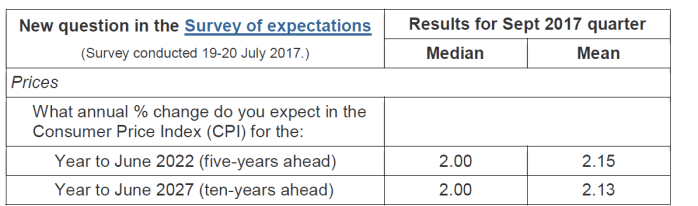
Last week I bemoaned the fact that the Reserve Bank had dropped various questions from its Survey of (business and professional) Expectations, and although it had added some new questions (in some cases more or less directly replacing the ones they had dropped) they had withheld the survey results for those new questions.  Presumably their logic was to build up a time series of responses before making the information available outside the Bank.

That wasn’t very satisfactory. It gave them information the rest of us didn’t have, and meant that  –  in particular –  we had suddenly lost any survey-based measures of what the Bank was expected to be doing with monetary policy.  Thus, they’d deleted a 90 day bill rate question and added a question about OCR expectations, but weren’t planning to tell us the results for some (unknown) time.

I wasn’t too happy about that stance, and thought it probably wouldn’t stand up to an Official Information Act request –  it is, after all, official information, and couldn’t possibly be withheld on the usual grounds the Bank likes to invoke (eg free and frank advice).  So I lodged a request for the answers to the new questions.

That request was lodged on 7 August.  This afternoon their reply turned up, providing everything I’d asked for.

expecs 1.png

expecs 2

They also indicated that future summary responses to these questions will be released with the regular Survey of Expectations releases.

Of course, it is new data so there is only a limited amount one can take from this first set of numbers.  But I was interested that respondents have a mean expectation for inflation 10 years ahead of 2.13 per cent –  quite a bit higher than is probably implicit in the gap between indexed and nominal bonds (my own response to that question was 1.4 per cent).

Respondents (in a survey in late July) put a pretty high probability on the Reserve Bank having raised the OCR by next June, and respondents also seem to be of the view that the worst of the house price inflation is over for now –  rather than, say, what we are seeing at present being just a brief pause.

In time, these new questions will enrich the Survey of Expectations.  The Bank could (and should) have gone further – eg a question about the OCR five years hence (a proxy for expectations of the neutral rate) and a question or two about expected net immigration flows.   But at least we now have some new data.

I don’t often praise the Bank, but I am impressed at the quick change of mind, and helpful and full response I got today.


Three Governors and monetary policy

Graeme Wheeler indicated yesterday that he will shortly be giving a speech offering some reflections on his time as Governor.    It is a good idea, at least in principle.  Wrapping up his 10 years as RBA Governor last year, Glenn Stevens gave a thoughtful speech along those lines (which I had intended to write about, but never got round to).   Wrapping up his 10 years as Governor of the Reserve Bank, Alan Bollard did an interesting interview with one of the editors of the Bulletin – he even acknowledged having made a mistake early in his term.

It is hard to be very optimistic about the forthcoming Wheeler speech, but ….. perhaps……this time.  Someone emailed me last night, after my comments on yesterday’s news conference, suggesting that

surely at heart you would have been more disappointed if Wheeler had finally answered questions in a meaningful way.  Would have made the past 5 years of communication even more painful.

I’d have been astonished certainly, but I have a naively optimistic streak and I’d like to  be pleasantly surprised, even this late in the game.  When he was appointed, I had had high hopes for the Governor.

But the promise of a forthcoming review speech, and an exchange with someone yesterday about the relative performance of the three Governors who have operated in the inflation-targeting era (in which I found myself defending Graeme), got me reflecting on how one might do those comparisons, at least in respect of monetary policy.

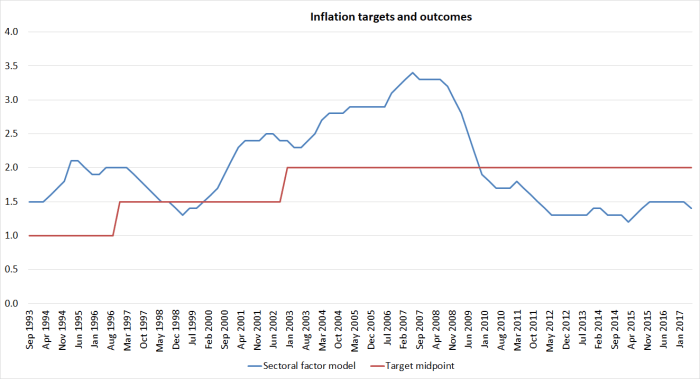
One could simply look at deviations of inflation from target.   Using headline CPI inflation wouldn’t help much there –  the CPI in the 1990s was constructed materially differently than it is now.  And when Don Brash took office there wasn’t an inflation target at all.  But the Bank is fond of its sectoral factor model measure of core inflation.  That measure has only been around for the last five years or so, but the Bank has calculated the series back to September 1993.   And as it happens, the first inflation target that last long enough for performance to be measured against it was the one adopted by the incoming National government in December 1990 –  inflation was to be 0 to 2 per cent by December 1993.

So here is the sectoral factor model measure graphed against the midpoint of the successive target ranges.

targets and outcomes

There are several things to notice:

  • this measure of core inflation has been much more stable in the Wheeler years than in any previous five year period,
  • none of the three Governors kept sectoral core inflation (or any other measure) close to the midpoint of the target range, and
  • the biggest deviations were in the last years of the previous boom, when this measure of core inflation was actually outside the target range.

In terms of average deviations

Brash 0.5
Bollard 0.5
Wheeler 0.6

But the Bollard decade was a tale of two halves: far above the target midpoint for his first six years or so, and then increasingly below the midpoint by the end of the period.

All this said, I wouldn’t want to put too much weight on those numbers, for various reasons including:

  • monetary policy works with a lag.  One can’t blame Graeme Wheeler for the first 12-18 months’ outcomes during his term.  Then again, the last three or four years’ numbers aren’t much different from those early in his term,
  • this measure didn’t exist, and certainly wasn’t being used, in the Brash or Bollard years (that said, no one disputes that inflation ran above the target midpoint during their terms, for various –  different –  reasons),
  • only since Wheeler took office has the target midpoint had any formal status.  In practice, Don Brash did aim for the midpoint, and often referred to it in public communications.  Alan Bollard didn’t regard the midpoint as being particularly important, and thought (and talked) in terms only of being comfortably inside the target range (thus at times we published projections with inflation settling back to around 2.5 per cent).

The fact that inflation averaged well above the target midpoints during the Brash years often surprises people.  Don had a reputation as an inflation-hating hardliner (an “inflation nutter”), which was –  at least in some respects –  well-warranted (he could also, at times, be a political pragmatist, to the dismay of the real hardliners).   He took the targets, and the midpoints, seriously.  So why was inflation averaging persistently above target?  My story is that he – we –  never quite realised how much higher than international interest rates New Zealand interest rates needed to be to keep inflation here in check.  In today’s terms, we underestimated the neutral interest rate.  In a way that wasn’t surprising.  After the great disinflation, we expected our interest rates to converge to those of the rest of the world –  and international visitors encouraged us in that view (I well recall the day a visiting senior Australian sat in my office trying to argue that we must have policy wrong because interest rates were still so much higher than those in Australia).    That convergence has simply never proved possible –  I argue because of the interaction of high immigration and low savings, but the “why” is a topic for another day.  Everyone realises that now, but we didn’t in the 1990s.   It led us to forecast lower inflation rates than we ended up achieving, and because – in effect – we believed our model we kept making what amounted to the same mistake.

Alan Bollard’s “mistake” was different.  He came into office with a sense that Don –  and those around him –  had been too hardline, and that if only we “gave growth a chance” we could get better outcomes all round.  I suspect he really did care about unemployment. He certainly cared a lot about the tradables sector, and the rising and high exchange rate quickly became quite a constraint on what he was willing to do with the OCR  (it was something of a political constraint too).  He was probably less willing to tighten than the median of the staff advice would have been, but actually staff advice also had something of the wrong model.  People just didn’t realise how much momentum there was behind the boom, or how structural (to the interaction of population and land use regulation) the lift in house prices was.   Because of the exchange rate, Alan was unwilling for too long to contemplate taking the OCR anywhere near the (real) peaks of the 1990s, even though by most measures –  whether unemployment or capacity utilisation –  the pressure on resources was much greater.

All three Governors made what would now be generally recognised as mistakes.  Some lasted shorter than others.  We held off adopting an OCR for years too long.  In 1991 we made the now-incomprehensible mistake (I strongly supported it at the time) of trying to hold up interest rates even as the economy was falling away rapidly into a recession, on some misguided view around the interpretation of the yield curve slope.  That lasted only a matter of months.  Then there was the MCI debacle in 1997 and 1998.  And scarred by that experience, we were too quick to cut the OCR in 2001 –  responding to a US recession that never much affected us.

Alan Bollard later openly acknowledged that his interest rates cuts in 2003 had been a mistake (at the time I’d thought at least the first one was appropriate).  And in 2010 the Bank was too quick to start raising interest rates, and had to reverse itself quite quickly.

As for the (single) Wheeler term, it was dominated by the mistake of promising to raise the OCR a lot, actually raising it by 100 basis points, and then the Bank only slowly and reluctantly having to more than fully reverse itself.     Perhaps more seriously still, there has been no apparent effort to position New Zealand for the next recession, when the OCR won’t be starting at 8.25 per cent.

Some of the mistakes the Reserve Bank has made have been in company (other central banks doing similar things).  Most haven’t.  In some cases, it has been a clear example of the Governor imposing his will on the organisation –  those 2003 OCR cuts were over the advice of a majority of OCRAG –  but most haven’t.  Then again, chief executives shape organisations, recruit people they are comfortable with, and sometimes don’t really welcome the airing of alternative views.  I don’t think, with hindsight, the institution’s record has been particularly good –  and I say that as someone who was heavily involved, at times at very senior levels, for a long time.  Sadly, it doesn’t seem to be improving.

I’m reluctant to try to reach a view on whether, overall, Wheeler has been worse than his two predecessors.     After all, the circumstances the three men faced were very different:

  • Don Brash was in charge during what we liked to think of as the “heroic” phase, slaying the inflation beast that ravaged New Zealand for the previous 25 years.  But, beyond that, he –  and we –  were learning what it meant to run monetary policy in a low inflation environment.  We had few effective yardsticks –  although we were probably more reluctant than we should have been to have consulted other countries’ practices and experiences.
  • On the other hand, Don presided over monetary policy through probably the most stable period ever in New Zealand’s terms of trade.
  • Alan Bollard presided during the most dramatic financial crisis the world had seen for decades –  perhaps since 1914.  I didn’t agree with all his stances in that time –  some he himself changed quite quickly –  but in many ways that 18 months or so was his finest hour: the willingness to improvise liquidity policies and to cut the OCR again and again, in large dollops.
  • Recessions: Bollard and Brash had to cope with them (ie externally sourced ones –  1991, the Asian crisis, the dot-com bust, and 2008/09). and Wheeler simply hasn’t.
  • Different shocks: Brash presided over the period of wrenching fiscal and structural adjustment, which made much of the data harder to read.  Bollard presided during a whole new period of persistent and unexpected strength in the terms of trade (we hadn’t paid them much attention until to then) and the Canterbury earthquakes.  All three Governors have had to grapple with the toxic mix of population growth and land use regulation spilling into rising trend house prices –  but it was the Bollard years that saw the largest, and most widespread, increase in debt/GDP ratios and private sector lending more generally.
  • In his early years, Brash had to deal with a severe domestic financial crisis and the aftermath of a very damaging credit, equity and commercial property boom.  Neither Bollard (despite the finance companies) nor Wheeler had to face something similar.

But, in many ways, I’d argue that Graeme Wheeler, and the Bank he presides over, have had it relatively easy.    Over his period there has been:

  • no international recession,
  • no major overseas financial crisis (the euro crisis transitioned into chronic state around the time Wheeler took office),
  • no deeply dislocative domestic shocks,
  • a stable backdrop of global inflation,

And unlike many of his international peers, he has always had total flexibility to adjust the OCR as required (the near-zero bound simply wasn’t an issue) and there were no looming fiscal crises in the background either.

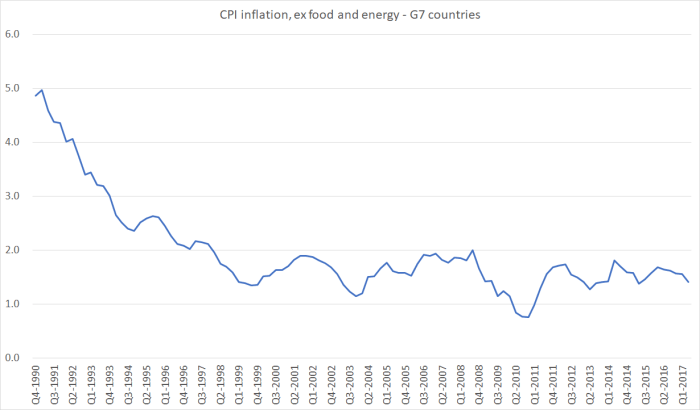
You might be surprised by the comment about stable global inflation. But here is the OECD’s measure of G7 core inflation (ie CPI ex food and energy).

CPI ex G7

Pretty stable for almost 20 years now.  Of course, within that some countries have done better than others.  And the interest rates that have been consistent with keeping inflation around these levels have fallen a long way.  But there aren’t huge inflationary or deflationary shocks from other advanced economies.  Contrast this chart with the New Zealand core inflation chart above.    And recall that, unlike New Zealand, most of the G7 countries were pushed to the absolute limits of conventional monetary policy.

It is fair to acknowledge that the recent swings in the terms of trade have been quite large –  so I’m not trying to suggest that getting monetary policy just right was easy (if it were that easy, we wouldn’t be paying a lot of people a lot of money to get it right).    But broadly speaking, a lot of things have been working in the Reserve Bank’s favour in recent years, that their peers in other countries haven’t had:

  • as already mentioned, the Reserve Bank had full OCR flexibility, and
  • an unemployment rate persistently above their own estimates of the NAIRU (a basic pointer to a demand shortfall, something conventional monetary policy can remedy),
  • high terms of trade (on average), supporting demand overall,
  • the effects of Canterbury earthquakes were quite disruptive late in Bollard’s term, but ever since Wheeler took office, they’ve been a consistent source of demand growth [NB I’m not suggesting earthquakes make us richer, but the reconstruction is a significant source of demand –  helpful if demand is otherwise scarce.] and
  • really rapid population growth (hard to forecast, but persistently surprising on the upside throughout Wheeler’s term –  the last quarter of net outflows, seasonally adjusted, ended a few days after he took office), and
  • although fiscal policy was net contractionary at the start of his term, even that has swung round to neutral or mildly expansionary more recently.

There is no reason to think it has been any harder to get things right –  forecasts and reality – than in the earlier years, and some reasons why it should have been easier to keep inflation up near target.

Non-tradables inflation, the bit the Reserve Bank has most medium-term influence over, should have been relatively easy to get up to levels more consistent with meeting the overall inflation target.  And yet, the Bank’s sectoral factor model measure of non-tradables inflation is no higher now than it was when the Governor took office.

Arguments about technological change, structural changes in labour demand, or whatever simply aren’t relevant to this conclusion.  They provide opportunities for faster growth without unduly fast inflation –  surely, broadly speaking, the goal of economic policy?  They provide the oppportunity to run the labour market a bit harder and get more people –  often people who find life a bit difficult – into employment.   In such a world, one does well –  getting inflation back to target –  by doing good.    Instead, all too often it has come to seem as though the Wheeler Reserve Bank is more concerned about house prices –  especially in Auckland – than it is about inflation or unemployment, even though –  when pushed –  they will acknowledge that monetary policy can’t do much about house prices.  And all this with no good model of house prices, and the failures of land use regulation.

So, yes, we’ve had stable (core) inflation in the Wheeler years, but stable at too low a level –  in his own words, an “unnecessarily” low levels.  He agreed to deliver it higher, and had a lot of things working in his favour to get it higher.  He wasn’t faced with rapid productivity growth –  driving prices down  –  rather the contrary.  And he was never faced with a fully employed labour market.    He simply didn’t do his job, when he easily could have.  He seemed to allow himself too readily to believe that somehow he faced the same challenges some of his peers bemoaned at BIS meetings –  when the preconditions for rapid (per capita) demand growth, a strong labour market, and inflation around target were much different here.

Would another Governor faced with the same circumstances have done differently in recent years?  We can’t really know.  There have always been some economists and commentators running a different tack but (a) as far as we can tell, most of the rest of the Reserve Bank senior officials have supported the Governor’s approach, and (b) most domestic market economists have done so most of the time as well.     It was the sort of defence we used in the Bollard and Brash years –  few ever consistently argued for tougher policy.  But it isn’t that persuasive an argument –  we charge the Reserve Bank Governor, resource him, and pay him well, to do better.

Where I suspect we can conclude that a different Governor would have done better is in perhaps the more peripheral aspects of monetary policy:

  • it is hard to believe that any other Governor would have been so reluctant to acknowledge a mistake.  Even if reluctant to accept the fact, most would have found more effective, appealing, lines to use,
  • Most possible Governors would have been much more willing to open themselves up to serious scrutiny, especially when questions around performance started arising.  Good ones would prove their competence and capability in part by their ability to engage with and deal with alternative perspectives.
  • Surely no other possible Governor would have taken the pursuit of Stephen Toplis to quite such lengths.  We know other Governors have at times expressed irritation with particular views, but that is very different from deploying your entire senior management team to attempt to close a critic down, and then when that failed  writing to Toplis’s employer – an institution the Bank actively regulates – to attempt to have him censored,
  • (oh, and other possible Governors probably wouldn’t have attempted to tar publically, in the cool light of day, someone who highlighted a serious weakness in the Bank’s systems).

It is hard not to think that a different Governor wouldn’t have produced stronger speeches – more akin to the quality one finds from Governors in other advanced countries –  or demanded, and received, more consistent depth and excellence in the quality of the analytical work underpinning the advice on monetary policy.

I’m not going to conclude that Wheeler did monetary policy worse than his predecessors –  and I will be interested to see his own arguments in his forthcoming speech –  but even considered in isolation it doesn’t look to have been a creditable record, whether on substance or on style.   That is something the Bank’s Board –  and whoever might shortly be Minister of Finance –  need to reflect on seriously, not just in identifying a specific successor, but in strengthening the institution as a whole.


Consistent to the end…..sadly

Consistent to the end, the outgoing Governor of the Reserve Bank today both refused to accept that he’d made any mistakes, while refusing any comment at all on some of the more searching questions.

The news conference was on the occasion of the release of his statutory monetary policy accountability document, the Monetary Policy Statement.    It was the last opportunity journalists will get to question him.  And yet faced with questions about the Toplis affair (his use of public resources, including his senior managers, to attempt to close down critical commentary from an employee of an organisation the Bank regulates), he simply refused to comment.   I’m sure he is now feeling quite embattled and defensive, but surely it should be unacceptable for a powerful public official to simply refuse all comment on such a chilling example of abuse of executive office?   If he doesn’t think it is an abuse, and thinks somehow people shouldn’t be allowed to aggressively criticise him, he should at least have the decency to say so openly.   I hope members of Parliament use their opportunity this afternoon to ask questions on this matter, and to insist on answers.

The Governor also tried to avoid most questions about his term in office (but was happy to provide a long answer to a curious question about risks around North Korea, on which he has (a) no accountability, and (b) no more knowledge than the rest of us).  Apparently there is a speech coming –  which may be interesting, but it provides no opportunity for follow-up challenge or scrutiny.   Asked if his critics have been fair, and if at times their criticism may have clouded his judgement in decisionmaking, he claimed he will cover that in his speech.  If so, that should be interesting.      Asked also about:

  • what surprised him about the economy in the last five years,
  • about his inflation record in the last five years, and
  • what his successor should worry about

he refused to provide any answers, and simply referred everyone to the forthcoming speech.

One journalist finally voiced a widespread concern and asked if the Governor had been open enough with the media, noting that the Governor appeared not to have given a single live interview in five years.     The Governor claimed to have been pretty open, citing the press conferences he holds.  He also claimed that his colleagues do interviews, but simply never engaged with the fact that he personally is legally responsible for the exercise of a great deal of power –  not just monetary policy, but in regulatory policy areas –  and simply doesn’t face up, ever, to anything but soft-ball interviews.  A press conference, with 20 other media and where the Governor gets to decide whose questions to take when, is simply very different from a sustained searching interview –  whether on Morning Report or one of the TV current affairs shows.

Towards the end of the interview, the Governor seemed to change tack a little.  After repeated questions about his stewardship, he came out claiming that things have actually gone pretty well really over the last five years, and that the Reserve Bank deserves credit for that.   It was like a performance straight from the National Party advertising unit.  Growth had, we were told, averaged 3 per cent and there had been plenty of employment growth.  Even house price inflation was somehow claimed as to their credit (I think the fact that it is temporarily low in Auckland).   Oh, and core inflation averaging 1.5 per cent –  when he had explicitly accepted a task of keeping it around 2 per cent –  was also apparently just fine.    These results should, apparently, dispel any suggestion that, even with hindsight, monetary policy had on average been too tight.

He did acknowledge in passing that there hadn’t been much productivity growth –  which isn’t his fault –  but there was no mention at all of the weak per capita GDP growth (by comparison with earlier recoveries), no mention of an unemployment rate that has been above even the Bank’s too-high NAIRU estimate for eight years now, and no mention of a very high labour underutilisation rate.   And even on the inflation front, he seemed to want to blame all the problems on the rest of the world: low tradables inflation, as if a persistently high exchange rate had nothing to do with that.  He attempted to claim that non-tradables inflation (averaging around 2.2 per cent) had been just fine, when everyone recognises that getting core inflation near 2 per cent would have required non-tradables inflation rather nearer 3 per cent (which shouldn’t really have been hard amid a big building boom).  And non-tradables is what the Reserve Bank has the greatest degree of medium-term influence over.  If the Bank deserves credit for the last five years –  whether for style and communications, or for specific policy – it can only have done so relative to a particularly low benchmark.

Even now, said the Governor, he was quite comfortable with his decisionmaking in 2014 and 2015 –  when he unnecessarily raised the OCR by 100 basis points, and then was slow and reluctant to reverse those cuts.    I’m not sure what he thinks he gains by never ever conceding any mistakes.  He’s human surely.  We all make mistakes.

All in all it was a pretty disappointing, if not overly surprising, performance.  Whoever takes up the job of Governor next year will surely face a huge challenge, in shifting the organisational culture –  which must have been infected by Wheeler’s approach –  and lifting performance.

And all that was before even getting to the content of this Monetary Policy Statement.  

There was the odd good thing I noticed.  LUCI, the ill-fated Labour Utilisation Composite Index –  sold for a year or so as a measure of absolute tightness in the labour market, before they finally realised that it was mainly an indicator of changes in that tightness (a difference that matters quite a lot) –  seems to have quietly exited the stage.

But there were various more troubling points:

  • they were at pains to note that their estimate of the neutral OCR has carried on falling.   But, as in the chief economist’s speech a couple of weeks ago, there was no attempt to translate that into estimates of how neutral mortgage rates, or neutral deposit rates have changed.  As I noted then, widening spreads between the retail interest rates and the OCR suggest that if we take the Bank’s neutral OCR estimates seriously, their implicit estimates of neutral retail rates have been rising.   That seems seriously implausible.   It matters because the Bank keeps talking –  and forecasting –  on the basis that monetary policy is highly stimulatory. It almost certainly isn’t.
  • and although they did note that mortgage interest rates are higher than they were last year, there was no attempt anywhere in the document to explain why the Bank considers that monetary conditions need to be tighter now than they were last year (especially as growth and core inflation have been surprising on the low side).
  • it was quite surprising how upbeat they appeared to be on the global economy.  In fact, their upside scenario is one in which global inflation picks up quite a bit.   That migth have seemed a plausible possibility a few months ago, but with US inflation ebbing and no real signs of any increase in core inflation anywhere else, it looks (frankly) a little desperate.  Perhaps it is a reflection of the Governor’s continued conviction that global monetary policy is highly accommodative/stimulatory?   Were it actually so, one might have expected an increase in inflation before now.
  • the Bank seems focused on the idea that the labour market is almost at capacity.  Their projections have the unemployment rate levelling out at 4.5 per cent, suggesting that is their estimate of the NAIRU.  Between demographic factors on the one hand, and wage inflation outcomes on the other, that seems unlikely.

But perhaps my biggest puzzle is where all the forecast growth is coming from.

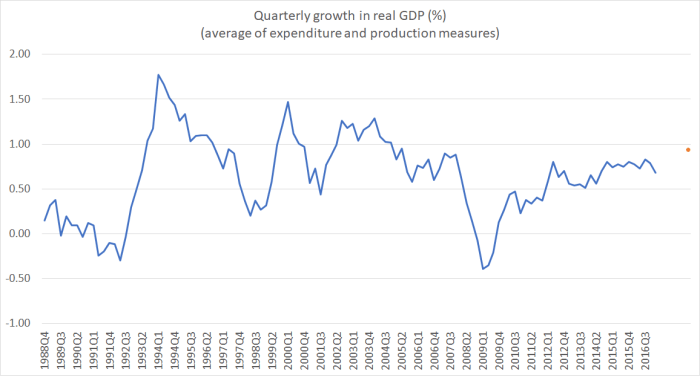
Over the next six quarters, the Bank projects that quarterly GDP growth will average just over 0.9 per cent. This chart shows six-quarter moving average of GDP growth (in turn, averaging the production and expenditure measures).

GDP growth qtrly

The orange dot shows the forecast for the next six quarters.  Their projections suggest that the economy will grow more rapidly over the next 18 months than it has managed on a sustained basis at any time in the current recovery.   You might not think that the difference looks large, but:

  • the Bank already recognises that monetary conditions are tighter than they were last year,
  • the Bank is forecasting a substantial reduction in the net migration inflow, and no one seriously doubts that unexpectedly rapid population growth has been the biggest single driver of headline GDP growth in recent years.  However much immigration adds to supply, it adds a lot to demand.

So why are we to expect a sustained growth acceleration from here?   Although it isn’t stated in the document, I hear that the Bank is invoking the expected fiscal stimulus (from promised measures announced in the Budget).  In isolation that might make some sense, but against the projected halving in the net migration inflow and the actual tightening in monetary conditions, it doesn’t really ring true.     If anything, the risk now has to be that over the next 18 months, headline GDP growth averages lower than we’ve seen in the last couple of years.

In many respects, the MPS is just another production in the long line of Reserve Bank documents that hold out the promise of higher medium-term inflation, but with little reason to expect it to happen.     But I was interested in one line in the policy section of the document. Often the Bank sounds quite complacent about non-tradables inflation, suggesting that everything is under control.  But this time they explicitly note that “a strong lift in non-tradables inflation is necessary for inflation to settle near the target midpoint in the medium-term”.   That, for central-bank-speak, is a pretty strong statement.    It might seem to argue for a more aggressive easing.

But they seem torn.  On the one hand, they go on to note that even “higher levels of growth may not be accompanied by significant increases in inflationary pressure”.   On the other, there is another strong statement about wage inflation: “increasing capacity pressure is likely to support wage growth in the near term“.    I guess that is quite a benchmark they’ve set for themselves –  and quite a surprising one after all these years of one-sided forecast errors.  If it doesn’t happen, and there seems little obvious reason why it should start now, I hope the Governor’s successors will be revisiting the stance of policy.

You might be wondering, so why not just cut the OCR and “give growth a chance”?  The Governor’s response to that is

an easing of policy, seeking to achieve a faster increase in inflation, would risk generating unnecessary volatility in the economy

I’m not quite sure what standards he is judging “unnecessary” by here?  It isn’t as if growth has ever been particularly rapid in this recovery (see chart above).  It isn’t as if unemployment has ever dropped, even temporarily, below the NAIRU.  It isn’t as if inflation has been surprising on the upside.  It isn’t as if productivity has been rocketing away.   It is as if the Bank is simply allergic to taking any steps that might possibly run a risk of (core) inflation going over 2 per cent, after all these years below.  In practice, it looks a lot like 2 per cent inflation represents a practical ceiling, rather than a target midpoint.

The Governor concluded his press release claiming that “monetary policy will remain accommodative for a considerable period”.  Fortunately, he will have no say in that matter.  Unfortunately, since we know neither who will be making the decisions, or what PTA they will be working towards –  recall that Labour, with the support of eminent economists like Lars Svensson, favour adding an explicit unemployment objective (to help make clear why we have active monetary policy in the first place) –  there isn’t really much information in that statement at all.   Much of the uncertainty is inevitable –  no one knows the future –  but quite a bit would be avoidable if we had a better statutory mechanism for Reserve Bank decisionmaking.

The search for the new Governor presumably goes on (the Reserve Bank Board would, on normal schedule be meeting next week).  Should the Opposition parties win power, I hope that one of their first actions (because time is pressing) will be a quick amendment to the Reserve Bank Act, to give the Minister of Finance the power almost all his overseas peers have, to appoint directly as Governor someone with whom he is comfortable, not someone the outgoing government’s Board delivers up to him.  In fact, it would be a sensible change whichever group of parties forms the next government.


Reading a NZ economist supporting large-scale immigration

As much as I can, I try to read and engage with material that is supportive of New Zealand’s unusually open immigration policy.   One should learn by doing so, and in any case there is nothing gained by responding to straw men, or the weakest arguments people on the other side are making.

At present, supporters of our unusually open immigration policy hold all the levers of power, and dominate much of the media.   But what has surprised me over the years I’ve been thinking about these issues is how unpersuasive I find the pro-immigration material, perhaps especially that written in a New Zealand context.   I’m not sure whether dominating elite opinion for so long has meant they no longer put the effort in, or what.  But whatever the reason, I’ve expected stronger arguments and evidence –  in support of a policy now run for 25 years –  and haven’t found them.

At the start of the year –  in a document that they were quite open about being aimed at Winston Peters, and those who might be listening to him –  the New Zealand Initiative came out with a substantial publication, largely devoted to saying that there was really nothing to worry about: if they couldn’t demonstrate the economic gains to New Zealanders (a point they acknowledged) there were few or no downsides.   If there was a case for any refinements, it was very much at the margins.  I devoted a series of posts(captured in a collected document) to examining the case they’d made.    I remain surprised at the limited extent to which an institution run by economists engaged with the specifics of New Zealand’s longer-term economic (under)performance.

A month or two ago, BWB Texts published Fair Borders? Migration Policy in the Twenty-First Century , a collection of chapters by various New Zealand authors (mostly, it would seem, of a left-liberal persuasion).  I wrote earlier about the chapter on a particularly unusual feature of the New Zealand system: we are the only country with any material amount of immigration (and one of only a handful in total) allowing people to vote if they’d resided here for just a year.

But my main focus is on the economic perspectives, both because that is my own background, and because successive governments have sold the immigration programme primarily as a tool to improve New Zealand’s economic performance and the economic outcomes of New Zealanders.   One doesn’t see it any more, but MBIE used to call the immigration programme a “critical economic enabler” .

And in Fair Borders there is a chapter on the economics of immigration, headed “International Migration: The Great Trade-Off”.   The author is Hautahi Kingi, a young New Zealander –  with a fascinating back story, that left me disquieted about aspects of our system –  who has recently completed a PhD on the ‘macroeconomics effects of migration’ at Cornell, and now works for a consulting company in Washington DC.

He begins his chapter in praise of migration –  not just something good, but something “central to human experience” –  harking back to some mythical day when humans were free to wander savannahs and steppes, constrained only by wild animals, unfamiliar climate, and hostile people who were already there, but not by official border guards.

As he notes, actually, 95 per cent of people live in their country of birth.  Probably a fairly high percentage live within 100 miles of where they were born.   Given this, Kingi concedes,

immigration policies have the potential to transform not just our economies, but the structure of our societies and institutions.

Which is, of course, part of what many people worry about.  Societies and institutions exist as they are for good reasons.    G K Chesterton had some wise cautions to those who happily lay into such institutions.

Kingi continues “by definition, international migration is a global issue”.  Well, I suppose so, in that for any international migration to occur at least two countries are involved.  But there is no necessary reason why immigration policy should be considered a global issue at all.   It isn’t like issues around pollution or climate change.  And few countries do treat it as an international issue.  They make immigration policy, as they seek to make policy in most other areas of governments, primarily in the interests of their own citizens/voters.

Kingi’s first main section is about what he describes as “the global perspective”.   He is pretty persuaded by the papers which seek to show that if only all countries opened their borders and people could move wherever they wanted there would be a massive – perhaps 100 per cent –  increase in world GDP.  In his words “from a global income perspective, no other policy offers anything remotely as appealing”.

But, in fact, he doesn’t make much of a case.  Sure, open migration would beat out foreign aid –  the alternative policy he quotes – as a means to lift average incomes.  But whoever supposed that most foreign aid ever did much good –  Peter Bauer was writing about this stuff decades ago –  or that much of it wasn’t more about foreign policy (cultivating relationships with foreign governments) than about lifting living standards in recipient countries.     Free trade in goods and services does much more than foreign aid.

Perhaps more importantly, surely the most compelling and effective means to lift living standards en masse is for countries to adopt growth-friendly policies and institutitions.  China is the most obvious example in recent decades.   They have a long way to go –  on both policies and outcomes –  to get to First World living standards, but what they have achieved in recent decades is transformative, and obvious.  And for hundreds of millions of people.

Unfortunately Kingi –  and many of the libertarians who also run such arguments –  end up running a latter-day version of the line one used to hear decades ago from people on the dripping-wet left wing side of economic debates: the poor are poor because the rich are rich.    To a first approximation, it is simply false.    People in New Zealand, or the UK, or France, or Denmark aren’t rich because we won some lottery, or just got lucky, but because our ancestors developed, and we maintain, cultures and institutions that develop and maintain a high level of productive capability (encouraging and rewarding people for investing in human and other forms of capital).   Sadly, too many other countries have failed to do so.   (The need to work hard to maintain such cultures is part of why I think Oliver Hartwich’s Herald op-ed today is profoundly wrong: character matters greatly.)

It is not as if change is imposssible –  look at the convergence achieved in recent decades by a handful of east Asian countries.  It is not as if our relative position is immutable either –  not 1000 years ago, China was well ahead.   But prosperity, en masse, is mostly about the institutions, broadly defined, that societies develop and maintain.  Doing so is hard work.

Are there exceptions?  Well, yes of course.  In our age, if you don’t have too many people, and you do have lots of oil and gas, your people can be very rich, even without many of the supporting institutions that otherwise seem to be required.  But those are windfalls, in a sense achieved by free-riding on the gains –  demand and technology – developed elsewhere.

Generally, even if individuals might feel themselves lucky or unlucky, societies –  and all of us exist within societies – aren’t lucky or unlucky: they are the product of successive generations of choices.   Immigration restrictions don’t “elongate the misery” of poor countries: the choices of those societies are primarily what have that effect.

Can one import prosperity?  To some extent one can.  After all, New Zealand (and Australia and the like) are examples.  Material living standards weren’t high for indigenous people pre-colonalisation.  But New Zealand and similar countries had lots of land, a temperate climate, and by importing not just lots of people from the then most advanced economic culture (and all the legal and associated institutions), something a bit like Europe was created here.   Maori shared –  perhaps to a lesser extent than might have been desirable –  in the prosperity that was created here.   But –  and these are Kingi’s words – “movement of people entails movement of culture and norms”.    A New Zealand that was once largely the place of Maori isn’t really so any longer.

But that 19th century example –  that transformed Australia, New Zealand, Canada, Argentina, Uruguay, Chile, and US –  isn’t really relevant to New Zealand’s situation now.  Even if we wanted to engage in such a mass transplantation, there is no economic culture hugely more advanced than what we already have.

So Kingi’s focus is the other way round –  it is on the gains to migrants from being able to shift from poor countries to rich countries.  There is no doubt that, for individuals at the margin they are considerable –  it is why we see foreign students willing to pay $40000 for a job in New Zealand, with the aim of qualifying for a New Zealand residence visa.

But the staggering gains in the papers Kingi cites don’t result from quite modest flows, but from “massive” movements of people.  In his words “movement of people entails movement of culture and norms” –  and if those effects are small for modest migration flows, they are likely to be substantial for “massive” movements.  In the long-run, migrants import their own economic destiny –  just as we (descendants of the 19th century migrants from the UK) did.   And if poor migrants in large numbers ultimately bring their own cultures and institutions, it is most unlikely that in the long run they’d be better off here to anything like the extent the academic papers suggest.  After all, geographic New Zealand is no better intrinsically suited to economic prosperity for lots of people than many other parts of the world –  arguably (or so I’ve argued) our remoteness makes us less so.

Strangely, Kingi’s poster-child example of large scale immigration is the Gulf Cooperation Countries, such as Qatar and Kuwait.  86 per cent of Qatar’s population is made up of migrants. Qatar has probably the highest GDP per capita in the world.  It is obviously appealing to the poor migrants, who keep coming, but I’m not sure why Kingi regards it as a remotely appealing basis on which to sell mass migration to New Zealanders.   For a start, these are classic states with massive natural resources and (originally very few people).  It is no surprise that there are windfall gains that could be spread around.   But as even Kingi acknowledges, the exploitation of lowly-skilled foreign labour in countries like this is appalling (even if one wants to engage in economists’ talk of both sides benefiting or it wouldn’t happen).  It simply isn’t how we would want a society to be structured.  And although he notes that this large scale migration goes on without causing any great domestic political problems, (a) the migrants have few rights, and no political rights (even fewer typically than the natives), and (b) these are societies not exactly known for freedom of speech, freedom of the press and the like,  And, sadly, slavery –  or its modern equivalent –  can look quite appealing to the slaveholders and those who benefit from the practice.   It remains morally repulsive.

If you’d only got this far in Kingi’s chapter, you might suppose he was an out-and-out advocate of open borders and free migration, here and everywhere.     But it is here that he gets more interesting.  Note the trade-off in his chapter title, and he seems to recognise that whatever large scale migration might do for the migrants, it could well harm at least some natives.  I think he gives a fair account of the international debate about the impact of immigration on the wages of lowly-skilled natives

Although this debate continues unresolved in academia, it is at leasr conceivable that immigrants may negatively affect those native workers with whom they compete most closely for jobs.  The experience of globalisation in recent decades should teach us to take this potential concern very seriously.

He looks to reconcile what he sees a a global imperative to allow high immigration (generally) with the risk of harm to vulnerable natives, favouring better-educated migrants.

But as notes, immigration is’t just an economic issue.  And here too he seems torn.  He’s a paid-up member of those who “embrace multi-culturalism as a cherished part of progressive society” and yet recognises that “mass migration” can have a ‘potentially corrosive effect on that society”.    But as I say, he is torn.

When people cross borders, so do their cultures and norms, and we are almost always richer and stronger for it.

But

more diverse societies also tend to reduce the provision of public goods and erode support for the welfare state

Unlike some libertarians, that erosion of support for the welfare state seems to be a bad thing for Kingi.

and

[ethnic divisions] can severely undermine the social institutions sustaining an economy because, despite the assurances of modern legal systems, “virtually every commerical transaction has within itself an element of trust”

He notes

The impact of immigration on a country’s social fabric can be an uncomfortable issue to discuss because it forces us to acknowledge and confront lamentable tribal aspects of human frailty.

Institutions and societies evolve to cope with human fraility –  aka “reality”.

And almost in passing he notes a Maori dimension

modern Aotearoa was founded on the principle that tangata whenua have rights to their culture that should not be overridden by settlers.  At the heart of the critique against colonialism is a concern for the enforced erosion of culture.

Kingi sets out the concluding section of his chapter with the proposition that there is a moral dilemma between the global and domestic perspectives.

by restricting the entry of foreigners…we effectively accept the substantial inequality outside our borders in order to protect the veneer of equality within.

You can see where his economist instincts lie.  But he is simply wrong about the trade-off, at least once large numbers of people are involved.  Societies make, and sustain, their own destinies.   He argues that

migration is, and always has been, the best tool for reducing suffering  in our world

But demonstrably that isn’t so.  Europe didn’t get rich on the back of migration –  even if the 19th century outflows helped them a bit.  China didn’t lead the world –  and recover its standing in the last 40 years –  on the back of migration.   Perhaps some libertarians wish it were otherwise, but migration –  country to country –  has always been a distinctly minority experience.   It lifts prospects for relatively small numbers –  if the people of North America are generally richer than the countries of their ancestors, people of South American typically aren’t.  Rising prosperity, reduced poverty, mostly result from choices, conscious or unconscious, that societies make about how to organise and discipline themselves.

I’m not sure quite where Kingi himself ends up.  His chapter is strikingly high level, and despite being in a book focused on New Zealand hardly engages with the New Zealand economic experience (or New Zealand social/cultural issues) at all.  It certainly doesn’t recognise how unusually large New Zealand’s residence approvals programme is by modern international standards.

Perhaps when Kingi ends this way

While international migration represents a life-changing opportunity for many, it also threatens the livelihoods of others and strikes to the core of our societies by changing their structure, their jobs, their culture, their appearance

he is still working his way towards a policy prescription for modern New Zealand.

As part of Radio New Zealand’s recent podcast series on New Zealand immigration, Kingi and I did a series of email exchanges on these issues –  me as the sceptic and Kingi as the supporter.  Radio New Zealand tells me that the series of letters was well-received by readers,  in part for the very different angles they present on the economic issues.  I want to come back to that exchange, perhaps next week, to elaborate on some of the key points we each chose to make when confronted with the other’s arguments, under pretty tight word limits.


Intervening without understanding: the RB and the housing market

I spoke last night to the Nelson Property Investors’ Association.  They’d asked me to talk about the Reserve Bank and the waves of new direct controls on housing finance that the Bank has put in place (or is positioning itself to put in place).  Those controls have upended a liberalised and decentralised market that had been in place and functioning well, providing good access to credit without drama, for almost 30 years.  Instead, we have now superimposed one man’s judgement.

It was a topic I was happy to talk about.  It is certainly timely.  In part that is because the current Governor’s term ends next month, and the person who gets the job next year as his permament replacement will materially influence the future direction of housing finance controls (although ideally governance reforms will materially reduce one person’s influence).  But also because the Reserve Bank currently has a consultation document out, as part of a process to get the imprimatur of the Minister of Finance for possible use of debt-to-income regulatory limits.    Submissions on the debt to income ratios proposal close next week and although I will be making a submission, last night’s address didn’t specifically focus on that proposal.

Much of my address was material I’ve covered before here.  Nonetheless, in pulling it all together into a single (more or less) coherent story, I realised afresh just how poor the processes, background analysis, and the policies themselves have been.    As it happens, at the meeting last night a representative of the NZ Property Investors’ Federation also spoke briefly, and his remarks were a reminder that poor quality policy certainly isn’t unique to the Reserve Bank.   The difference perhaps is that we choose the politicians, and when governments do daft or dangerous things, we get to vote on tossing them out again.  No such luck with the Reserve Bank.   And, from my perspective, I write about things I know something about, and I’m pretty sure that the Reserve Bank was once considerably better than this.  And could be again.

I began by looking back

When I was young and exploring job opportunities, I spent a day at the Reserve Bank. The then deputy chief economist was explaining the attractions of working at the Bank – things other than just the heavily-subsidised house mortgages. But the one line I remember was when he stressed the involvement the Reserve Bank had in the housing market, and issues around mortgage financing.

That wasn’t too surprising when one thinks about it. It was December 1982. We were coming towards the end of 40 years of pretty pervasive regulatory controls over so many aspects of the financial sector, including housing finance. The Reserve Bank was then a strong advocate in official circles for financial system deregulation, and allowing the market to take over the allocation of credit. It was – I thought then, and think now – on the side of the angels.

But in my first 20 or so years at the Reserve Bank housing was, at best, a very minor point of what we did. Within months, almost all the direct controls were stripped away. Institutions lent for housing if (a) they could fund themselves, and (b) if they could find (hopefully) creditworthy customers. It was their issue, not ours. Credit, generally, became more readily available. Interest rates trended back down, and banks typically became more willing to lend for longer terms. For an ordinary working person looking to buy a house, a very long repayment period will often make a lot of sense – just as a high initial LVR loan had always done.

And Parliament was careful to provide that whatever prudential powers the Reserve Bank did have were to be used not just to secure the soundness of the financial system, but also to promote the efficiency of that system.

But the bulk of the address focused on the weaknesses in what the Reserve Bank has been doing, in how it has made its case, and in the subsequent accounting for the impact of those controls:

  • how they’ve never adequately engaged with the range of international experiences in 2008/09, fixating on the US and Irish experience when (a) Ireland was in the euro, so lost a lot of policy flexibility, and (b) the US has a long history of heavy government involvement in the housing finance market.  Plenty of other advanced countries, including New Zealand and Australia, had big increases in house prices and housing credit, and no housing-driven financial crisis,
  • how they continue to ignore the implications of their own successive waves of stress tests, which continue to show that even with very severe shocks the banking system appears to be resilient,
  • they hardly ever engage on, and have produced no research on, the efficiency implications of direct controls, including on how they controls apply to banks and not non-banks, how they apply to housing lending but not other sorts of credit (even when past research suggests housing loans are rarely a key factor in systemic crises), and how the controls end up favouring riskier housing lending (new builds) over safer lending (on existing properties).  Similarly, they’ve never engaged on the extent to which controls will impede the information discovery process implicit in different banks managing risks in different ways,
  • there has been no evidence produced to explain why, in the Governor’s judgement, banks can be “trusted” to run their own credit policies in all other areas of their balance sheets, but just not in housing finance,
  • they’ve produced nothing on the distributional implications of their policies –  which tend to favour established low-leverage participants, at the expense of those looking to get into the market.  These concerns only increase now that policies once sold as temporary are becoming increasingly longlived.
  • despite assertions that the controls have reduced system risks, they’ve produced no analysis or research to make that case.    Simply arguing that the volume of high LVR housing loans is lower (no doubt true), simply isn’t a satisfactory basis for such claims.

But, in a way, what concerns me at least as much as all this is that the Reserve Bank simply does not have a remotely adequate model of house prices.   If they produced such a model (in words, or equations) we could carefully scrutinise it.  If it was robust, we might even be inclined to defer to policy proposals based on that model.    As it is, there is almost nothing –  in public (and if they had such a model, they’d have every incentive to publicise it).

Consistent with this, the Bank’s house price, and implicit house price to income ratio, forecasts have been consistently and repeatedly wrong.     They seem to put far too much weight on interest rates –  while rarely acknowledging that interest rates are high (or low) for a reason, usually one to do with the expected growth potential of the economy.   In much of New Zealand, reall house prices how are no higher, or even lower, than they were a decade ago when the OCR was at 8.25 per cent.

The Bank also seems to have an implicit model in which what has gone wrong is that building has lagged behind short-term unexpected changes in demand.  No doubt it has to some extent, but the much the bigger issue –  as most experts (and, I think, both main political parties) would now agree is land prices, themselves a product of land use regulatory restrictions (and associated infrastructure problems).   These are no multi-decade phenomena, and show no sign of being resolved any time soon.    When land is made artificially scarce by regulatory interventions in place for decades, which have not successfully been reversed anywhere else, what basis does the Bank have for (a) thinking that the house price issue is to any considerably extent an “overly liberal finance” problem, and (b) for supposing that a deep sustained correction  –  a halving of house prices –  is a serious possibility?   On their published material, none at all.

Instead of a good rich model, and a nuanced understanding of the housing market, all we are given is the extreme reduced-form, of “what goes up, must come down again”.  Well, perhaps one day, but regulated prices can stay well out of line with unregulated fundamentals for a very long time –  see second hand cars in NZ in the 1950s onwards, or New York taxi medallions. 

The absence of a richer basis of research and analysis to back these multi-year interventions should be deeply troubling.  It simply isn’t how public policy should be made.  It risks looking as though policy is based on one man’s whims.

I wrapped up this way

So we’ve ended up with highly invasive direct controls which mean that, for the first time in decades, ordinary borrowers need to worry about what the government might regulate next, instead of being free simply to deal with their bank on the intrinsic merits of their own project, or their own servicing capacity. Years on, there are no published criteria indicating when these temporary measures might be lifted – if anything, we seemed to be headed deeper into a morass of financing controls. And all this has been done based on no good evidence whatever – whether about crises, about housing, or about the housing finance market, which had seemed to most involved to be working just fine. It is bad enough when they don’t publish analysis. What is scarier is that the really don’t seem to know. It is so far from being an acceptable standard that probably no one could have envisaged this happening even 10 years ago.

How did this sad state of affairs come to be?

Good systems of governance avoid putting very much power in one person’s hands. But by law, the Governor could do all this on a whim. We don’t run other state agencies or our court system that way.

We had a Board of the Reserve Bank that did nothing when the Governor they appointed started running off the rails.

We have banks that are scared to speak out, or take on the regulator.

We have a Parliament that isn’t willing to do its job – holding to account the man, and institution, to whom they gave so much power.

Events matter too. Those crisis-ridden months of 2008/09 rightly prompted a “never let it happen here” mentality. But it was a knee-jerk reaction, with no analysis looking carefully at why it hadn’t happened here. It seemed to provide an open field for enterprising interveners.

And then there were the NZ specific events: the huge and unexpected population surge, all amid governments (and oppositions) willing to do almost nothing to fix the underlying dysfunction in the housing and urban land supply market. “Someone needs to do something” was the mood. Well, the Reserve Bank was “someone” and LVR controls were “something”. Never mind that they might have nothing to do with the underlying housing problem, and respond to financial stability problems that RB numbers suggest just don’t exist.

Sadly, we’ve upped the returns to lobbying, and to keeping sweet with the regulator – incentives only accentuated by episodes like the Toplis affair. Evidence is that the Bank doesn’t welcome debate, or challenge, or scrutiny, and could well try to take it out of your hide. That means even less serious scrutiny of the Bank than we might once have hoped for.

And so one thing piled on top of another, and a single person at the head of a once well-regarded body gets let loose to pursue his (questionably legal) whims, and mess up our well-functioning housing finance market, all while pontificating idly (without thoughtful background research or analysis) on a steadily worsening housing crisis. I’m sure he has good intentions – about saving us all from ourselves – but no mandate, no analysis or evidence, no accountability. Just whim.

Shortly, the one man will be off. And we – citizens, savers, actual and potential borrowers – will be left to live with the consequences. We can only hope that whoever takes up the role of Governor next year, does so with a quiet determination to begin unpicking the mess, allowing the market in finance to work properly – as it had been doing in recent decades – and building an institution known for the excellence of its analysis, operations and policy. Perhaps the new improved Bank may even be able to offer some compelling insights on the regulatory disaster that our housing market – in common with those in many other similar countries – has become.

But I’m not hopeful about any of this. Politicians seem not to care. And powerful officials typically rather like the degree of power they enjoy. Why take the risk, they might well say, of removing controls. Why not just trust us, we know what we are doing.

There were a couple of questions that helped shed light on my story.

One asked how different things would look if we’d simply stuck with the deregulated finance market and not put on any of the LVR controls.

My response was “not much”, at least on the house price front.  As the Reserve Bank itself will openly state, they don’t think LVR restrictions make much sustained difference to house prices.  You might get six months “relief”, perhaps even twelve months, but before long the structural fundamentals  –  population pressures on the land-supply constrained market –  reassert themselves.   Perhaps in total house prices are still a couple of per cent lower than they might otherwise have been, but no one can tell with any confidence.  What we can be reasonably confident of is that different people own the houses: fewer new entrants, and more owned by establishment players. So much for the democratisation of finance that the 1980s reforms made possible.

Of course, there would probably be a larger stock of higher LVR loans –  and banks would be holding more capital against those loans.    But since we don’t adequately understand what banks have chosen to do instead of the high LVR loans they are barred from, we don’t even know have different the risk profile of their balance sheets would look, let alone whether they were more at risk of some future crisis.   (I would also note that had the Reserve Bank done nothing, the less direct guidance to the Australian banks from APRA would no doubt have influenced lending patterns here).

And the second was along the lines of what I might have done in Graeme Wheeler’s place.  My short answer was “nothing”.   There is no evidence that the housing “crisis” is, to any material extent, a phenomenon of inappropriately loose finance, and there is no evidence that banks here have systematically been making poor judgements about the allocation of (housing) credit.  I’d have been reassured by the stress tests –  in fact, I still recall going to an internal seminar, perhaps in 2014, when the results of the stress tests were first presented.  I, among others, didn’t want to believe them, but despite all the pushback and probing, the results appear to have been robust.  Keep doing the stress tests, and when those results look worrying that is the time to consider further action.

None of that is a story of indifference to the problems of a dysfunctional housing supply and urban land market.  But problems need to be correctly diagnosed, and appropriate remedies applied.  Appropriate remedies to the housing market failures rest squarely with central and local government, not with the Reserve Bank.    Research resources are scarce, but there might even have been a case for the Reserve Bank to have invested in becoming something of a centre of excellence in housing, housing finance, and the economics of land use.  In some respects, it isn’t core Reserve Bank business, but it is hard to argue that it would be inappropriate for the central bank to develop and maintain structured expertise in a market that represents that main form of collateral for the banking system.    We don’t want our Reserve Bank, or the Governor, politicised, but a high-performing central bank, with an established reputation for objective excellence, could nonetheless have made a valued contribution to a better debate, and better policy responses, to the lamentable situation that is New Zealand housing.    Perhaps, with a different Governor, they still could.

Anyway, the full text of my address is here.    We are entitled to expect better from such a powerful public agency.


Keep an eye on the earth, not the stars

So far this year, there has been only a single on-the-record speech from the Reserve Bank Governor, and none at all [UPDATE: actually one] from his Deputy Chief Executive (and incoming –  although unlawful – acting Governor) Grant Spencer.   But there have been quite a few speeches from the next tier or two down –  in some cases probably as part of Wheeler-backed bids for the governorship.   Geoff Bascand –  currently, in effect, chief operating officer –  is probably the only really serious internal contender, and I still intend a post on the  speech he gave last week on matters  –  New Zealand’s external indebtedness – well outside the range of his day job.

But yesterday there was another speech from Assistant Governor and Head of Economics, John McDermott, delivered to an Auckland corporate/fx audience.  The speech was put out under the rather groan-inducing heading Looking at the Stars.   In formal economic models, the equilibrium values of variables are often denoted with an *.    Thus, r* –  or “r star”  –  is the equilibrium, or neutral, interest rate.  McDermott’s speech was an attempt to explain how the Bank uses some of these equilibrium variables  (“the” output gap, “the” neutral interest rate, and “the” equilibrium exchange rate) in setting monetary policy.

I had various picky concerns about the speech, but I won’t bore you with those.

The speech was pretty consistent with the sort of speeches McDermott has given over the years.   In his role, he is (among other things) the Governor’s chief adviser on the New Zealand economy and monetary policy.  He’s had the job for 10 years now, and yet there is still a pervasive tone of the textbook about his speeches.   Models –  disciplined ways of thinking through issues –  have a role to play, probably in all areas of policy.  But in his speeches McDermott never seems to have found a way of successfully conveying a nuanced understanding of the economy and policy issues, in a way that doesn’t leave too much of the formal architecture on display.    It is quite a contrast to successful senior policymakers in central banks in other countries.

At times, it is as if he doesn’t feel comfortable without the formal apparatus, even when he knows the rather severe limitations of those tools and techniques.  Here is an example of what I mean.  In the conclusion to his speech, McDermott states that

To set monetary policy we need to know [emphasis added] where the key macroeconomic factors (such as interest rates, output, and the exchange rate) are tracking relative to their equilibrium levels, denoted by our ‘stars’. These stars are unobservable and complex to estimate, so we use a range of techniques to help form our view of their values over time. Like the night sky, our stars keep moving.

Earlier in his speech he had noted that these equilibrium values “are the anchors around which we aim to stabilise the economy”.

Such in a world –  in which the Reserve Bank, and others, knew where these equilibrium levels are, and how they are changing – might well be great.    (Although even then a single instrument –  the OCR –  just can’t manage three other variables, in addition to inflation.)     But it isn’t the world we live in.

In fact, McDermott more or less acknowledges that.  Take the output gap  –  the difference between actual GDP and estimates of potential GDP –  as an example.    There have been huge revisions to the Bank’s estimates of the output gap over time (I’ve illustrated this previously, but it isn’t contentious –  everyone recognises the point), and McDermott himself states in the speech that “we have a range of uncertainty with respect to the output gap; around 2 per cent of potential output.”.    In a series which the Bank estimates has only flucuated in a range of -3 to +3 in the last 25 years or so, those margins of error are large enough that only rarely can the Bank even be confident which sign the output gap has.    If knowing potential output and the output gap is as essential to monetary policy making as McDermott claims in this speech, we might as well give up completely.  They don’t know, and neither does anyone else with any great confidence.

The conceptual framework might well be useful –  you are more likely to need to tighten if the economy is running above capacity –  but real-time empirical representations of this sort often aren’t very much use at all.  In fact, one of the more obvious gaps in the speech is there are no observations, or charts, illustrating how the Bank’s view of these equilibrium values goes on changing.   It isn’t so much that 2017’s neutral interest rate might be different from 2007’s, but that the 2017 estimates of the 2007 neutral interest rate may be very different to what the Bank thought the 2007 neutral rate was when it was making policy in 2007.    For some research purposes –  making sense of economic history etc- that doesn’t matter, in fact it is how knowledge advances.  But actual policymakers have to operate in the knowledge that they are highly likely to be wrong in their contemporaneous estimates of these equilibrium relationships.    And there is simply nothing of that in this speech.

If the errors was just randomly distributed it might matter less.  But some of them are rather more systematic.  Neutral interest rates are a good example.   Most people now accept that neutral interest rates are lower than they were, but most –  including most policymakers –  have been slow to adjust those estimates.    That is a natural human tendency, but it also means that any policymaker who puts a great deal of weight on their current estimates of neutral interest rates will think any particular level of market interest rates is further from the “true” neutral rate than will actually turn out to have been the case.  Monetary policy will then have been run too tight.    One could mount a reasonable argument that that is a material part of the story of what has gone on at our Reserve Bank.   Recall that the Governor keeps asserting that monetary conditions are extremely stimulatory –  suggesting he has in mind quite a strong view about what “the” neutral interest rate is.    Recall too McDermott’s comment that the Bank seeks to use these equilibrium relationships as “anchors around which we aim to stabilise the economy”.  There has been a strong sense over the years of the Reserve Bank constantly wanting to get the OCR back much closer to its estimate of the neutral rate.

Actual policymaking isn’t always that bad.   How could it be when on the one hand they think the economy is running at full capacity (one equilibrium concept they tell us they rely on), while the OCR is a whole 175 basis points below neutral (the other main equilibrium concept they tell us they rely on knowing).   But it hasn’t been very good either.  And the policy communications –  examples like this speech –  are pretty consistently poor.

Sometimes I even worry about basic levels of apparent competence.   McDermott includes this chart in his speech

Figure 1: Nominal Neutral OCR and Actual OCR

figure1

Source: RBNZ estimates


This is their current estimate of how the neutral OCR has tracked over the history of the series (the OCR was only introduced in 1999).    They have a suite of tools and models that produce a range of estimates –  the grey band –  and the blue line is the mean of those estimates.    In the text, McDermott says the Bank is now using 3.5 per cent as the neutral OCR in their modelling and forecasting, which is about where the blue line is at present.

There is some economic discussion around the chart

Over time, the neutral interest rate has been slowly falling; a trend that has been seen in many countries around the world. Economic theory tells us that changes in neutral real interest rates reflect changes in real economic factors such as population growth, productivity growth, preferences for savings, and world conditions. A combination of these factors appears to have been contributing to the fall in neutral, both in New Zealand and abroad.

Which all sounds fine, and sounds consistent.   But then you remember that the neutral interest rate the Reserve Bank is using is the OCR, and the OCR is an interest rate that isn’t paid by any borrower, or received  by any saver, in the wider economy.    For those one has to look at data on, say, term deposit rates or floating mortgage rates.

Start with the chart above.   The Bank says its estimate of the neutral OCR is now 3.5 per cent.  But go back a decade –  July 2007 was just before the financial crisis stresses really started to infest funding markets globally –  and the blue line looks as though it would be almost bang on 5 per cent.    If I recall rightly, at the time we thought the neutral OCR was much higher than that –  perhaps as high as 6.5 per cent –  but as things stand now the Reserve Bank is telling us it thinks the neutral OCR has fallen by 1.5 percentage points over the last decade.

That might sound like a lot.   In fact, it is nothing at all.  Here’s why.  In July 2007, the OCR was 8.25 per cent.   At the same time, the Reserve Bank’s measure of six month term deposit rates was 7.98 per cent, and the Bank’s measure of new floating first mortgage rates was 10.35 per cent.  Term deposit rates were 27 basis points below the OCR, and first mortgage rates were 210 basis points above the OCR.

Right now, the OCR is 1.75 per cent and has been all year.  Last month (latest data), the term deposit rate indicator was 3.31 per cent (156 basis points above the OCR) and the indicative new first mortgage rate was 5.84 per cent (409 basis points above the OCR).

In other words, the margins between the rates people are actually paying/receiving and the OCR have blown out enormously –  in fact by around 190 basis points.    Implicitly, the Reserve Bank has revised upwards its estimates of neutral retail interest rates.

Those spreads between the OCR and retail rates can and do move around, so I’m not suggesting you focus on the difference between the 150 point cut in the neutral OCR, and the 190 point increase in spreads between the OCR and retail rates.   The real point is that, despite the fine words in the chief economist’s speech about reasons why neutral interest rates here and abroad have probably fallen –  perhaps quite considerably –  the Reserve Bank has made practically no adjustment of substance at all.  As they’ve always said, it is retail interest rates –  not the OCR –  that affects spending and investment choices.

I can’t believe McDermott doesn’t know all this –  we used to have charts presented with each set of forecasts illustrating how the spreads had changed since before the crisis –  but if that is right, what is the explanation for how the speech is written?    And is this the sort of presentation that has the Governor still asserting that monetary policy is highly stimulatory, even as inflation continues to track “broadly sideways”?

In a way, these things shouldn’t matter.  A prudent central bank would simply treat current interest rates as a starting point, and look for actual data –  new developments –  suggesting a case for change.  But at our central bank it does seem to matter to some extent, because we have key policymakers out asserting that they “know” what the equlibrium values are, and can/should use them to make monetary policy.   What say instead the Reserve Bank had assumed a 150 basis point fall in neutral mortgage rate?  That would translate to a neutral OCR of around 2 per cent at present.  It seems at least as plausible as the Bank’s own number –  with inflation persistently below target, an output gap they think is near zero, and unemployment persistently above the NAIRU.  Then presumably we would be hearing quite different rhetoric from the Governor about just how stimulatory, or otherwise, monetary policy is.

Changing tack, the other thing that is striking about the speech is the reminder of just how little focus the Reserve Bank puts on the labour market.   Labour is by far the biggest input to the economy, and also the market in which the rigidities and slow price adjustments –  a key concern for monetary policy – are most prevalent.  And yet it hardly rates a mention in McDermott’s speech.   Many other central banks –  and forecasters –  find the concept of the NAIRU (the non-accelerating inflation rate of unemployment), and the gap between actual unemployment and the NAIRU, as a useful (even central) part of their forecasting and analysis framework.  That is partly because the unemployment itself is a directly observed and, in principle, is a direct measure of excess capacity (more so, certainly, than the output gap).   But it is also because policy is supposed to be about people, and ability of people to get a job when they want a job is one of the key markers of a successfully functioning economy.   We have active discretionary monetary policy because the judgement has been made that without it the inevitable shocks that hit the economy would leave countries too prone to prolonged periods of unnecessary unemployment (Greece is the extreme contemporaneous example).   Voters don’t greatly care about unemployed machines, but they do care about unemployed people.

Contrast the Reserve Bank of New Zealand’s approach to that of the Reserve Bank of Australia –  with a very similar inflation target.   Yesterday, the RBA Governor was out with a thoughtful nuanced speech on labour market issues, in which he observed that “the unemployment rate is still around 1/2 a percentage point above estimates of full employment in Australia”.   He referenced a clear and useful recent Bulletin article on “Estimating the NAIRU and the unemployment gap”  which opens with this clear and simple statement

Labour underutilisation is an important consideration for monetary policy. Spare capacity in the labour market affects wage growth and thus inflation (Graph 1). Reducing it is also an end in itself, given the Bank’s legislated mandate to pursue full employment. The NAIRU – or non-accelerating inflation rate of unemployment – is a benchmark for assessing the degree of spare capacity and inflationary pressures in the labour market. When the observed unemployment rate is below the NAIRU, conditions in the labour market are tight and there will be upward pressure on wage growth and inflation. When the observed unemployment rate is above the NAIRU, there is spare capacity in the labour market and downward pressure on wage growth and inflation. The difference between the unemployment rate and the NAIRU – or the ‘unemployment gap’ – is therefore an important input into the forecasts for wage growth and inflation.

You’ll see nothing of the sort from the Reserve Bank of New Zealand.      It is as if they fear that somehow talking about ordinary people, and the overall balance in the labour market, will somehow be betraying their mission.    But their mission is about people’s lives, jobs, and opportunitites.

I’m not suggesting that at present the RBA is running policy any better than the RBNZ is –  in both countries there looks to me a case for thinking about possible further rate cuts –  but the RBA certainly communicates much better, and in a way that suggests both a grounded story about what is happening in Australia and the world, and an identification with the interests of ordinary Australians.

That is part of the reason why, somewhat reluctantly, I’ve come to the view that the Labour Party is right to campaign on amending the Reserve Bank Act to add a focus on unemployment to the goals of monetary policy.   It should be implicit in the current way the Act is currently written, but in practice it seems to have become something the Bank is uncomfortable with, rather than something central to their reason for being.  Phil Lowe and Janet Yellen  –  or their respective decisionmaking boards –  aren’t some rampant wet inflationistas, and yet they manage to talk openly and sensibly about these issues, and find it a useful framework for analysis and communication, in a way that seems beyond our Reserve Bank.    We’ve got to the point where far-reaching is needed at the Bank –  in its legislation, its ethos, and in its senior people.

I’ve always been a bit hesitant about suggestions that the Reserve Bank operates primarily in the interests of one group of New Zealanders over another –  that hesitancy shouldn’t be surprise; after all, I sat round the monetary policy decisionmaking table for a couple of decades and we all want to believe that we serve the public interest.  But, with the benefit of a bit more detachment, I increasingly worry that the Bank –  unconsciously rather than deliberately – reflects more the perspectives and interests of what the Australians talk of as “the big end of town”, than of ordinary New Zealanders.

There are just a couple of illustration of what bothers me.  After each MPS the Reserve Bank runs (or at least did when I was there) a series of presentations around the country to explain its thinking.  In some ways they worked quite well –  we spread out across the country (usually the three main centres plus one provincial centre a quarter) the morning after the MPS.  I enjoyed participating.   But all these functions were hosted by the banks, and the invited attendees were the banks’ business, corporate and financial customers –  in smaller provincial areas, they were often hosted in a bank’s business customer lounge.   Never once did we do those talks to union-organised gatherings of interested employees, to church or community groups, to students, to meetings of beneficiaries or the like.  Don’t get me wrong –  the Bank does, or did, accept some invitations in the course of the year to talk to other groups, but the big events are about corporate audiences.

It struck me again yesterday when I picked up John McDermott’s speech. It was delivered to HiFX (presumably staff and invited clients), a “a UK-based foreign exchange broker and payments provider that has been owned by Euronet Worldwide since 2014”.  Out of interest, I looked back through the other on-the-record speeches McDermott has done during Graeme Wheeler’s term of office.  They were to audiences at:

  • Federated Farmers
  • FINSIA (a financial sector training group)
  • NZICA CFOs and Financial Controllers
  • Goldman Sachs Australia
  • Macroeconomic Policy Meetings, Melbourne
  • Bay of Plenty Employers and Manufacturers
  • Wellington Chamber of Commerce
  • Waikato Chamber of Commerce/Institute of Directors

Each a perfectly worthy audience in its own right no doubt.  But there is something of a pattern –  it is an employers and financial sector focus, rather than (m)any groups broadly representative of the citizenry.    When the people you talk to are mostly rather comfortable, it must to an extent influence the way in which you as an organisation end up thinking.    Few if any of those audiences would be much bothered if the unemployment rate had been above the NAIRU for, say, eight years and counting.

McDermott told us about how he was looking at “the stars”.  In fact he knows almost nothing particularly useful about them –  and if there is a criticism it isn’t that he doesn’t know the unknowable, but that he keeps asserting against all the evidence that he can.  Perhaps he and his colleagues would be better off keeping a cold hard eye on the ground, on the things we know rather better –  a (core) inflation rate still well below target, wage inflation still very subdued, and an unemployment rate still persistently high.   And talk to us in language that suggests a care about the interests of ordinary New Zealanders.


Nonsense repeated endlessly is still nonsense

For decades –  in fact going back to the 19th century –  business groups in New Zealand have claimed that we need lots of immigration (often even more immigration) to relieve pressing skill shortages.   No one ever seems to ask them how other countries –  which typically have nowhere near as much immigration as we do –  manage to survive and prosper, but set that to one side for now.

Sometimes the alleged skill shortages relate to really highly-skilled positions.  I don’t suppose anyone is going to have a problem if DHBs manage to recruit the odd paediatric oncologist from abroad.   But more commonly the calls relate to the sorts of jobs that require considerably less advanced skills.  In generations past the call was for more domestic servants –  colonial girls were apparently reluctant to take on such roles, at least at the sorts of wages that middle New Zealand wanted to offer.     These days…….well, we all know the sorts of role firms claim they simply have to have immigrants for.  Without them, the more florid suggest, the economy will topple over.

For an individual employer, those calls make a lot of sense.  Each firm has to operate with the rest of the economy as it is.    Faced with two potential employees of exactly the same quality, of course an employer will prefer the one who will work for less.  And they’ll be keen to have the competition among potential employees, to keep down any pressure for higher wages.  And if your firm couldn’t hire immigrants while your competitor could, your business might well be in some considerable strife.     Moreover, if the whole pattern of the economy has adjusted to using large amounts of modestly-skilled immigrant labour, so that some sectors rely mainly on that labour, of course it will look to employers in those sectors as if the continuation of current policy is absolutely vital.   Who, we are asked, will staff the rest homes otherwise?  Or milk the cows?

Deprive an individual employer of the ability to hire modestly-skilled migrant labour, and the argument will stack up.   But if we are thinking about immigration policy as a whole we need to take a macroeconomic, whole of economy, perspective.  And then the perspective, or experience, of an individual employer is largely irrelevant.    With a materially different immigration policy, much about the economy will be different, not just the ability of that individual firm to hire a particular immigrant.

This isn’t some striking new perspective.  New Zealand economists were saying it decades ago, responding to exactly the same sort of business sector claims.   Mostly the response consisted of pointing out two things, both of which really should be obvious but seem to repeatedly get lost in the “our business needs more migrants” rhetoric:

  • migrants aren’t just producers (sources of labour supply) but consumers, and someone else has to produce the stuff they want to consume, and
  • in a modern economy each new person generates a need for quite a lot of additional capital (a place to live, roads, schools, hospitals, shops etc) and someone else has to produce and put in place that capital.

In other words, whatever beneficial impact an individual migrant may seem to have at the level of the individual firm, there is little reason to suppose that in aggregate high rates of immigration will do anything at all to ease so-called “skill shortages” or “labour constraints”.    In fact, mostly the claim was rather the reverse: big migration inflows temporarily exacerbate those pressures across the economy as a whole.

I’ve written previously about Professor Horace Belshaw’s contribution to the immigration debate as long ago as 1952, as the post-war immigration wave was getting into full swing.   Belshaw was, at a time, one of our leading macroeconomists.  He noted

At the time when there are more vacancies than workers, it is natural to assume that immigration will relieve the labour shortage. This however, is a superficial view.  The immigrants are not only producers but also consumers. To relieve the shortage of labour it would be necessary for more to be contributed to the production of consumer goods or of export commodities used to buy imported goods than the increased numbers withdraw in consumption.  That is unlikely….[and] there will be some temporary net additional pressure on consumption.

and

Of much greater importance is the fact that each immigrant requires substantial additional capital investment, not in money but in real things.  Houses and additional accommodation in schools and hospitals will be needed. In order to maintain existing production and services, and even more to maximize production per head, there must be more investment in manufacturing and farming, transport, hydro-electric power, municipal amenities and so on.

To anticipate a little, immigration is not likely to ease the labour shortage while it is occurring, and is more likely to increase it because although additional consumers are brought in, more labour than they provide must be diverted to creating capital if the ratio of capital to production is to be maintained.

A few years later, the Reserve Bank published an article in its Bulletin (April 1961) on “Economic Policy for New Zealand” by a visiting British academic, who noted

It is an illusion to assume that inflationary pressure and labour shortage can be relieved by increased immigration….the main immediate effect of increased immigration is to add to the shortage of capital goods. Even single men need to be housed, and they need capital equipment with which to work in industry…..Resources have to be devoted to providing this capital that could otherwise have been devoted to increasing and modernising capital equipment per man employed.

A few years later, another leading New Zealand economist, Frank (later Sir Frank) Holmes – Belshaw’s successor as McCarthy Professor of Economics at Victoria – published a series of articles on immigration for the NZIER.  I could quote from him at length, but suffice to say he was convinced that in the short-term the demand effects (including for additional labour) from increased immigration outweighed, by some considerable margin, the supply effects.   And here “short-term” didn’t mean a month or two.  In fact, he quoted from some recent estimates by the Monetary and Economic Council –  the Productivity Commission of its time – suggesting the additional excess demand would last for up to five years.

Or, a few years on, a quote from economic historian Professor Gary Hawke

Ironically, the success with which full employment was pursued until the late 1960s led to frequent claims that labour was in short supply so that more immigrants were desirable. The output of an individual industrialist might indeed have been constrained by the unavailability of labour so that more migrants would have been beneficial to the firm, especially if the costs of migration could be shifted to taxpayers generally through government subsidies. But migrants also demanded goods and services, especially if they arrived in family groups or formed households soon after arrival and so required housing and social services such as schools and health services. The economy as a whole then remained just as “short of labour” after their arrival.”

This sort of conclusion wasn’t even very controversial among economists.   Whatever the possible longer-term merits of high immigration –  and on that point views did differ –  no serious analyst saw it as a way to relieve labour market pressures or deal with other excess demand pressures.   It simply didn’t.

For 15 years there wasn’t very much immigration to New Zealand and in the process this knowledge seemed to have been largely lost.      But the character of the economy didn’t really change, let alone the basic propositions that (a) migrants are consumers too, and (b) more people requires the accumulation of materially more physical capital.    At the Reserve Bank it took us a while to wake up to this, in the face of first big post-liberalisation surge in immigration in the mid 1990s, but thereafter it became established wisdom for us.     Consistent with this was a piece of research the Bank published just a few years ago.  In that paper Chris McDonald looked at the impact of a one per cent lift in the population from net migration on, in this chart, the output gap (the estimated difference between actual GDP and the economy’s productive potential).

output gap mcdonald

On this estimate, unexpected changes in migration increase the excess demand pressures on the New Zealand economy.    The dark blue line is the central estimate, while the lighter lines represent confidence intervals around that central estimate.   Coincidentally –  see the Monetary and Economic Council estimates from earlier decades – on this model it takes five years (60 months) for the excess demand effects to fully dissipate.   Over  that time, on this model, immigration will be exacerbating aggregate labour market pressures, not relieving them.

I don’t want to put too much weight on any particular model estimates, and the Reserve Bank itself has tried to back away from this particular one.   What causes the change in immigration matters to some extent.     But the general conclusion –  immigration does not ease resource pressures –  shouldn’t be controversial.  Indeed, only a few months ago some IMF modelling on New Zealand’s experience again produced similar results.

None of this should be a surprise (including to economically literate officials advising ministers).  As I noted earlier there are two strands through which immigrants add to demand.  The first is consumption.  The household savings rate in New Zealand is roughly zero: on average, people consume what they earn.   Perhaps the typical (or marginal) migrant is different –  some will be sending remittances back to their homelands –  but even if we assume that new immigrants have hugely different behaviour than New Zealanders, perhaps consuming equal to only 80 per cent of income, it is still a significant boost to demand.  In effect, much of what the immigrants produce will be consumed by them (not exactly the same stuff, but across the economy as a whole).  That is no criticism of them –  people do what people do –  but it is the first leg in the story about why claims that immigration eases labour shortages are typically simply false.

But the much more important part of the story is the capital requirements that new people (migrants or natives) generate.     Here Statistics New Zealand’s capital stock data can help us.     The latest estimates of the net capital stock (ie net, as in depreciated, and excluding land) are around $750 billion.   Total GDP is around $250 billion.   That ratio of net capital stock to GDP has been pretty stable around 3 for decades.

cap stock to GDP

Each dollar of additional GDP seems to require three dollars of new capital.    And this ratio understates the issue for two reasons:

  • the first is that the capital stock is a net (depreciated) figure and the GDP is gross (it includes capital spending to cover depreciation  –  around 15 per cent of GDP), and
  • the second is that our focus is here on the contribution of labour.    The ratio of the net capital stock to compensation of employees (the national accounts measure of total labour earnings) is almost 7.

These are average numbers of course, and in discussing immigration the focus should be on the margin.    It might be reasonable to point out that the typical migrant won’t need much more government capital in the short-term (eg schools and hospitals)  –  but then central government makes up only around a sixth of the total capital stock.  Perhaps the typical migrant, at least their early years, will settle for less good quality housing than the typical native?   But on the other hand, the productivity of the typical migrant is also likely to be lower than the national average, again at least in the early years (MBIE’s own labour market research highlights how long it takes many migrants to reach the earnings of similarly qualified locals).   So I’m not here to give you a definitive number for how much new capital spending is typically going to be associated with each new migrant, but it will be large.  It will be a significant multiple of the first year’s labour supply of the typical new migrant.  It will, in other words, for several years exacerbate any aggregate shortages of labour, not relieve them.

Of course, quite a bit of physical capital is imported.  All those earlier estimates already, explicitly or implicitly, take those imports into account.  SNZ’s input-output tables suggest that across capital formation as a whole the import component isn’t high –  around 21 per cent in 2013.  That shouldn’t be surprising.  Buildings make more than half the physical capital stock, and although they have some imported components, there is a great deal of domestic labour (and domestically produced timber and concrete).  Accommodating more people simply adds greatly to the demand for employment over the first few years after they arrive.

Commentators and politicians who argue that migrants don’t take jobs away from New Zealanders are largely correct  (again, past modelling exercises confirm that sort of intuition).  They don’t do so –  and they don’t succeed in lowering aggregate wages –  precisely because influxes of immigration (or unexpected reductions in the net outflow of New Zealanders) add to demand –  for goods and services, but thus for labour –  more than they add to supply.    There are probably some sector-specific adverse wage effects –  in sectors where immigrant labour has been made particularly readily available –  but much the bigger determinant of overall real wage prospects in New Zealand is productivity growth.  Sadly, our record on that score over many decades has been poor. Over the last five years it has been shocking –  no labour productivity growth at all.    That, in turn, may be in part because of the effects of rapid population growth –  all that spending associated with more people crowding out (notably through a high exchange rate) activities that might have offered more productivity growth prospects.    Despite the political rhetoric to the contrary, there is no surprise that more people create more jobs –  always have, probably always will.  But there is also no surprise that as it was decades ago, is now, and probably ever will be, increased immigration doesn’t ease overall labour market pressures.

So too much of the New Zealand debate is simply misplaced.  If we want to deal with domestic unemployment, as we should, look to monetary policy (it was a point Frank Holmes made 50 years ago). In the current context, hire a Governor who will take seriously the ambition of non-inflationary full employment.  If there are sectoral market pressures, let wages in those sectors adjust –  that is what happens to tomato prices when tomatoes are in short supply.   And if we were serious about wanting sustained productivity growth –  as we should be –  it increasingly looks as though much lower levels of non-citizen migration would be the way to go.

On our woeful productivity performance, even the Reserve Bank is starting to openly recognise the issue.  This chart (using their estimate of TFP) was in the chief economist’s speech this morning

Figure 3: Potential GDP Growth

Figure 3: Potential GDP Growth

Source: RBNZ estimates.

Little investment –  as the Deputy Governor noted in his speech last week –  and almost no productivity growth, and simply lots and lots more people.  To what end –  beneficial to the average New Zealander –  one might reasonably wonder?


Immigrants and the right to vote

I’ve been reading Fair Borders?: Migration Policy in the Twenty-First Centuryrecently released by Bridget Williams Books in their BWB Texts series.  It is a collection of nine fairly short chapters by New Zealand authors on various aspects related (more or less loosely) to immigration policy.  Being from the BWB stable, it is a pretty left-liberal collection.   I’m hesitant about recommending it, as many of the chapters don’t offer much insight or analysis, but (a) there isn’t much being written in New Zealand on immigration policy, (b) it is pretty cheap ($14.95 from memory) and (c) the publisher (in the cover blurb) does recognise that the interests of actual or potential new migrants and the interests of New Zealanders aren’t necessarily the same.

I will come back another day to the chapter by a young economist who has recently completed a PhD on “the macroeconomic effects of immigration” at Cornell.  But today I wanted to focus on the one chapter that really caught my attention, by Kate McMillan, a senior lecturer in politics at Victoria.  Her chapter bears the title “Fairness and the borders around political community”, and isn’t really about immigration, per se, at all.   Rather she focuses on something I’d never known before, that New Zealand is very unusual internationally in when we allow new arrivals to vote.

Only five countries in the world have provisions allowing resident non-citizens to vote: Malawi, Chile, Ecuador and Uruguay –  none known these days for taking many immigrants –  and New Zealand.   In most countries, only citizens get the right to vote in national elections (there is a much wider range of rules for local elections in many countries).  The United Kingdom also allows residents who are citizens of the Republic of Ireland or “qualifying” citizens of Commonwealth countries to vote in parliamentary elections, but there is no general entitlement for non-citizens residents (including those from EU countries other than Ireland).

New Zealand’s rules seem to have evolved from something very like the British system.  Until 1975, “the right to vote in New Zealand local and national elections was granted only to British subject adults who had been resident in New Zealand for at least a year”, and similar provisions had been in place in Canada and Australia.  McMillan reports that Canada and Australia at around this time shifted to a citizenship-based voting rights model, the same choice that had been made by most new states as they decolonised in the post-war decades (Malawi presumably being the exception).

New Zealand made a different choice.   We dropped the “British subject status” requirement, and opened the franchise to any permanent resident who had been resident here for a year or more.  And, as McMillan points out, in the Electoral Act “permanent resident” doesn’t mean what it means in the immigration administration.   To become a permanent resident under that system, you need to have been on a resident visa first for two years.  But in the Electoral Act, anyone on a visa without an expiry date counts as a permanent resident.   In principle –  although it won’t be common –  someone could have arrived on 22 September last year, and be voting on 23 September this year.  The same provisions apply to Australian citizens living here (a year’s residence suffices to get the right to vote).

McMillan highlights further how unusual our voting rights rules are.  In those other four countries that allow non-citizen residents to vote in national elections all require residents to have lived in the country for at least as long as they would have to have lived there to be entitled to take out citizenship before they are allowed to vote.  (Unless you are Peter Thiel or Gabs Makhlouf), people have to spend five years here before they are entitled to apply for citizenship.  But new arrivals can vote when they’ve been here for only a year, even if they have no real intention of staying.

That doesn’t seem right to me.    It is certainly a long way out of step with international practice, including in the democratic societies we typically compare ourselves to.  To be clear, McMillan herself does not favour material changes in the rules, although she does suggest bringing the Electoral Act’s definition of “permanent resident” into line with that in the Immigration Act (which would increase the practical residence requirement from one year to two).   She suggests this change for administrative clarity (including for migrants and others on just who is entitled to enrol/vote) and because ‘the current one-year residency rules leave too much room for populist opposition”.  That seems an odd argument both because (a) her own chapter highlights just how out of step with international practice the New Zealand rules are (even compared to liberal beacons like Sweden, Canada, or Norway), and (b) because it isn’t at all clear why a shift from a one year to a two year residence requirement would satisfy the dreaded “populists”.     In almost all countries, non-citizens can’t vote in national elections at all.

A change along those lines would be a big step for New Zealand. But in a sense it would be a step away from our colonial past.   The very liberal franchise provisions are clearly a legacy of the days when (a) almost all our migrants were British, and (b) when there was only a hazy line drawn between Britain and New Zealand (or Canada and Australia) –  there wasn’t a separate New Zealand citizenship until 1948.    These days we are our own country, and it seems right that only those who have made the step of becoming citizens of this country should be able to vote, and thus directly influence how we are governed.   It isn’t an argument about immigration numbers at all.  And if and when immigrants (in large or small numbers) become citizens they should, of course, be free to vote.

There are counter-arguments, of course,  One relates to paying taxes.  If one pays taxes in a country, shouldn’t one be able to vote there?  I don’t think so.  I’ve lived and worked in three other countries, and it never once occurred to me that I should get a say in their future.  It was their country –  the citizens of those countries –  not mine.    Clearly, almost every other country in the world takes the same view –  and the handful of others who don’t also don’t receive very many new people anyway.

Taking up citizenship is an act of commitment.  It means different things to different people of course.  When the 1975 rule change was made, there was a concern about not putting pressure on people to become citizens who might have been here for decades, and barely recognised a difference between British and New Zealand citizenship (McMillan quotes from Hansard a speech by then backbench MP Michael Bassett).  Perhaps that was an argument that had some validity 40 years ago  (I don’t find it very persuasive even then, as existing rights could readily have been grandfathered, imposing a citizenship-based franchise for anyone arriving after the law was changed).     These days, it seems a very weak argument.  If you aren’t prepared to go to the modest effort of becoming a citizen, and swearing allegiance to New Zealand and its sovereign, we might be quite happy to let you live here permamently, but why should you get a say in how this country is run or governed?  You’ve chosen to remain at arms-length from us.

As McMillan reports, the select committee that considered the 1975 legislation (a) amended the initial government proposal to allow only citizens to stand for Parliament, and (b) recommended “that the issue of franchise rights be considered again the following year and that some thought be given then to whether citizenship might be the appropriate measure”.    There seems a lot of merit in an argument that if you can vote you should be able to stand for Parliament, and I don’t expect there would be many supporters for removing the requirement that only citizens can be MPs.    McMillan and a colleague sum up the 1975 changes as a product of “interplay between idealism and pragmatism, theoretically informed and ad hoc decision making, and quick-fix measures that, whether by accident or design, became a permanent and extraordinary feature of the New Zealand constitutional landscape”.   It is a quick-fix that is now well overdue for reform.

How important is the issue?   In numerical terms perhaps not too large.  As McMillan notes, the proportion of newly-eligible non-citizens who vote in the first election they are eligible for is relatively modest, and the number of new residence visas granted each year is just under one per cent of the existing population.   Most of them will be eligible for citizenship two elections afterwards.   Perhaps in some constitutency seats it might be a bit more of an issue, but the overall composition of Parliament is largely determined by the nationwide party vote.

I think it is more about taking New Zealand citizenship rather more seriously than we seem to.   Whether it is abuses like the grant to citizenship to Peter Thiel (nine days in the country and no intention of ever living here), or allowing full voting rights to people who’ve been here for as little as a year, and may have no intention of staying, we seem to treat too lightly membership of this polity.    Some of that is about our colonial history, but Canada and Australia had similar histories and they’ve moved their franchise provisions back into the international mainstream.  Perhaps part of it is the sheer numbers of New Zealanders who’ve left permanently?   Whatever the reason, reforming the voting rights provisions, to a citizenship basis – and perhaps something like five years residence for local body elections –  would seem to make sense.  I’d be comfortable with protecting existing voting rights for anyone who has lived here for more than, say, 10 years, but for anyone else, if they want a say in the government of this country, first make the step of becoming a citizen of this country.

On another topic, many readers will be aware of Radio New Zealand’s new podcast series on immigration which started last week.   I was one of the many people they interviewed as part of putting the series together.   The series is presented by an immigrant (non-citizen) and is sponsored by Massey University and so, as you might expect, the overall tone is pretty favourable to New Zealand immigration.  And there is a slightly de haut en bas tone to it all.   Having said that, it is a fairly serious-minded attempt to look at a wider range of perspectives on the New Zealand experience than one often finds.  It called to mind the line Boswell recorded in his 18th century life of Samuel Johnson

I told him I had been that morning at a meeting of the people called Quakers, where I had heard a woman preach. Johnson: “Sir, a woman’s preaching is like a dog’s walking on his hind legs. It is not done well; but you are surprised to find it done at all.”

For anyone interested in the subject, you could do worse than download the series as it released over the next few weeks.

MBIE on how emissions reductions targets interact with immigration policy


No, that blank space wasn’t a mistake.  It was the sum total of everything MBIE has written or commissioned (analysis, advice, research, or whatever), in the period since the start of 2014 on how the appropriate or optimal immigration policy for New Zealand might be affected by commitments to reduce greenhouse gas emissions.     At the start of the period the government was considering what commitments to make under the then-forthcoming Paris climate accord.    For the last couple of years, those commitments have been firm policy.     As a reminder. this is how the Ministry for the Environment describes New Zealand’s commitments

New Zealand has recently formalised its first Nationally Determined Contribution under the Paris Agreement to reduce its emissions by 30 percent below 2005 levels by 2030. The Paris Agreement envisages all countries taking progressively ambitious emissions reduction targets beyond 2030. Countries are invited to formulate and communicate long-term low emission development strategies before 2020. The Government has previously notified a target for a 50 per cent reduction in New Zealand greenhouse gas emissions from 1990 levels by 2050.

In their recent annual stocktake, the Ministry for the Environment listed “a growing population” as the first item on their list of three particular challenges New Zealand faces in meeting the emissions reduction target.    It might not have been an issue had New Zealand chosen to specify its reduction target in per unit of GDP terms, as for example Chile did.  But instead we specified the target in terms of total reductions of emissions, and set a target for reductions that was similar to (say) that of the EU, even though our population growth rate is rapid, and the population of the EU isn’t increasing much at all.    As the Ministry for the Environment belatedly recognised, rapid population growth matters.   A large chunk even of New Zealand’s total emissions result directly from human activity (vehicles and power generation), and most of the remainder result from farm animals, with pastoral farming remaining by far the largest chunk of our export industries.

I say that the Ministry for the Environment seemed to recognise the point belatedly because I asked whether they had any analysis, research or advice on the implications of, say, our immigration policy –  which directly boosts the population, all else equal –  either before or since the government set the emissions reduction target.   Their response was on time and in full.  There was nothing at all that fitted the terms of my request.  I also included in my request whether they had raised the issue with MBIE, the government’s prime advisers on immigration policy.  They hadn’t, at all.

In parallel, I lodged a request with MBIE.    Had they perhaps thought, whether when the government was setting the emissions reduction target, or more recently when they were reviewing the residence approvals target, about the connection between  more people, and the adjustment costs of meeting the emissions reduction target.  At least in principle, it looked like one more reason why one might be cautious as to whether immigration policy was in fact likely to make New Zealanders as a whole better off.

MBIE took their time to reply, but they also replied in full.  There was nothing –  no analysis, no research, no advice or briefing to any of their ministers, no sign of any effort to flag the issue with Mfe and perhaps seek their input.  Nothing.

I’m not really sure whether to be surprised or not.   For all the rhetoric about “joined-up government” (one of the arguments for creating mega MBIE in the first place), there has never been much sign of it working well.   And for both departments there were probably sacred cows they didn’t want to touch.   Perhaps many of the MfE people are “true believers” who think the world might be a better place if we quickly moved to a carbon-free economy, regardless of the costs of doing so.  And MBIE seems to have plenty of immigration “true believers” who seem implicitly to believe –  even if they never attempt to demonstrate –  that the benefits from immigtration to New Zealand are so great that any issues around the emissions reduction target must be trivial at best, and not allowed to distract from the great project of a bigger New Zealand.

But, even allowing for all that, I’m enough of a naive and idealistic enough former public servant that in fact I am a little staggered that neither department had anything at all on the issue –  not so much as a discussion note by someone in one department or another willing to think just slightly out of the mainstream.    Perhaps it was just a response to the preferences of respective ministers –  the government after all appears to have a strong commitment to “big New Zealand” regardless of any other costs –  but even if that is the answer, it still looks like a significant failure of officialdom, which has a responsibility to point out uncomfortable tensions and costs, offering free and frank advice even (perhaps especially) when it might be unwelcome.

In earlier posts, various commenters struggled to see why the issue mattered.  It is pretty straightforward.  For all the optimism about new technologies, if they were already economic they’d already be being adopted.   Adjusting to substantially lower emissions is therefore almost certain to come at a real economic cost, and that cost will be greater the more the population pressures drive up the baseline level of emissions.  People will drive and fly, people will need/want electricity, goods need transporting and so on.   And New Zealanders demand for imports needs exports, and there is little sign yet of any systematic strong growth in the non natural resource based sectors.  Impose a heavier burden on those farm sectors –  which might be well-warranted on environmental grounds –  and it will undermine the competitiveness of those industries.  If we can’t keep selling as much stuff abroad, we can’t import as much.  Our living standards will be lower than otherwise.

If our population by 2030 was say 10 per cent lower than current immigration policy will make it, all else equal, we’d be much closer to meeting the emissions reduction commitment, and would need to impose fewer (inevitably costly) restrictions or intensified price signals to achieve the balance of the reduction target.   It is simple as this: when we use policy to import more people that means more intense pressure on all of us, and all emitting industries and activities than is otherwise necessary, to achieve the emissions reduction target the government has set itself.   That cost needs to be properly evaluated, in a robust assessment of whether the possible gains to New Zealanders from the immigration itself are large enough to outweigh the additional costs and burdens imposed via the given emissions reduction target.  At present, neither MBIE or ministers are able to (or even really attempt to) demonstrate such benefits at all.

When, in the privacy of closed seminar rooms (or even in ministerial offices), senior officials and their associates sit down to hardheadedly review immigration policy –  assuming, as I do, that this does happen on occasion –  the implications of our emissions reduction target really needs to begin to be factored into the discussions.  It is quite staggering, in a country with such an unusual immigration policy, that it has not happened until now.   It might be a question for the State Services Commissioner to look into: quite how did such significant departments overlook completely such a significant potential connection between two major areas of policy.