Reserve Bank BIM: resisting reform

Once upon a time, post-election briefings to an incoming minister actually contained some free and frank official advice on major policy issues.  I have sitting on my desk the 1987 Treasury briefing  –  almost 800 pages of analysis and advice (good and bad).   But as the briefings started being  routinely published, it seemed to start an inexorable trend towards documents of astonishing banality, often containing little more than lists of the official ministerial responsibilities and/or the activities of agencies (I just flicked through the BIM of one major ministry, released yesterday, and it was a startlingly content-free zone).  If there still is free and frank advice offered by the public service, you won’t often find it in these documents.  It isn’t helped by the growing practice of writing (or finalising) the BIMs only after the composition of the new government is known, rather than in advance of the election.

Reserve Bank BIMs over the years have tended to go in the same banal descriptive direction.  So I didn’t expect to find anything interesting when I opened up the document released yesterday.  But I was wrong.    The (unlawfully appointed) “acting Governor” Grant Spencer had used the opportunity to make his case for minimal change to the governance and decisionmaking provisions of the Reserve Bank Act, including an eleven page appendix on that specific issue.

At the time of last month’s Monetary Policy Statement, Spencer –  and his deputy, Geoff Bascand –  went public on their opposition to any substantial change.  But they did that just in response to press conference questions.   I summed up their position –  “just cement in the status quo, and if we really have to have externals make sure they are silenced and that there is no greater transparency” –  this way

[their] approach is that of “the priesthood of the temple” –  we will tell you, the great unwashed, only what it suits us to tell you, in the form we want to present it.  It is simply out of step with notions of open government, or with a serious recognition that monetary policy is an area of great uncertainty and understanding is most likely to be advanced by the open challenge and contest of ideas.

In the BIM, they go further and stress how keen they are that any external appointments should be made by the Governor rather than –  as is the case in most other advanced democracies –  the Minister.   They were keen to keep any review of the Act very narrow, and to control the process themselves as far as possible

we would be happy to prepare a draft terms of reference, in consultation with the Treasury

Fortunately, they lost that one and the review is being led by The Treasury, supposedly supported by an (as yet unnamed – or unannounced – Independent Expert Advisory Panel).

But it was that eleven page appendix I really wanted to write about this morning.  They describe even it as a “brief summary” and refer to a more detailed version of the paper being available. I have lodged a request for it, without any great expectation of it ever seeing the light of day (it might, for example, have been logical to have released it when the Minister of Finance announced his review –  logical, that is, if the government or Bank were interested in open government).

The Bank’s first claim is that the current system –  a single unelected decisionmaker, appointed by other unelected people –  “works well” at least for monetary policy, and that the Reserve Bank’s monetary policy “is highly regarded internationally”.    In principle, those are two separate points.  It is hard to imagine the Reserve Bank being held in “high regard” internationally for its monetary policy over the last decade –  whatever sentimental respect there still is for the Bank as pioneer of inflation targeting almost 30 years ago.    Our central bank remains the only advanced country central bank to have launched into two tightening cycles since the 2008/09 recession, only to have to fully unwind both of them.   Perhaps it is the sort of mistake anyone might have made, but our Reserve Bank did.    And the Bank has no more successful than anyone else in keeping inflation close to target –  even though, with interest rates still well above zero, it faced fewer obstacles than most.

The one recent report the Bank attempts to use in its defence is a brief one written earlier this year by an old friend of the then Governor.  I wrote about it at the time.

When an old uncle or family friend is in town and comes for dinner, the visitor will usually compliment the cook, praise the kids’ efforts on the piano, the sportsfield, or in dinner table conversation, and pass over in silence any tensions or problems –  even burnt meals –  he or she happens to observe.    Mostly, it is the way society works.  No one takes the specific words too seriously –  they are social conventions as much as anything.  One certainly wouldn’t want to cite them as evidence of anything much else than an ongoing, mutually beneficial relationship.

It is a shame the Reserve Bank is reduced to publishing, and touting, a report like this in its own defence.  When good old Uncle Philip, a fan of yours for years, swings by, it must be mutally affirming to chat and exchange warm reassuring thoughts.  But as evidence for the defence his rather thin thoughts, reflecting the favourable prejudices of years gone by, and institutional biases against doing much about inflation deviating from target, isn’t exactly compelling evidence for the defence.    Sadly, getting too close to Graeme Wheeler as Governor seems to diminish anyone’s reputation.  It is a shame Turner has allowed himself to join that exclusive club.

In a way, what strikes me most about the Bank’s appendix is the near-complete absence of (a) any critical self-scrutiny, and (b) any sense of operating in a society that expects scrutiny and accountability of powerful public agencies, and not just on terms set by those agencies.

For example, they organise their thoughts around the notion that “the objective of decision-making design is to create a system that leads to rigorous decision making”.  I’m not sure which management textbook they got that from, but it doesn’t sound a lot like the way we should organise things  for making public decisions in a democratic society (internal management decisions in a private company might be another matter).  “Rigour” in decisionmaking is certainly important, but when those decision are outward-facing and have pervasive effects across a country, with no rights of review or appeal, it is far from being the only relevant criterion.   “Legitimacy” for example –  an ongoing sense of public confidence that the agency is being well run, in the interests of the public not just of officialdom – matters a lot.  So should openness.  For many year now our statute books have contained this provision (part of the purpose clause in the Official Information Act).

to increase progressively the availability of official information to the people of New Zealand in order—
(i) to enable their more effective participation in the making and administration of laws and policies; and
(ii) to promote the accountability of Ministers of the Crown and officials,—
and thereby to enhance respect for the law and to promote the good government of New Zealand:

Around their centrepiece –  the goal of “rigorous decisionmaking” –  they circle “four key components”

  • institutional design,
  • high quality inputs,
  • genuine deliberation, and
  • accountable for decisions

There is nothing of interest under their heading of “institutional design”.  As they note, the Governor is legally responsible for all Reserve Bank decisions, and although all Governors since 1989 have operated with advisory committees (the form and names have changed over time), in a single decisionmaker model there is only one Reserve Bank view.   However, it is worth noting that the Reserve Bank remains intensely secretive about the range of internal views or advice ever becoming known, in ways that do nothing to support good decisionmaking, let alone robust scrutiny, challenge, and accountability.

On ‘high quality inputs’, the Bank claims that its decisionmaking “is supported by a broad range of high quality inputs”.  Perhaps, but (a) despite the inputs they’ve still made some bad policy mistakes, which should at least raise questions about the inputs (recognising that in a field like monetary policy, riddled with uncertainty, some mistakes are inevitable), and (b) we don’t know, because they hold all the inputs very closely, and refuse to release any, even years later.   Just yesterday, we had the refusal to release their background analysis on the aspects of the new government’s policy they’ve incorporated in their latest projections.  I once wrote a paper with Grant Spencer to the then Minister of Finance in which we referred rather scathingly to one particular proposal as involving “trust us, we know what we are doing”.  These days, unfortunately, Grant seems to treat it as a practical guide to running a central bank (whether on most regulatory matters or monetary policy).

They claim, only briefly, that their current system produces “genuine deliberation”.  Again, how would we know?   They refuse to release the minutes of the Monetary Policy Committee, or of the Governing Committee, they refuse to release a summary of the individual recommendations on the OCR, and they refuse to release the background papers.  Not just in the weeks after a decision, but even years later. I know, I’ve asked.   How robust, for example, were the deliberations around the ill-judged tightening cycle than began in 2014?  In my observation –  I was still involved at the time –  not very.

Then there is “accountability”, which sounds good, but isn’t really.  Of course, they cite the role of the Reserve Bank Board, and its reports to the public and to the Minister. But this is the same Board that will have appointed the Governor and which, in history, has never openly said a remotely critical word about any Reserve Bank decision.   Perhaps in private they do a really good job  –  in my experience, at times some of them (usually the more awkward ones) asked some useful questions –  but that isn’t serious public accountability.  The Board seems to see their role primarily as having the back of the Governor –  how else, for example, did they stay silent in the face of Graeme Wheeler’s deployment of his entire senior management to try to silence Stephen Toplis?   The Bank goes on to claim (correctly) that the Board is given the materials used to lead up to OCR decisions, but then (outrageously) claims that “a subset of this information is made available to the general public”.  In fact, none is at all.    All we get is what the Governor chooses to allow us to see scrubbed up and sanitised in his Monetary Policy Statement, even though all the background material is public information, produced with public money.    They have a very strange definition of accountability at the Reserve Bank.

(As they do every few months, they roll out an academic paper from a few years ago suggesting that on that particular measure, the Reserve Bank is one of the most transparent central banks in the world.  As I’ve noted previously, there is a big difference between telling us a lot about what they know (almost) nothing about –  eg where the OCR might be in 2020 –  and telling us stuff they do know about (their own advice, analysis, range of views etc). They do the former well, and the latter is almost non-existent.)

The Bank then turns to potential modifications to the Act.   The (unlawfully appointed)
“acting Governor’s” preference is simply to codify the current committee (the Governing Committee, consisting at present of the “acting Governor”, the Deputy Governor and the chief economist).

In earlier incarnations of this idea, the proposal was that the members of such a statutory committee would all have formal voting rights.  But even that –  weak advance –  has now gone out the window and the Bank is now arguing to protect the single decisionmaker model, while putting into statute simply a requirement that the Governor have an advisory committee.  Under their proposal the Governor “would be responsible for the manner in which the Governing Committee conducts itself”.

Frankly, this is a worse than useless suggestion.  The Bank claims it would increase transparency around the decisionmaking process. In fact, the effect would be quite the reverse.  For a good Governor it might make no effective difference.  For a bad Governor, it would allow him or her the fig-leaf of being able to claim that decisions were made in (statutory) committee even though (a) the other members had no formal vote, and (b) all members would be appointed by, remunerated by, and accountable to, the Governor.  The Bank simply shows no sign of recognising the institutions need to built to be robust to bad appointees (because, in every human institution, they will happen from time to time).

Interestingly, they are open to the idea of separate committees for monetary and financial policy.  I’ve strongly favoured that, but recall that the sort of committees they propose are advisory only.  In fact, there is nothing to have stopped them putting such committees in place already.  Arguably, it was actually the way things worked before the Governing Committee was established: the Governor made OCR decisions in the OCR Advisory Group, and financial regulatory decisions in the Financial System Oversight Committee.  Those specialist committees still exist (OCRAG renamed as the – formal –  MPC).

We get to the real concerns –  they know they’ve lost the fight over keeping the single decisionmaker model –  when they come to the question of external members, the decisionmaking approach, and the communications.

On externals, they argue

The extent to which policy committees benefit from external members depends on the nature and objectives of the committee and the conditions associated with the external members’ appointment. Policy committees which have to interpret political objectives or indeed establish goals to be achieved should benefit from having external members. In New Zealand, the objectives of monetary policy are clear in the Act, and through the PTA. For prudential policy, the objectives of soundness and efficiency are clear, but their interpretation requires complex judgement.

To which my reaction is “yeah right”.  No one thinks the prudential policy objectives are clear –  in the sense of easily operationalisable.  There are big choices to be made about goals and instruments (eg around use of LVR restrictions). But actually it isn’t much different with monetary policy.  No one seriously regards the PTA as a document that avoids trade-offs, or involves no judgements –  indeed, wasn’t the “acting Governor” only the other day arguing for more flexibility in interpreting the goals?   More generally, they offer no support –  none –  for their claim that there is a special case for external members where goals are relatively more fuzzy.  External members can matter for a range of reasons, including minimising the risk of external groupthink, and helping ensure that a full range of models/perspectives are brought to the table.

They go on.

Policy making in monetary and financial policy often involves complex considerations based on multiple indicators, analytic models and competing economic theories. Full-time members with experience and expertise are likely to be better suited to this task than part-time external participants.

So you say.  But there are two separate issues here.  The first is about expertise (do we need subject experts only, or a range of perspectives) and the second is about whether the job is fulltime or part-time.   In Sweden, for example, most of the monetary policy committees members are outsiders (often academics or former market economists), but they are appointed to non-executive fulltime roles while they are on the committee (weirdly, this leads the Reserve Bank to claim they are insiders).  As for expertise, the Bank still seems to have made no effort to show that the issues it deals with an inherently more complex, or in more need of specialist expertise at the decisionmaking phase (as distinct from technical advice and supporting analysis) than many other agencies of the New Zealand government (which are typically run by part-time boards, appointed by ministers, with a range of backgrounds).  Even among executives, I don’t imagine the chief economist actually spends much time on financial regulatory matters on which he helps the Governor make decisions in the Governing Committee (at best, he is a part-timer non-expert in that area).

I’ve covered previously the Bank’s preference to avoid voting in committees, and (especially) to avoid any public revelation of differences of perspective.  They claim that

Research into decision-making practices finds that consensus is the preferred decision approach as it allows for more in-depth discussions, the frank exchange of views, more accurate judgement on average, and higher committee morale.

But they neither provide any references, nor engage with the practical experiences of various other advanced central banks that seem to have found a voting plus openness model works well –  I’ve noted previously the cases of the UK, the US, and Sweden.    And, as I’ve noted previously, you have to wonder how local councils, Parliaments, and higher courts manage?  The Supreme Court –  rather more important on the whole than the Reserve Bank –  seems to manage with both voting and disclosure of individual views.  The public –  a priority, if not for the Bank –  seems to be better for it.

Perhaps most extraordinary is the Reserve Bank’s assertion around the appointment process.

In New Zealand, the Governing Committee is a “technical” committee created to carry out the purpose and objectives set out in the Act, the PTA and the MoU. The Reserve Bank is the government’s agent in carrying out its monetary, prudential and macro-prudential policy objectives, and we consider it critical that policy committee appointments be made by the Reserve Bank for their policy competence and not through a political body.

I could understand if they thought that “on balance, we think it would be better” to have appointments made by the Bank itself.  But “critical”……….really?

You have to wonder what makes New Zealand so different from most other advanced countries.    In Australia, the Governor and the Deputy Governor are both appointed by the Treasurer.  In the UK, the Governor and the (various) Deputy Governors are appointed by the Chancellor.  In the UK, the members of Fed Board of Governors are all appointed by the President (confirmed by the Senate). In Sweden, the key appointments are made by the parliamentary committee that oversees the Riksbank.

It is a good practice that major policy decisions should be made only by elected people –  and the Reserve Bank can’t surely pretend their decisions aren’t “major”, including having significant redistributive consequences –  and that where any such powers are delegated they should be made by people appointed directly by elected officials.  Typically, such decisions –  like those of the Cabinet –  will actually be made (legally) collectively.  But for some reason –  that they refuse to state –  the Reserve Bank thinks it should be different.  It shouldn’t.   There are plenty of different models of how Reserve Bank goverance should be done, but a system that keeps single decisionmaking, or which has all decisionmakers appointed by the Reserve Bank itself, should simply be ruled out from the start.

As a final point, the Bank includes a table which they use to support a claim that “about two thirds of the monetary policy committees of inflation targeting central banks have external members”.  It is a pretty shonky table.  For example, they class Sweden as having no external members, when (as noted earlier) most members are non-executive (but fulltime) externals.  They seem to make the same mistake for the Czech Republic, which appears to have several fulltime non-executives.  Weirdly, they claim that the ECB has a majority of outsiders –  but they appear just to mean the Governors of the constituent central banks, who are insiders if ever there were.  But perhaps as importantly, I’m not sure that Armenia, Peru, Hungary, South Africa, Thailand, Guatemala –  none beacons of good governance –  are the sorts of places I’d be looking to for guidance in structuring a robust and accountable decisionmaking system for the central bank.    Not all of the more advanced countries do have externals on their monetary policy decisionmaking committees, but Australia, Norway, Sweden, the US, the UK, Israel, Iceland, Japan, and Korea do.  And of all those advanced countries, only New Zealand and Canada have the sort of single decisionmaker system that the Reserve Bank wants to maintain.

South Africa –  an embattled central bank, facing the increasing prospect of political interference –  doesn’t have externals, but I did find this nice quote on their website

In monetary policy decision-making processes, committees are preferred above individuals. Not one central bank has replaced a committee with a single decision-maker, a fact that has both theoretical and empirical support; the ability to draw diverse viewpoints from constituent members in committees ensures that there is likely to be some moderation of extreme positions and policies and more even policymaking.

Indeed.  We shouldn’t let the Reserve Bank keep such a flawed system, even gussied up with a statutory advisory committee appointed by the Governor himself.   Other countries don’t do it that way –  and our Reserve Bank has far more power than most central banks because of its regulatory functions –  and hardly any other government functions in New Zealand are run that way.

It was good that the Bank included this material in its BIM, rather than just quietly slipping it to the Minister of Finance in a document we didn’t know existed.  It would be better still if they now released the full version of the document making their case. At present, that case is looking pretty threadbare, not informed by either good comparisons or a strong recognition of what open government should look like, and –  if anything –  designed to serve the interests of career bureaucrats rather than of the public.  That’s not too surprising: bureaucrats typically do what they can to protect their bureau.  But it doesn’t make it a good basis for public policy.

As for the Minister of Finance, perhaps he could take a stronger lead by (a) encouraging the Bank to release the fuller paper, (b) ensuring that Treasury releases the Rennie report on similar issues (and associated supporting documents) and (c) actually named the Independent Expert Advisory Panel supposedly playing a key role in the current Treasury-led review of the relevant provisions of the Reserve Bank Act.
As non-transparent, and obstructive, as ever

Just when you think there are the occasional promising signs that the Reserve Bank might, perhaps, be becoming a little more open…….they come along and confirm that they are just as secretive as ever.

At the last Monetary Policy Statement, the Reserve Bank indicated that it had made allowance for four (and only four) specific pieces of the new government’s policy programme.   They provided no details, beyond the barest descriptions, even though these assumptions fed directly into their projections and to the “acting Governor’s” OCR decision.  In one specific example, they indicated that they had assumed that half the planned Kiwibuild houses would displace private sector housebuilding activity that would otherwise have taken place.   That assumption directly feeds into their forecasts of resource pressures, but is also quite politically sensitive.  You might suppose that in an open democracy, a public agency that came up with such estimates would publish their workings, at least when a formal request was made.

You’d be quite wrong.  I lodged a request a few weeks ago, asking for “copies of any analysis or other background papers prepared by Bank staff that were used in the formulation of the assumptions”.  I wasn’t asking for emails back and forth between staff, and I wasn’t even asking for the minutes of meetings where these papers were discussed.  I certainly wasn’t asking for copies any other government department or minister might have supplied them.  Just the analysis and related background papers the Bank’s own staff had done.

In response –  having taken several weeks of delay –  they didn’t redact particularly sensitive items, they simply withheld everything (down to an including the names of the papers concerned).   This is, it is claimed, to “protect the substantial economic interests of New Zealand”, a claim which is simply laughable.  Protecting senior officials of the Reserve Bank from scrutiny is not, even approximately, the same thing as protecting the “substantial economic interests of New Zealand”.  It might even be less intolerable conduct if they had laid out the gist of their reasoning in the MPS itself.  But they didn’t.

Of course, it is par for the course from the Reserve Bank.  They consistently refuse to release any background papers related to the MPS, no matter how technical they might be, or how high the degree of legitimate public interest (I did once get them to release such papers from 10 years ago).  They simply have no conception of the sort of open government the Official Information Act envisages.

Reform –  including opening up the institution –  is long overdue.  I do hope that the Minister’s review of the Act is going to address these issues seriously.

And in the meantime you and I –  citizens, taxpayers, who paid for this analysis –  are left none the wiser as to why, say, the Bank thinks a 50 per cent offset is the right assumption for Kiwibuild.  Perhaps it is, perhaps it isn’t, but the debate –  including around monetary policy –  would be better for having the workings in the public domain.

I was tempted to reuse my “shameless and shameful” description from yesterday, but that might a) overstate slightly the true importance of this particular issue, and (b) is a description better kept today for the Prime Minister and her willed blindness to the issues around China’s interference in the domestic affairs of New Zealand.  Anything for an FTA extension, nothing for protecting the democratic institutions and values of New Zealanders.

Full letter from the Bank below.

Dear Mr Reddell

On 16 November you made an Official Information request seeking:

copies of any analysis or other background papers prepared by Bank staff that were used in the formulation of the assumptions about the impact of four specific policies of the new government (minimum wages, fiscal policy, immigration, and Kiwibuild), as published in last week’s Monetary Policy Statement.

The Reserve Bank is withholding the information for the following reasons, and under the following provisions, of the Official Information Act (the OIA):

  • section 9(2)(d) – to avoid prejudice to the substantial economic interests of New Zealand;
  • section 9(2)(g)(i) – to maintain the effective conduct of public affairs through the free and frank expression of opinions by or between officers and employees of the Reserve Bank in the course of their duty; and
  • section 9(2)(f)(iv) –  to maintain the constitutional convention for the time being which protects the confidentiality of advice provided by officials.

You have the right to seek a review of the Bank’s decision under section 28 of the OIA.

Yours sincerely

Roger Marwick

External Communications Adviser | Reserve Bank of New Zealand | Te Pūtea Matua

2 The Terrace, Wellington 6011 | P O Box 2498, Wellington 6140

  1. + 64 4 471 3694

Email: roger.marwick@rbnz.govt.nz  | www.rbnz.govt.nz


More excuses for a job not well done

It is another glorious day in Wellington –  I always reckoned a 2 degrees warmer Wellington would be a good thing – and there is Christmas shopping to do, but I couldn’t let the latest speech from the Reserve Bank go by without comment.

It is presented as a speech by “Reserve Bank Governor Grant Spencer”.   Fortunately, most of the media haven’t fallen for that line –  which they’ve tried on in a number of recent documents.   If Spencer is anything, he is “acting Governor”, and no more.

How do I know?  Because Parliament was quite clear that

The Governor shall be appointed for a term of 5 years

And when he appointed Spencer, Steven Joyce was quite clear that the appointment was for six months only.   He only ever claimed to be appointing an “acting Governor”  –  who can, under certain conditions, be appointed for only up to six months.

As it happens, even that appointment is almost certainly unlawful.  The Act is also pretty clear that an acting Governor can only be appointed when a Governor leaves office before his or her term has expired.   That wasn’t the case here.  In other circumstances, the Minister and the Board are simply expected to get on and make a permanent appointment, so that a new permanent appointee can take office when the previous appointee’s term expires (a date known, in this case, for the previous five years).  It might not be ideal phrasing, but it is the law, and if there was a problem –  as there was in the case, around the election –  either the law needs to be worked within, or to be changed by Parliament.

But we now have the strange situation where the Minister who appointed him thought Spencer was acting Governor, while Spencer himself now seems to purport to be –  not just have the powers of  – Governor.  As I’ve been doing for the last couple of months, I will continue to describe him only as “acting Governor”, or “the economist purporting to be acting Governor”.

Whatever his label, there is a bit of sense of relief that Graeme Wheeler is gone and that Spencer –  someone well-liked and generally more open –  is minding the store.   But his speech earlier this week, on monetary policy and the challenges of low inflation, still left a great deal to be desired.  I suspect it wasn’t intended this way, but in practice it amounts to not much more than excuses for not keeping inflation near target for the last five years, partly by attempting to obscure a New Zealand debate with the (somewhat different) issues some other advanced countries face.  And, of course, whatever the merits of Spencer’s views, he’ll be gone in little over three months and as yet we have no idea who the new single decisionmaker will be (let alone who will eventually serve on the new statutory monetary policy committee to be put in place next year).

There is some interesting stuff in the speech though.  Most notable perhaps was the number of references to unemployment.  Often enough Reserve Bank monetary policy documents mention it barely at all –  the Bank even tried to displace it with a new (but sadly ill-fated) labour market capacity indicator of its own devising.  For decades, the capacity variable in the Bank’s inflation models was (its estimate of) the output gap, and there were typically lots of references to it in speeches or Monetary Policy Statements.  

But in Spencer’s speech –  his first as “acting Governor”, and the first under the new government – there is but one reference to the output gap (and then only in abstract terms) and 17 references to “unemployment”.    And to think that some people reckon it doesn’t make much difference who is appointed Governor.

But the odd thing is that much of the speech is devoted to making the case that the unemployment rate (itself) hasn’t been much help in explaining inflation in recent years.  Which might be true, to some extent, but so what (at least when considering events of the last decade)?  After all, for years the Bank told us they didn’t put much weight on the unemployment rate, didn’t think they could fix on a NAIRU etc etc, and that we really should be focusing –  as they did –  on the output gap and a broader suite of high-tech capacity indicators.    It might even –  if valid –  be an argument for not putting too much specific focus on a specific or precise unemployment rate in the new monetary policy regime the government envisages –  but that isn’t the case Spencer makes, and weirdly he suggests that the Bank is already (since when?) putting more weight than previously on employment indicators.  It isn’t very coherent, in a New Zealand context.

This chart ran in the recent Monetary Policy Statement (when I didn’t get round to commenting on it) and it appears again in Spencer’s speech.

GS speech 1

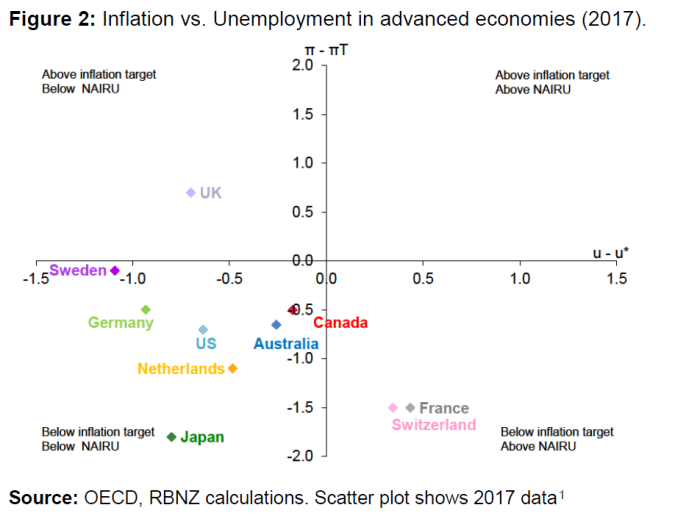
It is the sort of chart the word “chutzpah” might have been invented for.  They use it to try to suggest that much of the advanced world is “stuck” in a situation in which the unemployment rate is below the sustainable rate (a NAIRU) and yet inflation is also below target.

There are a number of odd things about the chart.  For example, they include three separate observations for Germany, the Netherlands, and France, even though all three are in a common currency (and thus common monetary policy) area.  And surely it would have been more enlightening to include the other advanced countries with independent monetary policies (eg Norway, South Korea, Israel, Iceland?  There is also no place at all for inflation expectations in the story the Bank is trying to tell in the chart.

But the biggest, most obvious, omission is New Zealand.  And where would New Zealand fit on the chart?  Well, core inflation is about half a per cent below target and on most estimates –  even on the most recently quarterly unemployment observation (4.6 per cent) –  the unemployment rate is still above an estimate of the NAIRU.    If these relationships hold at all, there are lags, and the average unemployment rate for the last four quarters was 4.9 per cent.  By contrast, before the major revision downwards to the HLFS unemployment rate last year, the Reserve Bank had a NAIRU estimate of 4.5 per cent in its models (a part of that model that had no implications for the inflation forecasts), and after those revisions, Treasury published estimates suggesting they thought the NAIRU was now nearer 4 per cent.   In other words, for now at least, New Zealand still belongs in the bottom right quadrant of the Reserve Bank chart, the one in which there isn’t much of a mystery or puzzle at all: with inflation below target and unemployment above a NAIRU, a typical response  –  in an inflation-targeting framework –  would be to cut the OCR.    Switzerland and France can’t do that –  Swiss interest rates are already negative, and France can’t control interest rates  –  but New Zealand could.  It is just that the Reserve Bank chose not to.

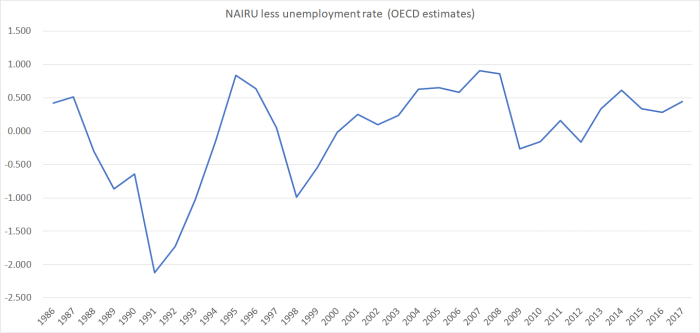
In the chart the Bank uses OECD estimates of the NAIRU.  That is understandable –  they are the only consistent cross-country estimates I’m aware of –  but not one without its problems.  For example, somewhat unusually, the OECD thinks the New Zealand NAIRU this year is still in excess of 5 per cent.   Then again, if you believe the OECD’s estimates, unemployment in New Zealand has been below the NAIRU for almost the entire 21st century so far (rising just very slightly above only in 2009, 2010, and 2012).  It simply doesn’t ring true.

nairu less U

The Reserve Bank’s next chart in this area is this one

GS speech 2

The suggestion is that there was a relationship between unemployment and inflation in the 2000s (when they also didn’t use the relationship), but that it has disappeared (for now at least) in the last few years.

Given that the relationship (even in the previous decade) wasn’t tight by any means, and many of the higher inflation numbers related to things –  eg oil shocks and short-term exchange rate movements –  that didn’t have much to do with New Zealand unemployment rates, I didn’t find the chart overly persuasive.   Moreover, since everyone recognises that the NAIRU changes over time –  with things like demographics, labour market regulation, some hysteresis etc –  even the theoretical relationship shouldn’t be with the unemployment rate itself, but with the gap between the NAIRU and unemployment rate.    I suspect the Bank is currently feverishly working on a suite of time-varying NAIRU estimates –  to reflect the new government’s interest –  but there is no hint of those in this speech.

Ideally, one might want to look at something more like an unemployment gap estimate against deviations of core inflation  from target (what the Bank was trying to do, in a snapshot) for other countries in the first chart).  As I’ve already said, I don’t have any confidence in the OECD’s levels estimates of the New Zealand NAIRU, although the changes in the associated gap from year to year might not be too bad.    For now, it is all I have.

So in this chart, using annual data (all we have for the unemployment gap) I’ve shown the deviations  of sectoral core factor model inflation from the midpoint of the inflation target and the OECD estimate of the unemployment gap from 1993 (when the core inflation data start) to 2016 (each dot is one year’s data).

GS speech 3

Even including the most recent years (the furthest left observations) there is still a relationship there, albeit not a very tight one.    Then again, it wasn’t very tight –  although a bit more upward sloping –  when I deleted those most recent years.  No doubt the Bank could –  and perhaps is doing so privately –  do this sort of analysis in a more sophisticated way.

I’m not suggesting there are no puzzles about New Zealand’s inflation performance in the last few years.    But simply plotting the raw unemployment rate (and not even looking at, say, the underutilisation rate or the gap) against headline inflation isn’t going to tell you much –  we aren’t in 1958 now (when Phillips wrote)  and, apart from anything else, inflation expectations matter.

For the last couple of years, the Bank has consistently tried to tell a story of how inflation expectations are firmly anchored at the 2 per cent midpoint of the inflation target.   That has always been a questionable proposition, especially as regards the sorts of expectations that might affect wage and price setting behaviour.     Their favoured two-year ahead measure of inflation expectations is now around 2 per cent, but a decade ago it was averaging almost 3 per cent.  Household inflation expectations are also lower than they were.  Again, that isn’t very surprising because a decade ago the Reserve Bank wasn’t seriously aiming to deliver inflation at 2 per cent (the target midpoint): we might have been happy enough to take it if inflation had got there of its own accord, but our projections (the Governor’s choice) rarely showed inflation dropping below 2.5 per cent any time soon.  Actual core inflation was up around 3 per cent.

And these days?  Well, core inflation hasn’t been anywhere near 2 per cent for years now –  persistently below.  And although the Bank consistently talks of getting inflation back to 2 per cent, it hasn’t done so, and for several years consistently erred on the hawkish side, with constant talk of wanting to “normalise” interest rates, and actually following through on an unnecessary and ill-judged tightening cycle.   Even now, “normalisation” got a lot of attention in last week’s FSR (although mercifully absent from the speech), and the Bank constantly talks about not wanting to act aggressively to get inflation back to target.  Any rational observer would not only assume inflation will be materially lower than it was, but that the Bank is quite relaxed about that (it more or less says so).  The practical target isn’t really 2 per cent –  any more than it was, on the other side, 10 years ago – but something a bit lower.

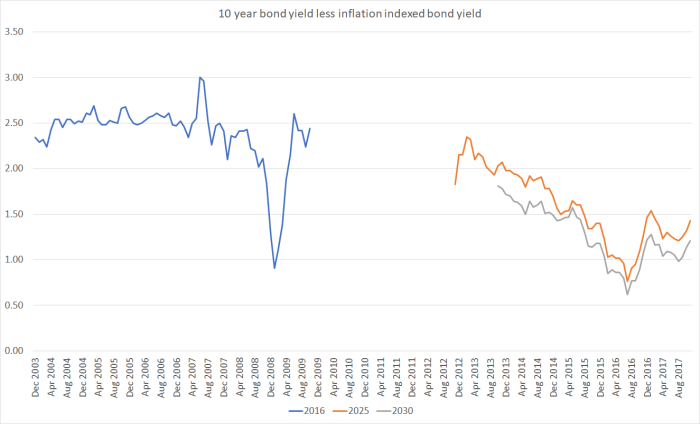
The Bank must hate data from the inflation-indexed bond market (because it never engages with it in any of its publications), but the gap between indexed and conventional bonds is not inconsistent with my story.     Interpreting that data in fine detail isn’t easy. For a long time, we had only a single indexed bond (matured in Feb 2016), and by late in its life headline inflation (eg the GST change in 2010) mattered much more than the medium to long-term outlook).  These days there are several indexed bonds, but they have fixed maturity dates while the Reserve Bank’s published “10 year bond rate” has, in effect, a maturity date that moves through time.

But consider this chart, showing the gap between yields on successive indexed bonds and the conventional 10 year bond rate.

IIB expecs to dec 17

In the years prior to 2008 (when the indexed bond still had 10 years to run), the implied inflation expectation was around 2.5 per cent.   As noted earlier, that wasn’t too far from how we were running things in practice.   What of now?  It is late 2017, so 10 years from now is roughly half way between 2025 and 2030, the two indexed bond maturity dates either side of 2027.   In November, the average gap between orange and grey lines was 1.3 per cent, and for the year to date the average gap has been 1.2 per cent.

No doubt, there are all sorts of idiosnycratic things going on, so these breakeven inflation rates may not be “true” inflation expectations (as, for example, they weren’t in the midst of the crisis in 2008).  There are, for example, a lot of inflation bonds on the market, and it is possible that Treasury has somewhat glutted the market.    My point simply is that if one wants to make sense of relationships between unemployment (or other capacity measures) and core inflation over the Wheeler years, it is wilfully blind to simply ignore a story about changing inflation norms.

The next chart is just a rough and ready thought experiment.  What if, when Graeme Wheeler took office in September 2012, inflation expectations were genuinely about 2 per cent, and people really thought that was what the Reserve Bank was serious about.  The indexed bond yields –  rough and ready as they are –  suggest that isn’t wildly implausible.  And, say, now people really think the target (for sectoral core inflation) is more like 1.3 per cent –  the most recent actuals are 1.4 per cent.  Then the chart just shows the relationship (using quarterly data) between the unemployment rate and the gap between actual core inflation and an implied target taken by interpolating from 2 per cent in 2012 to 1.3 per cent now.

GS speech 4

I”m not suggesting that is the “true” relationship, but it looks like an idea worth taking more seriously than the Bank has thus far been willing to do in public. After all, expectations adjust gradually in most circumstances.  It seems negligent, or deliberately obtuse, not even to engage with the possibility.

After all, the “acting Governor” –  I almost slipped there and initially typed it as Governor – ends his speech with the suggestion that

To the extent that the leverage of monetary policy over domestic inflation may have reduced, this suggests a cautious approach when responding to inflation deviations from target and careful attention to our assessment of economic slack. It may be appropriate for monetary policy to put relatively more weight on output, employment and financial stability relative to inflation.

Why wouldn’t a reasonable observer conclude that the Bank isn’t really targeting 2 per cent (although it might be happy enough to get there by accident) and continue to adjust their expectations and behaviour accordingly.

With a new government planning to revise the Bank’s mandate to increase the Bank’s focus on employment/unemployment, Spencer’s line would almost be some sort of sick joke if it weren’t so serious.    When the unemployment rate has been above New Zealand estimates of a NAIRU for nine years, and when the economic recovery (average growth in real per capita GDP) has been so muted, you might reasonably suppose that the government would have been expecting the Bank to do its job more energetically –  which would involve getting inflation back to target, and in the process finally delivering an unemployment rate around the (unobservable NAIRU) and even a bit faster real GDP growth.  But Spencer –  with no mandate whatever, but presumably with the support of his colleagues, Bascand and McDermott –  wants to tell us that their idea of putting more focus on “employment and output” than in the past has been to deliberately deliver such weak cyclical outcomes –  ie deliberately accept higher unemployment/lower employment than is strictly necessary.  And the implicit promise is more of the same to come, at least if people like them are left in charge.  I hope the Minister of Finance is paying attention, and that his recent talk of possibly removing the midpoint reference from the PTA wasn’t a sign that he has begun to buy into this Wheelerish mentality (even if given a glossed up public face by his colleagues now that they are minding the store).


Why do our politicians ignore PRC influence?

Our leading politicians appear quite unbothered about the rise of China and the way it is happening.   We don’t see emerging an open, free, peaceful, and democratic state  –  as with Taiwan, Korea or Japan.    We don’t even see something that looks like a large Singapore.    Instead we see a very large totalitarian party-state, suppressing most meaningful freedoms for its own people –  in ways reminiscent of the Soviet Union or Nazi Germany –  and increasingly willing to use the combination of size and wealth (not high per capita, but there are a lot of people) to throw its weight around internationally, at times (as in the South China Sea) in flagrant and ongoing violation of international law.  It is increasingly well-documented that that strategy includes attempting to exert control over ethnic Chinese cultural and religious groupings and media outlets in other countries, to suborn (with all sorts of blandishments, whether financial, access, or whatever) key figures in other countries, and to exert influence on the domestic politics of other countries, including encouraging ethnic Chinese in other countries who have suitably close ties to the Communist Party to run for elective office in those countries.

It is easy for the world-weary, and those who want to avoid confronting the issue, to respond “but everyone does it; every country seeks to exert influence”.   And, no doubt to some extent or other, that is true.   And so we need to look to the character of the country, and political regime, in question.  The People’s Republic of China today still looks much like the Soviet Union and Nazi Germany, two of the more odious regimes (at least among large countries) in the 20th century.  We –  citizens and governments –  should be treating it as such.

Instead, all our political parties, and their leaders, seem determined to look the other way, to try to pretend –  even though surely they know otherwise –  that China is some sort of normal state.   Why, the party presidents of National and Labour were recently sending warm fraternal greetings on the occasion of the five-yearly Communist Party Congress.     Would they have turned up to the Nuremberg rallies as well?   I guess political fundraising is a difficult business, but you might have hoped that former Foreign Minister Phil Goff would walk away from a $150000 donation to his mayoral campaign from an offshore donor.  Perhaps such donations should be illegal?

And then there are the elected politicians.  We have two elected members of Parliament who left China as adults and settled in New Zealand.    One appears to have misrepresented his past in his residency/citizenship application, and certainly hid it from the public when he first ran for Parliament.  That past: membership of the Communist Party, and being a member of the Chinese military intelligence system, clearly sufficiently in the good graces of the Party to have been allowed to move abroad.  The same MP remains very close to the Chinese Embassy, and has never been heard to utter a word of criticism of Chinese government policy.   And ever since the story broke, just before the election, he has gone very quiet: refusing to account to the voters (at least as represented by the English language media).

The other member of Parliament is a less egregious, but still troubling, case.  Raymond Huo is a Labour MP, also apparently widely known to be very close to the Chinese Embassy.  Of him, Professor Anne-Marie Brady wrote

Raymond Huo霍建强 works very publicly with China’s united front organizations in New Zealand and promotes their policies in English and Chinese. Huo was a Member of Parliament from 2008 to 2014, then returned to Parliament again in 2017 when a list position became vacant. In 2009, at a meeting organized by the Peaceful Reunification of China Association of New Zealand to celebrate Tibetan Serf Liberation Day, Huo said that as a “person from China” (中国人) he would promote China’s Tibet policies to the New Zealand Parliament.

It was Huo who made the decision to translate Labour’s 2017 election campaign slogan “Let’s do it” into a quote from Xi Jinping (撸起袖子加油干, which literally means “roll up your sleeves and work hard”). Huo told journalists at the Labour campaign launch that the Chinese translation “auspiciously equates to a New Year’s message from President Xi Jinping encouraging China to ‘roll its sleeves up’.”  ……    Xi’s catchphrase has been widely satirized in Chinese social media.   Nonetheless, the phrase is now the politically correct slogan for promoting OBOR, both in China and abroad. ……. In 2014, when asked about the issue of Chinese political influence in New Zealand, Huo told RNZ National, “Generally the Chinese community is excited about the prospect of China having more influence in New Zealand” and added, “many Chinese community members told him a powerful China meant a backer, either psychologically or in the real sense.”

So whose interests does Huo represent in our Parliament?  They are quotes from his own speeches/interviews, which I’m not aware that he has contested.  He has also been remarkably quiet since the Brady paper was published in September.

Recall that on TVNZ a few weeks ago, veteran diplomat (and now lobbyist) Charles Finny, who has been keen to stick up for both men and celebrate their membership in our Parliament, explicitly stated that he was always very careful what he said in front of either man, as he knew –  and given his diplomatic/trade background he would know – that they were both close to the Chinese Embassy.   If Finny always takes care what he –  just a private citizen lobbyist now –  says in front of Yang or Huo, how should ministers or senior opposition MPs react?

In fact, their reaction tends to be to pretend there is no issue.  Bill English has simply refused to answer any serious questions, referring journalists to Jian Yang as if he can answer questions about his own suitability for office, even if he were willing to make himself available for journalists.  The previous Attorney-General, and Minister for the GCSB and SIS, tried to pretend that any concerns were just racist or anti-foreigner –  as if no one could tell the difference between, say, Joseph Goebbels and Dietrich Bonhoeffer or between Xi Jinping and Liu Xiaobo.   It was pretty despicable.

Not that there was ever much hope that the Labour Party (or their partners) would be any different.  As Opposition leader, Jacinda Ardern sought to simply avoid the issue –  as, I suppose, you would when you had Huo on your list.  People who live in glasshouses and all that, I suppose.

And so it proves in government.   Last week, Raymond Huo was confirmed as chair of the Justice select committee of Parliament.    They do the triennial inquiry into the conduct of each election.  They handle legislation around such matters as political donations, the electoral system, the rule of law, and so on.    And the government is quite happy to have as chair of that committee, someone known to be close to the embassy of the dreadful People’s Republic of China, a government with little or no regard for the rule of law –  whether domestically or internationally.  Someone who channels quotes from Xi Jinping to win votes for Labour.  Who seems to think that China having more influence in New Zealand is a good thing.

I’d be uncomfortable with an American or a Briton who had become a New Zealand citizen championing greater influence of their country in New Zealand.  But there isn’t a moral equivalence between the UK, the USA, and the People’s Republic China.  The latter is a force for evil.   And you will, it seems, never hear that from Raymond Huo.

But, of course, the National Party seems unbothered.  People in glasshouses, I suppose.

And then as if to bring the last few months full circle, there was an interview on Newsroom last week with the new minister responsible for the GCSB and the SIS (and various other portfolios, including those around electoral law), Andrew Little.  Buried down at the end of a lengthy interview, Little was asked about the issue of Chinese influence

One thing that Little is not concerned about is any perceived growing influence of China in New Zealand.


When questioned about the issue and Yang, Little will not reveal if he had received any related briefings but says he has no concerns.

“There’s nothing here that’s alerted me to any Chinese nefarious influence in institutions like universities…I know there’s often the line about political influence but our donations regime is pretty transparent.

“That’s a legitimate public debate right now because it’s [Yang’s background] been revealed, he said he didn’t know he was teaching spies? I can’t recall what his defence is, he’s made it into Parliament because the National party wanted him to be there, people are going to have to form an opinion themselves.”

Asked if Yang should have been allowed to stand for Parliament or if he should have been granted citizenship, Little says he does not have enough background to comment on the latter but was more comfortable with the National MP being an elected official.

“He’s a New Zealand citizen, that entitles him to stand for Parliament. There’s a variety of backgrounds. Sue Bradford, who was a regular radical protestor, took on the police, took on the establishment, she became an MP.

“I’d be very worried about saying there were criteria beyond citizenship that we should add to about whether you can stand for Parliament.”

It doesn’t look to have been the most searching interview ever, with no questions at all about Huo, but at least the journalist asked about some things.  And as he asks, Andrew Little is scampering for cover, and in the process insulting Sue Bradford (of whom I’ve probably never knowingly previously defended). Our minister for the intelligence services compares a former spy, member of the Chinese Communist Party, and someone with close ongoing ties to a heinous regime and its representatives in Wellington (the validity of whose citizenship he doesn’t feel comfortable commenting on), with a domestic activist and protestor exercising –  and perhaps occasionally stepping over –  her rights as a New Zealand citizen.  I’m not aware anyone has ever questioned Sue Bradford’s loyalty.

And even if Jian Yang’s citizenship is securely grounded, is this senior minister really serious about that final sentence?  I don’t suppose anyone is proposing amending the Electoral Act to provide specifically that (unrepentant) members of the Chinese Communist Party, past or present, and past Chinese spies, should be disqualified from Parliament.  I wouldn’t want to amend the Act to legally disqualify a whole bunch of other people either.   If some former apartheid South African BOSS agent had somehow got New Zealand citizenship, s/he might be legally entitled to run for Parliament but –  without some serious exercise in penitence and contrition –  I hope no serious political party would consider nominating him/her.  Graham Capill is probably eligible to run again for Parliament –  and I’m a Christian, and believe in forgiveness and restoration – but no party that nominated him would ever get my vote.  And so on.  The law can’t and shouldn’t try to cover all circumstances.  But decent political parties should be able to draw lines themselves.  Ours don’t seem to anymore  (our version of Roy Moore and John Conyers perhaps?)   There is no way Jian Yang should be in our Parliament at all, and if Raymond Huo won’t distance himself from the PRC –  and call out its evil and abuses, domestic and foreign, neither should he.   Decent parties simply shouldn’t select them (being list MPs, the public have little or no direct effective recourse).

These issues of Chinese influence in other countries aren’t unique to New Zealand  (there is a good recent podcast from an Australian academic on these issues in an Australian context) although from what I’ve read of countries such as Australia, Canada, and the United States, New Zealand is the only country yet with two MPs with these close PRC ties in our national Parliament.

Quite why our politicians aren’t bothered is a bit of a mystery.  There is clearly an element of not upsetting Beijing, and with it a desire not to rock the boat in ways that could have short-term economic cost through the trade ties of some large New Zealand entities with close traditional ties to our governments.   Perhaps the political donations are part of the story as well.   That’s the shameful side of the story.  Is this what it must have been like in the 1930s, when plenty of politicians wanted to smooth things over with Germany, and more egregious abuses just made the cause of appeaement seem more urgent?

But the other side must be that the voters just don’t care very much, if at all (as European populations didn’t for a long time in the 1930s).    Perhaps that is understandable.  There isn’t a lot of foreign news in our papers and other media, and certainly not on stories that deal much with China.  We don’t have good foreign affairs think-tanks, and on the one hand taxpayer money is devoted to keeping the good news stories flowing, and journalists value the opportunity of funded trips to China.  How, then, will the average voter know what our political parties make themselves –  and by extension us –  party to?

It doesn’t make it less shameful though, and it isn’t even clear what our politicians think they achieving in selling out our values, the principles our society is built on, in keeping quiet about China.  There is the mythology that somehow China makes us (or Australia) wealthy.  It’s nonsense of course.  China is a middle-income country with a badly distorted economy.  More to the point, countries almost always make (or break) their own fortunes.  I’ve pointed out before how small a share of GDP is represented by the exports of New Zealand firms to China.  Of course, that trade matters a lot for some firms, but it doesn’t matter that much at all for the nation’s overall prosperity.  Politicians seem to sell out our soul for the financial interests of a small group of exporters, whose interests are not necessarily our own.

No doubt, MFAT advisers periodically remind any minister tempted to acquire some backbone of the potential for China to disrupt the trade of New Zealand firms.   You can read the stories about Mongolia, Norway, the Philippines, and –  most recently – South Korea.  There is some potential for disruption –  the Chinese seem to have been particularly willing to cut off the tourist flow when a country steps “out of line”, and presumably the international student market is also vulnerable.  In both cases, blocking trade hurts the seller (NZ) but doesn’t make much difference to the buyers (Chinese tourists just go to, say, France that year).    But is this the sort of country we want to become, where we quail before the butchers of Bejing, rather than standing for our own values and institutions, and telling anyone who wants to export to China –  to deal with a regime on a par with Soviet Union or Nazi Germany – that they are on their own?   South Korean firms are learning now, having experienced the nature of the Chinese state, that diversification is prudent.

There seems little doubt that Chinese global influence will only increase, and that that of the United States will continue to diminish. Perhaps one day, the Communist Party will be toppled and that influence will be more benign, but that isn’t the prospect for now.  Particularly for a country as far from China as we are, that still leaves us with choices.  I’d rather our politicians (and public) decided to take a stand.  Dealing with the PRC –  dealing with Chinese entities on PRC terms –  on other that proper and limited diplomatic terms, should be no more socially or politically acceptable than pandering to the Germans was in 1939.

Not, of course, that there is any likelihood of our government taking a stand.  Flicking through the Herald over lunch I noticed an advert from a Chinese-government affiliated entity celebrating the “New Zealand China Young Leaders’ Forum” held on Sunday which, we were told, was “setting NZ up for a bright future”.  Just like China you mean?  No political freedom, no religious freedom, no freedom of expression, just the dominance of the Party (and a mediocre economy)?   The Chinese premier, Li Keqiang had, we were told, sent his greetings and the Chinese delegation was led by a Vice-Minister.   And guess who opened this forum?   Well, that was Michael Wood, Parliamentary Under-Secretary to the Minister for Ethnic Communities.  I guess he was about as far down the official food chain as it was possible to get, but one likes to think that the British government wouldn’t have been sending a representative in 1939 to open some joint forum with, say, the Hitler Youth.

Our political leaders, apparently without exceptions (certainly none with the courage to speak out even timidly) disgrace us.

An underwhelming top 200

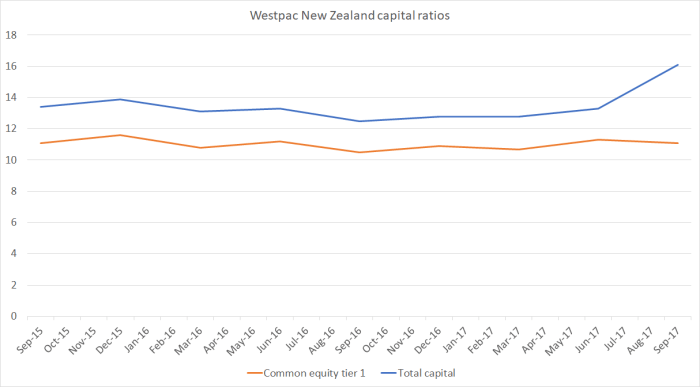
In last Friday’s Herald there was a weighty supplement headed “Dyanamic Business”, reporting/celebrating the results of the annual Deloitte Top 200 (companies that is) business awards.  It seemed to be an opportunity for mutual self-congratulation, bonhomie, and a bit of virtue-signalling thrown in as well (eg the MBIE-sponsored award for “diversity and inclusion”).  And a few oddities as well: the award for “excellence in governance” went to a company that is majority state-owned and subject to quite real moral hazard risks (see 2001), and I don’t suppose the Reserve Bank will have been best-pleased to see the chair of Westpac New Zealand Limited –  the subsidiary just last week subject to Reserve Bank sanctions for failures of governance –  as a runner-up the “Chairperson of the Year” stakes.

But what caught my eye flicking through the supplement was this table for the top 200 (non-financial) companies in New Zealand.

Annual % growth 2016/17
Revenue 4.3
Pre-tax profits -6.4
Tax paid 22.7
EBITDA 2.9
Assets -5.7
Equity 2.9

(Tax aside) those numbers didn’t look very impressive.  Total revenue was up 4.3 per cent (and the accompanying article says that in the previous year revenue actually fell).  Profits and total assets actually fell, and both EBITDA and total equity were up by 2.9 per cent.

And what happened to the whole economy?  The Top 200 numbers use the latest audited accounts of each company, so there is a mix of balance dates.   But in the year to June 2017 (the latest quarterly data we have), nominal GDP rose by 5.9 per cent.  The last annual national accounts came out late last week: on those numbers, nominal GDP has risen 6.2 per cent in the year to March 2017, and 5.1 per cent in the year to March 2016.   Against that backdrop, the performance of the top 200 companies was, if anything, surprisingly weak.

Big companies, in aggregate, doing less well than the economy as a whole needn’t be a concern.  It could, after all, be a sign of thrusting new companies surging ahead and displacing the tired old giants.  But there isn’t really much sign of that sort of process in at work in New Zealand –  see, for example, the tech sector.   And, of course, our overall per capita growth in real GDP (let alone productivity growth) has been pretty deeply underwhelming.

In a way, a simple list of the top 10 most profitable companies (dollar value of profits) is quite revealing:

Fonterra
Spark
Air NZ
Ryman Health
Kaingaroa Forest
Auckland Airport
Transpower
Z Energy
Meridian Energy
Mercury

Of those 10, we have four majority state-owned companies (one a natural monopoly), a chain of petrol stations, a property-boom play, and a co-op whose profits are largely driven by swings in global commodity prices.   There wasn’t much new or very dynamic about it.  In a way, the list of top 10 money-losing companies looks more interesting – in addition to Tasman Steel (No 1) and Kiwirail (No 2), it does feature Xero and Orion Health.

It is a very different list than, say, one of the top most profitable non-financials in the US, which does feature (relative) newcomers like Apple and Alphabet (Google) and where almost all the companies have a strong international focus.

I mentioned those new annual national accounts numbers.  No doubt I’ll be using the numbers in various posts in the next couple of months, but for now just a couple of charts.

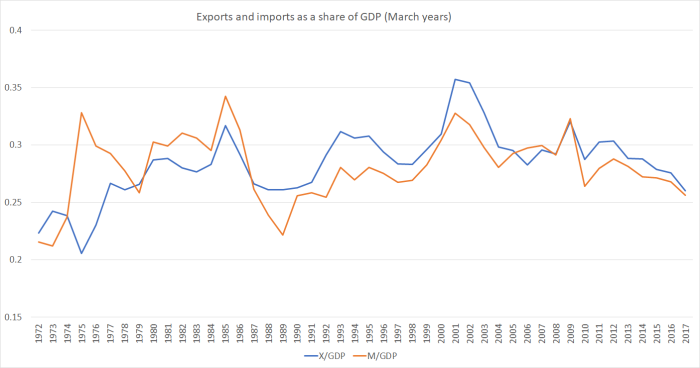
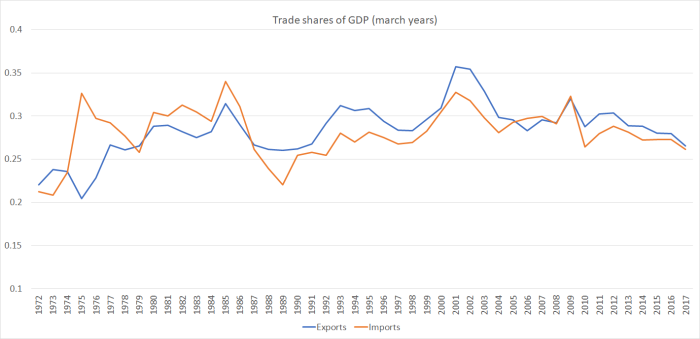
I’ve noted in various recent posts the fall in the export share of GDP over recent years.  There was always the hope that some of that might have been revised away when the annual numbers were published.  But no.

X and M share of GDP

As a share of GDP, imports haven’t been lower since the depths of the recession in the year to March 1992.  Exports haven’t been lower, as a share of GDP, since the year to March 1976 –  more than 40 years ago.     There was, so it was claimed, a policy focus on increasing the outward orientation of the New Zealand economy.  If so, it failed.

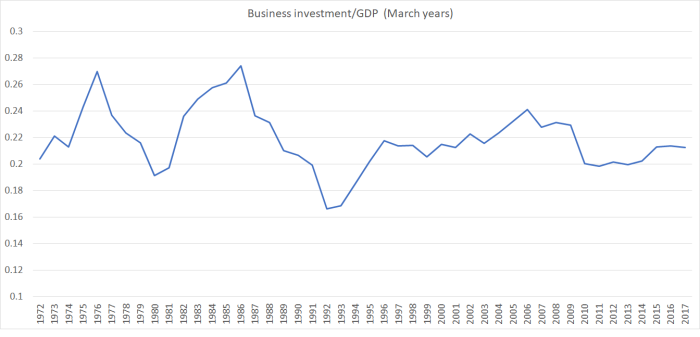
And what of business investment as a share of GDP  (as previously, this is total gross fixed capital formation less government and residential investment)?

bus investment

It picked up a couple of years ago from recession-era lows, but has gone sideways since, and is nowhere the rates reached in the previous expansion.

When profit growth in our top 200 companies has been relatively subdued perhaps it shouldn’t be surprising that not very much business investment is occurring.   And those export/import numbers shown earlier strongly suggest that what business investment is occurring will have been disproportionately concentrated in the non-tradables bits of the economy, those that don’t (be definition) face much international competition.

Deloittes and the Herald might think this is a “dynamic economy” –  and I’m sure there are plenty of small exciting firms in it –  but once we stand back and look at the aggregate numbers the picture isn’t very encouraging at all.  If change is constant, the change here seems –  in aggregate –  to more akin to drifting slowly backwards.

That was the legacy of the now-departed National-led government.  That government’s policies were not, in relevant areas, materially different than those of the previous Labour-led government.    The worry now is whether there is any realistic basis for expecting something different, and better, from the new centre-left government.  At present, it isn’t obvious why the future should be any better than the performance over the last 20 years or so.


National single-handedly lifting parliamentary productivity

The Productivity Commission has been working on a report on state sector productivity, commissioned by the previous National-led government.    I’m not sure that everyone simply working harder was quite what they had in mind.

But judging by the number of written parliamentary questions lodged in the less than three weeks since the opening of Parliament, National Party MPs (and their research assistants) seem to be generating outputs at a record rate.   Outcomes –  the real focus surely –  might be another matter.

Parliament publishes an accessible record of all written parliamentary questions asked since 2003.   Here are the annual totals.

wirtten PQs annual

The Opposition (largest component being the Phil Goff-led Labour Party) was particularly active in 2010, lodging almost 40000 questions that year (almost all written questions are lodged by Opposition MPs), but in the average year around 17000 questions were asked.

It is an interesting contrast to the Australian Parliament, where a fact sheet records that on average in the last Parliament only 11.6 questions per sitting day were lodged.   Perhaps incentives matter:  in New Zealand, all written questions have to be answered, and within six working days.  In Australia, by contrast, there is no time limit.

In that earlier chart there is nothing unusual about the 2017 numbers.  At the moment the total is a little below average, but there are still four more working weeks of the year.  And here is a chart of the monthly totals back to just prior to the 2014 election.

PQs monthly

There are some zero months: around elections when Parliament itself is dissolved, and the Opposition parties seem to have given themselves (and those who have to answer the questions), a complete break each January.

But look at that total for November 2017: 6254 questions asked already.  The first question wasn’t asked until 8 November and it is only 25 November now.   With four more working days to go, they could yet hit 10000 questions for the (partial) month.   At anything like this pace, the 2010 record will be blown out of the water next year.

But one does have to wonder to what end?  The line from Macbeth “sound and fury, signifying nothing” was springing to mind, perhaps (one would hope) unfairly.

Every one of these questions –  even the really mundane ones –  have to be processed, by the Clerk’s office, by the relevant Minister’s office, and possibly by a government department.  Each one needs an answer prepared, and then submitted back through the system for approval and then lodging for reply.

And it isn’t as if this is a normal phenomenon immediately after an election or change of government.  In December 2008, for example, the first month of the new Parliament, only 619 written questions were asked.   In the two months after the 2014 election, a total of 2339 written questions were asked.

And what bits of vital government information are the Opposition MPs trying to ferret out of ministers?   Dr Jian Yang, a middle to lower ranking National Party MP, spokesman on Statistics, has been more active than the average Opposition MP: he has asked 147 questions so far (the average Opposition MP has asked “only” 110).    These are the five questions he asked on Thursday (he took the day off apparently yesterday)

What reports, briefings, memos or aide memoires did the Minister receive on 23 November 2017?

What meetings did the Minister attend on 23 November 2017?

What meetings did the Minister decline on 23 November 2017?

What events did the Minister attend on 23 November 2017?

What events did the Minister decline on 23 November 2017?

And the previous day he asked the same five questions about the 22 November. And the Minister of Statistics doesn’t actually do very much at all.  From what I could see, not a single one of the 147 questions was substantive.

Now I’m all in favour of open government.  I reckon Parliament itself should be subject to something like the Official Information Act, and there is a good case for making the diaries of ministers open (sunlight being a good disinfectant against undue influence etc).

But quite what is being gained by interminable questions of this sort (when there is presumably no suggestion of any particular inappropriate conduct)?   They aren’t all diary questions of course.  Shane Reti, another National MP, has 587 questions to his name.  A sample includes from yesterday.

Will the Minister commit to visiting NorthTec Rawene Campus in the first 100 days of office?

When was the last time the Minister visited the NorthTec Rawene Campus?

It all has the feel of a rather expensive fishing expedition in the expectations that if they ask enough questions something will turn up somewhere about something.  Another phrase for it might be “sheer waste of taxpayers’ money” (something perhaps the Taxpayers’ Union could get interested in.)  When people set out in pursuit of a political career, with the typical high-minded aspirations such people have, did they really think this is the sort of activity they’d be reduced to?

Meanwhile, I’m sure the public service (and ministerial staff) are fervently hoping for a breather in January.  But I’m not sure I like their chances.

UPDATE:  This post by Graeme Edgeler changes my impression somewhat.

Committing pointless economic suicide?

There has been some silly nonsense published in various overseas publications about the change of government – all that on top of things like the Wall St Journal‘s weird pre-election suggestion that Jacinda Ardern was some sort of Trump-like figure.

I’ve written about some egregious examples of ill-informed commentary here.  There was, for example, Nick Cater’s piece in The Australian praising the reformist nature of the previous government, the outperformance of the New Zealand economy, and specifically John Key and Bill English who “stand as inspiration to the rest of the developed world in these anxious and volatile time”.  And then, more recently, there was the Washington Post column by an Auckland-based American lifestyle journalist who sought to convince his readers that the new government was controlled by the far-right.   It was a case, we were told, of “Ardern may be the public face, it’s the far right pulling the strings and continuing to hold the nation hostage”.

Sure we are small and remote and not of that much objective significance to the rest of the world.  But the scope for really badly-informed commentary is still a bit of a surprise: in both cases, it seemed,  involving the authors projecting onto New Zealand what they wanted to see, and causes they themselves wanted to champion (in Cater’s case, genuine reform from the centre-right government in Australia, and in Ben Mack’s case probably a desire for something well to the radical-left of what any party in Parliament stands for).

Another example of detached-from-reality commentary turned up yesterday on Forbes magazine’s website, by an American investment adviser/commentator named Jared Dillian.  I’d never heard of him before, but apparently he has a following in some circles, and is clearly willing to speak his mind.  By the look of his new article on New Zealand, doing a little basic research first might help though.

His article has a moderate enough headline, New Zealand, An Economic Success Story, Loses its Way.    In fact as a headline in 1960 it would have been spot-on.   Without the constraints of magazine editors, his message was then amped-up when he tweeted out the link to the article, under the heading “New Zealand commits pointless economic suicide”.

I probably wouldn’t have bothered writing about it, but TVNZ asked me to go on this morning and comment on it, and preparing for that involved reflecting a bit more (than the piece really deserved) on where he was wrong and why.

I suspect the author must have been raised on some mythology about the 1980s reforms, which (rightly) got a fair amount of attention internationally then and for a decade or more afterwards.

There is the gross caricature of the pre-1980s New Zealand economy for a start (“most of industry was nationalized”, “extraordinary levels of government debt” [well, not much more than half –  as a share of GDP –  current debt levels in the US]).   And then the claims about the subsequent period that are utterly detached from any sort of data: “New Zealand is a supply-side economic miracle”, “New Zealand enjoyed unprecedented economic growth”, “it became one of the richest countries in the world”.

All this in a country which over the last 30 years has had one of the lowest rates of productivity growth of any advanced country –  none at all in the last five years –  and which looks set to be overtaken by Turkey and such former communist states as the Czech Republic, Slovakia and Slovenia.   We’ve just drifted slowly further behind most of the rest of the advanced world.  Numbers of those leaving fluctuate cyclically, but over the post-reform decades we’ve had one of the largest cumulative outflows of our own people of any advanced country in modern times.

But what of the suicide note that Dillian appears to believe the new government’s policy agenda represents?

Top of his list is any changes to the Reserve Bank Act.  He is, clearly, a big fan of the Reserve Bank and of New Zealand’s lead role in introducing inflation targeting.  That’s fine, and reasonable people can differ on whether there is a strong case for change, and the extent to which possible changes (details yet unseen) might change substance (as distinct from appearance/style).   But Dillian apparently knows already.

At 4.6%, unemployment is already low, but she wants to take it well below four percent, for starters. She would rather that the central bank tolerate higher levels of inflation in order to get unemployment lower, risking all that the RBNZ has achieved over the years.

A bit of basic research would have told him that the government has repeatedly indicated that they will not be seeking to give the Reserve Bank a numerical unemployment target, and that they recognise that other structural measures are needed if unemployment is going to be sustainably lowered very much further.  And in his press conference a couple of weeks ago. Grant Spencer “acting Governor” of the Reserve Bank didn’t exactly seem to think the baby was about to get thrown out with the bathwater.  If he did think so he could easily have said; after all he is retiring in four months’ time.  And the Bank had one of their friendly foreign academics, on a retainer from the Bank, out making pretty reassuring noises the other day too.  As he points out, the rhetoric from the government talks of modelling the Reserve Bank’s goals on those used in Australia and the United States –  central banks which, mostly, behave much the same way our Reserve Bank does when it is following its current mandate.

It isn’t just goal changes that worry Mr Dillian.

She also wants to include an external committee in the RBNZ’s monetary policy decisions, which will certainly give the bank a more dovish tilt.

When central banks as diverse as those of the UK, Australia, Sweden, the United States, Israel and Norway include external members on their monetary policy decisionmaking committee, it is difficult to take seriously the suggestion that moving to such a committee will “certainly” make New Zealand monetary policy more “dovish”.   What it may, perhaps, do is reduce the risk of the sort of false starts we’ve twice had to put up with from successive Governors this decade.

Then there is the forthcoming legislative ban on non-resident non-citizens buying existing residential properties.

New Zealand has, by anyone’s measure, one of the biggest housing bubbles in the world. Banning foreign ownership of property sets the country up for a possible real estate crash.

Set aside for the moment the question of whether the market is a “bubble” (I don’t think so, on any reasonable measure) but somehow adopting the same policy as Australia has had for years is suddenly going to fix our housing market problems.  If only.

What of immigration?

Ardern also opposes high levels of immigration, along with her coalition partner, Winston Peters. It is set to drop dramatically. Immigration, especially skilled immigration, has been a big contributor to economic growth over the years.

Actually, the Labour Party policy, which will be the government’s immigration policy, does not change the number of non-citizens annually given the right to live here permanently by even one person: the target remains at 45000 per annum (or around thre times per capita the rate in the United States).  Official policy supports continued high rates of immigration.  On immigration, Winston Peters won nothing beyond the rather limited, one-off, changes that Labour has proposed.

But, yes, really rapid increases in the population, driven by net immigration numbers, have greatly boosted headline GDP over the last few years.  Meanwhile, per capita real GDP growth –  surely the metric that matters rather more –  has been pretty anaemic at best.  And –  have I mentioned it before? –  there has been no productivity growth at all in the last five years.

Dillian ends with two final predictions.   Having heralded our high rankings on some of the economic freedom indices, he now asserts that “New Zealand will probably lose its status as one of the most open, free economies in the world”.    Frankly, that seems pretty unlikely.  As I’ve shown previously, on the measure he appears to cite our score has been pretty flat for 20 years now, through the ebbs and flows of the policy changes put in place by both National-led and Labour-led centrist governments.

econ freedom

Perhaps this government will prove different, but on the evidence to date – the published policy programmes – there isn’t much sign of it.

And what of Dillian’s final prediction?

It seems likely that New Zealand will experience a recession during Ardern’s term.

As it is now seven years (or eight, depending on how you count these things) since the end of the last recession, any detached observer would have to think there is a non-trivial chance of a recession in the next three years.  Periods of expansion don’t typically die of exhaustion, but New Zealand has never gone 10 years without a recession of some sort or other (and although some Australians like to boast of their 25 year run, in fact even they have had an income recession in that time –  a sharp correction in the terms of trade in 2008 for example).   Our modern history is a small sample of events, but it wouldn’t be too surprising if something went wrong in the next few years.

Of course, most –  but not all –  of our recessions have had a significant international dimension to them.   And that is still probably our greatest area of vulnerability in the next few years –  some shock, or series of shocks, arising out of insufficiently-weighted (or priced) areas of vulnerability, accentuated by the fact that most other countries now have little room to use fiscal policy for counter-cyclical purposes and almost none to use monetary policy (most policy rates being very close to, or below, zero). When the next foreign recession hits it is going to be difficult for other countries’ authorities to respond effectively.

Could we mess things up ourselves?  It is always possible –  and monetary policy mistakes are among the possibilities –  but even if you think the new government’s policy platform will reduce potential growth (or potential productivity growth) and even if there is some sort of “winter of discontent” fall in confidence next year, it is difficult to see what in the current mix of proposed domestic policies would tip New Zealand into recession.   Lower headline GDP growth seems quite possible, but was also likely if the previous government had returned to office.

Dillian’s story seems to rest on the forthcoming “housing crash” and cuts to immigration.  But if net migration is a lot lower in the next few years than it has been in the last few that is most likely to be because the Australian economy –  our largest trading partner – is doing better.    Policy itself is designed to maintain a high average net inflow of non-citizen migrants (and is the poorer for that).  As for housing, unless/until land use laws are substantially liberalised, the idea of a crash in house prices is just a scary fairy tale –  and were land use laws to be substantially liberalised, it would be more likely to be a force for good –  including allowing some productivity gains – than one that would drag the economy down (tough as some of the redistributive consequences might be for some people).    Among our good fortunes is that if demand does look like weakening materially, the Reserve Bank still has a fair amount of room to cut interest rates –  not enough probably, but more than almost all other advanced countries.

All of which Mr Dillian could have found out with the slightest amount of digging.  If there is a “suicide” dimension to economic policy in New Zealand, it is the wilful blindness of successive governments led by both main parties, who keep on doing much the same stuff, and either believe they’ll get a different and better (productivity) result, or who just don’t care much anymore.

What does The Treasury want to know? Not about productivity apparently

Last week I joined 80 or 90 other economists and people from related disciplines, drawn from the public sector, universities, consultancies, and think tanks, together with a few commentators, at an event organised by The Treasury.  It was billed as “Wealth and wellbeing: High quality economics in the twenty-first century”.  They were looking for input.

The symposium began with a presentation by The Treasury’s chief economist, Tim Ng, based around a paper he and a couple of colleagues had written, “Improving economic policy advice”.  That paper, in turn, built on the Living Standards Framework that Treasury has devoted a lot of effort to building and promoting over the last half dozen years or so (and which you can read all about here).

The Living Standards Framework has troubled me from the first, and despite the numerous refinements, and attempts to articulate how it is used, and how government policymaking benefits, I remain sceptical.   I’m not the only one: the New Zealand Initiative’s Bryce Wilkinson published a critique last year (pages 7 and 8).  Bryce made a number of good points, including the merits of a traditional cost-benefit analysis approach, and the tendency of the Living Standards Framework to assume the benevolence (and knowledge) of officials and politicians, in a way that simply ignores much of the economic literature around incentives, information, and the possibilities of the sort of government failure we see all the time.

The Treasury has for some years now proclaimed a vision for itself

Driving what we do is our vision to be a world-class Treasury working toward higher living standards for New Zealanders.

Like Bryce, I’m also uneasy about that

Personally, I am not a fan of vision statements for government agencies. Public servants are paid to serve their elected ministers in the wider public interest and perform their delegated authorities impartially.

Either Treasury’s vision has content –  in which case it has no more legitimacy than the personal preferences of a group of senior officials –  or it is little more than vacuous waffle (“we want to do well”).

There is much the same lack of clarity around the Living Standards Framework, the  centrepiece of which now appears to be this smart new picture.

Higher Living Standards - The Four Capitals - Natural, social, human and financial/physical

Good things flow from these “four capitals”.

There is an accessible, relatively recent, guide to using the Living Standards Framework(LSF).  But it is still not clear whether there is very much substance to it at all, or whether it ever means anything more than “when you do policy advice, there are lots of dimensions it can be important to think about”.  As if anyone ever doubted it.    Treasury talk about a list of six ways they have used the framework.  The first was for brainstorming, but then surely the whole point of brainstorming is not to be tied into an artificial organising framework?   They also show an example of analysing defence policy using the LSF, but (despite the pretty picture, page 10) it is not clear at all how analysing defence policy as a contribution to “social cohesion: abroad” is particularly helpful to anyone.   And their final use is “to measure progress”, featuring a heroic attempt to illustrate change across each of the dimensions since 1870.  An exercise of that sort might be useful for economic and social historians –  with all the inevitable caveats –  but it isn’t clear how it helps today’s ministers.  In fact, it would still be interesting to know whether any major decisions during the term of the previous goverment were made differently because of the advent of the LSF.

Perhaps it will be different under the new government? My observation at the time Treasury first came up with the LSF was that they seemed to be preparing for a Labour/Greens government.

There is also still the tone of a “grab bag” of the latest trendy ideas to it.   This line appeared in the paper presented to the Symposium

To be relevant, wellbeing measurement and cost-benefit analysis need to be sensitive to changing technological, ecological and social trends, such as digitalisation, globalisation, the rise of China, environmental limits, and an increasing policy focus on inequality.

And anything else ministers, citizens, or bureaucrats happen to find “relevant” at the time?  It doesn’t sound like much of a basis for rigorous, detached, free and frank advice.

One of the many problems is that there is little robust basis for aggregating all these issues, concerns and indicators.   But that doesn’t stop The Treasury, who have apparently decided to use the OECD’s Better Life Index, another theory-free ad hoc summary measure (on which New Zealand happens to score well).

Conveniently perhaps, the OECD index doesn’t even include either GDP per capita or related productivity measures (although there are some other income measures).   For some of the variables, it isn’t even clear whether, or why, something counts as good or bad.  The employment rate is in the index, but employment is mostly an input (inputs are costly), not an output –  and yet I presume the OECD counts a high employment rate as “a good thing”.   New Zealand score on ‘years of education’ will presumably lift now that we are going to have free tertiary education, but there is no assurance that the policy will lift average national wellbeing (as distinct from transfering it from one group to another).   Labour market insecurity appears in the index, in a measure in which a country is penalised for having low unemployment benefits relative to market wages –  but what basis is there for the OECD’s implicit judgement that one system is better than the other in the longer-term?  The share of expenditure devoted to housing also appears in the index: it will tend to be higher in a country with larger houses, but what basis is there for any sort of welfare interpretation of the numbers.   (And, on the other hand, the share of the native-born population living abroad –  a reasonable relative-welfare indicator, taken from revealed preferences – doesn’t appear in the index at all.)

These indices, and the Treasury’s Living Standards Framework, often seem to be developed in reaction to some sort of caricatured view that GDP (even per capita GDP) is everything.   But the problem with the caricature is that it is view that no one has ever held.  Every economic policy adviser recognises (for example) that GDP includes the spending/activity to replace depreciated physical capital.  A measure of net domestic product is a little more useful for welfare purposes, and a measure of net national income (distinguishing the income generated that accrues to residents) better still.   Measures of consumption per capita might be better again, if the purpose of economic activity is conceived as supporting consumption over time.   And it is not as if the concepts of externalities, or the depletion or degradation of natural resources, are exactly new phenomena.   And if some government were crazy enough (and powerful enough) to simply set out to maximise GDP per capita, they’d conscript us all, prohibiting retirement, individualised childcare, or even any leisure beyond what the maintenance of productive capacity might require.   It doesn’t happen in free societies (although it came close in wartime).   It is a straw man.  (As incidentally would a similar articulation about GDP per hour worked: if a government were crazy enough to seek to unconditionally maximise that variable they would simply ban all but the most productive people from working at all.)

So the issue about productivity, or GDP per capita, isn’t that the goal of policy has ever been to maximise either.  After almost 70 years of underperformance (productivity growth less than in other countries), one doesn’t have to get into debates about “maximising productivity” to want Treasury to be able to offer good answers about why we are in this situation, and how we might out of it.   Officials and advisers might concentrate on identifying roadblocks –  government policies that impede firms and households making choices they would otherwise take –  the removal of which might result in GDP/productivity outcomes more in line with those in other, apparently more successful, countries.  Of course, each of those interventions needs to be evaluated on its own merits.    There are good reasons to make schooling compulsory, or not have lump sum taxes or whatever, but many regulatory interventions won’t pass any sort of decent test (as, in its day, rules that led to the assembly of TVs didn’t).  I’d argue that our immigration policy doesn’t.

And if I can’t fully put my finger on what I don’t like about the “four capitals approach” it is a sense –  not stated, perhaps not even believed, but implicit nonetheless –  that these are resources of the government, to be marshalled and managed by governments in what they judge to be some sort of “national interest”.   And all too little of a sense that governments more often corrode these so-called capitals than foster them.

And in the New Zealand specific context, a focus on the Living Standards Framework can come to provide cover for the failure to grapple with New Zealand’s long-term economic underperformance and (in this specific context) the failure of The Treasury –  the government’s principal economic advisers –  to be able to offer compelling advice, built on compelling analysis and narrative, for what has gone wrong, and what might be done to fix it.   Perhaps we’ll see some startling new insight on that problem when the Treasury’s Briefing for the Incoming Minister is finally released, but I’m not expecting it – there have been no new ideas tested in working papers or speeches or anything of the sort.  In the paper presented at last week’s Symposium there was more on macroeconomic stabilisation issues (which New Zealand does relatively well) than on productivity, and no obvious policy ideas (on productivity) beyond changing the tax treatment of housing and land use laws (there might be elements of use in that, but no one seriously believes those changes alone would close the 60 per cent gap between, say, productivity levels in New Zealand and those in places like France, Germany, the Netherlands or the United States).

Much of the focus on the Symposium seemed to be on building links between Treasury and the academics.  I’m not sure they got far on the day, although the forum did provide a good opportunity for the academics to remind Treasury that (a) research costs money, (b) research takes time, and (c) the PBRF university ranking and funding scheme strongly discourages academics from doing any research, however well-remunerated, that doesn’t lead to publication to international journals or books published by university presses.

Treasury also used the occasion to launch something called the Community for Policy Research as part of strengthening relationships with researchers working on New Zealand issues.    As part of that, they have released a Research Interests document, a list of research interests which is

“our assessment of where additional research with a New Zealand focus could be useful.  It reflects a number of judgements, including our sense of gaps in the evidence base, where we believe polciy development is being hampered by lack of evidence and emerging medium to long term issues. Often we are looking for research that will help us make a step change, where wider debate will be necessary over the medium to long term”.

Which sounds fine, until one actually turns to the list.

On fiscal policy, for example, there is an item

“Should New Zealand have an Independent Fiscal Council?”

Perhaps it should, perhaps it shouldn’t, but it is explicit Labour and Greens policy that we should.   Presumably the outstanding issues are around the form, and responsibilities, that Council should take?

There are 13 macroeconomic topics –  many of them rather technical (output gap estimation, time-varying NAIRU estimation –  and not a single one of those topics relates to any sort of timeframe beyond the cyclical.    Thus, they are interested in “different approaches to population/immigration projections (eg Bayesian)” but apparently there are no outstanding issues around the longer-term term impact of immigration policy (whether on productivity, or those social and environmental capitals).

In fact, the word “productivity” doesn’t appear at all (or any cognates).  Does Treasury have all the answers already, or have they more or less given up?    The productivity issues seem like classic New Zealand-specific longer-term issues that The Treasury –  principal economic advisers to the government –  really should be looking for answers to, and associated research on.  But, apparently, topics like “What is the relationship between volunteer work, social and human capital?” count as more pressing.

Several people at the symposium took the opportunity to push back in reaction to Treasury’s recent boast that this year it had hired no one with just a straight economics degree.   As one public servant put it, they wouldn’t want to go to a mechanic for brain surgery, and as another former public servant noted, Treasury needs to be really excellent in its economic advice –  and tacking a few short day-release economics courses on to a degree in a quite different subject isn’t really likely to be enough.  One might be less bothered if there was a sense that Treasury’s analysis and advice was consistently excellent, and the only obstacle to first-rate policy was the politicians (of whatever stripe).  That just isn’t so these days.

Finally, it was interesting to observe the numbers of Treasury speakers and of panellists attempting to use Maori phrases, or introductions, or talking about the need to incorporate Maori perspectives into thinking about wellbeing.  As it went on, I started looking round the room trying to spot anyone who might themselves be Maori (noting that there were at least four adult migrants at my table –  of 10  –  alone).  Finally, my curiosity was satisfied when one of the panellists, clearly with the same sort of reaction, asked for a show of hands.  In a room of at least 80 people,  two responded that they identified as Maori. I hope it left the organisers just a little uncomfortable.

I’ve been reasonably critical of Treasury’s work in this (excessively long) post.  But I would commend them on the aspiration behind the occasion, and on going to the effort of openly engaging with a wider group of policy and research people, openly articulating issues they are interested in seeing research on.  There is a place for confidential policy advice and for the free and frank exchange of views between ministers and officials, but our understanding of the issues is only likely to be advanced by open, two way, dialogue and debate at earlier stages of the process.  Some of the challenges New Zealand faces are substantial, and the pool of able, interested and available people isn’t large, or necessarily restricted only to the public service.


Revisiting Westpac and the Reserve Bank

Last week I wrote a post about the Reserve Bank’s announcement that it had increased Westpac New Zealand Limited’s minimum capital requirements –  by quite significant amounts – “after it failed to comply with regulatory obligations relating to its status as an internal models bank”.

Two things in particular annoyed me last week:

  • the complete lack of any serious explanation, from either the Reserve Bank or Westpac, as to what had gone on and why, how and by whom the errors were uncovered, what remedial steps had been taken (in both institutions), how we could be sure similar problems didn’t exist in other banks, and
  • the absence from both statements (Reserve Bank and Westpac) of any reference to Westpac’s directors, even though under our system of bank regulation and supervision, the directors have primary responsibility for attesting to the accuracy of disclosure statements, and face potential civil and criminal penalties for (strict liability) offences for publishing false information.

One can understand why Westpac would not want to say anything more, even if (for example) they thought the Reserve Bank had overreacted: don’t upset the regulator is one of the watchwords of the banks, because even if your concern might be justified on one point, the Reserve Bank has many other ways to get back at you on other issues (where, eg, approvals are needed) if you make life difficult.

The Reserve Bank’s stance is more disconcerting.  It is, after all, a government regulatory agency, responsible to the public for the exercise of its statutory powers, and for the management of its own operations.    And yet, as so often with monetary policy, they seem to think it is up to them to decide how much they will graciously tell us, rather than to be accountable and answer the questions that people have.  I gather they are refusing to explain themselves further at all.  If, as it says it is, the government is serious about increasing the transparency of the Reserve Bank, this is just another example of why reform –  and a new culture –  is needed.

When I wrote last week, there were several things I didn’t notice.

First, I noticed the lack of any sign of contrition in the Westpac statement, but didn’t go on to draw the obvious conclusion that lack of any sign of contrition –  even feigned for the public – might suggest that they felt they were being rather unjustly dealt with in this matter.    Had they been caught out doing seriously bad stuff, you’d have expected them to, if anything, overdo the public contrition (mea culpa, mea culpa, mea maxima culpa and all that).

Second, the Reserve Bank’s statement was clearly designed to have us believe that there had been systematic problems for nine years now, ever since Westpac was first accredited to use internal models.  Why do I say that?  This is what they said.

The report found that Westpac:

  • currently operates 17 (out of 35) unapproved capital models;
  • has used 21 (out of 32) additional unapproved capital models since it was accredited as an internal models bank in 2008;

But someone pointed out to me Westpac’s initial disclosure of the problems in its September 2016 disclosure statement.   In that statement (page 9) Westpac disclosed a couple of trivial errors dating back to 2008 (in sum, lifting risk-weighted assets by $44 million on a balance sheet of $86 billion).  And what about the model approvals errors?  Well, this is what the directors’ disclosure says:

“The Bank has identified that it has been operating versions of the following capital models without obtaining the Reserve Bank’s prior approval as required under the revised version of the Reserve Bank’s Capital Adequacy Framework (Internal Models Based Approach)(BS2B) that came into effect on 1 July 2014”

If it is correct that prior to July 2014 internal models banks did not require Reserve Bank approvals for specific models (and I have now have vague recollections of internal discussions on exactly this point in 2013/14, and an earlier version of BS2B does not have the requirement) that would put a rather different light on Westpac’s errors than was implied in the Reserve Bank statement.    Transition problems associated with a pretty new requirement look rather different than a failure that had run for nine years since the inception of the Basle II regime.

The original conception of allowing banks to use internal models to calculate risk-weighted assets (for capital adequacy purposes) had not been to have the Reserve Bank micromanaging the process, but rather reaching an overall judgement about the ability of banks to responsibly use such models, while imposing supervisory overlays where the Reserve Bank thought the models were producing insufficiently cautious results (as we did from day one in respect of housing mortgage exposures).  Over the years, the Reserve Bank grew less confident in the internal models approach, culminating (apparently) in the 2014 requirement that all models have prior Reserve Bank approval.

As the situation stands now

Registered banks may only use approved internal models for the calculation of their regulatory capital adequacy requirement. Banks must advise the Reserve Bank of all proposed changes to their estimates and models before implementing them.

There are specific requirements laid down about the information banks have to submit to the Reserve Bank when seeking such approvals. I’ve been told that the Reserve Bank can then take up to 18 months to work through the process of approving any change (there are, after all, 32 models for Westpac alone, and four internal-models banks).

The Reserve Bank also requires that

A bank that has been accredited to use the IRB approach must maintain a compendium of approved models with the Reserve Bank. This compendium has to be agreed to by the Reserve Bank and only models listed in that compendium may be used for regulatory capital purposes. The compendium is to be reviewed and relevant sections are to be updated at least once a year. The compendium must be updated as soon as practicable after a model change has been approved by the Reserve Bank. The compendium lists basic model-related information such as version number, approval date, risk drivers, key parameters, as well as information from the most recent annual validation report on RWA, EAD, validation date and model outlook, and any other model-related information required by the Reserve Bank.

All of which sounds sensible enough, but it raises some obvious questions.  If this was a new requirement in 2014 (but in fact whenever the requirement was introduced), surely the Reserve Bank would have insisted on a compendium from each bank of the models that bank was using at the time, and then would have put in place a process to (a) monitor any changes it was approving, and (b) ensure, whether by directors’ attestation or whatever, that any changes to the models banks were using actually had prior Reserve Bank approval.  But did any of this happen?

Since we don’t have anything in the way of a good explanation from either Westpac or the Reserve Bank we can only guess at what must have happened.  I’m pretty sure Westpac didn’t consciously set out to deceive the Reserve Bank –  the banks are gun-shy, terrified of breaching conditions of registration –  and the Reserve Bank’s own statement seems to accept that story.

Perhaps there is a clue in this line from the Reserve Bank statement as to what the independent investigation found.  Westpac New Zealand

failed to put in place the systems and controls an internal models bank is required to have under its conditions of registration.

Most or all of the risk modelling work is likely to have been being done in Sydney (by the parent bank) and not by Westpac New Zealand at all.   Quite possibly, people on this side of the Tasman only ever see the bottom line numbers, and pay no attention to the modelling or (small?) changes in it.    Perhaps Sydney went on refining risk models, including updating the models for changes in data composition (as the composition of individual loan portfolios changes), and just didn’t know that they were now (unlike the first few years as an IRB bank) required to notify and get Reserve Bank approval for each and every change?   If so, it is still a system failure –  and potentially of concern for the way it highlights how things could go more seriously wrong –  and shouldn’t have been allowed to happen, but it doesn’t seem like the most serious failing in the world.  Did the Reserve Bank see Westpac’s model compendium in 2015, and if so did they confirm with the Westpac risk people in Sydney (presumably who they are primarily dealing with) that the models in the compendium, and only those models, were being used?  If so, why it did it take another year to uncover the problems.  And if not, why not?

Without a proper explanation, we don’t know if this is the story.   But depositors and creditors should be owed an explanation by Westpac, and the public are owed one by our regulator, the Reserve Bank.

The third thing I didn’t pay much attention to last week was the statement that Westpac now had a total capital ratio (share of risk-weighted assets) of 16.1 per cent.  It seemed surprisingly high, but it was higher than the (temporarily increased) regulatory minima, and than the level Westpac had undertaken to maintain, so I passed over it quickly, and I shouldn’t have.

Here are Westpac New Zealand’s capital ratios (common equity tier one, and total capital) for the last couple of years.  The data are taken from disclosure statements and, for September 2017, from Westpac’s press release last week.

wpac capital ratios

I couldn’t find any reference anywhere to Westpac New Zealand Limited having issued any capital instruments on market in the September 2017 quarter.    But the Westpac New Zealand branch did issue $US1.25 billion of perpetual subordinated contingent convertible notes in September.  Those instruments would qualify as Tier One capital (though, of course, not as common equity).  Since we don’t yet have the September disclosure statement, we can’t be sure what went on, but it looks as though the proceeds of that issue might have been used to subscribe to (eg) a private placement of similar securities by Westpac New Zealand to its parent.  Whatever the story,  it seems unlikely that the sudden increase in Westpac New Zealand’s capital ratio had nothing to do with the fight they were then no doubt in with the Reserve Bank about the appropriate response to the model-approvals issue.

Again, we deserve a better explanation from the Reserve Bank (and Westpac) as to what actually went on.  For example, did the Reserve Bank insist that Westpac take on more capital, even beyond the temporarily increased regulatory minima, and then let Westpac raise the additional capital before letting the public (and depositors/creditors) in on what was going on?  Perhaps not, but the alternative –  in which Westpac New Zealand just happened to decide to raise more capital just before the regulatory sanction was announced  –  seems a bit implausible.  The news coverage would have been at least subtly different if last week’s announcement of the model approvals errors had been accompanied by the statement that Westpac New Zealand would need now to take steps to increase its level of capital (as distinct from just glossing over a fait accompli).

Which also brings us back to the unanswered questions?   We don’t know how much difference the use of unapproved models actually made to Westpac’s risk-weighted assets –  in fact, we don’t even know if the Reserve Bank knows.   And we don’t know if the Reserve Bank insisted on this new capital –  although it seems likely given that they noted that

In addition, the Reserve Bank has accepted an undertaking by Westpac to maintain its total capital ratio above 15.1 percent until all existing issues have been resolved.

when 15.1 per cent is well above even the temporarily higher regulatory minima for Westpac.

But if so, is the penalty proportionate to the offence?  It is impossible to tell, on the information the Reserve Bank has so far made available, and that isn’t a good state of affairs –  no basis for holding this (weakly-accountable) regulator to account.

And, to return to one of the questions I posed last week, why wouldn’t prosecution of the directors have been a more appropriate penalty, and one better-aligned with the design of the regulatory framework?  I’m not suggesting anyone should have gone to prison, but if what actually went on here was a governance design failure, surely it is an obvious case for trying out the penalty regime designed to ensure that directors do their job (of, among other things, ensuring that management do their job)?  A fine on each director –  for what are, after all, strict liability offences –  looks as though it could have been a more appropriate penalty.    But if such prosecutions had been contested, that might have forced the Reserve Bank to disclose more, including about their own system failures, than perhaps they would have been comfortable with?   Bureaucrats protect themselves, and their bureau.

As I said last week, I hope journalists use the opportunity of the Financial Stability Report press conference next week to pose some of these questions to the “acting Governor” and Geoff Bascand, the new Head of Financial Stability.  They can’t force the Reserve Bank to answer questions, but if the Bank continues to stonewall, in the face of repeated questions from multiple journalists, in a news conference that is live-streamed, it won’t be a good look for the Reserve Bank (or for Geoff Bascand personally, if he is still in the race to become the next Governor).


Looking for a successful outward-oriented economic strategy 

I could bore you with thoughts on (a) Supreme Court rulings on the duties of trustees to disclose material to members/beneficiaries, or (b) even more recondite rulings on severability (the conditions under which, having inserted an invalid and unenforceable provision into a deed, the discovery of that invalid provision invalidates (or not) the rest of the deed).  Doing so might help straighten out my thinking for a meeting this afternoon, but it would bore you witless.

Instead, I’ll just leave with a link to a piece I wrote that appeared on the New Zealand Centre for Political Research website over the weekend.

A month or so ago, on the day the new government was to be sworn in, I wrote a post here about the apparent tension between the government’s stated ambition to increase the outward-orientation of the New Zealand economy (including the appointment of a Minister for Export Growth) and various specific policies the new government seeemed committed to, which seemed likely to reduce exports as a share of GDP (all else equal).  In some cases, those policies represented overdue elimination of explicit or (more often) implicit subsidies.  In other cases, no doubt some sort of case could be made for each of the policies on their own merits.  Nonetheless, taken together they looked likely to continue to shrink the foreign trade share of the New Zealand economy (the actual outcome under the previous government, despite the regularly restated goal to substantially increase exports as a share of GDP.

In that earlier post, I included this chart, of exports and imports as a share of GDP, back to 1971/72.

trade shares

There are some data revisions due out later this week.  It would be very surprising if they changed the broad picture.  Foreign trade has been becoming less important as a share of New Zealand’s economy, even though every successful case of economic transformation I’m aware of has involved getting the preconditions right that result in more domestic firms successfully taking on the world market.

There are some unavoidable factors that explain a temporary diversion of resources towards the domestic economy: the repair and rebuild process after the Cantervury earthquakes being the most obvious. But the peak of that process has passed, and yet Treasury’s advice in the PREFU was that the downward trend (in exports/GDP) would continue.  The problems look structural.

A few days after that earlier post I was mildly encouraged to see references in the Speech from the Throne to the need to lift productivity in New Zealand.  Exports were highlighted in this paragraph

This means working smarter, with new technologies, reducing the export of raw commodities and adding more value in New Zealand. For example, by securing the supply for forestry processing, greater investment in fishing and aquaculture, increasing skills and training, and more research and development to add value to dairy and other products and to create new technologies.

I couldn’t track down old Speeches from the Throne, but it did strike me as the sort of stuff almost any government could have (and probably did) say for at least the last 50 years.   The previous government, for example, claimed to be keen on aquaculture, and removing regulatory roadblocks to it.  Forest processing as a big theme in the 1950s when the government led the formation of Tasman Pulp and Paper (and my old hometown of Kawerau).  And so on.

And yet, as the old line has it, if one does the same stuff over and over again, why would one expect a different result?  We’ve been drifting behind the rest of the advanced world –  and have had no productivity growth at all in the last five years –  and foreign trade as a share of GDP hasn’t been sustainably increased for 25 years now.

Muriel Newman, former ACT MP, at NZ CPR saw that earlier post and asked if I’d like to do something shorter, and a bit more policy-focused for their newsletter.    The result is here.

I noted that there are lots of things that could be dealt with to lift our economic performance

I hope that the new ministers are going to turn their minds pretty quickly to how they might achieve the sort of reorientation in the economy that their own campaign recognised is needed. Regional development funds aren’t likely to be the answer; in fact, over the last 15 years, “the regions” have generally done better than “the cities”.   Auckland has been the laggard (again in per capita terms).

There are plenty of things that could be done to lift the competitiveness of the New Zealand economy.  For example, we now have a company tax rate that is above that of the median OECD country.   Lower taxes on the returns to business investment are one of best ways of getting more such investment.   We also already have one of the highest minimum wages rate, relative to median incomes, of any OECD countries.  Reforming our land use and planning laws could markedly lower the cost of housing, and help ensure that people and businesses can locate in the best locations.

In response, Muriel Newman asked a bunch of other regulatory issues.  I noted that I agreed that there was plenty of room for improvement on many fronts

But it is worth remembering that things on the regulatory front are typically not worse here than in most other advanced countries (indeed, we often score a little better than average on summary measures).   There is a lot we could do to remove roadblocks in these areas, but if we are to understand why NZ has continued to do badly relative to other advanced countries, i think we need to focus on things that are different here than abroad.  As per the column, our company tax rate is now high, and our minimum wage is high (both relative to other OECD countries).  But we are also very remote, in an era when personal connections seem to matter more than ever, and we have an immigration policy that is very unusual by international standards.  Of other OECD countries, only Australia and Canada come close to our target inflow (and Israel will take any Jewis person who wants to come –  that is a different issue).

And to revert to the concluding paragraphs of the NZCPR article

Defenders of our very high target rate of immigration talk constantly about skill shortages.  But OECD data show that New Zealand workers are already among the most skilled around.  We don’t need more workers – skilled or otherwise.  In fact, because of how difficult it is to base internationally competitive businesses here, there is an almost irreconcilable tension between continuing to drive the population up, wanting to deal with the pressing environmental issues associated with natural resource exports, and still wanting First World living standards.  The best way to square the circle would be to cut back sharply on the target rates of non-citizen immigration.

There isn’t anything necessarily wrong, in principle, with a growing population.  But successive governments have been putting the cart before the horse – driving the population up in the idle hope that a bigger population might somehow spark higher productivity growth.  In a location that isn’t a natural home to lots of people, that was never very likely.  Instead, we need to focus instead on the able people we already have – and to heed the wisdom of the New Zealanders who’ve been leaving.   Without a change of course, we seem set to slowly drift ever further behind other advanced countries, increasingly unable to offer our people the world-leading living standards we once delivered and could, with the right policies, once again aspire to.

It is a shame that the new government shows no interest in tackling our anomalous, and deeply unfit-for–this-location, immigration policy (indeed, there are now reports they are in no hurry even to fix the manifest problems around student visas and associated work rights).  Unless they do so –  and in the process achieve a substantial sustained reduction in the real exchange rate –  it is very difficult to see a path through which the Minister for Export Growth will get to the end of his term and be able to point to a sustainable turnaround in performance, and a trajectory for exports (and imports) as a share of GDP that might offer some hope of New Zealand one day catching up with the rest of the advanced world again.