Material progress: how very recent

There was a news story a few years ago in which some academics were reported as suggesting that pretty much everyone of West European descent alive today was descended from Charlemagne, first Holy Roman Emperor.   That he had 18 children, legitimate and otherwise, only increased those probabilities.  35 generations back we each have about 34 billion notional ancestors and yet the total population of north-western Europe back then was only about 20 million.

I didn’t give the story much thought until last week.  For the last few months my 12 year old daughter has been hard at work tracing family trees, with a bit of help from Dad.   I was mostly interested in the last couple of hundred years, but she has been keen to trace every line possible as far back as we could go.  We’ve put in some intense effort over the holidays and last week she stumbled on the path that took us all the way back to Charlemagne (and a couple of centuries before him).   Just seeing that continuous path –  one of the billions that made her her – on a couple of sheets of A3 gives a fresh vividness to those earlier centuries.

Of course, the other thing that even a little economic and social history does is to serve as a reminder of just how recent our material prosperity is.  I downloaded a copy of the UK 1861 census form for one particular set of ancestors –  just before they got on the (slow) boat for New Zealand.   They were farm labourers in a small town in Yorkshire, living in a street where the other residents were also farm labourers and the like – and one is explicitly described as a pauper.  The UK in 1861 had (on the Maddison database numbers) the best material living standards anywhere, rivalled only by Australia.  But life was tough, hours were long, amenities were few, and (for example) infant mortality rates were shockingly high.   According to a book a distant relative wrote recently, 26 people were to die on their trip to New Zealand –  quite an “investment” in the prospect of better opportunities.

One of the children of that Yorkshire family, then just one year old, made the most of the opportunities 19th century New Zealand offered.  He built businesses and served as mayor of Christchurch from 1912 to 1919 (and later as an MP).  At the time, New Zealand is estimated to have offered among the very highest material standards of living anywhere in the world.  But I wrote last year about what those “best material living standards” amounted to only a hundred years ago.

Imagine a country in which the average age at death was only about 45, 6 per cent of children died before their first birthday, and another 1.5 per cent before they turned five.  Not many children are vaccinated.

Most kids get to primary school –  in fact it is compulsory –  but only a minority attend secondary school.  By age 15 not much more than 15 per cent of young people are still at school.   Only a handful do any post-secondary education (total university numbers are about 1 per cent of those in primary school).   Houses are typically small –  not much dedicated space for doing homework – even though families are bigger than we are used to.   Perhaps one in ten households has a telephone and despite the street lights in the central cities most people don’t have electricity at home.

Tuberculosis is a significant risk (accounting for seven per cent of all deaths).  Coal fires – the main means of heating and of fuel for cooking – mean that air quality in the cities is pretty dreadful, perhaps especially on still winter days.  Deaths from bronchitis far exceed what we now see in advanced countries. There isn’t much traffic-related pollution though – few cars, so people mostly walk or take the tram.  The biggest city is finally about to get a proper sewerage system, but most people outside the cities have nothing of the sort.      And washing clothes is done largely by hand – imagine coping with those larger families.

Maternal mortality rates have fallen a lot but are still ten times those in 2018 in advanced countries.  One in every 50 female deaths is from childbirth-related conditions –  which leaves some kids without mothers almost from the start.

Welfare assistance against the vagaries of life is patchy.  Most people don’t live long enough to be eligible for a mean-tested age pension.   Orphans aren’t in a great position either, and there is nothing systematic for those who are seriously disabled.  There is a semi-public hospital system, but most medical costs fall on individuals and families, and there just isn’t much that can be done about many conditions.

There are public holidays, and school holidays, but no annual leave entitlements.  No doubt the comfortably-off take the occasional holiday away from home, but most don’t, because most can’t (afford it). Only recently has a rail route between the two largest cities been opened –  but it takes 20 hours for cities only 400 miles apart.

I wouldn’t choose to live in that country.  Would you?

And yet my grandparents did live there –  they were all kids then.  This was New Zealand 100 years or so ago, just prior to World War One.  I took most of that data from the 1913 New Zealand Official Yearbook.

In constructing the family tree those infant mortality rates were brought home more vividly, when I found one great uncle and one great aunt both of whom died aged less than one in the years just prior to World War One, both in comfortable Christchurch families.

Over the holidays, I read an old masters thesis –  written at Otago in 1950, and still occasionally cited –  that somewhat updated the picture, at least as regards household management and facilities.   According to the Maddison collection of data, New Zealand in 1950 still offered perhaps the third or fourth best material living standards anywhere in the world.   This particular student had conducted what appeared to be a reasonably well-designed survey, and set of interviews, with women in a sample of households in central Dunedin, looking at what appliances each household had, which of a variety of services they used, and so on.  The survey and interviews were conducted in early 1950.   Here is one summary table.
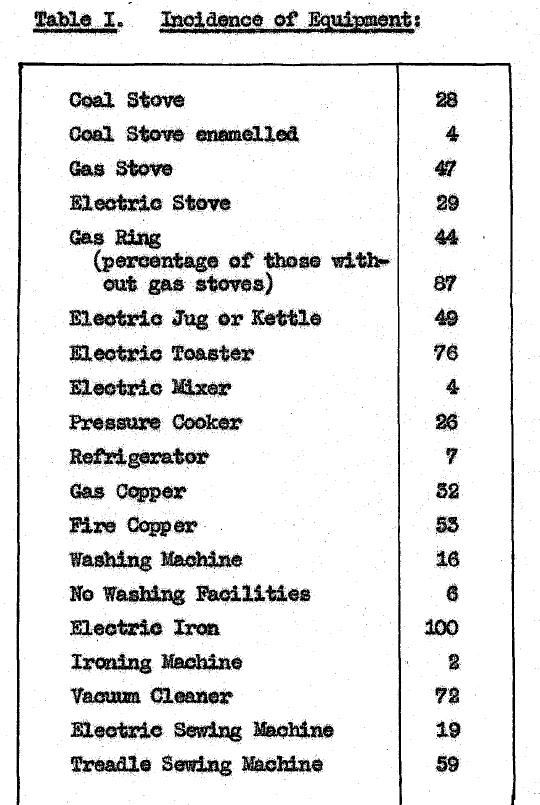
appliances 1950

You can see the spread of technology.   100 per cent of these households had an electric iron, and 72 per cent had a vacuum cleaner (presumably none would have in 1913).  76 per cent even had an electric toaster.  But many were still cooking using a coal range, just under half had an electric jug or kettle, and only 7 per cent had a refrigerator –  in a major city in one of the richest countries on earth, less than 70 years ago.   There were, of course, few (probably no) domestic freezers, microwaves, dishwashers –  or the myriad of more specialised appliances that now line the shelves of Briscoes.  And, on the other hand, sewing machines were widespread.

The student recorded the occupational status of each household (typically, the employment of the husband) and analysed the incidence of these appliances across different occupational classes.    The incidence of domestic technologies (those in the table above) in professional occupation households was, for example, about about twice that among labourers and pensioners (the differences being statistically significant).

The second strand of the survey that underpinned the thesis was the use of various external services.    When only 7 per cent of (these) households had a refrigerator –  and presumably none a freezer – fresh food was a major issue.

Bread for example

bread

(If you didn’t bake your own) it had to be collected every day it was baked.  According to the survey most walked to the shop to buy it.

Around half of the respondents had their groceries delivered, and around 10 per cent shopped using their own car.  The rest walked and carried the groceries home (typically from choice, since delivery was generally available).   Meat couldn’t be stored with long without a fridge, and the survey found that few butchers offered to deliver, so a walk to the butcher was pretty much a daily requirement.   Many of the respondents didn’t have a telephone, so even if delivery had been available, they’d still have to have walked to the butcher to place the order.

What of fruit and vegetables?

fruit and veg

The thesis goes on to look at the use of commercial laundry services, house-cleaning and window-cleaning services (including a slightly arch comment about the one respondent who claimed never to clean their windows), and the employment of people to assist in household chores or child-minding.

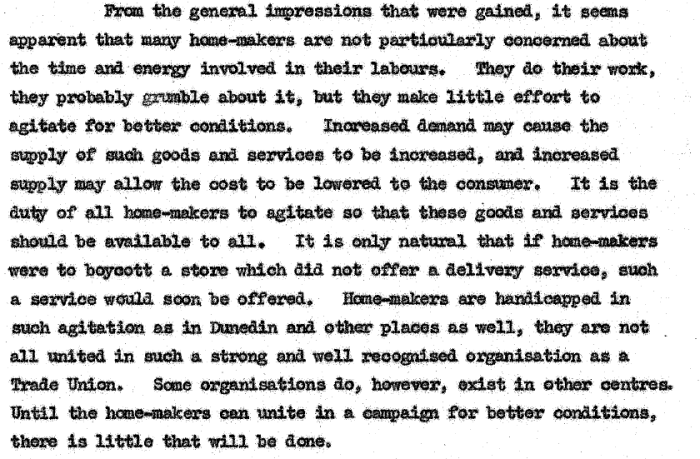
Perhaps like all writing, that 1950 thesis is also something of a period piece. There are asides about the price controls and butter-rationing still in place in post-war New Zealand, and a near unwavering sense that household management is a woman’s work.  And if there is a recognition of the importance of price –  this was, after all, a thesis partly done under the Economics Department
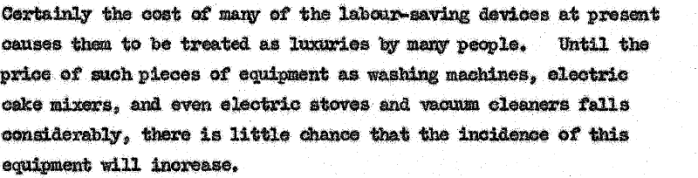
tech

there were also some curious asides

tech 2

Best national accounts estimates suggest that average material living standards in New Zealand in 1950 were not much more than a third of those today (and over that period New Zealand has had among the slowest rates of productivity growth of any country).   The data captured in that thesis help illustrate some of the concrete differences.

That thesis was my mother’s.  She is the great-granddaughter of that 1861 Yorkshire farm labourer, and the great-niece of that former mayor and MP – she was told to blame him when she couldn’t start school at five (Depression-era economies by the government of which he was an MP).  She was the first person on either side of my daughter’s family tree to graduate from university (at least in modern times), at a time when only about 5 per cent of young people went to university (and only about 1 per cent of women).  In one of the richest countries in the world.

It is her 91st birthday today.    There have been staggering material changes over the span of her life, let alone that of her grandparents and their generation.     Echoing Robert Gordon perhaps, I’m less convinced that if I live to 91, there will have been anything like that scale of improvement over my life.  I’m just about to walk to the butcher and supermarket.  Then again, in 1962 one couldn’t trace back generations of ancestors from the comfort of one’s own computer screen.

 

Christmas near and far

There are lots of economics and domestic public policy issues one could write about, even just ones from the last few days:

  • the Wellington City Council harassing hairdressers offering customers a Christmas glass of champagne,
  • the imminent passing of highly convenient bags from our largest supermarket chain, all because the Prime Minister and her mates apparently can’t tidy up themselves,
  • the large increase in the minimum wage, and an erstwhile centre-right commentator who seems to believe (a Matthew Hooton tweet) that this will boost productivity and economic wellbeing,
  • the advert for a new Secretary to the Treasury,
  • the impact of proposed new bank capital requirements on interest rates (hint: small), or
  • the repeated and systematic failures of the Immigration New Zealand arm of MBIE.

But it is Christmas Eve, so no economics today, or for the next few weeks (unless there is some particularly compelling combination of bad weather and interesting news).

Perhaps only a small minority of my readers are Christians, but tomorrow is Christmas Day and whatever the beliefs of those who now observe it in some form or another, it is a Christian festival –  one of the greatest (with Easter and Pentecost).  Since some 95 per cent of my readers are from New Zealand, Australia, the United States or the United Kingdom, I’m assuming almost all of you will, in one form or another, be celebrating Christmas.

Plenty of citizens of the People’s Republic of China are Christian too – tens of millions of them by most estimates.  The regime does its best to domestic, sinify, or even eliminate Christianity.   They attempt to portray Christianity as somehow un-Chinese –  heedless to the origins of (say) Marx and Lenin, and unbothered by the fact that Christianity has a much longer history in China than the Communist Party does.  But, in many ways, they are right: Christianity isn’t Chinese, it isn’t British, or French, or Kenyan, or Samoan, or New Zealand.  It is a gospel –  good news –  that transcends boundaries of culture, race or whatever, and involves a higher loyalty than to any earthly ruler or authority.  And that is the real problem for the Chinese Communist Party, as it was for the Nazis or the Soviet Communists before them.  It is a radical creed –  these were Mary’s words

Luke 1:46-55 King James Version (KJV)

46 And Mary said, My soul doth magnify the Lord,

47 And my spirit hath rejoiced in God my Saviour.

….

50 And his mercy is on them that fear him from generation to generation.

51 He hath shewed strength with his arm; he hath scattered the proud in the imagination of their hearts.

52 He hath put down the mighty from their seats, and exalted them of low degree.

53 He hath filled the hungry with good things; and the rich he hath sent empty away.

When you wake tomorrow, as you celebrate Christmas in your own way over the next few days (twelve of them!), perhaps you might consider sparing a thought, or a prayer if you pray, for Wang Yi, the pastor of the Early Rain Covenant Church in Chengdu (a major city in south-west China) and his congregation.

Wang Yi hasn’t been a Christian all his life.  Less than 15 years ago, a publication in China was lauding him as one of the top “public intellectuals” in China.  He was a lawyer and legal scholar.  In 2005 was converted and baptised, founding the congregation (in a Presbyterian tradition) a few years later.  The congregation has hundreds of members.   Wang Yi has been an outspoken preacher and writer.

Two weeks ago, the party-State acted, closing down the church, sealing off its building.  They arrested Wang Yi and his wife, and perhaps 100 other congregants.  There will be no open Christmas services for that congregation tomorrow, although perhaps small groups will gather in homes to celebrate this great Christian festival.

Another Christian in Chengdu …. described the scale of the operations against Early Rain as “unprecedented” but said more could be expected, adding: “I’m very lucky they haven’t found me yet.”

The Early Rain community would survive, he said, but would now go further underground.

“We will continue the gathering. The church is shut down so it’s impossible to have a big gathering, but there will be small gatherings on Sunday and on Christmas Day.”

Wang Yi, his wife and many of the others won’t even have that option.  They will wake instead in a PRC prison and although each of them will no doubt give thanks for a Redeemer come into the world – God become man in Jesus –  they’ll be isolated, perhaps taunted by guards, agents of the PRC party/State.  And wondering what further trials are to come –  the pastor and his wife already face charges (in a system with no rule of law) carrying a potential 15 year jail terms.   Because they chose to follow a call and worship, not allowing the state to dictate when or how they follow God.

You might think this is a story of no wider interest.  If it has been reported in New Zealand, the references must have been few and fleeting.  Overseas, it is a different matter.  Here are stories from such beacons of the liberal media as the New York Times and the BBC.

Wang Yi and his fellow church leaders prepared for, anticipated, persecution.  They knew the character of the regime they were dealing with.   This letter was written initially for the congregation by one of the elders  –  one of the last to be taken – just before his own arrest.  He ends

Beloved brothers and sisters, I am writing this letter in “hiding.” May you all be filled with joy in the gospel of Christ. May you welcome, filled with hope, the even heavier cross and more difficult lives that lie ahead of you.

“Christ is Lord. Grace is King. Bear the cross. Keep the faith.” This is the vision Early Rain Covenant Church received from the Lord. May we all obtain it, cherish it, put it into practice, and live it out!

And this letter was written by Wang Yi himself in advance, to be released if and when he was taken into captivity and held for more than 48 hours.  It represents his 14 decisions for how he will respond to the coming persecution, not resiling from his faith in Christ.   This is an earlier, inspiring and humbling, statement from Wang Yi.

Wang Yi doesn’t operate in isolation. Here is a statement from the association of Presbyterian churches of which his congregation is a part, including these extracts.

Please pray for the members behind bars. May the Lord grant them confidence and strength so that they would be as bold as Paul and Peter to preach to the kings and prisoners about Christ who died and was raised.

Please pray for the members who are frightened and for those who have been released but are still being monitored. May the Lord keep them, whether free or bound, from losing heart, so that they may testify to the true, trustworthy, and glorious gospel before their family, neighbors and law enforcement.

Please pray for the members who are facing pressure to sign the pledge not to attend the church. May the Lord guide them through the Holy Spirit in all circumstances so that whether they turn left or right, they will hear the voice that says “that is the right way,” so that they can walk in it.

In this episode, as so many others (whether around Xinjiang, the Falun Gong, or abroad), we see something of the true face of the Chinese Communist Party and the brutal regime it controls.    And yet officeholders in our country (and others) cosy up to the regime (boasting of their good relationships), scared to name evil, cowering without principle.

If you were so motivated, you might wish to register your concern about this persecution –  as so many others –  with the PRC Embassy in New Zealand.   Here is the face in New Zealand of an evil regime.  Here are their contact details.

I pray for Wang Yi, his wife, the elders and congregation, in prison or in hiding tomorrow.   My confident hope, as I’m sure theirs is too, is a verse perhaps not often read at Christmas, one day

Philippians 2:10-11 New King James Version (NKJV)

10 that at the name of Jesus every knee should bow, of those in heaven, and of those on earth, and of those under the earth, 11 and that every tongue should confess that Jesus Christ is Lord, to the glory of God the Father.

As Wang Yi has put it, quoted in the New York Times article I linked to earlier, “There is no eternal power [on earth], there is only eternal faith.”  One day the CCP will be, in Kipling’s words, at one with Nineveh and Tyre.

This was Martin Luther’s firm assurance, reflected in one of the great Christian hymns

A safe stronghold our God is still,
A trusty shield and weapon;
He’ll help us clear from all the ill
That hath us now o’ertaken.
The ancient prince of hell
Hath risen with purpose fell;
Strong mail of craft and power
He weareth in this hour;
On earth is not his fellow.

And though they take our life,
Goods, honor, children, wife,
Yet is their profit small;
These things shall vanish all:
The City of God remaineth!

One of Wang Yi and his congregants facing persecution –  and who knows what else –  this Christmas.

The PRC, the Pacific, and New Zealand

Our Minister of Foreign Affairs and Deputy Prime Minister gave an interesting speech in Washington last weekend.  It was a bit saccharine and ahistorical (past rivalries over various Pacific island and atolls anyone?) for my tastes, but the overall thrust –  urging the United States to be more active in the (south?) Pacific  – wasn’t something I much disagreed with.

The People’s Republic of China wasn’t named as a threat, but it didn’t take a genius to see the connection.  I remain somewhat sceptical that simply offering bigger “bribes” (call it development assistance if you want) is any way to build a more resilient Pacific in the medium-term.  That has to come down to values, domestic accountability (hardly likely to be fostered when lots of money is in play) and a recognition of the fundamentally evil, and corrosive, nature of the PRC regime –  whose values are as antithetical to most ordinary Pacific people, just as much as they are to most ordinary New Zealanders.   The short-sightedness (and greed?) of too many officeholders in Pacific countries is a formidable obstacle, their vanity flattered (for example) by invites to Beijing, even to meet Xi Jinping himself, whether or not their own pockets are lined.  These are mostly Christian countries, and yet when the Foreign Minister talked about the Pacific the other day there was nothing about values, nothing (for example) about freedom of religion, at time when the Beijing regime is intensifying its repression and persecution of Muslims and of Christians.   The sort of thing that would horrify most decent people (here or in the Pacific) if they knew –  as, for example, Kristallnacht did 80 years ago.  Values, not competitive aid bidding, drive societal choices in the longer term.

To the extent the speech had much attention at all locally –  which is hardly at all (has there been any thoughtful commentary from international affairs or Pacific specialists?) –  it has been on the extraordinary statement by the Prime Minister that she had not seen the speech before it was given.    It looked a lot like a significant foreign policy initiative, and yet it appeared not to have been discussed by the Cabinet. If anyone wanted evidence for Chris Trotter’s suggestion that the Prime Minister was in office but not in power, more decorative than substantive, it was hard to imagine a better example.  It looks like yet another example where there is a New Zealand First policy in some foreign affairs matter, but not necessarily a stance shared by the biggest party in government Labour.   After all, in her post-Cabinet press conference (link above) the Prime Minister was hardly offering a ringing endorsement of her Foreign Minister’s stance.   For practical purposes, they can probably both agree on flinging a bit of money around, with not much accountability, but perhaps not much beyond that.

And even if they happened to (more or less) agree on the Pacific –  and what will it come to anyway, in a US led by an inconstant troubled President, and with increasingly serious fiscal problems of its own? –  one area where Labour and New Zealand First must agree in practice is on doing and saying quite as little as possible about the PRC influence activities in New Zealand.  Some months ago, Winston Peters did make some cryptic remarks about how “something would be done” about Jian Yang, but it wasn’t clear if he meant anything then and (of course) it has come to nothing since (the Minister of Foreign Affairs doesn’t have much say over an Opposition MP).     Both seem more embarrassed by, than admiring of, Anne-Marie Brady –  in her case, it is hard not to reach the conclusion that the government (Parliament as a whole in fact) would much prefer that she went away and shut up, and stopped raising awkward questions.   Neither has been willing to call out the PRC over the Xinjiang internment camps –  not even joining with many of old friends when they got together to make representations.  They wouldn’t even speak up when National’s Todd McClay was parroting Beijing’s talking points about “vocational training centres” or –  in a country with still more self-identified Christians than any other faith –  about the renewed persecutions of the Chinese churches.  They seem quite unbothered about allowing such a heinous regime to put (safely vetted for political and religous “soundness”) agents of the PRC –  nice and friendly as they may be individually –  in our kids’ schools.  And has a word been heard from the Prime Minister or the Minister of Foreign Affairs about the PRC’s abductions of Canadians in China?  Do we stand with our friends, our values?  Or do we just cower before the PRC?  Peters and Ardern (and Bridges and Shaw) show all the signs of the latter approach.

So they fling all the money they like around the Pacific.  Perhaps if they do so Mike Pence and Mike Pompeo will take them a bit more seriously.  But unless they are willing to start taking seriously the issues here at home –  and there is not a shred of evidence for any such change of heart –  it isn’t clear why any of us should take them as seriously worthy of the offices they hold.  Through some mix of fear, delusion, mendicancy (all those party donations) they’ve taken our values, our traditions, and prostituted them on some CCP altar.  Egged on –  if anything more enthusiastically –  by the National Party.

If they were ever interested in beginning to get serious, political donations might be a place to start.   And on that score, I was interested to listen to outgoing National MP Chris Finalyson’s valedictory address.   I’ve never been a great fan of Finlayson – a classic example of what is wrong with MMP, never having had to actually win an election or persuade people to vote for him –  but my view of him took a steep dive at the Rongotai candidates’ meeting last year (Finlayson was the token National Party candidate).   From the floor I asked him

“Mr Finlayson, last week one of the world’s leading newspapers, the Financial Times gave considerable prominence to a story about a New Zealand MP.  That MP had been a member of the Chinese communist party, and part of the Chinese intelligence services.  He never disclosed that past to the public when he stood for Parliament, and has never taken the opportunity to denounce the evils of the Chinese regime.  Can you comment on why it is appropriate for such a person to be in our Parliament?  And could you also comment on the new paper by Professor Anne-Marie Brady raising concerns about the extent of China’s attempts to exert political influence in New Zealand, and about the close ties of various senior National Party figures with Chinese interests?”

The question was greeted not with embarrassed silence, but with pretty vigorous applause from the floor.

Finlayson –  our Attorney-General, first law officer of the land, senior National Party minister  – got up, briefly.   His answer ran roughly as follows:

“That was a Newsroom article, timed to damage the man politically.  I’m not going to respond to any of the allegations that have been made about/against him. I think it is disgraceful that a whole class of people have been singled out for racial abuse.  As for Professor Brady, I don’t think she likes any foreigners at all.”

The man dishonoured the high offices he held.   But, somewhat to my surprise, in his valedictory address, Finlayson included these remarks.

That’s why I think both major parties need to work together to review the rules relating to funding. I have a personal view that it should be illegal for non-nationals to donate to our political parties. Our political system belongs to New Zealanders, and I don’t like the idea of foreigners funding it. Similar concerns are now starting to be raised in other jurisdictions, and we need to work together, without recrimination, to ensure that our democracy remains our democracy”.

It is, mostly, illegal for non-nationals to donate material sums to our political parties.  I’d be happy to ban such donations completely, including those anonymous donations from abroad through the guise of charity auctions, of the sort Phil Goff funded his mayoral campaign with.    But, of course, many of the concerns serious people have about political donations –  in Australia, as well as in New Zealand –  do not relate to donations by non-nationals, but to donations by people born abroad who have become citizens, and yet retain close associations with reprehensible regimes in their country of birth (bluntly, the PRC).  I’m sceptical much can be done by law about that particular issue.  It requires political party leaders –  individually or together – to decide that there are some people they simply won’t take donations from at all.    There was a considerable fuss some years ago about the Exclusive Brethren.  No respectable party would take donations from known gang leaders or those strongly suspected of involvement in organised crime.  It shouldn’t be hard –  in a decent leader –  to make the moral choice that your party will take no donations from people with known (or strongly suspected) United Front associations.  It is what decent people would do, recognising the character of the PRC regime.

So, interesting as it was that Finlayson chose to raise the issue at all, his interjection barely scratched the surface of the issue.   But it was a (small) start from a figure who has enjoyed credibility in many circles.   Perhaps he could consider urging candidates in this year’s local body elections to commit to (a) take no donations (including through anonymous charity auctions) from non-New Zealand citizens, and (b) to take no donations even from citizens if those citizens have, or are strongly suspected to have, close ties with entities supporting highly repressive regimes in other countries.   Would it make any difference?  Probably not –  money can still be channelled less directly –  but it would be a signal to New Zealanders that their officeholders (and those bidding to take their place) took seriously the issue, the concern.    At worst, it would be interesting to hear how Phil Goff would defend refusing to make such a commitment to voters.

On another aspect of the PRC influence issue, a few weeks ago I was sent a copy of a book called “In the Jaws of the Dragon: How China is Taking Over New Zealand and Australia”, by one Ron Asher.   It is a 350 page book, apparently fairly well-documented and footnoted, now on its 5th edition (and so I’m told selling quite well) making a case that…….well, it is there in the title.   From the author’s note

This book…seeks to expose the sinister goals of the Communist government of China, which has murdered tens of millions of Chinese people since it shot its way to power in 1949, denies them basic rights and is now threatening the peace of the Pacific –  and the world –  by its excessive armaments programme and its expansionist activities in the South China Sea.  Through economic domination, aggressive immigration, bullying and other means it is trying to exert a control over Australia and New Zealand that is harmful to our sovereignty, democracy, heritage and economic prospects for the future.

There was plenty of interesting material in the book, and it was useful to have it gathered in one place.  It was interesting to learn of (former National) MP Jami-Lee Ross’s paid trips to the PRC –  which left me wondering (a) how many other MPs have had such trips, and (b) why we don’t just follow the US example and ban MPs taking any material hospitality from foreign governments, friendly or potentially hostile/threatening.   There was plenty of material –  including around Confucius Institutes (this week yet another US university decided to close theirs down), Huawei, and “aid” to various Pacific countries.

And yet much of the material had me pushing back to some extent at least.   The author is much more wary of foreign investment from the PRC than I am.  To be fair, the global tide of opinion on risks around PRC corporate investment abroad is shifting –  reinforced by the PRC laws which make it clear that even private PRC companies must follow directions of the PRC authorities (party/State).   And weak capital markets disciplines in China –  especially around SOEs –  have long left me a little nervous about any material expansion in the role of PRC banks.  It would seem crazy  –  simply an unnecessary risk, given the character of the regime – to allow, for example, our electricity or telecoms network companies to be owned or controlled by PRC-friendly interest.  I hope that when a stake in the Port of Napier is sold no one will even consider a sale to PRC interests –  port acquisitions have been a significant aspect of PRC strategy abroad in recent years, perhaps benefiting the sellers but leave societies to repent at leisure.

But I’m still not persuaded the sale of dairy farms to PRC interests, or the establishment of PRC-owned milk processing plants in New Zealand represents any material sort of threat to New Zealand, or New Zealanders.    The author notes that the (PRC) buyer will reap the profits in future, including from the ability to construct integrated supply and distribution chains.  But in a land market that is even moderately competitive, much of those gains should be captured in the value of the land at the point of sale.  Within limits, it makes sense for assets to be owned by parties best able to utilise them.  That ability is likely to be reflected in a willingness to pay.   Perhaps I’m a touch naive, but some arguments still seem to go too far for my comfort and conviction.  The growing entanglement of our universities with PRC interests –  consciously making themselves exposed to PRC political pressure –  represents more of a risk, and pressure point –  the more so  when we once looked to universities to champion the sorts of values that underpinned our society (but not the PRC).

This isn’t an attempt at a full review.  For those interested in the issue though, there is plenty to chew on, whether one ends up going quite as far as the author (or not).   Perhaps the thing I came away with most was a sense of how careless of our values our political leaders have been, how indifferent to the character of the Beijing regime, and how utterly shortsighted their approach has been for decades –  whether pursuing personal gain (which I suspect mostly isn’t the reason –  it may be different for business and academic figures), party donations, or just lemming-like prioritising trade and short-term opportunities over all.

Whatever the motive, in many respects they’ve blithely, unconcernedly, sold out New Zealand and New Zealanders, dishonouring both our own freedoms and values, and those (denied) of hundreds of millions of Chinese.   But even at this point, it isn’t clear that the PRC has clout in New Zealand beyond the deference our political officeholders –  cowering –  keep choosing (and it is wholly a matter of choice, especially at this physical distance) to pay them.   Evil people –  Xi Jinping and his party and regime – will do what they will do, as Hitler or Stalin before them did.  We can’t do much about them –  hoping against hope for regime change –  but we can choose what responses we tolerate in our officeholders.    If we care at all about PRC influence in the Pacific, our officeholders might start by demonstrating that they take the issue –  the regime and its threat – seriously at home.  What matters to someone is best demonstrated by the price they are willing to pay for it.


Bank capital: (not) consulting with APRA

After I’d posted yesterday, a reader made this comment about an article which apparently appeared in the Australian Financial Review yesterday

I see the AFR reporting today that APRA say they were “consulted” about the RBNZ release last Friday which was the document’s release date.

That account seemed consistent with a comment I’d seen in The Australian the previous day in which APRA indicated that they would be consulting with the Reserve Bank on its proposals, but with no indication that there had been any prior consultation.  If so, that seems extraordinary.

My reader went on to ask

Is there any protocol for consultation between APRA and RBNZ on these types of regulatory issues? It seems surprising to me that the RBNZ could propose something so radical without a genuine prior discussion with the regulator of the banks who dominate the NZ financial system.

I can only endorse that second sentence.  If anything, it seems like an understatement.

There are reciprocal provisions in the New Zealand and Australian legislation (the New Zealand provision is here), but they are mostly about doing whatever possible to avoid damage to the other country’s financial system (especially in crisis resolution).  There is also an RBNZ/APRA MOU, but it is mostly about ongoing supervision of trans-Tasman banks.   There is this brief, rather minimalistic, section

Regulatory Policy Development
25. The Authorities expect to respond to requests for information on their respective national regulatory systems and inform each other about major changes, including those that have a significant bearing on the activities of Cross-border Establishments.

But not every expectation of reasonable and appropriate behaviour should need to be written down.

Searching the Reserve Bank’s consultative document for references to APRA, it seemed telling that the Bank referred a couple of times to the possibility of aligning with APRA standards around the idea (questionable) of introducing a leverage ratio, but has no discussion at all about the merits (or otherwise) of introducing new capital requirements so far in excess of those APRA imposes (requirements called “radical” by one of the ratings agencies).

And yet the risks the two countries’ banking systems are exposed to seem very similar, and much the same banking groups are involved.   And when the senior management of our Reserve Bank is pretty new to these sorts of issues, and when the Bank consciously chose to dis-establish its own risk modelling capability several years ago, it is hard not to think that the Reserve Bank would have benefited from serious consultations with APRA (at various levels of the respective organisations) even as the Governor retained the right to come to his own decision.   There is a suggestion that the Governor has a bit of chip on his shoulder about Australia and Australian banks.  Whether that is true or not, if the indications of lack of prior consultation are correct, it isn’t good enough.  But I suppose it parallels the apparent lack of any systematic advance consultation –  technical papers, seminars etc –  with people outside the Bank in New Zealand either.     It might be interesting for someone to ask them who they actually did consult with (other than (apparently) Professors Admati and Hellwig).  Even within government, how much prior consultation was there with The Treasury or the Minister of Finance?

The New Zealand legislation may, misguidedly and for the time being, give the Governor the barely-trammelled power to make these decisions, but it is important to recognise that the Reserve Bank (the Governor) neither bears the costs of these decisions (whether they work out well or not) nor gets any benefits from them.  Great power –  in a single person’s hands – and yet not much incentive to get things right.  That is a worrying combination.

After yesterday’s post, another reader sent me this line from Adam Smith

The statesman who should attempt to direct private people in what manner they ought to employ their capitals, would not only load himself with a most unnecessary attention, but assume an authority which could safely be trusted, not only to no single person, but to no council or senate whatever, and which would nowhere be so dangerous as in the hands of a man who had folly and presumption enough to fancy himself fit to exercise it.

The Wealth of Nations, , Book IV, Chapter II

The full quote is mostly about a slightly different point, but as my reader noted the final couple of lines seemed particularly apposite.


The tree god again

Some months ago the Governor of the Reserve Bank inaugurated his audacious bid to have his institution –  seen by most as a official agency created by, and accountable to, Parliament –  seen as some sort of local pagan tree god, with him (I assume) as the high priest in the cult of Tane Mahuta.  We’ve been told, by the Governor, that a people –  New Zealanders –  walked in economic darkness until finally the light dawned with the creation of the Reserve Bank.  It is pretty absurd stuff, not even backed by decent history or analysis, and one might be inclined just to ignore it, but the Governor seems serious.  In particular, he keeps returning to his claim. In fact, he was at it again –  claiming the mantle of Tane Mahuta –  yesterday with another little release that poses more questions than it offers answers (and which presumably means we’ll end the year still with no substantive speech from the Governor on anything he actually has statutory responsibility for).

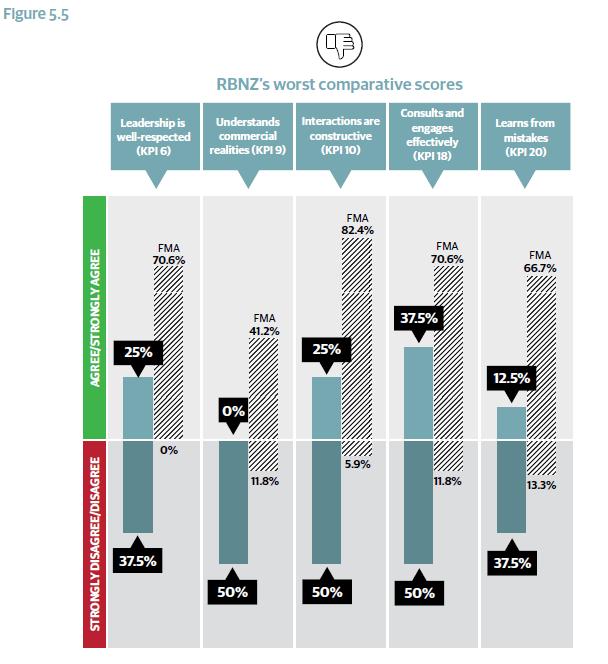
Readers might recall that there was a damning report on the Reserve Bank as financial regulator, drawing on survey results of regulated institutions, released in April by the New Zealand Initiative.    This chart summed it up quite well

partridge 1

It has, presumably, been a priority for the Governor to improve the situation.   After all, even the Bank’s Board –  always reluctant to ever suggest any weaknesses at the Bank, even though their sole role is monitoring and accountability –  was moved to comment on this report, and the issues it raises, in their Annual Report this year.

And thus the Governor begins

In a step toward achieving the best “regulator-regulated” relationships possible, the Reserve Bank (Te Pūtea Matua) has established a Relationship Charter for working effectively with banks. The Charter will also be discussed with insurers and non-bank deposit takers in the near future.

One might question just how “best” is to be defined here –  after all, the public interest is not the same as that of either the Reserve Bank or of the banks, and there have been many examples globally of all too-comfortable relationships between regulators and the regulated.

But it was the next paragraph that started to get interesting.

Reserve Bank Governor Adrian Orr said the Relationship Charter commits the Bank and the financial sector to a mutual understanding of appropriate conduct and culture. “This is underpinned by the principle ‘te hunga tiaki’, the combined stewardship of an efficient system for the benefit of all,” Mr Orr said.

I’m not sure that understanding is necesssarily advanced when an institution operating in English introduces little-known phrases from another language to their press releases.  Here is how Te Ara explains “te hunga tiaki”

Te hunga tiaki

The Te Arawa tribes use the term ‘te hunga tiaki’ instead of kaitiaki, explains Huhana Mihinui.

The prefix ‘hunga’ is more common than ‘kai’ amongst Te Arawa, hence te hunga tiaki rather than kaitiaki. The essence of hunga is a group with common purpose. Hunga may also link with the sense of communal responsibilities. The same meaning is not conveyed with ‘kai’ … te hunga tiaki likewise invokes ideas of obligations to offer hospitality, but also to manage and protect, with the implicit recognition of the group’s mana whenua [customary authority over a traditional territory] role in this respect. 1

Which sounds pretty problematic frankly.  Banks and the Reserve Bank do not have a common purpose or a common set of responsibilities.  The Reserve Bank has legal responsibilities to the people of New Zealand, and the banks have legal responsibilities to their shareholders.  The two won’t always be inconsistent, but at times they will and there is little gained (and some things risked) from trying to pretend otherwise.  In both cases –  but particularly in that of the Reserve Bank –  there are limits on the ability of the principals (citizens and shareholders) to ensure that the boards and/or managers are actually operating according to those responsibilities.   Shareholders can sell.  Citizens are stuck with the Governor.

The statement goes on

“Writing it was the easy part. Operating consistently with the conduct principles is the challenge. We will regularly mutually review behaviours with the industry. Appropriate conduct is critical to the trust and wellbeing of New Zealand’s financial system, and the Reserve Bank – the ‘Tane Mahuta’ of the financial garden,” Mr Orr said. 

It is the tree god again –  a tree god that has some considerable way to go in improving its own conduct, be it around attempting to silence critics or whatever.

But this is also where I started to get puzzled.   In both those last two paragraphs from the statement, there is a suggestion that this document is some sort of agreed position between the banks and the Reserve Bank.   It is there in the charter document itself –  a one pager, complete with cartoonish tree god characters.

RBNZ-Relationships-Charter

(What I didn’t see was, for example, “we will avoid abusing our office and putting pressure on regulated bank CEOs to silence their economists when those economists write things we don’t like”.)

The word “mutual” is there twice, clearly suggesting that the banks have signed on to this.

But, if so, isn’t it a little strange that there are no quotes from any bankers, or the Bankers’ Association, in the press release, just the Governor’s own spin?   And when I checked the Bankers’ Association website, there was no statement from them. In fact, I checked the websites of all the big four banks and there was not a comment or statement from any of them.   Frankly, it doesn’t seem very “mutual”.   It looks a lot like gubernatorial spin.

And, to be frank, I don’t really see any good reason why there should be such mutual commitments.   Regulated entities don’t owe anything to the regulators.  They may often be intimidated by them, (privately) derisive of them, or even respect them.  But the regulated entities are just private bodies trying to go about their business in a competitive market.  By contrast, the Reserve Bank  –  the Governor personally –  carries a great deal of power over those entities, and they have few formal remedies against the abuse of that power.   What might reasonably be expected is unilateral commitments by the Governor as to how his organisations will operate in its dealings with regulated entities, standards (ideally measurable ones) that they and we can use to hold the regulator to account.      But that is different from what purports to be on offer in yesterday’s statement.

Of the brief specifics in the list of commitments, I don’t have too much to say.  There is a big element of “motherhood and apple pie” to them, and a few notable elements missing.  There is nothing about analytical rigour, nothing about transparency, nothing about remembering that the Bank’s responsibility is primarily to the New Zealand public, nothing about maintaining appropriate distance between the regulator and the regulated.  But I guess those would have been inconsistent with the fallacious claims about all being in it together and working for common goals.

It is at about this point that the Bank’s press release changes tone quite noticeably (not quite sure what happened to “one organisation, one message, one tone”).   Deputy Governor Geoff Bascand takes over and claims

Deputy Governor Geoff Bascand said the Reserve Bank’s recent announcement of a consultation with banks about the appropriate level of bank capital highlights the usefulness of the Relationship Charter.

And even in that one sentence he captures some of the mindset risks.  As I read the announcement the other day, it was a public consultation about the appropriate level of bank capital, and yet the Deputy Governor presents it as a “consultation with banks”.  If the Bank is going to run with this “Relationship Charter” notion, perhaps they could consider one for their relationship with the only people who give them legitimacy, Parliament and the public (having said that, perhaps I should be careful what I wish for).

And then weirdly –  in a press release supposed to highlight a new era of comity, open-mindedness etc –  the Deputy Governor launches into an argumentative spiel about the proposed new capital requirements.

“There is a natural conflict of interest. Banks will want to hold lower levels of capital to maximise returns for their shareholders. However, customers and society wear the full economic and social cost of a bank failure. We represent society’s interests and will naturally insist on higher capital holdings than any one individual shareholder,” Mr Bascand said.

Strange use of the phrase “conflict of interest”, which usually relates to a person or an organisation having two competing loyalties (perhaps personal and institutional), but even if one sets that point to one side for now, the rest is all rather one-dimensional and not terribly compelling.  He seems unaware, for example, that banks often hold capital well above regulatory minima –  creditors and rating agencies have perspectives too –  or that in most industries firms happily determine their own levels of capital, and somehow society manages (and prospers).  And, of course, there is not an iota of recognition of the way in which bureaucrats all too often serve bureaucratic interests (rather than societal ones), of the distinction between loan losses and bank failures, or of how the interventions of official and ministers often create the problems in the first place.

And then there is the final paragraph

“Following our Relationship Charter, we long signalled the purpose of our work and shared our analysis and consultation timetable. We have also committed significant time to engage with banks and provide a sensible transition period to make any changes we decide on. The Charter means what we are looking to achieve can be discussed professionally, while we continue to build appropriate working relationships. Outcomes will be superior and better understood and owned by society,” Mr Bascand said.

Of course, for example, whether the proposed transition period is “sensible” is itself a matter for consultation (one would hope –  and not just with banks).  Given the high probability of a recession in the next five years –  and the limited firepower here and abroad to deal with a severe recession –  some might reasonably wonder at just how wise it would be to compel big increases in capital ratios over that five year period, at a time when the Bank’s own analysis repeatedly suggests the banks are sound with current capital levels.   Credit availability might well be more than usually constrained.

One might go on to note that the level of disclosure in the consultative document is seriously inadequate for such a substantial intervention –  one that would take New Zealand further away from the international mainstream not closer to it.   As I noted in a post a few days ago, back in 2012 the Bank published a fuller cost-benefit analysis of the sorts of capital requirements that were then in place.  There is nothing similar in the consultative document issued last week, not even (I gather) any engagement with the previous cost-benefit analysis.  Given the amounts of money involved, that is simply unacceptable.  I’ve lodged an Official Information Act request for the (any) modelling and analysis they’ve done, but I (and others) shouldn’t have needed to; it should have been released as a matter of course.  In fact, even better they should have published a series of technical background papers over the year, held discussions with a range of interested parties (not just banks) before coming to the decisions they chose to formally consult on.      That is what good regulatory process might have looked like.

And then there is that bold final claim

Outcomes will be superior and better understood and owned by society

I’m all for effective and professional relationships between the Reserve Bank and the banks it regulates.  Perhaps that may even lead to better policy outcomes, but there is no guaranteee of that (after all, at the end of it all the law allows the Governor to make policy pretty much on a personal whim –  which is a lot like what the proposed higher capital ratios feel like).  But quite how a better relationship between the Reserve Bank and the banks will make outcomes “better understood and owned by society” is a complete mystery to me.   There are plenty of examples of regulators and the regulated ganging up against the public interest, and others of the regulators ramming through changes that might –  or might not –  be in society’s interest.  There is simply no easy mapping from a better relationship between the Bank and the banks, and good outcomes for society, let alone ones that –  whatever it means –  are “owned by society”.   Good outcomes rely heavily on very good and searching analysis.  And nothing in the Charter commits the Bank to that.

When one reads the argumentative second half of the press release it is little wonder the banks themselves wanted nothing to do with the statement.   I guess there isn’t much chance of the banks and the Reserve Bank getting too close to each other in the coming months as they (and the bank parents and APRA no doubt too) fight over the billions of additional capital Adrian Orr thinks they should have.

Meanwhile, the Governor can play at tree gods.  But it would be much better for everyone, including most notably citizens, if he were to engage openly and (in particular) more substantively on the issues he has legal responsibility for.   Cartoons and glib statements don’t build confidence where it counts.


The China Council takes the stage

I have good memories of a young Don McKinnon.  It was early 1980, my first year at Victoria University, and Don McKinnon was a first-term National MP.  It was just a few months after the Soviet occupation/invasion of Afghanistan, and there was a strong push from many governments in the West against competing in that (northern) summer’s Olympic Games, to be held in Moscow.   Don McKinnon was invited along to articulate and defend the government’s stance. It was a pretty hostile audience as I recall –  the median student (or perhaps just the median of those who would turn up to lunchtime political meetings) was pretty left-wing (and of those who weren’t so left-wing not many had much time for the then Prime Minister, Rob Muldoon).  I no longer remember many of the details of the event, but I do recall McKinnon vigorously fighting his corner, and making the case that New Zealand athletes shouldn’t be part of one of tyranny’s great celebrations –  first Olympics in a Communist country) in the wake of such egregious aggression.   Those were days of considerably greater moral clarity about such regimes –  no doubt helped by the fact that there was not much trade with the Soviet Union, and our universities weren’t reliant on the Soviet market.

That was then.  Today’s Don McKinnon is full of years, knighted no less.  And any moral clarity on these sorts of issues appears to have been lost long ago.  For these days, Don McKinnon is chair of the (largely) taxpayer-funded New Zealand China Council, set up by the previous government to run propaganda around the People’s Republic of China, and help ensure that public discontent around supping with the devil never becomes too problematic.   Those aren’t their words of course, but the gist of the actual words they do use isn’t that different.     They don’t exist to do foreign diplomacy (that is what we have MFAT for), they don’t exist to do business (individual firms and universities for that, they exist to propagandise New Zealanders –  with our own money.

Mostly, the part-time Executive Director (of whom more below) speaks for the China Council.  But every so often –  perhaps whenever it seems as if a nerve has been touched – they wheel out the chair Don McKinnon.  There was an op-ed in the Herald this time last year, ably responded to by Simon Chapple of Victoria University –  a rare New Zealand academic willing to express scepticism.   Sir Don wanted us to “respect” the People’s Republic of China –  it was never made clear why, given the nature of the regime –  and if there were ever any issues well the great unwashed could trust the “relevant agencies” to deal with them (conveniently ignoring that fact that many of the issues raised by Anne-Marie Brady a few months earlier were not illegal –  they were questions of instead of right and wrong, surely matters for open debate.

Earlier this week Don McKinnon was back in the pages of the Herald.   Straw men abounded.    McKinnon opened with the Hauwei provisional decision taken by the GCSB.  You’ll recall that when decision was announced the China Council put out a statement lamenting the proposed ban.  I’m still a bit puzzled by that statement given that the chief executives of MFAT and NZTE sit on the Council’s Board and were presumably party to this public criticism of one of our intelligence agencies.

In his article this week, Don McKinnon has moved on a bit.

The substance of the decision is not for me to debate, but the risk is that it complicates the already complex management of the trade and economic relationship at a time of geopolitical tension.

but it really isn’t a much better stance from a former Foreign Minister, in a body largely funded by the taxpayer (not Huawei).   Shouldn’t he be lamenting the fact –  unquestioned –  that the PRC is engaged in far-reaching cyber-intrusions and intellectual property theft in much of the world, the sort of approach that might leave anyone cautious about letting a PRC regime-controlled company (as they all are) loose on a 5G network?

But what of those straw men?  This was the opening line of the article

The recent GCSB ruling in respect of Huawei must surely be a body blow for those who allege the Chinese Government and the Chinese Communist Party are influencing New Zealand’s policy-making.

A “body blow”?  Well, perhaps if anyone were claiming that New Zealand governments always and everywhere do what the PRC would prefer.  But I’m not aware of any serious participant in these debates who says that. Beijing probably wasn’t too keen on New Zealand purchasing the P8 aircraft, and would presumably prefer we opted out of Five Eyes too.  But they must be absolutely delighted that former PLA intelligence official, Communist Party member, Jian Yang still sits in our Parliament – even after all that background, and the active misrepresentations to the authorities, is in the public domain.  Or that when new defence policy documents include a few mild but honest words, the only criticism in the political sphere is from an Opposition leader –  himself having signed us up to an aspiration to fusion of civilisations – concerned that the government might upset Beijing.  Or that the government refuses to participate in joint Western efforts to protest the gross abuses in Xinjiang (which the Opposition describe, PRC style, as vocational training camps).  Or that Yikun Zhang, with clear and strong ties to the regime and Party can manage to be awarded –  with bipartisan support –  royal honours for services to New Zealand.  How they must have chortled when they heard that.  Or that both Ardern and Bridges are apparently so scared of a Beijing reaction that neither can manage a forthright defence of Anne-Marie Brady, or of ethnic Chinese New Zealanders being intimidated –  here in New Zealand –  by Beijing.

Don McKinnon purports to believe that none of this is an issue at all.  Apparently we once –  years ago –  mentioned the South China Sea, and that was quite enough.  As for political donations, there are plenty of serious people around –  even people with ties to his own organisation –  who evince unease about that situation –  about, for example, another former Foreign Minister financing his mayoral campaign substantially with anonymous donations from the mainland.   McKinnon isn’t stupid, and will know all this, so one can only conclude he doesn’t care a jot – about the integrity of the political system of his own country.   The 1980 version of Don McKinnon wouldn’t have tolerated a KGB/GRU officer –  never once heard to criticise any aspect of the USSR –  in our Parliament.  2018 Don McKinnon thinks Jian Yang’s presence in Parliament is just fine –  apparently any concerns are “unsubstantiated” (you mean the ones he himself belatedly acknowledged?) –  and has the man sitting on the China Council’s advisory board.

The whole thing is suffused with that determination never ever to upset Beijing –  and whenever anything might (eg Huawei) the emphasis is on the PRC perspective, not the New Zealand one.   This reaches egregious extremes in this observation

National security is important but so too is our increasingly multi-faceted relationship with China.

National security isn’t everything.  Civil liberties and our democracy matter a great deal too.  But for a former longserving Foreign Minister to suggest, in writing (presumably carefuly drafted) that national security is something we should compromise on to keep the regime in Beijing happy is…….extraordinary (and that is probably too mild a word).

And this is one of the problems with the China Council.  They do now often include a ritual line about our “very different values”.  It is there in this week’s article too.  But, strangely –  conveniently for them –  they never ever spell out the nature of those differences.  Doing so might require them to speak or write in a way that suggested disapproval of aspects of the PRC –  or, and I hope this isn’t so, a genuine belief that the PRC system is just as good as our own, only different, and simply nothing to worry about.  So we never hear about (say) the imprisonment of a million or more people in Xinjiang, about fresh attacks on Christians in China, about the widespread theft of intellectual property, about a regime so insecure images of Winnie-the-Pooh are being banned, about the absence of the rule of law, about real military threats to free and democractic Taiwan, about the absence of freedom of speech, or even about the lawless  revenge abductions of a couple of Canadians this week.  Nothing.  And why?  Because there are deals and donations to keep flowing, and none of these things matter a jot –  in the only sense that reveals importance, a willingness to pay a price (probably quite a modest one, if at all).

McKinnon ends with two more incredible comments.  The first was

The risk of overreaction in New Zealand is all too real, however.

Really?  With our supine political and business class, desperate as ever to play the issues down, and no doubt grateful to Sir Don for putting pen to paper.   Some sign of any reaction among our purported leaders would be worthy of note.  But then the China Council’s view of “overreaction” seems to be any reaction whatever –  just let us get on with the deals and donations.  Trust us…..

And at the very end

The short step from rational debate to panic can come at a heavy cost.

So never ever upset Beijing, or the thugs with the baseball bats will extort a price.  But,trust us……they really are good guys, we are better for dealing with them, they’re good guys.  Really.

The thing that really staggers me about the China Council is that with all those senior figures and all that taxpayers’ money the quality and depth of their propaganda and advocacy is so limited.  They might have good practical arguments to make on some points, but making them should involve engaging substantively with the sort of detailed concerns being raised.  The China Council has never made any attempt to substantively engage with Anne_Marie Brady’s paper –  and, shamefully, has been totally silent on the apparent attempts to physically intimidate her (and thus to scare others).  And they are fellow New Zealanders.

As it happens, there was another good example yesterday of our cowering “leaders”.  Newsroom has an account of MFAT’s appearance at a parliamentary select committee, where much of the discussion seems to have been around the PRC, the “FTA”- upgrade, and so on.  I’m not going to excerpt the story, but read it and all you sense is fearfulness from both sides –  if the Opposition is critical it is that the government might have upset Beijing.  There is no sense of self-respect, no sense of values that matter, just a backdrop of deals and donations –  and that weirdly misplaced view about the significance of the PRC to New Zealand’s economic fortunes so actively fostered by yet another former Foreign Minister, Murray McCully.

And, finally, I must have hit a bit of nerve somewhere near the China Council.  After a post the other day, this tweet appeared on the Executive Director, Stephen Jacobi’s feed.

Which was a bit odd really.  I went back and looked at the post in question.   And I couldn’t find any examples of me calling him names.  I did note that “he appears to be Christian” but as on his Twitter page he calls himself an Anglican, and was tweeting a photo of an Advent service, that didn’t seem an unreasonable deduction.  And as one Christian to another, it can hardly count as name-calling.

So I had a look back at any of my other past posts I could find when I’d written about Jacobi (here, here, here, here and here were the ones I could find).   And yet anything resembling name-calling seemed thin on the ground (which was relief, because it is something I try hard to avoid –  perhaps not always successfully).   In one of those early posts I introduced Jacobi this way

The Council employs a part-time Executive Director, Stephen Jacobi.  He spent considerable time at MFAT, but from his own account his focus was Europe and North America (including as our deputy high commissioner in Canada) and in trade negotiations.  Since leaving MFAT in 2005 he has run his own consulting firm, and been employed as the public face of various trade-related bodies, including serving as Executive Director of the NZ US Council from 2005 to 2014.  He is articulate and readily available to the media, but has no specialist expertise in China or (indeed) on the workings of New Zealand democracy.   That isn’t a criticism –  after all, neither do I –  just to note that his arguments, and evidence, need to be reflected on and carefully examined, perhaps having regard to the interests that are paying him, not as coming from an expert authority in the area.

And that still seems right, and fair.  He is a paid lobbyist and advocate –  propagandist wouldn’t be too strong a word.  Those are, more or less, job descriptions.  I’m sure he believes most or all of what the job requires him to say.  It is just a shame that the institution for which he works seems to have abandoned all sense of good and evil when it comes to the PRC.

But in the search for anything that might resemble name-calling, I did across lots of arguments, analysis, and some evidence. I don’t particularly expect Jacobi or the China Council to engage with me –  although I’d be happy for them to do so – but the thing is that they don’t engage with China experts (notably Anne-Marie Brady) either.  Instead, they play distraction, suggest racism is at work, call debates “unedifying” rather than engage in them, or  –  as in this case –  suggest that all there is is name-calling.  With so many resources at their disposal, that approach doesn’t exactly redound to their credit.  With the politicians on side perhaps it doesn’t matter for now, but such large disconnnects between the values of a people, and the attitudes and practices of their “leaders”, are unlikely to last forever.  It was Scott Morrison who only a few weeks ago observed that we –  citizens of free and democratic countries –  have to be more than just the sum of our deals.  Or, as I added, of our political party donations.

Funding the Reserve Bank: focus on your statutory mandate

The Reserve Bank has been joining the ranks of the public sector agencies bidding for more money –  not just doing so in the conventional manner, behind closed doors in private discussions with relevant ministers, but in public.

There were some initial comments a few weeks ago, which I didn’t notice at the time, using this totally spurious argument

we are a net contributor to Crown revenue rather than a cost, and we’ve asked if we can hang on to a little more of what we make in order to fund extra work,” the Reserve Bank spokesman said.

The Reserve Bank generates a lot of money (mainly) by issuing zero interest bank notes (a statutory monopoly) and investing the proceeds in interest-bearing assets.  It takes little skill to collect this (what is in effect a) tax.     That income should have no bearing, formal or rhetorical, on how much of our resources the Reserve Bank is permitted to spend on other stuff –  mostly more bureaucrats to do regulation, analysis, and (see below) political positioning, of the sort many other cash-constrained bureaucracies in Wellington do.   Those activities do not generate even an iota of revenue for the Crown.

They were back with the begging bowl this week at the annual financial review undertaken by Parliament’s Finance and Expenditure Committee.  I saw two accounts –  one from Newsroom, and one from interest.co.nz.      There were a couple of strange claims, including the Governor appearing to suggest that the CBL failure might have occurred because the Reserve Bank didn’t have enough staff.  I don’t regard that as a totally implausible story  –  then again, the system is not supposed to prevent all failures, and at least some concerns relate to what the Bank did do (suppression orders) rather than what it didn’t do.  But if staffing was a concern, and the Bank thought it didn’t have the resources to do the job Parliament had given it, surely the previous year’s Annual Reports would have said so.  And I’m pretty sure they didn’t.

Orr is also reported as claiming that

….now was the time to resource-up and ready the bank for a crisis.

“The time when under-resourcing most shows up is generally during a time of crisis and we aren’t in one of those times,” Orr said.

I doubt that is so. In a crisis it is all hands to the pump, and institutions pull through.  If there is under-resourcing (and that is an open question) it is more likely to affect progressing work programmes in more-normal times.

Perhaps it is why, 8.5 months into his governorship, we still haven’t had a substantive speech from the Governor on either monetary policy or financial stability/regulation?  But that can’t really be the explanation either –  after all, we’ve always only had one Governor, and his predecessors somehow managed.

The Reserve Bank’s finances are not very tightly managed (externally, by the minister or Parliament).  Under the current Act there is provision for (but not a necessity for) a five-yearly funding agreement, outlining how much the Bank can spend.   It isn’t a great model, for various reasons, even if it was a step forward on the total lack of formal controls that existed prior to the 1989 Act.

But my experience was that almost every year, the Reserve Bank’s actual spending undershot what was provided for in the Funding Agreement.  I knew they had had the odd tighter year this decade, but other than that it isn’t something I follow closely.  But here is interest.co.nz’s account of what the Bank said in its latest Annual Report released in October.

The Reserve Bank’s annual report, issued last month, showed it had undershot spending allowed through its funding agreement by $26.7 million over three years and paid a $430 million annual dividend. By June 30 the Reserve Bank had spent $173.1 million of a possible $199.8 million allowed by its 2015-2020 Funding Agreement, signed with the previous National-led government. Net operating expenses in the June 2018 year were $4.1 million below the funding agreement, despite rising $8 million year-on-year to $76 million.

“The $26.7 million cumulative underspending is expected to partially reverse in the last two years of the funding agreement, as capitalised expenditure on systems improvements is amortised to operating expenses, and the issuance of new banknotes continues. The Bank expects to be within the five-year aggregate expenditure provided for in the funding agreement,” the annual report said.

Bottom line?  They’ve been underspending again, and even though that is “expected to partially reverse” over the next two years, the forecast reversal is only partial and, once again, they expect to underspending the Funding Agreement allowance.  And, under the current statutory model there are no adverse consequences for the Bank if it were to have spent a little more than the Funding Agreement number anyway.  But the issue is moot –  they seem to have managed in a way that will actually underspend (again).

Which leaves another of Orr’s comments ringing a bit hollow

Orr in the select committee again pointed out the limitations of the five-yearly model, saying a “phenomenal” number of “unanticipated” events had happened in the last five years, and the same would be the case in the next five years.

And probably every five years since 1990, and yet the Bank still almost always underspends.

Having said that, this may be one of the areas in which there is some convergence of views between me and the Governor.  The five-year funding agreement model is crazy and should be scrapped.   No corporate – no government agency for that matter –  sets operating expenditure budgets five years in advance, and it is simply silly to expect to do so for the Reserve Bank.  It is fine to do rough medium-term plans to help ensure that foreseeable expenditure pressures are identified well in advance, but that is different from a binding five-year budget.

Where we may well diverge again is that I think the Reserve Bank’s policy, regulatory and related activities should be funded –  as most government agencies are – by means of detailed annual appropriations by Parliament (and will be forthrightly making that case when the current review of the Reserve Bank Act gets round to looking at funding issues).  I wrote about the issue in a post earlier in the year.   Here were some of my points:

A common argument –  at least among central bankers –  is that somehow central banks are different.  There is only one important respect in which they are: they earn far more than they spend.  But even that isn’t very important here.  Central banks make money largely through the statutory monopoly on currency issue, which is just (in effect) another form of taxation.  And spending and revenue are two quite different bits of government finance: IRD might collect lots of money, but it can only spend what Parliament appropriates.

And what of those arguments about avoiding back-door pressure?  Even they don’t mark out central banks.  After all, we don’t want ministers interfering in Police decisions either (a rather more important issue than a central bank), but Police are funded by parliamentary appropriation.  So is the Independent Police Complaints Authority.   There are plenty of regulatory agencies where policy might be set by politicians, but the implementation of that policy is set by an independent Board, and where backdoor pressure could –  in principle be applied.  Other bodies publish awkward reports that make life difficult for politicians.  But those bodies too are typically funded each year by parliamentary appropriation.  It is just how our system of government works.

When I wrote about this issue in 2015 (having only recently emerged from the Bank), I was hesitant about calling for radical change.   The funding agreement system itself could be tightened up in various ways, which might represent an improvement on what we have now.   But there isn’t any very obvious reason not to start with a clean sheet of paper, and build a new system –  aligned with how we manage public spending in the rest of government –  starting from the principle of annual appropriations, with a clear delineation by functions (monetary policy, financial system regulation, physical currency etc), and standard restrictions on the ability of ministers to reallocate funds across votes).

I’m not aware of any country that funds it central bank by annual appropriation.  But historically, central bank spending all round the world was subject to weak parliamentary control.  This is one of those areas where the international models aren’t attractive, and the standard should instead be the way in which we authorise spending across the rest of government.   This is a policy and regulatory agency ….  and should be funded, and held to account, accordingly.

But if the Governor really thinks he doesn’t have enough resources to do aspects of the job Parliament has given, perhaps he could look rather hard at how he prioritises.  In his FEC appearance the other day, he claimed to have been doing so, but in my observation his sense of priorities appears personal, idiosyncratic and even political, not at all well-aligned with the Bank’s statutory mandate.

Recall that the Governor has only been in office for just over eight months, but already we’ve had things like:

  • speeches on climate change, helping out his buddies in the government and in the liberal wing of the business community,
  • the “Reserve Bank as tree god” exercise, which surely didn’t just flow off the end of the Governor’s pen in an idle hour one Saturday afternoon. It will have consumed real resources, at an opportunity cost,
  • cartoon versions of the Monetary Policy Statements and Financial Stability Reviews,  and
  • swamping those individually modest items by several orders of magnitude there was the conduct inquiry of which I noted upon its release

Despite highlighting several times in the report that this was really none of their business (of course they phrased it more bureaucratically: “neither regulator has a direct legislative mandate for regulating the conduct of providers of core banking services”), they’d spent an estimated $2 million of public money to mount their bully pulpit, lecture the banks, lobby for more powers for themselves.  

It simply wasn’t their job, but it suited the Governor’s ambitions to sweep in and spend large amounts of public money –  for modest-sized agencies –  on a personal campaign, to discover what?

The waste goes on.  There is an advert out at the moment for a Manager, Performance and Corporate Relations.  There appears to be some real work associated with the role (some of the bureaucratic hoop-jumping all government agencies have to do) but part of the role is this

Leading a mid-sized team of specialists, the person appointed will provide leadership to organisation-wide initiatives such as the Bank’s Climate Change Strategy and Te Ao Maori framework.

There can be no possible need for whatever a “Te Ao Maori framework” actually turns out to be.   The Reserve Bank isn’t some social agency dealing with troubled individual families, where quite possibly individual cultural backgrounds matter.  It doesn’t really deal with ordinary people much at all –  that is not a criticism, it doesn’t need to.    It runs monetary policy –  which affects and benefits people quite regardless of ethnicity-  and it regulates banks (and other financial institutions) again –  one would hope –  regardless of the ethnicity of individual managers or shareholders.  Fortunately, the “principles of the Treaty of Waitangi” are not part of the Reserve Bank Act.     I don’t suppose the Bank will be spending a vast amount of money in this area, but every little bit reallocated to financial regulation would surely help, at least if you believe the Governor and his Deputy.  It has the feel of the Governor pursuing another personal political agenda at the expense of the taxpayer.

And then there is “the Bank’s Climate Change Strategy”.    I’ve touched on this before, but as a reminder the Reserve Bank is an office-bound organisation, with precisely two offices (main one and a small one –  probably unnecessary –  in Auckland).  For practical reasons (to do with specialist vaults) the Bank –  unlike most central government agencies –  owns a building in central Wellington, and if they own any vehicles at all it might be just one car.  They are a wholesaler of one physical product –  bank notes –  but they import that product from overseas producers, for whom the Reserve Bank is no more than a modest-sized customer (thus with little market power).  But they do, I suppose, travel to lots of overseas meetings (but last I looked, international air travel still isn’t captured in the agreed international carbon reporting framework or our own current government’s incipient net-zero goal).

There is just no obvious reason –  at least not one that isn’t ultra vires –  for the Reserve Bank to be spending public money on a “climate change strategy” at all.  It is a feel-good piece of political positioning, perhaps helping the Governor is his turf fights around the Reserve Bank Act, and assisting him in a cause that he clearly feels strongly about personally –  even if there is little sign of him thinking about it deeply.

I’ve written prevously about the sheer vacuity of much of this, especially in the New Zealand context –  our banking system hardly being heavily exposed to, say, oil producers.  There was a vapid box in the FSR a few weeks ago, and as I noted of it

The text burbles on about possible risks, but it all adds up to very little.     There are numerous risks banks and borrowers face every decade, every century.  Relative prices change, trade protection changes, external markets change, exchange rates change, technology changes, economies cycle, land use law changes.  Oh, and the climate changes.

If one looks at the structure of New Zealand bank (or insurer balance sheets) it just isn’t credible that climate change poses a significant risk to the soundness of the New Zealand financial system (that pesky law again).   Some individuals are likely to face losses from actual and prospective sea-level rises, but banks (and insurers) typically have diversified national portfolios.   People can’t have mortgage debt without insurance, and so the insurers are likely to be constraining people first.   Much the same surely goes for the rural sector?   Sure, adding agriculture into the ETS at the sort of carbon price some zealots have called for would be pretty detrimental to the economics of a dairy debt portfolio, but then freeing up the urban land market probably wouldn’t be great for residential mortgage portfolios, and we don’t see double-page spreads from the Reserve Bank on that issue, or the Governor trying to play himself into some more central role in that area.     It smacks of politics –  signalling the Governor’s green credentials –  more than anything legitimately tied to financial system soundness.

As it happens, the Bank yesterday released its “Climate Change Strategy“, a 10 point statement which seems almost equally devoid of content relevant to the statutory responsibilities of the Bank.  Instead, the Governor is offering political support to the government (that is the gist of the first paragraph) and bidding to be a player.  Here are two of their 10 points.

8.No single institution working alone can achieve meaningful progress on a global challenge such as climate change. Furthermore, it is not for financial policymakers to drive the transition to a low-carbon economy, nor is it the role of the Bank to advocate one policy response over another. That is the role of government.

9. However, appropriate action on a national or global level can only be achieved if individuals and entities are able to take action on a micro level. For this to occur, two conditions need to be met. First, there has to be proactive and effective leadership to drive our collective understanding of climate risks and to establish robust strategies to respond to those risks. Second, there has to be effective and timely dissemination of those assessments and strategies. Appropriate information will be vital in enabling entities and individuals to price and manage risks, facilitating the transition to a low-carbon economy, and ultimately contributing to both the soundness and efficiency of the financial system.

You might agree, disagree, or simply yawn, but when did this become an issue for a central bank, with important, powerful, but quite limited, statutory responsibilities?  And a central bank crying poor, claiming it doesn’t have enough money for its day jobs.   It is more like a creed than something one might reasonably expect from a central bank.

As part of the Bank’s statement we learn that

The Bank has also been welcomed as member of the Network of Central Banks and Supervisors for Greening the Financial System (NGFS). The Network was set up in December 2017 at the Paris ‘One Planet Summit’ to strengthen the global response required to meet the goals of the Paris agreement.

Head of Department Financial System Policy and Analysis Toby Fiennes says the Reserve Bank is very proud to have been accepted as a member of the NGFS.

“Playing our part globally, and as a leader in the Pacific region, is important both in terms of reinforcing New Zealand’s reputation as a ‘good global citizen’, and in providing us access to the latest thinking around the globe,” Mr Fiennes says.

(Among this small group of (excessively funded?) central banks and regulators is the central banking arm of the Chinese Communist Party. )

I guess it is the sort of feel-good, but empty, rhetoric one now expects from public servants.  And I guess when you see yourself as a tree god, the fit with an organisation devoted to “greening the financial system” must be almost complete?   But it is all empty.  “Playing our part globally” seems likely to involve little more than another round of international meetings to attend –  all those extra emissions – at the taxpayers’ expense, to advance Orr’s personal agenda at a time when he suggests the institution has insufficient money to do the job the taxpayer instructed them to do.  On an issue where there are no material financial system implications at all.

I’m open to the idea that the Bank might in fact need more financial resources, given the various jobs that (wisely or not) Parliament has instructed them to do.   There are other agencies and causes that might have a stronger case  and (on the other hand) some that should simply be wound up altogether.  But the Bank’s case would be that much more compelling if there weren’t repeated signs that the Governor was using the institution and public resources to advance personal, often quite political, agendas that reach beyond his statutory responsibilities.  He should be ensuring –  and the Board insisting –  that resources are rigorously prioritised to focus on the statutory mandate.

Where have real house prices risen and fallen?

The QV house prices indices for November for each of the territorial local authority areas were released last week.  Much of the headline coverage is around the fact that in the last year Auckland prices have barely changed, while those in places like Dunedin, Invercargill, Palmerston North and Whanganui have shown double-digit rates of increase.  Even Wellington prices rose 7.4 per cent –  something brought home to me when a house across our driveway went for $2 million recently (a very big house).

Cycles are often not in synch from place to place and I’ve sometimes found it an interesting reference point to look back and see how (real) house prices have changed since the peak of the previous surge upwards in house prices, in mid 2007.  That, of course, was just before the onset of the last recession in New Zealand.

Here is a chart showing (mostly) the cities

house prices 2018 1

Auckland is, of course, still far worse –  total real increases (as well as levels) –  than any of the other cities.  But I was interested in a couple of things.

First over the (little more than a) decade. the increase in real house prices in Dunedin is well above that in many urban areas, and about the same as the increase in Wellington prices.  In the absence of population pressures, that Dunedin increase took me a bit by surprise.

And second was Christchurch.  There was a big rise in Christchurch prices a few years ago –  housing was in genuinely short supply following the earthquakes –  but looking back to before the recession and earthquake, and forward to today, Christchurch house prices haven’t increased in real terms very much at all.   Christchurch city has had less population growth than, say, Auckland or Wellington, but is still estimated to have 6 per cent more people than it had in 2007.

Much of the population growth (about 75 per cent of it) in greater Christchurch since the earthquakes has been in the Selwyn, in particular, and Waimakariri districts.  People sometimes talk about how responsive the two councils’ policies have been in facilitating this growth.  There is clearly something to that, but it is worth noting that neither locality seems to offer anything like the sort of easy ability to build and develop land that we can observe in many fast-growing places in the United States.  Real house prices in Selwyn, for example, have risen by about 20 per cent in the last decade.  And there is are enormous amounts of flat land in Selwyn.

And my other chart is of the TLAs at the bottom of the scale –  the places where real house prices are still lower than they were at the peak of the boom in 2007.

house prices 2018 2

Not, it seems, because (say) land use laws were freed up and the cost of bringing new houses to market has fallen.  In some of these places, prices are probably now below replacement cost (at least on existing land use regulation).    Most, if not all, look like the sorts of places that would benefit from the sort of much lower real exchange rate that I remain convinced has to be a part of any successful economic adjustment in New Zealand –  not that either main party seems to have any interest in effecting such a transition.

It is a sad and shameful record for our politicians.  One neither hears them talking of a goal to get house prices back down again, nor sees them implementing or advocating policies that might make a credible long-run difference.  I guess it won’t greatly matter for the kids of people like the Prime Minister or the Leader of Opposition, but what about the kids of the rest of us? It saddens me to listen to my kids talking about how difficult they think it will be to ever afford a house (in places with decent jobs), but it angers me how (practically) indifferent our political leaders –  central and local – seem.

Earnings advantage of the tertiary-educated

Skimming through the tweets of the chairman of the Productivity Commission –  who often includes interesting charts –  I spotted this picture.

returns to education

It is an interesting chart on a number of counts.  First, in every country shown, except the UK, the earnings advantage to tertiary educated workers is higher –  often materially so –  for older workers than for younger ones.  Second, all the countries at the far left of the chart are among the poorest of all those shown (the sample is OECD countries and “partner countries”).  And thirdly, of course, that New Zealand is over towards the far right of the chart, where the earnings advantage to tertiary educated workers is pretty low (and especially so for older workers).   The chart is drawn from this short OECD note.

Making sense of the numbers isn’t straightforward.    First, note that the chart isn’t claiming to illustrate returns to tertiary education, but the earnings margin of people who have had a tertiary education over those who haven’t.  The difference matters –  people who undertake tertiary education are different, in various dimensions, to people who don’t.    I’m in that older age group, and if I think back to my Auckland high school, only about 10 per cent of those who started in the third form made it to the seventh form.  Most of them probably did go on to university, and perhaps a few others did tertiary study later, but it was a cohort that was much more intellectually capable, on average, than the other group.   Since university was all but free to attend in those days, there weren’t even obvious financial barriers excluding capable people from poorer families.

These days, of course, a much larger share of young people undertake tertiary education.  But that probably means that the intellectual capability of the median tertiary qualifed person today is lower relative to that of the population as a whole than was the case 40 years ago.  It isn’t clear that is true if we compare the median of those with tertiary education and those without it (since the median of those without it is now likely to be quite a bit lower relative to that of the population as a whole).

Productivity performance in New Zealand has been poor for a long time, and we now start a long way behind the better-performing OECD countries.  If there were a lot of really good opportunities here then all else equal, and given how far behind we start, I might have expected the returns to enchanced skills (not, of course, the same as having a tertiary education) to be higher here than in many other countries.  The greater international mobility of people with better educational qualifications might have tended to work in the same direction.

But instead, those with tertiary educations aren’t doing well absolutely (low productivity country) or relative to those without.     And so you are left wondering quite why immigration policy is oriented towards recruiting lots of “skilled”  migrants –  particularly those with New Zealand tertiary education –  and why “education” policy is oriented towards encouraging yet larger proportions of people to undertake tertiary education.  None of which prevent’s Treasury’s living standards dashboard  – which we are told is going to help shape next year’s Budget – including the share of the population with a university degree of one of their “wellbeing indicators”.

(As far as I can tell, this particular chart also doesn’t taken of the fact that getting a tertiary education costs a lot of money –  directly (fees and living costs) and indirectly (foregone time in the labour force) and thus, if anything, probably overstates the advantage held by the tertiary educated.  There are other estimates of overall lifetime earnings advantages (or otherwise)).

Abdicating a basic responsibility

The Herald this morning reported on a new open letter in support of Anne-Marie Brady, this one from 169 (at present –  the letter is still open apparently) overseas experts on issues relating to the People’s Republic of China.   As the signatories note:

Since the publication of her work on global United Front work, Brady’s home and office have been subjected to burglaries, during which no valuable items other than electronic devices were stolen. Most recently, her car was found to have been tampered with in ways consistent with intentional sabotage. According to media reports, Interpol and the New Zealand Security Intelligence Service  (SIS) are involved in the investigation. In China, academics were interrogated by Ministry of State Security agents after their institutions hosted Brady. Brady has also been personally attacked in media under the direction of the CCP, both in the PRC and in New Zealand. Taken together, these circumstances make it likely that this harassment campaign constitutes a response to her research on the CCP’s influence, and an attempt to intimidate her into silence.

Despite the evidence of CCP interference provided in Brady’s research, of which the harassment campaign appears to be a further example, the New Zealand government has been slow to take action and failed to acknowledge that a problem exists…..

Far from unique to New Zealand, the CCP’s global United Front tactics and other political influence operations have been documented in other locations, in Europe, Oceania, Asia and the Americas. ….Whether within or without the limits of the law of their target countries, these activities have considerable effects on their societies and merit evidence-based research and the attention of politicians and the media. The harassment campaign against Brady risks having a chilling effect on scholarly inquiry, allowing the CCP to interfere in the politics of our societies unfettered by informed scrutiny.

We urge the New Zealand authorities to grant Professor Brady the necessary protection to allow her to continue her research, sending a clear signal to fellow researchers that independent inquiry can be protected in democratic societies and conducted without fear of retribution.

We join other voices in support of Professor Brady, which have included statements by a New Zealand Chinese community organisation, some of her Canterbury University colleagues, New Zealand academics and two Australian Sinologists, as well as many others on social media.

We further hope decision makers and the public at large, in New Zealand and elsewhere, will engage with evidence-based research on the CCP’s United Front tactics, such as Brady’s Magic Weapons, and give due consideration to policy advice emanating from such research.

It is welcome that these (mostly) foreign experts are coming together in support of Professor Brady. But what sort of country have we become where such stands are even thought necessary?   Once upon a time this was a bastion of democracy and liberty, and now our “leaders” cower in the corner, apparently unbothered about “little things” like the apparent intimidation of Professor Brady.   It is a shameful choice.  There are deal flows to keep going –  students to enrol for the new academic year for example –  and funding political parties doesn’t seem to come cheap.   And barely a voice in Parliament –  none from anywhere in our main parties – that appears troubled in the slightest.

Before I saw that open letter I’d been meaning to draw attention to an even more trenchant statement from closer to home, this one by Paul Buchanan, a former academic with a background in the US system, and who now runs a consultancy that describes itself this way

36th Parallel Assessments is a non-partisan, non-governmental geopolitical risk and strategic assessment consultancy.

Buchanan is an American who has lived here for a long time, and is in the process of becoming a citizen.  From what I’ve read of his stuff over the years, his personal politics probably lean left. But his post pulls few punches about the abdication of responsibility being displayed by the Labour-led government on this issue.

I do not mean to bang on about the Anne Marie Brady case but since it is coming up on one year since the campaign of criminal harassment began against her, I feel compelled to mention how the Labour-led government’s silence has been used as a window of opportunity by pro-China conspiracy theorists to question her credibility and defame her. Until I blocked the troll I shall call “skidmark,” this was even seen here on KP [Kiwipolitic blog] where he launched numerous attacks on professor Brady as well as question the very notion that the burglaries and vandalism that she has been subjected to were somehow related to her work on PRC influence operations in NZ.

He goes on the outline a number of strands of attack made on Professor Brady  by these “trolls”, each more far-fetched or unpleasant than the last.   There are even people echoing the ludicrous and desperate claim made on the hustings last year by the then Attorney-General Chris Finlayson that Professor Brady was saying the stuff she was becasue she was “racist”.

Buchanan goes on

It is very likely that the government’s reticence to talk about the case is due to diplomatic concerns, and that political pressure has been put on the Police and SIS to delay offering any more information about the status of the investigation

That’s a serious claim, but almost nine months on –  while the Prime Minister pretends this is just a normal suburban Police inquiry – it sounds plausible.  Police, after all, have form in bending to the political wind.

Gathering from the tone of her recent remarks it appears that Ms. Brady is frustrated and increasingly frightened by the government’s inaction. I sympathise with her predicament: she is just one person tilting against much larger forces with relatively little institutional backing. I also am annoyed because this is a NZ citizen being stalked and serially harassed on sovereign NZ soil, most probably because of things that she has written, and yet the authorities have done pretty much nothing other than take statements and dust for fingerprints.

And expressed no hint of concern, let alone outrage, at the possibility of the involvement of a foreign power.  (And, of course, no apparent interest at all in taking seriously the substantive concerns Professor Brady was highlighting about PRC “sharp power” in New Zealand.)

Buchanan concludes with a telling parallel and highlights just how unacceptable the government’s handling of this matter –  apparently more interested in Beijing than in Brady –  should be seen as.

If this was a domestic dispute in which someone was burglarising and vandalising a neighbour’s or ex-partner’s property, I imagine that the cops would be quick to establish the facts and intervene to prevent escalation.  If that is the case then the same applies here. Because to allow these crimes to go unpunished without offering a word as to why not only demonstrates a lack of competence or will. It also encourages more of the same, and not just against Ms. Brady.

If one of the foundational duties of the democratic state is to protect the freedom and security of its citizens, it appears that in in this instance NZ has so far failed miserably. The government needs to step up and provide assurances that the investigation will proceed honestly to a verifiable conclusion and that it will work to ensure the safety of Anne Marie Brady against those who would wish to do her harm.

To not do so is to abdicate a basic responsibility of democratic governance.

Of course, the main opposition party shares in responsibility for, and ownership of, the government’s shameful abdication.

As I noted, one of the ludicrous claims made against Professor Brady –  fluent in Chinese, married to a Chinese man –  is that her work is motivated by racism.  One of those who has made such claims in the Chinese-language media is Auckland writer Morgan Xiao, a past or present international student at the University of Auckland.  He apparently writes fairly prolifically in various of the (CCP-controlled) Chinese-language outlets, which is of course his right.   His Facebook page however advertises his Labour Party associations, listing himself as a member of Labour Botany electorate committee, and featuring of photo of himself posing with the Prime Minister.   His writings are pretty pro-Beijing, and very anti-Brady.  He has accused her of racism, and also of running the arguments she does because she has been paid by the Americans to do so.  It is pretty florid stuff –  he has new piece here this week (open in Chrome and Google Translate will give you the gist).

A few weeks ago, the Auckland-based dissident author, and editor of the Beijing Spring magazine, Chen Weijian published (in Chinese) a takedown of some of Morgan Xiao’s recent writing on this subject.   I’ve previously published a translation of Chen Weijian’s article on Yikun Zhang (he of the National Party donations controversy, the Labour-bestowed QSM, and the close Beijing connection), and I was approached as to whether I’d be willing to make more widely available a translation of the latest article.   The translation has been undertaken by Luke Gilkison (and reviewed by a native Chinese speaker) a recent graduate in Chinese language and literature who has also spent time living and studying in China.  Both he and I would emphasise that the article is the work of Chen Weijian, and the views expressed are his and his alone, but his arguments seem to deserve wider circulation, especially given that Morgan Xiao himself is repeatedly returning to the issues.   The rhetorical style isn’t mine, and in some areas his conclusions seem a little over-optimistic to me (I’m not so sure that “the mainstream political ideology of our time is liberal democracy”).    But for those interested, the full translation is here

Chen Weijian Morgan Xiao Gilkison translation

As a flavour

On the matter of New Zealand–China relations, Xiao went on to say this: 

For a long time now, the National Party and the Chinese government have had frequent interactions. Many former National MPs have gone on to consultancy jobs within CCP-linked companies, and every time the Chinese government hosts an event, the number of National Party attendees far exceeds that of any other party. It’s evident that within National, at least, it is well known that China and New Zealand’s relationship is innocuous – otherwise how could these two parties, National and the CCP, be so close? Would that not be treason? 

This last part is said very well. Although I don’t know for sure what National would say to these assertions, I’m fairly sure they would have some choice words for this young man. Something along the lines of, “How on Earth is this helping us? You’re clearly intending to ruin us. Subterfuge!

And

He writes an editorial column on the website Skykiwi, and he’s a contributing writer for the People’s Daily, a state-run Chinese newspaper, where he writes under his Chinese name, Xiao Zhihong (肖志鸿). You’re more likely to find Xi Jinping thought in his Skykiwi column than anything reflecting New Zealand values. This quote from Xi Jinping appears in one of his columns, for example: “Our vision for democracy is not merely a system of one person, one vote. We strive to reflect the will of the people, and in this regard we not only do not fall short of the West, but we greatly surpass it.”

How does Xiao understand CCP-style democracy and “universal values”? This is his opinion on the Tiananmen Square massacre: 

Murderers and arsonists are criminals with no hope for rehabilitation. ….. But those June 4th bottom-feeders burnt and beat to death hundreds of soldiers, set fire to thousands of vehicles, and looted an army arsenal. People who commit wanton violence and destruction like this are beyond hope of rehabilitation. The condemnation of these crimes is a universal value. I say let us string up these June 4th rioters and beat them!

Perhaps if the Prime Minister ever chooses to speak out against the intimidation of Professor Brady, or to begin to take seriously the issues Professor Brady has repeatedly raised, she might make clear that she strongly disapproves of this sort of stuff from a Labour Party electorate committee member.

Then again, I guess Morgan Xiao was really only following her lead, when a few months ago she was committing to closer relations between Labour and the CCP and of party president Nigel Haworth who was in Beijing praising the regime and Xi Jinping just a few months earlier.

It is an abdication of New Zealand values –  hand in hand with the National Party.  We need leaders who see government, and international relations, as more than just the sum of the deals, the sum of the flow of political party donations.  There is little sign that we have such “leaders” anywhere in politics.