Inquiry into possible leak: for the record

It came to my attention that the weekly political newsletter Trans Tasman has commented on the Reserve Bank’s inquiry into the possible leak of the OCR decision.

They noted “the markets didn’t move until after the cut….so no harm was done and Reddell now says it may not have been a leak”.  The “now” in that sentence is what bothers me, with a suggestion that I have walked back from some earlier position.

So, to be clear:

At 8.04 am on 10 March I received an email from a person in a media organisation saying

We have just heard that the Reserve Bank is cutting by 25 basis points.

At 9.08 am I sent the following email to Reserve Bank Assistant Governor John McDermott and to Head of Communications, Mike Hannah

For what it is worth, I received an email an hour ago from someone telling me that they had just heard that the Bank was going to cut by 25bps this morning.  I have no idea whether it was a well-sourced “leak” or just speculation, but I have no reason to doubt the person who told me, who in turn (as far as I’m aware) has no reason to pass on simple speculation.

There were a couple of brief follow-up emails in which I told them the exact time of the email I’d received and made clear that it had not come from anyone inside the Bank.

Later that day, in my post about the Monetary Policy Statement, I included this brief concluding paragraph

And finally, as I have noted to them, the Reserve Bank might want look to the security of its systems.  I had an email out of the blue at around 8 this morning-  most definitely not from someone in the Bank –  telling me that the sender had just heard that the OCR was to be cut by 25 basis points.  I have no way of knowing if it was the fruit of a leak, or just inspired speculation, and was relieved to see the foreign exchange markets weren’t moving, but it wasn’t a good look.

A week or so later I wrote a post about possible improvements in the way the Reserve Bank handles and releases information about the OCR.

In that post I noted

I went into town this morning to talk to the Reserve Bank’s inquiry looking into the possible leak of last week’s OCR announcement (see last paragraph here).  I still have no idea whether there really was a leak, but it seems likely, and if so it seems likely to have come from one or other of the lock-ups the Bank runs, for analysts and for the media.

It “seems likely” to me mostly because if there was another explanation for the email I received, it would have been easy for the sender to have got in touch, either with me or with the Bank, to explain.  Perhaps someone had misunderstood something they’d been told.  Perhaps they were just testing me.  Or whatever.  Perhaps the sender has approached the Reserve Bank directly, but they certainly haven’t approached me.

The whole episode got a surprising amount of media coverage last week, on the back of this story by Hamish Rutherford.   That story quoted a Reserve Bank spokesman as saying

“We are aware of an allegation that information may have been leaked ahead of the OCR announcement on 10 March,” a spokesman of the bank said.

In a clarifying post, I noted that I had made no “allegations” (see paper trail above), but had simply passed on, unprompted and as a concerned citizen and former employee, the information (the email) I had received. I noted:

I have been consistently clear that the email in its own right is not confirmation that a leak occurred,  but it is troubling nonetheless, and raises the serious possibility of a leak.  When I drew the matter to the attention of the Reserve Bank, they also expressed immediate concern and appropriately moved to initiate an inquiry.

and

I still fervently hope that the investigation is able firmly to conclude that no leak occurred.

And that is the last thing I have said on the matter.  As readers will recognize, there has been no change in my account/arguments, and no allegations.  There is one piece of evidence from me, and the Bank is inquiring into what, if anything, they can conclude from that, and from anything else they can gather.  If there was in fact a leak of some sort, it may be a little like looking for a needle in a haystack  (and it is hard to prove a negative, even if no leak occurred) and so it may be difficult from them to conclude anything very confidently one way or another.

I presume that, in due course, the Reserve Bank will release the results of its inquiry.  Whatever it concludes about the specific event, the focus really should move quickly to reforming the procedures to materially reduce the risks of any leaks occurring.


Central bank communications

I had not been going to write any more now about the Reserve Bank’s investigation into the possible OCR leak (I voluntarily passed them hard but partial information; what conclusions they are able to draw from that information is up to them)  and the related, more important, issues of how they handle releases, lock-ups etc.  But overnight Marek Petrus, former communications director at the Czech central bank, got in touch and drew my attention to a couple of posts on the issue which he had put on his own very interesting blog, Lombard Rates.  He has also left a substantial comment on my earlier post on reforming Reserve Bank releases.

Petrus’s two posts are here (more specific) and here (more general).  He argues as follows

Based on my experience, organizing lock-ups for interest rate-decision releases is not a standard, wide-spread practice among central banks.

As far as I know, few central banks provide information on rate decisions under embargo, be it via lock-ups or other means (the Czech National Bank, where I set up that lock-up regime for news agencies some years ago, is one of those few).

Still, lock-ups do make sense, but mostly for technical, complex matters that require a lot of explanation (a specific example is releasing Inflation Reports or Financial Stability Reports). Providing information on a rate decision and the main reasons behind such decision under an embargo longer than, say, 5-10 minutes is not worth the risk.

My suggestion for the RBNZ, or any central bank considering ways to employ or redesign an embargo technique, would be to organize the standard lock-ups only to provide detailed explanations on complex publications or complicated technical, regulatory matters. The most market sensitive information (such as the rate announcement) should either be released under no embargo at all, or be made available to a small group of journalists via a tight, 10-15 minute lock-up. That would help reporters get the facts right and avoid making a factual error under stress.

No market participant or analyst should have access to this sensitive kind of information before the official release. That to me is the first line of defense against an embarrassing information leak. Afterwards, an open press conference could be held for journalists and TV cameras, and a separate background seminar organized for analysts, to explain the decision and answer detailed questions. However, this press conference and the background seminar are, as rule held, only after a rate decision has been published, and has thus become part of public domain.

I agree with the gist of these comments, although I’m not sure about holding background briefings for analysts after the release.  When we first did Monetary Policy Statements in New Zealand we did exactly that, but the sessions were not popular (clients wanted immediate explanations, and after that the market economists wanted to move on to other things).  Perhaps more importantly, comments on the monetary policy outlook and projections should be made openly and on-the-record or not at all.

UPDATE: Petrus has got in touch to clarify what he meant about an analysts’ briefing:

I did not mean to suggest that a seminar for analysts should be organised behind closed doors (i.e. only on background).

Quite the opposite: It should be made public, streamed live as a video webcast and later made available online as a video recording. By writing about “background seminar”, I meant to say that background and detailed information about a policy decision and the latest forecast should be routinely provided by a central bank via such analyst meetings.

The most transparent central banks, such as Sweden’s Riksbank and the Czech National Bank, make such analyst meetings public by providing a live webcast and making the video recording available via online services such as YouTube for every member of the public to watch.

See for instance: https://www.youtube.com/playlist?list=PL7V-SFaHLX4LcIZjld51kktczHEj36hJ9

That would appear to be an excellent approach for our Reserve Bank to consider adopting.

Reforming Reserve Bank releases

I went into town this morning to talk to the Reserve Bank’s inquiry looking into the possible leak of last week’s OCR announcement (see last paragraph here).  I still have no idea whether there really was a leak, but it seems likely, and if so it seems likely to have come from one or other of the lock-ups the Bank runs, for analysts and for the media.

But the discussion this morning got me thinking again about some of the Reserve Bank’s processes around OCR decisions and Monetary Policy Statements. Insiders will recognize some old familiar arguments.

In many ways, it is remarkable that the Reserve Bank has not had an OCR leak, deliberate or inadvertent, before now (the memory of a couple of other earlier ones –  one deliberate and wilful, one inadvertent, are still seared in my memory).  As the Governor noted in his press conference last week, the decision to cut the OCR had been made the previous Friday –  six days before the announcement.  That delay is shorter than it used to be –  at one stage, the OCR decision was being made more than two weeks prior to release – but much much longer that it needs to be, or than is the typical practice in other countries.  In other countries, official interest rate decisions are typically announced within hours of the decision being made.  Draft news releases announcing the decision (and covering the range of possible options) must be part of the package of papers before the respective decision-making committees.

Delays have not always been that long in New Zealand. Prior to the introduction of the OCR in 1999, the Governor used to finalise any announcement on monetary policy (since we weren’t setting a specific interest rate, the announcements were more about the Bank’s overall take on things) at a 7:30am meeting in his office on the morning of the release of the Monetary Policy Statement.

The long lag between the Governor taking the OCR decision and the release of that decision arises solely because the Reserve Bank has chosen to release, four times a year, Monetary Policy Statements at exactly the same time as the OCR announcement (in fact the OCR announcement on these occasions is chapter one of the Monetary Policy Statement).  Long documents take much longer to finalise than one page OCR announcements do.

But there is no need for the two documents to be so intertwined.  Other central banks typically don’t do it that way.  In fact, in law, the Reserve Bank only has to publish two MPSs a year.    And, frankly, the MPSs (which are shorter than they used to be) often don’t add very much beyond what was in press release –  or certainly not much that couldn’t wait for a few days.  I’d favour the Bank moving to a system of monthly OCR reviews (well, 11 months a year), making the announcement the day the decision is made, and moving to publish two, or at most three, Monetary Policy Statements a year, not tied to the date of any particular OCR announcement.  On the one hand, it would improve security and markedly reduce the opportunity for inadvertent leaks, and on the other it might encourage the MPSs to become vehicles for more substantial background analysis and evaluation, along the lines of what the statutory provisions seems to envisage.

The counter-argument, of course, is that monetary policy is forecast-based, and so we need to see the forecasts to make sense of the policy.  It is fine argument in principle, but bears little relationship to reality.  Mostly, central banks respond to the immediate flow of data.  Yes, those data have implications for what happens in future, but almost all the information is typically in the initial revision of view –  about where things are right now, or perhaps a few months ago.  And, of course, as anyone who has been inside these processes knows, the forecasts are often adjusted to reflected the Governor’s priors about policy and policy messaging (the stuff dealt with in a couple of paragraphs in the press release).  That isn’t a criticism –  we know so little about the future that I think it is mostly right, proper and sensible as an approach.  But a full set of forecasts, and all the commentary that goes with them just isn’t necessary for the policy messages to be got across effectively. In fact, often less text is better than more on a policy announcement day –  there is less chance of inadvertent differences of emphasis etc.

My other suggestion is to consider discontinuing lockups.    Other central banks typically (as far as I know) don’t do them: they put the policy announcement out in the public domain, including as much or as little elaboration in the statement as the occasion warrants, and leave it to analysts and markets to work it out for themselves (sometimes with the benefit of later, open, press conferences).

There is case for lock-ups for some sorts of releases.  Government budgets seem like a reasonable example, when there is a multitude of announcements, often of complex unfamiliar material.  Or the release of major in-depth reports on some specialized aspect of government (which might be hard to report well, but perhaps not very market-sensitive).  It isn’t obvious that OCR announcements fit that bill.

Of course, the Bank does not typically do lockups for the OCR announcements that don’t come as part of Monetary Policy Statements, suggesting that –  in principle at least –  the Bank agrees that OCR announcements don’t need lockups.  The lockups must be for the rest of the MPS documents.  But they are quite familiar in structure and content, and little of the content is particularly complex or unfamiliar.

The Bank’s lock-ups come with two sets of risks.  The first is the risk of leaks.  The information in OCR announcements is enormously market sensitive –  look at how much and how quickly the exchange rate moved on last week’s announcement, creating a huge incentive for someone to try to cheat.  40 years ago it might have easy to secure people in an ordinary room, with no risk of them being able to communicate with outsiders.  Central bankers weren’t at much of a disadvantage in managing those who might want to cheat.  It is hard to believe that the playing field is quite so level these days, with all the advances in technology, including very small scale technology.   At least while I was at the Bank, the analysts’ lock-up used to occur in a room in which people could be seen quite easily from neighbouring apartments (other clever ways of signaling, getting round the rules, were covered in this recent New Yorker article –  more, outside fiction, than I had ever read about bridge).  Perhaps no one ever abused the systems, but why take the chance that someone one day finds (or just exploits) a way around the Bank’s precautions?       Perhaps they did last week.

The second risk, and perhaps more often practically important, is that the lock-ups are not just occasions when people are shut in a room with a document and left to digest it.  In these lock-ups staff, often quite senior staff, are available to answer questions and offer clarifying comments.  There is often plenty of ambiguity around Reserve Bank statements –  it isn’t like the specifics of a technical Budget announcement  –  and that creates the risk that attendees of a lock-up get information on the Bank’s views and interpretations that isn’t available to everyone else, or that people get slightly different messages depending on who they happen to talk to in the lock-ups.

It is quite valid for the Reserve Bank to have messages it wants to convey with OCR releases.  Those messages should be written down –  debated and refined internally as required –  and then be available to everyone. Further comment shouldn’t really be necessary, but if it is necessary or desirable to have occasional press conferences then at least (as the Bank does) they can be audible/visible to all (via the webcast).

On another, different, Reserve Bank topic, I was talking the other day to a business person who had been visited by Reserve Bank staff on their regular business visits, gathering conjunctural information.  This person told me that he had asked the staff whether the Bank was doing any work on reforming the governance of the institution. The staff apparently responded that they were doing so.

If this report is accurate it is quite newsworthy.  Previous reports had led us to believe that the Bank had done extensive work on possible governance reforms, but had completed the project.  They would not release any of the papers relating to the work.  Information that The Treasury released a few months ago confirmed that the Bank’s work has been discontinued, and that the Minister of Finance had indicated (against Treasury’s preferences) that he did not want work in that area continued with.  Perhaps some journalist might care to ask the Bank whether this report is accurate, and whether they do have work underway on governance reforms.  If they do, and if the Minister is becoming more interested, that would be very welcome news.   But perhaps some young economist just had the wrong end of the stick, or misinterpreted the question?

Reflecting on the MPS and the Reserve Bank

There were some aspects of Graeme Wheeler’s comments following the release of the Monetary Policy Statement the other day that I welcomed.

He firmly pointed out that no advanced country central bank –  or, more importantly, government –  had abandoned inflation targeting since the global recession of 2008/09, and that none had lowered (or raised in fact) their inflation targets.  It is always worth keeping an open mind on possible improvements to the regime –  inflation targeting centred on 2 per cent won’t be the end of history –  but for now the Reserve Bank’s job, given to it by the government, is to get and keep inflation outcomes, over the medium-term, around the 2 per cent midpoint of the target range.

And when asked about the impact of a lower OCR on house prices, he succinctly observed “well, that’s just something we’ll have to watch”.  By conscious choice, house prices are not part of the inflation target, either in New Zealand or in most (if not all) inflation targeting countries.  It is one, important, relative price, influenced heavily by a range of other policy considerations.  And if bank supervisors should pay a lot of attention to house prices, and associated credit risks, it is a different matter for monetary policymakers.

And, of course, there was the OCR cut itself. It was the right thing to do, and on this occasion he didn’t allow himself to be locked in by his own previous rhetoric.   Probably one reason why I was less surprised by the move last Thursday than some of my fellow doves is that I’ve seen –  and been part of –  too many episodes in the past when the Reserve Bank has flip-flopped, and when speeches and statements had either backfired or been ill-considered in the first place.

The Reserve Bank now seems to be trying to make out that no one should have been surprised, and that there was nothing wrong with the Governor’s February speech (made only five weeks before the MPS).   Shamubeel Eaqub tells us that

An official told me it was this document that signalled the requirements for a cut in the March meeting

and in a soft-soap interview with the Herald this morning the Governor, clearly on a campaign to improve his image,

“professes surprise at the surprise about the cut”

At one level, this is clearly nonsense.  His markets and economics people will have pointed out to him that few people expected a cut last Thursday, whether or not they thought one was warranted.  He knew he was going to deliver a surprise.

At another, and more important, level it is also nonsense.  Of course, the February speech had the usual lines about risks and the way in which if the outlook changed so would the policy rate path.  Central bank speeches always do.

But (a) the Governor knows very well that his speech (not that of an underling, but of the decision maker himself) was interpreted hawkishly, and (b) that readers who interpreted it that way were quite reasonable to have done so.  After all, if he had thought everyone misinterpreted it on 3 February, it would have been very easy for the Bank to have corrected the perception –  journalists are always keen to talk to the Governor, although only the Herald ever seems so favoured.

Here was what I said about the speech at the time

In many respects it was an elaboration on last week’s brief OCR review statement –  “we might have to cut the OCR, and risks are tilted to the downside, but we don’t really want to”.

…Once again, the Governor simply does not seriously engage with the arguments made by those who suggest that a lower OCR would have been, and would be, preferable.  Instead, he basically makes up an inflation story that simply isn’t supported by the numbers, and attacks straw men.  The defensiveness is disheartening.

There were his assertions that core inflation was just fine, that inflation expectations were just fine (even though he knew key data were coming out shortly which were likely to move lower), that the OCR increases of 2014 had been fully reversed (without so much as a hint of a mention of real interest rates), that the economy was doing well, and house price inflation was concerning, all the time attacking those nameless critics with their “mechanistic approach” suggesting that lower headline inflation warranted a lower OCR.  It just wasn’t a speech that a capable Governor would have given had he thought there was a reasonable chance that he might be cutting the OCR only five weeks later.    Like others, I’ve gone back and read the speech since Thursday, and I stand by that conclusion.   The underlying economic and inflation position just did not change that much in the intervening few weeks.

I didn’t lose money on the episode, or have clients who did, so this isn’t just an articulation of the pain of getting it wrong and hearing from upset clients.  It was simply a(nother) poor performance from the Bank.

I’ve had people ask whether I think it is a case of the Governor not really being up to the job, or of him simply being poorly-advised.   Russian peasants, languishing in their oppression, are said to have reassured themselves “but if only the Tsar knew, if our plight were not kept from him by the venal or incompetent advisers”.

It is easy to adopt the “poorly advised” line, but I don’t think it really washes.  Apart from anything else, the Governor has been in place now for 3.5 years and his senior advisers are appointed, appraised, and rewarded by him.   Part of the chief executive’s role is to have robust advisory processes in place, including people who are willing to stand up and point out the risks in what he is saying or doing.    But, in any case, in my experience at the Bank the Governor treated speeches as very much his own product-  drafted by him, and not really receptive to any suggestions or comments that challenged his own priors.  The February speech felt at the time like the work of an embattled defensive individual, over-reacting under pressure.  Subsequent events tend to confirm it.  The MPS has a very very different tone to it than the speech.  And as I noted the other day there is no sign in it of the staff sharing the Governor’s predilection for the sectoral core factor model as a best single measure of inflation –  indeed, the text and chosen chart almost looked as if they had been placed to undermine any such suggestion.

At one level, perhaps it doesn’t matter very much.  In the end, the speech wasn’t an OCR review, and when it came to reviewing the OCR he did the right thing.  While I don’t think it is desirable to set out to surprise markets, neither do I think that such surprises in and of themselves are the worst thing in the world.

But it is symptomatic of a weak institution.  In one sense, the weakness isn’t new or specific to Graeme Wheeler.  I’d argue that for 20 years the Reserve Bank has been prone to lurches, and has lacked the solidity and consistency of some of better central banks around –  including notably the Reserve Bank of Australia.  Some of the worst examples –  eg (for those with long memories) the MCI  – occurred on the watch of my friend Don Brash.  But things have got materially worse again in the last few years.

In his interview this morning, Liam Dann includes this curious impression

You get a sense Wheeler enjoys lively debate and would love to engage more in the local discussion.

It isn’t an impression anyone else I’m aware of has of him.  While I was still at the Bank he very resistant to any internal debate or to dissenting views –  and from what I hear on the grapevine that hasn’t changed in the last year.  His speeches give no sign of an enthusiasm to engage with alternative perspectives, or even to recognize that such perspectives might have any merit (nameless critics dismissed as “mechanistic”).  And as others have pointed out –  a couple of soft-soap Herald interviews apart –  he does no serious local interviews, and thus eschews the ample opportunity he has to be part of the local discussion.    Curiously, despite being the head of a New Zealand government agency, paid in effect by the people of New Zealand, Wheeler comments to Dann that when he answers media questions his main interest is “economists and investors in the United States or Europe”.  He spent much of his working life in the US and Europe, behind the scenes, and there is nothing to suggest he is remotely comfortable in the glare of public scrutiny back home.

Add in a continued reluctance to ever acknowledge having made mistakes (in an area where mistakes are inevitable, at least for humans), the making up  on the fly of ill-supported stories (eg “it was all about petrol prices” only six weeks ago, a line that has now disappeared again),  a continued failure to get or keep inflation near target, and communications failures like the February speech, and it all adds up to much less than we deserve from such a powerful agency and its chief executive.  He doesn’t seem to have either the really superior personal insights on the economy, or the self-confidence (and recognition of his own limitations) to foster the dialogue and debate internally, that would help deliver consistently good policy, and supporting analysis.

It is good that he cut the OCR on Thursday. It was overdue.  But it is not as if the problems have gone away.  He still seems oblivious to the increases in real interest rates he has overseen, he is still defending the February speech (in the press conference he again asserted that he had to deal with –  nameless –  critics  misinterpreting the PTA), in his press statement (the bit of the MPS he focuses on most) he still asserts the centrality of the sectoral factor model measure when the rest of the document largely ignores it.  And he still forecasts that inflation will get back to target, but offers little substantial analysis to support his claim.  I do believe that he cares about persistently low inflation, but in his role performance is really what matters.  We still aren’t seeing it, and there is nothing in the content or processes to suggest we will avoid a repeat of the last 12 months, heel-dragging and ill-considered communications, in the period ahead.  That has to be a concern.  Under the governance model, the Board’s Annual Report this year should be interesting,  It probably won’t be.

Rod Oram wrote yesterday that

Our Reserve Bank was once a global leader.  It must be again.

When he arrived at the Bank, Graeme Wheeler had the mantra of making the Reserve Bank the best small central bank in the world.  I was never sure that was realistic-  after all, a lot of countries choose to devote a lot more resources to their central bank than we do (even the Governor the other day somewhat surprisingly acknowledged to FEC that it would help if he had more resources).  So, I also don’t think we can expect our central bank to be a “global leader”.

But it really should be doing quite a lot better than it is.

Finally, just a note on one other observation from the Dann interview.  In an unusual disclosure, the Governor tells us that all the 13 people who provided him with written advice on the OCR decision favoured a cut last week, leaving Dann with the impression that “it wasn’t even a line-ball call”.

It is, probably, good to know that officials were unanimous in their advice.  But

  • if those 13 people had seen the draft of the January speech were they all unanimous in being comfortable with that?
  • it is worth bearing in mind that, in my long experience on the Monetary Policy Committee(or its predecessor the OCR Advisory Group), overwhelming majority “votes” are much more common than material divisions of opinion.  It is a climate that does not encourage debate, and certainly does not encourage significant differences of opinion at the recommendation stage.   Indeed, I recall the meeting at which Deputy Governor Geoff Bascand, admittedly then new to the Bank, laid into me for an OCR recommendation which he most certainly disagreed with.  It takes a certain strong-mindedness (or sheer stupidity) to go on dissenting.

It was an unusual disclosure because the Bank has always fought hard to keep secret the advice provided to the Governor on the OCR.  But if the Governor has chosen to disclose the “vote” on this occasion, only a few days after the announcement, it is difficult to see how any of the usual OIA excuses (“free and frank expression of opinion”, “substantial economic damage to the interests of New Zealand”, or “avoiding premature disclosure”)can now be applied in future, especially in respect of decisions from some quarters past.  I have just lodged an OIA request for the voting record (aggregate only, no names, thus mirroring Wheeler’s disclosure) for all OCR decisions since mid-2013 (ie just prior to the ill-fated tightening cycle getting underway).
 

A non-New Zealander as Governor?

The Australian newspaper ran an article yesterday on the appointment of a new Governor to the Reserve Bank of Australia.  Glenn Stevens’ term expires in September.  As it now March, I was a little surprised to read that

A spokesman for current Treasurer Scott Morrison said ….that the specific process for choosing the new governor was still under consideration.

But perhaps that just reflects the overwhelming expectation that the highly-regarded Deputy Governor, Phil Lowe, will get the job.

The Reserve Bank of Australia has had a long history of Governors appointed from within –  in its (fairly short) history, only one Governor was appointed from outside (Bernie Fraser who moved from being Secretary to the Treasury).  But the article explored the possibility that the Treasurer could look outside the Bank, or even abroad, for a replacement for Stevens.

Even allowing for the recent appointment of an expatriate Australian banker as Secretary to the Treasury, it seems pretty unlikely that the Treasurer would do much more than take a cursory look at possible candidates other than Lowe.   If the Reserve Bank of Australia has perhaps been inclined to be excessively upbeat in recent years, it is not obvious that the Bank’s conduct of affairs has been so egregiously wrong –  or upsetting to the government – that it would make sense to reach beyond the pretty deep bench of senior officials that the RBA has maintained over the years.

As the article notes, the appointment of a foreigner to a role as central bank Governor is not unknown –  Mark Carney at the Bank of England at present, and Stan Fischer at the Bank of Israel are two I can think of – but it isn’t at all common in stable and advanced countries.  (New Zealand’s former Deputy Governor Peter Nicholl served as head as Bosnia’s central bank in the aftermath of the civil war in the 1990s).

When inflation targeting was young, and there was a strong belief that it would be easy to hold a Governor to account, there was a view in some circles that it might even be best to get a foreigner as Governor –  after all, the world labout market was so much deeper than that here in New Zealand, and since it was all very technical and the target was well-specified, the only thing that really mattered was technical expertise (perhaps even more than good judgement).

But no one looks at it quite that way now.  It is widely accepted that central banks excess a considerable degree of discretion.  That is so whether they are inflation targeting, nominal GDP targeting, wage targeting –  in fact, anything other than a fixed exchange rate, or Friedman’s fixed money base target rule.  There is considerable discretion, limited effective accountability, and the discretion is in areas of activity that matter to many people (ie the entire economy and financial system).  In that sort of climate it seems reasonable that people would prefer to be governed, or administered, by people from their own country.  No matter how capable other candidates might be, we don’t consider allowing people from abroad to become MPs or Cabinet ministers –  at least not until they have lived here for a few years and become citizens themselves.  It isn’t that all New Zealanders, or all Australians or all Americans, share the same values or views, simply a slightly inchoate but deep-seated sense that we should govern ourselves.  Part of it perhaps is that in any of those roles –  senior political ones, or powerful independent bureaucrats – the ability to explain oneself to the citizenry is a key aspect of the job, and that involves the ability to draw on common reference points, shared experiences etc.

In the Reserve Bank of Australia case, one could mount an argument that these issues are less compelling.  After all, the Governor is chief executive of the Bank and chair of the Board, but he doesn’t get to appoint the Board, and he isn’t a single decision-maker.  Interest rate decisions – the main decisions the Reserve Bank of Australia makes – are made by an outside Board appointed by the elected government.  Even the Deputy Governor is directly appointed by the Treasurer and sits, as of right, on the Board.

But what about New Zealand?

Here the formal process for appointing a Governor is laid out in the Act. The Reserve Bank Board nominates a candidate, whom the Minister of Finance can accept or reject.  If the Minister rejects that nomination, the Board must come up with another one.  The process can go as many rounds as it takes, but at no point can the Minister just impose his or her preferred candidate.  Personally, I think that is a weakness of our system –  it is unusual to give the Minister of Finance so little so in the appointment of such a powerful official.  Ours is a system where, formally, all the powers vest in the Governor personally, so the Minister of Finance also has no say in the appointment of any of the other senior officials of the Bank.

And compared to most central banks, the Reserve Bank of New Zealand exercises a large amount of discretionary powers in a wide range of areas.  In addition to monetary policy, the Governor has considerable autonomy in setting prudential regulatory policy (and the application of that policy), in foreign exchange rate intervention, in payment system operations, and in the physical currency.  On each individual limb, other central banks can be found that do what our Reserve Bank does, but take as a whole it would be difficult to find any central bank which (a) covers so many functions, (b) has so many powers formally delegated to the Bank, and (c) where all those functions vest with a single individual, the Governor.  It is a role at least as powerful as that of most Cabinet ministers – partly because of the actual powers the Governor wields, and partly because of how much more difficult it is to get rid of a person if they mess up (compare, say, Judith Collins and Nick Smith, as two senior ministers in the current government to have been dismissed when they erred).

As the Reserve Bank Board and the Minister approach the end of Graeme Wheeler’s term next September, there must be a temptation to consider overseas candidates.  After all, the current deputy chief executive will be in his mid 60s, a similar age to Wheeler, and was passed over when he sought to become Governor last time.  None of the other internal senior managers look like outstanding candidates –  and it was 1982 when an internal candidate was last appointed Governor (itself a pretty internationally unusual statistic).  Outside the Bank, the list of plausible contenders in New Zealand doesn’t seem overly deep either – and for almost all the names I’ve heard suggested I can think of material arguments against.

But I think it would still be a mistake to go global.  Some aspects of the role could be done by any able person –  revitalising, for example, the Bank’s research and analysis across the range of its policy functions.  That is partly just about good second and third tier appointments, and partly about being a voracious customer for the insights that analysis throws up .  But the role also needs someone who understand the New Zealand economy, the New Zealand system of governance, and someone who understands the New Zealand financial system.  And it needs someone who is comfortable, and credible, in telling the Bank’s story – and sometimes it will be a controversial or difficult story –  to New Zealand audiences.  Plenty of people criticized Don Brash over the years, but few doubted that his heart was in this country, and that its best interests were his priority.  In a small country, with a foreign-dominated financial sector, a very powerful central bank, and ongoing controversy about the role of monetary policy and New Zealand’s economic performance, it is hard to imagine any foreign appointee successfully filling the bill.

Of course, it might be a little easier if the governance of the Bank was reformed.  For example, in a system in which the Governor was chief executive, but had no more voting rights on monetary policy or financial regulation policy matters than others members of the respective committees, the stakes are a little lower.  But even then, I think such governance reform more appropriately opens the way to the appointment, from time to time, of a foreign expert as a member of one or other of the voting committees.  Since the Bank of England’s nine-person Monetary Policy Committee was established by legislation almost 20 years ago it has not been uncommon to have a foreigner sitting on that committee. In a New Zealand context, supplementing local expertise with outside perspectives in that way could have some appeal – if New Zealand government board fees were sufficient to attract quality candidates –  but we are still likely to be best, in all but the most exceptional circumstances, to look for a Governor from home –  as we do when we choose ministers, judges, (and these days Governors-General), military chiefs and so on.

As I’ve noted before, the next gubernatorial appointment is in any case complicated by the timing of next year’s election.  Graeme Wheeler’s term expires just beyond three years since the last election, and most of the opposition parties have been campaigning on changes to the monetary policy framework.  If they are serious about reforms, they are also likely to revisit the governance arrangements, to shift towards a model that is (a) more internationally conventional, and (b) more in line with how we govern other independent government agencies in New Zealand.  The current government would no doubt be within its legal rights to make an early appointment for the whole of a new five year term (having obtained a suitable recommendation from the Bank’s Board –  all of whom have been appointed, or reappointed, by the current Governor).  But given the timing it would seem an inappropriate use of power, that could materially complicate relations between the Bank and a future government.  Somewhat reluctantly, I think Graeme Wheeler should be asked to stay on for an additional year or so, allowing whichever party forms the next government to appoint a Governor to work with whatever model of monetary policy and central bank governance emerges from the electoral process.

The Reserve Bank’s OIA charging policy release

Thanks to Eric Crampton for alerting me to the Reserve Bank’s OIA release (to Alex Harris) around its new charging policy.

The documents are interesting in that they provide us with some data.  The Reserve Bank has complained about a large increase in the number of OIAs they have been receiving, and used that as one justification for the new charging policy.

 18 requests in calendar 2010

21 requests in calendar 2011 – up 17% from previous year

30 requests in calendar 2012 – up 42% from previous year

45 requests in calendar 2013 – up 50% from previous year

47 requests in calendar 2014 – up 4% from previous year

70 requests in calendar 2015 – up 49% from previous year

As they acknowledge, the Reserve Bank has been rather more active in a number of policy areas in the last few years –  LVR restrictions are the most obvious example –  which might have been expected to generate more requests, and more (attempted) scrutiny of the Bank.

But what is a reasonable baseline?

In their paper, the Bank staff note that the Treasury informed the Bank that they had a team for four full-time staff to handle OIA requests (and had charged only one person –  an academic with a large research grant – some years ago).  We don’t know how many OIA requests Treasury deals with each year (for requests to The Treasury itself, and those it handles for the Minister of Finance), but on the Treasury website there  are more than 100 OIA releases in the last 12 months –  and that list is described as “selected responses” and also excludes pro-actively released material (such as the post-Budget large pro-active release).

The Treasury is a larger organization than the Reserve Bank (around 420 staff to the Bank’s 260 or so), and covers a wider range of functions.  On the other hand, the Reserve Bank has a large amount of delegated power in a variety of very significant areas (monetary policy and banking regulation), and with a very large balance sheet.  It isn’t obvious that 70 OIA requests a year is an unreasonable number for an organization of the power, size, and importance of the Reserve Bank.  Perhaps –  as various people have suggested –  it is just that the Reserve Bank was getting off surprisingly easily in the previous few years?

In the note to the Bank’s Senior Management Group I am listed as one of the culprits –   having, at that time, apparently lodged 16 OIA requests in 2015 (the final total would have been 2 or 3 higher).  Curiously, the Bank proposes in the documents a benchmark for charging in which charges would apply to people making more than a rolling average of two requests per month.  Not even I managed that last year –  and I haven’t lodged a request with the Bank this year to date.   As the No Right Turn blog puts it:

The bank’s cutoff for when it will refuse a request for “substantial collation and research” is a mere three hours, while their definition of a “high volume requester” is someone who makes two requests a month for two months. Combined, these basically rule out any use of the OIA for serious research or investigation of the bank’s policies, whether by academics, investigative journalists, or the public. And while MPs won’t be charged, their requests will still be refused if they take more than that three hour limit. The net result: less scrutiny, and a specific incentive against regular scrutiny. Which means less accountability to the public.

I had a quick look through my email inbox to refresh my memory of last year’s requests:

  • four related to issues around the Bank’s superannuation fund. I am an elected trustee of that Fund, and we have been grappling with some difficult and serious issues raised by a pensioner about events in the late 1980s and early 1990s.  The Governor’s alternate (Geoff Bascand) had been actively seeking to close the issues down, without further investigation (even though they have already led to the discovery, disclosure, and apology for the fact that past trustees –  chaired by Don Brash, and including the current head of the New Zealand Transparency International –  had broken the law).  The only way to get some of the information needed was to request it from the Bank under the Official Information Act.    In no case was any substantial research or collation faced by the Bank (in one case I was simply told to photocopy the pages I wanted).
  • When I left the Bank I sought approval to use old discussion notes and memoranda that I had written.  This was an entirely friendly approach, designed to minimize future requests by, in effect, seeking general approval to quote old papers (I even excluded from the request one paper I knew the Governor was sensitive about).  Approval could have been granted, at least for older papers, with no Bank resources at all.
  • I sought the release of background papers to one of the 2005 MPSs.  These were 10 year old documents, nicely collated and stored. The point of the request was to establish the principle that such papers should be public, at least with a lag.  The request should have involved no material costs to the Bank, and when the papers were finally released –  well beyond 20 working days –  there were no deletions at all.
  • In two cases, I sought background papers after major changes of view by senior bank management –  changes where no reasoning was provided at the time.  One related to capital gains taxes, and the current one relates to immigration.  Since they were current issues, (of material public interest) there should have been limited resources required to respond promptly.
  • I requested background papers relating to 2012 Policy Targets Agreement. As this is the key document governing monetary policy, and no background papers had been released at the time the PTA was signed, it seemed desirable to better understand what the Minister and Governor had had in mind (especially in light of the current monetary policy stance debates).
  • I requested papers relating to the extensive work programme the Reserve Bank had been doing on reforming  the governance of the Reserve Bank.  The Bank has refused to release anything of substance, a quite extraordinary stance for a work programme that has now (apparently) ended (and quite in contrast to the Treasury’s approach to a request on that work).
  • I sought papers provided to the Bank’s Board relating to the September MPS.  The Bank will have spent next to no resources on this request, since was refused completely (as I expected, but I wanted to establish the point).
  • I sought minutes of the Bank’s Governing Committee for a defined period last year.  The Governor has been keen to stress the role the Governing Committee plays in decisionmaking, and as is well known it is common for minutes of key policy committees in other central banks to be released.  Totally refusing this request will also have taken almost no resources, since there was no sign in the response that they had considered the individual meeting minutes.
  • I requested one specific paper I had written about fiscal and monetary events in 1991 –  the first big test of the inflation targeting framework.  This request was, of course, necessary only because the Bank had (see above) refused my general request to be able to cite my old papers.
  • I requested copies of the submissions on the new investor finance restrictions.  After great difficulty, and only after another media request, were some of these documents released (in total). It remains common practice elsewhere in government to publish submissions pro-actively.
  • I requested copies of submissions on the regulatory stocktake.  Comments as for the previous item: costs and resource pressure arise entirely from the Bank’s choice to be non-transparent.
  • And I made two requests relating to the (TPP) Joint Macroeconomic Declaration, to which the Reserve Bank is a party.  The second request followed when the first request was denied in full.  The second request is still pending.

Reviewing that list with the benefit of hindsight they seem like exactly the sorts of requests that a central bank and financial regulator might expect in the course of a year like last year.  Most would have been avoided if the Bank adopted the sort of pro-active transparency, as regards process, that is now best practice, or (in some cases) had simply explained itself.  Even when material was released, it was almost always done on the last lawful day, or after an extension or two.

(Of course I would say this), but none of the requests appear vexatious or deliberately time-wasting.  I have been encouraged to make other requests of the Bank –  to seek information on the process they have used on each of the requests they have stalled, obstructed or refused, but have chosen not to.  I’m less interested in the details of any particular request than in the general pattern of obstruction and (despite their claims) non-transparency.

The Official Information Act is about improving access to official information –  an idea that the Bank appears to be rather uncomfortable with.  As I’ve noted before, it may be that their charging policy is lawful, but if so there is something amiss with the law itself. Whether or not it is lawful, it is not good practice, and not consistent with the sort of image –  an open and transparent institution –  that the Bank regularly tells us it wants for itself.

A transparent central bank? Not our one.

Readers may recall that on the day of the December Monetary Policy Statement I lodged a request for analytical papers the Bank had considered in recent months on the economic impact of immigration.  The background was (a) the Governor’s press conference endorsement of New Zealand immigration as “a good thing”, and (b) the explicit statement in the MPS that the Reserve Bank had changed its view of how immigration affects the short-term balance between supply and demand pressures.  As they stated in the key policy judgements chapter:

Record net immigration is adding materially to demand and to labour supply.  Given continued strong flows, we have revised up our projection for net immigration (see chapter 5).  Based on the cycle to date, we assume the future population boost and associated increases in the labour force will translate more quickly into supply potential than we have assumed in the past.

That has important implications for monetary policy.

But there was nothing in the rest of the document, or in the answers at the press conference, to explain this quite marked change of stance.  As I have pointed out, the new stance is not just different from their past view, but different from quite recent Bank published research, in which demand effects exceed supply effects in the short-term, meaning that all else equal the OCR tends to rise when net immigration does.

As I noted a couple of weeks ago, when the Bank extended my quite limited request, it had seemed at the time like a fairly simple request: show us the analysis you are using to back what represents quite an important change of view.

A short time ago, I received the Bank’s final response.  The heart of the response is here (I’ve highlighted the section in bold)

The Reserve Bank holds 20 documents within the scope of your request, which are all related to either the Monetary Policy Committee or the Governing Committee’s discussions of Monetary Policy.

The Act explicitly recognises, in section 4(c), that there are times when releasing information is against the public interest and provides for such circumstances with different types of reasons to withhold information. The Reserve Bank is withholding these 20 documents under the following grounds of the Act:

  • s6(e)(iv) – to prevent damaging the economy of New Zealand by disclosing prematurely decisions to change or continue government economic or financial policies relating to the stability, control, and adjustment of prices of goods and services, rents, and other costs;
  • s9(2)(g)(i) – to maintain the effective conduct of public affairs through the free and frank expression of opinions by or between officers and employees of any department or organisation in the course of their duty;

The papers about immigration that you’re seeking were prepared in the context of monetary policy discussions, including setting the Official Cash Rate and publishing the Monetary Policy Statement. As you are aware from your time working at the Bank and from your previous requests for information related to both the Monetary Policy Committee or the Governing Committee, the Reserve Bank considers that information provided to and discussed recently by policy committees in relation to setting the Official Cash Rate must be kept confidential in order to ensure that free and frank discussion occurs and that free and frank advice is provided to the Governor. The Bank considers that the need to maintain confidentiality abates over time as the economic cycle moves along, but that current and recent advice must remain confidential in order for the Bank to effectively perform its monetary policy function. Public disclosure of current and recent advice occurs, in summary form, via publication of the Monetary Policy Statement and associated news statement. The process of deciding what to publish in the Monetary Policy Statement recognises and balances the tension between disclosure and confidentiality.

Frankly, if they had told me that they had no papers within scope I might not have been unduly surprised.  Sometimes forecast assumptions are tweaked to produce the bottom line the Governor wants (always have been, probably always will be).

But to suggest that no paper on any aspect of immigration that went to the Monetary Policy Committee  at any time over the five months or so leading up to the Monetary Policy Statement can see the light of day, on principle, seems completely inconsistent with the statutory purposes and principles of the Official Information  Act –  designed to make information more available.  And there is no sign that the Bank has considered the papers one by one: it looks a lot like a blanket refusal.

As for the statutory provisions they quote:

  • section 6(e)(iv) simply cannot be used here. It refers to premature disclosure of decisions.  My request was for background analysis or research.
  • and the invocation of the “free and frank” provisions is also, at best, a stretch.  I didn’t ask for minutes or records of discussion at meetings.  I don’t even ask for individual pieces of OCR advice (the one page notes advisers submit), but for pieces of analysis –  prepared, most probably, in one or other of the sections in the Economics Department.  The material clearly exists.  It is official information.  We should be able to see it –  especially, when it has “important implications for monetary policy”.

As I’ve noted repeatedly there is a far higher degree of transparency (and timely transparency) around background papers feeding into the government’s Budget deliberations.

I noted recently that “the Reserve Bank constantly tries to convince us of how transparent it is.  As Deputy Governor, Geoff Bascand, put it in his first on-the-record speech

The Reserve Bank is deeply committed to transparency – of policy objectives, policy proposals, economic reasoning, and of our understanding of the economy, and of course of our policy actions and intent. Clear communication and strong public understanding make our policy actions more effective.

We are working to enhance the openness and effectiveness of our communications

Mine wasn’t a request for anything obscure.  It didn’t have a “gotcha” agenda –  though legally it doesn’t matter if it did. (And, if anything, their change of view happens to support my current view on monetary policy).   It was just a request to see the background papers that appear to have led to a large change of view, on an important part of how current shocks affect the economy and inflation pressures –  a change not elaborated on at all in the document they did make available, the Monetary Policy Statement.    To enable us to better appreciate, in Bascand’s words, their “economic reasoning, and…our understanding of the economy”.

The Bank simply isn’t very transparent at all.

I will pass on this response to the Office of the Ombudsman.

The cause of getting some insight into the Bank’s view of immigration is not, apparently, totally hopeless.  At the end of today’s email they did include this

The Bank holds other information that is not within the scope of your request but that nevertheless may help shed light on the Bank’s views about immigration. This material is currently being worked on with a view to publication and the Bank will inform you when it is available.

I’ll look forward to seeing that material when it eventually appears.  But, as they note, it isn’t within the scope of my request, or within the sort of 20 working day OIA timeframe.  It continues the Bank’s longstanding approach of acting as if the principles of the Official Information Act really don’t apply to them, and that as far as possible only things that the Bank has written for external publication should see the light of day, not “official information” as defined by Parliament.


Australia’s tradables sector….and Eaqub on the RB

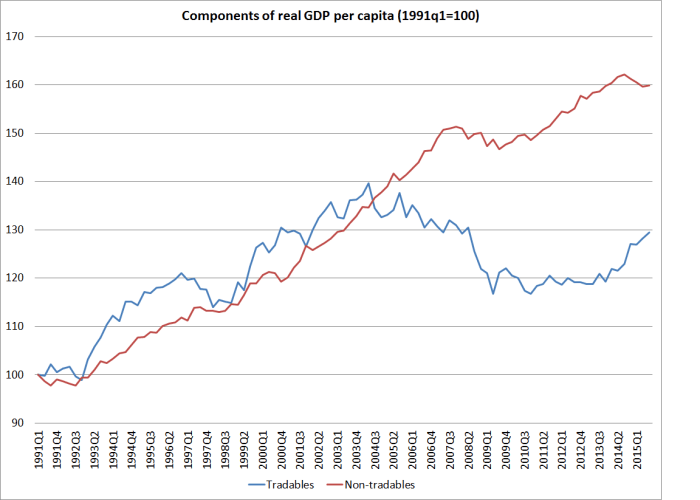
In a post on Thursday I showed this chart, a rough and ready decomposition (pioneered by the IMF) of real GDP per capita into that produced by tradables sectors (bits exposed to competition from the rest of the world) and non-tradables sectors.  My proposition was that successful high-performing economies will usually be led by strong tradables sector growth.
tradables and non-tradables gdp

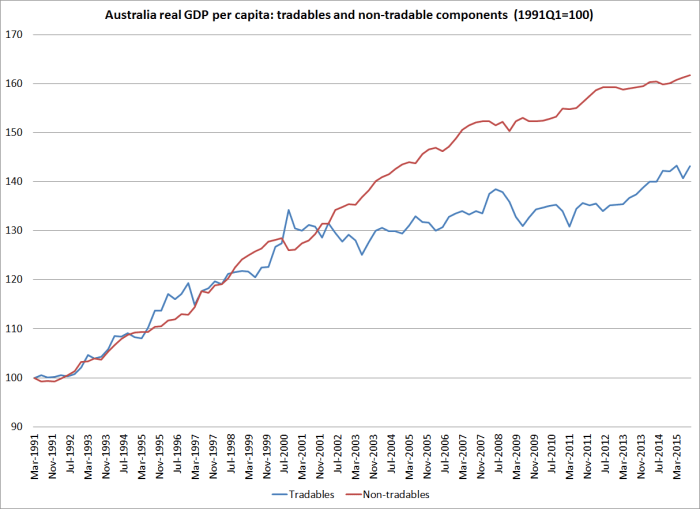
I was curious about how the comparable chart would look for Australia.

aus t and nt

Total growth in non-tradables per capita has been almost identical in the two countries over these 25 years (around a 60 per cent increase).

But look at the differences in recent years in (this proxy for) tradables sector output, per capita.

aus and nz T sector

In New Zealand, (this proxy for) tradables sector output per capita hasn’t increased over 15 years (notwithstanding the strong last few quarters).  In Australia –  which certainly isn’t a stellar economy –  the picture is much less negative.

At a sub-sectoral level, manufacturing output in Australia (per capita) has been even weaker than in New Zealand over the full quarter century.  The big difference, of course,  is simply the rapid growth in mining output.

Changing tack, just briefly…

Some readers perhaps find this blog a fairly unremitting critique of the Reserve Bank of New Zealand.  But today I’m sticking up for them.

Independent economist Shamubeel Eaqub has a column in today’s Dominion-Post, which in the hard copy version runs under the heading “Gorging a warm-up act for debt horror show”.   And “gorging” is Eaqub’s word, not just some sub-editors hype.   According to Eaqub, all New Zealand’s debt chickens are about to come home to roost –  notwithstanding, apparently, the fact that debt/GDP ratios are little changed over the last eght or nine years, and that no one has any good sense of what a sustainable, optimal, or equilibrium level of such ratios might be.

But according to Eaqub

The Reserve Bank is complicit, as they regulate banks. They say that the banking sector is not at risk. Their modelling shows sufficient capital buffers – which influence banks’ risk appetite to lend and vulnerability in a recession.

Their modelling has also shown higher inflation and interest rates for the last seven years – mistakenly.

It’s time the Reserve Bank better regulated banks to stop the repeating cycle of debt gorging and economic vulnerability.

This is really just a “guilt by association” slur.  Yes, the Reserve Bank has got its inflation and interest rate forecasts badly and repeatedly wrong, but what possible connection does that have to the question of whether banks hold adequate capital (whether risk weights, or required capital ratios)?    Or whether the stress test results are plausible?  Eaqub produces precisely no evidence to support his insinuations.  It is a short column to be sure, but surely he could at least offer readers a hint.

Lets recall that the stress tests involved a 40 per cent fall in house prices across the country, and something like a 50 per cent fall in Auckland.  And they involved an increase in the unemployment rate larger than any seen in any advanced economy with a floating exchange rate since World War Two.  And the banks still looked pretty resilient.

And as the IMF has previously noted, when they looked at a variety of other countries, risk weights on housing lending in New Zealand were materially higher than those in other countries.

I suspect there are tough times ahead for the New Zealand and world economy.  One can always argue for more capital, but to do so from the current situation  –  where New Zealand banks are better-capitalized than most –  one really needs more than simply the claim that “they got monetary policy wrong, so we shouldn’t give them credence on any other score”.


Rather desperate defensiveness

The Governor of the Reserve Bank has this afternoon delivered his annual speech to the Canterbury Employers Chamber of Commerce.  In many respects it was an elaboration on last week’s brief OCR review statement –  “we might have to cut the OCR, and risks are tilted to the downside, but we don’t really want to”.

Beyond that, it wasn’t an impressive effort.  Once again, the Governor simply does not seriously engage with the arguments made by those who suggest that a lower OCR would have been, and would be, preferable.  Instead, he basically makes up an inflation story that simply isn’t supported by the numbers, and attacks straw men.  The defensiveness is disheartening.

Lets take the numbers first.  On several occasions the Governor repeats the claim that “Annual headline inflation is currently 0.1 percent. This is primarily because of the negative inflation in the tradables sector, and the decline in oil prices in particular.”

First, you can’t just ignore tradables prices –  when the target is expressed in terms of CPI inflation, and around half the index is tradables.  CPI inflation is a weighted average of tradables and non-tradables inflation, and tradables inflation is typically lower than that for non-tradables.  Perhaps one might set tradables to one side for a time if the exchange rate has just been moving very sharply –  exchange rate changes do tend to affect the level of domestic tradables prices (and so temporarily affect the inflation rate).  But the peak in the New Zealand TWI was 18 months ago now.  If anything, the lower exchange rate has been holding up, perhaps only a little, tradables prices in the last year.  And non-tradables inflation in the last year was only 1.8 per cent.  If inflation was really consistent with the target midpoint, we should expect to see non-tradables inflation around 2.5 per cent.  It is a long way off that at present.

Second, the Governor repeats the story from last week’s statement that really it is mostly about falling oil/petrol prices.  But it takes no sophisticated analysis to read the SNZ CPI release, or consult the Reserve Bank website, and find that CPI inflation ex petrol was 0.5 per cent last year –  at a time when the exchange rate has been falling.  The Governor also invokes the cut in ACC motor vehicles levies in his defence –  which would be fine, except that he completely ignores the offsetting government decision to increase tobacco excise tax yet again.  SNZ publishes a series of non-tradables inflation excluding government charges and the alcohol and tobacco component.  That series increased by 1.8 per cent last year –  exactly the same as the overall non-tradables inflation rate itself.  In other words, administered government taxes and charges do not explain low headline inflation, and neither (to a great extent) does low petrol prices.  To argue otherwise  –  without much more supporting analysis –  just isn’t supported by the data.

Here are a range of analytical and exclusion measures that one might reasonably look at in assessing current core inflation

Annual inflation, year to Dec 2015
Trimmed mean 0.4
Weighted median 1.5
Factor model 1.3
Sectoral factor model 1.6
CPI ex petrol 0.5
CPI ex food and vehicle fuel 0.9
CPI ex food, household energy and vehicle fuel 0.9
CPI ex cigarettes and tobacco -0.3
Non-tradables ex govt charges and alcohol and tobacco 1.8

As he did in last week’s release, the Governor focuses on the sectoral core factor model measure –  which just happens to  be the highest of any of the inflation measures.  Since previous OCR releases had not focused on specific core inflation measures, we might have hoped for either a balanced assessment from the Governor, or a more in-depth case for why we should regard the sectoral factor model as the best measure.  Why not, for example, (and at the other extreme) the trimmed mean (which has had quarterly deflation in three of the last five quarters)?  But there was simply nothing : just assertions.  (Incidentally, even if the Governor is correct that the sectoral factor model is the best read, it is quite a slow-moving smooth series, and a deviation of 0.4 percentage points from the target midpoint would not be insignificant. )

So perhaps we can debate quite where the underlying rate of inflation really is –  as I noted last week, neither the Governor, nor anyone else, knows that with any certainty.  But the Governor doesn’t engage in that debate, he reverts to attacking straw men.

Once upon a time –  a quarter a century ago, says he gulping –  a wise boss at the Bank objected when I was drafting Monetary Policy Statements attacking anonymous views of outsiders (“some commentators said”) and suggested that if we wanted to deal with criticisms we should identify them specifically, and respond to what people had actually said.  It took more work, but he was right.

By contrast, we hear today from the Governor the lofty declaration that “the Policy Targets Agreement is a relatively simple document [arguable, but we’ll let that pass] we continue to be surprised at the wide range of interpretations that we see in the media and in the commentaries”.  Really?    But the Governor gives no indication as to whose interpretations he has in mind, and what those interpretations might be.    I see comments occasionally from people who argue that the Act or the PTA should be changed, but I don’t recall seeing any very great divergences over the last few years in the interpretation of the PTA itself.  Yes, there is some uncertainty about what, if anything, the longstanding obligations to “have regard to the soundness and efficiency of the financial system” and to avoid “unnecessary variability in exchange rates, interest rates and output” might practically mean –  but there is nothing new about that, and the Bank itself can’t give an straightforward answer to those questions (a lot, inevitably, is “it depends on the specific circumstances”).  But the debate about the conduct of monetary policy over the last few years has mostly been squarely within an entirely conventional framework.  The Governor and his advisers (and initially many of the bank economists) expected inflation to pick up and hence thought the OCR needed to be raised a lot.  Others were more sceptical.  But both sides of the argument operated largely within a forecast-based model  –  suggesting that the OCR should be adjusted in line with the medium-term outlook for inflation.  As it happens, the Bank –  and those who adopted the same line –  were proved wrong –  but it wasn’t really a dispute about the PTA itself.  They were forecasting differences and –  while forecasting is hard –  the Bank and the Governor have been repeatedly wrong-footed by the data.  They had the wrong model.  Again, some of their international peers made the same mistake –  others were just constrained (or thought they were) by the near-zero lower bound.

The Governor also devotes space to attacking a related straw man. Indeed, this one is the centrepiece of the press release he put out with the speech:

“Mr Wheeler said that the Bank would avoid taking a mechanistic approach to interpreting the PTA.  Some commentators see a low headline inflation number and immediately advocate interest rate cuts:, he said.  A mechanistic approach can lead to an inappropriate fixation on headline inflation”

This is just the flailing around.  All his predecessors have also sought to avoid taking a ‘mechanistic’ approach to the PTA, so there is just nothing new or interesting in the assertion that he doesn’t want to be mechanistic (although some have argued that “mechanistic” might describe his own 2014 stance).   Perhaps more pointedly, I’d challenge the Governor to name a single commentator who has suggested that policy should be run in reaction to current headline inflation.  I can’t think of any.  I’ve been more dovish than probably any other commentator over the last year, and if anything I have repeatedly criticised the Governor for an unwarranted focus on headline inflation in his OCR releases (when he was arguing that the lower exchange rate would soon have inflation back to rights).  Who are these “mechanistic” people the Governor has in mind?

It is good to know that the Governor will “continue to draw on the flexibility contained in the PTA”, but in the end the PTA requires the Bank to focus on keeping inflation near 2 per cent.  It simply hasn’t succeeding in delivering that sort of outcome –  in fact, not once since the current Governor took office.  I’ve suggested that one practical approach to those repeated errors might be to aim for inflation a little higher than 2 per cent.   If the past forecasting errors continue –  and they may, because no one fully understands what is going on globally – it is more likely that actual inflation will end up around 2 per cent.  And if the forecasting errors do go away, actual inflation would come in a bit over 2 per cent –  not ideal, but not the worst outcome after years of undershooting, and consistent with the sort of flexibility the PTA provides.  Perhaps that is one of the strange interpretations of the PTA the Governor has in mind?    But it certainly doesn’t argue for driving policy off current headline inflation.

The country really deserves more engagement from the Governor, and some intelligent debate.  There are puzzles in the data that aren’t easy to resolve (there are new ones in today’s HLFS).  Resolving them and getting appropriate good quality policy from the most powerful  unelected official (and agency) in New Zealand isn’t helped by some mix of lofty condescension and attacking straw men –  cases no one is making –  rather than grappling with the alternative issues and arguments.

With all the resources at the Governor’s disposal, we should expect more from him than is evident in this defensive piece.  Those charged with holding him to account – the Board, the Minister, and Parliament’s Finance and Expenditure Committee should be asking hard questions, of him and of themselves.


Immigration effects and the OIA

The economic impact of immigration received considerable attention in the Reserve Bank’s December Monetary Policy Statement.  That made sense –  the net inflow (a small net outflow of New Zealanders and a large net inflow of foreigners) over the last year or so has been one of the larger net inflows seen for some time, and has led to an estimated population growth rate higher than we’ve experienced for decades.  Changes in immigrant numbers affect the labour market, the housing market, demand for government infrastructure etc.   A forecast-based monetary policy needs a good story about (a) what will happen to net migration, and (b) what the short-term economic effects of those immigration developments will be.  And making sense of what has already happened requires disentangling the various influences –  including those associated with changes in immigration.  It is particularly important in New Zealand, where the level of inward non-citizen migration is larger than in most advanced countries, and where the variability in the net flow of New Zealanders and foreigners is larger than most.  Watching the Republican debate the other day, I heard Marco Rubio argue that the US was the world’s most generous nation because it took around a million legal migrants a year.  That is about 0.3 per cent of the US population.  Our annual non-citizen residence approvals target is around 1 per cent of our population.

But reverting to the Reserve Bank view, the material in the Monetary Policy Statement and associated press conference wasn’t that convincing.  Here is what I wrote about it then:

I am also puzzled about the Bank’s stance on immigration, and the evidence base that lies behind it. The Governor is clearly at one with New Zealand elite opinion –  he told the news conference that he thought high levels of immigration were “a good thing for New Zealand” and that he did not think there should be any immigration policy changes.  Views differ on the long-term economic impact of immigration, and many certainly agree with him, but why was this a subject the Governor is commenting on at all?  Historically, the Reserve Bank has been studiedly neutral on the long-term issue, and focused (rightly) on the short-term cyclical implications.  Governors who use the platform they have been given to advocate their personal policy preferences in other areas risk further undermining support for the autonomy they enjoy in respect of monetary policy.

But even the Bank’s view on the cyclical impact of the recent high levels of immigration seems confused.  In chapter one (the press release) they assert that high levels of immigration have reduced capacity pressures and contributed to  a lowering of inflation (ie supply effects exceed demand effects).  In chapter 5, they produce a scenario about the impact of immigration staying unexpectedly high over the next year or two.  In that scenario they explicitly articulate what appears to be their latest new view, in which a change in immigration has no net short-term impact on capacity or inflation pressures (short-term demand effects are just matched by short-term supply effects).  There is no analysis in support of any of this.  And there is no engagement with their own past research, or with the consensus view of New Zealand macroeconomists going back decades that whatever the possible long-term gains from immigration, in the short-term the demand effects dominate the supply effects (which shouldn’t be surprising, since the per capita capital stock requirements of each new person are materially greater than one year’s labour supply).  It was only two years ago that they published a research paper which showed these results.

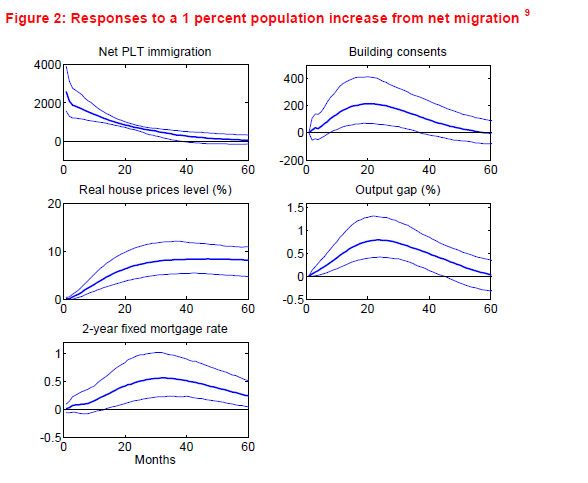
mcdonald rresults

Demand effects exceed supply effects in the short-run (of several years).

The Bank seems all over the place on these issues. Perhaps they have fresh new research on the issue, but they put out two new Analytical Notes this morning, and there was nothing on immigration. I have asked for copies of any analysis they have produced in support of their new view, including how it might relate to the 2013 research.

For decades, the Reserve Bank has been clear that the short-term demand effects of immigration outweigh the short-term supply effects in New Zealand.  That was typically the view of other macro forecasters, and it was also the consensus among New Zealand economists throughout the post-war period.  It isn’t surprising (modern economies need lots of physical capital – and building a house typically takes more than the value of a year’s labour) –  and it says nothing about whether or not large scale immigration is beneficial in the long-run.  But the Reserve Bank has now apparently changed its stance, while providing analysts, commentators, and the public no basis for their new stance.  Perhaps the new stance is correct, but we should be able to evaluate their arguments and evidence.

So on the morning of the MPS release, I lodged a request with the Bank for

Copies of any analysis undertaken by, or discussed by policy committees at, the Reserve Bank since 1 June 2015 about the determinants of net migration in New Zealand and the economic impact of immigration.  I am interested both in any material shedding light on the Bank’s evolving views around the balance between supply and demand effects of immigration (including any reflections on the ongoing relevance, or otherwise, of the results published in Chris McDonald’s 2013 Analytical Note) [from which the chart above is taken], and anything shedding light on the Governor’s comment this morning that the high level of net immigration is a “good thing” for New Zealand.

It wasn’t a “gotcha” request.  I assumed there must be some new modelling or research behind the Bank’s stance, and was keen to see it, and cover it here.  It was also surprising that a Reserve Bank Governor would comment explicitly on longer-term immigration policy so I wondered if they had new evidence, or were influenced by new evidence from others, to justify that stance.  I also drew the request quite narrowly, focusing on the previous two forecast rounds only, and not asking for emails.  I was quite genuinely interested only in either research papers (there just aren’t that many  in any five month period) or analytical pieces discussed at the Monetary Policy Committee (again, it seemed unlikely there would be many –  immigration not having featured in the Statement of Intent as a key aspect of the Bank’s research programme.   Moreover, since immigration had been a prominent aspect in the Monetary Policy Statement released just that morning, it was hard to imagine that any extensive investigation would be required to unearth papers, which had been prepared and discussed in the previous few weeks.  And as I noted the other day, the Reserve Bank has tried to convince us of how transparent it is around its  “policy objectives, policy proposals, economic reasoning, and of our understanding of the economy”, so it seemed reasonable that they would be keen to get any material out as soon as possible.

And since the Official Information Act requires agencies to release material “as soon as reasonably practicable” the naively optimistic strand that lurks within me wondered if I might get something by Christmas.  Silly me.

Instead, I had an email from the Bank just before 5pm last Friday –  the very last day of the 20 working days available to the Reserve Bank to respond.  I was advised that

The Reserve Bank is extending the time limit for a decision on your request to Monday 29 February 2016, as permitted under section 15A of the Act, because the request necessitates a search through a large quantity of information and meeting the original time limit would unreasonably interfere with the operations of the Bank.

That is certainly a statutory ground on which a deadline for dealing with a request can be extended.  But it is highly unlikely to be a legitimate argument in this instance.  As I noted, it is not plausible that there is huge amount of material.  And as for unreasonably interfering with the operations of the Bank, recall that these aren’t ancient historical papers, or about some obscure points of policy; they are recent papers directly relevant to the Bank’s primary function, where it prides itself on transparency.  And the OIA had already given the Bank extra time (since deadlines are automatically extended over the summer holiday period).

Frankly, I’m not sure what the Bank has to hide.

But it feels like deliberate stalling and, accordingly, I have appealed this decision to the Ombudsman.    I am beginning to worry that perhaps there is nothing there at all.

That would be a concern –  and especially from an agency which wants to convince us that its new charging policy is itself in the public interest [1], and indeed supports access to official information.


[1]  Somewhat curiously, despite the alleged need to “search through a large quantity of information” and the risk that doing so might “unreasonably interfere with the operations of the Bank”, there has not yet been any suggestion of a charge for meeting this request.