The Reserve Bank’s McDermott again

Earlier in the week I wrote about Reserve Bank chief economist John McDermott’s rather strange attempt to distract attention from the Bank’s own GDP forecasts –  which some had suggested were a bit optimistic –  by suggesting that private bank economists didn’t understand the process the Reserve Bank used, and even using the word “nonsense” in an attempt to bat away what seemed like quite legitimate questions.   Somewhat to my (pleasant) surprise, Westpac  – one of the banks that had questioned the Reserve Bank’s forecasts – actually went public in response , although being an institution regulated by the Reserve Bank they still seemed to feel the need to express due deference to the powerful, ending their note this way, (emphasis added)

We are comfortable respectfully maintaining that difference of opinion.

After each Monetary Policy Statement the Reserve Bank’s senior staff fan out across the country to do a series of post-MPS presentations (I used to do some of them myself).   These events are all hosted, and paid for, by the commercial banks, and commercial clients of those banks are the invited guests.  It is an arrangement that is convenient for the Reserve Bank –  the banks rustle up an audience –  but which has always seemed a bit questionable to me: preferential access to senior public officials, on sensitive policy issues, for the invited clients of particular banks.  The tone and thrust of questioning might be a little different if some such occasions were hosted by the Salvation Army or unemployed worker advocacy groups.

These occasions are supposed to be off-the-record, whatever that means.  The Bank defends it on the basis that it is supposed to let them speak more freely.  But the reason people turn up is to garner information and perspectives from –  and ask questions of – senior public officials.  And no one supposes that financial markets people in the room don’t (a) use, and (b) pass on to clients anything interesting, any different angles, that are raised when the Governor (in particular) and his leading offsiders are talking.     As I’ve noted previously, the contrast with the Reserve Bank of Australia is striking: senior officials will give speeches to private audiences, but the standard practice is, wherever possible, to post the text of the address and a webcast or audio of the address and any question and answer sessions, to minimise the extent to which some have access to Reserve Bank information/views others don’t have.

After my post the other day, a reader who had been at the post-MPS presentation John McDermott had given last Friday got in touch to pass on some of what McDermott had said there.  My reader felt –  and based on his report I agree –  that they didn’t put this senior official, or the Reserve Bank, in a particularly good light.   The reports are secondhand (ie I wasn’t there), so I’m relying on my reader to have captured the thrust of what McDermott said reasonably accurately.  But having worked closely with McDermott in the past, what I read had a ring of authenticity to it.   My reader has given me explicit permission to quote from the email I was sent.

He spent the first five minutes of his short presentation defending their record by displaying a chart showing CPI, broken down into tradables and non-tradables components, over the last 50 years or so. Essentially he was highlighting how insignificant the recent deviations from target look when you compare it to the extreme volatility in prior, pre-OCR, decades. He also claimed the RBNZ can only influence the non-tradables component and was rather self-congratulatory in how well they had done there.

Something didn’t sound quite right about that (the tradables vs non-tradables breakdown doesn’t go back that far), so I asked the Bank for a copy of McDermott’s slides (which, legally required to respond as soon as reasonably practicable, they supplied within 24 hours).    In fact, this paragraph was summarising two slides.  The first is, from memory, one of McDermott’s favourites.

mcdermott 1

In the 70s and 80s inflation was very high and volatile, and for the last 25+ years it hasn’t been.  It is a worthwhile point to make from time to time, but doesn’t have much bearing on anything to do with how monetary policy should be run right now (a bit looser, a bit tighter or whatever).  Apart from anything else, almost every advanced country could show a similar, more or less dramatic, chart.    And in the earlier decades, inflation wasn’t being targeted –  until 1985 the ‘nominal anchor” was the (more or less) fixed exchange rate.

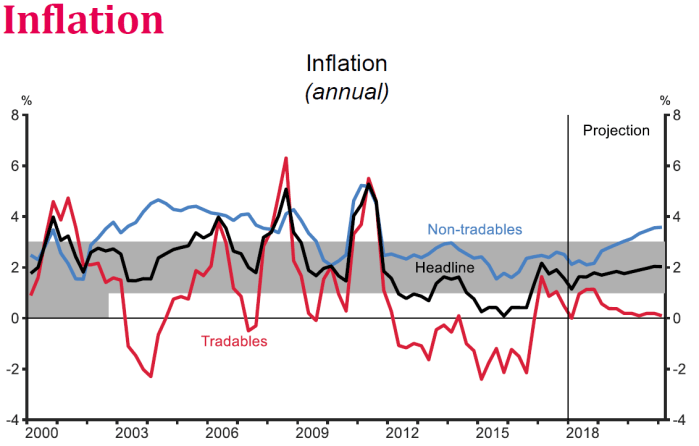
The second chart was this one
mcdermott 2

This is presumably what McDermott was talking about when, as my reader reported,

He also claimed the RBNZ can only influence the non-tradables component and was rather self-congratulatory in how well they had done there.

There is no doubt that, in the short-term, the Reserve Bank is a pretty minor influence on tradables inflation, which is thrown round quite a bit, and most obviously, by fluctuations in petrol prices (changes in which closely track international oil prices) and the influence of weather events of fresh food prices.   The Reserve Bank can’t do much about those, and is specifically instructed (in every PTA) not to focus on them.  Of course, in the very short-term the Reserve Bank can’t do much about non-tradables inflation either –  it is quite persistent (ie not very volatile), and inflation right now is a response to monetary policy choices from perhaps 18 months ago, and economic forces (often hard to forecast) from the last year or so.

But it would be nonsense to suggest (if in fact McDermott did) either that tradables inflation is outside the Bank’s influence, or that the track record on non-tradables inflation is just fine.   New Zealand can’t do anything much about the world price of tradables, but monetary policy is a direct influence on the exchange rate, and thus on the New Zealand dollar price of tradables.    That can’t sensibly produce a stable tradables inflation rate quarter to quarter, but it can (and does) have a material influence on the trend –  “core tradables inflation” if you like.     And McDermott’s chart seems deliberately designed to avoid focus on the fact that, over time, tradables tend to inflate less rapidly than non-tradables.  As I’ve noted previously, the rule of thumb around the Bank used to be that if one was targeting 2 per cent inflation, that might typically involve something nearer 1 per cent tradables inflation and something nearer 3 per cent non-tradables inflation.

As it happens, the Reserve Bank produces estimates (from its sectoral factor model) of core tradables and core non-tradables inflation.  I ran this chart of those data a few weeks ago

sec fac model jan 18

Not only is this estimate of core tradables inflation not terribly volatile, but the gap between the two series isn’t unusually large or small.  Overall (core) inflation has simply been too low to be consistent with the target set for the Reserve Bank.  There isn’t anything for current Reserve Bank management to be proud of.

One of the reforms the new government is promising is the addition of some sort of employment objective (non-numerical) to the Bank’s statutory monetary policy responsibilities.  We don’t know the details, and probably neither does the Bank –  The Treasury was accepting submissions on that point right up to today – but I presume we will get a hint when the Policy Targets Agreement with the new Governor (under existing legislation) is signed and released next month.   But it is an obvious area of interest and apparently McDermott was asked some questions about the new environment.   You may recall that in the MPS the Bank released, for the first time, an estimate of the NAIRU (the estimated rate of unemployment at which there is neither upward nor downward pressure on inflation from the labour market) – “released”, but in a footnote (repeated in the press conference), citing analysis in an as-yet-unpublished research paper.

My reader reports that McDermott was asked about this, including

whether their estimate of NAIRU came about as a result of the likely addition of an employment mandate to the PTA, and … how they went about coming up with that number. His initial reply was “I’ve got a lot of very smart people working for me” and then he went on to basically say that the analysis and maths involved are too complicated for us to understand. He also highlighted, to the point of seeming rather proud of, the fact his team had decided to come up with the estimate on their own accord without any suggestion from him. It didn’t seem to me that even he knew how they  came up with 4.7%, nor that he particularly cared much.

The final sentence is clearly editorial in nature, and may or may not represent McDermott’s actual view, although it was clearly how he came across to this particular member of his audience.     As for the rest, when you put out a number in a footnote, don’t simultaneously make available the workings and background research, fall back on “very smart” staff,  and won’t even attempt to explain the intuition of the work that has been done, it isn’t a particularly good look from a senior public servant.    (I’ve also heard that in fact the “acting Governor” had been all over staff, as a matter of urgency, to produce publishable estimates of the NAIRU.)

I’m still looking forward to seeing the research paper when they finally get round to publishing it.  Perhaps the 4.7 per cent estimate of the NAIRU (with confidence bands) will prove to be robust, although it seems implausibly high to me.  But it is worth remembering that the Bank has form when it comes to rushing out new labour market indicators in high profile documents endorsed by senior managers, that play down any notion of ongoing excess capacity, without having first adequately road-tested and socialised the background research.    Persevering readers may recall the saga of LUCI , touted a couple of years ago by a Deputy Governor as the latest great thing, allegedly demonstrating that the labour market was already at or beyond capacity (and at least in that case the associated Analytical Note had already been published), before the interpretation of the whole indicator was quietly changed, and then it disappeared from view.

The questioner of McDermott apparently continued and

….suggested NAIRU will presumably become a more important consideration for the Bank going forward if they are handed a ‘full-employment’ mandate but he didn’t really address that question and instead spent 5 minutes explaining why it would need to be the Bank, and not politicians, who define what full-employment means at any given time, a suggestion I wasn’t aware anyone had made otherwise. He pressed the point that he didn’t believe the change to the mandate would make any difference whatsoever and sarcastically pointed out that they already consider employment when making decisions.

Since neither we, nor McDermott, has seen the new mandate, and since the new Governor (not yet in office) will be the single legal decisionmaker for a time, and then the new statutory Monetary Policy Committee will take responsibility, it isn’t clear how or why McDermott thinks he can say with any confidence that a new mandate won’t make any difference to policy.  Perhaps he wishes it to be so, but then he has been one of key figures in the regime of the last six-plus years that has delivered core inflation consistently below target even while (even on their own estimates) the unemployment rate has been above the NAIRU for almost the whole of that time.     As reported, it didn’t seem a very politically shrewd answer either –  it is one thing to emphasise that (as everyone agrees) in the long-run monetary policy can only influence nominal things (price levels, inflation rates etc), and quite another to suggest that there aren’t legitimately different short-run reaction functions.

We deserve better from our operationally independent central bank. Lifting the quality, and authority, of the Bank’s work around monetary policy will be one of the challenges for the new Governor, and needs to be borne in mind too by those devising the details of the new Reserve Bank legislation.

The Reserve Bank’s case for minimal reform

In early December, the Reserve Bank’s briefing to the incoming Minister of Finance  (BIM) was released, as part of the general release by the new government of the set of BIMs.     I wrote about the Bank’s briefing, and in particular about the appendix they included on the governance and decisionmaking issues.  In a departure from the now-common practice of including nothing of substance in BIMs the (unlawful) “acting” Governor –  I think I’ve gone a whole month without using that description –  took the opportunity to make his case in writing for minimal reform.

The Bank indicated that the appendix was itself a summary of a fuller document that they would make available to the Minister on request.  So I lodged an Official Information Act request for the fuller document, which they have released in full to me today.     It is really the sort of document that should be included with the collection Treasury has made available as part of the current Treasury-led review of the Reserve Bank Act, but as it isn’t there, I thought I should make it available for anyone interested ( RBNZ Memo – Review of policy decision process 16 Oct 2017 (1) ).

The paper was written by a couple of Reserve Bank managers –  Roger Perry, who manages a monetary policy analysis team, and Bernard Hodgetts who head the macrofinancial stability area –  and is dated 16 October, a few days before it became clear who would form the next government.   The paper itself is not described as Bank policy, but in the release I got today it is stated that

Please be aware that the document encapsulates Reserve Bank thinking at the time it was prepared.

Which suggests that at time it did represent an official view –  probably workshopped with senior management before the completed version we now have.     There is a pretty strong tone to the document suggesting that the authors did not expect a change a government (with only a couple of footnote references to possible implications of Labour Party policy positions in this area).

But, frankly, I was surprised how weak, and self-serving, the document was.  The Reserve Bank has been doing work on these issues off and on for several years –  there was the secretive bid a few years ago by Graeme Wheeler to get his Governing Committee enshrined in statute –  and yet there was little evidence of any particularly deep thought, and no sign of any self-awareness or self-criticism (over 30 years was there really nothing the authors –  or Bank –  could identify as not having worked well?).

There was also, surprisingly, no sign of any engagement with the analysis or recommendations of the Rennie report.  It is hard to believe that a report, on Reserve Bank governance issues, completed months earlier had not been shown to the Reserve Bank itself.   There was no substantive engagement with the models adopted in various countries that we tend to be closest too, or which are generally regarded as world-leaders in the field (by contrast, several references to the Armenian model –  to which my reaction was mostly “who cares”).    There was no reference at all to how Crown entities are typically governed in New Zealand –  that omission isn’t that surprising, given the Bank’s track record, but it should be (the Bank is after all just another government agency).  There wasn’t even any reference to how other economic and financial regulatory agencies in New Zealand are governed, even though the Financial Markets Authority is a new creation with a markedly different (but more conventional Crown entity) governance and decisionmaking model.

For what it is worth, on 16 October, the Bank seemed to favour:

  • enshrining the idea of the Governing Committee in law, but perhaps with slightly different versions of membership for monetary policy and financial stability functions,
  • legal decisionmaking power continuing to rest with the Governor,
  • the Governor’s appointment continuing to be largely controlled by the Board,
  • no publication of minutes or votes,
  • no external members of the committee(s).

But they make no serious attempt at critical analysis to support their case, let alone to engage with the risks of a system in which a single decisionmaker is key, and where that single decisionmaker is the boss of the other members of (what is really just) an advisory committee.   Or the anomalous nature of such a system in the New Zealand system of government, where even elected individuals rarely have such unconstrained authority, where committee-decisions are the norm (from Cabinet, the higher courts, through major Crown entities to school Boards of Trustees) and where Cabinet ministers (or Cabinet collectively) typically have the key role in appointing those who exercise considerable statutory powers.

The management of a central bank that can’t come up with better analysis than this really makes it own case for change –  legislative change, personnel change, and cultural change.

The Reserve Bank and housing collapses

In early December, the Reserve Bank published a Bulletin article, “House price collapses: policy responses and lessons learned”.  The article wasn’t by a Reserve Bank staffer –  it was written by a contractor (ex Treasury and IMF) –  but Bulletin articles speak for the Bank itself, they aren’t disclaimed as just the views of the author.   Given the subject matter, I’m sure this one would have had a lot of internal scrutiny.  Or perhaps I’ll rephrase, it certainly should have had a lot of scrutiny, but the substance of the article raises considerable doubt as to whether anyone senior thought hard about what they were publishing in the Reserve Bank’s name.

I’ve only just got round to reading the article and was frankly a bit stunned at how weak it was.    Perhaps that helps explain why it appears to have had no material media coverage at all.

The article begins with the claim that

This article considers several episodes of house price collapses around the globe over the past 30 years

In fact, it looks at none of these in any depth, and readers would have to know quite a bit about what was going on in each of these countries to be able to evaluate much of the story-telling and policy lessons the author presents.

Too much of the Reserve Bank’s writing about house prices tends to present substantial house price falls as exogenous, almost random, events: a country just happened to get unlucky.  But house prices booms –  or busts –  don’t take place in a vacuum.  They are the result of a set of circumstances, choices and policies.

And none of the Reserve Bank’s writings on housing markets ever takes any account of the information on the experiences of countries which didn’t experience nasty housing busts.  Partly as a result they tend to treat (or suggest that we should treat) all house price booms as the same.  And yet, for example,  New Zealand, Australia, the UK and Norway all had big credit and housing booms in the years leading up to 2008 but –  unlike the US or Ireland –  didn’t see a housing bust.  What do we learn from that difference?   The Reserve Bank seems totally uninterested.   Their approach seems to be, if the bust hasn’t already happened it is only a matter of time, but 2018 is a decade on from 2008.

One particular policy difference they often seek to ignore is the choice between fixed and floating exchange rates.  When you fix your exchange rate to that of another country, your interest rates are largely set by conditions in the other country.  If economic conditions in your country and the other country are consistently similar that might work out just fine.  If not, then you can have a tiger by the tail.  Ireland, for example, in the 00s probably needed something nearer New Zealand interest rates, but chose a currency regime that gave it interest rates appropriate to France/Germany.    Perhaps not surprisingly, things went badly wrong.

In the Bulletin article, the Bank presents a chart showing “house price falls in [10 OECD] selected crisis episodes” (surprisingly, not including Ireland).  But of those, eight were examples of fixed exchange rate countries (in several cases, the associated crisis led the country concerned to move to a floating exchange rate).   The same goes for all the Asian countries the author mentions in the context of the 1990s Asian financial crisis.     There can be advantages to fixing the exchange rate, but the ability to cope with idiosyncratic national shocks in not one of them.     And yet in the ten lessons the author draws in the article, there is no hint of the advantages of a floating exchange rate, in limiting the probability of a build-up of risk, and then in managing any busts that do arise.    It is a huge omission.  As a reminder, New Zealand, Australia, Norway, the UK, and Canada –  the latter a country that has never had a systemic financial crisis –  were all floating exchange rate countries during the 2000s boom and the subsequent recession/recovery period.

The author also hardly seems to recognise that even if house prices fall, house prices may not be the main event.   Even the Reserve Bank has previously, perhaps somewhat reluctantly, acknowledged the Norges Bank observation that housing loan losses have only rarely played a major role in systemic financial crises.   But there is no hint of that in this article.     Thus, in the severe post-liberalisation crises in the Nordics in the late 1980s and early 1990s, house prices certainly went up a lot and fell back a lot too, but most accounts suggest that those developments were pretty marginal relative to the boom and bust in commercial property, in particular development lending.  The same story seems to have been true for Ireland in the crisis there a decade ago.  Housing also wasn’t the main event in Iceland –  a floating exchange rate country not mentioned here that did have a crisis.  Even of the two floating exchange rate countries the article mentions –  Japan and the United States –  only in the United States could housing lending, and the housing market, be considered anything like the main event (and the US experience may not generalise given the very heavy role the state has historically played in the US housing finance market).

(And as I’ve noted here before,  even the US experience needs rather more critical reflection than it often receives: the path of the US economy in the decade since 2007 wasn’t much different to that of, say, New Zealand and New Zealand experienced no housing bust at all.)

Some of the other omissions from the article are also notable.  The author seems quite uneasy, perhaps even disapproving, about low global interest rates (without ever mentioning that inflation has remained persistently low), but there is no hint in the entire article that neutral interest rates may have been falling, or that global trend productivity growth may have been weak (weakening before the 2008/09 crisis showed up).   Thus, where economic activity is now –  10 years on –  may have little or nothing to do with the specifics of housing market adjustments a decade ago.   And although he highlights the limits of conventional monetary policy in many countries (interest rates around or just below zero), again he doesn’t draw any lessons about the possible need for policymakers to give themselves more room to cope with future downturns (by, for example, easing or removing the technological/legislative constraints that give rise to the near-zero lower bound in the first place.)

It is also remarkable that in an article on housing market collapses, there is only one mention of the possible role of land use restrictions in giving rise to sharp increases in house prices in the first place.   And then it is a rather misguided bureaucrats’ response: because supply may eventually catch up with demand the public need wise officials to encourage them to think long-term.  Perhaps the officials and politicians might be better off concentrating their energies on doing less harm in the first place –  whether fixing exchange rates in ways that give rise to large scale misallocation of resources, or avoiding land use restrictions that mean demand pressures substantially translate in higher land and house prices.

But in all the lessons the Bank (and the author) draw in the article, not one seems to be about the limitations of policy and of regulators.   There are typical references to short-termism in markets – although your typical Lehmans employee had more personal financial incentive (deferred remuneration tied up in shares that couldn’t be sold) to see the firm survive for the following five years –  than a typical central bank regulator does, but none about incentives as they face regulators and politicians (including that in extreme booms, an “insanity” can take hold almost everywhere, and even if there were a very cautious regulatory body, the head of such a body would struggle to be reappointed).

And nor is there any sense, anywhere in the article, as to when cautionary advice might, and might not, look sensible.  Alan Greenspan worried aloud about irrational exuberance years before the NASDAQ/tech bust –  someone heading his concerns then and staying out of the market subsequently would probably have ended up worse off than otherwise.   Much the same surely goes for housing.  In New Zealand, central bankers have been anguishing about house prices for decades.  Even if at some point in the next decade, New Zealand house prices fall 50 per cent and stay down –  the combination being exceedingly unlikely, based on historical experience of floating exchange rate countries, unless there is full scale land use deregulation –  that might not be much encouragement to someone who responded to Reserve Bank concerns 20 years ago.  (Oh, and repeated Reserve Bank stress tests suggest that even in a severe adverse economic shock of the sort that might trigger such a fall, our banks would come through in pretty good shape.)

The article concludes “housing market crashes are costly”.    Perhaps, but even that seems far too much of a reduced-form conclusion.  The misallocations of real resources that are associated with housing and credit booms are likely to be costly: misallocations generally are, and often it is the initial misallocation (rather than the inevitable sorting out process) that is the problem.  To me, it looks like an argument for avoiding policy choices that give rise to major misallocations (and all the associated spending) in the first place: be it fixed exchange rates (Nordics or Ireland), land use restrictions (New Zealand and other countries), or state-guided preferential lending (as in the United States).   Of the three classes, perhaps land use restrictions are most distortionary longer-term, and yet least prone to financial crises and corrections, since there are no market forces which eventually compel an adjustment.

It was a disappointing article on an important topic, sadly all too much in the spirit of a lot (but not all) of the Reserve Bank’s pronouncements on housing in recent years.

On housing, in late November, the Minister of Housing Phil Twyford commissioned an independent report on the New Zealand housing situation.   According to the Minister

“This report will provide an authoritative picture of the state of housing in New Zealand today, drawing on the best data available.

The report was to be done before Christmas and it is now 15 January.  Surely it is about time for it to be released?

OIA obstructionism – yet more evidence for RB reform

Working my way through things that turned up while I was away, I stumbled on an impressive piece of public sector diligence.  At 3.44pm on the last working before Christmas – a time by which surely most office-bound workers had already left work for the holidays –  Angus Barclay, from the Communications Department of the Reserve Bank, responded to an Official Information Act request I’d lodged with the Bank’s Board several weeks earlier.   I was impressed that Angus had still been at work, but was less impressed with the substance of the response.

I’d asked the Board for copies of the minutes of meetings of the full Board and any Board committees in the second half of last year (specifically 1 July to 30 November).  It didn’t seem likely to be an onerous request: there would probably only have been four or five full Board meetings, and perhaps some committee minutes, all of which will have been readily accessible (in other words virtually no time all in search or compilation).    Perhaps the Board would have wanted to withhold some material, and (subject to the statutory grounds) that would have been fine.  But again, doing so shouldn’t have been onerous.   The Board, after all, exists mostly to monitor the performance of the Governor, on behalf of the public.   In an open society, it isn’t naturally the sort of material one should expect to be kept secret.

In fact, in the 22 December response I received I was informed that there were only five documents.  But I couldn’t have them.  Instead, the request was extended for almost another two months, with a new deadline of 19 February.   Oh, and they foreshadowed that they would probably want to charge me for whatever they might eventually choose to release.

Why was I asking?     After an earlier request to the Board, around the appointment of an “acting Governor”, it had come to light that there was no documentation at all around the process for the appointment of a new Governor (that had been underway in 2016, before Steven Joyce told them to stop), which in turn appeared to be a clear violation of the Public Records Act.    The process of selecting a candidate to be the new Governor is one of the Board’s single most important powers.   And yet the records showed that nothing had been documented –  to be clear (see earlier post), it wasn’t that material was withheld (for which there might well have been an arguable case), it just didn’t exist.   Following that post in May, I was interested to see whether the Board had sharpened up its act, and come into compliance with its statutory obligations.

I had some other interests, of course.   For example, in the five months covered by my request, Graeme Wheeler had finished his term, and I also wondered if there might be some insight in the minutes on the still-secret Rennie review on the governance of the Reserve Bank.

But instead I met obstruction.

There are two things that interest me about the response.  The first is that, although the request was explicitly made of the Reserve Bank Board –  which has a separate statutory existence, and whose prime function is to hold the Bank/Governor to account –  the response came from Reserve Bank staff, referencing only Reserve Bank policies and practices.  It is consistent with my longstanding claim that the Board has allowed itself to simply serve the interests of, and identify with, the Bank –  rather than, say, the Minister who appointed them, or they public whom they (ultimately) serve.

Thus, in respect of the charging threat, I received this line

The Ombudsman states on page 4 of the guidelines on charging that: “It may also be relevant to consider the requester’s recent conduct. If the requester has previously made a large volume of time-consuming requests to an agency, it may be reasonable to start charging in order to recover some of the costs associated with meeting further requests.”

I’m not precisely sure how many OIA requests I lodged with the Board last year, but I’m pretty sure it was no more than four (and one of those was to secure material that was in fact covered by, but ignored in the answer to, an earlier request).   Three of the four I can recall were simply requests for copies of minutes – with no substantial search or collation costs.  Given the uncertainty around the legality of the appointment of the “acting Governor”, major events during the year such as the Rennie review, questions around compliance with the Public Records Act, and the process of selecting a new Governor, it didn’t seem like an undue burden on the Board.

As the Ombudsman’s charging guidelines also note

Note, however, that some requesters (for example, MPs and members of the news media), may have good reasons for making frequent requests for official information, and they should not be penalised for doing so.

Since this blog is one of the main vehicles through which a powerful public agency –  Bank and/or Board –  is challenged and scrutinised, I’d say I was on pretty strong ground in my request for straightforward Board minutes.  (And just to check that the Board itself isn’t being overwhelmed with other requests, I lodged a simple further request this morning asking how many OIA requests the Board has received in each of the last two years, and copies of the Board’s procedures of handling OIA requests made of it.)

I can only assume that the Bank itself, which seems to be controllling the handling of requests made even to the Board, has gotten rather annoyed with me again, and decided to use the threat of charging as some sort of penalty or deterrent.  Longstanding readers may recall that we have been this way once before.  About two years ago, the Bank got very annoyed with me (and some other requesters) and started talking of charging left, right and centre.   Reaction wasn’t very favourable, and Deputy Governor Geoff Bascand even took to the newspapers with an op-ed defending the Bank’s stance.   There was talk of a “mushrooming” number of requests, but on closer examination even that didn’t really stack up –  the number of OIA requests the Bank received was much smaller than, say, those The Treasury received.     Explaining is (often) losing, and as I noted at the time, the Bank didn’t come out of the episode well.   As a refresher, the Bank released responses to 20 OIA requests in 2017.  The Treasury, by contrast, released responses to more than 80 OIA requests (in both agencies there will be have responses not posted on the respective websites).

But even in their defence a couple of years ago, Bascand asserted that the Bank –  no mention of the Board –  would be charging only when the requests were “large, complex or frequent”.  My latest request of the Board is neither large nor complex, and neither were the earlier requests.

Even though the Bank and the Board are not the same entities, they are clearly trying to conflate my requests to both entities.   But over the course of last year, my records suggest I lodged no requests at all with the Reserve Bank itself in the first five months of last year.    Between June and the end of the year, there seem to have been quite a few, but on topics as diverse as:

  • the new “PTA” signed by Steven Joyce and Grant Spencer,
  • the Toplis suppression affair,
  • assumptions about new government policies the Bank referred to in its latest MPS,
  • some data from an expectations survey that the Bank had not published
  • three old papers, each clearly-identified in the request,
  • a specific paper on RB governance issues explicitly mentioned in the Bank’s BIM, and
  • work on digital currencies that the Bank explicitly highlighted in a recent research paper.

All still seem like reasonable requests, of a powerful agency which has a wide range of functions.  It seems unlikely that many of them should have involved any material amount of time to search for, or collate (in fact, in response to several requests the Bank responded quite quickly and in full, prompting notes of thanks from me).   There are no requests that can reasonably be described as “fishing expeditions”, and no pattern of repeated requests for much the same information.  They seem like the sort of requests those who devised the Official Information Act might have had in mind.

Finally, it is worth noting what the Ombudsman’s guidelines suggest can and can’t be charged for (bearing in mind that very few agencies charge at all).    Agencies can, in appropriate circumstances, charge for things like

Search and retrieval 

Collation (bringing together the information at issue) 

Research (reading and reviewing to identify the information at issue) 

Editing (the physical task of excising or redacting withheld information) 

Scanning or copying

Five nicely-filed documents (Board minutes) will have taken mere minutes to retrieve, no time to copy (since they will exist in electronic form already) and no time to research.  It is conceivable that the physical task of redacting withheld information might take a little time –  but very little.

And what can’t agencies charge for at all?

Work required to decide whether to grant the request in whole or part, including:
– reading and reviewing to decide on withholding or release;

– seeking legal advice to decide on withholding or release;

– consultation to decide on withholding or release; and – peer review of the decision to withhold or release. 

Work required to decide whether to charge and if so, how much, including estimating the charge.

If the Reserve Bank or the Board think that trying to charge for five simple, easily accessible, documents is consistent with the principles of the Official Information Act, or of the sort of transparency they often like to boast of, things are even worse than I’d supposed.   And in the attempt, they will again damage their own image and reputation more than they inconvenience me.

If anything, it is further evidence of why a full overall of the Reserve Bank Act –  and of the institution –  is required.  You might have supposed that, with a review underway, the Bank and the Board would have wanted to go out of their way to attempt to demonstrate that there were no problems, no issues, in an attempt to convince the Minister to make only minimal changes, leaving incumbents with as much power and control over information as possible.  But no, instead by the words and actions they simply reinforce the case for reform, and indicate that they have little concept of what genuine public accountability means.   We should be looking for openness, not obtuseness and obstructiveness from the Bank –  whether the Governor (“acting” or permanent) or the Board, supposedly operating on our behalf to keep the Bank in check.  Once again, we don’t see what we should have the right to expect.

Perhaps, on reflection, the Bank or the Board will reconsider their wish to charge for some simple documents –  the sort of documents that should probably be pro-actively released as a matter of course.  If not, one can only assume they have something to hide.   The “good governance” former public servant in me is sufficiently disquieted about the evidence of weak or non-existent recordkeeping that I am thinking of taking further the apparent breach of the Public Records Act.  Options might include:

  • a letter to the chair of the Board, asking how the Board is assured that it is operating in compliance with the Act,
  • a letter to the Minister of Finance, asking whether (and how) he can be sure that his appointees (the Board) are operating in compliance, given past evidence of major gaps,
  • a letter to the minister responsible for the Public Records Act itself,
  • a letter to the Auditor-General expressing concerns about the evidence suggesting that the Board of the Reserve Bank is not meeting its statutory obligations under the Public Records Act.


Adrian Orr as Governor-designate

There are some good aspects in the announcement yesterday that the government intends to appoint Adrian Orr as the next Governor of the Reserve Bank.

For a start, the appointment will be a lawful one –  always a help.  Steven Joyce’s unlawful appointee as “acting Governor” will continue to mind the store until late March, and then at least we will be back to having someone lawful in office.   The unlawful interlude was unnecessary, and reflects poorly on governance and policymaking in New Zealand, but it will be soon be over.  Be thankful for small mercies.

It also seems highly unlikely that Adrian Orr will spend his first five years in office skulking in corners, avoiding any serious media scrutiny.   He is a vigorous and, mostly, effective communicator (on which more below) and in that sense is likely to be a welcome breath of fresh air in the Reserve Bank.  If he can model greater openness, across all the Bank’s function, it would be a significant step forward.

And there might be reason to hope that an Orr-led Reserve Bank might start to take transparency –  within and beyond the confines of the Official Information Act –  rather more seriously.  I’m not a huge fan of the New Zealand Superannuation Fund, but I am quite impressed by their transparency, including in dealing with Official Information Act requests.  When I asked recently for the background papers justifying the decision to cut the Fund’s carbon exposures –  they’d already pro-actively released some papers –  I got (from memory) something like 3000 pages of material.  When one asks the Reserve Bank for background papers to monetary policy decisions, one is repeatedly stonewalled (unless it is about things from 10 years ago).  I hope the contrast bodes well for the sort of leadership Adrian will bring to the Bank.

That is the positive side of the appointment.  But here is what I wrote earlier in the year, at the time when controversy was raging about his NZSF salary.

Orr simply isn’t –  and I wouldn’t have thought he’d claim otherwise –  some investment guru, blessed with extraordinary insights into markets, prospective returns etc etc.  He was a capable economist, and a good communicator (at least when he doesn’t lapse into vulgarity), who turned himself into a manager and seems to have done quite well at that.   He always seeemed skilled at managing upwards, and his management style (in my observation at the Reserve Bank) seemed to err towards the polarising (“are you with us, or against us”), attracting and retaining loyalists, but not exactly encouraging diversity of perspectives or styles.  He isn’t exactly a self-effacing character. (That is one reason I’m not convinced he is quite the right person to be the next Governor of the Reserve Bank.)

I’d stand by those comments today.

He is more of a manager –  and perhaps a salesperson – than an economist, despite some comments in the last day about him being an “exceptional economist”.  That has probably been so for at least 20 years now.  In itself, that isn’t a criticism, and there is a significant management dimension to the Reserve Bank role –  in particular, at present, a change management responsibility (both to implement whatever changes emerge from the Minister of Finance’s secretive review of the Reserve Bank Act, and to lift the internal performance, and improve the culture, of the Bank).

His management approach might be more questionable. In his first short stint at the Reserve Bank, 20 years ago, he took over a department that was severely demoralised and lacking the influence it would normally have had.  In a narrow sense, he did an effective job of turning around that underperformance.   But his style always seemed to be quite a divisive one, playing up “his team” at the expense of others, rather than seeking to lift the entire organisation  –  in fact, he boasted of it in his farewell speech when he left the Bank in 2000.  I haven’t observed him directly in the last decade, but I am struck by the number of able people I’ve known who’ve worked for him for a time, and then didn’t.    It wasn’t, as far as I could see, that they went on to bigger and better things either.  Adrian seems to build cohesive teams of loyalists.  That has its place, but it isn’t obvious that the Reserve Bank is one of those places.

What of his communications skills?  He can be hugely entertaining, and quite remarkably vulgar (an astonishingly crude analogy involving toothbrushes springs to mind).   Just the thing –  perhaps –  in an old-fashioned market economist.  Not, perhaps, the sort of thing we might hope for from a Reserve Bank Governor.   Financial markets can get rather precious about very slight changes in phrasing etc from the Reserve Bank, and it is hard to be confident just how well Orr will go down.  No doubt he will rein in his tongue most of the time –  and perhaps he has calmed down a bit with age – but it is the exceptions that are likely to prove problematic.

And what happens when some journalist or market economist riles him?    Perhaps a journalist might ask him about how he would approach an episode like the Toplis affair?  You (and I) might like to hope things would be different, but I have in mind an episode from Orr’s time as Deputy Governor.  A visiting economist was engaging in what they thought was a bit of robust dialogue with Orr in a meeting with several people at the Bank.  Shortly afterwards, Orr bailed the visitor up in the street and told him ‘never, ever, do that in front of my staff again”.

And yet, so we are told, part of the motivation for the forthcoming reforms to the Reserve Bank is to ensure that more perspectives are heard, and incorporated, in decisionmaking at the Bank.   How confident can we be that Orr will actually implement the reforms in a way that will foster debate and diversity, rather than clamp down on it and marginalise anyone he perceives as disagreeing with him?   Particularly if the person or people disagreeing with them doesn’t share his blokish style, or might simply know more about a particular issue than Orr does.

And how is Orr going to do –  repeatedly in the public eye, in a way he hasn’t been for the last decade –  with the sort of gravitas and political neutrality the role of Governor requires?  Only a few weeks ago – when he must already have known that he was likely to become Governor –  Orr gave a speech to the Institute of Directors, in which he reportedly dismissed the views of Deputy Prime Minister on the economy as “bollocks” and went on to suggest, in answer to a question about nuclear risks in North Korea, that perhaps two issues could be solved at once ‘because Winston is going to North Korea”.  Recall that at the time, Orr was not some independent market economist, but a senior public servant.     He might well have been right in his views on the economy, but is this how senior public servants should be operating?

I also have concerns about the way Orr engages with issues and evidence. My very first dealing with him involved some controversial reform proposals we were working on at the Bank, while Adrian was still in the private sector.   Adrian’s submission had played rather fast and loose with the data, something I pointed out to Don Brash, the then Governor.  Don went rather quiet and didn’t say much, which puzzled me a little, until a day or two later Adrian’s appointment as Reserve Bank chief economist was announced.  Much more recently, there was some debate earlier in the year about NZSF’s performance.   On a good day, and in official documents, Adrian will happily tell you NZSF’s performance can only really be judged over, say, 20 or 30 years horizons.  But then he will pop up in the newspaper suggesting that a few moderately good years –  amid a global asset market boom –  vindicate the existence of the Fund and the way it is run.    He keeps trying to convince us that he runs  a “sovereign wealth fund”, when it fact it is a speculative punt on world markets, using borrowed money (yours and mine).  He has simply refused to engage with the international evidence casting doubt on whether active funds management can generate positive expected returns in the long-run, and when he led the NZSF into a big (politically popular, but economically questionable) move out of carbon exposures –  an active management call if ever there was one – he took steps to ensure that taxpayers couldn’t really know whether his judgement paid off (hiding the change in the benchmark itself, rather than being constantly reported in devations from a benchmark).     I’m just not sure it is quite the degree of rigour, authority and independence of mind that we should be looking for in a Reserve Bank Governor.  What example, for a start, does it set for his own subordinates in how they marshall evidence and arguments for him?

On the same note, there was that speech Orr gave last month to the Institute of Directors (full text here).  It was given at a time when he knew he was in the final stages of the gubernatorial selection process.   It was advertised as a substantial speech

Looking Beyond Our Shores – Adrian Orr’s Address to the Institute of Directors

Adrian Orr’s address to the Institute of Directors, Wellington, 16 November 2017.
Adrian shares his thoughts on what directors need to think about to make sure New Zealand benefits from its place in the globalised economy.

So you might have expected some considerable substantive analysis.   But there wasn’t much there at all.     You won’t find anything about New Zealand’s underperformance –  productivity, exports, or whatever.   But you will find one conventional wisdom thought after another (albeit with a tantalising aside on Chinese influence), whether or not they apply to New Zealand  (eg “returns to the owners of capital versus labour –  which is stretched to extremes at present within and between nations” –  when the labour share of income has been rising in New Zealand for 15 years).  And then it devolves to “doing something” about climate change –  which might or might not be sound, but isn’t going to make us materially better off – and lots of self-praise (not all of it even accurate) for the NZSF.    A speech on how to “make sure New Zealands benefits from its place in the globalised economy” ends with these platitudes

My summary thoughts are:

  • Companies must take more long-term ownership of all their activities – it is the Board’s role; 
  • New Zealand needs to embrace a global reputation of longtermism, and sell it; and
  • We can start with climate and our culture at the company level.

No real answers, and not much depth there.   Perhaps it wasn’t characteristic –  I haven’t gone back and read his other speeches from recent years –  but this was the speech on a topic somewhat closer to his new areas of responsibility as a (singlehanded) key economic decisionmaker.

I’m sure there are those capable people who are genuinely impressed with Adrian (as presumably, the Reserve Bank Board was –  the same people who appointed Graeme Wheeler).  But don’t be fooled by the absence of any sceptical comment at all in the last day or so.     Of the people the media is likely to go to for comment, many will be needing to maintain a professional relationship with him in his new role, and others will work for organisations that do business with NZSF –  and Orr is still chief executive there for a few more months.

Only time will now tell how Orr does in the job.   For a time he will be by far the most powerful unelected person in New Zealand –  exercising singlehandedly all the monetary policy, regulatory, and intervention powers the various Acts give to the Governor –  and then and beyond responsible for leading the transition to a reformed Reserve Bank (details of which are still unknown –  including how much effective power will be left with the Governor).  As someone who is well-known to fight for his patch, his people, I’ve further revised down my estimate of the prospects for real change at the Bank –  especially around the financial stability functions where (a) the Bank is almost lawless, and (b) the Minister of Finance doesn’t care very much.  I’d like to believe he will do well –  for the New Zealand public –  but it is hard not to shake the impression that Adrian Orr is no Phil Lowe (RBA), Stephen Poloz (Bank of Canada), Philip Lane (central bank of Ireland), Stan Fischer (former central bank of Israel and recent vice-chair of the Fed).   In some ways he will be very different from Graeme Wheeler, but in many areas we could be exchanging one set of weaknesses for another.

But I suspect he will be wildly popular at the annual financial markets function the Reserve Bank hosts.   Bonhomie, backslapping, and plenty to drink tended to characterise those functions when I had to attend them.


Two BIMs and a bureaucrat

As I noted last week, government departments’ (and agencies’) briefings to incoming ministers have mostly become a bit of a joke: mostly devoid of any substance, typically specifically tailored to the preferences of the particular incoming government (ie written/finalised after the shape of the new government is clear), and mostly not much more than process pieces.  If one is interested in the actual substantive advice –  the sort of things the Lange government intended to make available when they began publishing BIMs in the mid 1980s –  citizens need to fall back on the Official Information Act, with all its limitations.

There are exceptions –  I wrote the other day about some substance in the Reserve Bank’s BIM.   And even on the little that is released, sometimes tantalising hints sneak through.  The intelligence services, for example, left unredacted a suggestion that governments might need to be concerned about the influence activities in New Zealand of foreign governments –  something neither the current Prime Minister nor her predecessor have been willing to take seriously or address openly.

Of the other economic functions, neither the Treasury nor the Immigration BIMs say much.  But sometimes there is quite a bit even in a few words.  Take immigration for example.    It was only a few years ago that MBIE was telling Ministers of Immigration (and the public) that immigration was a “critical economic enabler” –  a potential catalyst to transform New Zealand’s dismal productivity performance.   There isn’t much in this year’s Immigration portfolio BIM –  mostly process again –  but my eye lit on this paragraph

New Zealand’s immigration system enables migrants to visit, work, study, invest, and live in New Zealand. Economically, it contributes to filling skill shortages, encouraging investment, enabling and supporting innovation and growing export markets. Immigration has contributed to New Zealand’s strong overall GDP growth in recent years largely through its contribution to population growth. However, the evidence suggests that the contribution of immigration to per capita growth and productivity is likely to be relatively modest.

The theory –  dodgy bits like “filling skill shortages” and the more plausible bits –  is there in the first half of the paragraph.  But by the end of the paragraph, even MBIE has to concede that there isn’t likely to be much boost to per capita income or productivity at all –  the effects are “likely to be relatively modest”.  It is hard to avoid that sort of conclusion –  looking specifically at the New Zealand experience –  when (to take MBIE’s list from the second sentence) “skill shortages” have been a story told in New Zealand for 150 years, business investment has been weak by OECD standards for decades, firms haven’t regarded it as particularly attractive to invest heavily in innovation (again by world standards), and the export share of GDP is now at its lowest since 1976.  Still, it is good to see reality slowing dawning on MBIE.  On my telling, they are still too optimistic, but even on their telling when such a large scale policy intervention seems to produce such modest economic results it might be time for a rethink.

And what about the BIMs prepared by Treasury?   There isn’t much in the main Finance document (lots of process stuff, and plenty of talk of diversity and wellbeing and none on productivity).  There is an appendix specifically aimed to address what Treasury understand to be the new Minister’s priorities, but not much about Treasury’s own view of what needs to be done, or the pressing problems.    If anything, reading Gabs Makhlouf’s covering letter to Grant Robertson one might conclude that Treasury didn’t think there was much to worry about at all.

You are taking up your role at a time when New Zealand’s economy is in a relatively strong position.  There is solid forecast growth, complemented by fiscal surpluses and a strong debt position.  And while international markets still present a number of risks and uncertainties, overall the global economy –  as reflected in the IMF’s recent outlook –  presents opportunities for New Zealand to seize, in particular with Asia’s ongoing growth.

Presumably the Secretary didn’t think it worth emphasising five years of no productivity growth, seventy years of pretty weak productivity growth, shrinking exports as a share of GDP, sky-high house/land prices, pretty weak business investment and so on.  Or even the fact that notwithstanding “Asia’s ongoing growth” –  a story now for more than forty years –  nothing has looked like turning around New Zealand’s continuing gradual economic decline.    And perhaps when you are a temporary immigrant yourself –  as Makhlouf presumably is –  the cumulative (net) loss of a million New Zealanders isn’t something that concerns you?

In their BIM Treasury proudly asserts that “We are the Government’s lead economic and financial adviser”.  Perhaps they hold that formal office, but it is hard to be optimistic about the content of what they might be offering the government.

But Treasury also had some other BIMs for other portfolios they have responsibilities for.  The one I noticed was the Infrastructure one.    Buried in the middle of that document was this observation

Auckland’s ability to absorb growth has been reached. Environmental, housing and transport indicators all reflect a city under increasing pressure. Traditionally, Auckland has been more productive than other regions of New Zealand but, on a per capita basis, this productivity premium has been shrinking over time. Auckland is not performing as well as expected for its size and in comparison to other primary cities around the world.  There are opportunities to increase this productivity but only if supply constraints, especially transport and housing, are resolved.

That key middle sentence –  no hint of which appears in the main Treasury BIM –  could easily have been lifted from one of my various posts on similar lines.    They could have illustrated the point with a chart like this.

akld failure


Appearing in the standalone Infrastructure BIM, Treasury appear to want to blame these poor outcomes largely on infrastructure gaps –  a conclusion which I think is flawed –  but I’m encouraged to see a recognition of the problem in official advice to the Minister of Finance.   It is all a far cry from the rather lightweight celebratory speech Gabs Makhlouf was giving about Auckland’s economy only 18 months ago, which I summed up this way

[it] might all sound fine,  until one starts to look for the evidence.  And there simply isn’t any.  Perhaps 25 years ago it was a plausible hypothesis for how things might work out if only we adopted the sort of policies that have been pursued. But after 25 years surely the Secretary to the Treasury can’t get away with simply repeating the rhetoric, offering no evidence, confronting no contrary indicators, all simply with the caveat that in “the long run” things will be fine and prosperous.  How many more generations does Makhouf think we should wait to see his preferred policies producing this “more prosperous New Zealand in the long run”?

If the Secretary to the Treasury was going to address the economic issues around Auckland, one might have hoped there would be at least passing reference to:

  • New Zealand’s continuing relative economic decline, despite the rapid growth in our largest city,
  • Auckland’s 15 year long relative decline (in GDP per capita), relative to the rest of New Zealand,
  • The contrast between that experience, and the typical experience abroad in which big city GDP per capita has been rising relative to that in the rest of the respective countries,
  • The failure of exports to increase as a share of GDP for 25 years,
  • The fact that few or any major export industries I’m aware of our centred in Auckland (the exception is probably the subsidized export education sector) –  and by “centred” I don’t mean where the corporate head office is, but where the centre of relevant economic activity is.

There is nothing of economic substance on immigration in the main Treasury BIM this year, but perhaps over the next few years Treasury could start thinking harder about whether it really makes sense to be using policy to bring ever more people to one of the most remote corners on earth, even as personal connections and supply chains seem to be becoming ever more important, at least in industries that aren’t simply based on natural resources.

The one other thing that did catch my eye in the Treasury BIM was this paragraph

The Treasury Board. This external advisory group supports the Treasury’s Secretary and ELT to ensure that its organisational strategy, capability and performance make the best possible contribution to the achievement of its goals. Current members of the Board are the Secretary to the Treasury (Gabriel Makhlouf), the Chief Operating Officer (Fiona Ross), Sir Ralph Norris, Whaimutu Dewes, Cathy Quinn, Mark Verbiest, Harlene Hayne and John Fraser (Secretary to the Australian Treasury).

Now, to be fair, the “Treasury Board” has no statutory existence, and no statutory powers.  It isn’t even clear why it exists at all –  Boards are typically supposed to represent shareholders, and as regards Treasury, the Minister of Finance, Parliament, and the SSC are supposed to do that on our behalf.  But given that there is an advisory Board, what is a senior public servant from another country  –  the Secretary to the Australian federal Treasury –  doing on it?      New Zealand and Australia might be two of the closer countries in the world, but we don’t always have the same interests, and at times those interests –  and perspectives – clash rather sharply.    I gather John Fraser is quite highly regarded, but who does he owe allegiance to, and whose interests is he advancing in his work on the New Zealand “Treasury Board”?  I might not worry if he were a retired former Treasury Secretary from Australia, but he is a serving official of the Australian government.  It seems extraordinary, and quite inappropriate.   Did he, for example, have any involvement in the recent, superficially questionable, appointment of a former senior Queensland public servant to a top position in our Treasury?    Again, close working relationships between the two Treasurys –  each as servants of their own governments –  might be reasonably expected, and perhaps mutually beneficial.   But providing a senior official of another government with inside access to the senior-level workings of one of our premier government departments seems questionable at best.  GIven Makhlouf’s past enthusiasm for China, perhaps the appeasers at the New Zealand China Council will soon be suggesting he appoint someone from China’s Ministry of Finance could join Fraser on the “Board”?

And finally, some kudos for a bureaucrat.  As various people have noted, Graeme Wheeler went for five years as Governor –  as the most powerful unelected person in New Zealand –  without ever exposing himself to a searching interview, or making himself available for an interview on either main TV channel’s weekend current affairs shows.  His appointment might be highly legally questionable, he might be only minding the store for a few months, but yesterday Grant Spencer went one better than Wheeler and sat down for interview on Q&A with Corin Dann.    I thought he did well, but what really counted was just showing up, and being open to questions.

Since much of the interview was about Spencer’s speech last week, which I’ve already written about, there was much in it that I disagreed with.  But I’m not going over that ground again.  Perhaps the one new thing that caught my attention was when Spencer claimed that the Bank is independent for monetary policy, but not around things like LVRs.   That is simply factually untrue.  The Act makes it very clear that any decisions to impose or lift LVR restrictions are solely a matter for the Governor (also a point that the Prime Minister, the Minister of Finance and their predecessors have recognised).   Spencer went on to say that if the then government had not wanted the Bank to impose LVR restrictions they wouldn’t have done so.     That might be fine, but I hope they never apply that standard to monetary policy decisions.  And if LVR decisions really are more political and redistributive in nature, perhaps as part of the forthcoming review, the Reserve Bank Act should be changed so that the Reserve Bank offers technical professional advice, but the Minister of Finance makes the decision?.  We can, after all, toss out elected governments.


Revisiting Westpac and the Reserve Bank

Last week I wrote a post about the Reserve Bank’s announcement that it had increased Westpac New Zealand Limited’s minimum capital requirements –  by quite significant amounts – “after it failed to comply with regulatory obligations relating to its status as an internal models bank”.

Two things in particular annoyed me last week:

  • the complete lack of any serious explanation, from either the Reserve Bank or Westpac, as to what had gone on and why, how and by whom the errors were uncovered, what remedial steps had been taken (in both institutions), how we could be sure similar problems didn’t exist in other banks, and
  • the absence from both statements (Reserve Bank and Westpac) of any reference to Westpac’s directors, even though under our system of bank regulation and supervision, the directors have primary responsibility for attesting to the accuracy of disclosure statements, and face potential civil and criminal penalties for (strict liability) offences for publishing false information.

One can understand why Westpac would not want to say anything more, even if (for example) they thought the Reserve Bank had overreacted: don’t upset the regulator is one of the watchwords of the banks, because even if your concern might be justified on one point, the Reserve Bank has many other ways to get back at you on other issues (where, eg, approvals are needed) if you make life difficult.

The Reserve Bank’s stance is more disconcerting.  It is, after all, a government regulatory agency, responsible to the public for the exercise of its statutory powers, and for the management of its own operations.    And yet, as so often with monetary policy, they seem to think it is up to them to decide how much they will graciously tell us, rather than to be accountable and answer the questions that people have.  I gather they are refusing to explain themselves further at all.  If, as it says it is, the government is serious about increasing the transparency of the Reserve Bank, this is just another example of why reform –  and a new culture –  is needed.

When I wrote last week, there were several things I didn’t notice.

First, I noticed the lack of any sign of contrition in the Westpac statement, but didn’t go on to draw the obvious conclusion that lack of any sign of contrition –  even feigned for the public – might suggest that they felt they were being rather unjustly dealt with in this matter.    Had they been caught out doing seriously bad stuff, you’d have expected them to, if anything, overdo the public contrition (mea culpa, mea culpa, mea maxima culpa and all that).

Second, the Reserve Bank’s statement was clearly designed to have us believe that there had been systematic problems for nine years now, ever since Westpac was first accredited to use internal models.  Why do I say that?  This is what they said.

The report found that Westpac:

  • currently operates 17 (out of 35) unapproved capital models;
  • has used 21 (out of 32) additional unapproved capital models since it was accredited as an internal models bank in 2008;

But someone pointed out to me Westpac’s initial disclosure of the problems in its September 2016 disclosure statement.   In that statement (page 9) Westpac disclosed a couple of trivial errors dating back to 2008 (in sum, lifting risk-weighted assets by $44 million on a balance sheet of $86 billion).  And what about the model approvals errors?  Well, this is what the directors’ disclosure says:

“The Bank has identified that it has been operating versions of the following capital models without obtaining the Reserve Bank’s prior approval as required under the revised version of the Reserve Bank’s Capital Adequacy Framework (Internal Models Based Approach)(BS2B) that came into effect on 1 July 2014”

If it is correct that prior to July 2014 internal models banks did not require Reserve Bank approvals for specific models (and I have now have vague recollections of internal discussions on exactly this point in 2013/14, and an earlier version of BS2B does not have the requirement) that would put a rather different light on Westpac’s errors than was implied in the Reserve Bank statement.    Transition problems associated with a pretty new requirement look rather different than a failure that had run for nine years since the inception of the Basle II regime.

The original conception of allowing banks to use internal models to calculate risk-weighted assets (for capital adequacy purposes) had not been to have the Reserve Bank micromanaging the process, but rather reaching an overall judgement about the ability of banks to responsibly use such models, while imposing supervisory overlays where the Reserve Bank thought the models were producing insufficiently cautious results (as we did from day one in respect of housing mortgage exposures).  Over the years, the Reserve Bank grew less confident in the internal models approach, culminating (apparently) in the 2014 requirement that all models have prior Reserve Bank approval.

As the situation stands now

Registered banks may only use approved internal models for the calculation of their regulatory capital adequacy requirement. Banks must advise the Reserve Bank of all proposed changes to their estimates and models before implementing them.

There are specific requirements laid down about the information banks have to submit to the Reserve Bank when seeking such approvals. I’ve been told that the Reserve Bank can then take up to 18 months to work through the process of approving any change (there are, after all, 32 models for Westpac alone, and four internal-models banks).

The Reserve Bank also requires that

A bank that has been accredited to use the IRB approach must maintain a compendium of approved models with the Reserve Bank. This compendium has to be agreed to by the Reserve Bank and only models listed in that compendium may be used for regulatory capital purposes. The compendium is to be reviewed and relevant sections are to be updated at least once a year. The compendium must be updated as soon as practicable after a model change has been approved by the Reserve Bank. The compendium lists basic model-related information such as version number, approval date, risk drivers, key parameters, as well as information from the most recent annual validation report on RWA, EAD, validation date and model outlook, and any other model-related information required by the Reserve Bank.

All of which sounds sensible enough, but it raises some obvious questions.  If this was a new requirement in 2014 (but in fact whenever the requirement was introduced), surely the Reserve Bank would have insisted on a compendium from each bank of the models that bank was using at the time, and then would have put in place a process to (a) monitor any changes it was approving, and (b) ensure, whether by directors’ attestation or whatever, that any changes to the models banks were using actually had prior Reserve Bank approval.  But did any of this happen?

Since we don’t have anything in the way of a good explanation from either Westpac or the Reserve Bank we can only guess at what must have happened.  I’m pretty sure Westpac didn’t consciously set out to deceive the Reserve Bank –  the banks are gun-shy, terrified of breaching conditions of registration –  and the Reserve Bank’s own statement seems to accept that story.

Perhaps there is a clue in this line from the Reserve Bank statement as to what the independent investigation found.  Westpac New Zealand

failed to put in place the systems and controls an internal models bank is required to have under its conditions of registration.

Most or all of the risk modelling work is likely to have been being done in Sydney (by the parent bank) and not by Westpac New Zealand at all.   Quite possibly, people on this side of the Tasman only ever see the bottom line numbers, and pay no attention to the modelling or (small?) changes in it.    Perhaps Sydney went on refining risk models, including updating the models for changes in data composition (as the composition of individual loan portfolios changes), and just didn’t know that they were now (unlike the first few years as an IRB bank) required to notify and get Reserve Bank approval for each and every change?   If so, it is still a system failure –  and potentially of concern for the way it highlights how things could go more seriously wrong –  and shouldn’t have been allowed to happen, but it doesn’t seem like the most serious failing in the world.  Did the Reserve Bank see Westpac’s model compendium in 2015, and if so did they confirm with the Westpac risk people in Sydney (presumably who they are primarily dealing with) that the models in the compendium, and only those models, were being used?  If so, why it did it take another year to uncover the problems.  And if not, why not?

Without a proper explanation, we don’t know if this is the story.   But depositors and creditors should be owed an explanation by Westpac, and the public are owed one by our regulator, the Reserve Bank.

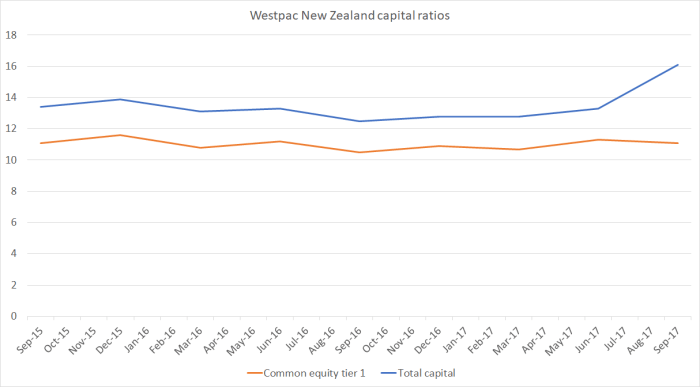
The third thing I didn’t pay much attention to last week was the statement that Westpac now had a total capital ratio (share of risk-weighted assets) of 16.1 per cent.  It seemed surprisingly high, but it was higher than the (temporarily increased) regulatory minima, and than the level Westpac had undertaken to maintain, so I passed over it quickly, and I shouldn’t have.

Here are Westpac New Zealand’s capital ratios (common equity tier one, and total capital) for the last couple of years.  The data are taken from disclosure statements and, for September 2017, from Westpac’s press release last week.

wpac capital ratios

I couldn’t find any reference anywhere to Westpac New Zealand Limited having issued any capital instruments on market in the September 2017 quarter.    But the Westpac New Zealand branch did issue $US1.25 billion of perpetual subordinated contingent convertible notes in September.  Those instruments would qualify as Tier One capital (though, of course, not as common equity).  Since we don’t yet have the September disclosure statement, we can’t be sure what went on, but it looks as though the proceeds of that issue might have been used to subscribe to (eg) a private placement of similar securities by Westpac New Zealand to its parent.  Whatever the story,  it seems unlikely that the sudden increase in Westpac New Zealand’s capital ratio had nothing to do with the fight they were then no doubt in with the Reserve Bank about the appropriate response to the model-approvals issue.

Again, we deserve a better explanation from the Reserve Bank (and Westpac) as to what actually went on.  For example, did the Reserve Bank insist that Westpac take on more capital, even beyond the temporarily increased regulatory minima, and then let Westpac raise the additional capital before letting the public (and depositors/creditors) in on what was going on?  Perhaps not, but the alternative –  in which Westpac New Zealand just happened to decide to raise more capital just before the regulatory sanction was announced  –  seems a bit implausible.  The news coverage would have been at least subtly different if last week’s announcement of the model approvals errors had been accompanied by the statement that Westpac New Zealand would need now to take steps to increase its level of capital (as distinct from just glossing over a fait accompli).

Which also brings us back to the unanswered questions?   We don’t know how much difference the use of unapproved models actually made to Westpac’s risk-weighted assets –  in fact, we don’t even know if the Reserve Bank knows.   And we don’t know if the Reserve Bank insisted on this new capital –  although it seems likely given that they noted that

In addition, the Reserve Bank has accepted an undertaking by Westpac to maintain its total capital ratio above 15.1 percent until all existing issues have been resolved.

when 15.1 per cent is well above even the temporarily higher regulatory minima for Westpac.

But if so, is the penalty proportionate to the offence?  It is impossible to tell, on the information the Reserve Bank has so far made available, and that isn’t a good state of affairs –  no basis for holding this (weakly-accountable) regulator to account.

And, to return to one of the questions I posed last week, why wouldn’t prosecution of the directors have been a more appropriate penalty, and one better-aligned with the design of the regulatory framework?  I’m not suggesting anyone should have gone to prison, but if what actually went on here was a governance design failure, surely it is an obvious case for trying out the penalty regime designed to ensure that directors do their job (of, among other things, ensuring that management do their job)?  A fine on each director –  for what are, after all, strict liability offences –  looks as though it could have been a more appropriate penalty.    But if such prosecutions had been contested, that might have forced the Reserve Bank to disclose more, including about their own system failures, than perhaps they would have been comfortable with?   Bureaucrats protect themselves, and their bureau.

As I said last week, I hope journalists use the opportunity of the Financial Stability Report press conference next week to pose some of these questions to the “acting Governor” and Geoff Bascand, the new Head of Financial Stability.  They can’t force the Reserve Bank to answer questions, but if the Bank continues to stonewall, in the face of repeated questions from multiple journalists, in a news conference that is live-streamed, it won’t be a good look for the Reserve Bank (or for Geoff Bascand personally, if he is still in the race to become the next Governor).


More questions than answers

When a Reserve Bank press release turned up yesterday afternoon, announcing that the Reserve Bank had temporarily increased the minimum capital requirements for Westpac’s New Zealand subsidiary, after breaches had been discovered in Westpac’s compliance with its conditions of registration, my initial reaction was a slightly flippant one.  It must, I thought, be nice for the Reserve Bank to be able to impose penalties when banks don’t do as they should, but it is a shame that there is no effective penalty operating in reverse.   When the Reserve Bank misses its inflation target, imposes new controls with threadbare justification, flouts the principles of the Official Information Act, allows OCR decisions to leak, or attempts to silence a leading critic what happens?  Well, nothing really.

But as I reflected on the Reserve Bank’s statement and the Westpac New Zealand, both reproduced here, I became increasingly uneasy.

This is what we know from the Reserve Bank

Westpac New Zealand Limited (Westpac) has had its minimum regulatory capital requirements increased after it failed to comply with regulatory obligations relating to its status as an internal models bank.

Internal models banks are accredited by the Reserve Bank to use approved risk models to calculate how much regulatory capital they need to hold. Westpac used a number of models that had not been approved by the Reserve Bank, and materially failed to meet requirements around model governance, processes and documentation.

The Reserve Bank required Westpac to commission an independent report into its compliance with internal models regulatory requirements. The report found that Westpac:
·currently operates 17 (out of 35) unapproved capital models;
·has used 21 (out of 32) additional unapproved capital models since it was accredited as an internal models bank in 2008; and
·failed to put in place the systems and controls an internal models bank is required to have under its conditions of registration.

The Reserve Bank has decided that Westpac’s conditions of registration should be amended to increase its minimum capital levels until the shortcomings and
non-compliance identified in the independent report have been remedied.  …..

In addition, the Reserve Bank has accepted an undertaking by Westpac to maintain its total capital ratio above 15.1 percent until all existing issues have been resolved.  The Reserve Bank has given Westpac 18 months to satisfy the Reserve Bank that it has sufficiently addressed those issues or it risks losing accreditation to operate as an internal models bank.

There is nothing additional in the Westpac statement, but they don’t appear to dispute either the Reserve Bank’s findings or its response.

There are a few things to clear away.  First, the temporary increase in the minimum capital requirements for Westpac New Zealand does not constitute a financial penalty at all.    Arguably that might be true even if it increased the actual amount of capital Westpac had to hold (Modigliani-Miller and all that), but this measure does not do that.    The Reserve Bank statement tells us that as 30 September, Westpac’s total capital ratio was 16.1 per cent.

That doesn’t mean it is no penalty at all.   I’m sure there has been a great deal of very uncomfortable anguishing in recent months both among Westpac New Zealand directors and senior management, and at head office (and the main board) in Sydney.  APRA is likely to have taken a very dim view of this sort of mismanagement by an Australian bank’s subsidiary.  And, of course, a lot of scarce staff time is now going to have be devoted to sorting these issues out over the next 18 months.  That resource has an opportunity cost –  other things those people could have been used for, which might have boosted the bank’s earnings.

But what I found more striking was how little either the Reserve Bank or Westpac statements said about breaches of conditions of registration which appear to go to the heart of our system of prudential supervision.

There is, for example, nothing at all in the Westpac statement about how these errors happened (use of numerous unathorised models, dating back to 2008), and not much contrition either.  The closest they come is this

WNZL is disappointed not to have met the RBNZ’s requirements in this area.

And our system of banking supervision is supposed to, at least in principle and in law, rely very heavily on attestations from each individual director that the bank they are directors of is fully in compliance with the conditions of registration (which includes provisions around calculation of minimum capital requirements and associated models).  But there is no apology from the directors, and no sign that any director has lost his or her job.   Potential heavy civil and criminal penalties –  including potential imprisonment –  are supposed to sufficiently focus the attention of directors that depositors and other creditors can rely on the information banks publish.  Westpac’s clearly haven’t been able to rely on their disclosure statements for almost a decade.  And yet there is no specific mention of the directors in the Reserve Bank’s statement either.

There is also nothing in either statement (Reserve Bank or Westpac) about the quantitative significance of the errors.   The Reserve Bank tells us that they accept that Westpac did not deliberately set out to reduce its regulatory capital, but intent and effect are two different things.    These problems appear to have been known about for more than a year –  Westpac tells us they first reported them in their September 2016 Disclosure Statement.  But was the effect, over the years since 2008, to reduce the amount of capital Westpac had to hold relative to what it would have been if they’d been using Reserve Bank approved models?  Or does no one –  at the Reserve Bank or Westpac –  yet know?   When the issues are sorted out will Westpac New Zealand be required to restate its capital ratios for the whole period since 2008?

The Reserve Bank’s own processes also seem lax at best.    And this comes closer to home for me, since I sat for a long time on the Bank’s internal Financial System Oversight committee.  The precise mandate of that committee was never fully clear –  in a sense, it was to provide advice on whatever issues the Governor wanted advice on –  and we didn’t typically do individual bank issues at this level of detail.  But that Committee provided advice to the then Governor to go forward with Basle II and, in particular (back in 2008), to allow the big banks to use internal-models based approaches to calculating regulatory capital requirements.    I don’t recall if anyone ever asked how we –  the Reserve Bank –  could be confident, on an ongoing basis, that an internal-models bank was actually using approved models.  But had anyone done so, I’m pretty sure the answer would have been along the lines of “director attestations” and the stiff potential civil and criminal penalties directors could face for what are, after all, strict liability offences (directors don’t have to be shown to have intended to mislead –  it is enough that their statements were subsequently found to be false.)

For a long time the concern was that any questions we (the Bank) asked of bank management would weaken the incentive on directors to get things right –  they might, after all, claim they had relied on us.   But that mentality had been changing in the last decade –  eg the Reserve Bank started collecting private information that creditors don’t have access to.     But where were the questions around Westpac’s models?  After all, it wasn’t a single model where someone overloooked getting Reserve Bank sign-off, but roughly half of all the models, stretching back years.

If there is nothing in the Reserve Bank statement about steps the Bank may have taken to improve its own monitoring and recordkeeping (given that they had to grant approval, how did they not know that so many models were being used and had had no approval?), there is also nothing about any steps they may have taken to assure themselves that there are not similar problems in any of the other IRB banks.   Have they even asked the question?  Surely, one would think, but mightn’t we expect to be told?

As I noted, there was no mention of the directors in the Reserve Bank statement.  But did the Reserve Bank consider taking prosecutions against Westpac’s directors, who signed false disclosure statements over the years from 2008 to 2016?  If not, why not?  If the directors believed (as presumably they did) that the statements they were signed were correct, did they have reasonable grounds for that belief?  What procedures or inquiries had they instituted over eight years that (a) they had confidence in, and (b) still proved wrong?  The Reserve Bank insists on independent directors: those on the Westpac NZ board look quite impressive, but what were they doing all those years?

If the Reserve Bank has lost confidence in a system of rather condign punishment of directors, perhaps it should tell us so, and seek legislative changes.  But if it really still believes that director attestations have a central role in the framework, surely this is as good an episode, and time, to make an example of someone as there is ever likely to be?  After all, it was about a core aspect of the regulatory framework (capital requirements), and comes at times when there are no jitters around the health of the financial system.  If there is no penalty for directors, no doubt directors of other banks will take note.

And then there is the question of the other (apparent) breaches of the conditions of registration. I don’t make a habit of reading Disclosure Statements (and don’t bank with Westpac anyway –  although, come to think of it, the Reserve Bank Superannuation scheme, that the “acting Governor” is a trustee of, does).  But I had a quick look at the latest Westpac statement.  On page 2, there is half page of disclosures of things Westpac NZ is not compliant with.  Several appear to be dealt with by yesterday’s announcement, but another five don’t.   Perhaps they are all pretty small matters –  they look that way to this lay reader – but banks are supposed to be fully compliant.   It is the law.

From the Reserve Bank’s side, the press statement went out in the name of Deputy Governor (and new Head of Financial Stability) Geoff Bascand.  But he has been in the role for less than two months now.  By contrast, “acting Governor” Grant Spencer was head of financial stability from 2007 to 2017, spanning the entire period of the use of internal models, and one of his direct reports, the head of prudential supervision, has also been in his role that entire time.    One would hope that the Reserve Bank’s Board is now asking some pretty serious questions about just what went on, about how the Reserve Bank has handled these issues over the last decade, and about how much confidence New Zealanders can have in an avowedly hands-off system.

Most probably, the empirical significance of this protracted breach of the rules will prove to have been small.  For that small mercy, we should of course be grateful.  But it is also small comfort because the fact that such breaches could go on for so long –  and the statements aren’t even clear how they came to light – leaves one wondering about what other gaps we (or the Reserve Bank, or Westpac or other IRB banks) might not yet know about.  Often enough, such problems only come to light when it is too late.   In many other central banks and regulatory agencies, if they hear about this episiode, there will be tut-tutting along the lines of “well, that is what you get when you don’t have on-site supervision of banks”.  Personally I wouldn’t want to see New Zealand go that way, but my confidence in our approach has taken a blow in the last 24 hours.

The Reserve Bank has a review of capital requirements underway at present.  I hope final decisions are not going to be made before a new Governor is in place.   There is plenty of unease around the use of internal-models for calculating capital requirements –  especially for rather vanilla banks such as those operating here.  Personally, I’d be comfortable moving away from that system, back to a standardised model for calculating capital (which would, among other things, put Kiwibank –  somewhat put upon by the Reserve Bank – and TSB on the same footing as the large banks).  But, for now, the law is the law, and needs to be seen to be enforced.  A breach of this sort, with little serious direct penalty, risks undermining confidence in our system.

And, of course, there is the small matter of openness.  Not every aspect of the Reserve Bank’s dealing with an individual bank can be published, but there are a lot of questions –  including about the Reserve Bank itself –  to which we really should be entitled to more answers than the Bank has yet given us.

I hope some journalists are willing to pursue the matter further.  Questions could be directed to David McLean, the well-regarded Westpac NZ CEO, to the Board members past and present (especially the independents), perhaps to the parent bank in Sydney, and –  of course –  to Grant Spencer and Geoff Bascand –  if not before then at their next (financial stability) press conference, which is now only a couple of weeks away.


The Reserve Bank second XI takes the field

The second XI at the Reserve Bank fronted up to present today’s Monetary Policy Statement.    There was the unlawfully appointed “acting Governor” Grant Spencer –  who is now signing himself as “Governor”, not even as acting Governor –  the chief economist, John McDermott, and the new head of financial stability (and openly acknowledged applicant for Governor) Geoff Bascand.    At best, they are holding the fort until the new Governor is appointed, and a new Policy Targets Agreement put in place, but despite that Spencer still felt confident enough to assert that “monetary policy will remain accommodative for a considerable period”.     How would he know?  He won’t be there.

One could feel a little sorry for the Bank.  After all, not only is the second XI holding the fort, but a new government took office only a week or so ago.    Between Labour’s manifesto commitments and the agreements with New Zealand First and the Greens, there are a lot of new policy measures coming.  But there is not a lot of detail on most of them.    The Bank’s typical approach in the past has been not to incorporate things into the economic projections until they become law (at, in the case of fiscal policy, in a Budget).   They’ve departed from that approach on this occasion, and have incorporated estimates of the macro effects of four new policies:

  • fiscal policy,
  • minimum wage policy,
  • Kiwibuild, and
  • changes to visa requirements affecting students and work visas.

I suspect they’d have been better to have waited.  On fiscal policy, for example, there are no publically available numbers yet –  just last week the Prime Minister told us to wait for the HYEFU.    On immigration, there has been nothing from the new government on the timing of any changes.  And on Kiwibuild, there is no sign of any analysis behind the assumption the Bank has made that around half of Kiwibuild activity will displace private sector building that would otherwise have taken place.  And so on.

And then there are the numerous other policy promises the Bank hasn’t accounted for.  In the Speech from the Throne yesterday there was a clear commitment to “remove the Auckland urban growth boundary and free up density controls” in this term of government.  If so, surely that would be expected to affect house prices and perhaps building activity?   Binding carbon budgets are also likely to have macro effects.

I’m not suggesting the Bank can produce good estimates for any of these effects.  Rather, they’d have been better to have stayed on the sidelines for a bit longer, since they were under no pressure at all to change the OCR today, rather than incorporate rough and ready estimates of a handful of forthcoming changes, with little sign that they have really stood back and thought about how the economy is unfolding.

And the conclusions they’ve come to do seem rather questionable.  The “acting Governor” kicked off his press conference talking of the “very positive” economic outlook.  I’m not sure how many other people will agree with him. As the Bank themselves note, they’ve been surprised on the downside by recent GDP outcomes, and housing market activity has been fading.  Even dairy prices have been edging back down, and oil prices have been rising.  (And, of course, there has been no productivity growth for years.)

The Bank forecasts an acceleration of economic growth –  even as population growth slows –  on the back of additional fiscal stimulus and additional building activity under the Kiwibuild programme.    Like other commentators, I’m rather sceptical that we will see anything quite that strong.  But even on their own numbers, productivity growth over the next few years is now projected to be weaker than the Bank was projecting in August.       And if Kiwibuild really is going to add so much to housing supply, in conjunction with slower population growth than the Bank was expecting, how plausible is it real house prices will simply be flat as far the eye can see (or the forecasts go)?  Not very, I’d have thought.

In the end, the numbers don’t matter very much.  Spencer will be gone at the end of March, and we’ll have a new Governor and a new PTA.  A new Governor will make his or her own assessment, and own OCR decisions.  But part of what that person will need to do is take a look at lifting the quality of the Bank’s economic analysis.

For all the talk of initiatives promised by the new government, the Monetary Policy Statement itself was striking for containing not a word –  not one –  mentioning that the monetary policy regime itself is under review.  Of course the “acting Governor” can’t pre-empt changes the detail of which aren’t known, but the Act does require the Bank to discuss in MPSs how monetary policy might be conducted over the following five years: a horizon over which we’ll have a different PTA, a different Governor, an amended statutory mandate, and a statutory committee to make decisions.

My main interest was in the contents of the press conference, where journalists raised both the issue of the proposed new mandate and the proposed changes to the statutory decisionmaking model.    In both cases, I suspect the second XI said too much.

Asked about the proposed mandate changes, Spencer began noting that he couldn’t say too much as the review was just getting started.  He then went on to assert that “moving to a dual mandate was unlikely to have a major impact on how policy is run”, explaining that in many ways flexible inflation targeting is akin to a “dual mandate” (something that, in principle, I agree with).     But then, somewhat surprisingly, he claimed that the proposed change could lead the Bank to become more flexible, potentially allowing greater volatility in inflation to promote greater stability in employment.  I guess it depends on the details of the changes, which none of us yet knows, but it was the first I’d heard of anyone calling for more volatility in inflation.  Over the last decade, those who think the Bank hasn’t put sufficient weight on the labour market indicators (like me) would have been quite happy to have seen core inflation at the target midpoint on average.  The previous Governor committed to that, but didn’t deliver.

On which note, it was a little surprising to hear the Chief Economist talk about how the Bank had improved its forecasts, and got its inflation forecasts right over the last couple of years.  That would then explain why core inflation has remained persistently below the target midpoint???  And has not got even a jot closer in the last couple of years?

Spencer noted that at present the Bank regarded the labour market as ‘pretty balanced’, such that a dual mandate wouldn’t make much difference right now.   But it turns out that they really don’t know.

They were asked a question about the government’s goal of getting the unemployment rate below 4 per cent, and –  fairly enough –  drew a distinction between structural policies that might lower the NAIRU and anything monetary policy could do.  When pushed, they argued that on current structural policies, an unemployment rate lower than 4 per cent would be inflationary, and suggested that estimates of the NAIRU range from 4 to 5 per cent at present.

But then all three of the second XI went on.  Spencer noted that the estimates are ‘very uncertain” and that in anticipation of a “dual mandate” the Bank was now doing some work to come up with some estimates of the NAIRU, suggesting that they haven’t had a precise estimate until now [although there were always assumptions embedded in the model].    Then the chief economist –  who at almost every press conference tries to discourage the use  of a NAIRU concept –  chipped in claiming that any NAIRU was “very very variable” and “changes all the time”, without offering a shred of evidence for that proposition.

And then the head of financial stability chipped in, opining that estimates of NAIRUs around the world have been declining (not apparently seeing any connection between this thought and (a) the NZ experience, and (b) his colleague’s observation a few moments earlier that the numbers were pretty meaningless anyway.

Out of curiousity I had a look at the OECD’s published NAIRU estimates.  This is the NAIRU for the median OECD monetary areas (ie countries with their own monetary policy plus the euro-area as a whole).

nairu oecd

The estimate for 2017 is 5.3 per cent.  That for 2007 was 5.5 per cent.     There just isn’t much short-run variability in the structural estimates of the long-run sustainable unemployment rate. That is true for other advanced countries.  It is almost certainly true for New Zealand.    It reflects poorly on the Reserve Bank how little they’ve done in this area, and it one reason why a change in the wording of the statutory mandate is appropriate.  The unemployment rate is a major measure of excess capacity, pretty closely studied by most central banks but not, until now it appears, by our own.

(Of course, had they wanted to be a little controversial, they could have noted that proposed structural policy changes –  notably the increased minimum wages they explicitly allowed for –  will tend to raise (not lower) the NAIRU to some extent.)

If they were at sea on the unemployment rate issue, what really staggered me was the way Spencer (and Bascand) used the press conference to campaign for minimal changes to the statutory governance and decisionmaking model for monetary policy.      They didn’t need to say more than “decisionmaking structures are ultimately a matter for Parliament, and we will be providing some technical input and advice to the Treasury-led process the Minister of FInance announced earlier in the week”.

But instead, they took the opportunity to campaign for as little change as possible.  Spencer noted that they agreed the Act should be changed to provide for a committee, but noted that they already had a committee, they thought it worked well, and they would like to reflect that in the Act.   Others might challenge whether the advisory committee, or the Governor, has done such a good job in the last five years (or today) but set that to one side for the moment.

They loftily conceded that there were possible advantages to having externals on a committee –  the potential for greater diversity of view. But they were concerned that in a small country it could be very difficult to find outsiders with unconflicted expertise to make the system work.  There was nothing to back this –  no explanation, for example, as to how places like Norway and Sweden manage, or how we manage to fill the numerous other government boards in New Zealand.

But what they really hate –  and I knew this, but was still surprised to hear them proclaim it so openly, just as a proper review is getting underway –  is the idea that any differences of view might be known to the public.   They could, we were told, tolerate a system of ‘collective responsibility’ –  in which all debates are in-house and then everyone presents a monolithic front externally –  but were strongly opposed to any sort “individualistic committee” in which individual views might become known.    These systems –  of the sort prevailing in the UK, the United States, Sweden, and the euro-area –  have, they claimed, the potential to become a “circus” with too much media focus on monetary policy, and a concern about “heightened volaility” in financial markets.   Spencer went so far as to suggest that an individualistic approach could undermine the reputation and credibility of the institution.

A slightly flippant observer might suggest that the second XI and their former boss have done that all by themselves –  between the actual conduct of policy, and attempts (in which they all participated) to silence one of their chief critics.  A more serious observer might ask for some evidence from the international experience, to suggest that the more individualistic approach has damaged the standing of the Fed, the BOE, or the Riksbank.  Are these less well-regarded organisations than the Reserve Bank of New Zealand?    I’d have thought it would be hard to find such evidence.

Bascand –  one of the declared candidates for Governor –  then chipped in to note that what management was concerned about was to ensure that the focus of discussion was on the issues “the Bank” had identified, not on individuals or their particular views. Loftily –  earnestly no doubt – he declared that they wanted the focus to be on substance.  No doubt, as defined by management.   It reinforces the point I’ve made often that Bascand is the candidate for the status quo.  Bureaucrats setting out to protect their bureau.  Predictable behaviour – even if usually more subtle than this –  and what the public need protecting from.

There are successful central banks that adopt the collegial approach –  the RBA is one, albeit one with a rather old-fashioned committee decisionmaking model –  but there is nothing to suggest, in the international experience, that that model produces better outcomes, or a more credible central bank, than the individualistic approach.  Indeed, many observers would regard Lars Svensson’s open disagreement with his colleagues on the Riksbank decisionmaking committee as a useful part of the process that finally led the rest of the committee, including the Governor, to abandon their previous excessively hawkish approach a few years ago.

The second XI’s approach is that of “the priesthood of the temple” –  we will tell you, the great unwashed, only what it suits us to tell you, in the form we want to present it.  It is simply out of step with notions of open government, or with a serious recognition that monetary policy is an area of great uncertainty and understanding is most likely to be advanced by the open challenge and contest of ideas.

Fortunately, the new government shows signs of seeing things differently.   There is a minister for open government (admittedly, lowly ranked), a commitment to improving transparency under the Official Information Act.  And in the Speech from the Throne yesterday there was an explicit commitment –  not referenced by the Second XI, still trying to relitigate – that

“The Bank’s decision-making processes will be changed so that a committee, including external appointees, will be responsible for setting the Official Cash Rate, improving transparency.”

Note the use of “will”.   The Bank management’s preference for a “collective model” would do nothing at all to improve transparency.

It is all a reminder of how uncertain things still are, and how important the membership of the Independent Expert Advisory Panel the Minister of Finance has pledged to appoint as part of review of the Act might be (including whether the panel is really “expert” or –  as rumour suggests – a politician might chair it).   And also how important it is that Bank management do not have a leading say in the advice that goes to the Minister.  Management is paid to implement Parliament’s choices, not to devise models that cement in the dominance (and secrecy) of management.

It is also a reminder of just how important the appointment of the new Governor is, and why it remains hard to be confident about just how committed the government is to serious change when they’ve left that appointment in the hands of the Reserve Bank Board –  all appointed by the previous government, all on record endorsing the way things have gone for the last five years, and with a strong track record of serving the interests of management rather than those of (a) the public and (b) good public policy.

The Robertson reviews of the RB Act

When you’ve favoured a reform for the best part of 20 years, and made the case for it –  inside the bureaucracy and out –  for several years, then, even though it was a reform whose time was coming eventually, there is something deeply satisfying about hearing the Minister of Finance confirm that legislative change will happen.    That was my situation yesterday when Grant Robertson released the terms of reference for the review of the Reserve Bank Act, including specific steps that will before long end the single decisionmaker approach to managing monetary policy.   Various Opposition parties had called for change (the Greens for the longest), market economists had favoured change,  The Treasury had tried to interest the previous government in change five or six years ago, before Graeme Wheeler was appointed.  But now the Minister of Finance has confirmed the government’s intention to introduce legislation next year.   The amended legislation won’t be in place before the new Governor takes office, but presumably the policy will be clear enough by then that the new Governor will know what to expect, and what is expected of him or her.  Reform was overdue, but at least it now looks as though it will happen.

There were several aspects to yesterday’s announcement from the Minister of Finance:

  • the new “Policy Targets Agreement”,
  • the two stage process for an overhaul of the Reserve Bank Act, and
  • inaction on the appointment of the new Governor.

In what looks like not much more than a photo opportunity, Grant Robertson got Grant Spencer, current “acting Governor” of the Reserve Bank over to his office and together they signed a “Policy Targets Agreement” that was, in substance, identical to the one Steven Joyce and Grant Spencer had signed in June.

There was no legal need for a new Policy Targets Agreement (even if either of these two documents had legal force, which they don’t), and no incoming Minister of Finance has ever before requested a new PTA (the Minister has to ask, and can’t insist) that is exactly the same as the unexpired one that was already in place.   When National came to power in 2008, they did ask for a new PTA.   The core of the document –  the obligations on the Governor –  weren’t altered, but they did replace clause 1(b), which describes the government’s economic policy and how the pursuit of price stability fits in.  Under Labour that had read

The objective of the Government’s economic policy is to promote sustainable and balanced economic development in order to create full employment, higher real incomes and a more equitable distribution of incomes. Price stability plays an important part in supporting the achievement of wider economic and social objectives.

National replaced that with

The Government’s economic objective is to promote a growing, open and competitive economy as the best means of delivering permanently higher incomes and living standards for New Zealanders. Price stability plays an important part in supporting this objective.

If the new Minister of Finance really thought a new PTA was required to mark his accession to office, surely he could have at least replaced the National government’s policy description with one of his own –  even simply going back to Michael Cullen’s formulation, which actually mentioned full employment.

Apart from the photo op, I’m not sure what yesterday’s re-signing was supposed to achieve.  The Minister presented it as providing certainty to markets, but it does nothing of the sort: we are in the same position now we were a couple of days ago, Robertson had already told us he wouldn’t make substantive changes until the new Governor was appointed and we still have no idea who that person will be, or what the precise mandate for monetary policy only a few months hence will look like.  Nor, presumably, does the Reserve Bank.

And by signing the document, Robertson seems to have bought into Steven Joyce’s “pretty legal” (but almost certainly nothing of the sort) approach to the appointment of an “acting Governor”.    As I’ve noted previously, the Reserve Bank Act does not provide for an acting Governor except when a Governor’s term is unexpectedly interrupted (death, dismissal, resignation or whatever), and –  consistent with this –  there is no provision in the Act for a new Policy Targets Agreement with an acting Governor (since a lawful acting Governor will only be holding the fort during the uncompleted term of a permanent Governor who would already have had a proper and binding PTA in place).    Spencer’s appointment appears to have been unlawful, and Robertson has now made himself complicit in this fast and loose approach to the law.   Consistent with the fast and loose approach, he allowed Spencer to sign yesterday’s Policy Targets Agreement as “Governor”, not as “acting Governor”.  He cannot be Governor, since under the Act any Governor has –  for good reasons around operational independence – to have been appointed for an initial term of five years.  And he isn’t acting Governor, since there is no lawful provision for him to be so in these circumstances.  At best, he is “acting Governor” –  someone purporting to hold that title.

The heart of yesterday’s announcement, however, was the two stage process for reviewing and amending the Reserve Bank Act.

Phase 1:

The review will:
• recommend changes to the Act to provide for requiring monetary policy decision-makers to give due consideration to maximising employment alongside the price stability framework; and

• recommend changes to the Act to provide for a decision-making model for monetary policy decisions, in particular the introduction of a committee approach, including the participation of external experts.

• consider whether changes are required to the role of the Reserve Bank Board as a consequence of the changes to the decision making model.

A Bill to progress the policy elements of the review, including on the details necessary to introduce a potential committee for monetary policy decisions, will be introduced as soon as possible in 2018. This will give greater certainty on the direction of reform in advance of the appointment of the next Reserve Bank Governor, currently scheduled in March 2018.

Phase 1 of the review will be led by the Treasury, on behalf of the Minister of Finance. The Treasury will work closely with the Reserve Bank who will provide expert and technical advice. An Independent Expert Advisory Panel will be appointed by the Minister of Finance to provide input and support to both phases of the Review.

Phase 2:
In line with the Government’s coalition agreement to review and reform the Reserve Bank Act, the Reserve Bank and the Treasury will jointly produce a list of areas where further investigations of the Reserve Bank’s activities are desirable. This list will be produced in consultation with the Independent Expert Advisory Panel.

This list, and the next steps for the review, will be communicated early in 2018. This phase of the review will incorporate the review of the macro-prudential framework that was already scheduled for 2018.

It is clearly intended as a pragmatic approach.  With a new Governor to take office in March, they want to get on with the specific changes Labour campaigned on  so that they come into effect as soon as possible after the new Governor is in office (realistically, it is still hard to envisage the new Monetary Policy Commitee making OCR decisions and publishing Monetary Policy Statements until very late next year –  perhaps the November 2018 MPS – at the earliest.)  It also appears to aim to separate the things on which the government mostly just wants advice on how best to implement changes they’ve promised, from other issues that may need looking at but where the parties in government have not taken a strong position.

But it still leaves me a little uneasy, on a couple of counts.

First, while it would be easy enough, after due consideration, to make limited changes to the Act to give effect to the desire to make explicit a focus on employment/low unemployment without many spillovers into the rest of the Act (I listed here a handful of clauses I think they could amend to do that),  I’m less sure that is true of the monetary policy decisionmaking provisions.    As the terms of reference note, if monetary policy decisions are, in future, to be made by a statutory committee, it raises questions about the role of the Bank’s Board –  whose whole role at present is built around the single decisionmaker (the Governor has personal responsibility for all Bank decisions not just monetary policy ones).

But how can you sensibly make decisions about the future role of the Board without knowing what changes (if any) you might want to make to the Bank’s other functions?  If, in the end, you leave all the other powers in the hands of the Governor personally, something like the current Board structure might still make sense, with some minor changes as regard monetary policy decisions.  But if you concluded that a statutory committee was also appropriate for financial stability issues, and that even the corporate functions should be governed in more conventional ways (Board decides, chief executive implements), there might be no place at all for a Board of the sort (ex post monitoring and review agency) we have now.    Decisions about the governance of an institution need to start by taking account of all the responsibilities of the institution, not just one prominent set of powers.

Second, it may be difficult to maintain momentum for more comprehensive reform once the government’s own immediate priorities have been dealt with.    On paper, it doesn’t look like a problem, but resources are scarce, legislating takes time and energy, implementing new arrangements for monetary policy takes time and energy, and it would be easy for momentum on the second stage to lapse (whether at the bureaucratic level, or getting space on the government’s legislative agenda).    That risk is compounded by an important distinction between phases one and two.    In phase one, the Treasury is clearly taking the lead, on behalf the Minister.  In phase two, we are told, “the Reserve Bank and the Treasury”  (the order is theirs) will “jointly” produce a “list of areas where further investigations of the Reserve Bank’s activities are desirable”.    A joint list raises the possibility of the Bank holding a blocking veto –  not formally, but in practice –  and where the Bank is more interested in (a) blocking other far-reaching changes that might constrain management’s freedoms, and (b) advancing whatever list of minor reforms it might have in mind itself.

Perhaps in the end much will depend on the Minister himself, and on the Independent Expert Advisory Panel he plans to appoint.  But the Minister of Finance will be a very busy man, and up to now he has shown little interest in reforms of the Reserve Bank legislation beyond the first stage ones.

What of the panel?  We’ll know more when we see what sort of people are appointed to it, and how much time they are being asked to give to the issue.

In a set of Q&As released with yesterday’s announcement the Minister indicated of the panel that “they will be individuals with independence and stature in the field of monetary policy, including governance roles”.   That is probably fine for phase one (which is monetary policy focused), but the bulk of the Bank’s legislation, and much of its responsibility, has nothing to do with monetary policy at all.  So if the panel is going to play a substantive role in the planned phase 2, I’d urge the Minister to consider casting his net a bit wider.

As to who might serve on it, there aren’t that many with what look like the right mix of skill, experience, and independence.  It is sobering to reflect that when the (still secret) Rennie review on related issues was done earlier in the year, not a single domestic expert was consulted.  I imagine they will want to draw mainly on people who actually live here.  But if possible, I would urge Treasury and the Minister to consider inviting Lars Svensson to be part of the panel –  as someone who has undertaken a previous review for an earlier Labour government, someone who supports an explicit employment focus, and someone with practical experience as a monetary policy decisionmaker.    David Archer – a New Zealander (and former RB senior manager) who now heads the BIS central banking studies department – might also be worth drawing on.

The third dimension of yesterday’s announcement was the Minister of Finance’s comments about the process for appointing a new Governor.    There I think he is making a mistake.

In his Q&As, the Minister noted that “the process for appointing a new Governor is in the hands of the Board”.

Newsroom reports that, when asked, Robertson noted that

“I’ve met with the chair of the board and he has assured me that process is underway and well under way and going well. I sought an assurance from him that any candidates he was interviewing would be ones who would be able to implement a change to policy along the lines we’re going, he expressed his confidence about that but in the end the process itself lies in his hands.”

Appointing a new Governor of the Reserve Bank is –  or should be –  the most consequential appointment Robertson will make in the next three years.  For a time that person will, single-handedly, wield short-term macro-stabilisation policy (which is what monetary policy is) and –  perhaps indefinitely –  will wield all the regulatory powers of the Bank.  Even if committees end up being established for both main functions, the Governor will have –  and probably should have –  a big influence on how, and how well, macro and financial regulatory policy is conducted over the next five years.

There has been a pretty widespread sense that the Reserve Bank in recent years has not been operating at the sort of level of performance –  on various dimensions –  citizens and other stakeholders should expect.  That isn’t just about substantive decisions, but about supporting analysis, communications, operating style etc.  And yet the Reserve Bank Board –  and chairman Quigley –  have backed the past Governor all the way (whether on minor but egregious issues like the attempts to silence Stephen Toplis, or on the conduct of monetary and regulatory policy).   But the new government claims to want something different.   The issue isn’t whether a potential candidate can, as a technical matter, manage the sort of phase 1 changes the Minister plans.  I’m sure any competent manager could.  The more important issues are around alignment and vision.  Is the Minister content to leave the process to the Board –  all appointed by the previous government – and take a chance on them coming up with someone who represents more than just the status quo?   At this point, it appears so.  Apparently, the selection process will not be reopened, even though the advertising closed months ago and the role of the Bank (and Governor) is to be changed.

It is quite an (ongoing) abdication by the new Minister. In (almost all) other countries, the Governor of the Reserve Bank is appointed directly by political leaders (Minister of Finance, head of government or whoever).   Those leaders no doubt take soundings in various quarters, but the power –  and the responsibility –  rests with the politician.   Here, Grant Robertson just rolls the dice –  relying on a bunch of private sector directors appointed by his predecessors –  without (it seems, from the tone of his comment above) a high degree of confidence in the outcome.  Perhaps he’ll like who the Board comes up with. But if he doesn’t, so much time will have passed that he’ll be stuck. He can reject a Board nomination, but they’ll just come back with the next person on their own list, evaluated according to their own sense of priorities etc.  It isn’t the way appointments to very powerful positions –  the most powerful unelected person in the country for the time being –  should be done.

And two, very brief, final points:

  • now that the government has changed, and the Minister who asked for the Rennie review of Reserve Bank governance issues has gone, surely there can be no good grounds for continuing to withhold Rennie’s report and associated papers?  It is not as if it is playing any role in the current Minister’s thinking.

    Newsroom also asked Robertson if he had seen a review of the bank undertaken by former State Services Commissioner Iain Rennie that was requested by former Finance Minister Steven Joyce.   He said he was yet to see it, but had asked Treasury about it.

  • we are told to expect a new Policy Targets Agreement when the new Governor is appointed.   Presumably, true to past practice, the first the public will know about it is when the document –  guide to macro-management for the next five years –  is released.    It would good if the Minister of Finance would commit now to proper transparency, including pro-active release (once the document is signed) of  relevant documents.  It would be better still if he would think about adopting the considerably more open, and rigorous, Canadian model.

    Less than a year since completing the last review of its inflation-targeting mandate, the Bank of Canada is starting to prepare for the next one in 2021.

    Consultations kick off in Ottawa on Sept. 14 with an invitation-only workshop of economists that will be webcast on the central bank’s website. It’s an early public start to the process, and comes amid a growing sense that a deeper look at the inflation target is needed after almost a decade of poor economic performance.

A more open approach to these issues – as practised in Canada for years – has much to commend it (even if I didn’t always think so when I was a bureaucrat.)