The Robertson reviews of the RB Act

When you’ve favoured a reform for the best part of 20 years, and made the case for it –  inside the bureaucracy and out –  for several years, then, even though it was a reform whose time was coming eventually, there is something deeply satisfying about hearing the Minister of Finance confirm that legislative change will happen.    That was my situation yesterday when Grant Robertson released the terms of reference for the review of the Reserve Bank Act, including specific steps that will before long end the single decisionmaker approach to managing monetary policy.   Various Opposition parties had called for change (the Greens for the longest), market economists had favoured change,  The Treasury had tried to interest the previous government in change five or six years ago, before Graeme Wheeler was appointed.  But now the Minister of Finance has confirmed the government’s intention to introduce legislation next year.   The amended legislation won’t be in place before the new Governor takes office, but presumably the policy will be clear enough by then that the new Governor will know what to expect, and what is expected of him or her.  Reform was overdue, but at least it now looks as though it will happen.

There were several aspects to yesterday’s announcement from the Minister of Finance:

  • the new “Policy Targets Agreement”,
  • the two stage process for an overhaul of the Reserve Bank Act, and
  • inaction on the appointment of the new Governor.

In what looks like not much more than a photo opportunity, Grant Robertson got Grant Spencer, current “acting Governor” of the Reserve Bank over to his office and together they signed a “Policy Targets Agreement” that was, in substance, identical to the one Steven Joyce and Grant Spencer had signed in June.

There was no legal need for a new Policy Targets Agreement (even if either of these two documents had legal force, which they don’t), and no incoming Minister of Finance has ever before requested a new PTA (the Minister has to ask, and can’t insist) that is exactly the same as the unexpired one that was already in place.   When National came to power in 2008, they did ask for a new PTA.   The core of the document –  the obligations on the Governor –  weren’t altered, but they did replace clause 1(b), which describes the government’s economic policy and how the pursuit of price stability fits in.  Under Labour that had read

The objective of the Government’s economic policy is to promote sustainable and balanced economic development in order to create full employment, higher real incomes and a more equitable distribution of incomes. Price stability plays an important part in supporting the achievement of wider economic and social objectives.

National replaced that with

The Government’s economic objective is to promote a growing, open and competitive economy as the best means of delivering permanently higher incomes and living standards for New Zealanders. Price stability plays an important part in supporting this objective.

If the new Minister of Finance really thought a new PTA was required to mark his accession to office, surely he could have at least replaced the National government’s policy description with one of his own –  even simply going back to Michael Cullen’s formulation, which actually mentioned full employment.

Apart from the photo op, I’m not sure what yesterday’s re-signing was supposed to achieve.  The Minister presented it as providing certainty to markets, but it does nothing of the sort: we are in the same position now we were a couple of days ago, Robertson had already told us he wouldn’t make substantive changes until the new Governor was appointed and we still have no idea who that person will be, or what the precise mandate for monetary policy only a few months hence will look like.  Nor, presumably, does the Reserve Bank.

And by signing the document, Robertson seems to have bought into Steven Joyce’s “pretty legal” (but almost certainly nothing of the sort) approach to the appointment of an “acting Governor”.    As I’ve noted previously, the Reserve Bank Act does not provide for an acting Governor except when a Governor’s term is unexpectedly interrupted (death, dismissal, resignation or whatever), and –  consistent with this –  there is no provision in the Act for a new Policy Targets Agreement with an acting Governor (since a lawful acting Governor will only be holding the fort during the uncompleted term of a permanent Governor who would already have had a proper and binding PTA in place).    Spencer’s appointment appears to have been unlawful, and Robertson has now made himself complicit in this fast and loose approach to the law.   Consistent with the fast and loose approach, he allowed Spencer to sign yesterday’s Policy Targets Agreement as “Governor”, not as “acting Governor”.  He cannot be Governor, since under the Act any Governor has –  for good reasons around operational independence – to have been appointed for an initial term of five years.  And he isn’t acting Governor, since there is no lawful provision for him to be so in these circumstances.  At best, he is “acting Governor” –  someone purporting to hold that title.

The heart of yesterday’s announcement, however, was the two stage process for reviewing and amending the Reserve Bank Act.

Phase 1:

The review will:
• recommend changes to the Act to provide for requiring monetary policy decision-makers to give due consideration to maximising employment alongside the price stability framework; and

• recommend changes to the Act to provide for a decision-making model for monetary policy decisions, in particular the introduction of a committee approach, including the participation of external experts.

• consider whether changes are required to the role of the Reserve Bank Board as a consequence of the changes to the decision making model.

A Bill to progress the policy elements of the review, including on the details necessary to introduce a potential committee for monetary policy decisions, will be introduced as soon as possible in 2018. This will give greater certainty on the direction of reform in advance of the appointment of the next Reserve Bank Governor, currently scheduled in March 2018.

Phase 1 of the review will be led by the Treasury, on behalf of the Minister of Finance. The Treasury will work closely with the Reserve Bank who will provide expert and technical advice. An Independent Expert Advisory Panel will be appointed by the Minister of Finance to provide input and support to both phases of the Review.

Phase 2:
In line with the Government’s coalition agreement to review and reform the Reserve Bank Act, the Reserve Bank and the Treasury will jointly produce a list of areas where further investigations of the Reserve Bank’s activities are desirable. This list will be produced in consultation with the Independent Expert Advisory Panel.

This list, and the next steps for the review, will be communicated early in 2018. This phase of the review will incorporate the review of the macro-prudential framework that was already scheduled for 2018.

It is clearly intended as a pragmatic approach.  With a new Governor to take office in March, they want to get on with the specific changes Labour campaigned on  so that they come into effect as soon as possible after the new Governor is in office (realistically, it is still hard to envisage the new Monetary Policy Commitee making OCR decisions and publishing Monetary Policy Statements until very late next year –  perhaps the November 2018 MPS – at the earliest.)  It also appears to aim to separate the things on which the government mostly just wants advice on how best to implement changes they’ve promised, from other issues that may need looking at but where the parties in government have not taken a strong position.

But it still leaves me a little uneasy, on a couple of counts.

First, while it would be easy enough, after due consideration, to make limited changes to the Act to give effect to the desire to make explicit a focus on employment/low unemployment without many spillovers into the rest of the Act (I listed here a handful of clauses I think they could amend to do that),  I’m less sure that is true of the monetary policy decisionmaking provisions.    As the terms of reference note, if monetary policy decisions are, in future, to be made by a statutory committee, it raises questions about the role of the Bank’s Board –  whose whole role at present is built around the single decisionmaker (the Governor has personal responsibility for all Bank decisions not just monetary policy ones).

But how can you sensibly make decisions about the future role of the Board without knowing what changes (if any) you might want to make to the Bank’s other functions?  If, in the end, you leave all the other powers in the hands of the Governor personally, something like the current Board structure might still make sense, with some minor changes as regard monetary policy decisions.  But if you concluded that a statutory committee was also appropriate for financial stability issues, and that even the corporate functions should be governed in more conventional ways (Board decides, chief executive implements), there might be no place at all for a Board of the sort (ex post monitoring and review agency) we have now.    Decisions about the governance of an institution need to start by taking account of all the responsibilities of the institution, not just one prominent set of powers.

Second, it may be difficult to maintain momentum for more comprehensive reform once the government’s own immediate priorities have been dealt with.    On paper, it doesn’t look like a problem, but resources are scarce, legislating takes time and energy, implementing new arrangements for monetary policy takes time and energy, and it would be easy for momentum on the second stage to lapse (whether at the bureaucratic level, or getting space on the government’s legislative agenda).    That risk is compounded by an important distinction between phases one and two.    In phase one, the Treasury is clearly taking the lead, on behalf the Minister.  In phase two, we are told, “the Reserve Bank and the Treasury”  (the order is theirs) will “jointly” produce a “list of areas where further investigations of the Reserve Bank’s activities are desirable”.    A joint list raises the possibility of the Bank holding a blocking veto –  not formally, but in practice –  and where the Bank is more interested in (a) blocking other far-reaching changes that might constrain management’s freedoms, and (b) advancing whatever list of minor reforms it might have in mind itself.

Perhaps in the end much will depend on the Minister himself, and on the Independent Expert Advisory Panel he plans to appoint.  But the Minister of Finance will be a very busy man, and up to now he has shown little interest in reforms of the Reserve Bank legislation beyond the first stage ones.

What of the panel?  We’ll know more when we see what sort of people are appointed to it, and how much time they are being asked to give to the issue.

In a set of Q&As released with yesterday’s announcement the Minister indicated of the panel that “they will be individuals with independence and stature in the field of monetary policy, including governance roles”.   That is probably fine for phase one (which is monetary policy focused), but the bulk of the Bank’s legislation, and much of its responsibility, has nothing to do with monetary policy at all.  So if the panel is going to play a substantive role in the planned phase 2, I’d urge the Minister to consider casting his net a bit wider.

As to who might serve on it, there aren’t that many with what look like the right mix of skill, experience, and independence.  It is sobering to reflect that when the (still secret) Rennie review on related issues was done earlier in the year, not a single domestic expert was consulted.  I imagine they will want to draw mainly on people who actually live here.  But if possible, I would urge Treasury and the Minister to consider inviting Lars Svensson to be part of the panel –  as someone who has undertaken a previous review for an earlier Labour government, someone who supports an explicit employment focus, and someone with practical experience as a monetary policy decisionmaker.    David Archer – a New Zealander (and former RB senior manager) who now heads the BIS central banking studies department – might also be worth drawing on.

The third dimension of yesterday’s announcement was the Minister of Finance’s comments about the process for appointing a new Governor.    There I think he is making a mistake.

In his Q&As, the Minister noted that “the process for appointing a new Governor is in the hands of the Board”.

Newsroom reports that, when asked, Robertson noted that

“I’ve met with the chair of the board and he has assured me that process is underway and well under way and going well. I sought an assurance from him that any candidates he was interviewing would be ones who would be able to implement a change to policy along the lines we’re going, he expressed his confidence about that but in the end the process itself lies in his hands.”

Appointing a new Governor of the Reserve Bank is –  or should be –  the most consequential appointment Robertson will make in the next three years.  For a time that person will, single-handedly, wield short-term macro-stabilisation policy (which is what monetary policy is) and –  perhaps indefinitely –  will wield all the regulatory powers of the Bank.  Even if committees end up being established for both main functions, the Governor will have –  and probably should have –  a big influence on how, and how well, macro and financial regulatory policy is conducted over the next five years.

There has been a pretty widespread sense that the Reserve Bank in recent years has not been operating at the sort of level of performance –  on various dimensions –  citizens and other stakeholders should expect.  That isn’t just about substantive decisions, but about supporting analysis, communications, operating style etc.  And yet the Reserve Bank Board –  and chairman Quigley –  have backed the past Governor all the way (whether on minor but egregious issues like the attempts to silence Stephen Toplis, or on the conduct of monetary and regulatory policy).   But the new government claims to want something different.   The issue isn’t whether a potential candidate can, as a technical matter, manage the sort of phase 1 changes the Minister plans.  I’m sure any competent manager could.  The more important issues are around alignment and vision.  Is the Minister content to leave the process to the Board –  all appointed by the previous government – and take a chance on them coming up with someone who represents more than just the status quo?   At this point, it appears so.  Apparently, the selection process will not be reopened, even though the advertising closed months ago and the role of the Bank (and Governor) is to be changed.

It is quite an (ongoing) abdication by the new Minister. In (almost all) other countries, the Governor of the Reserve Bank is appointed directly by political leaders (Minister of Finance, head of government or whoever).   Those leaders no doubt take soundings in various quarters, but the power –  and the responsibility –  rests with the politician.   Here, Grant Robertson just rolls the dice –  relying on a bunch of private sector directors appointed by his predecessors –  without (it seems, from the tone of his comment above) a high degree of confidence in the outcome.  Perhaps he’ll like who the Board comes up with. But if he doesn’t, so much time will have passed that he’ll be stuck. He can reject a Board nomination, but they’ll just come back with the next person on their own list, evaluated according to their own sense of priorities etc.  It isn’t the way appointments to very powerful positions –  the most powerful unelected person in the country for the time being –  should be done.

And two, very brief, final points:

  • now that the government has changed, and the Minister who asked for the Rennie review of Reserve Bank governance issues has gone, surely there can be no good grounds for continuing to withhold Rennie’s report and associated papers?  It is not as if it is playing any role in the current Minister’s thinking.

    Newsroom also asked Robertson if he had seen a review of the bank undertaken by former State Services Commissioner Iain Rennie that was requested by former Finance Minister Steven Joyce.   He said he was yet to see it, but had asked Treasury about it.

  • we are told to expect a new Policy Targets Agreement when the new Governor is appointed.   Presumably, true to past practice, the first the public will know about it is when the document –  guide to macro-management for the next five years –  is released.    It would good if the Minister of Finance would commit now to proper transparency, including pro-active release (once the document is signed) of  relevant documents.  It would be better still if he would think about adopting the considerably more open, and rigorous, Canadian model.

    Less than a year since completing the last review of its inflation-targeting mandate, the Bank of Canada is starting to prepare for the next one in 2021.

    Consultations kick off in Ottawa on Sept. 14 with an invitation-only workshop of economists that will be webcast on the central bank’s website. It’s an early public start to the process, and comes amid a growing sense that a deeper look at the inflation target is needed after almost a decade of poor economic performance.

A more open approach to these issues – as practised in Canada for years – has much to commend it (even if I didn’t always think so when I was a bureaucrat.)
Can any good thing come from the BIS?

The Bank for International Settlements was supposed to be wound up after World War Two.  That was agreed at the Bretton Woods conference in 1944, partly because the International Monetary Fund was being established, and partly because the BIS –  based in Basle, just over the border from Germany – was perceived to have got altogether too cosy with, and protective of the interests of, the other side.

But the BIS –  originally set up to handle reparations settlements and related issues –  survived.  These days it provides a variety of useful services to central banks around the world, provides a venue for various central bank meetings, and employs some interesting people and publishes some stimulating research.    The BIS was once largely a North Atlantic affair, but these days even the Reserve Bank of New Zealand is a shareholder.

Prior to the financial crisis and 2008/09 financial crisis, the then head of the BIS Monetary and Economic Department, Bill White, was one of the few prominent establishment voices foreshadowing serious problems ahead.  Inflation targeting, he argued, was one of the causes of the looming problems.  Few national central bankers were at all receptive to his views (not all of which, by any means, were correct).

These days, the head of the Monetary and Economic Department is Claudio Borio, a long-serving BIS economist who, individually and with co-authors, has published a series of papers on matters financial and macroeconomic that have also tended to challenge  the current “establishment view”.   Over the last few years he –  and the BIS –  have been sceptical of case for official interest rates being as low as they’ve actually been, arguing that economic outcomes might even have been better if interest rates had been higher, and that monetary policy should be driven more by considerations around ‘financial cycles” than by (the outlook for) inflation.    There is a lot of work resting behind these arguments, and even if I don’t end up agreeing with many of the conclusions, Borio’s articles and speeches are well worth reading for anyone interested in the issues (a recent accessible example is here, which I might back and write about substantively at some point)

The prompt for this post was a column that appeared in the (UK) Daily Telegraph a few days ago, in which their economics columnist Ambrose Evans-Pritchard sought to tie together the BIS/Borio views –  which would have argued for a much tougher approach to monetary policy in recent years (at least on conventional definitions) –  with the New Zealand Labour Party’s (and the new government’s) desire to amend our Reserve Bank Act.   The article, which various readers sent me, appears under the somewhat flamboyant heading “Apostasy in New Zealand spells end of global central bank era”  (the article is behind a paywall, but if you register you can get one article per week free).

It begins

The cult of inflation targeting began in New Zealand in the late Eighties. We may date its demise to a remarkable ideological pivot in the same country thirty years later, and with it the end of central bank ascendancy across the world.

Which would not, I’d have thought, be how Grant Robertson (or his senior colleagues in the new government) would have thought about what they appear to be proposing for New Zealand.  They aren’t proposing to change the inflation target range itself (or even, so far as we’ve heard, move away from the explicit midpoint added in 2012), but argue that in adding a requirement (details to be advised) that the Reserve Bank pay explicit attention to the maintaining something near “full employment” (long-run sustainable rate of unemployment), they are simply converging on the international mainstream.  In particular, they cite Australia and the United States.

And if pushed about what difference such a focus might have made had it been in the Reserve Bank Act in the past, Grant Robertson has suggested that the Reserve Bank would have been less likely to have tightened (as much) in 2014 –  the shortlived, ill-fated, tightening cycle that proved unwarranted by inflation developments.  In other words, if anything  (and no one can be sure that different words, but same Governor, would have made a difference), it would have been towards having interest rates a little lower, a little sooner, than otherwise.   In other words, the diametrical opposite of the approach that Claudio Borio, the BIS, (and Ambrose Evans-Pritchard) would have favoured.  If anything, I suspect that the BIS view may have influenced Graeme Wheeler’s enthusiasm for raising the OCR in 2014 –  with constant references to “normalising” policy.

Evans-Pritchard concludes his article

“[Western central banks] can excuse themselves for runaway asset prices, vaguely talking about the deformities of China’s Leninist capitalism, or the Confucian ethic, or some unfounded exogenous shock from Mars.  It has let them cling to inflation targeting shibboleths for far too long. Premier Ardern is the canary in the mineshaft.  It was the same New Zealand Labour Party back in the Eighties that pioneered so much of what we think of as globalisation [I’m really not sure where he gets that idea from], before it was gamed by the elites and began to go off the rails.  The Party now wants to reassert the primacy of the democratic nation state, and to call time on the excesses –  starting with a ban on home purchases by foreigners.  The global axis is shifting.”

The BIS –  or Evans-Pritchard –  might (or might not) be right about the politics or the economics globally.  But nothing we’ve seen or heard from the new Minister of Finance –  or his colleagues –  suggest that they have anything in mind for New Zealand monetary policy, or the mandate of the Reserve Bank of New Zealand, that steps outside the international mainstream at all.  That might disappoint some –  who actively prefer higher interest rates without first securing the productivity growth and investment demand which would sustain higher real interest rates –  but what those people wish for is nothing like what Labour’s words suggest we in New Zealand are likely to be delivered.

Of course, the first big decision about monetary policy for the new government is who should be the next Governor.   Individuals matter at least as much, arguably more, than the details of formal mandates.   In almost all other countries, political leaders themselves get to appoint directly the head of the nation’s central bank.  Obama appointed Janet Yellen, Scott Morrison (Australia’s Treasurer) appointed Phil Lowe, George Osborne appointed Mark Carney, euro-area heads of government appointed Mario Draghi, and so on.  It is the way democratic societies typically work –  actually, non-democratic ones come to that.  But not New Zealand.

Here, unless he changes the Act, the Minister’s hands are tied. He will have to appoint as Governor someone nominated by Reserve Bank Board.  All the Board members were appointed by the previous government, the advert for the job was framed under the previous government, all the Board members have endorsed the conduct of monetary policy (and the performance of the Bank more generally) in recent years, none has much experience in central banking, financial regulation, and none has any public accountability.  And yet they will decide who will, single-handedly (for the time being) wield the levers of macroeconomic policy.  It is a gaping democratic deficit –  even if you don’t think actual policy should be run even a little differently in future.   The Government could easily change those provisions, and bring New Zealand into line with standard international practice. It requires a simple amendment to the Reserve Bank Act, deleting six words.

Strong candidates for Governor aren’t exactly thick on the ground. But if the Minister were to make a change, or even to make suggestions to the Board, one of the people he shouldn’t go past actually works at the BIS.   David Archer currently holds a senior position at the BIS, but until 2004 had spent a decade as first Head of Financial Markets, and then as Head of Economics (including carrying the title of Assistant Governor) at the Reserve Bank.  He fell out with Alan Bollard and made his escape.

I worked closely with (and for) David across a couple of decades.  Up that close you see both the strengths and weaknesses.  David has a reputation as something of an “inflation hawk”.  That was perhaps most obvious over 2003/04, when he was right –  interest rates were too low for too long, and as a result core inflation got away on us (see the chart in yesterday’s post).   But such reputations (“hawk” or “dove”) usually don’t mean very much –  smart people will sometimes differ on how to read any data, and at different times the same person will end up on the different side of those debates.  David’s greatest strength in my view is a high degree of intellectual curiosity, a demand for rigour, but an openness to debate, to challenge, to exploration of alternative views and ideas. It certainly isn’t the only quality one needs in a Governor, but it is an important one –  perhaps especially in a single-decisionmaker system, but also as the Reserve Bank recovers from the Wheeler years.  He is the sort of person who attracts capable people –  again something the Bank will need in the coming years.

There are drawbacks, or gaps, as there are with all the possible candidates.   David hasn’t had much involvement in bank regulation or supervision –  now a big part of what the Bank does –  and was (rigorously) sceptical of the Reserve Bank getting actively involved in discretionary supervision and regulation.   I’m not sure how his views on these issues may have evolved over the years, but what could be counted on would be a rigorous and systematic approach to the application of the law, and to recommendations on any possible changes to the law.  And, of course, he has now been away from New Zealand for 13 years –  that brings the upside of extensive international contacts, but the downside of reduced familiarity with New Zealand (and the way the Bank’s own role in the public sector has evolved).    That people here still recognise his potential value was seen in Treasury’s choice of him as one of the external reviewers of the recent (as yet unseen) Rennie review –  Treasury is currently fighting to keep Archer’s comments secret.

David wouldn’t be a candidate for the status quo.  If the Minister of Finance is really content with the status quo, he might as well just stick with the Board-led process, likely to end up appointing Deputy Governor Geoff Bascand.  But whether around decisionmaking structures, transparency and accountability, and monetary policy goals themselves, all the public indications have been that the government is looking for change, and a lift in the overall performance of the Bank.   If so, Basle might well, on this occasion, be one of the possible alternative places to look for someone to take on this very influential, powerful, role.


OIA: unexpected bouquets and brickbats

I have been critical over the years of the Reserve Bank’s approach to Official Information Act requests.  I made mention of it, in passing, just this morning.   The long-established practice had been to withhold absolutely anything they could conceivably get away with, and to delay as long as possible anything they really had to release.   The presumptions of the Act (well, specific provisions actually), of course, operate in the opposite direction.

In the last couple of weeks I had lodged requests for a couple of pieces I had written while I was still working at the Bank in 2014.   One was the text of a speech, on New Zealand economic history and the evolution of economic policy, to a group of Chinese Communist Party up-and-coming officials, delivered as part an Australia New Zealand School of Government programme (in which they got to hear from John Key, Gerry Brownlee, Iain Rennie, no doubt a few others, and me).     The other was a discussion note I had written on how best to think of New Zealand’s economic exposure to China.    The second request was lodged only late on Monday.    I could not envisage any good (lawful) reason for them to withhold the material, but that often hasn’t stopped the Reserve Bank in the past.  If they released the material at all, I was anticipating a 20 working day wait.

But this afternoon, I received both documents in full.  I was shocked.  I took the opportunity to send a note to the Bank thanking them for the prompt response.  And as I have often been critical here of aspects of the Bank’s handling of various things, including OIA requests, I thought I should take the opportunity to record my appreciation openly.    Who knows what prompted the change, but it is an encouraging sign.  Perhaps the “acting Governor” (a sound caretaker, unlawful as his appointment may be) is making a positive difference?

On the other hand, I’ve usually been pretty openly positive about The Treasury’s approach to OIA requests.  One isn’t always happy with their decisions, but there is a strong sense that they generally do all they can to be as open as possible.    There is the look and feel of an agency that seeks to comply with the spirit of the Act, as well as the letter.

But not when it comes to the Rennie review.   Some time ago, they refused a journalist’s request for the terms of reference for the review.   They also refused to release some of the papers associated with the Rennie review (including drafts of the report) that I had requested some time ago .   In July they told me they wouldn’t release papers because of “advice still under consideration” (even though that is not a statutory ground, and Rennie is neither a minister nor an official, and even though I had not then requested a copy of the final report which had been delivered in April).

But time has moved on, and so early last week I lodged a fresh request.  This time I asked for:

I am requesting copies of :

  • the draft supplied to Treasury on 5 April 2017
  • the report delivered to Treasury on 18 April 2017
  • the version of the report sent out for peer review
  • the completed report incorporating any comments provided by the peer reviewers.
  • copies of comments supplied on the draft paper by peer reviewers
  • file notes of meetings Rennie or assisting Treasury staff had with non-Treasury people in the course of undertaking the review (including the Board of the Reserve Bank).

I am also requesting copies of any advice to the Minister of Finance or his office on the Rennie review, and matters covered in it, since 18 April 2017.

And this afternoon I got a response from The Treasury, refusing to release any of this material.

Their justification?

This is necessary to maintain the current constitutional conventions protecting the confidentiality of advice tendered by Ministers and officials.

That is, in principle, a valid statutory ground (unless public interest considerations trump it).  But…..Iain Rennie is not an official or a Minister, but was rather a contractor to The Treasury.

But what about the advice to the Minister himself (or his office)?  Well, according to Treasury,  “Mr Rennie’s report has not been tendered to the Minister of Finance, nor has any other Treasury advice on this issue since the report was commissioned.”

So, the report which was requested by the Minister of Finance himself (he told a journalist so in April which is how news of the review became public), which was finalised more than six months ago, has not been sent to the Minister of Finance at all, and nor has any advice from Treasury been sent.  Since oral briefings are covered by the Official Information Act, we must then assume that a notoriously hands-on minister has no idea what is in a report he requested, and which was finished six months ago.   Perhaps, but it seems unlikely.

Treasury tries to claim in its letter “that this work was commissioned to inform Treasury’s post-election advice”.  But that certainly wasn’t the impression the Minister of Finance was giving in April, when this was presented as his own initiative.   But even if that story is true, it still isn’t grounds for withholding a six months old consultant’s report paid for with public money.  It is official information, and releasing the report is not the same –  at all –  as releasing Treasury’s views on it.

There were three external reviewers of the draft report.  Comments were sought from:

  • Charles Goodhart, an academic and former Bank of England official and MPC member,
  • Don Kohn, former vice-chair of the Fed, and currently a member of the Bank of England’s Financial Policy Committee, and
  • David Archer, former Assistant Governor of the Reserve Bank and now a senior official at the Bank for International Settlements.

The comments of the first two are withheld on the standard ground “to maintain the current constitutional conventions protecting the confidentiality of advice tendered by Ministers and officials”, but neither Goodhart nor Kohn is either an official (of New Zealand or –  in Goodhart’s case of anywhere) or a Minister, and these are comments on a draft report I’m seeking, not something ever likely to get as far as the Minister of Finance.

Archer’s comments are withheld on different grounds:

  • “the making available of that information would be likely to prejudice the entrusting of information to the Government of New Zealand on the basis of confidence by the Government of any other country or any agency of such a Governoment or by an international organisation”

But there is no indication that Archer was commenting on behalf of an international organisation, but rather was offering personal views (rather than confidential “information”).   It isn’t, say, confidential information about the business of, say, the BIS.

  • “to protect information which is subject to an obligation of confidence where the making available of the information would likely prejudice the supply of similar information or information from the same source and it is in the public interest that such information should continue to be supplied”.

There is no evidence that (a) Archer’s comments, made presumably in a personal capacity, were subject to an “obligation of confidence”, or (b) that publishing his comments on a draft report would make him less likely to provide such comments (not clearly “information” in any case) on future Treasury consultants’ reports on Reserve Bank issues.      And nor is there any reason why this clause should apply any more to Archer’s comments than to those of Goodhart and Kohn –  for which it has not been invoked.

It is all (a) incredibly obstructive and (b) not remotely convincing.  I will be appealing The Treasury’s decision to the Ombudsman.  Perhaps some journalist might consider asking Steven Joyce if it is really true that he has no idea what is in the Rennie report that he asked for eight months ago, which was completed six months ago, and which is held by his own department.  Even if that is true, it is not good grounds under the Act for withholding a consultant’s report, let alone drafts of it.

So, well done Reserve Bank.  And it is a shame about The Treasury.


Reforming the Reserve Bank: some challenges for the new government

There will be more important issues facing the incoming government –  even in what are, broadly speaking, economic areas.

There are house prices, for example, where two successive governments have done nothing material to solve the structural problems that have been evident for 15 years now (present for longer).  It is a matter of (in)justice as much as anything.

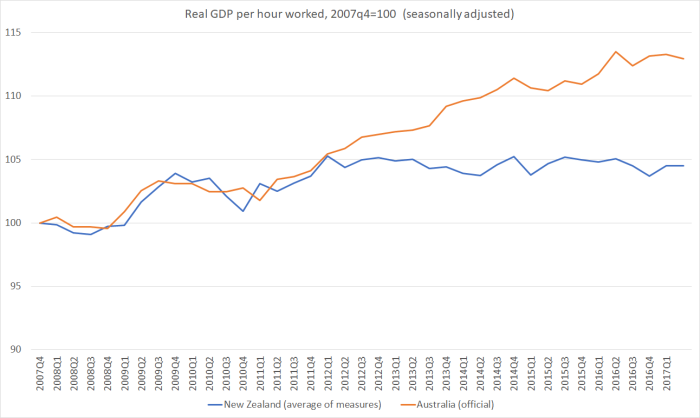
Or reversing the dismal productivity performance, epitomised by the last five years or no productivity growth at all.

aus vs nz ral gdp phw 2

Or reversing the dismal export performance which has seen exports as a share of GDP slipping –  not usually a path to sustained prosperity –  and which is forecast, by Treasury, to keep slipping (all else equal).

x to gdp

But if these things matter much more to our longer-term prosperity,  it doesn’t make an overhaul of the Reserve Bank less important.    And action on that front is now quite pressing.  Apart from anything else, the Bank has an (unlawfully appointed) caretaker Governor, and whoever is appointed as the new Governor –  under current legislation wielding huge amounts of power singlehandedly – will surely want to know quite what the shape of the job they are taking on is.   If the three parties who will be part of the new government are to be believed, any change isn’t just going to be limited to some slightly different words in the new Governor’s Policy Targets Agreement.

I wrote a post last week on the possible implications for monetary policy of a new government.   I’ll reproduce below the bits of that post that are relevant to the sort of Labour-led government we will actually have.

But the Reserve Bank isn’t just a monetary policy agency.  If anything, the case for legislative reform is even stronger in respect of the other functions (notably the extensive financial regulatory functions the Governor exercises under various acts) than it is for monetary policy.   These issues have less immediate political salience of course.  But whereas for monetary policy there is, at least, a statutorily-required Policy Targets Agreement which can be used as a legal basis to hold the Governor to account, there is nothing remotely similar in respect of the prudential regulatory powers.   The Governor –  whoever he or she may be –  exercises huge discretionary power, especially over banks, with little or no means for anyone to hold the Governor to account.  You might like LVR limits (I don’t).  But, whatever the merits of such controls, the Governor can impose or remove completely those controls on the basis of little more than a personal whim.  There are process hoops he or she would have to jump through, but no substantive constraints.  The same goes for debt to income limits.  Or higher, or lower, capital requirements on banks.

It is simply far too much power to vest in any one person – especially an unelected person, who cannot easily be removed from office.   A new Governor might be a truly exceptional person, blessed with wisdom and judgement far above the average.  But we have to build our institutions around typical people –  and typical public sector chief executives (including Governors), are typically average, a mix of strengths and weaknesses, insights and blindspots.

It isn’t the way in which other central banks and financial regulatory agencies are typically structured and governed.  No other country that has reformed its institutions in the last 40 years has given a Governor anything like as much personal power as our system does –  and even those who wrote our legislation would be flabbergasted at how much power our Governor actually wields since back then no one envisaged such an active discretionary regulatory role for the Bank.

Perhaps as importantly, it isn’t the way we govern almost anything else in New Zealand:

  • public companies have boards,
  • charities have boards,
  • the judiciary has several layers of appeal, and in the higher courts benches of judges decide cases rather than individuals,
  • the Cabinet itself is a decision-making committee, with the Prime Minister not much more –  in extremis –  than primus inter pares.  Prime Ministers can typically be ousted quickly by a party caucus.
  • Crown entities (from a school Board of Trustees to a major central government entity like the Financial Markets Authority) are governed by decisionmaking Boards.

Chief executives typically play an important role, but it is almost always an executive role, advising on and implementing a strategy set by others, and ensuring that the organisation itself functions effectively.     In areas of policy in particular, single decisionmakers are very rare, and in areas of policy with as much discretion as those the Reserve Bank exercises unknown.  And recall that governance structures don’t exist for the good times, or the occasions when everyone agrees; they are about resilience in tough times, resilience to inevitable human frailty.

It isn’t just a matter of policy discretion, moving away from the highly-unusual and risky single decisionmaker approach.   There are oddities such as the Reserve Bank being responsible for its own legislation –  something very unusual for a regulatory agency –  and thus, often, for reviewing its own performance.  We’ve seen that just this week: industry complaints that the Reserve Bank is reviewing its own performance as insurance industry prudential regulator.   No doubt the regulatory agency has useful input to such reviews, but they just can’t bring the degree of detachment and independence to a review of their own performance that the public should expect.

And then there is transparency.  The Reserve Bank has sought to claim over the years that it is highly transparent. In what matters, it is anything but.   The Bank scores well in transparency over things it knows almost nothing about: they will happily tell us what they think will happen to the OCR in 2019, for example.   But, unlike most government agencies or Parliament itself, they won’t, as a matter of course, publish submissions made on regulatory proposals.  They provide particular secrecy to the submitters with the deepest pockets and the strongest interest in limiting regulation (banks themselves), and rely on a provision of the Act that was never intended to cover such submissions and which is well overdue for reform.     They won’t publish the background papers to Monetary Policy Statements, even many months down the track (I did once succeed in getting 10 year old papers released).  They won’t publish minutes of the advisory Governing Committee meetings.  They won’t publish, even with a lag, even anonymised, the advice and recommendations the Governor receives when reviewing the OCR.  Like many government agencies, they are persistently obstructive, pushing the very limits of the Official Information Act.

I could go on, but won’t today.  Perhaps especially in a small country, an excellent central bank can be a significant part of the set of economic institutions that can help to shape and improve our economic performance.   We need better from the Reserve Bank –  not just specific decisions, but better supporting analysis, and a more robust and open institution (not one attempting to silence critics) than we’ve had in recent years.  And so reform shouldn’t just be about the odd line of legislation here and there, but about (re)building a capable, open, and accountable institution that supports better quality decisionmaking.  Finding the right person to be Governor, as one part of a new set of governance institutions, is a big part of that.  And that is where the urgency needs to begin.  Simply relying on names generated by a search and application process that began under the outgoing government, where applications closed even before the incoming Prime Minister became leader and gave much hope to her side, where applicants are all being interviewed and vetted by a Board of private company directors (and the like) appointed by the previous government –  and apparently content with how things have been – is most unlikely to be a good basis for identifying the right person.  And, again, it isn’t the way they do things in other countries.

I don’t want to be misread as suggesting that the Reserve Bank is more important than it really is.    Better macroeconomic management –  keeping the economy fully-employed, in a context of price stability – and appropriate financial system regulation, significant as they are, do not offer the answers to our long-term economic performance problems.  Those answers rest with structural policy choices that the Bank has no special role in.   But (a) good governance of very powerful institutions matters in its own right, and (b) in the short-medium term central bank choices, including around monetary policy, do make a real and material difference to economic performance.  Ours has been poor over the last decade.  In particular, we simply shouldn’t be in a position where the unemployment rate has been above any credible estimate of the long-run sustainable rate (or the NAIRU) for the whole of this decade so far.   Most other countries with their currencies, and own monetary policies, aren’t in the same situation.   This country can do so much better.  A better-led central bank, operating under reformed laws and institutional arrangements, can be one part of that mix.

(And now that the National-led government is leaving office, I am hopeful that the OIA request I lodged again 10 days or so ago for the Rennie review report and associated papers might at last lead to some documents being released.)

Here are the bits of last week’s post on what a Labour-led government might mean for monetary policy, (for ease of reading I’ve not block-quoted the material).

—————————————————————————————————————————

And what if Labour leads the next government, requiring support of the Greens and New Zealand First for legislation?  [We’ve already had confirmation, as I suggested then, that the Singaporean model is simply not going to happen.]

In that case, legislative reforms are more certain, but somewhat similar questions remain about what difference they might make.

Thus, the Labour Party campaigned on amending section 8 of the Act to include some sort of full employment objective.   They haven’t provided specific suggested wording, and would no doubt want official advice on that.  The Greens have endorsed that proposal and there is no obvious reason why New Zealand First would oppose it. But they might want to try to get some reference to the exchange rate or the tradables sector included, whether in the Act itself or in the Policy Targets Agreement.

Winston Peters’ private members bill [from a few years back] sought to amend the statutory goal of monetary policy (section 8 of the Act) this way (adding the bolded words)

The primary function of the Bank is to formulate and implement monetary policy directed to the economic objective of maintaining stability in the general level of prices while maintaining an exchange rate that is conducive to real export growth and job creation.

[As I noted then, this wording goes too far and asks the Reserve Bank to do something that is impossible (real exchange rates are real phenomena, not monetary ones).  I hope Labour and the Greens would not accept it, but we must presumably expect something of the flavour to find it way into the ACT or the PTA.]


I’ve also previously suggested that if Labour is serious about the full employment concern, it might make sense to amend section 15 of the Act (governing monetary policy statements) to require the Bank to periodically publish its estimates of a non-inflationary unemployment rate (a NAIRU), and explain deviations of the actual unemployment rate from that (moving) estimate.  In principle, something similar could be done for the real exchange rate, but the (theoretical) grounds for doing so are rather weaker.  Perhaps the political grounds are stronger, and such a change might encourage the Bank to devote more of its research efforts to real exchange rate and economic performance issues.

But –  and I deliberately use the same words I used above –  such legislative changes are not ones that would, on their own, make any practical difference to the conduct of monetary policy.  Reflecting back on the 25 years of advice I gave to successive Governors on the appropriate OCR, I can’t think of a single occasion when the advice would have been likely to be different under this formulation than under the current wording.

The Labour Party and the Greens also campaigned on legislative reforms to the monetary policy governance model (including a decisionmaking committee with a mix of insiders and relatively expert outsiders, and the timely publication of the minutes of such a committee.)   Although those proposals would represent a step in the right direction, they are rather weak. In particular, since Labour proposed that all the committee members would be appointed by the Governor, the change would largely just cement-in the undue dominance of the Governor.    But I’d be surprised if they were wedded to those details, and it shouldn’t be too hard to reach a tri-party agreement on a decisionmaking structure for monetary policy –  probably one that put more of the appointment powers in the hands of the Minister of Finance (as elsewhere) and allowed for non-expert members (as is quite common on Crown boards –  or, indeed, in Cabinet).

So legislative change in that area –  probably quite significant change –  seems like something we could count on under a Labour-led government.

But whether it would make much difference to the actual conduct of policy over the next few years still largely depends on who is appointed as Governor.   Not only will whoever is appointed as Governor going to be the sole decisionmaker until new legislation is passed and implemented –  which could easily be 12 to 18 months away –  but that individual will be an important part of the design of the new legislation and the sort of culture that is built (or rebuilt) at the Reserve Bank.

As I noted earlier, the appointment process for the Governor has been underway for months.  Applications closed at a time –  early July –  when few people would have given the left much chance of forming a government.  And the Board, all appointed by the current government and strong public backers of the conduct of policy in recent years, have the lead role in the appointment.   Perhaps a new Labour-led government would reject a Bascand nomination.  But even if they did so, they have no idea which name would be wheeled up next.

There are alternatives, if the parties to a left-led government actually wanted things done differently at the Bank.   First, they could insist that the Bank’s Board reopen the selection process, working within the sorts of priorities such a new government would be legislating for.  Or they could simply pass a very simple and short amending Act to give the appointment power to the Minister of Finance (which is how things work almost everywhere else).  Of course, there is still the question of who would be the right candidate, but at least they would establish alignment of vision from the start –  a reasonable aspiration, given that the Reserve Bank Governor has more influence on short-term macro outcomes than the Minister of Finance, and yet the Minister of Finance has to live with the electoral consequences.

Over time, governance changes are important as part of putting things at the Reserve Bank on a more conventional footing (relative to other central banks, and to the rest of the New Zealand public sector).   I think some legislative respecification of the statutory goal for monetary policy  –  along the lines Labour has suggested –  is probably appropriate: if nothing else, it reminds people why we do active monetary policy at all.   But on their own, those changes won’t make any material difference to the conduct of monetary policy  –  or even to the way the Bank communicates –  in the shorter-term (next couple of years) unless the right person is chosen as Governor.  Perhaps so much shouldn’t hang on one unelected individual, but in our system at present it does.

Symbols matter, but so does substance.  It will be interesting to see which turns out to matter more to a new government with New Zealand First support.

In closing, there is a long and interesting article in today’s Financial Times on some of the challenges – technical and political –  facing central bankers.  As the author notes, in many countries authorities are grappling with a mix that includes very low unemployment and little wage inflation.  In appointing a Governor for the Reserve Bank of New Zealand, it would be highly desirable to find someone who recognises, and internalises, that the challenges here are rather different.  Unlike the US, UK, or Japan (for example) New Zealand’s unemployment rate is still well above pre-recessionary levels –  when demographic factors are probably lowering the NAIRU –  and real wage inflation, while quite low in absolute terms, is running well ahead of (non-existent) productivity growth.    There are some other countries – the UK and Finland notably –  that also have non-existent productivity growth, but it is far from a universal story.  Productivity growth carries on in the US and Australia and (according to a commentary I read last night) in Japan real output per hour worked is up 8.5 per cent in the last five years (comparable number for New Zealand, zero).

Some of these issues are relevant to monetary policy (eg unemployment gaps) and some are relevant to medium-term competitiveness (wages rising ahead of productivity growth).  We should expect a Governor who can recognise the similarities between New Zealand’s experiences and those abroad, but also the significant differences, and who can talk authoritatively about what monetary policy can, and cannot, do to help.  Perhaps even, as a bonus, one who might even be able to provide some research and advice to governments on the nature of the economic issues that only governments can act to fix.


Implications of a new government for monetary policy

Whichever way New Zealand First decides to go, we’ll have a different government than we’ve had for the last few years.   Whatever form that government takes –  coalition, confidence and supply agreements, or just sitting on the cross-benches – New Zealand First’s votes will typically be vital for passing any legislation, and whichever party leads the government will constantly be needing to consult with New Zealand First to avoid inadvertently getting offside with them.

As issues around the Reserve Bank and the exchange rate have been a significant part of Winston Peters’ stated concerns over the years (including attempts to amend the Act through a private members’ bill, and repeated references to a Singaporean style of monetary policy), it is interesting to speculate on what difference his bloc of votes in Parliament might make to these issues over the next few years.  A journalist asked for my thoughts the other day, and this post fleshes out what I said in response to those questions.

There are probably at least three –  separable – areas worth touching on (simply as regards the Bank’s monetary policy roles):

  • the specification of the target for monetary policy, whether in the Act or the Policy Targets Agreement,
  • any changes to the legislated decisionmaking and accountability provisions for monetary policy, and
  • the type of person appointed as Governor.

I find it worthwhile to recall that Winston Peters has history in this area.  In 1996, New Zealand First was campaigning vigorously on bringing about change at the Reserve Bank.  At the time, the particular concern was that in focusing on price stability (0 to 2 per cent inflation at the time) we were encouraging/causing an overvalued exchange rate.  The proposed remedy was that we should instead target inflation around the average of our main trading partners (then a bit higher than New Zealand).    What actually happened was that as part of the horse-trading for the coalition agreement with National, Don Brash agreed to an amended Policy Targets Agreement, in which the target was raised from 0 to 2 per cent annual inflation, to 0 to 3 per cent annual inflation.  Actual inflation had been averaging about 1.5 per  cent anyway, so although the change made a small difference to policy for a short period, the difference was pretty minimal.  After that, Winston Peters –  as Treasurer – displayed little real interest in monetary policy and never bothered the Bank again.

So my starting point, in thinking about New Zealand First influence on Reserve Bank matters now, is that although I’m quite sure that the concerns Peters expresses –  including around overvalued real exchange rates –  are quite real (and in many respects valid –  shared as they’ve been by people spanning the range from Graeme Wheeler to me), in the end not much about the conduct of monetary policy is likely to change at his insistence.  And that is probably as it should be –  our real exchange rate problems are not primarily grounded in monetary policy problems.

We also know that although Peters has repeatedly talked of preferring a Singaporean model of monetary policy (a guided exchange rate, without an officially-set OCR), both Steven Joyce and Grant Robertson during the campaign flatly ruled out such a change.  They were right to do so.  I’ve explained why in a post earlier this year.    Even if such a system was desirable, it isn’t workable (at all) for New Zealand unless and until the structural demand factors behind our interest rates being persistently higher than those abroad are tackled –  and that isn’t a matter for monetary policy.

And the Singaporean model is not one of an absolutely fixed exchange rate.  It is a managed regime (historically, “managed” in all sorts of ways, including direct controls and strong moral suasion).  It produces a fairly high degree of short-term stability in the basket measure of the Singapore dollar.      But it works, to the extent it does, mostly because the SGD interest rates consistent with domestic medium-term price stability in Singapore are typically a bit lower than those in other advanced countries (in turn a reflection of the large current account surpluses Singapore now runs –  national savings rates far outstripping desired domestic investment).  As the Reserve Bank paper I linked to earlier noted

“From 1990 to 2011, the average short term Singapore government borrowing rate was 1.8 percent p.a. below returns on the US Treasury bill.”

Those are big differences (materially larger than the difference between the two countries’ average inflation rates).  And they mean that Singapore dollar fixed income assets are not particularly attractive to foreign investment funds.  By contrast, New Zealand’s short-term real and nominal interest rates are almost always materially higher than those in other advanced countries.   Partly as a result, even though Singapore’s economy is now materially larger than New Zealand’s, there is less international trade in the Singapore dollar than in the New Zealand dollar.

So a Singaporean model just is not going to be launched in New Zealand any time soon.

If Peters sides with National, what then might he secure in this area?

An obvious possibility would be a change to the Policy Targets Agreement.  There has to be a new one when a Governor is appointed, and (if they think the current interim one is lawful and binding –  which I don’t) they could also seek an immediate change.  Such changes immediately upon a change of government have been the norm rather than the exception (having happened, to a greater ot lesser extent, in 1990, 1996, 1999, and 2008).

At the start of each Policy Targets Agreement it has become customary (Peters began the pattern in 1996) to have a preamble about what the government is hoping to achieve.  The current government’s preamble reads this way:

The Government’s economic objective is to promote a growing, open and competitive economy as the best means of delivering permanently higher incomes and living standards for New Zealanders. Price stability plays an important part in supporting this objective.

It would be easy enough to craft a form of words that talked about avoiding an overvalued and excessively volatile exchange rate and promoting the tradables sector of the New Zealand economy.

But it won’t make any difference –  one iota of difference –  to the way monetary policy is conducted.  It is a statement of political aspiration –  and can perhaps be sold to the base as such –  not a mandate for the Governor.

Recall too that the Policy Targets Agreements since 1999 have required the Bank, while pursuing price stability to” seek to avoid unnecessary instability in output, interest rates and the exchange rate”.  On occasion, that provision has (modestly) influenced monetary policy choices at the margin (one reason I’ve favoured removing it), at least with a Governor who was that way inclined anyway.  In principle, the exchange rate element could be singled out and given more prominence further up the document.

Winston Peters’ private members bill sought to amend the statutory goal of monetary policy (section 8 of the Act) this way (adding the bolded words)

The primary function of the Bank is to formulate and implement monetary policy directed to the economic objective of maintaining stability in the general level of prices while maintaining an exchange rate that is conducive to real export growth and job creation.

I simply cannot see the National Party agreeing to that specific formulation. I hope they wouldn’t.  It goes too far and asks the Reserve Bank to do something that is impossible (real exchange rates are real phenomena, not monetary ones).   But could they consider a formulation like this one?

The primary function of the Bank is to formulate and implement monetary policy directed to the economic objective of maintaining stability in the general level of prices while promoting the highest levels of production, trade and employment that can be achieved by monetary policy.

It is very similar to the legislative provisions introduced by the National government in 1950, in providing a greater degree of (formal) independence for the Reserve Bank and a new focus on price stability.  But in that framing the caveat “the highest levels…that can be achieved by monetary policy” is vital.   Beyond the short to medium term, monetary policy can’t do much other than maintain stable prices.

Perhaps they could find, and agree on, some clever wording.   It would be a rhetorical victory for Peters, and since rhetoric and symbolism do matter not necessarily an insignificant one.

But, so I would argue, not one that would, on its own, make any practical difference to the conduct of monetary policy.  Reflecting back on the 25 years of advice I gave to successive Governors on the appropriate OCR, I can’t think of a single occasion when the advice would have been likely to be different under this formulation than under the current wording.

What about possible governance changes –  to the formal statutory provisions around monetary policy decisionmaking?  At present, all power is vested in the Governor personally, the Governor’s appointment is largely controlled by the Bank’s Board (unlike most countries where the Minister of Finance has the main power).

I can’t imagine that the National Party would be averse to some changes in this area.  After all, Steven Joyce commissioned the Rennie review and in doing so was presumably open to at least some modest changes (perhaps legislating something like the current internal advisory committee).   But equally, it is difficult to see why New Zealand First would regard it as any sort of win to hand power to more internal technocrats.  To the extent New Zealand First favours governance changes they probably prefer a decisionmaking Board dominated by outsiders, with a strong export sector orientation.  Perhaps it isn’t a die in the ditch issue for National, but it is harder to see the two parties reaching agreement on that sort of change, even if it did produce something that looked rather like the (generally highly-regarded) Reserve Bank of Australia.

But if Peters and New Zealand First care about making a difference to the actual conduct of monetary policy over the next few years, or even to how the Bank talks about monetary policy, the key consideration is who becomes Governor.   Whatever the formal specification of the target, whatever flowery words exist around goals, the personality, instincts, “models”, and preferences of whoever is appointed Governor matters a great deal.  Partly because it is a single decisionmaker system, and partly because as chief executive the Governor (inevitably and appropriately) has a big influence on how the institution evolves, where it focuses its analytical energies and advice etc.

But the Governor selection process has been underway for months, and the Bank’s Board – all appointed by the National government –  must be getting close to delivering an initial recommendation to whoever is appointed as Minister of Finance.   No doubt the Minister of Finance would consult New Zealand First –  whether through the Cabinet appointments process, or outside it –  and the Minister can reject a Board nomination.  But the Minister can’t impose his or her own candidate, they just have to consider the next person the Board puts forward.  Since the Board were (a) appointed under the current system, and (b) have had no concerns at all about the conduct of monetary policy or the leadership of the Bank in recent years, it seems reasonable to assume they’ll be putting forward a status quo candidate (there are no known exceptional candidates).  If so, my money is on Deputy Governor Geoff Bascand who –  as I’ve written about recently –  might be a safe pair of hands, but is unlikely to be more than that, and about whom there are some concerns (especially if, as Peters appears to, one cares about the interests of bank depositors.)

In short, if National leads the next government I wouldn’t expect any material differences on the monetary policy front, even if there are some symbolic wins for New Zealand First.  Even governance reform –  which most people think desirable –  might be hard to actually deliver (the status quo will avoid any conflicts).

And what if Labour leads the next government, requiring support of the Greens and New Zealand First for legislation?

In that case, legislative reforms are more certain, but somewhat similar questions remain about what difference they might make.

Thus, the Labour Party campaigned on amending section 8 of the Act to include some sort of full employment objective.   They haven’t provided specific suggested wording, and would no doubt want official advice on that.  The Greens have endorsed that proposal and there is no obvious reason why New Zealand First would oppose it. But they might want to try to get some reference to the exchange rate or the tradables sector included, whether in the Act itself or in the Policy Targets Agreement.  The sort of wording I floated earlier in this post might provide a basis for something workable.

I’ve also previously suggested that if Labour is serious about the full employment concern, it might make sense to amend section 15 of the Act (governing monetary policy statements) to require the Bank to periodically publish its estimates of a non-inflationary unemployment rate (a NAIRU), and explain deviations of the actual unemployment rate from that (moving) estimate.  In principle, something similar could be done for the real exchange rate, but the (theoretical) grounds for doing so are rather weaker.  Perhaps the political grounds are stronger, and such a change might encourage the Bank to devote more of its research efforts to real exchange rate and economic performance issues.

But –  and I deliberately use the same words I used above –  such legislative changes are not ones that would, on their own, make any practical difference to the conduct of monetary policy.  Reflecting back on the 25 years of advice I gave to successive Governors on the appropriate OCR, I can’t think of a single occasion when the advice would have been likely to be different under this formulation than under the current wording.

The Labour Party and the Greens also campaigned on legislative reforms to the monetary policy governance model (including a decisionmaking committee with a mix of insiders and relatively expert outsiders, and the timely publication of the minutes of such a committee.)   Although those proposals would represent a step in the right direction, they are rather weak. In particular, since Labour proposed that all the committee members would be appointed by the Governor, the change would largely just cement-in the undue dominance of the Governor.    But I’d be surprised if they were wedded to those details, and it shouldn’t be too hard to reach a tri-party agreement on a decisionmaking structure for monetary policy –  probably one that put more of the appointment powers in the hands of the Minister of Finance (as elsewhere) and allowed for non-expert members (as is quite common on Crown boards –  or, indeed, in Cabinet).

So legislative change in that area –  probably quite significant change –  seems like something we could count on under a Labour-led government.

But whether it would make much difference to the actual conduct of policy over the next few years still depends considerably on who is appointed as Governor.   Not only will whoever is appointed as Governor going to be the sole decisionmaker until new legislation is passed and implemented –  which could easily be 12 to 18 months away –  but that individual will be an important part of the design of the new legislation and the sort of culture that is built (or rebuilt) at the Reserve Bank.

As I noted earlier, the appointment process for the Governor has been underway for months.  Applications closed at a time –  early July –  when few people would have given the left much chance of forming a government.  And the Board, all appointed by the current government and strong public backers of the conduct of policy in recent years, have the lead role in the appointment.   Perhaps a new Labour-led government would reject a Bascand nomination.  But even if they did so, they have no idea which name would be wheeled up next.

There are alternatives, if the parties to a left-led government actually wanted things done differently at the Bank.   First, they could insist that the Bank’s Board reopen the selection process, working within the sorts of priorities such a new government would be legislating for.  Or they could simply pass a very simple and short amending Act to give the appointment power to the Minister of Finance (which is how things work almost everywhere else).  Of course, there is still the question of who would be the right candidate, but at least they would establish alignment of vision from the start –  a reasonable aspiration, given that the Reserve Bank Governor has more influence on short-term macro outcomes than the Minister of Finance, and yet the Minister of Finance has to live with the electoral consequences.

Over time, governance changes are important as part of putting things at the Reserve Bank on a more conventional footing (relative to other central banks, and to the rest of the New Zealand public sector).   I think some legislative respecification of the statutory goal for monetary policy  –  along the lines Labour has suggested –  is probably appropriate: if nothing else, it reminds people why we do active monetary policy at all.   But on their own, those changes won’t make any material difference to the conduct of monetary policy  –  or even to the way the Bank communicates –  in the shorter-term (next couple of years) unless the right person is chosen as Governor.  Perhaps so much shouldn’t hang on one unelected individual, but in our system at present it does.

Symbols matter, but so does substance.  It will be interesting to see which turns out to matter more to a new government with New Zealand First support.

In closing, there is a long and interesting article in today’s Financial Times on some of the challenges – technical and political –  facing central bankers.  As the author notes, in many countries authorities are grappling with a mix that includes very low unemployment and little wage inflation.  In appointing a Governor for the Reserve Bank of New Zealand, it would be highly desirable to find someone who recognises, and internalises, that the challenges here are rather different.  Unlike the US, UK, or Japan (for example) New Zealand’s unemployment rate is still well above pre-recessionary levels –  when demographic factors are probably lowering the NAIRU –  and real wage inflation, while quite low in absolute terms, is running well ahead of (non-existent) productivity growth.    There are some other countries – the UK and Finland notably –  that also have non-existent productivity growth, but it is far from a universal story.  Productivity growth carries on in the US and Australia and (according to a commentary I read last night) in Japan real output per hour worked is up 8.5 per cent in the last five years (comparable number for New Zealand, zero).

Some of these issues are relevant to monetary policy (eg unemployment gaps) and some are relevant to medium-term competitiveness (wages rising ahead of productivity growth).  We should expect a Governor who can recognise the similarities between New Zealand’s experiences and those abroad, but also the significant differences, and who can talk authoritatively about what monetary policy can, and cannot, do to help.  Perhaps even, as a bonus, one who might even be able to provide some research and advice to governments on the nature of the economic issues that only governments can act to fix.


The Rennie review: still secret

Hamish Rutherford has a new story up at Stuff on the review of aspects of the governance of the Reserve Bank undertaken earlier this year by former State Services Commissioner (and former Treasury Deputy Secretary for macro matters) Iain Rennie.  The report was undertaken for Treasury, at the request of the Minister of Finance.  The final report was, we’ve been told, delivered in mid-April.

I’ve written about this a review a few times:

But still the review report has not been released, and nor is Treasury willing to release either earlier drafts of the report, or the comments made by reviewers.

Today’s article appears to be prompted by some observations from ANZ chief economist Cameron Bagrie,

Cameron Bagrie, chief economist for ANZ, said without the terms of reference he was “flying a bit blind”, but it was possible the review was headed towards recommending a model used across the Tasman, where powers are split between the Reserve Bank of Australia and the Australian Prudential Regulatory Authority (APRA).
“The consensus seems to be that the review is about monetary policy,” Bagrie said.
“I suspect it’s broader and maybe they are looking at whether we have an Australian model where they have the RBA for monetary policy, financial stability, markets, payments et al and APRA for the prudential/regulatory side.”

I’m quoted in Rutherford’s article.  As I’ve said previously, I’d be really surprised if Rennie was recommending a structural separation (along the lines of Australia).  There are all sorts of models internationally, but I haven’t heard anyone in New Zealand for some years seriously propose structural separation (I may at times have advocated such a split in the past), especially since the British government a few years brought the regulatory functions back under the same roof as monetary policy.   There are separate statutory committees for each main function, but they are all conducted out of the Bank of England.  If anything, the global trend in recent years has been to emphasise the important overlaps or crossovers between monetary policy and financial stability, if only in respect of the underlying information flows.

Although Bagrie noted that “the consensus seems to be that the review is about monetary policy”, it has surely been clear for some time that the review could not have been that narrow in scope?  After all, Steven Joyce told us in April that he asked the reviewer to look at whether the Reserve Bank should continue to be responsible for its own legislation –  an issue that is almost entirely about the Bank’s regulatory responsibilities.  And the terms of engagement document did note explicitly that

The Treasury is contracting Iain Rennie to provide a report assessing governance and decision-making at the Reserve Bank.

Nothing there suggesting monetary policy only.  And, in any case, no reviewer could really do a serious job looking only at monetary policy, given that it occurs within an institution, and both functional and (whole of) institutional governance would be likely to be affected by any decisions regarding monetary policy.  And Treasury has been known to be unhappy about the governance of the financial regulatory functions –  including the Bank’s responsibility for its own legislation –  and Rennie was contracted by The Treasury.

On which note, Rutherford includes this

Top officials within the Reserve Bank are said to believe Rennie’s report is something of a power grab by Treasury.

Michael Reddell, the former special advisor to the Reserve Bank, said even the details about the report already released , around which organisation was responsible for the central bank’s governing legislation, amounted to a power play.

Far be from me to agree with the Bank on this.  If I said there was a “power play” involved, it was simply to note that the Treasury has long been uncomfortable about governance, accountability and information flows around the financial regulation powers of the Reserve Bank.  I happen to agree with them   There is too much power vested in one individual, and in one agency.  Those powers should be trimmed, and stronger accountability established.  The Treasury should probably be made responsible as the primary advisers on the various pieces of legislation the Bank operates under.

In a post a couple of weeks ago, I referred to the Bagrie thesis, the Rennie review, and Reserve Bank reform prospects more generally, noting

On the National Party side, you’ll recall that the Minister of Finance had Treasury hire former State Services Commissioner (and former Treasury deputy secretary) Iain Rennie to provide some analysis and advice on possible changes to the governance of the Reserve Bank.  Having had drafts reviewed by various experts, the report was completed months ago, but hasn’t yet seen the light of day.  Treasury has been blocking the release of even drafts of the report, or comments on the draft by reviewers, and nothing is heard from the Minister of Finance.    Presumably Rennie didn’t conclude that everything was just fine and no changes were required.  Had he done so, there would have been no reason not to publish, and it might even have been a small piece of useful ammunition against the sorts of reforms opposition parties are campaigning on.

The interesting question is (a) how far has Rennie gone in his recommendations, and (b) whether a re-elected National government (perhaps reliant on New Zealand First –  long critical of the Reserve Bank) would implement them?   I heard the other day a hypothesis that the report isn’t being released because it calls for reform so radical that the Reserve Bank would be split in two (a monetary policy and macro agency, like the Reserve Bank of Australia, and a prudential regulatory agency (like APRA).   There are pros and cons to such a structural split, but I haven’t for a long time heard anyone here seriously propose it as an option (and particularly not since the UK government brought all those functions back under one roof).    Time will tell, but I would hope Rennie would recommend things like (ideas previously proposed here, and practices in the UK):

  • moving (in law) to committee-based decisionmaking,
  • having external members appointed directly by the Minister,
  • separate committees for monetary policy and the prudential regulatory functions,
  • a mandated greater degree of transparency, and
  • (something Joyce asked for advice on) making Treasury primarily responsible for the legislation under which the Reserve Bank operates.

As I say, time will tell.  But if National is back in office, they will presumably want to move quite quickly on appointing a permanent Governor (the Board, which is driving the process, meets again later this week), and whoever takes the role would presumably want to know what legislative arrangements they would be operating under.

It is well past time for the Rennie report, and associated documents to be released.  Doing so can’t have suited the current government, but this is an official document, paid for with taxpayers’ money.   And there can’t really be any credible grounds under the Official Information Act for withholding a months’-old consultants report to The Treasury on matters of organisation design.  In fact, in the current hiatus –  between Governors –  I would argue that there is a significant public interest in the release of the report now.


Reserve Bank Annual Reports

Last Friday, the Reserve Bank’s Annual Reports were published.  There were two of them, both required by law.   But most people wouldn’t know that.

There was the outgoing Governor’s own report on the Bank’s performance, the annual accounts etc.  That warranted a press release, and some modest media coverage.  But buried inside the Bank’s annual report was the, quite separate, statutory Annual Report of the Reserve Bank’s Board.    It has no separate place on the Bank’s website, it wasn’t accompanied by a press release from the chairman, although this year it did actually get passing mention in the “acting Governor”‘s press release.

The Reserve Bank Board isn’t a real board, in the sense known either in the private business sector, or in the government sector.  As the Board itself notes “the Board is a unique governance body in the public sector”.  The Board largely controls the appointment of the Governor, and has some say over the recommended dividend.  But otherwise, its powers are all supposed to be about providing a level of scrutiny and monitoring of the Bank –  and in particular the Governor personally – on behalf of the Minister of Finance and the public.  In practice, at least with a public face on, the Board tends to be emollience personified –  nothing to worry about here chaps –  that has very effectively served the interests of successive Governors.

A post about the Board’s Annual Report has become a bit of an annual ritual (2015 and 2016).  But before turning to the substance of the Board’s 2017 report, I wanted to pick up just a few points in the (now former) Governor’s report.

In his final speech as Governor (which I wrote about here), Graeme Wheeler sought to (a) tell a pretty positive story about New Zealand’s economic performance over his five years in office, and (b) claim significant credit for the Bank for that (supposed) good performance.   He returns to the theme in the Annual Report

With our own economy about to enter its ninth year of expansion, it’s useful to put a longer-term focus on New Zealand’s progress. Compared to the period 1990-2012
(i.e., the 22-year period since flexible inflation targeting was first introduced), New Zealand’s economy has experienced slightly stronger GDP growth and much faster employment growth over the last five years. Headline inflation has, however, been weaker and our current account deficit has been smaller as a share of GDP, while the unemployment rate has been around its average for the period since the mid-1990s. Labour productivity growth has been disappointing, a challenge we share with many other advanced economies. While some of these economic outcomes since 2012 lie beyond the influence of Reserve Bank policy levers, the Bank’s monetary policy has been a significant driver behind the growth in output and employment.

Setting aside the minor point that there was a double-dip recession in 2010, and thus any expansion has been running for only around seven years, there is so much wrong or misleading with these claims that it is hard to believe that a serious public figure –  a public servant not a politician –  would repeat them.

Where to begin?

Perhaps with the five years in which there has been no labour productivity growth at all.  Yes, global productivity growth is weaker than it was in the 1990s and early 2000s, but few other advanced economies have experienced anything as bad as New Zealand’s productivity record in the last five years.

Or with the fact that headline GDP growth has been reasonable only because of very rapid population growth.  Growth in real per capita GDP has been pretty poor, largely reflecting the complete absence of productivity growth.  Similarly, rapid employment growth mostly reflects rapid population growth, and unemployment has been above any reasonable estimates of a NAIRU throughout the Governor’s term.

Or with the shrinkage of the export sector as a share of GDP.

Or with house prices.

Or with the fact that, over this particular five years I’m pretty sure that the Reserve Bank was the only advanced country central bank to boldly set off on what it envisaged as a large tightening phase, only to have to (grudgingly) more than complete unwind the tightenings they actually did implement.

With no global crises, no domestic crises, no domestic concerns about conventional monetary policy exhausting its capacity (unlike many other advanced countries), Wheeler should have had a fairly easy five years.   As it is, there isn’t much credit he can claim for the Bank and its monetary policy.

It is the sort of self-serving nonsense the Bank’s Board –  if it was doing its job –  should have been calling out.   Apart from being simply wrong, it isn’t even helpful.  If the Bank had really had the huge influence on medium-term economic performance that the Governor seems to be claiming, it rather undermines the case for having so much power – so many choices-  at such a remove from elected politicians.  The normal case for an independent central bank is that such an agency will keep inflation down and won’t make much difference to economic performance at all.

But there is –  again – little sign in the Board’s Report of serious scrutiny or accountability.  Even honesty seems to be at a premium.

The Board’s Reports have certainly lengthened.  Only three years ago, the Board’s report was only two pages long.    Last year’s report was four pages long.  This year’s report is six pages long, and the first four of them are quite densely-packed text.

But apparently the Reserve Bank does no wrong, ever.  So not only is the Reserve Bank Board “a unique governance body” in the public sector, but the Reserve Bank must be a unique organisation, public or private.   One wonders if it was immaculately conceived, or acquired such perfection itself?

There is two solid pages of text on monetary policy and (as far as I can see) not a word that management would feel even slightly uncomfortable with.  No areas that the Board thinks the Bank might have put greater emphasis on, no disagreement, nothing.

There is another one and a half pages on the Bank’s regulatory functions, but again apparently nothing where the Board thought the Bank might have done better, or areas where a different emphasis might have been helpful. It could all have been written by management (and may well have been).  Management will have been particularly pleased to read this

“The Board has also observed that the Bank carefully considers the feedback it receives on regulatory initiatives, bearing in mind that regulated institutions will not always agree with the regulator’s approach and the eventual regulatory outcomes.”

No doubt, although there is little evidence open to the rest of us to suggest that the Bank pays any heed to substantive feedback in its formal consultation processes.  And one might reasonably wonder whether in a moment of introspection the Board might perhaps think that “monitored institutions will not always agree with the monitor’s approach or the eventual conclusions of the monitor”, and wonder if that description has ever characterised the Board’s Annual Reports on the bank.

And so we labour on through lots of descriptive text about the activities of the Board –  with nothing on the evaluative frameworks they use, or the external advice they draw on.  As we do, we come to the odd interesting snippet such as this

“Monitoring the Bank’s relationships is a continuous process.  During the year the Board availed itself of a number of opportunities to observe how these were operating in practice, paying particular regard to any feedback on the messaging, transparency and accountability of the Bank.”

It looks as though this sentence is supposed to be meaningful, but quite what the meaning is supposed to be isn’t clear at all.    Does it mean that perhaps they were just ever so slightly uncomfortable with the heavyhanded pressure Graeme Wheeler and his senior managers brought to bear on Stephen Toplis and the BNZ (the latter an institution the Bank regulates) when Toplis criticised the Governor’s communications, even if they can’t bring themselves to say so?    One might hope so, but if people who are paid to hold a powerful agency to account won’t even criticise, even diplomatically, such egregious abuse of office, we might wonder again what use they are to citizens.   (And I did lodge an OIA request, the results of which suggests no serious concerns in private either.)

Towards the end of the Board’s report, they write about the change of Governor.  To read this report, one wouldn’t know that the Board had been well down the track towards recruiting a new permanent Governor, oblivious to the election, when the Minister of Finance forced them to stop.  You have to wonder what they gain by the omission, when the relevant material is already public.   They explicitly note that they and Treasury sought advice from Crown Law on the approach to be followed.   Despite that advice, the purported “acting Governor” appointment still appears to be unlawful.  Remarkably, the report contains nothing on the steps the Board had already taken, before the end of 2016/17 to find a new Governor, even though that appointment is one of their principal responsibilities.

Finally, as it does every year, the Board’s Report notes the Board’s relationship to the Reserve Bank’s superannuation scheme (the Board appoints half the trustees including the chair).   This is a deeply troubled fund, grappling with some pretty serious historical errors –  including some made by the Board itself, which must approve rule changes.   I’ve written previously about the role of the Bank’s (now) deputy chief executive –  who attends all Board meetings –  in these matters.   But the Board’s Annual Report simply records the heart-warming fact that the new superannuation fund chair “kept the Board informed of the work associated with the development of a new Deed for the Trust”.  On the principle that when you things you know about are wrong, it leaves one worried about the other material that one doesn’t know in detail.  On this occasion, there was no “new deed”, but some amendments to the rules (largely) to allow the superannuation fund to comply with the new Financial Markets Conduct Act.   As part of those changes, trustees were about to left in the lurch by the Bank –  unremunerated and yet with no liability insurance.    Only threats that the new rules would not be executed (requires all trustees to sign) and a written protest to the Board helped secure a backdown.  And the more serious issues, of past rules breaches, and mistakes in past rule changes, still look set to head to the courts next year.  Millions of dollars are potentially in dispute.

As I’ve written (repeatedly) before, the Reserve Bank’s Board doesn’t really serve much of a useful function.  A thoroughgoing reform of the goverance of the Reserve Bank (including the role of the Board) is well overdue, and there are signs now that whoever forms the next government it may well happen (although I am less optimstic of that if National leads the next government as even if they favour some change, they may not favour changes New Zealand First –  or the Greens if you must –  would support).   If the Board is to retain a role as an accountability and monitoring body, it too will need a shake-up.  Independent resourcing would help, but much of what is really needed is a different mindset, in which the Board finally serves the public, not acting as guardians of the Governor.  My own preference would be for the monitoring and accoutability functions to be undertaken by a Macroeconomic Advisory Council, established formally at arms-length from the Bank, the Treasury and the Minister of Finance.


Splashing the cash at the Reserve Bank?

When the Reserve Bank’s Annual Report turns up in my in-box, the table on remuneration isn’t the first place I turn.  In fact, executive pay more generally isn’t one of those issues I can get terribly excited about.  I thought Jim Rose’s column in the Herald the other day made some good points, although (a) I’m not sure that whether the share price goes up or down when the CEO leaves is really a good indicator of whether the individual was appropriately remunerated or not, (b) none of the defences he deploys really apply with any great force to senior public sector positions.  And there is no market discipline on top public sector salaries, so critical scrutiny  and open questioning actually matters.

But someone emailed me suggesting that the Reserve Bank Annual Report implied that the (now former) Governor, Graeme Wheeler had had a big pay rise.  And that did interest me, because outside the halls of the Reserve Bank Board it isn’t clear who would have thought that Wheeler had done something even approaching a stellar job as Governor.

Wheeler started at the Bank in September 2012, so we can’t get a read on his initial salary in the (June year) 2012/13 accounts.   But there are four years of annual reports when he will clearly have been the top earner in the Bank.    The relevant tables show the top earner received as follows during these financial years:

2013/14 620000 to 629999
2014/15 640000 to 649999
2015/16 660000 to 669999
2016/17 850000 to 859999

That is some jump.  But there is a footnote on this year’s numbers, stating that “the highest remuneration band includes a payment of $101000 for accrued annual leave, which was paid out in cash rather than taking leave”.  (That must be about two months of unused leave, for someone in the job  – at a time of no crises – less than five years, which itself doesn’t suggest particularly good management.)

But even if we subtract the $101000, we are left with figures suggesting that Graeme Wheeler got a payrise of around $90000 between 2015/2016 and 2016/17.  In fact, it was quite possibly more than that, because he personally may well have been reviewed on the anniversary of his appointment, in September (and if so the 2016/17 numbers may include only around three-quarters of his big annual increase).

So how do his cumulative pay increases compare against either CPI inflation or general wage inflation (I use the analytical unadjusted series, which is materially higher than the QES recently)?  There has, of course, been no productivity growth in New Zealand over the term Wheeler was in office.

wheeler salaries

It is a pretty astonishing boost.  Perhaps not a great problem for somone doing a stellar job but this was someone who:

  • had consistently seen inflation undershoot the target midpoint, that he’d specifically agreed to focus on, for five years,
  • who never, ever, admitted a mistake (surely not his advice to his own young managers?)
  • had repeated communications problems with financial markets,
  • whose speeches rarely offered much in-depth insight, and whose defences of successive waves of new regulatory interventions never seemed robustly grounded.
  • whose embattled relationship with the media was epitomised in his refusal to ever expose himself to a serious  and searching one-on-one interview (or indeed any interviews with outlets not already supportive of the Governor).

Oh, and then late in the 2015/16 year, there was the OCR leak debacle which among other serious failings, involved the Governor publicly tarring as irresponsible the person (yes that was me) who drew to the Bank’s attention evidence of the apparent leak.

This year, of course, (but no doubt well after Wheeler got his last pay rise) there was the still-more-shameful episode, in which Wheeler sought personally (and used his senior managers to reinforce his efforts) to silence a pesky critic, who happened to work for an organisation the Reserve Bank regulates.  And on that note his tenure ended badly, and largely unlamented.

So what were they thinking when they gave such a big pay rise to someone with such a mediocre (at best) track record, who was hardly like to walk out on them if he didn’t get the increase?  And who was “they”?

Well, on this occasion, it wasn’t the Bank’s Board.  The Reserve Bank Act is quite clear that

The conditions of employment of the Governor, including remuneration, shall be determined by agreement between the Minister and the Governor after consultation with the Board

In practice, the Board may well have put a recommendation to the Minister.   But however this idea first got traction –  whether Wheeler pushed for a pay rise, or the Board really did initiate it –  the Minister approved it. That was last year’s Minister of Finance, Bill English.   This was the same minister who went on record pushing back against a big pay rise for another public sector chief executive, Adrian Orr –  but couldn’t actually stop the New Zealand Superannuation Fund’s board putting through the pay rise.    Sceptical as I am of the NZSF, and of its long-term performance, Orr’s case for a big pay rise looks to have been considerably stronger than Wheeler’s.

I can’t imagine why the Minister of Finance approved such an increase, especially against the backdrop of his own evident discontent with the Bank.   I guess he isn’t too busy governing this week, so perhaps some journalist could ask him?

(But it was fortunate for Grant Spencer that Bill English did approve that pay increase.  When the (unlawful) “acting Governor” appointment was announced we were told that Spencer would be paid to mind the store on the same terms and conditions as Wheeler had been receiving.)

PS.  Someone who attended a post-election lunchtime seminar at Victoria University today informs me that Colin James (usually well-connected) stated there that he understood that The Treasury is undertaking a “root and branch” review of the Reserve Bank Act.  If so, that would be most welcome.


A first unlawful act?

Earlier in the week, Graeme Wheeler completed his term as Governor and left office.  Even in a week with little real news to report, his departure didn’t seem to receive any notice in the media.  Not even the Herald managed an enconium.   Surely his departure must go unlamented almost everywhere, even if, no doubt, the Bank’s Board –  supposedly guardians of the public interest, but in fact guardians of the Governor –  gave him a good dinner on the occasion of their meeting last week?

And now Grant Spencer – erstwhile deputy chief executive – purports to be in charge, as “acting Governor” until a permanent appointment can be made by the incoming Minister of Finance.  I like Grant.  He was my boss in two separate stints spread over many years, and –  in the late 80s –  was a voice of reason and moderation in an age when young hotheads didn’t always welcome such perspectives.   Now that he purports to wield so much untrammelled power –  not just monetary policy, but all the Bank’s regulatory functions –  I’m sure his management skills must also have improved further.  I like to tell the story of the two years, very early in my management career, without any structured performance feedback from him: the only way I could really be confident I must have been doing ok was through the annual pay round, but when he came to deliver that news I was on the phone, so Grant scribbled the number on a piece of paper, dropped it on my desk, and left.  But I’m sure he would be a safe pair of hands, minding the store.

Unfortunately, his purported appointment –  probably sensible in intention if Graeme Wheeler couldn’t have been persuaded to take a temporary extension – is, as I’ve been pointing out for months, probably unlawful.  (If, as a new reader, you are puzzled by that claim, you can read for yourself my thoughts on the summary of Crown Law’s legal advice on the issue.  I still have with the Ombudsman a request for (a summary of) the Reserve Bank’s own lawyer’s advice.)

And if his appointment is unlawful then so, presumably, are all the acts the Bank takes –  or purports to undertake –  under his authority over the next few months.  Including setting the OCR.

Again, that proposition might puzzle you.  Surely even if there was some question over the lawfulness of the appointment of an acting Governor in these circumstances, there would be no question of the lawfulness of the Bank’s actions?  I had a look at the legislation a few months ago.

Does it all matter?    Sometimes laws contain provisions stating that any problems in the appointment of an officeholder, or doubts about the validity of the appointment, don’t affect the validity of enforceability of the actions/decisions taken by that person.

In fact, the Reserve Bank Act has one of those provisions.    For the Board.  Under section 54(4)

The validity of any act of the Board is not affected by—

(a) any vacancy in its membership; or
(b) any defect in the appointment of a director; or
(c) the fact that any non-executive director is disqualified from appointment under section 58

But there is simply nothing comparable for the Governor.    Curiously, there is protection for the Deputy Chief Executive when exercising delegated authority from the Governor.   Under section 51 

The fact that the Deputy Chief Executive exercises any powers or functions of the Governor shall be conclusive proof of the authority to do so, and no person shall be concerned to inquire whether the occasion for doing so has arisen or has ceased.

But there is nothing like it for the Governor, or any acting Governor.  There is simply a requirement on the Board and the Minister to make a proper appointment, and to have that person in place once the previous Governor’s term ends (and presumably an expectation that Governor appointments are sufficiently high profile, and as all powers of the Bank rest with the Governor, no questions should ever arise about the authority of the Governor him or her self to make decisions.

(Again, it is perhaps worth noting that there are also no such protections in the 1964 Act – the one in place when the 1989 Act was being drafted.  The drafters presumably made conscious choices about what to add and what not to.)

If the appointment of Spencer as acting Governor is unlawful, it looks as though any actions taken by him –  or under his (purported) delegations during his term –  would also be unlawful.

Perhaps it won’t matter very much.  Few people expect the OCR to be changed in the next six months, and if so perhaps they could argue that successive OCR decisions aren’t actions but inactions –  just leaving things as Wheeler left them.

But the Reserve Bank does lots of other stuff.   They commit to commercial contracts, they deal in New Zealand in international markets.  They take enforcement actions against financial institutions that fall foul of the law, or of the Bank’s rules.  And so on.  In a crises, they (the Governor) has substantial regulatory powers.

The situation should never have been allowed to arise.  As I’ve noted for months, it was easily avoidable, with a simple temporary change to the Reserve Bank Act (which there is no obvious reason for the Opposition parties to have opposed –  either on the substance, or as regards Spencer personally, whom everyone regards as a decent and honourable person).   But now we have an unlawful appointment, and Spencer purporting to exercise the powers of (acting) Governor.

But what of the OCR press release –  which, as pure commentary, I suppose Spencer is free to issue?  It probably isn’t that sensible to make much of minor differences in wording: in some areas Spencer may just use slightly different hobbyhorse phrasing than Wheeler would have.  But no one sees it as a material departure from last Wheeler statement, even if (perhaps) the confidence in the growth outlook might be fading.  As for what it might mean for actual (or purported) OCR setting, not much.  After all, it is quite plausible that a new Minister of Finance and coalition could mean modifications to the Policy Targets Agreement almost straightaway (happened in 1993, 1996, and 1999).  And even if that doesn’t happen, Spencer won’t be there to offer his opinion by the end of March, and no one knows who the new Governor will be, or what mandate he or she will be working towards.

The growth outlook was one of the issues I touched on in my comments on the last Monetary Policy Statement.  Those comments still seem largely valid now –  the June quarter GDP numbers were flattered by big one-off boosts to services exports from the World Masters Games and the Lions tour, and yet still showed growth of only 0.8 per cent.

But perhaps my biggest puzzle is where all the forecast growth is coming from.

Over the next six quarters, the Bank projects that quarterly GDP growth will average just over 0.9 per cent. This chart shows six-quarter moving average of GDP growth (in turn, averaging the production and expenditure measures).

GDP growth qtrly

The orange dot shows the forecast for the next six quarters.  Their projections suggest that the economy will grow more rapidly over the next 18 months than it has managed on a sustained basis at any time in the current recovery.   You might not think that the difference looks large, but:

  • the Bank already recognises that monetary conditions are tighter than they were last year,
  • the Bank is forecasting a substantial reduction in the net migration inflow, and no one seriously doubts that unexpectedly rapid population growth has been the biggest single driver of headline GDP growth in recent years.  However much immigration adds to supply, it adds a lot to demand.

So why are we to expect a sustained growth acceleration from here?   Although it isn’t stated in the document, I hear that the Bank is invoking the expected fiscal stimulus (from promised measures announced in the Budget).  In isolation that might make some sense, but against the projected halving in the net migration inflow and the actual tightening in monetary conditions, it doesn’t really ring true.     If anything, the risk now has to be that over the next 18 months, headline GDP growth averages lower than we’ve seen in the last couple of years.

Whichever parties form the next government, and as I noted last week, it seems likely that government expenditure will be higher than projected.  But it is still difficult to see a growth outlook as relatively buoyant as the Bank projected –  and requires if inflation is to get back to target –  as the most likely outcome.

And the Bank –  and government –  still seem grossly underprepared for the next recession, whenever it comes.


Various views on Reserve Bank reform

Undecided to the end, earlier this afternoon I went out for a walk resolved that I wouldn’t come home until I’d voted.  With guests to cook dinner for, it was an effective constraint.

The other day, the Herald ran a Bloomberg column by journalist Tracy Withers headed “RBNZ could be in for a shake-up”.  Much of the column is familiar ground, and complements my own post the other day on the coming reform of the Reserve Bank –  whichever party forms the next government.    But there were a couple of interesting snippets, one of which wasn’t in the version the Herald used but is now in the updated column the link will take you to.

The first is an explicit comment from the Secretary to the Treasury, Gabs Makhlouf.  It seems quite unusual for a neutral public servant to be commenting in public –  in another country as it happens – on any matter of possible new policy just a few days out from an election.   Save it for the post-election briefing to the incoming Minister of Finance, would surely have been the stance of most senior public servants (all the more so when it is an issue on which at several parties have explicit public policies).

Anyway, what does Makhlouf think about Reserve Bank reform?

Gabriel Makhlouf, head of New Zealand’s Treasury Department, said he favors formalizing committee-based decision making at the central bank but doesn’t have a view on whether the committee should include external members.
“I can see why people may be concerned about that, and I can also see the value of having externals, and the different perspective they bring,” he said in an interview in Singapore Friday. “It’s something we are definitely going to study quite carefully before we decide what to recommend to the government.”

Treasury has long-favoured a move to formalise a committee-based decisionmaking structure.  They unsuccessfully attempted to interest the then Minister of Finance, Bill English, back in 2012 before Graeme Wheeler was appointed.  But it is surely a little surprising that, after all these years, and five months after Iain Rennie’s report on such issues was finalised, that Treasury still doesn’t have a view on a key aspect of possible reform.  Or are they simply waiting for the election results to come in, and will then tailor their advice to the proferences of their new masters?  I’d like to think not, but is there good reason to do so?

The other interesting snippet –  and maybe it wasn’t new but I hadn’t seen the specific quote previously –  was about the views of the current Minister of Finance.

If a National-led government is returned to power, Finance Minister Steven Joyce has said he’s open to formalizing the existing committee structure but doesn’t favor outside members.
“We should have a look at it,” Joyce said in a July interview. “I wouldn’t see radical change. I think the Reserve Bank model serves us very well.”

I’d certainly disagree with his final sentence, but of course he is welcome to his view. But it does tend to confirm the suggestion I made in the post earlier in the week that the Rennie report must have proposed quite far-reaching reforms.  After all, if Rennie had concluded that the current governance model “serves us very well” and that no change was required, or only some minor changes such as formalising the current Governing Committee, surely the Minister of Finance would have released the report by now.  Rennie may not command enormous respect beyond, say, the current occupants of the Beehive, but had a former State Services Commissioner and former Treasury deputy secretary for macroeconomics concluded that no material change was appropriate –  and certainly nothing like the changes (still modest themselves) that Labour and the Greens have campaigned on – it would have been modestly useful to the National Party, who have attempted to argue that Labour and the Greens simply don’t have what it takes to be economic managers.

Given that the Rennie report to Treasury was paid for with public money, was finished five months ago, and is official information, it is pretty inexcusable that it has not yet seen the light of day.

(I should note that neither the Joyce comments nor those of Makhlouf comments seem to address the Reserve Bank functions other than monetary policy.   In those regulatory areas, reform is even more vital, given the relative lack of constraints on the Governor’s personal freedom of action –  nothing like the Policy Targets Agreement exists.)

The other thing that prompted this post was the Herald’s editorial on Thursday, prompted by the Bloomberg column, and headed “Meddling with OCR carries risks”.  The text doesn’t appear to be online.

Over recent years, the Herald has been a useful mouthpiece for the Reserve Bank, and for outgoing Governor Graeme Wheeler in particular.  By not asking any awkward questions, they’ve been given preferential access to soft interviews and profiles, and have reliably backed up the Governor’s choices –  even when hindsight proves those choices weren’t always the best.

The editorial is somewhat overblown, and lacking in any serious supporting analysis. It asserts

This country has no need to copy any country’s conduct of monetary policy.  New Zealand pioneered inflation targeting by an independent central bank and it served this country will through the global financial crisis whatever mistakes were others may have made.   The divergent targets of the US Federal Reserve possibly contributed to the crisis.

We certainly pioneered formal inflation targeting, although independent central banks had been around in several other countries for decades –  on that count we followed an international lead.  Actually, I’d agree that inflation targeting served us reasonable well through the crisis, as it served well a bunch of other countries.  The US only formally adopted inflation targeting after the crisis was over.  Some would argue that different rules (nominal GDP, price level targeting, wage targeting) might have led to even better responses, although I’m a bit sceptical of that claim.  And any suggestion that the “divergent targets” of the Federal Reserve may have contributed to the crisis probably rests on claims by US economist John Taylor that interest rates were held too low –  below the Taylor rule prescription –  in the early 2000s.  There may be something to that specific point, but…..the Reserve Bank’s own published analysis shows that we did much the same thing during that period.  It is one thing to argue that New Zealand’s monetary policy isn’t much different than that in countries with differently expressed statutory goals (including the US and Australia), but another to argue that our monetary policy is somehow superior to that of those countries.   There is just no evidence for that latter proposition.

Then there is a weird paragraph about the Labour Party’s proposal to add an employment/unemployment dimension to the monetary policy goal.  There are certainly some questions Labour needs to answer if they do happen to form the next government, but to conclude (rhetorically), “could a Labour Party bear a target of 0-4 per cent unemployment”?  one can only suppose the answer must be “yes, but they probably wouldn’t suggest being that prescriptive”.   Only a few people –  some able ones among them –  think full employment in New Zealand at present is lower than 4 per cent.

In the end, the editorial writers seem to conclude that adding an unemployment dimension might not do much harm after all (although they can’t conceive of it doing any good), and what really worries them is the governance proposals.

Labour’s proposed changes to the way the Bank operates may be more damaging.  The Governor would no longer be solely answerable for the key interest rate, the official cash rate (OCR) set eight times a year [isn’t it seven now?].  Labour would give the decision to a committee with some appointees from outside the bank.  Already the Governor consults widely. But sole accountability can produce better decisions. A committee allows blame to be dispersed.

I was pretty gobsmacked. As I noted in my post the other day, I criticize Labour`s proposals as excessively timid, and leaving too much effective power in the Governor.  But quite what is the Herald concerned about?  That we might have a decision-making structure for monetary policy a little more like those in

  • Australia,
  • the United States,
  • the United Kingdom,
  • Norway,
  • Sweden,
  • the euro-area
  • Israel (which had a single decisionmaker until a few years ago, but changed)

They are correct that we don’t need to follow what other countries do.  But there is often wisdom in the choices those other countries make, and when the current Reserve Bank Act was written few countries had reformed their practices in recent decades.  We were (so we thought) pathbreakers, but no country has followed us along this particular path.

Or perhaps the Herald is concerned that monetary policy might be governed the way the rest of the country is?  For example,

  • the Cabinet (actually a committee of people who aren`t technical experts),
  • most companies, while final decision-making power typically rests with a Board,
  • the governance of most or all other Crown entities, from the Board of Trustees of the local primary school, to that of powerful regulatory agencies like the Financial Markets Authority, or
  • our higher courts –  both the Court of Appeal and the Supreme Court decide each case with a panel of judges.

But perhaps New Zealand monetary policy is uniquely suited to single (formal) decision-making? It is possible I suppose, but frankly it seems unlikely.

And do notice the careful wording “sole accountability can produce better decisions”.  In theory perhaps it can, if we have as Governor someone uniquely talented and gifted with insight and judgements far beyond those of mere mortals.  But this is a real world.  If such people existed, it would be very hard to identify them in advance –  or perhaps even persuade them to serve.   And if those responsible for appointing a Governor thought they`d found such a superstar, only for reality to turn out a bit differently, that would be a recipe for worse outcomes than under a (much more robust) formal committee-based decision-making model. It is why in most areas of life we choose governance models of that sort, rather than beating on supermen (or women).

And today, I`m not even getting into questions of the actual judgements or track record of accountability of Graeme Wheeler.     That can wait for next week.

The editorial concludes that

our system of monetary management is working well. Labour should hesitate to meddle with it.

Actually, not many people would really agree.  Even Steven Joyce says he is open to some change. It is a risky system, out of step with international practice and New Zealand practice in other areas of public life.  It has gone hand in hand with a progressive weakening in the quality of the institution, and if one does wants to talk about relatively uncontroversial specific failures, bear in mind that the Reserve Bank of New Zealand is the only central bank in the world to have launched two tightening cycles since the 2008/09 recession, only to have to quickly reverse both of them.  Those were choices made by individuals given too much power by Parliament. Whoever forms the next government, it is time for a change at the Reserve Bank.