Central bank minutes released: a small victory for transparency

Regular readers will recall that the Reserve Bank has long been deeply resistant to releasing any information relating to OCR decisions or Monetary Policy Statements, other than what they themselves chose to release, whether in the published documents or in subsequent interviews.  That has never been very satisfactory, but the Bank has attempted to carve out for itself a special place, more or less above the provisions of the Official Information Act.

One of the things they’ve consistently refused to release is minutes of the Governing Committee, the body set up by the previous Governor, in which the Governor takes his final OCR decision (and other major decisions, including ones around LVRs).  They had long taken the same stance to the minutes of the predecessor Official Cash Rate Advisory Group, even when the requests related to decisions some time in the past. Often enough, it seemed that there were no written minutes at all (which was probably in breach of the Public Records Act).

I had largely given up on making any progress on this issue (and, anyway, the new statutory Monetary Policy Committee, which will have its own charter on such matters, is coming next year). But for some reason, which I now forget, I had lodged one more request six months ago seeking

1. the minutes of any meetings of the Governing Committee relating to the May MPS,
including minutes of the meeting where the OCR decision was taken;

When the Bank refused to release anything (not even date of meeting, list of attendees, headings –  even if all the substantive content was redacted) I complained to the Ombudsman, noting that (among other things) the Bank quite often released minutes of Board meetings (even with some content withheld).

The Bank regularly releases minutes of the meetings of its own Board (in response to OIA requests), with individual deletions as appropriate.  It seems inconceivable, for example, that the date, time, place of the meeting, the list of attendees, the confirmation of past minutes, and the final decisions of any meetings (themselves reflected in a later published document) could pass a “free and frank”: withholding test, even if (again) it is plausible that if there is any substantial account of the nature of contentious discussion at the meeting that specific element of the material might.

And then I forgot all about the request until a short time ago when an email from the Reserve Bank turned up.

We refer to your complaint to the Office of the Ombudsman (ref: 480453) relating to your request for: “minutes of any meetings of the Governing Committee relating to the May MPS, including minutes of the meeting where the OCR decision was taken.

The Reserve Bank has reconsidered its initial position and is now releasing with redactions, a copy of the only document within the scope of your request – the Governing Committee minutes in May. The document is attached to this correspondence.

And it has only take six months, which is progress.  Credit to the Ombudsman.

For anyone interested, the minutes themselves are here

Governing Cttee minutes May 2018 OCR

One day perhaps we might even have released –  with a suitable lag – the background papers the Governor (and his new MPC) receive, and upon which they base their decision

I’m not sure there is any new information in the particular minutes released, but having released Governing Committee minutes in this form –  against a request made almost immediately after the relevant OCR decision was released – a small but helpful precedent has been established.   Some material is still withheld on the highly questionable ground of avoiding damage to the substantial economic interests of New Zealand.  One day, the Ombudsman is going to have to provide some substantive guidance on that provision, but for now both he and the Bank seem keen to avoid the Ombudsman having to draw the appropriate line between national economic interests and those of a particular public agency.


Reserve Bank whimsy

I was meeting someone in town this morning. I was a bit early and the person I was meeting was a bit late so I found myself standing for some 20 minutes across the road from the Reserve Bank.   As I did, I became a bit curious about these four guys.

orr1

In the entire time I watched them, this is all the activity there was (the chap with his hand on the cone).

Most of the Bank’s building is apparently still closed as a result of the asbestos scare, although the ground floor museum has now reopened.  But it isn’t at all clear what these guys were doing.  Access to the turning circle is now controlled (remotely) by those metal bollards, and although there will probably be billions of dollars of notes in the vaults, electronic security systems –  and big thick steel doors and walls – will be guarding that.  They weren’t acting as a guide to members of the public –  various people walked up the main steps into the museum while I watched and none interacted with the security men.  They seemed to be just standing there.  And when I walked past again 45 minutes later, they were still there….just standing.  Is the Bank a bit overfunded, or is it just the average productivity in New Zealand is so low that labour intensive operations (accomplishing what?) are still affordable?

I’ve commented here on the new Governor’s enthusiasm for all manner of green causes.  But he seems to be doing his bit personally, or maybe just saving a few dollars for the staff cafeteria.  Someone pointed out to me that the Bank now has a dinky little vegetable garden right on the corner of Bowen St and The Terrace.  I guess the space is too small for a tree?

orr2

On a slightly more serious note, readers will recall that a few weeks ago the Governor was billed as giving a speech on transparency, to the annual meeting of the (largely) taxpayer-funded lobby group Transparency International, to be introduced by the State Services Commissioner (who has responsibilities for open government)……..and yet the speech was to be totally non-transparent (no text published).    Potential attendees were told that the Governor was to be thanked by the head of the Department of Prime Minister and Cabinet, Andrew Kibblewhite, who is shortly to take up the job of Secretary for Justice, with responsibilities for the Official Information Act.

As it happens, the newsletter of Transparency International dropped into my inbox the other day.  It featured a report of the Orr address.

Guest Speaker: Adrian Orr

Guest speaker, Governor of the Reserve Bank of New Zealand (RBNZ), Adrian Orr, was introduced by Adrienne Meikle, CEO of the Commerce Commission. Noting that people referred to her as “the other Adrienne” she augmented her introduction with comments about the key priorities of the Commission.

The RBNZ Governor provided a most insightful, off-the-record address with ideas to stimulate thinking about the relevance of transparency, accountability and integrity for more-effective governance.

The vote of thanks was delivered by Lyn McMorran, Executive Director of the Financial Services Federation, who has contributed an account of Adrian’s presentation below.

Perhaps Peter Hughes and Andrew Kibblewhite were just too busy in the end, or did they get cold feet about being associated with such a travesty –  the secret speech on transparency by a public official, to a (publically funded) transparency and governance lobby group?

Senior officials, in roles that are closely followed by markets etc, really shouldn’t be doing “most insightful” off-the record addresses.  If the speaker can’t be bothered writing a full text he or she can do as the Reserve Bank of Australia does and make an audio or video record available.

As it happens, Ms McMorran has given us a summary of this “off-the-record” address.  Here is an extract (emphasis in the original)

He said, however, that often constructs within society work against us doing the right thing. In terms of transparency he said that what gets measured gets managed. Too often what is measured are things that are short term and that managers are often being incentivised for the start line not the finish line.

It is, therefore, crucial to get the horizon right – determine what outcomes we want over time – horizons that matter.

Another excellent point Governor Orr made was about the principal/agent phenomenon where a manager owns the capital but is highly divorced from the managers and the managers of managers to whom they outsource this capital and it is hard for the person at the top to know how ethical all the layers are within their organisation.

Same old themes –  especially the bit about time horizons, where the Governor seems still to be convinced that he knows better than citizens and markets what timeframes are relevant for what sorts of institutions/issues.

Under the Official Information Act I also asked the Bank for the speech or –  if no full record existed –  a summary of what was said (memories are official information too).  For completeness, here is the summary I received.

Governor Orr did not use any notes for his speech but drew upon:

An outline of the speech from Governor Orr’s recollection, is as follows:

  1. Thanks for the invite.
  2. Congratulations on your work to raise transparency as a means of ensuring integrity in peoples/firms/governments behaviour.
  3. Property rights sit at the basis of a sound functioning economy.
  4. Macro stability is also very useful (monetary and fiscal policy).
  5. Microeconomic incentives to invest productively are also necessary (human and physical capital investment).
  6. 3-5 (above) are endogenous inputs to economic growth (see Conway and Orr, RBNZ Bulletin 2000).
  7. Transparency assists 3-5 occur – as it reduces the likelihood of some forms of ‘market failure’ – myopia, asymmetric information, time inconsistency in policy, and principal-agent issues.
  8. Even if people don’t aim to create bad outcomes, market failure can lead to sub-optimal outcomes.  Likewise, market intervention can suffer the same issues.  Hence, commitment and transparency can reduce these risks.
  9. Applause and thanks.

There were no questions as there wasn’t time.

I remain less interested in the specific substance of the speech than in the principle of openness.  Private fee-paying audiences shouldn’t have better access to the Governor’s views or insights than the wider market or public audience.


Show your workings: KiwiBuild, the Reserve Bank, and the Ombudsman

The Reserve Bank is a powerful public agency, whose views receive a lot of coverage, and some respect in some quarters. The views taken by the Bank affect where interest rates are set, and thus the short-medium term path of the economy itself.  They aren’t just commentators –  they are players too –  but they aren’t less than commentators.  They use a lot of public money to undertake analysis that is supposed to underpin their commentary and decisions.   It should be pretty much Open Government 101 that citizens –  who pay for the analysis and are directly affected by how the Bank uses it –  should be able to see that analysis.     The Reserve Bank has never seen it that way.  Over decades –  when I was closely involved, and still now –  they’ve taken the view that the Bank is different, and special, and that all we should be entitled to see is what they choose to tell us.   Even Xi Jinping reaches that low bar.

Sadly, the Bank has had the Ombudsman –  supposedly the watchdog for citizens to ensure, specifically, that the Official Information Act is complied with (in letter, but ideally also in spirit) –  wrapped around its little finger for decades now.  Through successive Chief Ombudsmen and successive Governors, the Ombudsman’s office has provided cover for one of the most powerful agencies of government, one still (for a few more months) run as one man’s fiefdom (single decisionmaker regime).

KiwiBuild is a case in point.  As I noted, the Reserve Bank is a powerful public agency.  KiwiBuild is a major element in the current government’s policy, and one very relevant to the Reserve Bank given the role fluctuations in residential investment often play in business cycles.   What the Reserve Bank thinks about the impact of KiwiBuild matters for monetary policy.  It can matter also to the government, especially now that its flagship programme appears to have run into political difficulties.

The Reserve Bank first opined on KiwiBuild in its November Monetary Policy Statement last year.  That document was finalised shortly after the new government took office, and in it the Bank reported –  in highly summary form –  the assumptions it had made about four strands of the new government’s programme minimum wages, fiscal policy, immigration, and Kiwibuild).   Here is what they had to say about KiwiBuild (emphasis added).

The Government has announced an intention to build 100,000 houses in the next decade. Our working assumption is that the programme gradually scales up over time to a pace of 10,000 houses per year by the end of the projection horizon. Given existing pressure on resources in the construction sector, the aggregate boost to construction activity from this policy will depend on how resources are allocated across public and private sector activities. The Government intends to introduce a ‘KiwiBuild visa’ to support the supply of labour to high-need constructionrelated trades. While accompanying policy initiatives may alleviate capacity constraints to some extent, our working assumption is that around half of the proposed increase will be offset by a reduction in private sector activity.

It wasn’t necessarily an unreasonable working assumption, but it was very early days for the new government.  Presumably the Bank had had the benefit of perspectives from, say, MBIE and Treasury that the public were not privy to, and they must have applied their own (considerable) analytical resources to thinking hard about how, at any economywide level, crowding out would work.  It didn’t seem unreasonable that if the central bank was going to weigh in like this, and make policy on the basis of such assumptions, we should be able to see a little more of their supporting analysis.  After all, if the correct number wasn’t a 50 per cent crowding out, but (say) 25 per cent, 75 per cent or even 100 per cent, it could have material implications for monetary policy.

And so, a few days after the Monetary Policy Statement was released, I lodged a request for

copies of any analysis or other background papers prepared by Bank staff that were used in the formulation of the assumptions about the impact of four specific policies of the new government minimum wages, fiscal policy, immigration, and Kiwibuild), as published in the November 2017 Monetary Policy Statement.

Somewhat predictably, the Bank refused and I appealed the matter to the Ombudsman.

The Bank justified its refusal on two conventional grounds, and one on which the Ombudsman has never provided substantive guidance.

The Reserve Bank is withholding the information for the following reasons, and under the following provisions, of the Official Information Act (the OIA):

  • section 9(2)(d) – to avoid prejudice to the substantial economic interests of New Zealand;
  • section 9(2)(g)(i) – to maintain the effective conduct of public affairs through the free and frank expression of opinions by or between officers and employees of the Reserve Bank in the course of their duty; and
  • section 9(2)(f)(iv) –  to maintain the constitutional convention for the time being which protects the confidentiality of advice provided by officials.

Anyone with a modicum of interest in open government, and even the slightest familiarity with the Reserve Bank, financial markets etc, would recognise that the claim that releasing such background supporting analysis would prejudice the “substantial economic interests of New Zealand” is laughable.

The Reserve Bank continues to comment on KiwiBuild, and the implications of that programme for the overall outlook for residential investment and for economic activity.   The views taken by the Bank still matter, both substantively (monetary policy) and in terms of the growing political controversy over the programme.     And they continue to provide almost no substantive analytical underpinnings for their views.  Here is the relevant extract from last week’s MPS. 

The Government’s KiwiBuild programme is expected to contribute to residential investment over the second half of the projection.

and

The KiwiBuild programme is assumed to add to the rate of house building from the second half of 2019.

And that’s it. No description of any analysis they (presumably) must have undertaken.

The issue came out in the press conference, where it was even enough to win the government a favourable news story, Reserve Bank backs KiwiBuild targets… mostly.  Here is some of that story

But the Reserve Bank’s quarterly Monetary Policy Statement noted that the “KiwiBuild programme is assumed to add to the rate of house building from the second half of 2019”.

That’s big news. The Bank puts extensive resourcing into coming up with its economic forecasts, and it’s essential that it does so. The Bank’s forecasts guide it’s setting of the official cash rate which is one of the main levers that sets the pace of the economy. Get it wrong, and the consequences can be severe.

That’s why it’s worth noting that the RBNZ now appears to back the view that most of the KiwiBuild homes built will be in addition to the current housing supply, which is roughly 30,000 houses delivered on the private market.

Critics have assumed that all or most of the 12,000 houses KiwiBuild will deliver each year, once fully deployed, will come by sucking resources from the 30,000 builds currently taking place. New Zealand will still build 30,000 houses a year, but 12,000 of them will be KiwiBuild, they say.

But the Bank disagrees, saying its forecasts have “assumed some minor set off”, but that KiwiBuild is overall likely to increase housing supply.

This is a change from the Bank’s MPS from last November. At the time, RNZ reported the Bank’s preliminary calculation was that as many as half of KiwiBuild’s projected 100,000 homes would have been built anyway.

Housing Minister Phil Twyford responded then that “there may be some offset but I doubt it will amount to very much”.

It now seems the Reserve Bank largely agrees, although as an independent entity it is duty bound to stay out of politics.

It doesn’t totally back the Government’s aspiration to deliver all the KiwiBuild homes in addition to existing supply.

Reserve Bank Chief Economist John McDermott said there would still likely be some “crowding out” as KiwiBuild sapped workers and resources from the private sector.

“You can imagine when one part of the economy starts to increase demand it will crowd out some other parts but overall we will start to see quite a lot of activity over the next few years in residential construction,” he said.

This stuff matters, Orr and McDermott are opining on it, Orr is making monetary policy on it, but they can’t or won’t supply any supporting analysis.  Not a year ago, and not now.     Perhaps they are right, but what confidence should we have in their views when they won’t show us, so to speak, their workings.  Old exam question used to specify that if you wanted credit for your answer (to, say, some maths problem) you needed to show your workings.  It isn’t obvious why the bar should be so much lower for a powerful public agency like the Reserve Bank.

Sadly, they have persuaded the Ombudsman to agree with them.  In my post on Thursday, I included some text from a submission I had made a few months ago to the Ombudsman on his provisional determination on this issue.  On Friday I received a letter from Peter Boshier, the chief ombudsman, conveying his final decision.  In it, he fully backed the Reserve Bank’s stance of refusing to release any of the background papers.

In my submission I had attempted to draw a parallel between background papers provided to the Governor on matters relating to MPSs and OCR decisions, and material provided to the Minister of Finance in respect of, notably, the Budget.  Each year a huge amount of that latter material is pro-actively released.  I noted

Thus, Cabinet papers underpinning key government announcements are frequently released, sometimes in response to OIA requests and at other times pro-actively.  But so too is advice to a Cabinet minister from his or her department.  That is so even when, as is often the case, officials have a different view on some or all of the matters for decision from the stance taken by the minister.   A classic example, of course, is the pro-active release of a great deal of background material, memos, aide-memoires etc compiled and submitted as part of the Budget formulation process.  Many of the working papers in that case may never even have been seen the Secretary to the Treasury but will have been signed out to the office or minister at the level of perhaps a relatively junior manager.  Many will have been done in a rush, and be at least as provisional as analysis the Governor receives in preparing for his OCR decision.  I’ve been personally involved in both processes.

Is it sometimes awkward for the Minister of Finance that his own officials disagreed with some choice the minister made?  No doubt.  Do ministers sometimes feel called upon to justify their decisions, relative to that official alternative advice? No doubt.  But it doesn’t stop either the provision of such dissenting (often quite provisional) analysis and advice, or the release of those background documents.

The sorts of arguments the Reserve Bank makes, and which Mr Boshier appears to have accepted, could well be advanced by Cabinet ministers (eg clear messaging about this or that aspect of budgetary or tax policy –  all of which are substantial economic interests of the NZ government).  If they have advanced such arguments, they have generally not succeeded.  And nor should they.  Doing so would undermine effective accountability or scrutiny, even though the Minister’s formal accountability might be to Parliament (he has to get his Budget passed).

The relationship between the Minister and his or her department officials is closely parallel to that between the Governor of the Reserve Bank –  the sole legal decisionmaker (who doesn’t even have to get parliamentary approval of his decisions) –  and the staff of (in this case) the Economics and Financial Markets departments of the Bank.  One group are advisers, and the other individual is the decisionmaker.  The fact that they happen to both part of the same organisation, doesn’t affect the substantive nature of that relationship.   Managers and senior managers in the relevant departments are responsible for the quality of the advice given to the Governor, in much the same way that the Secretary is responsible for Treasury’s advice to minister (and at his discretion can allow lower level staff to provide analysis/advice directly to the Minister or his office)   I would urge you to substantively reflect on the parallel before reaching your final decision, including reflecting on how (if at all) official advice on input to the OCR is different than official advice (including supporting analysis) on any other aspect of economic policy.

Remarkably, in his determination to protect the Reserve Bank,  Boshier simply ignores the parallel to Treasury budget advice altogether.  Perhaps it isn’t altogether the appropriate parallel (although I think the situations are extremely analagous), but instead of engaging and identifying relevant similarities and differences, the Chief Ombudsman simply ignores the argumentation.  He seems to think it is okay for powerful public agencies to make policy based on critical assumptions, and opine on matters of political sensitivity, and yet to be under no obligation to show any of their workings, even when (as in this case) such material clearly exists (the responses make that clear).

If that weren’t bad enough, the Ombudsman plumbs new depths with this paragraph from his letter

You contend that the formal accountability of the Governor is relatively weak and that public scrutiny and challenge is the most effective form of accountability. However, that view would seem conflict with your previous stated view that it was the Reserve Bank Board, rather than market commentators, who was best placed to hold the Governor to account.2 Your paper makes a very strong case for the merits of the formal accountability mechanism, the disadvantages of market commentators, and the legitimate variance of views that can arise.

I was initially a bit puzzled about what he was going on about, until I looked at footnote 2.  It was a link to this paper on monetary policy accountability and monitoring, which I had written for the Bank, as a Bank employee, in about 2005 or 2006, making a defensive descriptive case for the Bank, including highlighting how open and accountable it was.  The article has actually been amended slightly in recent years, but even at the time it wasn’t my own view –  it was the official Bank line.  That is what public servants are paid to write.  (Heck, I’ve given presentations making the case for OCR decisions I strongly disagreed with –  it is what public servants do.)     As I recall it, the article had been intended for publication in the Reserve Bank Bulletin, and my own bosses had been reasonably comfortable, but the Bank’s Board was most definitely not comfortable, and insisted both that it not appear in the Bulletin and that before it appeared anywhere it be amended to play up the importance of the Board’s monitoring and accountability (relative to the way things were presented in the draft).

I couldn’t believe that a serious person –  and Peter Boshier used to be a senior judge, and as Ombudsman is entrusted by Parliament with protecting citizen’s interests –  was actually going to run so feeble an argument.   Perhaps it seemed like a “gotcha” argument to some junior person in his office, but review processes are supposed to winnow out such lines. I’m still sitting here shaking my head in disbelief.  The Ombudsman seriously wants us to believe that because a Bank official, writing for the Bank –  a decade or more ago –  says it is highly accountable via the Board, it is in fact so.  Only someone determined to provide cover for the Bank could even think to take such a line seriously.  But that seems to be a description of the Ombudsman.

As tiny sliver of hope, the Ombudsman did point out that his decision had to be made as at the time I initially lodged the request,  ie was it reasonable for the Bank to have withheld the information last November/December, a few weeks after the relevant MPS. As a year has now passed, I have submitted a new request to the Bank, for exactly the same information from last November. I fully expect the Bank to decline that request, and then the Ombudsman can determine whether even after a year citizens should be entitled to see the working analysis powerful public agencies use when they opine on, for example, controversial government policies.  The Official Information Act is well overdue for an overhaul, but decisions like these simply reinforce the case, with more evidence of how ineffective the administration of the Act (including by the Ombudsman) often is in delivering on the purpose statement in the Act itself.

Meanwhile, Orr and McDermott opine on KiwiBuild and (apparently) make policy on their opinions, but refuse to provide anything of the analysis that underpins their views.  That simply isn’t good enough.

ADDENDUM

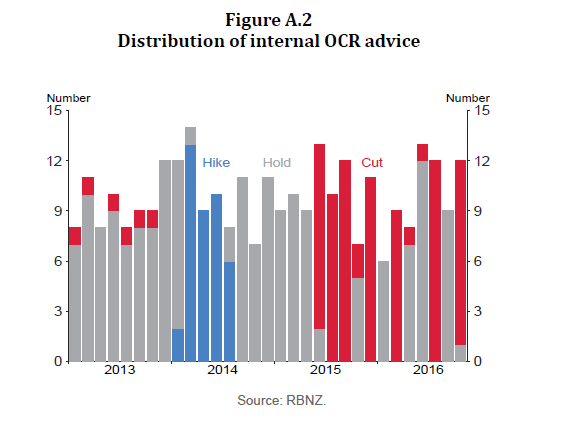
For anyone interested in another small example of how the Reserve Bank has the Ombudsman wrapped around their little finger,  consider the release last Thursday in the Monetary Policy Statement of this chart.

OCR advice

When I’d first seen it I offered a little bit of praise to the Governor for publishing it.  It happened to be quite similar to information I had requested more than 2.5 years ago, and which the Bank had refused to release.

As I noted in the post on Thursday, I learned a few minutes after publishing that praise of the Governor that, in fact, they had published the material only because –  after a mere 2.5 years –  the Ombudsman had got round to asking them to reconsider.   But it got worse when I got the formal letter from the Ombudsman on Friday.  They did actually apologise for taking 2.5 years and noted

As you may appreciate, this investigation has involved several meetings and much correspondence with the Reserve Bank concerning the use of a rarely-used withholding ground.

(From memory this is the “substantial economic interests” ground, which the Ombudsman thus again avoids formally ruling on.)

But this was the bit that really caught my eye

To preserve market neutrality, the Reserve Bank asked me not to inform you of its decision to release this information until after the November MPS.

This simply confirms that the Ombudsman and his staff have no concept of what might, or might not, be market sensitive.   Anyone with the slightest familiarity with the issue will recognise what actually happened.  The Bank decided to put the information in the MPS so that it might perhaps attract a little praise (for new interesting information) –  and it even managed to get some from me – while avoiding a situation where, having released the information to me –  me having requested it 2.5 years ago – I could have put it out first here, with some digs about the process, the obstruction, and the interests of transparency.

As it happens, I have no problem at all with the Bank putting the material in the MPS. It gave the material more visibility than it would get here –  and there was even a question at the press conference –  but no one, but no one (other than presumably the Ombudsman’s office, which appear not to know what it doesn’t know) would have bought the line about this old information being in any way market sensitive, or hence the alleged need for “market neutrality” about its release.  The Ombudsman’s office, again, allowed itself to be used by the Bank.  Relevant Bank staff will no doubt have been quite pleased with themselves.  But if anyone from the Ombudsman’s office is reading this –  and perhaps I’ll send them a copy –  they might use it as a prompt to begin to rethink the extreme deference they’ve displayed towards the Bank over the years.


That will be $2 million and would you like fries with that?

Yesterday afternoon the Governor of the Reserve Bank and the chief executive of the Financial Markets Authority released their report on bank conduct and culture.  Despite highlighting several times in the report that this was really none of their business (of course they phrased it more bureaucratically: “neither regulator has a direct legislative mandate for regulating the conduct of providers of core banking services”), they’d spent an estimated $2 million of public money to mount their bully pulpit, lecture the banks, lobby for more powers for themselves.    And yet, rather lost among the soundbites –  especially those from the Governor loudly lamenting the apparent risks of “complacency” – was this simple summary (from the second page of the Executive Summary)

…culture and conduct issues do not appear to be widespread in banks in New Zealand at this point in time.

Perhaps these regulatory agencies should stick to their core responsibilities, assigned by law.   Developing a culture of doing excellently what Parliament asked them to do, of being open and accountable to citizens, and avoiding overreaching their mandate (relying on implicit threats) would be good to see from both the Reserve Bank and the FMA.  All government agencies should know their limits and stick within them.  Perhaps their respective boards should be asking some hard questions of management.

Oh, and dealing effectively with complaints made against, or to, the agencies themselves would also represent quite a (welcome) change.  Physician heal thyself.

But getting back to the report itself, the simple truth is that there just wasn’t much there.  Not much economic analysis –  just somewhat ad hoc “sermons” –  no cross-industry comparative analysis, and not even the simple acknowledgement that in institutions run by human beings mistakes will be made from time to time.

Perhaps there is something in the line that it was rather a once-over-lightly review.  Perhaps too neither institution really had a strong interest in finding serious problems –  just enough for the Governor to advance his ambitions with more portentous lectures on how private businesses needed to run themselves better.

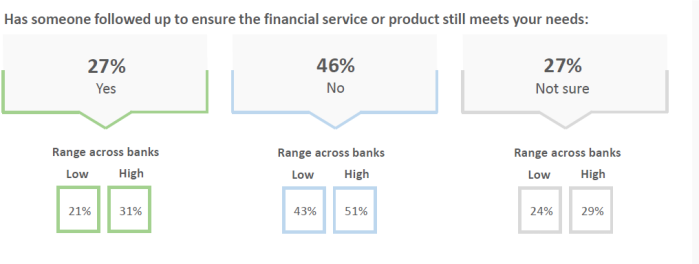
But it was well-known for months that the review was underway.  There was plenty of opportunity for any serious systematic issues –  whether in a single bank or across the system –  to be brought to light by those adversely affected.  And, as it happens, as part of the review the FMA and RBNZ commissioned a poll, surveying the experiences people had had with their own banks, and their trust in banks and the banking system.   It isn’t clear from the published report how the (on-line only) sample was selected, but I thought the results were quite reassuring.

There was this summary, for example

culture 1

It often seems as though every second shop I go into has staffed trained to attempt to sell products I don’t want or need (“City Council rubbish bags?” I’m routinely asked –  and never buy –  at the local New World), so if only a quarter of bank customers have had staff offer them financial products they don’t want or need, bank marketing must be a bit better targeted than I’d realised.

There is also a degree of unrealism about some of the questions.  I’m quite sure that when I’ve dealt with my bank they have rarely put my long-term financial interests first.  Why would they?  They are a profit-maximising private business looking to maximise value for shareholders, but through a repeat-game business where alienating the customers is often detrimental to the longer-term interests of shareholders too.  (And for many products the bank may have no idea what my “long-term financial interests” actually are.)

Or there was this question.

Q: ‘After purchasing a financial service or product, such as credit card, insurance, loan, term deposit, KiwiSaver, etc., has someone followed up to ensure the product continues to meet your needs and is still suitable for you?’

culture 2

Surely even at best this is only a nice to have?  Annoying calls from firms “just following up to see that everything is okay” have a cost (to the recipient too).  And there is some (considerable) onus on customers.  If I reflect on this question, I probably have a couple of credit cards I no longer need –  and am paying a small amount to the ANZ for each year – and no one has rung to check whether they are still “meeting my needs”.  But I don’t expect them to.  I’m an adult.

I’m not totally laissez-faire on such matters.  There are dangers that long-term contracts, hard to get out of, could be sold to people who simply don’t understand them. (Occupational pension schemes that people had no choice but to join are another example.)  It is reasonable for society to have (legal) protections built into the system.  But this report highlights precisely no systematic problems.   The report briefly, and reasonably, mentions a class of “vulnerable customers”, but again it was not apparent that there are either systematic problems or easy solutions.

Perhaps the most publicised part of the report is the initiative by the FMA and Reserve Bank to try to get all banks to stop sales-related incentives for frontline staff.   Given that the two institutions acknowledge that their legal mandates are limited it isn’t clear how much this is more than bluff, bravado, and a bit of pushing at an open door (some banks already being in the process of phasing out such incentives).  I hold no brief for specific remuneration practices, but I was struck by how little actual analysis there was in the report, including the role of sales-based incentives in a whole range of other sorts of firms and industries.  I didn’t explicitly check, but when I bought a car a few weeks ago I didn’t assume other than that the salesman would be benefiting personally if I happened to buy a car from him.  No doubt he knew that I knew.  There are risks, and one deals with them by some mix of dealing with reputable firms (invested in their brand), mechanic checks, and so on.  It isn’t clear in what respect the FMA and the Reserve Bank think basic banking products are so different.   There are no perfect ways of resolving agency issues (even within organisations), again something missing from the report.  Then again, rhetoric is cheap and serious analysis is hard (and grabs fewer headlines).

One of the Governor’s consistent themes is that banks –  and indeed private business more generally –  are too short-term in focus. He never produces any evidence to support his claim, or to back his view that he is better placed than private shareholders and managers to appropriately factor in time horizons, conditioned on the huge uncertainty everyone faces.   It shows through again in this report.  There are several claims that banks are too focused on short-term customer value or satisfaction, but no evidence is adduced to support this.   Frankly, I’d find it a little surprising if it were true.  Lifetime customer value is an approach that has been around in the marketing etc literature for 30 years now (and the basic idea won’t been unknown prior to that), and if banks really were just prioritising the short-term presumably they’d run into trouble eventually?  And yet New Zealand (and Australian) banks –  outside the immediate post-liberalisarion period –  have been both stable and profitable over many many decades, and haven’t even been losing customers to newer better providers more willing or able (or something) to meet customers’ long-term needs.

So, overall, I wasn’t impressed.  From the beginning, the review looked like a bit of power and influence grab –  especially by the new Governor, playing politics – bidding for more resources.  It came at a time when the banks –  legitimate private businesses (not, as the Minister of Finance put it this morning, operating as some sort of “privilege”) –  were (and are) in a weak position to stand up for themselves (given the bad stories from Australia).  And so banks, who face a market test every single day –  not just the share market, but customers with the ability to take their business elsewhere –  have to quietly put up with lectures from senior bureaucrats who’ve never faced such tests, never had to put their ideas or products to the market, deferentially swearing to go along and do as Orr and Everett say.   And, of course, if the banks do end up having to put in place more reports, more systems, more compliance checks, well, the burden of regulation always falls less heavily on big established players than on small operators or new entrants.  And so the big players –  more deft at playing the political/bureaucratic games – don’t really have much to worry about.  But customers might.

None of this is to suggest that ethics and morality (two words absent from the report)should be unimportant in business.  Without them, the basis for trust –  central to well- functioning markets and societies –  is corroded and eventually lost.  But it also isn’t clear that yet more mandated reports, yet more boxes to check, yet more rules to get legal sign-off on compliance with, is any sort of real substitute for the sort of personal and institutional integrity many hanker after.  I’m a trustee of a couple of superannuation schemes, which the FMA is responsible for regulating, and I’m struck by the sheer cost and additional complexity new waves of rules add –  even rules specifying the maximum number of words in one specific report –  and the contrast between that and the likely value being added for members.  And the improbability that the thicket of rules will really do much the stop the rogues.  Or even to cultivate a culture of honour and decency –  as distinct from formal compliance –  among the promoters and adminstrators of such schemes.

Restructuring the Reserve Bank

Seven months (and counting) into his term as Governor, Adrian Orr still hasn’t deigned to deliver an on-the-record speech on either of his main areas of statutory responsibility (monetary policy and financial stability) but he has this morning done what it seems almost all new CEOs –  public sector and private sector –  now do, and restructured his senior management, ousting or demoting several top managers, elevating one or two, and opening up a raft of vacancies.  Public sector senior management restructurings seem to generate most of the Situations Vacant business for the Dominion-Post newspaper these days.

A few people have asked my thoughts on the restructuring, so…..

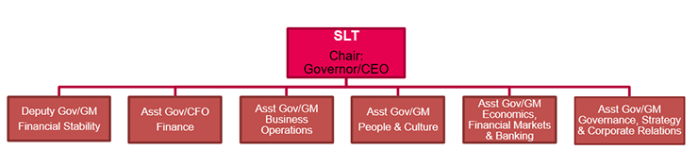
As a first observation, I give credit to the Governor for resisting the temptation of across the board grade inflation (although there is at least one example, see below).  Every public sector senior management advert one sees –  I pay attention mostly because my wife has been in the market – is full of Deputy Chief Executive roles (not infrequently five or ten of them).  The Bank’s Act constrains the number of Deputy Governor positions (only one, in the bill before the House at present) but if he’d wanted to, all these SLT positions could have been designated Deputy Chief Executive roles.  As it is, having resisted title inflation, the Governor might find some potential applicants a bit more hesistant than otherwise: an Assistant Governor (even for Economics, Financial, and Banking) may sound less glamorous than a Deputy Chief Executive title.

This is the new structure, which looks a lot like those for all manner of public sector organisations.new-leadership-team-structure

Three of those positions are filled straight away.

Appointments to Senior Leadership Team
Geoff Bascand – (Currently Deputy Governor and Head of Financial Stability) has accepted a role on the SLT as Deputy Governor and General Manager of Financial Stability.
Lindsay Jenkin (currently Head of Human Resources) has accepted a role on the SLT as Assistant Governor/General Manager of People and Culture
Mike Wolyncewicz (currently Chief Financial Officer and Head of Financial Services Group) has accepted a role on the SLT as Assistant Governor/ Chief Financial Officer Finance.

Of those two appointments (Bascand and Wolyncewicz) seem sensible and appropriate.  Bascand currently holds a statutory Deputy Governor appointment and would have been hard to shift even if the Governor had wanted him out.  His role is slightly –  though perhaps sensibly – diminished as he will no longer have overall senior management responsibility for financial markets.

To be blunt, the new Assistant Governor for People and Culture has the feel of tokenism on two counts.   The first count relates to the current tendency for HR managers to be given glorified titles and to report directly to the chief executive (the message supposedly being “we value our people”, as if organisations never did when HR was a fairly low-level support role).  Line managers are the people who convey (by their actions mostly) to staff the extent to which they are valued (or otherwise).   And the second relates to the incumbent, who just is not particularly impressive.  As someone put it to me, perhaps she might be okay in some modest commercial operation, but she never showed any sign of being suited for a key leadership role in a significant policy organisation.  But….she is a woman, and in promoting her Adrian Orr manages –  after 84 years –  to have a woman in a top tier role (although still not in a key role in policy or operational areas, the raison d’etre for the organisation).   It will have been an easy win to simply grade-inflate the Manager, Human Resources role.  After all, as he said a few months ago

We will be working actively. We are just going to have to be far more aggressive at getting the gender balance balanced,” Orr said in a recent interview

(And before I get angry emails or anonymous comments from past or present Reserve Bank staff, I will reiterate my view –  and it is only mine –  that there are no conceivable grounds on which Lindsay Jenkin would be in the top tier of a major policy organisation other than her sex.  I wish it were otherwise.)

In the entire restructuring, the person one should probably feel most sorry for is Sean Mills, Assistant Governor and Head of Operations, whose job is dis-established and who is leaving the Bank, having joined under a year ago.  I suppose he knew the risks –  taking on a direct report job in the hiatus between Governors, when no one had any idea who the new Governor would be or what structure he or she would prefer.  I’ve never met Mills, and have heard nothing good or bad about him, but it is always a bit tough to lose your job after less than a year.

Two long-serving key senior managers –  both in their roles for 11 years now –  are demoted as part of the restructuring, one perhaps a bit more obviously than the other.

The first is Toby Fiennes, currently Head of Prudential Supervision.  His role –  a big job –  appears to have been split in two.

Toby Fiennes (currently Head of Prudential Supervision Department) has accepted the role of Head of Department for Financial Stability Policy and Analytics.

with one of his current managers (very able) taking up the role responsible for actual oversight of financial institutions.

Andy Wood has accepted the new role of Head of Department for Financial System Oversight.

I always had some time for Fiennes (although I’ve probably criticised speeches and articles here) and thought him in some respects the best of the main departmental heads.  Perhaps it is just that the job has gotten so big that the Governor no longer wanted one person doing it, but the new role is much-diminished relative to what he has been doing for the last decade.   And Geoff Bascand already had the key overall financial stability role, so there was no possible promotion opportunity.

The bigger, and more obvious, demotion is that of (current) Assistant Governor and Head of Economics, John McDermott.

John McDermott (currently Assistant Governor and Head of Economics) has accepted the role of Chief Economist and Head of Department for Economics in the Economics, Financial Markets and Banking Group.

After 11.5 years as a direct report to the Governor, and almost as long with the Assistant Governor title, McDermott loses both.

I’m always hesitant to write much about McDermott.  He was my boss for six years, and while we had our differences we sat across from each other for years and exchanged views on all manner of work and family things.  I liked him, was looking just the other day at the personal gift he gave me when I left the Bank, and I was genuinely pleased to applaud his daughter’s award the other night at the Wellington East Girls’ College prizegiving.

Unfortunately, I don’t think he was the person for the role he has held for eleven years, and which he never really grew into or made of that position what it should have become.  He has a strong track record as a researcher, and apparently was for quite a while the most widely-cited New Zealand economics researcher, but the key senior manager for monetary policy –  effectively a deputy governor without the title – required more than McDermott had to offer.   In public view, this was apparent in speeches and Monetary Policy Statement press conferences.  And thus, sad as it perhaps is for John, I think the Governor has made the right choice.  Whether McDermott stays for much longer in the diminished position he will now take up perhaps depends a lot on who gets vacant (and crucial) new role of Assistant Governor for Economics, Financial Markets, and Banking).

Two other senior managers in core roles leaving the Bank

Mark Perry (Head of Financial Markets)…..elected to leave the Reserve Bank.

Bernard Hodgetts (Head of Macro-Financial Department, who is currently seconded as Director Reserve Bank Review in the Treasury) has also chosen to leave the Reserve Bank after he finishes his role leading the review.

The Head of Department for Financial Markets won’t be an easy role to fill –  I wouldn’t have thought there were any obvious internal candidates.

Three more comments on the review:

  • even if a role like “Assistant Governor, Governance, Strategy and Corporate Relations” is the sort of title one sees in lots of government agencies, it feels like another example of grade inflation.  Presumably this involves the communications functions, the Board Secretary, and churning out the myriad hoop-jumping documents like the Statement of Intent.  People with “strategy” in their title in public sector organisation are rarely at the heart of what the organisation do.
  • there will be a lot of focus on who gets the role of Assistant Governor, Economics, Financial Markets, and Banking.  This is (slightly) bigger role than Murray Sherwin held 20 years ago, without the benefit of the Deputy Governor title.    We will have to wait until the adverts appear to see whether the Governor is after a policy leader (someone who really knows this stuff) or a generic public service manager.  If –  as I hope –  the former, it has been speculated to me that the Governor may try to attract back to the Bank the current Treasury chief economist Tim Ng (whose talents would be better used doing almost anything than wellbeing budgets).  Another possibility is the current Treasury deputy secretary for macro, Bryan Chapple who has a central banking background and led some of the financial markets reform work at MBIE.  No doubt there will be others applying, especially as the holder of the position is almost certainly to be a statutory appointee to the new Monetary Policy Committee.
  • this restructuring also probably helps clarify who will be the four internal members of the new Monetary Policy Committee.  The Governor and Deputy Governor will be members ex officio, and it is hard to see how the other positions would not be given to the Assistant Governor, Economics, Financial Markets,and Banking) and to John McDermott, as head of the Economics Department.

Overall, the restructuring is quite a mixed bag.   There are some good appointments and some poor ones already, and quite a lot will depend on a handful of the remaining appointments (especially the quality of person they can attract to that Assistant Governor role –  which, notwithstanding my earlier cautions about grade inflation, really should be a deputy chief executive position, both for recruitment reasons and for the stature and standing of the person in international central banking circles).

If I have a caveat about the overall structure, it is probably that the Bank would be better for having at least one senior policy person –  whether as Deputy Governor or so Advisor to the Governor –  who didn’t have a demanding line management role.  Such roles aren’t uncommon in other central banks, but I guess it depends on the Governor’s own preferred operating style.

And since I have the opportunity of a post about the Bank, I should note that I have not abandoned the issue of the Governor’s total non-transparency in respect of his speech about transparency to the Transparency International AGM (at which he was introduced by the State Services Commissioner, who has responsibilities for open government).  I am pleased to see this issue has had a little bit of media attention, including this article which pointed out that 90 per cent of Transparency International’s funding comes from the taxpayer.  I have an Official Information Act request in with the Bank for any briefing notes or text the Governor used, for any recordings that may exist, and if none do for a summary of what was said (memories –  very fresh, since I lodged the request within hours of the Governor delivering his speech – are official information too.   I don’t expect much, but there is a point to be made –  all the more so given the topic, the audience, the introducer, and the funding source for the body to which he was speaking. I can’t imagine Orr said anything very controversial, in which case why the secrecy? And if what he said was controversial –  foreshadowing for example Monday’s forthcoming culture review – it shouldn’t be said only to select private audiences.  It was simply an unnecessary own-goal, some sort of silly reassertion (perhaps Wheeler like) of a Reserve Bank perception that it really should be above such trivial matters as disclosure, transparency and the Official Information Act.


Looking back to the deposit guarantee

12 October 2008 was a frantic day.  It was a Sunday, and I never work Sundays (well, two financial crises, one in Zambia, one in New Zealand, in 30+ years).  There was a call in the middle of our church service summoning all hands to the pump, to put in place a retail deposit guarantee scheme that day.   We did it.  My diary later that night records that we’d “delivered a brand spanking new not very good deposit guarantee scheme”, announced a few hours earlier.   It was a joint effort of the Reserve Bank and The Treasury.

I had recently taken up a secondment at The Treasury.  I’d been becoming increasingly uneasy about the New Zealand financial situation for some months (flicking through my copy of Alan Bollard’s book on the crisis I found wedged inside a copy of an email exchange he and I had had a month or so earlier about Lender of Last Resort options for sound finance companies, potentially caught up in contagious runs) but I hadn’t had any material involvement in the unfolding sequence of finance company failures.   But it was the escalating international financial crisis – this was four weeks after Lehmans, 3.5 weeks after the AIG bailout, two weeks after the US House of Representatives initially voted down TARP, and two weeks after the Irish government surprised everyone by announcing comprehensive deposit guarantees –  that really accelerated interest in the question of what, if anything, New Zealand should do, or might eventually be more or less compelled to do.    The initiative for some more pro-active planning came from The Treasury, but with some parallel impetus  –  including around guarantees – from the then Minister of Finance, Michael Cullen (who, a few days out from Labour’s campaign launch, was also looking for pre-election fiscal stimulus measures).

On Tuesday 7 October, there was a long meeting at the Reserve Bank, attended by both the Secretary to the Treasury, John Whitehead, and the Governor of the Reserve Bank.  My memory – and my contemporary diary impression – is that the Governor was considerably more focused on the managing the Minister’s political concerns than on any sort of first-best response.    But the outcome of that meeting was agreement to quickly work up a joint paper for the Minister which would not, at that stage, recommend introducing a deposit guarantee scheme, but which would outline the relevant issues and operational parameters, giving us something to work from if the situation worsened.

Which it quickly did, both on international markets, and with the political pressure, with the Prime Minister signalling that she wanted to be able to announce something about guarantees in her campaign launch that coming Sunday afternoon.

I and a handful of others on both sides of The Terrace scurried round for the next few days.  I see that in my diary I wondered what the best approach was: do nothing, allow some risk of the crisis engulfing us, and then pick up the pieces afterwards, or be more pro-active and take the guarantee route.  My conclusion –  and even today I wince at the parallel (but this was a late-at-night comment) – “I suspect that if the pressures really come on, the Irish approach is best”.   As relevant context, although much of the finance company sector was in solvency trouble (many had already failed) there were no serious concerns about the solvency of the banking system.   (Liquidity was, potentially, another issue.)

At Treasury we had recognised the importance of the Australian connection –  most of our banks being Australian-owned.     I’m not sure of the date, but we had taken the initiative –  at Deputy Secretary level –  of approaching the Australian Treasury to see if they were interested in doing some joint contigency planning around deposit guarantees, and had been told that the Treasurer had no interest in such guarantees and so our suggestion/offer was declined.

But even Australian authorities could look out the window and see that the global situation was deteriorating rapidly, and by late in the week that recognition was being passed back to authorities on this side of the Tasman.  Alan Bollard always kept in close contact with his RBA counterpart Glenn Stevens, and on the Friday my diary records (presumably told by some RBNZ person I was working with) “apparently Glenn S[tevens[ told Alan this afternoon that the RBA/authorities might fairly soon have to consider a blanket guarantee”.     In the flurry and uncertainty, one other senior RBNZ person –  still holding a senior position there –  told me that in his view nothing should be done here unless there were queues outside New Zealand banks.

Between a handful of people on the two sides of the street, we got a paper on deposit guarantee scheme possibilities out to the Minister of Finance on the Friday afternoon.  It was a mad rush, with some uneasy negotiated compromises (and everyone’s particular hobbyhorse concern got its own mention). I was probably too close to it to tell, and noted I wasn’t that comfortable with it, but when I got Alan Bollard’s signature he indicated he was happy with it.  I noted “lots of small details to sort out next week –  we hope only that, not implementation”.     To this point, we were focused mostly  on retail deposits, but I see in my diary that in The Australian on the Saturday there was talk from bank CEOs of a possible need for a wholesale guarantee scheme.

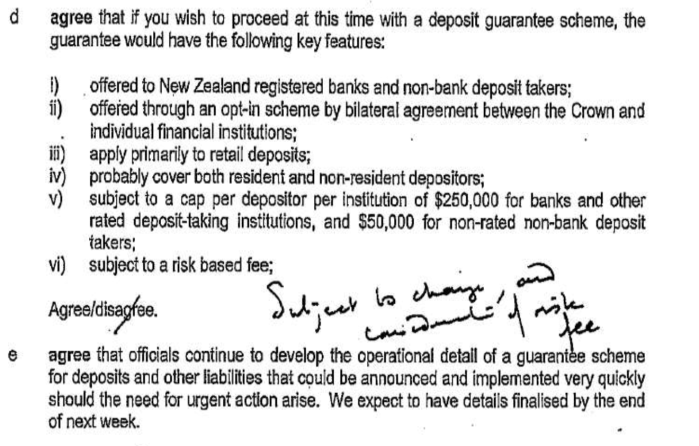
The full, unredacted, paper we wrote is available on The Treasury’s website.   The thrust of the advice was that (a) action was not necessary immediately, but (b) that should conditions worsen a scheme could be put in place at quite short notice.  The rest of the paper outlined the relevant issues, and the recommended features of any such scheme, and we advised against announcing a scheme until the remaining operational details had been sorted out, something we suggested could be done in the folllowing week.

These were the key features we suggested, largely accepted by the Minister.

dgs 1

One thing that puzzles me looking back now is why we were focused on guarantee options, rather than lender of last resort options.  The latter would have involved lending on acceptable collateral to institutions that we judged to be solvent, perhaps at a penal rate.  It was the classic response to the idea of a contagious run –  troubles elsewhere in the financial system spark concerns about other institutions, and people “run” –  cashing in deposits, retail or wholesale –  just in case.  A sound institution could, in principle, be brought down very quickly by such a run (empirically there are few such examples –  most actual runs end up being on institutions that prove to be at-best borderline solvent).

In the paper we sent to the Minister on 10 October we don’t seem to address that option at all.  I presume the reason we didn’t was twofold.  First, guarantees were beginning to proliferate globally.  And second, there probably is a pretty strong argument that if (a) you are convinced your banking system is sound, and (b) there are nonetheless doubts in the wider environment (in this case, a full scale global crisis, and a domestic recession), a guarantee is likely to be considerably more effective in underpinning confidence.  Not so much depositor confidence, as the confidence of bankers (and their boards).    Even if lender of last resort funding, on decent collateral, had been available without question, few bankers would have been happy to rely on that, and many would have been very keen to cut exposures, pull in loans, and reduce their dependence on the good nature of the Reserve Bank Governor.   A guarantee –  where the Crown’s money is at stake –  is a much stronger signal than a loan secured on the institution’s very best assets.   On the other hand, as the paper does note, once given a guarantee may not leave one with much leverage over the guaranteed institution.

Almost all of the subsequent controversy around the deposit guarantee scheme related in one form or another to one key choice.

All the systemically significant financial institutions in New Zealand were banks (not that all banks were systemically significant).  But they were not, by any means, the only deposit-taking institutions, and we were in the midst at the time of a finance company in which many companies were proving to be insolvent and failing.  Other finance companies appeared –  not just to the Reserve Bank, but to the market, and to ratings agencies – just fine.

Treasury and the Reserve Bank jointly recommended to the Minister that any deposit guarantee scheme include finance companies.  Why did we do that?

The simple reason was one of both fairness and efficiency.  Had we proposed to offer a guarantee only to banks (let alone only the big banks) then in a climate of uncertainty and heightened risk, there would have been an extremely high risk that such an action would have been a near-immediate death sentence for the other deposit-taking institutions, including ones with investment grade ratings, and in full compliance with their trust deeds.    We knew that finance companies (while small in aggregate) were riskier than our banks, but that was no good reason to recommend to the government a model that would have killed off apparently viable private businesses.  It still seeems, with the information we had at the time, an unimpeachable argument.  Classic lender of last resort models, for example, don’t differentiate by the size of the borrowing institution.

We weren’t naive about the risks –  including that there was still no prudential supervision of finance companies and the like –  and we explicitly recommended that risk-based fees (tied to ratings) be adopted, and the maximum coverage per depositor be much lower for unrated entities.   We included in the table an indicative fee scale, based credit default swap pricing for AA-rated banks in normal times, scaling up (quite dramatically) based on the much higher default probabilities of lower-rated entities.

We even included a indicative, totally back of the envelope, guess as to potential fiscal losses –  drawing on the experience of the US S&L crisis.  As it happens, actual losses were to be less than that number, even though the scheme as adopted by the Minister of Finance was less good than the one we recommended.  (Treasury provided some other –  but lower – loss estimates a few days after the actual announcement, but I can’t see those on the Treasury website and can’t now recall the approximate numbers.)

But all that was just warm up.   We’d been under the impression that the Prime Minister was going to announce, in her campaign launch speech, that preparatory work was underway on a deposit guarantee scheme.  That was probably her intention.  But that didn’t allow for the Rudd effect.  The Australian Prime Minister decided that he was going to announce an actual retail guarantee scheme for Australia that day –  the Sunday.  And so it was concluded that New Zealand had little choice but to follow suit.   As a matter of economics, there probably was little real choice but to follow the Australian lead.  But the timing was all about politics.  Neither economic nor financial stability would have been jeopardised if we hadn’t had a deposit guarantee scheme announced before the banks opened on Monday morning.  We’d have been much better to have taken a bit more time and hashed out some of the details with the Minister in his office in Wellington, not at campaign launches and then, as the day went on, airport lounges (at one point late that afternoon I –  who’d talked to the Minister perhaps twice in my life previously –  was deputed to ring Dr Cullen and get his approval or some detail or other of the scheme).   But I guess it might have left open a brief window in which critics might have suggested that New Zealand politicians were doing less for their citizens and their economy than their Australian counterparts.

The main, and important, area in which Dr Cullen departed from official advice was around the matter of fees.   We’d recommended that the risk-based fees would apply from the first dollar of covered deposits (as in any other sort of insurance).     The Minister’s approach was transparently political –  he was happy to charge fees to big Australian banks (who represented the lowest risks) but not to New Zealand institutions (including Kiwibank).  And so an arbitrary line was drawn that fees would be charged only on deposits in excess of $5 billion.   Apart from any other considerations, that gave up a lot of the potential revenue that would have partly offset expected losses.  The initial decision was insane, and a few days later we got him to agree to a regime where really lowly-rated (or unrated) institutions would have to pay a (too low) fee on any material increases in their deposits. A few days later again an attenuated pricing schedule was applied to deposit-growth in all covered entities.   But the seeds of the subsequent problems were sown in that initial set of decisions.

The weeks after the initial announcement were intense.  We rushed to get appropriate deed documents drawn up, dealt with endless request from institutional vehicles not covered who sought inclusion (property trust, money market funds etc), and set up a monitoring regime.  In parallel, we quickly realised that the way wholesale funding markets were freezing up suggested that a wholesale guarantee scheme was appropriate, and got something announced in a matter of weeks –  a much more tightly-designed, better priced scheme, operating only on new borrowing (but I’m biased as that scheme was mostly my baby).  As it happens, that scheme provided the leverage to actually get the big banks into the deposit guarantee scheme.  Once the government had announced the retail scheme the big banks had little incentive to get in –  they probably thought of themselves (no doubt rightly) as sound and as too big to fail –  and the scheme was an opt-in one (we couldn’t just by decree compel banks to pay large fees).   But the Minister of Finance –  probably reasonably enough –  insisted that if banks wanted a wholesale scheme (which they really did) it would be a condition that they first sign up to (and pay for) the retail scheme.  Perhaps less defensible was the Minister’s insistence that any bank signing up to the guarantee scheme indicate that it would avoid mortgagee sales of home owners in negative equity but still servicing their debt (the ability of banks to do so is a standard provision of mortgage documentation).

After the first few weeks of the retail scheme I had only relatively limited ongoing involvement, and so I’m not going to get into litigating or relitigating the South Canterbury Finance failure, and whether –  even the constraints the Minister put on –  and how that could by then have been avoided (the Auditor-General report some years ago looked at some of those issues).   The outcome was highly unfortunate, and expensive.  Nonetheless, it is worth remembering that the total cost of all the guarantee schemes – retail and wholesale – was considerably less than officials had warned was possible.  And it is simply not possible to know the counterfactual –  how things might have unfolded here had either no guarantees been offered, or if the finance companies and building societies had been excluded from day one.  Personally, I think neither would have provided politically tenable, but we’ll never know that, or how that alternative world played out.

But with the information we had at the time –  including, for example, the investment grade credit rating for SCF (which had outstanding wholesale debt issues abroad –  and actually my only meeting with SCF was about their interest, eventually not pursued, to try to use the wholesale guarantee scheme) –  the recommendation made on 10 October seem more or less right. Given the same information I’m not sure I’d advise something different now.  And once Australia had made the decision to guarantee retail deposits, there was little effective economic or political choice for New Zealand.   Had they not done so –  and there was real data, regarding increasing demand for physical cash in Australia, supporting Rudd’s action (rushed as timing was) – perhaps we could have got away with a well-designed wholesale guarantee only.   That would have been a first-best preferable world, but it wasn’t the set of facts we actually had to work with.


More on Orr

It is six months today since Adrian Orr took office as Governor of the Reserve Bank, the latest (and last, given forthcoming legislative reforms) in a line of people who over the last 30 years have held office as the single most powerful unelected person in New Zealand (more powerful individually than most elected people).

When it comes to monetary policy, I’ve had no particular problem with the Governor’s bottom-lines.  In fact, if he’d stuck to those, the contents of this blog in recent months would have been quite different.

Here was the bottom line in May (the Governor’s first OCR decision)

The Official Cash Rate (OCR) will remain at 1.75 percent for some time to come. The direction of our next move is equally balanced, up or down. Only time and events will tell.

in June

The Official Cash Rate (OCR) will remain at 1.75 percent for now. However, we are well positioned to manage change in either direction – up or down – as necessary.

in August

The Official Cash Rate (OCR) remains at 1.75 percent. We expect to keep the OCR at this level through 2019 and into 2020, longer than we projected in our May Statement. The direction of our next OCR move could be up or down.

and here is the Governor today

The Official Cash Rate (OCR) remains at 1.75 percent. We expect to keep the OCR at this level through 2019 and into 2020. The direction of our next OCR move could be up or down.

As one of the only (perhaps the only) commentators who has been consistently on record in thinking a lower OCR would have been a good idea, and who has argued that if there is a move in the next 12 months it will be a cut, I’ve welcomed the fact that –  unlike most market economists –  the Bank’s focus doesn’t appear to have been on when the next OCR increase happens.  Too much focus in that direction misled both the Bank and the market economists for much of the last decade.

Thus far, well done Governor.

The bit in those “bottom line” statements that has left me a little uneasy is the apparently confident statements about the future: in March, the OCR would stay at 1.75 per cent “for some time to come”, and in the last two releases it has been even more specific about dates if less dogmatic in tone (“we expect to keep the OCR at this level through 2019 and into 2020”).       But none of us knows the future.  Macro forecasting is pretty futile more than perhaps a quarter or two ahead, and yet the Governor spends resources and puts his reputation somewhat on the line as if he were some sort of oracle, granted insight into the far –  by monetary policy standards –  far future.    It is bizarre and unnecessary.

But perhaps equally surprising is the way the market economists play the game.  Their commentaries are full of discussions around whether the next adjustment is more likely (say) 12 months out or 15 months out, as if they too are oracles, blessed with some particular insight.  I suppose they have clients who want this sort of stuff, but you might think that at least some of the better clients would appreciate being told the truth: there is almost no chance of the OCR changing in the next three months, and beyond it is really anyone’s guess, almost inherently unknowable.  Words like those in the Governor’s first statement: only time and events will tell.  Crisp and honest.

And yet I’m conscious that much of my experience was in periods when interest rates moved round a great deal.  And these days they seem not to.

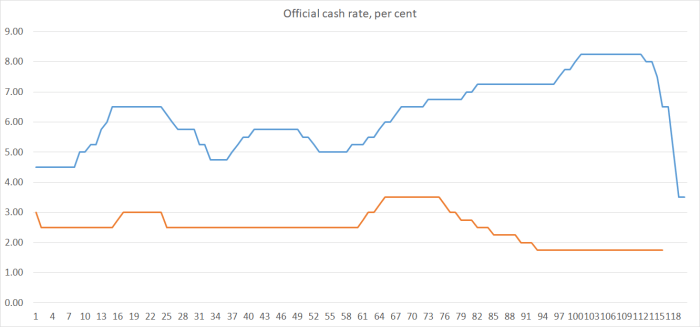
The OCR system itself is almost 20 years old.   The first OCR was set in March 1999.  In this chart, I’ve shown the first 10 years of data (to February 2009) and the subsequent 9.5 years to now.

OCR 10 years

In the first 10 years, the range from low to high was almost 500 basis points.  In the rest of the 1990s, the amplitude of fluctuations in the 90 day bank bill rate was similarly large.

And the last 9.5 years?   The total range within which the OCR has fluctuated is only 175 basis points, and it was only even that wide because of the msisguided enthusiasm for tightening in 2014.

That is quite a difference.

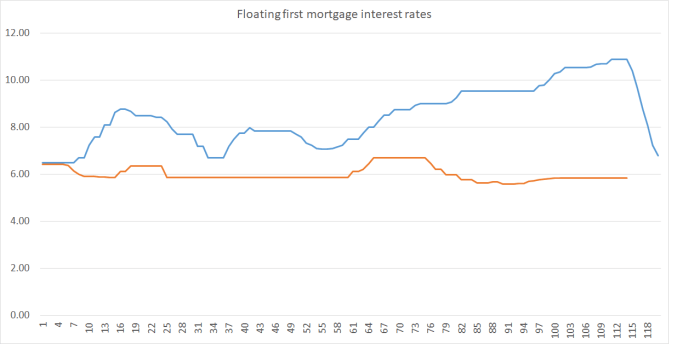
But the difference is even more stark if we look at retail interest rates.   Here is the Reserve Bank’s floating first mortgage rate series for the same two periods.

floating 10 yr

Over the last 9.5 years, this mortgage interest rate has moved within a total range of only about 110 basis points.

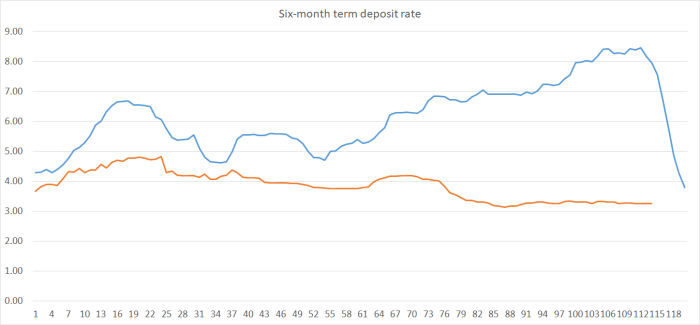
And here is the same chart for the Bank’s six-month term deposit rate series.

TD rate 10 years

The range from high to low is about 170 basis points (similar to that for the OCR), but the peaks were a very long time ago now (back in 2010/11).  For years now, term deposit rates (on this indicator) have fluctuated little, between just over 4 per cent and just over 3 per cent.

I don’t have a good hypothesis for why we have seen such a dramatic change in the variability of interest rates.  It doesn’t surprise when one sees such patterns in countries that hit the effective lower bound on nominal interest rates –  unable to cut further, inflation lingers low and there is little reason then to raise rates. But that isn’t the New Zealand story at all  –  the lowest the OCR has got is the current 1.75 per cent and everyone recognises it could be cut further if necessary.

Has the economy really got so much more stable than it was in the previous couple of decades?  It seems unlikely, perhaps especially in New Zealand (with, for example, record swings in population, big earthquakes, and big terms of trade changes).  Perhaps, to some extent, the Reserve Bank has simulated the sort of behaviour seen in the lower bound countries: always reluctant to cut (even though they always could have), inflation has stayed too low, and the economic upswings have, partly as a result, been pretty muted by historical standards and not very inflationary.  I’m genuinely puzzled.  Who knows, perhaps the Governor could offer the benefits of Bank research and analysis on this point whenever he finally gets round to deigning to give a substantive speech on his primary (according to the Act) responsibility, monetary policy?

Changing tack, in yesterday’s post I had a bit of fun taking the Governor to task over his attempt to articulate the story of the Reserve Bank as if it were some obscure mythical tree god, Tane Mahuta.   Late in that post, I noted that they had adopted some imagery of an island, as what the Bank was working towards.  In their own words

“We have visualised ‘our island’ that we are moving towards on the horizon, one that all New Zealanders can be proud of and that Tane Mahuta –  our Bank – can stand tall on.”

And this was the page with the picture I showed.

our island.png

I noted yesterday

It appears to be the island where the imaginary tree god dwells.  But, here’s the thing, it doesn’t look a bit like anywhere in New Zealand.  And the Reserve Bank of New Zealand is supposed to be primarily about New Zealand and New Zealanders.   Has the tree god flown the coop (so to speak) and fled to some poor Pacific Island where –  perhaps –  well paid senior central bankers take their winter holidays and commune with the deity?   I’d prefer a central bank –  even one deluded that it is a tree god –  to think New Zealand, New Zealand people, New Zealand places.

A diligent reader took the photo and did a little digging with the help of Mr Google.  Turns out that the Governor’s island is Bora Bora, a very expensive resort location in French Polynesia.  I guess it is the sort of place the Governor and his chums flit off too –  although I’d been under the impression the Governor’s destination of preference was the Cook Islands –  but the weird thing is that it is in a quite different country.  Even more oddly, given his distaste for the colonial experience –  suffusing his official document –  it is a territory of an old European empire.   Don’t we have any islands in New Zealand?

But we do, of course.  The Governor can probably see Somes Island out his office window. I live in a suburb named for its island.  And all of us live on these islands, the myriad of them that make up New Zealand.

I guess it was just a silly slip –  though you wonder how no one picked it up –  but it does seem all too consistent with the Governor’s style: once over lightly, and  more focused on the issues he isn’t responsible for (recall not long ago he told us we were lucky as a country not to export fossil fuels) than on the narrow range of things he is responsible for.  Perhaps he could put aside the tree god stuff and get back to (what a commenter this morning urged me to) the “dry old world of money”.   There is more interesting and important stuff in the world, but “money” is the Governor’s job, and it needs to be done well, and in a way that commands respect.

And, finally, regular readers might recall a post from a month or so ago, in which a reader had passed on a report of the Governor’s address (off the record –  and thus only the favoured few had access) to an INFINZ financial markets function in Wellington in late August.    It was reported that the Governor has been typically loquacious, but offering up potentially quite highly market-sensitive information to his favoured audience.

Typically loquacious but, so the report suggests, perhaps going rather beyond the Bank’s public lines on monetary policy as articulated in the August Monetary Policy Statement, in a very dovish direction.     And weighing in on what sort of person he wanted (and did not want –  economists apparently not wanted) on the new Monetary Policy Committee –  the one where the Minister supposedly makes the appointment, the one where the legislation has not yet been dealt with by the relevant select committee.

It seemed rather undisciplined and inappropriate, and I reminded readers again of the contrast with the Reserve Bank of Australia where speeches by the Governor and senior staff are typically on-the-record, usually with a published record of the subsequent Q&A session as well.  The difference doesn’t matter much when off the record speeches are totally anodyne, and people answer questions in a similar unrevealing way, but that certainly isn’t Orr’s style.

On this occasion, so the report I received suggested, it wasn’t just monetary policy things the Governor was free and frank about.    There was, for example, reportedly stuff about how if banks didn’t change their ways he’d change them for them, by setting up a Royal Commission here  [something the government would surely not be keen on given their difficult relationship with the business community, and plethora of reviews/inquiries], and a totally dismissive approach to the recent failure –  on the Bank’s watch – of CBL Insurance.

I put in an Official Information Act request to the Bank about this speech.  I didn’t expect much –  it seemed unlikely the Governor was working from a text, but (given his style) it was at least possible (it would be prudent more generally) there might have been a recording.  There wasn’t apparently.

But I also asked for copies for briefing notes or emails related to the content of the speech.  And there was some material there in the response I got back this morning.   The full response will apparently be put on their website before long (now here).   What was interesting was a request sent out on behalf of the Governor to several Bank staff who had been at the function inviting any feedback  (the request was for anything, good or bad, but perhaps not surprisingly none of the staff offered anything sceptical or critical, to a Governor not known for welcoming challenge).   In those comments we learn from one

My impression from the crowd was that they also enjoyed the speech and are really starting appreciate that having a longer-term vision and focus is important. I like that you gave the audience practical examples such as the United Nations Sustainable Development Goals, Carbon Disclosure Project, and Principles of Responsible Investing that they can start using/working toward now – they have no excuses for inaction!

The SDGs have nothing whatever to do with the Reserve Bank or its responsibilities.

And from another

For example, Adrian discussed climate change and short-term vs. long-term thinking.

Nor, of course, has climate change.  Short-term vs long-term thinking is one of his hobbyhorses, but as I’ve noted previously the Bank has done nothing substantive on this claim.

It sounds as if the speech was all over the show, and mostly (as we’ve come to expect) not on the things he is paid to be responsible for. It is undisciplined and unfortunate, and won’t help wider confidence in him or the tree god (though those who like his leftist political analysis may, shortsightedly, welcome it).  And none of it is transparent and open, more like a locker-room chat to his buddies in the financial sector.  He tells us the economy sat in darkness before the advent of the Reserve Bank.  Maybe, maybe not, but assuredly we all too often sit in darkness when it comes to the activities of the Bank itself.  That simply shouldn’t be acceptable.  Openness, and equal information for all, should be the watchwords of a modern accountable central bank and its Governor.

Orr among the forest gods

Almost 1300 years ago, the English missionary priest and bishop Saint Boniface confronted the belief of some pagan German villagers in Thor, god of (among other things) oak trees. Tree gods (or beliefs in them) were vanquished, and Boniface became known as the apostle to the Germans..

Pre-evangelisation, Maori had their own tree god, Tane Mahuta.    As far as I can tell, not many believe any longer in this local tree god: when I looked up the 2013 Census data, there were lots of Maori recording no religion, and there were plenty of Catholics and Anglicans.  But there wasn’t a category shown for tree gods, or any of the other deities (Wikipedia has a list of at least 35 of them).

But the Governor of the Reserve Bank seems intent on bringing them back.

Tomorrow will mark six months since Adrian Orr became the most powerful unelected person in New Zealand, as Governor of the Reserve Bank.  Six months on we’ve had not a single serious and substantive speech on the policy areas he is responsible for, and where he exercises a huge amount of barely-trammelled power.  No speech on monetary policy, no speech on banking regulation, and nothing either on the less prominent things the Governor is responsible for –  such as, for example, insurance prudential supervision, a New Zealand insurer having failed, regulated by the Reserve Bank just before the Governor took office.  He hasn’t substantively and openly engaged with, or responded to, the damning survey results on the Bank’s performance as a financial system regulator.

Instead, we’ve heard the Governor on almost everything else.  There was infrastructure, climate change (repeatedly), the failings of capitalism, geopolitics, women in economics, and of course bank “conduct” (playing distraction from his institution’s own failings, by trying to butt into a field for which the Bank has no statutory responsibility).    There have been lots of words, but not much sign of in-depth reflection or distinctive insights, and even less sign of doing him well, and being open about, the jobs Parliament has actually given the Bank.   Throw in some considerable complacency about monetary policy and it should be a pretty disquieting picture.

Some of it is probably just the Governor’s well-known propensity to talk.  Some of it might even be an understandable (if misguided in application) desire to lift the esprit-de-corps at the Reserve Bank after the demoralising Wheeler years.  And a lot seems to be about winning the turf battles, ensuring that in the reviews of the Reserve Bank Act that the government has underway as much as possible of the Bank’s powers are kept, in effect, under the Governor’s control, and that the existing powers and functions of the Reserve Bank are all kept in the Reserve Bank.  Part of that seems to be about openly subscribing what should be a non-partisan agency to every trendy left-wing cause that is going (and which, presumably, the Governor believes in personally.) A power play in other words –  and, with a weak government that probably doesn’t care much, quite likely to succeed,  somewhat to the detriment of New Zealand.

The latest example was the release on Monday of a rather curious 36 page document called The Journey of Te Putea Matua: our Tane Mahuta.   Te Putea Matua is the Maori name the Reserve Bank of New Zealand has taken upon itself (such being the way these days with public sector agencies).  It isn’t clear who “our” is in this context, although it seems the Governor  – himself with no apparent Maori ancestry – wants us New Zealanders to identify with some Maori tree god that –  data suggest –  no one believes in, and to think of the Reserve Bank as akin to a localised tree god.  Frankly, it seems weird.  These days, most New Zealanders don’t claim allegiance to any deity, but of those of us who do most –  Christian, Muslim, or Jewish, of European, Maori or any other ancestry – choose to worship a God with rather more all-encompassing claims.

But the Governor seems dead keen on championing Maori belief systems from centuries past.    In an official document of our central bank we read

A core pillar of the evolving Māori belief system is a tale of the earth mother (Papatūānuku) and the sky father (Ranginui) who needed separating to allow the
sun to shine in. Tāne Mahuta – the god of the forest and birds – managed this task after some false starts and help from his family. The sunlight allowed life to flourish in Tāne Mahuta’s garden.

This quote appears twice in the document.

All very interesting perhaps in some cultural studies course, but what does it have to do with macroeconomic management or financial stability?  Well, according to the Governor (in a radio interview on this yesterday) before there was a Reserve Bank “darkness was on our economy”.  The Reserve Bank was the god of the forest, and let the sun shine in.  Perhaps it is just my own culture, but the imagery that sprang to mind was that of people who walked in darkness having seen a great light.   But imagine the uproar if a Governor had been using Judeo-Christian imagery in an official publication.

On the same page we read

Many of these birds feature on the NZ dollar money including the kereru, kaka, and kiwi – core to our belief system and survival.

I’m a bit lost again as to who “our” is here.  I’m pretty sure I’m like most New Zealanders; I never saw a bird as “core” to my “belief system”.  Perhaps the Governor does, although if so we might worry about the quality of his judgements in other areas.

As I say, it is an odd document.  There are pages and pages that have nothing whatever to do with monetary policy or the financial system.  Some of it is even quite interesting, but why are we spending scarce taxpayers’ money recounting stories of New Zealand general history?  There is a page about the Maori navigators and, somewhat out of order, an earlier one about what early Maori ate and what the tribes traded among themselves.   And there is a whole page about Kate Sheppard who, admirable as she was, has nothing whatever to do with New Zealand economic or financial history and policy.  There is questionable history:  simple matters of fact (eg Apirana Ngata wasn’t the first Maori Cabinet minister and didn’t first hold office in the 1920s – James Carroll, who held high office for a long period (twice as acting Prime Minister), preceded him), highly questionable and tendentious economic history, and overall a tone (perhaps comforting to today’s liberal political elite) that seems embarrassed by the European settlement of New Zealand.     There is lots on the difficulties and injustices that some Maori faced, and little or nothing on the advantages that western institutions and society brought.  Reasonable people might debate that balance, but it isn’t clear what the central bank –  paid to do monetary policy and financial stability –  is doing weighing in on the matter.

As I noted earlier, in a radio interview yesterday the Governor claimed that prior to the creation of the Reserve Bank ‘darkness was on our economy’, that the Reserve Bank had let the sunshine in, and that Australia and the UK had somehow turned their backs on us at the point the Bank was created.   In fact, here it is – Reserve Bank as tree god –  in the document itself.

The Reserve Bank became the Tāne Mahuta of New Zealand’s financial system, allowing the sun to shine in on the economy.

I think there was a plausible case for the creation of a central bank here, but to listen to or read the Governor you’d have no idea that New Zealand without a Reserve Bank had been among the handful of most prosperous countries in the world.  Here from the publication, writing about the period before the Reserve Bank was created

The infrastructure funding was further hindered by the banks being foreign-owned (British and Australian) and issuing private currency. Credit growth in New Zealand was driven by the economic performance of these foreign economies, unrelated
to the demands of New Zealand. Subsequent recessions in Britain and Australia slowed lending in New Zealand when it was most needed.

Very little of this stands much scrutiny.  You’d have no idea from reading that material that the New Zealand government had made heavy and persistent use of international capital markets, such that by 1929 it –  like its Australian peers –  had among the very highest public debt to GDP ratios (and NIIP ratios) ever recorded in an advanced country.  You’d have no idea that New Zealand was among the most prosperous countries around (like Australia and the United States, neither of which had had central banks in the decades prior to World War One).   You’d have no idea that the economic fortunes of New Zealand, trading heavily with the UK, might reasonably be expected to be affected by the economic fortunes of the UK –  terms of trade and all that.   Or that economic cycles in New Zealand and Australia were naturally quite highly correlated (common shocks and all that).  And of course –  with all the Governor’s talk about how we could “print our own money” – within five years of the creation of the Reserve Bank, itself after recovery from the Great Depression was well underway, that we’d not unrelatedly run into a foreign exchange crisis that led to the imposition of highly inefficient controls that plagued us (administered by the evil twin of the tree god?) for decades.  Or even that persistent inflation dates from the creation of the Reserve Bank

One can’t cover everything in a glossy pamphlet, even one that seems to purport to be aimed at adults (including Reserve Bank staff according to the Governor), but there isn’t much excuse for this sort of misleading and one-dimensional argumentation, aka propaganda.

The propaganda face of the document becomes clearer in the second half.   Among the issues the government’s review of the Reserve Bank Act is looking at is whether the prudential and regulatory functions of the Bank should be split out into a new standalone agency, a New Zealand Prudential Regulatory Authority.  I think that, on balance, that would be a preferable model.  It also happens to be the model adopted in much of the advanced world, including many/most small advanced economies.  There are arguments to be made on both sides of the issue, but you wouldn’t know it from reading about the Governor’s vision of the Bank as a Maori tree god, where one and indivisible seems to be the watchword.      Everything is about “synergies”, and nothing about weaknesses or risks, nothing about how other countries do things, nothing about the full range of criteria one might want to consider in devising, and holding to account,  regulatory institutions for New Zealand.

I don’t have any problem with officials, including from affected agencies, offering careful balanced and rigorous advice on the pros and cons of structural separation. But that is a choice ultimately for ministers and for Parliament.  And among the relevant considerations are issues of accountability and governance.  Neither word appears in Governor’s propaganda piece.   But then tree gods probably aren’t known for accountability.  New Zealand government regulatory institutions should be.   If ministers and Parliament decide to opt for structural separation, I wonder how the Governor will revise his document –  his tree god having been split in two.

Among the tree god’s claims about financial regulation and what the Bank brings to bear was this breathtaking assertion, prominently displayed at the head of a page (p27).

The Reserve Bank is highly incentivised to ‘get it right’ when it comes to prudential regulation. We have a lot at risk

It is an extraordinary claim, that could be made only be someone wilfully blind –  or choosing to ignore –  decades of serious analysis of government failure, and the institutional incentives that face regulators, regulatory agencies, and their masters.

There is nothing on the rest of that page to back the tree god’s claim.   On any reasonable and hardheaded analysis, the Reserve Bank has very weak incentives to “get it right”, or even to know –  and be able to tell us –  what “get it right” might mean.   When banks fail, neither the Reserve Bank Governor nor any of the tree god’s staff have any money at stake (at least in their professional capacity, and as I recall things, Reserve Bank staff – rightly –  aren’t allowed to own shares in banks).  It is all but impossible to get rid of a Reserve Bank Governor, and it is even harder to get rid of staff (for bad policy or bad supervision).  Most senior figures in central bank and regulatory agencies of countries that ran into financial crises 10 years ago, stayed on or in time moved on to comfortable, honoured (a peerage in Mervyn King’s case) retirements, or better-remunerated positions in the private sector.

And when the Reserve Bank uses its powers in ways that reduce the efficiency of the financial system, or stopping willing borrowers and willing lenders writing mortgage contracts, where are incentives on the Reserve Bank to “get things right”.  There are no personal consequences –  the Governor and his senior staff either won’t have, or would have no problem getting, mortgages.  The previous Governor got to exercise the bee in his bonnet about housing crises, and to play politics, with no supporting analysis and no effective accountability.    The current head of the tree god opines that lenders and borrowers can’t be trusted –  but tree gods apparently can –  but when challenged produced no analysis to support his claim.  That sort of system creates incentives for sure, but they aren’t to “get it right”.  Officials have incentives to keep things secret, and we saw that on full display with the Bank’s supervision of CBL Insurance last year –  they might argue it was in the public interest, but even if so, it was clearly in their private interests, and against the interests of many members of the public.

Another word that hardly appears at all in the document is “transparency”.  If you wanted to call yourself a tree god who sheds light upon the dark world that was pre-1933 New Zealand (or, presumably, a modern New Zealand without our current Reserve Bank) you might think there would be at least some self-awareness of the other side of letting the light in: letting in the light on the Bank’s own operation.   As I’ve documented here over the years, the Bank is quite open about what it wants to be open about.  But what credit to them is that, everyone releases what they want to release: the essence of transparency is readily and willingly releasing material that they might, in some senses, prefer to keep to themselves, to make for an easier life for the tree god.  Our Reserve Bank –  the Governor’s pagan tree god –  is notoriously secretive and obstructive, consistently pushing to and beyond the limits of the Official Information Act.  Only a few weeks ago the Ombudsman’s office had to intervene to remind them that simply invoking “Chatham House rules” doesn’t enable you to keep things secret.  And with even the Cabinet having promised pro-active release of Cabinet papers, and pro-active release of Budget background papers and advice, the Reserve Bank looks not like a tree god shedding light in dark places, but like some more malevolent self-interested dark deity.

The Governor also tells us he has adopted an ever more ambitious goal than the previous Governor’s one.  Graeme Wheeler articulated a vision of the Reserve Bank as “best small central bank” in the world.  It was pretty empty.    There was no sign that citizens or other stakeholders had asked him to be the “best small central bank”  –  richer countries than us will often choose to spend a lot more (and with less accountability) on their central bank.  In any case, when challenged a few years later, it turned out that there was nothing going on to benchmark themselves against that ostensible aspiration.   But Orr’s aspiration for his tree god is an unqualified “best central bank”.     The institution is a very long way from that at present –  and getting further away if Orr uses the Bank as a platform for pushing for his personal political agendas, well beyond the Bank’s statutory responsibility.  It isn’t open, it isn’t excellent, it is accountable.  It should do much better (although I’m still not convinced that a small poor advanced country should be expecting, ir aiming, ot have best central bank there is.)

And finally, among the oddities of Orr’s apparent aspirations is something about an island.  There is a full page under the heading “Our island and Tane Mahuta”, complete with lots of (mostly) worthy (if sometimes threatening, for staff ) aspirations, and this picture.

RB island

It appears to be the island where the imaginary tree god dwells.  But, here’s the thing, it doesn’t look a bit like anywhere in New Zealand.  And the Reserve Bank of New Zealand is supposed to be primarily about New Zealand and New Zealanders.   Has the tree god flown the coop (so to speak) and fled to some poor Pacific Island where –  perhaps –  well paid senior central bankers take their winter holidays and commune with the deity?   I’d prefer a central bank –  even one deluded that it is a tree god –  to think New Zealand, New Zealand people, New Zealand places.

Better still, ditch the pagan religion –  not (according to the Census) taken seriously by Maori, and never part of the heritage or beliefs of most New Zealand –  leave it to the cultural studies textbooks, and get on with doing your job, openly, accountably, excellently.

And, as part of that, abandon the complacency about monetary policy, expressed again  by the Governor is his Radio NZ interview yesterday.   The next serious recession  is, according to him, nothing to worry about.  Monetary policy faces no serious constraints.  Which, presumably, is why all those other countries who did find themselves at the effective lower bound last time round were able to rebound so quickly and effectively, and deliver inflation consistently near target.  Or perhaps that is only in a false tree god’s imaginary world?

UPDATE: I meant to include, but accidentally left out, reference to the fact that the Bank of New Zealand had been majority New Zealand government owned from 1894, forty years before the Reserve Bank was formed.   Surely the Governor was aware of that?

A bouquet for the Government

They don’t deserve many, but this announcement this morning is unambiguously positive.

Cabinet papers will be proactively released, Minister of State Services Chris Hipkins announced today.

The move is part of the Government’s wider plan to improve openness and reflects its commitment to the international Open Government Partnership.

The Cabinet papers will be released no later than 30 business days after a Cabinet decision. This process will be in place for Cabinet papers lodged from 1 January 2019, Chris Hipkins – who is also responsible for Open Government – said. ……

“Cabinet papers will be released within 30 business days of the Cabinet decision unless there is good reason not to publish. If we can publish it, we will.”

It will, almost certainly, end up less good than it sounds.  But it is a start.    The official papers upon which our governors make their official decisions should be open to public scrutiny, with only a short delay.  As the Minister’s press release notes

“This change is consistent with the spirit of the OIA which states that information should be made available unless a good reason exists for withholding it.

“Proactive release of official information promotes good government and transparency and fosters public trust and confidence in government and the public agencies.”

Of course, only time will tell how (a) this government chooses to run the system, and (b) whether future governments regard themselves bound by the newly-established practice (the law isn’t being amended to require pro-active release, but it probably should be).  I don’t suppose we will ever see any Cabinet papers that might deal with awkward issues around the relationship with the People’s Republic of China, or PRC interference in New Zealand public and commercial life.   Perhaps we shouldn’t either.  Some things – a few –  need to be not only deliberated in secret, but to able to have the relevant considerations and supporting evidence kept under wraps for a longer period.  And, reasonably enough in my view, they won’t be releasing papers relating to recommendations for honours (they say they will withhold papers relating to appointments as well, and that is more concerning).

What worries me a little more is that

Individual ministers will have responsibility for releasing Cabinet papers, which will be subject to an assessment to decide if there are good reasons to withhold any of the information.

If individual ministers are making the decision, how will we be confident that all ministers are applying more or less the same standard?  There is no suggestion of a central monitoring process, and there will be more or less ornery ministers, more or less politically uncomfortable issues, weaker and less confident ministers, and –  as our arrangements have developed –  ministers who hold ministerial warrants but aren’t part of Cabinet, or even of the government itself.  Will, for example, the Greens ministers be bound by this new Cabinet practice?

But if the principle is that the official papers upon which our governors make their official decisions should be open to public scrutiny, with only a short delay, shouldn’t this principle be extended –  either voluntarily, or mandatorily –  to other state agencies that make major policy decisions, that attract considerable public interest and scrutiny?

One could readily extend the principle to the boards of all Crown entities (subject to similar specific exclusions as the Cabinet will apply to itself).

But, of course, the entity I particularly had in mind was the Reserve Bank.   The Bank’s longstanding line has been that, even though they make vital economic decisions that can materially affect the short to medium term performance of the economy, it would be costly, damaging, and confusing to release the background papers that the Governor receives prior to making his or her decision.  After all, they tell us, there is the MPS or the press release, and the Governor holds a press conference once a quarter.  What more do we need to know, they argue?   They simply generally refuse to release background papers –  although I did once manage to get them to release some that were ten years old (to make the point that, at most, there is a time dimension to any decision on whether material can be released under the OIA).

But those arguments apply –  if at all –  just as much to decisions made by Cabinet, often on much more complex and sensitive issues than those the Reserve Bank deals with.  Cabinet decisions are announced by ministers, the PM holds press conferences, and ministers are generally pretty accessible to the media  (more so than most Governors).  But the Cabinet has rightly decided to release (most) Cabinet papers, and recognises that doing so is right and proper in a free and open society, and will over time enhance confidence.

The same should go for the Reserve Bank.  If the Governor is serious when he talks about being open and transparent –  as he seems to be on all matters that he isn’t responsible for –  he’d take the lead on this issue, and announce that in future the big folder of background papers prepared going into each Monetary Policy Statement, together with the (anonymised) written advice of his advisers on the OCR decision, would be routinely released (perhaps with a small number of redactions) six weeks after the OCR/MPS announcement to which they relate.  Six weeks is long enough that plenty of new data will have emerged since the papers were written (indeed, it will be close to the next OCR decision), and short enough to still be of use/interest to analysts in understanding the Bank’s thinking (recall that we still have no idea what analysis they used last year when they announced they were assuming half of the building associated with Kiwibuild houses would be offset by reduced other residential building activity).

And if the Governor won’t take the lead, the Minister of Finance should insist on this sort of approach as part of the legislation and procedures around the establishment of the new statutory Monetary Policy Committee.

Most likely the Bank will continue to fall back on spurious arguments about potential damage to the “substantial economic interests of New Zealand” (an OIA ground that hasn’t been well-tested), or risks of confusion.  Those arguments are just wrong, and risk sounding (or perhaps are) self-serving: powerful bureaucrats protecting their particular monopoly on information/advice.  Cabinet has been willing to step beyond those arguments, and we should expect the Reserve Bank Governor –  a very powerful unelected policymaker –  to be even more ready to do so (being, after all, unelected and thus with less legitimacy).  If he doesn’t do so willingly, he should be left with no choice.


Another campaign speech from the Governor

Five and a half months into his Governorship, we’ve not had a single on-the-record speech from Adrian Orr about stuff that he is actually directly responsible for.  There hasn’t been a single speech about monetary policy –  still, by law, the Bank’s “primary function“.   There hasn’t been one either about banking regulation and supervision, financial stability more generally, let alone about the regulation of insurers and non-bank deposit-takers.   That is the stuff New Zealanders’ hard-earned taxes are paying him for, the job in which he is handed a great deal of discretionary policy power.  It is almost as if –  despite all the talk, all the cartoons – he has set himself the goal of being less open, less transparent, about stuff he should be accountable for than his ill-starred predecessor Graeme Wheeler.

Because even though Orr avoids talking about what he is responsible for, he talks a great deal –  but rather loosely – about almost everything else (almost all from the liberal agenda) under the sun.    There has been infrastructure, agriculture, climate change, bank conduct –  which you might think was the Bank’s business, but isn’t (it is, by law, a prudential regulator, not a conduct one) –  and so on.    Off-the-record at a recent event he has reportedly threatened a Royal Commission on banking conduct.  It is almost as if he thinks of himself as a politician.  On the record, his only speech until recently was championing some big corporate buddies and their exercise in climate change virtue-signalling, assiduously keeping on side with the new government.

Perhaps there is a gap in the market on the left-wing side of politics, where effective and capable leadership seems to be sorely lacking (come to think of it, that is probably so on the right-wing (so-called) side of politics too).   But if Orr is pursuing the bigger prizes he simply shouldn’t be doing it from the office of Reserve Bank Governor.  It matters, or should do, that people across the political spectrum (and with no interest in politics at all) can be confident that the Governor is using his office solely for the statutory purposes, and not to advance and champion personal political agendas.  I was no great fan of Graeme Wheeler’s, but I did believe that about him –  for all his faults, he was a self-effacing public servant.   Orr gives us no reason to have that confidence in him.  That degrades the institution.

The fact that most of Orr’s publicly-championed political preferences probably chime quite well with those of the current left-wing government shouldn’t make it any more acceptable than if he were championing causes favoured by, say, ACT or the Conservative Party (although at least in that case we’d be sure he was acting independently, not shilling for his mates or his personal ideologies, or in pursuit perhaps of victories in the various turf battles around the structures and responsibilities of the Bank).  It simply shouldn’t be happening.  It is an abuse of office, and the Minister of Finance and the Bank’s (supine) Board should be calling him out and insisting on a change in behaviour.

Last Friday we had another (very long) on-the-record speech from the Governor.  This one was under the heading “Geopolitics, New Zealand and the winds of change”.   It was odd from the start.  When the advisory came round telling us the speech  –  to a Workplace Savings conference –  was forthcoming, I wondered if any incumbent central bank Governor had ever given a speech with “geopolitics” in the title.  It didn’t seem very likely.   Most largely try to stay moderately close to their knitting –  the core responsibilities of their office.  And then, on reading the speech, it was odd to find that (notwithstanding the title) there was no references to geopolitics at all – the word or the thing.   That was a relief.  But what happened I wonder?  Did his senior advisers, the Minister of Finance, or MFAT prevail on him at the last minute to remove some material?

The Governor started his speech counter-punching

I know many people will be thinking, ‘what has the Reserve Bank Governor got to say about anything long-term? Doesn’t the Bank just sit and watch for outbreaks of inflation – shifting the official interest rate on a needs-be basis? Some will even comment publicly, ‘How dare the Governor speak outside of their 1 to 3 percent inflation mandate!’

I guess that was people like me.  No one has suggested that the Governor talk only about monetary policy –  although it would be a nice change if he did talk about it (say, preparing for the next recession) –  and, after all,  the Bank has extensive financial regulatory responsibilities.  No one would think it amiss if the Governor gave us a thoughtful analysis of just what is going on in the New Zealand economy at present, and how that fits with inflation prospects or financial risks.    But we’ve heard nothing like that.   And the Governor isn’t the Minister of Finance, he isn’t head of a think-tank, he isn’t an academic: instead he is a public servant, supposed to be politically neutral, operating within a specific legislative mandate.   If the Chief Justice or the Commissioner of Police were giving speeches like Orr’s it would be at least as inappropriate.

The Governor goes on

I hope to convince you we have a strong vested interest in, and influence on, the long-term economic wellbeing of New Zealand.

“We” here being the Reserve Bank.   But this is just wrong-headed (and inconsistent with the lines run by all his modern predecessors).   A country can have low and stable inflation and be poor or just underperforming (the latter the New Zealand story for decades), and it could have quite high inflation and still do rather well (see, for example, Turkey where labour productivity had almost caught up with that in New Zealand).    Discretionary monetary policy is, almost of its nature, about shorter-term economic stabilisation –  which matters a lot, but is just a quite different set of issues than those about longer-term prosperity.  Much the same goes for banking (and related) regulation –  to the extent it has a useful place, it is mostly about avoiding or limiting the short-term (but multi year) disruption that can accompany financial crises.  But, as the US amply demonstrates, financial crises –  nasty and disruptive, and even expensive, as they can be (and often having their roots in policy choices by regulators and their masters) – aren’t inconsistent with long-term prosperity.  Oh, and relatively poor or underperforming economies can still have a high degree of financial stability –  see, for example, New Zealand.

But Orr doesn’t make a contrary case, or demonstrate his proposition. He just asserts the connection between what he wants to say and the job he is paid to do.  And then moves on to six pages of (single-spaced) text on

I summarise the key plague on economic society as ‘short-termism’. This is the overt focus on the next day, week, or reporting cycle. In contrast, by long-term, I mean anything that ranges from ‘outcomes’ over the next few years, through to an ‘idealised vision’ that could last inter-generationally.

Remarkably, he advances not a shred of evidence, or sustained analysis, in support of his proposition.   Not that that is new, of course,  A few months ago he told the Finance and Expenditure Committee that banks and their customers had too much of a short-term focus, and thus he –  presumably blessed with an “appropriate” long-term perspective –  needed to step in.  But when I asked about any work the Bank had done to support such propositions, it turned out that there was none.  It was just off the top of his head.

It probably sounds good –  especially to senior bureaucrats not much given to introspection or historical reflection – to claim that there is too much short-term thinking in the world.  If only, if only, (they probably think) people would defer to people like them, the world would be a much better place.

Someone pointed out to me yesterday that Orr’s speech was strongly reminiscent of (the great US economist) Thomas Sowell’s description of the “conceit of the anointed” in his 1995 book.   I haven’t read the book, but as I dug some reviews and extracts, I was struck by how apt the comparison seemed to be.  There was this quote for example

“In their haste to be wiser and nobler than others, the anointed have misconceived two basic issues. They seem to assume: 1) that they have more knowledge than the average member of the benighted, and 2) that this is the relevant comparison. The real comparison, however, is not between the knowledge possessed by the average member of the educated elite versus the average member of the general public, but rather the total direct knowledge brought to bear through social processes (the competition of the marketplace, social sorting, etc.), involving millions of people, versus the secondhand knowledge of generalities possessed by a smaller elite group.

It is the knowledge problem all over again.  But Orr, of course, never touches on it.  His implicit model assumes a great deal of knowledge –  known with a great deal of certainty – and it ignores the repeated failures of governments and bureaucrats even (or perhaps especially) when they were trying to take “the long view”).    The real world is one in which we know –  as individuals, even very able ones – remarkably little.  And where frequent monitoring –  what might in some abstract full-information world feel like “short-termism” –  helps ensure appropriate course corrections, incorporating what we are learning.    We have to build institutions around those realities –  human societies have done so, over millennia.  None of this features in the Governor’s world, even as he celebrates the vast lift in living standards over recent centuries, little of it down to wise and far-seeing bureaucrats.

After all, plenty of well-intentioned politicians and bureaucrats have thought they were looking to the long-term.  The insulationist economic strategies adopted in New Zealand for decades after 1938 were conceived exactly that way, and didn’t end well.   Think Big strategies in the early 1980s were certainly conceived with a long-term view in mind: they were an utter disaster all round.  The idealists who passed the Resource Management Act thought they were consciously taking a long view.  Globally, the Club of Rome people in the early 1970s were extremely well-intentioned and, for most practical purposes, totally wrong.  And that is before we get to the wildly more extreme cases of those who thought they were building the “new Jerusalem” (so to speak) in revolutions and Communist takeovers in Russia and China.  Hitler, arguably, had the long-term in mind and it would have better for everyone if he’d settled for fixing the short-term challenges Germany faced in 1933.

But Orr acknowledges none of this as he airily asserts that the biggest problem the world economy faces in “short-termism”.  Arguably, one of the problems the New Zealand economy faced in the last decade was a Reserve Bank that wasn’t short-term enough in its focus –  convinced it knew where interest rates “needed” to head back to one day, they quite unnecessarily left tens of thousands of people involuntarily in the ranks of the unemployed.  And yet the Governor has praised their stewardship through that period.

It is a long speech and I’m not going to try to unpick every paragraph, but I did think it was worth picking up a few excerpts to highlight the shallow and reactive leftish thinking on display from one of our top public servants.  Among his list of “challenges”

Environmental degradation, with climate change now well accepted as a significant impact on economies worldwide. The impacts are physical through nature, and financial through changes in consumer and investor preferences, and regulation.

Perhaps the Governor hasn’t noticed that in most advanced countries air pollution, and often water pollution is (a) far less than it was 100 years ago, and (b) is far less than it is in emerging economies (notably China and India)?   And if he thinks climate change is having a “significant impact on economies worldwide” it might have been nice to have suggested a source.  Recall that the OECD –  about as centre-left technocratic a group as they came –  suggest a modest impact over even the next 40 or 50 years.

Ageing populations are also dominating the outlook for the next 30-plus years, with Japan being the canary for us all to watch. Their population is on the decline due to their demographic profile weighted so much to the elderly. Savings and consumption patterns are changing simply due to this population swing. The older have the savings and are demanding less in goods, but more in services, especially human contact. Loneliness is a significant and growing disease. Yet the owners of capital are struggling to create careers out of caring for the elderly, at least at incomes that attract and retain the people needed. The same could be said for tourism in New Zealand.

Has “loneliness” ever featured in a central bank Governor’s speech before (it appears twice in this one)?  If not, it would be for a good reason –  central banks have nothing to say on the subject.  Is there any substance to a sentence suggesting that a fall in the population is “due to” their demographic profile.  And what on earth do the last two sentences mean?   When willing labour is scarce surely (a) prices tend to rise, and (b) there is a substitution in favour of more physical capital?

And then there is inequality — the great cause of the left.

What do I mean by inequality? Well, even if the economic ‘pie’ has grown in total, the rewards are always skewed one way or another. Over recent decades, the rewards to the owners of capital (profits) have outstripped the owners of labour (wages) more than throughout economic history.

What does the Governor mean here by “skewed”?  He doesn’t tell us.  But he claims, or so it seems, that the labour share of income is somehow doing worse (levels or changes) that at any time in history.   Even if it were true, we might expect a more careful analysis of why, and the implications of such a change.  But here is chart I ran last year using OECD data of the labour share of GDP.

lab share since 1970

It is a remarkably variegated experience.  And if one were take a more recent period, the labour share of income here has increased a bit since about 2001 (not entirely surprising given that (a) employment has been quite strong and investment weak, and (b) that wage increases have increasingly run ahead of near non-existent productivity growth.

Or one could add, in a New Zealand specific context, that to the extent that inequality has widened much at all in recent decades, much of it is down to housing costs, in turn the direct result of choices (ostensibly long-term in nature) of officials and politicians.  Consumption inequality seems to actually be less than it was (chart in this link).

You might expect a senior New Zealand public servant opining openly, from his taxpayer-funded pulpit, about what is wrong with the world to actually know, and address, some of this stuff.

After all, in what is clearly a theme of elite official opinion in New Zealand at present, we should, Orr thinks, lead the world.

But, we do have opportunities to lead the globe in positive change if we can become more long-term in our economic activity.

Or

The great news is we are small, young of nation, lightly populated, green, kaitiaki (caretaking) of spirit, not dependent on the export of fossil fuels, and have a strong rule of law and sound moral compass. Significant and bold leadership is in our grasp.

This from the little country whose leaders have let it fall so far behind the rest of the advanced world in productivity –  what opens up so many other options and choices –  in recent decades?  (And, re those fossil fuels, personally I’d swap Norway’s economy for ours any day).

But that isn’t a problem for Orr.  He reckons the productivity failure is easy to overcome

The reasoning behind the low productivity is well understood but, apparently, difficult to combat in a coordinated, persistent, manner.

So with problem identification and solutions outlined, wouldn’t we just move on to resolution? Short-termism challenges us always and everywhere.

Appparently everyone agrees on (a) the analysis, and (b) the answers.  All we need is to abandon short-termism.  The superficiality of all this, the detachedness from reality –  hasn’t he noticed that there is no agreement at all on what the nature of the problem is, reflected in quite varying policy prescriptions –  almost beggars belief.

There is more glib stuff later (amid some odd Maori mythology) about how long-termisn will be our saviour

If company boards and managers have a long-enough horizon, then there are no externalities – all issues are endogenous to their actions (eg, pollution, employment, inclusion, and sustainable profit).

This is simply nonsense.  Externalities don’t arise because people – in this case the agents of company owners –  don’t have a long enough horizon, but (largely) because property rights and interests aren’t always clearly or properly assigned.  And you can have as a long a horizon as you like and still often, probably repeatedly, be wrong.  And if you want to worry about the long-term, I’m really glad that no one much 100 or 200 years ago worried very much about notions of global warming etc.  Had they done so our current global prosperity would simply not be.  Here is a nice line from a recent speech by the (greenish) chair of the Productivity Commission

British Economist Dimitri Zenghelis draws attention to the astonishing lift in global living standards since the onset of the industrial revolution (Zenghelis, 2016). The combustion of fossil fuels has been integral to that transformation and, in his words, “capitalism was founded on carbon”.

And we should be thankful for that, even as there may now be adjustment challenges.

I wanted to conclude with a couple of examples of Orr’s thinking on matters a bit closer to his core areas of responsibilities.   There was this, for example,

We can also be unpopular with wider New Zealand, as shifting interest rates and/or implementing and altering the loan-to-value ratio that banks are allowed to lend at, are often not immediate vote winners. These activities directly cut across our human instinct for instant gratification, despite in the long-run maintaining a stable financial system and reducing the scale of financial volatility and/or crises.

And yet neither Orr, nor Wheeler before him, has shown any evidence at all that New Zealand banks were lending inappropriately, or borrowers were borrowing unwisely when five years ago the Reserve Bank intervened in a functioning housing finance market – where the banks had just come through a nasty recession unscathed –  to stop willing borrowers and willing lenders getting together to assist people into a house.  It was well-intentioned I’m sure –  so many things are –  but mostly what it looks as though it achieved was to keep ordinary New Zealanders out of houses a bit longer than otherwise, in favour of cashed-up buyers who got slightly cheaper entry levels.  Ah, but Orr (and Wheeler) know better what is good for you and me.

And then this from the second to last paragraph

We still concentrate most of our investment in housing equity – rather than productive equity – relying on leverage from offshore borrowing. This is not a formula that will create ‘capital deepening’ in our economic efforts.

It is a popular line (echoed often by the Minister of Finance), but no less incoherent as a result.  A Governor of the Reserve Bank really should know better.     What is implicit in what he said there is that there is too much housing in New Zealand (“we concentrate most of our investment in housing equity”).  And yet most people think that, given our population growth, too few houses have been built, perhaps for decades.  Given our population growth, more real resources probably should have been devoted to building houses.  I imagine his defence will be something around the price of houses, but high prices of existing houses don’t divert any real resources anywhere (they mostly just shift wealth from younger people to older people –  each new loan creating a new deposit.  As the Governor will be well aware through the latest surge in property prices over the last five years, New Zealand net international investment position (loosely, borrowing from the rest of world) has been shrinking as a share of GDP.

We deserve much better from our central bank, and particularly from an individual entrusted with so much (specific) power as the Governor.    He should stick to his knitting –  and actually get on and talk about pressing issues he is actuallly responsible for –  he should stop championing personal political causes (even, or perhaps especially, if they happen to be music to the ears of the current government), and he should invest some time in thinking hard and rigorously about the claims and arguments he so readily tosses into the wind.  Failing to do so will risk diminishing him, but (considerably more importantly) it will diminish the standing of the Reserve Bank, and mark another step in the decline of effective policy leadership from New Zealand government agencies.

Not everyone will agree though.  I noticed a Letter to the Editor in this morning’s Dominion-Post from one Dave Smith of Tawa praising the Governor’s speeches (including this specific one) as a departure from the past pattern of “bland and uninspiring speeches”.    But central banks are supposed to be about as exciting as the crash fire brigade at the airport.  Leave the soaring rhetoric and the wider political vision to the politicians.  Apart from anything else, we have some choice over them.  We have none with Orr.

He is abusing, and degrading, his office.