Australia’s Pandemic Exceptionalism

That’s the title of a 2024 book by a couple of Australian academic economists, Steven Hamilton (based in US) and Richard Holden (a professor at the University of New South Wales). The subtitle of the book is “How we crushed the curve but lost the race”.

It is easy to get off on the wrong foot with at least one of the authors. Each of them has a Foreword, and Hamilton’s rubs me up the wrong way every time I come back to it (as I did just now). There are 26 “I’s” in 2.5 pages (he notes “I am the first to admit I can be prone to self-congratulation”) and then this moan

I do love Australia but boy do we love credentialism.  Australia is a country where time served is taken far more seriously than the merits of an argument. Where, unless you have some postnominals, a regular column writing in a national broadsheet, or went to the right private school, the typical journalist won’t give you the time of day.  The policy discussion is fundamentally undemocratic, and the country is poorer for it.

Which seemed a little odd for someone who is an assistant professor in another country and has just had a book, on policy in Australia, published by an Australian university press. In fact, I looked up Hamilton’s bio. It has 7 pages of listings under “Opinion Writing” (130 or so pieces), and the bulk of those articles/columns were published in top Australian newspapers (AFR, Australian, SMH). Not bad for a junior academic living in another country.

The title of the book is a bit of a puzzle. In places, the story is that Australia did some things exceptionally well (thus, low death toll) and other things exceptionally badly (that subtitle about losing the race is about the delays in securing vaccines – and the economic nationalism of trying to promote Australian-produced options – and in moving away from exclusive reliance on lab-processed PCR tests and authorising/enabling extensive use of RAT tests). But then their claim in the concluding chapter is “overall, Australia’s handling of the pandemic was exceptionally good”, notwithstanding their claim earlier in the book that the vaccine delay – similar to New Zealand’s – was “almost surely the single most costly economic event in Australian history”, a claim which itself makes no sense unless they are using some exceptionally narrow definition of “economic event” that isn’t hinted at in the text. And they give very little attention to the Reserve Bank of Australia’s role in pandemic economic management – none at all to the massive losses to taxpayers from ill-judged risky interventions in the bond market, and very little to the worst outbreak of (core) inflation in decades.

My own final take on that “overall exceptionally good” claim was as follows:

In some respects (including the important mortality one) Australia did materially better than most.  Arguably the Australian government (like New Zealand’s) got one really big call right (the initial closing of the borders in March 2020 just in time, albeit –  and as [the authors] note – later than they should have). Beyond that, the record is really rather mixed.  Some of that might perhaps have been inevitable in such exceptional times.  But plenty of things could have been done better, as even [the authors] (sometimes grudgingly) acknowledge.

For those tempted to buy the book, if you followed events closely over 2020 to 2022 you aren’t likely to find anything new, and some of the argumentation is moderately detailed, and thus it isn’t entirely clear who the target audience was. But time moves on, people forget too quickly, and before long there will cohorts of policy advisers and even politicians for whom the pandemic period was little more than a hazy teenage memory. For them, perhaps in particular, it is likely to be a useful point of reference.

The editor of the New Zealand economics journal, New Zealand Economic Papers, invited me to write a review of the Hamilton and Holden book, which was published on their website a few weeks ago.

There were a few changes before the final published version but what follows has all the substance.

Review of Steven Hamilton and Richard Holden, Australia’s pandemic exceptionalism:how we crushed the curve but lost the race, UNSW Press, Sydney, 2024, 240pp

Introduction

No one can doubt that 2020 and 2021 were exceptional.  COVID-19 was the worst pandemic in a century, and the nature and scale of the policy responses were pretty much without precedent.  Those of us who’d assiduously read accounts of the 1918/19 flu pandemic got little real help in what to expect.  The discontinuities in the economic data will probably be puzzling students a century hence.

But in their new book two Australian academic economists, Steven Hamilton (George Washington University) and Richard Holden (University of New South Wales), seek to highlight what they believe to have been exceptional about the specific Australian experiences and policy responses –  exceptionally good (the economics), and exceptionally bad (sluggish acquisition of vaccines, very slow adoption of RAT tests).  Since the overall experience of the pandemic in Australia –  policy and outcomes –  was very similar to that of New Zealand many of the arguments made are likely to be valid, or not, for New Zealand too.

Both Hamilton and Holden (hereafter HH) had many things to say during the pandemic, and a fair number of the points they were making then were fundamentally correct. And so if the book often has a self-congratulatory tone (and Hamilton acknowledges his tendencies in his Foreword) it isn’t entirely unwarranted. 

Judged by deaths from Covid, Australia was one of the group of the best performing advanced countries. As HH recognise, these outcomes were a mix of luck and policy –  Italy, for example, felt the full force of the outbreak early, but it could have been any other country, particularly those with lots of travel to and from China.  

Using Our World in Data, here are the advanced countries with cumulative death rates less than 1000 per million people (a longer list than you might get the impression of from reading the book).

COVID-19 death rates per million (to 21 January 2025)
Australia963
Iceland489
Japan597
Korea693
New Zealand879
Singapore358
Taiwan739

In contrast there are the United Kingdom (3404), the United States (3548), and Italy (3344), with a number of central and eastern European EU countries materially higher again. 

But how should we assess the wider policy response, in particular the economic side of things?

Assessing policy responses

The authors were among the organisers of an open letter in April 2020, signed by 265 Australian economists, arguing in support of government policy, including lockdowns, and they continue to champion the view that there was no trade-off between public health and economic outcomes in the peak pandemic period.   It is a set of arguments that, taken together, never seemed fully persuasive.  

HH remind readers of the Goolsbee and Syverson (2021) paper that suggested quite early on, using mobile phone data, that almost 90 per cent of the reduction in movement in the United States was voluntary (was happening anyway independent of legal restrictions being imposed).  If so, and given that the legitimate public health goal was to get and keep the replication rate below 1 (ie each case passing Covid on to, on average, less than one other person), was there really a compelling case –  that would pass a robust cost-benefit test –  for fairly extreme lockdowns?  How much difference did the marginal movement restrictions produce (on the health side) and at what economic and social cost?  Presumably, on average, the least costly and disruptive reductions in movement occurred first and voluntarily?   

Unfortunately, we do not know with any confidence the answers to questions like these.  There was little or no evidence of serious cost-benefit analysis being deployed, even in principle, in the New Zealand official advice (and the Productivity Commission ran into significant blowback when it attempted something illustrative) and nothing in HH’s book suggests things were any different in Australia.  Unfortunately, there is also no sign of any marginal analysis in this book (or in other post-event evaluations).

Peak lockdowns in New Zealand were more onerous than those (on average across states) in Australia and, for what it is worth, the best estimates of June quarter 2020 GDP in both countries show a materially larger fall in New Zealand than in Australia[1].   Lockdowns were not the biggest part of the economic story, but it is also very unlikely they made only a small difference[2].  Output not generated in one quarter isn’t typically replaced with additional output later, even when there is a very quick recovery in activity to the pre-crisis level.   And beyond GDP effects, HH seem largely unbothered by the human costs of the more extreme provisions – funerals couldn’t be held, the dying or bereaved couldn’t be comforted, and so on.  Decisionmakers, of course, had to operate under considerable time pressure in early 2020 –  although as HH note, they were often slow to grasp the seriousness of what was emerging and so lost valuable time for reflection and analysis. 

Hamilton was among those making the case fairly early that in a shock of this sort (not having its roots in initial economic imbalances) fiscal support measures should focus not just on income support but on keeping firms and employment relationships (and the embedded firm specific capital) intact.  It wasn’t a new idea (and New Zealand governments had used that model on a small scale in the wake of the Christchurch and Kaikoura earthquakes) but as the magnitude of the Covid crisis belatedly became apparent the scale of any such support (not just dollars but the administrative capacity required) was daunting.  

The United States serves as a foil throughout the book to help make the authors’ case for Australian exceptionalism (especially on the economic side of things).  The authors correctly note that the American political system (in which the head of government doesn’t control the legislature, and where a large proportion of powers –  including around unemployment insurance – operate at the state level anyway) could not realistically have been expected to generate quick and comprehensive whole of government responses, of the sort we saw in Australia and New Zealand.  They contrast particularly the Australian JobKeeper programme programme (somewhat similar to the New Zealand wage subsidy scheme, both emphasising retention of existing employment relationships) with the US support programmes (lump sum household grants and the Paycheck Protection Programme).

The way government support programmes were designed is generally recognised as having had substantial implications for the extent to which the reported unemployment rate rose in different countries.

Increase in unemployment rate: end-2019 to peak COVID level (percentage points)

Australia                                          +2.5

New Zealand                                  +1.1

Canada                                            +8.1

United States                                  +11.3

United Kingdom                             +1.4

Those are stark differences[3], and HH attempt to connect the difference between the  US and  Australian unemployment numbers to subsequent economic performance.  Somewhat surprisingly they do this wholly by reference to the employment to population ratio, which is higher now in Australia (and New Zealand) than pre-COVID, but is lower in the United States, with the suggestion that the JobKeeper type of programme, if not perfect, was better suited to a full and quick rebound in the economy.

As it happens, the United Kingdom (with a very small increase in the unemployment rate) also now has a lower than pre-COVID employment to population ratio, but more importantly there is no mention at all of the respective GDP experiences.

In fact, despite the very different pandemic experiences of Australia and the United States the tracks for real GDP per capita were remarkably similar.  Both countries regained the December 2019 level in the same quarter (March 2021) and by the end of the immediate pandemic period the cumulative growth rates had been almost identical. 
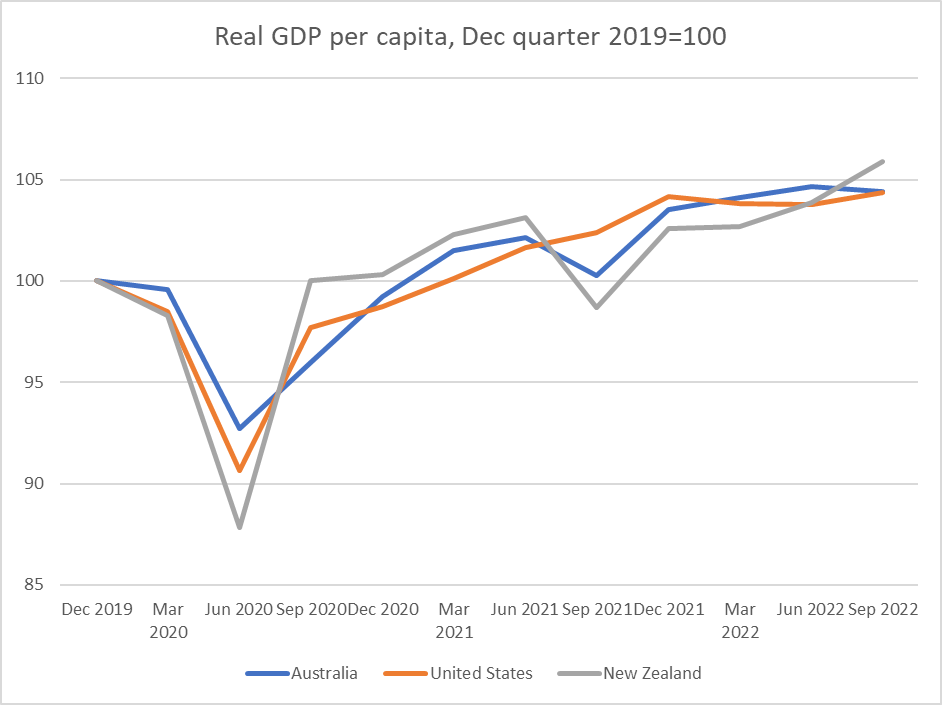
Since then, of course, US productivity and real GDP per capita growth have diverged (favourably) from those of almost all other advanced economies. The reasons aren’t yet well understood, but there isn’t much evidence that pandemic-related labour market scarring has mattered much at least at an economywide level. 

As the authors highlight, Australia could reasonably be considered to have done exceptionally badly around vaccine procurement, and the approval and widespread use of RAT rest. They both devoted many column inches at the time to the breathtaking failure of politicians and officials in Australia to act early and decisively to secure access to vaccines by placing orders or buying options at scale on all the emerging potential vaccines (a New Zealand book would have to grapple with the same failure).  No one knew which would emerge as best or be available earliest, and the cost of over-ordering would have been small compared to the costs of additional economic and social disruption if the population remained largely with access to an effective vaccine.   The complacency –  in the then Prime Minister’s words “this is not a race” – reflects very poorly on ministers and officials, and came at a considerable economic cost.  Like New Zealand, Australia eventually achieved very high vaccination rates, but the operative word is “eventually”.

Unfortunately, and inexcusable as those delays were, this is one of a number of places where HH lapse into overstatement.   They estimate that the vaccine delays cost Australia (directly and indirectly) A$50 billion and go on to claim that this meant that “Australia’s great vaccine debacle [was] almost surely the single most costly economic event in Australian history”.   $A50 billion is a lot of lost output but it was about 2.5 per cent of one year’s GDP.  By contrast, during the Great Depression Australia’s per capita GDP averaged almost 15 per cent below pre-Depression levels for five years (so in total something like 75 per cent of one year’s GDP), and the 1890s financial crisis (when it took 15 years for real GDP per capita to regain pre-crisis levels) was even worse.    If one wants more recent, and directly policy-related, costly economic choices, one might think of the post-war tariff walls or letting inflation get away in the 1970s. 

Macroeconomic policy

HH are firm champions of fiscal policy as a countercyclical stabilisation tool, and spend quite a bit of space in the book revisiting arguments for why there should have been (but wasn’t) countercyclical fiscal stimulus in Australia’s 1991 recession and why they believe such stimulus was both desirable and successful in 2008/09.  They are sympathetic to Claudia Sahm’s proposal for additional semi-automatic fiscal stabilisers.  I’m sceptical on all three counts (including the associated claim that Australia avoided a recession in 2008/09, when the unemployment rose by 1.7 percentage points and real per capita national disposable income measures fell materially), but the connection to an event like the pandemic is not clear.  

In a typical unexpected downturn countercyclical policy aims to stimulate business and household demand and spending.     The relative merits of monetary and fiscal policy tools can be debated but the goal is pretty clear.   The goal in March 2020 was quite different.  The aim wasn’t to stimulate demand or activity, but to tide people and firms over while the economy was more or less shutdown (more or less as a policy goal, through some mix of official edicts and private risk-averse behaviour).    That required direct transfers in one form or another, something monetary policy simply cannot do.  The fact that programmes like JobKeeper (and the New Zealand wage subsidy) worked – at vast, probably unnecessarily large, fiscal cost[4] – in a unique crisis like COVID tells us almost nothing about how best to handle future conventional (aggregate demand shock) downturns. And nor do the experiences of past conventional recessions shed useful light on how best to handle shutting down much of the economy temporarily for non-economic reasons.

One of the striking omissions in the book is any serious or sustained discussion of monetary policy and the performance of the Reserve Bank of Australia (RBA).  Monetary policy wasn’t the instrument that could or should have dealt with the income support and firm-retention goals governments rightly had through COVID.  But monetary policy moves last, and is supposed to take into account all the other pressures on the aggregate demand/supply balances, with the aim of keeping inflation near target.    Faced with the unique pressures of COVID too many central banks, including the RBA, failed badly.  Core inflation reached levels it was never supposed to reach again under inflation targeting.  And those same central banks ran up massive losses (tens of billions of dollars in the RBA case) on ill-judged and largely ineffective bond buying programmes.  These massive losses to taxpayers are not mentioned at all in the book.

There is a brief discussion of inflation, but HH seem to treat those outcomes as just a price that had to be paid, even describing the inflation (somewhat curiously) as an “insurance premium” (such premia are usually fixed upfront against uncertain losses and are not the unexpected outcome).   They, like many central bankers  (at least judging by their public remarks), seem utterly indifferent to the huge redistributions of wealth such a severe outbreak of unexpected inflation caused.

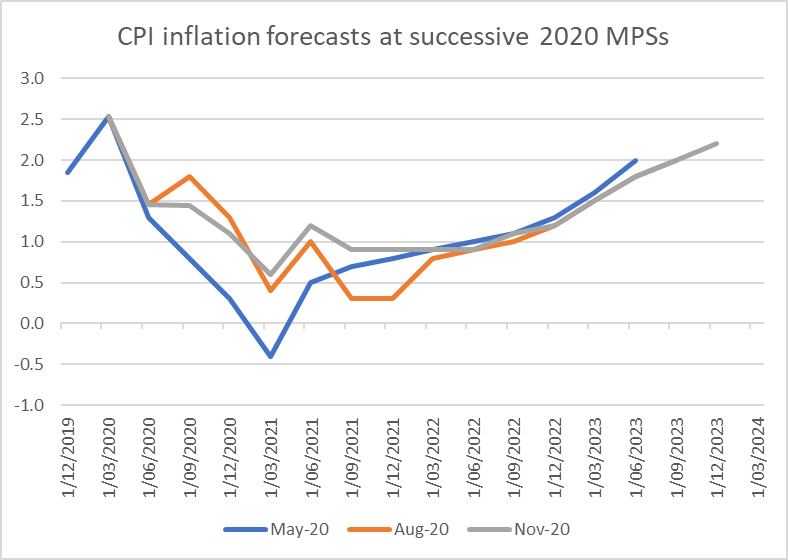
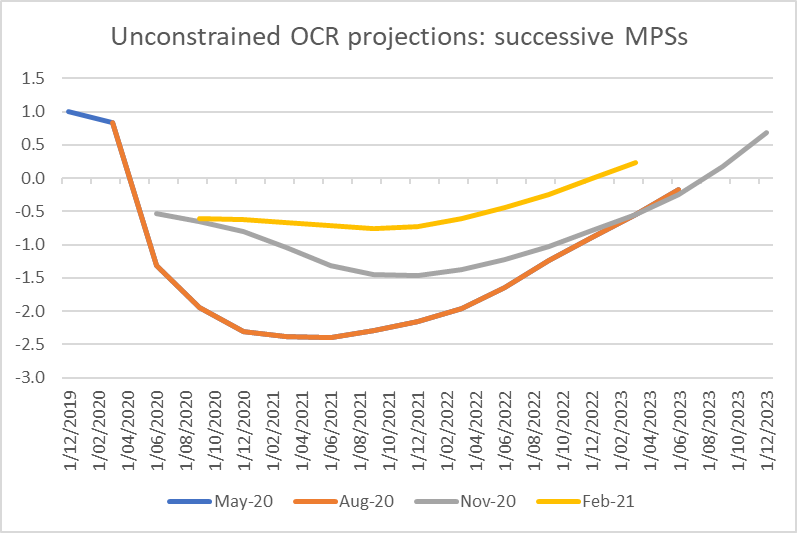
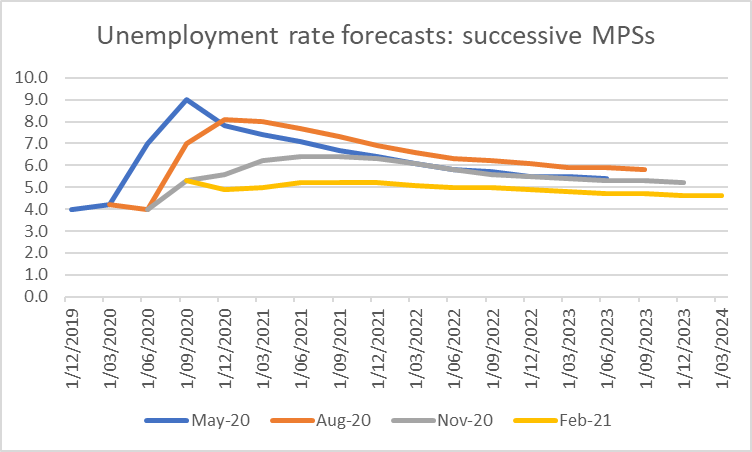
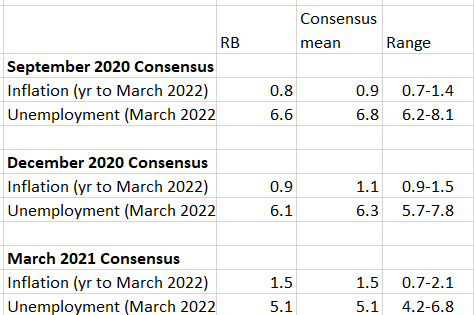
Various commentators, including HH, contrast the really gloomy macro forecasts that were widespread in mid-2020 with the actual outcomes.  The suggestion is that this is a testimony to policy effectiveness, but surely it is mostly a testimony to forecasting failure?  Central banks and finance ministries in the second and third quarters of 2020 knew all about the nature and magnitude of the policy support, but they simply misread the overall macroeconomic implications.   Take the RBA Statement of Monetary Policy from as late as November 2020: they forecast trimmed mean inflation at 1 per cent for 2021 and 1.5 per cent for 2022, both well below target.  Projections of that sort at that time were not uncommon (those of the Reserve Bank of New Zealand were similarly weak).  Those serious misjudgements, not the COVID support interventions themselves, gave us the serious inflation problem that central banks are still now dealing with the after-effects of.     Getting the balance between demand and supply effects right, knowing what weight (little, as it turned out) to put on adverse uncertainty effects etc, wasn’t easy, but it was the job central bank experts are paid to do.

Conclusion

Much is made by HH of  Australian “state capacity”[5] and at one point they suggest that “if this book is about anything, it’s state capacity”.   On recent metrics (eg O’Reilly and Murphy (2022)) state capacity in Australia going into the pandemic was good but didn’t stand out relative to other advanced economies.  The authors are clearly right to praise the ability of the Australian Tax Office (ATO) to put in place quickly the JobKeeper programme, itself in part a reflection of efforts to modernise the agency over previous years. But since state capacity is more than just the technical abililty to implement a programme quickly and efficiently under pressure, we can’t –  and HH don’t – ignore things like the vaccine procurement and RAT approval issues, both of which were costly failures.  And what we saw, in Australia no more or less than most other advanced countries, was monetary policy authorities failing to do their core job adequately when it really counted.

We need many more books and formal studies about all aspects of the pandemic period, national and cross-country.  That said, it isn’t entirely clear who the target market for this particular book is.  The Australian Treasury (past and present), the ATO, and the then Treasurer Josh Frydenberg will welcome it (they count as the authors’ heroes), and those already inclined to agree with the authors will nod along as they read, but without necessarily learning anything new.  In a fairly short account covering a substantial amount of sometimes-complex historical ground perhaps there isn’t room for, and they don’t attempt, fresh in-depth analysis. But memories fade all too quickly, and before long a new generation of junior policy analysts will be staffing agencies with only a hazy child’s memory of the pandemic. The book should be a useful introduction to much[6] about the Australian government response. 

Which brings us to the final issue: was Australia’s overall handling of the pandemic “exceptionally good”, as the authors claim?  In some respects (including the important mortality one) Australia did materially better than most.  Arguably the Australian government (like New Zealand’s) got one really big call right (the initial closing of the borders in March 2020 just in time, albeit –  and as HH note – later than they should have).  Beyond that, the record was really rather mixed.  Some of that might perhaps have been inevitable in such exceptional times. But plenty of things could have been better, as even HH (sometimes grudgingly) acknowledge.

References

Gibson, J. (2022), Government mandated lockdowns do not reduce Covid-19 deaths: implications for evaluating the stringent New Zealand response, New Zealand Economic Papers Vol 56 2022 Issue 1

Goolsbee, A. and Syverson, S. (2021), Fear, lockdown, and diversion: Comparing drivers of pandemic economic decline 2020, Journal of Public Economics 193

O’Reilly, C. and Murphy, R. H., (2022), An Index Measuring State Capacity, 1789–2018, Economica, Vol 89, Issue 355 pp 713-745

Reddell, M., “A radical macro framework for the next year or two”, Croaking Cassandra blog, 16 March 2020 (https://croakingcassandra.com/2020/03/16/a-radical-macro-framework-for-the-next-year-or-two/)


[1] Note, however, that measurement of a locked-down economy was much more difficult than usual, particularly in non-market sectors, and outsiders can’t be sure how comparable the (inevitable) assumptions used were.

[2] John Gibson (2022), written in 2020, is also relevant here, drawing on the diverse restrictions in the different parts of the United States..

[3] The United Kingdom had by far the largest peak to trough fall in GDP of any of these countries.

[4] HH tend to play down the validity of ex post observations of this sort (while accepting that there may be cheaper options that could be considered in future), but as it happened I had laid out before the New Zealand lockdown the genesis of an alternative approach that, had it been adopted, would have proved considerably cheaper (Reddell (2020)),

[5] For example (p39), “the sharp contrast with the United States revealed deep reserves of state capacity that we simply had not realised were there”.

[6] But not all.  One notable omission from the book was much discussion about the range of different state approaches.

Reviewing Covid experiences and policies

I’ve spent the last week writing a fairly substantial review of a recent book (“Australia’s Pandemic Exceptionalism: How we crushed the curve but lost the race”) by a couple of Australian academic economists on Australia’s pandemic policies and experiences. For all its limitations, there isn’t anything similar in New Zealand.

What we do have is the Phase 1 report of the Covid Royal Commission which was released by the government at the end of November. You can find the full 700+ page report here. I haven’t read the full report but did read Chapter 6 on “Economic and social impacts and responses” (which starts on page 242 of the Report itself, or page 285 of the pdf). It was, frankly, a pretty disappointing read. If the overall Royal Commission report itself got surprisingly little coverage, I don’t think I’ve seen any mention at all (certainly no serious or sustained reporting or analysis) on the economic dimensions of that exceptional period.

It is disappointing on a number of counts. First, and perhaps least important to me at this point, we were told (and the terms of reference make clear) that the focus on the Royal Commission was supposed to be on lessons learned with a view to being better equipped/prepared to handle future pandemics. But in the economics section of chapter 6 there is almost none of that, and the focus seems to be almost entirely on describing and evaluating policy responses and the impact of them. Which would be fine, except that the chapter is very much an establishment perspective, with little or no sign of any critical scrutiny before reaching the generally rather complacent conclusions.

I went and had a look at the list of engagements and people the Royal Commission had met with had over the course of their inquiry. I was looking to see which economists, academic or otherwise, the Royal Commission might have met with. They had, of course, met with The Treasury and the Reserve Bank, they’d met with three [named] former Secretaries to the Treasury (another former Secretary to the Treasury was one of the commissioners), they note a meeting with one economist described as a “public policy expert” on aspects of the wage subsidy scheme. And other than that all we got was, in November 2023, a mention that they had met with “various [unnamed] independent economic commentators”. Which was more than a little surprising when, for example, leading New Zealand economist John Gibson had been producing work on related issues since early days of the pandemic (discussed first on this blog here), as had former academic Martin Lally. I worked my way through the 12 pages of end notes to Chapter 6, and not only was there no reference to anything by Gibson or Lally, but there was no reference to any commentary or critique etc by any outside economists, academic or otherwise (although there is a quote from a Bernard Hickey Substack). There is a one sentence reference to “considerable concern” they heard from “some expert stakeholders” about the LSAP, only to dismiss this on the grounds that “these policies are now well accepted by international organisations” and going on to channel the Reserve Bank’s own lines in its defence. Fiscal losses of “in the order of $11 billion” are noted. but there is no attempt to evaluate the strategy or to think about how support might better (and more cheaply) be provided in future. That isn’t scrutiny and evaluation; it is reporting.

The chapter is weak right from the start, when the Commissioners simply assert (there is no supporting analysis) that “the strict public health measures introduced in March 2020, especially the border closure and national lockdowns, were essential [emphasis added] to protect the economy and society from the immediate and devastating effects of the pandemic had the virus been allowed to spread unchecked”. There is no analysis as to what extent of restrictions was required (it is a very all or nothing assertion), there is no reference to the fact that significant reductions in movement were occurring prior to any legal restrictions (or, for example, to the work of Goolsbee and Syverson from the US, using mobile phone data, and suggesting that almost 90 per cent of reductions in movement pre-dated legal restrictions). There is no suggestion of any cost-benefit approach at the margins (as there was no sign of it in the official advice, and we recall the trouble the Productivity Commission got into when they did one brief illustrative exercise), and no comparison looking at how the economic costs and benefits of the New Zealand approach stacked up. Of course, no country let the virus “spread unchecked” but the US is often used as a foil and counterpoint to New Zealand and Australia, and for all the differences in approach it is striking how similar the respective paths of real GDP per capita proved to be (for quite different health outcomes of course).

I don’t have a strong view on what, if anything, in this area should have been done differently, but we should have expected more challenge and scrutiny from the Royal Commissioners.

There is no attempt anywhere in the chapter to consider whether the things fiscal policy was used for could have been done (materially) more cheaply – either in evaluating 2020 and 2021 or thinking about the future. The fiscal costs were staggeringly high. It also isn’t clear that the Royal Commission really understands the point of the initial fiscal approach. They talk about the aim being to support economic activity, when in fact it was quite the contrary: the point of the lockdowns (and private risk-averse behaviour) was to largely shut down the economy for a time. What the wage subsidy approach was designed to do was (a) tide individuals over (the government compelling many not to work, and b) facilitate a quicker rebound than otherwise by maintaining established firm-specific arrangements and human capital. It certainly did the former, but to what extent it really did the latter (see chart above) deserves more serious scrutiny. Headline unemployment rates in the US went far higher than in New Zealand (and Australia) reflecting different intervention approaches, but (see chart) it isn’t immediately obvious that overall US economic performance suffered.

The Royal Commission also runs a line one sees too often, taking the very gloomy economic forecasts that were around in the second quarter of 2020, contrasting them with actual outcomes, and concluding that credit belonged to the policymakers (the Royal Commission hedges a little but is in the same camp with its “No doubt, these better-than-scenario outcomes reflected, at least in part, the speed and generosity of the Government responses”. But that simply has to be wrong. Treasury and Reserve Bank forecasters in the second quarter of 2020 knew all about the scale and nature of all those responses (economic and public health): the effects they expected were already embedded in their forecasts/scenarios. What actually happened was a massive forecasting failure, misunderstanding the nature of the shock and the way the balance of supply and demand pressures was likely to play out. Of course, plenty of private sector commentators and forecasters made the same mistake, but official failures had rather more consequences.

The Royal Commission is keen on the Reserve Bank’s self-described “least regrets” strategy (which, incidentally, has just a single mention in the RB May 2020 MPS), by which they thought – sensibly enough – that faced with a big adverse shock you wanted to act early rather than late. The problem was never with that as applied to RB actions in March 2020, but that they failed to apply anything like the same logic when it started to be apparent that inflation was becoming a problem. They were slow to recognise the speed of the economic rebound or the emerging capacity and core inflation pressures, and were slow to act, and acting rather slowly (Orr to this day attempts distraction, around things like Ukraine that didn’t happen until after the economy was already well-overheated and core inflation had risen strongly). That series of mistakes – in common with many other central banks – added hugely to the overall cost to New Zealanders of the Covid experience, and we are still dealing with the aftermath now. The Royal Commission seemed much more inclined to channel Reserve Bank stories, down to and including repeating a cross-country chart from the Bank’s own self-defence publication designed to make New Zealand look good by using headline inflation in 2022 (much of Europe affected by a gas price shock) rather than core, and the level of unemployment (rather than either the change, the NAIRU gap or the output gap) when – quite unrelated to anything around Covid economic policy – New Zealand has one of the lower NAIRUs in the OECD. Most extraordinarily, and with no supporting analysis at all, the Royal Commissioners conclude that the severe inflation outbreak was an “unavoidable price” of good policies. If so, we’d really better change the Reserve Bank’s mandate, and perhaps whitewash from history their own very weak forecasts for inflation from late 2020 and early-mid 2021. They certainly didn’t think inflation was inevitable; they (paid to get these things roughly right) got their forecasts, and thus policy, badly wrong.

Now to be fair to the Commissioners they do note the obvious, that both fiscal and monetary policy were too loose for too long, but it is all very subdued, and with no insight on what went wrong and why, or what might be better in future. There are complacent comments that if there were some gaps in Reserve Bank/Treasury coordination “it was good by international standards”, even as though offer no evidence for such claims. They don’t even mention – a point the Reserve Bank acknowledged in early 2020 – that the Bank had failed to ensure that negative interest rates were a technical possibility: had it been otherwise they might never have gone so big and so long on the LSAP, at such vast risk and (as it turned out) fiscal costs (the Bank, to be fair to them, had not historically been keen on LSAP types of instruments).

I could go on with many smaller points, but that would mostly be to bore readers. I’ll end with just two: there is no attempt to evaluate whether the exporter freight subsidies really made sense, and for so long, nor is there any attempt to evaluate whether it made sense – as was done at the start of the pandemic response – to permanently increase welfare benefit levels going into a pandemic that was (a) likely to have large economic and fiscal costs, making us poorer on average, and b) wasn’t going to affect the real incomes of those on benefits.

Overall, I thought this bit of the report was a serious lost opportunity. Perhaps the economic establishment (RB, Treasury, Grant Robertson) like it because there is no serious challenge or scrutiny, but just the appearance of it (a 700 page report don’t you know) but what use is that to New Zealanders, either in holding powerful officeholders to account (and yes time were tough but you take these jobs for the tough times) or in being better prepared for the inevitable future adverse shocks.

Deaths and excess deaths

Back in 2020 and 2021, in and around the straight economics and economic policy posts, there were quite a few on aspects of the Covid experience in New Zealand, particularly in a cross-country comparative light.

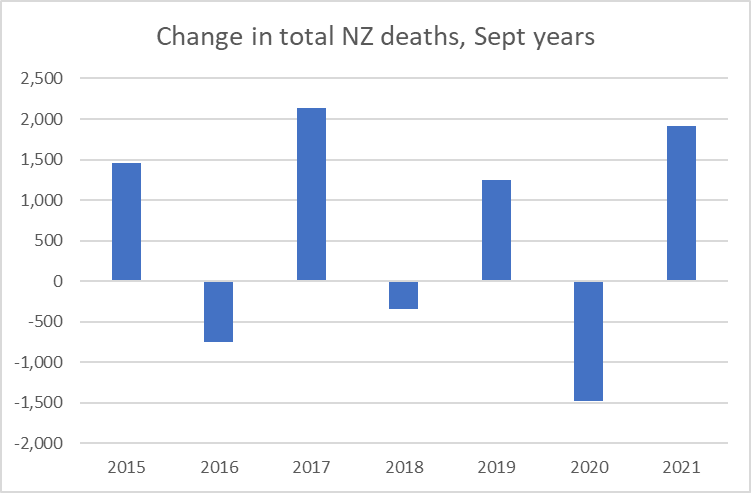
More recently, you see from time to time suggestions that New Zealand’s experience may have been so good that in fact excess mortality here since Covid began might actually have been negative (in which case, fewer people would have died than might have been expected had Covid never come along.

A couple of alternative perspectives on that caught my eye in the last couple of months, both from academics, one from a physicist and one from an economist.

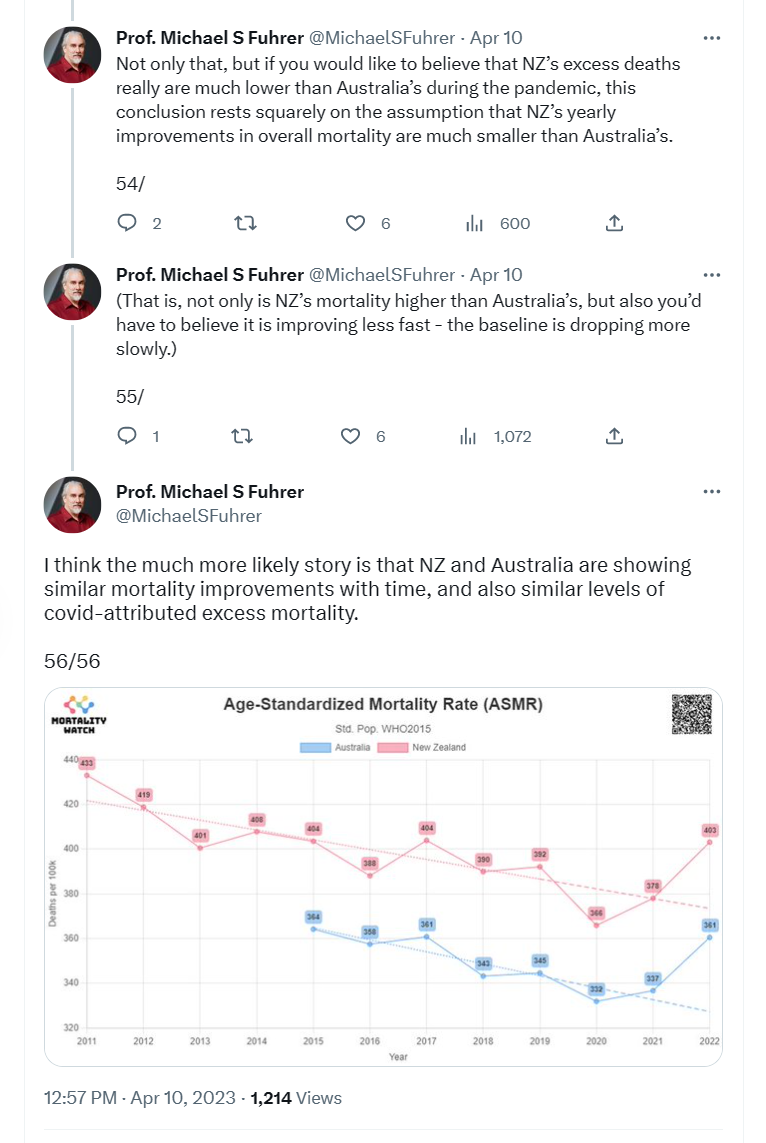
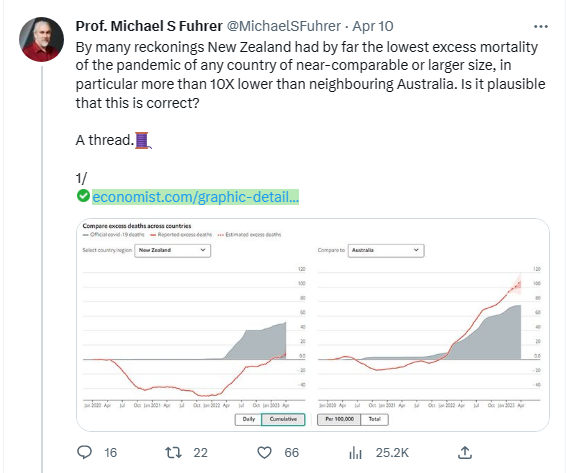
The first was a very very long Twitter thread from Professor Michael Fuhrer at Monash in Melbourne. His thread starts with this tweet

and after reviewing the evidence, and granting that

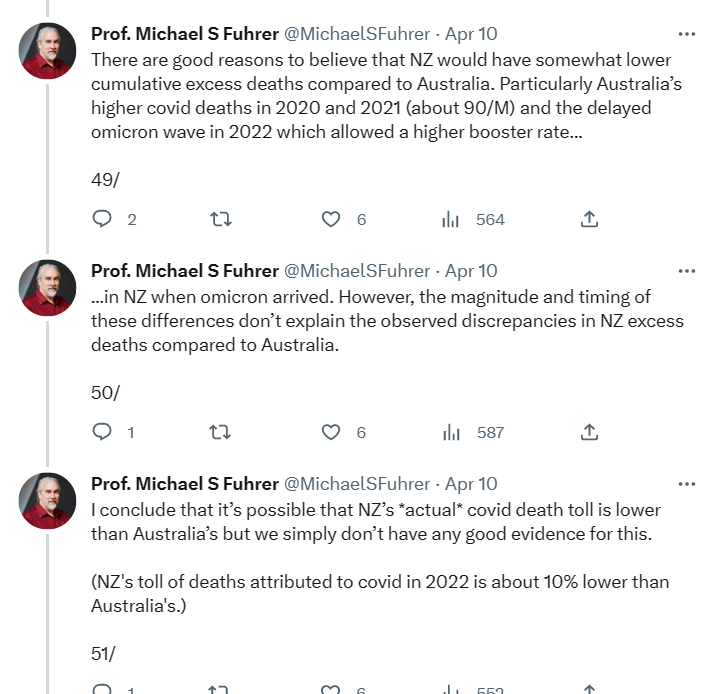
he concludes that

All of which sounded plausible, at least having read the entire thread.

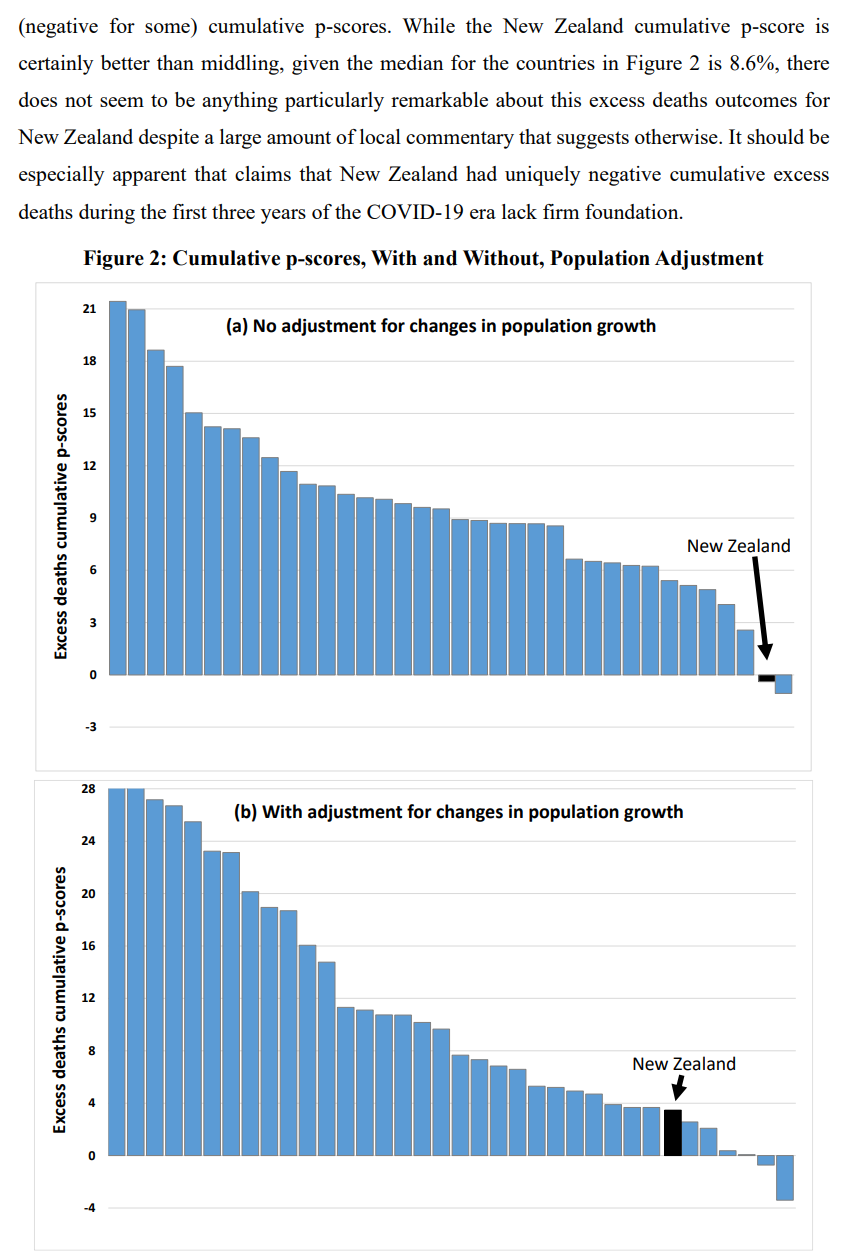
A week or so later Professor John Gibson, one of New Zealand’s leading academic economists (at the University of Waikato), sent me a copy of a new short paper he had written, under the heading “Cumulative Excess Deaths in New Zealand in the COVID-19 Era: Biases from Ignoring Changes in Population Growth Rates”. I’d done a couple of posts on earlier work by Prof Gibson on aspects of Covid policy responses and the likely impact of some of those choices.

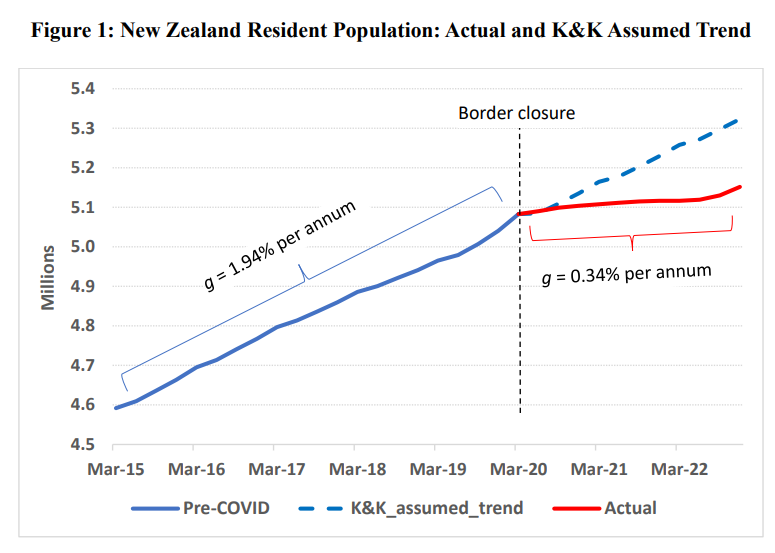
For New Zealand, one of the biggest things that changed over the first 2.5 years of the Covid era was a dramatic slowing in the population growth rate, not because of Covid or other deaths but because net migration went from a hugely positive annual rate to a moderately negative rate. Pre-Covid – and probably again now – migration is the biggest single influence on the year to year change in New Zealand’s population. He includes this chart

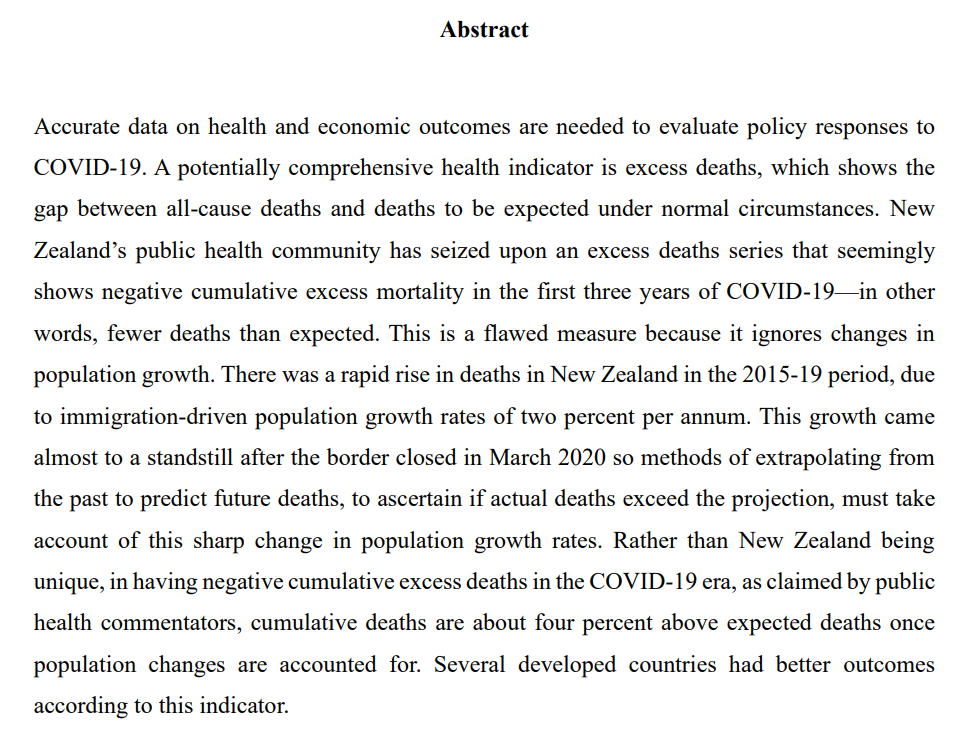
Here is Gibson’s abstract

It is a short paper, and easy enough to read, so I’m not going to elaborate further, and will simply cut and paste the final page.

It is a shame he hasn’t labelled all the other countries, but his text tells us that the countries to the right of New Zealand on that bottom chart are Luxembourg, Canada, the Netherlands, Iceland, Israel, and Australia. Note too that several countries just to the left of New Zealand have estimated excess mortality barely different from that estimated for New Zealand.

Across the entire grouping of countries New Zealand still rates fairly well (there are many other things we might reasonably hope to be in the best quartile for but are not; this one we are), but as he notes for the three years to the end of 2022 even in New Zealand there does appear to have been positive excess mortality in the Covid era.

I have no particular point to make, but found both Fuhrer’s thread and Gibson’s note interesting notes, providing some useful context to thinking about the New Zealand experience. Since one still sees claims (including reportedly from David Seymour just a couple of days ago) that there have been no excess deaths in New Zealand over the Covid period, is it too much to hope that some media outlet or other might give some coverage to what appears to be careful work by, in particular, Gibson, a highly-regarded New Zealand academic?

Reviewing monetary policy

Way back in 1990 Parliament formally handed over the general responsibility for implementing monetary policy to the Reserve Bank. The government has always had the lead in setting the objectives the Bank is required to work to, and has the power to hire and fire if the Bank doesn’t do its job adequately, but a great deal of discretion has rested with the Bank. With power is supposed to come responsibility, transparency, and accountability.

And every so often in the intervening period there have been reviews. The Bank has itself done several over the years, looking (roughly speaking) at each past business cycle and, distinctly, what role monetary policy has played. These have generally been published as articles in the Bank’s Bulletin. When I looked back, I even found Adrian Orr’s name on one of the policy review articles and mine on another. It was a good initiative by the Bank, intended as some mix of contribution to debate, offering insights that were useful to the Bank itself, and defensive cover (there has rarely been a time over those decades when some controversy or other has not swirled around the Bank and monetary policy).

There have also been a couple of (broader-ranging) independent reviews. Both had some partisan intent, but one was a more serious effort than the other. When the Labour-led government took office in 1999 they had promised an independent review, partly in reaction to their sense that we had messed up over the previous few years. A leading Swedish academic economist Lars Svensson, who had written quite a bit about inflation targeting, was commissioned to do the review (you can read the report here). And towards the end of that government’s term – monetary policy (and the exchange rate) again being in the spotlight – Parliament’s Finance and Expenditure Committee did a review.

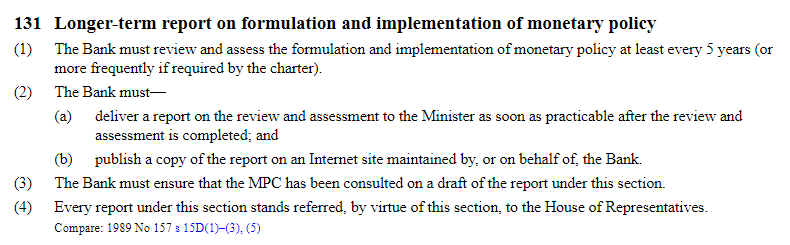
When the monetary policy provisions of the Reserve Bank Act were overhauled a few years ago this requirement was added

It made sense to separate out this provision explicitly from that for Monetary Policy Statements (in fact, I recall arguing for such an amendment years ago) but the clause has an odd feature: MPSs (and the conduct of monetary policy itself) are the responsibility of the MPC, but these five-yearly longer-term reviews are the responsibility of “the Bank”. In the Act, the Bank’s Board is responsible for evaluating the performance of both management and the MPC, but the emphasis here does not seem to be on the Board. It seems pretty clear that this is management’s document, and of course management (mainly the Governor) dominates the MPC. Since the Board has no expertise whatever in monetary policy, it is pretty clear that the first of these reports, released last week, really was, in effect, the Governor reporting on himself.

And although plenty of people have made scathing comments about that, there isn’t anything necessarily wrong about a report of that sort. After all, it isn’t uncommon (although I always thought it odious and unfair given the evident power imbalance) for managers to ask staff to write about notes on their own performance, as part of an annual performance appraisal, before the manager adds his/her perspective. The insights an employee can offer about his or her own performance can often be quite revealing. And it isn’t as if the Bank’s own take on its performance is ever going to be the only relevant perspective (although, of course, the Governor has far more resources and information at his disposal than anyone else is going to have). The only real question is how good a job the Bank has done of its self-review and what we learn from the documents.

On which note, I remain rather sceptical about the case (National in particular is making) for an independent review specifically on the recent conduct of monetary policy. Some of those advocating such an inquiry come across as if what they have in mind is something more akin to a final court verdict on the Bank’s handling of affairs – one decisive report that resolve all the points of contention. That sort of finality is hardly ever on offer – scholars are still debating aspects of the handling of the Great Depression – and if there was ever a time when choice of reviewer would largely determine the broad thrust of the review’s conclusions this would be among them. Anyone (or group) with the expertise to do a serious review will already have put their views on record – not necessarily about the RBNZ specifically (if they were an overseas hire) but about the handling of the last few years by central banks generally. There is precedent: the Svensson review (mentioned above) was a serious effort, but the key decision was made right at the start when Michael Cullen agreed to appoint someone who was generally sympathetic to the RB rather than some other people, some of equal eminence if different backgrounds, who were less so. It would be no different this time around (with the best will in the world all round). A review might throw up a few useful points and suggestions, and would probably do no harm, but at this point the idea is mostly a substantive distraction. Conclusions about the Reserve Bank and about its stewardship are now more a matter for New Zealand expert observers and the New Zealand political process (ideally the two might engage). Ideally, we might see some New Zealand economics academics weighing in, although in matters macroeconomics most are notable mainly by their absence from the public square.

That is a somewhat longwinded introduction to some thoughts about the report the Bank came out with last week (120 pages of it, plus some comments from their overseas reviewers, and a couple of other background staff papers).

I didn’t think the report presented the Bank in a very good light at all. And that isn’t because they concluded that monetary policy could/should (they alternate between the two) have been tightened earlier. That took no insight whatever, when your primary target is keeping inflation near the middle of the target range and actual core inflation ends up miles outside the range. Blind Freddy could recognise that monetary policy should have been tightened earlier. When humans make decisions, mistakes will happen.

The rest of the conclusions of the report were mostly almost equally obvious and/or banal (eg several along the lines of “we should understand the economy better” Really?). And, of course, we had the Minister of Finance – not exactly a disinterested party – spinning the report as follows: “It is really important to note that the report does indicate that they got the big decisions right”. It should take no more than two seconds thought to realise that that is simply not true: were it so we would not now have core inflation so far outside the target range and (as the report itself does note) pretty widespread public doubts about how quickly inflation will be got down again. It would be much closer to the truth to say that the Reserve Bank – and, no doubt, many of their peers abroad – got most of the big decisions wrong. It has, after all, been the worst miss in the 32 years our Reserve Bank has been independent, and across many countries probably the worst miss in the modern era of operationally independent central banks (in most countries, after all, monetary policy in the great inflation of the 1970s was presided over by Ministers of Finance not central banks).

But there is no sense in the report at all of the scale of the mistake, no sense of contrition, and – perhaps most importantly in my view – no insight as to why those mistakes were made, and not even any sign of any curiosity about the issue. The focus is almost entirely defensive, and shows no sense of any self-critical reflection. There are no fresh analytical insights and (again) not even any effort to frame the questions that might in time lead to those insights. And no doubt that is just the way the Governor (who has repeatedly told us he had ‘no regrets’) would have liked it. And here we are reminded that this is very much the Orr Reserve Bank: the two senior managers most responsible for the review (the chief economist and his boss, the deputy chief executive responsible for monetary policy and macroeconomics) only joined the Bank this year, and so had no personal responsibility for the analysis, preparation and policy of 2020 and 2021 but still produced a report offering so little insight and so much spin. Silk, in particular, probably had no capacity to do more, but the occasional hope still lingered that perhaps Paul Conway, the new chief economist, might do better. But these were Orr’s hires, and it is widely recognised that Orr brooks no dissent, no challenge, and in his almost five years as Governor has never offered any material insight himself on monetary policy or cyclical economic developments. Even if they had no better analysis to offer – and perhaps they didn’t, so degraded does the Bank’s capabilities now seem – contrition could have taken them some way. But nothing in the report suggests they feel in their bones the shame of having delivered New Zealanders 6 per cent core inflation, with all the arbitrary unexpected wealth redistributions that go with that, let alone the inevitable economic disruption now involved in bringing inflation a long way back down again. It comes across as more like a game to them: how can we put ourselves in the least bad light possible with a mid-market not-very-demanding audience (all made more unserious as we realised that the Minister of Finance had made the decision a couple of months ago to reappoint Orr, not even waiting for the 120 pages of spin).

At this juncture, a good report would be most unlikely to have had all the answers. After all, similar questions exist in a whole bunch of other countries/central banks, and if the Reserve Bank has the biggest team of macroeconomists in New Zealand, there are many more globally (in central banks, academe, and beyond) but it doesn’t take having all the answers to recognise the questions, or the scale of the mistakes. In fact, answers usually require an openness to questions, even about your own performance, first. And there is none of that in the Bank’s report.

Thus, we get lame lines – of the sort Conway ran several times at Thursday’s press conference – that if the Bank had tightened a bit more a bit earlier it would have made only a marginal difference to annual inflation by now. And quite possibly that is so, but where is the questioning about what it would have taken – in terms of understanding the economy and the inflation process – to have kept core inflation inside the target range? What is it that they missed? (And when I say “they” of course I recognise that most everyone else, me included, also missed it and misunderstood it, but……central banks are charged by Parliaments with the job of keeping inflation at/near target, exercise huge discretion, carry all the prestige, and have big budgets for analytical purposes, so when central banks report on their performance, we should expect something much better than “well, we acted on the forecasts we had at the time and, with hindsight, those forecasts were (wildly) wrong”.) The question is why, what did they miss, and what have they learned that reduces the chances of future mistakes (including over the next year or two – if your model for how we got into this mess was so astray, why should the public have any confidence that you have the right model – understanding of the economy and inflation – for getting out of the mess? At the press conference the other day the Governor and the Board chair prattled on about being a “learning organisation” but you aren’t likely to have learned much if you never recognised the scale of the failure or shown any sign of digging deep in your thought, analysis, and willingness to engage in self-criticism. We – citizens – should have much more confidence in an organisation and chief executive will to do that sort of hard, uncomfortable, work than in one of the sort evident in last week’s report.

With hindsight one can make a pretty good case that no material monetary policy action was required at all in 2020. One might be more generous and say that by September/October 2020 with hindsight it was clear that what had been done was no longer needed. But that wasn’t the judgement the Reserve Bank came to at the time – and it is the Bank that has been tasked with getting these things right. Why? (And, of course, the same questions can be asked of other central banks and private forecasters, but the Reserve Bank is responsible for monetary policy and for inflation outcomes in this country.)

I may come back in subsequent posts to look at more detail at a number of specific aspects of the report (including a couple of genuinely interesting revelations) but at the big picture level the report does not even approach providing the sort of analysis and reflection the times and circumstances called for (in some easier times a report of this sort might have not been too bad, although you would always look for some serious research backing even then).

And if you think that I’m the only sceptic, I’d commend to you the comments from the former Deputy Governor of the Bank of Canada. On page after page – amid the politeness (and going along with distractions like the alleged role of the Russian invasion) – he highlights just how relatively weak the analysis in the report is, how many questions there still are, and a number of areas in which he thinks the Bank’s defensive spin is less than entirely convincing.

New Zealanders deserved better. That we did not get it in this report just highlights again that Orr is not really fit for the office he holds. In times like those of the last few years – with all the uncertainties – an openness to alternative perspectives, willingness to engage, willingness to self-critically reflect, and modelling a demand for analytical excellence are more important than ever.

The $9 billion dollar man

The Listener magazine this week reported the results of a caption contest they’d run for a photo of Reserve Bank Governor Adrian Orr.

I’d suggested what seemed to me a rather more apt caption.

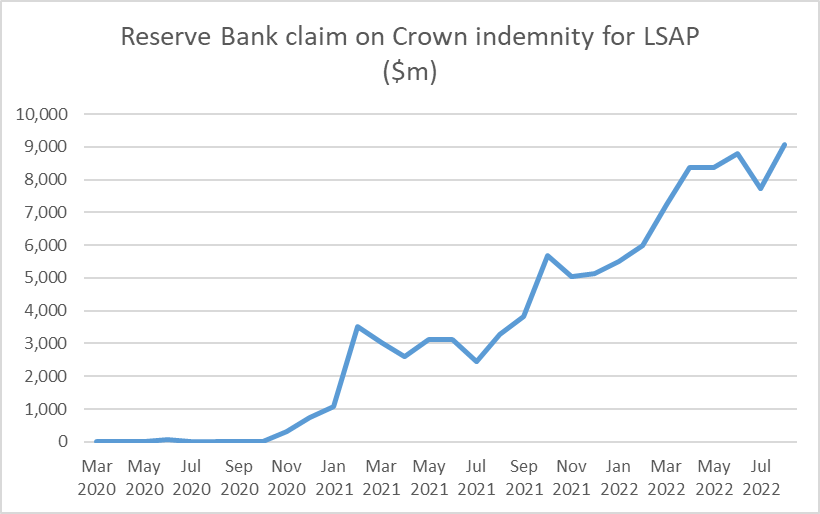
One good thing about the Reserve Bank is that they do report their balance sheet in some detail every month, and yesterday they released the numbers for the end of August. August was not a good month for the government bond market: yields rose further and the market value of anyone’s bond holdings fell. And thus the Reserve Bank’s claim on the government, under the indemnity the Minister of Finance provided them in respect of the LSAP programme, mounted.

This is the line item from the balance sheet

A new record high at just over $9bn.

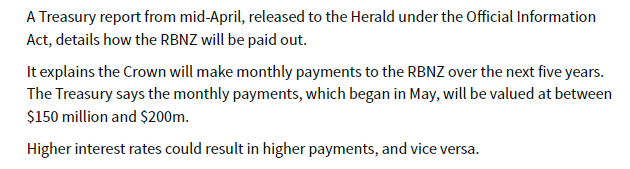
And that doesn’t seem to be quite the full extent of the losses the Governor and the MPC have caused. A while ago the Herald reported on an OIAed document from The Treasury.

I wasn’t sure quite what to make of that, but we know that from July the Bank has begun selling its bonds back to The Treasury. Over July and August they had sold back $830m of the longest-dated bonds (ie the ones on which the losses will have been largest) and presumably collected on the indemnity when the Bank realised the losses on those bonds at point of sale.

Presumably all the numbers will eventually turn up in the Crown accounts, but for now it seems safe to assume that Orr and his colleagues (facilitated by the Minister of Finance) have cost taxpayers around $9.5 billion dollars – getting on for 2.5% of New Zealand’s annual GDP (or about 7 per cent of this year’s government spending).

These are really huge losses, and to now the Governor’s defence seems to amount to little more than “trust us, we knew what we were doing”, accompanied by vague claims that he is confident that the economic benefits were “multiples” of the costs. But there is no contemporary documentation in support of the former claim (eg a proper risk analysis rigorously examined and reviewed before they launched into this huge punt with our money), and nothing at all yet in support of the latter claim.

Central banks should be (modest) profit centres for the Crown. Between their positions as monopoly issuers of zero-interest notes and coins and as residual liquidity supplier to the financial system there is never a good excuse for a central bank to lose money, and certainly not on the scale we’ve seen here (and in other countries) in the last couple of years – punting massively on an implicit view that bond yields would never go up much or for long (as they hadn’t much in the previous decade when other central banks were engaging in QE).

There are plenty of things governments waste money on, and plenty of big programmes that (rightly) command widespread support (through Covid you could think of the wage subsidy scheme). But this was just little more than a coin toss – low expected value, but with at least as high a chance of big losses as of any substantial gains. And seemingly with no accountability whatever. Orr has not apologised for the losses, nor have the other MPC members. No one has lost their job – but then this is the New Zealand public sector where hardly anyone ever does – and not a word has been heard from those charged with holding the Bank to account (the Board or the Minister of Finance).

Back when I was young the Bank ran up big (indemnified) foreign exchange losses in the 1984 devaluation episode. Searching through old papers I can’t find the precise number the Crown had to pay out, but between what I could find and my memory it may well have been of a similar order (share of GDP) as the LSAP losses. But the responsibility then rested directly with the Minister of Finance – the Bank was not operationally independent, and defending the fixed exchange rate under pressure was government policy. It was a rash policy – the Bank advised the government not to do it – and the large losses added to the obloquy heaped on Muldoon for his stewardship in his last couple of years on office. But the public got to vote Muldoon out, while there still appears to be a serious possibility that Orr – having cost New Zealanders perhaps $1800 each – will be reappointed (with just six months of his term to go if he is not going to be reappointed it will need to be announced soon to enable a proper search process for a replacement to occur). The LSAP losses may not even be the Governor’s worst failing, but no one directly responsible for that scale of taxpayer losses – on risks he simply did not have to take – should even be considered for reappointment, at least if accountability is to mean anything ever.

Of course, there have been bigger losses in New Zealand government history. I’ve just been reading John Boshier’s Power Surge on the Think Big debacle of the 1980s. As a share of GDP, total economic losses to the taxpayer from that series of projects were far greater than the LSAP losses, but I’m not sure that losing less in one punt than the worst series of discretionary public sector projects ever in New Zealand history should be any consolation or mitigation. And, for what it is worth, Boshier’s book suggests there was typically more advance risk analysis undertaken for the Think Big projects than we have yet seen evidence of for the LSAP.

I’m sure gambling appeals to some people, and I wouldn’t want to stop those minded punting on the bond market, the fx market, Bitcoin, equities or whatever. But if that is the sort of thing that takes Orr’s fancy – and it probably isn’t judging by his past financial disclosures – he could at least do it with his own money, not ours. And having rashly done it with our money, and lost heavily, have the decency to apologise.

Orr defending the LSAP

The Governor of the Reserve Bank must have been feeling under a bit of pressure recently about the LSAP programme. Losses have mounted and some more questions have started to be asked – by more than just annoying former staff – about value for money.

And thus on Thursday morning “Monetary Policy Tools and the RBNZ Balance Sheet” dropped into inboxes. It was an 10 page note setting out to defend the Bank and the MPC over the bond-buying LSAP programme and the inaptly-named Funding for Lending programme, the crisis facility under which the Bank is still – amid an overheated economy and very high core inflation – lending new money to banks.

Of course, the Monetary Policy Statement had been out the previous day. Had the Governor been serious about scrutiny and engagement, he’d have released his note a day or two before the MPS (or even simultaneous to the MPS). Then journalists could have read the paper and asked questions about it in the openly-viewed press conference. The Bank’s choice not to do so revealed their preferences. Oh, and then the note was released less than an hour before the Finance and Expenditure Committee’s hearing on the MPS, and since FEC no doubt had other things to consider it is unlikely any of the members had read the note before the hearing. That too must have been a conscious choice by the Bank (one that didn’t go down well with the Opposition members).

I noted earlier that the paper was 10 pages long, but there wasn’t a lot of substance. We still have nothing but the Bank’s assertions for their claims that the LSAP programme was worthwhile, and while we are told that they hope to provide some more analysis in a review document at the end of the year, attempting to kick for touch for another four months frankly really isn’t good enough. And, of course, we’ve heard nothing at all from the three non-executive MPC members who share responsibility for the programme. As it is, the 10 page note does not even provide a serious attempt at a rigorous framework for evaluating costs, benefits, and risks – there is more handwaving, and attempts to blur any analysis, than serious reasoning.

There are two separable strands. I am going to focus on the LSAP rather than the Funding for Lending programme (FLP), but it is worth making a few points on the latter:

  • the Bank claims that the FLP was necessary because banks were not yet operationally capable of managing a negative OCR, but the FLP was only finally launched in December 2020, and the Bank has separately told us that by that time banks’ system were in fact capable of coping with a negative OCR.   Sure, the FLP had been foreshadowed over the previous few months and probably had some impact on retail rates then, but then the possibility of a negative OCR had also been foreshadowed,
  • the FLP was misnamed from the start (creating of lot of unnecessary controversy at the time about housing finance), with the name feeding an entirely fallacious mentality that shortages of settlement cash were somehow a constraint on bank lending.  I am pleased to see that in this document the Bank (now that it suits) explicitly states “there is little evidence that higher settlement cash balances resulting from these programmes have directly impacted bank lending”.  Paying the full OCR on all settlement cash balances – a Covid novelty that continues – will also have that effect.
  • it remains extraordinary that the Bank is still undertaking new lending under the FLP until the end of this year.  It was a crisis programme, launched belatedly when crisis conditions had all but passed anyway, and there has been no clear justification for continuing new loans for at least the last year (recall the Bank wanted to raise the OCR last August).   Arguments about predictable funding streams just fall flat, when the entire economic and financial climate was so uncertain, and when banks like everyone else recognise that circumstances have moved on from where they were two years ago.  The Bank’s claim –  that somehow banks would not future bank commitments seriously if they terminated early – deserve little more than to be scoffed at.  And although the Bank will tend to play this down, we can tell that the FLP is relatively cheap funding –  if it were not, banks would not still be tapping the facility.  Similarly, arguing (as they do) that the OCR can offset the FLP is to concede the point: increases in the OCR should be leaning against real inflation pressures, not counteracting other lingering stimulatory crisis interventions.

But enough of the FLP, daft as it is still to be running it, the costs and risks are fairly small.

Not so the LSAP, where costs and risks are demonstrably high (now conceded by the Bank) while the alleged benefits are hard to pin down (not helped by the Bank making no serious public effort so far), and the water is being deliberately muddied by the Governor’s bluster and absence of careful delineation of the issues and arguments.

On financial costs, this from the Bank’s document is clear and straightforward (and I would hope might finally silence those who keep trying to claim they aren’t “real” costs, are all “within the Crown” or whatever).  The Bank is clear that the financial losses themselves are real.

The best estimate of the net cost of LSAP is measured by the value of the Crown’s indemnity – unrealised losses based on current market valuation, reflecting a higher OCR – and losses realised by RBNZ upon the sale of the Bonds.  

As to quantum, the claim under the indemnity fluctuates each day, and some of the Bank’s claim has now been paid by Treasury, but the Bank’s Assistant Governor was happy at FEC to use a ballpark $8bn figure. $8bn is roughly $1600 per man, woman, and child in New Zealand.

In the rest of this post, I am drawing on three sources of Bank comment: the 10 page document itself, the Bank’s appearance at FEC on Thursday (comments from Orr, Silk, and Conway, the chief economist), and the Governor’s full interview with the Herald (linked to in this article). Orr has made stronger claims orally than what is in the formal document, asserting twice that the wider economic gains of the LSAP programme were “some multiple” of the financial losses, following up to add that in his view it wasn’t even close. “Some multiple” must mean at least two, so at minimum the Governor is asserting (and recall there is no evidence advanced and not much argument) that the LSAP resulted in real economic gains of at least $16bn. At minimum, he is claiming a benefit of about 5 per cent of GDP at the time the LSAP was first launched. These are really huge claims, and you’d think he’d have at least some disciplined framework to demonstrate their plausibility (even just as ballpark estimates).

Instead, we are offering not much more than handwaving, and lines that at best veer close to outright dishonesty.

There seem to be three broad strands to whatever case Orr is trying to make:

  • there is the “least regrets” rhetoric,
  • there is talk (especially in the Herald interview) of the gains from bond market stabilisation back in March 2020, and
  • there is lots of talk (even the chief economist went down this line at FEC) about how much stronger than forecast the economy has been than was being forecast in 2020.

As Orr now tells it, “least regrets” meant the Bank would run monetary policy in such a way that it would prefer to see a grossly overheated high inflation situation (actual outcome) than a deep depression and entrenched deflation. Perhaps many people might share that preference if it was the only choice. But it wasn’t, and we’d be better off sacking and replacing all involved if they really want us to believe it was. Go back to 2020 and then when they were first talking about “least regrets” it was the much more reasonable framing (eg here) that, at the margin, and given that inflation had undershot the target for 10 years, they might be content with (core) inflation being a little above the target midpoint for a while rather than jump on things too early and risk keeping the unemployment rate higher than necessary for longer than necessary. Not everyone would necessarily have agreed with them on that, but it would have commanded pretty widespread assent (I wasn’t unhappy myself)….and in any case was entirely hypothetical at the time since, as I’ve documented in recent posts, actual inflation forecasts (Bank and private) were well below the target midpoint even as the Bank added no more stimulus beyond that (from OCR, LSAP, FLP or whatever) already embedded in the economic and inflation forecasts. So don’t be fooled by Orr rhetoric suggesting we should smile benignly on their handling of things because “the alternative was some Armageddon”. We pay him and his offsiders a lot of money to help ensure that those aren’t the choices.

Back when the LSAP programme was first announced – 23 March 2020 – there was a twin (related) motivation: generally to ease monetary conditions, and specifically to underpin the functioning of the government bond market. Global government bond markets were then in a mess, reflecting primarily US-sourced extreme illiquidity and flight to cash (at the time stock markets had been falling very sharply too). For those interested, here are a couple of links to what was going on at the time (here and here). Government bond rates were rising (even as policy rates had been cut): the disruption was real enough and it was getting very difficult to place paper. I’ve even gone on record here in the past stating that, even allowing for the moral hazard risks, I had no particular objection to some stabilising interventions, especially in the Covid context.

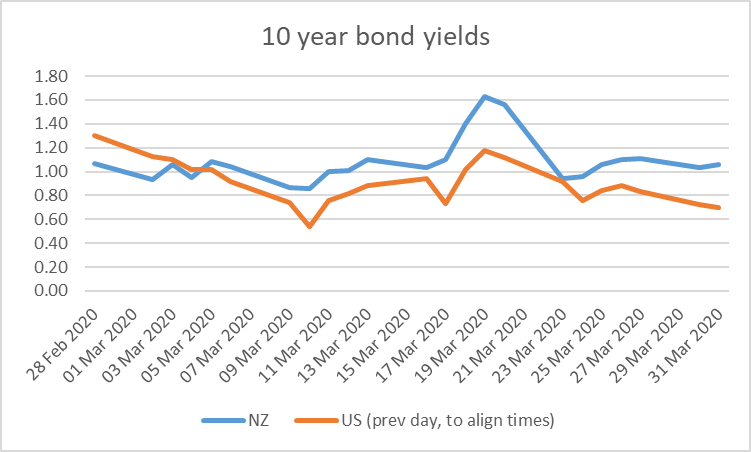
But here is a chart of US and NZ 10 year government bond rates for the month of March 2020 (with the US rates lagged a day to line with the NZ ones – changes in NZ bond rates in the morning are usually mostly a reflection of what has happened in the US overnight (the previous day for them).

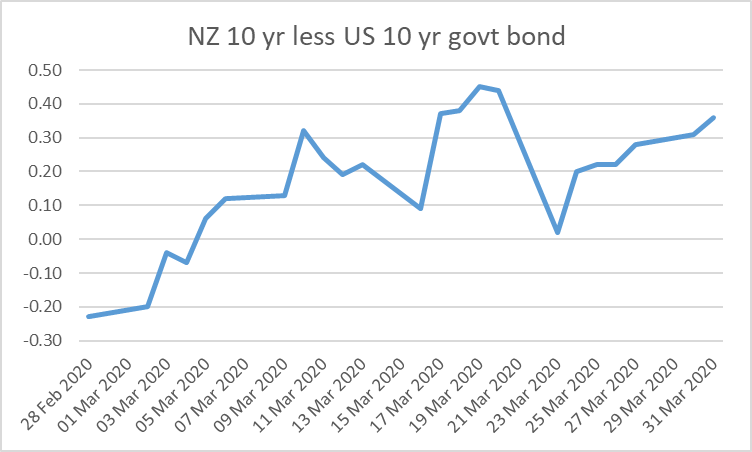
You can see yields rising in that third week of the month even though both central banks had cut policy rates sharply that week (and the Fed had announced restarting of bond purchases). The NZ market is less liquid at the best of times than the US one. But yields in both countries peaked on 19 March (NZ).

As did the gap between New Zealand and US rates. Days before the Reserve Bank did anything or even announced their own LSAP (although they had foreshadowed that one might be coming).

And if the Reserve Bank announced its LSAP on 23 March, on the same day (but remember the time difference) the Fed greatly expanded its own bond-buying programme. Almost immediately New Zealand long-term bond yields were back down to around 1 per cent.

Simple charts of yields – of the most liquid part of each market – don’t directly get to the illiquidity in other markets, but all indications are that the worst (globally) was already over by the time the Reserve Bank made its announcement, and given the US-sourced nature of the shock, it seems far more likely that the US actions were the more decisive policy contribution to stabilising markets. I don’t want to begrudge the Bank its small part in domestic market stabilisation (and they had some other interventions, including thru the fxs swaps market – but remember it is the LSAP they are defending), but even if we run through to 10 April, total bond purchases by the RBNZ to that point was only $3.6bn. Sure, a willingness to go on intervening offered a bit of cheap insurance to market participants, but if Orr wants to make much of what those earlier operations contributed (and it really can’t be much, given lockdowns, extreme economic and policy uncertainty etc) it relates to less than a 10th of the risk the Bank eventually exposed the taxpayer to through the LSAP.

(And if you want to note that over the month New Zealand bond yields did not fall as much as those in the US, recall that at the start of much US policy rates had much more room to fall than NZ ones did – and expectations of future short rates are the main medium-term influence on bond yields).

The third broad strand of Orr’s defence now appears to rest on how unexpectedly strong the economy (and inflation) proved to be.

From the 10 page report

His new chief economist tried the same line at FEC, with less nuance, and Orr himself when asked by Nicola Willis what evidence there was of the net benefits of the LSAP responded succinctly “the economy we live in today”.

It really is borderline dishonest. After all, all those dismal 2020 sets of forecasts – the Bank’s, the Treasury’s, and the myriad private sector ones – all included the effects of the policy stimulus (including the LSAP), and views on the path of the virus itself, so the resulting massive forecast error (for which I am not particularly blaming anyone) logically cannot be proof – or even evidence – of the effectiveness of a single strand of monetary policy (LSAP), or even of macro policy taken together. Since Orr and Conway are smart people, and know this point very well, it must be a deliberate choice to continue to muddy the waters as they do. They never even address the probability – high likelihood in my view – that most economists simply got wrong the extent of the adverse demand shock. At very least any serious analysis would have to unpick the various elements.

Instead, in none of their written material, or the comments of Orr and his offsiders, has there been any attempt (even conceptually) to think about the marginal effects of the LSAP programme itself. It was a discretionary (and last minute) addition to the toolkit. And even if we granted them a free pass for the first $3.6 billion or so of purchases (see above) all the rest was their choice. We know the financial costs (that $8bn or so of losses) but the alleged huge gains (Orr’s “multiples”) are unidentified – no effort has even been made. As just one small example, when the Herald’s journalist asked Orr whether, for example, they could have done less LSAP and instead cut the OCR to zero (which as even the Bank notes has no material market risk), Orr simply avoided answering the question.

I’ve run through previously the various reasons to be sceptical that the LSAP had much useful macro effect (those vaunted $16bn of gains Orr would need to show). In particular, even if the impact on longer-term bond rates was as large as Orr has claimed (again numbers that have never been documented), it isn’t at all obvious how that would have translated to large useful macro gains. It is commonly understood that the most important element in the interest rate bit of the New Zealand transmission mechanism is the short-end. Short rates (1-2 year bond rates) shape most retail lending rates, and are themselves largely influenced by expectations of the future OCR. Had the Bank been interested, say, in managing down a 3 year bond rate – as the RBA was – it could have done that directly, at very little financial risk. But instead they focused their bond buying at the longer end of the yield curve. Government borrowing costs may have been a bit less than otherwise as a result, but monetary policy isn’t supposed to be about getting cheap finance for the government but about macro stabilisation. Few private borrowers take borrowing at long-term fixed rates.

The Bank also claims that the exchange rate may have been lower than otherwise as a result of the LSAP. Perhaps, but (a) it depends on the counterfactual (they could have lowered that OCR further instead but chose not to) and (b) in most models the real economic effects of exchange rate moves take quite a long time to be felt, and even the Reserve Bank argues (contrary to quite a lot of literature) that the impact of the LSAP was decaying over time.

And it is worth pointing out that, as their document notes, they used the LSAP because of issues around operational readiness of banks for negative OCRs, but whose responsibility over the previous decade had it been to have ensured that banks were operationally ready? The taxpayer was exposed to the massive financial risk from the LSAP – without, it appears, any robust prior risk analysis – because of the Bank’s own failures. Just maybe there were some macro gains, but in a better world we’d have got those without the huge financial risk (and $8bn of losses). (A former colleague noted to me the other day that if we’d wanted to throw around an extra $8bn we’d almost certainly have gotten more macro bang for the buck by just giving $1600 to every man, woman and child and setting them free to spend – probably would have seemed a bit more equitable too.)

Oh, and did I add that if the last big macro policy tool deployed – the LSAP – was really as potent as the Governor seems to claim, then given how overheated the economy has been and the fresh ravages of high core inflation, it might have been much better (and lower risk) if the keys to the ill-prepared drawer marked LSAP had never been found and the instrument left untouched. We pay central bankers to do (materially) less badly than this, even (especially?) in difficult and uncertain times.

Bottom line: there has so far been no serious attempt by the Reserve Bank to frame an analysis that looks at the marginal impact of the LSAP programme, whether numerically or conceptually. Until there is, everything else they utter on the subject is really just defensive bluster. The public deserves better from senior officials of such a powerful institution. But as so often with the Bank, the question again arises as to why those paid to hold the Governor and MPC to account seem utterly uninterested in doing so.

Reviewing Covid monetary policy – Part 2

In yesterday post, the first in this series, I tried to review and assess the Reserve Bank’s preparedness and its policy response to the Covid economic shock in the first 2-3 months (January to April 2020). They weren’t very well prepared, as it turned out, and this probably contributed to them rushing (and rushing The Treasury and the Minister) into some elements of the response that bore financial risks that were grossly proportionate to the likely economic or financial returns. But on the information they had at the time, and the way most other forecasters and commentators were thinking about the likely economic implications of Covid (and associated other policy responses), there wasn’t much doubt that a significant monetary policy response – easing monetary conditions – was well-warranted at the time. But there were mistakes – some perhaps not that consequential as it turned out (the pledge not to change the OCR, up or down, for a year come what may, but others (the LSAP, concentrated at the long end of the yield curve) much more so (in a variety of ways), and to a considerable extent foreseeably so on the information available at the time. And, as usual (but potentially mattering more in high stakes times) the Bank wasn’t very transparent.

A point I didn’t make explicitly yesterday, but should have, is that a stylised central bank (and among advanced countries there has never been one in recent decades) focused exclusively on inflation would have had no cause to have done anything different, given the data and the beliefs about (a) how the economy would behave, and (b) how the various possible monetary policy instruments would work.

Today I want to focus on the following year or so. Over that period, there weren’t a huge number of monetary policy initiatives (they really didn’t change the OCR at all, up or down, although did ensure that banks could cope with a negative OCR should the inflation outlook require such a rate in the future.

There were two significant policy announcements:

  • the extension of the LSAP (and the associated Crown indemnity) to a potential $100 billion of bond purchases, and
  • the establishment of the Funding for Lending scheme.

Inflation targeting has long been recognised as relying heavily on forecasts of inflation. Why? Because monetary policy actions don’t affect inflation anything like instantaneously. Prudent policy today will typically (but not always) be substantially informed by best view available on the outlook for inflation some way ahead. The lags matter.

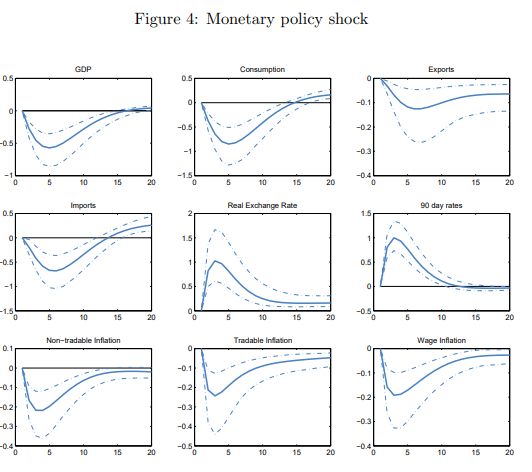
Quite how long those lags are is a matter for some debate. The old phrase was “long and variable”. I had a quick look at the Monetary Policy Handbook the Bank likes to boast of, and which is supposed to give readers a good sense of monetary policy as the Bank sees it. The word “lags” appears only once, and that referring to implementation lags in fiscal policy. I also checked the Discussion Paper in which the Bank’s calibrated economic model, NZSIM, is described, and was a bit surprised to find this chart

which seems to suggest very short lags (compare the 90 day and inflation charts), shorter than most practical discussion assumes. It is likely that the length of lags depends a bit on the shock, and a bit on the circumstances, but most pundits seem to think of the biggest impact of monetary policy on inflation as taking perhaps 12-18 months.

(Note that if the lags were as long as is sometimes rhetorically asserted – two years or more – the June quarter 2022 inflation outcomes (most recent we have) would have been substantially influenced by shocks to monetary policy in the June quarter of 2020, and since there were few/no dissenters then on the information available then, most questions of holding the RB now to account for recent inflation outcomes would be rendered largely moot. But few if any observers act, or consistently speak, as if the lags – for the largest effects – are that long.)

Implicitly or explicitly, all forecasts of inflation (and especially those that incorporate recent or prospective monetary policy changes) have a view on the length of lags, and when the Bank or officials ever discuss lags you also get the impression they have something like 12-18 months in mind.

So what did the Bank’s forecasts look like during this period? (Here, for the record, I an going to assume – I hope uncontroversially – that the published numbers were the Bank’s – or MPC’s – best view at the time.)

Here are the Bank’s inflation forecasts for the three successive MPSs, May, August and November 2020

Note that Reserve Bank published inflation forecasts almost always come back to 2 per cent eventually – it is the goal set for the Bank, and the default way the models are set up is for monetary policy to adjust endogenously to the extent required to get inflation back to target.

But note that these forecasts appear to have embodied views about the shocks monetary policy was leaning against that were severely disinflationary. Even with endogenous monetary policy, in all three of these sets of forecasts the inflation rates 12-18 months ahead were around 1 per cent, the very bottom of the target range and well below the 2 per cent successive governments required the Bank to focus on achieving. By the February 2021 MPS – not shown – the inflation outlook 12-18 months ahead was for outcomes around 1.4 per cent.

The Bank usually has OCR forecasts, but during this period (a) they had pledged not to change the OCR, (b) they believed the OCR could not yet be taken negative, and (c) they believed (or said they believed) that the LSAP was doing, and would do, a lot of the adjustment . So they published forecasts of what an “unconstrained OCR” would look like if a hypothetical OCR were to be doing its usual job.

Here were those projections (the paths in the May and August MPSs were identical)

So each of the published sets of projections through this period – but particularly those in 2020 – implied inflation well undershooting the target midpoint, even with substantial monetary stimulus (whether coming from the LSAP – which the Bank believed to be effective – or the OCR or – later – the Funding for Lending programme).

On their numbers it was pretty clear cut. The case for an aggressively stimulatory monetary policy was strong, whether considered against some pure inflation target or the Remit the MPC was charged with working towards.

I haven’t mentioned the unemployment or output gap estimates. These were the unemployment rate forecasts, that take into account actual and endogenous future monetary policy

I don’t want to make much of them (in shocks like this most of the information is already in the inflation picture) but their best view through 2020 was the unemployment into 2022 would still be 6 per cent or thereabouts (well above any credible NAIRU estimate). By the Feb 2021 MPS there was a big revision downwards, but they reckoned then that this week’s unemployment number would be about 5 per cent (best guess a day out, something like 3 per cent).

The forecasts were, of course, wildly wrong. But (a) there is no reason to suppose they were anything other than the best view of the MPC/Governor at the time, and (b) on those forecasts, the purest of inflation targeters would have taken a similar view on how much monetary policy stimulus was required (arguably – it was an argument I made at the time – the projections argued for more).

It isn’t very satisfactory that an organisation we spend tens of millions of dollars a year on, and set up a flash new statutory committee to make the decisions, did that poorly. There is no getting away from the fact that they had the biggest team of macroeconomists in the country, and access to every bit of private or public data they would have requested.

But, they weren’t the only ones doing forecasts, putting their money and/or reputations on the line. Long-term bond yields, for example, were barely off their lows in early November 2020, when the Bank was finalising the last projections of 2020.

What were the published forecasts of other forecasters showing. Conveniently, NZIER each quarter publishes a collection in their Consensus Forecasts. Those numbers include projections from the five main retail banks, NZIER itself, the Reserve Bank and The Treasury. There are limitations to the comparisons – they report numbers for March years (as distinct from rolling horizons) – and each institution’s forecasts are finalised at different dates (and Treasury publishes numbers only twice a year). The data are slightly biased against the Reserve Bank, which typically finalises forecasts in the first or second week of the second month of the quarter, while the compilation is published in the middle of the final month of the quarter (so some will probably have updated their forecasts after the Reserve Bank publishes its MPSs).

But for what it is worth here are the comparisons for forecasts done in late 2020 and the first quarter of 2021.

In the September 202 comparison, the Reserve Bank’s numbers for both inflation and unemployment are very much middle of the pack (just a little less inflation and a little less unemployment than the mean response (NB: note to NZIER: medians are probably better)).

By the final quarter of 2020, the Reserve Bank had the lowest March 2022 inflation forecasts,,,,,,but not by much. 1.1 per cent – the mean response – was still a very long way below the target midpoint.

And in the March 2021 comparison – where those focusing on the Reserve Bank’s failures might have hoped to find them at odds with their peers, on the wrong side – the Bank’s inflation and unemployment forecasts sit right on the respective means (and the least-wrong forecaster – credit to them – still proved to be off on inflation by just less than 5 percentage points).

I think it is no small defence of the Reserve Bank, in making the monetary policy that was driving core inflation outcomes now, that it had very much the same sets of views as its local forecasting peers. There are other forecasters (eg Infometrics) but it isn’t obvious anyone doing and publishing forecasts was doing much better than the Bank when it mattered. If you disagree that it is “no small defence”, all I can really offer is “well, they’d be really culpable if the central tendency of private forecasters – each with fewer resources – had been materially less bad than them”.

Another comparison is with the NZIER’s Shadow Board exercise, which for each monetary policy review invites six economists (and a few others) to offer their views on what the Bank should (not “will”) be doing. Several of the bank chief economists are in the Shadow Board panel, as are Viv Hall (retired macro academic, and former longserving RB Board member), Prasanna Gai, macro professor at Auckland (and former overseas central banker/adviser), and Arthur Grimes (former chief economist of the RB and the National Bank).

Shadow Board members used to just be asked for an OCR view, with probability distribution, and given the chance to make comments (some take regularly, some occasionally, some hardly at all). So I look through each release starting with the June 2020 (non MPS) review. The question was posed about the degree to which respondents thought the RB should use (a) a negative OCR, and (b) further QE (ie an expansion of the announced QE programme) at each of (a) the upcoming meeting and (b) the coming 12 months.

In June 2020, of the six economist respondents two thought there was a strong chance that a negative OCR would eventually be required. Arthur Grimes thought there was a near-zero chance. Four of the six strongly favoured an eventual expansion of the QE programme. Prasanna Gai put that chance at 50 per cent. Arthur Grimes again assigned a near-zero probability. Sadly, neither Prasanna nor Arthur offered any comments in elaboration, so we don’t know whether they felt the LSAP would be ineffective, they had a more robust macroeconomic (inflation and/or unemployment) outlook, or what.

By the next review, enthusiasm for more stimulus had begun to fade somewhat (although Arthur – again with no comment – modestly increased his very low probability on more QE being appropriate.

By the September review the LSAP programme had been significantly expanded, but respondents views about the future hadn’t changed much. A couple thought a negative OCR quite likely to be required, but no one was keen on a further increase in the LSAP programme. Nothing much had changed in respondents’ views going into the November MPS (and one of the comments suggest a robustly different macro outlook).

By the February 2021 exercise, the question had changed. Respondents were now asked about the likely need for “tighter policy”, now and in the coming year. There was growing sense that a tighter policy stance would be required over the coming year, but only one respondent – Grimes – was confident that an immediate tightening was warranted.

Ah, you say “see, an academic who doesn’t even do monetary policy stuff these days bests the Reserve Bank”. Except for the awkward fact that this was the time Grimes chose to make comments and explain his stance. His explanation?

The RBNZ loosened monetary policy too much through 2020, causing soaring house prices (as well as other asset prices) which is very damaging for disadvantaged New Zealanders and for the next generation…..The tightening should continue until such time as house prices return to a much more affordable level provided the goods market does not enter deflation.  

In other words, whatever the merits of Grimes’s stance may or may not be, he wasn’t at all focused on the outlook for the CPI. Instead he favoured using monetary policy to target house prices, with the explicit proviso that deflation might be a risk for general consumer prices. But – whatever merits or otherwise there may be to his argument – the target he was proposing was not the one the government had charged the Bank with pursuing.

(To look ahead, in the April survey Grimes again focuses on house price inflation but does talk about a need to “head off incipient goods market inflation pressures).

Again, maybe someone to point to some other commentators who did better, but from among the usual range of suspects there was little or nothing marking out the Bank’s overall view on inflation or monetary policy in the second half of 2020 or even early 2021. What there had been of course was a huge kerfuffle over house prices – where at times the Bank didn’t help itself (the chief economist once suggesting rhe higher prices were good ands helpful), but where mostly I agree with Governor: house prices were not something the monetary policy arm of the Bank was supposed to focus on (construction costs are) and that it would be an inferior approach to monetary policy to make house prices a focus of monetary policy. It is not irrelevant that no other central bank does.

So there was massive forecasting failure, and a widely shared one. The good side of that was that the economy got back to capacity much faster than expected/feared. The (very) bad side is that the economy grossly overheated and substantial core inflation pressures compounded – in headline CPI terms – various one-off price levels shocks that orthodox monetary policy generally encourages central banks to “look through”. It wasn’t a forecasting mistake unique to New Zealand. it was, it appears, about how Covid, the resulting stimuli etc would work out – something for which neither central banks nor private forecasters had many useful precedents.

None of that means that there were not significant mistakes made by the Bank during the period in this post.

If –  as the forecasts suggested –  more monetary policy stimulus was warranted in August and November 2020, there was still no good reason for a massive expansion of the LSAP programme, still focused at the long end of the yield curve (where little borrowing occurred), still boosting the level of settlement cash (in a way that had next to no macroeconomic significance, given the settlement accounts paid a full OCR interest rate, but which fed a frenzy around “printing money” –  from both several journalists on the left, and a few economists on the right.  The Bank had the option of cutting the OCR further –  25 points isn’t nothing, even if perchance a modestly negative OCR might have created a few residual systems problems for a few banks.  Sure, some weren’t keen in the abstract on negative rates, but the beauty of conventional monetary policy (the OCR) is that it comes a little or no financial risk to the taxpayer.  Massively expanding the LSAP programme –  when even the Bank will acknowledge uncertainty about the strength of transmissions mechanisms –  opened the way to potential for further massive losses to the taxpayer, with no sign still (months on, crisis passed) of serious risk analysis or indications of the losses taxpayers might face in the worst case, if things went bad and bond yields (and then the OCR) rose sharply.  

(A common excuse (I even used it once or twice myself) is “well, it doesn’t matter too much if the economy is so much stronger”, except that (a) there is little serious evidence (and the Bank has published none) that the LSAP was what produced the strength, and (b) things have so overheated, that if the LSAP did contribute much there are now two strikes against it.  At worst, the Bank should have been much for focused on managing yields at the 2 and 3 year parts of the yield curve, where any potential good would have come at much less financial risk.)

And then there is the Funding for Lending programme.  There have serious issues around the fact that that crisis scheme is still lending now, but that is an issue for the next post.

Again, given the macro forecasts (see above, very similar to those of private forecasters), it isn’t unreasonable for the Bank to have been seeking to ease monetary conditions a bit further.  And that is what the Funding for Lending programme did –  helped (mostly in the announcement effect, more than in actual lending) to lower term deposit rates relative to the OCR.  It was conceived at a time when the Bank thought the OCR could not go negative, but was only finally put in place by a time when (so the Bank told us) those issues had largely been sorted out.

I wrote a post about the launch of the Funding for Lending scheme in November 2020 (“Funding for lending and other myths”). I stand today by everything in that post. The scheme wasn’t harmful, didn’t carry material financial risks, and probably helped ease conditions a bit (the Bank has claimed it is latterly equivalent to one 25 basis point OCR cut, which sounds plausible). But by the time it was deployed it simply wasn’t necessary – adjustments could have been made simply to the OCR (if the Bank had not been dogmatically wedded to the ill-advised March 2020 pledge not to change the OCR come what may). And, if you refresh your memory, the scheme fed narratives that somehow banks were settlement cash constrained (they had never been), and led to loud but futile arguments about whether access to the funds should be tied to expansions of particular favoured types of lending (when banks were more opportunity-constrained, were never cash constrained, and where if such access rules had been put in place the scheme would not have worked to the limited extent it did. The Bank itself was a significant part of the problem – it was the party that devised the misleading name, presumably in same wish by the Governor to be seen, again, “doing stuff”.

I’m going to stop this post here, and am not going to attempt a summing up except perhaps to suggest that in the broad thrust of monetary policy (stimulus provided) this period the Bank did no worse than anyone much else (and if that isn’t saying much, so many people inside and outside of government and of New Zealand misread how the economy would behave). Lags are a problem. A mechanical inflation targeter with that not uncommon view of the world might reasonably have counselled more. Where the Bank is more culpable during this period – both with hindsight and with perspectives available at the time – was in its use of unconventional instruments.

Reviewing Covid monetary policy – Part 1

After last week’s posts on the Reserve Bank’s handling of monetary policy, I thought it might be worthwhile to stand back and attempt a series of posts this week on how the Reserve Bank has handled things (mainly monetary policy) over the two and half years since, in late January 2020, Covid became an economic issue for New Zealand. In today’s post, I will look at the Bank’s preparedness and their responses over the first three months or so. In a second post, probably tomorrow, I will look at their handling of policy over the following year or so, and a third post will look at the more recent period. If it seems worthwhile, I might attempt a final post bringing it all together.

It is hardly a secret that I do not have a high regard for the Governor, but in this series I will be seeking to offer both brickbats and bouquets as fairly as I can, and to distinguish as far as possible between perspectives that were reasonably open to an informed observer at the time and those which benefit from hindsight. Both have their place. Even though every country’s circumstances differ, what was going on in other countries and central banks is not irrelevant to a fair assessment of the Reserve Bank’s handling of things. People with more time and resources are better placed to assess the variety of responses in other advanced countries, but I will draw on comparisons where I can and where I think it would be helpful. Finally, while my focus is on the people who mattered – the Bank and the MPC – I’m always conscious that I wrote a lot in real-time about how monetary policy was being and should be handled. Inevitably I’ve had to reflect on what I got right and wrong, and why.

One area in which the Bank does not score well throughout is transparency. The Bank often likes to boast about being very open and transparent – the Governor was at it again in his press release last week reacting last week to the Wheeler-Wilkinson paper – but it is anything but, and the gaps were more evident than usual over the Covid period. The Bank has been less willing than the government generally to release relevant background documents, nothing at all has been heard from most members of the MPC (despite it being one of the most difficult times for monetary policy in a decades), and there have been few serious and relevant speeches and little or no published research. In challenging and uncertain times when no one has any sort of monopoly on wisdom the stance the Governor has chosen to take – echoing the biases of successive Governors – is a poor reflection on the Bank. We are told that Bank staff are beavering away on their own review, but the Bank will not even commit to having that material available to the public before their consultation on the five-yearly review of the monetary policy Remit closes (and there is no sign, for example, of any sort of ongoing engagement with alternative views going on). Here it is always worth bearing in mind that the Reserve Bank has far more resources available to it (including the largest team of macroeconomists in the country) than any other relevant party in New Zealand. We should expect better. And the Governor’s assertion a couple of months back to Parliament’s Finance and Expenditure Committee that he regrets nothing is neither true to the limitations of human knowledge/understanding, nor exactly reassuring that we are dealing here with an open and learning organisation.

Preparedness

When the first news of Covid cases emerged from China at the very end of 2019, the OCR was 1 per cent and the Bank had been struggling for some years to get (core) inflation up to the 2 per cent that successive governments had told them to focus on. By the end of 2019, they were not far away, but equally the economy was pretty full employed, the growth phase had run for 8 or 9 years, and prudent central bankers needed to be thinking about how they’d cope with the next recession. The effective lower bound on the nominal OCR really wasn’t that far away and in typical recessions perhaps 500 basis points of interest rate cuts had been required.

In a couple of respects, the Bank doesn’t score too badly:

  • as long ago as 2012, then outgoing Governor Alan Bollard had set up a working group (I chaired it) to think about how we would handle the next serious downturn. That group recommended, and there was no dissent from senior management, that steps be taken to ensure that the Bank’s systems and those of the banks could cope with modestly negative interest rates (which had already become a thing abroad),
  • in 2018, shortly after Orr took office, the Bank published a survey of options for what they referred to as “unconventional monetary policy”, citing the need to have thought through the issues in case the need arose in New Zealand (I discussed the article here).
  • well into 2019 the Governor gave a substantive interview in which he expressed his view that a negative OCR was preferable to using large-scale asset purchases in a future serious downturn. They seemed to have been thinking about the issue quite a bit.

The problem was that it didn’t seem to have occurred to them until very late in the piece to check if their preferred option was workable. Documents released under the OIA confirm that it wasn’t until December 2019/January 2020 that they thought to check, and pretty quickly the feedback from banks told them that – for many if not all banks – there were systems problems (both computer systems and documentation) that meant negative interest rates could not be implemented in short order.

(To be honest, I am still mystified on two counts: the first is how the Bank never checked over all those years, but the second is how the banks – often part of banking groups with operations in countries/markets that had dealt with negative rates elsewhere over the previous decade – were sufficiently remiss as not to have prepared either. How insuperable these obstacles really were in still hard to tell, but what matters is that the Reserve Bank and the MPC treated them as so, and were foreced into last minute changes of plan.)

The Bank was pretty slow off the mark to recognise the potential severity of Covid. By late January, some New Zealand exporters of luxury food products to China (notably crayfish) were reporting real problems. At the very end of January, New Zealand temporarily closed the border to arrivals from China (China have already restricted outflows from China), threatening both tourism and foreign students, and lockdowns were a thing in one of the world’s largest economies. But through February, the Bank took a fairly relaxed approach (which, in fairness to them, seems to have reflected a fairly relaxed approach across much of government – the Secretary to the Treasury sits on the MPC, and there is no sign that she injected any great sense of urgency to the deliberations on the February MPS, and published papers reveal no urgent whole of government effort to get ready for what might be coming). I was among those calling for a precautionary (Covid) OCR cut in February – at the time, there was no doubt that the Covid effects we were experiencing were, from a New Zealand perspective, pure adverse demand shocks. The Bank didn’t act, but what surprised me more was a couple of weeks later when they took to social media to talk up economic prospects for 2020 (an OIA request revealed that this wasn’t some rogue social media person, but was initiated/cleared by the Bank’s chief economist).

The global situation deteriorated into March, and not much was seen or heard of the Bank. But then on 10 March the Governor delivered a speech to an invited audience on monetary policy at very low interest rates. The Governor was keen to stress that this was all in abstract, there were no immediate plans to use any of them, but also

There was an indication that they would shortly be publishing background technical papers on each option (papers which, if they existed, never actually were published).

Note the preferred order. Note the date.

A couple of days later the Herald briefly reported some comments by the chief economist also downplaying the potential of asset purchase options.

On Monday 16 March, the deteriorating situation (virus, markets, economic dislocations), finally prompted the Bank to act. The centrepiece of the day’s announcements was that the OCR was cut by 75 basis points immediately (other central banks were making similar moves). But there were other elements to the day’s announcements, notably:

  • a year’s delay in the commencement of the higher bank capital requirements,
  • a move to pay the OCR interest rate on all settlement cash balances (previously each bank had a quota – linked loosely to daily interbank settlement requirements – above which only below market rates were paid).

Both moves made sense.

The Bank also indicated that it had discovered – 6 days on? – that banks could not operationally cope with a negative OCR, and issued a pledge that seemed strange and inappropriate at the time and seemed only more odd later: no matter what happened, the OCR would not be changed for the coming year. It simply made no sense. On the one hand, even if a negative OCR wasn’t really technically feasible, there didn’t seem to be any obstacle to an OCR of zero (or 1 or 10 basis points). And in an environment that was moving so fast and was so uncertain (that, for example, emergency unscheduled MPC announcements were needed) how could anyone pretend to the level of confidence in the economic and inflation outlook implied by a pledge that, come what may, the OCR would not be changed – up or down – for the coming year? Since the Bank won’t release the relevant documents and has never really engaged on the issue, it is hard to know what was going on in their minds, or what issues/risks they were thinking about (or not).

All that said, on the day the broad thrust of the moves was fairly widely welcomed (as just one example, here is the “Whatever it takes” (and “more will be necessary”) press release from the NZ Initiative. This was the day before the government’s own first significant Covid fiscal package (which I described at the time as, at best, good in parts).

The Covid situation deteriorated rapidly over the following week, with New Zealand’s “lockdown” (not envisaged in either fiscal or monetary announcements the previous week) announced and implemented. Economic activity was clearly weakening, as (eg) domestic travel dried up. Global equity markets were very weak and pressures spilled over into bond markets, initially in the US, but increasingly globally. Cash was king and bonds could be sold.

And on 23 March, the Bank announced that they had lurched to launching a $30bn large-scale asset purchase programme. Read the statement and it is clear that there were two separate considerations: one about the immediate pressures in the government bond market (yields were rising) and the second – more important – about the deteriorating economic situation. In their words

The negative economic implications of the coronavirus outbreak have continued to intensify. The Committee agreed that further monetary stimulus is needed to meet its inflation and employment objectives.

The following day – the “lockdown” having been announced by then – the Reserve Bank, the government and the retail banks had a further announcement (not primarily about monetary policy) : a six month mortgage holiday for those with severe Covid income disruptions, an (ill-fated) Business Finance Guarantee Scheme, and (from the RB, and with monetary policy implications) an easing in the core funding ratio requirement on banks.

There were various other announcements over the following days/weeks, but perhaps the last in the initial wave (and I’d forgotten it came a month later) was a 21 April announcement that the Bank was planning to remove LVR restrictions for 12 months.

It seems to me that the Bank’s broad approach over the period from mid-March to late April 2020 was consistent with a pretty widely held view of severe downside risks to both economic activity and inflation – widely held among informed observers in New Zealand and those overseas (looking at their own economies). Of course everyone recognised that (for example) ordering people to stay at home for weeks on end represented a reduction in the economy’s capacity to supply (good and services) and that the liberal wage subsidies would maintain immediate purchasing power (at least for wage and salary earners), but that there were good reasons to suppose that adverse demand effects would outweigh supply reductions. If so, downside risks to inflation and inflation expectations were very real (risks to expectations soon became apparent in survey measures) and, well, inflation and inflation expectations were what we wanted the monetary policy arm of the Reserve Bank to focus on.

What sort of demand effects might we see? Examples included:

  • schools and universities unable to receive foreign students (significant export industry), and uncertain when those restrictions might ease,
  • tourism itself was a net export earner for New Zealand,
  • the borders being closed meant few if any new migrants could arrive (the demand effects of new migrants typically outweigh supply effects over the short-term horizons relevant to monetary policy,
  • the previous recession had seen a material fall in nominal house prices (despite much larger interest rate reductions) and between (a) reduced immigration, (b) limited interest rate cuts, and (c) significant reductions in business income (not protected by wage subsidies) house price falls and consequent reductions in building activity seemed likely (for those fond of wealth effects, them too)
  • big fiscal outlays upfront meant higher taxes later. That, together with lost GDP, meant we were actually/prospectively poorer, and might less keen on future spend-ups
  • huge additional risk and uncertainty had been added to the economic environment ( no one knew when normality would return, what it would look like, how many disruptions – or deaths – there would be in the intervening months/years. A standard prediction would be that heightened perceptions of risk and real inescapable uncertainty would mean firms and households would respond by deferring spending, and particularly (very cyclical) investment spending,
  • and if all this happened globally then our export commodity prices could be expected to fall (even as headline inflation was lowered by oil prices briefly approaching zero).

I held many/most of those sorts of views. So did many/most forecasters in those early days. A fairly aggressive macro policy response was warranted on those sorts of scenarios. If inflation and inflation expectations were to fall sharply it could prove very hard to get them back up again. against that sort of troubled economic backdrop. I am not aware of many (if any) mainstream commentators or forecasters taking a drastically different view in those early days (even as everyone recognised the huge uncertainty).

That doesn’t mean an automatic tick for everything the Bank did. For me

  • the big OCR cut, if a little late coming, was quite the right thing to do (including against a backdrop of significant fiscal income support and some other stimulus)
  • making available additional liquidity if required also made sense,
  • as did the easing of the core funding ratio, which helped enable lower term deposit rates relative to the OCR,
  • but the pledge not to change the OCR further for a year made no sense then, and makes no sense now.  The Bank knew it was entering a climate of extreme uncertainty, it knew it might need all the monetary support it could get. No one else anywhere in the economy had any certainty at all about anything, and yet the Bank pretended to.  
  • the move to pay the OCR on all settlement cash balances made little sense if the Bank was really serious about delivering as much stimulus as it could (that floor stopped market rates drifting lower) [UPDATE: altho it did support a more precise control of very short-ter market rates at/near the OCR itself, that might have been impaired otherwise if the Bank was injecting more liquidity.  This was probably the intention, althoguh a little later in ended up impairing one channel through which the LSAP might have worked].

My focus is on the remaining two strands of the package.

Perhaps one can mount a decent case for a week or two of stabilising intervention in the government bond market in late March 2020.   The pressures would have sorted themselves out anyway (after Fed intervention) but if the RB wanted to do its little bit that in isolation probably did little harm (if reinforcing future moral hazard risks).   But the case for the sustained LSAP itself (initially $30bn) was never, and has never compellingly, been made.  The Bank was right, just a few weeks earlier, to be wary of what the LSAP could offer outside the white-heat of financial crisis.  It seemed to have been too readily swayed by some mix of a need to be seen doing stuff (having ruled out more on the OCR), and false parallels with choices some other central banks had made over the previous decade.  The Bank rushed into the LSAP mainly purchasing long-term government bonds with ever, it seems, addressing either the fact that very little borrowing in New Zealand occurs at long-term fixed rates (so even if they affected those rates a bit, so what?) and with no serious financial risk analysis at all (if any such document existed it would surely have been released by now).   This latter failure has cost the taxpayer very dearly, and any serious risk analyst (in the Bank or The Treasury –  who seem quite culpable here, as advisers to the Minister on the indemnity)) would have identified those downside risk scenarios.   It was a failure of controls that, in a private bank, would rightly alarm a supervisor.     (While my view on the LSAP still seems to be something of a minority view in New Zealand, it is quite consistent with that of Professor Charles Goodhart, a UK monetary economist that the Bank has drawn on over the years, writing –  in a Foreword to a book on QE completed just prior to Covid “the direct effect on the real economy via interest rates, whether actual or expected, and on portfolio balance, was of second order importance. QE2, QE3 and QE Infinity are relatively toothless”).  I absolve the Bank of claims that the LSAP was later to do much to influence asset prices or the CPI, but that was on grounds that it was a gigantic speculative punt in the bond market, at taxpayers’ risk, for an expected economic return that was always derisorily small. 

If I have a minority view on the LSAP –  simply was not appropriate even at the time as a monetary policy tool –  I may also have on the LVR restrictions.  I see numerous people commenting, including on my Twitter feed, that “well, maybe the Bank had to do something with monetary policy in March 2020, but why do they do anything with LVRs-  that really was inexcusable”.

And on that I simply disagree.  I have never been a fan on LVR restrictions and in that sense would always –  including now –  welcome their removal, but even on the Bank’s own terms suspension of the restrictions was the sensible thing to do back then (ideally a few weeks earlier).  LVR restrictions were intended to lean against reckless lending against rapidly rising collateral values, and in discussions inside the Bank in the early days on LVRs the mentality was that sensibly controls would be lifted if asset prices were to be falling, or otherwise the controls would exacerbate falls and potential illiquidity in the market, while doing little/nothing for financial stability.  In this particular (Covid) crisis there was a further factor, cited by the Bank in its announcement: a six month mortgage holiday for those severely affected by Covid could have run smack hard into LVR restrictions had the latter been left in place [UPDATE: since interest deferrals in particular would have amounted to an extension of further credit to the borrower, at a time when collateral values –  which in principle would need to be reassessed at any fresh credit extension – appeared to be (and were expected to be) falling.]   One might quibble that the mortgage holidays really did pose increasing financial stability (loan loss) risks down the track, but the banks were already amply capitalised.  Between early indications that house prices would fall –  as they did for the first couple of months –  and tightening bank credit standards anyway (something the Governor regularly inveighed against) suspending the LVR restrictions was definitely the right call with the information, and the (widely shared) economic outlook the Bank had at the time.

This has, almost inevitably been a long post. I’m going to stop here, with just one final brief observation.  When, as is often done, people now talk about high inflation being a problem almost everywhere, it is sometimes (and fairly) pointed out that it isn’t quite all (advanced) countries: Japan and Switzerland being two examples of countries with much more moderate inflation.  They were also two countries that didn’t do anything much with monetary policy in 2020.  However, that doesn’t really tell as anything about what was right to do, with the information at the time, in early 2020.  After all, both Japan and Switzerland went into Covid with policy rates already negative, and unable to do very much more with monetary policy.  Had they been able to do more perhaps they would have done so. Or perhaps not.  But we have no easy way of knowing.  In early 2020 countries (central banks) like NZ, Australia and the US were openly quite glad to have the leeway they did, to take the steps they did, in a climate in which many argued “just do whatever it takes”.

Next stage in Covid monetary policy tomorrow.


To what end?

It is two years today since my first post about pandemics (and the economy). Rereading it, and another the following week, over the weekend and it was interesting to reflect on what issues had (and hadn’t) sprung to mind. But back then, however fearful people might or might not have been initially, few would have supposed that two years on we’d be labouring under new, and even more onerous, restrictions, and that for the best part of two years few of us would have been able to travel.

I was quite supportive of the need for restrictions, especially at the border, for quite a long time. Even last year, when the government was so slow to roll out the vaccine, doing everything possible to keep the virus out would have seemed appropriate (ie more than the government actually did). As for domestic restrictions, in both 2020 and 2021 the government clearly overshot, imposing (and renewing) some restrictions that seemed more about asserting power and showing who was in control than about public health, and others that failed all tests of decent humanity. (None, of course, were ever justified by any sort of cost-benefit analysis – an abdication of any sort of decent policy analysis that I hope one day our politicians and senior officials look back on in shame.)

But that was then. Since late last year, the government’s approach has increasingly lost any coherence. Despite high vaccination rates, we’ve had extreme coercion used on those reluctant to get vaccinated, and we’ve lurched down a path of “papers please” where those who refuse to show their government papers are prohibited (either by law directly, or enabled by it) from undertaking many of the normal activities of life. All this as (a) it was clear that the biggest risk posed by the unvaccinated was to themselves, and (b) that lots of vaccinated people were getting Covid anyway, apparently often/mostly from other vaccinated people. Government guidelines as to when it would ease restrictions were repeatedly ignored by the government itself. The government meanwhile had confirmed that it had given up on elimination some time ago.

And then, of course, came Omicron – two months ago in other parts of the world. The experience of Omicron so far seems to be that it is highly highly infectious, partly as a result waves don’t last long, and among the vaccinated (even more so the boosted) the rates of serious illness and/or death seem remarkably low. In some places – the UK is the most obvious example – even with a lot of cases, numbers in hospital ICU care did not even increase during the Omicron wave (but there is a variety of experiences, depending in part on starting points). Nowhere, it seems, is there evidence of the spectre of “overwhelmed health system” having been realised (although you might expect, even hope, that systems would be put under some pressure).

As for our government, first it seemed that they shut down for the holidays. In normal times, no one would begrudge them that, but this was something more akin to “wartime” – a major threat unfolding, inter alia, just across the Tasman. You might have thought that all hands would have been on deck, led by the Prime Minister, with planning (and public consultation on those plans) advancing rapidly. And vaccination centres operating night and day to get vaccinated many more of those eligible for a third dose. Oh, and the child vaccination programme might have got going before Christmas too. But no, this was the government of complacency – we still don’t have their “plan” (apparently something is coming on Wednesday) – and now controls.

Even on what we have seen, policy is all over the place. Last week, they stopped allocating MIQ rooms for ordinary New Zealanders, but that was (a) done with no ministerial announcement, and (b) to affect arrivals a couple of months hence (when who knows what the environment will be). They keep telling us (sensibly, rightly) that Omicron will spread in the community, but then on Friday the government quietly put in place much-extended isolation requirements – of the sort that perhaps might make some sense (if complied with) in an elimination model, but which make no sense now – the more so as they will powerfully deter some from even getting tested.

And then yesterday we got the new general restrictions. From both the PM and the Director-General we were told they were still aiming to “stamp out” the outbreak, but even (especially?) they must know they are just making things up now – a Level 4 lockdown in August didn’t stamp out that outbreak (or wasn’t pursued long enough to), and this lot of restrictions is nothing like Level 4. The more realistic rhetoric/spin seems to be about “slowing the spread” – there are big adverts in the papers this morning enjoining us to get with the team, play our part.

But why do we want to “stop the spread”? I don’t. We are already two months behind much of the world – two months of repressive domestic restrictions and onerous border controls – and for what? Various other places are coming out the other side now, not having had particularly bad health experiences – England, Ireland, the eastern states of Australia, South Africa – while Ardern and her colleagues – apparently with little opposition from National – seem to be determined to try to slow the incoming tide. They’ve provided no supporting analysis, no cost-benefit analysis, there are no end-point dates for these controls (which may not do much “good” anyway, while disrupting lives), and no published criteria – not that on the past record they would ever stick to them – for getting controls off, getting our lives back to normal, binning the “papers please” regime, and opening the border (even just for New Zealanders).

Events are being cancelled all over the place, and whereas (say) we watched the Ashes test in Hobart a couple of weeks ago with large local crowds in attendance (in the middle of a not-small Omicron outbreak) the government is going to condemn us to the grim spectre of test matches with no crowds at all.

Of course, it could be worse. The government could – and may yet – resort to more onerous restrictions (have they done anything to prepare the public for several weeks of 30-40 deaths a day?) but it is unclear what they are trying to achieve, and how their cobbled-together policies fit a strategy. We hear talk about “flattening the curve” but that seems like a recipe for months and months of controls – the sort of restrictions that may appeal to public health professors and some left-wing politicians, but which should generally be anathema in a free and open society. There is talk, always talk, about getting our booster rate up – but (a) whose fault is it they weren’t offered earlier?, and b) even now, because of the delay, the percentage of our population with boosters is already higher than (say) the Australian share 6 weeks ago when their outbreak was getting underway.

People oriented to controls can always dream up reasons for delays – and I might have had a touch more sympathy if the government had shown itself ever willing to get rid of controls that were no longer self-evidently necessary – but they never attempt to show an overwhelming case. In an interesting Newsroom article over the weekend, on preparing for Omicron, Prof Michael Baker justified his case for more restrictions on the basis that “several hundred people” might die if we just let Omicron sweep through. Quite possibly – if one takes the Australian numbers as a guide – but 34000 people a year die in New Zealand, and that number fluctuates (easily plus or minus 1000) from year to year. It simply does not justify restrictions without limit, and lives lived – unable to sensibly plan – at the whim of politicians.

baker

And, of course, we are rightly reminded of the limitations of the public health system. It was a reasonable argument two years ago, but not now, when the government has done little or nothing to boost capacity over two years, and now wants to put us under their (somewhat half-hearted) controls anyway. Sure, there would be likely to be some weeks of extreme pressure on the system, but it is hard to conceive of any serious cost-benefit analysis – that value freedom at all – justifying society-wide restraints, indefinitely, to avoid a few weeks difficulty (and even some otherwise avoidable loss of life).

Now, of course, Omicron will be disruptive even if the government does nothing. Baker, in that same article, seemed to use that as justification for “oh well, we might as well just have lockdowns then”. But there is a big difference between government controls – backed by the coercive power of the state – and individuals and firms taking their own precautions, calibrated to their own individual risk and risk tolerance. I’m pretty sure no one would put off a quiet swim at a deserted beach, or a driving lesson for their child, except the state compelled them,

(And I say all this as someone who is almost 60, and hasn’t had the best of health in the last couple of years. There are risks to life, and – fully vaccinated and soon boosted – I’m quite happy to run those modest risks. I’m not happy seeing events cancelled willy-nilly at government fiat, or governments still stopping people travelling (indefinitely), and so on.)

There are lots of things the government could and should have done much better re Covid over the last 12-18 months. Had they been done we might be in a slightly better position now, but it is water under the bridge now, and nothing about the government or Ministry of Health gives any reason for confidence that we should put up with indefinite restrictions on their say so. They have the power of course, but they abuse and misuse it (down to and including the arrogant disdain evident in the way the government refuses to even put out case/hospitalisation data at a fixed time each day – a simple thing in some ways, but one that simply reveals their indifference and, quite possibly, incompetence).

Better to (a) scrap the vaccine pass system (which simply institutionalises repression, of the sort that should be alien to this country, for no significant public health benefit), (b) open the border to NZ citizens, and (c) cut the isolation requirements to something like those in the US and UK, with a view (d) to following the English lead and looking to remove all Covid restrictions by, say, 31 March (subject to renewal only by vote of Parliament, not arbitrary ministerial fiat with no consultation or transparency).

Oh, and release all the relevant Cabinet papers and ministerial briefings within two days of decisions having been made. These are our lives, our freedoms. We are not supposed to be just playthings of the government. The smallest regulatory changes in normal times have to go through proper (if often faux) consultative processes. Sometimes in emergencies needs must, but this was Omicron – they had the best part of two months to be prepared; do the analysis, test it in public, consult. Instead, perhaps we’ll see a “plan” on Wednesday, perhaps we’ll see the papers and analysis (if any exists) six months from now.

LSAP losses

The Minister of Finance and The Treasury appeared before Parliament’s Finance and Expenditure Committee yesterday. It was encouraging to see National MPs asking questions about the Reserve Bank’s Large Scale Asset Purchase programme, which was undertaken with the agreement of both the Minister and The Treasury and which has now run up staggering losses for the taxpayer.

A standard way of estimating those losses is the mark-to-market valuation of the Bank’s very large LSAP bond portfolio. As of the latest published Reserve Bank balance sheet, for 31 October, those losses were about $5.7 billion. When the 30 November balance sheet is out, probably next week, the total losses will be lower (bond rates fell over November), but with a very large open bond position still on the books taxpayers are exposed to large fluctuations in the value of the position (up or down), with no good basis for supposing that the expected returns are likely to compensate for the risk involved. If there was a case for putting on a large open bond position early last year – I doubt it, but take that as a given for now – there is no case for one now, in a fully-employed economy with rising inflation, and with the conventional instruments of monetary policy – which expose taxpayers to no financial risk – working normally and effectively.

A post from a few weeks ago set out the issues.

I didn’t watch the whole 2 hours (link to the video above) but from exchanges with various people I think I have seen all the questions and answers relevant to the LSAP issues.

First, at about 43 minutes in, National’s Andrew Bayly asked the Minister of Finance (a) why, when Crown indemnity was approved the Minister did not then require a plan for unwinding the position (the Bank is currently talking about having a plan early next year, almost two years on), and (b) why there was no limit to the indemnity.

I’m not sure either question was that well-targeted, and the Minister had no real trouble responding. As he noted, the LSAP programme had been initiated in the middle of a crisis, time was short etc. And although there isn’t a limit on the indemnity itself there is a limit of how many bonds can be bought, and the government determines which bonds are on issue which amounts to much the same thing. That said, both responses take as more or less given that the idea of an LSAP had never occurred to anyone on any corner of the Terrace/Bowen St triangle until late March 2020. We know the Bank had been (rather idly) talking about the option for several years, including saying they’d prefer not to use it, but it seems they had not done the hard ground work, and neither had The Treasury nor the Minister insisted on it, well in advance. There is no sign any cost-benefit analysis for something like the LSAP was ever done, no analysis of likely Sharpe ratios, no analysis of potential peak taxpayer losses and so on. The Bank should be held accountable for that, but…the Minister is primarily responsible for holding them to account, and The Treasury is the Minister’s principal adviser (and the Secretary is a non-voting member of the MPC).

After the Minister left, Bayly returned to the LSAP (at about 68 minutes), supported by National’s new finance spokesman Simon Bridges. Bayly asked the Secretary to the Treasury whether an increase in the OCR would increase the liability for the Crown for the indemnity. The Secretary responded that the indemnity was net neutral from a whole of Crown perspective. What followed was a slightly confused discussion with Bridges ending up suggesting that the Secretary was “plainly wrong”. I don’t think the Secretary answered well, and she certainly didn’t answer in a way designed to help clarify the issues around the LSAP, but she is correct that the indemnity itself does not affect the overall consolidated Crown financial position (the claim the Bank currently has on its balance sheet is fully offset by an obligation the (narrowly defined) central government has on its balance sheet. It is quite likely that without the indemnity the MPC would have been very reluctant to have run a large-scale LSAP programme (the Bank’s own capital would not support the risk), but once the programme was established what determines the financial gains or losses is, in short, just the movement in market interest rates. The indemnity just reallocates any losses within the wider Crown accounts. In that particular exchange, The Treasury made none of this clear, and Secretary herself seemed a bit confused when the discussion got onto the different ways the bond position might eventually be unwound (there is little or no indemnity if the bonds are held to maturity, but that doesn’t mean there are no costs to the taxpayer). And thus (reverting to Bayly’s initial question) an increase in the OCR – particularly one now expected – doesn’t itself change the Reserve Bank’s claim under the indemnity

About 25 minutes further on, Bridges returned to the fray and a rather more enlightening conversation followed. Bridges asked whether the LSAP did not represent a significant increase in Crown financial risk. The Secretary agreed and both she and one of her colleagues explained – as I have here repeatedly – that what had gone on was that the Bank had bought back long-term fixed rate bonds, effectively swapping them for the issuance of settlement cash, on which the interest rate is the (variable) OCR. Unfortunately some of the discussion still got bogged down in matters of Crown accounting (the difference between the purchase price of the bonds and the face value, which is of no economic significance), and the Secretary was very reluctant to allow herself to be pushed into acknowledging that the position of the LSAP portfolio – implemented with her support – is deeply underwater. As a simple matter of analysis, she was never willing to distinguish between the mark-to-market loss to now, and the potential gains, losses, and risks on continuing to hold a large open position from here on. One is a given – now a sunk cost – and conflating the two (in the hope “something will turn up”) obscures any sense of accountability, including for the choices to keep running the position. She and her staff wouldn’t accept that sort of explanation from any other government agency running large financial risks.

Were the position to be liquidated today – as, at least in principle (crisis having passed, economy full-employed) it should be – a large loss for the taxpayer would be realised. At a narrow financial level it is as simple as that. If the position continues to be run – in the limit through to maturity, finally in 2041 – what will matter is where the OCR averages relative to what is currently priced into bond yields, but it won’t change the fact that the portfolio is starting behind – the OCR is already much higher than was expected at the time most of the bonds were bought. And if the portfolio is let continue to run, taxpayers are exposed to ongoing large risk for no expected return (there is no reason to suppose the Bank is better than the market at guessing where the OCR will need to go over the next 10-20 years).

(The current agreement between the Minister and the Bank requires that if the Bank looks to sell the LSAP bonds it do so only to the Treasury itself. Such a sale, of course, changes nothing of economic substance (purely intra-Crown transactions don’t) – the high level of settlement cash balances would still be there, earning whatever OCR the macro situation requires – but from a political perspective it would be convenient, as there would no longer be monthly updates on the Bank’s website as to the extent of the losses caused by the MPC’s rash choices (backed by The Treasury).

Treasury officials did chip in a couple of caveats. First, the Secretary noted that in assessing the overall LSAP programme one had to look also at the (any) macroeconomic benefits. In principle, of course that is correct, but (as I’ve argued previously) any such gains are unlikely to have been large:

  • the LSAP was designed to lower long-term bond rates, but these are a very small element in the New Zealand transmission mechanism,
  • it is hard to see much evidence here or abroad of sustained effects of LSAP-like programmes on long bond rates (eg movements beyond what changing expectations of future OCR adjustments themselves would simply),
  • the Bank always had the option of cutting the OCR further (on their own telling, to zero last year, and lower still since the end of last year), at no financial risk to the taxpayer, and
  • if there is a macro effect, perhaps it was modestly beneficial last year, but must be unhelpful now (recall that the literature suggests it is the stock of bonds that matters, not the flow of purchases, and we now have an overheated economy with above-target inflation.

And one of her deputies chipped in noting that there might have been some savings to The Treasury from having been able to issue so heavily at such low rates last year, the suggestion being that without the LSAP the Crown might not have been able to get away so many bonds so cheaply. There is probably something to that point, in an overall accounting, but (a) the effect is unlikely to have been large relative to the scale of the subsequent rise in bond yields, and (b) especially with hindsight a better model would have been for the Bank not to have been purchasing bonds and the Crown to have been issuing fewer.

The Select Committee discussion ended with the offer that National MPs could lodge a follow-up question for written response by the The Treasury. I hope they avail themselves of that offer.

The Treasury could be, and should be, much clearer and more upfront about the analytics of the LSAP issues, but it isn’t clear – given their involvement all along – that their incentives are in this case that well-aligned with the interests of the public in scrutiny, transparency, and accountability.