On the way ahead

In my post last Thursday I offered some thoughts on changes that should be initiated by the government in the wake of the Governor’s surprise resignation. (Days on we still have no real explanation as to why he just resigned with no notice, disappearing out the door and (eg) leaving his international conference in the lurch, but this post is entirely forward looking.) Here I want to elaborate on three points, having benefited from a few days to reflect and a few useful conversations/exchanges:

  • the position of the Board chair, Neil Quigley,
  • policymaking on bank (and related) regulatory matters,
  • the Funding Agreement.

Board members, including the chair, of the Reserve Bank cannot be removed at will by the government. That puts them in a different position than the boards of many other government agencies. Whatever the pros and cons of that model (and there are both) it is the law as it stands.

Last year the government – for reasons never made clear – extended the term of the chair of the Board, Neil Quigley, for another and apparently final two year term. Quigley has been on the board for a very long time now, and has been chair since 2016. By usual standards of corporate governance that would really be too long anyway, even allowing for the fact that the role has changed over time. But it was pretty clear when the reappointment was done last year that with Quigley getting another two years but Orr having (then) almost four years to run, the government expected – and appropriately so – that a new chair would be in place to lead the search for, and transition to, a new Governor (Governors are now limited to two terms).

It should be untenable for Quigley lead the search (and transition) process now. He drove the selection and appointment (and reappointment) process for Orr in the first place. And frankly, however Orr appeared to the interviewers in 2017, that did not turn out well, and did not end well. The Board – and especially the long-serving Board chair – has to take some responsibility for that (including the chaos of last week, including Quigley’s own unconvincing belated press conference, which one person put it to me was bad enough to warrant dismissal for cause – sadly, not really a statutory option). In addition, Quigley – whose responsibilities have been to the public and the minister – has had the back of the Governor throughout his term, and there has never been the slightest hint in any Board Annual Report of any concerns at all. Worse, it appears that Quigley championed that blackball back in 2018 which – unlike any serious central bank in the world – saw anyone with current or future research interests in or around monetary policy banned from consideration for appointment to the Monetary Policy Committee (and yes, there is chapter and verse on this). Much more recently, whether deliberately or through careless forgetfulness (and failing to check records) he actively misled Treasury and, in turn, the public on this matter, claiming there’d never been such a ban (see, eg, here and here).

It is time for Quigley to go, and for cleaning house to begin in earnest. Quigley can’t be dismissed, but it shouldn’t be beyond the wit of the Minister of Finance to have it made clear to him that it isn’t tenable or appropriate for him to lead the next stage. Quigley himself is a wily political operator and could no doubt read tea leaves were they presented to him. And he seems still to want that medical school. Willis also has an existing board vacancy to fill now, and 2 more positions become vacant on 30 June.

(Assuming she isn’t willing to amend the Act to make the appointment of the Governor wholly a choice for her and the Cabinet), Willis should be looking to move in short order to put in place a new Board chair, someone not compromised by the Orr years, someone of stature (appointments need to be consulted with other parties in Parliament), but also someone trusted to be sympathetic to the general direction the government wants to go with the Bank. (If that seems threatening or politicised, it isn’t intended that way, but we are a democracy and governments, in Parliament, get to make the big picture policy and organisational directional calls). In any case, the Minister should look to issue a new letter of expectations to the Board making clear what she is looking for as regard budget discipline, policy priorities, and the qualities to be sought in a new Governor.

What about prudential regulatory policy? In most areas of government, policy is set by ministers, and implementation is done by agencies, including Crown entities, operating (implementing/applying) at arms-length from ministers. That is both efficient (ministers have limited time etc) and consistent with good governance generally – we really do not want ministers playing favourites for their donors or mates in the application of the standard rules, and we really do want accountability to Parliament and public for policy choices.

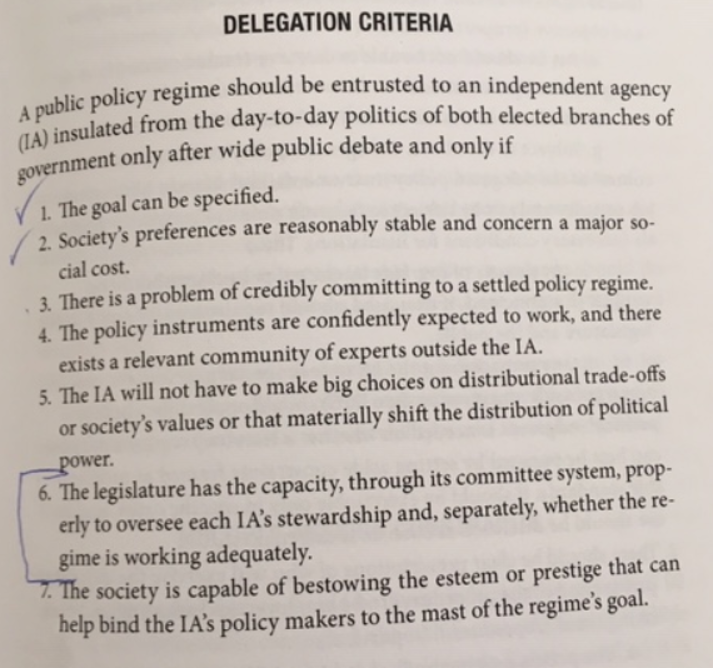
In prudential policy in New Zealand things are different. For the most part, the Reserve Bank itself gets to set the rules (big picture social risk tolerances and all) and apply them. Prudential regulators of course tend to like such a model, and there is plenty of literature from sympathetic former regulators, and from academics, in support of it. On the other hand, it looks pretty dubious through a democratic accountability lens. I’ve written here previously about former Bank of England Deputy Governor Paul Tucker’s book on delegating power, including but not exclusively so, to central banks. Bank regulatory policy simply does not pass the test – the various sensible principles Tucker lists – for being delegated to technical experts. And, as it happens, in New Zealand the power doesn’t even rest with technical experts, but with the Reserve Bank Board, which has been very light indeed on expertise or experience in these areas.

It has become clear that the government is unhappy with elements of Reserve Bank policy choices in these areas. Some of the apparent discontent – eg last year and the secretive advice re remuneration of settlement account balances – doesn’t make sense. Some other counts seem weak, and others rather more persuasive. But here’s the thing: the government is the government and, hand in hand with Parliament, is supposed to make our laws, and be accountable for them. The government, for example, sets the inflation target (while delegating OCR calls needed to deliver inflation near target).

It seems highly likely that prudential policy issues are going to be front of mind in choosing a new Governor (all that ongoing select committee inquiry and all). Which is fine, but a much more direct way to do things would be to seek a simple amendment to the Deposit Takers Act to make clear that in setting prudential standards the Reserve Bank first needs the consent of the Minister of Finance (at present, the Bank needs to inform her – not consult – and even failure to inform doesn’t invalidate the new rule). Then the government could be confident that whoever became Governor would be (a) providing advice, and b) ensuring the implementation of the rules, but that policy itself would be being set by the government. People we can toss out. We shouldn’t want a yes-man (or woman) as Governor – it shouldn’t be in the Minister’s interests either – and it is critically important that the Minister gets robust, technically expert, advice from the Bank (informed by research and critically-reviewed analysis) before making prudential policy decisions. But big picture policy calls should be for the Minister.

I’m not a parliamentary process expert so perhaps it might take a few months to make such an amendment. It is likely to take a few months to appoint a new Governor anyway, but any appointment could then be made with the new Governor knowing that those would be the terms on which they were taking the job.

The final of my three points is about the Funding Agreement, widely believed to be one of the factors that led Orr to storm off. As a reminder, the Reserve Bank isn’t (but probably should be) funded by annual parliamentary appropriation (yes, we want operating autonomy but we still fund the Police that way), but through an agreement that determines how much of its profit the Bank gets to keep and spend. This is a deeply flawed model – a legacy of late eighties disputes. Not only does Parliament not get a say at all (with hundreds of millions of operating spending involved) but the Bank does (government departments simply get told by ministers what their appropriation will be). But worse it is not compulsory for there even to be a Funding Agreement, and the law states that if there isn’t one the board simply has to use its best endeavours to keep spending no more than in the last year of the previous agreement. Which, I suppose, caps further growth in bloat and budget, but could be used to simply to refuse to accept a cut in budgets (when almost every other government agency has had or faces cuts). I’m not suggesting the Bank would negotiate in bad faith, but….the law is the law, and it gives them much more power and formal leverage than most agencies have. It should be changed, and in short order, to ensure that if the five year funding model remains, a) the Minister sets the amount, and the allocation among Bank’s statutory functions, and b) that all is subject to parliamentary debate and ratification as other government spending is.

Changing tack, who might eventually be chosen as the new Governor? There isn’t any obvious standout candidate – which may be a poor reflection on how our system has worked, including the way successive Reserve Bank Boards have operated over the last couple of decades. Various articles have listed a reasonably predictable list of possible names, including Arthur Grimes, John McDermott, Christian Hawkesby, and Prasanna Gai [UPDATE: and Dominick Stephens was also on those lists]. I tossed into the mix on Twitter the other day the name of former Government Statistician and (more recently) Deputy Governor, Geoff Bascand. One name I have been a bit surprised not to have seen mentioned – casting the net necessarily wide – is Carl Hansen, who was appointed to the MPC last year, but who has both Reserve Bank and Treasury experience, and chief executive experience.

All those people are economists by background. Neither the current head of the Fed nor the current head of the ECB is an economist. That is pretty uncommon these days, but both the Fed and ECB have deep benches of economics expertise in very senior roles. But might, for example, there be a case for a strong non technically expert change manager becoming Governor, perhaps with the intention of doing only 2-3 years (on the pattern of Brian Roche at PSC)? I’d be wary – perhaps a good Board chair could best do some of that – but….there is no standout candidate.

An obvious question is what about New Zealanders abroad or indeed foreigners (eg the Australian government has appointed a Brit, with no past ties to or experience of Australia, to the Deputy Governor role at the RBA). I used to be pretty staunchly opposed to a foreign appointment when the Governor was the all-powerful single decisionmaker, but legislative reforms have – at least on paper – spread the power. Someone with no past ties to, or experience of, New Zealand would still face a big adjustment hurdle, and it would be quite risky (and there are adverse selection issues: the most able globally might reasonably think their best opportunities were not in New Zealand). New Zealanders abroad might be more of an option, although one I used to champion as warranting serious consideration (including in 2017) – David Archer, former Assistant Governor, former senior official at the BIS – might have almost aged out by now (although is probably only about the same age as Grimes) and has been away for a long time. There will be others.

I’m not going offer my thoughts on the pros and cons of any of these individuals. Suffice to repeat that, and especially given the broad role as it is currently specified, there doesn’t seem to be a compelling candidate in any of the lists. Perhaps even more than usually, in coming up with their final pick, the Board and the Minister might want to be thinking in terms of a team at the top, the sort of people a possible new Governor would choose to fill the couple of most senior posts (policy and operational/administrative) around him/her.

Pretty (il)legal

The title of this post was, of course, a reference to the efforts of former Minister of Finance and National campaign manager Steven Joyce to defend the use by National of music inspired by or copied from some overseas band’s work. It was, he claimed, “pretty legal”. The courts disagreed.

Joyce himself developed form in this area, and as Minister of Finance in 2017 appointed an acting Governor of the Reserve Bank for six months, with no legal authority whatever. It was, in many respects, a pragmatic solution (a new permanent Governor could not, under our conventions, be appointed to take office very close to election day), but instead of passing a brief technical amendment to the Reserve Bank Act, to deal with what was perhaps an unforeseen oversight in the initial drafting, he simply went ahead and made the questionably legal appointment. At the time, this blog devoted a lot of time and space to the issue (having flagged the looming issue a couple of years in advance, while officials and ministers did nothing). Eventually, through the good offices of the Ombudsman, Crown Law – CEO, one Una Jagose, who has since developed something of a reputation – released a summary of their legal advice to Treasury on the issue (discussed, with other relevant links, here). Crown Law’s case seemed to boil down to no more than “well, Parliament must have intended to enable the appointment an acting Governor of this specific sort”. Had they intended it, it would have been a simple matter for a suitable clause to have been in the act. None was. (That particular gap has been fixed in the amendments to the Reserve Bank Act in recent years).

It mattered for a number of reasons.

First, because we are supposed to be governed under the rule of law, not ministerial whim, or the fancy of officials who happen to think a particular outcome would be convenient, but can’t be bothered asking Parliament to legislate. “Pretty legal” is no sort of acceptable standard, the more so when on a plain reading (detail and legislative context), something is actually pretty clearly illegal.

There are also real risks when officials and ministers play fast and loose with the law, for their own convenience, betting perhaps that no one will be bothered with the expense and delays in access to civil justice to attempt to challenge it formally. Fortunately, Grant Spencer – who compromised a worthy career by accepting this temporary but dubiously legal appointment – doesn’t seem to have been faced with particularly contentious choices in his few months occupying the office, but the lawyers might have been gathering if there had been a very costly or contentious decision going against one or other groups of interests. In those days, all power at the Reserve Bank rested with the Governor personally.

And, frankly, this was our central bank, supposed guardian of financial stability, and prudential regulator, including around ensuring that good standards of governance exist and are upheld in banks and financial institutions. Would this sort of – pretty legal/ evidently illegal but convenient – standard have been even close to acceptable to the Reserve Bank if a supervised institution had offered it up in the context of its own appointments? And while the appointment was made by Steven Joyce, there is not the slightest sign in the documents of any unease from the Bank. Its Board was, then as now, chaired by Neil Quigley. (You may recall that Quigley – in his day job – and Steven Joyce have an economic relationship recently called out and criticised by the Auditor-General no less. They probably thought that arrangement was pretty much okay. It wasn’t.)

All that said, and bad as that episode was, it was all over in six months. A permanent Governor, lawfully appointed, took office and things moved on. Not all such “pretty (il)legal” stuff done by governments is so time-limited.

All that in the post so far was really by way of scene-setting for another example of “pretty legal” sort of thinking. It doesn’t affect many people, but does involve the Reserve Bank (Quigley again, Orr, and their very senior appointees), The Treasury, the Minister of Finance and most of her ministerial colleagues on the one hand, and a fairly small group of mostly very elderly pensioners on the other. Officials and ministers are acting as if the law simply doesn’t matter, to achieve what might otherwise in many ways be a sensible outcome, and by refusing to make simple legislative amendments are doing so in a way that leaves those pensioners and their spouses highly exposed to what could, in the wrong circumstances decades hence, be catastrophic financial risk.

I will try to keep the explanation short and clear.

The Reserve Bank established a pension fund for employees back in 1935. The defined benefit (pension) bit of the scheme was closed to new members in 1991 (and the later defined contribution bit has also been closed for a long time) and all the members of that scheme are now retired. There aren’t many left (50 or so), and as schemes shrink cost burdens tend to increase, investment options diminish, and it gets harder to find member trustees.

The scheme’s rules allow for it to be wound up. But in that event, trustees have to be able to purchase replacement pensions. There are no private annuity providers now in the New Zealand market, but decades ago a provision was included allowing for the possibility of transferring pension liabilities to the Government Superannuation Fund (not coincidentally, the provisions of the two schemes are pretty similar).

I’m a trustee of the scheme – never quite imagining in 2008 when I filled in as someone’s alternate that I’d still be there 16 years later. A couple of years ago I championed exploring whether a transfer to the GSF was really a feasible option. If it could be done in ways that replicated members’ benefits, it would lead to measurable cost savings for the Bank, and get all the compliance etc rigmarole out of our lives. I suspect that no one who has served as a trustee of this scheme in the last decade has counted it a pleasant or satisfying experience.

Anyway, my colleagues agreed and we got the Reserve Bank Board (which has the final decision on a wind-up) to agree to us exploring the issue.

There were a couple of immediate questions. If the GSF Authority wasn’t interested, we couldn’t compel them. But even if they were interested did they have the legal powers, under their own legislation, to assume our liabilities (in exchange for payment)?

People, with various degrees of creativity, looked through the GSF Act and found two possible straws to cling to. One dropped away very quickly, as everyone accepted it didn’t help.

But then there was section 98 of the Government Superannuation Fund Act.

When it was first suggested as an avenue, I scoffed. And the more I reflected on those provisions, and their legislative context/history, the more implausible it became.

The legislation dates back many decades and what evidence there is suggests it was written mainly with university lecturers in mind – many of whom in those days came from the UK. It made sense to enable agreements that recognised service in (say) UK universities for NZ university pension purposes and vice versa. What was envisaged was a reciprocal relationship.

You’ll note that the provision isn’t restricted to overseas entities. Reciprocal arrangements can be enabled, by Order in Council, with other New Zealand entities. It would, for example, have been fully in order decades ago for (an Order in Council enabling) the Reserve Bank and the GSF to have entered a reciprocal agreement to mutually recognise service in the other (eg for Treasury staff moving to the Reserve Bank, Reserve Bank staff moving to Treasury). There was never an agreement of that sort (in fact such were the restrictive practices at the Reserve Bank even when I joined in the 1980s that it was all but impossible to join the Bank if you were aged over 26).

But the critical words in that statutory provision – which has apparently not been tested by the courts – is “reciprocity” (“providing reciprocity in matters relating to superannuation”).

A few months ago a Cabinet committee, attended by 19 ministers (including the PM) and an under-secretary, decided that it was fine and dandy. A bit later Treasury pro-actively released the relevant Cabinet minute. They also released, with significant redactions, the associated Cabinet paper, presumably prepared for the Minister of Finance by Treasury but with input from various other government agencies.

It is a shoddy paper from start to finish (starting with the repeated claim that the Reserve Bank scheme is a “government” scheme – it is a fully separate legal entity, on the same footing and regulatory basis as any other legacy superannuation scheme under the Financial Markets Conduct Act, with the Reserve Bank having no powers over it, and the government itself having no powers or liabilities different from those applying to any private scheme). It is perhaps no wonder that both the Minister and Treasury refused my OIA requests for advice received on this GSF option.

It is, however, usefully clear and explicit that the main reason for such a transfer, if it can be legally done, is to save money for the Reserve Bank. That is an entirely legitimate objective, provided members’ interests and rights are robustly protected. But there is no sign that the Minister provided any such assessment to her colleagues, who presumably nodded this through. A transfer to GSF could, in appropriate circumstances, be a mutually beneficial and tidy outcome. But it simply isn’t legal on the law as it stands, and precisely because it is proposed to be done using an Order in Council, which can simply be revoked by any future minister/government, or disallowed by Parliament itself under standard secondary legislation provisions, with no recourse for pensioners, it leaves those pensioners in an extremely vulnerable position. The risk of such revocation or disallowance might seem low today, but as even the Cabinet paper notes the liabilities probably have at least 40 years to run, and no sensible person concerned about their own finances is going to approach decades-long contracts saying “oh, never mind, explicit written statutory powers will probably never be used”. You look for protections, and what the Minister of Finance is proposing to do – pretty illegal in the first place – offers none at all.

“Reciprocity” simply does not mean what it has to mean for a simple sale and purchase agreement in which the trustees pay cash to GSF to take the liabilities off their hands to count. It doesn’t mean something like that in plain English usage, and it does not do so anywhere else in New Zealand statutes (and yes, I have worked my way through every single reference). When I buy my groceries from the supermarket it is a mutually beneficial exchange, but no one thinks of it as an agreement involving “reciprocity” (which in general and statutory usage, and things like Social Security Agreements involves something much more of a “like for like” nature.) Moreover, as even the Cabinet paper notes this (pretty illegal) wheeze involves trying to use an Order in Council to get round an explicit statutory prohibition of new entrants to the GSF scheme itself.

A couple of months ago, having become aware of the Cabinet minute (although not then of the redacted Cabinet paper itself) I wrote to the Minister of Finance outlining in some detail my concerns, and proposing instead a simple and uncontroversial legislative amendment to the GSF Act, which would provide trustees and members legal certainty, and markedly reduce future risks for members (since revocation of an authorising Order in Council or disallowance by Parliament would no longer be options). I have not had a reply from the Minister. When I approached her again, a private secretary suggested that I could expect a response shortly. Nothing has since been heard, suggesting that a conscious decision has been taken to simply ignore my concerns, as someone with legal duties to scheme members.

The full text of my letter to the Minister of Finance is here.

Letter to Minister of Finance re section 98 of the GSF Act

The Cabinet paper very briefly touches on the legislative option (having provided ministers with no information on the risks and legal doubts about the approach her officials would have them take).

I guess if there is no formal legal challenge, pretty illegal stuff can be done quickly. But this is a bizarre argument more generally. Nothing in the Cabinet paper suggests any urgency about an arrangement. The scheme functions, bills are paid, pensions are paid, and although pressures will build they have not done so yet. It would be good to tidy things up, but only if it can be done robustly, and not with ministers brushed off with lines about there being nothing to worry about and only minor implications for members). As it happens, it is now late October 2024 and if a transfer happens it certainly won’t be until 2025. Doing things properly, by the book, not indulging in quick “pretty illegal” fixes, unbothered about the future vulnerabilities created, should be the way our ministers and responsible officials operate.

But I guess this is New Zealand.

You might be wondering about the other trustees of the scheme. Well, three of them are appointed by Orr/Quigley – two are among Orr’s many DCEs – and openly take the view that it is no concern of theirs whether the current law actually allows a transfer of this sort. Of course, in many commercial deals it isn’t possible for one party to look fully behind the scenes and be sure of the other party’s processes and internal authorisations. One often has to rely on warranties etc. But…..the GSF Act is a public statute, has been on the books for decades, and simply does not contemplate or allow for a deal of this sort. Judging by the time spent, some might conclude that trustees have seemed much more concerned about their own future indemnity arrangements than about robustly protecting the best interests of members.

There are simple and much more robust fixes. It is beyond comprehension why the Minister and officials are not willing to take such a route. It speaks of indifference to law, and indifference to people. But it looked quick, and perhaps “pretty legal”

Astonishing indifference to a failed institution

Since taking office, the new government has replaced quite a number of chairs of government entities. I’m sure there are many others but NZTA, Health NZ, Pharmac, and the FMA are just the examples that spring to mind. It isn’t uncommon for such changes to be made, and in many government entities board members can be replaced at will by the government of the day.

It isn’t so for the Reserve Bank. Mostly, board members (including the chair) can only be replaced at the end of their terms. This is consistent with notions of the operational independence of the Reserve Bank, and much the same provisions apply to MPC members.

Two years ago the overhauled Reserve Bank Act came fully into effect and with it came a new Board. If the previous government appointed people who mostly simply weren’t fit for the responsibilities they were taking on (I compared them in an earlier post to a slightly overqualified board of trustees for a high decile high school), and in several cases had question marks around them, at least the terms of the appointees were staggered so that if there was a change of government there would in reasonable time be an opportunity for change. In fact, they left one possible position unfilled (the Board can have between 5 and 9 members). Perhaps most importantly, the previous chair Neil Quigley was given only a two year term (ending on 30 June 2024), much shorter than would normally be desirable but in what was clearly intended as a transitional appointment, smoothing the way with (a) a new Act, and (b) a large and simultaneous crop of new Board members.

As a reminder, the Reserve Bank’s Board is a very powerful body. They hold all the powers of the Reserve Bank other than those statutorily assigned to the Monetary Policy Committee. That means not just the corporate aspects (that the published Board minutes suggest they relish most), but all the prudential regulatory policy and supervisory powers, and most of the issues around the Reserve Bank’s large balance sheet. It also means that the Board has the primary responsibility for recommending the appointment of the Governor and of the external MPC members, and the responsibility for holding to account and overseeing the Monetary Policy Committee. These are very substantial powers, and in some cases at least seem to be taken very seriously (for example I noticed in a recent set of published Board minutes that a Board member had actually been presenting to the Board the paper on a set of proposed regulatory policy changes – which seems, frankly, quite unusual, but their choice I guess).

It is no secret that things have not gone well at the Reserve Bank in recent years. 

And yet late last week this announcement appeared from the Minister of Finance

Even among those with low expectations of the current Minister of Finance, it was pretty astonishing news. It isn’t really possible to get rid of the Governor – unless he had been inclined to do the honourable thing, including accepting responsibility for the macro mess, and resign – but the Board chair’s term expired just six months after the new government took office. Of the three parties in the government, the two who had been in Parliament last term – ACT and National – had both objected to Orr’s reappointment when, as his new law required, Grant Robertson had consulted them. And it was the Board, led by Quigley, that was responsible for choosing to recommend Orr. The Finance spokesman for one of the parties (ACT) had been out in public, on ACT’s official accounts, just a few weeks ago attacking Orr

And who is responsible for the Governor’s performance monitoring and accountability? Why, that would be the board, with typically a leading role played by the Board chair.

But never mind says Nicola Willis (presumably with the endorsement of the entire Cabinet), let’s give Neil yet another two years. Either the government thinks things at the Reserve Bank are going swimmingly or (much more likely) they just don’t care. That would be consistent with there being no sign of any change to how the MPC is supposed to work (eg requiring more openness and accountability), no sign yet of any Letter of Expectation from the new minister to the Bank signalling any sort of difference of direction/emphasis, and no sign at all of pressure on the Bank to voluntarily join in cutting its (bloated) expenditure authorised by the previous government, in an agreement that has another year to run.

It isn’t obvious that there would have been any political price at all if they had chosen to replace Quigley. It was widely expected. It was the end of his term. And so on.

And there are numerous reasons why this reappointment is bad.

One of them is that, no matter how good a person is, sixteen years on a single board is just too long (Quigley was first appointed in 2010). He has already been chair for eight years (the typical limit, for example, on government department chief executives in a single role). Even the Reserve Bank Act recognises this sort of issue: the Governor, for example, simply can’t be reappointed when his current term expires in 2028, and the same went for the external Monetary Policy Committee members who are turning over this year and next. And what of Board members?

Presumably Quigley’s time on the Board prior to 2022 doesn’t count formally against this constraint, but…..sixteen years (even as the Board’s role has changed over time) is simply too long (as is 10 years as chair, again almost no matter how good you are).

Then there is the Reserve Bank that he has presided over for the past eight years, as the power and responsibility of the Board was substantially increased. That is the Bank that has delivered as follows:

  • the worst outbreak in inflation in modern times, including first the most overheated economy among OECD central banks, and now a wrenching dislocation –  including deep falls in per capita GDP –  to get inflation back under control,
  • losses of around $11.5 billion dollars on the utterly unnecessary Large Scale Asset Purchase (LSAP) programme, with no material offsets or benefits to show for this rather reckless gamble,
  • the sharp decline in the volume and quality of published Reserve Bank research and analysis (Treasury is hardly a research powerhouse but is now clearly better than the RB),
  • the near-complete absence of any sort of serious speech programme from powerful senior decisionmakers,
  • the blackball placed by the Board/Bank on the appointment to the MPC in its first five years of anyone with actual or future research expertise/activity in macroeconomics or monetary policy (a policy so beyond comprehension that the documents show that not even Treasury officials in the macro area understood it)
  • the absence of robust cost-benefit analysis for the increasingly intrusive range of prudential controls the Bank has put in place,
  • the evident loss of focus on core functions, in favour of the personal ideological preferences of management (and perhaps the Board),
  • the appointment of a deputy chief executive with specific responsibility for monetary policy and macroeconomics with no background in the subjects and no evident expertise (pretty much unprecedented these days),
  • a Governor who has repeatedly lied to or actively misled Parliament (eg here, here, here, and here),
  • and so on.

Many of these things were the direct responsibility of the Governor and/or the Monetary Policy Committee, and it is pretty appalling that Orr himself was reappointed but (a) the Board is responsible for overseeing and holding to account the holders of these offices, and b) the Board recommended the appointment or reappointment of each of these people (the Governor himself, external MPC members to the limits the law allowed, and the utterly ill-qualified DCE who could not have been appointed to an MPC role without the Board’s imprimatur).   There is also no sign that the Governor is any more willing or able to engage in a constructive manner or tolerate dissent, disagreement, or criticism than ever.  He plays distraction, he plays the man.  He simply isn’t a figure of gravitas commanding general respect.  And he is Quigley’s responsibility.

“Public sector accountability” has increasingly become a sick joke, but Orr and Quigley are perhaps the New Zealand epitome of that.    Accountability –  serious practical accountability, with consequences –  was supposed to be price of power and independence.  Mess up really really badly and under this government (and the last) you don’t even get politely sent on your way when your term is up.  This government couldn’t do much about Orr now, but they could have replaced Quigley and simply chose not to do so.

As to why, who knows?  Well, the Minister presumably does but she isn’t saying (and apparently no journalists are asking).  Her statement talks of two things.  The first is “retaining his leadership and experience in central banking and monetary policy”, which can’t really be said with a straight face when one looks at the Reserve Bank’s recent record as a central bank (and Quigley has no direct involvement in monetary policy).  The second is that his reappointment ensures the Board “is well positioned to take om new members”.  Which might have been a half-plausible line in 2022, with five new members in a single day (and a new Act and responsibilities) but is a rather desperate claim now…..especially when the Minister –  in office for six months already –  has made no effort to fill the two possible vacancies that are there (one of long standing, the other arising 2-3 months ago when an existing director left for another government appointment), and there is an established cohort of existing directors carrying on.

The best explanation is that she simply didn’t care.

(The more hardbitten cynics might recall Quigley’s cosy relationship with the National Party over his university’s bid for a medical school (“a present for the start of your second term”), but Quigley is more of an opportunist, working whatever angles or sides benefit him, rather than some National hack –  he was, after all, confirmed as chair previously by the Labour government.)

I have wondered if one possibility is that the government has someone in mind who might be suitable as chair but is either not yet ready or not yet available.   Looking at the Board page I spotted this


vermeulen


“Future directors” are quite the thing in the public sector these days, and as this text says Grant Robertson encouraged the Board to appoint one. But they only got round to doing so on 1 June. Vermeulen, who seems to be Belgian, was a researcher at the ECB for a long time, switching to academe and relocating to New Zealand just a few years ago. He looks as though he could be a credible contender for some role in or around the Bank (possibly an MPC position, when another vacancy arises next year), perhaps even an effective Board member or even, one day, chair. It seems like a fairly unambiguously good appointment on the face of it. But then with actual Board vacancies outstanding, if this was anything like the backstory why wasn’t he just appointed straight onto the Board? If he doesn’t seem to have any much governance background, he looks no worse qualified overall than several existing Board members, and at least (unlike most of them) has some subject knowledge and expertise.  So the more I think about it, the less likely my charitable explanation seems.  

It is true, as the minister said, that a couple of other (underqualified) board members’ terms expire next June, but that shouldn’t have impeded replacing Quigley now –  if anything it should have helped impel change at the top starting now.  If Willis and her colleagues cared.

Finally, a reminder that Quigley hardly exemplifies the qualities one should be looking for in a chair of a powerful and prominent government agency, that needs to command widespread respect –  not just as non-partisan, but as highly capable, honourable, and marked by the utmost standards of integrity – in return for the huge degree of influence (for good, but often for ill) that the public and Parliament grants to the Bank.   The Board’s role in such an entity is to act as agent for the public, upholding all the standards citizens might reasonably expect, not to simply have the back of management and the bureaucratic institution.

Quigley can on occasion talk a good talk.    But there is little evidence that he walks the talk or insists on it from the Governor or management. 

On institutional capability for example, he was clearly primarily responsible for the extraordinary blackball put in place, preventing active experts from being appointed as external MPC members (a call all the more extraordinary when none of the internals were really expert either).   Astonishingly, OIAed documents (finally obtained recently, when they should have been released in response to a 2019 request – now subject to an appeal to the Ombudsman) show that Quigley himself had been keen on stocking the MPC with, all things, lawyers –  for a function that had almost no regulatory dimensions.

As to integrity, a series of OIAed documents last year (eg  here ) show that Quigley actively asserted to The Treasury that there had never been such a blackball –  this the person who himself in 2018 told an academic of my acquaintance that that person would not be considered for exactly that reason (research active in the broad subject area).  And then last year – when MPC positions were being advertised again and question about the blackball were being asked – together with The Treasury he tried to suggest it was all a misunderstanding, the responsibility of some midlevel Treasury manager who had somehow misunderstood everything (and by 2023 was no longer at Treasury so was no longer in a position to push back), prompting Treasury and the then Minister to repeat his simple falsehood in public statements to the media.    It was pretty despicable behaviour –  against a backdrop of public comment from the then Minister, the Minister’s then economic adviser, and the Bank itself (in 2019 and 2022) defending exactly the blackball Quigley now denies ever existing.   Just possibly by last year, Quigley – a busy man –  had ended up confusing a couple of different things (real conflicts of interest were a genuine concern for the Board in selecting MPC members), but he made no effort to clarify the situation or acknowledge any mistake.  Note that one of the other Board members from 2018/19, actively involved in the selection proceess, went on record to the Herald to (a) disagree with Quigley, b) wonder why Quigley didn’t just act to clarify things, and also, as I understand, to indicate to the Herald that they had accurately reported him.

These simply aren’t the actions of an honourable man, with any sort of commitment to the openness and transparency the Bank prefers to prattle on about rather than to practice.

On integrity, I found this line from Quigley himself in an email from 2018 (around the MPC selection process):  “the Reserve Bank can never be in the situation that the integrity of its senior decision-makers could be called into question by other roles”.

Again, fine words and no one is going to disagree.  But Quigley simply doesn’t walk the talk.  He was active in the selection of Rodger Finlay for, first, the “transitional Board” and then the full new Board of the Reserve Bank in 2021/22 at a time when Finlay was the chair of the board of the majority shareholder in the fifth largest bank in the country.  It was simply extraordinary that it happened, but nothing in the documentary record suggests that Quigley –  the Board chair – ever raised much concern.  It all finally got sorted out about the time the new Board finally took office, but (a) Finlay had been receiving Board papers and attending Board meetings for months while still having his Kiwibank ownership role, and b)  now serves as the Board’s deputy chair, with perhaps no current conflict but still tainting the Board’s standing (and any sort of commitment to strong and honest governance in the financial system) by his  prominent presence.

Then there was the case of the current Board member Byron Pepper, who was appointed to the Reserve Bank Board –  with no sign of any objection by Quigley as chair – despite being then a director of an insurance company part-owned by another insurance company that was regulated by the Reserve Bank (Board) itself.  It wasn’t illegal, but it was simply a poor appointment (particularly in the first up round of appointments to a new institution) and dreadful look.  But not to Quigley apparently, who simply seems to have no moral sense of what is right and wrong, what is an appropriately high standard of governance, just of what can be gotten away with.  Eventually, several months later, Pepper resigned from that insurance role under pressure.  OIAed documents show that Quigley still didn’t think there was anything wrong but that awkward public questions might be asked and they had to worry about the pesky OIA, which (apparently inconveniently) they had to provide “good faith responses to”.   

And what of Quigley own other roles?  Specifically, (what always seemed like it should be a fulltime job) as Vice-Chancellor of Waikato University.   Well, there Quigley and his university were recently openly reprimanded by the Auditor General for inappropriately weak procurement practices in respect of the expenditure of large amounts of public money hiring a former Cabinet minister as a lobbyist.  And this was the same Quigley, the same institution, that hit the headlines a few months ago with the oh-so-cosy, but spectacularly badly phrased (particularly from someone who was at the same chair of the Board of the Reserve Bank) fawning email to National’s then health spokesperson Shane Reti, as Quigley lobbied for a new medical school.

reti

All the evidence is that, under pressure, he lacks integrity and judgement, including any fundamental sense of what is right and wrong, and what is fit and proper in the chair of a prominent and powerful public institution.   He is unfit for office (an office he seems not to have exercised for any good –  and if the Orr we’ve seen, blustering, repeatedly actively misleading Parliament, unwilling and unable to engage constructively, pursuing personal political agendas in public office (most recently his weird FDI remarks) is the one that has benefited from any guidance, counsel, or restraint from Quigley as Board chair heaven help us).  And yet…. Nicola Willis and the Cabinet just went ahead and appointed him again.

They seem not to care at all about the decline of New Zealand public institutions (as, for example, their extraordiinary failure to appoint a Public Service Commissioner).  Cynics suggested their only real interest was in holding office themselves.   Sadly, evidence is mounting in support of that claim.

(But I have this morning lodged an OIA request with Willis’s office for all material relating to the Board appointments and vacancies.  Perhaps some more favourable material will emerge.  Time will tell, but I won’t be holding my breath.)

Note that under the amended law passed by the previous government, Willis will have been required to consult with other parties in Parliament on Quigley’s fresh appointment.  Here, of course, only opposition parties matter.  It will be interesting to see if any of them had comments to make – but between two mired in severe reputational (and worse) issues around their own members, and one that reappointed Orr (and the rest) in the first place, it is perhaps too much to hope for anything to have been said. 


ADDENDUM

Since I hope this will be my final post about the selection of those MPC members in 2018/19 (the blackball now having been removed and some better appointments made this year), the latest set of papers the Bank eventually released again confirm how the Board under Quigley has been gaming the system to give the Minister of Finance what he (at the time) wanted.  The Act is written with the clear intention that the Board selects individuals to be appointed to the MPC and recommends those specific names to the Minister.  The Minister can reject such nominations, in a process that should be documented and disclosable, but (and this was a point the Bank often made in publicly championing this unusual double veto system) cannot impose his own candidates.    Papers around the first selection process show that nothing of the sort happened.   Even when the final recommendations went up to the Minister the Board presented him with a menu of options and invited him to choose his favourites,  This was after they had already consulted him and his office, who had made it clear that they wanted at least one female appointee (even though the one chosen had no subject expertise or relevant background and may have been quite astonished at her own selection).  The latest papers also reveal that late in the process a list of names was canvassed with the Minister who still wasn’t satisfied and at that point seems to have proposed that former union economist and Michael Cullen ministerial adviser Peter Harris –  also with no relevant subject expertise –  be added to the list.  Of course, he was and was then appointed by the Minister.

To be clear, I am not a big fan of the legislated system.  I would rather, as typically in other countries, the Minister was free to choose his or her own appointees to the Board and MPC and as Governor (I have previously proposed adding non-binding “confirmation hearings” (as in the UK) as some check on inappropriate appointments). But that is not the law as it stands (and was reaffirmed in the latest amendments).  What we actually have is performance theatre on the public – pretending one system, practising another – all made possible by a compliant Board chair, Neil Quigley.    For all his poor judgement and weak leadership, he does seem to make himself useful to ministers.  But that isn’t what the chair of the Reserve Bank is supposed to be or do.

Never mind democracy or effective accountability

Bernard Hickey had a column on Newsroom yesterday, on which the summary reads as follows

A generation of baby-boomer leaders revolted at Robert Muldoon’s conservatism and rewrote the nation’s software in 1989. So what should Gen X/Y/Zers do if they win power in the next decade? Bernard Hickey argues they should give the Infrastructure and Climate Change Commissions Reserve Bank-like independence and tools to target housing affordability and carbon zero by 2050.

He starts with a look back to the reforms of the 1980s and early 1990s. I’m not quite sure why he centres on 1989 (as “year zero…in modern New Zealand”), a year when the governing Labour Party was tearing itself about and heading towards one of its biggest defeats ever, but it was the year the Reserve Bank Act was passed –  near-unanimously in Parliament, and yet with large amounts of opposition (just short of a majority in National’s case) in both main party caucuses.  And the Reserve Bank framework appears to be Hickey’s model for how some new generation of reformers should deal with such major public policy challenges as “housing affordability and carbon zero by 2050”.

Thirty-one years on, the country could have used the creation of the Climate Change Commission and the Infrastructure Commission to acknowledge these problems and take the long-term decisions out of the hands of politicians and the three-year electoral cycle.

That would have involved giving the commissions clear targets and control over tools to achieve those targets.

For example, the Infrastructure Commission could control the balance sheets of NZTA and Kāinga Ora in a way that allows them to borrow and build to achieve targets such as carbon zero by 2050 and housing costs of around 30 percent of disposable income for the bottom quintile of households under the age of 65.

I guess at least we should be grateful he proposes boards with multiple members (not mostly owing their jobs to the chief executive) –  at the Reserve Bank all power was vested in one man for 30 years, and even now the Governor  –  himself not even appointed by a minister – controls a majority of the MPC.

There can be case for the delegation of some operational policy decisions to unelected boards (and, of course, we typically want the application of rules to individuals and individual companies to be determined by people who aren’t politicians).   And we want judges to be independent.   But if you are at all committed to a democratic system of government and to effective accountability for decisionmakers, the range of policy issues appropriately delegated is remarkably narrow. In fact, I’d argue it is very close to an empty set.

I’ve written here previously about the book Unelected Power published a couple of years ago by Princeton University Press, and written by former Bank of Engand Deputy Governor Paul Tucker.  In the book he deals with exactly these sorts of issues: what sorts of decisions should be delegated to the unelected, and under what circumstances.   He draws heavily from his career as a central banker, but his focus is broader than that.    I’ve found this little table an effective summary of his case

Tucker

(IA here is “independent agency”).

One could debate some of these points at the margin, but broadly speaking they seem like a good framework against which to evaluate proposals to delegate policymaking to the unelected.  I think it is pretty arguable whether even monetary policy would pass that test, but think about it in light of Tucker’s points.

If there wasn’t general agreement in 1989 about the appropriate target for monetary policy (recall that in 1989, “inflation targeting” barely existed outside a few internal Reserve Bank memos), there was pretty general agreement that we wanted inflation rates that were a lot lower and more stable than they’d been for the previous couple of decades.  These days, there is pretty strong agreement on something like 2 per cent inflation as the target.

There is also a reasonable consensus of relatively-expert opinion that, in the longer-term, there are no adverse trade-offs such that (say) maintaining inflation at around 2 per cent would make us poorer than maintaining inflation at 4 per cent.   The monetary policy framework, and the delegation to the Governor/MPC, is based on the notion of the long-run neutrality of money (monetary policy).  There are short-term trade-offs, which do need to be managed, and dealing with those is why we have active monetary policy.

And monetary policy in 1989 wasn’t a new thing.  There had been literatures on money and prices going back a couple of hundred years, active use of monetary policy since the 1930s, and not even central bank operating autonomy was new (we’d had it previously, and in places like the US, post-war Germany, or Switzerland, it had never been otherwise).

And while the Parliament was giving  Reserve Bank powers that were fairly pervasive in effect –  the point about monetary policy is getting in all the cracks, and influencing aggregate demand across the whole economy –  in fact no one was compelled to deal with the Reserve Bank, the Bank had no regulatory powers (as regards monetary policy) and could really only influence –  later set directly, once the OCR was adopted –  a single short-term interest rate.   In giving the Bank operational independence, Parliament also removed the Bank’s ability to set, for example, reserve ratios and similar direct controls.  (And it is worth noting that the independent Reserve Bank doesn’t even really decide whether the OCR will be 8 per cent or (say) 1 per cent –  monetary policy is adjusting the actual OCR relative to the changing (not directly observable) neutral rate.)

And then it is worth recalling that the Reserve Bank Policy Targets Agreements were signed for five years at a time, but for quite some time rarely lasted anything like that long: between 1990 and 2002 there were three  (arguably four) different targets for the rate of inflation, and two different targets for just the time horizon to get down to the level, as well as frequent changes in how the Bank was supposed to deal with short-term deviations.  Almost all these changes were driven from the political side –  no complaints about that, they were elected.  Oh, and at all times Parliament reserved to the Minister of Finance the power to override the target signed with the Governor and impose a quite different goal for a time (a power never used, but Michael Cullen as Minister mused aloud about the option).

And it is also worth remembering that we’d already broken the back of (really) high inflation before the Reserve Bank ever came into effect (and that some other countries with formally independent central banks –  including the US and Australia –  had also had quite bad experiences with inflation in the 1970s and early 80s).

I am not, repeat not, arguing against operational independence for the Reserve Bank on monetary policy (although I think the case is less strong that I once thought, including because the challenge of the last decade has been central banks delivering inflation too low, contrary to the propositions that underpinned the case for autonomy).  But monetary policy is pretty straightforward, fairly fast-acting, working within what had been generally agreed frameworks, and with few or no long-term distributional/values-based choices/consequences (although the shorter-term ones are greater than most involved in 1989 probably realised). And it uses a single instrument that alters incentives, rather than directly (regulatorily) affecting individual firm or households.

Contrast that with what Bernard Hickey seems to be championing.

One might start by wondering where we would be on housing if we’d given “independent experts” free reign in 1989 or 1991.  First, you’d have to know which “experts” managed to get hold of the levers of power in this area.  Some might have produced quite good outcomes (or rather facilitated the private sector doing so) but most likely the same planning establishment that still infests most of local government and much of central government (“highly productive” land consultations anyone) would have taken charge with their visions for what towns and cities should look like.   There is little reason to suppose outcomes now would be any better for removing what little democratic accountability there was.  If anything, they might have been worse.   And the distributional effects of those choices are (a) very large, and (b very long-lasting.   Contests of that are inherently political.

And while it is fine to suggest some independent commission might be charged with delivering a particular cost of housing by taking control of large chunks of the government balance sheet (leaving the associated large financial risks to the rest of us), a) there is no agreement that housing affordability issues are mostly about (insufficient) government capital spending, b) no agreed and generally accepted model for what should be done where, and c) if a Commission’s only tool is infrastructure, but the main causes lie elsewhere (whether you believe land use law, taxes or whatever) the independent commission will be incentivised to grossly overdo the infrastructure spend in a futile, and distortionary, attempt to make up for other problems.  And no one, but no one, is going to delegate to an independent agency all the laws and regulations that might affect housing affordability (be it RMA provisions, Local Government Act provisions, CGT or land tax, transport charging, immigration or whatever).  Let alone offer protection against agencies pursuing their affordability target by structuring policy to force us all into tiny houses.   It simply will not happen.  And neither should it.  There is no conceivable agreed monitoring and accountability framework either.   We need to be able to toss out the people who make these decisions.  And the political process needs to grapple with the tough choices.

What about climate change?  Here’s what he has to say

And for the Climate Commission?

Another set of tools could be used by the Commissions working in tandem to hit zero carbon by 2050, including controlling a carbon price in the same way the Reserve Bank controls the Official Cash Rate, and controlling emissions standards and import regulations for petrol and diesel engine cars.

Of course it technically could be done.  In our system of government, Parliament can give away whatever power it likes whenever it likes –  but can also always grab them back again – but it shouldn’t be.  This is about a target 30 years hence, which makes sense (or not) only in the context of what the rest of the world is doing, with huge distributional distributional consequences, and no agreed models on what measures (or carbon prices) would be required, and thus no ability to assess ex ante an expected cost of the policy.    No one has any idea what technologies will emerge either, whether to ease adjustment or reduce the case for it.     There is almost nothing about the issue that suggests it would naturally be something where we could safely and prudently trust the matter to a particular group of experts or “experts” (and don’t come at me about existential threats, since whether or not climate is really such, it is so almost entirely independently of whatever New Zealand does).

If one were looking for parallels in history, perhaps one might think of World War Two, a pretty serious threat to the world as we knew it, and our side was very much of the backfoot for a couple of years.   You can fight wars without any democratic independent –  broadly describes Germany, Japan, Italy, and the Soviet Union.   But we  –  the Anglo world, including New Zealand –  prided ourselves that we didn’t do things that way.  The big calls, the big choices (many of which changed through time as events unfolded) were made by the people’s elected representatives.  Some of us –  including New Zealand –  even had elections during the war, and an active parliamentary Opposition almost throughout.  Sometimes those elected leaders did really badly.  But the process mattered; it was part of what we were fighting for.

I guess lots of people are frustrated by a variety of poor outcomes in New Zealand –  be it productivity, house prices, climate change or whatever.   But big and hard choices are what we elect politicians for, and the accountability (ability to toss them out) is one of our few real protections.  In very few areas of policy –  and probably generally not very interesting ones –  is there the degree of consensus that anything like what Bernard Hickey is proposing might require.   There is a class of technocrats who would really like to turn politicians/Parliament into little more than a nominating committee, occasionally passing legislation on the current whim of the technocracy.  It is a system I suppose, but long may it not be ours.

(And all that defence of politicians from one so disillusioned with our actual politicians/parties that at present I’m minded to choose to not vote at all this year.  To my mind, the issue is not that we don’t give enough power to “experts”, as that there is singular abandonment of leadership among our political class.)

The creeping corruption of official New Zealand

I’m not sure how many readers get and read the Sunday Star-Times (SST) newspaper.  Some weeks I flick through and wonder why we still do.  But yesterday as I turned the pages I was glad I had, because it was as if one page after another shone a light on some aspect or other of the degraded state of New Zealand public life.   And it got me thinking not just about those specific stories, but about others that had been in the news over the previous week.

Starting with the relatively small stuff, there was an SST story about NZTA.   The first bit of the story was about how

The New Zealand Transport Agency allowed a senior staffer to bid for a multi-million dollar contract in a ridesharing service that came with a $475,000 subsidy from the Government agency.

Surely that should have been totally unacceptable?  But not, it appears, to NZTA.  Despite, as the article notes, guidance from the State Services Commission that

“in general, having a private business in the same area as a public servant’s official responsibilities would be highly problematic and is most likely to be unacceptable”.

NZTA’s blithe response was to state that “it managed the obvious conflict of interest”.

Now, as I understand it, it wasn’t NZTA itself awarding the contract and (as it happens) the senior NZTA employee didn’t win the contract.  But why was such conduct allowed in the first place?  If you work for a government agency, you simply don’t do stuff in your private life where there could be any reasonable suggestion of a conflict of interest.

This particular story was, we were told, one of seven cases of employee conflict of interest NZTA had to disclose.  The other specific case cited in the article –  around an NZTA regional director who is also chair of a Maori tribal authority “involved in a project currently under construction” by NZTA –  seems, if anything, worse.  The fact that the regional director had agreed not to be involved in any matters relating to the project, doesn’t change the fact that all her staff and colleagues know her, and presumably know of her outside interests.  It is (well, should be) staggering that these arrangements are smiled on by NZTA.  (And it should be a little surprising that the journalist writing up the story seems to have made no effort to get comment from the Minister of Transport, or from the Opposition spokesperson.)

Elsewhere in the media last week – I think mainly in the Herald – was the story of the Supreme Court judge who had been off on holiday with a senior lawyer in a case that was currently before the Supreme Court.   In various articles I saw, uneasy lawyers were falling over themselves not to impugn the “personal integrity” of the judge –  I guess the (now retired) judge has colleagues and these lawyers might have to appear before them –  but frankly this just should not be acceptable conduct.  Apparently the rules allow the other side to object to such cosy holiday arrangements (or other possible conflicts) –  which didn’t happen in this case –  but as the articles noted that is hardly a cost or risk-free option for the other side’s counsel, risking getting offside with the judge (for having disrupted his or her –  in this case – holiday plans, and perhaps being seen to impugn their integrity).   But the onus shouldn’t be on opposing counsel: the rules should be strict, and the conduct of the judges should be (if anything) stricter.  Personal integrity here should include a conscious recognition of the need for justice to be seen, by fair-minded observers, as utterly impartial.

There is talk in the articles about how hard it is for judges, of the “small and tight-knit” legal community, of lifelong friends, and so on and so forth.    Nothing in that should make it acceptable behaviour for judges to be holidaying with lawyers who appear before them (and especially not in current cases, and for higher court judges).  When you take on the office of judge –  perhaps especially in our final court of appeal –  you should accept –  and the system should demand –  a high degree of restraint, and of distance, that people in most other roles won’t face.

But, being New Zealand, it isn’t clear that anything is happening about situations like this  (there is a specific –  somewhat belated –  application for a recall of the judgment in question, but this is a wider issue).  I saw no questions of the Chief Justice demanding answers as to how this can be acceptable behaviour, and no questions of the Minister of Justice and/or Attorney-General.   And not a peep from the Opposition, of course.

A bit further on in yesterday’s SST was a column about the Gordon Jon Thompson situation.  This was the lobbyist, and friend of the Prime Minister’s, brought in by the Prime Minister to serve as her chief of staff for several months, with exposure to all Cabinet papers, and heavy involvement in the appointment of Labour ministerial staff, all the time fully intending to return to his lobbying business.  If I’ve read correctly the various stories, throughout his time in the PM’s office, he remained a director of his lobbying firm, and never disclosed who his clients were, rendering it hard to take seriously the Prime Minister’s claims that matters relating to his clients were never discussed between them.    And then this morning we read that there is more

“The Prime Minister’s office has said she ‘seeks out Mr Thompson as a sounding board from time to time.’ However, none of the Prime Minister’s interactions with Mr Thompson appear in her ministerial diary released on the Beehive website.

“Last year, the Government undertook to publicly release details of Ministers’ diaries consistent with its promise to be the most open and transparent administration in New Zealand’s history. The Prime Minister has released details of phone calls and meetings with a wide range of people. So, why is she keeping her communications with Mr Thompson a secret?

Again, lots of people seem to fall over themselves to not impugn the “personal integrity” of those involved.  But their personal integrity is in question, because senior people need to recognise, and live in a way that respects, that the absolute avoidance of any appearance of conflicts is almost as important as the absolute avoidance of the substance.  Confidence in our system depends on people have good grounds to believe that the system works fairly, impartially, and with rules and degrees of self-restraint that bend over backwards to avoid actual or perceived conflicts.      The question isn’t whether laws have been broken or not –  although it looks as though the laws should be tightened –  but a matter of what is an acceptably high standard of behaviour from those holding public office.     Even if everyone in this affair had the best of intentions (which we can’t simply grant) conduct in this case cannot possibly have reached that level, if we are at all serious about decent and demanding standards in public life.

Then, of course, there is the ongoing Makhlouf affair.  Really serious misjudgements by one of our most senior public servants were on full display during the “Budget leak” affair a couple of weeks ago.  Notionally, Makhlouf’s employer is conducting an inquiry into that behaviour, but (a) this is the same State Services Commission that was putting out coordinated statements with Makhlouf as part of the original problematic series of events, and (b) even as the inquiry is ongoing, the State Services Commissioner was giving a gushy farewell speech at the Beehive farewell party for Makhlouf, including stressing how collegial the group of public sector CEOs is.   Perhaps we’ll even see this week the State Services Commissioner’s report, but how can anyone have any confidence in the integrity of the process, let alone in the willingness of top officials to take any responsibility, or express contrition, when they get things wrong –  as Makhlouf demonstrably did?   The cosy arrogance of the whole affair was further compounded last week when Parliament’s Finance and Expenditure Committee held its hearings for Vote Finance.  The Minister of Finance turned up, but the Secretary to the Treasury simply absented himself.  He wasn’t sick, he wasn’t suspended while the SSC inquiry was ongoing, and he seems to have simply decided that serious scrutiny –  not from his chums at SSC but from Opposition MPs – whether about the systemic weaknesses that led to the problems in the first place, or about his own conduct, could be uncomfortable, and so stayed away, sending his underlings along to make excuses for him.   And, as we know, he leaves office later this week, flitting off to another job in another country.   Parliamentary scrutiny of public officials is supposed to be one of the features of our systems, but when it gets uncomfortable it clearly doesn’t matter to Makhlouf – nor, presumably, to Grant Robertson who might reasonably have insisted that Makhlouf turn up.

In a post last week on the ANZ/Hisco affair, I noted that –  whatever the prurient interest in a large private business’s issues with its now-departed CEO –  there should be greater focus on senior public officials who use the public purse (their time, paid for by the taxpayer) to advance personal causes, political or otherwise, for which they have no official mandate.   After all, while we can change banks, we are stuck with our central bank (our transport agency, our courts and so on).    As I noted

And when the Governor of the (monopoly) Reserve Bank never gives substantive speeches about things he is actually responsible for, plays fast and loose with the Official Information Act, claims he has no resources to properly oversee the bank capital system (internal models and all) that the Bank itself put in place, all while spending a million dollars on a Maori strategy (for a body with little or no public-facing role), devoting his time and professional energies to personal passions, be it climate change, infrastructure, or whatever, there is also nothing we can do about it.  The amounts involved –  money diverted from core functions (under budgetary pressure) to finance the Goveror’s personal causes and whims –  is probably already at least as much as the Hisco case over 10 years.  But we can’t change central banks, can’t dump our shares in the Reserve Bank.  Perhaps these issues (for some reason) excite fewer people, but when the abuses and slippages are by high government officials, they need to be taken much more seriously, precisely because exit isn’t (for us, citizens) an options.  The small(ish) stuff needs to be sweated.

Some readers may have thought I was slightly over-egging the point, but shortly after releasing that post, I had an email from a reader with yet another example of Orr abusing his office.  Next month, Orr is giving a speech to the financial industry group FINSIA (members can get continuing professional development credits for turning up to hear him) and my reader sent along the promotional email.  Orr’s speech is billed as “The Future of the Reserve Bank: The View from Tane Mahuta” (which itself was a bit puzzling because in responding to critics of his tree god nonsense Orr claimed that “we don’t see ourselves as a tree god”, and yet that seems to be exactly how his speech is billed.)    It is possible there could be some substantively interesting material –  after all, the next stage of the review of the Reserve Bank is supposed to see a discussion document out in the next couple of weeks.  And there is some mention of that review in the email FINSIA sent out hawking the Governor’s address.    But just as much space is given to this

The Bank is focusing on strategies that contribute to climate change sustainability and a commitment to a more culturally inclusive central bank with a higher degree of awareness of Te Ao Māori.

You can be sure that Bank’s communications people will have approved how the Governor’s speaking engagement is described in the FINSIA advert.

As I have noted many times before, the Bank has no mandate at all for the Governor’s climate change focus.  As he very well knows, it is largely irrelevant to monetary policy, and of very little relevance around financial stability in New Zealand.  It is a personal crusade –  using a public platform to advance his personal causes.  Much the same can be said for his Maori strategy: it bears no relation to the things Parliament asked him to do, and neither monetary policy nor financial regulatory policy bear down in systematically different ways on Maori than on non-Maori (any more than on red heads as distinct from others,  Christians as distinct from atheists, Labour voters as distinct from National voters, and so on).  It is simply a misuse of office, and of the scarce resources the taxpayer has put at the Governor’s disposal (recall, that this is the Governor who claims he is under-resourced to do basic elements of his financial regulatory role).    Perhaps it all plays well with members of the Labour and Greens caucuses, but that simply isn’t his job –  and it remains possible he could find himself working with a National-led government before his term is out.   How could they, or we, have any confidence in the impartiality of the Governor, or that he is using his office –  and resources –  strictly for the things Parliament mandated the Bank to do.

(And while people on the right often want to suggest that all the bad stuff emanates from the Minister of Finance –  same tendency evident in reverse when National-led governments are in offce – I took the opportunity to look up the Minister of Finance’s latest letter of expectation to the Governor.  These letters can’t add to or subtract from statutory obligations, but can be interesting/important nonetheless.    But, as it happens, none of the Governor’s personal obsessions  – climate change, the tree god, the “Maori strategy” –  were mentioned at all,  It was nice to have that level of confirmation that the abuse of office is all the Governor’s own doing.)

I could go on as regards the Bank. I’m involved at present in the consequences of highly problematic (at best) choices made by the Bank, dating back to when Orr was Deputy Governor, and for which neither he nor his current deputy –  responsible for the Bank’s work on “culture and conduct” in the financial system –  show any real sign of taking responsibility for, or fixing.  Come to think of it, the Financial Markets Authority –  financial regulator –  displays little energy either.  But that is enough for now.

These are just a handful of the sorts of episodes, great and small, that go on in New Zealand –  a country that likes to claim high standards of governance and accountability in public life.  They take different forms.  Already, the Shane Jones/Semenoff affair recedes into memory.  Police simply flout the law.  Or what of a statistics agency run so poorly that even the Census was botched, and yet no one loses their job?  And so we could go on. If we don’t start sweating the “small stuff” again, or simply get used to a ‘near enough is good enough”, or “never mind, decent individuals” standard, we’ll lose any traction in clinging onto the sort of standards a decent and open society should be insisting on from those who hold public office.  Good –  honest, open, rigorous, accountable – government is a rare and valuable thing.  Degraded government –  and we risk slipping down exactly that path  –  is a serious threat to the sort of standards New Zealanders once held dear.

Then again, what to expect in a country where the major Opposition party has a former PRC military intelligence official, close to the PRC embassy, (formerly?) a CCP member, sitting in its caucus, while its president sings the praises of Xi Jinping?  And the governing parties seem quite unbothered by any of that, having sold any soul they once had when it comes to anything to do with the regime in Beijing (in fact, this very week, the deputy leader of the Labour Party is in China aiming “to deepen…our relationship with China”.)  Xinjiang?  Hong Kong extradition laws?  Forced organ extractions?   South China Sea?  Systematic persecution of religious believers of all stripes?  Systematic repression of any dissenters?  Abduction of Canadian citizens?  Never mind, nothing to do with us, seems to be the combined National and Labour line.

Just another example of a corrupted and corroding system, where the only “value” left seems to be some mix of what can be got away with, and what generates a few more dollars or donations.  And barely anything left at all about what is right and decent.  Or about the notion that the only real test of someone’s values is what they will pay a price for.

(And, after all that, I never even got to the SST stories on the immigration system. Perhaps tomorrow.)


Powerful unelected public appointees

Some time in the next couple of weeks the Minister of Finance will be announcing the members of the new (statutory) Monetary Policy Committee which assumes responsibility for monetary policy on 1 April.  There will be seven of them, and only one serves ex officio (the Governor), so there will be six names to be announced.  Almost certainly, the Deputy Governor Geoff Bascand will be one of them, and the new Assistant Governor for economics and financial markets, Christian Hawkesby, will be another.   The fourth internal member is likely to be the new Chief Economist, but that position hasn’t been filled yet, so perhaps that is the source of the delay.  And then there will be the three mystery part-time external appointees.

When I said that the Minister will announce the appointments, that shouldn’t be read as suggesting the Minister will have had much say (at least if the legal process has been followed).   The appointments will all have been sorted out between the Governor and the Bank’s board –  most of whom were appointed by the previous government.  The Minister can reject nominations, but can’t impose his own candidate (although I have heard suggestions of him trying to inject names into the process).   Those were the same rules that applied when the Governor was appointed.

(In addition, of course, the outgoing Secretary to the Treasury has nominated himself to be the first Treasury observer on the Monetary Policy Committee.  It is a strange choice, both because the Secretary’s term expires very shortly (you’d have thought some continuity might be a good idea) and because any Secretary to the Treasury has perhaps 300 issues to keep on top of, and spending up to 50 days a year –  the advertised expectation for external members – as a non-voting observer at the Reserve Bank suggests an odd sense of priorities.   It looks like the sort of role one would normally expect a second or third tier person to take on.)

And thus monetary policy will be in the hands of a group of people not only themselves unelected, but appointed (in effect) by people who are not only unelected but are (a) typically faceless, known by hardly anyone, (b) lacking in much technical or policy capability and (c) largely unaccountable.   Monetary policy may not seem overly important right now – it is over two years since the OCR changed –  but it matters a great in serious downturns, and preparations for the next such downturn should be a significant issue for the Bank and the new MPC now.

And these people will take up their new statutory roles without a chance for us, or our elected representatives, to grill them, and to understand the thinking around monetary policy that they might bring to the role.  That is, of course, so even for the Governor, because although he has now been in that job for almost a year, he’s not yet given a substantive speech on monetary policy (more concerned, it appears, with tree gods and the like).

In principle, the members of Monetary Policy Committee can agree to do speeches and interviews (under quite tight constraints, but still better than the nothing the Minister first intended).  But you are very unlikely to hear any distinctive voice from the internal members of the committee (they after all, owe their pay, resources, and promotion prospects etc to the Governor).  And I’m still expecting that the external members will be chosen in part for their willingness to come quietly and not rock (as he sees it) the Governor’s boat.

How much better if, before you take up office as a policymaker –  and that is what the MPC are, exercising considerably discretion –  you had to front up at an open hearing of a parliamentary select committee and explain your qualifications for the job, your views on monetary policy and macroeconomic management, and any questions about your background, potential conflicts etc, that MPs might think relevant.    It is, of course, what happens in the United States.    There, members of the Federal Reserve Board of Governors have to win Senate confirmation.  That has some appeal, but I’m not proposing that –  the US has a quite different system of government.

But in the United Kingdom, where the statutory Monetary Policy Committee system is relatively new (about 20 years old) they have something very much like what I’m proposing.    Before taking up their appointments, new members of the MPC have to undergo a Treasury Select Committee hearing.   The Committee can’t veto the appointment, and the whole House of Commons doesn’t get a vote.  But an adverse report from the Committee can be a considerable embarrassment.  In one case in the last couple of years, someone appointed as Deputy Governor actually stepped down after the report by the select committee.  That she stepped down was probably better for the Bank of England and better for a sense of serious democratic scrutiny and accountability.  Ministers might, in the end, be able to appoint pretty much anyone, but there is another layer of open scrutiny which they –  and the nominee –  have to be prepared for.

Sceptics will cast doubt on what value our local version, the Finance and Expenditure Committee, might add in the process.  The UK Treasury Select Committee is regarded as one of the better scrutinising select committees around (in the economics and finance field), and isn’t just full of people champing at the bit to be the next Cabinet minister (our system is particularly bad at present, in that both the chair and deputy chair are already parliamentary undersecretaries, in effect part of the executive already).  Committee scrutiny of Reserve Bank MPSs and FSRs is already perfunctory and typically more focused on point-scoring and that evening’s news bulletin.  So my expectations of pre-appointment scrutiny hearings aren’t that high.  But just because MPs are often pretty useless doesn’t mean we just give up on democratic scrutiny and accountability.  Just possibly, given a new and responsible role some might see it as an opportunity to demonstrate their chops.

I hope that the Minister of Finance and his officials, in considering Phase 2 of the Reserve Bank Act review –  likely to deliver us another new policy committee –  will keep this possible innovation in mind.

It isn’t just a model for the Monetary Policy Committee though.  I reckon it should be much more seriously considered for a range of other key appointments, currently totally in the gift of ministers, where the appointee concerned will exercise huge discretionary power –  often reflecting a personal ideology, personal character – sometimes for decades.

For example, today (12 March) is Dame Sian Elias’s 70th birthday.  That means she finally has to retire as Chief Justice, after a couple of months short of twenty years in office.  The higher courts are now pretty transparent –  certainly by the standards of the Reserve Bank –  but she, and her colleagues of the Supreme Court, have exercised huge amounts of discretionary power, and there isn’t anything citizens can do about that.  (Parliament could, of course, legislate to reverse the effect of some egregious ruling.)  And for a term for which I’m not aware of any parallel in New Zealand (most other statutory appointments, from the Governor-General down, are for no more than five years).

Sian Elias is replaced as Chief Justice, on the Attorney-General’s sole choice, by Helen Winkelmann.  She is 53 and most probably will end up as Chief Justice for 17 years.   The government announced plans last year to extend the power of the Supreme Court, so as explicitly allow the courts to make declarations of inconsistency of individual peices of legislation with the New Zealand Bill of Rights Act, while mandating Parliament to reconsider and respond.  Sure, the declarations would not overturn existing legislation, but it is a further chipping away at the sovereignty of Parliament, entrusted to a committee of ex-lawyers, appointed by the Attorney-General (typically an active senior politician, usually holding other portfolios as well) and with no serious scrutiny of (say) the judicial philosophy, personal ideology, or background of the appointees (indeed, it is almost regarded as lese-majeste for anyone to raise such doubts).

And there is no point pretending that judges just “read the statute” (or the Bill of Rights) –  they interpret (shaped in part by their own background and predispositions) and thus themselves create the law.   And yet there is no prior scrutiny whatever –  rather the Attorney-General of the day sorts out his/her candidates, using whatever criteria they choose (Chris Finlayson got to appoint most of the current senior judges with no scrutiny or transparency at all).  And once appointed, neither the Chief Justice nor individual Supreme Court judges ever have to account for their approach, philosophy or whatever.   Politics (not specifically partisan politics) and ideology are almost inevitably at work in how higher court judges operate (anyone doubting this, refer to the US experience, and here we don’t even have the checked of a hallowed constitutional text.)

Attorneys-General and judges seem to like this approach (unsurprisingly).  As they put it on the courts website

From time to time it has been suggested that a more formal method for appointment of judges should be adopted but that course has not been followed. There is no suggestion that the present procedure has not served the country well.

Well, they would say that wouldn’t they.  For Supreme Courts judges (including the Chief Justice in particular) I think there is a pretty good case for (a) a fixed term appointment (say, 10 years without the right of renewal) and (b) for proper parliamentary hearings, at which nominees could be seriously grilled, before taking up any appointment.  Perhaps most of our top judges have been as good as we could get –  although one Supreme Court justice has already had to step down –  but no one should hold that much power for that long, and certainly not without serious and open scrutiny before taking up the position.

The position of Commissioner of Police is being advertised at present.  That appointment is in the gift of the Prime Minister of the day (with only as much scrutiny of the appointment as the Prime Minister chooses to give –  not much apparently in recent case of the Deputy Commissioner.  In some respects, it is less concerning that the situation of the Chief Justice – the appointment is only for three years at a time, and in the end the courts hold more power than the Commissioner.  On the other hand, when you hold a three year appointment, and want to be reappointed, there is quite an incentive not to rock the boat in ways that might make the Prime Minister look askance.  The Police have gained an, apparently well-earned, reputation for preferring to look the other way when complaints or issues involving politicians and political parties are involved.

And if you think the Commissioner of Police doesn’t really exercise much power, I’d remind you of the current incumbent’s claim last week that he alone –  not elected politicians –  had the power to decide whether or not the Police should routinely carry fire-arms.    If someone you love ends up dead at the hands of a police officer acting rashly, it won’t be much comfort if the IPCA eventually raps Police over the knuckles (and things carry on much as usual).  At a more mundane level, Police exercise discretionary power.  In effect, marijuana has been decriminalised, not by Act of Parliament, but by the choice of the Police Commissioner (you might or might not support decriminalisation, but everyone will recognise that it is a significant choice).  There are all manner of other areas where Police discretion is at work –  or could be revoked on an individualised basis.

And it isn’t as if the Commissioner has been without blemish, whether in office (think Haumaha) or prior to taking it up (that historic drink-driving conviction that only come up several years after he took office, or the eulogy at the funeral of a former police officer found to have planted evidence in a major case).  Perhaps he really is, or was, the best person for the job, but it might be more reassuring if, instead of just being appointed by John Key, he’d had to face some open hearings, including around his views on the sorts of areas where the Police might either just stop policing, or greatly step up policing.  Add in a non-renewable five or seven year term, and we’d be considerably closer to a system that balanced operational independence (in the narrow areas where that is appropriate) with democratic accountability, and a reminder that ultimately the Police are supposed to work for the people, not for the Prime Minister of the day.

I’m sure there are other positions where a similar degree of open parliamentary scrutiny would enhance confidence in the appointments made to powerful public positions, espcially roles in which the holders exercise significant discretion –  either policymaking, or in holding other officeholders to account.  I had a list of senior positions in this post, and quite a few of those (eg Human Rights Commissioners, and head of the IPCA) look like candidates for pre-appointment parliamentary hearings.   The Chief Justice and the Police Commissioner are much more fundamentally important roles than those at the Reserve Bank, but the sort of change I’m proposing would also be more unconventional for those roles.  The UK approach, for the Bank of England appointees, is already established and has proved its worth. I’d commend it to the government.

Implications of a new government for monetary policy

Whichever way New Zealand First decides to go, we’ll have a different government than we’ve had for the last few years.   Whatever form that government takes –  coalition, confidence and supply agreements, or just sitting on the cross-benches – New Zealand First’s votes will typically be vital for passing any legislation, and whichever party leads the government will constantly be needing to consult with New Zealand First to avoid inadvertently getting offside with them.

As issues around the Reserve Bank and the exchange rate have been a significant part of Winston Peters’ stated concerns over the years (including attempts to amend the Act through a private members’ bill, and repeated references to a Singaporean style of monetary policy), it is interesting to speculate on what difference his bloc of votes in Parliament might make to these issues over the next few years.  A journalist asked for my thoughts the other day, and this post fleshes out what I said in response to those questions.

There are probably at least three –  separable – areas worth touching on (simply as regards the Bank’s monetary policy roles):

  • the specification of the target for monetary policy, whether in the Act or the Policy Targets Agreement,
  • any changes to the legislated decisionmaking and accountability provisions for monetary policy, and
  • the type of person appointed as Governor.

I find it worthwhile to recall that Winston Peters has history in this area.  In 1996, New Zealand First was campaigning vigorously on bringing about change at the Reserve Bank.  At the time, the particular concern was that in focusing on price stability (0 to 2 per cent inflation at the time) we were encouraging/causing an overvalued exchange rate.  The proposed remedy was that we should instead target inflation around the average of our main trading partners (then a bit higher than New Zealand).    What actually happened was that as part of the horse-trading for the coalition agreement with National, Don Brash agreed to an amended Policy Targets Agreement, in which the target was raised from 0 to 2 per cent annual inflation, to 0 to 3 per cent annual inflation.  Actual inflation had been averaging about 1.5 per  cent anyway, so although the change made a small difference to policy for a short period, the difference was pretty minimal.  After that, Winston Peters –  as Treasurer – displayed little real interest in monetary policy and never bothered the Bank again.

So my starting point, in thinking about New Zealand First influence on Reserve Bank matters now, is that although I’m quite sure that the concerns Peters expresses –  including around overvalued real exchange rates –  are quite real (and in many respects valid –  shared as they’ve been by people spanning the range from Graeme Wheeler to me), in the end not much about the conduct of monetary policy is likely to change at his insistence.  And that is probably as it should be –  our real exchange rate problems are not primarily grounded in monetary policy problems.

We also know that although Peters has repeatedly talked of preferring a Singaporean model of monetary policy (a guided exchange rate, without an officially-set OCR), both Steven Joyce and Grant Robertson during the campaign flatly ruled out such a change.  They were right to do so.  I’ve explained why in a post earlier this year.    Even if such a system was desirable, it isn’t workable (at all) for New Zealand unless and until the structural demand factors behind our interest rates being persistently higher than those abroad are tackled –  and that isn’t a matter for monetary policy.

And the Singaporean model is not one of an absolutely fixed exchange rate.  It is a managed regime (historically, “managed” in all sorts of ways, including direct controls and strong moral suasion).  It produces a fairly high degree of short-term stability in the basket measure of the Singapore dollar.      But it works, to the extent it does, mostly because the SGD interest rates consistent with domestic medium-term price stability in Singapore are typically a bit lower than those in other advanced countries (in turn a reflection of the large current account surpluses Singapore now runs –  national savings rates far outstripping desired domestic investment).  As the Reserve Bank paper I linked to earlier noted

“From 1990 to 2011, the average short term Singapore government borrowing rate was 1.8 percent p.a. below returns on the US Treasury bill.”

Those are big differences (materially larger than the difference between the two countries’ average inflation rates).  And they mean that Singapore dollar fixed income assets are not particularly attractive to foreign investment funds.  By contrast, New Zealand’s short-term real and nominal interest rates are almost always materially higher than those in other advanced countries.   Partly as a result, even though Singapore’s economy is now materially larger than New Zealand’s, there is less international trade in the Singapore dollar than in the New Zealand dollar.

So a Singaporean model just is not going to be launched in New Zealand any time soon.

If Peters sides with National, what then might he secure in this area?

An obvious possibility would be a change to the Policy Targets Agreement.  There has to be a new one when a Governor is appointed, and (if they think the current interim one is lawful and binding –  which I don’t) they could also seek an immediate change.  Such changes immediately upon a change of government have been the norm rather than the exception (having happened, to a greater ot lesser extent, in 1990, 1996, 1999, and 2008).

At the start of each Policy Targets Agreement it has become customary (Peters began the pattern in 1996) to have a preamble about what the government is hoping to achieve.  The current government’s preamble reads this way:

The Government’s economic objective is to promote a growing, open and competitive economy as the best means of delivering permanently higher incomes and living standards for New Zealanders. Price stability plays an important part in supporting this objective.

It would be easy enough to craft a form of words that talked about avoiding an overvalued and excessively volatile exchange rate and promoting the tradables sector of the New Zealand economy.

But it won’t make any difference –  one iota of difference –  to the way monetary policy is conducted.  It is a statement of political aspiration –  and can perhaps be sold to the base as such –  not a mandate for the Governor.

Recall too that the Policy Targets Agreements since 1999 have required the Bank, while pursuing price stability to” seek to avoid unnecessary instability in output, interest rates and the exchange rate”.  On occasion, that provision has (modestly) influenced monetary policy choices at the margin (one reason I’ve favoured removing it), at least with a Governor who was that way inclined anyway.  In principle, the exchange rate element could be singled out and given more prominence further up the document.

Winston Peters’ private members bill sought to amend the statutory goal of monetary policy (section 8 of the Act) this way (adding the bolded words)

The primary function of the Bank is to formulate and implement monetary policy directed to the economic objective of maintaining stability in the general level of prices while maintaining an exchange rate that is conducive to real export growth and job creation.

I simply cannot see the National Party agreeing to that specific formulation. I hope they wouldn’t.  It goes too far and asks the Reserve Bank to do something that is impossible (real exchange rates are real phenomena, not monetary ones).   But could they consider a formulation like this one?

The primary function of the Bank is to formulate and implement monetary policy directed to the economic objective of maintaining stability in the general level of prices while promoting the highest levels of production, trade and employment that can be achieved by monetary policy.

It is very similar to the legislative provisions introduced by the National government in 1950, in providing a greater degree of (formal) independence for the Reserve Bank and a new focus on price stability.  But in that framing the caveat “the highest levels…that can be achieved by monetary policy” is vital.   Beyond the short to medium term, monetary policy can’t do much other than maintain stable prices.

Perhaps they could find, and agree on, some clever wording.   It would be a rhetorical victory for Peters, and since rhetoric and symbolism do matter not necessarily an insignificant one.

But, so I would argue, not one that would, on its own, make any practical difference to the conduct of monetary policy.  Reflecting back on the 25 years of advice I gave to successive Governors on the appropriate OCR, I can’t think of a single occasion when the advice would have been likely to be different under this formulation than under the current wording.

What about possible governance changes –  to the formal statutory provisions around monetary policy decisionmaking?  At present, all power is vested in the Governor personally, the Governor’s appointment is largely controlled by the Bank’s Board (unlike most countries where the Minister of Finance has the main power).

I can’t imagine that the National Party would be averse to some changes in this area.  After all, Steven Joyce commissioned the Rennie review and in doing so was presumably open to at least some modest changes (perhaps legislating something like the current internal advisory committee).   But equally, it is difficult to see why New Zealand First would regard it as any sort of win to hand power to more internal technocrats.  To the extent New Zealand First favours governance changes they probably prefer a decisionmaking Board dominated by outsiders, with a strong export sector orientation.  Perhaps it isn’t a die in the ditch issue for National, but it is harder to see the two parties reaching agreement on that sort of change, even if it did produce something that looked rather like the (generally highly-regarded) Reserve Bank of Australia.

But if Peters and New Zealand First care about making a difference to the actual conduct of monetary policy over the next few years, or even to how the Bank talks about monetary policy, the key consideration is who becomes Governor.   Whatever the formal specification of the target, whatever flowery words exist around goals, the personality, instincts, “models”, and preferences of whoever is appointed Governor matters a great deal.  Partly because it is a single decisionmaker system, and partly because as chief executive the Governor (inevitably and appropriately) has a big influence on how the institution evolves, where it focuses its analytical energies and advice etc.

But the Governor selection process has been underway for months, and the Bank’s Board – all appointed by the National government –  must be getting close to delivering an initial recommendation to whoever is appointed as Minister of Finance.   No doubt the Minister of Finance would consult New Zealand First –  whether through the Cabinet appointments process, or outside it –  and the Minister can reject a Board nomination.  But the Minister can’t impose his or her own candidate, they just have to consider the next person the Board puts forward.  Since the Board were (a) appointed under the current system, and (b) have had no concerns at all about the conduct of monetary policy or the leadership of the Bank in recent years, it seems reasonable to assume they’ll be putting forward a status quo candidate (there are no known exceptional candidates).  If so, my money is on Deputy Governor Geoff Bascand who –  as I’ve written about recently –  might be a safe pair of hands, but is unlikely to be more than that, and about whom there are some concerns (especially if, as Peters appears to, one cares about the interests of bank depositors.)

In short, if National leads the next government I wouldn’t expect any material differences on the monetary policy front, even if there are some symbolic wins for New Zealand First.  Even governance reform –  which most people think desirable –  might be hard to actually deliver (the status quo will avoid any conflicts).

And what if Labour leads the next government, requiring support of the Greens and New Zealand First for legislation?

In that case, legislative reforms are more certain, but somewhat similar questions remain about what difference they might make.

Thus, the Labour Party campaigned on amending section 8 of the Act to include some sort of full employment objective.   They haven’t provided specific suggested wording, and would no doubt want official advice on that.  The Greens have endorsed that proposal and there is no obvious reason why New Zealand First would oppose it. But they might want to try to get some reference to the exchange rate or the tradables sector included, whether in the Act itself or in the Policy Targets Agreement.  The sort of wording I floated earlier in this post might provide a basis for something workable.

I’ve also previously suggested that if Labour is serious about the full employment concern, it might make sense to amend section 15 of the Act (governing monetary policy statements) to require the Bank to periodically publish its estimates of a non-inflationary unemployment rate (a NAIRU), and explain deviations of the actual unemployment rate from that (moving) estimate.  In principle, something similar could be done for the real exchange rate, but the (theoretical) grounds for doing so are rather weaker.  Perhaps the political grounds are stronger, and such a change might encourage the Bank to devote more of its research efforts to real exchange rate and economic performance issues.

But –  and I deliberately use the same words I used above –  such legislative changes are not ones that would, on their own, make any practical difference to the conduct of monetary policy.  Reflecting back on the 25 years of advice I gave to successive Governors on the appropriate OCR, I can’t think of a single occasion when the advice would have been likely to be different under this formulation than under the current wording.

The Labour Party and the Greens also campaigned on legislative reforms to the monetary policy governance model (including a decisionmaking committee with a mix of insiders and relatively expert outsiders, and the timely publication of the minutes of such a committee.)   Although those proposals would represent a step in the right direction, they are rather weak. In particular, since Labour proposed that all the committee members would be appointed by the Governor, the change would largely just cement-in the undue dominance of the Governor.    But I’d be surprised if they were wedded to those details, and it shouldn’t be too hard to reach a tri-party agreement on a decisionmaking structure for monetary policy –  probably one that put more of the appointment powers in the hands of the Minister of Finance (as elsewhere) and allowed for non-expert members (as is quite common on Crown boards –  or, indeed, in Cabinet).

So legislative change in that area –  probably quite significant change –  seems like something we could count on under a Labour-led government.

But whether it would make much difference to the actual conduct of policy over the next few years still depends considerably on who is appointed as Governor.   Not only will whoever is appointed as Governor going to be the sole decisionmaker until new legislation is passed and implemented –  which could easily be 12 to 18 months away –  but that individual will be an important part of the design of the new legislation and the sort of culture that is built (or rebuilt) at the Reserve Bank.

As I noted earlier, the appointment process for the Governor has been underway for months.  Applications closed at a time –  early July –  when few people would have given the left much chance of forming a government.  And the Board, all appointed by the current government and strong public backers of the conduct of policy in recent years, have the lead role in the appointment.   Perhaps a new Labour-led government would reject a Bascand nomination.  But even if they did so, they have no idea which name would be wheeled up next.

There are alternatives, if the parties to a left-led government actually wanted things done differently at the Bank.   First, they could insist that the Bank’s Board reopen the selection process, working within the sorts of priorities such a new government would be legislating for.  Or they could simply pass a very simple and short amending Act to give the appointment power to the Minister of Finance (which is how things work almost everywhere else).  Of course, there is still the question of who would be the right candidate, but at least they would establish alignment of vision from the start –  a reasonable aspiration, given that the Reserve Bank Governor has more influence on short-term macro outcomes than the Minister of Finance, and yet the Minister of Finance has to live with the electoral consequences.

Over time, governance changes are important as part of putting things at the Reserve Bank on a more conventional footing (relative to other central banks, and to the rest of the New Zealand public sector).   I think some legislative respecification of the statutory goal for monetary policy  –  along the lines Labour has suggested –  is probably appropriate: if nothing else, it reminds people why we do active monetary policy at all.   But on their own, those changes won’t make any material difference to the conduct of monetary policy  –  or even to the way the Bank communicates –  in the shorter-term (next couple of years) unless the right person is chosen as Governor.  Perhaps so much shouldn’t hang on one unelected individual, but in our system at present it does.

Symbols matter, but so does substance.  It will be interesting to see which turns out to matter more to a new government with New Zealand First support.

In closing, there is a long and interesting article in today’s Financial Times on some of the challenges – technical and political –  facing central bankers.  As the author notes, in many countries authorities are grappling with a mix that includes very low unemployment and little wage inflation.  In appointing a Governor for the Reserve Bank of New Zealand, it would be highly desirable to find someone who recognises, and internalises, that the challenges here are rather different.  Unlike the US, UK, or Japan (for example) New Zealand’s unemployment rate is still well above pre-recessionary levels –  when demographic factors are probably lowering the NAIRU –  and real wage inflation, while quite low in absolute terms, is running well ahead of (non-existent) productivity growth.    There are some other countries – the UK and Finland notably –  that also have non-existent productivity growth, but it is far from a universal story.  Productivity growth carries on in the US and Australia and (according to a commentary I read last night) in Japan real output per hour worked is up 8.5 per cent in the last five years (comparable number for New Zealand, zero).

Some of these issues are relevant to monetary policy (eg unemployment gaps) and some are relevant to medium-term competitiveness (wages rising ahead of productivity growth).  We should expect a Governor who can recognise the similarities between New Zealand’s experiences and those abroad, but also the significant differences, and who can talk authoritatively about what monetary policy can, and cannot, do to help.  Perhaps even, as a bonus, one who might even be able to provide some research and advice to governments on the nature of the economic issues that only governments can act to fix.


The Rennie review: still secret

Hamish Rutherford has a new story up at Stuff on the review of aspects of the governance of the Reserve Bank undertaken earlier this year by former State Services Commissioner (and former Treasury Deputy Secretary for macro matters) Iain Rennie.  The report was undertaken for Treasury, at the request of the Minister of Finance.  The final report was, we’ve been told, delivered in mid-April.

I’ve written about this a review a few times:

But still the review report has not been released, and nor is Treasury willing to release either earlier drafts of the report, or the comments made by reviewers.

Today’s article appears to be prompted by some observations from ANZ chief economist Cameron Bagrie,

Cameron Bagrie, chief economist for ANZ, said without the terms of reference he was “flying a bit blind”, but it was possible the review was headed towards recommending a model used across the Tasman, where powers are split between the Reserve Bank of Australia and the Australian Prudential Regulatory Authority (APRA).
“The consensus seems to be that the review is about monetary policy,” Bagrie said.
“I suspect it’s broader and maybe they are looking at whether we have an Australian model where they have the RBA for monetary policy, financial stability, markets, payments et al and APRA for the prudential/regulatory side.”

I’m quoted in Rutherford’s article.  As I’ve said previously, I’d be really surprised if Rennie was recommending a structural separation (along the lines of Australia).  There are all sorts of models internationally, but I haven’t heard anyone in New Zealand for some years seriously propose structural separation (I may at times have advocated such a split in the past), especially since the British government a few years brought the regulatory functions back under the same roof as monetary policy.   There are separate statutory committees for each main function, but they are all conducted out of the Bank of England.  If anything, the global trend in recent years has been to emphasise the important overlaps or crossovers between monetary policy and financial stability, if only in respect of the underlying information flows.

Although Bagrie noted that “the consensus seems to be that the review is about monetary policy”, it has surely been clear for some time that the review could not have been that narrow in scope?  After all, Steven Joyce told us in April that he asked the reviewer to look at whether the Reserve Bank should continue to be responsible for its own legislation –  an issue that is almost entirely about the Bank’s regulatory responsibilities.  And the terms of engagement document did note explicitly that

The Treasury is contracting Iain Rennie to provide a report assessing governance and decision-making at the Reserve Bank.

Nothing there suggesting monetary policy only.  And, in any case, no reviewer could really do a serious job looking only at monetary policy, given that it occurs within an institution, and both functional and (whole of) institutional governance would be likely to be affected by any decisions regarding monetary policy.  And Treasury has been known to be unhappy about the governance of the financial regulatory functions –  including the Bank’s responsibility for its own legislation –  and Rennie was contracted by The Treasury.

On which note, Rutherford includes this

Top officials within the Reserve Bank are said to believe Rennie’s report is something of a power grab by Treasury.

Michael Reddell, the former special advisor to the Reserve Bank, said even the details about the report already released , around which organisation was responsible for the central bank’s governing legislation, amounted to a power play.

Far be from me to agree with the Bank on this.  If I said there was a “power play” involved, it was simply to note that the Treasury has long been uncomfortable about governance, accountability and information flows around the financial regulation powers of the Reserve Bank.  I happen to agree with them   There is too much power vested in one individual, and in one agency.  Those powers should be trimmed, and stronger accountability established.  The Treasury should probably be made responsible as the primary advisers on the various pieces of legislation the Bank operates under.

In a post a couple of weeks ago, I referred to the Bagrie thesis, the Rennie review, and Reserve Bank reform prospects more generally, noting

On the National Party side, you’ll recall that the Minister of Finance had Treasury hire former State Services Commissioner (and former Treasury deputy secretary) Iain Rennie to provide some analysis and advice on possible changes to the governance of the Reserve Bank.  Having had drafts reviewed by various experts, the report was completed months ago, but hasn’t yet seen the light of day.  Treasury has been blocking the release of even drafts of the report, or comments on the draft by reviewers, and nothing is heard from the Minister of Finance.    Presumably Rennie didn’t conclude that everything was just fine and no changes were required.  Had he done so, there would have been no reason not to publish, and it might even have been a small piece of useful ammunition against the sorts of reforms opposition parties are campaigning on.

The interesting question is (a) how far has Rennie gone in his recommendations, and (b) whether a re-elected National government (perhaps reliant on New Zealand First –  long critical of the Reserve Bank) would implement them?   I heard the other day a hypothesis that the report isn’t being released because it calls for reform so radical that the Reserve Bank would be split in two (a monetary policy and macro agency, like the Reserve Bank of Australia, and a prudential regulatory agency (like APRA).   There are pros and cons to such a structural split, but I haven’t for a long time heard anyone here seriously propose it as an option (and particularly not since the UK government brought all those functions back under one roof).    Time will tell, but I would hope Rennie would recommend things like (ideas previously proposed here, and practices in the UK):

  • moving (in law) to committee-based decisionmaking,
  • having external members appointed directly by the Minister,
  • separate committees for monetary policy and the prudential regulatory functions,
  • a mandated greater degree of transparency, and
  • (something Joyce asked for advice on) making Treasury primarily responsible for the legislation under which the Reserve Bank operates.

As I say, time will tell.  But if National is back in office, they will presumably want to move quite quickly on appointing a permanent Governor (the Board, which is driving the process, meets again later this week), and whoever takes the role would presumably want to know what legislative arrangements they would be operating under.

It is well past time for the Rennie report, and associated documents to be released.  Doing so can’t have suited the current government, but this is an official document, paid for with taxpayers’ money.   And there can’t really be any credible grounds under the Official Information Act for withholding a months’-old consultants report to The Treasury on matters of organisation design.  In fact, in the current hiatus –  between Governors –  I would argue that there is a significant public interest in the release of the report now.


Reserve Bank Annual Reports

Last Friday, the Reserve Bank’s Annual Reports were published.  There were two of them, both required by law.   But most people wouldn’t know that.

There was the outgoing Governor’s own report on the Bank’s performance, the annual accounts etc.  That warranted a press release, and some modest media coverage.  But buried inside the Bank’s annual report was the, quite separate, statutory Annual Report of the Reserve Bank’s Board.    It has no separate place on the Bank’s website, it wasn’t accompanied by a press release from the chairman, although this year it did actually get passing mention in the “acting Governor”‘s press release.

The Reserve Bank Board isn’t a real board, in the sense known either in the private business sector, or in the government sector.  As the Board itself notes “the Board is a unique governance body in the public sector”.  The Board largely controls the appointment of the Governor, and has some say over the recommended dividend.  But otherwise, its powers are all supposed to be about providing a level of scrutiny and monitoring of the Bank –  and in particular the Governor personally – on behalf of the Minister of Finance and the public.  In practice, at least with a public face on, the Board tends to be emollience personified –  nothing to worry about here chaps –  that has very effectively served the interests of successive Governors.

A post about the Board’s Annual Report has become a bit of an annual ritual (2015 and 2016).  But before turning to the substance of the Board’s 2017 report, I wanted to pick up just a few points in the (now former) Governor’s report.

In his final speech as Governor (which I wrote about here), Graeme Wheeler sought to (a) tell a pretty positive story about New Zealand’s economic performance over his five years in office, and (b) claim significant credit for the Bank for that (supposed) good performance.   He returns to the theme in the Annual Report

With our own economy about to enter its ninth year of expansion, it’s useful to put a longer-term focus on New Zealand’s progress. Compared to the period 1990-2012
(i.e., the 22-year period since flexible inflation targeting was first introduced), New Zealand’s economy has experienced slightly stronger GDP growth and much faster employment growth over the last five years. Headline inflation has, however, been weaker and our current account deficit has been smaller as a share of GDP, while the unemployment rate has been around its average for the period since the mid-1990s. Labour productivity growth has been disappointing, a challenge we share with many other advanced economies. While some of these economic outcomes since 2012 lie beyond the influence of Reserve Bank policy levers, the Bank’s monetary policy has been a significant driver behind the growth in output and employment.

Setting aside the minor point that there was a double-dip recession in 2010, and thus any expansion has been running for only around seven years, there is so much wrong or misleading with these claims that it is hard to believe that a serious public figure –  a public servant not a politician –  would repeat them.

Where to begin?

Perhaps with the five years in which there has been no labour productivity growth at all.  Yes, global productivity growth is weaker than it was in the 1990s and early 2000s, but few other advanced economies have experienced anything as bad as New Zealand’s productivity record in the last five years.

Or with the fact that headline GDP growth has been reasonable only because of very rapid population growth.  Growth in real per capita GDP has been pretty poor, largely reflecting the complete absence of productivity growth.  Similarly, rapid employment growth mostly reflects rapid population growth, and unemployment has been above any reasonable estimates of a NAIRU throughout the Governor’s term.

Or with the shrinkage of the export sector as a share of GDP.

Or with house prices.

Or with the fact that, over this particular five years I’m pretty sure that the Reserve Bank was the only advanced country central bank to boldly set off on what it envisaged as a large tightening phase, only to have to (grudgingly) more than complete unwind the tightenings they actually did implement.

With no global crises, no domestic crises, no domestic concerns about conventional monetary policy exhausting its capacity (unlike many other advanced countries), Wheeler should have had a fairly easy five years.   As it is, there isn’t much credit he can claim for the Bank and its monetary policy.

It is the sort of self-serving nonsense the Bank’s Board –  if it was doing its job –  should have been calling out.   Apart from being simply wrong, it isn’t even helpful.  If the Bank had really had the huge influence on medium-term economic performance that the Governor seems to be claiming, it rather undermines the case for having so much power – so many choices-  at such a remove from elected politicians.  The normal case for an independent central bank is that such an agency will keep inflation down and won’t make much difference to economic performance at all.

But there is –  again – little sign in the Board’s Report of serious scrutiny or accountability.  Even honesty seems to be at a premium.

The Board’s Reports have certainly lengthened.  Only three years ago, the Board’s report was only two pages long.    Last year’s report was four pages long.  This year’s report is six pages long, and the first four of them are quite densely-packed text.

But apparently the Reserve Bank does no wrong, ever.  So not only is the Reserve Bank Board “a unique governance body” in the public sector, but the Reserve Bank must be a unique organisation, public or private.   One wonders if it was immaculately conceived, or acquired such perfection itself?

There is two solid pages of text on monetary policy and (as far as I can see) not a word that management would feel even slightly uncomfortable with.  No areas that the Board thinks the Bank might have put greater emphasis on, no disagreement, nothing.

There is another one and a half pages on the Bank’s regulatory functions, but again apparently nothing where the Board thought the Bank might have done better, or areas where a different emphasis might have been helpful. It could all have been written by management (and may well have been).  Management will have been particularly pleased to read this

“The Board has also observed that the Bank carefully considers the feedback it receives on regulatory initiatives, bearing in mind that regulated institutions will not always agree with the regulator’s approach and the eventual regulatory outcomes.”

No doubt, although there is little evidence open to the rest of us to suggest that the Bank pays any heed to substantive feedback in its formal consultation processes.  And one might reasonably wonder whether in a moment of introspection the Board might perhaps think that “monitored institutions will not always agree with the monitor’s approach or the eventual conclusions of the monitor”, and wonder if that description has ever characterised the Board’s Annual Reports on the bank.

And so we labour on through lots of descriptive text about the activities of the Board –  with nothing on the evaluative frameworks they use, or the external advice they draw on.  As we do, we come to the odd interesting snippet such as this

“Monitoring the Bank’s relationships is a continuous process.  During the year the Board availed itself of a number of opportunities to observe how these were operating in practice, paying particular regard to any feedback on the messaging, transparency and accountability of the Bank.”

It looks as though this sentence is supposed to be meaningful, but quite what the meaning is supposed to be isn’t clear at all.    Does it mean that perhaps they were just ever so slightly uncomfortable with the heavyhanded pressure Graeme Wheeler and his senior managers brought to bear on Stephen Toplis and the BNZ (the latter an institution the Bank regulates) when Toplis criticised the Governor’s communications, even if they can’t bring themselves to say so?    One might hope so, but if people who are paid to hold a powerful agency to account won’t even criticise, even diplomatically, such egregious abuse of office, we might wonder again what use they are to citizens.   (And I did lodge an OIA request, the results of which suggests no serious concerns in private either.)

Towards the end of the Board’s report, they write about the change of Governor.  To read this report, one wouldn’t know that the Board had been well down the track towards recruiting a new permanent Governor, oblivious to the election, when the Minister of Finance forced them to stop.  You have to wonder what they gain by the omission, when the relevant material is already public.   They explicitly note that they and Treasury sought advice from Crown Law on the approach to be followed.   Despite that advice, the purported “acting Governor” appointment still appears to be unlawful.  Remarkably, the report contains nothing on the steps the Board had already taken, before the end of 2016/17 to find a new Governor, even though that appointment is one of their principal responsibilities.

Finally, as it does every year, the Board’s Report notes the Board’s relationship to the Reserve Bank’s superannuation scheme (the Board appoints half the trustees including the chair).   This is a deeply troubled fund, grappling with some pretty serious historical errors –  including some made by the Board itself, which must approve rule changes.   I’ve written previously about the role of the Bank’s (now) deputy chief executive –  who attends all Board meetings –  in these matters.   But the Board’s Annual Report simply records the heart-warming fact that the new superannuation fund chair “kept the Board informed of the work associated with the development of a new Deed for the Trust”.  On the principle that when you things you know about are wrong, it leaves one worried about the other material that one doesn’t know in detail.  On this occasion, there was no “new deed”, but some amendments to the rules (largely) to allow the superannuation fund to comply with the new Financial Markets Conduct Act.   As part of those changes, trustees were about to left in the lurch by the Bank –  unremunerated and yet with no liability insurance.    Only threats that the new rules would not be executed (requires all trustees to sign) and a written protest to the Board helped secure a backdown.  And the more serious issues, of past rules breaches, and mistakes in past rule changes, still look set to head to the courts next year.  Millions of dollars are potentially in dispute.

As I’ve written (repeatedly) before, the Reserve Bank’s Board doesn’t really serve much of a useful function.  A thoroughgoing reform of the goverance of the Reserve Bank (including the role of the Board) is well overdue, and there are signs now that whoever forms the next government it may well happen (although I am less optimstic of that if National leads the next government as even if they favour some change, they may not favour changes New Zealand First –  or the Greens if you must –  would support).   If the Board is to retain a role as an accountability and monitoring body, it too will need a shake-up.  Independent resourcing would help, but much of what is really needed is a different mindset, in which the Board finally serves the public, not acting as guardians of the Governor.  My own preference would be for the monitoring and accoutability functions to be undertaken by a Macroeconomic Advisory Council, established formally at arms-length from the Bank, the Treasury and the Minister of Finance.


A first unlawful act?

Earlier in the week, Graeme Wheeler completed his term as Governor and left office.  Even in a week with little real news to report, his departure didn’t seem to receive any notice in the media.  Not even the Herald managed an enconium.   Surely his departure must go unlamented almost everywhere, even if, no doubt, the Bank’s Board –  supposedly guardians of the public interest, but in fact guardians of the Governor –  gave him a good dinner on the occasion of their meeting last week?

And now Grant Spencer – erstwhile deputy chief executive – purports to be in charge, as “acting Governor” until a permanent appointment can be made by the incoming Minister of Finance.  I like Grant.  He was my boss in two separate stints spread over many years, and –  in the late 80s –  was a voice of reason and moderation in an age when young hotheads didn’t always welcome such perspectives.   Now that he purports to wield so much untrammelled power –  not just monetary policy, but all the Bank’s regulatory functions –  I’m sure his management skills must also have improved further.  I like to tell the story of the two years, very early in my management career, without any structured performance feedback from him: the only way I could really be confident I must have been doing ok was through the annual pay round, but when he came to deliver that news I was on the phone, so Grant scribbled the number on a piece of paper, dropped it on my desk, and left.  But I’m sure he would be a safe pair of hands, minding the store.

Unfortunately, his purported appointment –  probably sensible in intention if Graeme Wheeler couldn’t have been persuaded to take a temporary extension – is, as I’ve been pointing out for months, probably unlawful.  (If, as a new reader, you are puzzled by that claim, you can read for yourself my thoughts on the summary of Crown Law’s legal advice on the issue.  I still have with the Ombudsman a request for (a summary of) the Reserve Bank’s own lawyer’s advice.)

And if his appointment is unlawful then so, presumably, are all the acts the Bank takes –  or purports to undertake –  under his authority over the next few months.  Including setting the OCR.

Again, that proposition might puzzle you.  Surely even if there was some question over the lawfulness of the appointment of an acting Governor in these circumstances, there would be no question of the lawfulness of the Bank’s actions?  I had a look at the legislation a few months ago.

Does it all matter?    Sometimes laws contain provisions stating that any problems in the appointment of an officeholder, or doubts about the validity of the appointment, don’t affect the validity of enforceability of the actions/decisions taken by that person.

In fact, the Reserve Bank Act has one of those provisions.    For the Board.  Under section 54(4)

The validity of any act of the Board is not affected by—

(a) any vacancy in its membership; or
(b) any defect in the appointment of a director; or
(c) the fact that any non-executive director is disqualified from appointment under section 58

But there is simply nothing comparable for the Governor.    Curiously, there is protection for the Deputy Chief Executive when exercising delegated authority from the Governor.   Under section 51 

The fact that the Deputy Chief Executive exercises any powers or functions of the Governor shall be conclusive proof of the authority to do so, and no person shall be concerned to inquire whether the occasion for doing so has arisen or has ceased.

But there is nothing like it for the Governor, or any acting Governor.  There is simply a requirement on the Board and the Minister to make a proper appointment, and to have that person in place once the previous Governor’s term ends (and presumably an expectation that Governor appointments are sufficiently high profile, and as all powers of the Bank rest with the Governor, no questions should ever arise about the authority of the Governor him or her self to make decisions.

(Again, it is perhaps worth noting that there are also no such protections in the 1964 Act – the one in place when the 1989 Act was being drafted.  The drafters presumably made conscious choices about what to add and what not to.)

If the appointment of Spencer as acting Governor is unlawful, it looks as though any actions taken by him –  or under his (purported) delegations during his term –  would also be unlawful.

Perhaps it won’t matter very much.  Few people expect the OCR to be changed in the next six months, and if so perhaps they could argue that successive OCR decisions aren’t actions but inactions –  just leaving things as Wheeler left them.

But the Reserve Bank does lots of other stuff.   They commit to commercial contracts, they deal in New Zealand in international markets.  They take enforcement actions against financial institutions that fall foul of the law, or of the Bank’s rules.  And so on.  In a crises, they (the Governor) has substantial regulatory powers.

The situation should never have been allowed to arise.  As I’ve noted for months, it was easily avoidable, with a simple temporary change to the Reserve Bank Act (which there is no obvious reason for the Opposition parties to have opposed –  either on the substance, or as regards Spencer personally, whom everyone regards as a decent and honourable person).   But now we have an unlawful appointment, and Spencer purporting to exercise the powers of (acting) Governor.

But what of the OCR press release –  which, as pure commentary, I suppose Spencer is free to issue?  It probably isn’t that sensible to make much of minor differences in wording: in some areas Spencer may just use slightly different hobbyhorse phrasing than Wheeler would have.  But no one sees it as a material departure from last Wheeler statement, even if (perhaps) the confidence in the growth outlook might be fading.  As for what it might mean for actual (or purported) OCR setting, not much.  After all, it is quite plausible that a new Minister of Finance and coalition could mean modifications to the Policy Targets Agreement almost straightaway (happened in 1993, 1996, and 1999).  And even if that doesn’t happen, Spencer won’t be there to offer his opinion by the end of March, and no one knows who the new Governor will be, or what mandate he or she will be working towards.

The growth outlook was one of the issues I touched on in my comments on the last Monetary Policy Statement.  Those comments still seem largely valid now –  the June quarter GDP numbers were flattered by big one-off boosts to services exports from the World Masters Games and the Lions tour, and yet still showed growth of only 0.8 per cent.

But perhaps my biggest puzzle is where all the forecast growth is coming from.

Over the next six quarters, the Bank projects that quarterly GDP growth will average just over 0.9 per cent. This chart shows six-quarter moving average of GDP growth (in turn, averaging the production and expenditure measures).

GDP growth qtrly

The orange dot shows the forecast for the next six quarters.  Their projections suggest that the economy will grow more rapidly over the next 18 months than it has managed on a sustained basis at any time in the current recovery.   You might not think that the difference looks large, but:

  • the Bank already recognises that monetary conditions are tighter than they were last year,
  • the Bank is forecasting a substantial reduction in the net migration inflow, and no one seriously doubts that unexpectedly rapid population growth has been the biggest single driver of headline GDP growth in recent years.  However much immigration adds to supply, it adds a lot to demand.

So why are we to expect a sustained growth acceleration from here?   Although it isn’t stated in the document, I hear that the Bank is invoking the expected fiscal stimulus (from promised measures announced in the Budget).  In isolation that might make some sense, but against the projected halving in the net migration inflow and the actual tightening in monetary conditions, it doesn’t really ring true.     If anything, the risk now has to be that over the next 18 months, headline GDP growth averages lower than we’ve seen in the last couple of years.

Whichever parties form the next government, and as I noted last week, it seems likely that government expenditure will be higher than projected.  But it is still difficult to see a growth outlook as relatively buoyant as the Bank projected –  and requires if inflation is to get back to target –  as the most likely outcome.

And the Bank –  and government –  still seem grossly underprepared for the next recession, whenever it comes.