On peripheral share markets, and the mess that can still lie behind them

As the wild gyrations around the sharp decline in Chinese share prices dominate the business news headlines,  the chart of the Shanghai share price index was reminding me of another chart, from our own history.

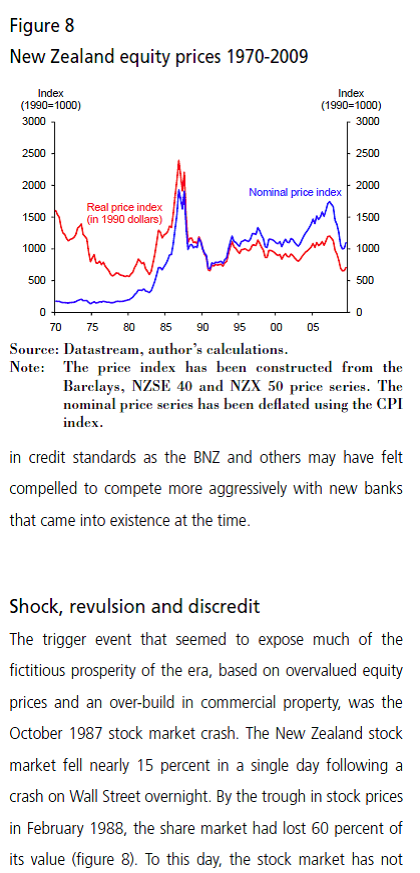
The historical data are hard to come by so I’ve had to use this chart, which covers a rather long period, from a good Reserve Bank Bulletin article about past New Zealand financial crises (mostly, the 1890s and the 1980s). In China’s case, a 150 per cent increase in share prices in a year or so, most of which has now been given back in only a few months (of course, it is perhaps worth remembering that there was an even bigger boom, to even higher peaks, in 2006/07).   In New Zealand’s case, the boom in real prices was even larger – if it took a slightly longer period of time – and the bust was complete.

NZ share prices 80s

There is lots of discussion at present – often from US-centric people – about how the Chinese share market is somewhat peripheral to the economy. And, in some senses, no doubt it is. The share market has always been relatively peripheral to the New Zealand economy too, and market capitalisation as a share of GDP has typically been low. Between farms, farmer co-ops, wholly foreign-owned companies, and state-owned companies, most economic activity simply wasn’t represented by listed companies. Take state-owned companies as an example. In 1986/87, the government still owned several banks, insurance companies, the post and telephone system, the one TV company, the railways, the airlines, the largest petroleum company, and the steel mill. There were no New Zealand listed banks, and no vehicles for direct equity exposures to our largest export industries (sheep and dairy products).  Forestry was probably the only major export industry with material listed exposure.

And yet the market went crazy, and when it burst it was the start of some very tough years for New Zealand. The whole post-liberalisation mania has not been adequately documented (unlike, say, the Nordics booms and busts of much the same time), but it was characterised by much more than just crazy share prices for the minority of people with any material direct exposure to the market. These things rarely happen in isolation. We had a massive credit boom – private sector credit growing at 30 per cent per annum – and a massive commercial property boom, skewing real resources into places that proved not really to offer economic returns. The absurdity of some of what went on during that period was captured in the suggestion of one (brief) high flyer, that New Zealand had a comparative advantage in takeovers. Few bankers had any experience in disciplined credit risk analysis in a liberalised market economy – and nor did their shareholders (whether government or Australian private). And, in any case, bonuses weren’t being paid to people who stayed clear of the boom for long. Highly leveraged investment companies were all the rage – often the principal asset was overvalued shares in other investment companies.

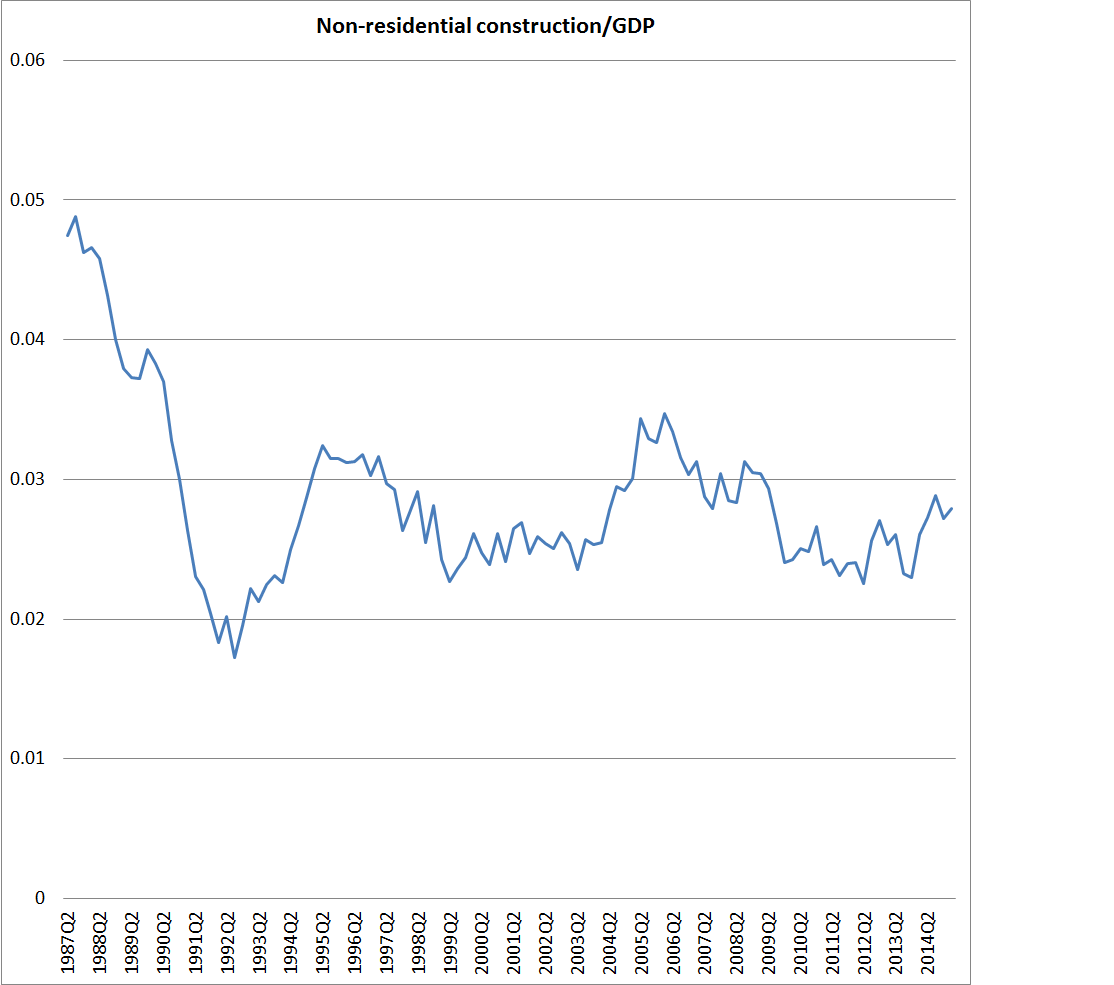
As one illustration of what went on, here is the commercial property picture.  A 3 percentage point of GDP fall is huge, and of course the boom-times share of GDP has never been regained, suggestive of how overblown that market had become.

non-res 80s

As they often are, central bankers were slow to recognise what was going on. The section I managed wrote a paper to the Minister of Finance a few weeks before the crash arguing (as I recall) that the strength of the share market was a pointer to the underlying strength of the economy (and hence a reason to tighten monetary policy). A week or two after the crash, my boss and I were visited by a firm of economists we were often dismissive of – they urged us to recognise that a savage commercial property and banking shake-out was about to get underway. We were polite but pretty dismissive.

Those are the sorts of episodes that leave financial crises in their wake, and which often have nasty and prolonged real economic consequences. Some of us at the Reserve Bank might have initially been a little sceptical, but the liquidity stresses soon became very apparent. Within weeks we had acquiesced in a sharp fall in short-term interest rates (we didn’t directly set them then), which eventually totalled 400-500 basis points.  The exchange rate came down as well. And it still took years for the economy to really recover.

No two situations are ever quite the same. New Zealand was trying to vanquish double-digit inflation, a situation few countries these days find themselves in. But ill-disciplined credit booms, of the sort we had in the 1980s, and of the sort the Chinese have had – on a far larger scale and with fewer market disciplines – are often enormously damaging. Often there is an equity market mania dimension to these things, but the mania is often the epiphenomenon rather than the main event; symptoms of something deeper going on. And the timing will never be quite precise – we had a mania in 1986 around a company (investment and finance) whose shareholders, in their private capacity, were backing what appeared for a time likely to be a successful tilt at the yachting America’s Cup. Of itself, it probably did little or no real economic harm, but it was symptom of the excesses, and of the undisciplined nature of the times.

So count me as a little sceptical of the notion that because not many Chinese hold shares, we don’t need to worry about what is going on there. As here, it is a matter of looking to the phenomena behind the headlines – in their case, several years of one the largest, least-disciplined domestic credit and investment booms in history.

Oh, and there are simply no parallels between the 1987 New Zealand position – which brought down several major financial institutions, including our largest bank – and the New Zealand position now. I wrote about that (lack of) parallel a few months ago.

Grant Spencer speaking on the housing market again

Reserve Bank Deputy Governor, Grant Spencer, gave another speech on housing yesterday. I was pretty critical of his previous effort (here and here).

The latest Spencer speech has some interesting material in it.   But too much of what he is saying doesn’t seem to be based on any substantial research or analysis. A good example is around tax. Apparently the Bank now regards”tax policy as an essential part of the solution, given the historical tax-advantaged status of investor housing”. But if it is an essential part of the solution why are they content with such modest changes? And what has happened to previous Bank analysis suggesting capital gains taxes would have little sustained effect on house prices?   Grant Spencer has neither presented, nor referenced, any analysis that supports either limb of his statement.     Indeed, previous Reserve Bank work, done by someone who now works at the heart of the Bank’s regulatory interventions, showed that to the extent that the tax system favoured housing, the greatest biases (by a considerable margin) were in favour of the unleveraged owner-occupiers.    That work was done in 2008, and since then the tax situation of investor property owners has become relatively less favourable, because of the depreciation changes in 2010.

And yet there is not a mention in the speech of the awkward issue of tax on imputed rents on owner-occupied houses[1]. As I noted yesterday, the Bank seems to have adopted a disconcerting style of endorsing whatever measures the government of the day is happy with, and staying quiet on other aspects of policy that might directly affect house prices (eg first-home buyer subsidies, large scale active immigration programme, arguments about stamp duties for non-resident buyers, and the non taxation of imputed rents).   That sort of pandering has become too common in government departments, but shouldn’t be the standard adopted by an independent Reserve Bank.

There is lots in the speech I could comment on. But I want to focus mainly on one of my perennial issues, the stress tests undertaken by the Reserve Bank and APRA last year, and reported in the November Financial Stability Report. As regular readers will know, faced with a pretty severe test:

  • real GDP falling 4 per cent,
  • house prices falling 40 per cent (and 50 per cent in Auckland) and
  • the unemployment rate rising (by more than it has in any floating exchange rate post-war country) to 13 per cent.

banks came through largely unscathed. Loan loss expenses peaked at around 1.4 per cent of banks’ assets (compared to a peak of around 0.8 per cent in 2009). That seemed like the basis of a pretty sound financial system. Don’t just take my word for it: in the FSR the Reserve Bank itself observed “the results of this stress test arereassuring, as they suggest that New Zealand banks would remain resilient, even in the face of a very severe macroeconomic downturn.”

The Reserve Bank Act allows the Bank to use its regulatory powers to “promote the soundness and efficiency of the financial system”. How, I have asked, could further highly intrusive restrictions be warranted when the system was so sound, especially as such restrictions have inevitable efficiency costs? For quite a while, we got nothing in response from the Governor and his staff. The Governor simply avoided answering a direct question on the issue at Parliament’s Finance and Expenditure Committee – even though the Bank has often argued that the Governor’s appearances at FEC are a key part of the accountability framework.

The Reserve Bank finally addressed the issue in the consultative document, released on 3 June, on the proposed investor property finance restrictions. This was what they had to say.

The Reserve Bank, in conjunction with the Australian Prudential Regulation Authority, ran stress tests of the New Zealand banking system during 2014. These stress tests featured a significant housing market downturn, concentrated in the Auckland region, as well as a generalised economic downturn. While banks reported generally robust results in these tests, capital ratios fell to within 1 percent of minimum requirements for the system as a whole. Since the scenarios for this test were finalised in early 2014, Auckland house prices have increased by a further 18 percent. Further, the share of lending going to Auckland is increasing, and a greater share of this lending is going to investors. The Reserve Bank’s assessment is that stress test results would be worse if the exercise was repeated now.

We don’t know what other submitters made of this argument, but in my submission I argued that this was both a weak and flawed claim.  Weak, in that there is no claim that the results would be “materially:, “significantly” or “substantially” worse.  And flawed in that higher asset prices would, all else equal, provide a larger equity buffer in the event of a subsequent fall.

In its response to submissions, released last Friday, the Bank went some way to acknowledging this point

It is true that rising house prices do not immediately increase the risks of losses in a stress test. Indeed any given percentage fall in house prices will leave house price levels higher in absolute terms if house prices have risen further prior to the downturn (so someone borrowing years prior to the downturn may still have substantial equity). The Reserve Bank is mindful, however, that gross housing credit originations are substantial (in the order of 30% of the outstanding stock of housing credit each year). So elevated levels of house prices tend to lead fairly quickly to higher levels of borrowing and debt to income ratios for many borrowers. Additionally, if house prices rise further relative to fundamentals they are likely to fall further in a downturn.

But again this is misleading.   The statistic that 30 per cent of the stock of housing credit is newly originated each year tells us nothing about risk. A borrower shifting his or her (otherwise unchanged) debt from one bank to another will be captured in the Reserve Bank’s gross originations data, but that shift does not change the risk in the banking system. Overall, debt is growing very sluggishly, and the Bank has still not given us a single historical example where a banking system has run into crisis when for the previous several years the stock of the debt had been growing no faster than nominal GDP.   In principle, too, a higher peak of prices might suggest a larger fall, as the Bank says, but they already allowed for a 40 per cent fall, and a 50 per cent fall in Auckland, and I’m not aware of any historical case in which house prices have fallen much more than 50 per cent.

So far, so unconvincing.   But in his speech yesterday, Grant Spencer took a new and interesting tack on stress tests.  Here is what he had to say

There is a point to clarify here around the stress testing that the Reserve Bank conducts on the banking system as part of our prudential oversight function. Sometimes commentators incorrectly interpret the aim of macro-prudential policy as preventing bank insolvency. From a macro-prudential perspective, we may wish to bolster bank balance sheets beyond the point of avoiding insolvency. Stress tests help to inform our assessment of the adequacy of capital and liquidity buffers held by the banks. However, they are only one of the tools contributing to that assessment. In a downturn, banks will typically become risk averse and start to slow credit expansion in order to reduce the risk of breaching capital and liquidity ratios. In a severe downturn, faced with a rise in impaired loans and provisions, banks may start to contract credit which can quickly exacerbate the economic downturn. In this way, a financial downturn can have severe consequences for macro-financial stability well before the solvency of banks becomes threatened.

In 2014, the four largest New Zealand banks completed a stress testing exercise that featured a 40 percent decline in house prices in conjunction with a severe recession and rising unemployment. While this test suggested that banks would maintain capital ratios above minimum requirements, banks reported that they would need to cut credit exposures by around 10 percent (the equivalent of around $30 billion) in order to restore capital buffers. Deleveraging of that nature would accentuate macroeconomic weakness, leading to greater declines in asset markets and larger loan losses for the banks. Such second round effects are not reflected in the stress test results. A key goal of macro-prudential policy is to ensure that the banking system has sufficient resilience to avoid such contractionary behaviour in a downturn.

I suspect that Grant has my comments in view here. Actually, I had long assumed that the Reserve Bank did not aim to prevent all bank insolvencies – the official line, after all, has long been “we don’t run a zero failure regime”. Prudential policy has avowedly been aimed to reduce the probability of an institution failing, but not to prevent all failures. That seems to me like the right public policy approach.

But I have also assumed that the aim of prudential measures (call them “macro-prudential” if you like, but there is no distinction in the Act) was to promote the maintenance of a sound and efficient financial system. Why? Because that is what the Reserve Bank Act, passed by Parliament, says the Bank is to use it powers to do.   It is not clear that the Bank has any statutory mandate for actions motivated by a “wish to bolster bank balance sheets beyond the point of avoiding insolvency”, and especially not when there is apparently no regard being paid at all to the efficiency of the financial system.

Anyway, Spencer goes on to argue that the real purpose of the controls – whatever the Act says – is to avoid banks contracting credit in a severe downturn.   But actually in a severe downturn – and especially one associated with a prior credit and asset price boom of the sort the Deputy Governor worries about – some contraction of credit seems like a good and desirable outcome. No doubt it would be unhelpful if the doors was closed to all loan applications, but no adjustment process ever occurs perfectly or costlessly. In fact, as the Reserve Bank noted in its discussion of stress tests in the FSR last November, “it can often be difficult to implement mitigating actions in the midst of a severe crisis”, and as a result “the Reserve Bank’s emphasis tends to be on ensuring that banks have sufficient capital to absorb credit losses before mitigating actions are taken into account”.

Spencer worries that a material deleveraging could exacerbate the extent of the fall in GDP and asset prices, and the rise in unemployment, worsening the credit losses relative to those highlighted in the stress test scenario. That is a plausible argument in principle, but it drives us back to the question of how demanding were the stress test scenarios in the first place.

I’ve already mentioned how demanding the unemployment component of the stress test was. No floating exchange rate country since World War 2 has had an increase in the unemployment rate as large as implied in the Reserve Bank tests. Countries are typically much better able to adjust to shocks if the exchange rate floats, than if they are fighting to defend a fixed exchange rate . Interest rates can be cut further and with fewer constraints, and the exchange rate itself can fall, a lot.

The Reserve Bank used a scenario in which nationwide house prices fell by 40 per cent, and Auckland prices by 50 per cent. Since 1970 I’ve found only been six episodes in which advanced country real house prices have fallen by more than 40 per cent (the stress tests rightly use nominal house prices, so a 40 per cent fall in nominal house prices is a more demanding test than a 40 per cent fall in real  prices).

Five of those six cases occurred in countries with fixed exchange rates. In only three of those cases was there a material fall in GDP, but the falls that did happen were very large: Finland’s GDP after the 1989 house price peak fell by 10 per cent, Ireland’s GDP after the 2006 house price peak fell by 9 per cent, and Spain’s GDP after its 2007 house price peak fell by more than 7 per cent[2].      Based on historical experience, to get an increase in the unemployment rate from around 5 per cent to 13 per cent, and a more than 40 per cent nationwide fall in nominal house prices, it would probably take more a more severe recession than a 4 per cent fall in GDP.    US real (altho not nominal) house prices fell by almost 40 per cent in the late 00s, but even there the unemployment rate did not rise by as much as is assumed in the Reserve Bank of New Zealand’s stress tests.  Losses on mortgage portfolios mostly arise from the interaction of falls in nominal prices and sharp rises in the unemployment rate.

What do I take from that? If the stress tests have been done robustly – and no one has raised serious substantiated doubts about that, the scenario probably already implicitly reflects any short-term deepening of the recession that might result from any active deleveraging banks might undertake. Banking crises everywhere – Finland, Spain, Ireland, Norway, Korea, Japan (and the United States) –  has seen some deleveraging, and the effects of that are reflected in the historical data.

I welcome the attempt to address the stress tests directly, and to attempt to defend current policy against the results of that work.  But it still doesn’t seem to stack up. The Reserve Bank has a statutory mandate to use prudential powers to promote the soundness and efficiency of the financial system. The Bank’s own numbers suggest the system is sound “even in a very severe macroeconomic [and asset price] downturn”, and direct controls have real and substantial efficiency costs which the Bank just does not address. And cyclical stabilisation is primarily a matter for monetary policy, a point the Deputy Governor also does not address.

This post has gone on long enough, so I’m going to largely skip having another go at Spencer’s unsubstantiated enthusiasm for high-rise apartments, pausing only to note that his continued enthusiasm for the number of apartments in Sydney – where land use restrictions are even tighter than in Auckland – , reads rather oddly given that Sydney is one of the few cities with higher house price to income ratios than Auckland.   I have no problem if people want to live in apartments – laws should allow them to be built – but I’m not sure there is any good basis for the Reserve Bank Deputy Governor to be trying to dictate people’s housing choices.  There is plenty of land in New Zealand.

And, finally, I was struck by Grant’s observation that housing issues keep the Reserve Bank “awake at night”.   He went on to note that “when something keeps you awake at night, it is good to do something about it”. Perhaps.  Sometimes, it might be good to get up, read a book for half an hour and go back to sleep. If my kids wake with a bad dream, I give them a hug and send them back to bed.   Focusing on the facts can also be a way of dealing with the night worries. Avoiding too much caffeine and rich food can help too.

Lying awake at night can induce tiredness and irritability, reducing one’s ability to analyse issues clearly. The Reserve Bank has offered lots of snippets of information, and lots of prejudices, but very little sustained analysis on the nature of the risks to the soundness and efficiency of New Zealand’s financial system. As someone put it to me yesterday, it is also a very macroeconomic speech, conveying little sense of what is going on in domestic credit markets.  I suggest the Bank should  focus again on the stress test results, and the very demanding assumptions used in those tests, keep a close eye on credit standards, and that they then look to monetary policy to do the cyclical stabilisation job. The price of financial stability is constant vigilance, but the Bank still looks as though it is jumping at (financial stability) shadows. Their own earlier hard analysis suggests a pretty robust financial system, no matter the insanity of the mix of other policies that is producing house prices as high as they now are in Auckland. That is a measure of the success of the Reserve Bank – charged by Parliament with financial system soundness and efficiency, not house price stabilisation – not the basis for a need for ever more costly and inefficient interventions.

(And in case any of this sounds complacent, I suspect I’m much more worried about the New Zealand and world economies right now than the Bank has given any hint of being.)

[1] I don’t necessarily favour such a change, but then I don’t think tax issues play a material role in explaining house price behaviour in New Zealand.

[2] In Korea nominal prices fell gradually during the real economic boom of the 1990s, in Japan nominal prices fell for 20 years, without a very severe recession, and in Norway in 1980s there was also no substantial recession. Both Norway and Korea had fixed exchange rates through most of these periods.
Some longer-term house price charts

Reflecting further on the risks facing our banking system, I dug out some fairly long-term house price inflation data from the BIS for 19 OECD countries.  I was slightly hesitant about doing so, because there is a risk of feeding the narrative that vanilla lending secured on residential property is likely to be an important independent element in any financial system stress. As the Norges Bank has pointed out, and as the Reserve Bank has affirmed, that just hasn’t been so historically. To the extent that the United States last decade may have appeared an exception, it is important to recall that the heavy role Congress and the Federal government played in driving down lending standards, and the non-vanilla nature of much of the lending.

But for what it is worth, here are a few charts. In all cases, the latest observations are for the December 2014 quarter, which is as up to date as the BIS data are.

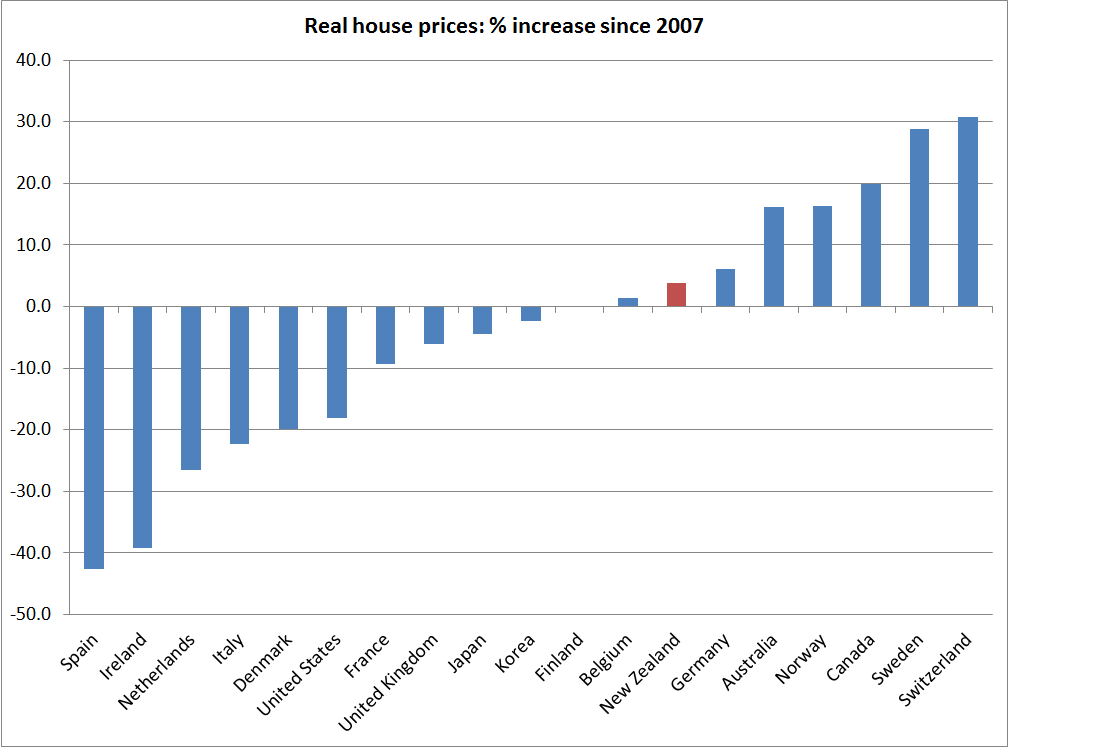
Here are real house prices changes since 2007 (most countries had a peak in or around 2007).

house prices since 2007

Real house prices in New Zealand have increased by less than those in Australia and Canada – and yet it is New Zealand banks that have been downgraded to BBB+, a rating not much higher than that held by South Canterbury Finance in 2008. As we’ve seen previously, New Zealand credit growth has done no more than roughly track nominal GDP growth over that period.

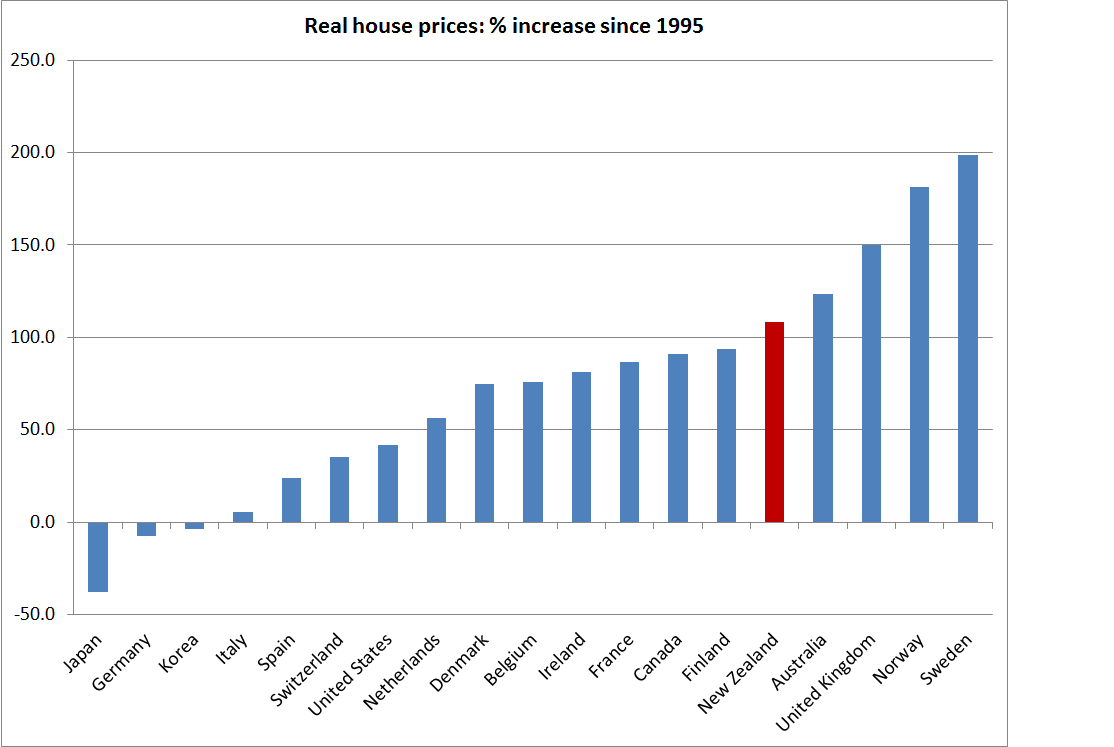
The BIS base their data at 1995. There is nothing special about 1995, although in most of these countries it was before any of the strongest house price booms had got underway.

house prices since 1995

Even over the whole 20 years, New Zealand real house prices have increased less than those in Australia and the UK. For the boom period itself (1995 to 2007) New Zealand’s house price inflation was only a touch stronger than that of the median country in this sample.

For most of the countries the BIS has data back to 1970, but for all 19 countries they have data back to 1976. Whether one starts from 1970 or 1976, New Zealand has had less real house price inflation than Australia and the UK, although more than Canada.

house prices since 1976

And what about periods of falling real house prices? There have been 53 episodes across these 19 countries of real house price falls in excess of 5 per cent.   Germany and Belgium have had only one such episode each. Five countries – including New Zealand – have had four such episodes each (including the 15 per cent real fall in and around the 2008/09 recession).

None of this is intended to convey any sort of sense of complacency about house prices in New Zealand (and especially Auckland). They are a scandal, resulting primarily from the acts (of omission and commission) of central and local government), but if anything have increased a little less than we’ve seen in countries with similar planning and land use restrictions (the UK’s are probably tighter, but population growth pressures are less there than in New Zealand and Australia).

But singling out the New Zealand banking system – as S&P appears to have done – seems unwarranted. There is no obvious material differentiation in the sorts of housing risks being taken on by New Zealand banks. Perhaps S&P are right about New Zealand. But the Reserve Bank’s stress tests results don’t suggest so. And, perhaps as importantly, historically, vanilla housing loans don’t lead to bank collapses, and systemic banks don’t collapse (or even come under severe stress) when credit has been growing no faster than GDP.  Reckless property development lending is a much more plausible culprit –  and we haven’t had it in the years since the recession.

Not entirely unrelatedly, I saw a piece the other day by Auckland City’s chief economist in which he cited some work done for the Council by NZIER suggesting that part of the growth in Auckland house prices can be explained by the proposed district plan changes that will allow for greater intensification in some parts of Auckland. I’ve seen a similar argument made by the Westpac economics team. But I must be missing the point. I can easily see why allowing more intensification on a particular section will increase the relative price of that section, but I cannot see how it can be raising prices of houses and land across Auckland as a whole.   Reducing land use restrictions – whether in respect of intensification, or allowing more dispersed development – increases the effective supply of land. And it seems unlikely that increasing supply will itself materially alter demand (eg materially increasing population growth, most of which is now driven by immigration policy). At least when I did introductory economics, increased supply would generally lower the price. It is easy to see why the relative (and perhaps even absolute) prices of some sections might rise if the reforms are for real, but surely any such effect should be more than offset by a fall in urban prices more generally?   If there is serious scope for more intensification, and that potential is expected to be utilised, then rational potential buyers all over Auckland should already expect less intense competition in future for this now less-scarce resource.  If anything, those prospective regulatory changes should be lowering prices now (perhaps only a little, because no one knows yet what real effect they will have), not raising them.

The same Chief Economist also noted that

“we need to economise on the massive amount of urban land we already have, and use it to its best effect. Acukland needs to treat its land like gold dust and a little needs to go a long way”.

I’ve got no problem with removing land use restrictions, whether they are on outward or upward development, but lets recall that the only thing that makes Auckland urban land remotely comparable to gold dust is the regulatory regime which the Auckland Council administers and imposes. Yes, Parnell might always be expensive, but there is simply no reason why  sections in middling suburbs should be. Historically, as cities become richer they have less dense, not more dense.   Planners, councillors, and associated bureaucracts are the people who systematically impede that normal and natural process.

I guess they got South Canterbury Finance very wrong, but…..

At the end of 2008 South Canterbury Finance was rated BBB- by Standard and Poors.  Earlier that year, it has issued three year bonds (themselves rated BBB-) in the US private placement market.   BBB- wasn’t such a bad credit rating for a small, not overly diversified unregulated domestic lender.  But a year or two later, SCF failed spectacularly, at considerable cost to the taxpayer.

Today, S&P has come out downgrading the standalone ratings of three of the four big banks to BBB+.  Of course, that is still two notches above SCF’s rating, but if it is really justified  the news would have to be quite concerning.  Note that the overall issuer credit ratings remain at AA-, reflecting the combination of probable parental support and the possibility of government support (for these systemically significant banks) in the event that they get into trouble.  Their assessment of the risk of investors losing money hasn’t changed.

But it is the standalone rating that is meant to reflect the quality of each bank’s loan book.

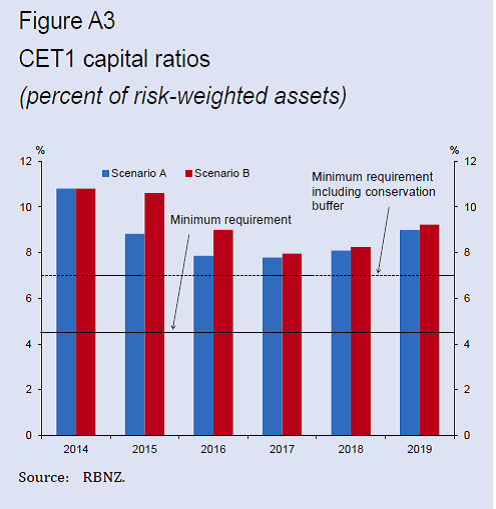
Recall that the RBNZ and APRA stress-tested the large banks only last year.  The stress scenarios were very demanding –  a 50 per cent fall in house prices and an increase in the unemployment rate larger than any seen in floating exchange rate countries in the post-war decades.  And the banks’ loan books came through with flying colours, and the actual capital of each of the banks was not impaired at all (capital ratios fell because risk weights on the remaining loans rose).

Here is a chart of capital ratios from the stress test scenarios from the November FSR

CET

If Standard and Poor’s are right there must be something very wrong with the Reserve Bank stress test results.  Not that much has changed in the make-up of banks’ portfolios in the last 12-18 months for the difference to be about new, much riskier, loans being made.  My bias is to run with the stress test results –  perhaps they are a little optimistic, but probably not too much.  But the Governor doesn’t seem to believe them, and neither apparently does one of the leading rating agencies.  If the Bank is really sceptical then it is really past time for it to lay out any reasoning, and evidence, it has as to why the stress test results are not now a good guide to the standalone health of the major banks.

New Zealand credit growth in recent years

As the near-inevitable aftermath of China’s extraordinary government-led credit boom gathers pace, and the global deflationary risks mount, I thought it might be timely to have a look at credit growth in New Zealand in recent years.

I was partly prompted to do so by some reactions yesterday to my AUT Briefing Papers piece on housing. Several commenters at interest.co.nz were convinced that I was letting the banks off the hook, and that the creation of credit to finance house prices must be, in some substantial measure, to blame for high house prices (in Auckland).

In one sense, that reaction isn’t surprising. A similar model seems to have been implicit in the Governor of the Reserve Bank’s 2013 LVR restrictions and the new Auckland-specific investor finance restrictions he is consulting on at present.   After all, prudential regulatory powers of the Bank should, as per the provisions of the Reserve Bank Act, be used only when action is need to promote the soundness of the financial system.

Without covering old ground in detail, I don’t believe that there is any such systemic threat. The Reserve Bank has not made a persuasive New Zealand-specific case, and the one piece of careful analysis that has been presented (the stress test results) suggest that the banking system would be robust to even some very severe shocks.

The international literature suggests that probably the single best (albeit not very good) predictor of crises is rapid growth in the ratio of credit to GDP. We had that in the years prior to 2007. China has had it, much more dramatically, in the last five years or so. Many countries have had periods of very rapid growth in credit, and no banking crisis I’m aware of was not preceded by a period of very rapid credit growth. New Zealand’s stresses from 1987 to 1991 are an example.   But many, perhaps even most, episodes of rapid domestic credit growth have not ended in domestic systemic banking crises. New Zealand post-2007 was just one example.

The record suggests, unsurprisingly, that the quality of lending matters a lot. And the quality of lending tends to deteriorate a lot when, either

  • Government agencies are directing that lending or setting up incentives that drive banks to undertake poor quality lending (the US housing finance boom of the 00s and the recent Chinese credit boom are good examples), or
  • Where the regulatory shackles have just been taken off, and no one –  banks or regulators –  has much experience with a liberal market-based economy and appropriate credit standards (New Zealand, Australia, and the Nordics in the 1980s were good examples).

None of that looks to be the case in New Zealand at present.  We have credit data to the end of June, and GDP data only to March, but for the rest of this I’ll just assume that seasonally adjusted nominal GDP showed no growth in the June quarter.

Since December 2007, just prior to the big recession, New Zealand’s nominal GDP has risen by just under 30 per cent, and the four different measures of private sector credit have risen by about 33 per cent. But the pre-crisis dairy lending boom went on well beyond the end of 2007   If we start our comparisons from December 2009, we find that nominal GDP since them has increased by around 26 per cent and PSC by around 21 per cent. Within that total, lending to households has increased by 22 per cent.  Whatever the base period for comparisons, credit growth has been fairly subdued relative to GDP.

credit growth since dec 07
credit growth since dec 2009
And it is not that nominal GDP growth has been rampant. In the seven years to March 2015, NGDP increased by 27.4 per cent, down from 55.1 per cent growth over the previous seven years. As is now well-recognised, given the inflation target, monetary policy has been too tight over the last few years, not too loose.

Annual nominal GDP growth fluctuates a lot, largely with fluctuations in the terms of trade. At present NGDP growth is slowing rapidly. Credit growth is currently growing faster than nominal GDP growth   The strongest component of that is agricultural credit, up 7.6 per cent in the last year. But whatever the overall state of banks’ dairy exposure – and I suspect they will lose quite a lot of money, without it being a systemic threat – the current growth in dairy credit is not the sort of lending that is recklessly bidding up asset prices, it is a reflection of the severe drop in farmers’ income –  if anything, a buffer rather than the initial source of any problem.

In short, when credit has been growing at only around the (rather subdued) rate of growth in nominal GDP for the last 6-8 years

(a) it is difficult to credibly blame bank lending policy for growth in specific asset prices (Auckland house prices) without independent evidence of a decline in lending standards (which neither the Reserve Bank nor anyone else has sought to demonstrate), and

(b) we just don’t have the basis for expecting any severe stress on or threat to the soundness of the strongly-capitalised financial system.   Rising house prices certainly generate a demand for additional credit, but it is the rather more fundamental forces (driven by governments) –  land use restrictions and policy-driven immigration flows – that are the source of the underlying pressure on prices. The same banks operate nationwide, and there is no sign of house price inflation in Invercargill, or even Wellington.

Of course, a rather nasty economic slowdown appears to be already underway, and that could worsen a lot yet. If so, that will put a lot of pressure on a lot of borrowers.

Dairy lending and the Minister of Finance

I saw this Bernard Hickey piece yesterday afternoon, and have been mulling on it since.

Finance Minister Bill English has admitted the Government and Reserve Bank are in discussions with banks to ensure they don’t prematurely force dairy farmers into mortgagee sales that could trigger a dangerous spiral lower in land values.

If accurately reported (which it may not be), it is somewhat disconcerting.  What bothers me is the notion that the Minister of Finance (and perhaps the Governor of the Reserve Bank, although there is no confirmation of any involvement by the Bank) thinks he knows better than banks how to run their own businesses. Ministers of Finance often aren’t very good at presiding over the government’s own businesses – Solid Energy or Kiwirail anyone?

During the 2008/09 recession I did quite a lot of work at Treasury on dairy debt. Debt, and dairy land prices, had run up extremely rapidly in the previous few years, and there was concern about what the fall in commodity prices, and the seizing up in international funding markets, might mean for the dairy sector as a whole, and for those who financed them. I reminded the perennial optimists that the long-term real average dairy payout had been around $4.50 and that it would seem unwise to be planning (whatever one might hope for) on anything much higher in the medium-term future.

During that period, I took to describing dairy debt as “New Zealand’s subprime”. My point here was not that large losses were inevitable (in fact, in that episode NPLs did pick up quite notably, although not in a systemically-threatening way), but that the nature of the risk exposures were not generally well understood. At the time, banks were very dependent on wholesale market funding, and few offshore investors appreciated just how large New Zealand banks’ exposures to farms were (I recall checking out the US flow of funds data and finding that in an economy 100 times our size, farm debt in the US was only around 10 times that in New Zealand).

It was also never entirely clear that the Australian parents really appreciated the scale of the dairy debt boom, and competitive credit-supply war, their New Zealand subsidiaries had gotten into. And, of course, the market in agricultural land was not the most liquid in the world – like many markets there was reasonable liquidity in booms, and almost none in busts.   That illiquidity meant that it was very difficult for anyone to know the true value of the collateral underpinning dairy debt. As it was, dairy land prices fell very sharply (and never subsequently fully recovered the boom time peaks) even with very few forced sales. One of the risks of lending secured on farm land was that if one lender got very worried and starting a round of forced sales, it would seriously undermine the market value of the collateral other banks were holding. They all knew that – and they also knew about the goodwill in the rural community that had been burned off in the period of financial stress in the 1980s. And that created an incentive for what I describe as “hand-holding” – each tacitly agreeing (probably not in ways that create legal difficulties) to approach forced sales very very cautiously. That might seem a good outcome in some respects, albeit at the expense of transparency. In 2009 perhaps, with hindsight, it was: the downturn in dairy prices proved short-lived, and the recovery in the payout bought time for banks to manage out of their worst exposures.

But we didn’t know then, and we don’t know now, how long the low payouts will last for, and what either a market-clearing or equilibrium price for dairy land is. And when I say “we”, I include experts, stray bloggers, and the Minister of Finance and the Governor of the Reserve Bank. Uncertainty is a key feature of economic life, and one that people in positions of power too readily underestimate. There is probably a selection bias – people without a strong self-belief (and belief in their own views) tend not to end up at the top of politics. In some dimensions, the current position seems more worrying than the 2009 episode. Not much new debt has been taken on in recent years, and there hasn’t been a recent spiralling-up in land values. That suggests little risk of a systemic threat to the health of the banking system (but as I have noted previously it is not clear that the minimum risk weights the Reserve Bank requires on dairy exposures are really high enough). But, on the other hand, whatever is dragging milk prices so deeply down now is not the side-effect of a global liquidity crisis, the direct effects of which were reversed pretty quickly. Global commodity prices have now been trending down for several years, and there is little obvious reason to expect the trend to be reversed – although no doubt there will be plenty of volatility.

Perhaps there is nothing more to this story than a natural politician’s desire to sound sympathetic to business owners who find themselves in difficult conditions. I hope so.  But the Minister of Finance and the Governor of the Reserve Bank hold a lot of power over banks, and the fact that those statutory powers exist suggests it is even more important that the Governor and Minister avoid putting pressure on banks to make decisions that might suit a politician, but might not be in the interests of bank shareholders. Banks aren’t popular, but they are legitimate and important businesses, who are expected to make a return and act in the best long-term interests of shareholders. Plenty of times some discerning forbearance may have helped through a key customer in difficult times, but forbearance – whether by bank or regulator – can also be a recipe for worse problems, and bigger losses, down the track. The risks of that are much greater when people with no financial stake weigh in to try to tilt the attitudes of lenders. Neither the Minister nor the Governor has the information to make those calls well regarding dairy debt. In the Governor’s case, it is little more than a year since he gave this relentlessly optimistic speech, and I’m sure that without too much difficulty I could find similar examples from the Minister of Finance – it is, after all what ministers do.

Here is a link to my own piece on dairy debt from a couple of months ago.

Lending to investors: still no smoking gun

I hadn’t paid any attention to the Reserve Bank’s new data providing somewhat more disaggregated information on new (ie the flow not the stock) residential mortgage lending. But the Herald’s cover story this morning sent me off to have a look.

There is only 10 months of data, and the housing market has some seasonal features. And the mortgage market has already been distorted by the Reserve Bank’s first set of LVR controls – which were always likely to have impinged most heavily on first-home buyers – so we aren’t even getting a clean read on the underlying patterns of mortgage demand.   But, from my perspective, the data reveal very few surprises, and the only thing that really took me by surprise was a pleasant surprise.

Here were a few of the points I noted as I worked my way down the Bank’s spreadsheet:

  • By value, 69 per cent of new mortgage loans over these 10 months were to owner-occupiers.  30 per cent were to “investors” (they have a residual category called ‘business” accounting for around 1 per cent).  According to the most recent census, the proportion of houses that was owner-occupied was less than two-thirds.  (The two numbers aren’t directly comparable, as local councils and Housing New Zealand own significant numbers of rental properties.)
  • By number, 81 per cent of new mortgage loans over these 10 months were to owner-occupiers.
  • By value, 15 per cent of loans to owner-occupiers were to first home buyers.  That might have been a touch lower than I expected.  First home buyers will generally be borrowing a larger proportion of the value of the house, but will also be buying cheaper houses.  FHBs will have been disproportionately squeezed by the Reserve Bank’s LVR controls.
  • By number, 8 per cent (by number) of owner-occupier loans were to FHBs over this period, but they accounted for a third of all owner-occupier loans with LVRs above 80 per cent.
  • Investors accounted for only 11 per cent (by number and value) of over 80 per cent LVR loans.
  • By number, 27 per cent of new FHB borrowers were borrowing in excess of 80 per cent LVR, and about 4 per cent of other owner-occupier, and investor borrowers.

high lvrs

  • 46 per cent of new investor loans were for LVRs of over 70 per cent (for some reason, the Bank is not collecting/reporting this data for the other categories of borrowers).

Almost all of that was quite unsurprising. And note that although the Herald devotes a lot of space to contrasting “first home buyers” with “investors”, it would seem more natural to compare all owner-occupier borrowers with all investors. Just possibly a comparison between FHBs and “first investment property purchasers” might be interesting, but we don’t have that data.

Perhaps the one thing that surprised me a little was how little high LVR lending has been going to investors over this period. Unfortunately, the period is distorted by the Bank’s controls, and it is at least possible that banks have been favouring FHBs since the LVR restrictions were put in place. And although the reporting is done at a highly aggregated level, I have heard stories of an upsurge in the proportion of loans being written by 79 per cent LVRs. If so, there is little or no effective risk reduction.   The Reserve Bank keeps on asserting that 70 per cent LVR loans to investors are just as risky as 80 per cent loans to owner-occupiers, but as Ian Harrison has been arguing, as yet they have produced little or no robust evidence to support that assertion.

I suppose what I take from these data is that, once again, there is no smoking gun to justify the Governor’s apparent determination to ban banks from lending a cent to residential rental services businesses in Auckland, when they have even a moderately high LVR.   Banks and borrowers are deeply irresponsible, and the Governor knows better….or so we are apparently to believe.   Recall that, across the whole country, between 3 and 4 per cent of new investor mortgages in the last 12 months have had initial LVRs in excess of 80 per cent.  Even if the number is double that in Auckland (and I’m not aware that anyone has that data), it hardly has the feel of reckless lending or borrowing behaviour.

The Reserve Bank has produced no evidence of any serious deterioration in lending standards. Add into the mix the still rather modest rate of growth in overall household lending, and the very encouraging results of the Reserve Bank’s own 2014 stress tests, and the case for such intrusive restrictions – with all the attendant efficiency and distributional costs – imposed by a single unelected official, is just not convincing.  Even if there were more substantial evidence to support the Governor’s concern, the soundness and efficiency of the financial system –  the only goal towards which the Bank can use its powers –  would be at least effectively protected, at less cost to individuals and to economic efficiency, through higher capital requirements.

House of cards?

The Reserve Bank announced last month its decision to require banks to classify all loans secured on residential investment properties separately from other residential mortgage loans. This applies not just to large commercial operators, but to borrowers with just a handful of investment properties. The Reserve Bank will now require banks to use higher risk weights (ie have more capital) in respect of the former than in respect of the latter.

This has been quite a saga. The Bank went through a couple of rounds of consultation on earlier proposals last year (then focused on larger operators), and then came back earlier this year with a revised proposal. I made a brief submission on that consultative document, as no doubt did a variety of other people (although we don’t know who, as the Reserve Bank – unlike parliamentary select committees – does not routinely publish the submissions it received). The Reserve Bank’s summary response to the submissions can be found half way down the page here (various specific links on the RB website don’t appear to be working today),

The proposal that the Reserve Bank consulted on in March/April, and which it recently adopted, had a strong feel of being reverse-engineered. The Governor had apparently decided that he wanted to be able to impose additional direct controls on lending for residential property investment, and to do that he needed banks to have systems in place which would clearly delineate between investment property loans and owner-occupied loans. To support that prior policy conclusion, the Bank has sought to argue that loans on residential investment property are, all else equal, riskier than other residential mortgage loans.   To be clear, the Reserve Bank is asserting that a loan is riskier because it is secured on an investment property, even if the initial LVR, the initial date at which the loan was taken out, the nature of the house itself, the borrowers’ income etc were all exactly the same as those for an owner-occupied loan.

What has always been a bit surprising is how little in-depth effort the Bank has put into demonstrating that its argument is correct. It has run a variety of arguments in principle about why investment property loans might be riskier than those to owner-occupiers. Most of those have never seemed overly compelling, especially not in a New Zealand context.   Indeed, there are some reasons why the result could be reversed (for example, unemployment is probably the largest single risk, all else equal, in respect of an owner-occupier mortgage, but rental income flows – which help service investment property loans – tend to be less discontinuous).

But the issue should ultimately, be an empirical one. All else equal, have investor property loans proved to be riskier than owner-occupier loans? Getting good comparable data isn’t always easy.  Material loan losses tend to arise only when nominal house prices fall, and although real house prices fell sharply in the late 1970s, large nationwide falls in nominal house prices haven’t happened in New Zealand since the 1930s. Data from that period aren’t available – although perhaps it is an opportunity for an economic history PhD project working in bank archives. But even more recently, nominal house prices have fallen materially in a number of regions, and I have encouraged the Bank to ask banks for data on the loan loss experience (investor vs owner-occupier) in places like Gisborne, Wanganui, or Invercargill.

In fact, the Bank has tended to rely on a handful of overseas studies, about a handful of overseas experiences. This isn’t one of those areas where there are dozens of studies about dozens of episodes. That makes it all the more important that what studies exist are read carefully and applied and interpreted to New Zealand very carefully. That appears not to have been done. Worse, even when some weaknesses in the way the Bank interpreted and applied such papers were pointed out to them (in submissions on the consultative document), they largely just repeated their assertions and interpretations.

I’ve worked my way through some of the papers, and had had concerns about how the Bank had interpreted and applied the results. My former colleague, Ian Harrison, who consults as Tailrisk Economics, and is much more expert in the specialist risk aspects than I am, has worked his way carefully through each of the empirical papers the Bank has cited, and several that they should have cited, but did not. He has sent me a forthcoming paper “A House of Cards”, in which he has worked his way carefully through each of the Bank’s arguments and pieces of evidence. Cumulatively, it is a pretty damning read. Ian has given me permission to run some excerpts here, and I hope that when his paper is published it will get the attention it deserves.

On the international experience, Ian summarises as follows:

The international literature does not provide support  for the Bank’s contention that investor loans are riskier and owner-occupier loans. Four of the four studies that controlled for other loan attributes found that investor status had no impact, or only a trivial impact, on default rates. A European Banking Authority survey of 41 advanced modelling banks found that none identified investor status as a risk driver in their retail housing mortgage lending models.

A good example of what appears to have gone on is how the Bank has represented an important paper on the Irish experience

Lydon and McCarthy 2011 “What lies beneath? Understanding recent trends in Irish Mortgage arrears”

The graph presented in paragraph 11 of the March 2015 Consultation document presents data from the Lydon and McCarthy paper, which addressed the question of whether BTL [buy to let] status was, in itself, a default driver, or whether the higher default experience could be explained by differences in other loan characteristics.

It was found that after controlling for differences in LVR and servicing costs, BTL status had no impact on default rates.  The higher increase in observed BTL default rates was due to the fact that a larger share of BTL loans were made in the lead up to the GFC when underwriting standards were at their lowest point and house prices at a peak.

Naturally subsequent default rates were higher for investors who bought at the wrong time and who offered scant protection to the lender, but default rates would also have been higher than average for owner occupiers with the same characteristics.

The results of their analysis are presented in table 7 of the paper which shows that the coefficient  for the marginal impact of BTL status is 0.00.  This estimate is significant at the 1% level.

In a subsequent presentation (“The Irish Mortgage market in Context – Central Bank of Ireland 2011) the authors said:

“Controlling for LTV & MRTI…

Relative to next-time-buyers (NTB), FTB borrowers are 2% less likely to be in arrears

–whereas, no relative difference for BTL”(our emphasis)

The data presented in the Consultation document does not provide evidence that Irish BTL loans are a riskier asset class. It is misleading to represent the paper, as the Bank does in several documents, that it provides evidence that BTL loans are riskier.’

Or, in respect of a US study:

Palmer C. (2014) ‘Why do so many subprime borrowers default during the crisis: Loose credit or plummeting prices’

The Bank made the following statement:

“Palmer (2014) reports that default rates increased in a multivariate regression with loan to value ratio and for loans that were declared non-owner occupiers.”

In his paper Palmer uses comprehensive loan-level data to decompose sub-prime loan loss defaults amongst three default drivers. His conclusion is as follows.

Decomposing the observed deterioration in subprime loan performance, I find that the differential impact of the price cycle on later cohorts explains 60% of the rapid rise in default rates across subprime borrower cohorts. Loan characteristics, especially whether the mortgage had an interest-only period or was not fully amortizing, are important as well and explain 30% of the observed default rate differences across cohorts. Changing borrower characteristics, on the other hand, had little detectable effect on cohort outcomes. While quite predictive of individual default, borrower characteristics simply did not change enough across cohorts to explain the increase in defaults.”

There is no marker for investment property as such in the study, just a marker for whether the dwelling was  to be owner occupied or not. It is not clear whether holiday or other second homes would fall. Regardless, the non-occupier marker fell into the borrower characteristic category, which in total provided little independent explanation of deliquency. There was no result that investor status increased defaults. The Bank’s statement was false.

I suggest that you read the entire document when it is available. As far as I can tell, none of the studies the Bank cites appears to have been fairly represented, or applied to New Zealand.

If Ian’s reading of the papers is accurate (and I have no reason to doubt it) it is a very disconcerting commentary on the processes in the Reserve Bank.   The Bank has plenty of able people, who would have been well able to pick up on each of the weaknesses Ian Harrison has identified.  And yet not just once, but again in the response to submissions, and in the new consultative documents, after the Bank had had time to consider the criticisms that submitters have made, the studies have continued to be explained or applied in ways that are, at best, misleading.

Reasonable people can reach different views on appropriate policy measures. I think the Governor of the Reserve Bank has far too much power in this area, and I disagree with the proposed restrictions.   But if citizens cannot trust the Bank to cite evidence in a balanced and accurate way, confidence in the entire policymaking process is likely to be severely eroded.

As I have noted, in such areas the Governor is effectively prosecutor, judge, and jury in his own case. Worse, he is also responsible for the investigative work that is presented in support of the case that he will himself decide. Of course, he has staff to do the work for him, but the staff (and their managers) are hired, rewarded, and potentially fired, by the Governor. A strong Governor will want to know the weakest points in his own case, and to ensure that those weaknesses are appropriately aired, balanced presumably by other strong evidence or arguments for the sorts of regulatory initiatives he is proposing. But the Wheeler Reserve Bank appears to be one in which either no one is willing to stand up and point out the weaknesses or, if someone did point them out, where the Governor and his senior managers said, in effect, “oh just ignore that, continue to repeat the same lines”. One would hope there is a better explanation, but it isn’t obvious. The Bank’s Deputy Governor, Grant Spencer, for example, has spent decades in senior roles in the Bank, and many thought he was a strong candidate to become Governor in 2012. He has direct line responsibility for the two departments dealing with these banking regulatory issues. How did he let documents this weak go out, not just once, but repeatedly? Anyone can make a mistake citing a single paper, but the breadth and repeated nature of what Ian highlights has the feel of something more deliberate.

Even if the Bank could show, with some degree of confidence, that investor property loans were riskier than those to owner-occupiers, other characteristics held equal, the case for the proposed ban on lending in excess of a 70 per cent LVR for residential investment properties in Auckland has serious weaknesses. I elaborated on those in my recent submission (and have also requested copies of all the submissions the Bank has received).

I’ve been critical of the Governor’s conduct of monetary policy over the last couple of years. But reasonable people will, at times, reach quite different views on what monetary policy stance is required. His turned out to be wrong although, as I noted this morning, he had plenty of company for too long.   But repeated misrepresentation of data to support a controversial regulatory initiative strikes me as much more serious. It might do less damage to the economy, but it strikes at the heart of the integrity of the institution, and raises serious questions about the extent to which the public can have confidence in the (unelected) Governor’s ability and willingness to carry out his statutory duties in the public interest, in an objective and dispassionate manner. Cynics might expect such standards from politicians. We certainly shouldn’t tolerate them from officials.

I hope that when Ian Harrison’s full paper is published, the Bank’s Board will start asking some pretty searching questions.  The Board is charged to, inter alia,

    • keep under constant review the performance of the Bank in carrying out—
      • (i) its primary function; and
      • (ii) its functions relating to promoting the maintenance of a sound and efficient financial system; and
      • (iii) its other functions under this Act or any other enactment:
    • (b) keep under constant review the performance of the Governor in discharging the responsibilities of that office:

Perhaps the Minister of Finance might refer the issue to Rod Carr, chair of the Board, for his views.

Investor finance restrictions

The Reserve Bank is consulting on the Governor’s proposal to ban loans with an LVR in excess of 70 per cent for residential investment property businesses in Auckland.  I have written quite a bit on this proposal since it was first revealed when the FSR was published in mid-May, and was hesitant about spending more time on the issue (my kids would have preferred another board game or two). But I did decide to write something.

Submission to RBNZ investor finance restrictions July 2015

Submissions close on Monday.

Here are a few extracts from the introduction and conclusion of my (not overly long) submission.

As I have noted in various pieces of public commentary on this proposal, in such matters the Governor effectively acts as prosecutor, judge and jury in his own case.  As such it is difficult to have any confidence in the consultative process –  it is simply implausible that the  single person actively and publicly proposing such restrictions can take a properly dispassionate and impartial approach to assessing submissions on the proposal.    The proposed turnaround time, from the closing date for submissions to the release of the final policy position (“early August”), casts further doubt on the seriousness, and open-mindedness, with which the Bank (the Governor, as sole decision-maker) is approaching the consultative process on the substantive proposal (as distinct perhaps from the fine operational details).   Confidence in the process is further undermined by the fact that no cost-benefit analysis has been provided for the proposal.   We all know that cost-benefit analysis, in the right hands, can be generated to support any proposal, no matter how egregious, but proper cost-benefit analysis at least force the preparers to write down their assumptions, which enables them to be scrutinised, debated, and challenged.

My concerns about the substance of the proposal fall under five headings:

  • The failure to demonstrate that the soundness of the financial system is jeopardised (this includes the failure to substantively engage with the results of the Bank’s stress tests).
  • The failure of the consultative document to deal remotely adequately, with the Bank’s statutory obligation to use its powers to promote the efficiency of the financial system.
  • The failure to demonstrate that the statutory goals the Bank is required to use its power to pursue can only, or are best, pursued with such a direct restriction.
  • The lack of any sustained analysis (here or elsewhere in published Bank material) on the similarities and differences between New Zealand’s situation and the situations of those advanced countries that have experienced financial crises primarily related to their domestic housing markets.
  • The failure to engage with the uncertainty that the Bank (and all of us) inevitably face in making judgements around the housing market and associated financial risks, and the costs and consequences of being wrong.

The absence of any substantive discussion of the likely distributional consequences of such measures is also disconcerting.  Distributional consequences are not something the Reserve Bank has ever been good at analysing.  In many respects they were unimportant when the Bank’s prudential powers were being exercised largely through indirect instruments (in particular, capital requirements) but they are much more important when the Bank is considering deploying direct controls.  In particular, the combination of tight investor finance restrictions in Auckland and the continuing overall residential mortgage “speed limit” is likely to skew house purchases in Auckland to cashed-up buyers.  In effect, to the extent that the restrictions “work” they will provide cheap entry levels.  New Zealand first home buyers and prospective small business owners will be disadvantaged, in favour of (for example) non-resident foreign owners.    At very least, it should be incumbent on the Bank to spell out the likely nature of these distributional effects.

Conclusion 

The restrictions proposed by the Reserve Bank do not pass the test of good policy.  The problem definition is inadequate, the supporting analysis is weak, and the alignment between the measures proposed and the statutory provisions that govern the use of the Bank’s regulatory powers is poor.

Reasonable people might differ on when policy tools should be deployed, but we should be able to disagree on the basis of much more extensive, robust, and well-documented background material than has been presented in this consultative document.   At present, the evidence that we do have suggests that the New Zealand banking system is strong and highly resilient, with no sign that there has been any serious or disconcerting deterioration in lending standards.  The Reserve Bank appears to be mistaking high house prices that result from real structural factors (land use restrictions and immigration policy), with those that results from a credit-led process.  The latter might argue for much tougher prudential controls, though probably still less distortionary indirect ones.     But there is simply no evidence at present of such a credit-led process.  Yes, house purchases need to be financed, but that appears to be a largely passive facilitative process, which poses no materially enlarged threat to the soundness of the financial system.

Real economic costs of financial crises – Part 2

I did a post a couple of weeks ago suggesting that some of the talk about the long-term real economic costs of financial crises had been exaggerated.  My example was US growth over 150 years or so, in which the trends seemed largely undisturbed by the numerous financial crises.  It makes a lot of sense that, disruptive as severe recessions can be in the short-term, the long-term economic prosperity of nations is not much affected by financial crises.  Growing prosperity is primarily about innovation, in all its dimensions (new technologies, new ways of using them etc), and it isn’t overly plausible that a financial crisis could make that much difference in the medium-term.

The previous Reserve Bank of New Zealand Governor Alan Bollard made this point in a speech he gave in 2012, just before the end of his term (He graciously listed me as co-author, but it was his speech).

dealing with debt

Prior to 2008, the classic post-war systemic financial crises in advanced countries were in Spain, Japan, and the three Nordics (Norway, Finland, and Sweden).  Reinhart and Rogoff label them the “big 5”.   Since it was close to home, I’ve also had a look at New Zealand’s experience with the crisis of the late 1980s (for offshore readers, this saw – inter alia  –  a collapse in the share market, numerous major corporate collapses, the failure of a major investment bank, and the near-collapse (twice recapitalised) of the government-owned largest commercial bank) and at the Korean crisis of 1997/98.

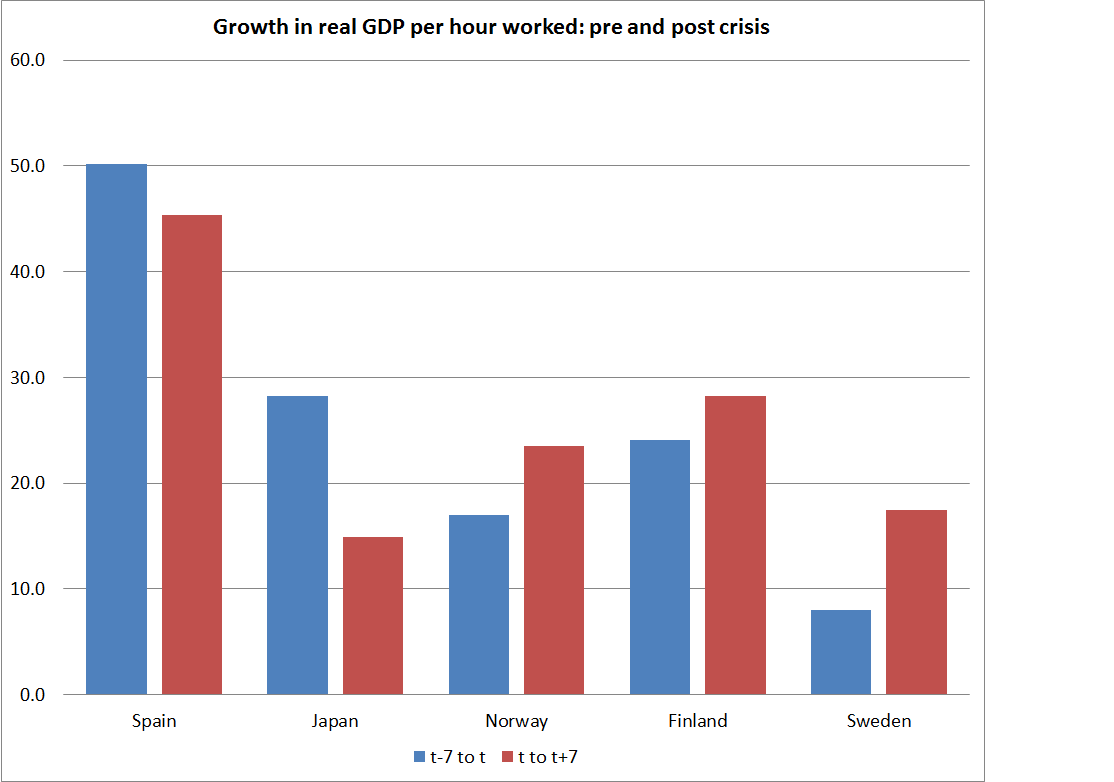
Ideally, one might look at TFP data, but it is not available, consistently compiled, for most of these countries in these periods around crises.  So I had a look at labour productivity –  real GDP per hour worked, drawing from the Conference Board’s database.  I was curious how growth in the years after a crisis compared with that in the years leading up to the crisis.  In this case, I looked at data for seven years each side of the crisis date.

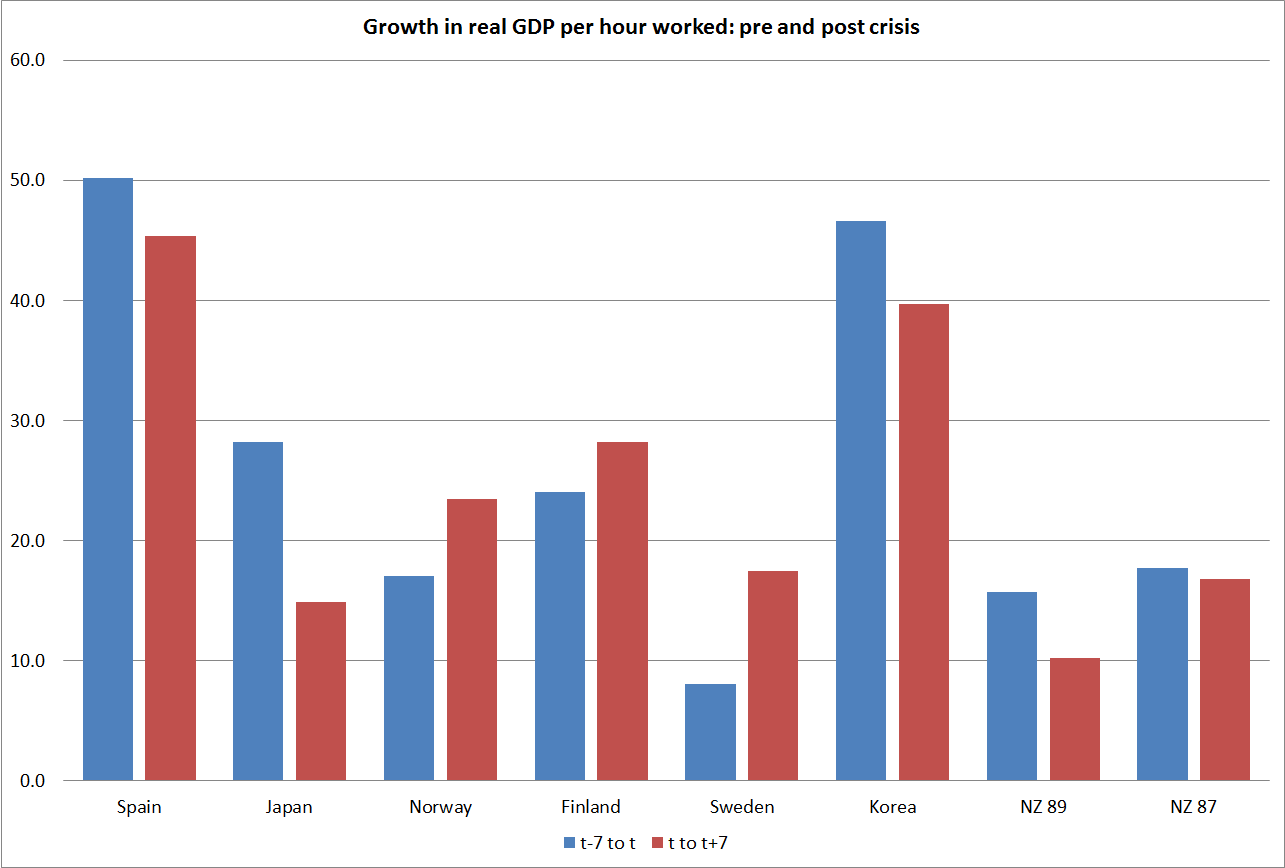
Crisis dating is itself an imprecise business.  For the big 5, I’ve used Reinhart and Rogoff’s dating, and for Korea I’ve used 1997.  Dating the New Zealand crisis isn’t easy.  I’ve used 1989, which was the year in which several major failures occurred.  I could have used 1987, which is when the share market collapsed, never really recovering.   I’m not suggesting anything very definitive can be drawn from the comparisons, and there is always a great deal else going on in any economy (at times, structural reforms might be an endogenous response to the crisis, or –  as in New Zealand –  structural reforms had been going on in parallel.

Here are the results for the big 5 financial crises.  In three of the five countries, productivity growth was faster in the years following the crises than in the years prior to the crisis.

big 5

And here is what the picture looks like if we add in New Zealand (with 2 possible datings –  1989 is my preference) and Korea.  These examples balance up the illustrative sample, but they hardly provide a clear-cut illustration of the idea that financial crises cause permanent costs.

big 5 +

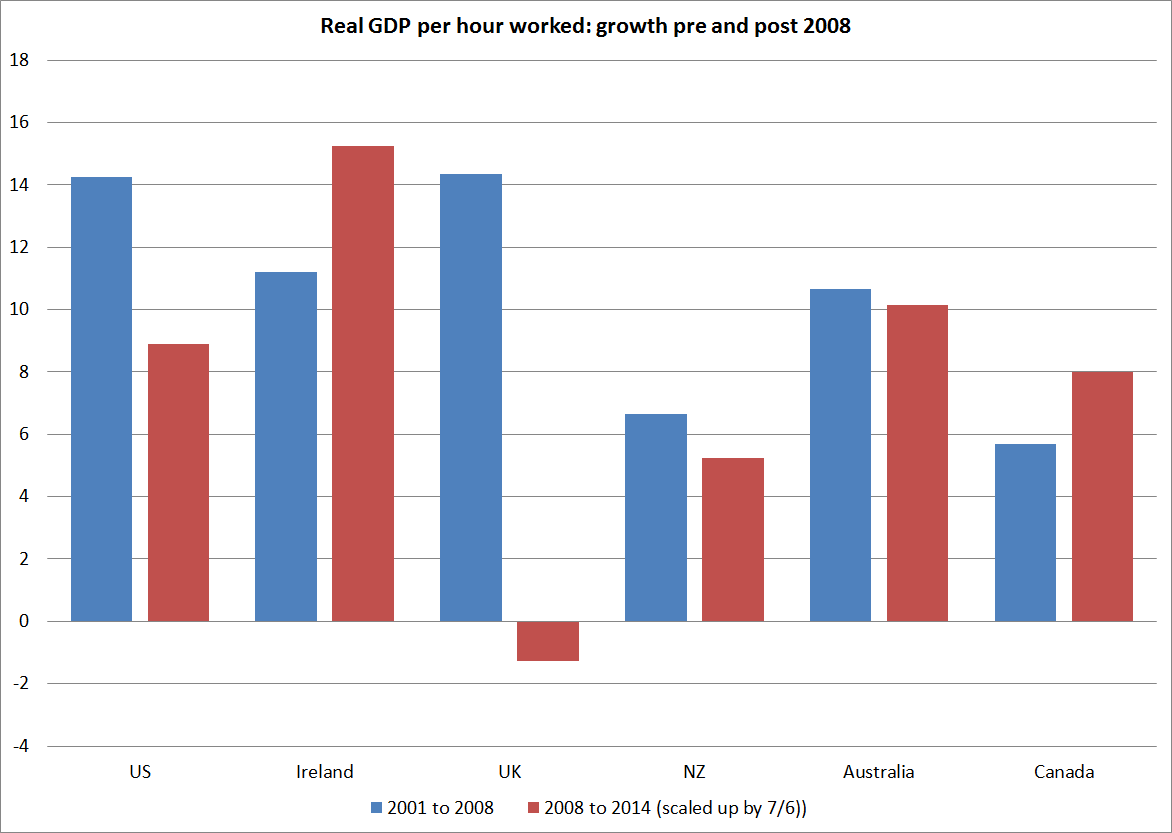
What of the most recent period?  If we date financial crises to 2008 (which seems reasonable), there is only six years of annual data since the crisis, and those data are still likely to be subject to considerable revision.  But for what it is worth, if we multiply productivity growth since 2008 by 7/6, here is what a chart of pre and post 2008 productivity growth looks like for the US, Ireland, the UK, and for New Zealand, Australia, Canada.  No one would dispute the US and Ireland had systemic financial crises rooted in problems in their own countries.  My reading of the UK is somewhere in the middle –  several of its major banks failed and were bailed out, but in considerable part based on offshore exposures.  New Zealand, Australia, and Canada did not experience systemic financial crises.

post 2008

Across advanced countries as a group, labour productivity growth in recent years has been slower than it was in previous years.  But as I’ve discussed previously, this isn’t restricted to (or focused among) countries that have had financial crises.  Indeed, the Irish crisis was probably the most severe of any of those in OECD countries, and yet Ireland has reported faster labour productivity growth since 2008 than in the seven years prior to it.

Misallocation of resources that leads to eventual recessions and financial crises come at a cost.  With the exception of Japan, each of the crisis countries (pre 2008 and 2008) had nasty recessions associated with their crisis.  But to what extent the severity of the recessions was caused by the crises, as distinct from the severe initial misallocation of credit and possibly of real resources, is an open question.  And in Japan, and in the post 2008 experience, the role of demand shortfalls (resulting from combination of the near-zero lower bound, and fiscal constraints) is also likely to be very relevant in many countries.

We should be hesitant about concluding the financial crises have material long-term economic costs.  If they don’t, the case –  embraced by regulators, whose incentives might be somewhat skewed – for more extensive and intrusive financial regulation is materially weakened.  Indeed, if the crises might have been caused in large part by policy choices, we want to be even more wary of handing additional powers to regulatory agencies of the same state whose actions/choices caused the problems in the first place.  The role of active or passive policy choices in creating conditions that drove down lending standards in the recent Irish and US cases is pretty clear, but policy also played a key part in many of the 1980s crises (fixed exchange rates in the Nordic countries, and the difficult transition from hitherto excessively regulated banks and financial markets in the Nordics and in New Zealand).