Do citizens always (net) leave their own countries?

In my post the other day on New Zealanders continuing to leave New Zealand, one thing I didn’t touch on is that in normal circumstances one should expect more citizens to leave their own country than arrive.

People mostly acquire citizenship by first living in a country.  For most people, it is a matter of being born somewhere (although not everyone born in a particular place is entitled to citizenship of that country).   Others acquire citizenship through immigration, sustained residence and naturalization.  And there is a, typically much smaller, group who acquire citizenship outside the country –  eg the children born abroad of New Zealanders.

In other words, most citizens of a country are in that country to start with.  However successful the country is, it is likely then that over time more citizens will leave the country than will arrive in it.  There typically isn’t a large stock of citizens abroad, and some citizens will, for example, marry someone from another country and move to settle in that country.   Others will find an exceptional job abroad, or simply like something about the lifestyle or values that another country offers.  The United States, for example, has had among the very highest material living standards for a long time, but the best estimates seem to be that there are a couple of million American-born US citizens living abroad.  More Americans have left the United States than have arrived.

But two million Americans is less than 1 per cent of the US population.  In New Zealand’s case, by contrast, Australian statistics say that there are around 600000 New Zealand born people (almost all of whom will have been New Zealand citizens –  many still are) in Australia alone.    There are only around 3.5 million New Zealand born people in New Zealand.   Diasporas make a difference.

Once there is a large stock of citizens living abroad, there is no reason to think that the net migration flow of citizens will continue to be outward, no matter what the economic conditions are.  If New Zealand’s economy starts performing better than those abroad, which group of people finds it easiest to move here and take advantage of those opportunities?  Surely those who are already our own citizens –  they have the legal right to move here, full access to our welfare supports, and few cultural adjustment issues  (Australians can come here too, but the flows are typically small.)  By contrast, people from other countries face  all sorts of additional hurdles.  They need legal permission to come (and we don’t allow just anyone in, as soon as they want to come),  and they typically won’t know the culture that well or find it easy to immediately see their skills fully recognized in the labour market.    With 600000 New Zealanders in  Australia alone, if there was any convergence going on between living standards in New Zealand and Australia (or New Zealand and the UK, where the next largest group of New Zealanders live) that could quite quickly and readily been accompanied by a reversal of the net outflow of citizens.  Many would still be leaving  –  some permanently, some just for a few years –  but more could be returning.

What happens in other countries?    Do we ever see net inflows to a country of citizens of citizens of that country, or is this just a theoretical curiosity?  In fact, we do see, and have seen, such flows.

I went to the Eurostat database, which collects and reports data from a huge number of European countries (mostly those inside the EU, but not only them).   Somewhat to my surprise, I actually found what I was looking for: in this case, 10 years of annual data for the migration inflows and outflows of citizens of each reporting country.  I’m not sure how they compile the data in most countries (in New Zealand, we use arrival and departure cards), but in Europe the use of identity cards and the need to register in a locality probably support data collection.  In any case, however they manage to calculate it, this is what I found.   I downloaded the data for 32 countries for the years 2004 to 2013 (the most recent Eurostat had).  Bear in mind that New Zealand has not had an annual net inflow of its own citizens for more than 30 years.  But over the last decade, 11 of these European countries had had such inflows in at least one year (in fact, all of those 11 had had at least two years of net inflows of their own citizens).

These were the countries that had experienced inflows: Denmark, Ireland, Greece, Spain, France, Croatia, Cyprus, Slovakia, Hungary, Malta, Finland

It is a diverse group: some of the richer EU countries (France, Denmark and Finland) as well as some of the poorer.  Unsurprisingly, most of the inflow years seem to have been when the home economies were doing well.  Over time, for example, Ireland has huge net outflows, akin to New Zealand’s experience (and hence a very large diaspora), but they had a net inflow of their own citizens of around 12000 people a year from 2006 (when the Irish data start) to 2008.  Cyprus –  a much smaller country –  was attracting back a net 1000 or so of its own citizens each year right up until their crisis hit in 2013.  And so on.

As I noted, even very rich countries will tend to see a modest outflow of their own citizens over time.  Norway, for example, has an extremely high GDP per capita (and even higher GNI per capita), and about the same population as New Zealand.  It was losing about 1000 Norwegians per annum over 2004 to 2013 –  a period when New Zealand lost an average of 28000 people per annum.

And how do to the average net outflows over time compare across countries?  This chart shows data for the Eurostat countries discussed above, supplemented with national data for New Zealand and Australia.

own citizens inflow

A handful of countries actually had a net inflow of their own citizens over this full period.  But only two of the countries had a larger average annual outflow (as a per cent of population) than New Zealand.  If New Zealand had really been doing well our diaspora is large enough that the flow could easily have reversed.  It simply hasn’t.  It fluctuates, and the net outflow in the last year has been modest by our own historical standards (recent decades), but even last year’s net outflow would have put us towards the right of this chart.

Grant Robertson and a 21st century monetary policy

Grant Robertson  has a statement out today asserting that “Monetary Policy Must Get into 21st Century”.  Setting aside the fact that his party was in office for half the 21st century so far, had two reviews undertaken of the framework (one by Lars Svensson, an internationally-regarded expert, and one by the Finance and Expenditure Committee), and made no changes to the thrust of the framework (goals, powers, responsibilities etc), it really isn’t clear what Robertson wants.   He talks of wanting “modern tools”, but the tools our Reserve Bank uses are entirely normal.  Indeed, since the OCR was introduced to New Zealand only in March 1999, it must almost count as a 21st century tool.  Going into the last election, Labour did propose a (fairly weak) new tool, the variable Kiwisaver rate, but indications since have been that they were backing away from that.  So what alternative tools does Robertson now have in mind?

Robertson rightly points out that inflation has not been at 2 per cent –  the Bank’s target –  since the current Policy Targets Agreement was signed.  We didn’t have that problem previously –  inflation was, if anything, typically a bit above the mid-point of the target range.  That suggests the problem is not with the goal –  a medium-term focus on price stability  – but with the way the Reserve Bank has been handling incoming information.  Quite possibly the challenges they face have intensified in recent years, but despite having full policy flexibility –  never close to zero interest rates –  they haven’t handled them very well.  One might reasonably raise questions about that failure, and the failure of those charged with holding the Bank (and the Governor personally) to account (the Board and the Minister), but there is just no evidence that the target or the tools are the problem.

As I’ve said before, I’m not suggesting the way the Act is written is ideal, and if we started from scratch I would probably suggesting writing the goal a bit differently.  But doing so would be to help articulate why we aim for something like price stability over the medium-term.  It would be unlikely to make much difference at all to how policy was actually conducted.  That depends primarily on the Governor and the senior advisers he gathers around him.

Better monetary policy –  delivering better outcomes around 2 per cent inflation –  over the last few years would have narrowed the gap between New Zealand and world interest rates, which was (temporarily) unnecessarily widened by the Governor, but it wouldn’t have closed it.  That gap has been there for decades, and isn’t a reflection of how the Reserve Bank runs monetary policy.  There are things that governments can – and should – do that would sustainably close the gap, but (rightly) they aren’t things the Governor or the Reserve Bank has any power over.

A previous rant on much the same subject from a few months ago is here.


Some thoughts on the inflation data

Perhaps not surprisingly there has been a lot of coverage of yesterday’s CPI outcome –  an inflation rate of only 0.1 per cent for the year; materially lower than either the Reserve Bank (in its December MPS) and all other published forecasters had expected.

Quite what the numbers mean isn’t so clear-cut, and I’ll come back to that, but it is very low inflation.

Of course, this is an era of low inflation.  According to the OECD database, nine OECD countries had even lower inflation (or deflation) than we did last year –  eight of those countries have policy interest rates at zero (or even a bit below).

The media made much of our inflation rate being the lowest since 1999, but they probably missed the story.  After all, 1999 isn’t that long ago (and the target was lower then).  And in those days, the CPI included retail interest rates, and interest rates dropped by around 400 basis points in 1998.  All the experts thought that in a deregulated economy including interest rates in the CPI was daft –  apart from anything else, it meant that when the Reserve Bank tightened monetary policy, inflation temporarily went up.  So daft in fact that the Policy Targets Agreement in place at the time, signed by Winston Peters and Don Brash, set the target in terms of CPIX (ie the CPI excluding credit services).  In fact, the way the official CPI was calculated was changed shortly afterwards to essentially the approach used today.

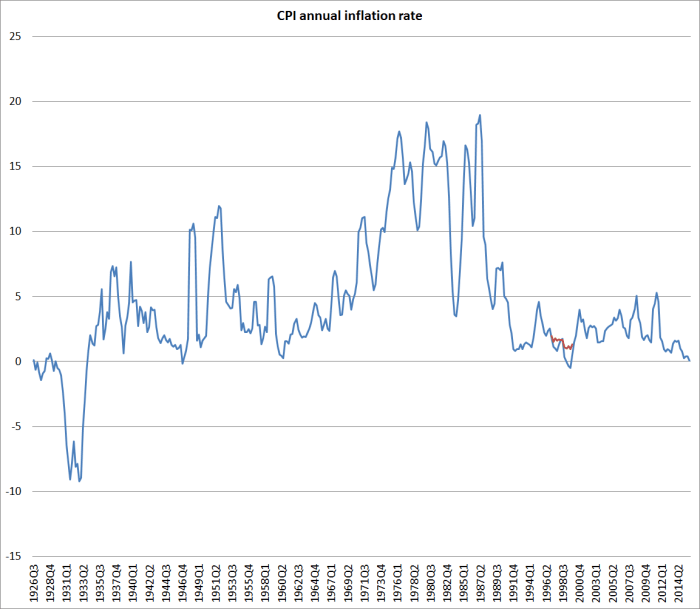
We don’t have a consistently compiled historical CPI in New Zealand (the way all sorts of things have been measured, but especially around housing, has changed materially over time, but then so –  for example –  has the extent of price controls, regulation etc).   But here is a chart using the official historical CPI all the way back to the 1920s, with an overlay (in red) of the CPIX inflation rate over 1997 to 1999.  At the trough, annual CPIX inflation was around 0.9 per cent –  not that much below the midpoint (1.5 per cent) of the then target range.

cpi inflation

Taking a longer horizon, annual CPI inflation got as low as 0.3 per cent in 1960 (I recall tracking this number down in the early days of inflation targeting and holding it out as something to aspire to, the last time New Zealand had managed ‘price stability’).  And since the Reserve Bank opened in 1934, the only time annual inflation has really been lower than it was in 2015 was in 1946, when the annual inflation rate briefly dipped to -0.2 per cent.  The lowest inflation rate for almost 70 years might have been more of a story.  “Lowest inflation since the Great Depression” would no doubt be a headline the Reserve Bank will be keen to avoid, but that too must be a non-trivial risk now.

Quite what to make of the inflation numbers is another matter.  Although the Reserve Bank has been playing up headline inflation in its recent statements, headline inflation shouldn’t be (and rarely is) the focus of monetary policy.  What matters more is the medium-term trend in inflation: as the PTA puts it

“the policy target shall be to keep future CPI inflation outcomes between 1 per cent and 3 per cent on average over the medium term, with a focus on keeping future average inflation near the 2 per cent target midpoint”

But it has been four years now since headline inflation was 2 per cent.  The Reserve Bank keeps telling us it is heading back there relatively soon, and has continued to be wrong.  Even before this latest surprise, they had been forecasting it would be another two years until inflation got back to 2 per cent.

If the weak inflation was all about petrol prices perhaps we could be relaxed –  whatever mix of supply and demand factors is lowering oil prices, taken in isolation it is a windfall real income gain to New Zealand consumers.   But CPI inflation excluding vehicle fuels was 0.5 per cent last year, down from 1.1 per cent in 2014.  Indeed, tradables inflation excluding vehicle fuels was -1.2 per cent in 2015, also a bit lower than the 0.9 per cent in 2014.

Over the last few years, a common explanation for New Zealand’s low inflation rate had been the rising exchange rate, which tends to lower tradables prices.  But the exchange rate peaked in July 2014, and in the December quarter 2015  (having already rebounded a little) it was 7 per cent lower than it had been in the December quarter of 2014.  Of course, some Reserve Bank research not long ago suggests that when the exchange rate has fallen previously the inflation rate itself has tended to fall –  presumably because the exchange rate falls don’t occur in a vacuum and are often associated with a weakening terms of trade and a weakening economy.

Government taxes and charges throw around the headline CPI –  for the last few years, large tobacco tax increases held headline inflation up, and more recently the cut in vehicle registration fees lowered the headline rate.  But in the last year, non-tradables inflation excluding government charges and tobacco and alcohol taxes was 1.8 per cent, exactly the same as overall non-tradables inflation.   Non-tradables prices tend to rise faster than tradables prices (think of labour intensive services) so with an inflation target on 2 per cent, one might normally be looking for a non-tradables inflation rate of perhaps 2.5 to 3 per cent.

What of the “core” measures of inflation?   Probably for good reason, the “ex food and energy” measures don’t get much focus in New Zealand.  But SNZ do report such a measure, and it recorded 0.9 per cent inflation last year, right at the bottom of the target range although barely changed from the 1.0 per cent in 2014.

The Reserve Bank reports four core inflation measures on its website.  None of them is close to 2 per cent, but the message from them in terms of recent trends isn’t that clear.  Two measures (the weighted median and the factor model) suggest little change in the core inflation rate over the last year.  One of them –  the trimmed mean –  suggests a material slowing in core inflation (indeed, in quarterly terms the trimmed mean –  which excludes the largest price changes in both directions – had its weakest quarter in 15 years of data).  But the fourth measure –  the sectoral core factor model –  actually suggests that core inflation has picked up quite noticeably over the last few quarters.  It is a pretty smooth series, and so an increase in inflation from 1.3 per cent to 1.6 per cent, especially when headline inflation is so weak, is worth paying attention to.

The sectoral core measure has been the Reserve Bank’s preferred measure of core inflation, and mine.  Frankly, I’m not sure what to make of it, although I take some comfort from the fact that the increase seems concentrated in tradables prices (the sectoral factor model separately identifies common factors among tradables and non-tradables prices and only then combines the two factors).  The tradables factor seems quite sensitive to exchange rate movements –  as one might expect –  but is not obviously something monetary policy should be responding to.    It is always important to think hard about data that go against one’s story, so I remain a bit uneasy about what the sectoral core measure is telling us (even recognizing that it has end-point problems, that mean recent estimates are sometimes subject to quite material revisions).

For the last nine months I’ve been arguing here (and had earlier been arguing the case internally) that monetary policy needs to be looser if future inflation is once again to fluctuate around 2 per cent –  the target the Governor and the Minister have agreed.  Somewhat belatedly, and grudgingly the Reserve Bank has cut the OCR, and it will take some time for the full lagged effects of those cuts to be seen.   Current core inflation –  whatever it is –  partly reflects the lagged effects of previous overly-tight policy.

In terms of future monetary policy, yesterday’s CPI results in isolation aren’t (or shouldn’t be) decisive.    They rarely are.  But equally there isn’t much reason in those data for anyone to be confident that inflation will relatively soon be fluctuating around 2 per cent.  That confidence matters –  as I noted earlier in the week, both financial markets and firms and households have been gradually lowering their expectations of future inflation .  If that becomes entrenched, it is harder to get inflation back up –  but the risks of trying more aggressively to do so are also diminished (people today simply aren’t looking for inflation under every stone, worried that some nasty inflation dynamic is just about to destroy everything they’ve worked for).

And context matters too.  As I explained in December, I thought the Reserve Bank’s case  that the economy and inflation would rebound over the next couple of years –  and hence no more OCR cuts were needed –  was unconvincing.  The intervening six weeks have done nothing to allay those concerns.  Over recent years there were some huge forces pushing up domestic demand –  strong terms of trade, the upswing in the Christchurch repair process, and the huge increase in net migration.  None of those factors seemed likely to be repeated.  Dairy prices seem to be lingering low, global economic uncertainty is rising, global growth projections are being revised downwards (even by that lagging indicator, the IMF) and just today US Treasury bond yields dropped back below 2 per cent.   Unease seems to be turning to fear, in a global climate where deflationary risks seem more real than those of any very substantial positive inflation.

In sum, the case for further OCR cuts in New Zealand now is pretty clear, and the risks (of materially or for long overshooting the inflation target) seem low.  Would doing so boost the property market?  Relative to some counterfactual, no doubt.  That is a feature not a bug.  Monetary policy works in part by increasing the value of long-lived assets, and encouraging people to produce more of them.  But what it would also do is lower the exchange rate, providing a buffer to more-embattled tradables sector producers (think dairy farmers) and increasing the expected returns to new investment in other areas of the tradables sector.

Who knows what the Governor and his advisers will make of the recent data flow.  In a more transparent central bank we could look forward to seeing the minutes of next week’s meetings, the alternative perspectives and arguments.  As it is, the Governor will tell us what he wants us to know in his OCR release next week, and perhaps in his speech the following week.

Still a country New Zealanders leave

In one of his weekly columns over the holiday period the Herald’s John Roughan, a touch sentimental perhaps that his grandchildren were just returning home again to Singapore, made the case that the post 1984 economic reforms have made New Zealand “a place worth returning to”,  “a place that can hold its own in the world”, and so on.

It is a nice story.  It is certainly one that I hoped would come true.  It is just a shame that the facts don’t really support it.

What have New Zealanders been doing?  Well, the last time there was any sort of sustained net inflow of New Zealand citizens to New Zealand was when Sir Robert Muldoon governed:  seven consecutive months in 1983.  It probably wasn’t greatly to Muldoon’s credit, since by mid 1983 Australia’s unemployment rate had risen sharply to just over 10 per cent.    There were also two months in early 1991 when there was an inflow of 90 people:  and again Australia’s unemployment rate was rising rapidly.    Even in the last 12 months a net 4800 New Zealand citizens have left.  Sure, plenty of individuals leave and come back, but in net terms the data tell us the flow is outwards.  It is a volatile series, and the outflow at present is less than it has often been, but we’ll need several years more data before there would be any reason to think the pattern of net outflows –  in place since the mid 70s – is ending.  There has been a net outflow of New Zealand citizens of 680000 since the reforms began.

net plt flow of citizens

And even if the outflows were to slow, it isn’t necessarily a mark of our own success.  Australia has long been the natural place for New Zealanders to seek better opportunities for themselves and their families.  For a long time, access to Australia was largely unrestricted –  it was easy to go, pretty easy to adapt, and if things went wrong the social safety net buffers in Australia were there for the immigrants.  New Zealanders can still easily go to Australia, but they now have a much tougher time of it –  for new arrivals, access to the Australian welfare system is available only for those arriving on permanent residence visas (typically not New Zealanders).  And their children can find themselves in a legal limbo.   In boom times, only the most risk averse pay much attention to factors like that  –  and those who choose to migrate aren’t generally the most risk averse –  but tougher times in Australia, and just the passage of time and the reporting of more stories of the difficulties some have faced, is reducing the attractiveness of Australia, even as the income and productivity gaps between the two countries have continued to gradually widen.  It is too early to tell how large any structural change in the willingness of New Zealanders to go to Australia has been –  the cycle dominates –  but if it has happened it is neither a benefit to New Zealanders or a reflection of any success on our part.

Roughan glides between the talk of New Zealanders coming home and celebrating the overall net immigration statistics.  But again, large net inflows of non New Zealanders aren’t a sign of economic success, just a sign of one strand in economic policy.    A relatively rich country never has too much difficulty getting migrants if it wants them –  there are always many countries that are worse off.  Indeed, a violent middle income country like South Africa attracts lots of (mostly illegal) migrants –  most of Africa is even poorer.  This isn’t the place to resume debates about whether New Zealanders will benefit from our immigration policy over the long haul, just that inflows –  however large – are not themselves a sign of our economic success.

I’m one who thought –  and thinks –  that most of the reforms of the 1984 to 1993 period were in the right direction, and generally needed to be done.  But we need to face the fact that even if many of those reforms were beneficial –  and I think they probably were –  New Zealand’s productivity performance has remained pretty woefully bad.  And absent huge new natural resource discoveries, productivity is the basis of sustained prosperity.

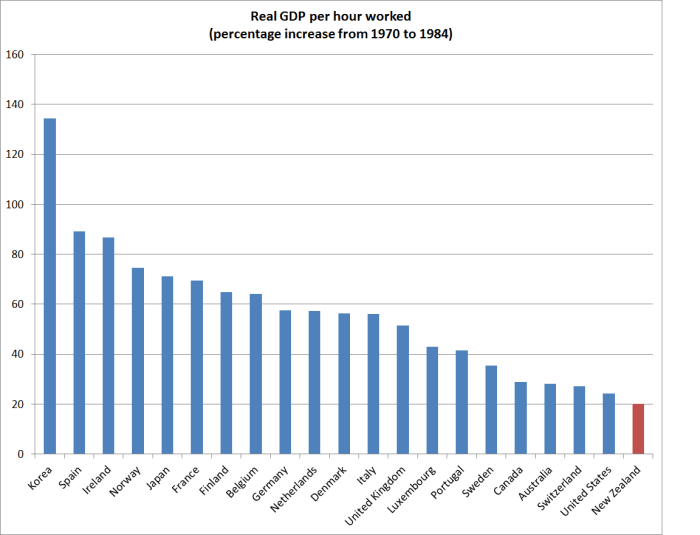
Roughan talks of finishing school at the end of the 1960s and having then been pessimistic about New Zealand’s prospects.  And New Zealand did very badly in the fifteen or so year after that.  Between some of the bad choices we made ourselves (Think Big for example), oil shocks, slumping commodity prices and the UK entry into the EEC, it perhaps wasn’t surprising that between 1970 and 1984 we had the lowest growth in real labour productivity (real GDP per hour worked) of any OECD country for which the data are available.  I was one of young (and probably naïve) who looked at that record and thought that there was no real reason why it couldn’t be reversed with a couple of decades of decent economic management.

real gdp phw 70 to 84

But it just hasn’t happened.  Here are the same data (growth in real GDP per hour worked) for the 30 years since 1984.

real gdp phw 84 to 14

We’ve managed to match growth in Spain and Canada –  both countries that in 1984 had higher levels of productivity than we did –  and we’ve done better than Greece, Switzerland, and Italy.   Better than in the earlier period, but thin pickings really, especially when one contemplates how bad things in Italy and Greece have been in recent years.

Our story isn’t all bad, of course.  We reversed a really bad track record of high inflation, and government’s accounts look pretty good by most (but not all) advanced country standards).  The rapid accumulation of overseas debt (as a share of GDP) also came to an end.  Without those improvements, perhaps the productivity picture would have been even worse.

Individuals generally don’t make choices based on macroeconomic data, but on their perceptions of the opportunities for themselves and their families.  But in this area, the flow of people and the macro data seem pretty well aligned.  New Zealanders just keep on leaving –  in smaller numbers right at the moment, but with little sign of any structural reversal of the flow –  and our productivity performance continues to languish. Yes, to pick up Roughan’s words, New Zealand is a “lovely” place and I enjoy the “temperate warmth of our summer”, “the deep blue sky” and the “beaches and bays” as much as anyone, but…..the beaches look pretty good in Uruguay too, one of the few (then) advanced countries to have done even worse than New Zealand over the last 100 years.

OIA: changes in RB practice and in law needed

Just before Christmas, I drew attention to the Reserve Bank’s new policy of charging for Official Information Act requests.  At the time, this paragraph appeared on the Bank’s website.

The Reserve Bank has a policy of charging for information provided in response to Official Information requests when the chargeable time taken to provide the information exceeds one hour, and charging for copying when the volume exceeds 20 pages. Our charges are $38 per half hour of time and 20c per page for copying (GST inclusive).

That text has now been removed and they appear to have provided some rather more extensive material outlining the approach they are now planning to take.  This is what is now stated on the website:

The Official Information Act allows the Reserve Bank to charge for preparing information that we send in response to requests. When charging for responses to Official Information requests, the Reserve Bank works within the guidelines published by the Ministry of Justice here – Official Information Act: Charging for Services. Charges are $38 per half hour of staff time after the first hour, and 20 cents per page for printed or copied material provided in response to a request, after the first 20 pages.      The Reserve Bank is resourced to meet disclosure obligations for a reasonable level of Official Information requests and generally will not impose charges for small, simple or infrequent requests. If requests are made for large amounts of information that require substantial collation and research, the Reserve Bank’s first step is to work with the requester to refine the request to a smaller scale or scope that is less likely to involve charges. Where request is still chargeable and likely to be expensive, we will give the requester further opportunity to refine the scope of the request and thereby reduce or eliminate charges.

Basis for charging     The cost of providing free responses to Official Information requests is generally borne by taxpayers. The Reserve Bank believes that requesters should bear some of the costs when requests are made for very large amounts of information, where a response to a request is particularly complex, or where individuals or organisations make very frequent requests.

Guidelines for charging      Charges will be imposed for responses when preparation of the response involves more than one hour of chargeable collation, research and preparation work. If the Reserve Bank decides that information requested can be made available, but that charges are appropriate, we will formally advise the requester of:

  • our decision to release the information,
  • the estimated amount of proposed charges,
  • the basis for proposed charges, and
  • the requester’s right to seek an Ombudsman’s review of the proposed charges.

Remission of charges        The need to pay charges may be modified or waived at the Reserve Bank’s discretion, if:

  • charges might cause financial hardship for the requester; or
  • releasing the information is likely to contribute significantly to public understanding of the Reserve Bank and its work, and release of the information is not primarily for the benefit or interest of the requester; or
  • if the information already in the public domain in a form which the requester could acquire without substantial cost.

As I noted before Christmas, it appears probable that the Reserve Bank’s general stance is legal, since the relevant provisions of the Official Information Act itself are quite short and permissive

Subject to section 24, every department or Minister of the Crown or organisation (including an organisation whose activities are funded in whole or in part by another person) may charge for the supply of official information under this Act.

Any charge fixed shall be reasonable and regard may be had to the cost of the labour and materials involved in making the information available and to any costs incurred pursuant to a request of the applicant to make the information available urgently.

Whether it is appropriate is quite another matter.

I discovered the new policy when the Bank sought hundreds of dollars to provide me copies of some easily accessible, non-contentious, very old minutes of meetings of the Reserve Bank Board. But I’m not now the only one to have been hit by the new policy. Richard Meadows of Fairfax was told he would have to pay a similarly large amount to progress several of his OIA requests, a step that has brought greater coverage to the issue. There were articles on Stuff last week (here and here), and yesterday the Dominion-Post editorialised on the Reserve Bank’s new policy, under the heading “An obstacle in the path of freedom”.

The Bank is, of course, bound by the law. But it also notes that it seeks to work within the charging guidelines approved by the then government in 2002. But it is not clear that it is really doing so.

For example, the Bank lists factors it would take into account in deciding whether to modify or waive any charges, but the list it uses is not the same as the list in the government’s charging guidelines. They state

7.1 The liability to pay any charge may be modified or waived at the discretion of the department or organisation receiving the request. Such decisions should have regard to the circumstances of each request. However, it would be appropriate to consider inter alia:

  • whether payment might cause the applicant hardship;
  • whether remission or reduction of the charge would facilitate good relations with the public or assist the department or organisation in its work; and
  • whether remission or reduction of the charge would be in the public interest because it is likely to contribute significantly to public understanding of, or effective participation in, the operations or activities of the government, and the disclosure of the information is not primarily in the commercial interest of the requester.

To comply with these guidelines the Reserve Bank first has to consider the circumstances of each request.   And it is advised to consider whether “remission or reduction of the charge would facilitate good relations with the public” and whether “a remission or reduction in the charge would be the in public interest because it is likely to contribute significantly to public understanding of, or effective participation in, the operations or activities of the government”. The Bank states that it will consider remission or reduction if the request is “not primarily for the benefit or interest of the requester”, but that is hugely different phraseology than the one in the government’s charging guidelines, which talk about where “the disclosure of the information is not primarily in the commercial interest of the requester” – in other words, the test is whether the requester making money from the information in the request.

Yesterday, I was also informed that my request for material the Reserve Bank held relating to its involvement in the post-TPP Joint Macroeconomic Declaration (that our central bank and Treasury were party to, along with macroeconomic authorities in other TPP countries) would also be subject to a charge of $560.

There is no evidence in the letter from the Reserve Bank that they have considered the circumstances of the specific request. For example, as the Dominion-Post editorial notes, charges of this scale “would be a serious obstacle for any individual” and “if OIA requests routinely cost this much it would also be a problem even for large media outlets”.  But I suppose it would not necessarily cause “hardship”

More pointedly, there is clearly no commercial benefit to me at all (let alone it being a “primary” factor) in making such a request. This blog is a non-commercial operation.

What about the wider public interest? Well, the government has been clear that it wants to encourage scrutiny and discussion of TPP issues now that the agreement has been signed. And yet, one press release apart, the Reserve Bank has published no background information about its involvement in the Joint Macroeconomic Declaration, and the Governor has not answered any questions about it. Against that background, a request of the sort I lodged seemed likely to assist public understanding of a new international commitment made by the Reserve Bank. The fact that the Reserve Bank itself constantly stresses the gains from transparency makes their stance on OIA requests in general, and this one specifically, particularly incongruous.

Perhaps the Bank wants to argue that publication on my blog would not advance the public interest (although I’m not sure how they would apply that reasoning to one of the country’s largest media groups). I have, of course, a smaller readership than the Fairfax publications, but by New Zealand standards it is a pretty significant number of people – including, but not limited to, officials, market analysts, journalists and politicians – with an interest in economic and financial policy and analysis issues in New Zealand. The official charging guidelines note that it is reasonable to ask whether requesters have a means of disseminating the requested material. As they note “in the case of the media, however, it can be reasonably assumed that they do have access to means of public dissemination”. The same might be said for requests from reasonably widely read bloggers – blogs not having been as common in 2002 when the charging guidelines were written.

But in any case, the Reserve Bank has itself created a platform for disseminating material, by adopting the (admirable) policy of releasing the results of many of the OIA requests it receives on its own website.

I suspect the change of Reserve Bank policy was prompted by the various requests I have lodged with the Reserve Bank over the last year or so. I haven’t gone back and checked each of them, but I’m pretty sure that in all cases (a) I have written about them here, thus giving dissemination to what the Bank has released (or refused to release) and (b) that all of them have had a focus on enhancing the understanding and scrutiny of a powerful public agency[1].

The Reserve Bank’s new stance is a serious misjudgement. The issue isn’t whether their stance is legal – it probably is – or whether, as applied to either Fairfax or me, it is in accordance with the government’s charging guidelines – it probably isn’t. The bigger issue is the one I have been highlighting for the last nine months. The Reserve Bank is a very powerful organisation, with a great deal of discretionary policy choice left (formally) in the hands of one unelected person. The Bank exercises far more discretion, in a much wider range of areas, than the designers of the Act – and especially of its governance provisions – ever envisaged. Against that backdrop, the Reserve Bank – and its Board and the Minister, both charged with responsibility for the Governor’s performance – really should be going out of its way to be open and transparent – not just on the things it wants to communicate to us, but in facilitating the sort of scrutiny and challenge that open and democratic societies thrive on. The questions might be awkward at times, and some of the angles oblique, but it is for citizens to define the questions and challenges, not the unelected bureaucrats.

It would tedious to go through once again all the areas in which the Bank fails to practice openness and transparency, but to take just three think of submissions on its regulatory proposals, background papers to the current PTA, and background papers on the substantial programme of work undertaken on possible reforms to the governance model. If the Bank is going to add to its generally obstructive approach – responding as slowly as possible, and releasing absolutely as little as possible while waiting out the Ombudsman – by making access to public information something only for those with deep pockets, it will simply further undermine any legitimacy or respect that it has. I would urge the Governor (and his committee) to rethink, and would encourage the Board, the Minister, and members of the Finance and Expenditure Committee to pick up the issue with the Governor. I welcome the fact that James Shaw, co-leader of the Green Party has already gone public on the issue.

More generally, as I have noted before, the Bank would be well-advised to consider adopting a much more pro-active approach to the release of background papers (akin to the pro-active approach taken by the Minister of Finance and the Treasury following each Budget).   For example, the Bank might consider:

  • releasing all submissions on regulatory proposals on the website on the day submissions close,
  • releasing background papers to the Funding Agreement the day the Funding Agreement is released,
  • releasing background papers on any new PTA at the time of the signing of that PTA
  • releasing proper minutes of the OCR-advisory Monetary Policy Committee, and of the monetary policy meetings of the Governing Committee, say, six weeks after the relevant OCR release
  • releasing background papers to each Monetary Policy Statement immediately after the release of the subsequent Monetary Policy Statement

None of these would be extraordinary by the standards of other government agencies or international central banking.

There would, no doubt, still be matters on which people would lodge Official Information Act requests with the Reserve Bank, but the more open the Bank is upfront the less people will feel the need to lodge ad hoc requests.

More generally, this issue highlights the need for a more comprehensive reviews of the Official Information Act, including the role of the Ombudsman’s office and the charging regime. It may well be the Reserve Bank is isolated in its new stance – the No Right Turn blog is seeking the information on that. But as the Dominion-Post editorial puts it, the “default position should be to give the information free. Only in the most exceptional cases should this rule be breached”.

A reader has suggested that perhaps any proposal to charge should require the explicit advance consent of the Ombudsman’s office. That sounds sensible, provided the Ombudsman is properly resourced, but would require a change to the legislation. Legislation might provide that charges could be levied only for exceedingly complex requests (perhaps those taking more than 100 hours – and with decent document management systems how many should that be?) or where it is evident, on the balance of probabilities, that the primary benefit in releasing the information would be for the commercial interests of the requesters (although general release on a public website would presumably deal with what might otherwise be uncharged gifts to commercial operators). Perhaps there needs to be a separate provision for “vexatious requesters”, akin to vexatious litigants in the courts – but again that would be a matter for the Ombudsman to judge, and “asking awkward questions of powerful agencies” would not qualify of itself as vexatious.

We have sought to avoid a “dollar democracy”. The rich and powerful have no more voting rights than you or I. The same really should apply to the access to public information that enables us to evaluate and hold to account politicians and other officeholders (as it largely has in the way the OIA has been administered  –  for all its problems – by most agencies). Whether or not the Reserve Bank backtracks, it is time for Parliament to revisit the OIA and better fit it for an age when openness and transparency are seen as increasingly important. Part of that will be about a stronger culture (and obligation) to pro-actively disclose, part about better-resourcing the Office of the Ombudsman, and part is about ensuring that access to public information is not determined by the size of one’s bank account.

As I was just about to publish this I noticed an op-ed from the Reserve Bank’s Deputy Governor Geoff Bascand, defending the Reserve Bank’s stance in response to yesterday’s editorial.  Readers can evaluate it for themselves, but I noticed this section

Since the policy was introduced we’ve responded to seven OIA requests and sought charges for two of them because most could be addressed without collating large amounts of information.

The particular charge that sparked recent commentary arose because providing the information requested would take an estimated 8½ hours of chargeable time (along with additional non-chargeable time).

As the Bank has sought charges for two of my OIA requests since the policy was changed, and Richard Meadows noted in the comments on my earlier piece that he was charged for three, this account seems not quite accurate.  And I’m still waiting for a response to my September request for the submissions made to the Bank on its regulatory stocktake.


[1] As it happens, the Board papers I requested last year probably fitted those categories least (they were about (a) some background work on the origins of the Reserve Bank Act and the Board’s role, and (b) the interests of hundreds of present and former members of the Reserve Bank’s superannuation fund (I’m a trustee of the scheme and some difficult issues have arisen from that era)).

Is inflation going to settle back at 2 per cent?

Financial markets don’t seem to think so.

There is a variety of inflation expectations measures.  None of them is ideal (and few are directly comparable across countries), but together they have been providing a reasonably consistent picture of weak, or weakening, expectations of future inflation in New Zealand.  No one knows quite to what extent people use expectations of future inflation in their planning and economic behavior, let alone whether the expectations they actually use (mostly probably no more than implicit) are similar to what they tell those conducting the surveys.    If anything, many  of the survey measures seem to have had a persistent upward bias over the years –  but whether that has influenced behavior is hard to tell.

When inflation expectations start undershooting the inflation target midpoint, it isn’t necessarily a problem in the short term.  After all, it is generally better if firms and households expect what is actually happening than that they are persistently surprised.  But if expectations are slow to adjust –  as they tend to have been – and if expectations, in some form or another, play an important role in influencing the medium-term trend in inflation (reflecting the norms firms and households have in mind for wage and price inflation when they go into the market), then a sustained weakening in inflation expectations can become quite problematic.  After all, the Reserve Bank has been given a goal of maintaining core inflation around 2 per cent.  And if people no longer really expect that future inflation will be near 2 per cent it can become quite hard to get inflation back up again.  People don’t have to think 2 per cent (or above) inflation is impossible, just that the best guess might now be to act on the assumption that something lower will probably be delivered.  After the best part of two decades in which core inflation persistently overshot the midpoint of the inflation target, that would represent a huge change in mindset.  Not all of it would be unwelcome –  as the Bank has noted, it would be good if firms and households became convinced that inflation average 2 per cent rather than, say, 2.5 per cent.  But good things can be carried too far and it increasingly looks as though that has happened.

Survey measures of inflation expectations are useful, but putting a number in a survey involves no risk for respondents and so no incentive to be particularly accurate.  So economists have tended to hanker after market-based measures, where money is directly at stake.  In a world of incomplete information and incomplete contracts, the best we have available in New Zealand is the difference between the yields on New Zealand government conventional bonds and inflation indexed bonds.  It is not a perfect measure by any means, but if there is a reasonable amount of both indexed and conventional bonds on issue, and at least a moderate degree of liquidity in each market, then any persistent changes in investors’ expectations of inflation should, over time, be reflected in changes in the spread between the yields on the inflation-indexed and conventional bonds.    And whereas most survey measure of inflation expectations are for periods one or two years ahead, implied inflation expectations derived from the bond market can provide information on the next 10 years (or more) –  something about the overall expected inflation climate, abstracting from all the noise of regulatory and relative price changes.

The New Zealand government now has 20 year indexed and conventional bonds on issue in reasonable volumes, but unfortunately I can’t find any time series data on the conventional yields ( eg the Reserve Bank is only providing data on the yield on the 20 year indexed bond not the conventional one).   But for these purposes the 10 year bonds should be fine.  And here is the chart of the gap between indexed and nominal yields since the start of 2014, using the data on the Reserve Bank’s website.

iib expecs to jan 16

A common problem with these sorts of comparisons in New Zealand has been that there were very few indexed bond maturities on issue and rather more conventional bond maturities, so that one wasn’t always comparing the same maturity dates.  But these days the government is issuing conventional and indexed bonds with the same maturity dates.  At least since the middle of 2014, the chart will be showing the gap between indexed and conventional bonds each maturing on 20 September 2025.  [UPDATE: A reader drew my attention to the fact that I had misread the DMO’s bonds on issue page and there are not yet exactly matched maturities. It does not affect the gist of the story, although as ever it is indicative only.]

It is not a pretty picture.  Up until perhaps September 2014, there wasn’t anything obvious to worry about.  Implied expectations for the 10 years ahead were very close to 2 per cent.  In the first half of 2014 much of the market appeared to buy the Reserve Bank’s story that a robust recovery meant that even with a progressively higher OCR inflation was going to settle relatively quickly around 2 per cent.

But since then, the trend decline in implicit market expectations has been striking.  As always, there are ups and downs –  individual pieces of data, or changes in market positioning, push prices this way and that.  But whereas investors 18 months ago were happy to trade on the assumption that the Reserve Bank would deliver inflation averaging around 2 per cent, that has not now been so for some time.  As of yesterday, the implicit expectation (average inflation over the next 10 years) was only 1.17 per cent –  not just nowhere near the target midpoint, but close to the very bottom of the target range.  And recall that these are expectations for the next 10 years –  not just the immediate period of falling oil prices, or the last 20 months of Graeme Wheeler’s term, or any of other stuff that throws around the headline CPI – which is what matters for indexed bonds –  in the short-term.  It increasingly looks as though markets (potential buyers and sellers of these longer-term instruments) are pricing a reasonable prospect of at least a year or two of deflation over the next 10 years.  It is certainly a very long way from a confident expectation that, on average over time, the Reserve Bank will do its job.

I wonder what the Reserve Bank’s Board makes of such developments.

A slightly whimsical note to start the year

I spent the last couple of weeks in one of my favourite places in New Zealand –  Whakatane/Ohope.   The beaches are great and the surf is safe, and it is pretty warm even when (as it did too often) it rains.  The local paper – the Beacon – runs a bleakly fascinating crime column of the sort all papers once did –  not just the bare details of names and ages, but accounts of episodes of mundane violence and repeated lack of self-control that come before the District Court each week. They include reports of judge’s comments –  a judge who has been around for a long time but still hears explanations or excuses that flabbergast him.  For an insight into what is, fortunately, like another world it is hard to beat.

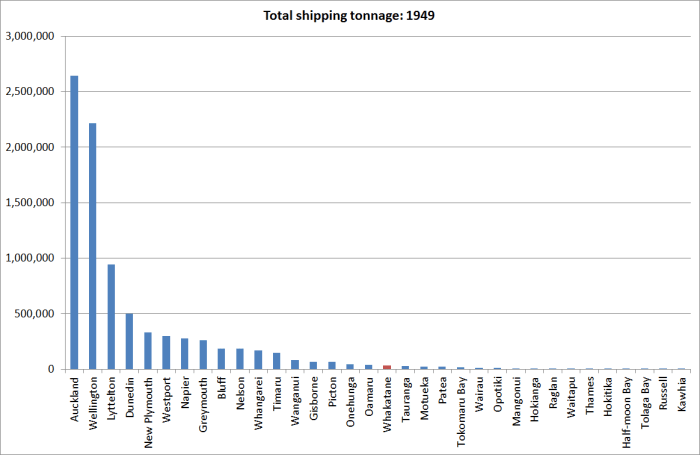
One afternoon last week, we dropped in to the local museum, which is rather well done on a small scale.  Among the display panels was one that took me by surprise.  I didn’t jot down the exact words, but it was along the lines of “until the 1950s, Whakatane’s port handled more cargo than Tauranga did”.   These days, picturesque Whakatane handles sports fishing and sightseeing trips to Whale and White islands and not much more, but I’m old enough to remember a few coastal ships in Whakatane in the late 60s and early 70s  And I knew that Tauranga had been a late developer  (in the 1951 census Tauranga and Mount Mauganui combined had fewer than 11000 people). But I still made a note to check out this claim when I got home.

And sure enough, here is shipping data for 1949, from the 1950 New Zealand Official Yearbook.

total trade 1949

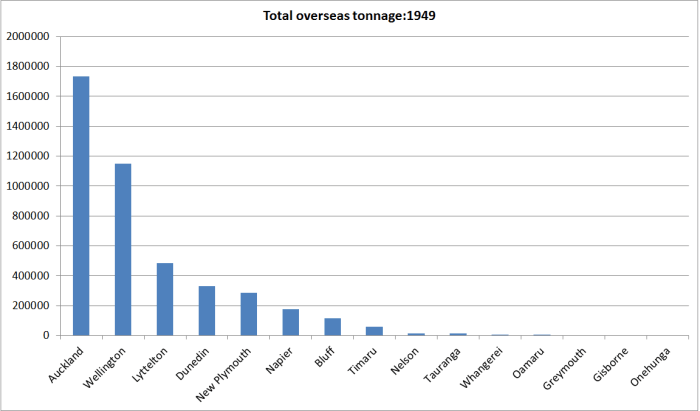
And sure enough, Whakatane then still had more shipping trade than Tauranga.  But I was also struck by how high Wellington stood, and by the prominence of Greymouth and Westport.  Bear in mind that in those days, coastal shipping was almost as important (even by volume transported) as overseas trade.  That explains Greymouth and Westport, in an economy heavily dependent on coal.  I wondered if the Wellington story was just about inter-island coastal shipping, but it isn’t.  Here are the overseas shipping volumes by port (sum of export and imports, in tons).

overseas tonnage 1949

Wellington was far and away the second largest port for overseas trade, with volumes almost two-thirds of those of Auckland.

And here, by contrast, is the value of merchandise trade by port for 2014.

total overseas trade 2014

Auckland remains the port handling the largest share of overseas trade, but now Tauranga is second (from 10th 65 years previously) while Wellington’s sea port did not much more overseas trade than New Plymouth. Wellington airport’s overseas freight trade narrowly edges out what SNZ reports as Parcel Post.

No doubt there is a variety of other factors going on.  Even as a coastal port, Whakatane with a shallow and difficult river bar  (and nearby Opotiki) couldn’t survive the advent of bigger ships and the removal of regulatory limits of road transport.  For Tauranga, the establishment of the Tasman mill at Kawerau, and the associated railway line to  the Mount, in the mid 1950s gave a significant boost to its trade.  And from the 1970s containerization focused foreign shipping trade in fewer and fewer ports.  But no doubt population changes matter as well.  The Tauranga urban area last year had a population of around 130000, and the combination of Auckland, Hamilton and Tauranga urban areas which had accounted for only around 20 per cent of the total population in 1951, were together almost 40 per cent of New Zealand’s total population last year.

As for Wellington, of course services exports are not in these data.  Then again, as a share of GDP services exports are barely higher than they were 20 years ago.

One last post for the year

I wasn’t planning to write anything of substance today, but after my post yesterday an Australian reader pointed me in the direction of the Australian volume data on exports of services.

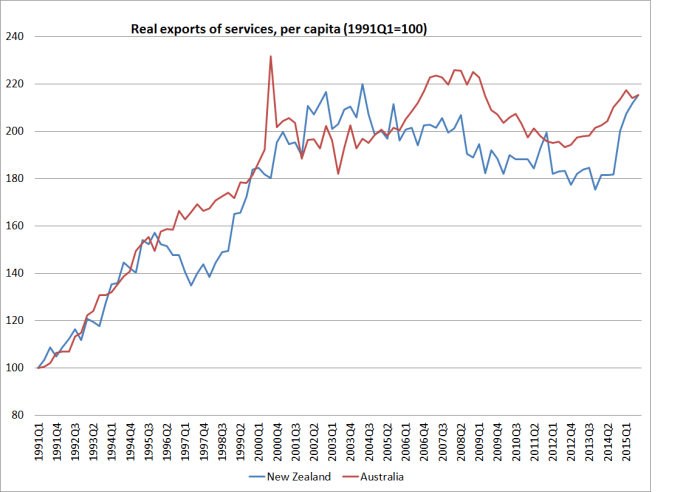
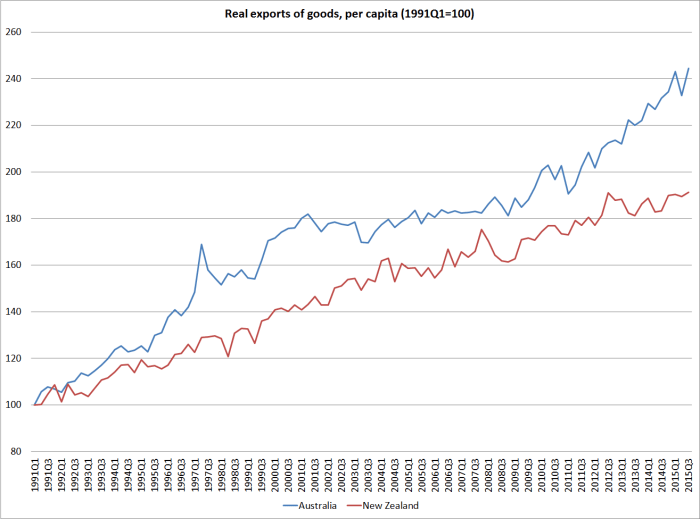
So here are two charts: one showing per capita exports of goods for New Zealand and Australia since 1991 (when the New Zealand quarterly population series begins) and the other showing services exports.

services x

In both countries, services export volumes have been fairly moribund for at least the last decade.  Tourism and education exports are the largest components of services exports, and both appear to be quite sensitive to the exchange rate.  But it is interesting that over the full period, real per capita services exports have grown at about the same rate in the two countries (a slightly different picture than in the nominal chart I showed yesterday).

goods x

The goods export picture is very different.  As I pointed out yesterday, total exports per capita have grown materially faster in Australia than in New Zealand. The difference is concentrated in goods exports.  Since 1991, real goods exports per capita from New Zealand have risen by 91 per cent, but those from Australia have risen by 144 per cent.

I’m not about to launch into a lengthy discussion of why, or what it means, but it is hard to get ahead –  or in New Zealand’s case to catch-up or even end the relative decline – when a country’s firms appear to have found it so difficult, and unremunerative, to increase their sales to the rest of the world.

This is my last post for the year.  Writing this blog has been a fascinating and rewarding experience, and I’m grateful to all those who have visited and read my stuff this year, and to those who have taken the time to comment.   Writing things down sharpens one’s own thinking, and I’ve enjoyed engaging with the ideas and people.   I’ll resume blogging at some stage in mid-January.

In the meantime, enjoy the summer break and Christmas celebrations.  For Christians, it is the festival celebration of a stunning truth: that God become man, in the form of a vulnerable child, to reconcile mankind to God.

In the beginning was the Word, and the Word was with God, and the Word was God.

And the Word was made flesh, and dwelt among us, (and we beheld his glory, the glory as of the only begotten of the Father,) full of grace and truth.


Exports: some trans-Tasman comparisons

One last post prompted  by the quarterly national accounts release last week.

I’ve shown charts highlighting how weak our per capita income growth has been, and how the volume of business investment per capita has only just got back to near pre-recessionary levels.

But what about exports?  In many respects they are the longer-term life blood of our economy –  the success New Zealand firms have in selling in the rest of the world shapes, over time, what we can afford to buy from the rest of the world.  And for a very small country, the rest of the world is most of the potential market.   I highlighted last week how little growth there has been in New Zealand’s export share of GDP over decades.

Real per capita exports in the September 2015 quarter were 8.5 per cent higher than they had been in December 2007, just prior to the recession.  In some ways, that doesn’t seem too bad –  plenty of components of GDP have been weaker.

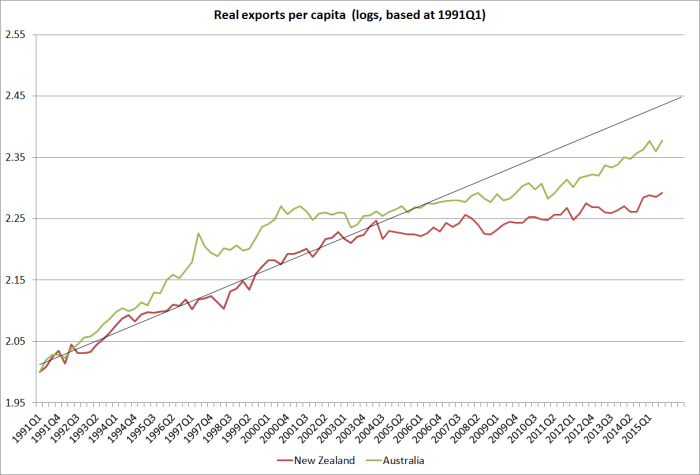
But here are real per capita exports for both New Zealand and Australia since the start of 1991.  The starting point is determined simply by when the SNZ quarterly population series for New Zealand begins.

exports real pc

The trend line shows the trend in New Zealand per capita exports from the start of the series to the end of 2003.  There is a visible fall in the trend rate of growth of exports after that point, but it also coincides with the sharp rise in New Zealand’s real exchange rate which has not been sustainably reversed since then.

What about the comparison to Australia?  Australia achieved faster growth in real per capita exports in the first decade (around 1 per cent per annum faster).    Australia’s real exports per capita then went sideways for a number of years (and more or less moved parallel to ours over perhaps 2002 to 2012) before once again growing materially faster than New Zealand’s exports over the last few years.  Over the whole period since 1991, Australia’s exports per capita have risen 21.8 per cent faster than New Zealand’s.

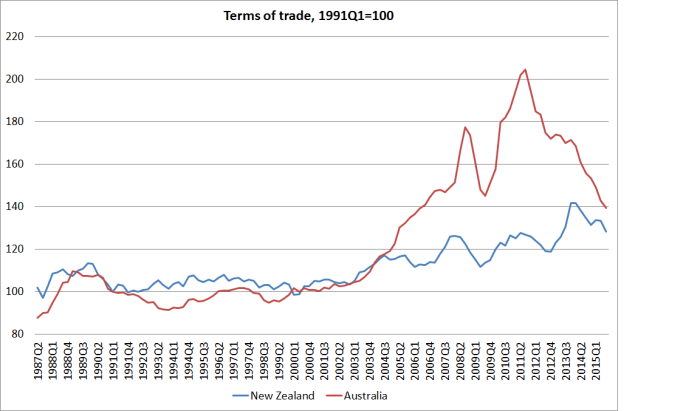
One story sometimes told is that if the terms of trade rises then a country doesn’t need to export as much (by volume) –  if prices do the work, real resources can be used for other purposes (economic life is about consumption, not exports –  which are just a means to an end).  A higher exchange rate, on the back of the stronger terms of trade, redistributes resources away from the export sector.

Even if there is something to this point in principle, in practice it doesn’t look as though it explains much of the difference between the New Zealand and Australian performance.    After all, Australia had a much bigger terms of trade surge than New Zealand did.  Even now,  whether we count from 1991 or from when the terms of trade started moving up strongly (around 2003/04) Australia has had a stronger terms of trade than we have.

tot nz and aus

Of course, Australia is still in the midst of an adjustment:  exports are growing quite strongly on the back of the huge investment boom in the resources sector.   But, on the other hand, the global prices of the commodities Australia exports are still falling, taking the terms of trade with it.  If the terms of trade continue to fall much further, and stay low, some (much?) of that Australian investment might yet be regretted by the firms that undertook it –  and might not, with hindsight, have helped Australia much.   Only time will tell.

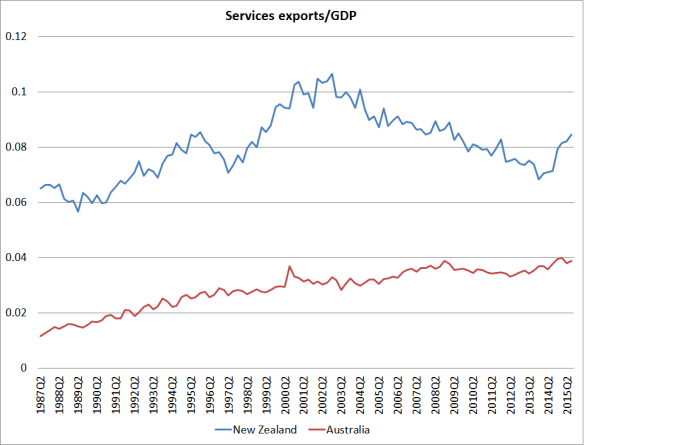
But lest anyone think Australia’s strong export performance is just about the resources sector, I found the chart comparing services exports in the two countries sobering (this reverts to nominal ratios to GDP because I couldn’t quickly find volume data for Australian services exports).  New Zealand –  the smaller country –  still has a higher foreign trade share of GDP.  But despite the way the terms of trade boosted the exchange rates in both countries (making for tough conditions for exporters of non commodity goods and services), services exports in Australia are now around the historic peak.  But in New Zealand –  despite the impressive surge in the last few quarters – services exports as a share of GDP are now barely 80 per cent of the previous peak.

services exports nz and aus

Not a particularly cheery note for the approaching Christmas season, but then in the church’s year it is still Advent, a solemn season of reflection, preparation, and self-examination.  So perhaps not so inappropriate after all.

Immigration is NOT causing poverty

I did an interview on Radio Live this morning on the economic impact of immigration.  When I went to listen to it afterwards, I found it was marketed under the heading “Immigration causing poverty”.  I’m not sure where they got that idea from what I’d said, but just to be clear my argument is that high rates of immigration to New Zealand over the last 60 or more years have worsened our overall economic performance. But even from my relatively pessimistic perspective, this is still one of the better off countries in the world.  And as readers will recognize, I reckon immigration, if anything, lowers unemployment rather than raises it –  ie puts more short-term pressure on demand than on supply.

In case anyone is interested, here is the link to the interview.

http://www.radiolive.co.nz/Immigration-causing-poverty—expert/tabid/506/articleID/110378/Default.aspx

UPDATE:  Thanks to Radio Live for changing the heading.