Spencer appointment still appears unlawful

Just a couple of days after the election, Graeme Wheeler’s term as Governor of the Reserve Bank expires and Wheeler will leave office.

In the normal course of events, a new appointment of a permanent Governor would long since have been made.   But as officials belatedly realised late last year, and as the Reserve Bank Board had eventually to be directed to recognise, a new permanent appointment of someone to take office in late September could not be made in the run-up to the election, without breaching the conventions that govern how the period around elections is handled.

I’d been drawing attention to the issue for 18 months or so, and had suggested that the practical solution would have been to have invited Wheeler to accept a short extension of his term, allowing whoever formed the new government after the election to make their own appointment.  We don’t know whether Wheeler wasn’t willing to consider that, or whether the Minister of Finance wasn’t, but there were no legal obstacles to such an extension.  And yet it didn’t happen.

Instead in early February, the Minister of Finance announced that he was appointing the existing Deputy Governor (and deputy chief executive) as acting Governor for six months after Wheeler’s departure.  Spencer in turn had indicated that he would not be seeking permanent appointment and would retire at the end of the acting Governor period.

There is provision in the Reserve Bank Act for an acting Governor in some circumstances.  Thus, when in 2002 Don Brash resigned in the middle of his term to enter politics, Deputy Governor Rod Carr was appointed as acting Governor for a few months.

But ever since the Spencer appointment was announced I’ve been raising questions about the legality of this appointment (I have no concerns at all about Spencer himself).   There was this post on the day the Spencer appointment was announced.   And then a later post outlining the argument in more detail.   The gist of the argument is that the wording of the Act appears to provide for an acting Governor only when a vacancy arises in the course of a Governor’s term (as happened in the Brash/Carr case), and not when a Governor’s term expires and the Minister decides, for whatever reason, not to make a permanent appointment for a time.  Not only do the words naturally lead to that interpretation, but the overall context (the way related bits of the Act are designed) suggests that that was indeed Parliament’s intention in using those words.

I lodged OIA requests with the Reserve Bank Board (responsible for recommending appointees), the Minister of Finance, and with The Treasury (principal advisers to the  Minister of Finance).   The Board’s response was both obstructive, and indicative of how badly they appear to be in breach of the Public Records Act.  But, as usual, the response from Treasury was much more helpful.   In this post, I outlined the considerable amount we learned about the process from the papers Treasury released.      But The Treasury withheld the advice they had received from Crown Law on the lawfulness of various aspects of the appointment, and there was not even any report of the Crown Law reasoning in any of the policy advice documents.

The protection of legal professional privilege is grounds for withholding documents under the Official Information Act, and is widely used by officials to keep the thrust of legal advice confidential.    But this ground for withholding, like several others, is subject to a caveat

unless, in the circumstances of the particular case, the withholding of that information is outweighed by other considerations which render it desirable, in the public interest, to make that information available.

The Ombudsman had relatively recently highlighted this provision, and on occasion had ordered the release of either the legal advice itself, or a full summary of that advice.  And so I appealed to the Ombudsman against Treasury’s decision to withhold the legal advice. I didn’t really expect to get the advice itself, but I wanted to understand the reasoning and argumentation Crown Law had provided in support of the Minister of Finance’s decision.  And since it involved an appointment to a position holding very considerable discretionary power in a number of policy areas, it seemed to me that it would be in the public interest to make at least a summary of the advice available.  After all, if there were doubts about that lawfulness of the appointment, that could undermine confidence in the Bank’s action, and its capacity (during the term of a purported acting Governor) to exercise (for example) its crisis management powers.

And, somewhat to my surprise, the system worked.  In a post at the time, in April, I lodged the appeal I noted

I suppose it will take some considerable time for the Ombudsman’s office to get to this request –  perhaps even after the acting Governor’s term has ended –  but with the possibility of reviews to the Reserve Bank Act governance provisions in the next couple of years, it would still be valuable for this advice and intepretation (in full or in summary) to be put in the public domain. This is, after all, about the appointment and accountability provisions for the most powerful unelected public office in New Zealand.

But last Friday the Ombudsman’s Office rang to inform me that after discussions between the Ombudsman and Treasury, Treasury had agreed to release a summary of the Crown Law advice.  The Ombudsman’s office assured me that, having seen all the orginal opinions themselves, it was a fair and representative summary of the advice.  Since I only ever really expected to obtain a summary of the advice, I agreed to discontinue my appeal for the full advice.  An hour or two later, the summary of the Crown Law office arrived in my email in-box.   Only five months after the original appeal was lodged, and before the (purported) acting Governor takes office.  I was impressed, and grateful that Treasury did not seek to drag the matter out longer (which they could have done).  I’m not sure why they changed stance, but perhaps they recognised that with the changeover only a couple of weeks away, there might well be further questions about the lawfulness of the appointment.  If so, it would be desirable to have the Crown case in the public domain.  Perhaps too they had noticed reports of Grant Robertson’s concerns about some of the Reserve Bank appointments this year (I’m not sure if he has concerns about lawfulness, but he might reasonably be disgruntled at not being consulted over the appointment of a very powerful public official to commence work on the third working day after the election). Spencer might be (purporting to be) acting, but in that role he would have all the discretionary policy powers of the Governor.

The document I received from The Treasury is here.

Crown Law summary advice re acting Governor Official Information Act Response – Michael Reddell (20170031)

Macroeconomists often don’t have much to do with lawyers and legal opinions.  But I’ve had more than more my share, both in various regulatory and markets role over the years, here and abroad, but also for the last nine years as a trustee of the (somewhat troubled) Reserve Bank staff superannuation scheme.   There are good lawyers and poor ones.  And even from decent lawyers there are good and persuasive opinions and poor ones too.   In just the last six weeks, I’ve read a very persuasive opinion on an issue where I was initially inclined to (and would have preferred) the opposite interpretation, and an opinion  –  the conclusion of which I was inclined to agree with –  where the reasoning left a great deal to be desired.     We’ve had cases where draft legal opinions have come back and we’ve had to point out that the lawyers have simply overlooked key considerations that seem relevant, and so on.

Ours is an adversarial legal system, where in each side of any particular case, there are lawyers arguing the interests of their clients.  Whatever the truth is –  whatever the final judicial decision is –  there is no particular reason to expect it to be captured in a single opinion from a lawyer arguing the interests of his or her client.  In this case, the Minister of Finance wanted to make an acting appointment, of Grant Spencer, and Crown Law’s advice appears (see those earlier documents linked to above) to have been sought quite late in the piece, to backfill a political and bureaucratic preference.   It is what in-house lawyers do –  and that is the role Crown Law serves.  Sometimes they will say “no you just can’t do that” but often enough they be casting around for a half-plausible interpretation to enable the client to do what they want to do anyway, perhaps especially when the risk of an actual court challenge is low.

Which is all by way of saying that I didn’t find the Crown Law reasoning persuasive.  I didn’t really expect to, but I was curious to see what arguments –  or precedents –  they would mount.    In fact, I was surprised by how thin and unconvincing their reasoning was.    I’m now more worried than ever that this major public appointment will be unlawful and, therefore, that real doubts will hang over the lawfulness of any Reserve Bank actions taken by the (purported) acting Governor during the next few months.

Crown Law notes, by reference to a couple of Supreme Court cases from last decade, that under the Interpretation Act 1999

The meaning of an enactment must be ascertained from its text and in the light of its purpose

As the Supreme Court noted,

even if the meaning of the text may appear plain in isolation of purpose that meaning should always be cross checked against purpose in order to observe the dual requirements

In this case, both the text and the purpose work in the same direction, towards the same interpretation.  And that interpretation isn’t the one Crown Law places on the relevant provisions of the Reserve Bank Act.  In fact it highlights the limitations of legal opinions when the lawyers concerned are not intimately familiar with the legislation concerned and with the policy purposes behind the relevant provisions.

Section 48 of the Reserve Bank Act allows the Minister, on the recommendation of the Board, to appoint an acting Governor

for a period not exceeding 6 months or for the remainder of the Governor’s term, whichever is less

The plain meaning of the text “in isolation” is that an acting Governor can be appointed if a vacancy arises during a Governor’s term, but not if the Minister and Board simply don’t appoint an acting Governor.  After all, on 27 September there is no “remainder” of any Governor’s term, and the relevant term limit is “whichever is less”.    There is no number of days –   let alone months –  less than zero.

Ah, but, argues Crown Law, “the scheme of Part 3 of the RBNZ Act indicates that there is to be a Governor at all times”.   This assertion governs much of the rest of their advice.  If there has to be a Governor at all times and a permanent appointment hasn’t been made, a temporary (acting) appointment must be able to be made, and “whichever is less” is of no account.

Actually, I’d agree that the Act envisages there being someone with the powers of  Governor at all times.  But the Act’s wording appears to be designed so that there can be an acting Governor –  if an unexpected vacancy arises during a Governor’s term –  wielding those powers, but that in the normal course of events it is up to the Board and the Minister to get on and make a substantive appointment so that a new Governor is in place at the end of the old Governor’s term.   There is no provision, express or implied, for the Minister and Governor to evade those expectations and restrictions.  (It might, in some cases, be desirable for there to be such provisions –  for exactly a case like this, where the election date falls near the end of the outgoing Governor’s term, but there isn’t.   Laws as passed are not always written in the way that, with hindsight, we might prefer.)

The Crown Law people appear to have realised that a key aspect of the Reserve Bank Act is operational autonomy in respect of monetary policy.  But they don’t seem to have appreciated –  they certainly don’t mention –  the explicit precautions Parliament took to prevent that autonomy being eroded through the appointments process.  Thus, any new Governor must be appointed for five years.    The initial appointment cannot be shorter, even if some superb candidate turned up and was only available for four years.  Without a restriction of that sort, it will have been reasoned, the Minister and the (Minister-appointed) Board could get together and appoint someone for six months or a year at a time, rolling over those appointments if appropriate depending on the extent to which the Governor heeded the Minister’s preferences.  It simply can’t be done, under the Act as it stands.  An existing Governor (but only he) can be extended for a short period, but of course that person will already (by construction) have served at least five years in office.

Thus, for Crown Law to be correct –  in claiming that the Minister and the Board are free to appoint an acting Governor for up to six months even when there is no remaining term to complete –  they are effectively arguing that one of the key provisions of the Act –  that specific five year initial term –  can be effectively subverted by a succession of six-month acting appointments.  These are extreme illustrative examples, but my point is not that this is what was intended by the Spencer appointment, but that it is what the law must allow if Crown Law is right.  Since the plain words and the purpose of the relevant provisions of the Act take us in the opposite direction, Crown Law simply must be wrong on this point.

I have also argued previously that there is no statutory provision for the signing of a Policy Targets Agreement between the Minister and an acting Governor.   That makes sense on my interpretation of the Act because on that interpretation, there can only be an acting Governor when an existing gubernatorial term has been unexpectedly interrupted.   Thus, a Policy Targets Agreement is signed “for that person’s term of office” (section 9) before a Governor is appointed.   And when Don Brash resigned his term still had another 17 months to run, and there was already a PTA in place for that term.  Thus when the Minister appointed Rod Carr to be acting Governor for a few months of that remaining term, there were already policy targets in place for the Bank, signed by the person whose term Carr was partially completing.      There is nothing comparable from 27 September this year, since the PTA Wheeler signed with Bill English in 2012 will have expired the previous day.

Crown Law attempts to get round this by asserting –  and it is simply an assertion  –  that  acting Governor “is the Governor”.  If he is the Governor, there must be a PTA signed with him before he is appointed.   But they offer no statutory support for this proposition (acting Governor “is” Governor).  After all, the Act talks of an acting Governor having the powers and responsibilities of the Governor, but still maintains a distinction between the two titles.   If there was no distinction, there would be no need for the acting Governor statutory provisions.  But Parliament chose to make such a distinction, and must have intended something thereby.    And it seems to  have done so because of the emphasis Parliament placed on having all actual gubernatorial appointments be for five years.    There is no provision in the Act for an acting Governor to sign a PTA, because the Act clearly envisages (literal wording and policy purpose) that an acting Governor would be appointed only during the unexpired portion of a term of a substantive Governor.

Anyway, you can read the summary of the Crown Law advice yourself.  Perhaps you’ll be persuaded.  I’m not.     It would appear that (a) an unlawful appointment is about to be (or has already been) made, and thus the Reserve Bank will have no lawful head after Graeme Wheeler leaves office on 26 September, and (b) that the document Grant Spencer and Steven Joyce signed on 7 June, which purports to be a Policy Targets Agreement under section 9 of the Reserve Bank Act is, in fact, no such thing.

If so, not only will the Bank have no lawful head on 27 September, it will have no Policy Targets Agreement to guide and constrain any monetary policy actions it takes, or purports to take, over the period from them until the new permanent Governor takes office.   Even if my interpretation were finally to be shown to be wrong in law, the fact that it is a plausible interpretation –  I would argue the most natural interpretation, consistent with the provisions of the Interpretation Act –  should raise serious concerns, and leaves some doubt hanging over the ability of the Bank to act effectively over the next few months.

Quite possibly, the Bank won’t need to do much in that time.  Markets don’t expect the OCR to change, and it doesn’t seem likely that debt to income limits will be imposed either.  But circumstances can change quickly.  We might have a new government in a couple of weeks, and the Labour Party has indicated a desire to have the Bank focus on unemployment as well as inflation.  A natural step in the early days of such a new government would have been to seek a change in the PTA to make that expectation explicit, pending a subsequent change in the Act.   But what, formally, is the status of the existing document, let alone any new one Grant Robertson might seek to put in place?  Can he override (section 12) a purported PTA which isn’t a real PTA?  (In any case, shouldn’t the Opposition have been consulted about the 7 June purported PTA, given that it was an action being taken, to come into effect after the election to shape the conduct of macro policy for the first six months of any post-election government’s term).

The sad thing about this whole episode is how unnecessary it was.  First, if Graeme Wheeler had been persuaded to stay for another six months, there would be no legal uncertainty whatever.  If that couldn’t happen, a simple one-off amendment could have been made to the Reserve Bank Act to allow for this specific acting appointment, with a sunset clause such that the provision lapsed next March.  At this point, neither option is possible – Wheeler is off to take up his directorships, and Parliament doesn’t sit before 27 September.   For the time being, we –  and institutions directly regulated by the Bank –  will simply have to live with the uncertainty, hope that no difficult decisions arise before a substantive appointment is made.  And perhaps the Minister –  whoever he or she is –  might need to be prepared to legislate quickly if circumstances should turn nasty and the need for greater certainty becomes apparent (one wouldn’t want the exercise of crisis management powers being tested through the courts for years to come).

It has been pointed out to me that section 51 of the Reserve Bank Act allows the Governor to delegate any of his functions and powers to the Deputy Chief Executive and

Any such delegation, until it is revoked, shall continue in force according to its tenor, notwithstanding that the Governor who made it may have ceased to hold office.

In principle, so it might be argued, since Spencer is now the Deputy Chief Executive, the outgoing Governor could delegate all his powers to Spencer as deputy chief executive, and such a delegation would continue to be valid even though the Governor who gave the delegation has ceased to hold office.

It is an interesting idea.  But according to Board minutes released to me previously, the Board has already recognised that from 27 September the other Deputy Governor, Geoff Bascand, will be the deputy chief executive, replacing Spencer –  who presumably would not then have those powers.

It is the sort of issue that would seem to need a good lawyer’s advice.    Can a delegation remain in force not just if the Governor who gave it is no longer in office, but if there is no Governor at all (and recall that the Act puts almost all the powers of the Bank in the hands of the Governor).

It is a mess.  And a quite unnecessary one, if only the process had been better managed by the Minister of Finance, the Reserve Bank Board, and The Treasury from the start.


(PS.  Incidentally, were Crown Law to be correct that an acting Governor had to have a new PTA before he or she could have been appointed, Michael Cullen and Rod Carr would have been in breach of the Act in 2002.   This isn’t compelling on its own –  people do make inadvertent mistakes – but it is illustrative as to how the relevant provisions of the Act have previously been read.)
 

Housing failure set to continue

I’ve long been sceptical that any government is likely to fix the housing market problems any decade soon.   Some of that was specific New Zealand points: National seemed to be doing almost nothing, Labour had done almost nothing when it was in government, and Labour seemed likely to rely on the anti-development Greens if and when it formed another government.    But most of the scepticism was – and is –  rather more overarching: no one has been able to show me a case study anywhere in the world where intense land use restrictions had once badly messed up a housing market, and where those controls had then been successfully unwound and housing made affordable again.   In principle, there was no reason why New Zealand should not have been first.  But the ages of pathbreaking New Zealand reforms  –  whether the 1890s or the 1980s –  seem well behind us at present.

It wasn’t a weekend that led my to revise my opinion.    In yesterday’s Sunday Star-Times Rob Stock had a piece reporting widespread scepticism about the claims that both Labour and National are making.  He began with both leaders’ reluctance to even call for lower house prices.  No one much seemed persuaded by the idea that nominal house prices might hold flat and incomes rise steadily to reduce price to income ratios.  On paper it could be a plausible story, but even if so it is a solution for the next generation not the current one.   And the article also reported a great deal of scepticism about the apparent Labour aspiration to introduce a lot more lower-priced homes without having much impact on the prices of existing dwellings.    The people Stock quoted seemed a bit more optimistic that –  despite the disavowals – Labour’s plans might actually lower house prices.   Fundamentally improve the land supply situation and perhaps that might be realistic.  Without that, government-sponsored builds seem likely to substantially displace private sector builds.

But then there were the policy cues.  Yesterday morning, National announced that, if re-elected, it would increase the subsidies offered to first-home buyers.  First-home buyer grants, in a supply-constrained market, are a policy so daft that I’m not aware of any serious analyst, from any side of the political/economic debate, who thinks they are a good idea (and Treasury and the Reserve Bank have opposed them).  New Zealand was mercifully free of such subsidies for most of its history –  and policy people used to look across the Tasman, slightly disdainfully, at the grants there.   First home buyer grants are, largely, an expensive way of getting house prices a bit higher than they otherwise would be.  And here that outcome is even more likely given the announced increases in accommodation supplement payments next year.   Renters will be able to pay a bit more (so investors can afford to pay a bit more), and potential first home buyers would now also be able to pay a bit more –  perhaps especially in provincial areas where the grant goes a bit further.  Since the policy is well-foreshadowed, most of the effects will have been compounded into prices before the first young couple can get their increased grant.  And, as so often, the winners will be the people selling out of the market –  those who already have.  It is the sort of policy that gets adopted when governments have given up on  believing that they might actually fix the underlying problems –  and/or given up believing that they can convince voters that they might.    Subsidies to home buyers –  rather than fixing the underlying problem –  is like some throwback to the early 1980s (actually the last time we had such direct first-home buyer subsidies).

The messages from the other side of politics weren’t much more encouraging.  The leader of the Opposition yesterday announced her plans for the first 100 days of a Labour government.  Housing appears on the list, but the three most specific items are

  • Pass the Healthy Homes Guarantee Bill, requiring all rentals to be warm and dry
  • Ban overseas speculators from buying existing houses
  • Issue an instruction to Housing New Zealand to stop the state house sell-off

Whatever you make of the Healthy Homes Guarantee Bill, it won’t improve the affordability of housing (if anything, rather than contrary for renters).  And stopping the sell-off of state houses might (or might not) make some sense, but again it won’t alter, by one iota, the affordability of housing in New Zealand.   And, in fairness, both are probably being done for other reasons.  And so the one specific thing they’ll pledge to pass by Christmas actually designed to improve housing affordability is the proposed ban on non-resident foreigners buying existing housing.  Consistent with this, on Labour’s website, the very first thing one comes to under housing policy is

Crack down on speculators


Ban foreign speculators from buying existing homes

Reasonable people can differ on the specifics of this (and other “anti-speculation” measures –  the extension of the bright-line test for investment properties, and ring-fencing).   To me, it has the much the same feel as that around first-home buyer grants –  it is the sort of policy one adopts when one has given up on dealing with the underlying problems.    Blaming “speculators”, for the symptoms of a rigged and dysfunctional market, is a distraction strategy from way back for politicians here and abroad.

Banning non-resident foreign purchases of existing houses isn’t the worst policy imaginable –  and any adverse impact on New Zealanders is likely to be small to non-existent – but as a flagship policy for a possible new government it is hardly one that suggests a serious focus on fixing the underlying long-term problems.  Sure, it is probably quite easy legislation to draft  (though no doubt MFAT officials will be turning their minds to the issue of how to reconcile the proposed ban with, eg, the New Zealand-Korea “free trade” agreement) and comprehensively fixing the planning system isn’t.  But after years in opposition, and with policies around land supply that look promising on paper, if they were really serious about far-reaching reform in this area, one might have hoped they’d have found something specific to have done in the first 100 days –  a stake in the ground, an earnest of a serious commitment to free-up land supply later in a first term.   But when the previous leader never mentioned the issue, the current leader never does, and when there is nothing in the 100 day action plan, I’ll stick with my scepticism for the time being.

Bloodless economists probably aren’t supposed to do disgust, but that pretty much summed up my reaction to the weekend story that, less than a year out of office, John Key had sold his Parnell property, at what is apparently a very substantial profit, to enable him and his wife to downsize.    No doubt it is mostly about “time of life” thing –  kids off their hands etc –  and I’m not suggesting that the National Party’s failure to do anything much about fixing the housing market problems for nine years was mostly about personal enrichment.     But this was a leader whose approach to the increasingly severe housing disaster was to glibly call it a “quality problem” or some sort of “sign of success”.  As I put it 18 months ago

In a speech to an Auckland business audience yesterday –  there is a report here, and also video footage –  the Prime Minister repeated his breezy claims that Auckland’s “challenges” around housing and transport are “a quality problem”, and a “sign of success”, and that both the city and the country are doing “incredibly well”.

Perhaps that is how it appears when you are already wealthy, live in a large house in a prime inner suburb, and have a taxpayer-provided chauffeur at your constant disposal.  Neither housing nor traffic problems must impinge terribly much.

And so, having moved on from public life, Key now extracts what is reported to be several million dollars of profits which are really just monopoly rents.  Keep the land supply market dysfunctional, boost the population considerably, allow house prices to be driven up to an extent that an ever-larger proportion of the young and the poor can’t afford to buy, and then simply take your own profits.   It is, in effect, money taken at the expense of the poor of Auckland –  not because any of them could afford Parnell, but because most of the increase in Parnell land prices is a reflection of the same common factor that has driven prices high across Auckland.  It is easy to be indifferent to a problem when you yourself benefit – even just passively –  from that continuing indifference.    The record, the policies, National is campaigning on today, including around housing and land, are more or less exactly the same as those of the first eight years of a National government, under John Key –  who has now cashed-out millions of dollars personally, made from his government’s refusal to fix the housing market.

Putting disgust aside and returning to the numbers, one often hears the current Prime Minister talking of 10000 houses a year now being built in Auckland, as if somehow this is the answer to the past policy failure.    It is often complemented by references to bureaucrats’ claims that tens of thousands of new houses are in the pipeline – I think I’ve even heard references to some multiples of Hamilton being built in the next few years.    (I’m not sure why we should be impressed by that figure, when New Zealand’s population is currently growing by as much as Hamilton every two years).

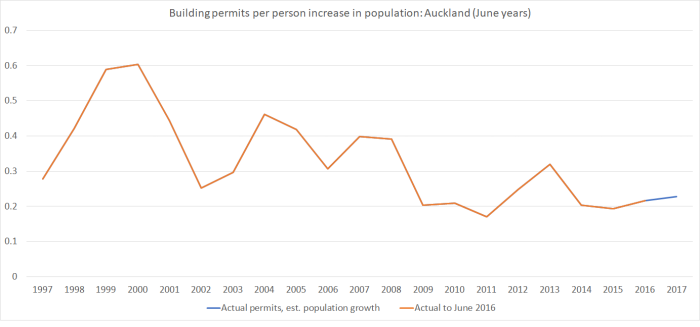
Of course, as Core Logic has pointed out, the actual increase in the housing stock is much less than the number of new dwellings being consented (many new builds require the demolition of existing houses), but even just focusing on building permits, is there any sign that the number of permits being granted in Auckland is getting ahead of the population growth?

The chart below uses official data.  It shows the number of building permits being granted in Auckland each (June) year relative to the (SNZ) estimated increased in the population over that same year.  Comparisons that look just at consents per capita are meaningless –  it is increases in the population that (are the biggest factor that) increase the need for accommodation.    The data are only annual, but for the year to June, so the actual building consents numbers are almost right up to date.    The population estimates for individual areas for June 2017 won’t be out until later next month.  But Auckland’s population is estimated by SNZ to have increased by 2.82 per cent in the year to June 2015 and by 2.83 per cent in the year to June 2016, and there has been no material change in net migration inflows over the most recent year.  So I’ve assumed a population increase in Auckland of another 2.82 per cent in the year to June 2017.   It is a rough estimate, but it would be surprising if the SNZ estimate next month was materially different.

building permits per person increase

So, yes, in annual terms, the number of building permits for new dwellings per person increase in the population has increased, but not by much.  But in the last two years, the rate of consenting has still been lower than in any year in the first decade of the data series.    It is unspectacular at best.  Sure, there is a lot of building going on right now, but then there are huge (government-abetted) increases in the population which don’t yet show any sign of abating.

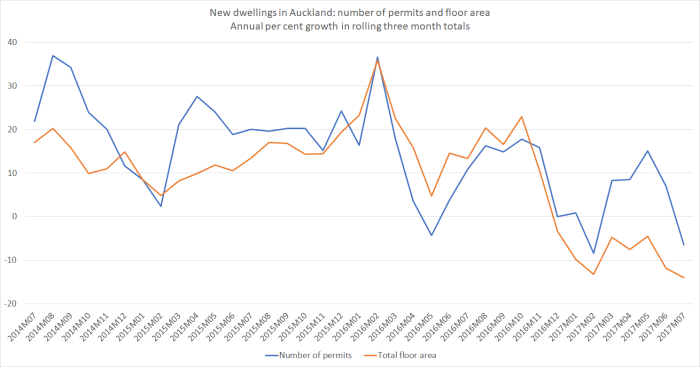
And if there is a lot of house-building activity going on at present, there are straws in the wind suggesting there will be less in future.  At a national level we’ve already seen some of that already in the building work put in place data released last week.  But here is a chart of Auckland new dwelling permits.  The data are noisy from month to month, so here I’ve taken the annual growth rate in the three-monthly total (eg May to July 2017 over May to July 2016) and shown the data for (a) the total number of new dwellings consented, and (b) for the total floor area of those consented new dwellings.

building permits 2

Both annual growth rates are now (a) well below where they were, and (b) actually are negative.  In other words, in annual terms the volume of new housing being consented in Auckland is dropping.  And there is no sign that the rate of population increase is.

Views will differ on whether these numbers reflect capacity constraints or the limits of effective demand at the prevailing (extremely high) prices.  My own bias tends towards the latter story –  and Rodney Dickens at SRA has done some analysis taking the same view.  But whichever story you think is more convincing, the numbers don’t suggest any near-term lift in the overall supply of houses relative to the increase in the population.  Taken together with the lack of much land-use regulation reform, it all provides little reason to think that housing affordability in our largest city is likely to improve much, or for long, on anything like current policies.  Meanwhile, the system will remain skewed to those who have, and against those who have not, and we can only expect yet more ad hoc measures –  whether from the elected government or outfits like the Reserve Bank –  to paper over the symptoms of housing market failure.


Eastern and central Europe, and us

Eastern and central Europe don’t get much coverage in the New Zealand media, or in New Zealand economic analysis.   But I’m intrigued by the region.    There are multiple levels to that –  religion, other dimensions of culture, battles in two world wars, decades of Soviet repression, and so on.   But what really plays on my mind is that these countries regained their freedom, and the hope that came with that, at much the same time that many senior and influential people here (and young economists like me) were convincing themselves that New Zealand had passed a turning point and our economic prospects really would be looking up.

Here there had been the famous jibe from David Lange, comparing New Zealand’s economy pre-1984 to a Polish shipyard.  At one level of course, it was a ridiculous claim, which trivialised the evils –  and rank inefficiency – of Communism.    But it had also captured something about the mood for change, partly in reaction to the plethora of controls the New Zealand economy had laboured under for decades.   Actually, New Zealand had been been liberalising for decades, but (generally) rather slowly and inconsistently.   And our living standards relative to those in other advanced countries had been dropping for several decades; the inefficiencies the heavy protectionism etc created were compounded by our worst terms of trade for a very long time.  Daft interventions like the Think Big energy projects just reinforced the sense of something having gone very wrong.

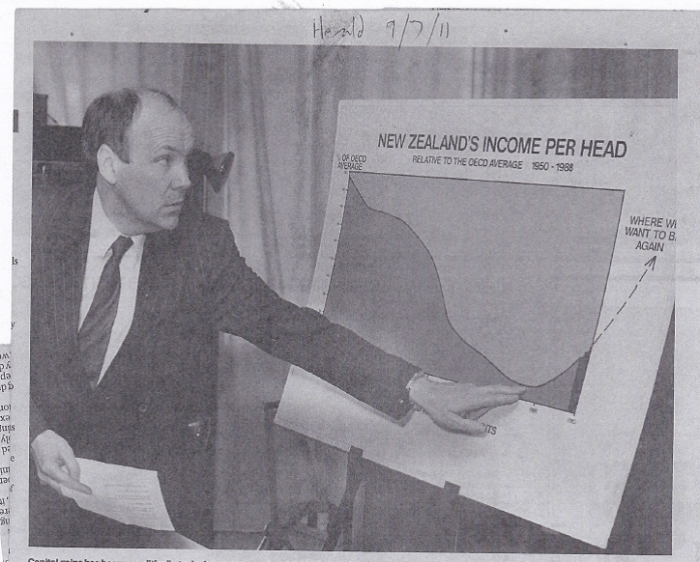
And so, over 10 years or so, there was a dramatic –  at times almost frenzied – period of far-reaching economic and institutional reform.  Much of it was admired –  even envied –  abroad, at least among the like-minded.   Outfits like the OECD and IMF praised the reforms, and typically had a few more to suggest, and there really was a belief that nothing much now stood in the way of reversing the decades of relative economic decline.  Productivity growth would, it was assumed, follow smart economic reforms much as night follows day.    There are some people from that era who will now dispute that anyone seriously expected that sort of improvement, but David Caygill was the (very capable) Minister of Finance, and here is how he illustrated the story.

caygill 1989 expectations

No sense there that the reforms –  which were extended further by his successors –  would simply slow our relative decline.

At the time, I was heavily involved in the Reserve Bank’s (small)  part in all this –  achieving and maintaining low and stable inflation.   Medium-term growth and productivity issues weren’t our focus, but a couple of colleagues –  including then deputy chief economist Arthur Grimes –  had been doing some work on exactly those issues.  Their findings were published in mid-1990.    Having established the nature of New Zealand’s relative decline, and identified some of the possible causes (including, in their view, past rapid population growth) they ended their article this way.

grimes smith text

And at around the same time, eastern and central Europe was regaining its freedom.  The Berlin Wall fell, democratic governments were elected in Poland and Czechoslovakia, the Baltic states regained independence, a place like Slovenia emerged peacefully from what was left of hitherto communist Yugoslavia and so on.    They were great days for the cause of human freedom.  But also of economic opportunity.   The former eastern bloc countries didn’t have identical economies, and it isn’t as if there hadn’t been economic progress even during the Communist years.  Some –  notably Hungary –  had started reform and economic liberalisation earlier than others.    But each of them had highly distorted economies, typically insecure property rights, and little in the way of a proper financial system.    Data from this period are pretty patchy – especially for the countries that had been part of other countries up until then – but these countries weren’t dirt-poor: the better of them probably had GDP per hour worked in 1990 similar to, say, that in Korea.    They were middle income countries.   Then again, as far as we can tell, in say the 80 years prior to World War Two none of them had ever been much better than middle income countries either.  Certainly, they’d nothing like the productivity, GDP per capita, or material living standards of New Zealand.

So if we go back 25 years or so, both in New Zealand and in eastern Europe those leading the economic reforms, and those running governments, had serious aspirations of catching up with the richer and more productive advanced countries.    Of course, the mess in eastern Europe was a whole lot bigger than the mess here.  In both countries, unwinding controls and protectionist structures involved short-term losses of output.  Those were moderate here, but savage in some of the eastern European countries.  But in both places there seemed to be great opportunities for catch-up and convergence.

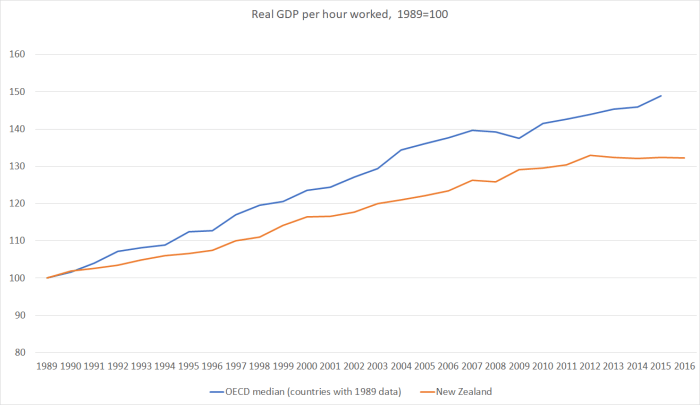
I illustrated the other day how poor our productivity performance has been relative to the other advanced OECD countries over that period.  From a starting point in 1989, productivity levels have slipped another 12 per cent further behind the median advanced OECD country.  In other words, no convergence has happened at all.  That has been so even over the last decade or so when productivity growth in the the “frontier” countries has itself slowed, which might have been an opportunity for some catch-up when we were starting so far behind.

But how do we compare with the eastern European countries?  Seven of them –  the Czech Republic, Estonia, Hungary, Latvia, Poland, Slovakia, and Slovenia –  are now in the OECD, and thus in the OECD statistical databases.  One other –  Lithuania –  isn’t in the OECD but has apparently reached data standards that mean the OECD is reporting their productivity data.   There are other countries not covered –  from Belarus or Moldova at the bleak extreme, to EU countries such as Bulgaria, Romania (which I wrote about here), and Croatia at the other.    There is good data for some of them in other databases, but for today I just wanted to use the same OECD database Steven Joyce was using the other day in talking up New Zealand’s performance.

The OECD data on real GDP per hour worked for these countries starts in various years during the 1990s.  2000 is the first year for which there is data on all eight eastern European countries.  In a way, it is a shame not to be able to start from the late 1980s, as I did in comparing us with the more advanced OECD countries.  On the other hand, by 2000 the worst of the immediate post-communist disruption was well behind these countries (as the initial output losses in our own structural reforms were behind us).    Sixteen years since 2000 (annual data is available to 2016) is a reasonable run of time to see how we’ve done relative to them –  and neither the initial year nor the most recent year is muddied by recessions or financial crises.   Each country has had a recession during this period, and in some cases they were pretty wrenching adjustments, involving IMF support.

Here is the cumulative real productivity growth for each of those countries, and New Zealand, since 2000.

eastern europe 1

The country with the slowest growth – Slovenia –  managed twice the productivity growth of New Zealand over this period, and the OECD estimates suggest that the level of productivity in Slovenia –  30 years ago a province of a communist non-market country –  is now approximately equal to that in New Zealand.

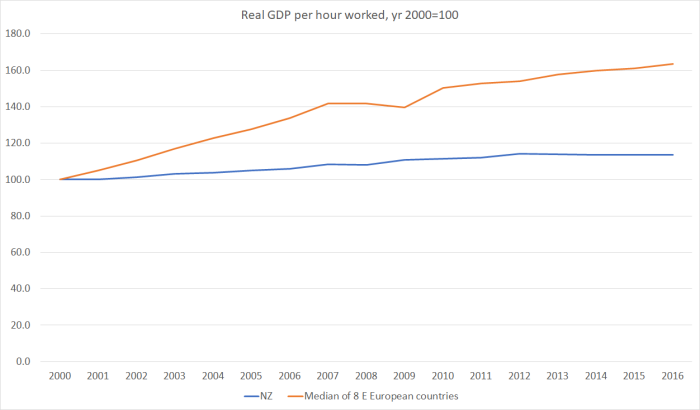
And here is the time series: the level of productivity in each country is indexed to 100 in 2000 and then I’ve taken a median of the eight eastern European countries.

easetern europe 6

You can see that the downturn in 2008/09 was much more severe for many of these countries (especially the ones running semi-fixed or hard-fixed exchange rates).

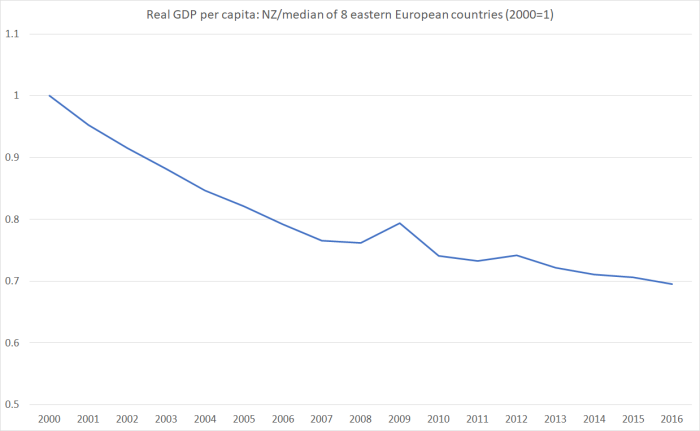
And here is the ratio of those two series.

eastern europe 3.png

Our rate of decline, relative to the eastern European countries, might slowed a little in the last decade, but there is no sign of things levelling out.

And if defenders of New Zealand’s performance want to argue something along the lines of ‘well, they are still poorer and less productive than New Zealand, so they should be achieving faster productivity growth than we are’,   well we are a great deal less productive than the median advanced OECD country, and yet we’ve not managed to achieve faster productivity growth than them.

In fact, here is a chart showing OECD estimates of the 2015 level of real GDP per hour worked, converted at PPP exchange rates, for the eight eastern and central European countries,  for New Zealand, and for four of the big higher-productivity OECD countries.

eastern europe 4

These days, our productivity levels look a lot more like those of the eastern and central European countries than of the OECD leaders (and Norway and Luxembourg and –  questionably –  Ireland are well above even those countries’ numbers).

At about this point, people often start saying “well, of course…those eastern European countries are close to the industrial centres of western Europe, and have been able to be attract foreign investment in manufacturing and become extensively integrated into the value chains associated with modern manufacturing”.

To which my response is along the lines of “well, yes, that is my point about New Zealand”.  We are poorly located –  for anything other than not being overrun by German or Soviet armies – and not many firms seem to have been able to develop substantial (unsubsidised) businesses selling internationally competitive products and services from here, based on anything other than our (fixed) natural resources.

Which is why it has come to seem so odd that we, as a matter of public policy, are aggressively trying to grow our population –  issuing 45000 residence approvals a year, three times the per capita rate of the US.  In doing so, we simply make it harder for ourselves to prosper here.

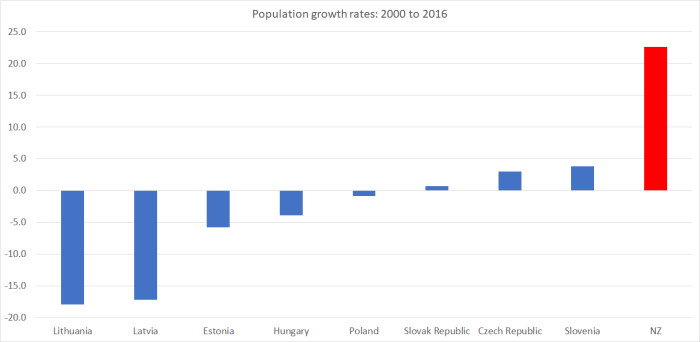
In fact, here are the population growth rates of the eastern European countries and of New Zealand since 2000.

eastern europe 5

I don’t think I’d be too keen on living next door to revanchist Russia.  But the five non-Baltic states here are firmly ensconced in central Europe, and over the last 16 years they’ve had an average of zero population growth, while our population has grown by almost 23 per cent.

Countries like that don’t have to devote huge shares of available resources (capital and labour) simply to keeping with the infrastructure needs of a rapidly rising population.    That, in turn, keeps pressure off domestic costs, and keeps the real exchange rate lower than otherwise. Combined with more favourable locations, lower company tax rates (in most cases) and (the perhaps mixed blessing of) EU membership, they’ve been able to lift productivity and living standards for their people in a way that has had no parallel in recent decades in New Zealand.     On typical institutional metrics like ease of doing business and corruption perceptions we score well ahead of any of those countries.  We don’t need marches in the street to protect the independence of the judiciary (as in Poland).  And our people do well on international skills comparisons.  But it isn’t enough if one draws too many people into an unpropitious location.

Until we face up to the evident limitations of our location, and the absurdity of actively importing so many people from abroad into such a difficult location, it is difficult to believe that our underperformance, that has now stretched out over almost 70 years, will even begin to be reversed.    For most of modern New Zealand history, France and Germany and the Netherlands had lower labour productivity than New Zealand did.  Now they are far ahead. Slovakia is already passing us, and it seems reasonable to think that if we and they keep doing the same things we’ve been doing for the last 20 years,  Slovenia and the Czech Republic will also go past us in the next decade.    That’s good for them.  I don’t begrudge their success –  the fruits of freedom and decent policy, in the context of a good location – but what about us?

Here we have one main party that wants to pretend that productivity growth is just fine –  simply ignoring the data.   And another which recognises and is now highlighting the problem –  I was seriously encouraged to see Jacinda Ardern making the “flat-lining at best” point about productivity in last night’s debate –  but doesn’t seem to have seriously engaged with what might produce significantly better and different outcomes in the future.   The scary thing is that if their roles were reversed, Labour might well be pretending there wasn’t a problem, while National still wouldn’t be offering much of a serious solution.   And so, from the apparent refusal of either main party to really confront the presenting symptoms and attempt a serious diagnosis of what has been going on, we seem doomed to slip slowly ever further down the league tables.    There are always many useful reforms to be considered.  But, foremost, we need to markedly cut back that 45000 residence approvals target, and then back our own able people to make the most of the natural resources we have, in the face of the real and –  on curent technology ineradicable – severe disadvantages of our location.


The big projected deficits in 2008

As part of the current political debate about the relative capability of the two main parties to manage the government finances responsibly, I sometimes see references to the large deficit forecasts that greeted the incoming National government in 2008.

I wrote about this issue a few months ago, in response to some specific claims made by one analyst at the time.  I’m reproducing the bulk of that post below (not indented).  My bottom line, supported with documentation is

But on best Treasury advice, the then Labour government thought they were leaving an essentially balanced budget [ie the 2008 Budget, their final fiscal policy choices], on top of an already very low debt level, not deficits.

It is certainly true that when the current government took office in November 2008, official fiscal forecasts showed large deficits for many years into the future.  But the last fiscal initiatives of the outgoing Labour government had been the 2008 Budget, the parameters for which were set out in the Budget Policy Statement released at the end of 2007.

Throughout much of the previous Labour government’s term of office, a key theme of fiscal policy developments had been the surprising strength in revenue.  It was, in many respects, why the fiscal surpluses were so large during those years –   Treasury and the government kept being taken by surprise, and Treasury was (prudently) cautious about treating the surprises as permanent.  If it was just a series of one-offs, or something cyclical, it wouldn’t have made sense to increase spending or cut taxes in response.

The Treasury gradually revised upwards their assessment of the underlying fiscal position.  Unfortunately, they took a particularly optimistic stance by the end of 2007.  I can recall the then Prime Minister making much of the fact that Treasury was now assuming that most of the revenue gains would prove permanent (and thus could support some mix of increased spending and lower tax rates) without the risk of dropping back into deficits.  I joined Treasury on secondment in mid-2008 and I have seen documents written to the Minister of Finance during early 2008 stating that reassessment.  I was under the impression that some had been released, perhaps as part of the pro-active release of 2008 Budget papers, but on checking that link on the Treasury website, I couldn’t see the paper in question.

But the facts of the reassessment aren’t in dispute.  Several Treasury staff produced a paper last year on the process of getting back to surplus, including the background to the deficits.  Here is what they had to say

Over the period 2005-2008, the Treasury increased its estimates of structural revenues by around 1 percentage point of GDP each year, and by 2008 the Treasury considered most of the operating surplus was “structural”

and

When the tax reductions [along with further spending increases] were announced in Budget 2008, the Treasury was still predicting the operating balance to remain in surplus through the forecast period, albeit at a lower level.

With the benefit of hindsight, the degree to which the surpluses were structural was overestimated. Although the tax reductions announced in 2008 turned out to be well-timed from the perspective of stabilising the economy following the GFC, their permanent nature added to the subsequent structural deficits.

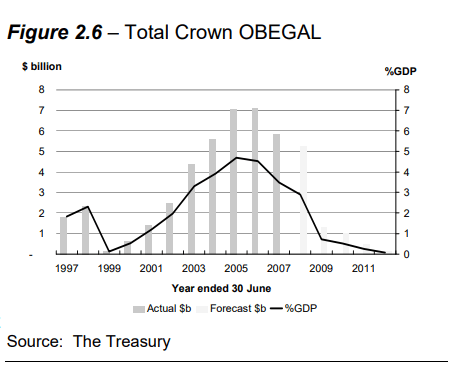
Here is the chart from the 2008 Budget Economic and Fiscal Update.

2008 Budget forecast obegal

That document was signed off  by the Secretary to the Treasury as representing his best professional assessment of the economic and fiscal outlook, incorporating the effects of announced government policy.  In New Zealand –  unlike many countries – the forecasts are those of the professional advisers, not those of the Minister of Finance.

On the basis of the economic and fiscal information available to it, the Treasury has used its best professional judgement in supplying the Minister of Finance with this Economic and Fiscal Update. The Update incorporates the fiscal and economic implications both of Government decisions and circumstances as at 9 May 2008 that were communicated to me, and of other economic and fiscal information available to the Treasury in accordance with the provisions of the Public Finance Act 1989.

John Whitehead
Secretary to the Treasury

14 May 2008

The projected surpluses by the end of the forecast period were tiny –  essentially the budget was projected to be in balance by then.  The economic and revenue outlook had worsened over the first few months of 2008, after the broad parameters of the Budget had already been sketched out in the BPS.   As we now know, New Zealand was already in recession by May 2008.   But on best Treasury advice, the then Labour government thought they were leaving an essentially balanced budget, on top of an already very low debt level, not deficits.

Of course, the government was wrong in that assumption.  But, specifically, Treasury was wrong in its best professional advice.    Perhaps the government would have run quite expansionary discretionary fiscal policy anyway, even if Treasury had been less optimistic about how permanent the revenue was.  They were, after all, behind in the polls, and the PM’s office –  didn’t Grant Robertson work there? –  would no doubt have been putting a lot of pressure on the Minister of Finance.  But that hypothetical didn’t arise.    They didn’t have to make such awkward political choices –  their own professional advisers told them they could have tax cuts and spending increases, and still keep the budget in (modest) surplus.  The Opposition National Party shaped its, more generous, tax cutting promises on much the same sort of Treasury forecasts and estimates.  (And a few years earlier, the 2005 election had partly been a bidding war as to how best to spend the surplus –  not whether there really was a structural surplus).

It wasn’t Treasury at its finest.  It is, perhaps, a reason to be cautious about just how much a fiscal council might add.   Would such a body, faced with similar circumstances –  a long succession of revisions upwards in revenue –  have really reached materially different judgements about the outlook then?  Perhaps.  We can’t know, but back in 2008 Treasury was using its best professional judgement, and the mistakes were still made.

There is a bit of a tendency afoot to suggest that the current National-led government has done a better job of fiscal management than the previous Labour government did.  I’m not really convinced by that story.   I’d accept that the previous government might have had an easier job than the current government has –  since one inherited modest but growing surpluses, while the other inherited deficits.  The current government had some nasty shocks (earthquakes) but also some of the best terms of trade in decades and the weakest wage pressures.      But if we expect our politicians to be guided by professional advice in areas like this, the previous government did what most orthodox opinion advised them to, keeping on delivering surpluses and reducing outstanding debt.  Probably they should have emphasised tax cuts more than spending increases, but this particular debate is about overall fiscal balances.

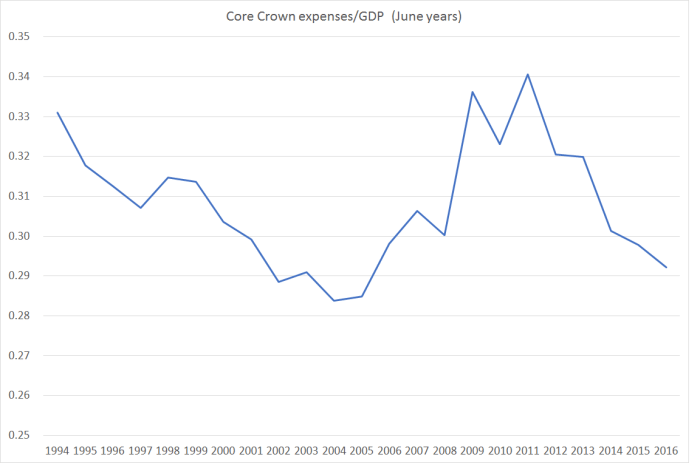
By the end of Labour’s term, government spending as a share of GDP was rising a lot –  but then Treasury was telling the government the money was there to spend.  And for all the talk of how the new Labour/Greens rules commit a new left-wing government to keep spending at around current National government levels, that level is around the average level that prevailed under the previous Labour government.

core crown expenses

There are things I’d criticise about the previous government’s policy. Allowing big structural surpluses to build up, as happened in the first half of the term, set the scene for a big spend-up later (which would have been big tax cuts if National had won in 2005). It is probably better to recognise the limitations of knowledge and typically keep both surpluses and deficits small. But it is easier to say in hindsight than it might have been at the time.  And in 1999 [when Labour had come to office], the severe fiscal stresses of 1990/91 were pretty fresh in everyone’s memory.

Tougher than Ruth Richardson?: implausible spending numbers

An overnight commenter on yesterday’s fiscal post made this suggestion

I wonder if some improvement in the PREFU could help. As you say, the Health budget has been increasing by $6-700m for the last couple of years, but is forecast to change by only minor amounts in future years. No one seriously believes that do they? Why not have assumptions for GDP, population, inflation, interest rates, demographics etc included in the PREFU numbers (maybe they are), and adjust the future years costs/incomes accordingly. So rather than having flat-lining health numbers, adjust for population, (health) inflation, demographics etc. I would hope that this would allow us to get a better sense of how promises stack up relative to a ‘normal’ expectation of what might happen. If someone wants to ‘deliver a modern health system’, but they aren’t going to increase the health budget, at least it would hopefully be apparent.

It may be far from perfect, but should at least be a bit more realistic?

I have a lot of sympathy with what the commenter suggests.  It is, more or less, what Treasury already do for the medium-term fiscal projections (beyond the four year budget window), and it wouldn’t be hard for them –  or an independent Fiscal Council –  to do something similar for the four years of the PREFU numbers (in addition to what is done now, rather than in substitution).   The numbers would be illustrative, and one might need to provide some ready reckoners to allow for different assumptions, but illustrative scenarios can still help to illuminate debate.

In that spirit, how would one look at the Health budget?   As I noted yesterday, in Labour’s fiscal plan they expect to spend $2361 million more on health in 2020/21 than the (basically flat) PREFU numbers.  To be clear, those PREFU numbers do not reflect what a re-elected National government would expect to spend; they just reflect what has already been allocated.

The Labour Party has claimed that their numbers allow for cost increases that would result from continuing inflation and population growth, as well as making provision for the various policy measures they have promised.    In the plan document they summarise this as

Reverse National’s health cuts and begin the process of making up for the years of underfunding that have occurred. This extra funding will allow us to invest in mental health services, reduce the cost of going to the doctor, carry out more operations, provide the latest medicines, invest in Māori health initiatives including supporting Whānau Ora, and start the rebuild of Dunedin Hospital.

The language suggests quite a lot more of an increase in spending than would be implied simply by inflation and population increases from here.

As it happens, we do have some insight as to how they think those inflation and population pressures should be allowed for.  After yesterday’s post a commenter sent me a link to a June 2017 press release from then-leader Andrew Little, which in turn linked to some work Infometrics had been commissioned to do for Labour on whether health spending had kept up with inflation and population pressures over the term of the current government.    In the tables in that short piece of work, Infometrics use CPI inflation and they allow for demographics pressures (ie the combination of an ageing population and a growing population) using (a) actual population growth and (b) some Treasury numbers that weight the population by its demand for health services.  With an ageing population that seems to lead to a demographic increase in demand for health services about half a percentage point higher than the population growth rate  (a bit more in years of low immigration – migrants on average are younger and have less short-term demand for health services).

If we take the Treasury projections for CPI inflation and population increase (from the PREFU), and apply the same sort of ageing population factor that Treasury and Infometrics have previously used, this is what we get.

CPI Inflation – Tsy forecast Population % increase –  Tsy forecast Total demographic % increase Implied % increase in health budget to keep pace $m increase
2018/19 1.7 1.5 2 3.7 608
2019/20 2.1 1.3 1.8 3.9 665
2020/21 2.1 1.1 1.6 3.7 655

If this approach is roughly right, the health budget (total Crown basis) would have to increase from the PREFU estimate for 2017/18 of $16432 million to $18360 million by 2020/21 just to keep pace with inflation and demographic pressures that are expected/forecast but haven’t yet happened.  In Labour’s fiscal plan, they expect to spent $18757 million on health in 2020/21.

On this basis – a methodology we know they used quite recently –  there is some margin between the expected (fiscal plan) numbers and those required simply to keep pace with future cost pressures.  That margin is $397 million in 2020/21.    But they argue –  the numbers are in the tables – that the health budget has been underfunded just for cost and demographic pressures during the term of this government to the tune now of almost $300 million per annum, and if one goes to their Health policy the first additional specific policy promise –  around GP fees – is itself estimated to cost $259 million a year, starting next year.  (Of course, National has made a similar promise in this area.)   It looks likely to be very difficult to deliver all those promises, and cover the basic inflation and demographic cost pressures, within that $18757 million.      That isn’t really surprising because, as I illustrated yesterday, the numbers suggest that health spending as a share of GDP won’t be changing –  and will be lower than it has been for most of the last decade.

Labour health

My actual interest in health policy and the health budget is quite limited (although my wife tells me I’m getting old and so should be more interested), but it is worth noting that Infometrics (and Labour apparently) used CPI inflation as a measure of the cost pressures. Ideally, one would want to use a specific index relating to health system costs.  I’m not aware that we have one in New Zealand –  certainly not one widely available –  but I did have a quick look at the CPI components data.

% increase since 08/09
CPI 13.2
Dental services 27.9
Paramedical services 29.1
Hospital services 32.3

Perhaps there might be some reason to worry that the CPI understates health inflation pressures (although it is true that the item “therapeutic appliances and equipment” –  one of those low inflation tradables – increased by only 2.6 per cent).    Even 1 percentage point more health inflation in total over three years would make considerable inroads into the margin Labour seems to have to deliver more medical services (or the same ones at cheaper prices to users).

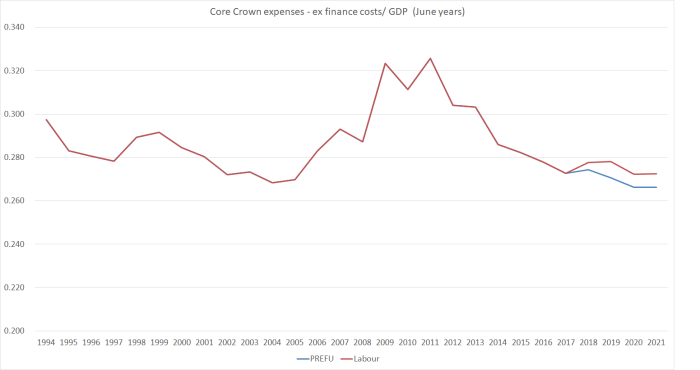
In a sense, my larger point in yesterday’s post was about how plausible it is to expect to see government operating expenditure falling further as a share of GDP.  That is what both parties are promising.     Here is a chart of core Crown spending as a share of GDP, stripping out finance costs, and simply looking at the things governments are purchasing and the transfers they are making.

core crown spending 17 election

The data only go back, in this form, to around 1994.  But government spending as a share of GDP –  again excluding finance costs – hadn’t been any lower than shown in this chart (and was mostly higher) in the previous 20 years.

So the National Party’s proposed spending numbers would be smaller as a share of GDP than at any time in the last 40 years, and Labour’s would be smaller than at any time except for two years in the last Labour government that were (a) only very slightly lower, and (b) proved unsustainable, with big increases in spending over the following few years.  Grant Robertson and Steven Joyce: both tougher than Ruth Richardson.

A small government person might well look at these numbers with pleasure, and assume that the government was getting out of whole areas and handing responsibility back to citizens. I recall discussions with the late Roger Kerr who talked of how an advanced economy could have a basic safety net welfare state and still keep spending perhaps 10 percentage points lower than shown in this chart.     But he didn’t have in mind, for example, relentless increases in the share of GDP devoted to NZS (as both parties promise for the next two decades).    Or moves towards fee-free tertiary education.  Or real increases in welfare benefit rates.  Or……

If we compare what the state was spending on things 10 or 12 years ago and what either main party wants to spend on things over the next few years (Labour more than National of course, but in historical perspective the differences are small), how credible is it that the spending share of GDP will be able to be held so low?  Yes, the burden of some spending programmes has been wound back, but it isn’t easy to think of things the state has simply decided to stop doing, and it easy to see areas (in the current electoral auction) where there is pressure to do more.     And it is not as if, in recent years, productivity gains (non-existent for five years now) have been giving us “free lunches”.

I’m not taking a view here on what the appropriate level of spending (or taxes) should be.  My own biases would be to lower both selectively (but also run smaller surpluses).  It is simply a point about the realism of the numbers both parties are campaigning on, given what they say they want to be able to deliver.

But I am still a bit perplexed, as I said yesterday, about why an opposition party campaigning against serious sustained underfunding in various key areas of government spending, and wanting to do some big new things, would also be campaigning on cutting government spending as a share of GDP –  just smaller cuts than the current governing party is promising.   Perhaps it would make some sense (economically) if we were in some sort of fiscal or debt crisis –  all those debates in the UK about the appropriate pace of “austerity” –  but we aren’t.    Net core Crown debt (properly measured) in the last financial year was 9.2 per cent of GDP.    Quite what the political imperative, or the economic narrative, is for further reductions from there is a bit beyond me.

Thoughts prompted by Joyce vs Robertson

If Steven Joyce had simply noted that the Labour Party appears to have made so many specific policy promises that if they were to form the next government it would be very hard to deliver on those specific policy commitments, meet ongoing increases in the cost of normal government activities, and yet at the same time meet the specific spending, surplus, and debt numbers they’ve outlined in their fiscal plan, a useful and constructive exchange might well have followed.  My summary stance: I think that looks like a reasonable conclusion.  How much it matters probably depends largely on how much weight you put on the importance of those surplus and debt numbers.

I didn’t read the Labour fiscal plan when it was released.  The specific policy promises had already been announced and in an MMP era, in particular, documents of this sort always seem like not much more than opening offers going into potential negotiations around the formation, and conduct, of a new government.    They also involve a degree of ritual obeisance to the belief that economic forecasts have much value; a ritual belief that while entirely conventional leaves me cold (whether opposition parties or government agencies are doing it).

None of us knows what the terms of trade will do over the next few years, or net migration, or the myriad of other things here and abroad that will affect the economic and fiscal outlook.  Even the rate of inflation will affect how large the operating allowance should sensibly be each year (since it is nominal –  and cost pressures will be different if the Reserve Bank delivers inflation at 1.2% than if it delivers 2.2% inflation).   Of course, we want specific promises to be costed, and on a multi-year basis.  But this debate hasn’t been about specific policy costings.  And beyond that, the amount of information in these documents is really quite limited.   Among other things, Labour’s numbers use exactly the same GDP track as in the PREFU, but presumably they expect their wider economic policy measures to make some difference to that (eg somewhat less immigration  –  at least in the first year –  and perhaps appointing a Reserve Bank Governor who might generate a bit less unemployment and a bit more inflation –  two measures deliberately used here because they have offsetting effects on nominal GDP).

But, for now, lets play the game.

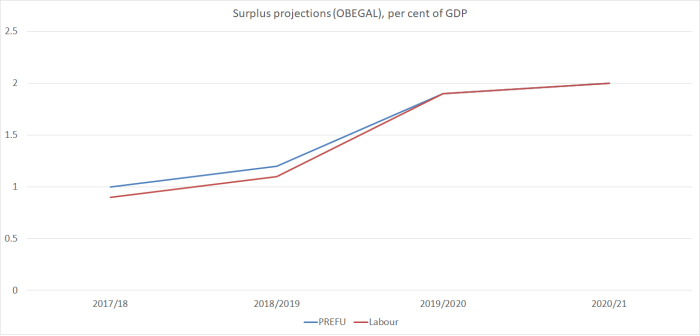
Labour has laid out their numbers in a series of summary tables.  They have explicitly identified numbers for each of their (revenue and expenditure) major policy initiatives, and made explicit summary provision for the cost of a group of less expensive policies.  And they identified how much (or little) still unallocated money they would plan to have available.   The resulting operating surplus numbers are almost identical to those in PREFU, but where they do take on a bit more debt –  to fund NZSF contributions and the Kiwibuild programme – they also allow for additional financing costs.

And then they had BERL go through the numbers.    People on the right are inclined to scoff at BERL and note that they are ideologically inclined to the left.  No doubt.  But all they’ve done on this occasion is a fairly narrow technical exercise.  They haven’t taken a view on the merits of any specific policy promises or even (as far I can see) on the line item costings Labour uses.  And they haven’t taken a view on the ability of a Labour-led government to control spending more broadly.   They’ve taken the Labour numbers, and the PREFU economic assumptions and spending/revenue baselines, and checked that when Labour’s spending and revenue assumptions are added into that mix that the bottom line numbers are

consistent with their stated Budget Responsibility Rules and, in particular

  • The OBEGAL remains in surplus throughout the period to 2022
  • Net Core Crown debt is reduced to 20% of GDP by June 2022
  • Core Crown expenses remain comfortably under 30% throughout the period to 2022.

An economics consultancy with a right wing orientation would have happily signed off on the same conclusion.  The numbers add up, on the material they were given.  In that sense, there is no $11.7 billion “fiscal hole” and the opening claim by Steven Joyce on Monday was simply wrong.   Arguably, irresponsibly so from a serving Minister of Finance.

But where there is more of an issue is that Labour’s spending plans on the things they are promising mean that to meet these surplus and debt objectives, on these macro numbers, there is very little new money left over in the next few years.     That might not sound like a problem –  after all, why do they need much “new money” in the next few years when the things they want to do are already specifically identified and included in the allocated money in the Labour fiscal plan.      The answer to that reflects the specifics of how the fiscal numbers are laid out, and how fiscal management is done.   Government departments do not get routine adjustments to their future spending allowances to cope with, say, the rising demands for a rising population, or the increased costs from ongoing inflation (recall that the target is 2 per cent inflation annually).   Rather, they are given a number to manage to, and only when the pips really start squeaking might a discretionary adjustment to the department’s baseline spending be made.  Any such discretionary adjustments comes from the “operating allowance” –  which thus isn’t just available for new policies.

You can see in the PREFU numbers.   Health spending rose around $600 million last year, and is budgeted to rise by around $700 million this year (2017/18).  And then….

$m
2017/18 16432
2018/19 16449
2019/20 16481
2020/21 16396

No one expects health spending to remain constant in nominal terms for the next three fiscal years.  But there will need to be conscious decisions made in each successive Budget to allocate some of the operating allowance to health –  some presumably to cover new policies, and much to cover cost increases (wages, drugs, property etc, and more people), all offset by whatever productivity gains the sector can generate.

And here is why I think there are questions about Labour’s numbers.  By 2021, they expect to be spending $2361 million more on health than is reflected in these PREFU numbers.     About 10 per cent of that increase is described as “Paying back National’s underfunding” and the rest is labelled as “Delivering a Modern Health System”.

This is how they describe their first term health policies

Reverse National’s health cuts and begin the process of making up for the years of underfunding that have occurred. This extra funding will allow us to invest in mental health services, reduce the cost of going to the doctor, carry out more operations, provide the latest medicines, invest in Māori health initiatives including supporting Whānau Ora, and start the rebuild of Dunedin Hospital.

That sounds like an intention to deliver materially more health outputs/outcomes (ie volume gains, or reduced prices to users).

In response to Steven Joyce’s attack, Grant Robertson is reported as having told several journalists that Labour’s health (and education) numbers include allowances for increased costs (eg rising population and inflation  –  and inflation in the PREFU is forecast to pick up) as well as the costs of the new initiatives.   Perhaps, and if so perhaps a pardonable effort to put a favourable gloss on the proposed health (and education) spends –  ie sell as new initiatives what are in significant part really just keeping with cost and population pressures.  I say “pardonable” because governments do it all the time.

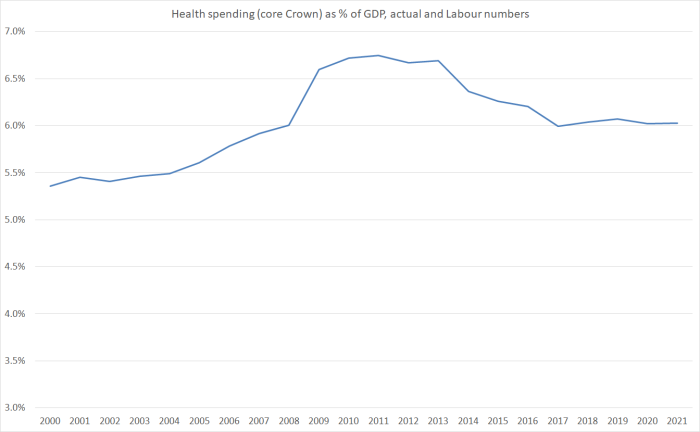
In this chart, I’ve shown core Crown health expenditure as a share of GDP since 2000, and including Labour’s plans for the next three budgets.  (Labour show total Crown numbers, but I’ve taken their policy initiative numbers –  ie changes from PREFU –  and applied them to the core Crown data, which Treasury has a readily accessible time series for.  The differences between core and total Crown in this sector are small.)

Labour health

In other words, on these numbers health as a share of GDP over the next three years would be less than it was for most of the current government’s term, and virtually identical to what it was in Labour’s last full year in government, 2007/08.    Some of the peaks a few years ago were understandable –  the economy was weak, and recessions don’t reduce health spending demands.  But even so, we know that there are strong pressures for the health share of GDP to increase, as a result of improving technology (more options) and an ageing population.  Treasury’s “historical spending patterns” analysis in their Long-term Fiscal Statement last year had health spending rising from 6.2 per cent of GDP in 2015 to 6.8 per cent in 2030.

Without seeing more detail than Labour has released there really only seem to be two possible interpretations.  Either Labour hasn’t allowed for the ongoing (ie from here) population and cost increases in their health sector spending numbers, or there must be much less in the way of increases in health outputs than the documents seem to want to have us believe (eg “reversing years of underfunding”).  One has potential fiscal implications.  The other perhaps political ones.    Glancing through Labour’s health policy, which seems quite specific, I’m more inclined to the former possibility (ie not allowing for population and cost pressures), but I’d be happy to shown otherwise.

Eyeballing that chart –  and as someone with no expertise in health –  it would look more reasonable to expect that health spending might be more like 6.5 per cent of GDP by the end of the decade, in a climate where a party is promising more stuff not less, and with no strategy to (say) shift more of the burden back onto upper income citizens.

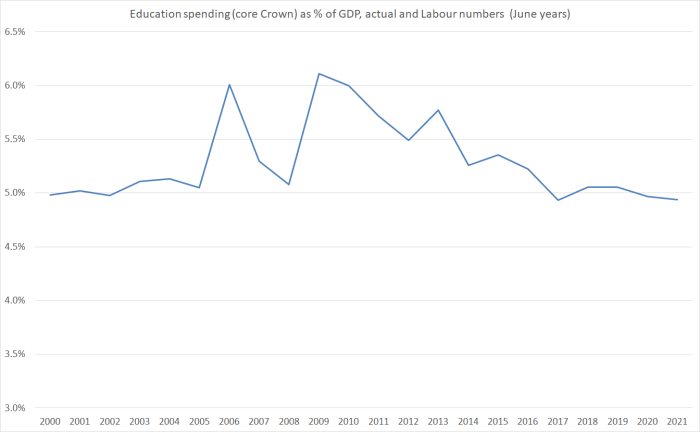
One could do much the same exercise for education.  Labour has seven line items in its “new investments” table.  Most of them are very specific (including increased student allowances and the transitions towards zero-fees tertiary education).     There is a general (large) item labelled “Delivering a Modern Education System” but in the manifesto there are a lot of things that look like they are covered by that.    There isn’t any suggestion that general inflation and population cost increases are included, but perhaps they are.  But again, here is the chart of education spending as a share of GDP, including Labour’s numbers for the next three years.

labour education.png

I’m not altogether sure what some of those earlier spikes were (perhaps something to do with interest-free student loans), but again what is striking is that Labour’s plans appear to involve spending slightly less on education as a share of GDP than when they were last in government.  And that more or less flat track from here doesn’t suggest a party responding to this stuff

National has chosen to undermine quality as a cost-saving measure. After nine years of being under resourced and overstretched, our education sector is under immense pressure and the quality of education is suffering. The result is a narrowing of the curriculum, more burnt out teachers, and falling tertiary education participation.

and at the same time committing to flagship policies around things like student allowances and fee-free tertiary study.

Again, it begins to look as though Labour has included in its education numbers the ongoing multi-year costs of its own new policies, but not the ongoing cost increases resulting from wage and price inflation and population increases.  Again, I’d happily be shown otherwise.

Of course, there is some unallocated spending in Labour’s numbers, but the amounts are very small for the next few years, and some of these sectors are very large.  And although population growth pressures are forecast to ease a little in the next few years, inflation is forecast to pick up and settle around the middle of the target range, so there are likely to be increased general cost pressures (including, for example, wage pressures if as Labour state in the fiscal plan document “by the end of our first term, we expect to see unemployment in New Zealand among the lowest in the OECD, from the current position of 13th”).

How much does it matter?  After all, we don’t know many specifics on the policy initiatives National (and/or its support partners) might fund in the next term, and there was the strong suggestion the other night of a new “families package” in 2020 (which would come from any operating allowance).  Quite probably the next few years will be tough, in budget terms, for whoever forms the government.  After all, the terms of trade isn’t expected to increase further, and inflation is.  And there is a sense that in a number of areas of government spending things have been run a bit too tight in recent years.      On the other hand, Labour participated in this ritual exercise and it looks as though they may have implied rather more fiscal degrees of freedom than were actually there, if –  critical point –  they happened to want to produce a surplus track very like National’s.    Gilding the lily isn’t unknown from either side of politics of course.

But perhaps the bigger question one might reasonably put to both sides is why the focus on (almost identical) rising surpluses?   These are the numbers.

labour surplusWhen net core Crown debt is already as low as 9.2 per cent of GDP –  not on the measure Treasury, the government and Labour all prefer, but the simple straightforward metric –  what is the economic case for material operating surpluses at all?   With the output gap around zero and unemployment above the NAIRU, it is not as if the economy is overheating (the other usual case for running surpluses).   Even just a balanced budget would slowly further lower the debt to GDP ratios.   One could mount quite a reasonable argument for somewhat lower taxes (if you were a party of the right) or somewhat higher targeted spending (if you were a party of the left, campaigning on structural underfunding of various key government spending areas).
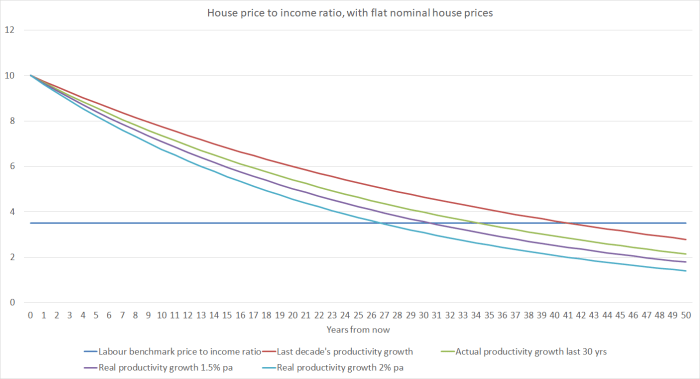
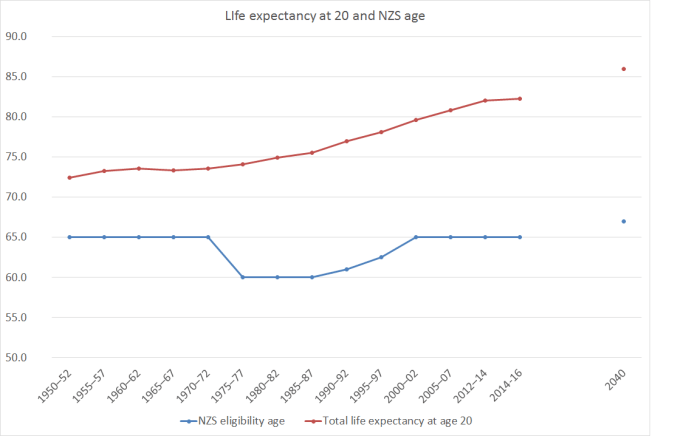
Labour is promising to spend (and tax –  thus the surpluses are the same) more than National.  But their commitment (rule 4) was to keep core Crown expenditure “around 30% of GDP”, not “comfortably below 30 per cent”.

labour spending

28.5 per cent is quite a lot lower than 30 per cent (almost $5 billion in 2020/21 – not cumulatively, as GDP is forecast to to be about $323 billion). And 30 per cent wasn’t described as a ceiling. And in the last two years of the previous Labour government, core Crown spending was 30.6 per cent of GDP (06/07) and 30 per cent of GDP (07/08).

It is a curious spectacle to see a party campaigning on serious structural underfunding of various public services and yet proposing to cut government spending as a share of GDP.  It would be difficult to achieve –  given the various specific policy promises –  but you have to wonder, at least a little, why one would set out to try.     We simply aren’t in some highly-indebted extremely vulnerable place.

Finally, the affair of the last 48 hours has revived arguments for some sort of offiical costings unit to be set up, as Labour and Greens have called for (in their Budget Responsibility Rules) and people like the New Zealand Initiative have also apparently favoured.  I’m much more sceptical of such proposals, and covered some of the reasons in earlier posts (when the Greens first made a play of this issue last year, and when the Labour/Greens rules were announced).   I support the idea of a Fiscal Council –  as Labour/Greens have proposed, and as past external reviewers have suggested  –  although would favour something more macroeconomic focused (ie advice and review functions on monetary policy as well as fiscal policy), but I don’t think the case for a costing unit has been made.

As I noted in one of those earlier posts

On balance, I still think there is a role for something like a (macro oriented) fiscal council in New Zealand, perhaps subsumed within the sort of macroeconomic or monetary and economic council I suggested here (but perhaps that just reflects my macro background).   And there is probably a role for better-resourcing select committees.  But when it comes to political party proposals, if (and I don’t think the case is open and shut by any means) we are going to spend more public money on the process, I would probably prefer to provide a higher level of funding to parliamentary parties, to enable them to commission any independent evaluations or expertise they found useful, and then have the parties fight it out in the court of public opinion.  The big choices societies face mostly aren’t technocratic in nature, and I’m not sure that the differences between whether individual proposals are properly costed or not is that important in the scheme of things (and perhaps less so than previously under MMP, where all promises are provisional, given that absolute parliamentary majorities are very rare).  If there are serious doubts about the costings, let the politicians (and the experts each can marshall) contest the matter.

And this particular dispute wasn’t even about the details of the costings of individual policy proposals.  It seems to have been more or less sorted out through the cut and thrust of political debate and expert commentary.  That feels to me like the way I’d want the system –  competing political parties, open democracy – to work.  No non-partisan experts can reasonably decree that one set of spending plans is or isn’t feasible or appropriate –  much of that is inevitably about politics.     There are gaps in our debate –  it was notable in the last couple of days that no academics were quoted, even though for example, Victoria University likes to hold itself out as policy-focused, and they even have a professorial chair in public finance –  but it isn’t clear that spending more taxpayers’ money to cost political party proposals (according to the particular model of that particular group of technocrats) is a high priority use for scarce fiscal resources.

(I noticed a couple of journalists last night describing me as “dryish right” and thus happy to fling mud at Labour.  I’d probably accept “dryish right” broadly speaking, but I’m sufficiently disillusioned with the total failure of this government to deal with housing, and the failures (and, what are in effect, lies) around productivity growth that I’d be more than keen to see a serious credible alternative.  As it happens, Labour’s policies around monetary policy and the Reserve Bank –  issues of some importance to me, even if not of wide general interest – seem to be heading the right direction.  I’m more sceptical as to whether they have more of an effective economic strategy than the government does.  Which is by way of saying that I like to think I’m an equal opportunity sceptic –  who doesn’t usually vote on economic issues anyway –  and if some of this post does identify some challenges for Labour, it isn’t because I’m champing at the bit to see Mr Joyce succeed.)


A depressing debate

Watching last night’s party leaders’ debate had its entertaining moments, but mostly if it  was clarifying it was so in a pretty depressing way.    And one of these two will be Prime Minister for the next three years.

There was the sight of both party leaders falling over themselves to disavow any notion that house prices should fall.  Apparently, a $1 million average house price (or the less headline-grabbing but still obscene median price of $800000+) in Auckland is just fine.  I suppose we should be grateful that on the one hand the National Party has moved on from the nauseating talk of how these house prices were a “sign of success” or a “quality problem”, and on the other hand that Labour’s housing spokesman will openly talk of an aspiration to having house prices averaging perhaps 3 to 4 times income.    Perhaps both party leaders really would prefer that Auckland house prices hadn’t increased very substantially in the last five years, but now they both seem content to simply treat it as a bygone –  as if we should simply live with $1 million house prices indefinitely until, some decades hence, a combination of inflation (mostly) and real income growth, might render home-owning in our largest city once again affordable to new entrants.

A couple of weeks ago I showed this chart.  Starting from a price to income ratio of 10 –  roughly that in Auckland now –  it traces out how house price to income ratios would evolve if nominal house prices were unchanged from here on (something both party leaders now appear regard as a good outcome).

house price to income ratio with flat nominal house prices

Just focus on the green line.  If we have inflation averaging two per cent, and productivity growth matching the performance of the last 30 years (quite a step up from where we are now) it would take almost 25 years to get price to income ratios down to even around five times income.     The Prime Minister talked of this being an issue for his kids.  The solution, to the extent there is one, seems to be aimed at his grandchildren.

Ardern seemed to try to have it both ways with the talk of “we just need to build more affordable houses”.   Lay members of my household responded “well, wouldn’t building more houses lower prices, which she just said she didn’t want?”.     Actually, it is unlikely to make very much difference, unless she is serious about freeing up land supply.  Without that, the overall affordability of the housing stock won’t change much, and any new houses built by or for the state will largely displace others that would have been built by the private sector.  And yet, although on paper Labour’s policy on improving land supply looks promising, the current Leader of the Opposition continues in path trod by her predecessor and simply never mentions the land issue –  even though everyone recognises that in Auckland in particular, the price of land is the largest component of a house+land.   Relative to that, further extending capital gains taxes is just a third order distraction.   At any plausible rate  –  in today’s low interest rate environment –  so is a land tax.

Sadly, I suspect there is an element of dishonesty about both party leaders’ responses.  If their housing policies really worked, I can’t imagine that either one would have a problem if house prices fell by, say, 20 per cent all else equal.  That alone would lower price to income ratios in Auckland to eight times.    It seems unlikely that that sort of fall would put anyone much in severe financial difficulty –   not that many people recently have been able to borrow at LVRs over 80 per cent anyway, and servicing capacity mostly depends on continued employment.     Continuing to talk of stable nominal house prices perhaps avoids (a) scaring the many people whose equity would be wiped out if house prices fell by 50 per cent, and (b) leaving themselves open to scare stories about how falling houses inevitably mean terrible economic times.   But it also makes a hard to develop a constituency for the sort of changes that might, in time, make a real difference, and enable this generation of young people  –  ordinary working families – to afford a decent home.

If that was bad enough, Jacinda Ardern’s superannuation pledge was worse.    John Key’s  pledge to resign rather than increase the NZS eligibility age was cynical –  he was quite open to Treasury that the age would rise, just not under his watch – but perhaps almost understandable in the context of the 2008 campaign.   Helen Clark would have run the “secret agenda to raise the age” line, at a time when Labour itself had no intention of raising the age, and had established the NZSF to buttress the political messaging.   But in this election, the incumbent Prime Minister leads a party which intends to legislate to increase the NZS age –  by a little, and some decades down the track.  It could hardly attack Labour for leaving open the possibility.   Even if Labour didn’t want to increase the NZS age itself now, what would have been wrong with a simple pledge that “no, we don’t see a need to raise the NZS age at present.  I don’t envisage it happening, but if at some point that judgement changes, I pledge that we won’t change the age without taking it to the public first as an election campaign promise”?

When the Prime Minister announced his NZS policy back in March, I ran this chart

Here is a chart showing life expectancy at 20, and the NZS eligibility age.  The final two dots are what might have happened by 2040 if the life expectancy gains continue at the same rate as since 1950, and the NZS eligibility age if yesterday’s National Party policy proposal comes to pass.

life and NZS age

Over that full period, 90 years, the NZS eligibility age would have risen by two years, and adult life expectancy (those getting to 20) would have increased by about 13.5 years.  By 2040 it will be amost 40 years since the NZS age got back to 65.  In that time, adult life expectancy is likely to have risen by 5 to 6 years, and yet the NZS age will have risen only by two years, if the new National Party policy is implemented.

How has a New Zealand politics got so febrile that parties that claim they want to use scarce fiscal resources to solve child poverty are reduced to this?   We can be pretty sure Bill English won’t be Prime Minister in 2037, so the NZS age won’t actually increase on his watch –  he’ll just foreshadow change decades down the track –  so in effect both candidates to be Prime Minister are refusing to increase the age while they are PM.   Old people vote of course, but this isn’t an issue about today’s old people –  it is about today’s middle-aged and younger people.   Even among today’s older people, almost half of those aged 65 to 69 are still in the labour force.

partic rate 65 to 69

Personally, I support a modest universal age-pension, but not one that cuts in at an age when a huge proportion of the recipients are still working, and are physically capable of doing so.    And how come we can scarcely even have that political debate even though all manner of other advanced countries have been willing to take steps to increase the eligibility age?  In Australia, for example, the age pension eligibility age will be 67 by 2024 –  and technically, all those Australians, and (a more plausible possibility) the New Zealanders living in Australia, would be eligible to relocate to New Zealand and claim our NZS, with no prior residence requirement, at age 65.

I found the “debate” around child poverty almost as depressing.    Neither party is actually willing to campaign for lower house prices –  even though housing costs have been a big factor in the material and financial challenges some face.  And all the talk was of how much money (other people’s money) the government could throw at the problem, with no mention at all of the possibility that improved economic performance might be the best way to lift living standards for everyone.  But then neither party seems to have  a serious idea as to how to lift our economic performance –  or even to care much about doing so (the Prime Minister just makes up stuff about the current performance of the economy).   And the Prime Minister was very keen to talk up how he, lots of data, and some public servants, are going to solve all manner of social problems.  Which, on the one hand, displays a touching faith in the capability of politicians and bureaucrats –  usually shared only by politicians and bureaucrats, and with little in past experience to support it –  and on the other simply refuses to address the likelihood that cultural factors are part of the story in dysfunction and deprivation.    I don’t really expect it from today’s Labour Party, but the Prime Minister is a self-described social conservative.

And then there was the wages debate.  On that one, I reckon the Prime Minister is right on the facts –  real wages have been rising, and faster than productivity has –  and I was disappointed to see the Leader of the Opposition still running here “its how people feel that matters”.   It might be uncomfortable to face it but wage inflation running ahead of productivity (and even than terms of trade gains) is one of the symptoms of an overvalued real exchange rate.  Plenty of observers –  including the outgoing Governor –  have highlighted that as a serious challenge for New Zealand.  It is part of the reason why Treasury forecast that exports will be shrinking as a share of GDP on current policies.   (If this whole point is obscure, it is partly a teaser for a forthcoming post.)

UPDATE:  On further reflection I’ve deleted the final paragraph.  I wrote it based on reading various commentaries, but before digging into the numbers myself (a salutary lesson that I shouldn’t need).   Understanding better both the Labour numbers and the National claims, I’d now take a more nuanced stance.

And, of course, there was the $11 billion fiscal hole that wasn’t.   Perhaps the National Party really believed their story when they put it out yesterday morning. By debate time, it was pretty clear to anyone without an axe to grind that there was little or nothing there.     Wouldn’t an honourable Prime Minister have simply quietly let the issue slide, and addressed the real challenges New Zealand faces, including real and legitimate questions about his own government’s performance over nine years, and about the aspirations and specific proposals the Labour Party is now outlining.

Consistently dismal relative productivity growth

Having done Saturday’s post unpicking some of Steven Joyce’s claims about New Zealand’s productivity performance, I thought it might be worth using the data for a few more charts illustrating something of our performance relative to other advanced countries going back a few decades.

Of the official SNZ data I used in my nine measures of real GDP per hour worked:

  • real GDP measures go back to 1987,
  • the HLFS goes back to 1986, and
  • the Quarterly Employment Survey goes back to the start of 1989.

Thus, using official SNZ data, we can really only do the international comparisons back to full year 1989.   The OECD and the Conference Board produce numbers of New Zealand going rather further back (using earlier SNZ data for much of that), and those estimates usefully illustrate our longer-term relative decline.  But in these particular posts, I just want to use the official New Zealand sources for New Zealand (and the OECD-reported data for other advanced countries).

Many of the current OECD countries (largely the former eastern bloc ones) don’t have useable data going that far back.  So in these charts I’m comparing New Zealand against the 25 OECD countries that have such data all the way back to 1989.    That includes all the more “traditional” advanced OECD countries except Austria.  But the OECD only has data for all these countries to 2015, so this chart compares total productivity growth across countries from 1989 to 2015.

productivity joyce 3

“Pretty dismal” would be my summary of New Zealand’s performance over that entire period.  There is a handful of countries that have done even worse.  Two are much richer and more productive than us anyway; the others some of the basket cases of the euro-area.  And recall that at the start of the period we were in the midst of an economic restructuring programme sold, in part, as designed to reverse the decades-long deterioriation in New Zealand’s economic performance.    As a comparisons, in 1989 Ireland is estimated to have had around the same level of real GDP per hour worked as New Zealand.

As I noted in Saturday’s post, there are nine simple ways to combine the various GDP and hours series to produce estimates of GDP per hour worked. In the chart above, I used the average of those nine measures –  a 32.4 per cent increase.   The range of the nine measures was from 29.0 per cent to 35.7 per cent.   At best, we also beat out Switzerland and Israel.  At worst, Netherlands and Luxembourg beat us.  Over that long period, data uncertainty just doesn’t change the picture much.

In the next chart, I’ve shown the annual path of real GDP per hour worked for New Zealand (again using the average measure) and for the median OECD country for which there is data throughout the period.  In all cases, countries were indexed to 100 in 1989, and so the chart is showing cumulative growth over the period in the two series.  The OECD does not yet have data for all countries for 2016.

productivity joyce 2

And here is the same data transformed into a ratio: the New Zealand line divided by the median OECD line, again indexed to equal 100 in 1989.

productivity joyce 1

On this chart, I have included an estimate for 2016, by taking the median productivity growth rate for those OECD countries (most of them) that have 2016 data.  I’ve also marked the final year of each of the three governments that changed during this period (1990, when Labour lost office; 1999 when National lost office; and 2008 when Labout lost office).

Over the course of these 27 years,  the trend has been downwards –  we’ve done (cumulatively) a lot worse than these other advanced countries (and the decline relative to those former eastern bloc countries is materially worse).

I don’t regard the dates around changes of government as being particularly meaningful for these economic comparisons: structural policy changes affect outcomes with a lag, and anyway, at least for the last two changes of government (1999 and 2008) there has been a lot more continuity than differences between the economic policies of the outgoing and incoming governments.  But in each of the different governments’ terms there have been years when our productivity growth was faster than that of the median OECD country.  Under the current government that year was 2009.  And so, as I noted the other day, in their first few years in office we actually made up a little ground relative to these other advanced countries.   But since then, the picture has been downhill again. Over the last four to five years all those gains have been lost, and more.

It is what happens when your country manages no productivity growth at all for five years or more (illustrated here using the average of the nine measures).

productivity joyce 4

I chose 1989 for the cross-country comparisons for the practical reason that 1989 is when the consistently-compiled New Zealand data go back to. But it was also David Caygill’s first year in office as Minister of Finance.     I’ve shown previously this photo in which he was illustrating his aspirations.

caygill 1989 expectations

But like his predecessors for several decades before him, and all his successors – including those in the last Labour government and the current National government – he failed. Terms of trade windfalls have help our incomes, but over the longer-term improved living standards – catching up with other countries – depends on improved productivity performance.  Our governments have consistently failed that test, and I can’t see anything in the current electoral offerings that seems likely to change the picture in, say, the next decade.

Unpicking Steven Joyce’s press release

As I noted yesterday afternoon, Steven Joyce had put out a press release on productivity.  The press release was a mix of policy-based digs at the Labour Party (which weren’t of any particular interest to me) and some statistical claims, some of which seemed more or less reasonable and others not.   My post yesterday afternoon briefly responded to some of those points.

The press release made these claims

On one of the key measures of productivity, GDP per hours worked, New Zealand’s productivity has lifted nearly 10 per cent since National came into office. That’s a faster rate than the UK, Canada, the US, the EU, the G7 and the average across the whole OECD.

“The last time Labour was in office, it was the reverse. Our productivity growth was 5.5 per cent over eight years and much slower than all those other economies.

I wasn’t quite sure where the Minister had got his numbers from, but was going to just let the matter lie.  After all, the point that people like me have been making for some time, and which the Labour Party had picked up on, was that there has been no productivity growth in New Zealand for the last five years or so.  And over the longer run of history, everyone knows our performance has been relatively poor, although for some sub-periods we’ve done better than others –  at times more or less matching the growth rates of other advanced economies.    And since no one thinks that economies suddenly change, for better or worse, immediately on changes of government –  and in recent decades, the policy changes from one government to another hadn’t been large anyway –  I wasn’t overly interested in the narrow partisan point as to whether average productivity growth had been better under this government or its predecessor.

But I couldn’t help myself.   And a story by Bernard Hickey alerted me to the fact that the Minister had used these numbers, or ones very like them, in answer to a parliamentary question a few weeks ago.    With less rounding, the Minister then said that “another measure used by the OECD is GDP per hour worked, which has increased 9.6 percent since 2008”.    The answer to the PQ suggested Treasury had probably supplied the numbers, so I was curious as to whether I could work out what had been done.

The most likely source was OECD data, which are only reported on an annual basis.   So I found the OECD’s table showing the level of real GDP per hour worked, in real (“constant price”) national currency terms.    And, sure enough, on that measure the OECD reports real GDP per hour worked having increased by 9.6 per cent from 2008 to 2016.   For quite a few countries (about a third of the total) the OECD doesn’t yet have full year 2016 data for this variable.   So the Minister’s observations about how New Zealand has done relative to other countries seem to use comparisons between 2008 and 2015.

And here is a chart of that data.

joyce 1

I wouldn’t put much weight on the Irish number (which goes off the chart, having to do with tax-related anomalies in their national accounts), but on this particular OECD-reported measure, over this particular period, only 10 OECD countries did better than New Zealand.  Hence Mr Joyce’s claims.

But there are some pretty serious problems with the comparison (even setting aside the fact that it is now mid-late 2017).  There is an old line about OECD data –  you trust (or at least use) every country’s data except your own.  Typically, that is because you know the pitfalls in your own country’s data and not always the pitfalls in data from other countries.   But here the problem is a bit different.  Specifically, the OECD’s data for productivity growth in New Zealand doesn’t bear much relationship to the New Zealand data itself.   From memory, when I’ve tried to do these comparisons before I’ve just replaced the OECD New Zealand data with SNZ data.     The OECD don’t have data of their own, and they must do some transformations of the data they get from here, but not ones that are readily open to scrutiny.

As I’ve explained previously, when I do charts of New Zealand productivity performance over recent years I average the expenditure and production measure of GDP, and divide by HLFS hours worked (corrected for the series break last year).    But I remembered last night that the OECD prefers to focus on the expenditure measure of GDP.  Many New Zealand analysts focus on the production measure  (which, a long time ago, was less volatile).  And although I use the HLFS, there is also a QES measure of hours.   That gives one quite a range of ways to calculate GDP per hour worked, even on an annual basis.

Percentage growth
2008 to 2015 2008 to 2016
Expenditure GDP/HLFS hours 8 7.6
Expenditure GDP/QES hours 4.8 5.3
Production GDP/HLFS hours 5.6 4.8
Production GDP/QES hours 2.4 2.5
Expenditure GDP/average of the two hours series 6.4 6.5
Production GDP/average of the two hours series 4 3.7
Average of the GDP measures/HLFS hours 6.7 6.2
Average of the GDP measures/QES hours 3.6 3.9
Average GDP measures/Average hours measures 5.2 5.1
Average of all these measures 5.2 5.1

Replacing the OECD’s questionable New Zealand numbers in the chart above with our own data –  highest, lowest, and average from this table –  makes the chart look like this.

joyce 2

On none of these measures did we quite match the performance of the median OECD country over this period.    It is fair to note that over the first half of the period –  2008 to 2012 – we did match, or even modestly exceed, the productivity growth of the typical OECD country.

But here’s the thing: across those nine possible New Zealand annual measures (see table above), not one has shown any growth in productivity at all over the (most recent) four complete years from 2012 to 2016.  The estimates are tightly bunched –  between a cumulative fall of 0.6 per cent, and a cumulative fall of 1.2 per cent.    All those numbers are prone to revisions, mainly as the GDP numbers themselves are revised, but for now they simply reinforce the point I and others have been making for some time: there seems to have been no productivity growth at all in New Zealand for some years now.

But what about the comparisons the Minister of Finance was making with productivity growth performance during the term of the previous government?   He asserted that

The last time Labour was in office, it was the reverse. Our productivity growth was 5.5 per cent over eight years and much slower than all those other economies.

So I went to the same OECD spreadsheet he seemed to have taken his productivity growth number from in talking about the current government’s term.   On that OECD measure, productivity had grown by 10.6 per cent over the whole period 1999 to 2008, or by 7.4 per cent over the eight years the Minister appears to focus on (2000 to 2008).

But what did the New Zealand data itself show?  I went back to the nine different measures (see above).  For the full period 1999 to 2008, across the nine measures there was a range from 7.3 per cent to 13.0 per cent growth in real GDP per hour worked.  The average of those measures was a 10.2 per cent increase.   I couldn’t quite replicate the 5.5 per cent number the Minister quotes for 2000 to 2008, but on one of the nine measures productivty growth in that period had been 5.8 per cent  (close enough I guess).

And how did other advanced countries do over the term of the previous New Zealand government?  Between 1999 and 2008 the median OECD country had productivity growth of 15.7 per cent.   So, as the Minister pointed out, productivity growth lagged that in other advanced countries during the term of the previous government.

The data go back far enough to also look at the experience under the 1990 to 1999 National government.  As ever, a reminder that comparisons between the experience in different terms of office have little or no economic meaning.  But, for what it is worth, here are the summary results.  Because the OECD doesn’t have annual data for quite a few countries past 2015.  I haven’t included numbers for the median OECD country for the last two lines.

Total growth in real GDP per hour
Range of NZ measures Average of measures Median OECD country
National 90 to 99 10.7 to 13.4 12 19.5
Labour 99 to 08 7.3 to 13.0 10.2 15.7
National 08 to 15 2.4 to 8.0 5.2 7.0
National 08 to 16 2.5 to 7.6 5.1
Last four years -1.2 to -0.6 -0.9

I’ll leave you to draw your own conclusion.  My overarching one remains that for 70 years or so our productivity growth has underperformed that of other advanced countries, and there has been no extended period in that time, under any government, when any progress has been made in closing the large (levels) gaps that have opened up between productivty here and that in much of the rest of the advanced world.

To facilitate the cross-country comparisons all the numbers and charts in this post so far have used annual data only.

For shorter-term, and more timely, analysis, one can use quarterly seasonally adjusted data  (that is what I usually do when, for example, I’ve shown the chart of how productivity growth performances in New Zealand and Australia have diverged in recent years).   I usually use just one of the measures (average of the GDP measures divided by HLFS hours).  But again there are nine potential measures, as per the first table above.   This chart shows the average growth rate across those measures in each of the periods shown.

quarterly

There are no direct comparisons possible to a big group of other advanced countries.  But in each of these four periods productivity growth, on this summary measure, has been less than that in Australia.

In this chart, I’ve shown all nine measures indexed to 2007q4.  That doesn’t align neatly with political terms, but I find it a more useful dating for economic analysis, starting just prior to the start of the recession (here and abroad).

real GDP phw qtrly

You can see that there is quite a big difference in what the various measures show for productivity growth over the first few years (and in particular from around 2010 to 2012 –  by 2012 the lines are a fair way apart).  There are some puzzles for people to work through about just how New Zealand did during that period,   But, again, there isn’t much difference in the growth rates (or lack) of them over the last five years.  That is even more stark if we look just at the last five years, indexing each of the series to 100 in 2012q1 (and noting the compressed scale of the chart).

real GDP phw 2012q1 base

Not one of the measures shows any material productivity growth over the last five years taken together.  And although there are some divergences in the last couple of years –  while we wait for SNZ to revise, and increasingly reconcile, the two GDP measures –  there isn’t any sign of the trend changing even in that very recent period.

Global productivity growth has been pretty weak since around 2005 –  ie before the recession and (domestically) the change of government.   But having no productivity growth at all here for five years now doesn’t look to be just an international phenomenon.  In fact, from the same table the Minister quoted from, productivity growth in the median OECD country in the last four years appears to have been around 0.8 to 0.9 per cent per annum.

So as I suggested yesterday when the Prime Minister claims that “productivity in New Zealand has been growing pretty well”,  a response along the lines of “yeah right”  seems quite appropriate.  The last five years look particularly bad.


(Non-economist readers might well be surprised, or disillusioned, by the wide range of possible estimates of productivity growth in some particular periods.   Unfortunately that is the way things are.  Measurement is a real challenge, not helped in New Zealand by persistent underfunding of official statistics.)


Productivity growth in perspective

Someone sent me a copy of a press release put out today by the Minister of Finance, Steven Joyce, is his capacity as the chair of National’s campaign.    In it he claims that productivity growth over National’s term of government has exceeded that when Labour was last in office, and has exceeded that of many other OECD countries.

On the latter claim, over the whole of government’s term in office, my view is that it is a broadly fair description.  I’ve put out posts noting that we’ve been no better than middling over the whole period since just prior to the recession and financial crisis.  That didn’t seem to me to be a particularly good performance, in view of the fact that (a) we had a big lift in the terms of trade, (b) we didn’t have a domestic financial crisis, (c) weren’t in the euro and (d) we didn’t run out of room to use conventional monetary policy.  Oh, and we had a big levels gap –  we were a lot poorer –  and were supposed to be about catching up.

But my comments, and those of J B Were economist Bernard Doyle, have focused on the last five years or so.   Since then, on New Zealand official numbers, our productivity has gone slightly backwards –  ie the level now is slightly less than it was five years ago.    That is sufficiently stark, and has now gone on for long enough, that it seems worth singling out.   What, one might wonder, would be likely to turn that around?  (Frankly, I’ve seen nothing from either main party  –  or, for the avoidance of doubt, minor parties – that seems very promising.)   It is difficult to get very up-to-date useful data for many other countries, but over that five years we have certainly done less well than the US and Australia.

What about comparisons across terms of government?  We can only calculate the GDP per hours work series back to 1987, so I’ve shown  productivity growth in the term of the 1990s National government (1990q4 to 1999q4), the Labour government of the 2000s (1999q4 to 2008q4), and the current government (from 2008q4 with GDP data only available to 2017q1). I’ve also shown the last five years.

For each of those periods I’ve also shown the exactly comparable data for Australia.   Australia is one of the few countries for which exactly comparable (real, quarterly, national currency) data are available.  They are shown on the ABS website.  Australia is also a relevant comparator because (a) it didn’t have a domestic financial crisis, or (b) run out of monetary policy room, and (c) because it is the easiest alternative option for New Zealanders (migrating) and a standard historical comparator.  The aspiration of catching Australia was one the current government articulated when it came into office.

As a reminder, for New Zealand I have:

  • averaged the two real GDP series (expenditure and production).  Using one or the other alone will produce slightly different numbers, but there is no obvious reason to prefer one over the other, and
  • divided the resulting series by the HLFS hours worked series, and
  • corrected for a series break in the HLFS hours worked series in June 2016, when the survey question was changed.  Not correcting for that would lower productivity growth estimates over the last few years by a further 2 per cent.

And this is the resulting table [UPDATE: with some very minor corrections]

Cumulative growth in real GDP per hour worked (per cent)
NZ Australia
National (90q4 to 99q4) 8.5 20.7
Labour (99q4 to 08 q4) 12.1 12.4
National (08q4 to 17q4) 6.7 13.7
Last five years (to 17q1) -0.2 7.5

As it happens, in not a single one of these particular periods did productivity growth in New Zealand exceed that in Australia  (although there will be shorter periods where we did).

There are other measures of course, but real GDP per hour worked is a pretty standard basis for comparison.  And to make such comparisons of growth rates sensibly (as distinct from levels comparisons) one shouldn’t use PPP-converted data but rather real national currency data as I have done here.

As a caveat, governments can’t take all the credit or all the blame for productivity trends in their time in office.  International trends matter, and even policies work with a lag.  Recessions affect comparisons – and I don’t suppose anyone is going to suggest the 2008/09 recession was either New Zealand party’s fault.      Partly for that reason I’ve suggested focusing on the distinctive, and disconcerting, New Zealand productivity performance over the last five years.  The relevant growth number is zero (or marginally worse).