What did the RB have to deal with?

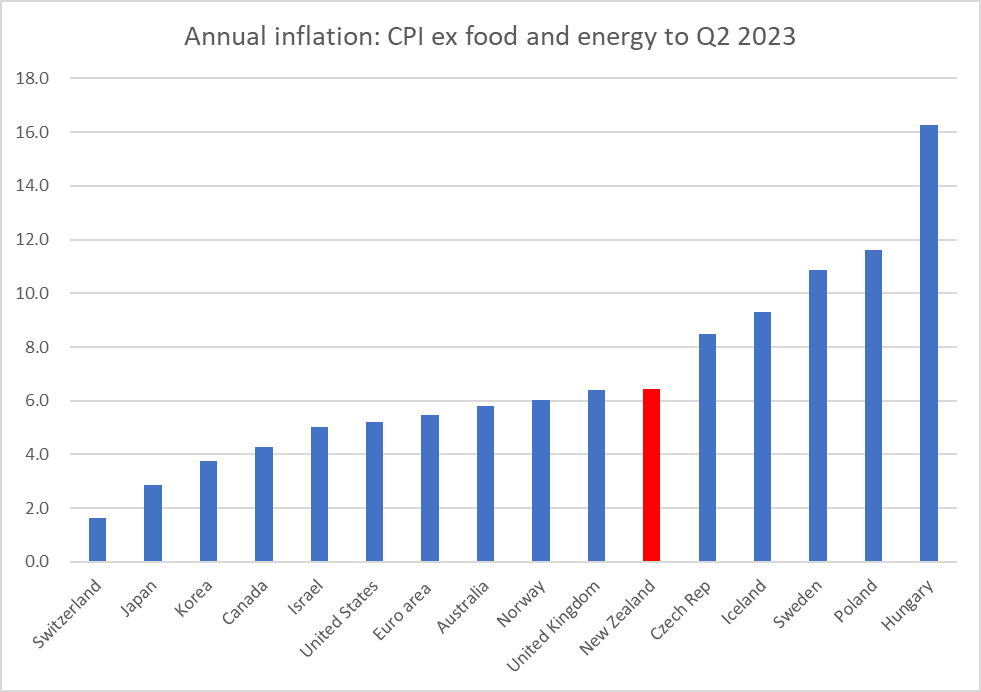
I’ve used this chart before to illustrate how diverse the (core) inflation experiences of advanced economies have been in this episode. It isn’t as if they’ve all ended up with similarly bad inflation rates, and the point of focusing on those countries with their own monetary policy and a floating exchange rate is that core inflation outcomes are a result of domestic (central bank) choices (passive or active) in each country.

Yesterday’s post focused on the rapid growth in domestic demand that the Reserve Bank had facilitated and overseen. But, it might have occurred to you to ask, what about foreign demand? It all adds up.

And if you look more broadly you might reasonably have thought New Zealand would be a good candidate for being towards the left-hand end of this chart.

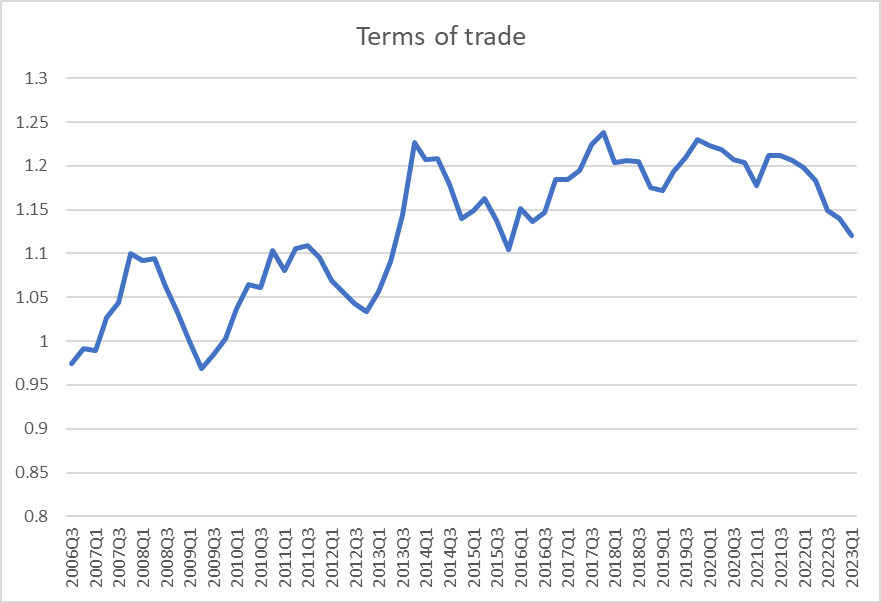
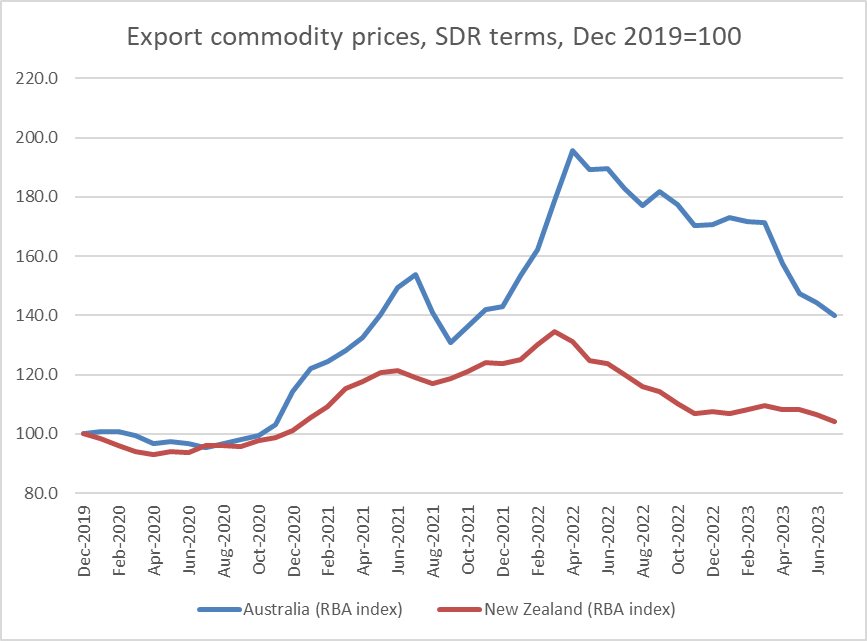
The central banks in Australia, Canada, and Norway have faced big increases in the respective national terms of trade (export prices relative to import prices) over the last 3+ years. All else equal, a rising terms of trade – especially when, as in each of these cases, led by rising export prices – tends to increase domestic incomes and domestic consumption and investment spending and inflation. It isn’t mechanical or one for one (in Norway, for example, they have the oil fund into which state oil and gas revenues are sterilised) but the direction is clear: a rising terms of trade is a “good thing” and more spending, and pressure on real resources, will typically follow in its wake.

Here is the contrast between New Zealand and Australia over recent years.

In Australia a 25 per cent lift in the terms of trade is roughly equal to a 5 per cent lift in real purchasing power (over and above what is captured in real GDP). A 10 per cent fall here would be a roughly equivalent to a 2.5 per cent drop in real purchasing power. As it happens, over the last couple of years (since the tightening phases began) the terms of trade have been weaker than the Reserve Bank expected, all else equal a moderate deflationary surprise.

But the other big deflationary influence was the closed borders. I’m not here getting into debates about the merits of otherwise of such policies. Central banks simply have to take whatever else governments (and the private sector) do as given and adjust monetary policy accordingly to keep (core) inflation near target. The fact was that our borders were largely closed to human traffic for a long time, New Zealand has more exports of such services (tourism and export education) than imports, and exports of services are far from having fully recovered pre-Covid levels.

We don’t have easily comparable tourism and export education data across countries, but we can look at how exports of services changed as a share of GDP. From just prior to Covid to the trough, New Zealand exports of services fell by 5.7 percentage points of GDP, a shock exceeded only by Iceland (-12.7 percentage points) – the fall for Australia was just under half New Zealand’s, and for most advanced economies (of the sample in the chart above) the fall was 1-2 percentage points of GDP. In most countries, that trough was in mid 2020, while in New Zealand it was not until early 2022.

Some ground has been recovered (most starkly in Iceland) but New Zealand (and to a lesser extent Australia) are still living with a material deflationary shock from this side of the economy. Real services exports in 2023Q1 were 26 per cent (seasonally adjusted) lower than in 2019Q4, just prior to Covid.

Now, again you will note that this isn’t the entire story. After all, New Zealanders couldn’t travel abroad easily for much of the time either, and money they would have spent abroad seemed to be substantially diverted to spending at home (probably more so than was initially expected). That reduction of imports of services was large (3 percentage points of GDP, with Australia 4th largest of this advanced country grouping) but early – the trough for New Zealand as for most of these advanced countries was as early as 2020Q3.

But that was then. This chart shows the change in imports of services as a share of GDP from just pre-Covid to our most recent data (2023Q1). That share has fully recovered here, with an increase very similar to that of the median country.
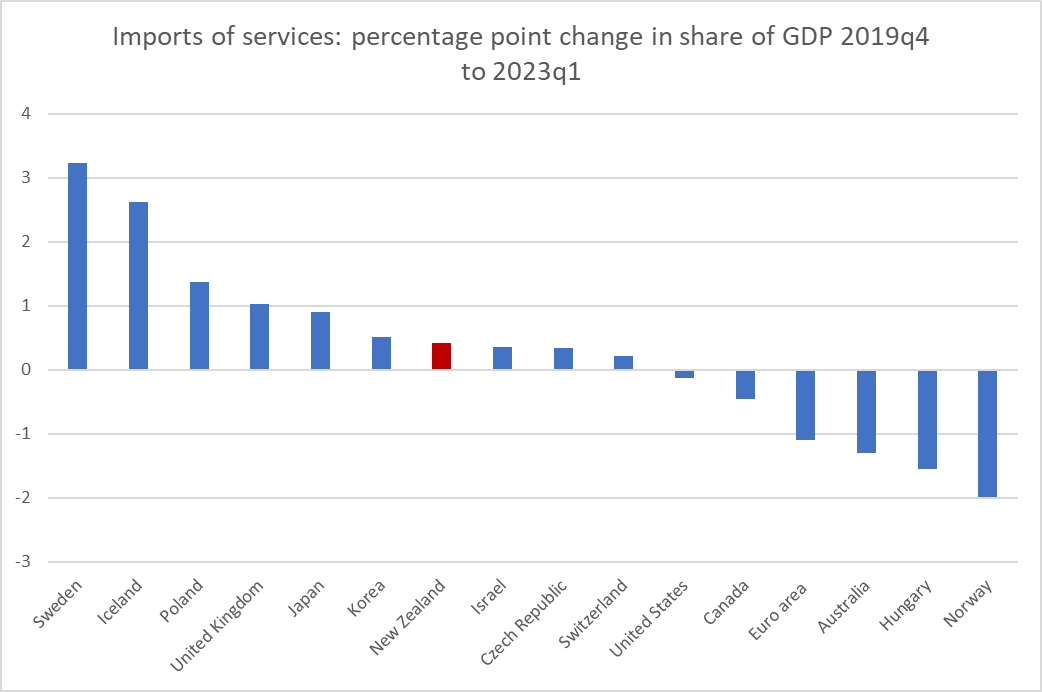
So, relative to pre-Covid (and pre-inflation surge), imports of services as a share of GDP are about where they were, and exports of services were still materially lower as at the last official data.

With a deflationary shock like this you might have reasonably thought that the Reserve Bank, if it was to keep inflation near target, would need to induce or ensure faster growth in domestic demand (than some other countries). Yesterday I showed this chart (remember, GNE is national accounts speak for domestic demand). New Zealand was at the far right side of the chart (strongest growth in domestic demand as a share of GDP).
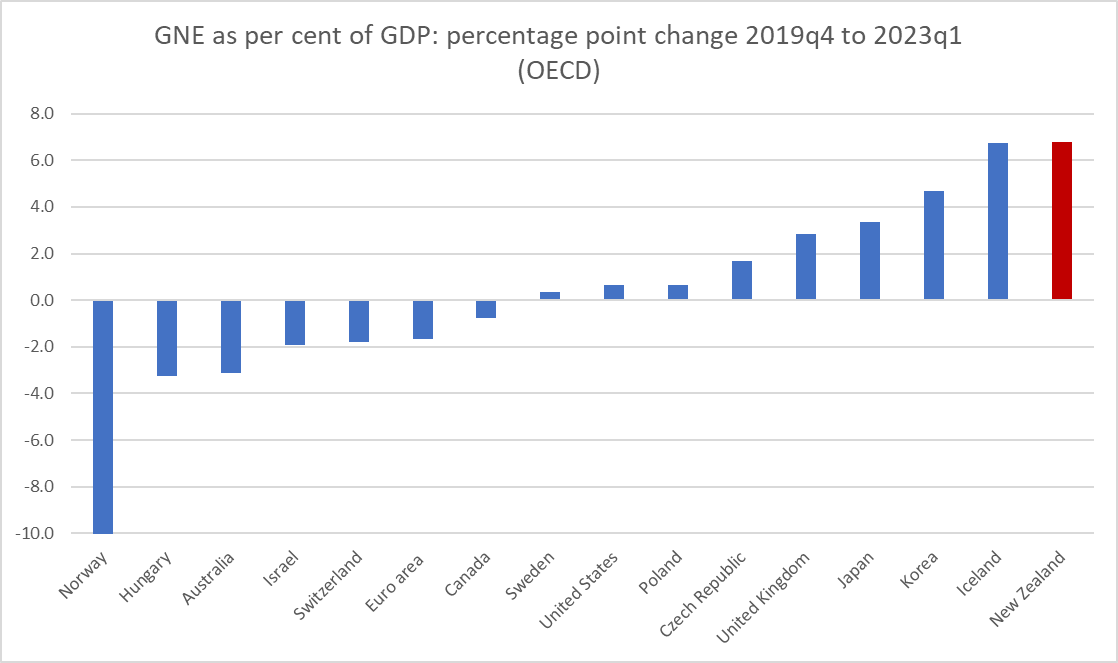
But what if we treated the change in the services exports share of GDP as an exogenous shock that, all else equal, the central bank legitimately had to respond to? In this version of the chart I’ve subtracted the reduction in services exports as a share of GDP.

It makes a material difference to the New Zealand numbers, but even so we are still left with an increase in the share of GDP that is third highest on the chart, about the same as the UK which (as is well known) is really struggling with inflation. (In case you are wondering Korea has relatively modest core inflation now – so first chart – but still about 3.5 percentage points higher than it was just prior to Covid; for us the increase has been about 4 percentage points.)

There are lots of numbers and concepts in this post and it isn’t always easy to keep them straight. But the key points are probably:

  • echoing yesterday’s post, don’t be distracted by the Governor’s spin about Russia or the weather or whatever (they just don’t explain core inflation to any material extent) or spin (probably more from the Minister) that every advanced country is in the same boat (they aren’t, see first chart),
  • more than other advanced countries, we should have been predisposed to being able to have kept inflation in check a bit more easily, having had both a fall in the terms of trade (very much unlike Australia and Canada) and a sustained fall in exports of services that as a share of GDP is materially larger than any other advanced economy has seen.  To be clear, those are bad things, making us poorer, but all else equal they were disinflationary forces,
  • and yet, core inflation here is in the upper half of the group of advanced economies and (as the MPS acknowledged) is not yet really showing signs of having fallen (unlike some other advanced countries, notably Australia, the US, and Canada),
  • the difference is about Reserve Bank choices and forecasting errors.  The Reserve Bank can’t control the terms of trade or exports of services, but its tool – the OCR – is primarily about influencing domestic demand.    They ended up producing some of the strongest growth in domestic demand (absolutely or relative to nominal GDP) anywhere in the advanced world.  It wasn’t intentional, but it was their job, and their mistake resulted in high core inflation.

The Reserve Bank doesn’t publish forecasts of nominal GNE – and note that my charts have shown a big increase in GNE relative to GDP – but even their nominal GDP forecasts, even just starting from two years ago when they first thought it was time to start tightening, have materially understated domestic demand growth
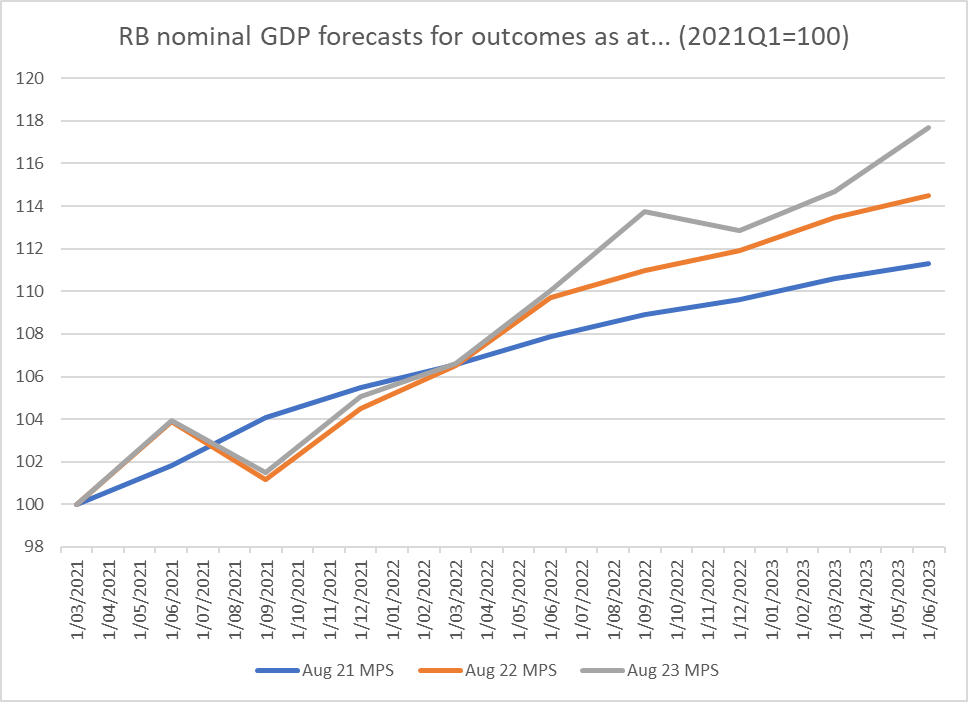
and over this period they have actually over forecast real GDP growth.

Again, I’m going to end on a slightly emollient note. Macroeconomic forecasting is hard, and especially in times as unsettled as these. I heard an RB senior person the other day noting (fairly) that they couldn’t tell when the borders would fully reopen, or how quickly people flows would respond when they did. Personally, I’m less inclined to criticise them for getting their forecasts wrong (“let him who is without sin cast the first stone”) than for the sheer lack of honesty and straightforwardness, and the absence of either contrition (in respect of failures in a job they individually chose to accept – no one is compelled to be an MPC member) or hard critical comparative analysis. But…..relative to other countries they had advantages which should have given us a better chance of keeping inflation near target, and things ended up as bad or worse as in the median advanced country.

If forced to confront these arguments the Governor would no doubt burble on about “least regrets”. But the least regrets rhetoric a couple of years ago was really about – and they know this – the risk that inflation might, if things went a bit haywire, end up at 2.5 per cent or so for a year or two, rather than settling immediately around the target midpoint of 2 per cent. It wasn’t – was never even suggested as being – about the risk of two or three years of 6 per cent core inflation, and a wrenching adjustment to get it back under control.

They may still claim to have no regrets. They should have many. We certainly should. They took the job, did it poorly, and now won’t even openly accept (what they know internally) that it wasn’t the evil Russian or a cyclone or….or….or…it was them, Orr and the MPC. They made mistakes (they happen in life), with no apparent consequences for them, and not even the decency to front up, acknowledge the errors, and say sorry.

Excess demand

Particularly when he is let loose from the constraints of a published text, the Reserve Bank Governor (never openly countered by any of the other six MPC members, each of whom has personal responsibilities as a statutory appointee) likes to make up stuff suggesting that high inflation isn’t really the Reserve Bank’s fault, or responsibility, at all. It may be that Parliament’s Finance and Expenditure Committee is where he is particularly prone to this vice – deliberately misleading Parliament in the process, itself once regarded by MPs as a serious issue – or, more probably, it is just that those are the occasions we are given a glimpse of the Governor let loose.

I’ve written here about just a couple of the more egregious examples I happened to catch. Late last year there was the line he tried to run to FEC that for inflation to have been in the target range then (Nov 2022) the Bank would have to have been able to have forecast the Russian invasion of Ukraine in 2020. It took about five minutes to dig out the data (illustrated in the post at that link) to illustrate that core inflation was already at about 6 per cent BEFORE the invasion began on 24 February last year, or that the unemployment rate had already reached its decades-long low just prior to the invasion too. It was just made up, but of course there were no real consequences for the Governor.

And then there was last week’s effort in which Orr, apparently backed by his Chief Economist (who in addition to working for the Governor is a statutory officeholder with personal responsibilities), attempted to brush off the inflation as just one supply shock after the other, things the Bank couldn’t do much about, culminating in the outrageous attempt to mislead the Committee to believe that this year’s cyclone explained the big recent inflation forecasting error (only to have one of his staff pipe up and clarify that actually that effect was really rather small). See posts here and here. Consistent with this, in his interview late last week with the Herald‘s Madison Reidy, Orr again repeated his standard line that he has no regrets at all about the conduct of monetary policy in recent years. It is consistent I suppose: why regret what you could not control?

It is, of course, all nonsense.

But there is, you see, the good Orr and the bad Orr. The bad – really really bad, because so shamelessly dishonest – is on the display in the sorts of episodes I’ve mentioned in the previous two paragraphs.

The good Orr – some of you will doubt you are reading correctly, but you are – is a perfectly orthodox central banker informed by an entirely orthodox approach to inflation targeting. You see it, even at FEC, when for example he is asked about the role the “maximum sustainable employment” bit of the Remit plays. He has repeated, over and over again and quite correctly as far I can see, that there has not been any conflict between it and the inflation target in recent years. That is how demand shocks and pressures work. And whereas in 2020 the Bank thought inflation would undershoot target and unemployment be well above sustainable levels, in the last couple of years the picture has reversed. He told FEC again last week that when inflation was above target and the labour market was tighter than sustainable both pointed in the same direction for monetary policy: it needed to be restrictive. There was, for example, this very nice line in the MPS, which I put big ticks next to in my hard copy.

The Bank doesn’t do many speeches on monetary policy, and those few they do aren’t very insightful but this from the Chief Economist a few months ago captured the real story nicely

and this from the Governor, describing the Bank’s functions, was him at his entirely orthodox

We aim to slow (or accelerate) domestic spending and investment if it is outpacing (or falling
behind) the supply capacity of the economy

Demand management, to keep (core) inflation at or near target is the heart of the Reserve Bank’s monetary policy job, assigned to it by Parliament and made specific in the Remit given to them by the Minister of Finance.

Domestic demand is known, in national accounts parlance, as Gross National Expenditure (or GNE). It is the total of consumption (public and private), investment (public and private) and changes in inventories.

I’ve been pottering around in that data over the last few days, and put this chart (nominal GNE as a percentage of nominal GDP) in my post last Thursday.

This ratio has tended to be low in significant recessions and high around the peaks of booms – investment is highly cyclical -but for 30+ years it had fluctuated in a fairly tight range. The move in the last couple of years has been quite unprecedented, in the speed and size. There was huge surge in domestic demand relative to (nominal) GDP.

One of the points I’ve made a few times recently is that country experiences with (core) inflation have been quite divergent over the last couple of years. The Minister of Finance in particular is prone to handwaving about “everyone faces the same issue” around inflation, and the Bank isn’t a lot better (doing little serious cross-country comparative analysis). But the differences are large.

And so I wondered about how those domestic demand pressures had compared across countries.

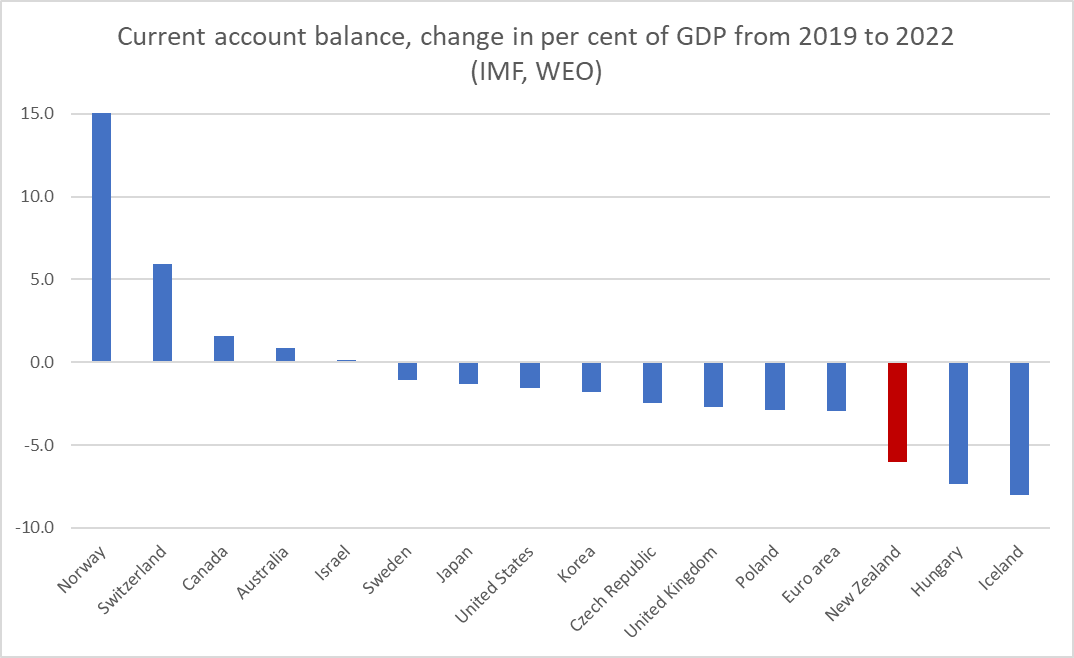
One place to look is to the change in current account deficits as a share of GDP. This chart, using annual data from the IMF WEO database, shows the change in countries’ current account balance from 2019 to 2022 (Norway is off this scale; what happens when you have oil and gas and another major supplier is being shunned)

There has been a fair amount of coverage of the absolute size of New Zealand’s current account deficit, and even a few mentions of the deficit being one of the largest in any advanced country. But for these purposes (thinking about monetary policy and demand management) it is the change in the deficit that matters more. Over this period, New Zealand’s experience has not just been normal or representative, instead we’ve had the third largest widening in the current account deficit of any of these advanced countries (those with their own monetary policy, and thus the euro-area is treated as one). Both Iceland and Hungary have slightly higher inflation targets than we do, but they have a lot higher core inflation (see chart one up).
The current account deficit is analytically equal to the difference between savings and investment. Over that 2019 to 2022 period investment as a share of (nominal) GDP increased in all but two of the advanced countries shown. Of the four countries where it increased more than in New Zealand, three are those with core inflation higher than New Zealand.

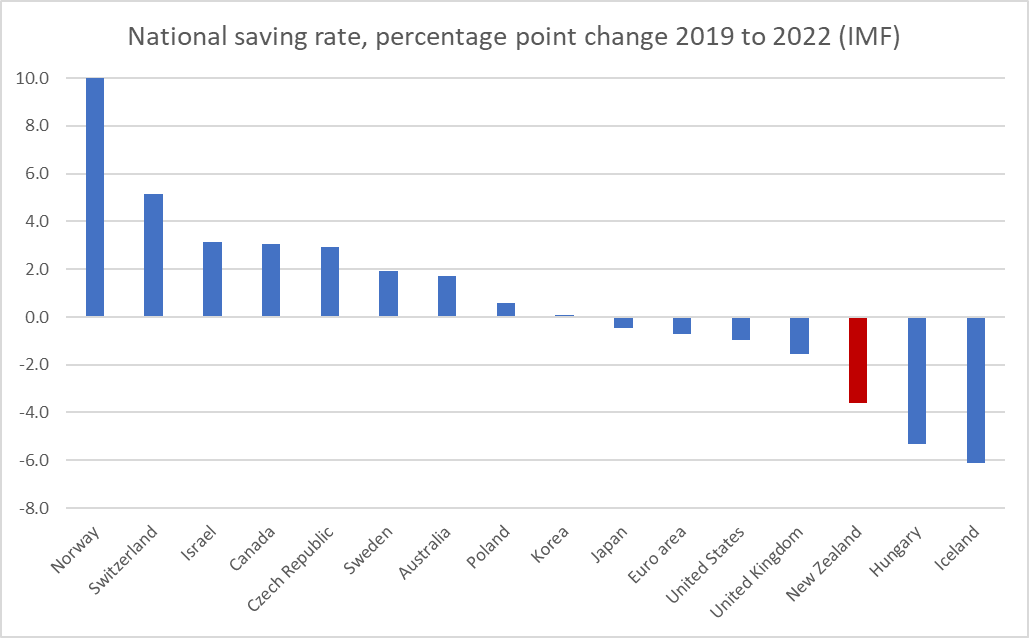
National savings rates (encompassing private and government saving) paint a starker picture. Somewhat to my surprise, of these advanced countries the median country experienced a slight increase in national savings over the Covid/inflation period.

Norway is off the scale again, because I really want to illustrate the other end of the picture. That is New Zealand with the third largest fall in its national savings rate of any advanced country.
What about that chart of nominal GNE as a share of nominal GDP? How have other countries gone with that ratio? There is a diverse range of experiences, but that sharp rise in the New Zealand share really is quite unusual, equal largest of any of these advanced countries.
(If you are a bit puzzled about Hungary – I am – all the action seems to have been in the last (March 2023) quarter’s data).

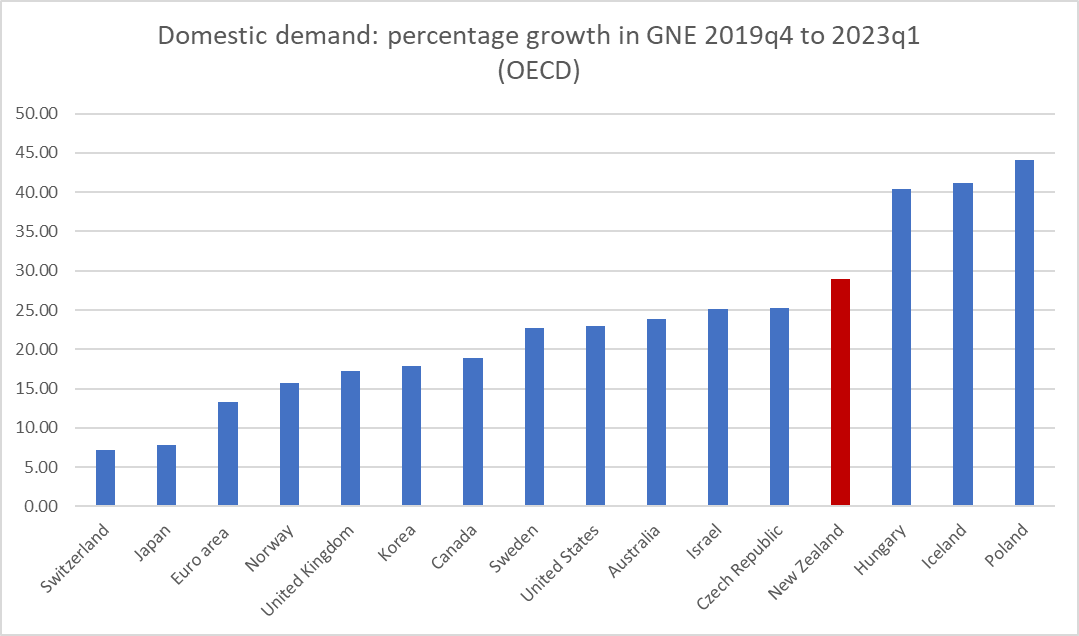
But lets get simpler again. Here is a chart showing the percentage change in nominal GNE (growth in domestic demand, the thing monetary poliy influences) from just prior to the start of Covid to our most recent data, March 2023.

It looks a lot like that earlier chart comparing core inflation rates across countries. In this case, New Zealand had the fourth fastest growth in domestic demand of any of these countries over this period (and those with higher growth are not countries with outcomes we’d like to emulate). And in case you are wondering, no this wasn’t just a reflection of super-strong GDP growth: over this period New Zealand’s nominal GDP growth was actually a little below the growth in the median of these advanced economies. The economy simply didn’t have the capacity to meet the nominal demand growth the Reserve Bank accommodated and the imbalance spilled into a sharp widening of the current account deficit and high core inflation. It wasn’t Putin’s fault, or that of nature (the storms), it was just bad management by the agency charged with managing domestic demand to keep core inflation in check.

I’ve also done all these chart etc using real variables. The deviations are often less marked, but no less substantive for that. Real GNE (real domestic demand) growth from 2019Q4 to the present in New Zealand was third highest among this group of advanced economies, and only Iceland (see inflation and BOP blowouts above) had a larger gap between growth in real domestic demand and real GDP.

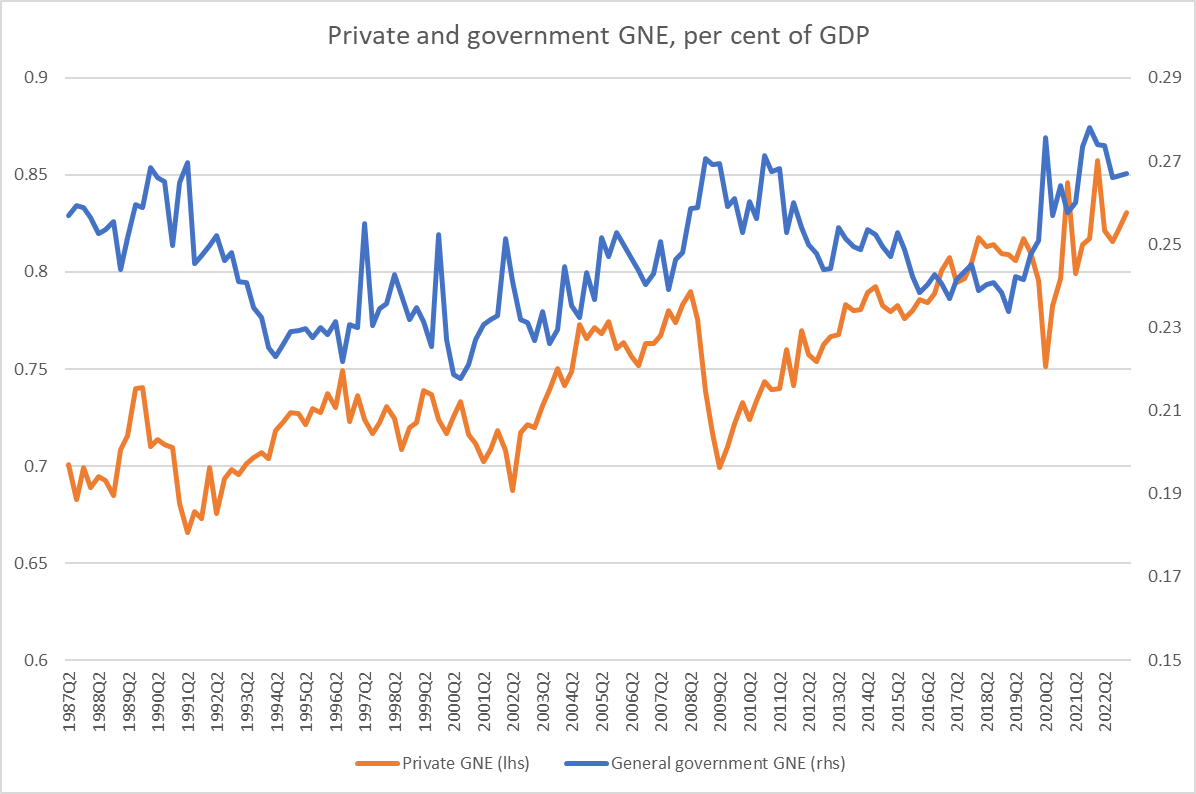
I don’t really want to divert this post into an argument about fiscal policy over recent years (monetary policy has to, as the Governor often notes, just take fiscal policy as it is, as just another demand/inflation pressure) but for those interested the government share of GDP has been high (which usually happens in recessions since government activity isn’t very cyclical) but private demand is what really stands out).

Bottom line: all those stories trying to distract people, including MPs, with tales of the evil Russian or the foul weather or whatever other supply shock he prefers to mention, really are just distractions (and intentionally misleading ones by the Bank). The Bank almost certainly knows they aren’t true, but they have served as convenient cover for the fact that the Bank simply failed to recognise the scale of the domestic demand (right here in New Zealand, firms, households, and government) and to act accordingly. We are now still living with the 6 per cent core inflation consequence. It is common – including in the rare Bank charts – in New Zealand to want to compare New Zealand with the other Anglo countries. But what the Bank has never acknowledged – and just possibly may not have recognised – is much larger the boost to domestic demand happened in New Zealand than in the US, UK, Canada or Australia. And domestic demand doesn’t just happen: it is facilitated by settings of monetary policy that were very badly wrong, perhaps more so here than in many of those countries.

Perhaps one could end on a slightly emollient note. Getting it right in the last few years has been very challenging, and it wouldn’t entirely surprise me if when all the post-mortems are done some of relative success and failure proves to have been down to luck (good or bad). But as in life, central banks help make their own luck, but digging deeper, posing and publishing analysis even when they don’t know all the answers, and by taking a coldly realistic view, not attempting to hide behind spin, misrepresentations, and what must come close to outright lies. Even by acknowledging errors, the basis for learning better, and being able to feel and display those most human of qualities, regret and contrition. We need a Governor and MPC members doing all this a lot more than has been on display here in the last year or two. Our lot show little sign of trying, or of even being interested in feigning seriousness.

Almost done…at least according to the Reserve Bank

I’m not a huge fan of central banks publishing medium-term economic forecasts (or projections as we were usually schooled to call them). As I understand it, decades ago the Reserve Bank of New Zealand only started publishing them because the Official Information Act was passed (and in those days the forecasts made little or no difference to policy so there wasn’t even an arguable ground for withholding). My scepticism only increased as the projections assumed an increasingly significant place in the policy communications, including the move to endogenous interest rate projections from 1997. It isn’t that a central bank’s forecasts are likely to be worse than anyone else’s, just that medium-term economic forecasting (cyclical stuff 2-3 years ahead) is really a mug’s game, and those medium-term forecasts rarely if ever have much impact on the accompanying OCR decision. OCR decisions are almost always, and necessarily (given the state of uncertainty, limited knowledge etc), driven by the latest data releases, which are at best real-time contemporaneous, and more often relating to periods a month or three back (the latest NZ GDP data are for the quarter that ended in March). And that is as it should be. And yet in my experience of the Reserve Bank forecasting and policy process, inordinate amounts of time (including time of the Governor) was spent on numbers for periods so far ahead they would, almost inevitably, be quickly invalidated; often more time (and more senior management smoothing, for messaging purposes) on where we thought things might be in 2 years than on where we think they are right now. I recall a speech some years ago now from a retiring senior European central banker who suggested that perhaps central banks shouldn’t bother publishing for horizons much more than six months, and that line still has some appeal to me. It isn’t about trying to withhold information, but about having nothing useful to say and no robust grounds on which to say it. None of that is a criticism of the Reserve Bank, or their peers abroad, it is just the state of (lack of) knowledge.

Of course, the international trend has been in the other direction, with more central banks publishing more forecast information, and for the time being we are where we are. The Reserve Bank of New Zealand was once considered a leader in forecast transparency, but there are some areas in which they really aren’t very transparent at all. Thus, despite the (quite appropriate) policy focus on core inflation, the Bank does not publish forecasts (even for the next few quarters) for any of the measures of core inflation, and despite the evident seasonality in the inflation data (sufficient for SNZ to publish seasonally adjusted series), the Bank’s inflation projections are not seasonally adjusted (in contrast to almost all quarterly quantity series). On core inflation, even the Reserve Bank of Australia, publishes projections (albeit at six-monthly rests rather than for each quarter) for annual trimmed mean inflation

But if I’m sceptical of the merits of published forecasts, that doesn’t mean those forecasts have no information about the central bank’s own thinking at the time of publication. In fact, the numbers can be – and often are – a significant part of the Bank’s storytelling and tactics, in support of a current policy stance. And how those numbers change over time can also be revealing.

You’ll recall – I highlighted it in my post last Thursday – that one of the good features of last week’s MPS was the upfront acknowledgement that core inflation was hanging up, and that if anything domestic inflation had been a little higher in the most recent quarter than the Bank had been expecting. For example, the minutes record that “measures of core inflation remain near their recent highs”, a point reiterated a couple of times in chapter 2 (the policy assessment). In case there is any doubt, they have a chart showing the core inflation measures grouped around 6 per cent (annual rate). The target, you will recall, is 2 per cent – the midpoint (that MPC is required to focus on) of the 1 to 3 per cent target band.

The Bank doesn’t use one of my favourite graphs, of quarterly core inflation

…but they don’t really need to. They seem to be in no doubt that core inflation has been hanging up, in ways that are at least a little troublesome.

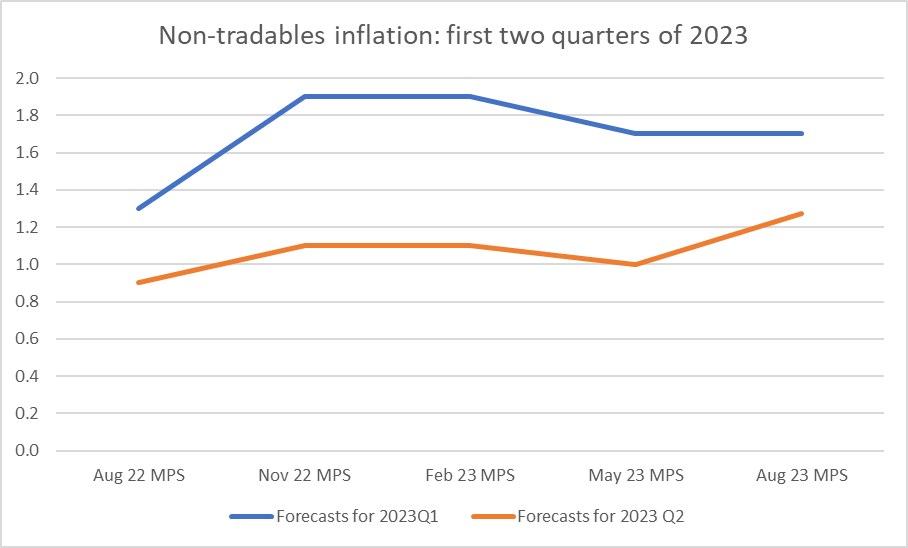
Of the published forecasts, the closest one to showing their hand on the outlook for core inflation is the forecasts for quarterly non-tradables inflation. Non-tradables inflation tends to run persistently higher than tradables inflation (for this century to date, annual non-tradables inflation has averaged 3.4 per cent while annual tradables inflation has averaged 1.4 per cent), and so even as tradables inflation has been abating, non-tradables inflation has been running at an annualised rate 6.6 per cent, a bit higher than core.

Looking out to the medium-term, the Bank seems to consider that non-tradables inflation of about 3.3 per cent will be consistent with inflation being at 2 per cent (for the final year of the projections, to September 2026, they show things being settled at those rates).

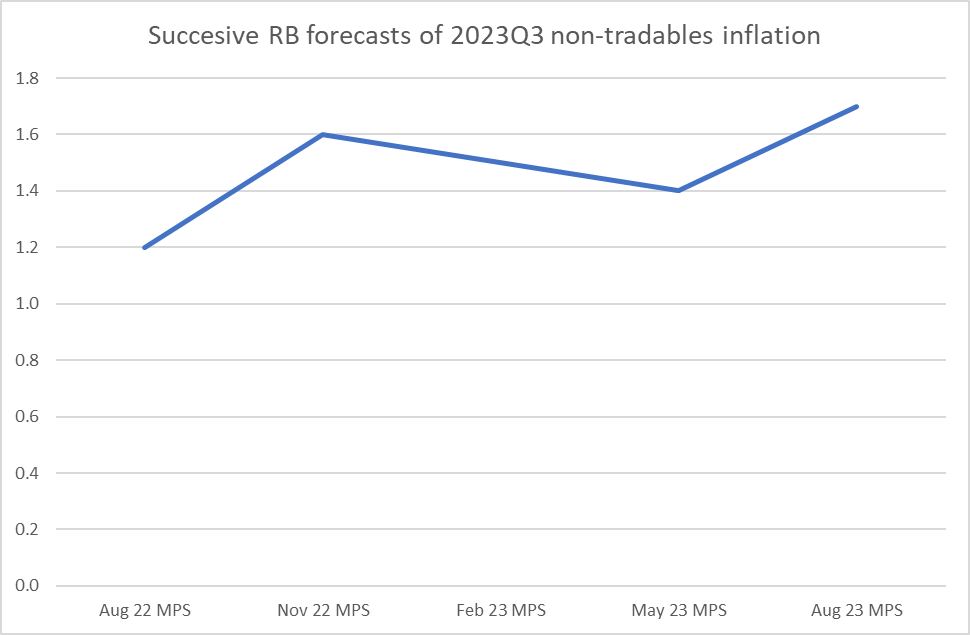
In the nearer-term they have generally been having to revise up their forecasts for non-tradables inflation. Here is how RB forecasts evolved over the last year towards the actuals for the two quarters in the first half of 2023.

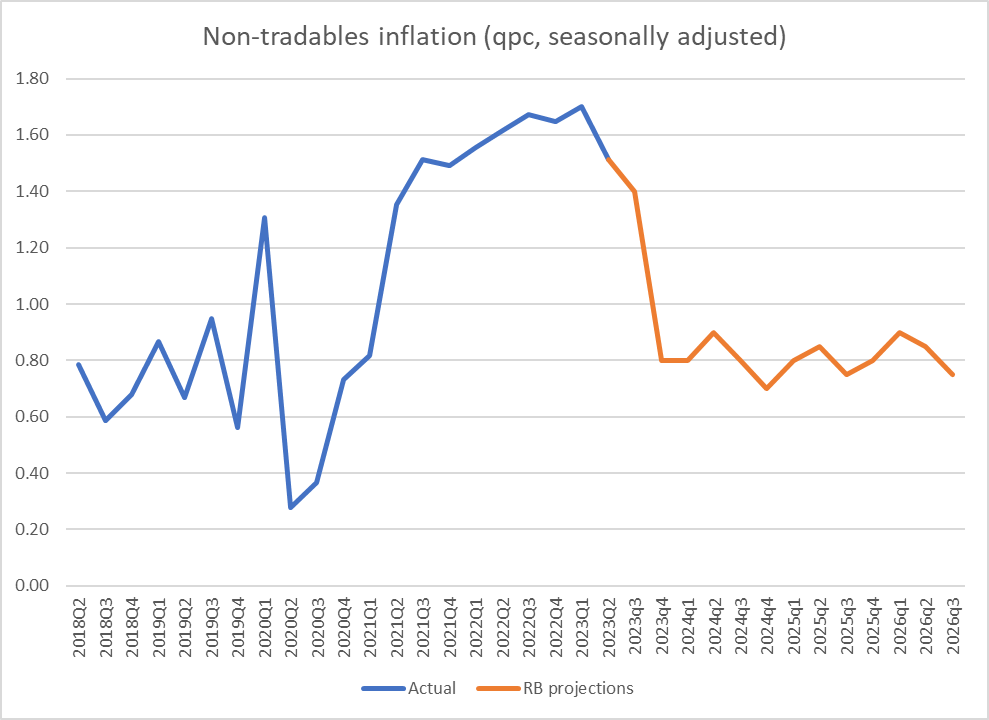
And here is the SNZ series for non-tradables quarterly inflation on a seasonally adjusted basis.

That last observation is modestly encouraging although (a) per the previous chart, it was quite a bit higher than the Bank was expecting, and (b) there is no sign of anything similar in the analytical core inflation measures themselves. Better than the alternative I guess, but nothing to hang your hat on (and as I noted earlier, when writing about inflation outcomes to date the Bank does not do so in the MPS – it is appropriately uneasy about core and domestic inflation holding up).

As it happens, the Bank has also been revising up its forecasts of Q3 non-tradables inflation – its latest view for the current quarter is (a touch higher) than any of its projections for the quarter over the last year.

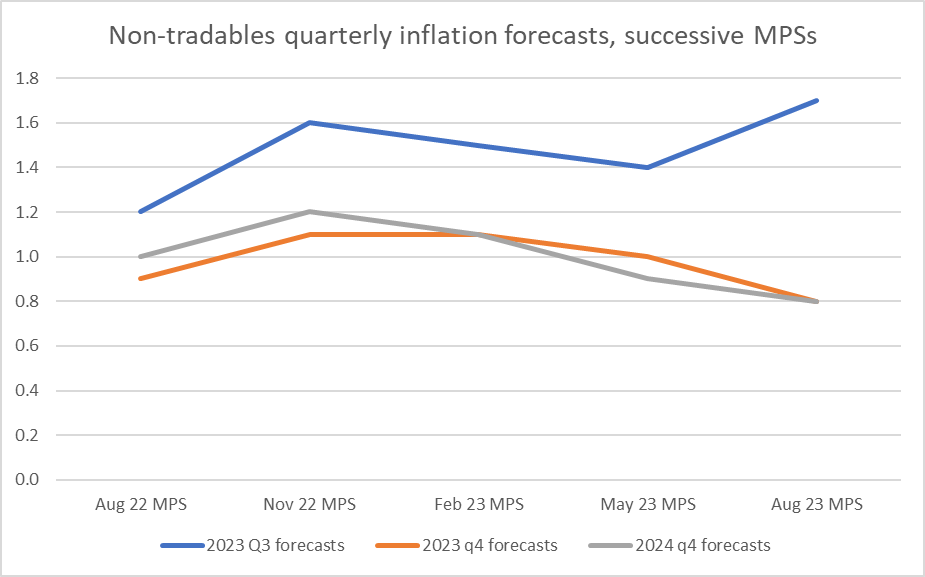
But….seasonality matters. The Bank doesn’t publish its inflation forecasts in seasonally adjusted terms. But if we compare the actual data, seasonally adjusted and not, we can back out some approximate seasonal factors, and convert the Bank’s projections into (approximately) seasonally adjusted terms (more technically oriented people could no doubt do it more formally).

This is the result

On these projections, non-tradables inflation (projections for which have been revised up to new highs) does fall a bit in in the September quarter, but then by the December quarter – measured centred on 15 November, now less than 3 months away, starting less than 6 weeks from now – suddenly the whole domestic inflation problem is solved. In (rough) seasonally adjusted terms, non-tradables inflation is back down to 0.8 per cent for the December quarter, a rate not seen since the start of 2021, and a rate consistent with all the inflation problems being solved. Annual rates take a while to come down to be sure, but any policy-setting agency would be firmly focused on quarterly tracks and…..within three months we are there (at least according to the Reserve Bank).

Quite the contrast: revising up the Q3 forecasts (a quarter we already know a bit about) and revising materially down the December 2023 and March 2024 forecasts, which we don’t yet know anything firm about.

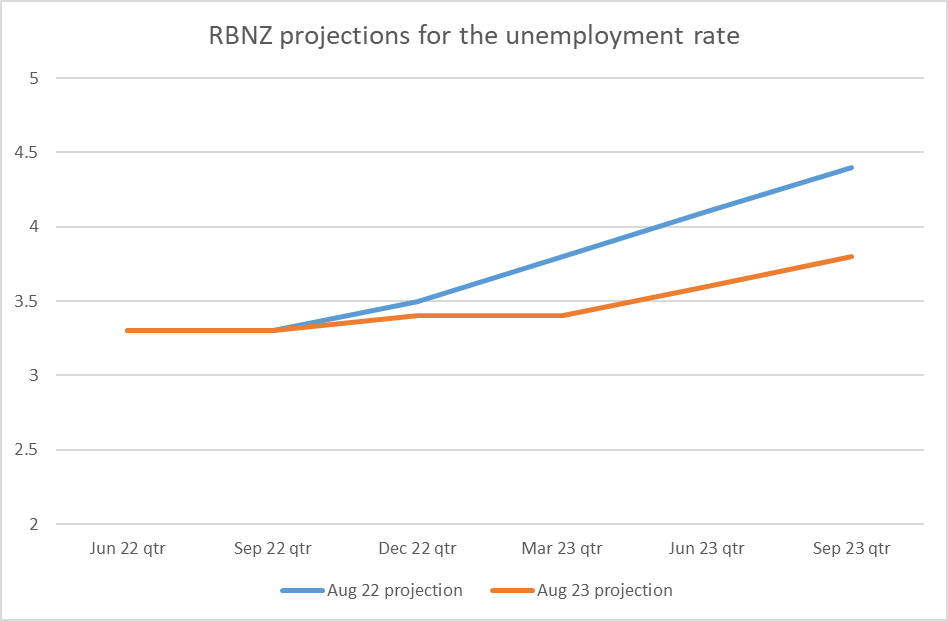
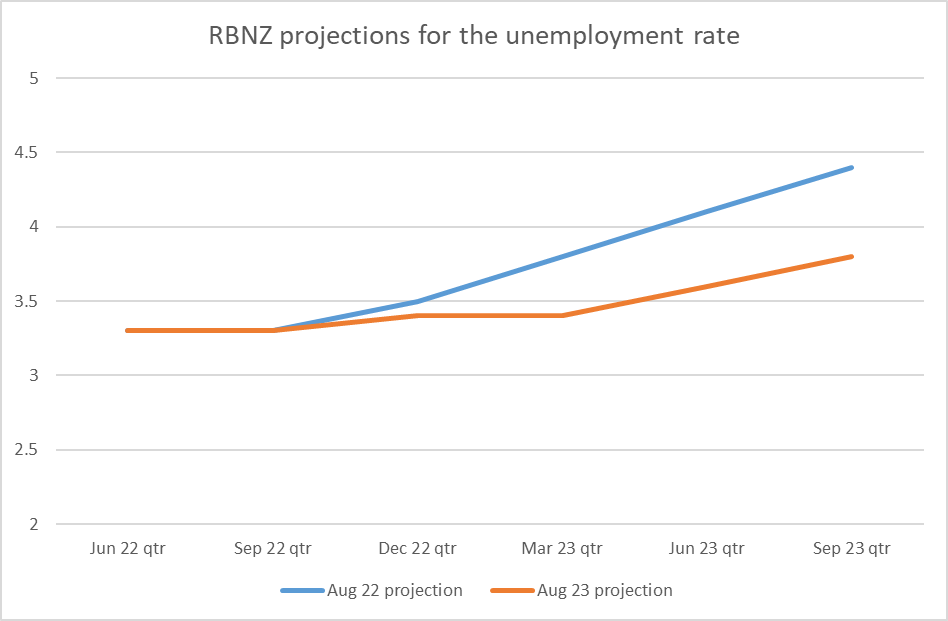
I won’t bore you with the charts but it is not as if they are suddenly expecting a much sharper rise in the unemployment rate. Actually, unemployment rate projections for the next 6 months have been revised down quite a bit.

It all seems like a rather miraculous good news story. and yet one that the Bank left buried in the website tables and made no mention of at all, not in the MPS itself or at FEC.

Suggesting they don’t really believe it themselves. How likely is that we’d go from an entrenched (core) inflation problem now (and in the most recent published quarter) back to something consistent with the target midpoint in a matter of weeks? Frankly, it doesn’t seem very likely.

One possibility – and who knows if it is the explanation – is that they really don’t want to raise the OCR again. That might be for political reasons, or because they like this idea of being (one of the first) central banks to reach a peak rate (or some, conscious or unconscious, mix of the two), but had those quarters from 2023Q4 into next year been a bit higher – domestic inflation abating more gradually, consistent with the fairly modest recession forecasts – they would have been under a great deal more pressure to raise the OCR now or in early October. Neither explanation would be to the Bank’s credit. Perhaps neither is the correct story, but then we don’t have any explanation at all from the Bank. If they really believed inflation was collapsing as we speak, surely they’d have told us?

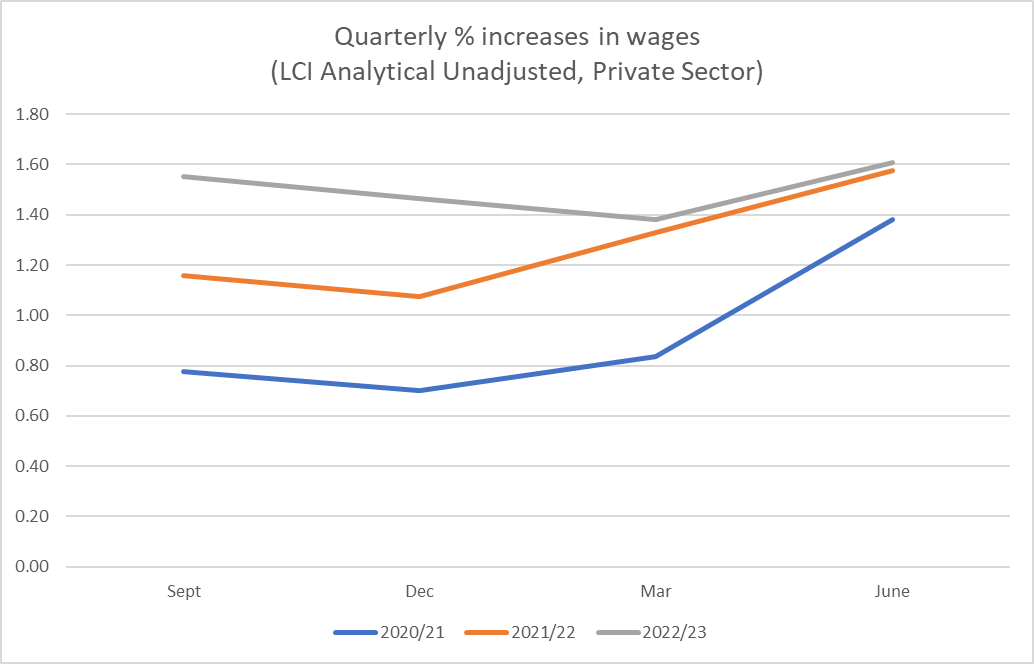
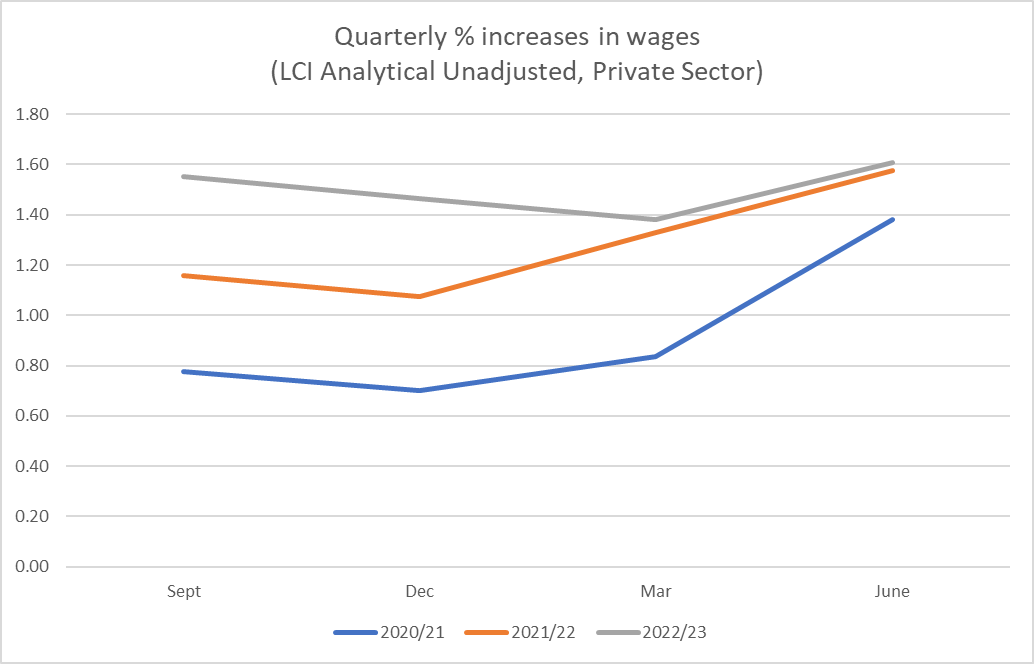
There are some other odd features in the numbers. Take the wage forecasts for example. The Bank doesn’t publish forecasts for the only data we have on wages rates themselves (that is the stratified LCI Analytical Unadjusted series). As I’ve shown previously, inflation in private sector wage rates seems to be levelling off (but not yet falling).

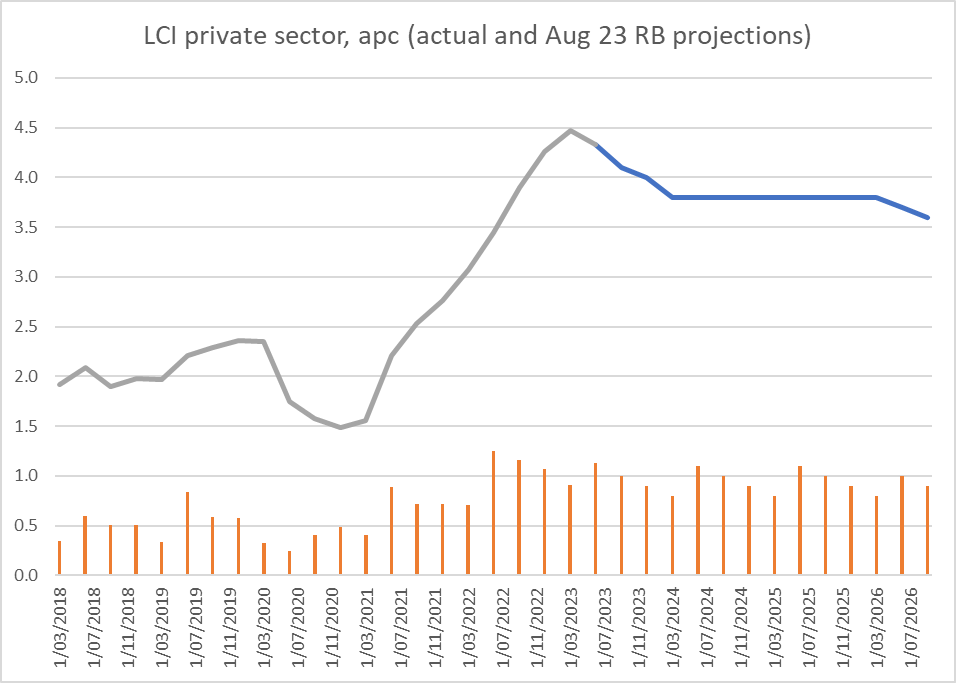
The Bank publishes forecasts for the LCI itself, for the private sector. The LCI is not a measure of wage rate but is designed to be a proxy for something like unit labour costs. Over the decades inflation in the headline private sector LCI has averaged somewhere not too far from the core rate of CPI inflation.

Eyeballing the chart might suggest that annual increases in this measure of the LCI of around 2 per cent might be roughly consistent with inflation at target.

Here are the Bank’s forecasts for LCI inflation

Note first that straight line. No model will have produced that, but rulers are a handy tool for forecast teams responding to gubernatorial whims. But more importantly, note that again they think the job is all but done – those quarterly rates of increases come down hardly any more (that apparently now being consistent with core inflation at the 2 per cent target, but again with no explanation). But then this measure of wage inflation holds up at a remarkably high levels even as the unemployment rate rises from the current 3.6 per cent to 5.3 per cent and only gets back to 5 per cent by the end of the projection period. It doesn’t make a lot of sense and simply isn’t very plausible.

None of it makes much sense. And these days, with a central bank whose Governor and Board chair just make up stuff when it suits, it is impossible to take anything they say or publish at face value. Which is a terrible place to be, when so much power is vested in the Bank, and so much havoc and loss wreaked, with no sign of any effective accountability at all.

Misleading Parliament

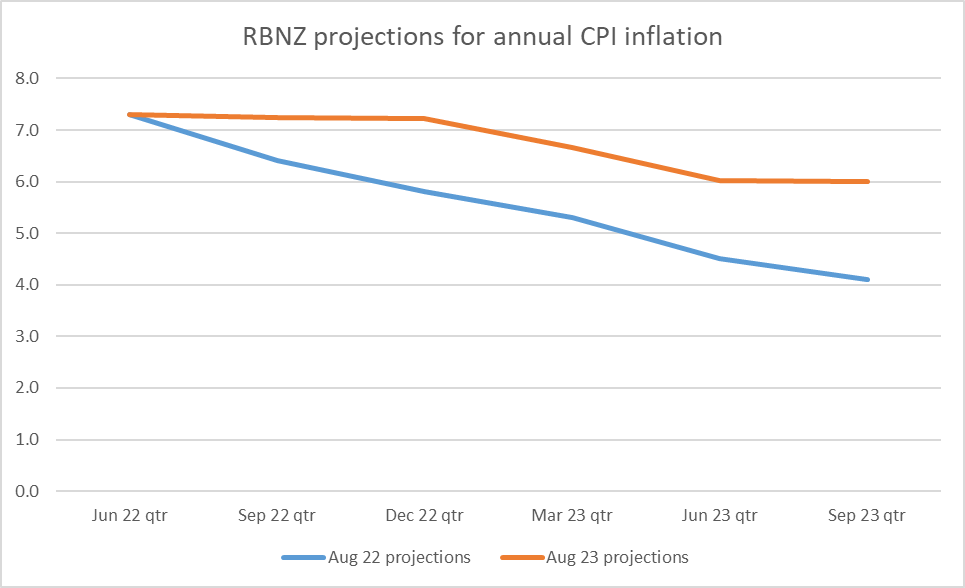
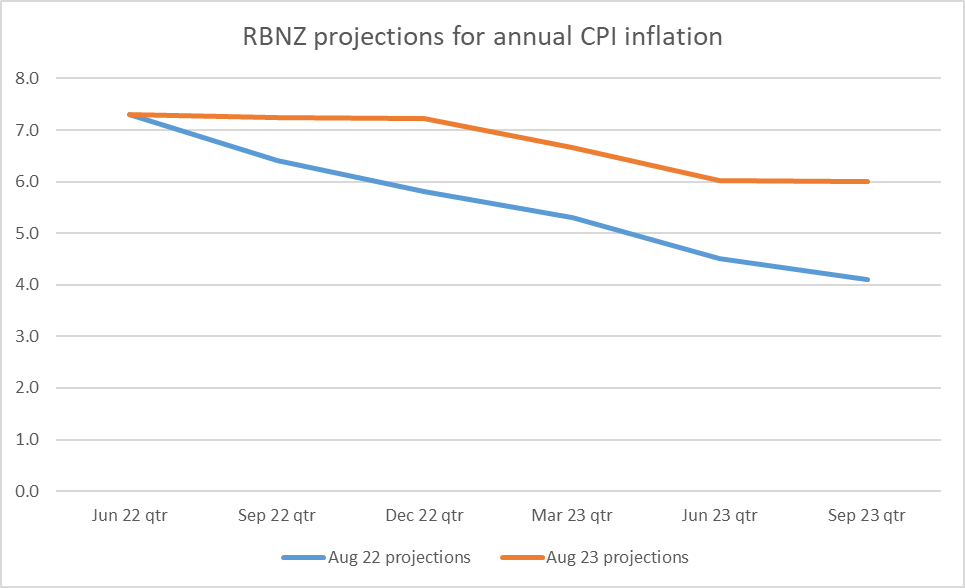
In my post on Thursday I commented briefly on the appearance by the Governor and his Chief Economist at Parliament’s Finance and Expenditure Committee. They tried to suggest to the Committee that to the extent there had been inflation forecast errors over the last year – responding to a question from Nicola Willis – that much of it was down the summer storms including Cyclone Gabrielle. But then a helpful staffer in the back row – who may not have been so popular with management after that – piped up and explained to FEC that the impact of the cyclone was perhaps 0.1 or 0.2 per cent. The forecasting error Willis had asked the Governor about was 1.9 percentage points (the Bank had last August forecast that inflation would be 4.1 per cent in the year to September 2023, but now think that inflation rate will be 6.0 per cent).

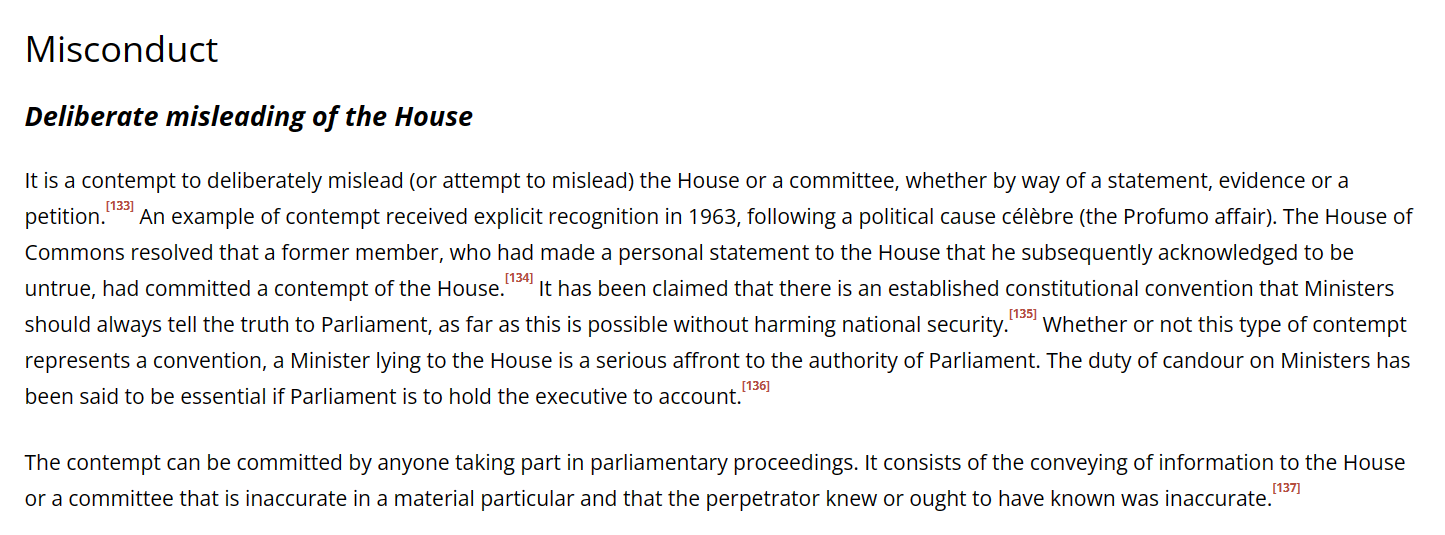
It was pleasing to see yesterday that veteran journalist Jenny Ruth has emerged from her restraint of trade purdah after leaving Business Desk to begin a new Substack newsletter (free for the first few weeks) and that one of her first columns was about the very same Reserve Bank appearance. Her piece is worth reading. She and at least one other journalist have commented on the Governor having “toned down his hostility” towards Nicola Willis in this appearance. The tone may have been less bad, but the substance was just as contemptuous as ever – and not just of Willis but of Parliament itself. That was, once upon a time, treated as a serious matter. This is from Parliament’s own website

My Thursday post was written from listening to the appearance live and scrawling a few notes as I went. Jenny Ruth’s column prompted me to go back and listen to the recording (you can find it here), being able to stop as needed and take fuller notes. I pick up that segment of the appearance with Orr closing his opening remarks declaring that he was very proud of the Monetary Policy Statement document.

Nicola Willis then asked “what is going on? Inflation has been out of the target range for 27 months. Why is it taking so long to get inflation out of our economy?

The Governor responded along the lines of “Good question. It is a global question. The drivers of inflation have been changing through time, but all biased up, There were lockdowns, supply constraints, the Ukraine war and pressure on commodity prices, and now supply shortages in New Zealand, with severe storms. The drivers have changed but we are confident, subject to the next shock, that inflation pressures are easing”.

Nicola Willis asked if the Bank had stimulated the economy too much, and the response was yes.

The Bank’s Chief Economist (and MPC member) Paul Conway added that “it had been one supply shock after another, citing Covid, the Ukraine War, the pressure moving from goods prices to services prices, and all in all a very unusual period.

He added that the Reserve Bank had however been one of the first central banks to tighten and one of the first to signal that they thought they had reached a peak.

Nicola Willis then asked about the contrast with the US, where inflation had come down faster and appeared to be doing better.

Conway responded that he had “been amazed at the performance of the US, that it was a very different economy, a very flexible one”. He noted that unemployment had rocketed upwards when Covid began and then had fallen very sharply with resources being reabsorbed. The US was “leading the globe when it comes to inflation coming down”, but that “without thinking about it too much” New Zealand had been somewhere in the middle of the pack over the last year.

Willis observed “it strikes me how inaccurate the Reserve Bank’s forecasts have been”, citing the August 2022 forecast that CPI inflation for the year to September 2023 had been 4.1 per cent, and that the latest forecast was for 6 per cent. “Have you looked at the inaccuracies and what is going on there?”

Orr responded that “yes, we do so constantly”, stressing that the great thing about monetary policy was that it as a repeat game, reviewed afresh every six weeks, when they could reflect on surprises relative to forecasts. He indicated that the Bank was working across a whole range of different issues on how to improve. Recent forecasts erros had been “very well explained” by supply shocks, noting that a year ago they had not known about cyclone Gabrielle.

Willis then asked “how much of the difference of 1.9 percentage points is down to Gabrielle?”

The Governor responded “I don’t have that”.

Willis responded that “it seemed a stretch” that cyclone Gabrielle could account for that much of it.

Conway responded that they could back the numbers out to look at exactly that question, and then launched into a bit of a defence of the Bank’s inflation forecasting more generally, argued that they were “pretty good” relative to other forecasters but that it was challenging even in normal times, but that these had not been normal times and that the supply shocks had been “incredibly disruptive”. He said that the Bank had an active programme underway to better understand economic dynamics.

Anna Lorck (a Labour backbench MP) then asked “just for clarity, how much lower would inflation be without Gabrielle?”

At this point the Bank’s forecasting manager, who was sitting at the back of the room, piped up. She was invited to come forward and grab a chair. Her response was that the cyclone effect on inflation had been less than initially expected and was probably 0.1 to 0.2 per cent, mostly in fruit and vegetable prices. Conway noted that the cyclone had been a negative supply shock (boosting those prices) but would also be a positive demand shock (rebuild activity), and either he or the forecasting manager noted that they did not have estimates for any eventual effects on construction costs more generally.

At this point discussion moved on to other topics.

There are several things worth noting just from that record:

  • not once did the Governor or the Chie Economist suggest that excess demand had had anything to do with inflation.  All the talk was about the sequence of supply shocks,
  • it was pretty clear from the answers that actually the Bank had done no serious analysis of the forecast errors over the last year or so,
  • it was also clear that the Bank had done no serious work on trying to understand lessons from other countries, whether those where core inflation has turned down (US, Canada, Australia) or those where it hasn’t,
  • the Governor wanted MPs to believe that the storms/cyclone were a big part of the story for why inflation had been so much higher than the Bank was forecasting just a year ago,
  • the Chief Economist seemed more interested in backing up the Governor rather than providing straight answers to the parliamentary committee, and
  • they might have gotten away with it (well, even more than they will anyway) if it weren’t for one of their capable staff in the back row giving the answer to the question from MPs, an answer very different from what her bosses had been trying to imply just minutes earlier.

There is no way any of this was simply the result of information not previously having been passed up the line.  As Orr had noted in his press conference the previous day, the OCR/MPS decision came as the culmination of “8-10 days” of meetings and deliberations, and paid tribute to staff and MPC members for the work that went in.   I’m sure in substance the meetings are little different than they ever were: lots of detailed papers, lots of presentations, lots of opportunity for questions, and lots of little snippets like “we think the direct effects of Gabrielle on the CPI have been about 0.1 to 0.2 per cent, a bit less than we’d initially expected.  The Governor and Chief Economist knew (that it was very small, relative to the difference Willis was asking about) and chose to mislead the Committee anyway).

But having listened to the FEC appearance again, I went back to the Monetary Policy Statement itself, dozens of pages of text, charts and tables.

First I searched the document for “storms”, “cyclone” or “Gabrielle”.  There were no mentions at all.  “storm” did appear once, but only to note some reduction in March quarter horticulture exports (fine and good to note, but…..the Governor was talking about (and being asked about) inflation.

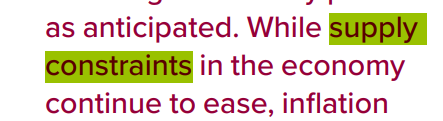
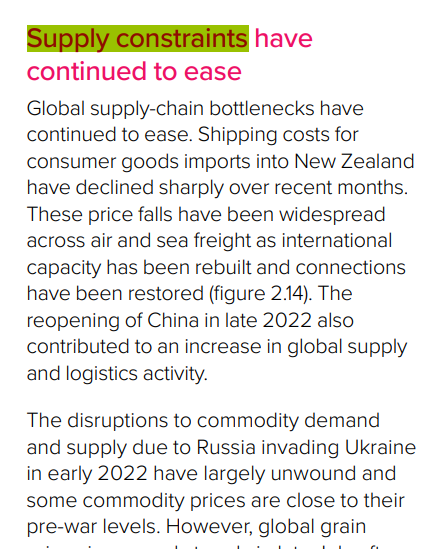
But surely “supply shocks” would appear in the document. After all, the Governor (and chief economist) had just told MPs that the series of supply shocks were the inflation story.  Perhaps with pardonable license they only meant a big part of the story (remember that the question was about the last 12 months’ forecast error)?  But anyway, “supply shock(s)” doesn’t appear in the MPS either.  I did find two references to “supply constraints”, but they were both good news stories

rather than explanations for why the Bank’s forecasts had again so under-forecast inflation. A few references to “supply chains” (bottlenecks etc) were also all positive, with things having markedly improved (so all else equal lowering inflation) rather than explaining why inflation this quarter is now expected to be 6 per cent when a year ago they expected it to be 4.1 per cent.

The contrast is just staggering, and really pretty shameful when one reflects that these were senior public figures, appointed by the Minister of Finance, testifying to a parliamentary committee when inflation is far outside the target band the MPC had been given.

I’m not even sure why honesty and contrition – whatever their innate virtues – need have been so hard. Forecasting at times like these is really challenging: were it otherwise we (and a whole bunch of other countries) wouldn’t have 6% (eg) inflation in the first place. But for reasons known only to them Orr in particular, and Conway, chose just to make things up, rather than provide honest testimony to one of the bodies charged with holding them to account. (I guess they must take lessons from their Board chair, although his just-so story was “only” to The Treasury, another body charged with monitoring the Bank, not to Parliament itself.)

As I noted in the earlier post (and as Jenny Ruth reminded readers at more length) the deceptions and misrepresentations have become a disconcerting pattern under Orr’s watch. For a certain class of person, why wouldn’t one if there are no consequences to doing so. But down that path lies the further erosion of any sort of serious accountability – accountability supposedly being the quid pro quo for operational autonomy and all the power and status that goes with it,

As a reminder, from the earlier post, here were the inflation forecasts Willis had raised

and these were the parallel unemployment projections

It wasn’t mostly about “supply shocks”, but about misjudging the extent of capacity pressures and the speed at which they would ease. But that would have been to have focused attention on the demand side, and the big misjudgements there, by the Reserve Bank, which is charged with cyclical demand management to keep core inflation in check. All these numbers are part of the MPS suite of documents on the Bank’s website.

(There was quite a bit more spin and highly questionable claims in Orr’s soft interview with a Herald journalist, but we really should be able to expect better – straightforwardness, messages actually consistent with the document he was speaking to, serious transparency, and so on; little things lilke that – when the Governor of the central bank faces a parliamentary committee.)

(Oh, and although it is an old line, it is still not true: Conway claiming to FEC that the Reserve Bank had been one of the first central banks to raise rates. There are 21 central banks making their own monetary policy (20 countries and the ECB) in the OECD. Of them, 7 started tightening earlier than our central bank, and another moved on the same day. The Reserve Bank was scarcely a stellar outlier. They did move earlier than the central banks of Australia, Canada, the US, the UK and the euro area, but then it seems now that Australia, Canada and the US have seen core inflation begin to abate earlier and further than it has here. One of the virtues of the MPS itself is that it doesn’t shy away from that fact that New Zealand core inflation is still holding up. And that, surely, is the relevant accountability test.)

At it again

Senior figures at the Reserve Bank have an alarming record of just making stuff up (and getting away with it). Just last week, documents showed that the Board chair had told entirely made-up stories to Treasury, apparently trying to rewrite history, in turn leading an incurious Treasury to lie to the media. And on several occasions the Governor has been found actively misleading Parliament’s Finance and Expenditure Committee (eg here, here, and here).

He (and, sadly, his chief economist) were at it again this morning at FEC. Asked why it was taking so long for inflation to come down we got a long list of supply shocks (ie things they weren’t responsible for) and little or no acknowledgment at all that excess demand (reflected in things like the unsustainably tight labour market), the thing monetary policy influences, might have played even part of a role.

But then this conversation ensued (not word for word)

Nicola Willis: A year ago your forecasts said inflation by now [September quarter 2023] would be 4.1 per cent, and now you are picking it will be 6.0 per cent. What explains that magnitude of error?

Orr: [after some burble] supply shocks and in particular the storms and cyclone Gabrielle

Nicola Willis: How much difference did the cyclone make?

Orr: I don’t know.

[a minute or two later]

Anna Lorck (Labour backbencher): Governor, how much difference has the cyclone made to inflation?

At this point, the Bank’s forecasting manager, sitting in the back row, pipes up and is invited forward and she explains that they think the cyclone might explain 0.1 or 0.2 per cent, (the effect through fresh fruit and vegetable prices)….. [and it seems very unlikely that the Governor did not already know this, having just sat through days of MPC deliberations].

As I say, they just make stuff up. Here it is worth remembering that a) fruit and vegetable prices, and especially extreme moves in them, will be out of all/most core inflation measures, and b) that as the Bank’s own MPS yesterday noted, several times, core inflation – the bit shaped by excess demand and expectations pressures – was hanging up and had not yet shown signs of falling.

These are the RB inflation projections Willis was referring to

And here are their unemployment rate projections from the same two sets of forecasts

Slack simply has not re-emerged in the economy as early or to the extent the Reserve Bank expected a year ago. That isn’t about adverse supply shocks. It is just a(nother) forecasting error re excess demand from the well-paid committee (and their large supporting staff) charged with delivering annual inflation near 2 per cent.

Despite the chief economist’s claims (again, at FEC this morning) that the Bank is pretty good at forecasting, in this episode (last few years) they’ve been consistently worse than respondents to the Bank’s own expectations survey (who’ve been bad enough).

All that was just about a few minutes in the MPC hearing, where (as so often) that Bank treats parliamentary scrutiny and accountability as some sort of game where anything goes. The post was actually going to be about the MPS itself.

It was a pretty thin and disappointing document, even with the modest nudge in the direction of possible further OCR increases. I read it more slowly and carefully than I sometimes do, and came away if anything more convinced that the combination of their own persistent mistakes and their own read of the data support a higher OCR now, to be confident that we will really get inflation back to 2 per cent fairly promptly from the current still elevated core levels. And astonished that, with no supporting analysis for the claim, the MPC continues with the bold claim – not paralleled as far as I’m aware in any other advanced country central bank – that they are “confident” they have done enough. “Confident” here seems most likely to be empty bluster, with the risk that it is also intended to keep the natives quiet for the weeks remaining before the election.

I have been, and still am, hesitant about suggesting that the Governor and the MPC are operating in a deliberately partisan way. But it gets harder to believe such a pro-incumbent bias is playing no part (consciously or unconsciously) in their words and actions. I’ve documented previously the skewed, highly unconventional, and very favourable to Labour, way the Bank treated fiscal policy in May following the more expansionary Budget. In this MPS, the word “deficit” appears 44 times, but it appears that every single one of those references is to the current account deficit, and not one to the budget deficit (altho there is a single reference to “the Government’s plan to return the Budget to surplus”). The same weird framing of fiscal issues was there not only in the rest of the document but explicitly from the Governor this morning. He claimed that what mattered for the Bank from fiscal policy was only/mostly government consumption and investment spending, not taxes (or apparently transfers), let alone changes in structural deficits (the usual model). Having provided no supporting analysis or rationale whatever – speech, research paper, analytical note, just nothing – the Governor appears to have simply tossed the conventional fiscal impulse approach out the window, at just a time when doing so suits his political masters. Perhaps it is all coincidence, but either way it is troubling.

More generally, relevant supporting analysis was remarkably thin on the ground. There was no analysis at all of past reductions in inflation in New Zealand, no analysis of the forecasting mistakes of the last year (see above), no serious analysis of what has gone on in the US, Canada, or Australia where core inflation has turned down (and what, if any, comparative insights those experiences might offer). (At FEC this morning, they were asked about the US case, and it was clear they’d not even thought hard as the chief economist was reduced to lines like “it is a very different economy”, “very flexible”, and that was it…….) And there seemed to be considerably more discussion of the current account deficit – which the Bank has no direct responsibility for – than of inflation for which it does. Even with a four page special topic on the current account and a five page one on immigration it is hard to think of any useful analytical insight one comes away from the document with. And remember that this is it: there is no stream of thoughtful speeches likely to emerge from MPC members over the coming weeks elaborating on bits of research or analysis there was no space for in the MPS itself.

And, revealing the poor quality of the MPC itself, even though core inflation lingers high, miles above target, there is no sign in the minutes of any serious thoughtful alternative approaches. We are left to assume that in a highly uncertain environment all these senior public officials just went with the flow. They are “confident” we are told again, but with no hint of why, or no hint of anything like the normal degree of divergence one might reasonably expect if seven able people were debating such challenging issues at the best of times.

Even allowing for signs that things are slowing – and remember we had two negative quarters of GDP growth late last year and early this year already – there seems to be more wishful thinking and hopefulness than serious supporting analysis (and, of course, any contrition – these people wreaked this inflationary havoc and the expected rise in unemployment – is totally absent). Not even the MPC hides the fact that “domestically-generated inflation” is not only hanging up but is also “marginally higher” than they’d expected as recently as May.

Among the straws they attempt to clutch at is a claim that “private sector wage inflation appears to have peaked and has started to ease” and “most measures of annual wage inflation have begun to ease”. But of all the series they seek to draw on, the only one that actually attempts to measure wage rates (rather than hourly or weekly earnings, or something approximating unit labour costs) is the LCI Analytical Unadjusted series. As I showed earlier in the week, at best this series seems close to peaking, but there is no sign yet of any slowdown.

Perhaps as to the point, even when some series have started slowing – and neither core inflation nor wage rates yet have – there is a long way to go to get core inflation from 6 per cent to 2 per cent, and the Bank’s forecasts and policy have been repeatedly wrong in the same direction over recent years.

Then there is the fact that the Bank has revised up its view of the neutral nominal interest rate by 25 basis points. That may well be sensible (respondents to their expectations survey have raised their view of neutral by 60 basis points in the last 18 months), but what it means is that the Bank now thinks the current OCR is less contractionary, all else equal, than it has assumed previously. It is as simple and mechanical as that. With core inflation still holding up, the labour market still tight (in their words), the output gap still positive, and other excess demand indicators still pointing to imbalances, it might then have seemed natural to have moved to raise the OCR, or at least to move the near-term forward track up by 25 basis points, putting October and November firmly into view. Instead, the track is ever so slightly higher in the near-term and the 25 points increase only really becomes apparent in the far (and largely irrelevant) reaches of the years-ahead OCR projections. The MPC was keen on a so-called “least regrets” framework when they were (unintentionally) giving rise to the current mess, but seem to prefer just to punt and hope now.

One of the (many) disappointments around the Reserve Bank’s analysis in recent years – a period when not only do we have a shiny new MPC but the biggest monetary policy failures in decades – is the lack of any really systematic and overarching view of the excess demand pressures that have built up in the economy. They show up, of course, most evidently in the high inflation (which then the Bank too often – see above – tries to minimise with handwaving rhetoric about supply shocks), and it shows (more abstractly) in the Bank’s output gap estimates and (more concretely) in the unsustainably low unemployment rates. But it also shows up in the labour force participation rate, which has stepped up a long way in this boom, tends to be pro-cyclical, and yet the Bank assumes the increase is permanent. Is that likely, and if so why?

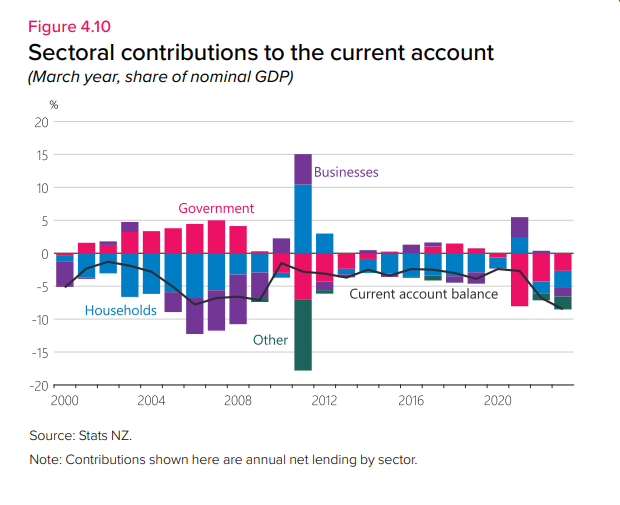
And then there is the sharp widening in the current account deficit, which does not get the attention it deserves as an indicator of macro imbalances and excess demand. As noted already, there is a four page special chapter (and I agree with the bottom line re the NIIP position), but it is rather light on macroeconomic analysis (a basic savings-investment lens) and longer, earlier, on accounting (the absence of Chinese students and tourists). There is a nice sectoral balances chart

and this is where even the Bank has to acknowledge the government contribution to the demand imbalances.

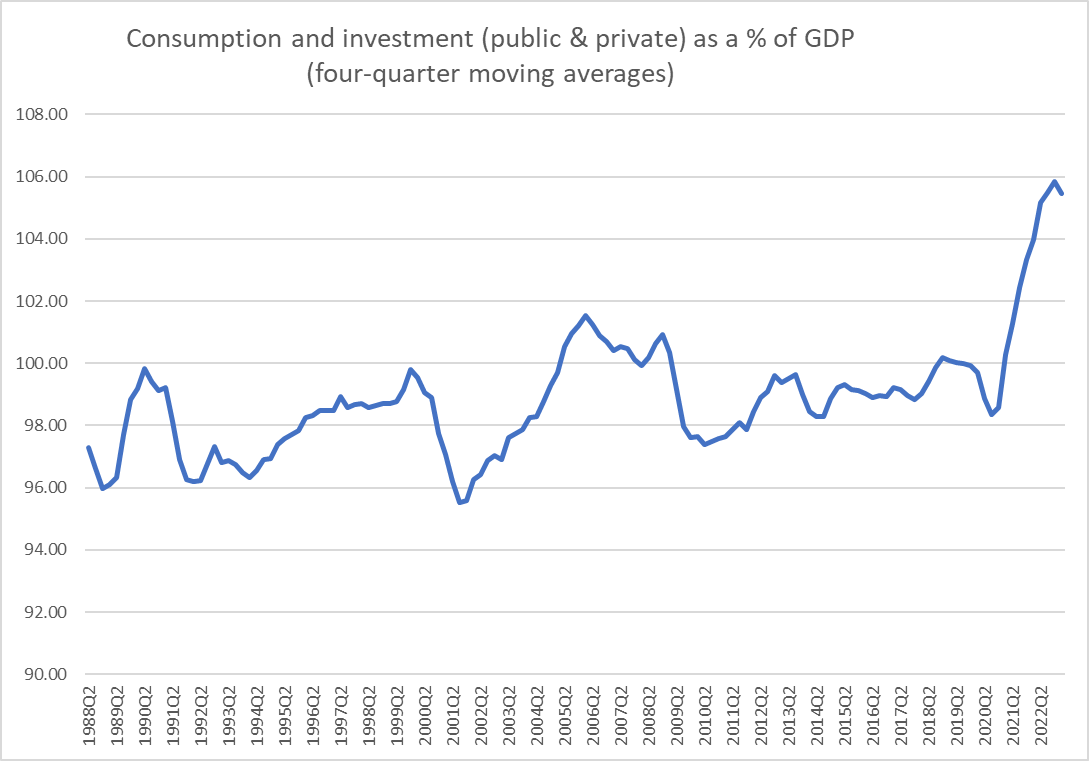
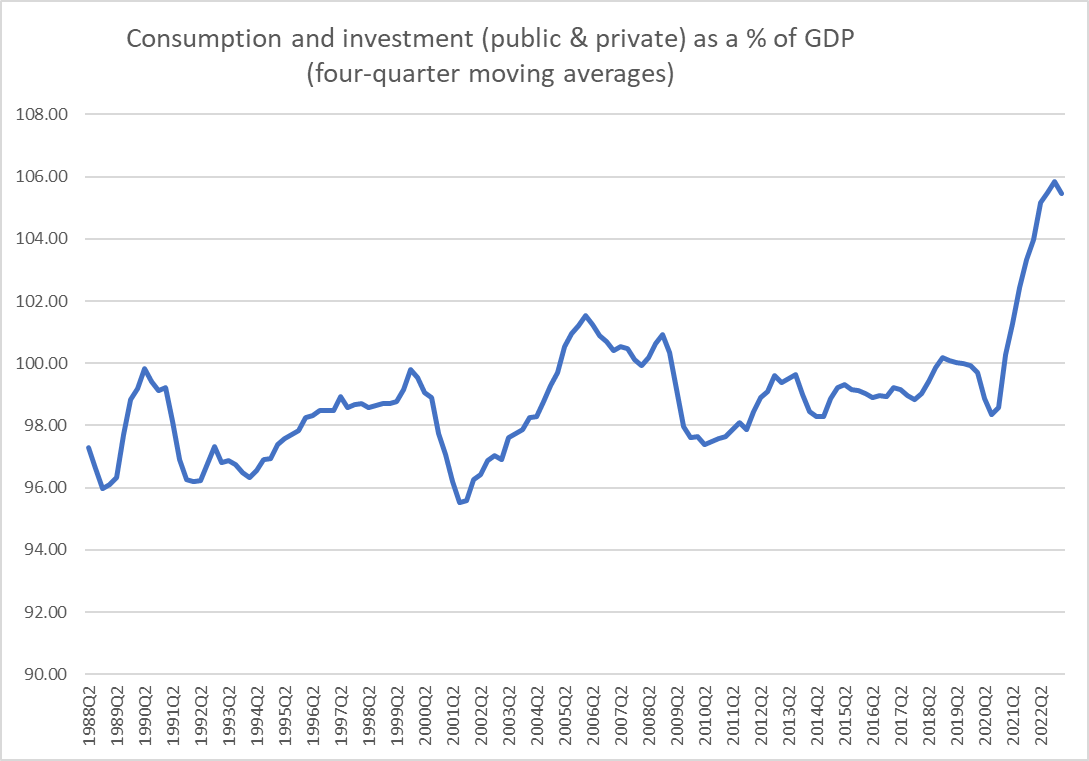
But in playing around with the data yesterday, I came up with this chart

The extent of the domestic pressure on available resources relative to domestic output is quite unprecedented in recent decades (both the consumption and investment lines individually are also around record highs, but it is the combination that is striking). Since GDP is what it is (already stretched beyond potential – that is what a positive output gap is) the excess demand pressures are reflected in a current account deficit. This is annual data. Using the quarterly seasonally adjusted data, the most recent quarterly observation was slightly higher than the last four quarter average. There is a lot of excess demand adjustment that seems likely to have to occur (if, for example, this ratio is to get back to the 98-100 per cent range observed most of the time in the last 35 years).

Central banks are well-positioned to make such points and present data in telling ways. Our mostly does not.

Any new government will face a lot of challenges, and a lot of areas of the public sector that really need sorting out. Given the great power handed to the Reserve Bank, their glaring failures in recent years, and their apparent indifference to matters of integrity, the combination of considerations mean they should be high on the priority list for a new Minister of Finance.

Monetary policy miscellany

I did an interview with Mike Hosking this morning on monetary policy and inflation, against the backdrop of this afternoon’s Reserve Bank Monetary Policy Statement. Where we differed seemed to be around wages. Hosking asked how did wage inflation get so high, contributing to the ongoing inflation problem, and suggested that wage earners should now hold back in order to help bring inflation down.

Such lines aren’t unknown, even from central bankers (the Governor and other senior Bank of England people have run such lines recently, and not emerged well from the experience). I think they are almost entirely misplaced. Inflation (well, core inflation anyway) is a monetary policy failing, a symptom of persistent excess demand across the economy (for goods, services, labour, and whatever). One symptom of that excess demand was the incredibly tight labour market – record low rates of unemployment (not supported by microeconomic structural liberalisations) and firms crying out for workers, reporting extreme difficulty in finding them etc. All those pressures appear to be beginning to ease now, but employment growth has been very strong even recently, the unemployment rate is still well below most serious NAIRU estimates, and the participation rate is far higher than it was pre-Covid.

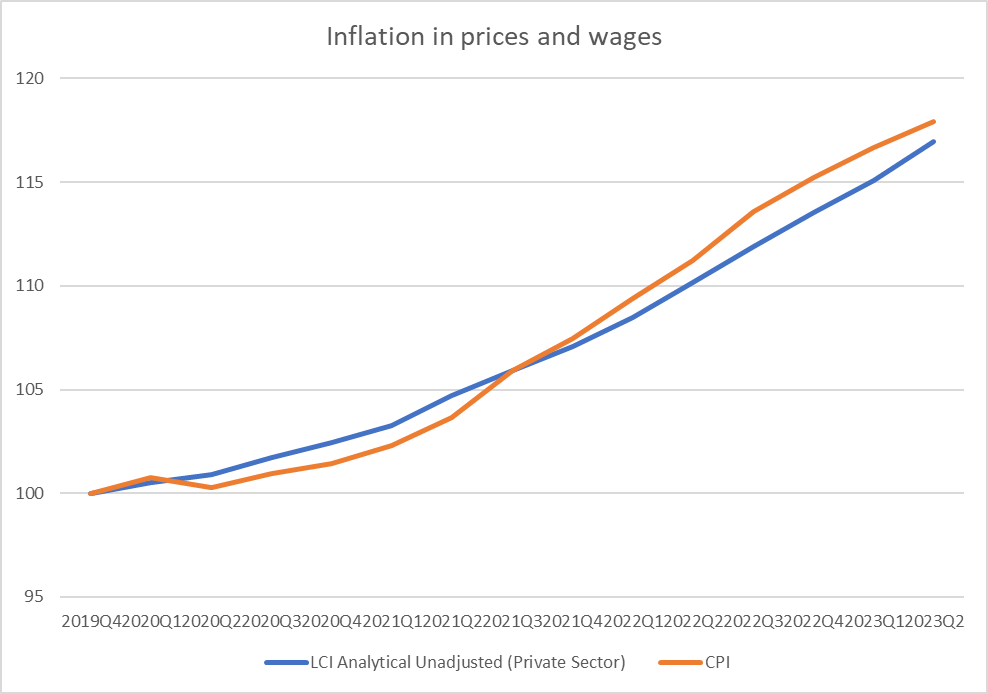
If anything, it is surprising we have not seen stronger growth in wage rates. Here is a simple chart showing wages (the stratified LCI Analytical Unadjusted index of private sector wage rates) and prices (the CPI) since just prior to Covid.

Over that 3.5 year period real wages have hardly changed (in fact they are slightly down, but the difference at the end of the period is less than 1 per cent). Even allowing for the fact that the inflation took everyone by surprise – most notably the central bank and its MPC – it isn’t really what I’d have expected this far into an inflation shock. Note that over time you’d normally expect real wages to rise as trend productivity improves, but the best estimates so far suggest little or no economywide productivity growth in New Zealand over the Covid period.

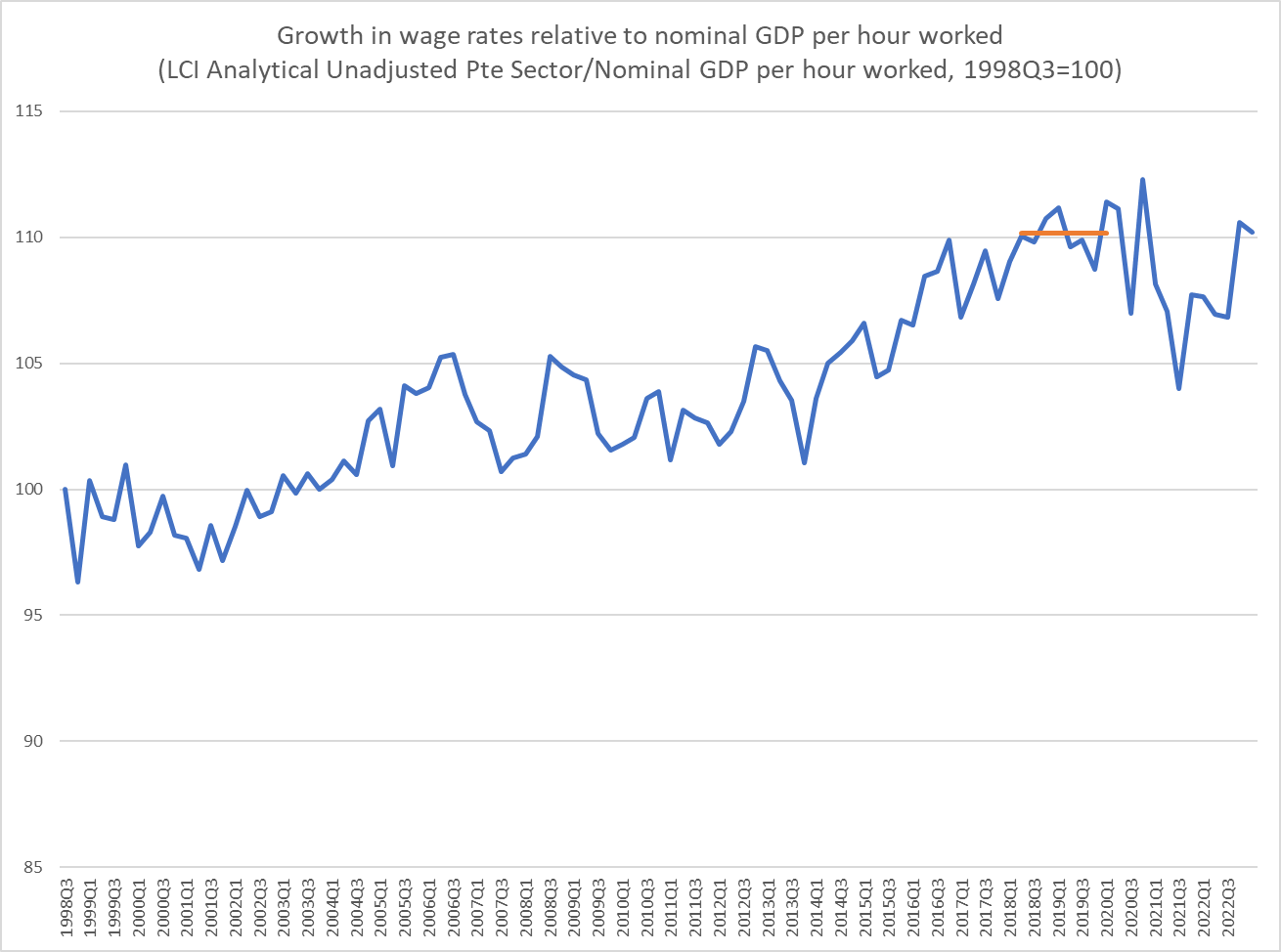
Now, as I noted in yesterday’s post the terms of trade for the New Zealand economy as a whole have been falling, reducing purchasing power relative to the real output of the economy. Perhaps wage rates have been doing something unusual relative to overall capacity of the economy to pay?

In this chart, when the line is rising (falling) private sector wage rates have been rising faster (slower) than nominal GDP per hour worked.

The orange line is the average for the couple of years immediately prior to Covid. As you see, the final observation (Q1 this year, as we don’t yet have Q2 GDP) is almost exactly at that pre-Covid level. Wage rates have not risen in any extraordinary way relative to the either prices or overall economic performance in the last year or two.

The gist of Hosking’s question was that if only workers now took lower wage increases the adjustment back to low inflation might be easier. At one level, I guess it just might, but only in the same way as if firms decided to increase their prices less (the CPI is, after all, ultimately just a weighted average of firms’ selling prices). But things don’t work like that, and it isn’t even clear that they should (there is a lot to be said for decentralised processes for both price and wage setting). As I noted in response, the labour market these days mostly isn’t a union leviathan confronting a combined employers’ leviathan, but a decentralised process in which individual firms and their workers make the best of the situations they find themselves in. Firms want/need to attract and retain staff and have to pay accordingly, and when employees have other options they can either pursue them or suggest they need to be paid more to stay where they are.

Core inflation is an excess demand phenomenon, which can be reinforced to the extent that people (firms, households, whoever) have come to fear/expect that inflation in future will be higher than it has been in the past (and whatever weight one puts on them that is what inflation expectations surveys are now showing). What we need isn’t firms or workers to be showing artificial “restraint” but the central bank to do its job, to adjust overall demand imbalances in ways that once again delivers core inflation sustainably near 2 per cent. Unfortunately, that can’t just mean heading back to things as they were at the end of 2019 when inflation was low, on the back of years of low inflation, but rising: achieving the reduction from 6 per cent to 2 per cent is the dislocative challenge.

Changing tack, as I mentioned yesterday one of the key things I will be looking for in the MPS today (more or less regardless of what immediate policy stance the Bank takes) is evidence of engagement with the question of why (core) inflation has come down so much in some (by no means all) other advanced economies and not in New Zealand.

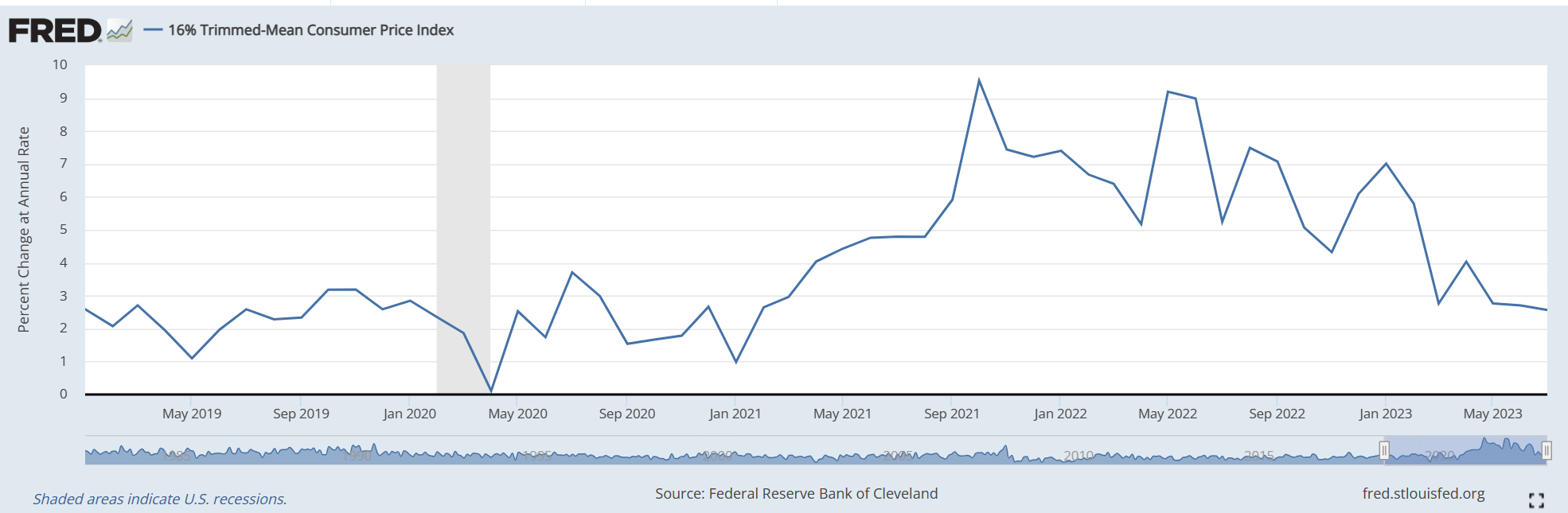
To illustrate, here is the US trimmed mean CPI (monthly annualised)

The weighted median series looks much the same.

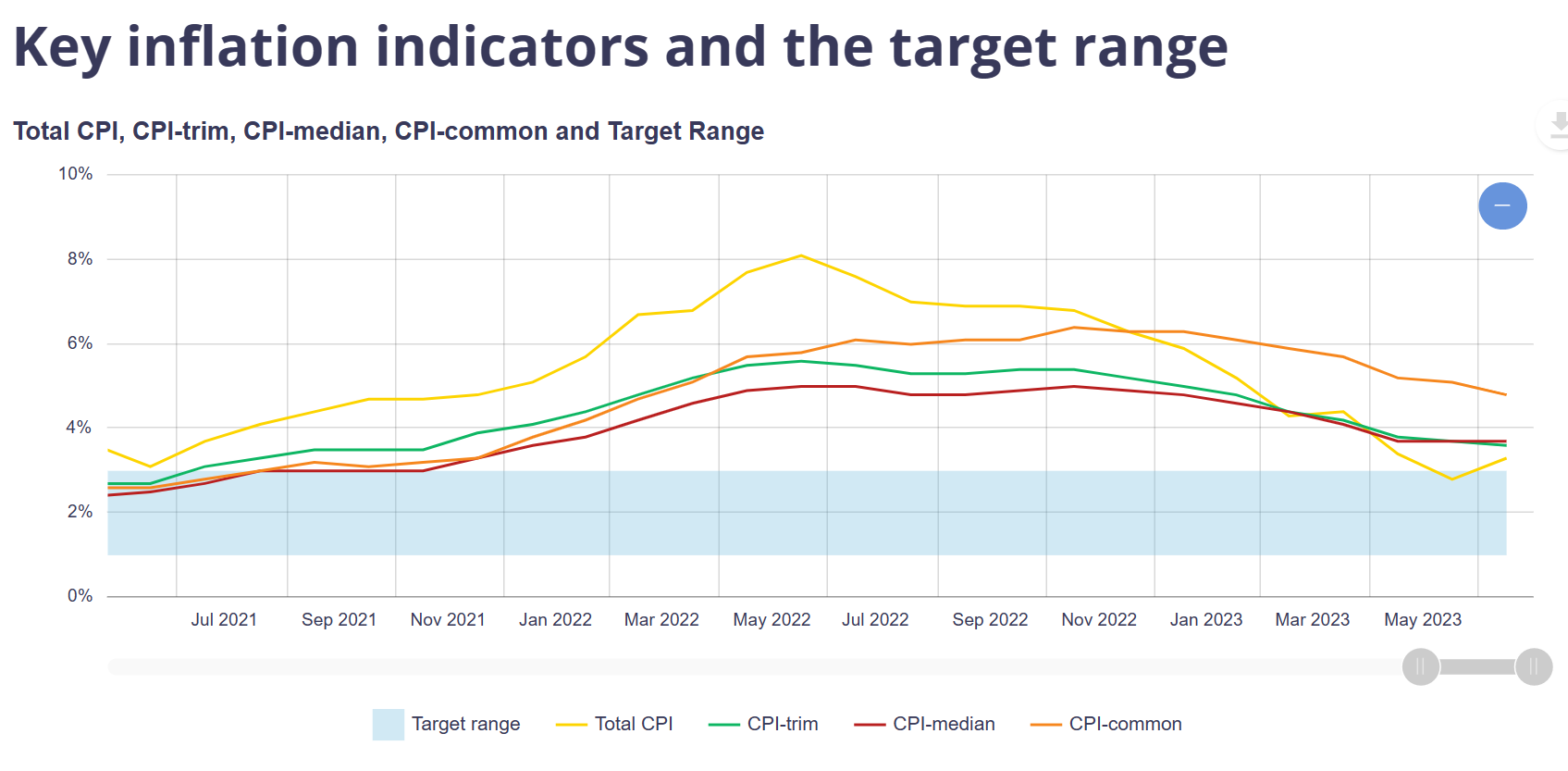
And here are the Bank of Canada’s annual core inflation measures

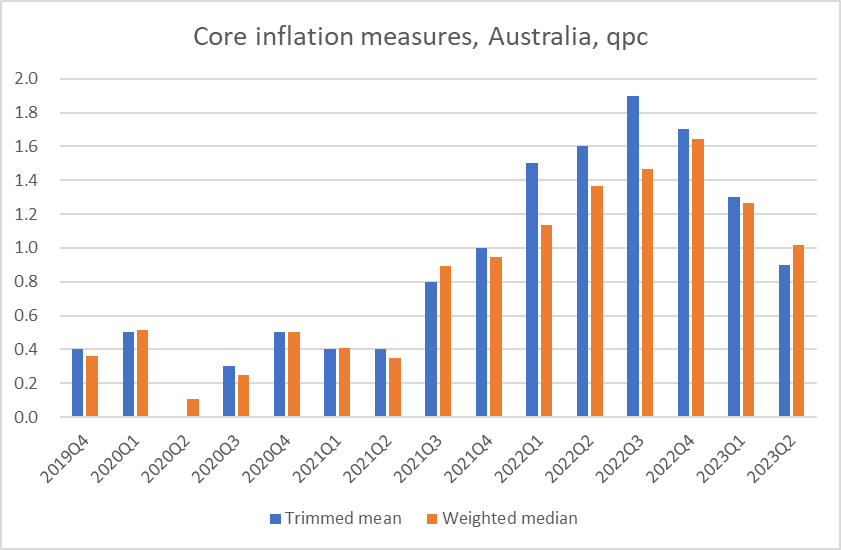
But it isn’t only in North America. Here are the Australian core measures (both now showing much the same story)

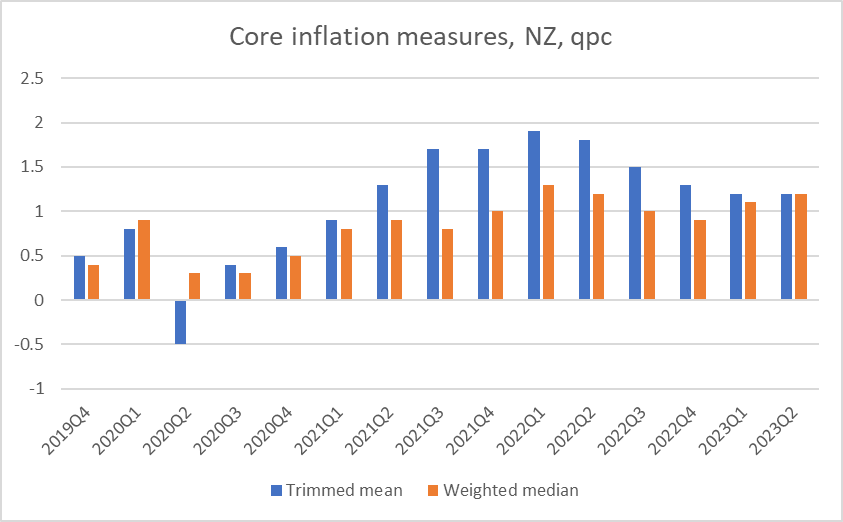
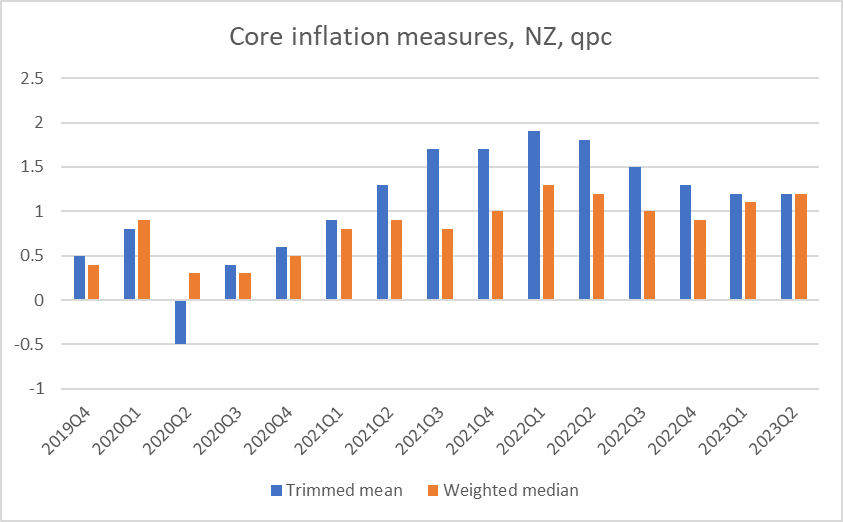
And yet here are the NZ measures

The trimmed mean appears to have fallen from a peak 18 months ago, but is hardly falling at all in the last couple of quarters, while with the weighted median it is not clear that there has been any reduction at all. Both are at levels a long way from the target midpoint.

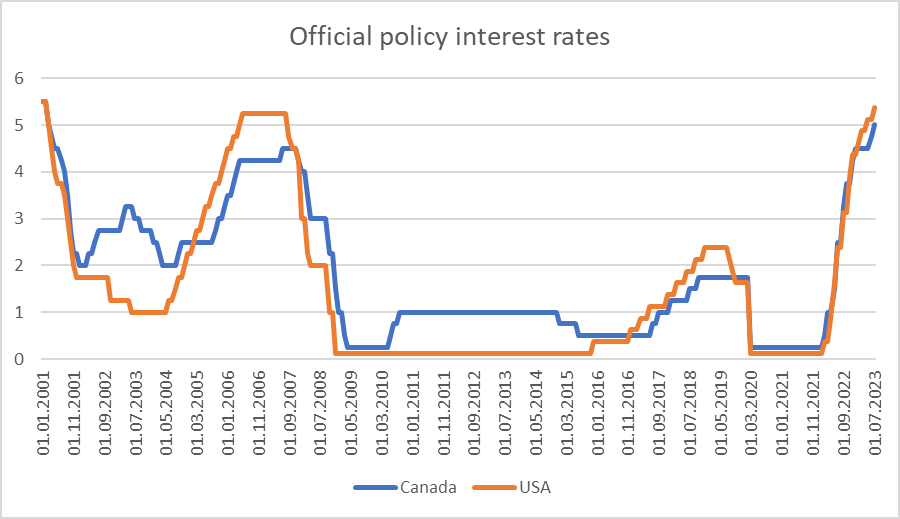
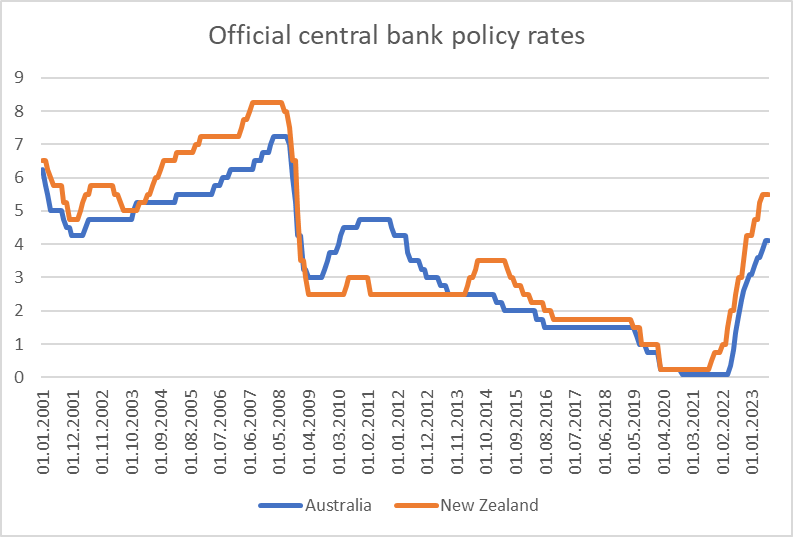
At one level, perhaps the US and Canadian inflation reductions are less surprising. Their central bank policy rates are now at or above the pre 2008 peaks. By 21st century standards these are now high interest rates for those countries

New Zealand makes quite a contrast……but Australia even more so.

I don’t understand quite why core inflation has already clearly come down in Australia at what seem to be quite modest interest rates. If you look carefully at those core inflation charts you will notice that core inflation started rising two quarters later than in New Zealand, and now seems to be clearly falling more and sooner.

Relative to New Zealand, Australia has had a better run with commodity prices

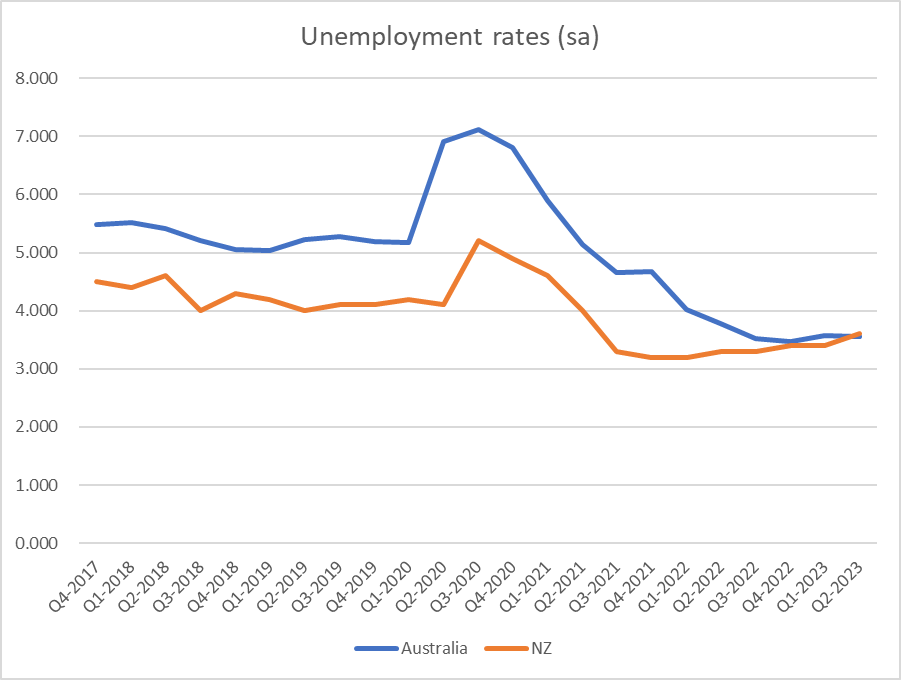
And whereas Australia usually has a higher unemployment rate than New Zealand, at present they are roughly the same, suggesting that if anything Australia may have an unemployment rate further below NAIRU estimates than New Zealand does.

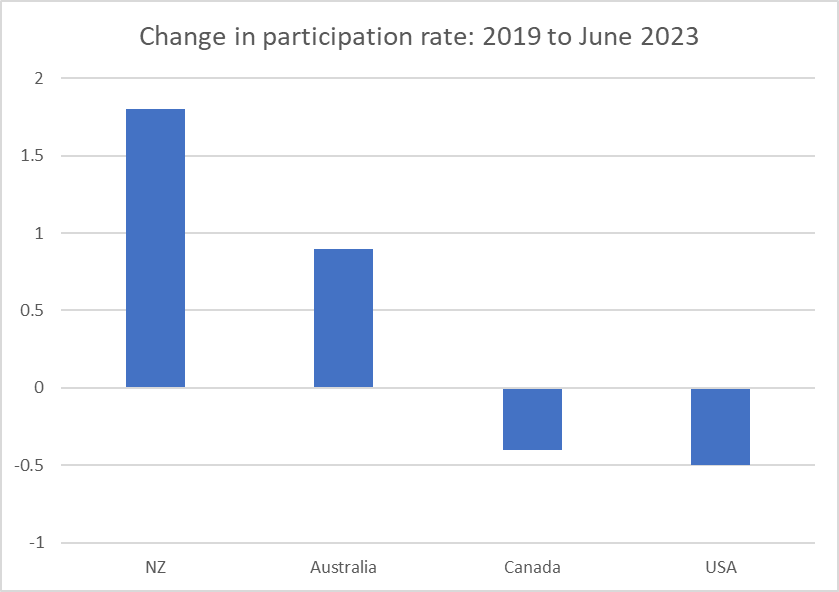
There must be good explanation for what is going on, for why core inflation has not yet fallen (as it has not in some other advanced countries) but to be persuasive such explanations need to be able to encompass credible explanations for why things have gone better (inflation fallen earlier and faster) in the US, Canada, and Australia. Those stories matters: on the face of it, the US and Canadian comparisons might suggest that the RBNZ has simply not done enough, but the Australian comparison (in an economy with a very similar Covid experience, and also a more similar labour market experience) might reasonably suggest the opposite. One sees stories from the UK and North America ascribing inflation to the low post-Covid participation rates, and (in the US) some easing in inflation perhaps being down to a recovery more recently in participation. But of these four countries NZ stands out as having the largest rise in participation (true even if some might discount the latest quarterly rise) and apparently (thus far anyway) the stickiest core inflation.

Perhaps the explanation will eventually be shown to have been some mix of “the cheque was in the mail” and “New Zealand data were published more slowly and infrequently than many other countries” – plenty of places already have July inflation data, in some cases July unemployment data, while we have only mid-May inflation and unemployment data, and have a two month wait for more.

Or perhaps there is more of an economic story. I hope the Reserve Bank can offer some serious analysis this afternoon.

The $11bn men and women of the MPC

Three months ago I wrote a short post here using some new data the Reserve Bank had started to publish on the monthly payments Treasury was making to the Reserve Bank as the losses were gradually realised on the huge portfolio of bonds the Bank and MPC had run up in 2020 and 2021 (the LSAP). It was to the Bank’s credit that they have started making the data available, and although there have been a few glitches since then, when I have got in touch they have been very helpful.

I can remember the days when I and a few others used to jeer at them for having lost $7 billion (and these numbers are a proxy – albeit an imperfect one – for big and very real losses for the taxpayer from the asset swap programme, executed at probably the single most inopportune time since interest rates were liberalised 40 years ago). Last year, the Taxpayers’ Union gave the Governor a lifetime achievement award for waste, citing then estimates of $8.5 billion of losses.

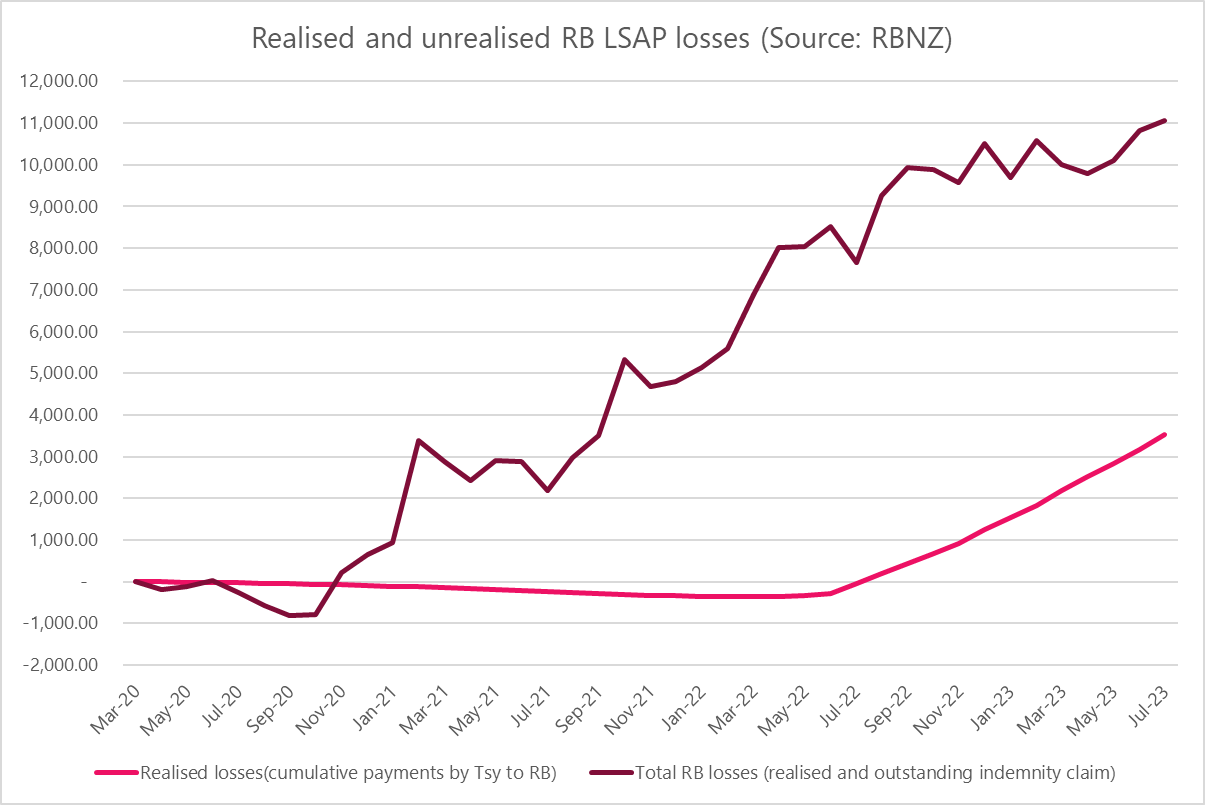
That was then. When I ran the first post in May total RB losses (now properly measured, with the indemnity payment data) had been bobbling just either side of $10 billion. With today’s update by the Bank of the relevant spreadsheet, here is the position to the end of July.

Yes, total RB losses from this grossly overblown under-analysed programme have now reached $11 billion (which was also the last total estimate from The Treasury I’d seen).

But, again, that was then, and in August to date bond yields appear to have risen another 20 basis points or so. As the portfolio slowly shrinks and the longest bonds are sold off first, the extent of further losses should diminish, but there is no sign we’ve yet reached the limit.

I’ve tended to focus in on the Governor as responsible, and there is little doubt that he is the dominant figure on the MPC.

But we shouldn’t forget the other internal MPC members who shared in the decisions to accumulate the risk:

Then Deputy Governor, Geoff Bascand

Then Assistant (now Deputy) Governor, Christian Hawkesby

Then Chief Economist, Yuong Ha

One has since been promoted and two have moved on, although with no hint that sharing responsibility for absolutely huge taxpayer losses was a part of either move.

More recently, Karen Silk and Paul Conway have joined the MPC. They weren’t there when the risk was taken on, but they have been part of the decision not to close it out quickly, and thus to continue to expose taxpayers to further losses.

And then of course, there are the three externals, all reappointed since the LSAP folly: Bob Buckle, Peter Harris, and Caroline Saunders.

And who reappointed them and Orr? Well, that would be the Minister of Finance and the Bank’s Board, the latter chaired by Neil Quigley, who has just proved you can apparently just make up stuff to Treasury, lead Treasury to lie to the press, and still carry right on as chair of a government board. In this country new depths of poor governance seem to be plumbed almost every week.

Finally, we shouldn’t completely exclude the Secretary to the Treasury from responsibility. She sits as a non-voting member of the MPC and she advises the Minister on things like indemnities and Bank performance. There is not even a hint (eg in the MPC minutes or OIAed papers) that she has ever dissented from the highly risky and costly LSAP intervention.

That is quite a list of people who share responsibility for losses that have now reached $2000 per man, woman and child in this country. Readers will reflect on just what nice-to-haves that politicians are now competing to bribe us with (with borrowed money) might have been considerably more affordable had the Bank stuck to the OCR which, boring as it may be, tends not to make or lose taxpayers much money at all.

I suppose one way of looking at that list of the responsible men and women is that if we averaged it out, the loss was a bit under $1 billion per responsible public figure. There wasn’t even a good party (as Mr Leauanae enjoyed on leaving MPP) just reckless waste and losses on a scale not seen in New Zealand public finances for a very long time.

And no one paid any personal price. There was no personal accountability at all. Most of these people still hold their high, and highly paid, offices. While you and I are covering the losses they so carelessly racked up. It is some slim consolation that one of them is up for election in a few weeks.

What should the MPC do?

There is a full Monetary Policy Statement from the Reserve Bank and its Monetary Policy Committee tomorrow. No one expects them to do anything much, but I’m less interested in what they will do than in what they should do. It is hard to be optimistic that the Committee will do the right thing at first opportunity – it mostly hasn’t for the last 3.5 years – but whatever is required will, presumably, eventually get done, perhaps after a prolonged dalliance with the alternative approach (if you think that cryptic, think $10-11bn of LSAP losses, entirely the responsibility of the MPC, and core inflation persistently some multiple of the target that had been set for them).

I wrote a post a couple of weeks ago looking at what had been happening to monetary policy and inflation across a bunch of advanced economies in the light of the complete suite of June inflation data. I’m not going to repeat all the analysis and discussion from there, and nothing very much has changed in the published data (for real nerds, still disconcertingly high Norwegian core inflation has come back down again after rising the previous month or two). But some key relevant points were:

  • as yet, there is no sign that core inflation in New Zealand is falling (and even if one measure it might be lower than the early 2022 peak there is no sign it is still falling now).  That is a quite different picture from some other advanced countries (notably the US and Canada, but also Australia).
  • employment appeared to continue to be growing strongly (and even confidence measures were stabilising),
  • New Zealand is one of a small handful of advanced countries where the policy rate now (5.5 per cent) is still well below the pre-2008 peak (8.25 per cent)
  • The MPC asserted at their last review that they were “confident” that they had done enough.  Neither those words, nor the idea, appear in the recent statements of any other central banks, and our MPC offered no reasons for their confidence.

Bear in mind that with core inflation around 6 per cent and the Bank’s target requiring them to focus on the 2 per cent target midpoint, there is a very long way to go.   It isn’t a matter of getting core inflation down by 0.5 or 1 per cent, but of a four percentage point drop.

Bear in mind too that whereas past New Zealand tightening cycles have typically seen total interest rates rises similar to what we’ve seen to date (a) the scale of the required reduction in core inflation is greater than anything we’ve needed to achieve for 30+ year, and b) unlike typical New Zealand tightening cycles there has been no support from a higher exchange rate.

What local data there have been in the last couple of weeks hasn’t given us any more reason for comfort.  Late last week, there were the monthly rentals and food price data.   The food price data did look genuinely encouraging, although it was a single month’s data in a part of the CPI that had seen inflation far faster than the core measures until now.  Rents, on the other hand, appeared to be continuing to rise quite strongly, with no sign of a (seasonally adjusted) slowing at all.

The suite of labour market data (HLFS, QES, LCI) was not really any more encouraging.  Labour market data do tend to be lagging indicators, but we have to use what we have.   4 per cent annual growth in numbers employed (comprised of four individual quarters each showing material growth) is absolutely and historically strong, by standards of past cycles the unemployment rate has barely lifted off the (extremely low) floor, and there is no sign of any slowing in wage inflation (remember that much of services inflation is, in effect, wage inflation).  There is seasonality in the wages data and SNZ don’t publish seasonally adjusted series but as this chart illustrates at best wage inflation might be levelling out, not much higher than the same quarter in the previous year.

To the extent the mortgage borrowers/refinancers tend to go for the lowest shortish-term fixed rate on offer, current two year fixed rates are barely higher than they were at the end of last year, and all the reports from the property market suggest a bottom has already been found and prices are already rising (still modestly) again.

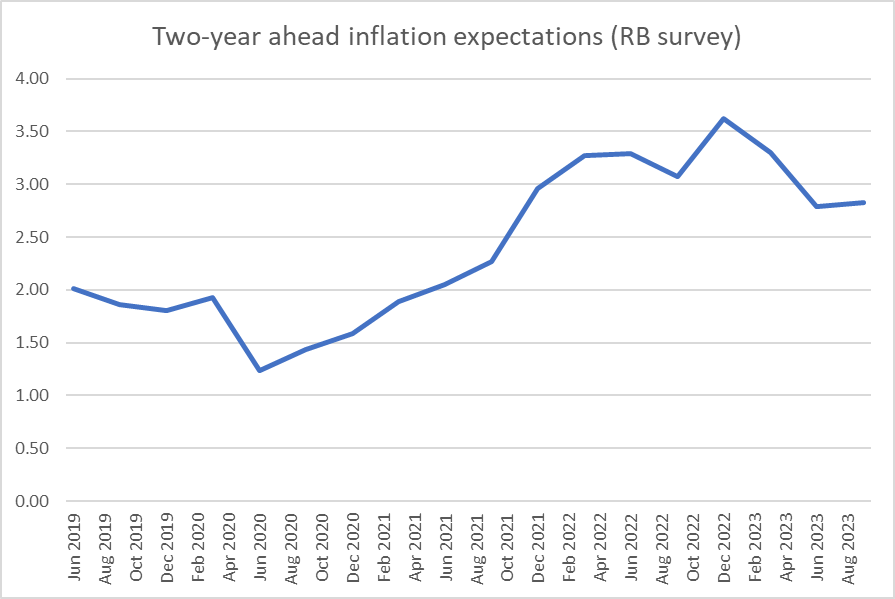
And then there was the latest RB survey of expectations. Medium-term expectations of inflation actually rose a touch (one could discount the small rise, but we should have been hoping for a fall, especially as the relevant horizon date moves out each quarter). This group of respondents has consistently and badly underestimated inflation in recent years. The Reserve Bank has too, but it has done even worse than these survey respondents.

The survey responses regarding the inflation outlook don’t seem anomalous. The same respondents revised up their GDP growth forecasts, revised up their wage forecasts, revised up their house price inflation expectations, and revised down their medium-term unemployment expectations. They might be wrong – and often are – but are there good grounds for thinking the Reserve Bank is any better at present (in a period when no one really has a compelling model of what has happened with inflation – if they had, they’d have forecast it better).

You may have noticed that a couple of local banks think the Reserve Bank will raise the OCR later in the year (presumably a view that the Bank will eventually be mugged by reality). One presumes this predictions are best seen as a view that “more will need to be done”, rather than a specific confident prediction of 25 basis points being specifically what is needed. No one can be that confident (with 25 basis points). It may be that the MPC has already done enough (as they thought) or that it needs to do quite a bit more, but even in hindsight it will be very difficult to distinguish between the effects of a 5.5 vs 5.75% peak choice.

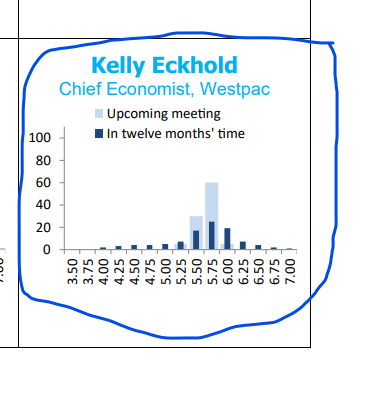
In the NZIER Shadow Board exercise, where respondents are asked what they think should be done, Westpac’s Kelly Eckhold thought that an increase in the OCR to 5.75 per cent at tomorrow’s MPS would be warranted (as does one other economist in the survey).

When I tweeted yesterday about the Shadow Board results yesterday I was still hedging my own position. I noted that I thought a least regrets approach – remember the MPC’s enthusiasm for such a model on the downside – suggested that it would have been better if the OCR had been raised more already.

That was deliberately an answer to a slightly different question than what I would do tomorrow if I were suddenly in their shoes, or (separate question again) what I think they should do. The actual MPC is somewhat boxed in by its own past choices (not just the “confident” rhetoric, but the absence of any speeches etc giving any hint of how they, individually or collectively, have seen the swathe of data that has come out since they last reviewed the OCR). To move the OCR tomorrow would bring a deluge of criticism on their heads, from markets and economists, but it would then be amplified greatly by politicians as we descend into the depressingly populist election campaign.

Since I think making the right policy adjustment (even amid all the uncertainty) is more important than communications, and since there is already reason to think the MPC has been playing party political games (its treatment of the Budget in the last MPS), I think they should raise the OCR anyway, by 25 basis points, and shift their forward-looking approach back to a totally data-dependent model, rather than trying to offer reassurances. Were I suddenly in their shoes, shaped to some extent by past choices, I would probably be wanting to indicate concern that core inflation was not yet falling, emphasising how far there was to go, and making clear that the real possibility of OCR increases would be on the table for both the October and November reviews (the latter the last before the MPC moves into its very long summer holiday).

To me, the issue now is not whether core inflation is going to fall. It seems most likely that it will finally begin to (and although overseas experience in by no means general, perhaps the US, Canadian, and Australia recent experiences offer grounds for hope) but rather how far and how slow the reduction will be. We need large reductions in core inflation, not just the beginnings of a decline, and two years into the tightening cycle we need to see large reductions soon. Perhaps it will happen with what has been done already, but that seems more like a hopeful punt than a secure outlook. One thing we should be looking for tomorrow, especially if the MPC does nothing, is some serious analysis illustrating their thinking as to why it is that core inflation here has not yet fallen (whereas, for example, it has in the US, Canada, and Australia). I don’t know the answer myself, but with all the resource at their disposal we should expect the MPC to make a good fist of a compelling story.

The world economy, and the travails of China, have got some attention recently. That global uncertainty will no doubt be cited by some, including around the MPC table, as reason for waiting. I’m not convinced, partly because over the decades I’ve seen too many occasions when such potential global slowdowns have been cited as an argument, only for them to come to not much. Relatedly, over the years one of the most important ways global events affect New Zealand has been through the terms of trade. A serious global slowdown might be expected to dampen the terms of trade (and thus real incomes and demand relative to the volume of domestic output) but…..

….New Zealand’s terms of trade have been trending down since Covid began, and quite sharply so since the start of last year. We’ve been grappling with an adverse terms of trade shock and have still had persistently high core inflation (and super-tight labour markets etc). There isn’t any obvious reason why the terms of trade couldn’t fall another 10 per cent (dairy prices have already weakened further in recent months, this chart only being to March), but if so it won’t be against a backdrop of recent surges of optimism (unlike the reversal in the recession in 2008/09). In short, there is plenty of time to react to really bad world events if and when they actually happen.

Finally, the immigration situation has materially changed the New Zealand macro position in the last year. In the June quarter last year, there was a net migration outflow of 2600 people. In the June quarter this year (June month data out only yesterday), the estimated net inflow was 20000 people (consistent with an annual rate of 80000 or so). The Reserve Bank is on record as saying it doesn’t know whether the short-term demand or supply effects are stronger (which is quite an admission from the cyclical macro managers) but all New Zealand history is pretty clear that – whatever the longer-term effects might be – in the short term demand effects, particularly from shocks to migration, outweigh supply effects. Without that effect, it might have been safe to assume enough had been done with monetary policy months ago. But not now, not against the backdrop of high and not falling wage and price inflation, strong employment growth, recovering housing market and so on.

Note too that the net inflow numbers are held down by the high and rising number of New Zealanders leaving. Outward migration of New Zealanders tends to be particularly strong when the Australian labour market is very tight (see 2011 and 2012), and if that market were to ease – as seems to be generally expected and thought to be required – the overall net inflow to New Zealand could surge again

Bottom line: I think the MPC should raise the OCR tomorrow, and certainly should flag October (once the Q2 GDP numbers are in) as live.

But all these views have to be held somewhat lightly. Doing that Shadow Board exercise (see above) myself, and it is something the Governor’s advisers at the RB used to have to do, I might distribute my probabilities as to what OCR is appropriate now something like this (none of those individual probabilities is higher than 20 per cent)

UPDATE:

In the comments Bryce Wilkinson points us to this. Having been in the weeds in 2007 I’m not convinced that on the information we had at the time an OCR of 10% was needed in Dec 2007. That said, an OCR of 4.3% in February 2022 would have been much better than policy as actually delivered. And note that an 8% OCR now would be close to the 2007/08 actual peak (as many other countries’ policy rates now are). Food for thought.

Laxity, or worse

Reading the hardcopy Herald over lunch I spotted an article under the heading “Ministry boss apologises over spend-up”, referring to Mr Leauanae, the chief executive of the Ministry of Culture and Heritage (MCH) as regards the events surrounding his farewell from his previous role as head of the Ministry of Pacific Peoples (MPP) and his welcome to MCH. This was the key bit

“on my watch”? He seemed to be trying to minimise what PSC had found had actually happened (written up in my post yesterday) and suggest that he himself hadn’t done much, but had after all just been the CE (so, in some sense, formally responsible but not really to blame). It was as if his wayward former underlings had done stuff that didn’t relate to him at all. What the PSC report actually described was Leauanae having accepted $7500 of taxpayer gifts himself at the farewell and then accepting $4000+ of travel for family members and friends for his welcome to MPP. (In addition of course to the rest of the extravagant $40000 spent in total on his farewell, as he moved from one small Wellington government department to another.)

As I noted on Twitter, one of the things the PSC report carefully never directly stated was quite when (a) the gifts were returned, and b) when the travel was reimbursed. It would have been easy for either the PSC report or Mr Leauanae to have given us specific dates, but they (obviously deliberately) chose not to. I have now lodged a couple of OIA requests to find out. Was it the day after the relevant events (say) or only after PSC started digging into the matter? The difference is likely to be quite important. If the former, one might take a more charitable view.

But the comments reported in the Herald prompted me to read the statement from Peter Hughes again more carefully. The lines Hughes will have been keen to see reported were

I thank Mr Leauanae for putting the matter right at the first opportunity.”

The “first opportunity” might suggest the day of the events or perhaps the day after. After all, as the full PSC reports note (carefully, without either evidence or further comment)

He advised it was always his intention to pay for his family and personal guests’ travel costs.

So on a casual reading you might have assumed it was all an oversight and was put right within a day or two.

But, from the Commissioner’s own statement, that can’t have been the case.

Perhaps the gifts really were returned very promptly (eg the night of the farewell function or at worst the day after), although the report/statement carefully does not give dates or times. (There is also that strange comment that he returned both the gifts and the money spent on them, which leaves questions as to whether the gifts had been able to be returned to the vendors for full refunds or not).

But that clearly wasn’t the case with the travel, because the second paragraph above says that it was the PSC review which uncovered the fact of this spending on Mr Leauanae’s family and friend’s travel, and that it was only in light of the review finding that he reimbursed MPP. And we know from the documents PSC released that they did not formally decide to look into the spending regarding the welcome to MCH until 19 June. That was eight months after the personal benefit to Mr Leauanae. That doesn’t seem even close to putting things right at the “first opportunity”, casts further doubt on Leauanae’s claim that he had always intended to pay for the travel himself, and strongly suggests someone with no strong sense of what is right and wrong when public money is being spent. Someone who still sits in a highly paid job as head of a New Zealand government department.

Peter Hughes was obviously somewhat constrained by the facts, but he consciously chose not to explicitly point out this timing, but to spin a story that would lead quick readers to think Leauanae had fixed things up straight away, not many months later only after the inquirers from his boss came calling.

Nothing in this story reflects at all well on Leauanae, and it really should be staggering that he goes on as a government department CE with, as far as the report suggests, no adverse consequences (he just repaid things when he finally got caught). Of course, it isn’t just the personal benefit, but the modelling and leadership (or lack of it) that will have led his former MPP underlings to think the lavish expenditure was ever acceptable, and the undisciplined processes etc reported last night in the Newshub story after they got hundreds of pages of documents from MPP. What gets you dismissed, or strongly encouraged to resign, when you hold a New Zealand government department CE role? Clearly not this record.

I’m also a bit surprised no one seems to have asked relevant ministers whether they have any confidence in Leauanae. In one of the weird bits of our legislation, they can’t sack him themselves, no matter (apparently) what he did, but the position of a CE would surely be untenable if the Prime Minister and the Minister of Culture and Heritage (as it happens the Deputy PM) indicated that they had no confidence in Leauanae. The PM has been reported as saying that the expenditure was unacceptable, but what of it? What is he going to do about it? He is, after all, the Prime Minister, and it is hard to believe that the Opposition parties will be leaping to the defence of Mr Leauanae.

Of course, it is always possible Hipkins and Sepuloni do still have confidence in Leauanae, even after what is already revealed about him (personal entitlement, weak and undisciplined financial management and people leadership etc). If so, that would be sadly telling. But you might have thought media outlets would at least ask whether they still have confidence in him, and if so why.

Laxity

Yesterday the news broke of the extravagant spending at the Ministry for Pacific Peoples (MPP), and to a lesser extent at the Ministry of Culture and Heritage, centred on the transfer from one division to another of the core public service of MPP’s then chief executive Laulu Mac Leauanae. In the spirit of the unified public service (all that stuff that Peter Hughes and Chris Hipkins touted), shifting from running one smallish unimportant department to running another one seems about on par with someone moving from one modest division of an indebted private company to another.

As the Herald reports MPP has already been a bit of an example of the extravagance with the public purse over recent year. A quadrupling in staff numbers for an agency with no clear or legitimate purposes….

In this example, staggering amounts ($40000) were spent on a farewell (for a person who’d worked for the Ministry for only five years), including extravagant personal gifts to the outgoing chief executive. Probably there was a case for a morning tea in the office (a cake and a few sausage rolls etc) or a drink after work for staff and a handful of outsiders. But it is hard to see a case for having spent more than a couple of thousand dollars in total. And impossible to see any case for (anything more than token) taxpayer-funded personal gifts…..the more so when the outgoing CE was just transferring to another wing of the same organisation.

And thousands of dollars spent by MCH on a welcome? What happened to simply turning up – at your new division of the same (government) enterprise – and starting work, with perhaps a staff morning tea or all-staff meeting at some early getting-to-know-you point? MCH has under 200 staff. Supermarket sausage rolls come quite cheaply. Four Governors started at the Reserve Bank in my decades there, and I don’t recall anything more extravagant for any of them (and in the earlier years the Reserve Bank was not a notably austere organisation).

You can read the Public Service Commission’s report and statement here. But what isn’t said there is at least as interesting as what is.

Starting with, how did PSC come to be so asleep on watch?

The farewell (and welcome) occurred in October. But this is the introduction to the PSC report

So either PSC didn’t even know about the event(s) – which frankly seems unlikely, unless they are even more slack than it seems – or no one there stopped to wonder just how much public money was being spent….until someone in the public asked. It is also pretty remarkable that MPP – by then under an acting CE – never thought of mentioning the OIA request to PSC until after the response had already gone to the respondent. As regards the costs of a farewell for one of the Public Service Commissioner’s CEs. And even when in mid January PSC decided to look into the farewell spending, it wasn’t for another five months that they thought to look at what had gone on as regards the welcome.

And that Herald extract above leaves one wondering just how much of all this we might have heard of the waste if it had not been for the written parliamentary question. Perhaps that is unfair, but the Commission’s approach was on display in a letter sent by the Deputy Public Service Commissioner on 17 January to the acting CE of MPP.

In that letter she states

my expectation is that the entire review process will be completed by mid to late February 2023. The final report will be published on the Commission’s website, but it will not identify any individuals by name and your agency will have the opportunity to comment on the draft report before it is finalised.

Not sure how she envisaged a report on a farewell for a CE naming no names but…. And it is August now.

Perhaps more concerning was this later in the letter

Which feels a lot like an attempt by PSC to stymie uses of key instruments of scrutiny and democracy (OIAs and PQs). It isn’t clear what OIA grounds they might have tried to withhold using……but with the OIA that rarely seems to stop agencies…..and PQs are questions from MPs to ministers, not matters that should be within the ambit of the PSC. The same text is in a letter dated 19 June from Peter Hughes to the MCH chief executive.

The PSC report has no reflections at all on PSC’s role or approach (or on any briefings they might have provided to their minister – at the time all this kicked off that was Chris Hipkins). In addition to the matters already touched on there was nothing at all about their own approach to agency oversight or to key appointments, that meant a culture developed in one or two of their agencies where spending of this sort happened. But of course to have done so might have been embarrassing for them, including because they had just promoted the CE, lauding him as a “sophisticated organisational leader” and not missing the opportunity to mention that expensive senior management course he’d recently done at Oxford. And yet his MPP senior management team not only thought it was okay to spend up big on his farewell (transfer) but (as the report documents) did so with no decent systems or budgets. The values and priorities of top leaders are well known by those beneath them. Nothing about this report suggests this CE preached or lived any sort of public sector frugality. But, never mind, he got the promotion……and holds the bigger job to this day.

Quite a lot else is glided over too. This is from the Peter Hughes statement

But neither here nor in the report are there any relevant dates. Mr Leauanae should simply never have accepted government departments paying for travel for his family members (tickets don’t just turn up), so reimbursing the cost when found out just doesn’t cut it.

Hard to see that sort of lackadaisical attitude being acceptable in anyone, at any level of the organisation. but……he was CE, displaying no sign of appropriate leadership at all. At best careless, at worst entitled (and note that the PSC report cites no evidence for his claim that “he always intended” to cover those expenses himself). And when did these refunds happen? A few days after the event, or only after PSC started digging? If it were the former it is highly likely PSC would have said so. Hughes refers to “the first opportunity” but the report itself does not.

And what of the gifts?

Many of the same questions arise? Surely on the day of the farewell, any public service leader should have expressed immediate extreme discomfort and returned all the gifts the same day? But there is no sign of any of that, and no indication that anything was returned before PSC started digging.

One could go on to note the sort of expenditure Hughes and the PSC seem to have no problem with. Recall that the welcome was to a transferring CE in a New Zealand public service department. As I said, a few sausage rolls and a welcome speech might seem reasonable. But not to PSC, which deemed all of this “moderate and conservative”

Sausage rolls and cup of coffee just don’t present the same challenges (or sheer waste). There was also this weird claim that somehow lavish expenditure was appropriate because

“In addition, the incoming Secretary was a Matai or chief, community leader as well as a public service leader.”

What he is or does in his private life is really neither here nor there (or shouldn’t be). You could be a hereditary peer, a billionaire, a generous philanthropist or whatever, and the fact remains that public money is being spent on a transfer of a public servant from one small agency to another.

In the end, the report seems to be largely a whitewash, at best slapping Mr Leauanae over the hands not even with a wet bus ticket but with a feather. He was found out, paid the money back after the event, and goes on to hold a CE position, in which if he ever utters words along the lines that public money should be used sparingly, rules adhered to in spirit as well as letter, staff probably scoff and go “one rule for you, and Peter Hughes’s favourites, another for the rest of us”.

But why should we be surprised? The twin cultures of entitlement and corruption, all accompanied by public sector bloat, are creeping ever onward. It is rare that any culprit ever pays a price – another Hughes CE took hospitality from an agency lobbying him to exercise discretion in their favour, and he went on to get a knighthood – and by their indifference we have to conclude that the government itself is unbothered.

As for the Opposition parties, they do part of their job in bringing some of this stuff to light and making a fuss now. But is there any sign of a robust open commitment to specific and much higher standards when their turn in government eventually comes? A CE who did what Mr Leauanae did (and allowed to happen) simply should not be still holding a government department CE job. That he is says that the standard now is not even “don’t get caught”. What standard is that for either other public servants? What sort of accountability to citizens and taxpayers?