Economic coercion PRC-style

The great fear that seems to pervade official circles in New Zealand (bureaucratic and political) is “what could China do to us if ever our government upset Beijing”, whether that involved speaking out forcefully against PRC military expansionism, doing something about Jian Yang, meeting highly-respected pro-democracy leaders from Hong Kong, pushing back against PRC control over local Chinese-language media, or whatever.

No one supposes any threat is military in nature.  What seems to worry people is the possible economic cost.      Governments led by both major parties have retailed (and perhaps believe) the nonsense that somehow New Zealand was “saved” by the PRC in the last recession, or that our alleged prosperity (no productivity growth in the last five years, and the shrinking relative size of our export sector) owes much to the good graces of the butchers of Beijing  If Xi Jinping should once avert his glance, our economy would be imperilled.   It is never openly stated quite that explicitly, and perhaps even the more thoughtful believers would use more-moderate language, but you get the gist.

All self-respect is long gone by this point.  Generally, if you find yourself over-exposed to someone else (some person, some business, some country), and especially one of questionable character, the prudent thing to do is to gradually reduce your exposure, diversify your risks, and regain your (perceived) freedom to act in accord with your values.    But when it comes to the PRC, prevailing opinion –  ministerial speeches, taxpayer-funded lobby groups, and so on –  seems to be that we should double-down, increasing our exposure to a country that they know to be an international thug and bully.  Thus, for example, our commitment to the geopolitical vision represented in the PRC Belt and Road Initiative, a scheme now being actively promoted with your own taxpayer dollars.

This mental model ignores a whole bunch of relevant points:

  • mostly, individual countries make their own success and their medium-term prosperity does not depend on the fortunes or favours of a single other country, no matter how large.   We (and Australia for that matter) were rich –  further up international league tables –  when China was mired in its own self-destructive behaviours,
  • the share of New Zealand GDP represented by trade with the PRC isn’t especially large by international standards, and
  • much of what we do sell is relatively homogeneous products traded on world markets.

(None of which is to downplay the risks to the world economy and New Zealand if something were to go seriously wrong in the PRC economy –  something I wrote about several years ago when still at the Reserve Bank ( Discussion note 2014 what if China slowed sharply ) most of which still seems valid – but that is a different issue, where the New Zealand government’s political stance towards the PRC is largely irrelevant.)

I’m also not attempting to minimise the PRC’s willingness or ability to play the bully-boy and attempt to exert coercion over New Zealand should our government ever find within itself a modicum of courage and self-respect.   These are people who play rough: with tens of millions of their own people dead at the regime’s hands, a whole province these days functioning much as an open air concentration camp, why stop at the odd sovereign independent country?  They haven’t.

Earlier this week, a US think-tank, the Centre for a New American Security, released a fascinating study on China’s Use of Coercive Economic Measures. The think-tank appears to be quite well-regarded, and has among its senior figures various people who served in the Obama administration.   The study appears to be a pretty careful description and assessment of the way the PRC has attempted to use economic coercion on a serious of democracies over the last decade, and to draw some lessons from those experiences.

They looked at seven such episodes:

  • a 2010-2012 episode in which the PRC halted rare earth exports to Japan (at the time, China accounted for 97 per cent of world production) over a specific incident related to the Japan/PRC dispute over the Senkaku islands,
  • the PRC’s measures against Norway (concentrated on salmon exports) over 2010-2016 after the (private) Nobel Committee awarded the Peace Prize to dissident Liu Xiaobo,
  • the PRC’s use of additional quarantine controls on the Philippines from 2012 to 2016, throttling agricultural exports (especially bananas), over the Philippines defence of its South China Seas claims, including those later upheld under the Law of the Sea by an international tribunal,
  • PRC attempts to coerce South Korea in 2016/17, with the intent of encouraging South Korea to reverse permission for deployment of the THAAD anti-missile system,
  • the PRC’s attempt to punish Mongolia for hosting a 2016 visit by the Dalai Lama,
  • pressure around the 2016 Taiwan elections, in which the PRC objected to the winning party and acted to cut back tourist numbers, and
  • the current pressure being exerted on Australia, via warnings to overseas students (and, although this study doesn’t mention them, delays in clearance of eg wine imports from Australia).

This isn’t the sort of thing normal countries do.

(The study also touches on the PRC pressure on Iran and North Korea, episodes which, while interesting, are a bit different from those involving democracies.)


There are other examples, including direct coercion on companies, and some telling snippets about the general approach

During the Hu Jintao era [when, as a whole, the PRC was less assertive than it has become under Xi Jinping], meetings between a head of state or head of government and the Dalai Lama led, on average, to a reduction of exports to China of between 8.1 percent and 16.9 percent. Trade subsequently recovered during the second year after the visit.

I haven’t got space to go into all these episodes in detail (all the material is there on pages 42 to 49 of the report), but there are a number of interesting points that emerge:

  • the clever targeting of politically salient sectors.  The coercive measures were rarely applied to sectors directly related to the issue that was directly bothering the PRC, but rather where they thought they could get leverage  (the Norwegian example was an extreme case, given that the initial “offence” wasn’t even done by the government,
  • coercive measures are rarely officially announced, allowing plausible deniability, and also calibration of any escalation and de-escalation,
  • measures are rarely applied in sectors where coercion could directly hurt PRC entities themselves.   As the authors note of the Korea example, there were 43 retaliatory measures taken by the PRC, estimated to have knocked 0.4 per cent off Korean GDP last year, but “Beijing made sure not to target Korean sectors where economic retaliation might harm China’s own supply chain” (thus, China still imports 65 per cent of its semiconductors),
  • where possible, the coercive measures involve restrictions not amenable to complaints to the WTO (where the PRC loses such complaints it has altered its behaviour to comply).  Tourism has been an obvious example, and perhaps the foreign students case in Australia.  More generally, “China typically imposes
    economic costs through informal measures such as selective implementation of domestic regulations, including stepped-up customs inspections or sanitary checks,
    and uses extralegal measures such as employing state media to encourage popular boycotts and having government officials directly put informal pressure on specific
    companies.”
  • in many cases –  but not always –  China wins (at least in the short-term) and the targeted countries adjust, often in a rather craven way.   Those that yielded did so in the face of rather limited overall economic costs (but large concentrated costs in a few sectors).

As an example of the victories, here is the report on Norway

Finally, China has achieved symbolic victories even when the practical impacts of coercive economic measures appear to be limited. For example, after the Norwegian Nobel Committee awarded Chinese dissident Liu Xiaobo the Nobel Peace Prize in 2010, China retaliated by banning imports of Norwegian salmon. The import ban appears to have had little real-world impact, as Norway found alternative markets and appears to have routed fish to China via third countries.  Yet, as part of restoring normal relations with Beijing in 2016, Norway nonetheless issued a public statement acknowledging China’s “sovereignty” and “core interests” while Beijing hoped that Oslo had “deeply reflected” on how it had harmed mutual trust.

There were limits even then

Initially, China also requested a secret “nonpaper” with a more strongly worded apology, but then-Prime Minister Jens Stoltenberg denied the request as at odds with Norwegian foreign policy.

But reality was craven enough

In its rapprochement with Norway, China achieved both its deterrent and public apology objectives. In 2014, Norwegian officials declined to meet the Dalai Lama. When the two countries normalized relations in 2016, China obtained a formal, public apology. Norway acknowledged China’s “sovereignty” and “core interests,” while Beijing hoped that Oslo had “deeply reflected” on how it had harmed mutual trust.  The salmon trade resumed. Upon Liu’s death in July 2017, Norway’s more muted statement compared to its European neighbors’, could be viewed as a sign of the continuing deterrent value of the Chinese policy A few weeks later, the countries revealed progress in their free-trade agreement negotiations.

Between coercion and inducements (stick and carrot), the Philippines government greatly softened its stance around the South China Sea.

Of Mongolia –  84 per cent of whose exports went to the PRC –  the authors note

After initially standing up to Chinese coercive measures, Mongolian leaders eventually relented. As part of the rapprochement between Ulaanbaatar and Beijing, Mongolian leaders, like Norway, offered a public apology.  They expressed regret for the invitation and emphasized that they would no longer host the Dalai Lama during the government’s term. Chinese leaders said they hoped that Mongolia had taken the lesson of not interfering in China’s “core interests” to heart.

South Korea went ahead with the THAAD deployment, and any concessions seem to have been modest and face-saving more than substantive.

South Korea eventually relented to Chinese pressure in October 2017 by issuing a list of assurances, the “three no’s,” on further missile deployment and military alliance with the United States. Korea officials argued that these assurances were a reiteration of long-standing policy, suggesting the advantages China can gain from informal measures that give it flexible off-ramps from economic pressure rather than tying it to specific—and falsifiable— results.  Additionally, though China did welcome the development, it still urged Korea to “follow through” on its statement and did not lift the pressure as quickly as it has in other cases of coercion. As of February 2018, more than four months after the rapprochement, tourism was still 42 percent lower than the previous year and Lotte still had not received relief from the regulatory pressure.

In the Japanese case, strong international support (EU and US) combined with WTO remedies meant the PRC didn’t win –  although domestic political imperatives may well have been served by stirring up anti-Japanese popular sentiment.

The specific pressure on Taiwan around the 2016 election doesn’t appear to have “worked” but is presumably still just part of the long-term PRC goal to isolate and weaken Taiwan, and exert pressure on firms (Taiwanese and international).

As for Australia, it is probably still early days (the article I linked to above appeared only yesterday).  Whatever the PRC has yet done –  plausible deniability and all –  is only a token of what they could yet do, if the Australian government continues to push back against PRC influence activities in Australia, and against PRC military expansionism.  For the moment there is no sign of the Australian government backing down, and bipartisan concern about PRC influence activities assists their position (as, presumably, does the coming election) but, equally, pressure from the sectors that are, or could yet be, targeted must be building.

The authors of the CNAS report are not optimistic that the PRC will become any less willing to use these coercive techniques; if anything, the continuing relative rise of China’s economic fortunes could increase the willingness, and perhaps ability, to exert pressure on individual firms, business and political leaders, and countries, blended perhaps with inducements (trade agreements) and other blandishments.

They offer a series of recommendations, many of which are quite US focused (and, as they note, for various reasons the US has not yet been subject to PRC coercive efforts yet).  Many of the recommendations focus on better understanding the issues and risks, at a detailed levels, raising awareness, and encouraging a forceful and supportive response to the PRC when other countries are targeted.  The advice for private sector companies is to take steps to ensure that they are not unduly reliant on PRC suppliers or the PRC market.   In the end, other countries (especially small countries) can’t stop the PRC attempting to act the bully-boy, but success (giving in) will only encourage the thug, and so there is something important about building resilience, reducing exposure, and being willing to take a stand alongside whoever the PRC picks off, rather than cowering in a corner, thankful that the bully has chosen someone else this time, and determining to be even more submissive next time the government engages with the PRC.

What does it all mean for New Zealand?

I hope our Ministry of Foreign Affairs and Trade has already been thinking hard about these case studies and about the lessons for New Zealand, and that in doing so their response is to advise the government on reducing exposure, not doubling down and living in the sort of fear of the battered wife –  too scared to leave, unable to resist.

But we don’t see any sign of that sort of approach, at least when our ministers and Prime Ministers (advised by officials) speak.  This is, after all, the regime that our government last year signed an agreement with, supposedly working towards a “fusion of civilisations”.

There is no point pretending there are no areas of vulnerability, if our government ever took a stand, even rather politely.  Quarantine and other related rules could be enforced rather more tightly.  I don’t suppose milk powder is a big risk –  the Chinese need it, and would only have to buy it from somewhere else if somehow trade with New Zealand was disrupted.  But higher-end lamb exports might be –  fresh product, not consumed by the mass Chinese market.  But I still reckon that the biggest, and most obvious, area of vulnerability is around export education and tourism, exports actually delivered here, rather than in China.  There are plenty of other places in the world for Chinese tourists to visit for a year or two, and other places –  often with better-rated universities –  for PRC students to study.   Put a ban on group tourism to New Zealand, or issue official warnings about safety here etc, or raise difficulties about landing rights and the numbers coming would be disrupted quite materially.  Being a small country –  and selling nothing critical to Chinese supply chains –  we might be a good case to try to “make an example of”

These sorts of threats aren’t some existential threat to our economic health and wellbeing –  recall the central bank estimate of a 0.4 per cent of GDP effect in Korea last year –  but they could be a big issue for some operators in the industries concerned.  As the Taiwanese example illustrates, tourism source markets can change, and can even do so relatively quickly (although perhaps as a long-haul destination the challenges are a bit greater here), especially if public money were put behind marketing campaigns.

In a way, the export education industry worries me more, especially the universities.  Last year, half all student visas were issued to Chinese students, and foreign students make up a huge share of university (and PTE, and some schools) income, in a system in which domestic fees are capped at (typically) below long-run average cost.   Universities and polytechs are government agencies, but ones with their own agendas to serve, and empires to preserve (Waikato, for example, has a degree-granting arrangements in China itself, presumably at risk of regulatory enforcement changes quietly implemented by the PRC, and several have Confucius Institute where they receive direct PRC funding).

A prudent industry would not have so many eggs in one basket, particular a basket controlled by a regime that has shown willing to act the international bully (one might have a quite different view if half the student visas were going to German students, Korea students, or Canadian students).  A prudent industry would be stress-testing itself (and its prime domestic funders and regulators would be insisting on such stress-testing) and adjusting its marketing accordingly.   But a rent-seeking one, knowing the feebleness of our governments, will continue to pull in the revenue from Chinese students knowing that (a) they can put a lot of pressure on governments to go along, and never upset Beijing about anything, and (b) even if things go wrong on that score, the financial risk will really lie with the government itself, not those who now run the universities (who would no doubt run an effective marketing and political campaign about how NZ students would suffer without a government bailout.

We might be small, and thus vulnerable on that count.  On the other hand, we are a long way away –  New Zealand is just a great deal less important to China than, say, the issues around Korea, Mongolia, Japan, Taiwan, and the Philippines.   And in aggregate we just aren’t that exposed to specific Chinese markets (even allowing for the fact that the PRC is a large part of the world economy now).  Even a bad year or two is just that –  not the abandonment of all future prosperity.

But we’ve allowed a couple of industries –  one highly-subsidised, through the immigration connection –  to flourish, and politically salient sector risks to develop, which now depend on the New Zealand government cowering in the corner and never upsetting Beijing.    Neither industry is at the leading edge of productivity growth –  indeed, our services exports in total are smaller now as a share of GDP than they were 15 years ago – but the probable political clout is undeniable.  It should be a matter of priority for any self-respecting government to look to reduce those specific exposures, encouraging greater resilience in the respective industries, so that one day we could have the courage to stand for what we believe –  assuming that among the political classes, belief is still about something more than the last trade dollar, and the next political donation.   In time –  one hopes, in a day (decades hence) when freedom comes to China –  we should aim for a relationship of trust and mutual respect, not one of the battered wife cowering in the corner.

(But as I reflected on this issue, my admiration increases for successive New Zealand governments decades ago –  most notably that led the Prime Minister’s predecessor Norman Kirk –  who were willing to openly take on France over atmospheric nuclear tests in the Pacific.)
A modestly indebted advanced economy

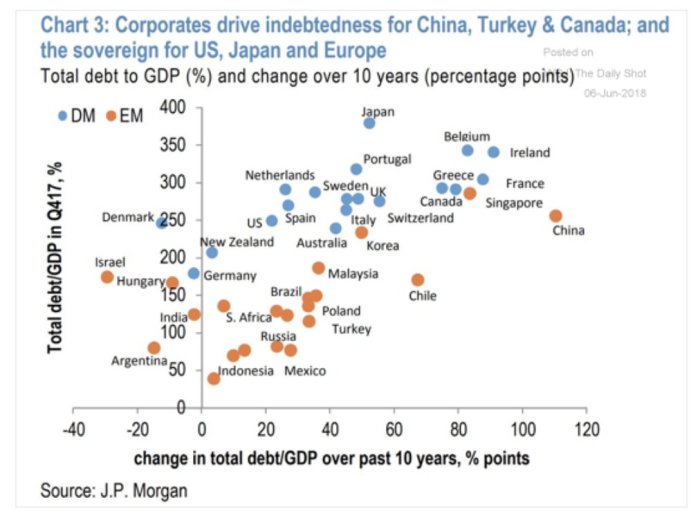
Sometimes people like to give the impression that New Zealanders are highly indebted.   And so this summary chart, which I stumbled on this afternoon, is some helpful context.

total debt

Among advanced economies, only in Israel and Germany is total debt/GDP lower than in New Zealand.

And also among advanced economies, only Denmark, Israel, and Germany had less of an increase in economywide debt/GDP over the 10 years to the end of 2017 (encompassing the recession and aftermath and subsequent recovery).

A decade ago, a comparable chart would have looked quite different.  I recall getting someone to dig out the data in about 2008 or 2009 which showed that our total debt/GDP ratio had increased in the previous few years about as much as the increase in Japan in the late 1980s (and all the increase was business and household).   And with most other advanced countries having materially increased their debt/GDP ratios over the last decade, New Zealand a decade ago would have been nearer the middle of the pack for the stock of debt than it is now.

Total debt to GDP calculations include household, corporate, and government debt.    As I showed in a post a couple of weeks ago, household debt to GDP hasn’t changed much here.  Government debt to GDP has increased a bit, and corporate debt to GDP also won’t have changed much.

Of course, those who want to remain worried about the New Zealand situation –  if I recall rightly the Governor said he was `scared’ –  will point out the role that big increases in government debt played in many other advanced countries.  Household debt to GDP has not changed very much in some of those other countries either.   But who is government but a collection of households?  We are the ones who have to service government debt.  And in many of these other countries, the total debt/GDP numbers will be understated because public service pension liabilities (contractural obligations) are not typically included in the debt numbers.  In New Zealand, there are almost no such liabilities, and those there are are properly accounted for.

Add in the reduction in the ratio of the net international investment position (net liabilities) to GDP over the last decade, and the picture is one in which debt should be much less of a concern here than in almost all advanced economies, and than in many – perhaps most –  emerging markets economies.  In a better world –  more business investment, on a path to more productivity –  we might perhaps have hoped there would have been more business debt being taken on.


Relative poverty: old and young

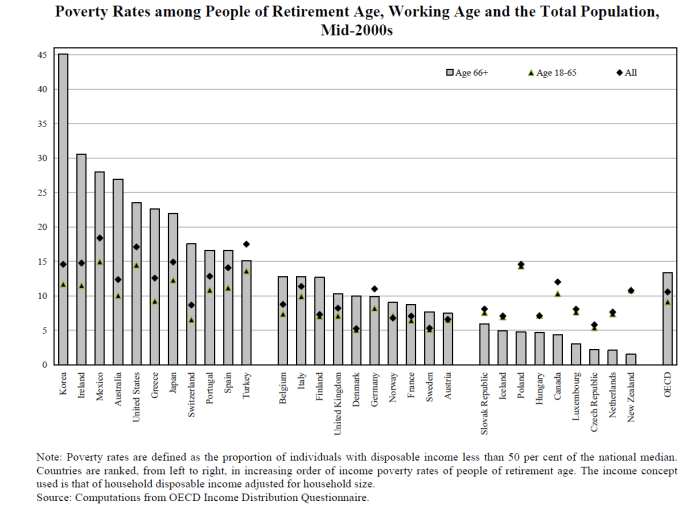
When I was working on my lecture last month on productivity as the best sure basis for dealing with poverty across a society as whole, I did take the opportunity to read around some of the literature on child poverty in New Zealand.   A line that used to be quite common in the New Zealand debate was that we had high rates of child poverty but low rates of poverty among old people, and that this represented some mix of a misplaced sense of priorities and some imbalance in political clout.  On checking, I see that I previously used the “low poverty rate among the elderly” argument myself in a published report.  On further checking, this was the sort of chart we used to see.

oecd elderly poverty chart 2000s

I’m fairly sceptical of these measures of poverty or deprivation.   They are mostly measures of (in)equality rather than of poverty, being calculated as the percentage of people in any particular group with incomes less than some threshold percentage (typically 50 or 60 per cent) of the (equivilised) median.     Real incomes for everyone could be doubled over time – by some mix of economic good fortune, innovation, and fine management –  and yet if the distribution of income didn’t change, we’d be told that exactly the same share of the population was still in “poverty”.  Sure, the detailed reports will specify that what they are measuring is relative “poverty”, but (a) that is almost a meaningless concept (whereas income or consumption inequality is not), and (b) the “relative” qualifier is usually too readily lost sight of once we shift from detailed technical reports to political debate and the like.     And so, a few months ago we had a  (very capable and well-regarded) visiting economist and politician noting in his lecture that child poverty rates (on these measures) were very similar in New Zealand and Australia, while failing to mention that average or median incomes in Australia are much higher in Australia than in New Zealand   People will be classified as “poor” in Australian who would be close to the median income in New Zealand.

Of course, there is a place for redistributive policies, but over time lifting overall rates of productivity make much more difference: the difference between the “poverty” most New Zealanders lived with (by today’s standards) when we were the richest country in the world a century ago, and the living standards of today.

But the specific point of this post, was this OECD chart I stumbled when I was thinking about poverty issues.  The differences in the differences between male and female rates look as though they could be interesting, but my focus is on the blue bars –  the number for the entire population aged over 65.

elderly poverty

OECD data used to (see first chart) suggest that New Zealand had some of the very lowest rates of elderly “poverty” anywhere.  But, apparently, that is no longer so.  On this measure –  using the 50th percentile –  New Zealand elderly “poverty” rates are still a little below the OECD total, and are actually a little above the OECD median (the countries labelled in italics are not OECD members).

And even in the days when numbers like those in the first chart were widely cited, people used to point out that it made quite a difference whether one looked at the 50th percentile, or (say) the 60th.  The widely-quoted child “poverty” measures in New Zealand typically use the 60th percentile.

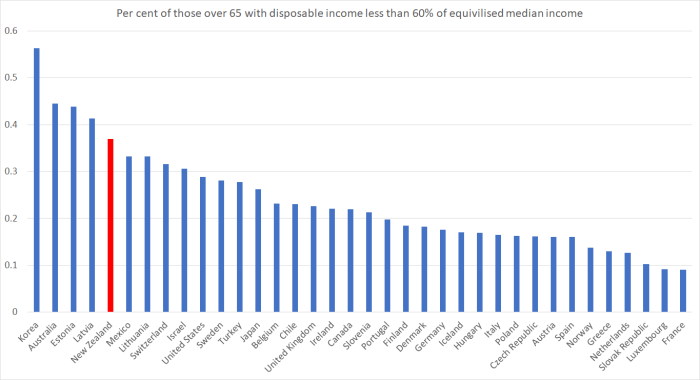
Somehow I managed to find the underlying data for the elderly on the OECD website.  The tables say that there is a new measure being used since 2012 (and thus the difference between the first two charts).   Here is an aggregate chart showing the share of the population aged over 65 with income below 60 per cent of median equivilised disposable income (ie the same measure as in the OECD chart above, just using a different percentile threshold).  Here are the data for 2015 (or most recent).

elderly poverty 60%

I was quite taken aback when I saw those numbers.   The results of this new methodology are so different from those under the old methodology (at least for New Zealand) that one would need to dig into the new and old methodologies to be at all comfortable with the results.  After all, it is not as if NZS policy has changed materially over the last 15 years or so, and we know that a relatively high share of New Zealand over-65s are still in the workforce.    And given the universal coverage of NZS, I find it a little difficult to believe that our elderly (relative) “poverty” rates are so much higher than those in, say, the United States.   Then again, it is interesting to see the Australian numbers – especially when we hear occasional calls to adopt something more like the Australian system (compulsory private savings and a means-tested age pension) here.

But if the OECD numbers are to be taken seriously at all, it looks as if  –  relative to the rest of the OECD –  our child poverty scores might be not much different than those for our elderly.   This is the OECD data on child “poverty” using the same 50th percentile benchmark as in the fancy OECD chart above.

child poverty 2014

New Zealand almost identical to the OECD average.

There will, unfortunately always be pockets of extreme deprivation and perhaps even absolute poverty (often perhaps not well-captured in these sorts of aggregate charts).  Some of that –  even after welfare system redistribution – will be about culture, some about personal poor choices, and some about misfortune.  Some of it will even be about atrocious policies –  for example, land use law in New Zealand.

But what we do know, with a very high degree of confidence, is that overall average material living standards –  for children, the old, and everyone in between –  in New Zealand are well below those in most of the “old” OECD countries, that we used to far exceed.  Remember the statistic I’ve quoted previously: it would take a two-thirds lift in average productivity in New Zealand to match that on average in Germany, France, Netherlands, Denmark, Belgium, and the United States.   The best way to sustainably –  including politically sustainably – and substantially lift the living standards of those at the bottom is to lift productivity across the economy as a whole.  And there is little sign that the government or the Opposition have any ideas as to how to turn the decades of underperformance on that score around,


Off the top of the Governor’s head

From a post a couple of weeks ago, just after the release of the Reserve Bank’s Financial Stability Report.

In a similar vein, I noted a story on Newsroom this morning, reporting the Governor’s appearance at the Finance and Expenditure Committee yesterday.  He was reported thus

But he told the select committee he would much rather the Reserve Bank, as banking regulator, could trust banks and borrowers to be prudent.

“I would love to not have to be active in that space. If banks had true long-term horizons, if the consumers were fully aware and myopia didn’t exist across borrowers, all the different foibles that people have, then you wouldn’t need the regulatory imposts.”

Talk about “nanny state” –  the Governor wishes he could trust us.  I wish we could trust him and his colleagues.

But, more specifically, the Governor here asserts again that banks are too short-term in their operations, that borrowers are myopic, and we need Reserve Bank intervention (he was talking of LVR and DTI restrictions) to save us from ourselves.  Par for the course, the Governor offered no evidence for his proposition (and there was none advanced in the FSR), it just seems to be some sort of new gubernatorial whim (as Graeme Wheeler came with the scarring experience of living through the US crisis, in this case Orr comes with an NZSF perspective –  neither grounded in specific  analysis of the New Zealand banking system).  I’ve lodged an OIA request this morning for any Reserve Bank analysis in support of these propositions.

To the credit of the Reserve Bank, they seem to have started responding to OIA requests more promptly.  I got the Bank’s response this morning.  Here is what it says:

On 10 May you made an Official Information request seeking: 

copies of any research, analysis or related material generated by, or for, the Reserve Bank suggesting that New Zealand banks had inappropriately short lending horizons, and New Zealand borrowers suffered from “myopia”. 

Under the provisions of OIA section 18(e), which allows refusal of a request where the information is not held, the Reserve Bank is refusing your request.

The Governor’s view as expressed in the reported comment was formed without recourse to specific material produced by, or for, the Reserve Bank.

So there was no analysis in the FSR supporting his claim, and nothing the Bank had done –  not even apparently in the previous five years – that supported his claim about the need for Reserve Bank interventions (LVRs, DTIs etc) constraining New Zealand banks’ lending, and New Zealand households’ access to credit.

He appears to have just made it up.  It was a whim, a prejudice, a line that sounded good as he said it…….and this is the basis on which the Governor makes policy (singlehandedly) and testifies to Parliament.  In a way, it isn’t that surprising, given the criticisms people like Ian Harrison and I have levelled at the quality of the analysis used to support their actual and proposed regulatory interventions, but to hear it direct from the Bank is still pretty telling.


Getting prepared for the next serious recession

Not infrequently over the last few years, I’ve criticised the Reserve Bank (and The Treasury and the Minister of Finance, both at least equally responsible) for the lack of any real sign that they were taking seriously the potentially severe limitations on the use of stabilisation policy (monetary policy in particular) in the next serious recession.  The topic never featured in speeches from the Governor, there was no published research on related issues, and getting ready never featured as a priority in the Bank’s annual Statements of Intent.

The potential problem, of course, is that – as things stand – the OCR can probably be lowered another couple of hundred basis points (to around -0.75 per cent) but for anything beyond that conventional monetary policy will quickly become quite ineffective, as large depositors (I’m thinking financial institutions and investment funds mostly) would exercise their option to switch into large holdings of (zero interest) physical cash.   People will still use bank accounts (negative interest rates and all) for most day to day transactions, but most financial assets aren’t held for immediate transactions purposes.

In typical past downturns OCR cuts of 500 basis points or more have been judged necesssary (the Reserve Bank cut by 575 basis points in 2008/09).   Similar magnitudes of adjustment have been made in, for example, the United States.

It is now almost 10 years since the Reserve Bank first cut the OCR to 2.5 per cent.  In the early years after that, the assumption was that (a) the 2008/09 recession had been unusually large, and (b) interest rates would soon need to be raised quite considerably, and so that whenever –  perhaps a decade hence –  the next recession happened New Zealand wasn’t likely to face a problem.  That was then.  As late as 2014 the then Governor was loudly talking up his plans to raise interest rates a lot, to –  as he saw it –  ‘normalise’ monetary policy.

But now it is 2018, and nominal interest rates are even lower than they were in 2008/09, and no serious observer thinks the Reserve Bank will have 500 basis points of policy leeway if another recession were to strike in the next few years (many doubt that the OCR will be raised much, if it all, in the intervening period, and a few –  including me –  think cuts would be more appropriate).  Most likely, the New Zealand economy will go into the next recession –  whenever it comes –  with the OCR 50 basis points either side of the current 1.75 per cent.  That just isn’t enough.   And the problem will be (greatly) compounded by the fact that central banks in almost all other advanced countries will be in much the same situation of worse (several already have their policy interest rates at -0.75 per cent.

If your central bank can’t cut policy rates (very much), and markets and firms/households know it, any incipient recession is likely to be worse than otherwise, and worse than we are used to (when downturns happen, central banks cut policy rates, often quite aggressively (if also often a bit belatedly), and people know/expect it).  Expectations of inflation may also drop away more sharply than we are used to, compounding the problems (real interest rates could raise, with nominal rates already on the floor).  Monetary policy has been the key stabilisation tool for decades, and (at best) it will be hobbled in any recession in the next few years.   For those who argue that interest rates don’t affect anything much domestically (a) I think you are wrong, but (b) the connection to the exchange rate is vital.   In monetary policy easing cycles in New Zealand, we also typically see big exchange rate adjustments, and that is part of how the economy stabilises and the next recovery begins.

Which is all a fairly long introduction to welcoming a new issue of the Bulletin published a few weeks ago by the Reserve Bank under the heading Aspects of implementing unconventional monetary policy in New Zealand.   As the introduction puts it

This article provides an overview of the experience with unconventional monetary policies since the global financial crisis of 2007/8, and assesses the scope for unconventional monetary policy in New Zealand. While there is no need to introduce unconventional monetary policies in New Zealand at this time, it is prudent to learn from other countries’ experiences and examine how such polices might work in New Zealand if the need arises.

It is, unambiguously, good to see such an article being published by the Bank.  Unfortunately, there is a degree of complacency about the content –  echoing remarks the Governor made at a recent press conference suggesting there was nothing to worry about – that should be quite disconcerting.  Complacency on such matters might be expected from politicians, with a tendency to live from one news cycle to the next.  We should not expect it from our central bankers.

As a brief survey of what other countries have done, the article is not bad.  There is some discussion of the experience with negiative policy rates, which comes to the pretty standard conclusion that policy rates probably can not usefully be taken below about -0.75 per cent.  There is a fairly long discussion of large scale asset purchases (mostly the government bond purchasing programmes) and some discussion of targeted term lending programmes operated in a few countries in the wake of the 2008/09 crisis.

Of large scale asset programmes, the Reserve Bank authors cautiously conclude

A large body of evidence shows that LSAPs were successful in easing financial conditions, through lower bond yields, higher asset prices and weaker exchange rates.11 The forward looking nature of financial markets means that most of the impact occurred on announcement, rather than when purchases were executed. As highlighted by Gagnon (2016), LSAPs can be especially powerful during times of financial stress, although the signalling and portfolio balance channels should still have a significant effect in normal times. There may, however, be diminishing returns through these channels. In particular, given the lower bound on short-term interest rates, there will be a limit to how far interest rates can be reduced via the signalling channel. Similarly, there is likely to be a lower bound on long-term interest rates (as investors have the option of holding paper currency with a fixed yield of zero) meaning additional purchases might not drive yields much below zero.

What really matters for central banks is whether LSAPs helped central banks achieve their mandates, related to achieving inflation, output and employment goals. While most studies into the effect of LSAPs in the post 2007/8 global financial crisis period find positive effects, they must be treated with caution. In part this is because of measurement issues: LSAPs have been implemented over a relatively short period since the 2007/8 global financial crisis, and previous historical relationships can have been expected to have changed. Overall, early work suggests LSAPs can be a beneficial monetary policy tool in exceptional circumstances. However the nature and extent of the transmission of these polices to inflation and activity is still being established.

Cautious as that is, I suspect it is not cautious enough.  For example, if one takes a cross-country approach there is little sign that long-term interest rates have fallen further relative to short-term interest rates in countries that did large scale asset purchases than in those which did not (for example, New Zealand and Australia).   Whatever the headline or announcement effects –  and some probably real effects in the midst of the crisis itself – without those longer-term effect on real bond rates, it is difficult to believe that the asset purchase programmes really made much difference to stabilisation and recovery.

Relatedly, as the authors note, the real test is surely progress towards meeting inflation targets and getting unemployment rates back down again quickly.  Against that standard, with the best unconventional tools central banks could deploy, on top of large reductions in policy rates, the experience has been very troubling –  the weakest recovery in many decades.  With that set of tools, the outlook the next time a serious recession hits has to be, almost by construction, worse than over the last decade.

But in many respects, the most interesting part of the article is the second half, exploring options for New Zealand.   Unfortunately, they do not seem to have moved very far at all from past work.  Just based on things I personally was involved in, in the late stages of the last recession I spent quite a bit of time at Treasury looking at options that might be deployed in things worsened further, and when the euro crisis was at its height in 2012 I led a Reserve Bank working group looking at some of the issues around how far we could go with conventional monetary policy, and what other instruments were then at our disposal.     The sorts of options we looked at then were helpful (and even then we reckoned the OCR could be cut to perhaps -0.75 per cent) but pretty limited.  The Bank seems no further ahead now and –  disconcertingly –  seems unbothered by that situation.

What tools do they have in mind?

The first is a negative OCR.

Overall, it appears that the Reserve Bank could implement negative interest rates, with the potential leakage into cash relatively small in value terms at modestly negative rates.

That seems right to me.  It would not be expected to involve, say, negative mortgage interest rates, but there have been some examples even of those in Scandinavia.

But it is the limits to the negative OCR which are the issue.

The second possible instrument they cover in the option of large-scale asset purchases.

As they note, there are not many (liquid) bond issues in New Zealand other than government bonds, and even the stock of government bonds is (generally fortunately) smaller than in many other advanced countries (including the US, UK, Japan and the more troubled parts of the euro-area).    And many passive holders of government bonds –  having made long-term asset allocation choices –  will not be that interested in selling.

In a New Zealand specific severe recession, these constraints might not matter very much.   Many of our government bonds are held by foreign investment funds, who have no natural (benchmark) reason to be in New Zealand.  Shake them loose by offering a high enough price and not only might bond yields fall quite a bit – at least initially –  but the exchange rate could be expected to fall too.  That latter channel would probably be much the most important one (since few New Zealand borrowers issue long-term debt, and those that do will typically swap it back into a floating rate exposure).

But if the downturn is pretty synchronised across a range of countries (as it was in 2008/09), that is a less compelling story.  Everyone will be trying to cut policy rates, and pretty everyone will be coming up against practical lower bounds.   Everyone can try to depreciate their currency, but in aggregate that ends up with not much expected change.  I’ve argued previously that if our OCR is ever around that of other advanced countries, our exchange rate should fall quite a lot, but at present the margins between our OCR and those of other countries is already smaller than we often find going into past recessions.

The Reserve Bank authors also note that the Bank could engage in (unlimited) unsterilised exchange rate intervention, buying assets in other countries’ currencies, and selling (‘printing’) New Zealand dollars, which the Bank can do without technical limit.   All else equal, that should tend to lower the exchange rate.

This might be more of an option for a small and inobtrusive country like New Zealand –  among the majors ‘currency war’ rhetoric would soon be flying. But even then, it isn’t likely to be a terribly effective policy.  The Reserve Bank notes some of the reasons (other countries trying to do the same thing – eg Australia our largest trade/investment partner).  But the other reason involves thinking about transmissions mechanisms: printing lots more New Zealand dollars creates more interest-bearing assets in New Zealand.  In normal circumstances, unsterilised intervention will drive down domestic interests rates, setting in train a mechanism that will lower the exchange rate, raise inflation etc etc.  But in this scenario, by construction, short-term interest rates can’t fall any further.    And there is no compelling reason to suppose that the holders of those new New Zealand dollars will want to spend more on goods and services (a channel which really might raise inflation).

The Reserve Bank briefly discusses the option of transacting the derivatives market, via interest rate swaps (larger and more liquid than the bond market).  This idea has been around for years.  There is no doubt it would enable the Reserve Bank to, say, cap the long-term (synthetic) interest rate, but it isn’t clear what good that would do, and there is no sign in the article of any new thinking in that regard.  The Bank talks of signalling gains –  communicating a commitment to keep the OCR low for a long period –  but I doubt that does much good beyond the short-term announcement effect.  For one, central banks can’t pre-commit, and markets and other observers will make their own judgements based on their read of the emerging economic data.

The final option they discuss is targeted term lending.   What they have mind here isn’t replacing market credit when funding markets seize up (as happened in 2008/09) but direct intervention in which the government and the Reserve Bank try to target credit to particular sectors.

This type of facility would provide collateralised term lending to banks at a subsidised rate if banks met specified lending objectives. These criteria would ensure that the low policy rate was being passed on to households and businesses. Holding collateral against the loans would mitigate the risks to the Reserve Bank’s balance sheet. Since a targeted lending scheme could see banks taking on more credit risk than they might otherwise choose, it would need to be carefully managed.

That final sentence is an understatement to say the very least.  Policies of this sort are really fiscal policy and, if done at all (which they should not be) should be done by the government itself, not the autonomous central bank.   Government involvement in encouraging credit provision to particular sectors has a poor track record, here or abroad (see US crisis ca 2008/09).   And when the Reserve Bank takes collateral to try to encourage/coerce banks into providing credit they would not otherwise provide, it is directly preferencing itself relative to other creditors (including depositors) if things later go wrong.

In an article about monetary policy, it is not surprising that the Bank gives little space to discretionary fiscal policy. But it is disconcerting that when they do touch on it, they get their basic facts wrong.

And in New Zealand, fiscal policy played an important role in the response to the 2007/08 global financial crisis.

Discretionary fiscal policy played no role at all in responding to the recession of 2008/09 (if anything, it was marginally contractionary given the cancellation of promised tax cuts in 2009).  Yes, the overal fiscal position slid into deficit but that was wholly because of (a) policy choices made before the government or Treasury realised there was a recession, and (b) automatic stabilisers, which are weaker in New Zealand than in most advanced countries.

As I said earlier on, the degree of complacency –  and refusal to confront options that really could make a significant difference –  is disconcerting.    The Bank argues

The Reserve Bank would look to communicate well in advance of any of unconventional policies being implemented, so as to enable financial markets and the government to prepare.

A nice sentiment, but as they note a few sentences later

we are rarely given the luxury of time when financial crises [or other recessions] hit

including because central banks are usually slow to recognise what is happening.  When you only have 200 basis points of conventional policy leeway –  and everyone knows that (a point not touched on in the article at all) –  they will need to be willing to signal a credible strategy very early.  And, on the evidence of this article, they do not have one (that would be likely to make any very material difference).

I suspect the authors really know that too, but prefer not (or are institutionally prevented from) saying so.  After all, they each smart people, and they know how poorly the world economy coped with, and recovered from, the last downturn, even deploying all sorts of unconventional policies  (fiscal and monetary) on top of the considerable conventional monetary policy leeway that existed going into that recession.  Even here –  where we never reached the limits of conventional policy –  the output gap remained negative, and the unemployment rate above official estimates of the NAIRU for eight or nine years.   Eight or nine years……..  That is just a huge amount of lost capacity, and of lives that are permanently blighted (prolonged involuntary spells of unemployment do that to people).

Perhaps the implicit argument is that we, and other countries, will do even more next time round.   But that isn’t likely.   Perhaps fiscal policy is, or should be, an option, at least in modestly-indebted countries like New Zealand, but any sober observer will recognise the real world political constraints other countries faced in using active fiscal policy to any great extent, for long, in the last recession.  Why is New Zealand likely to be different?

For much of the last decade, one has had the feeling –  in gubernatorial speeches and other commentary –  that, when it comes to it, the Reserve Bank really isn’t that bothered by lingering unemployment, excess capacity, or undershooting inflation.  One would like to think –  given his new mandate –  that the new Governor is different.  But this article isn’t really evidence for the defence on that score.

It is striking that the article does not engage at all with either of the two more radical options debated in other places and other countries:

  • reconfiguring the target for monetary policy.   This could take the form of a higher inflation target or, for example, the use of a price level or nominal GDP level target.  Each approach has its weaknesses, but either –  done in advance of the next serious downturn, not in midst when much of the opportunity is lost –  could help raise, and hold up, expectations about the path of the nominal economy, including inflation.
  • taking steps to material reduce the extent of the effective lower bound on nominal interest rates.

The latter remains my preference, for a number of reasons (including that the existing problem arises largely because central banks have  –  by law – monopolised note issue, and then not proved responsive to changing circumstances and technologies. Problems are usually best fixed at source.

If there is still a useful role for physical currency (I discussed some of these issues here), the ability to convert huge amounts of financial assets into physical currency, on demand, without pushing the price against you, is now a material obstacle to monetary policy doing its job in the next recession.    There is a good case for looking seriously at a variety of reform options, such as:

  • phasing out large denomination Reserve Bank notes (while perhaps again allowing private banks to offer them, on their own terms, conditions and technologies),
  • capping the physical Reserve Bank note issue, scaled to growth in, say, nominal GDP (perhaps with provision for overrides in the case of financial crisis runs),
  • putting a spread (between buy and sell prices) on Reserve Bank dealing in bank notes, or
  • auctioning a fixed quota of bank notes, and thus allowing the price to adjust semi-automatically  (when currency demand rises, as when the OCR goes materially negative) the cost of conversion rises.

These sorts of ideas are not new.  They do not get rid of the entire issue –  at an OCR of, say, -10 per cent, even transaction demand for bank deposits might dry up –  but they would go an awfully long way to ensuring that the next recession can be dealt with more effectively than the last.

If, for example, you thought the OCR was going to be set at -3 per cent for two years, then once storage and insurance costs are taken into account (the things that allow the OCR to be cut to around -0.75 per cent now), even a lump sum conversion cost (deposits into physical cash) of 5 per cent would be enough to keep almost everyone in deposits and bonds (even at negative yields) rather than physical cash.  That is a great deal leeway than the Reserve Bank has now.   Having that leeway –  and being willing to use it – helps ensure nominal rates don’t need to stay extremely low for too long.

In principle, many of these sorts of initiatives probably could be done in short order in the midst of the next serious downturn.  But we shouldn’t have to count on unknown crisis responses, the tenor of which have not been consulted on, socialised, and tested in advance.  It may even be that some legislative amendments might be required.

In summary, I welcome the fact that the Reserve Bank has begun to talk more openly about the potential limitations in its response to the next recession, but it is disconcerting that they still seem to be trying to minimise the potential severity of the issue.   In that, they aren’t alone.  I’m not aware of any central bank that has yet laid out credible plans to minimise the damage (although senior officials of the Federal Reserve have been more willing to talk about the issues openly).  In that, they are doing the public a serious dis-service, and risking worse outcomes than we need to face –  repeating the sort of reluctance to address issues that saw the world drift into crisis in the early 1930s.  Fortunately for the central bankers perhaps, it won’t be central bankers personally who pay the price.  That won’t be much consolation for the many ordinary people who do.

Since politicians, and not central bankers, are accountable to the voters, the Minister of Finance should be taking the lead in requiring a more pro-active (and open) set of preparations to be undertaken by the Reserve Bank and The Treasury.

UPDATE (6 July):   I have only just discovered that one of the authors of this article, whom I had known –  although not been close to  – for 35 years, had died shortly before publication.    Rereading this post, I don’t particularly resile from any of the content, but had I known I’d have written differently.


Gift receiving at the Reserve Bank

I was following up something this afternoon, and noticed that the Reserve Bank had posted an OIA response to someone inquiring about gifts accepted by staff.

There is almost two years of data, and the overall list isn’t that long.   I’ve been the recipient of all sorts of, mostly small, things over the years –  often from visiting central bankers or the like, but including the odd corporate box invite, dinners, and so on.   If anything, I’m a little surprised the Reserve Bank’s list isn’t longer –  in my days in the Financial Markets Department, corporate hospitality was part of relationship management, particular for our dealers.   The Bank must have tightened up: there is a surprisingly small number of cases of financial markets staff accepting hospitality etc.

But one element of the list really did catch my eye.  The Reserve Bank supervises banks, non-bank deposit-takers, and insurers: in doing so, it can have a big influence on the businesss of those institutions.    So one of the things that is very important is that the Reserve Bank’s supervisory staff keep a suitable distance from the institutions they are regulating.

On the gifts list, three banks operating in New Zealand showed up.  The first was BNZ, offering hospitality (twice) to Mark Perry, the Reserve Bank head of financial markets (and a former BNZ employee).   Mark won’t be involved in the supervisory or regulatory side of things.  The second was Bank Baroda, which presented a couple of books, which were passed on to the Reserve Bank library.

The bank that showed up most was ICBC.  It showed up seven times, on each occasion offering gifts to people with a direct involvement in bank regulation.   These ranged from a wall-hanging presented to the Governor by the bank chairman from China (not kept personally by the Governor), through to a box of food, cheese boards given to four staff, three note pads and a wireless mouse, a mobile power pack (again not kept by the individual) at the end of a supervisory meeting, and another wall-hanging presented to the Deputy Governor (not kept by him personally) by “ICBC Mr Wang Lin, Secretary of Party Discipline Committee”.

There was also another gift, accepted by the relevant staff, from a foreign bank at a meeting to discuss a possible application for bank registration.

I am not, repeat not, suggesting that any Reserve Bank official will have directly changed their stance on any matter to do with ICBC because of these fairly small gifts.  But appearances matter, and so does substance.   It is simply inappropriate for Reserve Bank staff to be accepting gifts from banks they regulate, no matter how small those gifts are.  Taken together such small gifts can foster an atmosphere that makes the regulator a little less willing to ask hard questions, or to confront problems, than they might need to be.

The Reserve Bank’s rules need to be tightened up and the banks concerned need to be reminded –  in the Governor’s words –  that these are New Zealand registered banks, no matter which country the bank concerned’s shareholders and owners happen to be based in.   Regulators simply shouldn’t be taking gifts from the regulated, not even as a matter of “courtesy”.


(Lack of) transparency at the Orr Reserve Bank

Since I have to spend a large chunk of the day at the Reserve Bank –  among other things, checking out how serious the Governor is about customer focus and about remediation when customers have problems (among the things he claims the right to demand from banks and insurers) in the case of the superannuation fund the Bank (=Governor) sponsors –  it seemed fitting to have a brief post focused on a Reserve Bank issue.

Long-term readers will recall that the previous Governor was notoriously secretive, except when it suited him.   Among the things he always refused to release were any minutes of any meetings of the Governing Committee (him and his two or three most senior staff).  The Governing Committee had been set up by Graeme Wheeler, and was sold to the world as the forum in which major decisions were made –  whether monetary policy, regulatory policy or whatever.   You might suppose that the records of such meetings would be of considerable public interest, and it is common internationally for the minutes of the meetings of any body responsible for monetary policy to be published, with a (typically) quite short lag.  But Graeme Wheeler seemed to think there was no legitimate case for such material to be released –  his model was that he should be obliged to tell us only what he wanted to tell us, how he wanted to tell it, and when he wanted to tell it.  That isn’t how the Official Information Act works, but that consideration never seemed to much bother the then-Governor.

But that was then.  Wheeler has left, bearing his CNZM, and we have a new Governor.  He talks a good talk about communicating more or better with outside audiences.  We’ve even had cartoons to help illustrate official documents, and at one press conference I think the assembled journalists were greeted in four languages.

So he seeks to build an impression of a more open Governor –  including by his (ill-judged)  willingness to talk freely about all manner of things that aren’t his responsibility.  And almost simultaneously with the Governor taking office, the Minister of Finance announced reforms he plans to legislate later in the year.  Under those (inadequate) reform proposals, there will be a statutory committee to make monetary policy decisions and –  fulfilling a Labour Party campaign pledge –  the minutes of the meetings of that new Monetary Policy Committee are to be published.  I’m sure that, if the Minister sticks to plan, they will be fairly anodyne minutes, but the indication has been that the minutes will outline any differences of view (even while not putting names to views or votes).  It will be a step forward when it happens.

And so, going into last month’s Monetary Policy Statement I noted that the new Governor could perhaps show his seriousness about being different from his predecessor, and get ahead of the forthcoming legislative provisions, by beginning to publish now the minutes of the Governing Committee (for meetings relevant to that MPS).   Ideally, as I noted, he would also pledge to publish the background papers for each MPS with a suitable lag (perhaps six weeks).

Nothing was forthcoming with the release of the Monetary Policy Statement –  just the cartoons, multi-lingual greetings (and a document itself that seemed to go down well with market economists).  So I lodged a request for the minutes of the Governing Committee meetings relating to the May MPS.

And last week I got my response.

…the Reserve Bank is withholding the information for the following reasons, and under the following provisions, of the Official Information Act (the OIA):

  • section 9(2)(d) – to avoid prejudice to the substantial economic interests of New Zealand; and
  • section 9(2)(g)(i) – to maintain the effective conduct of public affairs through the free and frank expression of opinions by or between officers and employees of the Reserve Bank in the course of their duty.

As advised previously, the Reserve Bank recognises the tension between disclosure and confidentiality and has considered your request in light of that tension. Public disclosure, in summary form, is essentially what happens with monetary policy decisions in a carefully considered media release and the full text of the Monetary Policy Statement. The process of deciding what to publish in these documents recognises and balances the tension between disclosure and confidentiality.

In other words, exactly the same approach adopted by the secretive and defensive Graeme Wheeler, and nothing is released at all.  Thus:

  • the date of the meeting,
  • the place the meeting was held,
  • the attendees at the meeting,
  • confirmation of the minutes of the previous meeting,
  • any subheadings outlining the nature of material discussed at the meeting,
  • and the final OCR (itself already published in the MPS)

all, in the Governor’s view, had to be withheld to protect the “substantial economic interests of New Zealand” or to protect “free and frank expression”.  I wonder if the Governor was worried there might one day be a debate about what day of the week it was.    The claim is so absurd it is hard to believe that serious people –  required to operate according to the principles of the Official Information Act –  could make the claim.  But the Governor does.

I can barely imagine a circumstance in which disclosure of material in such minutes could undermine the “substantial economic interests of New Zealand” (NB these aren’t the same as the “economic interests” of the Bank), especially when released several weeks after the MPS to which the discussion relates.  We aren’t talking about imminent bank failures here.  But perhaps there are such circumstances, in which case specific deletions  could be made and justified under this subsection.  Officials make such specific deletions every day (although not commonly, I gather, under this particular provision of the OIA).

The same goes for “free and frank”.  In the (extremely unlikely event) that the minutes ever recorded that the Deputy Governor (say) thought the Governor’s ideas about the OCR were barking mad, there might be a case for withholding that particular detail.  But no official writes minutes like that.    And recall that the Minister of Finance has already committed to the publication of minutes of the MPC a few months hence, once the legislation is in place.  Differences of view are supposed to be highlighted (even if not attributed by name).  It will be a small step forward, and the Minister has already decided that “free and frank” isn’t a good reason to withhold such material.

But the Governor clearly disagrees.  Perhaps he just wants to enjoy his last few months as the single decisionmaker.   But then –  it suiting him to do so –  he has already told us that all his advisers were unanimous last month that the OCR shouldn’t be changed.  So what can he possibly have to hide in those Governing Committee minutes?  The short answer is likely to be “nothing at all”, but he has quickly imbibed the traditional Reserve Bank resistance to Official Information Act scrutiny.

It is not a good sign.  I’ve been concerned that the reforms the Minister announced will be too weak to make any material difference, and suspicious that they will allow a Governor so inclined to dominate the new committee, suppressing debate and the serious examination of alternative interpretations or policy approaches.  Since Orr has never been one to encourage challenge or debate, that seemed a quite real and specific risk.  Which is why I thought I’d test the waters.  Had the Governor agreed to the release of MPS Governing Committee minutes (even with odd specific deletion) I’d have lauded him, and revised up my probabilities on his governorship, and the new MPC, proceeding well.

By simply refusing to release anything, it looks as though he has once again confirmed some of the fears people held (mostly quietly) about his appointment.  If so, that is a shame.   And however many languages he greets journalists in, however many cartoons he adds, serious scrutiny of powerful independent public agencies –  particularly as at present when all power is vested in one individual –  requires access to official information that won’t always suit the Governor.  Minutes of his policy committees are a good example, one most other Governors in advanced countries have come to live with, or even champion.

I’ve appealed this decision to the Ombudsman –  I might have a response by the end of next year –  but in a sense the point has already been made.  When it comes to things he is responsible for, Adrian Orr is no more open and transparent than his predecessor, who set the benchmark in quite the wrong places.  A government committed to more-open government (as the current one says it is) would have a quiet word to the Bank’s Board, and to the Governor, encouraging the Bank to think again.

Playing distraction on the PRC

On Newsroom on Friday there was a rather soft article giving a platform to an academic with a pretty strong vested interest in a “nothing to see here, move right along” approach to the People’s Republic of China.

Jason Young is acting director of the Contemporary China Research Centre (CCRC), based at Victoria University.  The chair of CCRC is Tony Browne, former New Zealand Ambassador to the PRC, who also just happens to be the chair of the PRC-funded (and controlled) Confucius Institute at Victoria University (CCRC and the Confucius Institute seem to share an administrator as well).  The CCRC itself seeems to work hand-in-glove with MFAT, seems to get considerable direct funding from government departments, and its advisory board is largely made up of public servants (MFAT, MBIE, Treasury, NZTE, Asia New Zealand Foundation) plus the chair of Education NZ and the former chair of the New Zealand China Trade Association. (None of this, of course, was in the Newsroom article.)  I’ve heard some stories about the role of MFAT in blocking anyone who might prove awkward from consideration for the role of Director.

Perhaps the NZ CCRC does some good work, and holds the odd interesting conference, but when push comes to shove it is hard not to see it as a taxpayer-funded front for the “nothing to see here” line that our politicians and business elites seem committed to.  In that respect, it is perhaps worse than the New Zealand China Council –  which openly functions as a taxpayer-funded advocacy group, while the CCRC hides behind the veneer of academic independence, integrity etc.

In Friday’s story, the first of Jason Young’s comments was largely pretty reasonable.   Asked about the recent testimony in the US and the papers published by the Canadian intelligence services,  he noted –  as I have –  that

Jason Young…. suggests both the Canadian and US reports are based in large part on the ‘Magic Weapons’ report published by Canterbury University professor Anne-Marie Brady last year.

Brady’s report, which detailed concerns about China’s attempts to influence migrant communities and take over ethnic media among other issues, received media coverage at the time.

However, Young says the latest round of coverage has done little to advance the case made by Brady.

“For many of us it’s just more hype around the same types of questions without new evidence.”

Perhaps “a repetition of the same claims in an increasing number of overseas fora” might have been a less-loaded description than “just more hype”, but lets not quibble too much.

Young goes on

Young believes the debate in New Zealand is becoming counterproductive, with opposing sides staking out increasingly polarised positions on the topic.

“We’re not talking about empirics, we’re not furthering the debate, all we are having is a more extreme and radicalised position being put forth…[and] we don’t talk about the bigger issues.”

Which prompts three thoughts:

  • first, if you are the director (even acting) of the Contemporary China Research Centre, surely you might have some responsibility for participating in, and actively facilitating debate, and exploration of the evidence, issues, and risks?    And yet, there is almost nothing of that sort coming from the CCRC.    They seem more focused on getting public servants properly house-trained.
  • debate?     We have a debate?   There isn’t much sign of one in New Zealand at all, most academics maintain a stony silence, and the contrast in that regard with Australia is particularly striking (whether or not you happen to agree with the current, more sceptical, stance of the Australian government).
  • As for empirics:
    • well no one doubts (because he has acknowledged it) that Jian Yang is a former member of PRC military intelligence structure, a member of the Chinese Communist Party, who also acknowledges that he misrepresented his past on New Zealand immigration forms, reportedly at the encouragement of the PRC authorities.  Jian Yang sits in New Zealand’s Parliament.
    • no one doubts the effective PRC control of almost all the Chinese language media in New Zealand,
    • no one doubts that a former Foreign Minister received a large donation to his mayoral campaign –  auctioning, of all things, the works of Xi Jinping –  from sources in the PRC,
    • no one doubts the ties of senior Labour backbencher Raymond Huo to United Front organisations, or his role in adopting a slogan of Xi Jinping’s for Labour’s ethnic Chinese campaign last year,
    • Charles Finny –  former senior diplomat, and himself on the CCRC advisory board –  observed on TVNZ last year that he knew both Jian Yang and Raymond Huo were close to the PRC Embassy and thus he was always careful what he said around them.
    • we know that several of our universities, and a number of high schools, take PRC money and allow the PRC to control appointments, and the content of teaching.
    • even abstracting from the Confucius Institute concerns, we know that our universities have made themselves very financially dependent on PRC students.
    • we know –  it is on public record –  that the presidents of both the National and Labour parties have been praising the Chinese Communist Party and Xi Jinping.
    • we know that a number of former politicians have ended up in well-remunerated roles in PRC-related entities, and that their continuation in such roles is inconsistent with ever saying anything remotely critical of the PRC.
    • and we know that our senior politicians –  whether in government or (in the National Party’s case) in Opposition – never ever say anything critical of the PRC regime (in stark and noticeable contrast to the sort of approach their predecessors took to, say, apartheid South Africa, pre-war Germany or Italy, the Soviet Union, and so on).
  •  So we could debate, for example, the risks and significance of joint research agreements New Zealand universities enter into with PRC institutions –  technology transfer, by fair means or foul, being a well-known PRC priority – or we could debate party fundraising in New Zealand, where the limited evidence might be open to various interpretations.  Evidence around cyber-attacks isn’t made public.  But there is still lots of hard factual material to be going on with.    And it is not as if most of the PRC activities are unique to New Zealand –  even if perhaps no other advanced country yet has a former PRC intelligence operative in Parliament.

Young goes on

Young says the Government’s messaging on the issue has been “quite minimal”, influenced in part by the sensitivity of allegations related to espionage or foreign influence and the role of our spies.

“The Government has got a responsibility to set China policy, to engage with China, and also have ground rules.”

Prime Minister Jacinda Ardern has made some steps in that direction, he says, pointing to her recent speech at a China business summit outlining her view of the region and the kind of relationship that was needed.

It would surely be more accurate to say that the Prime Minister –  like her predecessors –  seems to simply wants to pretend there isn’t an issue (a very different stance than that taken by her Australian Labor counterpart, Bill Shorten).    If, perchance, in the quiet of her heart she really does deplore the regime, and worry about its activities here and elsewhere, she owes it to the public to promote an honest open conversation.  But, so far, all the evidence is that she is just unbothered –  she has uttered not a word about Jian Yang, she promoted Raymond Huo, and so on.   Remarkably, the New Zealand airforce is conducting exercises with the PRC air force this week –  the same airforce that not a couple of weeks ago was landing long-range bombers on illegally constructed “islands” in the South China Sea (to not a word of concern from New Zealand).

Young’s contributions conclude this way

More generally, Young says the discussion about China needs to be based more on evidence and less on “hyperbole”.

“If someone is claiming New Zealand is the weak link in Five Eyes, what is the claim based on and what is the evidence behind that?

“The argument that New Zealand has somehow changed its security position in relation to Chinese influence, where’s the evidence for that? I can’t see any basis for it.”

It’s not that there’s nothing to talk about, he says: given China holds very different views to New Zealand and other countries, there are valid areas of concern.

But ensuring those concerns are backed up with evidence is critical to stop the debate from losing shape, he says.

Personally, the Five Eyes arguments (generally) seem to me like a bit of a distraction.  But so, in a sense, do Dr Young’s comments more generally.  There is plenty of hard evidence to be going on with, and a real reluctance apparent among the establishment to turn over stones lest awkward stuff might be uncovered.  Dismissing the sorts of issues that Professor Brady, and some others (including Newsroom, who first broke the Jian Yang story) have been raising as “hyperbole” itself looks like another attempt to play distraction, and avoid the real issues.  I’m sure Dr Young –  and Tony Browne, and Steven Jacobi, and the Prime Minister, the Leader of the Opposition, the leaders of the Greens and New Zealand First –  all know the character of the PRC regime:  evil at home, expansionist abroad, working to neutralise and/or divide countries like New Zealand or Australia (or Greece, or the Czech Republic, or…or….or) –  but they seem not to care one bit.  Or, if they really do care, to be so afraid, and to have lost any sense of self-respect or regard for New Zealand values, that appeasement has just become their watchword.  It is shameful.

The Newsroom article in which Dr Young is quoted also talked to another academic keen to downplay the issue; this time an Australian one, James Laurenceson, deputy director of the Australia-China Relations Institute, a think-tank based at a university in Sydney, and funded by large donations from two recent PRC migrants to Australia.

“The New Zealand government’s line tends to be to dampen reports down, but in Australia it goes in the opposite direction,” Laurenceson says.

He also suggests New Zealand has been more willing than Australia to scrutinise the allegations of foreign interference, and is unequivocal about which approach he favours.

“I can’t point to one single advantage of the approach Australia has taken,” Laurenceson says

What he means is that the New Zealand government prefers to ignore the issues altogether and, at least in public, pretend there is simply nothing to see.  In Australia, by contrast, an Australian (Labor) Senator was forced to resign for his close ties to the same billionaire who funded ACRI.  In Australia, in a bipartisan effort, the intelligence and security committee has recently released a 400 page report on the planned new laws designed to limit foreign government intervention and influence activities.   Yes, some Australian exporters appear to be paying a price, but sometimes doing the right thing –  standing up for your own country and its values, not just for the next dollar –  will cost those who parley with evil.  While Jacinda Ardern and Simon Bridges, aided and abetted by taxpayer funded bodies like the China Council and the CCRC, pretend there is just nothing to see.

There was a nice contrast to the New Zealand approach in The Australian newspaper on Saturday, in a column by their respected foreign editor Greg Sheridan.  For example

The last couple of weeks are a good indication of things to come. The range of our disagreements with Beijing in this period has been­ ­bewildering.

Beijing hates the foreign interference legislation. It hates that [Liberal MP, Andrew] Hastie under parliamentary privilege named a Chinese national resident in Australia as the suspect in a US case regarding a bribe paid to a former senior figure at the UN. It hates the fact that Canberra prevailed on Solomon Islands to refuse a Chinese bid to build an underwater internet cable. It hates that US court proceedings revealing alleged Chinese bribes in Papua New Guinea were front-page news in Australia.

It hates that Defence Minister Marise Payne rightly criticised the deployment of long-range bomber aircraft into islands that Beijing has illegally occupied in the South China Sea. It hates that, Beijing having ordered ­Qantas to refer to Taiwan as ­“Taiwan, China”, Payne said ­Qantas should not be bullied by governments and that Australia had “always called Taiwan, Taiwan”.

Beijing also didn’t like Payne’s reiteration of Canberra’s longstanding position on disputed territories in the South China Sea at the recent Shangri-La Dialogue, nor did it like her pointedly saying that countries should be allowed to express such concerns without being intimidated, coerced and bullied by other nations.

Beijing, like everyone else, understood who she was talking about.

In all these matters, the Turnbull government has taken the only position any self-respecting government could.

A self-respecting government, but not a New Zealand one.

After I’d read the Newsroom article, I found a recent podcast of a discussion between Jason Young and James Laurenceson.   It was another attempt by Jason Young –  remember all that taxpayer funding at stake, and those close ties to the Confucius Institute –  to play down the issues in New Zealand (to be clear, I’m not suggesting Young’s views are determined by financial incentives, but that he holds the role he does because he holds views that aren’t going to rock the boat with MFAT, the government, or the PRC).

In the course of the discussion –  in which he also highlighted the difference between New Zealand and Australia, in the depth of commentary and debate over there, without apparently seeing any role for people like him to take it deeper here – he attempted to draw a distinction between influence and interference.  But again, it was all about an attempt at minimalisation and trivialisation.  He accepts that PRC influence-seeking activities go on here, but then minimises that by suggesting “everyone does it” –  as if the character of the PRC regime is something we should be indifferent to, relative to say the UK, France, Germany, India, Singapore or whoever.  The issues aren’t just about process, but content, character, and so on.  As far as “intervention” is concerned, Young asserted that the “bar was not yet met” on such claims.  Perhaps that is a definitional issue, but when there is a former PLA intelligence operative in our Parliament, when another MP uses Xi Jinping slogans to advance his party’s cause (himself being associated with various United Front bodies), and when our politicians (and academics apparently) are too scared to speak out –  we never had a problem criticising South African apartheid or French nuclear testing – I think we all know that interference has happened.  Just because the mugger with the baseball bat doesn’t actually hit you, doesn’t mean that when you handover your wallet, the mugger hasn’t interfered.

Finally, as if to make Jason Young’s point about the greater depth and seriousness of the debate and analysis in Australia, there is even a better class of material to debate.  Professor Hugh White is an academic at ANU, former deputy head of Australia’s Defence Department, and a long-time writer on strategic issues in east Asia and Australia.  He has been criticised for, as some argue, being too ready to assert that Australia needs to recognise that the the PRC is already, or soon will be, the dominant power in East Asia, and re-align accordingly, making nice with the PRC and moving away from the US.

But he had a bracing short commentary out a few days ago, Australia’s real choice about China

Australia’s problem with China is bigger and simpler than we think, and thus harder to solve. It isn’t that Beijing doesn’t like Julie Bishop, or that it’s offended by our new political interference legislation, or that it’s building impressive new armed forces, or staking claims in the South China Sea. It’s that China wants to replace the United States as the primary power in East Asia, and we don’t want that to happen. We want America to remain the primary power because we don’t want to live under China’s shadow.

And that’s a big problem for Beijing. Its ambition for regional leadership isn’t something the Chinese are willing to compromise. Nothing—not even economic growth—is more important to them. So our opposition is a big fault line running through the relationship.

This shouldn’t come as news. China’s ambition, and the problems it poses for Australia, have been unmistakably obvious for a decade, but most of us have been in denial about it.

ending, after noting his real doubts that the US is willing to pay a price to retain its position

…at the end of last year, the government announced new laws to prevent covert political interference, clearly aimed at China.

That’s when China decided to exert a little pressure. It didn’t take long for Canberra to get the message. By early this year, Turnbull and Bishop were already backpedalling hard. They tried to deny that the foreign interference laws were aimed at China, talked up China’s positive contribution to the region, and even took the remarkable step of repudiating Washington’s new tough language about China as a rival and a threat.

But Beijing hasn’t been assuaged, and so the pressure is still on. It isn’t much so far—at least compared to what they could do if they wanted to cause us real pain. But it’s enough to remind Canberra—and the rest of us—what national power means. It means the capacity to impose costs on another country at relatively low cost to oneself, and China now has that in abundance. We’re being warned.

This problem isn’t going to go away, so we have to make some choices. Now we know that China is serious, what price are we willing to pay to resist it, and how far are we prepared to go? Those choices must be based on a realistic assessment of China’s power and ambitions, and of the cost we will incur by opposing them.

We haven’t had that kind of realistic assessment until now, in part because it has been so easy to accuse those who recognise the reality of China’s power and ambition as advocating surrender to it. That is, of course, absurd. And now, perhaps, we can put this absurdity behind us and start seriously to discuss how to deal with the biggest foreign policy challenge since at least World War Two.

It isn’t clear that the issues are really any different for New Zealand, including because of the absolute importance of our relationship with Australia.  But there is no New Zealand politician or, it seems, academic willing to actually make this straightforward point, and lead a debate about the implications, and choices, for New Zealand.  Perhaps where I depart from White is that I think he overstates the economic threat the PRC could pose to either New Zealand or Australia, other than in the short-term and in a handful of sectors that have dealt with the devil and left themselves over-exposed. Countries make an sustain their own prosperity.

But isn’t that the sort of debate and analysis one might hope for from a body labelled Contemporary China Research Centre. Or the sort of leadership one might hope for from our politicians.  New Zealand’s current approach –  keep silent, pretend there isn’t an issue, lie (in essence) about the character of the regime, and appease like anything –  wasn’t the right approach in the 1930s, and isn’t likely to be now.  It is a shameful betrayal of our interests, our values, and –  not incidentally –  of our friends in the free and democratic parts of east Asia.

Electioneering 1954 style

A few weekends ago I was fossicking in a charity book sale when I stumbled on The National Government 1949-1954: FIve Years of Progress and Prosperity, published by the National Party.   It was, it appears, published as part of National’s 1954 election campaign: 150 pages of (often quite detailed) text and tables, complete with a detailed chronology of measures, and an index.

I’ve always been interested in that first National government.  Apart from anything else, the Prime Minister (and Minister of Finance) was my grandfather’s cousin –  they’d been close, and in our family Sid Holland was always “Uncle Sid”.  It was a government with a fairly mixed record.  Through my career at the Reserve Bank I was always quietly proud that a relative had legislated to establish the primacy of price stability in what we expected from monetary policy and to put monetary policymaking at a further remove from direct ministerial control (even if, in practice, it didn’t make much difference).

There was some genuine liberalisation –  including of those banes of New Zealand economic management for too many decades, import licensing and exchange control.  And there was the ANZUS Treaty –  which I hadn’t previously known came into effect on ANZAC Day, a nice touch –  and the interesting episode of New Zealand’s approach to the Suez crisis.  It was the time of the wildly popular first ever visit by a reigning sovereign.  And the sort of short-term austerity that led to the Auckland Harbour Bridge being built too narrow from the start, or central planning that meant that for years the Reserve Bank wasn’t allowed to start building its own building.

In the territory of serious black marks, it is hard to defend the way the 1951 waterfront strike was handled –  not so much the confrontation with the watersiders itself, but the brutal undermining of civil liberties and the freedom of the press during that period –  often using powers introduced by the previous Labour government.

Perhaps only in New Zealand  –  where good histories and biographies are few – could a government that was in power for eight years, with a leader who spent 17 years in the role, not have either a decent scholarly treatment of that government or a biography of its leader.

But what of the book?

It has a foreword by the Prime Minister which, I imagine, captures quite well the way National saw things in those years

It is a proud thing to belong to a Government which is able to say that the people have never been better off, that there is a new spirit of vigour and enterprise abroad in the land, that there was never a time when so much progress was being made in the development of the resources of the country.

Once again, New Zealanders feel that the future belongs to them…….

Freedom, which is at the heart of the National Government’s philosophy, is perhaps an intangible thing – until you have lost it.  But it yields tangible results. The Government’s recrod, which this book outlines, is the answer to those who stand to the creed of Socialism.

But having lauded freedom, the Prime Minister goes on to laud the apparently growing role of the state.

A vast programme of development works is in progress –  imaginative and progressive schemes like the new pulp and paper and timber industry in the Rotorua-Bay of Plenty area, the utilisation of geothermal steam, the huge hydro-electric project at Roxburgh.  More hospitals, more schools, more houses –  there is no neglect of everyday necessities because of the scale of the development programme.  The Government has liberalised and extended social services, more is provided for other social services, trade is booming, the needy are cared for, the workers are prosperous, savings are greater.  On all fronts New Zealand has gone ahead, as a young country should…..

I lived in Kawerau as a child, but it is only over the last decade as I’ve come to read a lot more New Zealand history that I’ve come to realise how big a deal –  in some way, the decade’s Think Big, complete with outside capital and protected markets –  the Kawera/Murupara development really was in the 1950s.  The state was at the leading edge of promoting economic development, as it saw it (in this book, the Kawerua scheme is described –  perhaps with a little exaggeration, depending on how one classifies Vogel’s interventions –  as “the greatest single enterprise ever attempted in New Zealand”.

On the one hand, in the early 1950s, New Zealand still had some of the very highest material living standards in the world.  On the other, only a few years later people started writing serious reports (eg the new Monetary and Economic Council and the new NZIER) observing that New Zealand’s productivity growth was lagging behind.  Sadly, it was to be the story every decade from then to now.

But this post isn’t really intended to be an abbreviated political or economic history of the decade.  It was more that I was fascinated by things the National Party chose to highlight, and the accounts of interventions I’d just never been aware of.

Take rest homes for example.  When I was young, almost all of them were run and provided by church groups. I had never given much thought to why –  caring for the vulnerable was one of those things the church had done since Roman times.   But this little book tells how the government skewed the playing field:

Soon after taking office the Government introduced a policy of helping charitable or religious organisation to establish homes for aged people. Generous subsidies, up to 50 per cent, are offered, together with loans finance on favourable terms in respect of housing schemes.

The next sub-section recounts the introduction of a similar subsidy for such groups to establish youth hostels.

There are reminder of times past: anti-tuberculosis campaigns get two-thirds of a page to themselves.

There were 506000 radio licences in New Zealand in 1954, and not a single television.

And in a country of two million people, there were still only 334580 telephone subscribers (and a little subsection on “Mobile telephone services” –  some 2000 people had telephones in vehicles, up from only 192 when the government had taken office five years earlier).

The forerunner to Air New Zealand –  Tasman Empire Airways Ltd –  flew 30888 people trans-Tasman in the entire year to March 1954: fewer than 100 a day.  Domestic air services, so the party (fairly) boasted, has increased substantially during its term in government, but total passenger numbers were still less than 1000 per day.

And if economists are (largely rightly) inclined to be censorious about the excess demand policies of the period (inflation nonethless kept in check) there is still something to hanker after in these numbers:

In spite of the large increases in the labour force, ample work is still available.  At 15/1053 the number of vacancies for men was 13500 and for women 6500. Unemployment in 1953 averaged only 85 persons throughout the year.

(These were people registered as unemployed.  Five-yearly census numbers were higher, but still very low by modern standards.)

These were the days when, in New Zealand almost uniquely, cars held their value, the numbers imported being rationed.  There was an exception for people with overseas funds themselves (the “no-remittance” scheme) –  which made an English OE additionally attractive.  My grandfather was not infrequently heard to jest that my father proposed to his daughter only because she had a car, (having done her OE).

What of monetary policy?

The declared policy of the Government is to divorce currency and credit from political control, to avoid the issue of credit unbalanced by goods and services, and to stabilise internal prices by establishing a proper balance between money and goods.

From an economist’s perspective, two out of three isn’t bad, but that middle phrase is disconcertingly reminiscent of the real bills doctrine.  In fairness, the same government liberalised what were then known as “capital issues controls” restricting the ability of firms to raise funds on market.

And if there were elements of liberalisation, (eg the “state monopoly of coal seams” was abolished  on 10 October 1950) there was also this

The Potato Board was established in 1950 to control the production and marketing of main crop potatoes.

Why, one has to wonder?

In the some things don’t seem to change category, there was the boast that

Maori land claims.  Removal of grievances over land claims is being vigorously pursued, Claims settled include: [and a list follows]

Perhaps in the same category, pages and pages are devoted to housing and housing finance, including this curious observation under the heading “Encouraging local authorities to buy land and develop it for housing”

A retarding influence in many cases has been the desire on the part of local bodies to avoid placing a further burden on ratepayers by raising loans for housing activities, but the loan procedure has been simplified to open the way for local authorities to engage in housing activities without recourse to long-term finance.  They can now finance these projects on bank overdraft.

I’m clearly missing something in understanding the greater appeal of a bank overdraft.

Meanwhile large scale immigration has restarted (I wrote about it here), including subsidised (“assisted”) migration.  Being a skilled building trade worker was enough to get assisted passage for married people (at the time, policy explicitly favoured single people because of the housing shortages).  But there is no hint of the politicians realising –  what economists knew even then –  that new arrivals added more to housing demand, and overall resource pressure, than any feasible increase in supply (even in the building sector specifically).

For an economic history junkie, it is a fascinating read.  There is the line from L P Hartley’s novel The Go-Between that “the past is another country, they do things differently there”, and it comes to mind strongly reading this book  And, it won’t surprise regular readers to know that the other thought that comes to mind is one along the lines of “if only” we’d done things differently then and since, and could still today boast of being one of the richest countries in the world.  How much more we could offer our people –  on market, and off.  Of course, in material terms, people are better off today than they were in 1954.  That is an important benchmark, too easily lost sight of –  only a few years prior to 1954 my mother had done her masters’ thesis on the incidence of basic home appliances in Dunedin (far from universal) –  and yet, and yet, the failures and lost opportunities since then, which mean we now languish so far down the international league tables, matter too.  Both National and Labour must take responsibility for that failure.  Not that one would know it from either party’s campaigns last year.


The government consults on slashing productivity growth

Since the current government took office, I’ve highlighted from time to time (eg here) the tension between the rhetoric about the desire to lift New Zealand’s productivity performance (poor for decades, woeful in the last five years or so) and to increase the outward orientation of the economy,  and the specific policy promises which mostly seem likely to work in exactly the opposite direction.

The determination to reduce carbon emissions even more aggressively than the previous government’s goal, especially while sticking with a largely unchanged immigration policy that continued to drive up the population, seemed a prime example. I didn’t have any numbers, but the direction of the effect seemed pretty clear.

But now the government has published some numbers, which really should be getting a lot of attention.    Yesterday the Green Party leader James Shaw (Minister of Climate Change) launched a consultative document on what form the “net zero by 2050” target might actually take.  Perhaps naively, I’d assumed they had meant what they said, but in fact they are consulting on three quite different variants.

  • Net zero carbon dioxide by 2050: this target would reduce net carbon dioxide emissions in New Zealand to zero by 2050 (but not other gases like methane or nitrous oxide, which predominantly come from agriculture).
  • Net zero long-lived gases and stabilised short-lived gases by 2050: this target would reduce emissions of long-lived gases (including carbon dioxide and nitrous oxide) in New Zealand to net zero by 2050, while stabilising emissions of short-lived gases (including methane).
  • Net zero emissions by 2050: this target would reduce net emissions across all greenhouse gases to zero by 2050.

The third of those was, I think, was what most people had in mind.

Somewhere in the consultative document the first of these options is described as not being that different, in overall effect, from the target put in place by the previous government.

At the front of the report, the language –  not just from the Minister but from the MfE bureaucrats is very upbeat.    From the bureaucrats’ Executive Summary

This is our chance to build a high value economy that will hold us in good stead for the future. By upgrading our economy and preparing for the future, we can help make sure quality of life continues to improve for generations to come.

To read that, you’d suppose that pursuing ambitious emissions targets would make us richer, and better off in material terms.

A few paragraphs on the MfE officials suggests that the British have already shown us the way

Our economy is already dynamic and constantly adjusting to change. Jobs are continually created and lost. For some of us, the changes through the transition could be small or not noticeable – we could be driving vehicles powered by 100 per cent renewable electricity. For others, the changes could be bigger. The transition will affect how we travel, use land and what we produce and consume. Other countries, such as the UK, have shown that it is possible to reduce their emissions while growing their economy and maintaining a high standard of living.

This is probably what they had in mind (using OECD data which still only goes up to 2015).

emissions uk nz 1

That certainly makes the UK look good relative to us.

Then again, here is the emissions data for the two countries per unit of GDP.

emissions uk nz 2

The drop in emissions per unit of GDP has been almost exactly the same, over 25 years, in the United Kingdom as in New Zealand.   Our numbers are a lot higher than those in the UK but (for example) their economy trades with bankers/lawyers etc and ours trade with sheep and cattle.   There are different opportunities and different emissions profiles.

(And, as it happens, productivity growth in the UK in the last decade –  although not prior to that – has been materially worse than that in New Zealand.)

So the upbeat story about other countries having blazed a prosperous trail doesn’t really seem to have anything to it, at least in the one example MfE cites.  The main difference between the total emissions profiles is simply that we’ve adopted policies that raised our population much faster than the population growth in the UK.  It really is almost as simple as that.

But after the upbeat introduction, a bit of realism starts to creep in.

As we reduce emissions, the economy will continue to grow but possibly less quickly.

Only “possibly” though, although one’s confidence should have been waning already when a few lines later one reads that

We will need to invest in innovation and plant a lot more trees, to ensure we maintain a strong economy over the coming decades.

Because we all know that advanced countries get and stay rich by planting (lots and lots of) trees.  At best, it seems that they are likely to be a mitigant –  absorbing carbon emissions possibly more cheaply than some other methods.  They aren’t likely to add to our productivity or per capita income.

To the credit of the Ministry, they have had some modelling estimates done, and the Minister has allowed the summary results to be published.   It is not very satisfactory that the full model results have not been published yet, in what is a fairly short consultative period.  In fact, the suggestion is that the modelling work hasn’t even been finished yet

This and future material will be published on the Ministry for the Environment website as it is finalised.

But better to have what they did publish than to have to try to get it out of them via the Official Information Act.

NZIER was commissioned to do some modelling on the impact on GDP of the various net zero target options.  This is the table reproduced in the report.

emissions NZIER

As MfE observes

The analysis by NZIER suggests that GDP will continue to grow but will be in the range of 10 per cent to 22 per cent less in 2050, compared with taking no further action on climate change.

(Note that emissions per unit of GDP have been steadily trending down for decades as it is –  see first chart above.)

These are really big numbers.  I have never before heard of a government consulting on a proposal to cut the size of the (per capita) economy by anything from 10 to 22 per cent.  And, even on their numbers, those estimates could be an understatement.

The baseline assumptions NZIER have used produce average real GDP growth over 2017 to 2050 of 2.2 per cent.  They do not lay out the assumptions in more detail, but Statistics New Zealand population projections show average population growth over that period of 0.7 per cent per annum, so they seem to be assuming baseline productivity growth of something like 1.5 per cent.  That would be high by the standards of recent decades, but (except for rhetorical purposes) it does not matter very much: the focus is on the difference the various carbon emissions targets make to future productivity growth.

The numbers in the table do not show the unadorned comparisons.    They helpfully show the difference the varying degrees of ambition in the possible net emissions targets makes: the more ambitious the target, the worse the expected economic growth.  But in each of the three different scenarios (described in the very top line of the table), the modellers assume that the magic fairy helps out.     They assume faster rates of innovation in these particular sectors, over and above what is embedded in the baseline assumed rate of productivity growth.   This is how they describe it:

  • faster energy innovation occurs, driven by higher emissions prices and transitional policies that double the baseline energy efficiency trends across all industries and provide a shift to 98 per cent renewable energy by 2035 with the remaining 2 per cent used being gasfired generation in dry years only
  • faster transport innovation occurs, driven by higher emissions prices and transitional policies that increase electric vehicle uptake to 95 per cent of the light vehicle fleet and 50 per cent of the heavy vehicle fleet by 2050
  • faster agricultural innovation occurs, this sees a one-off innovation of a methane vaccine introduced in 2030 being adopted across all farms, which reduces dairy emissions by 30 per cent and sheep and beef emissions by 20 per cent. A reduction in global demand for dairy (11 per cent fall in 2050 output from 2015 levels) and sheep and beef (15 per cent fall) is experienced as consumer preferences shift towards lower emissions intensive foodstuffs, such as synthetic meats.

All of which might be fine, but there seems to be no allowance at all for the possibility that higher input costs etc might discourage investment in innovation (relative to baseline) elsewhere in the economy.  Affordable energy was, after all, a huge contributor to economic development in the last few centuries.

So on the best-case magic ferry scenario (the furthest right column) –  with much increased innovation in these sectors, and no offset elsewhere –  the full net zero target by 2050 would result in GDP in 2050 being a full 10 per cent lower than otherwise  (with 20 per cent of assumed overall productivity growth just given up).

If we only get the added innovation in agriculture, or only get it in transport and energy, the sacrifice is perhaps 40 per cent of all productivity growth (the difference between the 2.2% GDP growth baseline, of which productivity growth is about 1.5%, and the 1.5% and 1.6% GDP growth scenarios (in which productivity growth is only 0.8 or 0.9 per cent)).     A sacrifice of 0.7 per cent annual productivity growth for 33 years means accepting living standards 26 per cent lower than otherwise by 2050.

Again, to the credit of the government, they are also explicit about where the costs are likely to fall

Modelling shows the impact of domestic climate action would be felt more strongly by lower income households, because a higher proportion of their spending is on products and services that are likely to increase in cost as we reduce emissions across the economy.
Our modelling suggests the households that are in the lowest 20 per cent bracket for income may be more than twice as affected, on a relative basis, than those households with an average income.

Quite breathtaking really.   We will give up –  well, actually, take from New Zealanders –  up to a quarter of what would have been their 2050 incomes, and in doing so we will know those losses will be concentrated disproportionately on people at the bottom.   Sure, they talk about compensation measures

The Government has a number of tools it could choose to use to compensate affected households for higher costs, such as tax or welfare measures.

But the operative word there is could.  The track record of governments –  of any stripe –  compensating losers from any structural reforms is pretty weak, and it becomes even less likely when the policy being proposed involves the whole economy being a lot smaller than otherwise, so that there is less for everyone to go around.  The political economy of potential large scale redistribution just does not look particularly attractive or plausible (and higher taxes to do such redistribution would have their own productivity and competitiveness costs).

I guess I am impressed that the government was willing to publish a document suggesting adopting a policy which it openly documents would come at such a large potential cost to New Zealanders (substantial even if the magic fairy comes to our aid to the extent assumed in these scenarios).  It must surely be a first in history.   No one asked the citizens of, say, 1948 Czechoslovakia if they wanted to be impoverished (relative to a faster growing West).  But it is hard to see what is in for New Zealanders –  lagging badly behind other advanced countries on productivity anyway, with constant complaints about child (and other) poverty) – to just happily sign in to such a huge economic sacrifice?   And for what?

I guess these targets are advocated by zealots, but even the zealots surely recognise that what New Zealand does is not going to change the climate, and that many countries already richer and more productive than we are are proposing adjustments that are materially less costly or demanding that what the New Zealand government is proposing here.   I am not suggesting we can or should do nothing –  there is some minimum effort probably required to ward off the threat of trade sanctions –  but surely on any reasonable cost-benefit assessment of the interests of New Zealanders, we would be confronting these costs – the wilfully given up opportunities for our kids and grandchildren –  and pulling back?  Or we might be thinking again about whether deliberately boosting the population –  bringing people to a country with high baseline emissions per unit of GDP –  is sensible for the world, or (more importantly) for our own people.  I would be keen to see a variant of the NZIER results in which the population growth (and thus baseline emissions growth) was materially lower than what is assumed, based on current immigration policy.

To repeat, I would be surprised if ever before in history a democratic government has consulted on proposals to reduce the material wellbeing of its own people by up to 25 per cent.      Wars, of course, come at a very considerable cost –  and sometimes are worth fighting –  but again, I doubt any democracy (or perhaps even any tyranny) ever entered a war thinking that as a result of doing so they would be so much poorer 30 years on.  It is simply a breathtaking proposition –  the more so in a country that at the moment struggles to achieve any material productivity growth at all.

And as a reminder of what productivity means, see this recent post.

UPDATE: One issue I didn’t spot earlier is how there can be no marginal cost in going from the 75% to the net zero option, under either of the two scenarios shown.  To one decimal place, the assumed average growth rates are identical.  Given that going from 75% to net zero involves dealing with the short-lived gases (from agriculture), which are some of the most intractable issues (without dramatically shrinking the industries), it is difficult to see that this particular model result can be plausible.   But, to the extent, that the model results are the same under the two alternative targets, it undermines the case made by some that this document represents the government trying to walk back the original commitment to (true) net zero.