Abdicating a basic responsibility

The Herald this morning reported on a new open letter in support of Anne-Marie Brady, this one from 169 (at present –  the letter is still open apparently) overseas experts on issues relating to the People’s Republic of China.   As the signatories note:

Since the publication of her work on global United Front work, Brady’s home and office have been subjected to burglaries, during which no valuable items other than electronic devices were stolen. Most recently, her car was found to have been tampered with in ways consistent with intentional sabotage. According to media reports, Interpol and the New Zealand Security Intelligence Service  (SIS) are involved in the investigation. In China, academics were interrogated by Ministry of State Security agents after their institutions hosted Brady. Brady has also been personally attacked in media under the direction of the CCP, both in the PRC and in New Zealand. Taken together, these circumstances make it likely that this harassment campaign constitutes a response to her research on the CCP’s influence, and an attempt to intimidate her into silence.

Despite the evidence of CCP interference provided in Brady’s research, of which the harassment campaign appears to be a further example, the New Zealand government has been slow to take action and failed to acknowledge that a problem exists…..

Far from unique to New Zealand, the CCP’s global United Front tactics and other political influence operations have been documented in other locations, in Europe, Oceania, Asia and the Americas. ….Whether within or without the limits of the law of their target countries, these activities have considerable effects on their societies and merit evidence-based research and the attention of politicians and the media. The harassment campaign against Brady risks having a chilling effect on scholarly inquiry, allowing the CCP to interfere in the politics of our societies unfettered by informed scrutiny.

We urge the New Zealand authorities to grant Professor Brady the necessary protection to allow her to continue her research, sending a clear signal to fellow researchers that independent inquiry can be protected in democratic societies and conducted without fear of retribution.

We join other voices in support of Professor Brady, which have included statements by a New Zealand Chinese community organisation, some of her Canterbury University colleagues, New Zealand academics and two Australian Sinologists, as well as many others on social media.

We further hope decision makers and the public at large, in New Zealand and elsewhere, will engage with evidence-based research on the CCP’s United Front tactics, such as Brady’s Magic Weapons, and give due consideration to policy advice emanating from such research.

It is welcome that these (mostly) foreign experts are coming together in support of Professor Brady. But what sort of country have we become where such stands are even thought necessary?   Once upon a time this was a bastion of democracy and liberty, and now our “leaders” cower in the corner, apparently unbothered about “little things” like the apparent intimidation of Professor Brady.   It is a shameful choice.  There are deal flows to keep going –  students to enrol for the new academic year for example –  and funding political parties doesn’t seem to come cheap.   And barely a voice in Parliament –  none from anywhere in our main parties – that appears troubled in the slightest.

Before I saw that open letter I’d been meaning to draw attention to an even more trenchant statement from closer to home, this one by Paul Buchanan, a former academic with a background in the US system, and who now runs a consultancy that describes itself this way

36th Parallel Assessments is a non-partisan, non-governmental geopolitical risk and strategic assessment consultancy.

Buchanan is an American who has lived here for a long time, and is in the process of becoming a citizen.  From what I’ve read of his stuff over the years, his personal politics probably lean left. But his post pulls few punches about the abdication of responsibility being displayed by the Labour-led government on this issue.

I do not mean to bang on about the Anne Marie Brady case but since it is coming up on one year since the campaign of criminal harassment began against her, I feel compelled to mention how the Labour-led government’s silence has been used as a window of opportunity by pro-China conspiracy theorists to question her credibility and defame her. Until I blocked the troll I shall call “skidmark,” this was even seen here on KP [Kiwipolitic blog] where he launched numerous attacks on professor Brady as well as question the very notion that the burglaries and vandalism that she has been subjected to were somehow related to her work on PRC influence operations in NZ.

He goes on the outline a number of strands of attack made on Professor Brady  by these “trolls”, each more far-fetched or unpleasant than the last.   There are even people echoing the ludicrous and desperate claim made on the hustings last year by the then Attorney-General Chris Finlayson that Professor Brady was saying the stuff she was becasue she was “racist”.

Buchanan goes on

It is very likely that the government’s reticence to talk about the case is due to diplomatic concerns, and that political pressure has been put on the Police and SIS to delay offering any more information about the status of the investigation

That’s a serious claim, but almost nine months on –  while the Prime Minister pretends this is just a normal suburban Police inquiry – it sounds plausible.  Police, after all, have form in bending to the political wind.

Gathering from the tone of her recent remarks it appears that Ms. Brady is frustrated and increasingly frightened by the government’s inaction. I sympathise with her predicament: she is just one person tilting against much larger forces with relatively little institutional backing. I also am annoyed because this is a NZ citizen being stalked and serially harassed on sovereign NZ soil, most probably because of things that she has written, and yet the authorities have done pretty much nothing other than take statements and dust for fingerprints.

And expressed no hint of concern, let alone outrage, at the possibility of the involvement of a foreign power.  (And, of course, no apparent interest at all in taking seriously the substantive concerns Professor Brady was highlighting about PRC “sharp power” in New Zealand.)

Buchanan concludes with a telling parallel and highlights just how unacceptable the government’s handling of this matter –  apparently more interested in Beijing than in Brady –  should be seen as.

If this was a domestic dispute in which someone was burglarising and vandalising a neighbour’s or ex-partner’s property, I imagine that the cops would be quick to establish the facts and intervene to prevent escalation.  If that is the case then the same applies here. Because to allow these crimes to go unpunished without offering a word as to why not only demonstrates a lack of competence or will. It also encourages more of the same, and not just against Ms. Brady.

If one of the foundational duties of the democratic state is to protect the freedom and security of its citizens, it appears that in in this instance NZ has so far failed miserably. The government needs to step up and provide assurances that the investigation will proceed honestly to a verifiable conclusion and that it will work to ensure the safety of Anne Marie Brady against those who would wish to do her harm.

To not do so is to abdicate a basic responsibility of democratic governance.

Of course, the main opposition party shares in responsibility for, and ownership of, the government’s shameful abdication.

As I noted, one of the ludicrous claims made against Professor Brady –  fluent in Chinese, married to a Chinese man –  is that her work is motivated by racism.  One of those who has made such claims in the Chinese-language media is Auckland writer Morgan Xiao, a past or present international student at the University of Auckland.  He apparently writes fairly prolifically in various of the (CCP-controlled) Chinese-language outlets, which is of course his right.   His Facebook page however advertises his Labour Party associations, listing himself as a member of Labour Botany electorate committee, and featuring of photo of himself posing with the Prime Minister.   His writings are pretty pro-Beijing, and very anti-Brady.  He has accused her of racism, and also of running the arguments she does because she has been paid by the Americans to do so.  It is pretty florid stuff –  he has new piece here this week (open in Chrome and Google Translate will give you the gist).

A few weeks ago, the Auckland-based dissident author, and editor of the Beijing Spring magazine, Chen Weijian published (in Chinese) a takedown of some of Morgan Xiao’s recent writing on this subject.   I’ve previously published a translation of Chen Weijian’s article on Yikun Zhang (he of the National Party donations controversy, the Labour-bestowed QSM, and the close Beijing connection), and I was approached as to whether I’d be willing to make more widely available a translation of the latest article.   The translation has been undertaken by Luke Gilkison (and reviewed by a native Chinese speaker) a recent graduate in Chinese language and literature who has also spent time living and studying in China.  Both he and I would emphasise that the article is the work of Chen Weijian, and the views expressed are his and his alone, but his arguments seem to deserve wider circulation, especially given that Morgan Xiao himself is repeatedly returning to the issues.   The rhetorical style isn’t mine, and in some areas his conclusions seem a little over-optimistic to me (I’m not so sure that “the mainstream political ideology of our time is liberal democracy”).    But for those interested, the full translation is here

Chen Weijian Morgan Xiao Gilkison translation

As a flavour

On the matter of New Zealand–China relations, Xiao went on to say this: 

For a long time now, the National Party and the Chinese government have had frequent interactions. Many former National MPs have gone on to consultancy jobs within CCP-linked companies, and every time the Chinese government hosts an event, the number of National Party attendees far exceeds that of any other party. It’s evident that within National, at least, it is well known that China and New Zealand’s relationship is innocuous – otherwise how could these two parties, National and the CCP, be so close? Would that not be treason? 

This last part is said very well. Although I don’t know for sure what National would say to these assertions, I’m fairly sure they would have some choice words for this young man. Something along the lines of, “How on Earth is this helping us? You’re clearly intending to ruin us. Subterfuge!

And

He writes an editorial column on the website Skykiwi, and he’s a contributing writer for the People’s Daily, a state-run Chinese newspaper, where he writes under his Chinese name, Xiao Zhihong (肖志鸿). You’re more likely to find Xi Jinping thought in his Skykiwi column than anything reflecting New Zealand values. This quote from Xi Jinping appears in one of his columns, for example: “Our vision for democracy is not merely a system of one person, one vote. We strive to reflect the will of the people, and in this regard we not only do not fall short of the West, but we greatly surpass it.”

How does Xiao understand CCP-style democracy and “universal values”? This is his opinion on the Tiananmen Square massacre: 

Murderers and arsonists are criminals with no hope for rehabilitation. ….. But those June 4th bottom-feeders burnt and beat to death hundreds of soldiers, set fire to thousands of vehicles, and looted an army arsenal. People who commit wanton violence and destruction like this are beyond hope of rehabilitation. The condemnation of these crimes is a universal value. I say let us string up these June 4th rioters and beat them!

Perhaps if the Prime Minister ever chooses to speak out against the intimidation of Professor Brady, or to begin to take seriously the issues Professor Brady has repeatedly raised, she might make clear that she strongly disapproves of this sort of stuff from a Labour Party electorate committee member.

Then again, I guess Morgan Xiao was really only following her lead, when a few months ago she was committing to closer relations between Labour and the CCP and of party president Nigel Haworth who was in Beijing praising the regime and Xi Jinping just a few months earlier.

It is an abdication of New Zealand values –  hand in hand with the National Party.  We need leaders who see government, and international relations, as more than just the sum of the deals, the sum of the flow of political party donations.  There is little sign that we have such “leaders” anywhere in politics.

I didn’t move to Australia; my bank came to me

I was in town for a meeting earlier in the week, and walking along Lambton Quay I noticed this gigantic advertisement adorning the wall of an office building.

TSB photo.jpeg

I’ve always quite admired TSB, as the little bank that could. When I paid more attention to these things, they seemed to have innovative products, good technology, and had to stand on their own feet.  Oh, and there was the feisty CEO who once told visiting central bankers worrying about pandemic risks and bank preparedness that in New Plymouth they had bigger risks to worry about, turning around as he spoke and pointing out the window at Mt Egmont, which will erupt again.

I guess they have always played the “local bank” line in their marketing to some extent, but it was the brazenness of that billboard that astonished me.  Both the message and, even more so, the location.   This is central Wellington, and if there is any sort of “ground zero” for commitment to an open outward-oriented economy surely it must be here.  Much as I dislike the word, New Zealand’s “globalists” disproportionately live and work here.  Within a radius of a couple of hundred metres from this billboard you capture Treasury, MBIE, the Reserve Bank, MFAT, the Ministry for Primary Industry, and the Productivity Commission.  Why, the “right-wing” business think-tank the New Zealand Initiative is just over the road –  Eric Crampton and Oliver Hartwich must just be grateful the billboard faces away from their offices and they don’t have to see this crass effort every time they look out the window.

Perhaps Gabs Makhlouf, Brook Barrington, Adrian Orr et al don’t get out for a lunchtime walk, but their minions do and they must be the target audience for this billboard – Lambton Quay is always at its busiest at lunchtime.

And firms spend money on marketing presumably because they believe it will work –  “work” in this context presumably being drawing in new customers (unless it is just designed to court more Shane Jones Provincial Growth Fund goodies for Taranaki –  TSB being owned by a community trust.)  Are Wellingtonians really going to be swayed by this sort of crude nationalism and economic illiteracy.  It scares me a bit if so.

I didn’t move to Korea and yet the screen I’m typing to was made by a Korean company, and the profits from its design and manufacture presumably accrued to the owners of Samsung.   I didn’t move to the United States, and yet the platform this blog uses is (I think) American, and the profits from what I pay for using it accrue to the owners of that company.   One could go on –  the car, the printer, the TV, the bottle of French wine, or those Californian oranges in the fruit bowl.  The jersey I’m wearing is American and the books on the shelves next to me are from all over the Anglo world –  there will (producers hope) have been profits associated with each of them.  And although there probably isn’t much profit involved, my morning newspaper is produced by an Australian-owned company.  And yet, like 400000+ others I live in Wellington.

It is trade, and it is a good thing –  usually mutually beneficial, and if there are occasional exceptions to that presumption, you wouldn’t expect them to be successfully highlighted down Lambton Quay (even if too many public servants are all too keen on the possibilities of clever government interventions in our lives).   I didn’t move to Australia, and yet the shareholders of ANZ invested some of their savings to provide banking services to New Zealanders like me.  That was good of them –  in fact the earliest progenitors of ANZ were setting banking services here in 1840 (10 years earlier than the founding of what became TSB) when there wasn’t much organised here at all.   The profits from those transactions accrue to the shareholders (many but not all of whom are in Australia), because they provide the risk capital that underpins the business.  And while the TSB talks of the profits “moving to” Australia, in fact successful businesses –  that find willing purchasers of their services –  typically reinvest many of the profits in the business, right here in New Zealand.    Banking is a big business –  some might think too big and views will differ on that, but that isn’t the line TSB is running –  so it takes lots of capital.  That will, often or even typically, mean generating quite large profits –  the returns on that capital.

(Although it is a bit of a distraction, one could note that of the five New Zealand owned banks, four are directly capital-constrained by their ownership structures –  Kiwibank being government-owned, TSB owned by a community trust, and SBS  and Coop being a (modestly-sized) mutuals –  and only one of the NZ-owned banks manages a credit rating better than BBB. Not one of those institutions could even begin to displace the major players, and the risks facing New Zealand would increase if they were to try.)

TSB’s billboard proclaims to sophisticated (as they like to think) Wellingtonians that TSB is “proudly supporting New Zealand”.  This sort of crass attempt to play some sort of crude nationalist card supports no one other than themselves –  and perhaps the Shane Jones-isation of New Zealand politics.  It diminishes, and reflects poorly on, those who commission the advert, who surely know better.  They should stop trying to gull New Zealanders with some weird autarkic vision that, if followed through on, would be bad for a big country, and totally crazy for a small one.

I once worked for someone who told me his maxim was that from choice he would always use an overseas provider if he could (as I recall this was in the Ansett vs Air NZ days) to keep the pressure on the New Zealand providers to work harder and produce excellent products and services.  I never went fully along with him, but having seen that distasteful TSB advert on Tuesday, it actually gave some small pleasure to be in an ANZ branch yesterday and to receive friendly, helpful, accommodating service on the small matter I wanted dealt with. I’d say I’d be happy to have seen the resulting profits accruing to Australian shareholders, but they were so helpful they even waived the small fee on the matter in question –  lifetime customer value and all that I suppose.

As for TSB, they really should do better.  I hope Wellingtonians passing that big advert look on with disdain, grateful instead for the opportunities that foreign trade and investment –  in both directions –  created, and continues to create, for New Zealanders.    Or would we welcome British consumers being regaled with billboards proclaiming “you didn’t move to New Zealand, so why should the profits on that leg of lamb?”.

UN Compact on Migration

Various readers have commented in recent weeks on the United Nations Global Compact for Safe, Orderly, and Regular Migration, due to be signed next week by as many governments as can be mustered in support.   I’d had a quick skim through it and decided not to write about it here, as not only was it a non-binding political declaration, but most of it seemed more relevant to countries dealing with substantial illegal migration (and with migration mainly from very poor or disrupted countries – again, not the main situation in New Zealand).   And, as I pointed out to various readers, who needs the United Nations for immigration policy and practice to cause problems at home.  We have successive New Zealand governments, cheered on by the business and political “elites”, to do that for us.

But when I saw yesterday that the National Party –  as pro-immigration as they come – had indicated that (a) it would not support signing, and (b) it would withdraw from the agreement when it returned to government, I thought I should take another look.  It would, after all, be unusual to find myself in more of a middle-ground position on immigration issues that the National Pary.  Then it emerged that the current government has still not yet decided whether to sign up.   My suspicion remains that National’s stance is more about positioning relative to New Zealand First –  the contest for provincial votes –  than anything of substance.

Overseas, I was aware that the United States and Australia had decided not to sign, as well as a few eastern European countries – including some places whose democratic credentials are no longer unimpeachable.    But when I went looking, I found this article suggesting the pushback in Europe is spreading.    Austrian and Italy have refused to sign, and governments in Belgium, Germany and the Netherlands are under pretty intense pressure (from within).  In Holland, for example

The government ordered a legal analysis of the text last week to ensure that signing it will not entail any legal consequences. The Cabinet finally decided on Thursday that it would support the pact, but would add an extra declaration, a so-called explanation of position, to prevent unintended legal consequences.

So I reread the document, more slowly this time.  I can’t see any substantive need for the document –  it seems more about political rhetoric and framing than anything else –  and have long been deeply sceptical that the United Nations adds any value to anything much.   And, yes, the document has a pro-migration tinge to it (it talks of wanting to “promote” migration) and a rather “globalist” set of presuppositions (including the demonstrably wrong statement –  especially in the context of remote island states – that “no State can address migration alone”).   But that doesn’t mark it out from dozens of pointless international fora and international declarations.    And there is little doubt that the “elite” mindset, in Europe and its offshoots anyway, is mostly pretty strongly pro-immigration.

But it still isn’t clear to me quite what additional damage would be done by signing up to this pointless agreement.   Sure, even “non-binding” agreements will, at times, be used in domestic and international fora as a rhetorical stick to beat governments with if they ever look like stepping out of line with the mainstream.  But those sorts of arguments rarely deflect a government for long if it has domestic public opinion behind it in some direction or another (for good or ill).

There is some questionable economics in the document.  For example

Promote effective skills matching in the national economy by involving local authorities and other relevant stakeholders, particularly the private sector and trade unions, in the analysis of the local labour market, identification of skills gaps, definition of required skills profiles, and evaluation of the efficacy of labour migration policies, in order to ensure market responsive contractual labour mobility through regular pathways.

Or, alternatively, one could just let the market work it out.  When there are incipient skill shortages, wage rates tend to rise.  Same thing happens when, for example, bad weather creates a shortage of spinach or lettuce.    But, daft as the economics is, this stuff is the mindset of politicians and officials adminstering immigration schemes all over the western world. including New Zealand.  Recall that in New Zealand the current government is trying to get more actively involved in this sort of thing.

There are also totally vacuous bits, like the commitment to support and promote the United Nations International Day of Family Remittances.  Just what the world needs: another United Nations “day”.

Perhaps three clauses troubled me a little more.

There was this one

Enable political participation and engagement of migrants in their countries of origin, including in peace and reconciliation processes, in elections and political reforms, such as by establishing voting registries for citizens abroad, and by parliamentary representation, in accordance with national legislation.

I guess I can see what they are probably driving at (diasporas helping the reconstruction of the country of origin after say a protracted civil war). But, normally, we should expect migrants to commit themselves to their new country and its processes and political values and not be creating doubts about where their loyalties lie.  But in a country in which Jian Yang and Raymond Huo are MPs –  while still closely associating themselves with political interests in their country of origin –  and people like Yikun Zhang appears encouraged to play both sides –  it is hard to see how this particular provisions make things here any worse than they already are (around a small handful of our migrants).

And then there was this one

Promote mutual respect for the cultures, traditions and customs of communities of destination and of migrants by exchanging and implementing best practices on integration policies, programmes and activities, including on ways to promote acceptance of diversity and facilitate social cohesion and inclusion.

Which presents the issues as symmetric when they really should be asymmetric: the focus should be on encouraging the assimilation of the migrants, and ensuring their respect for the “cultures, traditions and customs” of the destination community –  just as when you go to someone else’s place for dinner you respect their practices, table manners etc.   One could also argue that encouraging “acceptance of diversity” and facilitating “social cohesion” are two contradictory, often mutually inconsistent, goals.  But again, flakey as all this stuff is, it is the way our bureaucratic and political “leaders” think and act anyway.  If the behaviour is a threat, it is hard to see that the UN agreement would be more of one.

Relatedly

Support multicultural activities through sports, music, arts, culinary festivals, volunteering and other social events that will facilitate mutual understanding and appreciation of migrant cultures and those of destination communities.

Quite what business this is of the UN –  or even of national governments actually – one has to wonder, but there is the “globalist” mindset for you.   And, again, it is pretty much what central and local governments do anyway.  I was interested that “religion” wasn’t on the list

And then, of course, there is Objective 17 (of the 23 in the document) which I have seen people express more serious concern about.

OBJECTIVE 17: Eliminate all forms of discrimination and promote evidence-based public discourse to shape perceptions of migration

We commit to eliminate all forms of discrimination, condemn and counter expressions, acts and manifestations of racism, racial discrimination, violence, xenophobia and related intolerance against all migrants in conformity with international human rights law. We further commit to promote an open and evidence-based public discourse on migration and migrants in partnership with all parts of society, that generates a more realistic, humane and constructive perception in this regard. We also commit to protect freedom of expression in accordance with international law, recognizing that an open and free debate contributes to a comprehensive understanding of all aspects of migration.

If that isn’t muddled I don’t know what is –  let alone, unrealistic (in no conceivable world are “all forms of discrimination” going to be “eliminated”).

The specifics under that Objective include commitments to

Enact, implement or maintain legislation that penalizes hate crimes and aggravated hate crimes

So-called “hate crime” legislation is almost always bad law and bad policy.  Punish assaults or murders or whatever as that: bad and unacceptable acts, regardless of who they are committed against or why.

And this

Promote independent, objective and quality reporting of media outlets, including internet based information, including by sensitizing and educating media professionals on migration-related issues and terminology, investing in ethical reporting standards and advertising, and stopping allocation of public funding or material support to media outlets that systematically promote intolerance, xenophobia, racism and other forms of discrimination towards migrants, in full respect for the freedom of the media.

Again, muddled at best.  You want to stop any public funding to outlets whose views are “unacceptable”, while having “full respect for the freedom of the media”.   Since I’m not entirely convinced there is a good case for public funding of any media outlets –  and since the publicly-funded outlets in New Zealand are champions of high immigration and all “worthy” leftist causes anyway –  it isn’t clear what difference this might make in New Zealand.    And there seem to be some MPs –  particularly in Labour and the Greens –  who aren’t too keen on allowing free speech on such issues anyway, whether or not we sign up to UN non-binding declarations.

And finally under Objective 17

Engage migrants, political, religious and community leaders, as well as educators and service providers to detect and prevent incidences of intolerance, racism, xenophobia, and other forms of discrimination against migrants and diasporas and support activities in local communities to promote mutual respect, including in the context of electoral campaigns.

All very asymmetric –  nothing at all about engaging with communities that might be uneasy about high immigration, or the immigration of groups with values antithetical to those of the destination community.  Perhaps, in some respects, this commitment troubles me more than most.   “Intolerance” is not an offence (in principle or in law) and it is the perfect right of people to debate –  perhaps especially in election campaigns – the future composition of their society.   A Saudi Wahhabi, a Chinese Communist Party zealot, an American evangelical, and a French secularist are all very different sorts of people. In large numbers, each group transplanted to (say) New Zealand would make a material difference to the society and polity we have here.  Those debates matter –  unless, apparently like the authors of this document –  you regard all differences of culture, politics, religion etc as superficial rather than fundamental.

As I said at the start, there is no obvious need for this document.  And even if there were obvious gaps, the very fact that it is a non-binding political declaration suggests it could meet no substantive need.  But in a New Zealand context, there are policies and practices around immigration that are much more damaging and threatening, particularly to our long-term economic performance, and perhaps in other areas too.  Among them:

  • the immigration policies of the National Party
  • the immigration policies of the Labour Party
  • the immigration policies of the Green Party
  • the immigration policies of ACT, and
  • the immigration policies of New Zealand First

I think that pretty much covers the spectrum.

There is no conceivable universe in which some international declaration –  or even agreement – around immigration would be more liberal and (in our specific economic circumstances) more damaging than what our political parties have done to us all by themselves.


Promoting constructive vigilance

That was the sub-title to the substantial (200 pages or so) new report released last week by the Hoover Institution at Stanford University on Chinese (PRC) influence activities in the United States (but with eight case studies on the situation in other countries, including one on New Zealand which draws largely on the work of Anne-Marie Brady).

The report is the product of a working group of 33 academics, think-tankers, and journalists specialising in PRC-related issues.  Around half those involved are academics.  Of the 33, 10 are ‘international associates’ –  again, about half academics –  bringing perspectives to bear on PRC activities in other countries, including three Australians and Anne-Marie Brady.

I read the report over the weekend.  I’m not sure there is a great deal new in it, but it is easy to read, and extensively documented, and the accumulation of material helps build the picture.     And even on New Zealand, there are striking lines from the Magic Weapons paper that one forgets

The Chinese government considers New Zealand an “exemplar of how it would like its relations to be with other states.” One unnamed Chinese diplomat even characterized relations between the two countries as similar to China’s close ties with totalitarian Albania in the early 1960s.

Or bits I’d never noticed previously

Individuals with strong ties to United Front organizations have donated several million dollars, primarily to the National Party. One such individual, who donated $112,000 to the National Party in 2017, is listed as an officer of no fewer than seven United Front organizations.

Then again, it was Labour bestowing the QSM on Yikun Zhang.

But the focus of the report is on the United States.  In many areas one is struck by the similarity of the story to the work done on these issues for New Zealand.

The Chinese Communist party-state leverages a broad range of party, state, and non-state actors to advance its influence-seeking objectives, and in recent years it has significantly accelerated both its investment and the intensity of these efforts. While many of the activities described in this report are state-directed, there is no single institution in China’s party-state that is wholly responsible…..   Because of the pervasiveness of the party-state, many nominally independent actors— including Chinese civil society, academia, corporations, and even religious institutions— are also ultimately beholden to the government and are frequently pressured into service to advance state interests.

or

China’s influence activities have moved beyond their traditional United Front focus on diaspora communities to target a far broader range of sectors in Western societies, ranging from think tanks, universities, and media to state, local, and national government institutions. China seeks to promote views sympathetic to the Chinese Government, policies, society, and culture; suppress alternative views; and co-opt key American players to support China’s foreign policy goals and economic interests.

or (more remarkably in the much larger US market)

In the American media, China has all but eliminated the plethora of independent Chinese-language media outlets that once served Chinese American communities. It has co-opted existing Chinese-language outlets and established its own new outlets.

The report builds to a set of policy principles and recommendations.  They group the principles and recommendations under three headings: Transparency, Integrity, and Reciprocity.   Under the first two headings, most of what they suggest seems (a) sensible, and (b) relevant to other countries where these issues arise, including New Zealand.

Here are the Transparency principles (there are more detailed recommendations below many of these).

Transparency is a fundamental tenet and asset of democracy, and the best protection against the manipulation of American entities by outside actors.

• American NGOs should play an important role in investigating and monitoring illicit activities by China and other foreign actors. They should as well seek to inform themselves about the full range of Chinese influence activities and the distinctions between legitimate and illegitimate influence efforts.

• Congress should perform its constitutional role by continuing to investigate, report on, and recommend appropriate action concerning Chinese influence activities in the United States. It should update relevant laws and regulations regarding foreign influence, and adopt new ones, to strengthen transparency in foreign efforts to exert influence.

• Executive branch agencies should similarly investigate and publicize, when appropriate, findings concerning these activities, with a view to promoting healthy and responsible vigilance among American governmental and nongovernmental actors.

• The US media should undertake careful, fact-based investigative reporting of Chinese influence activities, and it should enhance its knowledge base for undertaking responsible reporting.

• Faculty governance is the key to preserving academic freedom in American universities. All gifts, grants, endowments, and cooperative programs, including Confucius Institutes, should be subjected to the usual procedures of faculty oversight.

• US governmental and nongovernmental sectors should disclose financial and other relationships that may be subject to foreign influence.

And yet, to reflect on this list of items is to realise how much more serious the issue is here.   There are few relevant NGOs, the media is struggling and thinly-resourced, and instead of Parliament taking any sort of lead we have the former PLA intelligence official sitting in Parliament, not apparently bothering either National or Labour, and Raymond Huo –  with various United Front connections, and openly championing PRC perspectives –  chairs our Parliament’s Justice committee, dealing with electoral law.    The Opposition leader is soliciting large donations through people with close connections to Beijing, and Jian Yang is reputed to be the biggest National Party fundraiser.  (Again, in this regard US campaign finance laws, including disclosure provisions, are well ahead of our own.) The National Party’s president praises the Beijing regime and its leader, and if Labour’s president hasn’t been heard from for a while, he has form in that area too.   Our system is already corrupted, whereas (from the report) on this particular dimension the threat to the US system is still nascent.

As for the executive (political and official), they remain keen to say quite as little as possible – on any dimension of the issue (donations, cyber-security, Chinese language media, threats –  whether to Professor Brady or people in the ethnic Chinese community), and direct money to propaganda outfits like the New Zealand China Council to help keep the populace in line.  Winston Peters this morning refused to even accept an interviewer’s description of the PRC as becoming “increasingly authoritarian” (although, as he implied, there has not been a time since 1949 when it been anything other than highly authoritarian and repressive).

What of disclosure?  I linked the other day to a comment from consultant and former academic Paul Buchanan about PRC funding of parts of our universities.  If true, these contributions (and those of any other foreign government) should be fully and routinely disclosed.   And what about travel?   In the flurry of stories about Yikun Zhang it emerged that the Mayor of Southland had been travelling to the PRC, working closely with (and travelling at the expense of) Beijing-affiliated Zhang.   I was struck reading the Hoover report by the observation that US members of Congress can’t accept gifts of travel, and the same day I read that a reader sent me a link to a story about Clutha Southland National MP Hamish Walker (and other local body officials) on (PRC) paid trips to China.   Shouldn’t any such (paid for) trips simply be prohibited?  I’m sure MPs do their jobs better for some travel, but either they personally or the New Zealand taxpayer should be paying.  Not vested interests –  corporate or other governments.

What about integrity?  These were the high-level principles

Foreign funding can undermine the independence of American institutions, and various types of coercive and covert activities by China (and other countries) directly contradict core democratic values and freedoms, which must be protected by institutional vigilance and effective governance.

• Openness and freedom are fundamental elements of American democracy and intrinsic strengths of the United States and its way of life. These values must be protected against corrosive actions by China and other countries.

• Various institutions—but notably universities and think tanks—need to enhance sharing and pooling of information concerning Chinese activities, and they should promote more closely coordinated collective action to counter China’s inappropriate activities and pressures. This report recommends that American institutions within each of the above two sectors (and possibly others) formulate and agree to a “Code of Conduct” to guide their exchanges with Chinese counterparts.

• When they believe that efforts to exert influence have violated US laws or the rights of American citizens and foreign residents in the United States, US institutions should refer such activities to the appropriate law enforcement authorities.

• Rigorous efforts should be undertaken to inform the Chinese American community about potentially inappropriate activities carried out by China. At the same time, utmost efforts must be taken to protect the rights of the Chinese American community, as well as protecting the rights of Chinese citizens living or studying in the United States.

• Consideration should be given to establishing a federal government office that American state and local governments and nongovernmental institutions could approach—on a strictly voluntary basis—for advice on how best to manage Chinese requests for engagement and partnership. This office could also provide confidential background on the affiliations of Chinese individuals and organizations to party and state institutions.

That last suggestion seemed like one that should be considered here, as local government figures seem all to keen on accepting PRC approaches for relationships, oblivious to (or unconcerned by) the wider political context.  I’m not sure what Yikun Zhang’s interest in the Mayor of Southland specifically is, but I’m pretty sure it isn’t just that they got on well over a beer.  As the  report notes

….it is important for local officials to understand that local American “exchange” companies that bring Chinese delegations to the United States and promote professional interactions between the United States and China all depend on official PRC sanction and have received approval to receive Chinese delegations. The business model of such companies is, of necessity, as much political as financial. Even if they conduct high-quality programs, they should not be viewed as disinterested actors. They, too, are subject to rules made by the Chinese Communist Party, its united front bureaucracy, and united front strategic imperatives.

Where I was a bit more sceptical –  and where there seems to be some ongoing debate –  was around the idea of Reciprocity.    As academics, think-tankers and journalists, they are  –  as group – frustrated over how difficult it is for many to get visa access to the PRC, research in the PRC, use PRC government archives etc.  They contrast this to the fairly open access PRC researchers and employees of PRC media outlets have in the United States, and propose that the US should tighten up to try to gain greater access for outside researchers and journalists to China.  One can understand their grievance, but are these people really suggesting that open societies (the US or places like New Zealand) should adopt a PRC approach to things?    When it comes to foreign trade, “retaliatory” tariffs mostly end up hurting consumers in the country imposing them. Perhaps things are different when it comes to idea, research etc, but surely one of the great strengths – not vulnerabilities –  of our sort of system is our openness?

Early in the report I was struck by the observation that the working group did not “generally oppose” Confucius Institutes  (three in New Zealand, very many in the US –  although some have since been closed by the host universities).  But as I read on I found the specific recommendations

Confucius Institutes We do not endorse calls for Confucius Institutes to be closed, as long as several conditions are met.

US institutions should make their CI agreements public to facilitate oversight by members of the university community and other concerned parties. Those agreements, in turn, must grant full managerial authority to the host institution (not on a shared basis with the Hanban), so the university has full control over what a CI teaches, the activities it undertakes, the research grants it makes, and whom it employs. The clause in all Hanban contracts that CIs must operate “according to China’s laws” must be deleted.   If these standards cannot be attained, then the CI agreements should be terminated.

Furthermore, universities should prevent any intervention by CIs in curricular requirements and course content in their overall Chinese studies curricula or other areas of study by maintaining a clear administrative separation between academic centers and departments on the one hand, and CIs on the other. Finally, universities must ensure that all public programming offered by their CIs conform to academic standards of balance and diversity and do not cross the line to become a platform for PRC propaganda, or even a circumscribed view of a controversial issue. In fact, this report would suggest that universities not permit Confucius Institutes to become involved in public programming that goes beyond the CI core mission of education about Chinese language and culture. To go beyond these two categories invites opportunities for politicized propaganda.

As I understand it, few of those tests would be met in respect of the New Zealand Confucius Institutes (the one that is, as I understand it, is that the Confucius Institutes are not involved in the host university’s own courses or curriculum).   And, in addition, there is the unstated dimension as to whether our governments and universities should be facilitating the presence of PRC-appointed and paid staff in our schools –  the PRC being one of the most heinous regimes on the planet (as well as ruling a relatively poor country, which means we allow the taxes of poor foreigners to help pay for the education of our kids.)  If the PRC wants to subsidise Chinese-language learning then good luck to them, but let them set up downtown and market for clients in the way other countries’ language-teaching operations (Alliance Francaise, Goethe Institute) do.

Reprising a theme in my post on Saturday, there was this line about the compromised nature of universities.

The message from China to US universities is clear: Do not transgress the political no-go zones of the Chinese Communist Party or government, or you will pay a price. Sometimes the pressure is overt; other times it is more subtle and indirect, but no less alarming. Some American faculty members report troubling conversations with university administrators who continue to view Chinese students as such a lucrative revenue stream that it should not be endangered by “needlessly irritating Chinese authorities.”

There is lots more in the report, which is well-worth reading if you have the time.

Perhaps my bottom-line unease about the report was a bit of a reluctance to call a spade a spade.    For example, at least amid the discussion of the difficulties foreign academics and journalists face in the PRC, there was either a touching naivete, or a wilful refusal to face the fact, that the PRC is not a normal country, that just needs a few nudges to bring their attitudes and behaviours into line.   Why would one expect the PRC to behave differently, given the nature of the regime?   Obviously, all those involved know much about the true situation, but there was an apparent reluctance to say out loud that the party/State is  –  and for decades has been –  a malevolent force, at home, abroad, and increasingly in other countries.  Look at the tens of millions killed under the depraved indifference of the Party, the masss incarcerations, the forced organ transplant, at the near-total absence of freedom of speech, freedom of religion, the rule of law, or at the decades of the one-child policy. Look at the huge scale industrial espionage.  Look at the militarisation of the South China Sea, the constant threats to free and democratic Taiwan, or all the influence activities the report documents in the US and other countries, including attempting to subvert ethnic Chinese abroad and pressure them –  whatever there citizenship –  to advance PRC ends.  I know some people regard comparisons between the PRC and late-1930s Germany as overstated or unhelpful.  But such parallels seem increasingly valid –  not as prophecy, but as description –  and helpful in prompting those –  some perhaps individuallly decent people –  who just go along, to stop and think about the nature of the evil they accommodate or abet.  New Zealand politicians, of both stripes, as an example.

We have to be more than sum of our deals, more than the flow of political donations.

People might (as I do) distrust Trump on these issues for his typical inconstancy.  The difference here is that there is a constancy, but one that seems determined to, in effect, serve PRC interests, not the interests of New Zealanders, or the values that underpin our society (perhaps those involved try to tell themselves the two interests are much the same?).   That is why I still regard the “choose between China and the US” line as a false one.  Our governments could choose to go along with much of whatever (limited amount) the US is doing in foreign policy (or not), and still have abandoned any sense of integrity around our own system.  Personally, much as I welcomed the decision to buy the P-8 aircraft earlier in the year, I’d be more persuaded by our “leaders” if they had

  • combined to get Jian Yang and Raymond Huo out of Parliament,
  • defunded the China Council,
  • amended electoral laws to stop Phil Goff funding his mayoral campaign with anonymous mainland donations and to force comprehensive disclosure (at the level of the ultimate human donors) of all significant political donations,
  • done something to manage the exposure of the universities and the way in which that exposure risks compromising effective freedom to speak,
  • agreed together to stop issuing statements of praise for the PRC and Xi Jinping, and
  • foreswore accepting donations from anyone with significant United Front connections.

As a start.

Without steps like that, we could end up banning Huawei,  buying P-8s, being in the good graces of the US and Australia, and it just wouldn’t matter much. We’d still have severely compromised the integrity of our political system and our own longer-term interests.


What?

In the press release for last week’s Reserve Bank Financial Stability Report, the Governor commented that

Our preliminary view is that higher capital requirements are necessary, so that the banking system can be sufficiently resilient whilst remaining efficient. We will release a final consultation paper on bank capital requirements in December.

In commenting briefly on that, I observed

Time will tell how persuasive their case is, but given the robustness of the banking system in the face of previous demanding stress tests, the marginal benefits (in terms of crisis probability reduction) for an additional dollar of required capital must now be pretty small.

There wasn’t much more in the body of the document (and, as I gather it, there wasn’t anything much at the FEC hearing later in the day), so I was happy to wait and see the consultative document.

But the Governor apparently wasn’t.  At 12.25pm on Friday a “speech advisory” turned up telling

The Reserve Bank will release an excerpt from an address by Governor Adrian Orr on the importance of bank capital for New Zealand society.

It was to be released at 2 pm.   The decision to release this material must have been a rushed and last minute one –  not only was the formal advisory last minute, but there had been no suggestion of such a speech when the FSR was released a couple of days previously.

And, perhaps most importantly, what they did release was a pretty shoddy effort.    We still haven’t had a proper speech text from the Governor on either of his main areas of responsibility (monetary policy or financial regulation/supervision) but we do now have 700 words of unsubstantiated (without analysis or evidence) jottings on a very important forthcoming policy issue. which could have really big financial implications for some of the largest businesses in New Zealand and possibly for the economy as a whole.

The broad framework probably isn’t too objectionable.  All else equal, higher capital requirements on banks will reduce the probability of bank failures, and so it probably makes sense to think about the appropriate capital requirements relative to some norm about how (in)frequently one might be willing to see the banking system run into problems in which creditors (as distinct from shareholders) lose money.  At the extreme, require banks to lend only from equity and no deposit or bondholder will ever lose money (there won’t be any).

But what is also relevant is the tendency of politicians to bail out banks.  Not only does the possibility of them doing so create incentives for bank shareholders to run more risks than otherwise (since creditors won’t penalise higher risk to the same extent as otherwise), but there is a potential for –  at times quite large –  fiscal transfers when the failures happen.  Politicians have more of an incentive to impose high capital requirements on banks when they acknowledge their own tendencies to bail out those banks.  If, by contrast, they could resist those temptations –  or even manage them, in say a model with retail deposit insurance, but wholesale creditors left to their own devices –  it would also be more realistic to leave the question of capital structure to the market –  in just the same way that the capital structure of most other types of companies is a mattter for the market (shareholders interacting with lenders, customers, ratings agencies and so on).

But nothing like this appears in the Governor’s jottings.  Instead, we have the evil banks, the put-upon public and the courageous Reserve Bank fighting our corner.   I’d like to think the Governor’s analysis is more sophisticated than that, and one can’t say everything in 700 words, but…..it was his choice, entirely his, to give us 700 words of jottings and no supporting analysis, no testing and challenging of his assumptions etc.

There are all manner of weak claims.  For example

We know one thing for sure, the public’s risk tolerance will be less than bank owners’ risk tolerance. 

I think the point he is trying to make is about systemic banking crises –  when large chunks of the entire banking system run into trouble.  There is an arguable case –  but only arguable –  for his claim in that situation, but (a) it isn’t the case he makes, and (b) I really hope that (say) the shareholders of TSB or Heartland Bank have a lower risk tolerance around their business than I do, because I just don’t care much at all if they fail (or succeed).  Their failures  –  should such events occur –  should be, almost entirely, a matter for their shareholders and their creditors, with little or no wider public perspective.

There are other odd arguments

Banks also hold more capital than their regulatory minimums, to achieve a credit rating to do business. The ratings agencies are fallible however, given they operate with as much ‘art’ as ‘science’.

Bank failures also happen more often and can be more devastating than bank owners – and credit ratings agencies – tend to remember.

And central banks and regulators don’t operate “with as much ‘art’ as ‘science'”?   Yeah right.   And the second argument conflates too quite separate points.  Some bank failures may be “devastating” –  although not all by any means (remember Barings) –  but the impact of a bank failure isn’t an issue for ratings agencies, the probability of failure is.   And I do hope that when he gets beyond jottings the Governor will address the experience of countries like New Zealand, Australia, and Canada where –  over more than a century –  the experience of (major) bank failure is almost non-existent.

The Governor tries to explain why public and private interests can diverge (emphasis added)

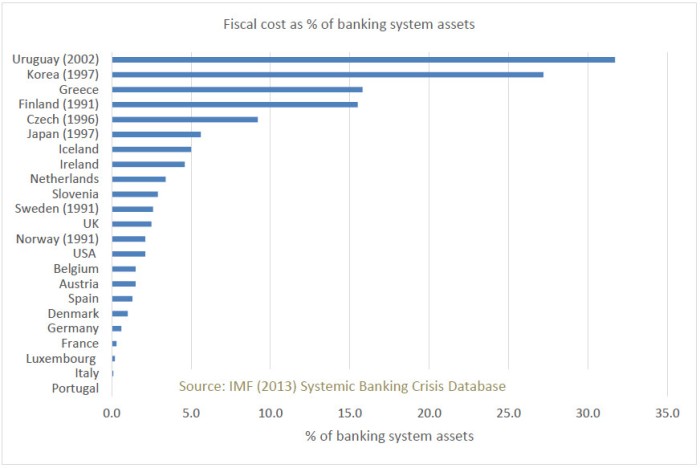
First, there is cost associated with holding capital, being what the capital could earn if it was invested elsewhere. Second, bank owners can earn a greater return on their investment by using less of their own money and borrowing more – leverage. And, the most a bank owner can lose is their capital. The wider public loses a lot more (see Figure 2).

But what is Figure 2?

figure 2

Which probably looks –  as it is intended to –  a little scary, but actually (a) I was impressed by how small many of these numbers are (bearing in mind that financial crises don’t come round every year), and (b) more importantly, as the Governor surely knows, fiscal costs are not social costs.  Fiscal costs are just transfers –  mostly from one lots of citizens (public as a whole) to others.  I’m not defending bank bailouts, but they don’t make a country poorer, all they do is have the losses (which have arisen anyway) redistributed around the citizenry.  If the Governor is going to make a serious case, he needs to tackle –  seriously and analytically –  the alleged social costs of bank failures and systemic financial crises.  So far there is no sign he has done so.  But we await the consultative document.

There is a suggestion something more substantive is coming

We have been reassessing the capital level in the banking sector that minimises the cost to society of a bank failure, while ensuring the banking system remains profitable.

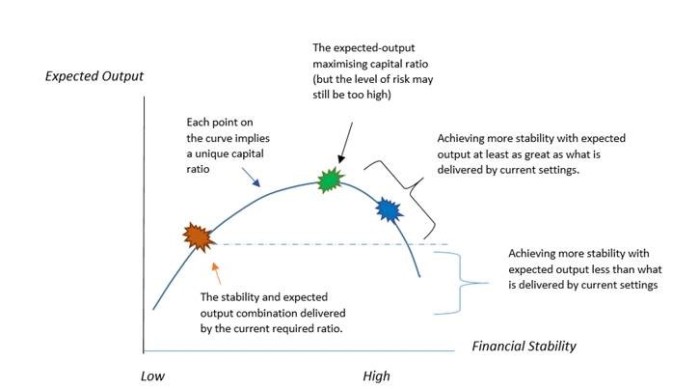
The stylised diagram in Figure 3 highlights where we have got to. Our assessment is that we can improve the soundness of the New Zealand banking system with additional capital with no trade-off to efficiency.

and this is Figure 3

capital chart

It is a stylised chart to be sure, but people choose their stylisation to make their rhetorical point, and in this one the Governor is trying to suggest that we can be big gains (much greater financial stability, and higher levels (discounted present values presumably) of output) by increasing capital requirements on banks.

I don’t doubt that the Bank can construct and calibrate a model that produces such results.  One can construct and calibrate models to produce almost any result the commissioning official wants.  The test will be one of how robust and plausible the particular specifications are.  We don’t know, because the Governor is sounding off but not (yet) showing us the analysis.  Frankly, I find the implied claim quite implausible.   Probably higher capital requirements could reduce the incidence of financial crises.  But the frequency of such events is already extremely low in well-governed countries where the state minimises its interventions in the financial system, so I don’t see the gains on that front as likely to be large.    And, as I’ve outlined here in various previous posts I don’t think that the evidence is that persuasive that financial crises themselves are as costly as the regulators (champing at the bit for more power) claim.  And many of the costs there are, arise from bad borrowing and lending, misallocation of investment resources, which are likely to happen from time to time no matter how well-capitalised the banks are.

There are nuanced arguments here, about which reasonable people can disagree. But not in the Governor’s world apparently.

He comes to his concluding paragraph, the first half of which is this

A word of caution. Output or GDP are glib proxies for economic wellbeing – the end goal of our economic policy purpose. When confronted with widespread unemployment, falling wages, collapsing house prices, and many other manifestations of a banking crisis, wellbeing is threatened. Much recent literature suggests a loss of confidence is one cause of societal ills such as poor mental and physical health, and a loss of social cohesion.

Oh, come on.  “Glib proxies”……..    No one has ever claimed that GDP is the be-all and end-all of everything, but it is a serious effort at measurement, which enables comparisons across time and across countries.  Which is in stark contrast to the unmeasureable, unmanageable, will-o-wisp that the Governor (and Treasury and the Minister of Finance) are so keen on today.

As for the rest, sometimes financial stresses can exacerbate unemployment and the like,  but the financial crises typically arise and deepen in the context of common events or shocks that lead to both: people default on their residential mortgages when they’ve lost their jobs and house prices have fallen, but those events don’t occur in a vacuum.  And anyone (and Governor) who wants to suggest that mental health crises and a decline in social cohesion can be substantially prevented by higher levels of bank capital is either dreaming, or just making up stuff that sounds good on a first lay read.

The Governor ends with this sentence

If we believe we can tolerate bank system failures more frequently than once-every-200 years, then this must be an explicit decision made with full understanding of the consequences.

As if his, finger in the dark, once-every-200 years is now the benchmark, and if not adopted we face serious consequences.   Let’s see the evidence and analysis first.  Including recognition that systemic banking crises don’t just happen because of larger than usual random shocks –  the isimplest scenario in which higher capital requirements “work” –  but mostly from quite rare and infrequent bursts of craziness, not caused by banks in isolation, but by some combination of banks and (widely spread) borrowers, often precipitated by some ill-judged or ill-managed policy intervention chosen by a government.   Higher capital ratios just aren’t much protection against the gross misallocations that arise in the process –  in which much of any waste/loss is already in train (masked by the boom times) before any financial institution runs into trouble (the current Chinese situation is yet another example).

Perhaps as importantly, under the current (deeply flawed) Reserve Bank Act the choice about capital is one the Governor is empowered to make.  But his deputy, responsible for financial stability functions, had some comments to make on this point in a recent speech (emphasis added)

And Phase 2 of the Government’s review is an opportunity for all New Zealanders to consider the Reserve Bank’s mandate, its powers, governance and independence. The capital review gives us all an opportunity to think again about our risk tolerance – how safe we want our banking system to be; how we balance soundness and efficiency; what gains we can make, both in terms of financial stability and output; and how we allocate private and social costs.

It may be that the legislation underpinning our mandate can be enhanced, for example, by formal guidance from government or another governance body, on the level of risk of a financial crisis that society is willing to tolerate.

These are choices that should be made by politicians, who are accountable to us, not by a single unelected and largely unaccountable (certainly to citizenry) official.  We need officials and experts to offer analysis and advice, not to be able to impose their personal ideological perspectives or pet peeves on the entire economy and society.

We must hope that the forthcoming consultative document is a serious well-considered and well-documented piece of analysis, and that having issued it the Governor will be open to serious consideration of alternative perspectives.  But what was released last Friday –  700 words of unsupported jottings –  wasn’t promising.

(I should add that I have shifted my view on bank capital somewhat over the years, partly I suspect as a result of no longer being inside the Bank. It is somewhat surprising how –  for all one knows it in theory –  things look different depending on where one happens to be sitting.  But my big concern at present is not that it would necessarily wrong to raise required bank capital, but that the standard of argumentation from a immensely powerful public official seems –  for now – so threadbare.)

Thoughts as the immigration data disappear

Last month marked the end of an era.  In a country with larger and more variable migration flows (in and out, New Zealand and foreign) than almost anywhere else Statistics New Zealand released the last ever set of permanent and long-term migration data.  The numbers were only ever approximations –  because people changed their minds –  but they were (a) based on data collected from every person crossing the border, and (b) reported quite quickly (October’s data were released on 22 November).

As I’ve written about here previously, there is a new system being put in place, but the numbers it produces will have (on SNZ’s own reported estimates) huge margins of error each and every month, and it will be at least a year after the event until we can have even moderate confidence in estimates as to what was going in any particular month.   The issue arises most seriously in respect of the outflows of New Zealanders, for which –  of course –  there is no other administrative data, such as (say) visa approvals.  It is cavalier, another step backwards in terms of having timely data  –  whether for economic monitoring, or political and economic debate –  but perhaps convenient for governments and officials who would prefer the issues not to be debated (“just let us get on with our ‘Big New Zealand’ project”).

Even the total movements data –  which was part of understanding tourist inflows and outflows data –  is now going to be worse.  This is from the recent SNZ release

Removing departure cards means changes to the timing and composition of this release. Statistics on short-term movements (including the current report International visitor arrivals to New Zealand) will be published in a new international travel release, and long-term movements in a new international migration release.

Both releases will be published on the same day, up to 30 working days after each reference month. November data, previously published just before Christmas, will now be published in January, and December data in February.

From about 15 working days to 30 working days.  That is SNZ’s –  and the government’s idea of progress?   Then again, these are the people who seem to have stuffed up the latest Census so badly  –  and no heads, political or bureaucratic, have rolled.

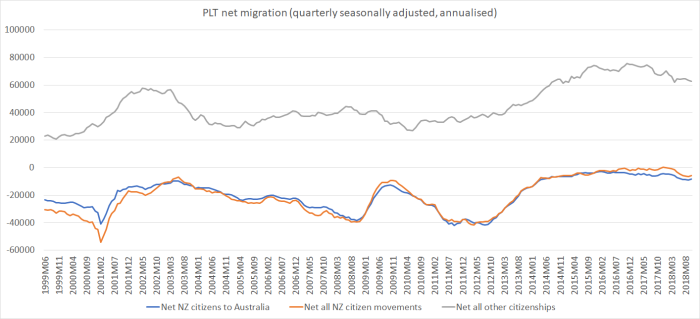
But to mark the passing of the PLT data, here are a few charts.  Here is the quarterly annualised data by citizenship.

Last PLT 1

For all the talk in recent years about “New Zealanders coming home”, there was only a single quarter with a (tiny) net inflow.   The net outflow of New Zealanders is still modest by historical standards, but interestingly while there is a net outflow to Australia there is still a small net inflow (the gap between the blue and orange lines) of New Zealanders from the rest of the world.   If leaving for Australia has got harder –  and the headlines about New Zealanders’ rights in Australia more grim –  perhaps it is harder still in the rest of the world?   And, despite the fall in residence approval visa numbers (mostly granted to people already here), the net inflow of non-New Zealanders remains large.

We won’t have this timely data in future.

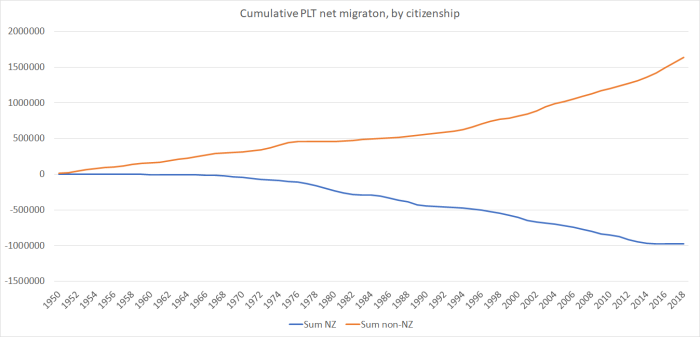
Migration data by citizenship is available. on an annual basis, back to 1950.  Here are the cumulative PLT numbers since then.

Last PLT 2

In the early period the net outflow of New Zealanders was tiny. For the 16 years up to an including the year to March 1965, the net outflow of New Zealanders was 10576, or an average of under 1000 a year.    In a normal country you expect to see an outflow of citizens: most people obtain citizenship by being born in a place (or naturalised in it), and some proportion of natives will always choose to leave –  whether falling in love, or simply preferring the opportunities some other place has to offer. But in normal countries –  especially normal advanced countries –  those outflows are typically small.   (Estimates, such as they are, of the number of American citizens living abroad, short or long term, come to less than 3 per cent of the total US population.)

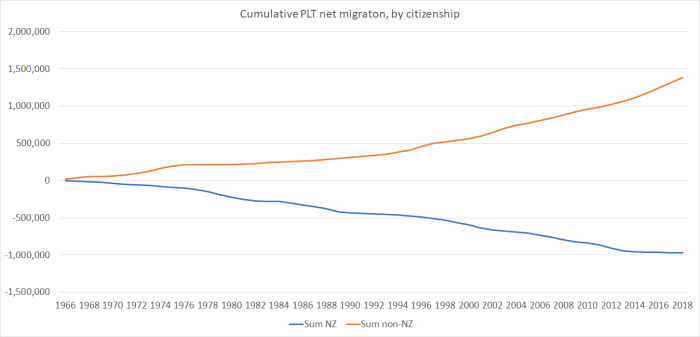
Here is the same chart starting from the year to March 1966 and coming all the way forward to the year to March 2018 –  53 years of data.

last PLT 3

Over that period a net 968000 New Zealanders are estimated to have left –  from a country that in 1966 had a population of just under 2.7 million.

And, on the other hand, successive governments have brought in (because it increasingly has been a matter of conscious and deliberate policy) almost 1.4 million non-New Zealand citizens.  Even just in the last 30 years –  when it has all been conscious and deliberate policy –  the net inflow of non NZ citizens has been 1.1 million people (in 1989, the total population was only 3.3 million).

Even allowing for the 50 year span, they are staggering numbers (in both directions).   And perhaps what is all but unprecedented is that combination.  There are countries –  even in the modern era of largely controlled immigration –  that have had very large inflows (you could think of modern Israel or Australia in the 1950s. or Portugese settlers flooding back home in the 1970s, or the French settlers back from Algeria after independence).  And you can think of countries that have had very large outflows in modern times –  Cuba, or modern day Venezuela, Syria, or some of the eastern European countries after they joined the EU.  But I can’t think of a single case that parallels New Zealand’s radical population experiment –  a mass exodus of its own people (mostly to better opportunities across the Tasman, quite rationally), accompanied by such active large scale controlled inflows of people from other countries.  Some of the places people leave from en masse are hellholes (each of the first three of my list), but the countries in eastern Europe typically aren’t –  almost all of them now, for example, have average GDP per capita above that of the median country.

As a matter of economics, I think the policies pursued by successive governments have been daft and damaging, embarked on (and, worse, continued) in a cavalier manner that paid no serious heed to the ongoing economic underperformance and constrained opportunities of New Zealand.  Or even to how unusual New Zealand’s approach to population and migration was. I’ve laid the arguments for that case out elsewhere (eg here) and am not going to repeat them here.   I’m pretty confident that –  on narrow economic arguments – material living standards for the average New Zealander would today be better (probably materially better) had governments respected the signal in the behaviour of New Zealanders, and perhaps kept the average annual inflow of non-New Zealand citizens to, perhaps, 10000.  Over the full period that would have meant perhaps 900000 fewer non-NZ immigrants.

We’d have been smaller –  but small countries abroad do just fine –  we’d have worked more within the constraints of our natural resources, we’d have reduced the extent of the disaster that is the housing “market”, and more internationally-comparable real interest rates and a lower real exchange rate would have made firms operating in the tradables sector better-positioned to succeed from here.

But as I was thinking about the issue, another dimension occurred to me that I hadn’t previously given much attention to.  The component of the population that wouldn’t have changed much with a much different immigration policy is the people identifying as Maori.    Those people were 15 per cent of the total population at the 2013 Census, and for the sake of argument we’ll assume it is still 15 per cent now.     With a different immigration policy –  along the lines I sketched above –  the population now might only be about four million, probably less  (a net 900000 fewer migrants, but they have children and grandchildren, filling out a total population effect over several decades).  A Maori population that is 15 per cent of 5 million, would be almost 19 per cent of a population of 4 million.

This is all highly-stylised, and I’m not putting any weight at all on precise numbers, but it is a reminder that immigration policy –  going back many many decades (see Vogel on this point about his immigration policy) –  has been about reducing the relative importance (numerical weight) of Maori in modern New Zealand.  Sometimes that was intentional, and at other times probably mostly not, but effects (especially entirely foreseeable one) matter more than intentions.

Reasonable people might differ on whether this is a good thing, or even a legitimate topic for discussion.  Were one Maori, one might quite easily think it a very bad thing.  You might view the resurgence of things Maori in recent years as a “good thing” and wonder about the “what ifs” around a quite different path of immigration in modern times.  Not only would your people have been clearly the single largest non-European ethnic grouping, but your overall share in the population –  and claim on power, resources, and esteem would have been that much greater.

But it is quite possible that many others would see things differently.  Many other voters –  consciously or not –  might welcome large scale immigration partly because it can be used to relativise and reduce the position of Maori (“just another minority in the cacophony of voices”).  As someone who is sceptical of our immigration policy (over decades) for economic reasons, I’m genuinely curious as to how the liberal strongly pro-immigration voices in our society reconcile their enthusiasm for high rates of immigration and their regard for Maori (the Labour Party itself, with such a substantial Maori caucus, is the most group to wonder about, although one could wonder about the National Party too.)

Of course, if one were being hard-headed about the matter one might wonder what such an alternative society might look like.  A country that was, say, 20+ per cent (identifying as) Maori  –  with higher fertility rates than other ethnic groups –  and just a couple of per cent each Pacific and Asian (a plausible mix if we’d been targeting 10000 net non-citizen migrants for the last 50 years).  That would look and feel very different to today’s New Zealand.  One can see reasons why some –  Maori and non –  would have embraced such a mix.  But, realistically, one can also see reason why for some European New Zealanders it might have been more of an impetus to have followed the economic opportunities and gone to Australia.   Who knows which tendency would have predominated, and what  political dynamics might have emerged in the process, or what the economic implications might have been.  My arguments about the economics of immigration in the New Zealand context have tended to proceed as if there are no ethnic faultlines –  and remember my “for economic purposes, I don’t care in the migrants come from Birmingham, Bangalore, Brisbane or Beijing”.  But that isn’t so, and it may –  genuine uncertainty, at least in my mind –  matter even in thinking about likely alternative economic outcomes.  In my view, it is almost always better to let societies work these thing –  including competing interests and values – out themselves over time, rather than have governments might a heavy hand on the scales (as they do by large scale immigration programmes).

(Some earlier thought on immigration policy and Maori are here.)


Universities and PRC-risk

A couple of days ago the prominent US economics blog Marginal Revolution highlighted a university in the United States which had taken out insurance against a significant drop in revenue from Chinese students.   The underlying article was here.  The policy had been taken out last year, but only now has the broker allowed the transaction to be publicised.

Here’s the gist

The University of Illinois at Urbana-Champaign has paid $424,000 to insure itself against a significant drop in tuition revenue from Chinese students.

In what is thought to be a world first, the colleges of business and engineering at the university signed a three-year contract with an insurance broker to pay the annual six-figure sum, which provides coverage of up to $60 million.

and

Jeff Brown, dean of the Gies College of Business, told Times Higher Education that the insurance would be “triggered” in the event of a 20 percent drop in revenue from Chinese students at the two colleges in a single year as a result of a “specific set of identifiable events.”

“These triggers could be things like a visa restriction, a pandemic, a trade war — something like that that was outside of our control,” he said.

Tuition revenue from Chinese students makes up about a fifth of the business college’s revenue.

Brown said that the insurance would cover the colleges’ losses if the decline was temporary and buy the university time to “make some adjustments to where we recruit” if it became a longer-term issue.

The article refers to the comments, mentioned here the other day, from a former head of Australia’s Department of Foreign Affairs and Trade

Last month, Peter Varghese, chancellor of Australia’s University of Queensland, suggested that universities should put revenues from Chinese students into a trust fund to insulate themselves against a future drop in enrollments from East Asia.

A few thoughts came to mind reading the article:

  • on the one hand, the insurance seems quite cheap (less than 1 per cent of the amount insured).  Even if a year ago there weren’t debates –  as now in the US –  about possible government restrictions on China student visa numbers – the risk of something going wrong wouldn’t have seemed small (after all, even pandemics happen more than once in a hundred years, and wars have also been higher frequency than that).
  • and, on the other, you have to therefore suppose that the contract is very tightly drawn, and it might well be difficult for the university to get a claim paid out.

It would also be interesting to have seen their analysis on the merits of paying a premium to an outside insurer as opposed to self-insuring.  The university concerned  appears to have an endowment of US$3.5 billion and a drop in Chinese student numbers doesn’t look like it could pose an existential threat to the institution as a whole.

And the policy seems unlikely to provide cover in the event that, say, the university president or a group of his/her senior academics were at some point to make a strong stand against the actions and policies of the People’s Republic of China.  That is something in the hands of the university and therefore almost certainly uninsurable.  If anything, one could imagine the insurance policy constraining their perceived freedom of action/speech.

But it also got me thinking about the compromised position of New Zealand universities.  Perhaps none of them is dependent on the China market for quite 15 per cent of their total revenue, although there will be individual departments and perhaps even faculties that will be at least that dependent.   In a new post, on why people on the left have been reluctant to support Anne-Marie Brady, I noticed this line from Paul Buchanan

The first, prevalent amongst academics, is concern about losing funding or research opportunities for publicly siding with her. The concern is obvious and acute in departments and institutes that receive PRC funding directly

Do we really have components of our public universities receiving direct funding from the PRC (Confucius Institutes aside, which are peripheral to the universities themselves)?  If so, surely such funding should be given more prominence, given the nature of the regime (scarcely benevolent and welcoming of scrutiny and criticism).

But even just in respect of student enrolments, the PRC market is clearly of considerable importance to the universities (and slightly far-fetched claims of increased penetration of the international student market are used to support Victoria University Vice-Chancellor – and China Council member – Grant Guilford’s bid to change the name of his institution).   Our universities are keen on lots of foreign undergraduate students for various reasons.  High numbers apparently help them in some of the mechanical international ranking schemes.   But the key driver is almost certainly the money.  Overseas students –  especially from non English-speaking backgrounds –  are quite expensive to support, but they can be charged full fees.  By contrast, the government caps both domestic student fees themselves, and limit the amount of direct support to universities in respect of those students (while, with gay abandon, offering interest-free student loans and fee-free entry to students themselves).  In a hugely distorted “market”, successive governments have set up the incentives that drove the universities further into exposure to the political whims of the PRC authorities.  Universities, in turn, were aided and abetted by the immigration policy provisions, that bundled-up work rights and qualification for post-study visas and residence points with study at a New Zealand institution.   In most fields, in most institutions, our universities simply aren’t so good (highly ranked) they’d attract large numbers on their own merits at full fees (although being a low wage Anglo country, presumably our fees are lower than those in some other countries).

The corruption of the system is double-edged.  There is the political dimension –  we are never likely to see a clarion call from our Vice-Chancellors opposing the repressive nature of the PRC regime, including the repression of academic freedom – such as it was – in China.  It seems unlikely they’d even speak up for, say, Anne-Marie Brady here –  certainly none have.  Once upon a time one might have looked to university vice-chancellors as among the eminent figures guarding and championing our traditions (for all the talk about academics as “critic and conscience”, a huge part of what they do is pass down the accumulated knowledge and wisdom, so that we don’t start anew each generation).  But not these days.  There are deals to be done –  connections with the PRC itself, even degree-granting programmes there –  and enrolment numbers to keep up.  Vice-Chancellors seem more like hawkers, than guardians and champions of our values.

But the other side of the corruption of the system relates to the pressure to pass people.  Those of us outside universities don’t see much of this directly, although occasional reports seep out.    But there was a Twitter thread the other day from an Australian economist, who teaches at the University of Queensland

One hears similar stories from time to time here (not necessarily specific to PRC students), and one can only assume they aren’t uncommon, (and that New Zealand universities are no purer, or their academics more resistant to pressure, than their Australian counterparts).

It is a very sad way to run a university system – at least if society expects anything more of universities than being degree-factories.   Rather than “critic and conscience” it has the feel of something more like corrupted exemplars of how off course our society has gone.

And thus there seems almost no chance that our universities –  or the Australian ones – will heed Peter Varghese’s advice (will his own even do so?).  Governments would have to take the issue seriously first, and that seems unlikely.    Putting aside some of the short-term profits as protection against a “rainy day” –  if the thugs in Beijing took a dislike to you – would probably immediately expose the problems in the financial standing of the universities and of our tertiary education system as a whole.  Better just to go along, get along, get the Vice-Chancellor on one or other of the pro-PRC propaganda bodies, pass the students, keep the contracts (with Beijing or Wellington), and keep supporting succesive governments in doing everything possible to avoid upsetting Beijing, to sacrifice the values of our society on the pyre of deals and donations.

But I was left wondering whether our own Export Credit Office –  a small intervention I’m deeply sceptical of –  would offer our universities the sort of insurance the University of Illinois was taking out.    They tout themselves as offering these services

NZEC can assist exporters to mitigate the effects of a buyer cancelling a contract or defaulting on its payments, as a consequence of commercial or political events beyond an exporter’s control.

And would we be better off if they did, or would the insurer just be even more keen on keeping the insured (the universities) in line?

In her writings, Anne-Marie Brady quite often introduces lines from Lenin, which appear to help shed some light on how the PRC operates.  As one reflects on our universities –  in particular – I’m reminded of the line that the capitalists would sell the communists the rope with which they’d later be hanged.   Perhaps one expects little of our “capitalists” –  businesses can prosper under any political regime (see Google worming its way back into China) – but universities were supposed to be better than that.  Governments share the blame, of course, but leaders of universities are moral agents, and should have their own responsibilities beyond just the income statement.