Deposit insurance, OBR etc

This wasn’t going to be the topic of today’s post, but I see Stuff has a story up based largely on a conversation I had late last week with their journalist Rob Stock.  (NB In the first version I saw a couple of hours ago a rather important ‘not” was omitted from this sentence “But a big bank failure was imminent, he said”).

New Zealand is being tipped to join the rest of the OECD in having a government-backed bank deposit guarantee scheme.

Under the Reserve Bank’s Open Bank Resolution scheme (OBR), depositors at a failing bank might have to take a “haircut” with some of their money being taken to recapitalise their bank, and get it open for business again quickly.

But former Reserve Bank head of financial markets Michael Reddell is tipping an end for OBR following the release of a discussion paper into the future of the Reserve Bank.

The background to this was the release last week of a joint Reserve Bank/Treasury consultative document as part of phase 2 of the review of the Reserve Bank Act.  I haven’t yet read the whole document, although a reader who has tells me it is a fairly substantive (and thus welcome) piece.  But when Rob Stock got in touch to suggest he would like to talk about the reappearance of the OBR (Open Bank Resolution), I read the relevant section (chapter 4) on “Should there be depositor protection in New Zealand?”

Stock is not a fan of the OBR option and was uneasy as to why it was appearing in the consultative document.  My response was along the lines that OBR had played a key role in Reserve Bank thinking about failure management for almost 20 years now.  Any new consultative document (especially a joint RB/Treasury effort) had to build from where policy/rhetoric had been but that, nonetheless, my read of the document suggested a clear framing pointing towards (officials favouring) New Zealand adopting deposit insurance.

Treasury has favoured such a change for some years, while the Reserve Bank had historically been quite resistant –  mostly, on my reading, because they take a rather naive wishful-thinking approach which ignores twin realpolitik pressures that ministers will face if a major bank is at the point of failure.    They believe in the value of market discipline (as, surely, in some sense most people do) and don’t want to do anything that might acknowledge that it isn’t always going to be a feasible (political) option.   In my view, in reaching for something nearer a first-best model in an idealised world, they increase the chances of third or fourth best outcomes.  A well-run deposit insurance scheme isn’t perfect, but offers the prospect of a decent second-best set of outcomes.  And, for what it is worth, would bring New Zealand into line with the rest of the advanced world.  As the consultative document makes clear, of the OECD countries only New Zealand and Israel don’t have deposit insurance, and Israel has already indicated that it is going to introduce a scheme.

As I noted, it was hard to see why any of the parties in the current government would be resistant to introducing deposit insurance (the Greens had been openly calling for such a reform) and there had been signs that although the “old guard” of the Reserve Bank had been resistant to deposit insurance the new Governor was likely to be more receptive. (And in the off-the-record speech Orr gave a few months ago, it was reported that among his comments was “deposit insurance is coming”.)   National had been resistant, but relevant context for that included the way they were landed with the aftermath –  and losses – of the retail deposit guarantee scheme after coming into government late in 2008.  The retail deposit guarantee scheme bore almost no relationship to a proper deposit insurance scheme –  being introduced at the height of a crisis, primarily covering unsupervised institutions and then knowingly undercharging those institutions for the risk being assumed.  But it is relevant (together with National’s bailout of AMI) in revealing how politicians are likely to behave under pressure in a financial crisis.

Why do I favour deposit insurance (as a second best)?   I’ve covered this ground in other posts, but just briefly again.   I see little or no prospect that, in event of the failure of a major bank, politicians will let retail depositors lose their money (reliance on OBR assumes exactly the opposite interpretation).    If so, it is better to force depositors themselves to pay for that protection up-front, in the form of a modest annual insurance premium.

At present, with the four biggest banks all being subsidiaries of Australian bank parents, the failure of a major domestic bank is only seriously likely to occur if the parent is also in serious trouble. (And the 5th biggest bank is government owned –  enough said really.) If the parent isn’t in serious trouble, there would be a strong expectation that the parent would recapitalise any troubled subsidiary and/or perhaps manage a gradual exit from the New Zealand market.

It simply isn’t very credible to suppose that if the ANZ banking group is failing, and the New Zealand subsidiary is also in serious trouble, a New Zealand government will let New Zealand depositors of ANZ lose (perhaps lots of) money while their Australian cousins and siblings (often literally given the size of the diaspora), depositors with the ANZ, are bailed out by (or covered by deposit protection by) the Australian government.   It isn’t as if there is any very credible scenario in which the New Zealand government’s debt position had got so bad that the government could claim “we’d like to help, but just can’t”, and the optics (and substance) would be doubly difficult because it is generally recognised that a concomitant to making OBR work would probably be to extend guarantees to the liabilities of other (non-failing) banks –  otherwise, in an atmosphere of crisis transferring funds to the failing bank will look very attractive to many.

My view on this is reinforced by the practical examples of bailouts we’ve seen.  Sure, the previous Labour government let many small finance companies fail without intervening, but then the deposit guarantee scheme happened. AMI policyholders were bailed out, when there was no good public policy grounds (other than the politics of redistribution etc) for doing so.  And, beyond banking, we had the bail-out of Air New Zealand in 2001. In the account of that episode that Alan Bollard (then Secretary to the Treasury) told, uncertainty about what might happen in the wake of any failure was a big part of the then Prime Minister’s decision.  It would be the same with the failure of any systemic bank.   It isn’t an ideal response, but it is an understandable one, and one has to build institutions around the limitations and constraints of democratic politics.

(The other reason why OBR is never likely to be used for big banks, is that in any failure of a major bank, trans-Tasman politics is likely to be to the fore, with a great deal of pressure from Australia for the failure of the bank group’s operations on both sides of the Tasman to be handled together/similarly.  It was a little curious that nothing of this was mentioned in the chapter of the consultative document.)

If there is no established depositor protection mechanism and if politicians blanch at the point of failure –  as almost inevitably they will –  then in practice what is most likely to happen is that everyone will be bailed out.   And that really would be quite unfortunate  – big wholesale creditors, who really should be on their own (and able to manage risk in diversified portfolios), losing along with granny.   And so one argument is that deposit insurance allows us to ring-fence and protect (and charge for the insurance upfront) retail depositors, while leaving wholesale creditors to their own devices in the event of failure.  In other words, a proper deposit insurance scheme could increase the chances that OBR can actually be used to haircut the sort of people (funders) that most agree should lose in the event of a bank failure.

There were a few things in the Stock article where I’m quoted in a way that at least somewhat misrepresents what I said.

Reddell said he expected the deposit insurance to win out and the scheme to be run by the Government.

An EQC-like fund would be created to collect insurance premiums from all depositors, with no banks allowed to opt out, he said.

The question here had been about which private insurer would be strong enough to provide the deposit insurance.  My response was that it was most unlikely such a scheme would be run through a private insurer –  they too can become stressed in serious crises –  and that what one would expect would be a government-run and underwritten fund, accumulating levies over the decades, and helping to cover any losses in the event of a major failure.

The premium would be about 10 basis points on deposits, so a deposit account paying interest of 3 per cent, would be cut to 2.9 per cent, with the rest funding the deposit guarantee premiums, Reddell said.

Here the question was mostly about who would bear the cost of the insurance. My point was that one would expect the cost to fall primarily on depositors (rather than say, borrowers or shareholders).  The size of any premium (which should be differentiated by the riskiness of the institution) would be a matter to be determined, and varied over time, but I did note to Stock that for an AA rated bank that cost might be quite modest.   I noted that although CDS (credit default swap) premia had increased since, in the half decade or so leading up to the 2008 financial crisis the premia for Australasian banks had typically been only around 10 basis points.

In other guarantee schemes each depositor only has a maximum amount of their money guaranteed. The paper mentions $50,000, but Reddell said the scheme, if introduced, would have a cap of around $100,000.

My point was that a cap of only $50000 (an idea mooted in the paper) didn’t seem particularly credible, and based on the levels of coverage in many overseas schemes (and under the deposit guarantee scheme) I would expect any deposit insurance scheme cap to be at least $100000.   Set the cap too low and it will end up being unilaterally changed at the point of crisis, with no compensating revenue to cover the additional insurance being granted.

And finally

But a big bank failure was not imminent, he said.

“Canada has gone over 100 years without a big bank failure. There’s no reason to think we will get one in the next few decades,” he said.

Of course, failures are always possible, but much of the mindset and literature is too influenced by either US examples (where the state has had far too big a role in banking), or those from emerging markets.   Canada provides a very striking contrast, but even in New Zealand or Australia the only period of systemic stress in the 20th century was in the period (the late 1980s) when a previously over-regulated system was deregulated quite quickly and everyone (lenders, borrowers, regulators) struggled to get to grips with applying sound banking practices in an unfamiliar environment.   A once in a hundred year systemic bank failure is something authorities have to plan for, and given the choice between collecting modest annual insurance premia for a hundred years to cover some (or even all) of the cost of bailing out retail depositors, and doing nothing and (most probably) bailing them out anyway, I know which second-best alternative I’d choose.

I hope the government agrees, and acts to implement a deposit insurance regime for New Zealand.  There are lots of operational details to work out if they do, and those aren’t the focus of this consultation document, but deposit insurance is the way we should be heading.
On Poland and economic performance

Next week we mark the 100th anniversary of the end of World War One.   Whatever else –  good and ill –  the resulting peace process ushered in, it led to the restoration of an independent Poland.   I was reading an article the other day by a British writer, resident in Poland, reflecting on 100 years of (renewed) Polish independence, which in turn prompted me to dig out some economic data.

My own reflection on Poland is that it is hard to think of a place in the western world (say, present day EU, other bits of western Europe, and western European offshoots – eg New Zealand, Australia, Canada, US, Argentina, Chile, Uruguay) that wouldn’t have been preferable to live in over the last 100 years or so, at least as judged by material criteria.   Perhaps if you were German, you have to live with the guilt of World War Two, but most of Germany was free again pretty quickly.   Romanians and Bulgarians might have been poorer on average, but they largely escaped the worst horrors of the German occupation.  To its credit, Bulgaria managed to largely save its Jewish population, while the Polish record was patchy at best.  With borders pushed hither and yon, and not a few abuses of other peoples (notably ethnic German) post-war, sanctioned by the state, the place then settled into 40 years of Communist rule.   There is a lot to admire about Poland, but I wouldn’t have wanted to live there any time in the 20th century.

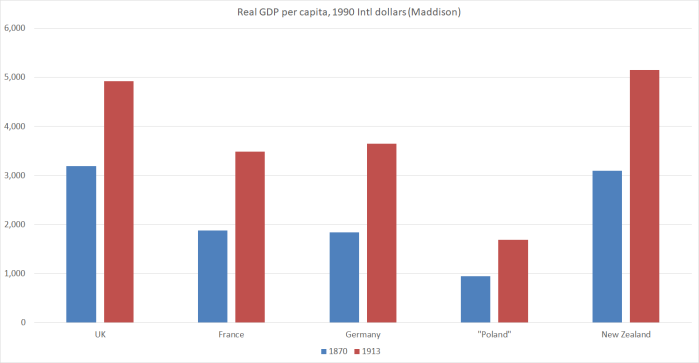
In economic terms it has always been something of a laggard.   Here from Angus Maddison’s collection of data are estimates of real GDP per capita for 1870 and 1913 for the UK, France, Germany, the territory that was Polish, and New Zealand.

poland 1

Real GDP per capita in Polish territory (mostly ruled by Russia) was about a third of that in New Zealand.

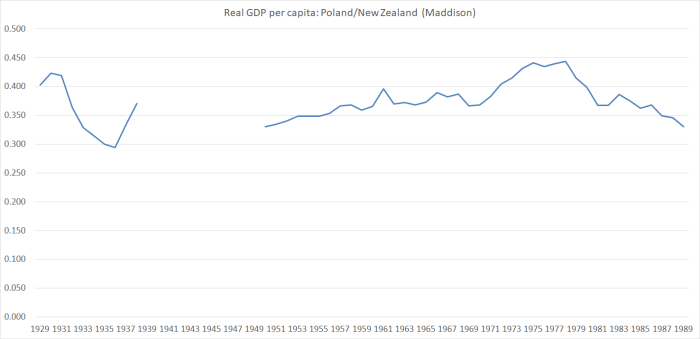
The Maddison database has annual data for Poland from 1929 (excluding the period of the war), and that ratio of Polish GDP to New Zealand GDP seemed to show no real trend whether pre-war or in the communist years, averaging just a bit more than a third.

poland 2

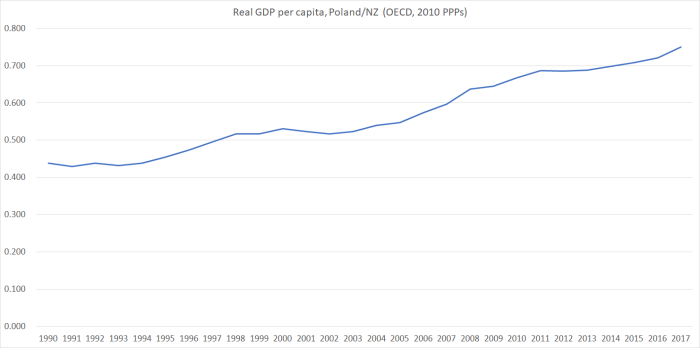
Relative prices – including the purchasing power parity exchange rates used- matter quite a lot in these cross-country comparisons across time.  So not too much should ever be put on any particular levels estimate.  The Maddison database only comes forward to 2008 and the most widely used current numbers are those from the OECD.  On their calculations, at the end of communism Poland was a bit better off (say, relative to New Zealand) than in the Maddison numbers.  Polish GDP per capita in 1990 is estimated to have been about 44 per cent of that in New Zealand.

Here are the OECD estimates for the period since.

poland 3

On OECD estimates, Polish real GDP per capita hit 75 per cent of that in New Zealand.

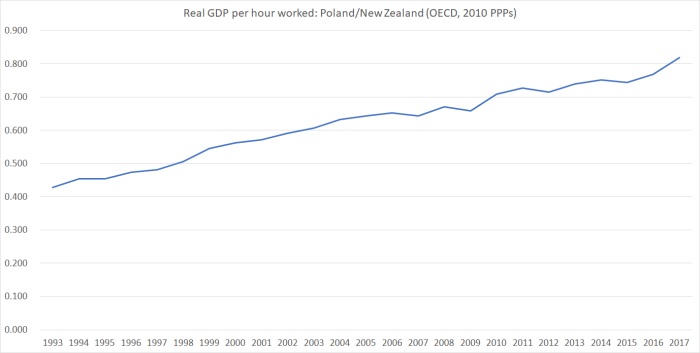
Here is the OECD estimates for real GDP per hour worked (for which there are no longer-term historical estimates, but we can safely assume the ratio was very low on average –  perhaps averaging 35 to 45 per cent –  in the century prior to 1990.  In 1993, when the Polish data start the ratio was 43 per cent –  almost exactly the same as for real GDP per capita.

poland 4

Last year, Poland’s labour productivty reached 82 per cent of that of New Zealand.

All of which is clearly very good for Poland.   And it clearly isn’t just that they’d thrown off the shackles of communism: as the earlier charts show, Poland had been a laggard in the 19th century, and in the first half of the 20th century.

But, of course, part of the good news in these charts is a reflection of New Zealand’s own poor long-term performance.

Here are the latest OECD labour productivity (real GDP per hour worked) estimates for the same group of countries as in my first chart above.

poland 5

Last year, for the first time, Polish real GDP per hour worked passed 50 per cent of that in France and Germany.  100 years ago, of course, both France and Germany would have lagged well behind both the UK and New Zealand.

Perhaps Poland will go on to achieve much greater convergence with the other big European economies in the next few decades – we can only hope so –  and yet one can’t help wondering whether the leaders of a newly independent Poland wouldn’t have been rather disappointed if they’d been told that 100 years on their successors and fellow citizens would still be achieving only half the output per hour of the French and Germans.

Then again, they’d probably have been astonished to learn that 100 years on they’d be managing 82 per cent of average New Zealand productivity (and even 63 per cent of that of the British –  leading global power a century ago).

Hard to think though how disbelieving our own leaders would have been 100 years ago if they were told how far we would have fallen relative to these other countries, notably including Poland.     With none of the excuses –   wars, shifting borders, genocide, or decades of communist rule.

I might have a look at the data for a few of the other post World War One emergent countries later in the month.

Restructuring the Reserve Bank

Seven months (and counting) into his term as Governor, Adrian Orr still hasn’t deigned to deliver an on-the-record speech on either of his main areas of statutory responsibility (monetary policy and financial stability) but he has this morning done what it seems almost all new CEOs –  public sector and private sector –  now do, and restructured his senior management, ousting or demoting several top managers, elevating one or two, and opening up a raft of vacancies.  Public sector senior management restructurings seem to generate most of the Situations Vacant business for the Dominion-Post newspaper these days.

A few people have asked my thoughts on the restructuring, so…..

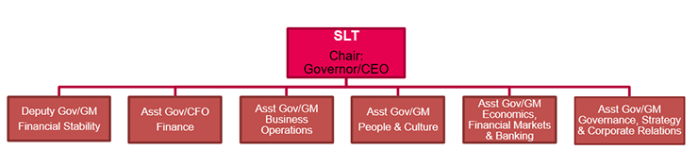
As a first observation, I give credit to the Governor for resisting the temptation of across the board grade inflation (although there is at least one example, see below).  Every public sector senior management advert one sees –  I pay attention mostly because my wife has been in the market – is full of Deputy Chief Executive roles (not infrequently five or ten of them).  The Bank’s Act constrains the number of Deputy Governor positions (only one, in the bill before the House at present) but if he’d wanted to, all these SLT positions could have been designated Deputy Chief Executive roles.  As it is, having resisted title inflation, the Governor might find some potential applicants a bit more hesistant than otherwise: an Assistant Governor (even for Economics, Financial, and Banking) may sound less glamorous than a Deputy Chief Executive title.

This is the new structure, which looks a lot like those for all manner of public sector organisations.new-leadership-team-structure

Three of those positions are filled straight away.

Appointments to Senior Leadership Team
Geoff Bascand – (Currently Deputy Governor and Head of Financial Stability) has accepted a role on the SLT as Deputy Governor and General Manager of Financial Stability.
Lindsay Jenkin (currently Head of Human Resources) has accepted a role on the SLT as Assistant Governor/General Manager of People and Culture
Mike Wolyncewicz (currently Chief Financial Officer and Head of Financial Services Group) has accepted a role on the SLT as Assistant Governor/ Chief Financial Officer Finance.

Of those two appointments (Bascand and Wolyncewicz) seem sensible and appropriate.  Bascand currently holds a statutory Deputy Governor appointment and would have been hard to shift even if the Governor had wanted him out.  His role is slightly –  though perhaps sensibly – diminished as he will no longer have overall senior management responsibility for financial markets.

To be blunt, the new Assistant Governor for People and Culture has the feel of tokenism on two counts.   The first count relates to the current tendency for HR managers to be given glorified titles and to report directly to the chief executive (the message supposedly being “we value our people”, as if organisations never did when HR was a fairly low-level support role).  Line managers are the people who convey (by their actions mostly) to staff the extent to which they are valued (or otherwise).   And the second relates to the incumbent, who just is not particularly impressive.  As someone put it to me, perhaps she might be okay in some modest commercial operation, but she never showed any sign of being suited for a key leadership role in a significant policy organisation.  But….she is a woman, and in promoting her Adrian Orr manages –  after 84 years –  to have a woman in a top tier role (although still not in a key role in policy or operational areas, the raison d’etre for the organisation).   It will have been an easy win to simply grade-inflate the Manager, Human Resources role.  After all, as he said a few months ago

We will be working actively. We are just going to have to be far more aggressive at getting the gender balance balanced,” Orr said in a recent interview

(And before I get angry emails or anonymous comments from past or present Reserve Bank staff, I will reiterate my view –  and it is only mine –  that there are no conceivable grounds on which Lindsay Jenkin would be in the top tier of a major policy organisation other than her sex.  I wish it were otherwise.)

In the entire restructuring, the person one should probably feel most sorry for is Sean Mills, Assistant Governor and Head of Operations, whose job is dis-established and who is leaving the Bank, having joined under a year ago.  I suppose he knew the risks –  taking on a direct report job in the hiatus between Governors, when no one had any idea who the new Governor would be or what structure he or she would prefer.  I’ve never met Mills, and have heard nothing good or bad about him, but it is always a bit tough to lose your job after less than a year.

Two long-serving key senior managers –  both in their roles for 11 years now –  are demoted as part of the restructuring, one perhaps a bit more obviously than the other.

The first is Toby Fiennes, currently Head of Prudential Supervision.  His role –  a big job –  appears to have been split in two.

Toby Fiennes (currently Head of Prudential Supervision Department) has accepted the role of Head of Department for Financial Stability Policy and Analytics.

with one of his current managers (very able) taking up the role responsible for actual oversight of financial institutions.

Andy Wood has accepted the new role of Head of Department for Financial System Oversight.

I always had some time for Fiennes (although I’ve probably criticised speeches and articles here) and thought him in some respects the best of the main departmental heads.  Perhaps it is just that the job has gotten so big that the Governor no longer wanted one person doing it, but the new role is much-diminished relative to what he has been doing for the last decade.   And Geoff Bascand already had the key overall financial stability role, so there was no possible promotion opportunity.

The bigger, and more obvious, demotion is that of (current) Assistant Governor and Head of Economics, John McDermott.

John McDermott (currently Assistant Governor and Head of Economics) has accepted the role of Chief Economist and Head of Department for Economics in the Economics, Financial Markets and Banking Group.

After 11.5 years as a direct report to the Governor, and almost as long with the Assistant Governor title, McDermott loses both.

I’m always hesitant to write much about McDermott.  He was my boss for six years, and while we had our differences we sat across from each other for years and exchanged views on all manner of work and family things.  I liked him, was looking just the other day at the personal gift he gave me when I left the Bank, and I was genuinely pleased to applaud his daughter’s award the other night at the Wellington East Girls’ College prizegiving.

Unfortunately, I don’t think he was the person for the role he has held for eleven years, and which he never really grew into or made of that position what it should have become.  He has a strong track record as a researcher, and apparently was for quite a while the most widely-cited New Zealand economics researcher, but the key senior manager for monetary policy –  effectively a deputy governor without the title – required more than McDermott had to offer.   In public view, this was apparent in speeches and Monetary Policy Statement press conferences.  And thus, sad as it perhaps is for John, I think the Governor has made the right choice.  Whether McDermott stays for much longer in the diminished position he will now take up perhaps depends a lot on who gets vacant (and crucial) new role of Assistant Governor for Economics, Financial Markets, and Banking).

Two other senior managers in core roles leaving the Bank

Mark Perry (Head of Financial Markets)…..elected to leave the Reserve Bank.

Bernard Hodgetts (Head of Macro-Financial Department, who is currently seconded as Director Reserve Bank Review in the Treasury) has also chosen to leave the Reserve Bank after he finishes his role leading the review.

The Head of Department for Financial Markets won’t be an easy role to fill –  I wouldn’t have thought there were any obvious internal candidates.

Three more comments on the review:

  • even if a role like “Assistant Governor, Governance, Strategy and Corporate Relations” is the sort of title one sees in lots of government agencies, it feels like another example of grade inflation.  Presumably this involves the communications functions, the Board Secretary, and churning out the myriad hoop-jumping documents like the Statement of Intent.  People with “strategy” in their title in public sector organisation are rarely at the heart of what the organisation do.
  • there will be a lot of focus on who gets the role of Assistant Governor, Economics, Financial Markets, and Banking.  This is (slightly) bigger role than Murray Sherwin held 20 years ago, without the benefit of the Deputy Governor title.    We will have to wait until the adverts appear to see whether the Governor is after a policy leader (someone who really knows this stuff) or a generic public service manager.  If –  as I hope –  the former, it has been speculated to me that the Governor may try to attract back to the Bank the current Treasury chief economist Tim Ng (whose talents would be better used doing almost anything than wellbeing budgets).  Another possibility is the current Treasury deputy secretary for macro, Bryan Chapple who has a central banking background and led some of the financial markets reform work at MBIE.  No doubt there will be others applying, especially as the holder of the position is almost certainly to be a statutory appointee to the new Monetary Policy Committee.
  • this restructuring also probably helps clarify who will be the four internal members of the new Monetary Policy Committee.  The Governor and Deputy Governor will be members ex officio, and it is hard to see how the other positions would not be given to the Assistant Governor, Economics, Financial Markets,and Banking) and to John McDermott, as head of the Economics Department.

Overall, the restructuring is quite a mixed bag.   There are some good appointments and some poor ones already, and quite a lot will depend on a handful of the remaining appointments (especially the quality of person they can attract to that Assistant Governor role –  which, notwithstanding my earlier cautions about grade inflation, really should be a deputy chief executive position, both for recruitment reasons and for the stature and standing of the person in international central banking circles).

If I have a caveat about the overall structure, it is probably that the Bank would be better for having at least one senior policy person –  whether as Deputy Governor or so Advisor to the Governor –  who didn’t have a demanding line management role.  Such roles aren’t uncommon in other central banks, but I guess it depends on the Governor’s own preferred operating style.

And since I have the opportunity of a post about the Bank, I should note that I have not abandoned the issue of the Governor’s total non-transparency in respect of his speech about transparency to the Transparency International AGM (at which he was introduced by the State Services Commissioner, who has responsibilities for open government).  I am pleased to see this issue has had a little bit of media attention, including this article which pointed out that 90 per cent of Transparency International’s funding comes from the taxpayer.  I have an Official Information Act request in with the Bank for any briefing notes or text the Governor used, for any recordings that may exist, and if none do for a summary of what was said (memories –  very fresh, since I lodged the request within hours of the Governor delivering his speech – are official information too.   I don’t expect much, but there is a point to be made –  all the more so given the topic, the audience, the introducer, and the funding source for the body to which he was speaking. I can’t imagine Orr said anything very controversial, in which case why the secrecy? And if what he said was controversial –  foreshadowing for example Monday’s forthcoming culture review – it shouldn’t be said only to select private audiences.  It was simply an unnecessary own-goal, some sort of silly reassertion (perhaps Wheeler like) of a Reserve Bank perception that it really should be above such trivial matters as disclosure, transparency and the Official Information Act.


Local listing for banks: a case for one in particular

There was a very strange article in the Herald yesterday from one Duncan Bridgeman claiming that it was, in the words of the hard copy headline Time to force Aussie banks to list in NZ”.

What wasn’t at all clear was why.

Bank profit announcements seemed to be the prompt for the column

Australian banks reaping huge profits from their New Zealand customers is a perennial scab that gets ripped off every time financial results come in.

I’m not persuaded the banks earn excessive profits here, but I know some other serious people take the opposite view.  But even if they are right, surely that is a competition policy issue –  the case for one of the new market studies perhaps, and any resulting recommendations.  There is nothing in the article explaining how forcing the Australian banks to sell down part of their New Zealand operations would affect, for the better, competition in the New Zealand banking services market.

The other prompt appear to be industry developments in Australia

Meanwhile, Australia’s big banks are starting to move away from vertical integration, partly because of conflicts of interest but also because their financial services model is unlikely to sustain the same profits over the longer term.

Suncorp, ANZ, CBA and NAB have all divested their life insurance operations. The latter two have also announced plans to spin off their wealth management operations. Westpac remains wedded to these areas of business but is expected to follow suit at some point.

And just last week financial services firm AMP, also heavily damaged by the banking royal commission, announced the sale of its wealth protection unit to US firm Resolution Life for A$3.3 billion and divulged plans to offload its New Zealand wealth management and advice businesses through a public offer and NZX listing next year.

But not one of those divestments has anything to do with core banking operations, unlike the approach Bridgeman appears to be proposing for the New Zealand bank subsidiaries.

A not unimportant word that one –   subsidiaries.  Presumably Bridgeman is fully aware, even though his article doesn’t mention, that all four Australian banks do the bulk of their New Zealand business not through branches, but through legally separate New Zealand subsidiary companies, with their own boards of directors (and statutory duties). (New Zealand compels them to do so, at least in respect of the retail business).

But when I read this paragraph I had to wonder if he really did appreciate that.

But if ever there was a time to raise the prospect of some form of domestic ownership and oversight of the banks, it is now.

The problem is it will never happen unless the Aussie banks are forced to by our politicians and regulators. After all, the last thing the banks want right now is another regulator to answer to.

Yet, why should it be accepted that four of this country’s five most profitable companies are effectively regulated in Australia?

The New Zealand subsidiaries are fully subject to New Zealand law: competition law, prudential regulation, financial conduct law, health and safety law.  The lot.  (Even the branches are subject to much New Zealand law, but leave them aside for now.)   The Reserve Bank of New Zealand sets minimum capital standards. minimum liquidity standards, disclosure requirements and so on.

Of course, since the New Zealand subsidiaries are part of much larger Australian-based banking groups, APRA’s regulations and requirements for the group can also be binding  –  not on the New Zealand business itself, but on the group as a whole.   APRA can, in effect, hold the local subsidiaries to higher requirements than those set by our Reserve Bank  (in just the same way that shareholders might voluntarily choose –  perhaps under rating agency pressure – higher standards than a regulator might impose), but it can’t undercut New Zealand standards for New Zealand operations.  Daft as they may be, New Zealand LVR restrictions are binding on banks operating in New Zealand.

Bridgeman goes on

Theoretically an Aussie bank could offload 25 per cent of the institution’s New Zealand assets and list the shares here separately. That would bring tax advantages to New Zealand investors who can’t use Australian franking credits, even though they are dual listed.

I presume he means selling off 25 per cent of the shares in the New Zealand subsidiary (rather than 25 per cent of the assets).  It would, no doubt, have tax advantages for New Zealand investors (and thus, in principle, the shares might command a higher price), and yet the banks haven’t regarded it as worth their while (value-maximising) to do so.    Bridgeman doesn’t look at question of why (presumably something about best capturing value for shareholders by holding all of the operations in both countries, and being able to  –  subject to legal restrictions and duties –  manage them together).

And he also doesn’t note that if, say, ANZ sold down 25 per cent of the shares in its New Zealand operation, the subsidiary will still be regarded by APRA as part of the wider banking group, and prudential standards will still apply to the group as a whole.  As they should –  after all, with a 75 per cent stake there would be a high expectation (from market, regulators and governments) of parental support in the event that something went wrong in New Zealand.

There is a suggestion that the article is a bit an advertorial for NZX

If a quarter of these assets were listed that would bring about $12.5b of capital to the local stock exchange – a badly needed injection at a time when the main market is shrinking.

But even then it isn’t clear what is meant.  It isn’t as if there is a new $12.5 billion (I haven’t checked his numbers) of local savings conjured up.   Buying one lot of shares would, presumably, mean selling some other assets.  In a country with quite low levels of foreign investment, the initial effect of any such floats would be to reduce that level further.  (Of course, in practice quite a few of the shares in any newly floated New Zealand subsidiaries would be picked up by foreign investment funds, leaving the alleged benefits of any compulsory selldowns even more elusive.)

Bridgeman ends with a rallying cry

And right now the Aussie banks are distracted with a battle on their home turf.

It’s the perfect time for some Coalition politicians to show some backbone and make a case for a change in this direction.

It might have appealed to Winston Peters once upon a time, but even if it weren’t a daft policy to start with, Bridgeman may have noticed that business confidence is at rather a low ebb right now.  Arbitrarily interfering in the private property rights of owners of private businesses – even if largely Australian ones –  wouldn’t be likely to do much to instill confidence in the soundness of policymaking.

As it is, they could start closer to home.  If governments really did want to focus on getting some more bank representation on the domestic stock exchange –  and it is not obvious why they would –  perhaps they could look at the New Zealand banks first.  After all, only one of them (Heartland) is sharemarket listed.  And the biggest of those New Zealand owned banks –  Kiwibank – is actually owned by the government itself.    In fact,  by three separate goverment agencies (NZ Post, ACC, and NZSF), none bringing obvious expertise to the business of retail banking, none themselves facing any effective market disciplines.  I’d be all in favour of a well-managed float of Kiwibank  (although once floated it might not last long as an independent entity).  There are good reasons (they’ve been there for years) for the government to consider seriously that option.  But there are no good reasons to force well-functioning locally regulated foreign-owned banks to sell down part of their operations in New Zealand.


Did state houses make much difference to housing supply?

I’ve been among those suggesting that the KiwiBuild programme –  even if it involved the government itself directly commissioning the building of new houses that no existing developer already had in prospect –  was unlikely to increase overall housing supply very much, or affect overall average house prices very much.  It was never clear how such a programme could affect overall housing supply very much.  For it to do so, there would have to be large unexploited profits left sitting on the table by private developers (properties selling for far more than it would cost to bring new developments to market).  If that isn’t so –  and we don’t see any obvious signs of such unexploited opportunities – whatever the government itself builds or commissions is just likely to mostly displace and replace houses that the private sector would have built.   (There is another possibility, that the government not only displaces most private building, but goes on building at a loss even beyond that point, but there is nothing in the PR around the programme to suggest that is what they have in mind.)

I also know the line the government and its defenders run that somehow KiwiBuild will “work” –  whatever that means –  by building particular types of houses the market isn’t providing.  But even to the extent that is so, what of it?   If the morass of regulation makes it uneconomic to build many new moderate-sized homes (although do recall that the flagship houses are four bedrooms), demand reallocates.  Decades ago many young couples started out with a brand new (small) house in a remote suburb with few facilities and not even a lawn (I’m just old enough to remember our (new) street in Christchurch where what would become front lawns were planted with potatoes, apparently to get the impurities out of the soil).  These days they don’t.   But is there any sign that the prices of the existing modest-sized houses have increased disproportionately relative to house prices more generally?  I’m not aware of any, and that isn’t really surprising, when by far the biggest issue in high urban house prices is land prices.   And KiwiBuild does nothing at all about them.

In my post earlier in the week, I mentioned the state house building programme initiated by the first Labour government, and often touted as the inspiration for today’s KiwiBuild programme.   In passing, and thinking as I wrote, I wondered if the (substantial) construction programme associated with the state houses programme had made much difference to overall housing supply.  It wasn’t something I’d ever given much thought to previously, but once one begins to think about it, of course it makes sense to doubt that that massive state intervention really made much difference on that specific count.  (It is quite probable that it materially increased availability for some –  small –  class of potential tenants private landlords were reluctant to touch.  It is also clear that it chewed up vast amounts of land, probably rather inefficiently – a couple of weeks ago I was driving through a state house neighbourhood a few blocks from where I grew up in Auckland and marvelled  –  not in a positive way – to see such small state houses on such large sections.)

There isn’t any easy way to compellingly answer my question.  Perhaps some academic researcher could turn their attentions to it at some point.   But out of interest I dug out a few charts.

This one (from Te Ara) shows the stock of state houses.

stock of state houses

(Interesting to see that the stock actually dropped a little during the term of the Kirk-Rowling Labour government).

And this chart shows annual data for both the number of new state houses built and those existing ones sold (something initiated by the 1950s National government).

state-houses-built-and-sold-graph

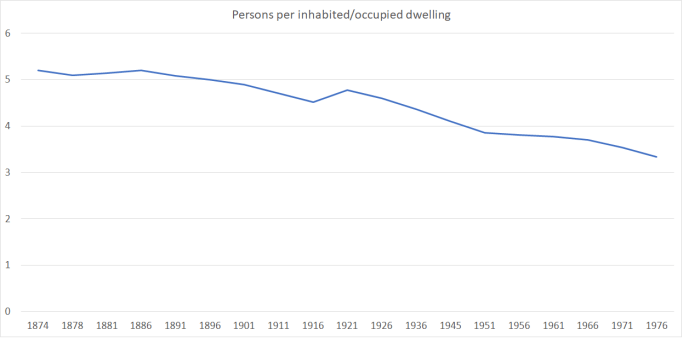
One way of looking at whether there is prima facie reason to think the state house programme might have made much medium-term differenc is to look at the population to dwellings ratio.

This chart is drawn from census data reproduced (up to the 1970s) in Bloomfield’s collection of New Zealand historical statistics.

person per dwelling.png

The spacing isn’t even –  censuses were skipped in 1931 and 1941 –  but all I really wanted to highlight was the strong downward trend over the 90 years from the mid 1880s to the mid 1970s.  The only interruption to the trend was in the single inter-censal period from 1916 to 1921.  It is more or less what one would expect, as people got wealthier, families got smaller (and, at least late in the period, divorce got more common).    Had the state not been building, there isn’t much reason to suppose that –  over time, and in the absence of building and land use restrictions –  the private sector would not have done so.  After all, they had done so in the decades prior to the state housebuilding programme (I was little surprised to see that even over the period encompassing the Great Depression –   1926 to 1936 –  the population to dwellings ratio fell).

Sadly, what might have been the cleanest test –  the 30000+ state houses built in the first decade or so of the programme –  also happened to mostly coincide with World War Two and the period of tight controls on all manner of things (including existing house sales) in the years following the war.  And government-imposed credit constraints remained an issue for the private sector for much of the post-war decades.

But I’d suggest that the burden of proof is really on the advocates of KiwiBuild to show that even very big government-inspired housebuilding projects really make much difference to the overall housing supply situation in the long-term.  After all, when the government owned many of our banks, most of our power companies, most of our radio and TV, and so on, mostly it didn’t supplement the stock of private businesses, it (rationally, from a private sector perspective) displaced them or crowded them out.  If the government were really serious about fixing the housing market, and making housing once again affordable for working class families, not just helping along well-paid professional couples, they’d free up the urban land market.  Sadly, there is no more sign of that under this government than under its predecessor.

On which note, there is a column today on interest.co.nz by Peter Dunne in which he begins thus

Kiwibuild is beginning to look more and more like no more than one of Edmund Blackadder’s cunning plans.

He has some good lines

It is worth recalling that in its election policy just one year ago Labour promised that it would “build 100,000 high quality affordable homes over 10 years”. The policy went on to talk about curbing homelessness through building affordable homes in the $350-450,000 price range.

The implication was unambiguous – Labour’s approach was going to be far more activist than National, and Kiwibuild would be Its primary policy to deal with homelessness and the housing crisis.

and

So far, just 18 Kiwibuild homes have been built, and another 447 are on track for completion by July 2019, leaving a shortfall of 535 on its first year 1,000 homes target.

Put another way, a first year achievement rate of just under 47%. And there has been a subtle but clear rewrite of the Kiwibuild objective.

According to the Kiwibuild website, the objective is now the much more passive one to “deliver 100,000 homes for first home buyers over the next decade”.

So, no longer will the government build “100,000 high quality affordable homes”. And no longer does “affordable” mean $350-450,000, but $650,000.

Moreover, now the plan is merely to “deliver” 100,000 homes, which, in the best Blackadder fashion, means accumulating all the new homes already being built over the next 10 years by the private sector anyway, and dressing them up as Kiwibuild homes.

But it is perhaps worth recalling here that Peter Dunne was a minister in the previous National-led government, and in particular held the one vote in Parliament that was sufficient to block the reforms (inadequate and insufficient as they would have been) that National was seeking to make.  I hope I don’t need to say again that I’m no defender of National’s record –  and lack of courage –  in this area in government, but it is a little rich for Dunne to snipe from the sidelines (legitimately in substance perhaps) when he personally blocked beginning to tackle some of the root causes of our obscene housing market failure.


On the background of Zhang Yikun

Last week the original Chinese version of the article below appeared in the Chinese-language magazine Beijing Spring.  It is about the background of Zhang Yikun the (non-English-speaking) Auckland businessmen who suddenly emerged into the public spotlight recently when Jami-Lee Ross released a tape of a conversation with National Party leader Simon Bridges.  Zhang Yikun had, it appeared, arranged/facilitated a set of donations to the National Party, totalling $100000, and had discussed with Bridges and Ross the possibility of another ethnic Chinese MP, apparently naming as a possible candidate one of his own employees/associates.  Once the spotlight fell on Zhang Yikun it turned out that he had had extensive associations with senior figures in both main New Zealand political parties.  And both he and his associate appear to have extensive involvement with the PRC’s United Front programme.

The article was written by Chen Weijian. The full version of his article, in Chinese, is here.  When it appeared Anne-Marie Brady described it as a “must read”.  The English translation below was done by Daisy Lee, an Auckland-based China researcher (with a few suggestions from me to improve the flow for an English-speaking readership).     The translated version omits some detail that is in the original article, and reorders some material (but from the fuller version I’ve seen, this version omits nothing that is central to his case).   I offered to make the translation available here.

I asked for some biographical material and this is what I received

Chen Weijian is Auckland-based prominent Chinese political commentator.

He is the chief editor of online pro-democracy magazine Beijing Spring. The magazine was established in the United States in 1982 and the current president is Wang Dan, one of the most visible student leaders in the Tiananmen Square protests of 1989.

Immigrating to New Zealand in 1991, Chen Weijian and his brother Chen Weiming  published the weekly Chinese newspaper “New Times” from 1996 to 2012.  Chen Weiming is a famous artist and sculptor known for his works of the 3-meter bronze statue of Edmund Hillary and 6.4 meters tall Goddess of Democracy.

In late 1970s when Chen Weijian lived in Hangzhou city of China,  he founded a private magazine Silent Bell which was banned by the Chinese government as illegal publication.

On my reading, the author’s key point is that the evidence of Zhang Yikun’s close association with the Chinese Communist Party, and the high regard in which he is held by the Party, is crystal clear.  Among that evidence is his very rapid ascent in various significant organisations that are part of the party-state’s overall United Front programme.

Chen Weijian’s article reinforces my view that New Zealand political parties and political leaders should steer well clear of those individuals like Zhang Yikun who are so closely associated with the Chinese Communist Party; a Party that is the source of so much evil at home in China, and which seeks to control the Chinese diaspora (and turn it towards Beijing, challenging the ability of migrants to become loyal to the country they’ve settled in) and to neutralise political opinion in countries around the world, including New Zealand.   There is no sign that such people –  and Zhang Yikun appears to be one of the most important of them in New Zealand –  have the interests of New Zealand and New Zealanders at heart in their interactions with, and donations to, our political parties.  And yet our politicians court him, and honour him.

If it is of use to anyone, I have put the text below in a separate document available here

State patriotism by Chen Weijian Oct 2018

—————————————————————————————————————————–

State patriotism 

By Chen Weijian

4 June 1989 was a bloody day that cannot be erased in Chinese history. The Chinese People’s Liberation Army (PLA) opened fire on unarmed students whose blood stained Tiananmen Square. 29 years later, on the same day, a New Zealand overseas Chinese leader, former PLA member Zhang Yikun, received the New Zealand Order of Merit.

On September 12th, Zhang Yikun was formally honoured at Government House. The news was even covered by China’s CCTV: a star in the overseas Chinese community was on the rise. But while awaiting his spectacular future,  Zhang Yikun this month burst into public view in New Zealand following his undeclared $100,000 donation to National Party.

The question of what political donations are legal and illegal is a matter for the relevant authorities. What I want to talk about is Zhang Yikun’s political background in China and the role he has been effectively playing in New Zealand as a “patriotic overseas Chinese” leader.

In his motherland, China, Zhang Yikun has held quite a few resounding political titles which distinguish him from all the other community leaders of the CCP’s United Front organisations in New Zealand.

In 2012, Zhang was elected as the vice chairman of Hainan Provincial Federation of Industry and Commerce.

The website’s home page says the Federation is a group of people’s organisations and chambers of commerce under the leadership of the CCP.  It is a bridge between the Party and the government to connect with the private sector.

That all members of the Federation must serve the party’s interest was explicitly addressed by Sun Chunlan, the minister of the United Front Department, when she spoke at a national training conference in July 2017 to the chairmen and party secretaries from all of the provincial Federations of Industry and Commerce.

She said then that “where the work of the Party and state is progressed, the Federation of Industry and Commerce should organize the  majority of people in the non-public economic organisations to follow”.

Zhang Yikun’s superior, the chairman of this Federation, is a famous businessman, Chen Feng, the co-founder and chairman of the Chinese conglomerate HNA Group.

HNA is known in New Zealand after the Overseas Investment Office declined its $660 million bid to acquire ANZ Bank’s UDC Finance last December.

Ranked No. 205 on Forbes 2017 China Rich List at $1.7 billion, Chen Feng is also a former PLA member.

It is unclear if Zhang Yikun’s wealth in China can be compared with Chen Feng’s holdings in HNA,  because on several Chinese websites Zhang is only declared as the chairman of Hainan Lian Sheng Fa Industrial Co., Ltd.  and there is no information about the company’s financial position.

However, one thing is certain: Zhang Yikun is not a normal business person, otherwise he would not have been able to become the vice chairman of the Hainan Provincial Federation of Industry and Commerce.

In Hainan province, Zhang Yikun plays an important role in another United Front Organisation, the Hainan Provincial CPPCC (Chinese People’s Political Consultative Conference ) where he was promoted to the Standing Committee in January 2013.

A Brief History of the CPPCC in its website explains that the CPPCC, established in 1949, is a creation of the CCP which combines the Marxist-Leninist theories on united front, political parties and democracy, with China’s concrete practice.  In its new century and new stage of development, China’s united front has further expanded and become the broadest possible patriotic united front composed of all socialist workers, builders of the socialist cause, and patriots who support socialism and the reunification of the motherland.

Five months after he was elected in the Standing Committee of the CPPCC, Zhang Yikun was nominated by the United Front Work Department of the Hainan Provincial Committee as a “ Builder of the Socialism with Chinese Characteristics.”

At the top of a list of criteria, any potential nominee is required to have good political quality, resolutely support the leadership of the CCP and the socialist system, the party’s line, and its principles and policies.

Chen 2Southland District Mayor Gary Tong says Zhang Yikun, posing here with John Key, is well known in central government.

While Zhang Yikun has been diligently fulfilling his political responsibility in China, he has also been highly committed to the United Front Work in New Zealand.

Although he has been in New Zealand for nearly 20 years and is still unable to speak English, it has not affected him networking with politicians.  Gary Tong, the mayor of Southland, who is currently travelling with Zhang in China, said that Zhang is well known in central government and has close links to high level ministers and MPs. They include National Party leader Simon Bridges, former PM John Key, party president Peter Goodfellow, Deputy Leader Paula Bennett, Auckland Mayor and former Labour leader Phil Goff , current Justice Minister and former Labour Party leader Andrew Little and other senior politicians.

Chen 3Auckland Mayor Phil Goff at Zhang Yikun’s house wearing a gifted Chinese costume.

Among them, Auckland Mayor Phil Goff, who was in Hong Kong on 4 June 1989, and saw the massacre on live broadcast TV. The experience had moved him and he has showed sympathy for activists in the past.  For example, when Wei Jingsheng, a famous Chinese democracy activist visited New Zealand, Goff invited him to lunch at Parliament. Times have changed, and though Goff is still particularly fond of China, his favour now seems to rest with interests associated with the CCP.

In New Zealand, Zhang appears to have been almost fated to succeed. He is admired by many immigrants who have been working hard for small achievement. Zhang talks of his own success quite modestly, as if “ I was not intending to pursue wealth, but prosperity just landed on me without my intention”.

Zhang Yikun was born in a village called Nigou in Puning County of Guangdong Province.   In 1990, at the age of 18, he joined the People’s Liberation Army in China. Joining the army was an opportunity for a rural youth to get out of the countryside. In his brief time in the army, Yikun was promoted to the headquarters.   In 1992, he was discharged, and started to work at the government of the Hainan Provincial Special Administrative Region. The fact that he was able to transfer positions implies that he was already well-regarded, since only those who were could get such transfers.

In 1996, Zhang Yikun was sent to the (prestigious) Chinese Academy of Social Sciences for postgraduate study. This in-service postgraduate program is specially designed by the CCP for the training of its officials. Having joined the army at age of 18, his education was at most an intermediate level. What led to him, an official with only an intermediate school education, being sent to an institution for higher education? We can only speculate.

Soon after his arrival to New Zealand in 2000, he ran his own restaurant called “China Yum Cha Restaurant”,  located at a premium location near Princes Wharf in Auckland. Unlike most Chinese immigrants who start washing dishes and cutting vegetables, Zhang directly became the boss of a large-scale restaurant (and subsequently opened another two restaurants). He had never run his own business in China nor apparently had any opportunity to make extra money. His monthly wage was just 800RMB in 1996. A large investment was required to finance this restaurant, so we can wonder where did the money came from?

Since then his business has becoming extremely successful. He has successively founded New Zealand Huanglian Group Ltd, HLG property Management Ltd, New Zealand Huanglian Natural Food Ltd and KCC Construction Ltd. The penthouse of 175 Queen St Auckland, the most expensive commercial building in New Zealand, has become the heart of his business empire. His business has developed to encompass multiple fields and multiple countries.  Activities include property development and management, export and import, commercial investment.  Several overseas offices have been set up in Hainan province, Guangdong province, Hong Kong and Thailand.

After establishing his business empire, Zhang Yikun began to build his career as an overseas Chinese community leader. Unlike Steven Wai Cheung Wong, the former head of the United Chinese Association in New Zealand,  who had to cultivate his relationship with the Chinese consulate for some years for his dreamed position, Zhang Yikun’s political promotion has been as astoundingly rapid as his commercial success.

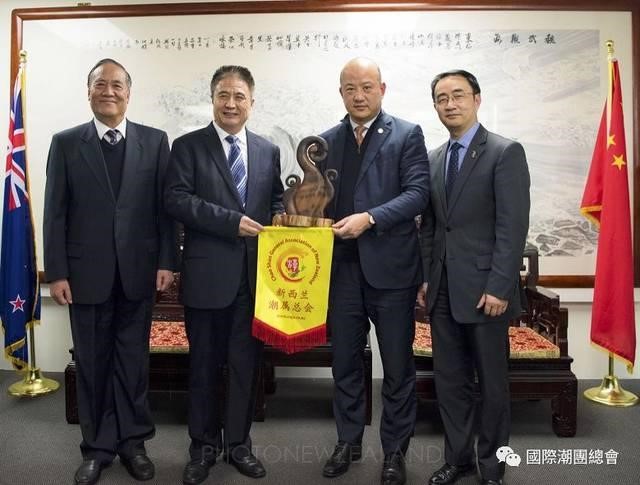
In 2015, he formed the New Zealand Chaoshan General Association (CGSA),  for people from Chaozhou and Shantou district of Guangdong province, and has taken the role as the chair of the International Chaozhou Federation after two years.

Undoubtedly, Zhang Yikun is treasured by the senior Chinese politicians or he wouldn’t have been given this significant role to unite those wealthy ethnic Chinese who are valuable to the CCP in their attempts to expand China’s global influence.

As just one example of his connections, on 3 September 2015, Zhang Yikun was invited to Zhu Ri He military base in Inner Mongolia to watch the military parade. He stood on the viewing platform watching the armed forces marching, various new types of military vehicles and missiles in the parade, and the aerial display. He emotionally said, “as a military officer, seeing the country is strong, (my) feeling of pride is rising.”

In New Zealand, he has been frequently visited by high level Chinese delegations. On 8 June 2018, his former comrade, Luo Baoming, the former party secretary of Hainan province, now the vice chairman of OCAC (Overseas Chinese Affairs Office) was warmly hosted by Zhang Yikun and his CGSA in Auckland.

At the reception dinner party, the two Chinese MPs who have made such a contribution to the New Zealand-China relationship, Jian Yang and Raymond Huo, witnessed how this senior OCAC official praised Zhang Yikun.

“The fulfilment of China’s dream needs the overseas Chinese community leaders like president Zhang Yikun who has the strength and passion for the state patriotism”.

State Patriotism! Here we have Jian Yang, former officer lecturer of a PLA spying school, and his fellow PLA veteran, Zhang Yikun, both members of “New Zealand Veteran Association” (Zhang Yikun is the president of the association), standing together to welcome a high ranking Chinese communist official, is it a coincidence?

Chen 4Jian Jian Yang (far right) and Zhang Yikun (second from right ), the two former PLA members greet Luo Baoming, the vice chair of OCAC

If the above is not enough to set the scene, here is another photo. This one was taken on 30 August this year in Beijing. Zhang Yikun is staring at the display wall of propaganda and listening. The display wall is themed in communism red, titled “Always Go With the Party” and next to it is the symbol of communism, the hammer and sickle.

Chen 1 Zhang reading the “Always Go With The Party” display banner in Beijing on 30 Aug 2018
The New Zealand government granted him a high honour on 4 June, the day the whole world commemorates the young students whose lives were taken by the evil party. Zhang Yikun, the former PLA member, carried his honour back to Beijing to express his love to the party.

Is his beloved country New Zealand or China?  There is nothing wrong if he says he loves China.  But in reality, he loves the Communist Party and is following the steps of the party forever. Of course, we can’t simply conclude just from a photo that he wants to follow the party all the way. For that, we should see what he has done in the past and what he is doing now.

The revelation of Zhang’s donation has brought back to fore stories that had been dormant for a while. The National MP Jian Yang, exposed last year for his hidden past as a PLA intelligence officer and teacher in PLA spy school, and later sitting in the Foreign Affairs committee of Parliament.  And now, another (former) PLA member, Zhang Yikun has emerged on the stage.

New Zealand is the land of the long white cloud, often described as the last pure – uncorrupt – land in the world. Unfortunately, it has been polluted by CCP’s Human Common Destiny. The clean-up of the pollution may have begun, but completing it will take time.

Too few mortgagee sales?

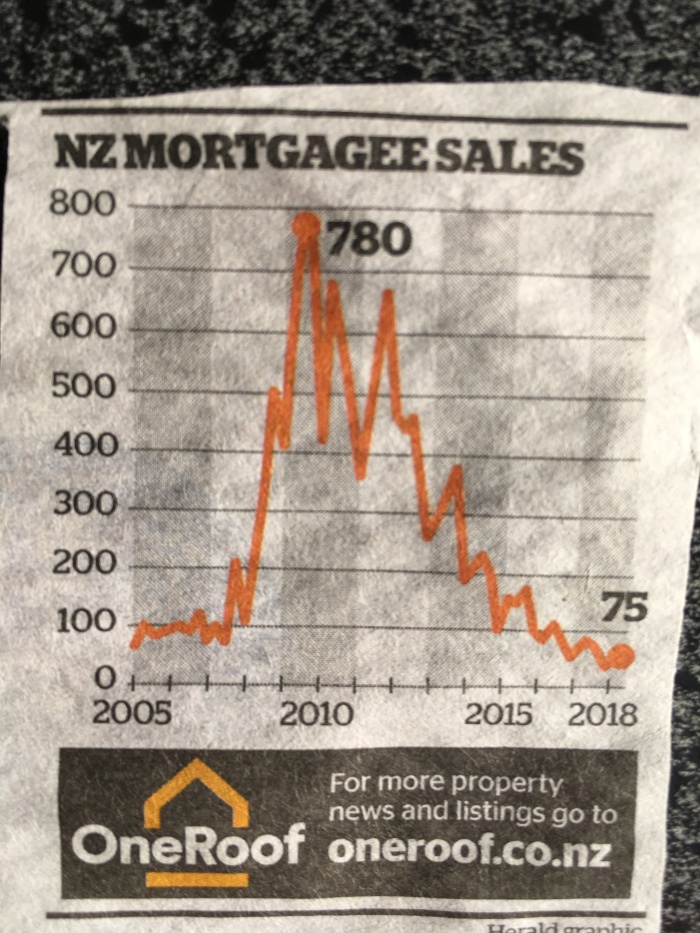
This chart appeared in an article in yesterday’s Herald, heralding (so to speak) mortgagee sales of houses hitting the lowest level for more than a decade.

mortgagee sales

The chart isn’t clearly labelled, but it appears to be quarterly data.  Elsewhere in the article, it is noted that the peak in annual mortgage sales was 2616 in 2009 –  the trough of the last recession, when the unemployment rate had risen quite sharply and nominal houses had fallen quite a bit (down 9 per cent nationwide in the year to March 2009).

In many respects, one wouldn’t wish a mortgagee sale on anyone.  But one also wouldn’t wish any individual to find themselves overstretched and having to sell the house themselves (and thus not a mortgagee sale).

But, equally, risk is part of a market economy.  And the housing stock financed by mortgage isn’t just the (sympathetic) case of the first home buyer owner-occupier, but also investment properties, beach houses, and fancy houses (the Herald story includes a piece about a pending mortgagee sale of a $3 million house in St Heliers).   In a country of almost five million people (and more than 1.8 million dwellings) one might reasonably wonder whether a mere 250 to 300 mortgagee sales in an entire year is lower than might be, in some sense, entirely desirable.   After all, the nature of taking risk –  and both purchaser and financier do –  is that sometimes things will go wrong.   The optimal number of mortgagee sales is very unlikely to be anywhere near zero.

The key combination of factors that tends to drive the number of mortgagee sales sharply upwards is higher unemployment and falling nominal house prices occurring together.  If unemployment rises but house prices stay high then even if the borrower runs into servicing difficulties they can usually sell the house themselves, repay the mortgage, and move on, without the additional and humiliation of being sold up by the bank.   If nominal house prices fall but unemployment is still low, borrowers will typically still be able to service the debt, and banks are reluctant to sell up people with negative equity who are still servicing the debt, even though they are legally entitled to do so.

We had that combination in 2009 (although in neither case to extremes) and you can see the consequence in mortgagee sales in the chart.

What is often lost sight of is that in a properly functioning housing and urban land market, mark to market losses on houses shouldn’t be uncommon, even in nominal terms (with, say, a 2 per cent national inflation target).   In such markets, land use can readily be changed in favour of housing development, and new houses/apartments readily consented and built.  In such markets there is no reason to expect a trend increase in real house prices, even if the population is growing rapidly.  Across a full country, some areas will do well and some not.  So some localities will more often see, perhaps modest, trend falls even in nominal house prices.  And, of course, without ongoing maintenance individual properties would depreciate in most localities.

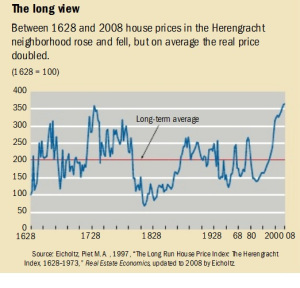
For those who doubt that such things are possible, I could bore you with charts from US cities where the markets function well, but instead I will use it as an excuse to reproduce what was for a long time one of my very favourite charts (written up here), showing prices for a street of houses in central Amsterdam from 1628.

herengracht11

There are ups and downs, but over several hundred years no strong trend.

And, of course, that is now what marks out housing markets in New Zealand (and Australia, and various other places, including parts of the US, where land use restrictions have become binding).   In recent decades there has been a strong upward (regulation-facilitated or induced trend) in real (and even more strongly in nominal terms) house prices.  As I noted yesterday, REINZ numbers show that over the last five years prices in Auckland and out of Auckland have averaged 8-9 per cent increases every year.  And that was on top of substantial increases in the 1990s and the 2000s.  It isn’t that easy (although not impossible) to get yourself into a position where the bank sells you up when house prices are rising that strongly.  But in a well-functioning market, we wouldn’t see such pervasive trend increases.

It is interesting that the number of mortgagee sales is now lower than it was in the mid 2000s (even though the housing stock is bigger now than it was then).      The unemployment rate has come down quite a long way, but is still about a full percentage point higher than it was in 2006/07 (and underemployment rates linger high).  For the sort of people –  a diminishing number –  who can afford a house anyway now, unemployment probably isn’t a big consideration now.  But, again, in a well-functioning housing market –  in which the Prime Minister wasn’t doing photo-ops with professional couples who’d won the lottery to buy a subsidised four bedroom house, but appearing with a working class couple of similar age able to buy their first house in one of our larger cities –  it might well matter more. Downturns hit harder people in less skilled jobs, and with more marginal attachments to the labour market.  In a better functioning system, more of those sorts of people would be buying houses, and some would end up unlucky and having to sell up later.   That is the “price” we pay for better access to the home ownership market.

The other relevant consideration is access to finance.   If a bank won’t lend more than, say, 40 per cent of the value of the property, it would be extremely difficult to ever see a mortgagee sale (only, say, idiosnycratic shocks such as the house burning down when the borrower had forgotten to pay the insurance bill or some such).     At the other extreme, of course, if banksare  lending 115 per cent of the value of the property –  in some over-exuberant mood in which everyone believes property values only ever go up, and where new buyers want to have extra cash for, say, fancy furniture, then it doesn’t take very much to go wrong for there to be lots of cases of negative equity, and potentially lots of mortgagee sales.  Mostly –  and to the credit of the banks –  we’ve avoided those sorts of excesses.

But for five years now we’ve had the unprecedented situation of the Reserve Bank limiting how much banks can lend to individual purchasers of residential properties (LVR limits).   We went through successive waves of these controls, and although they were eased somewhat last year binding restrictions are still in place.   The economic case for these controls was never robustly made (the Bank could never quite get round the fact that its own stress tests kept showing that banks were in fine health, or that mortgage lenders –  public and private –  had for decades been lending 90 per cent LVR loans in New Zealand and been able to managed the associated risks).

The Reserve Bank has been keen to boast about how effective these controls were in limiting the amount of high LVR lending banks were taking on.  They always presented this as “a good thing” even though they could never demonstrate (a) that banks were safer as a result (all else equal, banks need less capital when they have fewer risky loans),  or (b) that their judgement on prudent lending standards was better grounded than that of willing borrowers and willing lenders, with their own money at stake, or, incidentally (c) what other risks banks might have chosen to take on to keep up profits if prevented by regulation from lending to housing borrowers.

There wasn’t much doubt, though, that LVR controls applied tightly enough –  and the RB controls became increasingly tight – could restrict the amount of high LVR housing lending.  And high LVR loans will be disproportionately represented among those where a mortgagee sale eventually occurs.  So, even in a period of moderate unemployment, it is quite likely that LVR restrictions have reduced the number of mortgagee sales.

But it simply doesn’t follow that that is a good thing.  The other side of the same equation is that some people who would otherwise have been able to purchase a property using credit, whether owner-occupiers or investors, won’t have been able to do so.   Perhaps those people will have got into the market a few years later, but in the interim they will have missed out on the opportunities of home ownership –  and in most localities, being forced to wait means the entry price will be higher than it would have been if Reserve Bank controls had not intervened.   Those are real missed opportunities, while regulations skewed the playing field (cheaper entry levels) for cashed-up buyers.

In a well-functioning market, house prices rise and fall (although typically not that dramatically) and it is unlikely anyone will be much good at forecasting the movements that do happen.  With the best will in the world, and the best countercyclical monetary policy, economies will fluctuate, and some people who’ve taken on debt will find themselves unable to service the loan.  Painful as that no doubt it, it is only one of the many potential vicissitudes of life –  probably not the end of the world if you are in your 20s and have decades to get back in the market.  The alternative to expecting that a reasonable number of people will eventually have to sell up, in a world of uncertainty and unforecastability, is to have credit policies so tight that they also exclude substantial cohorts for much longer than necessary from being able to enter the housing market at all, whether as owner-occupiers or investors.

I don’t wish a mortgagee sale on anyone, any more than I’d wish a business failure or a redundancy on anyone. Even the transactions costs associated with any of these of events are often non-trivial.   But without them –  while still in a world where the future can’t be foreseen – we’d be living in an economy so cossetted that many opportunities –  for individuals and for the economy as a whole –  would be missed.  In the housing market, between regulatory restrictions on access to housing credit and other regulatory restrictions which impart a strong upward bias to real house prices, we are probably in that sort of situation now.  Too few people can get into the market at all, and too little risk may well mean we are in a position where a higher level of mortgagee sales might be desirable for the efficiency of the economy, the financial system, and the housing market itself.

Is that the best you can do Prime Minister?

There was a headline on Newsroom this morning “Ardern softly raises concern over Uighurs”.  That sounded interesting, even if that “softly” word was a bit of a giveway.  Here is what the article actually said

Ardern told media at her weekly post-cabinet press conference that she was concerned by the Uighur’s plight, although she had not recently been briefed on the subject.

She said she might raise her concerns at a future meeting with Chinese officials, but made no firm commitment.

“Generally speaking we take the opportunity to raise issues of concern,[but] it would be pre-emptive to say what I would discuss,” she said.

Presumably she was asked a question and had to say something.  That she was “concerned” was about as weak as you could possibly get –  by contrast her Labor counterpart in Australia yesterday managed a “gravely disturbing”.    The Prime Minister apparently went on to play down the issue further by specifically noting that she hadn’t been briefed recently.  When a Prime Minister cares about an issue, the briefings will come quickly.

And then, in case anyone (businesses, donors, Yikun Zhang or the like) was worried that she might have said too much, when asked if she would raise her concerns with the Chinese government she couldn’t muster more than “I might”.

This for one of the gravest and most large scale abuses in modern times, being committed by a Security Council member.  And the Prime Minister having called only recently for “kindness” to be some watchword of policy.   Not much on display if you are a Uighur.

The Newsroom article, which seemed to be doing as much as possible to put the Prime Minister in a good light, ended with this comment.

Ardern flagged human rights concerns in a recent meeting with Li Xi, the Party Secretary of Guangdong Province, who visited earlier this year, as reported by Newsroom.

And so I clicked through to that article to refresh my memory.

“We acknowledged of course we are both countries on different development paths, that the nature of our political systems, but that we’ve always as our two countries found ways to discuss those differences in a way that works for our relationship, and I put human rights under that category,” Ardern said.

The detention of Uighur Muslims in Chinese “re-education camps”, the subject of concern by a United Nations panel, was raised under that banner, Ardern said.

Asked of Li’s response to the human rights issues, Ardern said: “It was heard and received.”

I suppose it is good to know it was mentioned, but a mere mention in a private meeting hardly seems likely to bother Beijing.  And hardly likely to reassure New Zealanders that our elected “leaders” actually care much about the imprisonment of a million people, for little more than being who they are, let alone the more recent report of those Uighurs not in prison having regime spies forced on them, living in their houses to report on their attitudes and behaviours.

As it happens, we have a PRC perspective on the Prime Minister’s meeting last month with Li Xi, available on the PRC embassy website.  This was the meeting where, so the PRC reports, the Prime Minister suggested strengthening relations between the Labour Party and the Chinese Communist Party (emphasis added)

New Zealand is ready to deepen bilateral cooperation with China in economics and trade, tourism and innovation, strengthen party-to-party exchanges

Isn’t there quite enough obsequious praise of Xi Jinping, courting of CCP-connected donors etc from Labour figures already?

Of course, the PRC account doesn’t mention the Prime Minister raising any human rights issues (which isn’t to suggest they weren’t mentioned) but how seriously do you suppose they would have taken any concerns anyway when they can report that the Prime Minister said this (again, emphasis added)

Ardern said New Zealand and China have something in common in improving people’s wellbeing, protecting the environment, and enhancing coordinated development, adding that the development strategies of both sides are highly compatible, with broad room for cooperation.

I guess at the most reductionist level there is something to the first point: both governments probably do want to lift the wellbeing of their people, although in the PRC case even that is arguable (control and submission to the interests of the Party seems more paramount).   But it is a statement that is devoid of meaning, or moral content, when you contrast what a free and democratic society might mean by such statements, and what a regime that runs mass concentration camps, allows little no religious freedom, little or no freedom of expression, and no lawful vehicle for changing the government might mean.   As for “development strategies” being “highly compatible”, is the Prime Minister giving a nod of approval to strategies that involve widespread theft of intellectual property, the absence (boasted of by the chief justice) of the rule of law, growing state control of even private companies (let alone a massive credit-fuelled, and highly inefficient, domestic boom that ran for some years)?  It is just shameless pandering.

I don’t suppose the PRC is going to change any of its policies because New Zealand expresses disapproval, but what we hear from the Prime Minister and from the PRC’s reports gives us no basis to think the PRC would even believe that New Zealand governments cared.

Which is a good opportunity to include this tweet I noticed yesterday from someone abroad who comments on China issues.

The Churchill quote –  from his famous ‘iron curtain” speech – is very apposite, but in the specific New Zealand context, and the way our politicians court the regime and fear doing or saying anything even slightly controversial, the commentators own line was a nice place to end.

It comes back to the values, not bank balances, we want to have for ourselves and for our children.

Fortune for the favoured

The coverage in recent days of the first (branded) KiwiBuild houses –  one purchased by a young well-travelled couple, no children, she just graduating as a doctor, he something in marketing –  brought to mind the books I’d had sitting on a pile for ages intended for a post about the first Labour government’s state house building programme (we used to be told that the KiwiBuild vision was modelled on the earlier programme).

As for the KiwiBuild houses themselves, even the purchasers are unashamed in talking up their good fortune (at the expense of the taxpayer).

The owners of one of the new homes have compared their purchase to winning Lotto.

Couple Derryn Jayne and Fletcher Ross paid $649,000 for their four bedroom home, which they said is great value for money, compared to prices elsewhere in Auckland.

They had given up hope of finding a house on the open market after a year-long search.

Which, frankly, is a bit odd.  Of course house prices in Auckland –  and much of the rest of the country – are obscene, but even in Auckland you can pick up a first house for well under $649000.   I googled houses for sale in Clendon Park for example.  It mightn’t be a suburb entirely to everyone’s taste but my in-laws lived there until a decade or so ago.  And it is a first house we are talking about, where it isn’t obvious why the taxpayer should be assisting a lucky young couple into a brand-new four bedroom house.

Defenders of the government are quoted in the media.  There is an article in this morning’s Dominion-Post (which I can’t find online) in which, for example, Shamubeel Eaqub notes that

…the eligibility criteria were broad. “People also may not know how challenging it is to be a doctor without a private practice and with large debts.  I have heard stories of young doctors leaving places like Queenstown because they couldn’t see a way of ever owning a home there.”

Another person quoted in the article observes “even doctors have to start somewhere”.

No doubt. And no doubt it is quite tough for many people starting out, even professionally-qualified couples.  But lets just think for a moment about people rather further down the income ladder, typically without the sort of future income advancement opportunities that (many) doctors have.  Teachers and nurses for example, or motor mechanics, or retail managers, hairdressers, and so on.   If we “need” special lotteries to help favoured young professional couples into homes, how are people further down the income scale ever supposed to manage?  Ah, but, says the minister Phil Twyford, that is to miss the point: apparently KiwiBuild isn’t supposed to help low-income families, even though if there was ever a case for direct state intervention in the market it would surely be for those people rather further down the income scale; the sorts of people who not many decades ago could reasonably have expected to buy a basic first house.

An Auckland University economist (Ryan Greenaway-McGreevy) is also quoted in the article.  He argues, sensibly enough, that “it shouldn’t be a surprise that a new doctor could qualify. ‘Perhaps it speaks to how unffordable housing has become.'”

Which is, surely, the point.  Most people further down the income scale, and especially in Auckland, simply can’t afford to purchase a house at all, at least not without ruinously overburdening themselves. The economist goes on to suggest that KiwiBuild will lower prices for everyone.   Even if that were true, it still wouldn’t justify a lottery in which the favoured few pick up a house below market price at the expense of the taxpayer.  But, of course, there is little sign that it will be true –  many of the early KiwiBuild projects are just rebadging construction that was already going to happen, and over time there is no clear reason as to why we should not expect any specific KiwiBuild construction not to displace private sector activity that would otherwise have taken place.

And surely the evidence against that optimistic hypothesis is in the market prices.   If people really believed that whatever the government was doing –  KiwiBuild or whatever –  was going to lower house and urban land prices over time, then those prices would be dropping already, perhaps quite steeply.  Sure, Auckland prices seem to have gone sideways over the last 18 months or so –  after a huge surge over the previous few years –  but those in many other urban areas are still rising (in both real and nominal terms).   Over the last five years, the REINZ numbers now indicate that Auckland and non-Auckland house prices have risen at around the same rate (on average 8 to 9 per cent per annum).  CPI inflation is, by contrast, averaging under 2 per cent.   When nothing has been done to fix the land market, and most KiwiBuild construction is likely to simply displace private sector construction, none of that should be very surprising.  KiwiBuild is producing photo-ops, and Lotto-like wins for the favoured (and lucky) middle class few, but it is no fix  –  not even any material part of a fix –  to the dysfunctional housing market successive governments have delivered us.

And what of the first Labour government’s state-housing programme?  Actually, it didn’t do a lot for people at the very bottom either.  In the mid 1930s there was much talk of “urban slums”.   Ben Schrader’s history of state housing in New Zealand has a nice quote from a newspaper editorial written just a couple of weeks after the 1935 election, contrasting the newly built National War Memorial Carillion tower with the surrounding neighbourhood (in Wellington’s Mt Cook)

“The Tower was built right in the middle of Wellington’s slum area, and a stone’s throw away from it, men, women, and children are making a different kind of sacrifice.  They live  in squalor and dirt, in little shacks lacking even the ordinary comforts of existence.”

But the state house programme wasn’t for these people. They couldn’t afford the rents.  In fact, as Schrader records, one contemporary critic calculated that a worker would have to earn 20 per cent above “the weekly living wage (the amount the Arbitration Court determined was necessary to support a familiy in “reasonable comfort’) to be able to afford the rent on a state house.    In its defence, Labour argued that people moving into state houses would free up other houses for poorer people –   and in those immediate post-Depression years without the sort of tight land use controls we have today perhaps there was even something to that story (but I’m not aware of any evidence to confirm that conclusion).  But it certainly wasn’t a programme targeted to help those at the bottom (indeed, when later governments offered to sell state house to sitting tenants there was often a material wealth transfer to the fortunate minority).   And for the first decade or more Maori was also explicitly excluded.  Again from Schrader:

“This thinking [around separatism] was challenged in 1944 after the Department of Native Affairs surveyed Maori housing conditions in the industrial Auckland suburb of Panmure.  It found Maori crowding into tents and shacks made from rusting corrugated iron and discarded packing cases. Cooking was mostly done over open fires and sanitary conditions were primitive. Sobered by this and other similar reports, the government agreed in 1948 to build state houses for Maori.”

As for the photo-ops in an earlier age, everyone is familiar with the picture of Prime Minister Savage helping to carry the dining table into the first state house in Miramar, but Schrader records

“The Fife Lane function was so successful that a coterie of cabinet ministers repeated the furniture-carrying stunt at the opening of the first state house in each of the main cities.”

I wonder how more photos of Jacinda Ardern and Phil Twyford appearing with new KiwiBuild owners there will be?  And how people further down the income scale –  perhaps mostly Labour voters –  will be feeling about their own prospects of ever owning a modest house (not even a four bedroom brand new one) in one of our major cities.  That only seems likely if the government were to tackle the regulatory constraints on our urban land market, and despite the pre-election talk there is still as little sign of that so far as there was action under the previous government.  Very little.

(On a completely different topic, I’d just add my voice to the long list of those seriously troubled by the government’s decision to give residency to an imprisoned Czech convicter of dishonesty, and convicted and imprisoned for drug importing, and not even to be willing to explain why.   Personally, I can’t conceive any circumstances under which I would support giving such a privilege to a person with such a –  very recent – background, the more so when such a person comes from an EU country –  none of them is perfect, but none is Somalia or the People’s Republic of China.  There are plenty of decent and honest people who would like to live here, and we only take so many: why favour the Czech drug smuggler over any of them?   As with the extraordinary exercise of ministerial discretion under the previous government to grant Peter Thiel citizenship, these sorts of cases point to a need for much more openness and accountability.  If you want ministers to exercise personal discretion in your favour, you should expect all the details of your case to be published routinely, so that ministers can be properly held to account.  It simply isn’t good enough to have the Prime Minister tell us we should “read between the lines” and then refuse to go further.   Why would we be inclined to believe that ministerial discretion is being appropriately exercised in this case –  and that a drug smuggler with gang associations should be free to stay among us – when the track record (under both parties) inspires so little confidence?

I noted that there are plenty of decent and honest people who would be keen to live in New Zealand.  Stuff’s new article on the utter failure of the Immigration New Zealand arm of MBIE to take seriously the scams suggests that many of those who do get to live here probaby do so at the expense of the honest and decent ones.

[head of immigration advisory agency Carmeto] Malkiat believed most visa applications contained some level of exaggeration and misrepresentation, and significant number involved substantial corruption. There was now a generational pattern of exploited migrants in turn exploiting the next wave to arrive, he said.

“The reality is that if all immigration advisers speak up, 80 to 90 per cent of all applications are wrong, and should not be approved – it is a massive number,” he said.

“Most of the industry exists because of fraud. If there was no fraud, many advisers and lawyers would leave the industry [because they wouldn’t be needed].”

It was clear Immigration NZ was not equipped to deal with the widespread fraud that it was encountering, Malkiat said.

Former immigration minister Tuariki Delamere, now an immigration adviser himself, said he too had sent tip-offs to INZ but seen no action. “I sympathise with that adviser [Malkiat] doing that. Senior [INZ] staff have said to me they are understaffed and there are so many [cases to investigate]. I sympathise with them … but I am happy you are exposing it because the only way you stop [these frauds] is by prosecuting them and publicising it.”

Lawyer Alastair McClymont said he “used to tell INZ about them all the time as well – but nothing ever happened”.

Immigration New Zealand declined to comment on the complaints about its service.

That final line says it all really.  It is a disgrace.  Whether through these immigration scams or the political donations process, Labour and National in turn preside over the increasing corruption of the New Zealand system.    And yet their inaction –  and silence –  suggests they just don’t care. )


Three central bankers

Three heads of central banks feature in this (perhaps rather bitsy) post.

The first is one of the heroes of modern central banking, Paul Volcker.  Now aged 91, and clearly ailing, he has a new (co-authored) book out tomorrow, part memoir and part (apparently) his perspectives on various public policy challenges now facing the US.  (His successor Alan Greenspan, now aged 92, also had a new book out a couple of weeks ago.   At this rate, Don Brash –  a mere stripling at 78  –  could be just getting going.)

There are various articles and interviews around (I liked this one with the FT’s Gillian Tett) but what I wanted to write about was an extract from the Volcker book, published last week by Bloomberg (and which a reader drew to my attention), under the heading “What’s wrong with the 2 per cent inflation target”.     Volcker was, of course, the person who as head of the Federal Reserve from 1979 to 1987 took the lead role in ensuring that monetary policy was finally run sufficiently tightly, for long enough, to get US inflation enduring down.   One can debate how much was the man, and how much was an idea whose time had come, but it was on his watch that the hard choices were made.

This was, of course, before the days of formal inflation targeting.  Volcker has never been a supporter, citing approvingly in his article Alan Greenspan’s famous response to a mid -1990s challenge from Janet Yellen.

Yellen asked Greenspan: “How do you define price stability?” He gave what I see as the only sensible answer: “That state in which expected changes in the general price level do not effectively alter business or household decisions.” Yellen persisted: “Could you please put a number on that?”

The Fed finally came to do so, now adopting its own numerical target (2 per cent annual increases in the private consumption deflator.

Volcker takes the opportunity to blame us, writing of his visit to New Zealand in 1988 (when I recall meeting him).

The changes included narrowing the central bank’s focus to a single goal: bringing the inflation rate down to a predetermined target. The new government set an annual inflation rate of zero to 2 percent as the central bank’s key objective. The simplicity of the target was seen as part of its appeal — no excuses, no hedging about, one policy, one instrument. Within a year or so the inflation rate fell to about 2 percent.

The central bank head, Donald Brash, became a kind of traveling salesman. He had a lot of customers. After all, those regression models calculated by staff trained in econometrics have to be fed numbers, not principles.

He is probably a little unfair.  Rightly or wrongly, the rest of the world would have got there anyway (eg Canada adopted an independent inflation target very shortly after we did), and in time it was the New Zealand inflation target that was revised up to fall more into line with an international consensus centred on something around 2 per cent. His bigger point is that he doen’t like tight numerical targets: some of his reasons are defensible, but it is also worth recalling the Volcker was in his prime in an age when there was much less transparency and accountability more generally.

But my bigger concern with the article, and argument, is about what comes across as complacency about the risks the US (and many other countries) face when the next serious recession hits.  He is opposed to any steps to push inflation up to, or even a bit above, 2 per cent, and he also  doesn’t propose doing anything to remove, or even ease, the constraint posed by the near-zero lower bound on nominal interest rates.

Deflation, or even a period when monetary policy is constrained in its ability to bring the economy back to normal levels of utilisation following a serious recession, just doesn’t seem to be a risk that bothers him, provided financial system risks are kept in check.

The lesson, to me, is crystal clear. Deflation is a threat posed by a critical breakdown of the financial system. Slow growth and recurrent recessions without systemic financial disturbances, even the big recessions of 1975 and 1982, have not posed such a risk.

I found that a fairly breathtaking claim.  After all, the effective Fed funds interest rate in 1974 had peaked at around 13 per cent, and in 1981 it had peaked at around 19 per cent.  There was a huge amount of room for real and nominal interest rates to fall.  Right now, the Fed funds target rate is 2.0 to 2.25 per cent.

For most of history the Federal Reserve didn’t announce an interest rate target, but in this chart I’ve shown the change in the actual effective Fed funds rate (as traded) for each of the significant policy easing cycles since the late 1960s.

fed funds cuts

The median cut was 5.4 percentage points (not inconsistent with the typical scale of interest rate cuts in other countries, including New Zealand, faced with serious downturns).  Some of those falls were probably falls in inflation expectations, but even in the last three events –  when inflation expectations have been more stable –  cuts of 5 percentage points have been observed. (I was going to use the word “required” there, but there seems little doubt that policy rates would have been cut further after 2007 –  consistent, for example, with standard Taylor rule prescriptions –  if it had not been for the lower bound on nominal rates.)

And what of the current situation?  With a Fed funds target rate of about 2 per cent, if a serious recession hit today the Federal Reserve has conventional policy leeway of perhaps 2 percentage points (if they treat 0 to 0.25 per cent as the floor next time as they did last time) or perhaps as much as 2.75-3 percentage points (if they treat the effective floor as more like the -0.75 per cent a couple of European countries have operated with).  The Fed has given no public hint that they would actually be prepared to take policy rates negative in the next recession, so for now markets can only guess –  and perhaps hope.   But either way, the conventional monetary policy leeway is much less than was used in any of the significant US downturns of the previous 50 years.   That should be worrying someone like Paul Volcker more than it seems to, especially when three other considerations are taken into acount:

  • when markets know those limitations –  and firms and households will quickly learn them when the recession comes –  inflation expectations are likely to drop away more quickly than usual, because no one will be able to count on the Fed being able to keep inflation near target,
  • US fiscal policy has been so badly debauched that there is going to be little (political) leeway for material discretionary fiscal stimulus in the next recession, and
  • most other advanced countries have even less conventional monetary policy capacity now than the US does (and even less than usual relative to past history).

Reasonable people can quibble about the place of formal inflation targeting, but there needs to be much more urgency in planning to cope with the next serious recession, whatever its source or precise timing.

As readers know, I was not one of the biggest fans of former Reserve Bank Governor Graeme Wheeler.  But in Herald economics columnist Brian Fallow’s article last Friday there was some quotes from a recent speech Wheeler had given in Washington that had me nodding fairly approvingly as I read.

If the advanced economies face a recession in the next few years, much of the burden for stimulus will fall on fiscal policy, Wheeler says. The scope to cut interest rates is limited as policy rates in several countries remain at or near historic lows. Countries accounting for a quarter of global GDP have policy rates at or below 0.5 per cent, whereas policy cuts in recessions have often been of the order of 5 percentage points.

“In such a situation central banks would rely on additional quantitative easing and governments would face considerable pressure to expand their budget deficits through spending increases and/or tax cuts.”

They are words that need more attention even in a New Zealand context, where the OCR is only 1.75 per cent.  It was 8.25 per cent going into the last serious downturn.

Wheeler’s speech (a copy of which Brian Fallow kindly, and with permission, passed on) – to a conference on sovereign debt management –  is mostly about debt management issues.  It has a number of interesting charts from various publications, including this sobering one.

wheeler chart

Perhaps what interested me was that in his discussion of the issues and risks, Wheeler seemed not to touch at all on the two approaches often used in very heavily indebted countries –  even advanced countries – facing serious new stresses: default and/or surprise sustained inflation.   To the credit of successive New Zealand governments, fiscal policy here is in pretty good shape, and debt is low, but looking around the world it would perhaps be a surprise if Greece is the only advanced country to default on its sovereign debt (or actively seek to inflate it away) in the first half of this century.

And finally, our own current Governor.  He has just brought up seven months in office without a substantive public speech on the main policy areas he has responsibility for; monetary policy and financial stability.   It is quite extraordinary. He has been free with his thoughts on climate change, infrastructure financing, tree gods, and so on and so forth, while batting away questions about the next serious recession and its risks in a rather glib, excessively complacent, way (hint: QE and its variants is not –  based on international experience – an adequate answer).

Anyway, the Governor has repeatedly told us about his commitment to greater openness and communications.  I’ve been a sceptical of that claim –  both because every Governor says it in his or her own way, but also because of the track record that is already building.  There have been, as I said, no substantive speeches from Orr on his main areas of legal responsibility.  Speeches that are published apparently bear little or no relationship to what the Governor actually says to the specific audience.  There have been no steps taken to, say, match the RBA in making generally available the answers senior central bankers give in Q&A sessions after speeches, and we heard not long ago of a speech Orr gave to a private organisation, commenting loosely on matters of considerable interest to markets and those monitoring the organisation, but with no external record of what was said.

And it seems that there is likely to be another example today.  The next Monetary Policy Statement is due next week, as is the joint FMA-RB statement on bank conduct and culture (FMA responsibility that the Governor has barged into), both surely rather sensitive matters.  And yet the Governor is giving a significant speech this evening at the annual meeting of the lobby group Transparency International.

Guest Speaker: Adrian Orr

Adrian’s speech will encourage discussion about the relevance of transparency, accountability and integrity in the New Zealand financial sector.

Adrian Orr will be introduced by State Services Commissioner, Peter Hughes, and thanked by new Justice Secretary, Andrew Kibblewhite.

And yet his speech –  to Transparency International, introduced by the State Services Commissioner, thanked by the head of the Prime Minister’s department –  on transparency, is to be, well, totally non-transparent.  From the Reserve Bank’s page for published speeches

Upcoming speeches
There is nothing scheduled.
It seems like a bad look all round: for Transparency International (admittedly a private body) and its senior public service people doing the introductions, and for the Bank itself.   This isn’t some mid-level central banker doing a routine talk to the Taihape Lions Club, but the Governor himself on a topic of a great deal of interest –  to a body itself reportedly committed to more transparency and better governance.
I’d encourage the Bank to rethink, and to make available a script (or preferably a recording, given the Governor’s style) of his speech, and of the subsequent Q&A session.  It should be standard practice, and Transparency International would be a good place to start.