Human costs of big dislocations?

Puzzling the other day about the Prime Minister’s extraordinary performance –  tears at her official scheduled press conference, purporting to apologise on behalf of all New Zealanders for a single (awful) crime committed by a single private individual (and could we have imagined such a performance from Margaret Thatcher, Helen Clark, Golda Meir, Indira Gandhi, Angela Merkel or any serious male leader?) I was wondering whether she was about to cry in public about the many other murders that happen each year in New Zealand –  45 to 50 in a typical year.

But when checking out that number, I found a nice time series prepared by the Police reporting the number of New Zealand murders annually since 1926, drawn from a search of their records.   As they note

Note that counting rules for murder statistics have changed over time (i.e. cases vs offences vs victimisations). Therefore, trend for homicide statistics over a long period (especially before 2007) should be interpreted with caution.

In other words if you want to compare the 2016 murder rate with that in 1926 you have been warned: the numbers may not be calculated in quite the same way.  But shorter-term movements should still be meaningful, even allowing for a bit of year-to-year fluctuation.   Fortunately, mass killings (eg Aramona) don’t happen every year.

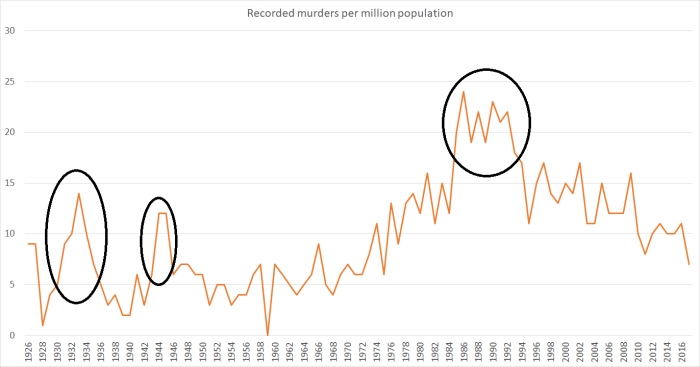
This was the resulting graph (I hope they are right about zero murders in 1958, but it seems unlikely).

murders

I’ve circled a few surges that caught me by surprise:

  • the first was the apparently significant increase in the murder rate during the Great Depression –  by far the worst economic downturn and social dislocation in New Zealand in the last century,
  • the second was late in World War Two (those years don’t include the Stanley Graham shootings in 1941),
  • and the third was the period of rapid economic change and, latterly, very high unemployment over the late 1980s and early 1990s.

Are these surges just coincidental-  something largely random that masquerades as a pattern?  I don’t know, and I don’t know the literature at all in this area.  There were certainly global forces at work in the rise of violent crime in the 1970s and 80s, and in the subsequent decline, but it does look uncomfortably like a story in which –  at least in New Zealand –  big economic dislocations and high unemployment were associated with higher murder rates. I once wrote a speech for Don Brash –  as Governor –  in which we associated higher suicide rates with such dislocations (and hence why we needed good stable macro policy).  I’ve always been a bit embarrassed about it –  without evidence it probably over-egged the pudding –  but perhaps we were closer to the mark than I’d thought?

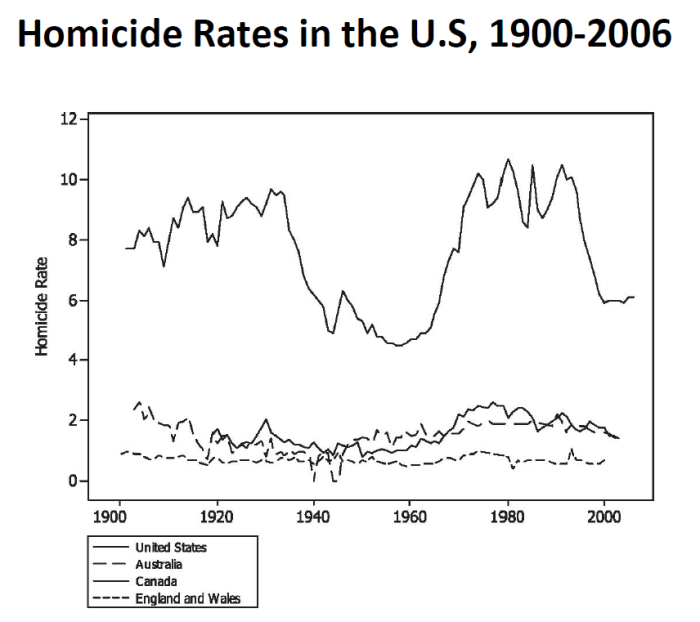
In terms of international experience, on a quick look I found this chart

murder us

The US data are easiest to read, and they don’t show the spikes we see in the New Zealand data  (it is a much bigger population, and so perhaps the New Zealand picture is just a small sample problem).    In Canada there is some suggestion of a spike in murder rates during the Great Depression, but not in Australia (where the depression was severe) or England and Wales (where it was not so bad).

I’m convinced good monetary policy has an important role to play in helping to avoid –  and limit – really bad economic dislocations.  High unemployment is quite scarring enough –  costly to individuals and to society as a whole –  but if it was associated with higher murder rates then doubly so.

Anyway, on such weak evidence I”m not trying to make strong arguments.  But I thought it was an interesting, somewhat surprising, chart, and perhaps experts have dug more deeply into these patterns.

Meantime, there many other gross failures of policy –  ones that are the direct responsibility of government –  that we see and hear no emotion from the Prime Minister about.  Prime Ministerial tears should, of course, be reserved to the privacy of the Prime Minister’s own home, but some genuine passion and energy about reversing the house price scandal or the decades of productivity underperformance –  both of which are likely to have cost lives, and certainly represented huge lost opportunities – would be welcome.  Or, rather nearer the justice system –  but this time the even more hands-on direct responsibility of central government –  there was the gross abuse one young New Zealander suffered (and still suffers) from the Crown in this episode, highlighted in this post.

Encouraging transparency and accountability

I’m travelling today and tomorrow, so just something brief now, and perhaps nothing tomorrow.

The government announced a couple of days ago that

From January, all Government ministers will have to release details of their internal and external meetings.

Minister for State Services (Open Government) Chris Hipkins said Cabinet had agreed to the release of summary information from their ministerial diaries from January 2019 onwards, with the first publication in February 2019.

To be specific

For each meeting in scope, the summary would list: date, time (start and finish), brief description, location, who the meeting was with, and the portfolio. The monthly summary will be published on the Beehive website within 15 business days following the end of each month.

It is a significant step forward, and will (or should) strengthen scrutiny and accountability of ministers.  There are some exceptions, and potential scope for the rules to be bent, but it goes beyond the publications practice for ministers in the UK and in New South Wales.   Together with the decision to pro-actively release Cabinet papers, it is another step towards delivering on the commitment to greater openness and transparency in government.

The (largely taxpayer-funded) lobby group Transparency International –  the ones who nonetheless host senior public servants giving secret speeches – has put out a statement welcoming the move.

“We are pleased that the Government acknowledges the need for transparency from its Ministers. Transparency is the antidote for corruption, every action they take makes New Zealand a better home for her citizens and reinforces New Zealand’s leadership in the global fight against corruption,” stated TINZ Chief Executive Officer Julie Haggie.

They suggest this should only be a first step

“We hope it is not long before all Parliamentarians are required to release their diaries and this requirement is codified in law so that it cannot be undone in the future by politicians fearful of transparency,” [chair Suzanne] Snively adds.

Not to disagree with that, but in many respects we have less to fear –  in our sort of political system –  from backbench members of Parliament than from senior officials (and even judges) exercising in some cases huge amounts of discretionary power.  Sometimes that is the ability to regulate directly, but even if they don’t have that particular power then the enforcement (or otherwise) of laws and rules made elsewhere opens up the potential for inappropriate influence, or even corruption.

The specific case I’m most interested in is the Governor of the Reserve Bank.  He will shortly lose his exclusive power to set and adjust the OCR himself, although he will still be hugely influential in monetary policy (and people will be keen to bend his ear or get the inside word).  But even once the new legislation is passed the Governor will retain his, largely untrammelled, powers as individual decisionmaker in regulating banks, and in enforcing (or not) a wide range of regulatory provisions affecting banks, non-banks, and insurers.  There is a great deal of money at stake in many of these decisions.

I’m not suggesting that anything very untoward goes on –  although successive Governors have each been involved in some questionable episodes.  But we (a) need to keep it that way, and (b) gain confidence in the way an institution is being run partly by means of transparency.   And what is good enough for elected Ministers of the Crown (who face scrutiny in Parliament every day) is surely a standard that should also be met by powerful unelected, largely unaccountable, officials.   I’d encourage the Governor to take the lead and announce that he will adopt the same standard, and if he doesn’t do so the Board and the Minister should prevail on him to reconsider.  If such transparency is good enough for ministers, it should be a standard expectation for the top tier of public officials.

Hope springs eternal, but I’m not very optimistic that the Governor will see such transparency as a positive virtue.  Readers will recall that the Ombudsman recently ruled in the Governor’s favour, allowing the Bank to withhold internal analysis and advice prepared for a Monetary Policy Statement at which the then (acting) Governor announced what the Bank was assuming about the impact of some major policy initiatives of the new government (including the now mired in controversy Kiwibuild), with no supporting detail or analysis.   Among the Ombudsman’s justifications was that, although his decision wasn’t made until almost a year after the request, his decision had to relate to the date on which my request had been made (ie very shortly after the relevant MPS).  To test this standard, I then re-lodged the request, so that a new decisions would have to be made about this analysis and information but on the basis that it is now a year old.

Absolutely not to my surprise, the Bank again rejected the request.  They do this even though, across the road, very similar sorts of background notes and briefing papers prepared for the Minister of Finance by Treasury staff as part of the Budget process are routinely, and pro-actively, released.

The Bank does condescend to observe that

In considering how long it is reasonable to withhold information of this nature, the Reserve Bank recognises that as time passes then release is less likely to have an inhibiting effect.

but concludes that a lag of more like five to ten years might be appropriate.  It would be laughable if it weren’t so serious.  According to the Bank, citizens are not entitled to see background papers on such matters ( and in the end the Bank’s analysis of Kiwibuild probably didn’t change the OCR decision materially) even a year after they were written (using taxpayer resources).  It makes a mockery of the principles of the Official Information Act, further undermining the already limited accountability of an already over-mighty public official.

Ministers have set an encouraging lead. The Treasury sets a good example around papers feeding into the Budget process. It is surely time for the Governor –  encouraged by the Board, soon to be more directly answerable to the Minister through a directly-appointed chair – to get with 21st century standards of transparency and accountability.


Human rights, Helen Clark, and the PRC

Yesterday was, apparently, the 70th anniversary of the adoption of the United Nations Universal Declaration of Human Rights.   Our former Prime Minister, former senior UN official, beloved of the Labour Party faithful, Helen Clark tells us so.

I can’t claim to be much of a fan of the United Nations, am not entirely convinced by the concept of “human rights”, and certainly don’t believe that any such rights flow from declarations of governments.  I’m not convinced some items in the declaration belong there.  But Helen Clark probably sees things differently.  She seems to be champion of all such things, worthy and not so much.   She’s a private citizen now, but it was only a year or so ago that our governments were championing her campaign to be Secretary-General of the United Nations and I’m told MFAT still uses her promote New Zealand foreign policy.

And what was our former Prime Minister actually doing yesterday on Human Rights Day?  Well, her Twitter feed says she was in the People’s Republic of China, attending something called the Imperial Springs Forum.

Is this some dissident forum, bravely championing the rights and freedom of the Chinese Communist Party’s subjects?   Silly, no of course not.     This was an event opened by the PRC’s Vice-President (open the report of the speech in Chrome and you’ll get a translation –  or Google a shorter version in English).  Here’s some of what he had to say

Wang Qishan said that the interests of all countries are deeply integrated and shared. China adheres to the path of peaceful development and advocates building a new type of international relations of mutual respect, fairness, justice, cooperation and win-win, and promoting the building of a community of human destiny that lasts for a peaceful and common prosperity. China will unswervingly follow its own path, do things in a down-to-earth manner, continue to learn from each other with sincerity and open mind, learn from each other, deepen cooperation, and always be a builder of world peace and global development. Contributors, defenders of the international order.

Doesn’t all that just describe so well the way in which the PRC operates?   Well, I guess “unswervingly follow its own [evil] path” might qualify.

Is the Imperial Springs Forum some quasi-independent body (if such an idea were even conceivable in today’s PRC? No, of course not.   Here is how one China watcher summarised it

All part of the same United Front work programme.  One of the leading figures behind it is apparently an Australian citizen Chau Chak Wing, of whom there are many rather gruesome stories to read (eg here), including some involving possible shadty dealings around the United Nations.   It seems to be a convenient –  for the PRC –  forum at which to gather prominent people from all over the world who will be polite and deferential, and treat the Party and the PRC as some sort of normal decent people –  not a bunch of brutal tyrants –  as a bunch somehow genuinely committed to open trade and free human development.   You can see the sponsors on the website here (and incidentially can see that our other former Prime Minister –  heavily involved in all things pandering to the PRC, including the New Zealand China Council –  Jenny Shipley was at last year’s event).

But what really struck me wasn’t what the PRC regime does.  We take them as evil and opportunistic –  they’ll use self-important people who make themselves available to be used.  It was more a case of what Helen Clark chose not to do.    There were quite a few tweets from her yesterday, including the one above about the Universal Declaration –  a document that China was a party to at its launch, and which the People’s Republic has made itself party to in 46 years in the United Nations.   Twitter is blocked in the PRC itself, but presumably there was some sort of VPN allowing the eminent former politicians and other attendees to carry on tweeting.

But there was not a word –  not even a subtle hint –  about the utter incongruity between the actions and expressed values of Helen Clark’s hosts –  the regime and its acolytes –  and the UN Universal Declaration of Human Rights.   On Human Rights Day.  You can read the whole declaration here but how about

Article 9.

No one shall be subjected to arbitrary arrest, detention or exile.

The million of so Uighurs anyone?

Article 10.

Everyone is entitled in full equality to a fair and public hearing by an independent and impartial tribunal, in the determination of his rights and obligations and of any criminal charge against him.

As applied, say, to the PRC former head of Interpol?   Or

Article 12.

No one shall be subjected to arbitrary interference with his privacy, family, home or correspondence, nor to attacks upon his honour and reputation. Everyone has the right to the protection of the law against such interference or attacks.

That would include those not-yet imprisioned Uighurs who’ve had PRC government spies forced into their homes?

Article 5.

No one shall be subjected to torture or to cruel, inhuman or degrading treatment or punishment.

Forced organ donations?

Article 19.

Everyone has the right to freedom of opinion and expression; this right includes freedom to hold opinions without interference and to seek, receive and impart information and ideas through any media and regardless of frontiers.

Where to start on what PRC subjects can’t do?

And then there was the article which really prompted me to turn to the keyboard today

Article 18.

Everyone has the right to freedom of thought, conscience and religion; this right includes freedom to change his religion or belief, and freedom, either alone or in community with others and in public or private, to manifest his religion or belief in teaching, practice, worship and observance.

The mass internment of Uighurs seems to be substantially about their Muslim religion. Serious religious commitment involves an alternative and higher form of loyalty than that to the Party.   That’s a threat –  as it was to the Nazis, or the Communist rulers of the Soviet Union.  As it is, and ever has been, to the CCP and to Xi Jinping.  And it isn’t just the Muslims.  This happened in Chengdu over the weekend  –  where the New Zealand consulate had been wining and dining Beijing’s Confucius Institute people from New Zealand a few days previously.

(Great book by the way, on all manner of religious traditions in China.)

It is not exactly secret.  I’m sure Helen Clark –  and the consulate in Chengdu, broadcasting news of its latest meeting with the local CCP/PRC powers than be –  will have been aware of it.   Not a word, of course, from our authorities, and that isn’t surprising.  But not a word either from a former Prime Minister, former senior official of the United Nations in the PRC on Human Rights Day itself.

Does the fine rhetoric, the official declarations, mean anything at all, or is it all just for show, some sort of Potemkin village, just enough to keep the conference invites coming, but not to be taken seriously, at least as regards any country that offers enough hospitality?

Had Helen Clark said something –  whether about the Early Rain church (it being in the headlines), about the Uighurs, or about any other of the myriad breaches – what was the PRC going to do?  They were hardly going to toss her in prison were they?  At worst, she’d have been ignored by her hosts, and not invited back.  But so what?   She can hardly need the money, and the PRC is hardly going to reform because some international toadies turn up to meetings with them.  With the UN stint behind her she is the sort of person who could effectively speak up and speak out for “human rights” and freedom in the PRC  (and against its aggression and interference abroad, including in New Zealand, against its effort to intimidate ethnic Chinese New Zealanders or Anne-Marie Brady –  who, at least as suggested by her writing seems to be personally of the left.)

If she cared, if it meant anything.

Instead she joins the pantheon of the prominent, determined never ever to say a word upsetting to Beijing –  Don McKinnon, Jenny Shipley, John Key, Bill English, (Todd McClay, Simon Bridges, Jacinda Ardern) and…..that champion of human rights, Helen Clark.

(For anyone more interested in the Wang Yi case specifically there is some useful, inspiring, material linked to by Ian Johnson, the New York Times journalist and author of that book on religion in the PRC.)


The superannuation sky is not falling

When there isn’t much, if any, political or community impetus to do anything about a looming issue, it can still be useful to be told that the sky isn’t falling –  at least if that analysis is correct – but it probably isn’t an approach likely to attract too many readers.

The New Zealand Initiative last week released just such a report on New Zealand Superannuation, under the (slightly laboured) title Embracing a Super Model: The superannuation sky is not falling. (I was among those who provided comments on an earlier draft of the report.)

There are lots of interesting charts, even if perhaps most are familiar to anyone who has been reading in this area.  And there are helpful reminders of the (very) good features of our NZS system

There is a lot to like about the NZS model:

  • Low poverty rates: The material hardship rate for the elderly is low compared to other groups in New Zealand and is one of the lowest compared with European countries. The standard hardship rate for superannuitants is 3%, compared with 11% for the whole population and 18% for households with children.
  • Relatively affordable: NZS is more affordable than public pension schemes in many OECD countries, both today and in 2050. At around 8% of GDP, the projected public expenditure on NZS in 2050 is still lower than what many OECD countries are spending today. These include oft-acclaimed systems like in Denmark, Finland, Norway and Sweden.
  • Simple and efficient: NZS does not distort incentives for employment and savings as much as means-tested systems. When an NZS surcharge was introduced from 1985 to 1998, people went to great lengths to avoid paying it by hiding their assets. The simplicity of a universal benefit also lowers administrative costs.

(although, as I noted in a post a few months ago some OECD data appear to raise questions about those relative poverty rates.)

Our system has the further merit, at least in my view, that it explicitly focuses on providing a modest level of income support, leaving the responsibility for any higher material standard of living in old age a matter for individuals and families.  (Having said that, the tax system we have had in place since 1988/89 –  taxing income on savings made out of after-tax income at least as heavily as income from labour –  is quite out of step with that particular vision.)

When it comes to recommendations for change, the New Zealand Initiative report is curiously bloodless.  I agree with some of their recommendations, disagree with others, and noticed an important omission.  But with no sense of any fiscal urgency, the author seems a little at sea.  For my tastes, there was a missing moral dimension – a sense of right and wrong.  Debates about how we care for our elderly seem almost inescapably moral in nature.  Of course, economists have little or nothing distinctive to add in that area, but the Initiative seems reluctant to even attempt to make a case.

Their first recommendation is one I’d agree with

Recommendation 1: Link the pension age to health expectancy

Doing so would save some money –  potentially quite a lot of money over time.  But to me, the stronger argument isn’t about saving money per se, but about a sense of right and wrong.    In an age when most people aged 65 are perfectly capable of working –  thanks to the changing nature of jobs and the improvements in the health status of people –  what possible case can there be for paying a near-universal living allowance, raised by taxes with all their deadweight costs, to everyone of that age?   No one argues –  the Initiative certainly doesn’t –  that people who are physically unable to work should have to, but that is true of people at any age (it is why, for example, we have the Invalids Benefit).   I also don’t have a problem with society agreeing that it doesn’t expect people past a certain age to provide for themselves (or within families), unless they particularly want to work.  But given the health status of most people aged 65 how can 65 possibly be the appropriate age now?   As a chart in the report illustrates, more than 50 per cent of men aged 65-69 are still in the labour force.

I’m much less convinced by the second recommendation

Recommendation 2: Index NZS to CPI only rather than both CPI and wages

• NZS is indexed to both inflation and the average ordinary time wage. Decoupling NZS from rises in wages is a way of ensuring productivity gains reduce the costs of NZS. The real purchasing power of NZS should remain the same while the real purchasing power of wages would increase.

Although it isn’t quite stated this way, this recommendation is an assertion that the relative living standards of a large chunk of elderly New Zealanders are too high (for the bottom four deciles of the over-65s, NZS makes up almost their income).  It is to guarantee a material increase in the relative poverty rate of older New Zealanders, substantially so over, say, a 20 or 30 year horizon. In fact, what would be likely to happen is that a whole raft of means-tested forms of assistance would be added to the system, detracting from one of the great strengths (see above) of the current system.  Also, even if the analysts recommending CPI indexation rather than wage indexation are willing to live with the full ramifications of such a system  –  in principle, 100 years from now the real value of NZS would be the same as now, even though real wages might be several multiples of what they are now –  the political system just won’t do so.   Break the link to wages now, and it is likely to be back a decade from now.

(One plausible compromise recommendation might be to lock in the real purchasing power of NZS at the point a person first receives it –  eg you might get 65 per cent of the average wage as it was when you turned 65 (or 68) –  and the person turning 65 (or 68) five years hence would get 65 per cent of average wages then.  Both would only be CPI-indexed from there forward, but future old people would get to share in the productivity gains the community manages to secure.  This approach would parallel how private defined benefit pension schemes work.)

What of the third recommendation?

Recommendation 3: Contributions to NZ Super Fund should not be at the expense of paying down debt

The Super Fund should not be relied on to reduce the future costs of NZS (it cannot do that), and contributions to the Fund should not come at the expense of paying down debt.

I get the impression that the New Zealand Initiative isn’t very keen on the New Zealand Superannuation Fund, but is reluctant to call a spade a spade and call for its disestablishment.  There is an analytical point to be made-  NZSF doesn’t materially affect the future affordability of NZS –  but there is an at least equally important debate to be had about whether runnning a highly-leveraged (wholly leveraged) investment fund trading world markets –  and making politically convenient plays whether around climate change, light rail, or whatever – is any sort of natural or appropriate role for government.   I don’t think so, and I doubt the Initiative does either, but they seem strangely unwilling to say it (I guess they want to keep on good terms with the government).  Note that the existence or not of the NZSF is a different issue from the question of whether governments running a welfare system, especially for old people, should also run much lower levels of net debt (even net assets) than some stylised government doing only law and order and infrastructure might. I think they should.

And what of the fourth recommendation

Recommendation 4: Productivity growth will make NZS – and everything else – more affordable

Faster rates of productivity growth relative to increases in the real interest cost of government borrowing can allow increased government spending without falling into a public debt spiral. Raising productivity growth is a way of making NZS (and everything else) more affordable, and gives future governments more options and flexibility to adjust to changing economic and political circumstances.

Well, of course, although on the narrow NZS point this is a less-strong argument than it appears.  When net debt is near-zero, debt servicing costs aren’t a particularly important consideration.  The Initiative argues for CPI-indexing partly so that productivity gains will improve the fiscal position, although that seems to me to put the emphasis in the wrong place.  Faster productivity growth –  and recall that ours has been lamentable for decades –  offers the prospects of better material living standards for almost everyone  including, as they note, flexibility about support for the elderly.

But in practice, this isn’t so much a New Zealand Initiative recommendation as an aspiration.   We’d all prefer that productivity growth had been, and would be in future, faster. But wishing it doesn’t make it so, and the Initiative hasn’t been particularly strong on identifying the key factors, or policy issues, that might explain that failing and offer credible New Zealand-focused pathways out of it.

Finally, turning back to NZS itself, it was striking that –  as far as I could see –  there was no discussion in the report of the rather weird aspect of our system: that in a country with so many immigrants and emigrants, we offer a universal benefit to anyone who has lived in New Zealand for 10 years after turning 20, including 5 years after turning 50.  It is made worse by the fact that we have Social Security Agreements with various countries, notably Australia and the UK, which mean that residency in those countries counts as residency in New Zealand for NZS purposes.  Is this affordable?  Perhaps so in the same sense the New Zealand Initiative notes that the overall NZS system could be afforded. But is it right?  Well, that seems like a moral question –  informed no doubt by analysis –  and one where I’m pretty clear what the answer should be. It is simply wrong.

Welfare systems should be about “looking after our own”, and if you went to Australia at 20 and spent your entire working life there, I don’t see any good reason for New Zealand taxpayers to support you back here in retirement (of course, we don’t know how material these numbers might be).  Or if you happened to come to New Zealand first at 55.    A graduated system, in which NZS payments are proportional to the time spent in New Zealand between 20 and 65, seems both fair and fiscally prudent.   Take the 10 year residency (real residency) as a starting point at which you might get, say, a third of the standard NZS at 65, and scale it up so that after say 30 years you get the full benefit.  (Will there be a few hard cases? No doubt, but that is where charity and family support should be expected to fill the gaps.)

It will be interesting to see what, if any, NZS policy the opposition National Party comes out with.  The previous government, at the very end of its term, and having changed leaders, did promise to phase in –  very very slowly – an increase in the NZS eligibility age to 67.  But only if they were re-elected, which they wern’t.  And doing nothing about other features of the system –  dealing with any life or health indexation (in full or in part) –  or the very short residency requirements.  With Labour and New Zealand First seemingly fully committed to the current parameters of the system, it would be a brave Opposition to campaign for change, especially from a party with little obvious sense of an ability to engage on matters of right and wrong.   One should probably never wish for a recession –  especially now given the limited capacity of the authorities in so many countries to respond –  but perhaps it will take a recession to get our leaders to more seriously address the NZS issue.  That was, after all, what it took in 1989 and then 1991 when Labour started, and National greatly accelerated, the move back to 65.


The China Council disgrace themselves and shame us

It is only a couple of weeks since the (largely) taxpayer-funded New Zealand China Council, which in its Annual Report –  signed off presumably by the heads of MFAT and NZTE (who sit on the Board) – was recently deploring what it regards as the “unedifying debate” about the extent of foreign (PRC) influence in New Zealand, was out in public with this lament

The New Zealand China Council is disappointed to learn plans for Huawei’s involvement in the development of Spark’s 5G network have been put on hold.

It didn’t seem to bother them that our intelligence services might have had serious concerns about threats to New Zealand’s national security. No, the bother seemed to be that a PRC company, under the thumb of the party/State (as all PRC companies are by law), had had it plans frustrated.   Surely, an outfit that had the interests of New Zealand and its people first and foremost would have been pleased to hear that any such threats was being stymied?   But then it has never really been clear whose interests the China Council, and its Board and staff, serve.  No doubt at least the public servants involved try to tell themselves they are really working in the interests of New Zealanders –  by pandering to Bejing at every opportunity –  and as for the rest of them (business people, MPs) why would they greatly care about New Zealand interests when personal interests are advanced by using taxpayers’ money in an attempt to keep the population quiet and Beijing happy?  We are told that both MPs, for example, have close ties to the PRC Embassy and to various PRC United Front bodies.  Jian Yang goes further than that –  not only a former PRC intelligence official and a Communist Party member, but he seems to spend inordinate amounts of his time –  paid as a New Zealand MP –  in some mix of business and propaganda in the PRC (in league with his party president Peter Goodfellow).

These people seem to have no values, represent no moral perspective, that might underpin New Zealand and its freedom and political system. They seem to act as if the PRC is just another normal country. More likely, of course, they know it isn’t and yet they just don’t care. There are deals to be done, donations to flow. And in the China Council’s case, our taxes are paying for it.

But what caught my eye over the weekend were a couple of tweets from the China Council’s Executive Director, former diplomat, Stephen Jacobi.  It is a personal account, but when you are the chief executive there is no credible distinction.

I’m no great fan of Destiny Church or Brian Tamaki, but in this single tweet Jacobi diminishes himself even further.   A New Zealand citizen, keen to have a programme he is promoting run in prisons –  but who hadn’t even got round to applying for funding/permission –  represents a threat apparently far exceeding that of the People’s Republic of China.  Yeah right.

Whether it is the theft of intellectual property, the intimidation of Anne-Marie Brady, the threats to ethnic Chinese New Zealanders (and the attempts to divide their loyalties), the way in which our political system is compromised by donation flows from people with close PRC associations, the presence in Parliament of Jian Yang (in particular) and Raymond Huo – neither of whom has ever uttered a public word critical of one of the worst regimes on the planet –  the presence of PRC-government funded workers (selected for political loyalty/reliability) in our school classrooms, the partnerships our universities have formed with this regime, and the way they’ve exposed themselves to economic pressure and threats from the regime, the way our mayors (and MPs) seem to fall over themselves to associate with the PRC, or a Leader of the Opposition who seems not to like non-binding agreements except when they aspire to fusing civilisations with the PRC (it was his signature on the BRI agreement last year)……and that’s just some of the stuff at home, let alone what they do in other countries and to their own people.   The PRC is, quite simply, consequential in a way that Destiny Church is unlikely ever to be, even in New Zealand. And, of course, Jacobi knows all this, but he has a job to do….and never mind about the facts or the threats.

The previous tweet –  actually retweeted –  on Jacobi’s feed was perhaps equally telling about how the powers that be in New Zealand see things

The Confucius Institutes, part of the PRC government’s worldwide programme attempting to influence opinion in their favour (or at least neutralise it) –  instruments of PRC foreign policy,  hosted and highlighted by the New Zealand consulate in Chengdu (where these people who labour for Beijing were visiting for the worldwide conference of the Confucius Institute movement).  I guess it is a bit confusing when your former senior official, Tony Browne, former New Zealand Ambassador to China, now sits on the global advisory board for the Confucius programme, advancing Beijing’s interests (while helping run training programmes for rising Communist Party officials).  The Newsroom article this morning on some of these issues is worth reading.

(I guess MFAT has form in these area. I’ve just been reading Anne-Marie Brady’s book about Rewi Alley and was struck –  if perhaps not surprised –  by the way New Zealand government’s were attempting to use that shameless fellow traveller and apologist, who openly defended and championed the PRC through the worst of the Great Leap Forward and the Cultural Revolution, to advance their dealings with a vile regime –  the same party, same regime as now, just better suits and better technology.)

How much better for our taxes to be used to expose New Zealand kids, and New Zealand citizens, to the nature of the regime which, in sheer brutality and suppression of human freedoms, must now rank among the very worst we’ve seen?  But I guess that might disrupt the trade opportunities of the people on the China Council’s boards.  Deals might not go through, donations might be interrupted.  Well, frankly, values are things for which you are willing to pay a price. And it isn’t clear that China Council has any such values – and none of them ever utter any.

Are these people any worse than our political “leaders”?  Perhaps not –  although probably no elected politician would be quite as crass as Mr Jacobi –  but that is a standard so low, it is barely even worth considering.

At a personal level, Mr Jacobi appears to be a Christian himself.  This appeared on his Twitter account yesterday

There probably aren’t many Anglicans in the PRC, but I’m sure Mr Jacobi is well aware of the mounting campaign by Xi Jinping to domesticate, sinify, and (preferably) eliminate religion – Christian, Buddhist, Muslim or whatever – from China.  When the largest country in the world adopts that sort of approach –  not just around religion – it is a threat to us all.   As another more famous Anglican once put it

No man is an Iland, intire of itselfe; every man
is a peece of the Continent, a part of the maine;
if a Clod bee washed away by the Sea, Europe
is the lesse, as well as if a Promontorie were, as
well as if a Manor of thy friends or of thine
owne were; any mans death diminishes me,
because I am involved in Mankinde;
And therefore never send to know for whom
the bell tolls; It tolls for thee.

MEDITATION XVII
Devotions upon Emergent Occasions
John Donne

I’ve recently subscribed to a newsletter, Bitter Winter, from an Italian think tank on religious freedom (or lack of it) in the PRC.  These, perhaps, are the sort of evils our universities willingly partner with.   This is the sort of stuff our officials and politicians simply ignore.  But then these are the same people who disgrace themselves singing from the Party songbook about “vocational training” in Xinjiang.

That’s religious freedom.  Then there is political freedom (lack thereof), freedom of speech, freedom from surveillance, the rule of law, and so on. Not one of these the PRC has, or even claims to aspire to.  And yet MFAT, our politicians, and the China Council –  all funded by tax dollars – seem content to treat the PRC as a normal country, run by basically decent people, rather than as an evil regime with no moral core, a regime from which every decent person should keep their distance, and a regime which every decent person should avoid putting themselves in the thrall, and under the threat, of.

It isn’t even as if there is the excuse of novelty –  Nazi Germany was five years old in 1938, not 69 years old.   We know very well what the PRC regime is like –  even those who defend it know, even if they prefer to pretend otherwise. We could (and should) choose a distant and formal relationship –  if your firm wants to deal with Beijing, don’t expect help from the government –  but instead the deals and donations seemed to have warped any sense of decency, in ways that would have been unimaginable 45 years ago when New Zealand was first establishing diplomatic ties with the PRC.


Where have real house prices risen and fallen?

The QV house prices indices for November for each of the territorial local authority areas were released last week.  Much of the headline coverage is around the fact that in the last year Auckland prices have barely changed, while those in places like Dunedin, Invercargill, Palmerston North and Whanganui have shown double-digit rates of increase.  Even Wellington prices rose 7.4 per cent –  something brought home to me when a house across our driveway went for $2 million recently (a very big house).

Cycles are often not in synch from place to place and I’ve sometimes found it an interesting reference point to look back and see how (real) house prices have changed since the peak of the previous surge upwards in house prices, in mid 2007.  That, of course, was just before the onset of the last recession in New Zealand.

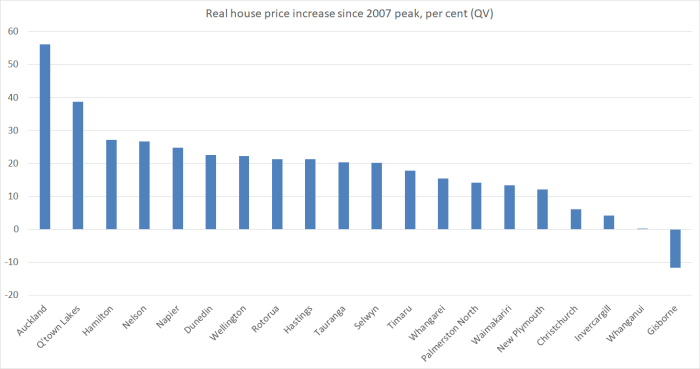
Here is a chart showing (mostly) the cities

house prices 2018 1

Auckland is, of course, still far worse –  total real increases (as well as levels) –  than any of the other cities.  But I was interested in a couple of things.

First over the (little more than a) decade. the increase in real house prices in Dunedin is well above that in many urban areas, and about the same as the increase in Wellington prices.  In the absence of population pressures, that Dunedin increase took me a bit by surprise.

And second was Christchurch.  There was a big rise in Christchurch prices a few years ago –  housing was in genuinely short supply following the earthquakes –  but looking back to before the recession and earthquake, and forward to today, Christchurch house prices haven’t increased in real terms very much at all.   Christchurch city has had less population growth than, say, Auckland or Wellington, but is still estimated to have 6 per cent more people than it had in 2007.

Much of the population growth (about 75 per cent of it) in greater Christchurch since the earthquakes has been in the Selwyn, in particular, and Waimakariri districts.  People sometimes talk about how responsive the two councils’ policies have been in facilitating this growth.  There is clearly something to that, but it is worth noting that neither locality seems to offer anything like the sort of easy ability to build and develop land that we can observe in many fast-growing places in the United States.  Real house prices in Selwyn, for example, have risen by about 20 per cent in the last decade.  And there is are enormous amounts of flat land in Selwyn.

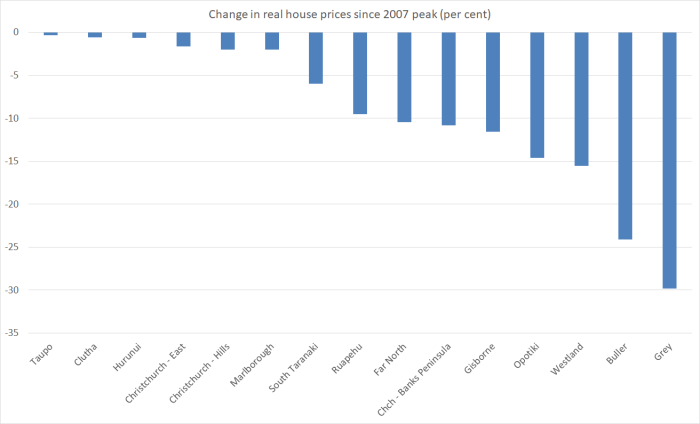
And my other chart is of the TLAs at the bottom of the scale –  the places where real house prices are still lower than they were at the peak of the boom in 2007.

house prices 2018 2

Not, it seems, because (say) land use laws were freed up and the cost of bringing new houses to market has fallen.  In some of these places, prices are probably now below replacement cost (at least on existing land use regulation).    Most, if not all, look like the sorts of places that would benefit from the sort of much lower real exchange rate that I remain convinced has to be a part of any successful economic adjustment in New Zealand –  not that either main party seems to have any interest in effecting such a transition.

It is a sad and shameful record for our politicians.  One neither hears them talking of a goal to get house prices back down again, nor sees them implementing or advocating policies that might make a credible long-run difference.  I guess it won’t greatly matter for the kids of people like the Prime Minister or the Leader of Opposition, but what about the kids of the rest of us? It saddens me to listen to my kids talking about how difficult they think it will be to ever afford a house (in places with decent jobs), but it angers me how (practically) indifferent our political leaders –  central and local – seem.

Earnings advantage of the tertiary-educated

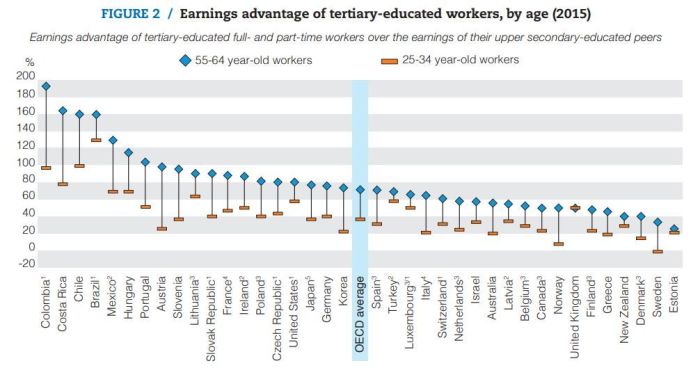
Skimming through the tweets of the chairman of the Productivity Commission –  who often includes interesting charts –  I spotted this picture.

returns to education

It is an interesting chart on a number of counts.  First, in every country shown, except the UK, the earnings advantage to tertiary educated workers is higher –  often materially so –  for older workers than for younger ones.  Second, all the countries at the far left of the chart are among the poorest of all those shown (the sample is OECD countries and “partner countries”).  And thirdly, of course, that New Zealand is over towards the far right of the chart, where the earnings advantage to tertiary educated workers is pretty low (and especially so for older workers).   The chart is drawn from this short OECD note.

Making sense of the numbers isn’t straightforward.    First, note that the chart isn’t claiming to illustrate returns to tertiary education, but the earnings margin of people who have had a tertiary education over those who haven’t.  The difference matters –  people who undertake tertiary education are different, in various dimensions, to people who don’t.    I’m in that older age group, and if I think back to my Auckland high school, only about 10 per cent of those who started in the third form made it to the seventh form.  Most of them probably did go on to university, and perhaps a few others did tertiary study later, but it was a cohort that was much more intellectually capable, on average, than the other group.   Since university was all but free to attend in those days, there weren’t even obvious financial barriers excluding capable people from poorer families.

These days, of course, a much larger share of young people undertake tertiary education.  But that probably means that the intellectual capability of the median tertiary qualifed person today is lower relative to that of the population as a whole than was the case 40 years ago.  It isn’t clear that is true if we compare the median of those with tertiary education and those without it (since the median of those without it is now likely to be quite a bit lower relative to that of the population as a whole).

Productivity performance in New Zealand has been poor for a long time, and we now start a long way behind the better-performing OECD countries.  If there were a lot of really good opportunities here then all else equal, and given how far behind we start, I might have expected the returns to enchanced skills (not, of course, the same as having a tertiary education) to be higher here than in many other countries.  The greater international mobility of people with better educational qualifications might have tended to work in the same direction.

But instead, those with tertiary educations aren’t doing well absolutely (low productivity country) or relative to those without.     And so you are left wondering quite why immigration policy is oriented towards recruiting lots of “skilled”  migrants –  particularly those with New Zealand tertiary education –  and why “education” policy is oriented towards encouraging yet larger proportions of people to undertake tertiary education.  None of which prevent’s Treasury’s living standards dashboard  – which we are told is going to help shape next year’s Budget – including the share of the population with a university degree of one of their “wellbeing indicators”.

(As far as I can tell, this particular chart also doesn’t taken of the fact that getting a tertiary education costs a lot of money –  directly (fees and living costs) and indirectly (foregone time in the labour force) and thus, if anything, probably overstates the advantage held by the tertiary educated.  There are other estimates of overall lifetime earnings advantages (or otherwise)).

Don’t legislate depositor preference

The government has underway a fairly comprehensive review of the Reserve Bank Act.  The first phase –  around monetary policy –  was pretty narrow in scope, rushed, and has resulted in not very good provisions now about to be legislated by Parliament.  I was always a bit sceptical about Phase 2, partly because of the way Phase 1 was handled and partly because the Minister of Finance had never displayed any particular interest in the issues.

But, for the moment anyway, I’m willing to revise my judgement.  Earlier last month a 100 page consultative document was released, the first of three as the Treasury and the Bank (aided by a somewhat questionable, secretive, independent advisory panel) work their way through the numerous issues involved in overhauling the Reserve Bank legislation and institutional design.

Yesterday, I attended a consultative meeting at The Treasury on the issues in the current document.  It was an interesting group of people and quite a good discussion, although even 2.5 hours is barely enough to do much more than scratch the surface on the wide range of issues in the document –  everything from the role of the Board to regulatory perimeter issues (including whether banks and non-bank deposit-takers should be subject to the same regulatory regime – most people seemed to think so).  Truly keen people can spend their summer preparing written submissions (due in late January).

What was striking –  part of what leads me to provisionally revise my view –  is just how much official resource is being put into this one review.  At yesterday’s meeting there were six members of the review team, and that wasn’t all of them –  and even they only report to their masters in the Reserve Bank and Treasury, many of whom will probably engage quite extensively on the issues. And the process has at least another year to run.  Despite having long championed the cause of reforming the Reserve Bank, I couldn’t help wishing that the same level of resource was being devoted to getting to the bottom of the causes, and compelling remedies, for New Zealand’s astonishingly poor long-term productivity performance.    There is little sign The Treasury has any resources devoted to that issue, the one that has the potential to make a huge difference to the lives of all New Zealanders.

But in this post I wanted to touch on just one specific issue that came up yesterday which surprised quite a bit and worried me quite a lot.   Chapter 4 of the document is devoted to the question of “Should there be depositor protection in New Zealand?”.  Of course, to the extent it adds in value at all, prudential regulation does help the position of depositors (reducing the probability of failure, and limiting the potential chaos if a major failure happens), but New Zealand’s legislation is unusual in that there is no explicit depositor protection mandate (the legislative goals are about the financial system, not individual institutions or their creditors).  Linked to that, we are now very unusual among advanced economies in having no system of deposit insurance.

I wrote about some of these issues, in response to a journalist’s queries, when the consultative document first came out.  But my focus then was on deposit insurance, and in particular on the realpolitik case I see for instituting deposit insurance, to give us the best chance that when a bank gets into serious trouble it will be allowed to fail, and its wholesale creditors –  the ones who really should know what they are doing –  can be allowed to lose their money.   Without deposit insurance, my view is that big banks will always be bailed out.  Perhaps they will even with deposit insurance, but by separating the interests of retail creditors from others, at least political options are opened.

But in focusing on deposit insurance, one thing I hadn’t really noticed in the chapter was the idea of providing depositors with additional protection by legislating depositor preference.  Depositor claims on the assets of a bank rank ahead of those of any other creditors.   Such a provision exists in the Australian legislation –  for Australian depositors.  It was a big part of the reason why New Zealand eventually insisted that Westpac’s retail business in New Zealand be locally incorporated (ie conducted through a New Zealand subsidiary).

To the extent I’d noticed the discussion of the depositor preference option, I’d assumed it was a bit of a straw man, there for completeness perhaps.  Surely, I thought, no one would seriously suggest that New Zealand adopt such a legislative preference.   But, going by the discussion at yesterday’s meeting, it seemed I was wrong and that officials are actually seriously considering this option.   They seem to see it as a complement to a deposit insurance scheme.  I think it would be quite wrongheaded.

In my incomprehension, I asked why  –  starting with a clean sheet of paper – anyone would think legislated depositor preference was a sensible route to consider.  The response seemed to be that it would be a way of reducing the cost of deposit insurance, and increasing the credibility of a deposit insurance scheme.  Both seem weak arguments, especially in the New Zealand context.

One argument sometimes advanced against deposit insurance is that in the event of a systemic financial crisis the cost could be so overwhelming that it would either over-burden public debt, potentially triggering a fiscal crisis, or lead to governments retrospectively walking away from the insurance commitment (simply legislating to not pay out).  In fact, we know that for reasonably governed countries that practical limits on the ability to take on new public debt are not very binding at all.   And we know that New Zealand has (a) very low levels of net public debt by advanced country standards, and (b) a banking system of only moderate size (relative to GDP) by advanced country standards.    Total household deposits with all registered banks are about $175 billion.  Not all of those would be covered by a deposit insurance scheme, even one that capped cover at a relatively high $200000.

Now lets assume something really really bad happens: banks lend so badly over multiple years that when the eventual reckoning happens loan losses are so large that 30 per cent of all bank assets are written off.   This would be absolutely huge –  far far beyond anything in Reserve Bank stress test, for beyond advanced country experience for retail-oriented banks.  But one can’t rule out by assumption utter disasters.  30 per cent of bank assets is currently about $175 billion as well.  There is about $40 billion of equity to run through, and then the creditors start bearing the losses.  Household deposits are about a third of non-equity liabilities, so in this extreme scenario the deposit insurer (and residual Crown underwriter) would face bills of up to perhaps $50 billion (a generous third of $135 billion of losses to be distributed across creditors and insurers).    And remember how extreme this scenario is: it assumes every bank in the system fails, and fails dramatically (not just slightly underwater), and that every household deposit is fully covered by deposit insurance.  In this really really bad, highly implausible scenario the bill presented to the depositor insurer is equal to less than 20 per cent of GDP.

Reasonable people can, of course, differ on whether deposit insurance is a good idea at all, just better than the likely alternative (my view), or something to be eschewed at all costs.  But in no plausible world would even a commitment of 20 per cent GDP overwhelm New Zealand public finances, or cast doubt on the ability of the New Zealand government to honour its obligations.   And none of this takes into account the likelihood that any deposit insurance scheme would be set up funded by insurance levies  Levy depositors, say, 20 basis points a year and you’ll be collecting (and setting aside) $350 million a year.  As I recall it, prudential policy (bank capital requirements) are currently set with a view to expecting systemic crises no more than once in a hundred years (the Governor the other day talked of extending that to once in 200 years).    If the really really bad systemic crisis hits in year 1, the government needs to borrow more upfront (recouped over time by the annual insurance fees).  If the really really bad crisis hits in year 150, there is a large pool of money standing ready, accumulated from those same annual insurance fees.

(Of course, in any scenario in which banks have lent so badly –  and regulators regulated so poorly –  that 30 per cent of all assets are written off, the economy is likely to be performing very badly for a while, and the public finances will be under some pressure anyway.  But those problems are there regardless of the resolution method chosen.)

The other argument I heard advanced for a legislated depositor preference is that it would reduce the cost of deposit insurance.    That might look like a superficially plausible argument, but it is almost certainly wrong in any economically meaningful sense.   Sure, if your bank is funded 50/50 by retail depositors on the one hand and wholesale creditors on the other, the chances that a deposit insurance fund will ever have to pay out to the depositors of that bank, in the presence of legislative preference, is very small (roughly speaking, losses would have to exceed 50 per cent of all the assets for depositors to be exposed to loss –  and thus the deposit insurer).    But if you don’t pay for your insurance one way you will pay for it another way.   If depositors have first claim on bank assets and all other creditors are legislatively subordinated, over time depositors are likely to earn lower interest rates than otherwise (less risk to compensate for) and other creditors more).   It might be hard to show this effect in the case, say, of the big Australian banks, but then no one seriously thinks the Australian government would do anything other than bail out those banks in the event of a crisis.  But we can see the pricing on existing subordinated debt issued by banks around the world – it yields, as you would expect, more than deposits.  It is much riskier.

Of course, it is true that legislating a depositor preference largely shifts the problem from the Crown balance sheet (underwriting the deposit insurer) to those of banks and their creditors.  That might look like a smart thing to do  –  internalising the issue and all that –  but in fact it is a subterfuge: trying to meet a public policy priority (depositor protection) by forcing banks to change their entire business model.  Much better to do things in a direct and transparent way: if you want deposit insurance, charge for it directly, and allow banks to determine how they operate their businesses (funding structures etc) given the insurance levies they face, and the market opportunities.  Doing so also operates more fairly – and efficiently – across different types of banks.  Depositor preference accomplishes nothing at all  in a bank that is 100 per cent deposit-funded, and such institutions should be competing on a competitively neutral basis with other banks with different mixes of funding.

In the consultative document, and again in the discussion yesterday, officials seemed to see a model in which wholesale creditors are exposed to more risk as a “good thing”, conducive to effective market discipline.  I’m with them on that point in so far as people -especially wholesale creditors –  who lend to banks should face a real risk of losing their money.  But depositor preference in effect says that the only way non-depositors can lend to banks is through instruments on which the losses mount extremely rapidly if anything goes wrong.  There is no good case for that (even if, as some do, you think it is reasonable to require banks to issue some tranche of subordinated or convertible debt).   It is a doubly surprising argument to hear mounted in New Zealand where for years –  and especially since 2008 –  we have been repeatedly reminded of the heavy exposure of our banks to offshore wholesale funding markets.   None of those holders has to take on exposure to New Zealand or New Zealand banks.   Legislate depositor preference and what you will do is to significantly increase the risk of those funding markets, for New Zealand, freezing, and yields on secondary market instruments going sky-high, at the first sign of any trouble, or even just nervousness.    Retail runs are one issue to think about, but as we saw globally in 2008 wholesale runs can be just as real, and perhaps more threatening (and lightning fast) –  I discussed the Lehmans story here.

I hope the legislated depositor preference option is taken off the table quickly.  It has the feel of clever wheeze intended to ease the path for deposit insurance.  Much better to make the case –  and there is a sound one –  for a properly funded deposit insurance scheme on its own merits.

On a totally different subject there was a surprising article in the Herald yesterday in which a former MPI official was discussing openly concerns held in 2008/09 about the potential financial health of Fonterra.   I was involved in this work at the time, working at The Treasury, and have always been a bit surprised that there wasn’t more open analysis of the issue at the time.  Just drawing on public information, the combination of:

  • a quite highly indebted cooperative,
  • largely frozen international credit markets (not just for banks),
  • highly-indebted farmer shareholders,
  • a model in which shareholder farmers could redeem their shares in Fonterra when their production dropped,
  • a drought the previous year (reducing production) and
  • low product prices, encouraging some farmers to further reduce production, and
  • the potential for some highly-indebted farmers to be sold up by their banks

was a pretty obvious basis for some vulnerability.    Fortunately, the particular extreme combination of risks never really crystallised.   One aspect of the 2008/09 crisis that was always interesting was –  in the words of one investment bank CEO at the time –  “one of the few markets that remain open is the New Zealand corporate bond market”.  That was because it was, and always has been, primarily a retail market, different from the situation in many other countries (reflecting regulatory differences).  In early 2009 Fonterra was able to run a highly successful domestic retail bond issue.  Subsequent changes to the Fonterra capital structure mean that in future serious downturns, redemption risk is no longer a consideration.  That, however, leaves more of the (liquidity) risk on farmers themselves.
Abdicating a basic responsibility

The Herald this morning reported on a new open letter in support of Anne-Marie Brady, this one from 169 (at present –  the letter is still open apparently) overseas experts on issues relating to the People’s Republic of China.   As the signatories note:

Since the publication of her work on global United Front work, Brady’s home and office have been subjected to burglaries, during which no valuable items other than electronic devices were stolen. Most recently, her car was found to have been tampered with in ways consistent with intentional sabotage. According to media reports, Interpol and the New Zealand Security Intelligence Service  (SIS) are involved in the investigation. In China, academics were interrogated by Ministry of State Security agents after their institutions hosted Brady. Brady has also been personally attacked in media under the direction of the CCP, both in the PRC and in New Zealand. Taken together, these circumstances make it likely that this harassment campaign constitutes a response to her research on the CCP’s influence, and an attempt to intimidate her into silence.

Despite the evidence of CCP interference provided in Brady’s research, of which the harassment campaign appears to be a further example, the New Zealand government has been slow to take action and failed to acknowledge that a problem exists…..

Far from unique to New Zealand, the CCP’s global United Front tactics and other political influence operations have been documented in other locations, in Europe, Oceania, Asia and the Americas. ….Whether within or without the limits of the law of their target countries, these activities have considerable effects on their societies and merit evidence-based research and the attention of politicians and the media. The harassment campaign against Brady risks having a chilling effect on scholarly inquiry, allowing the CCP to interfere in the politics of our societies unfettered by informed scrutiny.

We urge the New Zealand authorities to grant Professor Brady the necessary protection to allow her to continue her research, sending a clear signal to fellow researchers that independent inquiry can be protected in democratic societies and conducted without fear of retribution.

We join other voices in support of Professor Brady, which have included statements by a New Zealand Chinese community organisation, some of her Canterbury University colleagues, New Zealand academics and two Australian Sinologists, as well as many others on social media.

We further hope decision makers and the public at large, in New Zealand and elsewhere, will engage with evidence-based research on the CCP’s United Front tactics, such as Brady’s Magic Weapons, and give due consideration to policy advice emanating from such research.

It is welcome that these (mostly) foreign experts are coming together in support of Professor Brady. But what sort of country have we become where such stands are even thought necessary?   Once upon a time this was a bastion of democracy and liberty, and now our “leaders” cower in the corner, apparently unbothered about “little things” like the apparent intimidation of Professor Brady.   It is a shameful choice.  There are deal flows to keep going –  students to enrol for the new academic year for example –  and funding political parties doesn’t seem to come cheap.   And barely a voice in Parliament –  none from anywhere in our main parties – that appears troubled in the slightest.

Before I saw that open letter I’d been meaning to draw attention to an even more trenchant statement from closer to home, this one by Paul Buchanan, a former academic with a background in the US system, and who now runs a consultancy that describes itself this way

36th Parallel Assessments is a non-partisan, non-governmental geopolitical risk and strategic assessment consultancy.

Buchanan is an American who has lived here for a long time, and is in the process of becoming a citizen.  From what I’ve read of his stuff over the years, his personal politics probably lean left. But his post pulls few punches about the abdication of responsibility being displayed by the Labour-led government on this issue.

I do not mean to bang on about the Anne Marie Brady case but since it is coming up on one year since the campaign of criminal harassment began against her, I feel compelled to mention how the Labour-led government’s silence has been used as a window of opportunity by pro-China conspiracy theorists to question her credibility and defame her. Until I blocked the troll I shall call “skidmark,” this was even seen here on KP [Kiwipolitic blog] where he launched numerous attacks on professor Brady as well as question the very notion that the burglaries and vandalism that she has been subjected to were somehow related to her work on PRC influence operations in NZ.

He goes on the outline a number of strands of attack made on Professor Brady  by these “trolls”, each more far-fetched or unpleasant than the last.   There are even people echoing the ludicrous and desperate claim made on the hustings last year by the then Attorney-General Chris Finlayson that Professor Brady was saying the stuff she was becasue she was “racist”.

Buchanan goes on

It is very likely that the government’s reticence to talk about the case is due to diplomatic concerns, and that political pressure has been put on the Police and SIS to delay offering any more information about the status of the investigation

That’s a serious claim, but almost nine months on –  while the Prime Minister pretends this is just a normal suburban Police inquiry – it sounds plausible.  Police, after all, have form in bending to the political wind.

Gathering from the tone of her recent remarks it appears that Ms. Brady is frustrated and increasingly frightened by the government’s inaction. I sympathise with her predicament: she is just one person tilting against much larger forces with relatively little institutional backing. I also am annoyed because this is a NZ citizen being stalked and serially harassed on sovereign NZ soil, most probably because of things that she has written, and yet the authorities have done pretty much nothing other than take statements and dust for fingerprints.

And expressed no hint of concern, let alone outrage, at the possibility of the involvement of a foreign power.  (And, of course, no apparent interest at all in taking seriously the substantive concerns Professor Brady was highlighting about PRC “sharp power” in New Zealand.)

Buchanan concludes with a telling parallel and highlights just how unacceptable the government’s handling of this matter –  apparently more interested in Beijing than in Brady –  should be seen as.

If this was a domestic dispute in which someone was burglarising and vandalising a neighbour’s or ex-partner’s property, I imagine that the cops would be quick to establish the facts and intervene to prevent escalation.  If that is the case then the same applies here. Because to allow these crimes to go unpunished without offering a word as to why not only demonstrates a lack of competence or will. It also encourages more of the same, and not just against Ms. Brady.

If one of the foundational duties of the democratic state is to protect the freedom and security of its citizens, it appears that in in this instance NZ has so far failed miserably. The government needs to step up and provide assurances that the investigation will proceed honestly to a verifiable conclusion and that it will work to ensure the safety of Anne Marie Brady against those who would wish to do her harm.

To not do so is to abdicate a basic responsibility of democratic governance.

Of course, the main opposition party shares in responsibility for, and ownership of, the government’s shameful abdication.

As I noted, one of the ludicrous claims made against Professor Brady –  fluent in Chinese, married to a Chinese man –  is that her work is motivated by racism.  One of those who has made such claims in the Chinese-language media is Auckland writer Morgan Xiao, a past or present international student at the University of Auckland.  He apparently writes fairly prolifically in various of the (CCP-controlled) Chinese-language outlets, which is of course his right.   His Facebook page however advertises his Labour Party associations, listing himself as a member of Labour Botany electorate committee, and featuring of photo of himself posing with the Prime Minister.   His writings are pretty pro-Beijing, and very anti-Brady.  He has accused her of racism, and also of running the arguments she does because she has been paid by the Americans to do so.  It is pretty florid stuff –  he has new piece here this week (open in Chrome and Google Translate will give you the gist).

A few weeks ago, the Auckland-based dissident author, and editor of the Beijing Spring magazine, Chen Weijian published (in Chinese) a takedown of some of Morgan Xiao’s recent writing on this subject.   I’ve previously published a translation of Chen Weijian’s article on Yikun Zhang (he of the National Party donations controversy, the Labour-bestowed QSM, and the close Beijing connection), and I was approached as to whether I’d be willing to make more widely available a translation of the latest article.   The translation has been undertaken by Luke Gilkison (and reviewed by a native Chinese speaker) a recent graduate in Chinese language and literature who has also spent time living and studying in China.  Both he and I would emphasise that the article is the work of Chen Weijian, and the views expressed are his and his alone, but his arguments seem to deserve wider circulation, especially given that Morgan Xiao himself is repeatedly returning to the issues.   The rhetorical style isn’t mine, and in some areas his conclusions seem a little over-optimistic to me (I’m not so sure that “the mainstream political ideology of our time is liberal democracy”).    But for those interested, the full translation is here

Chen Weijian Morgan Xiao Gilkison translation

As a flavour

On the matter of New Zealand–China relations, Xiao went on to say this: 

For a long time now, the National Party and the Chinese government have had frequent interactions. Many former National MPs have gone on to consultancy jobs within CCP-linked companies, and every time the Chinese government hosts an event, the number of National Party attendees far exceeds that of any other party. It’s evident that within National, at least, it is well known that China and New Zealand’s relationship is innocuous – otherwise how could these two parties, National and the CCP, be so close? Would that not be treason? 

This last part is said very well. Although I don’t know for sure what National would say to these assertions, I’m fairly sure they would have some choice words for this young man. Something along the lines of, “How on Earth is this helping us? You’re clearly intending to ruin us. Subterfuge!

And

He writes an editorial column on the website Skykiwi, and he’s a contributing writer for the People’s Daily, a state-run Chinese newspaper, where he writes under his Chinese name, Xiao Zhihong (肖志鸿). You’re more likely to find Xi Jinping thought in his Skykiwi column than anything reflecting New Zealand values. This quote from Xi Jinping appears in one of his columns, for example: “Our vision for democracy is not merely a system of one person, one vote. We strive to reflect the will of the people, and in this regard we not only do not fall short of the West, but we greatly surpass it.”

How does Xiao understand CCP-style democracy and “universal values”? This is his opinion on the Tiananmen Square massacre: 

Murderers and arsonists are criminals with no hope for rehabilitation. ….. But those June 4th bottom-feeders burnt and beat to death hundreds of soldiers, set fire to thousands of vehicles, and looted an army arsenal. People who commit wanton violence and destruction like this are beyond hope of rehabilitation. The condemnation of these crimes is a universal value. I say let us string up these June 4th rioters and beat them!

Perhaps if the Prime Minister ever chooses to speak out against the intimidation of Professor Brady, or to begin to take seriously the issues Professor Brady has repeatedly raised, she might make clear that she strongly disapproves of this sort of stuff from a Labour Party electorate committee member.

Then again, I guess Morgan Xiao was really only following her lead, when a few months ago she was committing to closer relations between Labour and the CCP and of party president Nigel Haworth who was in Beijing praising the regime and Xi Jinping just a few months earlier.

It is an abdication of New Zealand values –  hand in hand with the National Party.  We need leaders who see government, and international relations, as more than just the sum of the deals, the sum of the flow of political party donations.  There is little sign that we have such “leaders” anywhere in politics.

I didn’t move to Australia; my bank came to me

I was in town for a meeting earlier in the week, and walking along Lambton Quay I noticed this gigantic advertisement adorning the wall of an office building.

TSB photo.jpeg

I’ve always quite admired TSB, as the little bank that could. When I paid more attention to these things, they seemed to have innovative products, good technology, and had to stand on their own feet.  Oh, and there was the feisty CEO who once told visiting central bankers worrying about pandemic risks and bank preparedness that in New Plymouth they had bigger risks to worry about, turning around as he spoke and pointing out the window at Mt Egmont, which will erupt again.

I guess they have always played the “local bank” line in their marketing to some extent, but it was the brazenness of that billboard that astonished me.  Both the message and, even more so, the location.   This is central Wellington, and if there is any sort of “ground zero” for commitment to an open outward-oriented economy surely it must be here.  Much as I dislike the word, New Zealand’s “globalists” disproportionately live and work here.  Within a radius of a couple of hundred metres from this billboard you capture Treasury, MBIE, the Reserve Bank, MFAT, the Ministry for Primary Industry, and the Productivity Commission.  Why, the “right-wing” business think-tank the New Zealand Initiative is just over the road –  Eric Crampton and Oliver Hartwich must just be grateful the billboard faces away from their offices and they don’t have to see this crass effort every time they look out the window.

Perhaps Gabs Makhlouf, Brook Barrington, Adrian Orr et al don’t get out for a lunchtime walk, but their minions do and they must be the target audience for this billboard – Lambton Quay is always at its busiest at lunchtime.

And firms spend money on marketing presumably because they believe it will work –  “work” in this context presumably being drawing in new customers (unless it is just designed to court more Shane Jones Provincial Growth Fund goodies for Taranaki –  TSB being owned by a community trust.)  Are Wellingtonians really going to be swayed by this sort of crude nationalism and economic illiteracy.  It scares me a bit if so.

I didn’t move to Korea and yet the screen I’m typing to was made by a Korean company, and the profits from its design and manufacture presumably accrued to the owners of Samsung.   I didn’t move to the United States, and yet the platform this blog uses is (I think) American, and the profits from what I pay for using it accrue to the owners of that company.   One could go on –  the car, the printer, the TV, the bottle of French wine, or those Californian oranges in the fruit bowl.  The jersey I’m wearing is American and the books on the shelves next to me are from all over the Anglo world –  there will (producers hope) have been profits associated with each of them.  And although there probably isn’t much profit involved, my morning newspaper is produced by an Australian-owned company.  And yet, like 400000+ others I live in Wellington.

It is trade, and it is a good thing –  usually mutually beneficial, and if there are occasional exceptions to that presumption, you wouldn’t expect them to be successfully highlighted down Lambton Quay (even if too many public servants are all too keen on the possibilities of clever government interventions in our lives).   I didn’t move to Australia, and yet the shareholders of ANZ invested some of their savings to provide banking services to New Zealanders like me.  That was good of them –  in fact the earliest progenitors of ANZ were setting banking services here in 1840 (10 years earlier than the founding of what became TSB) when there wasn’t much organised here at all.   The profits from those transactions accrue to the shareholders (many but not all of whom are in Australia), because they provide the risk capital that underpins the business.  And while the TSB talks of the profits “moving to” Australia, in fact successful businesses –  that find willing purchasers of their services –  typically reinvest many of the profits in the business, right here in New Zealand.    Banking is a big business –  some might think too big and views will differ on that, but that isn’t the line TSB is running –  so it takes lots of capital.  That will, often or even typically, mean generating quite large profits –  the returns on that capital.

(Although it is a bit of a distraction, one could note that of the five New Zealand owned banks, four are directly capital-constrained by their ownership structures –  Kiwibank being government-owned, TSB owned by a community trust, and SBS  and Coop being a (modestly-sized) mutuals –  and only one of the NZ-owned banks manages a credit rating better than BBB. Not one of those institutions could even begin to displace the major players, and the risks facing New Zealand would increase if they were to try.)

TSB’s billboard proclaims to sophisticated (as they like to think) Wellingtonians that TSB is “proudly supporting New Zealand”.  This sort of crass attempt to play some sort of crude nationalist card supports no one other than themselves –  and perhaps the Shane Jones-isation of New Zealand politics.  It diminishes, and reflects poorly on, those who commission the advert, who surely know better.  They should stop trying to gull New Zealanders with some weird autarkic vision that, if followed through on, would be bad for a big country, and totally crazy for a small one.

I once worked for someone who told me his maxim was that from choice he would always use an overseas provider if he could (as I recall this was in the Ansett vs Air NZ days) to keep the pressure on the New Zealand providers to work harder and produce excellent products and services.  I never went fully along with him, but having seen that distasteful TSB advert on Tuesday, it actually gave some small pleasure to be in an ANZ branch yesterday and to receive friendly, helpful, accommodating service on the small matter I wanted dealt with. I’d say I’d be happy to have seen the resulting profits accruing to Australian shareholders, but they were so helpful they even waived the small fee on the matter in question –  lifetime customer value and all that I suppose.

As for TSB, they really should do better.  I hope Wellingtonians passing that big advert look on with disdain, grateful instead for the opportunities that foreign trade and investment –  in both directions –  created, and continues to create, for New Zealanders.    Or would we welcome British consumers being regaled with billboards proclaiming “you didn’t move to New Zealand, so why should the profits on that leg of lamb?”.