Did an experiment “deepen and prolong” the Great Recession?

(Long and fairly geeky)

That’s the claim emblazoned on the cover of US academic George Selgin’s 2018 book Floored.   It is a big claim by a smart author, who has written many years (often quite sceptically, to say the least) about aspects of central banking.  And, for once, I won’t bury my conclusion: I wasn’t convinced.

The “experiment” Selgin is writing about is the decision, implemented at the start of October 2008, to pay (effectively a full market) interest rate on excess reserves (over and above the regulatory minimum the Fed persists in requiring) held by banks in their accounts at the Federal Reserve.    The Fed was late to the business of paying interest on these deposit balances (other countries, including New Zealand, had done so earlier).  It required Congressional authorisation –  itself a somewhat unusual feature –  and even having obtained that approval the new regime wasn’t supposed to be implemented until 2011.   And when the legislation was passed the focus had been on required reserve balances (not paying interest on those just represented a federal tax).   But with Fed liquidity operations during the 2008 financial crisis adding lots of excess reserves, the new interest on reserves policy was rushed into effect from 1 October 2008, with the aim of supporting demand for those reserves, and stopping market interest rates falling further than the Fed wanted.

That might seem a bit odd.  But remember that although the Federal Reserve was pretty responsive to liquidity stresses and frozen financial markets, they were slow to grasp the severity of the economic downturn.  This is from an earlier post

For example, the FOMC met two days after the Lehmans failure [in mid-Sept].  Had the Fed thought the Lehmans failure would prove “catastrophic”, or even just aggravating the severity of the recession, a cut to the Fed funds rate would surely have been in order.  There wasn’t one.  And the published records of the meeting show no sign of any heightened concern or anxiety about the financial system or spillover effects to the economy. 

It wasn’t until mid-December 2008 that the Fed funds target range was lowered to 0 to 0.25 per cent (with excess reserves now being remunerated at 0.25 per cent).

Congress had actually specified that any interest paid on reserves was to be at a rate that did not “exceed the general level of short-term interest rates”.   And yet, as various charts in the book demonstrate, the rate paid on excess reserves was to consistently exceed other short-term rates (including LIBOR, GC repo rates, and Treasury bill rates).   Notwithstanding the Congressional mandate, this wasn’t an accidental outcome, but a matter of deliberate design, since the Fed’s explicit aim –  outlined in various policy documents Selgin cites –  was to make excess reserves “attractive relative to alternative short-term assets”.    For that to happen, the interest rate had to be attractive.

Selgin’s argument is that this choice was at the root of much evil.    Specifically, by making excess reserves attractive –  so that banks didn’t want to get rid of them –  the historical link between excess reserves and broader monetary aggregate measures was broken.   Had banks been encouraged/incentivised to use, and (individually) try to get rid of, excess reserves, access to credit would have freed up much more quickly, demand would have expanded, and the economic downturn would have been (a) less deep, and (b) less prolonged.   As far as I can tell, the main channel seems to be a demand one, but he also argues that the productivity growth slowdown would also have been less severe.

Here’s why I’m not convinced.

First, take the counterfactual in which interest had not been introduced on excess reserves.  By 8 October 2008, the Fed funds target rate was still 1.5 per cent.  Without any remuneration on excess reserves, short-term market rates –  at least those that didn’t involve pricing any bank credit risk – would have been heading towards zero pretty quickly.    But by 16 December, the Fed funds target (now a range) was reduced to 0 to 0.25 per cent.   With no interest on reserves, the increasing volume of excess reserves would have reduced more market rates to zero.  But that is a difference of (a) two months and then (b) 25 basis points.    25 basis points rarely makes that much difference.

The argument is that credit conditions would have eased up more quickly.  Well, maybe, but in late 2008 and early 2009, not only was there extreme uncertainty about the creditworthiness of many marginal borrowers, but there was a great deal of reluctance among borrowers to take on new credit (who knew when demand and activity would recover?).  For entirely understandable reasons, most people were in batten-down-the-hatches mode.

I’m quite prepared to concede that lower interest rates could/would have made some difference – by then not so much in altering the depth of the trough, but in supporting the recovery that got underway from about mid-2009.  But (a) the near-zero effective lower bound on nominal interest rates prevented short-term falling to anything like the extent (to say -5 or -6 per cent) that analysts estimated (using Taylor rule frameworks) might, in the abstract have been desirable, and (b) the Fed didn’t want to lower interest rates further.  How do we know that?  Because they made no effort to utilise all the leeway they did have (various other central banks later cut their policy rates as low as -0.75 per cent), or to take emergency steps to ease the effective lower bound.   (In fact, had they been able to take their policy target rate materially negative, introducing interest on effective reserves would have been a prerequisite –  if you could earn zero on funds in the Fed accounts, while all around you rates were negative, the option of just leaving your money at the Fed would have been exceedingly attractive.)

And, of course, it wasn’t just the Fed that didn’t want (or believe it necessary for) short-term interest rates to be lower.    Bond yields for a long time were pricing a pretty quick rebound in short-term interest rates, and it wasn’t until 2012 –  well after the trough of the recession –  that US 10 year Treasury yields got down to around 1.5 per cent.   The Fed and markets were mostly, and repeatedly, focused on the first tightening (which didn’t actually take place until 2015).   That was a mistake, of course, but presumably involved the best expert judgement of the FOMC about where short-term rates neeeded to be.  If they’d read the economy correctly, official short-term rates would have been set lower, regardless of the interest on reserves policies.

The other main reason I’m sceptical is that all of this is a US-specific story, and yet the US experience of the recession and recovery wasn’t unusually bad, even though the US was itself the epicentre of the crisis.    If Selgin’s story was correct, the combination of being the crisis epicentre and adopting the IOR policy in the middle of it all, should have left the US economic performance looking pretty poor relative to, say, (a) other big countries (G7) with their own currencies, and (b) non-crisis advanced countries.  That should be so whether we focus on either real GDP per capita or real GDP per hour worked.

There are three other G7 floating exchange rate countries.  Two –  Japan and Canada –  didn’t have a homegrown financial crisis at all, while the UK was caught up in the US crisis.  Of those countries, all three had slower higher productivity growth than the US over the decade after 2007, and the US also had higher growth in real GDP per capita (although the differences with Japan and Canada are small).    Comparing the US with the smaller floaters who didn’t have a crisis (Australia, Norway, Israel, New Zealand) the US looks to have been pretty much in the middle of the pack.  Precise comparisons depend on which periods and which variables you focus on, but the US experience really doesn’t stand out in the way the Selgin hypothesis appears to require.  Of course, one never knows the (economic) counterfactual, but much as he criticises the IOR policy, Selgin doesn’t (that I noticed) set out one either.

In his book Selgin cites another short piece he wrote last year specifically about New Zealand’s experience with interest on reserves.  He claims our experience supports his case.   I’m also not convinced about that.

Some history.  When the OCR system was introduced in 1999, we designed it as (what is known as) a channel system.  The OCR itself was set half-way between the interest rate paid of deposits (25 basis points below OCR) and the rate at which banks could borrow (collateralised) from the Reserve Bank (25 points above OCR).  Actual settlement cash balances were tiny (of the order of $20 million in total).   Banks were required to keep their accounts in credit at the end of each day, but otherwise they had no real demand for positive balances. $1 each was, in principle, sufficient.    Banks lent and borrowed among themselves to manage the impact of net customer flows between them.

That system worked only because of a strange bifurcation we had (consciously and deliberately) introduced a few years earlier.  Until the late 1990s, interbank settlements were done only once at day (leaving lots of intraday credit exposures which could have led to havoc etc if ever there was a bank failure).  Like most other countries, we replaced that with a real-time gross settlement (RTGS) system, under which large wholesale transactions (mostly fx, but also fixed interest securities) were settled individually during the course of the day.  In a system with perhaps $30-40 billion of daily transactions, $20 million of total reserves wasn’t going to be enough.

To meet these liquidity needs, we set up a system of collateralised intra-day credit (“autorepo”), in which we lent banks billions of dollars during the day and took their securities as (in economic terms) collateral. At the end of the day, all those intraday transactions were unwound, and the system ended each day still with only $20 million or so of aggregate sewttlement balances.  By the mid 2000s, however, there was impetus for change from several sources.  Maintaining the separate software (the “autorepo module” in Austraclear) seemed cumbersome, probably expensive, and unnecessary.  And the stock of government bonds was steadily diminishing (lots of fiscal surpluses, and high offshore demand for NZ government bonds) and the Bank’s appetite for lending on paper issued by banks themselves (mostly bank bills) –  which had never been high – was diminishing.

And so we adopted a radically simpler system.  Instead of lots of lots of intraday repos, and the $20m balances at the end of the day, we just combined the two.  The Reserve Bank injected additional liquidity (billions of dollars of it) and bought various financial assets with the proceeds.  Bank wanted –  or needed – substantial balances to cope with the ups and downs of intra-day settlement flows.    They held more settlement cash balances and fewer securities, and we issued more settlement cash balances and held more securities.  This chart from Selgin’s New Zealand paper illustrates the magnitude of the change.

RBNZ-Settlement-Cash

Since the change was not intended to have any macroeconomic consequences, unsurprisingly there was a considerable change in the ratio of (say) broad money to settlement cash balances.  But for big picture purposes, that change itself was inconsequential.

However, one consequence –  the one that is the focus of Selgin’s note –  was that we no longer had a channel system. If we were paying an interest rate on $8 billion of settlement cash balances, that was going to be the operative Reserve Bank rate (hardly anyone borrowed from us again through the standing facility, except to test that it still worked) and the OCR was redefined as the deposit rate.  We’d moved –  consciously and deliberately –  to a floor system.   Selgin makes quite a lot of the idea that a mere a 25 basis point change had materially altered demand for reserves (hence the parallel he seeks to draw with the US), but in fact what really created the new demand was the Reserve Bank’s decision to end autorepo (and special intraday credit).   Banks could simply not have settled their payments –  sometimes well over $1 billion each  –  without holding a lot more settlement balances.

The simple system was initially introduced didn’t last long, in part because the early stages of the financial crises (abroad) broke upon us relatively soon.   Initially, we’d been willing to pay the OCR rate on any balances banks had in their accounts at the end of each day.   But for a variety of reasons, many people at the Bank were not happy about the consequences of this, including the fact that if a bank wanted to hold more settlement cash balances and couldn’t find any other bank keen to lend to them, we had to respond by increasing settlement cash balances, or see market interest rates potentially move out of line with our target.    I took the view that if there was a higher demand for settlement cash balances –  and macro conditions were where we wanted them – we should simply supply them.  The taxpayer typically profited from us doing so.

From memory I was the lone dissenter on the relevant committee when it was decided to introduce “tiering”. Under these arrangements, we would tell each bank how much they were allowed to hold at a full OCR interest rate, and anything else in their accounts at the end of each day would earn a rate a lot lower.  There were earnest bureaucratic efforts to devise formulae to determine how much banks should be allowed to hold, and through my remaining years in the Bank these were updated very so often.  I could never quite reconcile myself to this sort of (perhaps largely harmless) “central planning” or rationing.

Selgin –  who has written a lot in the course of his career about free banking, and the (not free) pre-Federal Reserve regime –  seems to think that tiering (which made excess reserves quite unattractive to banks) made a material difference, including to our economic performance.  Tiering was actually introduced as part of a package and (at least in my observation) the other component – lending secured on bank bills –  was at least as important, if not more so.  Selgin argues that, in consequence, credit spreads in New Zealand never blew out to the extent in the US and Europe, while somewhat grudgingly conceding what looks to me quite an important difference:

though the difference also reflected the fact that New Zealand’s banks were not so encumbered with toxic assets as some U.S. and European banks.

As in, not at all exposed to the sort of assets creating problems then in the Northerm Hemisphere.

It is certainly true that –  as compared to the US system –  tiering did lead to some new overnight interbank lending. Selgin puts a lot of store on this (and on the death of the overnight market in Fed funds in US), but I think it is a mistaken emphasis.   First, had our banks had anything like the degree of concern about each other that US banks did, there’d have been no interbank lending during the crisis.  And second, and more important, banks have plenty of other interactions in which to monitor the creditworthiness of each other.  Overnight loans have always seemed pretty minor relative to those other exposures (eg collateralisation on net positions in derivatives markets etc).

Selgin’s bottom line about New Zealand is this

The RBNZ’s success in keeping credit flowing may have in turn contributed, if only to a modest extent, to New Zealand’s Great Recession being  both one of the first to end and one of the shallowest.

And yet, with barely any domestic financial crisis ourselves and –  on Selgin’s telling –  with superior monetary management, here is the chart of per capita GDP.

crisis costs 2019

Yes, our recession was a little shallower than that of the United States –  you’d surely expect that when we didn’t have big banks toppling over, or new ones being bailed out almost every week.  A year or so later, we actually had a relapse, and across the whole decade there was rarely more than 1 per cent difference between the total cumulative growth rate.   And this is the chart on which New Zealand looks relatively good.

Here, by contrast, from the OECD data, is real GDP per hour worked for the two countries.

us nz prod

Our underperformance isn’t necessarily much worse than it was pre-crisis, but (a) the US did have the crisis and Selgin asserts it was very costly, and (b) we have the monetary management system that he regards as superior to that in the US.  There just doesn’t seem to be anything in the data to support a story that interest on reserves really made any material difference to macro outcomes.

The bigger issue always was the over-optimism about the outlook that meant that Fed wasn’t as aggressive as it could have been (actually neither was the Reserve Bank).  That remains a concern now when the authorities in neither country have done anything to “fix” the near-zero lower bound constraint.  And, by definition, the next serious downturn is getting closer every day.

For those (geeks) interested in such things, it is an interesting and stimulating book.   And he raises some points which I found more persuasive about the reluctance of the Fed to more actively reduce the size of its balance sheet, even years after the crisis.  That has the effect of leaving the central bank nearer the centre of the credit allocation process than it really should be. In turn, that risks inviting Congressional (or industry) pressure in the next downturn for the central bank to do more of that credit allocation: if there is a role for government in such matters, it is surely one for fiscal policy and Congress itself, not for the central bank.

Those readers with institutional subscriptions can read my, considerably shorter, review of Floored on the Central Banking journal website.

Reading our censorship act

I’ve been reading the Films, Videos, and Publications Classification Act 1993.  Fortunately, it isn’t a long act (by the standards of our Parliament), having a mere 177 clauses.

I dipped into it initially wanting to better understand what David Shanks, the unelected bureaucrat operating under the title “Chief Censor”, had been up to in deeming the Brenton Tarrant “manifesto” “objectionable”, and banning the rest of us from ever (re)reading it.   Regular readers will know my longstanding concerns about unelected unaccountable bureaucrats exercising substantial policy power.    At least in this legislation there is provision for substantive appeals to a review board, and for appeals to the courts on matters of law.   That is more accountability/potential for restraint than exists around the choices of, notably, the Governor of the Reserve Bank.

I’ll come back to the Tarrant case shortly. But as I read the Act –  and here I should stress that my personal stance would not favour the abolition of all censorship – it became increasingly apparent what an odd act it is.   There doesn’t seem to be a proper purpose statement, of the sort common in more recent legislation.  But perhaps the key point is found early on when Parliament attempts to define “objectionable”.

OFLC 1

Which might look like a solid start, except that I turned to the Interpretation section of the Act (section 2), and between “public display” and “public place” (both of which were defined) there was no definition of “public good”.     So the basic and overarching standard against which publications etc are to be assessed, and may be banned, simply isn’t defined, and appears to be solely matter for one unelected bureaucrat and – by dint of rights of appeal –  the Film and Literature Board of Review, and perhaps eventually some judges (aka, committtees of ex-lawyers) to decide.  On a whim and some personal preference?

Being a conservative Christian, I happen to believe that the availability of publications promoting pre-marital sex, homosexual sex, adulterous sex and so on is “likely to be injurious to the public good”.  I quite get that most of modern New Zealand society disagrees and I don’t attempt to push the point.  But it seems just weird that the standard is so (un)defined by Parliament, just deferring the decision ultimately to some unaccountable people and their particular whims and preferences.   It is not even like the US, where the Supreme Court has to at least make up some grounding for its more controversial rulings in the specific provisions of the constitution.

And it just got odder as I moved on to section 4

OFLC 2

According to Parliament, the “public good”, and what might risk being injurious to it, is a matter for “expert judgment”.    What was Parliament thinking, other than passing the buck and abdicating its own responsibility?

And what expertise then is required to be appointed as Chief Censor?  Well, none really.  Section 80 of the Act deals with that appointment, and all you really need is a Minister of Internal Affairs to nominate you, and the concurrence of the Minister of Women’s Affairs (why?) and the Minister of Justice.   The relevant sub-section notes that

In considering whether or not to recommend to the Governor-General the appointment, under subsection (1), of any person, the Minister shall have regard not only to the person’s personal attributes but also to the person’s knowledge of or experience in the different aspects of matters likely to come before the Classification Office.

Nothing about political philosophy, nothing about the theology of the body, nothing about the family, not about history, nothing about the political or judicial traditions that have underpinned our society for centuries.  Nothing really that gives an appointee any real expertise in determining “the public good” –  and in fact, given that Chief Censors have tended to come from the Wellington bubble, probably less well-equipped to assess “the public good” (as citizens might define it) than the first 100 names in the phone book.

What of Mr Shanks specifically, the incumbent (and relatively new) Chief Censor?  His background is almost entirely as a lawyer for government departments, and then as HR and corporate manager for one in particular (MSD).  There is nothing there that suggests any particular ‘knowledge or expertise’ in the substantive matters his office deals with (sex, violence, horror….or terrorism), let alone any background or expertise that gives us any reason to suppose he could “expertly” (or otherwise adequately) define “the public good” for the rest of us.  Almost his entire career has been built around enabling ministers to do their thing.  Nothing in his background suggests any interest in, or passionate commitment to, an open and accountable free society.

And, in fairness, perhaps much of what the office does, doesn’t really require that set of big picture set of skills.  But something like the Tarrant “manifesto” clearly does.   Nonetheless, Mr Shanks –  the public service lawyer – has decided it is “objectionable”, in terms of the Act, and “likely to be injurious to be the public good”.

Having made his determination a whole series of offence provisions (Part 8 of the Act) cut in.  There seem to be two broad categories.  The first relate to “distribution”  where distribution is defined thus

OFLC 3

Then we get the key bit of section 123 –  complete with the odious concept of “strict liability offences”

OFLC 4

Breach that and the penalties are draconian.

oflc 5

(Another case where fines have got out of whack with imprisonment: for most people 14 years of your life is worth a lot more than $200000).

What about possession?  On that point, there does seem to be a distinction based on knowledge or intent.   Inadvertently or unknowingly having an objectionable publication doesn’t carry stiff penalties

OFLC 6

But knowing possession does

oflc 7.png

Since “the public good” isn’t defined by statute law, and we’d had no similar “manifestos” relating to events in New Zealand history, if Mr Shanks and his inspectors start coming after people who had the document before Saturday, everyone could reasonably argue they had no “reasonable cause to believe” the document was “objectionable”, in terms of the statute.  None of us can read the mind of the government lawyer, Mr Shanks.

But to get back to the Shanks decision, what is remarkable about his statement on Saturday is that it contains no reference to, or discussion of, the “public good” statutory test at all. In most of it, he simply runs his personal views of the document, perhaps views he was encouraged to by Police (and perhaps ministers?). Perhaps befitting his (lack of) background in such things, there is no discussion at all as to how the public good might well be served by people being able to read, understand (and disagree, rubbish, or even agree with some or all of the text – some of which is reported to have been substantially factual) and then debate – in an informed way – a document that appears to reflect the thinking behind one of the most heinous crimes in New Zealand history, an event that is near-certain to be grist to the mill of all sorts of political debates for decades to come.

I can (at a pinch) see how one might reflect on that point and still reach the conclusion Shanks did, but there is no sign in his statement that he has even considered the issue.  Let alone of “expert judgment” at work –  after all, what expertise does he have?   Where is the evidence that any “expert” judgement was involved, let alone any “experts” other than those on the staff of government agencies?

Now it is true that, buried further down in section 3, there is specific reference to terrorism.  The Act notes that “particular weight” should be given to “the extent and degree to which, and the manner in which” the publication “promotes or encourages criminal acts or acts of terrorism”.   I’m sceptical that is what the document did, but even if to some extent it does, “the public good” appears to be the overarching test.  It just cannot make sense –  after an event of such defining horror as the Christchurch attacks –  for the substantial document the (alleged) shooter wrote to explain himself to be kept from public view forever.   Not even made available with specific deletions, but the whole document is simply banned.

But, of course, there is an ability to apply for exemptions (although you have to pay even to apply), but the release seemed to suggest that Mr Shanks might allow exemptions for some in the media (at least the bits he counts as “safe”) and parts of academe (and MPs might well be able to argue they needed it for their official duties), while forbidding it to the general public; the people who actually vote and set the ultimate direction for the country, including how we respond to these attacks.   Would you trust the Police and intelligence agencies to tell you what to take from the attack and attacker?  I wouldn’t (in general and in principle, let alone in these specific circumstances).  Would you trust a government that does nothing to damp down the inflammatory rhetoric of senior MPs from its support partners?  I wouldn’t.  Let alone a government 10 years hence that might want to use the event for its own purposes (viz Simon Bridges this morning calling for more personal privacy to sacrificed to the state).

And in many respect Mr Shanks’s ban is pretty futile anyway, as he more or less acknowledges in his statement

Those engaged in further reporting on the Christchurch attack may be tempted to consider the use of quotes from the publication that have already been used in other media reports.

“That use of excerpts in media reports may not in itself amount to a breach of the FVPCA, but ethical considerations will certainly apply,” said Shanks.

If I read that rightly, it isn’t illegal to quote from the document, just to possess it. Overseas people can and will possess it. They will, and should, debate, argue about it, agree and disagree with it, and (presumably) mostly deplore the actions associated with it.  But that in turn leads to the bizarre conclusion, that the people whose polity is most directly affected can only count being able to debate the document to the extent that (a) they can copy bits of it (or analyses of it) from overseas sources/publications, or (b) presumably, to the extent that having once read it they have a retentive memory.   That latter might be one thing now, it is quite another 10 or 20 years hence, as generations grow up who barely remember the events of the last ten days themselves.

It is simply a bad decision, made by someone who looks ill-equipped to have made it, probably under considerable influence from the Police (perhaps of the government), with no opportunity for a wider range of perspectives to have been heard.  It doesn’t seem to have been a decision Mr Shanks was compelled by law to have made; rather he exercised his huge personal discretion in ways that will damage our democracy and confidence in it if it is not quickly reversed.    What is perhaps chilling is that there has been not a word from the government ministers or MPs –  let alone the Prime Minister –  or the political Opposition (who seem mostly focused at present on keeping in lock step with the government, when they do well and when they are falling down).    Sure, Shanks is independent, but there would have been nothing improper in MPs, ministers, or senior Opposition figures making clear that they thought a wrong and counterproductive decision had been made.  Instead, it looks as though they are simply ready to go along.  It will look a lot as if the “establishment” is keen on having debate, if at all, only on its terms.   That is never a good basis for anything, and particularly not for confidence in the workings of a free and open society.

As many people have pointed out, by Shanks’s logic all manner of historical documents –  that are freely available –  would in fact be banned.   It serves the public good to be able to better understand Hitler or Mao or the Unabomber or the IRA, the PLO, or the Irgun Gang.  It won’t serve public confidence, or the public good more generally, to attempt to maintain some half-cocked ban on the Tarrant “manifesto”, in a world in which writings about it –  and quotes from it –  will be readily available in mainstream publications, serious and otherwise, internationally.  In addition to more serious risks, it will also bring Mr Shanks and his office into disrepute.

I’ve lodged an OIA request for the relevant documents.

OIA OFLC

In the meantime, I hope someone is able to seek a formal review of the decision. Weirdly, under the law, it appears that only Tarrant (‘owner, maker, publisher”) is free to seek a review.  Anyone else requires the explicit permission of the Secretary of Internal Affairs and there is no presumption that such leave would be granted, by someone who works for the government.

A woefully weak tradables sector

The GDP numbers came out last week.   The media commentary, such as it was, seemed quite relaxed about the numbers (politicians’ attention was elsewhere) with a “not too bad” sense.  But here is a chart of the annual average percentage growth in real per capita GDP.

RGDP aapc

It has now been more than 18 months since the annual average growth rate was above 1 per cent.  That is the worst run of per capita GDP growth, outside recession periods, we’ve had in the three decades for which we have data.    It is the Labour/New Zealand First watch now, but the slowdown was well underway towards the end of the previous government’s term (0.8 per cent annual growth for the year to September 2017).

It has, it seems, been quite a few quarters since I last updated my chart showing an (indicative) split between the tradables and non-tradables sectors of the economy.  Here it is, in real per capita terms.

T and NT to Dec 18

Per capita growth in the tradables sector isn’t doing too badly at all (although even there, the growth rates are a bit lower than they were in the mid-90 to mid 00s period).   But what of the tradables sector indicator (recall that this is agriculture, forestry, fishing, mining, manufacturing, together with exports of services)?    The latest observation is 7 per cent lower than the peak, itself reached more than 14 years ago.     Growth in the GDP contribution of these sectors has been about 1 per cent, in total, in the 18 years from the end of 2000.

It is an astonishingly bad performance –  well, it would be “astonishing” if we hadn’t become so used to New Zealand’s underperformance, and ministers (in successive governments) hadn’t got so used to glossing over failure.  Successful economies –  and most especially small successful economies –  tend to succeed when firms that can take on the world markets and successfully compete find it profitable to develop, locate, expand and remain in the country in question.   That simply hasn’t been the New Zealand story (and consistent with that, our foreign trade shares of GDP –  exports and imports –  are little changed over almost 40 years; quite out of step with the experience of successful advanced and emerging economies).

More than a few economists don’t really like the way this chart combines components of the GDP production and expenditure measures, in ways that (while probably sound enough for illustrative purposes) aren’t quite kosher.   So here are components individually, again in real per capita terms.

components mar 19

In per capita terms, mining is smaller than it was in 1991 (despite that huge oil-related surge in 2007).  Agriculture etc and manufacturing are still a bit smaller than they were in 1997 –  and less than 10 per cent higher (in per capita terms) than they were in 1991.

Services exports were, once, a good story, recording very rapid growth –  in per capita terms – over the 1990s and until around 2002.  But that was then, almost a generation ago when our current Prime Minister had barely come of age.  The current level of services exports (per capita) is only about 4 per cent higher than it was in 2002.     And all that despite the export subsidies –  for that is what film industry grants and bundling immigration and work rights with study here really are.    Others might note that emissions from international air travel aren’t even captured in the commitments successive governments have made, let alone internalised.

Here is another way of looking at exports of services: in nominal terms as a share of GDP.

services X to dec 18

The current share (8.5 per cent of GDP) was first reached in 1995.

When the Minister of Finance, the Secretary to the Treasury (and even the Governor of the Reserve Bank) go on about a more “productive economy”, these are the sorts of underperformances they need to start openly engaging and grappling with.

That, in turn, might involve taking the real exchange rate more seriously

rel ULC RER

A 20 per cent plus sustained appreciation in the real exchange rate, unsupported by (say) independently-sourced acceleration in productivity growth, is rarely very positive for the economic health of a country’s tradables sector.  But none of our political parties seem interested.  A high exchange rate means consumption remains cheap, and domestic-focused firms (who now dominate most of the business bodies and lobby groups) do well.  But it simply isn’t a sustainable long-term foundation for New Zealanders’ material prosperity.    High real exchange rates are a good outcome when they stem from an economy with strong underlying productivity growth, catching up with the rest of the world. But our policymakers and advisers almost seem to act as if they think they can put the cart before the horse, as if having a high exchange rate is itself some mark of success.

Ministers in Turkey

A couple of days ago I wrote about the trip to Turkey Winston Peters was planning, presumably undertaken with the explicit approval of the Prime Minister (and he was accompanied by a Labour Party Cabinet minister).

There were conflicting narratives from the Foreign Minister and his boss about this trip.  From the Foreign Minister’s own press release we learned

“Our current intention is then to travel onwards to Turkey, at the request of the Turkish Government, to attend a special ministerial meeting of the Organisation of Islamic Cooperation being held in Istanbul.

“This important event will allow New Zealand to join with our partners in standing against terrorism and speaking up for values such as understanding and religious tolerance.

The Prime Minister meanwhile suggested that Mr Peters would be “setting the record straight” with the odious Turkish president.  There was Erdogan’s use of video of the Christchurch shootings in his election rally, his false claims about Gallipoli (the claim the landings were all about being anti-Muslim) and his inflammatory rhetoric around New Zealanders and Australians.    She herself had been reluctant to say anything, unlike the Australian Prime Minister.

We learned this morning about the Foreign Minister’s effort.   First, there was Mr Erdogan

Peters said, however, that he didn’t discuss Erdogan’s use of the footage with Turkey’s foreign minister or president though it was widely expected that he’d raise the issue.

Erdogan later on Friday again showed an excerpt of the video at an election rally in the central city of Konya.

“I did not see any sound, peaceful purposes in raising it,” Peters said, adding that they had received “very assuring information” from the Turkish presidency.

Very assuring……..not.    It looks a lot as though he was played –  again –  by Erdogan, who seems to be using the whole affair to help his election campaign.     But I guess MFAT trains Foreign Ministers to abandon all sense of national self-respect etc.

And then there was the meeting of the foreign ministers of the Organisation for Islamic Cooperation (OIC).    You can read the statement made by Mr Peters to that meeting.  I guess views will differ on the specific content, but the overall tone struck me as strangely obsequious.  Which frankly seems weird just on its own merits (what does the New Zealand government owe to other countries in this matter?).   And doubly inappropriate at a meeting summoned by the odious autocrat who governs Turkey

There wasn’t much reference in the Peters statement to that “religious tolerance” he talked about earlier in the week in his press release.   But then it isn’t New Zealand that has a problem with religious tolerance: in this country, you can join or leave any religion you like, theistic or otherwise.  Leading secularists could abandon their faith and embrace Islam –  or Christianity or Judaism or whatever –  and few would pay much attention for long.  Or vice versa.

Not so for most of the countries represented at the OIC meeting, a meeting which Winston Peters seemed to go out of his way to thank them for attending –  almost as if they were doing the New Zealand government a favour by holding it.

The Peters press release earlier in the week talked of how he would “join our partners”  to speak up for “values such as….religious tolerance”.    So what did the communique have to say?  There is lots of pretty tendentious rhetoric, some boring listing of various official visits to New Zealand, and then we get to the substance. On religious tolerance

Calls upon all States to respect the freedom of religion of all Muslims; not restrict the fundamental human rights and freedoms of Muslims

This is an organisation of countries, not clerics, and not a few of these countries have substantial minorities of people of other religions.   And yet, the call is only for freedom of religion for Muslims.

After ploughing through lots more clauses, we also find this near the end

Requests the OIC Contact Group on Peace and Dialogue to engage, as a matter of priority, to focus its efforts and take action to combat religious discrimination, Islamophobia, intolerance and hatred towards Muslims,

Even with two New Zealand Cabinet ministers invited to attend their meeting, they still couldn’t bring themselves to even a passing reference to religious freedom for anyone else, even in their own countries, let alone New Zealand.

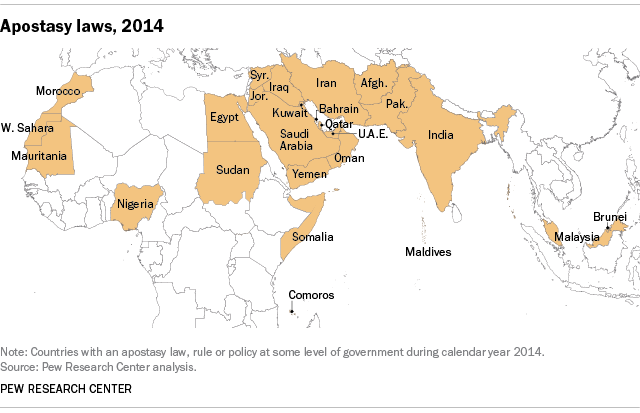
Of course, for most of them it would have been deeply hypocritical for them to have done so.  Here was the Pew Research graphic I used in the post the other day.

apostasy

These countries –  most or all of them members of the OIC –  have apostasy laws in place, making it an offence to leave Islam, let alone to embrace another faith.

Of them, this article from the (UK) Independent reports that

Thirteen countries, all of a Muslim majority, punish apostasy (the renunciation of a particular religion), or blasphemy with death.

The annual Freedom of Thought report by the International Humanist and Ethical Union, found that 13 countries impose capital punishment upon people simply for their beliefs, or lack of them.

Afghanistan, Iran, Malaysia, Maldives, Mauritania, Nigeria, Pakistan, Qatar, Saudi Arabia, Somalia, Sudan, United Arab Emirates and Yemen are the relevant countries.

Not that often enforced these days perhaps, but the law nonetheless.    All countries that will have been represented in this Organisation for Islamic Cooperation meeting, attended by Winston Peters and Jenny Salesa.

My concern here isn’t primarily with the OIC countries themselves.  Their governments –  very few democratic, few even allowing genuinely open political debate and scrutiny –  make their choices and New Zealand can’t change those.

My concern is with our own government.  I could suggest that they’ve been played by Erdogan and OIC, except that that might suggest they didn’t know what they were doing. I suspect they knew exactly what they were doing, and went ahead nonetheless.

We can be proud of our religious freedom and tolerance – hard-won –  and our government (Prime Minister, Foreign Minister on down) shouldn’t sully that good name by associating on such issues with a group of regimes that (mostly) have little or no regard for genuine religious freedom, and show no intention of granting it to their own people, or even to non-citizens living in their countries.

It is shameful, (presumably in some warped conception) opportunistic, and disrespectful of the values and practices of almost everyone who lives in this country.

People have been queuing up to laud the Prime Minister this week.  Some of it is probably due, much of it probably not, but on this significant foreign policy aspect of her government’s response she has allowed a pretty awful standard to prevail.


UPDATE: Not on the specific point of this post, but a chilling action by a government official nonetheless.  As people were pointing out, Mein Kampf is legal, the writings of Mao are legal (as they should be), but New Zealanders are now not supposed to see –  or cite – a document backgrounding perhaps the worst crime in New Zealand history.


Kudos to the Governor

I have been critical of the Reserve Bank Governor for not yet having given an on-the-record speech about either of his main functions, monetary policy or financial regulation/supervision.  Next week marks a year since he took up the job, and 1 April is the day he loses exclusive control of monetary policy to the new MPC, which he will nonetheless chair (and effectively control).

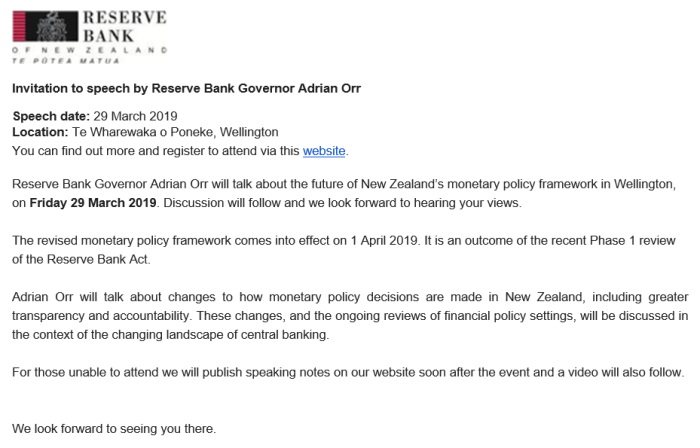
But this invitation just turned up.  It seems to be an open invitation, so anyone interested should feel free to sign up.  I’ll certainly be there and will no doubt write about what he has to say.

orr speech

It is also commendable that the invitation indicates that the Bank will be releasing video of the Governor’s speech (and any Q&A?)  This is a well overdue step forward –  especially as this Governor is quite open about freely departing substantially from his written texts –  and, if adopted consistently, will bring the Bank into line with how things have long been done at the Reserve Bank of Australia.

Presumably, by next Friday the Minister of Finance will finally have announced the other members of the new Monetary Policy Committee.

Wellington: not doing amazing things

This rather saccharine picture turned up in my lettterbox yesterday on the back of a publicity (for the mayor and councillors) pamphlet from the Wellington City Council.

WCC

The picture was actually part of an advert for the coming local body elections, but I thought it quite nicely encapsulated what is wrong with the mindset of so much of local government, including the Wellington City Council.

Many people would settle for local government doing the basics well. In Wellington, we are living with the ongoing disaster that is the new bus schedules and bus contracts.  It should really be pretty basic stuff – not as if running or contracting bus services is a new activity for local government – but they can’t even manage that.   That particular failure is the responsibility of the Wellington Regional Council (and you have wonder whether any sitting councillors will be re-elected in October).

What of the Wellington City Council?  In a post a couple of months ago, I noted a little example of ongoing incompetence –  the month it took, after several reports, to get them to fix a water leak in the middle of the road at the end of a quiet no-exit street, defended by a council officer on the grounds that they had needed to put in place a “traffic management plan”.

That’s a small item, and perhaps my experience was unrepresentative. A bigger example was the debacle of the Island Bay cycleway: never mind that it wasn’t wanted by residents, and is now facing a multi-million do-over (and a court case for judicial review): it was an “amazing thing” championed by the Mayor and his colleages.

But there are plenty of really big items too –  both actual failures, and grand schemes (“amazing things” probably) that typically involves plans to spend tens of millions of dollars of ratepayers’ money with little serious scrutiny and evaluation.   The biggest failure of course is house and urban prices: not as bad as Auckland, but certainly getting up there.  Buying a house in Wellington city in your 20s –  the sort of thing that was a normal expectation just a few decades ago –  is quite out of the reach of any average earner now.  And whatever overarching failures of central government in permitting this, the actual choices around land use regulation are made by local governments.  High house and urban land prices in Wellington City are almost totally the responsibility of the Wellington City Council.  An “amazing thing” no doubt.

Then, of course, there are the schemes championed by the Mayor to spend lots of money on a Wellington airport runway extension, even though the owners of the airport don’t regard such an extension as economically viable for them. At present, that one is tied up in courts, but it is another “amazing thing” they are keen on.  Or the planned convention centre?   A mere bagatelle at $180 million, and never a reasonable explanation for why –  if this was such a good idea –  no one in the private sector was rushing to build it.   Or the ever-escalating cost of fixing Wellington’s Town Hall (well over $100m and rising).  Another “amazing thing”?

And this week, residents suddenly found that the Central Library has been closed down indefinitely.  I’m a bit of a sceptic on public libraries, but my kids (and many other people) use them a lot.  According to the mayor, it wasn’t a legal obligation to close the building –  a new seismic report –  but a “moral obligation”.  No hint as to when library might re-open, let alone of the cost of fixing this council-owned building.   Too bad about the lost revenue (the closure meant closing down yet another car park), or the people who will lose their jobs (from the cafe inside the library –  the public servants are protected).   Like so many councils, Wellington can’t get the basics right but is only to happy to burble on about doing “amazing things”.

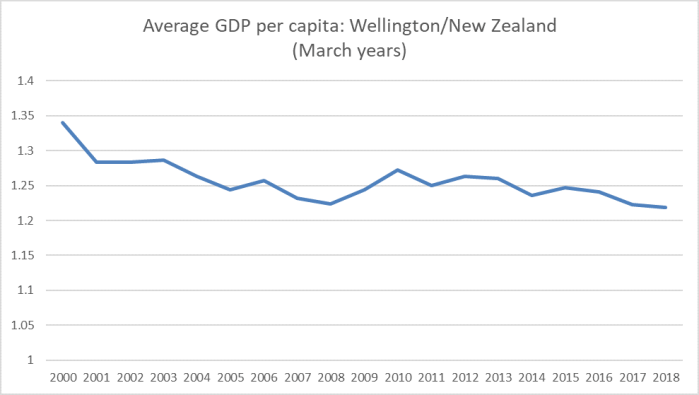
Okay, so that was the rant bit of this post.  I had been planning anyway to follow up on my brief reference to Wellington’s (greater Wellington this time) economic performance in my post the other day on regional GDP.   Over the period for which we have data (starting in the year to March 2000), Wellington has had the slowest growth in average per capita GDP of any region in the country.   I might almost have expected that if the starting point had been 1980 –  before the economic liberalisation that (a) slimmed down central government, and (b) meant many few companies were motivated to have head offices in Wellington.    From a starting point of 2000 –  and being anything but a Wellington booster – I was more surprised.

Of course, it is only fair to point out that average per capita GDP in Wellington is the highest of any region in New Zealand (Taranaki was higher for several years after 2007, after new oil production came on stream but it dropped back to second a few years ago now.)

wgtn GDP pc

For the last 10 years, Wellington has grown only a touch more slowly than the nation as a whole, but none of the lost ground has been recovered.   (Recessions tend to be relatively good for Wellington, as the public sector lays off staff –  or stops hiring –  much more slowly than the private sector.)

There are various reasons why Wellington’s average GDP per capita might be higher than that in the rest of the country.  One factor is that the share of the working age population employed is higher here (70.1 per cent last year in Wellington, 67.7 per cent in the country as a whole).   Some of that –  but not much –  is because Wellington has a smaller than average share of population aged 65 and over (13.2 per cent in 2013, vs 14.4 per cent nationally).  Wellington also has a slightly smaller (than average) share of the population in the under-15 age group.  So there is something –  but perhaps not much –  to the old story about Wellington that it was where young people came, but as many as possible later left.

I suspect that the biggest part of the story  –  say, why average per capita GDP in Wellington is materially higher than in (similar population) Christchurch – is simply that Wellington is “dominated” by head office functions of the biggest entity in the country, government.   “Public administration, defence, and safety” makes up about 4.5 per cent GDP nationwide, and 10.4 per cent in Wellington, and the overwhelming bulk of the well-paying jobs in that sector will be in Wellington head offices.   And it isn’t just activities that are captured in that “public administration etc” component of production GDP.  Like any head office (or, in case, system of head offices) there is a myriad of specialist functions – in private sector services businesses –  that are in Wellington because the public sector head offices are here (consultants, lawyers, lobbyists etc).

(You can have arguments, if you like, about whether these public servants etc are in some sense overpaid –  which, if true, would also inflate Wellington’s nominal GDP.  Since I was a head office public sector functionary for decades and my wife is a senior public servant now I’m not even going to try to offer a detached perspective on that one.)

Of course, no city of 400000+ people is ever just about one industry, even indirectly so.   As I noted in the earlier post, there is lots of hype at times about the Wellington tech sector, the Wellington film sector etc  I’ve written previously about the film and related industry, which may well have a range of high-paying jobs, but is –  on their own telling –  totally reliant on central government subsidies for their survival here.  The presence of that industry isn’t a sign of a city/region with an economy on a robust long-term footing.

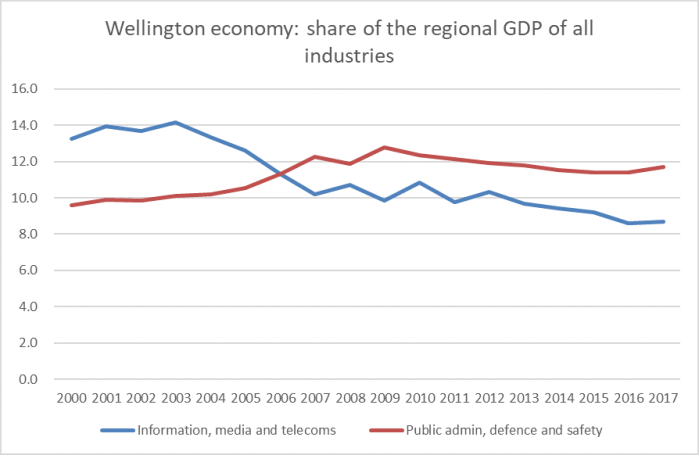
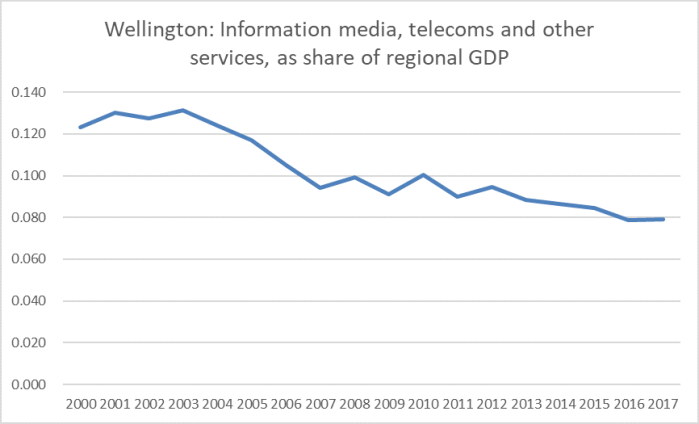
In the regional GDP release, SNZ includes tables showing a breakdown by sector of each region’s GDP (although with another year’s lag, so the new data in that area are for the year to March 2017).    I showed a chart the other day on the share of the “information, media and telecommunications” sector component of Wellington GDP.   Here is a slightly revised version of that chart (this time as share of the total GDP of all industries, without the GST etc correction). I’ve also shown the share for public administration etc.

wgtn GDP 2

Without further digging it is nothing more than correlation, but do note that Wellington’s greatest relative regional decline (see previous chart) was over the period when the share of public administration etc was rising quite strongly.

There has been a decline in the nationwide share of GDP accounted for in that “Information etc” category, but it is nothing like the magnitude of the fall experienced in Wellington.   That’s a relative decline.   (The regional numbers include “other services” under that same heading, but nationwide – where a more-detailed breakdown is available –  the share of “other services” has changed little over the period since 2000.

Perhaps all the good and exciting Wellington tech stuff is lurking under other headings?  Glancing through the table the only obvious other category is “Professional, scientific and technical services”.   But even add them together with the “Information etc” category and you still get a significant drop in the combined sector’s share of Wellington GDP (albeit in the first half of the period, the combined share has been fairly flat for the last decade).

And which sectors have grown strongly in Wellington since 2000?  The three fastest growing sectors were  –  in first place –  “rental, hiring and real estate services”  (a corollary of the decline in owner-occupancy rates?), and then “electricity, gas, water, and waste”, and “food and beverage services”.   It reminded of a recent conversation with someone who immigrated to New Zealand a few years ago and holds a high level head office job, and who really really loves Wellington.  When I pushed him on why, a lot seemed to come down to the coffee.  Nothing wrong with that I suppose, but hardly a successful outward-focused economy.

There aren’t really any policy lessons I want to draw from these data.  In fact, the worst thing I could imagine would be the Wellington City Council –  and its peers in the rest of the region –  deciding they needed to “do something”, flinging more money at more wasteful proposals or the so-called economic development agency.  Of course, they could –  and should –  fix up the housing and urban land market, and that might actually do a little¹ to boost the attractiveness of Wellington, boost average productivity, and do something to reverse the relative income decline.  But there is less than no chance of such sensible policy emerging from the Wellington City Council –  they’d rather carry on with their version of “amazing things”.  Wellingtonians live with the results –  and (in fairness to the the mayor and council) I fully expect my fellow citizens to re-elect the cheerleading incumbents come October.   Just as New Zealanders keep electing governments that preside over our ongoing economic decline relative to the rest of the advanced world.

  1.  I had an exchange with a reader in the comments section of Wednesday’s post as to why I’m not persuaded that the best housing (and transport) policies in the world would make much difference in closing the nationwide gaping productivity gaps.  Perhaps if Wellington alone were to fix these things, it might make more difference. But location is, powerfully, against us.


Rereading the UN Compact on Migration

To listen to some of the more overblown rhetoric this week, you’d could only conclude that the speakers/writers thought that anyone opposed to the UN Compact on Migration –  signed late last year by many countries, including New Zealand, but boycotted by another 29 (including 9 EU countries, the US, and Australia) –  was at least indirectly responsible for Brenton Tarrant’s¹ [alleged] act of evil last Friday.

Most directly in their sights, so it seemed, was the National Party which (rather belatedly) opposed the Compact, promised to withdraw from it if/when returned to government, and had been running a petition of some sort opposed to it.  National didn’t help themselves by, whether through incompetence or something worse, initially giving erroneous stories about when the petition had been taken down.  Straight after the shootings appeared to be the final story.  As if they were now embarrassed by their previous stance – or simply anticipated the deranged rhetoric of the last few days.

I went back and reread the UN Compact this morning.   I came away with much the same view as I’d taken in December.   The document is unnecessary (as, largely, is the United Nations), statist, strongly pro-immigration….and it is a little chilling in a few places.  More than enough reason not to sign it –  the world is, after all, awash with largely meaningless resolutions, including from the United Nations, and that shouldn’t be encouraged.  But as I noted in my single post back then, I hadn’t written anything about it previously

as not only was it a non-binding political declaration, but most of it seemed more relevant to countries dealing with substantial illegal migration (and with migration mainly from very poor or disrupted countries – again, not the main situation in New Zealand).

I was, and remain, more than a little suspicious of National’s belated commitment to the issue.

My suspicion remains that National’s stance is more about positioning relative to New Zealand First –  the contest for provincial votes –  than anything of substance.

But perhaps I’m being unfair to them.

What follows is the heart of my earlier post, without blockquoting it all.

But it still isn’t clear to me quite what additional damage would be done by signing up to this pointless agreement.   Sure, even “non-binding” agreements will, at times, be used in domestic and international fora as a rhetorical stick to beat governments with if they ever look like stepping out of line with the mainstream.  But those sorts of arguments rarely deflect a government for long if it has domestic public opinion behind it in some direction or another (for good or ill).

There is some questionable economics in the document.  For example

Promote effective skills matching in the national economy by involving local authorities and other relevant stakeholders, particularly the private sector and trade unions, in the analysis of the local labour market, identification of skills gaps, definition of required skills profiles, and evaluation of the efficacy of labour migration policies, in order to ensure market responsive contractual labour mobility through regular pathways.

Or, alternatively, one could just let the market work it out.  When there are incipient skill shortages, wage rates tend to rise.  Same thing happens when, for example, bad weather creates a shortage of spinach or lettuce.    But, daft as the economics is, this stuff is the mindset of politicians and officials adminstering immigration schemes all over the western world. including New Zealand.  Recall that in New Zealand the current government is trying to get more actively involved in this sort of thing.

There are also totally vacuous bits, like the commitment to support and promote the United Nations International Day of Family Remittances.  Just what the world needs: another United Nations “day”.

Perhaps three clauses troubled me a little more.

There was this one

Enable political participation and engagement of migrants in their countries of origin, including in peace and reconciliation processes, in elections and political reforms, such as by establishing voting registries for citizens abroad, and by parliamentary representation, in accordance with national legislation.

I guess I can see what they are probably driving at (diasporas helping the reconstruction of the country of origin after say a protracted civil war). But, normally, we should expect migrants to commit themselves to their new country and its processes and political values and not be creating doubts about where their loyalties lie.  But in a country in which Jian Yang and Raymond Huo are MPs –  while still closely associating themselves with political interests in their country of origin –  and people like Yikun Zhang appears encouraged to play both sides –  it is hard to see how this particular provisions make things here any worse than they already are (around a small handful of our migrants).

And then there was this one

Promote mutual respect for the cultures, traditions and customs of communities of destination and of migrants by exchanging and implementing best practices on integration policies, programmes and activities, including on ways to promote acceptance of diversity and facilitate social cohesion and inclusion.

Which presents the issues as symmetric when they really should be asymmetric: the focus should be on encouraging the assimilation of the migrants, and ensuring their respect for the “cultures, traditions and customs” of the destination community –  just as when you go to someone else’s place for dinner you respect their practices, table manners etc.   One could also argue that encouraging “acceptance of diversity” and facilitating “social cohesion” are two contradictory, often mutually inconsistent, goals.  But again, flakey as all this stuff is, it is the way our bureaucratic and political “leaders” think and act anyway.  If the behaviour is a threat, it is hard to see that the UN agreement would be more of one.

Relatedly

Support multicultural activities through sports, music, arts, culinary festivals, volunteering and other social events that will facilitate mutual understanding and appreciation of migrant cultures and those of destination communities.

Quite what business this is of the UN –  or even of national governments actually – one has to wonder, but there is the “globalist” mindset for you.   And, again, it is pretty much what central and local governments do anyway.  I was interested that “religion” wasn’t on the list

And then, of course, there is Objective 17 (of the 23 in the document) which I have seen people express more serious concern about.

OBJECTIVE 17: Eliminate all forms of discrimination and promote evidence-based public discourse to shape perceptions of migration

We commit to eliminate all forms of discrimination, condemn and counter expressions, acts and manifestations of racism, racial discrimination, violence, xenophobia and related intolerance against all migrants in conformity with international human rights law. We further commit to promote an open and evidence-based public discourse on migration and migrants in partnership with all parts of society, that generates a more realistic, humane and constructive perception in this regard. We also commit to protect freedom of expression in accordance with international law, recognizing that an open and free debate contributes to a comprehensive understanding of all aspects of migration.

If that isn’t muddled I don’t know what is –  let alone, unrealistic (in no conceivable world are “all forms of discrimination” going to be “eliminated”).

The specifics under that Objective include commitments to

Enact, implement or maintain legislation that penalizes hate crimes and aggravated hate crimes

So-called “hate crime” legislation is almost always bad law and bad policy.  Punish assaults or murders or whatever as that: bad and unacceptable acts, regardless of who they are committed against or why.

And this

Promote independent, objective and quality reporting of media outlets, including internet based information, including by sensitizing and educating media professionals on migration-related issues and terminology, investing in ethical reporting standards and advertising, and stopping allocation of public funding or material support to media outlets that systematically promote intolerance, xenophobia, racism and other forms of discrimination towards migrants, in full respect for the freedom of the media.

Again, muddled at best.  You want to stop any public funding to outlets whose views are “unacceptable”, while having “full respect for the freedom of the media”.   Since I’m not entirely convinced there is a good case for public funding of any media outlets –  and since the publicly-funded outlets in New Zealand are champions of high immigration and all “worthy” leftist causes anyway –  it isn’t clear what difference this might make in New Zealand.    And there seem to be some MPs –  particularly in Labour and the Greens –  who aren’t too keen on allowing free speech on such issues anyway, whether or not we sign up to UN non-binding declarations.

And finally under Objective 17

Engage migrants, political, religious and community leaders, as well as educators and service providers to detect and prevent incidences of intolerance, racism, xenophobia, and other forms of discrimination against migrants and diasporas and support activities in local communities to promote mutual respect, including in the context of electoral campaigns.

All very asymmetric –  nothing at all about engaging with communities that might be uneasy about high immigration, or the immigration of groups with values antithetical to those of the destination community.  Perhaps, in some respects, this commitment troubles me more than most.   “Intolerance” is not an offence (in principle or in law) and it is the perfect right of people to debate –  perhaps especially in election campaigns – the future composition of their society.   A Saudi Wahhabi, a Chinese Communist Party zealot, an American evangelical, and a French secularist are all very different sorts of people. In large numbers, each group transplanted to (say) New Zealand would make a material difference to the society and polity we have here.  Those debates matter –  unless, apparently like the authors of this document –  you regard all differences of culture, politics, religion etc as superficial rather than fundamental.

March 2019 here again.

Rereading that, it still seems about right (and in fact we’ve had chilling signs of the antipathy to free speech from a number of quarters this week).

In their opposition to the compact, National repeatedly asserted that our sovereignty was going to be compromised.  I never quite saw them explain how.   But at the time of the earlier post, some people who were more negative than I was on the document highlighted a risk that –  although the agreement is formally non-binding on governments – our local courts could, or would, over time seek to introduce the provisions of the agreement (and the fact of it) into judicial rulings on immigration issues in New Zealand.   Such judicial conduct is not unknown.  Perhaps that was some of what National had in mind.

I’m not a lawyer, so am not sure how significant a risk that is.  But I guess at the time my response had a number of strands:

  • parliamentary sovereignty is still intact in New Zealand.  Even if it is bad form to legislate retrospectively (re a specific case) there is never anything to stop Parliament legislating to, in effect, counter any tendencies of judges to import non-statutory documents of this sort into their decisionmaking,
  • more substantial and important questions probably should be asked about how we appoint – and who we appoint –  as top tier judges in New Zealand.   These are, inevitably and sadly, somewhat political roles –  not party political so much, as “ideological”.  I had a post last week suggesting a more open process for scrutinising and confirming senior judicial appointments (as well as term limits).    That still seems a higher longer-term priority than a single non-binding UN document, even one with somewhat chilling language in a few areas.

And the third strand –  decisive to me –  was this, with which I concluded December’s post

As I said at the start, there is no obvious need for this document.  And even if there were obvious gaps, the very fact that it is a non-binding political declaration suggests it could meet no substantive need.  But in a New Zealand context, there are policies and practices around immigration that are much more damaging and threatening, particularly to our long-term economic performance, and perhaps in other areas too.  Among them:

  • the immigration policies of the National Party
  • the immigration policies of the Labour Party
  • the immigration policies of the Green Party
  • the immigration policies of ACT, and
  • the immigration policies of New Zealand First

I think that pretty much covers the spectrum.

There is no conceivable universe in which some international declaration –  or even agreement – around immigration would be more liberal and (in our specific economic circumstances) more damaging than what our political parties have done to us all by themselves.

And since Simon Bridges was asserting the other day

“If you look at our immigration position, I think we have the strongest pro-migration position across the Parliament.”

I think you’ll see my point.  As it is, I’m pretty sure he is wrong in his claim. ACT and the Greens, from apparently opposite ends of the political spectrum, beat him to the title.

But to suggest that National should be whipping themselves, or ashamed of their stance on the Compact, is just absurd –  and worse.  (Their ongoing support for our high immigration policies is another matter).  It is, like so many areas of public policy, something around which reasonable people will differ, perhaps quite strongly.  That is the stuff of politics, and indeed of life –  perhaps the more so, the more diverse (ideologically, religiously or the like) your society is.  Ideas matter.  Even non-binding declarations are championed for a reason –  so much energy wouldn’t be expended on them otherwise.  It is reasonable, perhaps, to pose the question to the champions –  or even those more indifferent –  “if it is so inocuous, what’s the point?  Why does it matter so much to you?”


  1. I won’t be following the Prime Minister’s stance of not mentioning the name of the [alleged] killer (nor, I presume, will our courts).   I thought this op-ed from the Jerusalem Post dealt with that issue well.   We think no better of Hitler or James Earl Ray or Sirhan Sirhan for mentioning them, and their acts of evil, by name.   More specifically, I’m a Christian and our faith teaches that no one is beyond the possibility of God’s grace. Those are hard words to hear, and at a civil level I’d be quite content if we’d had the death penalty in place.  But vile as the acts were, Tarrant was –  and is – a human being.  And, as Solzhenitsyn sagely put it, the line between good and evil runs not between people or states, but through every human heart.

Agricultural sector productivity growth

In the last few weeks, presumably simply by coincidence, I’ve had various comments and emails about productivity growth in the agricultural sector.    The most recent one finally prompted me to dig out the official data and check that my impressions were still supported by the data.  They were.    Agricultural sector productivity growth was very strong, but has been much more subdued for some time now.

There are two main measures of agricultural sector productivity: labour productivity (in effect, output per hour of labour input) and multi-factor productivity (in effect, the residual after what can be attributed to growth in labour and capital inputs has been deducted). In principle, MFP is superior.  In practice, estimates rely more heavily on the assumptions used in the calculation (although –  diverting briefly –  to the various readers who have sent me a recent piece by GMO on TFP/MFP, I reckon there is less to that critique than the authors claim).

Agriculture is one of the sectors for which we have consistent productivity data back to year ending March 1978.  By New Zealand standards, that is a long run of data.  Note that there is quite a bit of natural volatility from year to year because of fluctuations in the climate (droughts and all that).

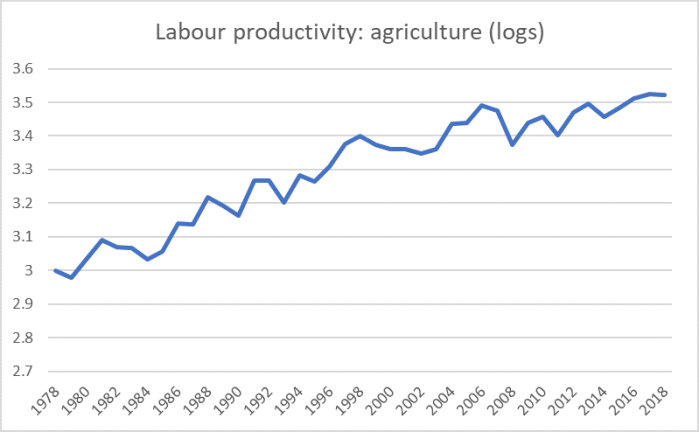
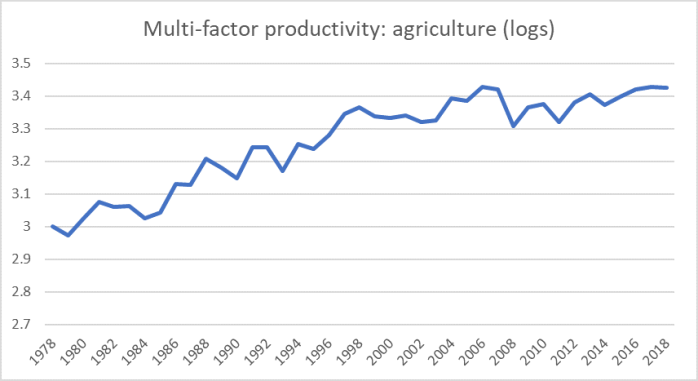
Here are the charts showing growth in labour productivity and in multi-factor productivity (both expressed in log terms, so that the slope of the line indicates the growth rate).

agric LP

Really rapid growth in the first 20 years or so (up 150 per cent in 20 years), but much slower growth since then.  It isn’t disastrous growth by any means –  averaging just under 1.5 per cent per annum from 2005 to now –  but nothing startling either.

And MFP.

agric MFP

Once again, really strong productivity growth for the first 20 years, and much less since then (none at all in the last decade).  If one had confidence in the data, that might be more concerning.

Perhaps –  and it is an obvious question to ask – you are wondering if the slowdown in agricultural productivity growth is just part of the general slowdown in labour productivity growth in New Zealand (seen mostly starkly in the overall economy figures, where there has been very little growth at all in the last five years or so).

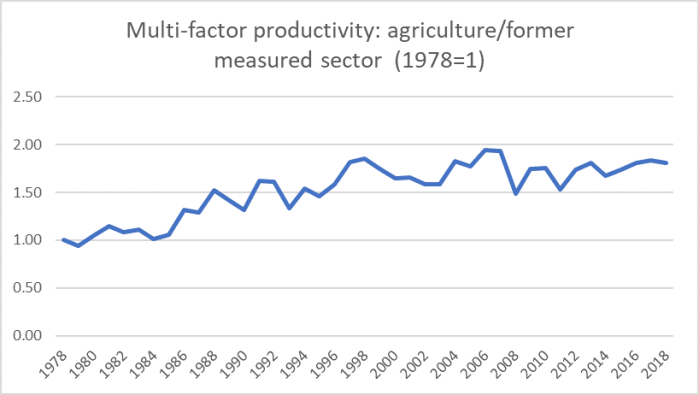
So here are the same two charts –  labour productivity and MFP –  but this time showing agriculture relative to the overall “former measured sector” (the series SNZ publishes that also goes back to 1978, covering the 70 per cent or so of the economy where productivity is relatively less hard to measure).  All series are indexed to a common base in 1978 (so none of this is about productivity levels, it is all about cumulative growth rates).

Labour productivity first.

agric LP and FMS

and MFP

mfp agr

There is clearly something in the story.   Growth in the “former measured sector” productivity itself has slowed –  labour productivity growth averaged 2.4 per cent from 1978 to 1998 and 1.6 per cent for the 20 years since 1998.  But whereas agricultural sector productivity growth was (far) outstripping that in the rest of the “former measured sector” in the earlier years –  the upward-sloping bits of the last two charts –  in the last 20 years (and even more so in the last 10) productivity growth in the agricultural sector has been a little slower than in the rest of the “former measured sector”.

I don’t have a policy point to make here.  Sector-level productivity isn’t my area.  Relative optimists might look at the data and suggest liberalisation played a big part in the earlier productivity surge, and that liberalisation wasn’t ever going to be repeated.  Perhaps, but bear in mind that our agricultural sector was always the part of the economy most heavily exposed to international markets  (by contrast, a sector like “Transport, postal, and warehousing” –  with similar total labour productivity growth over 40 years –  was almost certainly much more sheltered).   Pessimists might focus on the role of unpriced externalities (particularly around water pollution, but also methane emissions) and wonder how agricultural sector productivity might respond as regulation bears more heavily there (although it is possible we could see higher average productivity and lower total output).   Others might reasonably wonder about these productivity measures for agriculture in particular: in most sectors labour and capital are the critical inputs, but land is a huge input in agriculture and it isn’t directly accounted for (something which matters –  much –  more in looking at levels estimates).   [UPDATE: A SNZ person got in touch and pointed out that they do take account of land in their capital services estimates.]

As for me, my only motivation was to update my impressions.  Sadly, the latest data confirmed them.


Why is the Deputy Prime Minister going to Istanbul?

The government seems determined to do its utmost to assist in the election campaign of the odious Turkish President Erdogan.  It surely cannot be their conscious intention, but how else to read what they are doing?

There are local elections in Turkey next weekend. The Financial Times reports that the ruling party is facing the possibility of losing control of the capital city, Ankara.  The economy –  which has done remarkably well in recent decades (as I’ve noted here, real GDP per hour worked is now almost equal to New Zealand) – is currently in a sharp downturn.

Erdogan appears to be trying to bolster his local appeal by wrapping around himself some sort of self-acquired mantle as a leader among Islamic states.

And thus, although no Turkish citizens were killed in last Friday’s dreadful attacks in Christchurch, suddenly the Turkish Vice-President and Foreign Minister are in New Zealand.  There are motorcades in Christchurch and even a meeting with the Governor-General.   What was the government doing agreeing to even this visit?  Didn’t their advisers tell them how this would most likely be used?  And, to add insult to injury, this is a Turkish government that –  like all Turkish governments – actively denies (and threatens states that say otherwise) the active involvement of Turkish authorities in the Armenian genocide, one of the most hideous events in an awful war.

And that was before we learned of Erdogan using clips from the shooting video in his election rally, amping up the rhetoric with talk of Gallipoli and how the landings in 1915 had been anti-Muslim in nature, and talking of sending people (New Zealanders and Australians) home in coffins.  Perhaps it played well to his base, but not only was it irresponsible and inflammatory, it wasn’t even remotely historically accurate.  Turkey –  or its predecessor the Ottoman Empire –  actively chose to enter the war on the German and Austro-Hungarian side.  Right up to the outbreak of war the British had been helped develop the Ottoman navy.  I’m not relitigating the rights and wrongs of the First World War, but it was their choice.  The German establishment at the time was firmly Protestant.   The New Zealand government history site tells us

Enver grew impatient. On 25 October 1914, without consulting any of his ministerial colleagues, he ordered Admiral Souchon to take the Ottoman fleet, including the German-crewed ships, into the Black Sea to attack the Russians. The fleet carried out surprise raids on Theodosia, Novorossisk, Odessa and Sevastopol, sinking a Russian minelayer, a gunboat and 14 civilian ships. On 2 November, Russia declared war on the Ottoman Empire. France and the British Empire, Russia’s wartime allies, followed suit on the 5th. Enver Pasha had succeeded in bringing the Ottoman Empire into the First World War on the side of the Central Powers, Germany and Austria-Hungary. Whether he would be as successful in achieving his principal war aim – pan-Turkic expansion into Central Asia at Russia′s expense – was another question.

Erdogan can play domestic politics all he likes.  That is his problem, and that of his people/country.   But we should hold our officeholders to account for their (in)actions and words.

We are told that our Foreign Minister has had a quiet word to the visiting Turkish politicians.  But we’ve heard nothing from our Prime Minister.  By contrast, Scott Morrison has openly demanded an apology from Erdogan.  I’m sure he won’t get one, but at least he has put his cards on the table, and stuck up for his country.

What is our government doing?  Well, a press release yesterday told us that the Foreign Minister (Deputy Prime Minister in this coalition government) is off to Turkey, of all places, accompanied by another government minister.

“Our current intention is then to travel onwards to Turkey, at the request of the Turkish Government, to attend a special ministerial meeting of the Organisation of Islamic Cooperation being held in Istanbul.

“This important event will allow New Zealand to join with our partners in standing against terrorism and speaking up for values such as understanding and religious tolerance.

So, late in his election campaign, having insulted New Zealanders –  past and present –  Erdogan summons a meeting and our government comes running.   How does he supppose the state-dominated media in Turkey is likely to present that?  As if New Zealand has anything to answer for to Turkey.

And that is before we get to even consider this meeting of the Organisation of Islamic Cooperation.  This is such an odious organisation that just recently they issued a collective official statement endorsing the treatment of Muslims in Xinjiang by the People’s Republic of China.  I’ve been critical of our government for saying and doing nothing on that issue, but not once have I supposed that the Prime Minister and her Foreign Minister think it is all just fine (they leave that stance to Todd McClay). To his credit, Erdogan has actually been a rare leader to criticise the PRC over Xinjiang, but this is a meeting of the OIC itself Winston Peters is to attend.

And what messages does he envisage?  They will jointly speak out against terrorism –  no problem with that –  but they will also, we are told, speak up for “values such as…religious tolerance”.   Really?     It would be great if they both did it and meant it, but a significant proportion of the member countries of the OIC have apostasy laws on the books.

apostasy.png

And a significant proportion of those countries actually provide the death penalty as the punishment for leaving Islam.  I’ve listened to church leaders talk about the extreme courage of (rare) converts.  Tolerance in these countries means if you are born and raised Christian, Jewish or whatever you can stay that way, but no one is allowed to convert out of Islam.

It isn’t true of all countries.  Turkey is pretty good on the religious freedom score.  But  –  given the laws on their own statute books, freely chosen – any talk of religious toleration by the OIC is almost certain to be less than entirely honest.  And Winston Peters will be giving them cover by attending this meeting, just as he’ll probably be grist to Erdogan’s election campaign by turning up in Istanbul at all at a time like this.

Perhaps he will use the visit to make a strongly-worded call for an apology from Erdogan and for (too much of) the Islamic world to embrace genuine religious freedom –  the right to adopt or to leave a religion.  But I’m not holding my breath.

Looking at the regional GDP numbers

Under this government money from the Provincial Growth Fund has been being flung round like confetti (this was last week’s example), with very little sign of any rigorous evaluation.  It isn’t clear to me whether things are worse under this government than they were before (recall the 13 bridges Simon Bridges was promising in Northland as Minister of Transport, to try to win a by-election) or whether this lot are just “better”
at the branding.   “Regional development” –  with no disciplined sense of what actually shapes economic performance – has certainly been a cause dear to the heart of all recent governments (and their MBIE bureaucrats).

SNZ yesterday released the annual regional GDP numbers.   As ever, these  numbers aren’t perfect –  nominal not real, and prone to revisions for several years –  but they are lot better than nothing, which is what we had until almost 20 years ago.

The Provincial Growth Fund seems to have been particularly concentrating its confetti in Northland, Gisborne, and the West Coast.  The Northland and Gisborne regions are estimated to have the lowest average GDP per capita in New Zealand (at about 70 per cent of the national figure).  As it happens, the West Coast doesn’t do too badly, with average GDP per capita 84 per cent of the national average in the year to March 2018.  Manawatu-Wanganui and Hawke’s Bay round out the bottom five regions (with average GDP per capita less than that on the West Coast).

The regional GDP data have been available since the year to March 2000.  Over the period since then, three of those five regions have had faster growth in per capita GDP than the national average (and by very substantial margins in Northland and the West Coast).  All five have recorded faster growth than Auckland and Wellington.  And if one goes back to 2000, one of the poorest five regions then was the Bay of Plenty, but it has recorded such fast (per capita) growth since 2000 that it has overtaken not just Hawke’s Bay but also Tasman-Nelson.

The picture is a bit less positive if one takes just the last decade, but even over that period growth in per capita incomes is estimated to have been stronger in Hawke’s Bay and Gisborne than in the country as a whole.

As a matter of interest, I also had a look at the unemployment data.  The regional data from the HLFS arem’t reported for the same groupings as the regional GDP data, but here is one chart I constructed.

regional U rates

Even at its worst this decade, the gap between the two lines wasn’t as large as it was 20 years ago.  Last year, it was almost as low as it has ever been.  Involuntary unemployment is a blight on lives wherever it is found, but these particular regions don’t seem to have been doing too badly.

Meanwhile, any guesses as to which regions had the slowest growth in average GDP per capita over the entire period from 2000 to 2018?

Wellington was worst, followed by Auckland as second-worst.

akld wgtn shares

The two regions combined have recorded a material increase in their share of national population, and yet their share of total GDP is unchanged (actually down very marginally).

What about Auckland alone?  If the picture is less dramatic than for Wellington, Auckland matters much more, due to sheer size (and population growth, actual and projected) Here is the latest version of a chart I’ve shown in previous years.

akld gdp pc to 18

It certainly isn’t monotonic.  There are reasonably good phases (which look to coincide with building booms in Auckland) and really bad ones, but there is no sign of the longer-term trend reversing.   An even-greater share of the population is in Auckland, and average output per person in Auckland is growing more slowly than in most of the rest of the country.  In high-performing economies –  at least those relying on something other than really abundant mineral resources –  the picture is typically the other way round.  Big city GDP per capita is typically much higher than in the rest of the country, and in most cases that margin is widening.  But not in Auckland.

Any why is Auckland’s population growing so rapidly when its economic performance has been unimpressive (to say the least).  That’s down to immigration policy.  That isn’t really a debateable point: the data show that (net) New Zealanders have been moving away from Auckland.  This chart was taken from a Treasury working paper I wrote about last year.

tsy akld popn

Our large-scale non-citizen immigration policy –  with targets not exceeded in per capita terms in any other OECD country –  is a practical centrepiece of the economic strategy of successive New Zealand governments.   You don’t hear the phrase now, but it is only a few years ago that MBIE openly talked of the policy as a “critical economic enabler“.  With the best will in the world no doubt, “critical economic disabler” would be a fairer description of the role immigration has played for decades (probably going back all the way to the post World War Two period).  It isn’t the fault of the immigrants –  simply looking for the best for themselves and their families –  but of successive governments and their officials.  They are particularly culpable as the evidence has mounted that their strategy simply is not producing the desired economic results.

The story in Wellington is different of course, but probably no less telling.  Here, local government likes to talk up the idea of a city built on high tech industries.   Central government likes that talk, and also throws (lots of) money at the film industry.    The information in the regional GDP tables doesn’t give a full picture, but there is a line for the component of GDP labelled “Information, media and telecommunications and other services”.  Here is the share of that sector in Wellington’s GDP.

wgtn ICT

Even in Auckland, the share of that sector has been falling –  so there may be something structural around, say, the falling real price of telecommunications going on  –  but nothing like as steep as that fall in Wellington.

New Zealand does macro policy reasonably well –  fiscal policy and (for all my various criticisms at the margin) monetary policy – but our structural policies are set for failure, and in delivering continued underperformance, are doing just that.    The immigration policies pursued by successive governments simply take no account of either our experience (70 years of ongoing relative decline) or our most unpropitious location.   If –  as I noted yesterday –  this is a bad place for basing outward-oriented business (and revealed preference suggests that is so), it is a bad place for governments to engage in “population planning”, importing large numbers of people.  One of the fastest population growth rates in the OECD combined with one of the poorest economic performances should be telling anyone with ears to hear (not our politicians) something important.  The specific relative failure of Auckland just makes that message more stark.