Orr speaking

We’ve been hearing quite a bit from the Reserve Bank recently (in addition to the OIA disclosures of the Governor’s antics last year), just not much about monetary policy, short-medium term economic developments, or financial stability and regulation.  In a few weeks the Governor will have been in office for two years, and in that time we’ve not had a single serious and thoughtful speech from him on either financial stability/regulatory issues or on monetary policy and cyclical economic issues.   It is extraordinary, and not the sort of thing we’ve seen here in the past or in other advanced countries today.  As it happens, the new MPC members have now been in office for 11 months, and we’ve not seen or heard a word from any of the external members at all.

But what of Bank management?    If they haven’t been talking about core business (that small matter of the statutory responsibilities they are funded for), they’ve been out championing other causes, including themselves.

Last Wednesday the Governor (and accompanying senior managers) turned up at Parliament for the annual Finance and Expenditure Committee financial review hearing.  The Governor’s opening statement is here.    The only bit that immediately caught my eye was this

Amendments to the Reserve Bank of New Zealand Act, which came into effect on 1 April, gave responsibility for monetary policy decisions to the newly-established Monetary Policy Committee.

This framework has now been implemented and is working well, with six Official Cash Rate decisions by our new Monetary Policy Committee. The Summary Record of Meeting provides insights into how decisions are reached, and improves our stakeholders’ understanding of each Committee member’s contribution.

That final sentence, and particularly the second half of it, is at best spin, more accurately just a lie.  The Governor explicitly states that the Summary Record “improves our stakeholders’ understanding of each Committee member’s contribution”, when of course –  go and read them for yourself if you like –  that is simply false.  Not only does the Summary Record give no real sense of “how decisions are reached” but, by explicit choice and design (endorsed by the Minister of Finance), there is no reference at all to the views, arguments, analyses etc of any individual Committee member.  And –  did I mention this?  – none of the externals has been heard from in any other fora.  We have no idea whether they are making any contribution at all.   It is breathtaking that the Governor can so actively and deliberately –  in writing – lie to a parliamentary committee.  In isolation perhaps it is a small point, but if we can’t count on a very and powerful public official in the small and visible points, how do we trust him more generally.

The FEC appearance was also an opportunity for the Governor to bid for more resources –  a lot more resources we are told.  According to the Stuff account,  the Governor is bidding for a “30 per cent perhaps” increase in the Bank’s funding, claiming that (in respect of bank supervision)

The Reserve Bank’s existing resource was at the the low-end, if not “the lowest”, in the OECD

Which might sound more worrying/inappropriate were it not for the fact that New Zealand is among the smaller OECD countries and one of the poorer OECD countries, and also a country with a record of a sound financial system, and one dominated by banks already subject to serious supervision in another country that also has a long record with a sound financial system.

On several occasions over the years I’ve been willing to defend or even champion the case that the Reserve Bank is probably a little underfunded.  But it gets progressively harder to defend that view as the evidence mounts for how undisciplined the Bank is in the use of the resources it already case.  There was the million dollars for the Maori strategy, or the trips to international climate change meetings (and resources devoted domestically to such issues, for which the Bank has no particular responsibility) and there is the sense of a proliferation of staff in the communications/PR areas of the Bank.   I can’t yet formally verify that –  although I have lodged an OIA to get chapter and verse –  but I’m not the only person to note the range of new people/positions (on the bottom of press releases, emails or whatever) and my favourite anecdote was one a friend told a few months ago about being approached by a headhunting firm to consider applying for a job in something like “stakeholder relations” at the Bank,  a job my friend characterised as “having coffee with a lot of people, getting paid $180000 a year”.   I hope The Treasury and Grant Robertson will be having a close look at whether there is any sort of culture of ruthless prioritisation, frugality etc in how the Governor uses what he has, before offering up yet more public money.    There isn’t much sign of it.

Stuff also reports that National’s Finance spokesman Paul Goldsmith challenged Orr on his conduct

National Party finance spokesman Paul Goldsmith questioned Orr on the bank’s reaction to “criticism and debate” during a series of exchanges at the select committee, saying the Reserve Bank governor had “very significant independent powers” over the industries the bank regulated.

“From my point of view it is very important that we have open and robust discussion,” Goldsmith said.

“We wouldn’t want to have an independent governor with a glass jaw or a sensitivity to robust criticism,” he later added.

Orr’s response?

“What I won’t stand for is abuse of my team or myself,” he said.

He keeps claiming he and his team have been “abused” in some inappropriate or unacceptable way, but has not yet shown us a shred of evidence for those claims, suggesting that what is really at work is a powerful public figure who simply can’t cope with being challenged.  As one of his former staff put it last week “he could always dish it out, but could never take it”.

I hope Goldsmith won’t let the matter rest, especially if he should become Minister of Finance later this year.

Orr was back on the public stage on Friday with a speech, delivered to a business audience in Christchurch, under the title “Aiming for Great and Best at Te Putea Matua” (that being that Maori label the Governor has chosen to attach to the Bank).    The, perhaps rather odd, title refers to the Governor’s vision for the Reserve Bank “Great Team and the Best Central Bank”, the even more overblown goal than the one his predecessor had introduced, aiming to be the best small central bank in the world (when I asked, a few years later, what steps they’d take to benchmark themselves and measure whether they were getting close to the goal, the answer came back “nothing”).   Nothing wrong with aspiration and ambition of course –  although it is not clear that taxpayers would choose spend resources so heavily that a small, not very rich, country’s central bank would ever be best in the world.   The real problem is the delusional nature of the claims, the visions, which seem more about spin than substance.  Excellent central banks don’t have thin-skinned bosses, unable to keep their thin-skinnedness under control.  Excellent central banks have senior figures who make excellent thoughtful speeches. Excellent central banks are producing a steady stream of insightful research.  Excellent central banks underpin major policy initiatives with confidence-inspiring research and analysis, taking seriously alternative perspectives.

(Come to think of it, excellent central banks don’t just make stuff up when testifying to Parliament.)

We don’t have an excellent central bank (although it still has some good people); instead we have an organisation that has become little more than a platform for the Governor’s ambitions, whims, and political preferences, with little or no sense of boundaries, restraint, or the proprieties of public office.

I’m not going to waste a lot of time on a detailed review of the speech. Frankly, it is fairly dull although suffused with the Governor’s personal whims, especially around climate change (important issue and all, but really nothing whatever to do with the Reserve Bank).  But do notice just how the Governor operates.  There was this line

We have now made six Official Cash Rate (OCR) decisions – as a committee. We have managed robust discussion and come to consensus decisions. The nature of these discussions is published as a ‘Record of the Meeting’ for all to see. We also won this year’s Central Bank award for transparency in how we operate.

It is technically accurate, except that the transparency award they won was explicitly for one small element –  the (quite good) Handbook they’ve published on monetary policy –  not at all for anything about how the Monetary Policy Committee functions or how the ‘Record of the Meeting’ operates.  It is just dishonest.  It should be unworthy of –  beneath –  a major public institution in a sector where trust is supposed to be central.

A Stuff story appeared this morning about some more of the Governor’s comments.  I first assumed it must be referring to the (published) Christchurch speech, but the article says it is talking about a speech given in Auckland (perhaps he used much the same text?).  We get accounts of Orr as populist (also there in the published speech)

“I’m not here to talk to a few narrow specialists. I’m not here to talk to just the institutions we regulate.

“We are the central bank of everyone here in New Zealand, present and future, and we have been too narrow and too lax in our engagement with you all, and it is not going to happen again.”

The problem, of course, is that (a) few “specialists” actually have much confidence in him, (b) in all fields of life, we rely on “specialists” to help us evaluate and hold to account powerful public agencies (something Orr isn’t keen on at all), and (c) all that business about how his predecessors didn’t get out and talk to wider audiences is just so much nonsense, simply inconsistent with the facts.  Perhaps Orr has forgotten Don Brash’s in(famous) retail roadshows, or Graeme Wheeler’s repeated talk about how he and the Bank were going to talk to a wider range of people.   Some questionably, Alan Bollard even wrote a book (not inaccesible either) while in office.

And the article ends with an account of Orr’s answer to an audience question, which seems like quintessential undisciplined Or

Orr spoke about the importance of economic and social inclusion in response to a question from Jackie Clark, founder of The Aunties whanau support movement, who complained New Zealand was a low-wage economy.

“The owners of capital have been doing a great job over and above the owners of labour,” Orr said.

“It’s been extreme, unprecedented, over the last 40 or 50 years of that ongoing return to the owners of capital, and labour has become a global commodity, where production goes to the lowest common denominator.”

“We want low and stable inflation, but that does not mean we want low wages,” he said.
“We’ve been celebrating the fact that nominal and real wages have been growing recently.

“That’s how we roll. That’s how we have to roll, otherwise create yourself a gated community. Enjoy yourselves, but don’t leave.”

Would have sounded just great in a stump speech from Bernie Sanders, Alexandria Ocasio-Cortez –  there is at least some evidence in support of his story in the US –  or even Marama Davidson.  But (a) this is New Zealand, and (b) you are the Governor of the Reserve Bank, with quite narrow responsibilities for monetary policy (affecting only nominal variables beyond the short-term) and regulation for prudential purposes of some classes of financial institutions.  Instead, we get a rampantly partisan/ideological answer (inappropriate in itself, but when did bounds and norms bother Orr?), but one with little or no grounding in facts.

(A prudent grounded answer to the question might have been to note that distributional issues are not an issue for the Reserve Bank, but that in the longer-term only productivity growth will support a much higher wage economy.  Both statements would be accurate and uncontentious.)

Those first two sentences in Orr’s answer seemed to be about the labour share of income.  The data are summarised in a chart in this post.  In New Zealand –  it is different in some countries –  the labour share of income rose in the 1970s, fell in the 1980s and (depending on your measure –  I show three) is now just a little higher or a little lower than it was fifty years ago.    You might personally argue for some different split of the pie, but what in the New Zealand experience justifies Orr’s flamboyant off-reservation ideological rhetoric.

Or what about how wages have been rising relative to economic capacity (say, nominal GDP per hour worked, capturing productivity and terms of trade effects).  Well, as I illustrate every so often (most recently last month), this century, wage rates in New Zealand have been rising faster than GDP per hour worked.  Perhaps Orr doesn’t know that –  it certainly doesn’t suit his ideological message – but whether he knew it or not he actively misled his audience, while working on the taxpayer’s dime.

I was going to round off this post with a fairly detailed critique of a truly dreadful speech given a week or so ago by one of Orr’s principal deputies, Christian Hawkesby, the Assistant Governor responsible for economics, monetary policy and financial markets on “The Maori World View of the Reserve Bank” but with quite a bit else –  including some atrociously bad history –  thrown in, concluding with the absurd hubristic claim that the Orr/Hawkesby Reserve Bank is “putting the New Zealand back into the Reserve Bank of New Zealand”.   You’d think they were candidates at this year’s election, not senior (supposedly non-partisan, supposedly operating within the constraints of specifc statutes) statutory public officials.  But perhaps I’ll save that speech for another day, rather than risk losing the focus on the Governor who yet again reveals himself as simply unfit for the office he holds.  And yet those paid to hold him to account sit idly by.
Preferring to look the other way

It was remarkable to pick up the Herald yesterday and find their coverage of the SFO prosecutions over the donations to the National Party given over to some “gotcha” attacks on Jami-Lee Ross.    The huge headline is “Own Goal” and the next level down is “Jami-Lee Ross’ spectacular political faux pas”.   Almost as if it were some sort of National Party newsletter.

Three things struck me about the Herald’s coverage (and, as far as I could see, other mainstream media were not that much different).

The first was that this jeering at Jami Lee-Ross’s comeuppance seems a weird approach for a major media outlet to take, when we’d not have known anything about the events now subject to prosecutions on serious charges without Jami-Lee Ross’s disclosures.  There was certainly no sign the Herald had been getting to the bottom of the issues.   Whistleblowers have a wide variety of motives, and not all of them are noble –  and even those with elements of nobility are not infrequently tinged with more than a little of the less savoury side of things.   And yet we rely on whistleblowers to uncover lots of wrongdoing: in specific circumstances, we even have statutory protections for them  (but whistleblowing often comes with costs to the whistleblower, perhaps especially if they themselves have been directly involved in the alleged wrongdoing).

I guess I could understand the attacks at Ross’s expense had he, prior to all this coming out, been a longstanding public campaigner for clean elections, transparent financing of political parties, keeping foreign influence out of politics etc etc.   The (apparent) hypocrisy would be stunning –  akin to, for example, the morals campaigner caught in an extra-marital affair.   But that wasn’t Ross.  Did anyone ever mistake him for the moral face of politics when he was rising rapidly up the ranks of the National Party?

Perhaps he just generally was not a very nice or admirable person –  there are, for example. those reports of his flagrant, repeated, violations of his marriage vows etc.  But the fact remains that this wrongdoing (as alleged by the prosecutors for the SFO) would not be known had Ross simply stayed silent, whether that had involved continuing his efforts to climb National’s greasy pole, or just moving on quietly.     Either might have suited the National Party.   But it isn’t clear why such silence – about these specific donations, or about his involvement with others (Todd McClay and the PRC billionaire) that aren’t illegal but aren’t universally regarded as proper either – would have been in the wider public interest.  Unless, somehow, all that now matters to the New Zealand elite (political, media or whoever) is maintaining that veneer of cleanness, even when they know the substance has become very different.

Perhaps some of the jeering might have seemed reasonable to some back in late 2018 when the story first broke.  But the SFO clearly seem to think there is enough evidence that makes it worth a severely resource-constrained organisation actually laying charges on points of substance.  It doesn’t have the feel any longer of something just relying one (motivated) individual’s words.

And to Ross’s credit, since the story first broke (and all the drama of that time) Ross does seem to made some effort to contribute constructively to the public debate on some of the policy issues around donations to political parties.  He participated in the Justice committee’s (rather lame) inquiry into foreign interference, and spoke very forcefully in the House when the government was pushing through its travesty of a foreign donations law in December (the one that accomplished almost nothing useful,but perhaps looked/sounded to some like action).    Who knows quite what mix of motivations he has.  Perhaps some desire to bring down the existing National Party leadership (in Parliament and outside) with whom he previously worked so closely.   Perhaps some element of genuine remorse, or recognition of how far he himself had been part of the system degrading.    In a way, his motives don’t matter –  it is the facts and the merits (or otherwise) of his arguments.  No one appears to have contested the facts around the Todd McClay/billionaire donation.  Few appear willing to openly champion the current law which allows tightly-held foreign-owned New Zealand registered companies to donate freely to our political parties (even as none of the parties is willing to end that provision).    Ross’s call –  having been a key figure in the alternative model in recent years –  that only those registered to vote in New Zealand should be able to donate is a constructive contribution to the debate on our future laws (one I happen to agree with, but that isn’t the main point here).

In many ways, Ross seems an unsympathetic character –  down to and including the claims about whether he had ever wanted his name suppressed  – but when alleged serious wrongdoing is only brought to light by the voluntary choices of one individual (however self-destructive some of those choices might also be for now), there is something a bit tawdry and desperate about media kicking the man when he is down.  Better, surely, to encourage Ross to tell us all he knows –  and then test and scrutinise such claims/records –  whether or not particular actions happen to skirt inside current law or pass to other side of the law.

Perhaps the second thing that struck me was how little all of the coverage tied back to the National Party.   Jami-Lee Ross was re-elected to Parliament at the 2017 election under National’s imprimatur, and he was hardly a peripheral figure.  In fact, he’d risen quite rapidly and might have seemed to be a face of the future.  He was Chief Whip, and then was moved further up into senior spokesman roles.  Most likely, he’d have been a Minister of the Crown had National remained in office after 2017.  The (alleged) donation splitting occurred both when National was in office (under Bill English) and while it was out of office (under Simon Bridges).   Not only had Bridges promoted him, but read the transcript of one of those calls between the two of them  –  only a few months before all this became public –  and this clearly wasn’t someone on the outer with the leadership, no matter how quickly they later jettisoned him (while still trying to pretend nothing was wrong).

Before the names of those being charged become public, National had sought to distance itself with a statement welcoming the fact that no one now involved in the National Party had been charged.  But it doesn’t really wash does it, when (mostly from that transcript)

  1. the donations involved were to the National Party,
  2. the recipient of the donation (the Botany National Party account), and liaison with the donors, was a front-bench National MP,
  3.  one of those charged had hosted Bridges and Ross to dinner at his house, and Bridges was planning to host him for dinner at his own house (with Ross also to be invited),
  4.  one of the others of those charged was quite openly being championed for a place on the National Party list, and –  we are told –  had put his name in to go through National’s “candidates’ college” –  which presumably would require either prior party membership or some high level support from somewhere in the party,
  5. one of those charged had been nominated not long previously for an honour by another National MP.

Very conveniently, National is now saying nothing further on the grounds that “the matter” is before the courts.   And isn’t it convenient for them, in an election year, that the justice system works so very slowly that the cases are unlikely to come to trial before the election (and then, of course, we’ll have excuses about rights of appeal etc).   The defendants are entitled to a fair trial, but the public –  voting just a few months from now –  is also entitled to some straight answers from National and its leaders.

I’m not here taking a view on whether Bill English or Simon Bridges (or perhaps John Key before them) knew about the specific transactions and conduct over which the four individuals have been charged, in ways that might render them liable themselves to prosecution.  Who knows  (perhaps Ross, but he has yet to produce firm proof).  And frankly, I’m less interested in prosecutions as such, than in the underlying culture and conduct.  And there it is very hard to believe that the party leaders (in Parliament and outside) were somehow oblivious to that, especially when a rising MP is involved.  Organisations are rarely like that, when something pretty central (for a political party these days, fundraising) is involved, even if key people sometimes deliberately refuse to inquire more deeply into methods, lest that knowledge prove awkward.

This is the bit from the transcript that struck me

JLR: [laughs] Hey um you know at Paul Goldsmith’s function you saw those two Chinese guys, Zhang Yikun and Colin? You had dinner at their home?

SB: Yes.

JLR: They talked to you about a hundred thousand dollar donation –

SB: Yep

JLR: That is now in.

SB: Fantastic

and, a little later,

JLR: Donations can only be raised two ways – party donation or candidate donation. Party donation has a different disclosure which is fine, and the way they’ve done it meets the disclosure requirements – sorry, it meets the requirements where it’s under the particular disclosure level because they’re a big association and there’s multiple people and multiple people make donations, so that’s all fine, but if it was a candidate donation it’s different. So making them party donations is the way to do it. Legally, though, if they’re party donations they’re kind of under Greg’s name as the party secretary, so –

Bridges doesn’t challenge, dispute, express surprise or anything here. The conversation just moves on.

It just beggars belief that Bridges did not know that what was being talked about here was, at very least, sailing extremely close to the legal line.   Note that “hundred thousnad dollar donation” and the description “it meets the requirements where it’s under the particular disclosure level because they’re a big association and there’s multiple people and multiple people make donations”.     No talk of 20 people independently chipping in and the total happening to come up to $100000, no talk of an aim that a group might look to raise something like $100000 –  but explicit prior talk (with a key figure being someone we are told does not speak English) about “a $100000 donation”  –  a description Bridges clearly recognised –  and then once the money is in talk about how “it” meets the requirements.   Bridges either knew/realised, or actively preferred not to.  Neither should be acceptable in someone who wants to be Prime Minister.

It is remarkable that Bridges is not facing more scrutiny, relentlessly, whether from the media (every time he faces the media), in Parliament, or from other political parties more generally.   Even just straightforward questions like were any of the other defendants (notably Colin Zheng) ever National Party members, for how long, when did that membership cease?   Have other caucus members dined privately with any of the other three defendants?  What exact role does the leader play in party fundraising?  And so on.

(For the record, and in case it has not long been clear, while this particular issue involves the National Party, I have no unusual animus towards them –  except perhaps as a party for whom a social conservative pro-market middle-aged person might more normally be inclined to vote for.)

The third aspect of the coverage that I find perhaps most troubling is the near-complete media silence on the connections of one of the defendants, the Auckland businessman Yikun Zhang. These are issues which have no direct bearing, it would appear, on the cases to come before the courts, and yet nothing.

It isn’t as if Yikun Zhang is some independent and private individual who just happened to one day invite the Leader of Opposition (and his senior offsider Ross) home to dinner and out of the goodness of his heart popped a modest donation into the National Party account.   Apart from anything, media reports of a statement issued on behalf of the defendants suggests they claim to have given to various different parties (a point which really should be verified).  But when you don’t speak English, you don’t invite senior politicans home for dinner –  let alone welcome an invitation to dinner at the Leader of the Opposition’s (no doubt much less fancy –  as Bridges says, less-good wine) house – for the quality of the sparkling intellectual debate around, policy, political philosophy or the mechanics of government.

This rather is someone who seems to assiduously cultivate associations –  how much substantive, how much photo-op isn’t clear –   with almost anyone in New Zealand political circles.   Before his background was widely known, he pops up in photos with Andrew Little, Jacinda Ardern, Raymond Huo, Phil Goff, Paula Bennett, Simon Bridges, Jami-Lee Ross, Jian Yang, Simeon Brown, Paul Goldsmith and more.     He was nominated for his 2018 Queen’s Birthday honour –  conferred under Labour, initiated (we are told) under National – with nominations from prominent National and Labour politicians.   Not the sort of thing that happens to your run-of-the-mill community-oriented private citizen.

Yikun Zhang’s net stretches more widely: there are the ties to the Gary Tong, Mayor of Southland, which came to light a couple of year ago.   Tong went to China with Yikun Zhang.  Not a typical connection for a businessman with an Auckland construction company. [UPDATE: Anne-Marie Brady reminds us of this interview with Gary Tong, acting as some sort of mouthpiece for, and defender of, Yikun Zhang in 2018.]

And what of Yikun Zhang’s associations back in the PRC?    Auckland ethnic Chinese writer Chen Weijian documented those a couple of a years ago.  I wrote about it here, where I observed

On my reading, the author’s key point is that the evidence of Zhang Yikun’s close association with the Chinese Communist Party, and the high regard in which he is held by the Party, is crystal clear.  Among that evidence is his very rapid ascent in various significant organisations that are part of the party-state’s overall United Front programme.

and there is a translation of the original article here.  None of this seems to have been disputed.  It looks a lot as though Yikun Zhang’s principal orientation –  despite now being a New Zealand citizen (how do we let people become citizens when can’t speak English – or, presumably, Maori?) is to the CCP/PRC.     Since then specialist China commentators have further highlighted the prominent position Yikun Zhang has in the regime’s United Front activities, advancing the interests of the CCP at home and abroad.  (There is no suggestion that any of this is illegal.)

All this became public knowledge more than a year ago.  You’d have hoped that political leaders would have done due diligence on people their leaders are regularly photographed with, but even if they’d chosen to keep their eyes wide shut before late 2018, they had no such excuse since.

And yet remarkably, even after the material about his background, even after the allegations re donations emerged, there is little or no sign that either side of politics has become warier of Yikun Zhang.   One of his big activities last year was the international conference for a grouping of people from the area he originally came from in China, which was held in Auckland.

He’d managed to get the National Party’s president –  known for his past praise of the PRC regime and of Xi Jinping – to serve as honorary chairman of this conference, and the turnout of prominent political people, from both sides, is striking.  There is an article from the PRC consulate here (open in Chrome for a translation), featuring (perhaps among others) John Key, Jian Yang, Anne Tolley, David Parker, Jenny Salesa, Willy Jackson, Peter Goodfellow, Raymond Huo, Nicky Kaye and Phil Goff.

This is one very well-connected person, across both sides of politics, with considerable pulling power, who was gifted a New Zealand honour essentially for services to Beijing……who is now facing serious charges around electoral donations.  Who was known for months to have been caught up in allegations around party donations.  And yet our politicians –  National and Labour –  just wouldn’t stay away.

I hope at least somewhere in our media one assiduous journalist, working with people who can navigate the Chinese language sources, is doing a serious investigative piece on Yikun Zhang and his connections –  local, and in Beijing.  Perhaps it wouldn’t sell many papers on the day –  all those confusing acronyms etc –  but it is the sort of scrutiny our tarnished democracy needs.

It all looks, from the outside, like that combined New Zealand “elite” determination to do all its possibly can to never ever upset Beijing, to pander in public and behind the scenes, to tap apparently generous sources of donations from people without regard to their ties to an alien regime with no regard for democracy, freedom of speech, and human rights.  Keep the deals flowing, keep the dollars flowing, make sure no one can ever drive a wedge between the CCP and the National and Labour parties.  It is why, to me, the big issue isn’t really whether or not Yikun Zhang, Jami-Lee Ross or the other split donations to get round the law –  courts can and eventually will rule on that –  but the value-free mentality that has taken over our political “leadership”.   What was Simon Bridges doing going to dinner at the house of someone with such close regime ties, discussing party donations with, and soliciting from, him –  he was hardly a personal friend (that English language gap is telling)?  Why were MPs, mayor, and the Cabinet getting together to honour him?   Why was such a galaxy of political figures turning up at his event, all of them surely realising the regime-affiliation and interests of all such events?   But then why was Jacinda Ardern posing alonside Xi Jinping in Beijing a few months ago, why was Simon Bridges meeting the Politburo person in charge of domestic security (Xinjiang and all that), and so on?   The pander continued as recently as this week, with the PM reportedly calling for a minute’s silence at the Lunar New Year function at Parliament for those who’ve died of the coronavirus –  nothing wrong with that perhaps in its own right but, of course,she’s never called out the deaths and mass imprisonments in Xinjiang, the imprisonments and persecutions that inhibit freedom of speech and worship and politics in the PRC, or the tens of millions of live that regime has claimed.

Then again, these are the parties that (in National’s case) keep Jian Yang in Parliament and (in the case of all the other parties) do and say nothing about it, the parties that administer a government adminstration that seems unbothered by Jian Yang’s acknowledgement that he had lied about his past to get into the country.  It is shameful, and it is mostly not covered by our media.

In ending, some kudos to David Seymour, the ACT MP, re Yikun Zhang.  On his telling

“I’m pretty happy I didn’t take the invitation to a private dinner at Yikun Zhang’s house right now,” Seymour, leader of the ACT Party, told reporters on Wednesday.

“Multiple times the guy invited me to have a private dinner at his house and I thought ‘that sounds dodgy’ and never went…I have no idea what his intentions were.”

Seymour said he received the invitation in 2018, adding: “I don’t normally go to their house for dinner if I don’t know them and we can’t speak the same language – very unusual.”

He said Zhang Yikun “made frequent appearances at various Chinese events on the calendar that a lot of MPs go to” and that he would usually have “several intermediaries standing around who would speak English”.

Seymour said, “On multiple occasions he tried to get me to have dinner at his house, I said I won’t do that, he said ‘I own a restaurant and we could meet there’, and I said that sounds worse.

“So, as a result I never had any kind of arranged meeting with the guy and I’m pleased about that.”

It can be done.


National’s economic plan

I’d seen a few underwhelmed comments on the speech by Simon Bridges earlier in the week, “National’s economic plan for 2020”.   But just possibly some of those critics had missed some real gems, that might signal an Opposition party really serious about addressing New Zealand’s longrunning economic failures. For anyone wanting the short version, there was nothing of that sort.

I was quite critical of Bridges’s speech to the National Party conference last July

But, for all the almost ritualised mentions in Simon Bridges’s speech of the importance of a strong economy (even the Prime Minister mouths those sorts of line from time to time), there was nothing –  not a word –  to suggest that he recognises that the biggest obstacle to higher material living standards (whether in the form of cancer care or other public or private goods and services) is the woeful productivity record that successive governments –  led only by National and Labour –  have presided over.    There is plenty of talk about cyclical issues, but nothing about the structural failures, and nothing about what National might do that would conceivably make a real difference in reversing that performance.

Sure, it wasn’t primarily a speech about economics, but there has been nothing from Bridges or his colleagues elsewhere, and no hint of a recognition here, that much-improved productivity performance is the only sustainable path to much better material living standards.  And not a hint of a recognition that these failures were already well apparent in the government in which he served (latterly as Minister of Economic Development) –  and if you think politicians never make such acknowledgements then (and in fairness to Bridges) I should point out that in his brief speech at the start of the conference he did acknowledge that National hadn’t done that well on housing (“but we weren’t Phil Twyford”).

But I was a bit more positive about the economic policy discussion document released a month or so later.

Quite a few of things National is proposing look sensible. The general direction looks sensible.   The rhetoric is better than it was –  although, by itself, such rhetoric is cheap, and is the sort of thing most Oppositions for 25 years have eventually come round to saying.  But the scale of the policy response they are talking about is simply incommensurate to the scale of the problem (much of the policy mix they are suggesting is carrying on a broad approach they adopted in government, and productivity growth was very disappointing then).  For New Zealand average labour productivity to match that in top-tier OECD countries would require a 60 per cent lift from where we are.    That is simply huge.  Huge problems are rarely successfully answered with small changes (even a succession of them).

And so my challenge to National is along the lines of that the rhetoric is great, and I hope it reflects a shared sense that New Zealand’s long-term economic performance really is deeply disappointing, and has not sustainably improved –  relative to other advanced countries –  for any prolonged period for many decades now.  As they say, that has real implications for us, our children and our grandchildren, for the material living standards –  and public and private services –  we can achieve for the population as a whole.

But if you are serious, and you really mean what you say – all those good quotes I posted earlier –  you need to keep thinking harder, digging deeply, consulting broadly and testing and evaluating the proposals and analysis put to you.   Great ambitions need to be matched by excellent analysis, courageous policy, and skilful management of the political challenges.   Perhaps for many in the National caucus, winning the next election is all that matter, but I’d urge the party, and its members, not to focus on the small ambitions, but on the really big challenge that, successfully confronted, would so much transform New Zealand for the better, for almost all New Zealanders.

That was six months ago,  The election is now only seven months away, and if the speech earlier this week wasn’t intended to set out too many details (specific tax rate changes etc), if there was any sign at all that they were serious about more than just gettingback into office, it should be showing through by now, reflecting some sort of integrated story –  and telling that story –  about what has gone wrong, what needs to be done quite differently, and how National under the leadership of Mr Bridges proposed to set about doing it.   But no.

So what does he have to say?

It is pretty much all cyclical stuff.

The first page is pretty much a boilerplate recitation of the woes and challenges of the wider world, and there isn’t anything very much to disagree with.    Then we get this

Our commodity prices are high and our terms of trade are near the best they have ever been. From our primary sector through to our technology and innovative sectors, New Zealand should be booming and the envy of the world.

Perhaps there is a small amount to such a story on a cyclical basis, but no one in their right mind would envy our structural performance, among advanced economies, at any time this century (arguably, for most of the previous half-century either).

I’m not going to disagree with much of the shorter-term stuff

Because Jacinda Ardern’s Government has failed to deliver on its promises, has piled on the tax, cost and red tape, made things more uncertain domestically at a time of global uncertainty, and as a result New Zealand has become a country of lost opportunities.

They [people] deserve a government that does what it says it will, that delivers with certainty and removes barriers and burdens like tax, cost and red tape.

But then it starts getting a bit odd.

We have slipped to the seventh lowest GDP per capita growth in the OECD. We are behind countries like Chile, Hungary, Poland, Latvia, Estonia, Lithuania, Spain and even Greece.

Which is a rather odd list to be anguished about, seeing as all those eight countries have lower per capita GDP than we do (Spain is very close).  In conventional analysis of such things, one might reasonably expect (and hope) that poorer countries will grow faster than rich countries so that, over time, economic performance converges.    Oh, and Greece was coming off the back of probably the most savage economic downturn in the advanced world in almost a century, so it would be a surprise –  nay, a worry –  if they did not eventually begin to limp back towards full employment.

So, really strange list of countries, but it is certainly a fair point that seventh lowest per capita GDP growth in the OECD is pretty bad.    Unfortunately it has become par for the course.  For the whole period since 1970, we’ve had the third lowest growth in real per capita GDP in the OECD (small sample of countries for which there is data for the whole period).    There is complete data for the whole OECD membership since 1995, and over that period –  after all the reforms we did, but also period presided over by both National and Labour governments – we were 11th worst (out of 36 OECD countries).

And on productivity growth –  real GDP per hour worked – the only secure underpinning for long-term improvements in living standards, we’ve been 7th worst in the entire OECD over that whole period since 1995.

We’ve been doing poorly, mostly drifting backwards, relative to other advanced countries for a long time.     And if one year’s growth –  thrown around by all sorts of things, including measurement challenges (who knows how our latest annual growth rate will finally be measured, or ranked against those of other countries, when all revisions are in several years hence) makes for short-term political headlines, it is mostly a distraction from the real long-term failures.    A deliberate one one might suggest.

I couldn’t exactly replicate the Bridges claim that we were 7th worst in per capita growth –  I’m sure it is so on some or other series, but the ones I happened to check gave slightly different results.   I’m assuming he was using annual data, for which the most recent numbers are of course 2018 –  quite a lot (good and ill) has happened since then. I also checked the OECD quarterly seasonally adjusted per capita data, and as happens can offer a factoid Bridges might like: in the two years to September 2019 (latest official data, and covering the full period of this government) New Zealand’s per capita GDP growth shows as being 11th worst in the OECD, while for the previous three years (final term of the National government) we were 14th best –  ie actually better than the median OECD country.

But…..productivity.  Have I mentioned productivity?  (Bridges didn’t)   Over that whole five year period, our labour productivity was fifth worst in the OECD.   That was National’s failure, and it is Labour’s failure.  It would now take a 67 per cent lift in average New Zealand labour productivity to match average productivity in the leading OECD group (a bunch of north European countries and the US).

Now, in fairness to Bridges, there is one vestigial reference to such gaps

In comparison, if our GDP per capita were as good as Australia’s, the average Kiwi would be 35 per cent richer.

By my reckoning that is more like the productivity gap than the GDP per capita gap, but either way it is a big number.   No narrower now that it was –  wider on the productivity measure –  before the last recession.

Bridges goes on

That doesn’t happen by accident, it doesn’t take a country the size of Australia to achieve it. It happens when you have a strong economy focussed on you. Led by a competent government with a track record of delivering.

As Economic Development Minister and Associate Finance Minister, I saw how real this is.

Except that the gaps didn’t narrow then either, and all he goes on to enumerate is a series of either modest cyclical points or wholly rhetorical ones

It’s about getting up in the morning and seeing New Zealand ambitious and confident about itself again.

National’s response

National’s focus is simple and resolute.

  1. We will keep taxes and red tape low and grow incomes to help with your cost of living
  2. We will be responsible managers of the economy
  3. We will focus on growing the economy for all
  4. We will invest more in core public services like health and education
  5. Finally, we will create more jobs and opportunities for all New Zealanders

Except for the first half of item 1, Labour could – probably did – trot out exactly the same list in 2017.

He then gets a little more specific

To do this, today I am announcing five key measures that I want the sixth National Government’s first term to be measured by. They are things that matter to Kiwis because they impact us in our everyday lives.

  1. New Zealand’s economic growth is back to at least three per cent per annum.
  2. New Zealand’s growth rate per person is in the top half of the OECD
  3. We are reducing the after-tax income gap with Australia
  4. More New Zealanders feel they can reach their potential at home, rather than overseas
  5. We have revived business confidence so that businesses feel like they can take more risks and create opportunities for you and your family

Nothing very wrong with that I guess, but not much ambition either –  nothing about the level of GDP for example.   Nothing about productivity, and –  re the final point – business investment was really rather subdued under the previous government as well.

How will this be done?

Over the next few months I will be announcing our comprehensive Economic Plan.

The five major planks to it are five packages on:

  1. Tax relief
  2. Regulation reduction
  3. Infrastructure
  4. Small Business
  5. Families

Details to come, to be sure, but it is hard to believe it will amount to much, beyond a bit of political product differentiation, and (no doubt) a few useful steps at the margin.     If you plan to spend more, and keep the budget more or less in balance, for example, there is hardly room for game-changing tax reform.     And if I really quite like this

We have already promised to cut red tape and regulation. We will light a regulations bonfire in our first six months of government, and cut two regulations for every new one we create.

it isn’t much different to what National always says in Opposition, which never amounts to very much in government.  Why will this time be different?  Did Bridges have a reputation as a reforming liberaliser when he was a Cabinet minister?

The speech goes on with some soft-soap stuff that I won’t trouble you with.   And then we get to the conclusion

National’s view is that the 2020s should be New Zealand’s decade.

Which sounds good, but there is nothing in the speech suggesting thought, ideas, plans, ambition commensurate with the scale of that challenge.   It is really just a promise to manage a bit more compentently –  not an unworthy goal necessarily, but just part of keeping our ongoing relative decline tidy.   Ours kids deserve better.

Then there is this sentenc.  I read it first yesterday and read it again today and it still makes no sense –  or, most generously, just repeats itself in saying nothing.

Our ambition as a country can never be too great for what we need to achieve.

The decades of economic failure just keep on mounting up, on watches overseen by both National and Labour.  The scale of the failure –  the extent to which relative material living standards here have slipped away – is huge.  But while Bridges –  just like Ardern, or Key, or Clark, or Shipley –  might like to leave the impression they might finally be the one to wave a magic wand, all the evidence is that they (a) they don’t really care, and (b) have no serious ideas about what went wrong and no serious interest in knowing, or doing, what it might take to really turn this country’s economic future around.

If, perhaps, none of that is a surprise, I suppose we should simply be “grateful” that Bridges’s speech, just a few months out from the election, makes that indifference utterly clear.


What if COVID-19 things get really bad?

As I prefaced my very first post on coronavirus-inspired issues –  less than four weeks ago – “who knows quite what will happen with the current coronavirus”.  No one does, and I certainly don’t claim any insight on that medical/epidemiological point.   But there are serious experts in those fields now beginning to talk about the possibility –  some put it much stronger than that – of it turning into something that infects perhaps 40 to 70 per cent of the world’s population (I gather that sort of incidence isn’t uncommon in past serious pandemics), with perhaps 1 to 2 per cent of those people dying.  In that scenario –  it is purely a scenario –  something from 0.4 to 1.4 per cent of the world’s population dies.  The middle of that range would be similar to New Zealand’s experience in 1918.

My interest here is in the the economic impact of such a scenario (and can I repeat, this is simply based on one scenario –  with no probability attached, and one every sane person presumably hopes does not eventuate, but probably still the sort of thought experiment people in the economic agencies of governments should be thinking through, even just as a tail risk).

Perhaps a first stake in the ground is that even if something this bad happens, in a couple of years time the crisis would be over and something akin to normality would have returned.  Societies would no doubt still be scarred by the disruption –  economic, social, and perhaps political – and by the utterly unexpected scale of the human losses (the normal annual number of deaths in New Zealand is around 0.8 per cent of the population), perhaps in a way they don’t seem to have been in 1918 (coming off far greater death, destruction, and dislocation in the war).  But borders would open, commercial premises operating, people free to come and go within countries as they like with no unusual fear etc etc.  Health systems –  potentially grossly overloaded during the crisis scenario –  would be back to more or less normal either.  In other words, most of the effects are temporary.

Readers will know that there are debates, with real world consequences, about the nature of the costs and losses associated with financial crises, and debates about whether most of the effects are temporary or more permanent.  I can’t see how the overwhelming bulk of the economic effects of a even a very severe pandemic would be other than temporary.  The pandemic won’t have been endogenous to our economic system (so it won’t tell us much about initial gross misallocation of resources), isn’t likely to affect innovation or incentives to innovate or invest, and isn’t even likely to have much impact on productive human capital (especially if, as at present, deaths are concentrated among the elderly).   Perhaps there would be some persistent effect in dampening globalisation (reassessment of risk of cross-border supply chains etc), but the aggregateeconomic effects would take time to cumulate and spot, and be second-order relative to the near-term disruption.

But if we could be pretty confident that a couple of years hence things would be functioning more or less normally again –  even if, as globally in 1918, there were several distinct waves of the infection –  at the other end of the calendar, things would be characterised by extreme uncertainty.  First, even if a scenario of the sort I’m dealing with here comes to pass, none of us it will know it for some considerable time.  There would be duelling optimists and pessimists, each with plausible arguments and straws in the wind.   And presumably none of us would know where the infection rate would surge next.

That alone is a recipe for economic paralysis: the rational response to extreme uncertainty (often quite well-warranted uncertainty)  is to postpone (travel, investment, discretionary spending), delay, stick close to home etc etc (and that without the seemingly irrational responses we see reports of in New Zealand at present, of people avoiding Chinese restaurants).  Even if air travel was still possible –  it would quickly get much harder, as commercial imperatives (let alone regulatory ones) led to cancellations, and the rational prospect of future cancellations –  the number of people willing to travel far or for long will drop away.  Travel insurance also becomes a real issue.  Who wants even a modest risk of being stuck for weeks, with a potentially life-threatening conditions, in some foreign hospital with doubts about your ability to pay.   Nations will be reluctant to host lots of visitors who could fall sick while in your country, who – even with ability to pay, which not all would have –  could further overburden a potentially severely stretched health system.    As flights get cancelled, air freight is also disrupted.

We are already seeing the extent of social-distancing, cancellation of events etc –  mostly not forced by governments –  in places that currently have a relatively modest number of cases (Singapore, Hong Kong, and to some extent Japan).  Imagine the demonstration effects when –  this is a scenario remember – the next country, and one more transparent than China, gets a severe outbreak.    And the next, and so on.  (Scenario, remember.)

When such an outbreak happen, lets assume that no free country is going to be able or willing to impose such extreme lockdowns as the PRC has done.  But you don’t need that level of lockdown for the level of economic activity to be savaged.  Lots of people are sick in this scenario, in many cases really quite seriously ill, and typically (it appears) not just for a few days.  Those people will need people to care for them (not necessarily medically, but just the comfort we’d all want to offer to a seriously ill family member).  And between voluntary and semi-compulsory pressures, not that many people with a sick family member are going to be welcome in the office/workplace for a while.   More than a few employees will find hours drying up, or jobs disappearing altogether.  Sure, people still need to eat –  though who knows how effectively distribution systems hold up –  but there is a great deal of expenditure, business and private, that is discretionary (over a horizon of several months).   At one extreme –  long-term asset sales –  for example, the Chinese data show the property market having dried up for now.

(There were estimates last week that regions accounting for more than 50 per cent of Chinese GDP were in lockdown.   If those areas are operating at no more than half capacity for a month –  stabs in the dark, but they don’t look implausible numbers based on (for example) charts like these –  “true” Chinese GDP for this quarter could be 8 per cent lower than otherwise, when reported quarterly GDP growth is about 1.5 per cent.)

Now assume –  as the scenario requires –  that this isn’t just about one country, but about a steadily increasing number of countries.  And start factoring in the serious disruption to supply chains –  which we are already seeing in and from China (and recall that a supply chain isn’t much stronger, in effect, than its weakest link) –  and there is lot more economic activity at risk, even if all the workers were available and ready to work.

In each and every country, lots of businesses –  and more than a few workers –  are going to be facing big drops in income.  Initially each will like to think it is a matter of a week or two, but already that doesn’t really look like the China experience, and on this scenario, the problem has become worldwide.  Plenty of businesses have debt or very very limited cash reserves and so lots of firms will soon be in the hands of their bankers.  Responsible banks will want to stick by and support good longstanding clients, but there are limits (collateral values are likely to be falling, markets illiquid, even if temporarily), and banks themselves are likely to be affected by fresh waves of caution and risk aversion.    Bank funding might start to become a bit on issue playing on the minds of boards and management.

Financial markets have proved remarkably sanguine about the coronavirus so far.  Perhaps that makes sense if you believe the public-facing PRC story, that everything is coming under control before too many more weeks things will be getting back to normal.  But that isn’t the scenario I’m working with in this post.  In such a scenario, global uncertainty would be huge and uncertainty is the enemy of asset market valuations.  Quite probably there would be some real high profile company failures (or big state bailouts) going on –  airlines anyone? – short-term earnings estimates would be being savaged, and risk spreads would be widening   I doubt any supervisory agency has stress-tested its financial system for a shock of the sort I’m using in this scenario, and even if the event wasn’t severe enough to pose a systemic threat (a) there would be a great deal of uncertainty, including about who had what exposures, and (b) this scenario would come on the back of a global economy with a lot of vulnerabilities, including in financial systems, anyway –  the euro area economic performance anyone?

Perhaps the mitigating factor in all this is macro policy?  Which is a nice thought, except that so many advanced countries already have official interest rates at zero, or below (few/none have more than a 200 basis point buffer, and in major past downturns –  even shortlived ones –  500 basis points has been a not uncommon reaction).  No doubt, fiscal policy would swing into action –  in fact, you rather hope practical contingency thought is already going on.  Even in highly-indebted countries, for a genuinely short-term shock (1-2 years) there is room for some additional spending.   Some of it might even be effective – in eg retaining attachment to the labour market (some of the specific subsidies after Christchurch and Kaikoura), but it is hard to be that optimistic about the overall degree of effectiveness.  Governments can cut taxes in short order and put more money in individuals’ pocket, but in this scenario risk-aversion, social-distancing etc, suggests that cash constraints won’t be the ones binding individuals.  Governments can, of course, purchase real goods and services…..a common last-resort stimulus suggestion, but not one likely to work as well when it is a struggle to keep factories/shops open with staff turning up.

For New Zealand, one mitigant we could probably count on to help would be a lower exchange rate.  Historically, global risk events tend to be really rather bad for the NZD (and the AUD).  Export volumes and world prices might take a hit –  savage in some cases –  but what foreign exchange was being earned would generate quite a bit more income.

What about inflation?  One sees various stories already about disrupted supply chains putting upward pressure on prices/inflation for manufactured goods.  That seems plausible enough in some cases –  if, as reports suggest now, there are disruptions to the flow of winter fashions to our stores, there is less likely to be excess stock for sales late in the season, and so on –  but my sense is still that a scenario of the scale I’m writing about here is, on balance, a seriously disinflationary one.  That is both because commodity prices would be falling –  in some cases plummeting –  but also because the hit to demand for the fear, uncertainty, delay, distancing, physical disruption, would exceed the disruption to supply (but that needs teasing out with further analysis) and the risks of inflation expectations taking a further downward hit is also real.  This is the risk I, and others, have been highlighting for some years –  that in the next serious downturn, people will quickly realise that policy capacity is much less than usual and adjust expectations accordingly.  If that happened, it would risk severely impeding a return to full employment, even after the virus itself had passed into history.

This is all very speculative –  and around a scenario we must all hope never happens.  But we need policy agencies –  and others, be it academics or other commentators – to be thinking hard about these contingencies, including thinking about what options (and when) make sense to deploy early to minimise, to the extent possible, the human and economic dislocations, which could be very large.

I’m wedded to very few of the arguments here, and would welcome comment/challenge (not about the probability – on which I have no particular view – but on the implications of a deliberately extreme scenario, even if one that more medical experts of warning us we could yet face).  It would also be good to have a sense that the New Zealand governments was taking the issue and risk seriously and pro-actively planning.  On what we see at present –  which perhaps isn’t all there is –  it looks like lethargic political leadership, as keen as anything on keeping Beijing not too unhappy, with not much sign that the bureaucracy is much more than reactive either (officials will, no doubt, respond to political incentives).

Annual productivity data

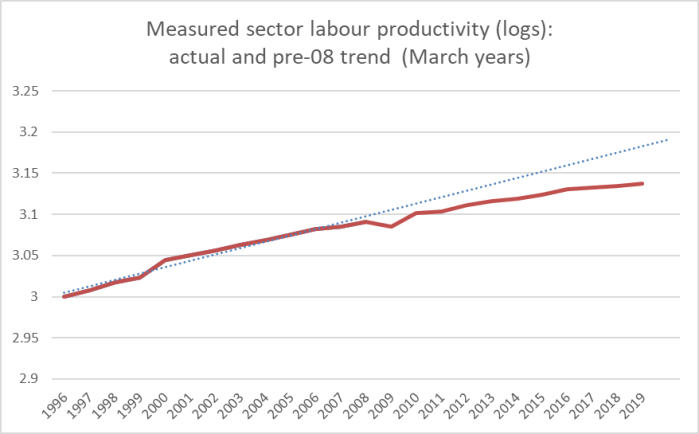
Statistics New Zealand last week released their annual measured sector and individual sector labour and multi-factor productivity data for the year to March 2019.  It isn’t data I tend to focus on, mostly because my interests are substantially in cross-country comparisons and also because my focus is whole-economy rather than on specific sectors and sub-sectors.  But it is still useful for thinking about productivity performance within New Zealand over time and we are now beginning to get a reasonable run of time series

(I can’t quickly find the official SNZ definition of the measured sector, but think of it in terms of what it isn’t (non-market bits of the economy like government administration).)

Here is labour productivity for the measured sector.  I’ve shown both the actual data (in logs) and the extrapolation of the trend line for the 1996 to 2008 period.

measured sector LP

The difference at the end of the period is roughly equal to 10 per cent productivity foregone.

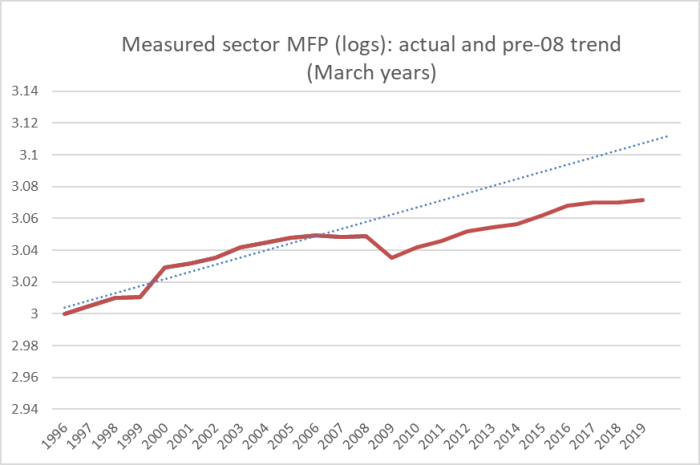
Here is the same chart for multifactor productivity (MFP).

MFP to 19

Those who are inclined to minimise New Zealand’s longstanding and ongoing productivity failures will, of course,  (correctly) point out that productivity growth in the advanced world as a whole has been slower in the last decade.    That might be some sort of excuse for countries at or very close to the productivity frontier –  best in pack.  It is no excuse at all for a country starting so very far behind the leaders (and, as I’ve pointed out here before, hasn’t stopped a bunch of eastern and central European countries –  often now about as productive as New Zealand, having been communist basket cases 30 years ago –  continuing to put in strong performances).

What about further disaggregated data?  SNZ publishes data/estimates for labour productivity for a wide range of individual sectors and subsectors, in many cases – making up what is known as the “former measured sector” – going back to the 1970s.   (Sadly, even if I run the trend line through the data all the way from 1978 to 2008, the gap around the last decade’s performance still looks stark.)

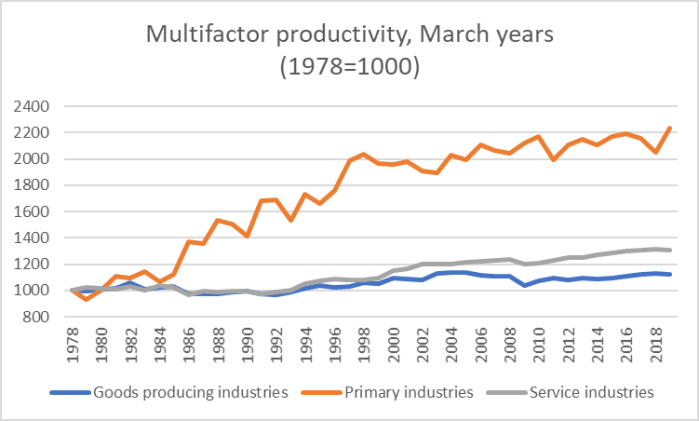
What about some more disaggregation?  SNZ show results for three high-level groupings: goods, services, and primary production.  The latter can be quite volatile (droughts and the like).  Here are the MFP numbers for those groupings.

MFP sectoral

The primary industries performance was pretty impressive –  doubling in twenty years –  but that good performance itself ran out more than twenty years ago now.    Within primary industries, agriculture itself still does quite well relative to productivity growth in the rest of the economy.

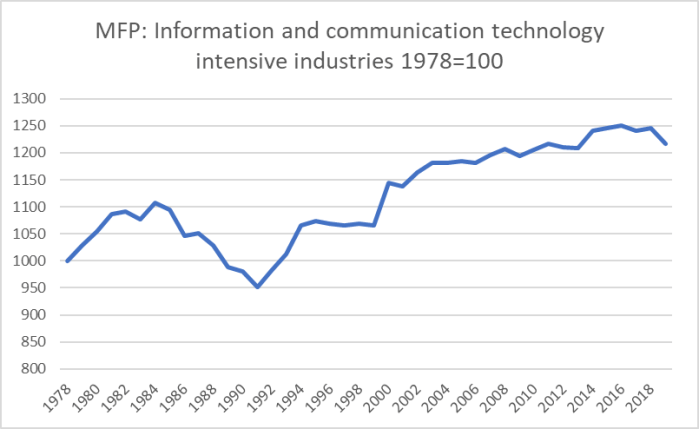
And finally a couple of charts on individual sectors.  Here is the MFP estimate for something SNZ call “Information and communication technology industries”

MFP tech

Not much growth this century   –  in fact, less than for the measured sector as a whole.

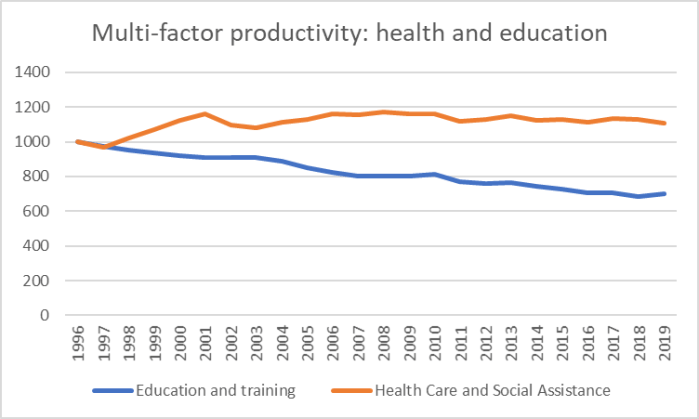
Then again, rather better than the performance in these two sectors.

health MFP

And for anyone interested, these are the six sectors with the highest (estimated) MFP growth over the last 15 years as a whole.

Per cent increase in MFP, last 15 years
Rental, Hiring and Real Estate Services 19.1
Forestry, Fishing, and Services to Agriculture, Forestry and Fishing 20.1
Textile, Leather, Clothing and Footware Manufacturing 27.1
Information Media and Telecommunication 33.4
Retail Trade 42.6
Wood and Paper Product Manufacturing 45.2

Quite a mixed bag.

Overall, however, the productivity performance of this economy remains dismal.  Sadly, there is little sign any of our major parties care.


Simply unfit

In yesterday’s Sunday Star-Times another article by their reporter Kate MacNamara shed further light on just how unsuited Adrian Orr is to be Governor of the Reserve Bank, exercising huge public policy and regulatory power still (in large chunks of the Bank’s responsibilities, often with crisis dimensions to them) as sole decisionmaker, with few/no effective checks and balances.  These disclosures should also raise serious questions about the judgement and diligence of the Board who were primarily responsible for Orr’s appointment and are primarily responsible for holding him to account, and of the Minister of Finance who formally appointed Orr, and is responsible now for both him and for the Board.

In this latest in her series of articles, MacNamara draws on the responses to one of several Official Information Act requests she had lodged late last year.  She had sought from the Bank copies of communications between the Governor and (a) the head of the financial sector body INFINZ and (b) Roger Beaumont the executive director of the Bankers’ Association (those responses are here), and copies of communications between Orr and the New Zealand Initiative think-tank, especially its chair Roger Partridge (responses here).    Her article draws mainly on the response re the New Zealand Initiative.

The context here is Orr’s (then) proposal to dramatically increase the volume of capital locally-incorporated banks would have to have to fund their existing loan books in New Zealand, disclosed in December 2018.    A wide range of commentators locally were critical of the Bank and many drew attention to the rather threadbare nature (at least initially) of the supporting material (it took three waves of releases over several months before we finally got the full extent of the Bank’s –  still-underwhelming –  case).   There had been no technical work preparing the ground, even though Orr was to be prosecutor and judge in his own case.  There was no serious cost-benefit analysis for what Orr was proposing, no serious benchmarking against capital requirements in other countries (notably Australia), no serious analysis of the nature of financial crises, and a strong sense that Orr wanted to compel us to pay for an insurance policy that simply wasn’t worth the price.    All this from an organisation where a recent careful stakeholder survey –  conducted by the New Zealand Initiative before Orr took office –  had highlighted very serious concerns about the Bank’s financial regulatory functions.    Meanwhile, Orr was already underway with his open attempts to cast anyone who disagreed with him as a “vested interest”, somehow “bought and paid for”.

Various people made public comments.  Among them was Roger Partridge, chair of the New Zealand Initiative, who had a column in NBR in early May critical of what was being proposed, and the processes used (at the time the Initiative was finalising its submission to the formal Bank consultation).    In my contact with Roger, he always seems much more interested in the substance and process of any issue.   But in a single decisionmaker model, it is a single person in focus.  [UPDATE: Here is a link to the “offending” column.]

Anyway, the Governor did not like Roger’s column at all.  Normal people who disagree might either let things wash over them (being in public life, exercising great power, not only does but should, bring scrutiny, challenge, and criticism).  Or perhaps you might even ring the author and have an amiable chat.  But not Orr.

The OIA release begins with Partridge emailing Orr after learning that Orr had rung the Executive Director of the Initiative had been “upset” by Partridge’s column.  This is a bit of a problem for the Initiative, as Orr is scheduled to speak at a private lunch for their members the next day, so Partridge offers up one of those semi-apologies (“if I crossed the line I apologise, but don’t resile from the criticisms of the policy process”), and even goes so far as to send Orr a copy of the remarks he intends to use to introduce Orr the next day (typical gush).

But that is not nearly enough for our thin-skinned Governor who replies to Partridge with a page and a half email.  All this after Orr had already talked to Hartwich both before and after a flight to Auckland they had both been on.   Just a slight loss of perspective and focus you might wonder?

And so we read (of his conversation with Hartwich)

I talked of the personal abuse I receive in this role. I also talked of the vested-interest driven articles that are prevalent and portrayed as analysis.

and

I do not accept your apology as it provides no reflection on your:
1. Stating I have a gambling problem.
2. Mocking our use of a Maori mythology to connect with a wider NZ audience – something we have been tasked by the public and stakeholders to do (I noted to Oliver this is a common thread of online abuse I receive from other purported banking/economic experts that go even further in ethnic/religious/personal comment).
3. Claiming below that you aimed to provide a robust critique of the proposal. You do not. You quote selective work of purported experts. You also pull only selected components of our submission process (which has stretched nearly 2 years).

From context, I understand that Partridge had said something along the lines that Orr was doing little more than gambling with his ill-supported capital proposal.  If so that seemed (and seems) fair to me, and would not to any reasonable person, with any sense of perspective, suggest they thought the Governor had a gambling problem.

I guess we are expected to just believe the lines about “online abuse” (and, who knows, perhaps I’m one of the people he is alluding to).

It goes on, before ending this weird way

I do not see your article as a robust critique. What I do see is ongoing character assassination, an undertone of dislike of the RBNZ, and a clear bias in economic and ethnic preference.

At the Bank we are open minded and working on behalf of all New Zealand and do so in a transparent manner.

See you tomorrow. The introduction looks fine. I will be professional and courteous towards your members.

Adrian

The person

But, of course, he is calm, open-minded, and –  apparently unlike any of his critics – only focused on the national interest.  And what to make of that “The person”?     If any upset junior staffer sent such an email to his/her boss, you might seek to get them some support and counselling.  But this was the most powerful unelected person in New Zealand, responding to a private citizen who happened to disagree with him.

(Of course, I can well understand why they didn’t do so, but in some respects it is a shame the Initiative didn’t disclose this correspondence at the time, so poorly does it reflect on a leading public official, making major policy decisions while clearly not coping.  I hope at least they referred the matter to the Minister and the chair of the Bank’s Board.)

Partridge sent another placatory email to the Governor, only to get yet another page-long missive

The behaviours displayed by your institution make it appear that it is a low chance that a well informed discussion where all parties come out better off could be ever achieved. We Remain open minded.

ending

See you later today. I will be professional and respect your members. I do not gamble.

There had been no mention of the “gambling” thing in Partridge’s email Orr was here replying to.

The rest of that OIA release is fairly uncontroversial stuff from 2018 on the release of the Initiative’s report that dealt with the Bank’s financial regulatory functions (the one the Governor claimed at the time to take seriously and welcome, although also the one he was rubbishing by late last year.)

What about the other OIAs?  It is mostly less egregious stuff.  But we have this odd example from a letter to the Executive Direction of INFINZ on 24 May 2019

For closure sake as promised, I mentioned to you at the event that I was disappointed with the process that you adopted in the preparation of a submission to our bank capital proposals. I did so as I want to be open and frank consistent with the ‘relationship charter’ we recently established with our regulated banks I read about your views first in your published op-ed and then via a newsletter you sent to INFINZ members. It was some time after that you met with RBNZ staff. The process created a perception of a predetermined outcome for the submission.

How shocking.  A private sector industry group first published its views in an op-ed and a newsletter and didn’t first talk to RB staff.      Quite who does the Governor think he is in objecting to that?

Even odder was this

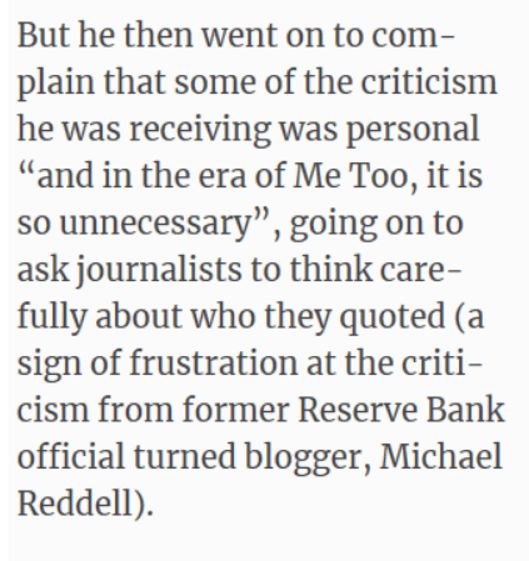
In the spirit of the ‘#me too’ commentary promoted at your awards evening, I have received personal written and verbal abuse from within the industry during this consultation process. For New Zealand’s capital markets to have the ‘social license’ to operate – another theme at your event – I believe the industry’s culture needs ongoing improvement.

As a reminder to the Governor, we don’t have lese-majeste laws in New Zealand, and certainly not for central bank Governors.   And as for this weird appropriation of the “#me too”  movement – mostly about the mistreatment of women by men in positions of power over them –  to apply to criticisms of a very powerful public figure…..well, weird is just the best term for it.

It wasn’t the only time he’d tried this line.  In a column late last year, Hamish Rutherford told us he’d even used it at a parliamentary committee

me too

Being in position of power, Orr’s complaints brought forward this response from the INFINZ Executive Director

We are concerned and disappointed that you have received verbal and written abuse from within the industry during the consultation process – bullying is not acceptable and we agree that all discussions should be both professional and respectful.

Quite how anyone in the industry –  or anywhere else for that matter –  could have “bullied” the Governor (who single-handedly wields all the power that mattered on the bank capital issues) is beyond me, but I guess INFINZ didn’t want to jeopardise their ability to get the Governor as a speaker etc.

The final set of OIA responses cover the Executive Director of the Banker’s Association.

The first was a Saturday morning email to Beaumont and the chairs of the four main banks in April.     It isn’t offensive and thin-skinned as he later became, but while the submissions are still open, he is clearly trying to put pressure on them

FYI only as I am eager you understand the effort we are going to in order that the Bank is open and listening.
This was not the impression you all conveyed to me over the last couple of weeks in our individual one-to-one meetings.

Only there is nothing in the rest of the letter to give anyone any reassurance.

In late May there is a letter (presumably emailed) from Beaumont to the Governor, copied to the Minister of Finance, about the “independent experts” the Governor had selected to help make his case.    The letter isn’t aggressive in tone but noted that none of the independent experts had New Zealand specific knowledge and suggest a couple of locals they could work with.

But this sparks a petulant email back from Orr, also copied to Grant Robertson

Dear Roger,
Your letter is unsigned. Can you confirm it is legitimate please? Apologies, one must be careful.

and

I do not understand the reason you have copied the Minister of Finance in to this dialogue. Is there something specific you are looking for from the Minister’s office that I need to understand?

Minister of Finance? Well, you mean the elected person with overall responsibility for economic policy, the person who has formal responsibility for your performance etc etc?

Recall, that all the stuff covered in the material that came to light yesterday is really just another glimpse at what was apparently a pattern of quite inappropriate behaviour.    From one of Kate MacNamara’s earlier articles

But other observers were not surprised. Details of [Victoria banking academic Martien] Lubberink’s experience were already circulating in Wellington and industry sources say they match a pattern of hectoring by Orr of those who question the Reserve Bank’s plan.

“There is a pattern of [Orr] publicly belittling and berating people who disagree with him, at conferences, on the sidelines of financial industry events,” said one source who’s been involved in making submissions to the Reserve Bank on the capital proposal.

There have also been angry weekend phone calls made by Orr to submitters he doesn’t agree with.

“I’m worried about what he’s doing.”

The source said some companies have “withheld submissions,” for fear of being targeted by Orr.

“They’re absolutely scared of repercussions. It’s genuinely disturbing,” he said.

We can only wonder what he was like inside the Bank or around his own Board table.

Does any of it matter, or is this simply the degraded state of public life we now have to get used to?  Age of Trump, age of Orr etc.

It should be utterly unacceptable, in any public figure, but perhaps especially so when that one public figure is (a) unelected, and (b) wields such huge discretionary power on far-reaching policy matters, with few/no checks and balances.   I was tempted to suggest that the individuals in receipt of these particular Orr missives are big enough to stand up for themselves, except that evidently they aren’t really –  Partridge, Hartwich, and McElwain find themselves rushing around the placate Orr.  That’s costly and uncomfortable: much easier just to pull your punches and offer less challenge or scrutiny next time the bully (for on his revealed behaviour it is him not his critics who better fits that description) wants to push through some half-baked costly idea.

The banks themselves will long since have gotten the message –  it was Orr’s predecessor who heavied the BNZ to shutdown Stephen Toplis when he wrote a critical commentary on some aspect of Wheeler’s monetary policy –  but the experience last year will only have reinforced that extreme caution.  Recall that Orr wields direct power over them in all sorts of way, visible and less so, and clearly does not cope with being challenged or criticised (no matter how many times he claims to be “open-minded”.   It is great that Kate MacNamara has kept up the scrutiny, but that will presumably mean no access: much easier for her fellow journalists to keep their heads down and not ask hard questions of the Governor and Bank (who –  news though it may be –  are not infallible).

And what about people inside the organisation?  Recall that on regulatory matters the Governor is still the sole decisionmaker, and on monetary policy he has –  in effect –  most of the clout, all of voice, and no real transparency.  It is vital that the Governor’s priors, whims, and even well-considered ideas are seriously scrutinised –  and even that the Bank sticks to its statutory roles –  but seeing the Governor treats outsiders, how are people inside the Reserve Bank likely to respond.  All but the most brave or reckless will be strongly incentivised to keep quiet, go along, join the cheerleaders etc.  In any public agency that should be grossly unacceptable, but particularly so in one as powerful as the Bank.  Orr has grossly abused his office, and looks increasingly unfit to hold it.

And if Orr gets away with it what message does it send to other thin-skinned bullies elsewhere in the upper ranks for our public sector, let alone to those who work for them.

And yet it looks as lot like Orr will get away with it.  Perhaps there was some quiet word in the hallowed halls of the Bank’s Board room, but these are the same people who selected the Governor less than two years previously. They are invested in his success, and they and their predecessors have a long track record of providing cover and defence for the Governor, not serious scrutiny and accountability on behalf of the public. This behaviour occurred in 2018/19 and there is no hint of concern in the Board’s published Annual Report.

If any of this bothered Grant Robertson, it can’t have been much.  You’ll recall that response I had late last year from Robertson, when I wrote to highlight his formal responsibilities for the egregious conduct highlighted in earlier MacNamara articles.  He then expressed his full confidence in the Board and suggested he was satisfied with the Governor too.     In the great tradition of “lets look after each other” Robertson has just appointed the Board chairman to a further two year term, even as he walked by such appalling conduct by the person he is paid to oversee.

(It is sad to reflect that much of the material covered here relates to events in May 2019.  That was the same month the then Secretary to the Treasury was also going rogue, grossly mishandling –  and then refusing to apologise for –  his handling of the “Budget leak” episode.    Doesn’t exactly instill confidence in the top tier of our leading economic agencies –  or the Minister responsible for both –  does it?)

Perhaps it is all in the past now.  Perhaps having got through the year, made his final decisions etc, Orr has returned to some sort of stable equilibrium and is operating effectively, rigorously, and deeply to provide leadership in difficult times.  Perhaps.  But even if that were so –  and that sort of Orr was not on display last Wednesday –  no one who can lose all perspective as badly as Orr clearly did last year, who simply cannot cope with serious criticism and scrutiny, simply should not hold high office here or anywhere else.  It is risky for New Zealand, it is dreadful for the reputation of the Bank, bad for the reputation of the New Zealand public sector, and reflects pretty poorly on our political leaders –  in government and Opposition –  who simply walk by, at least in public, such egregiously unacceptable conduct from such a powerful public servant (one who doesn’t even have the redeeming quality of being consistently rigorous, excellent and right to perhaps compensate in some small measure for his grossly unacceptable).


The Productivity Commission

Writing, somewhat critically, the other day about the latest Productivity Commission paper got me thinking a little more about the Commission itself.

I welcomed the decision to set up the Commission, partly in the backwash to the then-government ignoring and thens disbanding the under-resourced one-off exercise in focusing on New Zealand’s productivity failures, the 2025 Taskforce. But I’ve long been fairly ambivalent about what it has become, and unsure what the future might hold.

It certainly isn’t anything personal.  The longserving chair of the Commission, Murray Sherwin, was an old boss of mine and until recently we shared the misfortune of being trustees of the Reserve Bank staff superannuation scheme (he got off, I still serve penance).  They’ve run numerous interesting seminars over the years.  The people I’ve known there are smart and happy to engage.  In fact, I was just on their website and clicked on a piece I thought sounded interesting only to find that it was a link to one of my posts.

The Minister of Finance must also have had some doubts.  Papers just (pro-actively, but very belatedly) released show that shortly after the Minister took office he asked Treasury to conduct a review of the Commission, and they in turn commissioned David Skilling (independent consultant, now based in Singapore, and former head of the centre-left New Zealand Institute think-tank) to write a report.   Remarkably, the Commission itself was not invited to provide input –  and perhaps was not even aware the review was going on, since were it aware it would surely have provided input pro-actively.    The Commission seems only to have been invited to comment on the final Skilling report, completed in June 2018.   That seems a strange way to treat an agency that wasn’t evidently dysfunctional, was headed by a respected former senior public service chief executive and which at the time had a respected former Secretary to the Treasury as another of its longserving commissioners.   Even if Graham Scott had once stood for Parliament on the ACT list, no one has seriously accused the Commission of being partisan (and if anything their inclinations often seem to lean in the direction of “smart active government”, of the sort centre-left parties have often favoured, with too little emphasis on “government failure”).

None of which is to criticise the Skilling report. I found it clarifying in a number of places and was pleasantly surprised to find myself agreeing with the bulk of his recommendations.  He draws extensively on some recent OECD work reviewing institutions in various countries trying to do things somewhat similar to the Productivity Commission, with a focus –  consistent with the emphasis of his consultancy firm – on small advanced economies.

As Skilling notes, the explicit model for our Productivity Commission was the Australian Productivity Commission, at the time a very highly-regarded body.  But Australia is a much bigger economy than New Zealand’s (big economies tend to have relatively smaller export sectors), and although still some considerable way from global productivity frontiers, has nothing like the economywide challenges facing New Zealand.  And there is the not-insignificant issue of resourcing: there aren’t that many economies of scale in policy analysis and associated research (policy issues are just as complex in fairly large as in fairly small countries) and yet our Productivity Commission has perhaps 20 staff, while the Australian Productivity Commission has about 170.   That allows for a much greater depth and specialisation than is possible at the NZPC, no matter how able the individuals here might be.

Skilling usefully highlights that the Productivity Commission is not really focused on economywide productivity at all (“bluntly, it is a misnomer”).  Rather, and rather like the Australian counterpart, it is really a detached (from day to day political pressures, or even just the immediacy of the urgent) policy advisory group on specific topics that take the fancy of ministers from time to time.  Sometimes those are really important issues, other times they have the feel of topics it is good to be seen having someone doing, or even (the current “future of work” inquiry, which there are signs the Commission has struggled with) just as –   in effect –  a research resource for a political party’s next election manifesto.  To be clear, topics are chosen by ministers, not by the Commission.

This “chip away at bite-sized topics” approach seems to have been deliberate.  After all, the previous government (which set up the Commission) had no interest in serious reform on the sort of scale that made have made a really significant difference.  2.5 years in, neither does the current government.

It is an approach that probably makes a lot of sense in a country that was already at or near the global productivity frontiers.   Whatever challenges you face in Belgium, Netherlands, Sweden, Denmark (let alone Norway) –  and there are always areas where specific policies could be improved –  you know that your overall economy (productivity) is already about as good as it gets anywhere.  That simply isn’t the New Zealand situation: you’ll recall I’ve highlighted previously that it would take a 60 per cent lift in average labour productivity in New Zealand to match that leading bunch of countries.

Here, the approach taken to the Productivity Commission ends up serving as a distraction.  There is a pretence of an institution devoted to the issue, to taking the whole thing seriously, but not the substance.  If the Commission is to be kept as it now operates it might better be renamed, more prosaically as something like the Medium-term Microeconomic Advisory Group.  But even then there is a real problem, in that because there is no sign that the Commission has a shared narrative, or model, of the bigger picture economic underperformance, causes and broad remedies, it is often hard to have much confidence in the specific recommendations they throw out, and whether they should be priority areas for a government interested in change.  It also means they have no consistent framework underpinning their public communications.  (There was a narrative document published a few years back –  which I wrote about here –  but it was still exploratory in nature, and although it was owned at the time by the Commission, it seems to have been more the thinking of the author, who has now left the Commission.)

This issue has become more stark over the years.  When the Commission was set up there were two separate allocations of funding by Parliament: 90 per cent of the total funding was for specific inquiries initiated by Ministers, and the remaining 10 per cent was for the Commission’s self-directed research programme and related activities.  That formal split, in parliamentary appropriations, has been discontinued, but in the context of a flat overall level of funding (the total level of funding is unchanged over 9 years –  a period in which there has been not-insignificant total inflation), it is likely to be the discretionary activities that get squeezed.

As the Commission’s last Annual Report noted

The 2018-19 year ended with an operating deficit of $98 000, our second successive year with a deficit. The Board has been acutely aware that with rising costs, especially from remuneration costs, and an appropriation unchanged since the Commission commenced operations in 2011, we would eventually reach a point where spending would run ahead of our appropriation. In early years, our budgets provided for surpluses in order to build a small buffer of reserves. But we clearly face a decision about reducing costs and outputs should our business case for additional funding be unsuccessful. Decisions on funding will take place within the context of the review of our operations.

and

Given resource constraints we were no longer in a position to facilitate the Productivity Hub nor provide support to the Government Economics Network.

and

It has also been suggested that the Commission should have greater capacity to undertake wider ranging productivity-relevant research, exploring the nature, sources and characteristics of New Zealand’s poor productivity performance.   Our capacity for such research remains limited. ….our capacity to pull resource away from our inquiry teams is quite limited. To provide more research output requires either an increase in funding or a reduction in inquiry outputs.

Of course, one challenge is that a generalist policy analysis function (essentially what the bulk of the Commission is doing) and something seriously focused on getting to the bottom of New Zealand’s longrunning economic underperformance might not sit that naturally together in the same small semi-detached organisation.

As all prudent government agencies must these days, if they want to impress ministers, they wave the flag for “wellbeing” (this from the front of the Annual Report)

NZPC wellbeing

Perhaps they will secure some more funding in this year’s Budget (though more policy advice might not be an election year priority).

Skilling’s report had four recommendations:

  •  a greater focus in inquiry topics on the external facing tradables sector of the economy (noting the centrality of outward-facing sectors to successful small economies)
  • a more structured inquiry selection process, with more emphasis on criteria relating to economywide productivity,
  • more flexibility in inquiry formats,
  • more public reporting and analysis on overall productivity performance issues, including international benchmarking.

I generally agree (and will take the opportunity to note one of his suggestions for a specific area that would repay further work from the Commission:  “important domestic issues, such as the impact of migration (and population) on New Zealand’s productivity performance”

But you can’t help thinking that there are severe limits on the value of any such agency (or any long-term thinking in major economic ministries such as The Treasury) unless and until some political leadership rises up that really wants to deliver something different for New Zealand, that takes seriously dealing with our economic failure.  Of course, in an ideal world if/when that time ever comes those political leaders would find a rich and deep literature –  from the Commission, from academics, from government agencies, from other researchers and commentators –  on the issues and options for change.  But why would politicians who are themselves indifferent want to spend much money on things they would do nothing with?

Part of my long-term pessimism about the Commission –  quite independent of any individuals involved –  involved reflecting on the fate of past New Zealand efforts and agencies.  There was the Monetary and Economic Council, and then there was not.  They produced some interesting reports in their time, but didn’t last much more than a decade.  Same goes for the Planning Council, some of whose papers are still worth reading.  What will make the Productivity Commission different?  One difference is that it has its own act of Parliament, but that just means that it could be left to wither on the vine, funding gradually squeezed, good people no longer wanting to work for it, before one day someone tidies thing up and abolishes it.   It does not have critical mass, it does not have specialist expertise (those generalist economic policy analysts instead)…..and there isn’t really much evident political appetite for excellent policy or the supporting analysis (even on the occasions –  not always –  when the Commission has delivered such).  And if there were such an appetite, a revitalised Treasury would have the institutional incentives to seek to become the key provider (and in a small public sector, their arguments wouldn’t all be wrong).

There will be an interesting test just a little way down the track.  Murray Sherwin’s second term as Commission chair ends next January and the government will need to find a replacement.  The sort of person the government chooses (whoever is in government by then) could be quite revealing about the sort of future and role they see for the Commission.  Sherwin is a very smooth and effective bureaucratic operator and effective manager –  well-equipped for the sort of role the Commission has largely come to occupy – but if any government were serious about a greater focus on whole economy underperformance they’d probably have to be looking to a different sort of person to either Sherwin or to the other existing commissioners (able as they each no doubt are).  I’m not holding my breath.

Coronavirus and the OCR

A month ago there were no commentators suggesting the OCR should be raised at the next review.   Since then we’ve watched day-by-day as the news about the coronavirus (now named “SARS-CoV-2” and the disease it causes “COVID-19.”) has got relentlessly worse.   Against that backdrop, the case for an OCR cut today looks pretty unanswerable. Not because an OCR cut will make any material difference to March quarter GDP – it won’t –  but because the job of discretionary monetary policy is to lean against demand shocks, positive or negative, so long as inflation is well in check.

As I noted the other day, core inflation hasn’t got as high as the target midpoint for the whole of the last decade.  In that context, when there is a clear-cut (if not readily calculable) adverse demand shock, the Monetary Policy Committee would be remiss if it simply sat on the sidelines today, suggesting that they would merely be “watching closely” and be ready to act down the track.  In the current macro climate –  quiescent inflation, flat or falling inflation expectations –  there is simply no downside to acting now.    There is no particular virtue in instrument stability: the instrument exists to lean against macroeconomic instability (doing what it can to maintain “maximum sustainable employment”, in the current jargon).

Even a couple of weeks ago one might perhaps reasonably have reached a different view.  But now we have Chinese inbound tourism cut to almost nothing overnight (first as a result of Chinese restrictions and then our own), and confirmation from the universities that perhaps 60 per cent of their PRC students are still out of the country and unable to travel here.    We have much the same situation in Australia, a key economy for us, and in China itself –  one of the world’s largest economies –  huge economic disruption, and a spreading range of restrictions on movement, social gathering etc etc.  We see photos of largely empty streets or public transports in big Chinese cities that aren’t locked down, quite limited returns to work after earlier shutdowns, and so on. From Hong Kong there are reports of more cases, but again the bigger impact is probably people staying home, avoiding social gatherings etc.  Investment banks doing business in China –  ie quite severely constrained in their freedom to run negative lines –  have been marking down their 2020 Chinese and global economic forecasts.  Even the WHO –  which previously presented as relatively complacent – is now talking of this as

WHO chief Tedros Adhanom Ghebreyesus told reporters in Geneva the vaccine lag meant “we have to do everything today using available weapons” and said the epidemic posed a “very grave threat”.

“To be honest, a virus is more powerful in creating political, economic and social upheaval than any terrorist attack,” Dr Ghebreyesus said.

“A virus can have more powerful consequences than any terrorist action.

I’ll leave the florid rhetoric to him, but if there was a good case for cutting the OCR after the 9/11 attacks and after the February 2011 earthquake (and I think there was) that case is at least as persuasive –  compelling in my view –  now.

It isn’t really clear to me why, faced with a decision to make today (not, say, a week ago as with the RBA), anyone would favour not cutting the OCR.   The OCR (monetary policy more generally) is designed to be flexible and responsive (easing and, if warranted later, reversing such easing).  The OCR isn’t about support for individual adversely affected sectors –  if that is really needed in some areas it is a fiscal policy/government matter –  but about stabilising the overall economy faced with (in this case) clear negative shocks.  The tool is fit for purpose.

One argument sometimes heard is that we shouldn’t do anything because things are so uncertain.  But that argument should run exactly the other way round. The high degree of uncertainty, which is probably now rising by the day, is exactly the conditions in which people put off spending, put off travel, are a bit warier about eating out, and so on. It represents a likely material adverse demand effect on top of the specific channels (tourists, students) we already knew about.  Think of travel.  You might have been planning a business trip into Asia.  You might be happy enough to go today, and yet you look ahead and wonder what things might be like when you want to get home again, let alone what conditions might be like if somehow you got sick.  I reckon we’ll see an increasingly number of non-essential trips postponed, whether business or leisure.  And that won’t be so just in New Zealand.   With each passing week, we’ll also see more spillover effects into spending elsewhere in the economy and the confidence surveys –  whatever we make of them –  are likely to take a hit.

There is also the argument that things will snap back once the virus is behind us.  No doubt that is the most sensible assumption, but an increasing number of commentaries are noting that a full snap back isn’t likely to be a matter of a few weeks: it seems increasingly likely that the level of economic activity over much of this year, in much of the world, will be weaker than otherwise –  perhaps not a lot by the end of the year, but that is still 10-11 months away.    And assuming things will simply snap back risks being a recipe for doing nothing with monetary policy when it was actually needed (there are plenty of things forecasters think will be shortlived, but turn out to drag on rather longer).

I’ve also heard a story that the Reserve Bank cutting the OCR by 50 basis points last August may have instilled in some a sense of unjustified worry, becoming a bit of an own goal. Is there a risk of something similar now?    First, the August cut wasn’t well-handled.  It may have been substantively justified, but was poorly communicated and was not clearly tied to specific and very visible adverse developments here and abroad.  As it happens, I don’t think the “own goal” effects, if they existed at all, lasted for long at all (little sustained evidence in eg confidence surveys).    What about a move now?  Sure it would be unexpected, in that surveys of economists were all picking no change.  But (a) those surveys were often done a week or more ago, (b) economists generally aren’t asked what they think the Bank should do, and (c) there is a very clearly identified adverse event, which every commentator will be focusing on.  It would be quite easy for the Bank to credibly justify a cut today, specifically tagged to the coronavirus (and referring to 9/11 and 2011).  And if in doing so the Bank raised a bit more public consciousness of the mounting economic issues, it would probably be no bad thing anyway.

Perhaps the final caveat I’ve seen is that global equity markets seem quite surprisingly sanguine.  If they aren’t pricing something quite bad –  or even high risk – why should central banks react?  It is a fair question.  One answer is a matter of different time-horizons.  Equity markets are pricing earnings prospects over the life of the firm, while central banks are (by design) supposed to be focused more on the short-term.  A few bad months might not rationally affect the value of most firms much, but might still warrant lower policy interest rates. It is just a different game.  But it is also worth noting that New Zealand markets are pricing an OCR cut by the end of this year.   If it is needed, and likely to be useful, in a coronavirus context, it is much more useful –  and more likely –  frontloaded.

Time (not long now) will tell what the Monetary Policy Committee decides to do.  I am encouraged by two things: first, was the MPC’s willingness to act decisively last August (even if the accompanying communications etc were hamfisted) on much less clear-cut evidence, and second by the fact that one of the external members of the MPC (retired economics professor, Bob Buckle) was heavily involved in The Treasury’s early work on pandemic economic effects last decade.

Whatever the MPC chooses to do, the Reserve Bank has introduced an interesting new exercise in transparency.  If you are on Twitter you can ask the Bank directly a question during the press conference this afternoon.

Product market regulation

Writing yesterday about the Productivity Commission’s draft report on why firms don’t invest more (in “technology”), prompted me to take a look at the OECD’s Product Market Regulation (PMR) indicators.    In the OECD’s own words

The economy-wide PMR indicators measure the regulatory barriers to firm entry and competition in a broad range of key policy areas, ranging from licensing and public procurement, to governance of SOEs, price controls, evaluation of new and existing regulations, and foreign trade.

There is both a summary economywide indicator (the focus here) and a range of detailed component indicators and sectoral indicators.   As always with cross-country attempts to assess policy, the indicator(s) won’t be perfect, but such indicators can still shed some light on differences across advanced economies and across time –  the OECD has published the data every five years starting in 1998.

Here are rankings for 1998.  (On this measure, the lower the score the less burdensome -or whatever your descriptor – the product market regulation is.)

PMR 1998

In the wake of those numbers, when people talked about the productivity performance in New Zealand you’d often here something like “well, our business regulation is less burdensome than almost anywhere in the OECD” so (among the optimists) gains will follow or (among those less sanguine) whatever the big issues are they seem unlikely to be those relating to product market regulation.   A few years on we were still 2nd (in 2003) or 3rd (in 2008).

But by 2013 we were only ranked fifth.  Perhaps not disastrous, but some slippage evident.  And here are the 2018 numbers, fairly newly released (data for two countries still not there) assessing things as they stood on 1 January 2018.

pmr 2018

That is now a pretty unambiguous drop back in the rankings.   And three former Communist countries now beat us, with another two just slightly behind.

And it isn’t as if New Zealand has just been improving a bit more slowly than the rest of the OECD.  Here is the absolute score for New Zealand and for the median OECD country (no material differences if I used just the subset of countries for which there is a score on all five dates).

PMR 3

We’ve gone backwards, in absolute terms, since 2008.

I get quite a few comments whenever I write about productivity, suggesting that the web of regulation has been more constraining and all-encompassing over the years.  I have a fair amount of sympathy with many of those comments, even while doubting that such regulations will explain much of our poor productivity performance.   But in the PMR indicator we score poorly in a quite different area of government involvement.

The OECD publishes the data broken out into two “high-level indicators”.  One is “Barriers to domestic and foreign entry” and the other is “Distortions induced by [direct] state involvement.   Here is how we did in 2018 on the first of those.

PMR 4

Not too bad I suppose –  5th equal, and very close to the couple of countries just above us.

But here is the other high-level indicator

PMR 5

In turn, there are four sub-components to public ownership bit of this high-level series, and on each of them we score less well than the median OECD country.

PMR 6

On the “involvement in business operations” sub-components of the “distortions induced by [direct] state involvement high-level indicator we are the OECD median on one, and do a little than the median on the other two.

Of the other sub-components in the overall indicator, there were six where New Zealand scored materially differently than the median OECD country: three better, three worse.  Of the “worse” ones, only six countries score worse than New Zealand, and on the FDI one (and I know the interpretation is contentious) we score worst of all: none look like the sorts of areas a small economy, with persistent current deficits, should aim to score poorly.

New Zealand Worse
Assessment of impact of regulations on competition
Complexity of regulatory procedures
Barriers to FDI
New Zealand Better
Admin requirements on new companies
Barriers in service sectors
Treatment of foreign suppliers

One could go playing around in the relevant spreadsheets (economywide, and the additional sectoral ones) at great length.  Perhaps I will come to them in another post next week.

One can also debate just how much regulatory and state intervention poor scores really matter in terms of overall economic performance.  It is no doubt easy to point to any of the sub-components and find some highly successful country scoring poorly.  But when you are starting as far behind the leaders as New Zealand now is, then even if regulation and state control issues –  of the sort captured here –  aren’t the key factors, if we are serious about improving productivity we should be doing whatever we can wherever we can to provide a more facilitative climate for firms to prosper on their merits.

UPDATE: An OECD economist, in comments below, has helpfully drawn my attention to some methodological changes in the 2018 PMR which mean that scores cannot be compared (reliably) across time (the 1998 to 2013 ones should work, but there is a discontinuity to 2018).   I think her comments leave most of this post looking okay (the relative rankings should still be meaningful, and the identification of where we now do poorly) but one should be a little cautious about the time series chart (noting, however, that the trends I was highlighting were already apparent by 2013).

The Productivity Commission again

The Productivity Commission looks into topics the government of the day asks them to.  The current government asked for a report on issues around the “future of work” (a favoured topic of the current Minister of Finance when he was in Opposition) and the final report is due out next month.

The Commission has released a series of five draft reports looking at various aspects of the issue.  Late last year I wrote quite critically about one of those reports in which the Commission championed the case for a larger and more active welfare state, claiming that by adopting such policies New Zealand’s productivity performance might be improved.  As I noted

What it boils down to, amid various reasonable insights, is a push for a much bigger welfare state, allegedly in the cause of lifting average New Zealand productivity (and sustainable wages), without a shred of evidence or careful considered analysis connecting one to the other.    It is the sort of thing you might expect a political party to come out with –  the Labour Party conference, for example, is meeting shortly –  but not so much independent bureaucrats supposedly focused on productivity.

It was one of the less impressive pieces I’ve seen from the Productivity Commission.

Just recently I noticed the Commission announcing the release of the last of its draft reports.  I was a little surprised that they were allowing only just over two weeks for submissions (they close next Monday if anyone is interested).  When I finally read the latest draft, “Technology adoption by firms”,  I was less surprised: there was very little of substance there (including only about 20 pages of core text).  There was, of course, a summary recapitulation of the argument that people who lose their jobs should get from the state.

Beyond that, and as often with the Commission, there were some interesting perspectives and charts.   They have apparently had some new research done (as yet unpublished) on the implications of land-use restrictions for worker mobility, and there are a couple of charts from that forthcoming paper but (a) it is hard to know what to make of them without seeing the underlying paper, and (b) there is no sign they done anything cross-country thinking on the issue (bad as land use restrictions often are, it seems unlikely that they explain much about New Zealand –  or Auckland –  economic performance relative to Sydney, London, San Francisco, Hong Kong or wherever.  It is a hobbyhorse cause of the Commission’s – and one I mostly agree with them on –  but the case for a strong connection to New Zealand aggregate productivity performance is poor (and our labour market functions pretty well as it is).

Of course, since the focus of the paper is on firms (mostly private entities) and the question seems to be why those firms operating in New Zealand don’t invest more heavily in technology (or, I suppose, why there aren’t more such firms), the answer surely has to be (when all boiled down) “because the risk-adjusted returns to doing so don’t seem sufficiently attractive”.    And yet I don’t think that line appeared at all.  Nor, therefore, is there any sense that we should assume firms, and their owners, are already doing what is in their own economic best interests.    If so, the focus should be less on individual firms – although perhaps case studies can sometimes enlighten –  and much more on the wider economic policy settings (and any exogenous constraints- remoteness possibly being one of them).

Some regard for history might be helpful too. The Commission suggests on a couple of occasions that policy stability can be important, which is no doubt true in the abstract, but might offer less than they suggest in a country where economic policy has been pretty stable for most of the last 25 years, but that particular stable policy regime has not been accompanied by good economic performance.  Materially different and better outcomes are likely to require some quite different policy approaches.

Instead, what they have to offer is really not much more than a grab-bag, not supported by much.  Perhaps it was telling that of the two case studies mentioned in boxes in the draft report, the one on Weta never mentioned the massive taxpayer subsidies to the industry/firm, and the other Zespri never seemed to mention that export monopoly Zespri has, even though the Commission has often pointed to the importance of competition and easy entry and exit.

At the policy level, it was notable that three whole-economy variables/tools did not get a mention at all.  There was no mention of the real exchange rate, even though ours have unfolded this century in ways quite out of step with productivity growth differentials.  There was, as far I could see, no mention of company tax rates, even though ours are now quite high by international standards, particularly as they affect overseas investors.  And despite the scale of New Zealand migration, there was no mention –  good or ill –  of how the system might be affecting firm incentives to invest.    Foreign investment doesn’t even get much of a mention, other than to note the way the recent foreign buyer restrictions might be limited new housebuilding.

And of what was there was fragmentary at best.   Thus, we are told that “increasing emissions prices” “would encourage technology adoption by firms”.   Quite possibly so, but with no way of knowing whether the resulting technology adoption would be good for the economy or otherwise (one of the Commission’s messages is that we should embrace technology to lift material living standards).  Higher minimum wages can also encourage “technology adoption”, as firms try to substitute away from the now artificially more expensive input.  All sort of regulations can require investment in new technology, but that isn’t –  simply by assumption –  a good thing from a living standards/productivity perspective.

We are also told that strengthening something called the “national innovation system” would help, but  –  as was the case when the government brought back R&D subsidies –  no serious attempt to analyse why the returns to private firms to invest more heavily seem to be not-overly-attractive (when there are other countries, without subsidies, that see high private R&D spending).

We are told that targeted government intervention can have a role.  At times you get a sense that here they are pandering to the government, citing the “industry transformation plans” that are currently in the works (actually, I hope they are pandering there). But they go on to attempt to spell out examples of “successful targeted interventions” in New Zealand’s history.  Their first item is “industry training” –  it is no more specific than that, so I can’t quite tell what they mean.  And the second is this

encouraging technology development, diffusion and adoption in New Zealand’s agricultural industries (eg, the establishment of experimental farms, a “farm extension service” to spread good practice, and research institutions such as Lincoln Agricultural College, Massey University and the Department of Scientific and Industrial Research)

Even if you thought these were all success stories –  I don’t claim the specific knowledge to know –  they date from 100 years ago (DSIR founded in 1926) or even 150 (Lincoln founded in 1878).   It isn’t exactly a compelling narrative of modern “targeted interventions”.

Much of the rest is similarly scattergun in nature.  I’d happily see some regulatory reform around genetic modification, perhaps there is a case for competition policy changes (but the Commission doesn’t really claim to know –  “competition laws have not been fundamentally reviewed to assess their suitability for the digital age”).  Perhaps legislation around “consumer data rights” has a place, but they don’t seriously attempt to link this to obstacles to business investment.  And so on.

It isn’t that I think most of the specific policy suggestions are wrong –  some may be, most probably aren’t, some I’d support quite strongly –  but that they are little more than grab-bag of favoured measures, not well-grounded in any compelling narrative about New Zealand’s economic underperformance, and the obstacles to matching our strong labour market performance with a highly productive overall economy.  The Productivity Commission has been around for almost 10 years now, and we really should have been able to hope for more.   But I guess some of the issues get awkward (for Commissioners and their masters) and politically uncomfortable, so it is easier to play at the margins.  Amid the championing of personal political/policy preferences, there will probably be the odd bit of interesting analysis, perhaps some useful peripheral reforms, but the core challenges will be no closer to being addressed.

But then it isn’t as if the Prime Minister and Minister of Finance want anything much different –  unless some magic fairy dust somehow conjured up better outcomes –  and there was that sadly telling quote the other day from the man who would be Minister of Finance.

How will doing more of what we’ve done for the past three decades finally make us wealthy? I asked. Goldsmith offered no explanation.