Why the OCR should be cut substantially

I’ve seen a few people on Twitter, typically not economists, casting doubt on the case for an OCR cut.  Twitter isn’t really a suitable medium for serious engagement on the substance of such issues, so here is a short(ish) post, articulating a case that (I suspect) will seem pretty obvious, on most counts, to most readers.  I almost wrote the title to that post as “why the OCR should have been cut substantially”, but actually, and even though I thought the cut should have come in February, the actual announcement matters less than the confident expectation that the right thing will be done at the next scheduled opportunity.  Markets largely trade on expectations, even if short-term retail rates mostly move on announcements themselves.  Right now, it is the Bank’s talk –  see my last two posts –  that bothers me more than that the OCR is still at 1 per cent.

Why should the OCR be cut substantially?

  • because inflation expectations have already been falling (reflected in the bond market and in the ANZ business survey) leaving short-term real interest rates higher than those at the start of the year.   Faced with the facts of this year in early January, no one would have prescribed higher real interest rates as part of the appropriate policy mix.
  • almost certainly neutral short-term interest rates (consistent with being at the inflation target with full employment) have fallen considerably in recent weeks/months.  A useful way of thinking about monetary policy is that it needs to involve at least keeping pace with changes (estimated only) in the short-term neutral rate.   How large has that change been?  Well, one low-end estimate could be obtained by looking at the inflation-indexed government bond market.  Very long-term interest rates won’t be much influenced by how much markets think the Reserve Bank will do this month or next.  So take the 20 year indexed bond and the 10 year one, and you can back out an implied 10 year real interest rate for the ten years 2030-2040.   Even that yield has fallen by 30 basis points since the end of last year, and most everyone would expect coronavirus no longer to be much of a factor.  For the five years from 2025 to 2030, the implied real yield has also fallen 35 basis points.
  • add these sharp falls in long-term real rates to the drop in inflation expectations, and then bring the next year or two into the mix, and it is pretty easy to mount a case for a 100 basis point cut in the OCR.  (In fact, if we were starting with an inflation target centred on 5 per cent and an OCR of 4 per cent (instead of 2 per cent and 1 per cent) almost certainly that is what would have happened by now.  In periods when there is a very sharp fall-off in activity, or a huge surge in uncertainty, you cut the OCR early and decisively.  I suspect fear –  the limits of conventional monetary policy and a lack of conviction in the limited unconventional instruments –  is probably afflicting more than a few central bankers, not just in New Zealand, making them nervous of the limits being shown up.)  If the OCR was roughly in the right place at the last review pre-coronavirus, it is simply inconceivable it should now be anything like as high as it was then.  And yet it is.
  •  a common argument is that an OCR cut won’t do much to demand now.  And I agree. In fact, in some respects it isn’t even obvious we should want to boost some forms of domestic demand now –  more people going out socialising etc.  The scale of the disruption and dislocation we will face in the next few quarters is almost entirely independent of what monetary policy does (any monetary policy effects will be swamped by the scale of the real shock).  But it will, all else equal, ease debt-servicing burdens for both firms and households –  and you’ll have noticed that binding cashflow constraints is one of the prominent themes under discussion at present.   Consistent with the previous point, time has very little value now (materially less than a few months ago) and, at the margin, people (savers) shouldn’t be rewarded for that time, borrowers (on floating rates) shouldn’t be paying for it.   Will people say that is tough on retired savers?  I’m sure they will.  But, tough.  There is huge income loss underway, and “valid” returns to financial savings are just lower than they were for the time being.  It won’t last for even, but it is some of the loss-sharing that needs to happen.
  • looking ahead, whenever the worst of the crisis is over lower interest rates will do the usual job monetary policy does and support a recovery as fast as feasible.  And we shouldn’t wait and cut then for at least two reasons:
  • the first is the exchange rate.  All else equal a lower OCR will lower our exchange rate (failure to lower the OCR will tend to hold it up).  International trading conditions have become very hostile in aggregate and a lower real exchange rate is a natural and normal part of the buffering process.  And despite Christian Hawkesby’s claim (in his interest.co.nz) that the exchange rate is now low, the extent of the fall so far is small by the standards of typical New Zealand recessions: we aren’t getting any interest rate buffering and we aren’t getting much exchange rate buffering either.
  • the second is about inflation expectations.  Core inflation is likely to fall. Headline inflation is also likely to fall (oil prices).  Inflation expectations have already fallen and are likely to fall further.   When interest rates are getting near the feasible lows, the only prudent thing to do is to act aggressively to leave no doubt in anyone’s mind –  markets or public –  that the authorities are doing everything possible to keep core inflation near 2 per cent.  If they don’t convince people, the road to recovery will be harder and slower.  It was the very argument the Governor was using briefly last year when he noted that the risks were such he’d rather inflation ended up above 2 per cent than risk that downside trap.
  • we can still cut materially.  The ECB can’t do much on that score at all, and several other advanced countries are also very constrained.   But we can.  We need to for ourselves, and we also do our (little) bit for the world.
  • it is what you do with a significant adverse demand shock.  In fact, in a standard Taylor rule guidance, it is even what you do with supply shocks that raise the unemployment rate relative to the NAIRU (as this one certainly is) –  I thank an academic for reminding me of this further hole in the Bank’s reasoning.
  • other countries have.  Not all of them – even those who could –  but the UK, Australia, the US, and Canada have.  Perhaps they are wrong, but they are all experiencing very similar shocks, and it is a bit hard to see why Adrian’s judgement on this would be so much superior to those of his peers.  Wisdom of crowds and all that.
  • there is no conceivable downside to cutting the OCR aggressively now.  We aren’t starting with core inflation even at target, let alone above.  In fact, it hasn’t been at or above for a decade.  So at worst, the lower OCR has no effect at all on anything above (very unlikely, since at very least it will alter servicing burdens in a useful, slightly stabilising way).  Or, it works remarkably and astonishingly well, so much so that core inflation surges above 2 per cent.  After the record of the last decade and the threat to expectations, I can only really accentuate the Governor’s message from late last year and say “if so, bring it on”.
  • OCR cuts are easy to reverse when/if warranted, not relying to anything like the same extent as most temporary fiscal measures do on having a secure view of the period over which support will prove to be needed.  It should barely need saying, we have no idea of that now.

And I haven’t even mentioned tightening credit conditions, rising risk spreads, rising cost of equity capital etc.  It really is one of those times for “all hands to the pump”, even recognising that come what may the economic times ahead are going to be difficult and costly and any macro (or microeconomic) policies are going to make only a limited  – but better than nothing – difference for now.

I was just re-reading the post I wrote on the morning just prior to the last OCR decision, making a quick summary case for a cut then.   Most of it still reads pretty well, even if –  like everyone (well, certainly every economist) then, I was grossly underestimating the severity of just what was –  and is – still unfolding.


Almost literally unbelievable

Our central bank that is.

Except that I had to believe it.  The Governor himself was being quoted again in a Stuff article and the video footage of a full interview with his deputy (on the economics and markets side) Christian Hawkesby was on interest.co.nz.

On Tuesday, as I wrote about in my post yesterday, we had the Governor telling us that monetary policy would have no more than a supporting role –  despite being the main cyclical stabilisation tool – that there would be no “knee-jerk reactions”, that we were in “a good space” and  –  perhaps most incredibly of all –  that “confidence and cashflow will win the day”.  Confidence that had tanked, cashflow that was rapidly becoming a problem for many.  It was –  or one really wished it was –  unreal.

But Orr and Hawkesby –  both statutory officeholders charged with the stabilisation role of monetary policy –  were back at it yesterday.  Clearly, the Governor’s voice is most important –  especially with no deep or authoritative figures elsewhere on the MPC –  so we’ll take his new comments first.

Not all of it was silly.  There was the standard advice to firms to talk to their banks early (I imagine that, where they still can, firms might be well advised to draw down any credit lines early too).  But then we get lines like this

Reserve Bank governor Adrian Orr has advised businesses to focus on things they can influence and banks to consider their “social licence” and play a long game to bridge the gap in activity created by the coronavirus pandemic.

“That is it all it is, just a gap,” he said.

Talk about minimisation.  If a firm takes a deep hit to its revenue for six or nine months, and has fixed commitments it can’t get out of at all, and other semi-fixed commitments, what was a viable business can quickly run through any remaining collateral and not be viable at all (the underlying business might be, but not the existing owners).  So sure it is a “gap”, but it could be a mighty big one, with quite uncertain horizons for anything like normality returning.

Most especially because the Governor –  like the Minister of Finance – gives no hint of recognising that the worst  (probably a lot worse) is yet to come.

(And what about that strange suggestion that firms should focus on what they can influence?    What they can’t, really at all, influence is what is likely to be worrying most, more so by the day.)

But the interview goes on

He said he did not believe there was a perception that the bank had been slow to respond to date.

Instead, there were benefits in the central bank getting more information about how consumer and investor behaviour was unfolding and the response of global governments, he said.

“While some talk about ‘what is your interest rate response?’, at times like this central banks have a much broader and important role which is around financial-market functioning and financial institution stability,” he said.

“There, we certainly aren’t sitting on our hands, watching, worrying and waiting.

“We are on high alert around how the financial markets are operating and our role in the provision of liquidity.”

I guess he isn’t reading much of anything –  unless he now has his media clippings selected only for their favourability to him –  if he really believes that first sentence.  Perhaps the case for an OCR cut at the MPS was borderline, but there were plenty of sceptics even then as to whether their talk was taking things seriously enough.  And I haven’t seen many people who thought has remarks on Tuesday were appropriate, responsible, timely, or whatever.  In the meantime, central banks in Australia, the US, Canada and now the UK have acted.

But it was the rest of that quote that really staggered me –  the claim that the Bank had a “much broader and more important role” in this situation around market functioning and financial institution soundness.  Again, what planet is he on?   No one, but no one, believes the coronavirus shock’s economic effects are primarily a financial stability issue.  Really severe recessions could in time generate significant credit losses, but that is well down the track (for banks of our sort).  In things to do with the Bank this is primarily a severe adverse shock to demand (almost wholly a demand shock for New Zealand so far, something neither Orr nor Hawkesby seem to grasp).  These are the guys who go on and on about their new employment-supporting mandate.  Lots of jobs are being lost right now, and will be over the coming weeks and months.   There may be other things governments can/should do, there may be other stuff other wings of the central bank need to focus on, but monetary policy is their macroeconomic business, the tool that can be deployed quickly and flexibly, and which has been in every past crisis.  But Orr and Hawkesby seem to prefer to sit on their hands and gather more information (of the gathering of information in fast-moving, exponential, crises there is no end).

Before coming back to Orr’s final comments, I add some remarks on Hawkesby’s interview.

Assistant Reserve Bank Governor Christian Hawkesby says the RBNZ’s main focus at this point of the coronavirus crisis is making sure the banking system remains strong.

Echoing comments Governor Adrian Orr made on Tuesday around confidence and cashflow being key, Hawkesby said the RBNZ is looking at how funding markets and banks’ relationships with their coronavirus-affected clients are holding up.

“That’s really our first point of call and our main focus – at least in these initial stages,” he told interest.co.nz.

Much the same themes, but how utterly irresponsible.  No sense of his responsibility as a (statutory) monetary policymaker, explicitly charged with a macrostabilisation role.  Doubly so because, as he goes on to acknowledge (and unlike, say, Italy)

“We have a well-capitalised banking system and a well-funded banking system.”

So try looking under the right lamp-post for issues that need to be addressed.

Hawkesby, like Orr on Tuesday, hosed down expectations of large, if not emergency, Official Cash Rate (OCR) cuts in the immediate future.

He said the government could move with more haste than the RBNZ, targeting those most affected by coronavirus.

He also claimed it was “early days”: early days was a month or six weeks ago, when the Bank was doing its MPS forecasts.  This is now a full-throated downturn –  where even the local banks are now talking, belatedly, of recession.

And what of that nonsense about the government being able to move faster.  Not only is it generally not true –  OCR decisions can be taken and implemented almost instantly –  but on this occasion neither party has actually done anything yet.   In  fairness to Hawkesby when I listened to the interview he seemed to be trying to make a point that sectoral issues are better targeted with sectoral policies, but that doesn’t really help him this time, as he went on to say

Hawkesby said: “What we need to think through is, to what extent is it [coronavirus] a supply-side issue around supply chains; around specific sectors being affected – in which case monetary policy can’t provide direct help.”

He said monetary policy would be useful if there is a spill-over effect and a lack of demand and confidence across the economy.

Perhaps he missed the data release on Tuesday showing that business confidence had fallen to levels last seen in 2009.  And when you are talking about the temporary collapse of one of our largest economic sectors –  overseas tourism –  you are dealing with pervasive effects that really only macro policy can do much to lean against.

It is almost as if these guys think they are running some sort of academic seminar, rather than being alert to real world developments –  here and abroad, including monetary policy responses abroad.  Whatever the explanation –  and no one seems to have a good one, they are just failing to do the basics of their job.  In none of any of that was there any mention of the idea that (at least temporarily) neutral interest rates will have plummeted –  the fall in very long-term bond yields is probably a bare-minimum estimate of how much –  and that much of the job of monetary policy is keeping actual short-term rates in line with shifts in neutral.  These guys would appear to prefer to do nothing, even as real retail interest rates are rising. (I’m sure they will move, perhaps quite a lot, as spiralling global crisis will produce a lot of reality to mug them with in the next couple of weeks.)

Oh, and as in the Governor’s remarks on Tuesday, there was nothing in either interview about the threat to inflation expectations. They are falling around the world, and in New Zealand –  seen in the bond market and in the ANZ business survey.  As I noted towards the end of yesterday’s post, it is a strange omission, because only a few months ago both Orr and Hawkesby were dead-keen on emphasising downside risks to inflation expectations and making the case for pro-active least-regrets monetary policy adjustments.  Good and sensible quotes from both of them are included in this post from late last year.    Not sure what happened to those central bankers.  The threats/risks must be much greater now.  But it all fuels a sense that these guys are just out of their depth, with no consistent mental models or sense of the world (or this event) found especially wanting by a crisis.

By contrast there was good workmanlike speech on coronavirus economic issues yesterday by Guy Debelle, Deputy Governor of the Reserve Bank of Australia, Hawkesby’s direct counterpart.  It was what serious normal central banking looks like.

But I wanted to come back to Orr’s final comment in his Stuff interview.

The coronavirus was a reminder of why policies such as the Reserve Bank’s decision to increase the capital requirements of the major banks and to ensure they could operate on a standalone basis had been pursued, Orr said.

“We try to implement them in peace time, because it is hard to implement them in war time – not that I am saying we are in war time.”   

He probably should get his lines sorted out with his deputy: you’ll recall that Hawkesby quote that, at current levels before any of the increased capital requirements take effect, we have a “well-capitalised” banking system.   Which is what the Bank’s demanding stress tests have always shown, and what numerous serious critics pointed out in the consultation process last year.

But even if we take Orr’s comment in isolation, he seems not to recognise at all that whether his announced higher capital requirements made sense in some long-run steady-state, they will have some adverse effects on the availability of credit, rates of investment etc through the transition period.  Orr confirmed that capital requirements in December and they are to be phased in over seven years.   Unfortunately, the beginning of that transition period – when bank behaviour is already being affected (and we saw this in the last credit conditions survye months ago – the next one, presumably taken this month, will be fascinating) – happens to coincide with the nastiest economic shock we’ve had in a long time.   But, at present, no bank’s capital ratios will be any higher now than they would have been if Orr had seen sense and not proceeded (so there is none of the additional buffer he is implying).   As it happens, reported capital ratios  –  though not of course actual dollar capital – would drop before long, because the change to the rules around aligning minimum risks weights for iRB banks with the standardised rules is being frontloaded.

And while no one could foresee that we’d have a severe pandemic shock this year, Orr was warned of exactly this sort of issue: in a climate with little conventional monetary policy capacity, sharply increasing capital requirements over a period when a new recession was fairly probable at some point would simply compound the real economic and economic policymaking challenges.  This was from my submission

Finally, in this section, there was no discussion at all of the macroeconomic context in which these proposals would take effect.  The proposals involved a transition over five years.  Nine years into an economic recovery, with slowing domestic growth and growing global risks there has to be a fairly significant chance that the next significant recession will occur in the next five years (i.e. during the proposed transition period).  That means a significant risk that regulatory policy would be exacerbating any downturn (through tighter credit constraints, reduced credit appetite, and potential higher pricing), in a downturn in which monetary policy is likely to be hard up against conventional limits (the Bank’s own analysis has suggested the OCR might be able to be cut only to around -0.75 per cent).  Of course, if bank balance sheets were looking shaky it would be prudent to move ahead anyway – better ten years ago, but if not then now – but nothing in the Bank’s published analysis (past FSRs, stress tests, consultation document) nor in the credit ratings of the relevant institutions suggests anything like that sort of vulnerability.  Without it, you will – with a reasonable probability – make economic management over the next few years more difficult (additional upfront potential economic costs), in exchange for the modest probability of making any real difference to (already very low) financial system risks over that period. It isn’t a tradeoff that appears to be worth making – at least not without much more supporting analysis than we have had to date.

I’ve seen no sign Orr or his colleagues ever engaged with this point.

And before passing on, don’t overlook this bit from Orr

“not that I am saying we are in war time”

Relentlessly determined to minimise just what is going on and the extremely challenging period –  of indeterminate length –  we are now entering.

But whatever should have been, the new capital requirements are what they are.

There is some discussion as to whether it might make sense to suspend implementation of the new requirements.  In the UK, the Bank of England last night released their Countercyclical Capital Buffer (an element of their capital requirements).  More generally, people are looking at the merits of some regulatory accommodation.

For now at least, I have to say I’m quite sceptical, at least in New Zealand (and I noticed Hawkesby suggested these were conversations for well down the track).  Sure, capital is there to be used as loan losses mount (which, of course, they haven’t yet).  But it is always worth remembering how important expectations are to behaviour –  for bank/bankers as much as anyone else.  So, sure, Adrian Orr could suspend the implementation of the higher requirements, but why would that materially alter the attitude of banks to taking on additional risk?  After all, the Governor tells us this is just “a gap”, but even when reality finally mugs him, the banks –  and their parents in Australia –  will know that the Governor is still sitting there waiting to resume the steady escalation in capital requirements as soon as some modicum of normality returns.   I’m not going to oppose suggestions of a temporary suspensionm but I doubt there would be much bang for the buck in doing so, at least while Orr is still Governor.

It really has been a reprehensibly bad performance so far in this crisis from the Governor, his monetary policy deputy, and the Monetary Policy Committee as a whole (all of whom must, for now, be presumed to be on board – although will the next OCR decision be the first time someone on MPC is willing to record a dissent?).  Looking to the statutue books, you might have been hoping that the chair of the Bank’s board and/or the Minister of Finance –  both responsible for the Governor and the MPC –  would be demanding something better, but I’m not holding my breath about either of them.

There are, of course, more ultimate statutory provisions.  They won’t be used.  But the case is mounting that the Governor, the Bank, Hawkesby, and (as far we can tell) the external ciphers on the MPC simply are not doing their monetary policy job.  It is an utter failure of leadership, something we are now seeing far too much of at the top levels of government as this crisis deepens.  We are paying for unserious appointments, weakening public institutions, in the quiet times.


The unseriousness and unfitness of the Governor

For months the Reserve Bank has promised us some insights on how they are thinking about options for unconventional monetary policy (for use if/when the limits of the OCR are reached).   Last week they announced that they would release yesterday a principles document and that the Governor would deliver a short speech.

In this post I don’t want to concentrate on the substance of the material on unconventional monetary policy.  It is quite troubling, especially when the limits of the OCR may well now be so close, but that will have to be the subject of another post.

In this post I want to concentrate on Orr’s comments about the immediate situation and the approach he and the MPC are taking to communication.

But first take a step back.  It might seem like an age ago but it is only four weeks since the Reserve Bank’s Monetary Policy Statement.  In that statement, and in the Governor’s press conference, the Monetary Policy Committee was really quite upbeat.  Coronavirus effects –  only around China –  would be relatively small and pass quickly.  In fact, the MPC was so upbeat they even moved to a very mild tightening bias.   There was little serious analysis of the monetary policy risks and options –  no analysis, for example, of past stark exogenous shocks and the monetary policy responses – including in the minutes of the MPC’s meeting.  As I wrote at the time

There is no sense of the sort of models members were using to think about the issue and policy responses.  There is no sense of the key arguments for and against immediate action and how and why members agreed or disagreed with each of those points.  There is no sense of how the Bank balances risks, or of what they thought the downsides might have been to immediate action.  There is no effective accountability, and there is no guidance towards the next meeting.  Consistent with that, the document has one –  large meaningless (in the face of extreme uncertainty) – central view on the coronavirus effects, but no alternative scenarios, even though this is a situation best suited to scenario based analysis.   It is, frankly, a travesty of transparency, whether or not you or I happen to agree with the final OCR decision.

In fact, the projections (as usual) had been finalised a week before the final decision –  that works fine often, but this was a very fast-moving situation.

And that was about it.  There were no subsequent speeches from the Governor or his fellow MPC members, internal or external.

Since then, of course, a great deal has happened, little of it –  at least in global terms –  for the better, whether in terms of the progress of the virus itself, business confidence, or financial markets.

And yet the Governor told us he was coming along to give a high-level speech about longer-term monetary options.   In his introduction to the written speech –  all 19 pages of it – he went so far as to claim

Any perceived monetary policy signals in this speech are thus in the eyes of the reader only and not intended by the author.

But context and tone matter a great deal and often tell us a lot.   And, in any case, it seems from various media accounts that Orr took questions at the little event he hosted to deliver the speech, and felt quite free in commenting on coronavirus and the place (or lack of it, as he saw it) for monetary policy.

That in iself, as a matter of process, was pretty appalling.    We are told by an interest.co.nz journalist that Orr did not use his speech text, but instead

Calm vibes from Orr today as he delivered a 30min speech using hand-written notes

but no one who wasn’t there –  and it was an invitation-only event – actually knows what he said, and what emphases he chose.  That is bad enough re the speech itself, but then he ran a Q&A session for which there is no public record, other than snippets from various journalists’ accounts.  On highly contentious, important, market sensitive issues that simply isn’t good enough –  and just would not happen at any serious central bank. (In fact, the Bank itself knows better. Last year they did one of these self-hosted events with (a) an open invitation, and (b) video footage of the speech and Q&As posted on their website, and on that occasion the content was pretty innocuous.)  Does the Monetary Policy Committee and the Bank’s Board –  the latter paid to hold them to account – just roll over and go along with this travesty of good process?  It appears so.

But, anyway, lets try to unpick what he said (and didn’t say) based on the fragmentary records we have.

First, the formal speech text –  which must have been carefully considered and haggled over internally (at least if there is any decent process in place at the Bank, anyone willing to challenge the Governor).   Here is the relevant section

The nature of the economic shock that authorities may be looking to mitigate will inform the choice of tools. A specific supply shock (where goods and services cannot be produced for some reason) may be better managed through fiscal support (both automatic stabilisers and/or targeted intervention), with monetary policy assisting rather than leading.

New Zealand’s current drought conditions in regions of the North Island provide an example of a supply shock. If the drought remains relatively region-specific, and/or short-lived, then monetary policy would have a very limited stabilisation role. Any resulting loss of production may be short-term, and automatic fiscal stabilisers and/or targeted government transfers and spending would be more effective at mitigating any broader economic disruption. Meanwhile, monetary policy would remain focused on any longer-term impacts on incomes and wealth, and hence inflation and employment pressures.

A similar set of considerations confronts policymakers globally at present with the spread of the Covid-19 virus. The eventual economic impact on global supply and demand will depend on the location, severity, and duration of the virus. The optimal mix of policy responses are driven by these same factors.

The severity in terms of disruption to economic activity depends on how the virus is contained and controlled, how long this will persist, and the collective response of governments, officials, consumers, and investors to these events.

The Reserve Bank’s Monetary Policy Committee will be picking through these supply and demand issues. We will need to account for international monetary and fiscal responses, financial market price changes (e.g., the exchange rate and yield curve), and domestic fiscal responses and intentions, to inform our response. We also remain in regular dialogue with the Treasury to assess how monetary and fiscal policy can be best coordinated.

We need to be considered and realistic as to how effective any potential change in the level of the OCR will be in buffering the New Zealand economy from shocks such as a lack of rainfall and the onset of a virus.

For us, these monetary policy and financial stability decisions are repeat processes as the duration and severity of events play out. We are in a sound starting position with inflation near our target mid-point, employment at its maximum sustainable level, already stimulatory monetary conditions, and a sound financial system.

Remember that this text is written knowing that the backdrop is the dramatically worsening coronavirus situation –  it isn’t 200 cases in a faraway land anymore.  He’s said nothing for weeks after an MPS that –  at very least with the benefit of hindsight –  didn’t really strike the right note.  He’ll have known the market developments since –  I’m thinking mostly of bond markets, but you can throw in equity markets and credit spreads too.  He may not have had the ANZ Business Outlook data when he finalised the text, but if he was very surprised by the data –  released an hour before the speech was given –  that would be a very poor reflection on the Governor’s comprehension of just what is going on.

So all this was very deliberate conscious drafting, clearly designed to play down, to minimise, the coronavirus economic issues and the scale of the adverse demand shock that has been unfolding for weeks now.   If a junior analyst had set it out this way, it would be one thing, but he is the Governor –  people pay a lot of attention to his words, even if they are often “cheap talk”.

You see, droughts are something the Reserve Bank has never responded to.   There isn’t even the sort of “longer-term” aspect for monetary policy he suggests –  in fact, there is really is almost no longer-term dimension to monetary policy at all;  discretionary monetary policy is designed to be about fairly short-term stabilisation.   So to frame thinking about a monetary policy response to coronavirus in the same breath as droughts, ending

We need to be considered and realistic as to how effective any potential change in the level of the OCR will be in buffering the New Zealand economy from shocks such as a lack of rainfall and the onset of a virus.

and with not a mention of the risks around inflation expectations –  which he was briefly rather good on for a month or so after last year’s unexpected 50 basis point cut –  tells you this is someone looking for excuses not to adjust the OCR, minded not to do so if he could get away with it (which he probably can’t).   A Governor (and MPC) who were seriously concerned –  who recognised, for example, that most of what we’ve seen in New Zealand so far is a big adverse demand shock –  doesn’t need to give away his hand on precisely how much the OCR might adjust, but would almost certainly phrase things differently than Orr did yesterday.  It had the feel of a speech that he might have given a month ago.  Then there might have been some excuses, but now there are none.

And then we turn to the fragmentary accounts of the actual delivered speech and the questions and answers.  The journalist from interest.co.nz reports that

He said, in a speech delivered in Wellington on Tuesday, that the RBNZ won’t have a “knee-jerk reaction” to coronavirus.

He also said monetary policy was in a “support role”, with fiscal policy (government spending) being at the “frontline”.

“Knee-jerk reaction” is one of those lines you use when you disagree with someone’s call for action, and prefer to avoid engagement on substance.  What Orr seems to think of as a “knee-jerk reaction” is (a) along the lines of the actions of the RBA and the Fed, and (b) what others would call bold and decisive leadership, or others still “just doing your job”.

As concerning is that next sentence.  It isn’t his job to decide whether monetary or fiscal policy should be emphasised.  His job is to take account of what he sees and act accordingly to contribute to stabilising the economy and supporting the eventual recovery.     If the government chooses to do something large with fiscal policy –  which there is no sign of yet –  that is certainly something for the Bank to take into account.  But as it is, no policy support –  monetary or fiscal policy –  has yet been given at all.   Sure, the Bank can’t cut the 500bps or so that is typical in a New Zealand (or even US) recession, but their job –  assigned by Parliament –  is to respond strongly to severe adverse demand shocks, and big drops in short-term neutral interest rates, to help stabilise the economy and inflation expectations.    As it is, nothing in the speech suggested any sort of strong lead from the Bank, let alone one that might very soon bring the unconventional tools into play.  It is some combination of an abdication of responsibility and of the Governor’s long-held personal political preference –  it has been backed by no analysis or research he’s produced, let alone by statute –  for a more active, bigger government, fiscal policy.

We then got more of the same in response to questions

Orr said coronavirus posed a fiscal and monetary policy challenge, “but monetary policy will remain in that support role with fiscal policy being very much the frontline activity as it is now”.

“We will be watching very carefully for what is the important monetary policy response we need to make, but we want to do that in the best and fullest information, not some knee-jerk reaction, because New Zealand doesn’t need a knee-jerk reaction.

“We’re in a good space. I’m not sure a knee-jerk reaction would be particularly useful.”

Slogans rather than analysis, again.  He’ll never have full information until it is far too late –  monetary policy has to react to what is evident now and projections of what is coming.  That is what it did in the past –  responding to 9/11, to the 2011 earthquake, even to SARs – but Orr and the Committee never engage with any of this experience or practice.

Oh, and then the final bit from that account that caught my eye was this

“Confidence and cashflow will win the day,” Orr said.

Except that business confidence is through the floor –  lowest since 2009 –  and cashflow is rapidly drying up for many.   Oh, and widespread social distancing, and all the economic costs and dislocation that entails, seems to be not far away at all.   It is as if he was on another planet, where whistling to keep your spirits up was the remedy.

(Reflecting on the Bank’s apparent indifference to the severity of what is unfolding, and its threat to medium-term inflation expectations and nearer-term employment etc, I was reminded of how badly the Bank handled the period of the Asian crisis, as we were playing with the MCI.  Many readers will be too young to really get the reference –  count yourself lucky, but I must write it up one day – but the Governor will recall. He was there too.)

And what of the Herald’s account?

There we got this added snippet following the dismissive “knee-jerk” comments

We’re in a good space.

Who knows, perhaps he just meant that government debt is low.  But there is no other way we can be thought of as “in a good space” to cope with a very sharp dislocation and loss of economic activity this year.  And perhaps he hasn’t noticed that real interest rates –  the ones people are paying/receiving –  have been rising this year.

The Herald reports commentary from an economist who was invited to attend

“He basically hosed down expectations of a sizable interest rate cut and an inter-meeting one,” Bagrie, who attended the speech, said. “He explicitly said, time is on our side.”

It demonstrably isn’t.  Does he have any conception of the exponential growth in case numbers, including in Australia with which we have a largely open border?  Has he not noticed travel bookings drying up –  still almost all a demand shock from a New Zealand perspective.  This is one of those climates where time was never on anyone’s side –  with hindsight (at least) action should have been in place weeks and weeks ago.

And a final quote

“Here in New Zealand we’re in this wonderful position where monetary policy is willing and able to do whatever matters, and fiscal policy is also in a strong and credible position [to respond].”

Except that from the Governor’s words and demonstrated behaviour –  with his Committee sitting in front of him, unwilling to say anything, apparently in support –  monetary policy is transfixed by the shock, doing nothing so far, and reluctant to do very much at all.  Without even so much as a hint of what the risks and downsides the Bank has in mind if monetary policy was used aggressively while it still can be?  I’m pretty sure there was almost no mention that one of the great things about monetary policy is that it can be quickly reversed when the need passes, and another is that it is really easy to implement, something that cannot be said for many of the fiscal schemes –  details of which we have yet to see –  that the Governor appears to so strongly favour, especially if/when the economic dislocation builds, people are sick and/or working from home, and firms and individuals across the economy are feeling the extent of the downturn, perhaps even a temporary shutdown, in the economy.

Fiscal policy isn’t the Governor’s job, although he needs to be aware of it and take it into account.  Monetary policy is –  his and the Committee, from whom we hear so little –  and he simply isn’t doing it.  It is an abdication of responsibility –  reasons uncertain –  that just confirms again his unfitness for the high office he holds.  It also raises equally serious doubts about the rest of the Committee –  I heard an extraordinary story yesterday of one external member scoffing at taking the economic effects of coronavirus seriously –  and those paid to hold them to account.

It reflects pretty poorly on the Minister of Finance too.  After all, the MPC is wholly his creation, and he has legal responsibility for the way they do (or don’t) their job.  And he is the only one in all this with any serious public accountability.

I’m going to leave you with one of the Governor’s good moments.  These words were in a speech he gave in San Francisco last year

In particular, it is now more suitable for us to take a risk-management approach. In short, this means we look to minimise our regrets. We would rather act quickly and decisively, with a risk that we are too effective, than do too little, too late, and see conditions worsen. This approach was visible in our August OCR decision when we cut the rate by 50 basis points. It was clear that providing more stimulus sooner held little risk of overshooting our objectives—whereas holding the OCR flat ran the risk of needing to provide significantly more stimulus later.

You have to wonder what about the world has changed that, in the Bank’s view, makes that sort of approach not the best way forward now –  when the downside risks are much starker and clearer than they were then.

My bottom line on the Governor is that he will probably do the right thing eventually, after toying with or trying all the alternatives.  The global situation looks set to get quite a bit worse in the days before the OCR review, and I suspect the MPC will find themselves finally mugged by reality, overwhelmed by events.  But we need, deserve, a better central bank, a better MPC, a better Governor, than this. After all, as he says, confidence matters, and it is hard for anyone to have much confidence in him, or to count on his words meaning anything from one week to the next.

UPDATE: And here were the quotes I couldn’t find quickly this morning re inflation expectations.  He was very concerned to hold them up then, but apparently much less so now when the substantive risks are so much greater.


Coronavirus economics and policy

Any guesses as to which country currently has the highest number of coronavirus cases per capita?   I’d have got this one wrong, until I happened to spot a table yesterday with some numbers for San Marino.

Anyway, here are the top ten for total cases per million people  (data updated to 1pm).

top 10 COVID 19

Leave out the tiny countries/territories and the next few are Switzerland, Norway, Singapore, Sweden, and France.

On these standard lists of countries and territories –  no matter how tiny –  there are about 230 countries/territories.  At present, New Zealand is about 60th (ie lower end of the worst quartile –  probably not the impression you’ve had from the Ministry of Health or ministers).  Here is a chart of which countries are, right now, just a bit better/worse than New Zealand.

nz covid

Australia, with which we have a pretty open border and lots of movement across it, has about three times the cases per capita.

I’m not sure that the per capita numbers mean a great deal, especially when very small absolute numbers are involved.   One infected family or small cluster here and we’d quickly go shooting up past Taiwan, and despite the confidence the Ministry of Health (and their Minister) keep expressing in public, neither they nor we know what they don’t know.    They presumably know most of the contacts of the people with confirmed cases, but none of the contacts of the cases they don’t yet know, let alone the contacts of those contacts.  It is striking how much open alarm there now is in the United States –  active cancellation of events, top universities moving to online only etc – even though in the per capita ranking the US isn’t much different than New Zealand (in fact, as recently as Saturday morning was a bit further down this unwelcome league table than us).    Perhaps it is a reminder that three weeks ago, Italy had no confirmed cases and now (eg) million people and the heartland of the Italian economy are in quarantine.  Two weeks ago, Italy had the same number of confirmed cases the US has now.

Of course, the other aspect of some relevance is the trajectory of cases numbers over time.  Singapore, Hong Kong, and Taiwan all have had more cases per million than New Zealand.  A few weeks ago there was a real fear of an exponential increase in those places, perhaps especially Hong Kong, where the travel restrictions from the PRC had been imposed only fairly sluggishly and the numbers moving were large.   And yet in all three places, the exponental increase hasn’t happened.   In fact, in Singapore and Hong Kong more than half of all the people with confirmed cases have now recovered.  Presumably the virus isn’t any different, so we should look to behaviour, policies and practices.

Our government and Ministry of Health like to talk up the travel ban, but (eg) Hong Kong never really had one (and places like Australia and the United States did).   What seems much more striking about Singapore and Hong Kong was the extent of social distancing that has been practised for some weeks now.  In Hong Kong’s case, schools and universities were closed. In Singapore, they weren’t but reports suggest huge numbers of people working from home etc.  That also seems to have been the lesson in how the PRC got on top of the virus, notably outside Hubei province.   I like to reason by reference to cross-country comparisons, and so it surprises me how little of the debate or media coverage here is looking through the range of other advanced country experiences.  Instead, we seem to get endless backward-looking upbeat comments from the Prime Minister, Minister of Health, and the Ministry of Health, who seem only interested in encouraging anything much more than hand-washing when it is confirmed that things really are much worse in New Zealand.  They seem reluctant to (a) acknowledge what they don’t know, (b) the nature of incubation periods (if/when things are confirmed to be much worse, we’ll wish policies and practices at least a couple of weeks earlier had been different.   There is a line I read recently that suggested that whatever a country does before a pandemic really breaks out will seem too much, and whatever it does afterwards will seem too little.  With other country’s experiences to go by, it isn’t obvious why our authorities are encouraging such a relaxed attitude.   Surely none of us wants to end up a Lombardy?

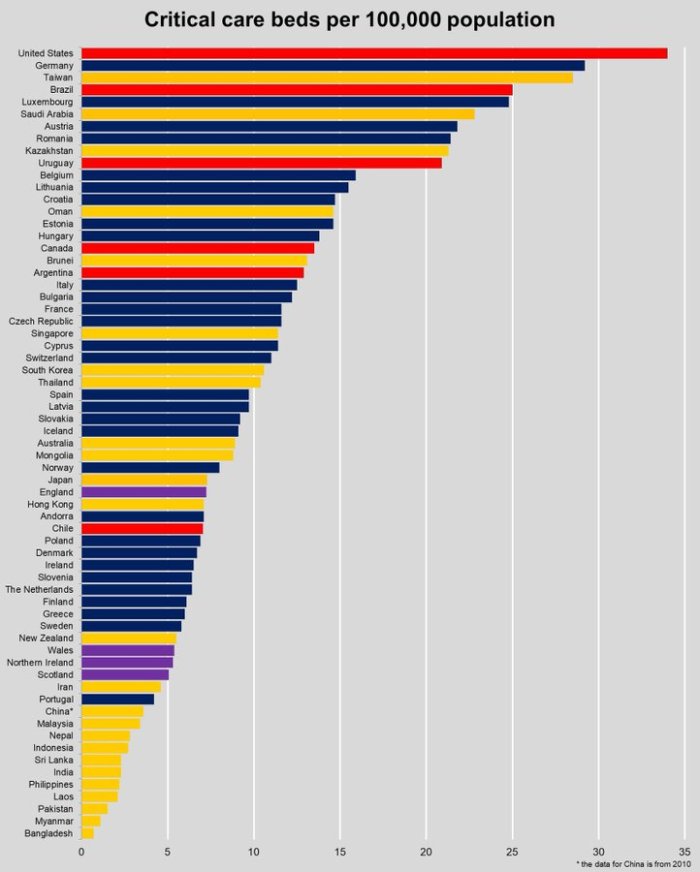
Where, of course, ICU beds are a real constraint, so much so that over the weekend there was mention of an Italian technical discussion document mooting the possibility of denying ICU care the very old.  I also happened see this chart over the weekend.  (Assuming these numbers are roughly comparable, you have to look a long way down this chart to find New Zealand.)

ICU

All of which is a bit of a distraction from the main –  economics and economic policy –  focus of this blog.    I’m running late today because The Spinoff asked me to write a short piece this morning elaborating some points I’d made earlier in a radio interview.     Here is what I wrote there, with some elaborations and additional points I didn’t have space for.

The economic implications of the Covid-19 public health emergency are formidable, and are growing by the day.

Most of what we’ve seen in New Zealand so far relates to the epidemic stemming from China and the steps taken to get things under control. Much of the policy discussion, including recent comments from the minister of finance, seems to have focused on attempts to assist firms and individuals in sectors which directly affected.

But that approach risks being a big mistake. It might have been fine if the only material outbreaks of the virus had been in China, and once they got things under control it was only a matter of time – albeit perhaps months – until those specific sectors and firms can get back to normal. But that simply isn’t what we face. Only yesterday the Italian government quarantined one of the major industrial regions of Europe.

Realistically, we have to suppose northern Italy won’t be the last place where life and production will be severely disrupted.  The trajectories of case numbers in various other European countries seem, to date, disconcertingly similar.  And then there is the United States.

Public health experts tell us the virus can be checked, but only with expensive and disruptive restrictions – voluntary or imposed, here or abroad. In her latest column here, Siouxsie Wiles notes:

Another thing we are all going to need to start doing soon is minimising or avoiding contact with other people. This is called social distancing. If you are greeting people, don’t hug, shake hands, hongi, or kiss. Bump elbows or feet instead. Work from home if you can. Much as it pains me to say it, social distancing also means avoiding public transport (get on your bicycle!). Similarly, it means avoiding gyms, churches, cinemas, concerts, and other events and places where people congregate.

Already, airlines report that forward bookings have dropped away sharply, and foreign tourism is heading towards zero for a time. It won’t be the only severely adversely affected industry, and the effects will be felt widely.

I found it very interesting that Wiles –  who seems to know whereof she speaks on the viral things, and seems to be no panic-monger –  was prepared to use, of New Zealand, the words “we are all going to need to start doing soon”.  That isn’t at all the message our happy-talking political and official leaders are giving.

Economic policy needs to be focused not primarily on the limited and concentrated economic disruption we’ve already seen. Instead, ministers and officials need to focus on the much, much larger, but scale-uncertain, losses and disruption that will soon break on us, and on vulnerable individuals rather than firms. As importantly, we need to be positioning ourselves to ensure that when the epidemic passes – and that could be some time – we are positioned to get overall demand and economic activity back towards normal as soon as possible.

Much of the economic loss and disruption we are near-certain to face over the next few months is now all but unavoidable. Nothing we do will put tourists back on plane, or open up supply lines from Milan, or whereever the next place to clamp down severely is. When people choose to stay home and maintain those distances, spending and economic activity will drop. It is the price we will pay as governments here and in other countries seek to spread out and reduce the incidence of the virus itself, and as individuals seek to limit our personal risks.

This point cannot be made too often.  Between choices here and individual and policy choices abroad much of the economic disruption is simply unavoidable.  There will be large losses of production, significant jump losses, material numbers of business failures, and significant permanent losses of wealth.     Much of what any spending can do now is really more (re)distributional in nature, than about changing the short-term course of GDP.   There is place for such distributional measures –  we don’t want sick people at work who can’t afford to take time off –  and in my view short-term measures should probably focus on income support, erring on the generous side where necessary.

Trying to directly assist individual firms is a fool’s errand. We just don’t know what we will be dealing with just a few weeks from now. Very soon the number of firms that can plausibly claim adverse effects will be huge. We simply don’t have the capacity to administer complex tailored schemes for huge numbers of firms, and the way would inevitably open up to all sorts of rorts and abuse.

To repeat, facing what is likely to unfold over the next few weeks or months, we need systems that are clean and relatively simple, and don’t rely on either government or the recipient firms being fully resourced to manage them.

That is why we have macroeconomic policy tools, which are designed to operate pretty pervasively when activity across the economy is hard-hit.

Monetary policy is typically the main one. The Reserve Bank is already quite badly behind the game in not having cut interest rates. No doubt they will do so later this month, but they need to cut the OCR hard, and to err on the side of what might look like doing too much. The risks of actually doing too much are slight, and the risks to falling short are substantial. Among them is a risk that expectations about future inflation drop materially further, which would raise real interest rates in the face of this severe and complex shock, greatly complicating the eventual recovery.

But monetary policy is approaching its limits. This is one of those (quite rare) times when monetary policy really needs to be supported by a significant and, when activated, fast-working boost from fiscal policy.

The OCR can probably be cut by up to 175 basis points.   Whether the last few cuts make any real difference, even to the exchange rate, is a contested point, but we won’t know if –  faced with big drops in activity in demand –  the limits aren’t pushed.

Big infrastructure projects are largely beside the point here – they simply take too long to get under way. One-off cash payments to households probably also aren’t the right thing, at least now. In the next few months people will be hunkering down anyway, and as I’ve already noted, a key consideration is providing support and confidence as and when the worst of the virus – and attendant direct economic disruption – has begun to pass. One possible tool, as part of a package, would be a significant, explicitly temporary, cut in the rate of GST.

Such a cut could be implemented quickly, would put more cash directly in the pockets of households, would operate in a somewhat progressive way (poor households spend a larger share of this year’s income than upper-income households) and explicitly encourages people to buy early rather than later (because you know prices will be rising again in, say, 18 months hence when the GST rate goes back up again).

This instrument was used in the UK in 2008/09.   The key point I’d add here is that in thinking about stabilisation and supporting recovery in the next 12-18 months we – including political parties from all sides of politics –  shouldn’t be focusing on our longer-term preferrred policy changes, but on things that are likely to do the stabilisation job (and can then probably be unwound –  as monetary policy).  That is also the way towards keeping a reasonable degree of cross-party consensus if the crisis is being welll-handled, rather than a sense that one side or the other is using the crisis opportunistically.

The key point now is that the government has to be looking forward, not backwards, and acting in ways that take seriously the sheer scale of the costs and dislocations we are just about to face. Whatever New Zealand does, we can’t avoid many of the short-term costs that are coming, but we can do a little to mitigate the damage (in an environment like this, for example, retail interest rates probably should be near zero, which they aren’t now) and official actions now can help create a climate most supportive of an eventual recovery. We need people to be confident of aggressive action focused on the real issues. In these circumstances, there are few or no returns to half-measures.

All manner of stresses and problems are likely to come to light, here and abroad, if this virus continues to wreak havoc –  or require far-reaching restraints (self or government imposed) over the next year or more – to keep it in check.  It would be foolhardy to assume that full recovery will be quick and easy, all the more so if macro policy has not done what it could to, for example, keep inflation expectations up.


A few coronavirus economic policy points

I’m staggered at how the government and most of the media still seem to have a backward-looking approach to coronavirus, and the economic effects thereof.  When the New South Wales Minister of Health yesterday indicated that in his view successful containment was now very unlikely, one might have supposed this would be big news in New Zealand.  After all, not only are there lots of New Zealanders in Sydney, but lots of people travel to and fro each day, and there are no restrictions or isolation requirements on those travellers.  If –  and it is presumably still an if –  containment is not likely to be successful in Sydney then surely, given that we haven’t had travel restrictions up to now and are unlikely to put them in place on Australia, it isn’t likely to be successful here.  It was, after all, the Prime Minister the other day who talked (loosely no doubt) in terms of a “common border”.     But I haven’t seen or heard of any comment from any of our political leaders, and no media outlet I follow has highlighted the story even though –  if it is so –  it must have material implications for how life might unfold here very quickly.  (For example, there is a community festival just down the road from here on Sunday, which annually attracts 80000 people in a pretty confined space. I don’t go, but people who are planning to might want to rethink.)

On issues of substance most of our political leaders seem either missing in action or, again, mostly backward-looking, as if coronavirus is something that happened in China and we are now just working through over the next few months/quarters the economic consequences of what has already happened.   On the evidence to date it is far from obvious that the Prime Minister has what it takes to lead and effectively drive the national response to an emerging, highly uncertain, serious ongoing crisis.  The Minister of Health seems to be missing in action (which, one hears, is often how officials thought of him in normal times).  And who else is there?   Kelvin Davis? Winston Peters? Phil Twyford?   I’ve heard suggestions that Grant Robertson “gets it”, but there continues to be great reason to doubt that, whether in his speech last week, his Q&A interview at the weekend, or one with Mike Hosking this morning.  It is all focused on stuff that has already happened, and the outworkings of that, and not at all on the worsening outlook, and the near-certainty of huge disruption and cost when community outbreak becomes a thing here.    Thus he continues to talk about “measured proportionate sectoral” responses, when in reality much the economy is likely to be overwhelmed for a time by what is unfolding.  You get no sense of that from Robertson.

I was initially supportive of the travel ban the government put in place several weeks ago.  It seemed prudent, and of course the Chinese government had put its own restrictions on outbound tourism.  I see quite a lot of commentary about how that ban “bought us time” or “kept the virus out for several weeks”, and I guess in years to come researchers will try to unpick the evidence on that one.  But I must confess to being a bit more sceptical now than I was.  Canada, for example, had no travel bans of its own, and yet when I checked this morning they had about eight times as many cases as New Zealand…..and almost eight times the population.  (And are not far from Seattle).  Neither country seems to have done a great deal of testing, so it isn’t simply that one country was finding more because it was searching harder.   It is impossible to easily know the counterfactual, of course, but perhaps the horse had already bolted by the time the travel bans were put on?  Again, superfically it isn’t obvious that the UK experience (no bans) has been worse at this point than the Australia or US experience.

Consistent with my post yesterday, I remain deeply sceptical of sectorally-targeted or admin-intensive specific government interventions to assist.   I see that in today’s Herald Hamish Rutherford is championing those sorts of programmes, under a subheading “Govt must act now to help hurting sectors take heart”.   Frankly, it is never the government’s job to help firms or sectors “take heart”.  The head has to be what is engaged in times like this.     Debate around these issues isn’t helped by an ongoing refusal, pretty much all round, to call what is happening right now what it is: an economic recession.    We might not have hard data on that point for months (even March quarter GDP includes January where there was little or no effect) but here, now, in March it seems almost certain that the level of economic activity is falling.  It is almost certain to fall further, perhaps at times a long way.    Forget about every other sector, all the supply chain disruptions etc and just focus for a moment on travel.  These were some forward travel booking numbers for Australia published in The Australian this morning.

“Between Feb 24 & March 1, year-on-year, bookings were down 47% from UK, 52% from the US, 71% from Indonesia, 32% from India and 100% from China and Japan, along with widespread cancellations.”

Is there any reason to suppose the New Zealand picture would be much different?   Uncertainty is the enemy of new investment, and uncertainty –  pure uncertainty, not just risk –  is extreme at present.  At present, not even the Leader of the Opposition is willing –  quite –  to call a spade a spade.

In recessions, bad stuff happens.  Firms fail.  People lose their jobs.  Plans are wrecked or disrupted. Asset prices fall.  Government revenue takes a hit.  (Government financial assets fall in value: see NZSF).  It isn’t pleasant, and usually those who bear the brunt aren’t in any very direct sense causally responsible for what happens to them, or their firms.    Much of the argument for focused sectoral action –  there is a lot of this in Rutherford’s article –  is along the lines that unless all these firms and jobs are saved now, recovery will be materially harder than it needs to be: the capacity mightn’t be there to take up the recovery in demand.  But, again, all recessions are like that.  But it isn’t as if the capital stock is going away.  Motelliers in Queenstown might go bust – I saw one this morning quoted as saying he could cope with downturn in Chinese numbers, but it would be problematic if others stopped “and that now looks as if it is happening”.  But the motel will still be there.  A jetboat or paragliding or whatever company might fail –  and that is tough, the flipside of the success operators capture in unanticipated boom times –  but the physical equipment and the location are still there.  And since this seems to be a worldwide thing, even if staff have to move and look for other jobs, many (or a next generation) will be quickly enticed back for whatever drew them to (say) tourist work in the first place.

And while it might have been easy a few weeks ago to identify specific firms that had lost directly associated with the virus, those numbers are rapidly going to be overwhelmed as the effects spread across the entire economy  – just as surely, if indirectly, the result of the coronavirus, and measures to manage/avoid it.   In recessions, for example, property markets tend to do badly –  see the 15 per cent fall in real house prices in New Zealand in 2008/09 despite a 400bps fall in mortgage rates – turnover will drop etc etc, and real estate agents will quite genuinely be able to blame the coronavirus for the slowdown.

You simply can’t sensibly target each firm/sector in the economy.  It is why we have macro policy –  economywide instruments designed to do what can be done to stabilise the downturn (that may not be much) and then lay a platform for as fast a recovery in demand and activity as can be achieved.   As it is, it is simply bizarre that with all that is observably different since, say, December, and all that is pretty visible just down the track, our macro policy settings are barely changed:  short-term wholesale and retail interest rates haven’t moved, nothing about (short-term impacting) fiscal policy has changed, the exchange rate is certainly a bit lower (but a modest move by historical standards) and on the other hand it is likely that credit conditions are tighter than they were.   There is an urgency about action, but that action should primarily be focused at the macroeconomic level.

And, finally today, I have been wondering how one might do an analysis of just what economic price is worth paying, as a society, to try to contain/manage coronavirus.  The Chinese economy and society seems to have paid a fearsome price and yet to have successfully (for now anyway) kept the worst of the spread of the disease in Hubei province (for anyone doubting the logic, I found this thread from a China-focused researcher helpful).

Serious scholars suggest that if the virus were simply left unchecked, it might infect 40 to 70 per cent of the world’s population (say 50 per cent).  For all the uncertainty about the true death rate, assume for the sake of argument 1 per cent of those infected.  In New Zealand terms, that is a potential total of early deaths of 25000.

According to the Treasury’s CBAx spreadsheet, the value of a statistical life (price community would pay to avoid premature death) this year is just on $5m.   25000 people at $5m each is $125 billion.  However, the evidence so far – including the Chinese data –  is that the deaths are very concentrated among older people.   On the Chinese data –  which may have its weaknesses –  the median age of those dying looks to have been as high as the late 70s, whereas the median age for all New Zealanders last year was 37.3. Remaining life expectancy at 80 seems to be about a quarter of that at 37, so we can chop down that maximum possible saving (from avoiding premature deaths) to no more than, say, $31 billion.

But, of course, even that is too high, since the implicit assumption is that all those lives could be saved with appropriate policy responses.  And from everything I read that seems incredibly unlikely.  Often people seem to talk about using policy measures and costly private actions (distancing etc) to spread out peaks and reduce the intense, perhaps overwhelming, peak pressures on the health system, and thereby (a) reduce the number of deaths and (b) make the whole experience less intolerable for those who would die anyway and those who, while sick, live.   Obviously I have no idea how many lives might be saved in total, but no one seems to seriously suppose it is anything like all of them.  If it was half, it would –  all else equal – be worth spending $15 billion or so to avoid those premature deaths.

Of course, if we could reduce the number of those who got seriously ill (but didn’t die) as well, it would be fair to ascribe a value to that too, but if people are up and about again in a month –  or even two –  that number will be swamped by the costs of death, given that in many cases those getting the virus won’t themselves be that sick at all (bad colds seem to be “one of those things” in life).

This is mostly by way of leading up to the question of how large would be discretionary economic costs be.  Note that I emphasise the word discretionary.  What other countries do as a matter of policy, and what other individuals do as a matter of prudence/fear is largely outside our control.  Thus almost all –  the exception perhaps being around university students – the economic effects so far are outside our control, and so is the temporary collapse in the rest of our tourism industry currently getting underway.  We will pay –  in lost output –  those costs whatever New Zealand governments do.  If major cities in other countries shut down for weeks at a time, disrupting travel, supply chains, demand for commodities or whatever, we have no real control over that.   Annual GDP at present is around $300bn.  It isn’t hard to envisage a scenario, quite outside our control, in which GDP for this year as a whole is perhaps $10bn less than otherwise.  That is income/wealth that will never be made up, even if/when after the crisis we get back ont a pre-crisis path.

The big choices are likely to be around how early/aggressively our authorities choose to act in shutting down cities, discouraging (or banning) social gathering, restricting movement etc etc.  We don’t really have hard data for other places yet, but what we know of the Chinese data suggests that these costs too could be very substantial –  not only has much of China been closed for six weeks already, but they are a long way from being back to normal, and with no idea what sort of virus resurgence they would see if they tried.  Shutdown, possibly pre-emptively (if still possible), much of New Zealand at different times for, say, six weeks at time.  In doing so, you could easily cut GDP during those shutdowns by 50 per cent.  Even if things quickly got back to normal after that, you’d still be looking at, say, 5 per cent loss of GDP for the year as a whole.  5 per cent of GDP is $15 billion, lost and never coming back.

I’m not attempting to offer answers here.  There are so many imponderables, most especially about what difference the toughest sustainable measures can eventually make to the death toll.   But it would be good to think that some of those “brightest New Zealanders” Hamish Rutherford told us were beavering away on these issues have at least been trying to think about the options in a systematic cost-benefit sort of way (here I emphasise the past tense, since time would appear to be of the essence, and you would hope officials haven’t shared in their masters’ public-facing sunny optimism about the threats we face). But if they haven’t done it yet, they need to be doing so now, urgently.


Yield curve indicators, monetary policy, and the case for action

Six months or so ago, shortly after a flurry of attention in the US around the 10 year bond rate dropping below the three-month rate (which had been something of a predictor of weaker economic conditions) I wrote a post here on yield curve indicators in New Zealand.    Once upon a time, we used to pay quite a bit of attention to the relationship between bond yields and 90-day bank bill rates although, as I explain in that post, it isn’t a great indicator of future New Zealand recessions (and wasn’t really used that way when we did pay attention to it).

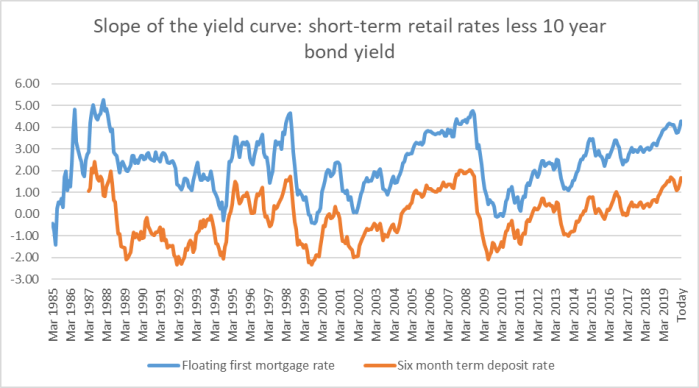
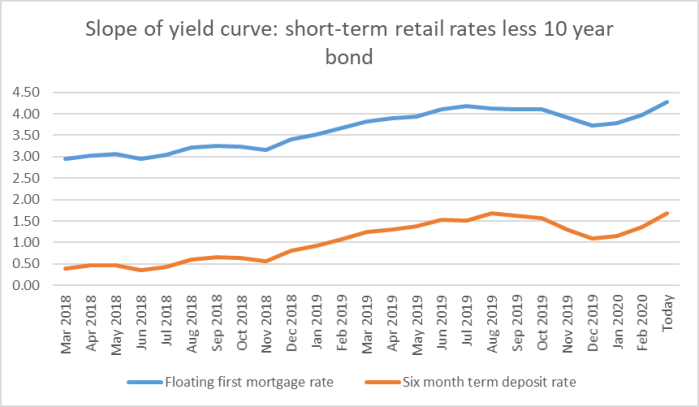
In the post I suggested it might be worth looking at a couple of other yield curve indicators, using the (fairly limited) retail interest rate data the Reserve Bank publishes, comparing short-term retail rates with long-term goverment bond rates.  The absolute levels wouldn’t mean much, but the changes over time might.   Here is a version of those charts updated to today (using current retail rates from interest.co.nz)

yield curve 20 1

and the same chart for just the last two years.

yield curve 20 2

For what it is worth, the only times these lines have been at or above current levels a New Zealand recession has followed.  And although the Reserve Bank interest rates cuts in the middle of last year did reduce the slope of the retail yield curves, we are now sitting right back where we were at the peak last year.

The Reserve Bank is, of course, now strongly expected to cut the OCR this month –  as Australia did yesterday and the US this morning, and as they should have done last month.  But do that and they’ll only take those retail yield curve slopes back to around where we were late last year –  and that on the assumption that long-term bond yields don’t fall materially further.  By historical standards that will look like relatively tight monetary policy, at least on this indicator.    And all that with credit conditions that tightened last year, look likely to tighten further because of the ill-considered capital requirement increases (they were warned about the risks that the transition period would cover, and exacerbate, the next major downturn) and –  despite political rhetoric –  are only likely to tighten further under the cloud of extreme uncertainty and actual/potential income losses currently descending.

In this climate, with the evident sharp slowing in economic activity, it would be more normal to envisage hundreds of basis points of cuts.  But, through official lassitude and a decade focused more on hoped-for rate increases than on the next severe downturn, cuts of that magnitude simply aren’t an option.

The constant pushback against the idea of OCR cuts now (whether last month, right now, or later in the month) is that they won’t achieve anything much in coping with the immediate disruption and the (probable) rapid increases in job losses over the next month or two.   And, of course, that is quite correct.

One also sees pushback using the argument that central banks shouldn’t be responding to share prices, noting that world markets are even now not much off their peaks.  Whatever the merits of that argument abroad –  and in general I don’t stock prices should (directly) drive monetary policy actions –  it is pretty irrelevant here: in all my years of involvement in advising on New Zealand monetary policy, the only time share prices ever really entered deliberations was in October 1987, and even then it was only as a proxy for the serious problems developing just behind the scenes.

But the fact that monetary policy doesn’t have much affect in the very short-term, particular amid really disordered conditions, is really rather beside the point.  If what you care primarily about is the employees and firms directly disrupted, there are plenty of direct options the government can, and probably is, considering.  But that is simply a different issue, even if one that operates in parallel.  Even direct short-term assistance won’t do much to slow the deterioration of economic aggregates –  won’t summon up more tourists, won’t fill gaps in supply chains, won’t offset the decline in spending if/when social distancing becomes more imperative.  By and large, we are stuck with whatever deterioration in economic activity the next few months bring, most of which will be events almost totally outside our control (overseas economic activity and the spread of the virus abroad and here).   We can support individuals to some extent, and perhaps can do something to increase the chances firms will still be there when the pressures pass.

But in many respects, monetary policy is also about the second leg of that. It is about getting in place early –  and providing confidence about –  conditions that will (a) support the recovery of demand as and when the virus problems pass, or settle down, and (b) helping ensure against that the sort of precipitate fall in inflation expectations (in turn confounding the economic challenges) that I warned about in yesterday’s post does not happen.   The importance of early and decisive action is compounded by several things:

  • the physical limits to conventional monetary policy (can’t cut very far, so need decisive early action to keep expectations up),
  • the probable political limits to fiscal policy (see 2008/09 globally)
  • the extreme uncertainty about the course of the virus or the economic consequences (like any city/country, we could face northern Italy or Korean disruption at almost any time),,
  • reasons to doubt just how rapid a recovery in demand will be (perhaps especially in tourism) and the likelihood of some –  growing by the day –  permanent wealth losses

All supported by the fact that, unlike other possible programmes, monetary policy action is readily reversible if the best-case scenario comes to pass.

I find two other thoughts relevant to the discussion.   It seems almost certain that the price-stability consistent interest rate is quite a bit lower than it was just a few months ago.  In normal circumstances, the job of the central bank is to keep policy rates more or less in line with that short-term neutral rate.  It might well be –  but no one knows –  that the fall is temporary, but the Reserve Bank’s job isn’t to back a particular long-term view (they have taken to talking recently far too much about the long-term, when their prime job is really quite short-term, about stabilisation) but to adjust to pressures evident now.

(In the same vein, we also hear the objection that the virus issues are “short-term” and thus no action is warranted.  Quite possibly, perhaps even probably, they are short-term, but so are most of the pressures central banks deal with.  Most recessions for that matter, even most crises.)

And finally, it is worth bearing in mind that many commentators are already highlighting debt service burdens for businesses where activity has fallen away sharply,     There are no easy answers to what the appropriate policy response, if any, is to those issues. But it is worth pointing out that there are likely to be permanent income/wealth losses, even if in a year’s time the path of GDP is back on the pre-crisis course.  Income not earned this year is unlikely to be made up for by more income later.  In the extreme, if the economy largely shut downs in certain cities or regions for a short time –  or if certain sectors (eg foreign tourism) largely shutdown for longer –  those losses will not be made back, and the debt (business and household, bank and non-bank, lease commitments and loans) that was being serviced supported by those actual/expected income flows will still be there.   Those losses have to be (will be) distributed somehow and frankly it seems reasonable that part of that would be by adjustments to servicing burdens.     People will say –  commenters here have –  that 25 basis points is really neither here nor there.  And, of course, that is true.  They will also say that the OCR is “only” 1 per cent –  also true – but retail lending rates are over 5 per cent (floating mortgages) or 9 per cent (SME overdrafts), and in a climate like the present.    Those rates really should be a great deal lower –  at least temporarily –  as, of course, should the adjustable rates being earned by savers/depositors.

Pro-active macro policy would be doing all it can, as soon as it can, whatever additional firm-specific measures the government might also try.  To repeat, the point isn’t to fix the immediate situation –  there is no such fix, absent the magic fairy curing the world of the virus overnight –  but to limit the risk of longer-lasting damage and better position ourselves for what could still be a difficult recovery, with permanent wealth losses.  The Reserve Bank should be taking the lead –  it is conceivable that if they are going to wait until the scheduled review date that even a 100 basis point cut could be under consideration by then –  but there is sufficiently little the Bank can do –  even about that medium-term horizon, that we should have well-targeted and designed effective and prompt fiscal stimulus as well (again focused on the six to eighteen month horizon).  If anyone influential is reading, I commend again –  as one part of a response – the case for looking hard at a temporary cut in GST).


On reading the official pandemic plan

I’ve been dipping into the official New Zealand Pandemic Action Plan  –  all 193 pages of it –  a bit in the last few days.  The document has evolved over the years and now describes itself as

This edition of the New Zealand Influenza Pandemic Plan reflects the sophistication of a third generation, risk-based plan that promotes collaboration across all levels of government, agencies and organisations when planning for, responding to and recovery form a pandemic event.

and

Pandemics by their nature are unpredictable in terms of timing, severity and the population groups that are most affected. This version of the New Zealand Influenza Pandemic Plan establishes a framework for action that can readily be adopted and applied to any pandemic, irrespective of the nature of the virus and its severity.

It isn’t really clear what status the document has at present.  It was finalised late in the term of the previous government, it was finalised under a different Director-General of Health, and it was designed for an influenza pandemic, and the current virus is not influenza.    As the Ministry of Health notes, in any case it is only a “framework for action”, and has to be adapted for the particular virus –  and presumably for the policy preferences (on how best to respond, what trade-offs to make etc) of the government of the day.   As a document, or even a framework, it seems most likely to be useful the more closely to health the immediate issues are –  but even then, different virus, different issues.

There are various workstreams described in the plan.  One of them in “Economy” –  something I had quite a bit to do with in earlier iterations of the planning almost 15 years ago now – described from page 48 of the plan.  But it really does no more than list the key relevant official agencies (Treasury, MBIE, Inland Revenue, and Reserve Bank) and a brief plain-vanilla description of the sorts of roles and responsibilities those agencies have.  And that’s it.

The plan itself is dealt with in about 35 pages.  But about a quarter of those aren’t about immediate issues, but about longer-term planning and preparation (important of course, but not the uncertainties we now face).   The “Keep it Out” phase –  the one officials and politicians regard us as being in at present –  then takes another seven pages.    I presume it is mostly worthy and sensible stuff, although there is little or nothing about the frameworks or evidence base used to shape official advice to ministers (eg around border restrictions of the sort we have in place now).

The next phase is “Stamp it Out”

Objective
To control and/or eliminate any clusters that are found in New Zealand.

There is a set of key decisions listed

stamp it out

(Many of which won’t be relevant here/now, absent a vaccine)

And there is a detailed listing below that, but it is all lists, and no analytical or policy framework.  One hopes there are more-detailed analytical papers in the Ministry of Health or other agencies, but the Pandemic Action Plan document is what the public has.  The Ministry’s website claims that

The NZIPAP provides information to guide key decision-making.

But really the only information is a listing of issues, agencies, and formal statutory powers. Useful as far it goes, but not that much help –  in particular to the public.

And it is no different in the “Manage It” and “Recovery From It” phases.    Catchy phrases –  useful enough –  and long lists –  again useful enough –  but little substance to guide decisionmaking or public debate/scrutiny of governments plans and actions.

The second half of the document is a little more discursive, and perhaps more useful.   For example, there is a discussion of Public Information Management. But it is limited by the fact that it seems wholly focused on the Ministry of Health, and not on the key role that political leaders (notably the Minister of Health and the Prime Minister) play throughout any pandemic period.    And it is a bit disconcerting when the very first item in the key objectives around public information management

Key objectives are to:
- maintain public confidence in the response and in agencies’ competence and capability

That might be the Ministry’s aim –  pursuing its own interests –  but it isn’t clear it should be what would be most important for the public, who cannot simply assume (need to be shown by transparency, consistency, humility etc) that the response is being well-managed.

The section also seems disturbingly oblivious to both the extent of information available to the public from other countries and public health agencies and to the genuine political choices likely to be faced during the pandemic period.

What first took me to the document was a desire to understand the relevant statutory powers and options.  There is what seems to be quite a good description (p109f).    Here is one summary

legis powers

Do note that reference to the Epidemic Preparedness Act.  It has really far-reaching powers, which appear to allow the government to temporarily waive lots of legislation once the Prime Minister issues an authorising notice. But as the Plan says, it relates “only to give named quarantinable diseases set out in Part 3 of Schedule 1 of the Health Act 1956”.

quarantine

Remarkably, this schedule appears to be able to be updated by regulation, rather than by legislation – itself a little worrying given the scale of the powers given to the executive –  but you might suppose it was about time that the current virus was added to the list.

But to take the Health Act special powers first

special 1


special 2

All of which is good to know, but there is no discussion anywhere as to the circumstances, considerations etc that might lead to such powers being exercised.   Now, perhaps one could argue that they would be context-specific, but in a sense that is my point.  In the current context, the Plan itself offers little or guidance to the public, and we have had no guidance, consultation etc specific to the looming event from either the Ministry or (more importantly, since they are the ones we can hold to account) the Minister of Health or the Prime Minister.  (As there was no open discussion of considerations relevant to decisions around border closures, either the initial ones or subsequent decisions.)

And what about that Epidemic Preparedness Act?  Here is what the Plan says

epidemic preparedness act

That is quite a mouthful.  The Act itself isn’t long, and if anything I found it a little clearer.  Here is the purpose statement

epidemic act

Such legislative overrides can themselves be disallowed by Parliament, which has to be called together pretty quickly if the Act is invoked –  unless, potentially an issue this year, the House has been dissolved for the election.

My point isn’t to debate whether or not these powers should exist –  although it does seem strange that the criteria relate to “essential government and business activity in New Zealand” (a term itself not defined anywhere, and you have to wonder how the Director-General of Health is qualified to judge what is “essential business activity”) not to human health, societal functioning etc (as well).   My point is that there is nothing in the Plan, and nothing we’ve heard from the officials or politicians on (a) what grounds they would look to invoke this Act, and (b) what statutory requirements they would look to suspend, in what circumstances (for those particularly worried, there are some core Acts they can’t touch).

Perhaps that might be unavoidable if there was a sudden outbreak of some disease with no real warning at all.  But we’ve had time –  now weeks and weeks of it – and there is nothing.  Ministers and officials act in ways that look as though they think “there, there, don’t worry your silly little heads about it, we’ll tell you what you need to know when you need to know it”.   But that is no standard for an open and democratic society.  It doesn’t even really seem consistent with the “public information management” themes, which talk about transparecy, building and maintaining trust.  You do that best by (a) being excellent, (b) being humble, but (c) being open and letting the public in on your thinking and planning, and being responsive to feedback.

As a good example, there is some discussion in the Plan of the possible closure of schools (and similar entities) –  pages 125 and 126 –  but it offers almost nothing.  And, as they note, much will depend on the circumstances of the virus.  In the current episode globally, we’ve seen many countries move to close schools, but one highly-regarded example of management (Singapore) where schools etc have been open throughout.  What is our government’s view on the matter at present, when New Zealand experiences community outbreak?  Surely it matters to the sort of planning individuals etc can/should be doing now.   If universities might end up closed quite soon, might that be relevant to questions around reopening borders to foreign students?   More generally, what is the government’s thinking on the movement restrictions etc being adopted in other democratic countries, notably Italy and South Korea.  Both ministers and officials seem missing in action –  no doubt talking among themselves, but not talking with citizens.

In an Appendix to the document there is a longer Public Information Management Strategy.  Much of it appears sensible enough.  There is even a specific extended section on

Key messages
It looks like a flu pandemic is about to start

Again, a lot of it seems sensible and seems consonant with what we are hearing from health authorities in various other countries. For example

plan

But we aren’t hearing any of this from our officials and ministers, even though –  as we’ve in the last week –  countries have gone from thinking they have no major immediate problem to full-bore crisis in a matter of days.  If anything, the Director-General of Health on RNZ this morning sounded rather Trump-like still talking of low risks of community outbreak in New Zealand  (when plenty of international experts talk in terms of having got well beyond that point everywhere, even if some still think Stamp It Out strategies can work –  viz encouraging signs from Singapore).    They still seem more interested in playing things down –  don’t worry your heads about it –  than in helping guide the public to realistic preparations and precautions, or even to offering substantive answers to specific reasonable questions about how the health system –  under pressure at the best of times –  would be able to step up, add capacity in short order etc when/if significant community outbreak becomes established here.  Perhaps there is a good case for such a choice, but we don’t see the Prime Minister or the Minister of Health even trying to make that case.

And since this blog is still primarily economics-focused, much the same point could be made about economic issues.  The Minister of Finance’s speech the other day seemed okay as far as it went, but it stopped well short of taking seriously the sort of disruption, risks and economic losses, if we see widespread closures (from regulation or fear) when the virus hits here.  There might not be much governments can do in the very short-term if those losses happen, but there are important specific issues, including those around how things like the food distribution system keeps working (if, say, one main city is largely locked-down and movement in and out restricted).

We really deserve and need more pro-active leadership and preparation from key ministers, and perhaps from officials too –  but they mainly work for and to the ministers, whose handling of these event may yet feature significantly in this year’s election campaign.


Preparing

In those distant days when world sharemarkets were still at or very near record highs –  actually, on Monday –  the Federal Reserve Bank of San Francisco released one of their short accessible Economic Letters summarising some research work done last year on the question “Is the Risk of the Lower Bound Reducing Inflation?“.   The views expressed are those of the authors, not the FRBSF let alone the wider Federal Reserve system, but the authors aren’t just fresh out of college either: one is the executive vice-president and head of research (one of the most senior policy positions) at the FRBSF, and the two authors are senior managers on the research side of the Bank of Canada.

Here is their summary

U.S. inflation has remained below the Fed’s 2% goal for over 10 years, averaging about 1.5%. One contributing factor may be the impact from a higher probability of future monetary policy being constrained by the effective lower bound [ELB] on interest rates. Model simulations suggest that this higher risk of hitting the lower bound may lead to lower expectations for future inflation, which in turn reduces inflation compensation for investors. The higher risk may also change household and business spending and pricing behavior. Taken together, these effects contribute to weaker inflation.

How does this work? Here is their description

If monetary policymakers are constrained by the ELB in the future, recessions could be deeper and last longer because central banks may be unable to provide sufficient stimulus. The greater decline in economic activity in this case would translate into lower inflation during such downturns relative to recessions when the policy rate is not close to the lower bound.

In addition, greater risk of returning to the ELB could also affect inflation during good times, when the economy is performing well and interest rates are above the lower bound. Investors and households often care about the future when making long-term investment decisions that are difficult to reverse, such as setting up a new production plant or buying a house. The possibility that recessions might be more severe in the future because of the ELB can affect their economic decisions today, prompting them to be more cautious to guard against this risk. For instance, households could start saving more in anticipation of possible harder times ahead. Similarly, businesses could engage in precautionary pricing by setting lower prices today if they anticipate a greater likelihood of deeper recessions in the future and do not review their pricing strategy frequently.

As something for the future –  perhaps the very near future –  it all seems a plausible tale, and is consistent with a line I’ve been running here for years, that when the next severe downturn comes markets (and other economic agents) will quickly focus on the limitations of conventional monetary policy and adjust their behaviour (for the worse, in cyclical terms) accordingly, deepening and lengthening the downturn.  But these authors go further and posit that people (real economy and financial markets) have already been factoring the ELB risks into their planning and decisionmaking, in turn directly contributing already to lower inflation and lower inflation expectations (than perhaps the current cyclical state of the economy might otherwise deliver).

I haven’t yet read their full working paper so can’t really evaluate the strength of their evidence on this point.  But if they are capturing something important about actual behaviour in the last decade or so, presumably those effects would be expected to have become larger the closer to the present we come.   Prior to 2007 the Fed (and other central banks other than Japan) had not reached the ELB at all. Immediately after the recession there was a pretty strong expectation that things would return to normal (including normal policy interest rates) before too long –  a view typically shared by markets and by central banks.    Only with the passage of time did those expectations gradually fade –  and perhaps more completely in Europe (where policy rates are still often negative, and pretty consistently lower than those in the US).

For New Zealand, of course, if there is anything to this story, it must be even more recent, having started with higher policy rates, and with markets and the Reserve Bank mostly looking towards higher policy rates until just the last couple of years.   The possibility of reaching the ELB in New Zealand has been a distinctly minority point (yours truly and perhaps a few others) for most of the last decade, in ways that leave me a little sceptical that the story will explain anything much of the inflation experience in New Zealand (or Australia) for the decade as a whole. In both countries, inflation has averaged materially below the respective target midpoints.

Whatever the case for the past, the FRBSF note ends with this point

These findings suggest that the puzzle of how to raise inflation to meet central bank goals may require new ways of addressing the risk of returning to the ELB and new ways of understanding how to set and meet inflation goals.

The problem is that there is a growing risk that it is now too late, and that central banks (and Ministries of Finance) have spent the last ten years not getting to grips with ensuring effective capacity for the next severe downturn, leaving things potentially almost paralysed when that severe downturn breaks upon us.  Which it could be doing right now.

Many advanced country central banks can now barely reduce the policy interest rate much at all –  the biggest problem with former Fed governor Kevin Warsh’s call yesterday for a coordinated international rate cut is that it would immediately highlight the limits, especially in Europe.  Even in a traditionally high interest rate country like New Zealand, there is perhaps 150 basis points of capacity, when the average recession in recent decades has involved 500+ basis points of cuts –  a point our Minister of Finance rather glossed over yesterday in his talk of the advantage of starting with relatively high interest rates.

As the FRBSF authors note

To compensate for this lack of conventional firepower, central banks can rely on unconventional policy tools, such as forward guidance or quantitative easing. While these tools proved effective during and following the crisis, it remains unclear whether they can fully compensate for the diminished conventional policy space and the more frequent encounters with the ELB

That is fairly diplomatic speak, as befits senior officials.  In reality, few really believe that unconventional tools under the control of central banks can adequately compensate for lack of conventional policy space.

In my view, those limits have not really been sufficiently focused on by markets, firms and households, or governments.  There has been quite a lot of wishful thinking around –  hankering for higher neutral rates, inability to spot an near-at-hand risk that might trigger an early severe downturn, or whatever.   But when people look at the looming coronavirus risks –  and markets will no doubt ebb and flow still, just as happened as the financial crisis unfolded a decade ago – and really begin to focus on what can, and will, be done, we are likely to see inflation expectations falling away much faster than in a normal downturn, in turn raising real interest rates and accentuating the problems, at a time when neutral interest rates are likely to be falling further (perhaps temporarily, but real enough for the time being).

To bring that back to the New Zealand situation, after ignoring the issue for a long time the Reserve Bank appears to have begun to take it more seriously in the last 18 months or so. But with little or no transparency and no apparent urgency.  We keep being told they are about to reveal their thinking –  I hope with a view to getting serious feedback etc –  but they’ve already mentioned enough that we can be sure that what they’ve had in mind simply will not make up for the limits of conventional interest rate capacity, even allowing for the likelihood that in such a severe downturn our exchange rate will fall a long way (as it did in most of those previous 500 basis point rate cut episodes).   There is also sadly little sign that the Minister of Finance has shown much leadership or urgency about seriously addressing this problem (again, nothing along those lines in yesterday’s speech –  good enough as far as it went, but it stopped short of the really serious issues/risks).

It would be easy for me to suggest that the Governor has been too much occupied with his tree gods, his climate change interests, his views on infrastructure or the distribution of income, rather than driving action urgently in this area of monetary policy capacity (core day job).  And that is no doubt true, but as a specific criticism it needs to be kept in perspective –  his predecessors had let the issue drift, and his peers at the top of many other central banks have also seemed to prefer to believe things would come right than to seriously prepare for the constrained alternative.  We risk paying the price now –  including with central banks paralysed by their own limitations and reluctant to act early and decisively to lean against (do what they can to buffer) the economic downturn (and downside risks to inflation and inflation expectations).

Quite possibly there is a place for fiscal policy in responding to a serious downturn, even one amid the chaos of a potential pandemic, but there needs to be a lot more realism about the likely constraints on how much, and how longlasting, any discretionary stimulus is likely to last.   There is no real excuse – even in a less fiscally constrained country like New Zealand –  for authorities not to have moved to greatly alleviate or remove the effective lower bound before now, and to have used relatively settled times to have socialised the case for doing so.

And even if the FRBSF authors are wrong about the influence of the ELB on inflation over the last decade, if it very quickly now becomes even more binding – starting from a lower initial level –  it will be front of brain for everyone through the next cycle.    It really needs to be dealt with now.  It isn’t technically hard –  there are various workable options –  but it needs leadership, will, and vision for something to happen, something which has the potential to limit the extremes (depth, duration) of that severe downturn whenever it finally strikes us.


Coronavirus can’t just be thought of as an illness for other countries

There was quite a bit of media coverage this morning around the potential economic impact of, and possible policy responses to, the coronavirus.   There have been commentaries from, or interviews with, various economists and a fairly substantive interview on RNZ with Grant Robertson, the Minister of Finance.  Each of them left me a little concerned, but of course the comments from the Minister of Finance –  who gets to decide things and is backed by phalanxes of official –  matter the most.

In his comments at the post-Cabinet press conference on Monday, the Minister indicated that he and his officials were working with three distinct scenarios.   There doesn’t appear to be anything in writing (eg on The Treasury’s website) but broadly the scenarios were as follows:

  • something (probably not too different than the Reserve Bank’s quite-sanguine recent published forecasts) that seems wholly focused on China, and with things beginning to get back to normal next month,
  • something where the effects, perhaps around a wider range of countries, linger for the rest of the year, and
  • a third scenario which he characterised as a serious global recession.

The government is still working with the first of those scenarios, although the Minister acknowledged that the risks of the second scenario looked to be rising.

Many of the other commentators seemed to be thinking along similar lines.  The NZIER, for example, released their quarterly forecasts overnight and their press release says

It is early days and there is a large degree of uncertainty over the magnitude and duration of the effects from the coronavirus outbreak. In the short-term, the uncertainty revolves around the ability of exporters to redirect their exports to other markets. Over the longer-term, the uncertainty is whether the coronavirus has any persistent negative effects on global growth.

And I’ve seen/heard other economists commenting on whether or not GDP growth for the first couple of quarters might or might not be negative (the popular definition of a recession –  more demanding here than in most countries, given our fairly rapid population rate).

But, frankly, it all seems a bit pointless, especially the very short-term forecasting, because all of them –  including the Minister of Finance –  seem to be dealing with a scenarios in which coronavirus is someone else’s health (and attendant domestic disruption) problem, for which New Zealand is only exposed to the global growth backwash.  Of course, that backwash might well be quite severe.   But none of them seem to be grappling with the near-certainty that coronavirus will soon be confirmed in New Zealand (based on what we’ve seen abroad, there must be a reasonable chance it is already here  –  and the Ministry of Health tell us that under their narrow criteria only 120 tests have taken place here).  And, more specifically, none of them is grappling with the possibility that we –  like any city in the world, it appears – could have Korean, Iranian, Italian, Bahrain situations here at any time from today (none of those countries seem to have thought last week that they’d be imposing all the the restrictions they now have).   If the experts who tell us there is now a high chance of a general global outbreak, perhaps infecting 40 to 70 per cent of the world’s population, are correct, probably most cities will face such a scenario.   And those sorts of events have the potential for huge disruption, and economic cost, which would swamp the sorts of narrow effects forecasters like the Reserve Bank have already allowed for.

Take as a scenario a significant outbreak in Canterbury (or Wellington).   Canterbury accounts for about 12.5 per cent of New Zealand’s GDP, and suppose that for a month economic activity in Canterbury is reduced to 50 per cent of normal  (some mixture of schools and daycare centres etc being closed, lots of people being sick or self-isolating because a family member was sick, restrictions on public gatherings, the evaporation of tourist arrivals, and fear).   If that was the only effect New Zealand’s GDP for the quarter of the outbreak would fall by 2.1 per cent –  not annualised, an actual fall of that amount.   That alone would be almost as bad as the worst quarter of our worst recession in modern times in 1991.      You could triple the effect if the outbreak was in Auckland (38 per cent of national GDP).

And even if by some chance the outbreak –  and tough restrictions –  was contained to a single city/region, the economic effects won’t be –  partly about domestic supply chains, partly about transport networks, and lot about precautions and fear.     If there is a Korean or Lombardy style outbreak in Sydney or Brisbane, we’ll already see a lot of costs start to rise rapidly here –  both domestic fear, and how many foreign tourists do we suppose would still be coming here?   So we can’t even assume that even if an individual city’s outbreak takes just a month to work through, that the national effects would be limited to a single month.     It isn’t inconceivable that we –  or small/compact countries like us –  could see the level of GDP fall by 10 per cent or more in a single quarter, and then take quite a long time to recover from the shock of what the society has just gone through.    Quite apart from anything else, that is quite a lot of lost tax revenue, even if 12-18 months hence things were more or less back to normal.

Of course, no one doing quarterly forecasts can allow for these sorts of events in their specific numbers, because we have absolutely no idea whether these scenarios hit tomorrow, next month, June (or, indeed, not at all).   But anyone –  policymaker, business, or householld – thinking about the outlook for the next year would be pretty unwise not to explicitly factor in a fairly probability that exactly that sort of highly disruptive short-term scenario could occur.     And then you have to factor in the near-certainty (so to speak) of extreme uncertainty, and associated disruptions –  forced on individuals or firms, or self-chosen as a precaution – across the world for much of the year ahead.   At very least, a lot of travel just won’t happen, a lot of investment projects will go on hold, and cash-flow/liquidity is likely to be a big issue for many firms and households, whether or not banks are more or less as supportive (or otherwise) in other stress periods.   Whether that will amount to the Minister’s “serious global recession” scenario or not, who knows (but probably, given other underlying vulnerabilities).

In many ways, GDP is just a headline number in thinking about the challenges we face, and in time it is likely to recover more or less fully (even allowing for the limits of monetary policy).  Much the bigger issue in the disruption to lives –  even lives lost –  lost jobs, debt defaults, perhaps stranded sick tourists, overwhelmed health systems, disrupted supply chains for things as (normally) mundane as food.  I suspect policymakers shouldn’t be focused so much on the Minister of Finance’s scenarios –  which in many respects from a New Zealand perspective are fairly vanilla as regards policy responses –  as on handling, and preparing for, the extreme but short-term disruption of actual coronavirus outbreaks here.

(As a reminder here of my post last week with some speculative thoughts on the potential economic ramifications if things go really bad.)

Of course, “preparing for” here should include preparing the public.  So far, both officials and ministers have been almost totally silent on that count.  In the early days, Health officials seem to be more interested in minimising the issue, but even having got beyond that they and their political masters seem to think all these issues are really just matters of bureaucrats, not for the public themselves.  News coverage seems more interested in what the government might or might not do to help currently-affected industries, and media representatives don’t seem to be pursuing ministers on how they will handle (the likelihood of) a significant outbreak here.  There was not a single question along those lines at the PM’s press conference on Monday.

There is, of course, a pandemic plan on the Ministry of Health’s website.   It was last updated in 2017, under a previous government.  It was designed with influenza in mind, and the current virus appears to be different in some material ways.     There is even an explicit appendix (p155f) on “public information management”, including for use at a stage when a pandemic might be looming.  But almost none of the messages mentioned there seem to be being conveyed at present.   There is no evident leadership –  from the Prime Minister, the Minister of Health, or some other minister leading the government’s response –  and no sense of what choices the government might make under what conditions.

As just one example, what approach does the government intend to take around schools and daycare centres?  Some places have closed them pretty quickly –  Hong Kong just extended school closures until April – while other places (notably Singapore) have left them open.   That single choice has big implications for many parents, and for their employers, and yet we’ve heard nothing, meaning no one can plan with reliable information.

Or at a more-mundane level, is there any sign of advice to people to consider stocking up on various non-perishables that might better enable them to cope with a few weeks at home.   Probably many of those paying attention will already be doing so (I certainly am) but a lot of people are probably barely conscious of the issue –  which could be on us tomorrow, or months away.  And what thought has the government given to people without the financial capacity to do much about stocking up –  living from pay cheque to pay cheque –  including if we were to see the sorts of runs on supermarkets you can see photos of from Milan.   If cities are more or less closed down, foodbanks aren’t likely to be available/effective either.    And what are the plans if 10 per cent of the population needed fairly serious medical treatment over a matter of a few weeks?   What plans might community support groups be making now?  Is it wise, or humane, to look at encouraging more young foreigners in now, when we might soon face serious stresses on our own health systems, with the visitors having few/no domestic support networks?  And so on.

There are lots of these sorts of questions/issues. Eric Crampton had a useful post on the point with some more of the relevant questions set out.  Perhaps there is some really effective planning going on behind the scenes, but even if so that simply isn’t good enough in the face of this sort of event, especially when we can all see and read about what is going on elsewhere and the advice being given elsewhere.   How much better to have some visible leadership and open serious conversations about how, as a society, we manage the high likelihood of extremely disruptive, costly, perhaps deadly, events quite soon.

A tweet from the Reserve Bank

I was in a meeting all morning and don’t have that much time this afternoon, so I should offer a special thanks to the Reserve Bank for suggesting a topic for today’s post.  It is prompted by this tweet, which turned up in my feed just as I was about to head into my meeting

The Bank used to use Twitter for not much more than sending out links to press releases etc.   But they seem to be trying to use it more actively, with a strategy (if any) that is less than entirely clear to the outsider.   For example, a couple of weeks ago there was the invitation to us all to submit questions via Twitter for the Governor’s MPS press conference –  which went rather badly when they only took two questions that were reframed as soft platforms for the Governor to declaim on some or other favoured topic.   Yesterday, there was a puff piece telling the world that the Bank was now 43rd most favoured employer for graduates in New Zealand.  I suppose that didn’t sound too bad –  small organisation and all that –  until I clicked on the link and found that the Bank came in behind 11 other government departments and a couple of local government entities.  Oh well, thanks for letting us know I guess.

This morning’s tweet has the potential to be quite a bit more concerning, on several counts.  Most concerning is that it reads as a statement of the institution’s view –  that of the MPC? – on matters directly relevant to monetary policy, launched into the ether with no notice at all.     That is no way to do monetary policy –  or rather it was the sort of way we did monetary policy 25 years ago, before we moved to a clearer, more scheduled, more predictable system.  This might seem like only a picky inside-the-Beltway issue, but this isn’t way things should be being done.  It would be interesting to know whether the MPC were consulted, or even advised, that a statement on the economic outlook was about to be made.

More substantively concerning is the content of the comments, perhaps especially when released in the middle of one of worst financial market trading days in several years.   Look at the substance of their new text: “we expect activity will pick up later this year, meaning more investment, more jobs, and higher wages”.      The link is to their cartoon summary of the Monetary Policy Statement, released almost two weeks ago, based on forecasts finalised almost three weeks ago.    Those were forecasts based on very short and quite limited negative coronavirus effect.    Those are the forecasts today’s statement links to.    How can they possibly still be the MPC’s best view now, when a growing range of medical experts now expect the virus to go round the world, infecting (in time) perhaps 40 to 70 per cent of the world’s population, with attendant disruption and uncertainty?  At very least, the risks to the happy upbeat story must be much more serious than the MPC thought them two or three weeks ago.

My guess is that the tweet wasn’t really intended as monetary policy and related economic commentary at all.  My guess is the MPC wasn’t aware of it, and quite possibly the Governor was not either.   Perhaps someone down the organisation running the Twitter account just thought it would be a good idea to tell us a bit more about the Bank (“we do forecasts”).    But official communications need to be managed better than that –  an excellent central bank, best in the world, would certainly do so.

Excellent central banks also communicate carefully and precisely about things bearing directly on their mandate.  A reader yesterday drew my attention to (something I’d missed) the way the Reserve Bank is falling short there too.   A good example was in the cartoon summary of the latest MPS, linked to in that tweet, where I found these

target 1

target 2

It isn’t just the cartoon version either.  Here from the MPC’s minutes

The Committee agreed that recent developments were consistent with continuing to meet their inflation and employment objectives

And my assiduous reader tells me the same phrasing pops up in comments made by the Governor, and in the last few MPS rounds as well.

Can you tell me what the Reserve Bank’s employment target is?

Trick question, as there isn’t one.

The MPC and the Governor surely know this, as their Remit –  the mandate set for them by the Minister of Finance –  is reproduced at the start of each Monetary Policy Statement.  Here is the central section

The current Remit sets out a flexible inflation targeting regime, under which the MPC must set policy to:

• keep future annual inflation between 1 and 3 percent over the medium term, with a focus on keeping future inflation near the 2 percent midpoint; and

• support maximum sustainable employment, considering a broad range of labour market indicators and taking into account that maximum sustainable employment is largely determined by non-monetary factors.

There is a clear and measureable inflation target, basically the one we’ve had for almost 20 years now.

And then there is a requirement to “support” maximum sustainable employment –  which is, more or less, what monetary policy tends to do when it acts to keep inflation near the inflation target.  There simply is not an employment target, so what are the Governor and MPC doing claiming that they’ve met this non-existent target.  It might be quite reasonable for them to argue that they believe they’ve done what they can to support keeping actual employment near maximum sustainable employment –  reasonable people might differ from them on that, but the debate would then be around an explicit mandate the Bank has been given.

Perhaps to many the loose language will seem harmless.   And perhaps when we are near to full employment it does little damage, but that won’t always be the case.  Come the next serious recession, unemployment will rise a lot/employment will fall a lot.  The Bank will do what it can to lean against those changes, but it won’t be failing –  not hitting a target –  just because the unemployment rate is high, perhaps even for several years (especially if the limits of monetary policy are reached).   More generally, it creates a sense in which someone there are equally important employment and inflation targets, when the Minister of Finance –  the one responsible for setting the target –  has clearly specified otherwise.

Mostly, it is probably some mix of sloppiness and the Governor’s ongoing efforts to play the “tribune of the masses” card.    And we should expect (demand) better than that from the Governor and the MPC – especially in formal written documents, whether aimed at the “specialists” Orr affects to despise or at a wider general audience.  You do not need to be sloppy in the use of language to communicate the essence of what you are supposed to be about.   From the Bank recently we’ve had loosely-grounded factual claims, outright misrepresentations, and repeated sloppy use of language to misrepresent the Bank’s mandate.  I’m guessing it would not go at all well with the Bank’s bank supervisors if they found the banks and financial institutions they regulate operating in so loose a way.  Apart from anything else, those supervisors might reasonably ask themselves “if things are this loose in what we see –  prepared for the public face –  what are things like where we cannot see, inside the organisation”.

These might be issues the Bank’s Board and the Minister of Finance –  both charged with keeping the Governor (and MPC) in line and accountable –  might be asked about.    I imagine they would just run defence for the Bank, but you never know.   Perhaps some journalist might approach an MPC member for comment –  and if, as most likely would happen, they simply refused to comment then report that stonewalling.