Economic coercion

It is pretty clear that the main (external) reason our two main political parties have been so reluctant to say very much at all critical of the increasing threats posed – to people in China or abroad (not overlooking there the ethnic Chinese New Zealanders) – by the CCP-controlled People’s Republic of China relates to the fear that New Zealand exporting firms might find themselves subjected to the PRC’s attempts at economic coercion. Quite possibly the flow of political party donations might be part of the story. No doubt the anti-Americanism that pervades much of the left in New Zealand (and a detestation of the current Australian government), combined with that weird belief that somehow New Zealand is better than both – perhaps able to be some sort of “honest broker” – plays some part. That self-regarding nonsense of the “independent foreign policy” – as if we didn’t make our own choices (rightly and wrongly) to support the UK in the Chanak crisis, to support sanctions in the 30s at the League of Nations Council, to enter World War Two, to offer support on Suez, to participate in Vietnam, to provide a frigate at the time of the Falklands, to play a part of the first Iraq war, and not to play a part the second – seems to be there, although mostly as cover, an excuse. Perhaps for a few individuals the prospect of lucrative or prestigious post-government roles plays a part, although I doubt that is really a serious driver for many (though those now holding such posts – and wishing to continue doing so – are themselves effectively silenced).

But no one really doubts that the biggest consideration is trade. There was a time when we used to hear, over and over again, the nauseating line that “New Zealand’s foreign policy was trade”, but if that line hasn’t been heard much in recent years, it is the subtext to so much around the PRC. In fact, often not even the subtext: Newshub had a story in the last day or so in which National’s foreign affairs spokesman Gerry Brownlee is quoted. The first bit sounded relatively encouraging (for the National Party)

Gerry Brownlee, National’s Foreign Affairs spokesperson, hopes Mahuta shares any information she receives with other parliamentary parties. He’s also pushing for an independent observer to be sent to Xinjiang. 

“I think that should be advanced as soon as possible as this isn’t going to go away until there is greater certainty about it nor can there be a clarity of action until there is a greater certainty about it one way or another,” he told Newshub.

He said if there are atrocities found to be taking place “on the scale we are told about, that might make the genocide test”.

But….

“But you have got to bear in mind that there are hundreds of thousands of New Zealanders at work today largely because of our trade with China. It is not a simple matter, it is not a straightforward matter, it is one the Government should definitely have a position on.”

“Genocide” (or even “just” gross and systematic state sponsored and administered human rights abuses) or trade. Sounds like Mr Brownlee thinks it a tough choice. (And in fairness, if it is particularly crassly expressed, there is no sign his basic view is much different from of his Labour counterparts).

There seem to be twin (related) mythologies at work. The previous National government sometimes liked to run the (deeply fallacious) line that somehow New Zealand firms’ trade with PRC entities had “saved” the New Zealand economy from the ravages of the 2008/09 recession – which allegedly would otherwise have been much worse here otherwise. No evidence was ever advanced for this proposition – that Murray McCully seemed particularly found of – and it seemed to (conveniently) escape notice that New Zealand’s total trade shares (of GDP) were falling not rising over this period, that New Zealand’s productivity performance over this period was woeful, and that it took 10 years for our unemployment rate to get back to pre-recession levels, slower even that the US – the country at the epicentre of the financial crisis that helped precipitate that recession.

And that mythology – less heard these days – is supplemented by a story that – so it is claimed – much of our prosperity (such as it is) rests of trade with the PRC, with the implication (from some) that we should be suitably grateful, or at least simply keep quiet, think kind thoughts privately, and be thankful for small mercies (our prosperity). Again, the argument simply doesn’t stack up. To a very large extent, countries (all of them) make their own prosperity (or lack of it). We weren’t among the very richest countries in the world in the first half of last century because of any other country, but because of some mix of technology, institutions, people, natural resources and so on. We don’t languish well down the per capita income league tables (albeit still a long way ahead of China) because of anyone else’s choices, but mostly because of our own policies. China didn’t make us rich or poor. It made China first (last century) poor, and eventually middle-income.

Now, middle-income only as the PRC may now be, there are a lot of Chinese, so China’s share of total world economic activity and demand is substantial, and likely to be growing for some time. And perhaps there are a few products and a few countries where it might be said that China makes a real and sustained difference to the country concerned: Australia, for example, has 30 per cent of the world’s iron ore reserves (and a larger share of production) and China currently consumes a very large share of world iron ore production. But even if Chinese demand makes a difference to Australian average incomes, Australia was a prosperous first world country before Chinese iron ore demand became so large, and would be still without it. Total gross iron ore exports from Australia are equal to about 5 per cent of Australia’s GDP.

The world price for commodity products is determined by world demand and supply conditions, a point given far too little attention in the timid New Zealand discussion of PRC issues. A severe and sustained recession in China would represent a significant (but cyclical) blow to the world economy, and to New Zealand – and would do so whether or not New Zealand firms traded much directly with PRC counterparts. That is also true – as we saw in 2008/09 – of severe US recessions. That sort of shock – and others like them, at home or abroad – is why we have a floating exchange rate and discretionary monetary and fiscal policy.

What is much less clear is how significant the economywide impact might be of any one country – the PRC – attempting economic coercion on New Zealand. There would clearly be an impact on some individual firms (big and small) but that shouldn’t be a first order consideration for New Zealand governments in setting foreign policy and considering articulating perspectives on human rights abuses.

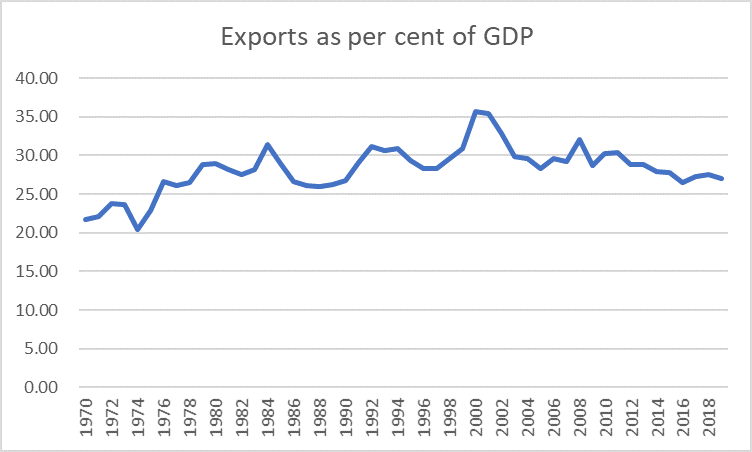
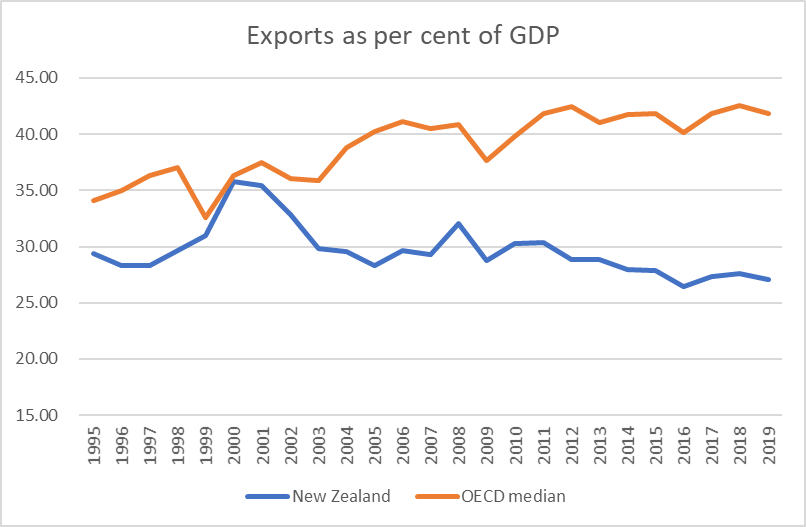
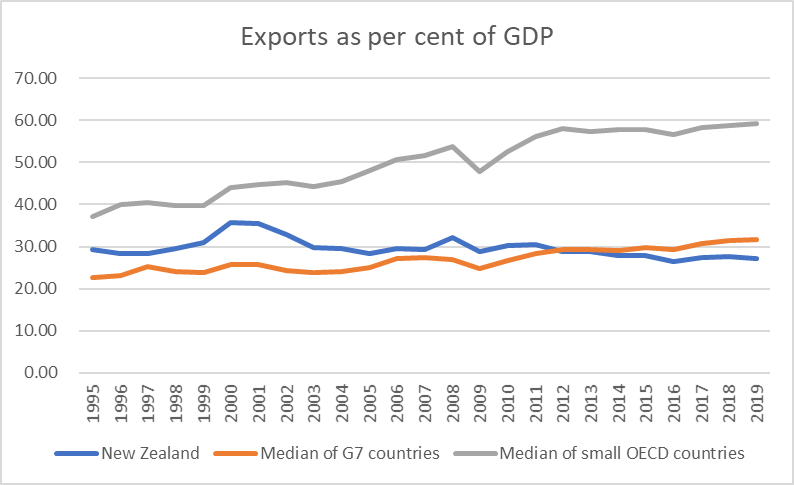
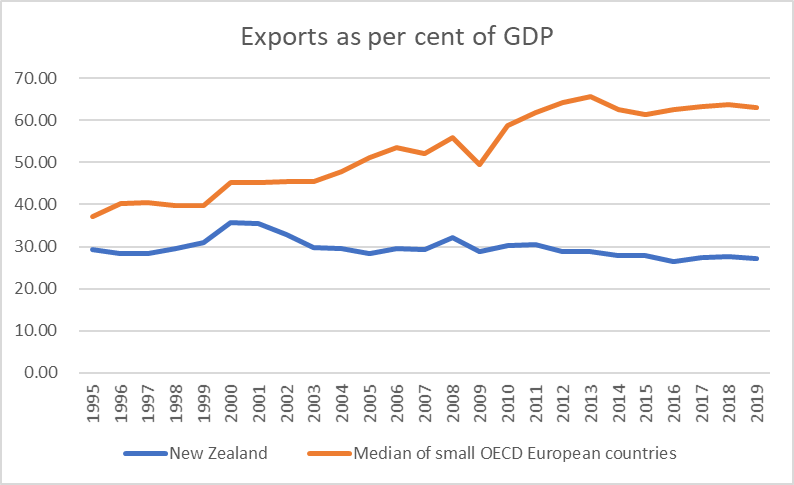
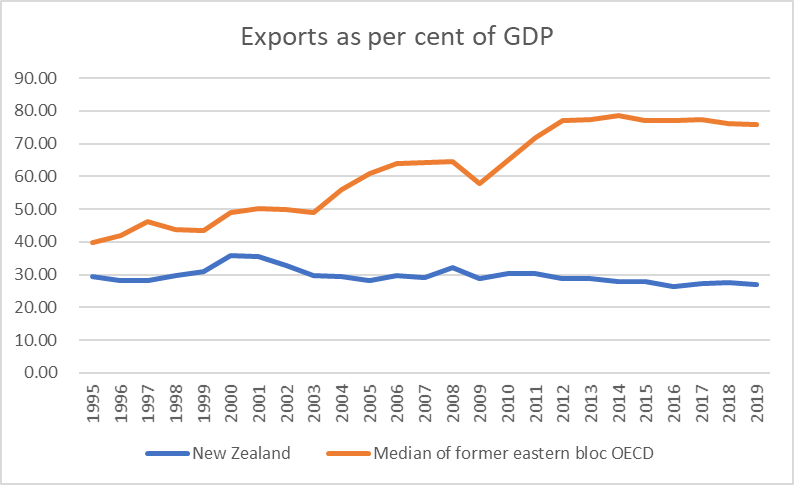
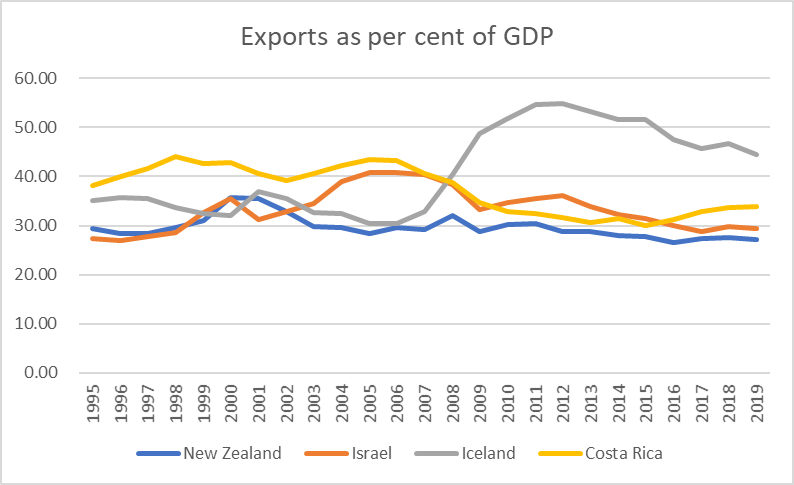
We can set some issues to one side. Yes, we are small, but that isn’t terribly relevant to anything. Yes, New Zealand firms trade internationally, but contrary to the rhetoric about being a “small highly open economy”, actually the share of our economy accounted for by foreign trade (exports and imports) is (a) much less than one would normally expect for a country our size, and (b) has been shrinking. And, yes the PRC recently moved a bit ahead of Australia as the country where the most two-way trade is done with, but – as people have noted for decades – one notable thing about New Zealand is that our trade isn’t very concentrated with any single other country/region (much less so than is the case for Australia). Total New Zealand exports to China, pre-Covid, were about 5 per cent of GDP. Even the EU apparently now has the PRC as the country with which the most foreign trade is done.

I’ve written on this issue before, and suggested then that the sectors of greatest vulnerability might be export education and tourism. As it happens, Covid has dealt to those particular markets for the time being (as it has for Australia). That isn’t a good thing in and of itself, but it does take those considerations off the table if the government were to think of taking a stronger stance at present. The focus for now is commodity exports (dairy, forestry, meat, crayfish etc).

And here it is helpful to look at the experience of (a) the Australian economy, and (b) Australian firms – keeping the two as distinctly different – in the face of blatant PRC economic coercion over the last year or so. There are some sub-sectors and firms that appear to have had it very tough – watch the ABC documentary screened the other day – and listen to the anguish of some of the small crayfish operators (who could still sell crayfish, but only at much lower prices). For reasons that aren’t clear to me, the wine producers exporting to China don’t yet seem to have been able to re-direct their sales (fortunately, in that sense, New Zealand wine exports to China are small). On the other hand, barley producers don’t seem to have been that much adversely affected at all. That is pretty much what you’d expect in a commodity product: some cost, some disruption, some stress for firms involved, but at the end of the day overall global demand and supply conditions won’t have changed much if at all. What we don’t see is any sign of severe economywide consequences: there is no mention of the issue (or risks) in the Reserve Bank of Australia’s latest (lengthy) minutes (by contrast, changes in New Zealand population growth actually get a mention). It seems to a third-order issue at a macroeconomic level – and the overall economy is what governments should be thinking about when they consider economic risks and consequences.

Were it otherwise, by the way, that is what we have macroeconomic policy for, fiscal and monetary, to help smooth the economy in the face of disruptions, whether Covid, coercion, or whatever.

Would it be any different for New Zealand? It is always possible, but it is not as if Australia is the only country the PRC has tried coercion on. They’ve had a go at Norway, at South Korea, at Taiwan, at the Philippines, at Mongolia, at Japan, in one form or another. In some case the governments have buckled – lobbying for special interests will do that – but in no case was there any evidence of a very large adverse macroeconomic effect. Nothing of the bogeyman story that our “elites” would like us to believe, that to offend China would be to jeopardise our very economic security or prosperity.

Of course, people will point out that China has not yet tried sanctions on Australian iron ore (but they did with coal, only to run into problems, because they still needed coal). But isn’t dairy different? The whole path of industrial development and infrastructure does not hang on dairy in the way perhaps it does on iron ore. No doubt, but PRC consumers have a clear demand for milk products, Chinese production is still nowhere near Chinese consumption, and the PRC has a history of attempting coercion mostly on things that don’t affect them, and their people, too much. So, sure China could ban New Zealand dairy exports for a time, but the underlying demand won’t change, and if China takes a large chunk of New Zealand exports at present, China’s imports are small chunk of world production. Now there are complications: “dairy” is not some single homogenous product, and cross-border trade in dairy is small compared to global production, but markets will adjust. Perhaps the world price for our specific products would fall a bit, and for a time, but….the nature of commodity markets is that prices are volatile. Perhaps luxury products like lamb for the restaurant trade might be a more likely target, but then the experience with Norwegian salmon was that total Chinese imports of salmon barely changed, with suggestions that quite a bit of Norwegian made its way back into China via Vietnam.

Whatever the potential disruptions for individual firms – and they are real (for them) – it simply is not credible – given the (smallish) size of our total exports, the commodity nature of most, the share of trade with China – that any sort of conceivable economic coercion would represent a serious sustained threat to the New Zealand economy. Production of most of our commodity products would be unlikely to change much at all, and if the prices of some were to fall, well we are not unused to terms of trade fluctuations. And floating exchange rates are part of the mechanism for buffering such shocks if they do end up a bit larger than expected. The Governor continues to swear by the potency of monetary policy and the many champions of active fiscal policy do the same for it. There is little that is unique about our economy or our risks vis-a-vis China. Just the choices of our governments, egged on by business and university leaders (the interesting thing about Australia now is the lack of business voices calling for the government there to pander anew).

Perhaps also we might have more sympathy for individual New Zealand exporting firms if it was five years ago, when PRC issues and risks were just beginning to emerge, and the experience of economic coercion was both newer and little known here. But no firm that trades with Chinese counterparts now can say they are unaware of the risks. They continue to trade with their eyes wide open (or prefer to pretend a different reality). When you sup with the devil, the standard advice is to take a long spoon. It simply isn’t obvious why firms that deal with Beijing – that perhaps have CCP cells in their subsidiaries in China – warrant our sympathy or support at all; one might argue rather the contrary, in that their voices – lobbying the government to do and say as little as possible – serve the interests of Beijing more than those of New Zealanders as a whole. (And one can’t help wondering how willing New Zealand firms will be to send staff to China once travel is easier, given the sort of travel warnings other countries have issued – and the arbitrary kidnappings the regime has engaged in).

Thus, when the government talks of how it wants to “respect” China – and even has the gall to suggest Australia might show more “respect” – the “respect” they want to offer to these thugs and bullies (to understate the evil of one of the very worst regimes of the planet) is a kowtow not on behalf of you and me – the voters who elected them, the citizens they supposedly represent – but a small group of firms (small and large) only too happy to have you and me pay the price of insurance for their business (we see it also in the substantially government-funded China Council which mostly serves business interests too). The government might want people to believe all those interests are aligned, but they aren’t.

The government has talked a little of encouraging diversification, and of the need for firms to have resilience plans. It probably doesn’t have much substance unless and until the government is willing to tell firms that they are on their own, and to back that up consistently. Most firms don’t trade with Chinese counterparts because of any love for the CCP, but because they perceive the risk-adjusted returns are best there. But that risk seems to be underwritten – diminished sharply – at our expense by a government that chooses to go as soft as it possibly can on Beijing, to feed lines that – wittingly or not, and probably not intentionally – give aid and comfort to the regime.

Finally, it is worth remembering that there is no suggestion that New Zealand should cut trade with the PRC (although individual New Zealanders might increasingly choose to avoid tainted products and companies). The trade threat we are discussing here is entirely something the PRC might choose. It isn’t the way normal or decent states operate, and yet our government would prefer us to pretend that the PRC is just a normal state, run by decent “respectful” people. We can’t stop them disrupting two-way trade – which isn’t some gift to New Zealand firms, but of mutual benefit in normal circumstances – but we can be clear about the values we hold, the interests we want our governments to serve, the real threats that everyone knows but which the government refuses to discuss openly. Values are things that you are willing to pay a price for, and the test of whether they really are values only comes when the possible price has to be faced. I don’t suppose Jacinda Ardern, Nanaia Mahuta, Judith Collins or Gerry Brownlee really like the CCP and its action any more than I, or many readers of this blog, do. I don’t suppose the CCP thinks they do either. They don’t care a jot what leaders think privately. It is what they are willing to speak up about, and act on, that bothers them. And they are right to draw the distinction: private thoughts and feelings signify nothing, especially in a purported leader, without follow through.

As it happens, any “price” New Zealand as a whole might pay seems likely to be modest at worst (worse for some firms, but they’ve chosen – entirely voluntarily – to keep trading with the thugs). It isn’t as if any better stance New Zealand might take would now be world-leading or ahead of the pack. And there would be the comfort of working together – with likeminded countries, of the Five Eyes or beyond, to name evil where it is found, where it threatens values we hold dear, other democratic countries, and the freedoms of the Chinese people themselves.
Listening to Mahuta

Following on from her speech last week, and the (rather overblown) controversy her subsequent remarks about the use of the Five Eyes grouping gave rise to, the Minister of Foreign Affairs Nanaia Mahuta fronted up for extended interviews with the two weekend TV currrent affairs shows.

I wrote about the speech in a post last Tuesday. Rereading the speech itself, and the post, I’d stand by what I said then. It was dreadful – whether the bizarre folk religion stuff, the absence of any evidence of any serious framework for thinking about the growing threat the PRC poses, and just for being more of the same old approach of being very very reluctant to ever openly name the evil done in the name of the CCP and its PRC. It is not that what was said was new: it wasn’t, it was just another example of the craven approach adopted by both sides of New Zealand politics, as evidenced by the support offered for the Minister’s speech by senior National Party figures.

I have read alternative perspectives, but don’t find them persuasive. Professor Anne-Marie Brady, for example, seemed to bend over backwards to defend the Minister and the government’s approach, suggesting of the contents of the speech

For New Zealand this was strong stuff. 

Count me unpersuaded because even if were true that the contents of the speech represented any movement by the government (and I think the evidence doesn’t really support that claim), starting points matter. The New Zealand government, backed by the Opposition, remains scared of its own shadow when it comes to the PRC, and simply fails to engage with the New Zealand public about the nature of the issue and risks. It won’t even engage in serious reform of our electoral donations law, even as investigations and criminal charges proceed about donations from CCP-linked figures. Neither party appears willing to state simply that it will not take donations from CCP-linked figures, let alone refuse to welcome such people as MPs.

Even on Anzac Day weekend, New Zealand’s Minister of Foreign Affairs chooses not to make a simple clear statement that she regards the PRC’s attempted economic coercion of Australia as unacceptable (or the regime’s hostage-taking of Australian and Canadian citizens). It is like a morals-free zone, presumably backed by the Prime Minister.

But it was interesting to listen to the Minister’s two interviews. I thought the Newshub interview was much superior – somewhat more searching (although there was a lot left unaddressed), but also more revealing (in a good way as well). Mahuta was put under some pressure both by the previous interview (a New Zealand citizen of Uighur origins) and by the House of Commons vote last week declaring the PRC approach to the Uighurs as a “genocide”. I didn’t think she emerged well from the interview, but (to her credit) she was finally willing to (more than once) use the word “atrocities” to describe what the PRC has done in Xinjiang – so different from the neutral “treatment of the Uighurs” in her (so we are told) carefully-drafted speech, or to the smart-alecky way she answered a journalist’s question after her speech. There must have been some rethink in the Beehive as the week went on, but only time will tell whether she is willing to use the line again.

But it was still mostly a line that consisted of playing for time, minimising things, avoid hard questions about New Zealand government choices, and so on. Challenged on the “genocide” issue she said she would be “willing to receive advice on that”, but gave no sign that (for example) she had already, or was now, actively seeking such advice. In other words it was clever line to fend off a journalist on the day, not a statement of substance. She says she is all for an independent UN observer to visit Xinjiang, but refuses to engage with the extensive published research of private scholars, or the judgements that various other governments or legislatures have reached.

She was asked about whether New Zealand should impose sanctions on, for example, imports from Xinjiang. She responded that New Zealand did not have an autonomous sanctions regime, without even addressing the point Prof Robert Ayson has made that New Zealand could impose travel bans (as it has in respect of Myanmar officials). Sadly, she was not grilled on why her government chose to scrap the Autonomous Sanctions Bill that had sat for some years on Parliament’s order paper. The thing about having an absolute majority in Parliament is that what does, or doesn’t, happen in Parliament is entirely your responsibility – and if Mahuta is not a top-ranked minister, she does sit in Cabinet and must have the confidence of the Prime Minister.

Oh, and we heard again several times from the MInister – unprompted – the claim that we – well, her government I suppose – wants to be “respectful” of the PRC. This is the same regime that she’d just said was committing repeated atrocities……

And one really had it confirmed that she was squirming and pandering when she was asked whether she thought she was on the “right side of history” as regards the PRC and Xinjiang in particular, and all the interviewer got in response was waffle. Surely there is only one answer any politician of decency and integrity should give to a question of that sort?

As with her speech, in her interviews she repeatedly gave the impression that the government was a trading body. It is a language and mindset that tends to suffuse bureaucracies and politicians, but there is an important distinction to be drawn. China – the PRC – is not “our largest trade partner”. Rather, individual New Zealand firms choose to buy and sell from/to firms in the PRC. Firms in the PRC may be more or less under the thumb of the Party/state, but here it is wholly a matter of private choice. And those choices – protecting them – are not a matter for the government. In fairness, to the Minister we did get a few repetitions of the old (many decades old) line about diversification and resilience, but never once a suggestion (even in muted language) that if you – your firm – chooses to sup with the devil you should bring a long spoon. More specifically, if you trade in a country that attempts economic coercion, that is really your choice, your problem, not that of the government or the rest of us. Governments are supposed to represent the wider interests and values of New Zealanders, not the business interests of a few firms and universities.

The New Zealand government’s approach to the PRC seems craven, fearful, and almost entirely mercenary (sure they make a few comments, and the PRC presumably lets them get away with it because (a) they rightly interpret the spirit (do and say as little as possible as feebly as possible, and (b) it suits them to drive wedges between New Zealand and other democratic countries. But the media scrutiny really isn’t much better. I’m pretty sure that in the course of those two extended interviews we heard and saw:

  • no challenge to the Minister to state simply that attempted economic coercion of Australia is unacceptable and that we stand with Australia (and no attempt to contrast New Zealand’s silence with the recent Biden-Suga communique)
  • no challenge to the Minister to state whether hostage-taking by the PRC is acceptable,
  • extraordinarily, no mention at all of Taiwan,
  • no questions about the PRC activities in the South and East China Sea (including the current standoff involving the Philippines),
  • no grilling of the Minister on the fate of the Autonomous Sanctions bill, why the government seems opposed to having one, and the past lines from the Minister that she wants UN-led responses (when she knows the PRC has a veto),
  • nothing on Hong Kong and the recent prison sentences handed out to leading respected figures in the democracy movement,
  • nothing on forced organ transplants,
  • nothing on intensifying religious and political repression,
  • nothing on the WInter Olympics in Beijing (will government officials or ministers or diplomats attend), will government money help fund New Zealand teams’ participation, should athletes go (to a place where “atrocities” are being committed on an ongoing basis as a matter of Party/state policy),
  • nothing on the sluggish and weak New Zealand response to the WHO Covid report.

The issue last week was never really about the Five Eyes intelligence and signals grouping, but about what everyone knows, that New Zealand governments (and most of the Opposition) simply lack any moral fibre when it comes to the PRC.   The issue isn’t which platform New Zealand speaks on, but the extreme reluctance of its government –  Prime Minister and Foreign Minister in particular –  to say anything much.  The PRC is one of the most heinous regimes on the planet –  probably the most heinous consequential one –  and our elected leaders simply refuse to name the evil.

(Which is not to suggest that I think any other government of any other democratic country does all it could.  A few –  notably Germany –  seem quite as bad as New Zealand.  But the New Zealand stance is shameful and unworthy, reflect of politicians who seem to see only dollars.   But the only values that really count as such are those one is willing to pay a price for.)

For those interested in the economic coercion issue, the ABC had a nice treatment of Australia’s experience in a programme that screened last night.

Regulating lending

The Minister of Finance yesterday announced the latest elements in the government’s overhaul of the Reserve Bank Act. As with so much of that multi-year multi-stage review it has good bits and bad bits.

I support the introduction of deposit insurance (with risk-based pricing), for second-best reasons canvassed here numerous times over the years (deposit insurance increases slightly the likelihood a big bank will be allowed to fail). I also support putting all deposit-takers under a common regulatory regime, replacing the weird halfway house we’ve had for the last decade or so where banks are under one regime and non-banks under another (with the Bank having key powers over the banks, but the Minister of Finance being responsible for key policy matters re the non-banks). So I’m not writing any more about those (well-flagged) aspects of yesterday’s announcement.

However, this –  from the Minister’s press statement –  was something of a bolt from the blue.

The reforms will also include a new process for setting lending restrictions, such as loan-to-value ratios.

“This will give the Minister of Finance a role in determining which types of lending the Reserve Bank is able to directly restrict. The Reserve Bank will then have full discretion to decide which instrument is best suited to use and how the restrictions are applied,” Grant Robertson said.

“As with other prudential requirements, lending standards policies will be subject to more general requirements such as consultation with other government agencies and the public, and the Reserve Bank needing to have regard to the Minister of Finance’s Financial Policy Remit.”

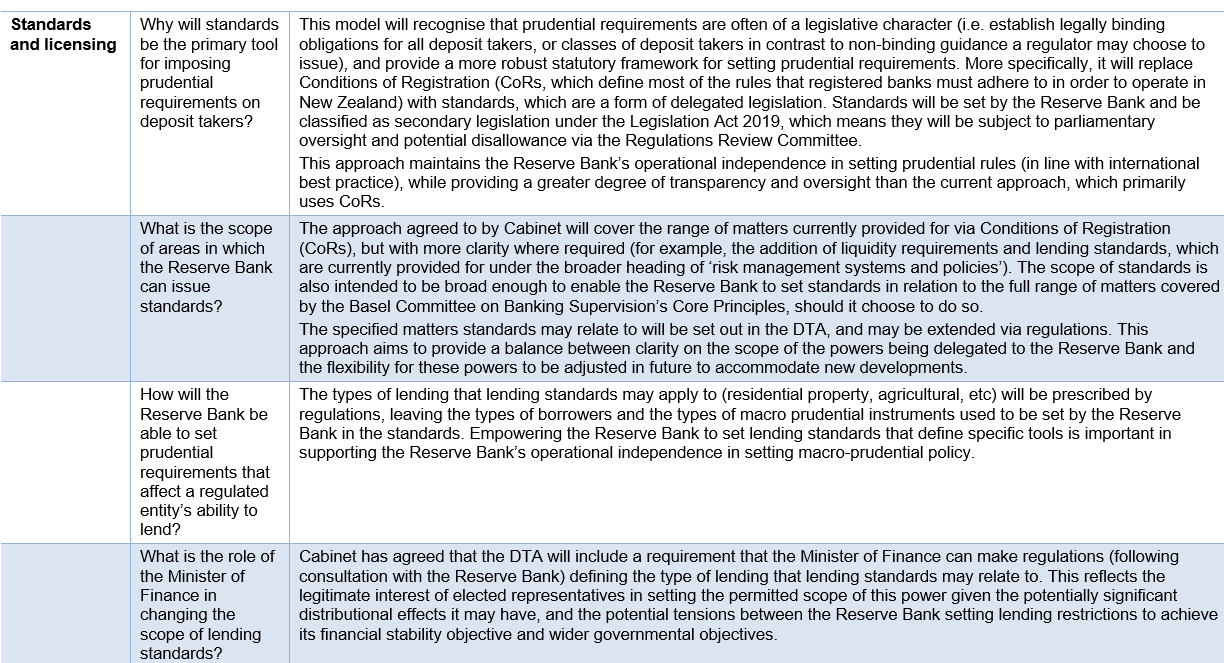
This was somewhat elaborated on in a Q&A document provided to journalists (which doesn’t seem to be on the Beehive or Treasury websites, but which one journalist sent me for my comments). The key bits are as follows (and apologies if it is a bit hard to read).

DTA standards

The first two rows there seem just fine, and indeed in some respects a significant step forward (notably treating future Reserve Bank prudential standards as secondary legislation, subject to proper parliamentary oversight and potential disallowance). They will also remove the current ambiguity around whether, for example, LVR restrictions are even a lawful use of existing legislation.

The problems – indeed, the oddity – is in the final two rows. Specifically

Cabinet has agreed that the DTA will include a requirement that the Minister of Finance can make regulations (following consultation with the Reserve Bank) defining the type of lending that lending standards may relate to. This reflects the legitimate interest of elected representatives in setting the permitted scope of this power given the potentially significant distributional effects it may have, and the potential tensions between the Reserve Bank setting lending restrictions to achieve its financial stability objective and wider governmental objectives.

I described this yesterday as a slightly curious step forward. It is a step forward because under the current Reserve Bank Act, applying to regulation of banks, all the policymaking powers rest exclusively with the Bank (the Governor personally at present), even though there are no clear and specific objectives, and thus little or no effective accountability. It is a really severe democratic deficit, only compounded in practice by the inadequacies of the Reserve Bank itself (see earlier posts on the weaknesses of their analysis, and the Governor’s bullying approach, around major regulatory policy initiatives).

There was an attempt some years ago to paper over this problem with the macroprudential memorandum of understanding between the Bank and the then Minister, which purported to give the Bank authority to, for example, use LVR restrictions. “Purported” because the Minister had no legal role, or authority – and could not formally stop the Bank doing what it wanted – but it may have provided some sort of political check (and without the MOU it is likely the Bank would have pressed ahead with debt to income limits).

Yesterday’s announcement appears to recognise that there was a problem, a weakness in the framework, leaving too much power in the hands of a central bank that has no mandate and no accountability. But the way the government has chosen to respond is really quite bizarre, the more so (it seems to me) the more I have reflected on it. As, frankly, are some of the other economists comments I’ve seen suggesting that this will take away the Bank’s “operational independence”.

Now, in fairness, some concerns may be allayed when the detailed legislation emerges. There are concerns that a government will be able to regulate that, say, credit to businesses they don’t like will be able to be regulated, but not that to businesses they do like, or (to take an absurd extreme) credit to National voters (or voting areas) could be restricted but not that to Labour voters. One would hope the legislation makes clear that any such regulation-making power – over which areas the Bank can impose lending standards – is subject to a clear and demanding statutory test, to ensure that such designations can be used only where there is a systemic-level threat to the financial system.

But then that is where the oddity comes in. You would expect the Reserve Bank to be (much) better positioned than ministers to determine where threats to financial stability might come from. While politicians are, in our system of government, the prime legislators and policymakers. They, after all, are the only ones we can toss out in elections, and the only ones facing day to day scrutiny and challenge in Parliament.

And yet, we are told, under this legislation the Minister of Finance will identify the risk areas (albeit “in consultation with” – but not subject to- the Bank), and then the Bank will be free to do whatever it likes in those areas. Of course, when I frame it as “the Minister of Finance will identify the risk areas”, it is also about “the Minister of Finance will identify the political no-go areas”. But that too is bizarre: the government might object to direct restrictions on lending to first-home buyers, but is unlikely to have the same objection to high capital requirements in respect of such lending – but the government can only determine the type of lending the Bank sets “standards” for, not the tools used. If there is a place for politicians in all this – and I think there is an important place – it should be about use of specific regulatory interventions (potentially very heavy-handed ones), not the identification of areas of risk.

Thus, I’ve seen no coverage of the fact that – on what we are told yesterday – in future the government will claim no right to determine whether or not debt to income limits can be imposed. That would represent a really big step back from the model the government and Reserve Bank tells us they have been using for the last decade or so. (And recall, again based on what we are told, if the government is okay with regulating housing lending – even first home owner lending – they won’t be able to (say) distinguish between LVR and DTI restrictions. That would be entirely a matter for the Bank, with no clear objectives and no effective accountability.

This is simply wrongheaded, giving official and up to date sanction to a near-unlimited potential set of regulatory interventions by an independent (and not very expert) agency. Those powers – if they are to exist at all – should rest with the Minister of Finance and Cabinet, taking advice from the Reserve Bank and Treasury.

It is also where some of the comments about “operational independence” get quite confused. As regards central banks the concept of operational independence grew up around monetary policy to distinguish the ability to adjust, say, an OCR in pursuit of a target, and the ability to set the target itself (which would be “goal autonomy”). The ECB has both goal and operational autonomy on monetary policy, but the Reserve Bank of New Zealand (like most central banks with modern legislation) has operational autonomy to pursue a target set for them by politicians. There is quite widespread support for that sort of model (even if the case is weaker than it once seemed). Not only is there a fairly clear objective and some reasonable way to assess whether or not the job is being done well, but central banks typically have quite limited (often no) direct regulatory powers as regards monetary policy: they can set their own interest rate, and can buy and sell assets (ie indirect influence), but that is about all.

By contrast, in bank (and now non-bank) regulation there is (a) no clear and specific objective, (b) no clear way of knowing whether the job is being done effectively (systemic bank failures are very rare, so there are few observations), but (c) there are few effective constraints on the direct regulatory interventions the Bank could use. It appears, for example, that they could simply ban some types of credit (provided by deposit-takers) if they so chose, or hugely impinge on household or business choices, in ways that – if done at all – should only be done by people we can hold to account. And that isn’t the Governor or the (new) Board. (As it happens, this is more or less the model – Bank advises, Ministers decides – that applies to non-bank deposit-takers, which is the reason why LVR controls don’t apply to them.)

We do want operational autonomy for the prudential regulatory agency. But that operational autonomy is about the implementation of policy powers that – at least in the broad – are set by elected policymakers. We do not want politicians interfering in how rules are applied to favour, say, one bank over another – any more than we want politicians interfering in which individuals get NZS, but the NZS policy parameters should be set by those we elect. There are grey areas (what is implementation, what is policy) but what the current government is proposing is a significant in increase in the policymaking powers of a bureaucratic agency – formally so in the case of non-banks, informally so (the prior constraint of the MOU) in respect of banks. That simply fails standard tests of good government, democratic accountability and so on – and would do even if the Reserve Bank were demonstrably an excellent agency.

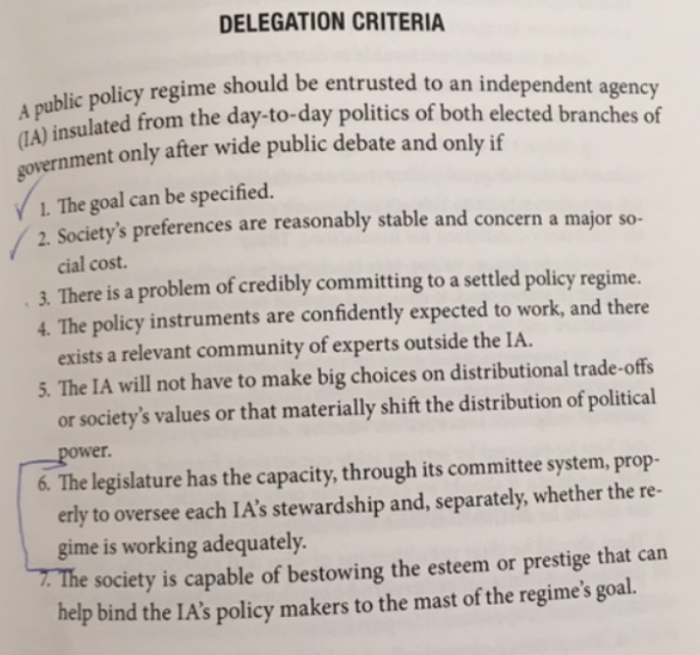
I’ve written here previously about the very useful book (Unelected Power: The Quest for Legitimacy in Central Banking and the Regulatory State) published a few years ago written by Sir Paul Tucker, former Deputy Governor of the Bank of England. This summary table is taken from the book.

tucker2

Giving far-reaching policymaking powers to the Reserve Bank, particularly in areas that directly impinge on firms and households, simply does not pass the test. Cabinet seems to have rightly recognised that politicians have key responsibilities and accountabilities, and yet taken a strange – and weak – approach in response.

To be clear, I do not favour any of the sorts of interventions the Bank has adopted or tried to get introduced in recent years. The prudential regulatory (system soundness and efficiency) case for LVRs or DTIs has never been compellingly made, and if I had my way the law would prohibit either the government or the Reserve Bank from imposing such restrictions (without specific new primary legislation). But if such powers are to exist, they should be exercised only by those we elect, those we can properly scrutinise, those we can toss out.

(On which note, the government is currently advertising for members of the new Reserve Bank board, to take office in July 2022, when the Board will assume all the financial regulation powers statutes give to the Bank. The formal job description is not quite this bad, but note that in the big newspaper adverts for these roles “championing diversity and inclusion” and “sound understanding of Te Ao Maori” (even “operating with intergenerational horizons”) come before any specialist expertise in the subject matter the Bank is responsible for.)

Inflation

The possibility of a sustained rise in the inflation rate (internationally and here) has been getting a lot of attention in the last few months. Note that I call it a “possibility” rather than a “risk”, because “risk” often has connotations of a bad thing and, within limits, a rise in the (core) inflation rate is something that should be welcomed in most advanced economies where, for perhaps a decade now, too many central banks have failed to deliver inflation rates up to the targets either set for them (as in New Zealand and many other countries) or which they have articulated for themselves (notably the ECB and the Federal Reserve). I’m not here engaging with the debate on whether targets should be higher or lower, but just take the targets as given – mandates or commitments the public has been led to believe should be, and will be, pursued.

Putting my cards on the table, I have been quite sceptical of the story about a sustained resurgence of inflation. In part that reflected some history: we’d heard many of the same stories back in 2010/11 (including in the countries where large scale asset purchases were then part of the monetary policy response), and it never came to pass – indeed, the fear of inflation misled many central banks (including our own) into keeping policy too tight for too long for much of the decade (again relative to the respective inflation targets). Central banks weren’t uniquely culpable there; in many places and at times (including New Zealand) markets and local market economists were more worried about inflation risks than central banks.

I have also been sceptical because, unlike many, I don’t think large-scale asset purchases – of the sort our Reserve Bank is doing – have any very much useful macroeconomic effect at all (just a big asset swap, and to the extent that there is any material sustained influence on longer-term rates, not many borrowers (again, in New Zealand) have effective financing costs tied to those rates). And if, perchance, the LSAP programme has kept the exchange rate a bit lower than otherwise, it is hardly lower than it was at the start of the whole Covid period – very different from the typical New Zealand cyclical experience. In short, (sustained) inflation is mostly a monetary phenomenon and monetary policy just hadn’t done that much this time round.

Perhaps as importantly, inflation has undershot the respective targets for a decade or so now, in the context of a very long downward trend in real interest rates. There is less than universal agreement on why those undershoots have happened, in so many countries, but without such agreement it is probably wise to be cautious about suggesting that this time is different, and things will suddenly and starkly turn around from here. At very least, one would need a compelling alternative narrative.

Having said that, there have been a couple of pleasant surprises in recent times. First, the Covid-related slump in economic activity has proved less severe (mostly in duration) than had generally been expected by, say, this time last year when some (including me) were highlighting potential deflationary risks. That rebound is particularly evident in places like New Zealand and Australia that have had little Covid, but is true in most other advanced countries as well where (for example) either the unemployment rate has peaked less than expected or has already fallen back to rates well below those seen, for example, in the last recession. Spare capacity is much less than many had expected.

And, in New Zealand at least, inflation has held up more than most had expected (more, in particular, than the Reserve Bank had expected in successive waves of published forecasts. The Bank does not publish forecasts of core inflation, but as recently as last August they forecast that inflation for the year to March 2021 would be 0.4 per cent (and that it would be the end of next year before inflation got back above 1 per cent). That was the sort of outlook – their outlook – that convinced me that more OCR cuts would have been warranted last year.

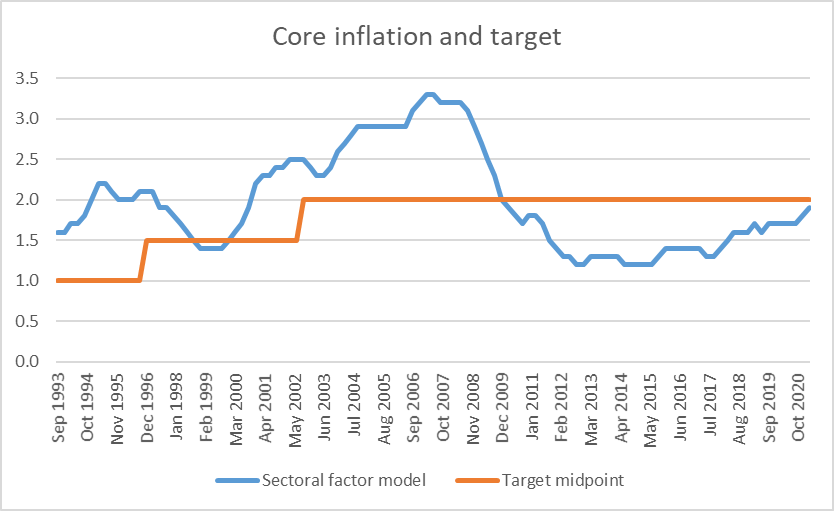
As it is, headline CPI inflation for the year to March was 1.5 per cent. But core measures are (much) more important, and one in particular: the Bank’s sectoral core factor model, which attempts to sift out the underlying trends in tradables and non-tradables inflation and combines them into a single measure: a measure not subject to much revision, and one which has been remarkably smooth over the nearly 30 years for which we now have the series – smooth, and (over history) tells a story which makes sense against our understanding of what else was going on in the economy at the time. This is the chart of sectoral core inflation and the midpoint of successive inflation targets.

core inflation apr 21

It is more than 10 years now since this (generally preferred) measure of core inflation has touched the target midpoint (a target itself made explicit from 2012 onwards). With a bit of lag, core inflation started increasing again after the Bank reversed the ill-judged 2014 succession of OCR increases, but by 2019 it was beginning to look as if the (core) inflation rate was levelling-off still a bit below the target midpoint. It was partly against that backdrop that the Reserve Bank (and various other central banks) were cutting official rates in 2019.

The Bank’s forecasts – and my expectations – were that core inflation would fall over the course of the Covid slump and – see above – take some considerable time to get anywhere near 2 per cent. So what was striking (to me anyway) in yesterday’s release was that the sectoral measure stepped up again, reaching 1.9 per cent. That rate was last since (but falling) in the year to March 2010.

As you can, there is a little bit of noise in this series, but when the sectoral factor model measure of core inflation steps up by 0.2 percentage points over two quarters – as had happened this time – the wettest dove has to pay attention.

To be clear, even if this outcome is a surprise, it should be a welcome one. (Core inflation) should really be fluctuating around the 2 per cent midpoint, not paying a brief visit once every decade or so. We should be hoping to see (core) inflation move a bit higher from here – even if the Bank still eschews the Fed’s average inflation targeting approach.

Nonetheless, even if the sectoral factor model is the best indicator, it isn’t the only one. And not all the signs are pointing in the same direction right now. For example, the annual trimmed mean and weighted median measures that SNZ publishes – and the RBA, for example, emphasises a trimmed mean measure – fell back in the latest quarter. The Bank’s (older and noisier) factor model measure is still sitting around 1.7 per cent where it first got back to four years ago. International comparisons of core inflation tend to rely on CPI ex food and energy measures. For New Zealand, that measure dropped back slightly in March, but sits at 2 per cent (annual).

Within the sectoral factor model there is a non-tradables component – itself often seen as the smoothest indicator of core inflation, particularly that relating to domestic pressures (resource pressures and inflation expectations). And that measure has picked up a bit more. On the other, one of the exclusion measures SNZ publishes – excluding government charges and cigarettes and tobacco – now has an inflation rate no higher than it was at the end of 2019 and – at 2.4 per cent – probably too low to really be consistent with core inflation settling at or above 2 per cent (non-tradables inflation should generally be expected to be quite a bit higher than tradables inflation).

I think it is is probably safe to say that core inflation in New Zealand is now back at about 2 per cent. That is very welcome, even if somewhat accidental (given the forecasts that drove RB policy). As it happens, survey measures of inflation expectations are now roughly consistent with that. Expectations tend not to be great forecasts, but when expectations are in line with actuals it probably makes it more likely that – absent some really severe shock – that inflation will hold up at least at the levels.

But where to from here?

Interestingly, the tradables component of the Bank’s sectoral factor model has not increased at all, still at an annual rate of 0.8 per cent. All indications seem to be that supply chain disruptions and associated shortages, increased shipping costs etc will push tradables inflation – here and abroad – higher this year. But it isn’t obvious there is any reason to expect those sorts of increases to be repeated in future – the default assumption surely has to be that shipping, production etc gradually gets back to normal, perhaps with some price falls then.

And if one looks at the government bond market, participants there are still not acting as if they are convinced core inflation is going higher. If anything, rather the opposite. There are four government inflation-indexed bonds on issue, and if we compare the yields on those bonds with the conventional bonds with similar maturities, we find implied expectations over the next 4 and 9 years averaging about 1.6 per cent, and those for the periods out to 2035 and 2040 more like 1.5 per cent. Again, these breakevens – or implied expectations – are not forecasts, but they certainly don’t speak to a market really convinced much higher inflation is coming. One reason – pure speculation – is that with the Covid recession having been less severe than most expected, it isn’t unreasonable to think about the possibility of a more serious conventional recession in the coming years with (a) little having been done to remove the effective lower bound, and (b) public enthusiasm for more government deficits likely to reach limits at some point.

So I guess I remain a bit sceptical that core inflation is likely to move much higher here, even if the Reserve Bank doesn’t change policy settings. Fiscal policy clearly played a big role in supporting consumption last year but we are likely to be moving back into a gradual fiscal consolidation phase over the next few years. And if the unemployment rate is now a lot lower than most expected, it is still not really a levels suggesting aggregate excess demand (for labour, or resources more generally). For the moment too, immigration isn’t going to be providing the impetus to demand, and inflation pressures, that we often expect to see when the economy is doing well (cyclically). And if you believe stories about the demand effects of higher house prices – and I don’t- house price inflation seems set to level off through some mix of regulatory and tax interventions and the exhaustion of the boom (as in numerous previous occasions).

What should it all mean for monetary policy? Since I don’t think the LSAP programme is making much difference to anything that matters – other than lots of handwaving and feeding the narratives of the inflationistas who don’t seem to realise that asset swaps don’t create additional effective demand – I’d be delighted to see the programme canned. But I don’t think doing so would make much sustained difference to anything that matter either. So in a variant of one of the Governor’s cheesy lines, it is probably time for “watch, hope, wait”. The best possible outcome would be a stronger economic rebound, a rise in core inflation, and the opportunity then to start lifting the OCR. But there is no hurry – rather than contrary after a decade of erring on the wrong side, tending to hold unemployment unnecessarily high. And there is little or no risk of expectations – or firm and household behaviour – going crazy if, for example, over the next year or two core inflation were to creep up to 2.3 or 2.4 per cent.

But what of the rest of the world? I’ve tended to tell a story recently that if there really were risks of a marked and worrying acceleration in inflation it would be in the United States, where the political system seems determined to fling borrowed money around in lots of expensive government spending programmes.

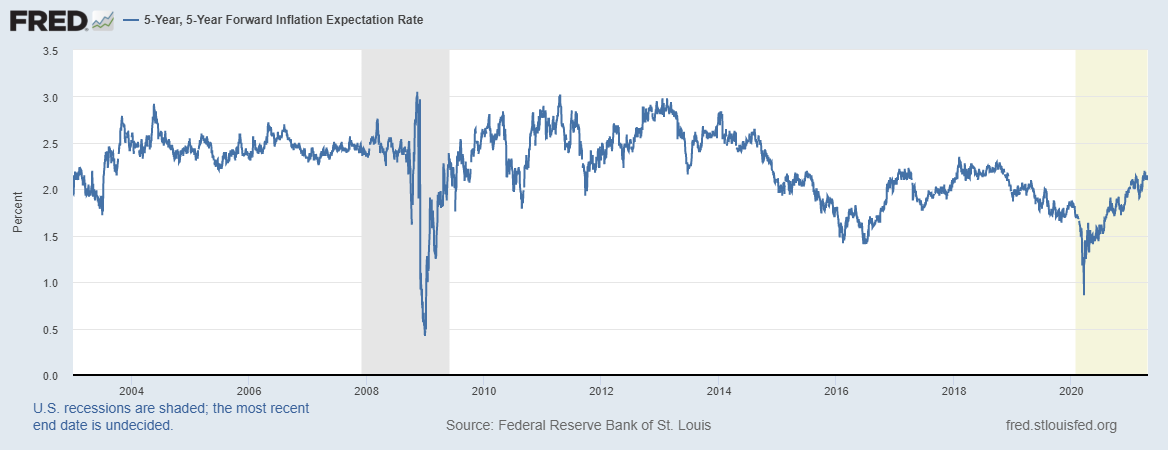
But for now, core inflation measures still seem comfortably below 2 per cent (trimmed mean PCE about 1.6 per cent). The Cleveland Fed produces a term structure estimate for inflation expectations, and those numbers are under 2 per cent for the next 28 years or so (below 1.7 per cent for the next 15 years). And if market implied expectations have moved up a lot from the lows last year, the current numbers shouldn’t be even remotely troubling – except perhaps to the Fed which wants the market to believe it will let core inflation run above 2 per cent for quite a while before tightening, partly to balance past undershoots. Here are the implied expectations from the indexed and conventional government bond markets for the second 5 years of a 10 year horizon (ie average inflation 6-10 years hence).

5x5

These medium-term implied inflation expectations are barely back to where they were in 2018, let alone where they averaged over the decade from about 2004 to 2014 – for much of which period the Fed Funds rate sat very near zero.

What of the advanced world beyond the US. It is harder to get consistent expectations measures, so this chart is just backward-looking. Across the OECD, core inflation (proxied by CPI inflation ex food and energy) has been falling not rising (these data are to February 2021, all but New Zealand and Australia having monthly data).

OECD core inflation apr 21

Are there other indicators? Sure, and many commodity prices are rising. And markets and economists have been wrong before and will – without knowing when – be wrong again. Perhaps this will be one of those times. Perhaps we’ve all spent too much time learning from the last decade, and forgetting (for example) the unexpected sustained surge in inflation in the 60s and 70s.

But, for now, I struggle to see where the pressures will come from. Productivity growth is weak and business investment demand subdued. Global population growth is slowing (reducing demand for housing and other investment). We aren’t fighting wars, we don’t have fixed exchange rate. And if interest rates – very long-term ones – are low, it isn’t because of central banks, but because of structural features – ill-understood ones – driving the savings/investment (ex ante) balance. For now, the New Zealand story is unexpectedly encouraging – inflation finally looks to be near target – but we should step pretty cautiously before convincing ourselves that the trends of the last 15 or even 30 years are now behind us, or that high headline rates – here and abroad – later this year foreshadow permanently higher inflation (or, much the same thing, higher required interest rates).

Just dreadful

There hasn’t been much, if anything, here over the last year or so on the (successive) New Zealand governments’ subservient and fearful relationship with the Peoples’ Republic of China. For some months I’ve had sitting on my pile to write about two books on the wider PRC issues (Hidden Hand by Clive Hamilton and Mareike Olberg, and Insidious Power: How China Undermines Global Democracy, a collection of papers including Anne-Marie Brady’s Magic Weapons paper on New Zealand). Perhaps one day.

But yesterday we had the first speech on the New Zealand/PRC relationship from our (relatively) new Minister of Foreign Affairs, Nanaia Mahuta. There was no reason to suppose it would be anything other than dreadful. Mahuta’s only other on-the-record speech as foreign minister had been a largely unserious word-salad of little substance. Her track record on the PRC has been dreadful, right since her first (perhaps mis-spoken) substantive TV interview in the role in which she loftily declared that she “knew” the PRC valued diversity, through the persistent reluctance to say anything much if at all possible – and then apparently as late as possible – on the growing catalogue of PRC abuses and threats. Oh, and of course the speech was being given to the New Zealand China Council, the propaganda and apologist body set up by the previous government (and substantially taxpayer funded, with key government officials directly involved). The Council has never so much as uttered a word of criticism of the PRC and its chair and former Executive Director were often quite vocal in pushing back against the concerns expressed by people like Professor Brady. And, of course, if Mahuta has been bad, the Prime Minister – who will no doubt have cleared yesterday’s speech – has been even worse, utterly silent.

Nonetheless, I watched the livestream of yesterday’s speech and carefully read the full text. It really was dreadful, on multiple counts. And here I’m not even going to focus on such bizarre bits as this, from her introduction.

I invoke the inspiration and guidance of the universe and the gods, I bestow a life-force upon this gathering.

Is she both a polytheist and (claiming to be) a deity herself, to be “bestowing a life-force”, whatever that means?

Or her incomprehensible suggestion – having gone and on about “taniwha” – suggesting that “we [who?] share common taniwha with the Pacific”. Would any serious foreign minister from any serious country talk like this? Perhaps the goblins unite Europe?

And who knows what, if anything, she means by her suggestion of a foreign policy “founded in” the Treaty of Waitangi. Perhaps she has in mind it being okay if the PRC gets a few Taiwanese leaders to agree to cede sovereignty and then simply moves to annex the rest? Probably not, but it is just another example of the vacuousness – which, I suppose, must sound good to someone, but seems to be simply a deliberate distraction and an excuse of opting out and being unserious about the global challenges, notably those posed by the PRC.

My bigger concerns – the focus here – are around (a) the utter lack of any sign of a serious, transparent, framework for how the New Zealand government thinks about the PRC, and (b) the continuing signs, nonetheless, of some mix of deference, sheer cowardness, and indifference to what the PRC is doing to other free and democratic countries.

This was the first speech on the PRC relationship by a new foreign minister, delivered to a China-focused (well, more likely a dollar-focused) audience. And yet there were no thoughts on the nature of the PRC challenge – none, not even to suggest, say, that the government thought everything was just rosy and the PRC’s intentions were entirely benign. There was no structured or systematic engagement with the rise of China, in any dimension whatever, just the odd passing allusion to this or that (really amounting to little more than “China is big”), There was no engagement at all with the literature on PRC interference/influence – this in a country with a figure closely linked to the PRC/CCP faces electoral donations criminal charges this year – nothing on China and the international agencies, nothing on China and the South China Sea (or the East China Sea for that matter), nothing on the PRC reach into (and intimidation of) ethnic Chinese communities in other countries, nothing on the history and experience of economic coercion. Just nothing, no framework, nothing. Either there is such a framework and the government just prefers to keep the public in the dark (the government that used to boast that it would be the most open and transparent ever), or – more likely – there isn’t one and the government’s entire approach amounts to saying and doing absolutely as little as possible, always aiming to keep on the right side of Beijing come what may, without totally alienating traditionally like-minded countries (perhaps not even that bothers them, but they probably worry that significant chunks of the public might worry if it become too clear how explicit the sellout was). Recall that this is the political party whose then president only a few years ago was lauding the PRC and Xi Jinping.

There might be reasonable debates to be had about how best to respond to the PRC threat, but without a proper analysis of the issues and risks there is no real leadership to any such debate. Of course, one can’t fit everything in a 20 minute ministerial speech, but the government has the full resources of MFAT at its disposal, and there is no sign of any serious engagement or analysis from them either. For an issue, and series of threats, of this magnitude, it is simply not good enough. In fact, it probably isn’t going too far to call it a betrayal of democracy and open government, when there really should be a wider public engagement on how New Zealand, and likeminded countries, should respond to the PRC. All, it appears, to keep a few exporting firms happy from month to month.

So if there was no serious analytical framework in the speech – and clearly it was the Minister’s intention not to provide one – what about what was there? I’ve seen some champions of the government suggesting there was really quite a lot (of good) there, just expressed very subtly. Seems to me that a better way of putting it is that there a few lines in the speech – drafted in ways likely to be minimally offensive to a Beijing (that would continue to prefer to keep New Zealand onside and drive wedges between it and other free and democratic countries) – designed for exactly that purpose, but signifying almost nothing. And there is much else that, while perhaps diplomatic boilerplate language, shouldn’t be being used of one of the most heinous consequential regimes on the planet (itself the sort of line an honest and courageous government might use).

Thus stepping through the speech we have pandering lines like

“As we approach the 50th anniversary of diplomatic relations next year,”

Which is, of course, true of the Peoples’ Republic (well, the CCP’s Republic) but we were allies with pre-Communist China in both world wars.

Or this one, which I’ve seen suggested as significant

“This has been a journey. Today we acknowledge the interests we share. Equally we have become more alert to the values that differentiate us.”

Well, okay, I guess there is a first derivative in that second sentence, but what of it? The Minister won’t even name these values that differentiate us, let alone do anything about the difference.

This line has also garnered a few headlines

In thinking about long-term economic resilience we also understand that there is value in diversity. Just as the Council has noted, it is prudent not to put all eggs into a single basket. The New Zealand government will continue to work with business to pursue a range of trade opportunities. 

As most of the media failed to report, the Minister was alluding to an utterly innocuous comment in the China Council’s own last Annual Report (you know it to be innocuous because nothing else gets in their Annual Reports). No country ever wants to have all the trade of its firms with those in a single other country – never has, never will. And that final sentence is really just a reminder of the fact that (for example) in the normal course of business New Zealand is currently negotiating preferential trade/investment agreements with the EU and with the UK. I’ll start to get interested when a minister says something like “if you deal in a country like the PRC you expose yourself to big risks with a regime unafraid to use trade as a coercive tool. If you get caught up in those you should go in with your eyes open, knowing that the New Zealand government isn’t here to help individual exporting firms, but the interests and values of wider New Zealand”.

Instead there were observations about the good relationship the Minister and Damien O’Connor had with their PRC counterparts – as if, in the current climate, this was a good thing. Neville Chamberlain seemed to like to think he had a good relationship with Hitler.

Then, of course, we get the line this government just loves to use – our allegedly shared commitments re climate change.

Beyond the regional agenda, many countries –including New Zealand – will continue to engage with China on climate change. The undertakings China has already made and its future actions, along with those of other big economies, will be hugely consequential.

As many others might note, in the unlikely event those “undertakings” are honoured.

She moves on to suggest that the New Zealand government “needs” to respect the values of the PRC/CCP? On what planet? One might well do to recognise what those “values” and priorities evidently are and engage the New Zealand public on what that means for us, but “respect them” Perhaps Ardern and Mahuta do? Most decent New Zealanders won’t. Forced organ transplants anyone? Compulsory sterilisations? Extreme repression of political and religious expression? The pre-eminence of the Party? You respect them if you must Ms Mahuta, but that tells us more about you.

And then we get another line that looks as though it was put in to be able to point to (“see, we did say something”).

And we look for a similar spirit of respect and engagement to be shown to all international friends and partners.  As a significant power, the way that China treats its partners is important for us.

This is probably a very muted suggestion that perhaps using economic coercion on (what was) our closest friend and ally, Australia, isn’t really on (perhaps also that holding Canadian citizens hostage isn’t our preferred option either) but so what? It is so muted it isn’t going to offend Beijing (no one supposes they really think we are okay with that sort of thing) and it says nothing starkly, doesn’t openly stand us alongside likeminded countries being coerced by the PRC. (She never even takes the opportunity to cite the recent paper suggesting that overall economic effects of PRC coercion efforts on Australia have been minimal, at least to date).

Then we get back to more pandering.

In terms of whanaungatanga the Dragon and the Taniwha may share similar characteristics but they exist in very different environmental conditions. The perspective each holds about the “optimum” environment for survival such as a country’s political system, democratic institutions, freedoms and liberties can and have shown to be significantly different.

Different perspectives can be positive, and underpin cultural exchange and learning,

But some differences challenge New Zealand’s interests and values.  There are some things on which New Zealand and China do not, cannot, and will not, agree.

While it is good to know that there are some things on which her government “cannot” agree with the PRC, isn’t it a trifle disconcerting that core aspects of our political systems are listed just before she just differences can be positive and implies we can learn from the PRC?

We then get the standard line – beloved of the previous government too – that

On many occasions New Zealand has raised issues privately with China. 

Except that no one, probably including the Chinese, take this seriously. When they won’t openly state – for the New Zealand public that they supposedly represent – what they say to the PRC, we can assume it is mostly “well, General Secretary Xi, you know our people don’t much like some of the things you do, but we won’t say anything openly, and lets get down to the next trade facilitation agreement”.

They keep trying to pretend to us that the PRC is a normal country, a normal regime, not the most heinous consequential regime on the planet, with generally malevolent intent.

Towards the end of the speech Mahuta briefly mentions a few public comments

Sometimes we will therefore find it necessary to speak out publicly on issues, like we have on developments in Hong Kong, the treatment of Uyghurs in Xinjiang, and cyber incidents.  

But notice the feeble, almost neutral, framing even there – nothing about egregious abrogation of an international agreement, imprisonment of long-respected democratic figures, gross human rights abuses (which some of our international friends consider amount to “genocide’). Oh, and “cyber incidents”, not even attacks. (Although I will acknowledge that this comment ties China to cyber attacks more than I think the New Zealand government has previously done, but in a way so obscure designed for the public not to notice).

Of course, no mention of the things her government chooses not to comment on, such as the recent WHO report which she told us previously they couldn’t comment on because officials had not yet had the chance to study the report. Slow reading officials? Or a government and officials that prefer to look the other way? I think we all know which.

The final line that I’ve seen it suggested gave substance to the speech was this one

China can play a role in the long term economic recovery of the region but there is a substantial difference between financing loans and contributing to greater ODA investment in particular to the Pacific. We must move towards a more sustainable Pacific that respects Pacific sovereignties, and builds on Pacific peoples’ own capabilities, towards long-term resilience.

But there is nothing new in this whatever. As previous people have pointed out, we can never compete with the PRC in throwing money at the Pacific, but we do like to highlight that we give rather than lend (even though concessional loans often have a substantial grant element).

So that was what was in the speech. What there wasn’t was any mention of included:

  • the recent imprisonment (or suspended sentences) for leading Hong Kong figures like Martin Lee and Jimmy Lai (no statement from the government either)
  • no mention of that WHO Covid report. Still unread?
  • no mention of PRC interference in New Zealand, including the intimidation of resident ethnic Chinese people, or the attempts to silence Anne-Marie Brady,
  • no mention of the growing international concern about the threat to Taiwan, or the current standoff involving the Philippines in the South China Sea,
  • no mention of how New Zealanders might consider taking their own (boycott) actions against companies using forced labour in Xinjiang,
  • nothing about the sanctions the PRC has been imposing on various western figures recently,
  • nothing about her government’s refusal to put sanctions of key PRC XInjiang figures, or the government’s decisions to scrap the Autonomous Sanctions bill that was before Parliament

Perhaps there is a case to be made for the government’s stance on each of these issues. but Mahuta didn’t make those cases, preferring to pretend the issues didn’t exist. It really was shameful.

And if all that was bad then there was what she said afterwards in response to questions. For example, it is reported that she dealt with a question on the Uighur situation by answering only in Maori (that presumably few present would have understood) but which a local academic reports includes this egregious line

“It’s important that we keep our perspectives on the situation of indigenous peoples elsewhere, they have complex, different laws, different government systems,

The Minister also grabbed headlines for her remarks distancing New Zealand from the use of the Five Eyes group of countries in responding to the PRC, suggesting that her government preferred the Five Eyes stuck to intelligence and that they would often prefer to walk alone on the PRC. Personally, I don’t have a strong view on the Five Eyes label, but these are countries that we might normally think we’d have an affinity with on such issues (and several of them – notably Canada – have not been particularly robust on the PRC themselves). But we all know that the issue isn’t really the Five Eyes – much though much of the far-left in New Zealand would probably prefer we weren’t part of it at all – but the New Zealand government’s preference – Ardern and Mahuta – to say as little as possible as rarely as possible, and keep in Beijing’s good books as long as possible as much as possible, pretty much whatever the regime does. And that is despicable. It might be one thing to distinguish ourselves from the Five Eyes grouping if New Zealand were becoming a uniquely courageous country working with wider groups of courageous countries willing to call out the regime internationally and act against it at home and abroad. But that isn’t it. It is simply a cowardly, mercenary, and utterly short-sighted, stance.

Of course, if Mahuta and her boss are dreadful on these issues – and despicable isn’t really too strong a word – it shouldn’t pass without notice that no party in Parliament, not even any individual MP, is any better. If, just possibly, a few words may be a little better now than at times under the previous government, the nature of the issues and threats is starker now, and all parties – all MPs – have less excuse for their willed blindness, their refusal to exercise any moral leadership. Two of our MPs – one each from National and Labour – (were allowed to be) signed up for the Inter-Parliamentary Alliance on China, and occasionally they have signed on to joint statements with large groups of MPs from other countries. But that is it. Neither one has given interviews or speeches domestically differentiating themselves from the shameful New Zealand political and business consensus that (a) dollars come before everything, and (b) that if we appease today, and appease tomorrow well….who can worry about beyond that.

UPDATE: A commenter sagely observes that in our culture, in days gone by, we celebrated St George and the tale of him slaying the dragon.

Forecasting failure

The International Monetary Fund last week released their latest World Economic Outlook and associated economic forecasts. The value of these forecasts is not so much that they are likely to be correct – economic forecasting is, after all, largely either a mug’s game or a delusion – as that (a) their forecasts for all countries are done in a fairly common way, and (b) their previous forecasts are well-documented and readily accessible.

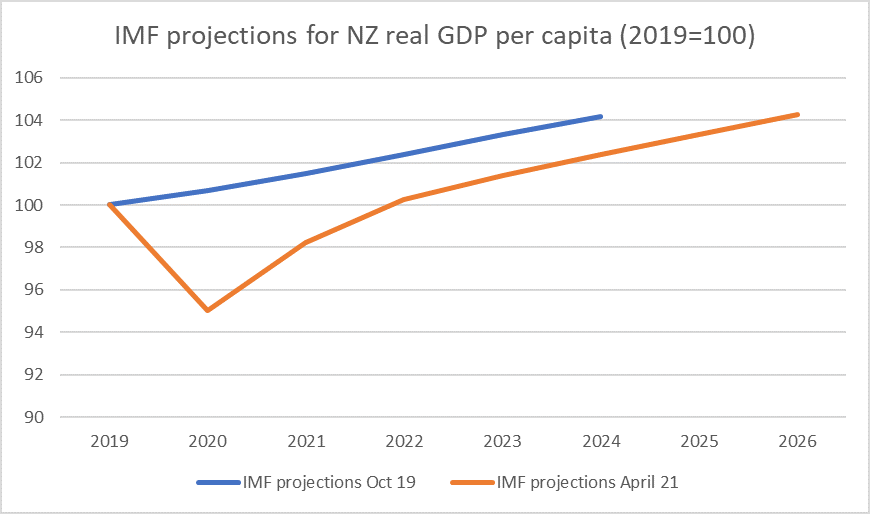
I took a look at a few of the IMF’s New Zealand projections. This chart, which I showed on Twitter last week, compares the IMF’s October 2019 (ie last pre-Covid) and April 2021 projections for New Zealand’s real GDP per capita for the period 2019-2026.

IMF projections for NZ

I thought three things were interesting about these IMF projections:

  • over seven years, the IMF thinks that real per capita GDP will have increased by a little over 4 per cent (a bit under 0.6 per cent per annum),
  • even by 2024 (three years away) the IMF still thinks that New Zealand’s real GDP per capita will be almost 2 per cent lower than they thought it would only 18 months ago,
  • the total gap between the two lines over the 2020-2024 period (covered by both sets of forecasts) is almost 15 per cent of a year’s GDP – simply gone, and with no sign in these projections that that loss will ever be recovered (even if, at some distant date, perhaps the two lines eventually converged).

This isn’t a comment about Covid or New Zealand’s Covid policy – all sorts of things may be going on in the thinking of the Fund’s forecasters – just a report of how much poorer the IMF now thinks New Zealand will be over the coming years than it thought only 18 months ago.

But perhaps, charitably/hopefully, you are thinking “well, that doesn’t look too good, but surely the rest of the world – Covid mess and all – must be worse, or at least as bad?”.

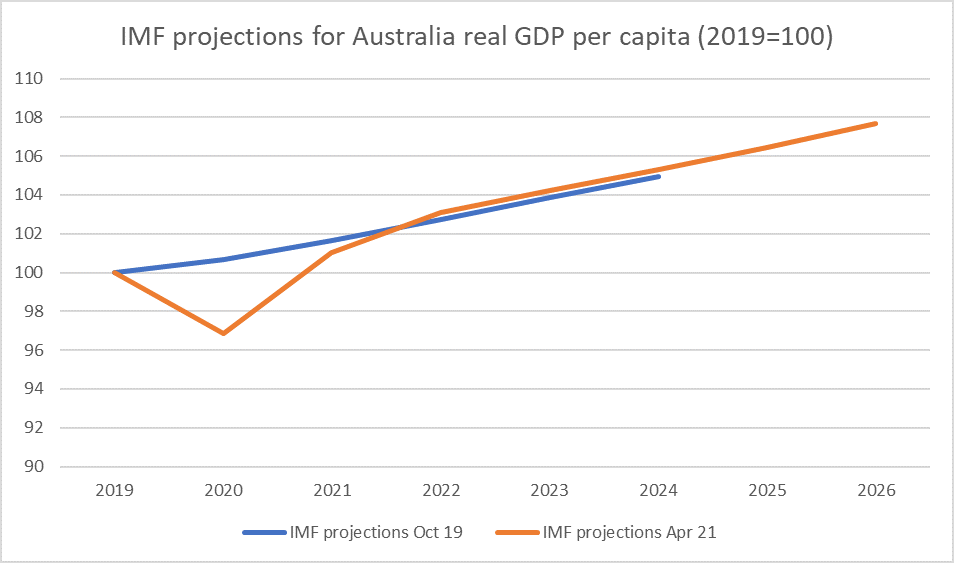
So here is the same chart for Australia.

imf aus

Which is probably the picture most countries would hope to have seen – some (inevitable) income losses last year, but a quick rebound and perhaps even a move to a future slightly higher growth trajectory. Note the other contrast to New Zealand: over 7 years the IMF thinks Australia will manage per capita growth of almost 8 per cent. Some part of the difference – although not the bulk of it – will reflect the fact that the IMF expects Australia’s unemployment rate by 2026 to be below 2019 levels, while in New Zealand the unemployment rate is expected to linger a bit higher than the pre-recession trough (itself higher than the previous pre-recession trough).

I didn’t do this comparison for a large group of countries, although for what it is worth the US chart looks more like Australia’s and that for Canada (not a stellar productivity performer in recent decades either) looks more like New Zealand’s.

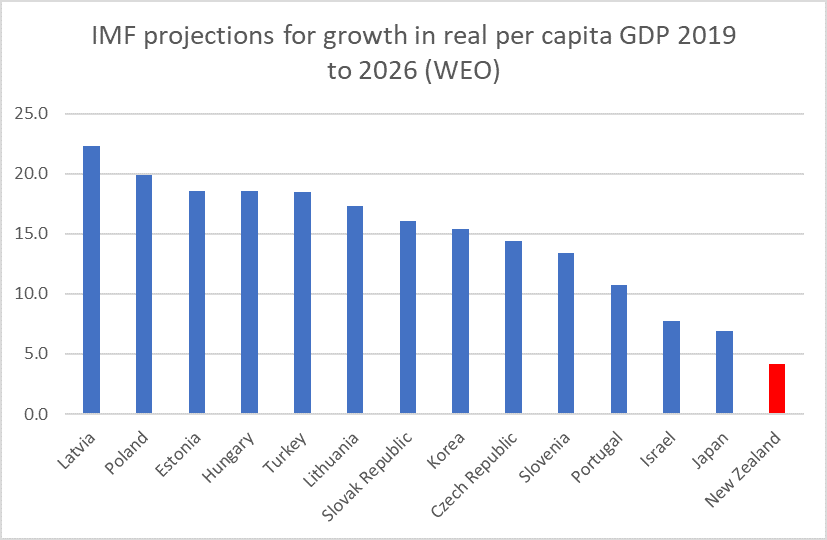
I did have a look at the IMF’s forecasts for growth in real per capita GDP across all the advanced economies in the OECD (and the few non-OECD advanced countries). Over the period 2019 to 2026 we were well into the bottom quartile of OECD countries, at least on the Fund’s view of the outlook.

But it was this chart I found most sobering. Many of the countries we often like to compare ourselves with – from days past – are now much richer and more productive than New Zealand is. They are nearer the productivity frontier, and future growth can’t “just” be catching up. But in this chart I’ve shown the IMF’s forecasts for real per capita GDP for the countries with a 2019 level of labour productivity (OECD real GDP per hour worked, in PPP terms) roughly 10 per cent either side of New Zealand (the IMF does not publish productivity forecasts).

IMF projections for NZ and productivity peers

Just woeful.

Of course, the IMF could be quite wrong, not just about the absolute outlook for the world economy (that is almost certain) but also about the relative performance of New Zealand. But when independent observers take a look at your country, its performance, and its suite of policies and think you will over the next few years do so much worse than a group of your peers (whether, in our case, considerably richer and more productive Australia – to which it is easy for young New Zealanders to move – or to a group of advanced countries with similar levels of productivity to New Zealand, all looking to catch up) it really should be a wake-up call for our political and official “leaders”.

But in New Zealand it seems that all those responsible would prefer that no one noticed, prefer to ignore the utter failure projected (on top of past decades of relative decline), to burble on about wellbeing, and to deliver to our kids some deeply diminished legacy and opportunities. We once were world leaders, but now this.

(Out of interest, I wondered what the IMF was assuming about immigration/population: of all those advanced economies – not just the ones in the chart – we are forecast to have the third fastest rate of population growth over 2019 to 2026.)

Holding senior officials to high standards

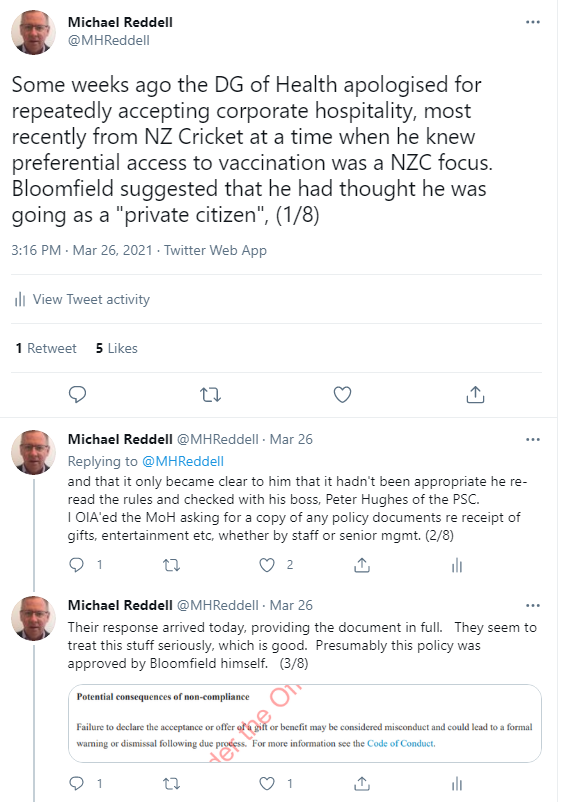
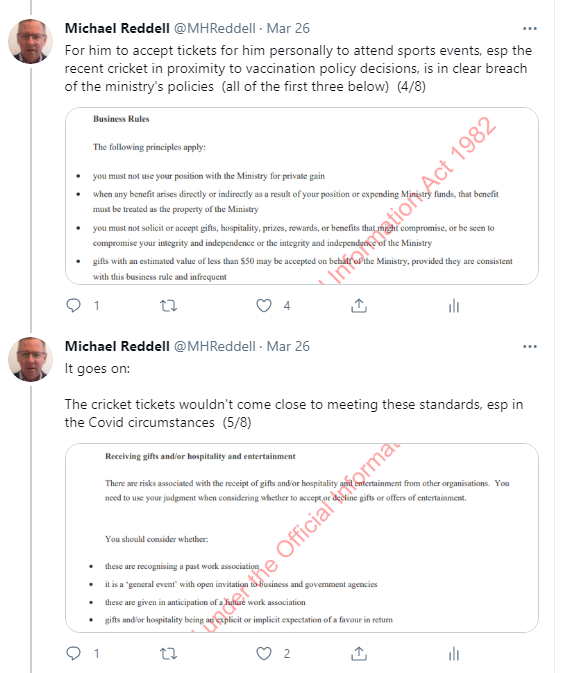
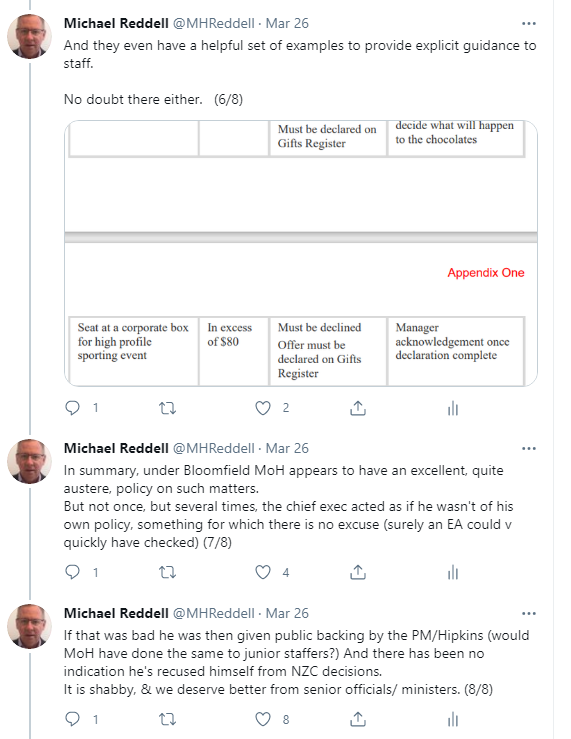
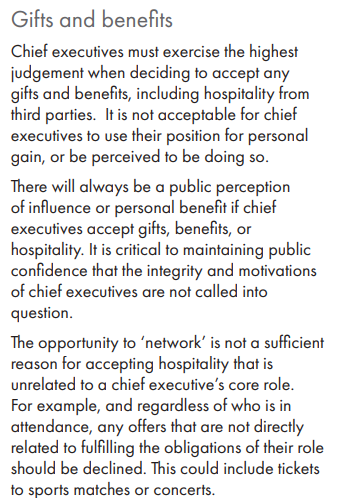
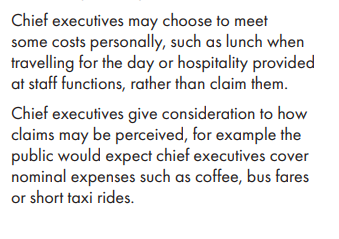
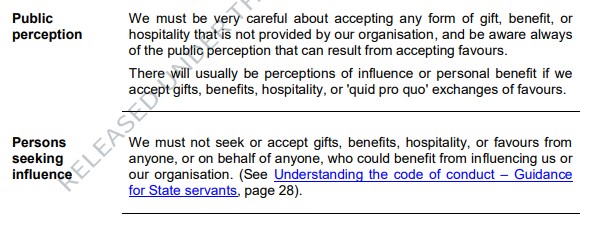
I’ve been bothered for some time by how lightly the Director-General of Health, Ashley Bloomfield, was excused over his lapse of judgement in accepting hospitality from New Zealand Cricket at a time when preferential access to the Covid vaccine for the New Zealand cricket team was a matter of some concern to New Zealand Cricket, and when Bloomfield himself exercises considerable clout in such matters (having both formal statutory powers assigned to him ex officio, but also being (one of) the Covid minister’s chief advisers). It wasn’t even as if this was a single lapse, since Bloomfield acknowledged that he had last year several times accepted tickets to rugby games, and yet the Rugby Union had been negotiating with the government re the ability to host foreign teams in New Zealand.

New Zealand has tended to pride itself over many years about the incorruptibility of public life. Unfortunately, we have seen too many cases over the last few decades that suggest this is more folk myth than reality, although clearly there are many places worse than us. But “many places worse than us” is simply not an acceptable standard; rather it expresses a degree of complacency that allows standards to keep slipping a little more each time, with excuses being made (“not really that big a deal”), especially for those who happen to be in favour at the time. But those sorts of cases, those sorts of people, are precisely where a fuss should be made, where mistakes or rule breaches should not be treated lightly. Integrity – and perceived integrity and incorruptibility – really matter at the top, and if there is one set of accommodations for those at the top, and another (more demanding) standard for those at the bottom it simply feeds cynicism about the political system and about our society.

What I worry about was captured quite well in a recent article in the Financial Times headed “British politics is morphing from delusion into sleaze”. Britain used to be highly regarded on this score too, but (sadly) no longer. Things seems worse there than here, but “many places worse than us” isn’t the standard we should tolerate.

I really don’t understand the near-deification of Ashley Bloomfield in some circles. Perhaps it is because I have not watched a single one of those 1pm press conferences. The man is a highly-paid very powerful senior public servant who, in the course of his stewardship at the Ministry of Health. seems to have done some things well and quite a few things not that well. But my indifference to the “cult of St Ashley” is really neither here nor there. A senior public servant could have, so to speak, walked on water, and it would still have been a staggering misjudgement to have been accepting hospitality from an organisation that wanted to lobby him/her. Even more so, when it was not just a single lapse.

When the story first broke, I lodged OIA requests with both the Ministry of Health and the Public Service Commission (former SSC) asking for copies of their policies on acceptance of gifts and hospitality. The Ministry of Health responded quite quickly and I wrote about their response in a thread of Twitter. Rather than go through all the material again, here is a copy of the thread I posted.

bloomfield 4

bloomfield 5

bloomfield 6

Good policy, simply ignored by the chief executive (Bloomfield). It wasn’t as if this was the sort of decision he’d had to make under extreme pressure or on the spur of the moment. If he wasn’t aware of his own agency’s policy – which would be pretty extraordinary – no doubt he has not just an EA but a whole office, any one of whom could have been asked to check the policy and get back to Bloomfield. He could have checked with his senior colleagues whether taking this hospitality was likely to pass the smell test. If he was still in doubt, he could have checked with his employer, Peter Hughes, the Public Service Commissioner. It appears he did none of this things, until after the story broke. From someone who has huge powers vested in them, it is not just a lapse of propriety but a stunning lack of judgement. If this is how things we come to hear about are dealt with, how much confidence can we have re other matters the Director-General is responsible for.

One hears suggestions that, Bloomfield having eventually realised it hadn’t been appropriate, all was made good by the fact that Bloomfield wrote a cheque for the equivalent of the cost of the tickets and donated it to the City Mission or some other worthy charity. In fact, that is almost pure distraction, since the money was never the main issue – on his salary he’d not have had any problems going to the cricket or rugby at his own expense if he’d wanted it (as many thousands of others did). Writing a small cheque simply doesn’t adequately deal with the inappropriate behaviour in the first place – any more than it likely would have were it to have been someone well down the public sector food chain.

Anyway, that was the Ministry of Health response. Yesterday, the Public Service Commission finally responded to my request. They provided me with the PSC’s own policies, for their staff and management, and a link to the guidance the PSC provides to public sector chief executives on such matters. I thought they were both pretty good documents.

The guidance to chief executives (of whom Bloomfield is one) is most relevant. This from the first page was just the sort of thing one would hope to see.

hughes 1

And this was pretty good to.

hughes 2

Did Bloomfield never read it?

And, slightly off topic, I was quite impressed with the austerity of this section of the guidance.

hughes 3

In some respects, the PSC’s own policies for their staff – not binding on Bloomfield – are even better.

hughes 4

hughes 5

Good stuff. The SSC policy even extends to immediate family.

hughes 6

Stringent rules, and aptly so.

So the Ministry of Health has stringent policies, the SSC has stringent policies, and the SSC guidance to chief executives is also stringent. Not one of those sets of policies should have led any employee – no matter how junior, or senior – to think that accepting sporting hospitality from entities trying to influence (“persuade, convince, explain”) the public servant would be anything close to appropriate. Such offers should have been declined immediately and repeatedly. And not necessarily because Bloomfield’s advice or decisions would have been influenced by hospitality – though as he is human too, who (including himself) can really know – but because it is simply a dreadful look, that corrodes reasonable public expectations around the integrity of the public service, all the more so in this time of Covid when the state has been wielding more extensive than usual powers, and then (somewhat inevitably) exercising discretion around exceptions to the rules.

But what actually happened? We might deduce from Bloomfield’s later comments that the Public Service Commissioner had told him his conduct in these matters had not been acceptable. But we are left to guess even at that. Perhaps defenders of Bloomfield might cite personal privacy, but when you are a very high official and you overstep the bounds in public, any rebuke also needs to be clearly visible to the public. Otherwise, we might reasonably think one of the public sector elite was looking after another of that same elite, perhaps even playing politics.

Because the political “leadership” was far worse. We – the public can’t do anything about Peter Hughes or Bloomfield – but we rely on the politicians we elect to demand high standards from the public service. And what happened in this case? Both the Prime Minister and the Covid minister did little more than laugh off these breaches, suggesting that no one begrudged Bloomfield an afternoon at the cricket after all his work. Pure distraction, pure minimisation, when the issue was never about him having a Sunday afternoon off at the cricket, but about who hosted him, and what interests his host had in influencing him.

I don’t think accepting one invitation to a sports event should be a firing offence – even for someone as powerful and prominent as the Director-General of Health. Repeat offences, as we saw in this case, do raise the ante somewhat, because they create doubts about the man’s judgement, and even about a possible sense of entitlement. David Clark lost his position as Minister of Health for offences that, in the scheme of things, were less serious, albeit embarrassing to the government.

But we should have been able to expect the Public Service Commissioner, the Prime Minister, and the Covid minister (for that matter the Minister of Health) to all have made it crystal clear, in public, that Bloomfield’s behaviour represented a serious and repeated lapse of judgement, a breach of the clear standards expected of MoH staff and public service chief executives, and that any repetition of this sort of lapse would be utterly unacceptable.

Or are the rules only for (a) show, and (b) little people?

Exporting: how does NZ compare?

In preparation for a meeting earlier this morning, I’d downloaded the OECD data on exports as a share of GDP. I thought it might be useful to share of a few of the charts. Most are updates of charts I’ve shown in years gone by, but it is good to be reminded of what has happened in New Zealand and how we compare with other OECD countries. In all the charts that follow I’ve excluded 2020 for two reasons: first, not all countries yet have data (at least in this database) and second, Covid, which affected individual countries quite differently and which should over time prove to be a blip. In all the charts other than the first I’ve shown data from 1995, which is when the OECD has complete data from.

Here, as context, is the New Zealand data since 1970. 1995 was not an outlier, high or low.

exports 1

Here is New Zealand relative to the median of all OECD countries (note that the OECD keeps doing its best to keep us near the more prosperous part of the OECD, by letting in new poorer countries: the latest country invited in (and now in the data) is Costa Rica).

exports 3

From the beginning of this chart, we’ve always exported a smaller share of GDP than then median OECD country has, and that gap has widened.

But, of course, one could expect the picture for other small countries to look different than one that included large countries. All else equal, large countries tend to do a smaller share of their GDP in foreign trade, just because there are relatively more opportunities at home (in the US, at one extreme, exports are equivalent to 12 per cent of GDP).

So in this chart I’ve shown (a) New Zealand, (b) the median for the G7 (larger) countries, and (c) the median for the small OECD countries (Belgium on down).

exports 4

And in this chart I’ve shown New Zealand against the small European countries (including Iceland).

exports 5

And New Zealand against the former Communist countries of eastern and central Europe, all small except Poland.

exports 6

These central and eastern European countries, all part of the EU, and often closely into supply chains for things like the German car industry, have been managed significant productivity growth, closing the gaps to some extent with the OECD leaders, over the last couple of decades.

There aren’t that many OECD countries that are both small and remote. In many respects both Iceland and Israel count, Costa Rica does, and so does New Zealand. Here are the records of those four countries.

exports 7

I’ve been increasingly intrigued by Israel which for all the reputation it has for high-tech industries, has done about as badly as New Zealand. Israel has a similar (modest) level of real GDP per hour worked to New Zealand and – coincidentally or not – has had very rapid population growth.

People are sometimes inclined to discount the central and east European story, noting (correctly) that the gross exports numbers used here don’t represent the extent of value-added in the respective economies, and thus may overstate the apparent success.

The OECD reports data on the extent of domestic value-added in gross exports, but only with a lag. The most recent data are for 2016 and that year two thirds of the exports of the median eastern/central European OECD member were domestic value-added, little changed over the previous decade. In New Zealand, by contrast, domestic value-added accounted for 87 per cent of total exports in 2016. The gap – between the export performance of New Zealand and that of the central and east European countries – is (very) real.

As I’ve said often here, exports are not uniquely special – indeed, I could have done the charts of imports and most of the pictures would have been quite similar – but that successful small economies (fast growing productivity growth ones) tend to be ones generating (or attracting) companies that find plenty of buyers for lots of their output abroad as well at home. That simply does not describe the New Zealand experience.

Grant Robertson on housing

The Deputy Prime Minister and Minister of Finance hit the weekend current affairs shows to make the case for the government’s housing/tax package.

I watched both the Newshub Nation interview – the one in which the Minister of Finance refused to rule out bringing in rent controls (a move which would, among other things, simply accelerate a trend towards the government itself being the main provider of rental housing) – and the one on Q&A. Perhaps because the latter is fresh in my mind – I only watched it this morning – but also because it was a better interview, I want to focus here only on the Q&A interview. For those who haven’t seen it, the whole thing seems to be available here. Incidentally, it was interesting that the government chose not to send out its Minister of Housing for these interviews.

What I found most striking was how this very senior minister, now with 3.5 years in office under his belt, floundered when asked about the effects of the government’s measures. It wasn’t, apparently, for him to say what the effect on house prices would be. Not only that but officials had apparently offered quite a range of views, (if so suggesting they didn’t really know either). He didn’t know what the effect would be on private rents either. This was, we were told, “highly contested territory”. Really all he was willing to say was that any effect on house prices would be to moderate the recent pace of increase, which he kept calling “unsustainable” – without apparently recognising that things that are unsustainable typically come to an end anyway. So if annual house price inflation slows to only 10 per cent per annum this year – under the influence of all sorts of possible influences – will the Minister of Finance be claiming this as a win for last week’s package? I don’t any serious analysts, let alone potential first-home buyers, will be. The Minister meanwhile claimed only to want to see an end to the “big big jumps in house prices”.

If you were a serious government, mightn’t you have adopted a package that you – and ideally your officials too – were confident would lower both house prices (actually the bundle of the house and the land under it) and private rents? After all, New Zealand real house prices have more the tripled in the last 30 years, and yet houses are little more than a combination of land (abundant in New Zealand), labour, and a bunch of tradables materials (timber, taps, pipes, gib board etc). General tradables inflation has been – as the Reserve Bank often points out – quite a bit lower than general CPI inflation for a long time. There aren’t any natural obstacles to (much) lower house prices. Just policy ones.

Or what about rents? Real rents fortunately have not tripled. The current SNZ rents index has data since 2006

Total percentage increases
Rents-stockCPI
2006 to 201012.213.1
2010 to 201516.35.4
2015 to 202017.78.4
Full period (06 to 20)53.229.2

So that is about a 20 per cent rise in real rents over 14 years, which might not sound so bad, except that over that period one of the key drivers of equilibrium rental yields – long-term interest rates (which are not only a financing cost but, more importantly, a return on a key alternative asset – have plummeted. Real 10 year government bonds yields were about 3.3 per cent at the end of 2006, 2.2 per cent at the end of 2015, and about -0.3 per cent at the end of last year. Rental yields have plummeted – and as the data show tenants have benefited from that – but real rents have not, because successive governments have adopted policies that drove real prices sharply up.

And don’t go blaming interest rates for the house prices, as the Minister tries to do (waving his hands and suggesting here are lots of things outside his control). Did you know that, even now, real interest rates in most of the advanced world are even lower than those here (in the US, for example, the real 10 year government bond yields is about -0.7 per cent)?

And, talking of the US, this is real house price inflation in (a) New Zealand as a whole (cities and towns and villages) and (b) the 20 or so metropolitan regions all with populations in excess of a million people that had house price to income ratios of less than 4 in the most recent Demographia report. You might not want to live in some or even most of these places, but plenty of people do (from memory, population growth in Columbus and Atlanta for example has exceeded that of New Zealand).

us and nz house prices

Of course, there are other US metropolitan areas where the picture has been less good, a few even where prices have been allowed to get as out of hand as they are in New Zealand. But in a sense that is the point. The entire US has the same interest rates – typically a bit lower than those in New Zealand. The entire US has much the same banking system, and even the same odd federal interventions in the housing finance market. The tax systems are much the same across the country. But the house price outcomes – even for similar population growth rates – differ hugely, consistent with a story about the importance of land use restrictions.

One might tell a similar story in Canada where the Demographia report has data for price to income ratios for six metropolitan regions each with a population of more than a million people. Same interest rates across the country, and fairly rapid population growth in both Toronto and Edmonton, yet Edmonton and Calgary have price/income ratios around 4 and Toronto and Vancouver 10 and 13 respectively (Ottawa and Montreal between 5 and 6).

So this should have been perhaps the cheapest time in history (rents relative to income) to be renting – here and abroad – and yet real rents have been rising, and the government cannot even manage a package that they, and their officials, are confident will lower rents. It really is hopeless.

In both weekend interviews the Minister did say that he would like to see the price/income ratios fall (suggesting that on a nationwide basis that ratio is now about 8. But even then, pushed by the interviewer, he wasn’t going to be pinned down or offer any hostages to accountability. He has “no number in mind”, said he “can’t tell what an affordable price is”, and butted away the interviewer’s suggestion that a ratio of 3 was not a uncommon benchmark in discussion of these issues, and wasn’t even willing to suggest that a ratio of 5 might be something to aspire to. He played distraction by suggesting that he would like to see incomes rise – which, of course, would lower the ratio – but has no policy to do anything about changing (improving) the future path of average/median income growth.

On Twitter on Saturday I did a quick exercise and pointed out that if house price inflation slowed to a long-term average of 1 per cent and incomes rose 2.5 per cent it would take almost 20 years for the price/income ratio to get to 6.

In the longer-term, incomes are likely to be driven by trends in nominal GDP per hour worked. That won’t be the only influence – people can work more (or fewer) hours, governments can run deficits in ways that put more in household pockets (or surpluses that take more out of household pockets), and relative returns to labour can change. But over a 20 year sort of horizon, nominal GDP per hour worked seems like a reasonable starting point: in New Zealand, the labour income share hasn’t changed much in 30 years, and while this government is doing a bit more redistribution governments come and governments go.

Nominal GDP per hour worked in turn reflects three broad factors:

  • general inflation (eg something like the CPI)
  • changes in the terms of trade
  • productivity growth (change in real GDP per hour worked)

The Reserve Bank has an inflation target of 2 per cent, which it hasn’t consistently met for a decade, but it is probably reasonable to think of something a bit above 2 per cent as towards the lower end of what average incomes might grow at over several decades. On other hand, productivity growth in New Zealand has been lousy for a long time, and nothing in what this government is doing – or what National is offering instead – looks set to improve that. And the best guess of a future real relative price like the terms of trade is today’s value. So I’ve done scenarios in which incomes rise anywhere between 2.25 per cent per annum and 3 per cent annum. Over 20 years, actual could still be better or worse than those numbers, but they seem like a plausible range. Over the last five or six years, actual growth averaged about 2.6-2.7 per cent (whether or not 2020 is included).

What about house price growth. Robertson and Ardern refuse to even talk about flat house prices, let alone falling ones, so I’ve used 1 per cent per annum as the lower end of the range of scenarios. And I ran the numbers for 2, 3, and 4 per cent. 4 per cent house price growth wouldn’t seem super low to most New Zealanders after the experience of recent decades, but there is no point running higher house price inflation scenarios because…….even at 4 per cent annual house price inflation price/income ratios keep rising forever.

If house price inflation slowed to 1 per cent per annum, year in year out and incomes rose by 2.6 per cent per annum, in 20 years time the nationwide price/income ratio would be 5.85.

If house price inflation averages 2 per cent per annum, and incomes rise 2.75 per cent, in 20 years time the price/income ratio is still 6.9 per cent.

If house price inflation and incomes grow at 2.5 per cent…..then of course, the price/income ratio never falls at all.

And it is no trouble at all to generate undemanding scenarios in which the price/income ratio just keeps lurching upwards – these things never happen steadily (every single year), but the long-term trend is what dominates.

And if by some chance you think a price/income of 6 doesn’t sound too bad. well (a) you’ve just too used to latter day New Zealand, and (b) check the table on page 15 of the Demographia report for the metropolitan areas (most of them) with ratios lower than 6, in lots of cases much much lower. New York – never really thought of as a cheap place to live – shows at 5.9, Montreal at 5.6, Manchester (UK) at 4.8, Nashville at 4.2, Edmonton at 3.8, and on downwards.

But the government has simply done nothing about freeing up the land, facilitating again aggressive competition among potential vendors on the periphery and in the intensifying centre and suburbs, which is the sure and reliable way of getting house prices (land prices) and rents down. And doing so quite quickly, because although it takes time to build, it takes very little time for expectations to change, and markets trade on expectations.

I could go one, but I won’t except to highlight the Minister of Finance’s desperate attempt to defend the spin – the lies really – that claimed that interest deductibility for rental property owners was a “loophole”. The interviewer challenged Robertson on whether the government would be removing deductibility for all businesses, and Robertson denied that was on the cards while doubling down on his loophole spin, claiming that property was a loophole because owner-occupiers couldn’t deduct their interest cost. Not even bothering to get into the point that the owner-occupier has no assessable income from the house (and under the government’s ringfencing change a couple of years ago could get no benefit from deductibility anyway), the interviewer asked the Minister about the purchase of a computer. The financing costs of such equipment (or a car) are deductible for businesses, but not for households. Was this a distortion the Minister was asked. He was floundering by this point simply reduced to asserting again that there was a “loophole” when it came to property. Only in the fevered imaginations of ministers and their spin doctors (and even they no doubt know better, they just take the public for fools).

It really was a poor performance by one of the government’s most senior ministers. And in that sense told you really all one needed to know about last week’s package: utterly unserious when it came to addressing the core issues (land use, and probably some construction cost issues thrown in) but simply a heavy dose of the politics of distraction, all while further messing up the tax system and the housing market itself.

(And lest anyone suggest this is partisan commentary, the unnatural disaster of the New Zealand housing market has been the responsibility of successive governments led by each of the main parties. But when you hold office you hold responsibility. Ardern and Robertson have held office for 3.5 years and now have a parliamentary majority that – for good or ill, per the New Zealand system and its limited checks and balances – would allow them to do almost anything they wanted. But they refuse to do anything that would, with confidence, lower house prices and rents, or to even suggest that lower house prices would be a desirable outcome. There are words for that sort of political betrayal. Mostly not terribly polite ones.

Messing around with housing

And so yesterday we got the long-awaited government package in response to the latest surge in house prices. As a reminder, it is just the latest surge in the more than trebling in real New Zealand house prices over the last 30 years.

BIS real house prices

We know it wasn’t really a serious policy designed to fix the housing market, not just because it didn’t even address the core issue (land use regulation etc) but because the Prime Minister still can’t bring herself to say that she would like to see lower house prices – not even just reversing the rise of the last few months – and the Treasury’s Regulatory Impact Statement is headed “Tax measures to moderate house-price growth”. Add to that I’ve seen reported that Treasury expects the extension of the so-called “brightline test” to boost government revenue, when a package that actually did something about fixing the market would see that specific revenue line almost evaporate for many years to come.

There is a lot that is odd about yesterday’s announcement, including the Treasury claim (in the RIS they published) that they opposed the deductibility rule change because they hadn’t had time to properly analyse it. Even if this was a last minute idea dreamed up by someone in the Beehive – and Richard Harman’s newsletter this morning suggests not, that the idea had been under consideration at least since November – what does it say about the loss of accumulated expertise in The Treasury that they could not offer robust analysis at short notice on almost any of the myriad possible housing tax changes that have been proposed and analysed at various times over the last 20 years? Surely (a) this is core capability (especially in a New Zealand with longrunning housing policy dysfunction), and (b) the analysis involved would have been qualitatively similar to whatever advice and analysis Treasury provided on ring-fencing rental income losses only a couple of years ago?

There are two tax components to the package; the extension of the brightline test to 10 years, and the removal of the deductibility of interest expenses for residential rental landlords. The latter is the more significant measure, but I’ll come back to that.

The only good case, ever, for the brightline test was what the name implied. Using time rather than intent (hard to prove) to determine which sales of investment property were subject to tax was easier, clear and simple. If, instead, you want to tax investment asset appreciation more generally, you’d introduce a capital gains tax. Such a tax would capture all investment assets (not just a particular class the government of the day doesn’t like), and it would provide for loss-offsetting arrangements. A proper CGT is somewhat akin to the government becoming an equity partner in your assets; ups and downs (although not generally in a fully symmetrical way). You might or might not agree with a CGT, but (a) no serious person/government ever thought one was the answer to house prices (and if any did experience should have long since disillusioned them), and (b) there is no sign in New Zealand house prices (and unsurprisingly) that the initial introduction of the brightline test, or its more recent extension, made any material difference to New Zealand house prices. So there is little reason to suppose this change will either (contrary to Treasury who claim to believe it will make a difference even in the “medium term”, albeit perhaps not the long term). It will, of course, change some transactional behaviour, reinforcing a lock-in effect for some investors (and thus reducing the efficiency of the housing market), but that is a different matter than any sustained impact on prices.

One aspect of the brightline test extension I haven’t seen referred to – and is not mentioned at all in the RIS – is the interaction with inflation. Over a 10 year horizon – let alone the 20 years Treasury favoured – a significant chunk of any house price increases will be general CPI inflation (if the Reserve Bank met its target the CPI would rise by 22 per cent over 10 years). There is little serious case anywhere for taxing general inflationary gains (as distinct from increases in real asset prices/values), and the issue is reinforced by the increases in the maximum marginal tax rate to 39 per cent. Suppose the government’s policies finally got on top of growth in real house prices and the only increase in house prices was from general CPI inflation. Someone selling just before the 10 years would be paying 8.5 per cent of the value of their asset in tax even though they had had no increase in real purchasing power at all. That would be a straight confiscatory tax, even more so at the horizons Treasury favoured (where it is harder to avoid by delaying sale). And yet Treasury regards a longer brightline test horizon, with full nominal gains taxed at a higher rate as both fairer and more efficient! A capital gains tax should tax either real gains or, much less desirably, tax nominal gains at a reduced rate. For the scapegoated sector we now have nominal gains taxed at a high (and rising) rate.

What of the deductibility policy? This is, as announced, a simply bizarre policy, not helped by the egregious spin – really bordering on lies – from the government suggesting that the ability to deduct interest from gross income in calculating the owner’s tax liability is a “loophole”. It is simply standard practice, a deduction open to any business. Except, very soon, operators of residential rental businesses. In many firms, in a wide variety of sectors, interest is a cost of doing business.

I can think of three bases on which a policy change around deductibility might have made sense. There is a decent argument that, for tax purposes, no interest paid should be deductible and no interest earned should be assessible. But that would involve universal application. There was an argument that some (from memory including Don Brash) used to advance that with no tax on capital gains, perhaps interest on investment property should not be deductible. But extending the brightline test to 10 years substantially undermines that argument for houses…..leaving it more potent for other assets (eg farm land) to which deductibility has not been limited. And that argument that I find most appealing – and which from memory the Reserve Bank used to favour – was that some proportion of interest deductions were really just inflation compensation, and didn’t really amount to a real expense (just maintaining the real value of capital). But that would argue for a symmetrical treatment of interest income and interest outgoings, and for a comprehensive approach, not just one picking on a current government scapegoat. Had the government been serious about rigorous reform that improved, not worsened, the tax system they could have foreshadowed that sort of change. At present, with interest rates so low, it probably would have reduced by about half the extent of interest that could be deducted.

(The “loophole” argument appears to be based on the fact that owner-occupiers cannot deduct interest. It should barely need saying that owner-occupiers are also not assessed for tax on the imputed rental value of living in their home – nor, of course, (generally) are they subject to the “brightline test”. Whenever there have been serious suggestions of taxing imputed rentals it has been recognised that interest deductibility would need to be introduced as part of any such mix. )

There seems to be a range of views around about what impact the deductibility change will have, especially on house prices. Westpac appears to mark out one end of the range, suggesting in a bulletin yesterday that house prices could settle 10 per cent lower over the longer-term with the potential for “much greater effects” in the shorter-term.

As they note, the Westpac economics team – their chief economist is currently on secondment to The Treasury – have long been advocating a model of house prices in New Zealand that emphasises the power of tax policy and tax policy changes to affect house prices. I’ve long been sceptical of that sort of story (and to refresh my memory dug out notes I’d written on the specific role of tax while at both the Reserve Bank and the Treasury). A paper with a very similar approach to the Westpac one was published as a Reserve Bank discussion paper some years ago, and it has a useful table (page 14) looking at the way in which various variables, including tax ones, affect the price various classes of potential purchasers (leveraged, unleveraged, investors, owner-occupiers) will be willing to pay for a house.

I’m no more convinced this time that tax (or regulatory) changes will have a large effect on prices (and a 10 per cent longer-term effect is quite large) than on previous occasions. One might expect some difference in what type of entity owns the property, but even then it is as well to be cautious. Just a couple of years ago, the ability to offset rental losses against other income was removed, and I’ve seen little in the way of analysis or argument suggesting that had very much effect at all, in prospect or in realisation. But if we go back further, there was little sign that the increase in the maximum marginal tax rate in 2000, foreshadowed with certainty for at least a year, gave a big boost to house prices (as the model predicts, because interest deduction is more valuable) or that the reversal of that increase a decade later cut house prices. The arbitrary removal in 2005 of the ability to deduct depreciation – on houses (as distinct from land) – didn’t seem to have a discernible sustained effect. The PIE regime, which worked against individual landlords, had little obvious effect. And going back further there is even less sign of such effects as decades earlier maximum marginal tax rates rose to 66 per cent, and then fell again, when inflation raised nominal interest rates (increasing the value of the interest deduction) or when ring-fencing was abolished in the early 80s and reinstated in the early 1990s. I’m also sceptical because we can see the huge divergence in house price outcomes in US cities, with fairly similar tax codes and banking practices across them, in ways that point to land use restrictions – and the long-run supply price of new houses – as the more important explanatory factor.

Perhaps this time will be different (although, almost inevitably, we will struggle to know, trying to unpick all the competing influences. Presumably some holders of investment properties will take the opportunity to sell now. Quite probably yesterday’s changes will help bring forward the temporary pause, or perhaps even pullback, that was always likely before too long (with no population growth, much tighter LVRs, perhaps a (irrational) ban on interest-only lending, perhaps even some lift in term mortgage rates etc). We’ve seen such pauses before and will no doubt see them again. But the supply/land issues have not been tackled.

It is worth noting that under the sort of model Westpac (and the Reserve Bank, see above) used, the purchaser willing to pay the highest price for a house was………..not the highly-leveraged investor but the unleveraged owner-occupier. That was so back in 2008 (when the RB analysis was done), reflecting the fact the imputed rental income is not taxed (and such purchasers have no interest payments). The difference is greater now – even prior to yesterday’s announcement – because owner-occupiers don’t have to worry about the brightline tax, while any investor – even if iniitally intending to hold for more than five years, rationally has to factor in a probability of seeling earlier.

Perhaps a little surprisingly (my notes record that it was so to me) is that the group next most willing to pay is the unleveraged investors. They do pay tax on their rental income, but – like the owner-occupiers – they have to think about the opportunity cost of their money, which has to be invested somewhere. Deposit rates are typically a lot lower than mortgage rates, and one will pay a price to avoid being stuck in deposits. Heavily-geared landlords (and remember, they can now borrow only 60 per cent from banks) come in only third. Of course, there may be times when highly-leveraged landlords are key marginal players – quite plausibly the last few months, especially when dealing with a temporary lifting of financial repression targeted at such people – but it wasn’t the general case, even pre-brightline.

One of the uncertainties, of course, is to what extent rents rise in the wake of this change. There is a lot of headline coverage of that, but the honest answer is that we don’t really know (although, again, the nature of the effect should be similar to that for ringfencing, albeit potentially on a larger scale). I’m a little sceptical as to how large the effect will be – notwithstanding the buffering the Accommodation Supplement provides – because if leveraged landlords were able to recoup all/most of their increased costs, that would leave excess expected returns on offer for unleveraged landlords (who are not directly affected by the loss of deductibility). Owner-occupation certainly hasn’t got easer – relative to six months ago LVR controls are back and prices/deposit requirements are higher (or even on Westpac’s take no lower) so I’d expect the biggest difference to be a shift over time from more heavily leveraged landlords to less-leveraged or unleveraged landlords, perhaps with a relatively modest (sustained) rise in rents.

This is, of course, then a policy that skews opportunities away from those needing debt finance (it explicitly no longer treats debt and equity similarly, previously one of the strengths of the NZ tax system) and they tend to be….the new entrants and more-marginal players. In favour of old money, institutional investors etc – who have pools of money that need investing. Now if you are a central banker you might think less leverage was “a good thing” (although that is what capital requirements are for) but it isn’t obvious that is so more generally, given the rigged land market. As Adrian Orr used to say – back when we were analysing housing options at the Bank 15 years ago – many of the leveraged investors are people like (his example) firemen, with a modest salary and using leverage – where it is available with good collateral – to get into an investment property, doing maintenance etc on their days off, getting a foot on the ladder (and some “forced savings” too). It was like that for a long time, whether or not real house prices were rising strongly.

Officials and ministers – especially Labour ministers – really don’t seem to like those sorts of people, and the sort of housing supply that results. Over a couple of decades now policy seems to have been set increasingly in ways that will have the effect of driving these small, initially quite leveraged, players from the housing field. In some cases that has seemed deliberate – including from some who really think home ownership isn’t something people should reasonably aspire to, and that long-term renting is some sort of Germanic ideal – in others just a side effect, but the direction is pretty clear: they favour institutional savings, not individual, and institutional (or large scale) rental providers not individual ones. And so the policy system – which 30 years ago treated these groups neutrally – no longer does. PIEs are taxed less heavily than individuals. Increased regulatory burdens (as ever) favour large players not small. Taxes based on realisations favour large unleveraged players, since they are less likely to be forced to sell, and have future gains to carry forward losses against). And now this egregious new distortion favouring equity over debt in rental housing. I don’t have any problem with institutional and corporate providers of rentals, but it should be an outcome of choice , enterprise, opportunity etc, not regulatory and tax distortions secured in their favour. Worse still, of course, is that if this latest package really does impair the availability of private rentals it will just strengthen the argument on the left that the state should be a much larger rental provider. There is a role for state rental dwellings, for a very small minority of troubled people, but in a functioning land and housing market there would simply be no market failure justifying such an intervention.

And a functioning land market – where there is aggressive competition among land providers/owners and genuine choice for potential purchasers between options on the periphery and options at greater density – is how unimproved outer-urban land prices should once again be somewhere near the price at the best alterative use (mostly farming presumably), not driven higher by artificial regulatorily-supported interventions. But such a market is what the government seems utterly uninterested in providing. The alternative – increasingly messy interventionist version of the status quo – appeals to the Greens and the statists, but it shouldn’t appeal to New Zealanders who care about their children becoming self-sufficient and able to meet the simple aspiration – readily achievable in a land-abundant country – of being able to purchase a basic house in their 20s.

Sadly, whatever was going to happen to house prices over the next three to five years anyway, it is hard to think that after some initial disruption, yesterday’s package will make very much sustained difference to prices at all. But I guess it will buy some political time and ease the headlines; today’s substitute for serious courageous leadership. Fixing the land market (and indexing the tax system) is still an option for some real leader, some day. If only.