China, currency adjustments, etc

[For those keen on my skills-based migration series, more posts are coming.  For government officials, and any others, going “yes, yes, you’ve made your point”, I will clearly label them and feel free not to read them]

There is a column in the Dominion-Post this morning, from a well-regarded journalist, Pattrick Smellie, running under the confident heading of “Beijing not starting a currency war”.  I’m sure the Chinese Embassy will have been pretty happy with the coverage.

Making sense of our own central bank is often hard enough, let alone the intentions and motivations of the Chinese state authorities. Early in World War Two Winston Churchill described Russia, newly signed-up to a non-aggression pact with Germany as “a riddle wrapped in a mystery inside an enigma”.  It seems to be a phrase that could readily be adapted to the Chinese authorities.  But as Churchill put it in the same speech, the key to Russia was “national interest”, or perceptions of it.

And, no doubt, no one is setting out to start a “currency war”.  If one actively devalues one’s currency one prefers that no one else follows.  That  is how the competitiveness gains are secured.  Then again, so-called currency wars in the past have sometimes been rather a good thing.  In the Great Depression  the countries that freed their currencies from gold first, and devalued, recovered soonest, and the laggards (big or small) themselves recovered when they too devalued.  In that period, so-called competitive devaluations were a path to a much-needed easing in global monetary policy, and a recovery in global demand.  It wasn’t coordinated and each country acted in its own perceived self-interest, subject to the constraints each faced.  Facing a very severe adverse terms of trade shock, and the temporary closure of UK funding markets, New Zealand was fortunate that it allowed its currency to depreciate against sterling quite early, then benefited from the UK’s own early departure from gold, and then actively devalued again in early 1933.

What, then, of China?  As Smellie ends up acknowledging in his article, in a weakening economy a depreciating currency might be thought of as normal or natural, and China’s economy has been weakening fast –  almost certainly much faster than is officially acknowledged.

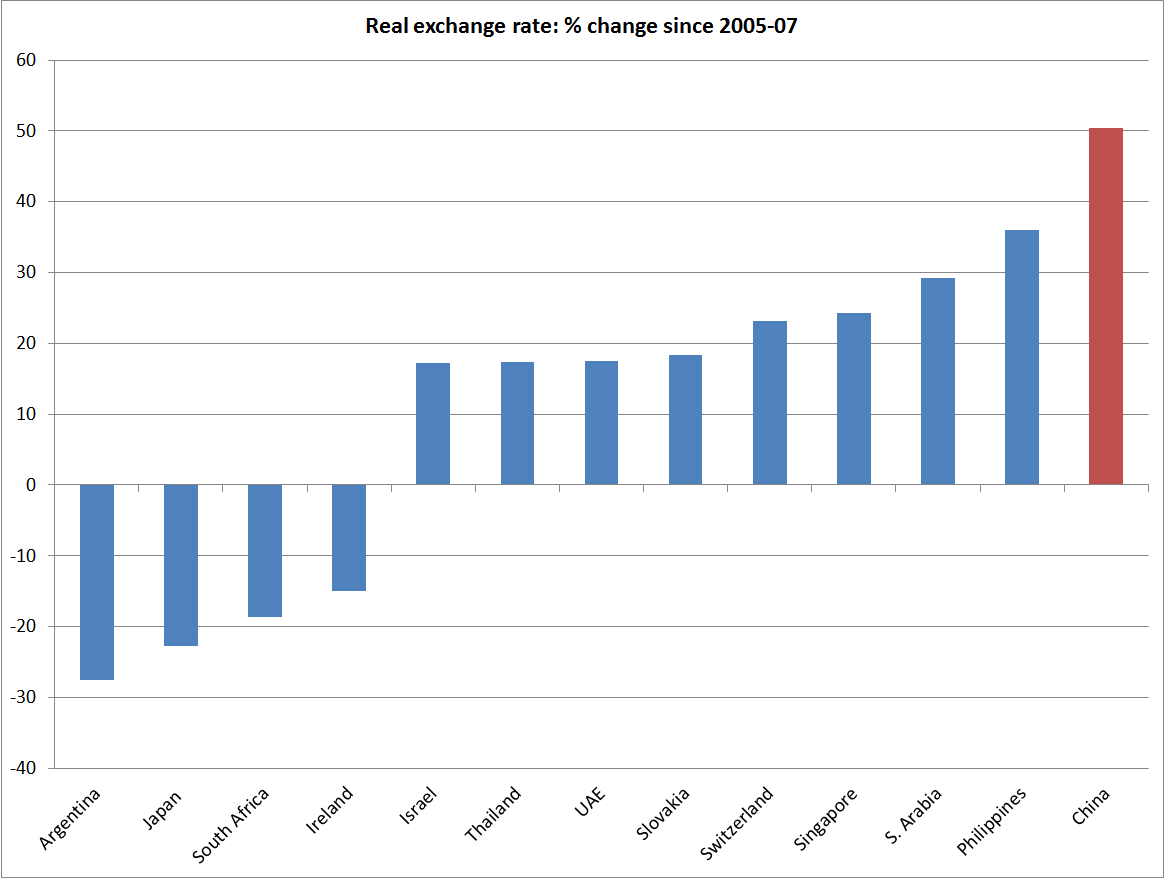
The BIS compiles real exchange rate indexes for about 60 countries.  I had a quick look at which countries had seen large real exchange rate changes since the pre-recession period.  Here I compared the average for the last six months with the average for 2005 to 2007.   13 countries have seen changes of more than 15 per cent[1].  China’s has been, by far, the largest change, and the largest increase –  up around 50 per cent.

china rer

It was pretty widely accepted a decade ago that the yuan was undervalued in real terms.  During this period, China was running huge current account surpluses –  something unprecedented in a fast-growing developing country  (Singapore or Korea, at similar stages of development, ran large deficits).  Hand in hand with the undervaluation, gross exports as share of China’s GDP had doubled from the early 1990s to reach almost 36 per cent in 2006.    Getting a good handle on true Chinese productivity growth isn’t easy, but there was pretty good reason, whether from the trade data or from productivity differentials, to have looked for a real yuan appreciation.

But a 50 per cent appreciation  – a considerable proportion of it in the last 12-18 months as the US dollar has strengthened –  is a very large move.  And, in conjunction with the much lower growth in global demand following the 2008/09 recession, the whole basis of China’s growth model has changed.  From a substantially export-driven model, China moved to relying on one of the biggest credit-led investment booms in history –  and, given the absence of market disciplines in China, perhaps the riskiest.  Credit to GDP soared.  Most of it has been domestic credit, but in the last few years there has also been a great deal of foreign debt taken on by Chinese borrowers.   Investment also soared –  from under 42 per cent of GDP in 2006 to more than 48 per cent by 2011.  Those are huge shifts.  And exports shrank back, from 36 per cent of GDP in 2006 to 23 per cent last year.  Again, a huge shift.  GDP was still growing, but much more slowly than it had previously, and with much less evidence of sustained productivity growth.

Against that backdrop, from a purely macroeconomic perspective, the idea of a depreciation of the real exchange rate must look quite attractive to some in Beijing.  Pursuing its own perceived national interests  no doubt, the Chinese credit boom of recent years has provided a lot of support to global demand, at a time when it was very weak, but the aftermath isn’t pretty.  It rarely is after credit booms –  see Spain or Ireland, or New Zealand post-1987.  With weakening domestic activity, and global growth that is still pretty subdued (at best), the Chinese authorities seem to have two broad short-term options.  Stimulate demand by gearing-up for one last government-inspired credit—based splurge, further exacerbating their own problems, or look towards tapping a bit more of the potential global demand for the benefit of their own producers.   (Of course, the third option would be a domestic cost- deflation, but the Greek model doesn’t seem to have much to commend it.)

People often point out that China’s consumption share of GDP is very low, and suggest a reorientation towards a more consumer-led economy.  But on the one hand those changes are likely to be slow –  and as Shang-jin Wei has pointed out , for example, things like the male-female population imbalance may be structurally driving up savings rate.  Perhaps as importantly, people are typically only willing to spend more if they are confident of their own future incomes.  At the end of a credit boom, with Chinese firms no longer securing the export growth they once were, that security isn’t unquestioned.

In a normal country, weakening demand at the end of a credit boom would naturally be followed by easing domestic monetary policy and a falling real exchange rate.  It is what happened in much of the West in 2008.   China has room to ease domestic monetary policy, but easier domestic policy almost inevitably puts more pressure on the exchange rate.  China has fairly large levels of foreign reserves (as a share of GDP) but expectations can change rapidly, and as many previous countries have found reserves can dissipate rapidly.  Plenty of capital is already flowing out of China.

I’m not suggesting any great insight into what the Chinese authorities were thinking earlier this week. In many ways, a lower real exchange rate would normally make a great deal of sense.   But these aren’t normal times.  As I noted earlier, the depreciations in the 1930s led to looser monetary policy globally.  There was no “beggar thy neighbour” dimensions to them, and everyone benefited.  And if the rest of the world still had materially positive interest rates, it could be the same now.  Easier Chinese monetary policy, lowering the real RMB might have been followed by some cuts in interest rates in other major economies, to offset the impact on them of the increases in their own real exchange rate.  But few large economies –  and none of the advanced ones –  has any material domestic monetary policy room (although the US can hold off  –  or reverse –  the widely-expected unnecessary initial tightening in its own monetary policy). Even in high-interest rate New Zealand, the policy room is dissipating.  Against that backdrop, any substantial depreciation of the yuan, even if it would be in China’s own macro-stabilisation interests, as its economy has slowed markedly, really could be a threat to the rest of the world.  A stimulus to demand in China risks being substantially at the expense of weaker demand elsewhere, at a time when overall global demand growth (China included) is at best modest, and probably weakening.  More competitive Chinese producers would be in a position to cut prices further –  in an economy where producer price inflation has been negative for a long time already –  posing new global deflationary risks.

Much of the media commentary this week has been about what the Chinese authorities intended.  And understanding that better would be good.  But, in the end, policymakers’ intentions matter only so far, once authorities have set out on a path, however halting, towards liberalisation.  There has been a widespread view until recently that the Chinese would not be willing to devalue the RMB –  whether for reasons for international relations, prestige or simply having bought the upbeat stories about China’s growth prospects.  Meanwhile, Chinese investors have been taking a different view.

This week’s action must have increased the perceived risk of some larger adjustment, whether willingly or not.  Many people have pointed out the size of past substantial devaluations –  I especially liked this piece –  but often enough those large devaluations (or float) were late adjustments, forced reluctantly on authorities who held on, and held on, until they could do so no longer.  No two countries’ situations are ever quite alike, but we shouldn’t assume that even if the Beijing authorities don’t want a large exchange rate adjustment that it won’t happen.

Much of the most recent real appreciation in the yuan reflected the material appreciation in the USD.  Some will recall that the continued appreciation of the USD, to which the Argentine peso was pegged, was one of the final straws that broke the Argentine currency board in 1991.

[1] In addition, Venezuela – which now has extreme currency rationing to defend an official peg – is recorded with a 251 per cent increase in its real exchange rate.

New Zealand credit growth in recent years

As the near-inevitable aftermath of China’s extraordinary government-led credit boom gathers pace, and the global deflationary risks mount, I thought it might be timely to have a look at credit growth in New Zealand in recent years.

I was partly prompted to do so by some reactions yesterday to my AUT Briefing Papers piece on housing. Several commenters at interest.co.nz were convinced that I was letting the banks off the hook, and that the creation of credit to finance house prices must be, in some substantial measure, to blame for high house prices (in Auckland).

In one sense, that reaction isn’t surprising. A similar model seems to have been implicit in the Governor of the Reserve Bank’s 2013 LVR restrictions and the new Auckland-specific investor finance restrictions he is consulting on at present.   After all, prudential regulatory powers of the Bank should, as per the provisions of the Reserve Bank Act, be used only when action is need to promote the soundness of the financial system.

Without covering old ground in detail, I don’t believe that there is any such systemic threat. The Reserve Bank has not made a persuasive New Zealand-specific case, and the one piece of careful analysis that has been presented (the stress test results) suggest that the banking system would be robust to even some very severe shocks.

The international literature suggests that probably the single best (albeit not very good) predictor of crises is rapid growth in the ratio of credit to GDP. We had that in the years prior to 2007. China has had it, much more dramatically, in the last five years or so. Many countries have had periods of very rapid growth in credit, and no banking crisis I’m aware of was not preceded by a period of very rapid credit growth. New Zealand’s stresses from 1987 to 1991 are an example.   But many, perhaps even most, episodes of rapid domestic credit growth have not ended in domestic systemic banking crises. New Zealand post-2007 was just one example.

The record suggests, unsurprisingly, that the quality of lending matters a lot. And the quality of lending tends to deteriorate a lot when, either

  • Government agencies are directing that lending or setting up incentives that drive banks to undertake poor quality lending (the US housing finance boom of the 00s and the recent Chinese credit boom are good examples), or
  • Where the regulatory shackles have just been taken off, and no one –  banks or regulators –  has much experience with a liberal market-based economy and appropriate credit standards (New Zealand, Australia, and the Nordics in the 1980s were good examples).

None of that looks to be the case in New Zealand at present.  We have credit data to the end of June, and GDP data only to March, but for the rest of this I’ll just assume that seasonally adjusted nominal GDP showed no growth in the June quarter.

Since December 2007, just prior to the big recession, New Zealand’s nominal GDP has risen by just under 30 per cent, and the four different measures of private sector credit have risen by about 33 per cent. But the pre-crisis dairy lending boom went on well beyond the end of 2007   If we start our comparisons from December 2009, we find that nominal GDP since them has increased by around 26 per cent and PSC by around 21 per cent. Within that total, lending to households has increased by 22 per cent.  Whatever the base period for comparisons, credit growth has been fairly subdued relative to GDP.

credit growth since dec 07
credit growth since dec 2009
And it is not that nominal GDP growth has been rampant. In the seven years to March 2015, NGDP increased by 27.4 per cent, down from 55.1 per cent growth over the previous seven years. As is now well-recognised, given the inflation target, monetary policy has been too tight over the last few years, not too loose.

Annual nominal GDP growth fluctuates a lot, largely with fluctuations in the terms of trade. At present NGDP growth is slowing rapidly. Credit growth is currently growing faster than nominal GDP growth   The strongest component of that is agricultural credit, up 7.6 per cent in the last year. But whatever the overall state of banks’ dairy exposure – and I suspect they will lose quite a lot of money, without it being a systemic threat – the current growth in dairy credit is not the sort of lending that is recklessly bidding up asset prices, it is a reflection of the severe drop in farmers’ income –  if anything, a buffer rather than the initial source of any problem.

In short, when credit has been growing at only around the (rather subdued) rate of growth in nominal GDP for the last 6-8 years

(a) it is difficult to credibly blame bank lending policy for growth in specific asset prices (Auckland house prices) without independent evidence of a decline in lending standards (which neither the Reserve Bank nor anyone else has sought to demonstrate), and

(b) we just don’t have the basis for expecting any severe stress on or threat to the soundness of the strongly-capitalised financial system.   Rising house prices certainly generate a demand for additional credit, but it is the rather more fundamental forces (driven by governments) –  land use restrictions and policy-driven immigration flows – that are the source of the underlying pressure on prices. The same banks operate nationwide, and there is no sign of house price inflation in Invercargill, or even Wellington.

Of course, a rather nasty economic slowdown appears to be already underway, and that could worsen a lot yet. If so, that will put a lot of pressure on a lot of borrowers.

Skills-based immigration – waiters

Somewhat annoyed with myself for losing my workings last night, I decided to start at the other end of the alphabet this morning.  Not many y or z occupations, but a fair number of Ws.

work visas wxyz

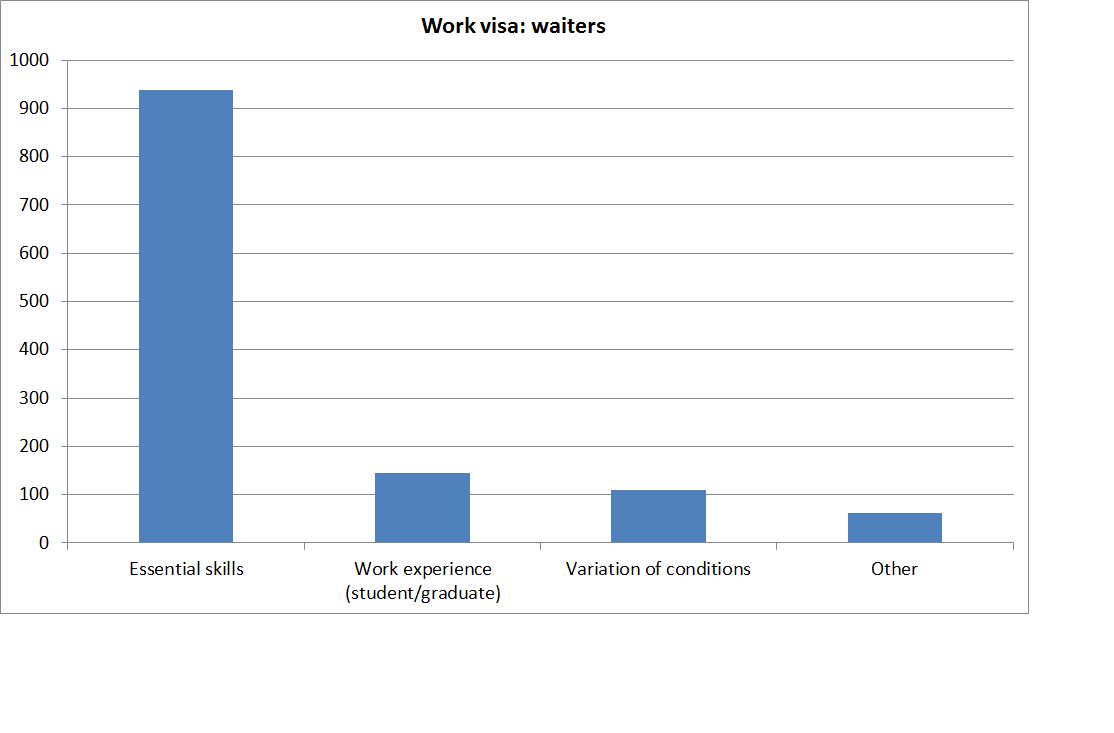
And again questions arise about the skills-based, productivity-enhancing, nature of those winery cellar hand and waiter approvals.  I had a slightly closer look at the waiter ones, using MBIE’s “application type”.  Somewhat to my surprise –  perennial optimist that I am –  this is what that breakdown looked like for the last five years.

work visas waiters

Café society and all that, but, really, an essential skill?

Skills-based immigration – D

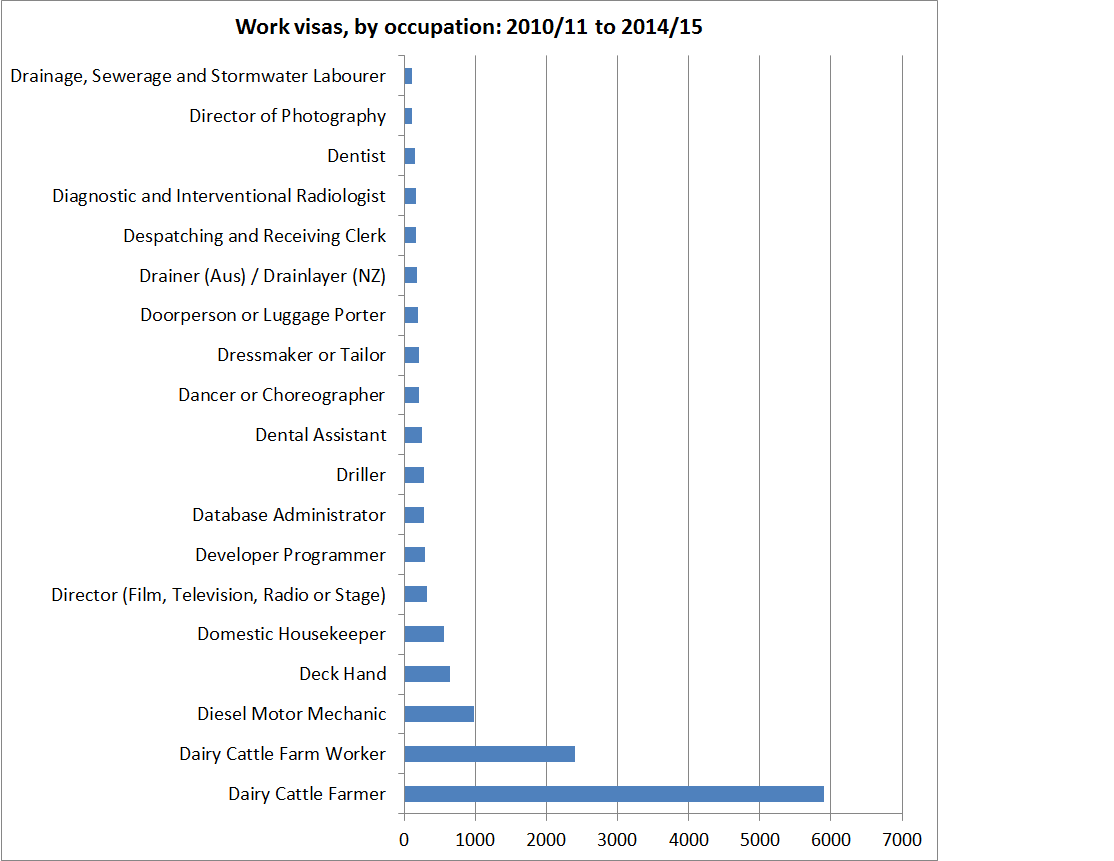
I’m sure they are excellent dairy workers/farmers (all 8000+ of them), but there are only around 11000 dairy farms in the whole country.  It does, rather, have the feel of an approach more strongly focused, in effect, on keeping down wages rates and conditions in the New Zealand dairy industry –  and fuelling the gross output driven mentality which Peter Fraser and co-authors suggest has dominated the industry in the last decade or so, a period when real value-added in agriculture has not grown at all.

The gains to farmers are clear, but those to New Zealanders as a whole are rather less obvious.

A quite remarkably larger number of (skilled?) domestic house-keepers as well, no doubt complementing the 1000 commercial housekeepers, and contributing to the long-sought lift in productivity.

work visas D

AUT Briefing Papers on housing

AUT University has, over the last few weeks, been running a series of short essays on housing-related issues, in their Briefing Papers series.  There are now seven contributions from a range of different perspectives –  from economics, to social housing and health issues.  My contribution to the series is up today.  In it I reprise (briefly) my story that persistently high house prices, especially in Auckland, are best seen as the result of policy blunders of successive governments: land use restrictions running head-on into high target rates of inwards non-citizen migration.

For regular readers there will be nothing new in the latest piece.  For others, a fuller version of that story is here, and a complementary piece explaining why Reserve Bank investor finance restrictions are not a sensible or appropriate response to a problem of this nature is here.

Skills-based immigration – C

Lots of the work visas approved in the last five years were for occupations starting with C.   There were quite a few carpenters, as one might expect, but when three of the top four categories are chef, cook, and café and restaurant manager it doesn’t have the ring of a strategy well implemented to enhance productivity and the earnings prospects of New Zealanders.  I was also struck by the number of commercial cleaners, commercial housekeepers, and community workers.  And I mentioned the 250 or so checkout operators yesterday.

A skills-based economic lever to lift productivity and living standards for New Zealanders?  Really…….

work visas c

Skills-based immigration – B

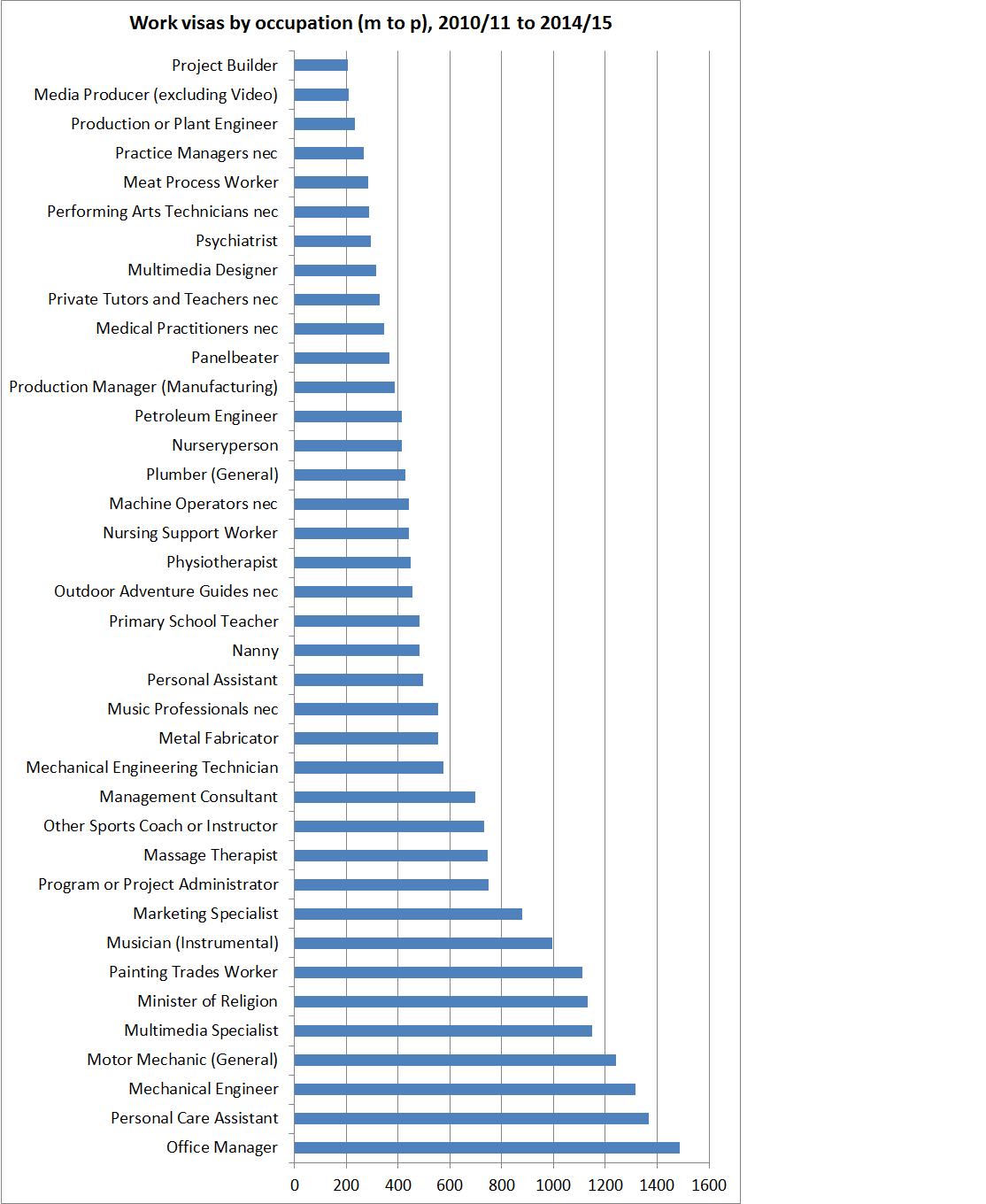
Not so many people came in with “letter B” occupations, but again the list of occupations with more than 100 approvals wasn’t a great advert for the transformational productivity-enhancing possibilities of our immigration policy.

work visas b

I won’t get into debates about the possible role of temporary migration in dealing with Canterbury rebuild pressures –  but really, builder’s labourers?  But even setting construction-related roles to one side for now, a list that has the top four places taken by beauty therapists, bar attendants, bus drivers, and baristas isn’t a great advert for the  productivity (and wage) possibilities this programme creates for New Zealanders.

Frankly, I’m surprised by how few of these work visa approvals seem to have been for genuinely highly-skilled roles.  But I led a sheltered life –  the Reserve Bank used to periodically recruit foreign PhD economists.   Then again, even in the Treasury papers I noticed reference to the declining average quality of migrants.

The Treasury papers also note (p 52) that

from a dynamic productivity perspective, we consider that migration shouldn’t provide a “path of least resistance” for growth in certain sectors of the economy.  By this we mean that temporary migration shouldn’t act as a lever that keeps labour costs in certain industries down to the extent that it dulls incentives to invest in capital or increase working conditions to attract local labour.

Perhaps they had the aged-care sector in mind? Or the dairy industry?

What sort of people get New Zealand work visas?

Fossicking on one of MBIE’s websites, I found a huge spreadsheet showing all work visas applications for the last five years.  I deleted the ones that were declined and starting to have a look at what occupations the people had who received New Zealand work visas over that period.   Not all of them, by any means, will have gone on to permanent residence, but most permanent residence approvals are of people  already living in the country (eg on a work visa).

This chart is just for occupations starting with the letter A, showing those for which there were more than 100 approvals  over this period.  Given that the focus of the immigration programme is supposedly on highly-skilled migrants, the number of aged care workers was striking (albeit not too surprising).  I’ll assume that most of the actors were genuinely short-term project related (while recognising that the film industry only survives through large taxpayer subsidies), but number 5 on this list was also a bit of surprise.  Skill-based lifts in productivity driving off an influx of foreign accounts clerks?

work visas a

Some of the approvals I don’t show raised a wry smile.  It wasn’t clear, for example, quite what demand there was in New Zealand for a (single) Aboriginal and Torres Strait Islander Health Worker.   Or for an antique dealer?

I’m not sure my enthusiasm will hold for the rest of the alphabet, but in case not I should mention that as I glanced through the spreadsheet I found that the New Zealand government –  focused on lifting national productivity, according to those Treasury papers –  had granted work visas to 149 checkout operators and 227 shelf-fillers.

The Treasury on immigration

Some months ago, I commented briefly on a speech by the Secretary to the Treasury, Gabs Makhlouf (himself a fairly recent temporary immigrant), in which he had lauded the economic gains to New Zealand from our large-scale non-citizen immigration programme.  Makhlouf asserted that:

Migration helps to lift our productive capacity – it enables the economy to grow faster by increasing the size of the workforce, in much the same way that foreign capital allows us to grow faster than domestic savings alone would permit.

Like foreign investment, migrants also bring new skills, new ideas and a diversity of perspectives and experiences that help to make our businesses more innovative and productive.

And perhaps most importantly, migrants often retain strong personal and cultural connections to other parts of the world, which opens up, and helps us to pursue, new business opportunities. We are in a pretty incredible position in this regard, with so many New Zealanders – around 1 million people – living overseas, and so many people who live here having been born in another country.

More recently, I passed on the comment Makhlouf had reportedly made, in an official capacity, that ‘immigration is good, it is as simple as that” (or words to that effect).

Some time ago, I lodged a request with Treasury for copies of any advice they had provided to ministers over the last couple of years on the economic impact of immigration in New Zealand, and on the permanent residence approvals target (currently 45000 to 50000 per annum). I was curious as to see what analysis and argumentation might lie behind their chief executive’s rather gung-ho views, but was really more interested in any economic analysis around the permanent residence approvals target, which I knew had been reviewed last year.

It took quite a while for the papers to be released, but eventually I did get part or all of 21 documents. Treasury suggested that they might put the material on their website, but they do not appear to have done so [UPDATE: a link here], so here is a link to a single pdf which contains all the material they released.  Subsequent page references are to this document.

Treasury immigration OIA results

Perhaps what surprised me most – I’m a starry-eyed optimist at heart – is how little substantive material or argumentation there was. I wasn’t expecting a major essay in each paper, but across the 21 papers there just wasn’t much there, even taken together.  Having said that, I was pleasantly surprised to find that the advice Treasury staff were providing the Minister seemed rather less glowingly optimistic than the perspectives offered by the Secretary.

The government sees (and probably previous governments saw) immigration primarily as an economic lever. If so, we do it mostly because we think it benefits us.  The non-citizen migration programme is certainly large, and Treasury recognises that New Zealand’s non-citizen immigration programme is one of the largest (as a share of population) of any advanced country. An immigration programme of the size and character of the one New Zealand has run over the last 25 years has changed New Zealand very substantially.   Total population continues to increase quite rapidly (not now the case in many other advanced countries), and the ethnic composition of the population has been changing markedly. By sheer scale, it is probably larger than any other aspect of government economic policy in the last 25 years.   Statistics record a net 862000 non-citizen permanent and long-term arrivals in the 25 years to March, and the true scale of the inflow is probably larger than that.

But what is there to show for it?   The idea is, to quote from two of the Treasury papers:

High-skilled migrant labour increases the average productivity of the labour market, and this is the micro-economic channel through which many of the benefits of immigration accrue (p56)

Granting residence to skilled migrants can increase New Zealand’s human capital by helping meet skill shortages in a growing economy, improving productivity by reducing search costs for employers, and increasing the diversity and innovation of the workforce. These effects can improve labour market productivity over time, which contributes to New Zealand’s overall economic productivity. (page 29)

But there is no evidence of it having happened. We’ve had one of the largest targeted migration programmes anywhere, and there is no sign of any improvement in New Zealand’s productivity performance relative to other advanced economies.   In none of these papers is there anything concrete Treasury points to to suggest more favourable outcomes.

An independent economist (and former Treasury staffer) Julie Fry was commissioned by the Treasury’s Macroeconomic Policy team to prepare a paper on links between immigration and New Zealand’s macroeconomic performance. The resulting work last year found its way into a published Treasury Working Paper on the issues. Her abstract read as follows:

New Zealand’s immigration policy settings are based on the assumption that the macroeconomic impacts of immigration may be significantly positive, with at worst small negative effects. However, both large positive and large negative effects are possible. Reviewing the literature, the balance of evidence suggests that while past immigration has, at times, ha significant net benefits, over the past couple of decades the positive effects of immigration on per capita growth, productivity, fiscal balance an mitigating population ageing are likely to have been modest. There is also some evidence that immigration, together with other forms of population growth, has exacerbate pressures on New Zealand’s insufficiently-responsive housing market. Meeting the infrastructure needs of immigrants in an economy with a quite modest rate of national saving may also have diverted resources from productive tradable activities, with negative macroeconomic impacts. Therefore from a macroeconomic perspective, a least regrets approach suggests that immigration policy should be more closely tailored to the economy’s ability to adjust to population increase. At a minimum, this emphasises the importance of improving the economy’s ability to respond to population increase. If this cannot be achieve, there may be merit in considering a reduced immigration target as a tool for easing macroeconomic pressures. More work is require to assess the potential net benefits of an increase in immigration as part of a strategy to pursue scale an agglomeration effects through increase population, or whether a decrease in immigration would facilitate lower interest rates, a lower exchange rate, an more balance growth going forward.

The Fry paper considers a number of my ideas around the potential adverse effects of high rates on inward migration to New Zealand. I don’t entirely agree with her conclusion, which I think is probably too generous to the immigration programme New Zealand has run over the last quarter century, but even her conclusion is modest enough – any gains, from a very large scale programme, are likely to have been “modest”.   If so, why bother with the programme?

Just before the Fry paper was released, Treasury wrote an aide-memoire to the Minister of Finance, which they have released in full (from p 18). It is interesting because it is a joint product of the macro policy area of Treasury and more micro-oriented labour market and welfare team.   The authors note that “on the whole, The Treasury agrees with the assessment of the evidence in the paper”.  They don’t necessarily agree with the policy recommendations, but the government’s principal economic advisory agency apparently sees no reason to be more optimistic about the economic impact of immigration than Fry’s quite downbeat assessment. It is a very different from the tone of Makhlouf’s March 2015 public speech.

As I have noted on various occasions, with a well-functioning market in housing supply and urban land, immigration should have no material or sustained impact on house prices. But if supply is sluggish – as it undoubtedly is in New Zealand, largely for policy-determined reasons – increases in population will put considerable pressure on house and land prices. All New Zealand’s population growth now results from the large non-citizen immigration programme – without it, we would have a flat or slightly falling population. Against this background, it is surprising that the papers Treasury released make very little mention of the implications of the target level of immigration for house prices, in Auckland in particular, and hence for affordability and inequality issues. The young and the poor, the latter disproportionately brown, pay the price of a government commitment to continued high levels of non-citizen immigration. It is not as if other parts of Treasury are oblivious to the problem – this recently released paper on the housing market treats the issue quite well – but it does not seem to have been factored into immigration policy advice.

In my macroeconomic arguments about the effects of immigration, I have tended to assume the best about the make-up of the immigration programme itself – that it was bringing in mostly well-qualified people. I was willing to concede that there might be some skills gains, but to argue that these were probably outweighed by the macroeconomic pressures (on real interest and exchange rates). But people keep pointing out that even the skills gains are not as clear one might like to think. Apparently, we’ve given 20000   work visas for chefs in recent years.  And Fry points to formal studies showing how disconcertingly long it takes many similarly-qualified immigrants to reach New Zealand native earnings. And, as the Treasury papers show (page 26), over the three years to 2013/14 only around half of permanent residence approvals were to people under the “Skilled/investor” heading (while more than 10 per cent were for the parents of New Zealand citizens or residents).

I had also not paid much attention to the numbers coming under the numerous working holiday schemes that New Zealand is now party to.   But Treasury has, and actually recommended to the Minister of Finance last year that a cap should be placed on the numbers coming to New Zealand under the various uncapped working holiday schemes, highlighted a number of risks, including that the substantial growth in the number of working holiday visas might adversely affect employment opportunities for New Zealand young people.   This is no small point, since standard analysis (to which I largely subscribe) tends to be very sceptical of the idea that immigration undermines employment prospects, whatever it might do (positively or negatively) to productivity or wages. And it is not just one paper. In another, from December last year, Treasury notes that “immigration policy often involves trading off domestic labour market objectives with other policy objectives” (page 52) – a rather different tone, again, from the Makhlouf speech – and observing that “there is reason to be concerned about the impact some of our current immigration policies may be having on the labour market prospects of low-skill New Zealanders.”

And I’ve already highlighted some of MBIE’s own work suggesting that the investor and entrepreneur immigration categories might struggle to provide much net economic benefit to New Zealanders. There is no sign in these papers that Treasury is any more optimistic.

The other thing I learned from these papers, which I had not previously been aware of, is that when Cabinet reviewed the New Zealand Residence Programme last year, they agreed to set a two-year target rather than a three year one. That was, apparently, partly to shift future decisions, perhaps still triennial, into non-election years. But they also “directed officials to undertake a review of NZRP and report back to Cabinet by November 2015”. Treasury observes (page 53) “MBIE is currently undertaking a strategic review of immigration policy settings. One particular area of interest that has emerged is the extent to which labour market objectives are balanced against goals like foreign policy, tourism and export education”. It all seems a far-cry from a hopeful vision of substantial productivity gains, and beneficial spillovers to long-term New Zealand living standards, from a large scale inward migration programme.

Twenty five years on there is little or no evidence that our very large scale inward migration programme is producing economic benefits for New Zealanders – which should be the principal criterion guiding what is, after all, sold as an “economic lever”. There are some obvious winners – notably those who happened to be property owners in Auckland –  but that is purely a redistributional effect, at a serious cost to those who are increasingly squeezed out of being able to afford to buy a house in Auckland. And there are serious reasons to worry that actually the immigration programme has made things worse for New Zealanders, by putting pressure on scarce resources, and driving up real interest and exchange rates, and crowding out much of the sort of business investment we might otherwise have expected after the economy was freed-up in the late 1980s and early 1990s.

The Secretary to the Treasury is upbeat on the economic benefits to New Zealanders of the immigration programme. But where is his evidence? His staff don’t seem to have been able to find it.

Notwithstanding the prejudices of the elites, there would seem to be a pretty good case now for substantially reducing the non-citizen immigration programme, rather than just pushing on with a failed strategy –  a huge intervention in New Zealand’s economy and society for which Treasury can point to no material demonstrable benefits.

Of course, MBIE may yet have the answers. At the same time I lodged the original OIA request with Treasury I lodged a similar one with MBIE, the department with prime responsibility for immigration policy issues. That request is still working its way through the system, more than two months after it was first lodged. I’m beginning to wonder what interesting gems it contains, or (perhaps more saliently) which might yet be deleted and withheld.   Two weeks ago I had a friendly email from them telling me I would have the information the following week, and then last week I had another email, from someone further up the hierarchy, telling me that consultation – with the Minister’s office perhaps? – was taking longer than expected, but “we are working to provide a response to you as soon as possible”.   It isn’t an overly urgent issue, but it has now been more than two months, and the basic timeframe under the Act is 20 working days.

Manufacturing sector employment

Having finished the last post, I flicked over to Kiwiblog and found a slightly flippant post, suggesting that Andrew Little’s comments about the dairy sector being in “crisis” could be safely discounted, in view of earlier Labour worries about the manufacturing sector having come to nothing. Indeed, on this take,

Their manufactured manufacturing crisis has seen record job growth in manufacturing.

I don’t follow sectoral employment data closely, so presumed I’d missed something.  Indeed, since much of manufacturing activity is a derived demand from construction activity (which has been very buoyant) and dairy processing makes up another component, and milk production has been growing strongly (even if agricultural value-added hasn’t), some strength in manufacturing employment sounded plausible.

But here is the chart of the Quarterly Employment Survey data, showing hours worked and number of full-time equivalent employees for the manufacturing sector as a whole.  The QES is a survey of firms, and probably quite reliable for these sorts of questions.

qes manuf

Given the strength of construction activity over the last couple of years, these seems quite remarkably weak data.

The HLFS (a survey of individuals) has a shorter series, and only for the total number of employees.  It has shown greater strength in the last few quarters, but even on this measure the numbers employed in manufacturing are still not up to pre-recessionary levels.

There is a long-running debate on the importance of manufacturing, both here and abroad.  Here was my summary take from a couple of months ago.

I’m not one of those who thinks that the relative decline of manufacturing is a tragedy, but on the other hand I also don’t think that it is a matter of total indifference.  Most likely, the relatively weak manufacturing sector performance in recent years, despite the buoyant construction sector, is a reflection of the persistently high real exchange rate.  Like Graeme Wheeler, I think the real exchange rate is out of line with medium to longer–term economic fundamentals.  A more strongly performing New Zealand economy, one making some progress in closing the gaps to the rest of the OECD, would be likely to see a stronger manufacturing sector.  It might still be shrinking as a share of a fast-growing economy, but a manufacturing sector that has seen no growth at all in almost 20 years doesn’t feel like a feature of a particularly successful economy.

The weak manufacturing sector, despite the support from construction sector demand, seems to be yet another symptom of an underperforming New Zealand economy.  If there were clear signs of rapid growth in investment and productivity in other parts of the tradables sector, we might reasonably be unbothered by the manufacturing numbers.  As it is, I don’t think we can be that relaxed.  And it isn’t a matter of targeting measures directly to boosting manufacturing, but about removing obstacles that have held up the real exchange rate (over decades), and which undermine the attractiveness of business investment across the economy as a whole.