Unprecedented…in a sample of four

The Reserve Bank had an interesting brief issue of the Bulletin out yesterday, reporting the results of some fairly straightforward data analysis as to how house prices (more accurately, house plus land prices) have behaved over the last fifty years or so, and how prices in Auckland relative to those in other parts of the country have behaved going back a few decades.  It is almost wholly a descriptive piece, offering no views on why things happened as they did, and little on what those patterns might mean.

The author –  Liz Kendall –  has done to work to construct a quarterly series for each TLA and a range of regional indices, using QVNZ data.  It would be nice to have those indices generally available, but perhaps restrictions on the use of the QV data precluded that?

The author identifies six distinct upswings in real national house (+land) prices since 1965, and as she notes the recent one has been relatively muted (for the country as a whole) –  despite all the fevered talk of low interest rates driving prices higher, ignoring the fact that interest rates are low for a reason (weak demand at any higher rates).

There wasn’t much of a upward trend in real New Zealand house prices, as far as we can tell, until the last 15 or 20 years.

rb housing 2

There was a huge boom in the early 1970s, as some combination of very low real interest rates and very rapid inward migration drove prices up.  But that increase was fully reversed over the following few years as credit conditions tightened, real incomes came under pressure, and significant net outward migration relieved pressure on the housing (house+land) stock.  The lack of any strong trend is consistent with what we see in the advanced countries that have a much richer longer collection of historical data –  including Australia and the United States.

Kendall illustrates that house prices in Auckland have not always been that highly correlated with those in the rest of the country.  There is clearly a common element to house prices in the country as a whole, but there are times when each region- including Auckland – “does its own thing”.  For example, in the 2002 to 2007 boom real house prices rose by materially less in Auckland than they did in the rest of the country (taken together).  And in the last three or four years, Auckland prices have risen much faster than those in the rest of the country.

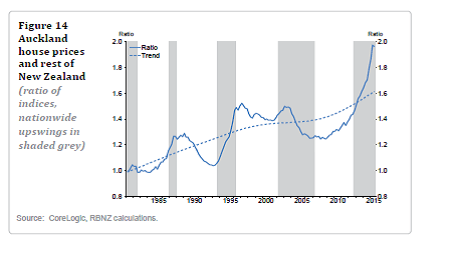
The punchline of the article appears to be this chart

RB housing 1

For the period since 1981 –   only 35 years –  it shows the ratio between Auckland house+land prices and those in the rest of New Zealand, and a moving average trend in this ratio.  The trend has no economic significance –  it simply smooths through the ups and downs in the actual data, and the more recent observations might end up being quite materially revised (up or down) as new data emerge (there are always “end point problems” with these sorts of filters).  The ratio is currently 22 per cent above this particular trend line, but when we look back 10 years hence who knows how large we will estimate that gap to have been.

I had just a few other thoughts on the article:

First, it was a shame that the authors did not look at Christchurch separately.    They look at an entity called “Greater Wellington” (Wellington, Upper and Lower Hutt, Porirua and Kapiti) but it is puzzling that they don’t even break Christchurch (an urban area of a similar population) out separately (just bunching it with Nelson, Dunedin and Invercargill), let alone look at a combined “Greater Christchurch” entity (Christchurch, Selwyn and Waimakariri).  At least in recent years, it has only made sense to think of the three TLAs together –  and price behaviour in that area has been distinctively different from, say, the rest of the South Island).

Second, it might have been interesting to see whether the differences between prices in other TLAs and the rest of New Zealand (perhaps excluding Auckland) were similar to, or different than, the pattern we observe in Auckland, including whether those patterns have been changing over the relatively short period under study.

Third, I would go easy on the word “unprecedented”.  In a short article, it is stressed several times that the gap between the increase in Auckland house (+land) prices and the increase in prices elsewhere in the country is “unprecedented”.  But they have regional data only since 1981, and in that period there have been a grand total of four upswings.  It is true that there is no precedent in the data, but there isn’t much data.

Relatedly, the article highlights how ill-served New Zealand is with historical economic and financial data.  That isn’t the responsibility of the Reserve Bank –  largely a policy and operational agency –  but it is a limitation that all users face.  Between the continued underinvestment in historical official statistics, and the lack of academic economists working on New Zealand economic history, and doing the leg-work to develop longer-run analytical series (as has been done for house prices in Australia, the US and various other countries), we have a relatively poor sense of what is normal or abnormal.  For example, it would be interested to know whether similar divergences occurred in the early 70s, in the post WW2 house (+land) price boom (when wartime controls were lifted), to be able to see what sort of regional divergences occurred during the Great Depression, and to be able to understand 19th century regional house price shocks (for example, the impact of the gold rushes on Dunedin prices, or of the land wars on Auckland prices).

The subtext in the Reserve Bank article is that what goes up comes down again.  In this article, it isn’t a particularly powerful point (and, in fairness the article doesn’t make much of it directly), since there will always be times when one region or another (even the largest) lags behind house price inflation in the rest of the country.  But there is no natural equilibrium  relationship between Auckland prices and those in the rest of the country –  as experience in the US demonstrates, it is mostly a matter of policy choices.  With weaker immigration and more liberal land-use policy around Auckland, real Auckland house+ land prices could be much lower absolutely, and relative to the rest of the country than they have been in recent years.  Many cities much bigger than Auckland in the US have house prices much cheaper, relative to surrounding areas, than Auckland does (I stayed recently with some friends in a small college city in the middle of the US where house prices were higher than those in the nearest, fairly prosperous, city of a million or more).

Finally, on the housing sector, SNZ released building consent data yesterday, completing the data for 2015.  The authors of the press release pointed out that the number of residential consents was the ninth highest ever –  which isn’t very impressive, since most macro series reach their highest or maybe second highest level each and every year.  What wasn’t pointed out was the way New Zealand’s population has increased –  not only is stock of people living here much higher than it was in previous housing booms, but the population increase over the last year or so has been larger –  even in percentage terms –  than at any time for decades.  Unfortunately, we don’t have an official population series that goes back prior to 1991, but using one of those from the international databases, here are residential building permits per capita since the series the mid 1960s.

residential building permits per capita


Last year’s building permits per capita were only just back to the average for the last 35 or so years –  even though the fast rate of population growth might normally have suggested, in a less regulatorily-impeded market, that consents per capita might have been considerably higher than the average over that period.

Which countries have been seeing export growth?

No one really doubts that over the longer term a better performing New Zealand economy –  absolutely or relative to the rest of the advanced world  –  would be likely to involve faster growth in exports.  It isn’t that exports are a special or unique type of product, or that tax breaks or other regulatory distortions should be put in place specifically to target exports.  It is simply that the rest of the world is a big place, and New Zealand is a small one.  The best prospects for high living standards here, at least for any given size of population, involves successfully selling more stuff to the rest of the world (which enables us to consume lots of stuff produced efficiently in other places).  The idea is implicit in the government’s own target to see exports as a share of GDP rise from around 30 per cent to around 40 per cent over the next decade or so.  But the general notion isn’t original to this government –  it has been a feature of New Zealand economic debate, and aspirations, for decades.

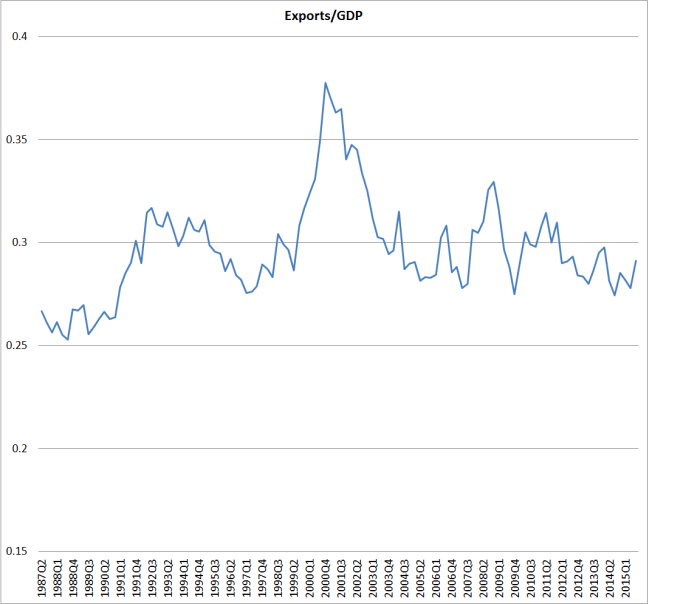
New Zealand hasn’t done particularly well on that score – nominal exports as a share of nominal share have barely changed over the last 25 years.

exports to gdp

Nominal export values are, of course, thrown around by fluctuations in export prices –  a particularly important consideration for a commodity exporting country.

But what about export volumes?  I dug out the OECD’s quarterly data on real export volumes.  I had a look at what had happened to export volumes for OECD countries (plus Latvia and Lithuania) since the end of 2007.    There is no ideal starting date, but the end of 2007 is just prior to the widespread recession of 2008/09, and in many countries export volumes slumped during the recession and subsequently recovered and I wanted to avoid those short-term fluctuations..

If we look at total export volume growth since the end of 2007, New Zealand doesn’t look too bad.  Total export volume growth was a little faster than for the G7 countries taken together, although a little slower than the EU countries or the euro area.  When one allows for the rising role of global value chains, which have boosted gross cross-border trade in many European countries (and which aren’t a feature of commodity trade), perhaps New Zealand’s performance doesn’t look too bad.

real exporrt vol growth

But, of course, New Zealand has had much faster population growth than most OECD countries – in some sense then we’ve needed more export growth than, say, a country with no population growth might have needed.  The OECD doesn’t have quarterly per capita data, and tracking down quarterly population estimates for many countries would take more effort than I have time for at present.

Instead, this chart simply subtracts the growth rate of real GDP since 2007 from the growth rate of real exports over the same period.   On this indicator, we are right back towards the bottom of the OECD.

gap between X and GDP growth

It isn’t necessarily a surprising result.  On the one hand, we’ve had to divert real resources from other activities to undertake the repairs and rebuilding in Christchurch. And on the other hand we have chosen –  as a matter of active policy –  to increase the population quite rapidly, which meant that resources that might otherwise have been able to be used to grow export businesses (at a probable lower real exchange rate) have had to be used to build the domestic capital stock (public and private) a higher population needs.

But if it shouldn’t be a surprising result –  just a logical outcome of shocks and choices –   it certainly isn’t one suggesting we’ve made any progress towards positioning New Zealand to begin to close the gap between our productivity and material living standards and those in the rest of the advanced world.

One difference between a transparent central bank and the Reserve Bank

The Reserve Bank constantly tries to convince us of how transparent it is.  As Deputy Governor, Geoff Bascand, put it in his first on-the-record speech

The Reserve Bank is deeply committed to transparency – of policy objectives, policy proposals, economic reasoning, and of our understanding of the economy, and of course of our policy actions and intent. Clear communication and strong public understanding make our policy actions more effective.

We are working to enhance the openness and effectiveness of our communications

Just recently, the Bank even had the gall to argue that its new charging regime for official information requests would support this; it “helps the bank fulfil the OIA in making valuable information publically available”.

I’ve illustrated on numerous occasions just how relatively un-transparent the Bank now is, whether in respect of monetary policy, financial regulation, or indeed its own corporate and governance activities.  In some ways and some areas the Bank has got worse, while in others it has just not kept up with best practice –  whether in other government agencies (especially those exercising regulatory functions), or in international central banking.

This won’t be a lengthy post.  It was prompted by reading a recent blog post by Dan Thornton, a former senior researcher at the Federal Reserve Bank of St Louis (and a very stimulating visitor to the Reserve Bank).    One of the features of the Federal Reserve system is that minutes of the FOMC meetings are released, and in addition full transcripts of those meetings (whether in person, or by conference call) are released five years after end of the relevant year.  You can see all the 2010 material the Federal Reserve has released here,  all readily accessible and nicely laid out.

Researchers and commentators use this stuff.  Here is the link to the post I was reading.  Thornton looks at one aspect of March 2009 FOMC meeting, a discussion around the wording of the statement that would be released.    For anyone interested, here is the heart of his discussion.

thornton

My point is not to take one side or other of the debate at the FOMC, but simply to illustrate the sort of openness that exists in the US, even with a lag, and contrast it with the situation in New Zealand.   It took me months last year to get the Reserve Bank to release the background papers to a ten year old Monetary Policy Statement – and I didn’t even bother asking for the minutes of the meetings, or the written advice to the Governor on the OCR, or any records of debate over the press release (all of which is official information, with a statutory presumption in favour of release).  Even that didn’t prompt a change in regular practice –  and if someone asked again now, for 10 year old papers, they would no doubt face a substantial charge.   Citizens and researchers, and even MPs, have no insights into the Reserve Bank’s processes or internal debates, beyond what (very little) the Governor chooses to publish in the MPS.  And the level of transparency around other Bank activities is even worse.  

The Federal Reserve isn’t perfect by any means –  and has fought transparency around, eg, its lending activities during the crisis –  but the contrast with the Reserve Bank of New Zealand is striking.

Grudging adjustment – yet again

Once again the Reserve Bank and its Governor have started backing away from a view that interest rates are low enough to get inflation back fluctuating around the 2 per cent midpoint of the target range –  the focus the Governor and the Minister agreed on just over three years ago.

Two years ago, with the OCR at 2.5 per cent, they were gung-ho on the need to raise the OCR – quite openly asserting that they expected to raise the OCR by 200 basis points.  From the January 2014 review:

The Bank remains committed to increasing the OCR as needed to keep future average inflation near the 2 percent target mid-point.

As late as December 2014, with the OCR now at 3.5 per cent they still thought

Some further increase in the OCR is expected to be required

By June last year, they had belatedly started cutting the OCR, and then thought only perhaps 50 basis points of cuts would be required.

By last month, they had got to 100 basis points of cuts, fully reversing (at least in nominal terms) the 2014 increases.   While not totally ruling out the possibility of further cuts they observed of the target midpoint that

We expect to achieve this at current interest rate settings

Today, that optimism has gone and we are back to

Some further policy easing may be required over the coming year to ensure that future average inflation settles near the middle of the target range.

I guess that is their bottom line, and I suspect the forecasters are giving the Governor little reason for much optimism.  No doubt the “over the coming year” is designed to discourage people from focusing on the March Monetary Policy Statement, but as ever the data flow will determine that.  Most likely, the Governor will have to shift his ground yet again – as he continues, for year after grinding year, to be over-optimistic about the likely rebound in inflation and (indeed) about the strength of the (per capita) economy.

But he must be a bit torn.  Almost everything in today’s statement that deals with what has already happened would be pointing towards further OCR cuts (weaker global growth and rising uncertainty about it, falling international commodity prices, continuing weak New Zealand export prices, and weak inflation here and abroad).  Add to that the Governor’s continuing unease about the exchange rate –  when it weakens it is usually a sign of weakening economic prospects, but the Governor still thinks it is too high.

So he seems to rest his case on two arguments.

The first is that New Zealand’s inflation rate isn’t very low after all.

 Headline CPI inflation remains low, mainly due to falling fuel prices

But that just isn’t even factually accurate.  The target inflation rate is 2 per cent, and the latest headline inflation rate was 0.1 per cent.   But the inflation rate excluding petrol prices was 0.5 per cent.  Excluding all vehicle fuels and household energy costs it was 0.6 per cent.  And if we take something like the common international ex food and energy measure, SNZ tells us that inflation excluding food, household energy and vehicle fuels was still only 0.9 per cent last year.

And it isn’t government charges or tobacco taxes either –  as I noted last week, in highlighting that the inflation rate is the lowest in 70 years –  the impact of higher tobacco excise taxes and cuts in government charges totally offset each other in the last year.

Everything seems to rest on the Bank’s sectoral factor model measure of inflation –  which, as I noted last week, has increased somewhat to 1.6 per cent for 2015.   This has been the Bank’s preferred measure of core inflation over the last few years,  but it is quite unusual for a model estimate measure of core inflation to make it into the OCR press release.  Indeed, I went back quickly and looked at the OCR press releases since the start of 2013, and not a single one of them referred to a core inflation measure, let alone quoted a specific number.

The idea behind the sectoral factor model is sound, but it seems rather bold for the Governor to put so much weight on this particular measure when it seems to be at odds with the other indicators of underlying or core inflation.  I’ve already quoted some of the exclusion measures (the CPI ex petrol, or whatever), but the other core inflation measures on the Bank’s website have also been flat or falling.  At the other extreme, the trimmed mean measure of inflation was only 0.4 per cent last year.  Oh, and inflation expectations –  survey measures and market ones –  have been low and falling.

I’m not sure what the “true” measure of underlying inflation is –  and neither is the Governor –  but I don’t think the overall balance of indicators should be giving the Governor any reason for confidence about the current situation of the inflation rate relative to target.  It certainly isn’t all about petrol.

The Governor also apparently remains optimistic about a re-acceleration in economic growth in New Zealand:

growth is expected to increase in 2016 as a result of continued strong net immigration, tourism, a solid pipeline of construction activity, and the lift in business and consumer confidence.

But….even if immigration remains high, that only maintains growth  rates and doesn’t provide a basis for any acceleration (especially as the Bank in its most recent MPS announced its conversion to a view that immigration did not put any net pressures on demand, even in the short-term –  a change of heart which they have still not justified, or released any supporting papers for).  When I last looked, international guest nights growth looked to have levelled off quite markedly in the second half of 2015, and any lift in business and consumer confidence still looks quite modest (and certainly hasn’t taken any of the measures back above where they were earlier last year).  And all that is before we take into account the continuing weak international dairy prices (weaker than the Bank, and most producers will have been expecting), and the increasingly difficult international environment.    There is plenty of volatility in quarter to quarter GDP growth rates, and plenty of revisions too, but there doesn’t seem to be much there to give us confidence that economic growth in New Zealand will pick up materially, if at all, this year.   And inflation was already weak, and weakening, even when the economy seemed stronger, and income growth higher, 12 to 18 months ago.

Yet again, the Governor is behind the game –  grudgingly adjusting his line to barely keep up with the deteriorating flow of domestic and international data.  We might worry less if the weak inflation was the result of strong and resurgent productivity growth, but there is no sign of that either.  Instead, we’ve been left with an anaemic recovery and a high unemployment rate (rising over the last year).  Not everything is down to the Reserve Bank’s failures, but the Governor’s choices haven’t helped –  monetary policy is designed to deal with demand shortfalls.   The Bank should be held more forcefully to account for those choices.

In closing, I was sobered to look at the inflation rate ex food and energy.  New Zealand’s is 0.9 per cent.  That for the euro-area is 1 per cent.  The gap isn’t large, but with plenty of policy room at the Reserve Bank’s disposal, they really should have been able to keep inflation a lot closer to the target midpoint than the ECB –  grappling with the zero bound, and all the existential issues weighing on activity, demand and investment in much of the euro area.

An independent Policy Costings Unit?

The Green Party co-leader Metiria Turei yesterday called for the establishment of an independent Policy Costings Unit within The Treasury.

Today, the Green Party has sent a letter to each party leader, asking for support from across the House to establish an independent unit in the Treasury to cost policy promises.

Political parties could submit their policies for costing to this independent unit, which would then produce a report with information on both the fiscal and wider economic implications of the policy.

Instead of New Zealanders making their decisions based on spin and who can shout the loudest, they will have meaningful, independently verified information instead.

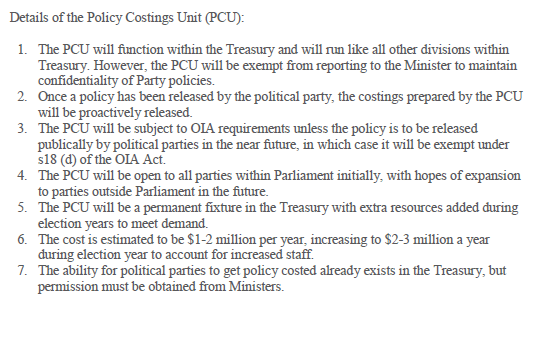
And here are some of the details of what the Greens are proposing.

greens pcu
I don’t think this is an ideological issue at all.  The National Party is opposed, but the Taxpayer’s Union –  generally sceptical of any proposals to spend more public money, and generally a bit more towards the right of politics than the left – has come out in support of the proposal.

 Taxpayers’ Union Executive Director, Jordan Williams, says “We agree with the Greens that an independent office to cost political promises would be good for democracy and public policy debates. While our preference is to have the office as one of Parliament, rather than Treasury, the Green’s policy has real merit.”

“Seldom does the Taxpayers’ Union call for new spending of taxpayers’ money but here we think the benefits to transparency and democracy far outweigh the cost.”

“This tool would make it harder for politicians to make up expensive policy on the hoof with taxpayers bearing the costs of the wish-lists. It would likely prevent the fiasco we saw with the Northland by-election bribes.”

Like the Taxpayer’s Union, I reckon that if New Zealand is going to establish such a unit it should be done as an office of Parliament, and I wonder why the Greens chose not to take that option.  Perhaps they took the view that such a unit would be cheaper if it operated within Treasury (drawing on the corporate functions of a larger organization).  But even if that were true, I suspect it would be a false economy.

If it is worth establishing such a body at all, it is worth doing it properly.  That means establishing a body with its own mission and esprit de corps, and staffing the organization with people who sense that their primary responsibility is to Parliament and to the political process, not with people whose career is advanced primarily by their performance within Treasury –  a line department that answers to the government of the day.  I’m not suggesting that people in a quasi-independent unit in Treasury could not do the job with integrity –  after all, Treasury at times provides secondees to the office of the Leader of the Opposition, and it hasn’t obviously tended to hurt those individuals’ careers on their return to the Treasury (one is now the State Services Commissioner, and another was the previous Secretary to the Treasury).  But the role would be better done by a properly independent body, able to attract someone of sufficient standing and authority to lead it (heading this sort of unit is not just a section manager’s job).  And if it were to established as an adjunct to any existing agency, I would probably suggest the Productivity Commission –  at arms-length from day-to-day politics –  rather than Treasury.

But is it worth going down this track?  I’m still ambivalent.  I don’t think there is enough thoughtful scrutiny of macroeconomic policy issues in New Zealand (and touched on some of that here), and before the Greens proposal goes any further it would be worth looking carefully at what is done in other countries.

I can think of two highly-regarded examples, from two quite different political systems.  In the Netherlands, the CPB has, for decades, provided costings for political party proposals.  Although it is not compulsory for parties to seek such costings, I understand that it has become the norm for them to do so –  an equilibrium, which looks (on the whole) like a good one.  The CPB is very highly-regarded and does a wide range of other work (not just electoral costings).  It is administratively a part of the Dutch Ministry of Economics Affairs (but with protections for its independence).  The CPB was founded in 1945 and had already functioned at arms-length from the government for decades before it began providing political party costings.  The CPB has more than 100 staff (not all doing political costings).

And in the United States, the Congressional Budget Office also plays a highly-regarded role as non-partisan “scorer”.  It is a quite different political system, and the role is not about scoring party promises doing into an election campaign, but in evaluating the fiscal implications of legislative proposals.

Both the CPB and CBO are highly-regarded.  I’m not sufficiently familiar with Dutch politics to offer any thoughts on how much impact the CPB costings have on retail politics in the Netherlands –  and I imagine that views differ anyway.  But regardless of technical capability and impartiality of the CBO, US fiscal policy and legislative processes don’t look overly attractive.  Of course, in a huge country there is cacophony of voices –  more or less expert –  and so it might be unreasonable to think that any publically-funded independent agency would make much difference to the debate.

What about the other Anglo countries –  the UK, Ireland, Australia and Canada?

The UK and Ireland have both established fiscal councils in recent years, and there have been calls for those agencies to be given a mandate to cost political party promises.  To date, neither country has altered the mandates of the fiscal councils (which are more macro in their focus).

Canada and Australia have each relatively recently established a Parliamentary Budget Officer.  The (fairly small) Canadian office does not appear to do political party costings (but can, on request of an MP, evaluate the cost of a proposal before Parliament), but the Australian PBO  (with about 40 staff) does make that facility available.  But here is the important thing –  politicians have been reluctant to use the facility, and there has been no obvious public backlash more or less compelling parties to have their policies evaluated by the PBO.   I’m not entirely sure why, but it is an alternative equilibrium to the Dutch one.  Which model would hold in New Zealand?  Perhaps, given resourcing constraints, smaller parties might use the Treasury office the Greens propose, but the proposals of the smaller parties generally matter less than those of the major parties.  Would Labour, or National in future when it is in Opposition, use the facility?  I don’t know.

Why might politicians be reluctant to have such a agency evaluate their policies?  Yes, there might be cynical reasons –  the proposals are just too expensive and parties don’t want that cost authoritatively exposed.    But there might be other reasons.    In the end, people often don’t vote for one party or another on the basis of detailed costings, but on “mood affiliation” –  a sense that the party’s general ideas are sympathetic to the broad direction one favours.  And I can’t think of a New Zealand election in my time when the results have been materially determined by the costings (accurate or inaccurate) of party promises  – perhaps in 1975 National might have won a smaller majority if the cost of National Superannuation had been better, and more openly, costed, but I doubt it would have changed the overall result.

And then, of course, there is the fact that economists, and public agencies largely made up of economists, have their own predispositions and biases.    The Economist touched on this issue quite recently.  It isn’t that economists are necessarily worse than other “experts”, or that people consciously set out to favour one side or another in politics, but (say) whatever the merits of the sorts of policies the Greens have favoured, it is unlikely that the New Zealand Treasury (1984-90) would have evaluated them in ways that the Greens would have found fair and balanced.  Perhaps ACT might have the same reaction to today’s Treasury?  If it were only narrow fiscal costings an agency was being asked to evaluate, perhaps these predispositions of the analysts would not matter unduly (although even there, much depends on the behavioural assumptions one makes), but the Greens’ proposal includes analysis of the “wider economic implications” of policy proposals.

On balance, I still think there is a role for something like a (macro oriented) fiscal council in New Zealand, perhaps subsumed within the sort of macroeconomic or monetary and economic council I suggested here (but perhaps that just reflects my macro background).   And there is probably a role for better-resourcing select committees.  But when it comes to political party proposals, if (and I don’t think the case is open and shut by any means) we are going to spend more public money on the process, I would probably prefer to provide a higher level of funding to parliamentary parties, to enable them to commission any independent evaluations or expertise they found useful, and then have the parties fight it out in the court of public opinion.  The big choices societies face mostly aren’t technocratic in nature, and I’m not sure that the differences between whether individual proposals are properly costed or not is that important in the scheme of things (and perhaps less so than previously under MMP, where all promises are provisional, given that absolute parliamentary majorities are very rare).  If there are serious doubts about the costings, let the politicians (and the experts each can marshall) contest the matter.

At very least, though, if this interesting proposal is going to go anywhere, it should be underpinned by a more in-depth analysis of the experiences, and contexts, of other countries.


Charging for official information

Debate over the Reserve Bank’s new charging policy has continued.  Under a heading “The perils of user-pays democracy” Bryce Edwards had a nice summary of the articles and commentaries that had appeared by late last week.  And since then the flow has continued –  including a Rob Hosking piece in NBR, a Dominion-Post article about, and interview with, the new Chief Ombudsman, and an op-ed this morning from Bronwyn Howell at Victoria University, run alongside the hard-copy version of Geoff Bascand’s defence (that first appeared last week).

If the Reserve Bank is monitoring the reaction and debate, which I’m sure it is, it can only conclude that it is losing in the court of public opinion.    It isn’t just about journalists, bloggers, academics etc, but in the comments sections to the various articles the balance of opinion seems to tilt quite clearly away from the Reserve Bank’s stance.

Losing in the court of public opinion should concern the Governor –  and those charged with holding him to account (the Board, the Minister, Parliament’s Finance and Expenditure Committee).  Democracy rests on the consent of the governed, and although formal laws play a vitally important part in expressing that consent, and securing compliance, it is buttressed by a sense that the decisions of the powerful (elected or otherwise) are fair and consistent with the values of the society.  I don’t get the sense that many people who have thought about the issue at all think that blanket charging, for any OIA requests that are at all complex or awkward, is consistent with the way in which this country should be run.  All the more so perhaps when the agency concerned wields so much power – the Governor has more discretionary policy freedom than even most elected officials –  with so little effective formal accountability.

It is, however, somewhat troubling that in his interview the other day with the Dominion-Post the new chief ombudsman, Peter Boshier, declares that the Reserve Bank’s policy is just fine:

“I think the Reserve Bank’s response is actually very fair.  When I looked at it I couldn’t fault it.  As a statement of principle it was perfectly fair and it’s one to which I subscribe”

I was surprised that the new Ombudsman was so upfront in his defence of officials, but it is consistent with the point I made last week, that the charging provisions of the Official Information Act itself are quite permissive, putting few constraints on agencies (other than that any charge be “reasonable”).  The government’s charging guidelines are considerably less permissive (and the Reserve Bank’s policy is not consistent with those guidelines), but those are guidelines to government agencies, not the law that the Ombudsman is required to interpret.

As a commenter on my earlier post has pointed out, in the end the only final and binding ruling on how the relevant provisions of the Act should be interpreted would be those of the courts, should anyone seek a judicial remedy.  I’m not aware that there has ever been a case on the charging provisions.   Last year, the courts heard Jane Kelsey’s case, but in largely upholding her argument that the Minister of Trade, and the then Ombudsman, had misapplied the law, by blanket refusals to release information, but the judge in that case did point to the option the Minister had had to charge for collation/ scrutiny etc of the information.  Perhaps at some point a court might rule that a fairly extensive charging policy, like that adopted by the Reserve Bank, was impermissible under the Act – ie unreasonable, because the effect was inconsistent with the whole purpose of the Act, to make official information more readily available.  But frankly, I’m old-fashioned enough to hope that no court would do so: Parliament put the charging provisions in the Act, and Parliament should refine or remove it, not (in Professor James Allan’s words), a committee of ex-lawyers.

Bronwyn Howell’s article this morning is a curiously “on the one hand, on the other hand” academic economist’s piece.

Inevitably, there are trade-offs to be made between the costs of acquiring information and the costs and incentives of concealing it.  There are economic arguments both for and against explicit fees.

The only certainty is that when it comes to the costs of Official Information, democracy itself doesn’t come cheap.

Yes, of course there are potential trade-offs, but they aren’t typically very large ones.  And, yes, open government and democracy carry some direct costs (even elections cost), but not typically very large ones –  and the costs of a not-very-open government (harder to put a dollar price on perhaps) are considerably greater.  And if the potential dollar costs are upfront, the benefits often flow over the longer-term.  Open and transparent government helps provide citizens with the confidence to allow governments, and government agencies, to act –  knowing that we can later scrutinize the choices made, and the evidence and arguments used in support of those choices.  When people don’t trust governments, they eventually take away the powers, and the flexibility those agencies have –  and sometimes need.

What of the Reserve Bank?  In his op-ed last week, the Deputy Governor argues that the Bank will only be charging for requests that are “large, complex or frequent”, suggesting that ordinary people have nothing to worry about.  But the case he cites –  a Fairfax’s reporter’s series of requests – involved 8.5 hours of time.  I’ve been asked to pay for a couple of requests that they estimate would, they estimate, have involved a similar amount of time.  But any serious request for information on policy matters is typically going to take, at least, several hours of work by officials, and that is partly because it is difficult to be sure where the information a requester is looking for might be found (ie which specific document), and agencies are not inclined to assist requesters.  In practice,  the requests the Deputy Governor appears happy not to charge for seem to be mostly the ones that involve no threat or risk to the Bank (in other words, no serious scrutiny).  It is way of fending off serious questions or investigations by the media and commentators.

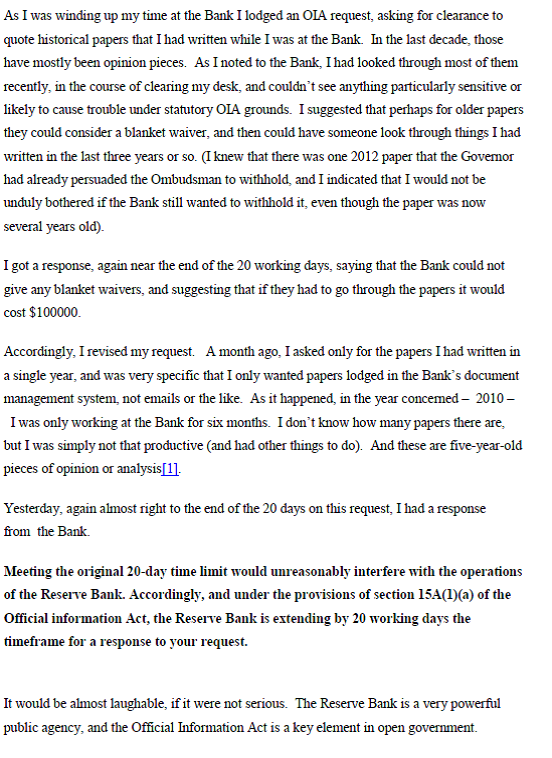
Here are some of my experiences with the Bank and OIA charges.  The first two date from before the current policy was adopted in November/December last year.

oia

If it were an agency committed to open government, it would have been very easy, with no direct cost to the Bank at all, to have simply responded to the initial request with a general authorization to use any of the older papers, and perhaps asking for a discussion about refining the request for the more recent ones.  But that isn’t the Reserve Bank’s way.

A bit later I asked for background papers to the 2012 Policy Targets Agreement.  The PTA is the key document governing the conduct of monetary policy, and no background papers to it were released at all when the Governor and the Minister of Finance agreed the PTA in 2012.  I was threatened with a large bill, and invited to refine the request.  A Bank official prompted me to narrow my request to a particular file which, when the Bank eventually finally responded to the revised request, proved to have almost nothing in it that shed any light on the background to the Policy Targets Agreement.

What of the more recent episodes?

I asked for copies of some old Board minutes.  Those papers are well filed, and nicely bound at the Bank.  The Bank knows there is nothing problematic in them as a year or so ago, I had made a request for a slightly more recent set of minutes, and was quickly told I could copy them myself.  And yet they wanted to charge hundreds of dollars for these readily accessible uncontroversial historical papers.

I also asked the Bank for papers relevant to the post-TPP Joint Macroeconomic Declaration to which the Reserve Bank has become a party.  I’ve been told that meeting that request is also likely to cost hundreds of dollars.  It isn’t a large or complex request either: the Bank tells me that they have identified seven papers and 26 pages of emails; if anything, I was a little surprised at how little material they had.

With a track record like this, it is not surprising that people are uncomfortable with the Reserve Bank’s new policy.  It seems designed to obstruct, not to inform, and particularly to obstruct any awkward questions about the activities of a very powerful agency.   I’m not sure what specific topics Richard Meadows’ requests were about, but it seems unlikely that they were very large or complex either.

In passing, I would note that one of the aspects of the Reserve Bank’s involvement in the post-TPP Joint Declaration that I was curious about was the additional costs they were committing to (with no new funding), and what they were proposing to displace to cover these costs.   The agreement committed the agencies involved to (at least) annual macroeconomic consultations between the parties to the agreement, which will involve additional travel costs, and additional analytical work in preparation for such meetings.   An additional business class airfare to Washington alone appears to be another $7000 or so, with additional costs (and lost other productive opportunities for a senior official) as well.    It would be surprising if the involvement in the Joint Declaration did not cost the Bank at least another $15000 a year.  And it would be surprising if all their OIA requests, trivial and substantive, cost much more than that.  Recall, that the Joint Declaration was developed only at the insistence of the US Congress (and even then the Federal Reserve refused to be party to it).  I’m not necessarily suggesting there is anything inappropriate about our Reserve Bank and Treasury being party to the declaration, although it does carry some risks.   But we should be able to see how the Bank has thought about those risks (and the additional costs).

In concluding, here is a link to the more radically open approach adopted in Norway.    The Reserve Bank should be reconsidering its policy on charging for information, but the more general issue really requires some political leadership from some party or another that believes seriously in open government, even recognizing that genuinely open government will sometimes be uncomfortable for the powerful.  Indeed, that discomfort is more or less the point.


Grant Robertson, the Reserve Bank, and the end of the Governor’s term

Further to my post the other day on Grant Robertson’s latest statement on monetary policy, Bernard Hickey has posted a substantial article about his interview with Robertson on these matters.  It is a useful piece to have –  certainly the most sustained discussion of monetary policy and Reserve Bank issues from Robertson since he became Labour’s finance spokesperson.

And yet it still poses more questions than answers, and still leaves Labour looking as though it has not really thought hard about either monetary policy or the reasons for New Zealand’s continuing economic underperformance (including the continuing large gap between New Zealand and “world” real interest rates).  As a voter and an interested observer/commentator, I found that pretty disappointing.   There is certainly space for a different approach to economic policy in New Zealand –  it is not as if either recent Labour or National led governments have managed to do anything that begins to reverse New Zealand’s relative economic decline.

But it is still looks as though they are more interested –  at least at this stage of the electoral cycle – in positioning (with their party base, and with the business community), and being seen to be different, than in the harder aspects of substantive economic analysis and concrete alternative policies (and the connection between the two of them).

Thus he says “the lowest inflation since last century combined with rising unemployment…is making a farce of monetary policy”, and “when you reach 15 quarters outside of the mid-point we do have to ask ourselves what we’re doing with monetary policy”.  And yet Robertson is very reluctant to criticize the Reserve Bank, and the Governor (formally the single decision-maker) in particular.  Indeed, he goes out of his way to praise the Governor and –  despite the single decision-maker model  – says “the targets agreement has not been met, but I wouldn’t want to bring that down to him personally at this time”.  Certainly, the Governor has advisers, but they are all employed by, and accountable to, him.

Instead, Robertson repeatedly argues for changing the framework.  He isn’t very specific about what he wants –  and it is still 20 months from the election – but the only point that keeps recurring in all his statements is a desire to have the Reserve Bank actively promote higher employment.  But he adduces no evidence whatever to suggest the reframing the wording of the Bank’s goal, along the lines of the Fed or RBA objectives, would make the slightest bit of difference to how the Reserve Bank actually runs monetary policy.  Past Reserve Bank research suggests that, on average over time, the Reserve Bank of New Zealand has reacted to incoming data in much the same way as the RBA or Fed have done.  Robertson either knows that, or should do, so the onus is on him to explain how his approach would make a difference, in substance rather than rhetoric.

And there is still nothing on the “new tools” Robertson has talked of needing.  When Hickey asked him about the variable Kiwisaver rate proposal Labour took into the last election, all he would say was that it was under review, and “that wasn’t mentioned today and won’t be in the foreseeable future”, adding (Hickey’s words) that “Labour preferred to have a simple policy that gave voters certainty”.  Which is all fine no doubt, but doesn’t give hardheaded observers reason to think Labour actually has serious alternative tools in mind.  That shouldn’t be surprising, as the tool the Reserve Bank does use is the tool other central banks use –  at least until they exhaust its potential when policy rates get to or just below zero.

It seems to me that there are two quite important separable issues:

  • the Reserve Bank has not done a particularly good job in the last few years of carrying out the Policy Targets Agreement.  That failure has been particularly stark since the 2 per cent midpoint reference was added in 2012.  With (as Robertson notes) inflation very low and unemployment high and rising, it is a pretty clear-cut case of a shortfall of demand, and a lower OCR is the best tool for stimulating additional demand.    The Reserve Bank can do something about that, but has failed to do so –  as Robertson notes, he was among those uneasy about the OCR increases in 2014, which were unnecessary, and the Bank (the Governor) has been slow to lower rates since.  Real interest rates now remain higher than were two years ago, when dairy prices were at their peak.
  • the disappointingly poor economic performance of New Zealand over recent decades, including such symptoms as the large gap between New Zealand real interest rates and those abroad, and the persistently high average real exchange rate.    As it has abandoned support for the existing monetary policy framework over the last few years, Labour has tried to imply (perhaps especially to its base) that there is something about the monetary policy framework that Labour could fix, offering some material improvement in our economic performance.  Neither Phil Goff, David Cunliffe nor David Parker ever quite managed to explain the connection.  Robertson has done no better.  That isn’t surprising, because it really isn’t there.  There might be better ways of articulating the objective, and there are better ways of running/governing the Reserve Bank etc, but none of them offer anything much in addressing the structural underperformance of the New Zealand economy.

Veteran commentator and analyst of left-wing politics, Chris Trotter wrote a piece the other day suggesting that Labour and the Greens were adopting an approach, akin to that in the early 1980s, of getting alongside the business community  –  getting them to the point where business was comfortable that an alternative government would not “scare the horses”.  I’ve no idea if that is an accurate description, but Robertson’s comments don’t look inconsistent with Trotter’s story.  I was interested, for example, in Robertson’s reaction to the question of whether Graeme Wheeler should be reappointed next year: Wheeler’s term expires almost three years to day from the date of the last election. Robertson doesn’t refuse to comment, but goes on to express his regard for Wheeler (twice), only then concluding that “ultimately it won’t be a decision I’ll be involved in”.

I have no idea, of course, whether Graeme Wheeler will even seek a second term, but whether he does or not, I think there should be some disquiet about the fact that his term expires in late September next year.  Monetary policy is now hardly something that the main political parties are united on (unlike the situation from 1990 until 2008, when any differences were about details, and the statutory goal united National and Labour), and it doesn’t seem very satisfactory that, for example, the current government could appoint someone to the office of Governor (single decisionmaker across a range of policy areas), taking office perhaps in the middle of an election campaign, or indeed just as a new government was taking office.  It isn’t a problem if the current government is re-elected, but (say) a Labour-led government supported by the Greens and/or New Zealand First might have a rather different view about priorities and emphases for the Bank.  The Governor has a degree of personal policy autonomy not shared, for example, by heads of core government departments (eg the Secretary to the Treasury).

The last time a Governor’s term expired in an election year was in 1993 (2002 was different –  Don Brash resigned just before the election campaign, and a new permanent appointment was not made until after the election result was determined).  But, as I noted, on that occasion National and Labour went into the election with no real difference on the Reserve Bank Act.  On that occasion, the Reserve Bank’s Board and the then Minister agreed to reappoint Don Brash in December 1992, well before any election year market uncertainty  (or campaigning) took hold.  And the first Brash term was due to expire a couple of months before the election would normally be due.

The situation next year seems much less tractable.    Wheeler’s term expires more than three years after the date of the last election.  And Labour seems sure to campaign for material changes to the Act (as would its potential future support parties).   And if Graeme Wheeler does not seek another term, any capable person pondering applying for the job in early to mid 2017 might be more than slightly uneasy –  it not being clear what the substance of the role might actually be.    I hope the Board –  and perhaps the Minister  – have already begun to think about the issue.  I’m not sure what the best way ahead is.  These clashes don’t happen often, but perhaps one option for the longer-term might be six year terms for the Governor, rather than five –  so that a new gubernatorial appointment was always in the middle of an electoral cycle.  For now, I wonder if it might be wise to consider extending the Governor’s term for another year. to allow longer-term decisions to be made with greater clarity about the longer-term direction of the Reserve Bank and New Zealand’s monetary policy regime.  As longerstanding readers might imagine, I’m hesitant about that option for a number of reasons, but none of the alternatives look ideal either.

In this post I haven’t touched at all on Robertson’s comments on immigration –  with which I am generally sympathetic, although sceptical about the extent to which immigration policy can be managed in a countercyclical way.  And countercyclical issues are not where the real debates about the economics of New Zealand’s large scale inward migration programme should be centred.


Do citizens always (net) leave their own countries?

In my post the other day on New Zealanders continuing to leave New Zealand, one thing I didn’t touch on is that in normal circumstances one should expect more citizens to leave their own country than arrive.

People mostly acquire citizenship by first living in a country.  For most people, it is a matter of being born somewhere (although not everyone born in a particular place is entitled to citizenship of that country).   Others acquire citizenship through immigration, sustained residence and naturalization.  And there is a, typically much smaller, group who acquire citizenship outside the country –  eg the children born abroad of New Zealanders.

In other words, most citizens of a country are in that country to start with.  However successful the country is, it is likely then that over time more citizens will leave the country than will arrive in it.  There typically isn’t a large stock of citizens abroad, and some citizens will, for example, marry someone from another country and move to settle in that country.   Others will find an exceptional job abroad, or simply like something about the lifestyle or values that another country offers.  The United States, for example, has had among the very highest material living standards for a long time, but the best estimates seem to be that there are a couple of million American-born US citizens living abroad.  More Americans have left the United States than have arrived.

But two million Americans is less than 1 per cent of the US population.  In New Zealand’s case, by contrast, Australian statistics say that there are around 600000 New Zealand born people (almost all of whom will have been New Zealand citizens –  many still are) in Australia alone.    There are only around 3.5 million New Zealand born people in New Zealand.   Diasporas make a difference.

Once there is a large stock of citizens living abroad, there is no reason to think that the net migration flow of citizens will continue to be outward, no matter what the economic conditions are.  If New Zealand’s economy starts performing better than those abroad, which group of people finds it easiest to move here and take advantage of those opportunities?  Surely those who are already our own citizens –  they have the legal right to move here, full access to our welfare supports, and few cultural adjustment issues  (Australians can come here too, but the flows are typically small.)  By contrast, people from other countries face  all sorts of additional hurdles.  They need legal permission to come (and we don’t allow just anyone in, as soon as they want to come),  and they typically won’t know the culture that well or find it easy to immediately see their skills fully recognized in the labour market.    With 600000 New Zealanders in  Australia alone, if there was any convergence going on between living standards in New Zealand and Australia (or New Zealand and the UK, where the next largest group of New Zealanders live) that could quite quickly and readily been accompanied by a reversal of the net outflow of citizens.  Many would still be leaving  –  some permanently, some just for a few years –  but more could be returning.

What happens in other countries?    Do we ever see net inflows to a country of citizens of citizens of that country, or is this just a theoretical curiosity?  In fact, we do see, and have seen, such flows.

I went to the Eurostat database, which collects and reports data from a huge number of European countries (mostly those inside the EU, but not only them).   Somewhat to my surprise, I actually found what I was looking for: in this case, 10 years of annual data for the migration inflows and outflows of citizens of each reporting country.  I’m not sure how they compile the data in most countries (in New Zealand, we use arrival and departure cards), but in Europe the use of identity cards and the need to register in a locality probably support data collection.  In any case, however they manage to calculate it, this is what I found.   I downloaded the data for 32 countries for the years 2004 to 2013 (the most recent Eurostat had).  Bear in mind that New Zealand has not had an annual net inflow of its own citizens for more than 30 years.  But over the last decade, 11 of these European countries had had such inflows in at least one year (in fact, all of those 11 had had at least two years of net inflows of their own citizens).

These were the countries that had experienced inflows: Denmark, Ireland, Greece, Spain, France, Croatia, Cyprus, Slovakia, Hungary, Malta, Finland

It is a diverse group: some of the richer EU countries (France, Denmark and Finland) as well as some of the poorer.  Unsurprisingly, most of the inflow years seem to have been when the home economies were doing well.  Over time, for example, Ireland has huge net outflows, akin to New Zealand’s experience (and hence a very large diaspora), but they had a net inflow of their own citizens of around 12000 people a year from 2006 (when the Irish data start) to 2008.  Cyprus –  a much smaller country –  was attracting back a net 1000 or so of its own citizens each year right up until their crisis hit in 2013.  And so on.

As I noted, even very rich countries will tend to see a modest outflow of their own citizens over time.  Norway, for example, has an extremely high GDP per capita (and even higher GNI per capita), and about the same population as New Zealand.  It was losing about 1000 Norwegians per annum over 2004 to 2013 –  a period when New Zealand lost an average of 28000 people per annum.

And how do to the average net outflows over time compare across countries?  This chart shows data for the Eurostat countries discussed above, supplemented with national data for New Zealand and Australia.

own citizens inflow

A handful of countries actually had a net inflow of their own citizens over this full period.  But only two of the countries had a larger average annual outflow (as a per cent of population) than New Zealand.  If New Zealand had really been doing well our diaspora is large enough that the flow could easily have reversed.  It simply hasn’t.  It fluctuates, and the net outflow in the last year has been modest by our own historical standards (recent decades), but even last year’s net outflow would have put us towards the right of this chart.

Still a country New Zealanders leave

In one of his weekly columns over the holiday period the Herald’s John Roughan, a touch sentimental perhaps that his grandchildren were just returning home again to Singapore, made the case that the post 1984 economic reforms have made New Zealand “a place worth returning to”,  “a place that can hold its own in the world”, and so on.

It is a nice story.  It is certainly one that I hoped would come true.  It is just a shame that the facts don’t really support it.

What have New Zealanders been doing?  Well, the last time there was any sort of sustained net inflow of New Zealand citizens to New Zealand was when Sir Robert Muldoon governed:  seven consecutive months in 1983.  It probably wasn’t greatly to Muldoon’s credit, since by mid 1983 Australia’s unemployment rate had risen sharply to just over 10 per cent.    There were also two months in early 1991 when there was an inflow of 90 people:  and again Australia’s unemployment rate was rising rapidly.    Even in the last 12 months a net 4800 New Zealand citizens have left.  Sure, plenty of individuals leave and come back, but in net terms the data tell us the flow is outwards.  It is a volatile series, and the outflow at present is less than it has often been, but we’ll need several years more data before there would be any reason to think the pattern of net outflows –  in place since the mid 70s – is ending.  There has been a net outflow of New Zealand citizens of 680000 since the reforms began.

net plt flow of citizens

And even if the outflows were to slow, it isn’t necessarily a mark of our own success.  Australia has long been the natural place for New Zealanders to seek better opportunities for themselves and their families.  For a long time, access to Australia was largely unrestricted –  it was easy to go, pretty easy to adapt, and if things went wrong the social safety net buffers in Australia were there for the immigrants.  New Zealanders can still easily go to Australia, but they now have a much tougher time of it –  for new arrivals, access to the Australian welfare system is available only for those arriving on permanent residence visas (typically not New Zealanders).  And their children can find themselves in a legal limbo.   In boom times, only the most risk averse pay much attention to factors like that  –  and those who choose to migrate aren’t generally the most risk averse –  but tougher times in Australia, and just the passage of time and the reporting of more stories of the difficulties some have faced, is reducing the attractiveness of Australia, even as the income and productivity gaps between the two countries have continued to gradually widen.  It is too early to tell how large any structural change in the willingness of New Zealanders to go to Australia has been –  the cycle dominates –  but if it has happened it is neither a benefit to New Zealanders or a reflection of any success on our part.

Roughan glides between the talk of New Zealanders coming home and celebrating the overall net immigration statistics.  But again, large net inflows of non New Zealanders aren’t a sign of economic success, just a sign of one strand in economic policy.    A relatively rich country never has too much difficulty getting migrants if it wants them –  there are always many countries that are worse off.  Indeed, a violent middle income country like South Africa attracts lots of (mostly illegal) migrants –  most of Africa is even poorer.  This isn’t the place to resume debates about whether New Zealanders will benefit from our immigration policy over the long haul, just that inflows –  however large – are not themselves a sign of our economic success.

I’m one who thought –  and thinks –  that most of the reforms of the 1984 to 1993 period were in the right direction, and generally needed to be done.  But we need to face the fact that even if many of those reforms were beneficial –  and I think they probably were –  New Zealand’s productivity performance has remained pretty woefully bad.  And absent huge new natural resource discoveries, productivity is the basis of sustained prosperity.

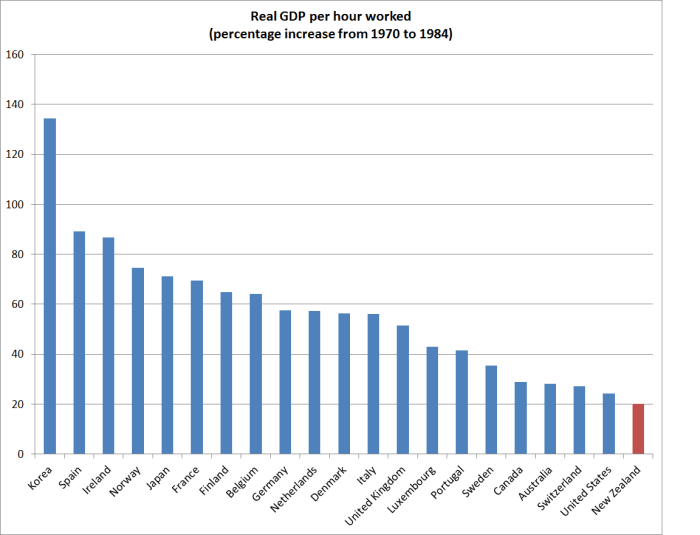
Roughan talks of finishing school at the end of the 1960s and having then been pessimistic about New Zealand’s prospects.  And New Zealand did very badly in the fifteen or so year after that.  Between some of the bad choices we made ourselves (Think Big for example), oil shocks, slumping commodity prices and the UK entry into the EEC, it perhaps wasn’t surprising that between 1970 and 1984 we had the lowest growth in real labour productivity (real GDP per hour worked) of any OECD country for which the data are available.  I was one of young (and probably naïve) who looked at that record and thought that there was no real reason why it couldn’t be reversed with a couple of decades of decent economic management.

real gdp phw 70 to 84

But it just hasn’t happened.  Here are the same data (growth in real GDP per hour worked) for the 30 years since 1984.

real gdp phw 84 to 14

We’ve managed to match growth in Spain and Canada –  both countries that in 1984 had higher levels of productivity than we did –  and we’ve done better than Greece, Switzerland, and Italy.   Better than in the earlier period, but thin pickings really, especially when one contemplates how bad things in Italy and Greece have been in recent years.

Our story isn’t all bad, of course.  We reversed a really bad track record of high inflation, and government’s accounts look pretty good by most (but not all) advanced country standards).  The rapid accumulation of overseas debt (as a share of GDP) also came to an end.  Without those improvements, perhaps the productivity picture would have been even worse.

Individuals generally don’t make choices based on macroeconomic data, but on their perceptions of the opportunities for themselves and their families.  But in this area, the flow of people and the macro data seem pretty well aligned.  New Zealanders just keep on leaving –  in smaller numbers right at the moment, but with little sign of any structural reversal of the flow –  and our productivity performance continues to languish. Yes, to pick up Roughan’s words, New Zealand is a “lovely” place and I enjoy the “temperate warmth of our summer”, “the deep blue sky” and the “beaches and bays” as much as anyone, but…..the beaches look pretty good in Uruguay too, one of the few (then) advanced countries to have done even worse than New Zealand over the last 100 years.

OIA: changes in RB practice and in law needed

Just before Christmas, I drew attention to the Reserve Bank’s new policy of charging for Official Information Act requests.  At the time, this paragraph appeared on the Bank’s website.

The Reserve Bank has a policy of charging for information provided in response to Official Information requests when the chargeable time taken to provide the information exceeds one hour, and charging for copying when the volume exceeds 20 pages. Our charges are $38 per half hour of time and 20c per page for copying (GST inclusive).

That text has now been removed and they appear to have provided some rather more extensive material outlining the approach they are now planning to take.  This is what is now stated on the website:

The Official Information Act allows the Reserve Bank to charge for preparing information that we send in response to requests. When charging for responses to Official Information requests, the Reserve Bank works within the guidelines published by the Ministry of Justice here – Official Information Act: Charging for Services. Charges are $38 per half hour of staff time after the first hour, and 20 cents per page for printed or copied material provided in response to a request, after the first 20 pages.      The Reserve Bank is resourced to meet disclosure obligations for a reasonable level of Official Information requests and generally will not impose charges for small, simple or infrequent requests. If requests are made for large amounts of information that require substantial collation and research, the Reserve Bank’s first step is to work with the requester to refine the request to a smaller scale or scope that is less likely to involve charges. Where request is still chargeable and likely to be expensive, we will give the requester further opportunity to refine the scope of the request and thereby reduce or eliminate charges.

Basis for charging     The cost of providing free responses to Official Information requests is generally borne by taxpayers. The Reserve Bank believes that requesters should bear some of the costs when requests are made for very large amounts of information, where a response to a request is particularly complex, or where individuals or organisations make very frequent requests.

Guidelines for charging      Charges will be imposed for responses when preparation of the response involves more than one hour of chargeable collation, research and preparation work. If the Reserve Bank decides that information requested can be made available, but that charges are appropriate, we will formally advise the requester of:

  • our decision to release the information,
  • the estimated amount of proposed charges,
  • the basis for proposed charges, and
  • the requester’s right to seek an Ombudsman’s review of the proposed charges.

Remission of charges        The need to pay charges may be modified or waived at the Reserve Bank’s discretion, if:

  • charges might cause financial hardship for the requester; or
  • releasing the information is likely to contribute significantly to public understanding of the Reserve Bank and its work, and release of the information is not primarily for the benefit or interest of the requester; or
  • if the information already in the public domain in a form which the requester could acquire without substantial cost.

As I noted before Christmas, it appears probable that the Reserve Bank’s general stance is legal, since the relevant provisions of the Official Information Act itself are quite short and permissive

Subject to section 24, every department or Minister of the Crown or organisation (including an organisation whose activities are funded in whole or in part by another person) may charge for the supply of official information under this Act.

Any charge fixed shall be reasonable and regard may be had to the cost of the labour and materials involved in making the information available and to any costs incurred pursuant to a request of the applicant to make the information available urgently.

Whether it is appropriate is quite another matter.

I discovered the new policy when the Bank sought hundreds of dollars to provide me copies of some easily accessible, non-contentious, very old minutes of meetings of the Reserve Bank Board. But I’m not now the only one to have been hit by the new policy. Richard Meadows of Fairfax was told he would have to pay a similarly large amount to progress several of his OIA requests, a step that has brought greater coverage to the issue. There were articles on Stuff last week (here and here), and yesterday the Dominion-Post editorialised on the Reserve Bank’s new policy, under the heading “An obstacle in the path of freedom”.

The Bank is, of course, bound by the law. But it also notes that it seeks to work within the charging guidelines approved by the then government in 2002. But it is not clear that it is really doing so.

For example, the Bank lists factors it would take into account in deciding whether to modify or waive any charges, but the list it uses is not the same as the list in the government’s charging guidelines. They state

7.1 The liability to pay any charge may be modified or waived at the discretion of the department or organisation receiving the request. Such decisions should have regard to the circumstances of each request. However, it would be appropriate to consider inter alia:

  • whether payment might cause the applicant hardship;
  • whether remission or reduction of the charge would facilitate good relations with the public or assist the department or organisation in its work; and
  • whether remission or reduction of the charge would be in the public interest because it is likely to contribute significantly to public understanding of, or effective participation in, the operations or activities of the government, and the disclosure of the information is not primarily in the commercial interest of the requester.

To comply with these guidelines the Reserve Bank first has to consider the circumstances of each request.   And it is advised to consider whether “remission or reduction of the charge would facilitate good relations with the public” and whether “a remission or reduction in the charge would be the in public interest because it is likely to contribute significantly to public understanding of, or effective participation in, the operations or activities of the government”. The Bank states that it will consider remission or reduction if the request is “not primarily for the benefit or interest of the requester”, but that is hugely different phraseology than the one in the government’s charging guidelines, which talk about where “the disclosure of the information is not primarily in the commercial interest of the requester” – in other words, the test is whether the requester making money from the information in the request.

Yesterday, I was also informed that my request for material the Reserve Bank held relating to its involvement in the post-TPP Joint Macroeconomic Declaration (that our central bank and Treasury were party to, along with macroeconomic authorities in other TPP countries) would also be subject to a charge of $560.

There is no evidence in the letter from the Reserve Bank that they have considered the circumstances of the specific request. For example, as the Dominion-Post editorial notes, charges of this scale “would be a serious obstacle for any individual” and “if OIA requests routinely cost this much it would also be a problem even for large media outlets”.  But I suppose it would not necessarily cause “hardship”

More pointedly, there is clearly no commercial benefit to me at all (let alone it being a “primary” factor) in making such a request. This blog is a non-commercial operation.

What about the wider public interest? Well, the government has been clear that it wants to encourage scrutiny and discussion of TPP issues now that the agreement has been signed. And yet, one press release apart, the Reserve Bank has published no background information about its involvement in the Joint Macroeconomic Declaration, and the Governor has not answered any questions about it. Against that background, a request of the sort I lodged seemed likely to assist public understanding of a new international commitment made by the Reserve Bank. The fact that the Reserve Bank itself constantly stresses the gains from transparency makes their stance on OIA requests in general, and this one specifically, particularly incongruous.

Perhaps the Bank wants to argue that publication on my blog would not advance the public interest (although I’m not sure how they would apply that reasoning to one of the country’s largest media groups). I have, of course, a smaller readership than the Fairfax publications, but by New Zealand standards it is a pretty significant number of people – including, but not limited to, officials, market analysts, journalists and politicians – with an interest in economic and financial policy and analysis issues in New Zealand. The official charging guidelines note that it is reasonable to ask whether requesters have a means of disseminating the requested material. As they note “in the case of the media, however, it can be reasonably assumed that they do have access to means of public dissemination”. The same might be said for requests from reasonably widely read bloggers – blogs not having been as common in 2002 when the charging guidelines were written.

But in any case, the Reserve Bank has itself created a platform for disseminating material, by adopting the (admirable) policy of releasing the results of many of the OIA requests it receives on its own website.

I suspect the change of Reserve Bank policy was prompted by the various requests I have lodged with the Reserve Bank over the last year or so. I haven’t gone back and checked each of them, but I’m pretty sure that in all cases (a) I have written about them here, thus giving dissemination to what the Bank has released (or refused to release) and (b) that all of them have had a focus on enhancing the understanding and scrutiny of a powerful public agency[1].

The Reserve Bank’s new stance is a serious misjudgement. The issue isn’t whether their stance is legal – it probably is – or whether, as applied to either Fairfax or me, it is in accordance with the government’s charging guidelines – it probably isn’t. The bigger issue is the one I have been highlighting for the last nine months. The Reserve Bank is a very powerful organisation, with a great deal of discretionary policy choice left (formally) in the hands of one unelected person. The Bank exercises far more discretion, in a much wider range of areas, than the designers of the Act – and especially of its governance provisions – ever envisaged. Against that backdrop, the Reserve Bank – and its Board and the Minister, both charged with responsibility for the Governor’s performance – really should be going out of its way to be open and transparent – not just on the things it wants to communicate to us, but in facilitating the sort of scrutiny and challenge that open and democratic societies thrive on. The questions might be awkward at times, and some of the angles oblique, but it is for citizens to define the questions and challenges, not the unelected bureaucrats.

It would tedious to go through once again all the areas in which the Bank fails to practice openness and transparency, but to take just three think of submissions on its regulatory proposals, background papers to the current PTA, and background papers on the substantial programme of work undertaken on possible reforms to the governance model. If the Bank is going to add to its generally obstructive approach – responding as slowly as possible, and releasing absolutely as little as possible while waiting out the Ombudsman – by making access to public information something only for those with deep pockets, it will simply further undermine any legitimacy or respect that it has. I would urge the Governor (and his committee) to rethink, and would encourage the Board, the Minister, and members of the Finance and Expenditure Committee to pick up the issue with the Governor. I welcome the fact that James Shaw, co-leader of the Green Party has already gone public on the issue.

More generally, as I have noted before, the Bank would be well-advised to consider adopting a much more pro-active approach to the release of background papers (akin to the pro-active approach taken by the Minister of Finance and the Treasury following each Budget).   For example, the Bank might consider:

  • releasing all submissions on regulatory proposals on the website on the day submissions close,
  • releasing background papers to the Funding Agreement the day the Funding Agreement is released,
  • releasing background papers on any new PTA at the time of the signing of that PTA
  • releasing proper minutes of the OCR-advisory Monetary Policy Committee, and of the monetary policy meetings of the Governing Committee, say, six weeks after the relevant OCR release
  • releasing background papers to each Monetary Policy Statement immediately after the release of the subsequent Monetary Policy Statement

None of these would be extraordinary by the standards of other government agencies or international central banking.

There would, no doubt, still be matters on which people would lodge Official Information Act requests with the Reserve Bank, but the more open the Bank is upfront the less people will feel the need to lodge ad hoc requests.

More generally, this issue highlights the need for a more comprehensive reviews of the Official Information Act, including the role of the Ombudsman’s office and the charging regime. It may well be the Reserve Bank is isolated in its new stance – the No Right Turn blog is seeking the information on that. But as the Dominion-Post editorial puts it, the “default position should be to give the information free. Only in the most exceptional cases should this rule be breached”.

A reader has suggested that perhaps any proposal to charge should require the explicit advance consent of the Ombudsman’s office. That sounds sensible, provided the Ombudsman is properly resourced, but would require a change to the legislation. Legislation might provide that charges could be levied only for exceedingly complex requests (perhaps those taking more than 100 hours – and with decent document management systems how many should that be?) or where it is evident, on the balance of probabilities, that the primary benefit in releasing the information would be for the commercial interests of the requesters (although general release on a public website would presumably deal with what might otherwise be uncharged gifts to commercial operators). Perhaps there needs to be a separate provision for “vexatious requesters”, akin to vexatious litigants in the courts – but again that would be a matter for the Ombudsman to judge, and “asking awkward questions of powerful agencies” would not qualify of itself as vexatious.

We have sought to avoid a “dollar democracy”. The rich and powerful have no more voting rights than you or I. The same really should apply to the access to public information that enables us to evaluate and hold to account politicians and other officeholders (as it largely has in the way the OIA has been administered  –  for all its problems – by most agencies). Whether or not the Reserve Bank backtracks, it is time for Parliament to revisit the OIA and better fit it for an age when openness and transparency are seen as increasingly important. Part of that will be about a stronger culture (and obligation) to pro-actively disclose, part about better-resourcing the Office of the Ombudsman, and part is about ensuring that access to public information is not determined by the size of one’s bank account.

As I was just about to publish this I noticed an op-ed from the Reserve Bank’s Deputy Governor Geoff Bascand, defending the Reserve Bank’s stance in response to yesterday’s editorial.  Readers can evaluate it for themselves, but I noticed this section

Since the policy was introduced we’ve responded to seven OIA requests and sought charges for two of them because most could be addressed without collating large amounts of information.

The particular charge that sparked recent commentary arose because providing the information requested would take an estimated 8½ hours of chargeable time (along with additional non-chargeable time).

As the Bank has sought charges for two of my OIA requests since the policy was changed, and Richard Meadows noted in the comments on my earlier piece that he was charged for three, this account seems not quite accurate.  And I’m still waiting for a response to my September request for the submissions made to the Bank on its regulatory stocktake.


[1] As it happens, the Board papers I requested last year probably fitted those categories least (they were about (a) some background work on the origins of the Reserve Bank Act and the Board’s role, and (b) the interests of hundreds of present and former members of the Reserve Bank’s superannuation fund (I’m a trustee of the scheme and some difficult issues have arisen from that era)).