Take a macro approach

There has been quite a bit of coverage in the last few days of business lobbies calling for special assistance to cope with the economic effects of the coronavirus to date, and signs too that the government is proving at least somewhat responsive.  In the Herald the PM is quoted as saying that the government will waive the standdown period –  typically a week – for those seeking to move onto a welfare benefit “because of the impact of Covid-19”.  In Parliament yesterday (emphasis added):

Rt Hon JACINDA ARDERN: I’m not going to make a prediction that no other economist is currently making or, indeed, Treasury. We are not predicting, but we are planning and preparing, because that is what we, of course, need to do in order to support those regions, in particular, that are most likely to be affected. We know those are likely to be—Gisborne, Hawke’s Bay, Tasman, and Marlborough are amongst the most exposed, particularly looking at the—

Hon Simon Bridges: It’s every small business in New Zealand.

Rt Hon JACINDA ARDERN:—impacts in China. But some analysis, obviously, Mr Bridges, demonstrates those impacts are particularly acute there, and then across the board for the likes of tourism and hospitality. In each of those regions we are looking to create tailored packages of support. That’s something that our Minister for Economic Development is currently working on.

In addition to all the other firms/sectors looking for assistance, there is a full page article in the Herald on the difficulties facing the tourism and hospitality sectors, including calls for wage subsidies.

Unfortunately, much of the way the Prime Minister talks about the issue –  and the Minister of Health on the health side –  suggests that the government is still acting as if coronavirus is a very bad thing (which, of course, it is) which has already happened somewhere else –  affecting our economy of course – and now it is really just a matter of time, albeit perhaps quite some months, until things get back to normal.  (It all seems consistent with the tone of the Director-General of Health who continues to play down the health risk in New Zealand, and – in public anyway –  to take the most short-term positive spin on almost every story/risk.  That matters because it suggests something of a government-wide mindset, with implications for the economic and economic policy issues that are my focus.)

In all the talk of this subsidy, that specific assistance, this tailored regional programme, no leading politician or official seems willing to front the fact that, difficult and costly as things have been so far for some individuals/firms/sectors, the only prudent approach is to plan on the basis that things will most probably get a lot worse before they get better.  It is fine to work on the basis that in a couple of years time things are likely to be more or less back to normal (as regards health/virus etc).  But two years is a long time away, and there is likely to be a great deal of disruption, uncertainty, and loss before we emerge safely on the other side.

Even if somehow the Ministry of Health was right and significant community outbreaks really don’t happen here, there still seem to be plenty of new and worsening ones abroad.  Even if China inches back towards normality –  and you could check out the new Caixin article on people just making stuff up there, about economic activity, to comply with top-down expectations –  much of the rest of the world seems to be heading in the opposite direction.  It isn’t just supply chains involving China, or tourists from China etc that we –  and others –  need to worry about.   If we do get significant outbreaks here we will have a whole new level of domestic disruption and loss (economic and other) as the measures –  imposed and self-chosen –  to manage the situation take hold.   Whole cities could come to a near-halt for non-trivial periods.

Frankly, it seems bizarre to be focusing on “tailored region specific packages” in this environment.  It looks remarkably backward-looking (focused on the stuff that has already happened), and to be not taking anywhere near enough account of the wider risks.  I presume somewhere in the Beehive or the upper levels of officialdom some people actually realise the magnitude of the issue/threat, and are taking it into account in their advice on specific policy proposals.  But there is no sign of that stuff in any of the outward-facing talk –  least of all from the Prime Minister.

Much of the talk seems influenced by the earthquake experiences, both Christchurch (especially after February 2011 and Kaikoura).   In particular, people talk positively about the short-term wage subsidies offered to some firms to help keep people connected to the labour market etc.  I think that, in passing, I have even referred favourably to that experience myself.  But it is a bad way of framing the current issue for a number of reasons:

  • trivially, Kaikoura was/is very small.  Whatever was done for people/firms there had no economywide implications,
  • second, and much more importantly, the nature of the shock and economic loss being dealt with was known.  Thus, although people fairly point out that there were aftershocks, and even worries about severe ones, when there were major earthquakes in Christchurch no one worried that there would be a big one –  or Rangitoto erupting –  the followng week/month in Auckland.
  • third, allowing for the aftershocks point, the worst event had already happened by the time the special programmes were launched.  We couldn’t be 100% sure of that at the time, but it is still a stark contrast to the situation we face now re Covid-19,
  • fourth, the earthquake shocks were known, from day 1, to be going to trigger a really significant boost to aggregate demand (repair and reconstruction) in and around the severely affected regions.  Activity might not resume quickly in some individual and specific sectors, but before too long there would be lots of jobs in total, and thus lots of wider demand.
  • fifth, even Christchurch was only about a tenth of the country.

By contrast this time, we know very little, and what we do know does not portend any great boost to demand and employment just a little over the horizon.   There could –  quite probably will – be very serious disruptions to come, perhaps across the economy as a whole.  Individual sector interventions are unlikely to scale effectively, and interventions announced now –  perhaps in some generous cast of mind – could very quickly be overwhelmed by the pressures of more serious widespread disruption and losses, whereby those “lucky” enough to be hit first-  in this case those who made themselves most dependent on one market, the PRC –  get the easiest largesse.

(I’m not even convinced of the case for suspending the standdown period.  This is a recession. We might hope it is brief.  It might be no one here’s fault. But most recessions aren’t in any way the fault of most of the individuals who bear the brunt of the downturns, and actually the best thing for people thrown out of work early is to reconnect to the labour market as soon as possible, perhaps before the labour market in aggregate gets much worse.  But this particular policy, because it can presumably be applied more or less with the flick of a switch (if it is avowedly temporary, and not tied to proving a Covid-19 connection), bothers me less than suggested admin-heavy targeted interventions, which might make good political theatre this week, but which could quickly look rather beside the point.)

And it isn’t as if these sort of tweaked tools are going to go to the heart of the issues either.  As I noted yesterday

Even direct short-term assistance won’t do much to slow the deterioration of economic aggregates –  won’t summon up more tourists, won’t fill gaps in supply chains, won’t offset the decline in spending if/when social distancing becomes more imperative.  By and large, we are stuck with whatever deterioration in economic activity the next few months bring, most of which will be events almost totally outside our control (overseas economic activity and the spread of the virus abroad and here).

If specific tailored micro policies aren’t the thing, that isn’t to suggest policymakers should be sitting idle.  Rather, macroeconomic measures with systematic whole economy effects should be in play, either deployed decisively right now –  in the case of monetary policy, which is easy to reverse later if necessary – or ready to go almost instantly as/when the full severity becomes a bit more generally apparent.  If it were me, I’d be suspending the forthcoming minimum wage increase as well –  whatever demand effects champions of high minimum wages might tout, in this environment raising already-high minimum wages will worsen the labour market ruptures politicians etc purport to be concerned about.

I don’t have a full suite of measures.   I still think a temporary reduction in GST has a lot of merit.  Perhaps a temporary (but significant) reduction in one of the lower income tax rates might have appeal –  and would ensure that the income effects to households were distributed relatively evenly.  (Incidentally, for any MMT champions out there, financing is pretty much a non-issue for now present, with long-term nominal bond yields at 1 per cent.)    And despite my general and long-term support for a substantial reduction in New Zealand’s permanent non-citizen migration numbers, I would be very careful to do nothing now to drive those numbers further down (they are likely to fall anyway), consistent with my point that the short-term demand effects of migration materially exceed the supply effects.    And there needs to be some hard-thinking about the potential private debt consequences of the (likely) substantial income losses –  that doesn’t just involve heavying the banks.  Banks, quite reasonably, will be more cautious, many borrowers will inevitably be less able to meet their debts. (The Chicago academic John Cochrane has a piece worth reading on some of those issues.)  (Hobbyhorse issue of mine, but very relevant: there should be action as a matter of urgency to addres, and greatly ease, the effective lower bound on nominal interest rates.)

I’m sure there are other options, that are focused, can readily be kept temporary, and which might plausibly have significant demand effects concentrated this year and perhaps next.    The design of a package with such measures –  econonywide in focus –  is where our economic boffins and their ministers really should be devoting all their design etc efforts at present.

If I’m underwhelmed at the political leadership around these issues, it is perhaps even more worrying to look at the officials and agencies supposed to support the Cabinet.   Our Treasury is led by someone with no New Zealand experience and (more concerningly, as I noted when she was appointed) no experience or background in national economic policymaking.  Our Reserve Bank is led by someone with little demonstrated capacity for deep and innovative thought, who has displayed more interest in things he isn’t responsible for than those he is.  MBIE is led by a former HR manager, and I could go on.  Perhaps there are some exceptionally able people the next tiers down, helping frame big-picture thinking and proposing well-thought-out specifics, but the names don’t really spring to mind.   Our public service (led from SSC, enabled by governments) hasn’t encouraged the fostering of those sorts of capabilities.  Our institutions have been allowed to run down, under successive governments, and we pay the price for that in tough and highly uncertain times.

I suppose I once got the idea that getting on the front foot might unnecessarily scare the horses (voters) and look “panicky”.  That might have seemed a plausible story a month ago, just like the “contained to China, to all intents and purposes” story might have seemed plausible then to some.   But it doesn’t now.  Politicians, officials, and the public need to recognise that things –  including economically –  are likely (few things are ever quite certain) to get much worse at times in the next few months before they get enduringly better.  Policy planning needs to be done on that basis, and “tailored region specific plans” don’t really seem like to cut it, or to be a wise use of scarce policy and adminstrative talent (or political capital for that matter).

Why economic policymakers need to respond aggressively

Yesterday I dug out some discussion notes I’d written while I was working at The Treasury during and just after the last New Zealand recession.  One of them –  written in June 2010, already a year on from the trough of the global downturn (although as the euro-crisis was really just beginning to emerge) – had the title “How, in some respects, the world looks as vulnerable as it was in 1929/30”.     The point of the “1929/30” was that the worst of the Great Depression was not in the initial downturn from1929 –  which, to many, seemed a more-or-less vanilla event – but from 1931 onwards.    It was only a four or five page note, and went to only a small number of people outside Treasury/Reserve Bank, but in many respects it frames the way I’ve seen the last decade, capturing at least some of issues that still bother me now, and lead me to think that  –  faced with the coronavirus shock –  macro policymakers should err on the side of responding aggressively (monetary and, probably, fiscal policy).

The more serious event –  akin to the 1930s –  didn’t happen in the last decade, at least outside Greece.    At the time, much of the focus of macroeconomic policy discussion  –  including in New Zealand –  was around ideas of rebalancing and deleveraging.    My note pointed out that, starting from 2010, it was very difficult to envisage how those processes could occur successfully over the following few years consistent with something like full employment.     To a first approximation it didn’t happen.  There was fiscal consolidation in many advanced countries, but not material private sector deleveraging. In most OECD countries it took ages –  literally years –  to get the unemployment back to something like the NAIRU.  And, of course, there was a huge leveraging up in China.  In much of the advanced world investment remained very subdued.

There were twin obstacles to getting back to full employment.  On the one hand, short-term policy interest rates in many countries had got about as low as they could go.  And on the other hand there was a view –  justified or not –  that fiscal policy had done its dash, and whether for political or market (or rating agency) reasons, further fiscal stimulus could not be counted on (even in a New Zealand context: I found another note I’d written a year earlier just before the 2009 Budget, which noted of “scope for conventional market-financed fiscal easing” that “our judgement –  more or less endorsed by the IMF and OECD – is that we are more or less at that point [scope exhausted]”.

The advanced world did, eventually, get back to more-or-less full employment.   But the world – advanced world anyway –  never seemed more than one severe shock away from risking dropping into a hole that it would be very hard to get back out of.  The advanced world couldn’t cut short-term interest rates by another 500 basis points.   For a time that argument didn’t have quite as much force as it does now –  when excess capacity was still substantial one could tell a story about not being likely to need so much policy leeway next time –  but that was then.  These days we are back starting from something like full employment.   There was also the idea of unconventional monetary policy instruments: but while some of them did quite some good in the heat of the financial crisis, and in the euro context were used as an expression of the political determination to hold the euro-area together come what may, looking back no one really regards those instruments as particularly adequate substitutes for conventional monetary policy (limited bang for buck, diminishing marginal returns etc).  And then there is fiscal policy.   Few advanced countries are in better fiscal health than they were prior to the last recession –  and New Zealand, reasonably positioned as we are –  is not one of the few, and the political/public will to use huge amounts of fiscal stimulus for a prolonged period remains pretty questionable.

Oh, and there is no new China on the horizon willing and able to have its own massive new credit/investment boom – resources wisely allocated or not – on a global scale to support demand elsewhere.

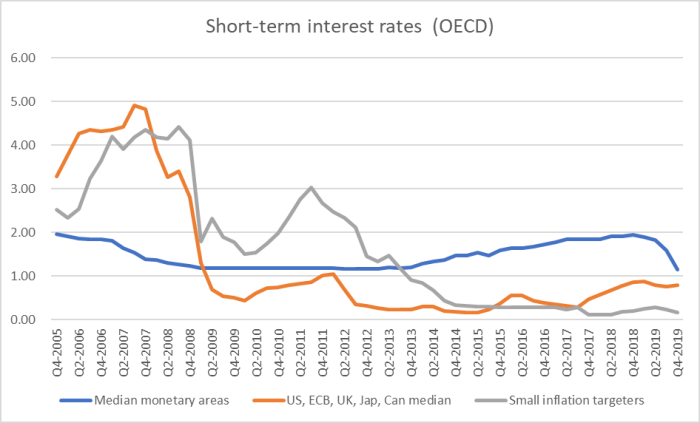
How about that monetary policy room?  Here are median nominal short-term interest rates for various groupings of OECD countries.

short-term 2020

You can see where we are 10 years ago.   Across all the OECD monetary areas (countries with their own monetary policy plus the euro-area) the median policy rate is about where it was then (of the two biggest areas, the US is a bit higher and the euro-area a bit lower).  Same goes for the G7 grouping.  And as for “small inflation targeters” (like New Zealand) those countries typically have much less conventional monetary policy capacity than they had in 2010 (New Zealand, for example, had an OCR of 2.75 per cent when I wrote that earlier note, and is 1 per cent now).

Back then, of course, the conventional view –  not just among markets but also to considerable extent among central banks –  was that before too long things would be back to normal.  Longer-term bond yields hadn’t actually fallen that far.  Here are the same groupings shown for bond yields.

long-term 2020

One could, at a pinch, then envisage central banks acting to pull bond yields down a long way (and with them the private rates that price relative to governments).  These days, not so much.  Much of the advanced world now has near-zero or even negative bond rates.  A traditionally high interest rate country like New Zealand now has a 10 year bond rate around 1 per cent.   Sure those yields can be driven low, but really not that much if/when there is a severe adverse shock.

And 10 years ago if anyone did much worry about these sorts of things –  and there were a few prominent people –  there was always the option of raising global inflation targets.  In the transition that might have supported demand and getting back to full employment. In the medium-term it would have meant a higher base level of nominal interest rates, creating more of a buffer to cope with the next severe adverse shock.   It would have been hard to have delivered, but no country even tried, and now it looks to be far too late (how do you get inflation up, credibly so, when most of your monetary capacity has gone, and it would hard to convince people –  markets –  of your sustained seriousness).

My other point 10 years ago in drawing the Great Depression parallels was that the Great Depression was neither inevitable nor inescapable.  But it happened –  in reality it might have taken inconceivable cross-country coordination to have avoided by the late 1920s –  and it proved very difficult (not technically, but conceptually/politically) to get out of.  The countries that escaped earliest –  the UK as a prime example –  did so through a crisis event, crashing out of the Gold Standard in 1931 that they would have regarded as inconceivable/unacceptable only a matter of months earlier.  For others it was worse –  in New Zealand the decisive break didn’t come until 1933, and even then saw the Minister of Finance resigning in protest.    If we get into a deep hole in the next few years –  international relations generally not being at their warmest and most fraternal, domestic trust in politicians not being at its highest –  it could be exceedingly difficult to get out again.  Look at how long and difficult (including the resistance of central banks to even doing all they could) it proved to be to get back to full employment last time.

In the Great Depression one of the characteristic features was a substantial fall in the price level in most countries.   The servicing burdens of the public and private debt –  substantial in many countries, including New Zealand/Australia –  escalated enormously, and part of the way through/out often involved some debt defaults and debt writedowns.

Substantial drops in the price level seem unlikely in our age.  Japan, for example, struggled with the limits of monetary policy and yet never experiencing spiralling increases in the rates of deflation (of the sort some once worried about).  But equally, inflation expectations ratcheted down consistent with the very low or moderately negative inflation, meaning real interest rates were never able to get materially negative.  Japan at least had the advantage that in the rest of the advanced world, nominal interest rates and the inflation rate were still moderately positive.

That could change in any new severe downturn.  A period of unexpectedly weak demand, with firms, households and markets all realising that authorities don’t really have much useable firepower, could see assumptions/expectations about normal rates of inflation dropping away quite sharply (in New Zealand they fell a lot, from a too-high starting point, last time round, even with unquestioned firepower at our disposal).  In that scenario, authorities would struggle to lower real interest rates at all for long –  falling nominal rates could quite quickly be matched with falling inflation expectations.  As people realise that, it becomes increasingly hard to generate a sustained recovery in demand, and very low or negative inflation risks becoming entrenched.  It isn’t impossible then to envisage unemployment rates staying very high –  unnecessarily and (one hopes) unacceptably high –  for really prolonged periods (check the US experience in the 1930s on that count).  An under-employment “equilibrium” brought by official negligence is adequately dealing with the effective lower bound on nominal interest rates.

I cannot, of course, tell if the current coronavirus is that next severe adverse shock.  But it looks a great deal as though it could be, and the risks are sufficiently asymmetric –  not much chance of inflation blowing out dangerously –  that we shouldn’t be betting that it won’t be.  Some people argue that since the virus will eventually pass for some reason it isn’t as economically serious as other shocks.   That seems wrong.  All shocks and recessions eventually pass –  many last not much more than a year or two  –  and the scale of disruption, and reduction in activity, we are now seeing (whether in the New Zealand tourism and export education industries, or much more severely in northern Italy, Korea and the like) has the potential to markedly reduce economic activity, put renewed downward pressure on inflation and inflation expectations (we see the latter in the bond market already), all accompanied by a grim realisation of just how little firepower authorities really have, or are really politically able to use.  (Ponder that G7 conference call tomorrow, and ask yourself how much effective leeway the ECB has now, compared to 2007, or even 2010. )

Against that backdrop, it would seem foolhardy now not to throw everything at trying to prevent a significant fall in inflation expectations, by providing as much support to demand and economic activity as can be done.   That means monetary policy, to the extent it can be used –  in New Zealand for example, a central bank that was willing to move 50 points last August, on news that was weak but not very dramatically so, should be champing at the bit to cut at least that much this month.  The downside to doing so, in the face of a very real threat to norms around inflation –  and a likely material rise in unemployment – is hard to spot.  And since everyone knows monetary policy has limited capacity –  and those who haven’t realised it yet very soon will –  we need to see fiscal policy deployed in support, in smart, timely, and effective ways.   In some countries it is really hard to envisage that being done well –  the dysfunctional US in the midst of an election campaign, starting with huge deficits –  but there really is no such excuse in countries such as New Zealand and Australia.  (Oh, and of course –  and after all these years –  something needs to be done decisively re easing the effective lower bound.)

(There is, of course, widespread expectations of a huge Chinese stimulus programme.  That is as maybe, although it will bring both its own risks –  domestic ones just kicked a little further down the road –  and the risk of new immediate dislocations, including the possibility of a significant exchange rate depreciation, exporting (as it were) deflationary pressures to the rest of the world.)

We are only one serious adverse shock away from a very threatening economic outlook, where the limits of macro policy would mean it would be difficult to quickly recover from. By the day, the chances that we are already in the early stages of that shock are growing.  Perhaps it will all blow over very quickly, and normality resume, but (a) even if that very fortunate scenario were to eventuate, the risks are asymmetric, and (b) we’d still be left sitting with very low interest rates and typically high debt, one serious adverse shock away from that hole.


Thinking about fiscal policy

A few weeks ago the Minister of Finance announced that the government’s Budget would be delivered on 14 May.    That really isn’t far away now.  I noticed the Minister, on TVNZ’s Q&A yesterday, suggesting the timing was opportune in light of the coronavirus.     Perhaps, but contemplate some relevant dates.   Last year’s Budget was delivered on 30 May and according to the documents these were the relevant deadlines

budget 19

Assuming much the same sort of timetable holds this year, the economic forecasts the Budget draws on will have to be finalised in not much more than three weeks from now.  The tax and other fiscal forecasts are finalised later but they draw on the economic forecasts.  And who supposes that there will be any meaningfully greater certainty in three weeks time than there is now?  In truth, the Budget economic forecasts will be little more than (well, really less than given the long publication lags) one potentially useful scenario.     They simply aren’t going to be –  and can’t be –  any sort of useful guide for policy in the current climate, and I hope the Minister and the Treasury Secretary (the forecasts are Treasury’s and the Secretary has to sign off on them) start making that clear soon.    Consistent with that, in setting budgetary policy no one should be getting hung up on (for instance) whether the bottom line is a small surplus or small deficit.   Any such forecast number –  in a period of extreme uncertainty –  will be just meaningless.

In his interview yesterday the Minister of Finance seemed to be saying much the same sort thing as in his speech on Thursday.   Much of it was, at one level, sensible enough, but to me it fell a long way short in grappling with the likely severity of the issues, and the related uncertainty, and with the vulnerability of the world economy and the limitation of current macro policy.   Perhaps it was partly what he was (wasn’t) asked, but he is an experienced politician and knows how to get across the messages he wants to convey.    When community outbreak becomes a significant thing here, there is going to be a lot of economic disruption (even in the most optimistic cases abroad, eg Singapore, containment so far has appeared to rely on extensive social-distancing –  voluntary and compulsory –  none of which is conducive to holding up short-term GDP (or similar indicators).

But even pending that, what will be happening to tourism right now?  We know tourism from China collapsed a month ago –  first PRC restrictions and then our own –  but what about travel from other markets.  How many people are going to be keen on booking new trips, or even – if they have the option –  embarking on new trips now? I don’t know about you but I flicked through the travel sections of newspapers yesterday and today, wondering quite how many takers there would be.  Allowing for both direct and indirect effects, tourism is estimated to be about 10 per cent of the economy and about 55 per cent that is international tourism.  Even if international tourism only halves for the duration –  and it would be a lot lower than that if there is significant community outbreak here, that alone is equivalent to taking almost 3 per cent out of GDP.   Sure, there is scope for some switching –  more domestic tourism, as New Zealanders pull back on their foreign travel –  but a couple of nights in Picton is for most hardly a substitute for the trip to Disneyland.     And, of course, there are more and more reports of business travel –  typically higher-end – being cancelled.   And all of that is just one sector of the economy: that associated with foreign travel.   It takes no account of scenarios in which people are unable to work, whether because of illness, movement restrictions, school closures or whatever.

There is simply no way of knowing how long or how deep the economic effects will be, or (for example) what public psychology –  including eagerness to spend and to travel –  will be like as the world gets through the other side.  But with strongly asymmetric risks I reckon there is a pretty strong for an aggressive macro policy response.  And some part of that clearly has to be fiscal, especially given the failure of authorities –  here and abroad – to deal with lower bound constraints on monetary policy (covered in my post on Friday).  If you are sceptical that I’m over-egging the monetary policy limits point, I’m not nearly as pessimistic as the local ANZ economics team

Not as pessimistic only in that I think the OCR can usefully be cut further than they believe.  But if they are right and we really will be at the conventional limits of monetary policy by May (the day before the Budget in fact) people really should start worrying, because the ANZ economic scenario is not as bad as it could get.  And there are few additional buffers that people can really count on in planning and forming expectations (including of inflation).

There has been quite a bit of talk about how monetary policy (and aggregate fiscal policy for that matter) can’t solve immediate problems –  even bizarre articles from people who should know better suggesting there is some sort of either/or dimension between medical solutions and macro policy responses.  And that is true, of course.    Macro policy can never deal with the sectoral effects of sectoral-focused shocks.  Macro policy is about stabilising the wider economy.  Macro policy also can’t do a great deal in the very midst of a crisis –  financial or otherwise.  But what it can do in the midst of a crisis –  perhaps especially a disease one, where moral hazard concerns are less of a worry –  is better than nothing (easing servicing burdens, easing the exchange rate, signalling activity, leaning (a little) against collapses in confidence etc).  Perhaps more important is the value of such tools when either the immediate crisis passes and we are left with chronic weakness in demand (perhaps for a few quarters, perhaps longer) and during the recovery phase.   Macro policy tools work with a lag, and it is well to get adjustments in place pretty early (which is why monetary policy flexibility is so good to have: it is a very easy instrument to adjust, including to unwind when the need has clearly passed).

What sort of fiscal policy?   I’m not that interested in specific assistance packages to individual sectors.  In some cases, that sort of action might be justified, but much won’t really be –  and the announcement a couple of weeks ago of funding to promote non-Chinese tourism looks even sillier now.  Realistically, political considerations are likely to be more important than anything else in shaping those sorts of handouts, but (fortunately perhaps) such specific interventions/distortions/bailouts aren’t likely to be large enough to materially respond to wider weaknesses in aggregate demand.

And whatever you think of the case for more – even much more – government infrastructure spending, there are long lags to getting any such projects up and going.  The case for a second Mt Victoria tunnel in Wellington might be rock-solid –  and it is even in Grant Robertson’s constituency – but it is no sensible part of a response to a coronavirus-induced recession, even if (say) you worried about several waves of the virus over a couple of years.

Generalised tax cuts in income tax rates –  which might or might not make sense longer-term –  aren’t particularly effective because (a) the overwhelming bulk of any cut would go to higher-income households, (b) there is no particular incentive to spend (and some of the things higher income people might othewise spend on –  an extra overseas holiday –  aren’t likely to be so attractive in the next few months, and (c) as the Minister observed in his interview yesterday, such cuts tend to be permanent.

One could do, as Hong Kong announced last week, some sort of lump sum distribution –  perhaps $1500 payment to each adult.  It is much more concentrated ($ value) towards people likely to spend additional cash, but it is still less likely to be spent at the height of a crisis than in other circumstances, just because people will be (eg) staying away from shops.  But perhaps a more significant issue is precisely that it is one-off –  you might get a one-month lift to demand and activity, but the situation is reasonably likely to require longer-term support than that.

The point of this past was really to explore one other option I haven’t yet seen mentioned: an explicitly temporary reduction in the rate of GST.     The idea has been around for a while, it was tried by the United Kingdom as part of their macro policy response in 2009, and was discussed in some detail in a paper presented in New Zealand almost 15 years ago by the (then) academic economist Willem Buiter, who had also served as a member of the Bank of England Monetary Policy Committee.

Buiter was invited to New Zealand as part of a focus in the mid-2000s (including this work) looking at possible tools that might enable more downward pressure to be maintained on aggregate demand –  keeping inflation in check –  without the concomitant upward pressure on the real exchange rate; the latter having become something of a sore point with both the Governor and the Minister of Finance.    One element of that involved inviting four international experts to offer advice.  The resulting papers, and discussant comments, are here.  Buiter was invited to focus on fiscal policy issues and his specific paper is here.  One of the options he explored (from p51 at the link) was using a temporary change in the rate of GST.

As a stabilisation option, supplementary to whatever monetary policy can do, a variable GST rate has one very big advantage relative to most fiscal options that are often touted.  Not only does a temporary cut put more money in the pockets of households –  and do so in a moderately progressive way (whatever lifetime consumptions patterns, in any particular period low income people typically spend a larger proportion of that period’s income, and face tighter credit constraints) –  but it provides an active incentive to spend now because you know that prices will be more expensive later.   Take as an example, an announcement that the rate of GST would be lowered by 2.5 percentage points for a year.  For a person/household facing the choice between saving and spending now, at the start of the period, it is akin to a 250 basis point cut in interest rates.  As the year goes on, the (annualised) effect gets even stronger (as we’ve seen with past GST increases, spending is brought forward to just before the increase).

There are all sorts of drawbacks with this instrument in general, whether used for temporary increases or temporary cuts, including judging when it would be appropriate to deploy the instrument (relative to, say, using monetary policy). Buiter favoured an independent committee –  akin to an MPC –  having the power to adjust the rate (something which I’m old-fashioned enough –  only Parliament should change tax rates –  to find abhorent).    But this is an unusually stark situation (and may well be starker still by Budget day) –  as, in a different way, was the UK financial crisis in 2008/09.    It is not just a matter of slowly accumulating pressures (or lack of demand pressures) but a stark, truly exogenous (to the New Zealand economy) event.  Defining a trigger for action shouldn’t really be a problem.  And we are very close to the limits of conventional monetary policy, so the tradeoff-among-instruments questions also presents less starkly than Buiter would have imagined.

One of the other drawbacks –  which the UK ran into –  is defining an exit point.   The period of weak demand around the world lasted much longer than any authorities expected in 2008 when they were devising responses to the financial crisis/recession.    The extent of that weakness was hard, perhaps impossible, to foresee.  With a pandemic virus perhaps it is a little easier – these things tend to sweep through in perhaps 12-18 months (even in 1918) so –  for example – a cut in the GST rate announced/implemented in May, to end at end of 2021 might seem reasonable (while still providing a substitution effect signal).  And if, spare us, at the end of the next year severe problems still faced us, then realistically choices could still be made then about whether to proceed with raising the GST rate or not (to not do so should require new legislation) –  there shouldn’t be (but who can really imagine) the same debates about whose fault it was the banks had failed etc.

One other drawback in the risk to inflation expectations.   Cut the rate of GST by 2.5 percentage points and the level of the CPI will fall by perhaps 2.1 per cent –  and the reported annual rate of inflation will be that much lower than otherwise for a year.   With a heightened risk of inflation expectations sliding away, there is a risk that those headline effects could accentuate the problem, even though none of the core inflation measures –  the ones most analysts emphasise –  would fall.   There is no easy way to know how large this effect would be, and it would be quite circumstance-dependent.  If, for example, the New Zealand dollar fell sharply –  as it usually does in severe adverse global events –  the direct price effects of more expensive imported tradable goods would lean against the GST effect on headline inflation (the UK, for example, had a sharp fall in its exchange rate around 2008/09).  And if the temporary GST cut was part of an aggressive multi-faceted (monetary and fiscal) stabilisation package, the (helpful) demand effects might well outweigh any risks of adverse headline effects on expectations.

The other downside concern might be implementation lags.  When I was around these sorts of discussions, IRD used to emphasise that these sorts of changes couldn’t be done overnight.  Announce on Budget day a GST cut starting three months hence, and the risk is that you worsen things in that three month period.   But when I went back to check the UK experience, I found that the policy had been announced on 24 November 2008, to come into effect on 1 December 2008.    If a change can really be implemented that quickly –  and hard to see why New Zealand IRD should be less capable than HMRC – a one week disruption might be tolerable.

Finally, relative to using monetary policy more heavily, fiscal options will tend to hold up the exchange rate more than otherwise.  That might be less of concern in a scenario in which it has fallen a lot anyway and –  as importantly –  monetary policy options are approaching their limits.

I am not, repeat not, recommending that the rate of GST be temporarily cut, even on the assumption that the economic situations looks as bad or worse late next month when final Budget decisions have to be made.   But, in a highly policy-constrained world, it looks like an option that should be pulled out of mothballs and looked at fairly closely by the Minister’s advisers, including a closer review of the strengths and pitfalls of the UK experience.   In situations like the one we seem to find ourselves in –  with the world one shock away from exhausting normal macro policy capacity, and that shock now seeming to be upon us –  it is probably better to err on the side of doing more rather than less, and to consider taking risks with instruments that would not normally count as ideal (in which category I put the variable GST).

And whether or not the Minister of Finance thinks it an option worth exploring, I’d welcome comments here, including from those closer to the operational details of GST than I am.


Government spending and revenue: some comparisons

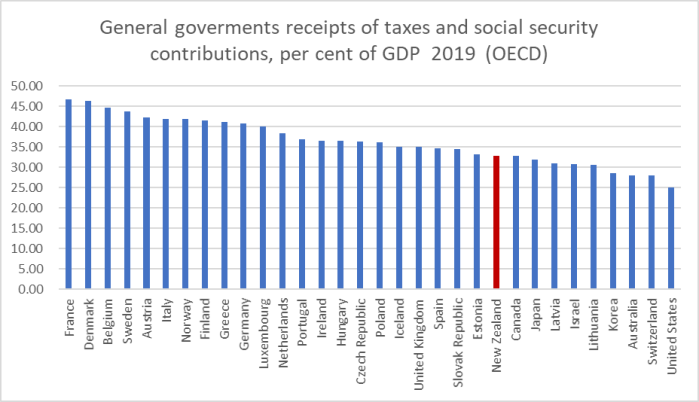
I had to look up this morning where New Zealand ranked among OECD countries in the total share of GDP taken in taxes.   The answer (for 2019) was 11th lowest, or 10th lowest if you (as you should, and as I do in the chart) use the denominator for Ireland (modified GNI) that the Irish authorities use.

taxes 2019

Among the English-speaking countries we often compare ourselves to, New Zealand and Canada are in the middle of the bunch, with the UK and Ireland higher and Australia and the United States lower.  Note that these are “general government” figures, including all levels of government in each country.

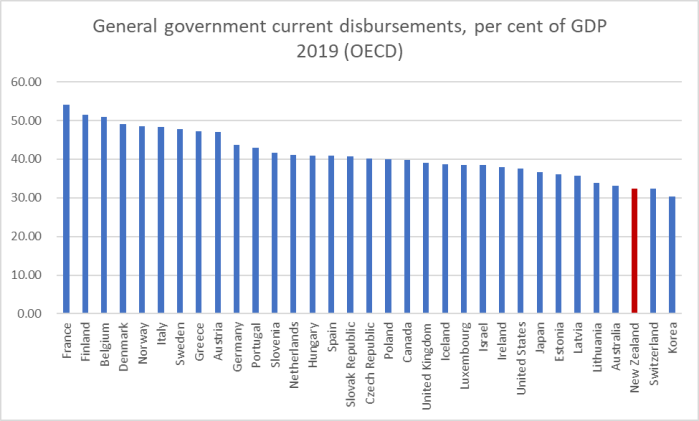
What about the spending side of the picture?  This is the chart for current spending across all levels of government.

spending 2019

New Zealand is towards the very bottom of that chart.  It is, however, fair to point out that when you have a low level of public debt you don’t face much an interest expense:  in terms of current purchases or transfers our overall level of current government spending goes a little further relative to most other OECD countries (with higher debts) than it might first look.

The big outlier, of course, if you compare that two charts is the United States, with yawning budget deficits.

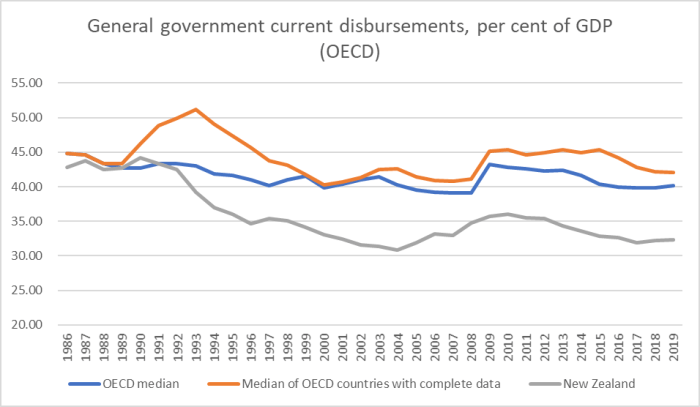
What about the changes over time?  These OECD data only go back to 1986 for New Zealand, so I’ve started the chart from then showing (a) New Zealand, (b) the median of all OECD countries, and (c) the median for the OECD countries for which there is complete data from 1986 onwards.

spending time series

The gap between New Zealand current government spending and that in the median OECD country opened up 30 years ago.  In fact, the gap between New Zealand and the consistent-sample grouping (the orange line) has fluctuated around a fairly constant mean since the early 1990s, with no obvious differences based on which of the major parties was leading the government.

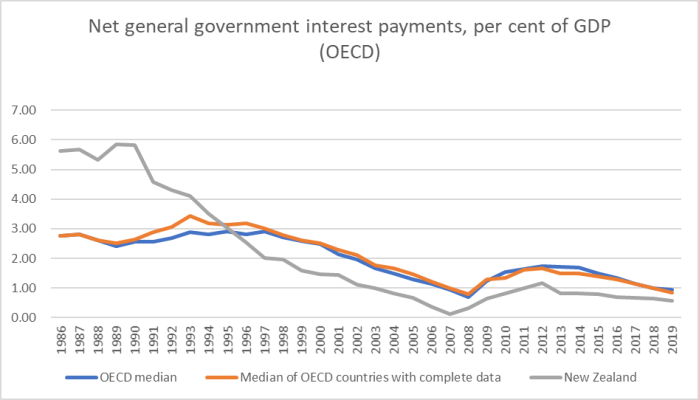
Of course, at the start of the period we still had fairly high debt and fairly high interest rates.  But that factor doesn’t look to explain much about comparisons for the last couple of decades.  This chart is of net interest expenditure as a share of GDP.

interest net

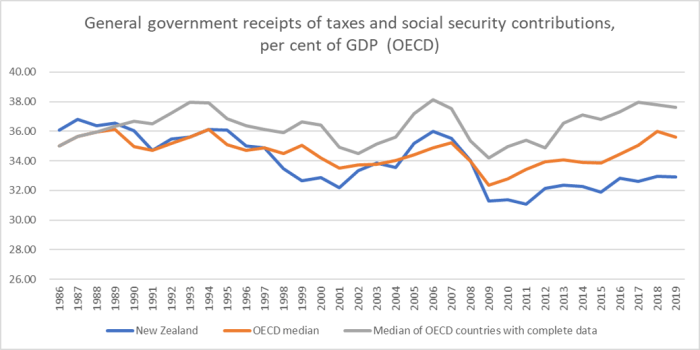
And what about changes in taxes (and social security contributions) over time?

taxes over time

On this measure, the gap between New Zealand and the complete-sample group of OECD countries (grey line) has widened further over the last decade or so.  Partly in consequence, whereas for the OECD as a whole (either series) the median country now has a higher tax share of GDP than it had in the late 1980s, we have lower taxes.  Consistent with that, of course, we also have lower current outlays than we had then, but it looks as though much of the difference will be accounted for by (a) in particular, lower (real and nominal) interest rates, and (b) lower debt.

I’m not attempting to draw any strong conclusions, just presenting the numbers.  They aren’t the only numbers that are relevant.  For example, as I understand it, the current disbursements series does not include depreciation, so in some respects it would be better to look at total outlays (in New Zealand, with a fast-growing population, government capital expenditure tends to be quite high).   Similarly the taxes and social security contributions series –  while important in its own right – is not a measure of total government revenue.  And I could track down the gross interest data and subtract that from the current disbursements series to get a consistent series of current primary spending.   Perhaps another day.

For now, I think one can safely say that New Zealand government spending and revenue are below those of the typical OECD country.  That wasn’t always the case, although much of what changed was servicing costs.  Whether that relatively modest size of government (spending and revenue) is a matter for concern or celebration will, I guess, depend on your ideology, your view (implicit or explicit) of various key elasticities, and perhaps your sense –   which should be detachable from ideology –  as to how wisely and well existing spending is being done.  For myself, I think there are areas where our government should probably spend more (health, access to justice, administration of justice, and statistics as just some examples), but I’m not convinced that even taken together they would amount to a strong case for higher taxes (when I think of potential savings –  on NZS, free tertiary education, the PGF as just some high profile examples).

An unimpressive MPC

I didn’t expect to be particularly critical of the Reserve Bank after yesterday’s Monetary Policy Statement.  A journalist asked me yesterday morning what I’d say if they didn’t cut the OCR, and I noted to him that whether they cut or not, what I’d really be looking for was evidence of the Bank treating the issues in a serious way, alert to the magnitude of what was going on and the sheer uncertainty the world faces around the coronavirus.

They –  the almost a year old new Monetary Policy Committee –  did poorly on that score.  And in his press conference, I thought the Governor simply seemed out of his depth.  Much of what the Bank had to say might have seemed reasonable two weeks ago –  no doubt when the bulk of their forecasts were brought together – but the situation has been moving (deteriorating) quite rapidly since then.   They can’t update published forecasts by the day, but there was little sign in the record of yesterday’s meeting, or in the Governor’s remarks yesterday afternoon (or those of his senior staff), of anything more immediate or substantive.  The Governor seemed to attempt to cover himself by suggesting that the Bank”s line was consistent with some “whole of government” inter-agency perspective, but….that is (or should be) no cover at all, since Treasury and MBIE don’t face the same immediacy the Bank does (it had to make an OCR decision) and whatever the Ministry of Health might be able to pass along about the virus itself, it knows nothing about economic effects.  On those, the government should be able to look to the Bank for a lead.  Instead, we got something that seemed consistent with the lethargic, lagging, disengaged approach of our government (political and official) to the coronavirus situation.

Thus, remarkably, faced with one of the biggest out-of-the-blue economic disruptions we’ve seen for many years, arising directly and most immediately in one of the world’s two largest economies, we get three-quarters of the way through the press statement before there is any mention of the issue, ploughing our way through upbeat commentary including on the world economy.   Even when we do get there, the coronavirus effects are described only as an “emerging downside risk” –  for something which has already sharply reduced activity in parts of our economy.  It is the sort of language one might use for things where the effects are hard to see, not for something this visible, direct, and immediate.   And on the day when the head of the WHO –  who has often seemed to play defence for the PRC – was highlighting the scale of the global threat.  On a day when a CDC expert was on the wires noting that the only effective response is social distancing –  the more distant people stay the less economic activity there is.

The Bank loves to boast about how transparent it is. As I’ve noted, they are happy to tell us the (largely meaningless) forecasts for the OCR three years hence, but they are astonishingly secretive about their own analysis and deliberations.   Thus, we now get a “summary record” of the final MPC meeting.  Here is pretty much all we get to see about the coronavirus issue

The Committee discussed the initial assumption that the overall economic impact of the coronavirus outbreak in New Zealand will be of a short duration. The members acknowledged that some sectors were being significantly affected. They noted that their understanding of the duration and impact of the outbreak was changing quickly. The Committee discussed the monetary policy implications if the impacts of the outbreak were larger and more persistent than assumed and agreed that monetary policy had time to adjust if needed as more information became available.

….The Committee discussed alternative OCR settings and the various trade-offs involved.

There is no sense of the sort of models members were using to think about the issue and policy responses.  There is no sense of the key arguments for and against immediate action and how and why members agreed or disagreed with each of those points.  There is no sense of how the Bank balances risks, or of what they thought the downsides might have been to immediate action.  There is no effective accountability, and there is no guidance towards the next meeting.  Consistent with that, the document has one –  large meaningless (in the face of extreme uncertainty) – central view on the coronavirus effects, but no alternative scenarios, even though this is a situation best suited to scenario based analysis.   It is, frankly, a travesty of transparency, whether or not you or I happen to agree with the final OCR decision.

Consistent with that, there was no mention –  whether in the minutes or in the body of the document or in any remarks from the Governor –  of past OCR adjustments in the face of out-of-the-blue exogenous events.  Again, perhaps there are good reasons why the cuts in 2001 (after 9/11) or 2011 (after Christchurch) or –  less clearly –  around SARS in 2003 don’t offer good lessons for policy-setting now.  Presumably the MPC thought so, but they lay out no analysis or reasoning, and thus no way to check or contest (or even be convinced by) their thinking.  It really isn’t good enough.   Then again, in the press conference no journalist challenged the Governor on these omissions.

Similarly, there was no sign in any yesterday’s material or comments of having thought hard about the limitations on monetary policy (globally) as interest rates are near their effective lower bound.  All else equal, and with inflation well in check, that starting point should typically make central banks more ready to react early against clear negative demand shocks to do what can be done to minimise the risk of inflation expectations dropping away.  Perhaps again it still wouldn’t have been decisive this time –  and our Reserve Bank still has a little more leeway than many –  but to simply ignore the issue, and show no sign of having thought hard about the wider policy context, was pretty remiss.

From his tone in the press conference, it was as if the Governor really didn’t want monetary policy to have to play a part –  to do his job –  as if it was all just an unfortunate distraction from good news stories he’d been hoping to tell.   So he told one journalist that at best monetary policy would be a “bit player”: for individual sectors that is no doubt true (but then monetary policy is never about dealing with specific sectoral problems), but not really the point, since there has been a clear and significant, highly observable negative demand shocks, and a huge increase in uncertainty (often a theme of RB speeches etc over the last year).  In fact, in answer to another question the Governor was heard claiming that there was “no specific event” to consider reacting to (hundreds of millions of people locked down in China, second-largest economy in the world?) and –  worse –  then claimed that there was no need to act as we already have very low and stimulatory interest rates.  The problem with that argument is that they were just as low six weeks ago, and since then we’ve had a clear large negative demand shock.

Asked about the fact that implied long-term inflation expectations (from the government bond market) were barely above 1 per cent, the Governor took a lesson from politicians and simply refused to answer the direct question.  He then went to on to claim that the monetary policy foot was already on the accelerator, that we’ve had more positive global growth –  even as global projections are in the course of being revised down – and that if anything the question that should have been being asked was why we weren’t thinking about raising the OCR (“renormalising”).

One journalist thought to ask the Governor about the difference between the Bank’s GDP forecasts for the year ahead (2.8 per cent I think I heard) and those of various outside commentators (more like 2.0 per cent) and asked about the difference.  The Governor’s response was that of glib teenager: “0.8 per cent I think”.  Pushed a bit further, he indicated that he had no idea why the difference and (more importantly) no real interest. He claimed (fair enough) not to accountable for anyone else’s forecasts, but showed no interest in the cross-check (that used to be pretty standard around the MPC table) of understanding why the Bank is different from others, and why the Bank still thinks that is the best forecast.

There was also the line about market prices constantly adjusting and buffering……all this as the exchange rate rose the best part of 1 per cent on his announcement yesterday, rather undercutting any exchange rate buffering  of the economy that had been underway.

Oh, and then we had gung-ho political cheerleading for the government’s infrastructure spending plans.  He claimed to be “very excited” by it and rushing past any issues around “crowding out” was keen to talk up all the possibilities of “crowding in” accompanying new private sector investment etc.  No evidence, no analysis, but it probably went down well with the Labour Party.  Sadly, the Governor seems to do campaigning and cheerleading better than he does monetary policy, and there seems to be no serious and substantial figure on his team to compensate for those weaknesses (while, as far we can tell, the invisible unheard external MPC members just function as ciphers and political cover).

As an illustration of what the Bank simply seemed to be missing –  or choosing to ignore – a reader left this comment here last night

The shock from nCoV isn’t just confined to China. It’s spilling rapidly across the Asia-Pacific region…

I have just spent the past few days in Singapore and I write this on a flight to Hong Kong, which is maybe 15% occupied. Singapore is shutting down, which is worrying given its entrepôt status. Malls are emptying, as are hotels and restaurants. Traffic is thin. Companies are rolling out their business continuity plans which will further exacerbate the dislocation. This isn’t about just China, it’s region-wide.

The same reader sent me directly a photo of one of Changi airport’s main terminals at lunchtime yesterday, with this note “Changi T-3 unloading zone. Today, 12 noon. Not a soul in sight.. no cars no people..”

I noted yesterday that more or more people would be cancelling trips, business or leisure, in the face of some mix of risk aversion and sheer uncertainty.  That happened to me yesterday –  less about immediate threat than about the extreme uncertainty about the environment a few weeks hence.

And this morning we hear a local public health expert calling for our sluggish government to expand travel restrictions to people coming from various other countries (including Singapore and Hong Kong) where there is now established community outbreak. Or news of major international events in Hong Kong being cancelled. Or a major world telecoms convention in Barcelona being cancelled.

I’m not suggesting the Reserve Bank should have tried to turn itself into disease experts or even to pin their colours to a different central scenario.  But they simply don’t seem alert to the magnitude of what is already going on, including that huge rise in uncertainty, and they provided us with very little useful analysis about the way they think about monetary policy, demand shocks, risks, instrument stability etc –  nothing to give us any confidence in their stewardship.

Oh, and you’ll recall I mentioned yesterday their interesting –  and potentially positive – experiment in transparency, inviting real-time questions to the Governor during the press conference via Twitter.  As I’d noted in advance, one might well be sceptical about just which questions they would choose to answer.  Actuals were even worse than my expectations.  The Bank’s comms guy had clearly been primed not to expose the Governor to any searching questions, and only two were let through at all, essentially translated into patsy questions, allowing the Governor to wax eloquent on a couple of favoured themes.   No one forced them to adopt this particular approach to being more open.  But if they want kudos for it, they need to be seriously willing to allow real and searching questions to the Governor.


“Please limit the number of my competitors”

There is often quite some competition for the oddest story in newspaper  (this morning, in the Dominion-Post, it was surely the little piece telling readers that the Mormons were pulling 21 missionaries out of Liberia –  not, it appeared, because they had been kidnapped to threatened but because Liberia’s economy was proving pretty dysfunctional).

In Saturday’s Herald I reckon it was a big feature article in the business section calling for the Auckland Council to cap the number of restaurants/cafes, at least in “certain areas” of Auckland.  Perhaps the oddest thing about the whole substantial article was that it was mostly built off the complaints of one owner, Renee Coulter of Coco’s Cantina, who is quoted at length.  Such a cap would, she says, ease “pressures around staffing and fierce competition”, which would no doubt be in her own interest (but not, one assumes, those potential staff owners are competing for) but she offers not the slightest hint as to how such restrictions –  less competition, as she says –  might be in the wider public interest (and there is no sign that journalist pushed her on the point).  Coulter reckons that if you want to enter the industry you should have to buy an existing establishment.

“There’s too many dining establishments, and that’s not me being a big cry baby”, or so she says but it sounds a lot like it.

The article goes on to quote her claiming that “it’s competitive to the point where people aren’t actualy making money, they are just staying trading so that they don’t go under”

But if that were an accurate description –  and it must surely be considerably exaggerated – the market has its own mechanisms: eventually, people will go out of business, and those with the best business models for the current market will survive.

Now don’t get me wrong.   As someone who doesn’t eat out that much –  five adult appetites gets expensive no matter how competitive the market, and anyway I like cooking –  I’m always surprised quite how many restaurants and cafes there are. I walked through Newtown this morning –  for non-Wellingtonians, a funny mixed sort of suburb with lots of council housing but also absurdly expensive (mostly) small houses, a couple of hospitals and a university just down the road –  and counted, quite literally, dozens of eating places, none particularly fancy, some new and some which have been there for decades.  I don’t know how they all survive, but I don’t need to: the owners make that assessment, day by day, and there is no obvious need, or public policy interest, in councils getting involved.

The Herald’s reporter managed to find one other owner to offer half-hearted support to Ms Coulter, but even then Krishna Botica (who owns a couple of outlets) said

“Certainly I think it is worth looking into, whether they could come up with something that was accurate and fair, I think there is a larger question mark over that.”

Among other problems, indeed.

But Botica does add some other complaints.  Apparently “everybody who lives in Auckland..finds it hard to keep with all the new eateries”, claiming that everyone rushes around all of which is “giving restaurants a very limited time to develop relationships”.

One can see that that might be challenging for business owners.  But it is their problem, not ours, not the Council’s.

Botica goes on to complain that business has become too “transactional” which means apparently “survival of the fittest”.  Or, on Ms Coulter’s telling, survival of zombie businesses that are making no money?   Either way, it just isn’t obvious why it is anyone’s problem other than the owners (and perhaps their immediate families).   A restaurant just isn’t one of those entities –  unlike, say, a life insurance company – that one really needs to know will still be around 30 years hence.

The Herald did go one better than just two somewhat aggrieved struggling (?) restaurant owners.   They tried to talk to the Council, who quite rightly pointed out that they had no legal powers in the matter (that’s good).  And then they went to the Hospitality Association.  The chair of that grouping didn’t support the idea of capping licence numbers, but he went one better in his calls, claiming that New Zealand needs to have a Minister of Hospitality.  To the extent that there is such a function at all at present, it is all under the wing of the Minister of Tourism but (according to Botica, the restaurant owner) “you can not lump them together anymore” given the size and attention they both need.     The mind boggles, wondering quite how much government attention –  food safety aside –  these people think their restaurants and cafes really need.  Then again, government’s set a dreadful lead with all the identity or industry-serving ministers they do create (be it Tourism, Women, Pacific Peoples, Ethnic Affairs, Racing, MPI or whatever).

The Herald also talked to the Restaurant Association, who seemed to represent a rather divided membership, noting that “competition can be a good thing and those managing their business well will come out on top” so “whilst we continue to monitor the idea of a cap, we are mindful of the potential limits this could put on creating valid opportunities for new owners”.

Normally, one might suppose that when there was a severe shortage of staff –  as those quoted in this article claim –  wages for those types of people would rise, perhaps quite a lot.  And if that, in turn, left some business unable to operate profitably, those less profitable operators would leave the market.    It is how resources are reallocated in a competitive market

But that doesn’t appear to be what these operators have in mind at all.  Not once in the entire article is there any reference to (relative) wages rising sharply.   No data are cited suggestig they are.   Instead, we get the plaintive calls for more cheap migrant labour.    Now I might even concede some sympathy with them around MBIE processing times –  the stories you hear really should shame a first world country that likes to boast of its good government, responsive services etc –  but the idea that governments should be, in effect, capping wages in particular sectors, in effect subsidising operators in thoese sectors, by allowing in ever more migrant labourers, typically with low reservation wages, really should be anathema.

But there is the thrust of the case: push for councils to cap the number of restaurant and cafe licences to reduce competition and choice for the public, all while pushing central government to impose more competition on lower-end New Zealand workers, or squeezing them out of the sector altogether, in favour of cheaper foreigners, temporary or permanent.   Wouldn’t life be sweet for the less-than-best operators if somehow government and council were to accede to their calls?

The thing I found remarkable about the article –  and it was quite a substantial piece, not a five line snippet –  was that there was no sign that the journalist had made effort (or bosses insisted) to get a perspective from anyone who might have other interests at heart.  Consumer groups for example, or even an economist specialising in competition and regulation.  It was as if it was producer (firm) interests that mattered, not consumers (or even workers), even though –  presumably even among readers of the Herald business pages there must be more consumers (that’s all of us) than firm owners.    There will always be industry voices calling for reductions in competition –  that is in the (at least temporary) interests of the incumbents  Governments are supposed to be there for the wider public interests, and –  temptations to be too close to business notwithstanding – you’d hope that major media outlets would at least want to sure that the wider public interest was represented when they allow their pages to be used to promote campaigns to limit competition and make life easier for business operators.

(Since I  get commenters bagging the Herald more generally, I might take this opportunity to point out the stark contrast in today’s papers between the Dominion-Post (and, I assume, other Stuff outlets) and the Herald coverage of the economic/trade effects of the coronavirus and the various restrictions in place, in China and abroad.  The Herald’s coverage is head-and-shoulders better –  although even it has important omissions –  than the Dominion-Post , and the latter (despite its large public service readership) doesn’t even compensate by superioru isight on the political/bureaucratic machinations.   Issues like whether our Foreign Minister really told the Chinese Foreign Minister on Saturday that we were imposing no restrictions, only for the government to adopt the diametrically opposite policy in announcements the following day.)


Flu and coronavirus thoughts

Ten days or so, prompted by the news emerging from China, I’d gone and found the pile of books I’d accumulated –  and in many cases not read –  over the years on pandemics, plague etc etc.  Since then I’ve read three of them, including two on the 1918 flu pandemic.

The first, published in the 1970s, was Richard Collier’s  The Plague of the Spanish Lady, a week by week treatment, drawn from some mix of contemporary accounts and survivors’ memories, of the experience with the flu pandemic (which got associated with Spain, mostly because Spain wasn’t at war and so there wasn’t the press censorship there was in many other countries).  It isn’t a global perspective, but he captures accounts from across the Anglo countries and northern Europe –  with quite a surprising number of snippets from New Zealand (the author apparently got a good response here when he advertised for survivors’ memories).   It isn’t an analytical treatment by any means –  there are various other good books for that –  but it was an absorbing impressionistic read.

Someone asked me the other day whether it was “scary”, and I guess in a way it was.  But I was more struck by the complex mix of responses, individual and institutional.  At the official level, often a reluctance to disrupt the ordinary course of business, life etc –  all compounded by the fact that there was still a war on.  It is always difficult to tell whether, in its early stages, something will turn really serious, and to judge best which risks to run.  But if those sorts of errors were pardonable, others were almost inexcusable –  the French Governor of Tahiti, and the New Zealand Administrator in western Samoa being just two prominent examples.  There are stories of sheer horror –  an Eskimo village in northern Canada where many human victims were finished off, and dead human bodies eaten, by ravenous dogs that no one was well enough to feed –  but also those of immense personal sacrifice, of people –  professional and otherwise –  rising to the occasion in ways they themselves might never had imagined, and so on.     And there was the sheer number of deaths in a matter of weeks – New Zealand lost half as many to the flu in little more than a month than we’d lost in four years of World War One.     Western Samoa is estimated to have lost 22 per cent of its population (while American Samoa lost no one).

The second was Prof Geoffrey Rice’s Black November: The 1918 influenza pandemic in New Zealand.  I was reading the 2005 version, but there is a new, and shorter, version still in print.   Rice –  an academic historian –  records that he had known nothing of the pandemic until he had an after-dinner conversation in 1977 with his father, who’d been a child in Taumaranui in 1918 and whose grandmother had been the final death in that unusually severely-affected town (if I recall rightly, around 80 per cent of Taumaranui’s population had come down with the flu and almost 2 per cent of the population had died (the national death rate was under 1 per cent).    That conversation sparked Rice’s interest, and a sustained research project, culminating in a first edition of his book in 1988.

The more formal side of the book was built on a reassessment of the death toll, based n a careful examination of all New Zealand death certificates during the period of the flu  (the advantage of a small population).   The book includes the detailed data by suburb (and town/county) –   18, or just under 0.5 per cent, in Island Bay for example.  And the data is there too (and a whole chapter of the text) for the staggeringly bad Maori death rate (4.2 per cent of the population died), although as Rice notes even in other years the Maori flu death rate far exceeded that for the European population up to at least the 1930s.

A significant chunk of the text is three chapters on each of the Auckland, Wellington, and Christchurch/Dunedin experiences –  city death rates (especially Auckland and Wellington) were consistently above those in the rest of the country – but there is a selection of detailed small-town accounts too (more than I’d ever previously read on Temuka).  The book is liberally illustrated –  photos, charts, and various survivors’ accounts (Collier providing his full New Zealand material) – and a nice mix of the more-analytical and the impressionistic/anecdotal.   I’d strongly recommend it to anyone interested in the period.    There is much the same mix of impressions –  positive and negative- as in the Collier book, but with more space and a single country, more depth and insight.

There was the New Zealand Ministry of Health with a grand total of about 11 staff.  A Minister of Health –  George Russell –  who was initially sceptical but then energetic, hard-driving, and pretty effective, even as he got offside with numerous local authorities.  There was the heavy community engagement in many places –  including an important role played by, for example, Boy Scouts in delivering messages, meals etc –  but Rice highlights the difficulty local organisers had in finding enough volunteers to help in Wellington (life still going on, the mayor had lamented seeing various young and fit people playing tennis one weekend, even as the pandemic raged).  There were doctors who gave everything and others who wanted only to tend their own patients.  There was the extreme – but shortlived – commercial disruption, even a week-long “bank holiday” (for all banks other than the Post Office, which apparently attracted more deposits that week).   There was the university exams suspended –  it was November –  after one student died while sitting his exam (the Chanceller of Victoria, former Prime Minister Sir Robert Stout, was outraged at the Minister of Health interfering in the internal affairs of the university).  The residents at Te Araroa who, collectively, got out their shotguns to prevent (anyone who might carry the) disease entering their settlement. And the deaths, so many deaths.  And the funerals –  elaborate funerals and funeral processions being a more important element in society then.   And perhaps in a testimony to some bits of government working better and faster then, the epidemic had only run its course in New Zealand by mid-December 1918, but the Epidemic (Royal) Commission’s report was presented to Parliament on 13 May 1919.

(Oh, and for those marvelling at China’s ability to build a new hospital in a week, I even noticed a couple of references in Rice’s book to small New Zealand towns  – with limited people and technology –  building new hospital wings in a matter of days.)

That’s enough history for now.

Ten days or so ago I also wrote a post, almost entirely hypothetical at time, about pandemics and potential economic effects when/if there ever were a serious one again.  Much of it had just drawn on thinking I’d been part of back in the 00s when there was a major official government effort to prepare against the risk of pandemic (H5N1 being around at the time).  But as I noted then –  it was the standard view in that earlier planning exercise

….in a modern economy a serious pandemic could have major economic consequences, less because of the loss of life itself (although the loss of 1 per cent of the population would, all else equal, lower potential GDP semi-permanently by around 1 per cent) than because of the disruption, the fear, and the voluntary or semi-compulsory social distancing that would be put in place to try to minimise the risk of the virus spreading or of particular individuals contracting it.  In a quarter in which an outbreak was concentrated, it is quite conceivable that GDP could fall by as much as 20 per cent  (if every worker was off work for just a week –  whether sick themselves or caring for others –  and that was the only adverse effect –  it wouldn’t be –  that alone would be a loss of almost 8 per cent).   Even if the outbreak was quite concentrated in time and normal economic activity resumed in full very quickly, in such a scenario GDP in the year of the outbreak would be 5 per cent less than otherwise.

Ten days on, that must be a lot like what is going on in Wuhan – and, it seems, an increasing number of Chinese cities.  Read the stories, watch the video footage etc and it is hard not to suppose that GDP in these parts of China will not be very very sharply lower in the first quarter (whatever the official statistics eventually say).  And all that with “only” 17000 offically confirmed cases –  that is a lot of people in absolute terms, but a tiny share of the population relative to (say) 1918 or those earlier pandemic planning scenarios.  There are doubts among some experts as to whether the PRC numbers are being properly collected/reported, but whether that is so or not, the economic effects (in large chunks of one of the world’s biggest economies) are already looking real and substantial.

And that is just China.   What about here, where there has not yet been a confirmed case?  We already had some direct effects last week (on the small scale, crayfish exporters and on the much larger scale, the PRC authorities themselves banning any outbound tourism (booked through official agencies, but we are told that is most of it)).   And non-trivial numbers of people wouldn’t have been able to travel anyway because they were locked down in their own cities or even neighourhoods in China).     But now we have joined a range of other countries in banning entry to non-citizens who had been in China in the last 14 days.  Probably the Chinese students coming for secondary school were mostly already here –  the treasurers of the respective boards of trustees will be grateful for that –  but the university year is still several weeks away and there are normally lots of PRC students (new ones, and ones returning after the long break).  For the time being none will be arriving.

Despite the idle government talk –  unquestioningly repeated by most of our media –  there seems very little chance that this ban will be only for 14 days.  It wouldn’t take that long presumably before, even if the ban was lifted, it wasn’t worth coming for the rest of the first semester.  There is a lot of revenue at stake for most of universities (and plenty of other tertiary institutions).  Tourism and export education receipts from the PRC alone make up 1 per cent of our economy –  direct effects only.   Once this is all over it would be interesting to launch a series of OIAs to discover how much education sector lobbying of the government was going on last week –  “never mind about public health risks, think about our bottom line”, and if you think that is excessively cynical, recall that this is basically the approach our universities take to the PRC more generally (“don’t expect us to be critic and conscience, there are joint ventures to be done, revenues to raise”).

(As it happens, this episode looks like an interesting quasi case study on PRC issues more generally.  In writing about the appalling way our political classes pander to the PRC, I have pointed out that export education and tourism are the two sectors that are most vulnerable –  commodities are sold in a global market.  One could envisage the PRC “punishing” New Zealand if it ever chose to speak out and push back more seriously –  has happened to other countries – but probably the most severe scenarios wouldn’t have envisaged PRC tourism and export education revenues being shut off almost completely overnight.  These will not be trivial effects, but I’ve argued that we could expect exchange rate adjustment and monetary and fiscal policy offsets, and that in the event of any such “punishment” it would not in any sense be catastrophic for the New Zealand economy, tough as it might be for individual over-exposed firms.  Time will tell how this particular unfortunate “experiment” plays out.)

It is very hard (for anyone) to know what the right policy response for countries like ours (or the numerous others that have imposed similar restrictions) might be.    You could mount a fairly good case, I’d have thought, for putting in place these sorts of restrictions a week ago –  after all, the Chinese authorities are the ones with the only real and hard information and they’ve imposed unprecedented lockdowns and stopped their citizen tourists going abroad (the latter arguably a very public-spirited approach to the rest of the world).   The revealed preference signals were pretty strong, and have only got stronger as the week has gone on.  You might also be troubled –  as I’ve been –  by the small number of cases the PRC is reporting completed and discharged.    The WHO might not approve of restrictions –  appears still not to –  but the WHO is responsible to no citizens or voters.  But our government was almost entirely silent all week –  nothing at all from the PM, little or nothing from the Minister of Health and mostly sunny upbeat stuff from the Director-General of Health and his staff.   They seemed to think this wasn’t a matter they needed to engage seriously on, and the media seemed to not pursue the issue in any meaningful way.

There were telling comments in an (otherwise strange) interview on Radio New Zealand this morning with the PRC Consul-General in Auckland.    Having taken the lead in banning its own people from heading abroad as tourists, the PRC now appears to have got grumpy at countries imposing their own restrictions.  The Foreign Minister has been quoted criticising the US restrictions.  And here is the Consul-General (and recall this is an agent of a highly authoritarian state, he won’t going off-message or talking out of school).

The Chinese people are now isolating the coronavirus, but New Zealand is … joining efforts to isolate the Chinese economy. That’s why I feel very disappointed.

“I think the epidemic will certainly have a impact on the business between the two countries. China is New Zealand’s largest trading partner … as I said before trade should be based on a normal exchange on people. But this sudden travel ban will worsen the current situation. If Chinese economy suffers from international isolation, the New Zealand economy will also be in a loss.”

No one here is trying to “isolate the Chinese economy”: rather our authorities are simply doing what the PRC had already been doing.  You and I are free to buy stuff from China: the big question this week is how many Chinese factories or offices will be actually at work.  If China is suffering, it is from a virus that got started in China (and which was covered up initially be the Chinese authorities).

But my real interest was in the Consul-General’s comment on the New Zealand government

“I can tell you that only two days ago, our foreign ministers talked over the phone about the outbreak… Foreign Minister Winston Peters said that New Zealand will maintain normal exchanges and people’s flow between the two countries. However, just overnight, the New Zealand changed its mind.

Now that is very interesting. It suggests that as recently as Friday or Saturday our deputy prime minister –  presumably reflecting whole of government policy – was telling the Chinese Foreign Minister that we would be imposing no travel restrictions.  I suppose the PRC could have got the wrong end of the stick, or be misrepresenting the conversation, but someone should surely be asking Winston Peters some hard questions about just what went on the inner counsels of our government (all this apparently without a Cabinet meeting).

Because suddenly yesterday afternoon we were imposing travel restrictions, much the same of those imposed by various other countries –  against WHO preferences apparently – a day earlier.  The notable late movers were the United States and Australia.

One has to wonder what the New Zealand government learned in the 24 hours prior to yesterday afternoon that led to such an (apparently) sharp change of stance.    I wonder whether pressure was put on them by the Australian government?  One could imagine the Australians thinking “well, if we put on restrictions and New Zealand doesn’t, the virus could get established there, and with incubation periods etc that would allow backdoor entry to Australia. “Nice visa-free entry to our country you have there: shame if something got in the way of it” might have been the message, express or implied.  Perhaps someone might ask our government, or Australia’s.

(Having imposed the restrictions, I presume the government is now thinking hard about what criteria it would use in deciding whether to extend the ban to people who’ve been in other places.    Will 100 human-to-human cases in Australia, or Hong Kong, or the US, or the Philippines, be enough for a ban on people having visited those countries. If not 100, then how many?  I don’t know the answer, but I hope the government has one in mind.)

And an almost-final thought for now, I’ve been staggered at how poor the New Zealand media coverage of these issues –  as they directly involve New Zealand policy choices –  has been.  It is easy to run foreign stories on events in China, but what we also need is seriously reporting and scrutiny of choices made, risks run (or averted here).  Last week, our media seemed simply engaged in channelling Ministry of Health lines, and a few personal stories.  In today’s media there still isn’t much sign that anyone has done any digging, talked to inside sources etc, to understand the dynamics of government decisionmaking.  And there is hardly any mention –  I saw one very brief snippet in the Herald – of the economics of the tertiary education sector, no attempt to talk to vice-chancellors, no attempt to talk to other commentators.  (Not even any apparent attempt to talk to the China Council, who must be torn –  when David Clark says the Chinese authorities were relaxed about NZ government choices, and the Consul-General says the opposite).   And there has been no serious challenge or discussion on the “14 day ban” –  which seems to risk giving quite misleading signals to people in relevant industries, against a global backdrop where unease is increasing, not showing any sign of relief).

And a final purely anecdotal point.  I was staggered over the weekend to hear of two teenagers, one of whom was reluctant to go into central Wellington over the week for fear of being exposed to coronavirus, and another whose parents forbade her to go.  And then this morning I was in the supermarket and noticed a customer in front of me (as European-looking as me) coughing her way down the aisle, not covering her mouth at all.  I suspect at another time I wouldn’t even have noticed, and yet I was brought up short –  not because I have any unease at all about being out and about anywhere in New Zealand, but in realising what the recent news had made me take notice of.   One has to wonder how much self-initiated social distancing will start going on here.  It doesn’t take much – rational or not – to put a dent in entertainment etc spends.

Fines

It is January, still the school holidays, and I can’t bring myself to read Reserve Bank background papers on bank capital issues (although I recommend Kate MacNamara’s piece on Stuff, drawing on some of those papers) so I thought I might do a post on an off-topic issue –  fines – that has bugged me for a long time but which I didn’t used to be free to write about (while my wife was at the Ministry of Justice).

There are two things that bother me about our system:

  • the way that maximum fines, set out in all manner of bits of legislation, are not indexed for inflation,
  • the way that fines are not systematically varied with the financial means of the offender (unlike the financial effects of a prison sentence or even community service).

As is right and proper, Parliament sets maximum fines for various offences when the legislation creating the offence is passed (or amended).    Legislation isn’t often revisited –  parliamentary sitting time is scarce –  and some legislation creating offences will have been passed very recently but some was passed decades ago. But inflation is thief of the value of money, particular as a reasonable amount of time passes.   A maximum fine set at, say, $10000 in 1990 would have to be set at about $18000 now just to be the same in real terms, and even that wouldn’t keep pace with real income gains.

For offences where there is both an imprisonment and a fine option open to the judge the problem is particularly egregious.  Take a piece of legislation passed 30 years ago that provided for a year in prison or a $5000 fine.   Parliament presumably set those two numbers with some sense of the relative value of time and money 30 years now.  But time has got more valuable and money has got less valuable.

Back in the days when I first became aware of this issue, perhaps there was an argument that in future it wouldn’t matter much: the Reserve Bank was required to target 0 to 2 per cent annual inflation, and there was a consensus that there was an upwards bias in the CPI of perhaps as much as 0.5 to 0.7 per cent per annum.   But over time any biases have been reduced as SNZ improved the index, and the inflation target was revised upwards.  As a matter of policy, we ask the Reserve Bank to reduce the purchasing power of money by around 2 per cent per annum.  In 36 years, the real value of any nominal sum (eg a pre-set maximum fine) will halve.

Inflation has been a systematic issue for decades and yet nothing has been done to index our maximum fines for inflation.     Sure, formal indexation isn’t a big thing in the private sector (although we –  sensibly enough –  index our welfare benefits), but (a) there are few nominal contracts that last anywhere near as long as the gap between Parliament reviewing and updating penalty levels, and (b) citizens have no redress or avoidance mechanisms –  the fixed nominal fines are Parliament exercising its sovereign power and we (and the judges for that matter) just have to live with it.  Offenders cannot be fined as heavily –  in real purchasing power terms –  as Parliament intended in passing the law.

This issue should be relatively easy to fix, and should not be enormously controversial if some MP or government were to pick it up.    For all new legislation/fines, the maximum fine could be set in terms of “fine points” (eg a $10000 maximum fine might be expressed as 10 fine points where a fine point is defined as equal to $1000 as at (say) 31 December 2019).     The value of those fine points in today’s dollars could be adjusted every quarter with the CPI, with the resulting nominal values readily available to anyone on a table maintained on the Ministry of Justice website.  For existing legislation (and fines) where fines have been set in nominal dollar terms,  once the date that fine came into law in known the nominal value of the fine could be adjusted each quarter (much the same table) with changes in the CPI.   If one wanted to be more far-reaching –  and I would –  one could index fines to changes in some index measure of wage rates.  That would maintain better the intended relativity between the cost to the offender of a fine vs that of a prison sentence. But just addressing the inflation indexation point would significantly improve the situation as it stands now.

The bigger issue –  and frankly the one that exercises me more –  is what appears to be a fairly deep injustice that fines are not consistently or systematically adjusted for the financial means of the offender.    Consider a sentence for a particular offence that would have someone imprisoned for a year.   Whether you are on the minimum wage or earning $250000 a year you are out of the private labour market for a year, unable to earn more than the small amount prisoners get paid for their labour.    A prison sentence costs (in dollar terms) a higher income person more than a lower income person. But a fine is a quite different matter.  For someone on the minimum wage, a $5000 fine might be almost ruinous while for the person earning $250000 they’d pay it readily enough without materially constraining any other choices.  Many cases in our court system result from unpaid fines.  Sometimes that will be pure choice by the offender, but not always by any means.

To be sure, under the Sentencing Act judges may decide not to impose a fine if they believe an offender does not, or would not, have the means to pay it.  But that is (a) a discretionary choice of a particular judge, (b) does not seem to allow (formally) a diminished fine (rather than simply not levying one at all), and (c) does not, of course, allow for a higher fine –  above the statutory maximum –  for a higher income (or wealthier person).  And as an old piece of Ministry of Justice research I found put it, drawing on a survey of judges

Lack of adequate information, particularly regarding the means of the offender, was considered to be an important factor limiting Judge’s ability to adjust the amounts of fines imposed.  About two-thirds of the Judges said they would never or only seldom ask for a written statement of means.  Time pressures were clearly one of the main reasons why this was the case.

Perhaps things have changed since then, but the basic issue hasn’t.  A nominal dollar penalty falls far more heavily on a poor person than on a wealthier person.   That probably offends most canons of justice  –  including perhaps the idea that “from whom much is given, much is expected” –  and is quite inconsistent with the way we treat imprisonment (where time is the standard unit, not dollars).

It would seem to me to be fairer –  albeit more complex to set up and administer in a fair and equitable way – if Parliament were to specify a maximum fine in terms of units of time equivalent, which would be translated into dollar terms for a particular offender by reference to the income and/or wealth of that individual (or company, where the fines apply to corporates).  One could think of a (relatively minor) offence that might have a maximum fine of seven days.     Subject to some de minimis (so having no income doesn’t enable you to escape punishment altogether, or leave prison as the only option), the specific amount an offender could be liable to face would be adjusted by income: for a student earning $100 a day (say) it would be a $700 fine, while for a highly-paid public servant earning $1000 a day, it would be a $7000 fine.

This isn’t a novel idea at all.  It is the way they do things in Finland for at least some offences (and have apparently for a long time).  This article notes various other examples, including the UK, where there is an income-adjustment formula for traffic fines.  And here a scholar looks at the possible constitutional obstacles to such a system in the US and concludes that they are not insuperable.  In our political system there are, of course, no constitutional obstacles –  Parliament can pretty much do what it wants –  but the real issues might be whether the additional administrative costs were worth it, and how severe the evasion opportunities might be.  Then again, when we sentence people to prison we have to go to a great deal of effort and expense to keep them there.

Of course, one might deal with this by having very much higher maximum fines and allow judges lots of discretion to reduce the actual fine according to the means of the offender.   Judge love discretion, and need to have some, but it isn’t obvious why a formal linked to wealth/income would not be more transparent and predictable and, frankly, fair.

Justice would be better served if potential fines were calibrated to the income/wealth of the offender, in much the way they (effectively) are for custodial or community service sentence –  where time (the common unit) is much more financially valuable to a (erstwhile) high income person than to a low income person.

Business investment and SNZ

The calendar says it is summer, but “summer” seems to have bypassed Wellington.  We’ve been back for 10 days and on not one of them has it been warm enough for a swim.  Right now, my phone says it is warmer in Waiouru than in Wellington.  And so, between driving lessons for my son, I’m still pottering in the national accounts data released late last year, although this will be the last such post for now.

At the end of November, I ran a post here on investment and capital stocks, drawing on the annual national accounts data released a few days earlier.  One of the central charts was this one

What about business investment?   SNZ don’t release a series for this –  but they could, and it is frustrating that they don’t –  so this chart uses a series derived by subtracting from total investment general government and residential investment spending.  It is a proxy, but a pretty common one.

bus investment to marc 19

Business investment as a share of GDP has been edging up, but it is still miles below the average for, say, 1993 to 2008, a period when, for example, population growth averaged quite a lot lower than it is now.  All else equal, more rapid population growth should tend to be associated with higher rates of business investment (more people need more machines, offices, computers, or whatever).

So common is this proxy for business investment that for a long time it was how the OECD was doing things, including in cross-country comparisons where New Zealand mostly did poorly.    Note that none of this approximation would be necessary if Statistics New Zealand routinely published a business investment series.  There is no obvious reason for them not to do so –  no individual institution confidentiality is being protected (as an example of one reason SNZ sometimes advance for non-publication).

My working assumption has long been that government-owned business operations designed to make a profit (notably SOEs) were not being included in “general government”.    I didn’t just make up that assumption; it is a standard delineation advanced by the OECD themselves.  Here is their own definition

Definition:
General government accounts are consolidated central, state and local government accounts, social security funds and non-market non-profit institutions controlled and mainly financed by government units.

In other words, “general government” would include government types of activities, including things –  even semi-commercial things –  mainly funded by government units (whether large losses, or direct subsidies or whatever).   Core government ministries would count.  State schools would count as part of “general government”, but fully private schools would not.  And nor, on the standard interpretation would the investment of New Zealand SOEs (required to aim to generate profits for the Crown) or fully market-oriented trading companies that might happen to have a majority Crown shareholding.    Such trading companies are mostly funded by their customers (and private debt markets) not by the Crown.

But it turns out that this isn’t how SNZ has actually been doing things in New Zealand, at least as regards the “sector of ownership” data I’ve used (and which the OECD has typically used for New Zealand).

I learned this because of a pro-active outreach by an SNZ analyst, to whom I’m very grateful.  This analyst emailed me noting that he had enjoyed my posts on the annual national accounts, but…

In that post you include a chart showing general government investment as a share of GDP. It appears that for your analysis you have utilised the sector of ownership and market group breakdown of our GFKF data, combining both market and non-market activities of entities with central or local government ownership. I wanted to make you aware that this includes state owned enterprises – market orientated units with government ownership. As a result your government investment figures will include, for example, Air New Zealand’s investment in aircraft and electricity units with government ownership.

I suppose it makes sense when one thinks about it (Air NZ and most of the electricity companies are majority government owned, and SNZ confirmed that they do not pro-rate).

As it happens, help was at hand.  The SNZ analyst went on

An alternative source for general government investment data is our institutional sector accounts which include GFKF for each institutional sector.  In recent years we have adopted a new sector classification – Statistical Classification for Institutional Sectors (SCIS) – to give more visibility to the roles of the various sectors in the economy. SCIS sector 3 (General government) GFKF is held under the series SNEA.S3NP5100S300C0 . We are currently expanding the range of sectoral National Accounts that we regularly compile and disseminate on both an annual and quarterly basis.

The following chart compares the sector of ownership basis with the SCIS basis for general government investment as a share of GDP.

poole 1

This then goes on to impact the presentation of business investment as you have calculated it:

poole 2

What are the implications?  “True” general government investment is lower than in the chart I’d shown (the blue line in the first SNZ chart).  But it also marks even more stark how stable the share of GDP devoted to general government investment has been (over 20+ years) despite big swings over that period in the rate of population growth).

On the other hand, business investment as a share of GDP is higher (over all of history) than I have been showing it.  But the extent of the recovery in business investment is even more muted than I had been suggesting.  Despite rapid rates of population growth, business investment in the most recent year was little higher than it was 6-8 years ago, and not that far above the lows seen in the 1991 and 2008/09 recessions.

The helpful SNZ analyst went on to note that SNZ could do things better.

I acknowledge your point that we can improve our presentation of investment data. We are looking at what we can do to improve this, particularly in giving more prominence to the government and business investment dimensions that your post highlights. We do want to support a consistent basis for the monitoring of government and business investment. Our development work to expand our sector based accounts will support this and allow us to improve both our annual and quarterly presentation. Note that the institutional sector accounts have a shorter time series available, but as we work through this we will consider extending the length of the SCIS based GFKF time series.

A quarterly “business investment” series should be treated as a matter of some priority.

The other aspect of my proxy that had bothered me a little over the years was the possibility of an overlap between residential investment and general government investment.  If the government itself was having houses built that should, in principle, show up in both.  I could, therefore, be double-counting my deductions.  I was less worried in years gone by –  the government itself wasn’t having many houses built –  but the current government has talked of large increases in the state house building programme.

SNZ’s analyst suggested I didn’t need to bother.

Apart from needing to make a choice over how to define general government investment as discussed above, the proxy you are using for business investment seems fit for purpose in the interim.

  • There is very little overlap between residential building investment and government investment, so subtracting both from the total is not doubling up on the subtraction much.
  • We represent households ownership of investment properties through separate institutional units to the households themselves. These units are classified to SCIS class 121 (non-corporate business enterprises). There is not a lot of business sector investment in residential property outside of this SCIS class, so subtracting all residential investment in your proxy is fit for purpose.

And yet I was still a little uneasy and went back to him

Thanks too for confirming that there is little overlap between residential building investment and government investment.  That had been my clear impression in the past –  and I know the OECD has done “business investment’ indicators the same way I was doing them –  but had been a little uneasy that with building of state houses ramping up again the overlap might be increasing.  If there still isn’t much overlap is that because (say) the construction only moves into Crown ownership when it is completed?

To which he responded

With regards to your question about the state housing ramp-up and whether that is causing the overlap between government (sector of ownership) investment and residential investment to be increasing… conceptually we should be capturing the state housing under government ownership. This is below our published level, and I’d want to look into the data sources and methodology used before being confident in the quality of the government residential investment data. But based on what I can see, Government residential investment does look to be a small share (typically around 1-2%) of total residential building investment, and there is not a clear trend of change in the share over the last 15 years. The values involved are not large enough to alter your interpretation of business investment in the way that you have derived it.

I was still a bit uneasy –  1-2 per cent didn’t really seem to square with talk of thousands more state houses –  but would have left it for then.  Except that the SNZ analyst came back again

A colleague has reminded me of our building consents release in February (https://www.stats.govt.nz/news/40-year-high-for-home-consents-issued-to-government) where we said:

Home consents issued to central government agencies reached a 40-year high in the year ended December 2018, Stats NZ said today.

Central government agencies, including Housing New Zealand, were granted consent for 1,999 new homes in 2018, which is the highest number since the year ended November 1978 when 2,105 were consented.

“There has been significant increases in new home consents issued to central government agencies in the last few years, with levels approaching those last seen in the 1970s,” construction statistics manager Melissa McKenzie said.

However, private owners (including developers) accounted for 94 percent of the 32,996 new homes consented in the year ended December 2018.

Partnerships between the government and private developers to build new homes may not be reflected in the central government numbers as the results depend on who was listed as the owner on the consent form.

Now, the building consents data then forms the basis for the compilation of our building activity statistics, through a combination of survey sampling and modelling. There is a lag between consent and building activity. So the timing is uncertain, but we should expect the higher consents to flow through to increased building activity. As the last paragraph notes, there are some practical aspects that may impact on the quality of the sector to which the building activity is assigned.

The building activity statistics are a key data source for our residential investment statistics in the National Accounts, but I’d want to look into the National Accounts methodology more to understand whether there are any other aspects impacting the quality of the government residential investment data.

So there seem to be a few problems to be sorted out at the SNZ end, leaving users of the overall investment data –  and particularly anyone looking for a timely business investment proxy –  somewhat at sea.   It probably isn’t a significant issue for making sense of the last decade or two, but if the state is going to be a bigger player in having houses built for it the data for the coming years will be murky indeed.

Unless, that is, Statistics New Zealand treats as a matter of priority the generation and publication of a timely “business investment” series.  They are only agency that can do so, that has access to the breakdown of which government-owned entities are investing, and what proportion of residential building activity is for government.

I guess this is just one among many areas where we see the results of SNZ not really being adequately funded, over many years, to do core business (even as they have funding for extraneous purposes, notably the collation of wellbeing indicators, some sensible, some barmy).   There aren’t many votes in properly funding such core activities, but it doesn’t make them less important.

I really do appreciate the pro-active amd helpful approach of SNZ’s analyst.  I hope his managers are receptive to the need to improve the quality of the investment data SNZ is publishing.

And the bottom line?  So far as we can tell, business investment has remained very weak, and quite inconsistent with what one might have expected in the face of the unexpected surge in the population over the last five years.  Firms, presumably, have not seen many profitable opportunities.

Decomposing the NZ economy…and Australia’s

Continuing on with updating my regular charts in light of the national accounts revisions released last month, I got to the one distinguishing (indicatively) between real growth in the tradables and non-tradables sectors of the economy.    Recall that for these purposes the primary sector (agriculture, forestry, fishing, and mining) and the manufacturing sector count as tradable, together with exports of services.  The rest of GDP is classed, loosely, as non-tradables.   As I’ve noted in an earlier post

The idea is to split out those sectors which face international competition from those that don’t.     It is no more than an indicator, and people often like to point out the components of “non-tradables” where, at least in principle, there is international competition.   But as a rough and ready indicator, it serves its purpose.   It was first developed by a visiting IMF mission about 15 years ago to help illustrate how one might think about the impact of a lift in the real exchange rate.

Here is the latest version of the chart, with both series expressed in per capita terms.

T and NT to sept 19

In per capita terms, there has been no growth at all in (this indicator of) the tradables sector since about 2002.   That is 17 years now.  The economy is increasingly concentrated in the non-tradables sector, the bits (generally) not very exposed to international competition.

One can –  people do –  quibble about adding up these components, so here is a chart of the individual components of the tradables sector measure.    It starts from mid-2002, when the tradables aggregate first got to around the current level.

T and NT components NZ to sept 19

None of these sectors has done particularly well,  The best performer –  oft-cited hope of the future –  services has averaged per capita growth of 0.6 per cent annum.  The mining sector is smaller than it was, and agriculture, forestry and fishing (taken together) has managed no per capita growth since 2012.

Perhaps there is no connection at all between this performance and developments in the real exchange rate

OECD ULC RER 2020

but I doubt many detached observers would think so.

It can get a little repetitive making the point, so this time I decided to put together –  for the first time in some years – the comparable charts for Australia.

Here is the aggregate chart for Australia

Aus T and NT to sept 19

Australia’s tradables sector had also gone more or less sideways for a while, but no longer.     Here is how the two countries’ tradables sectors look like on the same chart.

T and NT tradables

The 1990s were pretty good for the tradables sectors of both countries.  And although Australia has again been performing better in the last few years, even that growth is slower than Australia experienced in the 1990s.  As for New Zealand….well, no growth at all.

Here, for completeness, are the non-tradables sectors of the two countries.

NT components

Our non-tradables sector has been growing a bit faster than Australia’s in recent years.  That looks to be mostly because we’ve had a period of faster population growth –  rapid population growth tends to require more resources devoted to non-tradables sectors (notably construction).

nz and aus popn growth

And what about the breakdown of Australia’s tradables sector?

Aus T components

It is very different from the New Zealand picture in almost every respect.    The mining line didn’t surprise me –  it was the story I expected to be telling –  but the others did, including the continued strong growth of services exports.  Back in 2014 and 2015 it looked as though something similar was happening on both sides of the Tasman, but no longer: services exports here (per capita) have simply stagnated again.

New Zealand and Australia have both enjoyed pretty strong terms of trade in the last couple of decades (Australia’s more volatile than ours).  But over the decades, New Zealand average productivity (real GDP per hour worked) has kept dropping further behind Australia’s –  roughly 42 per cent ahead of us now, compared to about 25 per cent in 1970.   And yet OECD data suggest our real exchange rate has risen relative to Australia’s over that half-century.

aus nz RER

It isn’t that much of a rise –  around 15 per cent –  but the longer-term economic fundamentals pointed in the direction of a fall at least that large.      Policymakers here have, unwittingly (although that isn’t much of an excuse after all this time) delivered a climate –  a combination of factors –  that mean it is very difficult for the tradables sector to grow much in New Zealand.     Unless that changes it is difficult to envisage New Zealand not continuing to slip further behind, not just Australia but other advanced countries as well.

If the government were at all serious about responding to the productivity failings, these are sorts of imbalances they’d be instructing the Productivity Commission to investigate and make sense of.