Not many good tidings….

…in the productivity numbers that is.

Statistics New Zealand yesterday released the September quarter GDP data, including the revisions to the quarterly data that stem from the annual national accounts for the year to March 2016 that were published a few weeks ago.    Headline writers focused on the quite high rates of growth for the September quarter, while more sober observers allowed for the 2.1 per cent population growth in the last year and noted that in per capita terms real GDP growth remains pretty subdued.

I dug out the data to see if there had been any productivity growth.   As I’ve noted on several occasions, the labour productivity trend in recent years has been so weak it almost seems too bad to be true.  I wondered if the picture might look better with the new data.

In Australia, the ABS reports an index of real GDP per hour worked as one of the standard suite of published series.  In New Zealand, no such luck.  So I average the two measures of real GDP (expenditure and production) and divide by hours worked from the HLFS.  Unfortunately, Statistics New Zealand upgraded the HLFS earlier this year, and in the process introduced a break in the hours worked series.  There is a step up in hours worked that is partly on account of simply measuring things differently (and probably better).  Improvements in statistics are, of course, welcome but it is a little frustrating that the agency has made no effort to produce an official break-adjusted series.   In the June quarter, hours worked rose by 2.6 per cent.  As real GDP rose by 0.7 per cent, and there has been little sign of productivity growth in recent years, I’m going to assume in the charts that follow that 2 percentage points of that increase in hours was just a result of the change in methodology.  It won’t be quite right, but it doesn’t look likely to be seriously inaccurate either, especially against the measurement challenges and revisions we always face in looking at GDP/productivity.

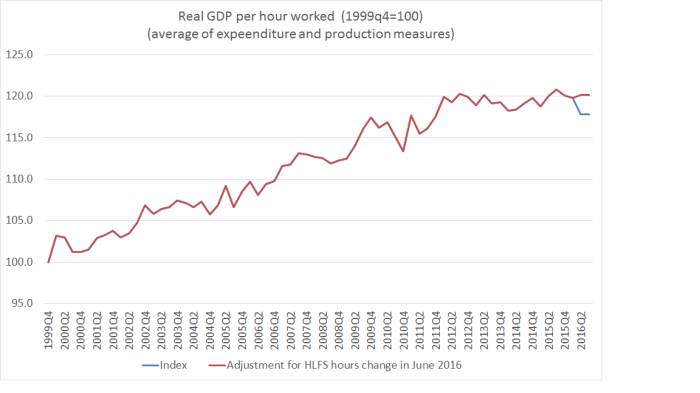
So here is the resulting measure of real GDP per hour worked

real-gdp-phw-dec-16

And, even with the data updates, there is still no sign of any material productivity growth.  It has been 4.5 years now since this productivity index got to around the current level.

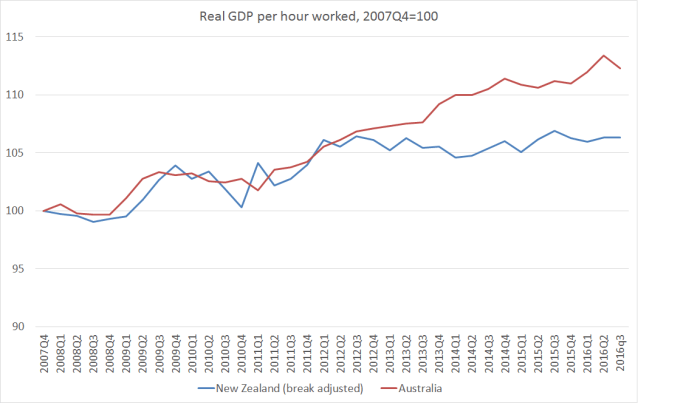
There was plenty of gloomy commentary around the recent Australian quarterly GDP outcome, but in productivity terms  even after a poor quarter (in a series with some noise), Australia continues to pull away from New Zealand.  Here are the two GDP per hour worked series, starting from 2007q4, just prior to the New Zealand (and global) recession and the Australian downturn.

real-gdp-per-hw-aus-and-nz

Our dismal productivity performance really should be getting more attention, and raising more concern, than it seems to.  But today isn’t the day for a long post on the underlying problems and possible solutions.

I’ll be taking something of a break.  There might be a few posts in the next few weeks, but something like a normal flow won’t resume until the week starting 30 January when the kids start going back to school.

In the meantime, in honour of Sunday’s Feast of the Incarnation (aka Christmas) I’ll leave you with this from John Milton’s poem

On the Morning of Christ’s Nativity
Compos’d 1629

I

This is the Month, and this the happy morn
Wherein the Son of Heav’ns eternal King,
Of wedded Maid, and Virgin Mother born,
Our great redemption from above did bring;
For so the holy sages once did sing,
That he our deadly forfeit should release,
And with his Father work us a perpetual peace.

II

That glorious Form, that Light unsufferable,
And that far-beaming blaze of Majesty,
Wherwith he wont at Heav’ns high Councel-Table,
To sit the midst of Trinal Unity,
He laid aside; and here with us to be,
Forsook the Courts of everlasting Day,
And chose with us a darksom House of mortal Clay.

III

Say Heav’nly Muse, shall not thy sacred vein
Afford a present to the Infant God?
Hast thou no vers, no hymn, or solemn strein,
To welcom him to this his new abode,
Now while the Heav’n by the Suns team untrod,
Hath took no print of the approching light,
And all the spangled host keep watch in squadrons bright?

IV

See how from far upon the Eastern rode
The Star-led Wisards haste with odours sweet:
O run, prevent them with thy humble ode,
And lay it lowly at his blessed feet;
Have thou the honour first, thy Lord to greet,
And joyn thy voice unto the Angel Quire,
From out his secret Altar toucht with hallow’d fire.

Two main parties with new leaders hasn’t happened often

Idly reflecting this morning on the change in the leadership of the National Party, I started trying to work out how often the two main parties have both gone into a general election with a new leader.

The National Party was formed in 1936.  Here are the names of the leaders of the National and Labour parties at each election since then.

Main party leaders
Labour National
1938 Savage Hamilton
1943 Fraser Holland
1946 Fraser Holland
1949 Fraser Holland
1951 Nash Holland
1954 Nash Holland
1957 Nash Holyoake
1960 Nash Holyoake
1963 Nordmeyer Holyoake
1966 Kirk Holyoake
1969 Kirk Holyoake
1972 Kirk Marshall
1975 Rowling Muldoon
1978 Rowling Muldoon
1981 Rowling Muldoon
1984 Lange Muldoon
1987 Lange Bolger
1990 Moore Bolger
1993 Moore Bolger
1996 Clark Bolger
1999 Clark Shipley
2002 Clark English
2005 Clark Brash
2008 Clark Key
2011 Goff Key
2014 Cunliffe Key
2017 Little English

New leaders for both main parties hasn’t happened often.  The most recent previous occasion was 1975, and the  only other time before that was 1943.  On both occasions, the incumbent Prime Minister had died during the previous electoral term, and the opposition party (in both cases National) had experienced a thumping defeat at the previous election.

Steven Joyce as Minister of Finance

Bill English is reported to have the numbers to become leader of the National Party and, thus, our next Prime Minister.  And if he does succeed in that quest he has indicated that Steven Joyce will become the Minister of Finance.

That news had me digging out a couple of posts I’d written this year on Mr Joyce’s comments and claims.  He has been Minister of Economic Development for some years –  years in which, as throughout the term of this government, there has been no progress towards closing the large productivity gaps with other advanced countries. In fact, over the last four years official statistics suggests New Zealand has had no productivity growth at all.

In a post in April I posed A Question for Steven Joyce after an interview in which as Science and Innovation minister he argued for even more migration to meet the needs of the tech sector.   He went on

“That’s one of the reasons I’m leery of calls to halt immigration – apart from the fact there’s not much reason to because of the economic gains,” he said.

I noted that

In the last fifteen years, we have had huge waves of immigration,  under both governments, and yet there is not the slightest evidence of economic gains accruing to the New Zealand population as a whole.  Tradables sector production per capita has gone nowhere in fifteen years, productivity growth has been lousy, and there is no sign of any progress at all towards meeting Mr Joyce’s own government’s (well-intentioned but flawed) exports target.

My question was (and remains)

“what evidence can the Minister point to suggesting that the very high rates of immigration to New Zealand in recent decades have done anything to lift productivity in New Zealand, or lift the average per capita incomes of New Zealanders?”.

….

Mr Joyce and the other MBIE ministers have huge resources, staff and budgets, at their disposal.  Surely they should be able to point to clear demonstrated economic gains for New Zealanders as a whole from such a large government intervention.  Our non-citizen immigration programme is already one of the largest (per capita) in the world.  Citizens might reasonably ask for evidence that such an outlier programme has benefited them before considering calls from Ministers for “even more immigration”.

A few months later Mr Joyce was on TVNZ’s Q&A programme defending the government’s economic record.   My post on it is here .   There was an attempt to defend the skills focus of New Zealand immigrants, all the time ignoring data from the same survey indicating that New Zealand already had some of the most skilled workers in the OECD.

TVNZ’s interviewer pushed Mr Joyce on the failure to make any progress in meeting on the centrepiece target in the government’s so-called Business Growth Agenda.

The goal, announced several years ago, was to lift exports as a share of GDP from around 30 per cent to around 40 per cent by 2025.  I thought the formal target was daft and dangerous, even while sympathizing with the intuition that motivated it – small countries get and stay successful by selling lots of stuff, competitively, in the rest of the world.

….

Here is chart of exports to GDP, going back to the start of the quarterly national accounts data in 1987. This time, I’ve also shown the average export share for each of the last three governments.

exports to gdp by govt

Plenty of things cause fluctuations in the series, and not many of them are under the direct control of governments.  Nonetheless, the average export share of GDP is materially lower under this government than it was under the previous government, and the latest observations are below even that average. Since the start of 2009, exports have averaged 27.7 per cent of GDP.  Under the previous National government –  one that first took office more than 25 years ago, that average was 27.5 per cent.  The government’s goal was to lift the export share by 10 full percentage points, and there is now only nine years left until the target date.  On performance to date –  and policy to date – we might be waiting several more centuries to achieve that sort of goal.

It is time Mr Joyce and his colleagues faced the fact that they are simply failing on this count.  A rather different approach is needed –  one which permits/facilitates a sustainably lower real exchange rate, orienting the economy more strongly towards investment in the tradables sector, and enabling more able firms to grow (and locate here doing so) by successfully selling to the rest of the world.  As I’ve noted before, per capita output in that vital outward-oriented part of the economy hasn’t increased at all for 15 years now.  It seems unlikely that that sort of reorientation will occur, all else equal, while we continue to bring in, as a matter of policy, so many not-overly-highly-skilled non-citizen migrants each year.

I haven’t written much about our export education industry and the huge increase in the number of student visas in the last few years –  a strategy championed by Steven Joyce as Minister of Tertiary Education.    In general, I’m keen on export education –  if New Zealand firms have good products that the rest of the world wants, good luck to them, and over time those additional sales should benefit us all.  But there has been more and more sign that most of the growth in export education in recent years hasn’t been about the quality of New Zealand’s educational institutions, but about immigration access.  We aren’t getting (many) top-notch students at all, they aren’t going to our best tertiary institutions, and in many cases they fund their stay here by competing directly in the labour market against relatively unskilled younger New Zealanders.  And there are more and more stories of rorts and exploitation –  well captured in the Herald’s series this week –  that really should leave New Zealand policymakers –  and perhaps especially the responsible minister –  ashamed of what is being done, and permitted and even encouraged, in our name.  It is all very well for officials and ministers to say they have now identified problems and are responding to them, but these sorts of rorts and outright exploitation were pretty predictable from that start.  And is there any sign that Steven Joyce cared?  Export incentives and lightly-disguised subsidies, all in pursuit of a short-term kick to economic activity, with little regard for any evidence of likely long-term gains to New Zealanders, or for the shorter-term damage to the good name of New Zealand and its institutions.

One could go on and talk about the dubious deal that MBIE and their Minister were party to, such as those around Sky City and the convention centre.

The prospect of Joyce as Minister of Finance isn’t encouraging.  Perhaps his Prime Minister will restrain his impuluses to intervene here or there, subsidise this firm or that, this industry or that.   But after eight years, isn’t it perhaps more likely that the purse strings will be loosened to pursue even more of these sorts of “smart active government” strategies that successive governments have pursued for decades, all the while watching New Zealand drift slowly further behind productivity levels in the rest of the advanced world.

At the end of one of the earlier posts, I wondered if perhaps Mr Joyce could point us to the evidence that guides his interventions (or those he favours).  Reflecting on that it reminded me of a seminar I was at some years ago.  Asked by one attendee why there was no cost-benefit analysis for some fairly expensive project, Mr Joyce responded “because I already knew the answer”.

The quality of regulatory impact statements, and associated cost-benefit analyses, emerging from Mr Joyce’s MBIE in the last few years have often been disturbingly weak.  Ministers and departments will do that if they can get away with it.  As Minister of Finance, Mr Joyce would have responsibility for Treasury’s work in trying to lift/sustain the quality of regulatory impact statements.   They have largely failed in that goal under Bill English.  It is not hard to see the quality of policymaking deteriorating again under a Treasury overseen by the activist Mr Joyce.

Mr Joyce is reputed to have troubleshooter skills –  he was, eg, the minister charged with sorting out the Novopay debacle.  But it is difficult to optimistic about the directions in which as Minister of Finance he would guide the overall approach to economic policy.

Two immigrants debate immigration

A month or two back, Professor George Borgas, professor of economics at the Kennedy School at Harvard and a leading researcher on the economics of immigration (and a Cuban immigrant in childhood) published a new book, We Wanted Workers: Unravelling the Immigration Narrative.  Borgas’s empirical work has led him to be somewhat sceptical of whether there are material economic gains to Americans from non-citizen immigration, and to suggest that perhaps immigration policy –  even in the US – is largely just a redistributionist policy, typically away from the more lowly-skilled Americans.  His empirical work has suggested long-term losses to these relatively low income people.

I haven’t yet read the book – much of which, I understand, is a more popular treatment of material dealt with more formally in his Immigration Economics a couple of years ago But Reason magazine –  a libertarian-oriented publication – has published a substantial and considered exchange of views, prompted by Borgas’s book, between Borgas and Shikha Dalmia, a senior analyst at a US libertarian think-tank (and an Indian immigrant).    Dalmia apparently describes herself as a “progressive libertarian and an agnostic with Buddhist longings and a Sufi soul”, so probably not your typical libertarian.

The exchange between Borgas and Dalmia is now freely available on-line here.    For anyone interested in immigration issues, it is worth reading.  The specific issues are, of course, a bit different here than they are in the United States.  A recent New Yorker review of various books on immigration, including Borgas’s, is also worth reading.

From the Reason debate perhaps two extracts struck me most forcefully.  The first from the libertarian open borders  Shikha

I agree completely that the “overreliance on economic modeling and statistical findings” on this subject is a regrettable development that fosters the notion that “purely technocratic determinations of public policy” are possible. In fact, the scientific hubris underlying such efforts prevents a full airing of the normative and ideological commitments that ultimately do—and perhaps should—guide policy.

and the second from Borgas

I ended my discussion in the first round by noting that “immigration creates winners and losers and the net gain may not be as large as some had hoped. So any discussion of immigration policy has to contrast the gains accruing to the winners with the losses suffered by the losers.” You did not address this very thorny issue in your response, so let me conclude by rephrasing it in even starker terms, as it isolates the problem at the core of our disagreement.

The evidence summarized in We Wanted Workers suggests that it is quite possible that the “efficiency gains” that receive so much emphasis in the libertarian narrative are totally offset by the costs associated with welfare expenditures or harmful productivity spillovers. As I said, it may well be that “immigration is just another government redistribution program.” My italicization of “just” was not a random click on my track pad. It was meant to drive home the point that there is a good chance that all that immigration does is redistribute wealth.

If there are no efficiency gains to be had, then espousing any specific immigration policy is nothing but a declaration that group x is preferred to group y. It is easy to avoid clarifying who you are rooting for by trying to reframe the debate in terms of amorphous philosophical ideals about mobility rights and the like. But this is where we go our separate ways.

When I read yesterday a new IMF article by Sebastian Mallaby (itself quite worth reading) asserting that “the movement of people [is] perhaps the most important of the three traditional forms of globalisation”, it brought home again how essentially ideological (meant not in a pejorative sense, but rather as “driven off a prior world view”, and we all have them) much of the support for large scale immigration often is.  Perhaps the same can be said for the sceptics.  And perhaps that is both inevitable, and not necessarily a problem, so long as we recognise the nature of the debate.

Thoughts prompted by Cuba

Fidel Castro is dead.  Sadly, the same can’t be said for the brutal regime that has controlled Cuba for 57 years now –  the regime that suppresses speech, religion, and the exercise of democratic freedoms that we take for granted; the regime that executed thousands of its political opponents and which, to this day, imprisons many of those brave enough to stand against it; the regime that suppresses free economic activity; the regime that actively tries to stop its own people leaving.  There have been plenty of awful Latin American regimes in the last 100 years or so, but fortunately most of the worst have now passed into history.  But not the Cuban regime.  I won’t rejoice in anyone’s death, but consider what type of man this was:  Fidel Castro had enthused about the idea of a nuclear attack on the United States, and had to be put in his place, in no uncertain terms, by Khrushchev.

Last week I happened to be reading Stephen Ambrose’s history of the Eisenhower presidency –  the last non-politician to become President of the United States.  Never having read that much about Cuba, I was surprised to learn that US government agencies –  and this at the height of the Cold War –  were genuinely uncertain what to make of Castro at first, were reluctant to conclude that he was a communist, and (in parts of the government at least) were initially reluctant to see him toppled, for fear that others, notably his brother (the current President of Cuba) would be worse.

But this blog is mostly about things economic.  I knew that pre-Castro Cuba had been a reasonably prosperous place by Latin American standards.  The southern countries (Chile, Argentina and Uruguay) were richer, and so was oil-abundant Venezuela.  But Cuba in the 1950s is estimated to have had real GDP per capita higher than, for example, that in Bolivia, Brazil, Paraguay, Honduras, El Salvador and Ecuador.    Most Cubans –  including Castro –  were descendants of Spanish migrants, and in the mid to late 1950s, real GDP per capita in Cuba is estimated to have been around 75 per cent of that in Spain.

What has happened since then?  Like all countries, Cuba has had its relatively good and relatively bad periods –  the latter, notably, after the fall of the Soviet Union.  And data sources for such a controlled economy aren’t that abundant, or probably that reliable.  However, Angus Maddison’s international database does have real GDP per capita estimates (all on a PPP basis) for Cuba from 1929 through to 2008 (the successor Conference Board database doesn’t include Cuba).

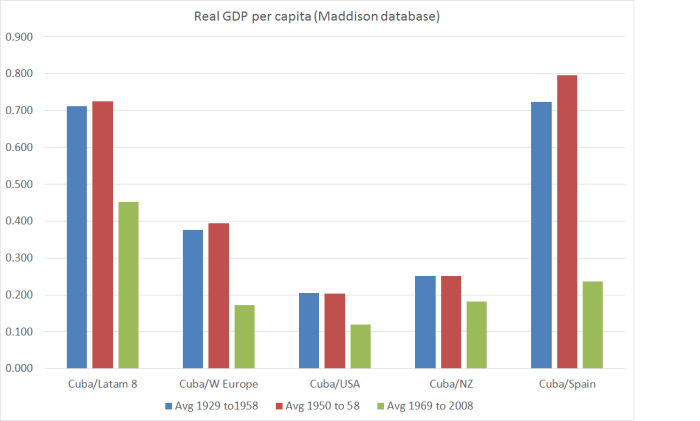
Here are estimates comparing real GDP per capita estimates for Cuba with those for other various other countries/groupings.  Here I’ve shown averages for (a) the thirty years prior to the Castro takeover, (b) the 1950s immediately prior to the takover, and (c) the forty years from 1968 to 2008.   And I’ve shown comparisons between Cuba and the United States, Spain, and New Zealand and also those with Maddison’s Western Europe measure and his measure for the eight largest Latin American countries for which there is annual data all the way back to 1929.     Using these averages masks the shorter-term volatility, but in looking at the Castro period the picture wouldn’t be much different if, say, I’d used just the 2008 observation rather than the 40 year average.  The big decline in Cuba’s economic fortunes took place in the 10 years after Castro’s revolution.

cuba

Against all these countries/groupings, Cuba’s performance in the Castro period has been worse than it was previously –  dramatically so when compared to the Latin American grouping, Western Europe, or to Spain, the former colonial power.

Having said that, I was a little surprised that the deterioration had not been even more marked.  If the numbers are roughly reliable –  and that is a significant caveat – then in 2008, Cuba’s real GDP per capita was still higher than those in El Salvador, Honduras, Nicaragua, and Paraguay.

Looking around for something a little more up-to-date, I found the World Bank had data showing PPP-adjusted current price per capita GDP estimates for the period 1990 to the present.  In Cuba’s case, “the present” only being up to 2013.

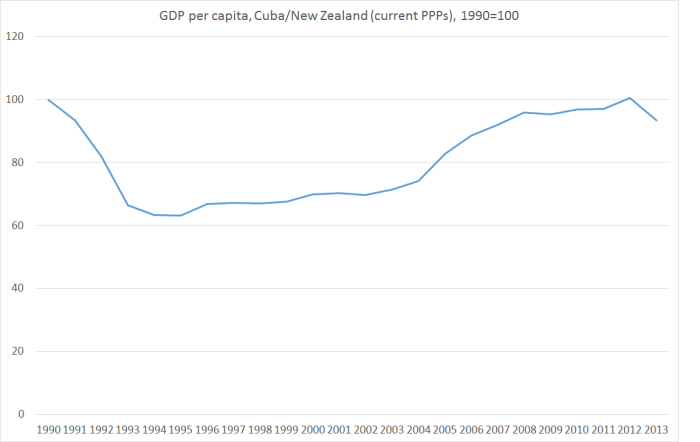
This is how Cuba has done relative to New Zealand over that period.  I’ve just set both countries’ GDP per capita equal to 100 in 1990 and so shown the relative growth since then.

cuba 2.png

It is a little depressing.  1990 was just before the collapse of the Soviet Union, and you see the subsequent sharp fall in Cuba’s performance in the early 1990s.  But over the entire 23 years, on this measure, there has been no change in New Zealand’s performance relative to that of Cuba.

(Here is a link to a post that puts Cuba’s economic performance in a rather more gloomy overall light.  I think it is a little unfair to compare any country’s performance to world GDP over recent decades, given that China is a significant chunk of the world and China had –  and has – so much ground it had to make up after the self-destruction over much of the 20th century.)

Of course, one of the other salient features of Cuba’s experience since Castro took power was the emigration to the United States.  Cuba’s population in 1958 was around 6.8 million.  Current estimates are that the Cuban-American population is around 1.2 million.  That outflow –  which would, presumably have been much larger if the Cuban government had not put tight exit controls in place –  was large enough that Cuba’s population growth in the 50 years after the revolution was the second lowest of all the Latin American countries Maddison reports data for (only Uruguay –  with its own large scale emigration-  had a lower rate of population growth in that period).

New Zealand is, of course, another country that has experienced a large scale net emigration of our own citizens.   Since 1958, it is estimated that 975000 New Zealand citizens (net) have left New Zealand permanently (and in 1958 our population was only 2.3 million).

I don’t want to make much of the Cuba/New Zealand comparisons. They can be crass, and risk trivialising the appalling oppression, persecution, and suffering of the people of Cuba, many of whom had –  and have – no way of escape.  And I’m not sure I believe the Cuban GDP numbers anyway –  and I see Tyler Cowen also highlights that issue.

But, equally, it is too easy to come to simply take for granted the massive outflows of our own people over recent decades, and the disappointingly poor relative economic performance.  Freedom is a great blessing, as is democratic choice (and legitimate exit options likewise), but our democracy –  and decades of chosen leaders –  has kept on failing our people.  We really should have been able to do a great deal better.

UPDATE: Various people have commented on the possible achievements of the Castro regime, especially in literacy and health.  Tyler Cowen had a link to this post, which I found useful in making sense of the merits of the case in that area.

Still reluctant to lower interest rates

I was a little late to the Monetary Policy Statement. The actual OCR cut yesterday was very well foreshadowed, and I wasn’t expecting much else.  And in fact there weren’t many surprises in the document.  But that is shame, because the Reserve Bank still seems trapped in much the same mindset that has delivered inflation below the midpoint of the target range (the explicit required focus of policy since 2012) for the last five years or so.  And it isn’t just headline inflation –  thrown around by petrol prices, tobacco taxes, ACC levies etc –  but whichever one or more core inflation measures one cares to focus on.  At present, the median of half a dozen core inflation measures is around 1.2 per cent.

And despite the rather self-congratulatory tone of the document, and particularly of yesterday’s press conference with the Governor and Assistant Governor, even on the Bank’s latest projections it is still another two years until inflation is expected to be back around 2 per cent.  And, of course, we’ve heard that line before, repeatedly.  As everyone knows, a lot can happen in two years, and it is most unlikely that things will unfold as the Bank (or any other forecaster expects) but there is nothing –  not a word, sentence, or paragraph –  in the latest MPS to explain why it is more likely today that inflation will now track back to settle around 2 per cent than it has been for the last five years.   Why should we be comfortable that the Bank has it right this time?

The Governor continues to repeat the line favoured by the government, emphasising recent annual GDP growth of around 3.5 per cent.  He does so in a way that suggests that all is pretty rosy, and my goodness if we were to do anything more there would be real risks of nasty overheating and intense volatility.  But like the government, the Governor rarely bothers to mention per capita growth.  Here is the chart of annual average growth in real per capita GDP (using the average of expenditure and production GDP).

real-gdp-pc-nov-16

At its brief best, several years ago, real per capita GDP growth never got anywhere near the rates of previous recoveries.  At something around 1 per cent now (1.5 per cent of an apc basis) it not anything to be encouraged by.  Sure, some of the weaker growth reflects the deteriorating productivity growth trend –  which the Governor can’t do much about –  but not all of it by any means.  With 2 per cent population growth, we probably should be getting a bit uneasy if over GDP growth were at 6 per cent –  and the unemployment rate was falling quickly below the NAIRU –  but that just isn’t the way things have been in New Zealand in the Wheeler years.  And the disconcerting thing is the Graeme seems to think that is a good thing.  Monetary policy could have done more, but consistently and consciously chooses not to do so.

Instead he repeats, over and over again, the point that tradables inflation has been negative for several years, making his life oh so hard (hard to get overall inflation back to 2 per cent).  From a New Zealand consumer’s perspective, low tradables is a good thing.  And from a New Zealand producers’ perspective it is typically should be quite a good thing as well.  Persistently weak tradables inflation creates room for the Reserve Bank to cut New Zealand interest rates further, in turn lowering the exchange rate (relative to the counterfactual).  A lower exchange rate would raise tradables inflation a bit, but also increase domestic economic activity and raise returns to our own tradables sector producers.    The headline inflation rate would rise as, over time, would core measures.

It is one of aspects of Graeme Wheeler’s stewardship that I don’t purport to adequately understand.  In almost every statement he repeats the plaintive line “a decline in the exchange rate is needed” but isn’t willing to do much about the one thing in his control that really makes some difference: lowering interest rates.

You might think that is a little unfair.  After all, the OCR has been cut by 175 basis points in the last 16 months.  But then it was unnecessarily raised  by 100 basis points over 2014.  Overall, the nominal policy interest rate has fallen over the last three years, but once one takes account of the fall in inflation expectations, there has been hardly any fall in the real OCR at all.  And that despite three more years of inflation persistently undershooting the target (and three more years of an unemployment rate above the NAIRU).

And they aren’t even providing much to boost domestic demand and activity.  The Bank ran this chart in yesterday’s MPS

funding-costs-nov-16-mps

It isn’t that easy to read, but just focus on the top and bottom lines. The top line is an estimate of the weighted average cost of new bank funding (retail, wholesale, onshore, offshore).  The bottom line is the OCR.  That marginal funding costs measure hasn’t fallen much at all this year, despite the continuing falls in the OCR.  Over the last three years taken together, the fall in marginal funding costs has not even quite kept up with the fall in inflation expectations.  Is it any wonder that core inflation has stayed low, and if there is any sign of some lift in inflation, it is at a very sluggish rate?

The Governor devoted a paragraph in  his main policy chapter to a discussion of the helpful things (in terms of lifting resource pressure and inflation) lower interest rates are doing.  There was a striking omission: frustrated as he no doubt is with the level of the TWI, it is almost certainly lower today than if the Bank had not cut the OCR.  But no mention of the exchange rate connection at all, even though it is probably one of the most important monetary policy transmission mechanisms in New Zealand.

But I was also struck by one of the observations the Governor did make.  He noted that low interest rates “are encouraging businesses to undertake investment they may not have done otherwise”.  So far, so conventional, and I wouldn’t disagree at all.  But here is a chart of investment (excluding residential investment) going back almost 30 years.

investment

Investment in things other than building new houses is certainly off the recessionary lows, but it is still a considerable way below the typical share of GDP seen in the mid-late 1990s and the pre-recessionary 2000s.  And that is (a) with some considerable activity related simply to rebuilding in Christchurch following the earthquakes, and (b) the most rapid population growth rate we’ve had for decades.  Many more people should mean a lot more investment (simply to maintain the capital stock per person).  With current rates of population growth, and the Christchurch effects, perhaps we might be a little uneasy, concerned about overshooting, if the investment share (ex housing) was much above say 18 per cent (around the pre-recession peak). But it isn’t, and there is a little sign of business investment accelerating.

Monetary policy doesn’t make that much difference to an economy in the long run.  But in the short to medium term it can make quite a difference.   If a central bank is reluctant to cut policy rates further when

  • core inflation is well below the target focus (and has been for years),
  • when the unemployment rate is falling only slowly and is still well above the NAIRU,
  • when per capita GDP growth remains modest at best,
  • when the exchange rate is well above appropriate long-run levels, despite a languishing exports/GDP picture,
  • and when business investment itself is pretty modest, especially given the unexpectedly rapid population growth

it is leaving New Zealanders poorer, and more of them unemployed, than is necessary, or desirable.

Perhaps the bit of yesterday’s press conference that frustrated me most was the response by John McDermott, the Bank’s chief economist and Assistant Governor to a question.  The questioner asked about whether the Bank had given any thought to the idea Janet Yellen had openly toyed with, of deliberately aiming for a period of above-target inflation –  whether to in some sense “make up” for the period of below-target inflation and cement in slightly higher inflation expectations, or just to “give growth a chance”, including the chance that additional demand growth might stimulate new supply and productivity growth.   As the next recession –  and the next need to cut rates –  can’t be that many years away –  whether by accident, exhaustion or unintended trade war – the “overshoot” approach might just be prudent risk management in the current circumstances.

There are a number of problems with the idea.  In a US context, I don’t find that argument that weak demand has held back productivity growth that convincing –  and they managed very rapid productivity growth during the Great Depression –  and there are questions as to whether a central bank could credibly commit to overshoot its target for a time (aren’t the incentives to renege as soon as inflation actually starts getting near the target?).  And in the US, the unemployment rate is already back to around pre-recession lows.

But the Bank’s chief economist simply didn’t address the question.  Perhaps he didn’t hear it clearly, or misinterpreted what was being asked, but he simply gave the rather self-satisfied response that if one looked at the Bank’s projections, inflation was heading back towards target, and that “sounds like the plan being implemented”.

It is nothing of the sort.  What the Bank is doing is pretty mainstream inflation targeting, on the assumption that their forecasting models and understanding of the economy is roughly correct.  And it is surely exactly the same approach they’d take if the target was, say, centred on 5 per cent, and core inflation measures were around 4.2 per cent.

It is also exactly the approach they’ve taken throughout the Wheeler term, when they have proved to be consistently wrong.  Inflation has simply kept on undershooting.

The approach that was asked about, at least as I heard it, was whether the Bank should not cut more aggressively now, actively aiming to get (core) inflation up to perhaps around 2.5 per cent for a time.  If the Bank’s forecasting models are still wrong –  and they’ve given us no basis to believe something has changed and they now have it right –  perhaps actual core inflation would turn out around 2 per cent.    But if the models are right, we’d have a few years where inflation was a bit above target.  There would be few obvious downsides to that.  The next recession –  whenever it is –  would be likely to see inflation fall again.  But we’d see inflation expectations pick up –  from the current 1.6 to 1.7 per cent – to something more like 2 per cent, and we’d see a phase of stronger real GDP growth (per capita), stronger business investment, and the unemployment rate might finally –  eight years on from the recession –  get back to something like the NAIRU.  Indeed, perhaps it might undershoot the NAIRU for a year or two, likely a welcome outcome for the people concerned.

And then there is the looming issue of the near-zero lower bound on nominal interest rates. The Bank has just cut the OCR to a new record low of 1.75 per cent, and projects that it will remain at that level for the next three years.  They think the economy already has a small positive output gap.  So if the next recession comes in the next few years, there will be only around 250 basis points of leeway to cut the OCR if required.  In past cycles, the Bank has often needed twice that capacity.  And yet the Bank has shown no sign of having any preparations in train to make the lower bound less binding.

Far better to take a more aggressive path now.  Actually push real interest rates well below where they were in the years when inflation has consistently undershoot.  Get inflation up sooner, and perhaps even overshoot for a time.  Get growth in real GDP per capita up, and drive unemployment down.  And in the process, get inflation expectations –  what people treat as normal –  up again. The best way to preserve capacity for the next recession is to get inflation expectations up –  at or above target midpoint –  now, while there is still discretionary capacity.

There are counter-arguments to this sort of approach –  no doubt, many would mention house prices –  but the Bank simply ignored the quite reasonable question.  It is as if they really just don’t care.  Not, I’d have thought, ever an appropriate response from a body given such great delegated power, but perhaps less so than ever in a week when voter rebellion against the elites, perceived not to have the interests of ordinary people at hear, hog the headlines.

As a final thought, while I welcomed the move to publish the interest rate projections in terms of the OCR (rather than the 90 day bill rate), given that the Bank adjusts the OCR in increments that are multiples of 25 basis points, it is rather odd to give the interest rate projection to only one decimal place.   Over the next few months, the OCR will either be 1.5 per cent, 1.75 per cent (as presumably the Bank thinks), or 2 per cent.  It won’t be 1.8 per cent or 1.7 per cent.  The Governor seemed to suggest yesterday that 1.7 per cent was implying a 20 per cent chance of a further OCR cut.  But, even if so, how do we know whether 1.8 per cent is simply 1.75 per cent rounded, or is intended as a 20 per cent chance of an OCR increase?  The move to using the OCR was designed to improve clarity.  They could do a little more in that direction (and in ways that might reduce the temptation to micro manage market expectations).


Still here

I had a post half-completed the other day when my computer failed –  a failure that proved terminal.  Add in an egregious decision by the Reserve Bank to leave trustees of its pension scheme potentially personally liable for some really bad past calls by the Bank (a decision that has already contributed to the resignation of our most eminent trustee) and a worsening cold, and my energies were elsewhere.  And, of course, for the last 24 hours, the US election has been much much more interesting than anything New Zealand-related that I might have written about.  Even my 10 year old came home from school yesterday telling me that her class had been following the early results intensely, even if (she reported that) some of the offspring of liberal Island Bay had apparently somehow become convinced that Donald Trump would soon be bombing New Zealand.

I wasn’t a Trump or Clinton supporter going into the election, and am pretty sure that if I’d been American I’d have voted for neither of them (although one of the interesting things in the last few weeks had been the collapse of the third party candidates’ vote share).  I laid out some of my reasons on my other blog.  So unconfident was I in either candidate that I thought a least bad outcome might be one in which one party controlled Congress and the other had the presidency, and (as I noted somewhere else a few days ago) the numbers suggested that if that was going to happen, that probably meant Clinton in the presidency.

But, of course, we now know that hasn’t happened.   Donald Trump will become President on 20 January 2017.  None of my reservations has gone away.  Character matters, temperament matters.  And Trump doesn’t have either of those in any sort of form that makes me think him fit to be President.  I suspect he will be a poor President.  Then again, with what we know now John F Kennedy and Lyndon Johnson wouldn’t pass the character test.  Nor Bill Clinton, nor Hillary Clinton.

For all the media vapours in the last 24 hours, the polls were always relatively close –  as late as yesterday morning I noticed that two new polls on the RCP presidential polls site had a slight lead for Trump –  and the popular vote (not, of course, the basis of the election) looks set to end quite close.  Towards the end of the campaign detached analysts had been saying that Trump had perhaps a 30 per cent chance of victory.  This outcome was always a serious possibility –  the more so perhaps as no one had adequately understood Trump’s surprising success since he first declared his candidacy in the middle of last year.  Perhaps in the end it was a bit like Brexit.  The polls were always close but (a) most of the media and political elites were appalled at the idea of Brexit, and (b) even supporters ( I was one) couldn’t quite believe, despite the polls, that a Brexit victory could actually happen.

Of course, as regards the US election, those sorts of sentiments were accentuated among elite observers outside the US.  According to polls New Zealanders (and Australians) overwhelmingly favoured Obama (in 2008 and 2012) and then Clinton, and that predilection will have been even more marked among our media and political and opinion leaders.  And so the subsequent coverage has been marked more by incomprehension and abuse than anything else –  although in a breath of commonsense the Prime Minister did note that New Zealand is unlikely to be one of the new President’s concerns.  Between the Dominion-Post and Morning Report (and a quick glance through the Herald),  the coverage has been so one-sided that it can only have appealed to the emotional uncomprehending side of liberal readers/listeners, offering little in the way of analysis.

I’m a free market-oriented, small government, social conservative.  There aren’t many of us in New Zealand.  Even if it weren’t for the character and temperament issues, much of Trump’s policy/rhetoric makes me deeply uneasy.  I believe in free trade –  although not preferential trade agreements of the sort of TPP –  and I’m very sceptical of the sort of infrastructure spending programmes that Trump and Clinton were falling over themselves to champion.    And if China has a hugely distorted economy, that mostly disadvantages China –  the idea of officially deeming China a “currency manipulator” isn’t appealing at all (and to extent it is an accurate description, it was truer 15 years ago than it is now).

Then again, there are some things I’m unambigiously happy about in last night’s result:

  • seeing the back, surely finally, of the Clintons (all of them).  Failings of character, a strong sense of entitlement, a strong whiff of corruption, and so on.   As someone noted, probably not many foreign governments will be donating to the Clinton Foundation today.
  • the probable death of TPP.  That agreement had very little in common with “free trade”.  ISDS provisions, which provide foreign investors access to different dispute resolution procedures than domestic investors or ordinary citizens have access to, should have no place in a democracy governed by the rule of law.  And the intrusion of international agreements into trying to set parameters for eg domestic labour market regulation should be firmly resisted.  Domestic laws should be argued over in domestic political debate.
  • the likelihood that new Supreme Court justices will be people inclined to read the Constitution as it was written, rather than as individual judges might wish it to be written.  There is an established procedure for amending the Constitution, and further politicising the Court isn’t that procedure.
  • a halt in the relentless push towards normalising abortion (the Democrats campaigned on restoring federal funding for abortions).
  • a pause –  though probably only a pause –  in the relentless push by federal authorities to compel private people and entities to accept/endorse policies that are anathema to their traditions and religious beliefs (eg same-sex marriage and transgender issues).
  • less risk of a hawkish interventionist foreign policy, and especially the serious risks that would have surrounded Clinton’s preference for a Syrian no-fly zone.

And others where there is some –  perhaps small –  hope of better policy:

  • smart people on both sides of US politics recognise there are serious flaws in the US corporate tax system. This means it is one possible area of serious reform, especially with the Republicans in control of the House and the Senate.  Lower capital income taxation, and a more conventional tax treatment of the offshore earnings of US companies, would be material steps forward, lifting the prospect of stronger private business investment,
  • steps towards a rather better healthcare policy, perhaps including much greater scope for innovation in the healthcare and drugs sectors, and perhaps a step towards comprehensive catastrophic risk cover (the latter a stance favoured by many Republicans pre 2008).
  • perhaps even Trump and a Republican Congress could be the vehicle towards a viable long-term solution for the huge number of illegal immigrants in the US.  In parallels with Nixon to China, perhaps only someone like Trump has the political positioning to be able to resolve the issue. I don’t have strong view on what the “right” outcome should be, but the existing legal limbo can’t be good for the illegals, or for confidence in the US system of government.

And in the last 15 years or so –  perhaps especially under Obama –  there has been a huge increase in the discretionary use of the powers of the administrative state, rather than relying on Congress.  No doubt each side of politics dislikes many of the uses the opposite side’s presidents have made of such powers –  and there are some serious challenges around the legality of some of those interventions (including, for example, Obama’s on immigration), but  in general, the heavy use of such power isn’t really consistent with visions of a democracy in which legislatures make laws and the executive carries them out. No doubt, Trump and the Congressional Republicans will have differences –  often large ones –  on many things, and it still takes 60 votes to get major things through the Senate –  but there must be more scope for relying on legislation rather than executive orders than there was in years when the presidency and Congress were controlled by different parties.  To me, whatever the specific policies, that is an unambigously good thing –  superior process.  And as the Republicans aren’t defending many Senate seats in 2018, if anything the Senate majority could actually increase a little for the last two years of the presidential term.

Am I very optimistic? No, not really.  It was always extraordinary that a great country was reduced to such a bad set of presidential options.  And no doubt the political environment for the next few years will be at least as toxic as the last few have been.  But from a small government social conservative perspective, even a deeply flawed vessel might still end up being agent for some modest gains (even amid the substantive and rhetorical dross).

IMF advocacy for immigration: some caveats

The other day I came across mention of a chapter in the IMF’s latest World Economic Outlook on the economics of immigration.  It turned out to be only half a chapter (from page 183) but it had some interesting discussion and material.  It probably won’t surprise anyone that although immigration is a long way from the IMF’s core responsibilities, the Fund is pretty gung-ho on the benefits.  My own stance is, of course, more skeptical: I doubt the economic benefits to recipient countries are typically anywhere near as large as the enthusiasts make out, and in New Zealand’s specific case I think the evidence increasingly suggests that high rates of immigration in the post-war decades (continuing to today, as strong as ever) have been detrimental to the economic fortunes of New Zealanders as a whole.

Whatever the truth is, the IMF might want to be a little more careful as to how they present the material in support of their claim.  The World Economic Outlook is one of the flagship documents of the Fund, widely circulated and discussed (including at the Executive Board level) before release, not just some obscure researcher’s working paper.

And so I was interested to find this

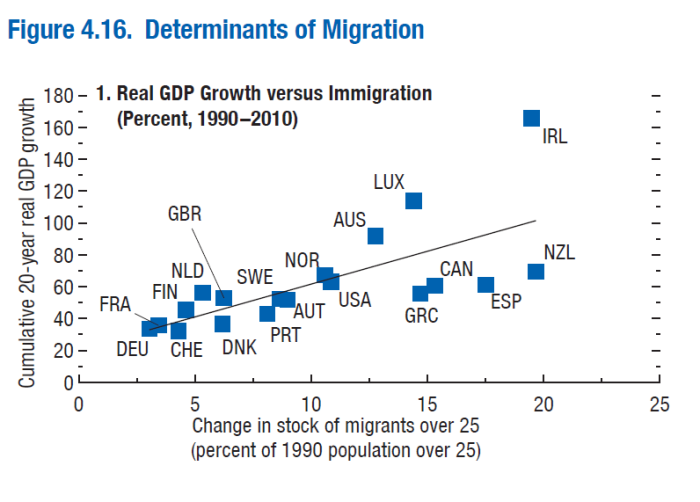
There is a positive association between long-term real GDP per capita growth and the change in the share of migrants (Figure 4.16, panel 1).

I noted the careful wording (“association” rather than “causal relationship”) and went looking for the chart.

imf-immigration-chart-1

Which left me a little puzzled. The text said there was a relationship, illustrated by this chart, between increases in migrant numbers and real GDP per capita growth.  But the chart itself showed only a relationship between total real GDP growth and immigration.  That sort of positive relationship was hardly surprising –  growing migrant numbers raises the population, which tends to raise total GDP –  but the interesting question was surely about per capita growth.  And it wasn’t just a labelling error –  it was easy enough to reproduce the Fund’s chart, showing what the labels said it showed.

And so I started digging around.  The IMF uses a group of 19 advanced countries, the choice presumably limited by data availability (so, for example, Belgium, Italy, Iceland, Japan and Korea –  among advanced OECD countries –  aren’t included).  And they focus on 1990 to 2010, presumably also to ensure that all the data (for some of the background modelling) was available.  And rather than total migrant numbers, they look only at migrants over 25.  In the charts that follow, I just follow their basic approach/time period.  In terms of country selection, I’d note just two caveats: first, a large part of Luxembourg’s GDP is produced by people who don’t live in Luxembourg but commute in each day (so GDP per capita can be a bit misleading) and in Ireland the corporate tax system has helped contribute to a huge gap between GDP and GNI –  and it is the latter that measures income accruing to the Irish. Finally, it is worth noting that more than half the countries in the sample are in the euro, and 1990 to 2010 covered the period of convergence to the euro, and then the full effects of imposing a common interest rate on quite different economies.

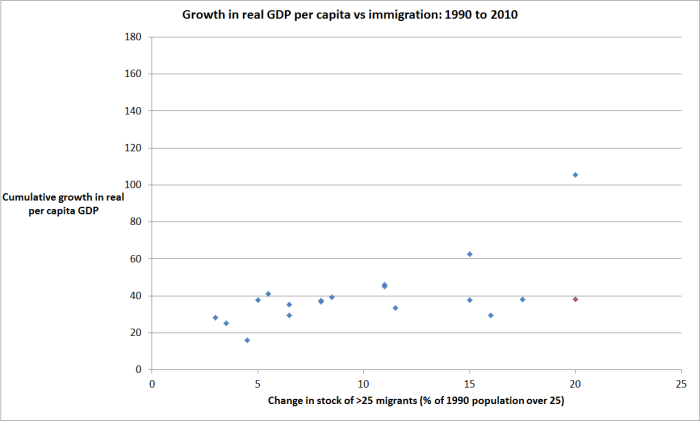
With those methodological notes out of the way, what did the chart of growth in GDP per capita over 1990 to 2010 look like when graphed against the change in the migrant share of the (over 25) population over that period?

imf-migration-and-gdp-pc

The red dot (hard to see, but lower right) is New Zealand.  The outlier (top right) is Ireland.  Excluding Ireland, there is almost no relationship at all, and certainly not one that would pass any tests of statistical significance.

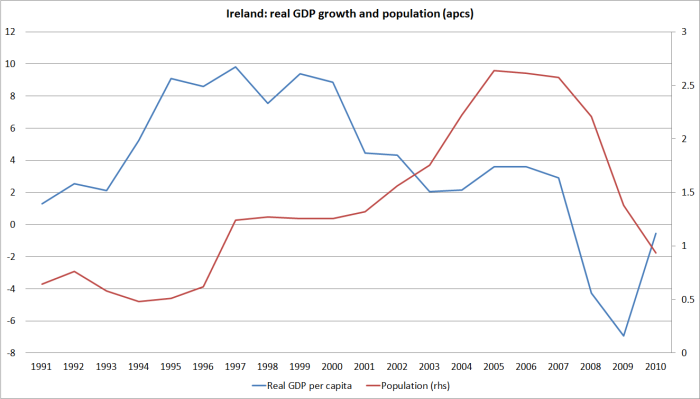
And in case you do want to include Ireland, bear in mind that the big surge in immigration to Ireland came after the most rapid growth in GDP, or GDP per capita.

ireland-popn-and-growth

Over 1990 to 2010, Ireland’s strong growth in real per capita GDP was pretty clearly not caused by immigration.

GDP per capita has its limitations, and the Fund –  and most immigration advocates –  typically argue that the most valuable gains from immigration arise from improvements in productivity. So using, the Fund’s period, the Fund’s sample of countries, and the Fund’s immigration variable, what did the (simple bivariate) relationships look like with, first, real GDP per hour worked growth, and then (often regarded as the best sort of productivity growth) multi-factor productivity (MFP) growth?

(In all these chart’s I’m drawing GDP and productivity data from the Conference Board’s Total Economy Database.)

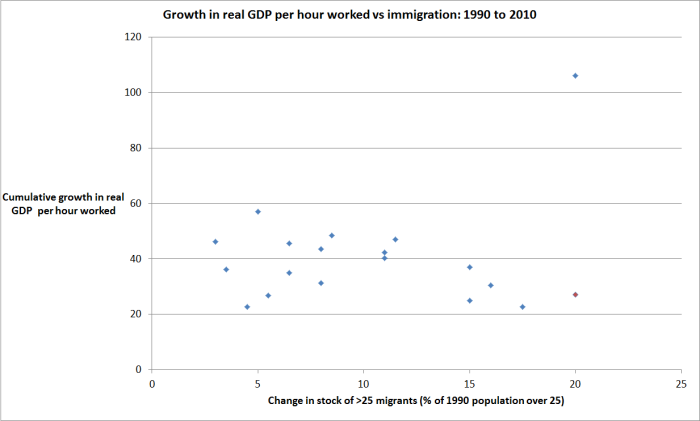
Here is the relationship with real GDP per hour worked.

imf migration and gdp phw.png

Again, New Zealand is in red (lower right) and Ireland is the outlier.

This relationship might not be very statistically significant either but –  at least excluding the Irish outlier –  if anything it runs in the wrong direction for the IMF story.  Over this period, and on this particular measure/sample, there was a modest negative association between immigration and labour productivity growth.

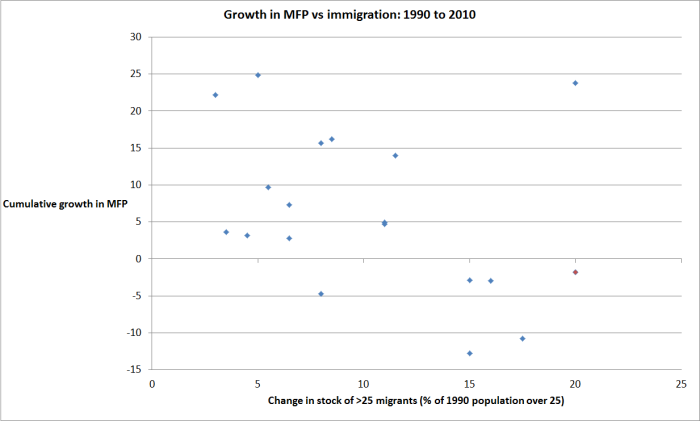
And what about MFP growth?

imf-mfp

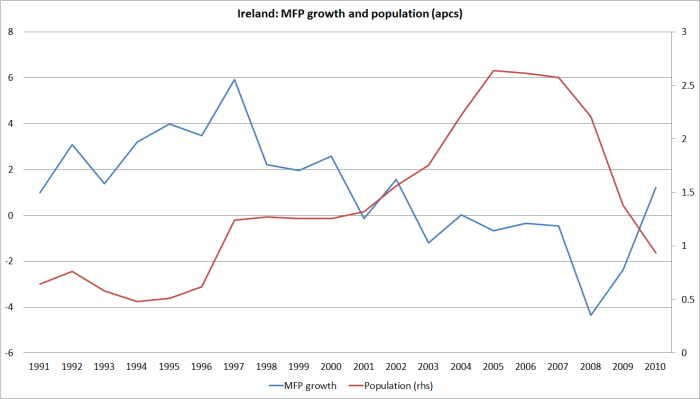
That relationship, especially excluding Ireland, is even more negative than the one for labour productivity.  And just to confirm that even on MFP, the immigration surge in Ireland came well after the best of the MFP growth.

ireland-mfp-and-popn

All in all, on these measures, for this sample of countries, over this period, there doesn’t seem to be much left of the IMF’s story.  Yes, immigration obviously tends to make economies bigger in total, but there is little sign in the informal analysis that it has made them more productive, and thus made the average individual citizen of the recipient country better off.

Of course, where it can the IMF likes to rest its claim on more sophisticated analysis than that.  Later in the chapter, they report that

Recent research suggests that migration improves GDP per capita in host countries by boosting investment and increasing labor productivity. Jaumotte, Koloskova, and Saxena (2016) estimate that a 1 percentage point increase in the share of migrants in the working-age population can raise GDP per capita over the long term by up to 2 percent.

The recent IMF “spillover note” that is drawn from is available here.  The authors use much the same countries, the same immigration variable, and the same sample period as in the WEO analysis above.   They also focus on the level of real GDP per capita, and the level of productivity, not just growth over a particular period.  Their approach has a number of advantages over earlier studies (including the focus just on advanced countries) and as the Fund notes, the estimated real GDP per capita gains are less than in some previous studies.

I’m not a technical modeler, so I’m not going to try and unpick the paper on those grounds.  My simple proposition is that the results do not, even remotely, ring true.

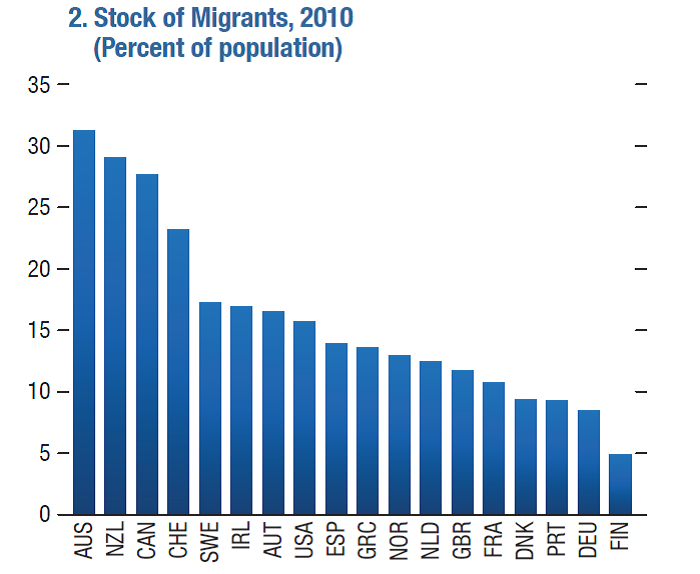
Here is a chart from the paper showing the stock of migrants in the sample countries.

stock-of-migrants

Think about France and Britain for a moment.  Both of them in 2010 had migrant populations of just over 10 per cent of the (over 25) population.  If this model was truly well-specified and catching something structural it seems to be saying that if 20 per cent of France’s population moved to Britain and 20 per cent of Britain’s population moved to France (which would give both countries migrant population shares similar to Australia’s), real GDP per capita in both countries would rise by around 40 per cent in the long term.  Denmark and Finland could close most of the GDP per capita gap to oil-rich Norway simply by making the same sort of swap.    It simply doesn’t ring true –  and these for hypothetical migrations involving populations that are more educated, and more attuned to market economies and their institutions, than the typical migrant to advanced countries.

(The study produces similar results for real GDP per person employed, but they do not test the relationship with either GDP per hour worked, or with MFP.  The authors suggests that the gains from immigration come through an MFP channel, but this seems doubtful –  especially over this period, and this sample, given the bivariate MFP growth chart above).

There are other reasons to be skeptical of the results in this IMF paper.  Among them is  that there is a fairly strong relationship between the economic performance of countries today and the performance of those countries a long time ago.  GDP per capita in 1910 was a pretty good predictor of a country’s relative GDP per capita ranking in 2010, suggesting reason to doubt that the current migrant share of population can be a big part of explaining the current level of GDP per capita (and some of the bigger outliers over the last 100 years have been low immigration Korea and Japan and high immigration New Zealand).    In fact, I’ve pointed readers previously to robust papers suggesting that much about a country’s economic performance today can be explained by its relative performance 3000 year ago.  How plausible is it that so much of today’s differences in level of GDP per capita among advanced countries can be explained simply by the current migrant share of the population?

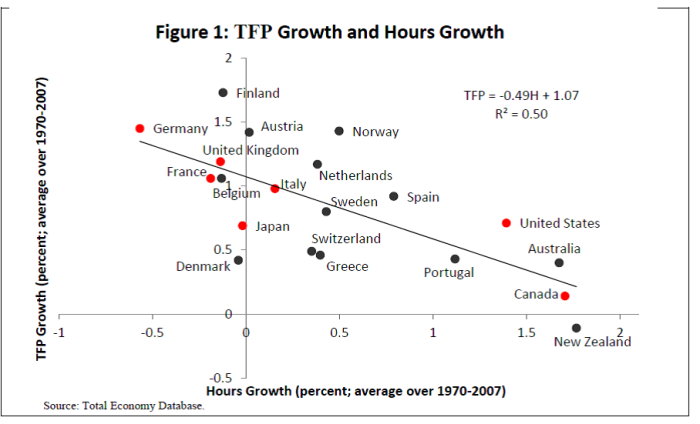
And then, reverting to bivariate charts (but one from a relatively recent IMF working paper)

imf-hours-and-mfp

Total hours growth is not just determined by immigration, but differences in immigration rates account for a large part of the differences in population growth, and growth in total hours worked, over long periods of time such as those in this chart.  There is just no sign, over that period and those countries, of the longed for link between productivity growth (here MFP/TFP) and growth in anything remotely linked to differences in the volume of immigration.

To revert just briefly to the IMF WEO chapter, one of the advantages of looking at just 18 or 19 countries is that the authors should be able to illustrate their point, at least impressionistically, by reference to individual pairs of countries.  If nothing else, it is a bit of a realism check, but it can also help make the overall story seem more persuasive. But there is nothing of that in the IMF’s discussion and advocacy.   And nor is there any effort to deal with what might reasonably look like problems for the story.  The two countries with the largest increases in migrant share over 1990 to 2010 were Ireland and New Zealand.  In Ireland, as I’ve shown, the immigration clearly came after the peak productivity gains –  perhaps a case of sharing the gains, but hardly one where immigration looks causative.  And New Zealand, well….readers know the New Zealand story.  In 1990 we were supposed to be well-positioned to catch up again with the other advanced countries –  the sort included in the IMF sample –  and we had a big migration surge (by international standards of pretty good quality migrants) and yet over the full 20 years we’ve had among the lowest productivity growth rates (labour and MFP) of any of these countries.

Perhaps there are some other countries, or country pairs, where the intuitive case is more compelling.  It is shame the IMF didn’t put in the effort to find them

A Victoria University professor on New Zealand immigration

By the end of World War Two there hadn’t been much net migration to New Zealand for 20 years.
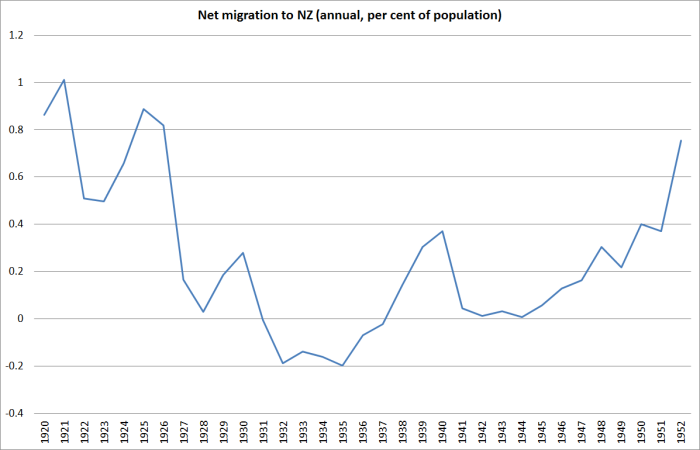
net-migration-20s-to-50s

There had been a big wave of assisted migration in the first half of the 1920s –  almost all those moving to New Zealand then were substantially financially assisted, initially largely by the British government, keen to assist ex-servicemen to resettle in the dominions, and then by the New Zealand government.  Financial assistance to migrants had long been a feature of New Zealand (provincial and central) government policy –  compared with the option of moving to Canada or the US (or even just staying in the UK), moving to New Zealand was expensive (time lost as well as fares).  But inflows to New Zealand dropped off after the mid 1920s and government assistance to migrants was largely discontinued from around 1927.  Over the twenty years, 1927 to 1946, annual net migration to New Zealand averaged less than 0.1 per cent of the population.  Not surprisingly, there was little movement during the war, and in the 1930s the outflows of the first half of the decade –  the UK was much less badly affected by the Great Depression than New Zealand was – largely balanced out the moderate inflows later in the decade.

At the end of World War Two, there was considerable angst about population prospects.  Birth rates around the advanced world, including New Zealand, had been low, and in many countries there was unease about what a flat or falling population might mean.  And the war itself had brought to the fore the idea that a lightly populated country might be unnecessarily prone to invasion threats.

There were no legal obstacles to immigration to New Zealand from Britain (or the other Dominions): as New Zealanders could move freely to Britain, so Britons could freely move here (as they could until the 1970s).  But in 1947, the government restarted the assisted migration programme – initially those selected had to contribute £10, but within a couple of years that requirement had been dropped.  Even though life in post-war Britain was pretty tough, and the gap in material living standards then was probably as large as it ever was, the government didn’t find it that easy to fill the number of free places it was offering.  But total immigrant numbers did pick up sharply and (as illustrated in the chart above) by 1952, the net inflow of immigrants had almost reached the sorts of levels soon in the first half of the 1920s.  And despite earlier worries about the birth rate, the “baby boom” happened here too.  In 1952, the total population increased by 2.5 per cent –  an even larger increase than we’ve experienced over the last year or so.

In 1952, Professor Horace Belshaw, an immigrant (as a child) himself, former student of Keynes at Cambridge, and by then McCarthy Professor of Economics at Victoria University and one of the most widely-published New Zealand academic economists of his day, turned his attention to the question of immigration to New Zealand.  In his short (32 page) booklet, Immigration: Problems and Policies, Professor Belshaw discussed some of the economic (and other) effects of high rates of immigration.

I’m going to reproduce here some of Belshaw’s material.  Regular readers will probably note a certain similarity with the economic analysis I have been presented about more recent New Zealand immigration policy (although I only found the Belshaw material a few years ago).

In beginning his discussion, Belshaw notes

In considering the volume of immigration which is in “the best interests” of New Zealand, it is necessary to distinguish between the “absorption capacity” at any particular time and what is desirable over the longer period…..we must compare the effects of a given growth of population with the effects of the larger population resulting from this growth.

…for example, the long run position will be affected by whether or not more intensive production in agriculture will yield a lower return per head with a somewhat larger population, whether the supply of electric power can be economically expanded to satisfy not only the increased use of electricity per head of population, but also the larger number of heads.  And the answer in both cases may be affected by technical discoveries not yet made.

Belshaw discusses a number of the transitional issues

Cultural absorption.  As he notes, most of the migrants at the time were from the UK and Northern Europe, and so

There will be personal misfits enough and the need to give assistance in orienting to the New Zealand way of life, but the cultures they bring with them at sufficiently close to our own to raise no special difficulty of absorption, and there are no social or political reasons to fear the growth of minority problems among groups which preserve a separate identity, such as have plagued the United States. On the other hand, migrants bring with them new skills, different accomplishments, and ways of looking at things which should prove economically advantageous and culturally enriching.

Immigration and the Labour Shortage

At the time when there are more vacancies than workers, it is natural to assume that immigration will relieve the labour shortage. This however, is a superficial view.  The immigrants are not only producers but also consumers. To relieve the shortage of labour it would be necessary for more to be contributed to the production of consumer goods or of export commodities used to buy imported goods than the increased numbers withdraw in consumption.  That is unlikely….[and] there will be some temporary net additional pressure on consumption.

Immigration and Capital Needs

Of much greater importance is the fact that each immigrant requires substantial additional capital investment, not in money but in real things.  Houses and additional accommodation in schools and hospitals will be needed. In order to maintain existing production and services, and even more to maximize production per head, there must be more investment in manufacturing and farming, transport, hydro-electric power, municipal amenities and so on.

To anticipate a little, immigration is not likely to ease the labour shortage while it is occurring, and is more likely to increase it because although additional consumers are brought in, more labour than they provide must be diverted to creating capital if the ratio of capital to production is to be maintained.  So the unsatisfied demand for consumers’ goods and therefore for labour to produce them will not be met.

…the fact remains that while it is occurring a population increase of the order under consideration will reduce the volume of capital per head, and for the time being cause production per head to increase slower than with a smaller rate of population increase. Immigration must be assessed in relation to its contribution to this situation.

The expansion of population of itself will increase inflationary pressures, for the net effect is to create additional purchasing power to finance capital creation without producing an equivalent volume of consumers’ goods and services.  This is another way of reiterating the point that it will not reduce labour shortages….. A sufficiently austere fiscal and financial policy might curb the inflationary effects, but not the necessity for capital formation nor the reduction for the time being in living standards.

As capital formation proceeds, the contribution of increased population to consumption will grow, and after five or six years may exceed current consumption per head. Meanwhile, however, each successive increase in population exerts inflationary pressures until such time as the aggregate increase in production from a larger population exceeds the annual capital formation needed by the growing population,  This would take a very long time.

He summarises his conclusions “in respects of current effects of immigration and population increase”.  Extracts:

2. Immigration of the scale contemplated is likely to increase inflation pressures and of itself increase rather than reduce the shortage of labour.

3. It will also increase the balance of payments problem and the need for credit controls, higher interest rates or import controls.

6. While it is occurring and for some time thereafter immigration on the scale contemplated is likely to lower living standards, either by reducing the supply of manufactured consumers’ goods or of facilities and amenities such as school and hospital accommodation, or by imposing additional strains on existing private and public capital.

My general conclusion is that the effects of such a volume of immigration on the New Zealand economy while it is occurring at the present time , are on balance prejudicial.

From the effects of immigration while it is occurring (and for several years afterwards), Professor Belshaw then turned more briefly to consider the effects of a larger population, once any transitional challenges had washed through.

Is it in the interests of New Zealand that the population should double in, say, 28 years (ie increase at a rate of about 2.5 per cent per year) and that immigration of a scale necessary to bring this about by supplementing natural increase should be arranged?  We reiterate that the problem is posed in these terms because immigration and natural increase have many similar effects.

He briefly looks at some non-economic factors

Strategic considerations.  In some quarters increased immigration is supported for strategic reasons. I have seen no analysis of the real issues by the proponents of this view, and in the absence of such a study confess to some reluctance to attach much weight to it in modifying opinions arrived at on other grounds.     ….a more likely strategy [than invasion] would be to blockade us into submission or ineffectiveness. The contribution of any conceivable immigration to New Zealand’s manpower then seems likely to make little difference.

Humanitarian Aspects of Immigration.  Presumably the immigrants will be better off than in their own countries, and the New Zealand community might be prepared to incur some sacrifices, if these prove necessary, to satisfy such a humanitarian impulse; but any possible volume of immigration will have a very small effect in relieving pressures in the home countries of the migrants.

Belshaw goes on to note that our then, in effect, “white New Zealand” immigration policy was unlikely to command much international admiration no matter how many migrants we took.

Cultural and Economic Enrichment.  Regarded from New Zealand’s own interests, a sizeable volume of immigration should prove advantageous in more ways than one…..The New Zealander who returns home after some time abroad [as Belshaw recently had] is often depressed at the unnecessary drabness and uniformity in the New Zealand way of life, and at the paucity and low level of achievement in many of the arts and crafts.  New blood may perhaps weaken the complacency with which these are accepted, and add spice and variety.  And there is no reason why these should be gained at the expense of those conditions and those national qualities which still make New Zealand so pleasant a place to live.  Is it really necessary, for example, that even in our main cities, our restaurants should be so reminiscent of the pioneering epoch (flies and all), and that the best food in the world should be so cavalierly treated?

As he notes, before turning back to economic considerations

this general line of argument supports the case for immigration, but not for any particular figure.

In commencing his economic discussion, Belshaw notes that

Presumably we should like to see such a trend of growth of population as is conducive to the maximum real income per head

while acknowledging that the answers and his opinions “must be very largely conjectural”.

He notes

it is a reasonable assumption that over the longer period immigrants will contribute much the same to both production and consumption per family as the general population. So we need not distinguish between immigrants and indigenous population when considering the effects of larger size, except insofar as the immigrants have brought new stimuli, arts and crafts, which we might otherwise lack.

Belshaw notes that there are some genuine economies from a larger population

As population becomes larger we should expect a variety of economies to result, increasing the effectiveness of labour applied to a given volume of capital.  The transport system would probably be more effectively utilized as the volume of traffic reduced overhead per unit of transport service…..There seems no reason why the machinery of government need increase pari passu with population apart from the extension in the range of government functions.

I believe these advantages to be real; but there is another side to the story.

….Here the capital requirements for population growth come into the picture. Previous discussion will have indicated that in my view these requirements are of such dimension as to greatly retard the increase in capital per head of population  Failure to increase, or even maintain capital per head will in large measure offset the benefits from a bigger population, increase the problem of bottlenecks, such as in relation to power, and by virtue of inflationary pressures distort the economy.  It seems unlikely that the annual increase in the production of consumers’  goods facilitated by a bigger population will offset the transfer of production to capital formation required by an increasing population. I fear that with a population increase of 2.5 per cent, we shall be faced with continued incentives to controls, primarily as a check on inflation…. Such controls may actually discourage enterprise. On these grounds I should consider that a smaller dose of inflation –  and therefore a smaller rate of population increase –  would be preferable.

Belshaw also discussed the scope for growth in exports, having devoted a considerable portion of his career to agricultural economics

The trend of external demand seems likely to be buoyant for farm products, though there may be recessions from time to time. Currently there are shortages in forestry products; but I have insufficient information to offer a judgement on prospective world demand some years hence. On the other hand, diversion of production to capital formation and the consequent internal inflationary pressure will adversely affect internal costs [in other words, raising the real exchange rate ] and divert labour away from farming and so impede expansion.  My view is that in consequence there will be less expansion in farming with a 2.5 per cent increase in population than with a smaller increase.

…I anticipated that we shall derive an expanded real income from overseas as a result of improvements in the terms of trade and of expanded exports; but reiterate that this expansion is likely to be larger with a smaller population increase….Hence on this score also we should expect a larger income per head with a lower population  increase.

Belshaw concludes his paper thus

Some probable developments favour immigration and others are unfavourable. But it is those elements favourable to the case for population increase which are most conjectural and uncertain. The current recurring disadvantages of a large population increase, and therefore of a large volume of immigration, seem to be more clearly demonstrable than the advantages of the larger settled population which would result from them.

The economy, and particularly the policy structure around it, in 1952 was different than it is now, and so not all the language easily translates into current discussions.  We don’t have exchange controls or (many) direct credit controls, and on the other hand, interest rates are much more variable, as are the nominal and real exchange rates.  But the essence of Belshaw’s story, almost 65 years ago, is really very similar to the lines I’ve been running about New Zealand.  Rapid population growth, now driven largely by immigration policy, almost inevitably puts considerable pressure on domestic resources, skewing resources away from production for consumption or exports to simply keep up with the capital requirements of a larger population.  Immigration doesn’t ease labour shortages, and if anything exacerbates them (at any economywide level).

Although I agreed with his conclusions, I didn’t find Belshaw’s analysis of the implication of a larger population as persuasive as his analysis of the transitional (multi-year) pressures.  But we know that there is no evidence that larger countries have achieved faster growth than smaller countries.  And I’d emphasise some different points than Belshaw does, especially the apparent constraints of distance/location, which would have been much less apparent in 1952, when agricultural and pastoral exports alone still produced top tier incomes for a small distant population.

But it is just a shame that successive governments in the 1950s and 1960s –  and again since the late 1980s –  have paid more attention to plaintive short-term cries from employers of “skill shortages, skill shortages” (only ever apparently relieved by recessions) than to the lack of good analysis and evidence that high rates of immigration actually make New Zealanders better off. Perhaps high immigration benefits native populations in some places and at some times –  I’m quite open to that possibility – but there is little sign they have in the past, or are now doing so, in post World War Two New Zealand.

After all, when Belshaw wrote, New Zealand had probably the third highest material living standards in the world.  Now, depending on the list you consult, we are no better than about 30th.  Other things have contributed to that glaring failure, but the repeated pursuit of a larger population (as a matter of policy) certainly shows no sign of having helped.  It was bad enough that the cautions of Belshaw –  and other economists –  were ignored back then. It is much worse now when for decades there has been a steady net outflow of New Zealanders, dispassionately assessing the prospects for themselves and their families in the country they know best, and deciding to leave.
RBNZ Board: not doing the job Parliament gave them

The Reserve Bank of New Zealand’s Board published its Annual Report last week.  It didn’t attract any coverage, but then it was hard to find –  buried inside the Bank’s own large glossy (expensive?) report, and with no accompanying press release (not even a mention in the Governor’s own press release).    And it didn’t say much anyway.

The Board isn’t part of the decision-making structure of the Reserve Bank.  Unlike a typical corporate or Crown entity, all the powers Parliament has given to the Bank rest with the Governor personally.  The Board are agents for the public and the Minister in holding the Governor to account, and so need to be –  and to be seen to be –  at arms-length from management.   I’ve criticized the Board previously for not publishing its report separately, and not even insisting that it is separately visible on the Bank’s website.  The Board must have noticed that criticism because in this year’s report they claim that they are “specifically tasked…with publishing its annual assessment within the Bank’s Annual Report”.   Unfortunately, even on this small detail they are wrong.  The Reserve Bank Act allows the Board’s Annual Report to be published with the Bank’s report if the Board agrees, but it certainly does not require the Board to agree or mandate the way the Board report is buried inside the Bank’s report.   It is a small detail, but perhaps one again suggestive of a Board that too often sees itself as part of the Bank, working hand-in-glove with management, rather than as a fairly independent entity, charged with challenge and review of the Governor’s stewardship.  As I’ve noted previously, the practice until now of having a former staff member chair the Board seems to have been a part of that identification with management.

It is a hard job for the Board to do well.  Typically Board members aren’t experts in the areas the Bank is responsible for.  And they don’t spend much time on the issues either –  they aren’t paid that much, and the current and former chairs have both had demanding fulltime chief executive positions of their own.   The Board has no resources: there is no independent budget, no staff.  And not only is the Governor himself still a member of the Board, but the Board secretary is a member of the Bank’s senior management group.   The Board can ask for (but not compel) papers to be provided, but the Governor has total control over what they get back, even though it is the Governor’s performance they are charged with monitoring and evaluating.

So it is a deeply flawed model.  In no other area of public life I can think of has a review body been set up that is so close to, and so dependent on, the entity/person it is charged with reviewing.   Like so much of the rest of the Reserve Bank governance model, the role and structure of the Board is overdue for reform –  the more so as the Reserve Bank has chosen to exercise more and more discretionary powers.

Cynics might think that problems were deliberately built into the legislation, and that there was never any intention of the Board playing a serious role in holding the Governor to account.  The cynics are wrong.  As I’ve explained previously, the original conception of the Reserve Bank’s role was a fairly mechanical one, and even the first Governor thought of accountability as pretty mechanical –  if (core) inflation was outside the target range he would lose his job.   So there were genuine good intentions when the Act was written in 1989, and when it was amended in 2003, to require the Board to publish an Annual Report.  But good intentions haven’t produced good results.  Poor structures make serious review and accountability more difficult than it should be, but the individuals successive Ministers have appointed to the Board haven’t done much about doing the best with the flawed structure they operate within.  That is something those individuals –  all no doubt capable and competent people in their own fields –  need to take responsibility for.

This year’s Board Annual Report spans eight pages of text.  That might sound moderately promising, except that almost all of the text is descriptive material: lengthy lists of meetings held, topics discussed, and so on.  If you went to the Report looking to get a sense of the Board’s views  –  as might befit a body established by Parliament, paid with public money –  it would be pretty thin pickings.  As far as I could see, the only judgements were as follows:

  • “the Board’s overall assessment is that the Bank continues to perform its functions to a high standard….and contributes to New Zealand’s stability and prosperity”, which is interesting, but comes out of the blue with no supporting analysis or evidence.
  • “on the basis of the information and advice available to the Governor at the time of his decisions, the Board assessed that the four MPSs and the intervening OCR reviews met the requirements laid out in section 15 of the Reserve Bank Act”.  These are quite formal technical judgements, made at the time of each OCR decision, not ex post reviews of the conduct of policy, (and, in terms of attention to detail, section 15 of the Act deals only with MPSs, not with other monetary policy adjustments or OCR reviews).
  • “the Board agreed that the November 2015 and May 2016 Financial Stability Reports met the requirements contained in  section 165A(2)(a) and (b) of the Reserve Bank Act.
  • “the Board reviewed the Bank’s health and safety policies in the context of the new legislation and advised that these should be reviewed annually and be externally audited”, and
  • “the Board….endorsed the decision taken by the Governor to cease pre-announcement media lock-ups”.  I presume we shouldn’t interpret this as meaning that they disagreed with canning the pre-release analyst lock-ups.

Which is all very well, but in none of these occasions does the Board offer any basis for their judgements.  There is no sign in the text that they had thought about any alternative models, engaged with any alternative perspectives, or anything of the sort.  To the extent there is any analytical discussion at all in the Board’s Report (and it is brief), it could have been lifted straight from the Governor’s own report.  If the Board genuinely believes that the Governor has been doing a good job, even with the benefit of hindsight, that is certainly an option open to them, but surely they owe us  – the stakeholders –  rather more evidence of having engaged with the issues and alternative perspectives than is on display again in this report?  If there is one thing everyone recognizes about things like monetary policy, it is that reasonable people can interpret the same material differently, even given a pre-specified target like the PTA. But there is no sign of that at all in this report.   And is the Governor really so perfect that the Board could find nothing in the entire year about which it was willing to express concern?  I suppose it is possible, but I’m sure even the Governor would recognize that he is –  like all of us –  a flawed human being, rather than some plaster saint.

There are other areas for concern.  I highlighted last year my concern at how the Board seemed to see its role as “having the Governor’s back”.

Too often, the Reserve Bank’s Board seems to see a significant part of its role as being to help the Governor spread  his story and to explain the choices the Governor is making.

And this year the Board uses exactly the same words it used last year to describe the functions they host for locals “elites” on the evenings of Board meetings

This outreach is a longstanding practice of the Board to ensure visibility of its role among the wider community, and to facilitate directors’ understanding of local economic developments, and the wider public’s understanding of the Bank’s policies.

As I noted then

Worthy activities for management, but that isn’t the role Parliament envisaged for the Board –  whose purpose is to hold management to account, not help management explain their choices to (select elements of) the public.

The public needs awkward questions, not sympathy.  The Board isn’t there to be a part of the Governor’s PR programme, but as part of citizens’ protection in respect of perhaps the most powerful unelected individual in New Zealand.  But there is just no sign that the current Board members get the distinction, or are interested –  or perhaps capable –  of playing such a role.

There is also the constant risk of the Board getting too involved with management to be able to credibly hold the Governor to account.  I was interested in this extract from the Report

With the Governors present, the Board met three of the chairs and a deputy chair of the four major banks for discussions on two key issues: the governance of New Zealand subsidiaries of the large Australian banks; and regulatory issues that are currently front-of-mind for New Zealand bank boards. The banks discussed risks in the dairy and housing sectors and the impact of LVR limits on balance sheet risks. The banks also discussed the review of the Bank’s outsourcing policy and risks associated with possible cyber threats.

Sounds like an interesting series of meetings, but what role of the Board was being pursued here?  The Reserve Bank Board has no role in such areas of policy, and if its concern was about being able to hold the Governor to account, if the commercial bank boards were ever going to speak freely, they weren’t likely to do so with the Governor in the room.  Individually, such meetings probably do little harm, but they just reinforce a sense of a Board which serves the Governor’s interests more than it serves the interests of the people of New Zealand, or (more specifically) the sort of role Parliament set out for them.

The one key power the Reserve Bank Board has is to recommend the appointment of the Governor.  The Board –  not one of them elected, very few of them widely known, none with any accountability themselves –  control the appointment, since the Minister cannot appoint as Governor someone the Board has not recommended.  It is now less than a year until the current Governor’s term expires, and yet there is nothing in the Annual Report from the Board on how it thinks about the exercise of that appointment powers; no sense of what makes a good Governor in such a powerful public role, and no discussion at all of (for example) the Bank’s succession planning.  Successful organizations typically promote from within, but 1982 was the last time a Reserve Bank Governor was appointed from within –  contrast that with the Reserve Bank of Australia.  But you would have no sense from this report that the Board was even paying attention to such issues, or grappling with why the Bank appears to have had such a poor record of developing potential Governors.

As I said, with such limited resources and such dependence on Bank management, the Board members face quite a challenge to do the sort of job Parliament asks of them, and which citizens should expect.  There are plenty of much better resourced review agencies around the New Zealand public sector, and when a government finally gets round to reforming the Reserve Bank Act they should look hard at such models, but there is a lot more the current Board could do, and be seen to be doing.  Under the chairmanship of Arthur Grimes and Rod Carr, there was a strong predisposition to support the Governor and the institution’s decisions.  That needs to change. The Board works for citizens –  and the Minister of Finance –  not for the Governor.

The Board has recently chosen a new Chair, an outsider for the first time rather than a former insider.  The challenge for Neil Quigley will be to try to lift the performance of the Board, and reorient it in the direction Parliament clearly intended (including when it required publication of a Board Annual Report).  It won’t be easy, and some of the Board members might not be keen –  keeping cosy with the Governor is much easier –  but if they believe the current governance model is the appropriate one, and one that can work well, they owe to us, and to themselves, to show it can work much better, and offer much more scrutiny and challenge, than on the evidence before us it has been doing in recent years.  Apart from anything else, support and endorsement is usually that much more persuasive if there is demonstrable evidence that those who end up offering the support have posed hard questions, brought alternative perspective to bear, and come away convinced.  Unreflective echoing of the perspectives of the decisionmaker convinces few people anywhere.  If anything, it just leaves questions about the quality of institutional governance in the New Zealand public sector.

As individuals Reserve Bank Board members typically look better than that. But they need to demonstrate that they have what it takes in this demanding role.

(Three months ago, I outlined what I thought the Board should have covered in this year’s report.  To no one’s surprise, there is little or no overlap with the actual report.)