More questions than answers

When a Reserve Bank press release turned up yesterday afternoon, announcing that the Reserve Bank had temporarily increased the minimum capital requirements for Westpac’s New Zealand subsidiary, after breaches had been discovered in Westpac’s compliance with its conditions of registration, my initial reaction was a slightly flippant one.  It must, I thought, be nice for the Reserve Bank to be able to impose penalties when banks don’t do as they should, but it is a shame that there is no effective penalty operating in reverse.   When the Reserve Bank misses its inflation target, imposes new controls with threadbare justification, flouts the principles of the Official Information Act, allows OCR decisions to leak, or attempts to silence a leading critic what happens?  Well, nothing really.

But as I reflected on the Reserve Bank’s statement and the Westpac New Zealand, both reproduced here, I became increasingly uneasy.

This is what we know from the Reserve Bank

Westpac New Zealand Limited (Westpac) has had its minimum regulatory capital requirements increased after it failed to comply with regulatory obligations relating to its status as an internal models bank.

Internal models banks are accredited by the Reserve Bank to use approved risk models to calculate how much regulatory capital they need to hold. Westpac used a number of models that had not been approved by the Reserve Bank, and materially failed to meet requirements around model governance, processes and documentation.

The Reserve Bank required Westpac to commission an independent report into its compliance with internal models regulatory requirements. The report found that Westpac:
·currently operates 17 (out of 35) unapproved capital models;
·has used 21 (out of 32) additional unapproved capital models since it was accredited as an internal models bank in 2008; and
·failed to put in place the systems and controls an internal models bank is required to have under its conditions of registration.

The Reserve Bank has decided that Westpac’s conditions of registration should be amended to increase its minimum capital levels until the shortcomings and
non-compliance identified in the independent report have been remedied.  …..

In addition, the Reserve Bank has accepted an undertaking by Westpac to maintain its total capital ratio above 15.1 percent until all existing issues have been resolved.  The Reserve Bank has given Westpac 18 months to satisfy the Reserve Bank that it has sufficiently addressed those issues or it risks losing accreditation to operate as an internal models bank.

There is nothing additional in the Westpac statement, but they don’t appear to dispute either the Reserve Bank’s findings or its response.

There are a few things to clear away.  First, the temporary increase in the minimum capital requirements for Westpac New Zealand does not constitute a financial penalty at all.    Arguably that might be true even if it increased the actual amount of capital Westpac had to hold (Modigliani-Miller and all that), but this measure does not do that.    The Reserve Bank statement tells us that as 30 September, Westpac’s total capital ratio was 16.1 per cent.

That doesn’t mean it is no penalty at all.   I’m sure there has been a great deal of very uncomfortable anguishing in recent months both among Westpac New Zealand directors and senior management, and at head office (and the main board) in Sydney.  APRA is likely to have taken a very dim view of this sort of mismanagement by an Australian bank’s subsidiary.  And, of course, a lot of scarce staff time is now going to have be devoted to sorting these issues out over the next 18 months.  That resource has an opportunity cost –  other things those people could have been used for, which might have boosted the bank’s earnings.

But what I found more striking was how little either the Reserve Bank or Westpac statements said about breaches of conditions of registration which appear to go to the heart of our system of prudential supervision.

There is, for example, nothing at all in the Westpac statement about how these errors happened (use of numerous unathorised models, dating back to 2008), and not much contrition either.  The closest they come is this

WNZL is disappointed not to have met the RBNZ’s requirements in this area.

And our system of banking supervision is supposed to, at least in principle and in law, rely very heavily on attestations from each individual director that the bank they are directors of is fully in compliance with the conditions of registration (which includes provisions around calculation of minimum capital requirements and associated models).  But there is no apology from the directors, and no sign that any director has lost his or her job.   Potential heavy civil and criminal penalties –  including potential imprisonment –  are supposed to sufficiently focus the attention of directors that depositors and other creditors can rely on the information banks publish.  Westpac’s clearly haven’t been able to rely on their disclosure statements for almost a decade.  And yet there is no specific mention of the directors in the Reserve Bank’s statement either.

There is also nothing in either statement (Reserve Bank or Westpac) about the quantitative significance of the errors.   The Reserve Bank tells us that they accept that Westpac did not deliberately set out to reduce its regulatory capital, but intent and effect are two different things.    These problems appear to have been known about for more than a year –  Westpac tells us they first reported them in their September 2016 Disclosure Statement.  But was the effect, over the years since 2008, to reduce the amount of capital Westpac had to hold relative to what it would have been if they’d been using Reserve Bank approved models?  Or does no one –  at the Reserve Bank or Westpac –  yet know?   When the issues are sorted out will Westpac New Zealand be required to restate its capital ratios for the whole period since 2008?

The Reserve Bank’s own processes also seem lax at best.    And this comes closer to home for me, since I sat for a long time on the Bank’s internal Financial System Oversight committee.  The precise mandate of that committee was never fully clear –  in a sense, it was to provide advice on whatever issues the Governor wanted advice on –  and we didn’t typically do individual bank issues at this level of detail.  But that Committee provided advice to the then Governor to go forward with Basle II and, in particular (back in 2008), to allow the big banks to use internal-models based approaches to calculating regulatory capital requirements.    I don’t recall if anyone ever asked how we –  the Reserve Bank –  could be confident, on an ongoing basis, that an internal-models bank was actually using approved models.  But had anyone done so, I’m pretty sure the answer would have been along the lines of “director attestations” and the stiff potential civil and criminal penalties directors could face for what are, after all, strict liability offences (directors don’t have to be shown to have intended to mislead –  it is enough that their statements were subsequently found to be false.)

For a long time the concern was that any questions we (the Bank) asked of bank management would weaken the incentive on directors to get things right –  they might, after all, claim they had relied on us.   But that mentality had been changing in the last decade –  eg the Reserve Bank started collecting private information that creditors don’t have access to.     But where were the questions around Westpac’s models?  After all, it wasn’t a single model where someone overloooked getting Reserve Bank sign-off, but roughly half of all the models, stretching back years.

If there is nothing in the Reserve Bank statement about steps the Bank may have taken to improve its own monitoring and recordkeeping (given that they had to grant approval, how did they not know that so many models were being used and had had no approval?), there is also nothing about any steps they may have taken to assure themselves that there are not similar problems in any of the other IRB banks.   Have they even asked the question?  Surely, one would think, but mightn’t we expect to be told?

As I noted, there was no mention of the directors in the Reserve Bank statement.  But did the Reserve Bank consider taking prosecutions against Westpac’s directors, who signed false disclosure statements over the years from 2008 to 2016?  If not, why not?  If the directors believed (as presumably they did) that the statements they were signed were correct, did they have reasonable grounds for that belief?  What procedures or inquiries had they instituted over eight years that (a) they had confidence in, and (b) still proved wrong?  The Reserve Bank insists on independent directors: those on the Westpac NZ board look quite impressive, but what were they doing all those years?

If the Reserve Bank has lost confidence in a system of rather condign punishment of directors, perhaps it should tell us so, and seek legislative changes.  But if it really still believes that director attestations have a central role in the framework, surely this is as good an episode, and time, to make an example of someone as there is ever likely to be?  After all, it was about a core aspect of the regulatory framework (capital requirements), and comes at times when there are no jitters around the health of the financial system.  If there is no penalty for directors, no doubt directors of other banks will take note.

And then there is the question of the other (apparent) breaches of the conditions of registration. I don’t make a habit of reading Disclosure Statements (and don’t bank with Westpac anyway –  although, come to think of it, the Reserve Bank Superannuation scheme, that the “acting Governor” is a trustee of, does).  But I had a quick look at the latest Westpac statement.  On page 2, there is half page of disclosures of things Westpac NZ is not compliant with.  Several appear to be dealt with by yesterday’s announcement, but another five don’t.   Perhaps they are all pretty small matters –  they look that way to this lay reader – but banks are supposed to be fully compliant.   It is the law.

From the Reserve Bank’s side, the press statement went out in the name of Deputy Governor (and new Head of Financial Stability) Geoff Bascand.  But he has been in the role for less than two months now.  By contrast, “acting Governor” Grant Spencer was head of financial stability from 2007 to 2017, spanning the entire period of the use of internal models, and one of his direct reports, the head of prudential supervision, has also been in his role that entire time.    One would hope that the Reserve Bank’s Board is now asking some pretty serious questions about just what went on, about how the Reserve Bank has handled these issues over the last decade, and about how much confidence New Zealanders can have in an avowedly hands-off system.

Most probably, the empirical significance of this protracted breach of the rules will prove to have been small.  For that small mercy, we should of course be grateful.  But it is also small comfort because the fact that such breaches could go on for so long –  and the statements aren’t even clear how they came to light – leaves one wondering about what other gaps we (or the Reserve Bank, or Westpac or other IRB banks) might not yet know about.  Often enough, such problems only come to light when it is too late.   In many other central banks and regulatory agencies, if they hear about this episiode, there will be tut-tutting along the lines of “well, that is what you get when you don’t have on-site supervision of banks”.  Personally I wouldn’t want to see New Zealand go that way, but my confidence in our approach has taken a blow in the last 24 hours.

The Reserve Bank has a review of capital requirements underway at present.  I hope final decisions are not going to be made before a new Governor is in place.   There is plenty of unease around the use of internal-models for calculating capital requirements –  especially for rather vanilla banks such as those operating here.  Personally, I’d be comfortable moving away from that system, back to a standardised model for calculating capital (which would, among other things, put Kiwibank –  somewhat put upon by the Reserve Bank – and TSB on the same footing as the large banks).  But, for now, the law is the law, and needs to be seen to be enforced.  A breach of this sort, with little serious direct penalty, risks undermining confidence in our system.

And, of course, there is the small matter of openness.  Not every aspect of the Reserve Bank’s dealing with an individual bank can be published, but there are a lot of questions –  including about the Reserve Bank itself –  to which we really should be entitled to more answers than the Bank has yet given us.

I hope some journalists are willing to pursue the matter further.  Questions could be directed to David McLean, the well-regarded Westpac NZ CEO, to the Board members past and present (especially the independents), perhaps to the parent bank in Sydney, and –  of course –  to Grant Spencer and Geoff Bascand –  if not before then at their next (financial stability) press conference, which is now only a couple of weeks away.


Anne-Marie Brady’s new paper

Canterbury University politics professor Anne-Marie Brady has published today a follow-up to her substantial paper on Chinese party/government influence-seeking activities, particularly in New Zealand.   In the new short paper, published under the auspices of a NATO-funded project “Small States and the New Security Environment (SSANSE)”,  she poses specific challenges to our new government to do something about the issue, and the threat it poses to New Zealand and New Zealanders (including the many ethnic Chinese citizens).

[UPDATE 23/2/18.  Anne-Marie Brady has asked me to clarify that while NATO (under its “Science for Peace and Security” programme) funds the overall SSANSE initiative, most the funding goes to three NATO-nation based academics.  In her case the support amounts only to a couple of airfares to attend two offshore conferences, and accommodation for those events.]

Her abstract reads as follows

New Zealand—along with other nations—is being targeted by a concerted foreign interference campaign by the People’s Republic of China (PRC). The campaign aims to gain support for the Chinese Communist Party (CCP) government’s political and economic agendas by co-opting political and economic elites. It also seeks to access strategic information and resources. China’s efforts undermine the integrity of our political system, threaten our sovereignty, and directly affect the rights of Chinese New Zealanders to freedom of speech, association, and religion. The new Labour-New Zealand First-Greens government must develop an internally-focused resilience strategy that will protect the integrity of democratic processes and institutions, and should work with other like-minded democracies to address this challenge.

When I read that “must” in the final sentence, of course I strongly agreed that it should be so, but was not at all optimistic that it will.

She summarises her key findings as

  • China’s covert, corrupting, and coercive political influence activities in New Zealand are now at a critical level. 
  • The New Zealand government needs to make legislative and policy changes that will better protect New Zealand’s interests and help to protect our nation against foreign interference activities more broadly.

Coming just a day after the news that a leading publisher in Australia had pulled out, at the last minute, of publishing a book on exactly these sorts of issues in Australia, it was a reminder that we aren’t alone in facing these issues.  Where we may stand alone is the determination of our political and business elites to ignore the issue, and just hope any fuss dies away quickly without too much upset to Beijing.

As she has argued already in her main paper, the active Chinese intrusion has become a much more serious threat in the last few years, under Xi Jinping

United front work has now taken on a level of importance not seen in China since the years before 1949, when the CCP was in opposition. The CCP’s united front activities incorporate co-opting elites, information management, persuasion, and accessing strategic information and resources. It has also frequently been a means of facilitating espionage. One of the key goals of united front work is to influence the decision-making of foreign governments and societies in China’s favour.

New Zealand appears to have been a test zone for many of China’s united front efforts in recent years. Australia has also been severely affected; and the government there has now made strenuous efforts to deal with China’s influence activities.

She links to a nice ABC article on the issue in the Australian context.  I’ve linked previously to an article on the law changes the Australian government is currently proposing.

Brady notes that New Zealand is of interest to China for both economic and geopolitical reasons.  Much of it is covered in the main paper, but some of these lines were new to me and some are apparently dealt with in her new book.

New Zealand’s economic, political, and military relationship with China is seen by Beijing as an exemplar to Australia, the small island nations in the South Pacific, and more broadly, other Western states. New Zealand is valuable to China, as well as to other states such as Russia, as a soft underbelly through which to access Five Eyes intelligence. New Zealand is also a potential strategic site for the PLA-Navy’s Southern Hemisphere naval facilities and a future Beidou-2 ground station—there are already several of these in Antarctica.

Whenever Chinese navy ships visit Auckland, I’m afraid I can’t help thinking of Soviet Union and Nazi Germany parallels –  surely we’d never have had their vessels visiting?  Would even our governments contemplate granting naval facilities to China –  an actively aggressive naval power?  I hope not.

Does it all matter?

Some of these activities endanger New Zealand’s national security directly, while others will have a more long-term corrosive effect. The impact of China’s political influence activities on New Zealand democracy has been profound: a curtailing of freedom of speech, religion, and association for the ethnic Chinese community, a silencing of debates on China in the wider public sphere, and a corrupting influence on the political system through the blurring of personal, political and economic interests. Small states such as New Zealand are particularly vulnerable to foreign interference: the media has limited resources and lacks competition; the tertiary education sector is small and —despite the laws on academic freedom—easily intimidated or coopted.

On that latter point, while Canterbury University has apparently stood up for Brady’s right to speak and write in ways that Chinese interests don’t like, that same university hosts one of the Chinese funded and controlled Confucius Institutes.

As she notes, New Zealand governments have embraced this relationship with China, something that intensified under the most-recent National-led government.

What should be done?  At an overarching level she says

The Labour-New Zealand First-Greens government must now develop an internally-focused resilience strategy that will protect the integrity of our democratic processes and institutions. New Zealand should work with other like-minded democracies such as Australia and Canada to address the challenge posed by foreign influence activities—what some are now calling hybrid warfare. The new government should follow Australia’s example in speaking up publicly on the issue of China’s influence activities in New Zealand and make it clear that interference in New Zealand’s domestic politics will no longer be tolerated.

Getting specific she calls on the government to

The Labour-New Zealand First-Greens government must instruct their MPs to refuse any further involvement in China’s united front activities.

That would be Raymond Huo I presume.

The new government needs to establish a genuine and positive relationship with the New Zealand Chinese community, independent of the united front organizations authorized by the CCP that are aimed at controlling the Chinese population in New Zealand and controlling Chinese language discourse in New Zealand.

And there is a list of six other specifics

  • The new Minister of SIS must instruct the SIS to engage in an in-depth investigation of China’s subversion and espionage activities in New Zealand. NZ SIS can draw on the experience of the Australian agency ASIO, which conducted a similar investigation two years ago. 
  • The Prime Minister should instruct the Department of Prime Minister and Cabinet to follow Australia’s example and engage in an in-depth inquiry into China’s political influence activities in New Zealand. 
  • The Minister of Commerce and Consumer Affairs should instruct the Commerce Commission to investigate the CCP’s interference in our Chinese language media sector— which breaches our monopoly laws and our democratic requirement for a free and independent media. 
  • The Attorney General must draft new laws on political donations and foreign influence activities. 
  • The New Zealand Parliament must pass the long overdue Anti-Money Laundering and Countering Financing of Terrorism legislation.
  • The new government can take a leaf out of the previous National government’s book and appoint its own people in strategically important government-organized non-governmental organizations (GONGOs) which help shape and articulate our China policy, such as the NZ China Council and the Asia New Zealand Foundation.

I’m not sure the Commerce Commission is quite the right body to look at the effective Party/state control of the Chinese language media.  And I’m also not entirely sure how much confidence I would have in either the New Zealand intelligence services or DPMC, but I’m certainly supportive of the sort of direction she calls for.

She mentions the ASIO report.   As an example of the more realistic hard-headed mentality now afoot in Australia, consider this extract from the Director-General’s overview in the latest ASIO Annual Report

During this reporting period, ASIO identified a number of states and other actors conducting espionage and foreign interference against Australia. Our investigations revealed countries undertaking intelligence operations to access sensitive Australian Government and industry information. We identified foreign powers clandestinely seeking to shape the opinions of members of the Australian public, media organisations and government officials in order to advance their country’s own political objectives. Ethnic and religious communities in Australia were also the subject of covert influence operations designed to diminish their criticism of foreign governments. These activities—undertaken covertly to obscure the role of foreign governments—represent a threat to our sovereignty, the integrity of our national institutions and the exercise of our citizens’ rights.

You will look in vain for anything similar in our SIS Annual Report.  Then again, the Minister for the SIS was the same Chris Finlayson who was reduced to personally attacking Professor Brady at a recent election meeting.

I’m also sympathetic to her call regarding appointments to the New Zealand China Council and the Asia New Zealand Foundation.  Over the last couple of months I’ve kept an eye on the China Council’s Twitter feed: it is little more than just a propaganda feed, accentuating the positive, eliminating the negative, and more given to adulation than critical analysis.    Between the preferences of the (previous) government, and the personal economic interests of many of the key figures involved, perhaps it isn’t too surprising.

But it is also why I’m not very optimistic Professor Brady’s calls will come to anything.   Foreign policy –  perhaps especially towards China –  has been depressingly bipartisan –  and there is little sign on these sorts of issues that the Greens or New Zealand First are really any different.   Why would our new Prime Minister be inclined to do things differently when her own party president was just recently offering congratulations to the Chinese Communist Party on the occasion of the recent 19th Party Congress?  The Labour mayor of Auckland was apparently the recipient of large offshore Chinese donations to his election campaign.  I gather that Helen Clark has rubbished the sorts of concerns Professor Brady has raised.

And the National Party Opposition won’t be pressing her to –  not only do they have a Communist Party member in their caucus, but their party president was also offering warm fraternal greetings to the butchers of Beijing.   The system seems to be corrupted already, so what motivation does anyone inside it have to start to turn things around?  Perhaps external pressure might help –  if he had any political standing left himself, Malcolm Turnbull might well turn the fire back on the New Zealand government, and question the way it was allowing New Zealand to be used in Chinese party/goverment interests?

As Professor Brady notes, the standard response is always along the lines of

It has often been said that New Zealand is not important to China and that if we offend the Chinese government we risk our trade with them. It is simply not true that New Zealand is not important to China. And when our national interests may be threatened, the government should be prepared to weather temporary short-term blow back, for long-term political and economic gains.

And as I’ve pointed out previously, Australia does much more of its foreign trade with China than New Zealand does, and countries make their own prosperity.  China hasn’t made New Zealand, or Australia, rich: our own people and own resources have done that.  But the firms –  public and private –  with a direct vested interest in keeping on good terms with China have access and political clout.  One of things we need to remember is that the interests of businesses (and universities) who deal in countries ruled by evil regimes, are not necessarily remotely well-aligned to the interests and values of New Zealanders.   Selling to China, on government-controlled terms, isn’t much different than, say, selling to the Mafia.  There might be money to be made.  But in both causes, the sellers are enablers, and then make themselves dependents, quite severely morally compromised.

And if I were ever remotely hopeful that the sort of changes Professor Brady (admirably) calls for might come to pass, there was just another reminder of how our elites view these things.  At a corporate function last week, former Prime Minister John Key

…spoke at length about New Zealand’s relationship with China. “As PM I went to China seven times and everyone knows that I’m a massive China fan. I think the opportunities are enormous, the country is amazing, and the leadership is doing extremely well,”

I guess the leadership is doing “extremely well” at securing its own position, advancing China’s interests (over against the rule of international law) in the South China Sea, in expanding their influence in countries like our own, in extending the reach of the Party ever further in China itself, and pressing on with the chilling social credit scheme, to give the state ever more control over the populace.  Oh, and the small matter of an ever-more-distorted credit-driven economy that can’t even come close to replicating the material living standard available in the freer democratic bits of east Asia.

The system –  our system, as well as theirs – is corrupted.  Their corruption and destruction is conscious and deliberate.

It all also leaves me slightly uneasy about a comment I saw from Professor Brady suggesting that any inquiry needed to take place in secret.  Perhaps there are some national security issues where secrecy would be important, but if there is any hope of sustained change it can probably only come from something that happens openly, and which enables New Zealanders to see what their leaders have done –  pursuing some mix of a warped view of national interest, and of private and personal business interests.   Who, after all, would the secret reports be delivered to, but the same political leaders who have allowed this suborning of our system, and our people, to go on.  Someone wrote to me yesterday that ” this isn’t an oligarchic or anti-democratic society”.  That’s right.  But it can be a supine one, too ready to ignore what doesn’t affect most of us (non-Chinese New Zealanders) very much on a day to day basis.

UPDATE:

If you refuse to open your eyes, or read, it is hardly surprising you might not see anything.

Andrew Little, the Minister Responsible for the SIS, said he was not aware of any undue Chinese influence.
“I don’t see evidence of undue influence in New Zealand, whether it’s New Zealand politics, or New Zealand communities generally.

“We have a growing Chinese community. We have a strongly developing trade relationship and diplomatic relationship with China. I don’t think those things, on their own, connote undue influence.

“If there’s other things she says constitutes undue influence, we’d have to know what that is.”


“I’m always very careful what I say to either man”

It was to the credit of TVNZ’s Q&A show –  probably our leading current affairs television programme –  that yesterday they gave some time to the question of the Chinese Communist Party (and state) activities in New Zealand.

The centrepiece was an interview with Canterbury University politics professor Anne-Marie Brady, about her recent substantial paper Magic Weapons: China’s political influence activities under Xi Jinping, which had a particular (and mostly well-documented) focus on New Zealand, and the great deference shown by much of the New Zealand establishment towards a brutal and expansionist regime.  And it was preceded by an interview with Beijing-based New Zealand economist Rodney Jones on various topics including (CP)TPP, China’s own political and economic direction (including the increasingly visible and dominant role of the Communist Party), and some of the concerns raised in Brady’s paper and in the Financial Times/Newsroom disclosures about the background of National MP –  and Chinese Communist Party member –  Jian Yang.

Jones noted –  and of course I largely agree with him –  that we should consider it simply unacceptable to have a member of the Chinese Communist Party as a member of our Parliament (noting the point various other commentators have made –  you only get to leave the Party by death or expulsion).  Same goes for former serving members of the military intelligence establishment of a regime such as that of China.   Jones called for bi-partisan agreement on these points between the National and Labour parties.  Formal accords don’t have a great track record, but frankly any political party that took serious our heritage as a longstanding open and free democratic society would not even consider having such a person in their ranks.   As I’ve noted previously, I’d make an exception for someone with Jian Yang’s background who has now genuinely “seen the light”, is willing to openly disown and criticise the regime he was once part of, wanting nothing now to do with the representatives in New Zealand of such an evil regime.   Oleg Gordievsky was a hero, and rightly honoured as such.

Professor Brady noted that China’s influence-seeking activities in countries such as ours operate on multiple levels (all documented more extensively in her paper).  She noted the way in which almost all the Chinese-language media in New Zealand is now under the thumb of the Chinese Communist Party.   She highlighted the issue of political donations, and the way in which our electoral finance laws allow large donations, including from foreign individuals and foreign-controlled entities, to find their way –  often anonymously –  to political parties.  She has previously noted the way that many former senior politicians now hold directorships and other positions in ways that either directly serve the interests of China, or (at least) provide a severe economic disincentive to ever saying anything that might displease China –  noting yesterday that in at least some cases these people will have got into these roles barely aware of the wider context. And she drew attention to the extraordinary way in which our business and political elites go out of their way to pander to such a dreadful regime.    She noted that the presidents of both the National and Labour parties, and various heads of universities, had been issuing positive statements around the recent 19th (Communist) Party Congress –  in a way which, as she noted, one could never imagine happening for a US political party convention.  I couldn’t find a record of vice-chancellors’ statements –  although given the amount of fee income they derive from Chinese students, and the (Chinese-controlled) Confucius Institutes  several allow as part of their universities, what she says wasn’t a great surprise.  As for Peter Goodfellow and Nigel Haworth, that did surprise me a bit, but sure enough a quick search took me to Xinhua/China Daily stories under the heading “Global chorus of praise for party leadership”, with quotes from these heads of our two largest political parties (along with those from various parties in other countries), prefaced this way

The ongoing 19th National Congress of the Communist Party of China has received messages of greeting from foreign leaders, political parties and organizations around the world. They speak highly of the Party’s leadership as well as China’s socioeconomic development and global contributions, and express full confidence that the CPC will lead China to even greater success. The following is an edited summary of these messages.

These people –  these parties –  are a disgrace, selling out their (our) birthright for a mess of potage.    All the more so at a conference which set the public seal on the ascendancy of Xi Jinping, whose term in office has been marked by ever-less freedom, an ever-more instrusive state, a much more internationally aggressive foreign policy……as we see the stepped up United Front Work programme of influence-seeking in other countries.  It is as if our political parties had lost any sense of self-respect.

Brady urged New Zealand to take the issues more seriously, and to look to work closely with Australia and Canada, countries which face similar issues to those in New Zealand –  and where the governments have been more willing to confront the problems.   She highlighted the quote from a Chinese diplomat that appears in her paper

after Premier Li Keqiang visited New Zealand in 2017, a Chinese diplomat favourably compared New Zealand-China relations to the level of closeness China had with Albania in the early 1960s.

As she noted, we should hope that this was very far from true.  Albania had been the most isolated member of the eastern-bloc then, and we should not be comfortable as the most isolated member of the western-bloc now.   In making that comment she was probably alluding to the reports of growing unease among our traditional partners about the closeness of New Zealand governments (and our political/business establishment) to China.

But in many respect Brady was mostly traversing –  although presenting it to a wider audience –  ground that her fascinating paper has already made familiar.  My main reason for writing this post was some mix of astonishment and further dismay at the panel discussion that followed the Brady interview.   There were three panellists: Josie Pagani (who has Labour affiliations), Laila Harre (former Alliance Cabinet minister), and former diplomat and now lobbyist Charles Finny.   Add in the presenter, and they were all falling over themselves to play down any sort of issue –  with the possible exception of something around political donations, with Laila Harre using the opportunity to make the case for state-funding of political parties.

The word “racist” was never explicitly mentioned, but the panellists and presenters seemed to live in terror of being denounced as “racist” if they raised any concerns about a foreign government’s activities in New Zealand.    It was, after all, exactly the approach taken by (now) senior Opposition MP (and former Attorney-General) Chris Finlayson, who then added in a touch of personal abuse of Professor Brady for “good” measure.   Pagani expressed concern that there was “an element of singling out individuals” (MPs Jian Yang and Raymond Huo) about the paper, and the presenter chimed in with the suggestion that no one raises concerns about (American-born and raised) Greens minister, Julie-Anne Genter.

I’m not sure about anyone else, but I’ve explicitly addressed the Genter situation here previously.  Had Genter worked for the American military intelligence system, and spent her time hob-nobbing with the American Embassy, articulating American positions on issues, I’d have many of the same concerns as I have about Jian Yang (with the –  not trivial – difference that the United States is a historic friend and ally).  It probably wouldn’t be appropriate for such a person to be in our Parliament, as we could not be confident that their national loyalties lay exclusively with New Zealand.  But here’s the thing: no one has ever raised a shred of evidence to suggest that Genter’s past or present includes anything of that sort.    (Personally, I’d be reluctant to vote for someone for Parliament who had immigrated from anywhere as an adult, but there is still a material difference between Jian Yang –  and Raymond Huo –  and Julie-Anne Genter.  And the important differences aren’t about skin colour or sex, but about demonstrable patterns of conduct.)

But the most vocal, and egregious, of the panellists was the lobbyist Charles Finny.  He has sallied forth in defence of Jian Yang previously, and I wrote about his comments here.   He’s a lobbyist, whose livelihood, depends on “getting on” with the main political parties –  which does make one wonder about TVNZ’s judgement about having as a panellist someone who will be ever-emollient at best.  He knows a great deal about China, but can’t afford to say what he knows openly.

Here is some of what I wrote about Finny’s previous effort in defence of Jian Yang.

Finny’s article is headed “Time for NZ political parties to take the migrant vote seriously” (actually I was pretty sure Labour had been doing just that in South Auckland for decades), but his focus is on the ethnic Chinese vote, and Jian Yang.

On the last day of the Westie experience [some years ago] I was introduced to a National Party candidate, Dr Jian Yang. He was teaching in the political science department at the University of Auckland. We talked about his academic background, about what he had done in China before leaving for Australia (where he completed his PhD at ANU), about the China-New Zealand relationship and about the Chinese Embassy and Consulate network in New Zealand.

It was clear Dr Yang was very well-connected to the leadership of the Chinese communities in New Zealand, as well as to the Embassy of the People’s Republic of China and its Auckland Consulate. He also had significant connections in China, both to government figures, and to the business community. This was the first of many meetings I have had with Dr Yang. We have met in his context as a MP, as a member of select committees and at social functions. We have travelled together to China and elsewhere as part of official delegations. It is my understanding that Dr Yang has become one of National’s most successful fundraisers, in much the same way Raymond Huo is important for the Labour Party’s fundraising efforts.

Did they, one wonders, back in 2010/11 discuss Yang’s background in the Communist Party and his teaching role in the Chinese foreign intelligence services?

What is astonishing is that one of New Zealand’s most-experienced China experts is, at least in public, untroubled by any of this: the close connections to a foreign government’s embassy, even as he serves as a member of the New Zealand Parliament, or the key role he describes both Yang, and Labour’s Raymond Huo playing in party fundraising?  Not that many decades ago, the convention – perhaps not always rigorously observed – was that elected politicians stayed well clear of party fundraising efforts, for good reasons to help maintain the integrity of the parliamentary system.

Finny is in full defence mode for Yang (and presumably Huo).

But it was a strange campaign period, with political players employing various strategies. Among the twists and turns, a rather strange and well-coordinated analysis/investigation was undertaken and then reported by Newsroom and the Financial Times about the past of Dr Yang. Subsequent coverage has led to calls for Dr Yang’s resignation.

Now, I have been involved in politics long enough to know that there are few stories of substance to emerge in the middle of an election campaign by coincidence (particularly ones that are so thoroughly researched). This was a story suggested by someone who had an agenda of some sort – and the timing was intentional.

If 10 days before an election isn’t a reasonable time to ask questions about a candidate’s background. I’m not sure when is? And it isn’t as if, to date, anything those media outlets reported has been disproved or refuted?

And Finny has nothing at all to say about Professor Brady’s paper, the timing of which was determined by the dates of an international conference she was presenting at. As he talks up – no doubt correctly – the importance of the migrant vote, surely suggestions that a major foreign power might be actively engaged in attempting to control most of the local Chinese-language media, and Chinese cultural associations, might have been worthy of some mention?

In his comments yesterday, Finny went further.   He confirmed that he had known right back in 2010/11 that Jian Yang had served in the Chinese military intelligence system.  The voters, of course, were not so fortunate, until Newsroom and the Financial Times finally revealed that background a couple of months ago.

Finny confirmed that he knew both Jian Yang and Raymond Huo, the latter less well.  He observed that he thought it was great that we had Chinese MPs, and had no problem with them being in our Parliament.  But then he went on to note that he was always very careful what he said to either man, because he knew that both of them were very close to the Chinese Embassy.  One could only shake one’s head in some mix of astonishment and despair that a leading former diplomat is just fine with having two people in our Parliament whom he doesn’t feel confident about talking openly to, apparently because he thinks that anything he says could end up back at the Chinese Embassy.    Out of his own mouth…….

There was a belated (and lame) attempt to cover himself, as Finny observed that “many of us are close to other countries’ embassies.  I don’t suppose that anyone has concerns that if someone in public life in New Zealand talks to Charles Finny that whatever they say might end up with the American, Australia, or whatever embassy he had in mind.  There is quite a difference between having a good working relationship with the embassy of another country –  probably quite important if you are involved in trade lobbying etc –  and having divided loyalties.  Charles Finny served New Zealand for decades as a diplomat, and I’m sure no one has reason to doubt his national loyalties.  Were he to move to the United States, get elected to Congress, and maintain very close ties to the New Zealand Embassy, Americans might reasonably have doubts (in that hypothetical).

Finny also attempted to defend Jian Yang and Raymond Huo by suggesting that their first loyalties might well be to New Zealand, but that they would have views about how New Zealand’s interests might be best served.  I suspect Arthur Seyss-Inquart had views about how Austria’s best interests in the 1930s were served too, or Jozef Tiso in Slovakia.  It is a defence almost impossible to take seriously.  We need to know that our MPs have a national loyalty only to New Zealand, and the best interests of New Zealanders, and not to an advancement of a foreign power’s view of those interests.

After all, if (private citizen and lobbyist) Charles Finny is always “very careful” about what he says in the presence of Jian Yang or Raymond Huo, how much more uneasy should we be our the presence of these MPs in the caucuses of our two main political parties (one previously in the government caucus, the other now)?   Should those MPs’ peers always be “very careful” what they say in the presence of Yang and Huo?  Finny’s advice would appear to be so.    Both serve on select committees, which benefit from departmental briefings –  indeed, given the shortage of experienced Labour MPs, Huo will almost certainly be chairing a select committee this term.  Would Finny regard it as acceptable for these men –  who he is “always careful” with – to serve as ministers in our government?  In any of these fora –  caucuses, select committees, Cabinet (or travel with senior ministers) –  there is likely to be information or angles that the Chinese Embassy would regard as valuable.  I’m not suggesting either man passes on such information: it was Finny who appeared to make that claim.  It was an extraordinary concession.

As for Josie Pagani claiming that there was “an element of singling out individuals”, well in a way she is correct.  Brady’s paper singles out specific individuals about whom there are specific reasons for concern –  the exact opposite, for example, of tarring an entire community.  Here are the some of specific paragraphs from Brady’s paper.

On Jian Yang she has several pages of material, including

As widely reported in the New Zealand and international media in 2017, Yang Jian worked for fifteen years in China’s military intelligence sector. It was a history which he has admitted he concealed on his New Zealand permanent residency application and job applications in New Zealand,104 as well as his public profile in New Zealand—at least in English sources.

However in an article in the People’s Daily (Renmin ribao) magazine, Huanqiu renwu (Global People) in 2013, which was republished in a number of websites, Yang Jian gave an extensive interview detailing aspects of his earliest years, his career in China, and subsequent activities in Australia and New Zealand. Yang Jian entered the PLA-Air Force Engineering College to study English in 1978; he taught at the same college for five years after graduation, trained at the People’s Liberation Army Luoyang Foreign Languages Institute for his first Masters degree, studied for a year at the Hopkins-Nanjing Center for US-China Studies at Nanjing University, and after that, from 1990 to 1993 taught English to students at the Luoyang Foreign Languages Institute who were studying to intercept and decipher English language communications.

Yang Jian does not mention his 15 year career and studies with the PLA on his National Party online cv, and it also does not appear on the online cv provided for his profile when he was a lecturer at the University of Auckland. But he did provide this information in a cv in English to be circulated to Chinese officials which he gave to the New Zealand Embassy in China, preparatory to a visit to China in 2012, the year after he entered parliament.  And a Chinese language report promoting the setting up of the National Party’s Blue Dragons organization (an ethnic Chinese youth group within that party), highlights his studies at the Luoyang Foreign Languages Institute, while not mentioning any other details about his working life or other tertiary studies when he was living in China. The Financial Times speculated that these selective mentions of his past links with the Luoyang Foreign Languages Institute were meant as a “dog whistle” to the Chinese community in New Zealand.

She goes on to note to his role as key fundraiser, access to material that someone with his background would never get as an official, and noting that “Yang is seen at most official events involving the PRC embassy and the ethnic Chinese community in New Zealand.”

And of Huo she writes

Even more so than Yang Jian, who until the recent controversy, was not often quoted in the New Zealand non-Chinese language media, the Labour Party’s ethnic Chinese MP, Raymond Huo霍建强 works very publicly with China’s united front organizations in New Zealand and promotes their policies in English and Chinese. Huo was a Member of Parliament from 2008 to 2014, then returned to Parliament again in 2017 when a list position became vacant. In 2009, at a meeting organized by the Peaceful Reunification of China Association of New Zealand to celebrate Tibetan Serf Liberation Day, Huo said that as a “person from China” (中国人) he would promote China’s Tibet policies to the New Zealand Parliament.

Huo works very closely with the PRC representatives in New Zealand.  In 2014, at a meeting to discuss promotion of New Zealand’s Chinese Language Week (led by Huo and Johanna Coughlan) Huo said that “Advisors from Chinese communities will be duly appointed with close consultation with the Chinese diplomats and community leaders.”   Huo also has close contacts with the Zhi Gong Party 致公党 (one of the eight minor parties under the control of the United Front Work Department). The Zhi Gong Party is a united front link to liaise with overseas Chinese communities, as demonstrated in a meeting between Zhi Gong Party leaders and Huo to promote the New Zealand OBOR Foundation and Think Tank.

It was Huo who made the decision to translate Labour’s 2017 election campaign slogan “Let’s do it” into a quote from Xi Jinping (撸起袖子加油干, which literally means “roll up your sleeves and work hard”). Huo told journalists at the Labour campaign launch that the Chinese translation “auspiciously equates to a New Year’s message from President Xi Jinping encouraging China to ‘roll its sleeves up’.”   However, inauspiciously, in colloquial Chinese, Xi’s phrase can also be read as “roll up your sleeves and …..[expletive deleted] hard” and the verb (撸) has connotations of masturbation. Xi’s catchphrase has been widely satirized in Chinese social media.  Nonetheless, the phrase is now the politically correct slogan for promoting OBOR, both in China and abroad. The use of Xi’s political catchphrase in the Labour campaign, indicates how tone deaf Huo and those in the Chinese community he works with are to how the phrase would be received in the New Zealand political environment. In 2014, when asked about the issue of Chinese political influence in New Zealand, Huo told RNZ National, “Generally the Chinese community is excited about the prospect of China having more influence in New Zealand” and added, “many Chinese community members told him a powerful China meant a backer, either psychologically or in the real sense.”

And these are people establishment figures like Charles Finny think are just fine to serve in our Parliament?   Even if they do choose to be “very careful” about what they say in these presence of these MPs?  Extraordinary.

Of course, both Jian Yang and Raymond Huo continue to lie low.  TVNZ approached them for comment –  and I suspect would have been only to happy to have broadcast an interview with either.  Jian Yang apparently had nothing to add to what he has already said –  including that he had falsely represented his past on immigration or citizenship papers because the Chinese authorities told him to –  and Raymond Huo was quoted as rejecting “any insinuations against his character”.  Perhaps he should take that up with Charles Finny.

It was pretty extraordinary when, in the previous Parliament, Todd Barclay refused to front the press, or be interviewed by Police.  But at least there was his right to avoid self-incrimination in a potential criminal context to consider.  For two newly-re-elected MPs to simply refuse to front serious questions about their past and present activities, raised by major media outlets, serious academics, and (now) a leading lobbyist and former senior diplomat is just extraordinary.

What is perhaps more extraordinary is that they are presumably doing this on advice.  No one doubts that if the whips and party leaders told them to front up (or else), they would do so.  So we can only assume that the party leaders are complicit in their refusal to front up to the voters.

Sadly, that wouldn’t be very surprising.    Bill English tells the media they will simply have to talk to Jian Yang, while knowing that Jian Yang is refusing to front up to any English-language media.  And questions as to whether is appropriate to have a Communist Party member and former Chinese intelligence officer in his caucus, and as a key fundraiser, are really matters for the leader.  In fact, in the post-election reshuffle, Jian Yang actually won a small promotion –  now National Party spokesman on statistics.

The current Prime Minister and the leader of the Green Party are totally silent on the matter.  And although our Deputy Prime Minister and Minister of Foreign Affairs did utter the odd concerned noise before he took office, there has been nothing since.    The latest line –  reported by Newsroom –  now that he has rejoined the establishment  is that

However, Peters said he did not raise the issue with [Chinese foreign minister] Wang, blaming previous governments for not taking action.

Perhaps, but you are the government now, and the issues haven’t gone away.   Perhaps even more incredible –  or par for the course –  was this

Peters said he had never wanted an inquiry into China’s influence in New Zealand.

“I raised two things, I said the fact the Australians had expressed serious concern and that this was, in terms of the Brady report, a highly internationally recognised thesis and finding – I didn’t ask for a full-scale public inquiry and I’m not asking for one now.”

However, a press release issued by Peters on September 19, titled “China’s Growing Control in New Zealand Must Be Investigated”, quoted Brady as saying “a special commission was needed to investigate China’s impact on our democracy”.

Which might be slightly less concerning if there was any sign, even a shred, that the Minister of Foreign Affairs or the Prime Minister were taking the issue seriously in private, and were willing to do anything about it.

Is there really no political figure, in our entire political system, willing to stand up for the interests and values of New Zealanders, for our heritage as one of the longest-established democracies in the world?  Or to recognise, and openly call out, the nature of the Chinese regime?  Hard to believe really –  decades ago our then Labour government was at the forefront of resisting the appeasement of Germany – but for now the evidence seems to point in one direction, and it isn’t encouraging,


The Washington Post falls for Ben Mack

A few weeks ago I devoted a post to an absurd article the Herald had run, by one of their “lifestyle columnists” (himself here on a work visa), Ben Mack.   It was published a couple of days before New Zealand First chose to join Labour in a coalition government, supported by the Greens.  Mack claimed that as a (temporary) immigrant, he was “terrified of Winston Peters”.  It was an absurd article, debasing any sort of prospect of intelligent debate, and really unworthy of a serious media outlet –  as the Herald still sometimes is.

But now he has, somehow, got a genuinely serious media outlet –  the Washington Post no less –  to run an article by him on “How the far-right is poisoning New Zealand”.  No one in New Zealand is going to take it seriously, but some Americans –  knowing pardonably little about New Zealand –  might.  If the article reflects poorly on Mack –  but then he is a “lifestyle columnist” who has only been in New Zealand for a couple of years –  that is nothing to what it says about one of the world’s better newspapers.

The article isn’t some considered analysis of that scattering of what might genunely be called “far-right” groups in New Zealand –  the tiny National Front for example, whose small group of lawful protesters (and the rather larger group of “counter-protestors”) were recently in the news.  No, instead we read that

A shadow is poisoning Middle-earth

But for all the excitement around Prime Minister Jacinda Ardern and her new government, the real power lies with the far right. And, more terrifying: The far right seized power by exploiting the very system meant to be a fairer version of democracy.

Little did you know.  But now you do.

It is, apparently “appalling” that a small party that, in principle, could have supported either side into government (and has in the past), got to decide which bloc ended up forming a government.  It isn’t clear why it is appallling: it seems a lot like MMP, which most New Zealanders (although not me) seem to like.  PR systems are how most European countries elect Parliaments, and thus put together governing coalitions.  It must seem strange to Americans, but it isn’t that hard to get your head round.  And had the Greens been willing to deal with National, or Labour and National been willing to form a “grand coalition”, New Zealand First wouldn’t even have been in play.  Parties made their choices, the voters made theirs, and on this occasion that left New Zealand First holding the decisive bloc of seats.  And Mack also has a go at them for taking so long, apparently not aware of how slowly coalition negotiations proceeded this year in the Netherlands, and are still going on in Germany.  It isn’t two months since the election.

But the pernicious influence of New Zealand First is already at work

The effects of the far right’s influence are already being felt. Amid pressure from New Zealand First, the government has vowed to slash immigration by tens of thousands by making it harder to obtain visas and requiring employers to prove they cannot find a qualified New Zealand citizen before hiring a non-citizen. They’ve also put forward legislation banning non-citizens from owning property,

But….but…….   New Zealand First didn’t get any of its immigration policies (such as they were) adopted at all.  The new government says it is adopting the centre-left Labour Party’s policy.  And that ban on foreign purchases (of existing houses)?  Well, it was supported –  going into the election –  by all three parties in the government, including the rather left-wing Greens.

It gets worse, US readers are told

Like American white supremacists in the age of Trump, bigots in New Zealand have also been emboldened by New Zealand First’s success into taking action beyond ranting on Internet message boards and social media. In late October, clashes erupted when white supremacists rallied in front of Parliament.

But apparently the National Front has a little rally every year.  What changed this year was the actions of a group –  led by two Green MPs –  to break-up a lawful protest.

It is all pretty weird stuff.  You might –  as I did –  read the Reserve Bank’s Monetary Policy Statement today, which lists the new government policies the Bank had specifically looked at.  There were higher minimum wages, new state-house building programmes, increased government spending (and reversal of tax cuts) and a larger fiscal deficit.  Oh, and the Labour Party’s modest promsed changes to immigration policy.   This, according to Mack, is the “far-right” setting the agenda.  He didn’t mention that the new government was going to reform the Reserve Bank Act to ensure that the central bank explicitly keeps an eye on keeping the labour market close to full employment.   The far right at work no doubt.  Because, you see

Put simply, while Ardern may be the public face, it’s the far right pulling the strings and continuing to hold the nation hostage.

and

What’s happened in New Zealand isn’t just horrifying because of the long-term implications of hate-mongers controlling the country, but also because it represents a blueprint that the far right can follow to seize power elsewhere.

Appealing to ethnically homogenous, overwhelmingly cisgender male voters with limited education and economic prospects who feel they’re being left behind in a changing world is nothing new for the far right. But what is new is its savvy at exploiting democracy by doubling down on these voters while mostly allowing larger political parties to attack each other on their own, thus positioning themselves as “kingmakers” who can demand concessions from those larger parties before carrying them into power.

As others have pointed out, like them or not, New Zealand First gets a larger share of its votes from Maori than many other parties.  In fact, Peters himself is Maori.

And haven’t we been here before?   As I noted in my earlier post

But –  and here is where a bit of perspective and experience of New Zealand might have come in handy to Mr Mack – not usually that much [clout] at all.   New Zealand First was in coalition with National in the mid 1990s –  Winston Peters as Deputy Prime Minister and Treasurer –  and it was in partnership with Labour for a few years from 2005 –  Winston Peters serving a Foreign Minister, and generally accepted as having done a reasonable job.   And what changed?  1996 is a while ago now, but I can recall:

  • a small increase in the inflation target, never subsequently reversed,
  • free doctor’s visits for kids under six, never subsequently reversed, and
  • a referendum on reform of New Zealand Superannuation, in which the cause Peters was advocating lost decisively.

Oh, and I think there was a Population Conference.

The 2005 to 2008 term was even less memorable, unless you were a Ministry of Foreign Affairs bureaucrat: their Minister secured them a great deal of additional money and the prospect of various new embassies.

I’m sure there was other stuff, but none of it was transformative.

New Zealand First’s vote shared peaked in the 1996 election.  But the far-right is rampant –  in control actually.

And looking through the Labour-New Zealand First agreement, quite what did New Zealand First secure?     There were some ministerial jobs, they saw off the possibility of a water tax, they got a “regional development fund” which will be used (among other things) to plant lots and lots of trees.  There were even more Police than Labour was promising, free driver training for secondary school students, a free health check for old people, and the possibility –  no more –  of some more capital for the state-owned bank.   And not a jot on immigration policy.

You might like the new government’s policies, or you might not.  You might like what NZ First specifically won, or you might not.  But that coalition agreement doesn’t seem to offer any support for anyone wanting to claim that the “far-right” was somehow in control of New Zealand, or of the government.  Indeed, if the (libertarian) right in New Zealand is celebrating anything in this government, it will be the referendum on personal use of cannabis, approval for medicinal cannabis use (Green causes) and the promise that the new government might free up onerous planning rules which drives house prices sky high (Labour policy).  If there is a genuine “far right” in New Zealand, I struggle to see how they’d find anything to celebrate in the new government, with New Zealand First or not.

Quite how a quite newly-arrived American lifestyle columnist so misreads New Zealand is a bit of mystery.  But how one of the world’s major media outlets, and serious newspapers, fell for this nonsense is a rather bigger puzzle.  It might be the age of “fake news”, but generally serious newspapers are supposed to be guardians against it, not the purveyors of nonsense to the world.

UPDATE (Friday): The Post has now published a response by a New Zealand journalist.


Why are NZ interest rates so persistently high (Part 2)?

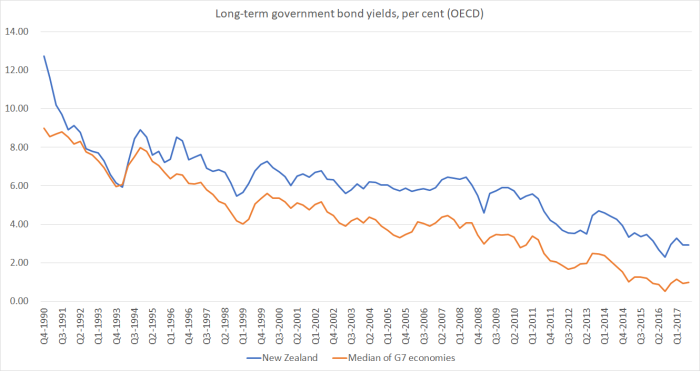
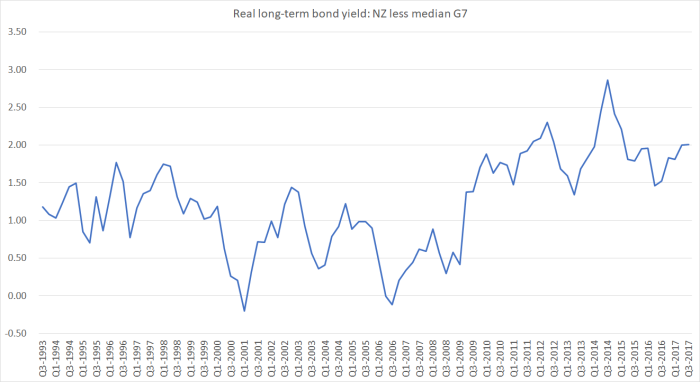
In Friday’s post, I illustrated how persistent and large the gap between New Zealand long-term interest rates and those in other advanced countries has been (and remains).  The summary chart was this one

real NZ less G7

The gap is large and persistent whichever summary measure of other countries’ interest rates one looks at.

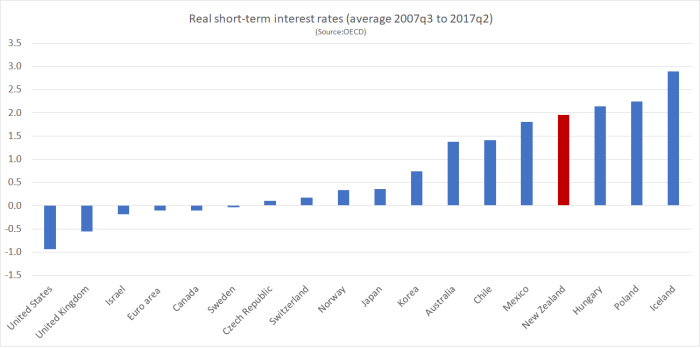
It is also there for short-term interest rates.  In this chart, I’ve shown average real short-term interest rates for the OECD monetary areas (17 countries with their own monetary policies, plus the euro-area) for the last 10 years, adjusting average nominal interest rates for average core inflation (the OECD reported measure of CPI inflation ex food and energy).

real short-term int rates oecd

Of the countries to the right of the chart, Iceland and Hungary have had full-blown IMF crisis programmes in the last decade, and Mexico and Poland had precautionary programmes.  That isn’t meant to suggest that New Zealand is crisis-prone, just to highlight how anomalous our interest rates look relative to those of the other more-established advanced economies.

In yesterday’s post I reviewed some of the arguments sometimes advanced to explain why New Zealand interest rates have been persistently higher than those in other advanced countries.   As I noted, these factors don’t look like a material, or compelling, part of the story:

  • size (of the country),
  • (lack of) economic diversification
  • market liquidity,
  • creditworthiness,
  • accumulated external indebtedness,
  • unusually rapid productivity growth

And, as I noted, none of those explanations has as a corollary a persistently strong real exchange rate.  A story that can make sense of New Zealand’s persistently high real interest rates needs to be able to make sense of the persistently strong exchange rate, and also of New Zealand’s persistently poor productivity performance.  As it is, in a country with a poor productivity performance and the disadvantages of remoteness, one might have expected to find persistently low interest rates and a persistently rather weak exchange rate.

At an economywide level, interest rates are about balancing the availability of resources with the calls on those resources.  In principle, they have almost nothing to do with central banks –  we had interest rates millennia before we had central banks.  They also don’t have anything necesssarily to do with “money”, except to the extent that money represents claims on real resources.

In any economy with lots of exceptionally attractive and profitable opportunities, firms will be wanting to do a lot of investment.  Resources used for investment today might well generate really strong returns in the future, but those resources can’t also be used for consumption (or producing consumption goods) today.  Interest rates play the role prices typically do –  acting as “rationing device”.  Higher interest rates today make some people willing to consume a bit less now, and they also help ensure that the only the investment projects with the higher expected returns go ahead.    In other words, interest rates help reconcile savings and investment plans.  (If they couldn’t adjust that way, the price level would do the adjustment –  and that is where central banks these days come in, adjusting the actual short-term interest rate to reconcile savings and investment plans while keeping inflation in check).

Sometimes the strong desire to undertake investment projects will be based on genuinely great new technologies.    Sometimes it might be just based on a pipe-dream (credit-fuelled commercial property development booms are often like that).   Sometimes, it will be based on direct government interventions (one could think of the Think Bg energy projects).  And sometimes, it will simply be based on rapid population growth –  people in advanced economies need lots of investment (houses, roads, shops, offices, schools etc).

Various factors can influence the desire to save.   If firms in your country have developed genuinely great new technologies, it may seem reasonable to expect the future incomes will be a lot higher than those today.  If so, it might be quite rational to spend heavily now in anticipation of those income gains (consumption-smoothing).  Some governments tend towards the spendthrift, and others towards the cautious end of the spectrum.  Tax and welfare rules might affect desire and willingness to save (although my reading of the evidence is that they affect more the vehicles through which people choose to save).   Demographics matter, and compulsion may also play a part.    Culture probably matters, although economists are often hesitant about relying on it as an explanation.  Business saving is often forgotten in these discussions, but can be a significant part of total savings.

But if, for whatever reason, people, firms and governments don’t have a strong desire/willingness to save at “the world interest rate”, then (all else equal) interest rates in your country will tend to be a bit higher than those in other countries.   And if firms, households and governments have a strong desire to invest (building capital assets) at “the world interest rate”, then (all else equal) interest rates in your country will also tend to be a bit higher than those in other countries.      Quite how much higher might well depend on how interest-sensitive that investment spending is (in aggregate).

Of course, we don’t get to observe actual supply curves for savings, or demand curves for investment.  We don’t know how much New Zealanders (or people in other countries) would choose to save or invest at “the world interest rate”.  Instead, we have to reason from what we do see –  actual investment (and its components) and actual savings.

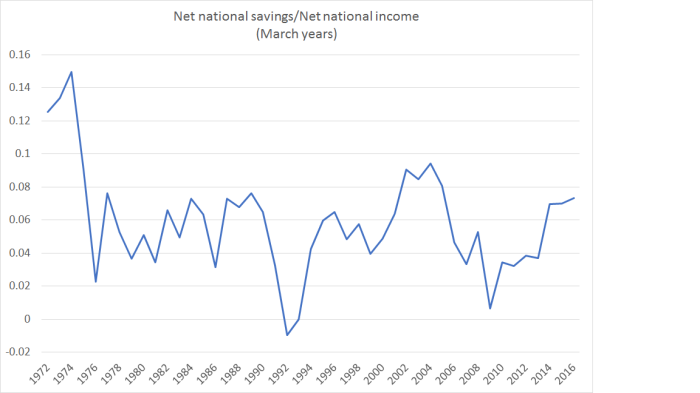
Take savings rate first (and by “savings” here I mean national accounts measure –  in effect, the share of current income not consumed).  Net national savings rates in New Zealand have been similar, over the decades, to the median for the other (culturally similar) Anglo countries, but lower typically than in advanced (OECD) countries more generally.  Savings rates are somewhat cyclical, but as this chart illustrates, for some decades now they’ve cycled around a fairly stable mean (through big changes in eg tax policy, retirement income policy, fiscal policy, financial liberalisation etc).

net national savings.png

All else equal, if tomorrow we woke up and found that somehow New Zealanders had a much stronger desire to save then our interest rates would fall relative to those in the rest of the world.   But that is an illustrative thought-experiment only, not a basis for direct policy interventions.  A relatively low but stable trend savings rate over a long period of time –  especially against a backdrop of moderate government debt –  suggests something more akin to a established feature of New Zealand that policy advisers need to take account of.   A different New Zealand economy might well feature a higher national savings rate –  more successful firms, wanting to invest more heavily over time to pursue great profit opportunities, retaining more profits to reinvest –  but that would be an outcome of a transformed economic environment, not an input governments could or should directly engineer.   Higher saving rates are not, automatically, in and of themselves, “a good thing”.

By the same token, if we all woke tomorrow and (collectively) wanted to build less physical capital (“invest less” in national accounts terminoloy), our interest rates would fall relative to those in the rest of the world.  Actually, that is roughly what happens in a recession: pressure on scarce resources eases and so do interest rates (central banks typically helping the process along).  But less (desired) investment is not, in and of itself, “a good thing”.   Nor, for that matter, is more investment automatically desirable – in the last 40 years, investment/GDP was at its highest in the Think Big construction phase.

Whether over the last 40 years, or just over the last decade, investment/GDP in New Zealand has been very close to that of the typical advanced country.  On IMF data, investment/GDP for 2007 to 2016 averaged 22.0 per cent in New Zealand, and the median advanced country had investment as a share of GDP of 22.1 per cent.

But these investment shares for New Zealand happened with (real) interest rates so much higher than those in the rest of the world.  As I noted earlier, we can’t directly observe how much investment firms, households and governments would want to have undertaken at the “world” real interest rate –  perhaps 150 basis points lower than we actually had.

We might, however, reasonably assume that desired investment would have been quite a bit higher than actual investment.  Both because some investment –  whether by firms, households or (more weakly) government –  is interest rate sensitive, and because we’ve had much more rapid population growth than the typical advanced economy.   In the last 10 years, the median advanced country has had 6 per cent population growth, and we’ve had 13 per cent growth in population.   More people need more houses, shops, offices, road, machines, factories, schools etc.    All else equal, with that much faster population growth we’d have expected more investment here (as a share of current output) than in the typical advanced economy.  But all else isn’t equal, because our interest rates are so much higher.   That population-driven additional demand is one of the reasons why interest rates have been so much higher than those abroad.  Combine it with a modest desired savings rate, and you have pretty much the whole story.

As I noted earlier, some investment is more readily deterred by higher interest rates than others (“more interest-elastic” in the jargon).    Most of government capital expenditure isn’t –  government capex disciplines are pretty weak, and if (say) there are more kids, there will, soon enough, be more schools.  And more people will mean more roads.  A lot of household investment isn’t very interest-sensitive either: everyone needs a roof over their head and (by and large) they get it.    With a higher population growth rate than other countries, on average we devote a larger share of real resources to building houses than other advanced countries typically do (albeit less than might occur with well-functioning land markets).  Business investment is another matter altogether.  Businesses only invest if they expect to make a dollar (after cost of capital) from doing so.  All else equal, increase the interest rate and less investment will occur.  That won’t apply to all sectors, because in the domestically-oriented bits of the economy not only are interest rates higher, but the underlying demand is higher (more people).  And so non-tradables sector investment probably isn’t very materially affected.  But for the bits of the economy exposed to international competition (whether exporting, competing with imports, or supplying firms that do one of those) it is a quite different story.  An increased population here doesn’t materially increased demand, and a higher cost of capital makes it harder to justify investment in the sector.

And all that is before even mentioning the exchange rate.

In an open economy, the floating exchange rate system is what allows countries to have different (risk-adjusted) nominal interest rates.  Without a floating exchange rate, higher interest rates here would offer a “free lunch”, and the interest rate differences wouldn’t last.   With a floating exchange rate, one can have differences in interest rates across countries, but the exchange rate adjusts such that, overall, expected returns are more or less equal across markets.  Higher interest rates here are, roughly speaking, offset by an implicit expectation that one day our exchange rate will fall quite a lot.  It appreciates upfront, to create room for that future depreciation.

The exchange rate, of course, also serves as a “rationing device”.    Some of the high domestic demand spills over into imports.  And the higher exchange rate makes exporting less profitable, all else equal.  And so when we have domestic pressures (savings/investment imbalances at “world” interest rates) that put upward pressure on our interest rates, not only is business investment in general squeezed, but the squeeze falls particularly on potential investment in the tradables sector.  Firms in (or servicing) that sector face a double-whammy: a higher cost of capital, from the higher real New Zealand interest rates, and lower expected revenues as a result of the higher exchange rate.

We don’t have good data on investment broken down between tradables and non-tradables sectors. But we do know that overall business investment as a share of GDP has been towards the lower quartile among OECD countries (whether one looks back one, two, three or four decades), even though we’ve had faster population growth than most.  We also know that there has been no growth at all in tradables sector real per capita GDP since around 2000, and we know that the export share of GDP has been flat for decades (even though in successful economies it tends to be rising).   Those stylised facts are strongly suggestive of a situation in which:

  • lots of government investment takes place (market disciplines are weak),
  • lots of houses get built (even if not enough –  because people need a roof over their heads),
  • a fair amount of investment occurs in the non-tradables sectors, despite the high interest rates, but
  • a great deal of potential investment in the tradables (and tradables servicing) sectors has been squeezed out.

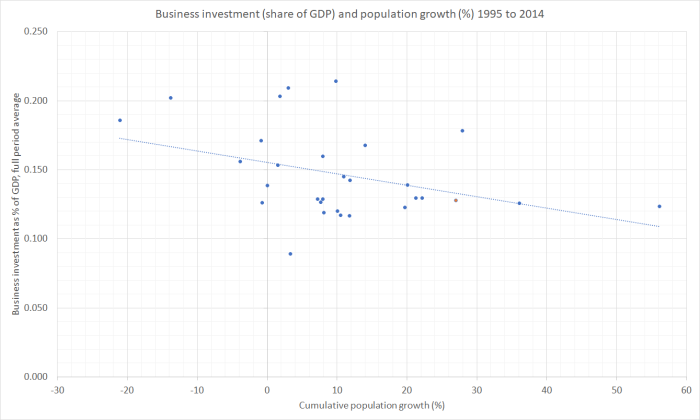
That is, roughly speaking, how we end up with rapid population growth and yet an investment share of GDP that is no different from that of a median advanced economy.  We know that population growth seems to adversely affect total business investment across the OECD (I ran this chart a few months ago)

Bus I % of GDP

And it is surely only commonsense to reason that tradables sector investment will have borne a lot more of the brunt than the non-tradables sectors.

I’m not getting into the details of immigration policy in this post.  Suffice to say that our immigration policy –  the number of non-citizens we allow to settle here –  is the single thing that has given New Zealand a population growth rate faster than that of the median OECD/advanced country in the last 25 years or so.  It is, solely, a policy choice.  Our birth rate is a little higher than that of the median advanced country, but we have a large trend/average outflow of New Zealanders.  So, on average, the choices of individual New Zealanders would have resulted in a below-average population growth rate (again, on average over several decades).  And that, in turn, would seem likely to have delivered us rather low real interest rates and a lower real exchange rate.  Real resources would have been less needed simply to meet the physical needs of a rising population, and more firms in the tradables sectors would have been able to have overcome the disadvantages of distance. And our productivity outcomes –  and material living standards – would, as a result, almost certainly have been better.

You can read about all this at greater length in a paper I did for a Reserve Bank and Treasury forum on the exchange rate and related issues back in 2013.

NZ interest rates are still remarkably high

By international standards that is.   And that gap, between our interest rates and those abroad, is nothing much to do with monetary policy.

If the new government is serious about addressing New Zealand’s dismal long-term productivity growth record –  which has been particularly poor in the last five years – it needs get serious about recognising that one of the key symptoms of our structurally unbalanced economy is that persistent gap between real interest rates in New Zealand and those almost anywhere else in the world.

Of course, the big story about interest rates over the last 25 years or more has been the persistent downward trend in the level of nominal and real interest rates.  In this chart, I’ve illustrated that for New Zealand and the median of the G7 advanced economies, using the OECD’s series of long-term interest rates (usually a 10 year government bond).  To stress, these aren’t central bank policy rates, but market-determined long-term yields.

long-term bond yields Nov 17

Once upon a time, very briefly, our long-term interest rates actually touched those (median) foreign rates.   But the dominant story in both series is the downward trend.  In fact, there is no real sign that the trend has yet ended –  each peak, for example, still looks a little lower than the previous one.

Inflation was falling a lot in many countries in the 80s and early 90s, but for the last 20 years or so core inflation has been pretty low and stable in the core advanced economies. In other words, the falls in international interest rates in the last 20 years or so have almost entirely been falls in real interest rates too.

core inflation G7

What about the gap between New Zealand and world interest rates?   Here is the gap between the two series shown in the first chart above.

gap between NZ and world int rates

The gap collapsed, briefly, in the early 1990s as we got on top of inflation, actual and expected short-term interest rates came down, and NZD assets became very attractive globally.  But the compression didn’t last.  Since around 2004 the gap between New Zealand bond yields and this measure of global rates has fluctuated around 200 basis points, with no obvious trend.   (The gap is smaller than that, typically, relative to the United States, and much larger relative to Japan and Germany.)

(I should stress that there is no single right way to summarily aggregate the various overseas long-term interest rates.   Whichever median of some of all OECD countries I used, the broad pattern was much the same, although the absolute size of the gap differs.)

What about real interest rates.   In this chart, I’ve adjusted the median G7 nominal interest rates using the median CPI inflation ex food and energy (the core inflation measure the OECD reports) for the G7 countries, and adjusted the New Zealand interest rates by the Reserve Bank’s preferred sectoral factor model measure.  The sectoral factor model data starts only in September 1993, so that is when I start this chart.   In principle, one might want to do the adjustment using measures of inflation expectations, but there are no consistent long-term measures available across countries.  Core inflation can be thought of as a proxy for inflation expectations.

real NZ less G7

Not only has there been no sign of the gap between New Zealand and “world” real interest rates closing, but if anything the gap has been wider since around 2009/10 than we’d seen previously.  On this measure, the gap has averaged 190 basis points over the past 8 years.

These are really large gaps.  On this measure, over the life of a 10 year bond they make for a 20 per cent difference in total returns.  That makes it a lot harder for a potential investment project evaluated in New Zealand to stack up than it would be for an equivalent project in other countries.

It is also tends to be reflected in big differences in exchange rates.   Those higher yields in New Zealand, if expected to persist, will look very attractive to overseas investors.  It might even look like a “free lunch”.  What takes away the “free lunch” dimension is an appreciation in the real exchange rate now, such that over the following 10 years the exchange rate is expected to depreciate just enough to leave the investor indifferent between holding NZD assets and those in other currencies.   That isn’t a mechanical relationship, but it is a pretty strong tendency.  It is the bigger-picture of the sort of modest jump (fall) in the exchange rate we often see when a Reserve Bank OCR announcement is surprisingly hawkish (dovish).    Comparing 10 year rates, it could account for a 20 per cent ‘overvaluation’ of the exchange rate.  On even longer-term rates the cumulative differences are even larger.  No wonder we don’t see much new investment in the tradables sector in New Zealand.

Perhaps you still doubt that the real interest rates gaps can really be as large as these summary series suggest.   We can check the sotry by looking directly at yields on inflation-indexed bonds issued by governments in various advanced countries.     Getting time series data for some of these countries can be a pain (unless one is setting in front of a Bloomberg terminal), but these are some of the current interest rates I tracked down a few days ago.

Our longest maturity inflation indexed bond matures in September 2040 (23 years away).  On Monday the Reserve Bank was reporting a real yield of 2.22 per cent on that bond.

The Australian government issues an indexed bond maturing on exactly the same date. The real interest rate on that bond, again on Monday, was (so the RBA reports) 1.18 per cent.

So even relative to Australia –  which also has quite high interest rates by advanced standards –  our very long-term real interest rates are very high.

What about some other countries?

The United States has an inflation indexed bond maturing in February 2040.  According to the Wall St Journal tables that bond opened the week yielding 0.89 per cent, roughly 130 basis points lower than the New Zealand 2040 bond.

Canada has a 2044 indexed bond, which was yielding about 0.75 per cent.

I could only find data for a 10 year Japanese inflation indexed bond, which appeared to be yielding about -0.4 per cent.

And Germany offers a range of maturities for its government inflation indexed bonds.   A few days ago, the 2030 bond was yielding -0.67 per cent, and the 2046 bond –  almost 30 years to maturity –  was yielding -0.34 per cent.

(UK indexed bond yields are not directly comparable because the tax treatment of the inflation adjustment is materially different).

There is certainly a range of real long-term yields across countries.    But ours are extremely high relative to those in other core advanced economies.

A year ago, I wrote a post along similar lines (although looking at the data in slightly different ways).  In that post I concluded

…our interest rates (a) are and have been higher than those abroad, (b) this is so for short and long term interest rates, (c) is true even if we look just at small countries, and (d) is true in nominal or real interest rate terms.  And the gap(s) shows no sign of closing.

All that is as true today as it was then.  It should be worrying anyone seriously interested in lifting New Zealand productivity and long-term per capita income performance.  On Monday, I will review some of the possible explanations for the gap –  partly to back the claim that it is a symptom that we should be worrying about, and partly to point in the direction of possible, and sensible, remedies.


Jian Yang again/still

In September, a couple of weeks before the election, the Financial Times and Newsroom published a story about the National MP Jian Yang.  The story revealed that Yang, who lived in China until age 32, had been a member of the Chinese Communist Party, and a member of the Chinese military intelligence establishment, and suggested that Yang –  formerly a member of Parliament’s foreign affairs committee –  may have been investigated by the Security Intelligence Service.    Questions were raised as to how much of this background the National Party had been aware of when they first selected him in 2011.  None of it had been known to the voters at the time.

The story got a day’s coverage in various local media and then largely went cold in New Zealand, even though it was just before the election, and although it happened to coincide with the release of a major paper by Canterbury University politics professor (and China expert) Anne-Marie Brady, raising substantial and documented concerns about the influence China was seeking to exert in New Zealand, both through the (former) Chinese diaspora (people in public life like Yang and Labour MP Raymond Huo), among Chinese New Zealanders, and (for example) through the recruitment of various prominent New Zealanders to well-remunerated roles in which they might be either well-disposed to Chinese interests, or at least unable/unwilling to voice any concerns about China’s activities and policies.    Professor Brady herself summarised the issue thus

This policy paper examines China’s foreign political influence activities under Xi Jinping, using one very representative state, New Zealand, as a case study. New Zealand’s relationship with China is of interest, because the Chinese government regards New Zealand as an exemplar of how it would like its relations to be with other states. In 2013, China’s New Zealand ambassador described the two countries’ relationship as “a model to other Western countries”. And after Premier Li Keqiang visited New Zealand in 2017, a Chinese diplomat favourably compared New Zealand-China relations to the level of closeness China had with Albania in the early 1960s. The paper considers the potential impact of China’s expanded political influence activities in New Zealand and how any effects could be mitigated and countered.

Yang himself has largely avoided the media.    But papers released under the Official Information Act confirmed that he had not told New Zealand authorities about his involvement with Chinese military intelligence, instead suggesting he had worked and studied at some quite different institutions.   Asked why, he responded that the Chinese authorities had told him to do so when he had left China (years earlier), and that was the way things were done in China.   That only heightened the concerns.

I wrote various pieces about the issue, noting (for example) that we should no more regard it as acceptable to have in our Parliament a former Chinese Communist Party member, former member of China’s military intelligence, someone who continues to hob-nob with the Chinese embassy, and who has never said a public critical word about Communist China (even as Xi Jinping increases the repressiveness of the regime) than it would have been to have a former KGB/GRU party member, associating closely with the Soviet Embassy, in our Parliament in the 1970s.  No one would have countenanced the latter.  It remains staggering –  and alarming about either the blindness of our elites, or the extent to which they’ve been suborned  (eg Yang is acknowledged as a major National Party fundraiser) –  that the Yang situation still appears to be regarded as acceptable in many quarters.

My own direct involvement was pretty tangential, when at a local candidates meeting a couple of days before the election, I asked a senior National Party minister –  Attorney-General and Minister for the SIS no less – about why it was acceptable to have such a person as a National Party candidate and MP.    Disgracefully, Chris Finlayson suggested that any concerns were just racist and that Professor Brady just didn’t like any foreigners.  Almost as disgracefully, the candidates of the other parties sat mute.

The story has had continued coverage abroad, including a nice New York Times piece a few weeks ago.  Serious –  pretty liberal –  international media such as the NYT and FT have taken the story seriously.    Our own media was slow to.  No doubt that suited the politicians –  at least those of the major parties.

But this week, the story seems to have gathered a fresh head of steam.   Our new Minister of Foreign Affairs, who had  previously talked on the need for an inquiry, by last week was avoiding questions on that topic, suggesting instead that the media could give the issue some more coverage.   And so, no doubt coincidentally, they did.

First, there was a substantial article by Matt Nippert in the Herald. Nippert notes that his article drew on “interviews with diplomatic and intelligence sources over the past month, including several with current security clearances”  –  which is surely less impressive than it sounds, as huge numbers of people in Wellington have security clearances (I did for years) –  but those sources seem to have added only a bit more colour, rather than revealing anything substantially new.    Nippert’s article is organised around what he calls “three unanswered questions” regarding Jian Yang:

  • What is Luoyang University?  This is the institution Yang claimed he had studied and taught at, rather than disclosing from the start that for much of his time he had actually been at a People’s Liberation Army academy.
  • Did Yang have access to sensitive materials (as an MP, member of the foreign affairs committe, and as –  otherwise junior –  MP accompanying John Key and Tim Groser on official trips to China)?
  • Why the official silence?

I’m not sure these really are the biggest issues now.   We know –  because Yang told us –  that his citizenship or residency applications details were (deliberately) misleading.    That is probably quite serious at a personal level, and probably warrants more from government departments than we’ve had to date.

Both Internal Affairs and Immigration NZ have said the revelations about Yang’s background and apparent lack of disclosure were not grounds to review their handling of the matter. A spokesman Immigration NZ went as far as to say “no new information has come to light which would warrant an investigation”, despite the facts being novel enough to warrant front-page coverage last month in the London-based Financial Times.

But, frankly, it seems like a second-order issue.  A man with his background, and ongoing associations, should not be a New Zealand MP, whether or not his citizenship application was all in order.

As for the information Yang may have been exposed to, even Nippert’s sources aren’t really alarmed.

Another source said Yang’s background – and closeness to New Zealand’s PRC embassy – was well-known in senior Wellington circles and had led to self-censorship. “I’m sure everyone is aware of that, and would be careful about what they say in his presence,” the source said.

“Would Jian have seen the briefing papers that were given to John Key? Almost certainly. He sat up the front of the aircraft with the Prime Minister and his advisers – I can’t imagine for a moment he didn’t have access to it.”

The source said this briefing document – unlikely to include top-secret classed intelligence from the Five Eyes network – would have been given a classification of confidential or higher.

In other word, just not that sensitive, even on the government’s own official classifications.

If there was  particular risk to New Zealand interests around his official position it was probably much more about the possibility that he might have one day become a Minister of the Crown.

The Herald tackled the third question –  the official silence –  in an editorial on Tuesday.

International media have rightly shown a keen interest in the affair.  But locally, interest – and answers – have been strangely muted. Neither National leader Bill English nor Prime Minister Jacinda Ardern seemed willing to address the issue during the election campaign. NZ First’s Winston Peters initially demanded an inquiry, but has gone silent on the matter since his elevation to Minister of Foreign Affairs.

Ardern has inherited a role that includes oversight of New Zealand’s intelligence agencies and will undoubtedly have been briefed on the Yang situation. She needs to reassure herself and then, in appropriate fashion, the public that the matter has been – or will promptly be – properly addressed.

But again, the issue of the intelligence services seems to be rather of a red-herring.     Yang, after all, now certainly has no access to anything particularly secret –  he’s an Opposition backbencher.  On the other hand, Raymond Huo –  who appears to also be closely associated with China’s United Front Work Department efforts in New Zealand –  is part of the governing party.    As Professor Brady puts it

Huo also has close contacts with the Zhi Gong Party 致公党 (one of the eight minor parties under the control of the United Front Work Department). The Zhi Gong Party is a united front link to liaise with overseas Chinese communities, as demonstrated in a meeting between Zhi Gong Party leaders and Huo to promote the New Zealand OBOR Foundation and Think Tank.

It was Huo who made the decision to translate Labour’s 2017 election campaign slogan “Let’s do it” into a quote from Xi Jinping (撸起袖子加油干, which literally means “roll up your sleeves and work hard”). Huo told journalists at the Labour campaign launch that the Chinese translation “auspiciously equates to a New Year’s message from President Xi Jinping encouraging China to ‘roll its sleeves up’.”

How sick is that? Invoking associations with Xi Jinping.

As a citizen, what worries me isn’t so much backbenchers giving away New Zealand secrets to China –  apart from anything else, they generally won’t have such access –  as the way in which such Members of Parliament seem to act as if the interests and views of the increasingly oppressive Chinese government and Communist Party are things for them to advance in New Zealand.   That is an issue both main parties look as though they need to confront, rather than being an issue primarily for the intelligence services.  Migrants should be welcome, once they become citizens, to be elected as members of Parliament, but it is probably particularly important for such members to be clear –  not just in words, but in conduct –  that their loyalties are only to the interest of New Zealand and (all) its citizens.  If Chris Liddell  –  a New Zealander on the White House staff –   spent lots of time hob-nobbing with the New Zealand Embassy, the US might reasonably wonder whose interests he was serving.  If Julie-Anne Genter does (which I’m sure she doesn’t) something similar with the US Embassy here, the same concerns would appropriately arise.  And recall that China is not just any country; it is today’s Soviet Union. A threat to all sorts of countries, including the free ones of east Asia.

Our main non-commercial media outlet, Radio New Zealand, was very late to the issue.  But this week they too have done their bit.   First, Bill English finally faced a reasonably searching interview on the subject (on Morning Report).  It was an astonishingly feeble performance, featuring repeated refusals to answer questions in any way other than “you’d have to ask Dr Yang that”, when the leader of the National Party knows that Yang has refused to make himself available for a proper interview, and for weeks has refused to answer any questions (Nippert’s experience as well).    The former Attorney-General, who claimed it was all racist, still holds a senior position in Mr English’s caucus.

And then there was John Campbell, who in his inimitable style last night illustrated the repeated refusal of Yang –  an elected member of Parliament –  to front the media.  According to Campbell, Radio NZ has been trying to get him to talk every day for weeks.  Calls simply go through to voicemail and are never returned.  Radio NZ even went to Yang’s house, but couldn’t get past the (unanswered) buzzer at the gate.

It reflects shockingly poorly on almost everyone in political life involved in this situation:

From the National Party side:

  • Jian Yang
  • Bill English,
  • Peter Goodfellow, President of the National Party,
  • Chris Finlayson, and
  • the rest of the caucus, not one of whom has been willing to break ranks (although Radio NZ did claim senior National Party sources were becoming increasingly uneasy).

And what of the new government?

  • There is the Prime Minister, who has never uttered a disapproving word, in the election campaign or since, about Dr Yang (not even about his silence),
  • The Minister of Foreign Affairs,
  • The leader of the Green Party, a party which appears not to rely on lots of diaspora fundraising, who is often strong on protecting our sovereignty, and yet who raised no concerns,
  • Raymond Huo, who surely some media should ask for a proper interview.

And then, of course, there are the obsequious members of the New Zealand China Council, and former leading figures in the National Party with a personal economic interest in keeping quiet.

Jian Yang’s political career is probably now effectively over.  Perhaps he’ll linger for a while, but it is inconceivable that he could rise any higher.  It is a disgraceful reflection on New Zealand, and on the National Party – and those other parties who could have spoken out and didn’t –  that an unrepentent Communist, unrepentant former intelligence services member of a hostile, expansionist government with a total disregard for human rights, sits in our Parliament still.  And simply refuses to face the media.  But that particular damage is probably done, it is just now a matter of tidying up the mess at some point.

The bigger questions would seem to be about the political and business culture that has been so indifferent to the specifics of Yang, and of Huo, to political fundraising from foreign sources, and to the sort of influence-seeking activities –  both among New Zealand Chinese citizens and in the wider political and economic system –  that Professor Brady has highlighted.    Professor Brady’s paper raises issues that really should be addressed in a proper inquiry, but also in some considerable soul-searching among New Zealand’s political and business elite about how New Zealanders’ interests, and reputation, as a free and independent state are best-served, and how best we –  and similar countries –  resist the inroads the Chinese Communist Party is making and, we can assume from the last Party congress, will only continue to seek to make.  As I noted in an earlier post, trade has muddied the waters: we had a clearer-eyed perspective on the Soviet Union than we seem to have about Communist China, a state on whose fortunes various elite institutions/companies and their chief executives (but not New Zealand’s overall fortunes) depend.   Perhaps our media too might ask themselves some questions, about what took them so long, made them so seemingly reluctant, to ask the hard questions about these issues.  Overseas comentators have been willing to, but the involvement of much of our own media seems quite halting and reluctant at best.


Making progress on housing?

I’ve been quite sceptical that either side of politics –  whichever group of parties won the election – would address the fundamental distortions that have rendered urban land and houses so expensive.  After all, successive National and Labour-led governments had enabled us to get, and overseen us actually getting, into this mess.  And for anyone looking to the minor parties, New Zealand First had previously been part of, or supported, governments of both stripes, and the Greens –  with a taste for rapid population growth and restrictive planning laws –  didn’t seem any more hopeful.   Neither the Prime Minister nor the Leader of Opposition, before or after the election, seemed interested in seeing lower house prices.

An optimistic supporter of the Labour Party yesterday put it to me –  it was Reformation Day , and the 500th anniversary of Luther nailing his theses to the door of the church in Wittenberg –  that not even the Pope could stop an idea whose time had come.   As I noted in response, the general point was no doubt true, but plenty of aspirant reformers misjudged when “the time had come”, when the mood and opportunity for change had become irresistible.   Often they paid a dreadful price.   In modern democracies, of course, that usually only means losing the next election, or quailing at the prospect and just not doing anything much of substance at all.

As I’ve noted various times previously –  including in this post a year ago – while there are plenty of examples of successful places (notably now in significant parts of the United States) without tight land-use restrictions limiting housing development, I’m not aware of any country (or even region/major city) that, having once adopted the morass of planning laws and associated restrictions, has ever successfully unwound those controls.  And thus we have house prices as they are in New Zealand, or Australia, or much of the UK, or California (and many other parts of the United States).

Housing was a significant issue in the election campaign, but perhaps less significant than it might have been if Auckland prices had still been rising strongly this year.  Four of the items on Labour’s pre-election 100 day plan were housing-related:

  • Pass the Healthy Homes Guarantee Bill, requiring all rentals to be warm and dry
  • Ban overseas speculators from buying existing houses
  • Issue an instruction to Housing New Zealand to stop the state house sell-off
  • Begin work to establish the Affordable Housing Authority and begin the KiwiBuild programme


Whatever the merits of some of them, nothing on that list was seriously likely to address the fundamental regulatory distortions that have stopped the housing and urban land markets working effectively.

Today the headlines are dominated by the announcement that the government appears to have found a way to ban non-resident non-citizens from buying existing homes, by amending the Overseas Investment Act to classify all the land under such dwellings as “sensitive land” (for which we reserved rights to “adopt or maintain any measure that requires the following investment activities to receive prior approval by the New Zealand Government under its overseas investment regime” –  page II-59 of this Annex to the Korea-New Zealand agreement).      Given that the Act requires a “national benefit” for any overseas investment in “sensitive land”, and it is difficult to conceive how a potential non-resident purchaser of a house could demonstrate such a benefit given the criteria set out in the Act, it looks to this lay reader like a clever wheeze that should, largely, be effective.

But to what end, other than political signalling?   At the margin, presumably transactions costs for all purchasers of houses, anywhere in New Zealand, will increase a bit forever (will we all have to verify that we are residents or citizens?).    More importantly, is there any evidence at all that a law change like this will increase housing supply?    And is housing supply, as distinct from land supply, the real issue at all?   The argument is supposed to run that if non-resident foreigners want to buy in New Zealand they will have to build, or buy a newly-built house, instead (as is, indeed, the law in Australia).    If the law discourages foreign purchases in total it will, to some extent, ease overall demand pressures –  although experiences with provisions like the British Columbia stamp duty suggest the effect might be quite shortlived –  but if it simply leads foreigners to bid for new houses rather than existing houses, presumably residents and citizens will –  at the margin –  buy more existing houses rather than new ones.     The law is likely to change, at the margin, who buys which type of dwelling, but why will it increase overall supply?     The land market is rigged, by regulation, to be as unaffordable as ever.  That won’t change as a result of this policy.  Any issues around development finance, council consenting, or infrastructure won’t change either.   In many cases, non-resident non-citizen purchasers –  however many there truly are –  probably already prefer new apartments (if, for example, what concerns them is an easily-maintained and secured store of value).    Perhaps there is evidence from some other places that such a restriction has increased effective supply?  If so, it would be good to have it drawn to our attention.   As it is, as I noted the other day, if the goal is real impact on housing affordability for New Zealand there is probably a stronger case for banning all house purchases by non-resident non-citizens than simply banning purchases of existing dwellings.

For the moment though, it is telling that the sound and fury –  perhaps even lifting the government’s poll ratings –  is around a measure that might dampen demand very slightly, and should do almost nothing to increase supply.    No doubt there is a place for signalling in politics.  But if you want to believe that real structural reform is coming, wouldn’t it have been reassuring to have seen something tangible around land supply in the 100 day plan, or emerging –  together with the non-resident ban –  from yesterday’s first substantive Cabinet meeting?  The Minister of Housing is quoted in the media talking about potentially using the Public Works Act to confiscate private land (and the Public Works Act provisions, while necessary for some limited purposes, never adequately compensate owners).  But not about allowing private land owners to use their own land more freely.     Labour went into the election promising

Labour will remove the Auckland urban growth boundary

Couldn’t that have been made part of the 100 day plan?   Or what about a piece of legislation allowing any geologically-stable private land to be used for housing, up to two storey height, without further resource consent (preferably for the whole country, but at least say in a circle with a radius 100 kms from downtown Auckland)?     Yes, there are still transport and infrastructure issues to be resolved –  so perhaps make the commencement date of the new legislation 12-18 months hence – but changes in this area –  land-use rules –  get much closer to the heart of the problem.    If there is a problem with “land-bankers”, it is a problem created by regulation and legislation, which removes the element of free competition from the market for developable land.  And, perhaps to balance the potential to increase the physical footprint of cities, how about a Working Group to report back within six months on options for allowing groups of residents/existing owners to contract out of existing planning restrictions when collectively those owners judge doing so to be mutually beneficial?

But this all highlights the question as to whether the government is really willing, let alone wanting, to see house and urban land prices fall.    On that score, the evidence is mixed at best.    Both the current Prime Minister, and her predecessor as leader of the Labour Party, have fallen over themselves to deny such an interest, and both have proved very reluctant to talk prominently about land-use reform (although I’m told that in small meetings  –  including during the Mt Albert campaign – the PM can talk fluently on the topic), favouring instead a public focus on (a) tax changes, (b) non-resident bans, and (c) state-driven building activity (much of which is likely to displace other building, since there is little evidence of unmet excess demand at current house+land prices).

On the other hand, Labour’s official housing policy has sounded promising, and both Phil Twyford (Minister of Housing) and David Parker (Minister for the Environment) have a promising track record.  In the previous Parliament, Parker moved an amendment –  which came very close to passing –  that would have removed the urban growth boundary around Auckland.  But Opposition –  when you don’t live with the consequences (gains and costs) – is different from government, and tactical embarrassment of an incumbent government, is different from managing a tri-party government and implementing serious structural reform.   Greens/Labour/New Zealand First agreement was presumably easy around the non-resident ban, but will probably be lot harder around fixing the land market (especially now that the government has recommitted to the “big New Zealand” approach to immigration and population).

I’m not ready to be very critical of the new government yet. But my scepticism about the prospects of serious reform remains.  It isn’t really about individuals or personalities –  as I’ve noted, past governments for 25 years have also done little or nothing –  but about incentives, risks, and precedents.  In that post I wrote a year ago I concluded

Individual political leaders can make a real difference.  It would be great if one would stake a lot on urban land use reform, but anyone considering it needs to recognize the lack of precedents, the potential losers, and the worries and beliefs that underpin the durability of the current model here and abroad. And they probably need to find not only the right language to help frame repeal choices and options, but find a package of measures which helps allay – even if only in part, and for a time –  the sorts of concerns some have.

(If anyone was serious about reform, and lowering house prices, I suggested a possible limited compensation scheme here.)

In a three year electoral term, if serious reform is going to happen it needs to be got under way quite quickly.  Whatever the possible merits of KiwiBuild (and I don’t have strong views) at present it looks as if there is risk that it –  with lots of activity –  will crowd out addressing the real issues around land use law that have, unnecessarily, given us among the highest house price to income ratios anywhere in the advanced world.


Towards a definition of the (un)employment objective

In my post the other day, I outlined one way in which the unemployment concerns that appear to be behind the Labour Party’s desire to amend the statutory objective for monetary policy could be implemented in a new Policy Targets Agreement, even before the Reserve Bank Act itself is amended.

We still have no specifics as to how the Labour Party (and now the Labour-led government) envisages changing the Act.  But in an interview on Radio New Zealand this morning I heard the Minister of Finance talking about looking to the specifics of the Australian and US legislation.   I didn’t find that very enlightening or reassuring.

The Reserve Bank of Australia was set up in 1959, and the section of its legislation relating to monetary policy goals and objectives was in the original.

It is the duty of the Reserve Bank Board, within the limits of its powers, to ensure that the monetary and banking policy of the Bank is directed to the greatest advantage of the people of Australia and that the powers of the Bank … are exercised in such a manner as, in the opinion of the Reserve Bank Board, will best contribute to:

a.  the stability of the currency of Australia;

b.  the maintenance of full employment in Australia; and

c.  the economic prosperity and welfare of the people of Australia.

In 1959, Australia –  like most countries –  had a fixed exchange rate, so that “the stability of the currency of Australia” meant the external value of the currency.  The provision has since been re-interpreted, and as is now taken as meaning the domestic value of the currency (ie domestic price stability), but no one would write the provision that way today.

This wording is also legitimately subject to the criticism made by those who disagree with what Labour is proposing.  It makes no attempt to distinguish between the short and long run, and thus does not recognise that monetary policy cannot affect the longer-term rate of unemployment at all.    The Australian legislation also has nothing like a Policy Targets Agreement (the document that resembles a PTA is informal and non-binding) and provides far too much discretion to the Reserve Bank.  That discretion has not been blatantly misused in recent decades –  a period when the actual conduct of monetary policy in New Zealand and Australia have mostly been quite similar –  but the legislation should not provide any sort of model for New Zealand as to how best to specify the goals of monetary policy.

What of the United States?   Much is made of the “dual mandate” that has guided the Federal Reserve over the decades.   But even that, mostly quite sensible, conduct of policy rests on a rather slender and unreliable legislative footing.    The statutory objectives in the Federal Reserve Act were set out in 1977, around the high tide of monetarism, and read as follows:

Section 2A. Monetary policy objectives

The Board of Governors of the Federal Reserve System and the Federal Open Market Committee shall maintain long run growth of the monetary and credit aggregates commensurate with the economy’s long run potential to increase production, so as to promote effectively the goals of maximum employment, stable prices, and moderate long-term interest rates.

In other words, the Fed is actually mandated to pursue long-term money and credit growth targets, in the belief that doing so will promote (a) maximum employment, (b) stable prices, and (c) moderate long-term interest rates.  Again, no one would write the statutory objectives that way today, and the formulation should offer little or no guide to anyone looking to overhaul the objectives of our own central bank.  In practice, of course, the Federal Reserve works around the statutory formulation, rarely citing it directly.  I think they way they run monetary policy in practice is quite sensible –  and typically not that different to the way the Reserve Bank here has often run policy –  but I bet they wish Congress had written the goal a bit differently in 1977.

In an ideal world, both the Australian and US statutory provisions would be updated and amended.  It isn’t desirable to have powerful autonomous agencies working under the mandates that don’t reflect today’s understandings of policy, leading those agencies to creatively reinvent their own mandates.  Those reinventions probably lead to better policy in the short-run, but the process of doing so undermines confidence in the role of legislatures in mandating, and holding to account, such agencies.

If one looks around the advanced world, there are lots of different ways of specifying central bank objectives. In most cases, the wording is considerably more recent than either the US and Australian examples.  A few years ago a colleague and I did a Reserve Bank Bulletin article reviewing those formulations –  the work initially prompted by the approach of the 2014 election, when Labour was also proposing changes.   As we noted,

Despite the similarities in how monetary policy is operated, there is a wide range of ways in which legislation and supplementary documents specify the medium- and longer-run aims societies have for monetary policy. In some countries the focus is more on the economic outcomes that a successful monetary policy could contribute to over the longer-term.  In others it is more on what monetary policy can more directly achieve. These differences do not seem to primarily reflect very different views of what monetary policy could reasonably accomplish. Specific national circumstances influence how formal documents are written. And older legislation often looks different than legislation adopted in the past 10-20 years, with the latter typically having a more explicit focus on domestic price stability. In some countries, formal documents say relatively little about what monetary policy is expected to achieve, while in other countries the formal documentation is more extensive.

As I’ve noted here previously, I think the sort of statutory change Labour seems to be talking about makes some sense.  In part, that is because monetary policy has –  ever since the late 80s –  been a divisive political issue here in a way that it hasn’t been in other countries.  In part, it is because of the failings of the Reserve Bank –  with many fewer constraints than their peers in many other advanced countries –  over the Wheeler years in particular.    But I’m not sure that the way other countries have worded their legislation is going to be of very much assistance to Treasury and the Minister of Finance as they attempt to come up with some specific proposals.     If I was to offer them specific suggestions, they would involve changes to the purpose clauses , to the clause governing the primary function of monetary policy, to clause 10, and to the clause governing Monetary Policy Statements.

It is perhaps worth remembering that over the life of the Reserve Bank –  now 83 years –  there have been various different formulations of the statutory goals of monetary policy.  Those changing goals were also discussed in a Bulletin article a few years ago.  When the first legislation was enacted in 1933, the statutory goal was simple, if not specific

It shall be the primary duty of the Reserve Bank to exercise control […] over monetary circulation and credit in New Zealand, to the end that the economic welfare of the Dominion may be promoted and maintained (1933, s12).

It is worth remembering that it simply isn’t possible to write down, whether in statute or in a PTA, all that one wants a good central bank to do in conducting monetary policy.  Or, at least, it hasn’t been since we went off the Gold Standard in 1914.     There is no perfect formulation, and good people –  sound judgement and a good understanding of the issues and constraints –  matter as much as precise wording.  Each generation faces differing shocks, differing sets of circumstances, and different things that aren’t well understood.  It is easy, and tempting, simply to set out simple wording like what is in the Reserve Bank Act now.  So long as it is understood not to capture everything –  and successive Governors and Ministers have recognised that –  it may not do much harm, and it keeps a focus on the long-term limitations of monetary policy.  But, equally, we have active discretionary monetary policy because we believe that monetary policy can do other useful stuff in the short to medium term.  Finding ways that reflect that understanding and translating them into legislative wording has its risks –  as not doing so does –  and can’t be done perfectly, but that isn’t a reason for not doing it at all.

And finally, it is worth remembering that, whatever the precise statutory wording, past research has found that, on average, the Federal Reserve, the Reserve Bank of Australia, and the Reserve Bank of New Zealand have tended to conduct monetary policy in much the same way, faced with similar shocks.


Ill omens for our democracy

When, on Saturday afternoon, my son mentioned that a National Front protest had been driven out of Parliament grounds I was a bit puzzled.  “Do you mean in London?”, I asked.

But it turns out the event in question was here in Wellington.  I wasn’t aware we had a National Front in New Zealand.  They even have a website (which I am not linking to).

From various media accounts (Newshub, Stuff, Herald, Radio NZ), it seems that the National Front had, some weeks ago, sought and obtained permission to hold a rally in the grounds of Parliament on Saturday.  So far, so unsurprising,  All sort of groups hold rallies there.  Understandably enough, as it is our Parliament.   Some of those groups you agree with, some you disagree with, some are pretty odious, and some rallies you might even be tempted to join in (I never have).

But from the other side of the political spectrum –  far to the other side – there was a group who didn’t just dislike the National Front, deplore their views, disagree with them about almost everything, but thought it was wrong that such people should even be able to hold a rally and express their views.    And so out went a call to stop them.   Not just to hold a parallel rally, in the hope (perhaps) of attracting more attendees than the National Front.    No, the plan was to

We will stop their mobilisation

and

12-1pm: Blockade/stop the National Front

And, sure enough, they did.  (And they got a lot more people along than the National Front did.)   As the Dominion-Post story puts it

“Hundreds of anti-racism protestors chased National Front members from the grounds of Parliament on Saturday.

But this wasn’t just any group of thugs.    This was a rally addressed by two MPs from a party that is now part of the New Zealand government: Marama Davidson and Golriz Ghahraman of the Green Party.   There is no hint that these MPs stood in front of the rally and urged restraint, reminding the rally participants that we live in a free land, in a democracy, where the freedom to speak one’s mind, to protest –   perhaps especially in the grounds of Parliament –  is intrinsic to our liberty.   Or to point out that freedom of speech –  liberty –  means something only if it applies to those with whom one disagrees, perhaps very strongly.   The views might be odious, but the freedoms (should) matter a lot.  But apparently not to these two MPs, both of whose Twitter feeds suggest they were proud to have been involved in this small scale thuggery.

And small scale apparently it was.   At least according to the Dom-Post account, only about half a dozen National Front people turned up to their rally.  Others were apparently “in the pub down the road”.     Hard to imagine six of them would have got any media coverage at all, except perhaps a small, slightly derisive, note somewhere, without the efforts of the Green Party MPs and their fellow protestors.

About six National Front members made their way towards Parliament in pairs, at intervals.  However, each time they did not make it to the gate because the rally of protestors moved them towards Wellington’s railway station [not exactly just over the road].

…..    A few scuffles started but police intervened, surrounding the National Front members to escort them away.

This is our democracy?

Fortunately it was all on a very small scale, but it was disturbingly reminiscent of scenes in the US (and the UK) which have become increasingly violent.  Out of curiosity, I tried to find out whether the Antifa (“anti-fascist action”) group(s) had come to New Zealand.    There were a couple of Facebook pages, one of which was pretty vile indeed.   I hope it isn’t representative of anyone much.

But it does leave questions for (a) the two Green MPs, (b) James Shaw, minister of the Crown and Green Party leader, and (c) the Prime Minister.   Is the freedom to protest –  without fear of a bigger group of thugs breaking up the protest –  something they believe in?  Does it apply even to groups you disagree with strongly, or only to those who support comfortable causes?  And does the Prime Minister regard the involvement of members of Parliament, from a party whose votes she relies on to govern, in such disruptive rallies as acceptable conduct? In the grounds of Parliament no less?   As a reminder, there is no merit in defending the right to speak or to protest of those ones happens to agree with, or whose views one is simply indifferent to.  It only means something if you stand up  for, and respect, the rights of those you strongly disagree with, perhaps even deplore.

These are, after all, MPs who should know better.   Davidson herself participates in protests in support of overseas terrorist organisation.  I count that as pretty despicable, but it is her right (at least in New Zealand).  Ghahraman is apparently a “human rights lawyer”.  I don’t put much stock by the New Zealand Bill of Rights myself, but it is an act of the New Zealand Parliament of which Ghahraman is now a member.  It states, quite simply,

16 Freedom of peaceful assembly

  • Everyone has the right to freedom of peaceful assembly.

Without being disrupted by thugs.  Without being escorted off the premises by the Police (for their own protection?)  And no matter how odious their views.   Our system is supposed to work by airing and debating differences, and then respecting the rights of each others to hold, and express, differing views.   The National Front is not a particularly sympathetic organisation, but in the famous words of the German pastor, Martin Niemoller, regretting, after the war, his own failure to take a stand earlier.

First they came for the Socialists, and I did not speak out—
Because I was not a Socialist.

Then they came for the Trade Unionists, and I did not speak out—
Because I was not a Trade Unionist.

Then they came for the Jews, and I did not speak out—
Because I was not a Jew.

Then they came for me—and there was no one left to speak for me.

Who will Marama Davidson and Golriz Ghahraman, and their supporters, be coming for next?

As it is, Saturday’s affair looks like a win for the National Front and a loss for our democracy, aided –  indeed egged on – by members of Parliament.  That’s sad on both counts.

ADDENDUM: (Wednesday 1 Nov)

I’m hesitant about adding this material, but I had an unsolicited email out of the blue from someone who describes himself as chair of the National Front.  These were the relevant comments.

However I would like to point out something that the media will not report even though they were informed.

The Flag Day attempt at 11:30 was a fake attempt to confuse the anti-White mob

Our actual event went ahead as planned a few hours later, once the mob had been satiated with a fake victory.

And perhaps more interestingly

We received our permit to assemble at Parliament around September 3.

We forwarded our intentions to the NZ Police as we do every year.

We contacted the Green Party before the date of the event to let them know we were receiving violent threats from the group that was going to be fronted by their MP’s.

We asked the Greens to please withdraw from the event.

If those latter comments are a correct description of what went on, they would appear to strengthen the argument that the Green MPs and the Green Party leader owe the public an explanation about their part in this.

If there is any further comment from any of them, I will link to it here.