Spencer appointment still appears unlawful

Just a couple of days after the election, Graeme Wheeler’s term as Governor of the Reserve Bank expires and Wheeler will leave office.

In the normal course of events, a new appointment of a permanent Governor would long since have been made.   But as officials belatedly realised late last year, and as the Reserve Bank Board had eventually to be directed to recognise, a new permanent appointment of someone to take office in late September could not be made in the run-up to the election, without breaching the conventions that govern how the period around elections is handled.

I’d been drawing attention to the issue for 18 months or so, and had suggested that the practical solution would have been to have invited Wheeler to accept a short extension of his term, allowing whoever formed the new government after the election to make their own appointment.  We don’t know whether Wheeler wasn’t willing to consider that, or whether the Minister of Finance wasn’t, but there were no legal obstacles to such an extension.  And yet it didn’t happen.

Instead in early February, the Minister of Finance announced that he was appointing the existing Deputy Governor (and deputy chief executive) as acting Governor for six months after Wheeler’s departure.  Spencer in turn had indicated that he would not be seeking permanent appointment and would retire at the end of the acting Governor period.

There is provision in the Reserve Bank Act for an acting Governor in some circumstances.  Thus, when in 2002 Don Brash resigned in the middle of his term to enter politics, Deputy Governor Rod Carr was appointed as acting Governor for a few months.

But ever since the Spencer appointment was announced I’ve been raising questions about the legality of this appointment (I have no concerns at all about Spencer himself).   There was this post on the day the Spencer appointment was announced.   And then a later post outlining the argument in more detail.   The gist of the argument is that the wording of the Act appears to provide for an acting Governor only when a vacancy arises in the course of a Governor’s term (as happened in the Brash/Carr case), and not when a Governor’s term expires and the Minister decides, for whatever reason, not to make a permanent appointment for a time.  Not only do the words naturally lead to that interpretation, but the overall context (the way related bits of the Act are designed) suggests that that was indeed Parliament’s intention in using those words.

I lodged OIA requests with the Reserve Bank Board (responsible for recommending appointees), the Minister of Finance, and with The Treasury (principal advisers to the  Minister of Finance).   The Board’s response was both obstructive, and indicative of how badly they appear to be in breach of the Public Records Act.  But, as usual, the response from Treasury was much more helpful.   In this post, I outlined the considerable amount we learned about the process from the papers Treasury released.      But The Treasury withheld the advice they had received from Crown Law on the lawfulness of various aspects of the appointment, and there was not even any report of the Crown Law reasoning in any of the policy advice documents.

The protection of legal professional privilege is grounds for withholding documents under the Official Information Act, and is widely used by officials to keep the thrust of legal advice confidential.    But this ground for withholding, like several others, is subject to a caveat

unless, in the circumstances of the particular case, the withholding of that information is outweighed by other considerations which render it desirable, in the public interest, to make that information available.

The Ombudsman had relatively recently highlighted this provision, and on occasion had ordered the release of either the legal advice itself, or a full summary of that advice.  And so I appealed to the Ombudsman against Treasury’s decision to withhold the legal advice. I didn’t really expect to get the advice itself, but I wanted to understand the reasoning and argumentation Crown Law had provided in support of the Minister of Finance’s decision.  And since it involved an appointment to a position holding very considerable discretionary power in a number of policy areas, it seemed to me that it would be in the public interest to make at least a summary of the advice available.  After all, if there were doubts about that lawfulness of the appointment, that could undermine confidence in the Bank’s action, and its capacity (during the term of a purported acting Governor) to exercise (for example) its crisis management powers.

And, somewhat to my surprise, the system worked.  In a post at the time, in April, I lodged the appeal I noted

I suppose it will take some considerable time for the Ombudsman’s office to get to this request –  perhaps even after the acting Governor’s term has ended –  but with the possibility of reviews to the Reserve Bank Act governance provisions in the next couple of years, it would still be valuable for this advice and intepretation (in full or in summary) to be put in the public domain. This is, after all, about the appointment and accountability provisions for the most powerful unelected public office in New Zealand.

But last Friday the Ombudsman’s Office rang to inform me that after discussions between the Ombudsman and Treasury, Treasury had agreed to release a summary of the Crown Law advice.  The Ombudsman’s office assured me that, having seen all the orginal opinions themselves, it was a fair and representative summary of the advice.  Since I only ever really expected to obtain a summary of the advice, I agreed to discontinue my appeal for the full advice.  An hour or two later, the summary of the Crown Law office arrived in my email in-box.   Only five months after the original appeal was lodged, and before the (purported) acting Governor takes office.  I was impressed, and grateful that Treasury did not seek to drag the matter out longer (which they could have done).  I’m not sure why they changed stance, but perhaps they recognised that with the changeover only a couple of weeks away, there might well be further questions about the lawfulness of the appointment.  If so, it would be desirable to have the Crown case in the public domain.  Perhaps too they had noticed reports of Grant Robertson’s concerns about some of the Reserve Bank appointments this year (I’m not sure if he has concerns about lawfulness, but he might reasonably be disgruntled at not being consulted over the appointment of a very powerful public official to commence work on the third working day after the election). Spencer might be (purporting to be) acting, but in that role he would have all the discretionary policy powers of the Governor.

The document I received from The Treasury is here.

Crown Law summary advice re acting Governor Official Information Act Response – Michael Reddell (20170031)

Macroeconomists often don’t have much to do with lawyers and legal opinions.  But I’ve had more than more my share, both in various regulatory and markets role over the years, here and abroad, but also for the last nine years as a trustee of the (somewhat troubled) Reserve Bank staff superannuation scheme.   There are good lawyers and poor ones.  And even from decent lawyers there are good and persuasive opinions and poor ones too.   In just the last six weeks, I’ve read a very persuasive opinion on an issue where I was initially inclined to (and would have preferred) the opposite interpretation, and an opinion  –  the conclusion of which I was inclined to agree with –  where the reasoning left a great deal to be desired.     We’ve had cases where draft legal opinions have come back and we’ve had to point out that the lawyers have simply overlooked key considerations that seem relevant, and so on.

Ours is an adversarial legal system, where in each side of any particular case, there are lawyers arguing the interests of their clients.  Whatever the truth is –  whatever the final judicial decision is –  there is no particular reason to expect it to be captured in a single opinion from a lawyer arguing the interests of his or her client.  In this case, the Minister of Finance wanted to make an acting appointment, of Grant Spencer, and Crown Law’s advice appears (see those earlier documents linked to above) to have been sought quite late in the piece, to backfill a political and bureaucratic preference.   It is what in-house lawyers do –  and that is the role Crown Law serves.  Sometimes they will say “no you just can’t do that” but often enough they be casting around for a half-plausible interpretation to enable the client to do what they want to do anyway, perhaps especially when the risk of an actual court challenge is low.

Which is all by way of saying that I didn’t find the Crown Law reasoning persuasive.  I didn’t really expect to, but I was curious to see what arguments –  or precedents –  they would mount.    In fact, I was surprised by how thin and unconvincing their reasoning was.    I’m now more worried than ever that this major public appointment will be unlawful and, therefore, that real doubts will hang over the lawfulness of any Reserve Bank actions taken by the (purported) acting Governor during the next few months.

Crown Law notes, by reference to a couple of Supreme Court cases from last decade, that under the Interpretation Act 1999

The meaning of an enactment must be ascertained from its text and in the light of its purpose

As the Supreme Court noted,

even if the meaning of the text may appear plain in isolation of purpose that meaning should always be cross checked against purpose in order to observe the dual requirements

In this case, both the text and the purpose work in the same direction, towards the same interpretation.  And that interpretation isn’t the one Crown Law places on the relevant provisions of the Reserve Bank Act.  In fact it highlights the limitations of legal opinions when the lawyers concerned are not intimately familiar with the legislation concerned and with the policy purposes behind the relevant provisions.

Section 48 of the Reserve Bank Act allows the Minister, on the recommendation of the Board, to appoint an acting Governor

for a period not exceeding 6 months or for the remainder of the Governor’s term, whichever is less

The plain meaning of the text “in isolation” is that an acting Governor can be appointed if a vacancy arises during a Governor’s term, but not if the Minister and Board simply don’t appoint an acting Governor.  After all, on 27 September there is no “remainder” of any Governor’s term, and the relevant term limit is “whichever is less”.    There is no number of days –   let alone months –  less than zero.

Ah, but, argues Crown Law, “the scheme of Part 3 of the RBNZ Act indicates that there is to be a Governor at all times”.   This assertion governs much of the rest of their advice.  If there has to be a Governor at all times and a permanent appointment hasn’t been made, a temporary (acting) appointment must be able to be made, and “whichever is less” is of no account.

Actually, I’d agree that the Act envisages there being someone with the powers of  Governor at all times.  But the Act’s wording appears to be designed so that there can be an acting Governor –  if an unexpected vacancy arises during a Governor’s term –  wielding those powers, but that in the normal course of events it is up to the Board and the Minister to get on and make a substantive appointment so that a new Governor is in place at the end of the old Governor’s term.   There is no provision, express or implied, for the Minister and Governor to evade those expectations and restrictions.  (It might, in some cases, be desirable for there to be such provisions –  for exactly a case like this, where the election date falls near the end of the outgoing Governor’s term, but there isn’t.   Laws as passed are not always written in the way that, with hindsight, we might prefer.)

The Crown Law people appear to have realised that a key aspect of the Reserve Bank Act is operational autonomy in respect of monetary policy.  But they don’t seem to have appreciated –  they certainly don’t mention –  the explicit precautions Parliament took to prevent that autonomy being eroded through the appointments process.  Thus, any new Governor must be appointed for five years.    The initial appointment cannot be shorter, even if some superb candidate turned up and was only available for four years.  Without a restriction of that sort, it will have been reasoned, the Minister and the (Minister-appointed) Board could get together and appoint someone for six months or a year at a time, rolling over those appointments if appropriate depending on the extent to which the Governor heeded the Minister’s preferences.  It simply can’t be done, under the Act as it stands.  An existing Governor (but only he) can be extended for a short period, but of course that person will already (by construction) have served at least five years in office.

Thus, for Crown Law to be correct –  in claiming that the Minister and the Board are free to appoint an acting Governor for up to six months even when there is no remaining term to complete –  they are effectively arguing that one of the key provisions of the Act –  that specific five year initial term –  can be effectively subverted by a succession of six-month acting appointments.  These are extreme illustrative examples, but my point is not that this is what was intended by the Spencer appointment, but that it is what the law must allow if Crown Law is right.  Since the plain words and the purpose of the relevant provisions of the Act take us in the opposite direction, Crown Law simply must be wrong on this point.

I have also argued previously that there is no statutory provision for the signing of a Policy Targets Agreement between the Minister and an acting Governor.   That makes sense on my interpretation of the Act because on that interpretation, there can only be an acting Governor when an existing gubernatorial term has been unexpectedly interrupted.   Thus, a Policy Targets Agreement is signed “for that person’s term of office” (section 9) before a Governor is appointed.   And when Don Brash resigned his term still had another 17 months to run, and there was already a PTA in place for that term.  Thus when the Minister appointed Rod Carr to be acting Governor for a few months of that remaining term, there were already policy targets in place for the Bank, signed by the person whose term Carr was partially completing.      There is nothing comparable from 27 September this year, since the PTA Wheeler signed with Bill English in 2012 will have expired the previous day.

Crown Law attempts to get round this by asserting –  and it is simply an assertion  –  that  acting Governor “is the Governor”.  If he is the Governor, there must be a PTA signed with him before he is appointed.   But they offer no statutory support for this proposition (acting Governor “is” Governor).  After all, the Act talks of an acting Governor having the powers and responsibilities of the Governor, but still maintains a distinction between the two titles.   If there was no distinction, there would be no need for the acting Governor statutory provisions.  But Parliament chose to make such a distinction, and must have intended something thereby.    And it seems to  have done so because of the emphasis Parliament placed on having all actual gubernatorial appointments be for five years.    There is no provision in the Act for an acting Governor to sign a PTA, because the Act clearly envisages (literal wording and policy purpose) that an acting Governor would be appointed only during the unexpired portion of a term of a substantive Governor.

Anyway, you can read the summary of the Crown Law advice yourself.  Perhaps you’ll be persuaded.  I’m not.     It would appear that (a) an unlawful appointment is about to be (or has already been) made, and thus the Reserve Bank will have no lawful head after Graeme Wheeler leaves office on 26 September, and (b) that the document Grant Spencer and Steven Joyce signed on 7 June, which purports to be a Policy Targets Agreement under section 9 of the Reserve Bank Act is, in fact, no such thing.

If so, not only will the Bank have no lawful head on 27 September, it will have no Policy Targets Agreement to guide and constrain any monetary policy actions it takes, or purports to take, over the period from them until the new permanent Governor takes office.   Even if my interpretation were finally to be shown to be wrong in law, the fact that it is a plausible interpretation –  I would argue the most natural interpretation, consistent with the provisions of the Interpretation Act –  should raise serious concerns, and leaves some doubt hanging over the ability of the Bank to act effectively over the next few months.

Quite possibly, the Bank won’t need to do much in that time.  Markets don’t expect the OCR to change, and it doesn’t seem likely that debt to income limits will be imposed either.  But circumstances can change quickly.  We might have a new government in a couple of weeks, and the Labour Party has indicated a desire to have the Bank focus on unemployment as well as inflation.  A natural step in the early days of such a new government would have been to seek a change in the PTA to make that expectation explicit, pending a subsequent change in the Act.   But what, formally, is the status of the existing document, let alone any new one Grant Robertson might seek to put in place?  Can he override (section 12) a purported PTA which isn’t a real PTA?  (In any case, shouldn’t the Opposition have been consulted about the 7 June purported PTA, given that it was an action being taken, to come into effect after the election to shape the conduct of macro policy for the first six months of any post-election government’s term).

The sad thing about this whole episode is how unnecessary it was.  First, if Graeme Wheeler had been persuaded to stay for another six months, there would be no legal uncertainty whatever.  If that couldn’t happen, a simple one-off amendment could have been made to the Reserve Bank Act to allow for this specific acting appointment, with a sunset clause such that the provision lapsed next March.  At this point, neither option is possible – Wheeler is off to take up his directorships, and Parliament doesn’t sit before 27 September.   For the time being, we –  and institutions directly regulated by the Bank –  will simply have to live with the uncertainty, hope that no difficult decisions arise before a substantive appointment is made.  And perhaps the Minister –  whoever he or she is –  might need to be prepared to legislate quickly if circumstances should turn nasty and the need for greater certainty becomes apparent (one wouldn’t want the exercise of crisis management powers being tested through the courts for years to come).

It has been pointed out to me that section 51 of the Reserve Bank Act allows the Governor to delegate any of his functions and powers to the Deputy Chief Executive and

Any such delegation, until it is revoked, shall continue in force according to its tenor, notwithstanding that the Governor who made it may have ceased to hold office.

In principle, so it might be argued, since Spencer is now the Deputy Chief Executive, the outgoing Governor could delegate all his powers to Spencer as deputy chief executive, and such a delegation would continue to be valid even though the Governor who gave the delegation has ceased to hold office.

It is an interesting idea.  But according to Board minutes released to me previously, the Board has already recognised that from 27 September the other Deputy Governor, Geoff Bascand, will be the deputy chief executive, replacing Spencer –  who presumably would not then have those powers.

It is the sort of issue that would seem to need a good lawyer’s advice.    Can a delegation remain in force not just if the Governor who gave it is no longer in office, but if there is no Governor at all (and recall that the Act puts almost all the powers of the Bank in the hands of the Governor).

It is a mess.  And a quite unnecessary one, if only the process had been better managed by the Minister of Finance, the Reserve Bank Board, and The Treasury from the start.


(PS.  Incidentally, were Crown Law to be correct that an acting Governor had to have a new PTA before he or she could have been appointed, Michael Cullen and Rod Carr would have been in breach of the Act in 2002.   This isn’t compelling on its own –  people do make inadvertent mistakes – but it is illustrative as to how the relevant provisions of the Act have previously been read.)
 

On Graeme Wheeler’s farewell speech

Checking back over my notes from the last Monetary Policy Statement press conference, I see that Graeme Wheeler told the assembled journalists that he would shortly be doing a speech that would answer many of their questions.   He was, for example, asked whether he thought his critics had been fair and whether he had ever allowed his judgement to be clouded by those criticisms. Perhaps unsurprisingly, there was nothing on any of those sorts of points  –  or any of the others he suggested he would cover –  in the speech he delivered yesterday to the Northern Club, safe from any further journalistic scrutiny.

In his term as Governor, Graeme Wheeler has given about 20 on-the-record speeches.  The first one was to a private Auckland club, and so was the last one.    And all the ones in between were given either to bureuacratic/academic audiences, or to business and finance ones.   It will have been very much the same for the off-the-record addresses the Governor gives to commercial bank business clients the morning after each MPS.    And unlike the practice of his RBA peers (who mostly put Q&A sessions up on the website), people not at these functions –  generally accessible only to invited guests –  don’t have access to his responses to questions.   When his preferred audiences skew strongly towards one set of economic interests –  so the questions and comments reflect their perspectives – that should leave us rather uncomfortable.  Perhaps union groups or community groups, for example, wouldn’t have had any interest in the Governor speaking?   But across the whole country, across five years, that seems unlikely.    It should be something for the new Governor –  whoever he or she is –  to reflect on.

But this post is mainly about some of the points of substance of yesterday’s speech.

When, three weeks out from a general election, a press release turns up extolling New Zealand’s economic performance, one might have supposed it was a party political message on behalf of the incumbent government, or at least from one of their lobby group supporters.  But this was from the outgoing –  supposedly apolitical – central bank Governor.

His press release was headed “Reserve Bank policy a key driver in economic performance” and the opening sentence read

The Reserve Bank’s monetary policy has been an important driver in the last five years behind above-trend growth in the economy and employment,

Which is quite a curious claim –  even without digging into the data –  because generally the Reserve Bank shouldn’t be having that much influence on the performance of the economy.  And the Bank’s main job is to keep inflation near target –  and on that count it has repeatedly undershot throughout Wheeler’s term.   Prima facie, that might suggest that, on average, monetary policy hasn’t done enough.

Wheeler’s claim seems to rest on the proposition that “during this time [the last five years] monetary policy has been stimulatory, with the Official Cash Rate averaging 2-3 percentage points below the neutral interest rate”.    Since the OCR has averaged 2.55 per cent over his term, he seems now to be saying that the neutral OCR was between 4.5 and 5.5 per cent on average over the course of his term.   I doubt there would now be many takers for that view, and if anything views on what a neutral interest rate might be have been being revised downwards.  They have further to go.

But, let’s suppose that Wheeler is right on that count.  If so, surely we should have expected a supercharged performance of the New Zealand economy.   After all:

  • although it is never mentioned in the speech, the terms of trade have been 10 per cent higher on average than they were during the Bollard decade,
  • we’ve had a huge boost to demand from the repair and rebuild process in Canterbury (the initial disruptions and losses of output were all in his predecessors’ term),
  • we’ve had another big population surge, and
  • there have been no serious recessions or financial crises abroad.

Throw in highly stimulatory monetary policy, and we should surely have seen something pretty impressive.  At very least we might have expected inflation to be at, or perhaps a bit above, target.

I don’t like to hold central banks to account for medium-term real economic outcomes.  Central banks just don’t have that much power.   So I don’t blame Graeme Wheeler or the Bank for, say, five years of zero productivity growth, while I do hold him responsible (solely responsible) for five years of undershooting (core) inflation.

But it is the Governor in his speech, only three weeks out from an election, who is actively trying to suggest not only that the New Zealand economy has done well in the last five years, but that he and the Bank deserve credit for that.    Neither is true.

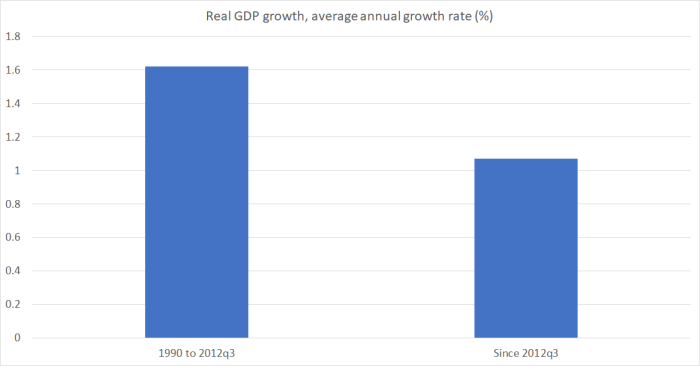
He includes a table which I’ve reproduced part of here, showing annual average growth rates

wheeler table

Inflation targeting began in New Zealand formally in early 1990.  So Wheeler’s story is that while the world economy has done a little worse during his term that it was doing in the previous 20 years, the New Zealand economy has actually grown faster than it managed in the previous 20 or so years.   Put that way, New Zealand’s performance looks good, and Wheeler appears to want to claim a considerable portion of the credit.

But this is the same nonsense that we get from the government, boasting about headline GDP numbers, and keeping very quiet indeed about the per capita performance.    Over the Wheeler term  –  not directly influenced by him at all –  New Zealand’s population is estimated to have increased by 8.5 per cent.     Advanced countries in total have had a population increase of less than 2 per cent.   Not surprising, headline GDP numbers here look moderately respectable.

But how does per capita growth in real GDP compare?  In this chart, I’ve shown the average annual growth rate in real per capita GDP for, on the one hand, the 22 years from when inflation targeting began to the end of Alan Bollard’s term as Governor, and on the other for the Wheeler term.   Remember that in the first period there were three recessions, two quite severe ones, and in the more recent period there have been none.

real GDP  pc wheeler.png

The only other gubernatorial term in which there wasn’t a recession was Alan Bollard’s first term (to September 2007).  Over that five year period real per capita GDP growth averaged 2.3 per cent per annum.

What about productivity?  Wheeler does acknowledge that “labour productivity has been disappointing”, suggesting that this is a problem most other advanced countries have but consigning to a footnote the recognition that New Zealand has had no labour productivity growth at all in recent years (unlike, say, Australia or the United States).

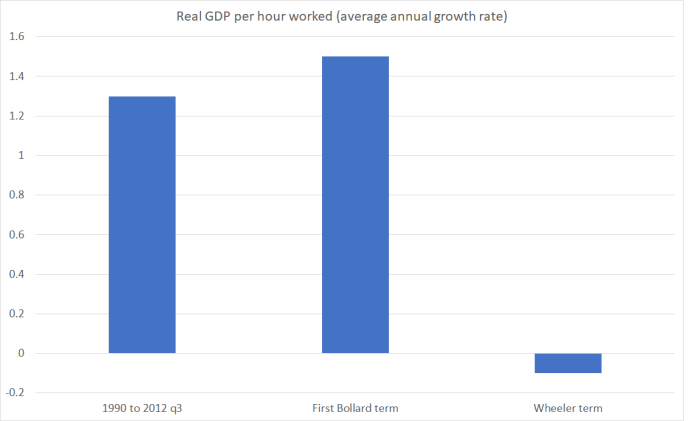
Here is how New Zealand’s labour productivty growth has been over (a) the whole pre-Wheeler inflation targeting period, (b) the last gubernatorial term without a recession (which also featured a housing boom and material lift in the terms of trade) and (c) the Wheeler term.

real GDP phw wheeler

To repeat, productivity is not something the Governor has much influence on, but…..it was him that was claiming credit for the “strong” performance of the New Zealand economy.

How about the labour market?     The Governor highlights that employment growth has been faster in his term than in the earlier inflation targeting period, but doesn’t mention that working age population growth has also been much faster during that period.   Actually, the rate of job creation relative to population growth hasn’t been at all bad in recent years – surprise increases in population create big increases in labour demand  –  but it is worth remembering that the quarter Wheeler took office saw unemployment at 6.7 per cent, the highest rate in the previous 13 years.  So we’d have hoped to see employment rising strongly and unemployment falling.  As it is, the unemployment rate averaged 4.8 per cent in the Bollard decade (boom and bust) and has averaged 5.4 per cent in the Wheeler term –  and all this as reasonable estimates suggest that the non-inflationary unemployment rate (the NAIRU) has probably been falling.

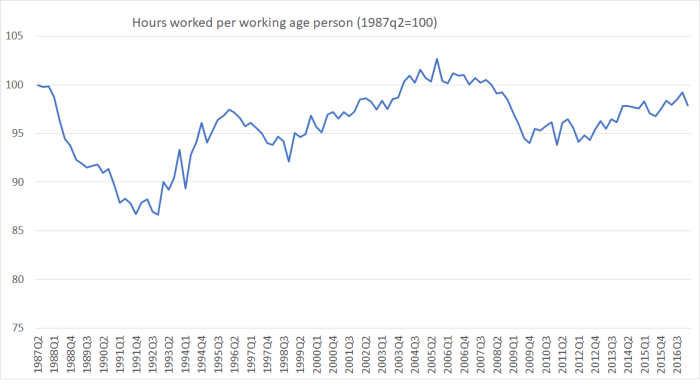
Even on the labour side of things, here is hours worked per person of working age.

hours worked per wap

Yes, the series has been recovering during the Wheeler term, from recessionary troughs, but is still not to the average levels prevailing for the four or five years prior to the recession.      Perhaps those levels might have amounted to “over-full” employment, but the unemployment numbers don’t suggest we are at that sort of point now.

I’m really not quite sure what Graeme Wheeler thought he was doing in making these claims. I don’t really suppose that he intended to be party political –  although the timing is such that he should have been more circumspect  – and actually in a way his claims, if valid, would actually suggest some serious problems in the economy –  if we could only manage such feeble outcomes even with highly stimulatory monetary policy.   But I guess it was mostly an attempt at distraction, to keep the focus away from what might otherwise have been.

Wheeler couldn’t do anything about (a) the aftermath of Canterbury earthquakes or (b) the migration influx (in any case only a touch larger than his predecessor had had to deal with), both of which have skewed the economy away from the non-tradables sector, probably helping to explain the distinctively poor New Zealand productivity performance.  He can’t do much about the neutral interest rate –  whatever it really is –  or about the troubling medium-term level of the real exchange rate.   But he could have done quite a lot about inflation.  Had he taken the steps that would have had core inflation averaging around 2 per cent –  instead of 1.4 per cent –  we’d have had a lower unemployment rate sooner, faster growth in per capita GDP (not indefinitely, but over this period), and stronger growth in employment and working hours.    He’d have delivered on his primary statutory mandate, and most New Zealanders would have been better off.

Humans make mistakes, and institutional structures that put lots of power in the hands of one person are particularly prone to mistakes.    The Reserve Bank of New Zealand is a good example of that, over the terms of successive Governors.   There are some things to be said for Wheeler’s stewardship –  as I’ve noted previously, core inflation has been quite remarkably stable during his term –  but he seems determined to never acknowledge a mistake, even with the benefit of several years hindsight. Individuals and institutions that don’t even recognise mistakes struggle to learn from them.   The Governor can repeat as often as he likes that local market economists and the relevant desk officer at the IMF thought the Reserve Bank was doing the right thing in 2014 (while ignoring the alternative minority voices).  The fact remains that they weren’t doing the right thing, when judged against their own mandate.  They remain the only advanced country central bank to have had two tightening phases since the last recession, and to have had to unwind them both.    Some acknowledgement of, and regret for, those mistakes might have been a gracious way for the Governor to have left office.  But I guess it is hard for leopards to change their spots.

I don’t want to spend any material time on the Governor’s treatment of housing market issues.  There is still no sign that they really understand the issues that have driven house prices to such unaffordable levels.  And I’m not going to bore you by running through the issues around LVRs again except to note that (a) there is no attempt to evaluate the Bank’s interventions against the only criteria the matter, the statutory responsibility to promote both the soundness and the efficiency of the financial system, and (b) my jaw almost dropped when I found no reference to any adverse effects on anyone of the LVR restrictions, except the rather self-pitying observation that “we were conscious that the introduction of LVR restrictions would make life difficult for the Bank”.   Not nearly as difficult as it makes things for willing lenders and willing borrowers to put in place credit facilities……

The final point I wanted to touch on was the Governor’s disconcerting complacency about the next recession.     The Govenor notes

If growth in the global economy slows because of debt-related or other issues, our economy will be affected. However, there is scope to help buffer against such shocks. We have greater room for monetary policy manoeuvre than central banks in many advanced economies.  Our Official Cash Rate is 1.75 percent – above the zero and negative policy rates of several advanced country central banks – and the Bank has not grossed up its balance sheet by buying domestic assets.  Similarly, with budget surpluses and low net Government debt relative to GDP, the Government has flexibility on the fiscal policy side.

Frankly, the issue that should be concerning the Bank isn’t some modest “slowing” in the global economy, it is the next serious global recession, the seriousness of which is likely to be accentuated by the fact that monetary authorities in most of the advanced world have very little scope to cut interest rates much.  And there is about as little scope in most of those countries to do much with fiscal policy.    In a typical US recession, for example, policy rates have been cut by around 7 percentage points.  At present, the Fed funds target is around 1 per cent.

In a typical New Zealand recession, the OCR (or equivalent) has fallen by perhaps 5 to 6 percentage points (our exchange rate tends to fall too, unlike in the US).  But our OCR is now 1.75 per cent, and inflation is well below target (the Bank thinks things are heading back to target, but their own official stance at present is neutral).    And while it is fine to note that our fiscal accounts aren’t in bad shape, in any serious recession they will look a great worse quite quickly (in flow terms).  There is some technical room for additional discretionary fiscal stimulus in a downturn, but the practical political room for additional discretionary stimulus has never been that large anywhere –  see, for example, the battles in the US in early 2009 around the stimulus package.

So while it is better to be in our position than that of some other countries, our position isn’t very good either –  and our Reserve Bank is responsible for our position, not that of other countries.   Going into the 2008/09 recession the Bank could say with confidence that we would cut as far as was needed –  and starting from 8.25 per cent, no one doubted our capacity.  Going into the next serious recession, if starting from around the current level of the OCR, no one will believe the Bank can do, or the government will do, that much.

Throughout his term, Graeme Wheeler appears to have done precisely nothing to position the Bank to cope with the next serious downturn  – despite all the advance warning, and experiences of other countries running out of conventional capacity.  The issue has never appeared in his Statement of Intent, or in past speeches.   He hasn’t got inflation back up to target, which would have led to nominal interest rates stabilising at a higher level than they are now.  He hasn’t done anything about addressing the institutional issues that make the near-zero interest rate bound a practical problem.  And, despite all that, he objects to any suggestion of raising the inflation target

It is not clear that central banks could readily increase inflation to these levels and attempting to do so would further stimulate asset markets, at least in the short run.  Raising an inflation target when productivity growth is weak makes little economic sense.

Perhaps it is too late in some countries –  although the largest of them, the US, has been raising interest rates, suggesting that a lower track of rates would produce somewhat higher inflation –  but it clearly isn’t here.  And as for the productivity argument, he has that quite back to front.  In a climate of weak productivity growth, and weakening global population growth, the case for a higher inflation target is stronger than otherwise –  precisely because there is more chance than otherwise that the near-zero bound would prove binding.

I guess the Governor has got to the end of his term and these particular risks haven’t crystallised.  Now it will be someone else’s problem, and I don’t suppose the Governor will have to worry about being one of those caught unemployed for a prolonged period in the next recession.   Forecasting is hard, and anyone can make mistakes. But failing to actively address this sort of foreseeable risk –  timing unknown of course –  is close to derelicition of duty in someone entrusted personally with all the powers of Governor of the Reserve Bank.    Getting on with some serious work in this area should be a priority for the new Governor, and for the Treasury/Minister of Finance.

(And I suspect that the key clue to Wheeler is the “asset markets” reference in that last quote.  There and throughout the speech his concerns about asset markets are pervasive.  And yet there is little sign of analysis that offers insights into those markets, and no sign of any Reserve Bank statutory responsiblity for such markets.)

Finally, it was interesting that in his reflections the Governor chose not to touch on the governance issues.  We know that he has favoured change (making he and the deputies he appointed collectively responsible under law).  And we know that the Opposition parties favour change.  And we know that Steven Joyce is sitting on (and refusing to release) a report to The Treasury commissioned from former State Services Commissioner, Iain Rennie on possible governance reforms.  It would, nonetheless, have been interesting and timely to have heard the Governor’s reflection on the issue, in light of his five years’ experience.

I keep wondering why the Rennie report is being kept secret –  months after it was completed.  One possibility is that Rennie is recommending reasonably substantial changes, going further than the Minister of Finance might have envisaged when he asked for the work to be done.  Whether that is so or not, there doesn’t seem to be any legitimate (OIA) reasons for the report (from a consultant to a ministry) to be kept secret.

And reform is overdue –  we shouldn’t be running a system where when the outgoing Governor opines on what will happen to LVR limits everyone knows that a month from now his views will mean nothing and there will be a different single decisionmaker in place.  Well-governed institutions are typically built around greater continuity and resilience to the preferences of single individuals.


On a declared candidate for Governor

Last week, we had an unusual public confirmation from a senior figure who  disclosed that they had applied for the job of Governor of the Reserve Bank.

I’m pretty sure it has never happened before in New Zealand.  The current Reserve Bank Act, which gives the lead role in appointing a new Governor to the Bank’s Board, has been in place since 1990, and this is only the third time there has been a vacancy to fill (as distinct from an incumbent being reappointed).  I can’t recall either in 2002 or in 2012 that anyone publicly disclosed their candidacy –  although in both cases, it was generally assumed that the incumbent deputies (Rod Carr and Grant Spencer) had applied.      It doesn’t happen in other countries, where the Governor of the central bank is generally appointed directly by the Minister of Finance or the President, without an advertised application process.  Again, sometimes it is widely known that someone is keenly interested –  eg in the US case a few years ago Larry Summers, the former Treasury Secretary –  but formal public confirmation is rare or unknown.

But in an (otherwise mostly unremarkable) interview with interest.co.nz’s Alex Tarrant last week, Reserve Bank Head of Operations and Deputy Governor, Geoff Bascand, confirmed his application

He’s put his hat in the ring for the Governor’s job. It’s been rumoured that he’d be the front-runner among the insiders if he wanted to stand, and now he’s confirming that he is going for it.

“The Reserve Bank matters to New Zealand’s economic performance and ultimately therefore to people’s welfare, and I’d like to be part of continuing to make this an excellent and strong institution, and to lead it in a way that it would be really successful for the next five years,” Bascand says.

If he doesn’t get it, then fair play to whoever does. Bascand says he’d like stay on in the Financial Stability role he’s about to take over when Grant Spencer moves into the Acting Governor position for six months starting late-September.

It is an unusual move.  In some respects, it is to his credit –  after all, one reason people don’t usually answer such questions is that it can be embarrassing to miss out, particularly if you are (or will be by then) the incumbent deputy, and perhaps more so if everyone knows you had applied.     But then it is presumably just another part of the multi-year effort by Graeme Wheeler to promote Bascand as his sucessor.   After all, the bulk of the interview (authorised by Wheeler) was about monetary policy and making sense of inflation –  normally issues that would be handled by either the Governor, or the Assistant Governor/Chief Economist, not by the chief operating officer responsible for things like notes and coins, security and property, communications, the operation of the securities settlement system, HR and the like.

Bascand’s background, of course, is in economics.  He started at Treasury, spent quite a bit of time at the old Department of Labour, running for a time its well-regarded Labour Market Policy Group, before moving to Statistics New Zealand where he eventually spent some years as Government Statistician.   There seem to be a range of views as to quite how successful that tenure was.  A while ago someone sent me a link to a somewhat sycophantic profile written while Geoff was in office.  Then again, I’ve heard that SNZ ran into some pretty serious financial problems on his watch.

When Geoff was appointed as Head of Operations and Deputy Governor, I was pretty positive on the appointment.  In part, that was the contrast to his predecessor, but much of it was about Geoff’s own merits. Graeme had set out to appoint someone who could contribute to policy, not just keep the operations ticking over, and in Geoff he had found such a person.   I hadn’t had a lot to do with him over the years, but what I’d seen left a fairly good impression, of someone who was smart, thoughtful, and level-headed.

It was an interesting move for Bascand himself.  He stepped down from a chief executive position in an operational agency to take up a number 3 position at the Reserve Bank  My take on day 1 (as recorded in my diary the day his appointment was announced) has remained my view throughout

“No doubt he sees it as a stepping stone back to either Governor or Secretary to the Treasury, via replacing Grant [Spencer] when he goes”

The expectation at the time was that Spencer probably wouldn’t stick around for five years, but as it happens next month Basacand will indeed take up Spencer’s position as Head of Financial Stability and deputy chief executive.

I recall Bascand telling an internal forum a few years ago that he’d only had two more years at SNZ to run, and hadn’t been interested in either joining the international consultancy circuit, or in the sort of operations-focused government chief executive roles that the State Services Commissioner had discussed with him.   Even though he’d had relatively limited experience in macro, and none in the financial sector, taking a fairly senior well-remunerated position at the Reserve Bank for a few years was a move back towards “home” –  his interests in economic policy.   And one that might position him well in time to secure the glittering prizes.

I don’t have many thoughts on how well he has done his day job –  head of operations  –  at the Bank over the past four years.  They aren’t areas I pay a great deal of intention to, and are largely inwards-focused anyway.  But the new bank notes seemed to be introduced smoothly, and many people seem to like them.  So he seems to have been a competent safe pair of hands, presiding over a continuation of the status quo (including, for example, the Bank’s obstructive approach to the Official Information Act, for which Bascand had responsibility).

What has been more noticeable has been the relatively high public profile Bascand has been given by the Governor on economics-related issues, especially in the last couple of years.     Bascand’s predecessor as head of operations gave almost no speeches, and certainly none on economic policy and analytical issues (and it is not as if the Bank has moved to do more speeches in total).

And it isn’t as if they have been bad speeches.    There are things I’d disagree with in all of them  –  and I’ve noted his over-enthusiastic embrace last year of the Bank’s new labour market capacity indicator –   but that isn’t a criticism.   If anything, I’ve found Bascand’s speeches the best of those put out by the four Reserve Bank senior managers, and certainly better, on economic issues, than those of the Chief Economist.  Bascand’s speeches come closer to comparing with those of senior managers in other central banks, including the Reserve Bank of Australia.

So in a way it isn’t surprising, or inappropriate, that the outgoing Governor has been smoothing the way, allowing Bascand to raise his public profile on economic policy issues, and –  in effect –  promoting him as the next Governor.

A few months ago the Bank’s Board advertised the position of Governor.   In their “candidate profile” they listed the sort of qualities they were looking for.  I wasn’t convinced that was the right list, but here is how I see Bascand against that list of characteristics.   My scale is 1 to 5, with 5 the best possible.

Outstanding intellectual ability 3.5
Leader in the national and international financial community 2
Substantial and proven leadership skills in a high-performing entity 3.5
Proven ability to manage governance relationships 4
Sound understanding of public policy decision-making regimes 5
Ability to make decisions in the context of complex and sensitive environments 3.5
Personal style will be consistent with the national importance and gravitas of the role 4

The Board had one more quality they were looking for

The successful candidate will also demonstrate an appreciation of the significance of the Bank’s independence and the behaviours required for ensuring long-term sustainability of that independence.

Personally, I suspect that is, in effect, ultra vires.  Decisions on the extent, or otherwise, of independence are matters for Parliament.    But I suspect Bascand would be a competent safe pair of hands on that count.

Overall, against this set of qualities, Bascand scores well on the “public sector” types of qualities, as he should.    We don’t know much about how he’d do as a single decisionmaker in a body with such high profile and extensive functions as the Bank (nor, in truth, do we know that for any of the possible candidates).  He is a capable analyst without, I suspect, claiming to be any sort of soaring intellect.  Where he probably scores lowest on this list of qualities is that he can’t make any serious claim to being a leader in the “national and international financial community”.   No one, I imagine, thinks of a distinctive Bascand perspective on any of the relevant issues.   Relatedly, he has no background with financial markets, banking, or financial system regulation –  at least beyond what he will have picked up sitting around the relevant committees, incidental to his day job,  in the last four years.

It is pretty clear that there is no ideal candidate to be the next Governor  (indeed, I heard at secondhand that the chair of the Board has said as much).  If so, Geoff Bascand strikes me as having the inside running if the powers that be are pretty content with things as they are, and aren’t looking for anything materially different over the next five years than they’ve had in the last five.    He is, after all, the only serious potential internal applicant, and the Board members have been able to see him every month for the last four years and take his measure.   Things probably wouldn’t run badly off the rails with Geoff in charge, and in some respects I expect he’d been a little better than Wheeler.

That is in the nature of a conditional prediction: if you think things have mostly been just fine at the Bank why go past Bascand?

But if he looks more or less suitable (given the slim alternative pickings) on the face of it, I still remain somewhat uneasy about appointing Geoff Bascand as Governor, in which position he alone would have personal legal responsibility not just for monetary policy, but for a wide range of regulatory interventions.   Some of that has been because he has been a key member of the Bank’s top-tier over the last four years, when monetary policy hasn’t been done well, and hasn’t been communicated well, and when the regulatory interventions have compounded, backed up by not particularly persuasive analysis.   I wonder if he’ll be able to demonstrate to the Board or the Minister that he was trying to influence the Governor towards better approaches?    Or even that he has learned something from those unsatisfactory experiences?

But my impression is that he is more a follower and capable implementer than a leader.   I was exchanging views a few weeks ago with another former colleague and we both noted that when Geoff first joined the Bank he’d seemed good and open, but quickly seemed to pick up the (internal) political signals and fall into line.  At a point when I was a lone internal voice on monetary policy I recall his somewhat strident objection that anyone could take a different view –  without ever making the effort to come and talk it over and understand a difference of perspective (in an area riddled with uncertainty).

Then, of course, there were episodes like the Toplis affair. Graeme Wheeler had got a bee in his bonnet about Stephen’s Toplis’s criticisms, and had all his fellow governors meet individually with Toplis to try to get him to back off.  Is that the sort of behaviour Bascand regards as acceptable from a top public servant?  And, if not, why did he simply go along –  after all, his day job didn’t involve contact with commercial bank chief economists?   Did he try to persuade the Governor to let it go?

Or the OCR leak episode.  I’m reluctant to make too much of it, because I was involved.  Then again, one collects data partly through experiences with people.   There is nothing in Geoff Bascand’s involvement in that episode, as revealed by the material the Bank had to release, that suggests someone with the sort of stature, and decency under pressure, that would mark him out from Wheeler.   Bascand was the senior manager responsible for external communications, lock-ups etc, as well as the one who commissioned the leak inquiry.

One could even think about Geoff’s speeches and interviews.  As I’ve already mentioned, I think they’ve been quite good.  But there isn’t any hint of a fresh or distinctive angle to them  (with the possible slight exception of comments around immigration in the Tarrant interview, which I would welcome).  Sure, the Governor is the sole decisionmaker, and it is his line that needs to be conveyed primarily.  But in a substantive speech a thoughtful senior adviser should be able to offer fresh insights or angles, without making trouble with the boss.  There is little sign Bascand has.

But my most sustained involvement with Geoff Bascand has been as fellow trustees of the Reserve Bank superannuation scheme over the past 4+ years.  Geoff serves as alternate for the Governor, and I’m an elected members’ representative.   Until late last year, Geoff was chair of the trustees (probably an illegal appointment, but that was an issue for those who appointed him –  the Board –  not for him personally).

Trustees of superannuation schemes –  regardless of who appointed/elected them – are required to act in the best interests of the beneficiaries of the trust, in this case, the members and pensioners.   A defined benefit superannuation scheme is a complex beast, involving huge elements of trust reposed in the trustees by members stretching over many decades (from memory, our median pensioner is now aged about 85).  The regulatory regime for superannuation schemes in New Zealand is quite limited –  something I have mixed feelings about, given my generally support for less regulation –  but there have long been statutory provisions, judicial precedents, and the obligations of the specific trust deed and rules themselves.  These days, superannuation schemes are the responsibility of the Financial Markets Authority –  a fellow regulator that Geoff Bascand will no doubt be dealing with extensively in his new role as Head of Financial Stability for the Reserve Bank (while at the same time a complaint against the trustees sits in FMA’s hands).

The Reserve Bank’s regulatory approach to banks is often characterised as being quite light-handed.  Certainly, there are few/no on-site inspections of the sort often seen in other countries.   But there are quite onerous requirements imposed on directors and managers, including various strict liability offences –  ones, that is, where people are liable whether or not they ever intended to commit an offence.  Strict liability provisions are generally repugnant, but there has been no sign of the Reserve Bank walking back its support for such provisions.  It is the standard they require of those who hold our money, or make our payments, in New Zealand registered banks.   Banks quake at the thought of breaching Reserve Bank regulatory requirements (we see it in the big buffers they run around the LVR limits).

Given this stern approach to the regulation of entities they have statutory responsibility for, you might suppose that they would consistently seek to adopt a “whiter than white” approach to the management of the long-term financial entity they themselves sponsor.  It isn’t an entity that is exactly invisible to the Bank either: successive Governors have been trustees, and when they choose not to attend one of their senior managers does so for them.  The Bank’s Board –  of which the Governor is a member –  appoints two of the trustees, and has to approve any rule changes.

Sadly, the standard the Bank –  and its senior managers –  have taken to the superannuation fund falls far short of the standard they require private financial institutions to adopt.   I won’t attempt to bore readers with details.  The worst abuses were done some decades ago.  Bascand’s involvement has been as these abuses have come to light, and how he has sought to guide the response and reaction.

Three years ago a particularly persistent retired member wrote to the trustees highlighting a series of potential problems around some rule changes in 1988 and 1991.  He suggested there was reason to doubt that one significant element of the the 1991 changes had been done lawfully at all, and that key elements of the 1988 changes (which gave the Bank power to, in effect, reduce pensions) had been done without the members’ consent that appeared to have been required by the rules, and under the relevant legislation.  Geoff’s immediate response –  as chair of a group of trustees, responsible for the fund, and working in the best interests of members –  was to write a memoradum to trustees proposing that we agree there was nothing of substance in the submission, and that we do no further investigation.

Fortunately, that did not gain agreement from fellow trustees.  I say “fortunately” because with only a little bit of follow-up work it emerged that in fact there had actually been a breach of the Superannuation Schemes Act (members had never actually been told at the time of the 1991 rule change).  Fortunately for today’s trustees, the statute of limitations had passed, but the trustees felt obliged to apologise to members for that earlier breach.

With a bit more follow-up work and some legal advice, it became clear that one element of the 1988 changes could simply never lawfully have been made (I think we are all agreed in shaking our heads in wonderment at how this happened), and another change that could lawfully have been made, nonetheless never had the member consent that clearly was required.  In fact, the Bank (and the Board) had known of some of these problems for more than 20 years and had never told members  (it was no small point –  the illegal change had meant that any surplus on wind-up could go the Bank).      That in turn has opened up issues around the validity of the consent members gave in the mid 1990s to a rule change that has been worth at least $5m to the Reserve Bank –  money it, in effect, extracted from the Fund, having apparently (and wilfully or perhaps otherwise) misled members about the alternatives.

The issue here isn’t the rights and wrongs on specific points.  It is about the cast of mind displayed by someone who will shortly be responsible for the regulation of most of our financial intermediation sector, and someone who asks to be given the huge powers Parliament places in the hands of the Governor of the Reserve Bank.    Geoff has been quite seriously engaged on the issues where the Bank’s financial interests might be threatened –  a process likely to end up in the High Court next year.  But he has never shown much sign of acting with the interests of the Fund’s members and pensioners at heart.    Despite him, rather than because of him (even though he was chair), some of the issues have continued to be pursued.    This isn’t the place to traverse the rights and wrongs of the specific issues; it is about my observation of a senior manager’s inclinations and cast of mind.   I’ve noted previously his seeming inability to recognise, and respect, the differences between his responsibilities as a Bank manager, and those as a superannuation scheme trustee –  the sort of lack of regard for boundaries that would rightly trouble the Reserve Bank if, say, it was apparent in a director of a New Zealand bank appointed by a foreign parent.

I don’t think Bascand has malevolent intent.  He is a pleasant and thoughtful person as an individual.  But he doesn’t seem to recognise his responsibilities, and rarely seems to want to dig deeper if he isn’t forced to.   Leadership is partly about asking hard questions, and insisting on rocks being turned over even if it might be inconvenient.  It is about recognising implications, and looking a bit further ahead than most.   Sadly, there doesn’t seem to have been sign of that sort of standard in the Bascand’s approch.  A few years ago a prominent person noted that the standard you walk past is the standard you accept.   The sorts of standards on display in recent years aren’t those we should be tolerating in a Reserve Bank Governor.

Then again, standards in public life in New Zealand appear to be slipping.  As I say, Bascand looks like the probable preferred status quo candidate for Governor.  But the status quo shouldn’t be nearly good enough.


Monetary policy, the Governor etc

In a post a couple of weeks ago I highlighted the extent to which monetary conditions appeared to have been tightening over the last few months, even as the OCR has been kept steady at 1.75 per cent.  Specifically, retail interest rates (lending and deposits) have increased, and the exchange rate has risen.  In addition, but less amenable to easy statistical representation, credit conditions have tightened, through some mix of Australian and New Zealand regulatory interventions and banks’ own reassessments of their willingness to lend.    Over this period there has been no acceleration in economic growth and inflation (whether goods or labour) hasn’t been increasing.  If anything, core measures of inflation –  already persistently below target –  have been falling away.

Yesterday the Reserve Bank released the results of the latest Survey of (business and economists’) Expectations.    The Reserve Bank has recently changed the survey, dropping a number of useful questions altogether, and missing the opportunity to plug some key gaps (eg there are no surveys in New Zealand of expected net migration).  They’ve also added some useful new questions, but for the time being are refusing to release the results of those questions –  including those around OCR expectations, house price expectations, and longer-term inflation expectations.

But one set of questions I was a little surprised that they left unchanged were those around monetary conditions.  I like the questions but it is a long time since I’ve seen anyone else write about the results.   Respondents are asked to indicate what their perception of current monetary conditions is (on a seven point scale, where four is neutral).  And then they are asked the same sort of question about expectations for the end of the following quarter and a year hence.

Broadly speaking, respondents tend to describe monetary conditions –  or at least changes in them –  as one might expect.   Here is the perception of current monetary conditions, dating back to the start of 1999 when the OCR was introduced.

mon condtions current

The peak in the series was right at the peak of the last OCR cycle, where the OCR was raised to 8.25 per cent.   Since then, although the Governor likes to describe monetary policy as extraordinarily accommodative, respondents have never thought that monetary conditions have been (or are) anywhere as easy as they were tight in 2007/08.  (When I completed the latest survey, I described current conditions as just a bit tighter than neutral.)

Note that latest observation.  Respondents reckon that monetary conditions have tightened.   The increase doesn’t look that large, and does come after a fall in the previous quarter.    But, the larger increases tend to occur either when the OCR is actually being raised, or when the Reserve Bank is talking hawkishly about the probable need for further OCR increases (thus, you can see the two big increases in 2014, when the Bank was in the midst of what it was talking of as 200 basis points of OCR increases).

But perhaps more interesting is that respondents also expect conditions to be quite a bit tighter by the end of the year, and again by the middle of next year –  and all that with no Reserve Bank encouragement at all.    And –  I would argue –  none from the underlying economic data either.

mon conditions ahead.png

The scale of the increase in the last few quarters is comparable in magnitude to the increase in 2013/14 when the Reserve Bank was talking up, and delivering, significant OCR increases.

Quite why respondents –  completing the survey in late July –  are expecting so much tighter is a bit of a puzzle.  But if it isn’t down to the Reserve Bank itself, or to the underlying economic/inflation data, perhaps it is reflecting trends respondents are observing –  the rising retail interest rates, high exchange rate and tightening credit conditions –  and that they are assuming that those things won’t reverse themselves, and may even intensify.

Personally, I think the case for somewhat easier monetary conditions is relatively clear at present: weak inflation, unemployment still above NAIRU, weak wage inflation, and a housing market that seems weaker than the toxic mix of land use restrictions and continued rapid population growth would warrant.  (To be clear, I’m not making a positive case for higher house prices inflation – though more housebuilding would be welcome –  just noting that the housing market is where, if overall conditions were about right (for the economy as a whole), we should be seeing continuing high inflation.)

Against that backdrop, I think it would be highly desirable for the Reserve Bank to make the point explicitly on Thursday that the economy has not needed, and does not now appear to need, tighter monetary conditions, and that some easing would be welcome and appropriate.    As I noted in the earlier post, I’m not sure it would really be appropriate for the Governor to cut the OCR –  given that (a) he hasn’t foreshadowed such a move, and (b) that this is his last OCR decision.    In a well-governed central bank –  such as almost every other advanced country has –  a change of Governor is less important: however influential the Governor’s views are, in the end he or she has only one vote in a largish committee.  All the other voters will still be there the next time an interest rate decision is made.

The problems here are compounded by the (a) the forthcoming election, so that no one knows what regime (what PTA) monetary policy will be being made under in future, (b) by the fact that we only have an acting Governor –  an illegal appointment at that – for the next six months, and people in acting roles are often loath to do anything they don’t strictly have to, and (c) by the lack of transparency in the Reserve Bank’s systems and processes.  When, say, Janet Yellen or Phil Lowe took up their roles as head of the respective central banks we knew a lot about how they thought about monetary policy.  Same goes for Mark Carney –  even though what we knew about him was from another country.    There is almost nothing on record as to how Grant Spencer these days thinks about monetary policy.  Even if he is to operate –  illegally –  under a (purported) PTA that is the same as at present, the PTA captures only a small amount of what is important to know: what matters as least as much is how the individual thinks about and reacts to incoming data.  With no speeches, no published minutes, no published record of the advice he has given the Governor on the OCR we know very little at all.

It is a model that badly needs fixing.  We simply shouldn’t be in a position where one person holds so much power, and hence their departure leaves such a vacuum (especially when, as will inevitably happen from time to time, such changes occur around election time).    We know that the Opposition parties are promising change –  roughly speaking in the right direction, although the details need a lot of work –  but what the National Party has in mind remains a mystery.   Treasury is refusing to release any of the versions of Iain Rennie’s report on central bank governance, claiming that the matter is under active consideration by the Minister of Finance.  That is a dodgy argument anyway –  since Rennie’s report to The Treasury is not the same as Treasury’s advice to the Minister (something I haven’t requested) –  but since they’ve had the final report for months now,  it shouldn’t be unreasonable to expect some steer from the Minister as to what his response might be.  As I’ve noted before, with the process of choosing a new Governor underway, at present neither candidates nor the Board have any real idea what a key aspect of the job might be.

The problems around “one man governance” aren’t restricted to monetary policy.   The Deputy Governor, Grant Spencer, gave a thoughtful speech the other day on “Banking Regulation: Where to from here?”.  But in a sense, the problem was in the title.  The Governor personally makes the policy decisions, and the Governor is leaving office next month.  Spencer will be minding the store –  illegally –  for a few months, and then retires early next year.  As we’ve seen in the past, the particular person who holds the role of Governor can make a big difference to the character and specific direction of regulatory policy –  LVR restrictions, for example, were (for good or ill) a legacy of Graeme Wheeler personally (and the earlier hands-off disclosure driven model, a legacy of Don Brash personally).  So in many respects it makes no more sense for Grant Spencer to be giving speeches on “where to from here” for bank regulation than it does for Steven Joyce to give such a speech on where to from here with tax policy.  In Joyce’s case, at least it is a campaign speech –  he hopes to still be in place next year, whereas Wheeler and Spencer will both be gone.  Neither they nor we know what their successors’ inclinations might be.

Again, that isn’t good enough.  We’ve personalised control of a major area of policy, when the general practice, here and abroad, is that when technocratic agencies exercise regulatory power they do so through boards that provide considerable continuity through time.  Individuals come and go, but they do so one at a time, and in a way that doesn’t dramatically change the balance of the board in the short-term.  That provides stability and predictability for both the institution itself, for those we are regulated (or indirectly but materially affected by regulation) and for those –  citizens –  with a stake in the agency.     We are well overdue for significant governance reforms to the Reserve Bank legislation.  And to say that is not to criticise the individuals –  Wheeler, or Spencer – who have to operate with the law as it stands it present, inadequate as it is.   The responsibility for the inadequate legislation  –  the iunadequacies of which have been brought into sharper relief in the last few years –  rests with ministers and with Parliament.

In closing, I do hope that when journalists get to question the Governor, and when later in the day FEC members get the same opportunity, they will not overlook the egregious and inexusable behaviour –  not sanctioned by any legislation –  by the Governor, his deputies, Geoff Bascand and Grant Spencer, and his assistant John McDermott –  in attempting to silence Stephen Toplis when they disagreed with some mix of the tone or content of his commentaries on them.     The intolerance of dissent, and the abuse of office, on display then aren’t things that can simply be let go silently by.   I’m as appalled as anyone by the lack of contrition Metiria Turei has displayed over her acknowledged past benefit fraud.  But bad as that is, abuse of high office by senior incumbents is, in many respects, a rather more serious threat.  Our elites seem to have become all too ready to do hardly even the bare minimum to call out, and expose, unacceptable behaviour by the powerful.  Here, we’ve seen no contrition, we’ve seen a Treasury advising the Minister to ignore the behavour, and a Minister of Finance –  legally responsible for the Governor –  happy to walk by on the other side, saying it is nothing to do with him.

(It was nonetheless interesting to read the BNZ’s preview pieces for this week’s MPS.  Perhaps they were just chastened by the data having not gone their way, or perhaps the heavy-handed pressure from the Governor really did work, because the tone (and spirit) of these latest commentaries is very different from what we saw –  and what so riled the Governor  –  in May.   Personally, I thought –  and think –  that the Governor’s May monetary policy stance was more appropriate than the BNZ’s, but that isn’t the point.  Our system is supposed to thrive on vigorous debate, and one isn’t supposed to lose the right to challenge the powerful just because in this case the Governor happens to regulate the organisation employing the critic.)


Intervening without understanding: the RB and the housing market

I spoke last night to the Nelson Property Investors’ Association.  They’d asked me to talk about the Reserve Bank and the waves of new direct controls on housing finance that the Bank has put in place (or is positioning itself to put in place).  Those controls have upended a liberalised and decentralised market that had been in place and functioning well, providing good access to credit without drama, for almost 30 years.  Instead, we have now superimposed one man’s judgement.

It was a topic I was happy to talk about.  It is certainly timely.  In part that is because the current Governor’s term ends next month, and the person who gets the job next year as his permament replacement will materially influence the future direction of housing finance controls (although ideally governance reforms will materially reduce one person’s influence).  But also because the Reserve Bank currently has a consultation document out, as part of a process to get the imprimatur of the Minister of Finance for possible use of debt-to-income regulatory limits.    Submissions on the debt to income ratios proposal close next week and although I will be making a submission, last night’s address didn’t specifically focus on that proposal.

Much of my address was material I’ve covered before here.  Nonetheless, in pulling it all together into a single (more or less) coherent story, I realised afresh just how poor the processes, background analysis, and the policies themselves have been.    As it happens, at the meeting last night a representative of the NZ Property Investors’ Federation also spoke briefly, and his remarks were a reminder that poor quality policy certainly isn’t unique to the Reserve Bank.   The difference perhaps is that we choose the politicians, and when governments do daft or dangerous things, we get to vote on tossing them out again.  No such luck with the Reserve Bank.   And, from my perspective, I write about things I know something about, and I’m pretty sure that the Reserve Bank was once considerably better than this.  And could be again.

I began by looking back

When I was young and exploring job opportunities, I spent a day at the Reserve Bank. The then deputy chief economist was explaining the attractions of working at the Bank – things other than just the heavily-subsidised house mortgages. But the one line I remember was when he stressed the involvement the Reserve Bank had in the housing market, and issues around mortgage financing.

That wasn’t too surprising when one thinks about it. It was December 1982. We were coming towards the end of 40 years of pretty pervasive regulatory controls over so many aspects of the financial sector, including housing finance. The Reserve Bank was then a strong advocate in official circles for financial system deregulation, and allowing the market to take over the allocation of credit. It was – I thought then, and think now – on the side of the angels.

But in my first 20 or so years at the Reserve Bank housing was, at best, a very minor point of what we did. Within months, almost all the direct controls were stripped away. Institutions lent for housing if (a) they could fund themselves, and (b) if they could find (hopefully) creditworthy customers. It was their issue, not ours. Credit, generally, became more readily available. Interest rates trended back down, and banks typically became more willing to lend for longer terms. For an ordinary working person looking to buy a house, a very long repayment period will often make a lot of sense – just as a high initial LVR loan had always done.

And Parliament was careful to provide that whatever prudential powers the Reserve Bank did have were to be used not just to secure the soundness of the financial system, but also to promote the efficiency of that system.

But the bulk of the address focused on the weaknesses in what the Reserve Bank has been doing, in how it has made its case, and in the subsequent accounting for the impact of those controls:

  • how they’ve never adequately engaged with the range of international experiences in 2008/09, fixating on the US and Irish experience when (a) Ireland was in the euro, so lost a lot of policy flexibility, and (b) the US has a long history of heavy government involvement in the housing finance market.  Plenty of other advanced countries, including New Zealand and Australia, had big increases in house prices and housing credit, and no housing-driven financial crisis,
  • how they continue to ignore the implications of their own successive waves of stress tests, which continue to show that even with very severe shocks the banking system appears to be resilient,
  • they hardly ever engage on, and have produced no research on, the efficiency implications of direct controls, including on how they controls apply to banks and not non-banks, how they apply to housing lending but not other sorts of credit (even when past research suggests housing loans are rarely a key factor in systemic crises), and how the controls end up favouring riskier housing lending (new builds) over safer lending (on existing properties).  Similarly, they’ve never engaged on the extent to which controls will impede the information discovery process implicit in different banks managing risks in different ways,
  • there has been no evidence produced to explain why, in the Governor’s judgement, banks can be “trusted” to run their own credit policies in all other areas of their balance sheets, but just not in housing finance,
  • they’ve produced nothing on the distributional implications of their policies –  which tend to favour established low-leverage participants, at the expense of those looking to get into the market.  These concerns only increase now that policies once sold as temporary are becoming increasingly longlived.
  • despite assertions that the controls have reduced system risks, they’ve produced no analysis or research to make that case.    Simply arguing that the volume of high LVR housing loans is lower (no doubt true), simply isn’t a satisfactory basis for such claims.

But, in a way, what concerns me at least as much as all this is that the Reserve Bank simply does not have a remotely adequate model of house prices.   If they produced such a model (in words, or equations) we could carefully scrutinise it.  If it was robust, we might even be inclined to defer to policy proposals based on that model.    As it is, there is almost nothing –  in public (and if they had such a model, they’d have every incentive to publicise it).

Consistent with this, the Bank’s house price, and implicit house price to income ratio, forecasts have been consistently and repeatedly wrong.     They seem to put far too much weight on interest rates –  while rarely acknowledging that interest rates are high (or low) for a reason, usually one to do with the expected growth potential of the economy.   In much of New Zealand, reall house prices how are no higher, or even lower, than they were a decade ago when the OCR was at 8.25 per cent.

The Bank also seems to have an implicit model in which what has gone wrong is that building has lagged behind short-term unexpected changes in demand.  No doubt it has to some extent, but the much the bigger issue –  as most experts (and, I think, both main political parties) would now agree is land prices, themselves a product of land use regulatory restrictions (and associated infrastructure problems).   These are no multi-decade phenomena, and show no sign of being resolved any time soon.    When land is made artificially scarce by regulatory interventions in place for decades, which have not successfully been reversed anywhere else, what basis does the Bank have for (a) thinking that the house price issue is to any considerably extent an “overly liberal finance” problem, and (b) for supposing that a deep sustained correction  –  a halving of house prices –  is a serious possibility?   On their published material, none at all.

Instead of a good rich model, and a nuanced understanding of the housing market, all we are given is the extreme reduced-form, of “what goes up, must come down again”.  Well, perhaps one day, but regulated prices can stay well out of line with unregulated fundamentals for a very long time –  see second hand cars in NZ in the 1950s onwards, or New York taxi medallions. 

The absence of a richer basis of research and analysis to back these multi-year interventions should be deeply troubling.  It simply isn’t how public policy should be made.  It risks looking as though policy is based on one man’s whims.

I wrapped up this way

So we’ve ended up with highly invasive direct controls which mean that, for the first time in decades, ordinary borrowers need to worry about what the government might regulate next, instead of being free simply to deal with their bank on the intrinsic merits of their own project, or their own servicing capacity. Years on, there are no published criteria indicating when these temporary measures might be lifted – if anything, we seemed to be headed deeper into a morass of financing controls. And all this has been done based on no good evidence whatever – whether about crises, about housing, or about the housing finance market, which had seemed to most involved to be working just fine. It is bad enough when they don’t publish analysis. What is scarier is that the really don’t seem to know. It is so far from being an acceptable standard that probably no one could have envisaged this happening even 10 years ago.

How did this sad state of affairs come to be?

Good systems of governance avoid putting very much power in one person’s hands. But by law, the Governor could do all this on a whim. We don’t run other state agencies or our court system that way.

We had a Board of the Reserve Bank that did nothing when the Governor they appointed started running off the rails.

We have banks that are scared to speak out, or take on the regulator.

We have a Parliament that isn’t willing to do its job – holding to account the man, and institution, to whom they gave so much power.

Events matter too. Those crisis-ridden months of 2008/09 rightly prompted a “never let it happen here” mentality. But it was a knee-jerk reaction, with no analysis looking carefully at why it hadn’t happened here. It seemed to provide an open field for enterprising interveners.

And then there were the NZ specific events: the huge and unexpected population surge, all amid governments (and oppositions) willing to do almost nothing to fix the underlying dysfunction in the housing and urban land supply market. “Someone needs to do something” was the mood. Well, the Reserve Bank was “someone” and LVR controls were “something”. Never mind that they might have nothing to do with the underlying housing problem, and respond to financial stability problems that RB numbers suggest just don’t exist.

Sadly, we’ve upped the returns to lobbying, and to keeping sweet with the regulator – incentives only accentuated by episodes like the Toplis affair. Evidence is that the Bank doesn’t welcome debate, or challenge, or scrutiny, and could well try to take it out of your hide. That means even less serious scrutiny of the Bank than we might once have hoped for.

And so one thing piled on top of another, and a single person at the head of a once well-regarded body gets let loose to pursue his (questionably legal) whims, and mess up our well-functioning housing finance market, all while pontificating idly (without thoughtful background research or analysis) on a steadily worsening housing crisis. I’m sure he has good intentions – about saving us all from ourselves – but no mandate, no analysis or evidence, no accountability. Just whim.

Shortly, the one man will be off. And we – citizens, savers, actual and potential borrowers – will be left to live with the consequences. We can only hope that whoever takes up the role of Governor next year, does so with a quiet determination to begin unpicking the mess, allowing the market in finance to work properly – as it had been doing in recent decades – and building an institution known for the excellence of its analysis, operations and policy. Perhaps the new improved Bank may even be able to offer some compelling insights on the regulatory disaster that our housing market – in common with those in many other similar countries – has become.

But I’m not hopeful about any of this. Politicians seem not to care. And powerful officials typically rather like the degree of power they enjoy. Why take the risk, they might well say, of removing controls. Why not just trust us, we know what we are doing.

There were a couple of questions that helped shed light on my story.

One asked how different things would look if we’d simply stuck with the deregulated finance market and not put on any of the LVR controls.

My response was “not much”, at least on the house price front.  As the Reserve Bank itself will openly state, they don’t think LVR restrictions make much sustained difference to house prices.  You might get six months “relief”, perhaps even twelve months, but before long the structural fundamentals  –  population pressures on the land-supply constrained market –  reassert themselves.   Perhaps in total house prices are still a couple of per cent lower than they might otherwise have been, but no one can tell with any confidence.  What we can be reasonably confident of is that different people own the houses: fewer new entrants, and more owned by establishment players. So much for the democratisation of finance that the 1980s reforms made possible.

Of course, there would probably be a larger stock of higher LVR loans –  and banks would be holding more capital against those loans.    But since we don’t adequately understand what banks have chosen to do instead of the high LVR loans they are barred from, we don’t even know have different the risk profile of their balance sheets would look, let alone whether they were more at risk of some future crisis.   (I would also note that had the Reserve Bank done nothing, the less direct guidance to the Australian banks from APRA would no doubt have influenced lending patterns here).

And the second was along the lines of what I might have done in Graeme Wheeler’s place.  My short answer was “nothing”.   There is no evidence that the housing “crisis” is, to any material extent, a phenomenon of inappropriately loose finance, and there is no evidence that banks here have systematically been making poor judgements about the allocation of (housing) credit.  I’d have been reassured by the stress tests –  in fact, I still recall going to an internal seminar, perhaps in 2014, when the results of the stress tests were first presented.  I, among others, didn’t want to believe them, but despite all the pushback and probing, the results appear to have been robust.  Keep doing the stress tests, and when those results look worrying that is the time to consider further action.

None of that is a story of indifference to the problems of a dysfunctional housing supply and urban land market.  But problems need to be correctly diagnosed, and appropriate remedies applied.  Appropriate remedies to the housing market failures rest squarely with central and local government, not with the Reserve Bank.    Research resources are scarce, but there might even have been a case for the Reserve Bank to have invested in becoming something of a centre of excellence in housing, housing finance, and the economics of land use.  In some respects, it isn’t core Reserve Bank business, but it is hard to argue that it would be inappropriate for the central bank to develop and maintain structured expertise in a market that represents that main form of collateral for the banking system.    We don’t want our Reserve Bank, or the Governor, politicised, but a high-performing central bank, with an established reputation for objective excellence, could nonetheless have made a valued contribution to a better debate, and better policy responses, to the lamentable situation that is New Zealand housing.    Perhaps, with a different Governor, they still could.

Anyway, the full text of my address is here.    We are entitled to expect better from such a powerful public agency.


Uncle Philip comes to visit

I wasn’t really planning a post today.  I’m in the middle of preparing a speech/presentation on the Reserve Bank and the housing market (working title “Intervening without understanding”).     But the Reserve Bank yesterday released some (a) comments on their forecasting review process and some aspects of monetary policy, prepared by a former BIS economist, and (b) the Bank’s spin on those comments.  Various people got in touch to say that they were looking forward to my reaction.

When an old uncle or family friend is in town and comes for dinner, the visitor will usually compliment the cook, praise the kids’ efforts on the piano, the sportsfield, or in dinner table conversation, and pass over in silence any tensions or problems –  even burnt meals –  he or she happens to observe.    Mostly, it is the way society works.  No one takes the specific words too seriously –  they are social conventions as much as anything.  One certainly wouldn’t want to cite them as evidence of anything much else than an ongoing, mutually beneficial relationship.

Philip Turner is a British economist who has recently retired from a reasonably senior position at the Bank for International Settlements.  The BIS is a club for central banks, and a body that has been champing at the bit for much of the last decade, encouraging central banks to get on and raise interest rates again.    Turner himself spent his working life in international organisations –  before the BIS he spent years at the OECD, where he developed a relationship with Graeme Wheeler (who was The Treasury’s representative at the OECD for six years or so).  He has never actually been a central banker, or involved in national policymaking.

Back in 2014, Graeme asked Turner to review the Reserve Bank’s formal structural model of the economy (NZSIM).   I didn’t have much to do with him on his visit then, but my impression (perhaps wrongly) was of someone now more avuncular than incisive (albeit with the odd interesting angle).   Having left the BIS last year, the Governor invited him back to New Zealand earlier this year, during which he sat through, and offered some thoughts on, the three-day series of forecast review meetings the Bank undertakes in the lead-up to each Monetary Policy Statement.  

There is nothing particularly unusual about that.  Perhaps twice a year the Bank has someone in who does something similar –  often a visiting academic or foreign central banker who was going to be in Wellington anyway.  It is an interesting experience for the visitor –  I will always remember the time Glenn Stevens (subsequently the RBA Governor) participated, and came out declaring that he now realised we were much less mechanistic than we seemed –  and usually there is the warm fuzzy feeling of mutual regard.  The visitors – friends of the Reserve Bank to start with –  get closer to the monetary policy process than is typically permitted in other central banks, and they are usually suitably appreciative.   Their reports, typically passed on to the Board, typically convey the sense of how good the process is, but sometimes there are even quite useful specific suggestions.    I’m not aware that such reports have ever previously been made public –  and I suspect that had someone asked for them under the Official Information Act, the Bank would have been as obstructive as ever.   Perhaps Turner’s report was particularly generous, perhaps the Governor was feeling particularly beleagured –  eg after the Toplis censorship attempts – but for whatever reason they have both released his report, and attempted to spin it well beyond what it warrants.

Actually, for those not familiar with the Reserve Bank’s internal process, the report may be of mild interest.   The description of the three days of meetings Turner sat through rang true –  and was interesting to me because it suggested things are still much as they were when I was last involved 2.5 years ago.  It will complement some of the other material the Bank itself has released on its processes.

In its press release, the Reserve Bank claims that Turner “commended the Reserve Bank’s forecasting and monetary policy decision-making processes”.  In fact, he did nothing of the sort.   He had no involvement in observing the preparation of the draft forecasts (the background work undertaken by the staff economists), he was not apparently invited to observe the Governing Committee discussions where the Governor makes his final OCR decision, and he engaged in no attempt to assess the Bank’s track record in forecasting or policy.  That isn’t a criticism of Turner.  He wasn’t asked to do those things.  Instead, he will have been handed a binder of background papers, and sat through perhaps 8 to 10 hours of meetings where those papers are discussed and issues around them identified.

That said, there is no doubt he is effusively positive about that process.

This process, which takes advantage of the small size of the central bank, avoids a problem that affects many other institutions. This is that unpopular or unorthodox opinions can get filtered out by successive levels in the hierarchy, as it is only more senior staff who make the presentations to Governors……

The open working-level culture is a credit to the RBNZ. Junior staff are given their voice. Views or arguments expressed by colleagues are challenged in a constructive and professional way. This is essential if the policy blind spots of a few individuals are to be avoided.

In my (rather long) experience there was an element of truth to all this.  The Bank is unusual in having very junior staff presenting directly to Governors.  That is generally good for them, and sometimes works well.  Then again, the Bank is a small organisation.  But it often involves people with quite limited experience or perspectives who can be quickly at sea when taken just slightly off their own safe ground or the established “model”.   It is an operational model that has some strengths, in staff development, but strongly prioritises (by default –  it is usually what 22 year old economists can do) fluent updates on the status quo.

There was also typically plenty of opportunity for people to chip in with unthreatening questions or clarifications.

But as for unpopular or unorthodox views being welcomed and heard……..

Perhaps things have changed a lot for the better in the last 2.5 years,  but it hadn’t been my impression of the Bank’s processes for quite some considerable time.   I largely stay clear of Reserve Bank people these days  (for their sake as much as anything) but nothing I hear through others suggests that the institutional culture has improved.  And how likely is it when the Governor is so outraged by external critical comments that he enlists each of his top managers to try to shut Stephen Toplis up, and when that fails he tries heavy-handed approaches to the CEO of the BNZ, a body the Governor himself regulates?  Whatever Turner’s (no-doubt genuine impressions) of the meetings he sat through, I suspect he saw what he wanted to see.      He formed a good impression of the Bank decades ago, his friend Graeme is now the boss and invites him over for a spot of post-retirement consulting, and when everything is presented as rosy, everyone is happy.

As a reminder, the Governor is so scared of diversity of view that he refuses to release –  even years after the event –  background papers, the balance of the advice he receives on particular OCR decisions, or the minutes of Governing Committee meetings.  But apparently Uncle Philip says all is good, and that should really be enough for us.

Turner saw what he thought he saw in the meetings he sat through.  Then again, he will have little or no familiarity with the New Zealand data, issues, or context.

And on that count what was perhaps more surprising was the rather strongly-worded declarations he offered on monetary policy (substance not decisionmaking process) in New Zealand in recent years.    One might suppose that such conclusions –  not just offered in passing over a drink, but now as an officially-authorised publication of the Reserve Bank – might require engaging with the data, with the details of the Bank’s mandate, with alternative perspectives, and so on.  But there is no evidence of any of that.

What specifically bothers me?  Well, for a start there is no mention of the fact that the Reserve Bank of New Zealand is unique in having run two quickly-aborted tightening cycles since the end of the 2008/09 recessions.  Then again, as I noted earlier, the BIS has long looked rather askance at low global interest rates, and has been keen –  with no mandate whatever –  to have advanced country interest rates raised again.  So was the Governor –  who keeps talking about how extraordinarily stimulatory monetary policy is.  But as an experiment, raising interest rates didn’t work out that well here.  And, at bottom, however good the process looked, the substance of the forecasts was repeatedly wrong.

Turner also gets into selective quotation of the Policy Targets Agrement.  He argues that

Clause 4(b) adds further that “the Bank shall implement monetary policy in a sustainable, consistent and transparent manner, have regard to the efficiency and soundness of the financial system, and seek to avoid unnecessary instability in output, interest rates and the exchange rate”. I have italicised these words because they describe a mandate that is realistic about what monetary policy can achieve. This mandate would not have been fulfilled in recent years, given the large shocks to international prices, by trying to keep the year-on-year inflation rate in New Zealand at close to 2 percent. To have achieved this, interest rates would have had to move by more than they have in recent years, and this would have created the unnecessary instability in output and the exchange rate that the RBNZ is enjoined to avoid.

Of course, no one has ever argued that headline CPI inflation should be kept at 2 per cent each and every year, so to that extent he is addressing a straw man.   Perhaps, charitably, he means keeping core inflation near target, something the Bank has failed to do for years.    But even then Turner omits a key phrase: the Bank is asked to avoid ‘unnecessary instability”, but only “in pursuing its price stability objective”.  The inflation target is paramount, and “unnecessary” variability here is clearly intended to  be distinguished from the necessary variability required to achieve the inflation target.    It isn’t an independent goal in its own right.

In fact, the whole of Turner’s quotation is pretty extraordinary once one remembers that this was the same Bank that marched the OCR  up the hill in 2014, only to have to smartly march it back down again in 2015 and 2016.  If that wasn’t “unnecessary variability” it is hard to know what would have been.  And quite what leads Turner to think that a stronger economy, getting inflation back to target, would have led to “unnecessary variability” in output –  when per capita growth (and even total GDP growth) has been anaemic by the standards of past cycles – is beyond me.  But no doubt Graeme and his acolytes told Philip so.

In his conclusion, Turner observes

The main conclusion is that the monetary policy process at the Reserve Bank of New Zealand works well. This is hardly a surprise given the RBNZ’s distinction as a pioneer in much of modern central banking (e.g. the inflation-targeting framework, the careful attention given to an accountability regime for the central bank that actually works) and given its high standing today among its central banking peers.

As I said, he seems to have formed a favourable impression of the Reserve Bank 25 years ago, and at this late stage isn’t minded to reassess.    If the Reserve Bank of New Zealand is still highly regarded among its “central banking peers” –  which frankly I doubt –  it can only mostly be because of that historical memory, of the pioneering days when –  for better and worse –  the Reserve Bank was genuinely innovative in monetary policy institutional design and banking regulation reform.  Frankly, I doubt many overseas central bankers pay much attention to New Zealand economic data, or to the publications and speeches of our central bank.  Why would they?  And no doubt Graeme is fluent enough when he turns up at BIS meetings.      Perhaps the biggest clue to what is wrong with that paragraph is the idea that we have “an accountability regime that actually works”.  No one close to it thinks so (however good it looked on paper 25 years ago).

Turner’s final paragraph is as follows

A final remark, in conclusion. Results over the past few years speak for themselves. The RBNZ has helped steer its economy through several large external shocks. Because it has done so without becoming trapped at a zero policy rate and without multiplying the size of its balance sheet by buying domestic assets, it has retained more room to pursue, if needed, a more expansionary monetary policy than is available at present to many central banks of other advanced economies.

This is simply almost incomprehensibly bad.     Inflation has been well below target, even in a climate of no productivity growth and lingering high unemployment.  If New Zealand isn’t “trapped” by the zero bound, it is entirely because we’ve persistently had neutral interest rates so much higher than those almost anywhere else –  which is neither to the credit nor the blame of the Reserve Bank –  and so were able (belatedly) to cut interest rates more than almost anyone else.  Because neutral interest rates are still, apparently, materially higher than those elsewhere, the Reserve Bank does have a bit more policy leeway than most other central banks when the next recession hits.  But, contra Turner, it is no cause for complacency –  no advanced country has enough room now –  and no credit to the Reserve Bank.

It is a shame the Reserve Bank is reduced to publishing, and touting, a report like this in its own defence.  When good old Uncle Philip, a fan of yours for years, swings by, it must be mutally affirming to chat and exchange warm reassuring thoughts.  But as evidence for the defence his rather thin thoughts, reflecting the favourable prejudices of years gone by, and institutional biases against doing much about inflation deviating from target, isn’t exactly compelling evidence for the defence.    Sadly, getting too close to Graeme Wheeler as Governor seems to diminish anyone’s reputation.  It is a shame Turner has allowed himself to join that exclusive club.


Keep an eye on the earth, not the stars

So far this year, there has been only a single on-the-record speech from the Reserve Bank Governor, and none at all [UPDATE: actually one] from his Deputy Chief Executive (and incoming –  although unlawful – acting Governor) Grant Spencer.   But there have been quite a few speeches from the next tier or two down –  in some cases probably as part of Wheeler-backed bids for the governorship.   Geoff Bascand –  currently, in effect, chief operating officer –  is probably the only really serious internal contender, and I still intend a post on the  speech he gave last week on matters  –  New Zealand’s external indebtedness – well outside the range of his day job.

But yesterday there was another speech from Assistant Governor and Head of Economics, John McDermott, delivered to an Auckland corporate/fx audience.  The speech was put out under the rather groan-inducing heading Looking at the Stars.   In formal economic models, the equilibrium values of variables are often denoted with an *.    Thus, r* –  or “r star”  –  is the equilibrium, or neutral, interest rate.  McDermott’s speech was an attempt to explain how the Bank uses some of these equilibrium variables  (“the” output gap, “the” neutral interest rate, and “the” equilibrium exchange rate) in setting monetary policy.

I had various picky concerns about the speech, but I won’t bore you with those.

The speech was pretty consistent with the sort of speeches McDermott has given over the years.   In his role, he is (among other things) the Governor’s chief adviser on the New Zealand economy and monetary policy.  He’s had the job for 10 years now, and yet there is still a pervasive tone of the textbook about his speeches.   Models –  disciplined ways of thinking through issues –  have a role to play, probably in all areas of policy.  But in his speeches McDermott never seems to have found a way of successfully conveying a nuanced understanding of the economy and policy issues, in a way that doesn’t leave too much of the formal architecture on display.    It is quite a contrast to successful senior policymakers in central banks in other countries.

At times, it is as if he doesn’t feel comfortable without the formal apparatus, even when he knows the rather severe limitations of those tools and techniques.  Here is an example of what I mean.  In the conclusion to his speech, McDermott states that

To set monetary policy we need to know [emphasis added] where the key macroeconomic factors (such as interest rates, output, and the exchange rate) are tracking relative to their equilibrium levels, denoted by our ‘stars’. These stars are unobservable and complex to estimate, so we use a range of techniques to help form our view of their values over time. Like the night sky, our stars keep moving.

Earlier in his speech he had noted that these equilibrium values “are the anchors around which we aim to stabilise the economy”.

Such in a world –  in which the Reserve Bank, and others, knew where these equilibrium levels are, and how they are changing – might well be great.    (Although even then a single instrument –  the OCR –  just can’t manage three other variables, in addition to inflation.)     But it isn’t the world we live in.

In fact, McDermott more or less acknowledges that.  Take the output gap  –  the difference between actual GDP and estimates of potential GDP –  as an example.    There have been huge revisions to the Bank’s estimates of the output gap over time (I’ve illustrated this previously, but it isn’t contentious –  everyone recognises the point), and McDermott himself states in the speech that “we have a range of uncertainty with respect to the output gap; around 2 per cent of potential output.”.    In a series which the Bank estimates has only flucuated in a range of -3 to +3 in the last 25 years or so, those margins of error are large enough that only rarely can the Bank even be confident which sign the output gap has.    If knowing potential output and the output gap is as essential to monetary policy making as McDermott claims in this speech, we might as well give up completely.  They don’t know, and neither does anyone else with any great confidence.

The conceptual framework might well be useful –  you are more likely to need to tighten if the economy is running above capacity –  but real-time empirical representations of this sort often aren’t very much use at all.  In fact, one of the more obvious gaps in the speech is there are no observations, or charts, illustrating how the Bank’s view of these equilibrium values goes on changing.   It isn’t so much that 2017’s neutral interest rate might be different from 2007’s, but that the 2017 estimates of the 2007 neutral interest rate may be very different to what the Bank thought the 2007 neutral rate was when it was making policy in 2007.    For some research purposes –  making sense of economic history etc- that doesn’t matter, in fact it is how knowledge advances.  But actual policymakers have to operate in the knowledge that they are highly likely to be wrong in their contemporaneous estimates of these equilibrium relationships.    And there is simply nothing of that in this speech.

If the errors was just randomly distributed it might matter less.  But some of them are rather more systematic.  Neutral interest rates are a good example.   Most people now accept that neutral interest rates are lower than they were, but most –  including most policymakers –  have been slow to adjust those estimates.    That is a natural human tendency, but it also means that any policymaker who puts a great deal of weight on their current estimates of neutral interest rates will think any particular level of market interest rates is further from the “true” neutral rate than will actually turn out to have been the case.  Monetary policy will then have been run too tight.    One could mount a reasonable argument that that is a material part of the story of what has gone on at our Reserve Bank.   Recall that the Governor keeps asserting that monetary conditions are extremely stimulatory –  suggesting he has in mind quite a strong view about what “the” neutral interest rate is.    Recall too McDermott’s comment that the Bank seeks to use these equilibrium relationships as “anchors around which we aim to stabilise the economy”.  There has been a strong sense over the years of the Reserve Bank constantly wanting to get the OCR back much closer to its estimate of the neutral rate.

Actual policymaking isn’t always that bad.   How could it be when on the one hand they think the economy is running at full capacity (one equilibrium concept they tell us they rely on), while the OCR is a whole 175 basis points below neutral (the other main equilibrium concept they tell us they rely on knowing).   But it hasn’t been very good either.  And the policy communications –  examples like this speech –  are pretty consistently poor.

Sometimes I even worry about basic levels of apparent competence.   McDermott includes this chart in his speech

Figure 1: Nominal Neutral OCR and Actual OCR

figure1

Source: RBNZ estimates


This is their current estimate of how the neutral OCR has tracked over the history of the series (the OCR was only introduced in 1999).    They have a suite of tools and models that produce a range of estimates –  the grey band –  and the blue line is the mean of those estimates.    In the text, McDermott says the Bank is now using 3.5 per cent as the neutral OCR in their modelling and forecasting, which is about where the blue line is at present.

There is some economic discussion around the chart

Over time, the neutral interest rate has been slowly falling; a trend that has been seen in many countries around the world. Economic theory tells us that changes in neutral real interest rates reflect changes in real economic factors such as population growth, productivity growth, preferences for savings, and world conditions. A combination of these factors appears to have been contributing to the fall in neutral, both in New Zealand and abroad.

Which all sounds fine, and sounds consistent.   But then you remember that the neutral interest rate the Reserve Bank is using is the OCR, and the OCR is an interest rate that isn’t paid by any borrower, or received  by any saver, in the wider economy.    For those one has to look at data on, say, term deposit rates or floating mortgage rates.

Start with the chart above.   The Bank says its estimate of the neutral OCR is now 3.5 per cent.  But go back a decade –  July 2007 was just before the financial crisis stresses really started to infest funding markets globally –  and the blue line looks as though it would be almost bang on 5 per cent.    If I recall rightly, at the time we thought the neutral OCR was much higher than that –  perhaps as high as 6.5 per cent –  but as things stand now the Reserve Bank is telling us it thinks the neutral OCR has fallen by 1.5 percentage points over the last decade.

That might sound like a lot.   In fact, it is nothing at all.  Here’s why.  In July 2007, the OCR was 8.25 per cent.   At the same time, the Reserve Bank’s measure of six month term deposit rates was 7.98 per cent, and the Bank’s measure of new floating first mortgage rates was 10.35 per cent.  Term deposit rates were 27 basis points below the OCR, and first mortgage rates were 210 basis points above the OCR.

Right now, the OCR is 1.75 per cent and has been all year.  Last month (latest data), the term deposit rate indicator was 3.31 per cent (156 basis points above the OCR) and the indicative new first mortgage rate was 5.84 per cent (409 basis points above the OCR).

In other words, the margins between the rates people are actually paying/receiving and the OCR have blown out enormously –  in fact by around 190 basis points.    Implicitly, the Reserve Bank has revised upwards its estimates of neutral retail interest rates.

Those spreads between the OCR and retail rates can and do move around, so I’m not suggesting you focus on the difference between the 150 point cut in the neutral OCR, and the 190 point increase in spreads between the OCR and retail rates.   The real point is that, despite the fine words in the chief economist’s speech about reasons why neutral interest rates here and abroad have probably fallen –  perhaps quite considerably –  the Reserve Bank has made practically no adjustment of substance at all.  As they’ve always said, it is retail interest rates –  not the OCR –  that affects spending and investment choices.

I can’t believe McDermott doesn’t know all this –  we used to have charts presented with each set of forecasts illustrating how the spreads had changed since before the crisis –  but if that is right, what is the explanation for how the speech is written?    And is this the sort of presentation that has the Governor still asserting that monetary policy is highly stimulatory, even as inflation continues to track “broadly sideways”?

In a way, these things shouldn’t matter.  A prudent central bank would simply treat current interest rates as a starting point, and look for actual data –  new developments –  suggesting a case for change.  But at our central bank it does seem to matter to some extent, because we have key policymakers out asserting that they “know” what the equlibrium values are, and can/should use them to make monetary policy.   What say instead the Reserve Bank had assumed a 150 basis point fall in neutral mortgage rate?  That would translate to a neutral OCR of around 2 per cent at present.  It seems at least as plausible as the Bank’s own number –  with inflation persistently below target, an output gap they think is near zero, and unemployment persistently above the NAIRU.  Then presumably we would be hearing quite different rhetoric from the Governor about just how stimulatory, or otherwise, monetary policy is.

Changing tack, the other thing that is striking about the speech is the reminder of just how little focus the Reserve Bank puts on the labour market.   Labour is by far the biggest input to the economy, and also the market in which the rigidities and slow price adjustments –  a key concern for monetary policy – are most prevalent.  And yet it hardly rates a mention in McDermott’s speech.   Many other central banks –  and forecasters –  find the concept of the NAIRU (the non-accelerating inflation rate of unemployment), and the gap between actual unemployment and the NAIRU, as a useful (even central) part of their forecasting and analysis framework.  That is partly because the unemployment itself is a directly observed and, in principle, is a direct measure of excess capacity (more so, certainly, than the output gap).   But it is also because policy is supposed to be about people, and ability of people to get a job when they want a job is one of the key markers of a successfully functioning economy.   We have active discretionary monetary policy because the judgement has been made that without it the inevitable shocks that hit the economy would leave countries too prone to prolonged periods of unnecessary unemployment (Greece is the extreme contemporaneous example).   Voters don’t greatly care about unemployed machines, but they do care about unemployed people.

Contrast the Reserve Bank of New Zealand’s approach to that of the Reserve Bank of Australia –  with a very similar inflation target.   Yesterday, the RBA Governor was out with a thoughtful nuanced speech on labour market issues, in which he observed that “the unemployment rate is still around 1/2 a percentage point above estimates of full employment in Australia”.   He referenced a clear and useful recent Bulletin article on “Estimating the NAIRU and the unemployment gap”  which opens with this clear and simple statement

Labour underutilisation is an important consideration for monetary policy. Spare capacity in the labour market affects wage growth and thus inflation (Graph 1). Reducing it is also an end in itself, given the Bank’s legislated mandate to pursue full employment. The NAIRU – or non-accelerating inflation rate of unemployment – is a benchmark for assessing the degree of spare capacity and inflationary pressures in the labour market. When the observed unemployment rate is below the NAIRU, conditions in the labour market are tight and there will be upward pressure on wage growth and inflation. When the observed unemployment rate is above the NAIRU, there is spare capacity in the labour market and downward pressure on wage growth and inflation. The difference between the unemployment rate and the NAIRU – or the ‘unemployment gap’ – is therefore an important input into the forecasts for wage growth and inflation.

You’ll see nothing of the sort from the Reserve Bank of New Zealand.      It is as if they fear that somehow talking about ordinary people, and the overall balance in the labour market, will somehow be betraying their mission.    But their mission is about people’s lives, jobs, and opportunitites.

I’m not suggesting that at present the RBA is running policy any better than the RBNZ is –  in both countries there looks to me a case for thinking about possible further rate cuts –  but the RBA certainly communicates much better, and in a way that suggests both a grounded story about what is happening in Australia and the world, and an identification with the interests of ordinary Australians.

That is part of the reason why, somewhat reluctantly, I’ve come to the view that the Labour Party is right to campaign on amending the Reserve Bank Act to add a focus on unemployment to the goals of monetary policy.   It should be implicit in the current way the Act is currently written, but in practice it seems to have become something the Bank is uncomfortable with, rather than something central to their reason for being.  Phil Lowe and Janet Yellen  –  or their respective decisionmaking boards –  aren’t some rampant wet inflationistas, and yet they manage to talk openly and sensibly about these issues, and find it a useful framework for analysis and communication, in a way that seems beyond our Reserve Bank.    We’ve got to the point where far-reaching is needed at the Bank –  in its legislation, its ethos, and in its senior people.

I’ve always been a bit hesitant about suggestions that the Reserve Bank operates primarily in the interests of one group of New Zealanders over another –  that hesitancy shouldn’t be surprise; after all, I sat round the monetary policy decisionmaking table for a couple of decades and we all want to believe that we serve the public interest.  But, with the benefit of a bit more detachment, I increasingly worry that the Bank –  unconsciously rather than deliberately – reflects more the perspectives and interests of what the Australians talk of as “the big end of town”, than of ordinary New Zealanders.

There are just a couple of illustration of what bothers me.  After each MPS the Reserve Bank runs (or at least did when I was there) a series of presentations around the country to explain its thinking.  In some ways they worked quite well –  we spread out across the country (usually the three main centres plus one provincial centre a quarter) the morning after the MPS.  I enjoyed participating.   But all these functions were hosted by the banks, and the invited attendees were the banks’ business, corporate and financial customers –  in smaller provincial areas, they were often hosted in a bank’s business customer lounge.   Never once did we do those talks to union-organised gatherings of interested employees, to church or community groups, to students, to meetings of beneficiaries or the like.  Don’t get me wrong –  the Bank does, or did, accept some invitations in the course of the year to talk to other groups, but the big events are about corporate audiences.

It struck me again yesterday when I picked up John McDermott’s speech. It was delivered to HiFX (presumably staff and invited clients), a “a UK-based foreign exchange broker and payments provider that has been owned by Euronet Worldwide since 2014”.  Out of interest, I looked back through the other on-the-record speeches McDermott has done during Graeme Wheeler’s term of office.  They were to audiences at:

  • Federated Farmers
  • FINSIA (a financial sector training group)
  • NZICA CFOs and Financial Controllers
  • Goldman Sachs Australia
  • Macroeconomic Policy Meetings, Melbourne
  • Bay of Plenty Employers and Manufacturers
  • Wellington Chamber of Commerce
  • Waikato Chamber of Commerce/Institute of Directors

Each a perfectly worthy audience in its own right no doubt.  But there is something of a pattern –  it is an employers and financial sector focus, rather than (m)any groups broadly representative of the citizenry.    When the people you talk to are mostly rather comfortable, it must to an extent influence the way in which you as an organisation end up thinking.    Few if any of those audiences would be much bothered if the unemployment rate had been above the NAIRU for, say, eight years and counting.

McDermott told us about how he was looking at “the stars”.  In fact he knows almost nothing particularly useful about them –  and if there is a criticism it isn’t that he doesn’t know the unknowable, but that he keeps asserting against all the evidence that he can.  Perhaps he and his colleagues would be better off keeping a cold hard eye on the ground, on the things we know rather better –  a (core) inflation rate still well below target, wage inflation still very subdued, and an unemployment rate still persistently high.   And talk to us in language that suggests a care about the interests of ordinary New Zealanders.


Vision, measurement, and (lack of) achievement

You might get the impression that I can be rather critical.  No doubt I can.  But one the thing the last couple of years has confirmed to me is that there is a still a sunny upbeat, naively optimistic, streak lurking within.    In particular, I keep being surprised by just how bad things really are at the Reserve Bank, and that despite having spent 32 (mostly quite enjoyable) years on the payroll.

A few weeks ago I wrote about the Reserve Bank’s (statutorily obligatory, but largely pointless –  given that the Governor is just about to leave, and the Governor makes all the decisions) Statement of Intent for the next three years.

Quite early in the document, in a section headed “Strategic direction”, I had come across this

The Reserve Bank’s purpose is to promote a sound and dynamic monetary and financial system. It seeks to achieve its vision – of being the best small central bank

As I noted then

It was a line one used to hear from the Governor from time to time when I worked at the Bank (somewhere I think I still have a copy of a paper that attempted to elaborate the vision), but it hasn’t been seen much outside the Bank, and if I’d given the matter any thought at all I guess I’d have assumed the goal had been quietly dropped.   Apparently not.

As an aspiration, it is one that has always puzzled me.

It is good to aim high I suppose, but isn’t it really for the owners to decide how high they want the Reserve Bank to aim? Then it is the manager’s responsibility to deliver.  I’ve not seen the Minister ask the Reserve Bank to be the “best small central bank”.    That isn’t just an idle point, because the ability to be the best will depend, at least in part, on the resources society chooses to make available to the Reserve Bank.  There are some gold-plated, extremely well-resourced, central banks around, particularly in countries that are richer than New Zealand.   I suspect New Zealand probably skimps a little on spending on quite a few core government functions including the Reserve Bank (but I’m probably somewhat biased, having spent my life as a bureaucrat), but that is a choice.    If we asked of the Reserve Bank what we ask of it now, but made available twice as many resources, we should expect better results.   As it is, there are limitations to what we should expect from 240 FTEs, covering a really wide range of responsibilities (the Swedish central bank, for example, appears to have about 40 per cent more staff, for a materially narrower range of responsibilities).

Given that the Governor has now restated the vision of having the Reserve Bank as the best small central bank, I assume he must have some benchmark comparators in mind, and assume they must have done some work to assess how they compare.  Since I assume any such documents would be readily to hand, I’ve lodged a request for them.

Specifically I asked as follows

I refer to the observation on p10 of the Bank’s new Statement of Intent, in which it is stated that the Bank’s vision is to be “the best small central bank”. I would be grateful if you could provide me with copies of any and all benchmarking exercises conducted since the vision was adopted (the start of the current Governor’s term?) indicating how the Reserve Bank is doing relative to other small central banks.

I’m not quite sure what I expected, but it wasn’t what I finally received this morning.

The Reserve Bank is declining your request under section 18(e) of the Official Information Act, because the document alleged to contain the information does not exist or cannot be found. Specifically to this ground, the Bank is declining your request as it has not conducted any benchmarking exercises since the vision was adopted indicating how the Bank is doing relative to other small central banks.

Not a thing.   No comparative tables.  Not a single paper for the Senior Management Committee or the Governing Committee.  Not a single paper for the Board, the body paid to hold the Governor to account, and to scrutinise and report on the Bank’s performance.

I’m still flabbergasted.  This is, so staff and the now the public are told, the Bank’s “vision”.  It was a distinctive emphasis introduced by the current Governor shortly after he took office, still being repeated front and centre in a key accountability document as the Governor gets ready to leave office.  And yet, he and they have apparently done nothing at all to assess where they stood at the start, and what if any progress they might have made since.   I’m sure that any junior manager at the Reserve Bank who articulated an ambitious vision for his or her own team would rightly have got pushback along the lines of “how will know you’ve achieved it?” and “who are you benchmarking yourself against”, or “what data collections processes will you put in place to enable us to assess whether you are making progress”.

Ambition is good.  Vision is good –  “where there is no vision, the people perish”.     But hand-wavy “visions” with little or nothing behind them, that apparently drive no decisions, and where there are no benchmarks, and no way of assessing progress, are worth almost nothing at all.   Within an agency, they just fuel staff cynicism.  Beyond the four walls of the institution concerned, they border on the deliberately dishonest – the sort of cheap and empty rhetoric (small beer in this case) that is corroding confidence is institutions and leaders across the Western world.     The pervasiveness of this sort of cheap rhetoric is presumably reflected in the fact that both the Minister of Finance and the Reserve Bank’s Board reviewed drafts of the Statement of Intent.  Did none of them ask: “Governor, this vision of being the ‘best small central bank’, where do you stand now, what progress have you been making, and how will we –  those charged with holding you to account – know?”?

Visions have their place.  But from independent government bureaucracies, I’d settle for consistently excellent delivery on the tasks Parliament has given them.  For too long now, we’ve not had that from the Reserve Bank, or from those charged with holding them to account on our behalf.  But when they met last week, applications for Governor’s job having closed, was the Reserve Bank Board even aware of the deficiencies?  And, even if so, did they care?

Options for a new Governor

Applications for the job of Governor of the Reserve Bank closed this morning.

As I’ve noted before it is a very odd business:

  • applicants don’t really know what job they are applying for (since Labour and Greens are promising material changes in the monetary policy decisionmaking model, and in the Bank’s statutory objectives, and the Rennie review may yet foreshadow changes by the current government),
  • the Board, charged with evaluating and recommending a candidate to the incoming Minister of Finance, also has no real idea what the job is.  The emphases of a Labour/New Zealand First government (say) would probably be rather different than those of a National-ACT government.

And yet, with still 2.5 months until the election, the Board will shortly settle down with their recruitment consultants to winnow down the list of applicants.  And this is a Board entirely appointed by the current government, and although the individual Board members may each be quite capable they are likely to be a different bunch of people, with different inclinations and preferences, than a Board appointed by a Labour-led government would have been.    Of course, elections have consequences –  governments get to appoint sympathetic people to the (too) numerous goverment bodies –  but it isn’t obvious why, if this year’s election leads to a change of government, the last election should so strongly influence the sort of person likely to be presented to the incoming Minister of Finance as the nomineee for Governor.

Board members have neither legitimacy nor expertise.  They aren’t elected, don’t front up to select committees or the media, don’t even maintain proper records (as required by law), and can’t be tossed out by voters if they do a poor job.   In other countries, almost every country I’m aware of, the Governor of the central bank is appointed by the Minister of Finance (or some other elected person –  eg the President in the US).  And in most countries, the Governor of the central bank has much less power than our Governor has.

In our system in particular, the Governor is a really consequential appointment.  The Governor is the sole legal decisionmaker on monetary policy and most aspects of banking regulation (as well as numerous other less important things the Bank is responsible for).  He –  and it most probably will be a he – alone gets to decide how aggressively the Bank should respond to economic downturns, or how closely it adheres to the Policy Targets.  He gets to decide how well-positioned New Zealand is for the next recession. He gets to decide whether banks are even allowed to lend to you by residential mortgage.  He could, if he chose, stake billions of taxpayers’ money on interventions in the foreign exchange markets, and if the bet goes wrong we –  not he –  lives with the consequences.    There is a gaping democratic deficit –  too much power in one person’s hands –  but is made worse by the fact that elected politicians (whom we can hold to account) can’t appoint someone in whom they have confidence to exercise these powers.  They must take a name handed to them by a bunch of company directors and the like appointed by the previous government.  The Minister can knock back any particular Board nominee, but in the end the Minister can only appoint someone that Board nominates.  And he can’t even easily replace the Board at short notice.

So who are these enormously influential members of the Board?   One member’s term expires in a week or so, and apparently he won’t be replaced until after the election.  That leaves six of them.

The chair is now Neil Quigley, vice-chancellor of Waikato University.   These days, Neil is an academic administrator, but earlier in his career he had a research background in banking regulation, financial history etc.

The vice-chair is Kerrin Vautier, a microeconomist by background, who has also been a company director and is a lay member of the High Court (under the Commerce Act).

The other four include two private sector company directors (one of whom is a director of an insurance company, even though the Reserve Bank regulates insurance companies), one lawyer, and one member whose roles seem to be mainly government appointments and not-for-profit positions.

I don’t want to be too critical of them as individuals.  I know, and have worked with, three of them at various times, and they are each able people.  But none of the six individually – or the group collectively – really seem to have the skills for making such a crucial public appointment.   They are not subject experts and have no expert advisers –  and yet they must presumably evaluate applicants’ monetary policy or regulatory inclinations/expertise – nor do they bear the downside if they make a poor recommendation.  They also have no experience in high profile public roles.   Ministers of Finance also typically aren’t experts, but (a) they have an entire Treasury to assist, and (b) they do bear the downside, since the public (reasonably enough) tend to hold elected politicians to account for the failures of public agencies.

The process is so flawed that I’ve argue before, and repeat the point today, that the Opposition parties really should indicate that, if elected, they will change the law to allow the Governor to be appointed simply by the Cabinet on the recommendation of the Minister of Finance, as is done in most other countries (perhaps with advisory quasi-confirmation hearings by a parliamentary committee).  Not only would it make our system more democratically legitimate and internationally comparable, it would also put the Board in a better position to monitor and hold to account whoever is appointed as Governor.  They’d have no incentive to simply back their own appointee, but could simply do the monitoring job  –  on whoever the Minister appointed –  as agent for the Minister and the public.

But for now, the system is as it is, and has its own momentum.  As the Board prepares for its next meeting on 20 July, they really need to start by thinking hard about:

  • what the nature of the job really is, and
  • about the outgoing Governor’s stewardship of the role during the last five years (especially bearing in mind that many of the current Board were responsible for Wheeler’s appointment).

It isn’t obvious the Board has really been doing the second with much energy at all.  I’ve written previously about their Annual Reports, which never seem to have found any cause for concern about anything, functioning more as additional legs in the Bank’s own public communications efforts.   The year just ended is the first in which the new chair, Neil Quigley, has led the Board.   Perhaps this year’s report will be a bit different and a bit more open but it is difficult to be very optimistic.    This is, after all, the same Board who defended the Governor over the OCR leak debacle, expressed no concern even after the event at the ill-fated 2014 tightening cycle, and so far have been totally silent about Graeme Wheeler’s highly inappropriate sustained attempts, including use of his senior managers, to attempt to censor a private sector critic.

When the advert for the Governor’s role first appeared, I wrote a bit about some of the surprising features of what they were asking for in their advert.  If there are governance system changes in the period ahead the Governor’s role may change, but at present it seems that there are three broad aspects to the role:

  • chief executive of an organisation with a large (but typically low risk) balance sheet, and a staff with significant policy, analysis and operational responsibilities,
  • the sole legal decisionmaker on all aspects of monetary policy, most aspects of banking regulation, and personally responsible for the Bank’s policy advice and actions in other areas,
  • a key crisis manager, and
  • the public face of an organisation whose choices at times bear heavily on the short-term performance of the New Zealand economy.

Under current law, those are features of the role at any time.   But in the current situation, there is the additional challenge of rebuilding the Bank’s capability and reputation after the Wheeler years.   Monetary policy hasn’t been well-handled.  Banking regulation appears to frustrate the banks (more than the inevitable tension between regulator and regulated).  No one now seriously looks to the Reserve Bank for “thought leadership” in the areas of its responsibility.  And, for all that the Bank likes to claim to be very open and engaged, it is perhaps akin to (say) a Singapore-government style of openness, that chooses tame interlocutors and just ignores alternative perspectives or, say, journalists who might ask hard questions.   There is a great deal of rebuilding to be done, and a good Governor over the next few years –  particularly with the prospect of legislative change –  needs to have qualities that will enable him or her not just to steward an organisation in good heart, but to lead organisational change and revitalisation.

With so much policymaking power personalised in the Governor’s hands, it is difficult to see how the right appointee won’t need to have a significant amount of directly relevant professional expertise.   Of course, monetary policy is very different from banking and insurance regulation, and quite possibly no serious candidate is particularly strong in both fields.   And on the financial sector side, it is important to recognise that this is a regulatory role –  some of my friends differ on this, but the Reserve Bank (despite the name) isn’t primarily a bank, even though it needs to understand banking to regulate it effectively.

Each of the three Governors under the current law has had an economics background. None was necessarily strong in the key technical dimensions (and of the three, only Don Brash had any prior experience in the public eye).     Ideally, we would find someone better aligned to the role (as, say, the last three Governors of the Reserve Bank of Australia have been), but there may not be such a candidate.    Really successful organisations are usually able to promote from within –  again the Australian experience –  but unfortunately the Reserve Bank here has been quite weak on developing people with the relevant senior experience (Grant Spencer has been both chief economist and head of financial stability, but he is retiring).

But if the appointee needs to have some significant professional expertise in the Bank’s areas of responsibility –  it might be different if the Governor was primarily CEO and just one voting member among five or seven on relevant committees –  technical expertise is far from all that matters.  As I noted in the earlier post, I was surprised the Board made no mention of character and judgement –  qualities that can take someone a long way, especially when times get tough and the Governor is under pressure.    Earlier in the year I wrote

For me, I’d settle for someone with the character, energy and judgement, backed up a solid underpinning of professional expertise, to revitalise the institution, rebuild confidence in it, and provide a steady hand on the policy levers, backed by high quality analysis and an openness to alternative perspectives, through both the mundane periods and the (hopefully rare) crises.  And all that combined with a fit sense of the limitations of what monetary policy and banking regulation/supervision can and should do

That still seems right.

Who might it be?   Back in February, shortly after Graeme Wheeler announced that he would be leaving, I noted

the lists of people talked about as potential candidates as Governor, be it Geoff Bascand or Adrian Orr (probably the names at the top of most lists) or others –  Rod Carr, John McDermott, Murray Sherwin, David Archer, Arthur Grimes, New Zealanders running economic advisory firms, New Zealanders who are past or present bank CEOs here or abroad etc

They still seem the most likely sort of people.  For reasons I’ve outlined before I don’t think it would be at all appropriate, let alone politically feasible, to appoint a foreigner as Governor, wielding all the power that position holds at present.     One foreign member of (say) a five or seven person Monetary Policy Committee or Financial Policy Committee might make sense at times.  But under our current law the Governor wields at least as much power as a typical Cabinet minister, and we require our Cabinet ministers to be New Zealanders.

When people occasionally ask me who I think will get the job, I usually note that Geoff Bascand must have the inside running.   He is a competent economist (albeit not mainly in macro or financial areas), knows his way around the bureaucracy, and has outside chief executive experience.   He has a number of downsides, including lack of any financial sector (or related regulatory experience), but appears to have been actively promoted by the current Governor (which perhaps should be a negative, but may not be).  The Board gets to see him every month.  A competent internal deputy is always likely to have the inside running.

I’ve heard that there is talk around Wellington that one of the CEOs of the Australian banks might be in line for the job, and Ian Narev’s name (head of CBA, parent of ASB) has been specifically mentioned.    At present, three of the group CEOs of the Australia banks are New Zealanders (one was apparently even a bank economist early in his career).   One can’t rule out the possibility completely, but none of these guys has any experience with monetary policy, nor any of being a regulator.  And they are used to running vast organisations, not ones of 250 staff.  You have to wonder whether a left-wing government –  perhaps especially one including Winston Peters –  would really be comfortable handing control of our monetary and banking system to the very wealthy CEO of an Australian bank (Narev for example took home A$12.3 million last year).   And, of course, if one were a shareholder of an Australian bank mightn’t the fact that the chief executive was looking to get out, applying for another job, be information that you might regard as material, warranting disclosure?   It seems a more plausible option if, say, the Minister could just directly appoint someone in whom they had confidence, rather than going through a drawn-out application process.

Of the people on that list, David Archer probably now isn’t widely known in New Zealand.  He holds a senior position at the Bank for International Settlements (club for central banks) but was formerly Assistant Governor and Head of Economics, and prior to that Head of Financial Markets, at the Reserve Bank.  He and Alan Bollard didn’t really get on, and David went overseas in 2004.    David would bring drive, energy, curiosity, openness, and high intellect.   On the other hand, he has been out of New Zealand for a long time now, and that does have hard-to-pin-down disadvantages.   He also doesn’t have any real experience with financial regulation –  in fact, in times past was a champion of a fairly minimalist approach (and whatever the merits of those arguments, they bear no relation to current NZ law).  He also has –  or had –  a style that works very well with some (the intellectually self-confident, perhaps even combative) but not necessarily with others.

Rod Carr remains an interesting possibility.   He was Deputy Governor for five years, and missed out on becoming Governor when Don Brash left.  He has direct banking experience (albeit 20 years ago).  He has also been a Reserve Bank Board member for the last five years, but was apparently ousted as chair by the other Board members last year.  Perhaps he will apply for Governor.  But in the various Board minutes that have been released to me in recent months, there is no sign that Carr absented himself from discussions around the process leading towards advertising for and selecting a new Governor.  Had he been planning to apply, to have absented himself (and documented that absence) would have seemed appropriate conduct.

Time will tell.  My main point is that it is a terrible way to select a person for the most powerful unelected role in New Zealand:

  • the wrong sort of people dominate the process (in principle)
  • in practice, the current Board has done a poor job, and doesn’t look well-placed to find a good replacement Governor, and
  • the timing is weird

At very least, the Board should have left applications open until the election result is clear.  That much was in the Board’s own hands.  Political leaders should have taken back to themselves the power to make (directly) such a vital appointment, as is done in other countries.  There is still time.

(And, of course, far-reaching governance reform is overdue. Ideally, the Minister would be looking for someone to oversee and implement a transition to a new model.)

It is now the school holidays.  Posts over the next couple of weeks will be quite sparse.


Who did Iain Rennie consult?

I’ve written a couple of times about the review former State Services Commissioner Iain Rennie has been conducting, at the request of the Minister of Finance, into two aspects of the governance of the Reserve Bank:

  • whether something like the existing internal committee in which the Governor makes his OCR decisions should be formalised in legislation, and
  • whether the Reserve Bank should remain the “owner” of the various pieces of legislation (RB Act, as well as the insurance and non-bank legislation) it operates under.

An earlier OIA request from a journalist saw The Treasury refuse to release the terms of reference for the report, but they did release the terms of engagement.  I wrote about that here.    We learned from that release that the report had been delivered to Treasury in mid-April.    We also learned that

In completing the work, the author will engage with an agreed set of domestic and international experts.

and

The key deliverable is a report, which will be peer reviewed by a panel of international experts.

I was interested to know who these experts were, and lodged an OIA request with Treasury.  No doubt, they could readily have responded in a day or so, but after four weeks they did finally respond yesterday.

Anyway, this was the list of “agreed domestic and international experts”.

experts

and this was the list of reviewers

reviewers

It is a curious list in many ways.    Setting aside the SSC people, of whom I know nothing but who are presumably knowledgeable on issues of governance of New Zealand public sector institutions, not a single one of the central bank experts (first list) has any experience of, or exposure to New Zealand (let alone actually being a New Zealander).

And Rennie, with Treasury’s agreement, appears to have consulted only current serving central bankers.   No doubt several will have had useful perspectives to offer on their own central banks’ experiences.  But the world of central bankers is a fairly clubby (or collegial) one, and you would have to think it unlikely that Rennie would have heard anything from these people that would cast doubt on how the arrangements their New Zealand peers operated under were working.   And among those current central bankers only one (Poloz, the Canadian Governor) has any stature in his own right; the others appear to be “corporate bureaucrats”, able no doubt to pass on information about how things work in their own central banks, but not self-evidently qualifying as “international experts” on central bank governance etc.

One might have supposed that any number of other people (even from abroad) could have provided valuable perspectives and insights.  For example, retired Governors and former members of decisionmaking committees, who are freer to speak their mind.   Lars Svensson, the leading academic and former monetary policy board member, wrote a review of our Reserve Bank in 2001 for our then-government.   Having had extensive experience as an insider since then, and retaining an interest in New Zealand, he would have seemed like a natural person for Rennie to have consulted.    In fact, there is not one academic on the list.   Not, for example, Alan Blinder, former vice-chair of the Fed and author of academic work on decisionmaking by committee.   There are no private economists on the list.  Not, for example, Willem Buiter now chief economist of Citibank and a former academic and member of the Bank of England’s Monetary Policy Committee.  And no one from abroad with, say, a Treasury perspective, or the perspective of a Minister.  Bernie Fraser, for example, had been both Governor of the Reserve Bank of Australia, and Secretary to the (Australian) Treasury.

And not a single person from New Zealand made the expert list?  Not Arthur Grimes, who was heavily involved in the design of the current system and later chair of the Reserve Bank Board.  Not Don Brash, who was Governor under the current system for 12 years.  Not thoughtful former Board members such as (for example) Hugh Fletcher.  Not people who had been involved from a Treasury perspective (especially in the years since Rennie himself left Treasury).  And, of course, no one who has written on the issues domestically.

You might, incidentally, be wondering why people from the Bank of Canada and the Bank of Israel top the list of experts.  That is likely to be because Canada is the only other advanced country central bank with the Governor as (formally) single decisionmaker (Canada has quite old central banking legislation, and the Bank of Canada has much narrower responsibilities than our Reserve Bank).  And until relatively recently, Israel also had the Governor as a single decisionmaker, before the legislation was overhauled and a mixed committee (internals and externals) took over the monetary policy decisionmaking role.  The Israeli experience should be interesting, but again you have to wonder why Rennie didn’t consult Stan Fischer, former Governor of the Bank of Israel, and now vice-chair of the Federal Reserve.

What of the international peer reviewers?  There were three, and each will have been likely to have added something in commenting on Rennie’s draft.    But, again, there is a distinctly “let’s keep this inside the club” feel to it all.   Goodhart, for example, is a respected academic economist, and former staff member and Monetary Policy Committee member at the Bank of England.    But he is now rather elderly, and has had a very strong relationship with the Reserve Bank of New Zealand over the years –   including as guest speaker at the (rather extravagant) 50th anniversary celebrations of the Bank, and then someone used as an expert witness  by the Bank at the parliamentary select committee when the current Reserve Bank Act –  governance and all – was being legislated (rather controversially) in 1989.

Donald Kohn is pretty highly-respected in international central banking circles.  So much so that Treasury omit to note in their description that, having retired from a career at the Federal Reserve, he is now a member of the Bank of England Financial Policy Committee, so still entirely within the central banking club.  He has visited the Reserve Bank and, from memory, wrote up his experiences pretty positively.

The final reviewer is David Archer, former Assistant Governor and Head of Economics at the Reserve Bank (and sometimes mentioned on lists of potential future Governors). He now holds a senior position at the Bank for International Settlements, a body owned by central banks (including ours) which describes itself thus

The mission of the BIS is to serve central banks in their pursuit of monetary and financial stability, to foster international cooperation in those areas and to act as a bank for central banks.

I worked with David closely over a long period, and he was usually pretty willing to speak his mind.  He certainly knew the Reserve Bank well –  at least in the days before financial regulation became so important, and before the Reserve Bank moved more back into the mainstream of central government as a major regulatory institution –  but you have to wonder quite how free he will have felt to offer views the Reserve Bank might be uncomfortable with – the Governor visits the BIS pretty frequently –  especially as those views will themselves presumably be discoverable in time.

So the offshore people consulted, or used as reviewers, seem as though they will have been a rather partial perspective on the issues at hand. No doubt, all provided some useful information and perspectives, but you can’t help thinking there could have been a lot more there if Rennie had sought it.  Then again, as State Services Commissioner his reputation was hardly that of someone keen on open government.  What is perhaps more troubling is that The Treasury was okay with all this.

Despite this published list, you have to wonder who else Rennie in fact consulted.  Why I do suppose there was anyone else?  Because, somewhat by chance, I also yesterday got a response from the Reserve Bank to an Official Information Act request for minutes of the Reserve Bank Board.

In the minutes of the Board meeting held on 30 March this appears

Rennie board

There follows almost three pages recording the details of the Board’s discussion with Rennie (and his supporting Treasury staff). every single word withheld (on somewhat questionable grounds).    Nothing else ever gets three pages of text in the Board minutes –  in fact, the process for appointing a new Governor is still not being minuted at all, even in this latest set of releases.

I don’t have any particular problem with Rennie consulting with the Bank’s Board.  They are likely to have some useful experiential perspectives to offer, but if the discussion covered almost three pages of minutes and –  according to Treasury –  no one else in New Zealand with any familiarity with central banking issues was consulted, it does all have the feel of an insiders’ job.  Perhaps that is what Steven Joyce wanted.  It isn’t what the situation requires.    Meanwhile, one can only hope that the report itself, along with the terms of reference, will be released before too long.

New Zealand isn’t the only country looking at these issues.  The Norwegian government just this week released an independent report they had commissioned looking at the future governance and mandate of their own central bank.  The summary report is very easy to read, and includes specific draft amendments to the law to give effect to the report’s recommendations.  Among those recommendations is a streamlined system of governance, with proposals for a monetary policy committee (40 per cent of whose members would be externals appointed by the government), and for a separate Board to which the Governor would be responsible in his role as chief executive of the Bank.    We can only hope that the completed Rennie report will be as clear and crisp.