Productivity growth in perspective

Someone sent me a copy of a press release put out today by the Minister of Finance, Steven Joyce, is his capacity as the chair of National’s campaign.    In it he claims that productivity growth over National’s term of government has exceeded that when Labour was last in office, and has exceeded that of many other OECD countries.

On the latter claim, over the whole of government’s term in office, my view is that it is a broadly fair description.  I’ve put out posts noting that we’ve been no better than middling over the whole period since just prior to the recession and financial crisis.  That didn’t seem to me to be a particularly good performance, in view of the fact that (a) we had a big lift in the terms of trade, (b) we didn’t have a domestic financial crisis, (c) weren’t in the euro and (d) we didn’t run out of room to use conventional monetary policy.  Oh, and we had a big levels gap –  we were a lot poorer –  and were supposed to be about catching up.

But my comments, and those of J B Were economist Bernard Doyle, have focused on the last five years or so.   Since then, on New Zealand official numbers, our productivity has gone slightly backwards –  ie the level now is slightly less than it was five years ago.    That is sufficiently stark, and has now gone on for long enough, that it seems worth singling out.   What, one might wonder, would be likely to turn that around?  (Frankly, I’ve seen nothing from either main party  –  or, for the avoidance of doubt, minor parties – that seems very promising.)   It is difficult to get very up-to-date useful data for many other countries, but over that five years we have certainly done less well than the US and Australia.

What about comparisons across terms of government?  We can only calculate the GDP per hours work series back to 1987, so I’ve shown  productivity growth in the term of the 1990s National government (1990q4 to 1999q4), the Labour government of the 2000s (1999q4 to 2008q4), and the current government (from 2008q4 with GDP data only available to 2017q1). I’ve also shown the last five years.

For each of those periods I’ve also shown the exactly comparable data for Australia.   Australia is one of the few countries for which exactly comparable (real, quarterly, national currency) data are available.  They are shown on the ABS website.  Australia is also a relevant comparator because (a) it didn’t have a domestic financial crisis, or (b) run out of monetary policy room, and (c) because it is the easiest alternative option for New Zealanders (migrating) and a standard historical comparator.  The aspiration of catching Australia was one the current government articulated when it came into office.

As a reminder, for New Zealand I have:

  • averaged the two real GDP series (expenditure and production).  Using one or the other alone will produce slightly different numbers, but there is no obvious reason to prefer one over the other, and
  • divided the resulting series by the HLFS hours worked series, and
  • corrected for a series break in the HLFS hours worked series in June 2016, when the survey question was changed.  Not correcting for that would lower productivity growth estimates over the last few years by a further 2 per cent.

And this is the resulting table [UPDATE: with some very minor corrections]

Cumulative growth in real GDP per hour worked (per cent)
NZ Australia
National (90q4 to 99q4) 8.5 20.7
Labour (99q4 to 08 q4) 12.1 12.4
National (08q4 to 17q4) 6.7 13.7
Last five years (to 17q1) -0.2 7.5

As it happens, in not a single one of these particular periods did productivity growth in New Zealand exceed that in Australia  (although there will be shorter periods where we did).

There are other measures of course, but real GDP per hour worked is a pretty standard basis for comparison.  And to make such comparisons of growth rates sensibly (as distinct from levels comparisons) one shouldn’t use PPP-converted data but rather real national currency data as I have done here.

As a caveat, governments can’t take all the credit or all the blame for productivity trends in their time in office.  International trends matter, and even policies work with a lag.  Recessions affect comparisons – and I don’t suppose anyone is going to suggest the 2008/09 recession was either New Zealand party’s fault.      Partly for that reason I’ve suggested focusing on the distinctive, and disconcerting, New Zealand productivity performance over the last five years.  The relevant growth number is zero (or marginally worse).

Productivity, wages, and other debate thoughts

Like many, I watched the major party leaders’ debate last night.   It was civil and courteous, playing the issues rather than the person.  So far, so good.  But sadly neither leader seemed to offer anything very substantial on fixing our pressing economic challenges, or even show any real sign of understanding the issues.     At a time when the unemployment is still well above what it was a decade ago, when the underutilisation rate for women is still almost 15 per cent…..

underutilisation

…when there has been no productivity growth for five years, and when the export share of GDP has been shrinking, the Leader of the Opposition seemed content to concede that the economy was in good shape.  “Relentlessly positive”  I suppose.

Not that the Prime Minister was having a bar of any concerns about productivity.   As Newsroom put it

English dismissed outright a report from sharebroker J B Were which concluded the country had a productivity recession. They were wrong. “They are way over-stating the case. Productivity in New Zealand has been growing pretty well….

Well, you can read the J B Were piece for yourself.  I did when it came out, and did again this morning.   It made many of the points I’ve been making here for some time.    There isn’t anything in the economic side of the report I’d materially disagree with.  The data –  as officially reported by Statistics New Zealand –  speak for themselves on the productivity underperformance, particularly over the last five years.

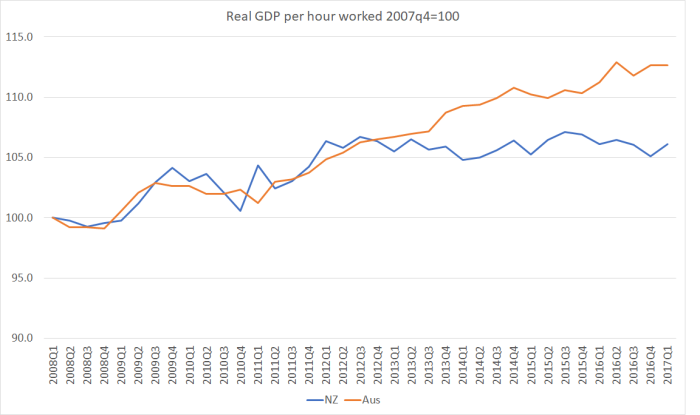
I’ve run this chart numerous times before.

real GDP phw july 17 Not only have we had no labour productivity growth for five years, but our near-neighbour Australia –  which the government was once willing to talk about catching up to – has gone on generating continuing labour productivity gains.    Yes, there has been a productivity growth slowdown in much of the advanced world, dating back to around 2005.    But our additional and more recent slowdown –  well, dead stop really – looks like something different, and probably directly attributable to New Zealand specific factors.   Things New Zealand governments have responsibility for responding to.

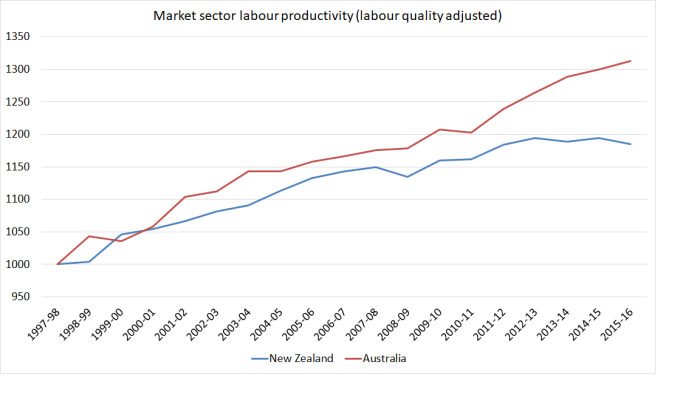
I’ve also shown this chart before –  labour productivity for the better-measured parts of the economy, with SNZ’s attempt to adjust for changing labour quality. It is annual data, and only available with a bit of lag.

market sector LP

Again, no labour productivity growth at all in the last few years.

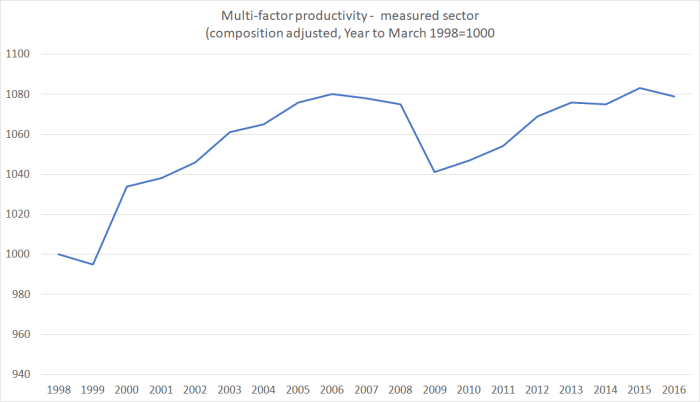
And what about multi-factor productivity growth?  It doesn’t get as much attention, partly because the data are only annual, and the construction of these estimates involves quite a few assumptions.   Nonetheless, here is the SNZ estimate for the (better) measured bulk of the economy.

mfp to 2016

The series is cyclical –  if machines are idle in a recesson estimated MFP falls and then recovers as utilisation picks up –  but looking through the recession, the estimated index level of MFP is the same now as it was 10 years previously.  No growth.

But somehow the Prime Minister thinks “productivity in New Zealand has been growing pretty well”.    One for the Tui billboards I’d have thought.

And all that is without even getting into the lamentable failure of governments led by both main parties to do anything about reversing the precipitous decline in levels of productivity in New Zealand relative to those in other advanced economies.    Lifts in the terms of trade –  experienced under both this government and its predecessor –  are of course welcome, but they can’t be a credible medium-term substitute for productivity growth.

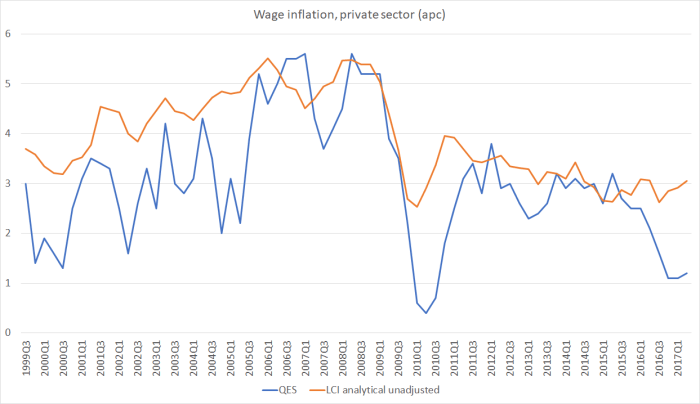
From the other side, the Leader of the Opposition’s suggestion that data on real wage growth didn’t matter, and what really mattered was how people felt, seemed almost equally risible.  In terms of attracting votes, perhaps she is right.   But when the Prime Minister pointed out that real wages have been rising, he was of course correct.  I’m not sure why people put so much weight on the QES measure of hourly wage inflation.  It has well-known problems (for these purposes) and is hugely volatile.   Here is a chart showing wage inflation for the private sector according to (a) the QES, and (b) the Labour Cost Index, analytical unadjusted series.

wages debate  No economic analyst thinks wage inflation is anything like as volatile as the blue line –  in fact, wage stickiness, and persistence in wage-setting patterns is one of the features of modern market economies.

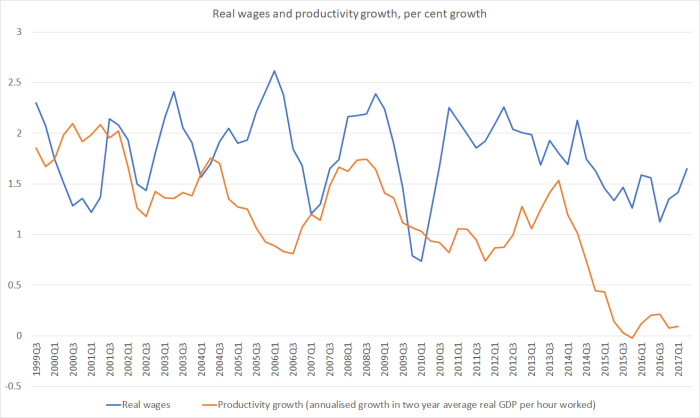
And here is the chart I ran last week, comparing real private sector wage inflation (the orange line above, adjusted for the sectoral core measure of CPI inflation) with productivity growth.

Real wage inflation now is lower than it was in the pre-2008 boom years, but it is running well ahead of productivity growth (however one lags or transforms it).    From here, lifting productivity growth is the only way real wage inflation is going to increase, and such increases in economywide productivity really should be recognised for what they are –  a well overdue imperative.

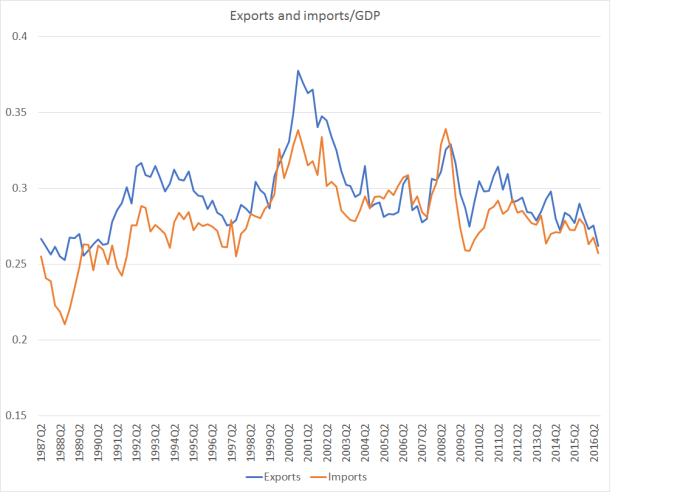
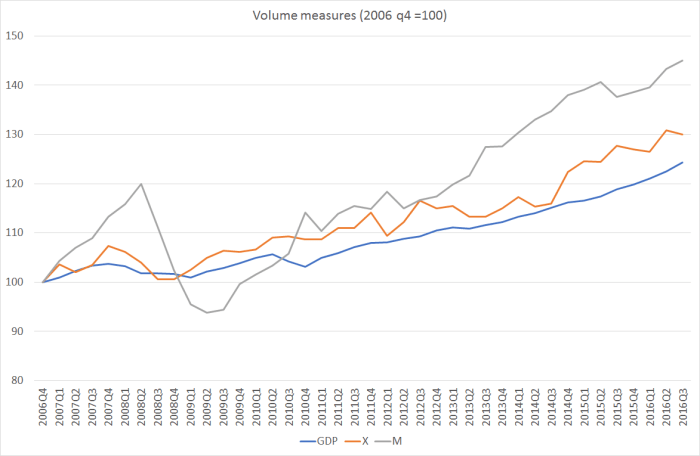
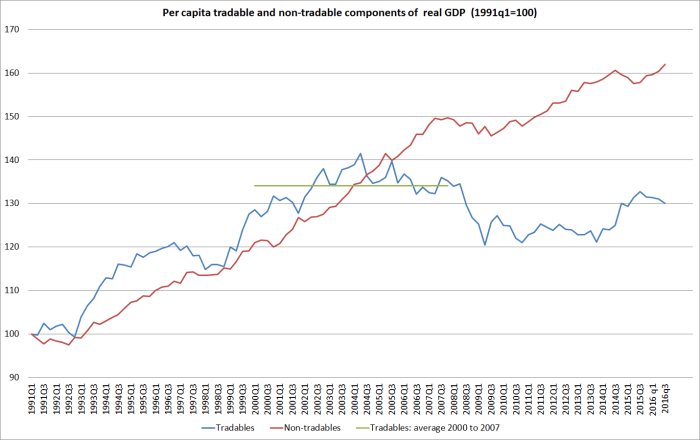
Sadly, the Prime Minister seems to want to bluff his way through, simply pretending there isn’t an issue, with no real answers as to how to  (for example) lift the outward-orientation (exports and imports) of the New Zealand economy, and refusing to face the fact that productivity growth has vanished since the latest new large net migration inflow began in 2013.  It won’t be the only reason why productivity growth has been vanished, but it is unlikely that there is no connection at all (and certainly the much-vaunted official and political claims that high non-citizen immigration flows are helping lift productivity look emptier than ever).

And the Opposition leader is no better.    When Ardern was asked last night who was going to build the houses if immigration was cut back, my 14 year old son turned to me and asked “why doesn’t she just say that if there are fewer migrants fewer houses would need to be built”.   Sadly, I could only point out that Labour’s approach to immigration actually isn’t materially different to the National Party’s.  The net inflow might be a lower in the first year, but in the essentials they are two sides of the same coin.  Here is what I wrote when Labour released their policy in June.

Overall, some interesting steps, some of which are genuinely in the right direction.  But, like the government, Labour is still in the thrall of the “big New Zealand” mentality, and its immigration policy –  like the government’s – remain this generation’s version of Think Big.  And it is just as damaging.    The policy doesn’t face up to the symptoms of our longer-term economic underperformance –  the feeble productivity growth, the persistently high real interest and exchange rates, the failure to see market-led exports growing as a share of GDP, and the constraints of extreme distance.  None of those suggest it makes any sense to keep running one here of the large non-citizen immigration programmes anywhere in the world, pulling in lots of new people year after year, even as decade after decade we drift slowly further behind other advanced countries, and se the opportunities for our own very able people deteriorate.

And what is Labour’s solution to the economic challenges?   There is lots of talk about more skills training, even though the OECD surveys suggest that our people are already among the most skilled in any OECD country.       Beyond that, Jacinda Ardern was invoking the OECD –  “they’ve told us what we need to do” to lift productivity and economic performance.

Well, this table is from the latest OECD Economic Survey of New Zealand, released a few months ago.  On the left hand side are the “main findings” and on the right the “key recommendations”

OECD recs

I don’t wildly disagree with most of those recommendations –  sceptical as I am of R&D subsidies.     But (a) with the exception of R&D subsidies, does this look at all like Labour Party economic policy  (has there been talk of the tax working group possibly proposing lower capital taxes?), and (b) more importantly, does anyone really think that these items, even taken together, are remotely enough to materially reverse the decades long decline in our relative productivity performance, that the OECD themselves highlighted?

Sadly, there was all too much of “let’s pretend” to the debate, and nothing to suggest that either side is really serious about engaging with, and delivering solutions to, the decades of underperformance, presenting now in five years of no productivity growth at all, and an economy increasingly skewed inwards rather than outwards.


Leadership and accountability

I’d been going to write just a short post on the contrast, that I’ve been trying to make sense of over the past week, between the very public calls for the head of the Director-General of the Ministry of Health, and the near complete silence around the conduct of the Governor of the Reserve Bank.   Perhaps there are just more votes in health than in the Reserve Bank?

Chai Chuah seems to lead a not entirely well functioning ministry –  in time presumably the SSC PIF report will reveal more –  but he has little or no direct control over anything beyond his own agency.  And the latest calls for his head –  or at very least for severe reprimand –  appear to relate to errors in putting together the Budget.  The mistakes were made by people down the organisation, and while chief executives have to take responsibility for everything in their agency, it doesn’t look as though the direct mistakes were made by Chuah himself.   And even the mistake affected expected flows of money between various government agencies (the various DHBs), with little or no apparent consequences for the public.   But the Minister was openly embarrassed by the mistake.  And there has been plenty of public and media comment, and even comment from politicians –  so much so that the State Services Commissioner has (rather unconvincingly) sought to suggest public service chief executives shouldn’t be openly criticised by the Opposition.

Contrast that situation with Graeme Wheeler, Governor of the Reserve Bank.  He is an extremely powerful indepedent public servant, who makes policy himself and regulates financial institutions, with relatively few checks and balances.   Upset by comments on his policies by the BNZ’s economist, he engaged in a sustained campaign to “silence” (materially alter the tone and/or content of) a leading critic.  It wasn’t a matter of a single upset phone call, but a sustained campaign over weeks (at least) involving not just the Governor, but each of his three other most senior managers, a meeting with the BNZ chief executive, and finally (that we know of) a letter to the BNZ chief executive, urging that Stephen Toplis be censored.   The Governor, recall, is a key regulator of the BNZ’s business.

And what was the response?   Pretty muted to say the very least.  Lots of people were pretty appalled by the behaviour, but hardly anyone was willing to say so openly.  As Reuters put it in a story

To write such a letter was an unusual move for the head of an independent central bank in an advanced economy, particularly one that directly regulates banks.
The fact the letter did not cause more controversy indicated the central bank’s power, analysts said.

Whether it is really the central bank’s power that was the issue I’m not sure.  For some no doubt it was (some people directly associated with banks made that point to me).   But for many others, with no current involvement in banks, it must have been something else. Perhaps it was partly because Wheeler is leaving shortly anyway?  Perhaps an ingrained willingness to turn a blind eye to egregious conduct when it involves establishment institutions?  The sort of practical indifference that, in turn, enabled the Minister of Finance to get away with abdicating his responsibilities (for the Governor and the Bank) and breezily dismissing the issue as nothing whatever to do with him.   A silence that risks leaving the impression that such conduct –  active attempts by senior public officials to silence a prominent (and annoying) critic –  is acceptable is modern New Zealand.

Then again, look at the example set by our current head of government.

I’m not party political at all.  If any readers think they can work out who I’ll vote for they are doing better than me.  But I’m probably the sort of pro-market conservative that might in times past have been most naturally comfortable supporting National.  And I’ve always had some regard for Bill English.  He was Minister of Finance when I spent some time at The Treasury and if he wasn’t willing to be very ambitious about doing stuff, at least he seemed to recognise – and care about – many of the underlying issues.    And in this very secular age, there was also something reassuring about a conservative practising Catholic as Prime Minister.   He seemed to be a person of decency and integrity, the sort of person any Cabinet would be fortunate to have.

Which is probably why what has emerged this week is so profoundly troubling.

I don’t care greatly about Todd Barclay himself.  What bothers me is Bill English, long-serving Minister of Finance, now Prime Minister, about to seek election to a full term as Prime Minister in his own right.   They are roles in which we should be looking for leadership with integrity.  What is on display this week doesn’t look remotely like that  –  not much leadership, not much integrity.

I’m sure plenty of politicians in the past have had guilty secrets – things that were either never widely known, or never able to be reported.       Had they become known, perhaps some other political reputations would have been severely damaged.    But we are dealing with this specific episode, which has become public, and this specific election.  In the process, the standards of the man who seeks to keep leading our country seem to be laid bare pretty starkly.  Not, I hope, the standards he would sign up to in the abstract, but the way that, under pressure, he actually chose to operate.

From his comments this week it is clear that:

  • Bill English knew not just that a financial settlement had been made in the dispute that had arisen over the employment relationship between Todd Barclay and his former staffer, but that (a) part of the settlement had been funded from the National Party leaders’ fund (not a problem in itself). and (b) that the payment had been larger than usual because of the “privacy issues”
  • Bill English knew that Todd Barclay had taped some of (her end of) his employee’s phone calls (as he noted in his statement to the Police that Barclay had told him so)
  • Bill English knew there was a Police investigation into a complaint around the taping (approached by the Police, he made a statement to them),
  • Bill English knew that  –  as was public knowledge – that Todd Barclay had refused to cooperate with the Police investigation.
  • Bill English knew that when an OIA release was made on these matters, his statement to the Police (with the report of Barclay acknowledging the taping), was deliberately and consciously withheld.

If it didn’t initially occur to him, when Barclay first mentioned the matter, that taping someone else’s phone calls could be a criminal offence, the possibility must have been clear by the time he was making his statement to the Police a couple of months later.

Bill English wasn’t Prime Minister when all this was going on, but he was both Deputy Prime Minister and the former electorate MP for Clutha-Southland.  He knew all those involved in a way that, presumably, John Key didn’t.  And can anyone really doubt that, in a matter with these specifics, if Bill English had insisted to John Key on a higher standard being adopted, it would have been done?

What might a high standard of integrity have involved in this case?

I’d have thought it was as simple as this.

Once it became clear that there was a Police investigation into these matters, English (and Key) should have insisted that Barclay co-operate with the Police inquiry –  first made that insistence known privately, and then (if that failed) publicly.  There was no legal obligation on Barclay to cooperate with Police, but this is about politics and acceptable standards in public life.    Insisting on co-operation with Police isn’t an asssement of guilt, or innocence, just the sort of minimum acceptable standard we should expect in those holding high public office (in this case under the National Party banner) –  especially when you as leader or deputy know stuff (per the English statement) that, at least on the surface, looks questionable.

And if Barclay had refused?   Suspension from Caucus would presumably have been an option, followed by expulsion from Caucus if necessary.   Richard Prebble did that as leader of ACT when the Donna Awatere case arose.

English –  and Key and the National Party Board –  could also have made clear that if Barclay refused to cooperate that under no circumstances would he be a National Party candidate at the 2017 election.

And Mr English could have released his Police statement.

No doubt, well before any of this happened, Barclay would have quietly bowed to the inevitable and either resigned or cooperated with the Police investigation.    But he isn’t the issue here; the conduct of the National Party leadership (and that of Bill English in particular) is.

Might it have been uncomfortable for English and the National Party?  Quite possibly –  and over something that they had had no effective control initially.  But doing the right thing often is uncomfortable.   But it is also why we all drum into our kids that “you’d get in less trouble if you’d fronted up straight away”.    Dealt with effectively 15 months ago (a) this would largely be forgotten by now, and (b) as much of any memory would have been about the willingness of the Prime Minister and Deputy Prime Minister to act decisively to uphold standards.

Instead, none of this was done, and presumably the hope was that none of it would ever come out.  As late as Tuesday morning –  after the Newsroom story came out –  the Prime Minister was still trying to claim he didn’t know much about what had gone on.

It is pretty shameful conduct from the Prime Minister.  And pretty feeble leadership even now.  There is no sign of contrition.  There has been no apology.  Even now, Barclay is still not indicating that he will be cooperating with the Police, still not apologising.  And yet he still sits in the National caucus.    Meanwhile, media seem to find it impossible to get the President of the National Party to face the media on the issue –  even though if the Prime Minister told him otherwise he’d surely be available almost instantly.  (In fact, I heard one National Party MP on Morning Report this morning bemoaning how unfortunate it was that “internal party stuff” had become public.  It suggests they still don’t get it.  Police investigations into possible criminal conduct aren’t just “internal party stuff”. )

Where was the leadership with integrity last year?  Where is it today?

Perhaps the spin is right that the public don’t care.  Time will tell.  But I reckon we should expect, and demand, better from those who hold, or seek, high office.  In a sense, we are fortunate that so much detail emerged on this episode –  that, for example, the Police got Mr English’s text with the comment about taping.  The standards  apparent in the stuff we do see is our best predictor for how our leaders handle other difficult stuff.  On the evidence of how Bill English (and John Key) have handled this episode, from the beginning to today,  those standards look pretty deeply disquieting.

As readers will know, I have written here more than once about a tendency that has crept into this government as the years have gone, and the problems of underperformance have become more apparent, to just make stuff up.  Perhaps it is the pretence that the economy is doing wonderfully, better than most of our peers (when in fact productivity growth is non-existent, the tradables sector is in relative decline, and the unemployment rate still disconcertingly high etc), or the proposition that New Zealand came through the 2008/09 recession better than most, or the laughable (and worse) attempt to pass off extraordinarily high house prices as a “quality problem” or mark of success, it has become all too pervasive.    Frustrating as that sort of thing is, at least anyone who looks for themselves can see that it is largely made-up lines.

The lack of leadership, and attempts to keep things from the public, apparent over the Barclay affair seems to me an order of magnitude more serious.   But perhaps one sort of spin eventually corrodes in other areas the standards these people would surely once have set for themselves, and allows them to lose sight of just how unacceptable the continued failure of leadership now on display really is.  Flourishing free and open democracies need better than that.


More people means more emissions. So how about fewer people?

I’ve never had that much interest in climate change.  Perhaps it comes from living in Wellington.   If average local temperatures were a couple of degrees warmer here most people would be quite happy.    And as successive earthquakes seem to have the South Island pushing under the North Island, raising the land levels around here –  you can see the dry land that just wasn’t there before 1855 –  it is a bit hard to get too bothered about rising local sea levels.  Perhaps it is a deep moral failing, a failure of imagination, or just an aversion to substitute religions.  Whatever the reason, I just haven’t had much interest.

But a story I saw yesterday reminded me of a post I’d been meaning to write for a few weeks.  According to Newshub,

In documents released under the Official Information Act, a briefing to Judith Collins on her first day as Energy Minister says the cost to the economy of buying international carbon units to offset our own emissions will be $14.2 billion over 10 years.

In the documents, officials say “this represents a significant transfer of wealth overseas”, and also warn “an over-reliance on overseas purchasing at the expense of domestic reductions could also leave New Zealand exposed in the face of increasing global carbon prices beyond 2030”.

The cost amounts to $1.4 billion annually.

The Green Party says the bill will only get bigger if no action is taken by the Government to reverse climate pollution, and it continues to open new coal mines and irrigation schemes.

Roughly speaking, this suggests we’ll be giving roughly 0.5 per cent of GDP each year to people in other countries, just because of an (inevitably) somewhat arbitrary emissions target.   Many useful economic reforms might struggle to generate a gain of 0.5 per cent of GDP.  These are large amounts of money, inevitably raised at a still larger real economic cost.   And this is on top of the economic costs of domestic abatement policies.

Of course, whatever New Zealand does in this area makes no difference to the global climate.  We are simply too small.  Most people recognise that we sign up to arbitrary targets through some (not unrelated) mix of wanting to be a good international citizen and (perhaps as importantly) being seen as a good international citizen.  If we were regarded as not “doing our bit” there might be a risk of trade restrictions or other adverse repercussions a little way further down the track.

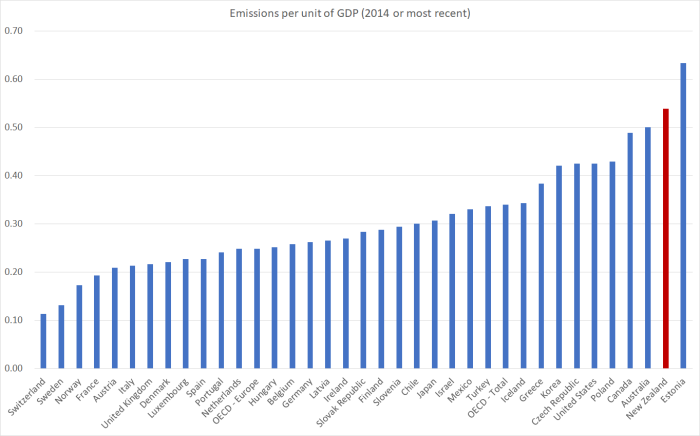
If one is an emissions and climate change zealot, the New Zealand data looks like it could give you grounds for zealotry.   For example, here are total emissions (in CO2 equivalent terms) per unit of GDP (using PPP exchange rates), from the OECD databases.  Why per unit of GDP?  Well, generating GDP takes various inputs, and emissions of greenhouse gases are often one of them.

emissions per GDP

But emissions levels are, at least in part, about geography and industry structure.  They aren’t just a matter of “wasteful” choices.   Thus, steps to reduce emissions might also reduce the number of units of GDP.   (In emissions per capita terms, we don’t rank as far to the right –  being quite a lot poorer than (say) Australia, Canada and the United States).

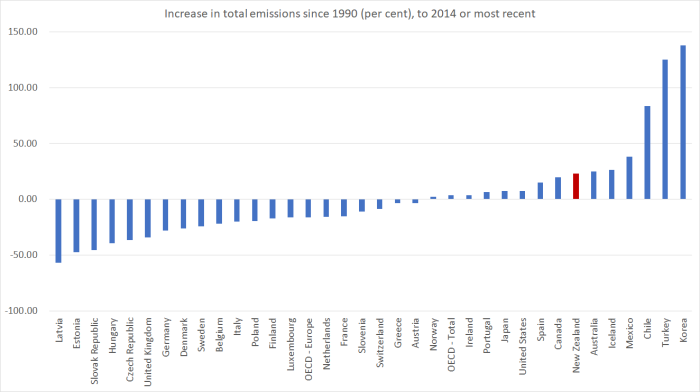
The self-imposed emissions reductions targets are, I gather, expressed in terms of total emissions.    Again using OECD data, here is how the various countries have done on that score since 1990 (the typical reference date –  and a somewhat convenient one for the former eastern bloc countries, which often had very inefficient heavy industries).

emissions total

But one of the things that marks us out relative to most of the OECD (and certainly relative to those former eastern bloc countries on the left of the chart) is the rapid growth in population we’ve experienced since then.   In fact, New Zealand’s population has increased by more than 40 per cent since 1990.  By contrast, all the world’s high income countries’ population has increased by only around 15 per cent over the same period.   And all else equal, more people tend to mean more emissions  (although no doubt it isn’t a simple one-to-one relationship).

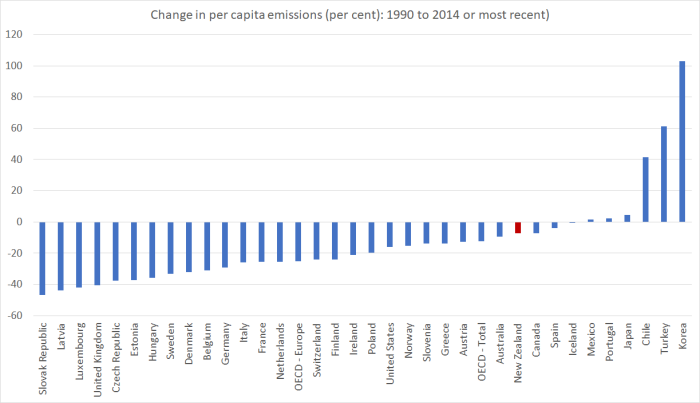
In per capita terms, our greenhouse gas emissions have actually fallen since 1990.  Of course, so have those of most OECD countries.  Here are the data.

emissions pc

Our average per capita emissions have been falling less rapidly than many other OECD countries, but not that much less rapidly than the OECD total.   And all this in a country where I gather –  from listening to the occasional Warwick McKibbin presentation –  that the marginal cost of abatement is higher than almost anywhere in the world.  Why?  Well, all those animals for a start.  And the fact that we already generate a huge proportion of our energy from renewable sources (all that hydro).  And, of course, distance doesn’t help –  aircraft engines use a lot of fuel, and neither a return to sailing ships nor the prospect of, say, solar-powered planes at present seem an adequate substitute.

So you have to wonder how our government proposes to meet its self-imposed targets, without doing so at great cost to the living standards of New Zealanders.

In fact, it seems the government is wondering just that.   A few weeks ago,

The Minister for Climate Change Issues, Hon Paula Bennett, and the Minister of Finance, Hon Steven Joyce, today announced a new inquiry for the Productivity Commission into the opportunities and challenges of a transition to a lower net emissions economy for New Zealand.

The terms of reference are here.    As they note

New Zealand has recently formalised its first Nationally Determined Contribution under the Paris Agreement to reduce its emissions by 30 percent below 2005 levels by 2030. The Paris Agreement envisages all countries taking progressively ambitious emissions reduction targets beyond 2030. Countries are invited to formulate and communicate long-term low emission development strategies before 2020. The Government has previously notified a target for a 50 per cent reduction in New Zealand greenhouse gas emissions from 1990 levels by 2050.

Which does look a little challenging (in 2014 total emissions were about 3 per cent lower than 2005 levels –  30 per cent looks a long way away).  That isn’t too surprising.  After all,

  • the marginal cost of abatement is particularly high in New Zealand
  • the rate of population growth in New Zealand has been rapid, and
  • the rate of population growth is projected, on current policies, to continue to be quite rapid.

In fact, SNZ project another 25 per cent population growth by 2050 –  quite a slowing from here, but still materially faster than the populations of most other advanced economies will be growing.  And, recall, more people typically means, all else equal, more emissions.    The 2050 target, in particular, requires quite staggering reductions in per capita emissions –  actual emissions now are a quarter higher than in 1990 –  if anything like these population increases actually occur.

The terms of reference for the Productivity Commission inquiry go on at  length about all manner of things, including noting (but only in passing) that there may be “future demographic change”.

Recall that New Zealanders are actually doing their bit to lower total emissions. Our total fertility rate has been below replacement for forty years.  And (net) New Zealanders have been leaving New Zealand each and every year since 1962/63.    If New Zealanders’ personal choices had been left to determine the population –  the natural way you might think –  total emissions in New Zealand would almost certainly be far lower than they are now.   Check out the low population growth countries’ experiences in the second chart above.

Instead, we’ve had the second largest (per capita) non-citizen immigration programme anywhere in the OECD (behind only Israel),  a programme that (as it happens) got underway just about the time (1990) people benchmark these emissions reductions targets to.

As I’ve noted repeatedly, neither the government (or its predecessors), nor the officials, nor the business and think tank enthusiaists for large scale immigration, can offer any compelling evidence for the economic benefits to New Zealanders (income and productivity) from this modern large scale immigration.    And when they do make the case for large scale immigration, they hardly ever mention things like emissions reductions targets (I’m pretty sure, for example, there was no reference to this issue in the New Zealand Initiative’s big immigration advocacy paper earlier in the year).    Even if, to go further than I think the evidence warrants, one concluded that the large scale immigration had made no difference at all to productivity levels here (and remember that, for whatever reason, we have actually been falling slowly further behind other countries over this period despite all the immigration), once one takes account of the substantial abatement costs the country is likely to face if it takes the emissions reduction target seriously, the balance would quite readily turn negative.    We would need to have managed quite a bit of spillover productivity growth from our not-overly-skilled immigration programme (and recall that no gains have actually been demonstrated)  just to offset the economic costs, direct and indirect, of meeting emissions reduction targets which are made more onerous by the rapid increase in population numbers.

So I do hope that as the Productivity Commission starts to think about how to conduct their emissions inquiry, they will be thinking seriously about the role that changes in immigration policy could play in costlessly (or perhaps even with a net benefit) allowing New Zealand to meet the emissions reductions targets it has set for itself.  On various assumptions about the economic costs or benefits of immigration, how would the marginal costs of abatement compare as between lowering the immigration (residence approvals) target, and other policy mechanisms that are more often advocated in this area?   It would be interesting to see the modelling work on these issues.  If the Productivity Commission doesn’t take seriously the reduced immigration option, it would be hard not to conclude that ideology was simply trumping analysis.

Of course, reduced population growth through lower immigration isn’t a solution for every country.  On the one hand, people who don’t come here, stay somewhere else.  And on the other, most advanced countries have much smaller immigration programmes than we do.  But if it isn’t a solution for every country,  it looks like a pretty sensible and serious option for New Zealand specifically.  And the interests of New Zealanders should be the primary focus of our policymakers, and their advisers.

It is also brings to mind the old question as to why the Green Party in particular seems to remain so committed to large scale immigration, and the “big New Zealand” mentality, that has driven politicians here (of all stripes) for more than a century.  Not only would a lower population be consistent with New Zealanders’ personal revealed preferences (birth rates and emigration) and actions, it would assist in meeting emissions targets.  Perhaps to idealistic Greens that seems like “cheating” –  it doesn’t reduce global emissions, although it may put the people in places where the costs of reducing global emissions is cheaper than it is here.

But even if so, then what about one of those other pressing Green concerns –  water quality and the pressure on the environment from the increased intensity of agriculture?  There is increasing recognition across the political spectrum that there is a major issue here, and it is an area where New Zealand actions and choices make all the difference.   Cut back the immigration target and, over time, we would see lower real interest rates and a lower real exchange rate.   Against that backdrop it becomes much easier to envisage governments being able to impose much stiffer, and more expensive, standards on farmers (the offset being the lower exchange rate).      With a less rapidly-growing population, the (probable) reduced growth in agricultural output would be less of a concern (economically) and real progress could be induced on the environmental fronts (emissions and water pollution etc), without dramatically eroding the competitiveness of New Zealand’s largest tradables sector.

(Much the same sort of argument can be advanced in respect of congestion and pollution costs associated with growth in tourism: less rapid immigration would result in a lower real exchange rate, making it more feasible (economically and politically) to levy the sorts of charges that might effectively deal with pressures that the sheer number of tourists is imposing in some parts of the country –  in a country where the natural environment is really what draws people.)

It is past time for a serious debate on just what economic gains (if any) New Zealanders as a whole are getting from continued large scale non-citizen immigration.  The emissions reduction target might be seen by some as an arbitrary, even unnecessary, intervention, and is no doubt seen by others as a moral imperative, perhaps the very least we could do. I don’t have a dog in that fight.  But the targets are a fact –  a domestic political reality, and probably an international constraint we have to live with even if we didn’t really want to.  Against that background, and given the high marginal cost of abating greenhouse gas emissions in New Zealand, and with little or no evidence of other systematic gains to New Zealanders from the unusually large scale immigration programme we run, we really should be taking more account of our immigration policy in thinking about how best (most cheaply) to reduce effectively greenhouse gas emissions, as well as the water pollution that increasingly worries many New Zealanders.

A government that simply makes things up

Perhaps all governments these days eventually do it, but one of the things that I’ve come to dislike most about our current government is the way they and their acolytes simply make stuff up.    I could, I suppose, understand them not actually doing anything much.  After all, they didn’t promise to do anything much.

But the endless spin, and stuff that is just made up, sickens me.  Apart from anything else, I try to bring up my kids heeding the biblical injunction to honour those in authority over us.  I don’t read that as suggesting people won’t disagree with those who hold office, but there is something quite sick about the political process –  and perhaps about a society that tolerates this stuff –  when so often one reads comments from senior ministers or the Prime Minister to which one can only  explain to kids interested in such things that “they are just making it up”.    We should expect much better than that.

I’ve written before about the current and former Prime Ministers’ dismissal of housing or conjestion problems as “quality problems” or “signs of success“.  And there are the repeated claims that New Zealand’s economy is doing better than almost any other advanced country –  a suggestion ably challenged in an article by journalist Graham Adams yesterday.   But today, since it is the day Murray McCully leaves ministerial office after a very long period in ministerial roles in two governments. I wanted to focus on an unfounded claim in a recent speech to the New Zealand Institute of International Affairs by the outgoing Minister of Foreign Affairs.

He begins with an unexceptionable observation

The key feature of the past decade has been the rise of China, in terms of both our bi-lateral relationship, and as a regional and global power.

Not just of the past decade, but the past several decades.

And, as the Minister notes, there has been a big growth in bilateral trade (goods and services).

In my eight and a half years in this role I have seen our exports to China increase from around $2 billion to nearly $10 billion, and visitor numbers more than quadruple from under 100,000 to over 400,000.

But then he dramatically over-reaches

Had it not been for the dramatic expansion of trade and economic relations with China in the early years of the Key Government, New Zealand would have suffered a long and sustained recession, and all of the associated social challenges that we have seen in some European nations.

There is simply no support for this proposition anywhere in the rest of the speech.

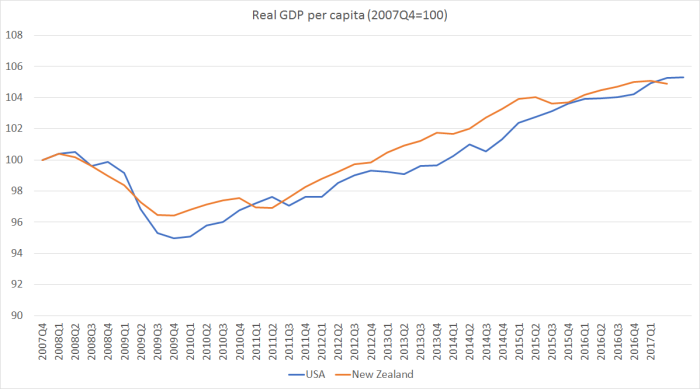
The implication, of course, is that New Zealand has done well over the term of this government.  But here is a chart of real GDP per capita for New Zealand and the United States, both normalised to 100 in the December quarter of 2007, just prior to the recession.

real GDP pc NZ and US

The United States, you will recall, was the epicentre of the financial crisis, and had a very nasty fall in house prices.  The United States cut interest rates as far as they then thought they could go.

New Zealand, by contrast, had a relatively modest home-grown financial crisis (localised in the non-systemic finance companies), never reached the limits of conventional monetary policy, and had a much stronger fiscal position going into the recession than the US (or most other advanced countries had).  Oh, and we the big bonus of a sharp fall in interest rates, as a country that had borrowed heavily from the rest of the world.

And yet look at the chart.  The initial recession was certainly a little deeper in the US than it was here –  but China wasn’t a significant influence on what was happening here in 2008/09.  But then we had a double-dip recession in 2010.

For a couple of years it looked as though we might be doing a bit better than the US, at least on this metric, but even that optimistic possibility has now faded away.  Over the nine years shown, real GDP per capita has grown almost exactly as slowly in New Zealand as it has in the United States (average growth rates of barely 0.5 per cent per annum).   You’d have to know economic data pretty well to be able to tell apart the US and New Zealand lines for the last six years or so.

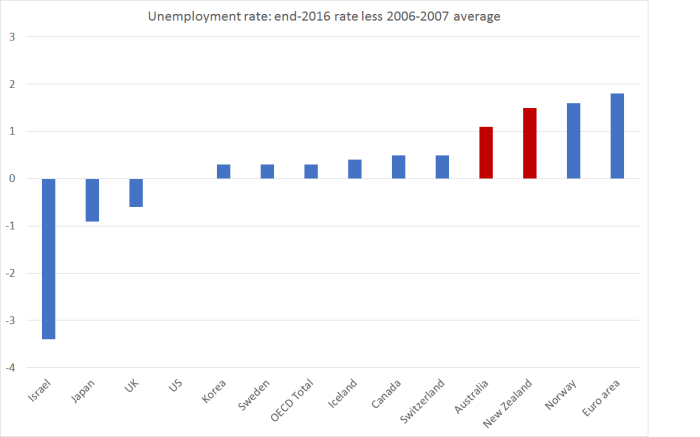
So we had a pretty nasty recession, which we took years to recover from.  On some metrics – eg the unemployment rate –  we still haven’t.  And all that even though China took up a larger share of our exports.  It is so even though in those “early years of the Key government”, China was a big source of demand driving activity in our biggest trade and investment partner, Australia.

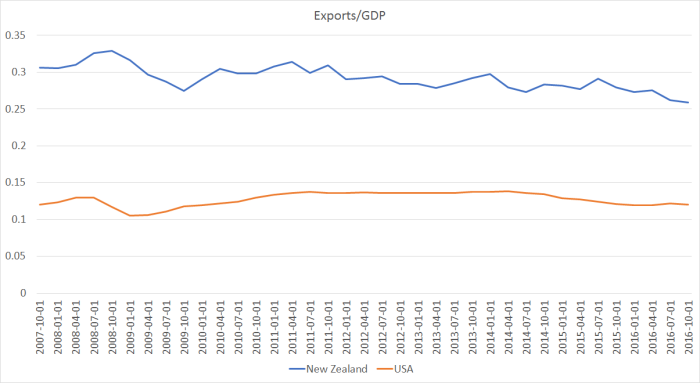
The Minister seemed to be telling a trade and exports story –  certainly those are the numbers he quoted.    But here are exports as a share of GDP for the two countries, again back to December 2007.

exports to GDP US and NZ

In both countries, exports took a hit during the recession – in the US’s case it was mostly volumes, while it our case much of it was prices (the fall in export prices).   But, despite all that additional trade between New Zealand and China, our export share of GDP has fallen quite a bit over the last few years, while that in the US (always much lower, given that the US is a large country) has held remarkably steady.

Perhaps this fawning “China our saviour” line went over well when the Premier of China was visiting recently, but it really doesn’t amount to much at all.  The country composition of our exports has changed –  and for a couple of years perhaps high prices out of China for milk powder lifted farmer incomes –  but as a share of the overall income, exports have been shrinking.  We produce stuff (mostly bulk commodities), and someone buys it.  In recent years, China has been a more important buyer –  although Australia remains our largest export market –  and the free trade market with China is likely to have been helpful, but it has hardly transformed our economic fortunes.

There are other differences between the US and New Zealand experiences.  The US unemployment rate went up much more than ours did during the recession, but then came down much more sharply and is now a bit lower than ours.

U rates in floaters

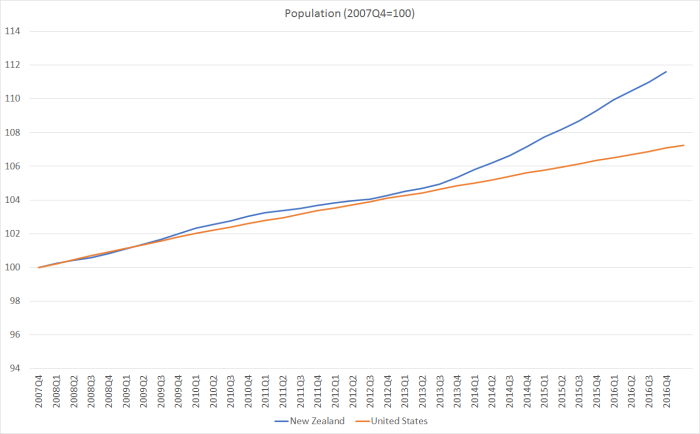
But one striking difference over the last few years is in the estimated population growth rates.

population US and NZ

Overall, ours is a story of little or no productivity growth (none for the last five years), of an economy that –  going by the headline statistics –  seems increasingly inward focused, reliant on population-fuelled (and earthquake rebuild fuelled) domestic demand.   And it is a pretty poor performance all round.

There are, of course, worse places among the advanced countries, and if that is all the Minister had wanted to say, no one could disagree.  But instead he over-reached, suggesting that somehow we’d done well.  We haven’t.  And mostly that is down to our own choices –  or, more specifically, those of the government in which Mr McCully has been a senior minister.

Trump and Muldoon

Over the last few days, a couple of local commentators (here and here) have been drawing parallels between Donald Trump and our own former Prime Minister, Sir Robert Muldoon.  I commented on one of those pieces, somewhat sceptically, and didn’t give it much more thought.    But yesterday Tyler Cowen devoted his Bloomberg column  to attempting to make exactly the same comparison, which prompted me to think about the case more carefully.

What would you think of a Western democratic leader who was populist, obsessed with the balance of trade, especially effective on television, feisty and combative with the press, and able to take over his country’s right-wing party and swing it in a more interventionist direction?

Meet Robert Muldoon, prime minister of New Zealand from 1975 to 1984. For all the comparisons of President Donald Trump to Mussolini or various unsavory Latin American leaders, Muldoon is a clearer parallel case.

I’m still not remotely convinced.  Any parallels seem superficial at best, and deeply unfair to Muldoon.  Without claiming any particular expertise in Italian politics/history, I’m not sure why Cowen would go past Silvio Berlusconi if he wants to find parallels among leaders in modern democratic states. –  and, even then, it is hard to believe that Italian governments were quite as shambolic as the Trump administration has been in its first few weeks.

If the similarities are few and superficial, the differences are pretty profound.  We can start with the personal:

  • Muldoon served in the army for several years in World War Two.  Like many prominent Americans (Cheney, Clinton) Trump avoided military service in wartime.
  • Despite suggestions of an extra-marital affair, Muldoon had one wife, for life.
  • Muldoon was neither a product of, nor revelled in, celebrity culture.
  • Muldoon wasn’t a wealthy man, and didn’t trade in influence or connections to build personal wealth.  He lived pretty modestly and his finances weren’t a secret.
  • Whatever people thought of him and his government’s policies, few doubted his genuine concern for New Zealanders, and no one ever thought that his motivation for being in politics was some sort of narcassism or craving for respect.

One can easily think of other differences.  Muldoon held high office for almost 15 years –  almost six years as Minister of Finance and then Deputy Prime Minister in governments led by other people, and eight and half years as Prime Minister (and Minister of Finance).  Ours is a parliamentary system, with no history of outsiders suddenly ascending to office  –  and so, for all the talk of “taking over his country’s right-wing party”, Muldoon joined it young, worked hard for it, rose gradually within it, had his undoubted talents recognised by those who worked closely with him, was selected (by his fellow members, all selected at a local constituency level), first as deputy leader, then as leader.  As leader of a parliamentary party –  able to be ousted at any week’s caucus meeting, at any time –  he won three general elections.  And Trump?   How many leading Republicans voluntarily chose him as their candidate?

As Cowen notes, Muldoon was also well-known for his fearsome command of detail.  He was a highly effective minister with a huge capacity for work.    And if he didn’t always agree with officials, those who worked for him recognised his respect for the role of public servants, as advisers.   Muldoon ran a disciplined administration –  in contrast, say, to the weak Prime Ministerial leadership and management in the administration that followed his.   Trump has published numerous books under his name, but Muldoon wrote books himself.

Of course, some of these sorts of comparisons aren’t new.   I pulled down from a box in the garage this morning, my copy of the Citizens for Rowling publication.   Six weeks or so before the 1975 election –  Muldoon’s first as party leader – a group of fairly prominent New Zealanders launched this high profile campaign, notionally in support of the then Labour Party Prime Minister, Bill Rowling.  In fact, it was pretty openly a “Citizens against Muldoon” movement –  people appalled at Muldoon’s pretty aggressive style, and at his popularity (“I ask the Nationals how they would feel if Mr Muldoon was the leader of the Labour Party” –  I imagine the answer would be “worried that we were about to lose badly”).  One of New Zealand’s leading journalists outdid himself lamenting the threats to individual freedom

“it happened in the United States during the era of Senator Joe McCarthy; it happened in Germany in the 1930s. I used to believe that it couldn’t happen in New Zealand.  Now I am not so sure.”

It didn’t of course.

Was Muldoon’s style one I was particularly comfortable with?  No, not really. He was a self-described “counter-puncher”, and willing to take on pretty aggressively those who challenged him.  Politicians like Muldoon’s predecessor as National Party leader, John Marshall, and his predecessor as Prime Minister, Bill Rowling, probably naturally appeal more readily.   But as party leaders, those two won no general elections at all.  Rowling, a profoundly decent person and effective minister, fought three elections against Muldoon, and lost them all.  The second and third were close, but the first wasn’t –  it was one of the biggest electoral reversals in New Zealand history (popular vote, and parliamentary seats), led by Muldoon, who was a fearsomely effective campaigner.   Not many people voted for Muldoon in 1975 because he “wasn’t Clinton” (or the New Zealand equivalent).

What of policy?   Muldoon became Minister of Finance in early 1967.  A year later, faced with a collapse in commodity prices, he oversaw a devaluation and an IMF-supported programme of macroeconomic stabilisation.  It was tough –  cuts to subsidy, fiscal restraint, markedly reduced access to credit –  and effective.  His first term as Minister of Finance saw a continuation of the slow progress towards financial sector liberalisation.

But when people focus they most often concentrate on his term as Prime Minister, in which he also served as Minister of Finance  (in New Zealand until the late 1980s it wasn’t uncommon for the Prime Minister to also hold a major portfolio –  Forbes and Holland has also been Ministers of Finance, several Prime Ministers had also been Minister of Foreign Affairs, and David Lange also served as Minister of Education).   Even then, the focus is often on the later years of his term –  and recall, by contrast, we are less than one month into the Trump presidency.

The external circumstances were probably the most difficult any New Zealand government has faced since the Great Depression.  The terms of trade had fallen very very substantially and New Zealand was grappling with reduced access to its major foreign market, the United Kingdom, following the UK entry to the EEC.  Official opinion was quite divided about the best way forward –  how temporary should the fall in the terms of trade be treated as for example.  In the earlier years of the Muldoon government, much of the policy news was  pretty positive:  elected on a mandate to “restore New Zealand’s shattered economy”, Muldoon markedly cut back key consumer subsidies, and –  over the doubts of some key officials –  undertook a quite far-reaching (for its time) liberalisation of the financial sector.  The fiscal deficit was reined in.   (A few years ago one pro-market former senior public servant, not exactly a fan of the Key government was to note to me his view that the first three years of Muldoon were materially better than the first three years of Key).

There were mistakes: the new public pension system, materially better in concept that what the previous government had put in place (and still the basis of our effective system) was excessively, and unnecessarily, generous.  But the details had been explicitly campaigned on –  policy wasn’t simply a matter of few idle phrases and atttitudes.

For those looking for direct parallels, the early days of the Muldoon government did see a defeat in the courts.  Having campaigned forthrightly on replacing the system of public pensions, Muldoon on assuming office indicated that contributions to the prevous system could now cease.  That hadn’t yet been legislated by Parliament, although with the huge parliamentary majority National had, there was never any doubt it would be.  In Fitzgerald v Muldoon the courts did their job in restraining executive over-reach.

The economists’ indictment of Muldoon mostly focuses on his second and third terms.  Fiscal deficits weren’t kept in check –  although the high rates of inflation then quite common in advanced countries (Muldoon’s biographer notes that as late as 1981, Australia, the US, the UK and New Zealand all had double-digit inflation) –  tended to exaggerate just how bad those deficits were.  And if I think Cowen is quite wrong to describe Muldoon as “favouring easy money” –  it was mostly a case for favouring low unemployment, in a country where for several decades there had been almost none, and where everyone accepted that getting on top of inflation might involve transitional unemployment costs –  there was no consistent sustained effort to get inflation down, even gradually.  He’d rather have had inflation down, and kept unemployment low –  thus his ill-fated heterodox approach in 1982 (a wage and price freeze, and a cessation of the continuous devaluation of the exchange rate, all designed to break the cycle of wage inflation expectations and high wage settlements).  But then not wildly dissimilar policies had been tried in the US only a decade earlier.

Cowen also calls Muldoon a protectionist.  There is little evidence for that claim.  He wasn’t the enthusiast who drove the CER agreement with Australia –  generally seen as material liberalising measure, even allowing for trade diversion risks –  but as the process went on he was instrumental in making it happen, despite the mutually disdainful relationship between Muldoon and his then Australian counterpart.  Initiatives that Prime Ministers really oppose typically don’t happen.  Muldoon recognised that an economically successful New Zealand required international trade, and more of it –  and his government was one constantly grappling with threats to access to the European markets for meat and dairy exports.  His government initiated industry studies to help wind back domestic protection for manufacturers servicing the domestic market (car assembly, TV assembly etc) and if the programmes of export incentives were expensive and misguided, the fundamental insight wasn’t –  a successful New Zealand was likely to be one in which New Zealand firms found competitive niches internationally, in a world in which we had no bargaining power and no one owed us any favours.

And what of Think Big?  Here is Cowen

His most significant initiative was called “Think Big,” and, yes, it was designed to make New Zealand great again. It was based on a lot of infrastructure and fossil fuels investment, including natural gas, and it was intended to stimulate the country’s exports and remedy the trade deficit. Because New Zealand’s parliamentary system of government has fewer checks and balances than the American system, Muldoon got more done than Trump likely will.

Yet this bout of industrial policy worsened the already precarious fiscal position of the government, and Muldoon’s public-sector investments did not impress.

Cowen elsewhere quotes Muldoon’s biographer, Gustafson, who makes it clear that Think Big was never primarily Muldoon’s project.  And while I won’t defend those projects, it is important to recognise some of the context: a take or pay agreement in respect of major gas resources that had been signed by the previous government, and yet another large upward shock to oil prices in 1979.  I’m deeply sceptical of most government investment projects –  perhaps especially those that rely on commodity price forecasts –  but I’m told that even within the Treasury at the time, a fairly large chunk of the staff were sympathetic to at least important parts of the set of projects eventually under the label “Think Big”.   It all ended up ruinously expensive, and Muldoon has to accept responsibility –  but it wouldn’t have happened without the able (if misguided) responsible senior minister at the time, Bill Birch.   And we run Cabinet government here.

New Zealand, of course, is rather unimportant to most people (New Zealanders aside).  The United States remains one of the most important international powers.  And so while our foreign policy doesn’t matter much to others, theirs does.   Whatever concerns people have about Trump’s knowledge of, or approach to, Russia, Iran, Saudi Arabia/Yemen, China, North Korea or wherever,  Muldoon was a consistent and fairly predictable member of the western alliance.  To the distaste of some, but consistent with our 30 year membership of ANZUS, he welcomed visiting American warships and –  whether he did it for reasons for sentiment or realpolitik trade considerations –  won my admiration for his military support for Britain in the Falklands conflict.

Even at this distance in time, I’d argue that Muldoon remains a profoundly ambivalent figure.  But I’d argue that, against extremely challenging circumstances, New Zealand moved forward rather than backwards under his stewardship.  There were plenty of backward steps, and quite a few mis-steps, and he was a politician not a saint –  so when Tyler Cowen writes of one policy that perhaps his “intentions might not have been entirely benign”, one might only observe that most politicians operate with the next election in mind –  but there was plenty of progress too.  Muldoon appointed plenty of able people as ministers (and some duds too), and if he was suspicious of some of them, he allowed or enabled a whole variety of useful reforms to happen –  small, certainly, on the scale of what came afterwards, but he was a product of his times, his party, and his background.

What do I have in mind?   Milk and bread were heavily subsidised when Muldoon took office, they weren’t when he left.   The CER agreement did facilitate a material opening of trade with Australia.   Saturday shopping was generally banned in 1975 –  it wasn’t by 1984.  Restrictions on road transport –  favouring rail –  had been materially woundback.  The Official Information Act was introduced on Muldoon’s watch.  The foreign exchange market was being freed up, and government bonds were being auctioned for the first time.  Even the price freeze had actually expired under Muldoon –  and official forecasts then suggested inflation subsequently could have been kept to 5-7 per cent.  Voluntary trade unionism became a reality late in Muldoon’s term, and one of his last acts as Minister of Finance had been to announce that subsidies to farmers would be wound back.

Was it a great record?  Probably not.  Were there mistakes?  For sure.   But was democracy, the rule of law, the freedom of the press, or the strong anti-corruption conventions that governed New Zealand society, government, and public sector seriously threatened or eroded?  Not at all.  Did he, or his ministers, enrich themselves or their families?  No.  And we had a Prime Minister with the attention span, and intellect, to make considered (if perhaps often wrong) decisions, and to defend them coherently.

From this standpoint, only a month in, Americans –  and the rest of the world –  should probably count themselves very fortunate if the Trump administration turns out anything like Muldoon’s.

And if people are still looking for precursors and comparators, the Berlusconi precedent looks more relevant, and frankly more disconcerting.


Maori and immigration

Early last month, just before I headed off to the beach, a couple of readers forwarded me references to an article written in about 1992 by the late Professor (of Maori Studies at the University of Auckland) Ranginui Walker, headed New Zealand Immigration and the Political Economy.  Having done no more than glance through it, I included a link to the article at the end of a post and went on holiday.

On my return, I sat down and read Walker’s article more carefully, including in the light of the new New Zealand Initiative advocacy report on immigration, which touches lightly on issues of how we should think about New Zealand immigration policy in light of the place of Maori in New Zealand.

Walker’s piece is interesting for two things: first, that is was written in the quite early days of something like the current immigration policy (policy having been reworked considerably over the 1986 to 1991 period), and second because it is a distinctively Maori-influenced perspective.   (Incidentally, Walker’s biographer was Prof Paul Spoonley, now a leading (and MBIE-funded) pro-immigration academic.   It would be interesting to know what Spoonley makes of Walker’s somewhat sceptical assessment of New Zealand’s immigration policy written at a time when the target non-citizen inflows were smaller than they are now (and the stock of migrants was much smaller than it is now).)

Walker argued that modern immigration policy was a matter covered by the Treaty of Waitangi, consistent with his attempt to re-insert the Treaty into contemporary policymaking.  He cited words from the preamble to the Treaty

The original charter for immigration into New Zealand is in the preamble of the Treaty of Waitangi. There, it states that Her Majesty Queen Victoria of the United Kingdom:

“has deemed it necessary, in consequence of the great number of Her Majesty’s subjects who have already settled in New Zealand, and the rapid extension of Emigration from both Europe and Australia which is still in progress, to constitute and appoint a functionary properly authorized to treat with the Aborigines of New Zealand for the recognition of her Majesty’s sovereign authority over the whole or any part of those islands.”

And went on to argue that

The present generation of Maori leaders abide by the agreement of their ancestors to allow immigration into New Zealand from the countries nominated in the preamble of the treaty, namely Europe, Australia and the United Kingdom. But, for any variation of that agreement to be validated, they expect the Government to consult them as the descendants of the Crown’s treaty partner.

Asian immigration, in particular, so it was argued, required formal consultation between the Crown and Maori.  You might find that a stretch –  I do  –  but it does focus attention on the question of just what Maori leaders in the first half of the 19th century were agreeing to when it came to immigration.  I suspect it wasn’t a set of policies that would reduce Maori to a small minority, marginalised politically, in their own land.

British and settler control over New Zealand developed gradually, from the first European settlement at Oihi through to the end of Maori/land wars in the early 1870s, by some mix of acquiescence, agreement (notably the Treaty), annexation  –  and military defence/conquest.  I wrote a post last year drawing attention to a lecture by 19th century Premier Sir Julius Vogel who had noted unashamedly, looking back on the origins of his own huge public works and immigration policy, the role played by a desire to secure the North Island militarily, and so shift the population balance that European dominance of New Zealand would be secured for the future.

I will tell you the real facts, and I think I may say there are only two or three men now living who can speak with equal authority. The Public Works’ Policy seemed to the Government the sole alternative to a war of extermination with the natives. It comprised the construction of railways and roads, and the introduction of a large number of European immigrants. The Government argued that if they could greatly increase the population of the North Island and open up the means of communication through the Island, and at the same time give employment to the Maoris, and make their lands really valuable, they would render impossible any future war on a large scale. They recognised that in point of humanitarianism there was no comparison between the peaceful and warlike alternatives.

In the almost 150 years since then, there have been a variety of motivations espoused for promoting immigration to New Zealand –  including (external) defence, relieving population pressures in Britain, sharing the great opportunities here, possible economies of scale, and more latterly encouraging greater diversity and encouraging possible productivity spillovers.  But whatever the argument, the effect of immigration policy has consistently been to reduce the relative place of Maori in New Zealand.  Non-citizen immigrants are almost inevitably non-Maori, and in a unitary democracy, overall voter numbers count.  Each immigrant lowers the relative weight on Maori in decisionmaking in New Zealand.  And to the extent that immigrants assimilate, it typical isn’t with Maori culture.

In his article, Ranginui Walker touches on one of the ways in which policymakers have sought to avoid confronting the issue.  Writing of the 1986 review of immigration policy he notes

The review asserted that New Zealand is a country of immigrants, including the Maori, thus denying their prior right of discovery and millennial occupation of the land. Defining the Maori as immigrants negates their first-nation status as people of the land by lumping them in with the European immigrants who took over the country, as well as later immigrants from the Pacific Rim. Furthermore, the review disguised the monocultural and Euro-centric control over the governing institutions of the country by claiming that immigration has molded the national character as a multi-cultural Pacific country. This multi-cultural ideology is a direct negation of the Maori assertion of the primacy of biculturalism.

In other words, if Maori are just another minority there is no distinctive place, or no particular need to be sensitive to the implications of immigration policy for them.

A few years later, the Business Roundtable (forerunner to the New Zealand Initiative) commissioned Australian-academic Wolfgang Kaspar to write a paper on immigration policy in a New Zealand context.  Kaspar –  and the Roundtable –  were dead keen on freeing up immigraton, seeing it as one important element in a strategy to lift New Zealand’s economic and productivity performance.    Commenting on how Kaspar treats the Maori issue, Walker wrote

Kaspar’s views on Maori policy are also a matter for concern. With few exceptions, most Maori would reject his sooth-saying that they should not fear becoming a smaller minority in a situation where land and resources would be “competed away.” Like Job’s comforters, he says: “They (Maori) could instead live in a nation of many minorities where the Maori minority fitted in much better as an equal social group.” Kaspar’s view is advanced with the ignorance and naivete of the outsider who knows nothing of the 150-year struggle of the Maori against an unjust colonial regime. The reduction of the Maori to a position as one of many minorities negates their status as the people of the land with bi-cultural treaty rights and enables the government to neutralize their claims for justice more effectively than it does now. Furthermore, new migrants have no commitment to the treaty. For these reasons, the ideology of multiculturalism as a rationale for immigration must be rejected. Although its primary rationale is economic, the government’s immigration policy must be seen for what it is — a covert strategy to suppress the counter-hegemonic struggle of the Maori by swamping them with outsiders who are not obliged to them by the treaty.

One doesn’t need to be comfortable with the rhetoric – I’m not – to see Walker’s point.  Whether by design (less probably now) or as a side-effect that the policy designers are largely indifferent to, large scale immigration simply reduces the relative significance of Maori in New Zealand.  It has done that in new ways in recent decades as much of the immigration has been non-Anglo.  For decades, immigration was mostly British, which left Maori as a small minority in their own country, but as at least the only “other” group.  Modern migration patterns risk treating Maori as simply one minority among many –  perhaps even, in time, with outcomes similar to (say) California where there is no longer any majority ethnicity.

Some of Walker’s article is now quite dated, but I think it is still worth reading if only because such perspectives don’t seem to get much airplay in the mainstream policy discussions.  And when occasionally people do make the point about large scale immigration undermining the role of Maori and the Treaty, they are often simply batted away with rather glib reassurances that today’s politicians –  who can make no commitments about how politics plays out 20 years or more hence – simply can’t back up.

(Although it isn’t my focus today, the first person to refer me to the Walker article highlighted this quote about the emphasis on large scale immigration to New Zealand

this policy does not take into account the fact that New Zealand is a primary producing country, it is resource poor in terms of minerals and oil, and is the most distantly placed country from world markets. It is difficult to produce competitively priced manufactured goods with the plussage of high freight costs on top of manufacturing costs.

Walker wasn’t an economist, but his observation is passing doesn’t seem to have been undermined by developments in the last 25 years, in which New Zealand’s overall economic/productivity performance has languished, despite the huge influx of new people.)

Last week, the New Zealand Initiative released their advocacy report, making the case for continued – or perhaps even increased –  high levels of non-citizen immigration.  It is an unsatisfactory report in several respects –  for example, the subtitle “Why migrants make good kiwis” seems to rather deliberately(?) miss the point that should guide policy; do migrants make existing New Zealanders better off –  and I’ll have quite a bit to say about various aspects of it over the next week or two.    But today I just wanted to focus on the treatment of the Maori dimension.

As the report notes

Many Maori too are concerned about immigration, seeing it as a threat to their unique position as the first people to settle in New Zealand

and

The Election Survey reveals that Māori are significantly less favourable towards immigration than other New Zealanders, and Māori are significantly more likely to want reduced immigration numbers. They are also less likely to think immigration is good for the economy, and more likely to see immigration as a threat. This finding remains even after controlling for age, religion, marital status, home ownership, household income, education, gender, and survey year.

The authors note

This is clearly a concern for New Zealand, where Māori and the Treaty of Waitangi occupy a special cultural and constitutional role in society and national identity. Given the low barriers to obtaining voting rights in New Zealand, there may be a fear that allowing migrants to express these views at the ballot box would dilute Māoridom’s special standing.

That is all fine, but what sort of response do they propose?

The range of policy responses to this problem are fairly limited. Cultural education programmes for migrants may sound appealing, but it is unclear how successful they would be in changing views. Some migrants may simply see it as a tick box exercise to be endured to gain entry into the country, and may not have the intended effect on
migrant attitudes towards Māori and their place in New Zealand.

Indeed, and even if it it had the “intended effect” that wouldn’t alter the inevitable shift in the population balance.  Maori –  like others –  might reasonably be assumed to want power/influence, not just understanding or consideration.

We have also considered a values statement, such as the one used in Australia. All visitors to the country are required to sign this document, affirming to abide by Australia’s largely Western values. Although this idea is appealing, it has two main weaknesses. First, New Zealand has yet to formally define its cultural values. Unlike Australia, or many other nation states, New Zealand does not have a single constitutional document. Instead, New Zealand’s constitutional laws are found in numerous documents, including the Constitution Act 1986, the Treaty of Waitangi, the Acts of Parliament, and so on. This allows the nation state of New Zealand to function, but does little to define what it is to be a New Zealander, and what set of national values need be upheld. Until this is done, it would be difficult to craft a robust and useful values statement. Even if it were possible, without constitutional protection, it would be subject to change according to political whim. Second, any values statement would still suffer from the pro forma weakness that a cultural education programme is subject to.

I don’t disagree that a “values statement” isn’t the answer, partly because in a bi-cultural nation there will be differing values –  things that count, ways of seeing and doing things –  even between the two cultures.    But they go on.

A partial answer to this problem may be to shift the burden from the immigration system to the education system. The national curriculum, which acts as a reference guide for schools in New Zealand, places significant emphasis on learning Te Reo and the cultural practices of Māori.   This may do little to address concerns about the attitudes primary migrants have towards Māori in New Zealand, but may influence the attitudes of second generation migrants. This is far from a complete solution, and monitoring attitudes of migrants to Māori, and vice versa, is advisable.

Indoctrination by the education system would seem equally likely to provoke backlashes, and –  of course –  does nothing to deal with the population imbalance issue.  As the final rather limp sentence concedes,  the report hasn’t actually got much to offer on this issue at all.  They go on to conclude

There are also cultural dilution concerns of the Māori community regarding high levels of immigration threatening their unique constitutional position in New Zealand. These areas require attention from policymakers if the current rates of immigration are to be maintained.

But surely if think-tank reports are to be of any real value they need to confront these issues and offer serious solutions, not just kick the issue back to busy and hard-pressed policymakers?

By the time we get to the conclusion of the whole report, things are weaker still

Māori views on immigration policy should be welcomed. A more inclusive process is needed to instruct migrants on the key place Māori hold in New Zealand society.

It is both condescending in tone –  both towards Maori and to migrants –  while not actually substantively addressing the real issues, which aren’t just about sensitivity, but about power.

It is difficult not to conclude that in putting the report together the New Zealand Initiative had a strong prior view on the merits of large scale immigration globally, but could do no more than handwaving when it came to an important consideration in thinking about immigration policy and its implication in New Zealand.   Of course, libertarians –  as most of the Initiative people would probably claim to be, or accept description as  –  tend to have little sense of national identity or sub-national cultural identity; their analysis all tends to proceed at the level of the individual.  But most citizens, and voters, don’t share that sort of perspective.

I don’t want to sound like a bleeding heart liberal in writing this, or to suggest a degree of identification with, or interest in, Maori issues and culture which I don’t actually have.  My family have been here since around 1850, but I have no family ties with Maori, whether by blood or by marriage, and am quietly proud of my own Anglo heritage.  In many respects I probably identify more easily with people and cultures in other traditionally Anglo countries than I do with Maori.  But this seems to me a basic issue of fairness, including a recognition that (empirically), there is such a meaningful group as Maori, and that on average they see some –  but far from all – issues differently than non-Maori.  No doubt there is about as much diversity among Maori as there is, say, among Anglo New Zealanders, but the differing identities are meaningful and show up in various places, including in voting behaviour.    And the inescapable point remains that New Zealand is the only long-term home of Maori.

I’m not one for apologising for history, and of course we can’t change history.  But current policies changes the present and especially the future.  Every temperate-climate region in the Americas and Australasia saw indigenous populations swamped in the last few centuries –  between the power of the gun, and the prospects of greater prosperity that superior technology and economic institutions offered.  Compared with, say, Canada, Australia, the United States, and Argentina, Uruguay and Chile, the indigenous population remained a larger share of the total in New Zealand.

This isn’t mostly a post about economics.  It is impossible to do a controlled experiment, but I think there is little doubt that the indigenous populations of all those countries of European settlement are better off economically today than they’d have been without the European migration –  even though in each of those countries indigenous populations tend to underperform other citizens economically.  But, those gains have been made, and at what cost have they come in terms of self-determination and control?    It isn’t easy for members of majority populations to appreciate what it must mean for a group to have become a disempowered minority in their own land.  For some it is probably not an issue at all, for others perhaps it is of prime importance, for most perhaps somewhere in between, important at some times and on some issues, and not important at all on others.

If there were demonstrably large economic gains now, to existing New Zealanders, from continued (or increased) large scale immigration there might be some hard choices to make.  Perhaps many Maori might even accept a further diminution of their relative position, as the price of much greater prosperty.   But there is simply no evidence of such economic gains –  whether in the New Zealand Initiative report or in other analysis of the New Zealand position.     If so, why should we ask of –  or simply impose on (we don’t have a federal system, with blocking power to minorities) –  Maori New Zealanders a continuing rapid undermining of their relative position in the population, and in voting influence in New Zealand?

Much of this comes to, as in many ways it always has, fairly crude power politics.  But the quality of a democracy should be judged in significant part by how it protects, and provides vehicles for the representation of the interests of, minorities.  A minority population, that was once the entire population of New Zealand, seems to have a reasonable claim to a particular interest in that regard.  Advocates of large scale immigration to New Zealand –  whether politicians or think tanks or business people-  might reasonably be asked to confront the issue, and our history, more directly.
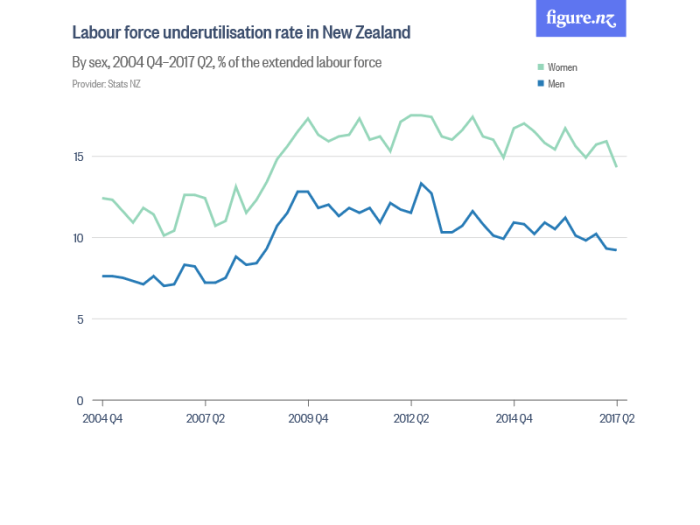


A dynamic and diversified export sector or “alternative facts”?

The Prime Minister went to Auckland yesterday, accompanied by his Deputy and his Minister of Finance, to deliver what is popularly billed as a “state of nation” address at the Auckland Rotary Club.   I’m staggered that the Prime Minister could give such an address in Auckland and not once mention that house price debacle that his government, and the previous Labour government, have presided over, and done little to address.

But the bit of the speech that caught my eye was this

I’m proud that on the other side of the globe from the European capitals I visited a few weeks ago, New Zealanders have built a cohesive and globally competitive country that can provide valuable lessons to the rest of the world.

In recent years, New Zealand has dealt with the biggest financial crisis since the Great Depression, we’ve dealt with devastating earthquakes and we’ve made significant progress on deep-seated social and Treaty issues.

We now have a dynamic and diversified export sector,

In particular the suggestion that we have “built a globally competitive country” and as a result we “now have a dynamic and diversified export sector”.  (I wasn’t too sure about the “valuable lessons” we can apparently offer to the rest of the world, but I’ll leave that aside for now.)

Statistics New Zealand typically advise that the best way to look at longer-term trends in components of the national accounts is to use ratios of the various nominal series.    Doing so avoids deflator problems, and also recognises that prices –  earned and paid –  matter.   Here is the chart showing exports –  and imports –  as a share of GDP.

exports-and-imports-over-gdp

Exports as a share of GDP are now below where they were when the Prime Minister was Minister of Finance/Treasurer in the last days of the Shipley government in the 1990s (and lower than at any time since then, under Labour or National governments).

In a thriving, globally competitive, economy one would more normally expect to see both exports and imports trending upwards as a share of GDP.  For small countries that is even more important than large countries.

Out of curiosity I did dig out the data on export and import volumes and how they’ve grown relative to GDP.  Here is the chart for the last decade.

x-and-m-volumes

Export volumes have certainly increased a little faster than real GDP has, and import volumes more so.  But if the value of what we sell to the world (and then buy from it) hasn’t increased as a share of GDP, it doesn’t look like a particularly impressive story.

And finally, here is the chart I run every so often, showing an estimate of GDP broken down between the tradables sector (primary plus manufacturing plus export of services) and the non-tradable sector (the rest).  And I’ve presented both series in real per capita terms.  It isn’t a perfect proxy by any means, but it tries to get at the idea that domestic production for domestic consumption –  especially in the manufacturing sector – is often exposed to global competition too.

t-and-nt-gdp-feb-17

In real per capita terms, this estimate of tradables sector GDP hasn’t grown in more than 15 years.  The current estimated level is lower than the average for the 2000 to 2007 pre-recession period.

The evidence for this economy being globally competitive is slim at best.  There are no doubt plenty of individual firms doing well, but it doesn’t add up to much, especially as the starting point –  the initial share of exports (or export value-added) in our economy –  was already so low for a country our size.

In part, firms seeking to export –  or produce locally in competition with imports –  have been battling uphill.  The TWI measure of the exchange rate is around 79 this morning –  on the Reserve Bank’s real exchange rate measure only around 5 per cent off the post-float peak.    High real exchange rates can be a welcome thing, when they result from rapid productivity growth and the growing success of New Zealand firms in international markets. The high exchange rate rate then helps share the gains around.  But that simply isn’t –  and hasn’t for a long time –  been the New Zealand story.

I’m not entirely sure why politicians come out and say this sort of stuff (“globally competitive”, “dynamic and diversified export sector”).  It is particularly sad coming from the Prime Minister, who in his early years as Minister of Finance used to make exactly the sorts of points I’ve made in this post in speeches up and down the country: he was particularly fond of a version of the tradables/non-tradables chart.  And the government has long had as one of its targets a material increase in the share of exports in GDP, suggesting that they knew there was something not quite right about New Zealand’s economic performance.

But now, almost nine years in, they seem reduced to simply making up lines like these, that perhaps might feel or sound good, so long as no one actually looks into them.  Doing so discredits the speaker, and perhaps as importantly it further cheapens and debases political dialogue and debate.  Bill English should be better than that.

Labour on New Zealand Superannuation

Sometimes I wonder where Andrew Little gets his advice/ideas.

Yesterday, the Dominion-Post ran an article by Vernon Small reporting an interview with the Labour leader and his finance spokesperson Grant Robertson.   In it

Little reaffirmed his opposition to raising the retirement age – a policy he scrapped as leader – but he wants to resume payments to the “Cullen” fund that pre-funds some of the cost of the universal pension.

“Do we need to resume contributions to the Cullen Fund? Too darn right we do, (because) $14.5 billion of contributions not made in the last eight years would have been worth $20b to the fund.”

Other changes to superannuation were not being contemplated, although Little did not rule out other options such as changes to the current indexing, which is linked wage rates.

“Those are things you can have a look at. They are not big money-savers necessarily – over time they might be – but (I am) not certainly averse to looking at those sort of things.”

But New Zealand could be proud of its low level of elder poverty. “So why would you want to change that?”

I agree that the low level of poverty among the elderly is something New Zealand can be proud of.  So why would Labour want to put it in jeopardy?   Because that is exactly what changing the indexing basis would mean over time.   By contrast, raising the age of eligibility gradually –  the policy Labour previously campaigned on but has now abandoned – would be one of the best ways of securing the admirable record of keeping from poverty those unable to work because of advanced age.

At present, NZS payments are indexed to changes in average nominal wages.  That means that, over time, those on NZS share in the overall gains that wage earners achieve.  When productivity growth is low, neither wages nor NZS tend to rise very much in real terms, and when productivity growth is strong the elderly get to share in the gains.  It is easy enough to run an economist’s argument for an alternative approach:  index to the CPI instead (as some favour) and NZS is kept at a constant real level, regardless of what happens in the real economy.  If the current real level of NZS is enough to keep poverty at bay, that same level should keep poverty at bay in future –  at least if “poverty” is defined the same way.

Changing the indexing basis makes a huge difference over time.    In their recent Long-Term Fiscal Statement, looking ahead of 40 years, Treasury (perhaps optimistically) assumed annual labour productivity growth of 1.5 per cent per annum.  Only a couple of days ago, they tweeted the chart from the report highlighting just how much would be saved by indexing to the CPI instead of to wages.  But the flip side of moving to CPI indexing is that NZS payments received by individuals in the future would be much lower than they would be under the current rules.  In fact, on the Treasury productivity assumptions, NZS weekly payments 40 years hence would be only around 55 per cent of what they would be on the current, well-established, formula.   Adopting such a rule would almost certainly see a big increase in the number of elderly people measured as living in poverty –  and since community expectations, and regulatory minimum standards in a whole range of areas, tend to rise with economic growth it is almost certain that there would be an increase in real hardship.  Imagine if real NZS weekly payments had been held constant for the last 50 years.

There is nothing inherently right about the current real (absolute or relative) level of NZS.  It is the outcome of a series of political (com)promises.  Sure some money could be saved by moving to CPI indexing for a while, but CPI indexing would almost certainly be untenable and unsustainable in the long run, reopening intense debates every few years as to just what level of income superannuitants should receive.  Avoiding the bitter fights around NZS that characterised New Zealand politics from the mid 80s to the late 90s seems highly desirable.

What I found really puzzling about Little’s reported remarks is that changes in the indexing arrangements would affect everyone who receives NZS –  and would potentially adversely affect them for the rest of their lives.  By contrast, changing the eligibility age doesn’t affect those (a large number of voters) now receiving NZS at all.   And changing the eligibility age slowly, as New Zealand can still afford to do, is a very slight dislocation for most people.   Increase the age of eligibility by, say, two months a year until the age gets to, say, 68, and then index any future increases to future increases in life expectancy.  On that rule, someone who was 60 when the policy change took affect might have to work until almost 66, instead of until 65, to receive NZS.  From their perspective, of course it is a loss and unwelcome, but it isn’t a huge dislocation.  And it is a much slower pace of adjustment than we adopted in the 1990s and early 2000s, when the age of eligibility was raised from 60 to 65 at a rate of six months a year –  and governments managed to get re-elected nonetheless.  I don’t imagine there are many 50 year olds now who expect to collect NZS at 65.

Yes, there are some people who are physically unable to work by the time they are 65.  There always have been, and no doubt always will be.  We have working age people now who are physically unable to work.    And any compassionate society needs to make provision for those people.  But that needn’t mean a universal entitlement at age 65 indefinitely.

The other overdue change to the NZS system is to alter the rules of eligibility.  A residency requirement of only 10 years to claim a full NZS payment seems generous to the point of irresponsibility, prioritising those with a weaker natural claim on our support, over those with a greater claim.  That is especially  so as I pointed out again recently the rules mean that for many people (especially New Zealanders in Australia) they don’t need to have lived in New Zealand –  or paid New Zealand taxes – at all.    The Retirement Commissioner proposes a 25 year residency requirement.  One other possibility might be phased residency tests: perhaps after 10 years, a person might be eligible for 20 per cent of the standard NZS payment, and after 30 years might be eligible for 100 per cent.   But that residency test should involve actual physical residence in New Zealand.

I’ve long been meaning to write a sceptical post about the New Zealand Superannuation Fund.  It was a worthy wheeze in the days when Michael Cullen set it up –  discouraging his colleagues from spending all of the large surpluses –  but it has no natural place.  There is no good moral or economic ground for keeping a universal pension at 65, even as life expectancy continues to increase,  the ageing of the population is a permanent (welcome) feature not a temporary blip, and we don’t have large surpluses any more –  and haven’t had surpluses at all for the last decade.  Labour is quoted citing the investment gains that could have been had if only contributions had been continued for the last eight years –  but (a) the scale of those gains was inherently unknowable in advance, (b) if, as many believe, global asset markets are overvalued the gains may not even be permanent (the NZSF portfolio is structured in such a way that mean that returns will be highly volatile) and (c) the flip side to putting more into the NZSF would have been even larger increases in government gross debt than we have already incurred in the last few years.  Paying public servants to take big leveraged investment risks doesn’t seem a natural role for government (although I know some of my readers/commenters disagree).

I wonder what Labour’s private attitude is?  After all, Labour governments elsewhere in the world –  notably Australia –  have put in place policies to raise the eligibility age for the state pension.  Perhaps they really hope that in next year’s Budget Bill English and Steven Joyce will take the brave but responsible step of raising the eligibility age slowly.  If they did, it is hard to envisage responsible members of the Labour Party’s leadership opposing such a stance with any conviction.

The Morgan immigration policy: appealing to MBIE and Treasury?

Gareth Morgan’s The Opportunities Party last week released their immigration policy, in a reasonably substantial eight page document, long on words and light on pictures.  I’m a classic floating voter, with absolutely no idea who I might vote for at next year’s election, and a nerd too, so I like the idea of a party coming out with some serious discussion of important issues perhaps nine months before the election.  On immigration policy in particular, it is more than we have seen from any other party.

The TOP immigration policy strikes me as one that the bureaucrats in MBIE and Treasury might quite like.  Perhaps some of the more thoughtful ministers might be inclined to agree (quietly) as well, but it is an approach that is in quite striking contrast to the gung-ho assertions that the current system is working just fine, and benefiting all New Zealanders, often heard from the new Minister of Finance.

TOP’s policy document begins

“We are strongly pro-immigration as another tool in the box to improve the prosperity of New Zealanders”

Which seems to fit very nicely with MBIE’s claims that New Zealand’s non-citizen immigration is a “critical economic enabler“.    TOP go on to note/claim that

“Migration enlarges our economy and has a small but real positive impact on our living standards”

and

Net immigration puts a small upward bias to economic growth which is good for keeping confidence and encourages investors to take the risks necessary to underpin growth in per capita incomes.

There are certainly plenty of claims along those lines, and it has been easy enough for academics to generate models showing how such gains to living standards might arise, in principle.    But there is no evidence advanced by TOP –  or by MBIE, Treasury, Steven Joyce, Michael Woodhouse, Business New Zealand or the New Zealand Initiative –  to demonstrate that in the specific circumstances of New Zealand large scale non-citizen immigration has actually improved the living standards of New Zealanders.

The focus of the TOP immigration policy document is on some of the specifics of what is wrong with the current policy approach.  In many respects, there has been a lot of continuity in policy whatever party has been in government over the last 20 years.  But the current government has gone further than its predecessors in debauching the system, a point made in the TOP document with Gareth’s customary vigour:

“The Government’s craven desire for economic growth at any cost – even if incomes of New Zealanders aren’t rising –  has seen it make Permanent Residency far too easy for migrants who add nothing.”

And here I can agree with a lot of the TOP specifics.  The way the student visas policy has been run is a disgrace, and should be an embarrassment to any New Zealander –  at least perhaps other than those running private training enterprises.  As TOP put it

“There have been numerous instances of dishonest behaviour by NZ providers and their foreign and local agents. There are many sotries about conflicts all along the supply chain from the finders in India, right through to shonky qualifications being granted in New Zealand.  The real issue is that too many involved in the supply chain don’t care much about the education anymore, it’s become an Underground Railroad for aspiring but modestly skilled folk of modest means to gain permanent residency in New Zealand.

The Government, with its obsession in seeing foreign education as a winning growth sector has sold the integrity of our immigration policy down the river.”

Probably no one would argue against an approach that gave points towards residency to people completing, say, a Master’s degree in a core academic subject from a well-regarded New Zealand university.  New Zealand PTE qualifications are quite  another matter.

They go on to criticise the plethora of new working holiday visa schemes –  themselves often put in place more for foreign policy reasons than based on a hardheaded analysis of the economic impact on New Zealanders (especially perhaps less skilled and lower income New Zealanders) –  and the clearly inadequate way in which the points scheme is working.

As TOP note, in dealing with economic immigration

“we only desire people who make us more prosperous.”

There is little sign of that in how current policy rules are working.

Among the specifics on the TOP list of policy proposals there are ones I can agree with:

  • “remove the need for highly-skilled migrants to have a job to come to”.  If we are serious about bringing in highly-skilled migrants, we shouldn’t be putting them through the hoop of compelling them to find a job here from offshore, and potentially move their families to the other side of the world unsure if they will eventually get residency.  Yes, language tests probably have an important role, and there is no point bringing in people with qualifications that simply won’t be recognised here, but if there are long-term gains from immigration they almost certainly arise from the quality of the people we attract, not from the ability to match up with a specific job from the first moment they arrive in  New Zealand. The policy change to favour, in granting residency, people already in New Zealand on temporary visas, was well-intentioned but hasn’t worked to benefit New Zealanders.
  • “reform the study-to-work-to residency regime for foreign students so that only jobs that meet a genuine skill criteria are recognised for residency points”.  I’d go further than that –  removing the right of students to work here while studying, and granting points only for recognised post-graduate qualifications –  but what TOP proposes would be an improvement on where we are now.
  • “reform the points system to reflect the importance of salary level, English language skills, and the ability of migrants to contribute to the economy”.  That last provision worries me a little –  it can cover a multitude of sins –  but the direction seems right.  Again, I would go further and remove the additional points available for job offers in the provinces –  that scheme simply reduces further the average skills level of the migrants we do get.

It is also good to see that TOP endorses the increasingly popular view – even the Retirement Commissioner has belatedly come out in favour  of it – that the residential qualifying period for obtaining New Zealand Superannuation should be extended from the current 10 years to (in their case) 25 years.

I’m less sure I could be enthusiastic about “applicants for Permanent Residency must demonstrate an understanding of our Constitution and the status of the Treaty of Waitangi”.  I sympathise with the apparent intent, but would “uncertain” be an acceptable answer –  in one of the few countries without a formal written constitution and where the status of the Treaty is more a matter of political debate than of law?

Thus far, I think the TOP policies, if adopted, would represent quite an improvement on what we have now.  But, as I noted earlier, I suspect that Treasury and MBIE officials might well agree.

I’m less convinced that the points system itself is a bad way to ration whatever quantity of non-citizen migrants we want to allow in.  Gareth argues

And at the heart of this question [who should we allow in] is – who should decide?  Some bureaucrat adding up eligibility points in a dark room at the back of an earthquake-prone building in Wellington? Or the market?  Obviously the market needs to.  There needs to be either a job offer at a wage that reflects the skill shortage or a track record of the employee having what it takes to add value.”

But it sounds a lot like a points system to me.    The real question is what we should issue points for, not whether to have something like that sort of scheme.  If one is an open-borders libertarian, or even someone who thinks that almost our migrants should come on refugee or family reunification grounds, things might seem different.  But TOP –  rightly in my view –  argues for an explicit economic orientation for most of our immigrant inflow, and if that is the framework someone needs to devise a rationing device.  We could auction places subject to various minimum criteria but, to my knowledge, no one has proposed such a scheme (and no other country with a substantial immigration programme has operated an auction scheme).

Many of these points are about detail.  The big area in which I disagree with TOP is around the overall level of non-citizen immigration we should be aiming for.  They observe

“our immigration policy then, is all about improving the levers.  A 1% contribution to annual population growth from net immigration is a good ceiling”.

As I noted a few months ago in writing about the Green Party’s new immigration policy, an annual ceiling on net immigration is all but impossible to manage.   The flows of New Zealand citizens into and out of the country are large, variable and very hard to forecast.  By contrast, we have fairly tight control on the flows of non-New Zealand immigrants.

I’m not entirely sure how to read the TOP target, but given that for the last 40 years of so there has been a net outflow of New Zealand citizens almost very single year, presumably TOP would be aiming at a net inflow of non-New Zealand citizens of around –  or perhaps slightly more than –  1 per cent of the population per annum.    At present, that would be a net inflow of non-citizens of around 47000 per annum.  By contrast, the gross residence approvals target now is centred on 45000 per annum, and the typical net inflow of non-citizens over the last couple of decades has been a bit lower than that (some of those granted residency don’t end up staying long).     In other words, in terms of overall numbers TOP seems to proposing inflows a bit less than those of the last year or two, but something quite similar to the average outcomes of the last 15 years.

That makes some sense on their own terms.  As I quoted earlier, they believe that high levels of immigration can improve the long-term prosperity of New Zealanders.   And I’m with them (at least most of the way) when in their FAQs they say

Question

How big then should the inflow of foreigners be?

Answer

The simple answer is the levels beyond which migration ceases to contribute to raising per capita income of Kiwis.

But where is evidence that anything like the sort of inflows of non-citizens we’ve had in recent decades –  or most of the time since World War Two – is contributing to “raising per capita income of Kiwis”?

It all seems to rest on the same underlying belief –  without evidence specific to the circumstances of New Zealand –  that now guides Treasury and MBIE: the current rules aren’t working very well, but if only we reorient them we can bring in at least as many people and we’ll finally –  decades on –  start seeing the gains of the large scale immigration programme.  Tui’s “Yeah right” springs to mind.

One of the real problems we face is that, attractive as New Zealand is to poor people and people of middling skills in poor countries, we just aren’t that attractive to many really able people.   By advanced country standards, we aren’t that wealthy or productive.  We are a long way from anywhere, including from the cultural and economic centres of the world.  And for all the talk about New Zealand’s wonderful lifestyle, I doubt there is an advanced economy that doesn’t offer very attractive lifestyles in one form or another.  Really ambitious and able people will typically aim for other countries first if they can get in there.  I’m a New Zealander and am at home here, but why as an able ambitious skilled foreigner would you come to New Zealand if you could get into the UK, the US, Canada, Australia, Ireland, or even –  so long as you are happy to learn another non-English language –  most of Europe?  All those countries have problems.  So does New Zealand.

The constant desire, repeated in the TOP document, to bring in lots of foreigners seems fated to be an approach that constantly disappoints.  We  could attract some really able people, and rule changes could help to attract more than the low number we get now.    But we shouldn’t fool ourselves about how desirable New Zealand is –  especially its long-term underperforming economy.  TOP associates itself with the recent strange call from Richard Dawkins for New Zealand to invite the world’s top academics to settle here.  I wouldn’t really have a problem with us doing so, but people need to stop and ask how likely it is to succeed.  When your country is remote, not that well-resourced economically, and when your universities are no better than middling, it simply isn’t very likely that many ‘top academics” would want to come, and in doing so cut themselves off from the funding, the networks etc that help make top tier research possible on a long-term basis.

Perhaps it does no harm to try, but in a way the real problem with the constant focus on trying to get lots of really skilled migrants is that it risks turning into a cargo cult.  Instead of looking to our own people, skills, institutions and energies to produce and sustain prosperity, we constantly look abroad. Other people aren’t the answer to our economic underperformance –  exchanging our people for some mythical superior group from abroad.  It is past time that New Zealand political parties, including TOP, started recognising this.