Rating our Ministers of Finance

A couple of months ago a journalist got in touch and asked for some thoughts on New Zealand’s best and worst Ministers of Finance. Eric Frkyberg was working on an article for The Listener, following on from one that magazine ran late last year ranking Prime Ministers. The Ministers of Finance article appears in the issue that turned up in my letterbox at lunchtime. He took views from three historians, a tax policy expert, and me and ended up ranking 10 Ministers of Finance from best (Douglas) to worst (Muldoon).

I didn’t actually give Frykberg a simple ranking like that. Instead, I tried to summarise my analysis in this chart
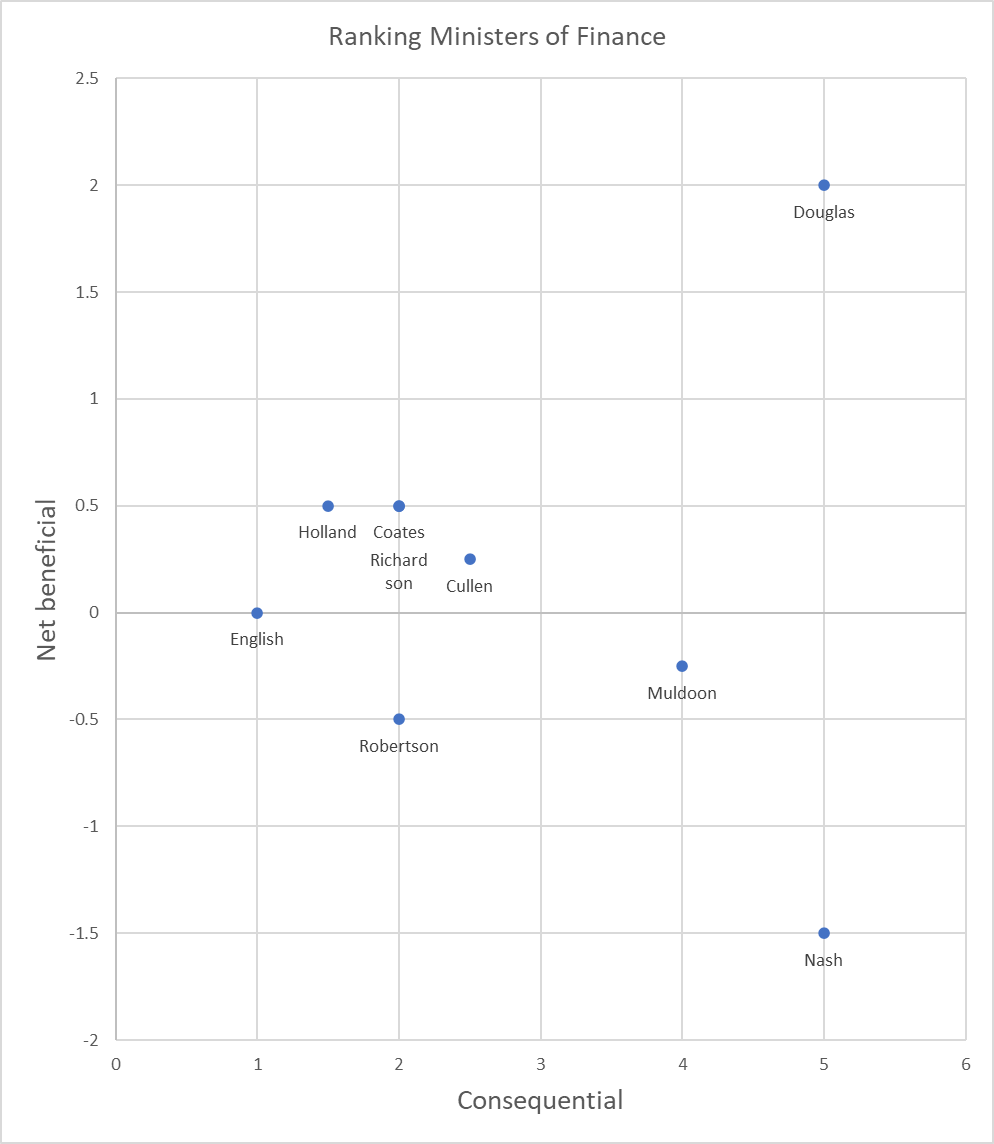
There are other elements one could evaluate these people on (some were more technically able than others, some served in more (or less) propitious times, some will have been nicer people) but I looked at the difference these ministers made, and whether and to what extent I thought those differences had been for good or ill. Nash, for example, was responsible for economic policy for a long time (14 years as Minister of Finance), and the controls-oriented model lasted for decades, but I assess that contribution as deeply net negative (I’m expecting correspondence on this point!). Muldoon was much less consequential because although he was Minister of Finance for much longer than Douglas (say), much of his economic policy (at least the better remembered bits) was swept away pretty quickly, even if they helped trigger what followed.

Anyway, for anyone interested here were the comments I sent Frykberg:

Thoughts on New Zealand Ministers of Finance

May 2025

There have been 29 people who have been Minister of Finance (or Treasurer, or Colonial Treasurer) since 1900, seven of whom were Prime Minister at the same time.

14 of them served for a significant period of time (more than one full parliamentary term)

Of the others, a couple are worth consideration as among the better Ministers of Finance, people who made a discernible difference even though both served for only about three years (Gordon Coates and Ruth Richardson).

Of the earlier list, I’d quickly knock out of consideration Allen, Lake and Birch.  Each seems to have been a fairly safe pairs of hands, without contributing a great deal that was distinctively constructive as Minister of Finance. [A former Treasury official recently passed on anecdote re Lake – who had had health problems for much of his term – that Treasury knew not to expect that he’d read anything longer than a page or two.]

And I’d also knock out both Seddon and Ward (despite their long terms), probably mainly because until the Great Depression macroeconomic management really wasn’t a thing in New Zealand, but also because of Ward’s questionable personal business record/bankruptcy and his ill-starred return in 1928.

That leaves a reduced list of:

Downie Stewart[1] is also worth a mention, mostly because he was the last Minister of Finance to resign on an issue of policy principle (he opposed the exchange rate devaluation in 1933 and resigned).  I think his policy position on that issue was wrong, but I admire a politician willing to pay the price.

How to think about each of these nine?

Coates won the battle to depreciate the NZ pound (such as it was) in early 1933, which helped turn the tide of the Great Depression.  On the other hand, he was also responsible for the deliberate default on the NZ government’s domestic public debt.  He was responsible for the establishment of an independent Reserve Bank in 1934 (and our first coinage in 1933). He was, to some extent, fortunate in his timing –  the worst of the Depression in the UK for example had already passed by the time he took office – and the pressure to cut spending (because of limited access to forex, whether from net exports or borrowing) had eased.  Work on a central bank had already been underway before he took office, but he nonetheless made it happen.  By the time he went out of office New Zealand had substantially recovered from the Depression.

Nash was Minister of Finance for 14 years in succession (albeit for a couple of years he was minister resident in Washington) which warrants consideration.    He deserves most credit perhaps for his fiscal stewardship of WW2 and the substantial reduction in NZ government outstanding external debt through that period.   On the other hand, his Reserve Bank reforms were a clear step backwards (putting the Bank under the thumb of government, and macroeconomic policy generally was run far too loosely in the early years, running into a foreign exchange crisis in late 1938 and what would have been default on sovereign foreign debt in 1939 if the approach of the war had not made the UK willing to intervene to enable maturing debt to be rolled over.  Moreover, the entire turn inwards (import licensing etc) occurred on his watch, and post war the government was far too slow to (a) liberalise, and b) keep inflationary pressures in check.  If there are positive enduring legacies of the 1st Labour govt it isn’t obvious things Nash was primarily responsible for are among them.

Holland isn’t primarily remembered as a Minister of Finance, but served as both PM and Minister of Finance from 1949 to 1954.  He was the first Minister of Finance after the 1st Labour govt, and made a number of useful steps (seeking to unwind import licensing, enabling tenants to buy state houses, removing the ability of the Minister of Finance to direct the Reserve Bank, the revival of monetary policy as a countercyclical tool, seeking to reintroduce competition in domestic aviation, ending rationing, introducing the annual Economic Survey to accompany the Budget).

Muldoon is a polarising figure.  Perhaps his biggest misfortune was to be Minister of Finance spanning almost entirely the period of very decline in New Zealand’s terms of trade (almost entirely outside NZ’s control).   A focus on the 1982-84 price and wage freeze, the undelivered 1984 Budget and the 1984 devaluation would lead to a very low score, and one could add Think Big to that mix especially with the benefit of hindsight[2].   The inflation record increasingly stood out (to our discredit) relative to peer countries abroad.

On the other hand, he left office with net govt debt only about a third of GDP (not much higher than now), had managed the late 60s slump in the terms of trade and painful (IMF- supported adjustment) as well as anyone was likely to have at the time.   And as Minister of Finance he also presided over significant, if fitful, financial sector liberalisation (right almost to the end) and in his combined PM/MOF role enabled CER, plans to reduce the importance of import licensing, road transport and shopping hours liberalisation, corporatising rail, and so on.

It is a very mixed record.   And he ends up not as consequential as either Nash or Douglas because little that he did really lasted long (good and bad both subsumed in the Douglas/Lange “revolution”).

Douglas was Minister of Finance for a little under 4.5 years, but it was an enormously consequential period (including that most of what was done then lives on in one form or another) and the dominant view among economists would probably be that those changes –  in law and ethos –  reestablished macroeconomic stability (fiscal and monetary) and contributed to a sustained improvement in our productivity performance (at least relative to the counterfactual).  He remains enormously controversial –  perhaps an embarrassment to his own (then) party –  and he was part of a team of ministers, but specifics one could point to include the Public Finance Act, the Reserve Bank Act (although legislated under his successor), an overhauled and much more efficient tax system, the corporatisation and privatisation of government trading entities, the removal of interest rate, exchange rate, and exchange control regulations etc.

Richardson was Minister of Finance for only three years, and arguably the thing she is most remembered for (the Fiscal Responsibility Act) was achieved only after she was sacked as Minister of Finance and had left Cabinet.    Notwithstanding the headlines and historical memory around the Dec 1990 fiscal package and the 1991 “Mother of All Budgets”, much of the necessary structural fiscal adjustment had already been done by Douglas/Caygill (government was running a significant primary surplus by the year to March 1991).  In that sense, she consolidated and extended work already under way.   Deserves credit for greatly accelerating the increase in the NZS eligibility age (a process initiated by Caygill).  Arguably the biggest economic policy reforms of that government’s term was the Employment Contracts Act, but it was Bill Birch’s legislation not Richardson’s.

Cullen.    In a blog post on Cullen’s memoir I wrote

“On the front cover of the book, Helen Clark describes Cullen as “one of our greatest finance ministers”. There aren’t that many (relatively long-serving ones) to choose from but I’d hesitate to endorse the accolade. Running down the public debt was an achievement but (a) demographics, (b) a prolonged, but productivity-lite, boom, and (c) the terms of trade ran strongly in his favour, and the dam burst in the final three years of his term. I guess he has monuments to his name – Kiwisaver and the NZSF (“Cullen fund”) – but then so does Bill Birch from his time as Minister of Energy, and the best evidence to date is that Kiwisaver has not changed national savings rates, and it isn’t clear what useful function the big taxpayer-owned hedge fund has accomplished. Meanwhile Cullen – and Clark herself of course – bequeathed to the next government (who in turn bequeathed it to this one), the twin economic failures: house prices and productivity (the latter shorthand for all the opportunities foregone, especially for those nearer the bottom of the income distribution).”

15 years on Kiwisaver and NZSF have endured so Cullen probably deserves marks for consequentiality.   But not much had been changed for the better.    Note that he shouldn’t really be blamed either for the deficits that emerged as he left office –  on his last (2008) Budget Treasury’s best professional forecasts/estimates were that the budget would remain (narrowly) in surplus.  They were wrong, but that wasn’t Cullen’s fault.  He thought he was going to leave a balanced budget.

English was Minister of Finance for eight years.  There is little to show for that time.   The government’s finances took a major hit with the Christchurch earthquakes but it still took a long time for the government to take the steps that would return the budget to balance.   There were few, if any, significant and positive economic reforms initiated and the twin legacies –  house prices and productivity –  I noted for Cullen above were also unaddressed on English’s watch.  He enabled a serious decline in the quality of The Treasury.  If one were looking for things to credit, the 2010 tax switch is probably worth a favourable note but it involved an overall increase in taxes on business (at a time when business income tax rates were generally being lowered globally).

Robertson was Minister of Finance only 18 months ago and so one could argue we are too close to evaluate him fairly.    There isn’t much to his credit (positives might include establishing a Reserve Bank MPC rather than a single decisionmaker –  although his claim to credit is marred by going along with a model that initially banned experts from serving and still in effect bars them from speaking –  the new deposit insurance scheme, and the critical early couple of months of Covid).  On the other hand, he inherited a structural budget surplus and bequeathed a large structural deficit (after the Covid effects had already passed through), made few/no useful structural reforms and displayed little real interest in productivity, he reappointed an RB Governor who had performed really badly (financial losses, inflation, personal style) and had failed to do much to reverse the decline in The Treasury.  So both institutions and macroeconomic outcomes worsened materially on his watch.  A moderately high score for consequentiality relates to (a) Covid, and b) the difficult legacy left.

One last candidate

In this exercise I focused only on the period since Seddon/Ward.    If one were to take the entire sweep of post-1840 New Zealand history one could argue this overlooks a prime contender for best and/or most consequential Minister of Finance

Vogel served four stints as Minister of Finance (Colonial Treasurer) totalling about nine years.  He was, arguably, the first champion in a succession of “big New Zealand” politicians, and was the author of the first “Think Big” economic strategy –  borrowing on a large scale in London to facilitate immigration and railways development[3].    He’d easily be in top 3 for consequentiality, although no doubt views would differ widely on how appropriate or beneficial the economic strategy was.

In summary

Here’s a chart [see above], trying to summarise how I see these ministers on the twin dimensions of consequentiality and net benefit (the latter can be positive or negative).

It is worth bearing in mind that all of them were creatures of their time (Douglas in 1935 and Nash in 1984 would no doubt have done things differently than in their own time; Muldoon might have struggled to feature at all had he just been Minister from say 1960 to 72).


[1] Disclosure of interest here: I’m related to Holland and my wife and kids to Downie Stewart.

[2] Nonetheless, I recall Graeme Wheeler –  who was in the energy section of Treasury at the time –  telling us that contemporary Treasury opinion had been pretty divided on the merits of Think Big.

[3] I wrote about him here A former Prime Minister and Minister of Finance on immigration policy | croaking cassandra

Ministers of Finance

No, nothing so serious as fiscal policy.

I saw this morning this chart in a tweet from a Canadian economics professor (prompted by the new ministerial appointments in Canada).

I was digging around in the list of former New Zealand Ministers of Finance anyway, and thought it might be interesting to try a New Zealand version. Responsible government here goes back to 1856 and so I dug out the previous occupations of those who have held the office of Minister of Finance (or Colonial Treasurer or Treasurer) since then. The list has 42 names (although several held the office on several separate occasions – Ward being the most recent to have been Minister of Finance four separate times, the last ending in 1930). Canada, reading from the chart above, appears to have had 43 federal Ministers of Finance since 1867.

Of our 43, 7 held office for less than six months (some of those early governments lasted for days or mere weeks). I could have excluded them from the chart below, but it doesn’t look as though doing so would materially alter the picture (although it would mean dropping our one engineer – Charles Brown (1856) – and the one builder (William Hall-Jones (1906)).

When you sometimes hear breathless cries of how awful it was that Muldoon served as his own Minister of Finance while being Prime Minister you realise how little New Zealand history people know. In addition to Muldoon, the following served as Minister of Finance and Prime Minister at the same time (some on more than one occasion): Stafford, Vogel, Atkinson, Grey, Ballance, Seddon, Hall-Jones, Ward, Massey, Forbes, and Holland. You’d have to guess it won’t happen again, but it simply hadn’t been uncommon in New Zealand (and that in the days before legions of Associate Ministers).

So, to the chart. In most cases it is pretty clear how to classify people (Tizard was a teacher, Muldoon and Douglas were accountants, Richardson was a lawyer), but not always. I’ve shown both Grant Robertson and Nicola Willis as political staffers, but Robertson had also been a public servant and Willis a lobbyist.

The chart is very different from the Canadian version. Farmers still top the chart, although the last farmer to have been Minister of Finance was Gordon Coates who left office in 1935 (yes, I know Bill English has some claims but by the look of it he spent about a year on the family farm before going into politics).

As for the “business” category it is also a little arbitrary: Seddon (publican), Birch (surveyor) and the architect and builder each had their own firms – as in fact for a time had Walter Nash, although I’ve classified him as a political administrator in respect of his long service as secretary of the Labour Party. And in case you are wondering about the civil servants, that list is Bill English and a number of colonial administrators, including one of the eminence of George Grey.

Unlike Canada, no economists have held the office. I have no reason to think that a bad thing – I’m wary of, for example, doctors as Minister of Health – although no doubt Don Brash once aspired to it, and perhaps Dan Bidois (Parliament’s one current economist) does now? And it is worth bearing in mind that once upon a time incomes per head here were well above those in Canada, and now they lag behind (and Canada itself has a pretty woeful productivity record).

[UPDATE: Since I have been contacted on this point by a few people, I should note that I am aware that Brooke Van Velden has a degree majoring in economics. However, at least as I understand it, she has never worked as an economist – which is not a criticism of course – and on leaving university worked for the political PR firm Exceltium. Bidois, on the other hand, worked as an economist at OECD for several years.]

Anyway, I’m a history and politics junkie and I found it interesting. I hope some of you did. For the real nerds here is the full table

Forty years of floating

Last year there was an interesting new book out, made up of 29 collected short papers by (more or less) prominent economists given at a 2023 conference to mark Floating Exchange Rates at Fifty. The fifty years related to the transition back to generalised floating of the major developed world currencies in 1973 (think USD, JPY, GBP, and the West German deutschemark, plus the Canadian and Swiss currencies). It was quite an interesting collection and even has some discussion of emerging markets. What was striking, reading it at this end of the world, was the almost complete absence of any discussion of the experience of smaller advanced countries – this isn’t just a matter of places like New Zealand or Norway or Israel or Iceland, but not even Australia gets a mention in the index.

As it happens, this weekend marks 40 years since New Zealand floated our exchange rate. It was announced at 10:30am on Saturday 2 March 1985 (timing set for after the Friday close of the New York foreign exchange market), and trading commenced on Monday 4 March.

I was working in the Monetary Policy Section (all 3 or 4 of us) of the Reserve Bank’s Economics Department at the time but although there had been talk of floating for months (pretty much since the devaluation in July 1984) and real policy challenges around maintaining the fix, the actual timing of the move was successfully kept very tight (I was never quite sure even whether my boss had known), and I learned of the news when later that afternoon I wandered down to the Hataitai dairy to buy my Evening Post.

It was the same day as David Lange’s Oxford Union debate on nuclear issues, and the Reserve Bank’s Deputy Governor, Rod Deane, had had to fly to London to brief Lange and secure his final agreement to the move (my diary the following week records him telling us that he had been most impressed with Lange’s questioning etc).

The Evening Post’s journalists must have been pretty busy as they’d managed to get comment from all manner of people in the couple of hours they had. Some of them are still commenting today

Bob Jones was another whose views were reported, claiming that by floating “New Zealand has now joined the rest of the world as a sophisticated economy” which wasn’t really true as by this point there were still lots of smaller advanced countries who weren’t floating at all (Australia had done so only a year or so previously), and many of the European countries were running their collective Exchange Rate Mechanism, designed to severely limit fluctuations.

The comments in that old paper that most caught my eye ((bottom right story in the first photo above) were from my old macro lecturer Merv Pope who was very critical, stating that in his view “the economy would suffer severely”.

There are books and articles that discuss the politics and bureaucracy of the period leading up to the float, and I know there are some people who read this blog who were closely involved in it all (who are welcome to add comment/context), so I’m not going to attempt to cover that.

The journey to floating mainly dates to the events around the July 1984 devaluation and the early days of the 4th Labour government. The establishment view in early-mid 1984 was that the New Zealand dollar was seriously overvalued in real terms, and in that sense the mid 1984 devaluation had been welcomed. All that said, as was perhaps necessary in the market circumstances, the extent of the devaluation – 20 per cent – had been set to eliminate the likelihood of further downward pressure, and thus to some extent probably represented an adjustment larger than the medium-term macroeconomics might have warranted.

Going pretty much hand in hand with the devaluation was the removal of the interest rate controls that the previous government had put in place over the past year, combined with a new willingness to fund the government’s deficit primarily by wholesale domestic debt sales, taking whatever price the market charged. With the prospect of rising inflation (if only from the devaluation itself) and large fiscal deficits, it had the makings of considerable difficulties in achieving effective monetary control. Exchange controls on capital transactions were still in place but they were porous (and more designed to limit outflows than inflows) and one of my tasks in August 1984 had been to sift carefully through the records of foreign exchange inflows looking for evidence of capital inflows drawn by the combination of high interest rates and a, possibly, undervalued exchange rate. A fixed exchange rate meant that we – the RB – were committed to buying whatever foreign exchange was offered at the fixed (against the TWI) rate, and all those purchases immediately added to domestic liquidity.

In an earlier post some years ago I noted

One of the starkest memories of my first year at the Reserve Bank, fresh out of university, was being minute secretary to a meeting in late 1984 attended by the top tiers of the Reserve Bank and The Treasury.  It was a just a few months after the big devaluation that ushered in the reform programme: senior officials were explicitly united in emphasising how vital it was to “bed-in” the lower exchange rate, and ensure that the real exchange rate stayed low.

The risk was that if we didn’t succeed in getting monetary conditions under control, all the pain of the devaluation might go for nothing (ending up with no real devaluation at all, as in a number of past devaluations here and abroad). And yet with high market-determined interest rates, it was going to be difficult to stop capital coming in. We still had tools like reserve ratios but (a) the goal was to move away from them not become more reliant, and b) they became much less effective in a deregulated interest rate market. We sold government debt aggressively, aiming to mop up the excess liquidity, but the more debt we sold, the more tended to come in (those yields were attractive, and the exchange rate was fixed).

Among the various Ministers of Finance (Douglas and associates) there was a desire to float, but when? It didn’t make a lot of sense to contemplate floating the exchange rate while exchange controls were still in place (although the UK had in the 1970s), and exchange control removal didn’t happen until the Friday before Christmas 1984. And no one really had a good sense as to what the market would deliver (particularly in terms of liquidity and volatility) when the float happened (I’m pretty sure no countries as small as New Zealand were floating were by then, and although Switzerland wasn’t hugely larger it was home to a fairly major banking and financial centre).

Short-term interest rates began 1985 in the mid-teens (the Reserve Bank’s data has the overnight cash rate at 13.4 per cent and the 90 day bill rate at 15.3 per cent in early January. Capital inflows tended to dampen rates, while our monetary policy actions sought to underpin them or push them up (the medium-term goal being to consolidate fairly low and stable inflation, after 10-15 years of high and volatile inflation).

But the backdrop turned fairly quickly. This is from the Bank’s June 1985 review

Pressures built further in February and by 15 February short-term rates had increased by another full percentage point. But it was in the final week of February that things culminated, with significant foreign exchange outflows, reflecting at least in part a sense that a float was likely sooner rather than later, and that when it happened the exchange rate was likely to fall. As the Bank’s Bulletin article records, foreign exchange outflows had been particularly heavy on 28 February and 1 March, transactions due for settlement two working days later. By Friday 1 March, overnight cash rate were at 38 per cent and the 90 day bill rate was at 25 per cent. If you really thought the exchange rate was going to depreciate quite a bit in short order, paying interest rates of under 10bps a day to fund a position taken on the back of that view wasn’t too much of a problem.

(Meanwhile in the Monetary Policy Section we were hard at work devising projections and policies designed to keep inflation in check, all based on a continuation of a fixed rate.)

While the exchange rate was fixed, the Bank was committed to buying and selling whatever it took to maintain the rate, and each such transactions had counterpart domestic liquidity consequences (the Bank was not then doing routine daily open market operations to stabilise the level of settlement cash). Those fx outflows just prior to the float sharply lowered liquidity in the banking system. And once the float happened, the door was closed.

On the first day of trading (4 March) the exchange rate did fall (down around 2 per cent against the USD, which itself was stable against the JPY and DEM) but the dynamic changed pretty quickly. Those liquidity pressures really started to bite, and anyone who wanted to bring funds back to New Zealand needed to find a market seller of NZD, rather than a fixed price central bank. Short-term interest rates skyrocketed

and although the official data has a peak cash rate of 265 per cent, my memory (and my contemporary diary records) suggests peaks in excess of 500 per cent (still only around 1 per cent day per day). Within a couple of days the NZD exchange rate was 4 per cent higher than it had been just prior to the float, and probably would have jumped even further had the Bank not eventually intervened. By 20 March, short-term rates were down to about 24 per cent. It had been a wild ride.

Could the float have been avoided back on 2 March. Most likely it could have. The big problem in July 1984 had been a combination of a) perceptions that the exchange rate was fundamentally overvalued, b) perceptions that Roger Douglas, likely finance minister if Labour won, wanted to devalue, and c) the fact that interest rates were controlled, and so sales of foreign exchange by the Bank had no countervailing interest rate effect. But the broad direction of economic policy was to free up financial market prices, and so there would have been little good reason to delay further.

It is interesting to ponder what might have happened had the government decided instead to a) liberalise interest rates, and b) remove exchange control but c) to keep on with a fixed exchange rate, at the post July 1984 level. The monetary policy trilemma says that in the world you lose control of domestic monetary conditions (and thus the ability to control your own inflation outcomes). By 1984/85, the inflation rates in most major western economies were already more or less in check (think UK, US, West Germany, Japan), and with a fixed exchange rate we might have been expected to have seen New Zealand converge in time to around the average of our trading partners. But I suspect it would have been a wild ride, and would not have ended well. For example, in March 1985 the effective Fed Funds rate was 8.5 per cent and three month rates in Germany were about 6 per cent. With those sorts of interest rates in New Zealand through that period – and that is what a credible exchange rate peg would have delivered – the credit boom, commercial property boom, sharemarket boom etc might well have been even larger, and ultimately messier to resolve, than what we were actually to experience a few years later (the Nordics, for example, went that sort of route, only to float some years later). (It also isn’t wildly different that what Ireland and Spain experienced in the 00s, except that – in adopting fit-for-Germany interest rates they may have been less badly prepared than New Zealand firms/banks might have been in the mid 80s.)

This isn’t a post to review New Zealand’s experience with floating. Perhaps I will attempt something like that over the next few weeks. There have been persistent critics, even beyond the Day 1 ones cited above, perhaps most notably the economist Brian Easton. There were endless debates in the late 80s under the broad heading of “sequencing”: there were models under which things might have been less messy if the order of liberalisation had been different: external trade and labour markets before financial markets (and particularly the capital account and exchange rate). We’ll never know, although (as just one illustrative example) it was never plausible that even the 4th Labour government was ever going to lead with labour market reform, so perhaps there was never a real choice.

Back in one of those early quotes, Rob Campbell commented critically about the increased room for “speculative moves” around the New Zealand dollar. I suspect that many of those who broadly supported the move to floating will still have been taken by surprise by the amplitude of the cyclical fluctuations in the exchange rate, and the incidence of large single day movements over the following few years. Then again, another mystery of the New Zealand experience is why an exchange rate that was so variable until about 15 years ago hasn’t been since. Perhaps that will be the topic for another exploratory (because I don’t think I know the answer) post

Not on the “brink of bankruptcy”

This coming Sunday will be the 40th anniversary of the 1984 election, which ushered in a decade of radical economic reform in New Zealand. The Listener magazine has a cover story (or set of them) on “Rogernomics and how it continues to shape our lives”. The first article is by Danyl McLauchlan (and isn’t bad in itself, even if it could have done with some economic policy fact-checking in a few places), which the contents page introduced with the description that the accelerated reform programme was a “momentous shift in direction for a country on the brink of bankruptcy”. The only problem with that story is that it simply wasn’t so. For decades, people from left and right have run the line, seemingly in need of a foundation myth (on the left for why their beloved Labour did so much dreadful stuff, and on the right to accentuate the case for the far-reaching reform programme, often with a subtext of “see, there really was no alternative”), but the apparent felt need for such a myth doesn’t change the underlying facts. Neither the New Zealand government, nor wider New Zealand (whatever that might mean in this context) was anywhere near the “brink of bankruptcy” in July 1984.

There was, incidentally, a time when the New Zealand government could fairly be described as having been “on the brink of bankruptcy”. The New Zealand government went into the Great Depression with government debt of around 160 per cent of GDP, the subsequent sharp fall in real and nominal GDP drove that ratio well over 200 per cent at peak, and in 1933 there was a default (most countries defaulted in those years, simply never repaying some of their prior legal debt commitments). One could argue that, for different reasons, the New Zealand government was also in deep financial strife in 1939. But it wasn’t in mid 1984.

The long-term Treasury fiscal tables only go back as far as the year to March 1972. Even then, changes in accounting practices etc mean the data aren’t fully consistent over time. But this chart captures what there is, up to the current (24/25) financial year forecasts.

As at 31 March 1984 net debt was 29.6 per cent of GDP. On the current preferred measure (including NZSF assets), central government net debt is projected to be 23.1 per cent of GDP at the end of the 24/25 financial year (and lest there be any doubt the New Zealand government is also now not on the “brink of bankruptcy”). Had the debt been increasing quite a bit over the decade running up to 1984? Certainly it had, but nowhere near as fast as many vaguely familiar with the fiscal situation then might have supposed because of the combination of inflation and financial repression (holding interest rates artificially low). Things were a mess, but solvency simply wasn’t the issue.

Finding comparable data for other advanced countries back that far is a challenge, but looking at the OECD’s patchy tables three countries showed up with much higher net debt than New Zealand back then: Belgium, Italy, and Israel (which also happen to be the three I remember being commented on most often back in the 80s). Italy was the least bad of those three back then, but with net debt ratios twice those of New Zealand.

Now, it is fair to add that the official debt numbers back in the mid 1980s didn’t necessarily capture everything. The Think Big projects were being put in place, and if the government wasn’t always a direct financier, protective barriers accomplished similar effects. The reforming Labour government eventually took a lot of that project debt back onto the Crown balance sheet, but as you can see from the chart above even at peak several years later, after a post-liberalisation financial crisis and several years of difficult economic adjustment net debt still peaked at not much more than 50 per cent of GDP. Not good (at all) but simply not then “on the brink of bankruptcy” either (about half of the advanced countries today have net debt in excess of 50 per cent of GDP – IMF data).

Things were certainly in something of a mess in mid-1984. We were just emerging from the wage and price freeze (the price freeze had been lifted earlier that year) and the big uncertainty was how things were going to unfold: would inflation stay moderately low (even the IMF noted at the time that the freeze had gone better than expected) or race back up to 15 per cent? And both the headline fiscal and balance of payments current account deficits were large.

Then again, some context is in order. Inflation really messes up the interpretation of some of these flow balance measures (something the Reserve Bank was publishing a lot of work on at the time), because a big chunk of nominal interest payments are inflation compensation and really, in economic effect, principal repayments. And when international observers really worry about countries’ fiscal policies they often pay a lot of attention to the primary balance (ie excluding finance costs). If a country is running primary surpluses, no matter how small, the debt (and debt to GDP ratios) are most unlikely to explode (in ways that really would raise real solvency/”brink of bankruptcy” issues).

So what do those long-term Treasury tables show? Coming all the way up to the current (24/25) year, we have 54 years of data. In 14 of those years (including 24/25 and the five previous years) the government is/was running a primary deficit. Only three of those years were in the 20th century. One was the year to March 1984, when the primary deficit looks to have been about 0.6 per cent of GDP. Not good (at all), but then this year’s primary deficit is projected to be a touch under 1 per cent of GDP.

The New Zealand was not then (and is not now) on “the brink of bankruptcy”. Here it is perhaps worth noting the IMF’s 1984 Article IV review report on New Zealand, which was finalised in February 1984. In those days, IMF reports were not published and were much more free and frank (this one was leaked to the New Zealand media just prior to the 1984 election, presumably by someone in the RB or Treasury): remarkably, although there is a great of angst about flow fiscal deficits (although with no sense of “brink if bankruptcy” debt stock stuff), there was no discussion of primary deficits at all.

Was the New Zealand economy performing well in 1984? No, of course it wasn’t. It was a mess in many respects, with a great deal of uncertainty, significant imbalances, and lousy productivity growth. But it also wasn’t as if nothing had changed for decades. Liberalisation had been proceeding, at times fitfully and with reversals but the direction was still pretty clear (something recognised in both IMF and OECD reports at the time). The CER agreement with Australia had come into effect just the previous year, formal current account convertibility for foreign exchange transactions had been adopted in 1982, and just a few months earlier auctioning of government bonds (rather than administratively set rates) had commenced (even if it too proceeded in fits and starts). The exchange rate had been fixed since mid 1982, although adjusted once in 1983 when Australia devalued, and the 1984 IMF report notes that it was thought most likely that the crawling peg adjustment model would resume as New Zealand emerged from the freeze. There was a strong sense among advisers of a really overdue need for better macro-stabilisation policies and microeconomic liberalisation policies but no imminent sense of crisis.

There was strong sense (including explicitly by the IMF in that February 1984 report) that the real exchange rate was probably overvalued (not only were there large current account deficits and a really adverse terms of trade, but fixing the nominal exchange rate over the previous couple of years was tending to appreciate the real exchange rate. But it had been a case argued for years.

What changed was when Sir Robert Muldoon called the election and market participants were convinced that (a) there was a high probability of Labour winning, and (b) that if they did win, it was highly likely that Labour would devalue. Roger Douglas was understood to be in favour of a devaluation, and documents that found their way into the public domain only reinforced that sense (as did rumours that a senior Labour MP had told – or strongly implied to – one significant lobby group that Labour would devalue). It was, after all, conventional economic wisdom, not in itself particularly radical.

Intense pressure on New Zealand’s fairly modest liquid foreign exchange reserves began almost instantly (and here the word “liquid” has salience, as some of the funds notionally held as foreign exchange reserves were actually kept by The Treasury in rather illiquid form). These were the days before open and unrestricted short-term capital flows, but even without that possibility, any rational exporter would seek to hold proceeds offshore for as long as possible, while any rational importer would look to make payments as soon as possible. Even just those timing effects, and there were some capital flows too, were enough to create huge pressure. The immediate cash-flow pressure was eased by the Reserve Bank offering (relatively cheap) forward cover, but that didn’t change the basic pressure.

Runs on fixed exchange rates are very hard to stop. They usually don’t start out of the blue, as this one didn’t, and can usually only be stopped if there is a universal commitment – very strongly shared across elite and political circles – not to adjust the rate. Of course, limitless reserves help a lot – including in reducing the chances of runs starting – but in those decades few countries with fixed exchange rates held very high levels of foreign reserves. Interest rate adjustments can help, at least in principle. If liquidity conditions tighten sharply and interest rates rise a lot as a run gets underway it can prompt some people to rethink. In June/July 1984 the Reserve Bank and Treasury advised Muldoon to lift the wholesale interest rates controls and allow some of those effects to work. But even had he been so minded it probably wouldn’t have worked, simply reinforcing a mood that something had to give, and soon, and that that something would be the exchange rate. It wasn’t as if runs on advanced country fixed exchange rates were that uncommon: in 1992 for example, both the UK and Sweden tried to face down runs, allowing interest rates to adjust. In Sweden short-term interest rates got briefly to 500 per cent. But both countries devalued (if you are pretty sure a 20 per cent depreciation is coming within weeks even an interest rate of 10 per cent per month won’t stop you selling). And that was, more or less, the story. It would have been cheaper if Muldoon had accepted official advice and devalued in the middle of the election campaign but……you can understand why any politician would have resisted what would have looked like a mid-campaign concession of failure.

It was an expensive mess (the reserves were eventually – very quickly – bought back at a much higher price) but it was a liquidity issue, in the context of a strongly held official view that the rate needed to be lower, not a solvency one. The country was simply not on “the brink of bankruptcy”. The devaluation itself didn’t force any of the rest of what followed – as I noted, the reserves flowed back pretty quickly once the RB was no longer compelled to defend a rather arbitrary market price that people had lost confidence in. The IMF and external creditors forced nothing either. It was all just New Zealand policymakers’ own doing. And it wasn’t even all very consistent: in fact, the devaluation was followed – in a rather panicky move by Douglas – by the reimposition of a price freeze for several more months. But the atmosphere of crisis, exacerbated by the political shenanigans in the day or two after the election (NZ not having immediate transitions like the UK) made for a great foundation myth. (And curiously there was another run on the currency seven months later, in the days leading up to floating the exchange rate. The market consensus was that a floating exchange rate would fall, perhaps a lot. They were wrong. In fact, if one looks at a graph of the real exchange rate over decades, one could argue that the official view in mid 1984 (very strongly held, and repeated internally in the months following the devaluation) was also – with hindsight – wrong.)

I’ve marked the devaluation low. It was hardly ever revisited once the exchange rate was floated. But the beliefs in 1984 were widely held, in official and private circles here, as well as abroad (eg IMF). Devaluation itself was pretty inevitable against that backdrop.

Six months ago today I wrote a post looking back at the economic outcomes that followed the far-reaching reform programme put in place over the following years. Since some of my right wing friends looked askance at the post, suggesting I was offering aid and comfort to the left, I should add that (a) I don’t hunt in a pack, and b) at the time I supported most of what was done, and c) still think a lot of it was the right thing to have done (and that much would have happened anyway, if in a more gradual and less rigorous fashion – the counterfactual was never one of no change). But it is also impossible to just look past the failure of New Zealand to reconverge with the OECD productivity leaders over the subsequent decades (we’ve dropped further behind almost all of them), or to ignore the utter disaster that has been New Zealand house prices, land use law etc. Again, we cannot know the counterfactual with any certainty. And we also cannot overlook very real gains (eg substantial trade liberalisation and much lower cost of imports etc). But it simply hasn’t been an unalloyed success story. If it were otherwise, New Zealand today would be a quite different – and better – place.

And if perhaps there are some signs that the political system is finally taking seriously the house price disaster – I’m reluctant to go further than that just yet – there is no sign at all that either side of politics much cares about the productivity failure.

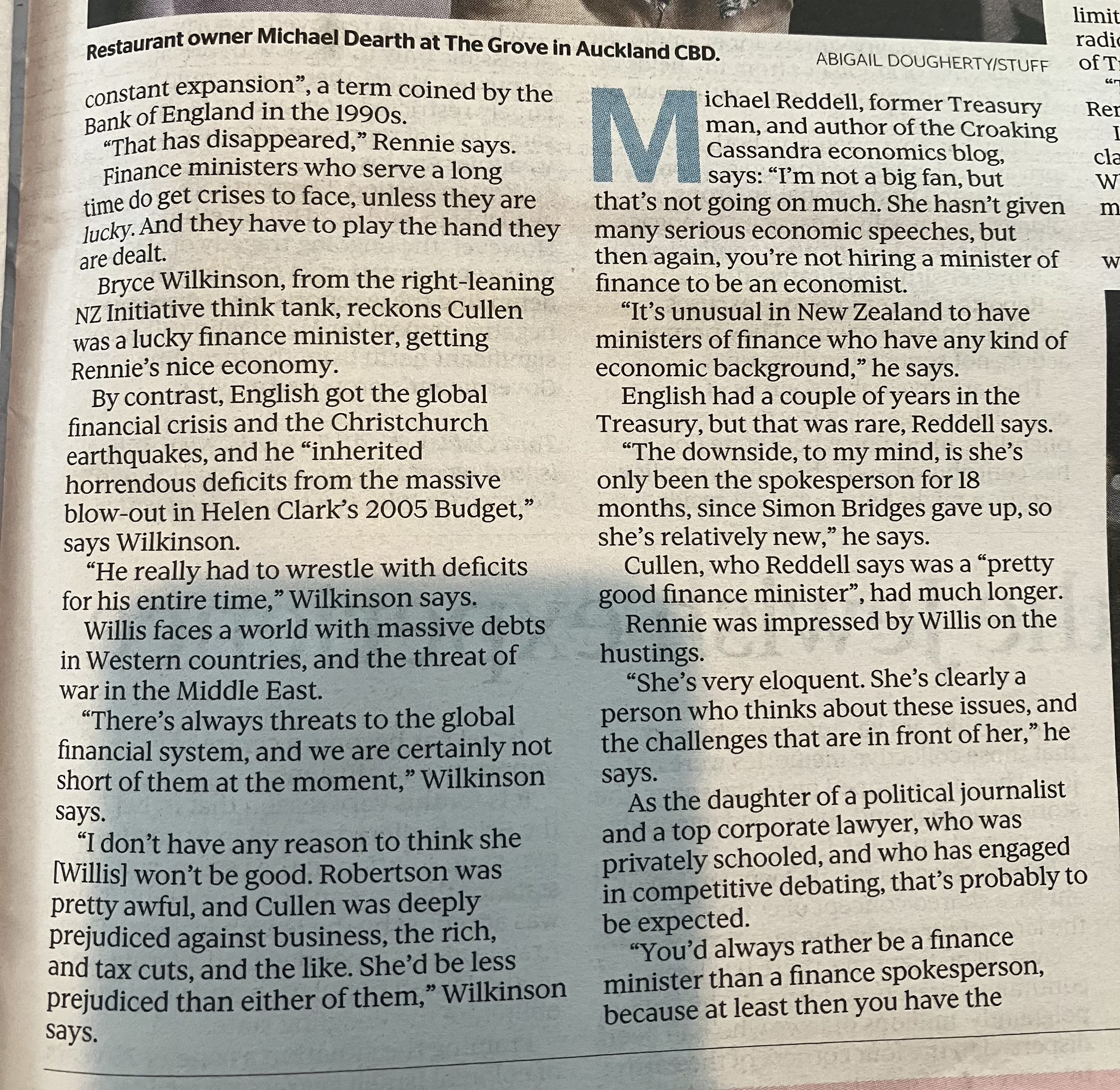
Willis as Minister of Finance

In this morning’s edition The Post has a double-page article about what Nicola Willis might be like as Minister of Finance. Those of my comments that were included are here

My bottom line was actually very similar to that of CTU economist, Labour champion, and former political adviser to Grant Robertson who was quoted as saying that only time will tell whether Willis makes a good finance minister, specifically “you don’t master these things overnight”. That said, I was a bit less impressed by the one campaign event I saw her at (the Stuff finance debate). I’m anything but a fan of Robertson – I think he ends up having been the worst Minister of Finance New Zealand has had in the post-liberalisation decades – but I thought Robertson had the better of her. Despite the government’s poor economic record and Willis’s apparent past debating prowess, perhaps 9 years’ experience as Labour’s finance person counted?

Willis comes to the job with relatively limited experience in the portfolio. Contrast her 18 months as the spokesperson with the 9 years Michael Cullen had before taking office (having sat in Cabinet for three years before that), or the similar background Bill English had had by 2008 (he hadn’t been spokesman for that long, but had briefly held a finance portfolio late in the previous National government). David Caygill and Steven Joyce both came to the job late in their respective governments’ terms, having served as senior economic ministers for years previously. Willis’s record is perhaps closest to that of Grant Robertson (neither had an economics background, and Robertson had had only 3 years as opposition finance spokesman). Neither has ever run anything much previously either, so again there isn’t a great deal to go on.

One might think of three aspects of the role of Minister of Finance:

  • senior political operator and parliamentary figure,
  • manager of the government’s finances,
  • lead figure in overall economic strategy.

The first of those isn’t really my territory.  But it was probably where Robertson did best.  He seemed to be a very effective figure in the House and a formidable debater etc.   That isn’t nothing, especially when (as they will, for any government) things go badly at times.    Perhaps Willis will be similarly effective (she was, like Robertson, primarily a political operative by background).

But beyond that it is very hard to know.  One could mount an argument that at least in the first couple of years Robertson didn’t do a bad job at all managing the government’s finances (the left thought him far too disciplined), but he’d inherited a fairly easy position (budget surpluses, unemployment falling etc).  The problems really became apparent once the worst of the Covid disruptions were over, and instead of insisting on steering a path back to surplus (in an overheated economy), Robertson presided over additionally expansionary budgets both last year and this, such that he bequeaths large deficits in a country that for 25 years had largely avoided them.   There seemed to be an inability or unwillingness to say no (and that in a government with no pressures from coalition etc parties).

How will Willis do in that role?  There really is no way of knowing at this point.  No doubt officials in Treasury have been beavering away for weeks preparing advice for an incoming Minister of Finance, one who plans to bring down some sort of mini-Budget within what will be not much more than her first five weeks in office, and will quickly have to focus on next year’s Budget.  But as to what hard calls she is willing to make, or to insist on (both her Prime Minister and the other parties will have different views on things) no one knows.  There is no track record (or nor really can there be, especially when neither she nor Luxon has previously served as a minister). 

I’m not overly optimistic, including because of the reluctance to put the seriousness of the fiscal situation front and centre during the campaign, preferring to run a campaign in which –  like Labour’s – (faced with large deficits) it was more a contest of who had had the shiniest new baubles to bribe voters with, financed by proposed tax changes that –  like Labour’s –  had little no economic merit, and around which there were also serious questions about the revenue they might raise.    As to the foreign buyers’ tax business, my unease was less about whether or not the revenue estimates are roughly right –  in macro terms it was always second order –  than about the way she and her leader handled the issue, refusing transparency, refusing to release any of the modelling, relying on “trust us” assertions when it wasn’t particularly obvious why – with the best will in the world – we would.  Verification helps underpin trust, and there was none of the former.

Being Minister, backed by a phalanx of Treasury staff and analysis, is different than being opposition spokesperson in a campaign.  But it isn’t Treasury that makes the hard political calls (and too often in the last few years Treasury itself seemed more inclined to favour bigger government over balanced budgets).  There is clearly now some political mood for restraint – even Labour seemed to get it in the last few weeks – but how well, and for how long, will that shape Beehive decisionmaking when the pressures from the numerous vested interests (of all sorts) mount?

My own unease is greatest around that “lead figure in overall economic strategy” role.  There will be other senior ministers no doubt, but a Minister of Finance who is deputy leader of the main governing party should be able to be looked to as the key player in this area.   And it is where, in her time as finance spokesperson, there is little sign that she has any more credible a model –  or any more substantive interest –  than Grant Robertson had for (for example) reversing the decades of economywide productivity growth failure.   We shouldn’t look to the (any) Minister of Finance as some sort of economic guru, but there is little or no sign that Willis is greatly interested or has made any effort to surround herself with advice, expertise, or even active debate about what might be needed.  The risk is that holding office will be sufficient, rather than doing something much in it.  There is, of course, the 100 point economic plan (which when I read it I probably agreed with a majority of the items in it) but a list that long really is a list rather than a strategy backed by a compelling narrative.  And it isn’t as if The Treasury seems to have much to offer there either (as distinct from narrower expenditure control stuff).

Who knows. We’ll see before long I guess.  If I’m “not a big fan” –  and I’m not –  it is a long time since I’ve had much confidence in any senior New Zealand political figure (or most of their top bureaucratic advisers –  an issue for Willis since The Treasury is weakly led, and entities she will be responsible for like the Reserve Bank and Productivity Commissions are worse. What, if anything, she is prepared to do about the leadership of these three agencies will be an early test).   It would be great to be pleasantly surprised.

(In the snippet above I included Bryce Wilkinson’s comments, partly because he runs a quite different line about Michael Cullen than the quote from me.  The background to my own comment was the observation that one didn’t need to have an economics background to be an effective Minister of Finance.  Cullen’s politics were very different to my own, but I have here several times defended his fiscal management, noting that he proved to have been very badly advised by Treasury, which told him that even in the face of expansionary budgets late in his term the Crown accounts would remain in operating surplus over the forecast period.  That proved to be very wrong, but it is The Treasury that is paid to do the numbers and provide those reckonings.  A couple of posts on that are here and here.

All that said, when I wrote about Cullen’s book I ended the post this way

cullen

Those last few lines are the sort of thing that could fairly be said of pretty much all our Ministers of Finance for decades.  

It would be great if Nicola Willis were to be different.  But there aren’t yet many positive straws in the wind.

Harry White, and reconstructing the international financial system

Harry White and the American Creed: How a Federal Bureaucrat Created the Modern Global Economy (and Failed to Get the Credit), a new book by James Boughton, was my weekend reading.

Boughton, now retired, was formerly the official in-house historian of the International Monetary Fund (IMF).   White was a fairly senior official in the US Treasury, a key adviser to Secretary Henry Morgenthau, from the late 1930s to 1945, and has a fair claim to have been the technocratic father of the IMF (and was then for a short time the first US Executive Director of the IMF).  It was a short official career and he died quite young, but has an interesting – and contested – story nonetheless.

What of the book?   Well, ignore most of the title.  I’m still not at all sure what the “American Creed” is supposed to mean in this context, and the bit about “created the modern global economy” is simply laughably wrong (and seriously misleading to the casual bookshop browser).  It is a full biography, but two-thirds of the book is about the last 7 years of White’s life (1941-48), including extensive discussion of the allegations which have dogged his reputation ever since that White may have been a Soviet spy.

By the time White became even moderately senior in the US Treasury, pretty much every country had moved off the Gold Standard (the European “gold bloc” countries not until 1936) and most major exchange rates floated.  In the diminishing number of democratic countries, private capital movements were mostly still free (although in the US for example private holdings of gold were simply outlawed).  Views differed on whether the new exchange rate regimes were a “good thing” or otherwise (in another book on my shelves there is a record of White on an official trip to London in the mid 1930s talking to prominent business figures who had embraced an era of floating exchange rates, but officialdom was often less enthusiastic).  In some circles then – and still today (Boughton seems guided by this story) – there was a narrative that non-fixed exchange rates were a material element causing a backing away from globalisation and multilateral trade in the 1930s (a story that I don’t think stands much scrutiny). It is certainly true that floating exchange rates in peace time were something of a novelty.

Then came the war (the US eventually joining in late 1941) with the attendant debt, disruption, and extensive controls over all manner of aspects in life in pretty every combatant country (and even many neutrals).

White wasn’t heavily involved in the creation of lend-lease, that innovative form of cross-country support initiated by the US (although they too were recipients of lend-lease assistance, New Zealand (for example) being a net provider of assistance to the US) but eventually had oversight responsibility for the administration of the scheme.  The real focus of his efforts as described in the book was on post-war planning, which absorbed a huge amount of resource among (in particular) US and UK officials even as the physical conflict raged.

As is fairly well known, there were rival conceptions of the details of what the post-war international monetary order should look like, exemplified by the ideas of White (for the US) and Keynes (a key adviser to the British).   But what no one seems to have been in much doubt about was that a regime of fixed (but adjustable) exchange rates should be established, and that if current account convertibility (ability to buy, sell and pay for goods and services freely from abroad) was over time to be a goal for many/most, private capital mobility was (at best) looked on with considerable suspicion (neither White nor Keynes were keen).  If you weren’t going to allow private capital mobility, not only were fixed exchange rates were more or less unavoidable but governments had to be sure of their own access to foreign reserves to manage fluctuations in the demand for their respective currencies.  There was no appetite for a return to a classical Gold Standard, but also a surprising attachment to the idea that gold should still have a place in the international monetary system (one presumption being that countries would be reluctant to accumulate substantial foreign reserves simply in the currency of another country without the ability to convert to gold).

If there were different conceptions there were also different interests and contexts.  The US, for example, had been a net provider of assistance to the rest of the world during the war, and so although it would emerge from the war with large domestic debts it had not accumulated an adverse international position.    The US under Roosevelt also came and went a bit on to what extent they sought to undermine the future of the British Empire and British Commonwealth relationships (notably the imperial preference trade arrangements, and the “sterling area” which had developed after Britain went off gold in 1931).  The UK, by contrast, had suffered a real large deterioration in its external financial position (as well as having lots of domestic debt) as a result of the war, and had accumulated huge volumes of blocked sterling liabilities to Commonwealth and Empire countries (goods had been sold to Britain, sellers had been paid in sterling, and the resulting central bank balances were not readily convertible into other currencies –  notably dollars).  New Zealand was among the countries that had accumulated such large claims on the UK.  The overhang of sterling liabilities was to be an issue for decades.   The US was keen on a fairly early move to convertibility, while the UK was wary, to say the least.   (There were, of course, many other countries, including the exiled governments of occupied countries like the Netherlands and Norway, but the bulk of the discussion and negotiation was between US and UK officials –  often led by White and Keynes (both of whom seem to have been awkward characters in different ways).

In institutional terms the US conception won the day. It was almost always going to. The US was by the biggest economy, was not itself dependent on external finance (although had a clear interest in a general post-war economic revival), and of course whatever was agreed between governments had to get through a US Congress that –  as ever – was not generally under the control of the executive.   And, in truth, the basic IMF structure (my focus here although the World Bank –  International Bank for Reconstruction and Development – also emerged, less controversially from this process) was an elegant one.   Countries would fix an exchange rate to the USD, while the USD itself would be convertible (for governments/central banks) into gold at a fixed rate.  Each member country would deposit some portion of their gold or USD reserves with the Fund, which in turn would establish rights for countries to “borrow” from the Fund in times of temporary balance of payments pressures.  Countries could make modest exchange rate adjustments themselves, but larger adjustments – to address structural imbalances – would require the approval of the Fund, itself governed by Executive Directors appointed or elected according to the quotas negotiated for each country.  I put “borrow” in quote marks, as formally the IMF did not do loans, but things that were more like currency swaps –  and obscure currency swaps (partly modelled on what had been done with the US’s own Exchange Stabilisation Fund in the 1930s) were thought easier to get through Congress than loans.  In economic substance there was no difference.

Boughton was, as I noted earlier, the official in-house historian of the IMF. Since the IMF still exists today, it is a perspective that leans him to seeing what was created in 1944/45 as an unquestionably good thing.   I’m much more sceptical.  One could wind up the IMF today and the world would not be worse off.   And one could mount an argument that if negotiated arrangements were almost inevitable in 1945, there is still little reason to suppose that the creation of the Fund was a net positive even then.

It didn’t –  couldn’t –  deal with the really big overhanging issues (including, but not limited to, those blocked sterling balances) and was part of state-led arrangements that enabled for a time some deeply unrealistic post-war exchange rates.  Britain, for example, went through a period of seeking further US financial assistance, was then forced by the US in exchange to allow early convertibility which went badly wrong very quickly, and only finally took the deep exchange rate depreciation that was always needed under pressure in 1949.   It is not hard to think that restoring floating exchange rates pretty much as soon as the war ended might have been a better way (also reducing the pressure later for the Marshall Plan – a point some US sceptics made even at the time).

But whether or not the creation was a good thing, there is little doubt that White was the technocratic father of the Fund – which exists today even if the world it was created for almost wholly doesn’t – and Boughton has written a useful and interesting account of aspects of that period, complementing the range of other books (many on the Bretton Woods conference in 1944 where the final details were negotiated with 40+ allied countries in attendance).

There is lots of other interesting detail in the book (occasionally too much – even as a former Washington resident I did not need every single street address White lived at), including White’s involvement in helping flesh out the madcap Morgenthau Plan that envisaged turning post-war Germany into primarily an agricultural economy. White owed his position to Morgenthau who in in turn owed his position and influence to his friend and neighbour Roosevelt. Once Roosevelt died, White’s hour in the US government system had passed,

One is left with the impression of an influential, extremely hardworking, smart individual, but also an abrasive and not altogether pleasant one.  In an age of great figures –  good and evil – my sense is that no one would today be writing biographies of him if (a) the IMF no longer existed, and (b) it were not for the espionage allegations (the two aren’t unrelated since it was uncomfortable for the Fund to have such allegations about one of its “founders”).

The espionage allegations were not my main interest in buying the book. Not being American I’m probably less interested in any case against White than in, say, the truth about Bill Sutch.   Boughton goes to great lengths to review and rebut in detail many of the claims that have been made ever since the 1940s.  In some cases, he seems very persuasive, and in others a bit less so.   What is now unquestionable is that some of White’s good friends and colleagues were Soviet agents in one form or another (in some cases very active), and even Boughton concedes that at times White may have been indiscreet in his ties with people who, while Soviet officials, were still wartime allies and official interlocutors.  But if Boughton’s is the pro-White case, other serious people (without IMF ties) still seem equally certain of White’s guilt.  Perhaps we will never really know.

New Zealand participated in the Bretton Woods conference where the new international monetary arrangements were settled.  Our key delegate was Walter Nash then (simultaneously) Deputy Prime Minister, Minister of Finance, and resident NZ Ambassador to the United States.  His small delegation including the Secretary to the Treasury, Ashwin, the then Deputy Governor (later Governor) of the Reserve Bank, Fussell, and the highly regarded economist AGB Fisher.   There were two main working groups at the conference –  one on the Fund chaired by White, and another on the World Bank chaired by Keynes.  Nash chaired a less important working group.

Bretton Woods was, in many respects, not a matter of great moment in New Zealand (and it is interesting that neither the war economy  nor political and external affairs volumes of the NZ official history of World War Two seem to have any mention of the conference or the issue).   New Zealand was firmly in the sterling area –  our pound pegged to sterling –  and Nash had a strong aversion to overseas debt.  But there was still an important defensive interest, since Labour has put in place pre-war extensive exchange controls and import licensing restrictions and had no intention of removing those restrictions in peacetime.

Digging around various other books on my shelves, it seems clear that Nash and the NZ delegation did not make a great impression.  Ed Conway’s book, The Summit, has a few comments.  Introducing Marriner Eccles, the then chair of the Fed, he suggests that Eccles’ oratory “would give New Zealand’s dreary Walter Nash a run for his money as the most self-important and tedious delegate”.  The relative size of each country’s quota in the Fund was then, as now, a matter of politicking dressed up behind an apparent technical façade.  New Zealand was among those objecting to the US proposal (not helped by the fact that Nash apparently confused sterling and dollar amounts) “in a ten-minute sermon from the country’s dreary lead negotiator, the Hon Walter Nash”.  Conway quotes from the contemporary diary of UK delegate/economist Lionel Robbins “throughout the conference {Nash] has shown a tendency to be about three bars behind the band”. 

A more recent history of New Zealand diplomacy during the war, by Gerald Hensley, has a more substantive discussion.  He notes that the delegation had a good grasp of the basic New Zealand needs “But not one had been able to do any deeper thinking about the implications of the Fund and on this occasion it showed”.  He goes to quote from a contemporary British delegation report back home which concluded that Nash was simply out of his depth (“He understood comparatively little of the technicalities, but could not restrain himself from intervening in an embarrassing manner on many complicated points which were, moreover, not the least concern to his country”).  The Australian delegation also recorded complaints.

As Hensley notes, however, the government’s (and Nash’s) main focus was on ensuring that nothing in the agreement would interfere with the government’s ability to maintain exchange and import restrictions.   Nash’s official biographer, Keith Sinclair records that “according to the notes he made at this time, he asked the chairman Harry D White whether exchange controls were permissible, provided that exchange was used to pay for all current transactions.  White replied that this was his understanding, and he asked the meeting if there was any dissent. There was none.”

(Which is all very well but it was not be until the early 1980s that New Zealand finally removed all restrictions on even current account transactions)

If Nash himself was content with the final form of the agreement, there was still a significant amount of angst back home.  Instructions came from the Prime Minister that New Zealand was not to sign adhesion to the Final Act from the conference, and in the end the two most junior officials in our delegation were allowed merely to sign a document that certified that it was a true record of the conference proceedings. That Nash himself was persuaded is reflected in a letter to Harry White that was read to the conference by a senior US delegate as the conference was winding up (Nash had had to leave early)

“Owing to the urgency to make a train last night it was not possible to say goodbye before leaving for New Zealand.  In congratulating you and those working with you on the foundation work in connection with the Fund and the Bank I affirm that it can easily be the greatest step in world history with possibilities of removing one of the major causes of war, if not the major cause.”

Talk about overblown political rhetoric.

New Zealand was one of a very small handful of countries that participated in Bretton Woods that did not join the Fund early on (the most prominent of course was the Soviet Union, but even Australia did not join until 1947).  There is an entire article to be written on this strange history one day (I have a big folder of papers I collected a few years ago but cannot immediately find it).  There was significant unease on both sides of parliamentary politics with talk of free votes. It seems to have been one of those issues that few cared much about (either way) but a minority (against) felt very strongly about.   The Labour government failed to take any lead (there was significant dissent in their own caucus), and by the 1946 election campaign the leader of the National Party was openly opposed to joining.   There seem to have been a range of concerns, some reasonable, some not, and it is not as if there was no sensible dissent in other places either (I read one speech from a senior former UK minister in the House of Commons ratification debate expressing concern that the IMF would allow the UK less exchange rate flexibility than the UK had needed in 1931).  Between close ties to the UK, some unease about an emerging US-led system, a commitment to the sterling area and UK trade preferences, all combined with on the one hand the NZ regime of controls and, in the late 40s, New Zealand’s strong external position (we revalued our currency in 1948) there wasn’t much momentum, before the undertones of Social Credit type concerns were mentioned.  When New Zealand did finally sign up in 1961, Hansard still records unease from Labour members that IMF membership might threaten New Zealand’s full employment record.

New Zealand did join.  New Zealand has borrowed from the IMF on a few occasions ( a former colleague recently described to me the gaming of the rules of one particular facility in the 1970s).  It isn’t clear that joining or not really made very much difference then or now – these days we get only not-very-useful advice and a few job opportunities for officials – although it would these days look odd not to be a member.

(Personally I’m quite glad NZ finally did join as four years on the IMF payroll –  two resident in Zambia, two as Alternative Executive Director in Washington – were by far the highest paid of my career, and the only technical assistance mission I ever did for them, in China, was conveniently timed to pay the bills for our wedding.)

UPDATE: Someone inquired about my observation that NZ was a net provider of lend-lease assistance to the US. On checking, I’m reminded that in accounting terms the two sets of flows were roughly even (we received about as much as we provided), however Hensley’s book (p250) notes that this somewhat misrepresented the flow of real value, since much of what New Zealand provided was valued at pre-war prices, while material received from the US was typically accounted for in contemporary price terms. To the extent this was so, NZ was a net provider to the US.

Reading Michael Cullen

There aren’t many New Zealand political memoirs/autobiographies – and even fewer diaries (although I was recently reading John A Lee’s for 1936-40) – and most of them aren’t that good. Voracious book buyer that I am, I usually don’t buy them until they turn up very cheap in a charity shop or community book sale. After all, sometimes there are interesting snippets and you never know when some angle on some event might prove at least somewhat enlightening.

But I thought I’d make an exception for Michael Cullen. He had, after all, been an academic historian in an earlier life, and was unquestionably smart and funny, and had been Labour’s finance/economics spokesman for 17 years and Minister of Finance for nine years (terms really only rivalled in modern New Zealand by Walter Nash and Rob Muldoon). I’d probably have been better off waiting for the charity shop copies to turn up.

There were interesting bits and pieces. Early chapters of autobiographies are often complained about but I almost always like them. There was, for example, the ancestor who was the last person burned at the stake in England for heresy (twice actually). Or the snippet of Cullen and his first wife buying their first house in Dunedin in 1971 for $10500 – “only twice my annual gross salary” as a new lecturer (lecturers at Otago now seem to start at about $82000). Or the prize he won at about the same time for the best University of Edinburgh PhD history thesis that year – enough to pay off in full the 30 per cent deposit they’d borrowed from his wife’s parents. Or the picture of the Dunedin Labour Party in the 70s – including the raffle organiser (“Labour used to be a raffle-funded party”) who “made a Ponzi scheme look positively generous” by offering a first prize in one raffle a full book of tickets in the next raffle.

And there were the national politics snippets, including the observation/claim that David Lange had persuaded Roger Douglas to stay in politics in 1981 by promising that if/when Lange became leader Douglas would be his Minister of Finance. As Cullen notes, some things might have been quite different…..although it is interesting to wonder just how much. Cullen’s perspectives – as senior whip and then junior Cabinet minister (often written in counterpoint to Michael Bassett’s book on the period) – on the Lange/Douglas tensions over 1978/88 were worth having, including his suggestion that (given the tensions, that only built further) perhaps Lange should have sacked Douglas in April 1987.

But it tended to go downhill from there, dramatically so for his treatment of the nine years of the 5th Labour government, which takes up almost half the book. Much of it has about it the character of a family Christmas letter from proud parents who just don’t know when to stop. If you want a canter through the things the government did during those nine years, trivial and not, I guess this is the book for you. Almost everyone did everything ably. But to anyone who was around New Zealand at the time, you simply aren’t going to learn very much (although I was surprised to read that Jim Anderton had been – so Cullen claims – one of the ministers most keen on lower company taxes late in the government’s term).

Two things in particular struck me. The first was that while Cullen was a Labour Party MP and minister, clearly he was not a Labour Party person (consistent with this in the early days his then wife had been more active than he was), and there is very little on the internal ructions that convulsed the party a few decades ago. More generally, there is little insight anywhere in the book on the many really significant political figures Cullen worked with over the years, none at all on Helen Clark (or Heather Simpson for that matter). There was almost no insight on some of the key public servants, or anything on the tensions. interactions etc. And this 12 years after he left office. Cullen seems to have reasonably kind words for most people – exceptions I think being Richard Prebble, Don Brash and (mixed with some admiration/envy at his success) John Key – but no insights. And if he ever worked with Grant Robertson, Jacinda Ardern or Chris Hipkins when he was Deputy Prime Minister and they were in Clark’s office, you wouldn’t know it from the book.

Presumably Cullen kept no diaries, and he notes somewhere in the book that he hadn’t been very good at answering questions from researchers over the years about past events because his mental approach was to compartmentalise and then move on (and of course he carried a formidably huge load during those Clark years). And writing the book can’t have been helped by the knowledge that his time might be very short (as it turned out to be) and that between illness and Covid he was only able to make a single trip to Dunedin to consult his papers in the Hocken Library. In a bigger country, he’d almost certainly have had a research assistant he could have drawn on. As it was, he tells us he drew heavily on what happened to be available on the web.

But there is also a sense of someone who – despite the training as an historian (which he often reminds us of) – just wasn’t that reflective. 50 years on from that house purchase he told readers about, house prices are appallingly high – and these developments were going on on his watch too – but there is nothing on how, technocratically and politically, his generation bequeathed that disaster. He was Labour’s finance spokesman for 17 years, beginning as the reforms (which he mostly supported) were supposed to be starting to pay off in reductions in the productivity gaps between us and the rest of the advanced world. Under his watch there were various bows in the direction of aspiring to make a difference. And yet here we are, with the gaps wider than ever. There is no sign anywhere in the book of any reflection, self-questioning, or even curiosity about the failure. Perhaps the only note of regret about policy I recall is a regret that the government had not been more active in determining the strategy of Fonterra, the behemoth they enabled but which also failed to deliver.

Perhaps it would have been different if he’d had more time. Even on the text he did write it is not hard to see where a good editor could have insisted on cutting out at least 50 pages (of a 400 page book) – perhaps including the line that knighthoods were a good thing because they gave a lot of pleasure to the recipients.

Of course, part of my interest in the book was in its treatment of Reserve Bank issues, he having been the Minister responsible for the Bank through nine sometimes difficult years, and Opposition spokesman beginning little more than a year after the 1989 Reserve Bank Act had come into effect. The Reserve Bank monetary policy framework has not, shall we say, been without its controversies over those 30 years – including the often very antagonistic approach taken by Jim Anderton whose party at times rivalled Labour on the left in the 1990s.

But again, it was curiously bloodless. You’d not have known, for example, that in his early days (perhaps as late as the 1996 election, as I recall us debating it at the Bank at one election and I was working overseas in 1993)), he (as Labour’s spokesman) championed a change to the inflation target (then 0-2 per cent annual inflation, with caveats). But Labour’s proposal – they needed product differentiation from National, the Alliance, and New Zealand First – was to adopt a target range of -1 to 3 per cent inflation. As I recall it, part of the aim was to capture more of the headline inflation shocks (oil prices, tax changes etc etc), but it could have led to the curious world in which the Bank was supposed to be more or less indifferent to inflation going negative, which didn’t seem as though it would prove very robust at first confrontation with experience.

Perhaps charitably, Cullen does not mention the (frankly fairly incompetent) way we ran monetary policy over 1997 and 1998 (the infamous monetary conditions index) but nor does he mention his oft-expressed (and somewhat valid) concerns about the volatility of both the exchange rate and interest rates, or his calls for changes to the Policy Targets Agreement and/or for an independent inquiry into the conduct of monetary policy. As it happened, the PTA was changed when Cullen took office, to add a new form of words that was supposed to appear substantive but which, to this day, no one really knew what the words actually meant for policy (I’ve long argued “precisely nothing”). At the Bank we were sufficiently uneasy that in the first few weeks of the new government I was sent on a whistle-stop 10 day tour of the RBA, the Monetary Authority of Singapore, the Bank of Japan, the Bank of England, the Bank of Canada, the Federal Reserve and the US Treasury to brush up our knowledge of, and perspectives on, operationalising foreign exchange intervention.

Out of office Cullen had called for an independent inquiry – which went over well with the left of his own party, and with the Alliance, with which Labour was mending fences. In office, he commissioned an inquiry, but consciously and deliberately chose as his reviewer someone who could be counted on not to make trouble – a leading academic author on inflation targeting, Lars Svensson (he could quite readily have chosen as reviewer any number of other quite reputable people – just one example being Bernie Fraser the former Governor of the RBA (and known as somewhat left-leaning). As it was, Svensson predictably made no difficulties and at times we (I was one of the small secretariat) had to talk him into revising down his effusive praise of Don Brash. He did propose adopting an MPC – but made up solely of executive staff of the Bank – a proposal that Cullen rejected, and what came out of the review were very minor changes indeed (the Governor to no longer chair the Bank’s Board, the Board to write an Annual Report). But he’d been seen to have had a review.

If there were ongoing government niggles re the Bank’s monetary policy they must have been quite limited for a while. In 2001 we’d been quite pro-active in easing monetary policy (somewhat burned by 1997/98) both in response to the global tech slowdown and after 9/11 (decisions I still think were warranted, but which some more hawkish people differ on). But Don Brash was still a bit of an issue. He’d made a high profile controversial speech to the government’s Knowledge Wave conference in 2001, stepping well outside areas he had any policy responsibility for (and, not surprisingly, championing policy approaches that weren’t really to Labour’s liking). Powers that be in the Beehive were understood to be not best pleased.

Nothing of all this in in the book.

Don Brash resigned as Governor on 26 April 2002 to seek selection as a National Party candidate at the forthcoming election (having been pro-actively recruited and given to understand he’d get a high list place, and perhaps a reasonable chance of being Minister of Finance – in the unlikely event National was to win). Cullen writes about this resignation, but comments only that he was “flabbergasted”, proceeding to write some generalised negative comments about Brash and his self-belief. As Don records in his own autobiography of his conversation with Cullen “I don’t think he was pleased but he was polite”, but he goes on to note “much more polite than Helen Clark was later in the day”. As I understood it, the PM had been (understandably in my view) outraged, felt it was something of a betrayal (to step straight out of high public office onto the campaign trail) and was specifically very aggrieved at the Bank’s Board (and specifically the then chair of the non-executive directors) – responsible to Cullen – for having written an employment contract that did not enforce a decent stand-down period. All of which might have been useful points for Cullen to have included, rather than just glib remarks (true or not) about Brash’s “extraordinary sense of self-belief”.

Appointing a new permanent Governor was a challenge. Under the law, the Governor had to be someone the Board nominated, but the Minister could reject a nomination and ask (endlessly, in principle) for another. Brash’s deputy, Rod Carr, filled in as (statutory) acting Governor including through the election campaign period, and assiduously sought to get the permanent role. Cullen records – and this I did not know – that the Board had formally recommended that Carr be made Governor.

I had nothing personal against Rod, but he was so dry that he made even Brash look slightly moist. I was not in the least convinced that he could adopt the somewhat more flexible approach I was looking for. I rejected the recommendation….Finding a replacement posed a problem, especially if my action was interpreted to mean a lack of commitment to the basic principles of the Reserve Bank Act. I was saved by Alan Bollard. He offered to put his name forward.

Of course, it would not have been hard to have found someone else, except that the understanding was that the word had gone out that no one associated with the Brash Reserve Bank was to be appointed. Thus, Murray Sherwin – until recently Deputy Governor, then Director General of Agriculture – would have made a good Governor, but he’d been of the Brash era. Less plausibly – though probably with politics more akin to Labour’s – another former Brash Deputy Governor Peter Nicholl (then Governor of the central bank of Bosnia) might have been keen (although I know the Bank’s Board wasn’t).

Again, what Cullen doesn’t record was the fascination with the RBA in the Beehive (including the 9th floor at the time). In some ways it was understandable – the RBA was run by a succession of competent people, the Australian economy was generally doing better than New Zealand’s, real interest rates were generally a bit lower (visiting RBA people would even encourage us to be more like them and we might get our interest rates down to “world” levels) and had been less volatile. My diary records a conversation with someone who had been to visit Peter Harris – now an MPC member, then Cullen’s main economic advisor – during this period, and Harris had apparently even toyed (perhaps not fully seriously) with the idea that they could get Glenn Stevens (then Deputy Governor of the RBA) as Reserve Bank Governor. The Prime Minister was known to want a policy target mirroring the Australian one (centred on 2.5 per cent inflation), something that Alan Bollard successfully resisted).

(Cullen goes on to record that he also knocked back SSC’s recommendation of Mark Prebble to be Secretary to the Treasury, primarily on ideological grounds. That was interesting but he never tells his readers that at the time – when Cullen was deputy PM – Prebble was chief executive of DPMC, that Clark had attacked that appointment in 1998 (again on ideological grounds) but had acquiesced in Prebble’s reappointment in 2000). It might have been interesting to have read some reflection on what changed.)

The period from late 2003 to the end of Labour’s term was a difficult one for monetary policy. Cullen does a little bit of sniping in the book – mainly at the idea that the Bank was engaged in targeting inflation forecasts (he words it a little differently but it is the implication of his repeated comments about an output gap focus) – but he displays almost no awareness of what was going on (including the sustained and significant rise in actual core inflation, the demand effects of rapid growth in population, the demand effects of the housing market (prices and volumes), the strong growth in the terms of trade, or the implications of fiscal policy. And I don’t think he once mentions the exchange rate, which became an increasing bugbear through this period, both for him and for his handpicked Governor. The best evidence for the proposition that throughout those years we did not tighten aggressively enough early enough is that core inflation moved to and beyond the top of the inflation target range (as benchmark, in the subsequent decade core inflation undershot, but never quite fell outside the bottom of the band).

There was an increasing search for some sort of circuit-breaker, with a particular focus then on things that might help dampen housing market pressures without necessitating further OCR increases and further rises in the real exchange rate. This culminated first in the Supplementary Stabilisation Instruments project, which Cullen claims to have known almost nothing of. This is the relevant extract from his book.

Both the Reserve Bank and the Treasury realised that in that situation [economic imbalances] the use of the official cash rate as almost the only means of dealing with such imbalances was far from satisfactory. It was rather like many anti-cancer drugs in causing significant collateral damage, so they had decided to work on what they called a Supplementary Stabilisation Instruments Project. This was their initiative, not mine, but it got John Key excited and he managed to invent all kinds of malign intentions the government had. I have no idea where the project went since it did not seem to produce any results.

Which simply wasn’t true. House prices became such a political problem there was a special unit set up in DPMC to look at what might be done, and John Whitehead and Alan Bollard agreed with Cullen to commission the SSI work. In a release at the time, Cullen claims that

He expressed concern at the impact of the high dollar on the export sector but said the Supplementary Stabilisation Instrument Project, the terms of which were drawn up by the Treasury and the Reserve Bank and released without reference to the government, would explore options to reduce pressure on the exchange rate by reducing monetary policy reliance on the OCR.

I can’t remember if the precise Terms of Reference were cleared by his office, but it was made very clear (from the Beehive) that difficult political options (capital gains taxes, public sector savings programmes, anything around the welfare system) were out of scope. These specific exclusions are mentioned in the published Terms of Reference (page 39 here). Cullen’s hands were all over this commission (my diary records a week or two prior an observation that Cullen, Bollard, and Whitehead had all apparently been keen on some particular tweaky tool I’d devised – I can’t recall what it was but am embarrassed that it seems to have been an LVR-based control).

The Minister goes on to claim that “I have no idea where the project went since it did not seem to produce any results”. Except that, readily available on the web, is our report to him on the analysis and possible tools, from March 2006.

And did it go no further then? Well hardly. Instead there was some considerable interest in the idea of a Mortgage Interest Levy – a scheme under which we might raise the cost of mortgages without raising the OCR – and I and a Treasury counterpart spent (what seems like) months devising something that might be workable, exploring fishhooks etc etc. That paper is here, as is the report to Dr Cullen.

And was this simply a bureaucratic conceit, or no interest to a busy Minister of Finance? Well, no. Actually, Cullen tried to persuade the National Party to go along. I knew this was so, but looking through some old papers found a press release from Michael Cullen, as Minister of Finance (9 February 2007), saying so and attacking Bill English (new National finance spokesperson) for not being willing to go along.

National leader John Key and finance spokesman Bill English are clearly at odds over the concept of a mortgage levy, which could potentially ease pressure on exporters, Finance Minister Michael Cullen said today.

…I can now reveal that Mr Key and Mr English were invited to a meeting in my office before Christmas to discuss alternatives to existing monetary policy instruments to tackle inflation.

…At that meeting Mr Key took a balanced and serious approach. Mr English though largely remained silent and his body language spoke volumes about his willingness to embrace new measures that may have a chance to help the New Zealand economy 

And so on.

And at that Cullen requested that further work be discontinued.

Cullen was a busy man, but it wasn’t as if this was an isolated project. The Minister continued to express concerns – quite serious ones. Not six years after his Svensson review had reported, Labour initiated a full-scale Finance and Expenditure Committee review of monetary policy (quite possibly intended more for shown than substance). More than once Cullen opened mused about the powers open to him under the Reserve Bank Act (but never used) to direct the Bank to pursue a different target (I wrote the internal paper musing on how we should respond, what options the Minister had, what constraints there were on him) and he also became increasingly critical of our public line that fiscal policy was adding to demand and inflation pressures, all else equal putting the real exchange rate and the OCR higher than they otherwise would be. Labour was on its late-term fiscal splurge (helped by Treasury advice that concluded the boom-time revenues were mostly permanent) and although the budget was still in surplus, running down that surplus actively added to the imbalances in the rest of the economy. For Cullen no doubt it was politically awkward – Labour was well behind and the polls, and the money was there. We were reduced to (among other things) writing boxes in the Monetary Policy Statement to explain our (entirely conventional view).

My point here is not that Cullen would necessarily have remembered all of this – busy man etc – but there is not even a hint of any of it. The book would have been much better with at least some of it, rather than the Christmas letter type of account.

Out of curiosity, I also looked for Cullen’s account of the genesis of deposit guarantee scheme. It is a somewhat self-serving account, including his attempt to blame the entire South Canterbury Finance situation on the National government that took office the following month. I wrote my own account of those few days here (I was very closely involved), and included this paragraph.

The main, and important, area in which Dr Cullen departed from official advice was around the matter of fees.   We’d recommended that the risk-based fees would apply from the first dollar of covered deposits (as in any other sort of insurance).     The Minister’s approach was transparently political –  he was happy to charge fees to big Australian banks (who represented the lowest risks) but not to New Zealand institutions (including Kiwibank).  And so an arbitrary line was drawn that fees would be charged only on deposits in excess of $5 billion.   Apart from any other considerations, that gave up a lot of the potential revenue that would have partly offset expected losses.  The initial decision was insane, and a few days later we got him to agree to a regime where really lowly-rated (or unrated) institutions would have to pay a (too low) fee on any material increases in their deposits. A few days later again an attenuated pricing schedule was applied to deposit-growth in all covered entities.   But the seeds of the subsequent problems were sown in that initial set of decisions.

They were his calls to make, and it was an election campaign, but perhaps a political memoir would be more helpful in revealing some of the tradeoffs, tensions, risks etc (or even the fact that – especially with Parliament dissolved – a Minister of Finance could issue such blanket guarantees with few/no checks and balances.

These were just the areas that I know something about in depth. So I’m left wondering what weight I should put on any of the rest, other than as chronology (which I too could get from the web).

On the front cover of the book, Helen Clark describes Cullen as “one of our greatest finance ministers”. There aren’t that many (relatively long-serving ones) to choose from but I’d hesitate to endorse the accolade. Running down the public debt was an achievement but (a) demographics, (b) a prolonged, but productivity-lite, boom, and (c) the terms of trade ran strongly in his favour, and the dam burst in the final three years of his term. I guess he has monuments to his name – Kiwisaver and the NZSF (“Cullen fund”) – but then so does Bill Birch from his time as Minister of Energy, and the best evidence to date is that Kiwisaver has not changed national savings rates, and it isn’t clear what useful function the big taxpayer-owned hedge fund has accomplished. Meanwhile Cullen – and Clark herself of course – bequeathed to the next government (who in turn bequeathed it to this one), the twin economic failures: house prices and productivity (the latter shorthand for all the opportunities foregone, especially for those nearer the bottom of the income distribution).

In that sense, what marks him out from a generation or two of New Zealand politicians, who have spent careers in office, and presided over the continuing decline?

Thinking Big still

Just before I went on holiday I wrote sceptically about the “five point economic plan” speech given by the then National leader Todd Muller.

We were promised then a series of major speeches fleshing out the framework Muller enunciated.  Among the five points was this

Delivering infrastructure had this promise

Before the end of this month, I will announce the biggest infrastructure package in this country’s history. It will include roads, rail, public transport, hospitals, schools and water.

My heart sank somewhat.  A new and different Think Big? But lets see the specifics.

Of the five points Muller had outlined, this seemed to be one where they were investing any hopes they might have of lifting New Zealand’s medium-term economic performance.

New leader Judith Collins started on the details with a speech given on Friday and some supporting documents.    This announcement had (a) some big headline numbers for spending over the next decade, (b) the “roads, rail, public transport” components for the North Island north of Tauranga, several of which are mainly about periods well beyond the next decade, and (c) some material on how they propose to replace the RMA, and to fast-track some of these projects in the meantime.  I think there had already also been a promise to build an expressway between Christchurch and Ashburton.

I don’t have any particular problem with building more and better roads where they make sense.  Same goes for rail within cities, again where such proposals make robust economic sense.  (I’m much more sceptical of things like cycleways, whether across the Waitemata Harbour or locally.)  And clearly congestion is a major issue in Auckland and –  for what is really a pretty-tiny city by international standards – to some extent in Wellington too.  Congestion has real economic and welfare costs.  National’s leader referred to one estimate of those costs in Auckland (presumably this one) at around $1 billion a year –  and since the study was done a few years ago, perhaps it would be reasonable to use a higher estimate now.

But we have tools that can deal with congestion.  Pricing.  It is a tool that seem to work when tried in other countries/cities.    Of course, simply pricing congestion doesn’t mean building no more roads ever, but it (among other things) helps give a better steer as to what the real price of congestion – and the value people put on avoiding it – and it deals with the congestion directly in the meantime.    Even the current government’s Minister of Transport has been on record suggesting that congestion pricing is “inevitable” at some point, just not now.

And what is National’s stance, to address what Collins calls a “congestion crisis”?

Looking further ahead, if we and Auckland Council ever look at congestion charges in the future, my Government will insist they are only ever revenue neutral, with other fuel taxes reduced to compensate.

“If we ever”….Not exactly a ringing endorsement, looking to shift the ground in the debate.  Perhaps congestion pricing isn’t easy electoral politics, but it is the direction we need to be heading.  It might actually make a material difference within five years, unlike (as far as I can see) most other things in the National plan.

Instead the focus seems to be a flinging around some big numbers, not being too bothered about how robust any analysis supporting the mooted projects is, and all with little or no sense of decent mental model of what has gone wrong with New Zealand’s economic performance,   And yet it is, supposedly, “the Plan that New Zealanders –  including Aucklanders –  have been waiting for, for generations”.

Pretty sure that last sentence isn’t true.  Collins, for example, talks up the “if onlys”, in her case around Sir Dove-Myer Robinson’s “rapid rail” proposal, that got lots of attention in Auckland in the early 70s.  We moved to Auckland about that time, but I was 10 and can’t claim to have given it huge attention.  But here’s the thing: the population of the Auckland urban area then was about 650000, the birth rate had been dropping for a decade, and the new government was just about to markedly tighten up on immigration access, a policy that carried through for the following 15+ years.  And even with all the New Zealand tendencies to boosterism, neither central nor local government was persuaded that Robinson’s scheme made economic sense.  Nor, most likely, did it.  Collins also talks up the City Rail Link project, the costs of which have escalated greatly since the government she was a part of first signed off on the project, which didn’t look very economic even then.

The promise seems to that this big infrastructure spend-up is going be pretty transformative in economic terms.  There are these quotes

This city is broken by congestion. Every Aucklander and every visitor to Auckland knows it. Congestion costs Aucklanders over $1 billion per year. That’s the strict economic loss. It represents lost production, lost productivity, lost opportunity.

But congestion is far worse than that. Congestion means unreliable journey times. It means frustration at sitting idle on the motorway. It means goods being delivered late to our ports. It means Mum being late to pick up the kids from rugby practice. It means a tradie only doing two, rather than four, cross-town trips per day. That’s fewer jobs for him; less income, and less economic activity.

I guess $1 billion per annum is supposed to sound like a big number.  In fact, it is about 1 per cent of Auckland’s GDP.   Fixing the problems is probably worth doing, but 1 per cent of GDP is tiny in the context of either Auckland’s gaping economic underperformance, let alone that of New Zealand as a whole (recall that the productivity leaders are more than 60 per cent ahead of us).

And yet, according to Collins, there are really huge gains on offer.

National’s approach to infrastructure is simple: Make decisions, get projects funded and commissioned, and then get them delivered, at least a couple of years before they are expected to be needed. That is the approach that transformed the economies of Asia from the 1960s.

Quite possibly, some east Asian cities/countries did infrastructure better than New Zealand has, but I’d be surprised if National can cite any authoritative development studies suggesting that the catch-up of that handful of successful east Asian economies was primarily about moving things/people more easily around their own countries.  They are typically regarded as outward-oriented, tradables-sector led, growth stories, perhaps with improving infrastructure going hand in glove with those flourishing outward-oriented opportunities.

But, as least as far as we can tell from this speech, or the framework one Muller gave, National’s policy approach is now primarily inward-looking?  That has long been the practical effect of the policy approach they (and Labour) have adopted over 25+ years, but it isn’t usually so blatantly put.

Collins went on.  Build these roads, rail etc and

Half of New Zealand lives in the Upper North Island region. We want a genuinely integrated region of 2.5 million New Zealanders. Our vision is to transform the four cities to be one economic powerhouse. We will unlock their potential so that the upper North Island becomes Australasia’s most dynamic region.

Recall that the expressway to Whangarei, complete with possible tunnel under the Brynderwyns, is –  even on this plan –  well over a decade away.  And recall that in the regional GDP per capita data, Northland has the lowest per capita GDP in the entire country, suggesting that if Whangarei has any part in some future “Australasia’s most dynamic region” it has a very very long way to come.      But even forget about the Whangarei bit of the fairytale for now, do the National caucus have any serious idea how far behind key bits of Australia productivity levels in New Zealand actually are (and Australia is no great OECD productivity success story)?   As a hint, that 1 per cent of GDP Collins talked about fixing won’t even begin to make a visible dent in the productivity gap –  a gap only likely to continue to widen for the next few years, even if Collins plan did eventually make some small helpful difference.

National –  like Labour really –  seems to have no idea at all what has gone wrong with the New Zealand economy, what has taken us from among the very richest and most productive countries on earth to be some slightly embarrassing laggard, increasingly unable to offer the best to our own people.   But they’ll just fling some more cash at things –  as Labour does, just a slightly different make-up – in the hope of getting elected, and the vague sense then the something must be done, and anything is something.

Here is the Collins approach to project evaluation

The economists will tell you we should build projects only when they’re needed. My sense from my time in politics is that you just want the government to get infrastructure projects built. You just want them done. And you want them done ahead of time.

My Government will be informed by processes like NZTA’s Benefit-Cost Ratio analysis, and by advice from the Infrastructure Commission. But we will not consider that analysis or that advice to be holy writ when making decisions about major transformational projects. Think about all of the Roads of National Significance the National Government built.

I don’t think Transmission Gully passed a decent cost-benefit test, even when it was going to be operational by now.

Now I’m not about to suggest that officials and appointees to government boards should be making the decisions, but any well-done cost-benefit analysis should be a key hurdle in any proposed commitment of large amounts of public money.  Perhaps there are reasonable arguments about methodology or about specific assumptions used in the calculations.  All that can and should be debated, but a project that cannot return a decently positive benefit-cost ratio is one the public should be very sceptical of.  Simply waving your hands and talking about “major transformational projects” should be no more acceptable now than ever.     And having projects in place “ahead of time” –  when few projections about the future, including about population, are that robust –  also has significant economic costs, even at today’s lower public sector discount rates.

One other questionable aspect of National’s plan is what they call “intergenerational funding”.  This is fancy language for borrowing, in this case off the core Crown accounts and having NZTA borrow instead.  As far as I can see there is almost nothing going for this particular approach –  one already indulged in by Labour, with Housing New Zealand now borrowing on-market.  It will be a (a bit) more costly than the central government borrowing itself, with no more likelihood the debt will be defaulted on, it is less transparent,  and unless the government is proposing to delegate all final decisions on projects to officials (which they –  rightly in my view –  show no sign of) there is no reason to think it will either tap new sources of capital (the NZ government not being debt-constrained) or introduce new disciplines on Crown capital spending.  There is, or can be, a place for government borrowing, but decisions on that are better taken, and managed, centrally.

So there were big numbers in the announcement, some big projects (which may or not be economic, may or may not ever happen even if National winds), but little or no sense of a credible economic model lying behind it, grounded in the specifics of New Zealand’s underperformance.  And if there is such a model at all, it just seems to be more of the same –  rapidly growing, but quite volatile, population – the strategy that has so comprehensively failed for the last few decades.      More and better roads aren’t going to materially change that.  Nor –  although it should be done as a matter of priority –  are the sorts of land use reforms that might make house prices more affordable. The new Leader of Opposition suggests a National government might do something there.  But we’ve heard that story before – whether from National in Opposition in 2008 or from Phil Twyford in Opposition in 2017.  Perhaps this time really would be different, but I’m certainly not counting on it.

Me too

No, not that one.  This one is the  apparent desperate desire of the new leader of the National Party to align himself with the aims and ambitions of the current government.   It was all there in his speech on Sunday (complete with his desire to suggest that he had really become what they call in the US a “cafeteria Catholic”, and that his faith would make no difference to any government he led).

I saw a National-aligned commentator this morning commenting sceptically

Perhaps, but I don’t think that even in those sorts of circumstances opposition parties used that sort of approach in New Zealand towards the end of three term governments.  I was never a John Key fan, and there were a few issues where he actively chose to adopt questionable policies adopted under the Clark government, but even Key promised more (even if he never delivered) than just to be a more competent executor of Labour’s agenda.  I went back yesterday and read a few of those 2008 speeches just to check. (And the 2008 campaign took place amid a  severe recession and global financial crisis, both deepening by the day.)

Who knows, perhaps it will win a few votes.  Perhaps, but if you believe the stuff Labour, New Zealand First, and the Greens say they want to do, why not vote for them?   After all, if execution has not exactly been a hallmark of the government –  and Muller, of course, makes some entirely fair points there – why not vote for people who really believe it, rather than the pale imitations who just want office (or, in some cases, may just be in the wrong party).  After all, there is such a thing as learning-by-doing and some ministers at least are likely to improve with time.   Muller himself has no ministerial experience (as a reminder, a country is not a company), and his deputy was a fairly junior minister at the end of the previous National government where she was not regarded well by officials and as Minister of Education managed to deliver a speech as wordy and hard to read as a piece of legislation.

Setting aside the heartwarming biographical bits, the speech seemed to be a mix of spin, historical errors, and an utter lack of any ambition or promise.

There was, for example, the laughable description of the wage subsidy scheme as “bipartisan”.  I guess New Zealand First and Labour make up the coalition Cabinet, so perhaps that really is bipartisan, but just because you supported an initiative the government took doesn’t make it a “bipartisan” one.  It is doubly strange because a few lines later he notes that we can’t “freeze-frame our economy, with never-ending and unaffordable wage subsidy schemes”.   Were they “unaffordable” or bipartisan” or both?

Muller is clearly keen on selling the merits of the Key-English government, and I know it is a commonplace to say they “got us through” the “global financial crisis” as if (a) there was much specific to get through (the crisis itself was mostly other countries’ problems, and (b) it had not taken 10 years –  10 years –  for the unemployment rate to get back to pre-recession full employment levels.   Might not be a very promising line for suggesting National is well-placed to handle this recession/recovery better.

There was the strange claim too that the previous National government did not raise taxes.  Even if you allow for the GST/income tax switch as roughly neutral, this was the government that raised effective corporate tax rates, imposed a brightline test (and thus tax) on housing, dramatically increased tobacco taxes, increased the taxation of Kiwisaver, and so on. And and there was fiscal drag too.   The emphasis of the fiscal adjustment might have been on the spending side, but there were increased taxes.

There was also the weird claim that “Bill English developed the Living Standards Framework”, except….he didn’t, Treasury did.  And all while not offering the sort of analysis and advice that the Minister and his office often claimed to really want.   Pledging to use it in future National Budgets is just another example of the me-too ism and the same avoidance of the hard issues –  productivity failure –  that seemed to drive The Treasury in the first place.

As a young man Muller worked for Jim Bolger when the latter was Prime Minister…..but only after the reform era had already ended.   Now he is desperate to distance himself and National from the reform era –  sounding a lot like Grant Robertson used to sound re the Reserve Bank Act, even as his actual reforms made next to no difference.   Thus we read

I was in for a bit of a shock when my own party took over in 1990 and moved even faster, allowing unemployment to reach 11 per cent in 1992 – the worst since the Great Depression, but a record that will probably be broken over the next year.

I think both Labour and National could have done those economic reforms more gently, more caringly and with a greater sense of love for our fellow Kiwis.

If we look across the Tasman to our sibling rivals in Australia, it pains me to say that Bob Hawke, Paul Keating and John Howard managed the reform process better than David Lange, or my friend and mentor Jim Bolger.

I believe the speed and sequencing of the economic reforms did terrible harm to the institutions of our communities, and to far too many of our families.

The same Australia whose unemployment rate in the 1991/92 period peaked at almost exactly the same (11.1 vs 11.2 per cent) as New Zealand’s, and whose unemployment rate has been higher than New Zealand’s for most of the subsequent 30 years.     Quite what does Todd Muller think  –  specifically –  should have been done differently?   This cartoon is from the late 80s.

douglas

And yet despite disowning his own party from its second to last term in government, Muller expects us to believe that we can count on them to handle the recovery better because  “economic management is in our National DNA”.  The same party that (a) was happy for the unemployment rate to stay unnecessarily high for 10 years, and (b) which made no progress at all (rather the contrary) in closing the glaring productivity gaps, reversing the decades of underperformance.  Oh, and which promised to fix the housing market and did almost nothing.   Why would we?

It was sad and sobering to get through Muller’s speech, reread it again slowly and carefully, and find not a hint of any concern about productivity (however expressed) or housing.  It isn’t that long ago since National put out a discussion document on the economy which did actually seem to recognise the productivity failings, and that those failings mattered for whatever else individuals or governments might want to do.  No more apparently, even though the failure hasn’t just been magic-ed away with the virus.   And if house prices may fall back a bit during the current recession –  as they did (15 per cent or so in real terms) in the last recession –  that isn’t fixing the underlying problems is it?  No ambition, no promise, not even any mention.

All we seem to get is the promise of a bigger welfare state.   But again, if that is what you want why vote National?

If you were really erring on the generous side, determined to find a silver lining, there was this line near the end of the speech.

I’m proud of what National and New Zealand has achieved since then [when he joined National in 1988], but I do not yet see an economy that is truly internationally competitive or agile enough to maintain and improve our standard of living.

And yet there is not even a hint of what he means, or what he or his party proposes might be done.   You wouldn’t know, for example, that the productivity gaps are larger than they were, that foreign trade as a share of GDP is smaller than it was.  And with no serious policy, it looks as feels just as empty as when current government ministers, then in Opposition, suggested things could be better –  but offered no serious clue as to how that might happen.  They are as vacuous as each other.

Oh, and then there was the truly weird attempt to appropriate the legacy of Michael Joseph Savage

We would not use this term in today’s more secular and diverse age, but, in the 1930s, Michael Joseph Savage spoke of “applied Christianity”. As I’ve said, something like that will guide my Government.

Savage faced the last economic crisis of the magnitude of what is ahead of us, and was forced to borrow. He launched a major public works programme. At the end of it, New Zealand had the first of many state houses for low income workers, and significant infrastructure to power an improving economy – including large-scale hydroelectric schemes on South Island rivers and lakes.

It sort of makes some sense when Labour does it.  Whether or not there is much truth to what they (Ardern, Robertson) say, at least he was the first Labour Prime Minister –  some Labour figures still like to display his photo in their offices and homes.  It is pretty weird when National does it, and even worse when their “facts” are so misleadingly bad.

Thus, the Great Depression –  New Zealand style, where it was bad –  was largely over the time Labour took office in December 1935 (as it was in Australia and in the UK –  the latter overwhelmingly our major market).  Real GDP had recovered to pre-Depression levels and the unemployment rate was falling.   Through the Depression, governments had not been “forced” to borrow, they had largely been unable to borrow –  as National’s finance spokesman knows well –  and had actually defaulted on some of their debt.    And although Muller swears by his macroeconomic orthodoxy –  and thus professes himself entirely unbothered about a Reserve Bank doing almost nothing to counter this recession –  the first significant legislative act of the incoming Savage government was to nationalise the Reserve Bank and give the government progressively more power to use Reserve Bank credit.     The Savage government did borrow domestically, it did build state houses (all while doing little to actually prepare for the coming war) but……it also ran New Zealand into crisis in late 1938 and early 1939.  Unable to borrow internationally, and yet with a fixed exchange rate, the foreign reserves held by the Reserve Bank and the trading banks fell away very sharply (variety of influences), and government’s response was to slap on exchange controls and import licensing, regimes that didn’t finally disappear until the 1980s.

And then there was that interesting claim about hydroelectric capacity.  I hadn’t heard of that before, so I went looking.  There was a good reason I hadn’t heard of it before: it just didn’t happen. Muller seems to have simply made it up.

I went to the old yearbooks and found nice detailed tables of (what they called) public works spending (which does not include state houses).  Combine that with some historical GDP estimates, and you get something like this chart.

public works

Public works spending was held up in the early stages of the Depression –  including, the record shows, the Waitaki hydro scheme, partly to keep people in work –  but were cut deeply as the situation worsened and the foreign borrowing constraints became tighter.  The trough was the worst year of the Depression for New Zealand –  that to March 1933 –  and thereafter public works spending increased.  It is certainly true that the rate of increase picked up with Labour in office but even at the end of the period was no higher as a share of GDP (about 2 per cent) than it had been a decade ago under Forbes and Coates.

And what of hydro developments.  To my pleasant surprise, the data for those were broken out separately.  Here is public works spending on “Development of water power” as a share of  total public works spending.

public works2

So the hydro share of public spending works spending actually peaked in the year to March 1933, and it was pretty much downhill thereafter.   Of course, total spending on hydro also increased but in the last peacetime years (to March 1939 and 1940) it  no higher –  in real terms, or as a share of GDP –  than it had been in 1928 ( and less than it was 1932) –  this for a technology where underlying demand  was increasing very rapidly, and for which the state had taken effective control of the development of new power generation.

I don’t know where Muller got his story from.  But surely they have people who can do the basics like fact-checking an important speech by a new leader?  Then again, perhaps it really didn’t matter, because all they wanted to do was to swear allegiance to the Labour legacy, real or imagined, past or present.

Muller suggests that he would be a one-of-a-kind Prime Minister

In my lifetime, New Zealand Prime Ministers have tended to be kind, competent or bold. Some have managed to be two of those things. My background in business and politics, and my grounding here in Te Puna, mean I plan to be all three – kind, competent and bold.

There was no sign of any boldness in the substance of the speech, and not much evidence that he has basic competence nailed either.

Oh, and he’s promoted  his Chinese Communist Party member, former part of the PLA military intelligence system, who acknowledges lying about his past to get into New Zealand, further up the caucus rankings.  If that qualifies as kind, competent, or bold he must have a different dictionary to mine.   Shameful is a better word for it.

Not in narrow seas

That’s the title of a new book, published this month, by veteran economist and commentator Brian Easton.   The title is borrowed from a collection of poems, published in 1939, by New Zealand poet Allen Curnow,  but presumably also keys off the author’s previous book published in 1997, In Stormy Seas: The Post-War New Zealand Economy.

The full title of the new book, published by Victoria University Press, is Not in Narrow Seas: The Economic History of Aotearoa New Zealand.      It is a curious title in a number of respects.  First, there is that reference to the place –  so beloved of public servants and the Wellington liberals –  that is no place: New Zealand is the name of the modern country, and there was – so far as we know –  no collective name for what went before.   Then there is the definite article “the” – not “a” –  suggesting a definitive treatment that just isn’t on offer, even in this big (655 pages of text) book.   And then there is the suggestion that it is an “economic history”.

When I saw the title of the finished volume last month I was reminded of hearing Brian telling people –  the book has been many years in the making –  that it wasn’t going to be a conventional “economic history”, but something different, more of a “history of New Zealand from an economic perspective”.   And it is somewhat reassuring that, however the publisher has chosen to present the finished book, the author still seems true to  his earlier vision –  he begins his final chapter thus “This is a history of Aotearoa New Zealand, centred on the economy”.     Six years ago, seeking a new funding grant, he told interested parties

Not in Narrow Seas, as its title, suggests is an ambitious history of New Zealand . It is written from an economic perspective.

In fact, an extract from that document, written when the book was two-thirds done, probably gives you a good flavour of what is covered

As such it covers many issues which are often neglected by most general histories. These include:

– the interactions between the environment and the economy (and society generally); the book starts 600 million years ago at the geological foundation of New Zealand;

– the offshore origins of New Zealand’s peoples and the baggage they brought with them;

– there are seven chapters on the Maori plus further material in numerous other chapters;

– there is a whole chapter on the development of the  Pacific Islands (after the proto-Maori left)  in preparation for the account of the Pasifika coming to New Zealand;

– there are specific chapters on the non-market (household) economy in preparation for an account of mothers entering the earning labour force (one of the radical changes in the 1970s);

– there are five chapters on the evolution of the welfare state;

– the book pays attention to external events and globalisation;

– it could be argued this is the first ‘MMP history’ of New Zealand because it looks at how people voted as well as electoral seats won. (If this seems odd, it is rarely mentioned that when Coates lost power to Ward in 1928 his party won far more votes but fewer seats);

– this is not yet another history of the ‘long pink cloud’. It takes a critical view of the more extreme versions from this perspective, in part because it puts a lot more weight on the farm sector as a progressive force (albeit with its own kind of progressiveness);

– it synthesises the rise of Rogernomics with the events before, showing both the continuities and the disruptions;

– while not a cultural history, it integrates culture and intellectual activity into the narrative.

And, of course, there is a fair amount of more-conventional “economic” material as well.

Easton was economics columnist for the late lamented Listener for decades (I think I saw a reference to 37 years, a remarkable run) and you don’t hold down a slot like that without being able to write in a clear and accessible way, and make comprehensible what sometimes some economists almost seek to make imcomprehensible.    That carries over to this book.  If one were looking for straight economic history you might expect lots of tables and charts, but there is only a handful of either (by contrast, around 100 tables and charts in the much shorter In Stormy Seas).   And breaking the text into 60 chapters means bite-sized chunks.    For a serious work of non-fiction it is a relatively straightforward read (and, for better or worse, there are no footnotes).    For those who don’t know much about how the story of New Zealand fits together, especially with an economic tinge, it is a useful introduction –  especially when one recalls that the last comprehensive economic history of New Zealand, that by Gary Hawke, was published in 1985 (and had gone off to the publisher before any of the reforms of 1984 and beyond were even initiated).

But talking of “tinges” note that line in the extract above “this is not yet another history of the ‘long pink cloud’ “. He notes

Much of our history has indeed been written from a leftish perspective. However, the pink cloud obscures the total story of New Zealand’s development.

And he has some useful correctives to perspectives offered by other “leftish” authors, but make no mistake this is a book from the liberal-left as well.   If he occasionally has positive things to say about National governments, for example, it is largely when they initiated things – ACC as an example –  that were radical for their time.  His is a “progressive” vision in which, to a first approximation, things have only got better and better as they’ve approached today’s state of affairs –  even while there is still some way to go to get to the desired “progressive” end.

I always find it interesting to read the Acknowledgements sections, perhaps especially of New Zealand books.  Easton has well over 100 names listed, some of people long dead (such as Bill Sutch). I recognised only half or two-thirds of them but the great bulk were people of the liberal-left (plus Winston Peters).  That isn’t a criticism; just an observation about where the author’s central Wellington milieu is.   In some respects, the book may be best seen as a distillation of Easton’s decades of thinking and debating about New Zealand (not just its economy).

I’m not going to attempt a full review of the book –  I’d say that I’d leave that to the New Zealand Review of Books, except that that publication too has now passed into history –  but I wanted to highlight just a few scattered points that struck me as I read.

First, in his earlier history of the post-war economy (mostly up to 1990) there was much to like.  One of the key areas I disagreed with him on  – I’ve dug out a published review I wrote at the time  – was around macroeconomic policy since 1984.   He reckoned the conduct of monetary policy, and in particular the handling of the nominal exchange rate, played a big part in explaining New Zealand economic underperformance.  Here were my 1998 comments.

easton 1998

In the new book, although less space is devoted to it, this continues to be Easton’s view.   I continue to think his case isn’t compellingly made, but then this is one of those issues where I’m closer to the New Zealand conventional wisdom than on most (I reckon macro management –  fiscal and monetary policy – has been among the better bits of New Zealand economic policy in recent decades).

Having said that, one line in the new book that got a big tick next to it was his observation that the real exchange rate was probably the most important relative price in New Zealand (arguably the terms of trade).   In that regard, I was a little surprised that with the benefit of another 20-25 years, there was nothing in the new book about the extent to which New Zealand’s real exchange rate had –  over decades now – moved (risen, stayed high) in ways inconsistent with the productivity performance of the New Zealand economy, even adjusted for the improvement in the terms of trade, and the associated decline in the relative significance of the tradables/exportables sector of the economy.    It is the same curious de-emphasis we now see from our officials and ministers faced with a really major adverse economic shock and apparently unbothered that a key stabilising relative price –  the real exchange rate –  has barely moved at all.   Since one of the key elements in Easton’s economic history of New Zealand is the collapse in the wool price in 1966 –  at the time wool was a third of our exports –  it is all the more surprising.

Relatedly, I was quite surprised by how little mention there is in the book of the continuing relative decline in New Zealand’s productivity and material living standards over many decades, to today.  Brian is well-known for asking hard questions about just what official statistics are actually measuring, so perhaps he doesn’t think we’ve continued to drift far behind –  but I doubt that is the explanation (he explicitly highlights data for the late 30s that suggests that at that time our material living standards were still among the highest in the world).  On the one hand, he seems to work with a model in which government policy doesn’t really make much difference –  unless it is messing up “Rogernomics” and associated macro policy – but even if that is his model, he doesn’t make clear what he thinks is driving our relative decline (let alone –  and perhaps one can’t ask for this in a history – what might make a difference). I wonder too if there isn’t an element of the point I’ve suggested over the years, that the powers that be in Wellington (political, bureaucratic, and other) finding our structural economic performance too hard to explain prefer no longer to talk about it much?

In passing –  which is more or less how he treats it here –  it may be worth noting that Easton here (as in the previous book) seems less than persuaded by the notion that large scale immigration to New Zealand since World War Two has done anything beneficial for the productivity or material living standards of New Zealanders.  Here, as I’ve noted before, he stands in continuity with earlier authors on New Zealand economic history.

And two final points.

The first relates to the Productivity Commission.  Commenting on developments this century, he notes of the Clark government

Curiously the government often reappointed or promoted those closely associated with Rogernomics, and they did little to create institutions to provide alternatives to neo-liberalism. By contrast, the National-ACT Government established the Productivity Commission, one of whose members was not only a “Rogernome” but had stood as an ACT candidate [former Treasury secretary Graham Scott].

and moving a decade on, he notes

…the Key-English Government, nudged by the ACT Party, established a Productivity Commission to help pursue its economic objectives. This agency remained in existence under the Ardern-Peters government.  More generally, the Ardern-Peters Government had followed its predecessor’s habit of assuming a milder version of the neoliberal framework.  Like the previous Labour Government it gave important jobs to former neoliberal enthusiasts.

I imagine one of the people Easton has in mind here is the current chair of the Productivity Commission, Murray Sherwin, who was head of the International Department of the Reserve Bank back in the days of the float of the exchange rate –  an issue Easton has long written about and strenuously challenged how things were done –  and, of course, a key figure at the Bank in the years when price stability was becoming established.  I guess he must be almost the last of the people who held reasonably significant positions in those reforming days to still be in public office.  But his term expires early next year, and it will be interesting who the government (I’m assuming Labour leads the next government too) chooses to replace him, and telling about the interest (if any) the government has in addressing longstanding economic failures, and how.  [UPDATE: Brian tells me he didn’t have Sherwin in mind.]

But, to be blunt, if the Productivity Commission is the institution for the propagation of continued “neo-liberal excess” (my words, not Easton’s), those on the left wouldn’t seem to have that much to worry about.  In addition, of course, to the fact that the “Key-English Government” seemed to have no serious structural “economic objectives” –  do you recall them fixing the urban land market, addressing productivity underperformance etc? –  the Commission itself has increasingly tended to reflect the same sort of “smart active government”, technocratic wing of the European social democratic movement, that we see in –  notably –  the OECD.   Since governments appoint the Commissioners, the Commission will over time tend to reflect the preferences of governments of the day –  and we’ve seen that already in the rather different tinge of appointments under this government.  The Commission is certainly nearer in inclination –  if better-resourced –  to the old New Zealand Institute (former executive director, David Skilling) than to, say, the Business Roundtable or the New Zealand Initiative.  To survive –  as always a peripheral player, and rather small –  I guess they have to meet the market one way or another.

Economists are renowned –  sometimes fairly, sometimes not –  for acting as if they believe that economics is some sort of universal discipline without which almost everything and everyone is poorer.  But one rarely sees it quite so breathtakingly expressed as on page 75 of the book, discussing 19th century New Zealand, when Easton observes

Perhaps most of the settlers did not have well-formed opinions –  economics was then a new discipline, even among the well-educated.

In summary, almost everyone reading the book will learn something, and perhaps on a few points be challenged to think a bit differently.  It is fairly easy to read, but it isn’t “the economic history” of New Zealand.   Then again, it doesn’t really aim to be.  I noticed that back in 2014 Easton talked of wanting to have these appendices available on the publisher’s website (I presume the numbers refer to word count)

APPENDICES

I. The Course of Population                            3850

II. The Course of Prices                                  4200

III. Measuring Economic Activity                  2100

IV. The Course of Output: 1860-1939           3250

V. The Course of Output: 1932-1955 2700

VI. The Course of Output: 1955-                   3400

VII. The Structure of the Economy                4050

VIII. The Course of Productivity                   1450

IX. Patterns of Government Spending           4850

X. Transfers                                                    5650

XI. Debt and Deficits                                     3300

VUP doesn’t seem to have been receptive to that. I hope that in time Easton might be able to make this material available on his own website, and past such notes (including appendices in the 1997 book) were useful and interesting to the geekier of his readers.