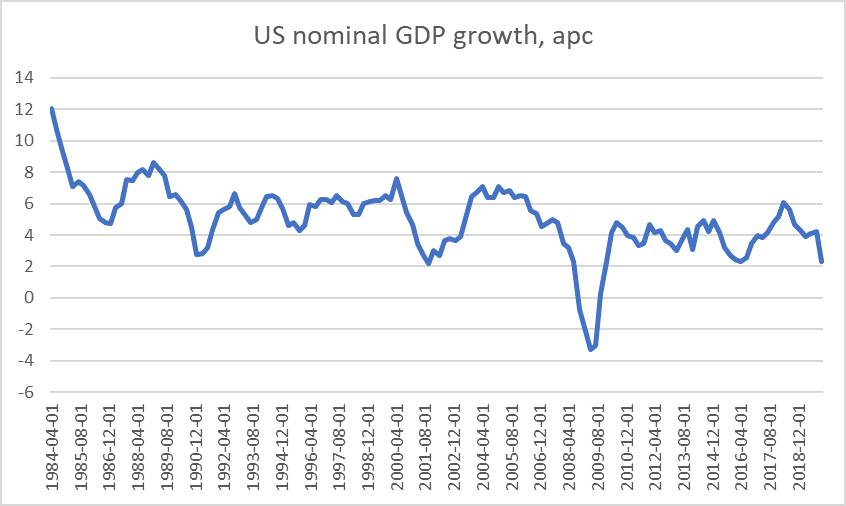
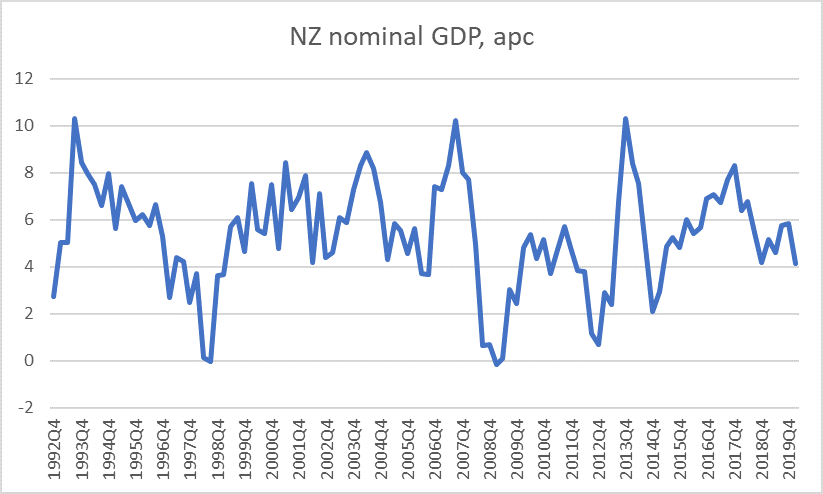
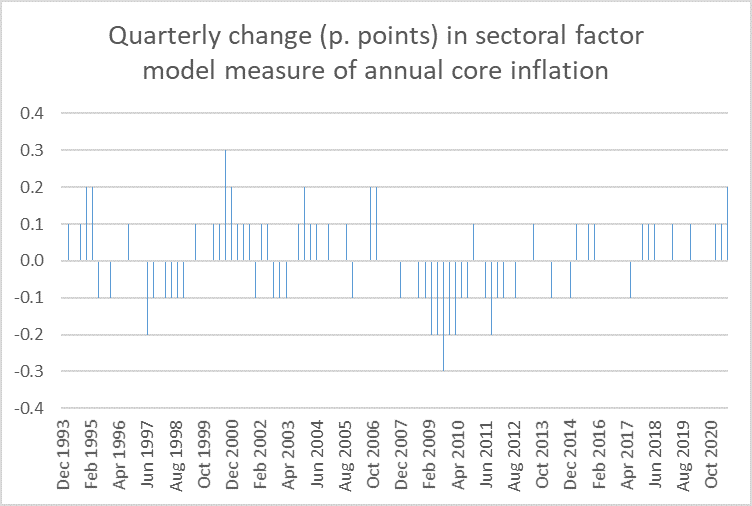
What if?

When inflation becomes established and pervasive – not just direct price effects of this or that supply shock or tax increase (or combination of them) – it generally doesn’t come down all by itself.

Expressed in terms of conventional monetary policy, it usually takes a period in which policy interest rates are raised to, and maintained at, a level above the (not directly observable) then-neutral rate. Of course, sometimes an adverse external demand shock – eg an external recession – comes along, which can do a big part of the job. But that isn’t usually much more pleasant. Either way, domestic demand growth typically needs to be held below growth in the economy’s productive capacity for long enough to lower inflation. And, among other things, that will typically mean a rise in the unemployment rate, to (for a time) levels beyond (not directly observable) then-neutral (sustainable, non-inflationary) rate.

In principle, it can all happen very smoothly and gradually (the vaunted “soft landings”, often talked of, rarely observed). Such “soft landings” are almost always forecast (not just by central bankers), at least until the alternative is unavoidably obvious. Of course, “soft landings” are generally preferable, but (except as a matter of luck) they assume a degree of understanding of what is going on, how economies are unfolding, that isn’t often present. If forecasters (central bank and otherwise) really had a good handle on how economies were behaving at present, we probably wouldn’t have landed in quite the current inflation mess in the first place.

Since the New Zealand economy and financial system were substantially liberalised after 1984, we’ve had two episodes in which pervasive (“core”) inflation has been lowered. Both fit the story. As it happens, in both cases, we had a period of quite-tight domestic monetary policy and an international economic downturn. Actually, in 1990/91 we had a fair amount of discretionary fiscal tightening as well.

Inflation had still been very badly entrenched in the late 80s. Core inflation was probably around 5-6 per cent, and hadn’t been lower for a long time. It took 90 day bill rates at 13-14 per cent for a couple of years. We didn’t have a concept of “neutral rates” then, but no one would have seriously doubted things were tighter than neutral: that was the point. The unemployment rate peaked at about 11 per cent (there were other structural changes going on at the same time) to get inflation down into the target 0-2 per cent range. It was a nasty recession, quite similar to one in Australia and no doubt with contributions from the US recession at much the same time.

Fifteen years later, core inflation had been rising for several years. On best estimates, it peaked at about 3.5 per cent, some way from the midpoint (2 per cent) of the revised target range. The OCR had been raised to 8.25 per cent to counter this inflation (at the time, from memory, the Bank thought of the neutral rate as being somewhere not much above 6 per cent). Core inflation, of course, came down, through some combination of the tight domestic monetary policy and a nasty global recession. The New Zealand unemployment rate, unsustainably low at the pre-recession trough (about 3.5 per cent), rose to about 6.5 per cent. Core inflation fell back to the target midpoint (and then overshot when monetary policy was kept too tight for years too long – but that is another story).

At present, of course, core inflation is probably a bit over 4 per cent (looking across the range of core measures). That is a long way below headline inflation (as was the case in 2007/08). The unemployment rate is 3.2 per cent, and even the Reserve Bank has been moved to observe that the labour market is unsustainably tight.

Core inflation can be brought down again, but it isn’t going to happen by magic. Most likely it will take a period of sustained weakness in demand growth, a period of a negative output gap, and – as part of that – a period when the unemployment is above the medium-term sustainable level. The Reserve Bank thought the neutral OCR was about 2 per cent pre-Covid: if so, then the subsequent lift in inflation expectations would suggest at least 3 per cent now. Getting above that is a long way from the current 1.5 per cent.

The situation isn’t much different in a bunch of other advanced economies, even if each have their own idiosyncrasies.

Most likely – here and abroad – getting core inflation back down again will take recessions.

Voters may not be altogether keen on recessions. That is understandable at the best of times, but right now it is only two years since the last dramatic dislocation and temporary loss of output and employment.

And so I’ve been wondering recently if, before too long, some government and/or central bank (probably the two together) might not just decide it is all too hard. Why put people through another recession? Perhaps especially if the government concerned is already not looking too good in the polls.

But, you say, wouldn’t that just be seen as feckless. “giving up” in the face of a “cost of living crisis”? How could serious people possibly defend such a stance?

Actually, quite easily.

Long-term readers of this blog will recall that for many years I banged on about the effective lower bound risks, and how difficult monetary policy would prove in the next recession. With hindsight, I (and the many others internationally who were raising such concerns) should have rephrased that “the next demand-led recession”. Covid proved to have been different, in ways little appreciated in March 2020. But the issue has not gone away. And not a single central bank has yet done anything much to ease the effective floor on nominal policy rates (at probably around -0.75 per cent, beyond which the incentives to convert to physical cash – neutering monetary policy – become increasingly strong). Nasty demand-driven recessions will come again.

Since the 08/09 global recession, several prominent macroeconomists abroad (including Ken Rogoff and Olivier Blanchard) had been suggesting raising inflation target, perhaps to something centred around 4 per cent) to grapple with exactly that lower-bound risk. I was not convinced then – including because these same central banks were failing to deliver even on their existing inflation targets (too low inflation was the story of the decade), and it was difficult to see how stated intentions of delivering even higher inflation were going to be given much credence.

To be clear, I still do not support such a policy change now. Economies function a bit less effectively at higher inflation rates (even stable ones), and the lower bound issues can be – and should be, as a matter of some priority – be addressed directly.

But the context has changed, a lot. Now, it wouldn’t be idle talk from ivory towers in the abstract about lifting inflation. Inflation is already high, and the question may soon be about willingness to pay the price to get it back down again. Few people are very fond of recessions. So why isn’t it quite possible – even likely – that some set of authorities somewhere, backed perhaps by some eminent economists focused on those lower-bound issues, as well as more-immediate political imperatives would suggest (initiate) a change. A 3-5 per cent inflation target range perhaps?

There would be pushback from some quarters of course. Do it once and won’t everyone believe you’ll do it again any time the pressure comes on? It is the sort of argument that sounded good 30 years ago, but actually New Zealand twice raised its inflation target – when the political pressure came on – and although I’m still not a big fan of those changes, it is hard for any honest observer to conclude that they were terribly damaging. Bond holders won’t necessarily like it, but many of the indebted would. Those on the margins of the labour market – the sorts of people most likely to lose their jobs, or find it harder to get one – might be responsive too. Realistically, in the face of such a change most forecasters would revise their numbers and project a little more output in the short-term (no long-term tradeoffs, but the costs of getting inflation back down are real).

There are quite a few places that aren’t likely to lead the way on any such change. The ECB, for example, sets its own specific inflation target, faces no election, and has a price stability focus embedded by treaty.

But there are other places where it could happen, and in particular any place where (as should happen) the elected government sets the inflation target.

New Zealand might be one of them. After all, the government is slipping in the polls, the likelihood of a recession between now and the election is steadily rising, and whatever merits the current Cabinet have, none of them seem like hard money people (to many of their voters that is probably a good thing). The current policy target Remit still has 21 months to run, but the Governor’s term expires in March, a new Board takes office in July, and so on. The Governor has already told us the Bank has analytical and research work underway – consistent with the provisions of the amended RB Act – for the next Remit review. Mightn’t it seem brave and pioneering, prioritising employment (immediate and in that next demand-led recession), to carve a new path and revise up the target (all perhaps flanked by distinguished experts).

To be clear, I do not (and would not) support such a change. Moreover, there is nothing in the public record to suggest that our government or central bank are looking at such a change. My point in writing the post is that, when one thinks about incentives, it isn’t obvious why some government or other mightn’t adopt exactly such an approach before too long. And it isn’t obvious why it wouldn’t be the New Zealand government. Just think of it, the ultimate product differentiation from Roger Douglas (the main consideration that seems to have driven Grant Robertson in the overhaul of the RB Act in recent years).

Of course, even if core inflation was to be stabilised at around 4 per cent, it seems almost certain that the unemployment rate will rise from here: that is the implication of the Reserve Bank’s observation that the labour market is unsustainably overheated. But there is quite a difference between settling at 4.0 to 4.5 per cent, and a couple of years at (say) 5.5 per cent. Shrewd political advisers will recognise this. They will also recognise that if most other advanced countries are heading for recessions we won’t fully escape the effects, but they might think that easing up on our target now might better position us for the (near-certainly) tough times on the horizon. Were I Ardern or Robertson – and I am very thankful I am neither – I might be tempted.

Perhaps the analysis here is all wrong. If so, I’d be really interested in reactions or alternative perspectives.
The Monetary Policy Statement

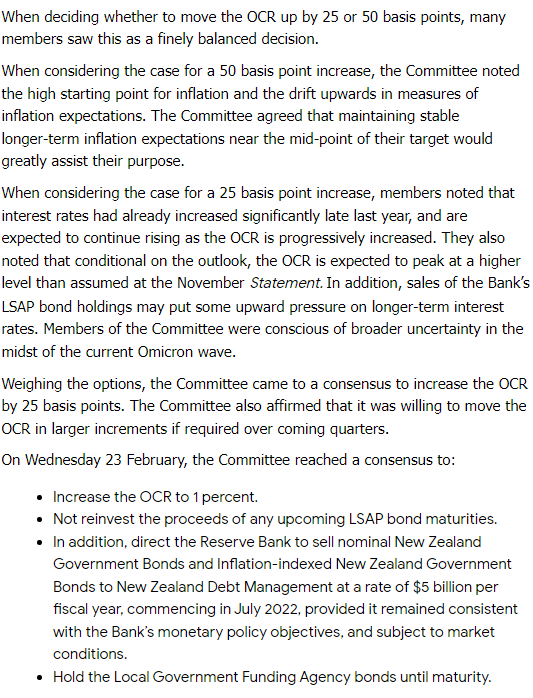
If anything I came away from today’s Monetary Policy Statement and (the bulk of it that I saw) the Governor’s press conference more convinced that I was yesterday that the OCR should have been raised by 50 basis points today.

There were a couple of elements in the minutes that were a little more encouraging than one might have feared.

There was the fact that a 50 point increase was clearly seriously considered, and debated. There was the fact that that debate was actually disclosed in the minutes (I think that is a first). There was the explicit comment not ruling out 50 point increases in the future. And there was, at last, a slow start to the process of unwinding the huge punt on the future of bond rates taken on in the LSAP intervention of 2020 and 2021.

It could have been worse. There clearly is an element of unease around the Committee table around the rise in inflation expectations, even for the longer-term horizons the Bank has often previously used to reassure itself there was no particular problem.

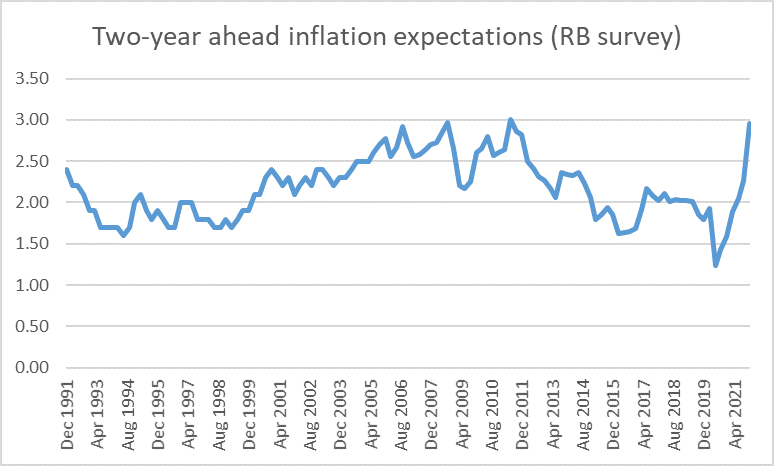
But…..when 2 year ahead inflation expectations of relatively more-informed observers have increased (as they have) by 29 basis points since you last met, an increase of the OCR by 25 basis points – especially as those survey respondents will already have expected such an increase and factored it into their inflation expectations – isn’t getting on top of things, even slightly, rather it is just falling a bit further behind. Whether thinking about inflation or inflation expectations, the MPC has fallen short of the Taylor principle – that at very least one should raise (lower) the OCR to the extent inflation and/or expectations rise (fall). The real OCR is now lower than it was when they descended from the mountain top in November, even as all measures of inflation (including the core inflation ones) have moved considerably higher. In the Bank’s own words, all the core measures are now above the top of the target range.

And, of course, the real OCR is now materially lower than it was two years ago, even though (core) inflation has been high and rising and – again on the Bank’s own reckoning – the labour market is unsustainably tight, the unemployment rate is too low to be sustained.

And yet the Committee made no attempt anywhere in the document to justify why real monetary conditions now would prudently, on the balance of probabilities (and they even invoked the “least regrets” language again), be so much looser than they were two years ago.

Linked to that, and perhaps my major criticism of the document itself, is that there was no sustained effort to analyse and explain why the Bank’s core inflation forecasts had been so wrong, why core inflation was now above the top of the target range, or what the MPC had learned from that experience that now gave them greater confidence that they understood the inflation process sufficiently well to keep on with the “slowly does it” approach to adjusting the OCR. In the circumstances it is a pretty inexcusable oversight – and it was a bit disappointing that no journalists asked about the issue/omission.

If one goes back to those minutes, the MPC lists a few reasons not to raise the OCR by 50 points:

  • there were the LSAP sales, but that is a clearly just there to bulk out the paragraph, since the body of the document says any impact of the LSAP, including sales, is now very small, and the Governor reiterated that point even more strongly in the press conference. In any case, the bond sales don’t even start for several more months.
  • there was the fact that interest rates had increased quite a bit late last year.  Which is fine, but there isn’t any sign that (say) inflation expectations have dipped.
  • there was Omicron, which seems to have been a factor, even though monetary policy operates with lags that run well beyond the next 3-6 weeks of the peak Omicron wave, and
  • there was this strange line: “They also noted that conditional on the outlook, the OCR is expected to peak at a higher level than assumed at the November Statement.”.   They have certainly raised the peak of the tightening cycle quite a bit, but……that would normally be an argument for getting on it with now, not just carrying on in the slow and measured way, even though you think –  as the MPC appears to –  that another 240 basis points of increases will be required.

There are more than a few puzzles in the document. For example, the peak of the OCR cycle (3.4 per cent) seems to be well above the Bank’s estimate of neutral rates – chart suggests something around 2 per cent – and both core and headline inflation eventually come down a lot. But the economic forecasts suggest this all happens by “magic”, since the output gap only goes negative in the year to June 2025, and the unemployment rate looks as though it never gets above the NAIRU. It reinforces the point that the model – the understanding of the inflation process and what has gone on in the last couple of years – is at best weak, and possibly missing in action.

At this point I should make clear that I do not have a strong view on where the OCR cycle should peak. I tend to think it is a fool’s errand given how little we know, and so I concentrate on the next few quarters. But the Bank is clearly uneasy about inflation expectations, thinks there is a lot more to do, and yet seems to want to get there very slowly, running in the process risks of things getting even further away on them. 50 basis points would have prudent, especially at a time when no one supposes there is much risk that a few months down the track there would have been cause for regret, having raised the OCR to the fearsome level of (about) -2 per cent.

Is there reason to think economic activity may not do that well this year? Indeed there is, although the eventual opening of the borders will add to (not detract from) capacity (including labour market capacity) and inflation pressures), and core inflation having once got this high – and the Bank expects it to stay this high for at least the next year – doesn’t typically come down by magic. It typically requires some policy force – a little more than is implied by real monetary conditions a lot easier than they were before Covid and this inflation surge got underway. As it is, the Bank is probably painting a rose-tinted picture all round: core inflation falls surprisingly easily, and productivity growth actually picks up a bit. Perhaps it will happen, but there is no compelling case made (and the Bank’s answers to the productivity question were particularly half-hearted.

I could go on on other matters but will end just noting three points briefly:

  • since yesterday’s post, Bob Buckle and Peter Harris have been reappointed to MPC positions for further three year terms.  There was no question to the Governor about how he can possibly justify –  the more so in the current circumstances –  the blackball placed on anyone with a serious ongoing engaged analytical or research interest in monetary policy.    The final appointment is made by the Minister of Finance, but he can appoint only those nominated by the Bank’s Board and no doubts that Orr dominates the Board on such matters, 
  • there was no attempt by the Bank to justify or explain away the more-than $5 billion in losses run up on the LSAP and –  more disappointingly –  no questions from the assembled media,
  • there was not a single question about the appointment to the senior deputy position responsible for macroeconomics and monetary policy (and to the MPC) of someone so manifestly underqualified –  with no relevant qualifications or experience – as Karen Silk.

Perhaps the FEC members might do a little better when the Governor next appears there?

UPDATE: I had to go and pick up a child and so missed the last few minutes of the press conference. I gather the Governor explained that the strange cover was in honour of his departing chief economist, who told us last time he was going to coach his son’s cricket team. It is a nice touch…….for someone who appears to have been forced out in the great Orr restructuring.

What the MPC should do

The Reserve Bank and the MPC will tomorrow emerge from their long summer slumber to deliver a Monetary Policy Statement and OCR decision. It is quite extraordinary that in this period, of considerable volatility, uncertainty, and inflation surging above the target range (even on core measures) we’ve heard precisely nothing from any of them (individually or collectively), and had no policy actions, for three months.

But, at last, tomorrow we will hear. As I’ve said repeatedly here over the years, I’m not really in the business of trying to guess what the MPC will do. There are plenty of people with a strong interest in that, and banks have people who nurture every little contact or conversation they can secure with Reserve Bank officials, analysts, or policymakers. As the Bank says little in public, and isn’t that consistent through time in how it acts, all one can say is good luck to those people.

My interest is in what the Reserve Bank should do, given the target set for them by the government (and, of course, the wider but less immediate question of what that target should be). The target is really pretty specific, with a primary focus on keeping the persistent elements of inflation near 2 per cent.

Against the backdrop of the Remit, I think it is pretty clear what the MPC should be doing tomorrow:

  • they should be raising the OCR by 50 basis points, and giving a signal that, all else equal, they expect another 50 basis point increase at the next review on 13 April,
  • they should be terminating new loans under the Funding for Lending programme, the crisis programme introduced in 2020 which is still at the margin having the effect of holding interest rates lower than otherwise, and
  • they should commence a programme of bond sales, designed to liquidate the LSAP bond position within 2 years (or, equivalently, have agreed a programme with The Treasury under which it would sell new bonds on market, buying back on the same day an equivalent amount of the bonds held by the Bank).

I don’t suppose either of the last two items on that list are at all likely.  I don’t even think that LSAP sales would make much material difference to monetary conditions (exactly paralleling my argument when they were buying bonds) but (a) every little helps, and (b) we should get this massive taxpayer bet on the bond market closed out ASAP, on principle.   And there is no crisis now –  the OCR is fully able to be used as desired.  Much the same goes for the FLP programme.  Closing that now might have some modest useful impact in tightening overall monetary conditions, but it would also align messages –  this isn’t the 2020 Covid crisis any more, and the focus of monetary policy now is (or should be) getting core inflation back down fairly expeditiously.

But even if they took both of those steps, the case for a 50 basis point increase tomorrow is strong. 

There are a couple of ways I find useful to look at things.

It was in last August’s MPS that the Bank really set out towards some significant OCR increases.  They didn’t act that day because they had the misfortune of a (long-scheduled) release a few hours after the Level 4 lockdown was imposed.  Back then they envisaged the OCR being 0.9 per cent for the March quarter 2022 (roughly consistent with having been 0.75 per cent moving to 1 per cent now).  But back then:

  • they thought core inflation was about 2.2 per cent and would go little or no higher (headine inflation forecasts for the second half of this year and beyond were 2.2 per cent, dropping further away)
  • they expected the unemployment rate for this quarter to be 3.9 per cent, and to go no lower than that.  
  • their latest reads on inflation expectations weren’t particularly inconsistent with inflation near the midpoint of the inflation target range (the most recent 2 year ahead measure they had then was 2.3 per cent).

And where are we now? 

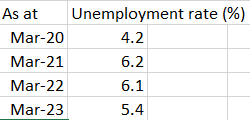
  • the unemployment rate – still probably the best indicator of spare capacity (or lack of it) – had fallen to 3.2 per cent in the December quarter, and there is talk it could go lower yet.  No one seems to suppose that the unemployment rate is near the NAIRU.
  • the latest headline inflation rate is 5.9 per cent, and may go higher this quarter.  Much more importantly, core measures have increased substantially –  the best of them, the sectoral core factor model measure, is now 3.2 per cent for the year to December, and
  • while there is a wide range of inflation expectations measures, none of them are as low as the Bank was seeing back in August, and the best of them are pretty consistent with people assuming (and acting as if?) inflation will stay outside the target range (and well away from the midpoint) for the next couple of year.  Even with the tightening in monetary conditions observed in recent months.

It was really captured quite well in a newspaper article yesterday that reported that all economists talked to thought that the Bank was now “behind the game”.   In that sort of environment, when you’ve been repeatedly surprised by the strength of inflation, and outcomes are no longer consistent with target –  suggesting that your model of what is going on is not working that well – the appropriate response is not to edge up the OCR ever so gradually and hope.   Least regrets –  of which we heard quite a lot from the Bank over the last 18 months – calls for something a bit bolder, to get ahead of the rise in (core) inflation and assure watchers (firms, households, markets) that you really are serious, rather than reluctant.

Is there a case in Omicron for holding back (25bps rather than 50bps)?   I don’t think so.  We can see how other countries have come through the short and intense Omicron waves –  which will temporarily disrupt both supply and demand –  and there is little sign of what is required from monetary policy being revised down in the wake.

(“Not surprising the market” isn’t a good excuse either.  When you say nothing for months, the market has little to go on re the MPC reaction function.  If you won’t talk, you have to live with surprises sometimes.  The market will cope, although might suggest that a bit more communication than once every few months would make sense.)

The second way of looking at things is to compare where are now to where we were two years ago.  Having cut the OCR during 2019 by early 2020 markets, not discouraged by the Bank, were beginning to think in terms of when a first OCR increase might be warranted (still then, it was thought) some time away.

The OCR is early 2020 was 1 per cent.  Core inflation was probably just under 2 per cent (having edged up over the previous couple of years towards the target midpoint), and the unemployment was about 4 per cent.   Where things are now we’ve already covered above –  much more inflation, more capacity pressure, and on any metric you like materially higher inflation expectations.

Any policy and/or monetary conditions?

Well, the OCR today is 0.75 per cent, still below where it was two years ago.  A 25 point increase tomorrow will only take it back, in nominal terms, to where things were in February 2020.  The nominal exchange rate is also now about where it was two years ago.

But what about the interest rates that firms and households face?   We’ve heard a lot about fixed rate mortgage rates have risen from their lows.  And that’s true: a two year mortgage rate is now about 170 basis points higher than the low (last April).

But what of comparisons to the start of 2020?

So nominal mortgage rates are perhaps 50 basis points higher than they were two years ago. But inflation is a lot higher than it was then, and so are all indications of inflation expectations. For these purposes, I’ll just use the Reserve Bank’s own survey of two-year ahead inflation expectations: 1.93 per cent in the survey done at the end of January 2020, and 3.27 per cent in the survey done a few weeks ago, an increase of 1.34 percentage points.

Here is the same chart, but expressed in real terms, adjusted for the increase in inflation expectations.

and the same chart for term deposit rates

(Real) monetary conditions have tightened a bit from the lows, but they really needed to. Compared to conditions prevailing two years ago, real mortgage rate, real deposit rates and of course the real OCR are substantially looser than they were. And whereas two years ago inflation looked to be fairly comfortably somewhere near the target midpoint, nothing remotely that optimistic describes the situation now.

Of course there are other influences – things like fiscal policy, the terms of trade, other regulatory restrictions (eg tax or the CCCFA) – but it would very very hard indeed to construct a story that suggested that real monetary conditions as we find them today (or might find them tomorrow) are likely to be consistent with the Bank delivering on its mandate, on the environment as we see it today. In fact, if core inflation becomes established at current rates (3% plus), standard economic analysis would tell us that reductions in core inflation – to the 2% the Bank is supposed to be focused on delivering – are likely to come about only by luck (ill-luck probably – adverse economic events) or by monetary conditions being tightened to above-normal levels of tightness for some time, a process that would (at very least) result in a period of sub-par economic growth, perhaps even a recession.

We’ll see tomorrow what the MPC has decided to do. But whatever the rate adjustment we should be able to expect a serious and rigorous accounting for just what has gone wrong in the last 12-18 months, what the Committee has learned, and a serious analysis of the options and risks in the monetary policy that might be required to get core inflation (and expectations of it) settling back around 2 per cent. Sadly, with this MPC it would probably be a bit of a surprise if we got even the appropriate degree of analysis, self-scrutiny, and accountability.

Forecasting and policy mistakes

Yesterday’s post was a bit discursive. Sometimes writing things down helps me sort out what I think, and sometimes that takes space.

Today, a few more numbers to support the story.

I’m going to focus on what the experts in the macroeconomic agencies (Treasury and Reserve Bank) were thinking in late 2020, and contrast that with the most recent published forecasts. The implicit model of inflation that underpins this is that even if the full effects of monetary policy probably take 6-8 quarters to appear in (core) inflation, a year’s lead time is plenty enough to have begun to make inroads.

Forecasts – and fiscal numbers – in mid 2020 were, inevitably all over the place. But by November 2020 (the Bank published its MPS in November, and the Treasury will have finalised the HYEFU numbers in November) things had settled down again, and the projections and forecasts were able to be made – amid considerable uncertainty – with a little more confidence. And the government was able to take a clearer view on fiscal policy. The Treasury economic forecasts in the 2020 HYEFU incorporated the future government fiscal policy intentions conveyed to them by the Minister of Finance. The Reserve Bank’s forecasts did not directly incorporate those updated fiscal numbers, but…..the Reserve Bank and The Treasury were working closely together, the Secretary to the Treasury was a non-voting member of the Monetary Policy Committee, and so on. And, as we shall see, the Bank’s key macroeconomic forecasts weren’t dramatically different from Treasury’s.

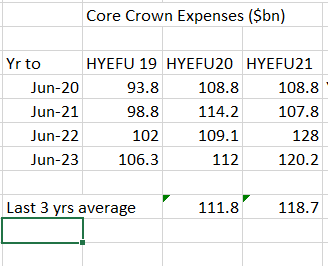
The National Party has focused a lot of its critique on government spending. Here are the core Crown expenses numbers from three successive HYEFUs.

expenses $bn

From the last pre-Covid projections there was a big increase in planned spending. But by HYEFU 2020 – 15 months ago – Treasury already knew about the bulk of that and included it in their macro forecasts. By HYEFU 2021 the average annual spending for the last three years had increased further. But so had the price level – and quite a bit of government spending is formally (and some informally) indexed.

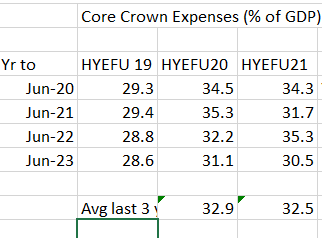
Here are the same numbers expressed as a share of GDP.

expenses % of GDP

By HYEFU 2021 the government’s spending plans for those last three years averaged a smaller share of GDP than Treasury had thought they would be a year earlier. (The numbers bounce around from year to year with, mainly, the uncertain timing of lockdowns etc).

There are two sides to any fiscal outcomes – spending and revenue. The government has been raising tax rates consciously and by allowing fiscal drag to work, such that tax revenue as a share of GDP, even later in the forecasts, is higher than The Treasury thought in November 2020. And here are the fiscal balance comparisons.

obegal

Average fiscal deficits – a mix of structural and automatic stabiliser factors – are now expected to be smaller (all else equal, less pressure on demand) than was expected in late 2020.

Fiscal policy just hasn’t changed very much since late 2020, and the fiscal intentions of the government then were already in the macro forecasts. Had those macro forecasts suggested something nastily inflationary, perhaps the government could have chosen to rethink.

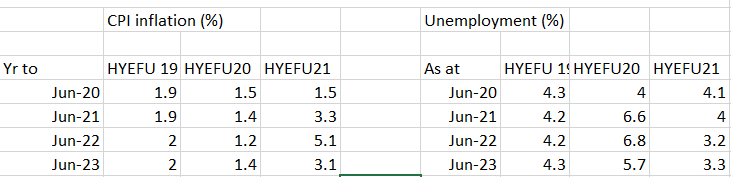
But they didn’t. Here are the inflation and unemployment forecasts from successive HYEFUs.

macro forecasts tsy

In late 2020, The Treasury told us (and ministers) that they expected to hang around the bottom end of the target range for the following three years, with unemployment lingering at what should have been uncomfortably high levels. If anything, on those numbers, more macroeconomic stimulus might reasonably have been thought warranted.

There were huge forecasting mistakes, even given a fiscal policy stance that didn’t change much and was well-flagged.

That was The Treasury. But the Reserve Bank and its MPC are charged with keeping inflation near 2 per cent, and doing what they can to keep unemployment as low as possible. For them, fiscal policy is largely something taken as given, but incorporated into the forecasts.

Their (November 2020_ unemployment rate forecasts were a bit less pessimistic than The Treasury’s, but still proved to be miles off. This is what they were picking.

RB U forecasts

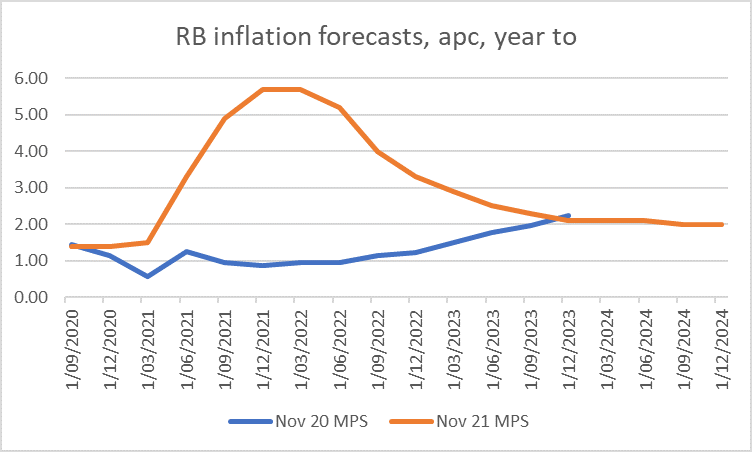
And here were the Bank’s November 2020 inflation forecasts, alongside their most recent forecasts.

rb inflation forcs

Not only were their forecasts for the first couple of years even lower than The Treasury’s, but even two years ahead their core inflation view was barely above 1 per cent. (The Bank forecasts headline inflation rather than a core measure, but over a horizon as long as two years ahead neither the Bank nor anyone else has any useful information on the things that may eventually put a temporary wedge between core and headline.) All these forecasts included something very much akin to government fiscal policy as it now stands. Seeing those numbers, the government might also reasonably have thought that more macroeconomic stimulus was warranted.

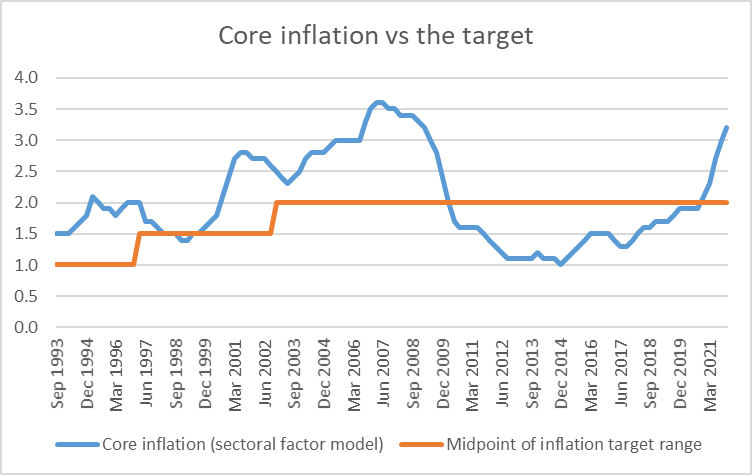
As a reminder the best measure of core inflation – the bit that domestic macro policy should shape/drive – is currently at 3.2 per cent.

core infl and target

There were really huge macroeconomic forecasting mistakes made by both the Reserve Bank and The Treasury, and – so it is now clear – policy mistakes made by the Bank/MPC. You might think some of those mistakes are pardonable – highly unsettled and uncertain times, not dissimilar surprises in other countries etc – and I’m not here going to take a particular view.

But of all the things Treasury and the Bank had to allow for in their forecasts, fiscal policy – wise or not, partly wasteful or not – just wasn’t one of the big unknowns, and hasn’t changed markedly in the period after those (quite erroneous) late 2020 macro forecasts were being done.

I guess one can always argue that if fiscal policy had subsequently been tightened, inflation would have been a bit lower. But Parliament decided that inflation – keeping it to target – is the Reserve Bank’s job. The government bears ultimate responsibility for how the Bank operates in carrying out that mandate – the Minister has veto rights on all the key appointees (and directly appoints some), dismissal powers, and the moral suasion weight of his office – but that is about monetary policy, not fiscal policy or government spending,

Inflation

The National Party, in particular, has been seeking to make the rate of inflation a key line of attack on the government. Headline annual CPI inflation was 5.9 per cent in the most recent release, and National has been running a line that government spending is to blame. It is never clear how much they think it is to blame – or even in what sense – but it must be to a considerable extent, assuming (as I do) that they are addressing the issue honestly.

I’ve seen quite a bit of talk that government spending (core Crown expenses) is estimated to have risen by 68 per cent from the June 2017 year (last full year of the previous government) to the June 2022 year – numbers from the HYEFU published last December. That is quite a lot: in the previous five years, this measure of spending rose by only 11 per cent. Of course, what you won’t see mentioned is that government spending is forecast to drop by 6 per cent in the year to June 2023, consistent with the fact that there were large one-off outlays on account of lockdowns (2020 and 2021), not (forecast) to be repeated.

But there is no question but that government spending now accounts for a larger share of the economy than it did. Since inflation was just struggling to get up towards target pre-Covid, and I’m not really into partisan points-scoring, lets focus on the changes from the June 2019 year (last full pre-Covid period). Core Crown expenses were 28 per cent of GDP that year, and are projected to be 35.3 per cent this year, and 30.5 per cent in the year to June 2023 (nominal GDP is growing quite a bit). That isn’t a tiny change, but…..it is quite a lot smaller than the drop in government spending as a share of GDP from 2012 to 2017. I haven’t heard National MPs suggesting their government’s (lack of) spending was responsible for inflation undershooting over much of that decade – and nor should they because (a) fiscal plans are pretty transparent in New Zealand and (b) it is the responsibility of the Reserve Bank to respond to forecast spending (public and private) in a way that keeps inflation near target. The government is responsible for the Bank, of course, but the Bank is responsible for (the persistent bits of) inflation.

The genesis of this post was yesterday morning when my wife came upstairs and told me I was being quoted on Morning Report. The interviewer was pushing back on Luxon’s claim that government spending was to blame for high inflation, suggesting that I – who (words to the effect of) “wasn’t exactly a big fan of the government” – disagreed and believed that monetary policy was responsible. I presume the interviewer had in mind my post from a couple of weeks back, and I then tweeted out this extract

I haven’t taken a strong view on which factors contributed to the demand stimulus, but have been keen to stress the responsibility that falls on monetary policy to manage (core, systematic) inflation pressures, wherever they initially arise from. If there was a (macroeconomic policy) mistake, it rests – almost by definition, by statute – with the forecasting and policy setting of the Reserve Bank’s Monetary Policy Committee.

I haven’t seen any compelling piece of analysis from anyone (but most notably the Bank, whose job it is) unpicking the relative contributions of monetary and fiscal policy in getting us to the point where core inflation was so high and there was a consensus monetary policy adjustment was required. Nor, I think, has there been any really good analysis of why things that were widely expected in 2020 just never came to pass (eg personally I’m still surprised that amid the huge uncertainty around Covid, the border etc, business investment has held up as much as it has). Were the forecasts the government had available to it in 2020 from The Treasury and the Reserve Bank simply incompetently done or the best that could realistically have been done at the time?

Standard analytical indicators often don’t help much. This, for example, is the fiscal impulse measure from the HYEFU, which shows huge year to year fluctuations over the Covid and (assumed) aftermath period. Did fiscal policy go crazy in the year to June 2020? Well, not really, but we had huge wage subsidy outlays in the last few months of that year – despite which (and desirably as a matter of Covid policy at the time) GDP fell sharply. What was happening was income replacement for people unable to work because of the effects of the lockdowns. And no one much – certainly not the National Party – thinks that was a mistake. In the year to June 2021, a big negative fiscal impulse shows, simply because in contrast to the previous year there were no big lockdowns and associated huge outlays. And then we had late 2021’s lockdowns. And for 2022/23 no such events are forecast.

One can’t really say – in much of a meaningful way – that fiscal policy swung from being highly inflationary to highly disinflationary, wash and repeat. Instead, some mix of the virus, public reactions to it, and the policy restrictions periodically materially impeded the economy’s capacity to supply (to some unknowable extent even in the lightest restrictions period potential real GDP per capita is probably lower than otherwise too). The government provided partial income replacement, such that incomes fell by less than potential output. As the restrictions came off, the supply restrictions abated – and the government was no longer pumping out income support – but effective demand (itself constrained in the restrictions period) bounced back even more strongly.

Now, not all of the additional government spending has been of that fairly-uncontroversial type. Or even the things – running MIQ, vaccine rollouts – that were integral to the Covid response itself And we can all cite examples of wasteful spending, or things done under a Covid logo that really had nothing whatever to do with Covid responses. But most, in the scheme of things, were relatively small.

This chart shows The Treasury’s latest attempt at a structural balance estimate (the dotted line).

In the scheme of things (a) the deficits are pretty small, and (b) they don’t move around that much. If big and persistent structural deficits were your concern then – if this estimation is even roughly right – the first half of last decade was a much bigger issues. And recall that the persistent increase in government spending wasn’t that large by historical standards, wasn’t badly-telegraphed (to the Bank), and should have been something the Bank was readily able to have handled (keeping core inflation inside the target range).

The bottom line is that there was a forecasting mistake: not by ministers or the Labour Party, but by (a) The Treasury, and (b) the Reserve Bank and its monetary policy committee. Go back and check the macro forecasts in late 2020. The forecasters at the official agencies basically knew what fiscal policy was, even recognised the possibility of future lockdowns (and future income support), and they got the inflation and unemployment outlook quite wrong. They had lots of resources and so should have done better, but their forecasts weren’t extreme outliers (and they didn’t then seem wildly implausible to me). They knew about the supply constraints, they knew about the income support, they even knew that the world economy was going to be grappling with Covid for some time. Consistent with that, for much of 2020 inflation expectations – market prices or surveys – had been falling, even though people knew a fair amount about what monetary and fiscal policy were doing. In real terms, through much of that year, the OCR had barely fallen at all. It was all known, but the experts got things wrong.

Quite why they did still isn’t sufficiently clear. But, and it is only fair to recognise this, the (large) mistake made here seems to have been one repeated in a bunch of other countries, where resource pressures (and core inflation) have become evident much more strongly and quickly than most serious analysts had thought likely (or, looking at market prices, than markets themselves had expected). Some of that mistake was welcome – getting unemployment back down again was a great success, and inflation in too many countries had been below target for too long – so central banks had some buffer. But it has become most unwelcome, and central banks have been too slow to pivot and to reverse themselves.

Not only have the Opposition parties here been trying to blame government spending, but they have been trying to tie it to the 5.9 per cent headline inflation outcome. I suppose I understand the short-term politics of that, and if you are polling as badly as National was, perhaps you need some quick wins, any wins. But it doesn’t make much analytical sense, and actually enables the government to push back more than they really should be able to. Because no serious analyst thinks that either the government or the Reserve Bank is “to blame” for the full 5.9 per cent – the supply chain disruption effects etc are real, and to the extent they raise prices it is pretty basic economics for monetary policy to “look through” such exogenous factors. It seems unlikely those particular factors will be in play when we turn out to vote next year.

Core inflation not so much – indeed, the Bank’s sectoral core factor model measure is designed to look for the persistent components across the whole range of price increases, filtering out the high profile but idiosyncratic changes. Those measures have also risen strongly and now are above the top of the target range. That inflation is what NZ macro policy can, and should, do something about. But based on those measures – and their forecasts – the Reserve Bank has been too slow to act: the OCR today is still below where it was before Covid struck, even as core inflation and inflation expectations are way higher. Conventional measures of monetary policy stimulus suggest more fuel thrown on the fire now than was the case two years ago.

When I thought about writing this post, I thought about unpicking a series of parliamentary questions and answers from yesterday on inflation. I won’t, but suffice to say neither the Minister of Finance, the Prime Minister, the Leader of the Opposition, or Simon Bridges or David Seymour emerged with much credit – at least for the evident command of the analytical and policy issues. There was simply no mention of monetary policy, of the Reserve Bank, of the Monetary Policy Committee, or (notably) the government’s legal responsibility to ensure that the Bank has been doing its job. It clearly hasn’t (or core inflation would not have gotten away on them to the extent it has). I suppose it is awkward for the politicians – who wants to be seen championing higher interest rates? – and yet that is the route to getting inflation back down, and the sooner action is taken the less the total action required is likely to be. With (core) inflation bursting out the top of the range, perhaps with further to go, the Bank haemorrhaging senior staff, the recent recruitment of a deputy chief executive for macro and monetary policy with no experience, expertise, or credibility in that area, it would seem a pretty open line of attack. Geeky? For sure? But it is where the real responsibility rests – with the Bank, and with the man to whom they are accountable, who appoints the Board and MPC members? There is some real government responsibility here, but it isn’t mainly about fiscal policy (wasteful as some spending items are, inefficient as some tax grabs are), but about institutional decline, and (core) inflation outcomes that have become quite troubling.

Since I started writing this post, an interview by Bloomberg with Luxon has appeared. In that interview Luxon declares that a National government would amend the Act to reinstate a single focus on price stability. I don’t particularly support that proposal – it was a concern of National in 2018 – but it is of no substantive relevance. Even the Governor has gone on record saying that in the environment of the last couple of years – when they forecast both inflation and employment to be very weak – he didn’t think monetary policy was run any differently than it would have been under the old mandate. That too is pretty basic macroeconomics. It is good that the Leader of the Opposition has begun to talk a bit about monetary policy, but he needs to train his fire where it belongs – on the Governor – not, as he did before Christmas, forcing Simon Bridges to walk back a comment casting doubt on whether National would support Orr being reappointed next year. In normal times, you would hope politicians wouldn’t need to comment much on central bankers at all. But the macro outcomes (notably inflation), and Orr’s approach on a whole manner of issues (including the ever-mounting LSAP losses) suggest these are far from normal times. Core inflation could and should be in the target range. It is a failure of the Reserve Bank that it is not, and that – to date – nothing energetic has been done in response.

Inflation, monetary policy and all that

The CPI for the December quarter was finally released yesterday – even later in the month than that other CPI laggard the ABS. The picture wasn’t pretty, even if at this point not particularly surprising. My focus is on the sectoral factor model measure of core inflation – long the Reserve Bank’s favourite – and if, as my resident economics student says “but Dad, no one else seem to mention it”, well too bad. Of the range of indicators on offer it is the most useful if one is thinking about monetary policy, past and present.

Factor models like this provide imprecise reads (subject to revision) for the most recent periods – that’s what you’d expect, especially when things are moving a lot, as the model is looking to identify something like the underlying trend. The most recent observations were revised up yesterday, and the estimate for core inflation for the year to December 2021 was 3.2 per cent. That is outside the 1-3 per cent target range (itself specified in headline terms, although no one ever expected headline would stay in the range all the time).

It is less than ideal. It is a clear forecasting failure – which would be even more visible if we show on the same chart forecasts from 12-18 months ago.

But…it isn’t unprecedented. In 28 years of data, this is the third really sharp shift in the rate of core inflation – although both were in periods before this particular measure was developed. And, at least on this measure, at present core inflation is still a bit below the 3.6 per cent peak in 2007, or the 3.5 per cent the annual inflation rate averaged for a year or more in 2006 and 2007.

What perhaps does stand out is how little monetary policy has yet done, how slow to the party the Bank has been. Over 1999 to 2001, the OCR was raised 200 basis points. From 2004 to 2007, the OCR was raised 300 points. And as core inflation fell sharply from late 2008, the OCR was cuts by 575 basis points.

So far this time the OCR has been increased by 50 basis points, and is not even back to pre-Covid levels – even though, on this measure, core inflation never actually dipped in 2020. I refuse to criticise the Reserve Bank for misreading 2020 – apart from anything else they were in good company as forecasters – but their passivity in recent months is much harder to defend.

The sectoral factor model measure is itself made up of two components. Here they are

Because the model looks for trends, the big moves in this measure of core tradables inflation have often reflected the big swings in the exchange rate – which affects pretty much all import prices – but this time there has been no such swing. Just a lot more generalised inflation from abroad (as well as the one-offs that this model looks to winnow out). So a lot more (generalised) inflation from abroad – not something to discount – and a lot more arising from domestic developments (demand, capacity pressures, and perhaps some expectations effects too). It is a generalised issue – above target, and probably rising further (both from the momentum in the series, and continued tight labour markets and rising inflation norms).

The headline inflation number gets media and political attention it doesn’t really warrant. Headline inflation is volatile, and even if in principle it might be more controllable than what we see, it usually would not make economic sense to control it more tightly. For that reason, in 30+ years of inflation targeting it has never been the policy focus.

And to the extent that wage inflation fluctuates with price inflation, the relationship is much closer with core inflation (we’ll get new wages data next week, and most likely the annual wage inflation will have risen a bit further).

It is worth noting – for all the headlines – that in every single year of the last 25, wage inflation has run ahead of core (price) inflation. As it has continued to do even over the last year. That is what one would expect – productivity growth and all that – even if the economy were just growing steadily with the labour market near full employment.

It is true that the gap between wage and price (core) inflation is unusually narrow at present

Perhaps the gap will widen again over the coming year – overfull employment and all that – but bear in mind that true economywide productivity growth is probably atrociously (partly unavoidably) low at present, so the sustainable rate of real wage growth is also less than it was.

(None of this means wage earners aren’t now earning less per hour in real terms than they were a year ago, but that drop is, to a very considerable extent, unavoidable. The gap between headline and core inflation is typically about things that have made us poorer, for any given amount of labour supply.)

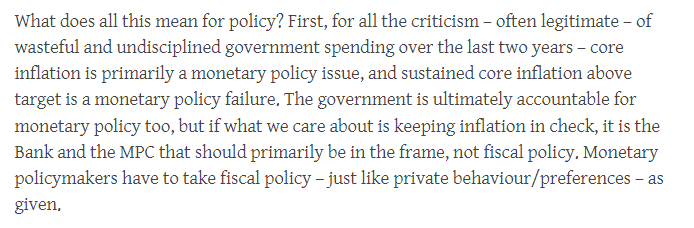
What does all this mean for policy? First, for all the criticism – often legitimate – of wasteful and undisciplined government spending over the last two years – core inflation is primarily a monetary policy issue, and sustained core inflation above target is a monetary policy failure. The government is ultimately accountable for monetary policy too, but if what we care about is keeping inflation in check, it is the Bank and the MPC that should primarily be in the frame, not fiscal policy. Monetary policymakers have to take fiscal policy – just like private behaviour/preferences – as given.

To me, the recent data confirms again that the Reserve Bank was far to slow to pivot, and far too sluggish when they eventually did. They are behind the game, as was clear even by November before they – like the government, but even longer – went for their long summer holiday in the midst of a fast-developing situation. It is pretty inexcusable that we will go for three months with not a word from the MPC, even as inflation has surged in an overheating economy.

What disconcerts me a bit is the apparent complacency even in parts of the private sector. (If I pick on the ANZ here it is only because they put out a particularly full and clear articulation of their story quite recently). As an example, ANZ had a piece out last week suggesting that the OCR would/should go to 3 per cent by about April next year, but that this would/should be accomplished with a steady series of 25 basis point adjustments. I’m also hesitant about making calls about where the OCR might be any considerable distance into the future (and in fairness they do highlight some of the uncertainties) but if you are going to make a central-view call like that most people might suppose it was consistent with a gradual escalation of capacity pressures, gradually leaned against with policy. But on their own description, the economic growth outlook over the next year doesn’t look spectacular at all – the word “insipid” even appeared – while the pressures (inflation and capacity) seem very real right now, in data that (at best) lags slightly. Core inflation has (unexpectedly) burst out of the target range, the economy is overheated, inflation expectations have risen (even in the last RB survey the two-year ahead measure was 2.96 per cent – up 90 points in six months, when the OCR has risen only 50 points. ANZ’s economists did address the possibility of a 50 basis point increase next month. They seemed to think it unlikely, because no ground has been prepared. They may well be right about that – and that may be what their clients care about – but, as advisers, they seemed unbothered about it. Why not urge the Bank to get out now and prepare the ground for next month’s review? Why not thrown caution to the wind and suggest the world wouldn’t end if the MPC actually took the market by surprise and took actions that increased the changes of keeping inflation in check? Based on what we know now, the economy would be better off if the Bank raised the OCR by 50 basis points next month (and sold some of that money-losing bond stockpile) and suggested it would be prepared to do the same again in April if the data warranted.

What difference does is make? The big risk right now is that people come to think that a normal inflation rate isn’t something near 2 per cent, but something near 3 per cent (or worse). If that happens – and no single survey will tell the story – it will take a lot more monetary policy adjustment (and lost output) at some point to bring things back to earth, all else equal. And whereas we have no real idea what monetary policy should be in the middle of next year, it is quite clear that considerably tighter conditions are warranted now, and that the Bank so far has not even kept up with the slippage in inflation and expectations.

What about Covid? By 23 February when the MPC descends from the mountain top, it seems likely that we might be nearing the peak of the unfolding Omicron wave. Experience abroad suggests that even when the government doesn’t simply mandate it, a lot of people will be staying at home, a lot of spending won’t be happening. Who knows – and we may hope not – MPC members themselves, or their advisers, may be sick and enfeebled. Tough as those weeks might be, they should not be an excuse for a reluctance to act decisively. MPC went slow last year, and to some extent now pays the price in lost optionality. Delay in August didn’t look costly then. Delay now looks really rather risky.

But who are we to look to for this action. As (core) inflation bursts out of the target band, and expectations of future inflation rise, we already have an enfeebled MPC, even pre Covid.

  • We have a Governor who has given few serious speeches in his almost four years in office,
  • A Deputy Governor who didn’t greatly impress when responsible for macro, and is now likely to be focused on learning his new job, and finding some subordinates after he and Orr restructured out his experienced senior managers before Christmas,
  • We have a Chief Economist who has been restructured out, and on his final meeting. No doubt he’ll give it his best shot but….that wasn’t much over the three years he was in the job, including not a single speech,
  • And we have the three externals, appointed more for their compliance than expertise, who’ve given not a single speech between them in three years, and two of them are weeks away from the expiry of their terms (and no news on whether they’ll be reappointed or replaced).

It was pretty uninspiring already, to meet a major policy, analytical and communications challenge. And then yesterday, the dumbing-down of the institution –  exemplified in speeches (lack thereof) and the near-complete absence now of published research –  continued, with the appointment of Karen Silk as the Assistant Governor (Orr’s deputy) responsible for matters macroeconomic and monetary policy.  And this new appointee –  who it seems may not be in place for February – seems to have precisely no background in, or experience of, macroeconomics and monetary policy at all (but apparently a degree in marketing)     But she seems to be an ideological buddy of the Governor’s, heavily engaged in climate change stuff.    Perhaps the superficial customer experience –  pretty pictures etc –  of the MPS will improve, but it is hard to imagine the substance of policy setting, policy analysis, and policy communications will.  It was simply an extraordinary appointment –  the sort of person one might expect to see if a bad minister were appointing his or her mates.  And if this appointment was Orr’s, Robertson has signed off on it, in agreeing to appoint her to the Monetary Policy Committee.  It would be laughably bad, except that it matters.  How, for example, is the new Assistant Governor likely to find any seriously credible economist to take up the Chief Economist position even if  –  and the evidence doesn’t favour the hypothesis at present – she and Orr cared?   Coming on top of all the previous senior management churn and low quality appointments it is almost as if Orr is now not vying for the title “Great team, best central bank”, but for worst advanced country bank.  (It is hard to think of serious advanced country central bank, not totally under the political thumb –  and rarely even then –  who would have such a person as the senior deputy responsible for macroeconomic and monetary policy matters: contrast if you will places like the RBA, the ECB, the Bank of Canada, the Bank of England, and numerous others.)

I sat down this morning and filled in the Bank’s latest inflation expectations survey.  For the first time –  in the 6/7 years I’ve been doing it –  I had to stop and think had about the questions about inflation five and ten years hence (I’ve typically just responded with a “2 per cent” answer –  long time away, midpoint of the target, 10 years at least beyond Orr’s term).  With core inflation high and rising, policy responses sluggish at best so far, and with the downward spiral in the quality of the MPC (and the lack of much serious research and analysis supporting them), how confident could I be about medium-term outcomes.  Perhaps it is still most likely that eventually inflation is hauled back, that over time core inflation gets towards 2 per cent, with shocks either side.  The rest of the world, after all, will still act as something of a check, no matter how poor our central bank becomes.  But the decline and fall of the institution is a recipe for more mistakes, more volatility, more communications failures, and less insight, less analysis, and fewer grounds for confidence that the targets the Minister sets will consistently be delivered at least cost and dislocation.  That should concern the Minister, but sadly there is no sign it –  or any of the other straws in the wind of institutional decline –  does. 

Not really up to the job

I was tempted to head-up this belated MPS post “Je ne regrette rien”, as that – I regret nothing (about last year’s monetary policy) – was what Orr told yesterday’s press conference as he was getting rattled towards the end. He should regret quite a bit – notably the $5.7 billion of taxpayer losses on the LSAP, and the ongoing huge risks (neither were points he was willing to engage on, whether in the MPS, in the press conference, or at FEC this morning – indeed he actively played distraction). But that isn’t really where I want to focus my thoughts on the Monetary Policy Statement.

I thought the MPC should have raised the OCR by 50 points. The MPC disagreed, and moved by only 25 points. That is their choice of course, but – once again – I was struck by just how lacking and inadequate the supporting analysis and argumentation were, on their own terms (ie relative to their own published forecasts). No informed reader – and there won’t be many other readers of their 56 pages – will have come away feeling persuaded by the insights and analysis the Bank’s big team of macroeconomists had generated. There was nothing new or insightful, at least that I could see. And much that wasn’t convincing.

As I’ve noted on various previous occasions, when there are big starting point surprises, surely we expect to hear from the MPC (a) why they think they got things wrong, and (b) what that mistake – and mistakes are inevitable in such areas – has taught them about how the economy is behaving and how, if at all, it changes their view about the road ahead. But once again, there was none of that (in fact, in the press conference again played distraction suggesting that the surprise was the lockdowns after August, whereas the September quarter unemployment and (core) inflation surprises really had nothing much to do with those lockdowns (which will, of course, have a big impact on September and December GDP). Their August projections/discussion had suggested something fairly unproblematic on core inflation, and instead they suddenly found themselves with outcomes near the very top of the range, and so on.

Their discussion of inflation expectations also lacked structure, consistency, and any sense of authority. In the minutes of the MPC meeting we were told

The Committee noted that near-term inflation expectations tend to move with actual inflation. Medium-term measures provide a better gauge of whether inflation expectations remain anchored, and these remain close to the target midpoint.

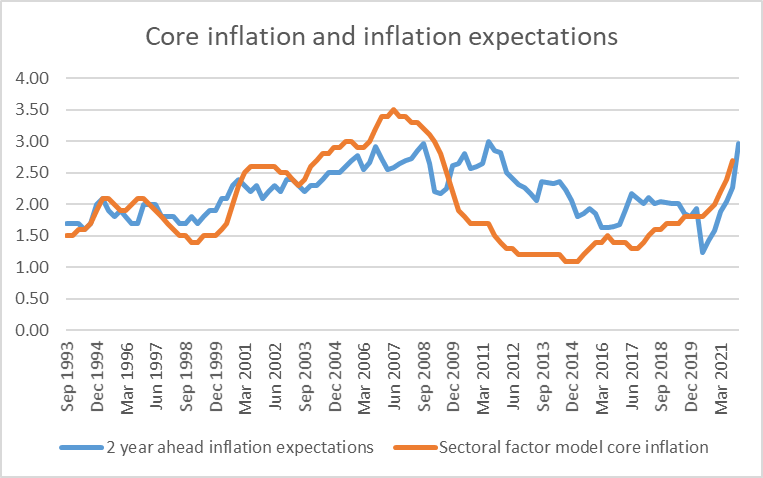
The message seems to be one of nothing to worry about at all. But even the story is misleading, at best. It is certainly true that year-ahead survey measures of inflation expectations seem to be very driven by fluctuations in headline inflation, but here is the two year ahead measure (from the Bank’s own survey) lined up against their (historically) preferred – and most stable – measure of core inflation. Inflation expectations – over almost 30 years – have typically fluctuated through materially narrower ranges than core inflation itself. The exception – potentially important exception – has been the last two years. If anything, the two year ahead expectation could be disconcertingly high already, given the extent of the rise in core inflation itself.

core and expecs

Then there is that claim that all is fine because long-term inflation expectations haven’t changed much. The Bank asks about expectations five and ten years ahead, and outcomes are not far from 2 per cent – as you would hope, given the target, but only because respondents presumably expect the MPC to act sufficiently aggressive to keep inflation near the centre of the target range. If those five and ten year expectations started moving up sharply there really would be cause for concern, but the fact they are still near 2 per cent shouldn’t be telling MPC anything about the appropriate policy stance now.

At the press conference one offshore questioner asked the Governor about the MPC’s response to the big increase in inflation expectations, given the Risk Appetite Statement included in the MPC in which they asserted that “they had a low appetite for policies or decisions that could cause inflation expectations to become unanchored”. This was greeted with a glib and dismissive response from Orr along the lines of “we have reacted and raised the OCR”, not even engaging with the fact that (for example) two year ahead expectations are now a full per cent higher than they were in February, and yet the OCR has been increased by only 50 basis points over that time, there isn’t another review until February, and the MPC has stated that they prefer to move in 25 point bites. At best, it will be the end of March before the OCR will have been raised by 100 basis points, but even that won’t have raised real interest rates at all relative to the start of this year (let alone relative to the start of last year). Perhaps expectations will have moved even higher – outside the target range in the meantime. Perhaps not, but surely we should have expected a more thoughtful nuanced and engaged treatment of the issues and risks? Core inflation has, after all, already increased a lot (and – which we will come to – even they seem to expect it to increase further).

Similarly, we are told that the Bank’s projections have the OCR rising to above (the Bank’s estimate of) the neutral OCR. They seem to base that on this portrayal of neutral.

neutral nov 21

But this chart seems not to have taken any account at all of a jump in inflation expectations. The Governor said they mattered – and that the Bank had responded – but there is no sign they do so in this estimate of neutral. Given the Bank’s inflation forecasts it seems unlikely that medium-term inflation expectations will be dropping any time soon, and if those survey numbers are capturing something real, doesn’t that mean the OCR needs to go (quite a bit) higher than they might otherwise have thought. Now personally I’m very sceptical of the value of medium-term projections, but it is the Bank that uses them as a storytelling device and yet quite a material (and identifiable) part of the story seems to be have been left out.

And so it goes on. The best question I’ve heard about yesterday’s MPS was from a first year economics student, who wanted to know how the Bank could claim to be fulfilling its mandate when it projects that inflation next year will be 3.3 per cent. I haven’t seen any attention paid to what that number means. Recall that it is now November 2021. Nothing about the year to December 2022 has happened yet. So the Bank’s forecasts for inflation next year must be very close to a forecast of core inflation (they don’t know the inevitable one-off shocks – up or down – and they assume the exchange rate is fairly stable). Core inflation is currently about 2.7 per cent and the Bank is quite content to see it rise to 3.3 per cent – outside the target range. When a press conference questioner asked a similar question, she again got a dismissive (and obfuscatory answer). It might be one thing to take things slowly if the unemployment rate was still lingering high, but the Bank is quite open that at present the unemployment rate is below a sustainable level. So raising the OCR more and more quickly wouldn’t be kicking the economy into recession – the Governor’s claim – but would just get both dimensions of their dual mandate back towards desired levels sooner (and with less risk to those pesky inflation expectations). As it is, the Bank’s forecast for the unemployment rate in March 2022 is a tough lower than it was in the latest official release. This is an economy that – on their numbers – has been overheating, and they can’t even manage of Taylor principle scale of response, not even when the unemployment rate is – on their telling -unsustainably low. Perhaps there is a case to be made for their choice, but neither the MPC nor the Governor made it.

I could go on at some length on other matters, but just a few bullet points instead:

  • it is sobering to see how pessimistic the Bank now is about productivity prospects  (0.5 to 0.6 per cent for annum across the forecast horizon).  The Bank has no particular expertise in productivity, but they just now take for granted our woeful performance
  • it was curious to see a lengthy Risk Appetite Statement in the document.  Doubly curious in that more space was given to (for example) the risk of an MPC member missing a meeting than to (nothing at all) the huge financial risks decisions like the LSAP programme expose the taxpayer too,
  • the Bank is all over the place on the LSAP (all while refusing to seriously address the losses, just waving the hands about “overall gains).  They seem oblivious to the international research that suggests the stock of bonds held is what makes any useful macro difference, asserting that the programme was previously making a big difference, but now makes only a small difference.  And once again they refused any serious answers about the future of the LSAP, claiming that a document is coming in February.   Similarly, they make laughable claims about why the Funding for Lending Programme needs to be kept open, Orr even suggesting to FEC that were they to close this crisis tool now (a year or more after the crisis) it might pose a future financial stability threat,
  • there were pages and pages on climate change.  As far as I could tell, all they seemed to focus on was direct price effects, and even then had nothing to say other than “some relative prices will rise”.  No doubt and –  by definition –  others will fall.  Orr claimed there was going to be unusual volality in headline inflation relative to core, but offered not a shred of analysis in support of his claim (we’ve had lots of shocks and policy reforms in decades past).  And, somewhat surprisingly, they didn’t even touch on any effects on the neutral interest rates –  if there is any effect (and I suspect that any effect will be vanishingly small) it is likely to lower neutral rates a bit.
  • remarkably, there was almost nothing in the document offering insights based on the experiences of other countries.  Again, with a big team of economists and access to overseas central banks you’d hope that the Bank’s thinking would be informed by the diverse experiences other central banks are observing.  But there was nothing.   

All in all, it was a fairly typically poor Reserve Bank performance, perhaps undershooting even my low expectations.  It was good that some questions were asked –  at the press conference and at FEC –  about the high turnover at the top of the Bank, even if Orr was allowed to get away much too easily with ludicrous claims about what a desirable place the Bank was to work, what an abundance of talent they had available etc etc.  It certainly wasn’t on display in this document.   

(On the turnover question, one almost had to feel sorry for the Chief Economist who has been restructured out:  asked by MPs about what was going on Orr rashly talked about how Yuong Ha “has chosen to go into a far more challenging role. What are you going to be doing?”  There was a noticeable, whereupon Ha lamely responded “Coaching my son’s cricket team. Taking a break”.   Orr seemed to display all the sensitivity and personnel management skill of, say, a Judith Collins.)

Interest rates

The Reserve Bank Monetary Policy Committee has had an unchanged membership for its life so far, but tomorrow’s decision (and MPS) will be the last for this group. The Deputy Governor Geoff Bascand moves on in January, the Chief Economist moves out in February, and the terms of two externals expire shortly thereafter (although one or both could be reappointed). On those changes, interest.co.nz had an interesting article yesterday which more or less confirms that the chief economist had been restructured out as the Orr permanent-revolution (at least until he finds a suitable mix of lackeys) rolls on, reports on Orr openly insulting a fellow speaker at an event they were both speaking at, even as it ends up (seemingly) trying to retain at least a little RB favour/access with this line

Nonetheless, Orr is community-minded and isn’t afraid to stand up to those with corporate interests, who spinelessly try to discredit their regulator by attacking his personality.

In days gone by surely a sub-editor might have questioned the unqualified unsupported used of a term like “spinelessly”, especially when it is well known that Orr has been on record abusing people who criticise his approach or policies, including those with no “corporate interests” whatever.

Critical as I am of Orr (in particular) and the upper levels of the Bank more generally, I continue to more or less expect them to do “the right thing” on basic monetary policy stuff. It won’t be well done, it won’t be well-communicated, it won’t typically be supported by robust or insightful analysis, but this group don’t seem like the sort who are going to wilfully let core inflation get away on them. That must be a pretty common view, because although shorter-term inflation expectations (measured in the Bank’s survey of semi-experts etc) have increased markedly, five-year ahead expectations are little changed from where they were 3 or 4 years ago.

Were I in their shoes I would increase the OCR by 50 basis points tomorrow. There are really two reasons for that. The first is simple: there is not another review until February (because a few years ago the Bank rashly decided to give its monetary policy function a long summer holiday). With two reviews during that period perhaps it might have been okay to have done two 25 point moves (not that there is any particular problem with 50 point changes, especially when the possibility is openly being canvassed). But there is also the underlying macro situation. Core inflation took the Bank by surprise a lot over recent months, and if it is not now outside the 1 to 3 per cent target range, neither is such an outcome that should be contemplated lightly. And inflation expectations measures have moved up a lot. There is no guarantee that the numbers reported in surveys are actually the numbers firms and households have in mind when they themselves are transacting, but it wouldn’t be wise to jump to the conclusion otherwise. Here is the two year measure.

2 yr ahead nov 21

The level of expectations is back to around the peaks in the 00s (prior to that the target itself was lower) and the increase over the last 12-18 months has been sharp. Early last year we needed lower nominal interest rates just to stop real rates rising. Now, we need rising nominal rates to stop short-term real rates falling – such falls would be undesirable in a climate of full employment and high/rising core inflation. One of the basic precepts of inflation control is that, all else equal, short-term rates need to be increased (decreased) as least as much as any rise (fall) in inflation expectations. Since even a 50 basis point increase tomorrow would only take the OCR back to where it was at the start of last year, and on almost every measure expectations are materially higher than they were then – and core inflation itself is much higher – the prudent response would be a substantial increase in the OCR now.

And I say that as someone who is quite open-minded about where the OCR gets to next year and beyond. As a matter of general principle I don’t think forecasting beyond the next quarter or two makes much sense, and the pandemic uncertainties here and abroad only compound that (we still have no firm take on output losses in the September quarter and it will be December next week). But not all the straws in the wind necessarily point in the direction of repeated or substantial further increases. It isn’t obvious that the wider global environment is persistently different – in ways that would support higher neutral real interest rates – than it was two years ago (and recall that global policy rates were being cut in 2019), fiscal policy (here and abroad) seems more likely to be a contractionary influence (fiscal impulse) than an expansionary one over the next few years, and for New Zealand reopening borders could still be more of a drag on domestic demand than a boost, at least for as long as it is very difficult for Chinese tourists to travel. Government policy generally is hardly set to promote a sustained acceleration in productivity growth (and associated investment) – if anything, we will be lucky to avoid a worsening set of outcomes. And if you believe in housing wealth effects – I don’t at an aggregate level – there could be some drag from that source next year. And so on. 50 points now and then approach each review next year with a genuinely open mind seems to me the most sensible, and prudent, approach.

For all the talk of how low interest rates are at present, it is worth remembering that New Zealand rates remain high by international (advanced country) standards. Very long-term interest rates – one silver lining to the higher government debt is that we now have a few more indicators – are the best place to look, abstracting from short-term cyclical effects.

As of yesterday, our 30 year government bond rate was 2.93 per cent. The comparable US rate was 1.91 per cent. The inflation targets in the two countries are all-but identical (over horizons like that) and the US has a far worse public debt position – actual and outlook than New Zealand. And the US is, by advanced country standards quite a high interest rate country: the German government 30 year bond yield is about 0.0%.

What about real interest rates? The market in inflation-indexed bonds is less deep but the amounts on issues are not now small. The longest New Zealand indexed bond has 19 years to maturity, and yesterday was yielding 0.71 per cent. By contrast, a US 20 year inflation-indexed bond was yielding about -0.71 per cent (30 year indexed bonds were yielding -0.52 per cent). But, to repeat, by advanced country standards the US is a high interest rate country. Germany has a 30 year inflation-indexed bond currently yielding -1.98 per cent.

These are really large differences, which have implications for how we think about the exchange rate: expected risk-adjusted returns tend to equalise across countries through the exchange rate, and whether the difference is 100 basis points (on a 30 year nominal bond) or 140 basis points (on a 20 year indexed bond) they point towards an overvaluation relative to the USD of perhaps 30 per cent, and something even larger relative to the euro. You’ll recall that New Zealand exports and imports as a share of GDP have been increasingly sluggish this century. There is a connection.

The bond yield differences have been around for a long time and show little sign of closing on any sort of sustained basis. You might think there was some evidence to the contrary for the US, at least if you look just at the most-common comparison, that of 10 year nominal bond rates.

us and germany

But for some years now both countries have had 20 year inflation-indexed bonds (the US numbers are the US 20 year constant-maturity yield, and for New Zealand the closest of the 2035 and 2040 bond yields).

20 yr yields

Our rates did look to be converging on those of the US for a time – by the time we went into Covid US short-term rates were much higher than those in New Zealand (and even more so relative to most other advanced economies). But as emerge, the gap now seems to be right back to where it was (the last observation on the chart is a spread of 1.41 percentage points). It is a really large difference, and not at all out of line with differences (New Zealand rates higher) than we’ve experienced over most of the last 30 years.

These are differences that cannot reflect default risk or (credibly) inflation risk. They seem to reflect differences – actual and expected – in the savings/investment pressures in the two economies, which in turn explain the respective neutral interest rates (ie rates consistent with inflation being at target while the economy is fully employed).

Finally, a chart that intrigued me when I generated it, but in which I don’t place much confidence. One advantage of a wider range of government bonds is that one can back out of the resulting yield curve implied forward interest rates. Thus, with 2035 and 2040 indexed bonds, one can back out the implied 5 year real rate for the period between 2035 and 2040 (ie far into the future, and not influenced – in principle – by current cyclical pressures, or even current members of the MPC or current government ministers).

Yields on both bonds look very low at present (0.56 per cent and 0.71 per cent yesterday), but what about that implied five year forward rate? Here is that chart for the last few years.

implied forward 5 year rate

Earlier in the year it might have looked as though the “new normal” might have been expected to involve much higher real rates in the medium-term future. But as things stand right now, the implied forward rate is just a bit lower than it was in early 2020. I’m reluctant to put very much weight on this – thin market, quite sensitive to small changes in individual 2035 and 2040 yields etc – but for what it is worth – and for now – markets seem to be pricing a medium-term return to the sorts of real interest rates (strangely low, in many ways) we had a couple of years ago.

Markets have, of course, been known to be wrong (often), but I don’t feel blessed with the insight to offer a view on whether this implied view is right or wrong, let alone whether if it were to be wrong, in which direction any error might be. Used as we are to positive real interest rates, there is nothing natural or inevitable about them.

The Money Illusion

Or to give the book its full title, The Money Illusion: Market Monetarism, the Great Recession and the Future of Monetary Policy.

I was engrossed in the 2008/09 recession – and the associated financial crises – at the time it happened, as an official at the New Zealand Treasury, and it must have been very early in the piece that I started reading Professor Scott Sumner’s then new blog, also The Money Illusion. I’m not a regular reader now, but found much of what Sumner had to say about the conduct of monetary policy – mostly in the US – stimulating and thought-provoking, even (perhaps especially) when I didn’t end up agreeing. So I was keen buyer when his 400 page book appeared.

It is an interesting mixture of a book – partly textbook, partly personal intellectual autobiography, and partly a tract championing a different approach to policy (and history). It would be well worth reading for anyone interested in monetary policy, with a particular focus on the recession of 2008/09 and it aftermath, and possible reforms for the future. Were I an academic teaching a monetary economics class I’d encourage all my students to read it (and have commended it to my economics-student son), not as replacement for a textbook but as a practically-oriented complement to it.

I usually read books of this sort with a pen in hand. But flicking through the book again I see that the pen was hardly deployed at all in the first 60 per cent of the book, which is a really clear and useful introduction to how the monetary system works, through a slightly different lens than most will be used to. If I didn’t agree with it all – and there were a few straw men tackled – people coming to grips with the system and concepts and history will almost inevitably see things more clearly for having read it. It is an achievement in its own right.

The second part of the book is focused much more on the policies adopted, mostly by the Fed, in 2008/09, and on the way ahead (bearing in mind that the big was largely finished before Covid, although I doubt the thrust of Sumner’s arguments would have been much changed by the experience of the last 18 months). And it is there I start to differ (and thus have lots of marginal notes).

It isn’t, I think, that we differ that much on how the economy works (or even how monetary policy works). Like Sumner I’m a champion of the potency of monetary policy. It can’t make countries rich, or solve things like New Zealand’s decades-long productivity failure, but it can – and should – do all it can to keep the economy as fully-employed as (labour market regulation etc makes) possible consistent with keeping inflation in check. It really matters, given the pervasiveness of sticky wages and prices in the economy. Sumner’s previous book, on the US experience of the Great Depression, was a really nice illustration of both the potency of monetary policy, and the way that misguided regulatory interventions (in that case much of the New Deal) can mess up economic performance.

And I’d also endorse two of his specific criticisms of choices the Fed made in 2008.

The first was the failure to cut official interest rates at the FOMC meeting a couple of days after the Lehmans failure. I think everyone – including Bernanke – now recognises that it was a mistake, but it really was an almost incomprehensible one. The justification was that the FOMC saw the risks of higher inflation as balancing the risks of lower growth. Now, as I noted in my post yesterday, headline inflation in September 208 was high – oil price effects mostly – but it is still hard to see how smart people could have reached the conclusion that a cut in the Fed funds rates was more risky than sitting tight. There was, for example, nothing disconcerting about the medium-term inflation outlook revealed in the breakevens in the government bond market (and by this time the Fed had already cut the Fed funds rate by quite a lot over the previous year. This is, of course, consistent with one of Sumner’s themes: central banks really should be taking more of a lead from market-price indications (which embody more wisdom and perspectives than a few dozen economists in any central bank can, and – he hopes – with less risk of (eg) groupthink).

It was a bad call. But in isolation it can’t have mattered much. After all, the FOMC went on to cut over the next couple of months, reaching their (self-identified) floor in December 2008.

The second questionable call was the move to pay interest on excess reserves held at the Fed (“settlement cash” in New Zealand parlance). I’ve written about this move in an earlier post, reviewing a book by George Selgin. This step was taken to stop short-term interest rates falling further…..in the depths of the most serious recession in decades…..by underpinning the demand for (willingness to hold) settlement cash. Selgin argued that this move deepened and extended the US recession – an interpretation I challenged in the earlier post – but it certainly dramatically changed any relationship that had previously existed between money base measures and wider nominal variables (nominal GDP, inflation, or whatever) – one of Sumner’s points – and did nothing to assist in getting inflation and activity back on course. (Our Reserve Bank made a similar decision last March, moving to pay the OCR on all settlement cash balances and thus underpinning short-term rates, at a time when the Bank also thought it needed to do massive bond-purchasing programmes.)

And while Sumner constantly (and rightly) cautions about simplistic reasoning from price changes, one of his other points about this period – and how the Fed was too slow and unaggressive in its approach – is how surprising it was to see real interest rates trending up over much of 2008. Discount the extreme surge if you like – though Sumner will argue that changes in market prices like that (tied in with risk aversion, market illiquidity) probably in any case support monetary easing – but that real yields were higher in January 2009 than in January 2008 does not sit that comfortably with a story of an aggressively-easing Fed.

TIPS 08

(At the time New Zealand had only a single indexed bond, then with about 7 years remaining to maturity. Yields on that bond did not start falling until November 2008, even though the economy had been in recession all year.)

But there is a tension in Sumner’s book. At least early on there is a sense that he thinks the Fed could have avoided the recession together if only they’d done a better job, but the specific failings he explicitly highlights cannot credibly have been large enough in effect to have avoided the recession (and further on in the book he notes that they might only have dampened the severity of the recession, which is a much weaker – and harder to test – claim).

In many ways his starting point is that the responsibility of a central bank is (or should be) to manage nominal spending in ways that avoid big and disruptive fluctuations (which often involve recessions, and sometimes exacerbate periods of banking stress). I have no particular problem with that. I still prefer something like inflation targeting (at least in countries like New Zealand and Australia) as the operational form that responsibility takes, while Sumner now prefers nominal GDP targeting (preferably in levels form, but in growth rates still better than nothing.

His bolder claim seems to be that if there is a recession – and he makes explicit exceptions for one where, as in March 2020, governments temporarily close down economies/societies – it is the fault of the central bank. And that is a step far too far for me. He might be right that in an ideal world no one would ever unconditionally forecast a recession, since they would also forecast that the central bank would take the steps required to forestall it. And so he might be right to say that neither the housing bust nor the associated financial crisis caused the US recession – central bank failure to react in time did – but that seems to me to simply assume away the problem, in a way that there are no easy or quick substantive or technical fixes for.

Here is a chart of US nominal GDP growth (note, as we see it now, not as people first saw it at the time).

us ngdp

Sumner thinks the Fed should aim to keep nominal GDP on a path consistent with about 5 per cent annual growth. Clearly that did not happen in 2008/09. Nominal GDP fell by more than 3 per cent in the worst 12-months and (consistent with then policy) there was never a later overshoot to get back on that 5 per cent annual growth levels track.

Here is a similar chart for New Zealand (from the low inflation era)

nz nom GDP

Our nominal GDP path is a lot noisier than that of the US – commodity price fluctuations are a key reason why NGDP targets are not a good idea for New Zealand (or Australia) – but you can see how much nominal GDP growth fell away in the two recessions (1997/98 and 2008/09) – and actually in the double-dip recession in 2010 too. Broadly speaking that doesn’t count as a successful outcome – but then nor does the real GDP recession, the rise in the unemployment rate, and (the extent of) the sharp fall in the core inflation rate.

But here’s the thing though. Had Alan Bollard – then the sole decisionmaker – been presented with credible forecasts at the start of 2008 that nominal GDP growth was going to go negative over the coming year, I have little doubt that he would have been prepared to cut the OCR sharply (he wasn’t exactly an anti-inflation hardliner). But he wasn’t. Not just from the internal forecasters, but from the wider forecasting community or the financial markets. Inflation breakevens weren’t plummeting, long-term real interest rates weren’t falling, the exchange rate wasn’t falling much (as late as May 2008 it was still higher than it had been at the end of 2006). The share market was falling back but (a) the New Zealand share-market wasn’t very representative of the wider economy, and (b) few if any one in New Zealand has ever put much weight on local share prices as an indicator. The Bank did not cut early or hard enough (and I was one of Bollard’s advisers until August 2008 and although I was one of those more focused on global risks I wasn’t recommending deep early cuts)….but we did not have the information on which to do so. I would argue that no one did. In a sense, it was the point of that period…..for a very long time no one understood quite how bad some of the lending had been, or who was exposed, or what the macro consequences (absent monetary offset) would be.

From all I read or saw of the US at the time, and since, I don’t think anyone in the US did either. It wasn’t as if the Fed was totally blind: they had been taken by surprise in 2007, but actually starting cutting in September (you can see in the chart above, nominal GDP growth was beginning to slow).

Could the Fed or the RB have done better? Almost certainly (some identifiable Fed mistakes above), but it is inconceivable that they could have prevented the recession – not because the techniques weren’t there, but because the information and understanding wasn’t.

One of my criticisms of Sumner’s book is that he largely avoids this issue, and more or less assumes much more was achievable over 2008/09 (the issues re the recovery are different but note that in NZ and in the US markets were often keener on tightenings than either central bank – and Sumner urges paying more attnetion to market prices). An example of what I have in mind is his treatment of Australia.

We are told that

Among all the developed countries, Australia was the one with that sort of devil-may-care attitude, and it breezed through the Great Recession with only minor problems. And yet from a conventional point of view the Aussies did the least aggressive monetary stimulus. Unlike most other developed countries, they did not cut interest rates to zero.

He goes on to present a table showing that average nominal GDP growth in Australia for 2006 to 2013 was much the same as in the previous decade (unlike the US and the euro-area).

And yet….the RBA was still raising interest rates into 2008 (I recall a conversation at a conference in early 2008 at which a very senior RBA figure expressed astonishment at what the Fed thought it was doing keeping on cutting), the RBA ended up cutting by 425 basis points, there was a huge fiscal stimulus, and yet here is the Australian nominal GDP growth chart.

aus nom GDP

And yet look how much nominal GDP growth fell away in that downturn (a bit more than in the US). And it wasn’t as if there were no real consequences, with the unemployment rate rising 2 percentage points.

I’m not saying it was a bad performance…..it might even have been about as good as the authorities could have managed. But that is sort of the point. Limitations of knowledge, understanding etc…..not just in central banks, but much more broadly.

I could go on, exploring some of this points and Sumner’s specific policy prescriptions in more depth. But this post has probably gone on long enough already. He favours targeting a futures contract on nominal GDP, which may be a reasonable idea (at least in the US context), but it isn’t going to change the basic problem around knowledge. In countries like New Zealand (as Sumner notes) something like an aggregate wages series would probably make more macroeconomic sense (but would have its own political problems). I’m all for using monetary policy aggressively, but there are limits to what short-term stabilisation can be hoped for, no matter the indicator, the specific target, the instruments, or the individuals.

(Rather than labour points about nominal GDP targeting, I’ll link to some remarks I made on the topic at a conference a few years back.)

Good books make you think, and think harder. The disagreements are often where the most value lies in forcing one to think harder about one’s own view. This one is worth reading and reflecting on. And I’m going to finish where the book does with a quote I endorse (even if a bit more relevant in the US than here):

In other words, the goal is a world in which policy makers don’t view fiscal stimulus or the bailout of bankrupt firms as a way of “saving jobs”, but rather as a sort of crony capitalism that favors one sector over another.

But there will still be recessions, real and nominal.

Inflation and monetary policy

No posts here for a while as I’ve been bogged down in trying to make sense of some events – little more than one week in history – from 30 years ago, where the uncertainty as to what actually happened (a precondition for making sense of what the events mean) is greatly magnified by really poor documentation and recordkeeping by….the Reserve Bank.

I was planning to return with something a bit more longer-term (perhaps tomorrow) but wasn’t yesterday’s inflation number interesting? It seems to have taken almost everyone – notably the people who do detailed components forecasts, including the Reserve Bank – by surprise to some extent.

Almost all the media focus has been on the headline number – 2.2 per cent increase for the quarter, 4.9 per cent for the year – because (I guess) it makes good headlines. (Excluding the two quarters when the GST rate was increased) it was the largest quarterly increase since June 1987 – an unexpected rise of 3.3 per cent, at a time when the Bank thought inflation was falling away, and when the Bank’s chief economist, Grant Spencer, was interviewed about the number that night he declared himself “flabbergasted”. That one number helped prompt an overhaul of, and marked improvement in, the Bank’s short-term inflation forecasting (not previously much of a priority).

But in annual terms, it is only 13 years since we had an inflation rate about this high. It was 5.1 per cent in the year to September 2008, a rate that may be beaten when the next CPI number is released in January, since last December’s (relatively modest) 0.5 per cent quarterly increase will drop out of the annual rate. Note that in the September 2008 quarter, the Reserve Bank had already (and appropriately) started cutting the OCR.

But my main interest is in core inflation. There are all sorts of different measures, from simple ones (useful for cross-country analysis at least) like the CPI ex food and energy, through varying degrees of complexity (and occasionally even special pleading by the people constructing them). For New Zealand though, my favourite measure – and the one the Bank openly favoured for some years (it is less clear how the current Governor and MPC see things) – is the sectoral factor model measure of core inflation. It was developed a decade or so ago by one of the Bank’s researchers, and initially got little attention even inside the Bank (mostly because the Governor and his advisers on the then Official Cash Rate Advisory Group were not really advised of it). I’ve been something of a lay evangelist for this measure ever since I realised it existed, and had some small role in getting this explanation of the measure published. The gist of what is going on is this

The sectoral factor model estimates a measure of core inflation based on co-movements – the extent to which individual price series move together. It takes a sectoral approach , estimating core inflation based on two sets of prices: prices of
tradable items, which are those either imported or exposed to international competition, and prices of non-tradable items, which are those produced domestically and not facing competition from imports.

Using very disaggregated data, it is an attempt to get at the systematic elements in the annual inflation numbers, recognising that tradables and non-tradables can be influenced by different systematic influences (notably the exchange rate in the case of tradables).

But the best argument for the series has been its usefulness – in some sense it “works”, telling useful stories, not subject to much revision, about what is going on in ways that square with what is going on with other things (notably capacity pressures, but also expectations) that are thought likely to be important influences on the trends in inflation, abstracting from the noise.

And the “noise” can be considerable. Here is annual headline inflation and the annual sectoral factor measure for the period since 1993 (as far back as the sectoral factor measure has been taken).

core oct 21

Big deviations have not been uncommon (although less so in the last decade), and spikes in headline inflation have never (yet) foreshadowed a commensurate increase in core inflation (as,say, stickier prices caught up with more flexible prices). If you did want a prediction of where core would be 12-24 months from now, historically today’s core inflation has been a much less bad (far from perfect of course) predictor than today’s headline inflation.

And so from here on I’m focusing solely on the core inflation measure. There are a few observations worth drawing from simply this chart.

First, the range in which core inflation has moved over 28 years has been 1.1 per cent to 3.5 per cent. And although the inflation target was centred on 1 per cent until the end of 1996 and 1.5 per cent until September 2002, the low in the series wasn’t then, but in late 2014 (a time when, curiously, the then-Governor was raising the OCR).

Second, over the 28 years not much time has been spent very close to the midpoint of the respective target range. In fact, the median gap between the core inflation estimate and the target midpoint has had an absolute value of 0.7 per cent over the history of the series. As it happens, yesterday’s core inflation estimate was 2.7 per cent, 0.7 percentage points above the target midpoint.

Third, for the first 15 years of the series core inflation was almost always at or above the target midpoint, and for the decade until last year it had been consistently below.

Now it is worth pausing here to note that prior to about 2012 the Reserve Bank (a) did not have the sectoral factor measure readily available to policy advisers, and (b) was not explicitly required to focus on the target midpoint. However, neither point really diminishes the usefulness of such comparisons because (a) sectoral core inflation was simply trying to put in a single measure something the Bank had constantly thought and written about since inflation targeting began, and (b) if Alan Bollard was personally disinclined to give much weight to the target midpoint, Don Brash certainly was (and revealed evidence – see those sectoral factor numbers from 2014 – suggests that Graeme Wheeler was more focused on where he thought in principle the OCR should be heading than on the target midpoint.

There are a couple more relevant observations. First, core inflation now (2.7 per cent) is about the same as it was (2.6 per cent) in the last year or so of Don Brash’s term (2001/02), and back then the target midpoint was 1.5 per cent, not the 2 per cent the Bank is now charged with. And, second, core inflation is still well below the 3.4/3.5 per cent seen in late 2006 and throughout 2007.

But perhaps the change in the inflation rate has been unusually sharp.

I put this chart on Twitter yesterday before the Bank published the sectoral core numbers.

core change

On the series now published, the sectoral core inflation rate rose by 0.3 percentage points in the latest quarter (so large but not exceptional). However, this sort of model is prone to end-point revision issues – new data leads the model to, in effect, res-estimate which recent prices moves were systematic and which were not. The previous estimate for sectoral core inflation for the year to March 2021 was 2.2 per cent. But that has now been revised up to 2.4 per cent. I don’t have (but the Bank should really publish) a database of historical real-time estimates, but a change from a previous estimate of 2.2 per cent in the year to March to one of 2.7 per cent for the year to June is likely to have been large by any standards.

What about changes from year to year? Again, I don’t have a real-time database, but here is how the annual rate of core inflation has changed from that a year earlier.

change in core

What we’ve seen so far – on current estimates which are subject to revision – is not exceptional. The rise in the rate of core inflation over the last year has been less than we saw around the turn of the century, and the magnitude of change is less than than the fall seen over 2009. But it isn’t a small change either.

When (last quarter, per the Bank’s published estimates) annual core inflation was estimated at 2.2 per cent, I was prepared to say (and did) that that rate of core inflation was unambiguously a good thing, given the target the government had set. After a decade of core inflation below the target midpoint, it was good to finally see an outcome on the other side, which would help to underpin medium-term expectations near the goal set for the Bank. That was doubly so because 2.2 per cent inflation went hand in hand with an unemployment rate right back down to pre-Covid levels (4 per cent) and probably pretty close to the NAIRU (itself a rate the Bank can’t meaningfully do anything about). I’d not have been uncomfortable with a core inflation rate going a bit higher still – not as a desired outcome, but not something to be too bothered about for a short period (as the MPC raised the OCR, which works with a lag). 2.7 per cent is somewhat less comfortable.

But quite a lot might have depended on where the unemployment rate (or other measures of excess capacity) was going. There have been two previous troughs in the unemployment rate. The first was in the mid 1990s, when the NAIRU appeared to be around 6.2-6.5 per cent. Core inflation reached its cyclical peak then at much the same time unemployment dropped into that range, and showed no signs of going higher. The second was just prior to the 2008/09 recession, when the unemployment rate was in the 3.4-3.9 per cent range. Core inflation had risen as the unemployment rate fell, but core inflation was not going higher in 2007, nor was it forecast to into 2008. In both cases, the Reserve Bank had been raising interest rates (or allowing them to rise) and things stayed more or less contained (before core inflation fell away in the two following recessions).

One of the great unknowns now is how things might have unfolded here without the Delta outbreak and the ongoing restrictions and lockdowns. We will get the HLFS numbers for the September quarter early next month, and the unemployment rate there is unlikely to have been much affected yet by the lockdowns etc. Most likely, the unemployment rate will be lower than 4 per cent, but how much?

But the outbreaks and restrictions did happen, and so even if the unemployment rate for the September quarter was in fact 3.6 or 3.7 per cent, it probably isn’t safe to assume anything of the sort as a December quarter starting point. Yes, most likely economic activity will eventually rebound when controls are finally lifted but (a) there isn’t the fresh policy impetus there was last year, and (b) for those who believe in house prices stories, the worst of this particular house price boom has most likely passed. It isn’t implausible that the unemployment rate for December and March could be back at or above 4 per cent.

What does it all mean for policy? No doubt the MPC is feeling vindicated in having raised the OCR at the last review, even amid the-then extreme Covid uncertainty, and even though the MPC is likely to have been very much taken by surprise by yesterday’s core inflation number. Absent Covid there was a strong case for a robust tightening of monetary conditions – reversing the LSAP bond purchases, ending the funding for lending programme, and getting on with OCR increases – and that case would have been considerably strengthened by yesterday’s outcome.

Perhaps fortunately, the MPC does not need to make another OCR decision until late next month, and that review will come with a full MPS which will allow them space to provide some careful and considered analysis of their own. We might hope that by late next month, something close to normality has returned or is on the brink of returning. There are no guarantees, but if that is the situation, the MPC should be starting to sell off the bonds, and ending the FfL programme (most likely they will do neither), and should probably still be considering seriously a 50 basis points OCR increase (albeit with one eye on the emerging China slowdown). We were told they had considered the option in August. There isn’t a need for panic or headless-chookery about the Bank having lost the monetary policy plot. But a fairly robust response does seem likely to be warranted next month, especially as the MPC has (most unwisely) scheduled decision dates in a way that gives them a long summer holiday with no OCR review at all in December and January.

Finally, I have been highlighting for a long time how the market-based indications of inflation expectations (from the indexed bond market) had consistently undershot the target midpoint for some years. Yesterday’s data seems to have prompted a move to (or above, depending on maturity) 2 per cent for the first time in a long time. That isn’t concerning – rather the contrary – but it will be worth keeping an eye on how those spreads – the breakevens – develop over the period ahead.