I got curious yesterday about how the Australia/New Zealand real exchange rate had changed over the last decade, and so dug out the data on the changes in the two countries’ CPIs. Over the 10 years from March 2014 to March 2024, New Zealand’s CPI had risen by 30.3 per cent and Australia’s CPI had risen by 30.4 per cent.
And that piqued my interest because the two countries have different inflation targets: New Zealand’s centred on 2 per cent per annum and Australia’s centred on 2.5 per cent.
So I drew myself this chart
Over the full 10 years, the two CPIs have increased by almost exactly the same amount, but they haven’t kept pace with each other steadily over that full period. Up to just prior to Covid, the Australian CPI had been increasing faster than New Zealand’s, as one might have expected given that the RBA had been given a higher inflation target than the RBNZ.
Now, before anyone objects, I should get in and note that in neither country is there a price level target. But if economies are subject to fairly similar shocks over a period of time one should normally expect a country with a higher inflation target to have experienced a higher cumulative price level increase than a country with a lower target.
Over the 10 years here is Australia’s CPI relative to the price level that would have been implied by being consistently at target midpoint
and the same chart for New Zealand
And in this chart I’ve put it all together
Over the half-decade or so to the end of 2019, the RBA and the RBNZ had both ended up undershooting (on average) their targets by about the same extent. If you look closely, the RBNZ was undershooting more earlier, and the RBA more towards the end of the decade, but there wasn’t a great deal in the difference.
But where the difference really becomes apparent is in the years (four of them) since Covid hit. Over that period, the RBNZ has generated/tolerated much more of an increase in the price level, in excess of what is implied by their target, than the RBA did. (And for those – like Orr – who like to try distraction with things like oil shocks, wars and rumours of wars, and supply chain disruptions, Australia faced all those too.)
There is a lot of focus in Australia – and apparently reasonably enough – on whether the RBA has yet done enough with monetary policy. It has certainly been puzzling that they reckoned they could get away with materially lower policy rates than in other Anglo countries, in the face of (still) near-record low rates of unemployment and a quite stimulatory fiscal policy. But so far, and overall, they’ve done a bit less badly than the Reserve Bank of New Zealand through the last four years taken together.
It remains somewhat remarkable how little serious accountability there has been for serious Reserve Bank policy errors, for which now pretty much everyone (except them) is paying the price. in one form or another.
(By the way, for anyone interested, the NZD/AUD exchange rate averaged 0.933 in the March 2014 quarter and 0.932 in the March 2024 quarter, so over that particular 10 year period there was no change in the real exchange rate at all.)
I’ve been rather tied up with other stuff for the last few weeks (including here) which is why I’ve not previously gotten round to writing about the first piece of monetary policy communications from our Reserve Bank this year. That was the “speech” by the Bank’s chief economist (and MPC) member Paul Conway given to anyone and no one in particular over the internet last Tuesday. It had been a couple of months since anything had been heard from any MPC members, in what are not exactly settled or uninteresting times, and it is still several weeks until we get the first formal monetary policy review and MPS this year. We really should be able to expect better……but then if it were that sort of central bank, lots of things about the last few years would have been done differently, including the Bank might not have lost the taxpayer the mindbogglingly large amount of $11bn or so (with not the least sign of any contrition or of anyone having been held accountable).
Conway’s fairly short piece was a puzzling document. What was the pressing need that called for a speech on ‘the importance of quality research and data”? And what made it sufficiently pressing that they couldn’t even wait to find a real live function/audience to address? And if there is no particular function/occasion that needed a speech, but rather just something the Bank had chosen to do, wouldn’t you have expected (I certainly would) to have found some substance. The bit (the bulk) of the speech under that headline title was in fact much more notable for what wasn’t there. Is any serious observer going to dispute the likely value of quality research and data? And especially not against the backdrop of the actual New Zealand situation: poor (if very slowly improving) data and very limited volumes of macroeconomic and financial research (with the Reserve Bank’s own output in the last half dozen years notably diminished).
You couldn’t help but think that the “speech” was really just an excuse for putting out a page and a half of comment on recent economic data. I’m all in favour of individual MPC members putting their individual views and their analysis into the public domain (one of the few ways we see the quality of the analysis and thinking of these statutory officeholders). Perhaps all the more so when it had been two months since we’d heard anything, but then one was left wondering why they felt the need to wrap an entire speech around those brief comments rather than (say) just stick out a press release with the recent data comments.
But if the process was a bit puzzling, my main interest was the substantive content of the short address.
I’m going to take the material in reverse order. At the back of the speech there is a page a half of text on “a policy-relevant research agenda” and “the importance of quality data”. On the first of those headings, the speech is simply devoid of content. One might have hoped they would be releasing some new research or touting how policy-relevant research papers had shaped their thinking and understanding over one of the most turbulent periods for monetary policy in decades. Or even just foreshadowed a couple of specific papers that were almost ready for release. Instead there was nothing of substance at all, just a stylised graphic highlighting areas they were interested in, a list looking pretty much like any monetary policy research agenda in recent decades for almost any advanced country central bank.
What of data? Better data would be great. At a macroeconomic level, New Zealand is one of only two OECD countries with only a quarterly CPI, something Conway glides over in welcoming the recent additions to the partial monthly prices data. We also don’t have monthly unemployment data, a pretty basic measure of excess capacity/slack, and all our main macroeconomic data comes out later, with longer lags, than most of our OECD peers. It really isn’t a satisfactory situation, when so much rides on reading the economy well. But what Conway offers is mostly honeyed words about “a consultation process” with SNZ “to better understand data needs and priorities”. If one wanted to look on the bright site I guess one could note that they are “exploring collecting much more detailed data from banks to support economic analysis and research” and “we are also developing new sources of higher-frequency data to incorporate into the MPC’s assessment process”, which sounds fine directionally, but so far doesn’t seem to have amounted to much.
Right up front, in the introduction to his speech, Conway claims that “the economy is now significantly different to how it was before COVID-19”. His claims appears to be that this is so for both the world economy and for New Zealand. Again, it is a lead-in to what is, at best, a once-over-lightly treatment: one page of text and two charts, and simply isn’t very persuasive at all (especially as regards the functioning of the economy as it affects monetary policy).
Inflation went up, to very uncomfortably high levels, and then is coming back down again. But what about how the economy works is materially different now than it was five years ago? Conway really offers no hints at all. Instead he notes that government deficits have been large and government debt has increased (as he notes, by more as a percentage of GDP in New Zealand than in the typical OECD country) but what, if any, implications are there for monetary policy? It isn’t obvious and Conway offers no suggestions.
Then when we get the common line about globalisation changing, with supply chain resilience and geopolitics more in focus. It is a common line, and this might have been an opportunity to illustrate the point with specific reference to New Zealand macroeconomic and inflation dynamics. But no…. I’m still a little sceptical that there is much to the story (of macroeconomic significance) and took that line too from a recent Martin Wolf piece in the FT. Perhaps there is a story that matters to the Bank, but Conway made no effort to get beyond the cliches.
We also heard - what we all know - that traffic through the Suez and Panama canals is down at present (the former for geopolitical reasons, the latter for climatic), but nothing at all about what it might, or might not, mean for cyclical or inflation dynamics. The Suez Canal, for example, was shut completely and for several years a few decades ago. In what way did it matter and to whom?
And then we got Conway’s take that “the pandemic has sped up the digital transformation”, which was he thought a good thing. I can’t claim to have read all the papers on the subject, but my impression had been that there just wasn’t much there (in terms, eg, of improved productivity). And if in some places more people are working from home (less a thing here it seems than in some US big cities) in what material way would it matter for a central bank?
Perhaps there were substantive points to be made. Perhaps there were things New Zealand (eg RBNZ) research might have shed light on. But….nothing.
Most of whatever interest the speech commanded was inevitably going to be on Conway’s short comments on recent data. When the MPC hasn’t spoken for two months, and was then last heard talking up the possibility of a further OCR increase, it was going to be lot of few drops of rain falling on travellers crossing a parched desert. It wasn’t as if that November MPS statement itself had been overly persuasive (this was the Bank that was talking of further OCR increases even as it forecasts showed inflation collapsing over the next few quarters).
Whatever you own view of the data, you can see why Conway might have wanted to be cautious. The Bank had been talking of a further OCR increase while the market was now very focus on when, and how aggressively, rate cuts would start (here and abroad). Last week’s short comments seem to have been designed basically to try to dampen market enthusiasm, not necessarily because Conway and such of his colleagues who were consulted had a markedly different firm view than the market, but so as not to create a rod for the Bank’s back if, come late February, the Committee as a whole does conclude that there is no OCR cut in prospect any time soon. The more the market had already moved, the harder it would be for the Bank to drive home its message (without quite nasty snapbacks in market pricing).
What, if any, insights were there in Conway’s comments? Not much.
There seemed to be three points:
revisions downwards to the level of GDP over several years past don’t necessarily tell us anything much about the inflation outlook. And, of course, every serious analyst already recognises this : if those data suggested the underlying productivity picture was a bit worse than had been thought, they don’t tell us much, if anything, about capacity pressures and how they are changing. We already have the inflation data for those earlier periods when the level of GDP itself was a bit lower than had been thought.
We (they) really don’t know what is going on with immigration (either the numbers – itself a reflection of data weaknesses reintroduced to the system a year or two before Covid – or the net pressures on capacity and inflation). There was a footnote suggesting NZIER had done some work for the Bank on migration and inflation, which is described as “forthcoming” but no useful insights were offered from that work.
Inflation is falling but – on the measure Conway chose to highlight (annual non-tradable inflation) – still far too high. But there was no supporting analysis at all.
Highlighting annual non-tradable inflation – and suggesting it is a “rough approximation of inflation generated within the New Zealand economy – was really a bit naughty in a couple of ways. As other commentators have pointed out, non-tradables inflation is almost always higher than general inflation, and it is general CPI inflation that the MPC is charged with focusing on. The MPC isn’t given an option of just being indifferent to tradables sector inflation. And you’d expect central bank analysts and policymakers to be fairly heavily focused on recent quarterly inflation (especially when the OCR only got to the current level last May), rather than lagging annual measures.
Conway mentions that core inflation measures are falling, but again chooses to illustrate the point using annual data only. That said, what used to be the Bank’s preferred measure – the sectoral factor model – is both annual and prone to revisions (up when inflation keeps rising, down when it keeps falling, but was already showing core inflation at 4.5 per cent, down from a peak of 5.7 per cent just a couple of quarters ago.
What about some of the quarterly core measures, probably reflecting the impact of monetary policy early last year? SNZ provides a breakdown into tradables and non-tradables only at the 10 per cent trim level. For tradables, the December quarter saw the lowest quarterly inflation rate since mid 2020, for non-tradables the lowest since the start of 2021. The picture is pretty similar for the weighted median quarterly data.
But perhaps the thing that surprised me most about Conway’s speech – in its reflection on recent data – is that there was no sign of any cross-country comparative perspective. Now, each country’s core inflation outcomes are ultimately the responsibility of its own monetary policy, but when core inflation in a bunch of countries rose pretty much at the same time, and then central bankers raised policy rates at pretty much the same time, and often to somewhat the same extent, you might think there would be value in posing cross-country comparisons, especially when many of those countries have more frequent and more recent data than we do. The common story seems to have been that (core) inflation has been falling away, a little earlier and easier than had seemed likely to many at (say) the start of last year. It isn’t obvious that New Zealand was a particular laggard in tightening (weren’t particularly early either) and so one might take some comfort from what is happening in other countries.
The comparison with the US might have been a particularly interesting one to touch on. The US has, so far, seemed to have experienced a sharp reduction in annualised core inflation with, as yet, little sign of any substantial or sustained economic slowdown. As Westpac’s Michael Gordon points out in a nice piece this morning, the US has been quite unusual on that score, and the economic data in both New Zealand and Australia have been materially weaker than we observed in the US (and that is especially so when one looks at per capita GDP growth). Quite why the US outcomes have, to date, been so favourable is a bit of mystery, not often explored by commentators in an international context, but when our economy has been so much weaker it seems that our inflation outlook should generally be positive. At very least it would be good to see some of this ground traversed in the MPS later in the month.
Before Christmas I wrote a piece here on monetary policy turning points in which I ended by noting that it wasn’t inconceivable that by the end of February an OCR cut might be appropriate here. Whether the data support such a case may be a bit clearer by Wednesday afternoon (after the quarterly suite of labour market data are out), although I don’t suppose that whatever the data show an early OCR cut is at all likely.
There is an interesting piece in the Financial Times today on “Why central banks are reluctant to declare victory over inflation”. Setting aside the fact that such language is more George Bush “Mission Accomplished” and never likely to be heard from central bankers – my old line (with acknowledgements to von Clausewitz) about inflation was “the price of price stability is eternal vigilance” – it nonetheless touches hardly at all on what must be one of the biggest factors weighing on the minds of central bankers. Having stuffed up so badly (a description rarely heard, although it should be more openly acknowledged) and delivered us into very high inflation and all the attendant unexpected wealth redistributions etc, central bank reputations took something of a well-deserved hit (a change since 2019 that of course Conway chose not to mention). They were too slow to reverse the easings of 2020 and the public paid the price. For them, reputationally, perhaps the worst possible thing now would be to begin easing, cutting policy rates, only to find in a few quarters time that inflation really wasn’t securely settling near target. There would be considerable public and political unease if they were soon tightening all over again. By contrast, people are attuned to the idea that squeezing out inflation involves some pain, so why not take the free (to them) option until they are 100 per cent sure inflation really is on course).
One problem then is that the interests of the individual central bankers – mostly still holding the offices they did in 2020/21 – aren’t necessarily well-aligned with the wider public interest. To be 100 per cent sure that inflation was well on course towards the target midpoint also necessarily then means quite a high risk of overshooting (both that inflation ends up going below target midpoint – as in so much of he pre Covid decade, here and abroad) and that output and employment are unnecessarily sacrificed. That, in turn, might be less of an issue in the US, where the economy has held up, then (say) here where we’ve already had last year some of the very weakest per capita GDP growth of any OECD country.
Much of the discussion about the possibility of rate cuts this year tends to proceed – perhaps not consciously but it is the effect – as if the two choices were to keep rates at current levels or to take them quickly back to neutral (wherever that unobserved variable might be – our RB thinks somewhere under 3 per cent). But those aren’t the choices central bankers actually face. I very much doubt it would be prudent for interest rates to be anywhere near neutral right now, but relative to how things looked when the OCR got to 5.5 per cent first in May 2023, there is a lot more reason now to be confident that the worst is past. Back then it was purely prospect but now we have some hard evidence, and we know that monetary policy works only with a lag. More disinflation is, as it needs to be, in the works. It isn’t impossible than an OCR of 5 or 5.25 per cent would now be better than one of 5.5 per cent.
Of course, none of any of this was in the Conway speech, which really did seem to be just about buying time/space to get the MPC through to the end of February (after its inexcusable three month summer break).
In conclusion….well, this was Conway’s
It was really quite remarkable for its avoidance of any responsibility. You’d note know from this that any central bank’s conscious and deliberate choices played any part in inflation being well above target for three years in succession. When you can’t acknowledge your part in a really bad, costly and disruptive, set of outcomes, it is really hard to be confident that you are really any sort of “learning organisation” or that the much-vaunted (but as yet unseen) research will be for anything other than support rather than illumination.
Central bank monetary policy speeches are rare enough in New Zealand. On the rare occasions MPC members do speak we deserve better than Conway’s effort. The Governor is due to speak next week. HIs speeches to the Waikato Economics Forum have tended to be substance-free zones, but I guess we can always hope.
And I hope the Minister of Finance and her advisers are taking note, and are looking to find and appoint rather better people to fill the two MPC vacancies arising in the next few months.
The Herald ran an op-ed yesterday under the heading “Why the Government’s new Reserve Bank mandate may lead to worse outcomes”. It was written by Toby Moore who served as an economic adviser in Grant Robertson’s office while he was Minister of Finance (a fact the Herald chose not to disclose to its readers).
I’m more interested in the substance of his argument. Moore is a serious guy, and I suspect he’d run his arguments whether or not he’d ever taken up a role with Robertson. But I think his core argument ends up not very persuasive.
Moore opens his article pointing out that there isn’t an overly strong economic case for having reverted to something very like the old statutory objective for monetary policy. There are certainly bigger economic challenges (albeit probably not ones the law draftsmen could tackle as quickly). As the Governor repeated again yesterday – while trying to minimise the extent to which the previous wording was actually a “dual mandate” (a point on which he was correct, but not a point he’d have made often under the previous government) – no monetary policy decision in the last few years was made differently because of the revised wording of the statutory mandate. That is entirely convincing: the Reserve Bank’s big mistakes (and they were very big mistakes) were forecasting ones. Given their forecasts their OCR choices made (more or less) sense. But they misunderstood how the economy was operating and how real the inflation risks were.
But then Moore attempts to argue that much of the previous 30 years would have been different (and better) if only the Reserve Bank had spent those decades operating under the statutory mandate it had from 2019 to 2023. The episode I want to focus on is that from a decade or so ago. These are his words
One can see the issue more starkly in this chart
As one added bit of context, in 2012 a requirement was added to the Policy Targets Agreements requiring the Governor to focus on delivering inflation near 2 per cent, the midpoint of the 1-3 per cent target range.
I agree with Moore that a series of bad monetary policy choices were made by the Reserve Bank during this period. In fact, while I was still at the Reserve Bank I argued against the proposed tightening cycle that eventuated in 2014 on the twin grounds that core inflation was very low, and (consistent with this) evidence from the labour market suggested quite a lot of slack still in the economy. Once I left the Bank in early 2015, it became a regular theme in commentary on this blog.
But…..the key point is that, once again, economic forecasts were very wrong. The Bank’s forecasts during this period usually had core inflation coming back to the midpoint and needing higher interest rates to keep it there.
And actually I think there is a fair argument - that should appeal to Moore, although not to some others - that during in 2010s one problem was that the Governor, having recently returned from a long sojourn in the US, became fixated on the housing market and the US crisis of 2007-09, and constantly wanted to orient policy to lean against such risks, without ever stopping to consider (a) similarities and differences between NZ and the US, or (b) his statutory mandate. It wasn’t the biggest factor in setting monetary policy wrongly – policy that delivered core inflation bouncing near the floor of the target range for years – the problem was forecasting failure and bad models – but it didn’t help either.
A central bank in the early 2010s (a) strongly focused on the inflation target, and (b) with better forecasts/models (or just looking out the window) would have delivered a lower OCR during that period, and in particular would not have championed a substantial tightening in 2014. That would have had better outcomes for inflation and for unemployment.
Reasonable people can differ on how best to specify and to articulate what we look to the Reserve Bank to deliver with monetary policy, but the problem a decade ago wasn’t some excessive focus on inflation, but a poor understanding (shared of course with many others here and abroad) of just what was going on. Arguably, looking out the window - at actual headline and core inflation - might have given a better steer during that period. A ‘dual mandate’ simply wouldn’t credibly have made any difference, given all else we know. The unemployed paid a price for those limitations/mistakes (as holders of fixed nominal financial assets have paid a big price for central bank mistakes in the last year or two).
Excellent central banks matter. They make a difference to real people, real outcomes. It would be good if we had one, and/or a government seriously resolved to deliver a better one.
The fall in New Zealand’s per capita real GDP (averaging production and expenditure measures) over the last year has been quite striking set against other advanced (OECD) countries for the same period. We are equal second-worst, and quite a bit worse than the next country with its own monetary policy (Sweden) - I’m mainly interested in the inflation situation. The fall in real per capita GDP in New Zealand thus far isn’t much short of the fall experienced in the 2008/09 recession.
With recent data it is certain there will be revisions and thus it isn’t impossible that the last year might end up looking a bit less bad. But for now, the published data are the best official guesses - for us, and for fiscal and monetary policymakers.
The OECD has data on quarterly real per capita GDP, going back a fair way (a lot further for some countries than for others, but pretty comprehensive for current members from the mid 1990s). I was curious how common falls in real per capita GDP had been in that database.
For the 1980s there isn’t data for many countries, but we find large annual falls in real per capita GDP as follows
Australia 1982/83
Canada 1982 (at worst about -5% per annum), and
the United States 1982 (the recession that saw them get inflation down.
Coming forward to the early 1990s we find
Finland 1991/92 (some mix of domestic financial crisis and the fall of the Soviet Union)
Canada 1991
Iceland 1992
(New Zealand would probably be on the list but our official population series begins in the middle of the early 90s recession)
Moving on a few years and we have
Chile 1998/99
Israel 2001/02
In 2008/09 all but a handful of countries saw a significant fall in real per capita GDP. It was, of course, the recession that ushered in the decade or so of surprisingly low inflation. At worst, per capita real GDP fell by about 5 per cent per annum in the US and 6 per cent in the euro-area (and about 4 per cent here).
In and around 2012 various euro-area countries (but notably Greece) did dreadfully, but the euro-area as a whole only saw real GDP per capita falling at about 1 per cent per annum during that period.
Covid intervened – when we shut down economies for a time and deliberately wound back economic activity – but otherwise there are no big falls in per capita GDP on an annual basis in places with their own monetary policy until……New Zealand right now.
What we have seen over the last year isn’t normal or small, but a large fall, of the sort seen in advanced economies only in pretty adverse times.
Why focus on real per capita GDP? The public commentary tends to focus on GDP itself, with all the attention on whether the total size of the economy is rising or shrinking. But for most economic purposes, and certainly for inflation purposes, it isn’t a very relevant measure. Zero per cent growth in GDP means something a great deal different if the population is static or falling than if it is growing at 2.5 per cent per annum. It is (much) more likely that excess demand pressures are easing if – absent really nasty supply shocks – per capita real GDP is falling, even if there is still some headline growth in GDP itself.
That said, all such comparisons, especially across time, take one only so far. In an era of really strong underlying productivity growth, even a moderate GDP or real per capita GDP growth might be consistent with easing excess demand pressures, and if productivity growth is historically modest – as it has been in much of the advanced world for almost 20 years now – even falling per capita GDP might not be consistent with much or fast easing in capacity pressures.
But a fall of 3.5 per cent in real per capita GDP over the last twelve months probably deserves more attention than it has been getting thus far (even if headline unemployment has still been quite low).
When the Reserve Bank MPC came out late last month with its last words on monetary policy before its extended summer break, my post then was headed “Really?“. It was a commentary on the disjunction between the Reserve Bank’s inflation forecasts on the one hand, that showed quarterly inflation collapsing (not really too strong a word for it) over the next few quarters, and on the other hand the Bank’s OCR projections that showed a better than even chance of a further OCR increase early next year and an OCR at or above current levels well into 2025.
It wasn’t as if the Reserve Bank even gave us a compelling story as to why (a) they expected inflation to be just about to collapse or b) why they were talking in terms of further OCR increases. It just didn’t make a lot of sense, and they seemed doomed to be wrong on one count or another. And here remember the lags (something the Governor himself reminded people off in his press conference): whatever core inflation is going to be by the middle of next year is (unknown but) baked-in already. Changing monetary policy would make little or no difference to most of next year’s inflation.
Now, it is quite fair to note that there hasn’t been much sign so far in the official CPI data of the core and persistent parts of inflation coming down much, if at all. As ever in New Zealand, things aren’t helped by infrequent and lagging data (our last comprehensive CPI data are reading things as at mid-August). Neither the trimmed mean nor weighted median measures are done on seasonally-adjusted data (SNZ, please fix this), but the latest quarterly observations for both measures were about the same as in the September quarter a year earlier. We do have a seasonally-adjusted quarterly non-tradables inflation data, and the latest observations are down from the peak, but the September quarterly inflation rate was still no lower than June’s. There is enough in those official data to suggest core inflation has definitely peaked - which isn’t nothing - but having gotten things so wrong a couple of years ago you can understand why MPC members might still be a little nervous if they were just looking at the CPI (although if you were really that nervous why project such a sharp fall in inflation so soon?)
The issues are compounded for the Reserve Bank - and anyone else trying to make sense of what is going on now and what might happen soon – by the fact that two big and powerful countervailing forces have been at work. On the one hand, we had the OCR raised by 525 basis points in little more than 18 months, an usually large move in such a short space of time (the only move really comparable was in 1994 - focus then on the 90 day bill rate). And, on the other hand, record net migration inflows. In isolation one is a sharply disinflationary force while the other has added to inflationary pressures (although on the Bank’s forecasts net migration is forecast to be sharply lower next year, and if so that is likely to be a disinflationary shock). Since the Bank’s models - and anyone else’s – didn’t do very well at all in picking the sharp increase in core inflation, there is probably little reason for them (or anyone else) to have much confidence now.
All that said, it is getting increasingly hard not to think that inflation is about to fall away pretty sharply, and would keep doing so for some considerable time if the OCR were left at current levels or even raised a bit further.
There are straws in the wind from the partial (monthly) price data that SNZ releases. Indicators from the labour market suggest it is much easier to find staff (much harder to find a job) than was the case just a few months ago (at the level of anecdote I’ve been surprised by stories from my university student kids about how much problem many young people they know have had getting holiday jobs). The experience of several other countries is also not likely to be irrelevant - where inflation has also (finally) seemed to have begun to fall away faster than seemed to likely to policymakers earlier this year (and bear in mind that if the RBNZ was not one of the first advanced country central banks to raise the OCR in 2021 (it was about 7th), it was moving earlier than central banks in the US, the euro-area, Canada, or Australia.
But then there are things like the GDP data. This was from my post on Saturday
Now, it is fair to note that on some international estimates New Zealand had a larger positive output gap than most other advanced countries when inflation pressures were at their peak last year. On that basis, it might take more work - more loss of output - to get inflation back down here than in many other advanced economies. But when you have the second worst growth in GDP per capita of any OECD economy (and materially weaker, on current estimates, than the next country with its own monetary policy - Sweden) it might seem like a reasonable hunch that enough has been done. Of course, there will be revisions to come, but the December quarterly GDP release (ie last week’s) is generally the least unreliable because it benefits from the recent updates of the annual national accounts.
Now, is it impossible that inflation could stay high - or fall only very sluggishly - even if GDP (and GDP per capita, which is more important here) are very weak. In extreme scenarios of course not. But the economy hasn’t been suffering from really nasty adverse supply shocks over the last year, extreme political instability is not a feature (transfers of office happened as normally as ever), and……inflation expectations have stayed encouragingly subdued throughout the last couple of years, and are modest now. In a rag-tag sort of way the system seems to have worked (central banks messed up really badly in 2020 and 2021 - and that can’t be lost sight of – but when all the alternatives had been explored seem to have done what was required). The high inflation of the last couple of years is going to be a nasty memory for quite a while (here as elsewhere), but there is little sign anyone much thinks inflation is going to settle outside the target range.
Worriers may point to recent pick-ups in confidence survey measures. This (Westpac) one just turned up in my email inbox
Being off the lows here still leaves it not far above troughs in the most recent two severe recessions in New Zealand. All the confidence measures are still in contractionary territory, and the medium-term mood is about as bleak as ever.
One reason sometimes mentioned for why central banks would be cautious is that - after the mistakes of 2020 and 2021 - it would be quite unfortunate if they were to sound softer now only to find that inflation was hanging up and that renewed tightening was eventually needed to finally get things back near target.
As a psychological consideration it is no doubt real. But central bankers shouldn’t be purging their own “guilt” or past incomprehension by holding tight indefinitely. Rather they need to recognise those personal biases etc and correct for them.
Against that backdrop I found it useful to look back at some of the last big easing cycles that the Reserve Bank presided over. A couple of weren’t very enlightening: the increases in the OCR in 2014 were never justified in the first place so when they were finally unwound didn’t offer much. And in the mid 90s there was enough weirdness - and volatility - about the management of monetary conditions (for those with long memories, think of the Monetary Conditions Index). But I had a look at 1990/91 and at 2008. In both cases, short-term interest rates fell by 500+ basis points (in the first case, accommodated by the RB – this was pre OCR – and in the latter by direct Reserve Bank decision). In both cases, inflation had been or become quite a problem. In 1990 core inflation had been stuck around 5 per cent and the goal – a couple of years out - was 1 per cent (midpoint of the 0-2 per cent range), and in 2008 headline and core inflation had moved persistently above 3 per cent, the top of the target range (best current estimates have core inflation peaking in that cycle near 4 per cent).
Go back to 1990/91. The first negative GDP quarter was March 1991. That data won’t have been available until late in the June quarter of 1991, but by the month of March 1991 90 day bill rates had already fallen by about half (250 basis points) of that total fall that year. At that point, the most recent (December) quarterly inflation data were hardly better than they’d been a year earlier (although it was to fall away very sharply in the next few quarters). Two-year ahead inflation expectations were still about 4 per cent.
With the benefit of hindsight, if anything we were too slow and reluctant (for a long time) to let interest rates fall that year. Much as we expected inflation to fall, we (like almost everyone else) was taken by surprise be the speed and size of the fall.
What about 2007/08, when the inflation target was much the same as it is now, and the monetary policy implementation system (the OCR) was the same?
Going into 2008, the OCR was at 8.25 per cent, a level it had been raised to in mid 2007 (at the time on the back of rising international commodity prices, when core inflation had already got troublingly high). What was to become labelled as the “global financial crisis” is conventionally dated as beginning in the northern hemisphere in August 2007 but even by mid 2008 it wasn’t seen as a huge factor in New Zealand (within the Bank there were competing views) - the galvanising events (eg Lehmans) weren’t until September that year. The world oil price had peaked - at still all-time highs - a bit earlier that year.
The New Zealand economy could hardly be said to have been in fine good heart. The lagged effects of several years of OCR increases were increasingly evident. But the unemployment rate by mid year was only a little off its lows (3.8 per cent), there’d been just a single quarter of falling GDP published (and some of that had been weather-related), but the first OCR cut was in July 2008. Two-year ahead inflation expectations are the time were about 2.9 per cent (a touch higher than they are right now). I recall the MPC/OCRAG debates at the time, which with hindsight were a bit surreal as there was much discussion about whether just possibly we might be able to cut by as much as 100 basis points over the following year (actual 575 basis points, and probably should have been more).
With hindsight - and here I would put more stress on hindsight – we were too slow to start moving then. It was perhaps understandable given where core inflation was, and the difficulty of anticipating the full gory mess about to break on us from abroad, but it was too slow. But my point was that it was long time afterwards before it was clear that core inflation was actually back near target or even that the unemployment was back around some sort of NAIRU (it was early February 2009 before the Bank knew the unemployment rate had got to 4.4 per cent).
Have there been mistakes in the other direction? Of course. The 2020 monetary policy easing was clearly a mistake. But there have also been a couple of times when we (the Bank) thought we’d done enough only to have to resume tightening (one might think of 2005/6) but the message from the data now is becoming fairly clear. At some point - perhaps before too long - much the bigger risk is likely to be holding the OCR at peak for too long.
Go back a year or so and there was quite a bit of debate about what the neutral OCR might be? No one really had any idea, and in truth no really does now. But……the developments in core inflation globally (and in GDP and jobs ads data locally) given us a much stronger reason now to be confident that policy rates are contractionary than perhaps we’d have had at the start of the year. And central banks do purport to run a system that puts quite some weight on forecasts of inflation. In practice, there is less reliance than is implied by the rhetoric (and models), which reflects the fact that forecasting is hard.
In debates here and abroad about the appropriate stance of monetary policy one often sees mention of two things. First, the notion that “the last mile” might prove materially harder than the first steps downwards in inflation. Mostly that seems like handwaving, especially when the focus is – as it should be - on measures of core inflation. There doesn’t seem to be much evidence from past cycles (including in New Zealand when we were first securing something like price stability in the early 1990s) of a “last mile” problem, and it seems no more plausible this time when inflation expectations have been subdued (and when in New Zealand the exchange rate remains fairly high and stable). The other argument is that central banks need to be sure we are going to get back to target. That is an argument that puts no weight on forecasts at all. I’m not one with any particular confidence in published central bank forecasts, but in most past big falls in inflation it would have proved to be a mistake (as indeed it was two years ago when central banks were slow to tighten). As time passes, there is more reason for confidence than there might have been even six months ago. Even in principle, that confidence isn’t enough to suggest policy rates should be back to neutral - wherever neutral is - but it should be enough to suggest that less contractionary settings might be required to give one the same level of confidence one was seeking 6-9 months ago when policy rates were first approaching what now seems to be the peak. We don’t have any real idea as to whether the OCR settles at 1.5 or 3.5 per cent, but it seems most unlikely it will settle anywhere near 5.5.
I’m still quite deeply perplexed by the Reserve Bank’s stance last month (assuming that it wasn’t - and they say it wasn’t - just about playing games with markets to hold expectations up). It is less than satisfactory that (a) they’ve gone off for a three month summer break (in contrast, the Cabinet seems to get about four weeks between meetings), (b) that there are no speeches or serious interviews exploring the issues, outlook, and risk (without a Parliament there wasn’t even the theatre of an FEC hearing [UPDATE: Shortly after this post went out the RB put out an advisory that there will be an FEC MPS hearing at 8am on Wednesday}). We are left with no insight on the Reserve Bank thinking, or the range of risks, hypotheses etc they are exploring or how well they are marshalling evidence in support etc. It is our inadequate MPC on display again, summoning no confidence in them whatever even if (just possibly) somehow they are right.
If the meaningful dataflow this year is largely already at an end - hard to see the HYEFU or the micro-budget telling us much – the CPI data in late January, the suite of labour market data in early February, and the monthly spending indicators (including those banks are now producing of own customer activity) should be telling us (and the MPC) a lot. If things are as weak as many recent indicators have suggested and inflation pressures are (finally) abating fast, the possibility of an OCR cut in late February shouldn’t be thought completely impossible or inappropriate.
I guess it will be an Act by the end of the day, but for now the short bill giving effect to a return to a single statutory objective for monetary policy is here. Yesterday’s parliamentary debate (first and second reading) is here, here, and here.
The heart of the bill is this clause
Note that this does not return things to as they were in 2018, keeping Labour’s addition of “over the medium term”. My own view is that references to time horizons are better kept for the Remit, which can be written in a more context-dependent way (sometimes it might be really important to get back to “price stability” – which isn’t 1-3% annual inflation anyway – really rather quickly. For example, after three years of inflation well above target?) With a bit more time, it might have been a good opportunity to simplify the 1989 bit of the wording as well. Simply “maintaining stability in the general level of prices” would be an improvement. But those are second and third order issues about this symbolic legislative change.
My bigger concern is that the legislation is not a complement to substance but a substitute for it. There is nothing wrong at all with symbolic steps, but if done in isolation they quickly come to seem like cosmetic distractions.
Take for example the Minister’s first reading speech
The bill is certainly a symbolic statement, but on its own it is nothing more than that. What is more, the Minister really should know that. There is nothing in the amendment that will, on its own, be “remedying one of the greatest stains of the outgoing Government and that is the stain of the cost of living crisis”. And there is nothing else even hinted at in the speeches from either the Minister or her associate (Seymour).
There has been a massive monetary policy failure in New Zealand in the last four years by the Reserve Bank of New Zealand (similar mistakes were made in many other advanced countries, but each operationally-independent central bank is responsible for its own country’s inflation rates). But, in part because there is a wide range of statutory legislative goals across countries and most of them ended up making much the same (really serious and costly) mistakes, it simply is not plausible to believe that things would have been materially different had that new “economic objective” been in place rather than the one that was actually on the statute books. There is no evidence at all to suggest that the monetary policy easing in 2020, the huge highly-risk LSAP punt, or the sluggish tightening in 2021 and early 2022 would have been any different at all, since the Reserve Bank’s own forecasts at the time (2020 and 2021) suggested to them that if anything what they were doing wasn’t really quite enough to keep inflation UP to the target midpoint.
This is all familiar ground but it is inconvenient ground (it appears) to the Minister who seems more interested in the rollicking political theatre of blaming her predecessor for his symbolic statutory amendment than in fixing our decayed and failing central bank. I read her speeches yesterday in both the first and second reading debates and there is no hint there that this statutory amendment is a first step in a process to fix the Bank or even to insist on some effective accountability for those whose decisions visited highly costly inflation and $12 billion of losses to the taxpayer on us. They used to talk of launching an independent review of Covid-era monetary policy. I was never entirely convinced of the case for such a review, and as I noted here recently if it is done the choice of reviewer will probably pre-determine the character of the final report, but it was a fairly consistent line from National. But there is no mention of it in yesterday’s speeches (the speech from the Associate Minister seemed more focused on the inflation of the Roman Empire than in actually fixing New Zealand’s central bank now).
The Minister (and her predecessor as Opposition finance spokesperson) has on several occasions been lied to by the Governor at FEC. The chair of the Board appears to have gotten away with lying to The Treasury, and getting Treasury to run spin for he and his Board have banned experts from serving as external members of the MPC. No external members have made even a single speech on monetary policy and inflation in their almost five years in office. The Board is stacked with underqualified mates of the previous government – a couple appointed despite, at the time, clear conflicts of interest, suggesting that not only the previous Minister but also the Governor and the board chair have at best a hazy sense of high standards in public life. Hardly anything is ever heard from the Governor on inflation – speeches from him on climate change are more common than those on the conduct of monetary policy. The Reserve Bank publishes little research, and is a bloated top-heavy regulation-fond expensive bureaucracy.
Not all of those failings could be fixed overnight even if the new government were so minded. The problem is that there is no sign at all that they are seriously interested in fixing any of them. This from a Minister and Associate Minister who did not support the reappointment of the Governor – a serious step for them to have taken then, but apparently meaning little now. There is no hint also that the Minister is going to reopen the selection process for the two external MPC roles falling vacant early next year. If she simply takes nominees who got through the Orr/Quigley/Board and Board recruitment agency process undertaken earlier this year, under the broad aegis of the previous government’s priorities/views, it is a recipe for things being no better in future. Either the nominees she is presented with will be amiable non-entities happy to be guided by the Governor, or (at best perhaps) people who were willing to keep their heads down and say not a discouraging word through the last four years of central bank failure.
Perhaps I’m being too critical too early? But if the Minister is at all serious about things being done differently in and by the Bank, yesterday’s speeches would have been a great (and easy) opportunity to have signalled something. It also hasn’t been too early for some other ministers to have written letters of expectation to agencies for which they are responsible, making clear the new government’s priorities around those agencies. But there seems to have been nothing from Willis.
Instead we get examples like this of her economic thinking
As economic thinking, the final sentence is a little embarrassing. There is little or no reason to suppose that there is any medium to long relationship (positive or negative) between the inflation rate and the unemployment rate (or “maximum sustainable employment”). One can have highish inflation and (sustainably) low unemployment or one can have low inflation – even price stability – and (sustainably) low unemployment. The record – across countries and across time – is pretty clear. But inflation – and especially unexpected bursts of inflation – is something the public dislikes, and for good reason. Getting and keeping sustainably low average rates of unemployment should be an important concern for governments, but Reserve Bank monetary policy has little or nothing to do with such outcomes.
Unfortunately there is quite a lot of muddled thinking around monetary policy and the expression of objectives. I could only agree with this line in the Minister’s first reading speech
Flexible inflation targeting, whereby the MPC has regard to the impact of monetary policy on the broader economy when determining how quickly to return inflation to target has been central to New Zealand’s successful inflation targeting regime for many years, and was the case prior to Robertson’s dual mandate hitting the books, regardless of whether there is a single or dual mandate, that remains the case.
and in fact giving expression to that generally shared understanding was one of the motivations for Labour’s legislative change in 2018. But, of course, the issue was never primarily about demand shocks and forecasting errors – like those of the last few years – that delivered us high inflation and unsustainably low inflation at the same time. Failures on the scale we’ve seen recently were simply never envisaged (and should never have happened). By contrast, supply shocks – that tend to drive headline inflation one way and unemployment the other way – aren’t infrequent at all and were always actively envisaged in the design and modification of Policy Targets Agreements over they years. In the face of such shocks it has always been the shared, usually expressed, understanding – and this dates all the way back to the oil shock in 1990 just a few months into the life of the 1990 Act – that faced with such shocks it would generally not be sensible or prudent to attempt to counter the direct price effects immediately, and that to do so would involve unnecessary and undesirable employment and output costs. There isn’t much of a sense of this in the Minister’s speeches – perhaps understandably as it veers to the geeky – but it is important nonetheless.
Finally, approaching the end of this post I wanted to offer a few thoughts on the Treasury’s Regulatory Impact Statement on the removal of the “dual mandate” from the Reserve Bank Act. At five pages long it is perhaps the best advert for the government’s decision not to require RISs for early pieces of legislation that are simply repeals. It leaves readers no better informed on the issues, offers no serious analysis, and actually muddies the ground in places. On the latter, for example, it correctly notes that Reserve Bank and Treasury view that the different mandate made no difference to policymaking over 2019 to 2023 (when the dominant shocks were understood to be demand shocks, likely to affect core inflation and unemployment in the same direction) but simply never engages on supply shocks (see previous paragraphs) or the flexibility long built into both central banking practice and the succession of Policy Targets Agreements. Since the political debate has further muddied this water – reinforced by half-baked media lines (of the sort I heard on RNZ this morning – it might be desirable for the new MPC Remit to make some of this stuff explicitly clear. There are short-term tradeoffs, but no long-term ones.
The RIS also repeats and endorses – and perhaps fed the Minister – the line that price stability is a “prerequisite” for achieving other objectives. It simply isn’t, and Treasury really should know better than to indulge what is not much more than misleading political rhetoric.
In RIS it is customary – perhaps even required – to look at three different ways of responding to the identified “policy problem”. The artificiality of this was never better displayed than in the Treasury RIS, in which they treat as a serious option using the reserve powers in the Act allowing the Minister of Finance to override temporarily the existing statutory economic objective, rather than amending the Act. Unsurprisingly, they recommend against using these never-used (dusted off for refreshing the memory every decade or so), which should never have been considered as an option in the first place – as not only would the market signalling have been terrible, but it would have gone quite against the direction the government was seeking (a permanent change).
Treasury ended up opposing the government’s legislative change, preferring to change just the MPC Remit (which the Minister can do pretty much any time he or she likes). Their only argument for this – eg they don’t seem to invoke any argument about reminding readers of statute of the wider context, or even that it is the Remit not the Act that is supposed to guide the MPC – seem to be a preference not to amend the Act (as if not amending the Act was a good in and of itself). They say “Treasury puts significant weight on the value of a stable and enduring legislative regime for the Reserve Bank” which (a) is weird coming immediately on the back of several years of extensive legislative overhaul around the Reserve Bank, (b) could be as easily seen as an argument for the government’s legislative amendment, which is closer to the “stable and enduring” legislative model that prevailed for almost 30 years, and (c) assumes recent reforms generally got things right, when there are clearly significant problems with the way the Reserve Bank Act reforms were done (including but not limited to making the underqualified board, which has no expertise in monetary policy, primarily responsible for holding the MPC to account and in appointing MPC members and the Governor).
Finally, Treasury seeks to invoke “international best practice” in defence of retaining Labour’s wording. In respect of legislative (or similar wording) they are simply misleading. All four of the most important advanced country central banks – Fed, ECB, Bank of Japan, and Bank of England – have a single statutory objective, even if often accompanied by wording designed to articulate something of why price stability matters. It is certainly true that some central banks have more explicit “dual mandate” wording and others talk openly about the interactions between inflation and employment, sometimes in “dual mandate” terms, but there is nothing out of step with the legislative amendment the government is putting through today. The Treasury explicitly tries to cite the US in its support, but while the Fed likes to talk “dual mandate” rhetoric, its actual statutory objective for monetary policy is (a) a single objective, and (b) one with very outdated – legacy of the 1970s wording.
“So as to” are the envisaged benefits of pursuing and achieving the specified single objective.
It was simply far from being Treasury at its finest, and if time was short there was no obstacle to writing a much better short paper.
As for the government it is early days, but the early signs are not great around the Reserve Bank. I’m quite prepared to believe the new government won’t accommodate more institutional bloat, and that their appointments will be no worse than those of their predecessors, but for now there are no signs leading a reasonable independent observer to expect anything much better about fixing the Reserve Bank (or our diminished Treasury for that matter).
UPDATE:
This is from a speech by the minister at the committee stage
The problem is that she contradicts herself. There are forms of inflation targeting where accountability might be really easy – any time CPI inflation is outside the target range, sack the Governor – but everyone has been agreed for 30+ years that that would not make sense and would generally produce inferior economic outcomes. In fact, the Minister herself agree because she is at pains to point out that the flexible form of inflation targeting (operated for the first 30 years) will be retained. In such a system it is not easy or mechanical to be able to exact accountability. These things -as so often in life – require judgement, and a willingness of ministers to exercise such judgement and, on rare occasions, act accordingly. Grant Robertson failure to do anything – and his decision to reappoint Orr and the 3 externals – is what made him party to their (central bank) failure.
It doesn’t seem to have been the best week for the Reserve Bank since the release of the latest Monetary Policy Statement last Wednesday. Of course, one could make a pretty compelling case that in the Orr years few weeks have been, and especially not any weeks when Bank figures actually say or do anything. But for now we’ll focus just on the last week.
On the one hand there was some pretty clear pandering by the Governor to the instincts and preferences of the new government. There is nothing like losing $12 billion dollars of taxpayers’ money and delivering several successive years of core inflation well above target – with no contrition on either count – to suggest past loss of focus and energy, but we learned from the Herald that
The PM said that during his conversations with Orr on Tuesday he was pleased to hear the governor’s “obsession” with lowering inflation.
If that was really Orr’s word – and it isn’t entirely clear from the story whether it was his word or the PM’s take – and he really meant it (as distinct from just indulging in loose rhetorical pandering) it would be more than a little concerning, when central bankers (New Zealand and abroad) have been at pains for decades to explain that having an inflation targeting regime does not mean they are (in their own words) “inflation nutters”. There are many many examples, in formal literature and less, from here and abroad, but as just one local example this article from Orr’s time as the Bank’s chief economist back in the (allegedly hardline, but always actually quite flexible) Brash years. I don’t think Orr was actually serious about the “obsessive” bit, because when he was asked about inflation in the MPS press conference he was at pains to explain – sensibly – that if there were forecasting errors around how quickly inflation comes down they simply couldn’t be sensibly corrected immediately (lags and all that). But it speaks of a Governor who is simply not a nuanced and serious communicator (consistent with the near-complete absence of speeches from him on monetary policy, through a period of serious policy failures).
In his remarks last week Orr also seemed to be getting on side with the government’s stated intention of legislating to restore the statutory goal for monetary policy to price stability, noting that the Bank’s own work on the Remit review had suggested a more prominent place for the price stability goal. That was all fine, and Orr has been pretty clear all along that Labour’s change to the goal in 2018 had not made any material difference to monetary policy decisions in the last few years, and the Bank – under successive Governors (and chief economists) – has long championed its (internationally standard) flexible inflation targeting approach.
But then the current chief economist was let loose and in remarks to Newsroom is reported under this headline
as having said
which is an astonishingly loose comment from someone paid hundreds of thousands of dollars a year and holding a statutory office as an MPC member. It is no doubt true that one could set up a highly-simplified model in which some arbitrarily chosen reaction function to some specific types of shocks might end up with (temporarily) higher unemployment under one specification of the statutory target than the current one. But….not only would there be other shocks in which unemployment would be (temporarily) lower (when both inflation and unemployment are low), but there is no sign of any work or thought on whether such shocks are at all frequent, or how they were actually dealt with under the statutory goal in place here for the best part of 30 years. And, notwithstanding Conway’s comment, the monetary policy decisions that matter are almost never easy, precisely because they are about uncertain futures. Take the last time core inflation was well away from the target midpoint – in 2008 – and check how many times the Reserve Bank was tightening then. It wasn’t, of course, and was right not to have done so (whatever mistakes it (we) might have made in the previous couple of years). It might be interesting for someone to OIA the Bank and ask what evidence they have for Conway’s claim that the planned legislative amendment will result – even “at the margins” – in higher unemployment.
But all that was general high level policy frameworks stuff. What about actual policy and outlook.
In the MPS – which the Governor described as “a wonderful wise document” – the Reserve Bank again revised upwards their future track for the OCR, lifting both the peak of the track (to the point where they reckon there is a better than even chance of another OCR increase next year) and increasing quite materially the extent to which they expect interest rates will have to stay high. The further out projections have been lifted by about 50 basis points, coming on the back of similar increases at the previous MPS.
But here is the most immediate problem (from a tweet last week).
Much of the media comment focuses on annual rates of inflation. The Reserve Bank projections have annual inflation finally dropping into the target 1 to 3 per cent range – although still a considerable way from the 2 per cent midpoint the Bank is required to focus on – for the year to September 2024. Even that isn’t far away now, but in thinking about policy it is typically more useful to be looking at the projections for quarterly percentage changes in the CPI.
There is some seasonality in the CPI (September quarters are typically much higher and the other quarters a bit lower than average). Unfortunately the Reserve Bank does not publish its inflation forecasts in seasonally adjusted terms, but on this occasion eyeballing does fine. You can see not only that ever quarter in 2024 has quarterly inflation at about half what it was for 2023, and as early as the June quarter of next year (mostly measured as at mid May, so only five months away) the headline quarterly CPI increase is projected to be already 0.5 per cent. By the December quarter of next year, the quarterly CPI increase is explicitly consistent with annual inflation of 2 per cent.
And how long does monetary policy take to have its largest effects? Views differ but the standard Reserve Bank line – the reason why the Governor suggested that if they are wrong about September 2024 they can’t sensibly immediately fix things – is something like 18 months. Even if it is as short as 12 months, those inflation outcomes next year in the Bank’s projection are the result of the current OCR, not a possible increase next year. And those outcomes are entirely consistent, on a quarterly basis by next November at the latest, with the midpoint of the inflation target range.
So why would you publish projections now showing a further OCR increase next year, and no cuts below the current 5.5 per cent until mid 2025 when (a) your best projections (presumably) are that quarterly inflation will be at target next year, and (b) your routinely repeated view is that monetary policy takes perhaps 18 months to have its main effect on inflation? If anything, that looks like a recipe for keeping the unemployment rate – not expected to peak, at above 5 per cent until mid 2025 – a bit higher rhan otherwise “at the margin”.
One possibility was that it was all just about “jawboning”. In the MPC’s view markets were getting a bit over-enthusiastic looking for the first rate cut so perhaps the track was pushed up and out a bit to send a message (and yes, late messaging changes to interest rate tracks do happen). But…..even if that had been the case, why wouldn’t you also have pushed up the inflation track? After all, the Reserve Bank’s inflation projections (see chart above) show a really sharp collapse in quarterly inflation rates, starting right about now.
But two members of the MPC have been sent out to assure us, via different media outlets, that no, the Reserve Bank was dead serious, and it was not (in a Post article reporting comments from Conway) “talking tough for effect”, or (in a Herald interview with the Deputy Governor) that there were no games going on and “our messages are genuine”.
If genuine, then incoherent. If inflation is doing anything like what the MPC’s own published inflation projections are suggesting (ie very quickly now getting back to target), there is no credible case for keeping the OCR well above (assumed) neutral for the indefinite future, and not cutting at all until mid 2025.
(To be clear, I am not and never have been a fan of published central bank interest rate projections, or any medium-term central bank forecasts – the state of knowledge is so limited that anything is more about messaging and game playing than any real information – but it is the MPC that chooses what it publishes.)
The story really doesn’t add up. Nor is it particularly compelling to suddenly start playing up fiscal pressures on demand (nothing having changed on the expansionary side around fiscal policy settings since the May Budget, and the Governor repeatedly played down demand effects in May and August – when it suited the government of the day for him to have done so). One could say something about immigration pressure (when the huge surge in net non-citizen arrivals has been evident for many months) altho the near-term estimates of the inflow have been increased.
But that big shock – the additional net arrivals – has already happened (quarterly this year), and yet the MPC tells us the think the inflation rate is just about to collapse, on current monetary settings.
Up to this point I have not taken a view on whether the Reserve Bank’s inflation forecasts are likely, just highlighting the tension between what are really quite rosy inflation projections, and that OCR forecast track – and the rhetoric- which is anything but.
The Reserve Bank has also been at pains to make the (obvious) point that they have to set monetary policy in the light of the New Zealand inflation outlook and that whatever is going on in other countries is not necessarily a great guide to what will be required in New Zealand. Which is all true, but…..much of what has gone on around inflation in the last three years has been fairly common to a whole bunch of advanced countries. There were, of course, the largely common supply shocks – ups and downs of oil and freight prices etc – but more importantly excess demand pressures, and extremely stretched labour markets, also became apparent in many countries. And if our fiscal policy looks to have been a bit more expansionary than in most, the biggest demand effects of that seem set to have been in 2022 and 2023 rather than beyond. The surge in immigration has certainly been huge – and my standard model for a decade has emphasised the positive net short-term demand effects from migration but (a) similar things have been seen in Australia and Canada, and to a lesser extent in countries like the UK, and (b) the Bank’s forecast assume quite a sharp slowing (annual net immigration next year is forecast at half the rate of this year.
In a post a few weeks ago I highlighted that on IMF estimates New Zealand had had the biggest excess demand (positive output gap) problem of pretty much any advanced country. If so, that would be a reason for caution, why inflation might be tougher to beat here than elsewhere (and it is true that our OCR is only around those of other countries, whereas in most past cycles it has had to go higher). But the OECD’s recent forecasts, out last week, suggest a picture that has New Zealand’s experience closer to the pack for this year and next.
What has happened then to (core) inflation in other advanced economies?
There are positive stories (US and euro area getting a fair number of headlines)
Each of those current annual inflation rates are materially below New Zealand, and the quarterly/monthly data are often more favourable.
In the Nordics, perhaps a mixed picture
but even then if one looks to the Norges Bank’s core indicators things seem to be heading in the right direction.
And even in the central European countries there has been a big reduction in core inflation (with a long way to go)
None of this is any guarantee that any of these countries will get to 2 per cent quickly, but the direction seems pretty clear, and it isn’t really obvious why it would suddenly become so much harder to cover the last mile. Nor, thus, is it really apparent why things will prove so much different here – when the RB itself tells us they think inflation is just about to collapse. It wasn’t as if there was any serious sustained analysis in the MPS itself to explain a) why the Bank expects inflation is on the brink of collapsing, or b) why they are really reluctant to believe their own numbers. Sure, the Governor was heard to mutter things about inflation expectations – even, bizarrely, suggesting that 10 year ahead numbers were some sort of personal blow, when we know the Governor will be gone in 4.25 years at most – but the best predictor now would have to be that if headline and core inflation fall away sharply, as the Bank tells us it expects, survey measures of inflation expectations will follow.
The Bank was in a slightly awkward situation last week, as neither they nor anyone else yet had (or has) a good sense of what the new government’s fiscal policy will mean (fiscal impulses etc) but that is no excuse for such an unconvincing set of stories on the data and evidence they do have. And of course now they have gone for the summer, with no speeches, no serious supporting analysis, just those strange plaintive lines from Messrs Conway and Hawkesby “no really, we are serious…..we really think inflation is to fall like a stone next year and yet we really think the OCR will have to stay this high or higher for the next 18 months”. It reflects poorly on the Bank, and should be just another set of evidence around the weaknesses of the Bank that one can only hope Nicola Willis will in time do something about.
But first a correction. As I noted on Twitter and very briefly on the post itself on Saturday, it seems that the gist of my post on Friday was wrong. The repeal of Labour’s tobacco de-nicotinisation legislation – whatever motivated the parties that championed the change – will leave the flow of tobacco excise revenue largely as it was, providing the government an extra flow of revenue – relative to what was allowed for in PREFU – that will, if anything, more than compensate for what National had told us they expected the foreign buyers’ tax would have raised. With the various other bits in the various coalition agreements they are probably back to being in roughly the – very demanding – fiscal situation National thought it would be facing before the election: large deficits, very demanding indicative operating allowances, and an aversion to cutting programmes/”entitlements”,
As for the impact of fiscal policy on aggregate demand, and thus the pressure on monetary policy, they’ve ended up – without really consciously trying, or so it seems, with a somewhat helpful policy switch; dumping the foreign buyers’ tax which was supposed to raise money from wealthy foreigners who mostly would not have been earning or otherwise spending that money in New Zealand (which revenue therefore would not have dampened demand) and replacing it with the reinstatement of the tobacco tax revenue scheme, mostly raising money from relatively low income New Zealanders who will, on average, have a very high marginal propensity to consume in New Zealand. Whatever the substantive merits (or otherwise) of either policy, all else equal the switch is slightly helpful for monetary policy.
A few days after the election I wrote a post “What should be done about the Reserve Bank?” itself if (as I put it in that post) a new government is at all serious about a much better, and better governed and run, institution in future. Perhaps unsurprisingly I stand by all the points in that post, around both individuals (Orr, Quigley, external MPC members, and so on) and the institution.
That post ended this way
That final paragraph was about the fact that unless he leaves more or less voluntarily it would be hard to get rid of Orr (judicial review risks etc and attendant market uncertainty) and yet it would be highly beneficial were he to be replaced well before March 2028.
Anyway, with the release on Friday of the two coalition agreements we know a little more re the options for the monetary policy functions of the Bank.
At a high level, both agreements commit the parties to make decisions that are “focused” to “drive meaningful improvements in core areas including
One might have briefly hoped that this might have resulted in the government lowering the inflation target to something actually consistent with price stability – eg, allowing for index biases, 0 to 2 per cent annual inflation – but it probably only means the abolition of the so-called dual mandate (something both National and ACT had campaigned). The specific material on monetary policy is from the ACT agreement
In National’s own 100 day plan the legislation to amend the statutory goal of monetary policy was to have been introduced – not passed – within the first 100 days, but in the coalition agreement there is no indication of the legislative priority. However, the Act makes it clear that the Minister of Finance could issue a new Remit – the actual targets the MPC is supposed to work to – at any time
It would be a simple matter of deleting one short paragraph from the Remit, which would then also have the appeal (to the government) of being clear that the MPC was working to this government’s Remit not the last government’s one. That doesn’t need to await the other advice, it could be done today or tomorrow (perhaps after the first Cabinet of the new government), and before the MPS on Wednesday. If the Minister moved that fast it would no doubt prompt specific questions at the MPS press conference, but…..they are going to be asked anyway. (UPDATE: The Minister is required to consult (but not necessarily have regard to the views of) the MPC before issuing a new Remit, so the next day or two probably isn’t an option, but it need not be an elongated process when the government has a clear electoral mandate for change.)
(To be clear, I am not a big fan of this change. I largely supported the 2018 legislative change. But……from the then-government’s perspective the change then was mostly about political product differentiation (essentially cosmetic) and so will the reversal be. Few serious observers think either change has made, or will make, any material difference to monetary policy decisions (and the Governor has repeatedly stated that it has not done so to now), but the change is – I guess – a way of signalling that the government recognises the public’s visceral distaste of high inflation and that it expects the Reserve Bank MPC to do so too (for the last two years there has been no sign of that).)
What about those other points on which advice is to be sought (presumably things ACT championed that National refused to agree to upfront, and may be disinclined to support at all)?
There are three of them:
replacing the “over the medium-term” time horizon for meeting the inflation target with some specific time targets (eg “over a rolling 18-24 month horizon” or somesuch),
removing the Secretary to the Treasury as an non-voting member of the MPC, and
returning to a single decisionmaker model for model (given the heading and context, presumably only for monetary policy, but perhaps more broadly).
I would not favour any of those changes.
The most marginal call – which wouldn’t excite me if it went the other way – is the position of the Secretary to the Treasury. I favoured the non-voting member provision in 2018 (it is a not-uncommon arrangement in other countries, and in Australia the Secretary to the Treasury is still a voting member), but there is no evidence from the four years of the MPC’s existence that the Secretary to the Treasury (or her alternate) has added any value (most often one of her deputies attends), whether around substance or process. The evidence we have also suggests a risk that the Bank and the Treasury are too close to each other, undermining the likelihood that the Treasury does its job – as the Minister’s adviser monitoring and holding to account the Bank – at all rigorously or well. How likely was it, for example, that there would be any serious accountability around the LSAP losses when the Secretary to the Treasury sat through all the meetings and there is no record of any ex ante concern being expressed? We also now know – from a recent OIA – that Treasury did nothing at all about the way they were lied to by the Reserve Bank Board chair as regards the earlier blackball on experts serving as external MPC members.
(More generally, if the new government is serious about a much better public sector they should be looking to replace the Secretary when her term expires next year, but this post is about the RB not the Treasury per se.)
I would not favour specific time targets for monetary policy. These were used in the early days of inflation targeting (when the first target was 0 to 2 per cent inflation by 1992), but once the target was achieved things reverted (sensibly in my view) to a model in which it was expected that inflation should (a) be kept within the target range, and (b) if there were deviations (headline or core), the Bank was expected to explain the deviation and explain how quickly it expected to get inflation back to target (either inside the band, or the target midpoint the MPC has been required to focus on since 2012).
It would not be advisable to put ex ante specific imposed timeframes on the MPC, mostly because shocks and deviations from target will differ. They may include, on the one hand, essentially mechanical things like GST changes (or other indirect tax or subsidy changes) which will appear in annual CPI inflation and, all else equal, automatically drop out 12 months later. But they will also include things like big – and perhaps sustained – supply shocks. You could think of a sequence of years in which – unexpectedly – the price of oil kept moving sharply higher (this happened in the 00s). A surge in petrol prices might take inflation above target. It is fine to require the MPC to bring inflation back 12 or 18 months hence, but if there is another surge six months on, you’ll end up with another overlapping target (the first having been deemed essentially redundant). And nine months later there might be a third surge.
Or we could – although let us fervently hope not – have a repeat of the last few years in which most everyone – RB, Treasury, outside forecasters – misunderstand and misjudges the severity of the pressures giving rise to the inflation, and thus the seriousness of the inflation problem. Back in November 2021 the Reserve Bank’s best professional opinion (presumably) reflected in their published forecasts was that inflation would have been back within the target range by March 2023 (a mere 18 months), with the OCR never having gone above about 2.5 per cent. Given a target to get inflation back in 12-18 months they’d have thought they were on course. That was wrong, of course, but the addition of a time-bound target wouldn’t have helped greatly with what was mainly a forecasting/understanding problem by then.
I do think there is reason to amend the remit. At present it does not really deal with mistakes like the last few years at all, stating just
which tends to treat all deviations are much like those resulting from GST or indirect tax changes, and never really envisages the need to correct serious policy failures (of the sort we’ve seen in the last few years). A provision that read something like “when the inflation rate moves outside the target range, or persistently well away from the target midpoint, the MPC shall explain (a) the reasons for these actual/forecasts deviations, and (b) the timeframe over which they expect inflation to return to around the target midpoint, and the reasons for that timeframe.” would be a useful addition. If the government was unwise to go down the “specific set time targets” path it would then need to allow for resetting/renegotiating such time targets when, as is inevitable, sustained shocks/mistakes happen. It was a model used in the very first (low-trust) Policy Targets Agreement, and was sensibly dropped a few months later in favour of the emphasis on transparent accounting.
The case for moving to a Monetary Policy Committee has been pretty compelling for decades (at least since Lars Svensson first recommended the shift in his 2001 review commissioned by the then-new Labour government) and it is to the credit of the 2017 to 2020 government that they finally made a change to a committee system. Not only is there no other area of public life (or politics) in New Zealand in which we delegate so much power – without appeal or review scope – to a single individual (Luxon himself can be ousted by his caucus with no notice), but hardly any other central bank anywhere operates a single decisionmaker system (the Bank of Canada is an exception in law – a legacy of old legislation – but they are at pains to stress that their senior management Governing Council functions as a collective decisionmaking body for monetary policy).
The right path now is not to strengthen the hand of the Governor – perhaps especially the current one if they are stuck with him – but to strengthen the Committee around whoever is Governor. It was quite disquieting to see ACT pushing for a return to the pre-2019 system. The old arguments about “we can sack one person not a whole board or committee” not only aren’t right generally (look at council, hospital boards, boards of trustees who’ve been replaced) but aren’t right in the specific context of monetary policy, and not only because in the face of the biggest monetary policy failure in decades no one lost their job, not even the person who was clearly most responsible (for the outcomes and the spin and misrepresentations around them). In practical terms, even if Orr could be removed shortly, it would be quite a punt in the dark to return to a single decisionmaker model, the more so when there is no single ideal candidate around whom people have united as “the” person to replace Orr.
Much better to focus on (a) replacing Orr as and when you can, b) reopening urgently the application process for the appointment of external MPC members to ensure that really strong candidates are appointed early next year (not those who got through the Robertson/Orr/Quigley RB winnowing process, selecting for people who won’t rock the boat, and have not rocked the boat in the last 3-4 years when things went so badly wrong at the Reserve Bank), and (c) amend the MPC charter etc to (a) require individual MPC members to record votes at each meeting, b) to require those votes to be published, c) to encourage external MPC members to give speeches/interviews, and d) to require FEC hearings for all MPC members before they take up their appointments. None of that requires statutory changes. It could usefully be backed
(There is course no guarantee that a better more-open MPC would have produced a less-bad set of inflation and LSAP outcomes this time – many other countries with better central banks have done pretty much as badly – but that is not a reason to simply settle for an inadequate status quo, one in which we never hear from most of these powerful officials, there seems to be no effective accountability, all supported by little or no serious research, analysis or insight.)
UPDATE: I meant to include this (from Stuff this morning), and now include it mostly for the record. As I said in my earlier post, there is no great harm in the independent review (of monetary policy under Covid) that they are talking of, but it also isn’t clear what is to be gained (and much will depend on who is appointed to do it). The failings of the RB in recent years are pretty well-understood, and the institution commands little respect now. If change is to be made, just get on and start now.
I’ve written a few posts in the last few months about the strange approach that the Reserve Bank has been taking to thinking and talking about the impact of fiscal policy on demand since May’s Budget. Background to the material in this post is here (second half, from July), here (mid-section, commenting on the August MPS), and here (September, in the wake of PREFU.
Up to and including the February MPS the Reserve Bank’s approach to fiscal issues was pretty much entirely conventional. What mattered mostly for them – and for the outlook for pressure on demand and inflation – was not the level of spending or the level of revenue or the makeup of either spending or revenue, but discretionary changes in the overall fiscal balance. Adjust the headline numbers for purely cyclical effects (eg tax revenue falls in economic downturns) and from the change in the resulting cyclically-adjusted surplus/deficit from one year to the next you get a “fiscal impulse”. That is/was an estimate of the pressure discretionary fiscal choices were putting on demand and inflation. For a long time, The Treasury routinely reported fiscal impulse estimates – and estimates they always are – along these lines, and had developed the indicator specifically for Reserve Bank purposes twenty years ago.
If the cyclically-adjusted deficit (surplus) is much the same from year to year the fiscal impulse will be roughly zero. A central bank typically isn’t interested that much in whether the budget is in surplus or deficit, simply in those discretionary changes. Back in the day, for example, we upset Michael Cullen late in his term when he was still running surpluses, but shrinking ones, when we pointed out that the resulting fiscal impulse (from discretionarily reducing the surplus) was putting additional pressure on demand and inflation, at a time when inflation was at or above the top of the target range. Whether or not what he was doing made sense as fiscal policy, it nonetheless had implications for the extent of monetary policy pressure required, and it was natural for us to point this out (as with any other major source of demand pressure).
Among mainstream economists none of this is or was contentious. International agencies, for example, routinely produce estimates of cyclically-adjusted fiscal balances, partly to help readers see the direction of discretionary fiscal policy choices. Plenty of past Reserve Bank documents will have enunciated this sort of approach.
It was also this sort of thinking that led to an amendment to the Public Finance Act in 2013
(NB: The Treasury has made analysis of this sort harder in recent years, as in 2021 they changed the way they calculate and report the fiscal impulse, in ways that make little sense and reduce (but don’t eliminate) the usefulness of the measure as they report it. These changes further undermined the usefulness of New Zealand official fiscal indicators – already generally not internationally comparable – but do not change the fundamental economics, which is the focus in this post.)
But suddenly, in the May Monetary Policy Statement – a document released just a few days after the government’s election-year Budget – there was a really major change in the approach the Bank and the MPC were taking to fiscal policy.
No one much doubts that the Budget was expansionary. Here, for example, was the IMF’s take in their Article IV review of New Zealand, published in August but finalised just 6-8 weeks after the Budget
There also wasn’t much doubt that the Budget (and thus demand pressures over the following 12-18 months – typically the focus of monetary policy interest) was more expansionary than had been flagged in the HYEFU at the end of last year. As I’d noted in the first post linked to above
For the key year – the one for which this Budget directly related – the estimated fiscal impulse had shifted from something moderately negative [in HYEFU] to something reasonably materially positive [in the Budget]. The difference is exactly 2.5 percentage points of GDP. That is a big shift in an important influence on the inflation outlook – which in turn should influence the monetary policy outlook – concentrated right in the policy window.
But how did the Reserve Bank treat the issue?
They were at it again in the August MPS, and in the next day’s appearance at FEC.
These sorts of lines – including one of the Governor’s favourites that fiscal policy was being “more friend than foe” – helped provide cover for the Minister of Finance, who was fond of suggesting to reporters that after all the Reserve Bank wasn’t raising any issues.
Some mix mystified and frustrated, I lodged an OIA request with the Bank seeking
If they really did have a thoughtful and well-researched new approach to thinking about fiscal policy and the impact on demand pressures, surely they’d be keen to get it out there. It didn’t seem likely there was anything – there were no footnoted references to forthcoming research papers etc – but….you never know.
But we do now. The Bank responded last month (I was away, and then distracted by election things so only came back to it last week). Their full response is here
They withheld in full the relevant sections of the forecast papers that go to the MPC prior to each OCR review. This is a point of principle with the Bank whereby they assert that to release any forecast papers from recent history would “prejudice the substantial economic interests of New Zealand” (I did once get them to release to me 10 year old papers, from my side as point of principle too). It is a preposterous claim – and needs to be fought again with the Ombudsman (or perhaps a Minister of Finance seriously committed to an open and accountable central bank) – in respect of documents that are many months old, but for now it is what it is.
That said, it would be very surprising if there was anything at all enlightening on the Governor’s change of tack in those withheld papers. The Bank’s economic forecasters rarely did fiscal analysis very well and those sections of the forecast papers were often fairly perfunctory (recall that the Bank takes fiscal policy as conveyed to them by the Treasury, just adjusting the bottom line deficit/surplus numbers for differences in macroeconomic forecasts (eg affecting expected revenue for any given set of tax rates)). More importantly, in the documents released there is nothing else from prior to this change of official approach in May – no internal discussion papers, no draft research papers, no market commentaries circulated approvingly, no overseas academic pieces, just nothing.
In fact, the first document dates from 31 July this year, a 14 page note from analysts from a couple of teams in the Economics Department with the heading “Fiscal policy – seeking a common understanding”. Had there been a serious analytically-grounded push for a new approach, you might have expected such a paper to have been prepared and presented to internal groups and to the MPC well before such a change featured in the MPS. But that change was in May…..and the document dates from the end of July (may have been prepared with the then-forthcoming August MPS in mind). It has a distinct back-filling feel to it.
Here is the paper’s summary
You notice that again they are invoking alleged potential jeopardy to New Zealand “substantial economic interests” to tell us which fiscal indicators these two analysts favour – rather weirdly given that the Governor has already told us (in MPSs) and told Parliament’s FEC which ones he thinks matter most.
But that withholding quibble aside, there isn’t anything really to argue about in that summary. I’m not entirely convinced that a fiscal multipliers approach is the best way of tackling the issue, but having done so they report nothing – not a thing – suggesting that what matters for monetary policy is primarily government consumption and investment spending (as distinct from transfers, taxes, or overall fiscal balances). It is an entirely orthodox position, but quite at odds with the line the Governor and the MPSs had been spinning.
(The paper does have a short box noting in the Bank’s economic model – NZSIM – government consumption and investment are identified separately, while the model itself does not have explicit components for tax rates or transfers but – sensibly enough – this gets no further comment in the paper, and does not mean that changes in tax or transfer policy make no difference to the projections the MPC is considering).
There isn’t very much in the paper on the interaction with monetary policy, but there is this
which is all fine and shouldn’t be at all contentious, but none of its suggest that changes in fiscal deficits don’t matter for the extent of monetary policy pressure and that – as the Governor took to claiming in the wake of the expansionary Budget – that all that mattered was government consumption and investment.
At the back of the paper there is a five page Appendix on all the Treasury measures of fiscal policy. Each appears to have been scored for “usefulness for monetary policy purposes” and while the comments have been released they appear to have withheld – jeopardising those substantial economic interests again apparently – scores or rankings of each item.
They do have items for Government Consumption and Government Investment. Under “usefulness for monetary policy purposes” the comment – on both – is simply “Government consumption [investment] provides information about the type and size of government activity”. Quite so, but…..not really about monetary policy.
But then we come to the item “Total Fiscal Impulse”. Here is what they say
These analysts from the Bank’s Economics Department are entirely orthodox. I would qualify their comments slightly because – as alluded to above – this new “Total Fiscal Impulse” measure is clearly inferior for purpose than the previous Fiscal Impulse, but they are clearly on the right track. They recognise that changes in fiscal balances can affect the outlook for demand and inflation (and hence monetary policy pressure). They go on to briefly note that the impulse was estimated to be strongly positive in the 2023/24 fiscal year (the primary focus for monetary policy at the time).
It isn’t a startlingly insightful paper, but that is fine. It is largely rehearsing long-established conventional perspectives, and if it was at odds with anyone……well, it was only with the Governor and the MPC. And I guess one can’t really expect junior analysts to take on the powers that be. But it is still just a little surprising perhaps that this 31 July paper contains no reference – not one – to the strange new Orr model that had suddenly overtaken the MPS. One might, for example, have hoped that the Chief Economist might have provided a lead, and even perhaps affixed his name to the paper…..but then he is an Orr-appointee and must have signed up to the weird MPS approach too.
There is one more document in what the Bank has released to me. It is undated, has no identified author, and is headed “Fiscal policy in the August 2023 MPS”, suggesting that there is a reasonable chance it was written specifically for the purposes of responding to my OIA.
There are two parts to this 1.5 page document. The first page lists four statements on matters fiscal from the August MPS and outlines “supporting evidence”. Of those, three are simply irrelevant: there has never been any dispute about the fact that in the 2023 Budget real government consumption and investment was expected to fall as a share of GDP over the next few years (although note that for setting monetary policy in mid 2023, what might or might not happen to some components of the budget in 2026 is simply irrelevant – monetary policy lags are shorter than that).
The fourth is “interesting”
You might have supposed that this statement had appeared in the August MPS. It doesn’t. “Fiscal policy” hardly appears at all (and nothing about what it will be doing over the period monetary policy is focused on) and “discretionary fiscal policy” doesn’t appear at all.
But beyond that it is still just spin. What happens by 2027 is (again) irrelevant to today’s monetary policy, and even if the cyclically-adjusted deficit is still forecast to narrow in the shorter-term the extent of that narrowing by Budget 2023 was materially less than what had been envisaged – and included in the RB forecasts – at HYEFU 2022. Fiscal policy is putting more pressure on inflation and demand than had been envisaged at the end of last year, exacerbating pressures on monetary policy. That was – and apparently is – the point the Governor still prefers to avoid acknowledging…..something Robertson was probably grateful for.
The second half of this little note is headed “Why haven’t we referred to other measures of fiscal policy?”
Of the four bullets, again there is no real argument with three of them
To which one can mostly only say “indeed”, but then no one suggested the central bank should look at either of the allowances – which in any case are only on the spending side of the balance. As for the operating balance, I’m not going to disagree, but……mentioning it would be typically less bad than the highly political mention of only one bit of the overall fiscal balance (direct government consumption and investment).
What of the fourth?
That is just weird. Take that penultimate sentence: it is a change measure that you want when it is monetary policy and inflation you are responsible for. The change is what changes the outlook for demand and inflation. But then there is the rank dishonesty of the final sentence. They prefer to “supplement the total fiscal impulse” do they? But there was no reference to it – or to words/idea cognate to it – in either the May or August MPS. And the claim that they can somehow sensibly supplement as fiscal balance based measure – which already includes taxes, transfers, and real spending – with “real government spending” is, it seems, simply plucked from thin air. It doesn’t describe what they’ve actually done these last two MPSs, it isn’t an approach even mentioned in the Economics Department’s July note (see above), and as far as I can see it has no theoretical or practical basis whatever.
It is just making stuff up.
We’ve had several previous attempts by Orr to actively mislead (Parliament or public) or make claims that prove to have no factual analytical foundations. There was the claim to FEC that the Bank had done its own research on climate change threats to financial stability, claims trying to minimise the extent of turnover of senior managers, claims regarding the impact of this year’s storms on inflation, claims that inflation was mostly other people’s fault (notably Vladimir Putin). Each of these has been unpicked in one way or another – the first via the OIA, the second via a leak, the third via one of his own staff piping up to correct things in FEC, the fourth simply be patiently setting down the numbers and timing. There have also been entirely tendentious claims around the LSAP, including his attempt – repeated in the recent Annual Report – to assert that the LSAP made money for taxpayers, despite the simplest review of the exercise he used in support of this claim showing that it simply didn’t provide any serious support for his view.
Every single one of those was bad, and should have been considered unacceptable, by both the Minister of Finance and the Bank’s Board. A decent and honourable Governor would simply never have done them. But bad as they were, those were self-serving misrepresentations.
What has gone on around fiscal policy this election year seems materially worse. We make central banks operationally independent in the hope that they will do their job without fear or favour, and without even hint of partisan interest. But faced with a Budget that complicated the task of getting inflation down, that was materially more expansionary than had been envisaged just a few months previously, Orr (and his MPC colleagues, reluctantly or otherwise) chose to completely upend the traditional approach to thinking about fiscal impacts on demand and inflation pressures, and tell a story – and a story it was – that tried to gloss over what the Minister of Finance had done, ignoring what mattered in favour of what was at best peripheral. Whether that was for overt partisan purposes is probably unknowable from any documents likely to exist, but it is hard to think of any other good explanation for what was done, espeically when – as this release shows – it was all based on no supporting analysis or research whatever.
The Official Information Act plays a vital role in helping expose events like this. It was never likely there was anything of substance behind Orr’s fiscal spin. But now we know.
(As to the attitudes of other MPC members, who clearly all went along since not a hint of a conventional perspective is in the minutes of the meetings around either MPS, there is a tantalising bit that was also withheld
Only one of the three relevant MPC meetings during this period, but the most recent. Was there some gentle unease from perhaps one member? We may never know, but at least this withholding appears to confirm that there are fuller minutes of MPC meeting, not just the bland summary published with each OCR announcement.)
PS. It is perhaps no surprise that the Reserve Bank has chosen not to put this OIA release out on their OIA releases page, even though that page was updated just a couple of weeks ago. It does not put the Bank in a good light.
In my post last week on ANZ’s note on the balance of payments, I included this chart from the latest IMF WEO (numbers finalised late last month). On the IMF’s read we had the most overheated advanced economy this year taken as a whole.
ANZ themselves followed up with this chart
In its October World Economic Outlook the IMF estimated that NZ was the most overheated advanced economy in both 2022 and this year, a conclusion that is certainly consistent with observed stubborn non-tradeable inflation. https://t.co/N2PIDOTP5Wpic.twitter.com/ITlQo8SqE9
So as they see things now, New Zealand had the most overheated of any of the advanced economies for two years in succession.
(As a reminder, the output gap is the difference between actual GDP in a period and the analyst’s estimate of potential GDP – loosely, the level of GDP in a particular period consistent with avoiding imbalances emerging (be it inflation pressures or current account ones). Since potential GDP is unobservable (and actual GDP is forecast and subject to revisions), “the output gap” isn’t directly observable, even well after the event. But the numbers that forecasters put in their tables are still useful, because they tell us how those forecasters, and the organisations that employ them, are seeing capacity pressures in the economy. They might prove to be right, or be proved wrong, but it is the view they are signing on to. And the great thing about a collection of national forecasts like those in the IMF WEO is that it is a single organisation with a single broad methodology at a single point in time.)
When there is a large output gap (positive or negative) it is reasonable to start asking questions about the performance of the central bank. The reason we set up central banks with discretionary monetary policy is to reduce the extent or duration of those imbalances, while keeping inflation in check. Sometimes there can be tensions between those goals but in the presence of demand surprises one tends to see both positive (negative) output gaps and high or rising (falling) core inflation at much the same times. A large output gap and inflation well away from target in such circumstances is a mark that the central bank has not done its monetary policy job well.
But it was all very well to spot that the IMF now believed the New Zealand economy to have been more overstretched than any other advanced economy for which they run these numbers – not that the IMF itself made this point in their recent Article IV report on New Zealand – but I was curious to see how their own thinking had evolved. Was this a new take on New Zealand’s relative position or not? And so I dug out the IMF output gap estimates/forecasts back to those published in April 2021.
And from here on I’m mostly going to concentrate, and illustrate, only the 10 countries/regions for which there is an output gap estimate and where there is a central bank with its own monetary policy. Most of those European countries in the earlier charts are subsumed in the euro-area estimate.
It is also important to mention that IMF projections are done on a current policy basis, so each of these charts is showing how the Fund thought economies would behave if the policy rate was left as it was at the point the forecasts were finalised.
Here is what the output gap estimates as at April 2021 looked like
New Zealand didn’t stand out, and if anything the Fund thought our output gaps for both 2021 and 2022 would be more negative than for most other countries. Recall that as this time, our domestic economy was recovering quite strongly, but perhaps the Fund was influenced by the likelihood of prolonged border closure (recalling that New Zealand has been a much bigger exporter than importer of both tourism and export education services). Locally, the Reserve Bank estimated in both its February and May 2021 MPSs that we’d have a negative output gap in 2021, but they expected – using endogenous policy rate forecasts – a positive output gap in 2022.
By the next WEO, the IMF’s view on New Zealand had changed quite sharply
By then – still amid the extended lockdown of Auckland – New Zealand was standing out as having, in both years, the second largest positive output gaps, behind only the US. (The Reserve Bank’s forecasts for New Zealand – which included some policy adjustment effect on the 2022 numbers – were pretty similar.)
I’m not going to show you the individual charts for the April and October 2022 and April 2023 WEOs because…..in all of them New Zealand is shown as having the largest positive output gap in both years (eg by 2022 forecasts for 2022 and 2023) of any of those any of these central banks were facing. Here is the October 2023 version though.
Here is how their New Zealand forecasts/estimates have evolved
Recall that all of these numbers were done on policy rates as they stood at the time (0.25 per cent in April 2021, 5.5 per cent in the latest forecasts), and yet the estimates of 2022’s output gap have just kept being revised up and there is no sign yet of their estimates for 2023 (or the few observations for 2024) being revised down, as one should have hoped.
So on the IMF’s telling all last year and this not only have we had consistently the most overheated economy in this set of advanced countries, but if anything the extent of the overheating has been revised upwards. If that was even close to being an accurate description of how things are it would add to the case (already evident in core inflation itself) that the Reserve Bank MPC has done a poor job, both absolutely and relative to its advanced country peers.
Here is the Reserve Bank’s own take over successive MPSs since the start of 2021.
It is telling that as early as February 2021 – eight months before they actually started raising the OCR – the Reserve Bank thought the economy would be stretched beyond capacity (which is basically what the output gap is) for each of the following three years.
It is also worth noting how stable their estimates for 2022 have been for a couple of years now, even as it passed from prospect to history. It isn’t a perspective you hear about from the MPC – a severely overstretched economy, and stretched to a magnitude that (on IMF reckoning) hadn’t been seen in any of these other advanced countries. As time has gone on they’ve increasingly revised up their view of how stretched things were in 2021 as well. None of these advanced economies are thought to have had 2 per cent positive output gaps two years in succession. But New Zealand did.
When we come to 2023 there is a big difference between the IMF view and the Reserve Bank view. Believe the IMF and 2023 as a whole still looks pretty bad – yet another 2 per cent plus output gap. But if you believe the Reserve Bank, for this year as a whole the output gap will have been almost zero (0.2 per cent on average), before the output gap goes deeply negative next year. The IMF of course does not agree with the Reserve Bank – there is a radical difference between the Fund’s view (0.7 per cent positive) and the negative output gap of 1.7 per cent of GDP the Reserve Bank expects for next year. If we simply slotted the Reserve Bank’s number into the IMF table/chart, the New Zealand output gap next year would be more deeply negative than those for any of the other advanced economies.
Now you might be thinking, “well, even if they got things wrong initially, hasn’t the Reserve Bank done a lot since?”
This chart shows the policy rate adjustments for all the OECD central banks in the BIS policy rates database, shown both relative to the Covid trough and relative to the immediately pre-Covid starting level in January 2020
Unfortunately we do not have IMF output gap estimates for the six countries furthest to the right on this chart, but even if we set them to one side there is nothing very startling about the extent of the Reserve Bank’s policy rate adjustment, even though – on its own numbers and those of the IMF – it was dealing with a really severely overheated economy, both in absolute terms and relative to advanced country peers. For what it is worth, in past cycles New Zealand has typically had policy rates quite a bit higher at peak than places like the US, Canada, and the UK. Thus far – and despite the severely stretched economy – that hasn’t proved to be the case this time.
Looking ahead, it is an open question whether the Reserve Bank’s (now-dated) August outlook will prove nearer to the mark than the IMF’s. We (and they) must hope so, given that inflation is still such a long way now from the 2 per cent target midpoint the MPC is supposed to be focused on. This week’s labour market data may provide some helpful hints. If we took the unemployment rate as it has been over the last couple of years and added in the consensus estimate for the September quarter (out on Wednesday) you’d certainly take the view that capacity pressures in 2023 will have been less than those in 2022. But even the IMF numbers tell such a story. But is it plausible to suppose that for 2023 as a whole the output gap will have closed almost completely as the Reserve Bank reckons? It seems a stretch to me, since no one much believes that an unemployment rate averaging below 4 per cent – which now seems almost certain for 2023 – is anywhere near a New Zealand NAIRU. We’ll see, and we’ll see what the Reserve Bank has to say later this month, before the MPC shuts down for their long summer holidays.
Finally, it is worth reflecting a little on quite why New Zealand might have had the most overstretched economy in the advanced world in 2022 and 2023. There were some positive factors, eg we weren’t in the Ukrainian war zone or directly affected by gas supply/price issues. But, on the other hand, despite the reopening of our borders, net services exports have remained pretty weak, acting as a drag on demand.
A good candidate hypothesis for what went on here was fiscal policy. I’ve pointed previously how unusual discretionary fiscal policy has been here in the last couple of years. Most countries ran quite big deficits in 2020 in particular around providing Covid support. We did too. But the median advanced economy also then saw deficits closing quite a lot (the IMF median projection for next year is getting close to primary balance).
By contrast, the (now) outgoing government here chose to run to materially expansionary budgets in both 2022 and 2023. That compounded the challenges facing the Reserve Bank’s MPC, since even if the direction of policy was reasonably signalled, the magnitudes were not. Expansionary fiscal policy puts more pressure on demand (showing up in output gaps and current account deficits) and inflation, which proved very unhelpful when the Bank itself was still realising how badly it had earlier misread underlying pressures anyway.
One might have more sympathy with the Reserve Bank had they beeen upfront about these pressures. But this year in particular they have repeatedly sought to minimise the role of fiscal pressures and fiscal surprises, to the point of attempting to reinvent macroeconomics in apparent service of the political interests of themselves and their masters. But that is topic for another post.


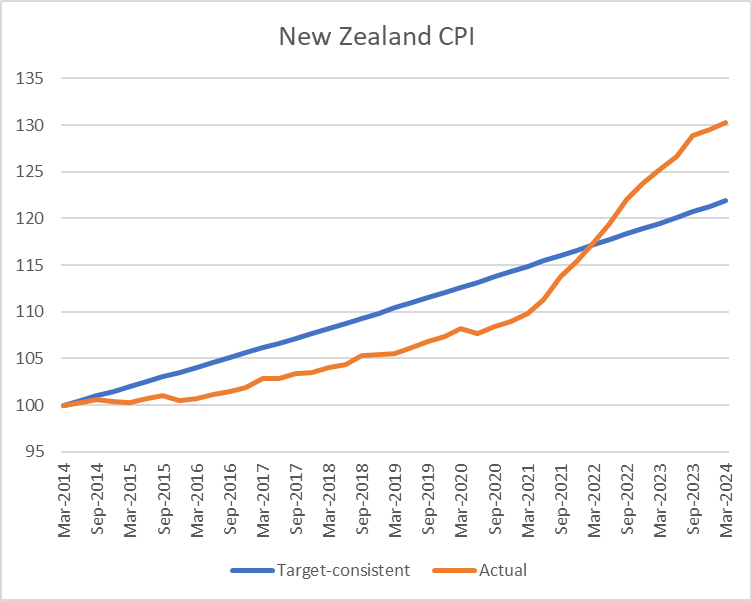
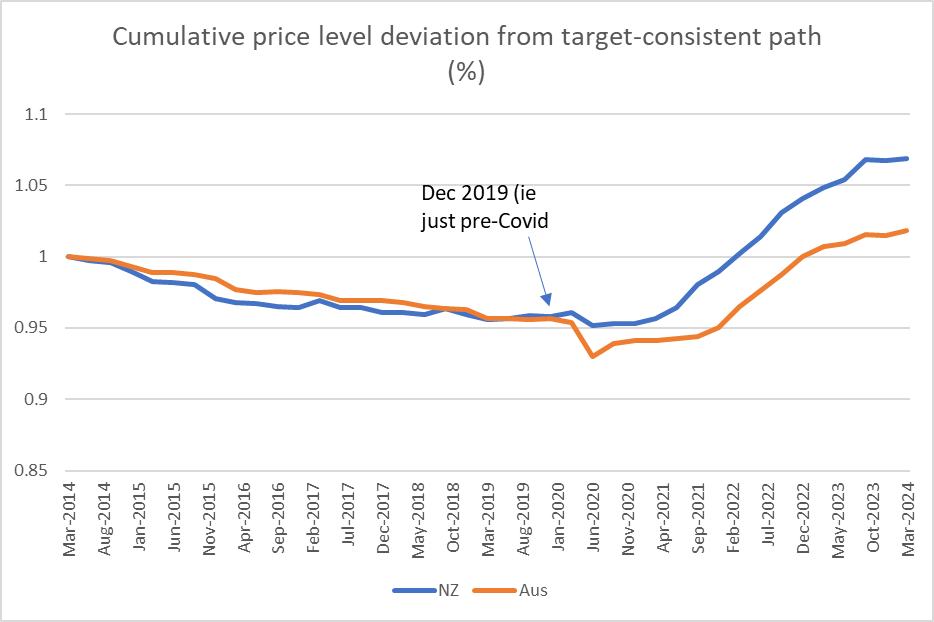
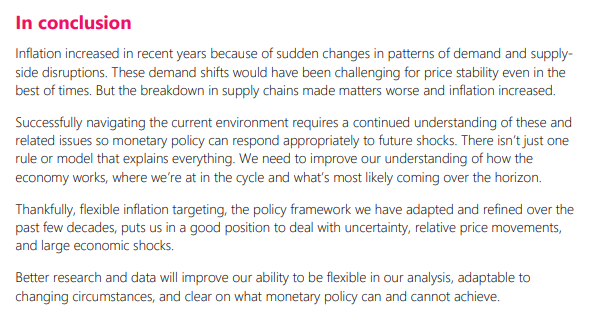
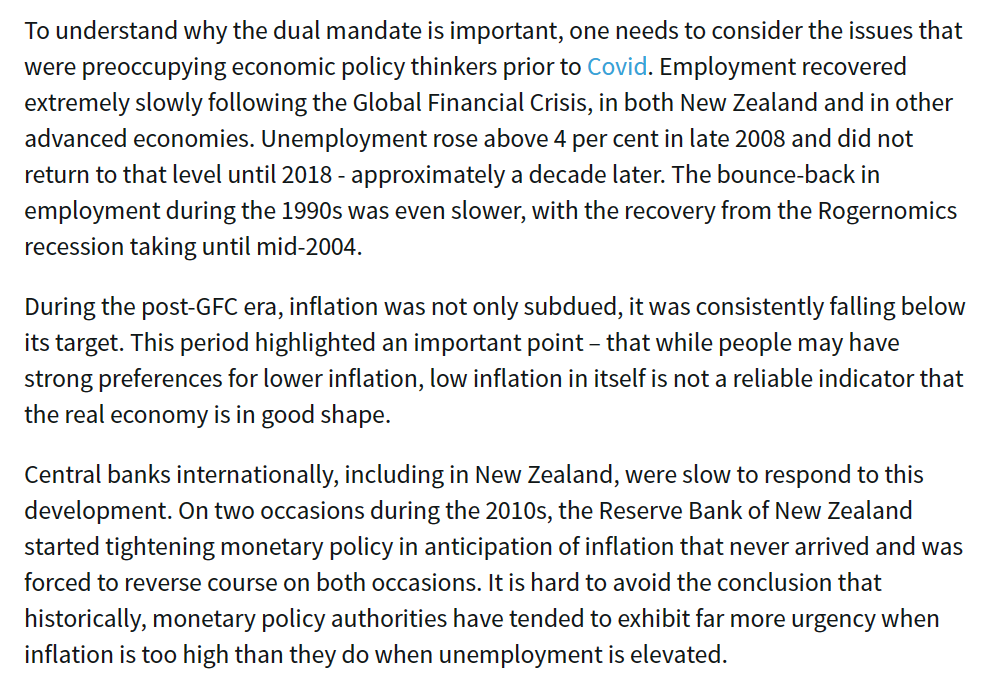
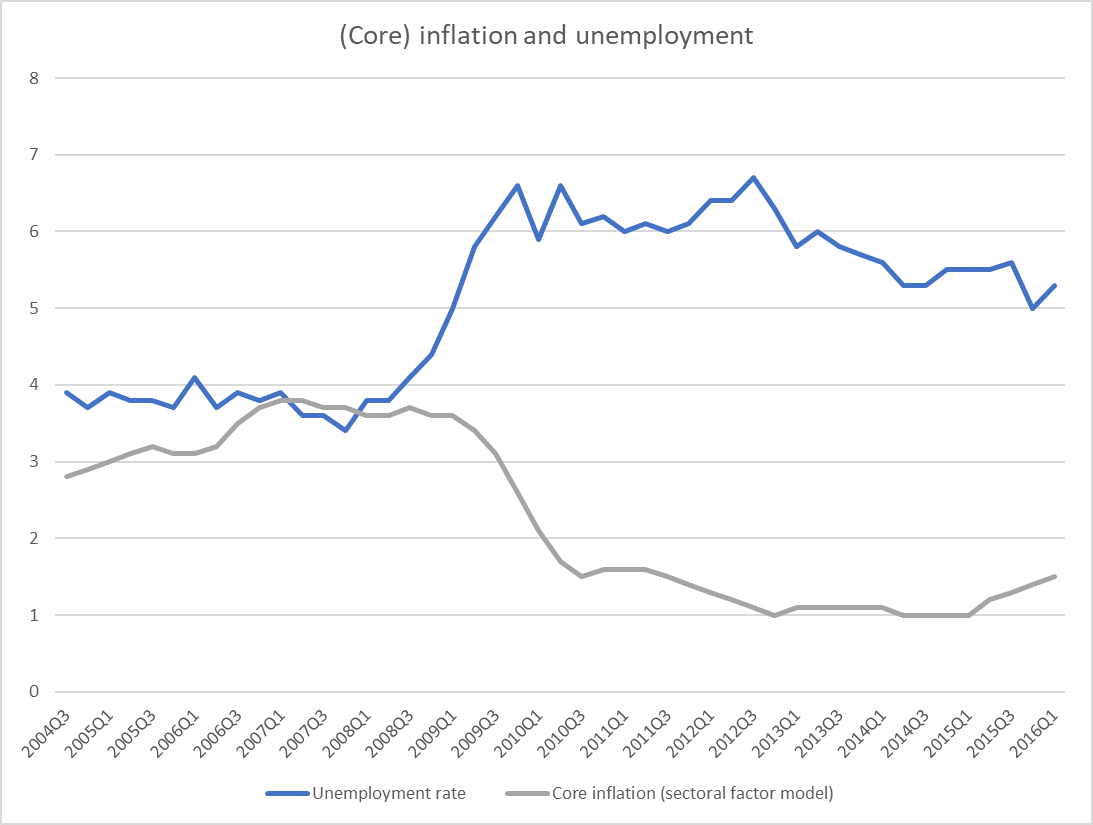
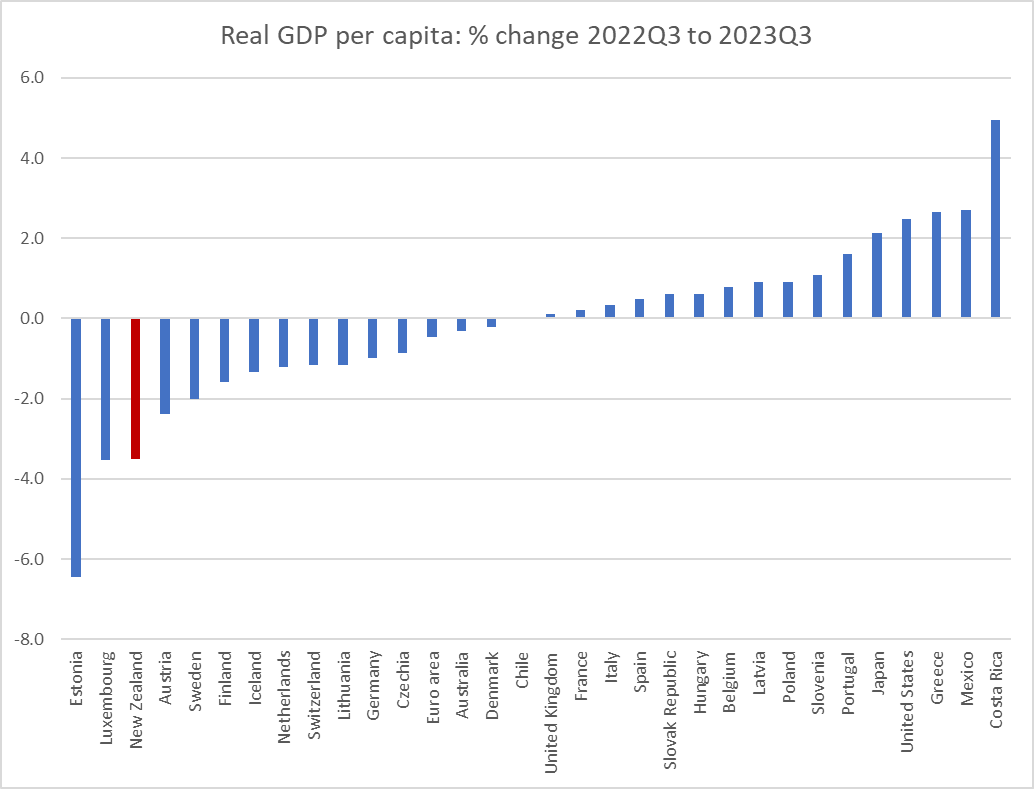
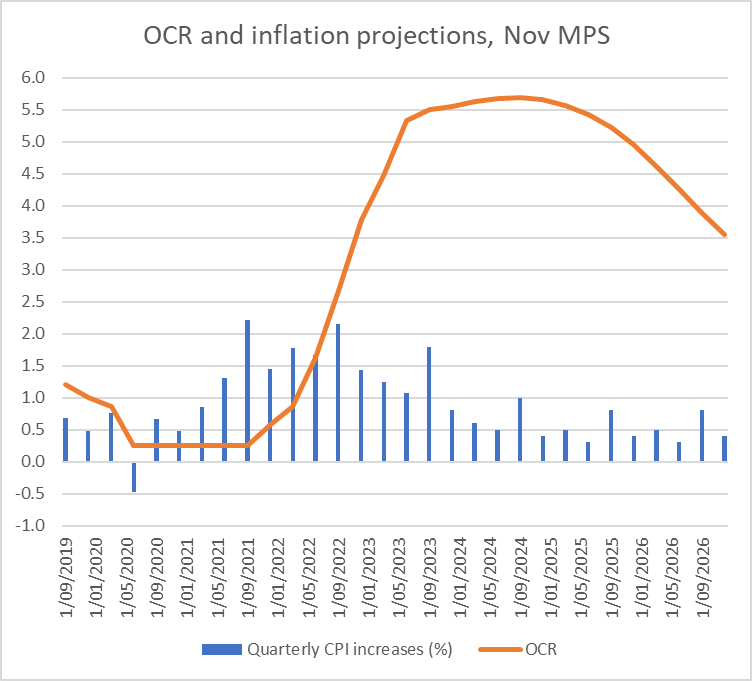
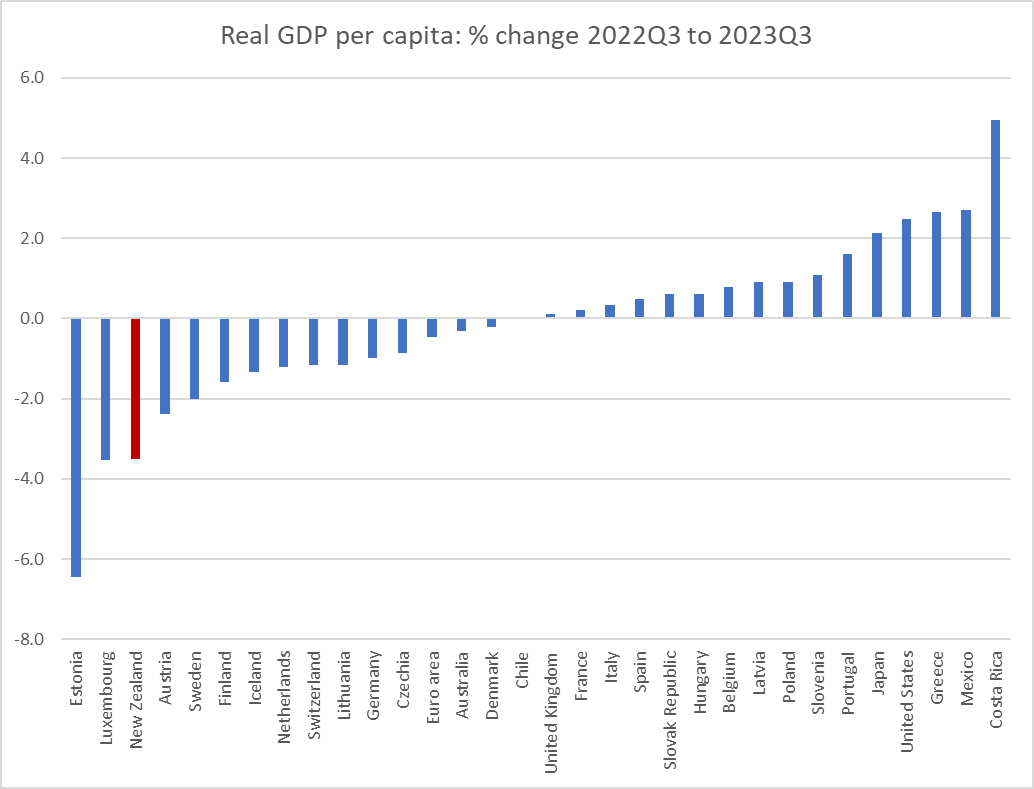
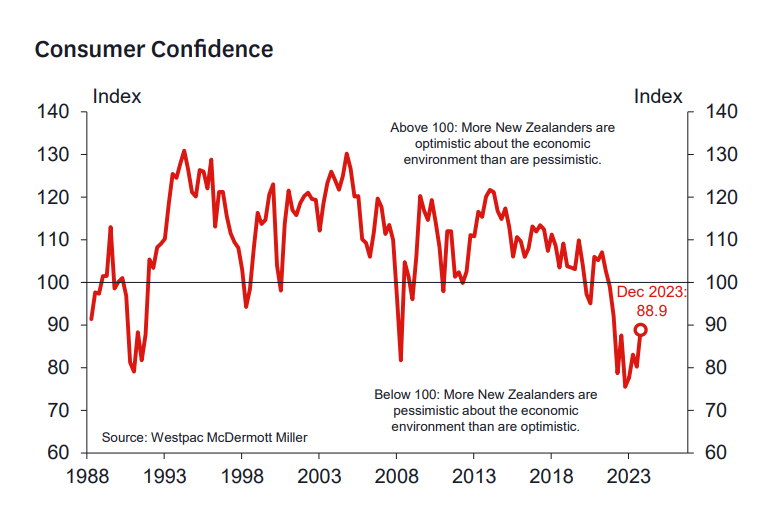
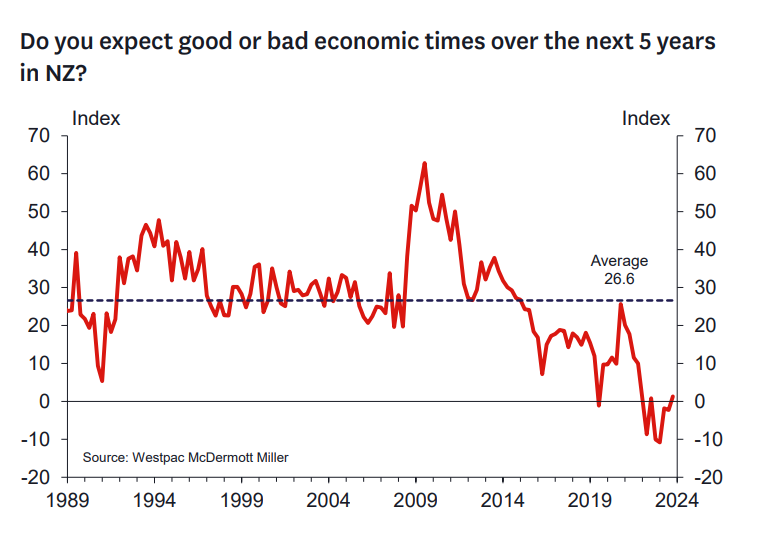
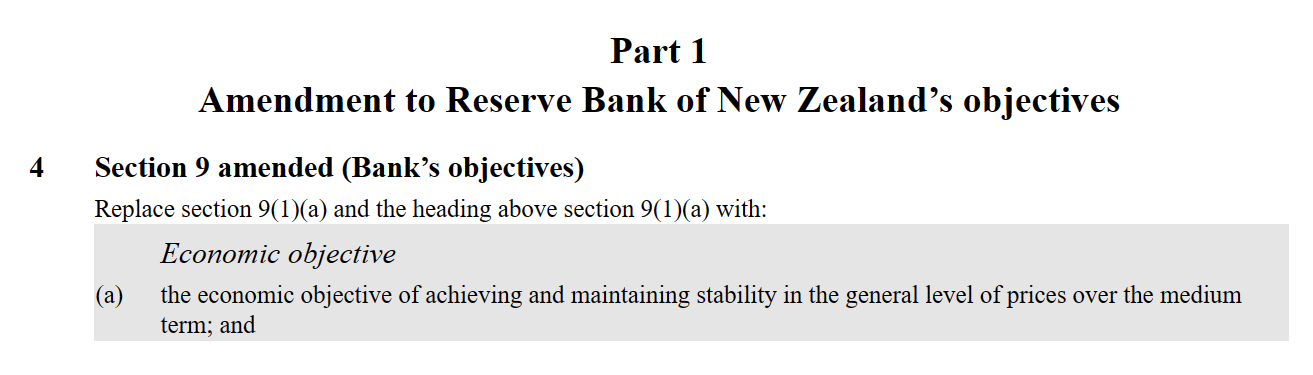
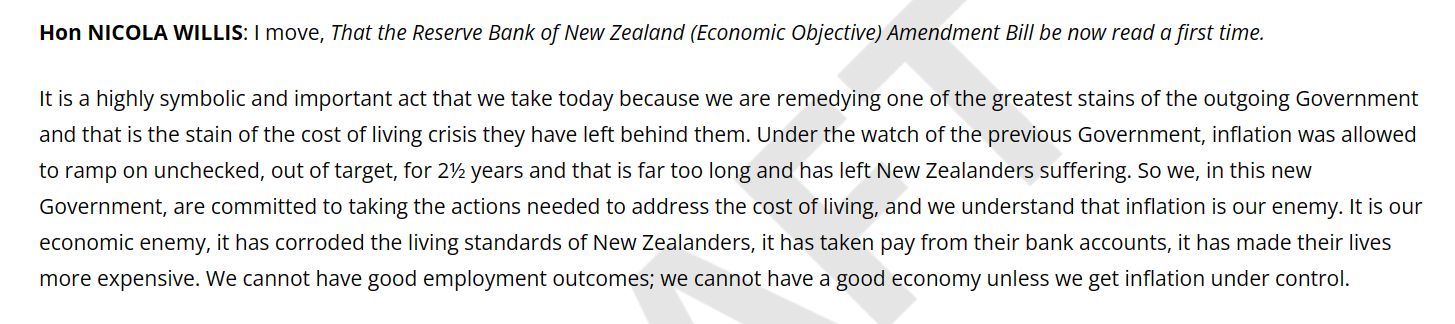

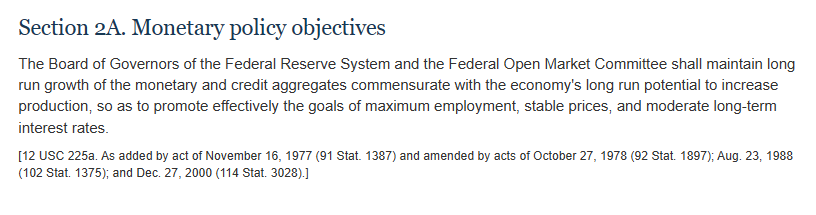
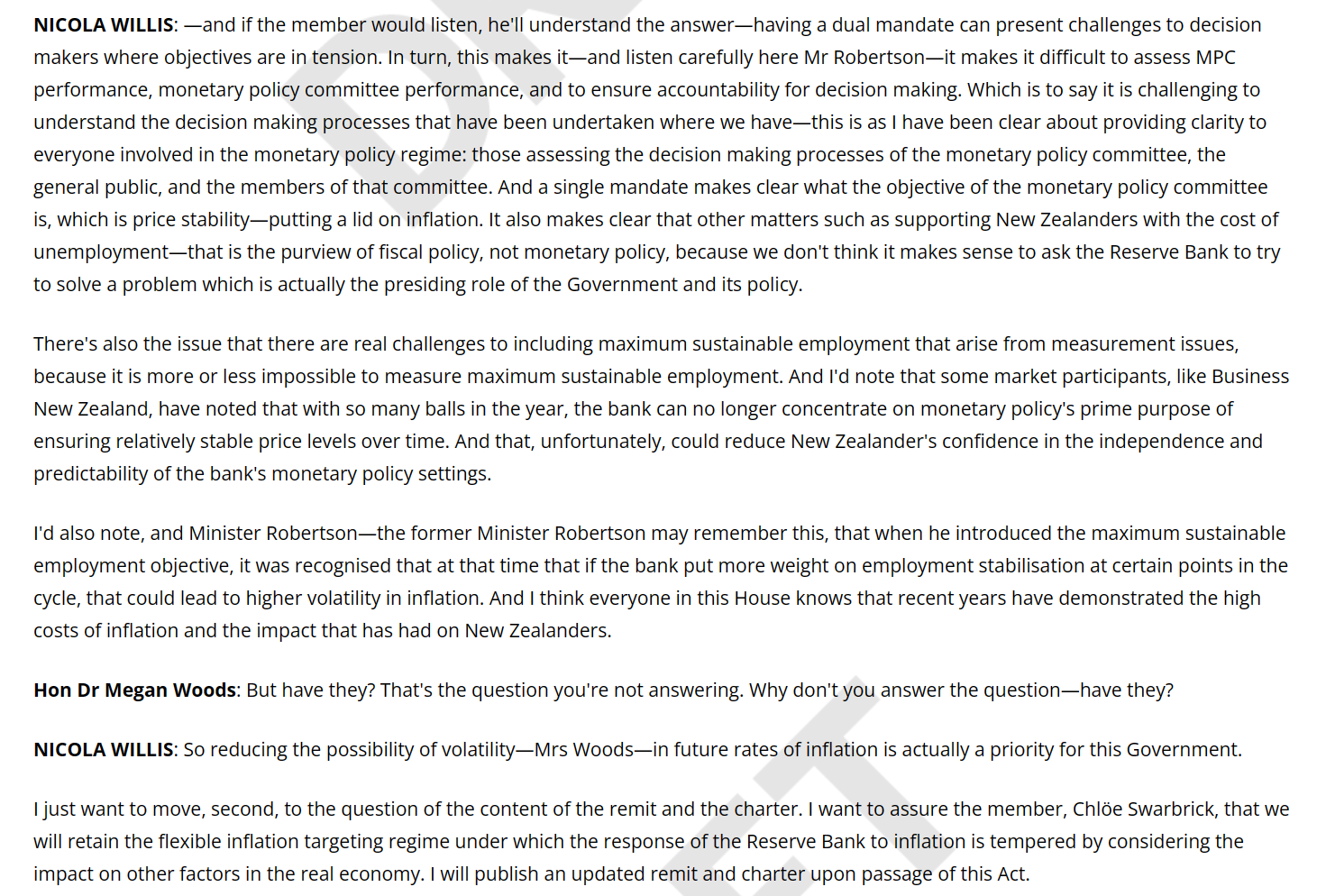


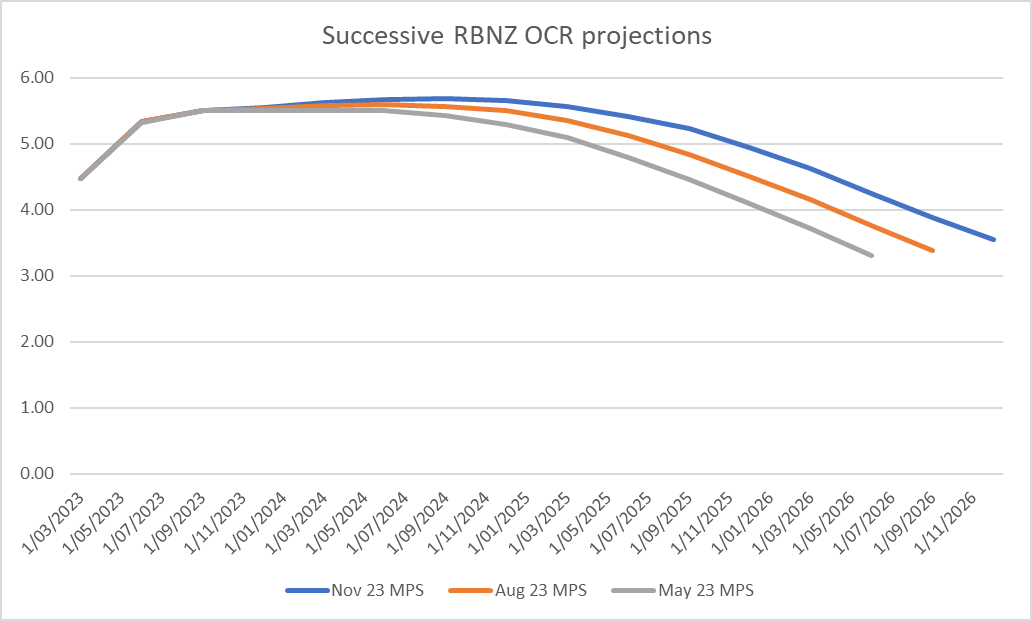
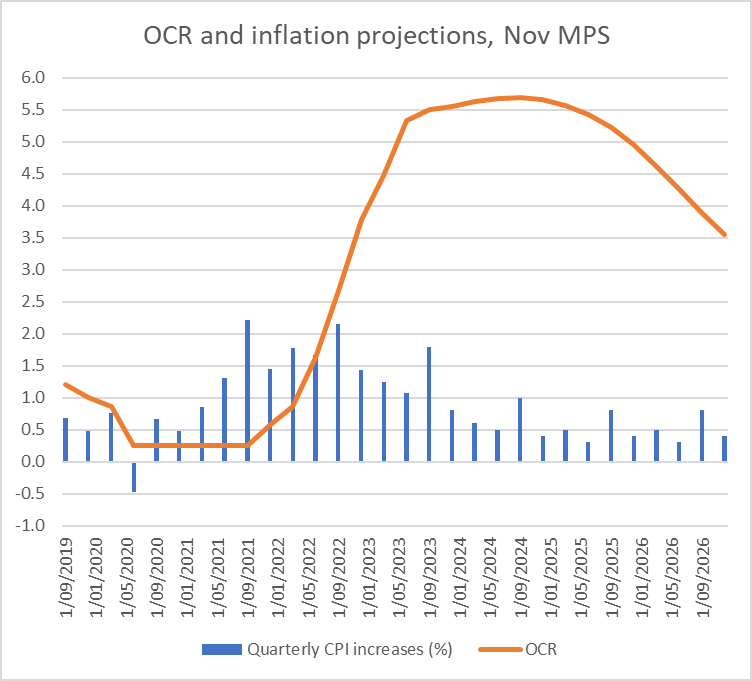
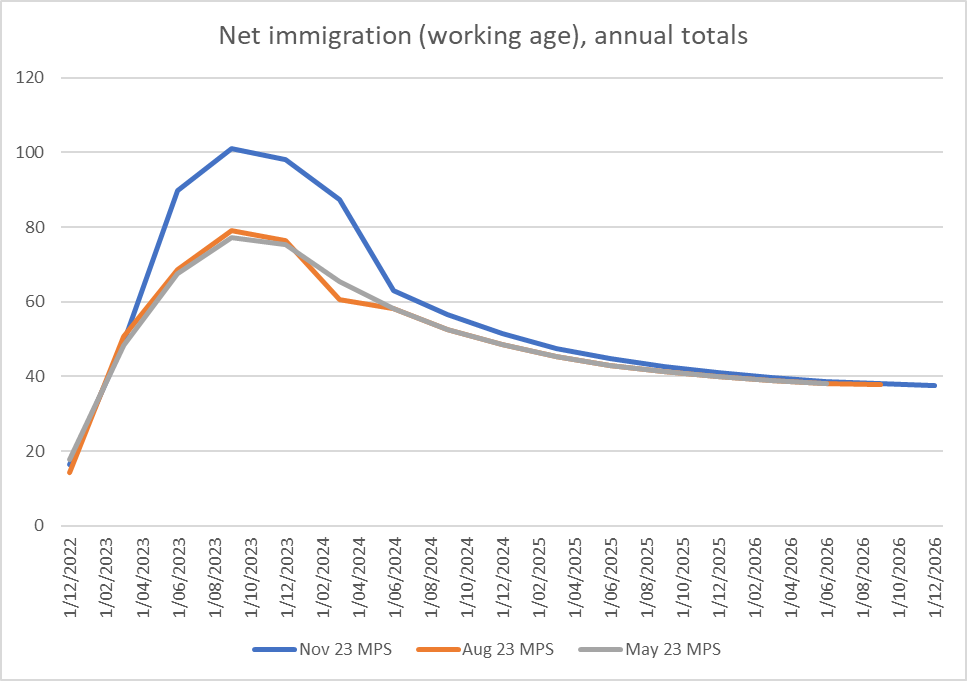
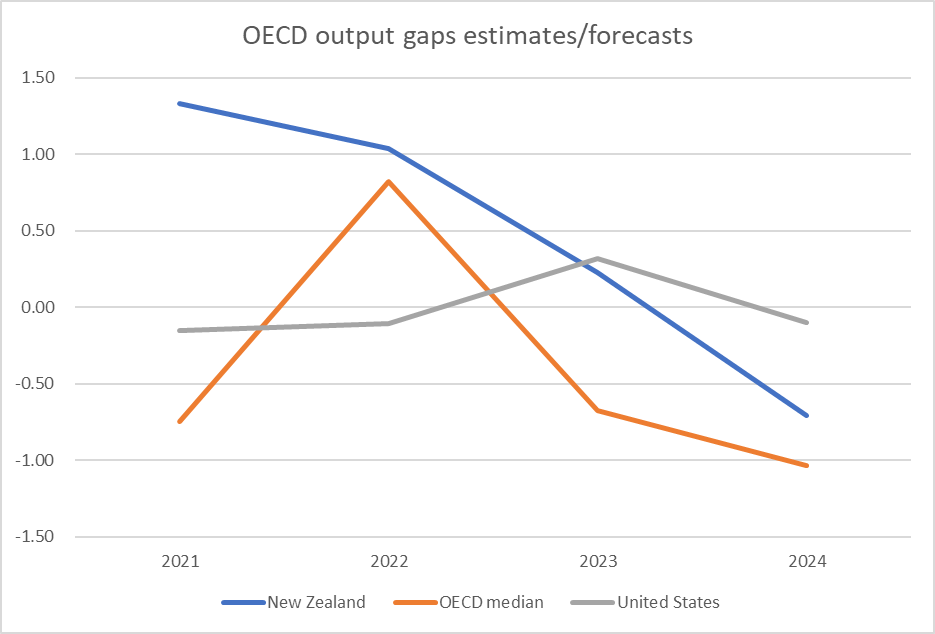
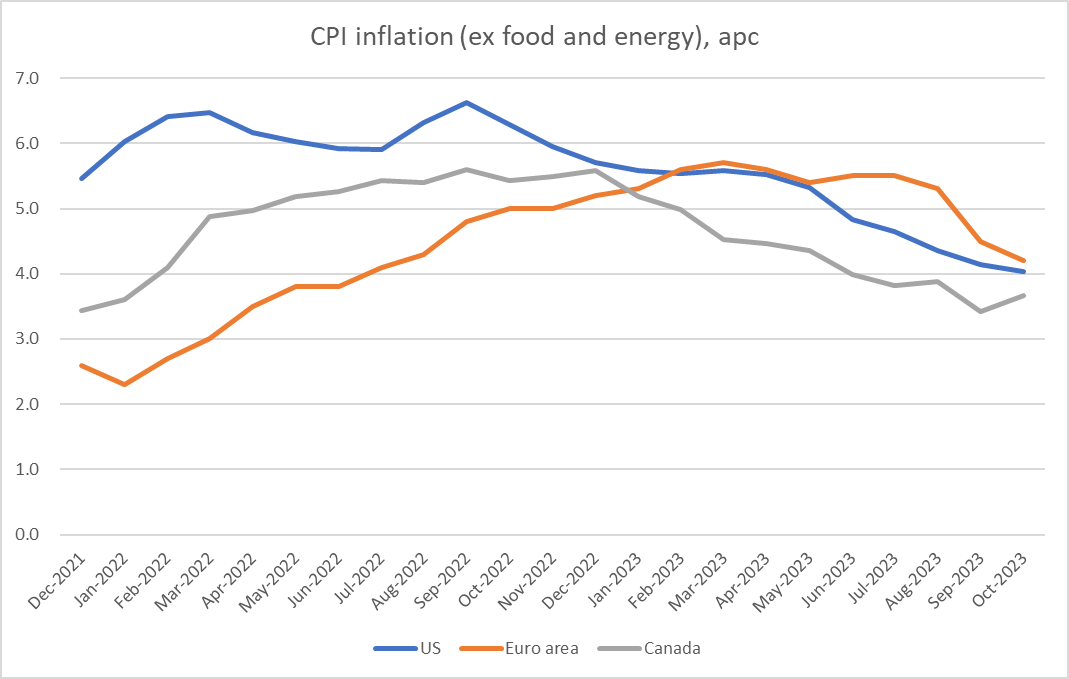
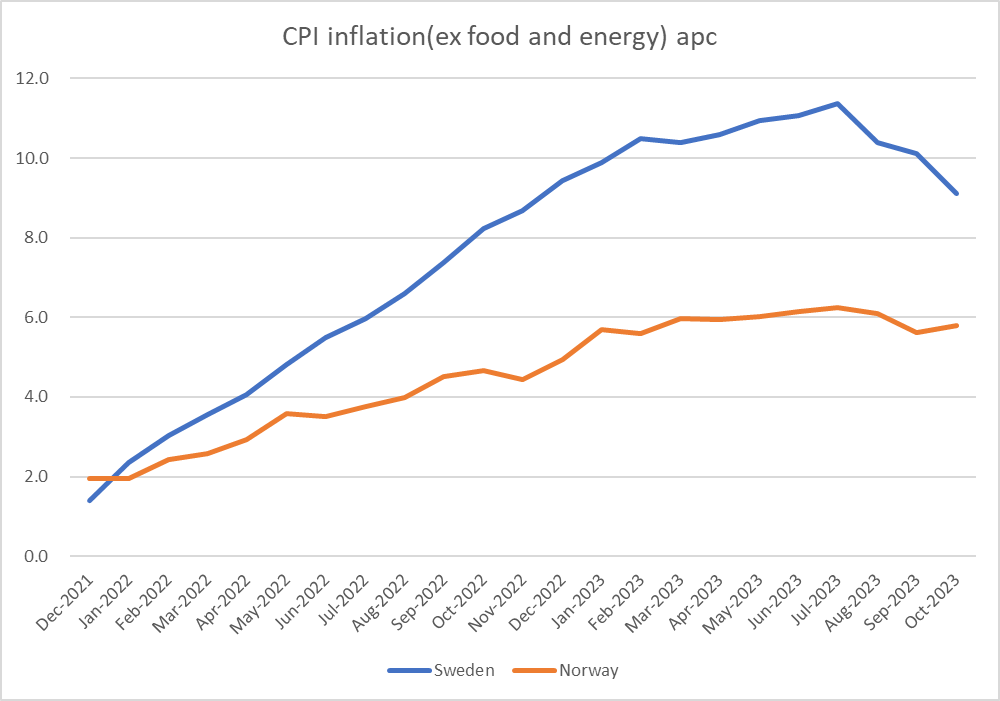
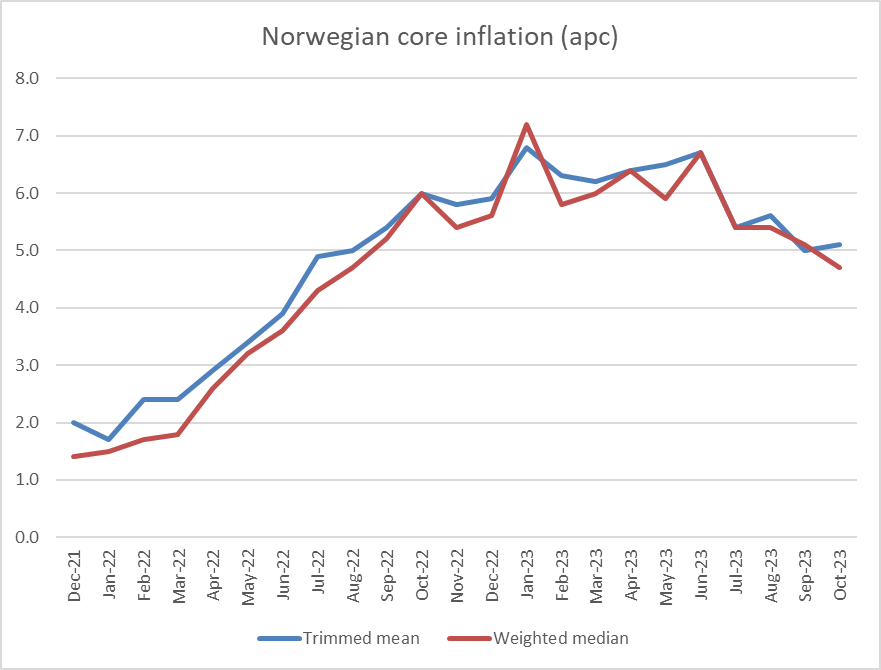
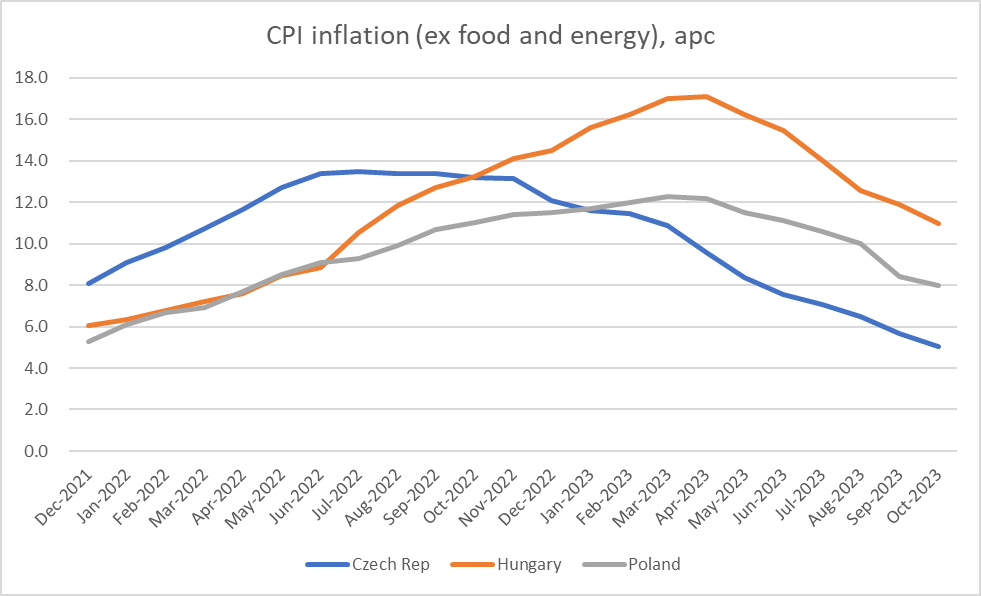
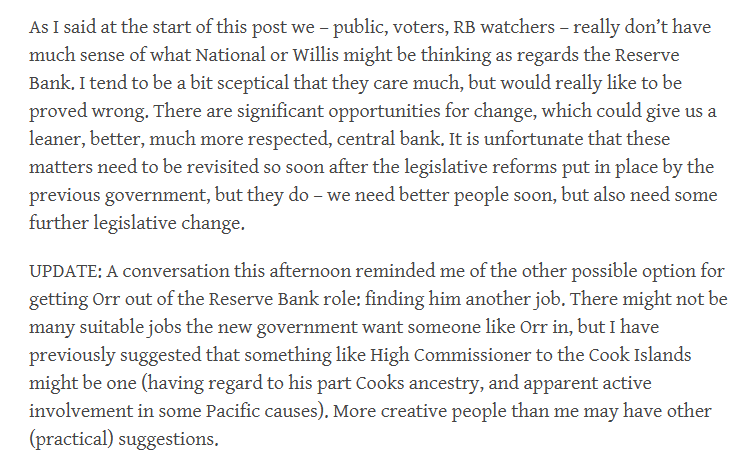

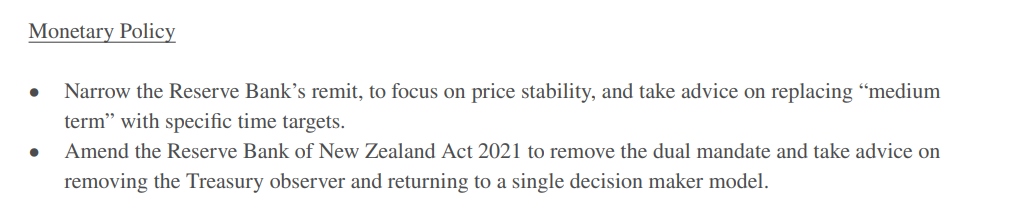
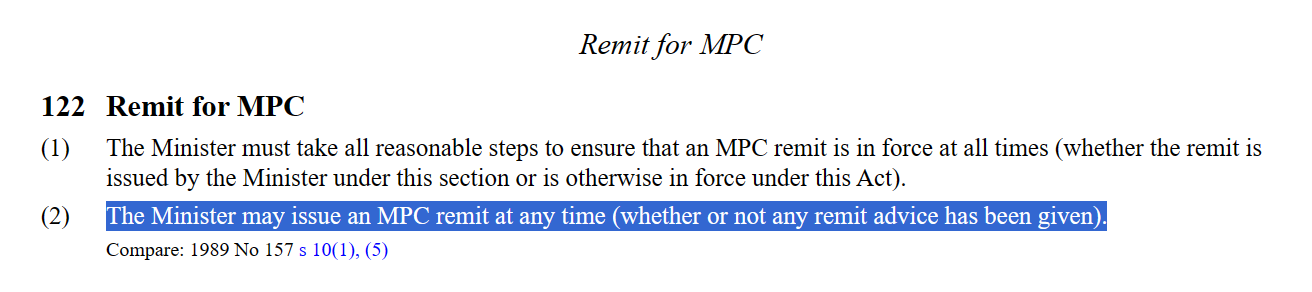

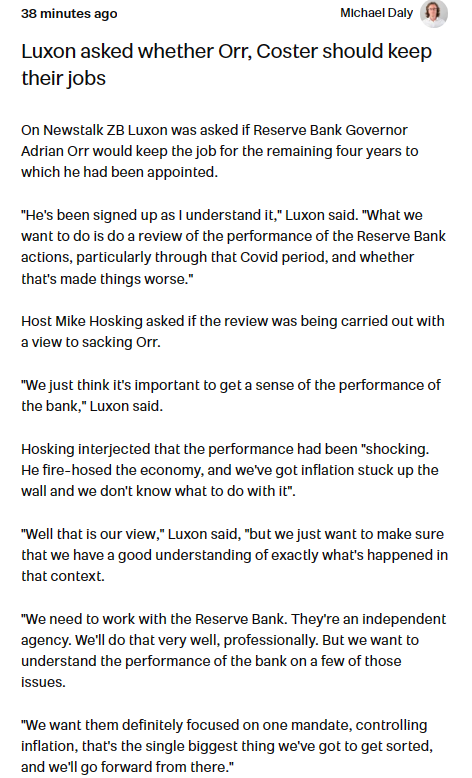



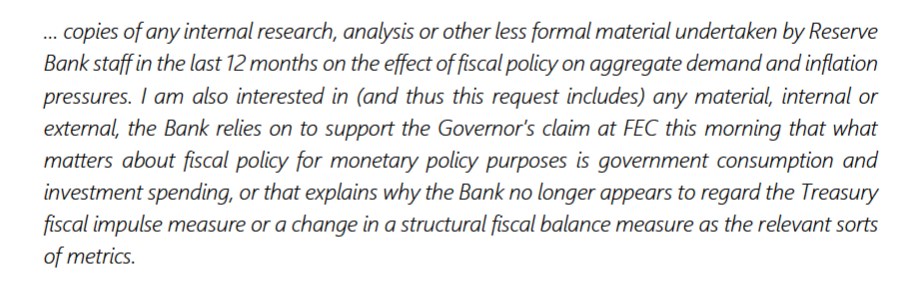
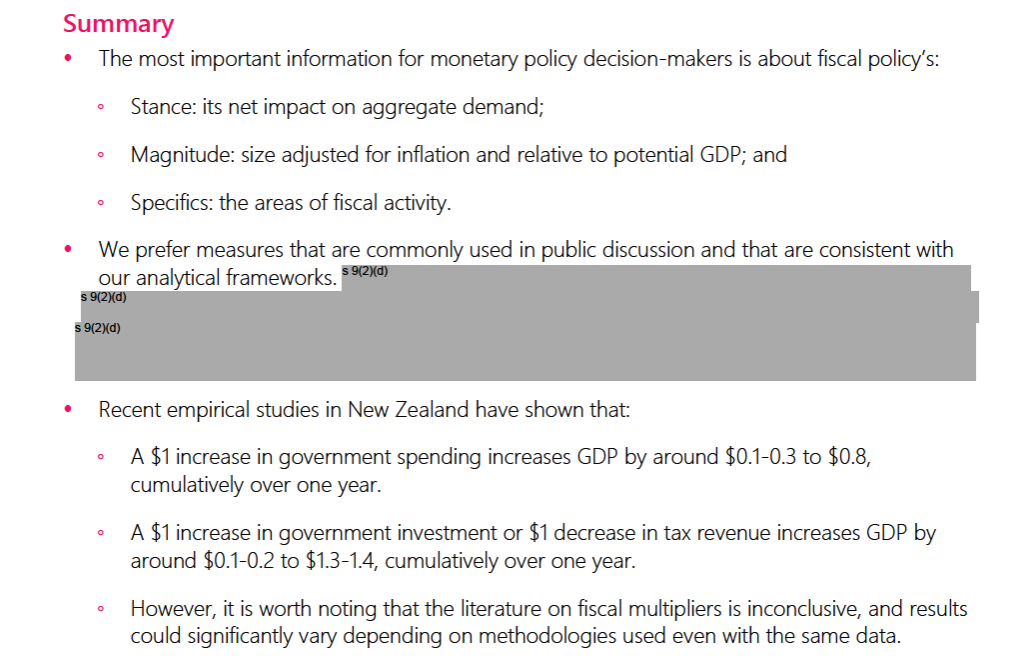


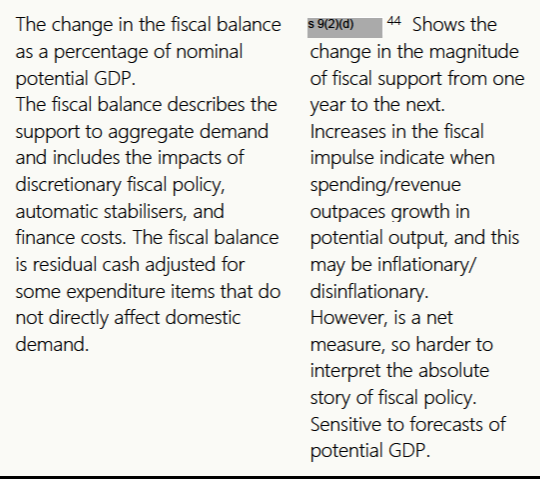

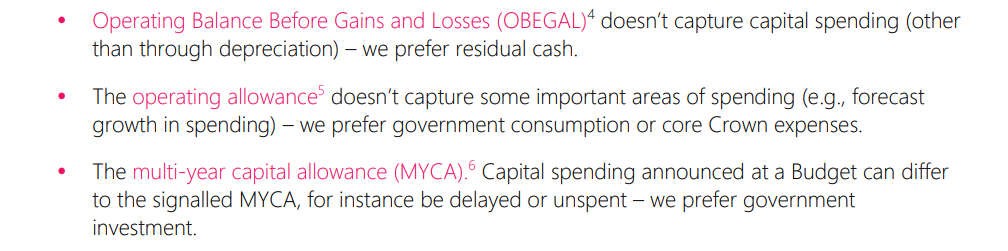


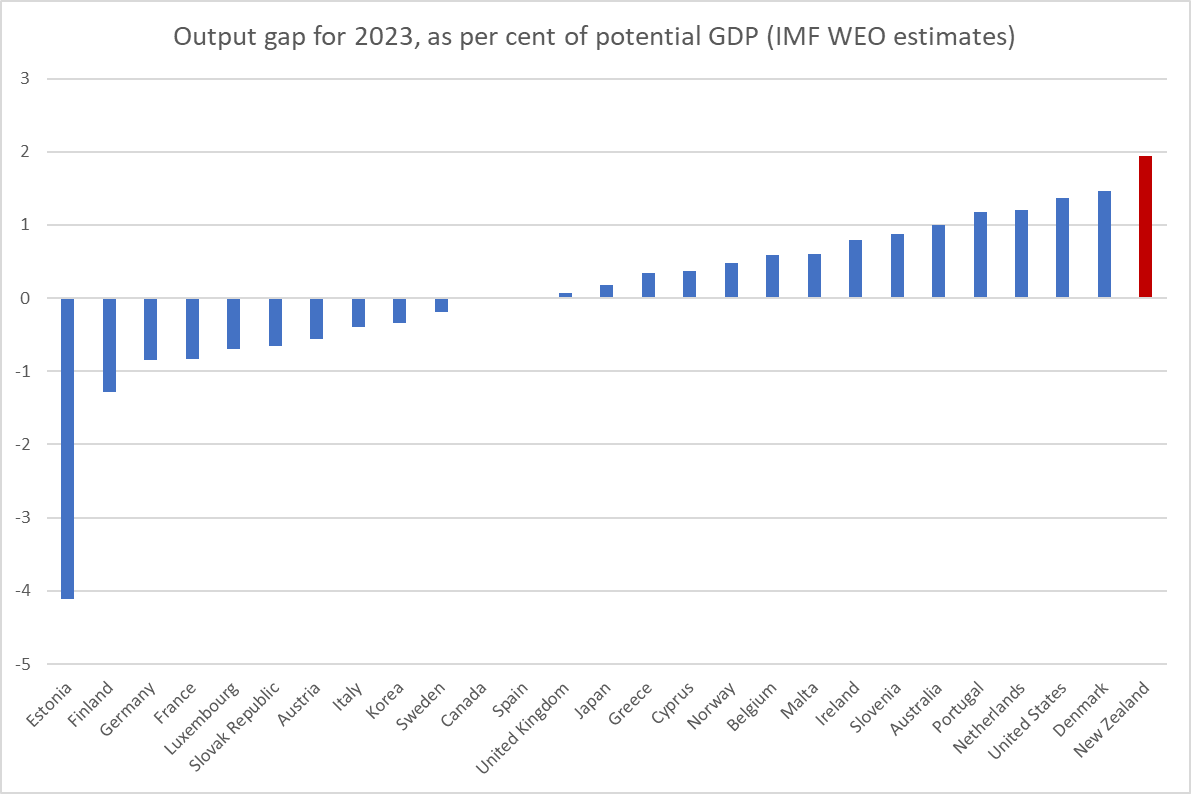
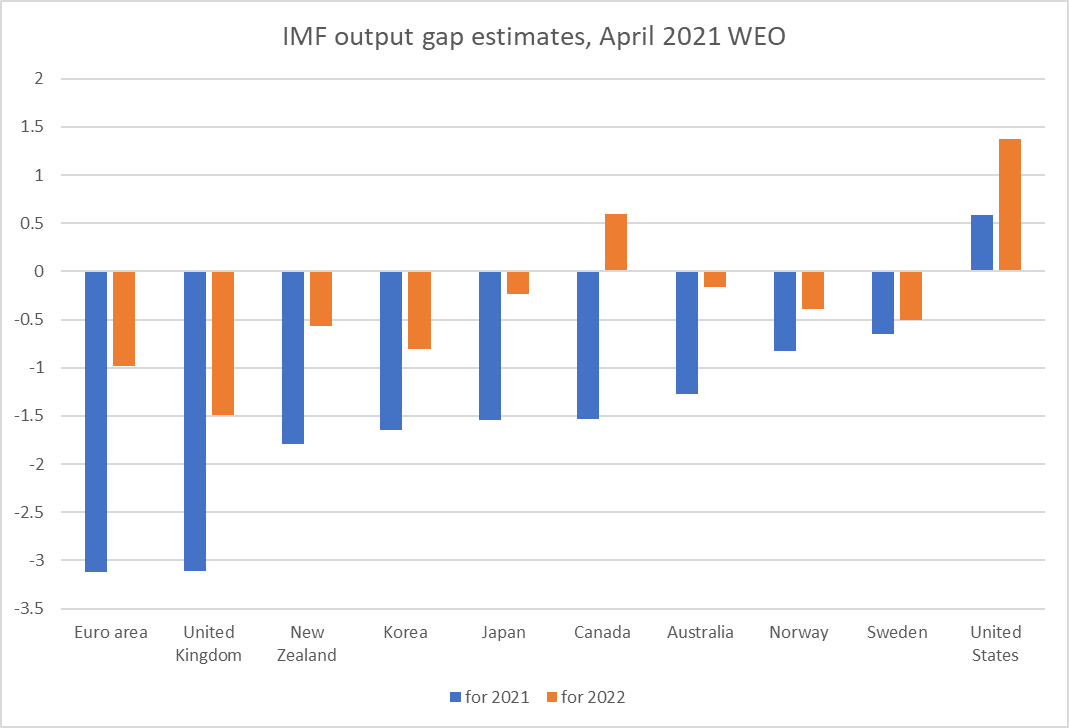


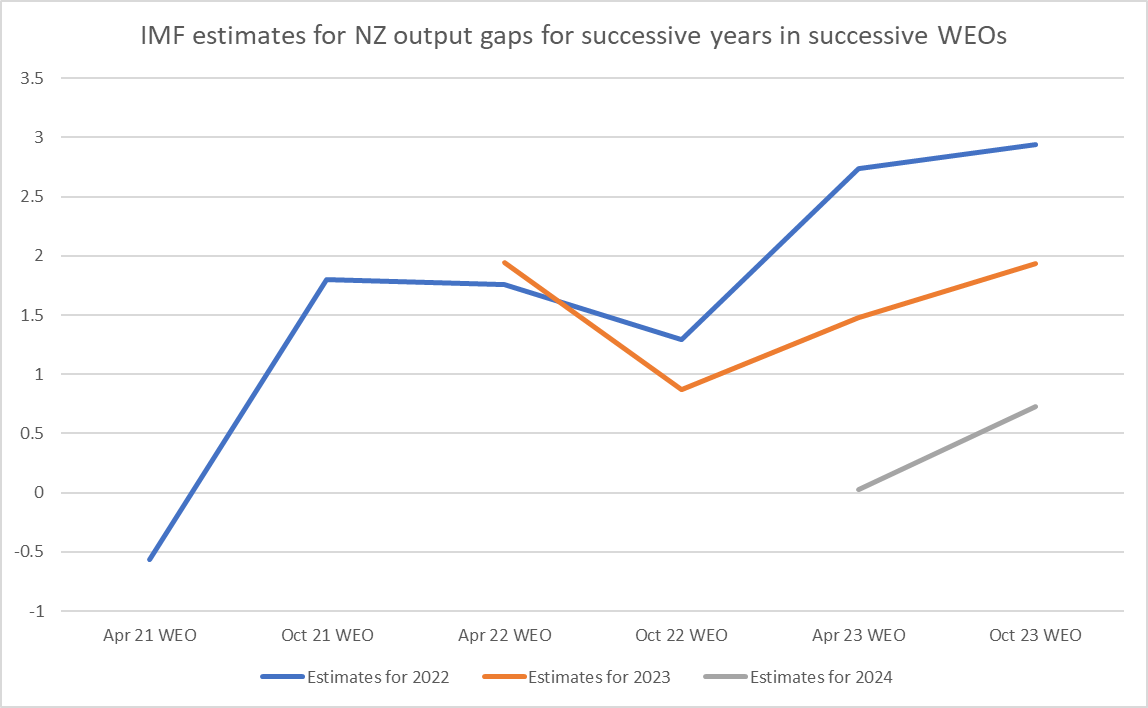

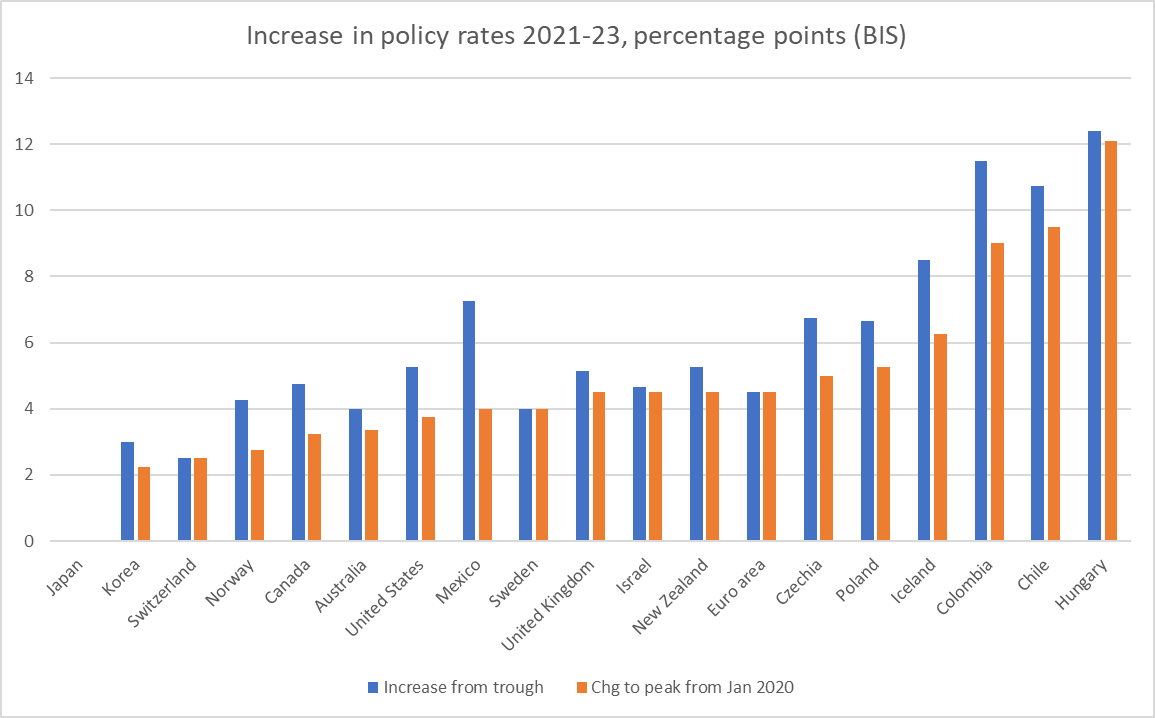
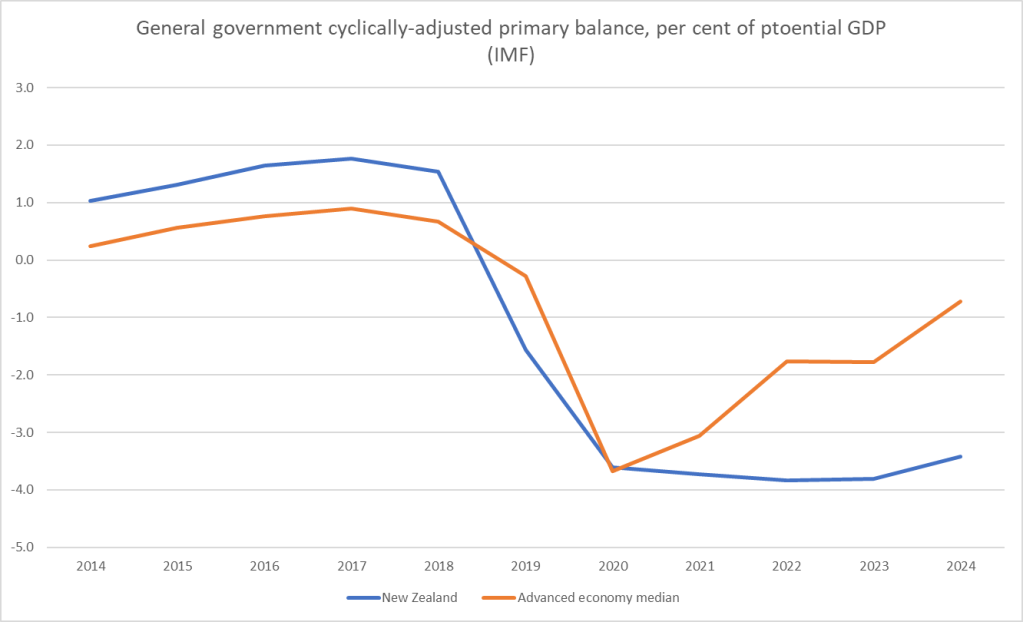
 croaking cassandra