Rather desperate defensiveness

The Governor of the Reserve Bank has this afternoon delivered his annual speech to the Canterbury Employers Chamber of Commerce.  In many respects it was an elaboration on last week’s brief OCR review statement –  “we might have to cut the OCR, and risks are tilted to the downside, but we don’t really want to”.

Beyond that, it wasn’t an impressive effort.  Once again, the Governor simply does not seriously engage with the arguments made by those who suggest that a lower OCR would have been, and would be, preferable.  Instead, he basically makes up an inflation story that simply isn’t supported by the numbers, and attacks straw men.  The defensiveness is disheartening.

Lets take the numbers first.  On several occasions the Governor repeats the claim that “Annual headline inflation is currently 0.1 percent. This is primarily because of the negative inflation in the tradables sector, and the decline in oil prices in particular.”

First, you can’t just ignore tradables prices –  when the target is expressed in terms of CPI inflation, and around half the index is tradables.  CPI inflation is a weighted average of tradables and non-tradables inflation, and tradables inflation is typically lower than that for non-tradables.  Perhaps one might set tradables to one side for a time if the exchange rate has just been moving very sharply –  exchange rate changes do tend to affect the level of domestic tradables prices (and so temporarily affect the inflation rate).  But the peak in the New Zealand TWI was 18 months ago now.  If anything, the lower exchange rate has been holding up, perhaps only a little, tradables prices in the last year.  And non-tradables inflation in the last year was only 1.8 per cent.  If inflation was really consistent with the target midpoint, we should expect to see non-tradables inflation around 2.5 per cent.  It is a long way off that at present.

Second, the Governor repeats the story from last week’s statement that really it is mostly about falling oil/petrol prices.  But it takes no sophisticated analysis to read the SNZ CPI release, or consult the Reserve Bank website, and find that CPI inflation ex petrol was 0.5 per cent last year –  at a time when the exchange rate has been falling.  The Governor also invokes the cut in ACC motor vehicles levies in his defence –  which would be fine, except that he completely ignores the offsetting government decision to increase tobacco excise tax yet again.  SNZ publishes a series of non-tradables inflation excluding government charges and the alcohol and tobacco component.  That series increased by 1.8 per cent last year –  exactly the same as the overall non-tradables inflation rate itself.  In other words, administered government taxes and charges do not explain low headline inflation, and neither (to a great extent) does low petrol prices.  To argue otherwise  –  without much more supporting analysis –  just isn’t supported by the data.

Here are a range of analytical and exclusion measures that one might reasonably look at in assessing current core inflation

Annual inflation, year to Dec 2015
Trimmed mean 0.4
Weighted median 1.5
Factor model 1.3
Sectoral factor model 1.6
CPI ex petrol 0.5
CPI ex food and vehicle fuel 0.9
CPI ex food, household energy and vehicle fuel 0.9
CPI ex cigarettes and tobacco -0.3
Non-tradables ex govt charges and alcohol and tobacco 1.8

As he did in last week’s release, the Governor focuses on the sectoral core factor model measure –  which just happens to  be the highest of any of the inflation measures.  Since previous OCR releases had not focused on specific core inflation measures, we might have hoped for either a balanced assessment from the Governor, or a more in-depth case for why we should regard the sectoral factor model as the best measure.  Why not, for example, (and at the other extreme) the trimmed mean (which has had quarterly deflation in three of the last five quarters)?  But there was simply nothing : just assertions.  (Incidentally, even if the Governor is correct that the sectoral factor model is the best read, it is quite a slow-moving smooth series, and a deviation of 0.4 percentage points from the target midpoint would not be insignificant. )

So perhaps we can debate quite where the underlying rate of inflation really is –  as I noted last week, neither the Governor, nor anyone else, knows that with any certainty.  But the Governor doesn’t engage in that debate, he reverts to attacking straw men.

Once upon a time –  a quarter a century ago, says he gulping –  a wise boss at the Bank objected when I was drafting Monetary Policy Statements attacking anonymous views of outsiders (“some commentators said”) and suggested that if we wanted to deal with criticisms we should identify them specifically, and respond to what people had actually said.  It took more work, but he was right.

By contrast, we hear today from the Governor the lofty declaration that “the Policy Targets Agreement is a relatively simple document [arguable, but we’ll let that pass] we continue to be surprised at the wide range of interpretations that we see in the media and in the commentaries”.  Really?    But the Governor gives no indication as to whose interpretations he has in mind, and what those interpretations might be.    I see comments occasionally from people who argue that the Act or the PTA should be changed, but I don’t recall seeing any very great divergences over the last few years in the interpretation of the PTA itself.  Yes, there is some uncertainty about what, if anything, the longstanding obligations to “have regard to the soundness and efficiency of the financial system” and to avoid “unnecessary variability in exchange rates, interest rates and output” might practically mean –  but there is nothing new about that, and the Bank itself can’t give an straightforward answer to those questions (a lot, inevitably, is “it depends on the specific circumstances”).  But the debate about the conduct of monetary policy over the last few years has mostly been squarely within an entirely conventional framework.  The Governor and his advisers (and initially many of the bank economists) expected inflation to pick up and hence thought the OCR needed to be raised a lot.  Others were more sceptical.  But both sides of the argument operated largely within a forecast-based model  –  suggesting that the OCR should be adjusted in line with the medium-term outlook for inflation.  As it happens, the Bank –  and those who adopted the same line –  were proved wrong –  but it wasn’t really a dispute about the PTA itself.  They were forecasting differences and –  while forecasting is hard –  the Bank and the Governor have been repeatedly wrong-footed by the data.  They had the wrong model.  Again, some of their international peers made the same mistake –  others were just constrained (or thought they were) by the near-zero lower bound.

The Governor also devotes space to attacking a related straw man. Indeed, this one is the centrepiece of the press release he put out with the speech:

“Mr Wheeler said that the Bank would avoid taking a mechanistic approach to interpreting the PTA.  Some commentators see a low headline inflation number and immediately advocate interest rate cuts:, he said.  A mechanistic approach can lead to an inappropriate fixation on headline inflation”

This is just the flailing around.  All his predecessors have also sought to avoid taking a ‘mechanistic’ approach to the PTA, so there is just nothing new or interesting in the assertion that he doesn’t want to be mechanistic (although some have argued that “mechanistic” might describe his own 2014 stance).   Perhaps more pointedly, I’d challenge the Governor to name a single commentator who has suggested that policy should be run in reaction to current headline inflation.  I can’t think of any.  I’ve been more dovish than probably any other commentator over the last year, and if anything I have repeatedly criticised the Governor for an unwarranted focus on headline inflation in his OCR releases (when he was arguing that the lower exchange rate would soon have inflation back to rights).  Who are these “mechanistic” people the Governor has in mind?

It is good to know that the Governor will “continue to draw on the flexibility contained in the PTA”, but in the end the PTA requires the Bank to focus on keeping inflation near 2 per cent.  It simply hasn’t succeeding in delivering that sort of outcome –  in fact, not once since the current Governor took office.  I’ve suggested that one practical approach to those repeated errors might be to aim for inflation a little higher than 2 per cent.   If the past forecasting errors continue –  and they may, because no one fully understands what is going on globally – it is more likely that actual inflation will end up around 2 per cent.  And if the forecasting errors do go away, actual inflation would come in a bit over 2 per cent –  not ideal, but not the worst outcome after years of undershooting, and consistent with the sort of flexibility the PTA provides.  Perhaps that is one of the strange interpretations of the PTA the Governor has in mind?    But it certainly doesn’t argue for driving policy off current headline inflation.

The country really deserves more engagement from the Governor, and some intelligent debate.  There are puzzles in the data that aren’t easy to resolve (there are new ones in today’s HLFS).  Resolving them and getting appropriate good quality policy from the most powerful  unelected official (and agency) in New Zealand isn’t helped by some mix of lofty condescension and attacking straw men –  cases no one is making –  rather than grappling with the alternative issues and arguments.

With all the resources at the Governor’s disposal, we should expect more from him than is evident in this defensive piece.  Those charged with holding him to account – the Board, the Minister, and Parliament’s Finance and Expenditure Committee should be asking hard questions, of him and of themselves.
 

Grudging adjustment – yet again

Once again the Reserve Bank and its Governor have started backing away from a view that interest rates are low enough to get inflation back fluctuating around the 2 per cent midpoint of the target range –  the focus the Governor and the Minister agreed on just over three years ago.

Two years ago, with the OCR at 2.5 per cent, they were gung-ho on the need to raise the OCR – quite openly asserting that they expected to raise the OCR by 200 basis points.  From the January 2014 review:

The Bank remains committed to increasing the OCR as needed to keep future average inflation near the 2 percent target mid-point.

As late as December 2014, with the OCR now at 3.5 per cent they still thought

Some further increase in the OCR is expected to be required

By June last year, they had belatedly started cutting the OCR, and then thought only perhaps 50 basis points of cuts would be required.

By last month, they had got to 100 basis points of cuts, fully reversing (at least in nominal terms) the 2014 increases.   While not totally ruling out the possibility of further cuts they observed of the target midpoint that

We expect to achieve this at current interest rate settings

Today, that optimism has gone and we are back to

Some further policy easing may be required over the coming year to ensure that future average inflation settles near the middle of the target range.

I guess that is their bottom line, and I suspect the forecasters are giving the Governor little reason for much optimism.  No doubt the “over the coming year” is designed to discourage people from focusing on the March Monetary Policy Statement, but as ever the data flow will determine that.  Most likely, the Governor will have to shift his ground yet again – as he continues, for year after grinding year, to be over-optimistic about the likely rebound in inflation and (indeed) about the strength of the (per capita) economy.

But he must be a bit torn.  Almost everything in today’s statement that deals with what has already happened would be pointing towards further OCR cuts (weaker global growth and rising uncertainty about it, falling international commodity prices, continuing weak New Zealand export prices, and weak inflation here and abroad).  Add to that the Governor’s continuing unease about the exchange rate –  when it weakens it is usually a sign of weakening economic prospects, but the Governor still thinks it is too high.

So he seems to rest his case on two arguments.

The first is that New Zealand’s inflation rate isn’t very low after all.

 Headline CPI inflation remains low, mainly due to falling fuel prices

But that just isn’t even factually accurate.  The target inflation rate is 2 per cent, and the latest headline inflation rate was 0.1 per cent.   But the inflation rate excluding petrol prices was 0.5 per cent.  Excluding all vehicle fuels and household energy costs it was 0.6 per cent.  And if we take something like the common international ex food and energy measure, SNZ tells us that inflation excluding food, household energy and vehicle fuels was still only 0.9 per cent last year.

And it isn’t government charges or tobacco taxes either –  as I noted last week, in highlighting that the inflation rate is the lowest in 70 years –  the impact of higher tobacco excise taxes and cuts in government charges totally offset each other in the last year.

Everything seems to rest on the Bank’s sectoral factor model measure of inflation –  which, as I noted last week, has increased somewhat to 1.6 per cent for 2015.   This has been the Bank’s preferred measure of core inflation over the last few years,  but it is quite unusual for a model estimate measure of core inflation to make it into the OCR press release.  Indeed, I went back quickly and looked at the OCR press releases since the start of 2013, and not a single one of them referred to a core inflation measure, let alone quoted a specific number.

The idea behind the sectoral factor model is sound, but it seems rather bold for the Governor to put so much weight on this particular measure when it seems to be at odds with the other indicators of underlying or core inflation.  I’ve already quoted some of the exclusion measures (the CPI ex petrol, or whatever), but the other core inflation measures on the Bank’s website have also been flat or falling.  At the other extreme, the trimmed mean measure of inflation was only 0.4 per cent last year.  Oh, and inflation expectations –  survey measures and market ones –  have been low and falling.

I’m not sure what the “true” measure of underlying inflation is –  and neither is the Governor –  but I don’t think the overall balance of indicators should be giving the Governor any reason for confidence about the current situation of the inflation rate relative to target.  It certainly isn’t all about petrol.

The Governor also apparently remains optimistic about a re-acceleration in economic growth in New Zealand:

growth is expected to increase in 2016 as a result of continued strong net immigration, tourism, a solid pipeline of construction activity, and the lift in business and consumer confidence.

But….even if immigration remains high, that only maintains growth  rates and doesn’t provide a basis for any acceleration (especially as the Bank in its most recent MPS announced its conversion to a view that immigration did not put any net pressures on demand, even in the short-term –  a change of heart which they have still not justified, or released any supporting papers for).  When I last looked, international guest nights growth looked to have levelled off quite markedly in the second half of 2015, and any lift in business and consumer confidence still looks quite modest (and certainly hasn’t taken any of the measures back above where they were earlier last year).  And all that is before we take into account the continuing weak international dairy prices (weaker than the Bank, and most producers will have been expecting), and the increasingly difficult international environment.    There is plenty of volatility in quarter to quarter GDP growth rates, and plenty of revisions too, but there doesn’t seem to be much there to give us confidence that economic growth in New Zealand will pick up materially, if at all, this year.   And inflation was already weak, and weakening, even when the economy seemed stronger, and income growth higher, 12 to 18 months ago.

Yet again, the Governor is behind the game –  grudgingly adjusting his line to barely keep up with the deteriorating flow of domestic and international data.  We might worry less if the weak inflation was the result of strong and resurgent productivity growth, but there is no sign of that either.  Instead, we’ve been left with an anaemic recovery and a high unemployment rate (rising over the last year).  Not everything is down to the Reserve Bank’s failures, but the Governor’s choices haven’t helped –  monetary policy is designed to deal with demand shortfalls.   The Bank should be held more forcefully to account for those choices.

In closing, I was sobered to look at the inflation rate ex food and energy.  New Zealand’s is 0.9 per cent.  That for the euro-area is 1 per cent.  The gap isn’t large, but with plenty of policy room at the Reserve Bank’s disposal, they really should have been able to keep inflation a lot closer to the target midpoint than the ECB –  grappling with the zero bound, and all the existential issues weighing on activity, demand and investment in much of the euro area.

Grant Robertson, the Reserve Bank, and the end of the Governor’s term

Further to my post the other day on Grant Robertson’s latest statement on monetary policy, Bernard Hickey has posted a substantial article about his interview with Robertson on these matters.  It is a useful piece to have –  certainly the most sustained discussion of monetary policy and Reserve Bank issues from Robertson since he became Labour’s finance spokesperson.

And yet it still poses more questions than answers, and still leaves Labour looking as though it has not really thought hard about either monetary policy or the reasons for New Zealand’s continuing economic underperformance (including the continuing large gap between New Zealand and “world” real interest rates).  As a voter and an interested observer/commentator, I found that pretty disappointing.   There is certainly space for a different approach to economic policy in New Zealand –  it is not as if either recent Labour or National led governments have managed to do anything that begins to reverse New Zealand’s relative economic decline.

But it is still looks as though they are more interested –  at least at this stage of the electoral cycle – in positioning (with their party base, and with the business community), and being seen to be different, than in the harder aspects of substantive economic analysis and concrete alternative policies (and the connection between the two of them).

Thus he says “the lowest inflation since last century combined with rising unemployment…is making a farce of monetary policy”, and “when you reach 15 quarters outside of the mid-point we do have to ask ourselves what we’re doing with monetary policy”.  And yet Robertson is very reluctant to criticize the Reserve Bank, and the Governor (formally the single decision-maker) in particular.  Indeed, he goes out of his way to praise the Governor and –  despite the single decision-maker model  – says “the targets agreement has not been met, but I wouldn’t want to bring that down to him personally at this time”.  Certainly, the Governor has advisers, but they are all employed by, and accountable to, him.

Instead, Robertson repeatedly argues for changing the framework.  He isn’t very specific about what he wants –  and it is still 20 months from the election – but the only point that keeps recurring in all his statements is a desire to have the Reserve Bank actively promote higher employment.  But he adduces no evidence whatever to suggest the reframing the wording of the Bank’s goal, along the lines of the Fed or RBA objectives, would make the slightest bit of difference to how the Reserve Bank actually runs monetary policy.  Past Reserve Bank research suggests that, on average over time, the Reserve Bank of New Zealand has reacted to incoming data in much the same way as the RBA or Fed have done.  Robertson either knows that, or should do, so the onus is on him to explain how his approach would make a difference, in substance rather than rhetoric.

And there is still nothing on the “new tools” Robertson has talked of needing.  When Hickey asked him about the variable Kiwisaver rate proposal Labour took into the last election, all he would say was that it was under review, and “that wasn’t mentioned today and won’t be in the foreseeable future”, adding (Hickey’s words) that “Labour preferred to have a simple policy that gave voters certainty”.  Which is all fine no doubt, but doesn’t give hardheaded observers reason to think Labour actually has serious alternative tools in mind.  That shouldn’t be surprising, as the tool the Reserve Bank does use is the tool other central banks use –  at least until they exhaust its potential when policy rates get to or just below zero.

It seems to me that there are two quite important separable issues:

  • the Reserve Bank has not done a particularly good job in the last few years of carrying out the Policy Targets Agreement.  That failure has been particularly stark since the 2 per cent midpoint reference was added in 2012.  With (as Robertson notes) inflation very low and unemployment high and rising, it is a pretty clear-cut case of a shortfall of demand, and a lower OCR is the best tool for stimulating additional demand.    The Reserve Bank can do something about that, but has failed to do so –  as Robertson notes, he was among those uneasy about the OCR increases in 2014, which were unnecessary, and the Bank (the Governor) has been slow to lower rates since.  Real interest rates now remain higher than were two years ago, when dairy prices were at their peak.
  • the disappointingly poor economic performance of New Zealand over recent decades, including such symptoms as the large gap between New Zealand real interest rates and those abroad, and the persistently high average real exchange rate.    As it has abandoned support for the existing monetary policy framework over the last few years, Labour has tried to imply (perhaps especially to its base) that there is something about the monetary policy framework that Labour could fix, offering some material improvement in our economic performance.  Neither Phil Goff, David Cunliffe nor David Parker ever quite managed to explain the connection.  Robertson has done no better.  That isn’t surprising, because it really isn’t there.  There might be better ways of articulating the objective, and there are better ways of running/governing the Reserve Bank etc, but none of them offer anything much in addressing the structural underperformance of the New Zealand economy.

Veteran commentator and analyst of left-wing politics, Chris Trotter wrote a piece the other day suggesting that Labour and the Greens were adopting an approach, akin to that in the early 1980s, of getting alongside the business community  –  getting them to the point where business was comfortable that an alternative government would not “scare the horses”.  I’ve no idea if that is an accurate description, but Robertson’s comments don’t look inconsistent with Trotter’s story.  I was interested, for example, in Robertson’s reaction to the question of whether Graeme Wheeler should be reappointed next year: Wheeler’s term expires almost three years to day from the date of the last election. Robertson doesn’t refuse to comment, but goes on to express his regard for Wheeler (twice), only then concluding that “ultimately it won’t be a decision I’ll be involved in”.

I have no idea, of course, whether Graeme Wheeler will even seek a second term, but whether he does or not, I think there should be some disquiet about the fact that his term expires in late September next year.  Monetary policy is now hardly something that the main political parties are united on (unlike the situation from 1990 until 2008, when any differences were about details, and the statutory goal united National and Labour), and it doesn’t seem very satisfactory that, for example, the current government could appoint someone to the office of Governor (single decisionmaker across a range of policy areas), taking office perhaps in the middle of an election campaign, or indeed just as a new government was taking office.  It isn’t a problem if the current government is re-elected, but (say) a Labour-led government supported by the Greens and/or New Zealand First might have a rather different view about priorities and emphases for the Bank.  The Governor has a degree of personal policy autonomy not shared, for example, by heads of core government departments (eg the Secretary to the Treasury).

The last time a Governor’s term expired in an election year was in 1993 (2002 was different –  Don Brash resigned just before the election campaign, and a new permanent appointment was not made until after the election result was determined).  But, as I noted, on that occasion National and Labour went into the election with no real difference on the Reserve Bank Act.  On that occasion, the Reserve Bank’s Board and the then Minister agreed to reappoint Don Brash in December 1992, well before any election year market uncertainty  (or campaigning) took hold.  And the first Brash term was due to expire a couple of months before the election would normally be due.

The situation next year seems much less tractable.    Wheeler’s term expires more than three years after the date of the last election.  And Labour seems sure to campaign for material changes to the Act (as would its potential future support parties).   And if Graeme Wheeler does not seek another term, any capable person pondering applying for the job in early to mid 2017 might be more than slightly uneasy –  it not being clear what the substance of the role might actually be.    I hope the Board –  and perhaps the Minister  – have already begun to think about the issue.  I’m not sure what the best way ahead is.  These clashes don’t happen often, but perhaps one option for the longer-term might be six year terms for the Governor, rather than five –  so that a new gubernatorial appointment was always in the middle of an electoral cycle.  For now, I wonder if it might be wise to consider extending the Governor’s term for another year. to allow longer-term decisions to be made with greater clarity about the longer-term direction of the Reserve Bank and New Zealand’s monetary policy regime.  As longerstanding readers might imagine, I’m hesitant about that option for a number of reasons, but none of the alternatives look ideal either.

In this post I haven’t touched at all on Robertson’s comments on immigration –  with which I am generally sympathetic, although sceptical about the extent to which immigration policy can be managed in a countercyclical way.  And countercyclical issues are not where the real debates about the economics of New Zealand’s large scale inward migration programme should be centred.


Grant Robertson and a 21st century monetary policy

Grant Robertson  has a statement out today asserting that “Monetary Policy Must Get into 21st Century”.  Setting aside the fact that his party was in office for half the 21st century so far, had two reviews undertaken of the framework (one by Lars Svensson, an internationally-regarded expert, and one by the Finance and Expenditure Committee), and made no changes to the thrust of the framework (goals, powers, responsibilities etc), it really isn’t clear what Robertson wants.   He talks of wanting “modern tools”, but the tools our Reserve Bank uses are entirely normal.  Indeed, since the OCR was introduced to New Zealand only in March 1999, it must almost count as a 21st century tool.  Going into the last election, Labour did propose a (fairly weak) new tool, the variable Kiwisaver rate, but indications since have been that they were backing away from that.  So what alternative tools does Robertson now have in mind?

Robertson rightly points out that inflation has not been at 2 per cent –  the Bank’s target –  since the current Policy Targets Agreement was signed.  We didn’t have that problem previously –  inflation was, if anything, typically a bit above the mid-point of the target range.  That suggests the problem is not with the goal –  a medium-term focus on price stability  – but with the way the Reserve Bank has been handling incoming information.  Quite possibly the challenges they face have intensified in recent years, but despite having full policy flexibility –  never close to zero interest rates –  they haven’t handled them very well.  One might reasonably raise questions about that failure, and the failure of those charged with holding the Bank (and the Governor personally) to account (the Board and the Minister), but there is just no evidence that the target or the tools are the problem.

As I’ve said before, I’m not suggesting the way the Act is written is ideal, and if we started from scratch I would probably suggesting writing the goal a bit differently.  But doing so would be to help articulate why we aim for something like price stability over the medium-term.  It would be unlikely to make much difference at all to how policy was actually conducted.  That depends primarily on the Governor and the senior advisers he gathers around him.

Better monetary policy –  delivering better outcomes around 2 per cent inflation –  over the last few years would have narrowed the gap between New Zealand and world interest rates, which was (temporarily) unnecessarily widened by the Governor, but it wouldn’t have closed it.  That gap has been there for decades, and isn’t a reflection of how the Reserve Bank runs monetary policy.  There are things that governments can – and should – do that would sustainably close the gap, but (rightly) they aren’t things the Governor or the Reserve Bank has any power over.

A previous rant on much the same subject from a few months ago is here.


Some thoughts on the inflation data

Perhaps not surprisingly there has been a lot of coverage of yesterday’s CPI outcome –  an inflation rate of only 0.1 per cent for the year; materially lower than either the Reserve Bank (in its December MPS) and all other published forecasters had expected.

Quite what the numbers mean isn’t so clear-cut, and I’ll come back to that, but it is very low inflation.

Of course, this is an era of low inflation.  According to the OECD database, nine OECD countries had even lower inflation (or deflation) than we did last year –  eight of those countries have policy interest rates at zero (or even a bit below).

The media made much of our inflation rate being the lowest since 1999, but they probably missed the story.  After all, 1999 isn’t that long ago (and the target was lower then).  And in those days, the CPI included retail interest rates, and interest rates dropped by around 400 basis points in 1998.  All the experts thought that in a deregulated economy including interest rates in the CPI was daft –  apart from anything else, it meant that when the Reserve Bank tightened monetary policy, inflation temporarily went up.  So daft in fact that the Policy Targets Agreement in place at the time, signed by Winston Peters and Don Brash, set the target in terms of CPIX (ie the CPI excluding credit services).  In fact, the way the official CPI was calculated was changed shortly afterwards to essentially the approach used today.

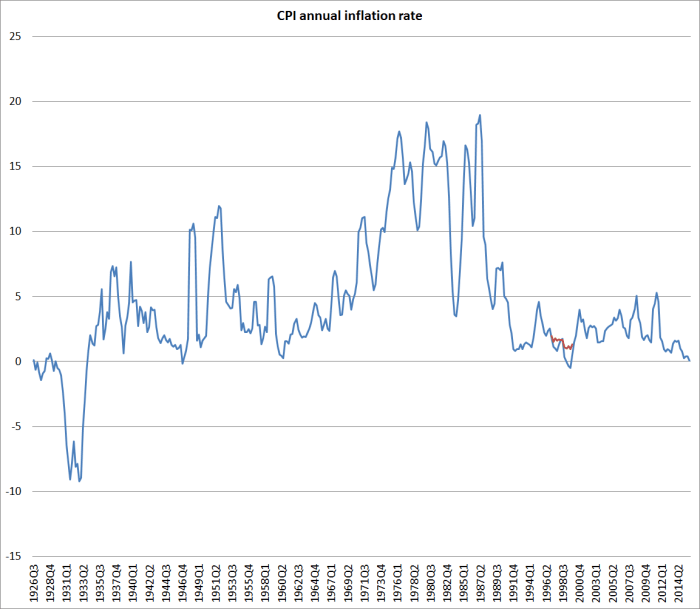
We don’t have a consistently compiled historical CPI in New Zealand (the way all sorts of things have been measured, but especially around housing, has changed materially over time, but then so –  for example –  has the extent of price controls, regulation etc).   But here is a chart using the official historical CPI all the way back to the 1920s, with an overlay (in red) of the CPIX inflation rate over 1997 to 1999.  At the trough, annual CPIX inflation was around 0.9 per cent –  not that much below the midpoint (1.5 per cent) of the then target range.

cpi inflation

Taking a longer horizon, annual CPI inflation got as low as 0.3 per cent in 1960 (I recall tracking this number down in the early days of inflation targeting and holding it out as something to aspire to, the last time New Zealand had managed ‘price stability’).  And since the Reserve Bank opened in 1934, the only time annual inflation has really been lower than it was in 2015 was in 1946, when the annual inflation rate briefly dipped to -0.2 per cent.  The lowest inflation rate for almost 70 years might have been more of a story.  “Lowest inflation since the Great Depression” would no doubt be a headline the Reserve Bank will be keen to avoid, but that too must be a non-trivial risk now.

Quite what to make of the inflation numbers is another matter.  Although the Reserve Bank has been playing up headline inflation in its recent statements, headline inflation shouldn’t be (and rarely is) the focus of monetary policy.  What matters more is the medium-term trend in inflation: as the PTA puts it

“the policy target shall be to keep future CPI inflation outcomes between 1 per cent and 3 per cent on average over the medium term, with a focus on keeping future average inflation near the 2 per cent target midpoint”

But it has been four years now since headline inflation was 2 per cent.  The Reserve Bank keeps telling us it is heading back there relatively soon, and has continued to be wrong.  Even before this latest surprise, they had been forecasting it would be another two years until inflation got back to 2 per cent.

If the weak inflation was all about petrol prices perhaps we could be relaxed –  whatever mix of supply and demand factors is lowering oil prices, taken in isolation it is a windfall real income gain to New Zealand consumers.   But CPI inflation excluding vehicle fuels was 0.5 per cent last year, down from 1.1 per cent in 2014.  Indeed, tradables inflation excluding vehicle fuels was -1.2 per cent in 2015, also a bit lower than the 0.9 per cent in 2014.

Over the last few years, a common explanation for New Zealand’s low inflation rate had been the rising exchange rate, which tends to lower tradables prices.  But the exchange rate peaked in July 2014, and in the December quarter 2015  (having already rebounded a little) it was 7 per cent lower than it had been in the December quarter of 2014.  Of course, some Reserve Bank research not long ago suggests that when the exchange rate has fallen previously the inflation rate itself has tended to fall –  presumably because the exchange rate falls don’t occur in a vacuum and are often associated with a weakening terms of trade and a weakening economy.

Government taxes and charges throw around the headline CPI –  for the last few years, large tobacco tax increases held headline inflation up, and more recently the cut in vehicle registration fees lowered the headline rate.  But in the last year, non-tradables inflation excluding government charges and tobacco and alcohol taxes was 1.8 per cent, exactly the same as overall non-tradables inflation.   Non-tradables prices tend to rise faster than tradables prices (think of labour intensive services) so with an inflation target on 2 per cent, one might normally be looking for a non-tradables inflation rate of perhaps 2.5 to 3 per cent.

What of the “core” measures of inflation?   Probably for good reason, the “ex food and energy” measures don’t get much focus in New Zealand.  But SNZ do report such a measure, and it recorded 0.9 per cent inflation last year, right at the bottom of the target range although barely changed from the 1.0 per cent in 2014.

The Reserve Bank reports four core inflation measures on its website.  None of them is close to 2 per cent, but the message from them in terms of recent trends isn’t that clear.  Two measures (the weighted median and the factor model) suggest little change in the core inflation rate over the last year.  One of them –  the trimmed mean –  suggests a material slowing in core inflation (indeed, in quarterly terms the trimmed mean –  which excludes the largest price changes in both directions – had its weakest quarter in 15 years of data).  But the fourth measure –  the sectoral core factor model –  actually suggests that core inflation has picked up quite noticeably over the last few quarters.  It is a pretty smooth series, and so an increase in inflation from 1.3 per cent to 1.6 per cent, especially when headline inflation is so weak, is worth paying attention to.

The sectoral core measure has been the Reserve Bank’s preferred measure of core inflation, and mine.  Frankly, I’m not sure what to make of it, although I take some comfort from the fact that the increase seems concentrated in tradables prices (the sectoral factor model separately identifies common factors among tradables and non-tradables prices and only then combines the two factors).  The tradables factor seems quite sensitive to exchange rate movements –  as one might expect –  but is not obviously something monetary policy should be responding to.    It is always important to think hard about data that go against one’s story, so I remain a bit uneasy about what the sectoral core measure is telling us (even recognizing that it has end-point problems, that mean recent estimates are sometimes subject to quite material revisions).

For the last nine months I’ve been arguing here (and had earlier been arguing the case internally) that monetary policy needs to be looser if future inflation is once again to fluctuate around 2 per cent –  the target the Governor and the Minister have agreed.  Somewhat belatedly, and grudgingly the Reserve Bank has cut the OCR, and it will take some time for the full lagged effects of those cuts to be seen.   Current core inflation –  whatever it is –  partly reflects the lagged effects of previous overly-tight policy.

In terms of future monetary policy, yesterday’s CPI results in isolation aren’t (or shouldn’t be) decisive.    They rarely are.  But equally there isn’t much reason in those data for anyone to be confident that inflation will relatively soon be fluctuating around 2 per cent.  That confidence matters –  as I noted earlier in the week, both financial markets and firms and households have been gradually lowering their expectations of future inflation .  If that becomes entrenched, it is harder to get inflation back up –  but the risks of trying more aggressively to do so are also diminished (people today simply aren’t looking for inflation under every stone, worried that some nasty inflation dynamic is just about to destroy everything they’ve worked for).

And context matters too.  As I explained in December, I thought the Reserve Bank’s case  that the economy and inflation would rebound over the next couple of years –  and hence no more OCR cuts were needed –  was unconvincing.  The intervening six weeks have done nothing to allay those concerns.  Over recent years there were some huge forces pushing up domestic demand –  strong terms of trade, the upswing in the Christchurch repair process, and the huge increase in net migration.  None of those factors seemed likely to be repeated.  Dairy prices seem to be lingering low, global economic uncertainty is rising, global growth projections are being revised downwards (even by that lagging indicator, the IMF) and just today US Treasury bond yields dropped back below 2 per cent.   Unease seems to be turning to fear, in a global climate where deflationary risks seem more real than those of any very substantial positive inflation.

In sum, the case for further OCR cuts in New Zealand now is pretty clear, and the risks (of materially or for long overshooting the inflation target) seem low.  Would doing so boost the property market?  Relative to some counterfactual, no doubt.  That is a feature not a bug.  Monetary policy works in part by increasing the value of long-lived assets, and encouraging people to produce more of them.  But what it would also do is lower the exchange rate, providing a buffer to more-embattled tradables sector producers (think dairy farmers) and increasing the expected returns to new investment in other areas of the tradables sector.

Who knows what the Governor and his advisers will make of the recent data flow.  In a more transparent central bank we could look forward to seeing the minutes of next week’s meetings, the alternative perspectives and arguments.  As it is, the Governor will tell us what he wants us to know in his OCR release next week, and perhaps in his speech the following week.

A perspective from the newly-released model

Somewhat belatedly, the Reserve Bank last month released a Discussion Paper outlining the features of the Bank’s relatively new forecasting and policy model, NZSIM.  I’m signed up to receive the email advisories when such papers are released, but it appears that on this occasion no advisory was sent out (an oversight apparently).  A commenter yesterday pointed me to the Discussion Paper.

The Reserve Bank has long prided itself on its formal macroeconomic models.   This dates back at least to the days of Roderick Deane, Chief Economist and later Deputy Governor of the Bank in the 1970s and early 1980s and one of the greatest figures in the history of the Reserve Bank.    The Reserve Bank was one of the early central bank adopters of formalised models, although most other advanced country central banks now use them in some role or another.  Historically, the Reserve Bank of Australia has tended to be towards the sceptical end on the role for economy-wide models in policymaking.

Maintaining such models has been a heavy investment for a small institution, especially as on at least a couple of occasions (over decades) the models have been junked almost as soon as they were finished.

And views on quite how large a role the models have ever played in the policy side of the Bank probably differ from observer to observer.  I was closely involved for a long time, and I tend towards the sceptical end.  The Bank had an unwarranted reputation for being somewhat in the thrall of whichever model it was using at the time.  I will always remember the time, fifteen years or so ago, when Glenn Stevens came over and spent several days observing our quarterly forecasting and policy round, and emerged commenting that he hadn’t realised that the Reserve Bank of New Zealand was really quite so pragmatic.

Structural models of the entire economy tend not to be overly useful for the sort of near-term forecasting (and backcasting and nowcasting) that largely shapes real-world monetary policy setting.  The current Deputy Governor, Grant Spencer, made this point well when, as an outsider speaking at a workshop to launch an earlier model in the 1990s, he noted that the technology was likely to be more useful for policy simulations (“what happens if we apply some shock to the system”) than for forecasting. There are simply too many institutional and data-related details that will be known to the forecaster at any particular time, but can’t be captured in a structural model, a deliberately stylised representation of the economy.  And that is even before one asks questions about anyone’s ability to forecast the economy more than a quarter or two ahead.

A good structural model captures the key features of how the designers think the economy works. But in an official agency, it is only likely to be useful if it reflects the key elements of how the decision-makers think the economy works   If it doesn’t, then over time either the model itself has to be adapted, or it will fall into disuse  (perhaps serving as an adding-up framework, and as a technology for generating nice charts and tables quickly –  which NZSIM was doing –  but with the structure of the model overridden pretty much all the time).  Obviously I’m no longer close enough to know what role NZSIM is playing in Graeme Wheeler’s deliberations (whether on forecasting or scenario analysis) but I’d be surprised if it was terribly large.  Apart from anything, for example, in this model, immigration is not explicitly treated, and fiscal policy changes never alter the deficit (any change in spending is automatically financed by a change in lump sum taxes)

Nonetheless, it is good to have the model Discussion Paper in the public domain.  As former Bank of England official Tony Yates has highlighted, (and here) the benchmark in this area remains the Federal Reserve

The Fed recently made its workhorse model FRB-US downloadable, with a dataset, code, everything you need to take a close look at what Governors say and what the staff have been doing for them.  The Bank of England should do the same.

Perhaps one could say the same about the Reserve Bank.  Having that additional material wouldn’t greatly interest me personally, but there are other people outside the Reserve Bank with considerable modelling background and experience for whom it could be useful, as part of further strengthening the external scrutiny of the Reserve Bank.   It can be useful to have a better sense of whether differences from the Bank arise because of different inputs (exogenous variables) or different assumptions about how the economy works.

But for now, I just wanted to highlight one chart in the Discussion Paper.  It shows the responses of a variety of variables to a 1 percentage point “monetary policy shock” –  roughly, a change in the policy rate of 100 basis points different than would the “policy rule” in the model would suggest.  There is nothing special about that particular policy rule –  indeed, I doubt it has ever been discussed in any detail at the Bank’s Monetary Policy Committee  – but also nothing especially objectionable about it.

impulse responses

But it is interesting because one could think of last year’s OCR tightenings as a 100 basis point monetary policy shock.  No doubt it won’t have been quite that in the formal model sense, but many people would now subscribe to the view that the tightening was largely (or completely) unnecessary.  Certainly, it has now been fully reversed, at least in nominal terms (real interest rates are still higher than they were when the tightenings began in March last year).

Within this model, a representation of the economy that the Bank is content to use in its internal processes and to describe as “the” new forecasting and policy model”, a 100 basis point monetary policy shock, that is unwound after a year or so, lowers inflation by about 0.2 per cent (roughly evenly split between tradables and non-tradables).  But it also has real economy effects:  after about five quarters, consumption is almost 1 per cent lower than it otherwise would be, and GDP is almost 0.6 per cent lower than it otherwise would be.

In a more formal way, it makes much the same point that the Minister of Finance was making the other day.

Finance Minister Bill English says the Reserve Bank raised interest rates “a bit too far” in 2014, contributing to slow economic growth at the start of the year.

“It’s one of the factors, along with dairy prices, that probably led to a much flatter 2015 than we had expected,” English told Bloomberg Television on Thursday evening.

“In retrospect, they lifted them a bit far” and “had to go back”, English said.

Graeme Wheeler’s experts might object to my characterisation of last year as a “monetary policy shock” in this sense, but the increases were clearly unnecessary and have been reversed.  Whether or not they could be justified at the time, the fact that they were unnecessary with hindsight means there will have been some short-term real economic cost.  The Bank’s model provides one way  –  using their view of how the economy works – of trying to get a plausible fix on the size of that cost. The model doesn’t have the unemployment rate within it, but  –  all else equal –  an additional 0.6 per cent of GDP might have been enough to have prevented the unemployment rate rising from 5.6 per cent in September 2014 to 6 per cent in September this year.

Is the Fed risking a policy reversal?

The Wall Street Journal ran an article yesterday by Jon Hilsenrath about this week’s (widely-expected) increase in the Federal funds rate target.  So extraordinary have the times been that many Americans will have gone almost a quarter of their working life and never experienced an increase in official interest rates.

Hilsenrath is generally regarded as a well-briefed journalist, and writes intelligently about the Federal Reserve and related issues.  This article seems to have two separate points to it.  The first is the suggestion that Federal Reserve officials themselves are worried that “they’ll end up right back at zero”.  And the second is a report of a new WSJ poll of economists about the outlook for the Fed funds target rate over the next five years.

Taking the poll first, 58 per cent of the surveyed economists reportedly expect that the Fed funds target rate will be back at zero in the next five years, and 16 per cent think the target will have been taken negative.

58 per cent seemed, if anything, a surprisingly low percentage, and not telling us very much.  After all, most policy rate cycles seem to have been only around five to seven years.  In the US, the Fed started raising rates in February 1994 and was back where it started by September 2001.  And then it started raising rates in June 2004 and was back where it started by October 2008.

In Australia, the RBA started raising rates in August 1994 and was back to the same level by September 2001.  It started again in November 2003, and was back where it started by December 2008, and the rate cycle that started in October 2009 was unwound by December 2012.

And what about New Zealand (abstracting from the very quickly reversed small cycles)?

Start                                      End

March 1994                         November 1998

November 1999                November 2001

January 2004                      December 2008

In New Zealand we never quite got to a cycle even as long as five years.    So if I was ever asked, and without looking at a single piece of data, I’d say there was always a pretty good chance that policy rate tightening cycles would be fully unwound within five years.

Some will argue that the current US position is different, in that it is starting from such a low rate.  Perhaps, but the Fed funds target was 1 per cent before the previous cycle got underway.  Neutral rates seem to have been declining around the world, and there is little sign that the US is an exception to that.  And on the other hand, as the WSJ article notes, the US recovery has now been underway for six years, so it is a long way into the recovery (weak as it has been) for the tightening cycle to be starting.

So if Fed officials had only this sort of five year horizon in mind in worrying about the possibility of reversal, it probably shouldn’t be newsworthy.  Shocks will inevitably happen, and there is a good chance that even if a tightening is warranted now, it won’t be needed in several years’ time.

But it would be more newsworthy if some significant chunk of the FOMC were worried that the US might experience the sort of policy reversal all too many advanced countries have had in the last few years.  The WSJ article lists a number of policy reversals in the period since the 2008/09 recession , including that of the ECB and those of smaller countries such as Sweden and Israel.  Mercifully, and perhaps reflecting the extent to which New Zealand has dropped under the radar in recent years, they don’t highlight New Zealand –  the only advanced country to have had two quick policy reversals since 2008/09.  I wrote about the various policy reversals a few months ago (here and here).

All too many central banks have misjudged the extent of the inflationary pressures in their economies, tightening before the evidence was in that inflation was really increasing.  Acting pre-emptively probably made sense in the early post-recession period –  forecast-based policy has, after all, been the mantra.  But it has become harder to justify as the years went by, and inflation continued to remain surprisingly weak (at any given interest rate) in most countries.  In New Zealand, forecast-based policies have probably ended up increasing the variability of interest rates.

Perhaps the US is different, and they really will be able to sustain not just a single Fed funds rate increase but a succession of them (of the sort apparently envisaged by many FOMC members in the dot chart).  But it isn’t clear to me why the US should be different.  It has been a pretty anaemic recovery, and if the unemployment rate has fallen a long way, the employment rate is still very subdued.  And the real exchange rate has risen a lot.  It isn’t that high by historical standards, but a 15 per cent increase in the real exchange rate over the last 18 months or so makes a difference even in a country where exports are only 14 per cent of GDP (tradables are a much larger share).

In this climate, I’d have thought that the inflation numbers themselves should be a key guide.  But even there, there is little obvious reason to think higher interest rates are warranted.  The Fed chooses to target inflation as measured by the deflator for personal consumption expenditure (PCE) –  as distinct from the CPI.  Headline annual PCE inflation is 0.2 per cent (those weak petrol prices, which affect US inflation more than NZ inflation, because taxes are a much lower share of petrol prices).  PCE inflation excluding food and energy has been 1.3 per cent over the last year –  an inflation rate unchanged now for many months.  And the trimmed mean PCE inflation rate has also been steady, at 1.7 per cent.  The Fed’s chosen target is 2 per cent inflation.  Perhaps one could argue that inflation is not too far from the target, especially if one chose to emphasis the trimmed mean measure, but it is not getting any closer.  Given the state of knowledge, and the precedents from other countries, it seems quite likely to be premature to act now.

pce

Which raises the question of why are they (apparently) moving now?  Perhaps the majority of the FOMC is just falling into the same trap other central banks (including the Reserve Bank) have done, expecting a resurgence of inflation (even though there is little or no sign of it yet).  Perhaps it is the low unemployment rate?    But is it not plausible that the NAIRU could be moving lower again?  Former senior Fed official Vince Reinhart has an interesting commentary out, in which he suggests that part of the motivation for a move now might be a desire by Janet Yellen to establish credibility as someone sufficiently tough and willing to move, that she can afford to make the case later for moving only very gradually.  Perhaps there is something to that story, but I hope not.  My impression is that central bankers usually play things fairly straight, reacting to the data as they read it (whether reading it correctly or otherwise) because any other approach is a dangerous game. Of course, American politics is different, and there is a lot of suspicion of the Fed on the right.  But in an anaemic recovery, when so many other central bankers have tightened and then had to reverse themselves, and in a global economy where the threats seem to be growing rather than dissipating, and where (for example) commodity prices are moving ever lower, adopting a strategy that might jeopardise the US recovery out of some desire to “establish credentials” would seem particularly inappropriate.   Within the terms of their own articulation of their mandate, there is little sign that the Fed has had monetary policy too loose in the last seven years –  Scott Sumner and others make a reasonable argument that they were too slow to ease at the start –  and no sign that monetary policy is too loose now.  None of us might adequately understand why interest rates are as low as they are, but that isn’t a basis for a central bank to try to end that on the basis of not much more than a mental model that “in a sensible well-functioning economy, interest rates really should be higher than they are now”.

And all that is before the growing signs of renewed financial fragility and risk.  I found this chart that I saw in a newsletter yesterday somewhat sobering.

defaults

A hawkish easing and a dovish tightening

A financial markets participant who lost money in the market moves following Thursday’s Monetary Policy Statement got in touch yesterday to ask where I ranked Thursday “hawkish easing” –  an OCR cut that actually tightened monetary conditions by prompting a 1.5 per cent increase in the exchange rate –  among policy mistakes.

He may well have had an international context in mind, but my mind went back to various episodes in New Zealand since I got closely involved in 1987.  As I pointed out to my correspondent, even if one counted Thursday as a mistake –  and I certainly thought the policy stance was wrong, and the communications pretty unconvincing –  there had been many worse over the years.  Making mistakes, either  in communications on the day or in the wider stance, is pretty much inevitable in the sort of discretionary monetary policy management most countries adopt.  Unfortunately the Reserve Bank of New Zealand seems to have more black marks against its name than most.  One could think of the MCI debacle in the late 1990s –  which led directly to the troublesome clause 4b of the PTA – or the two lots of policy reversals (tightenings that had to be unwound) since 2010.   Misjudging the overall appropriate stance of policy matters more (whether too tight or too loose) but it takes time for those errors to become apparent.  My mind went back specifically to a “hawkish easing” fifteen years ago, when the market’s adverse verdict was immediately clear.

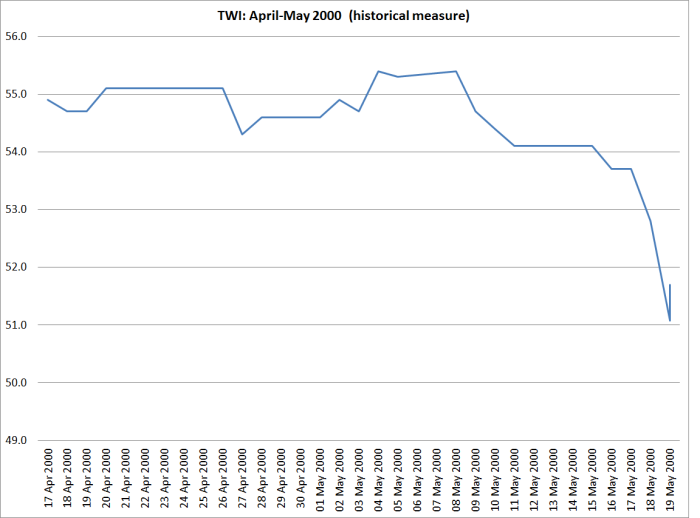
By May 2000, the Reserve Bank had been tightening monetary policy quite aggressively for some time.  It was the first ever OCR cycle –  the OCR was only introduced in early 1999, and we’d been raising the OCR by 50 basis points at a time.    The OCR was at 6 per cent, the same as the Fed funds target rate –  which itself was raised to 6.5 per cent on the morning of our MPS.

The May 2000 Monetary Policy Statement was released on 17 May.  We raised the OCR by another 50 basis points to 6.5 per cent, and the projections foreshadowed the likelihood of another 75 basis points of increases over the next few quarters.

The exchange rate had been relatively low for some time by then (around 58 on the TWI as it is currently measured, but 54-55 on the index as it then was).    When returns on USD assets were basically equal to those in the NZD, that weakness was hardly surprising (it is the example I use to illustrate why I’m pretty sure that if our OCR ever gets cut to near-zero our exchange rate will have fallen a long way).

Running into the MPS release, the TWI had been weakening a little.  I was deputy head of the Financial Markets Department at the time, and I recorded in my diary the night before the release that we were “likely to see the TWI lower” following the release.

In those days, we met at 7:30am on the morning of the release, to give final advice to the Governor and enable him to confirm his OCR decision.   It was to be stressful day, but my diary records that at the meeting “just as well everyone, with more or less enthusiasm, on the OCR group endorsed 50bps –  and at our morning meeting at 7:30 no one expressed even the least qualms”.

As I went on, “I’d expected the exch rate to ease off –  not to 52.8.  Over the following day or two, it fell as low as 51.08 –  on a 50 point OCR increase, we saw the exchange rate fall by almost 5 per cent at worst, and around 4 per cent when things had settled down.  Our widely-expected tightening ended up materially easing monetary conditions.  We were more than a little flustered, and my diary records us hoping “without success, that one of the wire service reporters would ring so we could point him in Murray [Sherwin’s] direction for a [clarifying] comment”.

twi may 2000

What was going on?   Basically, the market (particularly offshore) did not believe us.  They took the view that if we continued to raise the OCR that aggressively we would “kill the economy and hence exacerbate the future easing”.  I was pretty sceptical at the time (as I imagine were my colleagues), but as it happened we tightened no further, and were cutting the following year.  And as it happened there was a “growth pause” in 2000 that we had not anticipated.  The exchange rate was to fall by a further 10 per cent over the following few months and headline inflation went briefly to 4 per cent by the end of the year.

The May 2000 OCR increase, and the hawkish path it continued to portray, was a pretty material misjudgement by the Reserve Bank.  But what made it particularly bad was the strength of the immediate adverse reaction.  We badly misjudged that reaction.  There were a couple of local economists who were more hawkish than we were, but the market as a whole spoke –  and it did not believe us, or believe that we would be able to carry through our envisaged policy.  Even politicians weighed into the debate (Prime Minister and Minister of Finance).

By contrast, the only way to read the overall reaction since Thursday, has been that Graeme Wheeler’s latest policy announcement, and flat forward track, has been treated as credible.  Only time will tell whether the OCR, and with it the exchange rate, will eventually have to go lower, but for now the Governor’s stance, that he does not envisage further cuts, is being taken seriously.  And although there are some sceptical commentators (including – at least – Westpac, your blogger, my correspondent, and some macro advisory firms), there has been no controversy in the local media, nothing very critical in the commentaries from the local bank economists, and no comment at all from politicians on either side.  If anything the tone of the questioning in the press conference was slightly sceptical of the need to have cut at all.  So if I were Graeme Wheeler, I’d probably have got to the end of Thursday a bit disappointed that the exchange rate had risen by 1.5 per cent, but thinking that overall the reaction hadn’t been bad at all.  After all, the (never very likely) alternative might have been that people treated the flat rate track, and end of the easing cycle story, as not very credible at all. If so, the exchange rate might have fallen significantly – an excessively hawkish stance increases the need for easing in the future.

Credibility matters a lot to decision-makers.  Since no one can be 100 per cent sure what the right policy is, having the consensus with him probably matters a lot. After May 2000, Don Brash didn’t.  For now, Graeme Wheeler does.


Why isn’t the high unemployment rate bothering more people?

At 6 per cent, our unemployment rate is no longer low.  And yet it seems to excite little interest, whether from  the media, economic commentators, the Reserve Bank, or the government.

I’ve argued that the Reserve Bank’s unnecessarily tight monetary policy over recent years (as revealed by core inflation outcomes) has contributed to the high unemployment rate.  Within a standard model, this shouldn’t be a remotely controversial claim. If, as the Bank reckons, inflation expectations are in line with the target, then actual core inflation outcomes persistently below target will have reflected less utilisation of productive capacity (labour and perhaps capital) than would have been possible.  Put that way, it sounds bloodless and technocratic, but real people are affected here –  people unable to get a job at all, or to get as many hours as they would like.  Lower policy interest rates would have stimulated some more domestic demand, and would have lowered the exchange rate, stimulating some more external demand.  And core inflation would have come out nearer the target.

I’m not going to repeat the debate as to whether, with the information they had at the time, the Reserve Bank could reasonably have run a different stance.  I think so, and said so in writing within the Bank at the time.  But the point here simply is that, at least with hindsight, monetary policy was persistently too tight, and there has been an output and unemployment cost to that –  in a recovery that was, in any case, probably the most anaemic New Zealand has had for a very long time.  And the cost goes on –  even now, the unemployment rate is rising, not falling.

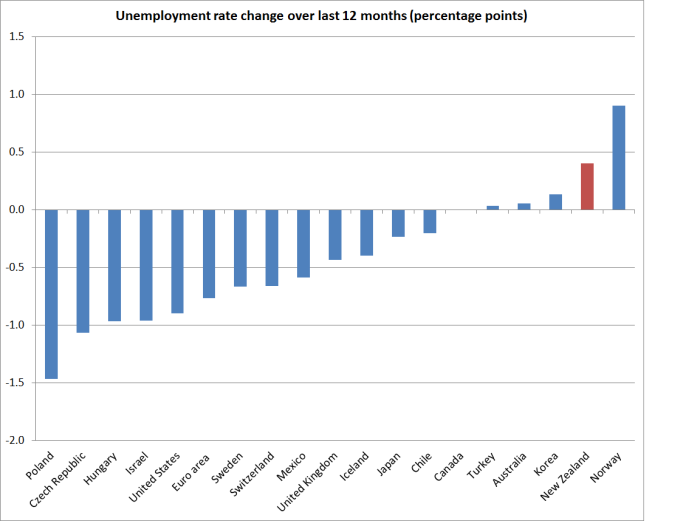
But how do we compare?  I downloaded the OECD data on unemployment rates for the 19 OECD monetary zones (ie 18 countries with their own monetary policy, plus the euro area).

Despite having some of the more flexible labour market institutions among advanced countries, New Zealand’s unemployment rate, at 6 per cent, is currently a bit above the 5.5 per cent median for this group of countries.

And over the last year, only four of these countries have had an increase in their unemployment rate at all.  New Zealand’s increase  has been second only to that in Norway.  The last year has been tough for Norway, with the collapse in oil prices.  The central bank has cut interest rates, by 75 basis points. But they are somewhat constrained.  The inflation target in Norway is 2.5 per cent, and core inflation is at least that high.  The central bank lists four core inflation measures on its website: one is at 2.4 per cent, one at 2.5 per cent, and the others at 2.8 per cent and 3.1 per cent.  Each of those measures is higher than they were a year ago.  Without looking into Norway in more depth, the rise in the unemployment rate (which is still only 4.5 per cent) doesn’t look like something that monetary policy can usefully do much about.  New Zealand is different.

U change since sept 14

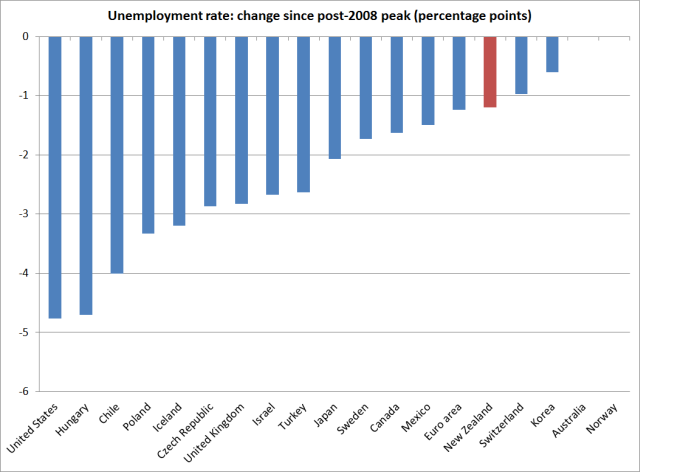
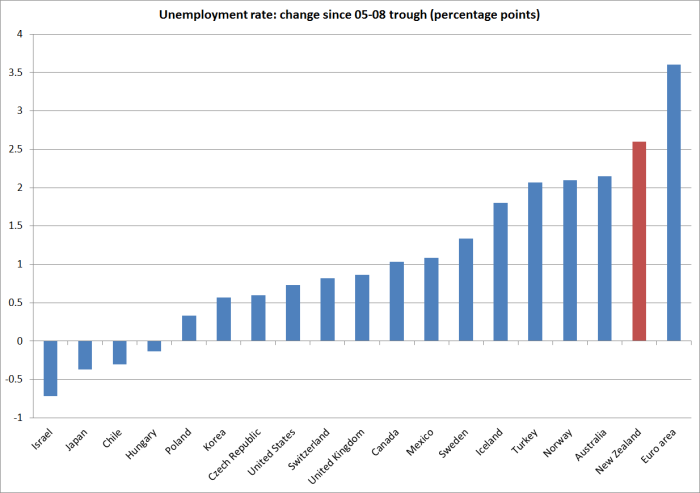
New Zealand also shows up at less attractive ends of the charts if we look at how the unemployment rate has changed since either the peak reached in the recessions from 2008 on, or from the trough in the boom years.  On the latter measure, the only area that has seen more of an increase in the unemployment rate is the euro area as a whole (which has pretty much exhausted the limits of conventional monetary policy).  And it is not as if our boom was extraordinarily large –  using OECD estimates, our peak output gap in the boom years (3.2 per cent) was bang on the median for this group of countries.

U chg since recession

U chg since 05-08

So New Zealand’s outcomes look pretty bad.  Relatively high unemployment now in cross-country comparisons, rising unemployment, and by some margin that largest increase in the unemployment rate since the boom years of any country that still has conventional monetary policy capacity left.  It should be a fairly damning indictment.

Of course, Australia also shows up towards the upper end of each of these charts.  Each of the RBA’s core inflation measures is now below their target, although (a) by less than core inflation is below target in New Zealand, and (b) this gap between outcomes and target has only really emerged in the last few quarters.  By contrast, core inflation in New Zealand has been clearly below the target midpoint for more than five years.   I suspect the Reserve Bank of Australia should also be cutting their policy rate further, but at present any error there looks less egregious than the error in New Zealand.

(Defenders of the Reserve Bank could, of course, reasonably point out that the Bank has cut by 100 basis points this year, and that monetary policy works with a lag.  However, since the Bank forecast yesterday that the unemployment rate will still be 6 per cent in March 2017, and inflation then is forecast to be only 1.5 per cent –  even with a material acceleration of growth –  that point is not particularly telling on this occasion.  It simply means that this year’s cuts have stopped the situation getting even worse.)

I’m not entirely sure why the unemployment outcomes seem to be getting no traction in the New Zealand debate.  Perhaps there is something in the insider/outsider story –  neither the bureaucrats making policy nor the market economists commenting on it are unemployed.  And perhaps many of them are, like me, of an age that the 11 per cent unemployment rates in the early 1990s shaped their perspective?  And having spent much of his career abroad, mixing mostly with international agency elites, the Governor may also have a rather limited degree of identification with the New Zealanders at the bottom end who are paying the unemployment price. But none of this seems particularly compelling.

As is widely recognised, the main Opposition political party has been failing, and isn’t helped by having a finance spokesperson who seems to struggle to get to grips with the issues, and to communicate them in a way that either resonates outside central Wellington, or in the House.  And yet, the unemployment rate would seem to be a natural issue for the Labour Party, with its strong union base, and voter base among the relatively less well-off sections of the community.

I suspect the Minister of Finance isn’t very happy with the Bank’s handling of things –  he has hinted as much in several public comments earlier in the year.  But what is in for him to make more of the Reserve Bank’s failing?  The government’s popularity ratings remain high, and the media and business elite continue to retail a narrative in which New Zealand’s economy is doing just fine –  despite near-zero per capita GDP growth, almost non-existent productivity growth (and high unemployment).

Which leaves me wondering whether elite opinion support for large scale immigration –  repeated yesterday by the Reserve Bank Governor –  is part of the story.  The Reserve Bank reckons that the high rate of immigration has raised the unemployment rate and lowered wage inflation –  it is there in the text of the MPS yesterday.  I reckon they are wrong on that: the demand effects of immigration surprises have almost always outweighed the supply effects, and so surprisingly high immigration has, if anything, tended to hold the unemployment rate down in the short-term (in the long-term it is the labour market institutions that determine it).  If you really strongly believe in the benefits of high rates of immigration to New Zealand –  and that has been the elite view, against the evidence of a steady trend decline in New Zealand, for a century or more – but think it is raising the unemployment rate in the short-term, then you might be reluctant to express any serious unease about the high and rising unemployment rate, lest it cast doubt on your preferred immigration policy.  If there is anything to that interpretation, I’m sure it is subconscious rather than conscious.  And I’m not sure if it explains anything either.

This is one of those times when central bank independence is not really serving the interests of New Zealanders.  The logic of the argument was that independent central banks would protect us from high inflation. Now it is working the other way round.   If the Minister of Finance were making the OCR decisions, the political pressure to do something about rising unemployment –  at a time of very low inflation –  would probably be more focused and intense.  The Minister of Finance has to face questions in the House every day, and make himself regularly available to the media and voters.  By contrast, the Governor hides away behind a cloak of technocratic expertise, and a Board which sees its role as to protect and promote the Bank.  That means no effective accountability (remember, real accountability means real consequences for real people).

A central bank adrift?

What to say about the Reserve Bank’s latest Monetary Policy Statement?

Having just reread my comments on the September MPS, I could simply run most of those comments again.

The Bank’s stance doesn’t really surprise me very much, but it is disappointing to say the very least.  New Zealand is being particularly poorly served by its central bank at the moment.

At least they cut the OCR.  Some had doubted it would happen, but the Bank has now belatedly completed the reversal of the totally unnecessary tightening cycle the Governor and his advisers initiated last year.   Even now, however, since inflation expectations have been falling, the real OCR is still higher than it was at the start of last year.  Over the intervening period, core inflation has stayed well below the midpoint target, and headline inflation has been at or below the bottom of the target range for most of the period.    The unemployment rate has risen, and per capita income growth has slowed markedly.    Somewhat surprisingly, there was not a single question at the press conference about that succession of misjudgements.

I was also a bit surprised that the word “unemployment”  did not crop up at all in the press conference.  The structural unemployment rate is influenced by various structural features of the economy (labour market regulation, demographics, the welfare system etc), but no one really doubts that monetary policy choices affect the short-term fluctuations in unemployment.  When the unemployment rate is above any reasonable estimate of the NAIRU, has been rising, and is forecast to continue to stay high, hard questions should be being asked of the central bank Governor.  They weren’t.    The Governor tells us that he is content not to have inflation back to the midpoint of the target range for another two years.  But there will an output and unemployment cost to that choice.  And a choice it is: the Governor probably can’t do much about inflation in the next couple of quarters, but a lower OCR over the next few quarters would, on the Bank’s own numbers, have got inflation back to target sooner.  But the Governor tells us that, as things appear to him at present, there are no more OCR cuts to come.

On its own numbers (I’ll come back to criticisms of those numbers shortly), the Bank defends its choice by arguing that

with inflation expected to increase steadily, consistent with the inflation target, a much sharper adjustment in interest rates than projected risks being inconsistent with clause 4b of the PTA

Clause 4b reads

In pursuing its price stability objective, the Bank shall implement monetary policy in a sustainable, consistent and transparent manner, have regard to the efficiency and soundness of the financial system, and seek to avoid unnecessary instability in output, interest rates and the exchange rate.

The Bank does not explain how it thinks a more aggressive approach to easing monetary policy would be inconsistent with clause 4b (and no one asked).

Perhaps it is interest rates they are worried about?  But the OCR has been between 2.5 per cent and 3.5 per cent since early 2009.  If they were to cut the OCR to, say, 1.75 per cent, the worst that could happen might be that in 12 or 18 months time they might need to raise interest rates again, probably into that 2.5 to 3.5 per cent range.  That doesn’t seem like particularly substantial variability by any historical standards.

Occasionally the Governor talks about avoiding output variability.  I’m pretty sure the authors of that phrase in the PTA mainly had in mind avoiding unnecessary recessions, but even if we grant that growth could be too strong in some circumstances, it doesn’t seem like a relevant story right now.  After all, on their numbers (Table 2:1) they think per capita GDP growth has been zero this year.  They forecast that growth will pick up, and they have overall GDP growth peaking at about 3.5 per cent in 2017.  Even with slower population growth that isn’t a troublingly high per capita growth rate.  In past cycles, we’ve typically had a year or two of 4 or 5 per cent or higher GDP growth.  Partly as a result of a succession of Reserve Bank misjudgments, we haven’t had anything like in the years since 2009.  If anything, it is what we need now to reabsorb into work the high (and rising) number of people who are unemployed.

More likely, it is the not-very-meaningful statutory provision “have regard to the efficiency and soundness of the financial system” that the Governor has in mind.  If so, he should be more upfront in making his case, and in identifying the tradeoffs involved in holding up interest rates to influence house prices and possible financial stability risks.   The Governor did note that cutting interest rates further would raise the housing risks.  But the Bank has other tools at its disposal to safeguard the soundness of the financial system, even if there were convincing evidence that that soundness was being threatened.  Using monetary policy to try to manage the possible risks around a relative asset price change is a recipe for putting the rest of the economy through the wringer.  The Governor’s monetary policy target is 2 per cent CPI inflation.  The Reserve Bank is continuing to making the same mistake Sweden’s Riksbank made.

Perhaps relatedly, Assistant Governor John McDermott responded to a journalist’s question by arguing that “very very low interest rates increase the risks in the economy”.  It is quite disconcerting to hear the Reserve Bank signing up to this BIS line –  with no supporting analysis.  And we should be wary of this “very very low interest rates “ line when the OCR today is sitting exactly at the level it has most often been at for the last six and half years (a bit higher in real terms).  Like the Governor’s constant claim that global monetary policy is very stimulatory, it depends on assumptions about neutral interest rates that the data increasingly don’t seem to support.  The Bank seems driven by a mental model that is deeply uncomfortable with a 2.5 per cent OCR, rather than by the data –  low inflation, weak per capita growth, rising unemployment, and weak commodity prices.

But are the Bank’s own numbers  even plausible?  I don’t think so.  They are projecting a material increase in GDP growth rates over the next couple of years, but it isn’t remotely clear what that optimism is based on.   The Canterbury repair and rebuild process will be gradually tailing off over that period, some recovery in dairy prices is probably already factored into producer expectations and behaviour, and the rate of immigration is expected to fall away quite materially. Population growth in 2017 is more likely to be 1 per cent than 2 per cent.    Even the Bank believes that the unexpectedly high rate of population growth has boosted GDP over the last couple of years.  So what will counter the impact of a material slowing in the rate of population growth?  It can’t really be the rest of the world’s economy.  The Governor rightly sounds a bit worried about the risks in China –  although the Bank seems blithely indifferent to the global deflationary shocks that China is representing – and there is nothing in the rest of rest of the world to suggest any material acceleration of growth next year.  For what it is worth, global energy and metals commodity prices are continuing to fall –  and while the direct effect of those falls might be modestly positive for New Zealand, they are only mitigating the impact of the weakening global environment.

Of course, forecasting is a mug’s game –  which is why monetary policy probably shouldn’t be driven off medium-term forecasts of things we (and they) know almost nothing about).  So it isn’t impossible that the Bank’s growth and inflation forecasts could come to pass.  But what they’ve given us today is not a convincing story as to how this acceleration is going to happen.  After all, their interest rate projections are no lower than those in September, and as the Governor noted the exchange rate has risen since then.  It rose further this morning.

There were a number of other odd dimensions to the document and the Governor’s comments.

Once again, the prime policy discussion (chapter 1) discussed headline inflation, but not core.  We are supposed to take comfort from headline inflation perhaps getting above 1 per cent early next year –  itself a weaker outlook than they’ve run previously –  but they offered no reasoning at all for why we should expect core inflation to rise.  And yet these are the lines they want the media to use.

In the press conference, the Governor bemoaned the fact that monetary policy decisions were always tricky because everyone in the country has a view (and this is inappropriate why?  It is, after all,  our economy, not the Governor’s).  He then claimed that it was very hard to move inflation expectations up once they start falling, and that this was so because in highly indebted economies people were reluctant to take on more debt.

Perhaps the Governor has not noticed that inflation expectations in New Zealand have already been falling –  on many measures they’ve never been lower, at least since the target midpoint was raised to 2 per cent.  The Bank quotes some carefully selected measures that average 2 per cent to suggest there is no problem, but (a) those expectations have fallen a lot over the last couple of years, and (b) they carefully ignore the indicative information revealed  in market prices.  The gap between indexed long-term government bonds and conventional long-term government bonds is currently about 1.4 per cent.  It isn’t a perfect measure by any means, but it is a price reflecting the choices and assessments by people putting real money at stake.  That is not typically so in the survey measures the Bank chooses to emphasise, which are often heavily influenced by the echo chamber of local market economists and media.

Inflation is very low, inflation expectations have been falling, and the Bank argues that in this climate it is hard to get inflation expectations up again.  So why not foreshadow more OCR cuts to come?    After all, the Governor was again anguishing about the exchange rate being too high.  Perhaps what holds him back is concern about housing, but then as the Governor told his questioner, he thinks people are reluctant to take on very much more debt.  He can’t have it both ways.  Even in New Zealand credit growth and housing market activity has been pretty subdued in the last couple of years, across the whole country, compared with what we saw in the mid 2000s.

The Governor was also asked whether the government should loosen fiscal policy. I assumed the questioner had in mind an increase in government spending which would stimulate demand and perhaps take some pressure off monetary policy. But oddly, the Governor came out with a suggestion that he thought a case could be made for more infrastructure spending, especially in Auckland.  My initial reaction was that reasonable people could differ on the case for more infrastructure spending, but I wondered if the Governor of the Reserve Bank should really be opining on such matters.  But I almost fell off my chair when he went on to explain that more infrastructure spending would increase capacity in Auckland and lower inflation pressures.  Perhaps in the long run, but had it not occurred to the Governor that putting infrastructure in place represents a material net increase in demand over the years when it is being put in place?

Perhaps more importantly, I am also puzzled about the Bank’s stance on immigration, and the evidence base that lies behind it. The Governor is clearly at one with New Zealand elite opinion –  he told the news conference that he thought high levels of immigration were “a good thing for New Zealand” and that he did not think there should be any immigration policy changes.  Views differ on the long-term economic impact of immigration, and many certainly agree with him, but why was this a subject the Governor is commenting on at all?  Historically, the Reserve Bank has been studiedly neutral on the long-term issue, and focused (rightly) on the short-term cyclical implications.  Governors who use the platform they have been given to advocate their personal policy preferences in other areas risk further undermining support for the autonomy they enjoy in respect of monetary policy.

But even the Bank’s view on the cyclical impact of the recent high levels of immigration seems confused.  In chapter one (the press release) they assert that high levels of immigration have reduced capacity pressures and contributed to  a lowering of inflation (ie supply effects exceed demand effects).  In chapter 5, they produce a scenario about the impact of immigration staying unexpectedly high over the next year or two.  In that scenario they explicitly articulate what appears to be their latest new view, in which a change in immigration has no net short-term impact on capacity or inflation pressures (short-term demand effects are just matched by short-term supply effects).  There is no analysis in support of any of this.  And there is no engagement with their own past research, or with the consensus view of New Zealand macroeconomists going back decades that whatever the possible long-term gains from immigration, in the short-term the demand effects dominate the supply effects (which shouldn’t be surprising, since the per capita capital stock requirements of each new person are materially greater than one year’s labour supply).  It was only two years ago that they published a research paper which showed these results.

mcdonald rresults

Demand effects exceed supply effects in the short-run (of several years).

The Bank seems all over the place on these issues. Perhaps they have fresh new research on the issue, but they put out two new Analytical Notes this morning, and there was nothing on immigration. I have asked for copies of any analysis they have produced in support of their new view, including how it might relate to the 2013 research.

It isn’t impossible that the effects of a surprise influx of immigrants could be near zero. If, for example, that influx just reflected the weakness in Australia, our largest trading partner, we’d have losses in demand for our exports to Australia offsetting the positive demand effects of the change in the net migration flow to Australia. But that isn’t an argument the Bank is running.  In fact, we have no idea what their arguments and evidence are.  It simply isn’t good enough, for such a major cyclical variable.

My overall take this morning was of an institution at sea.  Even if their case is in fact strong, neither the Governor nor his Chief Economist seem convincingly able to make the case, despite all the resources at their disposal.  The Chief Economist could not even effectively answer a simple question about why we wanted to get inflation up.   He ended up falling back on line that we want to avoid becoming like Japan.

real gdp phw jp vs nz

But, actually whether one starts from 1989 (the peak of the Japanese boom) or from 2007 (the peak of ours) Japanese productivity growth has somewhat outstripped that of New Zealand.  And recall that one of the lessons of how the Japanese ended up with persistent deflation was that they kept monetary policy materially too tight for much of the 1990s.  We might not have deflation yet, but persistently tight monetary policy –  tighter than it needs to be –  is only increasing our chances of ending up uncomfortably close to an undesirable deflation ourselves.  It is all very well for the Governor to make the (accurate) point that no country has raised its inflation target since 2007.  But in the sort of global climate we’ve now had for years, those who still can (countries that don’t have interest rates at zero) should be making full use of the scope to keep inflation and inflation expectations up.