Immigration and productivity spillovers

In the run-up to the release this month of the new book by Julie Fry and Hayden Glass, which appears to focus on the potential for the immigration of highly-skilled people to contribute to lifting New Zealand’s long-term economic performance and the incomes of New Zealanders, I was doing a bit of reading around the issue.

At issue here is whether, or under what conditions, immigration to New Zealand of highly-skilled people can lift not only the average productivity of the workforce in New Zealand (that seems quite plausible in principle –  think of a tech company simply relocating a particular research lab, staff and all, to New Zealand), but whether something about the skills those people have can translate into lifting the skills, productivity, and performance of the people who were already here.  Those sorts of “spillovers” are really what we must be looking for if we are serious about running a skills-based immigration programme, as some sort of economic lever or, in the government’s words, a “critical economic enabler”.    We can think about this in the context of New Zealand’s own history.  European immigration to New Zealand in the 19th century brought people from the world’s (then) most advanced, innovative and economically successful society to a country where the indigenous population had been operating at a level not that much above subsistence.  It would be astonishing if the European immigration had not raised average incomes of the people living in New Zealand (ie including the immigrants).  But it would have been a pretty unsatisfactory programme if it had done nothing to lift the productivity, skills and income of the native New Zealanders.

Fry wrote an interesting working paper for the New Zealand Treasury a couple of years ago reviewing the arguments and evidence on the economic impact of (more recent)  immigration to New Zealand.  But when I went back and had a look at that paper I was a little surprised at how little focused discussion there was of mechanisms by which such productivity spillovers might occur –  whether in generating more new ideas, or in applying better the stock of knowledge already extant – and how that might (or might not) have played out in New Zealand.

I also had a look at the old Department of Labour’s 2009 research synthesis on the economic impact of immigration.  They had a nice discussion on the possible link between immigration and innovation.  As they note, for some types of migrants to the United States there is reason to think that such spillovers might be material

The main mechanism in the United States appears to be the education of foreign graduate students rather than skilled worker immigration. The United States is the global leader in academic research, so the country attracts the top foreign students from across the world (positive self-selection). These account for most doctoral graduates (but there appears to be no crowding out of the United States born from research universities) and many of these foreign born doctoral students work in research and development (R&D) sectors in the United States, leading to a positive correlation between concentrations of highly skilled migrants and concentrations of patent activity.

Unfortunately, as they note, there is little evidence of such gains or spillovers in the limited New Zealand research.  That might reflect the fact that our actual immigration programme has not been very highly skills oriented at all (something the data make pretty clear), which could perhaps be changed by altering the parameters of the immigration system. Or it might reflect some things about New Zealand that cannot easily be changed: we are small, and remote, relatively poor, and have universities which typically don’t rank highly as centres of research, in contrast to the United States which is not just the “global leader in academic research”, but large, wealthy and more centrally-located.   And despite the recent surge in New Zealand exports of education services, that hasn’t been centred on our universities (it is a welcome boost to exports, but not likely to be the basis of any productivity spillovers to New Zealanders).

George Borjas is a leading US academic researcher on the economics of immigration and had a very accessible post up the other day looking at the question of productivity spillovers, and highlighting a range of quite recent and fascinating studies on some “natural experiments”.  One of the cleanest such experiments was the purging by the Nazi regime in Germany of Jewish academics (and research students).

In 1933, shortly after it took power, the Nazi regime passed the Law for the Restoration of the Professional Civil Service, which mandated that all civil servants who were not of Aryan descent be immediately dismissed. That meant that Jewish professors like John von Neumann, Richard Courant, and Albert Einstein were fired from their university posts. Many of these stellar scientists found jobs abroad, particularly in the United States.

Researchers have been looking at what the impact of these dismissals, and relocations, was on the productivity of those around them.  That included the impact on the productivity (published research output) of the graduate students (PhD candidates) of those the dismissed academics had been working with, the impact on the output of former colleagues of those who had been dismissed, and the impact on the colleagues that dismissed academics found themselves working with later (in the case of those who subsequently took up US academic positions).

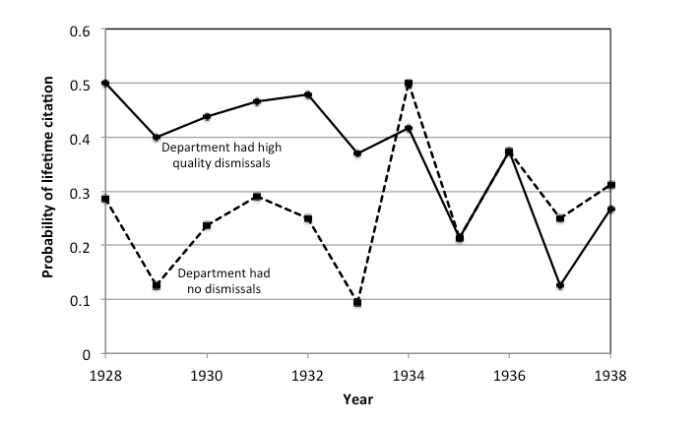
This is perhaps the starkest chart from Borgas’s post, drawn from this paper,  illustrating the lifetime impact on the graduate students left behind.
borjas chart

There are clear signs of a material adverse long-term impact (the mirror image of the sort of positive productivity spillovers those promoting a high-skills immigration programme are looking for).  PhD programme supervisors can matter hugely.    But any impact on the productivity of former colleagues was much less visible.

In another paper, recently published in the AER,  looking at the impact on innovation in the US from the relocation of these displaced Jewish scientists, the authors find that the new recruits did not increase the productivity of existing US inventors, but encouraged greater innovation in the US as a whole by attracting new researchers to their distinctive sub-fields of research.

Borgas sums up his take on this series of papers thus

My take from all this is very simple: At least in the experimental context, the evidence that high-skill immigrants produce beneficial spillovers is most convincing when the immigrants that make up the supply shock are really, really high-skill; when the number of such exceptional immigrants is sufficiently small relative to the market; and when those immigrants directly interact with the potential recipients of the spillovers.

Or as he put it in another of his own recent journal articles looking at the impact of the mass emigration of Soviet mathematicians following the fall of the Soviet Union

Knowledge spillovers, in effect, are like halos over the heads of the highest-quality knowledge producers, reflecting only on those who work directly with the stars

I found these papers fascinating in their own right (nerd that I am) but they also prompt thought about what we can actually hope for in a New Zealand context.  Even if we get past the sick-joke aspect of New Zealand’s  allegedly skills-based immigration, and the disproportionate number of chefs, aged care nurses, and café and shop managers, what could we really expect to be able to achieve with the best possible skills-based programme?

It would almost certainly be a much smaller programme.  And it would have to aggressively target the very best people – not be content with people who just happen to creep above a points-threshold, artificially boosted by a willingness to move to some of the more remote and less economically promising parts of the country.

But then one has to ask how realistic any of this is.    With all due respect to our green and pleasant, and moderately prosperous, land, why would the very best people want to come to New Zealand, let alone stay here?    We had our own stellar academic refuge from the Nazis –  Karl Popper taught at Canterbury for several years – but even he didn’t stay that long.  We have adequate, but not great, universities –  and there are many better in countries with many of the good things New Zealand can offer.  We have modest academic salaries.  We have small home markets, small networks of people working in possible similar areas, and if global markets in principle can be serviced from anywhere, evidence still suggests people tend to do it from closer rather than further away.  We seem to have almost nothing of what 1930s Britain or the US could offer to the displaced German academics –  or certainly nothing that a wide range of other countries couldn’t offer more of, more remuneratively.

But perhaps Fry and Glass can make a robust and more optimistic case.  I’ll look forward to the book, and will no doubt write about it here.


Immigration: political parties all seem pretty much on board

There is an interesting column on interest.co.nz today by David Hargreaves calling for the government to act to reduce the rate of immigration.  I’m generally quite sympathetic to his call, although much of his argument is focused on the shorter-term pressures that arise from large (and large fluctuations in) immigration flows, whereas my interest is primarily in the longer-term economic implications of high trend levels of non-citizen immigration.  But the column is headed “National is putting short-term expediency ahead of the country’s future”, and there I’m inclined to part company.

Yes, the National Party dominates the current government, and has supplied all the Ministers of Immigration since 2008.  But, by and large, they are following the same policy, apparently with same implicit beliefs about the benefits of immigration and of a larger population, that the Labour Party led government before them followed, and the National Party-led government before that.  Elite opinion in New Zealand has been strongly pro-immigration, presumably believing that it is in the interests of New Zealanders, for a long time.  What is at issue isn’t really “short-term expediency”, but long-term economic strategy and beliefs.

Elite opinion approves strongly of immigration, and is resistant even to any questioning of the approach, and yet those same people and institutions struggle to produce any evidence of the benefits.

The Secretary to the Treasury is very keen on immigration, and yet The Treasury doesn’t seem to have been able to find any evidence of benefits from New Zealand’s large scale immigration programme, and has been rather cautious about the extension of working holiday schemes.

MBIE and the Minister of Immigration continually runs the line that immigration in New Zealand is an “economic lever”, and yet when I asked for copies of their advice and analysis there wasn’t anything of substance there either.  There are assertions about possible benefits, and various theoretical arguments, but no evidence that New Zealanders have actually benefited from the evolving programme New Zealand has actually run.

The New Zealand Initiative think-tank seems keen on immigration, and yet when the chairman recently put out a piece on immigration, he subsequently acknowledged (see his comment in response to my piece) that there are no New Zealand studies that demonstrate the benefits to New Zealanders of New Zealand’s immigration programme.

Late last year, Mai Chen published a lengthy Superdiversity Stocktake report, some mix of immigration advocacy and marketing around how best to cope with the greater ethnic diversity that has developed in New Zealand over the last few years.  And yet, in the hundreds of pages, there was no evidence advanced that New Zealanders have been, or will be, made better off by the large scale immigration programme.  Chen referred to various papers supposedly showing benefits from diversity, but few adequately distinguished causal links and correlations, and several were not even dealing with ethnic diversity.  The one New Zealand paper cited –  a Department of Labour modelling exercise from a few years ago –  is generally accepted to be of the sort which generates benefits from immigration if first ones assumes benefits from immigration.  In other words, it simply does not shed light on the bigger question.  Here is a link to a recent commentary on the some of the articles Chen refers to.

So neither our leading government economic agencies, nor our academics, nor our think-tanks, nor immigration-advocacy groups have been able to show any material benefits from the large scale immigration programme, even after 25 years.  And yet the leading political parties for some reason continue to recite the mantras –   it is “critical economic enabler” we are told, but enabling what?

And while National and Labour are largely responsible, since they have led all governments in New Zealand for decades, most of the other parties don’t really seem that different.

Here is the Green Party policy.  It doesn’t get very specific, but also evinces no real discontent with the thrust of the immigration policy New Zealand has been running for 25 years.

New Zealand First often gets coverage for its comments on immigration.  They raise some concerns, some of which I think have merit, and others not.  But read the policy and it certainly doesn’t feel like a party advocating a far-reaching change of approach.

The Maori Party  apparently no longer has any references to immigration on its website (and there was nothing in the 2014 manifesto), but when I looked previously there was nothing suggesting any discontent (which has always puzzled me because, whatever the economic merits of immigration there is no doubt that each new wave weakens the relative political position of Maori in New Zealand).

United Future has an updated online manifesto, and its immigration policy (page 84) suggests no real discontent, and just suggests various tweaks at the margins.

And the final party in Parliament is ACT.  You might presume that they’d have been dead keen on immigration –  open markets in people as well as goods.    In fact, their website offers a curious mix.  On the one hand, the say

ACT is and always has been the pro-immigration party

But they must have had someone reading Reddell because a few sentences later they qualify this with

ACT is also committed to monitoring the emerging literature that suggests immigration may make the domestic population poorer through a process of capital widening

They have a whole page, which is fairly uniformly positive, but with that caveat.

It is quite remarkable that we’ve gone for 25 years with one of the largest scale planned migration programmes in the world, have no actual evidence of the benefits to New Zealanders of this programme, and all the time have continued our slow relative economic decline, and yet not one of the p0litical parties appears seriously uneasy about what is going on.  On the one hand, it is a testimony perhaps to the moderation of New Zealanders, and to the fact that we haven’t had lots of illegal immigration or Muslim immigration,  But as David Hargreaves notes in his interest.co.nz piece, our rate of immigration has been much more rapid than that of the United Kingdom, where it has become a major issue for debate (and over recent decades the UK economy has been materially more success than our own).

I was interested to see the generally left-leaning Bridget Williams Books has a new book out shortly, presumably next week,  in their BWB Texts series, on New Zealand’s immigration policy and practice.

Here is the publisher’s blurb.

Migration and the movement of people is one of the critical issues confronting the world’s nations in the twenty-first-century.

This book is about the economic contribution of migration to and from New Zealand, one of the most frequently discussed aspects of the debate. Can immigration, in economic terms, be more than a gap filler for the labour market and help as well with national economic transformation? And what is the evidence on the effect of migration not just on house prices but also on jobs, trade or broader economic performance?

Building on Sir Paul Callaghan’s vision of New Zealand as a place ‘where talent wants to live’, this book explores how we can attract skilled, creative and entrepreneurial people born in other countries, and whether our ‘seventeenth region’ – the more than 600,000 New Zealanders living abroad – can be a greater national asset.

It will be interesting to see what material, and arguments, the authors have to offer.   If it isn’t offering the evidence itself, perhaps it least it might contribute to a greater appetite for serious debate and analysis as to whether we, as New Zealanders, are benefiting from the evolving immigration programme in the way in which the elites seem to take for granted that we are.


Immigration the source of Australia’s prosperity?

Late last year, veteran Australia journalist and author George Megalogenis’s new book Australia’s Second Chance was published.  Despite the single economic market, it is often hard to become aware of new Australian books, and not always easy to get hold of them either.  Somehow I stumbled on a reference to this book and read it a few weeks ago.

Megalogenis appears to be highly-regarded by the liberal-left in Australia, at least judging from the reviews of his previous book (which was launched by Prime Minister Julia Gillard) that are quoted on the inside cover of this one.   Wikipedia says he once was once married to the woman who is now Labour premier of Queensland and, whether because of that or despite it, he appears to have it in for Queensland –  not helped, it seems, by the large number of New Zealanders living there.

It is a well-written easily-read book, and for those who don’t know too many details of Australian history since 1788 it is full of interesting facts.  It is just a shame that the thesis that shapes the book is almost certainly almost totally wrong.

Megalogenis argues that immigration is what has made Australia rich, and is what will make it richer still in future –  if only the naysayers, sceptics, racists etc just get out of the way, and let Australia fulfil its manifest destiny.

You may think I am over-egging his story, but here are some lines from the last page of the book

Australia matters more than most nations because it remains a settlement with potential.  Our unique strengths…..come with a burden.  The rest of the world expects Australia to succeed, given our small population and resource endowment.  Our previous eras of poor performance were punished so severely because the world believed we had let it down.  This is the pragmatic argument for openness, because history tells us the alternative is an isolated belittled Australia.  A globally minded Australia will continue to thrive, because the world will project its best self on us.

and a page or two earlier, concludes that Australia’s

standard of living depends on the migrant

The test for Australia now, we are told, is “to keep them coming”.

It is really a very odd argument.

As one person I mentioned the book’s thesis to noted, in one sense it is clearly true.  Had there been no immigration to Australia since 1788, it seems most unlikely that per capita incomes of Australians would anything like as high as they are today.  They aren’t in, say, Botswana or Mongolia.

Then again, as far as we can tell from the historical estimates that are available, Australia’s per capita incomes were the highest in the world in about 1890.  Australia has not matched that performance in the 125 years since.

According to Megalogenis, Australia’s success has rested on repeated waves of immigrants, and when the flow slowed times were not typically good for Australians.  Mostly, it is a story that seems to reverse cause and effect.    Migrants are attracted to economic success and opportunities.  In the 19th  century it was hugely expensive to immigrate to Australia (or New Zealand) and people did so in large numbers either when someone else paid them to do (assisted migration) or when really good new opportunities (large expected income gains) opened up.

Early European Australia was a penal colony, hugely heavily subsidized by Britain, with few export opportunities and not particularly attractive as a place to relocate to (the total European population in 1820 was 33000).  The first big natural resource shock was the discovery of the natural pasturelands in western New South Wales in the 1820s.  In 1830, Australian wool accounted for 8 per cent of British wool imports (German states had been the dominant supplier), but by 1850 Australia accounted for more than half of a fast-growing market.  The associated income growth markedly boosted both the Australian colonies ability to support themselves, and to support a much larger population at the sort of living standards (or better) they might have been used to at home.

The gold rushes of the 1850s (and sustained high gold production for several subsequent decades) had a similar effect.   Whole new incomes could be generated in Australia, supporting high living standards (and associated imports) for a larger population.  Immigrants flooded in  –  as they did later to New Zealand in our gold rushes. Australian exports as a share of GDP rose to around 40 per cent –  a level never achieved since.  But there is nothing in the economic histories to suggest that the immigrants created the prosperity. Rather, the prosperity made Australia (and especially Victoria) attractive to immigrants.  Since the typical immigrants was a single male, content with a pretty rough standard of accommodation – so there weren’t huge initial capital stock requirements –  the standard result in Australian economic histories is that the huge inflow of immigrants dampened wages in Australia (relative to a counterfactual in which the gold discoveries had to be exploited only by people already there).

After a final gold rush in Western Australia in the 1890s, there were no great natural resource discoveries in Australia for decades.  Agricultural productivity gains continued to lift farm output –  and refrigerated shipping and new dairy technologies assisted Australia, although to a lesser extent than New Zealand –  but the best land was already taken.  Perhaps unsurprisingly, these weren’t great decades for remote Australia.  By global standards, it remained a rich and successful country, but no longer at the forefront-  indeed, on some of best measures around there wasn’t much per capita growth from 1890 until World War Two. Perhaps unsurprisingly, the rate of population growth wasn’t as rapid – European migrants weren’t quite so keen on coming as they had been (and, as in other settler countries, Asian migration was severely restricted).  For the first half of the 20th century, Australia was much like New Zealand –  an agricultural exporter, primarily to the United Kingdom.  Overall, the two countries generated rather similar living standards  –  and still had some of the faster rates of population increase anywhere in the advanced world.

Minerals began to come back to prominence in Australia from the 1960s.  Australia stopped doing stupid stuff to itself-  bans on iron ore exports were lifted, prospecting rights were improved etc –  and some combination of new discoveries and new opportunities (the rise of Asia) provided a whole new, increasingly large, income stream for Australia.  New foreign income opportunities support higher consumption demands from an existing population, and can sustain a higher population.  Mineral exports from Australia had been 1 per cent of total exports in 1951.  They were 18 per cent in 1974, 28 per cent in 1989, and 55 per cent in 2009.  And exports as a share of GDP were materially higher than they had been in the 1950s and 1960s.  New Zealand, of course, has had nothing similar (some argue that there is plenty of mineral potential, but if laws make it difficult or impossible to exploit, it doesn’t matter much whether the enthusiasts are right or wrong).

But, contrary to Megalogenis’s thesis, there is just nothing in the data to support the idea that the rapid (immigration-fuelled) population growth has been the basis for strong per capita income growth (over decades).  Rather it is the rapid total income growth –  particularly associated with mineral developments over the last 40 to 50 years –  that has enabled Australia to support pretty good incomes for a growing number of people.  Again, we in New Zealand had nothing similar on the income side, and so overall returns (eg GDP per hour worked) available to the growing number of people have continued to languish.

Now, to be clear, this is not some crude story in which physical resources inevitably make a country rich.  There are so many counter-examples I’m not going even going to attempt to list them.  But new physical resource discoveries, when combined with capable people, and strong institutions, have proved able to generate high per capita incomes for people in places where one might not otherwise have expected such good outcomes.  Norway is one example –  balancing all three components of that mix..  With more emphasis on the resources than the human capital or institutions, Brunei or Kuwait are other examples (or Equatorial Guinea and Gabon).   Australia is closer to the Norwegian end of the story –  the same North European combination of people and institutions, that have made for the most prosperous settled societies in history, augmented abundant natural resources (but spread over considerably more people than Norway).  Australia doesn’t seem like the sort of location that, natural resources apart, would easily generate top tier incomes –  never in its history has it looked like developing seriously internationally competitive manufacturing or services industries based in Australia.

Readers may be skeptical of the story I’ve been telling.  But don’t take my word for it.  Most of it (and most of the data I’ve quoted) is based on one of my favourite economics books Why Australia Prospered,  published in the prestigious Princeton Economic History of the Western World series, and written by the recently-retired leading Australian economic historian Ian McLean.  The value of the book is partly that he explicitly considers Australia through a comparative lens, looking at other settler economoies, including New Zealand.   I reread it after I’d read Megalogenis, and his story is essentially the one outlined in the previous paragraph.  There is no sense, anywhere in the entire book, that anytime in the entire modern history of Australia immigration has been an enabler –  allowing Australia to lift its per capita income above what it would otherwise have been.

And what of that bastion of careful economic analysis, the Australian Productivity Commission?  They produced a big report 10 years ago, that concluded that there were probably few or no benefits to Australians from modern immigration inflows.  And late last year, in response to another government request for a report on immigration, they produced another lengthy draft report.  I’d seen a few media reports suggesting that they had reached a positive conclusion on the benefits from immigration, but when I dug into the chapter on the economywide impacts of immigration (from p 263), I found that in their baseline scenario productivity growth and wages were lower in the scenario in which current immigration levels continued than in a scenario without immigration.  The differences are very small, and my only point here is that there is little or no support for the sort immigration-boosterism reflected in a book like Megalogenis’s.  The Productivity Commission do run an alternative more positive scenario – but essentially it amounts to “what if we just assume that skilled immigration materially boosts productivity growth”.  If one assumes gains going into the analysis, one gets gains out the other end.

Over the broad sweep of modern history Australia and New Zealand have had pretty similar approaches to immigration. And they’ve had similar institutions, and similar sorts of capable people.   In neither case is there any evidence that continued high rates of immigration have done anything to lift either country’s longer-term economic performance.  Rather successful economies successfully absorbed more people at little cost to their own people.  The big difference between the two countries in the last 100 years has been the discovery and exploitation of the vast mineral resources in Australia. That has enabled Australia to continue to offer fairly high incomes to a lot more people –  including many New Zealanders.  Without the new opportunities, products or markets, New Zealand has struggled to cope with its population growth, and continues to drift further behind the rest of the advanced world –  putting more people into a place with few natural advantages.

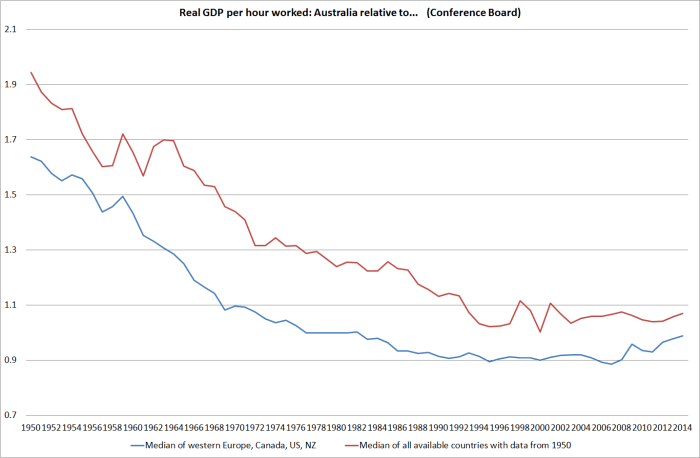
I described Australian incomes as “fairly high”.   And yet for all its huge natural resources, Australia’s real GDP per hour worked –  while a lot better than New Zealand’s – is no higher than the median of advanced countries.  For decades it fell relative to other advanced countries, and even over the last 20 years has done little better than hold its own.

aus real gdp phw relative

As a topic for another day,  might its people also have been better off without such rapid immigration-fuelled population growth?


New Zealand and Norway: a real exchange rate that hasn’t moved

On average, over time, one would expect the real exchange rate of a more poorly-performing country to depreciate against that of a better-performing country.

There is a whole variety of strands to a possible story about why one might expect to see such a relationship, and for why it would be helpful for the more poorly-performing country for such a depreciation to occur.  A less well-performing country will typically have found its firms less well able to compete in international markets (than those of the better performing country).  That, in turn might reflect a less attractive tax and regulatory environment, less real productivity growth, or changing demand patterns so that the world wants more of what the more successful country produces and less of what the less successful country produces.  Or it might even be about natural resource discoveries –  a country that discovers major new resources (eg oil and gas) just has more stuff that the rest of the world wants, and with good institutions such a country will tend to outperform other countries for a (perhaps quite prolonged) period.  And the citizens of a faster-growing country will rationally anticipate strong future income gains, increasing their consumption demand relative to the trajectory of consumption demand in the less well-performing economy.

I’ve illustrated previously that one of the striking stylized facts about New Zealand is that although our economic performance over the last 60 or even 100 years has been pretty disappointing by global standards, there has been no depreciation in our real exchange rate relative to those of other advanced economies.  No wonder our tradables sector has struggled.

This post is really just about illustrating the point by reference to one other particular small commodity exporting country, Norway.

For the first 100 years or more of modern New Zealand, no one doubted that per capita incomes in New Zealand were much higher than those in Norway.  New Zealand was one of the great economic success stories, while Norway struggled, and exported a lot of people, especially to the United States.  On the Maddison numbers, GDP per capita in New Zealand in 1870 was more than twice that in Norway.  By 1910, when New Zealand GDP per capita is estimated to have been the highest in the world, the margin was even more in our favour.

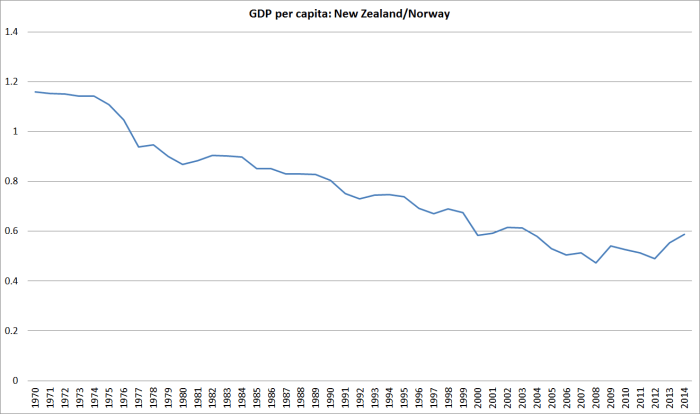
These days, GDP per capita in New Zealand is not much more than half that in Norway  (and the NNI per capita gap is even larger).  New Zealanders work long hours per capita, and our real GDP per hour worked is estimated to be only about 45 per cent of that in Norway.  Over the last few years, we’ve done a bit better than Norway, but the multi-decade trend has been strongly downwards.

Here, using the OECD database which has estimates back to 1970, is New Zealand GDP per capita relative to Norway’s (in current prices, using current PPP exchange rates).  These are really large declines.  Back in the early 1970s we had incomes about the same as those of Norwegians.

gdp pc nz and norway

Norway began to pull away from other OECD countries when its large oil and reserves began to move into production in the 1970s.  We, on the other hand, suffered in the 1970s from a deep decline in the terms of trade, and new access restrictions on our major export products.

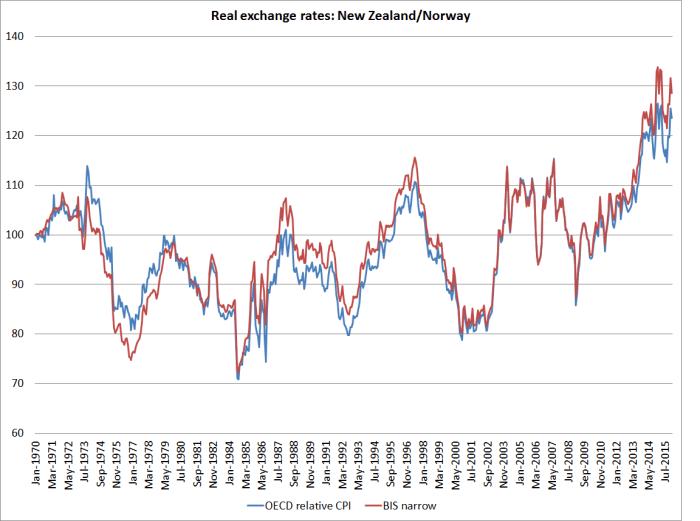
And yet here is a chart showing New Zealand’s real exchange rate relative to that of Norway since 1970.  I’ve shown two, very similar, series –  one is the OECD’s relative consumer prices index, and the other is the BIS’s narrow real exchange rate measure.

rer nz norway

Our real exchange rate (in particular) has been quite variable –  Norway’s has mostly been materially more stable –   but over the whole period there has been no trend whatever in the ratio of our real exchange rate to theirs (and in the last few years, New Zealand’s real exchange rate has risen a lot relative to Norway’s).

Using the OECD’s relative unit labour cost measure produces a slightly more encouraging picture for New Zealand –  but if there has been a trend decline at all, it has been quite small, compared with the magnitude of the deterioration in New Zealand’s economic performance (productivity, GDP per capita, usuable natural resource endowments).

Why has it happened?  Well, it is Saturday and I’m not planning to write an extended essay.  But my thesis is that it is a combination of things Norway has done, and things we have done.

On the Norwegian side, wisely or otherwise, much of the oil and gas revenues –  mostly accruing to the Crown – were diverted into the Petroleum Fund, and saved for a later day.   Norway has net government financial assets of around 250 per cent of GDP –  a figure that was less than 50 per cent only 20 years ago.  And there hasn’t been a large private sector offset   Norway’s positive net international investment position is now some 200 per cent of GDP.

What that has meant is that quite a large proportion of the new income earned in recent decades has not been spent.  And income not spent does not put upward pressure on the prices of non-tradables goods and services relative to those of tradables (another definition of the real exchange rate).  Norway has experienced some of that pressure –  Oslo is an expensive city – but a lot less than they would have without the huge savings rates.

Since the early 1970s, our government debt position hasn’t changed much –  it has gone up and down –  but was pretty low at the start of the period, and is pretty low now.  Our NIIP position has gone in the opposite direction of Norway’s, even though they were earning lots of (initially unexpected) income, and we were experiencing repeated disappointment.  On best estimates, our NIIP position was around -10 per cent of GDP in the early 1970s, and has been fluctuating around -70 to -80 per cent of GDP for the last couple of decades.

The Norwegians haven’t spent a larger share of their income even as their growth prospects improved, and we haven’t saved a larger share of ours even as our growth prospects deteriorated.  Neither choice is necessarily better than the other, but their choice tended to weaken their real exchange rate (all else equal) keeping more non-oil tradables firms competitive, and our choices tended to strengthen our real exchange rate, making it hard for the tradables sector to grow much.  For us, it tends to reinforce our decline.

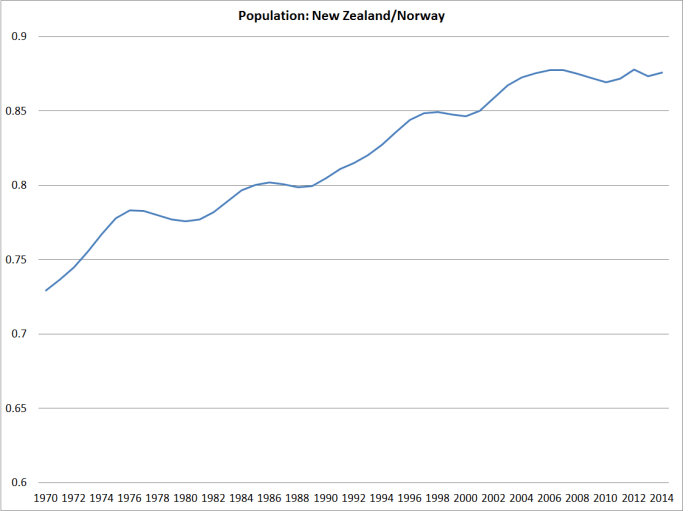
And then there are population choices.  When migration works well, it usually complements economic success that was already underway.  Rapid population growth, all else equal, tends to put upward pressure on a country’s real exchange rate –  it involves a high demand for non-tradables, putting upward pressure on non-tradables prices relative to those of tradables (set globally).  Norway’s population growth rate has increased quite a bit in the last decade, but over the full period since 1970, here is the chart showing the ratio of New Zealand’s population to that of Norway.

population nz norway

Our population –  in a country that has had one of the worst performances of any advanced country –  has grown materially faster than that of Norway, one of the most successful countries in the advanced world.  Not usually a recipe for success – in a family, or at a national level.

I don’t believe in population policy –  people should be free to have as many, or as few, kids as they can afford, and it should be no concern of governments –  but immigration policy is a different matter.  Our population has grown faster than that of Norway almost entirely because successive National and Labour governments have chosen to bring so many non-New Zealanders into the country (more than offsetting the upsurge in those leaving, mainly for Australia).  Doing so has helped impede the sort of the sustained downward adjustment in the real exchange rate one would have expected if governments had simply stayed out of the way.  It has made even harder for New Zealand to turn around the decades of economic decline.

It just looks like a wrongheaded policy, foisted on us –  at our expense, without seeking our endorsement –  by a succession of bureaucratic and political elites (different party labels or none, but similar ideologies and mindsets) who can offer barely a shred of evidence in support of the success of their strategy.

We can’t change the fact that Norway got oil or gas, and nor would we  wish to, or begrudge them their good fortune.  But it is pretty extraordinary that over 35 years when they’ve done so well and we’ve done so badly, there has been no change in our real exchange rate relative to theirs.  At our end of that relationship, it is as if governments have set out to stop the adjustment happening.   It wasn’t their conscious intent, but after this long lack of conscious intent makes them no less culpable.

Roger Partridge on immigration

I was going to spend the afternoon watching the cricket but….it seems less bad with my back to it.

The New Zealand Initiative describes itself  as

The New Zealand Initiative is a business group with a difference. We are a think tank that is a membership organisation; we are an association of business leaders that is also a research institute

According to a recent interview with the chairman

Currently we have 37 full fee-paying members, including ANZ Bank, ASB Bank, Air New Zealand, Chorus, Contact Energy, Deloitte, Deutsche Craigs, EY, First NZ Capital, Fletcher Building, Fonterra, Foodstuffs, Forsyth Barr, Freightways, Google, Heartland Bank, KiwiBank, Microsoft, PwC, SkyCity, Todd Corporation, Vero, Vodafone and Westpac.

The Initiative has produced some interesting material since they were formed a few years ago, and I often find what they write stimulating even when I don’t agree with them.

Like many, I’m signed up to receive the weekly newsletter.  It usually has two or three brief pieces from staff on something or other that has been in the news that week, often overlapping with work the Initiative has been doing.

This week’s newsletter was a bit different.   It has a piece from Roger Partridge, the chair of the Initiative, which can really only be described as a bit of a rant.  Under the heading Immigration Grows the Pie he gets underway wanting to close down debate

Sadly, our island state is not enough to stop a vocal minority chanting their own exaggerated anti-immigration claims. In recent times, calls to halt immigration have focused on Auckland’s overheated housing market. But, as economic conditions softened last year, back came the protectionist clichés about immigrants stealing Kiwi jobs.

As it happens, we do agree on one thing.  Partridge is responding to suggestions that immigration “takes away jobs”, and as I’ve argued for years, the demand effects of immigration typically exceed the supply effects in the short-run. In the short-term, if anything, immigration lowers unemployment, all else equal (also consistent with previous Reserve Bank research).  In the longer term, immigration probably doesn’t make much difference to unemployment rates –  labour market regulation, the welfare system etc determine that.  So I agree with Partridge that

In a market economy, the number of jobs is not static. More migrants create more jobs. They mean more teachers, more retail staff, more factory workers, and more managers. In fact, more of almost everything.

But that isn’t the real question –  it is one about whether New Zealanders, as a whole, benefit, in the form of higher incomes than they would otherwise earn.

Partridge then gets rather carried away with his enthusiasm

And that is not the end to the good news. Countless international studies have shown that increases in immigration not only tend to increase jobs, but also to increase the prosperity of the host nation. We benefit from their productive endeavours, their ingenuity and their diversity. And the more skilled the migrants, the greater the benefits.

That there are gains from immigration has received cross-party support in New Zealand since at least the 4th Labour Government. Let us hope the anti-immigration demagoguery falls on deaf ears. Going down that path we all lose.

The challenge is not keeping out the migrants; it is keeping out the bad ideas. Luckily, that does not need a wall, just clear thinking.

Well, we can debate the “countless international studies”.  As I’ve pointed previously, plenty of studies actually show that in the last great age of globalization, immigration actually narrowed income differentials –  incomes in the countries people were leaving rose relative to incomes in the countries they were coming to.  Economic success –  resulting from combination of better institutions, productivity shocks, or resources –  enabled countries to support immigrants at no undue cost to themselves, and relieved (just a bit) a burden on the source countries (Ireland, Sweden, Italy, UK etc).

But, actually, my reading of the literature and international experience on immigration is really an “it depends”.  Has immigration to Uruguay, Chile and Argentina benefited either side?  Most immigrants came from Spain and Italy, and the destination countries have Spanish-shaped institutions etc.  But income per head in all three Latin American settler countries is well below that in Italy and Spain –  two of the less successful Western European countries.  With hindsight, those immigrants probably should have stayed at home.

But our interest is surely New Zealand.  Can Partridge produce a single study –  let alone “countless” ones – that demonstrate that high rates of immigration have benefited New Zealand, whether in the post-war decades, or since the new National-Labour consensus developed at the end of the 1980s and early 1990s?

I’ve read pretty widely in the New Zealand literature and I’m not aware of any such studies.  MBIE and Treasury, in their advice to ministers on immigration can’t point to such studies.  Mai Chen’s recent taxpayer-supported  “superdiversity” report couldn’t.    There is a single paper around –  a modelling exercise from 2009 –  which purports to show such gains, but in fact it doesn’t. It can’t in fact  –  it is the sort of model that produces the answers you set it up to produce (something the authors recognize if not all the users).

There are simply no empirical studies demonstrating that one of the highest rates of immigration in the advanced world has actually produced any gains for New Zealanders as a whole (of course some gain, but many others lose, from (eg) the interaction of a distorted housing market and immigration policy, or the transfer between New Zealand diary workers and foreign ones).  Our productivity is lousy (total factor productivity included), and the tradables sector struggles to produce a much per capita as it was doing 10-15 years ago. Our own people keep leaving.  There is no simply evidence of any overall benefits for New Zealanders.  I’d be inclined to agree with Partridge that skilled (and innovative) immigrants would be better than the alternative,  but as I’ve illustrated previously  (and here) most of the immigrants we get aren’t particularly skilled at all.

Partridge is, of course, quite correct that

That there are gains from immigration has received cross-party support in New Zealand since at least the 4th Labour Government

The political and bureaucratic elites have been at one on that.  But there is simply no actual evidence, about specific developments in New Zealand in these few decades, that actually supports their belief about what our immigration policy would do for New Zealanders.    Perhaps it was a reasonable policy to adopt 25 years ago –  there was a lot of  belief that New Zealand was about to flourish, and perhaps there would be plenty of gains to share around.  But we haven’t flourished. We’ve languished, and it increasingly looks as though the migration policy was a misguided and perhaps quite damaging choice in our specific circumstances.

What New Zealand needs is some rigorous debate on the issues and evidence, not rather desperate attempts to simply rule any debate on immigration issues out of court.


Immigration effects and the OIA

The economic impact of immigration received considerable attention in the Reserve Bank’s December Monetary Policy Statement.  That made sense –  the net inflow (a small net outflow of New Zealanders and a large net inflow of foreigners) over the last year or so has been one of the larger net inflows seen for some time, and has led to an estimated population growth rate higher than we’ve experienced for decades.  Changes in immigrant numbers affect the labour market, the housing market, demand for government infrastructure etc.   A forecast-based monetary policy needs a good story about (a) what will happen to net migration, and (b) what the short-term economic effects of those immigration developments will be.  And making sense of what has already happened requires disentangling the various influences –  including those associated with changes in immigration.  It is particularly important in New Zealand, where the level of inward non-citizen migration is larger than in most advanced countries, and where the variability in the net flow of New Zealanders and foreigners is larger than most.  Watching the Republican debate the other day, I heard Marco Rubio argue that the US was the world’s most generous nation because it took around a million legal migrants a year.  That is about 0.3 per cent of the US population.  Our annual non-citizen residence approvals target is around 1 per cent of our population.

But reverting to the Reserve Bank view, the material in the Monetary Policy Statement and associated press conference wasn’t that convincing.  Here is what I wrote about it then:

I am also puzzled about the Bank’s stance on immigration, and the evidence base that lies behind it. The Governor is clearly at one with New Zealand elite opinion –  he told the news conference that he thought high levels of immigration were “a good thing for New Zealand” and that he did not think there should be any immigration policy changes.  Views differ on the long-term economic impact of immigration, and many certainly agree with him, but why was this a subject the Governor is commenting on at all?  Historically, the Reserve Bank has been studiedly neutral on the long-term issue, and focused (rightly) on the short-term cyclical implications.  Governors who use the platform they have been given to advocate their personal policy preferences in other areas risk further undermining support for the autonomy they enjoy in respect of monetary policy.

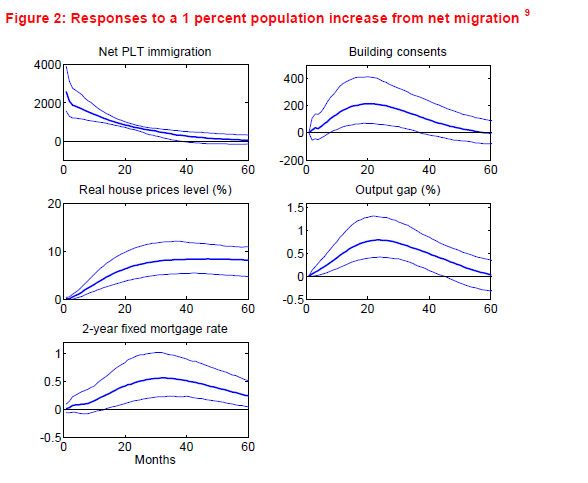
But even the Bank’s view on the cyclical impact of the recent high levels of immigration seems confused.  In chapter one (the press release) they assert that high levels of immigration have reduced capacity pressures and contributed to  a lowering of inflation (ie supply effects exceed demand effects).  In chapter 5, they produce a scenario about the impact of immigration staying unexpectedly high over the next year or two.  In that scenario they explicitly articulate what appears to be their latest new view, in which a change in immigration has no net short-term impact on capacity or inflation pressures (short-term demand effects are just matched by short-term supply effects).  There is no analysis in support of any of this.  And there is no engagement with their own past research, or with the consensus view of New Zealand macroeconomists going back decades that whatever the possible long-term gains from immigration, in the short-term the demand effects dominate the supply effects (which shouldn’t be surprising, since the per capita capital stock requirements of each new person are materially greater than one year’s labour supply).  It was only two years ago that they published a research paper which showed these results.

mcdonald rresults

Demand effects exceed supply effects in the short-run (of several years).

The Bank seems all over the place on these issues. Perhaps they have fresh new research on the issue, but they put out two new Analytical Notes this morning, and there was nothing on immigration. I have asked for copies of any analysis they have produced in support of their new view, including how it might relate to the 2013 research.

For decades, the Reserve Bank has been clear that the short-term demand effects of immigration outweigh the short-term supply effects in New Zealand.  That was typically the view of other macro forecasters, and it was also the consensus among New Zealand economists throughout the post-war period.  It isn’t surprising (modern economies need lots of physical capital – and building a house typically takes more than the value of a year’s labour) –  and it says nothing about whether or not large scale immigration is beneficial in the long-run.  But the Reserve Bank has now apparently changed its stance, while providing analysts, commentators, and the public no basis for their new stance.  Perhaps the new stance is correct, but we should be able to evaluate their arguments and evidence.

So on the morning of the MPS release, I lodged a request with the Bank for

Copies of any analysis undertaken by, or discussed by policy committees at, the Reserve Bank since 1 June 2015 about the determinants of net migration in New Zealand and the economic impact of immigration.  I am interested both in any material shedding light on the Bank’s evolving views around the balance between supply and demand effects of immigration (including any reflections on the ongoing relevance, or otherwise, of the results published in Chris McDonald’s 2013 Analytical Note) [from which the chart above is taken], and anything shedding light on the Governor’s comment this morning that the high level of net immigration is a “good thing” for New Zealand.

It wasn’t a “gotcha” request.  I assumed there must be some new modelling or research behind the Bank’s stance, and was keen to see it, and cover it here.  It was also surprising that a Reserve Bank Governor would comment explicitly on longer-term immigration policy so I wondered if they had new evidence, or were influenced by new evidence from others, to justify that stance.  I also drew the request quite narrowly, focusing on the previous two forecast rounds only, and not asking for emails.  I was quite genuinely interested only in either research papers (there just aren’t that many  in any five month period) or analytical pieces discussed at the Monetary Policy Committee (again, it seemed unlikely there would be many –  immigration not having featured in the Statement of Intent as a key aspect of the Bank’s research programme.   Moreover, since immigration had been a prominent aspect in the Monetary Policy Statement released just that morning, it was hard to imagine that any extensive investigation would be required to unearth papers, which had been prepared and discussed in the previous few weeks.  And as I noted the other day, the Reserve Bank has tried to convince us of how transparent it is around its  “policy objectives, policy proposals, economic reasoning, and of our understanding of the economy”, so it seemed reasonable that they would be keen to get any material out as soon as possible.

And since the Official Information Act requires agencies to release material “as soon as reasonably practicable” the naively optimistic strand that lurks within me wondered if I might get something by Christmas.  Silly me.

Instead, I had an email from the Bank just before 5pm last Friday –  the very last day of the 20 working days available to the Reserve Bank to respond.  I was advised that

The Reserve Bank is extending the time limit for a decision on your request to Monday 29 February 2016, as permitted under section 15A of the Act, because the request necessitates a search through a large quantity of information and meeting the original time limit would unreasonably interfere with the operations of the Bank.

That is certainly a statutory ground on which a deadline for dealing with a request can be extended.  But it is highly unlikely to be a legitimate argument in this instance.  As I noted, it is not plausible that there is huge amount of material.  And as for unreasonably interfering with the operations of the Bank, recall that these aren’t ancient historical papers, or about some obscure points of policy; they are recent papers directly relevant to the Bank’s primary function, where it prides itself on transparency.  And the OIA had already given the Bank extra time (since deadlines are automatically extended over the summer holiday period).

Frankly, I’m not sure what the Bank has to hide.

But it feels like deliberate stalling and, accordingly, I have appealed this decision to the Ombudsman.    I am beginning to worry that perhaps there is nothing there at all.

That would be a concern –  and especially from an agency which wants to convince us that its new charging policy is itself in the public interest [1], and indeed supports access to official information.


[1]  Somewhat curiously, despite the alleged need to “search through a large quantity of information” and the risk that doing so might “unreasonably interfere with the operations of the Bank”, there has not yet been any suggestion of a charge for meeting this request.


Do citizens always (net) leave their own countries?

In my post the other day on New Zealanders continuing to leave New Zealand, one thing I didn’t touch on is that in normal circumstances one should expect more citizens to leave their own country than arrive.

People mostly acquire citizenship by first living in a country.  For most people, it is a matter of being born somewhere (although not everyone born in a particular place is entitled to citizenship of that country).   Others acquire citizenship through immigration, sustained residence and naturalization.  And there is a, typically much smaller, group who acquire citizenship outside the country –  eg the children born abroad of New Zealanders.

In other words, most citizens of a country are in that country to start with.  However successful the country is, it is likely then that over time more citizens will leave the country than will arrive in it.  There typically isn’t a large stock of citizens abroad, and some citizens will, for example, marry someone from another country and move to settle in that country.   Others will find an exceptional job abroad, or simply like something about the lifestyle or values that another country offers.  The United States, for example, has had among the very highest material living standards for a long time, but the best estimates seem to be that there are a couple of million American-born US citizens living abroad.  More Americans have left the United States than have arrived.

But two million Americans is less than 1 per cent of the US population.  In New Zealand’s case, by contrast, Australian statistics say that there are around 600000 New Zealand born people (almost all of whom will have been New Zealand citizens –  many still are) in Australia alone.    There are only around 3.5 million New Zealand born people in New Zealand.   Diasporas make a difference.

Once there is a large stock of citizens living abroad, there is no reason to think that the net migration flow of citizens will continue to be outward, no matter what the economic conditions are.  If New Zealand’s economy starts performing better than those abroad, which group of people finds it easiest to move here and take advantage of those opportunities?  Surely those who are already our own citizens –  they have the legal right to move here, full access to our welfare supports, and few cultural adjustment issues  (Australians can come here too, but the flows are typically small.)  By contrast, people from other countries face  all sorts of additional hurdles.  They need legal permission to come (and we don’t allow just anyone in, as soon as they want to come),  and they typically won’t know the culture that well or find it easy to immediately see their skills fully recognized in the labour market.    With 600000 New Zealanders in  Australia alone, if there was any convergence going on between living standards in New Zealand and Australia (or New Zealand and the UK, where the next largest group of New Zealanders live) that could quite quickly and readily been accompanied by a reversal of the net outflow of citizens.  Many would still be leaving  –  some permanently, some just for a few years –  but more could be returning.

What happens in other countries?    Do we ever see net inflows to a country of citizens of citizens of that country, or is this just a theoretical curiosity?  In fact, we do see, and have seen, such flows.

I went to the Eurostat database, which collects and reports data from a huge number of European countries (mostly those inside the EU, but not only them).   Somewhat to my surprise, I actually found what I was looking for: in this case, 10 years of annual data for the migration inflows and outflows of citizens of each reporting country.  I’m not sure how they compile the data in most countries (in New Zealand, we use arrival and departure cards), but in Europe the use of identity cards and the need to register in a locality probably support data collection.  In any case, however they manage to calculate it, this is what I found.   I downloaded the data for 32 countries for the years 2004 to 2013 (the most recent Eurostat had).  Bear in mind that New Zealand has not had an annual net inflow of its own citizens for more than 30 years.  But over the last decade, 11 of these European countries had had such inflows in at least one year (in fact, all of those 11 had had at least two years of net inflows of their own citizens).

These were the countries that had experienced inflows: Denmark, Ireland, Greece, Spain, France, Croatia, Cyprus, Slovakia, Hungary, Malta, Finland

It is a diverse group: some of the richer EU countries (France, Denmark and Finland) as well as some of the poorer.  Unsurprisingly, most of the inflow years seem to have been when the home economies were doing well.  Over time, for example, Ireland has huge net outflows, akin to New Zealand’s experience (and hence a very large diaspora), but they had a net inflow of their own citizens of around 12000 people a year from 2006 (when the Irish data start) to 2008.  Cyprus –  a much smaller country –  was attracting back a net 1000 or so of its own citizens each year right up until their crisis hit in 2013.  And so on.

As I noted, even very rich countries will tend to see a modest outflow of their own citizens over time.  Norway, for example, has an extremely high GDP per capita (and even higher GNI per capita), and about the same population as New Zealand.  It was losing about 1000 Norwegians per annum over 2004 to 2013 –  a period when New Zealand lost an average of 28000 people per annum.

And how do to the average net outflows over time compare across countries?  This chart shows data for the Eurostat countries discussed above, supplemented with national data for New Zealand and Australia.

own citizens inflow

A handful of countries actually had a net inflow of their own citizens over this full period.  But only two of the countries had a larger average annual outflow (as a per cent of population) than New Zealand.  If New Zealand had really been doing well our diaspora is large enough that the flow could easily have reversed.  It simply hasn’t.  It fluctuates, and the net outflow in the last year has been modest by our own historical standards (recent decades), but even last year’s net outflow would have put us towards the right of this chart.

Immigration is NOT causing poverty

I did an interview on Radio Live this morning on the economic impact of immigration.  When I went to listen to it afterwards, I found it was marketed under the heading “Immigration causing poverty”.  I’m not sure where they got that idea from what I’d said, but just to be clear my argument is that high rates of immigration to New Zealand over the last 60 or more years have worsened our overall economic performance. But even from my relatively pessimistic perspective, this is still one of the better off countries in the world.  And as readers will recognize, I reckon immigration, if anything, lowers unemployment rather than raises it –  ie puts more short-term pressure on demand than on supply.

In case anyone is interested, here is the link to the interview.

http://www.radiolive.co.nz/Immigration-causing-poverty—expert/tabid/506/articleID/110378/Default.aspx

UPDATE:  Thanks to Radio Live for changing the heading.

Immigration, convergence and history

Browsing on some blogs this morning, I stumbled on a nice brief article by Kevin O’Rourke, an Irish economic historian and professor at Oxford, about the role emigration from Europe in the 19th century may have played in enabling European populations to capture the benefits of the Industrial Revolution, and overcome the Malthusian limits, sooner than they might otherwise have done.

The article is worth reading, but my eye lighted on a single paragraph that summarized some results that I’d been meaning to write about for some time:

…emigration proved an invaluable safety valve. It was highest where wages were lowest relative to the New World, and where population growth was fastest, although poverty traps at first impeded migration from the poorest regions of Southern and Eastern Europe. And the beneficial effects on European labour markets and living standards were often very large. According to one estimate, between 1870 and 1910 emigration lowered the Swedish labour force by 20 per cent, and increased real wages by 7.5 per cent; the equivalent figures were 24 per cent and 10 per cent for Norway, 39 per cent and 28 per cent for Italy, and no less than 45 per cent and 32 per cent for Ireland.

These estimates aren’t by just anyone. They are the results of work done by  two leading academics, Alan Taylor and Jeffrey Williamson, both of whom have spent decades looking at these and related issues.

In other words, emigration from (in these cases) Sweden, Norway, Italy and Ireland left the people who stayed behind better off –  it contributed, in the jargon, to a process of factor price equalization, tending to narrow the gaps between wages in emerging Europe and places like the United States, Australia or New Zealand.  Looked at through the perspective of history, it should not be a remotely surprising result to anyone.  Wage differentials between New Zealand and the United Kingdom, for example, are estimated to have converged in the run-up to World War One, in response to the very large inward migration here.

But for some reason people get hesitant about applying the same logic to New Zealand’s experience over the last 40 years or so.  Over that period, a large gap has opened up between wages and material living standards between New Zealand and the rest of the advanced world.  But the gap has been particularly obvious in respect of Australia –  obvious both because the two countries had had fairly similar incomes throughout their modern history, and because of the relatively free labour mobility between the two countries.

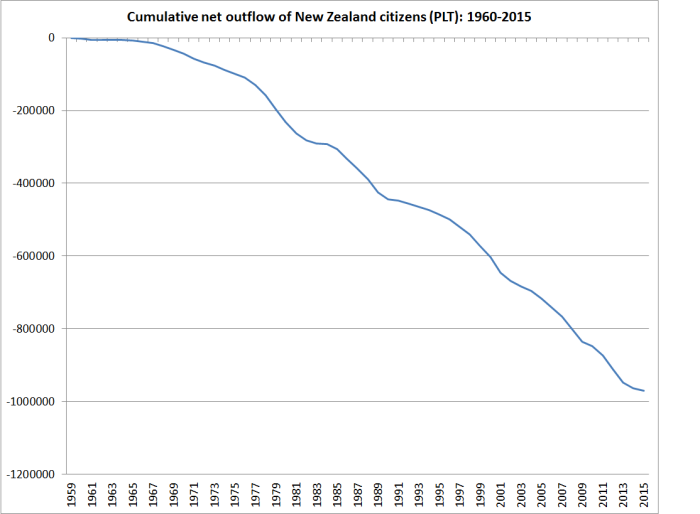
The cumulative net outflow of New Zealand citizens since 1960 is estimated to have exceeded 900000 people.

cumulative plt since 1960

If the average population over that period was around 3.5 million, the outflow is roughly equal to a quarter of our population –  so it has been on a scale similar to the countries in the extract above.  All else equal, we might have expected quite a degree of factor price equalization to have occurred as a result, just as those European countries experienced in the 19th century.    One wouldn’t have expected the process to be complete by any means –  after all, incomes in (former ) East Germany are still below those in the West, and not everyone has left the East.  But if economies were left to work normally, we’d have expected quite a lot of convergence.

But what really marked modern New Zealand out from 19th century Italy, Ireland, Sweden or Norway was immigration policy.   As returns abroad improved relative to those at home, authorities in none of those four countries/regions (Ireland was still part of the United Kingdom) had an active policy to bring in even more migrants from elsewhere than were leaving.

For many, the emigration must have been heart-rending –  breaking up families and depleting villages and regions.  But it was a process of responding to changing opportunities that, on average, improved living standards for those who went to the New World and those who stayed behind.  But the governments weren’t activist enough, or foolish enough, to prevent the adjustment working, or try to reverse it as a matter of policy.  You can’t expect to see factor price equalization occurring, working in ways that help the poorer country/region, when (net) there isn’t an outflow of factors from the poorer region.    If only New Zealand policymakers would recognize this rather basic, historically well-documented, point.


More people need more capital

The government’s Budget Policy Statement and the Treasury’s updated forecasts were released yesterday.  I’m not going to comment on the Treasury forecasts in any detail –  it doesn’t help that Treasury produces the only PDFs I’ve encountered anywhere that somehow my computer won’t open – although I’d happily bet against their apparent view that the neutral nominal interest rate is still 4.5 per cent and that inflation is going to quickly get back to the middle of the target range.

But two policy initiatives warranted brief comment.  First, the resumption of contributions to the New Zealand Superannuation Fund (NZSF) is being deferred again.  Leveraged speculative investment funds don’t seem a natural activity for governments, and my only disappointment is that the NZSF isn’t being dissolved.  As Grant Robertson put it, the further delay will put pressure on future governments to review the age of eligibility for NZS etc.  Precisely.

The second initiative was the increase in the capital allowance by $1 billion for the coming financial year.   I’m rather sceptical of the quality of much of the government’s capital spending (Transmission Gully, Kiwirail) but this increase shouldn’t be surprising.  There are a lot more people in New Zealand than was forecast a few years ago, and people need places to live, schools, road, hospitals, shops, factories etc.  A significant chunk of the total capital stock is owned by the government (almost a sixth just by central government) and all else equal, if we have a lot more people more needs to be spent to provide the associated capital stock. That is true in the private sector –  houses, shops, factories, offices –  and in the public sector.   The latest official capital stock data show a net (of depreciation) central government capital stock of around $110 billion.  The population shock in the last few years will have been at least 1 per cent, so we shouldn’t be surprised by the need for additional public sector capital spending.  It shouldn’t be seen as some sort of discretionary fiscal stimulus or (according to the odd argument Graeme Wheeler ran last week) as a way of easing inflation pressures.  It is just something made necessary by the surprisingly strong population.  It is a concrete illustration of how demand effects from immigration surprises typically exceed supply effects in the short-run, again contrary to the new Reserve Bank view.

The net capital stock is almost three times annual GDP: each new worker needs the equivalent of three years production in additional capital (whether housing or factories or whatever)   New workers add to labour supply, of course but of themselves they don’t directly add to the capital stock.  And, as noted, the required addition to the capital stock is large relative to the additional new labour supply in the first year  –  typically several multiples of it.  And we have a new wave of migrants each year, each requiring further additions to the capital stock.    Real resources have to be devoted to putting in place that capital stock (we don’t simply import completed houses, roads, schools or office blocks).

None of this should be particularly controversial.  If a country’s population is growing faster then, all else equal, the amount (share of GDP) that has to be devoted to investment (capital stock formation) should tend to be larger than otherwise.  An acceleration of population growth should be expected to boost investment, and countries with faster population growth rates might be expected to have higher investment/GDP ratios than countries with slower population growth.  The differences should be quite stark: a country with 1 per cent per annum  population growth might be expected to devote around 3 percentage points of GDP more to investment than the average country with zero population growth.  That is just enough more so that the growth in the population would not adversely affect the capital stock per capita.    It is never going to be a precise relationship, since there is always a lot else going on.  And some countries have patterns of production that are less capital-intensive than others (eg the UK’s financial services industries are probably less capital intensive than Germany’s heavy manufacturing).

But, in fact, the relationship doesn’t look to have been there at all, either historically or more recently.

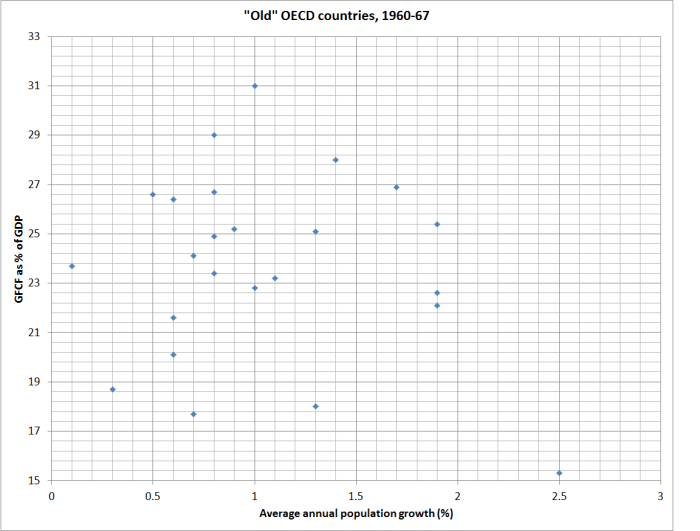
The OECD volume I had down the other day also had data for average annual population growth and gross fixed capital formation for the “old” OECD countries for the 1960 to 1967 period.  Here is the scatter plot, with a dot for each country.

gfcf and gdp old oecd 1960s

There is basically no relationship at all, and certainly nothing as strong as 3 percentage points more of GDP in investment for each 1 percentage point faster annual population growth.  It looks as though, across countries,, more rapid population growth tends to crowd out some investment growth. And since everyone needs to live somewhere, and governments have statutory command over resources and fewer market disciplines, the most likely investment to be crowded out is business investment.

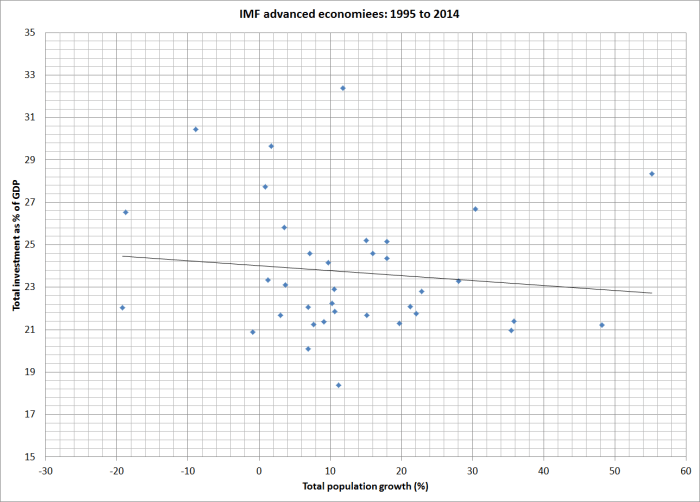
The 1960s is a long time ago.  So I also downloaded the same data from the IMF WEO database for each of the advanced countries for the last 20 years (1995 to 2014).  Here is the relationship between total population growth and the investment share of GDP.  The relationship is basically non-existent, and if anything (not statistically significantly) the relationship is the wrong way round.

gfcf to gdp 95 to 14

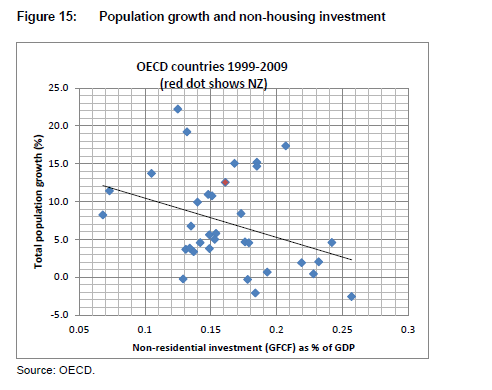
I didn’t have the energy to track down updated non-housing investment data, but I’ve shown previously that there has been a negative relationship between non-housing investment and the rate of population growth across advanced economies.

population and non-housing investment

According to the conventional story, this just should not be happening.  After all, our population growth is now largely the result of immigration policy, and high rates of skilled immigration are supposed to spark innovation, skills transfer, and new investment not just to maintain per capita capital stock but to capture the gains to the rest of us from the influx of capable people.  In fact, across countries and –  as far as we can tell –  across time faster population growth tends to squeeze out some business investment in the productive sectors.  Why?

There are two ways of articulating the story.  Strong demand, reflecting the desire to boost the capital stock to keep pace with the  population growth, tends to puts upward pressure on domestic interest rates (relative to those elsewhere).  That crowds out some of the desired investment (it just doesn’t happen), especially the return-sensitive business investment. It also tends to raise the exchange rate, providing a double-whammy adverse effect on investment in the tradables sector.     Growing per capita exports becomes harder.

The other way of looking at it, is to look at the relative prices of tradables and non-tradables.  Tradables prices are determined in world markets, and domestic demand doesn’t really affect them. But non-tradables prices are set in the domestic economy reflecting domestic demand (and underlying productivity growth).  High domestic demand associated with rapid population growth tends to raise the prices of non-tradables, and wages, while leaving tradables prices unchanged.  That makes it relatively more attractive to produce for the non-tradables sector, all the more so since all tradables production uses (now more expensive) non-tradable inputs.  External competitiveness is eroded and investment in non-tradables replaces, to some extent, investment in tradables.

Which brings us back to yesterday’s announcement.  The additional government capital expenditure was probably necessary, but at the margin, it will tend to be to squeeze out some other capital investment elsewhere in the economy.  The cross-country perspectives suggest that fast population growth will come at the expense of maintaining the per capita capital stock, and make it harder for New Zealanders to keep up, or close the gap on, the incomes of people in other advanced countries.

None of this is new.  It was the perspective of able New Zealand economists looking back on the post-war New Zealand experience.  Here, for example, is Professor Gary Hawke, writing in the last full economic history of New Zealand in the early 1980s.

the economic consensus is strong one. In essence it simply observes that productivity was highest in agriculture whereas population growth was catered for by the relative expansion of other activities. Population growth thus fostered expansion of relatively low-productivity activities and therefore tended to reduce average per capita income. The key assumption is that sectoral productivities would not have been even more unfavourable in the absence of population growth, and discussion of later chapters shows that assumption to be reasonable….Perhaps if less importance had been attached to full employment, or if a different exchange rate had been implemented, the sectoral productivity trends could have been changed. Perhaps so, but population growth made it more rather than less difficult to effect those changes in policy, even if they had been desired, and, in terms in which it was debated, the economic case against population growth in the post-war economy was always a strong one.

It still is in 21st century New Zealand.