Brexit, Trump and all that

Last week, The Treasury hosted a guest lecture featuring two visiting academics under the heading Brexit, Trump & Economics: Where did we go wrongOne of the visitors –  Samuel Bowles, now a professor at the Santa Fe Insitute -had been around long enough that in his youth he had served as an economic adviser in Robert Kennedy’s presidential campaign,  and at other times as an economic adviser to the Castro government in Cuba.  The other –  Wendy Carlin –  is a professor of economics at University College, London.

When the invitation went out, I was rather puzzled by the title?  Who was this “we” that apparently “got things wrong”?    After all, I was –  and remain –  keen on Brexit, and will recall for a long time the thrill of that June Friday afternoon as the results rolled in.  And if I wasn’t a Trump supporter, I wasn’t a Clinton one either.  There is a fascinating question as to how Trump became the Republican nominee, but once that had happened one of two unattractive candidates was going to become president.

“We” turned out to be economists.  And by getting things wrong, Bowles and Carlin didn’t mean simply getting eve-of-polling-day forecasts wrong (after all, that late in the day even some pretty prominent Leave figures didn’t expect to win).  Instead, economists were held to blame for these otherwise unthinkable, apparently lamentable, events occurring in the first place.  If only economists had done a better job, the deplorable events would never have happened.  Or so the story went.  The tone was one that surely no right-thinking person could have wanted such outcomes (Brexit was even described as a “gloomy event”).    As this was the second Treasury guest lecture in recent months deploring Brexit, I start to wonder if the organisation now has a quasi-official view (or perhaps it is just the British CEO)?

I’m still not entirely persuaded that either event –  Brexit or Trump –  is quite as earthshattering as the liberal elite seem to make out, or even that they are very closely connected.  UK voters chose to leave the EU by a margin of 52:48.  That is a large enough margin not to require recounts, but hardly an overwhelming margin.  And the same voters only a year early had re-elected (this time with an absolute majority) David Cameron and Conservative Party, on a not-remotely-radical platform.  And today, Cameron and Osborne are gone, and Britain still has a not-remotely-radical (perhaps only slightly more reforming than John Key) Conservative government, with a massive lead in the polls – albeit, the latter is as much about the problems with the Labour Party as anything else.  The government is charged with implementing Brexit, and there seems to be not the slightest sign of some turn inwards, or reversion to protectionism, on goods and capital flows.

Of course, if your vision was one of ever-closer-union, and a mental model in which there was only a one-way door to the EU, perhaps it is a great shock.  After all, if Brexit works more less okay, it might suggest to other countries’ citizens that there are reasonable alternatives to being part of the EU.  And that simply isn’t so radical –  after all, most of the world’s people show no interest in becoming citizens of multi-national superstates.  And the tendency of the last 100 years has been towards more sovereign states not fewer.  Lower barriers to international trade help make that possibility more economically viable.

And it is not as if the public in the United Kingdom has ever been very enthusiastic about subsuming sovereignty into some quasi-democratic entity based in Brussels.  The technocratic elites may have been enthusiastic, but the public seem never to seen anything very wrong about being British.  When your country has been free, and on the right side of the major conflicts of the last 100 years, it is hardly a surprising stance.  Citizens of Spain or Austria might see things differently.

I wrote a post earlier in the year about the fascinating polling data from the early 1970s I stumbled across in a book reviewing UK entry to the EU in 1973.    For all the talk that it was poorer, unskilled, older people who voted to Leave –  as if somehow that changes the character of the decisions –  in the early 1970s, when overall opinion was pretty closely divided on entering the EU, it was those same groups who opposed joining.  And of course the same people who were young in 1972, are old in 2016.  As I noted in that earlier post, what was striking from the polling data (comparing the early 1970s and the 2016 exit polls), is the change in attitudes among the more highly educated groups.    Among the AB group (professional and managerial occupations), in the early 1970s there was a huge margin (50 percentage points) in favour of joining the EU. In the 2016 exit polls, there was a margin of only 14 percentage points  (57:43) in favour of remaining in the EU.   Poor and unskilled changed their minds (as a cohort) less than did the more highly educated groups –  and those more highly educated groups became much more opposed to staying in the EU.

But for Bowles and Carlin, economists had failed the world.  They presented familiar data showing that most economists thought that Brexit would come at some economic cost (and of course, the great and the good –  the OECD, the IMF, the Bank of England, and the UK Treasury shared that view).  And yet the voters had the temerity to ignore these experts.   When I pushed them on the point, they did –  somewhat reluctantly –  accept that it wasn’t necessarily unreasonable for voters to make decisions on grounds other than economic ones (as I noted, most colonial independence movements  –  even the Irish one – probably came at an economic cost).  But it was a reluctant concession –  these were people who could really only see one end in view, less national sovereignty, more global rulemaking, and they could only lament the choices of British voters –  blaming economists for championing policies which had “made the backlash inevitable”.

(The second half the guest lecture was a presentation about a new approach to teaching introductory economics.  It looked quite promising, but the connection between a possible better approach to teaching basic economics and voters in future “being more willing to take advice from economists” seemed tenuous at best.)

As for the Trump phenomenon, I’m also not sure quite how big an event that should be seen as.    The last count I saw gave Hillary Clinton 48.2 per cent of the popular vote, and Trump 46.3 per cent.    Four years ago, the Democratic candidate scored 51.1 per cent of the popular vote, and the Republican candidate 47.2 per cent.   Presidential elections aren’t decided by national popular vote totals (any more than, say, UK parliamentary elections are) but these aren’t big shifts in the overall vote share.  Yes, the presidency changes hands –  as it was going to do anyway –  but a few hundred thousand votes in a few key states and things could easily have been different.  Are economists really to blame for the fact that the Democratic Party chose such a weak candidate –  who largely ignored many of those tight rust-belt states, despite the advice of her own husband?  And whoever is to blame for Wikileaks I doubt it is the economics profession?

In 1984 Ronald Reagan took 58.8 per cent of the popular vote, in 1972, Richard Nixon took  60.7 per cent, in 1964 Lyndon Johnson took 61.0 per cent and in 1956 Dwight Eisenhower took 57.4 per cent.  Those were landslides (in a New Zealand context, electoral landslides –  1972, 1975, and 1990 involved perhaps seven percentage point gaps in overall vote shares).   This was a very tight election, fought between two deeply flawed candidates.  And if Trump’s success may have helped some Republicans in the House and Senate, very few were campaigning on some Trumpesque policy ticket –  whatever the specifics of such a ticket might actually have looked like.  Like them or not, the appointees to the Trump cabinet announced so far, don’t seem a million miles from many of the sort of people who might well have been appointed to serve in any Republican president’s cabinet.  And being a democracy, parties tend to alternate in office.

What was pretty clear as the Treasury guest lecture went on was that the speakers were mostly just pushing a social liberal ideological agenda (as they characterised their concern it was about a “a revolt against liberal tolerance”.  Things were wrong when their side didn’t win and somehow –  weirdly – economists were to blame.  That isn’t just my interpretation of the event –  it was a proposition put to them at the lecture by Professor Jonathan Boston, himself proudly socially liberal.  What wasn’t clear was why our Treasury was aiding and abetting their cause.   (Or for that matter, how  the ascendancy  –  voted in by US voters, well aware of most of his flaws – of such a symbol of the decadence of modern culture as Trump even represents a defeat for the social liberal project.)

In passing, there was one truly fascinating snippet in the lecture.  Bowles is adamant that a much higher level of economic equality is “not hard to create” –  and he treats such outcomes as highly desirable.  According to his research, the level of economic inequality in modern Denmark and Sweden is about the same as that found in ancient hunter-gatherer societies.  It was almost worth venturing into town for the afternoon just for that.

In the same vein, I came across an interesting report from a conference held in the UK last month under the title “Brexit and the economics of populism”.  The conference was attended by a cast of 50 or so academics, journalists, and some leading market economists from across Europe.    There were some very able participants and it looks to have been a fascinating day’s discussion.  The 12 page conference report is well worth reading for anyone with an interest in Brexit, Trump, modern macro and micro policymaking –  and in the attitudes of the (non-political in this case) elites.

What was perhaps striking –  and this is the real link to the Bowles/Carlin lecture here last week –  is that there is no sign in the entire report that anyone who spoke had themselves been a Brexit supporter (even though 43 per cent of the ABs had favoured Brexit). The report captures one questioner noting that it is not unreasonable for people to vote on non-economic grounds, and that is about it.  And the report is full of references to those ill-defined and pejorative phrases “populism”, “xenophobia”, “nativism” and –  heaven forbid –  “nationalism”.  I had to look up “nativism” –  it isn’t a term that pops up much in New Zealand debates.  According to Wikipedia

Nativism is the political position of supporting a favored status for certain established inhabitants of a nation (i.e. self-identified citizens) as compared to claims of newcomers or immigrants

One might play around at the margins with the precise wording, but it looks like a definition that probably describes the overwhelming bulk of voters.  And there will be few elected politicians  (ie people who have actually persuaded people to vote for them) who seriously think that the interests of foreigners rank equally with the interests of citizens.

Next thing people will be having a go at “familism” –  the belief that the interests of one’s own family might rank more highly in one’s own concerns than those of other people’s families, domestic or foreign.

The conference report suggests participants thought governments needed to do better.  And, of course, there are areas in which that is no doubt true.  Often enough, that might involve avoiding hubristic schemes –  like the euro, or the EU on current scale –  in the first place.  Or respecting the principle of subsidiarity –  pushing decisions back to national governments (and perhaps even lower levels of government) whenever possible.  And respecting public preferences and choices.  And acknowledging the sheer limitations of the knowledge of experts in so many areas –  including economics.

But that wasn’t the focus of the attendees at this conference.  Instead, it was a recipe that seemed to have three broad dimensions:

  • a more active role for government, in particular in discretionary fiscal policy (as if debt levels in many of these countries were not already uncomfortably high),
  • putting more decisions at an arms-length from elected politicians (whether delegating more fiscal policy to independent agencies, or promoting international regulatory alignment), and
  • convincing the public that there really were significant benefits from large scale immigration.

In fairness, there was some recognition that dysfunctional housing markets are a major problem, but no speaker or questioner is reported as having favoured extensive land use liberalisation.  Instead, more roles for active government were in view.

The immigration stance, of course, caught my eye.  As the report writer noted there is an “academic consensus that wealthy countries benefit from migration from developing to developed countries”, but most of the comment was devoted to trying to play down the potential costs to relatively unskilled native workers.  I’m sure these people are quite sincere in their beliefs that there are benefits to advanced countries (and their existing citizens?) but I can’t help thinking that if the gains were that real, and it were that important an issue, the advocates would find it much easier to demonstrate the benefits (to the rest of us) than they do.  Perhaps quite often large scale immigration doesn’t do much harm to natives, but there isn’t much sign that does much good either.  In fact, support for large scale immigration –  whether in Europe or Australasia – is often more of an ideological proposition than one grounded in robust evidence.  It seems as much about a desire to change a society –  in ways which natives often don’t want –  than to lift overall economic prosperity for citizens.    (But in defence of the Europeans, at least no one in this conference is reported as advocating for immigration on the specious grounds –  invoked often by our business leaders and the incoming Minister of Finance –  that immigration is needed to fill “skill shortages”.)

If you got this far, you might be wondering what the point of this post was.  I feel somewhat that way myself. But it was partly about getting a few things off my chest, partly about passing along the link to the interesting conference report, and partly about thinking through my reaction to those who ominously go “could it –  Trump, Brexit –  happen here?”       Could what?  A couple of close votes  –  one of which leaves in place a very moderate centre-right government, and the other of which installs a President who seems to have very few fixed views.  In the specific sense, clearly not. We aren’t part of some multi-national entity like the EU, and our electoral system is very different from that of the US.  Then again, perhaps there could be a revolt against decades of economic underperformance, decades of elite indifference to that underperformance, and an extraordinarily high target rate of immigration which changes the character of the country without doing anything apparent to improve its economic performance.  It could happen, but frankly it doesn’t seem very likely right now.  Easier just to keep on pretending everything is fine.


Immigration and the macroeconomy

Eric Crampton, the strongly pro-immigration head of research at the strongly pro-immigration New Zealand Initiative drew attention to a nice summary (on a high profile portal for the wider dissemination of economic research) of a new empirical paper by a couple of researchers at the Norwegian central bank looking at the macroeconomic implications of immigration in Norway.    It looks as though a draft of the paper may have been presented in New Zealand, and at very least the authors thank a couple of Reserve Bank researchers for comments, and cite a couple of  Reserve Bank research papers.

Unlike most European countries (apparently) but like New Zealand, Norway has good quarterly immigration data.  Historically, Norway had quite low rates of immigration, but over the last 15 years or so there has been a substantial increase, mostly stemming from the liberalisation of migration flows within the EU (and closely associated countries, including Norway).  By New Zealand standards, the net inflows are still modest, and annual population growth peaked at around 1.3 per cent, compared with a 2.1 per cent peak recent annual increase in New Zealand.

Figure 1 Annual change in Norway’s population (%)furlanettofig1

One of the challenges in assessing the economic impact of immigration is assessing which bits are a response to domestic economic developments, and which are more genuinely exogenous.  There aren’t easy or foolproof ways of doing that (after all, even when there are discrete policy changes –  as with the recent change in New Zealand’s target level of residence approvals –  those changes aren’t made in a vacuum, and may be influenced by the actual or perceived state of the economy).

The latest paper uses a particular empirical “identification strategy” to try to distinguish endogenous from exogenous changes in the immigration  flows.  It looks a plausible enough approach, but it is hardly the last word on the subject.   There are two other features of the paper to note, both of which should make it more likely that the authors will find positive results.

The first is that the authors look only at immigration from “western countries” (EU/EFTA, North America, Australasia and Eastern Europe).   As they note, in Norway “immigrants from non-western countries exhibited an employment rate substantially lower than natives, and migrated to Norway mainly because of family reunification or as asylum seekers”.  The second is that the analysis uses “mainland GDP” –  which excludes oil production and associated transport.  Doing so is common in short-term macroeconomic analysis in Norway, but tends to skew the results towards finding positive results from immigration –  since the oil resource is a fixed factor, and a major contributor to Norway’s overall economic prosperity.  Every increase in the population spreads that particular fixed resource across more people, lowering the average per capita output from that sector per person.

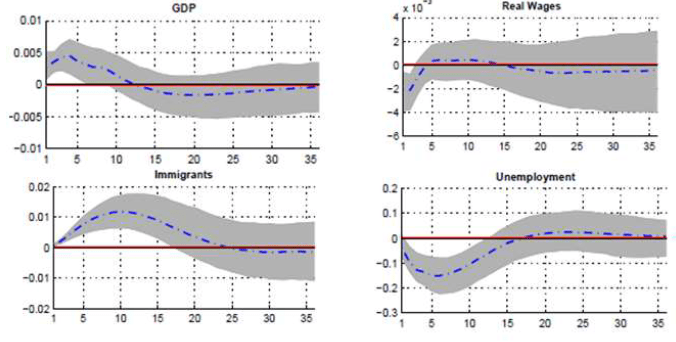
So what do the authors’ find as a result of their modelling?  Using quarterly data, they examine the response of a number of variables over periods up to 36 quarters (9 years) after the initial immigration shock.  Here is their chart.

Figure 2 Responses to an exogenous increase in immigration

furlanettofig2

When the grey shaded area encompasses the red (zero) line, there is no statistically significant effect found.

The results largely rang true to me, and are consistent with the longstanding approach of New Zealand economists to the short to medium term impact of immigration.    Unsurprisingly, an immigration shock boosts GDP –  to a statistically significant extent –  over the first year or so.  The new migrants (particularly these western migrants) are both workers and consumers, and generate a need to additional private and public infrastructure.  But interestingly, the effect doesn’t last.  On this modelling, there is no permanent increase in GDP –  let alone GDP per capita.

And consistent with the New Zealand stylised facts –  over decades, but including Reserve Bank research in the last few years –  a positive shock to immigration typically lowers the unemployment rate in the short-term (in this case two to three years), and in the long-term immigration makes no difference to the unemployment rate. That all makes sense –  typically the demand effects of additional immigration exceed the supply effects in the short-term –  after all, new arrivals need to eat (and do all or most of the normal consumption spending natives do), but they also create a demand for new houses –  which might last 100 years –  and other public and private additions to the capital stock.   In the longer-term, of course, the basic institutions of the labour market (regulations, unemployment benefits etc) determine the unemployment rate.

What about the fiscal impact?  On this modelling, it was found that additional immigration –  and recall that this study focused on western work-oriented migrants, not refugees or people coming on family reunification –  made no difference to public finances in the long-run.  There was a “slightly positive” effect in the short-term, which again shouldn’t be surprising, since –  as we saw earlier-   demand effects tend to exceed supply effects in the short-term, and strong demand tends to boost government finances.

These Norges Bank authors seemed to have started from a position of being relaxed about the economic impact of immigration to Norway.  They focus on the widely-heard arguments that increased immigration will raise unemployment and put additional strain on the public finances, and note that

Our research did not find any support for the macroeconomic arguments that have recently been used against immigration. In our model, immigrants do not limit job opportunities for native workers, and an increase in immigration has no negative effects on the fiscal balance (if anything, we find a small positive effect). It is important to stress, however, that our results refer only to immigration from western countries, and so largely capture job-related immigration.

However, reassuring (and unsurprising) as those results might be, the authors did find some more concerning results.  Specifically, GDP per capita (even just the mainland measure) appears to fall as a result of positive immigration shocks –  recall that in the long-term GDP didn’t rise and the population did –  and GDP per hour  worked also fell.   In their results, this arises from

This decline in productivity was mainly driven by a strong drop in capital intensity reflecting the adoption of less capital-intensive and more unskilled efficient technologies

As they note, laconically, in concluding their note

This may be a worry for long-term growth.

I wouldn’t want to make too much of these results. It is just one paper, and there are plenty of other papers with different research strategies and modelling techniques, that claim to find more positive results for other countries.    I’m not even sure this is the best approach to trying to sort out the long-term effects.  Then again, by focusing on only western immigration, and by looking only at mainland GDP (ignoring the fixed quantity of oil/gas), this paper gave itself the best possible shot at finding economic gains from immigration and –  at least on this methodology –  didn’t.  And these are results for a small country that – while not exactly located as favourably as Belgium or the Netherlands –  suffers nothing like the penalties of distance New Zealand does.

But there is a tendency in the New Zealand debate to (a) wipe from the memory banks all record of the longstanding scepticism of New Zealand economists about the value –  in gains in GDP per capita to New Zealanders –  of large immigration flows in the post-war decades (I wrote about one leading, and early, example of such scepticism here), and (b) discount any scepticism about the economic value of immigration to New Zealand as flying in the face of all serious literature.

The modelling approach in the Norwegian paper doesn’t really allow the authors to offer much insight on why mainland real GDP per capita, and real GDP per hour worked, in Norway might be being adversely affected by immigration, even though –  as in New Zealand –  the short-term effects on GDP and unemployment are typically positive.

As a reminder, while I am somewhat sceptical of the likelihood of large benefits to natives from immigration pretty much anywhere in the world –  unless people from a clearly more productive economic culture/set of institutions move to, and largely swamp the people of, a less successful place (the uncomfortable, but not seriously inaccurate summary of the 19th European migration to New Zealand).  Generally, I suspect immigration doesn’t make that much (economic) difference to natives.  But in some cases, it is likely to be materially harmful.  Give Wales, Nebraska, Tasmania or Southland control of their own immigration policies, and it is very unlikely that large scale immigration would leave the people of those places better off.  I suspect that New Zealand as a whole –  remote islands with control of its own immigration policy –  is also such an example.

I suspect there are two main channels through which this effect occurs here:

  • the first mechanism is the pressure that persistent large immigration inflows put on real interest rates and the real exchange rate.  The economy is skewed towards meeting the physical needs and demands that arise from a rapidly growing population, and away from outward-oriented business investment.
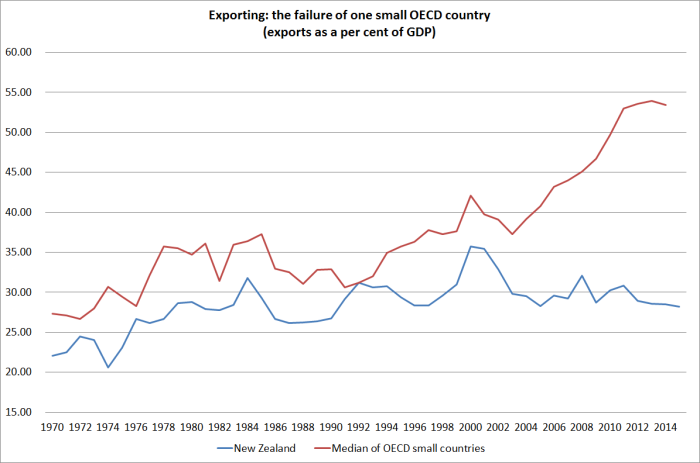
  • the second mechanism is through the dilution of natural resource endowment.  New Zealand’s exports remain overwhelmingly natural resource oriented (be it dairy, or coal, or wine or tourism), and there has been little sign of any dramatic transformation of that picture.  There are individual firms that succeed here simply on the quality of their people and ideas, not tied to any particular location-specific resources, but there simply aren’t many of them.   The persistent pressures on the real exchange rate make it less attractive than otherwise to develop them here, but in any case, New Zealand just doesn’t look like a natural location for lots of such businesses.  If so, we will remain very reliant on the fixed natural resources –  and ever more people, induced by immigration policy –  just makes it ever harder to keep up with, let alone catch up to, incomes and productivity in other more economically fortuiutously located countries.

It is a narrative that fits a lot of the stylised facts about New Zealand.  Of course, it doesn’t fit the prevailing “ideology” or mindset of our economic and political establishment – past and present Prime Ministers, key economic government departments, or (heavily non-tradables oriented) think tanks like the New Zealand Initiative.  But decades on there is still no evidence that their approach –  favouring lots of immigration to New Zealand, as some sort of “critical economic enabler” –  is producing economic gains for New Zealanders, and making New Zealand a more productive place.


Two immigrants debate immigration

A month or two back, Professor George Borgas, professor of economics at the Kennedy School at Harvard and a leading researcher on the economics of immigration (and a Cuban immigrant in childhood) published a new book, We Wanted Workers: Unravelling the Immigration Narrative.  Borgas’s empirical work has led him to be somewhat sceptical of whether there are material economic gains to Americans from non-citizen immigration, and to suggest that perhaps immigration policy –  even in the US – is largely just a redistributionist policy, typically away from the more lowly-skilled Americans.  His empirical work has suggested long-term losses to these relatively low income people.

I haven’t yet read the book – much of which, I understand, is a more popular treatment of material dealt with more formally in his Immigration Economics a couple of years ago But Reason magazine –  a libertarian-oriented publication – has published a substantial and considered exchange of views, prompted by Borgas’s book, between Borgas and Shikha Dalmia, a senior analyst at a US libertarian think-tank (and an Indian immigrant).    Dalmia apparently describes herself as a “progressive libertarian and an agnostic with Buddhist longings and a Sufi soul”, so probably not your typical libertarian.

The exchange between Borgas and Dalmia is now freely available on-line here.    For anyone interested in immigration issues, it is worth reading.  The specific issues are, of course, a bit different here than they are in the United States.  A recent New Yorker review of various books on immigration, including Borgas’s, is also worth reading.

From the Reason debate perhaps two extracts struck me most forcefully.  The first from the libertarian open borders  Shikha

I agree completely that the “overreliance on economic modeling and statistical findings” on this subject is a regrettable development that fosters the notion that “purely technocratic determinations of public policy” are possible. In fact, the scientific hubris underlying such efforts prevents a full airing of the normative and ideological commitments that ultimately do—and perhaps should—guide policy.

and the second from Borgas

I ended my discussion in the first round by noting that “immigration creates winners and losers and the net gain may not be as large as some had hoped. So any discussion of immigration policy has to contrast the gains accruing to the winners with the losses suffered by the losers.” You did not address this very thorny issue in your response, so let me conclude by rephrasing it in even starker terms, as it isolates the problem at the core of our disagreement.

The evidence summarized in We Wanted Workers suggests that it is quite possible that the “efficiency gains” that receive so much emphasis in the libertarian narrative are totally offset by the costs associated with welfare expenditures or harmful productivity spillovers. As I said, it may well be that “immigration is just another government redistribution program.” My italicization of “just” was not a random click on my track pad. It was meant to drive home the point that there is a good chance that all that immigration does is redistribute wealth.

If there are no efficiency gains to be had, then espousing any specific immigration policy is nothing but a declaration that group x is preferred to group y. It is easy to avoid clarifying who you are rooting for by trying to reframe the debate in terms of amorphous philosophical ideals about mobility rights and the like. But this is where we go our separate ways.

When I read yesterday a new IMF article by Sebastian Mallaby (itself quite worth reading) asserting that “the movement of people [is] perhaps the most important of the three traditional forms of globalisation”, it brought home again how essentially ideological (meant not in a pejorative sense, but rather as “driven off a prior world view”, and we all have them) much of the support for large scale immigration often is.  Perhaps the same can be said for the sceptics.  And perhaps that is both inevitable, and not necessarily a problem, so long as we recognise the nature of the debate.

The Treasury on Auckland and immigration

The Treasury yesterday released its latest Long-Term Fiscal Statement.  These documents, in some form or other, are now required under the Public Finance Act to be published at least every four years.  I was once a fan, but I’ve become progressively more sceptical about their value.  There is a requirement to focus at least 40 years ahead, which sounds very prudent and responsible.    But, in fact, it doesn’t take much analysis to realise that (a) permanently increasing the share of government expenditure without increasing commensurately government revenue will, over time, run government finances into trouble, and (b) that offering a flat universal pension payment to an ever-increasing share of the population is a good example of a policy that increases the share of government expenditure in GDP.  We all know that.  Even politicians know that.  And although Treasury often produces an interesting range of background analysis, there really isn’t much more to it than that.  Changes in productivity growth rate assumptions don’t matter much (long-term fiscally) and nor do changes in immigration assumptions.  What matters is permanent (well, long-term) spending and revenue choices.     And from a purely technocratic perspective – and Treasury are supposed to be technocrats, not politicians – the headline out of yesterday’s release should probably really be “there is no great urgency about doing anything much over the next 20 years”.  In this chart, from the report,  in 2035 spending as a share of GDP, on historical patterns and existing laws, is only around where it was in 2010.   ltfs

John Key –  the Prime Minister who refuses to do anything about NZS – almost certainly won’t be in office that long.

There were several interesting background papers Treasury released yesterday.  If I get time over the next few weeks, I might write about some of them here.  For now though, I simply wanted to highlight some interesting material in the main report on a couple of my favourite topics: Auckland’s economic (under)performance, and immigration policy.   I’m not entirely sure why either section was included in the report –  which is about fiscal projections – but there they are.

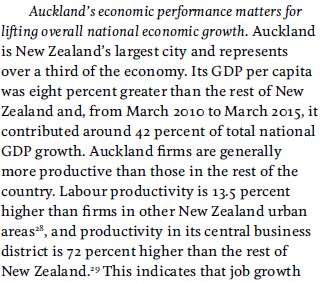
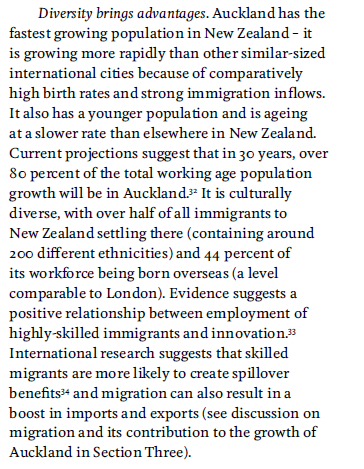
First, Auckland.  Here there are some encouraging signs that Treasury is finally recognising the problem.  A few months ago I was quite critical of a cheerleading speech about Auckland given by the Secretary to the Treasury.  And in the LTFS, the text starts off quite upbeat

akld text.png

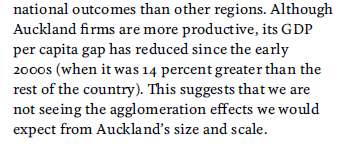
I was drumming my fingers at this point, but then I got to the second half of the paragraph.

akld-text-2

There was much more that could have been said, but for Treasury to acknowledge quite openly –  the plain statistical fact –  that Auckland incomes have been falling relative to those in the rest of the country, despite the huge infusion of additional people (“most skilled migrants anywhere in the OECD” as I heard Steven Joyce say again this morning) should be seen as pretty damning.  There is something very wrong with the model: as they add “this suggests we are not seeing the agglomeration effects we would expect from Auckland’s size and scale”.  Perhaps there is no guarantee –  or even reason to think –  that putting an extra million people or so (the increase in Auckland’s population in the last 50 years or so)  in a remote corner of the South Pacific would generate particularly favourable productivity results.

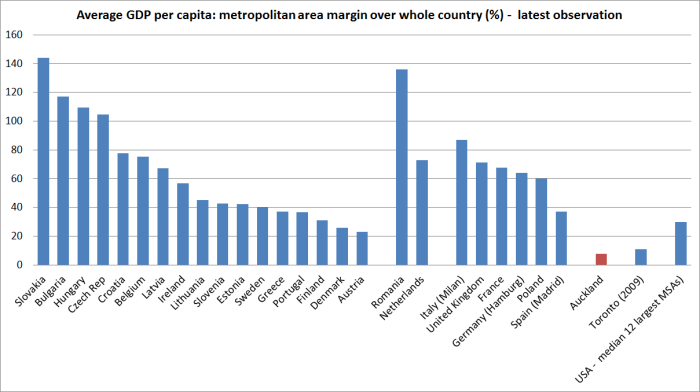
As I’ve noted previously, not only is Auckland’s GDP per capita less high relative to the rest of the country than it was even 15 years ago –  the point Treasury now acknowledges –  but that margin is small compared to what we see in other countries.  I ran this chart, looking at other large cities, in a post a few months ago.

gdp pc cross EU city margins

Auckland does poorly.  To me, that isn’t surprising.  This is a strongly natural resource based economy.  There is no sign –  and no sign Treasury points to –  that it has needed lots more people, and especially not in Auckland.

But Treasury, while clearly a bit troubled, isn’t willing to abandon the faith just yet.  The section on Auckland goes on.   There are a couple of anodyne paragraphs on Auckland as gateway (people and goods), and Auckland’s transport system,  and then we are right back to credal statements.

akld-text-3

Perhaps diversity does bring advantages, but in the specific case of Auckland, there is just no evidence of solid economic gains.  As Treasury notes, Auckland has a fast-growing population, a young population, a culturally diverse popuation, and a very high proportion of people born overseas.   But it has a disappointingly poor-  and worsening –  relative economic performance.  In my hard copy of the report I had scrawled next to the comment about London “just a shame, we don’t have their GDP performance”.  In the chart above, you can see the contrast between London and Auckland.    We really should expect more than faith-based claims from the government’s premier economic advisory agency.  As Treasury knows, for example, there is no evidence of a causal relationship between immigtration to New Zealand and growth in innovation, productivity or exports.

(For those interested in the Auckland underperformance issues, the October issue of North and South magazine had a nice article on  The Delusions of Aucklanders (and perhaps those advising governments). The article is now available on the new Bauer Media website, Noted.)

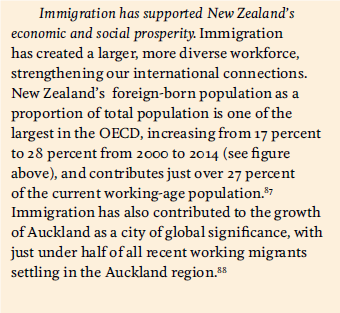
Some pages on from the Auckland discussion, Treasury has a page on immigration.  It also starts off with a strongly credal tone –  keep the faith.

akld-text-4

After finishing guffawing at the rather desperate “Auckland as a city of global significance” –  had the 9th floor of the Beehive requested that touch, or did they not need to ask? – we might simply ask for some evidence.  You might think it would trouble Treasury, even a little, that with one of the largest immigration programmes in the world –  of people who, by world standards, are not that badly skilled –  we’ve had 25 years of one of the lowest rates of productivity growth in the world.  Even Treasury acknowledges that failure.  Perhaps there isn’t a causal relationship.  Perhaps the productivity performance would have been even worse without the immigration.  But not a hint of doubt is allowed into this discussion from our premier economic agency.

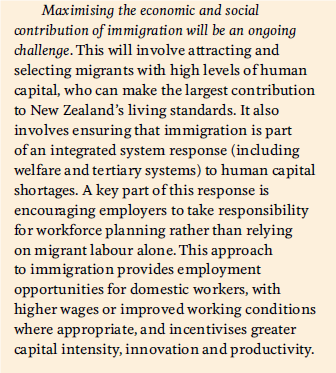
But then the drafting gets a little more cagey.

akld 5.png

Note very carefully the “can”.  Yes, in principle, a good immigration policy can support productivity etc in the right places/circumstances.  But Treasury can, and does, advance no evidence that it has, in fact, done so in New Zealand.   They really want the public to believe in the programme, while being skilful enough drafters not to allow themselves to be pinned down to have made claims that the economic performance of New Zealanders is actually better as a result of the large scale immigration programme.   There is no hint of any evidence that using immigration policy in “addressing short-term skill shortages” makes any difference to longer-term per capita growth and productivity (and I’ve seen no literature on that point internationallly either).  And actually, Treasury’s own scenarios suggest that immigration also makes very little difference to the longer-term fiscal challenges.

They conclude, perhaps a little uneasily, reverting to rather more jargon-ridden text.

akld-6

Be very wary of bureaucrats proposing “integrated system responses”, when markets have ways of dealing with issues.  Typically, when demand for additional labour and human capital is high, returns to that sort of labour rise, which attracts more people into those jobs, and to developing those skills.  “Skill shortages” –  or even “workforce planning” – just aren’t some sort of a chronic problem governments need to address.  Excess demand for labour is either a sign that monetary policy is a bit loose, or that wages (for that sector or industry, or across the board) should be rising.   And if Treasury –  or MBIE or ministers –  could produce strong evidence that our immigration policy really had boosted productivity and the material living standards of New Zealanders, that would be one thing.  But they can’t –  and don’t.   And don’t forget, that the same OECD survey Steven Joyce was citing again this morning shows that native New Zealanders already have some of the very highest skill levels in any OECD country.

Overall, I guess one gets a sense that Treasury is slowly losing confidence in bits of its story.  They now are prepared to acknowledge (at least part of) the sustained underperformance of Auckland.  They have raised some doubts about excess reliance of some industries on immigrants.  And they still can’t cite any real evidence of sustained gains in the living standards of New Zealanders from the large scale non-citizen immigration programme.  But rather than openly addressing the genuine uncertainty – and in what seems a slightly desperate attempt to keep spirits up, and encourage people to “keep with the programme”  – we are left with what are little more than slogans, simply asserting the alleged economic gains to New Zealanders from diversity and high rates of non-citizen immigration.  A reasonable response should be “well, show us the evidence”.

At the session Treasury hosted yesterday for the release of the LTFS, we were informed that the Productivity Commission is releasing next Monday its “narrative”, in which they will attempt to explain why the New Zealand economy has underperformed for so long, and (presumably) some thoughts on how best to reverse that.  I will look forward to that document –  there aren’t enough developed competing narratives around a really important issue – and I will no doubt be writing about it here.  Given the Productivity Commission’s statist tendencies, I’m not optimistic, but I will be particularly interested in how they deal with the immigration policy and Auckland issues, both in explaining the underperformance of the last few decades, and in contemplating a better way ahead.

IMF advocacy for immigration: some caveats

The other day I came across mention of a chapter in the IMF’s latest World Economic Outlook on the economics of immigration.  It turned out to be only half a chapter (from page 183) but it had some interesting discussion and material.  It probably won’t surprise anyone that although immigration is a long way from the IMF’s core responsibilities, the Fund is pretty gung-ho on the benefits.  My own stance is, of course, more skeptical: I doubt the economic benefits to recipient countries are typically anywhere near as large as the enthusiasts make out, and in New Zealand’s specific case I think the evidence increasingly suggests that high rates of immigration in the post-war decades (continuing to today, as strong as ever) have been detrimental to the economic fortunes of New Zealanders as a whole.

Whatever the truth is, the IMF might want to be a little more careful as to how they present the material in support of their claim.  The World Economic Outlook is one of the flagship documents of the Fund, widely circulated and discussed (including at the Executive Board level) before release, not just some obscure researcher’s working paper.

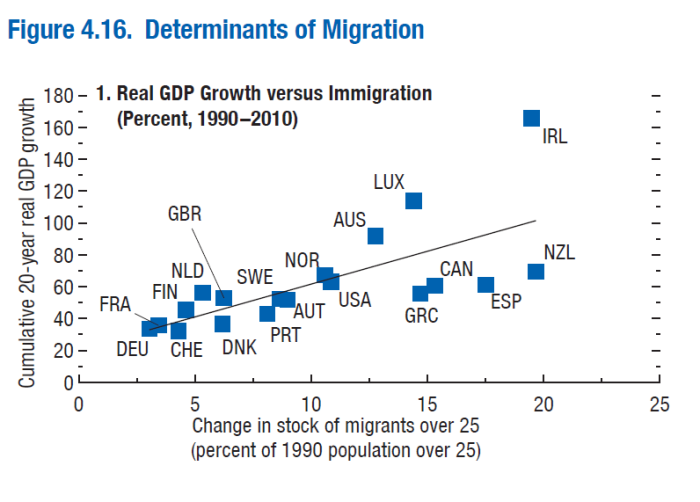
And so I was interested to find this

There is a positive association between long-term real GDP per capita growth and the change in the share of migrants (Figure 4.16, panel 1).

I noted the careful wording (“association” rather than “causal relationship”) and went looking for the chart.

imf-immigration-chart-1

Which left me a little puzzled. The text said there was a relationship, illustrated by this chart, between increases in migrant numbers and real GDP per capita growth.  But the chart itself showed only a relationship between total real GDP growth and immigration.  That sort of positive relationship was hardly surprising –  growing migrant numbers raises the population, which tends to raise total GDP –  but the interesting question was surely about per capita growth.  And it wasn’t just a labelling error –  it was easy enough to reproduce the Fund’s chart, showing what the labels said it showed.

And so I started digging around.  The IMF uses a group of 19 advanced countries, the choice presumably limited by data availability (so, for example, Belgium, Italy, Iceland, Japan and Korea –  among advanced OECD countries –  aren’t included).  And they focus on 1990 to 2010, presumably also to ensure that all the data (for some of the background modelling) was available.  And rather than total migrant numbers, they look only at migrants over 25.  In the charts that follow, I just follow their basic approach/time period.  In terms of country selection, I’d note just two caveats: first, a large part of Luxembourg’s GDP is produced by people who don’t live in Luxembourg but commute in each day (so GDP per capita can be a bit misleading) and in Ireland the corporate tax system has helped contribute to a huge gap between GDP and GNI –  and it is the latter that measures income accruing to the Irish. Finally, it is worth noting that more than half the countries in the sample are in the euro, and 1990 to 2010 covered the period of convergence to the euro, and then the full effects of imposing a common interest rate on quite different economies.

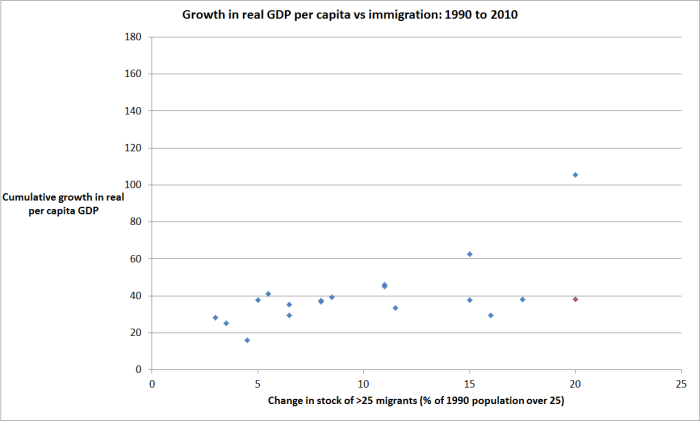
With those methodological notes out of the way, what did the chart of growth in GDP per capita over 1990 to 2010 look like when graphed against the change in the migrant share of the (over 25) population over that period?

imf-migration-and-gdp-pc

The red dot (hard to see, but lower right) is New Zealand.  The outlier (top right) is Ireland.  Excluding Ireland, there is almost no relationship at all, and certainly not one that would pass any tests of statistical significance.

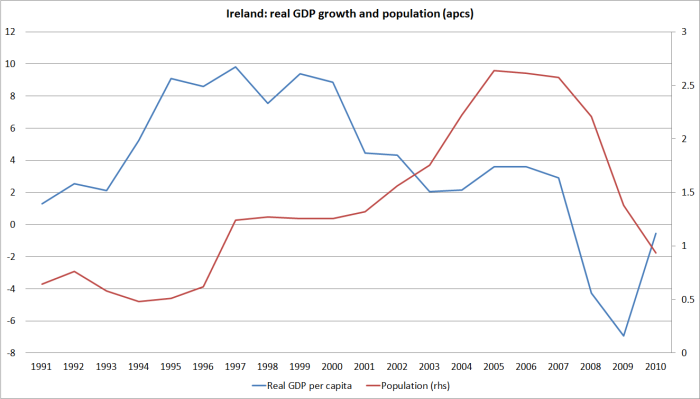
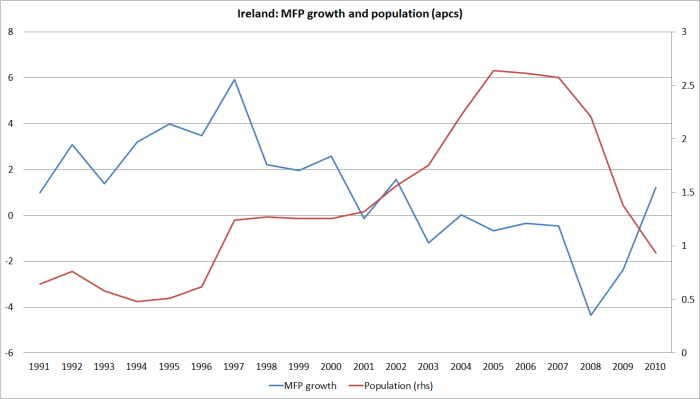
And in case you do want to include Ireland, bear in mind that the big surge in immigration to Ireland came after the most rapid growth in GDP, or GDP per capita.

ireland-popn-and-growth

Over 1990 to 2010, Ireland’s strong growth in real per capita GDP was pretty clearly not caused by immigration.

GDP per capita has its limitations, and the Fund –  and most immigration advocates –  typically argue that the most valuable gains from immigration arise from improvements in productivity. So using, the Fund’s period, the Fund’s sample of countries, and the Fund’s immigration variable, what did the (simple bivariate) relationships look like with, first, real GDP per hour worked growth, and then (often regarded as the best sort of productivity growth) multi-factor productivity (MFP) growth?

(In all these chart’s I’m drawing GDP and productivity data from the Conference Board’s Total Economy Database.)

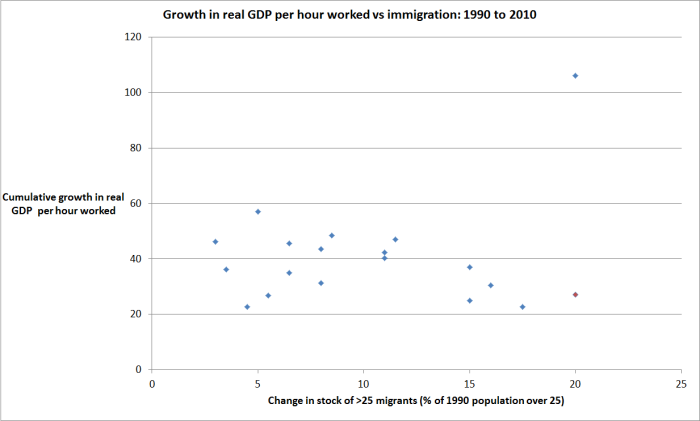
Here is the relationship with real GDP per hour worked.

imf migration and gdp phw.png

Again, New Zealand is in red (lower right) and Ireland is the outlier.

This relationship might not be very statistically significant either but –  at least excluding the Irish outlier –  if anything it runs in the wrong direction for the IMF story.  Over this period, and on this particular measure/sample, there was a modest negative association between immigration and labour productivity growth.

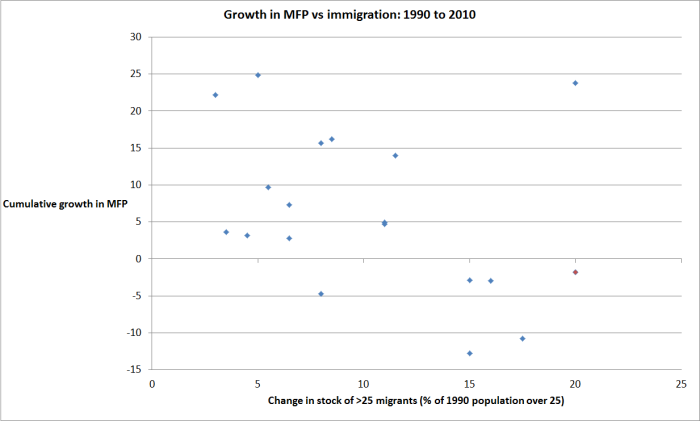
And what about MFP growth?

imf-mfp

That relationship, especially excluding Ireland, is even more negative than the one for labour productivity.  And just to confirm that even on MFP, the immigration surge in Ireland came well after the best of the MFP growth.

ireland-mfp-and-popn

All in all, on these measures, for this sample of countries, over this period, there doesn’t seem to be much left of the IMF’s story.  Yes, immigration obviously tends to make economies bigger in total, but there is little sign in the informal analysis that it has made them more productive, and thus made the average individual citizen of the recipient country better off.

Of course, where it can the IMF likes to rest its claim on more sophisticated analysis than that.  Later in the chapter, they report that

Recent research suggests that migration improves GDP per capita in host countries by boosting investment and increasing labor productivity. Jaumotte, Koloskova, and Saxena (2016) estimate that a 1 percentage point increase in the share of migrants in the working-age population can raise GDP per capita over the long term by up to 2 percent.

The recent IMF “spillover note” that is drawn from is available here.  The authors use much the same countries, the same immigration variable, and the same sample period as in the WEO analysis above.   They also focus on the level of real GDP per capita, and the level of productivity, not just growth over a particular period.  Their approach has a number of advantages over earlier studies (including the focus just on advanced countries) and as the Fund notes, the estimated real GDP per capita gains are less than in some previous studies.

I’m not a technical modeler, so I’m not going to try and unpick the paper on those grounds.  My simple proposition is that the results do not, even remotely, ring true.

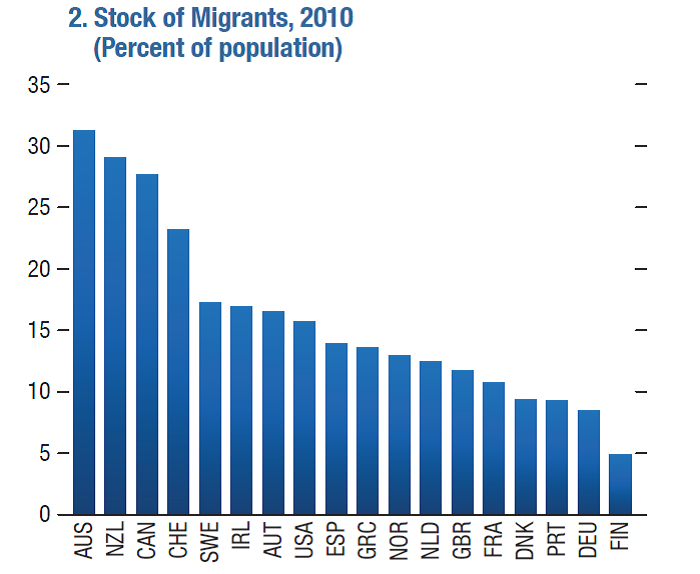
Here is a chart from the paper showing the stock of migrants in the sample countries.

stock-of-migrants

Think about France and Britain for a moment.  Both of them in 2010 had migrant populations of just over 10 per cent of the (over 25) population.  If this model was truly well-specified and catching something structural it seems to be saying that if 20 per cent of France’s population moved to Britain and 20 per cent of Britain’s population moved to France (which would give both countries migrant population shares similar to Australia’s), real GDP per capita in both countries would rise by around 40 per cent in the long term.  Denmark and Finland could close most of the GDP per capita gap to oil-rich Norway simply by making the same sort of swap.    It simply doesn’t ring true –  and these for hypothetical migrations involving populations that are more educated, and more attuned to market economies and their institutions, than the typical migrant to advanced countries.

(The study produces similar results for real GDP per person employed, but they do not test the relationship with either GDP per hour worked, or with MFP.  The authors suggests that the gains from immigration come through an MFP channel, but this seems doubtful –  especially over this period, and this sample, given the bivariate MFP growth chart above).

There are other reasons to be skeptical of the results in this IMF paper.  Among them is  that there is a fairly strong relationship between the economic performance of countries today and the performance of those countries a long time ago.  GDP per capita in 1910 was a pretty good predictor of a country’s relative GDP per capita ranking in 2010, suggesting reason to doubt that the current migrant share of population can be a big part of explaining the current level of GDP per capita (and some of the bigger outliers over the last 100 years have been low immigration Korea and Japan and high immigration New Zealand).    In fact, I’ve pointed readers previously to robust papers suggesting that much about a country’s economic performance today can be explained by its relative performance 3000 year ago.  How plausible is it that so much of today’s differences in level of GDP per capita among advanced countries can be explained simply by the current migrant share of the population?

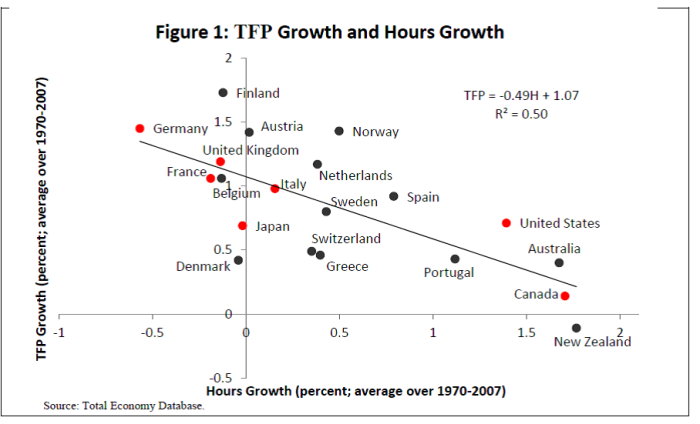
And then, reverting to bivariate charts (but one from a relatively recent IMF working paper)

imf-hours-and-mfp

Total hours growth is not just determined by immigration, but differences in immigration rates account for a large part of the differences in population growth, and growth in total hours worked, over long periods of time such as those in this chart.  There is just no sign, over that period and those countries, of the longed for link between productivity growth (here MFP/TFP) and growth in anything remotely linked to differences in the volume of immigration.

To revert just briefly to the IMF WEO chapter, one of the advantages of looking at just 18 or 19 countries is that the authors should be able to illustrate their point, at least impressionistically, by reference to individual pairs of countries.  If nothing else, it is a bit of a realism check, but it can also help make the overall story seem more persuasive. But there is nothing of that in the IMF’s discussion and advocacy.   And nor is there any effort to deal with what might reasonably look like problems for the story.  The two countries with the largest increases in migrant share over 1990 to 2010 were Ireland and New Zealand.  In Ireland, as I’ve shown, the immigration clearly came after the peak productivity gains –  perhaps a case of sharing the gains, but hardly one where immigration looks causative.  And New Zealand, well….readers know the New Zealand story.  In 1990 we were supposed to be well-positioned to catch up again with the other advanced countries –  the sort included in the IMF sample –  and we had a big migration surge (by international standards of pretty good quality migrants) and yet over the full 20 years we’ve had among the lowest productivity growth rates (labour and MFP) of any of these countries.

Perhaps there are some other countries, or country pairs, where the intuitive case is more compelling.  It is shame the IMF didn’t put in the effort to find them

A Victoria University professor on New Zealand immigration

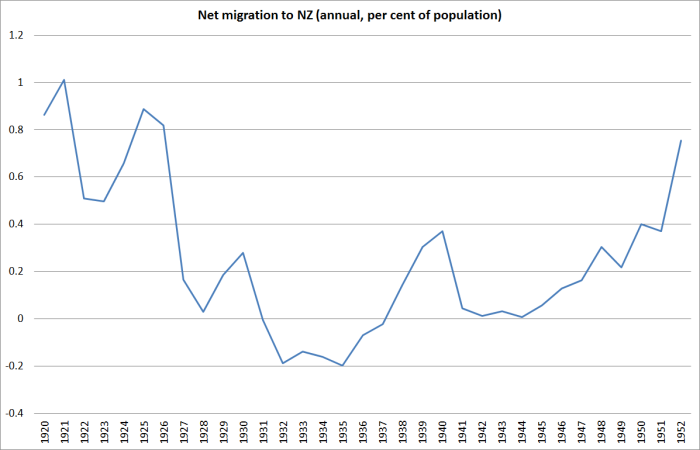
By the end of World War Two there hadn’t been much net migration to New Zealand for 20 years.

net-migration-20s-to-50s

There had been a big wave of assisted migration in the first half of the 1920s –  almost all those moving to New Zealand then were substantially financially assisted, initially largely by the British government, keen to assist ex-servicemen to resettle in the dominions, and then by the New Zealand government.  Financial assistance to migrants had long been a feature of New Zealand (provincial and central) government policy –  compared with the option of moving to Canada or the US (or even just staying in the UK), moving to New Zealand was expensive (time lost as well as fares).  But inflows to New Zealand dropped off after the mid 1920s and government assistance to migrants was largely discontinued from around 1927.  Over the twenty years, 1927 to 1946, annual net migration to New Zealand averaged less than 0.1 per cent of the population.  Not surprisingly, there was little movement during the war, and in the 1930s the outflows of the first half of the decade –  the UK was much less badly affected by the Great Depression than New Zealand was – largely balanced out the moderate inflows later in the decade.

At the end of World War Two, there was considerable angst about population prospects.  Birth rates around the advanced world, including New Zealand, had been low, and in many countries there was unease about what a flat or falling population might mean.  And the war itself had brought to the fore the idea that a lightly populated country might be unnecessarily prone to invasion threats.

There were no legal obstacles to immigration to New Zealand from Britain (or the other Dominions): as New Zealanders could move freely to Britain, so Britons could freely move here (as they could until the 1970s).  But in 1947, the government restarted the assisted migration programme – initially those selected had to contribute £10, but within a couple of years that requirement had been dropped.  Even though life in post-war Britain was pretty tough, and the gap in material living standards then was probably as large as it ever was, the government didn’t find it that easy to fill the number of free places it was offering.  But total immigrant numbers did pick up sharply and (as illustrated in the chart above) by 1952, the net inflow of immigrants had almost reached the sorts of levels soon in the first half of the 1920s.  And despite earlier worries about the birth rate, the “baby boom” happened here too.  In 1952, the total population increased by 2.5 per cent –  an even larger increase than we’ve experienced over the last year or so.

In 1952, Professor Horace Belshaw, an immigrant (as a child) himself, former student of Keynes at Cambridge, and by then McCarthy Professor of Economics at Victoria University and one of the most widely-published New Zealand academic economists of his day, turned his attention to the question of immigration to New Zealand.  In his short (32 page) booklet, Immigration: Problems and Policies, Professor Belshaw discussed some of the economic (and other) effects of high rates of immigration.

I’m going to reproduce here some of Belshaw’s material.  Regular readers will probably note a certain similarity with the economic analysis I have been presented about more recent New Zealand immigration policy (although I only found the Belshaw material a few years ago).

In beginning his discussion, Belshaw notes

In considering the volume of immigration which is in “the best interests” of New Zealand, it is necessary to distinguish between the “absorption capacity” at any particular time and what is desirable over the longer period…..we must compare the effects of a given growth of population with the effects of the larger population resulting from this growth.

…for example, the long run position will be affected by whether or not more intensive production in agriculture will yield a lower return per head with a somewhat larger population, whether the supply of electric power can be economically expanded to satisfy not only the increased use of electricity per head of population, but also the larger number of heads.  And the answer in both cases may be affected by technical discoveries not yet made.

Belshaw discusses a number of the transitional issues

Cultural absorption.  As he notes, most of the migrants at the time were from the UK and Northern Europe, and so

There will be personal misfits enough and the need to give assistance in orienting to the New Zealand way of life, but the cultures they bring with them at sufficiently close to our own to raise no special difficulty of absorption, and there are no social or political reasons to fear the growth of minority problems among groups which preserve a separate identity, such as have plagued the United States. On the other hand, migrants bring with them new skills, different accomplishments, and ways of looking at things which should prove economically advantageous and culturally enriching.

Immigration and the Labour Shortage

At the time when there are more vacancies than workers, it is natural to assume that immigration will relieve the labour shortage. This however, is a superficial view.  The immigrants are not only producers but also consumers. To relieve the shortage of labour it would be necessary for more to be contributed to the production of consumer goods or of export commodities used to buy imported goods than the increased numbers withdraw in consumption.  That is unlikely….[and] there will be some temporary net additional pressure on consumption.

Immigration and Capital Needs

Of much greater importance is the fact that each immigrant requires substantial additional capital investment, not in money but in real things.  Houses and additional accommodation in schools and hospitals will be needed. In order to maintain existing production and services, and even more to maximize production per head, there must be more investment in manufacturing and farming, transport, hydro-electric power, municipal amenities and so on.

To anticipate a little, immigration is not likely to ease the labour shortage while it is occurring, and is more likely to increase it because although additional consumers are brought in, more labour than they provide must be diverted to creating capital if the ratio of capital to production is to be maintained.  So the unsatisfied demand for consumers’ goods and therefore for labour to produce them will not be met.

…the fact remains that while it is occurring a population increase of the order under consideration will reduce the volume of capital per head, and for the time being cause production per head to increase slower than with a smaller rate of population increase. Immigration must be assessed in relation to its contribution to this situation.

The expansion of population of itself will increase inflationary pressures, for the net effect is to create additional purchasing power to finance capital creation without producing an equivalent volume of consumers’ goods and services.  This is another way of reiterating the point that it will not reduce labour shortages….. A sufficiently austere fiscal and financial policy might curb the inflationary effects, but not the necessity for capital formation nor the reduction for the time being in living standards.

As capital formation proceeds, the contribution of increased population to consumption will grow, and after five or six years may exceed current consumption per head. Meanwhile, however, each successive increase in population exerts inflationary pressures until such time as the aggregate increase in production from a larger population exceeds the annual capital formation needed by the growing population,  This would take a very long time.

He summarises his conclusions “in respects of current effects of immigration and population increase”.  Extracts:

2. Immigration of the scale contemplated is likely to increase inflation pressures and of itself increase rather than reduce the shortage of labour.

3. It will also increase the balance of payments problem and the need for credit controls, higher interest rates or import controls.

6. While it is occurring and for some time thereafter immigration on the scale contemplated is likely to lower living standards, either by reducing the supply of manufactured consumers’ goods or of facilities and amenities such as school and hospital accommodation, or by imposing additional strains on existing private and public capital.

My general conclusion is that the effects of such a volume of immigration on the New Zealand economy while it is occurring at the present time , are on balance prejudicial.

From the effects of immigration while it is occurring (and for several years afterwards), Professor Belshaw then turned more briefly to consider the effects of a larger population, once any transitional challenges had washed through.

Is it in the interests of New Zealand that the population should double in, say, 28 years (ie increase at a rate of about 2.5 per cent per year) and that immigration of a scale necessary to bring this about by supplementing natural increase should be arranged?  We reiterate that the problem is posed in these terms because immigration and natural increase have many similar effects.

He briefly looks at some non-economic factors

Strategic considerations.  In some quarters increased immigration is supported for strategic reasons. I have seen no analysis of the real issues by the proponents of this view, and in the absence of such a study confess to some reluctance to attach much weight to it in modifying opinions arrived at on other grounds.     ….a more likely strategy [than invasion] would be to blockade us into submission or ineffectiveness. The contribution of any conceivable immigration to New Zealand’s manpower then seems likely to make little difference.

Humanitarian Aspects of Immigration.  Presumably the immigrants will be better off than in their own countries, and the New Zealand community might be prepared to incur some sacrifices, if these prove necessary, to satisfy such a humanitarian impulse; but any possible volume of immigration will have a very small effect in relieving pressures in the home countries of the migrants.

Belshaw goes on to note that our then, in effect, “white New Zealand” immigration policy was unlikely to command much international admiration no matter how many migrants we took.

Cultural and Economic Enrichment.  Regarded from New Zealand’s own interests, a sizeable volume of immigration should prove advantageous in more ways than one…..The New Zealander who returns home after some time abroad [as Belshaw recently had] is often depressed at the unnecessary drabness and uniformity in the New Zealand way of life, and at the paucity and low level of achievement in many of the arts and crafts.  New blood may perhaps weaken the complacency with which these are accepted, and add spice and variety.  And there is no reason why these should be gained at the expense of those conditions and those national qualities which still make New Zealand so pleasant a place to live.  Is it really necessary, for example, that even in our main cities, our restaurants should be so reminiscent of the pioneering epoch (flies and all), and that the best food in the world should be so cavalierly treated?

As he notes, before turning back to economic considerations

this general line of argument supports the case for immigration, but not for any particular figure.

In commencing his economic discussion, Belshaw notes that

Presumably we should like to see such a trend of growth of population as is conducive to the maximum real income per head

while acknowledging that the answers and his opinions “must be very largely conjectural”.

He notes

it is a reasonable assumption that over the longer period immigrants will contribute much the same to both production and consumption per family as the general population. So we need not distinguish between immigrants and indigenous population when considering the effects of larger size, except insofar as the immigrants have brought new stimuli, arts and crafts, which we might otherwise lack.

Belshaw notes that there are some genuine economies from a larger population

As population becomes larger we should expect a variety of economies to result, increasing the effectiveness of labour applied to a given volume of capital.  The transport system would probably be more effectively utilized as the volume of traffic reduced overhead per unit of transport service…..There seems no reason why the machinery of government need increase pari passu with population apart from the extension in the range of government functions.

I believe these advantages to be real; but there is another side to the story.

….Here the capital requirements for population growth come into the picture. Previous discussion will have indicated that in my view these requirements are of such dimension as to greatly retard the increase in capital per head of population  Failure to increase, or even maintain capital per head will in large measure offset the benefits from a bigger population, increase the problem of bottlenecks, such as in relation to power, and by virtue of inflationary pressures distort the economy.  It seems unlikely that the annual increase in the production of consumers’  goods facilitated by a bigger population will offset the transfer of production to capital formation required by an increasing population. I fear that with a population increase of 2.5 per cent, we shall be faced with continued incentives to controls, primarily as a check on inflation…. Such controls may actually discourage enterprise. On these grounds I should consider that a smaller dose of inflation –  and therefore a smaller rate of population increase –  would be preferable.

Belshaw also discussed the scope for growth in exports, having devoted a considerable portion of his career to agricultural economics

The trend of external demand seems likely to be buoyant for farm products, though there may be recessions from time to time. Currently there are shortages in forestry products; but I have insufficient information to offer a judgement on prospective world demand some years hence. On the other hand, diversion of production to capital formation and the consequent internal inflationary pressure will adversely affect internal costs [in other words, raising the real exchange rate ] and divert labour away from farming and so impede expansion.  My view is that in consequence there will be less expansion in farming with a 2.5 per cent increase in population than with a smaller increase.

…I anticipated that we shall derive an expanded real income from overseas as a result of improvements in the terms of trade and of expanded exports; but reiterate that this expansion is likely to be larger with a smaller population increase….Hence on this score also we should expect a larger income per head with a lower population  increase.

Belshaw concludes his paper thus

Some probable developments favour immigration and others are unfavourable. But it is those elements favourable to the case for population increase which are most conjectural and uncertain. The current recurring disadvantages of a large population increase, and therefore of a large volume of immigration, seem to be more clearly demonstrable than the advantages of the larger settled population which would result from them.

The economy, and particularly the policy structure around it, in 1952 was different than it is now, and so not all the language easily translates into current discussions.  We don’t have exchange controls or (many) direct credit controls, and on the other hand, interest rates are much more variable, as are the nominal and real exchange rates.  But the essence of Belshaw’s story, almost 65 years ago, is really very similar to the lines I’ve been running about New Zealand.  Rapid population growth, now driven largely by immigration policy, almost inevitably puts considerable pressure on domestic resources, skewing resources away from production for consumption or exports to simply keep up with the capital requirements of a larger population.  Immigration doesn’t ease labour shortages, and if anything exacerbates them (at any economywide level).

Although I agreed with his conclusions, I didn’t find Belshaw’s analysis of the implication of a larger population as persuasive as his analysis of the transitional (multi-year) pressures.  But we know that there is no evidence that larger countries have achieved faster growth than smaller countries.  And I’d emphasise some different points than Belshaw does, especially the apparent constraints of distance/location, which would have been much less apparent in 1952, when agricultural and pastoral exports alone still produced top tier incomes for a small distant population.

But it is just a shame that successive governments in the 1950s and 1960s –  and again since the late 1980s –  have paid more attention to plaintive short-term cries from employers of “skill shortages, skill shortages” (only ever apparently relieved by recessions) than to the lack of good analysis and evidence that high rates of immigration actually make New Zealanders better off. Perhaps high immigration benefits native populations in some places and at some times –  I’m quite open to that possibility – but there is little sign they have in the past, or are now doing so, in post World War Two New Zealand.

After all, when Belshaw wrote, New Zealand had probably the third highest material living standards in the world.  Now, depending on the list you consult, we are no better than about 30th.  Other things have contributed to that glaring failure, but the repeated pursuit of a larger population (as a matter of policy) certainly shows no sign of having helped.  It was bad enough that the cautions of Belshaw –  and other economists –  were ignored back then. It is much worse now when for decades there has been a steady net outflow of New Zealanders, dispassionately assessing the prospects for themselves and their families in the country they know best, and deciding to leave.

Rethinking immigration policy: the Greens

The Green Party has been rethinking its approach to immigration.

Not that long ago, the Green Party seemed to be pretty stridently in favour of New Zealand’s large scale, fairly liberal, immigration policy.  It was never entirely clear to me why.  They were the party that emphasized the potential environmental damage from more intensive dairy farming, and were usually reluctant to support new infrastructure projects, partly on environmental grounds.  And yet ever more people pretty inevitably means a need for more exports (in a country that has shown little ability to develop large scale exports much beyond the fixed natural resource base) and more infrastructure.  And globally, radical Green supporters are sometimes heard to call for population policies, potentially penalizing people having the number of children they might prefer, all in the “interests of the planet”.  So I was never sure quite why the New Zealand Green Party was so keen on large scale inward migration, when the combination of (shrinking) natural increase and the typical outflow of New Zealanders would have delivered us a fairly flat population if only we’d had a more modest, and internationally conventional, target level of non-citizen immigration.  The only arguments one ever heard were along the lines of “diversity is good”, but then New Zealand is already one of the most ethnically diverse countries in the world, and without a great deal of economic success to show for that very rapid diversification over the last few decades.  Perhaps they just wanted to share the bounty of New Zealand with as many people from other countries as they could?  Perhaps they really didn’t like New Zealand, and New Zealand culture as it was, and had an agenda for breaking that down?

But now the Green Party has had a rethink.   Trying to understand the change, and its implications, I listened to James Shaw on The Nation, and read a couple of substantive articles (here and here) with quotes from Shaw.

If I read the policy correctly, it is to set a target for New Zealand’s population growth of 1 per cent per annum, and to adjust immigration policy settings (each year, or even more frequently?) in light of changes in the rate of natural increase and in the net outflow of New Zealand citizens.  On the Greens’ own calculations that would have meant a targeted net inflow of around 17000 to 20000 this year.    That is not an order of magnitude different from the medium-term target rate of residence approvals I have argued for, of around 10000 to 15000 per annum.

Perhaps it is good short-term politics, but as policy it doesn’t look as though it has been particularly well thought through.

Rates of natural increase don’t change that much from year to year, and although there can be big movements in that series over time there is quite a lot of persistence in the changes (eg the post-war increase in the birth rate last for almost two decades).  But the net flows (usually outflows) of New Zealanders are very volatile, and very difficult to forecast.  Here is the chart of actual net flows of New Zealand citizens.

plt-nzers

Fluctuations of 30000 per annum in just a couple of years aren’t uncommon, and if one had access to (say) all the Reserve Bank and Treasury forecasts the near-impossibility of accurately forecasting those fluctuations would be quite apparent.

Perhaps the response would be “oh, we wouldn’t rely on forecasts, but on actual data”.  But then there would be a serious risk of actually exacerbating overall cycles in net migration.  If the net outflow of New Zealanders had been large in the last six months, perhaps the target for immigration approvals for non-New Zealanders would be increased.  But people (especially able and skilled people) don’t just shift to the other side of the world on a whim, or with no notice.  There are some quite material lags in the system, and by the time the increased number of non-New Zealanders starting actually arriving, it is quite plausible that the net outflow of New Zealanders might have shrunk again.  I don’t agree with MBIE about much, but on this point I agree with them totally: it simply isn’t possible to target successfully the overall net PLT flow (or, hence, population growth) on an annual basis.

Defenders of Shaw might argue that these points don’t matter much and what really matters is the average population increase over time.  But that wasn’t his argument: he explicitly cited concerns  around the extreme peaks in the net PLT series, over the sort we have seen in the last couple of years.

The whole idea here is to try and smooth out the peaks and troughs,” Shaw said

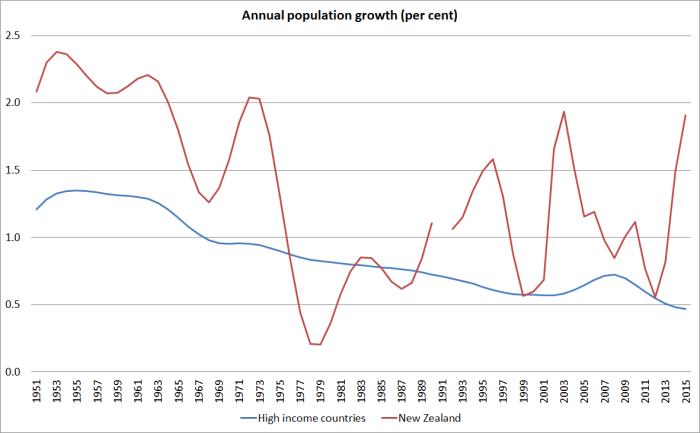
And if one is going to have an official population growth target –  as the Greens appear to be proposing –  why would one set it at 1 per cent per annum?   This chart shows population growth rates for high income countries (UN definitions and data) and New Zealand since 1950.

population-growth-world-and-nz

It has been 50 years since the high income group of countries (including immigrant receiving countries such as the United States, Canada, Australia, and New Zealand) had a population growth rate as high as 1 per cent.  At present, that growth rate is less than 0.5 per cent per annum.   And whether or not one welcomes the population growth New Zealand has experienced over the decades, there is no sign –  no evidence –  that it has produced any economic benefits for us at all.  If people choose to have lots of children that is one thing, but why would Shaw want our government to actively target above-normal (for high income countries) population growth?

But more generally, what is the case for a population growth target?  I can think of a few cases where perhaps one might make the argument: Israel, surrounded by hostile neighbours, probably wants as large as Jewish population as possible for external defence reasons.  They used to mount similar arguments in France a hundred years ago, as they contemplated how few young Frenchman there were relative to the number of young Germans.  But those sorts of arguments are just not relevant for New Zealand (or most other advanced countries).

Apart from anything else, it sets up all sorts of odd incentives and undesirable behavioural responses (although not necessarily much dafter than how New Zealand has actually run policy over the decades).  When economic circumstances change, people tend to leave underperforming regions.  That is rational and sensible for them and –  on the whole –  it even helps those who don’t leave. Patea and Taihape were once quite a lot larger than they are today.  Circumstances and opportunities changed and people over time moved away.  It would simply be daft policy for, say, local authorities in those areas to subsidise people to move in from elsewhere, even though the economic opportunities had moved away.

Under the Greens policy, if there is a significant upsurge in the number of New Zealanders leaving –  as, say, happened in the second half of the 1970s –  policy will, semi-automatically set out to replace them. The New Zealanders will have gone because, presumably, knowing New Zealand conditions well, they conclude that the opportunities abroad are better for them and their kids.  And in response the Greens want us to dig even further towards the bottom of the international barrel and find even more non-citizens to come and live here.  How likely is it that that would be a sensible policy?  Not very.  First, actual economic conditions and prospects in New Zealand have deteriorated, suggesting that New Zealand is less able than it was to offer real good incomes to able people.  And, second, to get a whole lot more immigrants, we would presumably have to lower the (economic) quality of those we take –  and perhaps quite a bit if the foreigners themselves do enough research to realise that relative opportunities here are also deteriorating.  It is not as if, on the government’s own evidence, we’ve been that successful in getting many very able people under current policy.

Of course, one could turn the story around, and be more optimistic.  If New Zealand’s prospects improved and suddenly many fewer New Zealanders were leaving, we would have to markedly reduce the non-citizen immigration inflow.  One could argue this as a good thing, in that we could raise the average economic quality of those we approve, but if one really believes in the economic benefits of immigration, why would you want to materially cut back the flow in circumstances in which New Zealand’s relative economic prospects appeared to have improved?

The arguments can also be applied to fertility rates and, thus, rates of natural increase.  If birth rates in New Zealand fell away sharply (to the sorts of rates –  around one child per woman – seen in many parts of developed Asia and some parts of Europe), what would the economic logic be of central government setting out to raise the target migrant intake (lowering the average migrant quality) just because New Zealand families decided to have fewer children?   After all, fertility choices might be partly a response to perceived economic prospects.   What sensible role for central planners is there in face of such fertility rate changes?

Turning back to the Greens, it isn’t clear that they have yet given much thought to how their proposal would work.

He did not give specifics on exactly which parts of the migration mix would be tweaked to achieve the 1% population growth, given the Government now has a planning range for permanent residency of 85,000 to 95,000 for the next two years, but does not have targets or caps for temporary work visas or student visas. Last week it temporarily suspended parental visa applications and lowered the planning range by 5,000. It is also reviewing work testing for work visas and student visa numbers.

A variable migration target implies constant tweaking of targets for permanent residency visas, both for skilled migrants and their families, along with targets for temporary work visas and student visas. Some elements cannot be controlled, including net migration of New Zealand citizens and working holidaymaker visas, given New Zealand has bilateral agreements with many countries that allow unfettered movements of such visas.

Shaw suggested student visas as one area that could be changed.

“We think that the government is actually barking up the wrong tree by putting the pressure on the family category,” he said.

“There’s huge numbers of students that are coming into New Zealand on temporary work visas and that’s actually where a lot of the pressure is coming from, especially on housing and on transport infrastructure.”

I think there is a lot wrong with our student visa policy, and with the liberality with which work visas are granted for fairly lowly-skilled positions, but……you can’t sensibly go making major changes to the parameters of the schemes every few months just because the forecast net outflow of New Zealanders has changed again.  It would put educational institutions in an impossible position, put firms considering hiring migrant workers in a very difficult position, and make the rules of the game so uncertain for potential migrants that you would risk undermining whatever merit the immigration programme has.  Even more than happens now, good people would seek out other countries with more stable and predictable regimes, and we’d be left with the fruit of an adverse selection process –  those sufficiently desperate to get in here that they’d apply despite the variability of New Zealand policy.   And while it is fine to talk about “smoothing out peaks and troughs” many of those pressure arise in specific regions, and it is even harder to practically manage those.  After all, New Zealanders tend to leave for Australia from across the whole country, while non-citizen arrivals (be it permanent or students) tend to disproportionately flock to Auckland.   So even if policy could be run to stabilize the overall rate of population growth from year to year –  and it can’t –  it might well markedly increase the variability of population cycles in Auckland specifically.  That doesn’t seem like an outcome the Greens would be wanting.

My own view remains that we should aim for a stable level of non-citizen (net) immigration, and set the stable target around a low level (consistent with the absence of any real evidence of benefits to New Zealanders as a whole).  But even a stable fairly high level of non-citizen immigration might be less bad in some respects than what the Greens are proposing, which assumes a degree of knowledge, and forecastability, that simply doesn’t exist.

I would keep the focus on the residence programme, and in turn keep that focused on the medium term.  If we are offering long-term residence in New Zealand, it shouldn’t be about meeting today’s immediate labour market needs, but about attracting a small group of young able energetic innovative people, who might make a useful contribution over their entire working lives.  I think we should welcome foreign students –  education should be just another export industry –  but without providing them with work rights here, and with only high level qualifications giving them a leg up on the path to residency.   And, as I noted the other day, for short-term work visas, I’d probably favour a salary test.  In all but very exceptional circumstances, simply don’t issue work visas for positions paying less than, say, $100000 per annum, and above that threshold take a fairly liberal approach.  Any employer could hire someone for up to, say, three years, but on a non-renewable visa.  If there are real temporary skills shortages arising from unexpected shifts in demand, such a policy will meet those needs, while over the longer term allowing the domestic labour market to work, as relative wage rates shift and people move from one occupation to another.  The scheme would be used, but there wouldn’t be 200000 approvals per annum.

In a sense the fatal conceit in the Greens new policy is the idea that New Zealand’s population growth rate can be held stable from year to year.  While New Zealanders are fairly free to move –  or not –  to the much larger Australian economy in response to changes in relative economic opportunities –  and while New Zealand incomes are so much lower than those in Australia –  we will almost inevitably have the sorts of swings in the net outflow of citizens I showed in the first chart above.  Trying to manage the inflow of non-New Zealanders year by year to offset those fluctuations would be (a) impossible, and (b) something of a fool’s errand even to try.   Whatever immigration policy we adopt, we really need to focus on the medium-term, in all dimensions.

BusinessNZ argues for more immigration

BusinessNZ describes itself as “New Zealand’s largest business advocacy body”.  Its chief executive, the lobbyist Kirk Hope, seems to have easy access to the op-ed pages of the Dominion-Post newspaper, and I’ve critiqued a couple of his columns (here and here) earlier in the year.

Hope –  and presumably BusinessNZ – is a big fan of high levels of non-citizen immigration to New Zealand.  Business groups have been for decades –  as far as I can tell, through all the decades of New Zealand’s relative economic decline.  We’ve had some of the highest controlled immigration flows of any country, and one of the worst relative economic performances.  However large the inflow it is never seems to be enough for the Manufacturers’ Federation (in decades past) or BusinessNZ now.  I have in front of me, the memoirs of Fred Turnovsky, twice head of the Manufacturer’s Federation and one of the “great and the good” of an earlier generation, where he records a lecture he gave at Waikato University in 1971 calling for a doubling in the officially proposed immigration target.

Earlier this week, following the government’s migration policy changes, BusinessNZ had a press release out –  under the heading Migration rules a sign of progress –  which seemed to welcome the changes.  I was quite surprised, but on closer inspection it wasn’t the small drop in the residence approvals programme target they were welcoming, or the cutback in the family quota (mostly non-working older parents), but simply the increase in the points requirement.

“Increasing the points required by skilled migrants to gain residence from 140 to 160 will help sharpen the annual intake towards higher skilled people.”

But, of course, increasing the points requirement isn’t an independent policy adjustment, it is just the logical corollary of a likely increase in demand for residence (mostly because of the large inflow of foreign students in recent years), while the availability of skilled migrant places hasn’t changed.  When demand changes the “price” needs to adjust.

And thus far I agree with Hope.  If we are going to allow in lots of “skilled” migrants, the more skilled they are, the better.  Of course, it is always hard for officials to detect skills, which makes it too easy to fall back on paper qualifications.

In an op-ed earlier in the year, Hope made the case for high levels of immigration to New Zealand on the grounds that we needed lots of immigrants to pay for our superannuation.

Restricting immigration as proposed would harm the economy.

With a birth rate just above replacement level, an ageing population and baby boomers retiring, we need immigrants to sustain the economy and pay for our superannuation, just as in decades past.

In response I noted

And on the NZS side of things, if there are affordability challenges with the current system, we have it in our own hands to modify the system to make it more readily affordable.  We could raise the age of eligibility –  National knows it needs to happen, even if the Prime Minister has pledged not to, and Labour campaigned for a higher age at the last election.  Other countries have made these sorts of changes.  We could also age-index NZS eligibility.  We could modify the entitlements of those who haven’t spent most of their working lives in New Zealand.  And there are other options I don’t support, but which would also ease the fiscal pressures, such as income and asset testing, or linking NZS increases to prices rather than wages.  And we can keep the way open for more older people to stay in the labour force for longer –  on that count, we already have one of the least distortionary old age pensions systems anywhere.  We are quite capable of managing the pressures ourselves.

Large scale immigration might make a small difference to NZS affordability, but it is an awfully big intervention for a really quite small difference.  As it is, New Zealand’s birth rate is around replacement, unlike many European and Asian countries, so the ageing population issues are in any case less pressing here than in most places.

In the end, the best way to support the various social spending commitments society wants to make is to foster a highly productive economy.  We’ve kept on failing to do that, and while immigration policy almost certainly isn’t the whole story, there is no evidence whatever that high rates of immigration have improved the position.

Strangely, the affordability of NZS seemed then to be his main argument for large-scale immigration.

But I suspect that was just an attempt to try to frame the issue in a more generally acceptable way.  In fact, business lobby groups in New Zealand tend to make the case for high levels of immigration largely in terms of keeping the cost of labour down.  Of course, they don’t put it in quite those words.  Instead, the constant refrain is “skill shortages” is mostly just another way of saying “I can’t get enough workers at the wage I want to pay”.    Markets have ways of taking care of looming shortages, or surpluses: the price adjusts.  We don’t hear of shortages of foreign exchange –  the price adjusts. The availability of tomatoes varies with the seasons and storms, but almost always any consumer can buy as many tomatoes as he or she wants, at a price which adjusts (up and down) quite frequently.

When it comes to people, and labour markets, these mechanisms don’t work instantaneously.  But markets take care of structural shifts in the demand for labour, if they are allowed to work.  A commenter argued earlier this week that we need lots of immigration to provide the workers to care for a growing elderly population.  No.  Immigration is certainly one option – look at the staggering number of aged-care nurses we’ve granted visas to in the last decade –  but so are changes in relative prices.  If the demand for labour in that sector increases, then over time relative wages in that sector will tend to rise. In turn, that will draw more New Zealanders to the sector, and will also reward investing in some more labour-saving technologies.  The same goes for almost any sector.  The wages changes might be small, if labour moves easily into the new in-demand sector, or large, if there is some reluctance of people to move into those roles.  But that is how the labour market would deal with shifts in the patterns of labour demand, if allowed to do so.

But to return to BusinessNZ.  Kirk Hope has another op-ed in the Dominion-Post this morning.  It is a useful piece because it is so explicit about his –  and his organization’s (?) -views.  Here is what he has to say:

One in four people in New Zealand is foreign-born, and many New Zealanders routinely leave to live in other countries.

This is what New Zealand is like – it’s ‘migration central’, awash with people coming and going, and it has always been this way.

This is simply quite historically misleading.  Large short-term migration is a new phenomenon –  we saw nothing like it in earlier decades.  And while it is no doubt true that “many New Zealanders routinely leave to live in other countries” –  I’ve done it three times –  the net outflow (the loss of almost a million New Zealanders) dates from when the growing gap between living standards in New Zealand and those in other advanced countries (especially Australia) started to become more apparent.  In successful countries, not many people leave for long.  Compare the net outflow of Norwegians from Norway with the net outflow of New Zealanders from New Zealand and you’ll see what I mean.

Business has long asked for more immigration…

You can’t get clearer than that.  We have probably the second largest controlled immigration programme in the advanced world (behind that other economic laggard, Israel), a residence programme three times the size (per capita) of that in the United States, large and growing numbers of short-term work visas, and still it just isn’t enough for business.

He elaborates

….as in more access to more skilled migrants to do the jobs that New Zealanders aren’t available for.

But as even Hope recognizes, in this and his earlier article, New Zealand hasn’t done very well at attracting really skilled migrants in recent decades.  Which shouldn’t really surprise anyone; after all, New Zealand is an awfully long way from anywhere (ie home and family), and simply doesn’t offer as good material living standards as many other advanced countries (including such migration recipient countries as Australia and Canada) do.   We haven’t been doing well at getting the best people to date, so why should expect to do better if we aim for even more migrants?

And Hope never once refers to the OECD data, cited by Steven Joyce and MBIE, suggesting that New Zealand workers’ skill levels are already among the very highest in the OECD (and the average immigrant had, on those measures, slightly lower skills than the average native).  Perhaps he doesn’t believe the numbers, but if so perhaps he could lay out his specific concerns with the data.  As I noted in my earlier post on that OECD data

Importing people doesn’t look as though it has been a means of raising skill levels here, or in most other countries.  In general that shouldn’t be surprising –  successful countries solve their own problems, and when they succeed they might share their bounty with newcomers. But a different sort of people is very rarely the answer to serious economic challenges.

But to revert to Hope

the points system will be able to deliver higher skills, but not necessarily the specific skills in most demand.

It might not answer the specific need for more engineers, construction managers, quantity surveyors, technologists, technicians and ICT workers – the actual skills needed today.

Fortunately, there is work underway to achieve more weighting in the points system to achieve specific skills such as these.

This is a sort of line he has run before and I commented then.

it is curious to see the leader of a business group reckon that he knows what skills and what industries will be the ones that will prosper in a future, more successful, New Zealand.  And it is puzzling to see so little faith placed in the workings of the labour market, or the skills and capabilities of New Zealand.  It is redolent of some sort of 1960s indicative planning mentality –  the sort of line of argument I have previously criticized MBIE for.

BusinessNZ tell us they believe in markets, private enterprise etc etc, but in fact they seem to want to shape our long-term migration policy around the ability of people like them – and MBIE bureacrats –  to work out quite what skills “the economy” needs right now.  Even though, in granting residence to a 25 year old, we are bringing in someone who might have 40 year plus of working life in New Zealand.  No one knows, or can know, what specific skills will be needed over that sort of horizon.    If we are going to bring in long-term migrants, with an economic focus, lets attract able, energetic, skilled people, with a realistic chance of adapting well to New Zealand, and not try central planning beyond that.

Hope goes on

Business will be hoping this work comes to fruition soon.

Without it, we face the danger of a breakdown in the political consensus around migration policy

If we are not able to import migrants with the specific skills needed, there will be little support for bringing in many migrants without them.

To the second sentence, I can only add “I hope so”. There is just no evidence –  from BusinessNZ, from the NZ Initiative, from MBIE, from Treasury, from National or Labour ministers – that the strong elite consensus in favour of high levels of non-citizen immigration has done anything, at all, to benefit the economic performance of the New Zealand economy as a whole. Perhaps it might produce such benefits in some times, some locations.  But our focus in on contemporary New Zealand –  this specific location.  Of course, the economy is bigger –  there are lots more people –  but there is no evidence, at all, that GDP per capita, or GDP per hour worked for New Zealanders are better as a result.  And that really should be the test, and especially in programme that is avowedly focused on the claimed economic benefits of the programme.   There is no more reason to simply assume that putting an extra million people in New Zealand –  roughly what our immigration policy has done in the last 25 years – would make any more sense than putting an extra million people in Wales, Scotland, Tasmania or Nebraska, if local territorial authorities in those places had control of their own immigration policy.

And what of that final sentence? For all I know, it might be descriptively accurate, but actually I suspect there is little support  now for “bringing in many migrants without them [skills]”.  Why would we, refugees aside?  There might be a case for attracting some really highly-skilled immigrants (not tied to specific current vacancies), but why would we want to bring in people with very limited skills.  At best, doing so could only drag down the relative returns to relatively lowly-skilled (absolutely or relatively) New Zealanders.  At worst, it could drag down our overall economic performance.

Hope goes on

These generalisations are not true. The fabric of New Zealand life, rather than being destroyed by immigration, is largely the result of ongoing immigration and is colourful, interesting and diverse as a result.

My focus in on the economic dimensions of the issue, but as a reminder –  and with no suggestion of causation – living standards in New Zealand (relative to those in other countries) were probably at their best in the 1950s, a period of a great deal of cultural homogeneity in New Zealand.  Large scale immigration –  particularly from different cultures than the native population –  changes societies, and there are likely to be both pros and cons from those changes.  If a country has meaning –  other than just a physical location –  it must involve something around shared identity and values.  If the economic gains from large scale immigration are slim or non-existent ( as I argue in the New Zealand case), one might want to examine more closely the other implications of large scale immigration –  whether that is about environmental pressures, or the declining relative place of Maori (the original native population).  But consciously or not, business lobby groups and their advocates tend to see little role for the nation state.

Having made his arguments about immigration, Hope attempts a pivot.  Never having succeeded in showing that there are widespread economic gains from our immigration programme –  let alone an even larger one – he turns paternalistic.  The problem apparently isn’t large scale immigration, it is the low level of skills of many New Zealanders.

For this group, upskilling is their most pressing need.

This is why the education system needs our focus as debate on immigration continues.

There needs to be more help for unskilled adults to get upskilled in basic areas of literacy, numeracy, communication and computing.

I’m not going to dispute that skills matter, or that the education system (or some families) could do better in equipping people for life and work.

But fundamentally this is a distraction.

The data show that New Zealanders on average have a fairly high level of skills. Not everyone of course –  here, or in any of those other countries.  And, in any case, much of the education system isn’t about adding skills, but about signaling and ranking.  We don’t have a high unemployment rate by international standards, or a low labour force participation rate (and here I agree entirely with BusinessNZ and the NZ Initiative that immigration does not raise local unemployment, or take jobs from natives).  So focus on skills and the best possible design of the tertiary education system all you like, but it really is a different issue from the appropriate immigration policy for New Zealand.

Towards the end of his article, Hope sums up

New Zealand’s shortage of in-demand skills is one of the most important and difficult problems we face, and changes in education should be a hot topic.

We are a nation of immigrants and descendants of immigrants, and our economy needs ongoing migration to cope with the skills gap we have at present.

It is quite staggering to find the leader of (ostensibly) market-oriented business lobby group discuss the labour market, access to skills etc, and never once mention wages (sectorally, or across the board).    His case might be more plausible if he stopped to engage with the counter-argument: why, over time, if there is a “shortage” of chefs (to take one of the leading skilled migrant categories) won’t relative wages for that set of skills rise, encouraging more people to (over time) shift towards those roles?  None of these adjustments happen overnight, but the market process usually works if it is allowed to.  But, of course, it is often just cheaper for firms to seek an overseas worker, than to lift returns to local labour across that set of skills.  Or if he stopped to think macroeconomically for a moment –  rather than simply at the level of the individual firm.

As for that final sentence, you have to wonder about which bit of the last 70 years of New Zealand economic history Hope missed.  We have had high (by international standards) non-citizen immigration for most of that period, and yet constant employer complaints down through the decades about “skills shortages”.  You’d almost suppose this was a really high-performing economy, with endless new outward-oriented opportunities and markets, crying out for people to tap those rapidly expanding markets.  Instead, our relative economic performance has been in decline for almost the whole post-war period, and our exports as a share of GDP has gone nowhere –  unlike almost every other advanced country –  for the last 30 years.    Perhaps BusinessNZ might like to reflect on the view – widespread among New Zealand economists in earlier decades (much to the dismay of Fred Turnovsky) –  that large scale inward immigration programmes add more to demand than they do to supply in the short-term, and thus –  at an economywide level – exacerbate rather than relieve “skill shortages”.  Individual firms don’t experience it that way, but that is the value of macroeconomics.

I could go on, but I’d really urge BusinessNZ to think again, and if they do want to continue to champion really large scale immigration programmes, to find some credible arguments and evidence for the programme (specific to New Zealand), and to engage with the track record of New Zealand’s immigration programme and economic performance over the last 70 years.  As they do, they might ponder the continued extremely high dependence of New Zealand on natural resource exports (perhaps 80 per cent on a broad definition), something that shows no sign of changing.  Our stock of natural resources isn’t increasing, and there is little obvious reason to think that we’ve needed a lot more people here to make the most of what we have.  Instead, we need to tap the smart and able people we do have, the strong institutions, and to get government out of the business of –  unintentionally –  persistently holding up the real exchange rate, and making it even harder than it should be to develop competitive firms based here. Markedly pulling back the immigration target –  not just playing at the edges as the government has done this week –  would be a big part of making that possible.


A modest start

The Minister of Immigration has today announced some changes in New Zealand’s immigration policy.

The centerpiece of New Zealand’s immigration policy has, for many years, under both National and Labour-led governments, been a target (“planning range” they like to call it) for the number of non-citizen residence approvals of 45000 to 50000 per annum.  For all the talk about the volatility in the net permanent and long-term migration numbers, much of that volatility simply results from choices of New Zealanders to go, or not.  That has little or nothing to do with immigration policy.   In terms of overall numbers, residence policy itself has been pretty stable.  Some years, actual approvals undershoot a bit, and sometimes they overshoot, but the target itself hasn’t changed for a long time.  Of course, New Zealand’s population has grown quite rapidly, so approvals as a share of the population have been trending down, while remaining high by international standards.

In today’s announcement, for the first time in a long time, the target has been cut.  The cut itself is small –  for the next two years, the annual target will be 42500 to 47500 non-citizen residence approvals.  In other words, the target has been cut by 5.5 per cent.

That is a small step in the right direction.  I’ve argued for some time that the residence approvals target should be lowered to something more like 10000 to 15000 per annum, and that to do so would, over time, offer a path towards a material improvement in New Zealand’s dismal long-term productivity and relative income performance. Now that the hitherto sacrosanct (although, as everyone accepts, initially rather arbitrary) 45000 to 50000 target has been cut, even if only modestly, I’d hope to see further reductions in the residence approvals target in years to come.

Perhaps as encouraging is the other change.  A large chunk of residence approvals have been going to people, often older parents, who would not qualify for New Zealand residence on their own merits, but get in simply because they have family already here.  Since our immigration programme is explicitly focused on the potential economic benefits to New Zealand, and New Zealanders, this large share of approvals going to  relatives undermined the (already slim) prospects that the immigration programme was ever going to benefit New Zealanders as a whole.

In today’s announcement, the government is

reducing the number of places for the capped family categories to 2,000 per year (down from 5,500)

In other words, all (and more) of the reduction in the targeted number of residence approvals will come from that group of migrants who never qualified to get here on their own merits.  If anything, there is a slight increase expected in the number of people who will gain residence based on their own skills etc.  All else equal, that is a step forward –  economically and fiscally.

As part of today’s announcement, the number of points required for residency has been increased.  That is really only a logical corollary of the likely increase in the number of applicants under the skilled migrant stream (as a result of the influx of foreign students in the last few years), but should mean that the people we do grant residence approvals to in the next couple of years will generally be of higher “quality” (in terms of the sort of characteristics the programme rewards) than those in the last few years.

Today’s announcement is a small step in the right direction, and thus welcome.  It helps illustrate what a useful and flexible tool the residence approvals target is.  Contrary to many naysayers, it is relatively straightforward to alter our residence approvals numbers.  Annual approvals will fluctuate, as will flows of New Zealanders, and flows of people on temporary visas, but, over time, it is the residence approvals programme target that largely determines the contribution of immigration policy to New Zealand’s population growth.   As a natural resource dependent country, in a very poor location from which to base other sorts of internationally-oriented businesses, we don’t need more people, which is why –  ideally –  today’s announcement will be the first of many over the coming decade.

As a reminder, the United States issues around 1 million green card a years: that is one green card per annum for each 319 people already in the United States.

Our new target, centred on 45000 residence approvals per annum, offers one new residence approval per annum per 105 people already in New Zealand.

The evidence base for running an immigration programme three times the size of that of the United States, to an extremely remote location with an underperforming economy, remains scant to non-existent, even after decades of the current policy.  A challenge for MBIE, and Treasury, and their respective Ministers, might be to show compellingly that New Zealanders as a whole are benefiting from the high immigration policy –  a policy that, slightly attenuated today, continues.

I’ve long argued that lowering the residence approvals target materially would, over time, lower the real exchange rate, and assist in shifting the economy towards a more international orientation (more exports, more imports, and less reliance on the non-tradables sector).  Media accounts suggest that the NZD actually fell on today’s announcement.  If so, that is welcome –  and consistent with the fact that asset markets tend to be forward-looking.  But, as everyone knows, exchange rates are volatile, and in the grand scheme of things, it is unlikely that a 5 per cent in the residence approvals numbers in isolation will make much discernible difference in the medium-term.  Now a 50 per cent fall, well….that really should make a difference.


Hard Stuff or MBIE puff piece?

According to TVNZ,  “The Hard Stuff sees Nigel Latta tackling the key issues facing NZers”, funded with taxpayers’ money through NZ On Air.

I don’t think I’d watched any of Latta’s programmes previously, but when I heard a couple of years ago that he was planning to tackle immigration I suppose I welcomed the notion that a mainstream broadcaster would give serious coverage to a major instrument of economic (and social) policy.

Shortly after Latta’s new series got underway, I’d heard underwhelming things about the immigration episode from people who’d watched it on the website.  But I only got round to watching it this weekend, after it was broadcast last Tuesday.

Frankly, even with the warnings I’d had, I was staggered at how much of a puff piece it was.  In many respects MBIE and the Minister of Immigration must have been delighted. But if that is the strongest case that can be made for New Zealand’s large-scale non-citizen immigration policy, we should be pretty worried.  Being a bit of a naïve optimist at times, I keep expecting someone –  MBIE, Treasury, the Minister, supportive academics, whoever –  to come up with some pretty compelling evidence or argumentation to seek to demonstrate how New Zealanders have benefited (economically) from one of the largest actively managed immigration programmes in the world.  But they don’t.  It must leave thoughtful supporters of the policy at least a little uncomfortable.

Latta’s programme had three main interviewees:

  • Nigel Bickle, the senior bureaucrat who heads the Immigration New Zealand arm of MBIE and who –  being a public servant –  is simply the mouthpiece for government policy.  The MBIE website describes his background as  follows:  “the majority of his experience is in front-line service delivery, in a number of operational and support leadership roles specifically within complex organisations undertaking change”.  Those are really valuable skills in some public sector roles, perhaps even in Immigration New Zealand, but I’m not sure they suggest he has much to offer on the costs and benefits to New Zealand of a large scale immigration programme.
  • An immigration consultant, and
  • Professor Paul Spoonley, an academic sociologist, one of the key academic advocates of New Zealand’s immigration policy, and one of the key figures in the MBIE-funded research programme CADDANZ, a programme that simply assumes the benefits of large-scale immigration.  I dealt with some of his overblown economic claims here.

There was some brief snippets from several  other pro-immigration people –  including one who claimed, incorrectly, that there had been a net influx of New Zealanders to Auckland (thus to downplay the role of non-citizen immigration on house prices) when the data suggest quite the opposite over recent decades.   And there were several heartwarming snippets from immigrant families, and from the Principal of Rangitoto College and that was about it.

The intended message seemed to be “there’s really nothing to worry your silly little heads about”.  And while I suspect (hope) he didn’t really mean to tar everyone with any doubts about the programme in this way, the only reference to alternative perspectives  that I spotted in the entire programme was to “racist idiots”.  Take that….

We were told (reasonably enough) that some past mistakes in the immigration programme  had now been fixed.  For example, there really had been an influx of highly-qualified people in the 1990s whose qualifications were not recognized here (while now the programme puts a strong emphasis on applicants having a job offer).  I was a little surprised to learn that in the 2013 census data, 62 per cent of taxi-drivers really were overseas-born.  Some of the least satisfactory features of the family stream of the immigration programme have been fixed –  one such featured (sibling) arrival seemed to be working extremely hard, but as his two jobs were at Pak N Save and as a cleaner it didn’t seem likely that the spillover benefits to the rest of the economy were large.  And, of course, we still allow around 4000 a year in under “parent visas”.

Bickle  –  that “front-line service delivery expert” –  argues that we need lots of immigration because a country “can’t get wealthy trading with ourselves”.  There seemed to be quite a bit of confusion there.  Of course, small countries (in particular) need to trade internationally, but that tells one simply nothing about the case for (or against) large scale immigration.  As it happens, and as I’ve pointed out before, most countries –  and especially most countries of our sort of size population –  export and import a much larger per cent of their GDP than New Zealand does.  And that is true whether or not those countries have had lots of immigration.  Even the academic advocates of immigration accept that the evidence that immigration does much to boost the export share of GDP is pretty slender.  I’d argue that there is a good case that in New Zealand (specifically) rapid population growth has, if anything, crowded out growth in exporting.

Towards the end of the show, Latta was burbling on about how “the economic gains are a no-brainer”.  And – in his view –  there are no other plausible risks/downsides of a large scale immigration programme,  So, he concludes, “immigrants are doing us a favour” and we should really be grateful to them for choosing to settle here –  rather than, he implied rather than directly stated, complaining or indulging those “racist idiots”.

You might wonder how Latta concluded  that the economic gains to New Zealand were a ‘no-brainer’.  I did.  I guess that is what comes of approaching the issue with what appears to have been a pre-conceived answer in mind, talking only to advocates of the immigration programme, and misinterpreting (or misapplying) a consultant’s report.

For some time, MBIE (and its predecessors) have been paying consultancy firm BERL to produce a report every few years, drawing heavily on Census data as well as other material from government agencies, to produce an estimate of the fiscal impact of immigration.  The latest such report was released, MBIE tell me, a couple of weeks ago.  But, as it suited MBIE’s agenda, it had been provided to Latta well in advance of that (the programme was the website before the BERL report was available to the public).  On this particular methodology, BERL estimates that the average non New Zealand born person (“immigrant”) contributed a net $2653 to central government finances, compared with only a net $172 per New Zealand born person.

The Minister of Immigration and MBIE are obviously keen on this report,  Only a week or so ago, Michael Woodhouse, Minister of Immigration, appeared on TVNZ’s Q&A programme and was asked, near the end of his interview, if there was in fact any evidence that, over the longer-term, our immigration programme lifts exports, productivity etc.  Not in the least abashed, Woodhouse responded that there most certainly was such evidence, citing a report BERL “put out just last month” which demonstrated a very strong positive contribution.  I looked around for such a report and eventually had to ask MBIE what the Minister was referring to.  I was told it was the BERL fiscal paper linked to in the previous paragraph.

I hope the Minister had simply misunderstood that report.  It is an interesting exercise in its own way, but it has very considerable limitations.  Let’s start with those the BERL authors themselves list:

This study focuses on a subset of relevant issues and is subject to a number of limitations
1. The study concerns the impacts of gross immigration, not of net migration flows.
2. The study concentrates on fiscal rather than economic impacts. Due to this the study is limited to estimating the direct monetary impacts on the government’s operating budget.
3. The study does not cover all components of the government accounts.
4. This study captures a number of influences on differences in the fiscal impacts between population groups. Data limitations restrict the degree to which within group differences can be used to estimate overall impacts.

To be clear, the fiscal exercise does not even purport to look at the overall economic impact of immigration (good or ill).  It sheds no light at all on that issue.

But even in what it does look at, there are some quite severe limitations:

  • recall that the report estimates that both NZ born and immigrants made a net positive fiscal contribution to the government’s accounts.  Perhaps, but recall that in 2013 (the year studied) the government was still running quite a large fiscal deficit.  In other words, even if the study is roughly accurately capturing the relative contributions of immigrants and the native-born, it isn’t remotely accurately capturing the absolute contribution.
  • The BERL exercise does not appear to recognize at all that much of the demand for increased government capital spending now arises from the immigration programme itself (as it notes, between 2001 and 2013, the New Zealand born population aged 25 to 64 actually fell slightly while the foreign born population of that age increased by 222000 people).  Over those 12 years, 80 per cent of the total population growth has been among the foreign-born.   Assign much of the (above-depreciation) government capex to the immigration programme and suddenly even the fiscal numbers will look quite different.
  • These are snapshot effects rather than inter-generational ones.  It is hardly surprising that an immigration programme that brings in relatively young people involves less government operating spending (per capita) than for natives –  people that age are typically young and fit –  but if we want to think about even the fiscal impact of the immigration programme as a whole it would be important to look at the impact not just of the immigrants in the couple of decades post-arrival, but (for example) at the impact as those people age, and the impact of their own children (many of whom will be New Zealand citizens, but still a consequence of the immigration programme).
  • perhaps most importantly, any sort of exercise like this is only meaningful if it deals with very small changes (when one can keep the rest of the economy held constant).  By contrast, the potential for a large scale immigration programme to affect real interest rates, the real exchange rate, and the underlying structure of the economy, means these fiscal exercises offer no insight at all on the overall impact of immigration even on the fiscal accounts, let alone the wider economy.

I’ve never made much of the fiscal issues around immigration.  By international standards our residence programme , if large, isn’t bad  –  if it doesn’t attract many very skilled people, at least it does successfully focus on getting people quickly into the labour market.  But precisely because in the end we are largely bringing lots of people quite like us –  who can readily get jobs –  it is very unlikely that in the long-run there will be much net difference in the fiscal effects between the contributions of those whose ancestors have been here for generations and more recent arrivals.

But to revert to Latta’s –  and the Minister’s –  overblown claims, not even BERL would argue that their report sheds any light on whether New Zealanders are gaining economically from our large scale non-citizen immigration programme, that has now been in place (albeit with constant tweaks) for 25 years.  Perhaps there are such gains, but to demonstrate them one would surely need to grapple with such disconcerting statistics as:

  • New Zealand having had among the lowest (lower quartile) rates of productivity growth among OECD countries for the last 25 years (and perhaps the only OECD country with materially higher immigration – Israel –  is one of the few countries to have had even less productivity growth than New Zealand),
  • the failure of exports as a share of GDP to increase for 30 years

exports small countries

  • the failure of per capita tradables sector real GDP to have increased at all for the last 15 years (recall, this isn’t just a share of GDP – there has simply been no real per capita growth in our outward-oriented sectors in that time).
  • the fact that after all these years, our exports remain very heavily natural-resource based, sectors that would seem unlikely to have much need of a rapidly growing population.
  • the continuing relative decline of Auckland’s GDP per capita, despite the concentration of the immigrant population in Auckland.

Perhaps I shouldn’t really expect words like “productivity” to appear in prime-time mainstream TV, even when taxpayer-funded, but it was as if Latta had never heard of the concept, and those he interviewed just didn’t care.  There was an (immigration) programme to defend after all.  Who cares if New Zealand has been in gradual economic decline for 60 years or more? The elites apparently simply know that the economic gains of an extraordinarily large immigration programme are a ‘no-brainer’.

Actually, I suspect a few of them will have cringed, and squirmed rather uncomfortably, when they heard Latta make that claim.  But the defenders of the programme –  Ministers, officials, and academics –  really need to start coming up with something much persuasive if we are really to be confident (and few things are ever certain) that New Zealanders are benefiting from this large scale intervention.