Can anything good come out of the ANZ?

ANZ’s New Zealand operation has had a bad run lately, what with the problems around the version of a model they were using for calculating operational risk capital, and then yesterday’s announcement of the loss of their CEO.    Perhaps it is a failure of imagination on my part, but I can’t claim that either episode greatly bothered me, whether as a customer or more generally.  Yes, both incidents suggest a degree of untidiness that isn’t ideal,  but it is a big organisation and they were pretty small issues.  Perhaps it suggests the local board doesn’t amount to much, but why would that surprise anyone?   Local incorporation is mostly about having (a) some assets that we can be reasonably sure will be available to meet local liabilities in the (very low probability) event of a major bank failure, and (b) having someone to prosecute if governance failures proved to have risen to a prosecutable standard (a reason for the otherwise questionable requirement for some of the directors to be locally resident).   Beyond that, it makes sense for the whole of the ANZ group to be able to be run, as far as possible, as a single entity.

But rather lost amid the headlines yesterday was a very useful new piece from the ANZ’s economics team, “Prospects for unconventional monetary policy in New Zealand”.   It is a very substantial piece of analysis, which gets into quite a lot of detail on how New Zealand might handle a situation in which the conventional limits of monetary policy had been exhausted (ie when the OCR has been cut to some modestly negative level).    I would encourage anyone with even a passing interest in the topic to read it.

Pretty much ever since this blog began in 2015 I have been lamenting the apparent failure of the Reserve Bank to take this issue very seriously.  It never popped up in Statements of Intent or gubernatorial speeches (in the days when we had a Governor who made them), even though many other countries had run into those limits in the last recession, and in most cases the pace of economic recovery had been disconcertingly slow.    Back in 2013 or 2014, perhaps the Bank had some small excuse –  the then management was so convinced the OCR was heading back up (and by a lot) that effective lower bounds just didn’t seem like an issue New Zealand needed to worry about.     But that was five years ago, and the OCR now is 1.5 per cent not the (say) 5 per cent the Bank might have hoped for.

In the last 18 months, there has been some movement by the Bank,  Last year, they published a Bulletin article surveying the experiences of other countries with unconventional monetary policy, and then offering some initial thoughts on options for New Zealand.   I wrote about that article here, welcoming the fact that it had been done, and the survey of other countries’ experiences, but regretting an apparent degree of complacency by the Bank about the New Zealand situation and the likely effectiveness of such policy tools.   That complacent tone characterised various comments the Governor has made at MPS press conferences: lots of handwaving, little hard analysis, and no engagement at all with just how slow the recovery was in most countries that were reduced in unconventional measures.    As I noted, central bank complacency risked coming at a cost –  a cost not to the comfortable central bankers themselves, but to those left unnecessarily unemployed for long periods of time.

The new ANZ piece is valuable for a number of reasons.  First, it will be more widely disseminated than the Reserve Bank article.  Second, it isn’t from the Reserve Bank (we need a wider range of discussion and debate around these isses and risks), and third, it goes into more operational detail (around important features of existing RB liquidity facilities etc) in several places than anything previously in the public domain.

I don’t agree with everything in the ANZ piece, and in particular I was surprised by the number of references to how distortionary or risky unconventional policies have been in other countries.  The rather bigger issue is that they mostly have not achieved much, at least once we got beyond the immediate crisis period (and this is a distinction the ANZ authors make).    As I’ve noted here repeatedly, there is little or no evidence that –  whatever the initial announcement effects –  long-term bond rates have fallen further relative to policy rates in countries that used unconventional policies than in countries that did not.

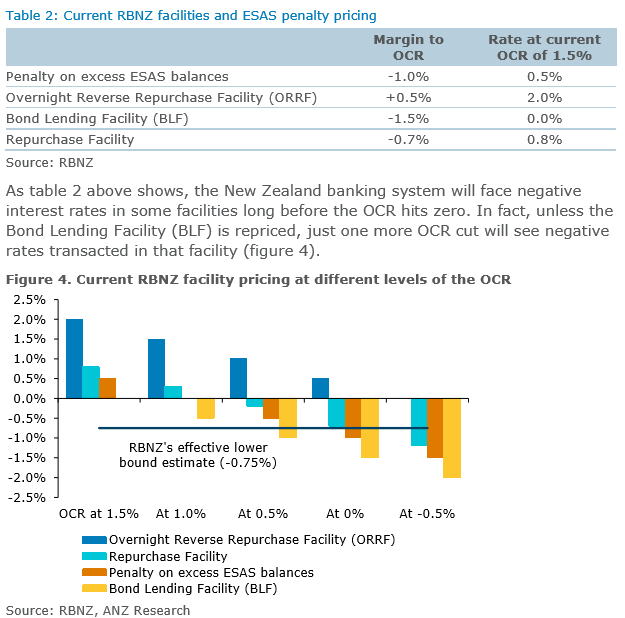
There was a useful reminder that some official RB interest rates will go negative well before the OCR itself gets to a negative number.    This is from their document
ANZ ZLB

The Bond Lending Facility is a facility whereby market participants can borrow bonds from the Reserve Bank (to support smooth market functioning) and, as the authors note, is little used.

The ANZ authors put more emphasis on the penalty on excess balances in settlement accounts.  I wrote about the Bank’s strange tiering policy in a recent post, but the gist is that the Bank determines for each bank what value of deposits at the Reserve Bank earn the OCR, and anything in excess of that earns 100 points less than the OCR.   Banks manage their settlement cash balances to minimise the extent to which anyone bears that lower return  But if the OCR were at -0.25 per cent, the rate on excess settlement account balances would be -1.25 per cent on current policies.   All else equal, that is a rate low enough that (a) no one else has imposed it, and (b) people might prefer to hold physical cash instead.

I’m a bit sceptical that this is a really important constraint on the ability of the Reserve Bank to use conventional monetary policy down to an OCR of around -0.75 per cent, since there is little reason to suppose the level of settlement cash balances would be rising as the OCR plumbed these new depths (if anything demand might be falling a bit), and banks would –  as the Bank would want –  be aggressively acting to limit the extent anyone bore the additional cost.   But it is an issue that is worth debating further, and which would become salient quite quickly if the Bank went beyond OCR cuts and started using unconcventional measures to boost settlement cash balances materially.  In earlier work, it was recognised that tiering policy would probably need to change if there was aggressive unsterilised asset purchases.

The authors rightly note many of the potential limitations of asset purchase options.  Sure, the Reserve Bank might be able to buy up a substantial portion of the government bonds on issue –  although some holders will be very reluctant sellers, having mandates that specify investment in government bonds –  but even if they could, what would be the channel whereby this would revive demand and economic activity (few borrowers took on long-term fixed rate debt).   And the Bank might be able to intervene heavily in the foreign exchange market –  perhaps on ministerial direction, to ensure the risks fall on the Crown –  but they’d likely be selling the New Zealand dollar when it was already undervalued, and if the OCR can’t go below -0.5 or -0.75 per cent, it isn’t likely that the exchange rate effect would be very large.  Intervening in the interest rate swaps market has been an idea around for a decade, and I’ve never been persuaded it would accomplish much.

But the options and issues really should be more widely debated, and the Reserve Bank and The Treasury should be taking the lead in encouraging open debate and serious scrutiny of the New Zealand specific issues.  As ANZ notes, perhaps interventions can be devised on the fly, but there is no excuse for finding ourselves in that position when we have had 10 years advance notice of the problem.  Adrian Orr’s tree god won’t offer the answers, no matter much Orr invokes Tane Mahuta.

My frustration is that thinking doesn’t seem to have advanced much at all in the ten years. I dug through some old files this morning, and among them I found a paper I’d written at Treasury in 2009 (benefiting from discussion with Reserve Bank staff)  on options if we reached the limits of conventional monetary policy.  I also found a discussion note I’d written in 2011 trying to engender some debate around the legislative provisions that support the near-zero lower bound on nominal interest rates, and was reminded of the report of a Bank working group I lead in 2012 on options if we faced near-zero interest rates (sparked by the intensity of the euro crisis then).  But nothing from either the Reserve Bank or The Treasury that has found its way into the public represents any advance on that thinking and work done up to a decade ago.  It really is pretty inexcusable.  It is almost as if our officials and minister think everything worked just fine in other countries after 2009 –  it clearly didn’t –  or they just don’t care.

Specifically –  and this is a criticism of the ANZ note as well (not even mentioning the issue) – there has been nothing done, no debate held, no analysis published, on dealing with fact that at present people can convert limitless amounts into hard currency, and will do so at some point once interest rates on other instruments (wholesale ones in particular) are substantially negative.   Here was what I wrote on that point in my post last year on the Reserve Bank’s article.

It is striking that the article does not engage at all with either of the two more radical options debated in other places and other countries:

  • reconfiguring the target for monetary policy.   This could take the form of a higher inflation target or, for example, the use of a price level or nominal GDP level target.  Each approach has its weaknesses, but either –  done in advance of the next serious downturn, not in midst when much of the opportunity is lost –  could help raise, and hold up, expectations about the path of the nominal economy, including inflation.
  • taking steps to material reduce the extent of the effective lower bound on nominal interest rates.

The latter remains my preference, for a number of reasons (including that the existing problem arises largely because central banks have  –  by law – monopolised note issue, and then not proved responsive to changing circumstances and technologies. Problems are usually best fixed at source.

If there is still a useful role for physical currency (I discussed some of these issues here), the ability to convert huge amounts of financial assets into physical currency, on demand, without pushing the price against you, is now a material obstacle to monetary policy doing its job in the next recession.    There is a good case for looking seriously at a variety of reform options, such as:

  • phasing out large denomination Reserve Bank notes (while perhaps again allowing private banks to offer them, on their own terms, conditions and technologies),
  • capping the physical Reserve Bank note issue, scaled to growth in, say, nominal GDP (perhaps with provision for overrides in the case of financial crisis runs),
  • putting a spread (between buy and sell prices) on Reserve Bank dealing in bank notes, or
  • auctioning a fixed quota of bank notes, and thus allowing the price to adjust semi-automatically  (when currency demand rises, as when the OCR goes materially negative) the cost of conversion rises.

These sorts of ideas are not new.  They do not get rid of the entire issue –  at an OCR of, say, -10 per cent, even transaction demand for bank deposits might dry up –  but they would go an awfully long way to ensuring that the next recession can be dealt with more effectively than the last.

If, for example, you thought the OCR was going to be set at -3 per cent for two years, then once storage and insurance costs are taken into account (the things that allow the OCR to be cut to around -0.75 per cent now), even a lump sum conversion cost (deposits into physical cash) of 5 per cent would be enough to keep almost everyone in deposits and bonds (even at negative yields) rather than physical cash.  That is a great deal leeway than the Reserve Bank has now.   Having that leeway –  and being willing to use it – helps ensure nominal rates don’t need to stay extremely low for too long.

In principle, many of these sorts of initiatives probably could be done in short order in the midst of the next serious downturn.  But we shouldn’t have to count on unknown crisis responses, the tenor of which have not been consulted on, socialised, and tested in advance.  It may even be that some legislative amendments might be required.

There is no excuse for not having these issue all sorted out well in advance, and having communicated clearly to the public (and ministers and markets) how they will be handled, secure in the knowledge that rigorous planning and risk identification has occurred.

In part, that is because of one other issue that ANZ piece doesn’t touch on (neither did the Reserve Bank article).  Once a new severe recession is upon us, people will fairly quickly begin to appreciate how few effective and credible options central banks and governments have, and react –  eg adjusting inflation expectations –  accordingly.  In 2009, the typical reaction was to expect a quick rebound, partly because that was how economies were perceived to have usually behaved, and partly because so many interventions were being thrown into the mix. Next time, people (markets) will go into a severe downturn with the memory of post-2009, an awareness of the unpropitious starting point, and an awareness of the distinct limitations of unconventional policy. All that is likely to exacerbate the downturn and further complicate effects at countercyclical stabilisation.  People will suffer as a result.

We need some leadership on these issues. If the Reserve Bank won’t or can’t provide it, the Minister of Finance –  who will bear responsibility before the voters –  needs to lead himself, and insist that his agencies do more and better, more openly, than they have done so far.

In the meantime, well done ANZ for a substantial piece of work. Once again, I’d encourage people to read it and think about the issues and constraints it raises.

A NZ central banker speaks

Next week Adrian Orr will have completed the first quarter of his five year term as Governor of the Reserve Bank.    In that time, he has given no substantive on-the-record speeches on either of his main areas of policy responsibility: monetary policy, or financial stability/supervision/regulation.     That would be highly unusual at any time, but these haven’t been normal settled periods.  On the monetary policy front, the statutory goal of monetary policy has been changed for the first time in 30 years, and the governance structure has also changed, all that amid a backdrop in which the Bank has had to once again change its policy stance, from looking towards OCR increases (in Orr’s first MPS, the interest rate track started rising from about now) towards cutting the OCR yet again.   And on the financial regulatory front, the Governor has proposed what appears to be the largest and most costly discretionary regulatory intervention (the bank capital proposals) since governors were first given prudential regulatory powers.  And the Governor wields all those regulatory powers personally; unlike monetary policy now, decisions aren’t the shared responsibility of a committee.  So it might have been reasonable to have expected several serious speeches from the Governor –  who is, after all, often lauded for his communications skills.

As one benchmark, the Reserve Bank of Australia’s 2019 speeches page already has 23 entries, including four substantive speeches from the Governor.    And the Reserve Bank of New Zealand?    Three speeches this year to date, only one from the Governor, and that was not a substantive contribution on either monetary policy or financial stability.   For the record, the RBA has a narrower range of responsibilities than the Reserve Bank of New Zealand.

But there was a recent speech –  given in Japan –  from one of his deputies, Assistant Governor and General Manager of Economics, Financial Markets and Banking, Christian Hawkesby.   Hawkesby recently rejoined the Bank after stints at the Bank of England and then in the local funds management sector.  He is a direct report to the Governor, and if he doesn’t have the official title of Deputy Governor (for some strange reason –  Wellington government agencies typically being awash with multiple people carrying ‘deputy’ titles), he is the most senior person below the Governor on the monetary policy side of the Bank.  He is a full voting member of the Monetary Policy Committee, so in additional to his staff appointment he is now a statutory officeholder.  His counterparts are people like (Deputy Governors) Guy Debelle at the RBA or Ben Broadbent at the Bank of England.   He is an able and amiable guy, and when he speaks we should be able to expect something pretty substantial and authoritative.   And in his first public speech, on the monetary policy legislative changes, we can be sure he isn’t saying anything the Governor would be unhappy with.

And so it was disappointing, to say the very least, how much political spin suffused the speech, and how lacking in analytical substance it was.  Recall that this wasn’t a speech to (say) a provincial Rotary Club, but to a Bank of Japan conference of economists and central bankers.

The Reserve Bank’s press release for the speech was, however, presumably aimed squarely at New Zealand audiences.    It is full of spin as well.

It begins

The Reserve Bank has significantly changed the way it makes monetary policy decisions, keeping itself in step with public expectations.

There are two problems with this.  The first is that, until rather recently, the Bank was telling us regularly and repeatedly, that the statutory changes (goal and governance) weren’t that significant at all, and really only wrote into legislation the way the Bank has been doing things for a long time (and perhaps built resilience against rare very bad Governors).   Hawkesby’s predecessor told us (and his audience) that when he ventured offshore for a speech last April (after Orr had taken office).

And the second is that the implication is that the Reserve Bank itself made these changes. It didn’t.  Parliament did, at the initiative of an elected government.    The difference isn’t trivial, because the entire press release continues in this vein, suggesting that the Reserve Bank is a principal, not an agent mandated by Parliament for very specific purposes.   Thus

“We maintain our legitimacy as an institution by serving the public interest and fulfilling our social obligations. Keeping our ‘social licence’ to operate depends on maintaining the public’s trust that we are improving wellbeing,” Mr Hawkesby said.

Nowhere does the Act charge the Bank with identifying what is in the “public interest”, or with “social obligations”.  Rather it gives specific responsibilities and powers to the Bank, subject to numerous other laws, and expects the law to be followed.  Parliament might make wise choices, daft choices, or some mix of the two, but the Bank’s job is to follow the law (and, perhaps, to offer advice to Ministers on how the law should be worded).  Oh, and “wellbeing” does now appear in the Act, but not as goal for the Bank to pursue directly but rather as the expected outcome (together with “prosperity” – never mentioned) of the Bank exercising its specific powers for the specific purposes outlined in statute.

The spin continues

“Thirty years ago New Zealand was prepared to accept a single expert – the Governor – making decisions about how to fight inflation. People now expect to see how and why decisions are made, expect that decision makers reflect wider society, and that current issues and concerns are factored into the decision making. By meeting these expectations, we can improve public trust in the legitimacy of the Reserve Bank’s work,” he said.

This is, frankly, pretty bizarre.  For a start, the old Act never required the appointment of an “expert” (and none of those who held office under that legislation really were monetary policy experts).  But, more importantly, as the Bank told us for the previous 30 years –  and as documents at the time the Act was introduced make clear  –  the focus of the earlier legislation was squarely on transparency and accountability.    (I happen to think the new legislation is an improvement, but not on the “how and why decisions are made” front.)

And then we get the burble about “decision makers reflect wider society”.   I’m not sure quite how a committee of seven middle-aged economists  –  and if these things matter to you, not one Maori –  quite meet that criterion, but perhaps one day the Bank will explain.

But what worried me more was the claim that “people” (who, specifically?) “expect…that current issues and concerns are factored into the decision making”.    Personally, I hope that all decisionmakers in all statutory bodies exercise their powers under the law, taking into account factors they are supposed to consider, and not bringing extraneous personal agendas to the table, hijacking public office as a platform for personal political causes.

I largely agree with the next paragraph

Mr Hawkesby outlined the new committee process that the Reserve Bank uses for deciding the official cash rate, noting that diversity among decision makers improves the pool of knowledge, insures against extreme views, and reduces groupthink.

(which is why I was championing a committee model, including outsiders, when the Reserve Bank was – until quite recently – opposed).  But this is what Hawkesby – and presumably Orr –  think we need a monetary policy committee for

“This diversity is needed to confront issues such as climate, technological, and other structural and social changes,” he said.

If you think –  as I do – that climate change is, at most, of peripheral relevance to the Bank’s financial stability functions, it is of no real relevance at all to monetary policy at all.  One could say much the same of “social changes” (what did he have in mind?) or even “technological changes”.  Now, to be sure, there is an old line of argument that the Reserve Bank needs to be aware of anything that might materially alter neutral interest rates or the neutral unemployment rate, but even to the extent that is so, the issues and challenges are no different than they have ever been –  in fact, the issues the Bank currently has to be aware of (around monetary policy) are almost certainly much less broad in scope than those it faced 30 years ago, when the Act came into force, in the midst of successive waves of extensive waves of micro reform.

The press release ends with this piece of politics.

He also said that collaboration with government can be undertaken in a way that maintains the Reserve Bank’s political independence while working on the broader objective of improving wellbeing.

It is simply not the Reserve Bank’s job to range more broadly, assisting the government with its partisan agendas, even if the individuals involved happen to be left-wing themselves.  To repeat, the Act is very clear that the Bank does not have an all-embracing goal of pursuing “wellbeing”, but is specifically charged with using its monetary policy powers to achieve and maintain price stability and “support” maximum sustainable employment.

The body of the speech –  with much more space for qualification –  is no better, and is arguably worse.  There are ahistorical claims (notably, that the previous Act brought down inflation from “around 20 per cent” –  inflation was about 5 per cent when the law was enacted).    And the nonsense suggestion that only now do people realise that low inflation is not an “end it itself”.

And never once do you see any reference (even politely) to the fact that the law was amended by Parliament as the outcome of a political process –  notably, a Minister of Finance who, in Opposition, needed some product differentiation (both from his National opponents, and from the ideological enemies formerly in his own party –  the reformers of the late 80s) but who always seemed more interested in cosmetics than in substance.  In fact, one never even sees the point the Minister often made –  and which Hawkesby’s audience of central bankers must have been well aware – that the recent legislative changes just bring the New Zealand legislation a bit closer to the (very longstanding) legislation in the US and Australia.    Instead we get this vacuity

Our policy framework changed because times are changing. For the Reserve Bank to maintain its credibility and relevance, we must change too.

And there is the incoherence of championing the record of the last 30 years, all while claiming that “a sole decisionmaker or uniform committee cannot possibly hope to possess the broad range of insights necessary to consider these issues” (climate change and social change again).    And the seeming blind spot about the utterly crucial nature of what a committee can bring…..and yet at the same time, the bank capital proposals rely wholly on a decision by one individual, the same individual championing the change.

There is questionable stuff throughout the speech, but this one near the end caught my eye,

There is emerging consensus that coordination is necessary for an optimal response of broader macroeconomic policy.16 For central banks, operational independence does not have to mean operational isolation. Rather, collaboration with government can be done in a way that builds and reinforces the social licence to operate, by showing a willingness to work with other partners to do whatever is necessary to achieve the broader objective—improving public wellbeing.

More politics, more wellbeing spin, but it was that footnote that I lighted on, apparently supporting the surprising claims of an “emerging consensus the coordination is necessary” for macro policy. I was intrigued and wondered what I’d missed.  When I looked more closely, the reference was to a short recent comment by economic historian Barry Eichengreen and it wasn’t an argument for more coordination at all.  Instead, it simply observed that in many countries monetary policy appeared to have more or less reached its limits and thus that fiscal policy might be much more important in future.

But nominal interest rates can’t be forced much below zero. And monetary policymakers, for their part, seem unable to push inflation above 1-2% in order to drive down real interest rates. Investment demand therefore tends to fall short of saving, creating a risk of chronic underemployment.

In this case, the argument for additional deficit spending to supplement deficient private spending is stronger, because there is less risk of crowding out productive private investment. This does not mean that the scope for running deficits is unlimited, because at some point safe government debt could be re-rated as risky, causing interest rates to rise. That said, these arguments lead to a straightforward conclusion: in the future, we will have to rely more on fiscal policy and less on monetary policy to achieve stable and equitable growth.

You might or might not agree with Eichengreen, but you simply cannot read him –  as Hawkesby attempted to represent him –  as making a case for more coordination of policy.  If anything, it is more a case for the growing irrelevance of central banks (a claim one can agree with or not).   It was either careless or dishonest to present it otherwise. I prefer to believe careless, but the Bank should be better than that.

And who knows what Hawkesby’s expert audience made of the final couple of paragraphs of the speech

And it is not enough to grudgingly adapt. In order to maintain credibility, central banks must embrace change and prove to the public that they are capable of delivering on their objectives. To remain credible is to remain relevant. Central banks should keep their eyes open, and be ready to change tack. Our destination—a world with improved wellbeing for our citizens—may not change, but the best route for getting there may.

We must adapt. We must continue to improve the wellbeing of our citizens. We must remain credible.

Rhetorical burble that was really a substance-free zone.

Speeches by good (economics) deputy governors of advanced country central banks –  eg Debelle and Broadbent, and their Canadian counterparts, or some of the economist heads of regional US Federal Reserves –  are often well-worth reading.  They typically contain and reflect serious economic analysis, and help create confidence in the robustness and depth of the institution itself.  Sadly, this first speech by Hawkesby fells well short of that standard –  and the gap is the more noticeable given the stature of the audience he was speaking to.   Credibility does matter, but if they are to be taken seriously the MPC (Orr, Hawkesby and the rest) will need to be making rather more serious and substantive –  occasional –  speeches than what was on offer this time round.

One can mount an argument that in the last year or two the Reserve Bank of New Zealand’s actual monetary policy calls have been a bit better than those of the Reserve Bank of Australia, but without a sense of a robust underpinning –  serious sustained analysis, and articulation of that reasoning, and of how they understand the economy –  we can’t have any confidence in the robustness of the institution, or that better calls have been any more than dumb luck.


Governing well, or just slowly making us poorer?

I noticed in the Herald this morning Audrey Young’s article running the line that (a) it had been a good  –  in fact, exceptional – week for the government, which had (she claimed) been governing well, and (b) that one example of this was yesterday’s reopening of the Wairoa-Napier railway line.   There was a celebratory article on the reopening in this morning’s Dominion-Post, which might better have been labelled as advertorial, and could easily have been taken straight from Shane Jones’s press secretaries.  It was, after all, only reopened with the (as yet) rather small amount of the Provincial Growth Fund that has actually been spent.  For this particular project, $6.2 million of taxpayers’ money, given to a loss-making SOE that, even running losses, had not itself considered the project viable.

This project was first announced in February 2018 and then I wrote a post about it, under the heading “The boondoggle”.   Here I’m repeating the bulk of that post.

Earlier this week, Kiwirail released its most recent half-yearly financial result. Once again, the taxpayer was poorer for their operations. They make great play of a modest “operating surplus” but I rather liked this summary table from their latest Annual Report

kiwirail1

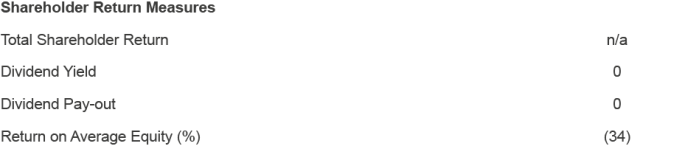
In other words, no returns to shareholders at all; in fact, losses in one year of a third of the (periodically replenished) shareholders’ funds

Last year, they had operating revenues of $595 million, and an overall loss of $197 million (much the same as the year before). So roughly a quarter of their overall costs are not covered by income. As an organisation – and with all due respect to the energies of individual employees (including the five earning in excess of $500000 per annum) – it has all the appearance of being a sinkhole, absorbing more of the scarce resources of taxpayers each year.

And before people start objecting that roads don’t make a profit, it is worth remembering that airlines do and coastal shipping operations do – and, if they don’t, they usually go out of business.

An organisation that operates such large losses (acquiesced in by successive shareholder governments) clearly isn’t one that applies the most demanding tests possible to the question of whether individual lines should be opened or closed. Occasionally people attempt to justify government intervention in this or that activity on (questionable) grounds that the private sector is applying too high a cost of capital. But in this case, the state operator’s average return on capital (ie over all its operations) is substantially negative, and it has no expectation of changing that.

A few years ago, Kiwirail closed the Gisborne to Napier line. Rail volumes had been low and falling – some trivial portion of the volume that Kiwirail estimated would have been required to make the line viable. But ever since, there have been people hankering for the line to be reopened.

And yesterday, as part of the first wave of projects approved under the new Provincial Growth Fund, the Minister of Regional Development announced that

“We’re also providing $5 million to Kiwirail to reopen the Wairoa-Napier line for logging trains, taking more than 5700 trucks off the road each year.”

In the more detailed material released with the announcement there is a suggestion that the Hawkes Bay Regional Council may also be putting in money.

There is no sign of any cost-benefit analysis of this proposal having been released at all. But we can assume that the proposal wouldn’t pass any standard (weak) Kiwirail commercial test since otherwise Kiwirail would have reopened the line without taxpayers’ having to chip in more money directly.

There used to be some logs/timber carried on the Gisborne-Napier line, but a reader pointed me to the numbers: in the final full three years of operation, a total of 327 tonnes of it. There are, apparently, going to be a lot more logs to move in the coming years. In the Minister’s words

“The wall of wood is expected to reach peak harvest by 2032 so reopening this line will get logging trucks off the road and give those exporting timber options that they currently do not have,” Mr Jones says.
“It makes sense to consolidate that timber in Wairoa and use rail to take it to the Port of Napier.

Except that apparently officials and Kiwrail had already looked at this option a few years ago. In a report released only a few year ago it was noted that

“We note that Kiwirail was not convinced this would be finanically viable for users given the relatively short distance involved and the need to double-handle the logs. Industry feedback has also indicated that transport of logs on rail across the study area was unlikely to be economic.”

Perhaps the economics has suddenly changed? But, if so, where is evidence? None was published yesterday. We aren’t even told what assumptions are being made about how much of the logging business will be captured.

The Minister’s release also argued that there were climate change benefits from this move

“It will also mean 1,292 fewer tonnes of carbon dioxide released into the atmosphere each year.”

Even if this were relevant – don’t we have an ETS supposed to deal directly with pricing emissions? – and accurate (what assumptions are being made, including about the carbon costs of the double-handling?), it sound doesn’t terribly impressive. A single 747 flying to London and back once apparently emits 1100 tonnes of carbon dioxide.

This is just one of the numerous projects the government is going to spend money on in the next few years.

A couple of weeks ago, I commented on the Minister of Finance’s underwhelming exposition of what the government was going to do to transform the productivity outlook in New Zealand. The Minister noted

A major example of this is the Provincial Growth Fund developed as part of our coalition agreement with New Zealand First. This will see significant investments in the regions of New Zealand to grow sustainable and productive job opportunities.

To which my response was

If it ends up less bad than a boondoggle we should probably be grateful. It isn’t the sort of policy that has a great track record, and it is hard to be optimistic that one new minister – with a vote base to maintain – is going to transform the sort of flabby thinking around regional development presented at Treasury late last year.

Sometimes economic policy in this country seems almost designed to defy reason and evidence in an effort to make us poorer, to hold back national productivity prospects. Spraying around $5m here and $5m there – $3 billion over three years, in some scheme reminscent of congressional earmarks in the United States – not backed, it seems, by any robust supporting analysis, seems just another step along that path.

But at least one senior journalist thinks this is an example of governing exceptionally well, making us poorer one earmark and subsidy after another.

There was an interesting range of comments on the earlier post, including some from champions of rail.  Not one attempted to defend the economics of the Wairoa-Napier line, and to anticipate some similar comments this time round here was my response to one commenter, focusing on my key points.

My specific point was two-fold:

1. Even allowing for arguments about the extent to which road use isn’t fully priced (on average – it clearly isn’t fully priced at the margins) other competing transport operators successfully meet the market test (air, coastal shipping). It isn’t immediately obvious why rail freight (the issue here) shouldn’t be held to the same standard

2. Successive govts have been happy for Kiwirail to operate in very low (negative) returns to shareholders – perhaps partly to reflect presumptions around road pricing etc – but even by that undemanding standard, Napier-Wairoa doesn’t appear to be have been viable.

There are various interesting comments to my post. But I haven’t seen any that suggest Napier-Wairoa is an economic proposition. It is still possible, of course, that in fact it is, but then one might have hoped for a cost-benefit analysis to have been (a) done, and (b) published.

And don’t suppose this is the end: in that Dominion-Post article we read this

On whether there was a possibility of extending the line to Gisborne, Jones said any business case would be pushing on an open door.

That might rival light-rail in Wellington for the most uneconomic transport proposal the government could fund.

Farewelling Makhlouf

I saw three reports of last night’s Beehive function to farewell the outgoing Secretary to the Treasury.  There was Barry Soper’s piece on the Herald website, and Herald political editor Audrey Young’s account, as well as Richard Harman’s Politik column (the latter is subscriber-only, but with one free article a month for non-subscribers).

Soper’s is the more hard-edged take

The atmosphere in the cavernous Beehive Banquet Hall last night was about the same as it would have been if Donald Trump walked into a Democrat’s convention.

and

It’s surprising the inquiry wasn’t done and dusted in time for the farewell given all the statements so far point to the fact that the Secretary knew full well when he claimed there’d been a hack attack that it hadn’t taken place, the GCSB spies had made that clear the night before.

But

But if last night was uncomfortable they were doing their best not to show it.

Across the three accounts, we learn that – Grant Robertson aside, as host –  no Labour ministers were present, but that a phalanx of New Zealand First ministers  and MPs were, including Shane Jones, whose (lack of) regard for the proprieties of public office is well-known.

I suppose that when it was decided to push ahead with this nauseating function, people had to at least go through the motions, but it sounds as if it was worse than that.    Audrey Young talks of the “glowing tributes” Makhlouf received (Harman talks twice of “fulsome praise” –  when I was growing up that meant (eg OED) “offensive to good taste, from excess or want of measure”, so perhaps Harman was deliberately being a bit double-edged.)    Reports suggest that at least Robertson was somewhat honest, since his praise seemed to involve the things that had seen a dumbing-down of The Treasury, and a lowering of its standing and capability to offer rigorous economic analysis and advice.  I guess when your government has no economic ambition, you don’t need much analysis.

But what seemed wildly inappropriate was the account of the State Services Commissioner Peter Hughes’s address.  You will recall that the State Services Commission is investigating Makhlouf’s personal conduct in and around the Budget affair.

“Thank you from the people of New Zealand. Our country is a better place for your work.”

He said Makhlouf had brought “strong leadership and a great deal of personal integrity” to Treasury.

He had been “authentic and straight up” and had been calm and unflappable.

“I will certainly miss your calm authority,” Hughes said.

In no conceivable universe (except perhaps some parallel one inhabited by SSC) could Makhlouf during that Budget episode be said to have displayed “calm and unflappable” leadership.  Had he done so, there’d have been no inquiry.

But, more importantly, how are supposed to take seriously (supposing anyone was inclined to) an inquiry into very recent conduct, when the person responsible for the inquiry gushes like this, and apparently went on to praise the collegiality of the public service chief executive “club”.   Looking out for each other no doubt (even if, privately, they must all be thinking “Gabs, how could you have?”)

And after all that attendees had to listen to Makhouf “at length” (is there anything worse at a farewell than long speeches?).  The sheer vacuity of it all was captured in this piece of (delusional) political pandering.

“I have to say, Grant, that one of my proudest moments was listening to the Budget speech and hearing the living Standards’ Framework come alive,’ he said.

While serious analysts struggle to identify any real difference the soft-centred feel-good rhetoric made.

The other thing that caught my eye in the Harman column was the photo at the top of it, showing Makhlouf and Grant Robertson chatting pleasantly with the PRC Ambassador, Madame Wu.  Pretty nauseating in the wake of the repression this very week of the Hong Kong protests –  but no doubt Madame Wu is delighted that our government, unlike Australia, the UK, the EU, and senior US figures, has said nothing at all.

But in particular the photo brought to mind Gabs’s shameless (and not even well-grounded) pandering to the PRC.   There is, for example, this

Secretary to the Treasury Gabriel Makhlouf has welcomed a new Memorandum of Arrangement formalising a financial dialogue between the New Zealand Treasury and the Ministry of Finance of the People’s Republic of China.

signed on the Prime Minister’s recent tributary visit to Beijing.  Of it, Makhlouf noted

There are fiscal, financial and economic issues of mutual importance to our two countries and there is much we can learn from each other

Quite what he thought the New Zealand Treasury could learn from economic policy etc in a middle income highly repressive state without the benefit of the rule of law or a genuine and open contest of ideas was never made clear.  You might excuse that bumpf on the grounds of “well, it is meaningless, and just the stuff officials sometimes have to do”. But the same can’t be said for the dreadful speech he gave in Beijing last year.  I wrote about it here.   An excerpt

What appalled in this particular speech was the craven grovelling to the PRC, the total relativisation of our two countries in ways which suggest that he thinks their system, their government, is just as good as ours.  (I don’t suppose he really does, but when you are a senior official, backing your government, what you say counts  –  including no doubt to the PRC authorities. He does the kow-tow)

He begins his speech with the rather empty claim that

Yet there is so much that we have in common.

We are all human beings I guess, but it wasn’t clear what else he had in mind.   He tries, not very convincingly, to elaborate.

All of us here want open trade, thriving business, and economic growth. Those things matter for our material wellbeing. But they are only a subset of what contributes to the quality of our lives. I’m sure we share a belief in the importance of good health and education, decent housing, the support of family and friends, a clean natural environment, a safe and peaceful society. We seek that for ourselves and for future generations.

As the Secretary surely knows, the People’s Republic of China has no commitment to open trade, having a highly regulated economy, and tight restrictions on international services trade in particular, and on investment.    But what of that broader list of things he thinks we have in common?  Perhaps it is fine as far it goes, but he is talking to people in a country whose government has a million people from Xinjiang in concentration and re-indoctrination camps.  And for all the Secretary’s talk about wellbeing –  and even “social capital” –  it is notable that things like free speech, free expression, the ability to change your government, freedom of religion, and even the rule of law – explicitly disavowed not long ago by the PRC Chief Justice –  are totally absent from his list.  The things that divide free and democratic countries from the PRC regime are huge and important.  Perhaps even the sorts of things that might appear in a typical New Zealand assessment of wellbeing?  But they, apparently, don’t matter much to the Secretary to the Treasury.  He goes on the praise the Belt and Road Initiative –  under the aegis of which the previous New Zealand government committed to the (rather frightening) aspiration of “the fusion of civilisations” with the PRC.

In all that he was just warming up.  There is later a substantial section of the “NZ-China relationship”, which is almost nauseating in places.  Thus

It is a relationship that goes beyond diplomacy and trade. It’s also about the links between people, about investing in our mutual success, and about recognising our shared interests in the world.

Liberty, democracy, the rule of law for example?  I guess not.  Respect for established international borders?  I guess not.    Then again, there is this in common, that both China and New Zealand have dramatically (economically) underperformed their near neighbours over the last century of so: in China’s case, Japan, South Korea and Taiwan, and in New Zealand’s case Australia.

Then we get this

It hasn’t all been one-way traffic. New Zealander Rewi Alley helped establish the Gung Ho movement in the 1930s and dedicated 60 years of his life to improving the living standards of Chinese workers.

You mean the active member of the Chinese Communist Party and unashamed apologist for its evils  (I have one of his books sitting on my desk, co-authored with the dreadful Communist fellow-traveller Wilfred Burchett, written towards the end of the Cultural Revolution celebrating the quality of life in the PRC).    Then again, when we have a Chinese Communist Party member in our Parliament what might one expect from our elites?

The Secretary moves on to celebrate PRC foreign investment in New Zealand.  He notes, without further comment, that

Over half of the 25 largest Chinese investors in New Zealand are state owned enterprises including Huawei, Yili and Haier.

as if this is a good thing (Treasury not being known for its enthusiasm for SOEs in New Zealand), as if he cares not about the national security threat various allied governments have determined Huawei represents –  and note that Huawei likes to represent itself as a private company –  and as if he is unaware (or cares not a bit) about the PRC law under which companies (private and public) are required to operate in the interests of the party-State, at home or abroad.  In the best of circumstances, state ownership (and murky ownership) is a recipe for weakened capital allocation disciplines etc, and the Secretary to the Treasury really should know that.

That is the sort of leadership our Treasury has had for the past eight years.  But I guess you can see why he probably mostly went over okay in the Beehive.   And why Madame Wu was so keen to chat.

My trains anecdote yesterday prompted a former Treasury official to get in touch with another farewell story.

I recall him also saying, in the context of the Christchurch earthquakes, that what was needed was a “Canary Wharf” kind of initiative in Christchurch. I recall his total absence of any reference to cost/benefit or evidence leaving us all looking at the floor – we were trying to imagine what a Canary Wharf in Christchurch might consist of, aside from being mystified about what it was about Canary Wharf that he was seeing as welfare-enhancing.

No doubt we all say dumb things at times, and perhaps especially people who think aloud.   But not all of us, having already risen to such giddy heights – albeit by leaving home and coming to a small and remote country – say things of quite such economic illiteracy in formal work contexts, and then get promoted further, to be chief economic adviser to successive governments for eight years.

It isn’t Makhlouf’s fault New Zealand has drifted further backwards, in economic terms, over the last eight years.  But over that time he led an institution that could have played a powerful role in shaping and influencing for the better debate about how best to respond to our longstanding continuing relative decline.  Instead he chose to shift the focus to feel-good distractions.  He –  and those who appointed and reappointed him –  bear responsibly for that, for what is in many respects a betrayal of our people, perhaps especially the poorest and most vulnerable, who can’t just flit in and when their term ends flit off to another high-paying job in yet another country.

Makhlouf again

This evening, so we are told, the official government farewell is to be held at the Beehive for outgoing Secretary to the Treasury Gabs Makhlouf whose eight year term expires in two weeks’ time.  It should really be a rather awkward occasion, even allowing for the likelihood that the people who turn up to the farewell will mostly be those either not bothered by serious misjudgements in public office (and a multi-year record of underperformance) or who feel that they have little choice but to attend (the host –  the Minister of Finance –  and, for example, ambitious careerists in the upper levels of the public sector).   The Leader of the Opposition and National’s Finance spokesperson are reported to be boycotting the event.

I’ve long been something of a sceptic of Makhlouf, having first observed him when I was working at Treasury a decade ago.  I was surprised –  and not exactly positive about –  him being appointed Secretary, and more surprised and seriously disappointed by Bill English’s decision to approve his reappointment.   The gradual decline in the quality and standing of The Treasury continued on his watch –  Eric Crampton argues it accelerated –  with a growing sense that The Treasury had become less interested in, and capable of, rigorous economic analysis, and more about bending with the wind to (indeed championing) all manner of trendy causes.   Makhlouf gave many published speeches, and they too were remarkable mainly for platitudes, politically-driven pandering (eg on the PRC), and conventional centre-left tropes, rather than for any distinctive insight.  He was particularly fond of talking up the idea of New Zealand being close to Asia, to which I’ve several times pointed out that when he was home in London he was closer to Shanghai or Mumbai than when he was in the office in Wellington.

Which is not to suggest that he was without his merits.  There were policy and organisational issues where I thought his instincts were sound, under his leadership Treasury continued to be better around the OIA than most agencies, he was/is a pleasant person, and he must have something of a thick skin.  Having been quite critical of him and The Treasury, I was a bit surprised a few months ago when he followed through on one of those polite “we must get together for a coffee” comments people sometimes make, and we had a long, pleasant, and productive discussion on all manner of things.

And so until a couple of weeks ago I’d assumed his term would end quietly and conventionally, with the hope (against hope, given the SSC –  and, frankly, the pool of credible contenders) that someone better might replace him.

But his conduct in the Budget “leak” affair –  much of it directly visible to, and aimed at, the public –  descended to a whole new level.   And simply should not have been allowed to stand.   I wrote about this in a post last week.    Quite a lot of additional information has emerged since then, including from the GCSB. the Prime Minister, and the head of the Department of Prime Minister and Cabinet.  None of it puts Gabs Makhlouf’s conduct in a better light, or offers any mitigating circumstances to explain his words, his actions, and his demeanour.    In such a serious matter he fell far short of acceptable standards.  An honourable and self-aware person in his position would have resigned by now (which might have been made a little easier knowing that he was leaving in a few weeks anyway). But then such a person would not have found themselves in such a position, because having realised that they had made a succession of mistakes –  perhaps unused to the glare of the public spotlight in an intensely political controversy – they’d have apologised and adopted an attitude of contrition.

Where did he go wrong?

Well, first, there was the not-insignificant matter that he was chief executive of an agency charged with maintaining Budget secrecy, and yet systems were such that some material found its way into the public domain anyway without too much difficulty.   Not a hanging offence in its own right, but not a good start.  And there hasn’t even been an expression of regret or apology for that –  not in the public statements anyway, but perhaps he has apologised to the Minister of Finance.

Then there was the rather melodramatic statement Makhlouf issued on the Tuesday evening  (this was the “deliberately and systematically hacked” statement).    It was made when, as is now clear, the GCSB had already told Treasury that nothing of the sort that most people think of when the word “hack” is used had occurred.  At best, it was loose and flamboyant language.  Makhlouf will have had the benefit of advice from his comms, legal, and IT people, and (we presume) his senior deputies.  His staff had had the advice from GCSB, and yet he still put out this statement.  He could, quite easily, have put out an alternative version along the lines of “GCSB has advised us that there has not been a hack, but as we continue to investigate ourselves, we have referred the matter to Police.”

In all the timelines that have emerged to date, none has documented the (likely frequent) contacts between Treasury staff and staff in the office of the Minister of Finance (or of the Prime Minister).  But even if you subscribe to the idea that the Minister was putting pressure on the Secretary, the fact remains that the statement was Makhlouf’s responsibility, and his alone.  As I’ve noted previously, when you are leaving in a few weeks, and then leaving the country, the Minister of Finance has little no leverage over you – but even if he had some leverage, your legal responsibility is still to act responsibly, calmly and independently.

We now have confirmation that the head of the GSCB had alerted his minister to concerns about Makhouf’s statement that evening (after the statement had gone out).  We know too that Andrew Little passed those concerns on to the Prime Minister and the Minister of Finance.  So even if Makhlouf did not know the full extent of GCSB’s concern prior to his statement going out, he must have been made aware of those concerns by late that same evening. (If Andrew Hampton was concerned enough to call his minister, are we to suppose he would not have first rung his fellow public service CE, Makhlouf, to put his concerns on record?)

And yet in his round of media interviews the next morning,  not only did Makhlouf not ease back the rhetoric, he amplified it –  both directly (his use of the “iron bolt” image) and in lines from interviewers to which he did not object.   We also don’t know precisely when Treasury IT staff formally advised Makhlouf what had actually happened, but even by this stage he must have had ample material and perspectives that should have led him to reconsider.  His rhetoric was out of step with whole-of-government action (no ODESC meeting, no early release of market-sensitive bits of the Budget etc,).   Whether or not his intent was partisan (I presume not), his rhetoric in turn provided cover for, for example, pretty inflammatory statements from the Deputy Prime Minister.  He must have realised  –  and if he didn’t it reflects more poorly still –  that he was misleading the New Zealand public.

By later on the Wednesday afternoon, even the Police were washing their hands of the affair (presumably after talking to Treasury IT staff earlier in the day) and yet there was still no clarification or withdrawal from Makhlouf.  Instead, we finally got a statement from Makhlouf at 5am the next morning, in parallel with one he had managed to get out of SSC.    I don’t suppose anyone thinks Treasury staff were at work at 4:30am finalising the press release –  there was no obvious reason why the statement could not have been released hours earlier –  but even then it was the content of the statement that was even more problematic than the timing.

There was no apology (either for the systems allowing the breach, or for his actions words over the previous 36 hours) and renewed attempts to muddy the waters with unsupportable claims that the release of the data had been a breach of some (non-existent) convention around Budget secrecy.  And then nothing more: no media appearances, no nothing.  And there has been nothing since, whether before or after the (belated) announcement of an SSC inquiry into Makhlouf’s words and actions, complete with (irrelevant) report from the State Services Commissioner that Makhlouf believed he had been acting in good faith throughout.  Quite probably, but good faith doesn’t excuse shockingly poor judgement (especially not in one of the most senior officeholders in the land).

My own view remains that had Makhlouf issued a genuinely contrite statement that Thursday morning, the issue would have died off pretty quickly.  New Zealanders seem mostly pretty forgiving, when someone owns up.  But Makhlouf appears to have dug in.  He could have apologised.  He could have taken leave while the investigation is going on (especially as it will involve a lot of questioning of his own staff). He could have resigned.  He could have arranged for tonight’s farewell to have been quietly postponed (I’m sure Treasury will have its own farewell).   But he did none of these things.  And now it appears to be in the joint interests of Makhlouf, the SSC, and the government for the inquiry – undertaken by people with specific conflicts (the SSC statement on the Thursday) and who are in any case too close to those they are investigating – to take just long enough to run out the clock.   That is a sad commentary on the people involved and on the system, and tonight’s farewell does look quite a bit like cocking a snook at New Zealanders, and robust standards of governance (which includes sweating the small –  and not so small – stuff), as the elite –  perhaps barely conscious of what they are doing –  look after their own.

What of the Irish?  I was among plenty of people surprised by Makhlouf’s appointment as Governor of the Irish central bank (I recall a flippant remark the day the appointment was announced about needing to check that it wasn’t April Fool’s Day).  He has no strong background in monetary policy, banking supervision, financial markets, or financial stability.  And he was male, (there was a strong female local contender) and he was – not to put too fine a point on it –  British, and Irish independence hadn’t exactly come about in the peaceful and evolutionary way New Zealand and Australian independence had.   “Hated imperialist overlords” and all that, even allowing for the fact that some time has now passed since then.  To the outsider, it seemed that what Makhlouf had going for him was mostly the conventional centre-left platitudes (appealing to the current Irish government) and a strong emphasis – beyond the facts and evidence –  on “diversity and inclusion”.  He hardly seemed likely to add brilliance or gravitas to the deliberations of the European Central Bank’s governing bodies: as a policy person and economist he was not a patch on the outgoing Governor, Ireland’s own Philip Lane.

The Irish central bank’s reputation took a hit in the wake of the 2008/09  financial crisis.  Much of that appeared to be very well-deserved (with the caveat that the political classes were so invested in the success narrative pre-2008 that a central banker who had tried to be much better might not have lasted long).    They’ve done a lot of rebuilding in the last decade, including having had some foreign appointees in senior roles.  The economist Stefan Gerlach served as Deputy Governor for several years.  He was sceptical when the Makhlouf appointment was first announced.  Here was his take on the news of the SSC inquiry

and on Eric Crampton’s piece on The Treasury under Makhlouf late last week

Radio New Zealand yesterday reported the Irish Minister of Finance saying that Makhlouf’s appointment was secure unless there was “very very grave misconduct” uncovered.

If the appointment has already been lawfully made, a quick check of the Irish central banking act suggests that government may have few options.  The initial appointment will have been solely at the discretion of the Irish cabinet.

19.—(1) The Governor shall be appointed by the President on the advice of the Government and shall receive such remuneration and allowances and be subject to such conditions of service as the Board shall from time to time determine.

A person serving as Governor is automatically ousted in exceptionally extreme circumstances

d) if and whenever he is adjudged bankrupt (whether in the State or in any other country) or makes a composition or arrangement with his creditors or is sentenced by a court of competent jurisdiction to suffer imprisonment or penal servitude, he shall forth-with become and be disqualified from holding the office of Governor.

There is a separate section on removing a Governor.  There is a health ground

21.—(1) If the Governor becomes by ill-health permanently incapacitated for performing his duties as Governor he may be removed from office by the President on the advice of the Government.

and a residual catch-all, which has to be initiated by the Bank’s Board and has to be unanimous.

(2) If the Board, by unanimous vote of all the Directors, requests the President to remove the Governor from office for cause stated, it shall be lawful for the President on the advice of the Government to remove the Governor from office.

It should be very hard to remove a serving Governor from office.  But Makhlouf doesn’t take office for another three months, where the standards really should be lower.  Embarrassing as it might be for the Minister of Finance to do so –  having initiated the appointment and lauded Makhlouf to the skies – it is a bit hard to see how anyone would have so thick a skin as to resist an approach from the Minister of Finance making it clear that he would no longer be welcome as Governor, and could not credibly serve as Ireland’s person in the governing halls of the European Central Bank, at a time when the ECB and European institutions will need all the credibility, and expertise, they can muster.   In the private sector, a payout might be involved.  Those don’t go down well in the public sector, but it isn’t as if Makhlouf resigned another job to accept the Irish appointment –  his term here was expiring and he wasn’t eligible for reappointment.

Time will tell, and that is Ireland’s problem.

On the occasion of farewells, people often go round looking for stories about the person departing.   I’d have met Gabs before this, but the first encounter that really sticks in my mind was a policy forum at The Treasury on aspects of overall economic performance, productivity etc.  If I recall rightly it was held in The Treasury’s wharenui, so we were all there in our socks/stockings.  At some point in the meeting Gabs piped up, opining that New Zealand’s real problem had been that we hadn’t invested heavily enough in rail, and went on to note that one of the best aspects of the British Empire had been its emphasis on rail.  The economists among us didn’t know where to look –  the floor mostly –  or what to say, but I still recall the conversation afterwards along the lines of “thank goodness he is only the Deputy Secretary for the operational side of The Treasury, and doesn’t have a policy role”.

Sadly, little did we know.

It is the sort of experience that leaves me cautious, at best, about what sort of appointment SSC will make this time, when they finally get round to filling the vacancy that has been known for three years and which was advertised six months ago….and which will be vacant in, at most, two weeks from now.


As obstructive as ever

Late last week I suggested that Pattrick Smellie of BusinessDesk was being more than a little generous to the Reserve Bank when he suggested that, even though the Governor was now displaying some of the same bunker mentality as was on display late in the Wheeler years, more generally

The RBNZ is now more open and transparent.

There was no evidence then for that proposition.  As I noted

it just isn’t so –  the capital review is only the latest example, but nothing material has changed about monetary policy, we’ve had no serious speeeches from the Governor on his core responsibilities, and they play OIA games just as much as ever

And today I’ve had another couple of fresh examples illustrating my point, and a reminder of a third.

The reminder?  Contact from the Ombudsman’s office about a complaint I lodged some time ago when the Bank took a grossly excessive amount of time to release material I’d requested –  relevant to bank capital review – all of which, in turned out, had already been given to other people (and thus should have been able to be released almost immediately).

And the new examples?    More than two months ago I asked both the Bank’s Board and the Minister of Finance for papers relevant to the appointment of members of the new Monetary Policy Committee.    After a while, both parties extended my request.  I wasn’t unduly bothered, although even then the notion ran around in my head that a pro-active release might have been a good idea, around the first appointments to a powerful new body.    Today, the Minister of Finance did release a fair amount of material (I haven’t read it yet), but what about the Bank’s Board?   Well, they just sent me a note extending the request yet again, using as their justification –  after having had 2.5 months already

because of the consultations necessary to make a decision on the request such that a proper response to the request cannot be made within the original time period.

And this is what Pattrick Smellie thinks is a “more open and transparent bank” (bear in mind that the Governor sits on the Board, and the Governor’s staff will do doing all the actual work).

Quite possibly the request for information around the MPC appointments could have taken a bit of effort.   But my other example of the Bank continuing on as ever, playing games outside both the letter and the spirit of the OIA, is one where they could easily have responded fully and openly within a day or two of the original request.

On 11 May, I lodged the following request

nzi oia

I was pretty sure he would have been speaking without notes or slides (but if there had been any they’d have been easy to send on –  after all, the material had already been provided to private sector people).   And since the request was made just a day after the presentation, it should have been very easy for the Governor to have jotted down a quick summary of what he had said, and how he had answered questions on two specific topics.

But 20 working days have now passed –  and recall that under the law the requirement is to respond “as soon as reasonably practicable, but no later than 20 working days” –  and this afternoon this request was also extended for another couple of weeks, again allegedly because the consultations necessary to make a decision could not be made within the original timeframe.  Yeah right.   (In fact, there shouldn’t need to be any consultations at all.  I asked only for the Governor’s words, which are official information.)

Why did I frame the request around those specific points?  It was easy to anticipate that the Governor would get lots of questions about his bank capital proposals, probably not (from that audience, which includes both private businesses and banks) sympathetic ones.  And about the Bank’s research capability?  That reflected a post here on the morning the Governor was to meet the New Zealand Initiative over lunch.

On which note, one hears that the Reserve Bank’s research function has been  substantially gutted, with several recent resignations in recent months from among their best-regarded and most productive researchers (and the manager of the team left this week and is reportedly not being replaced).    The Bank’s research function once played a very influential part in policy and related thinking, but that is going back decades now.   Even with a Chief Economist who himself had a strong research background, the research team never quite found a sustained and valuable niche in recent years, even as some individual researchers have generated some interesting papers, often on topics of little direct relevance to New Zealand.  One of the most notable gaps is that the Bank has become increasingly focused on financial stability and financial regulation, and yet little or no serious research has been published in those areas of responsibility (a senior management choice).  That weakness has been evident in the recent consultation document(s) on bank capital.

One can always question the marginal value of any individual research paper, but we should be seriously concerned if the Reserve Bank under the new wave of management is further degrading the emphasis on high quality and rigorous analysis.  Apart from anything else, a good grounding in research has often been the path through which major long-term contributors to the Bank have emerged, including former chief economists (and roles more eminent still) Arthur Grimes and Grant Spencer.   I see that the Governor is delivering an (off the record) talk at the New Zealand Initiative today: perhaps someone there might like to ask just what is going on, and what place the Governor sees for a research function in a strongly-performing advanced country central bank.  Not even he, surely, can count on Tane Mahuta for all the answers.

So I was interested to see if anyone with the opportunity had asked the question.

(As it is, I heard on the grapevine that at this event the Governor may have attempted to fend off any criticisms of his tree god nonsense with the allegation that criticism was simply “racist”.)

I’m more amused than outraged.  Because the Bank’s –  the Governor’s –  conduct is simply par for the course: obstructive whenever they can get away with it, as they have been for a very long time.   There is no sign –  none –  that in this regard the Orr regime is any better than what went before.  You might now get cartoons with your MPS or FSR, but what you won’t get is an open, transparent, and accountable Reserve Bank, seriously interested in substantive engagement or searching scrutiny.  That’s a shame.  And it is something the Board and the Minister should take a lot more seriously, including when the Minister exercises his new statutory power to appoint the chair and deputy chair of the Bank’s Board –  finally making it clear that the Board work for the Minister and the public, not for the Governor or their own quiet lives.

UPDATE: A commenter points out that a second extension, made outside the initial 20 day window, is itself in breach of the OIA.  Even the SSC agrees with that interpretation.

MULTIPLE EXTENSIONS You can extend the time limits for a request more than once, providing all extensions are made within the original 20 working day time period after receiving the request (see section 15A(3)).


Productivity by the numbers

That is the title of a new paper, intended (it appears) to inaugurate an annual series, from the Productivity Commission.   It is full of interesting tables and charts, and usefully drives home the point –  made repeatedly on this blog, and elsewhere –  that (a) longer-term productivity growth in New Zealand has been poor, and (b) that productivity growth matters for all sorts of other things New Zealanders individually or collectively care about.

Productivity growth in New Zealand has lagged since at least the 1950s.  On the data we have, the worst decade (falling further behind) was the 1970s, but the Productivity Commission usefully highlights that we have on slipping even in the last couple of decades.  This is one of their charts, showing the level of labour productivity in 1996 (about when the full OECD data series starts) and growth in productivity since then.

NZPC prod

Broadly speaking, the cross-country story has been one convergence: countries with lower initial productivity catching up (top left quadrant) and those with higher initial productivity growing more slowly (bottom right quadrant).   There is only one country in the top right quadrant (Ireland), but that is substantially a measurement issue stemming from the corporate tax rules.

But, as the Commission highlights, New Zealand is in the bottom left quadrant: countries that had only modest productivity levels in 1996, and still managed to grow slowly in the subsequent decades.  The real basket-case is, of course, Mexico, but we find ourselves grouped with Portugal and Greece, and Israel and Japan  (as I’ve noted here previously, it is well past time people in New Zealand stopped talking of Israel as some sort of high-growth exemplar).

I like the chart, and I’ve highlighted here previously the contrast between the productivity growth performance of the central and eastern European OECD member countries (top left) and New Zealand, including noting that several of them now have productivity levels very similar to those in New Zealand and are still growing fast.   I dug out the data for a similar chart going back to 1970 (when the OECD database begins, but for a smaller sample of countries).   Over that full period, we stand out as the underperformer.

But the Productivity Commission does rather tend to pull its punches (they are a government-funded agency, and depend wholly on (a) the resources the government allocates to them, (b) the quality of the Commissioners governments appoint, and (c) the character of the issues governments invite them to investigate).  (On (b) it seems somewhat overdue for the government to announced a replacement for now-departed former Secretary to the Treasury, and highly-regarded economist, Graham Scott, who has served as a Commissioner since the Productivity Commission was founded).

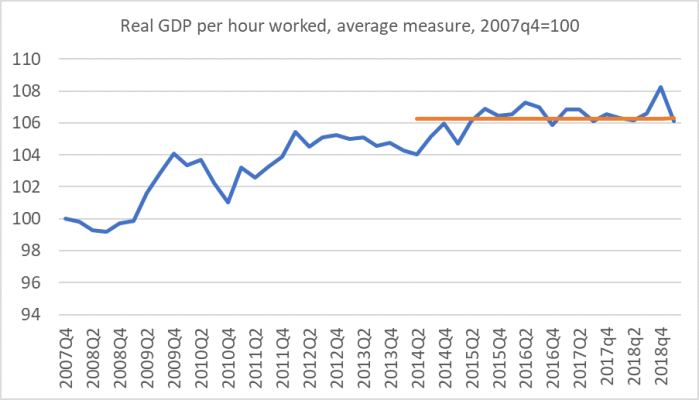
Pull its punches?  Reading “Productivity by the Numbers” you would have no idea how absolutely poor our labour productivity performance had been over the last few years.

Tsy productivity GDP phw

And there is, therefore, no sense of what light this experience might shed on possible explanations for our continued long-term underperformance.

They are also a bit self-promoting, suggesting that reversing the productivity underperformance “has been a central theme of the Productivity Commission’s work since 2011”.  If anything, the opposite has been true.  The Commission research team (when led by the now-departed Paul Conway) has at times produced some interesting papers on the issue, but the Commission’s core work is the inquiries successive governments have asked them to undertake, and not one of those inquiries has had as its focus economywide productivity failures and challenges.  Some of the inquiries have led the Commission down pathways which can, at best, be described as limiting the (economic) damage –  eg the low emissions inquiry.  On the other hand, the Commission has done a (mostly) positive job in helping to develop a more widely shared recognition that land use regulatory restrictions (and associated infrastructure financing perhaps) are at the heart of the housing disaster successive central and local governments have presided over for the best part of three decades.

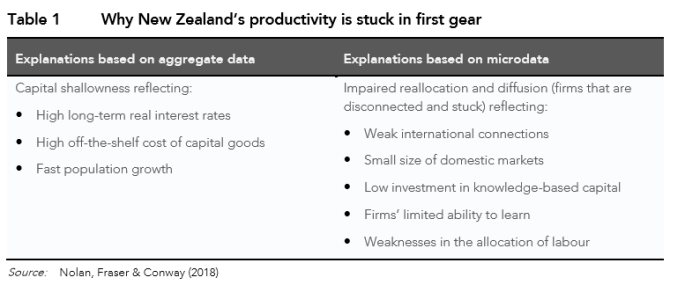
“Productivity by the numbers” is mostly descriptive – tables, charts, and comments thereon – but the authors do weigh in a little on possible explanations.  They include this table, taken from another recent article

NZPC prod 2

A couple of the items in the left-hand column are clearly intended as a nod in the direction of my ideas (referenced in the article the table is drawn from), and I welcome that.  But it isn’t clear that the Commission –  let alone the government’s official departmental advisers – is even close to a current integrated and persuasive narrative of what has gone wrong and how, if at all, things might be fixed.    As is perhaps inevitable in a summary table, many of the items are at best stylised facts (some probably not even facts).

The report goes on

This work has highlighted that New Zealand’s poor productivity performance has been a persistent problem over decades and turning this around will require consistent and focussed effort over many fronts and for many years. There is no simple quick fix.

It is a convenient line –  especially as there is no political appetite for change anyway –  but I don’t believe it is true.  Sure, we aren’t going to close the productivity gaps overnight, and sure there are (always) lots of useful reforms that could make a difference in a small way.  But here we aren’t dealing with the small differences between, say, productivity in the Netherlands and that in Belgium.  For an underperformance as large and as sustained as New Zealand’s – in what is substantially a market economy with passable institutions (rule of law etc) – it is highly likely that there are (at most) a handful of really important policy failures (things done or not done) where most of the mileage from reform would be likely to arise.  And there the Commission just does not engage.   Instead it tries to move on to a more upbeat story, and to shift the “blame” onto the private sector.

Indeed, work is already taking place in many areas, including in competition policy, infrastructure, science and innovation, and education and the labour market. There is growing interest in the need to improve Kiwi firms’ management practices and ability to learn (absorptive capacity), which shape their ability to innovate and improve their productivity (Harris & Le, 2018).

To me, much of this seems like dreamland stuff, deliberately choosing to avoid hard questions, while flattering the egos of ministers and officials in Treasury or MBIE.   Whatever the Productivity Commission thinks is good among those topics in the first sentence (and I struggle to think of anything much), it isn’t credible to suppose that the things they like about current policy even begin to make the sort of difference required to reverse the productivity failures.  And much as officials and academics like to suggest there is something wrong with New Zealand businesses (convenient that), there is no evidence that New Zealand firms and employees (managers and others) would be any less able to identify and respond to opportunities if government roadblocks and obstacles, including distorted relative prices, were fixed.

In the report, the Productivity Commission highlights how much we will miss out on if productivity growth continues to underperform the (somewhat arbitrary) 1.5 per cent per annum growth assumption in Treasury’s medium-term fiscal model.  The point is that small differences compound in ways that make for big differences in material living standards and opportunities.  And on that count I totally agree with them.    I made a similar point the other way round in a post on productivity last year.

I’ve banged on here about how dismal productivity growth in New Zealand has been in the last five years in particular. The best-performing OECD countries over the most recent five years were averaging more than 2 per cent productivity growth per annum – and all of them were countries catching up with the most productive economies, just as we once aspired to do. If we’d managed 2 per cent productivity growth per annum in the last five years, per capita GDP would be around $5000 per head higher (per man, woman, and child) today.

Catching up to the top tier will, in a phrase from Nietzche, take a “long obedience in the same direction” – setting a course and sticking to it. But here is a scenario in which the top tier countries achieve 1 per cent average annual productivity growth, and we manage 2.5 per cent average annual productivity growth. Here’s what that scenario looks like:

nzpc prod 3

I’ve marked the point, 15 years or so hence, where the gap would have closed by half.

I don’t usually quote Nietzsche, but here is the full quote

“The essential thing ‘in heaven and earth’ is… that there should be a long obedience in the same direction; there thereby results, and has always resulted in the long run, something which has made life worth living.”

What matters in an economy like New Zealand now isn’t finding 100 or 300 things to reform – sensible as many of them might be –  but finding the one (or two or three) things that might make a real difference, adjusting policy accordingly, and then persevering long enough to start seeing real and substantial results.     There is no reason why New Zealand should not again manage something close to top tier OECD average labour productivity, but –  on the demonstrated –  there is no reason to suppose that (a) anything like the current policy mix will deliver it, or (b) that tiny changes at the margin will deliver very substantially different results.    Welcome as the Productivity Commission’s statistical compilation is, those are the messages that need to be heard more loudly.

Sadly, of course, not a single political party seems to have any appetite for reversing our decades of economic decline.  But, just possibly, a compelling narrative from an authoritative body like the Productivity Commission might one day begin to change that.  At present, instead, the Commission seems in some unsatisfactory place where they don’t have the answers, and to the extent they sense some elements of an answer, they don’t want to upset anyone.


Bank capital requirements: playing defence

Liam Dann, apparently the Reserve Bank’s favoured journalist, has a column on the Herald website on the Governor’s proposal to increase substantially the minimum core capital ratios for locally-incorporated banks.  No doubt it will warm the Governor’s heart, if perhaps not the more rigorous of his staff.  Dann’s column runs under the rather populist heading “Don’t let Aussie shareholders hijack our banking debate”.

And yet, here’s the thing.  Dann advances not a shred of evidence in support of his  suggestion.    He writes

I also know the Reserve Bank’s new capital ratio proposal is an important topic for national debate.

And it is becoming one-sided.

The sheer weight of PR power pushing for the status quo – ultimately the interests of Australian bank shareholders – is what leaps out at me in this debate.

We’re seeing the screws turned on the Reserve Bank by numerous financial institutions, lobby groups and even opposition politicians, in a way that undermines the process.

“Becoming one-sided” when a well-resourced major economic regulator, able to act as prosecutor, judge and jury in its own case, with no rights of appeals –  and able to get media coverage whenever he wants it – proposes very major changes in the operating environment for a core part of our financial system, without robust supporting analysis or a proper cost-benefit assessment, and a wide range of parties push back?

Perhaps Dann didn’t notice that the Bankers’ Association put in a unified submission.  Sure, the Australian-owned banks are the biggest members of the Association, but the small New Zealand banks are also members.  The Bankers’ Association submission draws on work led by former Secretary of the (New Zealand) Treasury, former (New Zealand) Productivity Commission member, Graham Scott, supported by other analysis undertaken by Glenn Boyle (New Zealand) academic at Canterbury University, Martien Lubberink (a Dutch academic, and former bank regulator, at Victoria University, and one other New Zealand economist.    As a reminder, all the bank members of the association (New Zealand, Australian, Chinese, Dutch, British, American) signed on.

What of other economists?  I’ve been fairly vocal on the subject, speaking only for myself  (and I may be the last native New Zealanders who has no family connections to Australia at all, let alone any connections to Australian-owned banks and their shareholders).  My former colleague Ian Harrison has gone into some of the issues in much greater depth.  He’s a New Zealander too –  driven by his reading of the evidence, argumentation, and the public interest – and didn’t do any of his work with Australian bank shareholders as his focus.    I guess we’ll have to wait until the Reserve Bank finally publishes all the submissions to see the full range, but I’ve read several other unpublished submissions by New Zealanders, working for New Zealand firms, that were far from convinced that what the Governor is proposing would be in the New Zealand public interest.

If anything, I have been a little surprised at how quiet the Australian banks have been, at least in public.  Presumably there is intense lobbying going on behind the scenes –  on both sides of Tasman – but isn’t that entirely appropriate, and what one should expect (and welcome)?     Perhaps it would be better still if the debates were played out more openly….but that might require the Governor to actually engage, not to play his “politics of slur” card, that anyone disagreeing with him is simply serving vested interests, in the pocket of Australian banks.

And what of that bizarre suggestion that somehow the “screws are being turned….by Opposition politicians”…. “in a way that undermines the process”.  The Opposition must be flattered that anyone thinks they have that much power.  But quite what bothers Dann about the Opposition (or the wider opposition) isn’t clear….except perhaps that it has upset that nice Governor, who only has in mind –  and is clearly gifted with unique insights on – the wider public interest.  Contest and scrutiny and challenge are part of how policy is, and should be, developed and tested.

Anyway, you rather get the gist of the Dann column with this quote

To me, Orr and his predecessor Graeme Wheeler both seem to be intelligent, philosophical thinkers of a kind that is sadly all too rare in the upper levels of the New Zealand political sphere.

or

Neither this Governor nor the last has been troubled by differing views on where interest rates should be or what inflation is doing.

That would be same Governor (Wheeler) who marshalled his entire senior management team to complain formally to one of the banks (he regulated) when that bank’s chief economist criticised Wheeler on monetary policy?

or (of Wheeler)

For some reason many local commentators made assumptions about the Governor being the prickly one.

“For some reason”!    Very good, very visible, reasons –  whether one was inside or outside the Bank at the time.

In Dann’s world, Wheeler and Orr have been something akin to perfect hero knights, to whom the rest of us should defer in some mix of wonder and gratitude.  In the real world, both were pretty deeply flawed, with increasing questions about whether Orr is equipped (eg temperamentally) for the role (it became clear that Wheeler wasn’t).

When half-baked and costly proposals emerge from very poor policy processes –  and when there are no appeals against Orr’s unilateral exercise of statutory power –  those proposals need to be robustly scrutinised and challenged, by entities directly affected (whichever country they come from), and by those with a concern for the wider health and economic wellbeing of New Zealand.    Good proposals always benefit from robust scrutiny (even just enhancing confidence that what looks good actually is) and bad, poorly supported, proposals put forward by the confident and powerful badly need that scrutiny and challenge, in the public interest.   There are plenty of serious questions journalists could put to Orr – if he’d give them access to ask them –  and, on some at least there might be convincing and robust responses.  We’d all be better for hearing how the Governor deals with the substance of disagreement.   At present, reliance on slurs raises further questions as to whether the Bank has good answers, and whether it (and the Governor) have thought broadly and deeply enough.

A few weeks ago we learned that the Governor was planning to have some independent experts rather belatedly involved in what has, to now, been a very poor policy process.

The Reserve Bank is also in the process of appointing external experts to independently review the analysis and advice underpinning the proposals.

On the surface that sounded better than nothing, although as I noted in a post just before the FSR

And who are they going to find to serve as “external experts” this late in the piece, when most of those who think about the issues domestically have already either expressed their views and been involved as consultants in preparing submissions by others.  There can be a role for overseas experts, but knowledge of the New Zealand system and New Zealand experience should not be irrelevant.  And quite what is the selection process the Governor is going to use at this late stage –  the suspicion will inevitably be that he will be aiming for people just credible enough to look serious, but emollient enough not to want to make difficulties.

That same day the Bank quietly posted on its website –  where no one would find it who wasn’t looking –  the terms of reference for these external experts, together with the names/background of the people the Governor had appointed.   All three are from overseas, none (it would appear) with much/any background in banking regulation and none with any substantial background in New Zealand economics or banking (one spent a few weeks here in 2014).  At least two seem to have publications which suggest they will be very sympathetic to the Governor, and one other has published an entire book on protecting bank supervison from regulatory capture (good book).

You will recall the report last week that at FEC the Governor had gone further and (slanderously) claimed that anyone local had already been “bought” by the banks.   Which left me puzzling again at the way the Bank has apparently overlooked Professor Prasanna Gai, at the University of Auckland,  of whom we learn.

Professor Gai is currently serving a four-year term on the Advisory Scientific Committee of the European Systemic Risk Board

He might be presumed to have some relevant perspectives and experience, and I hadn’t seem his name associated in public with any other submissions/views on the current capital proposals.  I have no idea what his views on bank capital might be, but I suspect he isn’t flavour of the month at 2 The Terrace for some of his other views on the governance of financial stability etc.  And, unlike the foreign experts, he would have been somewhat attuned to the local debate.

As it is, in addition to having been carefully selected by the Governor himself –  at a late stage in the process, when he already has his stake in the ground –  the role of the “independent experts” has been drawn very narrowly.  One could even say, generously, surprisingly so.

First, there is the framing in the terms of reference. Thus (emphasis added)

The Capital Review has been carried out within the context of New Zealand as a small open economy, with external imbalances and an economic and financial system that is disproportionately subject to external economic and financial shocks and changes in offshore sentiment

This claim pops up quite regularly from the Bank, but there is no empirical or analytical support offered for it all at all.   Then we are told

Much of New Zealand’s private debt is concentrated in the household and agricultural sectors, and has been steadily climbing over recent decades.

That second half of that is simply wrong.  There were big run-ups in debt (to income or GDP) in the 90s and 00s, but the ratio of private debt to GDP or income is little different now than it was prior to the last recession.

The risk appetite framework is centred on the concept of ensuring that systemically important banks can survive large unexpected losses – i.e. losses that have a likelihood of occurring only once in every 200 years. This is a higher degree of risk aversion than is implicitly built into the New Zealand system at the moment, reflecting the Reserve Bank’s judgement that the economic and social impacts of financial crises are large and more wideranging than previously realised.

And yet have outlined nothing (here or in the fuller documents) in support of the claims in the final sentence, nor do they note –  these are overseas experts recall –  that New Zealand itself, like Australia, has not had a systemic financial crisis in well over 100 years.

And they repeat one of their starting stipulations

Capital requirements of New Zealand banks should be conservative relative to those of international peers, reflecting the risks inherent in the New Zealand financial system and the Reserve Bank’s regulatory approach.

But it is all castles in the air stuff, because they never seek to demonstrate that the risks around the New Zealand financial system (floating exchange rate, vanilla loan books) are even as high, let alone higher, than those of a typical advanced country.

What also wasn’t clear from the initial Reserve Bank reference is that the focus of the independent experts is not to be on the decision still to be made.  Instead, they are invited to review all the papers the Bank has released in its (multi-year) capital review.   This is the Scope of Work

The External Experts Report will cover: 

  • Is the problem that the Capital Review seeking to address well specified? 
  • Has the Reserve Bank adopted an appropriate approach to evaluate and address the problem? For example, is the range of information considered, and the analytical approach appropriate? 
  • Do the inputs and cited pieces of evidence used by the Reserve Bank in its approach appropriately capture the relationship between bank capital and financial system soundness and efficiency? 
  • Has the analysis and advice taken into account all relevant matters, including the costs and benefits of the different options?   
  • Have the issues raised in submissions been assessed fairly and adequately? The External Experts will only consider the Reserve Bank’s assessment of issues raised in the submissions on the first three consultation papers.
  • Have the key risks been adequately considered across the proposals in the Capital Review?  Was the advice and analysis underpinning the Capital Review reasonable in the New Zealand-specific context?

The Capital Review has generated internal analysis covering a wide range of issues. This analysis has formed the basis of four public consultation papers and a much larger number of internal reports. This analysis has covered all aspects of the capital requirements, including the definition of capital (“the numerator”), the calculation of risk-weighted assets (“the denominator”) and the capital ratio itself.

Thus, the independent experts are not asked to look at the submissions on the latest (most controversial document).  They are invited to consider whether the “advice and analysis” was ‘reasonable in the New Zealand-specific context”, and yet there is almost nothing about the New Zealand specific context in the “how much capital is enough” consultation papers, none of the experts has any material New Zealand specific knowledge, and they are not supposed to engage with or review the submissions.   And

It is not expected that the External Experts will carry out extensive consultation as part of their work. Any external consultation should be agreed in advance with the Reserve Bank.

If, for example, one of the experts was somehow to become aware of (say) Ian Harrison’s specific critiques of some of the modelling, they would be prohibited from engaging with Ian without the prior permission of the Reserve Bank.

I’m not impugning the integrity of the independent experts.   But they have been chosen by the Governor, having regard to their backgrounds, dispositions, and past research –  a different group, with different backgrounds etc, would reach different conclusions – and the Governor is well-known for not encouraging or welcoming debate, challenge or dissent.  Quite probably the experts, each working individually, will identify a few things the Bank could have done better, but it will alll be very abstract, ungrounded in the specifics of New Zealand, and the value of their report is seriously undermined in advanced because of who made the appointment, and the point in the process where the appointment was made.  This is the sort of panel that, at very least, should have been appointed a year ago.  Better still, it would not have been appointed by the Governor.

The flawed process highlights just what is wrong with the governance of banking regulation and related issues in New Zealand.  We need an expert bank supervisory body, but that body shouldn’t be able to set big-picture policy all by itself (one unelected individual, to whom all the rest work).   Those calls should be made by the Minister of Finance –  who, in any case, should be playing a more active and public role on this specific proposals in front of us –  advised by both the Reserve Bank and The Treasury, and drawing on whatever independent perspectives the Minister would be useful to the process.   The current system would be flawed even if we had a superlative Governor –  expert, judicious, rigorous, open-minded, self-critical etc etc –  but it is performing particularly poorly under the leadership the Reserve Bank has had for most of this decade, as the Bank has chosen to take to itself bigger and bigger interventionist policy calls.

Twenty questions

I wasn’t planning to write anything today, but in the Herald this morning there was an “interview” with Reserve Bank Governor Adrian Orr around the bank capital proposals. I put the word in quote marks, because it was more of a platform for the Governor to articulate his views and frustrations, than any searching or penetrating scrutiny.  I tweeted out a link which attracted a response from Newsroom’s Bernard Hickey

Twitter isn’t really conducive to a long list of possible questions (240 characters and all that) and I have more readers here than there, so I thought I’d jot down a few suggestions, a non-exhaustive list of possibilities, here.

  1.  Given that proposals of this sort were always going to be controversial, why didn’t you adopt a more robust process from the start (eg technical workshops, green papers etc before the Governor signed up formally to a specific option)?
  2. Especially so given that in this area you (single decisionmaker) can be seen as prosecutor, judge, and jury in your own case, without any rights of appeal?
  3. Why did you not publish all the relevant documents when the consultation paper itself was released, rather than drip-feeding them out over months?
  4. Why was there no proper cost-benefit analysis, with assumptions and senstivities clearly stated, published with the consultative document?
  5. Why have you not published (or prepared?) a robust comparative assessment of your proposals relative to the capital rules proposed/in place in Australia, enabling submitters to see clearly the similarities/differences?
  6. Why have you repeatedly attempted to slur all critics of your proposals as representing “vested interests”, rather than engaging with the substance of the arguments critics have made?
  7. Wouldn’t your position, and preferences, appear more robust to disinterested parties if they could see you engaging with, and specifically responding to, alternative perspectives?
  8. Are you willing to revisit the Bank’s previous decision on the inadmissibility of CoCos?  Given the relatively high level of CET1 capital, what grounds do you have not allowing (eg) CoCos issued to wholesale investors to meet any additional capital requirements the Bank considers warranted?
  9. Wouldn’t the ability to issue CoCos to meet any additional capital requirements be particularly valuable to the (capital-constraind) New Zealand banks?
  10. Why was there no discussion of OBR in the consultation document?  A credible OBR system appears to greatly reduce the need for any capital requirements (let alone very high ones), so does this absence suggest the Bank was walking back its support for OBR?
  11. Where is the evidence for the claim, made several times in the recent Bank FSR, of evidence that the costs of financial crises are much higher than previously realised?  Realised by who, and when? (Bearing in mind that current capital requirements post-date 2008/09.)
  12. You have taken to suggesting that the 2008/09 episode in New Zealand supports the need for further increases in bank capital.  GIven the very low level of loan losses and NPLs through that period –  a severe recession, after a dramatic run-up in credit to GDP – can you elaborate on your view?
  13. Why was there no discussion/analysis of the probable transitional effects in the consultative document?
  14. Why are you not proposing to impose the same higher capital requirements on NBDTs?  Won’t this further un-level the playing field?
  15. What sort of disintermediation from the balance sheets of the big 4 locally incorporated banks do you expect to see, bearing in mind that the requirements don’t apply to (a) other non-bank lenders in New Zealand, (b) banks operating here that are not locally incorporated, (c) foreign banks not operating here, but lending to major New Zealand borrowers, or (d) to the domestic securities market?
  16. How does this disintermediation square with the efficiency constraint that appear prominently in your Act (didn’t we experience lots of disintermediation in the 70s and early 80s?)
  17. Do you agree that any costs of the higher capital requirements are likely to fall most severely on borrowers (and depositors) with the fewest alternative options?  Under that heading, is it likely modestly-sized borrowers with idiosnycratic needs (including farmers) will be among the harder hit?  If not, why not?
  18. In your documents you do not seem to have engaged with the evidence that floating exchange rate countries that did not have a financial crisis in 2008/09 did not perform much differently than floating exchange rate countries that had a financial crisis?  Why not?  Doesn’t this suggest your “cost of crisis” assumptions are substantially overstated?
  19. How, if at all, do you distinguish between the economic costs of a misallocation of resources during a credit boom (which higher capital requirements are unlikely to stop) –  but which only crystallise (and become apparent) in the bust – and those arising from the banking crisis itself?   There is no sign that you attempted to draw this distinction in any of your documents?
  20. Why are you so reluctant to pay heed to repeated waves of Reserve Bank stress tests which suggest that very severe (appropriately so) adverse shocks would not severely impair the health of the New Zealand financial system, based on the lending standards adopted in the last decade or more?

And that was a list straight from the top of my head, without even pausing to check my submission on the proposals.  It wouldn’t be hard to come up with at least another twenty questions that journalists seriously interested in holding the Governor to account might reasonably ask.

An embattled Orr

Still catching up, but noticing some concerning newspaper stories about how the Governor was handling things, yesterday I finally got round to reading the Reserve Bank’s Financial Stability Report and watching the Governor’s press conference.

Of the former, probably the less said the better.  It is a disappointingly lightweight effort, clearly designed to sound a bit more worried about New Zealand financial system risks – to support (belatedly) the Governor’s capital proposals – even while offering no evidence to suggest that such risks were (a) significant, or (b) worsening.       There were statements of the blindingly obvious –  “some” households and farms are overindebted, as if that has not always been the case –  and alarmist conclusions (about the threat banks could face if lots of borrowers default) made without any reference to the Bank’s own repeated stress tests.

And then there was the press conference.   I’ve seen some pretty poor performances from Governors over the years –  early ones by Alan Bollard were often awkward, and as Graeme Wheeler became more embattled the defensive introvert, never comfortable with the media, took over.     But this one was the worst I’ve seen, and from someone who has many talents in communications.  But just not, so it is confirmed again, in coping with challenge, disagreement, or finding himself on the back foot.  I doubt a senior politician would have got away with it, and it isn’t obvious why an unelected bureaucrat, uncomfortable at facing serious scrutiny, should do so.

The Governor and Deputy Governor faced several questions about the possible impact of the Bank’s capital proposals on farm lending –  various commentators have suggested such borrowers will be among the hardest hit.  The Bank attempted to push back claiming that any sectoral impacts were nothing to do with them, and all about banks’ own choices.  But they seemed blind to the fact that banks will have more ability to pass on the additional costs of the higher capital requirements to some sectors, some borrowers, than others.  And that is because of a point the Bank never addresses: their capital requirements don’t apply to all lenders.

They don’t apply to banks operating here that aren’t locally incorporated, they don’t apply to banks operating abroad in respect of loans to New Zealand entities, they don’t apply to local non-bank institutional lenders (deposit-takers, who have their own capital regime, or others), and they don’t apply to bond markets.   So some borrowers (think large corporates in particular) have a variety of alternative options and others don’t.  Almost inevitably the costs of the Bank’s capital proposals would bear most heavily on those with the fewest options, and farm borrowers are foremost among that group (there isn’t a big appetite from new entrants to build farm loan books, and farm lending is information-intensive and quite property-specific).   The Reserve Bank’s failure to openly and honestly address these sorts of issues –  none of them have been touched on in any of the consultative documents –  reflects poorly on them.   Whether it is because they simply never recognised the issue, or are trying to play blame games and shift responsibility etc, isn’t clear, but since the issues have been raised here (and elsewhere) for months, there is an increasingly likelihood that they know exactly what they are doing, not playing straight with the New Zealand public.

The Governor came across as embattled from start to finish –  embattled at best, at times prickly, rude, and behaving in a manner quite inappropriate for a senior unelected public official exercising a great deal of discretionary power, with few formal checks and balances.   BusinessDesk’s Jenny Ruth – who often asks particularly pointed questions about the exercise of the Bank’s regulatory powers, and the lack of transparency around its use of those powers – was the particular target of his ire, and at one point he tried to refuse to take further questions from her.

It isn’t always clear that the Governor hears the way he sounds: he goes out of his way to state that it is a genuine and open consultation, only to then conclude “but we are going to have more and better capital” –  in other words, no true consultation at all, as he has already made up his mind on the big picture.  Asked by another journalist what had changed in recent years that made further big increases in capital requirements warranted now, he fell back on spin –  no substantive answer, but “not enough has changed since 2008”, which isn’t a serious answer at all, especially in view of (a) the resilience of Australasian bank loan books in 2008/09, (b) repeated stress tests since, and (c) that aggregagate debt to income ratios are little different now than they were 10 years ago.   At one point, he actively misrepresented a prominent submitter’s submission.

Not all the awkward questioning was about the new capital proposals.  Some was about the recently-discovered failure of ANZ to use approved models in calculating capital requirements for operational risk, in the course of which it was revealed –  belatedly –  that the  Reserve Bank had told banks  (but not the public) that it is no longer approving any changes they would like to make to their internal models.    Under pressure –  this is after all the Reserve Bank’s day job –  the Governor moaned that the Bank hadn’t been adequately funded and that they had to prioritise. It was a shame no one asked about why the $1 million on the Governor’s Maori strategy, his tree god spin, and the endless talk about climate change –  at best peripheral to the Bank’s responsibilities – is being prioritised over proper adminstration of the bank capital regime.  Someone still should (after all, recently they had the money to send two staff to Paris for a climate change shindig).

The press conference deterioriated further as it got towards the end.  Without specific further prompting, the Governor noted a certain frostiness in the room, and then launched off again in his own defence.  The Bank was very transparent –  he asserted, even though it took months to get the full capital proposal documentation out, and we still have no cost-benefit analysis –  and it was very open-minded (except that, as he told us, he was closed minded on the needed for more and better capital).  He went on to note that he needed to rely on facts, and he would welcome decent questionings but (and I paraphrase) “I will be short with people when I see continuous mis-statements from journalists and others with vested interests”, all while – he told us –  he was trying to serve the interests of the people of New Zealand.

It should become a case-study for official agencies in how not to do things.

But it appears that Orr wasn’t finished, and didn’t go back to his office, reflect that that hadn’t gone well, listen to some sage counsel from his senior managers or Board, and re-engage in that sunny upbeat way the Governor at his best can manage much better than most.

A couple of articles in the Herald in recent days tells us some more of the story.   The first was from Liam Dann, who has in the past provided a trusty outlet for the views of successive Governors, and the second was a column from Pattrick Smellie, under the heading “Bunker mentality returns to the RBNZ?”, evoking unwelcome memories of the Wheeler governorship.

Dann’s article draws from a media lunch at which Orr had apparently been speaking.  There was, it appears, no hint of emollience, no suggestion of welcoming all the thoughtful work and analysis that had gone into the many submissions the Bank had received.  That is what a normal person would do and say (whatever they felt privately).  But not Orr.  He’s all in.  People either don’t understand, or they choose not to understand because –  on the Governor’s telling – they are all self-interested, part of the financial sector, while he –  and he alone it appears –  is looking out for the future of New Zealand.   If you think I’m caricaturing, read the article for yourself (I’m reluctant to excerpt extensively something behind a paywall).   But here are two extracts.

Orr said he had expected the strong critical response from the banks because he was aware of “the capability and resource” within the industry to lobby for the status quo.

“It is a very, very powerful industry.”

But he said he had been surprised by the personal attacks and “the underlying venom” that had come from the broader financial sector – including bloggers, think tanks and some sections of the media.

The noble Governor –  alone equipped to assess the public interest –  as the Three Hundred at Thermopylae facing down the amassed hordes of bankers (and “bloggers, think tanks and some sections of the media”).

Not only is there nothing about the substance of the arguments and evidence submitters and commenters have made (at length over many months) but note the attempt to imply that anyone criticising his proposals (and the very weak process around them) was part of the “financial sector”.   No doubt my views don’t count for much, but I’ve articulated numerous questions and criticisms here (and in my submission), and have never once taken a cent from the “financial sector”.  My former colleague Ian Harrison has extensively critiqued the Bank’s proposals and supporting documents, and I know for a fact it was entirely a labour of love (well, voluntary and unremunerated anyway).  And even if affected industries have made submissions –  shouldn’t we want them to? –  the onus should still be on the Governor and his staff to address issues and criticisms in a constructive way, not to engage in some sort of Trumpy politics of slur (no need to engage, because you are  – great evil –  banks).  It actually got worse at FEC (at least according to the Smellie column): questioned about why his “independent experts” (appointed belatedly) were all from abroad, he couldn’t stick to a moderate line that (say) most New Zealand residents who knew much about the issue had already weighed in in one form or another, but had to resort to the (frankly slanderous) suggestions that any New Zealand experts “had already been ‘bought’ by the trading banks”.

In the Dann article there was further illustration of how the Governor plays politics and spin, rather than engaging on substance.    We get this

Orr described the notion that the major banks “sailed through the GFC” as a popular myth that had taken hold with the general public.

In fact sailing through had involved a $133 billion overnight guarantee, an $8b direct asset purchase by the Reserve Bank to provide liquidity, a $10b wholesale underwrite and a drop of the OCR by 5.75 per cent.

I know Orr was not in the core public sector at the time (he was trading the markets at NZSF), but this is a highly misleading attempt to play distraction.   First, as the Governor very well knows, the big banks did not want to participate in the retail deposit guarantee scheme (the Minister of Finance compelled them to, as a condition of the limited wholesale guarantees).  Second, as the Governor equally well knows, every wholesale funding market in the world dried up for a time (and for reasons –  as all the contemporary documentation makes clear –  that had nothing to do with the specifics of Australasian banks).  Third, it is a core role of the Reserve Bank to provide liquidity support when demand for liquidity rises.  Fourth, as regards banks, all those operations were profitable for the Crown.    Fifth, the scale of the OCR adjustment is totally irrelevant to questions of bank soundness or otherwise –  there was a severe recession, partly domestic, partly foreign –  and adjusting the OCR as it did was just the Reserve Bank doing its day job (a little slowly as it happens).  And finally –  and really the only point of relevance to the capital debate  – bank losses (and NPLs) remained impressively moderate through that nasty recession and slow recovery.  Capital was never impaired.

On my reading, even Pattrick Smellie’s column is too willing to defend Orr’s conduct –  last week, and more generally.    He sticks up for his use of the Bank to pursue climate change agendas that have no grounding in statute (translations of the Bank’s self-chosen Maori name signify precisely nothing), of the tree god nonsense and the costly Maori strategy (even defending Orr’s claim that criticism of him on this is somehow “racist”).  And he buys into the Orr propaganda line that the Bank is “now more open and transparent” (it just isn’t so –  the capital review is only the latest example, but nothing material has changed about monetary policy, we’ve had no serious speeeches from the Governor on his core responsibilities, and they play OIA games just as much as ever), but this really should worry the Board (albeit they are usually in the Governor’s pocket), The Treasury (other distractions I suppose), and the Minister of Finance.

Ebullient, rambunctious, prone to Shane Jones-ian turns of phrase, Orr is the antithesis of his prickly predecessor, Graeme Wheeler. The RBNZ is now more open and transparent.

However, Orr and members of his senior team are starting to exhibit some of the same bunker mentality as beset Wheeler,

Orr very much needs to be pulled into line, for his own sake and that of the country (as single decisionmaker he still wields huge untrammelled power).  At present, he is displaying none of the qualities that we should expect to find in powerful unelected official –  nothing calm, nothing judicious, nothing open and engaging, just embattled, defensive, aggressive, playing the man rather than the ball, all around troubles of his own making (poor process around radical proposals made without any robust shared analysis, all while he is prosecutor, judge, and jury in his own case).

It is a sad week for New Zealand when the heads of our two main economic agencies –  The Treasury and the Reserve Bank –  are so much, and so deservedly, under intense scrutiny, and when we have no idea who will even be Secretary to the Treasury –  lead economic adviser to the government –  three weeks from now.