How the Reserve Bank thinks we should evaluate its monetary policy

The Reserve Bank released a new issue of the Bulletin yesterday headed “Evaluating Monetary Policy”.   Bulletins carry the imprimatur of the Bank itself, and in this case the key messages are conveyed in quotes from Assistant Governor John McDermott in the accompanying press release.  I’m sure Graeme Wheeler himself will have gone through this quite carefully before agreeing to its release, and we can assume that the article speaks for the Governor.

In principle, the article isn’t a bad idea.  It is worth having an accessible summary reference that outlines the key legal provisions that govern the Bank’s accountability for monetary policy, and which articulates some of the real challenges in scrutinising and holding the Bank to account in the approach to conducting monetary policy (“flexible inflation targeting”) that is now pretty widespread.  As I’ve pointed out previously, the Act was written for a simpler (not very realistic) conception of monetary policy.

But it is also the sort of article that needs to be written rather carefully and modestly.  The people (or institution) being held to account are not the ones who get to define how we review and assess them, and hold them to account. That is up to us –  whether “us” is citizens, markets, MPs, media, lobby groups, the Minister of Finance, or whoever.  If it ever comes to a question of dismissing the Governor, the formal legal provisions would have to be considered very carefully, but short of that  –  and I hope we are always short of that –  a wide range of factors will, and should, be taken into account.  Some of them are the rather narrowly technocratic items in the latest Bulletin.  But many aren’t.  And an article of this sort from the Board –  who are actually paid to hold the Governor to account –  might have been more valuable.

In publishing this Bulletin, I suspect the Bank had a couple of motivations.  One probably was genuinely didactic and informative – the public service of reminding readers of some of the issues.  But I suspect the rather more important consideration was defensive. It looks like an attempt to get critics off their back, and perhaps even to fend off doubts that even some Board members might have had (the Board, while compliant overall, has always had its awkward characters)  about just how well the Governor has been doing in ensuring that the Bank achieves the policy targets.  An article like this will have been in the works for several months.

I don’t think the article does either job well.  If anything, it raises more concerns about the depth and authority of the key policymakers and advisers at the Reserve Bank.    My advice to them, had they asked, would have been that there might have been a useful role for two quite separate articles:

  • One on the framework itself, a reminder of how the accountability system is designed, and is evolved.
  • A separate one that reviewed , with the benefit of hindsight, the conduct of monetary policy over the last few years.   Would we have learned anything from the latter?  Perhaps not, but having the Governor make the strongest case he could, including showing us how he has learned from mistakes and the flow of new information, would have been revealing, however good or bad the document actually was.

Except in passing I’m not going to debate here the record of the last few years.  The article touches on it directly in a rather unconvincing box (pages 16 and 17), but in fairness it is difficult to do justice to the arguments on either side in five charts and six short paragraphs.  But, as a hint, if you want to persuade thoughtful people of your case, it is good to actually engage with the arguments or alternative perspectives the critics have offered.  Anyone can beat a straw man, but what is gained by doing so?

My copy of the article is riddled with comments in the margins, and I won’t bore readers by going through them all.

But let’s start with John McDermott’s press release, which pummels a straw man and declaims what should be a platitude.

The straw man?  We are told, portentously, that “it is not sufficient to look at inflation outcomes alone when assessing the conduct of monetary policy”.  Indeed, but whoever said it was?

And the platitude?  This point is repeated so often, between the article and the press release, that they really must want us to take notice: “a central bank should make full use of all relevant information, and learn from new information and forecast errors as these come to light.”   Really?    I’m sure we hadn’t thought of that before.    Of course, but critics will suggest that it is precisely what the Reserve Bank has not been doing in recent years.  They haven’t convinced us –  and don’t really try to do so in the article – that they have taken the best possible approach to learning from their mistakes.  That cause is not helped when the Governor is so reluctant to concede that any mistakes were ever made.

The article has a number of curious features even in its description of the formal accountability process.  For example, the phrase “Minister of Finance” does not appear at all.  And yet the Minister of Finance:

So how did the Bank manage to write a whole article about monetary policy accountability and not mention the Minister of Finance?  Ours is quite a different system than those in most other countries.

I think it is partly because they use a muddled concept of accountability.  The article is headed “evaluating” monetary policy, which  – at least to some ears –  has rather technical connotations to it.  But even allowing for that,  there is an important distinction between people having views on the monetary policy performance, and people with the power to do something about it.  Real accountability implies the presence of remedies –  the Board and the Minister have them, but we don’t.

The article also veers down an odd line of argument that confuses transparency and accountability (and evaluation for that matter).  Take this paragraph:

Well-informed oversight from external stakeholders benefits the Bank in two ways. Firstly, a clear understanding of the Bank’s policy goals, and how it might be assessed against those goals, helps external stakeholders predict how the Bank is likely to react to new information. This improves the efficacy of monetary policy, since agents in the economy can react instantly to new information, rather than having to wait for guidance from the Bank. Secondly, it provides several avenues – in addition to the role played by the Board – for direct feedback to improve the Bank’s decision making. Well-informed feedback can help the Bank identify faster the need for policy adjustments.

But “oversight” isn’t there to benefit the Bank –  it is supposed to protect the public and the country.  There is certainly a reasonable argument that transparency about the goals the Bank is working to and the “reaction functions” it uses can be helpful in engendering public and market responses to data that are consistent with how the Bank will eventually adjust monetary policy (so, could we see that model?), but that is a different matter from policy evaluation or accountability.  One can be predictably wrong –  as the Bank has become over the last couple of years-  as well as predictably right.  And, incidentally, it would be interesting to know whether any feedback from anyone has made any difference to “improve the Bank’s decision making” or “identify faster the need for policy adjustments”

But perhaps the critical caveat is “well-informed”?  Is there any feedback or criticism about monetary policy that the Bank (current Governor) has regarded as well-informed?

The Bank goes on to note that “self-assessment by the Bank is an important part of the accountability framework”.   The willingness to recognise mistakes and learn from them should be one of the characteristics the Board and the Minister should be looking for in evaluating the Governor’s performance.  I’m not sure, though, that I have seen those aspects commented on in the Board’s Annual Reports.

And it is a little surprising that the article does not refer to the one place in the Act where the Bank is required to undertake and publish self-assessment and review.   Section 15 of the Act governs Monetary Policy Statements, which are formally only required every six months. But each such statement must

contain a review and assessment of the implementation by the Bank of monetary policy during the period to which the preceding policy statement relates.

This section of the Act certainly needs updating, but the Bank does not even try to comply with the spirit of what those who drafted the law were about.  After constant nagging, they started publishing a box in each MPS which probably barely meets the formal legal requirements –  it briefly describes monetary policy over the preceding period, but makes no attempt at assessing or evaluating such policy  (as distinct –  and the distinction is important –  from defending it).  I used to argue that perhaps once every two years such a review and evaluation should be undertaken as a major special chapter in a Monetary Policy Statement, perhaps informed by commissioned reports from independent experts.   (The article also omits to mention the legal requirement on the Board to “ determine whether policy statements made pursuant to section 15 are consistent with the Bank’s primary function and the policy targets agreed to with the Minister under section 9 or section 12(7)(b)”)

Changing tack for a moment, there are a couple of interesting and slightly surprising observations in the article that bear on current policy.  I and various market commentators have been critical of the Bank in recent months over the claim it is making that things are okay, because inflation will be back well inside the target range by early next year.  The Bank’s forecasts are quite clear that this happens only because of the direct price effects of a lower exchange rate.  As outsiders have noted, one-off shifts in the price level are not the same as the medium-trend in inflation, and there was little basis to think that temporarily higher headline inflation foreshadowed rising core inflation.

It was, therefore, both reassuring and discomforting to find this quote in the article

Tradables inflation tends to be more affected by short-term disturbances, due to exchange rate movements and volatility in international prices. It is therefore more common for the Bank to look through short-term variability in the prices of tradable items.

Reassuring, since staff clearly haven’t abandoned the framework –  trends in the persistent components of inflation are really what matter to them.  But discomforting because in press release after press release (it was there again last week), speech after speech, the Governor tries to get us to focus on a headline inflation rate that is just temporarily boosted by the lower exchange rate.   That isn’t accountability or clear communications.  It looks a lot like just trying to muddy the waters to distract people from the persistent undershoot in core inflation.

The article also discusses the timeframe over which the Governor aims to get inflation back to target. But it is a puzzling discussion because it concludes with a quote from a speech Alan Bollard gave in late 2002, shortly after he had become Governor.  The target inflation rate had been raised and (arguably) some more flexibility had been added into the PTA. The Governor (and we his advisers) wanted to help outsiders understand how we would apply the new PTA.  He stated that his interpretation of the PTA was that following deviations from the inflation target range, things would be on course if “projected inflation will be comfortably within the target range in the latter half of the three year period.”  In other words, current inflation might be above target, but for the period 18 months to three years ahead, the Bank’s forecasts should show inflation settling “comfortably within” the target range, on credible assumptions.  Alan was a dove, who was keen to “give growth a chance”.   He proved content to have forecasts settling back to around 2.5 per cent in that 18 month to three year window.

The Reserve Bank in this article has now reaffirmed that approach to the PTA.  Which is puzzling, because the 2002 PTA made no reference to the midpoint.  That was something Alan often reminded us of –  getting to the midpoint might be nice if we got there, but there was no pressing need to do anything active about it.   But, as the current Governor has often reminded us, the reference to a focus on the 2 per cent midpoint, added in 2012, was put there for a reason – to help anchor inflation expectations near the midpoint of the target range.  But how can we –  or markets –  take seriously the PTA’s focus on the midpoint if the Bank is going to run the Bollard rule, and suggest that so long as its forecasts show inflation 18 months to three years ahead at, say, 1.5 per cent, that is consistent with the PTA?  Perhaps they mis-stepped in putting this article together, and no one noticed this tension?  If so, a clarification might be in order in the December MPS.  But if it is deliberate, those paid to hold the Bank to account –  the Board and the Minister –  should surely ask the Governor some fairly pointed questions?

Two final observations on the accountability material.  The Bank, as it always does, puts great store by the material that it publishes, and which it chooses to make available to people scrutinising its performance.  Perhaps just because the article was written by macroeconomists (who don’t tend to pay much attention to public policy and governance frameworks more generally) it did not mention at all the Official Information Act, which applies to the Bank as well and exists in part to enable better scrutiny of public agencies. Of course, the track record suggests that the Reserve Bank regards the Official Information Act as a regrettable legal obligation, to which minimalistic compliance may be necessary, but only after as much delay and obstruction as possible.  Self-selected transparency is not a great basis for scrutiny, challenge and review –  although the resistance to greater transparency may provide useful signals about the more general approach of the organisation.

And I was (somewhat geekishly) interested that the article does not seem to contain even once the word “model”.  It is difficult to evaluate monetary policy without a model in mind of how the economy works.  The Bank has prided itself over the decades on the extensive investment it has put into developing formal models of the economy, and undertaking formal structured research.  I’ve never been entirely sure that it was money well-spent (and the main model is still held secret), but John McDermott took a different view (and in the recent round of cost-cutting, the Bank’s research and modelling functions were not cut  back at all).    The authors of the article cite various academic articles from abroad, and most of them use formal models for policy evaluation.  I can quite understand that the Governor might not want the Bank to come across as too geeky and unrealistic, but if the Bank has really lost so much confidence in these more formal approaches to evaluation, even as inputs provided to those holding the Governor to account, that in itself is quite revealing.

Almost finally, I was mildly amused that the authors chose not to reference the previous article on the Bank’s website that dealt with these issues.  It is a few years old now, but the relevant legislation and economic challenges haven’t changed.  I’m sure there was a good reason for not doing so.  Like the current article, it (no doubt had to) understates the  limitations of the Board as a monitoring agent, but it did include a slightly richer list of the sort of things those looking to hold the Governor to account might reasonably be expected to take into account.

Some of the items the Reserve Bank’s Board might be expected to concern themselves with in fulfilling the monetary policy monitoring role include:

  • The processes the Governor uses to gather and interpret economic information.
  • The choices the Governor makes in allocating resources areas of the organisation relevant to monetary policy (including judgements he makes on whether to seek more, or fewer, resources, when the five-yearly funding agreement is negotiated)
  • The means the Governor uses to ensure that he is exposed to alternative perspectives.
  • The quality of the people the Governor appoints to advise him on policy choices.
  • The way in which the Governor applies section 3 and 4 of the PTA (dealing with deviations from the target range, and the avoidance of unnecessary instability).
  • The way in which the Governor thinks about and responds to the uncertainties around monetary policy.
  • The ability of the Governor to articulate the reasons for his policy choices, and his ability to convince others of his case.
  • The processes the Governor uses to assess past policy and learn from experience.
  • The stability through time in the Governor’s policy choices.

It would be interesting to see an article of this sort dealing with the Bank’s financial soundness and efficiency functions and responsibilities.  If effective accountability for monetary policy is hard, except perhaps at the point of any gubernatorial reappointment, it must be well-nigh impossible for the Bank’s other main functions.

Another Productivity Commission inquiry

A day after posting my sceptical comments on the Productivity Commission’s land supply report comes news that the government has asked the Commission to undertake more of a blue-skies exercise.  In the words of Bill English’s press release

The Government has asked the Productivity Commission to review urban planning rules and processes, and identify the most appropriate system for land use allocation, Finance Minister Bill English says.

“Urban planning in New Zealand not only underpins housing affordability but also the productivity of the wider economy,” Mr English says.

“Many parts of the regime are out-dated and unwieldy, having been developed over the years in a piecemeal fashion. International best practice has moved on and so must New Zealand.”

The Productivity Commission will undertake a first principles review of the urban planning rules that fall under Acts such as the Local Government Act, the Resource Management Act and the Land Transport Management Act, to ensure they support a responsive housing market.

“The Commission will also consider ways to ensure the future regime is flexible and able to respond to changing demands.”

There have not been many occasions in its seven years in office when the current government has pleasantly surprised me, but this was one of them.

And in the words of Murray Sherwin’s press release

“Most New Zealanders live in cities, and cities are places where most of the country’s economic activity occurs. It’s important that our planning system effectively controls harms to people and the environment, makes enough room and infrastructure available for homes, businesses and industry, and responds quickly to change,” said Commission Chair, Murray Sherwin.

“Cities across New Zealand face a range of challenges. Fast growing cities like Auckland are finding it difficult to provide enough capacity to house their rising populations, while others face the problem of maintaining essential services and infrastructure with flat or declining populations. Urban areas need a planning system that can respond effectively and efficiently to these pressures.”

“Our inquiry will explore the development of the current planning system in New Zealand, assess its performance compared to other countries, and identify where change is needed. The aim is not to draft new laws ourselves, but set out what a high-performing planning system would look like.”

The government’s terms of reference for this inquiry have not yet been released, so we’ll have to wait and see what, if any, constraints have been put on this particular inquiry.

I’m cautiously optimistic that the Commission will come up with something useful as it pulls together its report over the next year –  although ideas of private choice, preferences, markets, and knowledge limitations need to weigh at least as heavily as smarter government and better plans.

But it is worth bearing in mind that the current government has already been in office for seven years, and has achieved very little in respect of liberalising the rather dead-hand of the regulatory state in this area.  By the time the inquiry report emerges, the government will be eight years old and just about to head into an election year.  Major reforming legislation seems unlikely in 2017, and who knows what lies beyond that year’s election.  Have fourth term governments been known for their bold reforms (late Seddon, late Massey, 1946-49, 1969-72)?    Is a government in which the Greens are full members, or are  relied on for confidence and supply, likely to be one that introduces far-reaching reforms to make the land and housing markets work more flexibly and effectively?    And the Productivity Commission seems to have a hankering for more powers for central government –  more so, at least judging by their most recent report, than they favour more powers for individuals and more reliance on the market.  But more powers for central government might seem appealing if a particular central government shares one’s vision, but rather less so in other cases.

Perhaps the best we can really hope for is an authoritative document that will be mined for workable nuggets in the following decade or two?   But that, in itself, would be no small achievement.

I’ve noted previously that I’m not aware of examples where far-reaching planning regimes once in place have been materially unwound, enabling housing to become consistently more affordable and responsive to the needs and interests of potential purchasers.   Impressively, the Productivity Commission says its issues paper for this inquiry will be out only six weeks from now.  I hope they use that opportunity to draw our attention to any liberalising experiences abroad they are aware of.   And as the Commission has come across as rather sympathetic to the desire of councils to promote “compact urban forms”, I hope they consider the historical data suggesting that as cities have become richer they have tended to become less dense, not more dense.

It would be interesting to know what prompted this belated request from the government.  I wonder if the Hsieh and Moretti paper has played a part?  Certainly the Minister now talks of “urban planning in New Zealand…underpins…the productivity of the wider economy”, and the Commission was slightly breathless in its enthusiasm for the results

Quantifying the size of the prize is difficult, but it could be significant. One US study (Hsieh & Moretti, 2015) estimates that lowering regulatory constraints on land supply in three high-productivity US cities – New York, San Francisco and San Jose – to that of the median level of restrictiveness in the United States would increase GDP by 9.5%. A productivity bonus anywhere near this level would be of major significance to the New Zealand economy. Indeed, it is difficult to think of many other policies that would yield such an improvement in the nation’s economy.

I’m all in favour of much less heavily regulated land use, but I remain pretty sceptical about size of any aggregate productivity gains that such reforms might offer.  Well-functioning markets in affordable housing would be a great gain in their own right.  But papers like that of Hsieh and Moretti need a great deal more scrutiny before putting much weight on the idea that urban planning reform offers very large gains in productivity or GDP per capita.   It would be interesting, for example, to see some detailed scrutiny of comparisons between San Francisco and New York on the one hand, and Atlanta and Houston on the other.  And cross-country comparative analysis would also be interesting, including taking account of the economic fortunes of such cities (with tight land use and building restrictions) such as Sydney and London.

And I was curious about the timing of the announcement.  When an announcement is slipped out on the day of World Cup final, it doesn’t suggest any great desire on the 9th floor to draw much attention to the new work.  And consistent with that, perhaps, the capital’s daily newspaper, awash in black, does not even report the announcement (UPDATE: nor, as far as I can see, does the Herald).

The recent Productivity Commission report has a nice summary of the evolution of the planning regime in New Zealand.  Some time ago, browsing on the Ministry of Justice website [1] I stumbled on this snippet, from the speech of a Cabinet minister introducing to Parliament New Zealand’s first piece of town planning legislation in 1926:

Cities and towns in the Dominion at the present time have no schemes of town planning and the sooner the controlling authorities have the power and set to work and draft such schemes the better for themselves and the people generally.

Perhaps the councils benefited, but it less clear how “the people generally” – and especially those wanting reasonable housing for themselves and their children – have come to benefit.  Perhaps the new Commission report will help answer that question.

UPDATE: The Terms of Reference for the new inquiry are here.  As a quick reaction:

a.  They seem to take too much for granted the need for an “urban planning system”

b.   There are no references to individuals, markets, private preferences, choice, property rights etc

c.   The list of those the Commission is enjoined to consult is lengthy, and almost exclusively parties with vested interests in the process.  Many will have useful specialised knowledge, but there is no emphasis on property owners, potential house purchasers and the like.

d.    The Commission is enjoined not to undertake what might “constitute a critique of previous or ongoing reforms to the systems of legislation that make the urban planning system”.

[1] http://www.justice.govt.nz/courts/environment-court/about-the-environment-court/History

Land supply and the Productivity Commission

I’ve been a bit behind with my reading since I got back from holiday, but today was the first day of my son’s cricket season, and an opportunity for some concentrated reading on the sidelines.

The Productivity Commission released its final report Using land for housing last week.  It is a long report (400 pages or so), and I’ve only read so far the 35 page summary version, and the first few chapters of the body of the report.  From what I’ve read there are some useful specific findings and recommendations. But they come in a document that – as the Commission (with its rather Stakhanovite-sounding name) documents often do –  puts altogether too much faith in government –  the good intentions, knowledge, and capacity to execute of central government in particular.  It was enough to prompt me to pull The Road to Serfdom off the shelf when I got home, as a bit of a counter to the over-confidence.

I haven’t read the whole report, and may want to come back with some more detailed observations later, but I suppose my overarching impression was of a report that was largely lacking in a sense of a positive role for markets, for the price mechanism as a reconciling and coordinating device, or indeed for the value of individual preferences.    Markets work, and typically meet the needs of citizens when allowed to do so.  Government planners not so much.

In its defence, the Commission would no doubt observe that they were asked not to undertake a fundamental review of the Resource Management Act (or, no doubt, the other relevant pieces of legislation). But I don’t find that sort of response particularly persuasive.  The Commission shows no signs of unease with the concept of urban planning, and indeed seems to treat as wholly legitimate the choices of local councils to pursue particular visions of urban form (especially compact ones).  It is simply those pesky voters who stand in the way of councils realising their visions.  And perhaps worse, the ill-defined concept of “national interest” provides an overarching framework to the report.   It is certainly true that local authority powers all flow from central government –  ours is not a federal system –  but the Commission seems to provide no basis to believe that central government will consistently establish better policy than local government.  Is the track record any better?  I’m not convinced.   All sorts of governments –  here and abroad  –  have defined all sorts of questionable things as being in “the national interest”.  As I recall, it was an argument for the Clyde Dam.  In some senses, this report was reminiscent of a report some worthy body might have written 50 years ago on making import licensing and exchange control work better –  not entirely unworthy goals in their own right, but not really the point.

Part of this “national interest” story involves the Commission signing on all too easily to the idea that Auckland should get even bigger even faster than it already has.  They do cite a single recent journal article about some modelling work done on several cities in the US (none of which makes up even 10 per cent of the population of the United States).  Auckland, by contrast, already makes up a third of the total population of New Zealand, and since World War Two has grown faster than the largest cities in almost any other OECD country (Tel Aviv is an exception, and Israel’s economic performance has been about as bad as New Zealand’s).  Scandalous as Auckland house prices are, is it really credible that the failure of Auckland to have grown even faster is –  as the Commission strongly suggests –  one of the largest conceivable explanations for New Zealand’s long-term underperformance?

And in neither its general tone nor in its recommendations is the Commission a friend of property rights, even though the land supply issues arise in the first place because central and local governments have severely restricted the ability of landowners to do as they like with their land.  The Commission, for example, proposes legislation to time-limit covenants put in place between willing buyers and willing sellers in private residential developments.  To what end?  And, worse, they endorse the extension of compulsory acquisition powers to allow local authority Urban Development Authorities to take private land (at less than the value to the owner –  by definition) for housing purposes.  Again, wasn’t it central and local governments that created the problem in the first place?  And now they want to further undermine the security of people’s interest in their own land, to enable Councils to pursue “their visions”.  Even if such an approach were likely to prove helpful on the immediate issue (lowering urban land prices) in the short-term, how does the political economy of powerful urban development agencies look in the longer-run?  Is it likely to be a model of good governance?  Or is it more likely to be a channel through which vested interests (public and private) operate to benefit themselves, to the disadvantage of the public.  In general, the report’s sense of political economy seems rather naïve.  They are very taken with the idea that Councils operate at the behest of voters, who are disproportionately older and home-owning, but never really analyse alternative perspectives.  Home-owners, for example, typically have children, but there is little sense of an intergenerational perspective in what I have read so far.   And it has never been clear to me why the Commission thinks that middle-aged home-owners would have any problem with their Councils facilitating new housing developments on the fringes of cities provided that those developments covered the true marginal costs to the Council of such development.

Finally, I was interested in the Commission’s description of the overseas visits they had undertaken.  There were visits to Australia, and to the United Kingdom, but aren’t these the two countries with the most similar problems to those in New Zealand (at least as indicated by the Demographia price to income data)?  No doubt there are interesting insights to be found in Australia and the United Kingdom, but the evidence suggests they have not gotten round to actually solving the problems.   I was quite genuinely surprised that the Commission had not visited the United States and looked at the models that operate in many large and growing cities there, where house and land prices remain highly affordable (medians often under US$200000).  It all seems to reinforce a sense that the Commission sees New Zealand’s urban planning not just as an unfortunate and costly feature we might be stuck with for now, but as something positively useful and appropriate.  Doing so might be politically opportune in the short-term, but it is hard to see that it really deals with the longer-term issues in a durable and sustainable manner.

I may have cause to revise these comments when I’ve read the rest of the report, but based on the front window the Commission itself has put it up, I’m not optimistic of being able to do so.  And that is a shame.

Statistics NZ talking up the data again

A while ago, I noted the tendency apparent in Statistics New Zealand press releases to “accentuate the positive” (at least as staff seem to see it) in any data releases they were making.

In the last few years, Statistics New Zealand has taken to “spinning” its statistical releases.  I use the term advisedly.  I’m sure all the numbers are reported entirely accurately, but my issue is more with which numbers, and which comparisons, they choose to highlight.  Almost always, they seem to emphasise what staff (and management?) presumably regard as good news.  Is that quite the job of a national statistics agency?  Personally, I value good quality data, and technical explanations for apparent oddities –  and the assurance that SNZ has no agenda other than good quality data, adequately explained.  There are plenty of others out there (backbenchers in parliamentary questions?) to highlight the good, or not so good.

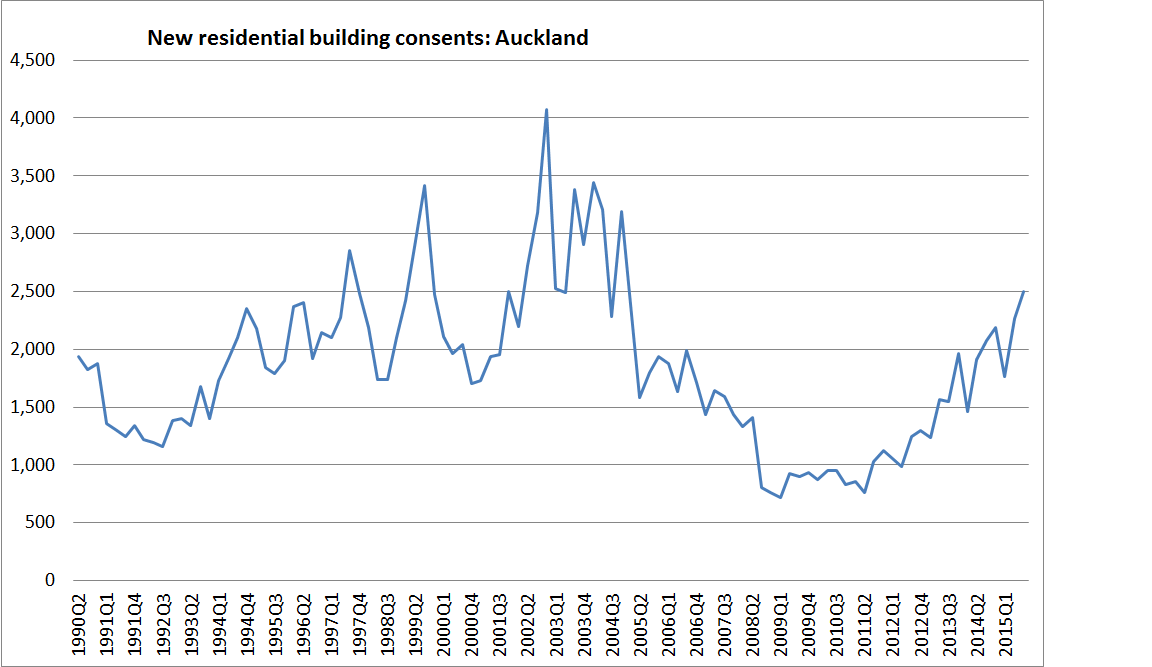
I was almost moved to comment yesterday when the business demography data were released, but had better things to do with my time.  But there was another, rather more egregious, example this morning, when the building consents release was headed up “Home building accelerates in the north”, even though the data were showing a second successive five per cent monthly seasonally adjusted fall for the country as a whole.   Of course, those falls came after the rather odd 20 per cent increase in the month of July.

I’m not sure why Statistics New Zealand seems to regard it as appropriate to spin their releases this way.  Having thought about it a little more, I wonder if the managers and deputy secretaries have KPIs for the amount of media coverage their releases get.  If so, there might be an incentive to run a strong story line in the release headline (or the SNZ text).  It could be downbeat stories as well as upbeat ones – either might help meet these media targets.  But downbeat stories prompted by SNZ headlines would be more likely to prompt complaints from ministers’ offices, and all public servants want as few of those as possible.

Is that the answer?  Perhaps not, but there must be something behind it.

And I’m not suggesting they should set out to accentuate the negative – again there are plenty of other people to do that.  But they are a statistics agency, whose integrity and impartiality we rely on.  Perhaps this is boring economist speak, but what would have been wrong with a heading this morning “September building consents data released”, and an opening sentence that read “the number of residential building consents fell in September for the second successive month, following a very large increase in July.  Consents in Auckland appear to be growing more rapidly than those in most of the rest of the country.”?

How about leaving the storytelling to journalists, politicians, economists….and even bloggers.

UPDATE: A glance at this month’s ABS releases suggests they mostly do these things better.

Treasury on investor finance restrictions

Back in August, I OIA’ed Treasury for copies of any material they had prepared on the Reserve Bank’s Auckland investor finance restrictions in the period following the release of the Bank’s consultative document on 3 June.   I had written earlier about the pro-actively released Treasury papers, which captured some of the earlier round of discussions Treasury had had with the Bank on this issue.  At that time, Treasury was unpersuaded by the Reserve Bank’s case, for a variety of reasons, and were rather grumpy about late notice, inadequate consultation with them etc.

But then I went away, and when I got back and worked through my inbox I didn’t notice that Treasury had (helpfully) replied to my request.  In fact, I only realised it earlier this week, when stories started appearing (Politik, MacroBusiness, NBR and the Herald and the Dominion-Post) based on the papers Treasury had released, and which are now available on their website.

There is a curious, rather defensive, tone to the letter I received from Treasury.  It looked as though senior management was now quite uncomfortable about the perceptions of a split between the Reserve Bank and Treasury, and so went out of their way to present a sense that everyone was on the same page…..really.

No doubt for this reason they included in the material they released a letter from Gabs Makhlouf to Graeme Wheeler.  It looks to be a stock letter, sent by the Secretary to every government department/agency head at the start of the new fiscal year.  There is nothing specific about the Treasury/Reserve Bank relationship in the letter  –  and it was notable mainly for the odd line “we want to create a New Zealand that is prosperous, sustainable and inclusive”.  I could object to “create” –  government departments have such power? –  but it was the “we” that struck me.  Surely we elect members of Parliament, from whom governments are formed, to determine policy, and set policy goals.  Mere government departments –  even The Treasury –  have an advisory and implementation role.

However, Treasury seem to have included the letter in the release to me so that they could draw attention to the final paragraph.

The Treasury will continue to provide an independent perspective, and aim to add value to agencies’ business in doing so. Our goal is to be collaborative and challenging at the same time, engaging in a constructive spirit, with a shared sense of ambition and focus on getting better outcomes for all New Zealanders.

No doubt.

But the other thing Treasury was really keen to get across –  it was explicitly included in the covering letter –  was a sense that everyone was really more or less on the same page, at least on the need for some sort of intervention.

Please note that overall, the Treasury supports the Reserve Bank’s view that recent developments in the Auckland housing market could potentially pose a threat to financial stability over the medium term.  Although there may not be signs that a systemic risk may crystallise imminently, there is cause for vigilance.  Given the consequences of doing too little too late, we support the case for intervention at this stage on financial stability grounds on the basis of the available data.

I noted those lines when I first opened the documents.  And then I was struck by how often they were repeated, word for word.  It appears in the Treasury’s submission on the Reserve Bank consultation document. It appears in the Treasury Report to the Minister that accompanied a copy of the submission.  And it appears even in an internal briefing note for the Secretary to the Treasury on the critical assessment of the Reserve Bank’s evidence base undertaken by Ian Harrison, and presented in the document A House of Cards

The paragraph is not elegantly written at all, and it would have been easy to revise the words slightly over time to improve the expression. But it has the feel of words that were haggled over, to get just enough qualifiers included, and then perhaps finally imposed from the top. No one dared deviate, even stylistically, lest it reopen all the old debates and scepticism.

After all, it does not say that the Treasury supports the Auckland investor finance restrictions coming into force this weekend (or the relaxation of the LVR limit in the rest of the country). Indeed, it does not say much at all.  It doesn’t say that recent developments in the Auckland housing market “do” pose a threat to financial stability, but simply that they “could potentially” do so, and even that is qualified by “over the medium term”.    Then follows the awkward sentence “although there may not be signs that a systemic risk may crystallise imminently” –  but not even Graeme Wheeler has suggested imminent crystallisation – “there is cause for vigilance”.  Well, yes, but then that is what taxpayers pay bank supervisors for –  we hope they are always “vigilant”.

But then they conclude rather oddly, “given the consequences of doing too little too late” they support “the case for intervention at this stage”, not unconditionally but “on the basis of the available data”.  I’m not sure at all what that final qualifier is supposed to mean, or how its hedges the Treasury position, but my interest is the first phrase in the sentence.  Surely that just makes the whole argument circular, and bases policy on a straw man? By definition, no one wants to have done “too little, too late”.    If the financial system is, in fact, going to collapse in a heap if we do nothing then they support doing something.  Most people –  although not everyone –  would.

But how do we know?  How, for example, do we deal with the many countries that have had rapid credit growth (unlike New Zealand at present) and house price inflation, but no subsequent systemic problems.  The Treasury lines just assumes an answer rather than demonstrating it, assumes that intervention can make a material sustained difference “over the medium term”, and does not even address the costs of intervention, or the consequences of being wrong.   It is a poor quality conclusion, that seems to rest on rather poor quality analysis.  It is, for example, exactly the sort of line that could have been run in 2005/06, on the back of the larger, and more pervasive (regions and asset classes), credit and asset boom.  And yet the banking system came through the subsequent severe recession almost totally unscathed

There are some useful comments in the papers, if not always that clearly expressed.  And Treasury seems to be torn.  For example, buried in their comments is the telling observation “there is little evidence that lending standards are declining, a crucial component for assessing systemic risk”.  If lending standards are not declining materially, history suggests there is almost no chance of  the sorts of credit losses that would trigger a systemic financial crisis.  Treasury and the Reserve Bank should be challenged to cite any exceptions they are aware of.  Treasury might have highlighted the point in their advice to the Minister.

Many of the stories around these papers have highlighted an apparent Treasury preference that if there is going to be a direct regulatory intervention it should be done using debt to income  limits rather than loan to value restrictions.  In principle, I think they are probably correct  – and that some of the comments in the Dominion-Post this morning are just wrong. But they lack the courage of their instincts –  after all if there is no sign of systemic risk “crystallising imminently”, why didn’t they push back more strongly against the rushed use of LVR limits again?  The Bank’s excuse in 2013 was that it didn’t have time, and something urgent had to be done. They were clearly wrong then, and it is now 2015.  Good policy takes time, and rushed interventions rarely end that well.

Curiously, even though Treasury are the guardians of regulatory quality in New Zealand, there is no reference at all in the comments to the “efficiency” dimension of the Reserve Bank’s statutory responsibilities.  Surely a challenge and review body should be more sharply posing questions around the balance between soundness and efficiency, and offering perspectives on how to think about policy proposals that might make some modest difference to soundness, but which certainly come at some cost to the efficiency of the financial system?   Treasury do note that the regime is already becoming much more complex than was envisaged when the Reserve Bank first lurched into direct controls in 2013, but pay no attention to disintermediation risks or the distributive consequences of the policy, simply rather lamely concluding that ‘this is new territory for both the RBNZ and the Treasury and we will need to work together to ensure we continue to develop our understanding of these policy settings.

The one aspect of the new policy that Treasury is slightly stronger on is pushing back against the relaxation of the LVR restriction outside Auckland   Here I’m not sure I really understand their argument –  something about the risk of inconsistent signals. I think they are wrong on that – the logic of the Reserve Bank’s position seem clear, in trying to target specific areas of exuberance.  There isn’t much sign of exuberance in Gisborne, or Invercargill, or Nelson, or Wellington or Christchurch.  I don’t agree with the controls, at all, and I think regionalisation of prudential policy is another dangerous step towards politicising the Reserve Bank (akin to discretionary regional fiscal policy), but Treasury have already accepted the case for an Auckland restriction, so they’ve already abandoned that line.

These documents highlight the ongoing tussle between the Reserve Bank and the Treasury over prudential policy (as distinct from its application to individual institutions).  In principle, I mostly side with Treasury.  The Reserve Bank has far too much independent power to set policy without the direct involvement of the Minister of Finance –  both the ability to vary banks’ conditions of registration, and the far-too-extensive scope the legislation seems to allow them to set conditions on.  In my view, policy in these areas should be set by the Minister of Finance, with advice from the operating agency (the Reserve Bank) and the Treasury.  The Reserve Bank’s operational independence in this area should be more narrowly restricted to matters relating to the implementation of policy and its application to individual institutions.

Institutional rivalry and tension is probably inevitable, and hardly unique to the relationship between our Treasury and our Reserve Bank.  It isn’t helped by both institutions being led by people who had come in, not just from outside the public sector, but from outside New Zealand altogether, or by the rather weak senior leadership team at Treasury.   But there is also something about the quality of what the Treasury brings to the table.  The Reserve Bank tends to foster a rather closed environment, resistant to questioning, challenge, or even comment.  That is true of monetary policy to some extent, but it is even more true of their regulatory roles.  Some of that is about the individuals involved but it has fairly consistently been backed by more senior management.  The Bank has tended to foster an attitude that it is better and smarter than those it deals with, than other government agencies, and than outside agencies more generally.  If such an attitude was ever warranted (and humility is always a virtue), it has certainly not been so for a long time.

But Treasury does not help itself in this area.  The people they have involved have often not been very impressive.  Sometimes they are able individuals, but with no background in the subject matter –  a common issue at Treasury, especially among managers.  Sure the Reserve Bank can be difficult to deal with, but your case is a lot stronger when what you are bringing to the table is incisive and thoughtful.  Even when the recipients are inclined to be dismissive anyway, it is easier to simple dismiss lightweight contributions than those with depth.  On the evidence of these papers, Treasury unfortunately still has some way to go.

A new wave of financial interventions and controls come into force this Sunday, as the Reserve Bank continues to undermine the efficiency of our financial system.  The case for the interventions has never convincingly been made by the Reserve Bank, and we have what feels like a knee-jerk policy intervention, that materially affect the lives and businesses of ordinary citizens, based on little more than the hunches of a Governor, who has already been shown to have got his monetary policy consistently wrong.  In the earlier papers, Treasury showed some sign of challenging the weaknesses of the proposal, but as time went on instead of standing their ground, they have pulled their punches.  And the remaining concerns are not argued in a clear and compelling manner.

If this is the best that our two premier macroeconomic and financial agencies can come up with we should be pretty worried about the quality of economic policymaking and advice in New Zealand.  Responsibility for that rests, in particular, with the individuals in charge of those institutions, and those paid to appoint them and hold them to account.

(But, I continue to note that Treasury applies the Official Information in a much more helpful, and within the spirit of the Act, way than the Reserve Bank.  I made this point in the Ombudsman’s survey –  which I would encourage anyone else who has made OIA requests to complete.)

China’s fertility rate in an Asian perspective

The media are full of stories of the Chinese government/party decision to abandon the evil one-child policy and replace it with a marginally less evil two-child policy.  It is interesting to see the change presented by the authorities as a response to an ageing population, and I’ve seen various commentaries over the last few years suggesting that this easing could make a difference to the economic prospects of China, even perhaps only over the shorter-term as some couples took advantage of the slightly less repressive regime.

As a rank outsider, I’ve been more than a little sceptical since I started paying attention a few years ago to birth rates in the rest of Asia, and especially in the wealthier bits of Asia, to which China has been making some progress in converging.  As far as I know, in none of these countries have there been direct attempts by governments to suppress, by regulation, the birth rates (indeed, Singapore has been actively trying to encourage a higher birth rate).

Here is the time series (from the World Bank database) for China, Japan, and the four other predominantly ethnic Chinese countries/territories (Taiwan, Singapore, Hong Kong and Macao).

tfr time series

And here, from the CIA Factbook are the countries/territories with the lowest total fertility rates in the world, plus China and Thailand.  (The levels are slightly different in the two different sources –  the CIA numbers are 2015 estimates –  but the broad picture is the same).

tfr

The countries with the greatest cultural similarity to China have the lowest fertility rates in the entire world –  only around one child per woman.  The other advanced Asian economies (Japan and Korea) are only a little higher, and one of the other emerging middle income Asian countries (Thailand) already has a TFR below that of China (although, on the other hand, Malaysia’s is higher).

Perhaps the policy change will materially boost China’s birth rate, but it would really stand out relative to the rest of advanced and emerging Asia if that were to happen.

Who speaks for the 35000 unnecessarily out of work?

The Labour Party’s finance spokesperson, Grant Robertson, yesterday took the opportunity of today’s OCR review to make another statement on monetary policy.  I was pretty critical of his previous effort, which seemed to involve trying to blame Bill English for Graeme Wheeler’s errors and misjudgements.

The latest statement is little more inspiring.  It was good to see him focus on the high and rising rate of unemployment, and to point out that inflation hasn’t been at the 2 per cent midpoint since that target was set three years ago.

But he wants to use this record as a basis for amending the Reserve Bank Act to “put employment up as a core objective“.  I presume he would really mean low unemployment, since the Reserve Bank would (reasonably) point out that employment growth and participation rates have done quite well over the last few years.  And unemployment is the measure of excess capacity in the labour market.

Robertson talks about a dilemma that the Governor apparently faces.  But there simply isn’t one.  Inflation (and more particularly core inflation measures) is well below where it should be, and unemployment is (rising and is) much higher than it needs to be (than any plausible NAIRU).  That is a classic case of a demand shortfall, and the standard prescription is looser monetary policy.  Lower interest rates and a lower exchange rate will tend to raise both activity and inflation, and lower unemployment.

There are times when monetary policy faces hard choices –  when keeping inflation near the target might involve measures that will temporarily raise unemployment.    Some of them are explicitly addressed in the Policy Targets Agreement (and have been ever since 1990), and others are captured in a more general way –  the PTA is quite clear, for example, that the focus of monetary policy is supposed to be on the medium-term trend in inflation, not the near-term wobbles.  And, for better or worse, for 15 years the PTA has explicitly enjoined the Bank to avoid unnecessary variability in output.

I’m not a diehard defender of the way the monetary policy bits of the Reserve Bank Act are worded, or even of inflation targeting itself.  There might even be some sensible ways of formulating section 8 of the Act to include references to unemployment.  But section 8 of the Reserve Bank Act has almost nothing to do with the combination (persistent low inflation and persistent high unemployment) that Robertson rightly worries about.   Rather those outcomes are about a persistent series of misjudgements by the Governor (and, apparently, most of his advisers).

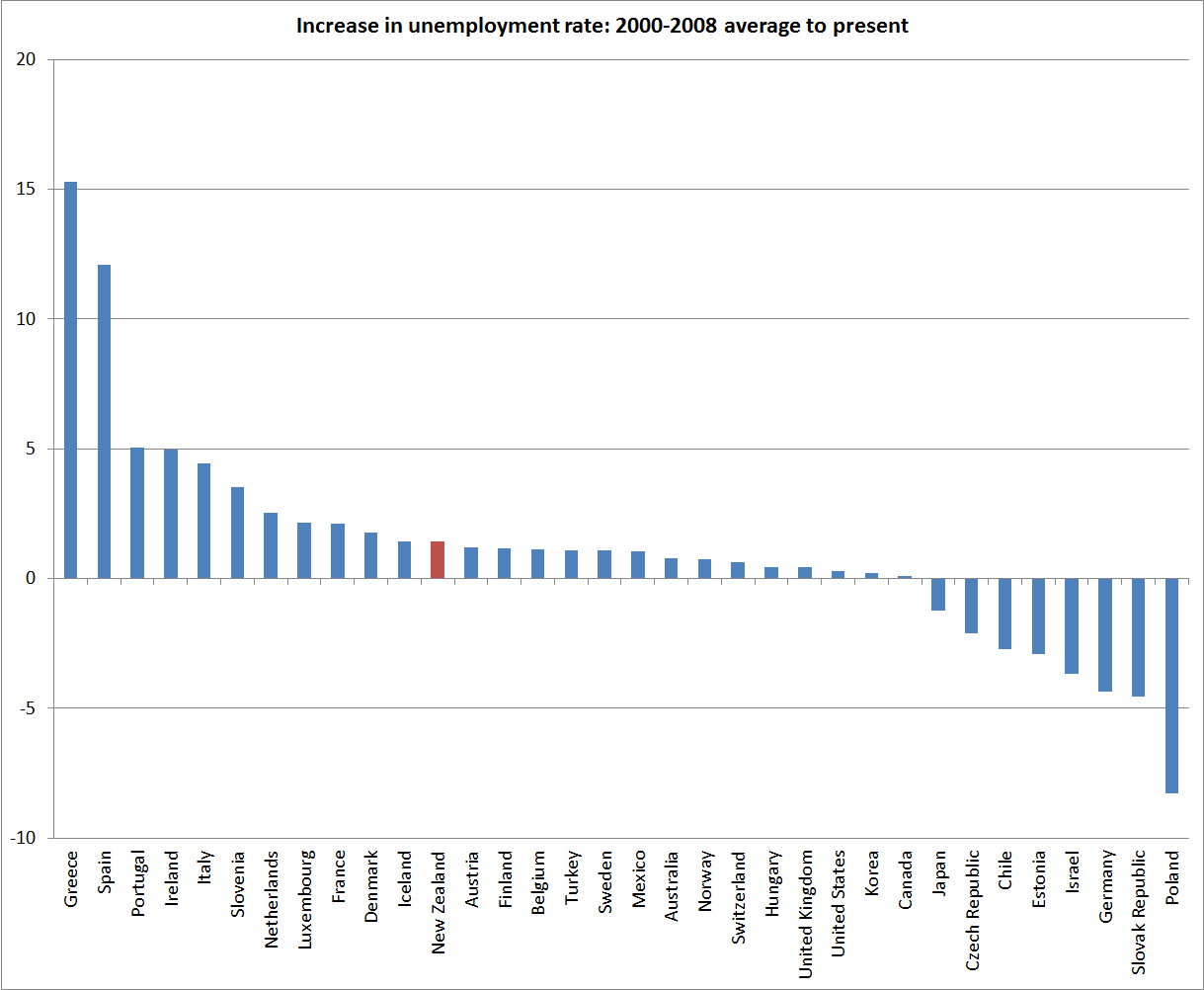
I’ve pointed out previously that central banks in other countries have also been taken by surprise by the events of the last few years.   But most of them have reached the limits of conventional monetary policy.  Several – including the ECB and the Swedish Riksbank –  even started to tighten, only to have to fully reverse those tightenings.   But the Reserve Bank of New Zealand is the only advanced country central bank that has (a) never been constrained by the near-zero bound on nominal interest rates, and (b) has twice (repeat twice) started tightening only to have to reverse itself again.    Taken together with the outcomes (too-low inflation, and too-high unemployment) it is a pretty poor track record.  And the Bank –  the Governor, recalling that the system is one of personalised accountability – has not been seriously called to account for that failure.

Legal responsibility for calling the Governor to account rests with the Minister of Finance and the Reserve Bank’s Board.  As I’ve noted, the Board seems to see itself as champions and defenders of the Bank, rather than being there to provide serious scrutiny and challenge.  And it isn’t clear that the Minister does more than grumble privately, and occasionally make slightly cryptic public asides.

But where has the political Opposition been?  In both his last two statements, Robertson absolves the Governor of any responsibility –  in his view the problem is the mandate, or even the Minister, not the month to month choices the Governor has actually been making.

Perhaps it is easy to call for changes in the mandate. It isn’t going to happen any time soon..  It might be harder to actually have a go at the Governor.  And one shouldn’t do so lightly, but this is an episode of repeated failure, and a stubborn reluctance to acknowledge, or learn the lessons from, those failures.  Of course, lots of the great and good have agreed with the Governor’s stance –  as I’ve pointed out before the NZIER Shadow Board’s recommendation have tended to mirror what the Governor actually does.  But they have been wrong, not just once, but again and again.  And the Governor is the person who is paid to get it right more often than not.   Why isn’t Robertson taking more of a stand and saying so.

And what about the governance arrangements?  Robertson notes that the Act was passed in the 1980s and is ‘out of date and out of touch with changes in the global economy’.  But if he looks at central banking legislation around the world what he will really find is that it is the governance aspects of the Bank –  the single decision-maker –  that look odd.  As the Reserve Bank’s survey showed, there is a wide variety of ways of expressing the statutory objectives for monetary policy, but there has been no trend away from something like a medium-term focus on price stability.  Our Governor simply has too much power.  Treasury reports that the Minister likes the current model because it provides better accountability, but where is the evidence of the accountability in the failures of the last few years?  The Minister can’t be blamed for who was appointed as Governor –  he had to appoint someone the Board nominated –  but he and the Board can, and should, be blamed for how little effective accountability there has been.

The unemployment rate is currently 5.9 per cent (and expected to rise further).  A reasonable estimate of the NAIRU might be 4.5 per cent.  If so, that is about 35000 people who are unemployed now who might not be unemployed if the Governor had run monetary policy, within his current mandate, rather better.  Even if the NAIRU, is nearer 5 per cent, it is still more than 20000 people unnecessarily out of work.   Does he get out and meet any of these people?  If so, I wonder how he explains his failure, and excuses the way his choices have blighted the lives of these people?

I suspect the answer to my question is “no”.  In fact, I just had a quick look through the list of audiences the Governor has given on-the-record speeches to since he took office.   There are various official forums and conferences, but not one of the remaining nine speeches was to groups representing workers, beneficiaries, or the wider community.  Most are to top-end business audiences (the “Admiral’s Breakfast Club” in Auckland, the Institute of Directors, INFINZ, Chambers of Commerce etc), and speeches given by the Deputy Governors seem to be to equally select audiences.  Perhaps the Governor gets no invitations from other sorts of groups, although in my experience that is unlikely.  Perhaps he gives lots of off-the-record speeches to such groups, and just by coincidence it is only the on-the-record speeches that were to upper-end business groups?

I’m not suggesting that the Governor is exercising anything other than his best judgement in making OCR decisions.   And his business audiences would also typically have been better off if the Bank had not been persistently and unnecessarily holding back the recovery, but his choices typically hit hardest on those at the bottom.  And it isn’t apparent that he is even listening to their plight, simply taking comfort from the echo chamber of the elite.

Traditionally, one might have expected an Opposition Labour Party to be their loud and clear voice.  Robertson’s is currently anything but that.

Thinking about housing again

I gave a talk in Nelson last night on housing issues.  It was largely a rework of material I’ve used before (posted here and here) so I won’t post the text here.   I’m not sure the speech quite hit the mark for the audience, but as always when I put together a presentation I find that I learn something in the process, or  some things come together more clearly in my own mind.

By Auckland standards, Nelson-Tasman house prices aren’t that high.   In real terms, house prices are still lower than they were in 2007.   But a median house price of around $400000 against a median household income of not much over $60000 reminds us just how high price to income ratios are across most of New Zealand (my old home town of Kawerau remains an unattractive exception).  Most of the “problem” is in the land.

As I often do, I devoted a bit of time to explaining why I don’t think features of the tax system are a material part of the explanation for high New Zealand house prices, or for the cycles that we –  and other countries  – experience.  As a slight counterbalance, I took the opportunity to put in another plug for land-value rating by local authorities, a case also recently made by the Productivity Commission.  Most New Zealand local authorities now use capital value rating, which – relative to a land value base –  provides less of an incentive to bring vacant land into development.  In principle, and all else equal, greater use of land value rating should help to dampen urban land prices, and close the gap between rural and peripheral urban land prices.

But one of the audience, a highly-respected figure in Nelson, with decades of experience in the building industry and on the local council, pointed out to me that Nelson city had, some decades ago, moved to land value rating.    Urban land prices remain very high.  It isn’t obvious that land value rating has been very helpful in easing land supply pressures.  Then again, nothing operates in isolation.  Neighbouring Tasman District Council, where much of the (flat land and) population and housing growth has been, still operates a capital value rating system.  And an ever-growing District Plan, that now runs to 1000 pages in Nelson City, probably has not a little to do with the continuing high land prices, and the continued excessively costly houses, in that part of the country.

A variety of factors no doubt explain the shift to capital value rating, although one can’t help wondering if the pervasive biases of so many councils towards more intensive, rather than extensive, development isn’t part of the story.  Many councils really don’t seem to want more land developed, or they want it developed only at a pace that suits them.  It is probably unrealistic to think that councils would favour a move back towards land value rating when those same councils are the ones applying land use restrictions in the first place.  If councils were committed to making urban land affordable, they could quite readily do it now.    Instead, as the Productivity Commission put it –  seemingly approvingly –  in its report last week:

Many urban councils in New Zealand have a clear idea about how they want to develop in the future, and how they intend to meet a growing population demand for housing.  Many larger cities have chosen to pursue a compact urban form.  Yet some of our cities have difficulty in giving effect to this strategy”.

Sadly, the Productivity Commission seems to see councils, and the planning regime, as part of the solution rather than as a large part of the problem.

I hadn’t been thinking much about housing while I was on holiday, but a conversation with friends we were staying with, in their growing prosperous (2 per cent unemployment rate) Midwest small college city, had got me thinking. I’d asked about local house prices and they’d commented that their house was probably worth about US$175000 –  decent-sized section, four bedrooms, and five minutes walk from the local college.  And they observed that prices had been moving up, and local sentiment was that they were really quite expensive.  In exchange I offered them scare stories about Island Bay prices, and vague references to the scandalous Auckland prices.

I didn’t give it much more thought until I got home and started preparing last night’s talk.  That observation that US$175000 was quite expensive was still running round in my head, and so I printed out the latest Demographia tables.  I’ve often used Houston as an example of a large, fast-growing, city with very moderate house prices –  in fact, lower in real terms than they were 35 years ago.   But, actually, Houston prices aren’t at the low end of the range –  the median house price was about US$200000 there last year.  Astonishingly cheap, absolutely and relative to income, by New Zealand standards but not by US standards.   Detroit (inner city) is a byword for cheap, but among cities with over a million people (and remember that Auckland hasn’t that many more than a million), these places last year had median house prices in a range of US140-175K (and price to income ratios of around 3).

Cincinnati

Grand Rapids

Pittsburgh

St Louis

Atlanta

Indianapolis

Kansas City

Louisville

Columbus

Oklahoma City

Memphis

Tampa

And there are dozens of other similarly affordable smaller cities.  I haven’t checked each of them, but I suspect “densification” hasn’t been a big part of keeping housing affordable.

Of course, the US has places at the other end of the range as well –  places I’ve barely heard of as well as Los Angeles, Honolulu, San Diego, San Francisco, and so on.

What marks out one group from the other isn’t being a “global city”, or a growing city:  it is mostly the land-use restrictions.  As Demographia highlight,  there are no cities  with high house price to income ratios that have liberal land-use regimes.

demographia

Which brings me back to a speech given last month by Bill English on housing affordability.  I noticed it has even been getting some coverage abroad, and it certainly has some useful perspectives on some of the issues (although looking through my copy I noticed I’ve scrawled “dubious” in a surprising number of places).  I liked the idea that our Deputy Prime Minister was making the case that urban planning has become a net drag on the country, and especially on its poorer and more vulnerable people, for whom housing has become progressively less affordable.  I was surprised to learn that the government now subsidises 60 per cent of all rentals in New Zealand.  And as the Minister notes of the 3000 page Auckland Unitary Plan “no one person [ or, one might add, no committee or Council] could possibly understand all the trade-offs in that plan”, or the implications of those choices.

I did, however, splutter at the suggestion that planning was an externality that central government might have to deal with just like “other externalities, such as pollution”.  The Minister seems to conveniently forget that the powers local governments have all flow directly from central government legislation – the centrepiece of which, the Resource Management Act, was passed by a government in which he served as junior backbencher.  Individual members of central and local governments may have their hearts in the right place, but this is ultimately a problem of central government failure at least as much as of local government failure.

And there are few signs that the problems are going away.  But perhaps that shouldn’t surprise us.  As I’ve noted here previously, I’m not aware of any examples of places in advanced economies where tight land use restrictions once in place have ever sustainably been removed.  When I first made this observation, I made it pretty tentatively.  I’m not an expert in the details of urban planning or familiar with the hundreds of individual regimes in various countries.  I was half-expecting that someone would come back to me quite quickly pointing me to a compelling case study of successful liberalisation.  So far no one has.  And I haven’t heard the Minister of Finance or the Minister of Housing highlight such studies.  I haven’t seen the New Zealand Initiative do so, and I haven’t seen Demographia do so, even though they have every incentive to highlight such examples if they exist.  I still hope there are such case studies out there, but it looks increasingly unlikely.

Bad policies don’t last for ever, but they can carry on for a  very long time.  I highlighted last night that New Zealand once had the unique feature of a car market where second-hand cars held their value and (by repute at least) were at times worth more than new cars.  My maternal grandfather often liked to tell the story that he reckoned my father was keen on marrying my mother as much because she owned a car as anything else (she’d done an OE and had overseas funds).  The insanity of the import licensing and local assembly regime eventually came to end, but it took a very long time –  sixty years or more.  Is there any reason to be more optimistic that housing will once again be affordable in New Zealand any decade soon?  If house prices had been bid up simply on the back of reckless bank lending policies, then perhaps so. But that isn’t the New Zealand story. Ours is a story of microeconomic policies, implemented and maintained by successive central and local governments, with the clear and predictable effect of making housing, and the sort of housing people want, much less affordable than it needs to be.

Fallow: the case for a lower OCR is compelling

Brian Fallow’s weekly column in the Herald yesterday  was fairly pointed.

Some further easing in the official cash rate seems likely, Reserve Bank governor Graeme Wheeler reiterated last week.

Well, good.

Because the case for more easing is compelling.

I agree with him.  Whatever measure of inflation one uses –  headline, exclusion measures, filtered measures  –  inflation has been persistently below where the Governor agreed to keep it, and shows no sign of rising (much or for long) any time soon.  On the Reserve Bank’s own numbers, the output gap is still modestly negative, and the unemployment rate has risen and is above any sort of NAIRU estimate.

But that wasn’t my reason for writing.  Instead, Brian notes a few considerations, including those mentioned in the Governor’s recent speech,  that might hold the Governor back

Housing is the first.  The Governor appears to have reversed himself, and gone back to thinking that (Auckland) house prices should be a factor in setting monetary policy.  But the Minister of Finance mandated him to target the medium trend in consumer price inflation, and New Zealand’s measure of consumer price inflation does not  –  rightly in my view (and that of most others) –  include existing house  prices or land prices.   House price inflation in Auckland is certainly scandalous, but the responsibility for that outcome is directly attributable to the choices of elected central and local governments.  The Reserve Bank’s role should simply be –  and in statute is –  to ensure that banks are sufficiently resilient to cope if nominal house prices ever fall sharply.

The second issue related to investment.  The Governor had suggested that the Bank needed to ask “whether borrowing costs are constraining investment”.   It isn’t clear why the Governor regards that as a relevant consideration –  absent some wild investment excess (1987 perhaps?), more private sector investment is generally a good thing.   Brian Fallow suggests that investment is sufficiently strong that there is no issue on that score anyway.  I’m not sure I agree.  Excluding residential investment, investment as a share of GDP remains pretty subdued. Historically, business investment as a share of GDP has been surprisingly low  in New Zealand relative to that in other advanced countries, given our faster trend rate of population growth, and now investment is low even relative to that history.  And that despite the rapid rate of population growth in the last couple of years.

investment to gdp

Not that the government’s ambitious export growth target is any concern of the Reserve Bank’s, but it is difficult to see anything like the targeted transformation in export performance occurring with these sorts of investment rates.  Of course, the big issue there is likely to be the real exchange rate –  still sufficiently high that even the Governor seems to comment on it whenever he can.

I touched last week on how odd it is to think of holding back on cuts now to save ammunition in case things get really bad again.  But Brian comes back to this issue by another angle.

But we can’t forget that New Zealand remains abjectly reliant on importing the savings of foreigners. The risk premium they demand to keep on doing that puts a floor under banks’ funding costs and the interest rates borrowers see, regardless of how low the OCR might go.

Here I think he is wrong.  I’ve dealt previously with the question of whether foreign lenders typically demand a “risk premium” for lending to New Zealanders (in NZ dollars).  The evidence strongly suggests that they don’t – and haven’t.    But if they were particularly concerned about New Zealand risk, there are two ways to get compensated for that risk.  The first would be to seek a higher interest rate.  They couldn’t typically get it at the short end, since the Reserve Bank itself directly sets the OCR based on domestic conditions.  They might perhaps get it on longer-dated assets (bonds), but expectations of the future OCR typically play the most important role in influencing the level of longer-term interest rates.

A much more plausible place to see any risk premium, in a floating exchange rate country, would be in the level of the exchange rate –  in other words, a surprisingly weak exchange rate.  Nervous foreign investors would be reluctant to buy NZD instruments at the interest rate set on those assets by domestic economic conditions.  But they might be happier to do so if the exchange rate were lower.  A lower exchange rate today, all else equal, means more prospect of some appreciation (and extra returns) in future.  It is a bit like the share market –  if concerns about a company, or the whole market rise, investors get compensation for the additional risk through a lower share price.  The lower exchange rate, in turn, helps rebalance the economy and reduces, over time, perceptions of risk.

But in thirty years of a floating exchange rate, I can think of only a handful of occasions when New Zealand’s exchange rate has been surprisingly weak (relative to New Zealand cyclical fundamentals)  –  most obviously at the height of the global crisis in 2008/09.  Global risk aversion was then at its height, and the NZD was caught in the backwash.  It isn’t a remotely typical story, and there is no sign that it is relevant now.  As the Governor keeps noting, the exchange rate is still rather high.

A materially lower OCR would lower domestic borrowing rates, which would provide a little support to lift investment.  But even if it did nothing at all on the score, it would work by lowering the exchange rate, in turn boosting returns to actual and prospective exporters.  Yes, it would increase the cost of domestic consumption a little, but the trade-off would be a stronger recovery, more resilient against any new wave of adverse shocks, lower unemployment, and –  not at all incidentally –  measures of medium-term inflation which would be rather nearer the rate the Minister of Finance asked the Governor to achieve.

The Reserve Bank apparently agonised for a while in 2008/09 about this idea that a too-low OCR might somehow create troubles with foreign investors.    Given the pace of the fall in the exchange rate during the international crisis, and the novelty of such low interest rates, they were perhaps understandable questions then.   But I doubt it is a factor that weighs much in the Governor’s deliberations now.  We shouldn’t welcome foreign investor concerns or heightened perceptions of risk –  they are a real cost –  but if those concerns exist, we are likely to be much better off absorbing them in a depreciated exchange rate, than trying to lean against them with unnecessarily high interest rates.  The alternative (‘lean against”) approach has usually been damaging, or disastrous, wherever it has been tried (think of all too many emerging market crises).

In the end, I think Brian agrees.

Even so, rather than keeping powder dry, the better way of mitigating the effects of another negative shock from the rest of the world might be for the bank to impart as much momentum as it can to the economy before the headwinds turn gale force.

It isn’t always and everywhere good advice, but given our continuing anaemic economic performance, it seems like very good advice right now, whether or not the headwinds ever gain further strength.  The debate probably shouldn’t be around whether the OCR should be 2.75 or 2.5, but why it should not quickly be cut to something more like 1.75 per cent.

The Treasury on Reserve Bank governance

Regular readers will know that one of the constants of this blog has been making the case for reforming, and modernising, the governance of the Reserve Bank.  The current model is out of step with international practice, and with the way other government agencies are run in New Zealand.   I’ve held this view for a long time, although the concerns are becoming more pressing as the Reserve Bank assumes, and is given, ever more discretionary power.     The current Governor is probably in the wrong job  (a huge role, making the holder probably the most powerful unelected person in New Zealand).  But the case for reform would be strong even if we had the best conceivable person as Governor.  Typically, we will have someone who is about average.

There has been a growing recognition of the case for change.  In 2012 The Treasury recommended to the Minister of Finance, before the current Governor was appointed, that further work be undertaken with a view towards moving to a committee-based decision-making framework.  At the time they found that most market economists were sympathetic to change.  At a political level, the Green Party has openly and repeatedly argued for change, while the Labour Party has come and gone on the issue.  But it isn’t an obviously ideological issue –  just a matter of finding a good governance model for an increasingly powerful New Zealand policy agency.

Graeme Wheeler himself recognised some of the weaknesses of the current system, and established the Governing Committee as the forum in which major decisions would be made.  He retains the legal power, and all the other members of the committee owe their positions, and remuneration, to the Governor, but in principle it represented a small step forward.  Whether it represents any real gain is impossible for outsiders to tell.  The Bank has flatly refused to release minutes of the meetings of the Committee, on any topic whatever, and –  in truth –  governance arrangements are really only tested in times of stress, and where there might be strong differences of view. Quasi-insiders –  the Bank’s Board –  could provide us with an assessment of how the new model is working, but their Annual Reports suggest that they are more interested in being champions of the Governor and the Bank rather than in providing substantive reports analysing and scrutinising the performance of the Governor and Bank.

The Bank has also refused to release any papers from its own work on reforming the governance model.  That refusal confirmed that a substantial amount of work had been done, at least some of which had been discussed with the Minister of Finance.

Fortunately, the Treasury generally takes a more accommodative approach to Official Information Act requests.  There are plenty of things about The Treasury that I am critical of, but they seem over the years to have displayed considerably more respect for the spirit of the Official Information Act and its role in New Zealand’s system of governance.  When the Reserve Bank refused my request for governance papers, I lodged a very similar request with The Treasury.

Yesterday, they released several papers, which are available here.

Treasury governance papers OIA response

There are a couple of nice and substantive background papers.  Some are focused just on monetary policy governance, but Treasury also recognises that the Reserve Bank has a much wider range of functions, and hence that any review of the legislative governance model really needs to look at the entire institution and all its roles and responsibilities.

Treasury still appears to favour change.   In particular, in a June paper to the Minister of Finance, commenting on the Reserve Bank’s draft Statement of Intent (page 48 in the release document) they note:

A key change from the previous year’s SOI is that a workstream on “best practice institutional frameworks…has been dropped.  In the Treasury’s view, this workstream would be worth continuing.  Nevertheless, we understand that the decision to drop this workstream is consistent with your feedback that the current decision making structure best supports accountability.

Recommendation

Note that the RBNZ is discontinuing its workstream on “best practice institutional frameworks”.  The Treasury would prefer this workstream to continue.

They have withheld a variety of other documents.  I’m not sure quite what the first ground (below) means in this context –  perhaps information from foreign agencies? –  but what is interesting is that the statement declining to release the other documents reveals that Treasury is continuing its own work on the issue.

Tsy governance OIA

At one level, it is nice to finally have public confirmation of the fact that the Minister of Finance has again rejected reforming the governance of the Reserve Bank.  Treasury reports that this is because the Minister thinks a single decision-maker best supports accountability.  But hardly any other country agrees with Mr English, and none do so among those who have reformed their arrangements for the central bank and financial supervision activities in the last couple of decades.    And we don’t apply that model to any other area in public life in which government agencies are making policy decisions.   There is a strong case for change, and no doubt in time change will happen.   It is a shame that the Minister is clinging to an outdated model, which is not serving New Zealand that well.  But well done to the Treasury for continuing the background work in thinking through the issues and options,