Cosmetics (can) matter: Labour’s monetary policy proposals

I’ve already written a bit about Labour proposals on monetary policy (here and here) and, for now at least, I don’t want to write anything more about the proposed changes to the decision-making process or the plan to require the Monetary Policy Committee to publish its minutes.  If there are all sorts of issues around the details of how, I haven’t seen anyone objecting to the notion of moving from a single decisionmaker model to a a legislated committee, or objecting to proposals to enhance the transparency of the Bank’s monetary policy.    The Bank was once a leader in some aspects of monetary policy transparency, but is now much more of a laggard.

Where there has been more sceptical comment is around Labour’s proposal to add full employment to the statutory monetary policy objective.    At present, section 8 of the Reserve Bank Act reads as follows:

The primary function of the Bank is to formulate and implement monetary policy directed to the economic objective of achieving and maintaining stability in the general level of prices.

Responding to this aspect of Labour’s announcement hasn’t been made easier by the lack of any specificity: we don’t know (and they may not either) how Labour plans to phrase this statutory amendment.    There are some possible formulations that could really be quite damaging.  But there are others that would probably make little real difference to monetary policy decisionmaking quarter-to-quarter.  Probably each of us would prefer to know in advance what, specifically, Labour plans.  But this is politics, and I’m guessing that there is a range of interests Labour feels the need to manage.  In that climate, specificity might not serve their pre-election ends.  One could get rather precious on this point, but it is worth remembering that there are plenty of other things that may matter at least as much that we currently know little about.  Under current legislation, who becomes the Governor of the Reserve Bank matters quite a lot to shorter-term economic outcomes, and we have no idea who that will be.   The details of the PTA can matter too, and under the governments of both stripes the process leading up to the signing of new PTAs has been highly secretive (often even after the event).  For the moment, we probably just have to be content with the “direction of travel” Labour has outlined.

In some quarters, Labour’s plans for adding a full employment objective have been described as “cosmetic”, as if to describe them thus is to dismiss them.    That is probably a mistake.  When I went hunting, I found that cosmetics have been around for perhaps 5000 years (rather longer than central banks).   People keep spending scarce resources on them for, apparently, good reasons.     Why?  They can, as it were, accentuate the positive or eliminate the negative –  highlighting features the wearer wants to draw attention to, or covering up the unsightly or unwanted marks of ageing.    They (apparently) accomplish things for the wearer.

What is the relevance of all this to monetary policy?  Well, there has been a long-running discontent with monetary policy in New Zealand, especially (but not exclusively) on the left.  In the 28 years since the Act was passed there has not yet been an election in which some reasonably significant party was not campaigning to change either the Act or the PTA.  We haven’t seen anything like it in other advanced countries.   Personally, I think much of the discontent has been wrongheaded or misplaced –  the real medium-term economic performance problems of New Zealand have little or nothing to do with the Reserve Bank –  and many of the solutions haven’t been much better (in the 1990s, eg, Labour was campaigning to change the target to a range of -1 to 3 per cent and NZ First wanted to target the inflation rates of our trading partners, whatever they were).     But that doesn’t change the fact that there has been discontent –  and more than is really desirable.

I’m quite clear that there is no long-run trade-off adverse trade-off between achieving and maintaining a moderate inflation rate (the sorts of inflation rates we’ve targeted since 1990) and unemployment.  And since something akin to general price stability generally helps the economy function better (clearer signals, fewer tax distortions etc) there is at least the possibility that maintaining stable price might help keep unemployment a little lower than otherwise.  Milton Friedman argued for that possibility.

But I don’t think that is really the issue here.

Because it is not as if there are no other possible connections between monetary policy and unemployment.   Pretty much every analyst and policymaker recognises that there can be short-term trade-offs between inflation and unemployment (or excesss capacity more generally –  but here I’m focusing on unemployment).   Those trade-offs aren’t always stable, even in the short-term, or predictable, but they are there.    Thus, getting inflation down in the 1980s and early 1990s involved a sharp, but temporary, increase in the unemployment rate.  That was all but inescapable.  And when the unemployment rate was extremely low in the years just prior to 2008, that went hand in hand with core inflation rising quite a bit.  Monetary policy decisions will typically have unemployment consequences.    Unelected technocrats are messing, pretty seriously, with the lives of ordinary people.   It is all in a good cause (and I mean that totally seriously with not a hint of irony intended) but the costs, and disruptions, are real –  and typically don’t fall on the policymaker (or his/her advisers).

And it isn’t as if monetary policymakers are typically oblivious to the pain.   There was plenty of gallows humour around the Reserve Bank in the disinflation years, a reflection of that unease.  And yet often the official rhetoric is all about inflation –  as if, in some sense, what look like relatively small fluctuations around a relatively low rate of inflation, matter more than lives disrupted by the scourge of unemployment.

So perhaps that is why cosmetics can matter, and serve useful ends even in areas like monetary policy.     There isn’t that much difference, on average over time, in how the Reserve Bank of New Zealand, the Reserve Bank of Australia, or the Federal Reserve (or various other inflation targeting advanced country central banks) conduct monetary policy.   They each tend to react to incoming data in much the same way (again, on average over time).   In the financial markets, they probably each have much the same degree of “credibility” (people think the respective central banks are serious about their stated inflation targets).   And yet my impression is that the Federal Reserve, for example, talks much more about unemployment than the Reserve Bank of New Zealand does.   The Fed gives the impression that (a) it is aware, and (b) that it cares.  In the last decade or so at least, that has been much less so here.

In New Zealand, the problem has been compounded by a sustained period when the Reserve Bank turned out to have run monetary policy too tightly (including two tightening phases that had to be quickly reversed).  Over that period –  and today –  the unemployment rate (the number of people unemployed  – the phrase I always used to encourage staff to prefer when we replied to correspondence) has been persistently above estimates of the NAIRU (non-accelerating inflation rate of unemployment).

The Reserve Bank is entrusted with a great deal of discretion, in an area riddled with uncertainty and imprecision.  We don’t know exactly what the NAIRU is (nor does the Bank).  We don’t even know what “true” core inflation is, let alone what it will be over the 12-24 months ahead, the sort of period today’s monetary policy decisions affect. That makes signalling and symbols perhaps more important than otherwise.

It is also why lines like

“It is mathematically impossible to target two variables with one instrument.” 

while formally true, aren’t really the point here.   Voters –  or some subsets of them –  simply want to know that those other things matter –  and matter quite a lot –  to the people wielding the power.    And as there is quite a connection between monetary policy choices and fluctuations in the numbers of people unemployed, they aren’t irrational to do so.    After all, they might well note that the old argument –  “well if unemployment is too high, inflation will undershoot the target and the Bank will quickly correct that” doesn’t sound so compelling after years of an undershoot, and years when unemployment has lingered quite high.

There is a whole variety of ways to send the signals:

  • one can tinker with the PTA again (most of the changes of 28 years have had this quality about them –  including for example the current references to unnecessary variability in output, interest and exchange rates),
  • one can choose a Governor who is known to care (although typically technocrats won’t be much known at all),
  • one could require the Bank to publish estimates of the NAIRU and report regularly on how monetary policy was affecting the gap between actual unemployment and the NAIRU,
  • the Bank could regularly write about, or give speeches, highlighting the importance of unemployment (gaps) in its thinking, and expressing discomfort whenever unemployment has to be temporarily high.

Or one could tinker with section 8 of the Act and add a full employment reference.

Perhaps Labour actually has a combination of these sorts of approaches in mind.  Amending the Act is isolation might not do much (even in signalling and symbolism) in isolation, but it might encourage the appointment of a Governor who took seriously the concern (after all the Bank’s Board has to operate under the Act), and it might encourage the Governor, the Bank, and any future Monetary Policy Committee to address these issues more directly in their own communications.

And at a political level, if they are serious about prioritising full employment as one  over-arching goal of economic policy (which seems a worthy goal to me, even if there are good and bad ways of pursuing it), a change to the Reserve Bank Act might also signal –  what the monetary policy analysts already know – that in the medium to longer-term monetary policy and the Reserve Bank are no obstacle to full employment.

As I noted last week, in 1950 the incoming National government amended the Reserve Bank Act to specify an objective for monetary policy as follows

[The Bank] shall do all such things within the limits of its powers as it deems necessary or desirable to promote and safeguard a stable internal price level and the highest degree of production, trade, and employment that can be achieved by monetary action.

Something similar, in today’s language, seems at worst unobjectionable to me.  At best, it might strengthen public confidence in the Bank and encourage the Bank and its incoming Governor and Deputy Governor to convey with more conviction how seriously they take the overall economic environment –  real firms, real people –  within which the Bank exercises its considerable discretionary power.

Reflecting on all this over the weekend, another parallel struck me.  In wartime, the priority is to win the war.  In many ways it is as simple as that.  A single objective.   And yet combat generals, delegated power by political leaders, who become known as reckless with the lives of their men eventually forfeit trust, corroding the loyalty of those who serve them (and those who appoint them).   Wars involve losses of life, often heavy losses. No general can take on the role without being ready to see young men lose their lives, perhaps in very large numbers.  And yet –  at least in a free society –  we don’t want generals who are indifferent to the cost.  We want them to spend lives as if each one were precious.  Soldiers who believe that of their generals probably fight with more conviction and determination.  And societies give leeway and respect to those generals, allowing them to lead the battles that, in time, win the war.   It isn’t a dual objective –  in the end societies do what they need to to survive and prevail –  but it isn’t irrelevant either.
 

Bits and pieces

As regular readers will know I have been uneasy about whether the Minister of Finance’s recent appointment of Grant Spencer as acting Governor of the Reserve Bank (while pragmatic) is in fact lawful.    I dealt with the issue first on the day the appointment was announced, and again when the Bank’s Board, the Treasury, and the Minister of Finance released material in response to my OIA request.

What made me most uneasy is that there was no suggestion in any of the papers –  whether the Board’s recommendation to the Minister, the Minister’s Cabinet paper, or in any of the various Treasury papers –  that officials, the Board, or the Minister had even considered seriously the lawfulness of such an appointment.  There is no summary of any legal advice in any of the papers, and no reference to the issue.  This is so even though the Act quite clearly makes the Policy Targets Agreement (PTA) the centrepiece of the balance between autonomy and accountability, and yet it makes no reference to the possibility of a PTA in a case where an acting Governor is appointed after a Governor’s term, and that Governor’s PTA, expires.   As an expression of good intent, the Minister of Finance and the incoming acting Governor have indicated that they expect policy will continue to be conducted according to the current PTA, but……(a) the whole point of the acting appointment is that Grant Spencer will take office a few days after the election (so the current Minister of Finance may be irrelevant) and (b) none of this is legally binding, even though the monetary policy provisions of the Act are built around quite detailed, and legally binding, rules.

All three agencies/people noted that they had withheld legal advice (from the Reserve Bank’s in-house lawyer and from Crown Law).  That wasn’t a surprise.   Protection of legal professional privilege is a grounds on which material can be withheld under the OIA.  But it is not an absolute grounds, and any possibility of withholding such material on that ground must first consider whether the public interest is such that the material should be released.  Recall that the whole point of the OIA is to allow more effective public scrutinty, accountability, and participation in public affairs.

I was initially inclined to let the matter lie.   But on further reflection, and having a look at some of the material the Ombudsman has put out in recent years (and a report of an even more recent decision), in which it has been ruled that either legal advice, or a summary of it, should be released, I have decided to lodge an appeal with the Ombudsman in this case.     It isn’t a case where, for example, the legal advice is contingent on facts known only to the parties commissioning the advice.  The relevant facts are all in the public domain already.  All that is being protected is the assessment of the interpretation of legislation on which powerful government entities are acting/advising.  If their interpretation of the acting Governor provisions is robust –  and it may well be –  then the Act is less robust –  in ensuring that the monetary policy decisionmaker is at arms-length from the Minister (not eg subject to six monthly rollovers), and yet is at all times subject to a legally binding accountability framework –  than had previously been thought.     There is a clear public interest in us being aware of any analysis the government, the Board, and the Treasury are relying on in making an appointment of this sort.  They act on those interpretations, and in so doing create “facts on the ground”.

I suppose it will take some considerable time for the Ombudsman’s office to get to this request –  perhaps even after the acting Governor’s term has ended –  but with the possibility of reviews to the Reserve Bank Act governance provisions in the next couple of years, it would still be valuable for this advice and intepretation (in full or in summary) to be put in the public domain. This is, after all, about the appointment and accountability provisions for the most powerful unelected public office in New Zealand.

On another matter altogther, I noted the other day that one of my readers, and periodic commenter, Blair Pritchard had published his own set of policy proposals for New Zealand.   Blair sets out seven policy goals and 15 policy proposals under the heading What’s a platform Kiwi Millenials could all get behind?    There is lots to like in his agenda –  and he graciously refers readers to some of my ideas/analysis –  although I’m sure most people, even non-millenials,  will also find things to strongly disagree with (for me, cycleways and compulsory savings –  although I’m also sceptical of nominal GDP targeting).      But I’d commend it to readers as a serious attempt to think about what steps might make a real and positive difference in tackling the challenges facing New Zealand.  And I really must get round to a post on a Nordic approach to taxing capital income –  one of the topics that has been on my list for two years now, and never quite made it to the top.   Cutting company taxes is the headline-grabbing option, and it would make quite a difference to potential foreign investors, but for New Zealanders pondering establishing and expanding businesses here, the company tax rate is much less important than the final rate of taxation on capital income which, in an imputation system, is determined by the personal income tax scale.   The Nordic approach quite openly sets out to tax capital income more lightly than labour income.   It isn’t a politically popular direction at present, but is the direction we should be heading, if we want to give ourselves the best chance of closing those persistent productivity chasms.


Still going nowhere: the government’s exports target

The government’s target for a substantial increase by 2025 in the share of exports in GDP has been something of a hobby-horse issue of mine.  I’m sure it was well-intentioned (the thinking behind it probably recognises that successful economies, catching up with the most highly productive countries, typically experience a more rapid increase in exports than in GDP as a whole).  It isn’t that exports are special, just that (among other things) one measure of the success of one’s firms/industries is the ability to sell more and better stuff on the (much larger) wider world market.  That, in turn, enables us to import lots (more) of stuff from the rest of the world.

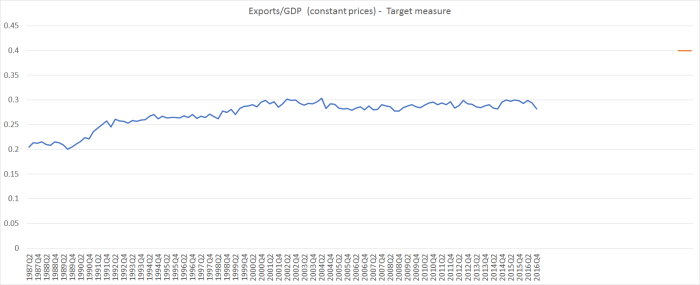
In parliamentary questions earlier in the week (number 8 here), Labour’s Finance spokesperson Grant Robertson was asking the Minister of Finance about that export goal, now expressed as aiming for real exports as a share of real GDP to get to 40 per cent by 2025.   Unfortunately, the government’s record on this item is so poor that one could almost feel sorry for the Minister, except that he devised the target and has repeatedly championed it.   He has also been the man behind such questionable “export subsidies” as the amped-up assistance to the film industry, and the large scale pursuit of foreign students attracted not so much by the excellence of our institutions as by the work and potential residence opportunities dangled in front of prospective students.   Export subsidies are just a bad idea, but export targets increase the risk of being tempted by such bad policies.

Statisticians (including those at Statistics New Zealand) advise against using ratios of real variables over long periods of time.  I know why the government and MBIE do it for exports (it abstracts from the direct effects of fluctuations in export prices and in the exchange rate), but it still isn’t really kosher.   Nonetheless, that is how they’ve expressed their target.    And here is the data, all the way back to 1987, and with the target level for 2025 highlighted in orange.

exports to GDP april 17

In his answer in Parliament, the Minister noted that the export share had been “remarkably stable for the last 10 or 12 years”.  Actually, make that more like 16 years.

Now somewhat oddly, in his answer the Minister of Finance kept referring to the recent drop in dairy export receipts as some sort of mitigating factor.    But that has been largely a result of the drop in prices, and the main reason for using the real exports to real GDP measure in the first place was to focus on volumes and abstract from the influence of fluctuations in global prices.   The drop in dairy prices is, for these purposes, simply irrelevant.

Incidentally, within that real exports measure we can break out the data on exports of services.  Between the political rhetoric around foreign students and tourism recently one might have supposed those bits would have been doing well.  And we are often told that “weightless” services exports are part of the way of the future.  But here are real services exports as a share of real GDP.

services exports apr 17

There was a bit of a pick-up a couple of years ago, but the current level is around a level first reached in 1995.

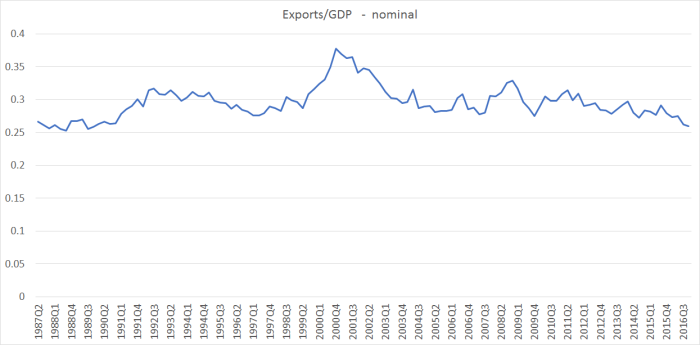
As the statisticians recommend, I prefer to look at ratios of nominal exports to nominal GDP.  There are no deflator problems, just the straight dollar value of what is exported from New Zealand and the dollar value of New Zealand’s GDP.  The trade-off is that there is bit more noise in the series.   Since neither series is mechanically controllable or even directly targetable in a market economy, I don’t think it is much of a loss.  Here is the chart of nominal exports to nominal GDP, again back to 1987.

exports to GDP nominal

Here the fall in global dairy prices does matter, but even then not in a straightforward way. After all, all else equal, when the price of our largest export falls one might expect the exchange rate to fall.   On this measure –  the simplest measure –  exports as a share of GDP are at a level not seen since the very last quarter of the 1980s.  A generation ago.

The Minister of Finance was also at pains to point out that over the last decade or so the pace of growth in world trade has slowed, and that is true (although a significant part of that has been the rebalancing of China’s economy).    So perhaps no one would hold it against him if the progress towards his own 2025 target –  now, as he notes, only eight years away –  was lagging a bit behind expectations.  But on his preferred measure there has been no progress at all.  On the better, if a little more volatile, measure things have been going backwards.     And yet this was the government that once had the ambition of closing the income and productivity gaps to Australia.

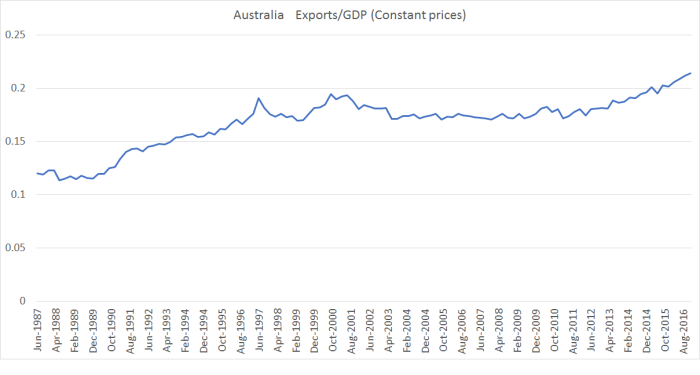
Australia provides an interesting comparison.  Here is the constant price ratio for them (the measure our government prefers for NZ),

aus exports to gdp.png

Historically, Australia had a materially lower export share of GDP than New Zealand – as one would expect in a larger country (where there is more scope for efficient profitable trade within national borders). And for a decade or so their real export share of GDP also went sideways, but for the last few years it has been rising again quite strongly.

They are also affected by changing commodity prices and exchange rates.  But here is the simple chart of nominal exports to nominal GDP.

aus exports to gdp nominal

It hasn’t been rising for some time.  But whereas our export share of GDP is back at 1989 levels, in 1989 Australian exports were about 15 per cent of GDP, now they are about 20 per cent.

That is the sort of change our government needed to be seeing (roughly a one third increase in the export share of GDP) if its 2025 exports target was to be met.   It looks exceedingly implausible at present.  There was no progress under the previous government, and has been none under the current government.  That strongly suggests something wrong with the policies both governments have been pursuing.

I like to think I’m an equal opportunity sceptic.  There is a little sign of the sorts of policies from the current government that will change this picture.  But while it is fine –  and no doubt fun –  to tease the Minister about the failure of his policies, we don’t yet know what policies, if any, Labour and the Greens will advance to have the economy change course, and shift to new higher levels of international trade.  Without something that does that, our prospects for closing sustainably any of the productivity or income gaps are slender to non-existent.

Slashing immigration really is quite easy

There is a story on the excellent new Newsroom site this morning on immigration.  When I printed it out at about 8am, it was running under the headline “Slashing net migration not easy”, although forty minutes later that had been revised to “Few answers to slashing net migration” [UPDATE: by 4:15pm the story is now running as “Slashing migration offers no easy answers”.]    Perhaps reflecting the preferences and presuppositions of the author, the URL for the story reads “immigration to rear its ugly head”, as if somehow there is something wrong with a serious discussion, in election year, about the number, and type, of people we allow to settle (or work) here.    But whether we should or not, if we (New Zealanders collectively) decided to cut back migrant numbers it is really quite easy to do so.  I’ll come back to that.

We are still waiting to see where Labour is going to land on immigration.   The other day housing spokesperson and campaign chair Phil Twyford was talking about what Labour might do on immigration.

Labour’s election chairperson Phil Twyford said Auckland was creaking under the weight of too many people and not enough investment in infrastructure.

and

Mr Twyford said details were still being worked out, but Labour policy would be to find a better balance.

“There is room to ease back particularly in the area of temporary work visas, and the blowout that has occurred in the so-called skilled migrant category.

“We think there’s flexibility there to ease back on the overall levels of immigration and that will take some of the pressure off Auckland.”

And yesterday Andrew Little was also commenting

Little said National had failed to manage immigration, especially by bringing in labourers when there were unemployed labourers here, and by the number of work visas issued.

But he said Labour would manage immigration, not cap it.

Bad as they are, stresses on Auckland –  housing or infrastructure –  aren’t the most compelling economic argument for cutting migrant numbers.  But if Labour is serious about making a difference there, it can’t just involve tweaks at the margin, or things that will affect numbers for just a year or two (since land markets, for example, will trade on expectations of future demand and supply pressures).  I guess we’ll see some details eventually.

What makes me sceptical that Labour’s talk in this area will amount to much is another comment from Andrew Little in the same article.

But asked if he welcomed signs Auckland house prices were falling, Little said no.

I’m sure there all sorts of political considerations about not scaring the (relatively small minority) of people who have taken on very large mortgages in the last few years, but really…….    When house prices in Auckland are ten times income a key marker of whether things are coming right will be a fall in house prices.   If all Little is saying is that prices will ebb and flow a bit, and that nothing structural has yet happened to reverse the inexorable trend rise in price to income ratios, then I agree with him.  But when houses are less affordable than they’ve ever been, we need politicians with the guts to say that they want to see house prices, especially in Auckland, a lot lower.

[UPDATE: In another report of the same interview Little confirms his reluctance to see prices fall    “Having the right number of houses, or closer to it, stabilises prices, it doesn’t collapse prices.”    That stance would be fine, if prices hadn’t got so out of whack over the last few decades. ]

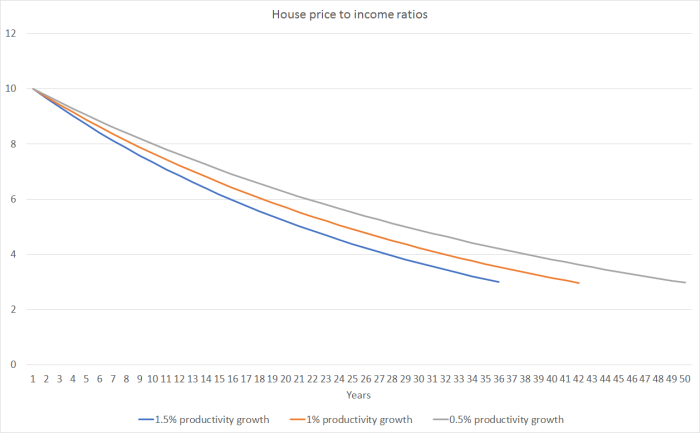
It isn’t as if time will quickly take care of the problem if nominal house prices simply hold at current levels.  We have an inflation target centred on 2 per cent, so over time we can assume incomes will rise by around 2 per cent plus whatever growth in labour productivity the economy can manage.  For the last five years, that has been zero.     Here is what happens to price to income ratios, starting from 10 (around the current Auckland level) on three different productivity scenarios.

price to income scenarios

Depending on how optimistic you are, it could take 40 to 50 years to get house price to income ratios back to around three – the sort of level sustained over long periods in well-functioning US cities (and in many other places before land use regulation became the fashion). Perhaps you are sceptical New Zealand could get back to three. It would take 20 years or more just to get back to five.  That sort of adjustment makes the government’s NZS eligibility reform proposals look positively fast-paced.

But to revert to immigration –  which has the potential to play an important role in accelerating any adjustment that looser land use regulation, and perhaps even new government house building, might set in place –  Newsroom’s Shane Cowlishaw reckons there are few easy ways to cut immigration.    It is mostly quite a good article, made more difficult for the author by the refusal of either the Minister of Immigration or Winston Peters to be interviewed, and the fact that neither Labour nor New Zealand First have published any details of their policy in this area.

But, frankly, I think Cowlishaw’s conclusion is simply wrong.  It isn’t that hard at all, and actually the current government showed that with the baby steps they took last year (cutting the residence approvals target, and –  within that – suspending parent visas, and reducing the family category numbers).

I outlined what I’d do in a post a few weeks ago.   Here it is again, all focused on the bits of the net flow that are about immigration policy, the number of non-citizens we let in to live and work in New Zealand.

  1.  Reducing the residence approvals target from around the current 45000 per annum to, say, 10000 to 15000 per annum.  In per capita terms, that would be about the rate of legal immigration the US has, and would be similar to the rate we had in the 1980s.  Not exactly closing the door, but certainly pulling it over to some extent.
  2. Within that reduced target I would look to focus much more strongly on demonstrably highly skilled people (who offer the best chance of fiscal and productivity gains) and thus would
    • revisit, reduce and potentially eliminate the current Pacific access categories,
    • permanently eliminate parent visas, except (and even then capped) where there is an enforceable, insured, commitment to full financial support from the parent, or their New Zealand citizen child.
    • leave the refugee quota as it is
    • eliminate the additional points provided for job offers in regional areas (a measure that is tending to lower the average quality of the accepted migrants)
    • eliminate additional points for New Zealand specific qualifications,
    • eliminate additional points for jobs in areas of “future growth” or “absolute skill shortage”
    • more strongly differentiate points in favour of higher level qualifications,
    • perhaps establish a category akin to the US visa for those with extraordinary ability
  3. Eliminate the provision allowing foreign students studying here to work 20 hours a week.  If New Zealand tertiary institutions really have a product worth buying –  and some probably do –  they should stand on their own feet, as other exporters are required to.
  4. Reshape the work visa system with a view to (a) reduce the scope for lobbying and influence peddling, (b) reducing the total number of people here on work visas at any one time, and (c) provide much greater flexibility for employers to utilise work visa people for short specific periods in highly-skilled and well-remunerated roles.    Since there would be many fewer residence approvals places open (see above) this path would in any case be much less popular with prospective migrants.   Specific features might include:
    • no one could have a work visa for more than two three year stints
    • use an age-based matrix in which in normal circumstances no work visas might be issued to anyone under 30 for a role paying less than, say, (an inflation-indexed) $75000 per annum, increasing by (say) $25000 in each five year age window up to a cap so that for a person over 50 to get a work visas they would need to be in a role paying $200000 per annum or more.
    • no doubt there would need to be some exceptions to this, and it would not apply to say approvals for roles of less than perhaps three months, but the point is to get the focus not on official judgements of “skill shortages” but on attracting people, if we do, who are capable of commanding high salaries (loose proxy for skill) on market.

I’d also be rethinking (although this isn’t specific) the emphasis in the current points scheme on people who already have New Zealand work experience.  It was a well-intentioned reform –  a reaction against the experience in the 1990s of people coming in who for various reasons simply couldn’t get established in the New Zealand labour market using the sorts of skills/qualifications that got them entry in the first place.    But it has the effect of giving priority to relatively lowly-skilled people who managed to get in on temporary work or student visas, over people with much higher skills and much more potential to add value to New Zealanders over the long haul.

Little or none of these sorts of changes requires complex legislation. For better or worse, the details are mostly at the whim of the Minister or Cabinet.  They would make a substantial difference, and offer the prospect of a sustained reduction in the net inflow of non-citizens (although still lots of year to year variability in the PLT numbers, that include New Zealanders).   They would, among other things:

  • take immediate pressure off the housing market (current and expected future pressures),
  • lead to material downward revision in expected interest rates (possibly actual cuts, but at least pricing out any increases for a long time to come),
  • lead to a material fall in the nominal real and exchange rates, boosting the competitiveness of our struggling tradables sector,
  • force our export education industry to rely on the excellence of its product (or at least some mix of excellence and moderate cost) rather than what I’ve described as “export subsidies” from the immigration system.  Subsidies typically don’t build strong robust, sustainably internationally competitive, industries.  Rarely if ever have, rarely if ever will.
  • we’d strengthen regional economies relative to Auckland (an economy whose productivity growth has been underperforming even relative to that of the whole country),
  • get the government out of the business of picking winners in the labour market, or sectors/skills that somehow need a government hand on the scales to help them out, and,
  • over time, it would be likely to ease pressures holding down the wages of New Zealanders towards the lower end of the skill distribution.

Of course, the immediate response from much of the business sector is “but how will I get workers”.    It is a real and genuine issue for individual firms under current policy settings.   But individual firms simply don’t see the economy as a whole, or the adjustments that would take place across the whole economy if a policy package like the one I’ve outlined above was adopted.

Thus, individual firms treat migrant labour as increased labour supply.  And, for each of them, of course it is.  But migrants add demand as well as supply –  reasonable estimates (and the consistent historical view of New Zealand macroeconomists are that in the short-term the demand effects are stronger than the supply effects.  After all, immigrants have to live somewhere, shop somewhere, work in some building, and few bring their household appliances (etc) with them.  So an individual migrant might indeed ease an individual employer’s labour availability issues –  and if there are lots of migrants in a specific sector, they might even ease those constraints for the sector –  but for the economy as a whole:

  • in the short-term high inward migration exacerbates overall labour shortages in the economy, and
  • in the longer-term, high migration makes little or no difference to overall labour shortages (or, eg, to the unemployment rate).

That is true even if all the typical economist pro-immigration arguments, including those about potential productivity spillovers, hold  (which, of course, I don’t think they have in modern New Zealand).

So what would happen if a government were to announce a package like the one I’ve outlined above?  I’ve already sketched it out at a high level above.  But here is a bit more colour and flavour.

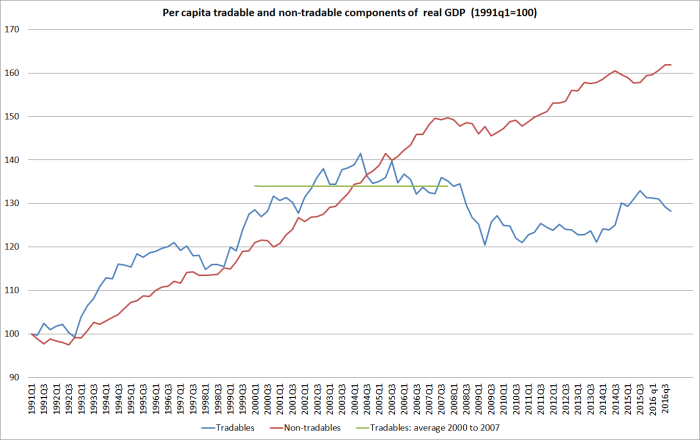
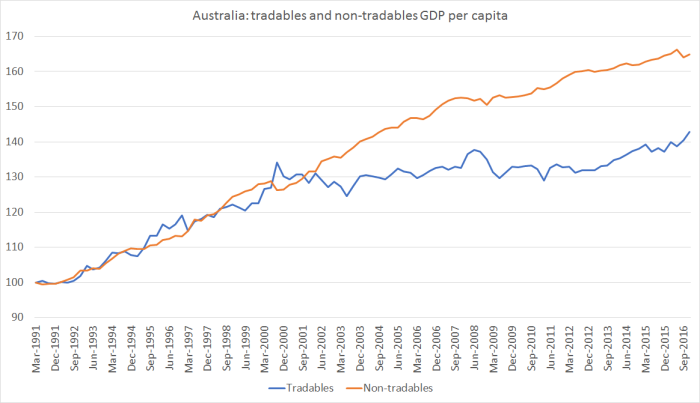
Whole sectors of the New Zealand economy employ many more people than otherwise because our population is growing so rapidly.   Activity in those sector would shrink, perhaps quite materially.   With a population growth rate around zero –  similar to those of many prosperous European countries –  not many people would be required to build new houses and road, and fewer people (for example) would be selling the stuff the stocks new houses (carpets, appliances etc).  Those people would need jobs elsewhere.  The prospect of lower interest rates would make more private investment attractive, but on its own that channel would take a while to work –  after all, overall domestic demand growth would weaken.  But the lower exchange rate –  actual and prospective –  would make a big difference to the competitiveness, and willingness to invest, of the tradables sector.   That investment will usually require workers –  to build it, and to staff it. So resources will shift within the economy.   Dairy farmers who couldn’t get Filipino workers could afford to bid up wages to some extent to attract potential New Zealand workers  (it doesn’t happen overnight, but markets work –  it will happen).  It would certainly be tough for (consumers of ) some domestically-oriented industries that have been heavily reliant on migrant labour (one could think of rest homes) but the whole point of an economic strategy that successfully reorients the economy towards a much more strongly-performing tradables sector is that tradables firms have it better relative to non-tradables firms.  (And non-tradables sector firms typically have pricing power that tradables sector firms don’t.)  It has been the other way round for too long, and we’ve seen the results (in eg, the charts I showed the other day).

Are there losers, even among New Zealanders, from such an approach?  Well, yes, of course.   It is almost impossible to re-orient the economy without there being losers.  Some of the people who will be worse off will be those holding urban land in or around our major cities (especially those who might otherwise have been thinking of selling).  Non-tradables firms often won’t find it attractive –  a business model geared to rapid population growth isn’t going to look so good under a model that no longer seeks to drive up population.  And there would inevitably be some workers in some firms/sectors who might find the adjustment difficult –  as is the case with any structural change, and as was the case as we moved (unconsciously no doubt) to skew the economy away from tradables firms towards non-tradables.

It is easy for economists to wave their hands and suggest big changes in economic structures and policies. It isn’t usually the economists themselves who are affected.  But our current strategy – the grand Think Big population experiment –  just isn’t working.  It wouldn’t be hard to change it, and in my assessment if we were to do so –  along the lines outlined above –  we put the New Zealand economy on a much better footing for sustained growth in productivity and real incomes/material living standards.  We’d also greatly ease those intense near-term stresses –  particularly housing and infrastructure in Auckland –  that rightly grab the headlines.


Possible Reserve Bank reforms: some reactions

Some of the media reaction to talk –  from both the government and the Labour Party –  of possible changes to the Reserve Bank Act  has been a bit surprising.  One leading journalist behind a paywall summed up both the review Steven Joyce has requested and Labour’s proposals as “utter balderdash”, apparently just because there are more important issues politicians should be addressing.  No doubt there are –  housing, the languishing tradables sector, non-existent productivity growth and so on –  but competent governments, backed by a large public service, can usually manage more than one thing at a time.    And although there are plenty of details to debate on Reserve Bank governance, they aren’t exactly divisive ideological issues.   A parliamentary under-secretary or Associate Minister handled most of the details of the 1989 Reserve Bank Act, in a government that did a great deal of other (often more important) stuff.

Bernard Hickey’s story on the government’s review and Labour’s proposals is headed Monetary Policy Reforms a Mirage.     That could be so.  If National is re-elected, they might advance no governance reforms.  Or they might just legislate for something very like the sort of internal committee that, in various shapes and forms, has been the forum in which the Governor made OCR decisions ever since the OCR was introduced.  But apparently at his post-Cabinet press conference, the Prime Minister –  who had rejected earlier Treasury advice in this area in 2012 –  opened up the possibility of a committee not just composed of insiders.

Meanwhile, English hinted Treasury might look at whether a rate-setting committee could include non-Reserve Bank personal. That would be a matter for the review, he said.

Beginning a process of discussing reform options tends to put a range of issues and options on the table.

The sort of decision-making and governance reforms being advanced by Labour and the Greens would be most unlikely to be “simply a mirage”.     There are number of concerns that what Labour is proposing does not go far enough, but again they are probably best seen as the starting point for a more detailed review if/when Labour and the Greens take office.  There is a risk that it could all come to not very much.   After all, even over the last 15 years the Reserve Bank has had a couple of Governor-appointed outsiders involved in the advice and decisionmaking process –  the Prime Minister’s brother is one of them at present –  and that hasn’t made much difference at all.  And requirements to publish minutes/votes can be subverted too.      But that it is why the appointment of the new Governor is so important.  If Labour and Greens are serious about reforming the way the Reserve Bank operates,  then if they become government they need to move quickly to find a person (perhaps a top team) they have confidence in, to work with The Treasury and the government to implement legislative reforms, and to lead the internal process changes to make the new, more open, vision a reality.    If they are serious about greater openness, they need to ensure they have a Governor who shares that reforming vision.   Such a Governor could make a considerable difference even if, for example, the new Monetary Policy Committee (MPC) were to have a majority of executive members.

In some ways, much the same goes for the, less substantively important, proposal to add some sort of full employment aspiration/objective to the statutory goal for monetary policy.    I’ve described it as virtue-signalling, but on reflection that might be slightly unfair.  In the narrow context of the Reserve Bank Act, it is probably about right –  if the Bank has had things a bit tight over the last few years, leaving unemployment higher than it needed to be, then often enough over the life of the Act, the unemployment rate has been below the NAIRU.   Changing the words of section 8 of the Act in isolation won’t make much difference. After all, Australia and the United States have wording Labour prefers, and yet the cyclical behaviour of their economies hasn’t, on average over time, been much different from New Zealand’s.

So I’m sure there is a bit of pure product-differentiation about Labour’s proposal in this regard.  That isn’t unusual. Most changes to the Policy Targets Agreements over the years –  from both sides of politics –  have been more about product differentiation than substance, about scratching itches rather than making much difference to how monetary policy is actually run.  For Labour there is probably is some perceived need to differentiate, and a desire to campaign (and govern?) on a whole-of-government commitment to promoting and facilitating full employment.   That is an unquestionably worthy goal.    If monetary policy choices aren’t going to make very much difference to the medium or long-term rate of unemployment, they can (and have) made quite a difference in the shorter term.  So one way of telling Labour’s story is that they want the word to get out to the public that they are committed to (medium-term) full employment, and they want the public to know that the Bank isn’t in any sense an obstacle to that, and to hear the Bank talking of the importance of the issue.  These are real people’s lives.   I noted yesterday

So the problem typically hasn’t been that the Reserve Bank doesn’t care about unemployment –  although they don’t mention it often, and there is little sense in their rhetoric of visceral horror at waste of lives and resources when unemployment is higher than it needs to be.

They probably should be talking about it more, with conviction.  The legitimacy of independent public agencies depends on part of people believing that those entities have the public interest at heart.  And everyone knows –  central banks acknowledge –  that in the shorter-term their choices do have (sometimes painful) implications for the numbers of people unemployed in New Zealand.  At a bloodless technocratic level, I’ve suggested Labour could amend the Act to require the Bank to regularly report on its estimate of the NAIRU, and how monetary policy is affecting the gap between the actual unemployment rate and the NAIRU.  But this isn’t just a bloodless technocratic concern.

So again, getting the right Governor matters –  someone who will talk convincingly and engagingly as if what they are about affects ordinary people, including those at the margins (vulnerable to unemployment and the resulting dislocation to their lives).

So, from the perspective of both strands of the Labour reform proposal, my concrete suggestion to them is that if they lead a new government after the election, they should quickly pass a one (substantive) clause amendment to the Reserve Bank Act.

Section 40 of the Act at present reads

40 Governor

(1) There shall be a Governor of the Bank who shall be appointed by the Minister on the recommendation of the Board.

(2) The Governor shall be the Chief Executive of the Bank.

Simply deleting “on the recommendation of the Board” would make our practice much more consistent with that in most other countries.  It would remove the controlling influence of a Board appointed entirely by the previous government, and it would allow Labour to have in place to lead the rest of their Reserve Bank reforms, someone of their choosing, someone in whom they have confidence.  That is how other advanced democracies do things.  It isn’t about appointing party hacks –  it is how Janet Yellen, Mark Carney, Ben Bernanke, Glenn Stevens and Phil Lowe were all appointed; capable people who commanded the confidence of the government that appointed them.

(Although it isn’t a priority for me, making this change might actually strengthen the effectiveness of the Bank’s Board in holding the Governor to account.  At present, when the Board (in effect) appoints the Governor they have a strong interest in backing their own judgement, and providing cover for the Governor.   If they were responsible for monitoring the performance of a Governor directly appointed by the Minister, they’d have less vested interest in the individual, and perhaps be more ready to represent the interests of the Minister and of the public).

As I was finishing this post, I noticed a highly critical article on interest.co.nz by Alex Tarrant.  Although he isn’t quoted, it reads in part as if Tarrant has been interviewing his father, Arthur Grimes, one of the designers of the current Reserve Bank Act monetary policy provisions, and former chair of the Reserve Bank Board.   There is a lengthy discussion of time-inconsistency issues –  a regular theme of Grimes’s.    I’m not going to attempt to respond in any detail now, but would just observe that whatever the explanations for the rise of inflation in the 60s and 70s (and I’m not persuaded by the story Tarrant quotes), what Labour seems to be proposing is something not far removed from the sorts of formal wording, and policy rhetoric, routinely used at the Reserve Bank of Australia and the Federal Reserve.  One can debate whether it makes much sense to use such langugage, or whether the formal statutory provisions in those countries make much difference, but it is hard for any detached observer to suggest credibly that the Reserve Bank of Australia or the Federal Reserve have suffered greater difficulties with credibility, or with the willingness of the public and markets to take their words seriously, than the Reserve Bank of New Zealand has faced with the current section 8 wording.   If anything, the Reserve Bank of New Zealand has had rather more problems –  odd experiments like the MCI, and two quickly-reversed tightening cycles in the last decade –  even if those particular mistakes and problems don’t have their roots in the wording of section 8.  And unlike other inflation targeting countries, there has never been an election since the Act was introduced in which some party or other (and not just the remnants of Social Credit) has not been campaigning for changes to the Reserve Bank Act or the PTA.  You don’t find anything like it in other inflation targeting countries.

Grant Robertson made my day

In an address at Victoria University at lunchtime, Labour’s finance spokesperson Grant Robertson launched his party’s monetary policy reform programme.   In an interesting move, the incoming Acting Governor, Grant Spencer, who would have to manage (for the Bank) the early stages of Robertson’s reform process if Labour leads the new government, attended, sitting very visibly in the front row.

The two main aspects of Labour’s proposal are:

  • broadening the objective from just price stability “to also include a commitment to full employment”
  • changing the decision-making structure for monetary policy, so that a committee would have legislated responsibility.  That committee would comprise four internals (including the Governor) and three external experts who would be appointed by the Governor (but in consultation with the Minister of Finance).

Labour would also require the Bank to release the minutes of the Monetary Policy Committee, including the results of any votes, within three weeks of the relevant OCR decision being announced.

I was interested to note a press release from the Greens in which they state

Labour plans to change the way we do monetary policy in New Zealand and the Green Party supports them fully. We’re now of a single mind on this.

The Greens have previously favoured the Reserve Bank Board –  whose members are mostly non-experts –  making OCR decisions, so I’m not clear if the “single mind” James Shaw refers to extends to that level of detail, or just to a shared commitment to (a) reform, and (b) a decision-making committee that would involve non-executive outsiders.

Bill Rosenberg of the CTU and I were discussants following Robertson’s address.   I wrote this morning a fuller version than I could use of my thoughts on the Labour proposal.

Reflections on Grant Robertson on the RB VUW 10 April 2017

I opened observing that when I got an outline late last week of what Robertson was going to say, I had blurted out that “Grant Robertson has just made my day”.  I’ve been arguing for governance reform for at least 15 years, and between the report the Minister of Finance has commissioned, and the shared commitment to reform of the Greens and now Labour, it looks as though change might finally happen.   There was a certain logic to the current single decision-maker system in 1989, but if it had a logic then –  in how we understood monetary policy, and the nature of the Bank’s functions –  it simply looks wrong today.  Other countries don’t do things that way.  We don’t either in other areas of public life.

What I’m most encouraged by is the commitment to involve outsiders, not just to cement-in a position for insiders.  Having said that,  I raised two main areas of concern:

  • the first is the Robertson proposal that the Governor should continue to be (in effect) appointed by the Board (in turn appointed by the current government), and that all the other voting members (inside and out) would be appointed by the Governor.  He qualifies this by noting that these appointments would be made in consultation with the Minister of Finance.    But that is a recipe that risks the Governor surrounding him or herself, deliberately or unconsciously, with people who think like the Governor, and will be reluctant to challenge the Governor too much.   The Minister might raise a few questions about a proposed appointee, but will be reluctant to second guess the Governor, and cannnot overrule him in this model.   Frankly, it is a model with a yawning democratic chasm and not a model I’m aware of being used in any other country.  It is one thing to delegate operational decisions to independent boards, but the members of those Boards should be appointed by those whom we elect –  ministers –  and whom we can toss out.
  • the second concern is that under the proposed model there would be four insiders and three outsiders.  That is the wrong way round, and most likely would be a recipe for the marginalisation of the outsiders (since the insiders have no independent status, and all work for, and have their pay etc set by the Governor, they can easily caucus and out-vote the externals).   I’d prefer two internals and three externals, all directly appointed by the Minister of Finance.

In response, Robertson noted that he was open to looking again at the ministerial appointment option.  He noted that it was awkward as putative Minister to be talking of giving himself such extensive appointment powers.  Perhaps, but that is the way most public sector boards work.  If he wants Labour precedent, Gordon Brown introduced the Bank of England statutory Monetary Policy Committee, to which the Chancellor appoints most of the members directly, and has to be consulted on the remaining two.

Robertson explained that he preferred to keep a majority of insiders because one of his priorities was to preserve the operational independence of the Bank. I was, and am, puzzled by that response. I noted to him that the RBA has a substantial majority of outsiders on its decision-making Board, and that they had operational independence.  The same goes for Sweden’s Riksbank.  I’m less optimistic about a re-think there, as Robertson also stated that he did not envisage allowing MPC members to make speeches or comments on monetary policy without the explicit prior consent of the Governor.  It seems he still has in mind an excessively Governor-dominated institution, and one in which it would be hard to ensure transparecny and the regular injection of fresh perspectives and alternative views.  If so, that would be unfortunate.

I noted some unease about his proposal that all the external appointees would be “expert”, and perhaps had that concern somewhat allayed when he stressed that in this context he did not intend “expert” to mean simply a narrow expert in specific aspects of monetary economics or the like.

My other main observation in this area is that the Labour proposal (deliberately and consciously) does not yet address the governance and decisionmaking for the Bank’s extensive financial regulatory functions.

But the most important omission seems to me to be the governance provisions for the Reserve Bank’s extensive financial stability and regulatory functions, under various different pieces of legislation.   There is no precedent anywhere for so much regulatory power to be in one person’s hands.  It wasn’t even an outcome that was consciously deliberated on by Parliament –  rather it grew up with a succession of amendments to the Act, and changes in regulatory philosophy over the years. And whereas a regulating Cabinet minister can be reshuffled or dumped whenever the Prime Minister chooses, a Governor of the Reserve Bank is secure for five years.

If individuals matter in monetary policy, even with something like the PTA, they are likely to matter hugely in the financial regulatory area, where there is nothing like the PTA to constrain or guide the Bank/Governor.  The economic impact of regulatory choices can be as large –  if less visible –  than those around monetary policy.  I really hope that Labour will be thinking hard about how to extend their governance reform ideas into the financial regulatory field.  Personally I think there should be three strands to that:

  • Removing some of the high level policy-setting power back to the Minister of Finance (so that the RB applies the rules etc and mostly doesn’t make the high level rules),
  • Move responsibility for the various pieces of legislation out of the Reserve Bank, probably to Treasury. This matter is already being touched in the Rennie review commissioned by the current Minister of Finance, and
  • Establishing a Financial Policy Committee, paralleling the Monetary Policy Committee, as the entity empowered to exercise whatever policymaking powers reside with the Reserve Bank. Again, a five-person committee (Governor, Deputy Governor, and three externals seems like a feasible solution).  The FPC would also be responsible for Financial Stability Reports.

Robertson acknowledged the deliberate omission and talked of it being “part of the conversation” moving forward.  I hope so.    This is the opportunity for a full overhaul of the governance model, not just tacking on an MPC to a model that doesn’t work that well in other areas either.

The other half of the address was about the idea of adding full employment to the goals for monetary policy.  I was (and am) much more sceptical, and nothing that was said in response to questions really clarified things much.    I get that full employment is an historical aspiration of the labour movement, and one that the Labour Party wants to make quite a lot of this year.  In many respects I applaud that.  I’m often surprised by how little outrage there is that one in 20 of our labour force, ready to start work straight away, is unemployed.  That is about two years per person over a 45 year working life.  Two years……     How many readers of this blog envisage anything like that for themselves or their kids?

But still the question is one of what the role of monetary policy is in all this, over and above what is already implied by inflation targeting (ie when core inflation is persistently  below target then even on its own current terms monetary policy hasn’t been well run, and a looser monetary policy would have brought the unemployment rate closer to the NAIRU (probably now not much above 4 per cent)).

I noted that I’m sceptical that the wording of section 8 of the RB Act is much to blame.  After all, for several years prior to the recession, our unemployment rate was not just one of the lowest in the OECD, it was also below any NAIRU estimates.  And when I checked this morning, I found that our unemployment rate this century has averaged lower than those of Australia, Canada, the US and the UK, and our legislation hasn’t changed in that times.  Robertson often cites Australia and the US.

The last few years haven’t been so good relatively speaking.  But if the legislation hasn’t changed and the (relative) outcomes have, that suggests it is the people in the institution who made a mistake –  they used the wrong mental model and were slow to recognise their error and respond to it.  Getting the right people, and a well-functioning organisation, is probably more important than tweaking section 8.

Robertson disputed my past characterisation (as “virtue signalling”) of his talk of adding a full employment objective.  But I still don’t see in what way I am wrong in that description.  It would send a single to key constituencies that Labour “feels the pain” and has an integrated commitment to advancing full employment, but what difference would it make to the Governor and his committee?  There wouldn’t be a numerical definition of full employment in the PTA, and since Robertson remains committed to the accountability framework of the Act, it is very hard to see how or why any given Governor would react much differently given a specific inflation target and a vague injunction to promote “full employment”.  A different Governor might make a difference –  hence, choose carefully –  but that sort of wording is unlikely to.

If they form a government later in the year, Labour (and the Greens) clearly will need to add some words to the PTA.  I drew the attention of those present to the 1950 amendment to the Reserve Bank Act, under which

[The Bank] shall do all such things within the limits of its powers as it deems necessary or desirable to promote and safeguard a stable internal price level and the highest degree of production, trade, and employment that can be achieved by monetary action.

I quite like it (and not just because a relative of mine was the responsible Minister of Finance).  It recognises that monetary policy doesn’t exist in a vacuum, and that people (voters and politicians) care about other stuff.  In fact we don’t pursue price stability simply for its own sake, but for a better life for New Zealanders. But note the key phrase  “the highest degree of…employment that can be achieved by monetary action”.  That might not be much, at least once the unemployment rate is back near the NAIRU.

As today’s chair –  economic historian Gary Hawke –  noted the 1950 change was largely about signalling too, and it isn’t obvous it made an awfully large difference to actual monetary policy.  But that was my point.  If you want words –  or signals – it is easy enough to craft elegant formulations that express those aspirations, and even articulate a place for monetary policy in overall economic management. It is a quite different thing to expect a central bank, however governed, with a single instrument capable only of affecting nominal variables in the longer-run, to make much material difference over time in achieving the wider –  and laudable –  government goal of full employment.

Politically, it doesn’t help at all to make that distinction.  But analytically it looks pretty clear.  Well-crafted words –  a modern version of that 1950 formulation –  would do no harm, and I’d have no real problem  with them, but they won’t make much substantive difference either. But sometimes, I guess, symbols matter quite a lot.

A leading academic weighs in on immigration

When the head of the economics department of New Zealand’s leading university takes to the op-ed pages of New Zealand’s most widely-circulated newspaper, readers might reasonably suppose that what the author has to say will be authoritative and well-worth reading for anyone interested in the issues upon which the author is opining.

Last Thursday, Professor Ananish Chaudhuri, head of the economics department at the University of Auckland, had a piece in the Herald headed Immigrants are a gain, not a drain .

Chaudhuri’s own background isn’t in the economics of immigration, nor is he an expert in issues around productivity, economic geography, or New Zealand’s economic history of sustained underperformance.   He is, as the article notes, professor of experimental economics.  I’ve only heard him speak once, and found his work fascinating.  You can check out his list of publications here.  He seems to be highly-regarded in his own specialist areas, and as an immigrant himself one might safely conclude he has been a net (economic) gain to New Zealand.

I’m not holding against him the fact that he isn’t an academic specialist in the economics of immigration and in New Zealand’s economic history and performance.  Few people (arguably none) are.  Ideas should stand on their merits, not on the CVs of those holding them.   But lay readers, attracted by the title “head of economics department, University of Auckland”, might have assumed a degree of specialist expertise that doesn’t seem to be there.

Chaudhuri’s op-ed has three main strands, before concluding with an astonishing assertion.

He begins with a bit of a rant against Donald Trump and somehow manages to wrap in, as part of a single phenomenon, the recent decision to deport some Indian students whose applications for student visas –  many no doubt hoping to use that as a stepping stone to residence –  were based on demonstrably, and admitted, false information.  They (signed statements which) lied.    One might, or might not, have some sympathy with them as individuals, but whatever one thinks about the appropriate levels of immigration to New Zealand (a) people are more likely to have confidence in it when the rules, whatever they are, are enforced, and (b) there are few defenders of the rort the student visa system had become over the last few years, often aided and encouraged by a government keen to maintain a story about the success of the export education industry.    We could sell more of almost anything if there were points towards a residence offered as well.  That is how export subsidies work.  They were a bad idea in the 1970s, and they are a bad idea now.

But what of the substance?

His first question is “are immigrants a drain on the economy”.     His answer to that question is no, and to do so he relies exclusively on the BERL estimate of the differential impact on (a portion of) government finances of natives and immigrants.    Nigel Latta made a TV documentary on immigration last year that relied wholly on the same study –  and if that was questionable (and I questioned it here) at least he wasn’t an economist.

As even the authors of the BERL study noted

2. The study concentrates on fiscal rather than economic impacts. Due to this the study is limited to estimating the direct monetary impacts on the government’s operating budget.

Fiscal impacts can be interesting, if done well, but they don’t tell us –  can’t tell us, aren’t designed to tell us –  whether natives are made better off, worse off, or left largely unchanged –  by the sort of level/composition of non-citizen immigration we’ve had.

As it is, the BERL study covered only some parts of the government’s finances, and the bits they omitted –  not through bias, but because they are hard –  would be likely to change materially even the fiscal assessment, as would a full intergenerational approach to the issue (again, BERL was not paid to do something state of the art).   For anyone who wants to look at some of the problems  with the fiscal estimates, I wrote about some of them in one of my posts responding to the New Zealand Initiative’s recent immigration paper.  As I noted, even if the average migrant is a net fiscal gain –  which is plausible –  it is very unlikely that all classes of migrants are.

In short, Chaudhuri offered readers nothing shedding light on whether New Zealanders’ living standards, or the productivity of the New Zealand economy, have been improved by our immigration programme.

Chaudhuri’s second question is “do immigrants displace native workers”.  Actually, on this point he went further than I would have, noting “yes to an extent”.     But after only a handful of words on immigration effects, he devotes the rest of that section of his article to discussing some interesting material on other forces that might (globally) be “driving blue-collar wages downwards”.  That may very well all be true, and even important, but what we were promised was an economic analysis of immigration (presumably focused on New Zealand), and it just isn’t there.

His third question is “do immigrants fail to assimilate”.  In his view “arguments about assimilation are usually a cover for aversion to ethnic diversity, so it is difficult to provide a cogent counter-argument”.  In other words, “back in your box racists”.  He seems unaware of, or uninterested in, literature on trust, national identity, social cohesion or any of the range of conflicting evidence on the implications of different types of diversity.  Perhaps he could walk down the road and have a chat with AUT academic Bart Frijns, whose work I wrote about here last year.   Issues around assimilation aren’t my focus, but there are reasonable debates to be had.

As he gets towards the end of his column, Chaudhuri offers quite a balanced perspective.

There is no doubt that while immigration increases the size of the national pie, it does create winners and losers. For workers suffering from stagnating wages, the sense of displacement and disillusionment is real.

So even on Chaudhuri’s assessment, it isn’t all a rosy story.  All else equal, some natives are being made worse off.    But apparently it doesn’t really matter, because the learned professor knows that….

…the bottom-line is clear: The net gain to society from immigration outweighs the losses and, therefore, there must be ways of providing a safety net for displaced workers in a way that makes all of us better off.

But no shred of evidence – global, let alone anything specific to New Zealand – was offered in the entire column to show that there are overall gains.  One might guess that he is relying on some general international academic pro-immigration consensus, but he shows no sign of having engaged with the specifics of the New Zealand experience, past and present, at all.    (And, for what it is worth, he also offers no specifics on these redistributive measures that might help ensure that even the “losers” actually end up made better off.  That isn’t surprising, as I’m not aware of any advanced economy where such measures have been put in place.)

Chaudhuri then wraps up with an astonishing claim

In the meantime and leaving cultural arguments aside, those who suggest immigrants are a net drain on society in economic terms are purveying “alternative facts” that should not be part of informed discussion.

Wow, so no debate should be entered into because the learned professor has decreed  –  not even argued, or demonstrated,  but just decreed –  that the economic case is closed.  Economies benefit, New Zealand’s economy benefits, and any suggest to the contrary is right up there with Trumpian claims about numbers in the Inauguration parade.   I disagree with the people at the New Zealand Initiative on immigration, but they weren’t that dogmatic –  and were pretty open about the lack of New Zealand specific empirical studies on the overall contribution of immigration policy to New Zealand’s economic and productivity performance. For them, the conclusion that New Zealanders’ benefit was a judgement –  probably held strongly, but an informed judgement nonetheless.  It wasn’t revealed truth, into which no subsequent debate could be tolerated

When the 27 prominent New Zealanders came out the other day with their open letter on free speech, I didn’t pay much attention. I was generally sympathetic, but in my observation the issue of attempts to close down debate (on all manner of topics) seem to be becoming a serious issue in the US (especially in academe) but not, at present, in New Zealand.  If one takes him at his word, Chaudhuri seems keen on having New Zealand catch up down that slippery slope.   I hope I shouldn’t take him at his word, and he is more open to debate –  specific debate, concentrated on New Zealand’s experience, and New Zealand’s programme –  than his op-ed suggested.  Perhaps the Herald could offer him another column, in which this time he could get specific about the nature of the evidence he believes –  as head of the economics department of our leading university –  makes it such an open and shut case that New Zealanders as a whole are reaping economic rewards with our huge decades-long grand immigration experiment?

Joyce requests review of Reserve Bank governance structure

Some will have seen Hamish Rutherford’s Stuff article reporting on the review the Minister of Finance has commissioned (to be undertaken by former State Services Commissioner, and former Treasury deputy secretary  responsible for macroeconomics,) Iain Rennie) on two aspects of Reserve Bank governance:

  • whether something like the existing internal committee in which the Governor makes his OCR decisions should be formalised in legislation, and
  • whether the Reserve Bank should remain the “owner” of the various pieces of legislation (RB Act, as well as the insurance and non-bank legislation) it operates under.

This is very welcome news.  As I noted in a post a couple of months ago on governance issues,  Steven Joyce has previously been on-record less averse than some to changing the model.


Who knows if the new Minister of Finance is interested, but flicking through some old posts, I was encouraged to find one from September 2015, reporting an exchange in the House between then Associate Minister of Finance Steven Joyce and the Greens then finance spokesperson Julie Anne Genter.  In response to a question on governance, Joyce responded

Hon STEVEN JOYCE : The suggestion that the member makes, of having a panel of people making the decision, is, I have to say, not the silliest suggestion in monetary policy we have heard from the Greens over the years, and many countries—

A backhanded dig at the Greens at one level, but not an outright dismissal by any means.

And with the Governor confirming that he is leaving in September, and a year now until a permanent new Governor is in place, it is good time to have such a review, so as to be open to the possibility of reform, including in discussion with potential candidates for Governor.   Treasury tried to interest the previous Minister of Finance in legislative reform before Graeme Wheeler was appointed, but were knocked back (even though Treasury had found support for reform from market economists).   Graeme Wheeler also sought to initiate reform –  legislating for his Governning Committee –  in 2013 (although he still keeps all the relevant papers hush-hush), and was also knocked back by the Minister of Finance.  So, I’m encouraged that Steven Joyce has initiated the review.

That said, it is a pretty small step.  Iain Rennie will bring some relevant background to the issue, although his track record as State Services Commissioner might not command much confidence in circles other than those who appointed him.  And the Minister of Finance is not committing the National Party to supporting change.  But with almost all other political parties favouring change, and Rennie likely to point out the simple fact that no other New Zealand public sector entity is governed the way the Reserve Bank is (all power formally in one official’s hands), and no other central bank and financial regulatory agency in other advanced countries puts so much power (monetary policy and banking etc regulation) in one person’s hand, it is likely to set in place momentum leading towards some legislative reform next year.

I spoke to Rutherford about this yesterday and am quoted in the article

Michael Reddell, a former special advisor to the Reserve Bank who says he sat on a committee on OCR decisions for 20 years, said formalising the current structure would make only a marginal difference, as the members all reported to the governor.

“If your pay and rations are determined by the governor, then the extent that you’re willing to stand up is questionable, particularly to a tyrannical governor,” Reddell said.

“If the minister [of finance] were appointing the people on the committee, it would be a material step forward.”

All three Governors who have operated under the current legislation have operated pretty collegially.  For a long time, the OCR Advisory Group (OCRAG) was the forum in which the Governor took formal written advice and recommendation, and then made his decision (I was part of that group for a long time).  Mostly his decision was in line with the (usually) clear-cut majorities of advice.  All members of that committee were appointed by the Governor, including two external advisers.   The current Governor has put in another layer of hierarchy, taking advice from a wider group and then making his decision in a smaller group (him, his two deputies and the chief economist).

I should stress that the reference to “tyrannical” Governors was not intended as a reflection on anyone who has served as Governor.    But you need to design institutions around poor or insecure Governors: good ones will want, and will encourage, debate and alternative perspectives.  Poor ones will squash it, and if they control all the members of the statutory committee, it offers little or no protection  –  and actually puts monetary policy decisionmakers at a further remove from the voters and Minister of Finance.   As I’ve argued previously, we need more involvement of the Minister in appointing monetary policy (and financial regulation) decisionmakers, and also need external perspectives brought into the process, in the form of full formal participation in the decisionmaking.  As, for example, it is in Australia, Canada, the UK, the US, Sweden and so on.

Rutherford’s report doesn’t say whether the Rennie review will also look at the formal decisionmaking structure for financial regulation.  Those issues will have to be considered in any legislative reform, and it is probably more important to get collective and external decisionmaking processes formalised, since in these areas the Bank does not operate to something like the PTA, but rather exercises huge amounts of barely-fettered discretion.

The second half of the review –  looking at whether the Bank should stay responsible for its legislation – is not one of the (long list) of reform issues I’ve focused on.  It will probably have many people at the Reserve Bank spitting tacks, and looking at all sorts of bureaucratic tactics to retain something as close as possible to the status quo.  I favour change (but will openly acknowledge that until perhaps the last five years I had the same insider hubris that affects many RBers –  a belief that “we are different” and no one else in positioned to do the legislation-ownership role well).  That is simply wrong –  and if the expertise isn’t there right now, it could be developed over time (probably in Treasury) without too much difficulty.  Again, it would bring the Reserve Bank into line with other Crown entity types of bodies, few (if any) of which are now responsible for their own legislation (altho in years gone by some important ones –  eg ACC – were).  It might seem to many readers like an “inside the Beltway” issues, that doesn’t really matter to citizens.  That would be a mistaken view.  Reform in this area is just one part of the overall agenda to improve the accountability of the now very-powerful Reserve Bank, and bring its goverance more into line with that for other Crown agencies, and with central banks and financial regulatory agencies abroad.

And so for the second time this week, I commend Steven Joyce.  It is only an unambitious start, but the start matters.


Tradables sectors in New Zealand and Australia

I have to spend the morning on the gruesome business of trying to make progress in unpicking 20 years of mismanagement of the Reserve Bank pension fund, dating back in some cases almost 30 years.  So this morning’s post will be short.

First, the latest update of my quarterly chart of real per capita tradables and non-tradables GDP.  Regular readers will recall that this is a rather rough proxy –  first developed by the IMF when they were highlighting New Zealand imbalances more than a decade ago.   For these purposes, the tradables sector is the primary and manufacturing components of production GDP, plus the exports of services from expenditure GDP.   The rest of GDP is treated as non-tradables.  Both series are indexed to 100 in the first quarter of 1991, which is when the official quarterly population series begins.

T and NT components NZ to Dec qtr 16

It isn’t a pretty picture.  There has been no growth in real per capita tradables sector GDP (on this proxy) for 17 years.   The peak in the series was in 2004, and if anything it has been trending down since then.  A year or two ago, it looked as though some sort of rebound was underway –  all those tourists and foreign students –  but even some of that growth has been reversed in the last few quarters.  Successful economies –  ones that catch up with the leaders, which record strong productivity growth –  tend to be those with relatively fast-growing exports, and strongly-performing tradables sectors.   A reasonable interpretation of what has gone on is that whatever factors led to the exchange rate being so persistently high –  since around 2003/04 –  will have accounted for the weak tradables sector performance.

Once upon a time, while I was at Treasury, we had someone do similar charts for a wide range of OECD countries.  I’ve only done one for Australia.  Here is what it looks like –  same definition,  based to the same date as the New Zealand one, and on the same scale.

Aus T and NT to Dec 16

Australia didn’t see much growth in real per capita tradables sector output over the 2000s.   In a way, that wasn’t surprising.  They had a huge terms of trade boom, which gave them more income to spend, without needing to produce any more tradables to sell abroad.  And they also had a massive business investment boom –  increasing future production capacity in the minerals sector –  which will have squeezed out tradables sector production during the investment phase.   But over the last five years, growth in real per capita tradables GDP has resumed again – even growing a bit faster than the non-tradables sector.   Perhaps (but only perhaps) there is some connection with the divergent labour productivity performance in the two economies in recent years.

real gdp phw dec 16 release

And for anyone wondering if the performance in the 1990s, when tradables and non-tradables production more or less kept pace, was unusual, in Australia (but not in New Zealand) there is the data to do the tradables/non-tradables GDP chart all the way back to the mid 1970s.  Here it is.

aus t and nt to 74

The sort of pattern we’ve seen –  17 years of no per capita growth in the tradables sector –  doesn’t look like the sort of feature one expects in a successful economy, poised to catch up with the rest of world, reversing decades of relative decline.  Sadly, of course, New Zealand hasn’t been such an economy.  On current policies, there is little reason to expect anything very different in the foreseeable future.

Appointing an Acting Governor: what the documents show

I had an email the other day suggesting that I should reduce my coverage of Reserve Bank issues.  No doubt the topic isn’t that interesting to that particular reader, but the main criterion for coverage here is what I’m interested in, and as I noted in response I’m interested in Reserve Bank issues, know something about them, and am fortunate to be much less constrained in what I can say than many other economists (often employed by entities the Reserve Bank regulates).   (As it happens, for any Wellington readers interested in monetary policy issues, I will be speaking briefly as a discussant responding to a presentation by Grant Robertson at Victoria University next Monday lunchtime.)

Which is by way of introducing a post which may not be of great interest to some readers.

For much of the time this blog has been running I had been pointing out, every few months, that the Governor’s term was due to expire almost three years to the day since the last election, and thus any replacement would normally be taking up the role right in the middle of a possible change of government.   As the Governor is the most powerful unelected public official in New Zealand, and there is currently no political consensus on monetary policy and Bank issues, it seemed inappropriate for the current government to be making an appointment to take effect just around the time of the election, materially tying the hands of a possible alternative government.     I’d suggested asking the current Governor, Graeme Wheeler, to stay on for, say, one more year (it was widely understood that Wheeler was not seeking a second full term).     There would have been no doubt about the lawfulness of that option, and had he been offered and accepted such an extension there would have been a new Policy Targets Agreement signed, as the Act provides.  Ever since 1990, the PTA has been the centrepiece of monetary policy arrangements in New Zealand, and the benchmark against which the Governor’s performance is to be assessed.

On 7 February, the Minister of Finance announced that (a) Graeme Wheeler would leave office at the end of his term, and (b) that because of the election the current Deputy Governor Grant Spencer would be appointed acting Governor for six months, allowing a permanent appointment to be made under whichever government takes office after the election.  It was also confirmed that Spencer would not seek appointment as permanent Governor.

In my post that day I welcomed the fact that the Board and the Minister had recognised the significance of the issue around the election, and raised no concerns about Spencer personally (he was my boss for two periods earlier in my career and I always got on well with him).   But I raised questions about whether such an appointment was lawful, under the terms of the Reserve Bank Act.

The Act allows for the appointment of an acting Governor –  and it has been done once before, when Don Brash resigned with immediate effect to go into politics –  but it appeared to provide for such an appointment only to cover a vacancy that arises during a Governor’s term, not to allow the Minister and Board to delay making a substantive appointment at the end of a Governor’s term (such an option would increase potential  political leverage over the Bank).     Consistent with that reading of the law is (a) that the Act makes no provision for agreeing a PTA with an Acting Governor (in a case like that when Rod Carr temporarily replaced Don Brash there was already a PTA is place –  which there will not legally be once Graeme Wheeler leaves office) and (b) that the PTA plays such a central role in the governance provisions around monetary policy (even in the event of a ministerial override of the Bank, a new PTA still needs to be put in place quickly.    But, technically, Grant Spencer will be conducting monetary policy with no PTA, and thus no (formal) checks and balances.

I was curious about (a) how this appointment came to be, and (b) how confident officials and ministers were of their legal ground.  So I lodged OIA requests with the Bank’s Board, with the Minister of Finance, and with the Treasury.   I didn’t really expect them to release the legal advice each agency might have obtained (although the Ombudsman has made clear that legal advice is not always absolutely protected, and (eg) this isn’t a matter of contractural dispute etc) but I assumed that the insights from that advice would be reflected in the policy advice and analysis that officials provided.

The Reserve Bank was about as obstructive as ever.   It took them seven weeks to release a single two paragraph document, the short letter from the Board chair to the Minister recommending the appointment of Spencer as Acting Governor.     There is no mention at all in that letter of the legal issues, not even a specific reference to the provision of the Act governing acting Governor appointments.  Clearly, and perhaps not unexpectedly, a lot else had been going on behind the scenes.

I had asked for

copies of all papers of the Reserve Bank Board relating to the end of Graeme Wheeler’s term as Governor, the process for appointing a permanent replacement, and the appointment of Grant Spencer as acting Governor.   This request includes papers on the Board’s agenda, minutes of relevant discussions, papers/letters sent to the Minister of Finance or Treasury, and filenotes of any relevant meetings.

The Board’s response suggested that the only other relevant material was (a) some advice from the Bank’s Human Resources, and (b) some internal legal advice.

It is simply incredible that there are no minutes of the Board meeting (even if it was just a teleconference) at which they made the recommendation to the Minister of Finance, and highly unlikely (as we shall see) that there are no minutes of earlier discussions, or even email filenotes of discussions that, for example, the Board chair might have had with the Minister of Finance on the forthcoming appointment.    If any of this is written down, it was covered by my request.  And if it is not written down, it might be operationally smart in the short-term (bureaucrats often say to each other, “be careful what you put in writing”) but it is particularly poor governance.  Both the head of the Prime Minister’s Department and the Ombudsman have been explicit that the provisions of the Official Information Act don’t justify taking a slapdash approach to documenting advice, decisions etc.

As I’ve come to expect, there was a much more helpful and fuller response from the Treasury.  It took some time, but there was 63 pages of material.    They haven’t yet put the response on their website – I’ll link to it when they do, and if anyone wants the material sooner just email me.  (Link to the released documents.)

I won’t bore readers by attempting to step through every paper, but what is clear is how late in the piece the decision was made to go the Acting Governor route, and that credit for that decision goes to the new Minister of Finance Steven Joyce.

The first papers are from August last year.  At that point, Treasury was aware that the expiry of the Governor’s term would fall in the period not far from the likely date of the 2017 election.  They didn’t seem to see the issue as a substantive one, and advised the Secretary to the Treasury that it might just mean that the appointment of a new Governor should be announced quite early (eg May 2017), which  in turn would mean the Board would have to begin the search process relatively early.

A month or so later they were specifically highlighting the convention under which governments are quite restrained in making significant appointments in the three months prior to the election. By this time, it is clear from the documents that the Bank’s Board was already actively planning their search and recommendation process.  Treasury note that it would be desirable to have an appointment announced by the end of May, but to do that a recommendation from the Board would have to be available by early-mid April, but “their current timeframe is to provide a recommendation to the Minister in May”.

By mid November, Treasury had taken formal advice from Cabinet Office, whose “legal and constitutional adviser” informed them that simply announcing an appointment early would not get around the pre-election conventions.  What mattered was the effective date of the appointment, not when it was announced.    That prompted an approach to staff in the Minister’s office highlighting the potential problem.  They note that one way around it would be to extend the current Governor’s term, or appoint an acting Governor for six months, but there is no discussion of whether the Act really allows for that latter option. (The other option was simply to barge ahead and make an appointment anyway, with or without consultation with opposition parties).

On 29 November, the Minister of Finance (still Bill English) held a meeting with Neil Quigley, chair of the Reserve Bank Board.  Treasury provided a briefing note.  It noted that “the Board is running the process….we understand that the recommended candidate for your consideration will be provided in May 2017” but flagged the issue around the pre-election period, and noted the possible options (as above).  Suggesting that they still hadn’t looked that carefully at the details of the legislation, they advised the Minister that a new PTA would be required, even if an acting Governor was appointed.

Among the documents is a note for the new Minister of Finance, which was in the end not sent.  But it states that “the previous Minister of Finance met with Professor Quigley on 29 November 2016 and indicated comfort with the Board continuing their appointment process as outlined to him”, and noted that Treasury had no further advice planned on this appointment.

Things seemed to move quite quickly from late December.  In a 20 December note to Gabs Makhlouf, staff pass on reactions to the news that “Hon. Joyce might look to delay the appointment of a new RBNZ Governor until after the election”

Staff themselves remain “neutral” about such an approach –  it is not at all clear what credible alternatives they saw there as being –  but noted the need to engage the Board quite quickly, noting “the Board’s original plan was to put out a job advertisement in late January, the Board has already engaged headhunters, and the previous Minister had signalled a preference for proceeding to appoint a new Governor next year”.

Christmas holidays intervene, and the next paper is a briefing for the Minister in advance of a 20 January meeting with Neil Quigley, which again notes the options of extending the current Governor’s term or appointing an acting Governor for six months (again, incorrectly noting that either option would require a new PTA).  Even at that meeting, the Minister does not appear to have communicated a decision, as there is then a (not very informative) note suggesting another discussion on the issue with Treasury officials on 24 January.   Only by 1 February is there a formal Treasury report providing the information to facilitate the Minister’s preference to appoint Grant Spencer as Acting Governor (which, according to the paper, had not yet been discussed between Spencer and the Minister).  Only at this point is Treasury uncertain about the PTA position, noting that they were seeking Crown Law advice.

It all went to Cabinet on 7 February –  with no hint of any issue as to whether an acting Governor could legally be appointed –  and was announced later that day.

I’m not usually a big fan of Steven Joyce, but as far as I can tell from these papers (and a very similar set I got from his office) he is the only one to emerge from this process deserving credit.  The Bank’s Board had seemed to see no problem at all in making an appointment pre-election to take office in the midst of a possible change of government.  The Treasury didn’t either –  they would have been happy, if they could, simply to have had an appointment announced early.  And as late as the end of November, the then Minister of Finance (now Prime Minister) was apparently happy to carry on towards appointing the most powerful public official to take office just (as it turns out) a few days after the election.    It was only very late in the piece that Treasury realised that there was no provision for a PTA with an acting Governor (Crown Law presumably confirmed that, as there will be no PTA with Spencer) and there is no sign that any officials ever seriously considered whether an acting Governor appointment was strictly legal.

But shortly after taking office, Joyce seemed to cut through most of this, eventually presumably instructing/requesting the Board not to proceed with the planned process that had already begun, and instead to recommend him an acting Governor appointee.   In a sense (whatever the formal legalities) they were lucky to find Spencer willing –  I have heard that he was planning to have left the Bank by now.

To repeat, my concern isn’t that something will go badly wrong in the six months Grant is in charge.  It is a practical solution to a problem that is made so severe by the fact that so much power is vested in one person’s hands.  That should be changed by whoever becomes the Minister of Finance after the election (and the role of the Board in making appointments should also be revisited).   But the practical outcome they have adopted still looks rather dubious on legal grounds, and we are supposed to be ruled by laws, not by what is opportune.   I’m not a lawyer, and some of the doubt could have been resolved if the Board and Treasury had pro-actively released any legal advice they obtained on the points, but it doesn’t look clear-cut that the chosen path was strictly lawful.

And perhaps as concerning is that key figures – including the current Prime Minister –  saw no problem in an outgoing government making a long-term appointment to such a powerful position, to take office in the midst –  or immediately after –  an election campaign, especially one where there is the potential for material changes of policy emphasis and legislation in areas directly the responsibility of the Governor.