Work visas outstanding – a simple chart

To repeat my point in my earlier post, I don’t greatly care which country our economic immigrants come from.  The skills and ideas they bring are what matter most in terms of the prospect of economic benefits to New Zealanders.  The data suggest that typical skill level is a lot lower than successive governments have suggested.

But in this chart I simply take the annual MBIE data on the country of citizenship of holders of outstanding work visas (all types of work visas, but not including students here on student visas but with work rights) and group the countries by continent.   The data are all from MBIE’s Migration Trends and Outlook tables.

share of work visas

Over those years, the number of outstanding work visas increased from  94,370 to 132,781.

The advantage of these data is that they show outstanding stocks, so remove all those who have come and then gone again.   The disadvantages are that:

  • the most recent data relate to the year ending last June.  However, as the chart suggests, the patterns don’t seem to change that much from year to year.  The chart is unlikely to be misleading about the current position,
  • the chart includes people on working holiday visas.  Ideally, we would look at them separately, but for those focused on the Asia vs other split the working holiday vias numbers are dominated by European countries (UK, Germany, France, with only South Korea and Japn in the top 10, well behind the big three)
  • the chart doesn’t include those here on student visas exercising their legal rights to work.    Those numbers will be totally dominated by people from Asian countries.

To repeat again, I’m interested in the policy settings, and the overall (including distributional) economic effects.   But it is still worth clearing away attempts to muddy the water, and the Herald’s suggestion, using inadequate PLT data, that temporary migrants on work visas are not dominated by people from Asian countries, is misleading at very best.

Questionable Herald analysis

I wasn’t going to write about immigration  today at all, but a radio station rang up last night and invited me to go on their show this morning to discuss an article in today’s Herald that runs under the headline Top source countries for migrant workers are not Asian.

Since I had to get up early anyway, and since the article gives me the chance to make two points, I thought I’d respond.

Perhaps my key point is that flawed articles like this really should reinforce the message to MBIE, that I made in a post the other day,  that while MBIE’s annual immigration approvals data are good and useful, they are only available with a long lag,  and the monthly data they provide is limited, little-known, difficult to use, and therefore largely overlooked.    If people can’t readily use that – accurate, official, adminstrative –  data they will use what they can easily get.  In this case, that is the permanent and long-term migration data derived from arrival and departure cards, and reliant on the self-reported intentions of people when they cross the border.  It is published monthly and hogs the headlines, but for actual analysis of immigration policy (which affects non-citizens) it just isn’t very good at all.

The Herald builds an article around this opening

A rise in work visas has been the driving force behind record immigration numbers but the main source countries are not from Asia.

A Herald analysis into immigration data found work visa arrivals increased from 16,787 in 2004 to 41,576 last year.

The top five source countries for work visas last year are the United Kingdom, Germany, Australia, South Africa and the United States of America.

They get those numbers not from data on the number of work visas issued, or outstanding, but on the basis of PLT arrivals data.   When people arrive at the airport they complete an arrivals card, indicate whether (at that time) they intend/expect to stay 12 months or more, and the reason for their visit.    The “reason for visit” isn’t tightly mapped to the various different visa classes, and all the non-New Zealand arrivals are grouped under four main headings (Residence, Student, Visitor or Work) and a small “Other” category.

So these data are correctly reported by the Herald, but:

  • SNZ only publish the data by previous country of residence, not country of citizenship (although they must have the latter data).   The Herald should have been a little wary when they noticed Australia high up on their list, since Australian citizens don’t need work visas to live and work here.  Published data don’t let us work out which country (citizenship) those people were actually from, but if someone worked in Australia for a couple of years and then came on to New Zealand there is no meaningful sense in which they are “Australian”.
  • The PLT data only attempt to capture the visa people held at the point they crossed the border.   Huge numbers of people change their visa while here –  more than 70 per cent of residence visas are granted to people who were already living here.  Perhaps more importantly in this context, many people who come on student visas –  probably almost all of those in the PLT (more than 12 months) category –  now have work rights while they are here.  And when they complete their qualification, many can acquire a “study to work” work visa.  So if we are trying to understand which country the migrants (temporary or permanent) who are working here come from, the PLT numbers are barely any use at all.

In fact, MBIE knows exactly who has an outstanding work visa (which doesn’t include students working while on a student visa), and which country those people are citizens of.  They now publish the data each year.  Here are the top 10 countries as at 30 June last year.

Outstanding temporary work visas by country, as at 30 June 2016
India 25,479
United Kingdom 15,040
China 12,192
Philippines 11,980
France 6,126
Germany 5,011
Fiji 4,912
United States 4,431
South Korea 3,443
Japan 3,102

The UK is still important, but it is swamped by people from India, and China and the Philippines aren’t far behind the UK.   We only have this particular data since 2009, but back then the UK was the largest source country for people with outstanding work visas.  Since then the UK numbers have only increased a little, while the Indian numbers have more than trebled.     And all that is so even though these stock numbers include the numbers here on working holiday (work) visas, where European countries (Germany, UK, and France) dominate the annual approvals numbers.

What about approvals data?  Here are the top 10 countries of people granted Essential Skills work visas in 2015/16.

Essential skills visas granted, by country, 2015/16
Philippines 5,408
India 4,812
United Kingdom 3,686
Fiji 1,973
China 1,823
South Africa 1,382
Ireland 969
Brazil 923
South Korea 828
United States 820

A decade ago, the UK was clearly the largest source country.

And here are the top 10 countries of people granted Family work visas (note, work visas –  these aren’t the residence approvals).

Family work visas granted, by country, 2015/16
India 7,720
China 4,012
Philippines 3,216
United Kingdom 2,566
Fiji 1,895
South Africa 1,407
United States 1,186
South Korea 865
Brazil 643
Sri Lanka 584

Again 10 years ago the UK was the largest single source country.

MBIE don’t provide this breakdown for those granted “study to work” visas, (even though the number of those visas granted has increased from around 6000 in 2005/06 to around 22000 last year.   And since student visa numbers are totally dominated by people from Asian countries

Student visas granted, by country, 2015/16
China 25,931
India 19,920
South Korea 4,888
Philippines 3,996
Japan 3,604
United States 2,914
Thailand 2,176
Brazil 1,961
Fiji 1,886
Germany 1,850

…we might reasonably assume that almost all of the study to work visas have gone to citizens of Asian countries.

And finally, of course, there is the residence approvals programme.     The overwhelming bulk of these approvals are granted to people already living in New Zealand, who arrived on one or other of the temporary visas programmes and eventually qualified for residence.  Here are the top 10 countries, for 2015/16 and for 2005/06 , 10 years earlier.

Residence approvals by source country
2005/06 2015/16
China 6,773 9,360
India 3,334 8,498
United Kingdom 14,674 4,934
Philippines 1,252 4,614
South Africa 4,033 2,970
Fiji 2,366 2,230
Samoa 2,188 2,156
United States 1,838 1,288
South Korea 2,260 1,125
Pakistan 140 882

Total approvals didn’t change much over that decade, but the composition (by source country) did.  One forgets I suppose, but I was a little surprised to realise that even 10 years ago the UK was still far and away the largest single source country.

Which country our temporary or permanent migrants come from isn’t a big concern of mine, and has never been a focus of my analysis of the possible connection between immigration and economic performance.  I don’t much care where migrants come from, but about what skills and talents they bring.   That said, I was interested in the new study by Harvard researchers that I linked to a few weeks ago, suggesting that if there were economic benefits from immigration (and that particular study reckoned there were) they were most evident when the migrants were from countries that are richer than the recipient country, or from countries with a degree of cultural similarity to the recipient country.   Perhaps that result won’t stand up to close scrutiny over time, but it does make quite a lot of intuitive sense.   On that residence approvals list, only the UK and the US are richer than us.

And as a final note, I repeat my plea to MBIE to markedly improve the availability of such summary data on immigration approvals (and outstanding visas).  They hold all the data, and there is no reason why these data could not be available, and easy to use, on a monthly or quarterly basis within a few days of the end of the relevant period.     Debate about immigration policy is often difficult enough, but it is made more so when the good timely data just aren’t made easily available, and people fall back on what they can find, inadequate for purpose as it often is.

Immigration thoughts over 40 years

Readers might suppose that I have always been sceptical of large scale immigration to New Zealand.  It would be more accurate to say that for most of my life I never gave it much thought.

I first remember being aware of immigration as a political issue when I was at intermediate school in Auckland in the early-mid 1970s  That was a period of very high immigration, and about the time of the big policy change initiated by the Kirk Labour government which removed from British citizens the automatic right they had previously had to settle here.  Pacific island immigration was also an issue.  But despite being a bit of a political nerd even then, my only perspective on it was that of a South Islander reluctantly resident in Auckland: I recall advocating a cap on Auckland’s population and forcing incomers to move elsewhere in the country.

There wasn’t much non-citizen immigration to New Zealand over the following 15 years, although the developing exodus of New Zealanders was an issue.   And even as policy changed in the late 80s and early 1990s, the high rate of unemployment still meant that non-citizen immigrant numbers were low.    As late as 1992 there was a net inflow of only around 13000 non-citizens.    I don’t recall immigration data ever getting much discussion around the Reserve Bank Monetary Policy Committee table, although the modellers had interesting equations to explain, in particular, the trans-Tasman flow.    I was the manager of the Bank’s forecasting team for a while, and I also don’t recall us ever paying much attention to immigration data then either (anyone else who was there can correct me if my memory is faulty).

I went overseas for a couple of years and when I came back we were in the midst of the first big inward wave of non-citizen migrants since liberalisation.     Those flows put a lot of pressure on house prices, especially in Auckland, and also on the economy’s real resources.    We were a bit slow to understand what was going on, but eventually appreciated (as our predecessors had in earlier decades) that the demand pressures from increased immigration typically exceeded the boost to supply, at least in the short-term.  Being the Reserve Bank we didn’t have much interest in (or any responsibility for) the longer-term issues, and certainly didn’t have an institutional view on whether in the longer-term large non-citizen immigration was of economic benefit to New Zealanders.

It was the 21st century before the issue came back to the fore again, with the sharp increase in non-citizen immigration numbers around 2002/03 –  some of it the increase in foreign students in response to the exchange rate.    The Bank was a bit gun-shy by this time, at having made some material monetary policy mistakes in the late 1990s, and I remember arguing (I wince at the memory) that there was a case to “look through” the net excess demand effects of increased immigration, because they were likely to be ‘one-off” in nature.  I certainly didn’t have a view, or much of an interest in, the longer-term issues.    Being a central banker, I was probably only interested in the monthly PLT numbers, and wasn’t even aware there was a residence approvals programme and a numerical target/”planning range”.

To cut the story short, I had little interest in the issues until I was involved with the 2025 Taskforce, set up to advise the government on why the large income and productivity gaps to Australia had opened up, and to recommend a policy programme that might close the gaps over the following 15 years.   I was seconded to Treasury at the time, and there was also quite a bit of interest there in why New Zealand’s interest rates were so high (relative to those abroad).   The 2025 Taskforce did not –  as readers might expect –  come out in favour of high rates of immigration.  One of the Taskforce members was the Australian economist Judith Sloan, who had lead the Australian Productivity Commission’s 2006 report on immigration.   She persuaded the Taskforce to adopt a line, consistent with that earlier report, suggesting that immigration was unlikely to offer much, if anything, in boosting medium-term GDP per capita (or productivity).

I came away from involvement with the Taskforce pretty supportive of the list of measures, and way of thinking about things, that they proposed.     But the more I reflected on the issues, the more it started to seem like a list of measures that, while useful, was unlikely to make a large enough difference to close the gap.   And as our exchange rate rebounded after the 2008/09 recession, I began to focus again on trying to understand why our real interest rates were still so high (relative to the rest of the world), noting that as a result of those high interest rates, the real exchange rate had averaged far higher than relative productivity underperformance might lead one to expect.   I was involved with a Treasury working paper published during this time arguing that the explanation for the high interest rates seemed most plausibly to lie in things affecting aggregate savings and investment preferences (demand for and supply of savings) in New Zealand.

It was only out of all that experience –  mostly down to the good fortune of the secondment to Treasury –  that my current way of thinking started to develop.  That was as recent as 2010.   I was fortunate enough that the Savings Working Group – another government appointed working group –  got interested in an early version of the ideas, and reflected some of them in their report.   And I was able to push them a little further in discussant comments, and then in a paper, in two conferences on macroeconomic and exchange rate issues sponsored by the Reserve Bank and Treasury.    But it wasn’t an issue that was of much interest, or importance, to the Reserve Bank (reasonably enough), and in fact the Bank became increasingly uneasy about my involvement in the area.  Immigration policy inevitably had political dimensions, and it wasn’t an issue the Bank was ever likely to take a preferred policy position on.

Through this period, my focus was very high-level and macroeconomic in nature.  I kept being told –  by Treasury and MBIE – that our immigration programme was one of the best in the world (and there were papers to prove it).   I didn’t have any reason to disagree (I didn’t have the detailed knowledge and my background was macroeconomics), but as I always stressed, if my argument/analysis was valid, it was so broadly speaking regardless of the quality of the individual immigrants.   Persistent excess demand pressures, in an economy with a pretty moderate savings rate, would put pressure on real interest rates and the real exchange rate and skew the economy away from business investment more generally, and that in the tradables sector more specifically.  It was simply cleaner to take as given the received notion among public sector economists that the quality of the immigration programme was pretty high.

The last couple of years, outside the public sector, have certainly been an eye-opener for me, on just how mediocre our immigration programme has actually been.  It may well be that our average non-native born worker has among the highest skills of any of those in the OECD.  It may even be that our immigration programme is better than those of most  –  in many ways it should be, as we have full effective control of our own borders.  But it simply isn’t very good.  Even on those OECD numbers, the average non-native born worker (immigrants past and present) has skill levels below those of natives (the latter being among the most skilled in the OECD).   There have been many very able migrants, but averages are averages, encompassing the excellent and the poor.  The average isn’t impressive.

We’ve seen quite a bit of that over the last few years:

  • only around 60 per cent of our residence approvals are to skilled or business migrants (and their spouses/partners/children), and all too many of those granted approvals in recent years have been in occupations that don’t strike most people as particularly highly-skilled –  not what people think of when they hear that MBIE sees our immigration programme as a “critical economic enabler”,
  • there were fairly large numbers of approvals granted to middle-aged and elderly parents and siblings of other migrants (people whose skills/qualifications would not qualify them directly), unlikely to make much contribution to New Zealand economic performance.
  • then there has been the big upsurge in student arrivals, concentrated in the lower-level private training establishments, the timing not coincidentally related to increased work rights for students in New Zealand.   Again, relative to our universities, the PTEs aren’t typically training the people most people have in mind when they think of highly-skilled foreigners.

And the disillusionment –  stripping away of the old illusions and official stories –  has continued even in the last week or two.

At a broader policy level, MBIE released data last week showing that

The Ministry undertook a random sample of more than 600 Skilled Migrant Category applications being considered as at 1 March this year. We found that 42.5 per cent of applicants earned over the New Zealand median income of $48,859 a year while 14 per cent of applicants earned over $75,000. These results have a margin of error of plus or minus 5 per cent.

57.5 per cent of those applying for residence under the Skilled Migrant category –  the most skilled bit of the residence approvals programme –  were earning less than $48859 per annum.  No doubt some of them would have been turned down, but the rejection rate of applications that get to this stage isn’t high.    On policy to date, a huge proportion of the so-called skilled migrants can’t even command that much income in the New Zealand labour market (and recall that 80 per cent of all residence approvals are granted to people already onshore, and I suspect that share is higher for the SMC category).

Perhaps I’m naively optimistic, but a week or so after these data came out, I’m still shocked at how low a skill level they reveal.   Our ministers and officials have repeatedly grossly misrepresented the programme and the number and sort of “skilled” people New Zealand is granting residence to.   If it were similar data on any other policy or economic topic, I suspect it would be front-page news in our media.

One of my readers (thanks Bob) took the huge unwieldy spreadsheet MBIE releases monthly and produced a summary of residence approvals over the 12 months to March 2017.  This table is in much the same format as MBIE uses in their annual Migration Trends and Outlook publication.

Residence Approvals: Year ended 31 March 2017
Application Substream Application Criteria Number approved
Skilled Migrant Skilled Migrant 25,357
Work to Residence Talent – Accredited Employer 1,464
Investor Category Investor 2 Category 1,404
Entrepreneur Category Entrepreneur category 740
Work to Residence Long Term Skill Shortage List Occupation 527
Investor Category Investor 1 Category 154
Partnership Deferral Skilled Skills/Business deferral 142
Work to Residence Religious Worker 122
Work to Residence Talent – Sports 27
Employee of businesses Employees of businesses 3
Business / Skilled Sub-total 29,940
Refugee 1,902
Samoa Quota 1,008
Pacific Access 607
Other Ministerial direction 295
Other Victims of Domestic Violence 28
Section 61 Section 61 133
International / Humanitarian Sub-total 3,973
Family Tier 1 & 2 Family Parent Tier 1 2,555
Parent Family parent 457
Sibling Family sibling 397
Adult Child Family child adult 47
Sibling Family sibling 2
Parent Sibling Adult Child Stream Sub-total 3,458
Partnership Partnership 9,439
Dependant Child Family child dependent 1,861
Partnership Partnership – Partner of an Expatriate 1,247
Parent Retirement Parent Retirement 37
Partnership Deferral Family Partnership deferral 23
Dependant Child Family Child dependent – Dependants of an Expatriate 11
Partnership Partnership 3
Uncapped Family Sponsored Stream Sub-total 12,621
Residence approvals Total 49,992

We now know how low the apparent level of skills has been in the skilled migrant category.  And that is the most skills-focused on any of these residence categories.  We can reasonably assume that the average skill levels across the other categories will be, perhaps materially, lower.

Of course, in some of the line items that shouldn’t be a concern.  We take refugees for humanitarian reasons, not domestic economic reasons.  But by and large our immigration programme has been sold as having an economic focus –  intended to lift productivity across the economy and benefit New Zealanders as a whole.    Standard economic theory will tell you that if the skill level of the migrants is low –  typically lower, especially at the margin, than the new native worker –  it could only benefit New Zealanders (on average) by driving down wages for relatively unskilled labour in New Zealand.    The evidence on whether it has done so is contested, but if it hasn’t, New Zealanders simply can’t have benefited.  And if we stand back and look at our productivity performance, business investment patterns, and tradables sector performance, there is no sign of such systematic benefits at all.

It looks increasingly like a costly sham.  New Zealanders have been sold the policy on one basis but –  whatever the merits of the policy they’ve been told we were running –  the actual policy looks to have been far worse than we were told.  And, I suspect, far worse than the people who first designed the more liberal immigration policy thirty years ago would have had in mind.

People will differ on how all this came to pass.  I’m not a conspiracy theorist, and suspect it mostly developed with the best of intentions all round (rather than, say, a deliberate attempt to drive up Auckland land prices and drive down lowly-skilled wages).   But good intentions don’t excuse shocking outcomes.  We simply don’t really have a skilled migration programme at all.  There are, and no doubt always will be, a few very highly-skilled people among the migrants –  and the issue here isn’t the migrants themselves (pursuing the best for themselves and their families) but the policymakers in successive governments –  but all too many have little to offer to benefit New Zealand.  For a country that hasn’t been doing that well economically for 50 years –  although there are cyclical ups and downs –  that simply isn’t an approach we can afford, if we want to offer our people some of the best material living standards in the world.  Perhaps it is partly a reluctance to accept that New Zealand just isn’t that attractive to very many of the sort of extremely able people we might genuinely benefit from.

And perhaps even more shocking than the skilled migrant applicant income data, was the news yesterday that our government is allowing someone who gained residence approval only five years ago, and has since committed several sexual offences, been in prison for them, made little apparent effort to rehabilitate, and remains (according to the experts) at high risk of reoffending, to remain in the country.  I’m not usually strongly sympathetic to “victims advocates” etc, or to those wanting to lock up even more people for longer, but I simply can’t believe that the government had let this chap stay.   Since such offenders don’t usually start offending in their 50s, you have wonder about the initial screening, but even set that to one side, how is this decision at all consistent with promoting the best interests of New Zealanders?   Individual decision it might be, but it looks too like a mentality in MBIE –  and their ministers? –  that simply doesn’t put the interests of New Zealanders first (whether in the economic aspects of the programme design and implementation, or others).      The specific decision might have been made by an official, but that person was operating only under the delegated authority of the Minister of Immigration.  The Minister now claims he’d have made a different decision, but if so perhaps he could release to us the guidelines he had laid down, that his officials were supposed to be working to when they made this egregious decision.    I’m quite sure Afghanistan would be an unpleasant place to be sent back too.    But Mr Akbari made his choices, breaking our law (and not simply traffic offences) not once but several times.  It isn’t clear why we owe him any further consideration, or why our people should be exposed to the risk of his further re-offending.   I don’t suppose Michael Woodhouse personally will be compensating future victims –  and of course with the best will in the world, he won’t be able to  put back together a life shattered by a further instance of such abuse by Mr Akbari.   Deportation then will be scant comfort to the victim.

As I like to stress, I try to be an equal opportunity sceptic.  Immigration policy has, for 30 years, been pretty much common ground between National and Labour.     The Donghua Liu case shouldn’t be quickly forgotten.

“Whichever is less”

I’ve done a few posts over the last couple of months about the lawfulness of the Minister of Finance’s decision to appoint an acting Governor of the Reserve Bank for six months after the expiry, just a couple of days after the election,  of Graeme Wheeler’s term.  As a reminder, I had several times argued that making a substantive five year appointment, to commence just after the election would be inappropriate –  indeed, as Treasury officials advised, it would also be inconsistent with the long-established conventions that govern behaviour in the period close to a general election.  As a further reminder, I have no particular concerns about Grant Spencer; if the appointment is lawful I’m sure he will mind the store capably until a permanent appointment is made by the incoming government.

This post was written on the day the acting appointment was announced, this one following responses to my OIA requests for information relevant to the appointment, and this one from last week on an appeal to the Ombudsman, on the grounds that the public interest (including because of the extent of the powers that rests with any appointee) should lead to the release of any legal advice the Minister, the Board, and officials received on the legality of the appointment.

And there I would have left it, with perhaps a repeat post the day Spencer took office.  My main concerns were about (a) the lack of transparency about an unusual appointment (even if it is lawful), and (b) about the importance of laws being followed, even if the legally questionable appointment was, on the face of it, quite a pragmatic response to the clash of dates (election, and end of Governor’s term).   But they weren’t necessarily points of general interest.

But then a reader got in touch.  The reader wasn’t sure, reading the legislation, whether or not Spencer’s appointment looked lawful, but pointed out that the Reserve Bank Act vests all the powers of the Bank in the Governor personally.  Thus, if there were doubts about the validity of the appointment of a Governor (or in this case an acting Governor), that would appear to raise doubts about the validiity, and potential enforceability, of any actions taken by the Bank during the term of the acting Governor.  That got my attention.

After all, the Governor wields a great deal of power.  He sets the OCR, he sets much of prudential regulatory policy, he authorises enforcement actions against regulated entities, and the Bank –  under his authority –  undertakes large volumes (and values) of financial transactions in domestic and international financial markets.  All delegations to staff are delegations directly from the Governor.   And those are just the routine activities of the Bank.  But a big part of why we have a Reserve Bank is about crisis management –  whether in foreign exchange markets, the economy more generally, or some or all parts of the financial system.   Many of the crisis powers rest with the Minister of Finance.   But many of the operational bits rest with the Bank, in which, as already noted, all powers are vested in the Governor.  That is what a single decisionmaker structure means.  It was a deliberate and conscious choice by Parliament.   Of course, in any particular six month period –  the term of the acting Governor – one hopes the crisis management powers aren’t needed at all.  But crises can flare up quickly, and the last thing one wants is doubts about the powers of the Bank, or the authority of those purporting to exercise such powers, in the middle of a crisis.  Let alone legal action afterwards seeking to invalidate some or all interventions by our central bank.

So I want to go slowly and carefully through the reasons why I think

a) it is not lawful for the Minister of Finance to appoint an acting Governor when the full term of a previous Governor has expired, and

b) why any defects in the appointment of a Governor/acting Governor appear to raise serious doubts about the validity and enforceability of any actions take by the Reserve Bank during the term of any acting Governor.

And I will suggest two possible practical solutions.

The Reserve Bank Act clearly allows for an acting Governor in some circumstances.

Section 47 of the Act allows for the case where the Governor is absent or incapacitated.   If the Governor is on holiday, or indeed seriously ill, the deputy chief executive can act automatically.  But if both the Governor and the deputy chief executive are absent or incapacitated, an acting Governor must be appointed by the Minister on the recommendation of the Board.    There is no limit to the term of such an appointment, although by implication –  since it is to cover an absence of an appointed Governor –  it could last no longer than the expiry of the Governor’s own term.    This section of the Act has never been used, and is not relevant to the current appointment.

Section 48 of the Act covers a vacancy in the office of Governor.    The key bits read as follows

If the office of Governor becomes vacant, the Minister shall, on the recommendation of the Board, appoint….[a person] to act as Governor for a period not exceeding 6 months or for the remainder of the Governor’s term, whichever is less.

The critical phrase here appears to be “whichever is less”.      When Don Brash resigned as Governor in April 2002, there was about sixteen months to run on his term.  The then Minister appointed Rod Carr to act as Governor.    He could be appointed for as long as six months, because there was still sixteen months to run on “the Governor’s term”.  By contrast, on 26 September this year there will be no days left on the Governor’s term.  Graeme Wheeler’s term will have expired at midnight the previous day.   So an acting Governor can only be appointed for…….. zero days, since there are no days left on “the Governor’s term”.  In other words, the Act simply does not appear to allow an acting Governor appointment along the lines of the (purported) Spencer appointment.

This is all consistent with the fact that the Act makes no provision for a Policy Targets Agreement with an acting Governor (it isn’t needed within a Governor’s term, since there is already a PTA in place), even though the PTA is central to the monetary policy parts of the Act,  and that the Act requires all new appointments of a Governor to begin with a five year term.   The Minister and the Board can’t just appoint someone for a succession of short terms –  no matter how well-intentioned the reason –  and thus compromise the effective independence of that person.

It is also, perhaps, worth noting that the previous (1964) Reserve Bank Act –  the one in place when the policy and drafting decisions on the current law were being made  –  also made no provision for the appointment of an acting Governor after the completion of a Governor’s term  (section 18 here ).  Under that legislation there could be an acting Governor only during the term of an appointed Governor (if the Governor and Deputy Governor were absent or incapacitated).  And Governors had to be appointed for five year terms.

In other words, the drafting looks conscious and deliberate.   The 1989 Act explicitly added provisions allowing for an acting Governor when the Governor resigned or died, leaving a vacancy during his term.  But the Bank’s legislation has never, in at least 50 years, allowed for an acting Governor to be appointed to commence after the end of the previous Governor’s term.  But that is what the Minister of Finance, on the recommendation of the Reserve Bank Board, purports to have done (the Minister having received no advice from the Board on the legality of such an appointment).

Does it all matter?    Sometimes laws contain provisions stating that any problems in the appointment of an officeholder, or doubts about the validity of the appointment, don’t affect the validity of enforceability of the actions/decisions taken by that person.

In fact, the Reserve Bank Act has one of those provisions.    For the Board.  Under section 54(4)

The validity of any act of the Board is not affected by—

(a) any vacancy in its membership; or
(b) any defect in the appointment of a director; or
(c) the fact that any non-executive director is disqualified from appointment under section 58.

But there is simply nothing comparable for the Governor.

Curiously, there is protection for the Deputy Chief Executive when exercising delegated authority from the Governor.   Under section 51

The fact that the Deputy Chief Executive exercises any powers or functions of the Governor shall be conclusive proof of the authority to do so, and no person shall be concerned to inquire whether the occasion for doing so has arisen or has ceased.

But there is nothing like it for the Governor, or any acting Governor.  There is simply a requirement on the Board and the Minister to make a proper appointment, and to have that person in place once the previous Governor’s term ends (and presumably an expectation that Governor appointments are sufficiently high profile, and as all powers of the Bank rest with the Governor, no questions should ever arise about the authority of the Governor him or her self to make decisions.

(Again, it is perhaps worth noting that there are also no such protections in the 1964 Act – the one in place when the 1989 Act was being drafted.  The drafters presumably made conscious choices about what to add and what not to.)

Perhaps some legal expert has an authoritative interpretation of these statutory provisions suggesting that

  • an appointment like that of Spencer is legal, and
  • even if there are any doubts, nonetheless there would be no basis to question the legality of the actions of the Bank during his term as “acting Governor”.

If so, surely they now owe it to us to release that advice, or even a summary of the argumentation that led the Minister to conclude that, under the existing statutory provisions, he could appoint Spencer as acting Governor.  Failure to do so appears to leave real doubt about the authority for any actions the Bank takes, or purports to take, during Spencer’s term.     It isn’t a remotely satisfactory situation for such a powerful agency, especially when –  since many routine decisions could simply be deferred –  a big part of the Bank’s responsibility is crisis management.  That uncertainty should unsettle financial market participants here and abroad, it should unsettle Parliament’s Finance and Expenditure Committee (charged with monitioring the Bank), it should unsettle entities regulated by the Bank, and –  given the pervasive reach of many of the Bank’s powers –  it should unsettle citizens more generally.  It simply isn’t a satisfactory situation.

But it is a relatively easily remediable one.    The first option would have been simply to have offered Graeme Wheeler a six month extension on his term.  There are no restrictions on the term of any reappointment of the Governor.  It is a common way to deal with difficulties –  whether logistic or political/constitutional –  in appointing a new chief executive.     Had this option been taken there would have been no doubts about the invalidity of any of the Bank’s actions during that term.   We don’t know whether the Board/Minister refused to countenance another six months of Wheeler, or whether Wheeler simply wanted to be out as sooon as possible.  Given the legislative restrictions, and the election-related constraints, neither would –  on the face of it – seem to have been a particular responsible, public-spirited stance.  Presumably the Wheeler extension option is no longer available, but if it is it should be revisited urgently.

The second option would be for Parliament to act.  With the agreement of the Opposition parties it would be easy and quick to pass a single substantive clause amendment allowing for the appointment of an acting Governor to cover the period 26 September 2017 to 25 March 2018 (the period envisaged for the Spencer acting appointment).   In this case, the acting appointment is a pragmatic solution, but done without legal authority.  So don’t rush to change the legislation permanently –  it looks likely to be back in the House next year whoever wins the election –  but the acting “appointment” itself could easily be validated. It might be a little embarrasing to do so, but it would be a one day wonder, and a small price to avoid any doubts about Bank actions during the acting Governor period.

Of course, the other way would be to appoint Spencer to a five year term as Governor, on the implied expectation that he would resign after six months.   But that is how we got into this situation in the first place.  The conventions around election periods strongly discourage making substantive appointments to powerful public offices, when the appointee would take up the position close to, or shortly after, a forthcoming election.

(This is one of those issues on which I would really like to be wrong.   But I’m increasingly uncomfortable that an error was made by the Minister of Finance and the Bank’s Board.)

Reducing non-citizen immigration by “tens of thousands”

Debate around New Zealand immigration policy continues to heat up.  That is what one should not only expect, but hope for, in an election year, especially in a country where non-citizen immigration is such a significant economic instrument, contributor to population growth etc, and even more so where –  despite all the talk of a skills-led immigration programme to lift overall New Zealand productivity – our productivity performance remains woeful.   And it isn’t as if the Think Big immigration experiment is a new thing, so that the gains might be just over the horizon (“the cheque is in the mail”).  Rather, the last few years have just been a somewhat intensified version of a strategy adopted for almost 30 years now.   Serious debate is long overdue.

Of course, some want to pretend that to pose any questions, raise any doubts, propose any cutbacks, about one of the most aggressive immigration programmes anywhere in the world is somehow “xenophobic”.  That’s just nonsense.  No doubt there are all sorts of reasons why some are in favour of large scale migration –  I’ve read New Zealand perspectives along those lines from libertarians and  from Marxists –  and all sorts of reasons why different people might now have some significant doubts.    Lack of any good robust evidence that New Zealanders have benefited economically from the large scale non-citizen immigration is only one of those reasons.     But when an experiment hasn’t shown clear signs of working after almost 30 years, it is almost a definition of insanity to expect different outcomes in future from keeping on doing the same thing.  And, while house prices shouldn’t be the main issue, for all the talk from the pro-immigration people that we should just “build more houses” (or free up the land) –  which I happen to agree with –  there is no sign at all of it happening to any great extent.  And it hasn’t in other places that got themselves into the mire of “town planning” and land use restrictions.

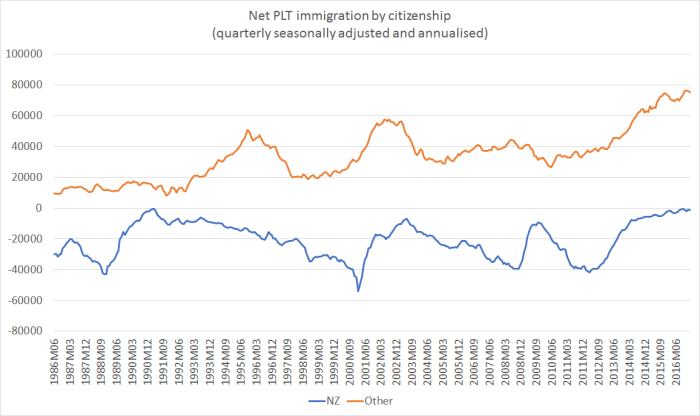
The government is keen to suggest that much of the high net migration numbers is about a return of New Zealanders from abroad.  In fact, of course, all that has happened is that the net flow of New Zealanders has slowed down (to near zero) at present.    Basically, all the 71000 or so net arrivals over the last year have been non-New Zealand citizens.   Here is the chart I’ve run many times before.

plt by citizenship apr 17

Over the last three months there has been an annualised net inflow (seasonally adjusted) of 75280 non-citizens, on a PLT basis.    (Relative to history it isn’t quite as high as it looks –  later SNZ research showed that in the 2002/03 boom there were more net permanent and long-term arrivals than the self-reported arrival/departure card estimates suggested –  but it is a large number, and large as a share of the population). That is around 35000 per annum more than were coming in, on average, in the decade prior to around 2012/13.       Almost all those non-citizens who come here require a discretionary decision by the New Zealand government (the exception being Australian citizens, for whom there is a long-term New Zealand government decision to allow free access).

Too few commentators focus on these non-citizen numbers.     Each of the main opposition parties seem to talk in terms of targeting the overall net PLT inflow.  NZ First talk in terms of, I think, 10000 to 15000, the Greens talk of 1 per cent of population, and now it appears that Andrew Little is talking of a target net inflow of around 20000 to 25000.      As I’ve noted before, and as many others have also argued, it is all but impossible, and not very sensible, to try to target the net PLT flow, and certainly not on a year to year basis.  The decisions of New Zealanders –  in turn heavily influenced by the state of the Australian labour market –  often play the largest role in fluctuations in the PLT numbers, and we don’t, can’t and shouldn’t try to control what New Zealanders do.

It is relatively straightforward, as a technical matter, to materially reduce (even by “tens of thousands”  –  Little’s language)  the net and gross inflow of non-citizens.  I outlined my own preferred approach in a post a week or two back.    Frankly, I’m a little sceptical that you could make quite that much difference if one focused narrowly on work visas, but even they offer a lot of potential.

The centrepiece of our medium-term immigration policy is the residence approvals programme.    Current policy is to offer around 45000 residence approvals each year.   Most of those approvals are offered to people who are already in New Zealand –  either on work or student visas  –  but over time it is the number of residence approvals on offer that largely determines the contribution of immigration policy to population growth (and, in the absence of good supply side policies) and to the pressure on roading infrastructure, house prices etc.    Many people only seek work or student visas to help them get points for residency.  If fewer residency places were on offer, there would be many fewer applicants for short-term positions.

The residence approvals target was reduced a little (from a range centred on 47500) last year.  But if I’ve done my calculations correctly on MBIE’s very unwieldy spreadsheet, 57623 people were approved for residence in the year to end of March 2017.     (UPDATE: I hadn’t done the calculations correctly, and the actual number seems to be 49991.  Readily accessible summary statistics – as we have in the rest of the economy –  would avoid such slips.)

Sometimes MBIE officials like to tell stories about being overwhelmed with good applicants in good times, whom it might be a shame to turn away.  But we now know, from MBIE’s own data, that that simply isn’t the situation.    Of the people applying for the most skilled stream in the residence approvals programme, more than half weren’t able to command an income as high as $49000 –  roughly what a starting primary school teacher earns – in the New Zealand labour market.    Our migrants might be more skilled than those in many other countries, but they aren’t very skilled at all, and most of them simply aren’t likely to be making a positive difference to the economic fortunes of New Zealanders (as a whole).

So let’s cut the target.  And in my view this is the nettle that the Labour Party really should grasp –  the key on which the whole programme turns.  If they want to look to their own past and their own traditions, it was one of the icons of the Labour movement, Norman Kirk who led the government that sharply cut back on non-citizen immigration, easing pressure on house prices and wider economic performance, in the mid 1970s.  Kirk did it by limiting open access for Britons.  In today’s term, the relevant metric is the residence approvals target (or “planning range”).

I’ve proposed pulling that target down to a range of 10000 to 15000 per annum.   But one doesn’t need to go that far to make a big difference.    For example, an incoming government could direct MBIE to ensure first that residence approvals for a year are capped at the upper end of the range (that would now be 47500 per annum).  Then they could, to provide a degree of certainty all round, announce that the target range would be reduced by another 20000, phased in evenly over a first electoral term, so that by the end of that term, the residence approvals target would be centred on 25000 people per annum.    That would still be getting on for twice as many approvals, per capita, as the number of green cards issued for US permanent residence.   It would be a thoroughly mainstream thing for a responsible centre-left party to do.    (As part of trying to refocus the programme on genuinely highly-skilled people I’d review and probably terminate the Pacific Access categories –  if we are serious about a skills-led economic programme we need to be hard-headed, but I don’t suppose a Labour Party with a big Pacific base could really do that.)

Of course, changing the residence approvals numbers doesn’t affect actual arrivals on day 1.  Even people approved overseas take some time to arrive, and I’m not suggesting cancelling approvals already granted.   But over time the reduced number of approvals will make a lot of difference (“tens of thousands” in fact) to the expected net inflows, even if all other visa programmes were unchanged.

But there are plenty of other changes that should be made.  We put far too much emphasis, in offering residence points, on people already having a job, or a firm job offer, in New Zealand.   Being at the ends of the earth, that isn’t always easy if you haven’t been willing to take the big risk and first relocate yourself and family to New Zealand (it isn’t exactly like moving from Brussels to Paris, or Dublin to London).  We probably do miss out on really skilled and innovative people who might otherwise come.  If we are going to give residence points for people already having a NZ job, or job offer, do it only for pretty highly paid roles –  perhaps those paying $100000 or more (you could age adjust it a bit too –  older people who are likely to be of real value as permanent residents should probably be earning rather more than that; younger people perhaps a bit less).    Again, changes like this will reduce the appeal of New Zealand work visas –  to what they should be (something where there is a specific short-term labour market need –  eg a temporary surge in demand like earthquake repairs).

What of short-term visas themselves?   A lot of government rhetoric has claimed that a huge upsurge in student numbers is a big part of the surge in net PLT immigration.    First, what we’ve seen in the last few years around students is as nothing compared to what saw 15 years ago.   Between 1997/98 and 2002/03 the number of people granted student visas increased by 70000.  Between 2012/23 and 2015/16 the increase was only 27000 (and MBIE data show that the number of valid student visas outstanding didn’t increase over the 12 months to February 2017).    As importantly, no one seriously questions that much of the increase in student visas –  mostly via lower-level PTE courses –  isn’t about the quality (or even cost) of our export education offerings, as about the residence points that such courses offer, both directly, and by providing access to a post-study “study to work” visa, which allows those completing these lower-level courses to work in any job they can find, no matter how relatively unskilled.      Severely cut back the ability of foreign students to work while doing lower-level courses, remove any residence points offered for such courses, and cut back on the “study to work” options and (the export incentives would drop away and) foreign student numbers would quite quickly fall back a long way.   One doesn’t even need to cut for every programme –  one can treat lower-level PTE courses differently to university degree courses, and even within university programmes treat post-graduate courses rather more generously.  We are happy to take –  even want –  really able people.  We shouldn’t be taking people who can’t even command $49000 per annum in the domestic labour market.

There were 25000 valid student visas outstanding earlier this year for PTE courses (and another 13000 or so for polytechs).  Halve those numbers and you make a material contribution to reducing the inflows of people (many of them working in quite lowly-skilled roles) by ”tens of thousands”.   It will be tough for those running the providers (the PTEs etc).  It was tough for many firms in the 1980s when export incentives and import protection were stripped away.  But they are changes that really need to be made.  Give some notice, sure, but many of the rule changes that facilitated the big inflows are themselves quite recent, so there shouldn’t be any sense of obligation to phase these concessions out very slowly.

I could go on, but won’t.   But as one last immigration thought for the day, I was rather puzzled by Fran O’Sullivan’s column in the Herald this morning.  Headed Forget immigration –  let’s talk wages, it was something of a mixed bag.    She seemed to recognise that immigration historically mostly raised total GDP and total population, and hadn’t been any sort of answer to New Zealand’s long-term productivity underperformance.    But her alternative was one that I suspect both pro-immigration economists like Eric Crampton, and sceptical ones like me, would both look at rather askance (to put in politely)

But if New Zealand is to evolve as a highly skilled economy it needs to set the bar higher, and pay decent wages which will also spur employers to take initiatives to drive greater movement on the productivity front.

This requires a major reset of the NZ economy – not simply using immigration to spur economic growth, then screwing the taps down when the cost of running things too hot becomes a political negative.

Where Labour is on point is with addressing the “Future of Work”.

Raising wages –  whether by government fiat (as in “pay equity” deals, or simply from employers swayed by the rhetoric) without the pre-conditions for growth in productivity is just a recipe for more unemployment (for New Zealanders), and the sort of insider/outsider bifurcated labour market that has given Spain what has long been one of the worst unemployment records anywhere.     We all want a high-wage high-productivity economy, but for everyone not just those who keep their jobs, and there is little evidence that putting the cart before the horse in the way O’Sullivan appears to suggest has ever worked on any sort of widespread basis.   The structural problems New Zealand faces aren’t mostly about bad choices by New Zealand firms (or indeed, foreign firms investing here) –  mostly they do their very best in the environment governments deliver to them –  but about that wider macro environment.

Higher real wages is a highly desirable outcome –  and on offer from policies that lead to closing the gap between New Zealand and world real interest rates (which, to be clear, has nothing to do with monetary policy) and allowing the real exchange rate to finally fall back to the sorts of levels that our dismal productivity performance suggests should have been warranted.  I hope that whatever Labour has in mind on the “future of work” it doesn’t involve leading with higher wage increases.  Rather, when they happen, consistent with low sustainable unemployment rates, it will be sign that we’ve got right much more of the rest of the policy mix.


What to make of the CPI?

The media headlines make a lot of the fact that yesterday’s CPI puts annual headline inflation above the 2 per cent target midpoint (and contractural focal point) for the first time since 2011.  The Governor has almost completed his five year term, so it is a first sight for him.

Of course, current headline inflation isn’t the focus of monetary policy.  The almost-expired Policy Targets Agreement (PTA) explicitly tells the Governor to focus on “future” inflation, and the “medium-term”.  In longstanding words:

For a variety of reasons, the actual annual rate of CPI inflation will vary around the medium-term trend of inflation, which is the focus of the policy target. Amongst these reasons, there is a range of events whose impact would normally be temporary.

There are almost always plenty of those.  There are genuine market prices that are quite volatile – oil/petrol prices and fresh fruit and vegetables are the two most obvious examples.  There are discretionary government charges –  eg ACC levies –  developments in which have very little to do with underlying pressures in the economy.  And there are straight out consumption taxes that appear directly in the CPI, but again have little or nothing to do with real resource pressures (or even rates of money and credit creation).   GST changes – we’ve had them about once a decade –  are the best example, but the repeated large increases in tobacco excises this decade are another.  Exchange rate changes can also muddy the waters.

As I noted in a post a few months ago, monetary policy works –  which shouldn’t surprise anyone, but apparently does –  and we’ve seen this as part of the explanation for an increase in inflation over the last year or so.   Some increase should be very welcome, since the various core measures had been dropping further below the target midpoint, and people appeared to becoming more used to treating as normal inflation outcomes well below 2 per cent.  Reversing the ill-judged OCR increases of 2014 seems to have dealt with that problem/risk for now –  although we (like most other advanced countries) remain quite exposed when the next recession hits.

Quite how much core inflation has really increased is a bit of an open question.   In various previous posts I’ve highlighted a selection of six possible measures.  Here they are again for the year to March 2017.

Annual inflation rate
Yr to March 2017
CPI ex petrol 1.7
Weighted median 2.2
Trimmed mean 2.2
Factor model 1.8
Sectoral factor model 1.5
CPI ex food and energy 1.6
Median 1.75

The sectoral factor model measure was the Governor’s avowed favourite measure.  A year or so ago, it was the highest of the six measures of core inflation.  Right now, it is the lowest.     Historically, it tends to be the most stable of all the measures, and although prone to revisions as new data are added, it probably does deserve more weight than the other measures.  That measure of core inflation picked up about 18 months ago, but has been steady at 1.5 per cent for the last year or so.

I am sensitive to the suggestion of cherry-picking data.  From memory, I was inclined to de-emphasise the core inflation number a year ago, so I don’t want to suggest now that it is the only variable that matters.  But in many countries, quite a bit of attention is paid to CPI ex food and energy measures as a proxy for core inflation, and the picture isn’t much different there.    It would be interesting to understand quite why the trimmed mean measure – one given quite a lot of attention in Australia – has moved around so much.  It was as low as 0.4 per cent (annual inflation) as recently as the end of 2015.

But if core inflation has picked up a bit, there is little in the data that suggests it is, or is about to, race away.    When I opened up the SNZ CPI tables, a few things caught my eye:

  • on the first page, I noticed that quarterly non-tradables inflation (and non-tradables tends to be more persistent, and hence attract more policy focus) had been 1.0 per cent.  That was exactly the same rate as in the March quarter of 2016, and a little lower than in the three previous March quarters.  (Non-tradables inflation is high in the March quarter because of the succession of tobacco tax increases.)
  • one of my favourite series is non-tradables inflation excluding central and local government charges and tobacco taxes.  March quarter inflation there was 0.6 per cent, lower than in the March 2016 quarter (and also lower than in the September and December quarters).
  • construction costs look like a potential pinch-point in the economy, and yet the seasonally adjusted data on construction cost inflation (and, in fact, property maintenance costs) both showed quarterly inflation rates for March quite a lot lower than we were seeing for much of last year.

Wage inflation measures are probably also relevant here, not so much through some sort of “cost plus” model of inflation, but because developments in the labour market will also be a good reflection of overall resource pressure (and the wage aggregates aren’t so affected by tax changes, government charges and similar one-offs –  although they will be affected, in future, by arbitrary policy interventions like “pay equity” settlements).   In some ways, wage measures might be a better (if politically infeasible) policy target for monetary policy.

Here is a chart of the Labour Cost Index (LCI) inflation, using the raw “analytical unadjusted” series.

LCI analytical

There isn’t evidence of much, if any, pick-up there, and perhaps especially not for the private sector.   The headline LCI numbers aren’t much different and the (volatile) QES data are even weaker.

We’ll get another round of labour market data in early May.  Perhaps there will be more signs of an acceleration in wage inflation, or even a material drop in the unemployment rate (suggesting that excess capacity is dissipating and, hence, future inflation risks may be rising) but for now probably the best one can say is that macro outcomes are suggesting that the OCR set at current levels might have been about right.   With the unemployment rate still above estimates of the NAIRU, and most indicators of inflation suggesting that core is probably (a) still below target, and (b) not picking up very rapidly, it certainly isn’t time for hawkish talk about near-term OCR increases.

I’ve noticed some market economists talking of altering the timing for their first expected OCR increases.  I guess it is an occupational hazard for them having to make such calls, still mostly about the far future.  But such are the uncertainties –  about the global environment, the domestic economy, the inflation process, let alone about who will be Governor (or MPC) and what the PTA will look like –  that it seems something of a fool’s errand.  It would, in many ways, be good if the next warranted OCR move were to be an increase, but such are the limitations of our knowledge that probably the best we can say at present is that the current OCR is probably the best prediction of the OCR for the next year or two, with reasonably wide confidence intervals around even that prediction.

Finally, Paul Walker at the University of Canterbury had an interesting and useful post yesterday on his blog highlighting the way that relative price changes muddy reported headline measures of “inflation”.   As he notes, and I have already noted here, getting at the “pure” inflation rate is both important but not necessarily that easy.

Walker links to an old paper by a couple of US academics highlighting the possibilities of factor analysis to distill the underlying trends, the “pure inflation”.  That is much the same approach used in the Reserve Bank’s preferred sectoral core factor model.  Here is Walker.

Using US data Reis and Watson found that

… most of the movements in conventional measures of inflation like the Consumer Price Index (CPI), its core version, or the GDP deflator are due to relative-price changes. Only around 15-20% of the movements in these measures of inflation correspond to pure inflation.

Given that they had measures of relative price changes and pure inflation Reis and Watson could look for evidence of money illusion in their data. They found that once they controlled for relative price changes, the correlation between (pure) inflation and real activity is essentially zero. So,

… when we see that high inflation typically comes with low unemployment or high output, this is indeed driven by the change in relative prices hidden within the inflation measure. When there is pure inflation, that is when all prices increase in the same proportion independently from any relative price changes, nothing happens to quantities.

Which would be fine (and it is a while since I looked at that paper), but here is a chart for New Zealand showing the Reserve Bank’s sectoral factor model measure of core inflation, and the unemployment rate.

U and P

Of course, there are other things going on in both series (including changes in inflation targets and inflation expectations).   And the sectoral core measure probably isn’t a perfect representation of core inflation.  But it is pretty clear that, in New Zealand, there is a (expected) short to medium term relationship between real activity measures (indicators of excess capacity) and developments in inflation even when many (if not all) of the “pure” relative price changes are stripped out.

Immigration data

MBIE does a pretty good job of releasing annual immigration data, albeit with quite a long lag.   Their Migration Trends and Outlook publication is full of interesting charts, and the accompanying spreadsheets have a rich array of data about people applying for visas to live in New Zealand, temporarily or permanently.     But the 2015/16 issue, covering the year to June 2016, was released in late November last year.    But it is now late April 2017 and we won’t have any official data made generally available until, presumably, late November this year.   Given the significance of immigration in the New Zealand economy, let alone in the political and social debate, it is staggering that only annual data are available, and even then with quite a long lag.     I’m surprised that, for example, Statistics New Zealand does not put more pressure on MBIE to bring its immigration statistics up to the sort of standard we expect in other areas of the economy.  Apart from anything else, nature abhors a vacuum, and in the absence of good timely (readily useable) immigration approvals data, people fall back on using the Statistics New Zealand permanent and long-term migration numbers, which (a) aren’t that accurate, as SNZ research itself has found, and (b) aren’t a good basis for analysing immigration policy developments (immigration policy affecting only non New Zealanders).

And in this day and age, the data must be quite readily available internally –  it isn’t, presumably, as if they are using paper-based systems and only compile the aggregates once a year.   I’d urge MBIE to look at upgrading their publication of statistics.    Key data –  approvals under each visa stream and main category –  should be able to be made available monthly, within days of the end of the month, and should (as relevant) be published on a seasonally adjusted basis (as most other official economic data are).   The sorts of detailed tables published with Migration Trends and Outlook should be published quarterly, and again it is difficult to see why we should expect, or tolerate, a lag of more than four weeks after the end of the relevant quarter.  It takes SNZ much longer than that to calculate GDP, of course, but immigration approvals data is all generated inside MBIE.    All this data should, in turn, be made available on the Statistics New Zealand platform  Infoshare.    To the usual complaint, when better data is sought, that “there is no money” my response is twofold: first, this is a really major component of New Zealand and social life, and timely information would inform a better debate and analysis, and second, immigration (including the associated research and analysis) is supposed to be self-funding.  If the fees aren’t quite high enough to cover the regular production of good data (all from internal systems) put them up (a very little surely).    In the meantime, it is tempting (but would be tedious) to lodge an OIA request for the data on the last day of each month, which would at least ensure it was available 20 working days later.

As an inadequate, but perhaps convenient for them, substitute for good generally-available data, MBIE does seem from time to time to provide bits and pieces of data to selected journalists.   That is no way to run a democracy.

A small example leapt out at me as I read today’s Herald over lunch.   In an article on yesterday’s announcement we find that:

In figures released exclusively to the Herald, a Ministry of Business Innovation and Employment sample of more than 600 skilled migrant category applications being considered as at March 1 found more than two in five would not have met the new income threshold.

Just 42.5 per cent of applicants earned over the New Zealand median income of $48,859 per year and 14 per cent earned over $75,000.

The figures are staggering.  Recall that skilled migrant principal applicants make up only about half of those granted approvals for residence.  These are (the bulk of) the “best and brightest” of those we bring here –  others are partners, children, family members, refugees, and Pacific Access people, who themselves wouldn’t get over the Skilled Migrant category thresholds.

Now, sure, it is a small sample (600 of the SMC applications being considered) –   and there seems to be a potential contradiction between the two sentences in that paragraph –  but at best it seems that only around half of the skilled migrant applicants earned more than the new, quite modest, income threshold.   Sure, the median income numbers cover people of all ages, and most SMC principal applicants are between 20 and 40, but….these have been the transformative skilled migrants MBIE and successive governments have been counting on to help transform the economy, and lift our dismal productivity, and that is all they can command in the labour market?  Really?

I suspect the Reserve Bank and Treasury are now paying freshly minted 21 year old economists, with just an honours degree, at least that $48,859 per annum by now.  And those people will achieve significant pay rises in the following few years.   In fact, on checking teacher salaries, a primary school teacher with a BA starts on $48165 per annum.     These will all be able people, but they are 21 or 22.   How can it make sense –  if our immigration programme is really skill-focused –  to be letting in as residents so many people who at, say, an average age of 30 can’t even command what a starting primary teacher makes?

Even though the official rhetoric has long been skills-focused, it increasingly looks as though we’ve actually been somewhat closer to lower-skills end of the immigration spectrum.   There hasn’t been anything much in the way of productivity spillover –  which could really only come from the very able and innovative, and we’ve not attracted many of them –  and the evidence suggests that the low-skilled migration hasn’t done much for us either.  Recall that the advocates of high immigration both argue that high immigration of relatively low-skilled people hasn’t dampened native wages and that we benefit economically from low-skilled migration.   But if wages haven’t been dampened, it can’t –  under the totally orthodox neoclassical economic model –  have done any good for New Zealanders as a whole either.  And if they have….well, we know that despite all those inflows business investment has been weak (share of GDP) relative to population growth, the tradables sector has been weak, and we’ve seen little sign of any other sorts of gains.

Perhaps the data MBIE provided the Herald aren’t quite as bad as they look.  But we can’t tell, because MBIE provided the information simply to one media outlet and we rely on what their journalists made of it.   As a material piece of background to a major government policy announcement, that really isn’t good enough.

UPDATE: This interest.co.nz article, informed by MBIE, adds a bit of detail

An Immigration NZ spokesman told Interest.co.nz that the department undertook a random sample of more than 600 live SMC applications on 1 March. All applicants were claiming for employment at skill levels 1, 2 or 3 under New Zealand and Australian classifications (ANZSCO).

Of the sample, 57.5% were for roles offering less than the new threshold of New Zealand’s median wage, the spokesman said. That meant 42.5% were for roles with wages above $48,859. Meanwhile, 14% earned above $75,000. The results were given a margin of error of plus or minus 5%, the spokesman said.


Further thoughts on the immigration policy changes

Having had some more time to look at the details of the government’s announced changes to the Skilled Migrant category (the main stream under which residence approvals are granted) and the proposals they are consulting on for changes to the Essential Skills (temporary work) visas, I’m perhaps slightly more positive than I was yesterday.   Within the government’s overall vision of what immigration can offer New Zealand –  one that I think is profoundly incorrect, based not on a hunch about what might be,  but on decades of New Zealand’s actual experience with large scale immigration programmes – the changes look as though they will represent an improvement.    Even if one is sceptical about the overall vision, the changes (actual and proposed) are likely to modestly reduce the damage that high levels of non-citizen immigration is doing (holding back real productivity and earnings growth) to the material living standards of New Zealanders.   That is welcome.

What is there to like?     Take the Skilled Migrant category changes first (which are definite, not just proposals for consultation)

In future, applicants with jobs at ANZSCO skill levels 1, 2 and 3 (currently regarded as highly-skilled) will only be awarded points for their employment if they are paid at or above NZ$48,859 per year (or NZ$23.49 per hour).

Bonus points will be awarded for remuneration at or above NZ$97,718.00 per year (or NZ$46.98 per hour)

and, straight from the government’s document,

Work experience

  • More points will be available for work experience.
  • Points will be awarded for skilled work experience in ANZSCO skill level 1, 2 and 3 occupations.
  • Points will be awarded for skilled New Zealand work experience of 12 months or more. There will be no additional points for work experience of two years or more.

Qualifications, age and partner’s qualifications

  • Points available for recognised level 9 or 10 post-graduate qualifications (Master’s degrees and Doctorates) will increase.
  • Points for people aged 30 – 39 years will increase.
  • Partner’s qualifications will only be awarded points if they are a recognised Bachelor’s level degree or higher or a recognised post-graduate (level 9 or higher) qualification.

Which factors will applicants no longer be able to gain points for?

Points for the following factors will be removed:

  • qualifications in an area of absolute skills shortage
  • skilled employment, work experience and qualifications in Identified Future Growth Areas
  • close family support in New Zealand

The document is light on detail.  There is no sign of how many more points will be available for things like higher level qualifications,  but as I noted recently it did seem absurd that if one needed 160 points for residence, there was only 5 points difference between what was on offer for a basic qualification (in an age when bachelors degree are a dime a dozen) and those for masters or doctorates.  Academic qualifications aren’t everything –  I always remember a school teacher advising us of his view that “the PhDs are the plodders” –  but if we are aiming for skilled and innovative people, we probably should be more strongly differentiating between higher and lower level qualifications.   Similarly, I like the idea of more points for more highly paid jobs.

And if we considering giving people permanent rights to live here –  which is what the Skilled Migrant category is about –  we shouldn’t be preferencing people who happen to fit current shortages as judged by Cabinet ministers and MBIE officials.  We are taking people who, we hope, will contribute strongly over 30 or 40 years.

On the other hand:

  • the additional points on offer for jobs outside Auckland, added in last year, remain.   One understands the politics of those points, but they simply have the effect of lowering the average quality of the people who are granted residence (as people with lower skills etc who can get a job outside Auckland will beat out higher-skilled people with a job in Auckland,
  • the minimum wage in New Zealand is now $15.75 an hour.   I reckon that is too high –  it is one of the highest relative to median wages anywhere in the OECD –  but it is the government’s own choice, and they keep increasing it.    But to be regarded as doing highly-skilled work, under the changes announced yesterday, people will only have to be earning $23.49 per hour, or just under 50 per cent more than the minimum wage.    It is good that they have put a threshold in but it is a pretty undemanding one.  Of course, we don’t know how many people it will catch –  and neither apparently does the government –  but if it is many, the system to now has been working even more badly than most have realised.
  • relatedly, I’m not really sure why we are giving residence points to anyone with an skill level 4 or 5 occupation.  In fact, if one looks carefully at the ANZSCO skills lists (here – I suggest Table 5 on the first spreadsheet) it isn’t clear why many of the occupations in the skills levels 2 and 3 qualify for points.    Here is just one subset of the level 2 skilled occupations
Hospitality, Retail and Service Managers
141 Accommodation and Hospitality Managers
1411 Cafe and Restaurant Managers
141111 Cafe or Restaurant Manager 2
1412 Caravan Park and Camping Ground Managers
141211 Caravan Park and Camping Ground Manager 2
1413 Hotel and Motel Managers
141311 Hotel or Motel Manager 2
1414 Licensed Club Managers
141411 Licensed Club Manager 2
1419 Other Accommodation and Hospitality Managers
141911 Bed and Breakfast Operator 2
141912 Retirement Village Manager 2
141999 Accommodation and Hospitality Managers nec 2
142 Retail Managers
1421 Retail Managers
142111 Retail Manager (General) 2
142112 Antique Dealer 2
142113 Betting Agency Manager 2
142114 Hair or Beauty Salon Manager 2
142115 Post Office Manager 2
142116 Travel Agency Manager 2
149 Miscellaneous Hospitality, Retail and Service Managers
1491 Amusement, Fitness and Sports Centre Managers
149111 Amusement Centre Manager 2
149112 Fitness Centre Manager 2
149113 Sports Centre Manager 2
1492 Call or Contact Centre and Customer Service Managers
149211 Call or Contact Centre Manager 2
149212 Customer Service Manager 2
1493 Conference and Event Organisers
149311 Conference and Event Organiser 2
1494 Transport Services Managers
149411 Fleet Manager 2
149412 Railway Station Manager 2
149413 Transport Company Manager 2
1499 Other Hospitality, Retail and Service Managers
149911 Boarding Kennel or Cattery Operator 2
149912 Cinema or Theatre Manager 2
149913 Facilities Manager 2
149914 Financial Institution Branch Manager 2
149915 Equipment Hire Manager 2
149999 Hospitality, Retail and Service Managers nec 2

Plenty of good people do those jobs, no doubt. Such roles all have their place in a modern economy.  But this programme is supposed to be bringing in highly-skilled, able and innovative people who can help lift the overall productivity of the New Zealand economy.  If we were simply interested in getting ever more people then a coarse sifting like this might be fine, but the goal of the programme –  and this is the residence programme, not a short-term skill shortages programme –  is more ambitious, and supposedly transformative, than that.    Simply requiring a beauty salon manager to earn more than 1.5 times the average wage bears no relation to that ambition.

In a sense, the problem with the programme is that New Zealand just isn’t that attractive to very many of the sorts of people who might genuinely make a difference.  It is a nice place to live –  if you don’t mind being far from anywhere else –  and the living standards aren’t bad, but if you are young, energetic, innovative, and genuinely highly-qualified you are more likely to be interested in a lot of other places before New Zealand –  all the other Anglo countries (including Ireland) for a start, and probably most of Europe too (some places in Asia –  Singapore, Dubai – probably attract some too).  Mostly they are richer than we are, mostly they have bigger domestic markets, and all of them are closer to other places (home, other countries, other markets etc).    It is part of the reason why I argue for markedly pulling down our residence approvals target, because it would then help us focus on attracting the small number of people who might really benefit New Zealanders.

What of the proposed changes to the Essential Skills temporary work visa (details at the link above)?

They are a modest step in the right direction.   But –  seasonal roles aside perhaps –  it isn’t clear to me why we continue to grant “Essential Skills” visas for any one in any occupation at levels 4 and 5 on the ANZSCO list?    Perhaps people will be less inclined to come in future, especially if they have partners/spouses who themselves can’t qualify for a work visa.  Perhaps, but New Zealand wages are still well above those in –  say –  the Philippines, and there is a huge number of Filipino workers in a various advanced economies (eg Hong Kong, and various Middle East countries) doing relatively unskilled roles, even though they’ve had to leave families behind.   The proposed three year limit (at any one time) on how long people in these occupation groups could stay in New Zealand seems appropriate, to minimise the risk of people living here long term with no plausible path to residency.   But three years is a reasonable chunk of time for a short-term relocation (in my own career, I did three temporary roles abroad, each for two years at a time).    I’d also be more comfortable if even people in higher-skilled roles were only eligible for three year visas (instead of five years).  I’d happily allow a single three year extension for, say, jobs in skill level 1, but after that either the person should settle here permanently, or return home.

Sadly, there is also no sign of any real change in how the so-called labour market test is operated.   The most compelling labour market test isn’t that “an employer satisfy an immigration officer that they have made genuine attempts to recruit or train domestic workers” (or even that they have advertised at WINZ), but what has happened to the relative price paid for that sort of role.     If wages for a particular type of skill have risen, say, 10 percentage points more than the market average across the economy in the previous two years, it might be a pointer towards some sort of genuine “skill shortage”.  But in the whole immigration system, and particularly in the Essential Skills category, there is no hint that changes in wage rates should be a material indicator.   We should ue market price indicators more, and bureaucratic judgement (and the employer’s persuasive gift of the gab) less.

I noted yesterday that this announcement made no attempt to deal with the rort that is much of the student visa system.    That still appears to be true, but there might be some beneficial effects  nonetheless.   It may well be that foreign students, using the extensive right to work provisions the government introduced a few years ago,  may be  heavily represented among those doing notionally level 1,2 or 3 jobs are yet getting paid quite low wages (below than 1.5 times minimum wage threshold).  If so, you would expect that this package –  under which such jobs don’t count towards residence points –  might diminish the attractiveness of New Zealand PTEs.     Cutting back export subsidies is always a good thing.

Overall, I think my assessment yesterday was right.  This is a fairly modest unambitious package, that (deliberately) doesn’t attempt to seriously reduce the typical level of non-citizen immigration to New Zealand.  But it does take some steps that will help modestly raise the average skill level of those coming to New Zealand.  But the changes are small, and don’t address the medium-term challenges around non-citizen immigration to New Zealand.   Even given the desire to continue with large-scale non-citizen immigration, the government could easily have gone much further in increasing the focus on the really skilled and able people whom we might be able to attract.      I’m not sure why they won’t.  Probably they are too influenced by short-term employer pressures –  which are real, but which change if overall immigration policy is changed enough (because overall demand abates too) –  and by the siren call of high headline GDP growth.  All while the tradables sector, productivity, and per capita living standards do badly, and –  since the government refuses to do anything serious about freeing up land supply for housing, even when the votes are on offer  – the house price pressures just get worse.  It all works most against the younger and poorer New Zealanders, but isn’t helping most of the rest of us either.

A modest step that ignores the big picture

Many readers were probably expecting a post on the immigration announcement this morning.   I did an op-ed for Stuff on those changes, which is now up.

The leaders of our government are still, apparently, believers in the twin fallacies of (a) “big New Zealand”, which has been failing through decades of large scale non-citizen immigration, and (b) that somehow an increased supply of people in New Zealand eases (rather than accentuates) overall labour market pressures.  People generate demand as well as supply, and the New Zealand empirical evidence has long suggested that  –  as one would expect, from the increased capital stock requirements – those short-term demand effects outweigh the supply effects.    Consistent with those beliefs, today’s changes are at the margins only.  In general, they look like baby steps in the right direction, but since even they –  with all the analytical resource at their command –  won’t or can’t tell us how large an impact they expect, it is difficult to believe the effects will be large.

When I read the Minister’s speech I was briefly encouraged to find these words

“Today, I want to look at the benefits migrants bring to New Zealand”.

But I turned the page and found…..well…..nothing.    Still no empirical evidence –  narrative or more formal –  for the claims of benefits to New Zealanders.  And really not much more than the same old implication that more people expand the economy in total (well yes they do but that is hardly the point), no mention of productivity, and the same old firm-level stuff (that ignores overall economy perspectives) about easing labour market constraints.

I concluded my Stuff piece this way

Rapid population growth –  without great new economic opportunities – simply skews the economy inwards.  Successfully making it in global markets is the only reliable path for a small country to get and stay rich, and yet the relative size of our export sector is shrinking.   It is time to give up the “big New Zealand” or “big Auckland” ambitions that seem to have appealed to our political leaders for generations.  Focus instead on maximising what we can achieve with our own limited natural resources and our own abundantly talented skilled hardworking people.

As ever, in election year, the question is whether the main opposition parties will be prepared to offer something materially different.

Svensson and Labour’s monetary policy

In 1999, having been out of office for nine years, the Labour Party campaign platform included promises about monetary policy.  They undertook to change the Policy Targets Agreement –  and they did, adding the words (still) requiring the Bank to “seek to avoid unnecessary instability in output, interest rates and the exchange rate”.

But they also promised an independent inquiry into the operation of monetary policy.    It was then 10 years since the Reserve Bank Act had been passed, and we’d gone through both a wrenching but successful disinflation, and through one full business cycle since something like price stability had been established.    Some of elements of the management of that cycle hadn’t been the Reserve Bank at its finest:  use of the Monetary Conditions Index to guide short-term policy management had given us a (relatively short) period of quite astonishing interest rate volatility, not helped by being slow to appreciate the significance of the Asian financial crisis.

I don’t suppose Michael Cullen was ever a great fan of Don Brash’s.  But Brash had already been reappointed for a third term in 1998 (arguably fortunate that the reappointment was done before the nature of the MCI debacle was fully appreciated).   And Cullen was clearly uneasy about the volatility in New Zealand interest rates, and about the big cycles in the exchange rate.   There were also suggestions that he was a bit uneasy about the rule of a single unelected technocrat at the Reserve Bank of New Zealand, and Labour at times seemed to look longingly across the water at the Reserve Bank of Australia (with a higher target, more flexible rhetoric, and a reputation for being a steady hand).    And, of course, Labour was coming into government with Jim Anderton as Deputy Prime Minister.  Anderton had still not been reconciled to the Reserve Bank Act framework at all.   So it was, all round, opportune to have an inquiry.

But of course whenever one sets up an independent inquiry, the name of the person appointed to conduct the inquiry tells one a lot about what the appointer is looking for.    There were all sorts of names bandied about at the time, including (for example) Bernie Fraser who had until recently been Governor of the Reserve Bank of Australia, and whose centre-left sympathies were not exactly unknown.  But the government settled on Swedish academic Lars Svensson.  Perhaps being Swedish  –  home of centre-left big government – lulled some on the left of New Zealand politics.  But, more importantly, Svensson was also a leading academic author on aspects of the (then still relatively new) theory and practice of inflation targeting.  He’d also spent some time in New Zealand a couple of years earlier, as the Reserve Bank professorial fellow.    In other words, it was never likely to be a terribly radical report.

And it wasn’t.    Which is not to say that it wasn’t a useful exercise, or that Svensson did not make some useful recommendations.  He did.  Some of the less important recommendations –  eg around the make-up of the Bank’s Board, and the publication of a Board Annual Report –  were even adopted.    Some others that should have been adopted –  for example, the introduction of a monthly CPI –  still, unfortunately, haven’t been.  Svensson also proposed legislating for committee decision-making for monetary policy, but his proposal of a committee of insiders (including the role I then held) went nowhere: among other reasons no doubt, Michael Cullen hadn’t come into politics to give statutory power to more Reserve Bank pointy-heads.

I was quite heavily involved in the review, both in contributing to the Reserve Bank’s own substantial submission to the inquiry and –  along with a couple of Treasury economists –  as part of the secretariat to the inquiry itself.  For an inquiry into the Bank, it was a bit of an odd arrangement  –  shortly after the inquiry began I was promoted into one of the half dozen top policy/management roles in the Bank and did the two roles in tandem –  but I guess it is a small country, and there was never much doubt about the overall favourable stance Svensson was likely to take.  He was a big fan of Don Brash, and the conclusions were his not those of the secretariat (in fact, flicking through notes stapled in my copy of the report yesterday I noticed that in some places we –  and the Bank –  urged Svensson to toughen up his comments, lest the report look in places a bit like a whitewash.)

But the main point of this post isn’t about history.  It was initially prompted by an observation in a column in the Sunday Star-Times the other day, in which their resident right-wing columnist was quoting Svensson from 2001.  Damien Grant, in commenting sceptically on Grant Robertson’s proposals,

Robertson might find it useful to know that when Cullen became finance minister he commissioned a review of the Reserve Act by Swedish economist Lars Svensson who concluded:

“It is beyond the capacity of any central bank to increase the average level or the growth rate of real variables such as GDP and employment.”

The understanding that monetary policy can only influence the value of money and nothing else is one of the few untarnished successes of modern economic thought. It is deeply disturbing that Grant Robertson does not seem to appreciate this.

As a commenter observed yesterday, no mainstream economist believes that monetary policy can change the long-term level of employment/unemployment/real GDP or whatever.  In the long-term monetary policy can only affect nominal variables.   Svensson certainly believed that then and believes it now.   I don’t know whether Grant Robertson does, but I expect so.

But equally, not many mainstream economists believe that active monetary policy typically has no effect (short to medium term) on real variables.   There is pretty general acceptance, I think, that the depth and severity of the Great Depression was in substantial part a matter of monetary mismanagement.  That’s a deliberately extreme example, but it both illustrates the point and (historically) provides some of the backdrop to modern more active discretionary monetary policy.  In earlier decades, adjustments in central bank interest rates (where central banks existed at all) were mostly about maintaining the gold (or silver) convertibility of the currency.  Domestic economic conditions didn’t play much of a role.    Really bad experiences like the Depression, along perhaps with the rise of universal suffrage (the more marginal got a say in politics), helped change that focus.

Writing in 2001, reviewing New Zealand policy, Lars Svensson had no doubt about the importance of real variables in the management of monetary policy.   He didn’t question section 8 of the Reserve Bank Act –  the focus on price stability.  But his articulation of flexible inflation targeting –  what the Reserve Bank saw itself practising – involved short-term trade-offs between pursuit of the inflation target, and the variability of the real economy.  At the time, as an academic, he focused explicitly on the trade-off with variability in the output gap (the gap between actual and potential output), and devoted several pages of the report to a discussion of the issue, describing it not just as a very short-term matter, but as a “short and medium term” issue.    (For anyone interested, the full report and associated documents are here.)     What he was talking about wasn’t at all inconsistent with the 1999 addition to the PTA, quoted above, about seeking to “avoid unnecessary instability in output”).    And there was only one tool –  the OCR.

Standing back from his more theoretical perspective, there was good reason why one might want explicit consideration of real variables in the official articulation of what an independent central bank was asked to do.   One doesn’t need active monetary policy if all one is concerned about is long-term stability in the general level of prices –  something passive like the Gold Standard would do it.    But the Reserve Bank Act –  and other comparable legislation abroad –  was about a regime for governing the discretionary active use of monetary policy.   We had –  and have –  such a policy because it was believed that discretionary monetary policy could make a difference, over meaningful horizons, to real economic outcomes (GDP, unemployment or the like) even if not to the trend or potential levels of those variables.

Some years later Lars Svensson himself became a policymaker, as a fulltime member of the executive board of Sweden’s Riksbank.  The Executive Board makes the monetary policy decisions in Sweden.    Many of my old Reserve Bank colleagues don’t agree, but I think Svensson proved to be an ideal person to have on a monetary policy decisionmaking committee.   He had strong expertise in the subject – albeit initially at a rather abstract level –  and a cast of mind which meant that he wasn’t just going to fall into line with the preferences of the Governor and the long-term staff advisers.  He strongly and opened argued against the Riksbank’s strategy, adopted several years back in the wake of the global recession of 2008/09, of trying to use monetary policy to lean against the accumulation of household debt, even at the expense of inflation undershooting the target (and unemployment remaining very high).   It was a costly failed experiment, which the Riksbank eventually abandoned.

His experience as a policymaker led Svensson to recraft how he thinks about the objective of the central bank and explicit role that unemployment should have in that thinking.   He hasn’t, of course, changed by one iota his belief that in the long-term the level of real variables is determined by a whole bunch of regulatory, demographic etc factors, but not by monetary policy.    He reflected on these issues a couple of years ago in a lengthy lecture, Some Lessons from Six Years of Practical Inflation Targeting (of which only the first 10 pages are directly relevant to this post), and in another article How to weigh unemployment relative to inflation in monetary policy?

He notes

Flexible inflation targeting involves both stabilizing inflation around an inflation target and stabilizing the real economy.  A clear objective for monetary policy contributes to monetary policy being systematic and not arbitrary. Furthermore, for central-bank independence to be consistent with a democratic society, it must be possible to evaluate monetary policy and hold the central bank accountable for achieving its objective. This requires that the degree of achieving the objective can be measured. A numerical inflation target allows target achievement with regard to inflation to be measured and the central bank to be held accountable for its performance regarding inflation stabilization. But if monetary policy also has the objective of stabilizing the real economy, that part of the objective must also be measurable, in order for monetary policy to be evaluated and the central bank be held accountable. Given this, how should stabilization of the real economy be measured?

and

Stabilization of the real economy can be specified as the stabilization of resource utilization around an estimated sustainable rate of resource utilization, accepting the conventional wisdom that the sustainable rate of resource utilization is determined by nonmonetary factors and not monetary policy and therefore has to be estimated. But how should resource utilization be measured? More precisely, besides inflation, what target variable (or variables) should enter the monetary-policy loss function? One can answer this question by interpreting the legislated mandate for monetary policy and by examining what economic analysis suggests about a suitable measure of resource utilization.

In Sweden, the Riksbank’s own act mentions only price stability.  But

 The Riksbank’s mandate for monetary policy follows from the Sveriges Riksbank Act 1988:1385 and the preparatory works of the Act, the Government Bill 1997/98:4 to the Riksdag (Swedish Government 1997) that contained the proposal for this legislation. In Sweden, the preparatory works of laws carry legal weight, since they contain guidance on how the laws should be interpreted. According to the Riksbank Act, the objective of monetary policy is “to maintain price stability.” The Bill further states (p. 1): “As an authority under the Riksdag, the Riksbank should, without prejudice to the objective of price stability, support the objectives of the general economic policy with the aim to achieve sustainable growth and high employment.”

(I didn’t know this when in 2014 we wrote a Reserve Bank Bulletin article on the statutory goals for monetary policy in a range of countries, the Swedish entry in which thus should thus be discounted, or read in the light of these Svensson comments.)

Svensson continues

The idea in the Bill is hardly that there is any conflict or tradeoff between sustainable growth and high employment. Furthermore, for many years Swedish governments have emphasized full employment as the main objective for general economic policy.  Also, in this context, high employment should be interpreted as the highest sustainable rate of employment, if we accept that monetary policy cannot achieve any level of unemployment and that the sustainable rate of employment is determined by nonmonetary factors. According to this line of reasoning, the Riksbank’s mandate for monetary policy is price stability and the highest sustainable rate of employment.

In practice, he argues that the unemployment rate –  and in particular the gap between the actual unemployment rate and the long run sustainable rate of unemployment (LSRU, determined by those non-monetary factors) should be the focus.   15 years ago his focus was on the output gap but

What does economic analysis say about the output gap as a measure of resource utilization? Estimates of potential output actually have severe problems. Estimates of potential output requires estimates or assumptions not only of the potential labor force but also of potential worked hours, potential total factor productivity, and the potential capital stock. Furthermore, potential output is not stationary but grows over time, whereas the LSRU is stationary and changes slowly. Output data is measured less frequently, is subject to substantial revisions, and has larger measurement errors compared to employment and unemployment data. This makes estimates of potential output not only very uncertain and unreliable but more or less impossible to verify and also possible to manipulate for various purposes, for instance, to give better target achievement and rationalizing a particular policy choice. This problem is clearly larger for potential output than for the LSRU.

and

Compared to potential-output estimates, estimates of the LSRU are much easier to verify, more difficult to manipulate and can be publicly debated. Independent academic labor economists can and do provide estimates of the LSRU and can verify or dispute central-bank estimates. Several government agencies have labor-market expertise and provide verifiable estimates of the LSRU. One could even think of an arrangement where an independent committee rather than the central bank provides an estimate of the LSRU that the central bank should use as its estimate, to minimize the risk of manipulation by the central bank. Furthermore, unemployment is better known and understood by the general public than output and GDP.

He concludes

Most importantly, it has much more drastic effects on welfare. As expressed by [academic labour economist, and former Bank of England Monetary Policy Committee member]   Blanchflower (2009):

Unemployment hurts. Unemployment has undeniably adverse effects on those unfortunate enough to experience it. A range of evidence indicates that unemployment tends to be associated with malnutrition, illness, mental stress, depression, increases in the suicide rate, poor physical health in later life and reductions in life expectancy. However, there is also a wider social aspect. Many studies find a strong relationship between crime rates and unemployment, particularly for property crime. Sustained unemployment while young is especially damaging. By preventing labour market entrants from gaining a foothold in employment, sustained youth unemployment may reduce their productivity. Those that suffer youth unemployment tend to have lower incomes and poorer labour market experiences in later life. Unemployment while young creates permanent scars rather than temporary blemishes. 

When unemployment rises, the happiness of both workers and non-workers falls. Unemployment affects not only the mental wellbeing of those concerned but also that of their families, colleagues, neighbours and others who are in direct or indirect contact with them.

Thus, I think there are strong reasons to use the gap between unemployment and an estimated LSRU as the measure of resource utilization that the central bank should stabilize in addition to stabilizing inflation around the inflation target.

Svensson proposes reduces all this to a “loss function”, to which, in principle at least, central bank monetary policy decisionmakers can be held to account, with formal weights attached to each of the inflation gap (from target) and the unemployment gap (from the LSRU).

Personally, I think he is rather unrealistic in supposing such a formulation is possible, at least as the basis for formalised accountability.    But if it is practically challenging (or even impossible), the sort of analysis he advances here isn’t unorthodox or out of the mainstream.  It is simply one plausible extension of the conventional economics of modern monetary policy, from one of the leading contributors to the academic literature (and someone who has himself been exposed to the real world challenges of policymaking).

I don’t know specifically what Svensson would make of the current debate in New Zealand, or of what the Labour Party (at quite a high level of generality) is proposing.    What we do know is that Labour is proposing nothing nearly as specific or formal as Svensson argues for: there would be no numerical unemployment target or an official external assessment of the NAIRU (or LSRU).  My impression would be that his reaction would be along the lines of “well, of course the unemployment rate –  and short to medium term deviations from the long-run level, determined by non-monetary factors – should be a key consideration for monetary policymakers; in fact it is more or less intrinsic to what flexible inflation targeting is”.   He might suggest there are already elements of that in the PTA, but that making it a little more high profile, with an explicit reference to unemployment, might be helpful.     I might be wrong about, but it could be worth Robertson or his advisers getting in touch with Svensson –  who retains an interest in New Zealand, and gave a paper here only a couple of years ago –  and asking.