Twenty questions

I wasn’t planning to write anything today, but in the Herald this morning there was an “interview” with Reserve Bank Governor Adrian Orr around the bank capital proposals. I put the word in quote marks, because it was more of a platform for the Governor to articulate his views and frustrations, than any searching or penetrating scrutiny.  I tweeted out a link which attracted a response from Newsroom’s Bernard Hickey

Twitter isn’t really conducive to a long list of possible questions (240 characters and all that) and I have more readers here than there, so I thought I’d jot down a few suggestions, a non-exhaustive list of possibilities, here.

  1.  Given that proposals of this sort were always going to be controversial, why didn’t you adopt a more robust process from the start (eg technical workshops, green papers etc before the Governor signed up formally to a specific option)?
  2. Especially so given that in this area you (single decisionmaker) can be seen as prosecutor, judge, and jury in your own case, without any rights of appeal?
  3. Why did you not publish all the relevant documents when the consultation paper itself was released, rather than drip-feeding them out over months?
  4. Why was there no proper cost-benefit analysis, with assumptions and senstivities clearly stated, published with the consultative document?
  5. Why have you not published (or prepared?) a robust comparative assessment of your proposals relative to the capital rules proposed/in place in Australia, enabling submitters to see clearly the similarities/differences?
  6. Why have you repeatedly attempted to slur all critics of your proposals as representing “vested interests”, rather than engaging with the substance of the arguments critics have made?
  7. Wouldn’t your position, and preferences, appear more robust to disinterested parties if they could see you engaging with, and specifically responding to, alternative perspectives?
  8. Are you willing to revisit the Bank’s previous decision on the inadmissibility of CoCos?  Given the relatively high level of CET1 capital, what grounds do you have not allowing (eg) CoCos issued to wholesale investors to meet any additional capital requirements the Bank considers warranted?
  9. Wouldn’t the ability to issue CoCos to meet any additional capital requirements be particularly valuable to the (capital-constraind) New Zealand banks?
  10. Why was there no discussion of OBR in the consultation document?  A credible OBR system appears to greatly reduce the need for any capital requirements (let alone very high ones), so does this absence suggest the Bank was walking back its support for OBR?
  11. Where is the evidence for the claim, made several times in the recent Bank FSR, of evidence that the costs of financial crises are much higher than previously realised?  Realised by who, and when? (Bearing in mind that current capital requirements post-date 2008/09.)
  12. You have taken to suggesting that the 2008/09 episode in New Zealand supports the need for further increases in bank capital.  GIven the very low level of loan losses and NPLs through that period –  a severe recession, after a dramatic run-up in credit to GDP – can you elaborate on your view?
  13. Why was there no discussion/analysis of the probable transitional effects in the consultative document?
  14. Why are you not proposing to impose the same higher capital requirements on NBDTs?  Won’t this further un-level the playing field?
  15. What sort of disintermediation from the balance sheets of the big 4 locally incorporated banks do you expect to see, bearing in mind that the requirements don’t apply to (a) other non-bank lenders in New Zealand, (b) banks operating here that are not locally incorporated, (c) foreign banks not operating here, but lending to major New Zealand borrowers, or (d) to the domestic securities market?
  16. How does this disintermediation square with the efficiency constraint that appear prominently in your Act (didn’t we experience lots of disintermediation in the 70s and early 80s?)
  17. Do you agree that any costs of the higher capital requirements are likely to fall most severely on borrowers (and depositors) with the fewest alternative options?  Under that heading, is it likely modestly-sized borrowers with idiosnycratic needs (including farmers) will be among the harder hit?  If not, why not?
  18. In your documents you do not seem to have engaged with the evidence that floating exchange rate countries that did not have a financial crisis in 2008/09 did not perform much differently than floating exchange rate countries that had a financial crisis?  Why not?  Doesn’t this suggest your “cost of crisis” assumptions are substantially overstated?
  19. How, if at all, do you distinguish between the economic costs of a misallocation of resources during a credit boom (which higher capital requirements are unlikely to stop) –  but which only crystallise (and become apparent) in the bust – and those arising from the banking crisis itself?   There is no sign that you attempted to draw this distinction in any of your documents?
  20. Why are you so reluctant to pay heed to repeated waves of Reserve Bank stress tests which suggest that very severe (appropriately so) adverse shocks would not severely impair the health of the New Zealand financial system, based on the lending standards adopted in the last decade or more?

And that was a list straight from the top of my head, without even pausing to check my submission on the proposals.  It wouldn’t be hard to come up with at least another twenty questions that journalists seriously interested in holding the Governor to account might reasonably ask.

An embattled Orr

Still catching up, but noticing some concerning newspaper stories about how the Governor was handling things, yesterday I finally got round to reading the Reserve Bank’s Financial Stability Report and watching the Governor’s press conference.

Of the former, probably the less said the better.  It is a disappointingly lightweight effort, clearly designed to sound a bit more worried about New Zealand financial system risks – to support (belatedly) the Governor’s capital proposals – even while offering no evidence to suggest that such risks were (a) significant, or (b) worsening.       There were statements of the blindingly obvious –  “some” households and farms are overindebted, as if that has not always been the case –  and alarmist conclusions (about the threat banks could face if lots of borrowers default) made without any reference to the Bank’s own repeated stress tests.

And then there was the press conference.   I’ve seen some pretty poor performances from Governors over the years –  early ones by Alan Bollard were often awkward, and as Graeme Wheeler became more embattled the defensive introvert, never comfortable with the media, took over.     But this one was the worst I’ve seen, and from someone who has many talents in communications.  But just not, so it is confirmed again, in coping with challenge, disagreement, or finding himself on the back foot.  I doubt a senior politician would have got away with it, and it isn’t obvious why an unelected bureaucrat, uncomfortable at facing serious scrutiny, should do so.

The Governor and Deputy Governor faced several questions about the possible impact of the Bank’s capital proposals on farm lending –  various commentators have suggested such borrowers will be among the hardest hit.  The Bank attempted to push back claiming that any sectoral impacts were nothing to do with them, and all about banks’ own choices.  But they seemed blind to the fact that banks will have more ability to pass on the additional costs of the higher capital requirements to some sectors, some borrowers, than others.  And that is because of a point the Bank never addresses: their capital requirements don’t apply to all lenders.

They don’t apply to banks operating here that aren’t locally incorporated, they don’t apply to banks operating abroad in respect of loans to New Zealand entities, they don’t apply to local non-bank institutional lenders (deposit-takers, who have their own capital regime, or others), and they don’t apply to bond markets.   So some borrowers (think large corporates in particular) have a variety of alternative options and others don’t.  Almost inevitably the costs of the Bank’s capital proposals would bear most heavily on those with the fewest options, and farm borrowers are foremost among that group (there isn’t a big appetite from new entrants to build farm loan books, and farm lending is information-intensive and quite property-specific).   The Reserve Bank’s failure to openly and honestly address these sorts of issues –  none of them have been touched on in any of the consultative documents –  reflects poorly on them.   Whether it is because they simply never recognised the issue, or are trying to play blame games and shift responsibility etc, isn’t clear, but since the issues have been raised here (and elsewhere) for months, there is an increasingly likelihood that they know exactly what they are doing, not playing straight with the New Zealand public.

The Governor came across as embattled from start to finish –  embattled at best, at times prickly, rude, and behaving in a manner quite inappropriate for a senior unelected public official exercising a great deal of discretionary power, with few formal checks and balances.   BusinessDesk’s Jenny Ruth – who often asks particularly pointed questions about the exercise of the Bank’s regulatory powers, and the lack of transparency around its use of those powers – was the particular target of his ire, and at one point he tried to refuse to take further questions from her.

It isn’t always clear that the Governor hears the way he sounds: he goes out of his way to state that it is a genuine and open consultation, only to then conclude “but we are going to have more and better capital” –  in other words, no true consultation at all, as he has already made up his mind on the big picture.  Asked by another journalist what had changed in recent years that made further big increases in capital requirements warranted now, he fell back on spin –  no substantive answer, but “not enough has changed since 2008”, which isn’t a serious answer at all, especially in view of (a) the resilience of Australasian bank loan books in 2008/09, (b) repeated stress tests since, and (c) that aggregagate debt to income ratios are little different now than they were 10 years ago.   At one point, he actively misrepresented a prominent submitter’s submission.

Not all the awkward questioning was about the new capital proposals.  Some was about the recently-discovered failure of ANZ to use approved models in calculating capital requirements for operational risk, in the course of which it was revealed –  belatedly –  that the  Reserve Bank had told banks  (but not the public) that it is no longer approving any changes they would like to make to their internal models.    Under pressure –  this is after all the Reserve Bank’s day job –  the Governor moaned that the Bank hadn’t been adequately funded and that they had to prioritise. It was a shame no one asked about why the $1 million on the Governor’s Maori strategy, his tree god spin, and the endless talk about climate change –  at best peripheral to the Bank’s responsibilities – is being prioritised over proper adminstration of the bank capital regime.  Someone still should (after all, recently they had the money to send two staff to Paris for a climate change shindig).

The press conference deterioriated further as it got towards the end.  Without specific further prompting, the Governor noted a certain frostiness in the room, and then launched off again in his own defence.  The Bank was very transparent –  he asserted, even though it took months to get the full capital proposal documentation out, and we still have no cost-benefit analysis –  and it was very open-minded (except that, as he told us, he was closed minded on the needed for more and better capital).  He went on to note that he needed to rely on facts, and he would welcome decent questionings but (and I paraphrase) “I will be short with people when I see continuous mis-statements from journalists and others with vested interests”, all while – he told us –  he was trying to serve the interests of the people of New Zealand.

It should become a case-study for official agencies in how not to do things.

But it appears that Orr wasn’t finished, and didn’t go back to his office, reflect that that hadn’t gone well, listen to some sage counsel from his senior managers or Board, and re-engage in that sunny upbeat way the Governor at his best can manage much better than most.

A couple of articles in the Herald in recent days tells us some more of the story.   The first was from Liam Dann, who has in the past provided a trusty outlet for the views of successive Governors, and the second was a column from Pattrick Smellie, under the heading “Bunker mentality returns to the RBNZ?”, evoking unwelcome memories of the Wheeler governorship.

Dann’s article draws from a media lunch at which Orr had apparently been speaking.  There was, it appears, no hint of emollience, no suggestion of welcoming all the thoughtful work and analysis that had gone into the many submissions the Bank had received.  That is what a normal person would do and say (whatever they felt privately).  But not Orr.  He’s all in.  People either don’t understand, or they choose not to understand because –  on the Governor’s telling – they are all self-interested, part of the financial sector, while he –  and he alone it appears –  is looking out for the future of New Zealand.   If you think I’m caricaturing, read the article for yourself (I’m reluctant to excerpt extensively something behind a paywall).   But here are two extracts.

Orr said he had expected the strong critical response from the banks because he was aware of “the capability and resource” within the industry to lobby for the status quo.

“It is a very, very powerful industry.”

But he said he had been surprised by the personal attacks and “the underlying venom” that had come from the broader financial sector – including bloggers, think tanks and some sections of the media.

The noble Governor –  alone equipped to assess the public interest –  as the Three Hundred at Thermopylae facing down the amassed hordes of bankers (and “bloggers, think tanks and some sections of the media”).

Not only is there nothing about the substance of the arguments and evidence submitters and commenters have made (at length over many months) but note the attempt to imply that anyone criticising his proposals (and the very weak process around them) was part of the “financial sector”.   No doubt my views don’t count for much, but I’ve articulated numerous questions and criticisms here (and in my submission), and have never once taken a cent from the “financial sector”.  My former colleague Ian Harrison has extensively critiqued the Bank’s proposals and supporting documents, and I know for a fact it was entirely a labour of love (well, voluntary and unremunerated anyway).  And even if affected industries have made submissions –  shouldn’t we want them to? –  the onus should still be on the Governor and his staff to address issues and criticisms in a constructive way, not to engage in some sort of Trumpy politics of slur (no need to engage, because you are  – great evil –  banks).  It actually got worse at FEC (at least according to the Smellie column): questioned about why his “independent experts” (appointed belatedly) were all from abroad, he couldn’t stick to a moderate line that (say) most New Zealand residents who knew much about the issue had already weighed in in one form or another, but had to resort to the (frankly slanderous) suggestions that any New Zealand experts “had already been ‘bought’ by the trading banks”.

In the Dann article there was further illustration of how the Governor plays politics and spin, rather than engaging on substance.    We get this

Orr described the notion that the major banks “sailed through the GFC” as a popular myth that had taken hold with the general public.

In fact sailing through had involved a $133 billion overnight guarantee, an $8b direct asset purchase by the Reserve Bank to provide liquidity, a $10b wholesale underwrite and a drop of the OCR by 5.75 per cent.

I know Orr was not in the core public sector at the time (he was trading the markets at NZSF), but this is a highly misleading attempt to play distraction.   First, as the Governor very well knows, the big banks did not want to participate in the retail deposit guarantee scheme (the Minister of Finance compelled them to, as a condition of the limited wholesale guarantees).  Second, as the Governor equally well knows, every wholesale funding market in the world dried up for a time (and for reasons –  as all the contemporary documentation makes clear –  that had nothing to do with the specifics of Australasian banks).  Third, it is a core role of the Reserve Bank to provide liquidity support when demand for liquidity rises.  Fourth, as regards banks, all those operations were profitable for the Crown.    Fifth, the scale of the OCR adjustment is totally irrelevant to questions of bank soundness or otherwise –  there was a severe recession, partly domestic, partly foreign –  and adjusting the OCR as it did was just the Reserve Bank doing its day job (a little slowly as it happens).  And finally –  and really the only point of relevance to the capital debate  – bank losses (and NPLs) remained impressively moderate through that nasty recession and slow recovery.  Capital was never impaired.

On my reading, even Pattrick Smellie’s column is too willing to defend Orr’s conduct –  last week, and more generally.    He sticks up for his use of the Bank to pursue climate change agendas that have no grounding in statute (translations of the Bank’s self-chosen Maori name signify precisely nothing), of the tree god nonsense and the costly Maori strategy (even defending Orr’s claim that criticism of him on this is somehow “racist”).  And he buys into the Orr propaganda line that the Bank is “now more open and transparent” (it just isn’t so –  the capital review is only the latest example, but nothing material has changed about monetary policy, we’ve had no serious speeeches from the Governor on his core responsibilities, and they play OIA games just as much as ever), but this really should worry the Board (albeit they are usually in the Governor’s pocket), The Treasury (other distractions I suppose), and the Minister of Finance.

Ebullient, rambunctious, prone to Shane Jones-ian turns of phrase, Orr is the antithesis of his prickly predecessor, Graeme Wheeler. The RBNZ is now more open and transparent.

However, Orr and members of his senior team are starting to exhibit some of the same bunker mentality as beset Wheeler,

Orr very much needs to be pulled into line, for his own sake and that of the country (as single decisionmaker he still wields huge untrammelled power).  At present, he is displaying none of the qualities that we should expect to find in powerful unelected official –  nothing calm, nothing judicious, nothing open and engaging, just embattled, defensive, aggressive, playing the man rather than the ball, all around troubles of his own making (poor process around radical proposals made without any robust shared analysis, all while he is prosecutor, judge, and jury in his own case).

It is a sad week for New Zealand when the heads of our two main economic agencies –  The Treasury and the Reserve Bank –  are so much, and so deservedly, under intense scrutiny, and when we have no idea who will even be Secretary to the Treasury –  lead economic adviser to the government –  three weeks from now.


Reading Treasury’s economic forecasts

Belatedly working my way through The Treasury’s Budget economic forecast tables, I checked whether they had become any more optimistic about the success of the government’s economic strategy.  Successive governments have talked about a more outward orientation,  and it seems likely that any successful and sustained lift in New Zealand’s overall economic performance would have as one marker of success an increasing share of GDP accounted for by trade with the rest of the world (big markets out there, big opportunities to buy and sell).

But the numbers in The Treasury’s latest forecasts translate into the same downbeat charts I’ve been generating now for some years.

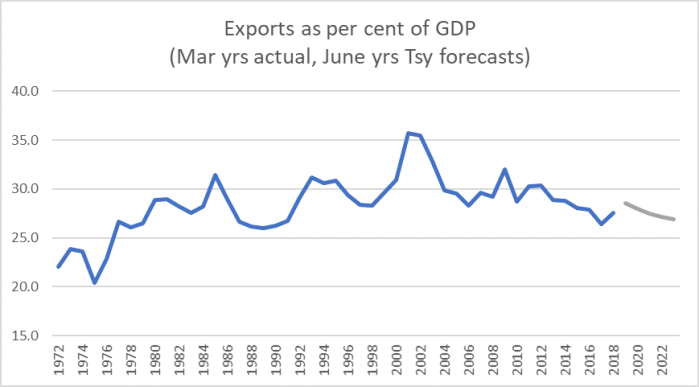
Here is exports as a per cent of GDP.

x gdp

By the end of the forecast period, when the government is likely to be finishing its second term, Treasury (on current government policies) thinks exports as a share of GDP will then be about where they were in 1977.

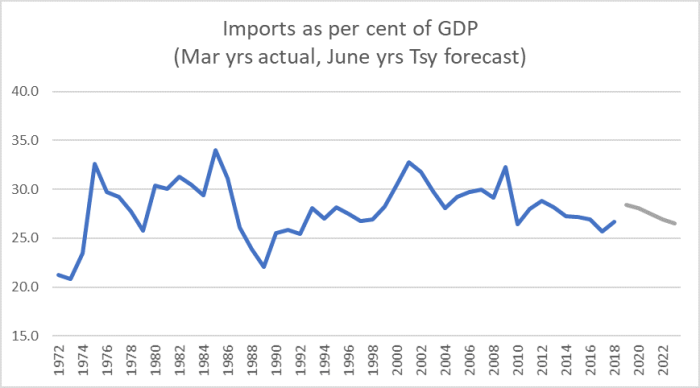
And imports?

m gdp

There is nothing remotely transformational.  Just more mediocre underperformance.

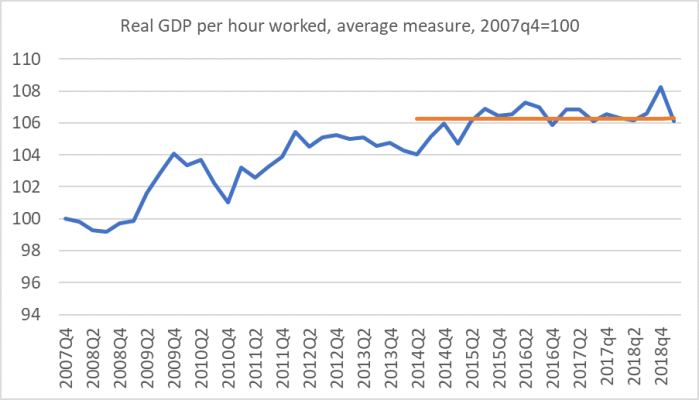
What about productivity?  Well, here The Treasury is rather upbeat.

This is the actual record of labour productivity growth, including an estimate for the March quarter 2019 using Treasury’s published GDP forecast.

Tsy productivity GDP phw.png

That’s next to no actual productivity growth for five years, and none at all for four years.

But, as ever, Treasury thinks things are just about to come right.  “As ever”?   Here’s a table I included in a post at the end of last year, suggesting that Treasury simply had the wrong model for thinking about productivity.

HYEFU forecasts for labour productivity growth published in Dec
Forecasts for June yrs 2014 2015 2016 2017 2018
2016 2.2
2017 1.6 1.6
2018 1.1 2.1 2
2019 1.2 0.8 1.5 2
2020 0.7 1.3 1.7 1.1
2021 1.4 1.5 1.2
2022 1.3 1.2
2023 1.2

The forecasts in the latest BEFU for the three out years (to 2023) are exactly the same as those published in December’s HYEFU.

Treasury has consistently expected a significant recovery in productivity growth, and it has equally consistently failed to arrive.   Is there any reason to think they are more likely to be right now?   It isn’t as if anything much in the policy framework has changed for the better.

(Of course, if the productivity growth fails to materialise, so –  most likely –  will the headline GDP growth, and the revenue estimates will be threatened.)

The other thing I find consistently odd about The Treasury’s macro numbers is their view all our inflation problems (undershooting the target that is) are now behind us: from this quarter, the forecast inflation rates are consistent with annual inflation at 2.0 or 2.1 per cent all the way to the end of the forecast period.    As a result, on their numbers, there are no OCR cuts (their numbers will have been finalised before the recent actual cut) and before too long OCR increases start being implemented: three years hence they expect to have seen 75 basis points of increases.

And, of course, this is the same sort of story they’ve been telling us for years.  Wrongly.

In many respects, medium-term macroeconomic forecasting is a mug’s game.  Few, if any, can do it consistently well.  So the numbers aren’t interesting in their own right –  they tell us nothing  much about what actually will happen –  but they do tell us something about the forecaster’s models, and when the forecaster is also the government’s lead economic adviser that in itself can matter.

On these numbers, we have a Treasury that sees no sign of an increasing outward orientation to the economy, seems to think an unemployment rate of about 4.5 per cent is as good as it gets in normal times (ie roughly the NAIRU), and continues to pick projections of productivity growth seemingly out of thin air, even against a backdrop of years of little or no productivity growth for recent years, no change of economic policy approach, no nothing,

For all the (quite appropriate) fuss about the outgoing Secretary to the Treasury, it is now only three weeks until his scheduled departure date and no replacement has yet been announced.    That in itself should be quite concerning, suggesting SSC is struggling to come up with someone with the right mix of competence and go-alongness.  There is a whole range of institutional performance issues a new Secretary should address, but the characteristics that might qualify someone to be appointed by the current SSC regime may well be exactly the wrong sort of characteristics to expect any material change for the better from after 27 June.


On Makhlouf and standards in public office

If I hadn’t been away, and then come down with a very nasty cold (which will soon have me back on the sofa again), no doubt I’d have commented earlier on the Makhlouf affair.  Whatever your view of how Gabs came to be appointed and reappointed, or of his overall stewardship of the office of Secretary to the Treasury, it is a sad business in many ways.

Human beings make mistakes.  I don’t suppose anyone would be calling for Makhlouf’s head if it were only a matter of having been chief executive of a (not overly large) agency where the document/computer security was so weak that what happened early last week could happen.  Not even when taken in the context of an organisation that didn’t seem to be quite as attuned to keeping secret what they were supposed to keep secret as we might have hoped (recall their policy on computers and lock-ups even after the RB OCR leak, or the episode last Thursday in which Treasury staffers were giving out copies of Budget documents to journalists outside the lockup, under the impression that the recipients were fellow Treasury staffers).  It isn’t a good look –  even recognising that Budget material is typically politically sensitive rather than market sensitive –  and perhaps might have taken a bit of the gloss off the farewell functions in the next few weeks.  But that would have been all.   The chief executive would have been responsible, and in some sense accountable, but those actions –  or failures –  wouldn’t have been his personal ones.

But the focus now is on choices that Makhlouf himself personally made, words he himself chose to use (or not use) and so on.    They are a rare case when the public gets a direct look at how a top public servant handles himself under pressure.  Not well.

The whole business started on Tuesday, mid-morning when National released Budget material.  By 12:20 pm that day there was an official statement from Makhlouf.   It was fine.  The heart of it was this

“Right now we’re conducting our own review of these reports and the information that has been published,” said Makhlouf.

As you’d expect.   Presumably the office of the Minister of Finance and (perhaps) the Prime Minister’s office had already made it clear they wanted to be keep updated.

But it must have been a busy next few hours at The Treasury, and presumably Makhlouf was extensively involved, at least in reviewing whatever information and advice his staff were generating.

His next public statement was issued at 8:02 on Tuesday evening.   And this was the one that started him down the perilous path

Following this morning’s media reports of a potential leak of Budget information, the Treasury has gathered sufficient evidence to indicate that its systems have been deliberately and systematically hacked. 
 
The Treasury has referred the matter to the Police on the advice of the National Cyber Security Centre.

It sounded impressive and sobering at the time.  No doubt it was supposed to.   All reinforced by Makhlouf’s rash interview on Radio New Zealand the next morning, with his overblown bolt analogy and attempts to play up the “attack” and “penetration” language (using it and never once objecting when the interviewer used those words).  I heard some of it at the time, but listening to it again this morning with the benefit of perspective it is all the more extraordinary given what Makhlouf clearly already knew.  He ruled out any “sloppiness” or “incompetence” in his own staff or systems.

But, of course, what we now know –  what Makhouf knew at the time –  is that the National Cyber Security Centre had already made it clear to Treasury that, based presumably on what Treasury staff had told them, there was no sign that anything fitting the bill of a “hack” had happened.  If they suggested –  as Makhlouf claims – that it was a matter for the Police, it was probably only in a “nothing to do with us, but you could try Police” sense.    The NCSC reference should never have appeared in Makhlouf’s statement at all –  they were dragged in, it appears, to provide Makhouf with cover.

Even allowing for the fact that it was a busy day, you can be sure that every word in the Makhlouf statement would have been considered carefully.   Presumably Treasury comms staff were involved, and at least a couple of his key deputy secretaries (including, one hopes, the one responsible IT and security).  We don’t know if they ran a draft past the office of the Minister of Finance (on Makhlouf’s telling, the matter was referred to Police at about 6pm and the Minister informed at about 7pm).   But in many respects it doesn’t matter: it was Makhlouf’s statement (personally) and even if someone else suggested things the words actually used are wholly his responsibility.  Public service chief executives are supposed to operate at arms-length, and are personally accountable as such.  At this point, the Minister had no leverage (after all, Makhlouf was leaving in four weeks time).

(The Minister’s own statement is another matter.  It upped the ante further, in a way Makhouf never directly did, attempting to tie the National Party to criminal activity (“the material is a result of a systematic hack and is now subject to a Police investigation”).  The fact that the Minister’s statement was released only 15 minutes after Makhlouf’s suggests that likelihood of close liaison between Treasury staff and staff in Robertson’s office. The statement looks unwise and opportunistic, but surely that is politics.  Absent further evidence, I’m prepared to believe the Minister and his office –  none of whom will have had a high degree of technical capability –  were misled by Makhlouf and The Treasury.)

After Makhlouf’s RNZ interview on Wednesday morning we hear nothing more of substance for most of the day.  A non-partisan observer might reasonably have concluded that the Simon Bridges release/attack was backfiring (it was my take).   But that was those of us not in the know.  Makhlouf and his senior IT staff (and their bosses) must have known very well by this point what had actually happened  (and if Makhlouf personally did not sufficiently understand the point, that too reflects poorly on him, for not having asked hard enough questions, or ensured he was on totally solid ground).   They must have known that at any time National could reveal how they had actually obtained the information (the search bar on Treasury’s website).  But they said nothing more all day, despite knowing that they had poured fuel directly into an intensely political controversy.

And then two awkward things must have happened.  First, Police actually reacted fast (and around something where it might have been politically convenient for them to have acted slowly) and advised Treasury that was nothing unlawful for them to investigate, and then Simon Bridges indicated that he would hold a press conference the following morning to explain how National had actually obtained the information.

Thereupon, there must have been intense activity at Treasury, as they attempted to get ahead of the story again.  This was the 5:05am statement.     But it wasn’t just another Makhlouf statement, as he managed to get the State Services Commissioner to issue a parallel statement.  One can only wonder how much consultation with ministers (Finance, State Services) or their offices went on through this period –  but it is hard to believe that Peter Hughes would have put out such a statement, getting in the middle of a political controversy, with little or no notice, little or no consultation.

And what did Thursday morning’s (5:05am) statement say?   There was a bit of unavoidable clearing the decks

Following Tuesday’s referral, the Police have advised the Treasury that, on the available information, an unknown person or persons appear to have exploited a feature in the website search tool but that this does not appear to be unlawful. They are therefore not planning further action.

But it was hardly a mea culpa by Makhlouf.    Once again, he seeks to perpetuate the “hack” theme, invoking the idea that the NCSC were working with Treasury to identify what had gone on.

In the meantime, the Treasury and GCSB’s National Cyber Security Centre have been working on establishing the facts of this incident. While this work continues, the facts that have been established so far are:

(there follow 11 bullet points, the now-familiar material about clone websites, indexing documents, and the simple ability to use Treasury’s search bar.)

And pushes the notion that someone else had done something wrong

The evidence shows deliberate, systematic and persistent searching of a website that was clearly not intended to be public. Evidence was found of searches that were clearly intended to produce results that would disclose embargoed Budget information.

Rather than that his job had been to run an organisation keeping politically-sensitive government material secure until the government chose to release it.  Something he had failed to do.

As he gets to the end of his statement Makhlouf does reluctantly concede the systems failure.

In light of this information, Secretary to the Treasury Gabriel Makhlouf said, “I want to thank the Police for their prompt consideration of this issue. In my view, there were deliberate, exhaustive and sustained attempts to gain unauthorised access to embargoed data. Our systems were clearly susceptible to such unacceptable behaviour, in breach of the long-standing convention around Budget confidentiality, and we will undertake a review to make them more robust.”

But even then is keen to muddy the waters.    Embargoes are irrelevant here –  they only apply to people who accept information under embargo, on terms and conditions set by the person releasing it.  There was no embargo here, simply insecure Treasury systems.  And then there was the final sentence, again playing distraction.  There is no “longstanding convention around Budget confidentiality”.    There are obligations on public servants to keep “Budget secret” information secret, an obligation that applies especially to the Treasury Secretary, responsible for Treasury systems, and there are rules in the Budget lockup.  But none of that applies to anyone else.  A journalist who receives a leak about Budget material isn’t breaking the rules or any conventions in breaking the story –  in fact, they’d be failing in their job if they chose not to run a newsworthy story.

And that was it.   No apology for misleading the Minister, no apology to the public for misleading them (all that talk of “hacks”, attacks on iron bolts etc), just an attempt to get in ahead of the Bridges press conference –  as if he himself were a political operator –  and to keep on muddying the waters and minimising responsibility.  Makhlouf has given not a single media interview since –  despite that very lengthy one on Radio New Zealand when he was playing the “under systematic attack” card, and probably garnering quite a degree of public sympathy, for all it was worth.

It was an extraordinary couple of days, and an extraordinary display of poor judgement by one of our most senior public servants.     He’d made a series of very bad calls, all his own personal responsibility, and in the full glare of the public spotlight.

A decent and honourable person might have taken a day and then announced his resignation.  After all, human beings make mistakes, and when they are serious enough, and public enough, sustained enough, and committed by someone very senior (in whom the system reposes considerable trust), bad choices need to have consequences.   Given that he is leaving shortly anyway, surely the decent thing to have done would have been to have issued a statement indicating that he’d made mistakes, regretted and apologised for that, but that it was best now to clear the air, and that accordingly he would be resigning with immediate effect.   Had he done so, my regard for him would have risen considerably (I’d even toyed with words for a post I might have written had he done so).

The alternative approach might have been to have announced that he had offered his resignation to the State Services Commissioner, and left to the Commissioner to decide whether or not to accept.  But reports to date suggest there has no even been that offer.

Instead, after several days, we learn that SSC is to hold an inquiry.  Unfortunately, their statement is not on their website, but according to media reports

The State Services Commissioner will conduct a new inquiry into statements and actions made by Treasury Secretary Gabriel Makhlouf​ concerning the Treasury “hack” last week.

I have little confidence in this inquiry.  For one, the inquiry is supposed to look into Makhlouf’s handling of last week’s events, but recall that the SSC made themselves an active player in those events when they agreed to a coordinated statement with Treasury on Thursday morning.  They are, at least in part, inquiring into themselves.  And then there is line from yesterday’s statement

State Services Commissioner Peter Hughes said the questions that had been raised were of considerable public interest and should be addressed.
“It’s my job to get to the bottom of this and that’s what I’m going to do,” Hughes said.
“Mr Makhlouf believes that at all times he acted in good faith.”
“Nonetheless, he and I agree that it is in everyone’s interests that the facts are established before he leaves his role on 27 June if possible. Mr Makhlouf is happy to cooperate fully to achieve that. I ask people to step back and let this process be completed.”

What have Makhlouf’s preferences got to do with it?  It all has a rather too-cosy feel to it, and the likelihood of this being wrapped up any time materially earlier than 27 June seems very low (any draft report will surely be given to Makhlouf and other affected parties to review, and perhaps have their lawyers comment on, before release).

Add to the cosy sense, the fact that Makhlouf hasn’t been suspended, but continues to work as normal –  with the full support in that of the Prime Minister.   This isn’t an inquiry into some obscure aspect of past administration, or even to details of how he was appointed, it is about his personal choices, words and judgements within the last week.    If it is serious enough to have a serious inquiry, it is serious enough for Makhlouf to be stood aside until the report comes in.  If it is a serious inquiry that is.

What of the authority under which Makhlouf is hired and fired?  That is the State Sector Act.  Government department chief executives are not standard employees, but hold a statutory office, appointed by the Cabinet on the recommendation of the State Services Commissioner.  The Commissioner them becomes the employer.  What of dismissal?  Section 39 covers that.

SSA

On the face of it, it is as simple as that.  So long as Cabinet agrees, a departmental chief executive can be removed.  It isn’t the famed “at-will employment” of the US, but it isn’t standard employment law either.  To a lay reader –  and there probably isn’t any case law in this specific context –  “just cause or excuse” really does look at though it should cover failings like misleading the Minister, repeatedly misleading the public, making flamboyant statements that the facts (known to him at the time) don’t support,  (arguably perhaps) wasting Police time, and refusing to offer any contrition when those facts emerged.

In that earlier quote, Peter Hughes reports that

“Mr Makhlouf believes that at all times he acted in good faith.”

I’m happy to believe that, but what of it?   That is no sort of standard –  a 16 year old placed in charge of The Treasury probably would have acted in good faith too, but simply wouldn’t have been up to the demands of the job, and would have been exposed sooner or later.   Makhlouf isn’t 16, but his conduct over the last week suggests that if he was acting in good faith, he simply didn’t display the judgement,temperament, and character that should be required to hold such office in New Zealand (let alone Ireland, but that is their problem).

Perhaps one can debate whether section 39 should be invoked to dismiss Makhlouf (although it is now clear that it won’t be).  One reason to hesitate might be that provision should not be used lightly, and has not been used previously.     I’m not in a position to know whether there have been more serious breaches of acceptable standards from departmental chief executives over the 30 years since the law was enacted –  most of what departmental CEs do happens behind closed doors, away from the public eye.   But of things that have come to public view, it is hard to think of any (departmental chief executive) episodes that plumb the low standards on display by Makhlouf in the last week (not just a single choice, word, or act but the accumulation of words, actions, choices over several days, each compounding the other, with no sign or act of any contrition).  He should go, and if he won’t resign, he should have been dismissed (yesterday’s Cabinet would have been the opportunity).

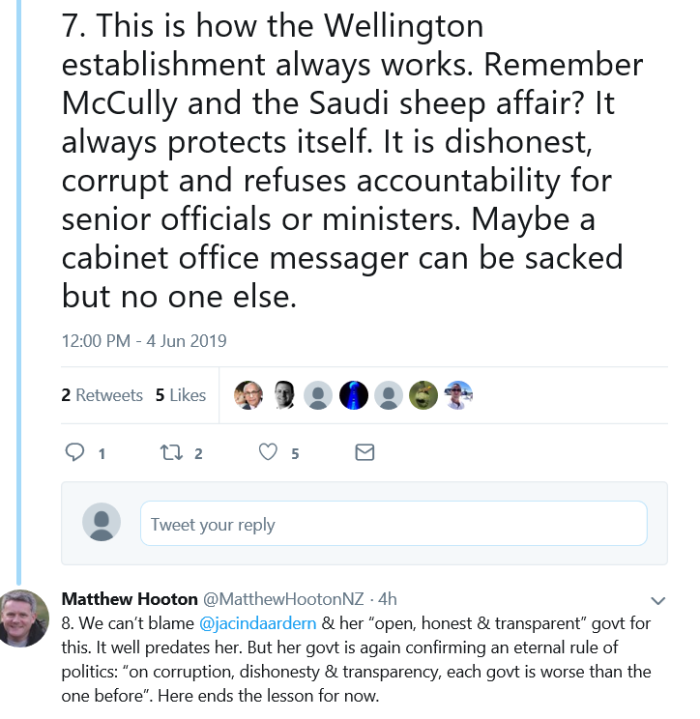
Matthew Hooton has a sustained Twitter thread this morning that is worth reading.  He is more focused on the political aspects, and the potential culpability of Grant Robertson (I’m ambivalent on that point, pending more evidence).  But his bottom line is one I strongly agree with:
hooton

And the State Services Commissioner is fully part of that same self-protecting establishment –  appointed by them, from among them, and now supposedly reporting independently on actions (of another member) that he himself was part of as recently as last Thursday morning.

This must not be the standard we settle for.
Economic failure: the reluctance to recognise the implications of extreme remoteness

As regular readers know, I tend not to be particular upbeat about the New Zealand economic story.  For anyone new, there should be a hint in the very title of the blog.  If, by chance, you are still attracted to an upbeat take, only last week in a post here I critiqued a recent book chapter taking that sort of view.

And so I was a bit surprised when, more than a year ago now, I was asked to write a chapter for a forthcoming book on aspects of policymaking, and associated outcomes, in a small state (this one).  In principle, the book sounded potentially interesting, and they were approaching a bunch of pretty serious and senior people to contribute.  But it wasn’t clear there was much in it for me, and since the plan was for the introduction or foreword to have been written by the head of the Department of Prime Minister and Cabinet, it seemed likely that the thrust the organisers were looking for was a positive take on the New Zealand story.   So as not to mess people about, I declined the invitation, only to have my arm twisted, with assurances that there was no such agenda.  In the end I agreed to write something, and although the organisers/editors still seem keen on a more positive spin, by the time I discovered that I was committed.

The latest draft of my chapter, attempting to be positive where I can, is here.

An underperforming economy; the insufficiently recognised implications of distance (draft chapter)

I’ve had useful comments from various people on an earlier draft (none of them bear any responsibility for the current version though), but if any readers have comments you’d like to add to the mix, you can earlier leave them as comments to this post or email me directly (address in the “About Michael Reddell’s blog” tab).

The potential market for the book, as I understand it, is people like students of public policy, perhaps in parts of Asia.  Many of these potential readers, I’m given to understand, see New Zealand as a sucesss story.   Within the (severe) limitations of length, I’ve set out to provide a more balanced take on the economic story.  In a way, I guess, New Zealand is a sort of success story.  200 years ago on these islands there was not much more than a subsistence economy, and only recently had overseas trade resumed after the inhabitants had been isolated for several hundred years.  From that to one of the richest countries in the world in a hundred years was remarkable.  And even now, after a century of relative decline,  there is only a handful of countries in east Asia and the southwest Pacific with material living standards matching or exceeding our own (Australia, Japan, Singapore, Taiwan, with South Korea coming close).   And from a macroeconomic policy perspective, we’ve now had low and stable inflation again for 25 years, have had low and stable public debt, and a considerable measure of financial stability.  That isn’t nothing by any means.

But it doesn’t exactly mark us out.  What does mark us out is that century of relative decline: of course, we are much richer than we were 100 years or so ago, but then we were among the top three countries in the world (GDP per capita), and now we languish a long way down the advanced country rankings (especially on productivity measures).    With productivity levels not quite 60 per cent of those in the leading bunch of advanced economies, we are getting closer to the point where New Zealand could really only be described as an upper middle income country.

My story, as a regular readers know, is that our physical remoteness –  in an era where, internet notwithstanding, distance appears to be not much less of a constraint than ever in many respects – is the key issue in our underperformance.  It isn’t that –  as some models and sets of estimated equations suggest –  distant countries are inevitably poorer, but that distant countries seem to thrive (to the extent they do) mostly on natural resources, and industries building directly on those resources.  And with a limited stock of natural resources, there are limits to the number of people that such places can support top tier incomes for (a very different proposition than for economies –  eg those of northwest Europe – where most of the most productive economies are found) where natural resources are simply no longer that important, and where the advantages of proximity can be realised more readily.    The story is much the same for Australia as for New Zealand –  and Australia has also been in (less severe) relative decline over the last 100 years – with the difference that Australia found itself able to utilise whole new sets of natural resources, either unknown or uneconomic previously.  New Zealand has had nothing – that material – similar, and no big asymmetric technology shocks in our favour for a long time either.   Against that backdrop, using policy to drive population growth (rapid by advanced country standards) simply did not make sense –  putting more people in a fairly unpropitious location, albeit one with some reasonable economic institutions (rule of law etc).  It didn’t make sense decades ago –  before people fully appreciated the nature of New Zealand’s relative economic decline –  and it doesn’t now.   There was a valuable signal, that policymakers and their advisers simply chose to ignore, when New Zealanders –  who know New Zealand best –  starting leaving in numbers that (while cyclical variable) are really large by international or historical standards (absent a civil war or the like).

Perhaps the new bit to my story in this draft chapter – which was prompted by the way the initial specification was framed –  was to think about why the stark economic underperformance has been allowed to go on, not just by our politicians and political parties, but with no compelling remedies offered by our major economic policy advisory institutions (The Treasury in particular) or by international agencies that offer advice (notably the OECD).  I suggest a story in which it is simply difficult to identify that right comparator countries when thinking about economywide productivity and economic performance issues.  For many areas of policy –  monetary policy is an example, but it is probably true of health and education and welfare –  pretty much any advanced market economies can offer useful benchmarking, but if remoteness really does matter (not just to, say, defence, but) to the viable options and business opportunities available here, then the experiences of –  say –  Belgium or Denmark just aren’t likely to be that useful, even if Denmark has a similar population and was once the major competitor for UK dairy markets.

We may be able to learn something from reflecting on the differences, but it is typically much more compelling if one can point to another similar country (or 2 or 10 of them) and learn from them.   And thus I note an important difference between New Zealand and many of the (now fast) emerging advanced economies of central and eastern Europe.  Not only are they physically proximate to various highly productive economies (easy and cheap to meet fellow policymakers and analysts regularly, including in EU fora), but have a lot of similarities across each other (similar location, similar communist past, and so on).     I don’t claim to know Hungary, Slovenia, the Czech Republic or Slovakia in great detail, but if I were a policymaker in any of them, I’d be (almost obsessively) benchmarking my economic policies against those of the others, and of nearby rich and productive countries (eg Austria and Switzerland).  There are never exact parallels, but in New Zealand’s case it is hard to find good parallels at all. I suggest that Israel might be in some respects the best for New Zealand –  but it is little studied here (and its productivity performance is about as bad as ours –  partly, I’ve suggested, for similar reasons).

The lack of easy examples to benchmark ourselves against isn’t really an acceptable excuse, but I suspect it is part of the explanation.  It is long been a problem for the OECD in their advice to New Zealand: they’ve repeatedly brought a northern European mindset to a remote corner of the world, after early on investing quite a lot in the idea that the New Zealand reforms were exemplary, and almost sure to reverse our underperformance.  Places like the OECD work a lot on illustrating cross-country comparisons, but they simply never found the right ones for New Zealand (on these economywide issues) and have not shown much sign of trying.  It is particularly problematic because the OECD are full-on committed to high immigration, regardless of the experience of an individual country (see my post about the then OECD Chief Economist extraordinary performance when she launched their 2017 New Zealand report – there is a new report due out in a few weeks, and I’m not holding my breath).

Of course, New Zealand politicians no longer seem to have any appetite for trying to reverse the staggering decline in New Zealand’s relative performance.    But just possibly they might if their advisers were offering a compelling diagnosis and set of prescriptions.  As it, The Treasury seems to have no more idea than the OECD, and seems to have abandoned much interest in the productivity issue, in favour of the feel-goodism and smorgasbord of random indicators that makes up the Living Standards Framework, supporting the “wellbeing Budget”.  I was exchanging notes the other day with someone about the mystery as to who the next Secretary to the Treasury will be (there is a vacancy a month from now, and applications closed three months ago).  It is hard to be optimistic that it will make much difference who gets the job –  given the hoops they will have to have jumped through to get it –  but sadly it is a story of a low-level equilibrium: no political demand for answers and options to reverse our decades of relative decline. and no bureaucratic supply of such answers or the supporting analysis either.

Anyway, for anyone interested here are the concluding paragraphs.

Conclusion

After the bold reforming period of the 1980s and early 1990s, official and political economic policymaking in New Zealand appears to have been at sea, without a tiller or compass, for at least a couple of decades.   Much that was positive was done during the reform era, and various good institutional reforms were put in place.  Much needed to be done, and in some respects it was to the credit of a small country that so much – initially attracting considerable international admiration –  could have been put in place so quickly.    Seared by the experience of the quasi-crisis of 1984, and rapid escalation of official debt in the previous decade, New Zealand has since enjoyed an enviable degree of macroeconomic stability: low and stable public debt, low and stable inflation, and domestic financial stability (even amid severe policy-induced upward pressures on house prices and household debt).  Unemployment rates that are fairly low on average are another successful element.   In those areas of policy, meaningful international benchmarks have provided a routine check of policy, and the external advice sometimes provided has typically been drawn from countries (small floating exchange rate countries), where the comparisons are apt and insightful.

But if stability has been successfully regained and maintained, on the wider counts of economic performance only a “fail” mark could possibly be assigned.  Among the failures, policymakers managed to preside over reforms that have created artificial scarcity of urban land and sky-high housing prices, in common with many of their Anglo peers.  But the productivity failure is more stark, because it is more specific to New Zealand.   Despite numerous (de)regulatory steps taken to open the economy to international competition –  and a considerable increase in the real volume of exports and imports –  foreign trade as a share of GDP has shrunk and with it the relative size of the tradables sector.  The export sector itself remains heavily dominated by industries reliant on domestic natural resources (a fixed asset) – services exports have been shrinking as a share of GDP – and, despite rapid population growth, business investment has been modest at best.

To an outsider, perhaps the surprising feature of such an underperforming advanced economy is that population growth has nonetheless been quite rapid. Birth rates have been below long-term replacement rates for several decades now. But defying the revealed preferences of New Zealanders, who have left the country in huge (but cyclically variable) numbers over the last 50 years for 25 years now policy has been set to bring in one of the largest migrant flows (per capita) of any advanced country.   Regularly presented as a skills-focused approach, it has remained difficult to attract many really talented people to a small remote country with lagging incomes and productivity[1] and there have been few (apparent or realised) outward-oriented economic opportunities in New Zealand for either natives or migrants.

Advocates and defenders of New Zealand immigration policy often attempt to invoke arguments and indicative evidence from other countries.  Even then, the value of insights appears more limited than the champions believe: not one of the high immigration advanced economies (Canada, Australia, New Zealand, Israel – or the United States) has been at the forefront of productivity growth over the last 50 years, and only the US is now near the frontier in levels terms.  But even if those arguments might have some validity in some other countries, there has been too little serious engagement with the specifics of the New Zealand situation: remoteness, lack of newly-exploitable natural resources,  and the actual experience (lack of demonstrable gains for New Zealanders) following 25 years with a high level of (notionally) skills-based immigration.    As by far the most remote of any advanced country, it is perhaps the last place one might naturally expect to see policy actively working (encouraged by local officials and international agencies) to support rapid population growth.

Looking ahead, if New Zealanders are once again to enjoy incomes and material living standards matching the best in the OECD, policy and academic analysts will have to focus afresh on the implications, and limitations, of New Zealand’s extreme remoteness and how best policy should be shaped in light the unchangeable nature of that constraint (at least on current technologies)   Past experience –  1890s, 1930s, and 1980s – shows that policies can change quickly and markedly in New Zealand.  But with no reason to expect any sort of dramatic crisis – macro-economic conditions are stable, unlike the situation in the early 1980s –  it is difficult to see what might now break policy out of the 21st century torpor or, indeed, whether the economics institutions would have the capacity to respond effectively if there was to be renewed political appetite for change.

[1] OECD (2016) adult skills data suggest that although the gap between skills of natives and migrants is small, migrants to New Zealand are, on average, less skilled than natives.

There won’t be any posts for a few days as we are heading off this morning to attend the funeral for my wife’s (extremely aged) grandmother.  Back blogging on Tuesday.

Poor policy processes and bank capital

The Reserve Bank’s Financial Stability Review is out tomorrow.  The last such document came out in late November, when we got a lot on the non-issue (from a New Zealand banking system systemic risk perspective) of climate change and almost nothing on bank capital.   There was a double-page spread on the former –  which the Governor has next to no responsibility for –  and on the latter only this

A consultation paper on the minimum capital ratios is due to be released in December. Our preliminary view is that higher capital requirements are necessary, so that the banking system can be sufficiently resilient whilst remaining efficient. The Reserve Bank’s aim is to announce final decisions on all key components of the capital framework in the second quarter of 2019.

The actual announcement of a huge proposed increase in minimum capital ratios was a mere two weeks away –  decisions must already have been made –  and there was not even a hint of the magnitude of what the Governor was about to hit the economy with.  And do note that strong sense of pre-determination: they thought they could announce proposals on the eve of Christmas and have everything finalised by June.  Their latest plan, announced last week, is for a final decision in November.   Even then, there is a strong hint of pre-determination, with comments as recent as the last day or two stating that “we will lift capital levels”, even if they now seem to want to sound more open about the extent.

I don’t suppose the Governor will be saying much tomorrow about the substance of the bank capital proposals.  Submissions have now closed, and it would be unwise for him to weigh in further now, at least if he hopes to be able to defend himself against charges that the consultation wasn’t for real.     But I hope there are serious questions –  both at the Governor’s press conference, and from the Finance and Expenditure Committee –  about the process.    It has been poor from the beginning, built on a weak and inappropriate governance framework, and if the latest announcement is a little more encouraging there are still significant unanswered questions.

Under the terms of the Reserve Bank Act, the Governor can unilaterally vary conditions of registration for banks.  That includes their minimum capital requirements.  This isn’t a conventional regulatory model: no ministers are involved, no decisionmaking board is involved, Parliament’s regulations review committee can’t disallow such rules.   And, of course, the Governor is not elected, is not even appointed by people who are elected, and neither he nor those who appoint him face any serious or effective accountability.  The only thing he has to do is to make sure that he jumps through the process hoops around “consultation”, and even then it is a very weak test given the deference courts tend to pay to agencies, and the extreme reluctance of banks to ever openly challenge their regulator in court (the Bank has lots of other discretion it can wield to disadvantage awkward banks).  It is a bad case of the adminstrative state run rampant, neither accountable nor particularly expert.

The Governor himself can’t change the statute he operates under (although the government does have underway at present a review of the Reserve Bank Act).  But a good Governor can recognise the limitations of that legislation, and choose to operate in ways that minimise the risks and disadvantages of a framework put in place decades ago, when the designers did not envisage the Bank exercising major regulatory discretion.  As it is, the Governor is effectively prosecutor, judge, and jury in his own case, and there are no rights of appeal.  Anyone with the slightest sense of history and human nature would recognise certain risks in such a model.   Checks and balances not.

The Reserve Bank’s overall capital review has been running for several years, dating back to Graeme Wheeler’s time.   There has never been strong grounds for urgency around the review, capital requirements having been lifted last only a few years ago.  Of course, regulated entities (banks, in this case) want certainty, but I’m pretty sure even they want robustly developed and scrutinised rules.

How much better if, having got their internal staff work to a certain point, the Reserve Bank had engaged in some proper, open-minded, consultation before the Governor ever signed on to a particular proposal.   Perhaps there could have been a series of Analytical Notes, Bulletin articles, and other background papers, reviewing relevant literature, reviewing the New Zealand experience, comparing and contrasting New Zealand’s situation with those in other countries (including identifying how and in what ways specific countries were relevant comparators, and rigorously reviewing arguments and evidence around possible medium-term transitional effects.  It might have all come together in something like, in older parlance, a Green Paper: not formal proposals, but a canvassing of issues, possibilities, risks, costs, benefits and so on.  A series of workshops and/or conferences could have been held over several months, open to interested parties (including invited local and international experts), to help test the Bank’s preliminary thinking. scrutinise the evidence etc etc, and all without the eventual decisionmaker having committed himself.  Such a process wouldn’t simply have been about picking holes, but might have highlighted new evidence (for or against) the Bank wasn’t aware of, or identified a list of important further questions needing more analysis or research.

It could have been a genuinely constructive process –  the path to better policy, as well as to a better reputation for the Bank (recall that stakeholder survey from a year or so ago).  At very least, it would have helped alert senior management (the Governor particularly) to the potential weaknesses in the Bank’s own analysis, major areas of concerned that commenters might raise if the matter went to formal consultation, and thus should have helped his own preliminary decisionmaking process.

And having done all that over a period of several months, the Governor might then have taken a preliminary view and moved to the next phase of consultation, but have done so with all his ducks in a line:

  • all the relevant papers would be released at the same time (not continue to be written over several months) including the pro-active release of background internal material,
  • there would be a proper rigorous cost-benefit analysis, with appropriate key sensitivities and asssumptions clearly highlighted,
  • there would be a regulatory impact assessment, not just done by those championing the reform, but independently reviewed and scrutinised,
  • and recognising that, unlike when a minister initiates legislative proposals (which have to get through Cabinet, select committee, and Parliament), the Governor is the sole decisionmaker on his own proposal, it would have been appropriate for the Governor to have announced the appointment –  at the start of the process –  of a small independent panel of credible experts to assist him in his later deliberations.  The Governor can’t delegate his statutory decisionmaking powers to expert advisers, but he can commit to have serious regard to the analysis and advice of such a panel, and to publish their advice before his own final decision was taken.

But we’ve had none of this.  Instead, the Governor charged ahead on what was evidently little more than a whim and a personal preference, and has been rushing to try to backfill his case ever since.  Having run into what appears to have been unexpectedly strong resistance to his plans –  and not just from the directly affected banks themselves, but from plenty of people with no vested interests –  we are now finally promised a proper cost-benefit analysis, and some “external experts”, but it is now so late in the piece that whatever and whoever they come up with is going to be greeted with a considerable measure of scepticism.  Anyone can produce a cost-benefit analysis to meet his or her boss’s preferences, and there will inevitably be a sense that whatever is finally produced –  how many more months away? –  it was generated to support the boss rather than to illuminate the issues.  And who are they going to find to serve as “external experts” this late in the piece, when most of those who think about the issues domestically have already either expressed their views and been involved as consultants in preparing submissions by others.  There can be a role for overseas experts, but knowledge of the New Zealand system and New Zealand experience should not be irrelevant.  And quite what is the selection process the Governor is going to use at this late stage –  the suspicion will inevitably be that he will be aiming for people just credible enough to look serious, but emollient enough not to want to make difficulties.

In a better world, having got this far, the Bank would now commit to publishing the cost-benefit analysis, the regulatory impact assessment, and the advice of the (as yet unknown) external experts and then reopening the consultation process for a short period (say 4-6 weeks), and only after any new submissions had been received, analysed, and seriously considered would the Governor make his final decision.   These are very big issues, with potentially major economic consequences, and no urgency (no doubt the Bank will tomorrow repeat its longrunning assurance that the financial system is sound).  We need to see much better policy processes used than have been on display so far –  all the more so when a single non-expert unelected official is making the proposals and the final decisions, and when his final decisions cannot be appealed.


CANZUK

I’ve been intrigued by the CANZUK proposition for some time.  In their own words,

CANZUK International was founded in January 2015 …and is the world’s leading non-profit organisation advocating freedom of movement, free trade and foreign policy coordination between Canada, Australia, New Zealand and the United Kingdom (the “CANZUK” countries).

Our campaign advocates closer cooperation between these four nations so they may build upon existing economic, diplomatic and institutional ties to forge a cohesive alliance of nation-states with a truly global outlook.

There is an online petition, and when I checked a few minutes ago 273,872 people had signed it.  Not insignificant numbers, although the total population of the four countries is over 125 million people.

I’m interested for multiple reasons:

  • I’m fascinated by British imperial history, think that in large part it is something to be proud of, and find cross-country comparisons of the experiences of other former British territories helps shed light on our own history,
  • 50 years ago I’d probably have found the CANZUK proposition almost self-evidently sensible (and at least around the movement of people it more or less described how things had been, at least among Australia, New Zealand and the UK since European settlement here),
  • My scepticism around the economic impact of New Zealand’s immigration policies, going back at least as far as the immediate post World War Two period.

On top of which, I discovered recently that one of the more vocal champions of CANZUK is a pro-Brexit British economist (New Zealand born apparently) who is related to my wife.  He takes every opportunity to champion the cause, as this tweet from earlier this morning.

lilico

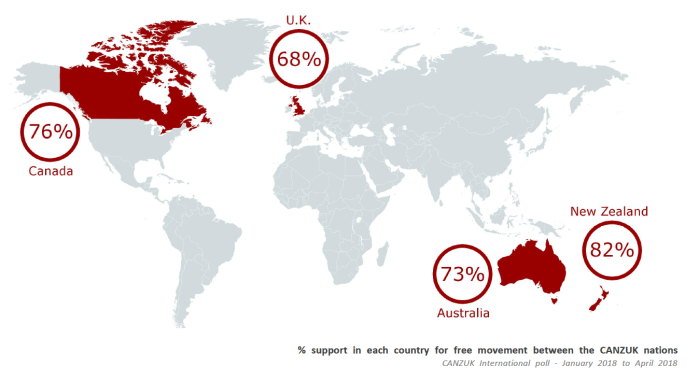
There has been some public opinion polling on the CANZUK idea, and the movement really rather liked the results.    This was the question (for New Zealand)

“At present,citizens of the European Union have the right to live and work freely in other European Union countries. Would you support or oppose similar rights for New Zealand citizens to live and work in Canada, Australia and the United Kingdom, with citizens of  Canada, Australia and the United Kingdom granted reciprocal rights to live and work in New Zealand?”

And this chart summarised the answers.

CANZUK

I wrote about the CANZUK proposal last year, when I observed (of the people-movement element of the proposal)

I’ve never been quite sure what to make of the CANZUK cause. I read a lot of imperial/Commonwealth history, and ideas like this sort of free movement area among the old ‘white Dominions’ are strikingly reminiscent of calls for an imperial federation or, much later, for imperial trade preferences (which became a big thing as the UK moved away from free trade itself). I could be a little provocative and suggest that is wasn’t entirely dissimilar to the sort of immigration policies New Zealand and Australia ran until a few decades ago, that could be – not entirely inaccurately – characterised as “white Australia” or “white New Zealand” policies.   …..even as an example of Commonwealth sentiment, not even South Africa – let alone Zimbabwe, Kenya or Namibia – appears in the CANZUK proposal.

Of course, there is a pretty straightforward answer. Almost invariably, public opinion in almost any country is going to be more open to large scale (or at least unrestricted) migration when it involves culturally similar countries than when it involves culturally dissimilar ones. In fact, there are good arguments that, if there are gains from immigration they could be greatest from people with similar backgrounds (and of course counter-arguments to that). Reframe the question as “would you support reciprocal work and residence rights among New Zealand, France, Belgium and Italy?”, and I suspect the support found in the CANZUK poll would drop pretty substantially – my pick would be something no higher than 50 per cent. Reframe it again to this time include Costa Rica, Iran, and Ecuador (let alone Bangladesh, India, and China – three very large, quite poor, countries) and people will start looking at you oddly, and the numbers will drop rapidly towards the total ACT Party vote (less than 1 per cent from memory).

And thus my own ambivalence about the CANZUK proposition. If I were a Canadian (of otherwise similar Anglo background to my own) I’d say yes. The historical and sentimental ties across these four countries – less so Canada – mean something to me. I’d probably even add the US into the mix. And across Australia, Canada, and the UK incomes and productivity levels are pretty similar – although the prediction would still presumably be that there would be an increased net flow of people from the UK to Australia (in particular) and Canada.

But I’m a New Zealander, and for us it would appear that there are two forces in conflict.  The ability to move freely to the UK or Canada might be a real gain to some New Zealanders –  as the ability to go to Australia has been over the decades –  but the quid pro quo could be that a lot more Brits could move here.

As it is, I’ve repeatedly noted that my economics of immigration argument doesn’t distinguish between whether the migrants come from Birmingham, Brisbane, Bangalore, Buenos Aires, or Beijing. We’ve made life tougher (poorer, less productive) for ourselves by the repeated waves of migrants since World War Two – in the early decades, predominantly from the UK, and in the last quarter century more evenly spread. Even though we are now materially poorer than the UK, enough people from the UK still regard New Zealand as attractive, that free movement – the CANZUK proposition – would probably see a big increase in the number of Brits moving here (big by our standards, not theirs). That might be good for them – that’s up to them – but wouldn’t be good for us. Perhaps the effect would be outweighed by more New Zealanders moving to the UK long-term, but I’d be surprised if that were so.

The CANZUK proposition is an interesting one, and is worth further debate. Apart from anything else, it might tease out what people think about nationhood, identity, and some of the non-economic factors around immigration.  ….at present public opinion appears to be strongly in favour, but on the specific question asked in isolation. It would be interesting to know, if at all, how responses would change if the option was free CANZUK movement on top of existing immigration policy, or (to the extent of the new CANZUK net flow) in partial substitution for existing immigration policy. The two might have quite different economic and social implications.

The CANZUK movement does appear to have an element about it – at least among some British advocates –  of an outward-oriented replacement for the EU.  But there are supporters elsewhere.   Most notably, the main opposition political party in Canada –  currently leading in the polls –  has CANZUK as one of its principal foreign policy platforms.     Closer to home, David Seymour has expressed support and –  somewhat to my surprise – I learned from the CANZUK website that Simon Bridges had done so too (pretty lukewarmly I suspect?).  The CANZUK people point out that even the Labour-New Zealand First coalition agreement has a provision that might be thought to have something to do with CANZUK (emphasis added).

Work towards a Free Trade Agreement with the Russia-Belarus-Kazakhstan Customs Union and initiate Closer Commonwealth Economic Relations.

What of the other dimensions of the proposal (free trade and foreign policy)?  My own position is that free trade is a good thing, and should try it.     We should remove all remaining tariffs, but not just on imports from Canada and the UK (we already have CER with Australia), but from anywhere and everywhere.  Doing so would benefit consumers.  And I’m sceptical of preferential trade agreements, and see little reason (sadly) to suppose that Canada (in particular) or the UK would be at all keen on open access for New Zealand agricultural exports.

And what of foreign policy?  I’d like to think that the four countries would stand together on many issues (bearing in mind that the North Atlantic and Arctic aren’t terribly important to New Zealand) but for now the four governments show little ability (interest?) in a common approach to, for example, the People’s Republic of China. In New Zealand’s case, not even any support when the PRC authorities abduct Canadia citizens.

Fairly or not, there is quite a sense about the CANZUK cause that is redolent of the 1950s.  I don’t mean that in a particularly negative sense –  there was, after all, a great deal to like about New Zealand’s relative economic performance in the 1950s, and about the still mostly quite close ties among the four countries, including the considerable freedom of movement (then again, Suez was hardly a great advert for NZ/Australia/UK foreign policy coordination).    As a citizen and voter, I feel a considerable affection for each of those countries –  probably more so than for any other countries, decent, worthy and prosperous as many of them are –  but it is the 2010s (almost the 2020s) not the 1950s.

And, at least from a New Zealand perspective, we’d be better off  –  economically, and probably on other dimensions – with materially fewer migrants, not with schemes that might only increase our average net non-citizen migrant flow (and reduce our ability to manage the flows, in a country where the housing and urban land market in particular is badly dysfunctional).


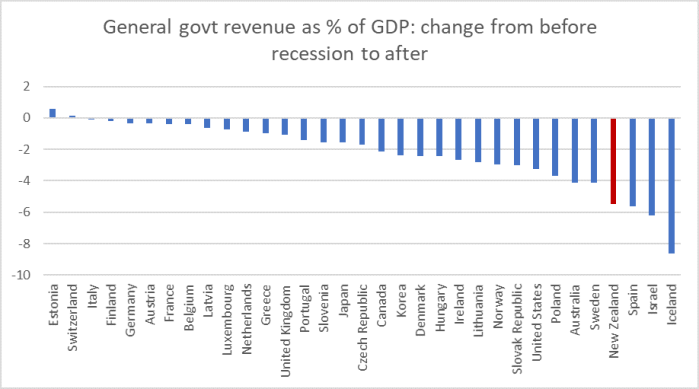
Recessions and revenue

Just a quick post today, prompted by yesterday afternoon’s about the change in the formulation of the debt target foreshadowed by the Minister of Finance.

My proposition was that, with a target range 10 percentage points wide, governments will be expected to stay within that range (more or less) all the time.  And that will means that in normal times –  proxied by when the output gap (perhaps adjusted for the terms of trade) is around zero –  the government will still have to hold pretty closely to the 20 per cent of GDP target midpoint.  They might be able to safely fluctuate between 19 per cent and 21 per cent (or thereabouts) but anything much beyond that would run a material risk of moving outside the target range –  prompting either procyclical fiscal adjustments or the abandonment of the target – the next time a reasonably significant recession hit.    That risk is compounded by the fact that output gaps –  and detrended terms of trade –  are only really best guesses in the first place.  When we think the output gap is zero, hindsight might reveal it to have been +2 per cent of GDP –  increasing the probable revenue losses when the economy next takes a hit.

I noted in yesterday’s post that New Zealand government tax revenue had fallen by around 6 percentage points of GDP in the period from the peak in the years just prior to the recession to the trough in the years just after.   Not all of that was cyclical –  there were some tax cuts just prior to the recession, and again in late 2010 –  but much of it probably was.  And whether or not the revenue loss was the automatic stabilisers at work or discretionary policy changes, a debt target would have constrained choices (on the tax side) that governments of the day had thought appropriate.    And my more general point was that a couple of years in which taxes/GDP were a couple of percentage points lower than normal –  adding to the debt –  shouldn’t be thought exceptional.

But I thought I should check that, and so I dug out the data on government current revenue (mostly taxes) as a per cent of GDP, to see what had happened in other countries in and around the 2008/09 recession.   Here is the change by country (lowest year just after the recession less highest year just prior).

rev

New Zealand –  which did have a pretty severe recession –  had the fourth biggest reduction in revenue as a share of GDP.  I guess that was exaggerated by the effect of the discretionary changes.

But what really interested me was that I noticed a number for the euro-area as a whole.    Revenue as a share of GDP had barely changed, in aggregate across the whole area.  The whole area, of course, had monetary policy adjustment open to it, but individual countries that are in the euro-area did not.

But the median fall in the share of revenue to GDP for OECD countries not in the euro area was 2.9 percentage points.  On the other hand, the reduction for the median euro-area country was only 0.7 percentage points.   I guess that was a mix of crisis countries, indebted countries, the Maastricht fiscal rules, or whatever.  But given the limitations of monetary policy, it hardly seems like an optimal adjustment: automatic stabilisers (in mostly quite high tax countries) should probably have generated more of a fall just on their own.

Anyway, it left me pretty comfortable that my ad hoc suggestion that the government needs to plan around its fiscal target on the basis that a serious recession could easily knock a couple of percentage points of GDP off revenue for a couple of years at least, which in turn would add to the debt.   If they don’t do so, they could find themselves engaged in pro-cyclical fiscal adjustment, which will be even more problematic in the next recession, given how much closer to the limits of conventional monetary policy we (and other countries) are likely to be.

A useful but modest step forward on fiscal management

A year ago the Minister of Finance gave a pre-Budget speech in which he restated the fiscal rules Labour and the Greens had campaigned on.  Among them

We will reduce the level of net core Crown debt to 20 percent of GDP within five years of taking office.

Here was what I said at the time

In general, debt targets –  with relatively short time horizons to achieve them –  aren’t very sensible as operational rules.   Such a rule can mean that a few fairly small, essentially random, forecasting errors in the same direction can cumulate to produce a need for quite a bit of (perhaps unnecessary) adjustments to spending or revenue.  More seriously, recessions can throw things badly off course for a while, and risk pushing a government into a corner –  either abandon the target just as debt is rising, or fallback on pro-cyclical (recession exacerbating) fiscal adjustments –  even though, in across-the-cycle terms, the government’s finances might be just fine.  No one looks forward to a recession, but governments (and central banks) need to work on the likelihood that another will be along before too long.   Natural disasters –  the other shock the Minister mentioned –  can have the same effect.

I see I omitted to mention that other pro-cyclical fiscal risk that a (point) debt target exacerbates: the temptation to spend up further in good times to keep debt from undershooting the target.

And so I am pleased see reports today of another pre-Budget speech from the (same) Minister of Finance, in which he said

The Government will scrap specific debt targets in favour of moving towards a target range, Finance Minister Grant Robertson has announced.

The current target, part of Labour’s Budget Responsibility Rules, is to reduce net debt to 20 percent of GDP by 2021/22. When that target is achieved, it will be replaced with a debt range.

Robertson did not specify what this was, but said Treasury had provided him with advice.

“At this point we are looking at a range of 15-25 percent of GDP, based on advice from the Treasury,” Robertson said.

Does it create risks?  Yes, it does, and that is why I would still favour dropping debt targets altogether.  There will be increased pressure for more spending up front.  But, operated responsibly, the proposed new debt-range provides only trivially greater amounts of flexibility.    Why?  Because no one ever expects the government will keep debt/GDP at a constant point every single year, but if they take the new range seriously people will expect them to keep within the sort of range all the time.  It is wide enough, it should be able to encompass the effects of most booms and busts, but only if in normal times debt/GDP is kept close to the midpoint of the range.  You probably give yourself a degree of freedom to have debt fluctuate between 19 and 21 per cent in normal times, but you always have to remember that a recession could be along any time.  A couple of years in which revenue is 2 percentage points of GDP below average and you will be on course for the top of the debt target range pretty quickly if your starting point is anything much higher than 21 per cent.  Tax revenue as a share of GDP fell from 31 per cent in the year to March 2006 to 25 per cent in the year to March 2011, and (a) while the economy started from a materially positive output gap, and (b) there were some tax cuts, a fall of a couple of percentage points of GDP is easy to envisage, and necessary to plan around.

My own preferred approach, without a debt target, is as I outlined it last year.

Personally, I would be much more comfortable with only two key quantitative fiscal rules:

  • a commitment to maintaining the operating balance in modest surplus, once allowance is made for the state of the economic cycle (cyclical adjustment in other words) and for extraordinary one-off items (eg serious natural disasters), and
  • something about size of government.    Simply as an economist I don’t have a strong view on what the number should be, although as I’ve noted previously it is curious that the current left-wing government, arguing all sorts of past underspends, was elected on a fiscal plan that promised spending as a share of GDP that undershot their own medium-term benchmark (that around 30 per cent of GDP).

The suggested fiscal surplus rule isn’t an ironclad protection (any more than a real-world inflation target in a Policy Targets Agreement is).  There are uncertainties about the state of the cycle and how best to do the cyclical adjustment, and incentives to try to game what might be counted as an “extraordinary one-off”.   That is why the fiscal numbers and Budget plans will always need scrutinising and challenging.  But if followed, more or less, such a rule would be sufficient to see debt/GDP ratios typically falling in normal times, and to avoid things going badly wrong over a period of several decades.  That is probably about as much as one can realistically hope for.

The focus would be on the first of those, the structural balance rule.

Part of the necessary scrutiny and challenge would be provided by that fiscal council the government consulted on last year, but about which nothing has been heard for months.

The PRC, trade, foreign investment etc

Parliament’s Justice Committee today has the second (and final?) public hearing of submissions on their foreign interference inquiry.  The first such session was described to me by someone who watched it all as “just hopeless”, and accounts I’ve read don’t suggest any reason to doubt that take.  If there were signs of seriousness about the process, they seemed to be about trying to play down, or pretend there was nothing to, concerns around the PRC.   The acting chair had introduced the hearing by suggesting she would prefer not to hear names.     Her party, earlier this week, launched a foreign affairs discussion document in which they talked of their “friends in Beijing”.  What hope for a serious investigation.

Reports this morning suggest the Committee is just about to have another acting chair, with previous acting chair Maggie Barry deciding to leave the committee, and substantive chair Raymond Huo (who initially opposed any public submissions, claiming government departments could say all there was to be said) having belatedly recused himself, as someone about whom concerns had been raised, notably in Anne-Marie Brady’s paper.  In another sign of the unseriousness of the exercise, a senior National MP on the Justice Committee told the committee two weeks ago, when Brady appeared, that he hadn’t even read the paper.  I might not have expected all MPs to have done so –  although all should –  but a senior MP, actually sitting on the committee, part of National’s international affairs team…..

It is reported that National MP Chris Bishop is to be the new acting chair.   As I happened I was engaged with Bishop briefly on this issue on Twitter yesterday, when he politely took exception to my suggestion that the inquiry, especially around the PRC, was really a faux inquiry.   His claim was that

bish.png

and went on to ask the basis for my concern.   240 characters really isn’t the length for such discussions, so I simply pointed him to my submission to the inquiry, and in addition to some of the points above noted the Jian Yang situation.  Perhaps he was in earnest.  Perhaps his acting chairmanship will really mark some sort of turning point in the inquiry.  It would be great if it did, but it is hard to have any optimism given how deeply entrenched, especially in the two main parties, the wish to pretend there are no problems, and to just get on treating the PRC as a normal country (“our friends”) has become, from Jacinda Ardern and Simon Bridges down.

There was another example of the establishment approach in this area in the Herald yesterday, in a column by lobbyist and former trade negotiator Charles Finny, offering to “make sense of the US-China dispute”.  Par for the course for the Herald, general readers would not have any idea that Finny serves on the Advisory Board of the (largely taxpayer-funded) New Zealand China Council, set up to champion closer ties with the PRC (and never known to have said anything critical of the regime), and he is also chair of Education NZ, the government body charged with promoting export education, much of it to the PRC.   On a good day, Finny appears to be alive to some of the risks around the PRC –  he did after all go on national TV and suggest that he was always careful what he said around Jian Yang and Raymond Huo given their apparent close ties to the PRC embassy – and I suspect he is mostly a true-believer in the mantra of the “rules-based order” and of the ever-increasing web of preferential trade agreements New Zealand is party to.

But his “making sense of the US-China dispute” column didn’t make sense of it at all, because it totally failed to place the rising tensions in a wider strategic or political context.  It was, on his telling, all the fault of the Americans (“the Trump Administration’s ‘America First’ mentality), and not at all about choices made by the PRC.  Later in the article, Finny does actually note first that some of the approaches that bother him began under Obama (judges for the WTO), and that there isn’t necessarily much difference between the approach being adopted by Trump and that by Democratic Party contenders, which you would think might matter.  But instead all we get is a worry that New Zealand could see

enormous pressure on New Zealand to stop buying Chinese technology or to co-operate with Chinese universities or research entities,

(Shouldn’t any decent media outlet have thought at that point that Finny should have to disclose his Education NZ and China Council involvements?)

Finny’s approach seems to be that no matter the character of the regime, we should simply keeping on doing more trade, buying more technology, allowing more investment.  There seems to be no sense at all of anything around security risks –  be it Huawei, Hikvision or whoever –  no sense that, however the New Zealand government labelled it in a treaty, the PRC is no market-economy, but one with an ever-increasing role for a state with totalitarian aspirations and abilities.   Simply no recognition of the way the PRC has sought to inject its pernicious influence –  and don’t pretend it is just another state – into the affairs of all sorts of other countries, including our own, including our own ethnic Chinese New Zealand citizens.   Now, you might think Trump is going about tackling these challenges in a poor way – or perhaps won’t even follow through –  but that is a quite different matter from whether there is a real issue that needs addressing.   Finny –  and the New Zealand political establishment –  would, it appears, prefer to pretend otherwise.  And don’t pretend –  as some try to –  that this is just about another big country getting richer and stronger.   There would be nothing like the level of concern there now is across the US political spectrum if China were opening up, reducing the power of the state, reducing the power of the Party, stopping the threats to Taiwan, stopping corroding freedom in Hong Kong, demolishing artificial islands in the South China Sea, not engaging in state-sponsored intellectual property theft, not imprisoning a million Uighurs, not attempting to exert control over diasporas and foreign Chinese-language media, and so on.    Those are the sorts of things that should be concerning our MPs and ministers, but not one will utter a word.      (And by contrast I listened to an interview yesterday with Pete Buttigieg, one of the fairly left-wing Democratic contenders.  I can’t imagine he agrees with Donald Trump on almost anything, and yet on China and the risk and threats he was fluent and serious.  I was impressed.)

As it happened, a reader this morning posted a link to a column from the New York Times by the (often rather breathlessly enthusiastic) champion of globalisation Tom Friedman on the US/China issue.  I don’t suppose he is generally much of a Trump fan either, and yet

A U.S. businessman friend of mine who works in China remarked to me recently that Donald Trump is not the American president America deserves, but he sure is the American president China deserves.

and, for example,

But when Huawei is competing on the next generation of 5G telecom with Qualcomm, AT&T and Verizon — and 5G will become the new backbone of digital commerce, communication, health care, transportation and education — values matter, differences in values matters, a modicum of trust matters and the rule of law matters. This is especially true when 5G technologies and standards, once embedded in a country, become very hard to displace.

And then add one more thing: The gap in values and trust between us and China is widening, not narrowing. For decades, America and Europe tolerated a certain amount of cheating from China on trade, because they assumed that as China became more prosperous — thanks to trade and capitalist reforms — it would also become more open politically. That was happening until about a decade ago.

But, as he goes on to note, it simply isn’t now.  And New Zealand politicians seem to refuse to confront the implications of that, accentuating local issues that were already building (as one small but prominent example, Jian Yang was already in country –  told by Beijing to lie about his past –  and in Parliament before Xi Jinping took the top job).

In somewhat the same vein the government has a consultation open at present (submissions close tomorrow) on possible changes to the overseas investment regime.  I took the opportunity to make a short submission for two reasons:

  • first, I generally favour greater openness to foreign investment, but
  • second, the discussion document dealt (rather superficially) with national security issues and how the rules might best handle those.

These days, New Zealand does not get much foreign direct investment –  and especially not much in the way of greenfields new developments.  I don’t think the screening etc regime is the main reason –  mostly, I suspect, we don’t have that much foreign investment because (a) there are few opportunities here, and (b) for the same sorts of reasons business investment generally has been weak for decades (high cost of capital, high real exchange rate, high taxes on business profits –  in that case, especially for foreign investors).  But I’d generally favour a more liberal environment, for almost all industries and for investors of almost all countries.

It is also worth recognising that most of any benefit (to productivity in New Zealand for example) from foreign investment will come from investment by firms based in rich and advanced countries.  Of course, there might be rare exceptions –  a firm based in Zambia, Laos or El Salvador –  but they will be exceptionally rare (the best ideas, technologies, management systems etc) will be in the rich countries –  part of why they got, and stay, rich.  So I’d favour a pretty-much open slather approach to foreign investment –  existing assets or new –  for investors based in rich countries (the OECD membership might be a decent starting point, and one could add in places like Singapore and Taiwan.

For most of the poorer or smaller countries, I really don’t care much what the rules are.  Probabilistically, there is almost nothing at stake (at least in economic terms) in maintaining restrictions on Zambia, Laos, El Salvador (or 100 others) if that is what the political process demands.  But, equally, there isn’t much risk or downside to opening up to them either, especially if one is focused on the benefit of New Zealanders being (generally) able to sell to the highest bidder.

There are various odious regimes in the world.  Most them don’t matter much to New Zealand at all (thinking places like Equatorial Guinea).  But the PRC does and in my view we should –  while the regime remains as it is – be treating investment from there quite differently, for various reasons.    One is a straightforward economic one.  Almost any large PRC firm is either an SOE or has a significant element of state/Party control to it.  We spent years here trying to reduce the hand of the state in direct business operations in New Zealand.  State entities typically don’t run businesses well, don’t allocate investment efficiently, and so on.  There is no more likelihood (to put it mildly) that PRC state-controlled companies will do so than the New Zealand government ones will –  and at least the New Zealand government ones are ultimately answerable to New Zealanders.  Such investment is likely to be a net negative for New Zealand even if the price paid to the initial New Zealand vendor is higher than that vendor could have got from another –  private –  purchaser, whether from New Zealand or another country.

But the deeper reason is that the PRC is a big and powerful totalitarian state, that has repeatedly displayed aggressive intent, which has values antithetical to those of most New Zealanders.   Individual PRC buyers may well be perfectly decent well-intentioned people –  as plenty of 1930s Germans were too –  but a totalitarian state has, and repeatedly demonstrated, its leverage over its own people, by fair means and (too often) foul.  We would simply be ill-advised to allow PRC-associated interests to have significant investments in many sectors in New Zealand.  One could think of media or telecom companies, or tech firms.    The PRC banks operating here should be a matter of concern, especially if they get materially larger than they are now.   But the concern should range wider.  For example, the greater the control PRC interests have of elements of the dairy industry, the more difficult New Zealand might find it to be handle the sort of economic coercion the PRC has attempted to engage in re various countries in recent years.

And, of course, to circle back to my earlier point, it is not as if the PRC is one of the world’s advanced economies.  Productivity levels languish far behind even New Zealand’s modest levels, and everyone recognises the dependence the regime has had on industrial espionage.  Deep pockets aside –  with a mix of market and non-market motives –  how much genuine benefit to New Zealanders is there likely to be from PRC foreign investment over time?

It is possible that this sort of restrictive regime could come at some economic cost, in terms of lost productivity opportunities for New Zealand. My sense is that it would probably be quite a small cost, but we can’t be sure.  Perhaps more importantly, many precautions have a cost –  whether it be a national defence force, Police, anti-virus software, or a lock on your front door.  The PRC is a threat to New Zealand and countries like us, and we need to be willing to spend some resources (perhaps sacrifice some short-term opportunities) to establish some resilience to those threats.

But, of course, our elected “leaders” and business establishment figures have no interest in any of this.  For them, it seems, the character of the regime matters not a jot, it demonstrated track record at home, abroad, and in New Zealand matter not a jot.  There are deals to be done, donations to be collected, and  –  if there are any risks –  well that will be someone else’s problem another day.  And in the process they’ve allowed our political system to become corrupted, indifferent to the character of the regime, indifferent to the values of New Zealanders.  But their “friends in Beijing” are no doubt happy.