Steven Joyce as Minister of Finance

Bill English is reported to have the numbers to become leader of the National Party and, thus, our next Prime Minister.  And if he does succeed in that quest he has indicated that Steven Joyce will become the Minister of Finance.

That news had me digging out a couple of posts I’d written this year on Mr Joyce’s comments and claims.  He has been Minister of Economic Development for some years –  years in which, as throughout the term of this government, there has been no progress towards closing the large productivity gaps with other advanced countries. In fact, over the last four years official statistics suggests New Zealand has had no productivity growth at all.

In a post in April I posed A Question for Steven Joyce after an interview in which as Science and Innovation minister he argued for even more migration to meet the needs of the tech sector.   He went on

“That’s one of the reasons I’m leery of calls to halt immigration – apart from the fact there’s not much reason to because of the economic gains,” he said.

I noted that

In the last fifteen years, we have had huge waves of immigration,  under both governments, and yet there is not the slightest evidence of economic gains accruing to the New Zealand population as a whole.  Tradables sector production per capita has gone nowhere in fifteen years, productivity growth has been lousy, and there is no sign of any progress at all towards meeting Mr Joyce’s own government’s (well-intentioned but flawed) exports target.

My question was (and remains)

“what evidence can the Minister point to suggesting that the very high rates of immigration to New Zealand in recent decades have done anything to lift productivity in New Zealand, or lift the average per capita incomes of New Zealanders?”.

….

Mr Joyce and the other MBIE ministers have huge resources, staff and budgets, at their disposal.  Surely they should be able to point to clear demonstrated economic gains for New Zealanders as a whole from such a large government intervention.  Our non-citizen immigration programme is already one of the largest (per capita) in the world.  Citizens might reasonably ask for evidence that such an outlier programme has benefited them before considering calls from Ministers for “even more immigration”.

A few months later Mr Joyce was on TVNZ’s Q&A programme defending the government’s economic record.   My post on it is here .   There was an attempt to defend the skills focus of New Zealand immigrants, all the time ignoring data from the same survey indicating that New Zealand already had some of the most skilled workers in the OECD.

TVNZ’s interviewer pushed Mr Joyce on the failure to make any progress in meeting on the centrepiece target in the government’s so-called Business Growth Agenda.

The goal, announced several years ago, was to lift exports as a share of GDP from around 30 per cent to around 40 per cent by 2025.  I thought the formal target was daft and dangerous, even while sympathizing with the intuition that motivated it – small countries get and stay successful by selling lots of stuff, competitively, in the rest of the world.

….

Here is chart of exports to GDP, going back to the start of the quarterly national accounts data in 1987. This time, I’ve also shown the average export share for each of the last three governments.

exports to gdp by govt

Plenty of things cause fluctuations in the series, and not many of them are under the direct control of governments.  Nonetheless, the average export share of GDP is materially lower under this government than it was under the previous government, and the latest observations are below even that average. Since the start of 2009, exports have averaged 27.7 per cent of GDP.  Under the previous National government –  one that first took office more than 25 years ago, that average was 27.5 per cent.  The government’s goal was to lift the export share by 10 full percentage points, and there is now only nine years left until the target date.  On performance to date –  and policy to date – we might be waiting several more centuries to achieve that sort of goal.

It is time Mr Joyce and his colleagues faced the fact that they are simply failing on this count.  A rather different approach is needed –  one which permits/facilitates a sustainably lower real exchange rate, orienting the economy more strongly towards investment in the tradables sector, and enabling more able firms to grow (and locate here doing so) by successfully selling to the rest of the world.  As I’ve noted before, per capita output in that vital outward-oriented part of the economy hasn’t increased at all for 15 years now.  It seems unlikely that that sort of reorientation will occur, all else equal, while we continue to bring in, as a matter of policy, so many not-overly-highly-skilled non-citizen migrants each year.

I haven’t written much about our export education industry and the huge increase in the number of student visas in the last few years –  a strategy championed by Steven Joyce as Minister of Tertiary Education.    In general, I’m keen on export education –  if New Zealand firms have good products that the rest of the world wants, good luck to them, and over time those additional sales should benefit us all.  But there has been more and more sign that most of the growth in export education in recent years hasn’t been about the quality of New Zealand’s educational institutions, but about immigration access.  We aren’t getting (many) top-notch students at all, they aren’t going to our best tertiary institutions, and in many cases they fund their stay here by competing directly in the labour market against relatively unskilled younger New Zealanders.  And there are more and more stories of rorts and exploitation –  well captured in the Herald’s series this week –  that really should leave New Zealand policymakers –  and perhaps especially the responsible minister –  ashamed of what is being done, and permitted and even encouraged, in our name.  It is all very well for officials and ministers to say they have now identified problems and are responding to them, but these sorts of rorts and outright exploitation were pretty predictable from that start.  And is there any sign that Steven Joyce cared?  Export incentives and lightly-disguised subsidies, all in pursuit of a short-term kick to economic activity, with little regard for any evidence of likely long-term gains to New Zealanders, or for the shorter-term damage to the good name of New Zealand and its institutions.

One could go on and talk about the dubious deal that MBIE and their Minister were party to, such as those around Sky City and the convention centre.

The prospect of Joyce as Minister of Finance isn’t encouraging.  Perhaps his Prime Minister will restrain his impuluses to intervene here or there, subsidise this firm or that, this industry or that.   But after eight years, isn’t it perhaps more likely that the purse strings will be loosened to pursue even more of these sorts of “smart active government” strategies that successive governments have pursued for decades, all the while watching New Zealand drift slowly further behind productivity levels in the rest of the advanced world.

At the end of one of the earlier posts, I wondered if perhaps Mr Joyce could point us to the evidence that guides his interventions (or those he favours).  Reflecting on that it reminded me of a seminar I was at some years ago.  Asked by one attendee why there was no cost-benefit analysis for some fairly expensive project, Mr Joyce responded “because I already knew the answer”.

The quality of regulatory impact statements, and associated cost-benefit analyses, emerging from Mr Joyce’s MBIE in the last few years have often been disturbingly weak.  Ministers and departments will do that if they can get away with it.  As Minister of Finance, Mr Joyce would have responsibility for Treasury’s work in trying to lift/sustain the quality of regulatory impact statements.   They have largely failed in that goal under Bill English.  It is not hard to see the quality of policymaking deteriorating again under a Treasury overseen by the activist Mr Joyce.

Mr Joyce is reputed to have troubleshooter skills –  he was, eg, the minister charged with sorting out the Novopay debacle.  But it is difficult to optimistic about the directions in which as Minister of Finance he would guide the overall approach to economic policy.

Eight (more) wasted years

Perhaps nothing became John Key more than the manner of his departure.  Tired –  “nothing left in the tank” –  and admirably unwilling to go into an election year and lie about his willingness to serve another full term, or to just struggle on, he chose to walk away instead.

It is rare for political leaders to leave voluntarily when they are well, undefeated, and not facing any serious internal challenge.  Harold Wilson (in the UK) and Calvin Coolidge are two who spring to mind.    Enoch Powell’s maxim was that

“All political lives, unless they are cut off in midstream at a happy juncture, end in failure, because that is the nature of politics and of human affairs.”

John F Kennedy and Norman Kirk were examples of leaders cut off in their prime, and reputations shaped for decades by the combination of their short time in office and the unexpected early deaths.

At one level, John Key’s political career won’t have ended in failure.  He remained popular and had had a pretty good chance of leading his party to a fourth term in government next year.  But at another level, so what?  If almost all political careers end in failure, in Powell’s terms,  that includes the careers of many very great men and women.  For each of Bob Hawke, Paul Keating, and John Howard, their careers ended in failure and defeat, but it doesn’t change what they had accomplished over the course of their careers.  The same could be said for Margaret Thatcher, Winston Churchill or Charles de Gaulle.  I might even include Tony Blair and Gordon Brown in such a list.  They left having made a difference. I’m not sure that same can be said of John Key.

There were three election victories, to be sure.  But here are the centre-right (National +ACT) vote shares for those three elections.

2008 48.58 per cent
2011 48.38 per cent
2014 47.73 per cent

Only at the 2008 election did those two parties together have a clear electoral majority (they obtained a tiny majority in 2014, and lost it shortly afterwards in the Northland by-election).   Those vote shares – and those of the National Party alone –  look very impressive in an FPP context, but those weren’t the rules Key was operating under.  Throughout his term he had either small majorities or a minority-government position.  Passing any contentious legislation required cobbling together the numbers among minority parties, and partly for that reason not much contentious was actually done.

In his 1975 election campaign, the then Opposition leader Robert Muldoon stated that if his party was elected his goal was to leave the country no worse than he found it.   That wasn’t how John Key articulated his vision.  In his campaign opening address in 2008 he talked about serious change.

You are looking for a Government that will focus on the issues that matter to you – a Government with a plan for economic recovery, and a Government with fresh ideas and the energy to meet the challenges this country faces.

At this election National is offering exactly that.

I am campaigning on strengthening our economy, on rising to the challenge presented by tough global conditions, and on delivering greater prosperity to New Zealanders and their families

Of Labour’s economic performance he said

It’s a shocking record, and Helen Clark and Michael Cullen should be judged by it.

Promising something different

National’s plan faces the fact that we must lift productivity in this country.

Labour has a dreadful record on productivity and National will do better. ……Labour won’t do that. End of story.

Third, National’s plan recognises that lifting productivity also means removing the bottlenecks in the economy – the roading problems and the creaky communications networks that are holding business back. That’s why National will fix the Resource Management Act and that’s why we’ll invest more in the infrastructure the economy needs to grow.

Fourth, lifting productivity also means encouraging businesses to invest.

The guys in red like to talk about this idea. But let me tell you something. I’ve had a bit more to do with business than them and it’s actually more straightforward than they think.

The number 1 reason that private companies invest is because they are profitable and feeling positive about the future. All the R&D credits in the world won’t cut it if companies aren’t making any money. We have to get the fundamentals right first.

And

…we must grow our economy faster.

I know we can do it.

You want to know why? Because I’ve actually worked in the world of finance and business. Helen Clark hasn’t. I’ve actually picked up a struggling business and made it grow. Helen Clark never has. And I’ve actually got stuck into a business, trimmed its sails, and delivered some profits to its shareholders.

And that’s what I am determined to do for this country.

I was always a bit of a sceptic on John Key, but during that election campaign –  in the middle of a recession and with the international financial crises as backdrop – the aspirations  he spoke of occasionally resonated.  The National Party has now taken down the link to the economic speech Key gave just a few days before the 2008 election but –  naive as I perhaps was –  I actually found this passage quite inspiring, and had it pinned above my desk at The Treasury for the following year or two.

I came into politics because I believed New Zealand was underperforming economically as a country. I don’t think it’s good enough that so many New Zealanders feel forced to leave our country each year to seek higher wages in Australia. I don’t think it’s good enough that our average incomes lag so far behind the rest of the world. And I think it’s unforgivable that the Labour Party has done so little to address these fundamental challenges.

I believe that a very big step change is needed in our economic performance to ensure New Zealand can make the most of its considerable potential. Growing the economy of this country continues to be my driving ambition. I stand before you today ready to deliver on that ambition for New Zealand.

You have my personal commitment that if I am elected Prime Minister in eight days’ time I will work tirelessly over the next three years to deliver the stronger economic future our country deserves.

I don’t doubt that he has worked tirelessly over the last eight years, but to what end?

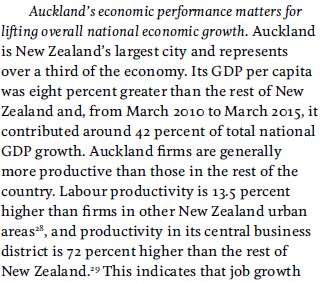
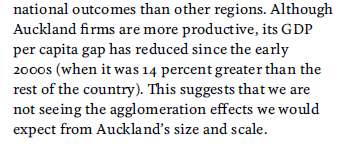
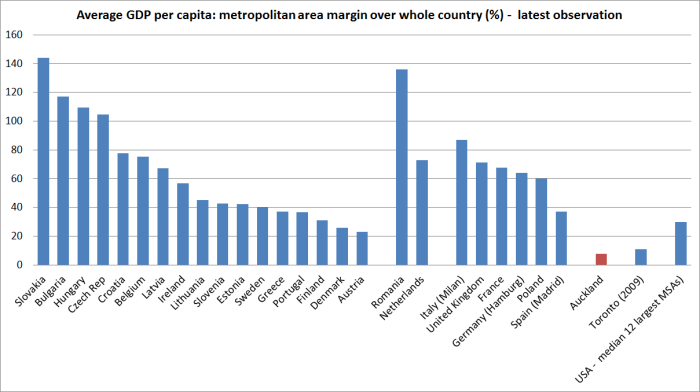
There has been no “very big step change” in our economic performance.  What is worse perhaps, there has been no serious attempt to bring about such a change.   The 2025 Taskforce’s prescription was dismissed –  from some Caribbean island where the Prime Minister was –  the night before its report was released.  And if he didn’t like that prescription there was no sign of any energy being put into finding a package of measures he really believed would make a difference.  Worse still has been the sheer dishonesty of the last few years in which the Prime Minister repeatedly asserts that New Zealand is doing very well by international standards, and is somehow the envy of the advanced world.  Only a few months ago we had the nonsensical claims that he was remaking New Zealand as the Switzerland of the South Pacific, or the frankly rather offensive proposition (to all those struggling in that market) that Auckland house prices were just what one expects in a successful global city –  when all the time, Auckland’s GDP per capita has been falling relative to that in the rest of the country (and when the government knows it has been making little or no progress in freeing up land use restrictions).  And for all the talk of international connections etc, there has been no nationwide productivity growth in the last few years, and exports as a share of GDP are, if anything, a bit lower now than they were in 2008.

Of course, over eight years in office almost any government is going to do some worthwhile things.  When Malcolm Turnbull last year talked to wanting to emulate the Key reform programme, I managed a brief list of worthwhile reforms.

But on the other hand, I noted this list

  • Higher effective corporate tax rates
  • The debacle of the earthquake-strengthening legislation
  • The continuing debasement of our skills-based immigration system, both in the way it is administered and in formal announced policy.
  • New overlays of financial market regulation
  • The re-establishment of direct government controls over who banks can and cannot lend to
  • The continuation of a regime of “corporate welfare”, including for example the Sky and Tiwai Point deals, and the smell that the Saudi sheep deal gives off
  • The degree of central government control of the Christchurch repair project, involving both wasteful projects (some of which may not finally go ahead), and the way central government has artificially boosted land prices and impeded the prompt redevelopment of the central city.
  • The continuing apparent decline in the rigour of public sector policy advice, and in the use of robust cost-benefit analyses in underpinning policy decisions.
  • Increased first home buyer subsidies.
  • Undermining housing affordability with mandatory insulation etc requirements for rental properties
  • Continuing increases in minimum wages, from very high levels (relative to median wages) at a time when unemployment is quite high, and policy was supposedly oriented to getting people off welfare.
  • Heavy investment in the newly state-repurchased loss-making Kiwirail

As Eric Crampton notes, the new government regulations that killed off ipredict now mean we don’t even have functioning predictions markets to follow in the wake of the Prime Minister’s resignation.

Of course, some credit is due to the government for returning the budget to balance, or even modest surplus.  It isn’t a trivial achievement, especially against the backdrop of the Canterbury earthquakes, but equally when you have benefited from (a) high terms of trade, (b) low interest rates, (c) rapid population growth which in the short-term tends to raised government revenue more than expenditure, and (d) unexpectedly slow wage inflation, and (e) some very big spending programmes from the outgoing previous government that had not yet become firmly entrenched, it was all a little easier than it might otherwise have been.  And important as maintaining fiscal balance is, it isn’t the sort of structural reform that generates the very big step changes in economic performance that John Key talked of.

The Prime Minister would also no doubt note the reduced outflow of New Zealanders to Australia.     As I’ve noted here previously, there is a lot of year-to-year volatility in those figures, but the average outflow  of New Zealanders has been lower over his term than over the nine years of the Clark-Cullen government.   That would have been encouraging if a reflected a sustained narrowing in the income/productivity gaps between New Zealand and Australia.  As it is, it seems to reflect higher unemployment rates in Australia and a recognition that the position of New Zealanders moving to Australia isn’t alwasy very secure if things don’t turn out well.  As for productivity, those gaps have only continued to widen over the Key years (and especially the last few years).

gdp-phw-nz-vs-aus

Of course, relative to other advanced countries the years since 2008 have not been especially bad in New Zealand.  There have been plenty of countries that have done worse, and plenty that have done better.  We’ve been middling at best and that is probably about the least we should have expected as –  through some mix of good management or good luck –  our incoming government in 2008 inherited neither a fiscal nor a financial crisis.

I haven’t touched much on the  debacle that is the housing market.  It didn’t feature in that 2008 campaign  launch – probably house prices were falling at that point of the recession. But in many parts of the country – including our largest city – the issues of unaffordability are so much worse now than they were then. Turning around our long-term productivity performance might seem really hard. Doing something effective to reverse the inexorable climb in real house prices just wouldn’t have been that hard – between land use law reforms, and easing back on the immigration-led population pressures until new policy frameworks left the housing market better able to cope. But, in fact, there has been almost no serious reform, and a generation of young families are increasingly shut out of home ownership. It is inexcusable. And perhaps the worst of it is that there was never any sign that the government was willing to go down fighting, to spend serious political capital – and perhaps to fail in the attempt nonetheless – to make a real difference. That isn’t leadership. At best it is followership.

I could go on.  About, for example, the suspension of property rights following the earthquakes, about the weak regard for the institutions of our democracy, or –  mundanely –  about the fiscal and moral failure that the big increase in (already high) prisoner numbers over the term of this government represents.  But I’m sure you get the drift.  It has been eight largely wasted years –  building on at least the previous nine largely wasted years –  in which none of the big structural economic challenges New Zealand  faced has been even seriously addressed.  On not one of them can the government show serious progress and on some –  house prices most noticeably –  things are now even worse than they were in November 2008 when John Key spoke of his goal of securing a very big step change in economic performance.  He has held office, and left at a time of his own choosing.  But to what end?  In that sense, surely, his political career ends in a failure much more indelible than that  of a mere electoral defeat or internal coup.

Superannuation choices

Economics is sometimes known as “the dismal science” – thanks to the 19th century writer and historian Thomas Carlyle.  I’m not sure that either word in that phrase is generally fair or accurate, but sometimes economists don’t help themselves.

A good example is around “the ageing population”, something that economists have been worrying about for at least as long as I can remember.  In fact, of course, the ageing population is one of the very greatest achievements of mankind in the last couple of hundred years.   In the UK –  at the leading edge of the Industrial Revolution –  average life expectancy at birth in 1840 was just over 40.  Now it is over 80.  In the first half of the 20th century, many of the gains were  in reductions in infant and childhood mortality.  In recent decades, the gains have been concentrated among adults.  The typical adult is living longer, and that is  –  typically –  something to celebrate.   Here is the New Zealand data on the increase in remaining life expectancy at age 65 over recent decades.

life-expect-65

An ageing population isn’t something to try to “remedy”, whether by encouraging more births, (or more wars?) or targeting more migrants.   If there is an ageing population “problem”, it is largely an artefact of the rules we’ve set up for paying state pensions.  There are no doubt some issues around health  –  amid that debate as to whether people living longer means more health spending, or just means that the health spending (usually concentrated around the last few years of life) happens at an older age.  But my focus today is on the state pension system –  New Zealand Superannuation.

When The Treasury recently released their Long-Term Fiscal Statement, I saw criticism of them in some quarters for not making more of the “need” to change the New Zealand Superannuation settings, often with a subtext that reform was urgently needed. I’m critical of Treasury on a variety of scores, but that isn’t one of them.

Treasury included this chart in the report.

ltfs

As I noted then, one could reasonably run this under a headline “no urgent need for any big fiscal changes for 20 years”.  On these projections, in 2035 the spending share of GDP would be around where it was five years ago.  Actual fiscal policy changes happen all the time, and the base on which revenue is raised changes too.  It wouldn’t take much for spending as a share of GDP in 2035 to be not much different from where it has been on average over the last decade.  One can’t reasonably generate “fiscal crisis” headlines –  or urgent official advice to ministers – out of that sort of scenario.

In saying that, I’m not expressing even the slightest sympathy with the Prime Minister’s dismissal of the Treasury projections as, to put it mildly, not worth the paper they are written on.  If he genuinely believed that there is an easy solution: amend the Public Finance Act and save us the not-inconsiderable amount of resources that goes into producing these statements every few years.   As he has done since he was first elected, the Prime Minister simply wants to make the issues around NZS someone else’s problem –  he knows the parameters should change, and will change, but just not while he is PM.  As someone who is 54, I’ve always assumed that the NZS eligibility age would have increased somewhat by the time I reached 65.  That now seems increasingly doubtful.

But these really aren’t primarily economic issues, and despite Treasury’s enthrallment with their Living Standards framework, they don’t have a mandate for using taxpayer resources to push strongly for the sort of society they –  a few hundred bureaucrats –  happen to favour.  It isn’t even their role to try to work out what choices the public would prefer – that is the stuff of politics.    I read the evidence as suggesting that lower average tax rates would tend to lift New Zealand’s productivity and GDP per capita, but the effects seem to be small and uncertain, and New Zealand’s government spending as a share of GDP isn’t extraordinarily large by modern advanced country standards.

To my mind, issues around New Zealand Superannuation are substantially moral in nature, and the debate would be better if centred on those dimensions, rather than on fiscal policy.  Our level of government debt isn’t that low, but by international standards it isn’t high either, and if anything looks likely to drop as a share of GDP over the next few years.  So the issue shouldn’t be “can we afford to pay a universal welfare benefit to an ever-increasing share of the population?” –  ever-increasing, on the assumption that adult life expectancy continues to increase.  We probably could.  But rather “should we?”, or “is it right to do so?”.   Economists quickly get uncomfortable with “is it right” type questions, sidelining them as “political choices”, but almost all the important political choices are about conceptions of what sort of society or government we want –  competing visions of what is “right”.   Of course, there are practical dimensions, and areas where experts can offer technical perspectives  –  eg the implications of particular choices for other things we care about (eg labour force participation, incentives to save etc) –  but the key choices shouldn’t really be seen as technocratic in nature.

For me, there is simply something wrong about offering a universal income to an ever-increasing share of the population.   Governments don’t exist to support us all, but on the other hand they probably do exist, in part, as a vehicle through which society can support those genuinely unable to support themselves.

I’m often struck by the contrast between the situation now and that in 1898 when the first (asset and income-tested) age pension was introduced in New Zealand.  The age of eligibility then was 65.  Life expectancy at birth then, even in a rich colony like New Zealand, was less than 65, and for the minority who made it that far, average  remaining life expectancy was perhaps another 10 years.   But the people who were turning 65 in 1898 will have typically entered the workforce very young –  even for those with a reasonable base of schooling, full-time work would have started by 12 or 14.  That meant fifty years in the workforce –  whether paid directly, or managing a household –  before the question of eligibility for a state pension even arose.  And there weren’t working-age benefits available either.

These days, by contrast, a typical young adult won’t enter the fulltime workforce until perhaps around age 20.  A few leave school and go straight into fulltime work at 16.  Many of the mass who now do university study will be 21 or older before they start fulltime work.    And around 10 per cent of the working age population is on a welfare benefit at any one time.  And when people do finally get to 65 –  as most do – their average life expectancy is now another 20 years.

So we’ve gone from a situation where most adults would support themselves (or within families etc) for their entire adult lives, and a small proportion might have perhaps a decade of state support in old age, to a situation where on average a typical adult will be receiving a state pension or benefit for perhaps a third of their adult life.  That is too much of a change, a shift towards state dependence, for me (as citizen/voter) to regard with equanimity.

This isn’t an argument for abolition of all welfare, or even for harshly treating those permanently unable to support themselves.  For the latter group –  a small minority – I worry that our system has already become unreasonably harsh and burdensome.    It is really simply a view that our conversations and debates should be around what sort of society we want, and what the appropriate role of the state vs self (and family) reliance is.    Shifting towards making NZS available at, say, 67, and then legislating to index that age of eligibility to future increases in adult life expectancy, just isn’t a terribly radical reconception of the role of the state in the face of such large (and welcome) increases in life expectancy, and in the ability of most people in, say, the 65-70 age group to maintain paid employment.

There also needs to be more public debate about the residence requirements for NZS.  When the age pension was first introduced in 1898, there was a requirement of 25 years continuous residence in New Zealand to be eligible.  A recipient had to have spent at least half their adult life in New Zealand –  whether as taxpayer or other contributor to the society/community.  Consider, by contrast, the rules today, under which one can be eligible for (a much higher rate of) NZS having lived in New Zealand for only 10 years, including five years after the age of 50.   That is extraordinary enough, but then there is the oft-overlooked provisions under which, in MSD’s words

We can also count periods of residence spent in countries that New Zealand has social security agreements with.

  • New Zealand has social security agreements with the United Kingdom, the Netherlands, Ireland, Jersey, Guernsey, Australia, Greece, Canada and Denmark
  • These agreements allow you to use residence in these countries to qualify for periods of residence (or contributions) and presence and the ordinary residence criteria.


Australia is, of course, the big issue there.  Not only have huge numbers of New Zealanders gone to Australia and spent the bulk of their adult lives there, but these provisions also apparently cover Australians who have never lived in New Zealand.

Fortunately for us, perhaps, people tend not to migrate towards colder climates in their old age, but the rules still seem quite extraordinary.  What obligation should New Zealanders have towards people who left for Australia at, say, 20, never paid any material amount of taxes in New Zealand, and then late in life decide that a universal pension in New Zealand seems an attractive fallback.  Even the fiscal risks aren’t small.

I’ve written about some of these issues before.  As I noted then

Personally, I’m happy that we should treat quite generously people who have spent most of their life in New Zealand and have reached an age that can genuinely be considered “elderly”, but I don’t feel the same sense of generosity towards those who have migrated here quite late in life, or to New Zealanders who have spent most of their working lives (and taxpaying years) abroad.

Of course, among the political questions societies need to face is the extent to which income support in (relatively) old age is universal or dependent on circumstances.  New Zealand has gravitated towards a structure where the state pension is paid to everyone, regardless of income or assets, and subject to a very undemanding residence requirement.

Is there a case for income and/or asset testing?    We tried such a model between the mid 1980s and the late 1990s, and it proved politically unsustainable.  Personally, I don’t think it is an issue worth trying to fight again.  It is easy to say “why pay NZS to people earning more than $100000 per annum”, but there aren’t many of them, and even those still earning high incomes at around age 65 will typically see labour income drop away quite quickly.  So there isn’t much money to be saved from instituting a means-test that cuts in at a high income.  There is quite a lot of money at stake if, say, an abatement regime could cut in at, say, the current NZS payment rate (any private income above that threshold would progressively reduce NZS payments).  But if we tried that sort of regime again, there would be huge resistance (on “fairness” grounds –  “I saved all my life, and that person who saved little gets the full NZS payment”), huge incentives to mask or transform the nature of income/assets, and a pretty serious disincentives effect on lower or midde income people to remain in the workforce past age 65.   Would it make much difference to private savings behaviour?  It is hard to tell: very low income people don’t have the capacity to save much anyway, and for seriously wealthy people it would make no difference.  For those in the middle, it might well deter private savings for some and raise it for others  –  the net effect just depends on whether the income or substitution effects are more dominant.  As it is, it is unlikely that the current NZS system materially adversely affects private saving – although the pension is universal, it doesn’t offer a comfortable standard of living for those from the income cohorts who had much capacity to save during their working lives.  For those people, our system discourages private savings less than, say, many of the other advanced country systems (offering an individual-income related unfunded state pension) do.

Frankly, I think any serious means or asset testing regime is largely futile, and probably unsustainable over time, unless or until society could recreate some sense of “shame” in being reliant on the state.  If NZS is seen as an entitlement, that no one should be embarrassed to take, people will do whatever it takes to maximise their claim to the entitlement.  Behavioural responses will be quite different than in a system in which people are ashamed to be dependent on the state, and will do everything possible to avoid themselves (or their parents/relatives) being dependent on the state for income support.

A few years ago, I came across an account of the New Zealand age pension system published just a few years after it was introduced.  William Pember Reeves had been a reforming minister in the Liberal government of the 1890s, and in 1902 published his two volume State Experiments in Australia and New Zealand. Included in that book is a fascinating and lengthy discussion as to how the new age pension system was working.  At the time around 4 per cent of New Zealand’s population was over 65 (compared to 14 per cent now).

I reread the relevant section this morning, and it was a reminder of a different age (different in some good ways and some not so good ones).  Applicants for the age pension had to appear in open court to present the evidence that they met the statutory tests.  Applicants were subject to good character tests, including being disqualified if they had had a recent period of imprisonment (by contrast, today on the MSD website it isn’t actually clear whether even current prisoners are disqualified).   And the income and assets tests were very demanding –  the marginal abatement rate was 100 per cent for private income above 34 pounds a year in private income.  Reeves was generally a supporter of the reforms he was writing about, but he also notes that even in those early days of the regime, there were opportunities to game the system, some legal, some not.

Our current NZS system has a number of good features. It does prevent the extremes of elderly poverty sometimes seen in other countries or in other times.  And it does nothing to directly discouraging older people from remaining in the workforce.  It is also administratively straightforward. And it probably does relatively little to deter private savings.   But –  and whatever the state of the government’s finances – with an age of eligibility that is the same now as it was 100 years ago, in the face of dramatic and continuing gains in life expectancy, it seems simply wrong – and expensive –  to keep paying a universal pension to an over-increasing share of the population.  And I can see no compelling reason for why full NZS should be available to anyone who has not spent at least 30 adult years physically resident in New Zealand –  be they immigrants, or New Zealanders who have spent much of their lives abroad.

Of course, others will have different conceptions of the role of the state.  No doubt, for those who favour a Universal Basic Income, NZS appears as a precursor to their vision for how the whole of society should be organised.  A related group –  those who worry as to whether there will be enough jobs to go round in future –  no doubt share that sort of view.  To date, a shortage of jobs just hasn’t been an issue in New Zealand and for me –  and these are ultimately moral debates –  the UBI proposals are deeply corrosive of the way in which I think society should operate.

To close, for those interested in the numbers, Treasury estimates that NZS spending will rise from around 4.8 per cent of GDP now to around 7.9 per cent by 2060.   Neither immigration nor productivity assumptions really make much difference to those numbers.  In their scenarios, raising the age of eligibility for NZS to 67 cuts that share by around one percentage point.    They don’t quote the numbers in this statement, but indexing the eligibility age to future gains in life expectancy offers materially larger savings than that, over time (eg over four decades, life expectancy could increase by perhaps another 7 years).  I don’t have a good sense of the savings a more binding residence requirement might offer, but it seems quite plausible that with these three changes, the public finances would be under no great pressure at all in continuing to offer something like the current wage-indexed level of NZS to the genuinely elderly who have spent most of their lives in New Zealand, in a minimally distortionary way.  But they are reforms that should happen –  should already happen –  regardless of what the 20 or 40 year ahead fiscal projections look like.


Two immigrants debate immigration

A month or two back, Professor George Borgas, professor of economics at the Kennedy School at Harvard and a leading researcher on the economics of immigration (and a Cuban immigrant in childhood) published a new book, We Wanted Workers: Unravelling the Immigration Narrative.  Borgas’s empirical work has led him to be somewhat sceptical of whether there are material economic gains to Americans from non-citizen immigration, and to suggest that perhaps immigration policy –  even in the US – is largely just a redistributionist policy, typically away from the more lowly-skilled Americans.  His empirical work has suggested long-term losses to these relatively low income people.

I haven’t yet read the book – much of which, I understand, is a more popular treatment of material dealt with more formally in his Immigration Economics a couple of years ago But Reason magazine –  a libertarian-oriented publication – has published a substantial and considered exchange of views, prompted by Borgas’s book, between Borgas and Shikha Dalmia, a senior analyst at a US libertarian think-tank (and an Indian immigrant).    Dalmia apparently describes herself as a “progressive libertarian and an agnostic with Buddhist longings and a Sufi soul”, so probably not your typical libertarian.

The exchange between Borgas and Dalmia is now freely available on-line here.    For anyone interested in immigration issues, it is worth reading.  The specific issues are, of course, a bit different here than they are in the United States.  A recent New Yorker review of various books on immigration, including Borgas’s, is also worth reading.

From the Reason debate perhaps two extracts struck me most forcefully.  The first from the libertarian open borders  Shikha

I agree completely that the “overreliance on economic modeling and statistical findings” on this subject is a regrettable development that fosters the notion that “purely technocratic determinations of public policy” are possible. In fact, the scientific hubris underlying such efforts prevents a full airing of the normative and ideological commitments that ultimately do—and perhaps should—guide policy.

and the second from Borgas

I ended my discussion in the first round by noting that “immigration creates winners and losers and the net gain may not be as large as some had hoped. So any discussion of immigration policy has to contrast the gains accruing to the winners with the losses suffered by the losers.” You did not address this very thorny issue in your response, so let me conclude by rephrasing it in even starker terms, as it isolates the problem at the core of our disagreement.

The evidence summarized in We Wanted Workers suggests that it is quite possible that the “efficiency gains” that receive so much emphasis in the libertarian narrative are totally offset by the costs associated with welfare expenditures or harmful productivity spillovers. As I said, it may well be that “immigration is just another government redistribution program.” My italicization of “just” was not a random click on my track pad. It was meant to drive home the point that there is a good chance that all that immigration does is redistribute wealth.

If there are no efficiency gains to be had, then espousing any specific immigration policy is nothing but a declaration that group x is preferred to group y. It is easy to avoid clarifying who you are rooting for by trying to reframe the debate in terms of amorphous philosophical ideals about mobility rights and the like. But this is where we go our separate ways.

When I read yesterday a new IMF article by Sebastian Mallaby (itself quite worth reading) asserting that “the movement of people [is] perhaps the most important of the three traditional forms of globalisation”, it brought home again how essentially ideological (meant not in a pejorative sense, but rather as “driven off a prior world view”, and we all have them) much of the support for large scale immigration often is.  Perhaps the same can be said for the sceptics.  And perhaps that is both inevitable, and not necessarily a problem, so long as we recognise the nature of the debate.

The Financial Stability Report: falling short again

The Reserve Bank yesterday released its six-monthly Financial Stability Report.   With (fortunately) no new direct controls to announce, the latest FSR didn’t get a great deal of coverage, and I won’t be writing about it at great length either.  But there were a few points that I thought it was worth making.

First, I thought it was a little surprising that the Bank did not have a bit more discussion of euro (and EU) break-up risk.  It has been a slow-burn process (materially slower than pessimists like me had expected) but none of the underlying stresses seem to be going away.  This weekend alone we have the Italian referendum, which could see the fall of the mainstream Italian government, and the rerun of the Austrian presidential election.  In the first half of next year, there are elections in France and the Netherlands, and in both countries anti-euro parties are polling very strongly.  The Reserve Bank does note problems in the banking systems of various European countries, but these are symptoms of some of the underlying problems not the source of the main risk.  As with all tail-risks, it is impossible to get the timing right, but to me these euro/EU risks remain by far the largest visible disruptive threat to the world economy and world markets over the next decade (China, by contrast, is more closed to the world, and has a strong (grossly over-strong) central government).  Perhaps the Reserve Bank feels uncomfortable writing about these euro/EU risks –  it might make for awkward conversations for the Governor the next time he goes to BIS meetings –  but these reports are for New Zealand citizens, not for the international fraternity of central bankers.  If it is too awkward to reflect on real and substantial risks, one has to ask how much value there is in FSRs more generally.  Conventional, and anodyne, references to Brexit and/or the US election don’t really cut it.

Second, it was a bit disappointing that even in a financial system piece like the FSR, the Bank still couldn’t help itself, and insists on running the line that

“New Zealand’s economy is strong relative to other advanced economies, growing 2.8 per cent in the year to 2016”.

And our population grew by 2.1 per cent in that year.  Per capita GDP growth is weak, and has been over the last few years taken together. I illustrated a while ago that relative to other advanced countries, growth in real GDP per capita since 2013 has been around the median.  And there has been no labour productivity growth here at all.

At one level when the Bank writes misleading things like this it doesn’t matter very much.  But at another level it does. Society has delegated an enormous amount of power to the Governor, including the resources to produce major reports like the FSR. We should expect them to avoid rose-tinted political perspectives.  If they don’t on small issues like this, how can we have much confidence in their willingness to accurately represent things in conditions of much greater stress or risk?

In the FSR the Bank puts quite a bit of weight on the increased use banks have been making of offshore wholesale funding.  I was a bit puzzled by this increased use, since there has been no sign of the current account deficit widening notably (and bank offshore borrowing tends to grow most notably when the current account deficit is large –  it was the main channel through which the larger deficits were financed).  I was interested in this chart, drawing on data from the Reserve Bank website.  It shows annual growth in Private Sector Credit to resident, and a broad measure of the money supply (M3, from residents), both adjusted for repo transactions.

psc and m3.png

The deposit side of the financial system balance sheet is growing at around the same rate as the credit side, hardly suggestive of any particular problems.  If anything, it looks as though banks’ increased reliance on foreign wholesale funding markets isn’t reflecting some deteriorating domestic macroeconomic imbalances, so much as the specification of the Reserve Bank’s core funding requirement (CFR) which, somewhat arbitrarily, distinguishes between some types of domestic deposits and others.  I don’t have a strong view on how the CFR is set up, and I believe some funding restrictions are necessary –  to internalise what would otherwise be a willingness of banks to simply rely on the central bank in times of stress.  But no such rule is perfect, and it would be good if the Bank were a bit more explicit about where the pressure for more (more expensive) foreign wholesale funding seems to be coming from.

One of my longstanding criticisms of FSRs over the years (including when I sat on the editorial committee reviewing them internally) is the weak treatment of the efficiency side of the Bank’s statutory responsibilities.  The Bank is required to use its statutory bank regulation powers to “promote the maintenance of a sound and efficient financial system”.  There is an almost inevitable tension between those two strands –  something I believe that Parliament recognised in phrasing things the way it did –  and the Act also requires the Bank to write FSRs in ways that allow the conduct of policy to be evaluated against the statutory criteria.

In yesterday’s FSR there is one paragraph (and one table) on the efficiency side of the Bank’s responsibility, under the somewhat ambiguous heading “Some indicators suggest New Zealand’s banking system is operating efficiently”.  Am I meant to take from that that other indicators, not reported, suggest otherwise?  I’m also a bit genuinely puzzled why the Reserve Bank considers that a low ratio of NPLs is an indicator of system efficiency.  In credit booms there are typically very few NPLs –  they come after the boom has bust.  In very risk averse systems there are typically very few NPLs.  In isolation, it simply doesn’t look like an efficiency indicator.      And the Bank simply does not address the inevitable adverse efficiency implictions of its increasing reliance on direct controls on specific classes of lending by specific types of institutions.   There has never been a proper cost-benefit analysis on the repeated waves of new controls.  Perhaps it is hard to do one formally, but the FSR should be an opportunity for some more considered analysis exploring some of these issues. As it is, it risks veering towards being a propaganda sheet for the Governor’s chosen policies.  Perhaps it is hard for it to be otherwise, especially under the current governance model –  the Governor signing off on a report on his own policy –  which simply highlights against the desirability of structural governance reform.

The FSR reports no reason to doubt the ability of the insurance sector to cope with the recent severe earthquake.  Perhaps the event was too recent to allow them to deal with the issue in any greater depth, but for the next FSR it might be worth posing the question as to what might threaten the ability of New Zealand insurers to keep getting reinsurance in large volumes for earthquake risk.    The NOAA database suggests that of the 33 earthquakes of 6.5 magnitude or greater to have hit New Zealand since 1840, 10 –  or almost a third –  have hit in the last 10 years (and the very destructive February 2011 aftershock was less than 6.5).    Is there a risk that a continuation of that sort of higher quake frequency could serously impair the ability to insure earthquake risk in New Zealand?  As we know that the Reserve Bank solvency standards for insurers were not set to cope with a repetition of the Christchurch quakes, what sort of tail risk concerns might this raise –   not just for the insurers, at least for the wider (currently) insured population?

The Reserve Bank has underway a review of the capital requirements for banks. on which they expect to consult next year.  As they note at present

The Reserve Bank will also look at international norms when considering calibration of New Zealand’s capital requirements. In raw international comparisons, the current capital ratio of New Zealand banks is relatively low. But a simple comparison is potentially misleading as the risk weights that New Zealand banks must apply to certain asset classes are set conservatively. This means New Zealand banks’ capital ratios appear lower than foreign banks’ ratios for the same underlying portfolios.

After adjusting for the conservative approach New Zealand takes, the Reserve Bank’s preliminary assessment is that New Zealand banks’ riskweighted capital ratios have been near or above international norms.

Looking ahead  (emphasis added)

As part of the review, the Reserve Bank will consider the appropriate amount and quality of capital New Zealand banks should be required to maintain. This will involve a survey of recent academic and central bank studies on optimal capital ratios. Care will be taken when interpreting these studies as they tend to be sensitive to assumptions about the effect of capital on banks’ funding costs and the scale of GDP losses that are directly attributable to banking crises.  It is also unclear how the inclusion of different types of capital affects the results of these studies.

I found those comments encouraging.  While I would hope that the Bank always interprets literature carefully, there are particular issues in this area.

Thus, those arguing for much higher bank capital ratios often suggest (for example) that all or most of the underperformance in economies since 2008 can be ascribed to the banking crises. If one assumes that, it is worth society spending almost any amount of money to avoid a repeat.  A more plausible story is that the banking crises themselves explain only a rather small amount of a structural global slowdown in productivity growth (that was already underway well before the crisis).  On other hand, those opposed to higher capital requirements often argue that having to fund a larger proportion of loans from equity would materially increase the cost of funding.  That approach tends to ignore both the potential for the Reserve Bank to cut the OCR, to offset any incipient rise in interest rates, and –  more importantly –  ignores the extent to which a higher reliance on equity reduces the riskiness of the institutions, and should reduce the required rate of return on equity.  Tax systems can complicate that story, but the New Zealand (and Australian) tax systems, with dividend imputation, tend to treat debt and equity more or less equally.

My own, provisional, view is that for banks operating in New Zealand somewhat higher capital requirements would probably be beneficial, and that there would be few or no welfare costs involved in imposing such a standard.  My focus is not on avoiding the possible wider economic costs of banking crises (which I think are typically modest –  if there are major issues, they are about the misallocation of capital in booms), but on minimising the expected fiscal cost of government bailouts.  As I’ve explained previously, I do not think the OBR tool is a credible or time-consistent policy.

Many of these have been relatively small points, at least for now.

I am more uneasy about two aspects of the report, one of which is missing completely.

There is simply no discussion at all –  and has been none in past reports –  of what the implications of drifting ever closer to the near-zero lower bound on nominal interest rates might be for financial system resilience in a further severe recession.  One of the great merits of a floating exchange rate system has been the flexibility it provides to national central banks to adjust policy interest rates, more or less without limit, as domestic conditions require. But the limits are now becoming increasingly visible.  It is remiss of the Bank – both in its MPS, its FSR, and its more corporate documents such as its Statement of Intent, or governors’ speeches – not to even begin to address these issues openly.  Simply ignoring them doesn’t make them go away, and there will no acceptable excuse if we find ourselves in the same position many other advanced countries found themselves in after 2008, having been given a decade’s sharp-focus notice of the potential problem.

And my final source of unease is around the Reserve Bank’s analysis of the housing market.  The Bank puts a great deal of importance on developments in the housing market, and the market for housing credit.  It is has imposed successive rafts of direct controls, of the sort never seen before in post-liberalisation New Zealand, all on the basis of little or no research.  And in the latest FSR, there is no fresh analysis, just the looming threat of debt to income restrictions –  if the market takes off again –  so long as the Governor can persuade the Minister of Finance to give him political cover (and of course he will, or otherwise the Opposition will attack the Minister for standing in the way of the Reserve Bank).

I’ve noted in the past that we’ve seen no analysis from the Bank on, for examples, countries that have had large increases in house prices and where there has been no subsequent financial crisis, or even collapse in house prices.  New Zealand, Australia, the United Kingdom and Canada in the 2000s are just some of the examples that spring to mind.  And although the Bank keeps talking about the problems in housing supply, they show no sign of having really thought deeply, or researched, the role of land market restrictions.  The New Zealand housing market is unlikely to be sorted out by simply building enough houses to keep the occupancy rate stable – or even a few more.  There is a much more structural issue around restrictions on land use (accentuated by the heavy regulatory costs imposed on building new houses).  I’m not aware of countries with floating exchange rates and tight land use restrictions where urban house and land prices have sustainably come down again.  Perhaps the Bank is, but if so surely the onus is on them to disseminate the research, rather than continuing to hand-wave and treat all house price increases as more or less equally risky.  When house prices are bid up on the back of congressional and executive pressure on lenders to lower lending standards, on pain of potentially losing favour with the regulators, that is a very different issue than when the combination of population pressures and land use restrictions drive prices up. But the Reserve Bank has never articulated that sort of distinction.

It is more than three years now since the Reserve Bank set off down the path of increasing direct controls (with no end in sight, let alone the prospect of removing the controls).  I went through the list of their Analytical Notes, Discussion Papers,  and  Bulletins over the last three years or so, and was struck by how little housing-market research they have published.  For an organisation with so much discretionary power, and a substantial publicly-funded research capability, it really isn’t good enough.

I could repeat a variety of points from previous commentaries –  including questions about what other risks banks are assuming if they are prevented from taking on as many high LVR housing loans as they would like –  but will leave it at that for now.


The Productivity Commission’s story

Some months ago I ran a post about some of various attempts to explain New Zealand’s decades-long relative economic decline, and to propose remedies that might reverse this performance.  The first major piece along these lines that I’m aware of was by the Monetary and Economic Council in 1962.  Since that was the year I was born, and economic outcomes now, relative to those in other countries, are worse now than they were then, despite all the various policy reforms and all the ink spilt in trying to make sense of the situation, I find that all rather depressing.  A lifetime, and more, of relative economic decline.

In that earlier post I noted that the Productivity Commission, or more particularly its Director of Economics and Research, Paul Conway, had been at work for some time on a “narrative” of New Zealand’s economic underperformance, offering some combination of diagnosis and prescription.      Earlier versions have been presented at various conferences and seminars here and abroad, and this week the finished product was released.  (In the interests of full disclosure, I should note that the Commission paid me to provide some comments and suggestions on a relatively advanced draft of the paper, imposing no  restrictions on me writing about the finished product.)

The paper, Achieving New Zealand’s Productivity Potential, is issued under Paul Conway’s name.  There is no disclaimer, of the sort often seen on public sector agency research, that the paper represents only the views of the author and not necessarily those of the institution.  I asked Paul about the status of the paper, and he suggested that my description, that it was his paper but that the Commission was “not unhappy with the content”, sounded about right.

The paper is well worth reading, and should be read by anyone with a serious interest in these sorts of issues.    It should be reasonably accessible for most potential readers, and –  at least by Productivity Commission standards – at 80 pages it is quite short.    There are lots of interesting charts, and a variety of interesting issues/possibilities are dealt with (including some of the arguments I’ve been raising).  It is a balanced and fair-minded report, and a really useful contribution to the debate that needs to be had.   Even if the Prime Minister apparently no longer cares much about it – the recent statistics are just too bad for political comfort – productivity growth is the basis of any future long-term prosperity prospects.

The paper isn’t the last word on the issue by any means.  That isn’t just meant as an observation that I disagree with some of it.  As Conway notes, there are many issues where not enough research has been done, whether by academics, core policy agencies, or bodies such as the Commission.  Some of the paper is inevitably a bit speculative.  One goal of the paper might be to stimulate further debate, and prompt a demand for more serious research in a number of areas.

The Commission appears to be keen to be read by the government and its acolytes.  That is perhaps understandable –  only this week, the Prime Minister was dismissing out of hand theTreasury’s long-term fiscal projections, and much the same fate befell the 2025 Taskforce a few years ago.  But on my reading, the desire to not immediately lose all readers from the current government has led them to over-egg the pudding in a few places, in writing up the story of the last few years.  It isn’t central to the story, but the suggestion that New Zealand has materially closed the income gap to other advanced countries in recent years just isn’t supported by robust data, and praise for the Business Growth Agenda and regulatory reform both seem to go beyond the substance of what has been achieved.   There is at least an arguable case that the quality of regulation has deterioriated further in recent years.  Where it counts –  productivity –  at best New Zealand has not lost more ground relative to other OECD countries in the last decade or so. But the large gaps simply aren’t closing.

Even though he began his career at the Reserve Bank, these days Conway’s focus has tended to be on microeconomic issues, and often on firm-level research.  New Zealand is particularly well-positioned for such research, because of the creation by Statistics New Zealand of the Longitudinal Business Database, which enables (a small tightly controlled group of) researchers to conduct studies using anonymised detailed data on individual businesses.  Various researchers, at Treasury, Motu, the Commission etc, have produced a series of interesting papers looking at various aspects of firm behaviour in New Zealand.  Some more results in that vein are included in Conway’s narrative paper.  Indeed, this firm-level approach dominates the early part of the paper –  he argues that “this approach puts firms at the centre of the analysis”.

Interesting as the results of these papers often are, I’m less convinced that the firm level analysis is very helpful for understanding long-term trends in overall economic (and productivity performance).  Some of that may just be about short runs of available data.  Thus, the paper begins with some international evidence about the differential labour productivity performance of leading and laggard firms over the last 15 years or so.  There is a big difference.   The Commission produces some evidence suggesting something similar for multi-factor productivity in New Zealand.  But fascinating as that is, we have no way of knowing whether it is normal behaviour, or whether something unusual and new has been going on in the last 15 years.  And, at least on this score, we don’t even know whether New Zealand has been doing more or less well than other advanced countries, even over this relatively short period.  My concern has been that the availability of the data –  itself a wonderful thing –  is shaping the research agenda more than is really warranted.   Perhaps that is inevitable –  researchers will follow data, as water flows downhill –  but even if so, we need to recognise that the questions that data can help answer aren’t necessarily the ones policymakers should be most concerned with.

None of this is to suggest that firms aren’t important.  Most market economic activity takes place in firms.  But firms, and managers and workers within them, respond to incentives, and should typically be presumed to do so in a rational way, that best serves their own interests.    That includes choices to enter the market, to expand or cut back, or to leave it.  Or simply never to set up at all.    After the 50 or so years of our relative decline, it is likely that the structure of our economy, and the firms within it, look quite different than if a more successful path had been found.  And firm-level analysis simply can’t look at the firms that never came into being –  the exporting firms, for example, that might have developed if repeated aspirations to lift the export share of GDP (as in most other advanced countries) had been met.  So, it isn’t entirely clear to me what we learn, that sheds light on overall productivity performance, from an analysis of the firms that happen to be here now. The firm level data, for example, suggest that the labour productivity performance of our leading firms is perhaps 30 per cent below that of advanced country peers.  But that is, surely, just what we would expect.  GDP per capita is –  roughly –  30 per cent below that in many other advanced countries, and firms (and workers) will adjust so that, at the margin, resources earn their marginal product.  Production structures will, typically, look different in poorer countries than in richer ones.

And so one of my criticisms of the Conway/NZPC paper is that while it is strong on highlighting symptoms, it is much weaker on analysing and understanding incentives (eg the reasons why firms, and governments, behave as they do).  There is a tendency in the firm-level literature to treat firms as the cause of the problems –  firms don’t invest enough in R&D, aren’t very good at management or what ever –  without taking as a prior (perhaps to be tested) that individual firms and the people within them typically make decisions that appear rational, and indeed (on average) optimal for themselves.  There is sometimes a sense that if only firms were as smart as the researchers studying them, the problems would be solved.  The Conway paper largely avoids that tone, but it is still weak on the incentives/opportunities issue.    If, as one study suggests, New Zealand firms’ management capabilities really are weak –  on some measure –  why has that happened?  What makes it rational for firms to ‘under-invest” in such capability?  Is it, perhaps, that what counts as high level capability in these surveys is, in fact, more of a luxury consumption product, that tends to accompany –  rather than independently cause –  economic success?  I’ve previously posed similar questions about R&D.   My own story –  unproven – tends to be that firms would be likely to invest more in (genuine, not just classified for tax purposes) R&D, if the overall business environment (expected returns) were less unfavourable.  Similarly, business investment in New Zealand (especially that in the tradables sector) probably isn’t low because businesses are badly run, or because business people are failing in some duty to their country, but because the expected risk-adjusted returns to much higher levels of investment just haven’t been there.

Another concern about the paper is that, for all the interesting paragraphs (and charts), I still came away from it uncertain quite how the author (or the Commission) would summarise the story.  For example, as between the various firm-level “failures” and the big picture macro environment issues,  there is no overall summary that gives me a good sense of which issues they think were really important, and which are rather less so, in explaining how we got to the poor outcomes we have today.  The same is true of the way ahead: what initiatives have the potential to make a real and substantial difference and which, while perhaps nice to have, probably don’t matter that much.   I suspect there is still a tension in the author’s own mind.  His own micro-orientation comes through strongly in the final paragraph of the whole paper.

The broad policy considerations for lifting productivity offered in the paper highlight the importance of regulation that promotes knowledge diffusion into and throughout the economy and increased competition to improve resource allocation. Synergistic investment in skills, innovation and organisational know-how (including managerial capability) and other forms of KBC [knowledge-based capital] are also important. Flexibility, openness and receptiveness to new technology are also key and carry important implications across a range of policy areas.

This is a quite different tone than comes through at the start of the document (Foreword, Key Points, and Introduction).  But more importantly, it has a strong whiff of “more of the same”, even though Conway reproduces the OECD’s chart that suggests that on a standard OECD set of micro-structural policies, New Zealand should already be much richer and more productive than it is.     And it doesn’t really engage at all with the sense in the second half of the paper (which I think the author comes to perhaps rather late and a little grudgingly, or which he perhaps just struggles to fit with his firm-based focus) that macroeconomic conditions –  whatever has caused persistently high real interest rates in particular –  may, in fact, be a material part of the overall story of why the economy has systematically skewed away from growth in the tradables sector, and why it has managed such weak overall productivity growth for such a long time.

In fact, Conway comes a long way towards the view I have been espousing in recent years that the best explanation for persistently high real interest rates (relative to those abroad), which best fits other relevant stylised facts such as the persistently strong exchange rate, is a series of (insufficiently recognised/understood) demand shocks (see discussion on pages 39 and 40).  He also recognises the likely connection between these persistently, and unexpectedly, high real interest rates and the way in which the real exchange rate has stayed high, even though productivity differentials have suggested that we should have seen a material depreciation in the real exchange rate.   Nonetheless, when it comes to discussing the overall economic performance, and particularly the policy path forward, the real exchange rate tends to get only passing mention.  By contrast, I think it is likely to be central to the story.  It is a key part of the business environment that firms considering establishing or investing here have to take into account, and over which they have no control.

For my money, Conway also underemphasis the importance of New Zealand’s extreme geographic isolation.  He notes OECD research that suggests distance represents perhaps a 10 per cent penalty on New Zealand’s GDP per capita, and recognises that –  in some ways counterintuitively –  distance may, if anything, be more of problem/constraint now, especially in knowledge-based industries, than it was in decades gone by.  But I suspect he doesn’t take the issue sufficiently seriously.  On my reading of the paper, most of it would be almost exactly the same if New Zealand was conveniently located in the Bay of Biscay, rather than in a remote corner of the South Pacific, distant from markets, suppliers, key networks etc.  The continuing natural resource base of the overwhelming bulk of our exports doesn’t get a mention either, even though it might raise questions about whether New Zealand is a natural place to put ever more people –  ever more people exposed to the “tax” of distance –  if we hope to generate top tier first world living standards for New Zealanders.

Perhaps somewhat relatedly, there is a lot of discussion in various places of the potential challenges, including for individual firms, that being a small country –  a quite different point from being a distant one –  might involve.  Small domestic markets, and the inevitable limits on the amount of competition in, eg, domestic services markets are real factors facing people considering investing here.  And yet, it was puzzling that throughout the paper there were very few systematic comparisons across small advanced economies.  After all, evidence tends to suggests that small countries have not, in fact, achieved less productivity growth than large ones.  And it is a well-known stylised fact that small countries engage in much more international trade (exports and imports) than large ones do.  Thus, while a firm in a small country might face the “need” to move into exporting earlier than a peer in Japan or the USA might, and face hurdles in doing so, actually the evidence suggests that they do it, and do so in ways that, taken together, generate high incomes and high levels productivity for their home nations.  On my read, being a distant country is a problem –  and one we can do nothing to change –  but being a small country isn’t.  Keeping on trying to become a slightly bigger, still very distant, country doesn’t look like a path to success.  If, in fact, it is, the case isn’t made in the Conway/NZPC paper.

In fact, on that score, I was pleasantly surprised by where the author has got to on immigration policy.   My impression is that his bias, and that of the Commission, would naturally tend towards favouring non-citizen immigration –  it is, after all, fairly standard OECD orthodoxy.  But, as I have consistently argued, the issue has never been a high-level issues of first principles –  at some times and in some places, immigration may benefit all those involved, movers and natives – but one that requires a specific assessment in the New Zealand context.

But as Conway notes

It is difficult to conclusively assess the impacts of migration on the economy.

On the demand side

More broadly, and as discussed in Section 4, Reddell (2013) argues that demand-side pressures driven by strong migration inflows are part of the reason for high real interest and exchange rates in the economy, which supress investment and encourage resources into the low-productivity non-tradables part of the economy.

While

On the supply side, migration may generate small productivity increases via agglomeration.

Note the “may” and “small”

And

A supply of high-skilled migrants may also lift productivity in other ways, including improvements in the skill composition of the labour market, diversity effects and knowledge transfer.

And while they note that, relative to other OECD countries, our immigrants aren’t that lowly-skilled, the picture isn’t all rosy either

Recent evidence from the OECD’s Survey of Adult Skills shows that the skill level of the total overseas-born population in New Zealand is higher than for the overseas-born population of any other OECD country (Figure 5.8). This indicates that the migration system has done comparatively well at attracting high-skilled migrants. However, migrant skills are still lower than the skills of the New Zealand-born population, suggesting that migration inflows may be part of the reason for small decreases in the average quality of workers outlined in Section 3.

(Note that, as I have written about previously, the same OECD survey shows that our native workers are among the most highly-skilled in the OECD.)

Before concluding

Although up-to-date research on the impact of migration on employment and wages is lacking, it is possible that recent inflows of low-skilled migrants have restricted wage growth and the employment of low-skilled New Zealanders. In turn, this would encourage a reliance on cheap labour by some firms and industries. In conjunction with any macroeconomic effects on real interest and exchange rates, this may suppress investment and productivity improvements, and work against efforts to increase the employment of lower-skilled New Zealanders.

The Government’s objectives around migration for labour market purposes should be clearly focused on improving the skill composition of the workforce to improve international connection and the flow of new technology into the economy. New Zealand is currently a very attractive destination internationally and policy needs to use that advantage to target very highly skilled and well-connected migrants. Any reduction in the total number of migrants coming to New Zealand as a result of this sharper focus may help address New Zealand’s macro imbalances outlined in Section 4.

I couldn’t really disagree  (but anyone who read only the Key Points or the Conclusion wouldn’t have sensed that there might be an issue in this area).

One last substantial issue also relates to labour.  For a couple of decades now, at least since the labour market liberalisation in the early 1990s, there has been a story put around that perhaps our labour productivity growth (and MFP?) was lagging because we had put in place highly flexible labour markets which were able to absorb many people (typically lower productivity people) who would simply miss out on jobs in many other countries.  If so, society as a whole might be better off, even if measured average productivity was a bit lower than it might otherwise be.  There is quite a bit of that sort of flavour in the Conway/NZPC paper.  Indeed, it even pops up in the call-to-action Conclusion of the entire paper.

The paper argues that New Zealand needs to shift from a development model based on increasing hours worked per capita to one in which productivity growth plays a more important role in driving growth in GDP and incomes per capita.

It is certainly true that average hours worked per capita are higher than in the median OECD country.  And employment as a share of the adult population is higher here than in the median OECD country too.  But that was true decades ago too.  Our HLFS data only go back to 1986, but that isn’t such a bad starting point –  it was before the bulk of the reforms of the late 80s and early 90s had taken effect, and before the very large, but temporary, disinflation and structural change increase in the unemployment rate occurred.    In fact, New Zealand’s unemployment rate in 1986 (4.2 per cent) wasn’t much lower than the current unemployment rate.

But how do we compare against OECD countries?
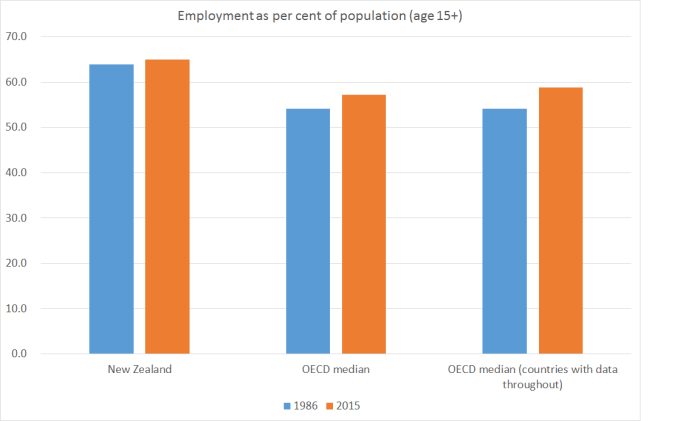
employment-oecd

Our employment rate has increased slightly over the 29 years to 2015, but  the median employment rate in other OECD countries has increased a little more than that in New Zealand.  Increased labour participation/employment rates cannot be part of the explanation for why over that same period we have continued to lose ground against other advanced countries, whether one looks at GDP per hour worked or at total factor productivity.    And while it is hypothetically possible that the high level of the employment rate might be depressing the level of productivity, it is worth remembering that the three OECD countries with higher employment rates than New Zealand (Iceland, Sweden, Switzerland) also have higher GDP per capita and GDP per hour worked than New Zealand does.

There are plenty of other aspects of the paper I could write about, and I could touch on some of those here in more depth.  One or two I might come back to next week.  But to close, I would note that I was struck by this line from the final paragraph

With low productivity so entrenched in New Zealand, lifting this presents a monumental challenge for policymakers, business owners and workers.

Unlike most of the rest of the paper, it presents business owners and workers as part of the problem.  But I don’t think the paper offers any evidence to that effect.  Instead, we should generally assume that business owners and workers respond rationally to incentives, and to the climate they face.    Governments shape so much of that climate.    On my telling, governments have (perhaps unintentionally) consistently skewed the economy away from paths that could have allowed much better productivity and GDP per capita outcomes.

The issues are important and the paper is a valuable contribution.  I encourage people to read it, and hope it stimulates some more debate on how New Zealand might best, in the paper’s closing words, achieve its productivity potential.

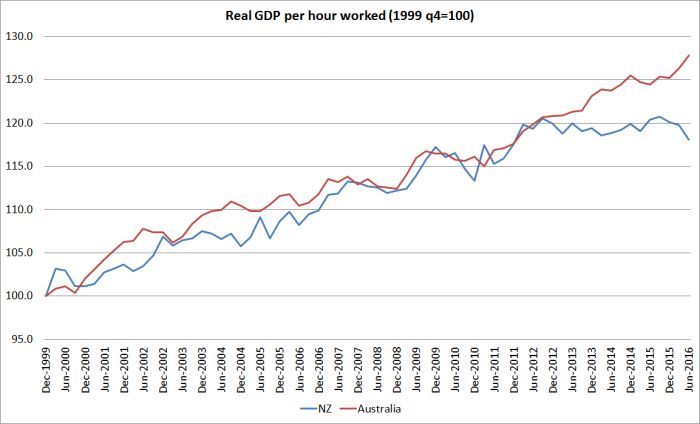
 

Thoughts prompted by Cuba

Fidel Castro is dead.  Sadly, the same can’t be said for the brutal regime that has controlled Cuba for 57 years now –  the regime that suppresses speech, religion, and the exercise of democratic freedoms that we take for granted; the regime that executed thousands of its political opponents and which, to this day, imprisons many of those brave enough to stand against it; the regime that suppresses free economic activity; the regime that actively tries to stop its own people leaving.  There have been plenty of awful Latin American regimes in the last 100 years or so, but fortunately most of the worst have now passed into history.  But not the Cuban regime.  I won’t rejoice in anyone’s death, but consider what type of man this was:  Fidel Castro had enthused about the idea of a nuclear attack on the United States, and had to be put in his place, in no uncertain terms, by Khrushchev.

Last week I happened to be reading Stephen Ambrose’s history of the Eisenhower presidency –  the last non-politician to become President of the United States.  Never having read that much about Cuba, I was surprised to learn that US government agencies –  and this at the height of the Cold War –  were genuinely uncertain what to make of Castro at first, were reluctant to conclude that he was a communist, and (in parts of the government at least) were initially reluctant to see him toppled, for fear that others, notably his brother (the current President of Cuba) would be worse.

But this blog is mostly about things economic.  I knew that pre-Castro Cuba had been a reasonably prosperous place by Latin American standards.  The southern countries (Chile, Argentina and Uruguay) were richer, and so was oil-abundant Venezuela.  But Cuba in the 1950s is estimated to have had real GDP per capita higher than, for example, that in Bolivia, Brazil, Paraguay, Honduras, El Salvador and Ecuador.    Most Cubans –  including Castro –  were descendants of Spanish migrants, and in the mid to late 1950s, real GDP per capita in Cuba is estimated to have been around 75 per cent of that in Spain.

What has happened since then?  Like all countries, Cuba has had its relatively good and relatively bad periods –  the latter, notably, after the fall of the Soviet Union.  And data sources for such a controlled economy aren’t that abundant, or probably that reliable.  However, Angus Maddison’s international database does have real GDP per capita estimates (all on a PPP basis) for Cuba from 1929 through to 2008 (the successor Conference Board database doesn’t include Cuba).

Here are estimates comparing real GDP per capita estimates for Cuba with those for other various other countries/groupings.  Here I’ve shown averages for (a) the thirty years prior to the Castro takeover, (b) the 1950s immediately prior to the takover, and (c) the forty years from 1968 to 2008.   And I’ve shown comparisons between Cuba and the United States, Spain, and New Zealand and also those with Maddison’s Western Europe measure and his measure for the eight largest Latin American countries for which there is annual data all the way back to 1929.     Using these averages masks the shorter-term volatility, but in looking at the Castro period the picture wouldn’t be much different if, say, I’d used just the 2008 observation rather than the 40 year average.  The big decline in Cuba’s economic fortunes took place in the 10 years after Castro’s revolution.

cuba

Against all these countries/groupings, Cuba’s performance in the Castro period has been worse than it was previously –  dramatically so when compared to the Latin American grouping, Western Europe, or to Spain, the former colonial power.

Having said that, I was a little surprised that the deterioration had not been even more marked.  If the numbers are roughly reliable –  and that is a significant caveat – then in 2008, Cuba’s real GDP per capita was still higher than those in El Salvador, Honduras, Nicaragua, and Paraguay.

Looking around for something a little more up-to-date, I found the World Bank had data showing PPP-adjusted current price per capita GDP estimates for the period 1990 to the present.  In Cuba’s case, “the present” only being up to 2013.

This is how Cuba has done relative to New Zealand over that period.  I’ve just set both countries’ GDP per capita equal to 100 in 1990 and so shown the relative growth since then.

cuba 2.png

It is a little depressing.  1990 was just before the collapse of the Soviet Union, and you see the subsequent sharp fall in Cuba’s performance in the early 1990s.  But over the entire 23 years, on this measure, there has been no change in New Zealand’s performance relative to that of Cuba.

(Here is a link to a post that puts Cuba’s economic performance in a rather more gloomy overall light.  I think it is a little unfair to compare any country’s performance to world GDP over recent decades, given that China is a significant chunk of the world and China had –  and has – so much ground it had to make up after the self-destruction over much of the 20th century.)

Of course, one of the other salient features of Cuba’s experience since Castro took power was the emigration to the United States.  Cuba’s population in 1958 was around 6.8 million.  Current estimates are that the Cuban-American population is around 1.2 million.  That outflow –  which would, presumably have been much larger if the Cuban government had not put tight exit controls in place –  was large enough that Cuba’s population growth in the 50 years after the revolution was the second lowest of all the Latin American countries Maddison reports data for (only Uruguay –  with its own large scale emigration-  had a lower rate of population growth in that period).

New Zealand is, of course, another country that has experienced a large scale net emigration of our own citizens.   Since 1958, it is estimated that 975000 New Zealand citizens (net) have left New Zealand permanently (and in 1958 our population was only 2.3 million).

I don’t want to make much of the Cuba/New Zealand comparisons. They can be crass, and risk trivialising the appalling oppression, persecution, and suffering of the people of Cuba, many of whom had –  and have – no way of escape.  And I’m not sure I believe the Cuban GDP numbers anyway –  and I see Tyler Cowen also highlights that issue.

But, equally, it is too easy to come to simply take for granted the massive outflows of our own people over recent decades, and the disappointingly poor relative economic performance.  Freedom is a great blessing, as is democratic choice (and legitimate exit options likewise), but our democracy –  and decades of chosen leaders –  has kept on failing our people.  We really should have been able to do a great deal better.

UPDATE: Various people have commented on the possible achievements of the Castro regime, especially in literacy and health.  Tyler Cowen had a link to this post, which I found useful in making sense of the merits of the case in that area.

What Wellington house prices have come to

A real estate agent yesterday sent me a PDF showing all the recent house sales in southern and eastern Wellington.

This one caught my eye

rintoul st.png

It is tiny, by almost any New Zealand standards.

It caught my eye because it is almost over the road from the school one of my daughters goes to, and because a fellow parishoner had spent her adult life in the almost identically small next door house.

Not only is the house tiny, but the section is pretty small by any standards.  No great redevelopment opportunities, unless (I suppose) someone managed to buy up the whole row of tiny houses.

Berhampore isn’t such a bad location I suppose.  It is an easy walk to the hospital or to Massey’s Wellington campus.  And I guess one could walk to work in town. The distance from this house to, say, Unity Books in Willis St is about the same as the distance from the Mt Eden shops to the Auckland Unity Books in High St.   But…….Berhampore is not Mt Eden.  It is slowly rejuvenating, and is apparently very popular among Green Party voters, but it will always have small houses, tiny sections, and rather a lot of council/state housing (oh, and the Satan’s Slaves are almost over the back fence).

And yet this tiny property went for $633,500.

Out of curiosity I checked out the real price I paid for my first house in 1989.  It was another couple of kilometres out of town, but the house was bigger, it was a couple of blocks from the beach, and the section was about three times the size of the Berhampore one.  In 2016 dollars, that house cost me $282000.

People in central and local government –  ministers, mayors, councillors, relevant officials – should really be hanging their heads in shame, at having so badly messed up housing and land supply markets to have produced such an atrocious situation.  Sadly, shame now seems like a foreign concept to those who do so much (always well-intentioned, but good intentions are never enough) damage to the prospects, and reasonable expectations, of our younger generations.

The Treasury on Auckland and immigration

The Treasury yesterday released its latest Long-Term Fiscal Statement.  These documents, in some form or other, are now required under the Public Finance Act to be published at least every four years.  I was once a fan, but I’ve become progressively more sceptical about their value.  There is a requirement to focus at least 40 years ahead, which sounds very prudent and responsible.    But, in fact, it doesn’t take much analysis to realise that (a) permanently increasing the share of government expenditure without increasing commensurately government revenue will, over time, run government finances into trouble, and (b) that offering a flat universal pension payment to an ever-increasing share of the population is a good example of a policy that increases the share of government expenditure in GDP.  We all know that.  Even politicians know that.  And although Treasury often produces an interesting range of background analysis, there really isn’t much more to it than that.  Changes in productivity growth rate assumptions don’t matter much (long-term fiscally) and nor do changes in immigration assumptions.  What matters is permanent (well, long-term) spending and revenue choices.     And from a purely technocratic perspective – and Treasury are supposed to be technocrats, not politicians – the headline out of yesterday’s release should probably really be “there is no great urgency about doing anything much over the next 20 years”.  In this chart, from the report,  in 2035 spending as a share of GDP, on historical patterns and existing laws, is only around where it was in 2010.   ltfs

John Key –  the Prime Minister who refuses to do anything about NZS – almost certainly won’t be in office that long.

There were several interesting background papers Treasury released yesterday.  If I get time over the next few weeks, I might write about some of them here.  For now though, I simply wanted to highlight some interesting material in the main report on a couple of my favourite topics: Auckland’s economic (under)performance, and immigration policy.   I’m not entirely sure why either section was included in the report –  which is about fiscal projections – but there they are.

First, Auckland.  Here there are some encouraging signs that Treasury is finally recognising the problem.  A few months ago I was quite critical of a cheerleading speech about Auckland given by the Secretary to the Treasury.  And in the LTFS, the text starts off quite upbeat

akld text.png

I was drumming my fingers at this point, but then I got to the second half of the paragraph.

akld-text-2

There was much more that could have been said, but for Treasury to acknowledge quite openly –  the plain statistical fact –  that Auckland incomes have been falling relative to those in the rest of the country, despite the huge infusion of additional people (“most skilled migrants anywhere in the OECD” as I heard Steven Joyce say again this morning) should be seen as pretty damning.  There is something very wrong with the model: as they add “this suggests we are not seeing the agglomeration effects we would expect from Auckland’s size and scale”.  Perhaps there is no guarantee –  or even reason to think –  that putting an extra million people or so (the increase in Auckland’s population in the last 50 years or so)  in a remote corner of the South Pacific would generate particularly favourable productivity results.

As I’ve noted previously, not only is Auckland’s GDP per capita less high relative to the rest of the country than it was even 15 years ago –  the point Treasury now acknowledges –  but that margin is small compared to what we see in other countries.  I ran this chart, looking at other large cities, in a post a few months ago.

gdp pc cross EU city margins

Auckland does poorly.  To me, that isn’t surprising.  This is a strongly natural resource based economy.  There is no sign –  and no sign Treasury points to –  that it has needed lots more people, and especially not in Auckland.

But Treasury, while clearly a bit troubled, isn’t willing to abandon the faith just yet.  The section on Auckland goes on.   There are a couple of anodyne paragraphs on Auckland as gateway (people and goods), and Auckland’s transport system,  and then we are right back to credal statements.

akld-text-3

Perhaps diversity does bring advantages, but in the specific case of Auckland, there is just no evidence of solid economic gains.  As Treasury notes, Auckland has a fast-growing population, a young population, a culturally diverse popuation, and a very high proportion of people born overseas.   But it has a disappointingly poor-  and worsening –  relative economic performance.  In my hard copy of the report I had scrawled next to the comment about London “just a shame, we don’t have their GDP performance”.  In the chart above, you can see the contrast between London and Auckland.    We really should expect more than faith-based claims from the government’s premier economic advisory agency.  As Treasury knows, for example, there is no evidence of a causal relationship between immigtration to New Zealand and growth in innovation, productivity or exports.

(For those interested in the Auckland underperformance issues, the October issue of North and South magazine had a nice article on  The Delusions of Aucklanders (and perhaps those advising governments). The article is now available on the new Bauer Media website, Noted.)

Some pages on from the Auckland discussion, Treasury has a page on immigration.  It also starts off with a strongly credal tone –  keep the faith.

akld-text-4

After finishing guffawing at the rather desperate “Auckland as a city of global significance” –  had the 9th floor of the Beehive requested that touch, or did they not need to ask? – we might simply ask for some evidence.  You might think it would trouble Treasury, even a little, that with one of the largest immigration programmes in the world –  of people who, by world standards, are not that badly skilled –  we’ve had 25 years of one of the lowest rates of productivity growth in the world.  Even Treasury acknowledges that failure.  Perhaps there isn’t a causal relationship.  Perhaps the productivity performance would have been even worse without the immigration.  But not a hint of doubt is allowed into this discussion from our premier economic agency.

But then the drafting gets a little more cagey.

akld 5.png

Note very carefully the “can”.  Yes, in principle, a good immigration policy can support productivity etc in the right places/circumstances.  But Treasury can, and does, advance no evidence that it has, in fact, done so in New Zealand.   They really want the public to believe in the programme, while being skilful enough drafters not to allow themselves to be pinned down to have made claims that the economic performance of New Zealanders is actually better as a result of the large scale immigration programme.   There is no hint of any evidence that using immigration policy in “addressing short-term skill shortages” makes any difference to longer-term per capita growth and productivity (and I’ve seen no literature on that point internationallly either).  And actually, Treasury’s own scenarios suggest that immigration also makes very little difference to the longer-term fiscal challenges.

They conclude, perhaps a little uneasily, reverting to rather more jargon-ridden text.

akld-6

Be very wary of bureaucrats proposing “integrated system responses”, when markets have ways of dealing with issues.  Typically, when demand for additional labour and human capital is high, returns to that sort of labour rise, which attracts more people into those jobs, and to developing those skills.  “Skill shortages” –  or even “workforce planning” – just aren’t some sort of a chronic problem governments need to address.  Excess demand for labour is either a sign that monetary policy is a bit loose, or that wages (for that sector or industry, or across the board) should be rising.   And if Treasury –  or MBIE or ministers –  could produce strong evidence that our immigration policy really had boosted productivity and the material living standards of New Zealanders, that would be one thing.  But they can’t –  and don’t.   And don’t forget, that the same OECD survey Steven Joyce was citing again this morning shows that native New Zealanders already have some of the very highest skill levels in any OECD country.

Overall, I guess one gets a sense that Treasury is slowly losing confidence in bits of its story.  They now are prepared to acknowledge (at least part of) the sustained underperformance of Auckland.  They have raised some doubts about excess reliance of some industries on immigrants.  And they still can’t cite any real evidence of sustained gains in the living standards of New Zealanders from the large scale non-citizen immigration programme.  But rather than openly addressing the genuine uncertainty – and in what seems a slightly desperate attempt to keep spirits up, and encourage people to “keep with the programme”  – we are left with what are little more than slogans, simply asserting the alleged economic gains to New Zealanders from diversity and high rates of non-citizen immigration.  A reasonable response should be “well, show us the evidence”.

At the session Treasury hosted yesterday for the release of the LTFS, we were informed that the Productivity Commission is releasing next Monday its “narrative”, in which they will attempt to explain why the New Zealand economy has underperformed for so long, and (presumably) some thoughts on how best to reverse that.  I will look forward to that document –  there aren’t enough developed competing narratives around a really important issue – and I will no doubt be writing about it here.  Given the Productivity Commission’s statist tendencies, I’m not optimistic, but I will be particularly interested in how they deal with the immigration policy and Auckland issues, both in explaining the underperformance of the last few decades, and in contemplating a better way ahead.

Monetary policy leeway for the next recession

A chart of short-term nominal interest rates over the last thirty years looks something like this.

nom-interest-rates-since-1987

It looks dramatic for two reasons.  First, I’ve started the chart from almost the historic peak in New Zealand’s interest rates, and secondly because in the late 1980s inflation and inflation expextations were still quite high.  It wasn’t until around the end of 1991 that inflation got inside the then target range of 0 to 2 per cent annual inflation.

Here are the same two series adjusted for inflation expectations –  the Reserve Bank’s two year ahead measure, from a survey that began in the September quarter of 1987.

real-int-rates-since-1987

It is a less dramatic picture of course but –  as in most other countries –  the trend is pretty strong downwards.  In previous posts I’ve shown that over the last 25 years or so there has been no sign of New Zealand interest rates converging on those in other advanced countries.

For some purposes, thirty years just doesn’t provide that much data.  There might have been 10000 calendar days, but there have only been two or three big cycles in interest rates, and a few smaller ones.

What has troubled me for some time –  perhaps the more so as the years since the last recession have accumulated-   is what happens when the next recession comes.  We know that most advanced countries ran out of conventional monetary policy capacity in responding to the 2008/09 downturn.  That, almost certainly, slowed the recover in demand and activity in many of those countries (even recognising the underlying productivity growth slowdown that was already underway before that recession).

Back in 2009, this might not have looked like much of an issue for New Zealand.  After all, in 2009 the OCR troughed at 2.5 per cent and the time pretty much everyone –  market pricing included –  expected a fairly quick and substantial rebound.   Despite a couple of ill-fated policy attempts at a tightening cycle, it just never happened.  And years on now, inflation is still materially below the target midpoint, and the nominal OCR is even lower than it was then.

Views differ about the current position of the economy, but they are probably bounded quite tightly around an output gap estimate of zero.  I emphasise that the unemployment rate is still above the NAIRU, suggesting a modest (and unnecessary) negative output gap, and even the most optimistic forecasters/commentators don’t see much sign of a materially positive output gap.  There aren’t huge amounts of spare resources lying idle, but equally there isn’t massive overheating either.  For better or worse, we should probably be treating current interest rates as something like “normal”  – not perhaps in some very long-term sense, but certainly in terms of the sorts of macro conditions we’ve experienced in recent years.

And if interest rates are in some sense around normal/natural at current levels, we can’t prudently assume or plan on the basis that they are highly likely to rise from here (any time in the next few years).  They might, but it looks as though it would take some material new development for that to happen.  But it must be almost equally likely that the next material move is a fall.  This isn’t a debate about where the next 50 basis point move comes from –  reasonable people could probably differ over that range about where the OCR should be right now.  Instead, it is about the next multiple hundred basis point move will be.  They aren’t that uncommon –  we’ve had three in the last 30 years.

I think there is a tendency –  partly a recency error, partly the dramatic headlines of the times –  to think of the interest rate adjustments over 2008/09 as unusually large.  But they weren’t, especially not in New Zealand.  There were some very big individual OCR adjustments  –  twice in a row the OCR was cut by 150 basis points-  but in total they didn’t add up to much more than usual for a New Zealand downturn.  Retail interest rates fell by 400 to 500 basis points.    Over the short sample we have, that looks to be about the typical amplitude of New Zealand interest rate cycles.

Dramatic as the events of 2008/09 were internationally, when one looks at the New Zealand real economic data, 2008/09 simply doesn’t stand as an extraordinary downturn (although the subsequent weak recovery stands out more).  Here is a chart of annual average real GDP growth (using an average of the expenditure and production measures).

real gdp aapc.png

The recession wasn’t quite as deep as the 1991 episode (which came after several years of pretty sluggish growth and not much sign of a positive output gap), and the slowdown in the growth rate wasn’t much larger than the slowdown from around 1996 to 1998.

And here is a chart of the employment and unemployment rates.

e-and-u-rate

Again, neither the change in the unemployment rate nor the change in the employment rate over 2008/09 particularly stand out.

It is a small sample of events, but on the basis of that limited sample, it looks as though we should be planning on the basis that in the next material downturn we’ll need to lower retail interest rates by 400 to 500 basis points.  And, we should be planning for the possibility that such a downturn happens before economic conditions warrant raising interest rates much, if at all, from current levels.

But 90 day bank bill rates today are around 2 per cent, and term deposit rates are a bit above 3 per cent.  The OCR itself is 1.75 per cent. There is a pretty clear consensus that, on current technologies and institutional practices, a rate like the OCR probably can’t be reduced below about -0.75 per cent –  if it was attempted large holders of short-term assets would find it more economic to convert those holdings into physical cash.  The Reserve Bank of New Zealand might have policy leeway of perhaps 2.5 percentage points, but they can’t safely assume they have leeway beyond that.  And among the scenarios they have to plan on is that in the next downturn there could be a renewed widening of the spread between retail and wholesale interest rates –  and it is retail rates that influence consumption and investment behaviour.

It is easy to say “oh, but we can just bring fiscal policy into play”.  But, on the one hand, the Reserve Bank has no control over fiscal policy, and can’t just assume that the political imperatives driving/constraining fiscal policy will neatly fit with the Bank’s stabilisation (inflation targeting objectives).  And, on the other, while New Zealand’s overall fiscal policy isn’t bad by international standards, it isn’t stellar either. The Crown balance sheet is in nowhere near as good shape as it was in 2008.  It can take a lot of fiscal stimulus to compensate for the absence of monetary leeway –  and of the numerous countries that deployed discretionary fiscal stimulus in 2008/09, I can’t think of any where it made a decisive difference (we can debate Australia).  And, relative to the situation in 2008, we’ve since been starkly reminded over the last few years how (physically and financially) vulnerable to earthquakes New Zealand is, reinforcing the case for fiscal prudence (eg a positive net assets position as the norm).

In the next big downturn, there might be some scope for discretionary fiscal policy support (beyond the relatively weak –  in New Zealand –  automatic stabilisers) but no one –  and certainly not the Reserve Bank –  should be counting on it much.

The other reason to be uneasy is that the limited policy leeway is no secret.  In typical downturns inflation and inflation expectations fall to some extent, but everyone recognises that the central bank will cut interest rates as much as necessary, to help support a recovery in demand, and keep inflation near target.  Countries as diverse as the US and NZ could cut by 500 basis points in 2008/09 and did, and everyone knew in advance they had that potential.

But if the next material downturn were to occur in the next couple of years –  and typical expansion phases in New Zealand haven’t last much longer than that – everyone will know that (abroad as well as here) central banks just don’t have that sort of leeway.  The Fed might be able to cut by 1.5 percentage points, and the RBA and the RBNZ by as much as 2.5 percentage points.  But that will be about it.  Rational agents –  firms, households, markets, will assume that inflation, and inflation expectations will fall further.  That will make it even harder to stabilise activity and inflation.

(I’m not going to spend a lot of time on QE, but outside extreme crisis conditions, I think it is fairly common ground that it would take a great deal of QE to compensate for even 100 basis points of conventional monetary policy leeway.)

This isn’t a trivial, or abstruse technical, issue.  At the heart of the case for discretionary monetary policy –  the model advanced countries have run with since the 1930s –  is the ability to adjust monetary conditions as much as it takes, to assist in stabilising the economy when it faces significant shocks.  In the next downturn, there is increasingly unlikely to be enough leeway.

That should be concerning the Minister of Finance, the Secretary to the Treasury, and the Reserve Bank –  not just in some idle handwringing sense, but commissioning work to respond to this threat.  Perhaps there are secret projects underway in the bowels of the Reserve Bank and Treasury, but this isn’t work that should be kept secret; rather, it should be part of an open and ongoing conversation to help reassure the public and markets that the authorities have the capacity to respond decisively if and when the next serious downturn happens.  There are solutions.

At the extreme, central bank physical currency could be withdrawn and completely replaced with electronic central bank liabilities, on which (say) negative interest rates could be paid.  But that would take legislation and considerable organisation, and would be an unnecessary over-reaction, while there is still a considerable revealed demand to transact (in the mainstream economy) in cash.  Better options might be to, say, cap the total issuance of Reserve Bank physical currency and allow an auction mechaism to set a variable exchange rate between physical and electronic Reserve Bank liabilities.  Banks themselves could be allowed to issue currency again –  on whatever terms they chose.  Or the Reserve Bank could simply put in place an administered premium price on access to new physical currency (eg a 2 per cent lump sum fee would be likely to introduce considerable additional conventional monetary policy leeway).  Each of these possibilities has potential pitfalls and possible legal issues. It would therefore be highly deisrable if an open consultative process was got underway, enabling a range of perspectives to be considered and debated in the cool light of day, rather than in the urgency of an unexpected recession.  If, in the end, it all proved too hard –  which I’d be reluctant to believe –  the case for an increase in the inflation target would be strengthened.  As the PTA needs to be renegotiated next year, now is the time to have this work underway. (And as the Reserve Bank has just given itself, somewhat unwisely, a three month holiday from reviewing the OCR –  the next review is not til February –  now would seem a particularly appropriate time to assign some joint Treasury and Reserve Bank resources to this work.)

What is particularly disconcerting is that there has been no hint that this is even considered an issue, whether in comments from the Minister, in speeches from the Secretary to the Treasury (including those commenting directly on monetary policy), in the Reserve Bank’s Statement of Intent, or in the increasingly rare speeches from the outgoing Governor.  We should expect more.

(And in case anyone thinks otherwise, this issue is not an argument against the OCR cuts of the last year or so.  Without them, inflation and inflation expectations would be likely to have fallen further, only increasingly the severity of the “lack of leeway” problem if a new recession were to strike a year or two down the track.  The best way to maximise the limited remaining leeway is to keep interest rates low enough now that inflation is at, or even slightly above, the midpoint of the target range.)