Wellington Airport: a factual high level summary

This morning’s Dominion-Post features a full page advert, notionally inviting people to make submissions on the resource consent application to extend the runway at Wellington Airport.

In fact, the advert is mainly an opportunity to tout the case for the hugely-expensive proposed extension –  in what must be one of the most expensive locations in the world in which one could add 300 metres to a runway (and still not comfortably meet international safety guidelines).  The pretty graphic highlights 20 Pacific Rim cities which planes could reach from Wellington –  without ever mentioning that the most likely outcome, if the project succeeds at all, is flights once or twice a week to one or two of them.

All one really needs to know about the proposal is that the owners of the airport think the project is sufficiently unattractive that there is no way they would proceed with the extension if it involved investing their own money.

The owners –  WIAL, majority-owned by Infratil – have been quite clear that the project will only proceed, even if it gets resource consent, if there is a massive public subsidy –  huge contributions from some combination of local, regional, and central government that would not be reflected in a commensurate ownership interest in the airport.  But there is no mention, at all, of this fact.

In a little note at the bottom of the advert  it is described as a “high level factual summary of some of key effects from the extension”.   I did spot the odd fact in the advert, but mostly it was boosterish opinions, clothed in consultants’ reports – and  all summarized in the huge alleged national benefit estimates.  I’m deeply unconvinced by the economic case for this airport runway extension –  the benefits appear to be overstated, and the discount rate used to evaluate them seems too low – but would have no real objection if private shareholders were paying for it.  But they aren’t.

I wrote a few posts about this proposal late last year, here, here, and here. Ian Harrison, at Tailrisk, has a nice piece here on the same issue.

I’m not making a submission.  As a matter of principle, I don’t think the Resource Management Act should be used to block business developments, unless there are compelling environmental grounds –  and I have no expertise in environmental issues, and am interested only to the extent Lyall Bay remains a pleasant spot for the family to swim.

The real debate should be around decisions new local and regional councilors consider making about injecting public subsidies to this operation (over and above what has already been spent). The quality of public sector investment spending is typically quite poor, and around the country airport investments (see eg Rotorua) are no exception.   As the local body elections are just weeks away, the focus needs to be on the attitude towards the project that each candidate takes.  So much money is involved, and attitudes to this project seem to reveal so much about candidates’ views on the role of local and regional government, that for me it will be a defining issue.  I will be seeking out candidates who are clearly opposed to spending public money on the extension.  In the huge field of mayoral candidates there appear to be a couple of options –  but their fine print needs checking out.  I haven’t yet done my research on the council and regional council candidates.  I encourage greater Wellington readers –  because although the Wellington City Council has been driving this, they’ll be looking for money from other local authorities in the region –  to prioritise this issue.

My fear is that once the election is over, there will be a behind-closed-doors process rushed through, with no rigorous evaluation of the economics of the project.  Cheer-leading from the local business community –  always keen on the sort of public subsidies and activities that don’t face the market test that keep Wellington afloat – reinforces the risk.

Surveyed expectations

The Reserve Bank’s quarterly survey of semi-expert opinion on the outlook for various macroeconomic variables was out the other day –  a bit earlier than usual, presumably because of the changes in the schedule of MPS releases.  This is a really rich survey, covering a wide range of variables, and has been running now for nearly 30 years.  But I noticed that the number of respondents is now down to only 52 (and on some questions there were fewer than 40 answers).  Once upon a time, if my memory isn’t failing me, there were nearer 200 respondents.

My impression is that the Bank’s aims have shifted over time: when the survey began in 1987 it was designed to capture the expectations of people making key transactional decisions in the economy.  There were always some economists, but quite a lot of effort went into getting business people and –  reflecting the much greater role of collective employment contracts then  – union officials to participate.   We even had large enough samples that we used to report responses separately for the different classes of respondents.  For some years, we ran a staff survey in parallel, which occasionally highlighted interesting differences between staff and external expectations for the same variables.    I’m not sure who is captured in the 52 respondents the survey now has, but I suspect economists must now make up quite a large proportion.  There isn’t necessarily anything wrong with that –  I suspect few people other than economists have explicit expectations for most macroeconomic variables (inflation might be an exception) and if they ever need such forecasts, they will typically draw on the numbers prepared by economists.  But it probably means the survey is drifting progressively ever closer to something like a consensus forecasts exercise of economists, rather than capturing how people are necessarily thinking in the wider economy.  It is broader than, say, the NZIER Consensus exercise, or than the pool of forecasters the Reserve Bank benchmarks its forecasts against (after all, it includes views of people like me who don’t prepare formal forecasts), but it is a similar class of exercise.

But what to make of the latest survey?  Only one thing really took me by surprise and that was that inflation expectations didn’t fall further.  I revised mine down, after having been stable for several quarters, and had expected the overall survey to show something similar.  After all, the June quarter CPI had surprised on the low side, the exchange rate had increased quite markedly and –  for what its worth –  the breakeven inflation rates derived from indexed and conventional government bonds had fallen further.  In fact, there was barely any change  –  if anything, a barely perceptible increase.

But it is worth remembering just how very weak these inflation expectations are.  The target midpoint –  which the Bank is required to focus on –  is 2 per cent, and last survey in 2014 was the last time two year ahead expectations were as high as 2 per cent.  And that was before the easing phase even got underway.  There have only been two quarters in the last four years when one year ahead expectations have been as high as 2 per cent.  Many of the deviations aren’t that large, but respondents really don’t believe the Bank will be delivering inflation fluctuating around 2 per cent.  That should trouble the Reserve Bank, and must trouble those paid to hold the Bank to account.  After all, actual inflation has been below 2 per cent for a long time now.

There is some short-term noise in the inflation expectations series, and there is some seasonality in the CPI.  But here is another way of looking at the data.   I’ve just averaged the last four observations for each of the four inflation expectations questions (this quarter, next quarter, year ahead, two years ahead) and annualized the two quarterly numbers. In the chart, I’ve shown them against the target midpoint, going all the way back to the end of 1991 –  which was when inflation dropped into the target range for the first time.

inflation expectations ann avg

That prompts several thoughts:

  • we’ve never previously seen all the measures below the midpoint. The last eighteen months or so really is different
  • we’ve never previously seen the two year expectations measures detach from all the other measures for so long,
  • when the shorter-term expectations often ran above the two year measure during the pre-2008 boom, it was the shorter-term measures that better aligned with (I’m hesitant to say “predicted”) what happened to the core inflation measures (the Bank’s own preferred, quite stable, measure peaked above 3 per cent).

The Reserve Bank might defend itself arguing that the fact that the two year expectations are still not too far below 2 per cent is reassuring –  “people trust us, despite the short-term variability”.   I don’t think that is a particularly safe interpretation –  especially when for the shorter-term horizons, about which respondents have much more information, expectations just keep on tracking very low.  Another common response from the Bank is to highlight exchange rate and oil price movements –  but most of the collapse in oil prices was 18 months ago now, and the current exchange rate is around the average for the Governor’s term to date.

A couple of other aspects of the survey caught my eye.  The first was the question about monetary conditions.  Here is what respondents said when asked about the conditions they expected a year from now.

mon conditions yr ahead.png

For seven surveys in a row, respondents have revised down their future expectations. This question has only been running since 1999, but that sort of run of downward revisions has no precedent –  not even during the 2008/09 recession.  Typically, the Bank raises or lowers the OCR and people seem to eventually expect policy to work and conditions to get back to normal. You can see that during 2008/09  –  by the June 2009 survey, respondents were already beginning to revise back up their future expectations.   But not –  yet –  this time.  I’d argue that isn’t surprising –  after all, the 2014 tightening cycle was a mistake, and even now with the OCR at 2.25 per cent, real policy interest rates are still higher than they were as that cycle was getting underway.  But perhaps there is another interpretation that is more favorable to the Bank?

I was also interested in the responses on expected 90 day interest rates –  a close proxy for the OCR.  Quarter ahead and year ahead expectations both fell by 10 basis points, but by next June the median respondent still thinks the 90 day rate will be 2.1 per cent.  That is probably consistent with the OCR at 1.85 per cent.  Respondents expect one more OCR cut –  most probably next week, according to the survey responses, but aren’t sure there will be anything much beyond that.  Perhaps more surprising, the lower quartile response for the year ahead was 2 per cent.  No one can tell the future with any great confidence, but I’d have thought there was rather more of a chance than that that the OCR might need to be cut to 1.5 per cent, or even below, to get inflation back nearer target.

It isn’t obvious how it is going to happen otherwise.  Respondents expect GDP growth to remain around 2.5 per cent.  And they don’t expect any material further reduction in the unemployment rate –  even though I see that Treasury has now revised its NAIRU estimate to 4 per cent –  and they expect only as very modest increase in nominal wage inflation (and of course those responses were completed before yesterday’s wages data).  It typically takes increased capacity pressure to get an acceleration in core inflation, and there is little or no sign of those sorts of pressures emerging in this survey.

So perhaps what we have is respondents reading the Governor much the way I do –  really reluctant to cut the OCR, but he will do so if events overwhelm him (his recent statement suggests next week’s MPS might be that time, if there hasn’t been another miscommunication or policy reversal).  But such a stance offers little chance of inflation getting sustainably back to around 2 per cent in the foreseeable future –  unless there is some really big unforeseen demand shock.

So those two year ahead survey expectations of inflation still look too high to me.   For many years, the ANZ’s survey of (non-expert) small and medium businesses had inflation expectations results above the Bank’s two year ahead survey.  Even those non-expert respondents now have (year ahead) expectations of only 1.49 per cent –  and that much larger survey has had an upside bias, over-predicting actual inflation, over the years.  I still feel pretty confident that the OCR will get to 1.5 per cent before too long –  but the sooner it is done, the less the risk of having to cut even further to restore practical confidence that future inflation will be averaging near the target the Bank has been set.  Sadly, with only 13 months of his term to go, it seems unlikely that Graeme Wheeler will ever preside over a 2 per cent inflation rate, let alone one that averages 2 per cent. But he can still set a better platform now for his successor.


Let’s not give even more statutory powers to the Reserve Bank

This morning the Reserve Bank released a variety of material that followed on from the leak of OCR at the time of March MPS.    Slipped out quietly onto their website – in response to an OIA request from me – was what might best be called the second stage of the leak inquiry report.  It is a document written by Deloitte almost a month after the release of what the Governor has called the “summary report” that was released on 14 April, and in places it is clearly phrased to respond to criticisms made after the release of that report.  I’ll have more to say about that document another day, but would just note that I was touched by the solicitousness of the Bank in deleting my name from a report they were releasing to me, apparently so as to “protect the privacy of natural persons”.  Perhaps they thought I’d forgotten my involvement?

The Bank also put out a press release headed “New Reserve Bank procedures for policy releases”.   After the discontinuation, from 14 April, of pre-release MPS and FSR lock-ups for journalists and analysts, there was pushback, especially from journalists, seeking the reinstatement of media lock-ups, under new and improved security arrangements (as distinct from what Deloitte call the “very high trust” arrangements –  under  which journalists could simply email from the lock-ups whenever they liked –  which had been found sorely wanting).   The Governor had indicated that the Bank would consider the options, and apparently commissioned a “security review” to explore the feasibility of lock-ups with much tighter security.  That review was undertaken under the leadership of Deloitte, but from the text the Bank has released today it is clear that it had a high degree of Reserve Bank staff involvement.

At the end of the process, the Governor has come to the right conclusion.  Lock-ups are not being reinstated, whether for analysts or journalists.  That was an approach I recommended at a time when the Bank itself didn’t even believe there had been a leak.  I commended the Governor’s initial decision to terminate the lock-ups, and I commend him again today.  There is simply no need for such lock-ups, and to hold them inevitably exposes the Bank to unnecessary security risks and/or unnecessary costs.  The public might have been well-served by lock-ups in a pre-internet age –   when it was hard to get timely access to the released documents –  but with today’s technology, the text is open to everyone at much the same time, and the onus is on the Bank to write its documents in a way that clearly communicates the messages it wants to convey.

Of course, the Bank is not seriously committed to openness or competitive neutrality in the access to information.  I have heard that they are still running briefings for analysts after the release.  [UPDATE: A market economist tells me that although they had such a briefing in June, there won’t be any in future]  An overseas expert on central bank communications has recommended –  and I agree with him –  that if such briefings are to be held (and there may be a useful place for them) they should be webcast, so that everyone has access to the same information/interpretation, not just the invited few who find it worthwhile to come all the way to Wellington (recall that most trading in the NZD is done offshore, and most New Zealand government bonds are held offshore).

[UPDATE: On further reflection, I would argue that such a post-release briefing, provided it is made openly available, would be a sensible option and cannot really understand why the Bank has scrapped them.  At a minimum it is less bad (and less costly in time) than lots of analysts approaching the Bank individually, and getting answers that could be (a) inconsistent across analysts, and/or (b) could be influenced by how well the analyst in question gets on with – eg  doesn’t criticize too much – the Bank and its senior economic staff in particular.]

For the media, the Bank notes that

We will also be placing additional emphasis on other opportunities for media access, such as on-the-record media briefings which have been trialled successfully this year.

There may be a place for such briefings, but if they are on-the-record again there is a strong case for webcasting them –  or even quickly publishing a transcript –  again so that everyone has the same information on a timely basis.  And, of course, on-the-record briefings –  with an emphasis on what the Bank wants to tell the media –  are very different from the sort of on-the-record searching interviews that the Governor consistently refuses.

I noted the other day that the Bank is sheltering behind an old provision of the Reserve Bank Act which, they argue, imposes serious sanctions (including a large fine or a term of imprisonment) if they were to release submissions –  especially from banks –  on proposed changes in regulatory policy.  I argued that if they had any sort of commitment to open government they should be promoting a simple amendment to the Act, to ensure that such submissions were fully, and simply, within the ambit of the Official Information Act.  If the Bank won’t promote such a change, perhaps an MP with a commitment to open government might.

So when I read through the Deloitte security review document, I was struck by the number of times that report had encouraged the Bank to seek a change to the Reserve Bank Act, this time to provide criminal sanctions for the early unauthorized release of OCR or MPS (or FSR?) material.  I suspect the idea for such a change did not come from Deloitte, but from Bank management themselves – in particular from the Deputy Governor responsible for such things (and former Government Statistician) Geoff Bascand.  In previous material released on the OCR leak, Bascand was on record as noting that Reserve Bank material of this sort did not have the sort of protections the Statistics Act provided to Statistics New Zealand.

It is really important that when the coercive powers of the state are used to compel individuals and firms to provide information to state agencies that people can be confident that that information is held securely.  Severe punishment for the inappropriate release of private information supplied by other people is quite appropriate.  But in fact, both the Statistics Act and the Reserve Bank Act already provide such penalties –  under the Reserve Bank Act someone can be sent to prison for three months, or a company can face a half million dollar fine.

But the economic forecasts and policy views of a government official (the Governor in this case) are a quite different matter.  And in many respect, that sort of information is not so different than the private information a firm might hold about a proposed merger or acquisition, about its planned dividend, about a new investment project, or –  in the New Zealand case –  Fonterra’s expected dairy payout.  Perhaps I’m wrong, but I’m not aware that there are criminal sanctions that protect, say, government Budget documents, or any other release of planned policy or legislation by government ministers.

In all those cases, confidentiality is clearly important to the information holder.  But in each case there would appear to be civil procedures open to information holders to protect the confidentiality of their information.  Typically, some staff in the relevant organization would have access to such information, and early unauthorized release would typically be a grounds for disciplinary action or perhaps even dismissal.    But other parties might too –  government Budget documents are printed externally, as is the MPS.  Sometimes professional advisers –  eg lawyers –  will be involved. And in some cases, entities will choose to provide information under embargo, or even to hold a lock-up.  In each and every case, it is open to the owner/provider of the information to specify in contract the confidentiality obligations of any party receiving the information.   Remedies for breaches of those policies are the responsibility of the institution providing the information.  There is no obvious need for criminal sanctions to be introduced in the process.  I hope that the Reserve Bank thinks again, and decides not to seek amendments of the sort Deloitte (no doubt at the Bank’s prompting) has suggested.  There is simply nothing that special about the OCR information –  it is not private information involuntarily provided to a government agency, and nor is it (say) material relating to national security.

In conclusion, it is interesting that in all the material that has emerged in recent months there has been little or no mention of one of the greatest security risks the Bank –  quite unnecessarily  – faces.    In most countries, the OCR decision is made and released on the same day –  that will have been what happened at the RBA yesterday.  The Reserve Bank has considerably shortened the lags over recent years, but as their recent article on the monetary policy process decision illustrates, the OCR decision to be released next Thursday will be made by the Governor this Friday.  There is six whole days when the information about the decision is known within the Bank.  Even if the formal knowledge is kept to a relatively small group –  when I was involved it was 10 to 15 people – it is simply an unnecessary risk.  With the best will in the world,it is almost inevitable that one day some one will let something slip, and there will be a huge uproar.  In terms of tightening security, still the best reform the Bank could make would be to release the OCR decision on the day it is made.


Wellington…still growing sluggishly

There was an annoying story on the front page of the Dominion-Post this morning.  The online version of the story is headed “The big squeeze: Wellington’s population could almost double in the next 30 years”, a proposition which appears to be based on nothing more than compounding last year’s estimated population growth for the Wellington city area.  I suppose anything could happen.  The annual immigration target could be doubled or trebled, central government could go on a massive expansion path, or the private sector could discover hitherto untapped opportunities in Wellington.

But if Wellington has outstripped Dunedin over the years, it has hardly managed strong growth.  I went back to my 1913 New Zealand Official Yearbook.  Back then, greater Wellington made up 17 per cent of the total population of the 14 large urban areas (a group made up of the places that were largest then, and those which are largest now –  eg in 1913 Hamilton and Tauranga barely figured, while Gisborne and Timaru did).  Today, the population of greater Wellington (including Kapiti) is about 14 per cent of the population of those 14 urban areas.
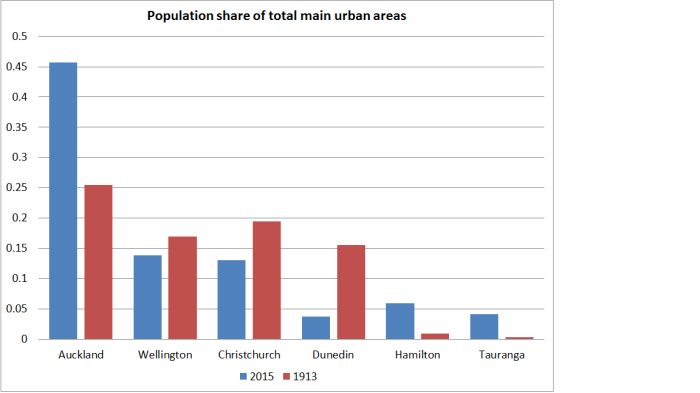
population shares wgtn

More recently, SNZ reports estimated data for urban area populations from 1996 to 2015.  Over that period, even Wellington city’s population growth has only slightly exceeded population growth for the country as a whole  –  and been ever so slightly slower than population growth in Nelson.  Take the greater Wellington area and population growth has been slower than that in greater Christchurch, despite the massive disruption from the earthquakes.

population growth since 1996

I’m not sure that this should greatly surprise anyone.  Wellington has been helped by the growth of government (the regulatory state needs staff and it keeps growing, even if the tax share in GDP doesn’t) and by happening to have industries which it remains fashionable to subsidise (the film industry).  On the other hand, it has a somewhat bracing climate –  albeit one staunchly defended by some true Wellingtonians.    There have been some good market-driven businesses built here, but not many choose (and find it optimal) to stay in the longer-term.

Average GDP per capita in Wellington is higher than that in New Zealand as a whole –  no doubt reflecting some combination of the huge number of professional government and government-dependent roles, and the fact that Wellington tends to be attractive to young people not old ones (it is windy and not very warm).  The labour force participation rate in Wellington averages higher than those in, say, Auckland and Christchurch.  But over the 15 years for which we have regional GDP data, average per capita GDP in Wellington has been growing more slowly than that in the rest of the country (a similar story to Auckland).
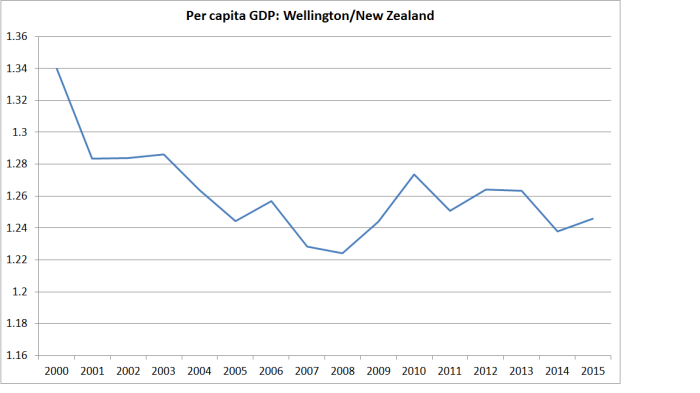
wgtn regional GDP

So I don’t really see much chance that the population of Wellington – even just that of Wellington city –  is going to double over 30 years.   Even the Wellington City Council’s “chief city planner” (shouldn’t anyone from outside the old eastern-bloc be embarrassed to hold such a title?) acknowledges it is unlikely.

But the focus of the Stuff article was on the Wellington housing market.    Of course, since it is an article about local authorities perhaps it isn’t too surprising that the word “market” does not appear at all –  not once in a reasonably substantial article.  The Council’s British chief bureaucrat, Kevin Lavery, is quoted instead as saying

Lavery said the 15 people who find themselves sitting around the Wellington City Council table after October’s election will have some big decisions to make on the supply, quality and diversity of housing in the capital.

Which really sums up all that is wrong with our system of local government.  Councils and their officials simply should not be in the business of making decisions on the “supply, quality, or diversity” of housing in the city.  That is what we have –  or should have –  markets for.  They are the mechanisms through which private tastes and preferences are reflected and private businesses respond to that (actual and anticipated) demand.  We need local authorities to do things like pave the streets, manage the water and sewerage, provide parks, and perhaps even run libraries.  We don’t need them deciding what sort of houses people are living in and where   The problems –  including the affordability problems – mostly arise when officials and councillors get in the way.  Now if Mr Lavery had simply been noting that no one can really predict what future population growth rates will be, or where people and businesses will prefer to operate, and that Council rules need to be sufficiently minimalistic and flexible to enable housing supply to easily respond to emerging demand, I’d have applauded him.  But no, he doesn’t see a dominant role for the market, but for 15 elected individuals, with neither the expertise nor the incentives to get those decisions right –  and that is no criticism of them individually, no one has that knowledge.

But the “chief city planner” is worried.

The danger was that developers would concentrate more on packing people in than on good design. “We’re not out to generate developments and profit margins for developers. We’re building communities.”

Council bureaucrats are “building communities”?  The mindset is really quite starkly on display.  In market economies, profit margins are part of what makes people willing to take risks, and build businesses –  even develop new subdivisions or apartment blocks –  taking the risk that things might actually go badly wrong.  But “profit margins” seem anathema to the chief planner.  And “good design” seems mostly to be a mantra to impose the tastes of some on everyone, and raise costs of housing.  Again, why is it a matter for local government?

It isn’t just the bureaucrats. Here is our Mayor, presumably somewhat torn between her Green Party credentials (supposedly sceptical of population growth) and her local authority boosterism.

Wellington Mayor Celia Wade-Brown said she believed her council had done plenty during her six years in charge to set the city up for a population boom.

It had signed off on a number of special housing areas with the Government, and was actively consulting communities in several suburbs on potential medium-density housing rules.

Establishing an Urban Development Agency this year would also help increase the city’s housing stock and keep prices in check, she said. The agency will be able to buy and assemble land parcels, and partner with developers.

It is all about bureaucrats and politicians, not at all about empowering markets.  Nothing about respecting property rights or promoting market solutions –  just put your trust in the Mayor and Council staff.  I’m wryly amused by her references to SHAs. There are a few not far from here.  One –  on the site of an old church –  now has a few townhouses almost completed. A much larger one, not 200 metres from where I sit, remains as overgrown, dark, brooding, and undeveloped as ever.  I’m keen to see it developed – though I know many locals aren’t –  but there is simply no sign of any progress.

I guess the election is coming up and the incumbent isn’t well-positioned but when she can end with the observation that

“When our average house price is $560,000 and the Government considers $600,000 to be affordable in Auckland, then I think our city is looking pretty good.”

it is as if very small ambitions indeed have triumphed.

One only has to fly over Wellington to realise just how much land there is in both Wellington city, and the greater Wellington area.  No doubt, the development costs are higher than those for flat cities such as Hamilton, Palmerston North or Hastings.   But there is little excuse for average house prices of $560000 –  responsibility  for that mostly rests with the mayor, councillors and their legion of planners, aided and abetted by central governments that have allowed councils to have such powers.

The Productivity Commission’s draft report on a new urban land use policy framework is apparently due out next month.  They had a mandate to be ambitious in their proposals.  The Commission has so far shown a disconcerting enthusiasm for giving more powers to councils and governments, not fewer (they are bureaucrats themselves, so perhaps even if disappointing it shouldn’t be so surprising). I hope they take seriously the possibility of largely withdrawing the state (central and local) from the urban planning business.  There was a nice piece the other day from a US commentator, Justin Fox, marking the 100th anniversary of zoning in New York.

It also appears to have been the first set of land-use rules in the U.S. that (1) covered an entire city and (2) used the word “zone.”

That was 100 years ago Monday. So happy birthday, zoning! OK if we kill you now — or at least maim you?

There’s a thought. Put markets, and private contracts, back in the driver’s seat, and let local authorities respond to private sector developments, efficiently delivering the limited range of services we really need councils to provide.  Don’t “plan communities”, but provide services to ones that develop.  (And that doesn’t include airport runways.)

Time to let the sunshine in

Former US Supreme Court Justice Louis Brandeis was the author of the famous line that sunshine is the best disinfectant, arguing for greater transparency in government agencies and the political process.   There is no perfect system, and probably no country reaches an ideal standard, but as governments around the world have become more intrusive and more powerful there have at least been some important counterbalances developed.  One of the most important has been the passing of freedom of information acts –  our own dating from 1982 –  which typically help move towards a presumption that information held by government agencies is accessible to citizens unless there is a compelling reason otherwise.  In making primary legislation (passing Acts of Parliament) Parliament now uses select committees much more extensively than was once the case and there is recognition, reflected now in established practice (Parliament itself not being subject to the OIA), that submissions to such committees, from people trying to influence our laws, should be made public on a timely basis.

The timely publication of submissions –  whether to, eg Productivity Commission enquiries, to local councils reviewing district plans, or to government regulatory agencies –  is increasingly becoming the norm.

There is, however, one notable blackspot in this generally positive story.  The Governor doesn’t invite public submissions on the OCR, but if you send him one anyway, it will be discoverable under the Official Information Act –  there is presumption in favour of release, unless there is a compelling specific ground not to.  But make a submission on a regulatory initiative –  where the Bank is required to consult, take submissions, and have regard to those submissions when the Governor makes his final decision – and anyone who wants to see that submission will face a barrage of obstructionism, some of it enabled by old legislation that simply hasn’t kept up with how the Bank’s extensive powers have evolved.

Last year, for example, various government agencies were doing things about housing.  The new brightline test and associated tax number provisions required parliamentary legislation.  All the submissions on these issues were published shortly after they were received.  The Reserve Bank put out proposals for a new round of LVR controls.  The Bank first refused absolutely to publish any of the submissions, even after the event, arguing that the summary of submissions that it wrote itself should be quite enough.  After several OIA requests, it finally backed down a little and agreed to release the submissions made by people who weren’t themselves regulated entities (ie those of people like me)-  but by then it was well after the decision had been made.

In their regulatory stocktake last year the Bank responded to several submissions and indicated that it would take another look at moving towards routine publication as the norm.  That sounded encouraging, but nothing was heard for many months, and then finally in May they released a consultative document on the publication of submissions on consultative documents.   By this time, they were clearly mostly interested in defending the status quo  –  publishing only their own, belated, summary of submissions.  That is apparent in the text, and also in the time they allowed for consultation: not seeking to change the status quo, they allowed almost three months for interested parties to make submissions.  By contrast, on stuff where they want change –  eg the latest LVR proposals –  three weeks’ consultation is deemed more than enough (“more than” since they are urging banks to apply the “spirit” of the new rules, even though the Bank has to be open to reaching a different view in light of submissions received).

My own submission on the consultation on the publication of submissions is here.

Submission to RBNZ consultation on publication of submissions Aug 2016

The Bank outlined two options

  • the status quo (summary of submissions and whatever they might eventually be forced to release under the OIA)
  • an alternative in which the Bank would publish all or part of submissions (timing of publication not clear) but only when submitters given their explicit consent.

The second option is not really a step forward at all.  The submissions the public need to be most worried about are those where submitters might refuse consent.  What, we might reasonably, wonder are they trying to hide –  wanting influence over our laws, without enabling the public to know what they are arguing.  This is particularly an issue in respect of regulated entities, where regulators can get all too solicitous of the interests of the regulated.  But it isn’t just regulated entities who should concern us.

The Reserve Bank’s stance seems to be a combination of genuine obstructiveness –  “rules and principles that apply elsewhere in government really shouldn’t apply to us” –   and some genuine legislative constraints.  Section 105 of the Reserve Bank Act –  and parallel provisions in other legislation the Bank operates under –  prohibits the Bank from releasing “information relating to the exercise, or possible exercise, of the powers conferred by this Part” of the Act (prudential regulatory and crisis management powers).  The Bank argues that they can –  but don’t want to –  release submissions from other interested observers, but simply cannot –  even if they wanted to –  release submissions on possible rule changes from regulated entities.

But here’s the thing: in section 105 there is no distinction drawn at all between information or views obtained from “regulated entities” and that from citizens more generally.  If the Reserve Bank really thinks these provisions apply to submissions on possible law changes (in this case, changes in banks’ conditions of registration), it cannot release any submissions at all.  But it can’t just pick and choose which it wants to release and which it does not.  They haven’t produced anything more than assertions in support of their interpretation.  One alternative possibility is that these provisions apply only to commercially confidential information –  which is in any case protected by the OIA, but which does not include an institution’s views on appropriate regulatory policy.

But there is a solution –  and really rather an easy one.  If section 105 really does constrain the Bank’s ability to be open and transparent, it is open to them to approach the Minister of Finance (and Treasury) and seek a simple change to the Act.  It should be easy enough to draft a short clause that provided that any submissions, from any party, on possible rule changes affecting all, or significant subset, of a class of regulated entities were not subject to section 105, and were fully subject to the provisions of the Official Information Act. Ideally, such a amendment would go a little further, and require all such submissions to be published on the Bank’s website on the day submissions close.  It is difficult to imagine who would oppose such an amendment.  Which opposition party is going to vote for greater bureaucratic secrecy? Perhaps some banks might object –  but these same banks know that when they make submissions to select committees or to other regulatory bodies those submissions will typically be published on a timely basis as a matter of routine.  If the Minister of Finance –  who seems strangely reluctant to touch the Reserve Bank Act –  wasn’t willing to make even this simple amendment, perhaps some backbencher with a serious commitment to open government could put such a provision in a draft bill in the members’ ballot.

I said that the legislative constraints mostly reflected old legislation that hadn’t kept pace with the changing role and powers of the Bank.  The section 105 provision dates back to 1987, a time when the Reserve Bank had very few supervisory or regulatory powers.  The older banks were established by their own acts of Parliament (rather than Reserve Bank registration) and these confidentiality provisions were, in effect, mostly about the ability of regulated entities to provide sensitive material to the Bank in an urgent and unfolding crisis situation.  Most people probably have little problem with protections of that sort –  although arguably the OIA provided them anyway.  There were no consultations on discretionary changes in regulatory policy, because there were no such changes.    LVR restrictions have really been the discretionary initiatives which have had the most pervasive effects – using conditions of banks’ ongoing registration as an instrument of short-term macroeconomic policy.  But the Reserve Bank did not even have the powers to impose LVR restrictions until an amendment to the Reserve Bank Act in 2003.  And even then, for a decade afterwards such powers weren’t used.

So if section 105 really protects the confidentiality of submissions on new regulatory initiatives, it is an unintended consequence. It is a most unfortunate one –  in an open society, lawmaking and the material lawmakers draw on, should be open to public scrutiny.  But it is also an easily remediable one.  It would be good to see the Reserve Bank re-think its stance, and approach the Minister of Finance seeking the sort of change I outlined above.   At present, foreign regulators have better access to the views of people maming submissions on our laws than our own citizens do.     And it is all the more important to fix this issue given that so much power in vested in a single unelected official –  who faces little or no effective accountability, and too little responsiveness to the concerns of citizens and voters. The Reserve Bank is a regulatory agency, not an institution warranting the deference and protections that, say, the Supreme Court might enjoy.

(An interesting example of where we really should have timely access to all submissions is highlighted by the article a couple of weeks ago from the ANZ’s Australian head of New Zealand operations, David Hisco.    Hisco argued that the new LVR restrictions should be even more onerous than what the Reserve Bank was proposing. But is he serious, or was he just wanting to convey the impression that he was a “banker who cared”?   There are not entirely-public-spirited reasons why bankers might favour tight restrictions on new business –  they might for example think they would be more temporary than higher capital requirements –  but at present we don’t even know whether Hisco is serious in his call for even tighter LVR controls.  His economics team didn’t seem very convinced even by what the Reserve Bank was proposing, but if he is really serious about the substance of his proposal, presumably it will be reflected in ANZ’s submission to the Reserve Bank this week or next, complete with supporting analysis.  If not, we can draw our own conclusions.  Either way, if the Reserve Bank has its way, we simply won’t be able to know.)

As this consultation itself (on the publication of submissions) is not about the exercise of powers under Part 5 of the Reserve Bank Act, I have lodged an OIA request for all submissions the Bank receives on it.