An anniversary post

In his weekly column in the Herald yesterday, Brian Fallow pointed out how unimpressive New Zealand’s recent economic growth performance has been.  His article was headed “Froth disguises the facts” , and highlighted again how overall activity levels are mostly sustained by high levels of immigration, and that per capita GDP growth has been weak (and recent per capita income growth even worse).

That column prompted me to dig out the latest data to update a chart I ran (with caveats) a few months ago, showing trends in per capita tradables and non-tradables components of GDP.  Here, the tradables sector is the primary sector (agriculture, forestry, fishing and mining)  and the manufacturing sector from the GDP production measure, and exports of services from the GDP expenditure measure.  The non-tradables sector is the rest of GDP.
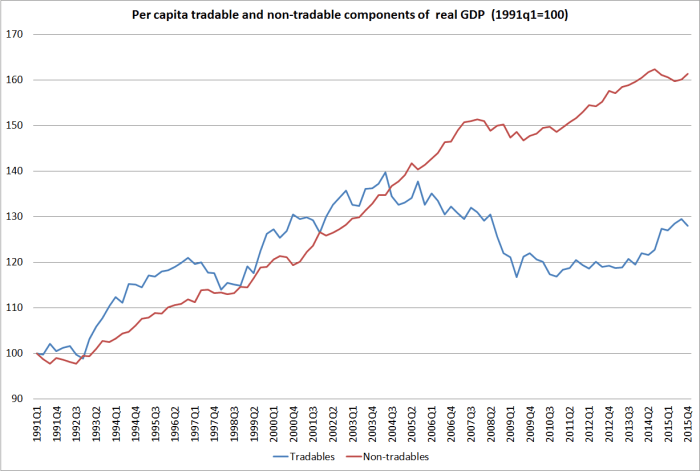
T and NT components of real GDP

It is a pretty depressing chart.  Per capita GDP in the tradables sector at the end of last year was still a touch lower than the level first reached in December 2000, 15 years previously.  Across the terms of two governments, both of which constantly talked of “international connections”, aiming for big increases in export shares of GDP etc etc, there has been simply no growth at all in the per capita volume of the stuff we produce in competition with the rest of the world.  As I’ve noted previously, the Christchurch repair process has inevitably skewed things a little, but it doesn’t do much to explain such a dire underperformance over 15 years.

Instead, with almost equal abandon the Clark-Cullen and Key-English governments have pulled ever more people into New Zealand, an economy that appears unable to compete sufficiently strongly internationally to see any growth at all in per capita tradables sector production.  All economies have, and need, both tradables and non-tradables production, and there is nothing inherently bad about non-tradables production, but if we were to have any hope of catching up again with the rest of the advanced world’s productivity and per capita incomes it almost inevitably has to come from firms finding New Zealand an attractive place to produce stuff (goods, services, or whatever) that takes on and beats producers in the rest of the world.  No matter how good our other regulatory settings are –  and if they aren’t typically great they mostly aren’t that bad – that simply isn’t likely with the sort of real exchange rate we’ve had over the last decade, itself the result of the persistently high real interest rates (relative to the rest of the world) and the pressure on resources that the policy-fuelled population growth creates.    Policy simply needs to change direction.

On a happier note, it is a year today since I left the Reserve Bank and was thus able to give this blog some publicity.  In effect, it is the anniversary of the blog.  I’ve really enjoyed almost everything about the intervening year –  best of all has been the more time with my kids, whether that has been baking, blackberrying, watching US political debates together, or just ensuring that the piano practice is done, and not inflicting on them nannies or after-school care.

The blog itself has found more readers than I had ever thought likely, which in turn probably prompted me to put more into it than I originally envisaged.  Somehow, I’ve read fewer books in the last year than I did in years when I was working fulltime.  I wanted to say thanks to all the readers, regular and occasional,  and to those who have commented. One of the best ways to refine one’s own thinking is to write, and be open to comment.  I’ve learned a lot in the last year, and (yes, it happens) have even altered my views on some issues.  Apart from anything else, one sees the world a bit differently once outside public sector bureaucracies.

Readership statistics aren’t always easy to interpret.  Many readers just get posts by email, and most other just drop by the home page, not explicitly clicking on any particular post.   But looking back over the last year, these are the 10 posts that have had the most people explicitly clicking on them, sometimes because they have been linked in other blogs.

  1.  A post on how New Zealand has done, relative to other advanced economies since 2007
  2. A post on the proposal to extend the Wellington airport runway, using large amount of ratepayer’s money.
  3. A post on the June 2015 CPI numbers, which I saw as a severe commentary on the Reserve Bank’s conduct of monetary policy in recent years.
  4. A post looking at the occupational breakdown of our permanent and long-term migrants.
  5. A post prompted by Malcolm Turnbull’s declaration, on deposing Tony Abbott, that he wanted to emulate “the very significant economic reforms in New Zealand”.  I noted that it was short list: I couldn’t think of any.
  6. A post on an unconvincing speech on housing by Reserve Bank Deputy Governor, Grant Spencer
  7. A post on financial crises around the advanced world since 2007.
  8. Another post on the occupational classification of our “skilled” immigrants.
  9. A post prompted by Wellington City Council meeting with local residents on plans to allow more medium-density housing
  10. A post on the continuing fall in dairy prices last year, with some longer-term perspectives.

Somewhat surprisingly, my post earlier this week about John Key’s apparent vision to turn New Zealand into a Switzerland of the South Pacific based on some mix of Saudi students, Chinese tourists, and wealthy people fleeing terrorism, is next on the list.

I’ve spent more time writing about the Reserve Bank itself than I ever intended.  Mostly that was because of the Bank’s unexpectedly obstructive attitude to OIA requests, and the unexpected slowness with which they have recognized just how weak inflation has been (and is) in New Zealand.   I hope to write less about the Bank in the coming year.  My main concern in matters economic is the continued long-term underperformance of the New Zealand economy, and (relatedly) the disappointingly poor quality of the policy analysis and advice of the leading official policy agencies in New Zealand.  The Reserve Bank is an important, (too) powerful, institution, but in the grand scheme of things central banks just don’t make that much difference, for good or ill.  That was a message I spent decades trying to spread while I was inside the institution, although I’m not sure we were ever very successful in persuading outsiders.  So I expect I’ll continue to make the point here.  People looking for the answers for New Zealand’s economic problems shouldn’t be focused on 2 The Terrace, but instead should be looking to the other corners (here and here)  of that Terrace/Bowen St intersection.


Governance of the Reserve Bank: an inadequate release

Just before the Easter break last week, the Reserve Bank partially reversed its position and released a few papers on the work it had been doing on possible reforms to the governance of the Reserve Bank.  I made some initial comments on that change of stance here, including noting that citing an Associate Minister’s response to an Opposition MP’s supplementary question in the House six months ago as the basis for a change of heart now was singularly unconvincing.

I’ve now had a chance to read the papers the Bank has released.  Having done so, I’m more puzzled than I was before.  Perhaps they are hoping for some brownie points for a slightly greater degree of openness than previously?  But as the project has come to an end, something rightly lamented by The Treasury, and the government has made clear that it has no intention of reforming the governance of the Reserve Bank, there should be no basis for withholding almost anything from the work done, and the advice submitted, on possible reforms to the governance of the Bank. It is official information, and there is a statutory presumption in favour of release.  It should, among other things, be a useful contribution to outsiders’ thinking on these issues.

The Bank has released a grand total of six papers.  Four are released with no omissions, one has a handful of short omissions (on “free and frank” grounds) and one omits a paragraph on another matter altogether.     In other words, processing the request for these particular papers will have taken no time at all.  And yet it took two months to refuse the initial request, and six months after the Associate Minister’s comments to release this handful of papers.  Not exactly a sign of an organization with a commitment to openness, transparency, not to speak of compliance with the law.    Now the Reserve Bank may claim – as it did back in July – that their initial (no doubt very coarse) filter produced 9000 documents inside the scope of my request.  I’m sure there are nothing like that number, but most of what is in scope has still been withheld.

What have they released?

The first paper is a descriptive note, dated 11 May 2014, by one of the young analysts in the Economics Department on “Governance arrangements: decision making committees”. It is a mildly interesting piece, with some discussion of arrangements in other countries.  It has a couple of paragraphs on decision making in other sorts of bodies, but why the author chose local councils (which are wholly elected) and DHBs (generally regarded as having one of the less satisfactory governance models in the New Zealand public sector), rather than (say) central government Crown entities such as the FMA or NZQA or EQC is beyond me.

The second paper, dated 25 June 2014, is a brief note, also from one of the teams in the Economics Department, to the Governing Committee identifying “Sections of the RBNZ Act subject to revision with a change in decision-making framework”.   There is little of note there, although it is consistent with the Governor’s apparent preference for a minimalistic reform (legislating  the role of the Governing Committee in setting the OCR).  There is no sign of the authors having stood back and thought about the larger issues of institutional design and governance.

The third paper, dated 4 July 2014, also to the Governing Committee from Economics Department staff, is headed “Best practice structure and governance of central bank decision-making committees”.  They are obviously a bit uneasy about the “best practice” description, because in a note with three pages of text and one table, the released version of the document has repeated four times the following inscription “Please note that the “best practice” referred to in this paper is as per the literature (specifically Blinder), and not subjective opinion of the paper’s authors”.    Weirdly, in a paper on (Alan Blinder’s “subjective” view of) “best practice” central bank governance, there is no sign that the authors recognize that our central bank is responsible for rather more than just monetary policy.    It isn’t an example of best practice policy analysis or advice.

The fourth document is an email to Gabs Makhlouf and Graeme Wheeler, dated 17 September 2014,  from Simon Duncan, a Treasury secondee in Bill English’s office.  It is a follow-up to a meeting Wheeler and Makhlouf had held with English a couple of days earlier.  The relevant paragraph is as follows:

On the Governance paper, I read that as the Minister being generally comfortable with the proposal as long as his concerns around the Committee model not embedding a strong independence culture on the financial stability side were addressed.  Opening up the RBNZ Act would be contingent on the political landscape following the election.

Which is interesting on a number of counts.

First, by September 2014 there was a specific proposal that had been put to the Minister, not (apparently) just orally but in the form of “the Governance paper”.    The Minister was apparently generally happy with whatever this proposal was.     And yet none of the material has been released, even though it would all have been within the scope of my request.  I’m at something of a loss to understand what anyone has to hide at this late date, when the project has been terminated.  And if the Governor simply does not want his proposal (or the supporting analysis) to get wider public scrutiny, that isn’t a good reason, in law let alone good governance in an open democracy.

But the email is also interesting because it highlights the ongoing tensions between the Bank on the one hand, and the Minister and Treasury on the other hand, around just how much autonomy the Reserve Bank should have in setting financial regulatory policy.   Our Reserve Bank has an (internationally) unusual degree of autonomy on that front, with very little effective accountability, and any suggestion that the powers should move from the Governor (who at least the Minister has some say in appointing) to an internal committee, dominated by people appointed by the Governor, would further (and inappropriately in my view) weaken the Minister’s relative position.

The fifth document released is by Dean Ford, a manager in the Economics Department, dated 15 October 2014 and is “Terms of reference: Moving to committee decision making at the Reserve Bank”   It is the terms of reference for a “joint Treasury/Reserve Bank work program” on these issues.  It is a working level group of named Treasury and Reserve Bank officials, designed to lead to “a common understanding of the advantages and disadvantages of the various committee design features”.  The intention was to host various roundtable discussions (I went to several of these) as a prelude to advancing the work “aiming to produce material suitable for briefing the Minister of Finance and Cabinet, and subject to Cabinet agreement, moving the project through the parliamentary process.  This could include material for select committee or public release”.

But, reflecting those longstanding tensions over the governance of the financial regulatory functions, this working group (wholly composed of Economics Department people from the Bank side) was supposed to focus on monetary policy where “initial discussions  … revealed many areas of agreement”.  Not so much on “financial policy”.   But “to allow the insights from the work to be more easily applied to financial policy when we reach that point, it will be necessary for the project team to understand how the Bank’s policy roles fit together”.  Indeed, one might have supposed that reaching that understanding was a precondition to taking a view on the appropriate governance model for any of the Bank’s major functions.  There are important differences of view, in international practice and in the literature, on to what extent the sorts of functions our Reserve Bank undertakes should be governed jointly or separately (or with overlaps).

The final document they released is an internal memo, dated 4 December 2014, and just addressed to one of the teams in the Economics Department, on “Central bank decision making committee design” , is no more than a (slightly abbreviated) version of the 4 July 2014 paper discussed above.

My presumption is that not too long after this the Minister of Finance told the Governor that he was no longer interested in pursuing governance reforms, perhaps particularly not along the lines the Governor was proposing.  This is consistent with the fact that (a) there is no reference to governance reforms work in the Minister’s letter of expectation to the Governor dated 2 March 2015, and (b) that the Treasury’s advice to the Minister of Finance on the Reserve Bank’s draft 2015 Statement of Intent, dated 5 June 2015, noted that the governance workstream had been discontinued.

Significant amounts of public resources were used to undertake the Bank’s work on possible governance reforms.  If the quality of the analysis they’ve released is fairly disappointing, at least this material makes clear that plans were fairly well-advanced.  And yet the Reserve Bank refuses to release the paper that must have gone to the Minister on these issues in September 2014  or anything of the work that was done after the Treasury/Reserve Bank working party was set up.

When the Bank originally withheld everything I requested they invoked a laundry list of excuses, including these two provisions of the OIA

9(2)(d) to protect the substantial economic interests of New Zealand.

9(2)(f)(iv) – to maintain the constitutional conventions for the time being which protect the confidentiality of advice tendered by Ministers of the Crown and officials.

The first excuse was always laughable, and has now disappeared.  But I was also interested that they are no longer invoking 9(2)(f)(iv).  In which case, why can we not see the advice the Bank did tender to the Minister on governance issues, and file notes of any discussions with the Minister on these issues?

It just isn’t good enough, but sadly it is par for the course with the Reserve Bank –  an organization in which the culture of secrecy has unfortunately become ingrained, beyond what is helpful, appropriate, or lawful.

In this case, it is doubly unfortunate because almost everyone –  perhaps with the exception of the current Minister –  thinks that changes should be made to the governance of the Reserve Bank.  Market economists canvassed by Treasury thought so, the Treasury itself thinks so, the Governor thinks so (unlike his predecessor who was strongly committed to the current model), Opposition parties appear to think so (the Greens certainly).

We have a system that was set up 27 years ago which (a)  doesn’t adequately deal with the range of issues the Bank is now responsible for, and actively wielding power over, (b) is out of step with international practice for monetary policy and financial regulation, and (c) is out of step with how we run other central government autonomous agencies in New Zealand.    Reasonable people can differ, perhaps quite strongly, on what the best alternative model might be. Personally, I think the Governor’s own preference is not at all the right response, and I laid out my alternative model here, but these are issues where we need good quality analysis from a range of perspectives, and some considered debate and discussion drawing not just on bureaucrats (inevitably skewed towards insider models) but on external analysts and, indeed, politicians.     These debates shouldn’t be about individuals –  Don Brash, Alan Bollard, Graeme Wheeler and any successors will all no doubt have strengths and weaknesses, and none walk on water –  but about the best institutional design for the governance of these important functions in New Zealand for the next few decades.  Openness on the analysis and advice already tendered would (should?) be a useful step to advancing the necessary discussion and debate.