Productivity growth worse than in Greece

In the interview with Richard Harman I noted that one of my main interests and (rather more importantly) one of the bigger challenges for New Zealand was its disappointing economic performance over the last 25 years.    The liberalisation of the economy in the 1980s and early 1990s was generally expected to have reversed the earlier decades of relative decline.  Not everyone shared that optimism, but among the advocates of reform within government and the public service, and among most international observers (for example, the IMF and OECD, and financial markets), that sort of re-convergence was generally expected.

But it didn’t happen.  For a while there was a “the cheque is in the mail” hypothesis doing the rounds –  it hadn’t happened yet, but it surely wasn’t far away.   But 25 years is a long time, and it just has not happened.  Around 1990, the former eastern-bloc countries started serious liberalisation.  Their economies had been much more heavily distorted than New Zealand’s (notwithstanding the Bob Jones crack in 1984 about the New Zealand economy resembling a Polish shipyard), but they have subsequently seen considerable convergence.

Here is my favourite summary chart of our underperformance over that period.  Using the Conference Board data, it is total growth in real GDP per hour worked for 42 advanced countries (OECD, EU, and Singapore and Taiwan) since 1990.  Only five countries had had slower growth over that period than New Zealand –  and two of them (Switzerland and the Netherlands) had had among the highest levels of labour productivity in any of these countries in 1990 (so one might have expected unspectacular growth subsequently).  No cross-country comparative measure is perfect, but I don’t this one is particularly unrepresentative of New Zealand’s relative performance  On this measure, Greece and Portugal have done less badly than us  (but recall that this is GDP per hour worked, and in the current Greek Depression total hours worked have dropped away precipitously).
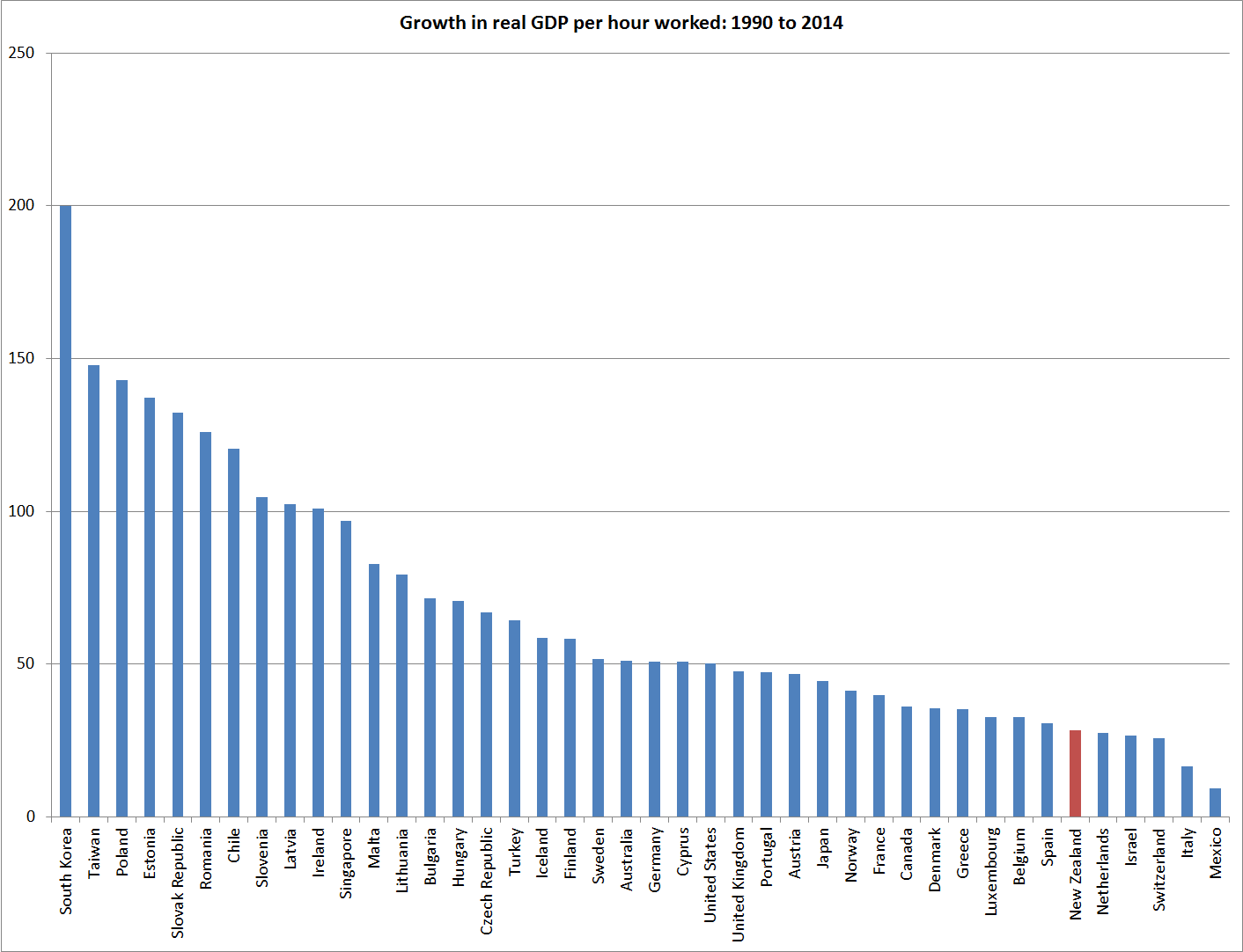
GDPphw since 1990

I’ve been running a story about the role of immigration policy in explaining that failure to converge –  total GDP has grown a lot, even if GDP per hour worked hasn’t.  In this wider sample of countries, New Zealand has had among the faster rates of population growth, despite the huge outflow of New Zealanders (around 525,000)  over that period.   Singapore (86%) and Israel (77%) have had much faster rates of population growth than New Zealand (30%) over this period.

My argument has been that in a country with a low savings rate, rapid population growth has put considerable sustained upward pressure on real interest rates and the real exchange rate, squeezing the share of GDP devoted to business investment and preventing the emergence of new tradables sector firms/products at the rate that (a) convergence would have required, and (b) the rest of NZ’s microeconomic policy framework might have suggested/warranted.  A few weeks ago, I showed how our real exchange rate against Australia had failed to decline despite the deterioration in our relative economic performance over decades.

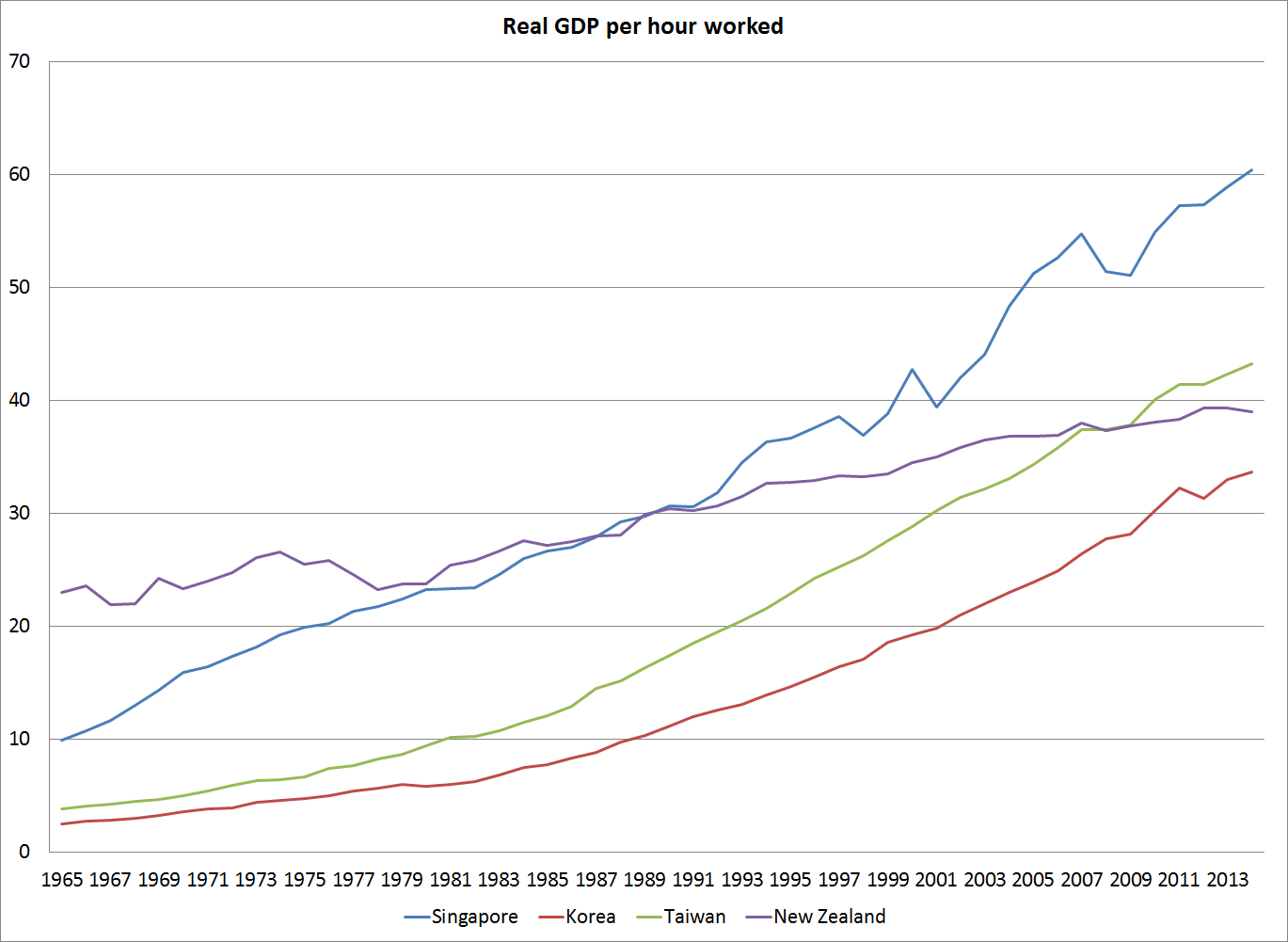
Here is another way of looking at the same point.  The two countries with the fastest growth in the chart above were Taiwan and Korea.  Singapore has also done impressively well.  In 1990, Taiwan and Korea were well behind New Zealand, and Singapore had about the same level of real GDP per hour worked as New Zealand  (precise comparisons depend on which set of relative prices are used, but on any measure all three countries have had growth outstripping that of New Zealand).

And here is the picture over 50 years, again using the Conference Board data
gdpphw asia
All three Asian countries have had some of the more dramatic catch-ups in productivity levels seen anywhere.  New Zealand, by contrast, in 1965 was among the advanced countries with the highest levels of labour productivity, and has been in relative decline since.

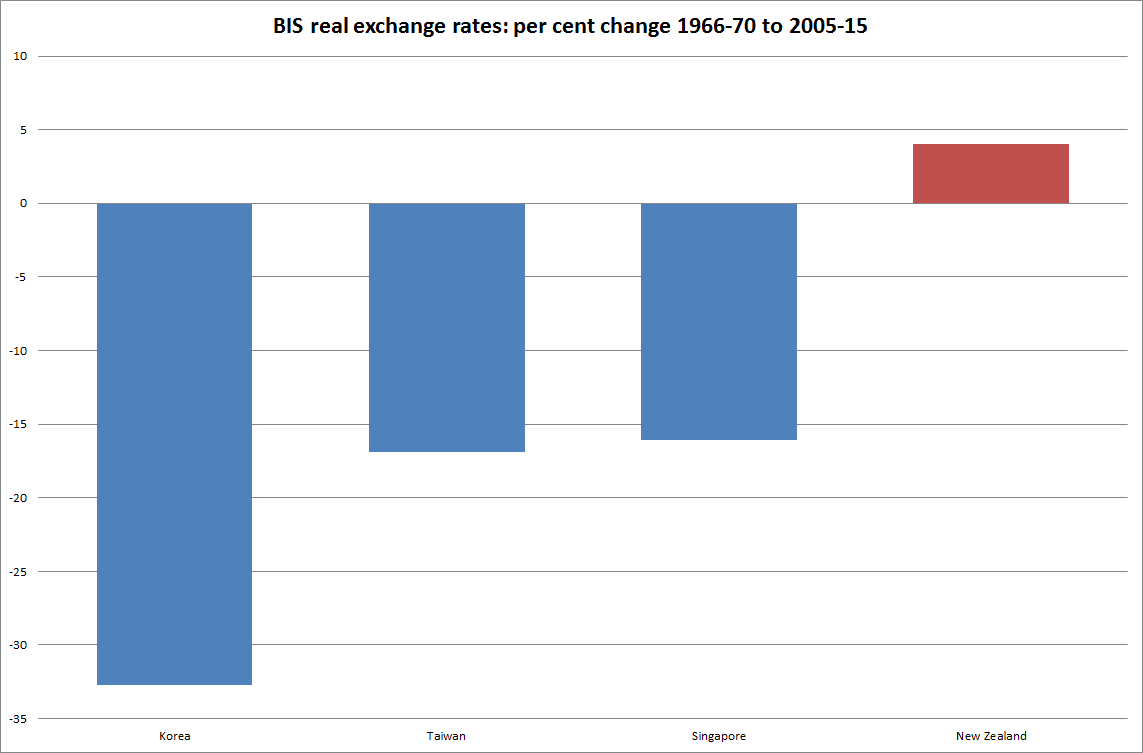
But what has happened to the countries’ real exchange rates since?  As ever, there is no unambiguous way to measure that, but the BIS have real exchange rate indexes for each of the four countries going back to the 1960s.  Of course, real exchange rates can move around a lot from year to year, so in this chart I’ve shown the percentage change in the real exchange rate from the average for 1966-70[1] to the average for the 10 years to May 2015.
bis rer asia

The countries that have had such dramatic productivity improvements have all recorded modest falls in their real exchange rates, and by contrast New Zealand has had an increase in its real exchange rate.  That is opposite of what one might initially have expected.  One might have expected a strong real appreciation in the Asian currencies (as has happened in Japan), as much higher incomes supported more and cheaper consumption in these countries.  Fewer resources now needed to be devoted to the tradables sectors in those countries.   And in New Zealand one might have expected the deteriorating productivity performance, and hence declining (relative) future consumption opportunities, to have been met by a declining real exchange rate. That would have increased the returns to productive investment in New Zealand –  helping to reverse the decline – and raised the relative price of consumption.

How does my story explain what went on?

In last 25 years, Korea and Taiwan have had materially slower population growth rates than New Zealand has, and much higher savings rates.  That meant both less pressure on resources simply to maintain the capital stock per person, and more domestic resources available to meet investment demand.  The net result: little upward pressure on real interest rates and the real exchange rate, despite the continuing productivity gains.

Singapore is at the extreme.  The national savings rate has averaged 46 per cent in Singapore over the last 25 years, roughly double the rate for advanced countries as a whole.  With so many resources available (earned but not consumed) even the investment needs of an average population growth rate of 2.5 per cent puts no pressure on domestic resources, or hence on real interest rates and the real exchange rate, despite the continuing productivity gains.

And that is my story in a nutshell: with very high saving rates your country might need lots more people to make the most of the savings.  But in a country with only a rather modest savings rate (for whatever reason) then having lots more people –  and especially bringing them in as a matter of policy – simply looks wrongheaded.  It undermines what policy is setting out to achieve.

It isn’t that migrants somehow “take away jobs”, but rather that rapid population growth (whether migrants or high birth rates) tends to divert resources (jobs) away from growing the bits of the economy that sell to the rest of world (a huge and diverse market, and probably where our future prosperity is to be found) to ensuring that the physical infrastructure (houses, roads, shops, factories, schools) keeps pace with the needs of the growing population. It makes it very hard to catch up with the richer countries.   Israel has found something much the same.

No comparison of any pairs of countries, in any particular period, is ever going to be conclusive.  I use the examples in this post simply to illustrate the story.

[1] Starting the comparison from the start of the BIS series in 1964 would result in an even larger fall for Korea
The contrary views of Croaking Cassandra

For anyone interested in a bit of background to this blog, and on me, Richard Harman, proprietor of the new New Zealand political news and analysis site, Politik ran a profile of me this morning.

It is a pretty fair reflection of our interview, and reflects my interests and aspirations –  in particular, the issues around New Zealand’s long-term economic underperformance matter a great deal more to me than critiques of aspects of the Reserve Bank.  When I left the Reserve Bank, I intended that Bank-related material would represent a distinct minority of my posts.  That is still my aim, but it may take some time to get there (and as one journalist who came to visit said to me “I wouldn’t be here if you were writing mainly about long-term economic performance issues”).

Sadly, the description of the Governor’s attitude to some criticisms I made of a draft document around the first set of LVR controls is accurate.  After that episode –  where even the extreme disapproval was only conveyed indirectly –  our next conversation was two years later when we accidentally found ourselves alone in the same lift in the midst of the restructuring that led to my job being abolished.  I was clearing my desk and carrying a box of books down to my car.  To his credit, Graeme did actually manage to make conversation –  about Piketty’s book, a copy of which was on top of my pile.

I should make one clarification/correction.  I’m reported as saying, about LVR restrictions, “Furthermore the Bank had done no research on what the likely impact of the controls might be.”.  I don’t think that was what I said, but if I did say it, it was not what I intended.  My criticism of the Bank’s analysis and argumentation around LVRs has been around

  • the failure to produce research looking carefully at the lessons of countries that did, and did not, experience financial crises in the last decade,
  • the failure to meaningfully engage with the Bank’s own stress test results, which suggest the New Zealand system is very resilient to even quite severe adverse shocks, and
  • the failure to engage with the statutory requirement to promote the efficiency of the financial system.

And  in the final sentences, I’m not sure how my friend and former boss Don Brash ends up classified by Harman as a “non-practitioner”.

SNZ’s productivity growth estimates

Statistics New Zealand released a swathe of annual productivity data yesterday.

These annual productivity data focus on the so-called “measured sector”, whereas most often (for data availability reasons) productivity comparisons are done for the whole economy.  The measured sector currently covers 77.3 per cent of the economy.  It excludes ownership of owner-occupied dwellings, public administration and safety, education and training , and health care and social assistance –  all sub-sectors where market price information is difficult or non-existent.  The measured sector data are good quality but (a) are only available with a considerable lag (data released yesterday are up to the year ended March 2014), and (b) are mostly only useful for looking at New Zealand’s own performance over time (and only limited amounts of time, since the data on this measure go back only to the mid 1990s).  Other databases, typically using whole economy measures, are more useful for timely cross-country comparisons.

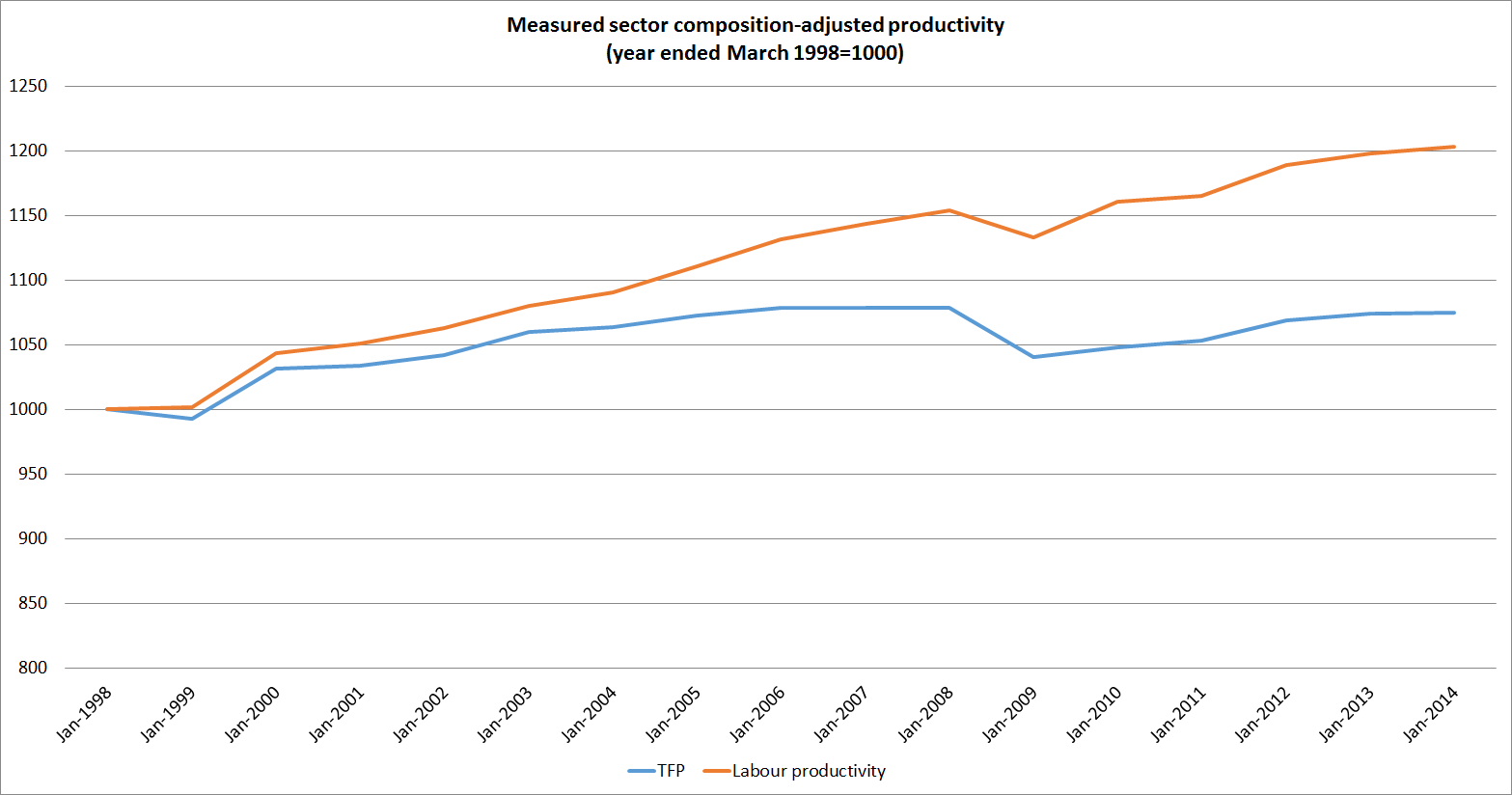
The chart below shows measured sector labour productivity and total factor productivity growth since the  year-ended March 1998.  These measures don’t just use a volume measure of labour inputs (eg hours worked) but adjust for the changing composition (improving quality of the workforce).  Simple measures based on hours worked in effect understate the role of inputs and, thus, overstate productivity growth.
measured sector
On this measure, labour productivity growth does not look too too bad.  In particular, although growth since 2007/08 has been slower than it was previously, the slowdown is less marked than many other series show for other countries.  But bear in mind that over the 16 years shown, total growth in labour productivity was only 20.3 per cent –  just under 1.2 per cent per annum.

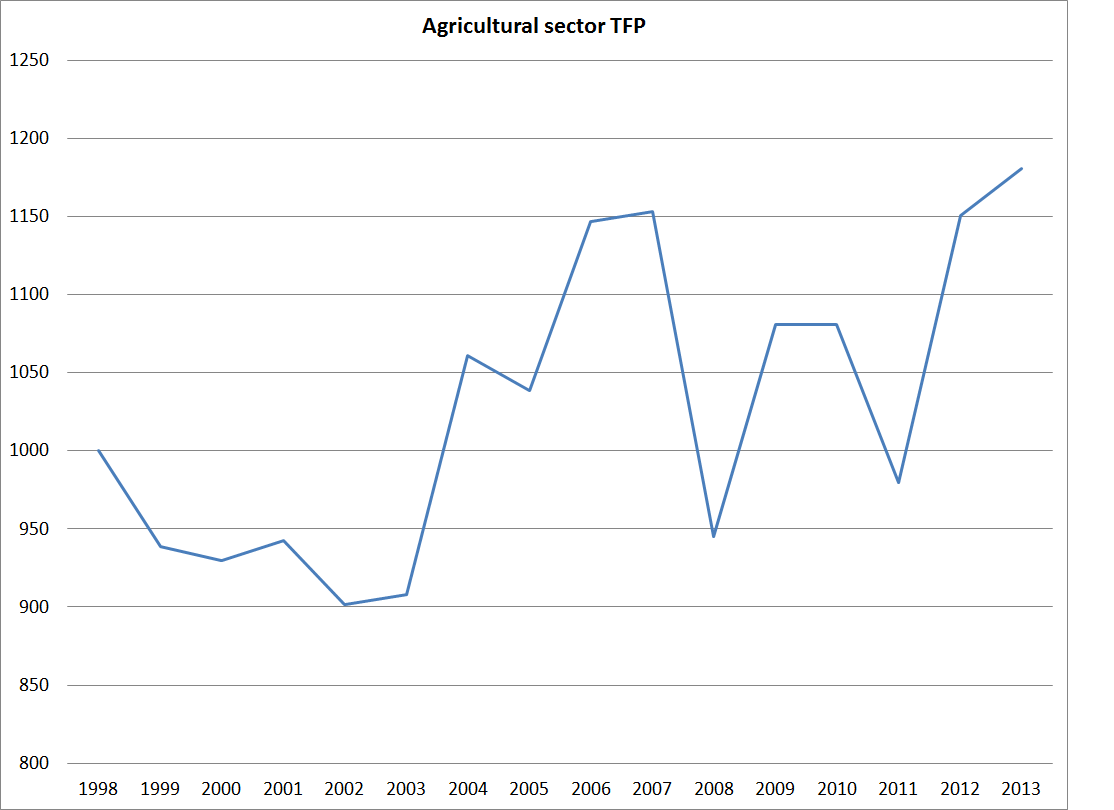
By contrast, the TFP picture is sobering.  In the 11 years since 2003, total TFP growth has been around 1.5 per cent (little more than 0.1 per cent per annum).  As I’ve suggested previously, perhaps there is something in the notion that the higher terms of trade (since 2004) have undermined TFP growth, changing production patterns to take advantage of the higher output prices but in ways that reduced measured productivity.  Perhaps, but I doubt if the effect can have been quite that large.  And the sectoral TFP data back up those doubts.  Here is the chart for agricultural sector TFP (only available to March 2013).  It is a noisy series (droughts do that), but it looks as though there has been some TFP growth in the sector since 2003, unlike the picture in the aggregate TFP series.

agriculture

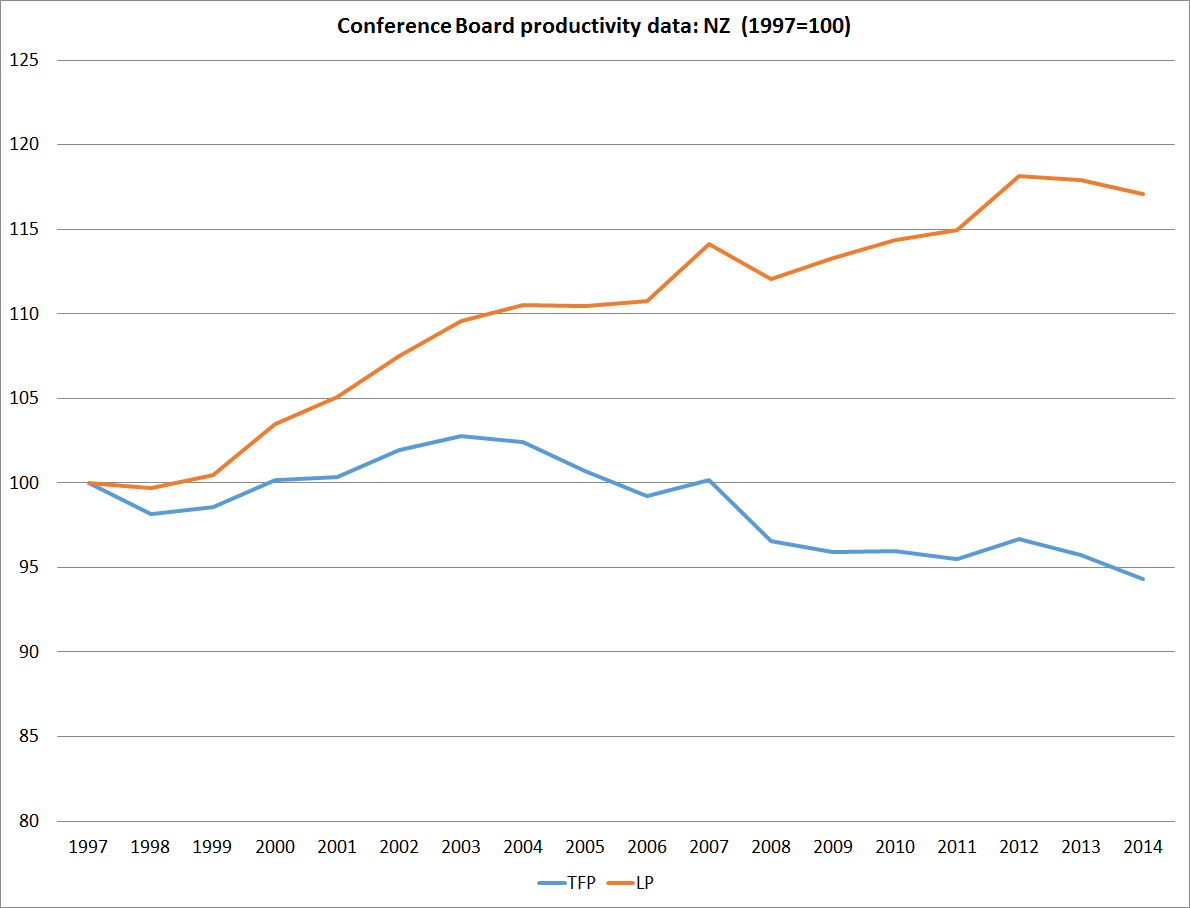
Finally, a quick comparison with the Conference Board estimates for New Zealand, which I used in my series on cross-country comparisons since 2007.    Here is the chart.

conference

The Conference Board uses a model to estimate TFP which ascribes more of New Zealand’s growth to the growth in capital services (than SNZ do).  (Like SNZ they make a correction for changing labour quality).   There is no point directly comparing the number from the SNZ measured sector TFP series with the Conference Board TFP series – different models produce different results.  But what is perhaps useful is to note that in both models New Zealand’s TFP growth has tailed-off markedly since 2003.  That should be pretty disconcerting.

And here is the international context for TFP growth, with a focus on the post-2007 period.

BOE chief economist on policy reversals

The Bank of England’s chief economist Andy Haldane had a stimulating speech out overnight.  I find almost everything Haldane writes is worth reading –  he stimulates thought, and sends me off chasing down references, even if I often end up not quite convinced by a particular argument he makes.

This speech, titled simply “Stuck”, explores some of the reasons why interest rates, around the advanced world, have been so low for so long.   Much of his story uses insights from psychology literature to try to explain behavioural responses across the advanced world in the years since the 2008/09 crisis.  I don’t find the application of the psychology literature entirely compelling, partly because Haldane does not attempt to differentiate between countries that did, and did not, directly experience a financial crisis.  For example, I would have expected different behavioural responses in places such as Ireland or the United States, on the one hand, and countries like New Zealand and Australia on the other.  For New Zealanders, I’d assert, the experience of 1987 to 1991 was much more frightening, and prone to have induced behavioural change, than anything we directly experienced in 2008/09.  And yet within 2.5 years of the trough of the 1991 recession, interest rates needed to rise here.  By contrast, in mid 2015, we are six years on from the trough of the recession, with no sign that the OCR needs to be higher than it was in 2009.

As it happens, New Zealand gets a mention in Haldane’s speech, in somewhat unflattering company. I did a post a few weeks ago on Policy interest rate reversals since 2009 looking at the 10 OECD countries/areas that had raised their raised their policy rates and then lowered them again.  Writing about the New Zealand policy reversal I commented:

it is difficult not to put this episode –  the increases last year, now needing to be reversed – in the category of a mistake.  It is harder to evaluate other countries’ policies, but I would group it with the Swedish and ECB mistakes.    Monetary policy mistakes do happen, and they can happen on either side (too tight or too loose).  But since 2009 it has been those central banks too eager to anticipate future inflation pressures that have made the mistakes and had to reverse themselves.  …..it should be a little troubling that our central bank appears to be the only one to have made the same mistake twice.  It brings to mind the line from The Importance of Being Earnest:

“To lose one parent may be regarded as a misfortune; to lose both looks like carelessness.”

Haldane includes in his speech a table with an “illustrative list of countries which have pursued the latter strategy – tightening during the post-crisis recovery and then course-correcting”.  New Zealand’s 2014/15 experience makes the list, as do the Swedish and ECB reversals noted in my quote above.  Somewhat provocatively, Haldane includes in the same list the US experience in 1937/38, where some combination of  fiscal and monetary policy tightenings (the role of active monetary policy is much debated) badly derailed the US recovery from the Great Depression, generating another severe recession.
haldane2
Haldane uses this illustrative material (and not all of the cases seem overly well chosen) to argue a case for an alternative monetary policy strategy:

The argument here is that it is better to err on the side of over-stimulating, then course-correcting if need be, than risk derailing recovery by tightening and being unable then to course-correct.  I have considerable sympathy with this risk management approach.

He goes on to say

Chart 19 shows the average path of output either side of the tightening. Most of these countries experienced several years of robust growth prior to the tightening, suggesting the economy was primed for lift-off. Yet when lift-off came, annual output growth weakened by around 2 percentage points in the following year, in the US by much more. Lift-off was quickly aborted as the economy came back to earth with a bump. In trying to spring the interest rate trap, countries found themselves being caught by it.

Why did this happen? One plausible explanation is the asymmetric behavioural response of the economy during periods of insecurity. Dread risk means that good news – such as oil windfalls – is banked. But it also means that bad news – 9/11, the Great Depression – induces a hunkering down. It risks shattering that half-empty glass. A rate tightening, however modest, however pre-meditated, is an example of bad news. Its psychological impact on still-cautious consumers and businesses may be greater, perhaps much greater, than responses in the past. Or that, at least, is what historical experience, including monetary policy experience, suggests is possible.

Another way of illustrating this point is to imagine you were concerned with the low path of the yield curve and the limited monetary policy space this implied. And let’s say you were able to lift the yield curve to a level which, for the sake of illustration, equalised the probabilities of recession striking and interest rates being at a level at which they could be cut sufficiently to cushion a recession.

With monetary policy space to play with, this might seem like a preferred interest rate trajectory. But it comes at a cost, potentially a heavy one. The act of raising the yield curve would itself increase the probability of recession. If we calibrate that using multipliers from the Bank’s model, cumulative  recession probabilities would rise from around 45% to around 65% at a 3-year horizon. These ready-reckoners are, if anything, likely to understate the behavioural impact of a tightening in a nerve-frazzled environment.

This suggests that a policy of early lift-off could be self-defeating. It would risk generating the very recession today it was seeking to insure against tomorrow. In that sense, the low current levels of interest rates are a self-sustaining equilibrium: moving them higher today would run the risk of a reversal tomorrow. These self-reinforcing tendencies explain why the glue sticking interest rates to their floor has been so powerful.

Haldane concludes that, in his view, current very low UK policy interest rates are still needed, to secure “the on-going recovery and the insure against potential downside risks to demand and inflation”.  Even at such a low policy rate, Haldane observes that he has no bias –  the next move the policy rate could be up or down, and might well be a long time away.

It is certainly refreshing to have a speech of this depth and quality from a senior policymaker, just one among many of those on the Bank of England’s Monetary Policy Committee.

But how convincing is his argument?  I’m not entirely convinced about the mechanism he proposes, but in practical terms, experience is on his side.  Almost all the advanced countries that have raised rates since 2009 have had to lower them again, in New Zealand’s case twice.  Personally, I’m inclined to think that psychology might offer more insights into the behaviour of central banks  and markets –  which, as Haldane notes, repeatedly expected early lift-offs and were repeatedly proved wrong.  In addition, as a nice piece on the Bank of England’s new blog recently illustrated, the “probability of deflation is raised further, and the likely duration of any deflation increased, if one thinks that there are limits on how far the Monetary Policy Committee (MPC) could loosen policy in the face of new shocks.” (ie as policy rates get near zero).

In the current climate, the safest approach for monetary policymakers is to hold off on the rate increases until there is hard evidence that actual measures of core inflation have risen to some considerable extent.  And if you have a central bank that made the mistake of moving too soon, hope that they recognise it quickly, own up quickly, and quickly act to reverse the mistake.  With data like the ANZBO survey results out this afternoon, those wishes seem increasingly apposite in the New Zealand case.

A few thoughts on Greece

It is a pretty difficult period for the world economy. The new BIS Annual Report (on which more later) keeps repeating that world growth has been back at around long-run averages.  But a quick glance down the headline stories on MacroDigest this morning (and it is much the same on the FT or the WSJ) reveals this collection:

Puerto Rico “can’t pay $72bn of debt”

Greece threatens top court action to block Grexit

Double bubble trouble in China

A failed euro would define Merkel’s legacy

BOE’s Haldane: Record-low rates necessary for continued recovery

My 12 year old has asked me to start teaching him economics, and we are bombarded with stories to discuss. This morning, at least, there are no good-news stories.

Of course, most focus is on Greece.  I’ve recently lost a long-running wager on Grexit.  Three years ago I bet a senior official who was much closer to the politics of the euro area that at least one country would have left the euro by mid-June 2015.   His story was, essentially, that the European authorities would do whatever it took to hold the euro together and make it viable for the long run, partly because the alternative was so awful.  My story was that the economic stresses were sufficiently severe, and choices would ultimately be made in individual nation states, that euro was most unlikely to hold together, at least with anything like the number of countries it had then.

In 2012 I certainly underestimated the political determination, and probably also the extent to which Greek public opinion would want to stay in the euro, no matter how bad the economy got.  Getting into the euro seems to have been a mark of a successful transition to a modern democratic state.  This was, recall, a country that had been ruled by the colonels as late as 1974, and had had a civil war only thirty years prior to that.  Even now, there is no certainty that a “no” vote this Sunday –  in respect of a package which is no longer even on the table –  will lead to Greece quickly leaving the euro.  With tight enough capital controls, and the rudiments of a parallel currency, perhaps they will limp on for a while yet.  The political imperative still seems to be that if Greece is going to leave, the narrative has to be one in which “other countries forced us out”.   Greece doesn’t seem to be ready to positively embrace exit –  political dimensions aside, the path through the first year or two beyond exit is pretty difficult and unclear.  For those of you who have read Pilgrim’s Progress, it is perhaps reminiscent of Christian’s fear as the river rises around him –  the river he must cross to enter the celestial city.  Grexit is no path to nirvana, but it does promise something better.

Because if exit looks frightening, going on as things have been in the last few years shouldn’t be remotely attractive either.  The simple mention of 27 per cent unemployment should really be enough.  Add in no sign of any sustained growth in the external sector of the economy, and it is a picture of any economy that has made no progress at all in reversing one of the very deepest recessions of modern times.  None of that is to deny that there have been useful reforms. But, as I’ve said before, there is no sign of any politically acceptable deal (politically acceptable to creditor countries and to the Greeks) that in consistent both with Greece staying in the euro, and with securing a strong rebound in economic activity and employment in Greece.  “Tragedy” is an over-used word, but surely this is one?

Part of the sheer awfulness of the situation is realising the part that other countries played in bringing this about.  And here I include even remote countries like New Zealand, which did not speak out –  or even speak quietly – against the IMF involvement in the deal.  Without the bailout package in 2010, this crisis would have come to a head five years ago.  It is now hardly controversial to suggest that the case for the 2010 bailout package, rather than a widespread Greek sovereign default, was mostly about the French and German banking systems, and concern with the possible ramifications for the wider world economy and financial system.    None of this absolves the Greeks of some responsibility.  Technically, no one forced them to take the deal.   But as the Irish and Italian authorities also found, it can be very difficult to resist the pressure to accede to the wishes of the ECB and core euro-area governments.

Where to from here?  As Gideon Rachman put it in his FT column today

If the Greek people vote to accept the demands of their EU creditors — demands that their government has just rejected — Greece may yet stay inside both the euro and the EU. But it will be a decision by a cowed and sullen nation. Greece would still be a member of the EU. But its European dream will have died.

And if Greece does leave, who will be next, and when?  It might take some time, but with no sign of a strong or sustained rebound in European growth, it is difficult to see the euro surviving in anything like its current form.  It probably isn’t a risk in the next few months –  the ECB and the Commission can deploy support mechanisms to manage any resurgence of external market pressures.  The threat is more from public opinion –  of realising, a year or two from now, that there is viable life outside the euro.  Places as badly managed as Argentina didn’t lapse into permanent economic depression after default and the abandonment of a fixed exchange rate.

The euro has not delivered the promises of its advocates and founders.  Further integration of national policies seems increasingly unlikely to happen.  Breaking up is hard to do, and in this case could be very disruptive to the wider world economy (with so little policy firepower left anywhere)  But the end of the euro, one of the more hubristic policy experiments in the modern West, would probably be good for the longer-run health of the member countries, and especially for their ability to respond to future shocks.  What it might mean for the future of the EU itself is a bigger question.  One could envisage very bad outcomes – a reversion to the controls of 1957, before the EEC was first negotiated.  That doesn’t seem very likely –  trade barriers are much lower now than then around the world.  Perhaps over time what might emerge is something more like a free-trade area without the overlay of other controls and bureaucratic apparatus of Brussels.  For citizens, even if not necessarily for officials, politicians, and lawyers, that might be rather a good thing. It might even make membership of a much more modest EU attractive in the UK.

Reforming NZS – a pertinent private member’s bill

Our Members of Parliament have, at present, 72 proposed members’ bills lodged with the Clerk, each hoping that his or her own bill will be drawn in the periodic ballot that is held to determine which will get the opportunity to be debated and voted on in the House.

There was a ballot the other day.  Four bills were drawn (the list is at the previous link).  On a quick glance, three of them look quite sensible, but here I wanted to highlight just one of them.

It is the New Zealand Superannuation and Retirement Income (Pro Rata Entitlement) Amendment Bill, in the name of New Zealand First MP, Denis O’Rourke. Unusually for a member’s bill, it is designed to (and would appear to) save the taxpayer considerable amounts of money.

The policy statement at the start of Mr O’Rourke’s draft bill sets out the gist of the proposal.

This Bill proposes a pro rata entitlement (PRE) to New Zealand superannuation (NZS) based on residence and presence in New Zealand between the ages of 20 and 65 years; a period of 45 years, or 540 months.

The Bill confronts the demographic realities of an increasingly ageing and mobile New Zealand population and its impact on NZS. These global trends require fair policies for the New Zealand taxpayer, the migrant, and the expatriate Kiwi who return to New Zealand to retire.

Within the OECD, NZS is unusually generous in terms of residency requirements. For example, a migrant who lives in New Zealand for 10 years may make little or no contribution to the New Zealand economy, yet is entitled to full NZS. Under the PRE system, this migrant is entitled to 120/540 of NZS, but retains any overseas government pension which is currently deducted from his or her NZS under the direct deduction policy (DDP).

Another example is an expatriate Kiwi who has worked overseas for 30 years, contributing to another economy, and has most likely earned an overseas pension. On returning to New Zealand to re-tire, he or she is also entitled currently to full NZS. Under PRE, with 15 years’ New Zealand residency, this returning Kiwi is entitled to 180/540 of NZS, but will also retain his or her overseas pension, which is currently deducted. Within the age period between 20 and 65 years, the Bill disregards up to 2 months’ overseas travel per calendar year. The Bill also exempts an aggregate period of 5 years’ absence for those whose rite of passage may cover their overseas experience, education and training (often bringing back exceptional skills), and, of course, the well-earned extended world cruise.

I touched on this issue in a post a couple of months ago.  It is a particularly serious issue because time spent living in Australia counts towards the residential eligibility requirement for NZS.  That just seems like skewing the playing field against the New Zealand taxpayer, in favour of those who have spent large chunks of their working lives in Australia.

One could, no doubt, debate details of O’Rourke’s proposal. But, in a sense, that is what should happen.  Whatever their reservations, I hope MPs will vote this bill through a first reading and allow it to examined by a Select Committee, inviting public submissions and perspectives from experts from MSD.  Perhaps there is a better way to deal with the issue, and I wonder if O’Rourke hasn’t gone a little too far (in requiring 40 years residence after age 20 to collect full NZS) to be sustainable.  But this looks like a constructive response to a feature of our system that otherwise looks likely to be increasingly expensive.  Not being at all a fan of the SuperGold card, there is much more money at stake on this issue, than on the card.

Here is what I had to say on the issue in early May:

New Zealand has a high rate of inward migration.  The target level of non-citizen immigration is around 1 per cent of the population per annum.  Many of those people come to New Zealand young and will spending most of their working lives contributing to New Zealand and its tax system.    But to collect a full rate of NZS you need only have lived in New Zealand for 10 years (at least 5 after the age of 50), so many people will be able to collect a full New Zealand pension having been in New Zealand for not much more than a quarter of a working life.  New Zealand does enforce quite strict offset rules on those who have accumulated foreign pension entitlements, but many migrants now come from countries with little or no public provision of pensions.  Surely it would make more sense to introduce a graduated scale –  perhaps paying half the full NZS after 10 years residence, and a full rate only after someone has lived here for 30 years?

I had always assumed that New Zealanders who had emigrated to Australia in their hundreds of thousands over the last 40 years or so would be unlikely to come back to New Zealand when they were old, because they would have to live here for five years after age 50 before being eligible for NZS.    I wasn’t the only one to assume that – I was corrected recently by a public servant doing some work in the area who had just discovered that residence in Australia (and several other countries with whom New Zealand has social security agreements) counts as residency in New Zealand for NZS purposes.  It looks as though people can leave New Zealand at 20, spend an working life in Australia, accumulate significant private assets under the Australian compulsory private superannuation scheme (enough that they would not be eligible for the Australian age pension), and having cashed in those assets could return to New Zealand at 65, claiming a full rate of NZS never having worked, or paid tax, in New Zealand at all.  Indeed, one might even be able to go on living in Australia.  Perhaps I have misunderstood the rules, but this structure strikes me as pretty scandalous.  What New Zealand public policy interest is served by such a generous universal approach to people who have not lived here for a very long time?

Personally, I’m happy that we should treat quite generously people who have spent most of their life in New Zealand and have reached an age that can genuinely be considered “elderly”, but I don’t feel the same sense of generosity towards those who have migrated here quite late in life, or to New Zealanders who have spent most of their working lives (and taxpaying years) abroad.

I subsequently had it confirmed that I had interpreted the rules correctly, and it was also pointed out to me that the Productivity Commission had highlighted this feature in its report, with the Australian Productivity Commission, on trans-Tasman issues.

China: the composition of the RB TWI really doesn’t matter for monetary policy

The BNZ’s Raiko Shareef has a research note out looking at the impact of including the Chinese yuan in the Reserve Bank’s trade-weighted index measure of the exchange rate. He argues that the inclusion of the CNY will increase the sensitivity of New Zealand’s monetary policy to developments in China.

I think he is incorrect about that. China has, of course, become a much more important share of the world economy in the last couple of decades. It has also become a much more important trading partner for New Zealand. Both of those developments, but particularly the former, mean that economic developments in China, including changes in the value of China’s currency, have more important implications for New Zealand, and other countries, than they would have done earlier. The Reserve Bank recognised the importance of the rise of China in setting monetary policy, and assessing developments in the exchange rate. But the Bank was quite slow to include the CNY in the official TWI measure. There was a variety of reasons for that, some more persuasive than others. But as far back as 2007 the Bank started publishing supplementary indices that included the CNY. If the Reserve Bank had used the old TWI in some mechanical way, then perhaps it would have been misled, and perhaps there would have been policy implications from the change in weighting schemes, But not even in the brief bad old days of the Monetary Conditions Index was the TWI used mechanically for more than a few weeks at a time. Every forecast round, the Bank comes back and goes through all the data, not just a reduced-form equation feeding off a particular TWI.

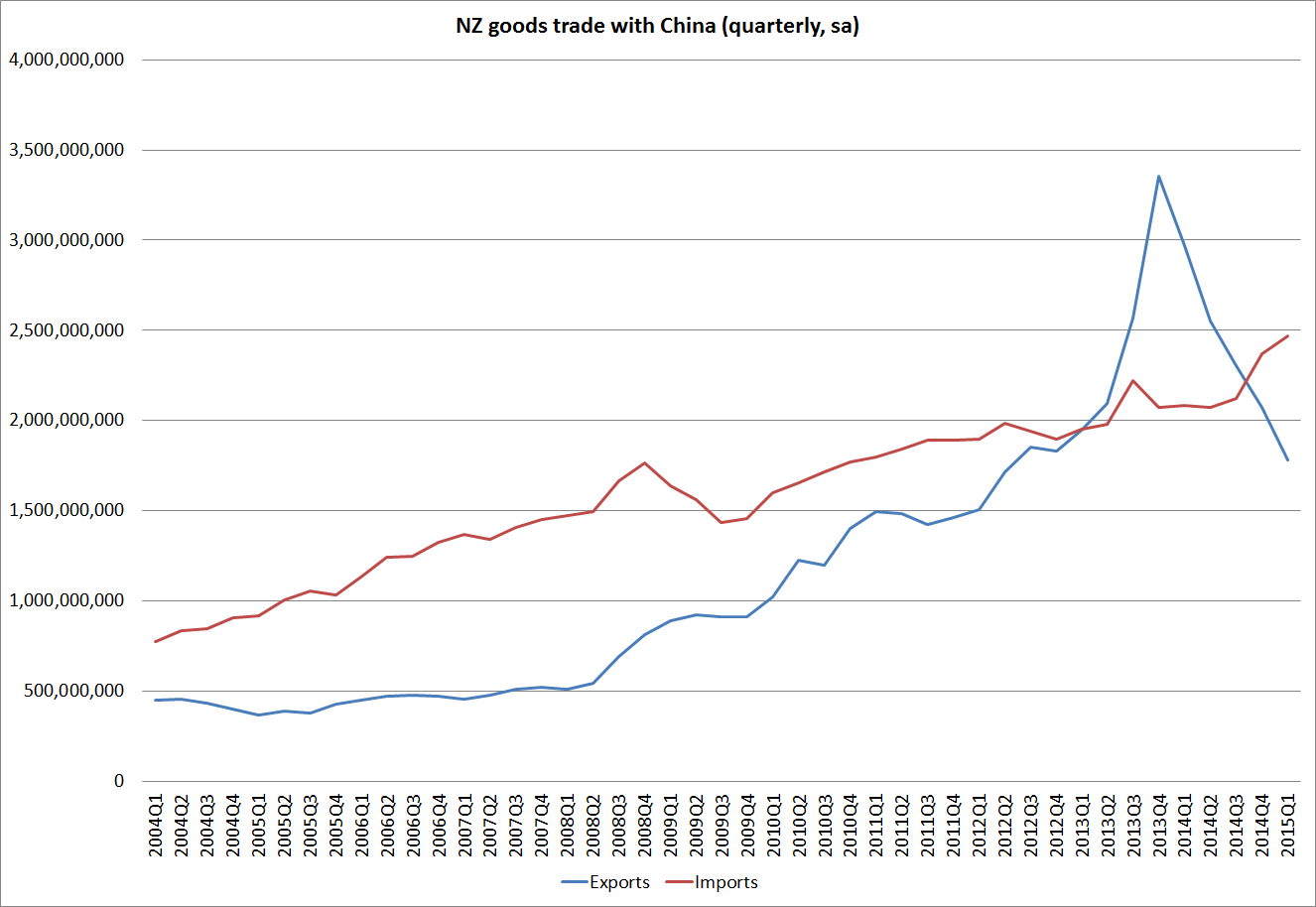
In the new TWI, the CNY has the second largest weight (20 per cent), just behind that on the Australian dollar.(22 per cent). But for the time being, that is likely to be high tide mark for the weight on China’s currency. Here is what has happened to goods trade – imports from China have kept on rising, but export values have plummeted (mostly on the fall in dairy prices).

chinatrade
A bigger question is one about what the appropriate weight on the CNY (and other currencies) is. I’ve argued that the CNY is important to New Zealand not because in a particular year we happen to sell lots of milk powder there, rather than in some other market, but because China is a large chunk of the world economy.  If we had no direct trade with China, it would still matter quite a bit.  In that sense, I reckon the new TWI understates the economic importance of the USD and the EUR, and overstates the importance of the AUD. We trade a lot with Australia, but Australia has very little impact on the overall external trading conditions our tradables sector producers face.

There are no easy answers to these issues. In a sense, that was why the Bank settled last year on a simple trade-weighted index. It wasn’t necessarily “right”, it wasn’t what everyone else did, but it was easy to compile and easy for outside users to comprehend. And without spending a huge amount of resources, on what was (probably appropriately) not a strategic priority, it wasn’t clear that any more sophisticated index would provide a better steer on the overall competitiveness of the New Zealand economy.

An issue of the Bulletin, written by Daan Steenkamp, covered some of this ground last December.

As already discussed, the new TWI has appreciated much less than the old TWI over the past decade or so. It is natural to ask whether the difference has, or should, affect how the Reserve Bank interprets or assesses the exchange rate. For example, are recent judgements about the ‘unsustainability’ of the exchange rate around recent levels affected? The exchange rate, however measured, is never considered in isolation from everything else that is going on in the economy. The Reserve Bank has, for example, recognised the rising importance of Asia in New Zealand’s trade and has taken that into account in its analysis and forecasting over the past decade or more. Exporters and importers deal with individual bilateral exchange rates, not summary indices. And New Zealand’s longstanding economic imbalances have built up with the actual bilateral exchange rates that firms and households have faced over time. How those individual bilateral exchange rates are weighted into a summary index therefore does not materially alter the Reserve Bank’s assessments around competitiveness and sustainability. Applying the macro-balance model (Steenkamp and Graham 2012) or the indicator model of the exchange rate (McDonald 2012) to the new TWI there are inevitably some changes, but the conclusions of those models, about how much of the exchange rate fluctuations are warranted or explainable over the past decade or so, are not materially altered.

There is no single ideal measure of an effective exchange rate index. Different TWI measures are useful for different purposes. In trying to understand changes in competitiveness it is likely to be prudent to keep an eye on them all. Developments in specific bilateral exchange rates will also have different relationships with economic variables and will be useful for different types of analysis. The focus of the Reserve Bank’s approach is on assessing the impact of the exchange rate on the competitiveness of New Zealand’s international trade, and the implications for future inflation pressures. Developing a full indicator of competitiveness, that reflected the specific nature of New Zealand’s international trade, and in particular the importance of commodity markets would require a very substantial research programme. It is difficult to be confident that the results would offer a materially better summary exchange rate measure than the simpler approaches the Reserve Bank has customarily adopted.

Of course, if China continues to grow in significance in the world economy, and if its currency becomes more convertible and is floated, it will become increasingly important to New Zealand. At the moment, the risks around China look somewhat the other way round – the influence of China may be more about the nasty aftermath of one of the biggest, least-disciplined credit booms in history. Growth looks to have fallen away much more than many (including the Reserve Bank) seem to have yet recognised.  But whatever the correct China story, the influence on New Zealand has little or nothing to do with how the Reserve Bank’s trade-weighted index is constructed.

The Governor states his medium-term plans

The Reserve Bank published its annual Statement of Intent on Friday.  I hesitated to write about the document, because to write about it I have to read it.   I always avoided doing so when I worked at the Bank.

The requirement to publish an SOI was added to the Act about 10 years ago.  And dry as they typically are, the SOIs were presumably intended by Parliament to help us understand what the Governor plans that the Bank will be doing over the next few years, and to help us –  and the Board and Parliament – hold the Governor to account.    It should give us a sense of where he sees the bigger looming issues.

Here is what the Act says:

162A Obligation to provide statement of intent

162B Content of statement of intent

162C Process for providing statement of intent to Minister

There is a reasonable amount of material in the document, and tempting as it is to comment on “the Bank’s aspirational goal of being the Best Small Central Bank” (the first time I’ve noticed this in a public document) I’ll save that for another day.  Instead, I want to look at what the Governor does, and apparently does not, see as the priorities for the Bank in the next few years,  in the three broad areas of the Bank’s main statutory responsibilities:

  • Currency
  • Monetary policy
  • Banking supervision

Currency

Two of the Bank’s 10 strategic priorities relate to physical currency

  1. Delivering New Zealand’s new banknotes

The release of Series 7 banknotes (Brighter Money) is scheduled for

the end of 2015 and in 2016. A successful release will require continued

extensive interaction with the Canadian Banknote Company, and

increased engagement with the public, the financial services industry,

and other key stakeholders.

  1. Developing a plan for future custody and

distribution arrangements for currency

The Bank will review its currency operating model and supporting

infrastructure to ensure that the currency needs of New Zealanders will

be met in the future. The review will assess the current operating model,

and identify options for the custody and distribution of currency. The

Bank will consult and collaborate with key stakeholders during 2015-

16 to ensure that the review’s recommendations are understood and

supported.

Those look fine as far as they go, even if the first now seems more operational than strategic.  But neither in this list, nor in the “functional initiatives” section, is there any sense of the significance of the zero lower bound, and the role that central bank physical currency monopolies play in exacerbating periods of economic weakness when policy interest rates get to (just below) zero.  New Zealand has been fortunate not yet to have the zero lower bound (ZLB) issue, but with a policy rate at 3.25 per cent and which is widely expected to fall quite a bit further it is not that far away.  We went into the last downturn with policy rates of 8.25 per cent.

Issues around the central bank physical currency monopoly, and whether (for example) retail electronic outside money might help alleviate the ZLB problems cannot be dealt with or resolved overnight.  But that is why it is so disappointing that nowhere in this medium-term document is there any sense that the Bank is taking the issue, and associated risks, seriously.  It looks as though they will be quite content to just run the risk that one day we get to an OCR of zero, unbothered that nothing was done to get ready for (and mitigate the risk of) that day. For countries that got to zero in 2008/09 it was a pardonable surprise perhaps, but the rest of the advanced world has now put us on notice.  This was a chance to be pro-active, and mitigate future risks, but the Governor does not seem interested in even commissioning work to look in more depth at the issues and options.   There aren’t straightforward “right or wrong” solutions, but the issues and options need serious analytical work now.

Monetary policy 

Not one of the Reserve Bank’s strategic priorities for the next few years relates to monetary policy, which remains (by statute) the Bank’s primary function.  This is so despite:

  • several years in which inflation has consistently undershot the targets agreed between Ministers of Finance and successive Governors
  • the salience of the zero lower bound issues to the ability of monetary policy to adequately deal with possible future serious shocks.  In view of the Governor’s worries about the potential threats to financial stability, it is all the more surprising that nothing major appears to be on the work programme to deal with these issues.
  • A new Policy Targets Agreement is due in just over two years (so inside the period covered by this SOI.

I have some sympathy with the argument that normal year-to-year issues in monetary policy don’t easily fit a “strategic priorities” framework, so perhaps the persistent forecast errors (and associated monetary policy mistakes) might not be expected to appear, even though they are now quite persistent, and have come at quite some cost to the unemployed.

But the ZLB issues certainly aren’t just routine issues.  They have represented a major constraint on the ability of central banks in other countries to do the sort of macroeconomic stabilisation expected of them.  Should we be doing something about removing the technical ZLB constraint?  If not, should we thinking harder about raising the inflation target midpoint?  What are the costs and benefits of the various options, and what might the implications be for other areas of policy (eg the tax system).

But the “functional initiatives” list offers nothing either. Here is what it says:

The Bank’s Economics Department has four key work streams for 2015.

  1. Macroprudential and monetary policy interface: undertake analysis and develop frameworks to better understand the interaction between macroprudential and monetary policy.
  1. Support the formulation of monetary policy: understand how events such as a construction and housing boom, fiscal consolidation, and international developments will shape the next business cycle.
  1. Monetary policy research: undertake analysis to improve the Bank’s understanding of the New Zealand economy and key monetary policy issues.
  1. Exchange rate analysis: reviewing the Bank’s frameworks for assessing the long-term sustainable level of the exchange rate and analysis of the cyclical impact of the exchange rate on New Zealand economic activity and inflation.

Nothing particularly objectionable there, perhaps, but nothing that seriously engages with the sorts of issues I listed above either.

Banking supervision

The Bank has three strategic priorities related to banking supervision:


  1. Exploring macro-prudential policy options to manage the financial stability implications of housing cycles

The Bank will explore macro-prudential policy options for managing the financial stability implications of housing market cycles. It will continue to investigate the interactions between monetary policy, prudential policy and the objectives of price and financial stability. The Macro-Financial department will lead work through the Macro-Financial Committee and

Governing Committee, with support from the Economics and Prudential Supervision departments.


  1. Updating the prudential policy and supervision frameworks.

The Bank will implement changes arising from the regulatory stocktake and will review other key policy settings. These will include outsourcing requirements on banks, and capital and liquidity settings in light of the revised Basel standards.


  1. Developing a comprehensive stress-testing framework for the New Zealand banking system

The Macro-Financial and Prudential Supervision departments are developing a comprehensive stress-testing framework to gauge the resilience of the banking system to adverse shocks. The Reserve Bank will work with the banks to identify and implement improvements to the banks’ technical stress-testing frameworks and processes. In addition,

the Bank will ensure that stress tests become a centerpiece of banks’ internal risk management, and are regularly scrutinised by senior management and boards.

One might question just how “strategic” 5 and 6 are – presumably here the Governor just means “we will put a lot of time into”?  I noticed that the Governor says he will “ensure that stress tests become a centrepiece of banks’ internal risk management”.   But banks might reasonably ask the same of the Reserve Bank.  The Bank is currently trying to further restrict banks’ business operations, even though the latest stress test results suggest there is no threat to the health of individual banks, or to that of the financial system as a whole.

There is also a long list of “Initiatives and strategies” in this area:

Initiatives and strategies

To address these issues, the Bank will:

  • explore additional macro-prudential policy options for managing the financial stability implications of housing market cycles;
  • work with the banks to ensure that stress-testing models and processes are robust and a core centrepiece of the banks’ internal risk management

continue to assess the linkages between monetary and macroprudential policy to ensure that complementary or opposing effects between the two policy areas are properly taken into account;

  • continue to enhance the reporting of financial system stability and efficiency, and policy assessments, contained in the FSR and other reports;
  • publish a stress-testing guide with a view to improving the stresstesting practices of New Zealand banks, and continue to develop a comprehensive stress-testing framework for New Zealand banks, a joint initiative with the Macro-Financial department;
  • complete the regulatory stocktake by consulting on and implementing initial enhancements to improve the efficiency, clarity and targeting of prudential standards for banks and NBDTs, and identifying separate areas for further work;
  • maintain supervisory engagement with executives and directors of regulated banks;
  • complete a review of, and consult on, the outsourcing arrangements that currently apply to ‘large banks’;
  • work closely with banks to ensure timely compliance with new outsourcing requirements;
  • review the Bank’s existing liquidity policy against finalised international liquidity standards;
  • review the Bank’s broad suite of capital requirements;
  • consult on a range of amendments to the statutory management powers in the Reserve Bank of New Zealand Act 1989 to clarify aspects of the legislative framework for the Open Bank Resolution policy;
  • promote legislative changes recommended by the review of the prudential regime for NBDTs that was completed in 2013;
  • finalise policy to strengthen the Bank’s oversight of financial market infrastructures; and
  • implement the business-as-usual supervisory framework for licensed insurers.

Again, what is there is not objectionable, but I think some questions should be asked about what is not there.    For example:

  • There is no sign of any proposed rigorous (let alone independent) ex-post evaluation of the Bank’s LVR regulations, even though they have been a major innovation in New Zealand policy.
  • There is no sign of any particular work on the efficiency of the financial system, even though any (arguable) soundness benefits from measures like the actual and proposed LVR controls come with undoubted efficiency costs.
  • There is no sign of any initiatives to lift either the quantity of quality of the Bank’s research and policy analysis in prudential regulatory and financial stability areas.  For example, there is no sign of any work programme on how to best interpret the lessons of other countries which have, and have not, experienced financial crises in the last decade or so.

More generally, there is no sign of an organisation that recognises the importance of, and wants to foster,  the robust contest of ideas, internally and externally.

In a sense, none of this should be very surprising.  As I have been highlighting, too many of the Reserve Bank’s powers (ie all of them) rest with the Governor alone.  But the draft of this SOI will have been seen by the Minister, and it might be interesting to ask the Bank or the Minister for a copy of any comments the Minister provided. Probably a draft went to the Reserve Bank’s own Board –  but the Board exists to review the Governor’s performance after the event, not to set strategic priorities, approve functional initiatives, or even set Budgets.   The SOI is a reflection of the single decision-maker’s preferences and priorities –  a model which has both strengths, and some significant weaknesses and risks

There is no suggestion of any further work on possible improvements in, or changes to, the statutory governance of the Bank.  I have just lodged an OIA request with the Bank asking for copies of any work done in this area over the last couple of years.  Of course, decisions on governance and statutory changes are a matter ultimately for the Minister and Parliament, but in his early months the Governor did appear to recognise some weaknesses in the current model, prompting him to establish the Governing Committtee (him, and the three deputy/assistant governors), as a forum in which the Governor would make major decisions, to help mitigate some of the internal risks in the current statutory system.

The Reserve Bank’s Statement of Intent stands referred to Parliament.  It might be interesting for the Finance and Expenditure Committee to ask the Governor about the some of the issues raised here.  Other departments have an estimates hearing before their funding is appropriated.  There is nothing similar for the Bank’s five year funding, but the SOI does provide a basis for some scrutiny and challenge.

The Reserve Bank’s releases on proposed investor finance controls

I noted yesterday that the Reserve Bank had also released some papers on the proposed new LVR restrictions on Thursday.  When that release was pointed out to me yesterday, the Bank’s website suggested that the papers had been released in response to an OIA request.  The papers still appear in the obscure corner of the Bank’s website where (in a welcome development) they have started publishing some of the responses they make to OIA requests.

But when I checked again this morning, the table now says of the latest release:

Date of Response Subject matter
25 June 2015 Loan-to-value ratio (LVR) restrictions, proactively released, jointly with the Treasury

Go through to the detailed page, and it suggests that the release is partly pro-active and partly a response to an OIA request.

This is information relating to loan-to-value ratio (LVR) restrictions that has been released proactively and in response to requests for information under the Official Information Act 1982 (the Act).

I’m a little confused.  But if there genuinely is a pro-active component to the Bank’s release then I welcome it, even if (say) they may just have released one additional paper to provide context for a few that were covered by the OIA.

It still leaves a little bit of a puzzle about the Treasury’s (entirely pro-active) choice to release.  Sometimes documents requested of one organisation cross-reference material generated in other organisations, but that does not appear to be the case here.  Perhaps the OIA request to the Reserve Bank included material the Bank held, even if it did not generate it.  If so, no doubt the Bank held copies of at least some of the Treasury papers?    But having been on the receiving end of numerous OIA extensions from the Bank (and recently one from Treasury), when documents written little more than 20 working days ago are pro-actively released, it has the feel of a genuinely deliberate timing choice.

But enough of the bureaucratic process stuff.  What I had intended to write about was the content of the Bank documents.  They released six, one of which (the 17 Feb one) I had previously seen.

Date Released on 25 June 2015
19/5/2015 Memo to Minister on draft consultation paper on LVR policy (PDF 818KB)
30/4/2015 Memo to Minister on estimated impact of changes to LVR policy (PDF 1.36MB)
24/4/2015 Memo to Minister on potential adjustments to LVR ratio policy (PDF 2.67MB)
21/4/2015 Memo to MFC on Proposed changes to the LVR policy (PDF 350KB)
2/4/2015 Memo to MFC on revisiting the case for regional targeting of marco-prudential policy (PDF 134KB)
17/2/2015 Memo to MFC on effectiveness of a tighter investor LVR limit (PDF 99KB)

We don’t have much context for this release.  In particular, we don’t know the scope of any OIA request the Bank may have been responding to, but if these papers are intended to reflect the analysis the Bank undertook in developing the proposed control on investor lending (and the Auckland-specific nature of the new policy), they are surprisingly short and weak.  Recall that the Bank is,  implicitly, saying the banks and borrowers are so risky and irresponsible that not one single (practical) cent can safely be lent by banks to Auckland residential property investors on LVRs over 70 per cent without jeopardising the soundness of the financial system.  That is a pretty ambitious claim.  It is not supported.

I have been critical of the Bank for not making a stronger case for its proposed controls.  The one comfort I suppose that we can take from these papers is that they are not hiding anything from us.  But if this is all there is – the extent of their engagement with the law, the economics, the stress tests, the uncertainty –  it is even less surprising that The Treasury was also not convinced that a compelling case had been made for the new controls.  Unfortunately, the Reserve Bank also continues to repeat to the Minister of Finance its claims that lending to investors is generally materially riskier than other housing lending.  An attendee at the LEANZ seminar the other night told the audience that he had gone through all the references the Bank has previously invoked in support of its claim, and had found that they simply did not say what the Bank claimed they were saying.  If that assessment is correct, it is pretty concerning, and should be so to the Board and the Minister –  charged with holding the Governor to account on our behalf.

A process issue struck me in reading the papers.  In discussing the possible new policy, the 21 April paper lists a possible timeline.  It suggests that a consultation period should end in “late June” and “Release final policy position and revised conditions of registration” in “mid-July”.  Allowing perhaps 10 working days to read, analyse, and reflect on submissions, write up recommendations to the Governor, write-up a response to submissions, and finalise the new conditions of registration themselves does not suggest that the Bank had in mind a very open process of consultation.  Actual timing slipped somewhat, as the consultative document was not released until early June, but we should hope that they take a little more than 10 working days to work through all the issues likely to be raised in submissions.

As I noted yesterday, the cause of serious scrutiny of the Governor’s proposals (and of open government more generally) would be advanced if the Bank were to publish on its website, as they are received or at least on the closing date, all the submissions they receive.  They are, after all, public, official, information.

Earthquakes, lives saved, and the OIA

I’ve posted a couple of times (here and here) on a “blunder of our government”; the plans and legislation to impose earthquake-strengthening requirements on many building owners, with seemingly little regard for any sort of robust cost-benefit analysis.  A sense, following the Canterbury earthquakes, that “something must be done”, plus perhaps some lobbying from vested interests, is the only way I can account for even the latest modified proposals.

This isn’t really my area, but I have great deal of time for my former RB colleague Ian Harrison who has led a lot of the thinking critiquing the government’s proposals.    EBSS (“working towards a rational seismic strengthening policy”) has been trying to use the Official Information Act to better understand the analysis and reasoning behind the government’s proposals, and its claims regarding the costs and benefits.    Their website is worth keeping an eye on from time to time, and they have a new post up about their latest request to MBIE.   I suspect they won’t mind if I reproduce it here.

The classic schoolboy excuse for failing to hand in homework looks credible compared to the excuse that MBIE has made for not provided us with documents requested under the Official Information Act.

In our analysis (the Minister’s new clothes) of the new seismic strengthening policies announced in The Building Minister’s speech in May we pointed out some ‘schoolboy’ errors  and suggested that there might be more.

The Minister said that the policies would save 330 lives over the next 100 years, but when MBIE last did the analysis in 2012 only 24 lives would be saved. We were also told that the whole strengthening exercise would cost only $770 million when the Tailrisk Economics analysis suggests that the true cost could be 10 times that amount.  The differences are critical to an understanding of the merits of the new policy.

To get to the bottom of the evidence on balance of the costs and benefits we asked for the following documents:

All documents relating to the following information presented in the Minister of Building and Housing’s speech on 10 May 2015 on the Government’s new seismic strengthening policies

(a)

  • The estimate of lives saved by the policy
  • The cost of the policy
  • The difference in risk between buildings near the 34% threshold and those with lower %NBS
  • The relative risk of dying in a car accident compared to dying in an earthquake

(b)   All documents relating to seismic strengthening policy for the period 1 April 2014  to 9 May 2015

Our requests were refused (past the statutory deadline for making information available) under section 18(c)(ii) of the Act, “as the making available of the information requested would constitute contempt of Court or the House of Representatives.” The rationale was that the Earthquake Prone Building Amendment Bill is currently before the Select Committee and that “all of the Committees’ ‘other proceedings’, including advice MBIE has provided to the Committee, are strictly confidential to the Committee”.

What MBIE seems to be saying here is that every document relating to seismic strengthening that has been produced by MBIE over more than a year have been provided to the Select Committee.

MBIE’s apparent claim is not plausible.   While MBIE might be entitled to withhold the advice they have specifically provided to the Select Committee there is no justification for a blanket refusal to provide the requested documents.

We suspect that what is really going on is that the Minister really hasn’t done his homework on the costs and benefits of his new policies and that MBIE is trying to cover it up.  On the 330 deaths there must be a strong suspicion that there has been a blunder or the evidence was engineered..

The material under (a) in particular seems like the sort of stuff that, in a genuinely open government, would have been pro-actively released a long time ago