Some overnight reading

Last week I wrote up some thoughts on negative nominal interest rates, and how important it is that finance ministers and central banks start treating as a matter of urgency the elimination of the regulatory constraints and practises that make it impossible for policy interest rates to go materially negative.  If they won’t, they need to raise inflation targets, but that would be a distinctly inferior option.

In that light, it was encouraging to read the blog of Miles Kimball –  one of key academic proponents of action in this area – and learn that he was talking overnight on exactly that topic at the annual central bank chief economists’ workshop hosted by the Bank of England.  The annual BOE meeting is an important and interesting forum (I got to go once) and typically John McDermott, chief economist at the Reserve Bank, attends.  The link to Kimball’s slides (“18 misconceptions about eliminating the zero lower bound”) is here.

I don’t agree with everything in Kimball’s presentation.  In particular I still think he puts too much weight on government providing the answer, rather than just getting out of the way and providing greater scope for market innovation. But then there is (or should be) a much greater urgency to addressing the issue in most of the rest of the advanced world, where policy interest rates have now been stuck at or near zero for a depressing number of years now.

The obstacles to negative nominal interest rates have been around as long as banknotes, but haven’t mattered very much in the past  –  after all, despite the occasional peripheral discussions and local experiments during the Great Depression, there was then a mechanism to generate recovery –  breaking the link to gold.  That option isn’t available this time.  Kimball rightly compares creating the ability to take nominal interest rates materially negative to breaking off gold in the 1930s.

In countries where interest rates have not yet hit zero, such as New Zealand and Australia, the Minister of Finance (who controls the gateway to taking legislation to Parliament), the Treasury (as chief economic adviser to the governments), and the Reserve Bank (as, in essence, implementation agents –  and to some extent the institution that benefits from the current system) need to be planning now to ensure that these old restrictions don’t impede the ability of our countries to cope with the next severe downturn.  This isn’t just something of academic or obscurantist interest – it is about unshackling one limb of macroeconomic policy so that it is ready when it is needed.  And as I’ve noted before, at 3.5 per cent our OCR is less high now than most of policy rates were in 2007 in those countries now stuck with the near-zero lower bound constraint.

And two other brief items:

I drew attention some weeks ago to the work Ian Harrison had been doing on earthquake strengthening requirements, an area of policy which appeared to have the makings of another government “blunder”.   A group Ian is associated with called EBSS (Evidence Based Seismic Strengthening) now has a website, and it includes a brief critique of the government’s revised proposals in this area announced earlier this month.  Those changes seem to amount to a step forward, in reducing the extremely heavy cost burden that the government had planned to impose on building owners, to mitigate extremely low probability and low cost risks.

However, as the EBSS paper notes, the new proposals still seem a long way short of ideal.  Now that I’m based at home I’m often down in the Island Bay shopping centre.  Many of the older buildings there –  including one housing the excellent and popular butcher –  are yellow-stickered, but I neither notice among other people, nor feel any myself,  any unease in using them.  Sometimes I wonder if that is just a short-sighted perspective, oblivious to the risks, but that is where numbers help.  This quote from the EBSS paper caught my eye.

As a point of comparison, flying has similar characteristics to earthquakes. There is a very small chance that there will be a catastrophic event that results in death. The chance of being killed, per hour, when flying is 4000 times greater than being in a typical Auckland ‘earthquake prone’ building. For New Plymouth buildings it is about 600 times greater, and for Wellington 20 times.

We fly because we know that flying is very safe. But the Auckland, New Plymouth and Wellington buildings will be shunned because they will be falsely identified as ‘high risk’ when there is overwhelming evidence that they are not.

And finally China. I must have missed the reports of the recent Chinese government instruction to banks that they must keep lending on local authority projects even if those local authorities can meet neither interest nor principal commitments on existing debt.  Christopher Balding has an excellent summary of what an edict like that seems to mean.  As he puts it “the Chinese bailout is starting to bail fast”.

Some other aspects of the FSR

In its Financial Stability Reports, the Reserve Bank consistently highlights two other areas of risk:

  • Dairy debt exposures of the banks
  • New Zealand’s quite large net international investment position

In this post I want to offer some thoughts on the nature of these risks, highlight perhaps a bigger risk that has never received a mention in an FSR, and end with a few thoughts on how the Reserve Bank might better think about FSRs.

Dairy farmers owed banks around $35bn as at June 2014.  That is more than the total capital of the banking system, and is the largest sectoral exposure of the New Zealand banking system.   Since each dollar of farm debt is generally regarded as much riskier than a dollar of housing mortgage debt it can’t be ignored as a potential area of threat to the banking system.  It also makes the New Zealand banking system different –  when I checked a few years ago, farm debt in New Zealand was about one tenth that in the US, even though US GDP was perhaps 100 times that of New Zealand.

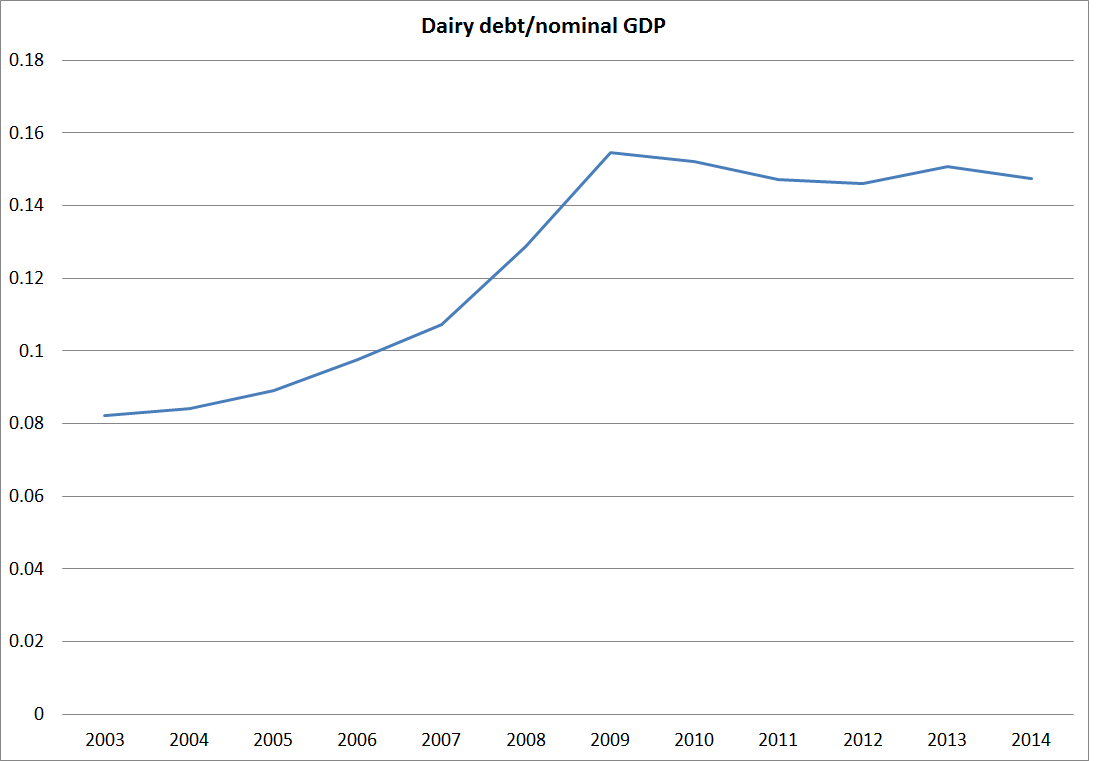
The Governor made much yesterday of the fact that dairy debt had trebled since 2003.  What we didn’t hear so much of is when that debt increased.  The chart below shows dairy debt as a percentage of GDP.  It rose very very rapidly to 2009, and has gone nowhere – actually fallen slightly – since then.

dairy

During that boom period, dairy land prices rose very sharply. Land prices fell a long way in the recession and even in the last couple of years land prices have been below the previous peaks (even in nominal terms).  It matters when the debt was taken on.  The worst of the loans taken in the boom –  and there were some pretty bad ones, as banks fell over each other to build market share, and buyers got sucked into some sort of bubble mentality –  have already failed.  Bank non-performing loans in respect of dairy exposures rose quite sharply over 2009 and 2010.  They could easily have got a whole lot worse, if the payout had stayed down for longer, and if banks had not all quietly recognised that in an illiquid market like that in dairy farms in a downturn, selling up many clients would rapidly drive the value of collateral even lower.

I did quite a lot of work, and thinking, on dairy risks in 2009.  I used to stir people up by describing dairy debt as potentially ‘New Zealand’s subprime’ –  potential for bad debts, exposures ill-understood both by parent banks and by offshore funders, and a market for collateral that was highly illiquid and, hence, with little effective price discovery.  And New Zealand has been down this path before – farm debt was a major problem in New Zealand, with all sorts of regulatory interventions, during the Great Depression. So I’m not complacent about the possibility of dairy risks.  But timing  matters a lot.  Not only has the worst of the boom-times debt already failed, but bank parents got quite a fright in 2009, and banks have had plenty of opportunity to manage their exposures over the last five years or so, including encouraging – or forcing – clients to take advantage of the good years to reduce debt levels.  I’m a bit of a pessimist on global commodity prices so it wouldn’t surprise me if farmers had a pretty tough few years ahead.  And in any sector where there is a boom followed by bust, some people will be caught out, and some will exit the industry.  But this is not 2009, and the chances of any material systemic threat, based on bank dairy books as they stand now, seems incredibly low.  A fresh dairy credit boom and land price spiral would be something quite different, but the last one was years ago now.

But I had some sympathy with the call I heard this morning for risk weights on dairy exposures to be raised.  My sympathy has nothing to do with the current situation, but with a fear that the weights were set too low in the first place.  Back in June 2011, the Reserve Bank published two Bulletin articles about dairy debt in the same issue.  One was a stress-testing exercise which used a plausible scenario that ended with 20 per cent of dairy loans having to be written off.  The other described the work the Bank had done on recalibrating risk weights for farm loans.  The authors reported that average risk weights on farm loans would in future be around 80-90 per cent.  That meant banks would be required to hold capital equal to perhaps 7 per cent of farm exposures (given that the minimum total capital requirement is 8 per cent of risk-weighted assets).  Requiring banks to hold insufficient capital to cover the Reserve Bank’s own contemporaneous stress test looked odd then, and still does now.  As I noted, current risks don’t look that large, but capital requirements are supposed to be set to be robust to all different phases of the credit and economic cycles.

(Incidentally, this is an example of a more general problem.  Would, for example, the Bank’s capital requirements for insurers be large enough that if the Christchurch earthquakes were repeated –  a real world stress test if you like – AMI would not have failed?  Given that the government chose to bail-out AMI at taxpayers’ expense, with the support of the Reserve Bank, and has shown no sign of regretting doing so, some questions might reasonably be asked.)

The Reserve Bank has long made much of New Zealand’s relatively large net international investment position (as a per cent of GDP).  It doesn’t make Chapter 1 this time round (which is welcome) but it is still there in later chapters, including the “Systemic Risk and Policy Assessment”.  New Zealand’s NIIP position is large by international standards, but it has been large for decades, and has shown no signs in the last 25 years of getting any larger.  That is a very different position from where countries like Spain and Greece found themselves in the years leading up to the euro crisis,  when NIIP ratios increased very rapidly.   New Zealand’s NIIP position is a symptom of some  persistent imbalances in the economy, but it is a chronic condition, not one that threaten crisis.   In fairness, the Bank now mainly focuses on rollover risk for domestic banks’ foreign funding, but even here I think they overdo it.   Even in the 2008/09 crisis, wholesale term funding markets were closed for only a relatively short period of time.   There was never any sign of idiosyncratic concerns about the Australian and New Zealand banking systems, even though on any objective measures the risks must have greater then than now.   Global market disruption – as, say, we might expect if the euro breaks up in a disorderly way –  could increase the cost of borrowing (as happened in 2008/09) but that effect can largely be offset through a lower OCR.  It just is not a first order risk for the soundness of the New Zealand financial system.  Wholesale funding can be an indicator of systemic vulnerability, but usually when wholesale funding has been running up rapidly because lending growth is far outstripping domestic deposit growth.  We went through that phase –  and our financial system got through it largely unscathed –  but it is not today’s risk.

I have been struck for some time by the absence of the word “deflation” from Financial Stability Reports.  For all my relative comfort about the health of the New Zealand financial system, the one thing that could really threaten it would be a period of significant deflation.  Why?  This isn’t Fisherian debt deflation story, but simply a reflection of the fact that almost all private debt is nominal.  If we were to experience a period of sustained deflation nominal asset prices could be expected to fall, and nominal wages (and profits) would also be expected to fall.  Those holding financial assets would be better off, but those with financial liabilities could be in quite serious strife.  For banks, the risks are entirely asymmetric – they don’t benefit from the increased real wealth of their depositors, but are heavily exposed to the increased real debt of those they have lent to.

Material or sustained deflation is not a high risk in New Zealand.  No doubt 25 years ago the Japanese didn’t think so either.  Deflation isn’t a non-existent risk for New Zealand either, especially in the current global environment – adverse demographics, the increasingly pervasive “bite” of the zero lower bound etc.  I’m not sure why the Reserve Bank is so averse to discussing the nature of the risk, even as an extreme scenario.  Yes, we know they have an inflation target of 1-3 per cent annual inflation, but there is no guarantee that a central bank will always be able to keep inflation up to current target levels and who knows what the future target will be.    This is one of those areas where the Governor, in preparing the FSR, needs to take off his hat as monetary policy decision-maker and just deal with the possible threat to the banking system – remote, but not impossible.

This post has ended up a little longer than I’d intended.  I want to finish with just a few thoughts on how I think the Reserve Bank should approach future FSRs.  In assessing risk, they seem rather stuck in a pre-2008 environment.  Back then, credit growth was very rapid across all classes of bank loan books, the finance company debacle was nearing its worst, asset prices generally were rising rapidly, banks were becoming progressively more dependent on short-term wholesale funding, and constant pressure was on to lower effective capital requirements (in the shift to Basle II).  It was quite reasonable to have entered 2008 quite concerned about possible threats to the health of the system.  But the New Zealand financial system came  through that severe recession, and the aftermath of a big credit boom, largely unscathed.  And almost nothing in the description of the pre-2008 years is relevant today.

Some of what has changed is just the result of market phenomena, but some is a result of worthwhile regulatory measures: higher minimum capital requirements, strong pushback against the pressure to erode risk weights, new liquidity and funding requirements and so on.  Some years ago, senior staff of the Bank’s Prudential Supervision Department used to tell the IMF each year that they presided over the safest banking system in the world.  That used to grate somewhat with the house pessimists (of whom I was one).  And yet, as it happened, they weren’t so far wrong.  The Bank should take some credit for the health and soundness of the financial system.  Of course, a central bank needs to keep a watching brief on emerging threats, but needs to be able to differentiate when they pose real threats to the soundness of the financial system, and when they are just the sort of thing that strong buffers are already in place to contain.  More energies might reasonably be put into reviewing the extensive regulatory net now in place –  not just to “iron out inconsistencies” (the sort of approach in the current regulatory stocktake) but to ask, and to invite serious outside perspectives on, what bits of the regulatory framework are really adding material value to the statutory goal of promoting the soundness and efficiency of the financial system.

Yet another policy lurch

Having now read the Financial Stability Report, and listened to the Governor’s press conference, I was surprised by the poor quality of the Report and of the policy that it discusses.  The FSR is supposed to contain material to enable us to assess the effectiveness of their use of their powers (here and here).  This one just does not.

Policy seems to be lurching from one intervention to the next, without any compelling analytical framework or evidence.  There also appears to be little sign of any historical memory.

For example, only six months ago the Bank was reporting the results of its own stress tests, which suggested that the major New Zealand banks (and presumably the financial system) were resilient to even very severe shocks to asset prices and servicing capacity.  And yet, despite announcing its intention to impose yet more, quite invasive, controls on bank lending to one sector of SMEs, there was no reference at all to this assessment and experience.  Perhaps the Bank does not believe the results of the stress tests, but if not surely they it owe it to us to explain why.  .

Similarly, the Bank laments that investors have become a larger share of property purchasers in Auckland (what is the “right” or “appropriate” share, and where is the “model” to determine that, we might reasonably ask them) but they don’t seem to see any connection between the imposition of the first LVR speed limit 18 months ago –  which will have borne most heavily first-home buyers, who have always been those who relied most heavily on debt finance –  and the greater presence of investors in the market.  At the time their own analysis and modelling (eg see chart on page 9) made the point that potential buyers who were displaced would, over time, be replaced by other buyers.  Their modelling also showed that the most that could be expected of the speed limit was a dip in house price inflation for a year or so, which would then be reversed as the new buyers entered the market.

If amnesia is a problem, so apparently is schizophrenia.  On the one hand, the FSR and the press release tell us that “New Zealand’s financial system is sound and operating effectively”, but on the other hand they apparently think that banks are operating so recklessly that not a single Auckland investor purchaser should be able to take a loan of over 70 per cent of the value of the property, no matter how sound a proposition that borrower might otherwise appear to his/her lender (including their flow servicing capacity).    Continuing the theme of an institution that can’t quite make up its mind – or perhaps doesn’t want to scare the investor horses, but wants cover for yet more regulatory interventions – the Governor told us in the press conference that he was becoming seriously concerned about financial stability risks.  If so, perhaps the first sentence of the Report should have been written somewhat differently.

The Bank also doesn’t seem to display much regard for good process.  It is going to produce a consultative document shortly on its proposals to restrict investor loans in Auckland (which I hope will have much more substantive justification for the proposed policy than is in the FSR), and yet it ‘‘expects banks to observe the spirit of the restrictions” now.  “Consultation” is supposed to have substantive meaning, and not just around the fine details of the regulations.  Is the Reserve Bank open to countervailing arguments, or has it already made up its mind and just going through the motions?  If the latter, it might leave itself exposed to the risk of someone seeking judicial review.

The Bank blunders in with these policies, each no doubt well-intentioned, but with little apparent recognition of the way that its actions affect real people, their lives and their businesses.  18 months ago a nationwide LVR speed limit was put in place, apparently because the Bank thought that house price inflation and associated credit growth was going to become a widespread problem.  If the Bank was omniscient it might be one thing, but they were simply wrong.   Ordinary house-buyers in Invercargill or Wanganui had to delay purchasing a house because of a mistaken Reserve Bank hunch.  And these weren’t measures that were ever necessary –  by contrast there will always be an interest rate in an economy –  since large capital buffers were already in place.  And in Auckland, the Reserve Bank’s earlier policy won’t have materially adversely affected those from upper income families, where parental support will have helped young people get around the 80 per cent limit.  But what about those without wealthier parents, who are surely disproportionately Maori and Pacific? There was no hint of that distributive impact in the Regulatory Impact Statement for the earlier restriction.    In Auckland the earlier restriction provided cheaper entry levels for the lucky (those who got inside the speed limit), the wealthy, investors, and cashed-up purchasers.  Is that good public policy?

Who will be adversely affected and who will benefit this time?  One group that springs to mind who might benefit are the fabled offshore investors.  No one has any good idea how many of these people there are, but as Grant Spencer acknowledged in the press conference his regulatory restrictions won’t bear on them.   From a financial stability perspective that might not matter to the Reserve Bank, but I suspect that to voters it will.  First penalise first home buyers. Then penalise people looking to build a rental property business (and perhaps those who rent from them).  And who will that leave?  The middle-aged cashed-up purchasers, and any offshore purchasers.  It doesn’t look fair, it doesn’t look like a reasonable use of Reserve Bank powers (when less intrusive instruments, such as risk weights and overall required capital ratios are available), and frankly it doesn’t look very democratic.

Of course, Parliament gave these powers to a single unelected official –  although I doubt that anyone in 1989 ever envisaged them being used for such purposes.  Jim Anderton, a staunch opponent of that Act, must now be rubbing his eyes in disbelief.  And, on the other hand, the current government was supposedly committed to reducing the burden of regulation, not increasing it.  One wonders if the Reserve Bank given much thought to the lobbying it now opens itself up to  –  carving out one set of rules for Auckland will, in time, open it to lobbying for special rules for other areas.   Cashed-up purchasers wanting to buy more cheaply in Queenstown might be knocking on the Governor’s door before too long.   If we must have regional policies (in bank regulation or other areas), let the choices be made by those whom we elect, and can toss out.

And then we are back with the larger questions.

  • Is there any evidence, from anywhere, ever, of a systemic financial crisis in a country where credit has been growing around the rate of growth of nominal GDP, and has been doing so for the last six or seven years?  The Bank has produced some interesting new data on gross credit flows, but it doesn’t change the underlying evidence from the international literature: when credit is not growing fast relative to GDP one of the key risks of a future crisis is missing.
  • Where is the evidence that loans to investors, all else equal, are riskier than other residential property loans?  Repetition of the claim over and over again is not the same as evidence.  As I have noted previously, the evidence from Ireland and the UK (tho in UK loan losses were always small) is not particularly enlightening, since the rush into buy-to-let properties was very much a late cycle phenomenon.  None of the sources the Reserve Bank mentions look at losses on like for like (eg similar age, similar LVR) loans.    In an earlier post, I questioned whether the Reserve Bank had any domestic evidence on losses on loans to investors, as compared to those to owner-occupiers, in those places where nominal house prices have fallen considerably in recent years.  If there really is the sort of difference the Reserve Bank asserts, surely it should be showing up in New Zealand data.   The one area where international evidence does seem to suggest that loan losses are greater is new house building –  but the Reserve Bank is still carving that out from the limits.

One word that appeared very little in today’s document was “efficiency”.  The Act talks repeatedly about the “soundness and efficiency” of the financial system. The efficiency references were put in for good reason – to limit the risk of recourse to direct controls, of the sort that plagued our system for decades.   By almost any definition, somewhat arbitrary controls like the LVR speed limit and the proposed new Auckland investor lending limit impede the efficiency of the financial system.  Almost inevitably there is some trade-off between soundness and efficiency considerations in any set of prudential measures, but in this document the Reserve Bank gives us nothing to allow us –  or those paid to hold the Bank to account –  to see how and why they have made the trade-offs they have.    What basis is there, for example, for imposing a blanket ban of any investor loans in Auckland in excess of 70 per cent LVR[1] when, for example, the soundness of the system could have been protected at least as well –  if there is a material threat at all –  with, say, higher risk weights for Auckland property loans more generally, which would not skew the playing field between different classes of potential borrowers/purchasers at the whim of the Governor.   There may be good grounds for the trade-off that is made, but they simply aren’t presented.  How can people assess the effectiveness of the Bank’s exercise of its prudential powers?

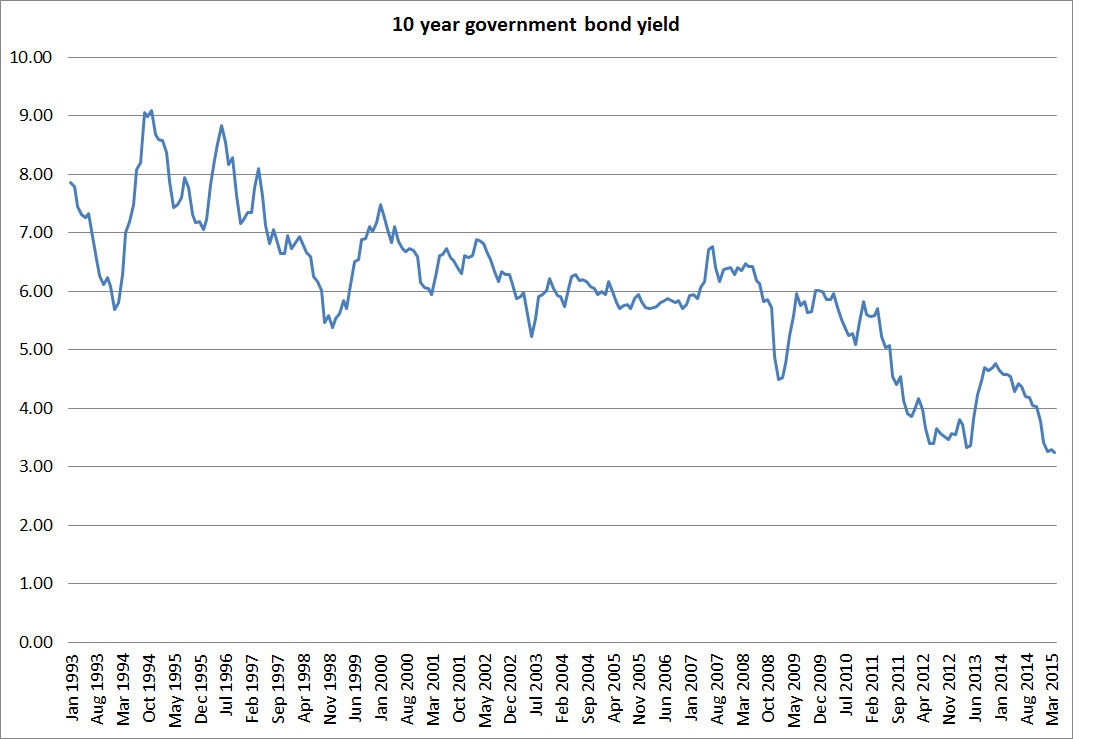
Finally, the Bank partly justifies its targeted intervention in Auckland, against one class of potential buyers, on the basis of rental yields in Auckland.  They argue that rental yields in much of the rest of the country are around 10 year average levels, but are at record lows in Auckland.  But has the Bank looked at a chart of New Zealand bond yields recently?  New Zealand 10 year bond yields are now at the lowest level probably ever (and certainly in the 30 years on the Reserve Bank’s website).  And the market now expects that the Bank will have to cut the OCR not raise it.  Shouldn’t we expect rental yields to bear some relationship to yields on alternative investments, such as long-term government bond yields.  Of course, the Bank would no doubt defend its stance by reference to the abnormally low level of bond yields globally.  And it is true that they are very low  (while NZ’s remain high by cross-country comparison), but the Reserve Bank –  even more than its overseas counterparts –  has been getting the future path of interest rates wrong for six years now.  Perhaps they will be right this time, but why should we be confident that they know better than the market?

10yr

It is difficult to fully make sense of what the Governor is up to. I suggested a few weeks ago that he didn’t want to be the person who presided over a NZ version of the US experience of 2006 onwards.  Which would be a laudable goal if there were any evidence that circumstances were even remotely similar. But there isn’t: overall credit growth is subdued, the Bank presents no evidence of a systematic deterioration in lending standards, and fundamental factors  provide a good basis to explain what is going on in house prices, both in Auckland and in the rest of the country.  Perhaps the Governor just wants to “do his bit” to solve the problems in Auckland, but (a) the Reserve Bank has no statutory mandate to focus on trying to manage house price cycles, especially in a single city, and (b) it isn’t clear how impeding access to finance (in a climate of modest per capita housing turnover, modest volumes of mortgage approvals and modest overall credit growth) is going to in any sense help deal with the structural problem.  There just isn’t a financial system problem –  and if there is the Bank just hasn’t made its case, and should get the evidence out there –  and it feels as if the Bank is misusing its extensive powers, based on a flawed reading of what is going on, and a failure to give due weight to how often past regulatory interventions have just made problems worse.

I pointed out a few weeks ago that it was now over a decade since the words “government failure” had appeared in a document on the website of the State Services Commission.  The Reserve Bank is now a major regulatory agency, exercising more and more powers by the decision of single unelected official.  I checked the Bank’s website, and the phrase “government failure” appeared only once (in a Bulletin article on historical crises), and “regulatory failure” appeared not at all.  It should disconcert citizens –  and those paid to hold the Bank to account –  that there is not more evidence of the Bank having reflected seriously on what that entire literature, and the experience of countless other regulatory bodies, might mean for how they should exercise their powers.

PS    In the press conference the Bank seemed to back away (perhaps just diplomatically) from the Deputy Governor’s expressed support for a capital gains tax. Almost a month ago, I lodged an OIA request for any material the Bank had considered on a CGT.   Since the Bank has taken so long to respond, and is required by law to respond “as soon as reasonably practicable”, I’m assuming they must have a considerable amount of substantive material that needs review.

[1] And, on the other hand, no such restrictions in Christchurch even though the Governor observed that he thought a glut of houses in Christchurch was quite likely.
Negative nominal interest rates

Late last week the New York Fed posted some interesting  and thoughtful speech notes by James McAndrews, their Director of Research, on “Negative Nominal Central Bank Policy Rates: Where is the Lower Bound” (see also some comments here from John Cochrane).

But McAndrews doesn’t really answer the question he poses, and instead offers a series of thoughts on some of the issues (institutional and policy) associated with negative nominal interest rates.   If it seems somewhat geeky it is, or should be, a pressing issue.  Four countries already have modestly negative policy interest rates for some balances.  Most other advanced countries have policy rates at or near zero and even in “high” interest rate Australasia the buffers are no longer large.

McAndrew outlines seven ”complications” with negative interest rates.  I won’t touch on them all –  read the speech.

The first, and best-known, is “avoidance”, the possibility of shifting into physical currency (which, at present, carries a zero nominal return).  He argues that currency is a less effective substitute for electronic money than many realise, and seems to put quite a lot of weight on the inconvenience of physical currency.  But that case seems a great deal stronger for mid-sized transactions than for the  store of value function of money.  I’m a trustee of a pension fund  and, to take an extreme example,  if nominal interest rates ever got to, say -10 per cent, I can’t envisage that I would have many qualms in agreeing to the bulk of the fund’s assets being held in secure (and insured) physical currency form, rather than interest-bearing securities as at present.  Yes, we would still need some electronic balances available to make our routine pension payments, but those transaction balances are small relative to the stock of assets.  In the same way that most of us still held zero-interest transactions balances in the high inflation era, we might still be quite comfortable to have, say, one week’s salary in an account earning a material negative interest rate simply because it is more convenient.  To settle wholesale payments, the transfer of claims over physical bank notes seems quite feasible (with time, and an expectation that interest rates would stay negative for a prolonged period).  The big risk central banks are concerned about is not that your cheque/EFTPOS account would be converted back into physical currency, but that banks and large investors would choose to convert their assets (where choices are heavily driven by relative expected returns).

Abolition of physical currency would, of course, eliminate this problem altogether.  I’m not in the camp of those who favour that option, and neither is McAndrews.  Indeed, I’m not sure that elimination of physical currency is even a legitimate call for a government to make.  As I outlined last week, I would rather go in the other direction, removing the government monopoly on banknotes[1], and allowing market competitive forces to get to work, including innovating smart ways to provide positive and negative returns on these nominal liabilities.  Central banks are monopoly providers, not known for their innovation and product development (an interesting OIA request might be to ask how many resources the RBNZ or RBA have devoted to product development and innovation in respect of physical currency, security features aside).  In time, whatever product innovation succeeded in the market could end up adopted by central banks themselves.  More immediately, central banks should be working on developing a retail electronic outside money product, which might in time displace physical central bank currency.  Banks have access to electronic outside money: why not the public?

In the shorter-term, abolition of physical currency is not even needed to provide material additional room for negative nominal interest rates.  A cap on total issuance, and allowing the conversion rate to fluctuate, would be enough to prevent wholesale conversion of electronic balances into physical currency.  It would be a significant step – two sets of central bank liabilities would have different values –  but not one that is either irrevocable, or particularly difficult to implement.

McAndrew also outlines various institutional frictions that might evolve differently if substantial negative nominal interest became more established.  For example, the ability to prepay tax obligations, or to delay depositing a cheque, could all represent ways to avoid a negative interest rate.  Frankly, most of these seem rather small issues, especially when weighed against the economic conditions that have led to negative interest rates becoming a realistic policy option.   Surely, for example, it would be easy enough for banks to alter their rules to require all cheques to be deposited more quickly than the current rules, perhaps especially those for large amounts?  And, if the US government has not already done so, the establishment of an interest rate (positive or negative) on prepaid taxes doesn’t appear that difficult.

I’m not going to go through each of McAndrews’ seven points, but will touch briefly on his two final ones.  He worries that establishing negative nominal interest rates might adversely influence public expectations of inflation, entrenching expectations of deflation.  Of course, anything is possible, but this seems very unlikely.  When policy rates around the world were slashed in 2008/09 that didn’t lead to a collapse in inflation expectations –  if anything there was unjustified degree of concern about future risks of high inflation.  In the end, decisive action to counter the risk of excessively low inflation (or deflation) seems much more likely to keep inflation expectations near target.   Indeed, one could that if the public realises that the limits of conventional monetary policy have largely been reached, then whenever the next downturn happens there is a more serious risk that inflation expectations will fall  much more rapidly than happened in 2008/09

His final point is about public acceptance.  Yes, negative nominal interest rates are a new phenomenon, and not one anyone has much familiarity with.  And no doubt central bankers, and politicians, would get many letters from aggrieved pensioners – just as happened when real and nominal rates fell over the 15-20 years prior to the recession. But the job central banks have taken on is one of macroeconomic stabilisation – stable inflation (or wages or nominal income) at as close to effective full employment as possible.  Big changes in relative prices (eg real interest rates) have distributional consequences.  Compensating losers is an option for governments and legislatures, but central banks need to keep a focus on cyclical macroeconomic stabilisation.  Yes, negative interest rates would be a communications challenge.   But prolonged high unemployment –  the risk if real interest rates can’t be cut enough –  is rather more serious than that.  Dealing with the unfamiliarity can’t be done fully until countries actually find themselves with negative interest rates, but central banks can make considerable progress –  especially in countries like New Zealand where negative rates are still some way away –  by starting early, preparing the ground and giving people a sense of what is at stake.

McAndrews ends this way:

Addressing the complications of negative nominal interest rates includes redesigning debt securities; in some cases, redesigning financial institutions; adopting new social conventions for the timeliness of repayment of debt and payment of taxes; and adapting existing financial institutions for the calculation and payment of interest, the transfer and valuation of debt securities, and many other operations. These innovations will require considerable time, resources, and effort. A benefit-cost analysis thus must weigh the potential advantages of negative rates against the costs of pushing back the tide of all of these conventions and institutions that have proven useful under positive nominal interest rates. That calculation likely will differ across countries, across institutional environments, and across the expected levels and duration of negative rates.

Much of that is fine, but it also reads rather complacently. In particular, it seems indifferent to the macroeconomic conditions that have given rise to discussions of this sort (and to negative nominal rates in several countries).    A common view, not universally shared but common, is that the US could usefully have had real short-term interest rates perhaps five percentage points lower than they were during the Great Recession of 2008/09  (in other words, given inflation expectations as they were, a negative nominal policy rate of perhaps -5 per cent).  The inability to do so meant, presumably, a material loss of output at the time, and a material number of people who spent time unemployed that would not otherwise have been necessary.  Those losses mount quite quickly.

Perhaps there is a strong public policy case for avoiding negative nominal policy interest rates.  I can’t see myself,  but if a consensus were to form on that side of the argument then, as I outlined a couple of weeks ago, there would be a strong case for a materially higher inflation target. Macro-stabilisation seems to require, at times, more deeply negative real interest rates than was generally appreciated when 2 per cent inflation targets were adopted.

But adopting higher inflation targets has its own institutional challenges and costs –  in particular, tax systems that are pervasively not designed to operate well with materially positive rates of inflation (and the non-payment of interest on physical currency).   And there is the practical problem that for most countries at present –  without the ability to take policy interest rates materially negative –  it is difficult to get inflation much higher than it is now.   It would seem preferable for finance ministries, legislatures, and central banks to now treat as a matter of some urgency the removal of as many as possible of the policy or regulatory roadblocks that limit the scope for materially negative policy interest rates before the next recession hits.

I have heard mention that Miles Kimball is visiting New Zealand shortly. If so, I hope the Treasury (and the RB) use the opportunity to explore options more seriously, and that the media take the opportunity to give the issue some more coverage.

[1] To repeat, this is NOT free banking.

Greece: not exporting its way out of trouble

Gideon Rachman’s column in today’s FT suggests (if he doesn’t quite directly say) that for Greece to leave the euro would now be the best way forward for everyone. He uses the analogy of a struggling marriage in which both parties might be happiest apart, however traumatic the breaking up might be. Where I come from marriage is “until death alone parts us” and my reading of the literature suggests that many unhappy couples who chose to stay together end up happier than those who separate. But the euro isn’t a lifelong covenant. It is an act of foreign economic policy among a group of sovereign states. While it serves the interests of their respective peoples it should last, and when it doesn’t it should be dissolved or slimmed down.

Rachman’s line is similar to ones I’ve run in a couple of recent posts (here and here), although my focus has been more on the idea that there is no politically saleable path (saleable in Greece, and in the other eurogroup countries) that offers both a robust Greek recovery and the whole euro group of countries remaining together. There is no guarantee that exit would be in the long-term best interests of Greece, but the status quo looks pretty awful.

Everyone knows how large the fall in real GDP has been, and how high the unemployment rate now is, years on from the start of this crisis. With no scope for discretionary monetary policy, and limited fiscal room even if the sovereign debt is mostly defaulted on (since the near-term appetite of new lenders is surely going to be limited), the source of any sustained boost to demand must either domestic innovation and productivity, or external demand.

Those wanting to put an optimistic gloss on the data can certainly produce real exchange rate measures that seem to show some gains in competitiveness. Perhaps, but it is difficult to adjust for compositional effects (the least productive people will have lost their jobs, but presumably want to be employed again one day).

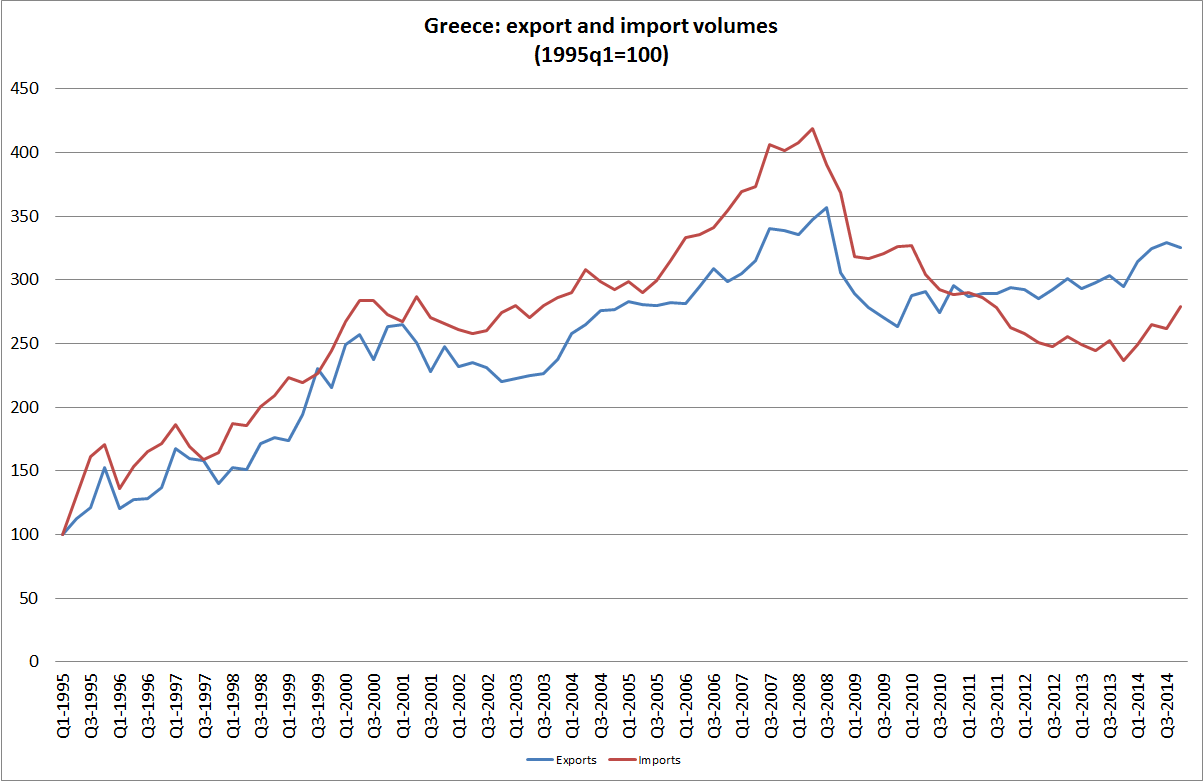
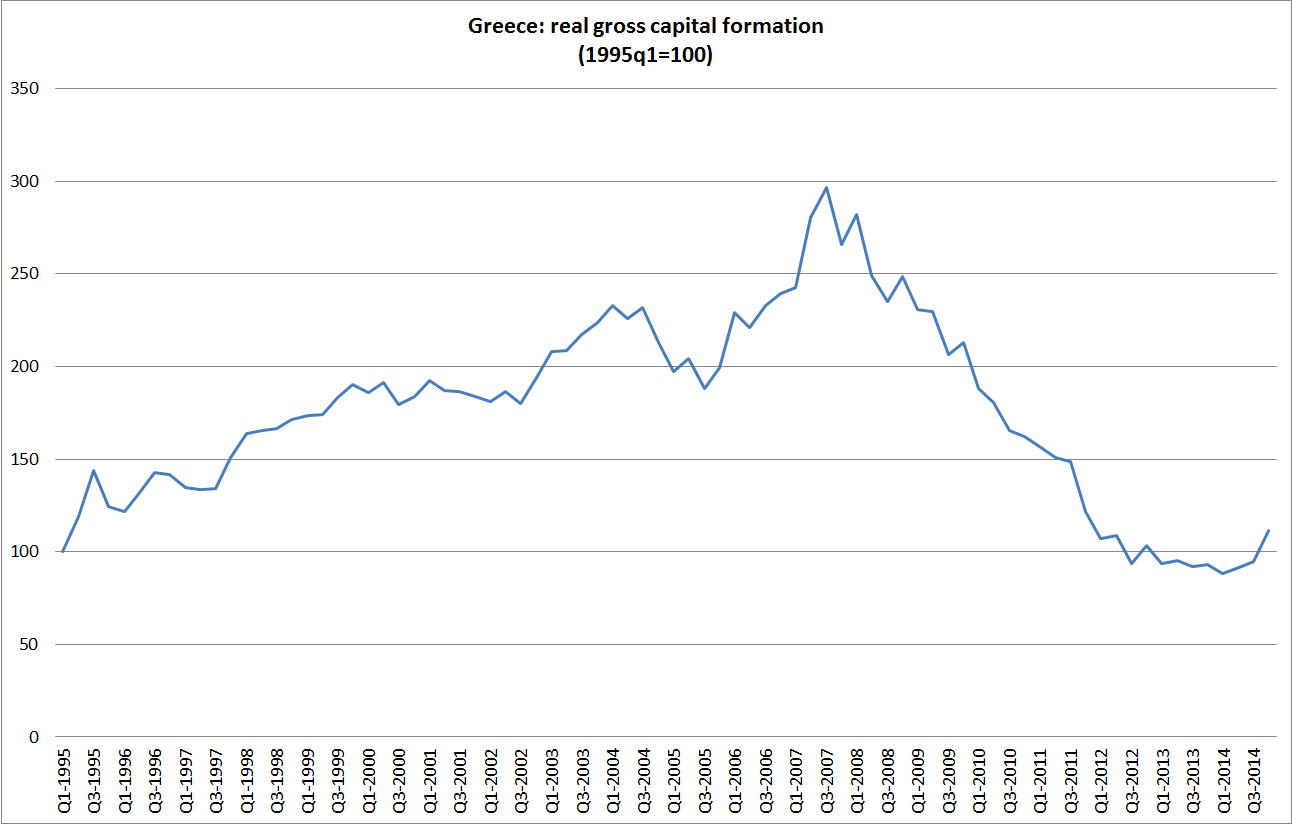
These two charts just look at some of the key aggregates, drawing from the OECD’s quarterly national accounts database.
Exports have been recovering somewhat since the trough after the global recession of 2008/09, but the volume of exports is only now back to 2007 levels. In an economy with unemployment in excess of 25 per cent, there is no crowding out of the export sector.
greece1

Import volumes have certainly fallen, very substantially. That might reflect competitiveness gains, and greater opportunities for domestic import-competing tradables producers. But it looks a lot more likely to mostly reflect a severe compression in demand. The collapse in real investment is particularly telling.

greece2

It is not quite all bad news. Greece has experienced an improved terms of trade over the last few years. But there is no sign of it translating into the sort of robust export growth, or business sector investment, that might enable the external sector to begin to pick up the huge slack in Greece’s economy. Whether that is because firms just aren’t competitive or because of rising uncertainty (or some combination of the two, as seems more likely) isn’t immediately clear. But note that these data go up only to 2014q4 – this was what things were looking like under the previous government and the old programme (for all its limitations). Any uncertainty has only become greater since then.

WIth almost nothing going well in Greek economy, and limited tolerance in the rest of Europe, the status quo surely can’t go on much longer.  One piece of good news today is reports that the IMF is no longer willing to extend and pretend, in this case at least.

Housing loans: big buffers and moderate risks

Paul Glass, of Devon Funds, had an article in the Herald yesterday, containing his agenda for action for New Zealand economic policymakers.   I was sympathetic to quite a bit of his analysis, but this section caught my eye:

It’s a technical area, but the amount of regulatory capital held against residential mortgages should be increased substantially, not just tinkered with around the edges as is currently happening. This would limit the amount of debt available for mortgages.

It is a common view, but I think it is wrong.  I’m not sure what reasoning Glass has behind his recommendation, but Gareth Morgan has argued along similar lines for years.  Morgan argues that  the bank regulatory capital regime (whether Basle I, II, or III) artificially favours lending secured on housing, because the risk weights used in calculating the amount of capital that needs to held in respect of such loans are less than those used in many other types of commercial bank assets.

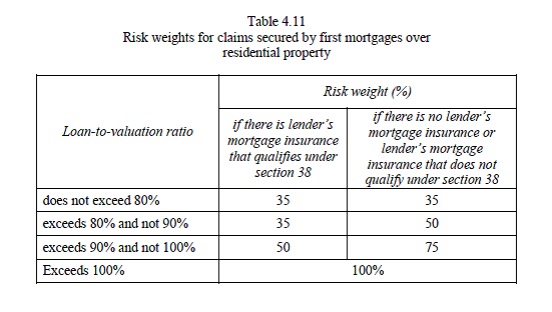
Calculation of risk weights for banks using internal ratings based model (the big 4 banks) is far from transparent, but the easiest way to see the difference is in the rules for other (“standardised”) banks.  Risk weights for residential mortgages are as follows:

riskweights

For loans with an LVR of less than 80 per cent, the risk weight is 35 per cent

By contrast, exposures to unrated corporate borrowers generally have a risk weight of 100 per cent.

But that is because the risks to banks from typical housing loans have been found to be less than those on many other bank assets.  This is not just an observation about boom times, or about New Zealand and Australia in recent decades, it is a result across many countries and many different circumstances.  Housing mortgages initiated by banks themselves, not under regulatory mandates to take on dubious risks, have rarely if ever played a major role in financial crises.  A recent Reserve Bank Bulletin reported on some of the international literature in this area.  A good example was Finland in the 1990s, where after a major credit boom and rapid growth in asset prices in the late 1980s, house prices fell by about 50 per cent in nominal terms, real GDP fell away sharply and unemployment rose substantially.  Banks took losses on their mortgage portfolios, but those losses were modest and not remotely enough to have threatened the health of banks.  The experience in the US since 2007 superficially looks like a counter-example, but binding federal government and congressional mandates played a key role in driving down the quality of new mortgage originations (and hence driving up subsequent loan losses).

It is not surprising that housing loan portfolios are not overly risky.  Lenders have a lot at stake, but they also have solid collateral.  Borrowers also have a lot at stake, especially in countries (like New Zealand and Australia with with-recourse mortgages).  You can escape your debts if you go bankrupt but fortunately (in my view) we don’t have a culture that is overly welcoming to bankruptcy.    And a owner-occupied home is not just a roof over the head, it is often also about a place in a community –  the local school, or sports club, or church.  So most residential mortgage borrowers do everything they can to avoid defaulting on their mortgage, and losing their house, even in very tough times.  There will always be a minority of bad borrowers, and other people who are just overwhelmed by events and the size of a shock.  Recent loans tend to be riskier than older loans –  most of us probably borrowed about as much as we could afford to get into a first house,  but mortgage portfolios age and typically get safer as they do.  And it portfolios of loans –  not individual loans –  that need to be evaluated in thinking about the risk to banks.

By contrast, the typical unrated business loans will have no collateral, revenue streams that depend quite strongly on the economic cycle (profits are more volatile than wages) and limited liability.   The nature of business is taking risk, and sometimes risks pay off and other times they go spectacularly wrong.  Empirical evidence is that a portfolio of unrated business loans is materially risker than a portfolio of unrated residential mortgages.  To be more specific, even in respect of property-based exposures, the evidence is that commercial property, and especially property development exposures, are far riskier (and more likely to lead threaten the health of banks and the financial system) than residential loan books.  Markets will, and regulators should, reflect that in their expectations around capital.

Actual risk-weighting for our big banks is more sophisticated than this description and, as mentioned, much less transparent.  Reasonable people can differ on whether anything is gained by having the IRB approach, or whether it would be better to simply use the standardised approach for all our banks –  all of which are relatively simple.

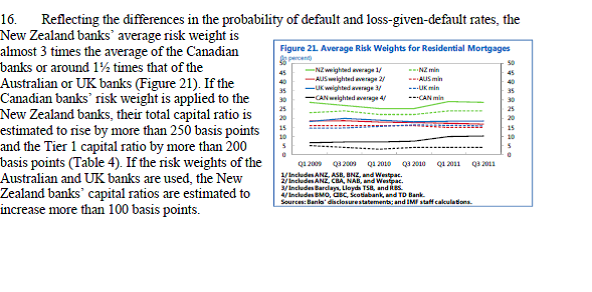
But not only is there good reason for residential mortgage risk weights to be lower than those on many/most commercial exposures, but New Zealand’s risk weights on residential loans are high by international standards.  This IMF piece, done a couple of years ago, contrasted effective risk weights on residential mortgages with those then in the UK, Australia and Canada

riskweights2

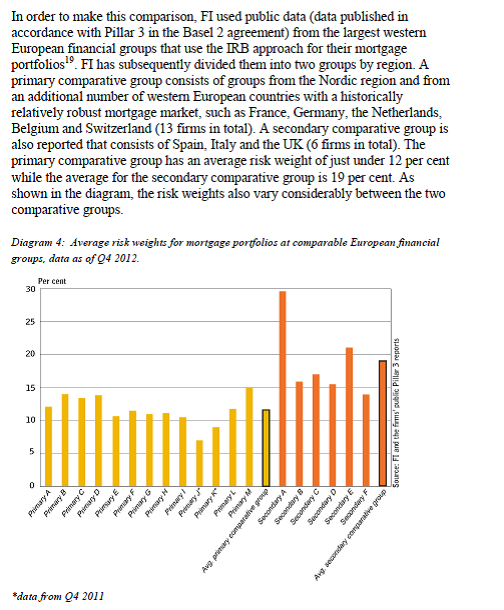
Sweden recently raised the minimum risk weights used by their banks on residential mortgages.  As part of the preparation for that move they produced this document, which includes this chart.  Again New Zealand risk weights on residential mortgage loans are higher than any of the banks in this chart – and are higher than the newly increased Swedish risk weights.

riskweights3

Residential risk weights, or overall required capital ratios, might still in some sense be too low in New Zealand.  But the onus should be on those calling for such increases to make the case that the threat to financial stability is greater than what is already allowed for in the bank capital framework.  The Reserve Bank did stress tests last year looking at the impact of a really quite severe adverse shock, in which nominal house prices fell a long way and unemployment rose substantially (it usually takes both to cause real trouble).  Not one of the banks, let alone the system as a whole, had its capital materially impaired in that scenario.  Those tests may well have been flawed, they may have missed something important, and they certainly won’t have captured everything that mattered, but on the information we have actually available the New Zealand banking system currently looks pretty well-placed to cope with a severe shock affecting the residential mortgage book.  With the stock of credit growing at only around 5 per cent per annum, that also should not be a great surprise.

And since housing seems to be one of those areas where to cast doubt on one possible explanation/solution is to risk being accused of thinking there is no issue or problem at all, I refer anyone inclined to react that way back to my take on housing.

Why not?

The Governor’s press release this morning, leaving the OCR unchanged, was no surprise.

But it continues to seem out of step with the data, and with his responsibilities under the Policy Targets Agreement. The statement has the feel of being written by someone who really really does not want to cut the OCR, but who won’t explain why.  It is if the current level of the OCR were being treated as an end in itself, or being held up in pursuit of some other goal, rather than being a tool for influencing the (rather too low) medium-term rate of inflation.

Fortunately, the statement corrects what must have been a mis-step in John McDermott’s speech last week.  Today the Governor states that:

It would be appropriate to lower the OCR if demand weakens, and wage and price-setting outcomes settle at levels lower than is consistent with the inflation target.

Last week, that criterion was expressed in terms of lower than the “target range”.

But there is no reference anywhere in the statement to the 2 per cent midpoint, even though the Governor and the Minister explicitly agreed that the midpoint should be the Bank’s focus.  And wage and price-setting outcomes are already inconsistent with the target midpoint and have been now for some years.  This statement offers no tangible basis for expecting that to change, just the limp observation that underlying inflation “is expected to pick-up gradually”.  Why?  When?  What is about to change that will now reverse a slide in core inflation that has been underway, more or less continuously, since 2007?  It has to be something more than just a belief that monetary policy is “stimulatory”.

Once again, the Governor anguishes about the exchange rate.  I agree totally with the substance of his references to New Zealand’s long-term economic fundamentals and how out of step the exchange rate is with them (it was the heart of this paper I wrote for the Treasury-Reserve Bank forum on exchange rate issues in 2013).  But……this is a press release about the nominal OCR, not about the real factors that shape New Zealand’s longer-term competitiveness.  And while the Governor observes that “the appreciation in the exchange rate, while our key export prices have been falling, has been unwelcome”, he seems unwilling to take the obvious step in response.  Exchange rates are largely influenced by expected relative risk-adjusted returns, broadly defined.  When New Zealand interest rates have been rising while those in most of the rest of the world have been falling, and we have a Governor who appears very reluctant to cut those interest rates, it is hardly surprising that we end up with a cyclically strong exchange rate.  Cutting the OCR won’t solve the long-term economic challenges:  they are about real factors, not monetary policy. But a strong sense from the Bank that the OCR was heading back towards 2.5 per cent over the coming year, or perhaps even lower, would be likely to make a useful difference.

And why not do so?  Core inflation is very low, the number of people unemployed (and underemployed) lingers uncomfortably high, inflation expectations are falling, farm incomes are falling, credit growth is pretty modest, and so on.  So why not cut?    Of course, no one can be totally certain that, with hindsight, cuts will prove to have been the right policy, but on the New Zealand and global data as they stand today –  and without a compelling case to suggest the inflation picture is about to change materially –  not doing so increasingly looks negligent.  In time, it is the sort of stance that also risks further undermining public and political support for the broad monetary policy framework, and the Governor of the Bank’s powerful position within it.

The Bank’s take on the rest of the world, as reflected in the press release, is both puzzling and disconcerting.  The Governor reiterates what appears to be one of his favourite lines, that trading partner growth is around its long-term average.  This is true, but largely irrelevant.  First, it simply reflects the fact that China is a more important trading partner than it was, and its growth rates are higher than those in our other trading partners.  But even China is slowing, probably quite sharply.  And commodity prices –  a key way the rest of the world’s economy affects New Zealand –  have fallen a lot.

In addition, in almost all of our trading partners – and in most countries that are not our trading partners –  GDP remains well below pre-crisis trend levels. Not all of that is excess capacity, but a significant proportion is likely to be.  Again, the Governor makes much of the low interest rates abroad, but seems not to put much weight on why those rates are so low.  There are all sorts of idiosyncratic factors in individual countries, but across the world interest rates are low and falling not because central banks have arbitrarily put them there (it isn’t some “monetary policy shock” in the jargon), but because markets and central banks both judge that underlying demand and inflation pressures require interest rates be at least as low as they are.  That is a very worrying perspective on the world, not a comforting one.

Finally, the Reserve Bank likes to claim that it is highly transparent, citing for example its scores in papers like this one.  But in many of the more transparent central bank we could look forward to the minutes of the meetings that led to the decision being published. In some central banks, even the range of views is extensively outlined.  The Governor has noted he now makes his OCR decision in the so-called Governing Committee, with his three senior colleagues.  But we do not have access to the minutes of these meetings, even with a lag, or to a summary of the advice provided to the Governor by his wider group of advisers, including the external advisers.  Transparency and open government are not just about announcing and explaining final decisions, but about the process whereby those decisions were reached.  Some other New Zealand government agencies are quite good at pro-active release of background material (for example, papers leading up to the Budget).  It is a model the Reserve Bank could look at emulating.  In the next few days, I am expecting a response from the Reserve Bank to my OIA request for background papers to an OCR decision from 10 years ago.  It will be interesting to see how they interpret the Act is deciding how to respond.

Tomorrow’s OCR announcement

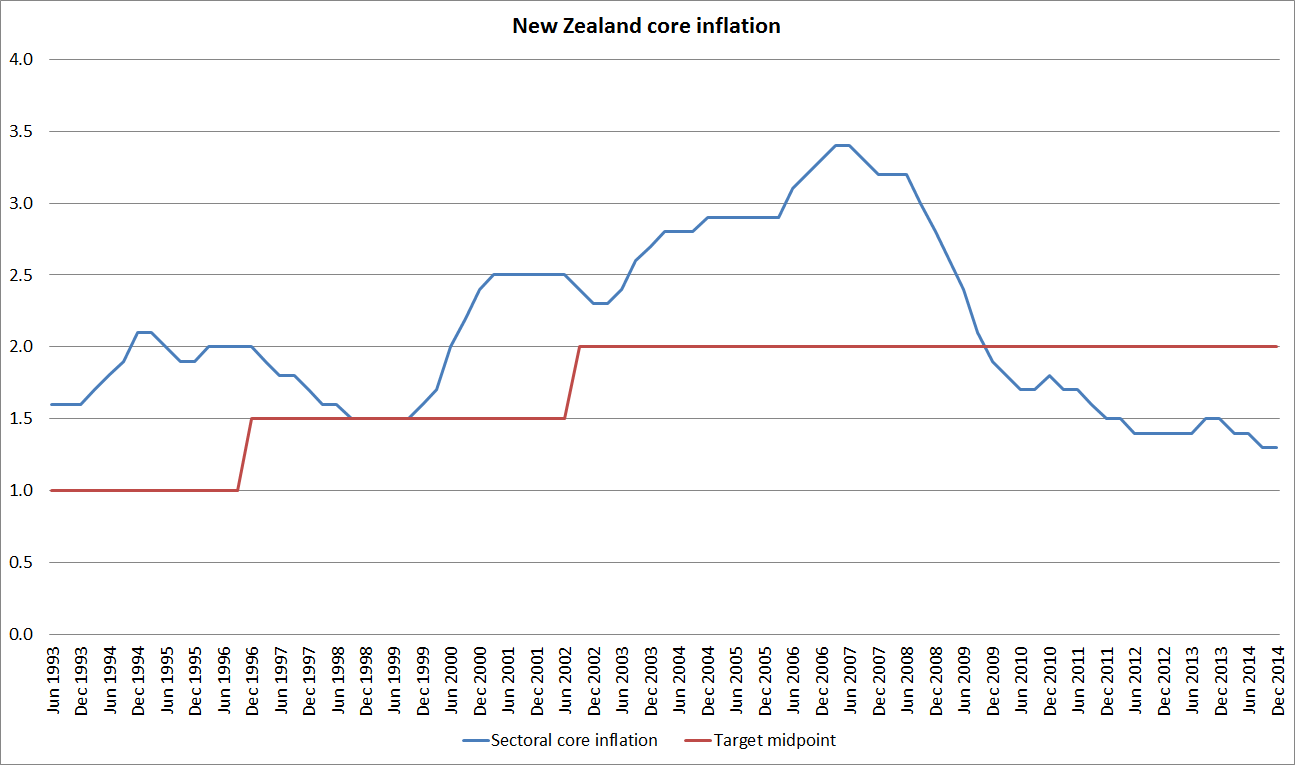
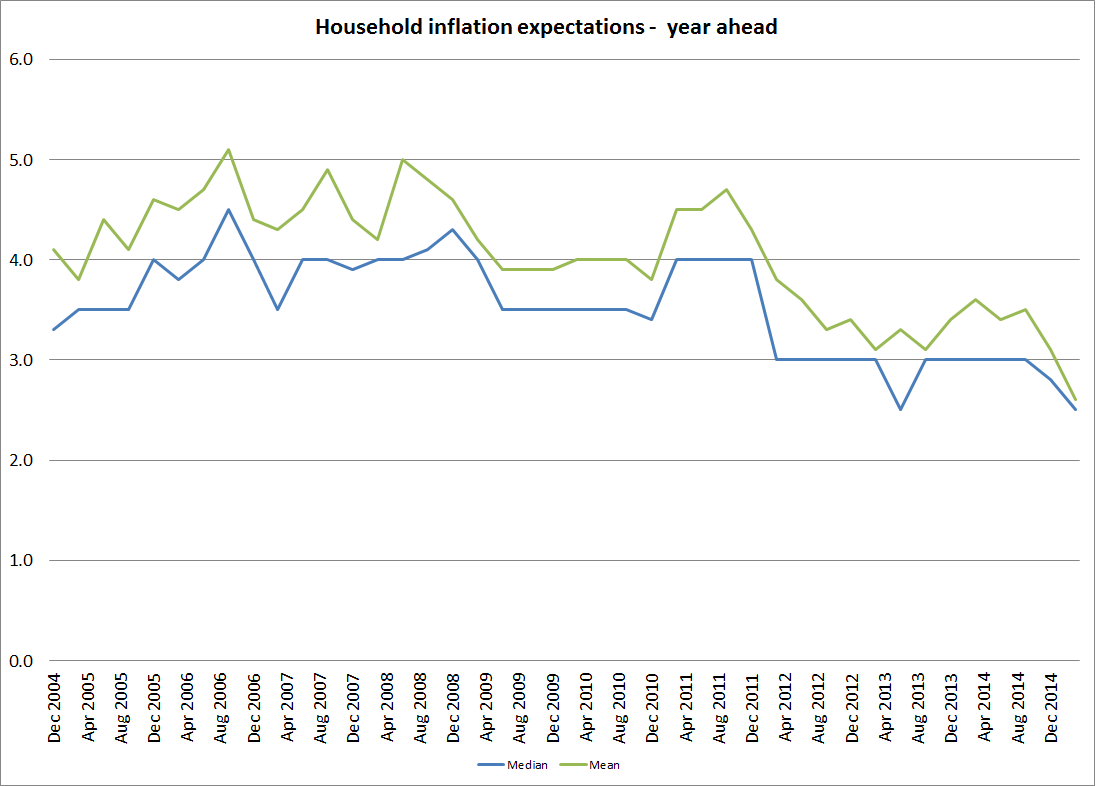
Tomorrow morning Graeme Wheeler, the single unelected official responsible for the conduct of New Zealand’s monetary policy, will announce his latest OCR decision.  That decision will, no doubt, already have been made – lags between decision and announcement are longer in New Zealand than in most other countries, even more so at Monetary Policy Statements  – and the only discussion now will be around wording the one page press release.   Do we really need to say anything this time about future policy?  Will that slight change of words spook the markets?  Is that claim really defensible?  How appropriate is it to comment on another country’s monetary policy?  How does talk about the exchange rate and the medium-term challenges it poses fit in a statement about today’s OCR.  How will local economists read it?  How will offshore markets read it?  Where are the political fishhooks?  Don’t we need a comma there rather than a semi-colon?  And so on. But the heart of the matter is the OCR decision itself – where will the interest rate the Bank pays on (some) settlement cash balances be set for the next six weeks or so.  The key influence on that should be the inflation target: a range of 1 to 3 per cent annual CPI inflation, with a focus on keeping future inflation “near the 2 per cent target midpoint”. The Reserve Bank would no doubt argue that that is exactly what they have been doing.  The target is not about inflation today, it is about “future inflation outcomes over the medium term”.   The Reserve Bank’s published inflation forecasts always show inflation coming back towards the target midpoint a year or two ahead.  They do that by construction, but policy over the last few years has been set consistent with that view.  The judgement was that interest rates needed to be first at 2.5 per cent, and then move progressively higher, to ensure that future inflation did turn out consistent with the inflation target.   Reading through the Monetary Policy Statement from last March, when the OCR increases began, it is quite clear that the Bank expected to see more non-tradables inflation, higher inflation expectations and higher wage inflation, even with the programme of OCR increases they had in mind. But the Reserve Bank was wrong.  There is no particular shame in being wrong, so long as one learns from one’s mistakes.  It isn’t clear that the Reserve Bank has been very good at that.  Of course, what matters is not that so-called headline inflation was 0.1 per cent in the last year.  All sorts of things will throw headline inflation around in the short-term and generally it won’t make sense for monetary policy to try to offset them.  That is why people develop measures of core inflation –  simple ones like CPI ex food and energy (volatile items), trimmed means, weighted medians, and the sectoral core factor model. Core inflation has been falling core cpi So have household inflation expectations household So have business wage and inflation expectations business And dairy prices – a major influence on incomes, and incentives to invest – have been coming in much lower than the Reserve Bank expected, consistent with the pretty relentless decline in global commodity prices. Had the Reserve Bank had known last March how the New Zealand economic data would turn out, I don’t think Mr Wheeler would have seriously considered raising the OCR then.  Had they done so anyway, they would, I hope, have faced very serious questions from their Board and from the Finance and Expenditure Committee: raising the OCR while showing forecasts suggested that core inflation would keep falling even further below the target midpoint looks like something other than inflation targeting. Everyone makes mistakes, and economic forecasting is something of a mug’s game,  But it is the Reserve Bank that chooses what weight to put on its own forecasts, and how far ahead to look.  When they have been so persistently one-sided in their errors, it is surely time to down-weight the forecasts quite considerably.  The “model” –  the way of thinking about what is going on –  just isn’t helping much, if at all. Such one-sided errors aren’t new.  During the boom years, the Reserve Bank was consistently surprised by how strong inflation was.  We didn’t fully understand what was going on, but didn’t correct for that and, as a result, by the end of the boom core inflation measures were above the top of the target range.  The underlying belief that surprisingly strong inflation pressures were just about to end is quite strongly parallel to what seems to be going on now – an apparent wish to believe that whatever has kept inflation down is just about to end. With perfect foresight the OCR would not have been raised to 3.5 per cent. No one has perfect foresight, but knowing what we now know  there is a strong case for starting to lower the OCR now.     As it is, it is not just that nominal interest rates were raised by 100 basis points last year (and not just the OCR, but floating mortgage rates) but that as inflation expectations are still falling, real borrowing rates are still rising further. Perhaps it would be different if there were strong, well-substantiated, reasons to think that underlying inflation pressures were just about to recover strongly –  and I stress “strongly”; it has taken five years or more for core inflation to drift this far below the target midpoint. But there aren’t.  The construction cycle looks to be pretty close to peaking .  Recall that the gearing-up of activity in Christchurch represented the biggest single project pressure on resources in New Zealand at least since Think Big, and yet core inflation just went on falling.  There is no sign of business or consumer confidence pushing up to new heights.  Export commodity prices are weak, especially for dairy –  and the exchange rate is at a level which, if sustained, can only act as a drag on other tradables sector activity.  And while I wouldn’t suggest setting policy on a non-consensus forecast for the rest of the world, no one really sees global activity or inflation posing a material new inflationary risk in New Zealand in the next year or two.  If anything, the deflationary clouds continue to gather. John McDermott’s speech last week was slightly encouraging –  a very belated recognition of just how weak inflation has been, and how little the Reserve Bank (or anyone) really understands about what is going on.  But I noted then this disconcerting line from the speech:

We remain vigilant in watching wage bargaining and price-setting outcomes. Should these settle at levels lower than our target range for inflation, it would be appropriate to ease policy.

In 2012, the Governor and Minister explicitly, and consciously, decided to include a focus on the target midpoint in the PTA.    It is the midpoint, not the bottom of the target range which the Bank should be focusing on. I can really only see one argument against an OCR cut, a line which I’ve seen reported in various media: the housing market, and what lower interest rates might do to house prices.  There are several points worth making briefly here:

  • In its monetary policy, the Reserve Bank is explicitly not charged with managing house prices.  The only target for monetary policy –  agreed with the Minister – is for the CPI.  Neither existing house prices nor land prices are in the CPI, and the CPI’s treatment of housing is one the Reserve Bank has endorsed.
  • To the extent that rising house and land prices in some parts of the country reflect the interaction of regulatory obstacles and population pressures, they are real relative prices changes –  not something that, even in principle, monetary policy should be paying much attention to.
  • House prices in much of the country have been flat or even falling.  There is no evidence of some generalised speculative dynamic, let alone a credit boom.
  • Any possible threats to future financial stability –  the case for which the Reserve Bank has not yet convincingly made – should be dealt with through prudential regulatory tools.  Higher required capital ratios, or higher risk weights on housing loans, would be an orthodox response if a cost-benefit analysis suggested that larger buffers were required.

Finally, the Reserve Bank does not have an explicit “dual mandate”.  But any time a central bank engages in discretionary monetary policy – as opposed to, say, a long-term fixed exchange rate – it is assumes such a responsibility de facto.  Changes in the OCR affect output and employment in the short to medium term.  Perhaps I’ve completely lost perspective, but it disconcerts me how little public attention the Reserve Bank gives to the number of people unemployed (and underemployed).  At 5.7 per cent, the unemployment rate is still well above normal, and underemployment measures in the HLFS have not come down much at all.  The decision to hold the OCR is not just a decision between higher and low inflation.  If it were, there would still be a case for a cut.  But the cut/hold choice is also one between a faster reduction in the number of people unemployed and a slower reduction.  Involuntary unemployment is a blight, that scars families and individuals, and often has permanent adverse economic effects on the unemployed.    When there is so much  inflation leeway –  inflation so far below target, with few looming inflation pressures – the plight of the unemployed should get more attention from the Reserve Bank, and from those who hold it to account.

Another potential “blunder of our governments”?

I commented the other day on possible New Zealand cases of government blunders.  My former colleague, Ian Harrison, reminded me of his work on another possible candidate, the Building (Earthquake-prone Buildings) Amendment Bill, currently before a Select Committee, which is due to report by the end of July.  Ian’s trenchant assessment of MBIE’s work leading up to this bill made pretty sobering reading the first time I went through it, and it was no less disquieting the second time.  I’ve seen no sign of any sort of substantial rebuttal to the thrust of the analysis Ian presents.

I’m certainly not indifferent to earthquake risk.  I live on the side of a hill in Wellington.  And my parents’ apartment block was severely damaged (and later demolished) in the February 2011 earthquake.  But this bill just does not look like the fruit of good public policy making, cost-effectively addressing real and substantive risks.  Perhaps the work of the Select Committee might yet limit the prospective damage and costs?

Eric Crampton discussed some of Ian’s earlier work a couple of years ago.  This suggestion made a lot of sense:

There’s a good case for having liability rules or standards for buildings that the public is forced to attend by the state: courtrooms, prisons, public licensing offices and the like. We can’t use a revealed preference argument around risk acceptance for those venues. But for other buildings where entry is voluntary, what’s wrong with mandating signs advising the public that “Engineering assessment suggests this building has (very low, below average, average, above average, seriously high risk) of falling down in case of earthquake. Entry is at own risk.”

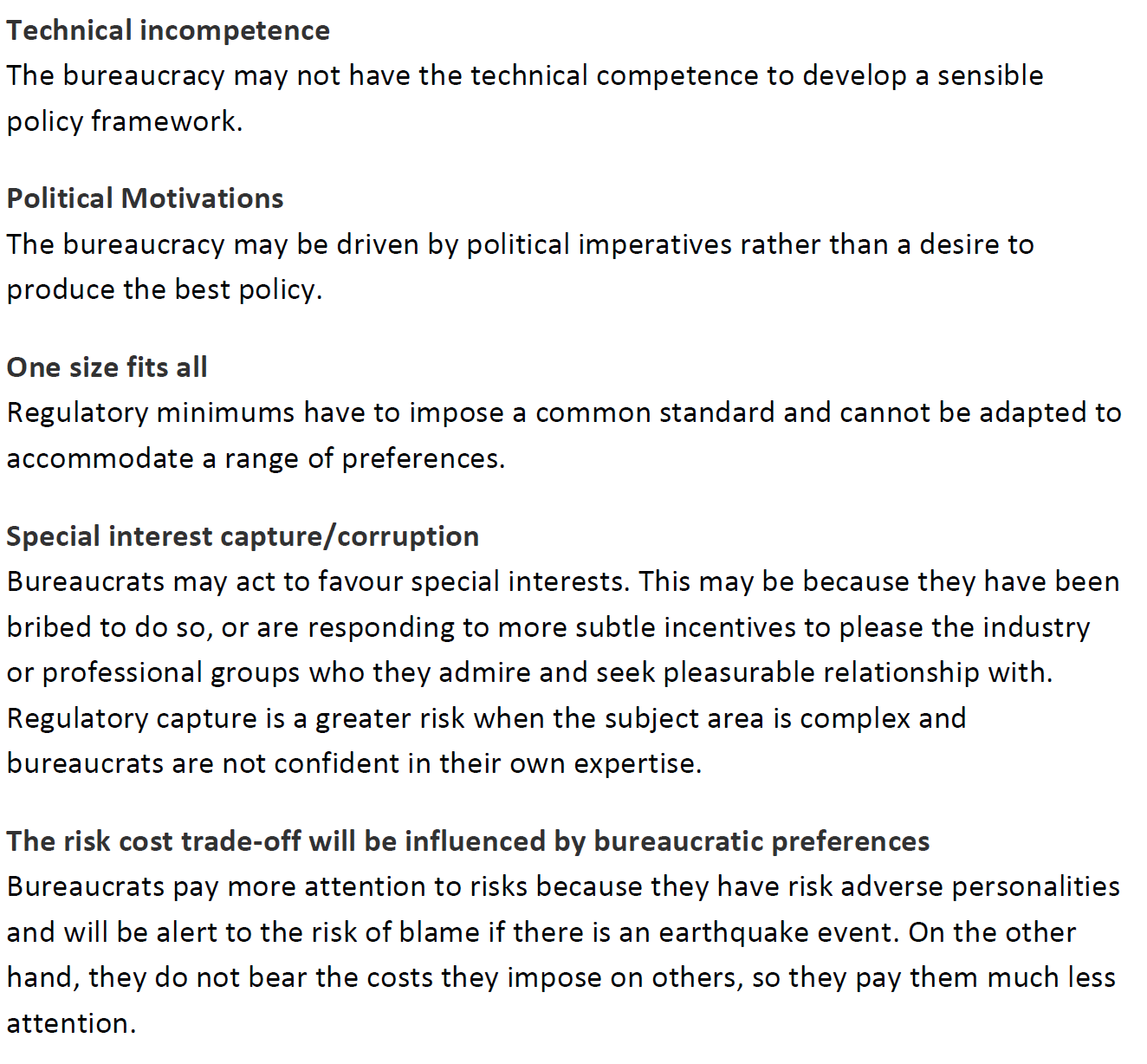
Ian’s focus is bureaucratic failures. I particularly enjoyed this, perhaps somewhat jaundiced, list of factors that lead official agencies, however well-intentioned, towards bad outcomes.

harrison2

harrison1

As King and Crewe’s book reflects, officials will make plenty of mistakes, but cases that rise to the level of  “blunders” hardly ever result from the efforts of officials alone.

Hidden in plain sight?

Peter Wallinson’s Hidden in Plain Sight (“what really caused the world’s worst financial crisis and why it could happen again”), had been sitting for a couple of months on the unread pile on the coffee table, when I found a reference to it on one of my favourite economics blogs/newsletters.  David Warsh’s Economic Principals is a weekly must-read, for his ability to put together succinctly enlightening perspectives on a range of issues in economics, including the history of economics.  So when, last week, in the middle of a column devoted to the American Enterprise Institute, I found a sneering attack on Wallinson, I decided it was time to read the book.  Without taking time to engage the substance, Warsh drips contempt:

He is, however, a lawyer, with no sense of what constitutes a satisfying economic explanation. What makes him a crank is the affable certainty with which he asserts a partial truth explains the whole.

No sensible analyst thinks that political pandering to poor people is a sufficient explanation of the crisis.

The book clearly polarises readers – when I checked on Amazon this morning, readers’ ratings were roughly evenly split between five stars and one star, with almost nothing in between.    That is something of a pointer to how much is at the stake in ongoing debates of how best to understand the causes, and handling, of the 2008/09 crisis.

So what is the essence of Wallinson’s story?    It is that without repeated, sustained and frighteningly successful US government efforts – under both Clinton and Bush administrations – to promote easier access to housing credit, particularly through the agencies (Freddie Mac and Fannie Mae), there would most likely have been no serious US financial crisis.  Wallinson documents how government mandates compelled the agencies to drive down their lending standards, and how because of the dominant role of the agencies in the market, this contributed to a sustained deterioration in the quality of new housing loans being made across the United States.  As late as 2004, new mandates were imposed, forcing the agencies to meet higher low income lending targets with loans for new purchases, excluding any refinancing or equity withdrawal loans.

Wallinson also explains how the distinction between prime and subprime was progressively eroded, and yet how difficult it was for anyone to be fully aware of the scale of what was going on.   Even in the early days of the crisis, data were interpreted as suggesting that the agencies had very little subprime exposure, and indeed that subprime exposures were a small part of the stock of housing credit.  But in fact commercial data providers treated all mortgages purchased by the agencies as prime by definition – unless they were purchased from explicit subprime lenders.   In other words a sustained deterioration in the quality of the agencies’ loan books was largely masked from outside observers –  Wallinson, who had worked on agency issues for some years, notes that he was himself in this category.

And he deals with an argument that the agencies themselves were responsible, pursuing profit-maximising strategies at least during the boom years.  In fact, the agencies constantly struggled, and often only narrowly met, the ever-increasing minimum legal requirements for the share of lending to low and below-median income borrowers.    If loan losses on agency-held mortgages were a little less bad than those in the market as a whole, that is also unsurprising  –  given the dominant position of the agencies, and their low (implicitly government guaranteed) costs of funds, they could typically out-compete other purchasers and get the best (least bad) loans available in any cohort.      The argument isn’t intended to elicit much sympathy for the agencies or their shareholders, who fought doggedly to protect their political position and government preferences, but they increasingly found themselves in an ever more threatening vice.  Their political position depended on being able to sell themselves as facilitating the “American dream” of widening home ownership, and this vulnerability was increasingly exploited by politicians who did not (or would not) appreciate the scale of the risk they were driving into the system.

I don’t agree with everything in Wallinson’s book, but that doesn’t detract from its value.  I think he overstates the importance of fair value accounting requirements – in a panic, fear and uncertainty will drive equity prices deeply lower, regardless of the basis on which institutions are formally valuing the assets in the spotlight – and I’m still not persuaded that, even given the Bear Stearns precedent, Lehmans should have been bailed out.

But if you are at all interested in the 2008/09 US crisis, this book is well worth reading.  It matters to New Zealand oriented readers for at least two reasons:

  • The crisis was a hugely influential event, not just on near-term economic developments back then, but in influencing the global debate about markets, banks, regulatory policy, and the role of government.  It will be a reference point for decades to come, and which narrative dominates will matter.
  • Graeme Wheeler’s perspectives on the New Zealand housing market seem very shaped by having lived in the United States through the boom and bust years.  But if the experiences of other countries are to shape policy in New Zealand –  and it is very important that we do learn from other countries’ experiences –  it matters greatly that we understand those experiences correctly.

The conventional wisdom of recent years has been that the crisis was primarily a result of flawed private market behaviour, with the world pulled back from the brink by the heroic efforts of various government actors.  The understandable mood of “never again” translates into a bigger role for government – more regulation and more regulated entities.  Governments protect the public from the (mostly unwitting) predations of inadequately regulated private markets, and the too easy ebbs and flows of private capital.  But an alternative story – to which Wallinson’s story contributes – would emphasise the role of government choices in generating the conditions that made severe crises likely in the first place.  For example, the US crisis would never have occurred, on the scale it did, without the sustained government efforts to drive down lending standards and expand credit, all made possible by the role of the extraordinary role that state has long had in the US market for housing finance.  And the two other worst housing collapses of recent years –  Spain and Ireland – would probably never have happened on anything like the scale they did without the decisions of the respective governments to adopt the euro, and hence apply interest rates not set to reflect domestic economic conditions.

No single story is ever the whole explanation of complex phenomena, and the two perspectives in the previous paragraph are deliberately sketched out in slightly caricatured fashion

Of course, John Taylor would add another strand to the “government failure” story, with his emphasis on the Federal Reserve’s departure from the prescriptions of the Taylor rule in the early 2000s.  I don’t find that particular argument very persuasive, and indeed in some respects I think it helps shed light on the Wallinson story.  The US was far from being the only country where monetary policy departed from the prescriptions of a Taylor rule.  For example, Willy Chetwin and I showed a few years ago that New Zealand’s OCR had for some years in the early-mid 2000s been set below what a New Zealand Taylor rule (using the Reserve Bank’s own estimates of the output gap and neutral interest rates) would have suggested.    The US was also far from the only country exposed to foreign capital inflows pursuing yield.  But the US experience of housing loan losses was uniquely bad.  It points to something unique to the United States as being a key part of any explanation.  Statutory mandates to drive lending standards ever lower looks like a pretty compelling element of any successful story of the causes of the crisis.  Fortunately, we’ve had nothing similar in New Zealand…or in Australia, the United Kingdom, or most other countries.  That doesn’t mean we can’t have big sustained falls in nominal house prices here, but it might mean the narrative around the US-centred crisis might not shed much light on vulnerabilities here.