Case not made: investor housing consultation

The Reserve Bank has been out consulting, I think for the third time, on proposals to differentiate clearly, in bank capital requirements, between loans for investment properties, and loans to owner-occupiers.   I made a fairly short high-level submission on their consultation document.  It is here:

housing consultation document 13 April 2015

The thrust of my argument is “case not proven”.  The Bank argues that, for otherwise similar borrower/loan characteristics, loans for investment properties are materially more risky than those on owner-occupied properties.  But they present surprisingly little data –  none from New Zealand, since we’ve had no material housing loan losses since the 1930s –  and what data are presented are largely taken as is, with no attempt to think seriously about how the New Zealand investor property market might be similar to, or different from, those in other countries.  In particular, the longstanding prevalence of small investors  –  which arises because our tax system treats them fairly neutrally with other potential holders –  is different from countries that often have large corporate holders of residential properties, and perhaps a rush into buy-to-let by individuals very late in the boom.

The Bank is quite open about the fact that its proposals would facilitate the imposition of eg a investor-specific LVR speed limit.  That is presented as an advantage, but as they have not consulted on the benefits and pitfalls of such a further intervention –  on top of the avowedly temporary initial LVR limit –  it cannot be considered as a public benefit at this stage.  The latest iteration of the proposals has the feel of something more focused on making an investor speed limit work, than on remedying material deficiencies in the New Zealand bank regulatory capital framework.  New Zealand already has among the very highest risk weights on housing loans of any advanced countries and, as the Reserve Bank has recently acknowledged, international experience is that housing mortgages are rarely central to even very serious financial crises.

Makhlouf on migration

The Dominion-Post reports this morning on a speech given yesterday by the Secretary to the Treasury, Gabs Makhlouf.  I might come back to the speech when I’m finally free of institutional constraints but, for now, it was his comments on migration that caught my eye.  An extract:

For New Zealand, many of the benefits from high net migration levels are similar to those that come from offshore investment.

Migration helps to lift our productive capacity – it enables the economy to grow faster by increasing the size of the workforce, in much the same way that foreign capital allows us to grow faster than domestic savings alone would permit.
Right now, at a time when international demand for some commodity products is weak, strong net migration also has the benefit of bolstering demand for goods and services at home.

Like foreign investment, migrants also bring new skills, new ideas and a diversity of perspectives and experiences that help to make our businesses more innovative and productive.

And perhaps most importantly, migrants often retain strong personal and cultural connections to other parts of the world, which opens up, and helps us to pursue, new business opportunities. We are in a pretty incredible position in this regard, with so many New Zealanders – around 1 million people – living overseas, and so many people who live here having been born in another country.

Contra Makhlouf, my proposition, which I will elaborate on over coming months, is that inward migration of non-citizens is rarely, if ever, even part of the answer (whether proximate or more fundamental) to underlying economic problems.  In relatively developed countries, per capita incomes of native populations have very rarely been lifted by immigration.  One way to see that is to look at incomes between pairs of advanced countries over very long periods: over say the last 100 years countries which have received lots of immigrants have not typically done better than those which did not.

And when non-citizen immigration has boosted native incomes it is usually because the immigrant culture takes over and swamps what was there before  (one could think of European migration to New Zealand, Australia, Canada, and the United States in this light relative to the pre-existing indigenous cultures).  Cultures embed a lot of the keys to economic success.  When it works well, large scale inward migration of non-citizens [I labour the description to be clear that I’m not talking about the comings and goings of New Zealanders] is a complement to economic success that was already well underway, not a contributory cause.    Be it late 19th century New Zealand or the United States, Singapore or Dubai today, or 20th century Ireland  (where people rationally left during the dark economic years, and large inflows occurred only after rapid sustained growth in GDP and productivity was already well-established) the longer-term economic benefits are almost all to the migrants,

Immigration allows the benefits of a country’s economic success to be shared more widely.  It might be a path to success  and prosperity for the migrant (if they didn’t expect that they would not migrate) but shouldn’t be seen as a path to lifting the innovation and productivity of New Zealand people and firms.  In Australia, as orthodox a body as the Productivity Commission reached pretty much that conclusion almost a decade ago.

New Zealand is not an economic success story, and has not been so at least since World War Two.  Finding a path that begins sustainably closing the income and productivity gaps to the rest of the advanced world, should come before governments carry on bringing in yet more people, even as our own people are choosing to leave.

A forgotten result of World War One

From 2014 to 2018 countries like ours are marking the centenary of successive phases of World War One.  For New Zealand, next month’s commemorations of the 25 April 1915 Gallipoli landings may well be the high point –  complete, no doubt, with rather saccharine portrayals of the enemy, devoid of any reference to the systematic Turkish massacres of their own Armenian subjects which, rather hauntingly, date from 24 April 1915.

But this is a blog about economic matters.  And for New Zealand, World War One marked the end of the Gold Standard.  Like the other British Dominions, New Zealand did not have a central bank at the time.  Commercial banks took deposits, made loans, and issued paper banknotes.  By law, these had to be convertible into gold, on demand, and banks held substantial gold reserves.  With the UK (and Australia) also on a Gold Standard, this established a very stable series of fixed exchange rates against the currencies of the economies most important to New Zealand.

There had been a departure from the gold convertibility provisions earlier, at the time of the BNZ crisis of 1894 –  convertibility was a double–edged sword, helping to build well-founded confidence in the value of deposits, but potentially exacerbating a crisis if a contagious run on banks looked like taking place. But that suspension was, and was always envisaged as, temporary.

When World War One broke out, New Zealand’s Parliament had already been considering banking legislation which would allow the Government, in an emergency, to suspend the convertibility into gold of notes issued by commercial banks. and declare bank notes themselves legal tender.  We can easily read the contemporary accounts thanks to the National Library’s wonderful Papers Past. The proclamation declaring that New Zealand was at war was not read until 5 August, but on 4 August the banking amendments were passed under urgency in view of the imminence of war.  The legislation also gave the government power to prohibit the export of gold during the period convertibility was suspended.

The next day, as part of New Zealand’s entry into the war, convertibility was suspended and gold exports were prohibited.  The suspension was initially for one month, but it was later extended.   New Zealand bank notes were never again convertible into gold as of right.  LIke many things, it was quite unforeseen in 1914.

What followed was a curious arrangement, which appears to have confused some eminent modern students of historical monetary arrangements (including Barry Eichengreen in his great book Golden Fetters).  Unlike most Gold Standard countries, New Zealand never resumed any sort of gold convertibility requirement after the war was over (unlike, say, the UK which did so in 1925).   Indeed, at least until the negotiated devaluation of January 1933, and perhaps until the opening of the Reserve Bank in 1934, there was no direct or indirect government control over the issuing, or management, of money in New Zealand.  In the jargon, there was no nominal anchor, only customary practice.  In fact, until the onset of the Great Depression, the banks managed their lending policies to ensure that notes were convertible into sterling (but not to gold) at par.

Good institutions – and the lack of them

I’ve read two very different books lately about societies in which the powerful plunder, while the legal systems offers few reliable protections against such abuse.

The British novelist Rana Dasgupta now lives in Delhi and has written Capital.  The title of this series of vignettes is a play on words –  Delhi is both the political capital of modern India, and it is a city in which moneymaking and trading on the power of political and bureaucratic connections is rampant.   India isn’t a country I know that much about, and the book was both fascinating and disconcerting. India has had democratically elected governments since Independence – in contrast, say, to  Burma, Bangladesh, and Pakistan – but it is scarcely a credit to democracy.

Written in a very different style, US academic Karen Dawisha’s Putin’s Kleptocracy is a relentless detailed account of the way Vladimir Putin has played the Russian system, to enrich himself and his cronies, as part of the complex mesh of, sometimes extremely brutal ways, he has established pretty pervasive control.  At best, Russian can now be described as an authoritarian quasi-democracy. Dawisha’s UK publisher refused to publish the book, apparently in fear of the weight of the onerous UK libel laws falling on them, but Simon and Schuster in the US have published it.

Both books are recommended, but they are very different.  Dasgupta is an easy read –  a sometimes dizzying series of pictures of people, his own Indian family included, that illustrates what modern Delhi has come to represent.  For 450 pages of text it has 4 pages of footnotes.  Dawisha, by contrast, has 350 pages of text and almost 70 pages of bibliography and notes –  the detail is what makes the case against Putin so strong.

Dasgupta himself draws some parallels:

“Earlier in this book we saw how fondly and often India was likened to America.  But for the most part, this was pure ideology. India has much more obvious similarities to America’s alter ego: Russia.  India and Russia had both had systems of state-run capitalism that had foundered by the 1980s, generating a new class of clever, underground entrepreneurs who came into their own after the old systems – almost simultaneously – collapsed.  Both countries developed systems, after that point, in which the existence of electoral democracy did not prevent the emergence of a class of oligarchs who used the political system to take control of their countries’ essential resources.  Both of them had capital cities, Moscow and Delhi, where the people watched with resentment as a small number of people used the immense power of large-country politics to their immense advantage.”

A year on from his book, with all the subsequent adventurism in Ukraine, this may be a little unfair to India.  But I was struck more by the contrast between these two countries, and the advanced Northern European tradition of which New Zealand is part.  No country has been totally free of corruption, and constant vigilance is required against, for example, sweetheart deals with those who cosy up to the powerful.  But it is difficult to see how India or Russia could reach even New Zealand’s (barely) First World living standards without far-reaching changes in the political and legal systems.  And, as always, entrenched interests, that don’t arise from nowhere, are a powerful obstacle.  And perhaps that is why, with few exceptions, the countries that were rich 100 years ago are still the rich countries today, as Ed Glaeser illustrated a few years ago.

New Zealand’s economy in World War Two

I’ve been reading, in quick succession, the three non-military books in the New Zealand official war history series:

F.L.W. Wood’s The New Zealand People at War: Political and External Affairs

J.V.T. Baker’s War Economy, and, in two volumes,

Nancy Taylor’s The Home Front

The books emerged quite slowly. Michael Bassett records that the 1950s Holland government wanted the history series to stick to military matters, and it was not until the Nash government that Baker and Taylor were commissioned.  Even then, Taylor’s work wasn’t published until 1986.

Read together they are a fascinating set of accounts of the civilian side of New Zealand’s involvement in the war.  My prime interest is the economics volume, but I was also struck by, for example, how far-reaching press censorship was in New Zealand –  often apparently to avoid political embarrassment, more than to safeguard military secrets.

War Economy is full of details –  perhaps too many in places, but it is detail that is hard to find elsewhere.  What it lacks is much of an analytical framework, not supplied in other economic histories of New Zealand (or, as far as I can tell, in scholarly articles).  If our universities were not now almost entirely devoid of economic historians, a modern analytical history of the period, drawing in more cross-country comparative analysis, would be a great opportunity for someone.

Two things from the period did stand out.

The first is that, while New Zealand, devoted almost as much of its GDP to the war effort as any of the major combatants (at peak similar to that in the UK, although the UK held the peak for longer), material living standards for the civilian population seemed to remain relatively high –  notably the quality of the diet, access to petrol etc.  Perhaps that partly reflects just what a rich country New Zealand then was.  Using Angus Maddison’s data:

Featured image

New Zealand’s GDP per capita in 1939 was second highest of those countries shown.  It may have been easier to devote a larger share of GDP to the war in a rich country like New Zealand than in a relatively poor one like the USSR, where a larger share of resources would have to have been devoted to subsistence.

And the second point is the dramatic transition, from New Zealand being on the brink of default in 1939, to New Zealand being, in effect, defaulted on just after the war.  In 1939, in the wake of the imposition of exchange controls, Walter Nash emerged from a humiliating mission to London, with a very onerous schedule of overseas debt repayments.  If the war had not been looming –  which made the British government keen on maintaining good relations with the Dominions –  it is quite possible that New Zealand would have been unable to rollover maturing debt at all, probably ending in a default to external creditors.  By just after the war, New Zealand  –  having markedly reduced its external debt ratios during the war – made a substantial gift to the UK: in reality, Britain was quite unable to meet all its obligations and needed some of them written down.

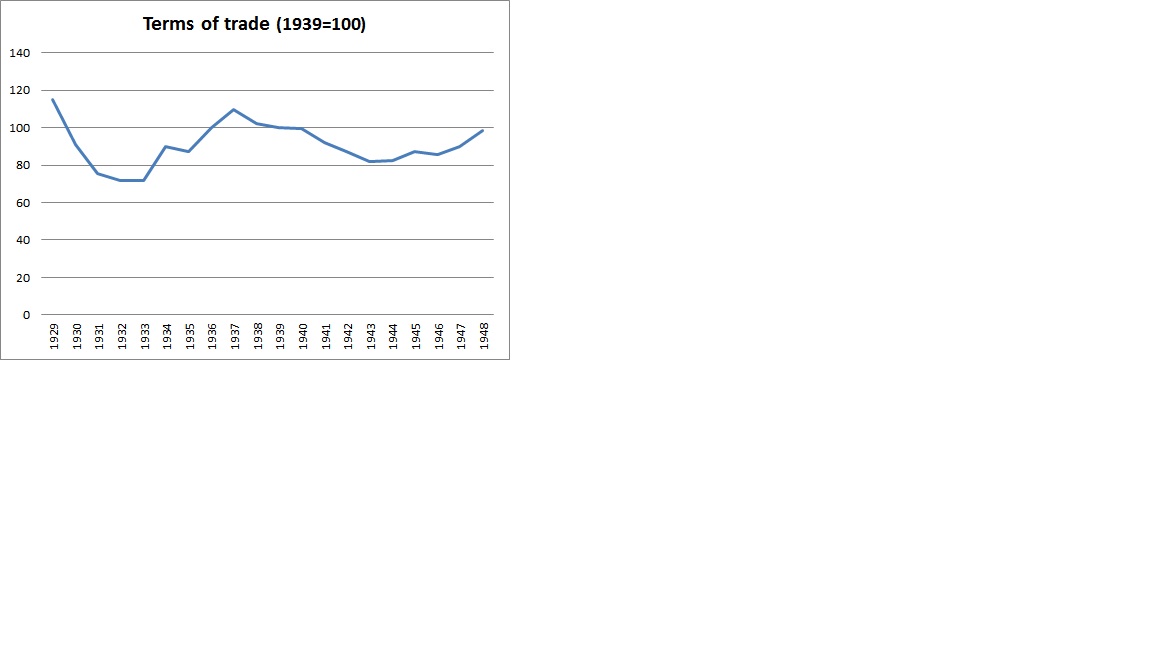
In a paper a couple of years ago, some IMF economists looked at examples of countries that had markedly reduced their overseas debt.  The New Zealand experience during WWII was as stark as any of those reversals, but is too little studied.  It seems to have mainly resulted from a determination to pay for as much of the war as possible from taxation, together with the controls and rationing that limited private sector consumption and investment.  What it was not down to was any strength in New Zealand’s terms of trade:

Terms of trade (3)

The terms of trade fell during the war years –  our import costs rose as global inflation increased, but there was little adjustment in the prices of the agricultural/pastoral products New Zealand sold to Britain.

A  fascinating phase in New Zealand’s economic history, to which I may return.

Why New Zealand languishes

New Zealand’s long-term economic underperformance, and what can be done about remedying it, should be one of the most keenly-debated topics in New Zealand public life.  Sadly, it isn’t.  Too many of our political and economic elites seem to view it as something for the too-hard basket, or perhaps are simply reconciled to declinism, or implicitly take the view that “New Zealand is still a nice place to live, and me and my children will be fine –  after all, they can always leave”.

I don’t think that is good enough.

To the credit of The Treasury, they have sometimes sought to engage with these issues.  A couple of years ago, they ran a series of lunchtime presentations for staff, inviting in various people to offer their views.  I was one of those invited –  and the invitation encouraged me to be a little provocative.  As it happens, the presentation itself never happened, but I took the opportunity to write down what I would have said, in pretty much the style I would have said it.  I’ve distributed copies to a wide range of people, then and subsequently.

The very short version of the story: New Zealand had an abundance of productive land, made valuable by the urbanisation of Britain and the emergence of refrigerated shipping in the late 19th century.  That natural endowment, and the associated technological innovation, was  –  and is – enough to support very high living standards for a quite limited population.  Since World War Two, New Zealand has had no big new opportunities –  unlike, say, Australia’s mines or Norway’s oil – and our governments haves repeatedly handicapped the country’s prospects by pursuing large programmes of inward migration.  Particularly in the last 25 years, governments have been actively hindering adjustment  –  more than replacing the many New Zealanders who have responded to market opportunities and left.  Growing population has rarely, if ever, been a basis for successfully lifting per capita income.

I’d write some things a bit differently now, and I will flesh out many of the points in later papers and entries on this blog, but for now here is one hypothesis for

Why New Zealand languishes

As ever, I will welcome comment and debate.