Reforming the governance of the Reserve Bank

The Green Party leader, James Shaw, has just put out a press release highlighting the Reserve Bank’s persistent forecasting errors, which have had the effect of keeping the number of people unemployed higher than it would otherwise have been in recent years.  James Shaw uses that record to reinforce the argument that too much power is vested in a single unelected individual, the Governor, and that the governance model of the Reserve Bank should be reformed, as (for example) The Treasury has previously argued.

As I have noted previously, the Bank’s serious forecasting errors are not primarily the fault of the single decision-maker model.  There was, unfortunately, widespread support at the Bank last year for the OCR increases, and it would have been hard even for a more independent committee to have resisted the push for the early increases.  But the succession of policy mistakes (eg having twice had to reverse OCR increases in the last five years) does reinforce the more fundamental arguments for a better, and more conventional, governance structure for the Reserve Bank.  It is not governed the way most central banks are, or the way most New Zealand government agencies are.  Even among central banks, only the Bank of Canada puts the legal authority to set the policy rate with the Governor alone, and the Bank of Canada Governor has a much less extensive range of powers than Graeme Wheeler (and his predecessors) have had.

I outlined my own case for governance reform here.

The Reserve Bank itself has been working on the issue.  I lodged an OIA request some time ago for

copies of any papers done by the Reserve Bank on statutory governance issues in the last two years  (i.e. since 1 July 2013).  To be specific, I am requesting:

  • any papers (draft or otherwise) provided to Treasury or the Minister of Finance on these issues
  • any papers provided to the Governor or the Governing Committee on these issues
  • any internal working or discussion papers on governance issues
  • any file notes or other records of discussions on these issues between the Governor, and the Secretary to the Treasury and/or the Minister of Finance.

The Bank has just extended my request for another month, telling me that they have found 9786 records or documents they need to check.  I suspect that means the initial search wasn’t very well-targeted, but there should be a few interesting documents to emerge in a month or so.  It will be interesting to see what model of change the Bank would prefer, if and when change comes, and their assessment of the pros and cons of the various approaches to dealing with the governance of the wide range of issues the Bank is given responsibility for.

It is a shame that the current government appears unwilling to address the issue.  It is one of those areas where change will almost certainly come, to bring Reserve Bank governance into line with modern public sector practice and the current responsibilities of the Bank.  It won’t surprise readers that I’m not a natural supporter of many Green Party issues, but I give them considerable credit for continuing to chip away at this issue.

Dairy lending and the Minister of Finance

I saw this Bernard Hickey piece yesterday afternoon, and have been mulling on it since.

Finance Minister Bill English has admitted the Government and Reserve Bank are in discussions with banks to ensure they don’t prematurely force dairy farmers into mortgagee sales that could trigger a dangerous spiral lower in land values.

If accurately reported (which it may not be), it is somewhat disconcerting.  What bothers me is the notion that the Minister of Finance (and perhaps the Governor of the Reserve Bank, although there is no confirmation of any involvement by the Bank) thinks he knows better than banks how to run their own businesses. Ministers of Finance often aren’t very good at presiding over the government’s own businesses – Solid Energy or Kiwirail anyone?

During the 2008/09 recession I did quite a lot of work at Treasury on dairy debt. Debt, and dairy land prices, had run up extremely rapidly in the previous few years, and there was concern about what the fall in commodity prices, and the seizing up in international funding markets, might mean for the dairy sector as a whole, and for those who financed them. I reminded the perennial optimists that the long-term real average dairy payout had been around $4.50 and that it would seem unwise to be planning (whatever one might hope for) on anything much higher in the medium-term future.

During that period, I took to describing dairy debt as “New Zealand’s subprime”. My point here was not that large losses were inevitable (in fact, in that episode NPLs did pick up quite notably, although not in a systemically-threatening way), but that the nature of the risk exposures were not generally well understood. At the time, banks were very dependent on wholesale market funding, and few offshore investors appreciated just how large New Zealand banks’ exposures to farms were (I recall checking out the US flow of funds data and finding that in an economy 100 times our size, farm debt in the US was only around 10 times that in New Zealand).

It was also never entirely clear that the Australian parents really appreciated the scale of the dairy debt boom, and competitive credit-supply war, their New Zealand subsidiaries had gotten into. And, of course, the market in agricultural land was not the most liquid in the world – like many markets there was reasonable liquidity in booms, and almost none in busts.   That illiquidity meant that it was very difficult for anyone to know the true value of the collateral underpinning dairy debt. As it was, dairy land prices fell very sharply (and never subsequently fully recovered the boom time peaks) even with very few forced sales. One of the risks of lending secured on farm land was that if one lender got very worried and starting a round of forced sales, it would seriously undermine the market value of the collateral other banks were holding. They all knew that – and they also knew about the goodwill in the rural community that had been burned off in the period of financial stress in the 1980s. And that created an incentive for what I describe as “hand-holding” – each tacitly agreeing (probably not in ways that create legal difficulties) to approach forced sales very very cautiously. That might seem a good outcome in some respects, albeit at the expense of transparency. In 2009 perhaps, with hindsight, it was: the downturn in dairy prices proved short-lived, and the recovery in the payout bought time for banks to manage out of their worst exposures.

But we didn’t know then, and we don’t know now, how long the low payouts will last for, and what either a market-clearing or equilibrium price for dairy land is. And when I say “we”, I include experts, stray bloggers, and the Minister of Finance and the Governor of the Reserve Bank. Uncertainty is a key feature of economic life, and one that people in positions of power too readily underestimate. There is probably a selection bias – people without a strong self-belief (and belief in their own views) tend not to end up at the top of politics. In some dimensions, the current position seems more worrying than the 2009 episode. Not much new debt has been taken on in recent years, and there hasn’t been a recent spiralling-up in land values. That suggests little risk of a systemic threat to the health of the banking system (but as I have noted previously it is not clear that the minimum risk weights the Reserve Bank requires on dairy exposures are really high enough). But, on the other hand, whatever is dragging milk prices so deeply down now is not the side-effect of a global liquidity crisis, the direct effects of which were reversed pretty quickly. Global commodity prices have now been trending down for several years, and there is little obvious reason to expect the trend to be reversed – although no doubt there will be plenty of volatility.

Perhaps there is nothing more to this story than a natural politician’s desire to sound sympathetic to business owners who find themselves in difficult conditions. I hope so.  But the Minister of Finance and the Governor of the Reserve Bank hold a lot of power over banks, and the fact that those statutory powers exist suggests it is even more important that the Governor and Minister avoid putting pressure on banks to make decisions that might suit a politician, but might not be in the interests of bank shareholders. Banks aren’t popular, but they are legitimate and important businesses, who are expected to make a return and act in the best long-term interests of shareholders. Plenty of times some discerning forbearance may have helped through a key customer in difficult times, but forbearance – whether by bank or regulator – can also be a recipe for worse problems, and bigger losses, down the track. The risks of that are much greater when people with no financial stake weigh in to try to tilt the attitudes of lenders. Neither the Minister nor the Governor has the information to make those calls well regarding dairy debt. In the Governor’s case, it is little more than a year since he gave this relentlessly optimistic speech, and I’m sure that without too much difficulty I could find similar examples from the Minister of Finance – it is, after all what ministers do.

Here is a link to my own piece on dairy debt from a couple of months ago.

Are we really better off than everyone but the US and Canada?

Yesterday I wrote that

the single economic issue that I care about most is reversing the decline in New Zealand’s relative economic performance that has been going on, in fits and starts, since at least the middle of the twentieth century, if not longer.

A few minutes after posting that I noticed a story about some new work by Arthur Grimes and Sean Hyland of Motu, in which they suggest that perhaps there isn’t a problem at all.   One of the authors was also nice enough to get in touch and alert me to it.   As they put it

“…New Zealand households have amongst the highest material living standards in the world”

They have quite a long technical working paper, which I have dipped into to answer some specific questions but have not read in full. But the seven page Motu Note, “The Material Wellbeing of New Zealand Households” tells, and illustrates, the story in a very accessible way. It also covers some consumption inequality results which I’m not going to touch on here at all.

Grimes and Hyland attempt to develop a measure of material wellbeing, using as their basis the durable goods held by households that have a fifteen year old in them.

This framework is applied to household level data from the OECD’s Programme for International Student Assessment (PISA) surveys, which include questions regarding the presence of household durables in the 15-year-old respondents’ homes, covering 16 consumer goods which range from the inexpensive (books), to expensive consumer durables (cars), whiteware (a dishwasher), utilities (an internet connection), and housing characteristics (the number of bedrooms and bathrooms in the house). This allows us to construct a dataset of household possessions for almost 800,000 households, covering 40 countries in the years 2000, 2009 and 2012.

And here is the picture with the headline-grabbing results. Having had below-average growth for the previous 12 years, these New Zealand households had, on this measure, material living standards in 2012 higher than the PISA-15 year olds households in all the other countries, except Canada and the United States.

grimes hyland

I found the exercise (which has been funded by a Marsden Fund grant) an interesting one, and yet I wasn’t really convinced. Here are some of the reasons:

  • How confident are the authors that PISA sample schools have been selected on the same basis in each country they look at?  PISA isn’t mainly designed to generate wellbeing measures, and any differences there will immediately flow into these durable consumption results.  I have read stories previously of strategic national selection of PISA sample schools
  • The general thrust of recent literature has been towards measuring some concept of wellbeing broader than GDP (or GNI, or –  better still – NNI, the gross income of New Zealanders, less depreciation).  It wasn’t clear to me why this particular subset of types of households, and types of consumption, should be thought superior to even traditional measures of consumption.
  • It wasn’t clear to me why durables consumption should be considered particularly important (except perhaps that the data are available in this sample).
  • Since the authors only look at the possession of these durables, not at the cost of them, they don’t factor in how much the cost of these items might squeeze out other consumption.  As a simple example, Amazon books are much more expensive here than in the United States (on account of transport costs).  We have a lot of them in our house, and less of other stuff than we otherwise would.
  • Perhaps these results might be relevant to child poverty debates, but we are typically more interested in how a country’s economy supports the consumption of all types of households within it.
  • Since the birth rate in, say, New Zealand, is much higher than that in, say, Italy, a typical Italian household with a 15 year old probably has 0-1 sibling, while a New Zealand household has 1-2.  In what sense are the consumption results then comparable?
  • And what about the many other consumption items.  For example, clothes, or restaurant meals, or foreign holidays (the latter more costly here than in, say, Belgium).  Perhaps access to beaches and mountains is a plus here, but access to good newspapers, and great museums and art galleries certainly weighs in favour of people of most of these countries over New Zealand.  And what of health or education spending –  actual individual consumption, but often provided by the state?
  • While it is reasonable to prioritise consumption over production, we know that savings rate vary quite widely across advanced economies.  Today’s savings support tomorrow’s consumption.  GNI (or NNI) measures provide a better sense of the consumption possibilities an economy generates than a particular subset of current consumption.

In wrapping up this post, I’m going to leave you with two charts.

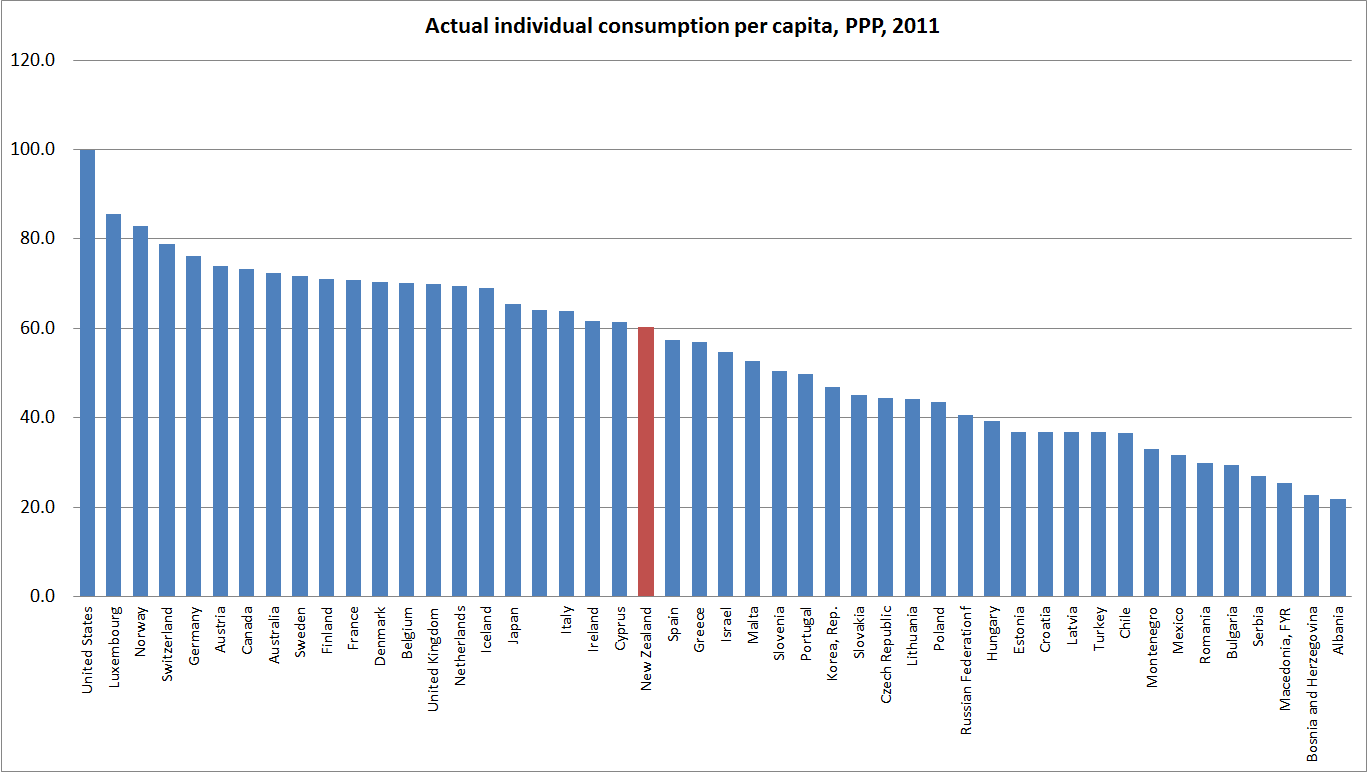
The first is from the 2011 World Bank International Comparisons Programme. They have developed a measure of actual individual consumption, across almost all countries, at purchasing power parity values (ie adjusting for the differences in what things cost across countries). Here are the per capita results for the subset of OECD-Eurostat countries (a slightly larger group than Grimes and Hyland use).

aic

Of these 46 countries, New Zealanders’ average consumption – across types of people – falls squarely in the middle of the pack, well behind most of the older OECD countries. Our ranking here looks quite similar to the rankings people are familiar with from GDP per capita, or even NNI per capita, charts. It isn’t a perfect measure, but it is much more comprehensive that the Grimes-Hyland one, and it isn’t obvious why it is misleading us about the material aspects of life in New Zealand relative to other advanced countries.

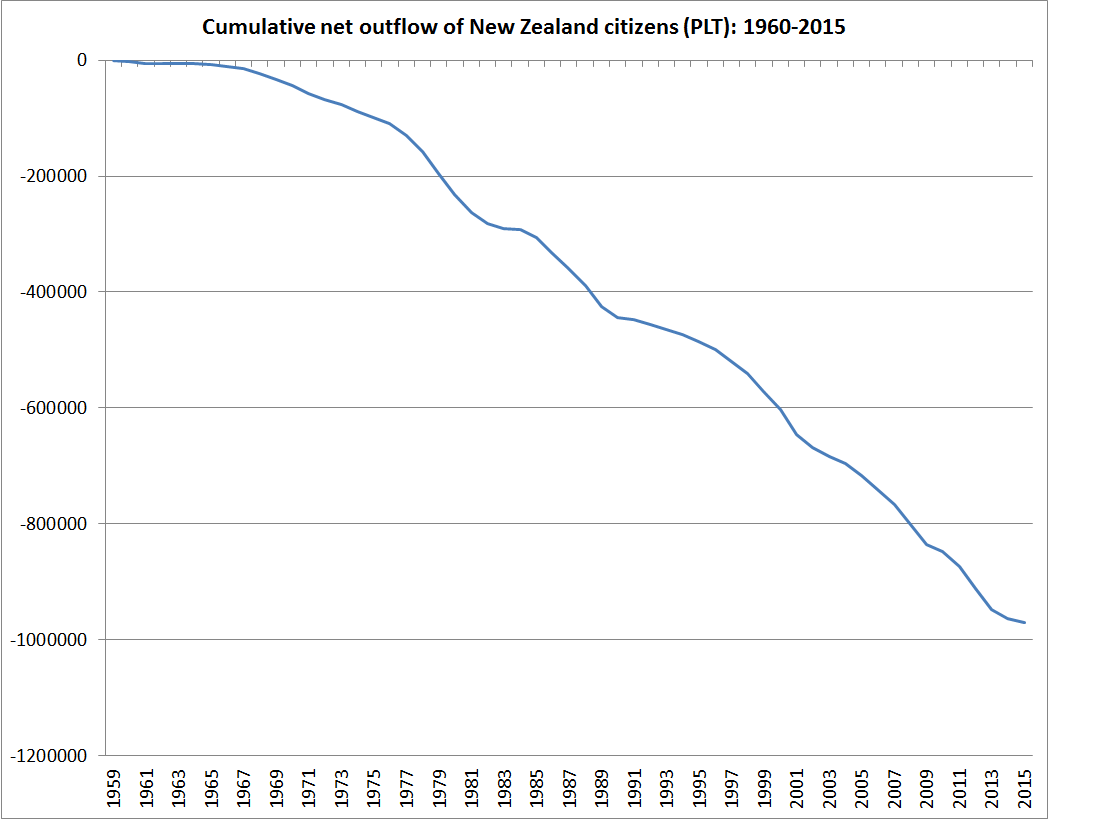
The final chart is just relevant to the New Zealand vs Australia comparison. On the Grimes-Hyland measure we score very similarly to Australia. Frankly that seems implausible as a representation of relative material living standards. Why? Because for fifty years large numbers of New Zealanders (net) have been leaving New Zealand, overwhelmingly for Australia.  Very few Australians have come the other way. There is quite a lot of cyclicality in the flow, but the trend is very clearly in one direction only.

cumulative plt since 1960

It wasn’t that way when more traditional GDP per capita estimates suggested that New Zealand and Australian economies were level-pegging. I entirely agree with authors who say that GDP per capita (or even NNI per capita) are not the be-all and end-all. People don’t change countries based on national accounts aggregates, or other international agency wellbeing measures. They are presumably changing countries because they believe the new country offers sufficient better material living standards, for them or their children, to offset the loss of the intangibles of home, extended family, and a culture and institutions one knows.   The choices people make reveal their preferences, and it is unlikely that over decades they’ve got it systematically wrong (after all, they could have come home again, as many did). None of us knows how much poorer material living standards are here than in Australia, but we can be pretty confident they are now, and have been for some decades, worse.

(Real researchers can stop reading here, but..) I helped the 2025 Taskforce put together their first report, on closing the gap with Australia. The report focused on policy, and as the primary underpinning for the analysis used national accounts measures, but at their request I put together this – purely illustrative – box. I stress the words “purely illustrative”- it was a matter of what I could find quickly. It isn’t comprehensive, but – as the box concludes – that is why we have, and try to improve, national income and expenditure accounts. 


Box 1: What do Australians get with their higher incomes?

Digging down to look at what people in the two countries actually consume can give a more tangible sense of the differences between New Zealand and Australian material living standards. Again, what is important in different climates varies, and tastes differ. But comparing living standards in New Zealand and Australia is easier than in most pairs of countries because the tastes and expectations are broadly similar.

These data are sometimes less reliable than the national accounts. Sometimes they are not compiled by national statistical agencies but by industry bodies. Even when statistical agencies are involved, things aren’t always measured exactly the same way in different countries. There is no single decisive fact. This box simply illustrates that across a very wide range of things that different people value or like to consume, the typical New Zealander has less than the typical Australian. Starting with where we live: the average size of a new Australian house or apartment built in 2007 was 212 square metres. In New Zealand, the comparable average was 193 square metres. Or what we drive: Australians have 619 cars per 1000 people, while New Zealanders have 560.

New Zealanders work more to earn our lower incomes: 887 hours a year are worked per head of population, as compared with 864 hours per head in Australia. Australians live longer: 81.1 years, compared with 80.2 years in New Zealand. Fewer people in Australia (111 per 100,000 people) die of heart disease each year than do in

New Zealand (127 per 100,000 people). Many fewer people die on the roads there: 7.8 each year per 100,000 people in Australia, 10.1 each year in New Zealand.  Australians have more televisions (505 per 1000 people) than New Zealanders do (477 per 1000 people). And there are more broadband subscribers (10.3 per 100 people, compared with 8.1 per 100 in New Zealand).

There are more cinemas per million people in Australia (92.4) than in New Zealand (82.2). And more mobile phones too (906 per thousand people versus New Zealand’s 861 per thousand). Australians drink more than New Zealanders: both alcohol (9.8 litres per capita versus 8.9 litres) and fruit juice (34.4 litres per capita versus 24.8).

This isn’t comprehensive by any means – that is why we have national income accounts. And there are some measures on which New Zealanders have more than Australians. Australia has 34.9 McDonalds outlets per million people, but New Zealand has 36.9 per million.

Lending to investors: still no smoking gun

I hadn’t paid any attention to the Reserve Bank’s new data providing somewhat more disaggregated information on new (ie the flow not the stock) residential mortgage lending. But the Herald’s cover story this morning sent me off to have a look.

There is only 10 months of data, and the housing market has some seasonal features. And the mortgage market has already been distorted by the Reserve Bank’s first set of LVR controls – which were always likely to have impinged most heavily on first-home buyers – so we aren’t even getting a clean read on the underlying patterns of mortgage demand.   But, from my perspective, the data reveal very few surprises, and the only thing that really took me by surprise was a pleasant surprise.

Here were a few of the points I noted as I worked my way down the Bank’s spreadsheet:

  • By value, 69 per cent of new mortgage loans over these 10 months were to owner-occupiers.  30 per cent were to “investors” (they have a residual category called ‘business” accounting for around 1 per cent).  According to the most recent census, the proportion of houses that was owner-occupied was less than two-thirds.  (The two numbers aren’t directly comparable, as local councils and Housing New Zealand own significant numbers of rental properties.)
  • By number, 81 per cent of new mortgage loans over these 10 months were to owner-occupiers.
  • By value, 15 per cent of loans to owner-occupiers were to first home buyers.  That might have been a touch lower than I expected.  First home buyers will generally be borrowing a larger proportion of the value of the house, but will also be buying cheaper houses.  FHBs will have been disproportionately squeezed by the Reserve Bank’s LVR controls.
  • By number, 8 per cent (by number) of owner-occupier loans were to FHBs over this period, but they accounted for a third of all owner-occupier loans with LVRs above 80 per cent.
  • Investors accounted for only 11 per cent (by number and value) of over 80 per cent LVR loans.
  • By number, 27 per cent of new FHB borrowers were borrowing in excess of 80 per cent LVR, and about 4 per cent of other owner-occupier, and investor borrowers.

high lvrs

  • 46 per cent of new investor loans were for LVRs of over 70 per cent (for some reason, the Bank is not collecting/reporting this data for the other categories of borrowers).

Almost all of that was quite unsurprising. And note that although the Herald devotes a lot of space to contrasting “first home buyers” with “investors”, it would seem more natural to compare all owner-occupier borrowers with all investors. Just possibly a comparison between FHBs and “first investment property purchasers” might be interesting, but we don’t have that data.

Perhaps the one thing that surprised me a little was how little high LVR lending has been going to investors over this period. Unfortunately, the period is distorted by the Bank’s controls, and it is at least possible that banks have been favouring FHBs since the LVR restrictions were put in place. And although the reporting is done at a highly aggregated level, I have heard stories of an upsurge in the proportion of loans being written by 79 per cent LVRs. If so, there is little or no effective risk reduction.   The Reserve Bank keeps on asserting that 70 per cent LVR loans to investors are just as risky as 80 per cent loans to owner-occupiers, but as Ian Harrison has been arguing, as yet they have produced little or no robust evidence to support that assertion.

I suppose what I take from these data is that, once again, there is no smoking gun to justify the Governor’s apparent determination to ban banks from lending a cent to residential rental services businesses in Auckland, when they have even a moderately high LVR.   Banks and borrowers are deeply irresponsible, and the Governor knows better….or so we are apparently to believe.   Recall that, across the whole country, between 3 and 4 per cent of new investor mortgages in the last 12 months have had initial LVRs in excess of 80 per cent.  Even if the number is double that in Auckland (and I’m not aware that anyone has that data), it hardly has the feel of reckless lending or borrowing behaviour.

The Reserve Bank has produced no evidence of any serious deterioration in lending standards. Add into the mix the still rather modest rate of growth in overall household lending, and the very encouraging results of the Reserve Bank’s own 2014 stress tests, and the case for such intrusive restrictions – with all the attendant efficiency and distributional costs – imposed by a single unelected official, is just not convincing.  Even if there were more substantial evidence to support the Governor’s concern, the soundness and efficiency of the financial system –  the only goal towards which the Bank can use its powers –  would be at least effectively protected, at less cost to individuals and to economic efficiency, through higher capital requirements.

The government’s immigration policy changes

The Prime Minister yesterday announced several changes to New Zealand’s immigration policy. This is an extract from the Minister of Immigration’s press release.

New measures to take effect from 1 November include:

  • Boosting the bonus points for Skilled Migrants applying for residence with a job offer outside Auckland from 10 to 30 points. [They require 100 points]
  • Doubling the points for entrepreneurs planning to set up businesses in the regions under the Entrepreneur Work Visa from 20 to 40 points.  [They require 120 points]
  • Streamlining the labour market test to provide employers with more certainty, earlier in the visa application process.

“Unemployment across the Mainland is nearly half that of the North Island, and labour is in short supply,” Mr Woodhouse says.“We’re looking at offering residence to some migrants, who have applied at least five times for their annual work visa. In return, we will require them to commit to the South Island regions where they’ve put down roots.”

Mr Woodhouse says the Government is also considering a new Global Impact Visa to attract high-impact entrepreneurs, investors and start-up teams to launch global ventures from New Zealand.

“I will announce further details later this year, but we envisage this visa would be offered to a limited number of younger, highly talented, successful and well-connected entrepreneurs from places like Silicon Valley,” Mr Woodhouse says.

I can’t see any background analysis to these measures, either on the MBIE website or with the Minister’s press release.  On the face of it, however, this looks like a set of measures that will, on balance, to undermine the quality of New Zealand’s immigration programme.

We all know about the infrastructure pressures in Auckland –  largely self-inflicted by central and local government.  Perhaps trying to steer some of the immigrants away from Auckland might temporarily ease some of those pressures a little.  But there is a price to be paid. Providing a significant increase in the number of points available for people with job offers outside Auckland must lower the likely average quality of incoming immigrants.  There is no sign that the permanent residence approvals target (135000 to 150000 on a rolling three year basis) is being increased, so people going to the regions –  taking advantage of the additional points for doing so – will be at the expense of otherwise better-qualified people who would have gone to Auckland.    Under the new policy, people will only have to stay in the regions for a year, so perhaps it will make only a very small difference over time to the number of immigrants who end up in Auckland.  But the ones who do come in, taking advantage of these additional points, will be – on average – less good quality people than the applicants who are squeezed out (people who might have a job offer in Auckland –  our highest paying and –  at least in a statistical sense –  most productive city).    Perhaps I’m missing a significant strand in the reasoning, but I can’t see the likely long-term economic gain for New Zealand.

The Global Impact Visa idea sounds superficially promising. But my impression from the Pathways Conference last week was that existing entrepreneur visa schemes had not worked particularly well.  It will be interesting to see the analysis behind this proposal, including an assessment of how the risks around it will be managed and overcome.  I remain a little sceptical of the attraction of New Zealand to “younger, highly talented, successful and well-connected entrepreneurs from places like Silicon Valley”.  The flow of people in that sector would seem more naturally to be in other direction.  I hope it is not an example of the old derogatory adage used about Britons working in Hong Kong:  FILTH  (“failed in London, try Hong Kong”).

Glenn Stevens on monetary policy

I’ve long had a great deal of time for the Reserve Bank of Australia. It is an institution made up of human beings, so they make mistakes from time to time (for a while, for example, their relentless optimism about China reminded one of a sell-side analyst) but it has been a strong institution for decades, successfully developing successive generations of governors and senior managers. Successful organisations tend to promote from within. The RBA publishes thoughtful analysis, and the speeches of senior managers are usually well-worth reading. I don’t recall any major innovations originating at the RBA, but they’ve avoided policy debacles like the MCI experiment, or rapid policy reversals.  All things considered – and setting to one side the serious issues around Note Printing Australia – I think the RBA has had a reasonable claim to having been one of better advanced country central banks in recent decades. At times, no doubt, fortune has favoured them. And perhaps too, there is a little in the old proverb about the grass always being greener on the other side.

Anyway, I was reading Glenn Stevens’ most recent (and quite short) speech, “Issues in Economic Policy”, on some of the challenges the Australian authorities, and the Reserve Bank in particular, face at present. The Governor grouped his remarks under four headings:

  • Negotiating turbulence (the international environment)
  • Accepting adjustment
  • Maintaining stability, and
  • Securing prosperity (a rather general discussion of the place of microeconomic reform)

What struck me, and prompted this post, was how scarce references to inflation were in the speech.  The Reserve Bank’s primary policy responsibility is the conduct of Australia’s monetary policy.  As the (non-binding) Statement on the Conduct of Monetary Policy between the Treasurer and the Governor put it:

Both the Reserve Bank and the Government agree on the importance of low inflation.

Low inflation assists business and households in making sound investment decisions. Moreover, low inflation underpins the creation of jobs, protects the savings of Australians and preserves the value of the currency.

In pursuing the goal of medium-term price stability, both the Reserve Bank and the Government agree on the objective of keeping consumer price inflation between 2 and 3 per cent, on average, over the cycle. This formulation allows for the natural short-run variation in inflation over the cycle while preserving a clearly identifiable performance benchmark over time.

There are only two references to inflation in the speech.  In the main one he observes:

A period of somewhat disappointing, even if hardly disastrous, economic growth outcomes, and inflation that has been well contained, has seen interest rates decline to very low levels. The question of whether they might be reduced further remains, as I have said before, on the table.

But the thrust of what followed was a bit surprising:

But in answering that question, it is not quite good enough simply to say that evidence of continuing softness should necessarily result in further cuts in rates, without considering the longer-term risks involved. Monetary policy works partly by prompting risk-taking behaviour. In some ways that is good: in some respects, there has not been enough risk-taking behaviour. But the risk-taking behaviour most responsive to monetary policy is of the financial type. To a point, that is probably a pre-requisite for the ‘real economy’ risk-taking that we most want. But beyond a certain point, it can be dangerous.

Deciding when such a point has been reached is, unavoidably, a highly judgemental process. And that is after the event, let alone beforehand. My judgement would be that policy settings that fostered a return to the sort of upward trend in household leverage we saw up to 2006 would have a high likelihood, some time down the track, of being judged to have gone too far. That is not the case at present, given the current rates of credit growth and so on. But the point is simply that in meeting the challenge of securing growth in the near term, the stability of future economic performance can’t be dismissed as a consideration.

It was as if the authors of the BIS Annual Reports had managed to infiltrate the RBA’s speechwriting team. The point of this post is not to make the case for further cash rate cuts in Australia. On the surface, some further easing looks warranted to me, but I’m not close enough to the Australian data to be confident of that view. My point is that the Governor looks here to be risking taking his eye off the inflation ball, and downplaying short-term macro stabilisation for some ill-defined concern about the longer-term. In any economy adjusting to an investment slump a reasonable case might be made that insufficient risk-taking is going on. And since there are no reliable direct benchmarks for the appropriate degree of risk-taking, a simpler benchmark might be levels of excess capacity in the economy. An unemployment rate of 6 per cent – above any estimates of NAIRU that I’ve seen – might reasonably suggest a need for rather more risk-taking across the economy, if the people who are unemployed are relatively quickly to find jobs.

The Governor goes on to note that “policy settings that fostered a return to the sort of upward trend in household leverage we saw up to 2006 would have a high likelihood, some time down the track, of being judged to have gone too far”. Central bankers worry about periods of rapid growth in credit and asset prices, but it is a curious historical episode to cite. After all, Australia came through that period of leveraging up (which had more to do with the interaction of planning restrictions and rapid population growth as with anything to do with monetary or banking policy) rather well. And if some of that was down to the good fortune of the terms of trade, it isn’t obvious that countries like New Zealand or Canada suffered seriously from the aftermath of rather similar domestic credit booms (although of course, post-2007 growth has been weak almost everywhere). There was little or no evidence that lending standards became pervasively and seriously too loose in Australia (or New Zealand or Canada) during the pre-2007 booms

Perhaps I’m over-interpreting the Governor, but his comments have a bit of a feel about them of the Swedish Riksbank’s ill-fated experiment in using monetary policy to lean against household debt accumulation, rather than keeping their eye firmly focused on the medium-term outlook for inflation. Economists and central bankers don’t know that much about appropriate levels of debt or about what macro policy can do about them. By contrast, we have a stronger sense of when the numbers of people unemployed are above normal, and a rather better (although far from foolproof) sense of what monetary policy can do about that, especially in periods when core inflation pressures (domestically and globally) are pretty quiescent (core inflation measures in Australia seem to be at or below the midpoint). And in Australia, the Reserve Bank’s Act explicitly enjoins the Bank to run monetary policy in a way that best contributes to “the maintenance of full employment in Australia”.  For practical purposes that doesn’t override a medium-term focus on keeping inflation near-target, but it does rank rather higher in the statutory list of considerations than visceral unease about the possibility, at some point down the track of excessive risk-taking.

On an unrelated point, for any readers interested TVNZ’s Q&A programme yesterday pre-recorded an interview with me, to be shown tomorrow. The questions were mostly around the Reserve Bank of New Zealand: actions, inactions, and frameworks. Unless I said something I really didn’t mean to say, I don’t think there is anything in the interview that regular readers won’t have encountered before. One question – how worried should we be about the New Zealand economy – caught me a little by surprise, and I’ve been reflecting further on that. I might jot down some thoughts on that here on Monday.

Immigration, and the evidence of things not seen

In the biblical book of Hebrews, there is a verse that reads “Now faith is the assurance of things hoped for, the evidence of things not seen”.

It seemed to be rather like that at the Pathways Conference that I attended part of in Wellington yesterday morning.  The Pathways conferences were established back in the 1990s and are held annually “to disseminate publicly funded research on international migration and demographic change”.  I hadn’t been to one before, and it looks like an excellent initiative, at least in principle.  The issues around immigration (here and abroad, past and present)  are fascinating and we (and other countries no doubt) need a “reasoned and deliberate” debate on immigration policy[1].  Funding enables the conference to be held at no cost to the participant, and enables academic and public sector researchers to discuss research results and immigration-related issues.  Given the significance of immigration in New Zealand, and the way it is seen as a significant “economic lever” (in the words of a senior MBIE official at the conference), we need scrutiny and debate.

There were around 120 attendees, but not a single member of the media.  That surprised me.   When I counted up the delegate list. almost 50 per cent were public servants (although I was a little surprised that no one from Treasury was there).

I suspect I may have been the only person present even mildly sceptical about the benefits of New Zealand’s immigration programme.  Certainly, none of the papers I heard, no comments from the floor, and none of the summaries of the remaining papers betrayed a shadow of doubt.      In fact, so certain of the direction of the argument were the organisers that they describe this year’s conference as being about “how New Zealand can better respond to these demographic changes in order to maximise the benefits associated with an increasingly diverse population”.  Perhaps there are such benefits, even net, but it would be better to demonstrate them, than simply assert them.  The tone of the conference –  supposedly about presenting publicly funded research  –  was apparent early on when the Minister of Immigration twice thanked conference attendees for all they (we?) did for “our migrant communities”.   And here I thought immigration policy was undertaken for the benefit of New Zealanders, whatever benefits there might be to the migrants themselves.

The contrast with the Australian Productivity Commission’s inquiry, which I wrote about last week, was striking.   There seemed to be no interest in questioning whether there were benefits, and if so who might be securing those benefits.  Nor much interest in innovative ideas (eg charging for migrant entry).  The Australian inquiry may well lead to no material changes in policy, but at least it should assure the Australian public of a serious and dispassionate analysis of the issues and options.

The Conference was described as being under Chatham House rules.  That seemed a little odd, at least in respect of the main presentations (as distinct from comments/questions from the floor), since the purpose was supposed to be about disseminating publicly funded research, to the public.    But the programme is on the web (see link) above.

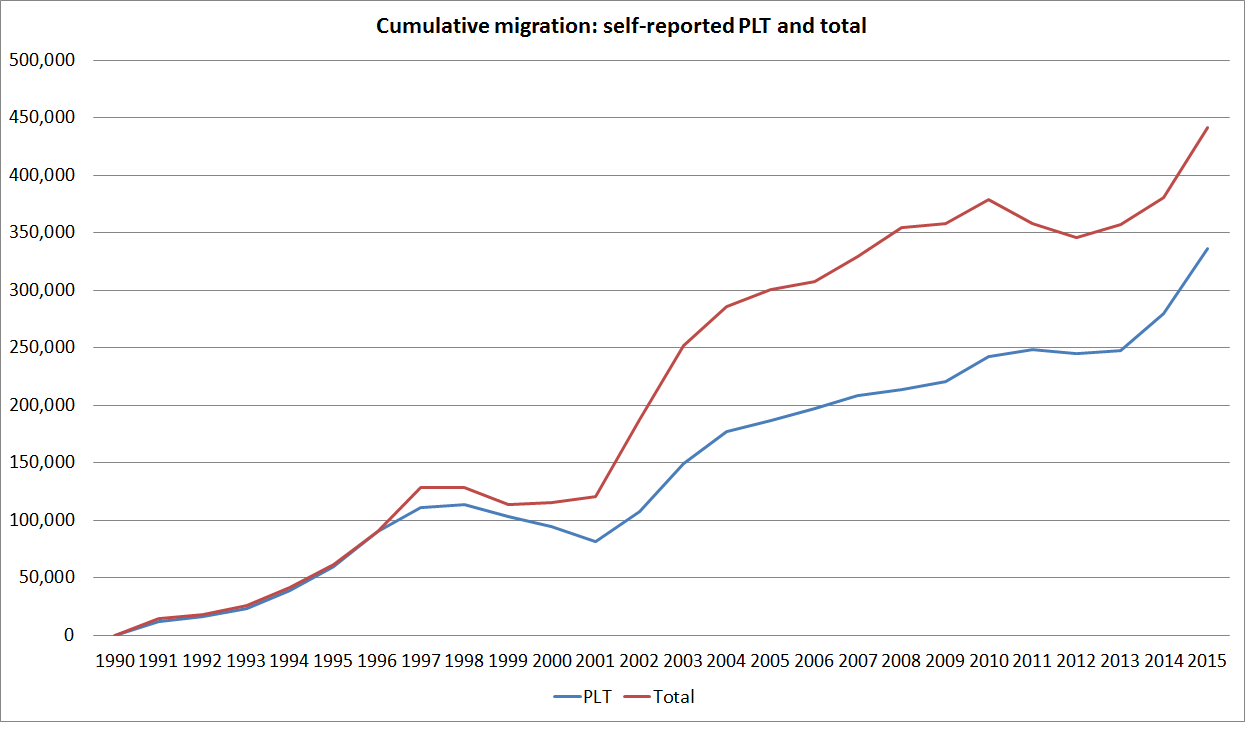
I found the Minister’s speech rather unimpressive.  The organisers described it as a “keynote” but it was anything but.  Unfortunately, I can’t quote from it, but suffice to say he appeared unimpressed by anyone –  be it the Herald, or perhaps even stray bloggers (with long-outstanding OIA requests in for departmental advice on immigration targets) –  suggesting that waves of migrants were putting pressure on resources or infrastructure.  A keynote actually addressing some of the issues might have been interesting.  And although the Minister and MBIE seem keen to remind people of the weaknesses of the PLT immigration data, they omitted to point out that in recent decades net PLT immigration has understated (not overstated) the net number of people coming to New Zealand.

cumulative plt since 1990b

In fact, what was striking about the morning was how little there was to give a listener any confidence that the “economic lever” (New Zealand’s immigration programme) was doing New Zealand much good.  I went along to listen, and was prepared to be sceptical.  But I didn’t really need to be.  Because what I heard wasn’t very encouraging at all.  Listening to people discussing the problems of designing an entrepreneur visa, for example, I became more sympathetic to the idea of auctioning migrant places.  And anguished talk of concern about how many migrants were going into low productivity sectors, rather than “where we want them to go” had much the same effect, and a desire to reach for my copy of Hayek, on knowledge problems etc.  The central planning tone (no doubt unselfconscious) was quite disconcerting.

One of the MBIE papers is on the web.  It discusses some work on investor migrants –  who already, in effect, buy their way into New Zealand.  The aim of the programme is to import people with business expertise and entrepreneurial skills, presumably to boost productivity in New Zealand.  And yet in these surveys of people at various stages of the investor migrant process  (and  in which respondents must have been at least partly motivated to give the answers MBIE wanted to hear, even if results were anonymised), 50 per cent of the money investor migrants were bringing in was just going into bonds, and only 20 per cent was going into active investments.  We aren’t short of money, but may be of actual entrepreneurial business activity.  And 70 per cent were investing only the bare minimum required or just “a bit more”.  And these people aren’t attracted by the great business opportunities in New Zealand, but rather by our climate/landscape and lifestyle.  It doesn’t have the sense of being a basis for transformative growth.  As even a fairly pro-immigration academic observed, New Zealand isn’t exactly likely to be first choice for the sort of person who might build the next great tech company.

In much of the debate around immigration in New Zealand it seems that people can’t quite make up their minds what sort of immigration we want.  On the one hand there is considerable emphasis on highly-skilled migrants. I can see the logic of that argument, even if I’m sceptical of what difference it might make.  But on the other, there was repeated discussion of the role immigrants play in the aged care sector and in the dairy sector.  Such migration is no doubt good for the migrant (migration usually is) but the basis on which it assists in lifting per capita incomes, and medium-term productivity, for New Zealanders is much less apparent.  As one senior official put it to me recently, the logic of bringing in large numbers of people to work cheaply on dairy farms isn’t obvious.  It may just allow farmers to bid land prices higher, or perhaps compensate for the self-inflicted problem of an overly high real exchange rate.

So there wasn’t much to go on if one wasn’t sure of the benefits of immigration in New Zealand.  But if you went along already convinced then no doubt faith carried you through the accounts of the practical limitations of how our immigration programmes actually work.

And, of course, I know that this was just one conference, and there are lots and lots of papers on immigration.  But few or none of them show, with any confidence, that New Zealanders are securing economic gains from this substantial economic lever that successive governments have sought to deploy.  We need a reasoned and deliberate debate, perhaps with our own Productivity Commission inquiry.

[1] Readers may recall that that was Shamubeel Eaqub’s description of the sort of debate he wanted about immigration, at least before he responded to my analysis with the label “racist”, a slur he has still not withdrawn.

House of cards?

The Reserve Bank announced last month its decision to require banks to classify all loans secured on residential investment properties separately from other residential mortgage loans. This applies not just to large commercial operators, but to borrowers with just a handful of investment properties. The Reserve Bank will now require banks to use higher risk weights (ie have more capital) in respect of the former than in respect of the latter.

This has been quite a saga. The Bank went through a couple of rounds of consultation on earlier proposals last year (then focused on larger operators), and then came back earlier this year with a revised proposal. I made a brief submission on that consultative document, as no doubt did a variety of other people (although we don’t know who, as the Reserve Bank – unlike parliamentary select committees – does not routinely publish the submissions it received). The Reserve Bank’s summary response to the submissions can be found half way down the page here (various specific links on the RB website don’t appear to be working today),

The proposal that the Reserve Bank consulted on in March/April, and which it recently adopted, had a strong feel of being reverse-engineered. The Governor had apparently decided that he wanted to be able to impose additional direct controls on lending for residential property investment, and to do that he needed banks to have systems in place which would clearly delineate between investment property loans and owner-occupied loans. To support that prior policy conclusion, the Bank has sought to argue that loans on residential investment property are, all else equal, riskier than other residential mortgage loans.   To be clear, the Reserve Bank is asserting that a loan is riskier because it is secured on an investment property, even if the initial LVR, the initial date at which the loan was taken out, the nature of the house itself, the borrowers’ income etc were all exactly the same as those for an owner-occupied loan.

What has always been a bit surprising is how little in-depth effort the Bank has put into demonstrating that its argument is correct. It has run a variety of arguments in principle about why investment property loans might be riskier than those to owner-occupiers. Most of those have never seemed overly compelling, especially not in a New Zealand context.   Indeed, there are some reasons why the result could be reversed (for example, unemployment is probably the largest single risk, all else equal, in respect of an owner-occupier mortgage, but rental income flows – which help service investment property loans – tend to be less discontinuous).

But the issue should ultimately, be an empirical one. All else equal, have investor property loans proved to be riskier than owner-occupier loans? Getting good comparable data isn’t always easy.  Material loan losses tend to arise only when nominal house prices fall, and although real house prices fell sharply in the late 1970s, large nationwide falls in nominal house prices haven’t happened in New Zealand since the 1930s. Data from that period aren’t available – although perhaps it is an opportunity for an economic history PhD project working in bank archives. But even more recently, nominal house prices have fallen materially in a number of regions, and I have encouraged the Bank to ask banks for data on the loan loss experience (investor vs owner-occupier) in places like Gisborne, Wanganui, or Invercargill.

In fact, the Bank has tended to rely on a handful of overseas studies, about a handful of overseas experiences. This isn’t one of those areas where there are dozens of studies about dozens of episodes. That makes it all the more important that what studies exist are read carefully and applied and interpreted to New Zealand very carefully. That appears not to have been done. Worse, even when some weaknesses in the way the Bank interpreted and applied such papers were pointed out to them (in submissions on the consultative document), they largely just repeated their assertions and interpretations.

I’ve worked my way through some of the papers, and had had concerns about how the Bank had interpreted and applied the results. My former colleague, Ian Harrison, who consults as Tailrisk Economics, and is much more expert in the specialist risk aspects than I am, has worked his way carefully through each of the empirical papers the Bank has cited, and several that they should have cited, but did not. He has sent me a forthcoming paper “A House of Cards”, in which he has worked his way carefully through each of the Bank’s arguments and pieces of evidence. Cumulatively, it is a pretty damning read. Ian has given me permission to run some excerpts here, and I hope that when his paper is published it will get the attention it deserves.

On the international experience, Ian summarises as follows:

The international literature does not provide support  for the Bank’s contention that investor loans are riskier and owner-occupier loans. Four of the four studies that controlled for other loan attributes found that investor status had no impact, or only a trivial impact, on default rates. A European Banking Authority survey of 41 advanced modelling banks found that none identified investor status as a risk driver in their retail housing mortgage lending models.

A good example of what appears to have gone on is how the Bank has represented an important paper on the Irish experience

Lydon and McCarthy 2011 “What lies beneath? Understanding recent trends in Irish Mortgage arrears”

The graph presented in paragraph 11 of the March 2015 Consultation document presents data from the Lydon and McCarthy paper, which addressed the question of whether BTL [buy to let] status was, in itself, a default driver, or whether the higher default experience could be explained by differences in other loan characteristics.

It was found that after controlling for differences in LVR and servicing costs, BTL status had no impact on default rates.  The higher increase in observed BTL default rates was due to the fact that a larger share of BTL loans were made in the lead up to the GFC when underwriting standards were at their lowest point and house prices at a peak.

Naturally subsequent default rates were higher for investors who bought at the wrong time and who offered scant protection to the lender, but default rates would also have been higher than average for owner occupiers with the same characteristics.

The results of their analysis are presented in table 7 of the paper which shows that the coefficient  for the marginal impact of BTL status is 0.00.  This estimate is significant at the 1% level.

In a subsequent presentation (“The Irish Mortgage market in Context – Central Bank of Ireland 2011) the authors said:

“Controlling for LTV & MRTI…

Relative to next-time-buyers (NTB), FTB borrowers are 2% less likely to be in arrears

–whereas, no relative difference for BTL”(our emphasis)

The data presented in the Consultation document does not provide evidence that Irish BTL loans are a riskier asset class. It is misleading to represent the paper, as the Bank does in several documents, that it provides evidence that BTL loans are riskier.’

Or, in respect of a US study:

Palmer C. (2014) ‘Why do so many subprime borrowers default during the crisis: Loose credit or plummeting prices’

The Bank made the following statement:

“Palmer (2014) reports that default rates increased in a multivariate regression with loan to value ratio and for loans that were declared non-owner occupiers.”

In his paper Palmer uses comprehensive loan-level data to decompose sub-prime loan loss defaults amongst three default drivers. His conclusion is as follows.

Decomposing the observed deterioration in subprime loan performance, I find that the differential impact of the price cycle on later cohorts explains 60% of the rapid rise in default rates across subprime borrower cohorts. Loan characteristics, especially whether the mortgage had an interest-only period or was not fully amortizing, are important as well and explain 30% of the observed default rate differences across cohorts. Changing borrower characteristics, on the other hand, had little detectable effect on cohort outcomes. While quite predictive of individual default, borrower characteristics simply did not change enough across cohorts to explain the increase in defaults.”

There is no marker for investment property as such in the study, just a marker for whether the dwelling was  to be owner occupied or not. It is not clear whether holiday or other second homes would fall. Regardless, the non-occupier marker fell into the borrower characteristic category, which in total provided little independent explanation of deliquency. There was no result that investor status increased defaults. The Bank’s statement was false.

I suggest that you read the entire document when it is available. As far as I can tell, none of the studies the Bank cites appears to have been fairly represented, or applied to New Zealand.

If Ian’s reading of the papers is accurate (and I have no reason to doubt it) it is a very disconcerting commentary on the processes in the Reserve Bank.   The Bank has plenty of able people, who would have been well able to pick up on each of the weaknesses Ian Harrison has identified.  And yet not just once, but again in the response to submissions, and in the new consultative documents, after the Bank had had time to consider the criticisms that submitters have made, the studies have continued to be explained or applied in ways that are, at best, misleading.

Reasonable people can reach different views on appropriate policy measures. I think the Governor of the Reserve Bank has far too much power in this area, and I disagree with the proposed restrictions.   But if citizens cannot trust the Bank to cite evidence in a balanced and accurate way, confidence in the entire policymaking process is likely to be severely eroded.

As I have noted, in such areas the Governor is effectively prosecutor, judge, and jury in his own case. Worse, he is also responsible for the investigative work that is presented in support of the case that he will himself decide. Of course, he has staff to do the work for him, but the staff (and their managers) are hired, rewarded, and potentially fired, by the Governor. A strong Governor will want to know the weakest points in his own case, and to ensure that those weaknesses are appropriately aired, balanced presumably by other strong evidence or arguments for the sorts of regulatory initiatives he is proposing. But the Wheeler Reserve Bank appears to be one in which either no one is willing to stand up and point out the weaknesses or, if someone did point them out, where the Governor and his senior managers said, in effect, “oh just ignore that, continue to repeat the same lines”. One would hope there is a better explanation, but it isn’t obvious. The Bank’s Deputy Governor, Grant Spencer, for example, has spent decades in senior roles in the Bank, and many thought he was a strong candidate to become Governor in 2012. He has direct line responsibility for the two departments dealing with these banking regulatory issues. How did he let documents this weak go out, not just once, but repeatedly? Anyone can make a mistake citing a single paper, but the breadth and repeated nature of what Ian highlights has the feel of something more deliberate.

Even if the Bank could show, with some degree of confidence, that investor property loans were riskier than those to owner-occupiers, other characteristics held equal, the case for the proposed ban on lending in excess of a 70 per cent LVR for residential investment properties in Auckland has serious weaknesses. I elaborated on those in my recent submission (and have also requested copies of all the submissions the Bank has received).

I’ve been critical of the Governor’s conduct of monetary policy over the last couple of years. But reasonable people will, at times, reach quite different views on what monetary policy stance is required. His turned out to be wrong although, as I noted this morning, he had plenty of company for too long.   But repeated misrepresentation of data to support a controversial regulatory initiative strikes me as much more serious. It might do less damage to the economy, but it strikes at the heart of the integrity of the institution, and raises serious questions about the extent to which the public can have confidence in the (unelected) Governor’s ability and willingness to carry out his statutory duties in the public interest, in an objective and dispassionate manner. Cynics might expect such standards from politicians. We certainly shouldn’t tolerate them from officials.

I hope that when Ian Harrison’s full paper is published, the Bank’s Board will start asking some pretty searching questions.  The Board is charged to, inter alia,

    • keep under constant review the performance of the Bank in carrying out—
      • (i) its primary function; and
      • (ii) its functions relating to promoting the maintenance of a sound and efficient financial system; and
      • (iii) its other functions under this Act or any other enactment:
    • (b) keep under constant review the performance of the Governor in discharging the responsibilities of that office:

Perhaps the Minister of Finance might refer the issue to Rod Carr, chair of the Board, for his views.

The Shadow Board on tomorrow’s OCR

The NZIER this morning released the results of its Shadow Board exercise. They survey nine people (currently three market economists, three business people, and three with academic affiliations) and ask them to assign probabilities for the “most appropriate level of the OCR for the economy”. In principle, I suppose “the most appropriate level for the economy” could be different from “the most appropriate level to be consistent with the requirements of the Policy Targets Agreement”, although I suspect that respondents will typically be treating the two as the same. Note that, in principle, the information in the Shadow Board responses is different from the information in financial market prices (which are close to a direct view on what the Reserve Bank will do – as distinct from what people think it should do) or from ipredict, which runs direct contracts allowing people to bet anonymously on what they think the Reserve Bank will do. When I looked just now, the prices reflected an 84 per cent chance of a 25 basis point cut tomorrow

Launching the Shadow Board was a modest but useful initiative by NZIER. It helps spark a little more debate, and a little more scrutiny, about what the Reserve Bank is doing, and puts the results in a useable (and reportable) format. It was inspired by a similar exercise in Australia (which is slightly more (too?) ambitious in that it also asks respondents for probabilities for the right rate six and twelve months ahead).

But what the Shadow Board doesn’t really do is provide any additional information on what the Reserve Bank should do. As everyone recognises, there is a great deal of uncertainty around monetary policy. Central banks talk of trying to target inflation a couple of years out, and yet have no great certainty even as to what is going on right now, let alone what will be going on 12-18 months hence.

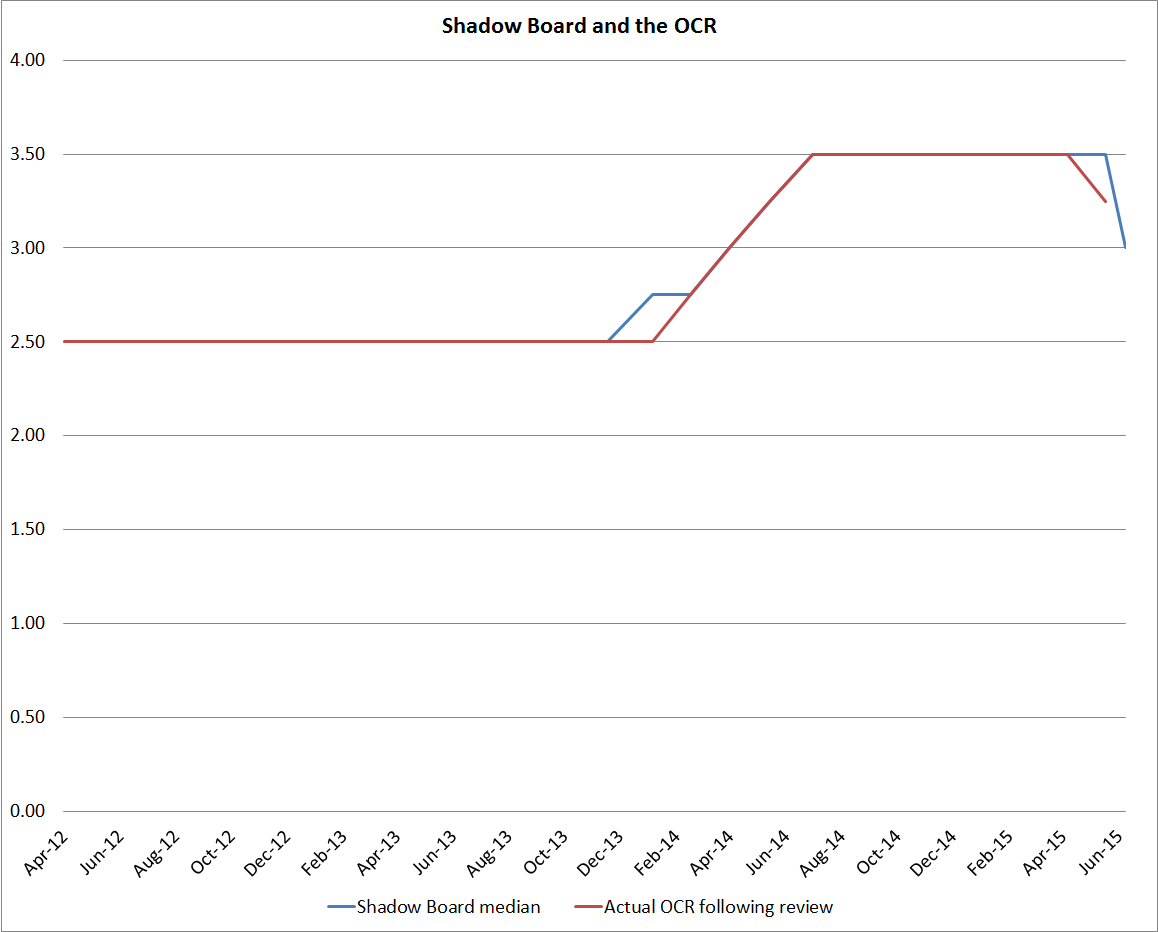
Here is a chart showing the actual OCR following the relevant review and the median view of the Shadow Board (thanks to Kirdan Lees at NZIER for sending me the historical data).

shadow board 1

They are all but identical, at least over this relatively short period. And yet the Reserve Bank has subsequently acknowledged that, with the benefit of hindsight they would have had the OCR lower in 2011 and 2012.   And most observers would now agree that the OCR did not need to have been as high as it was over the last year.

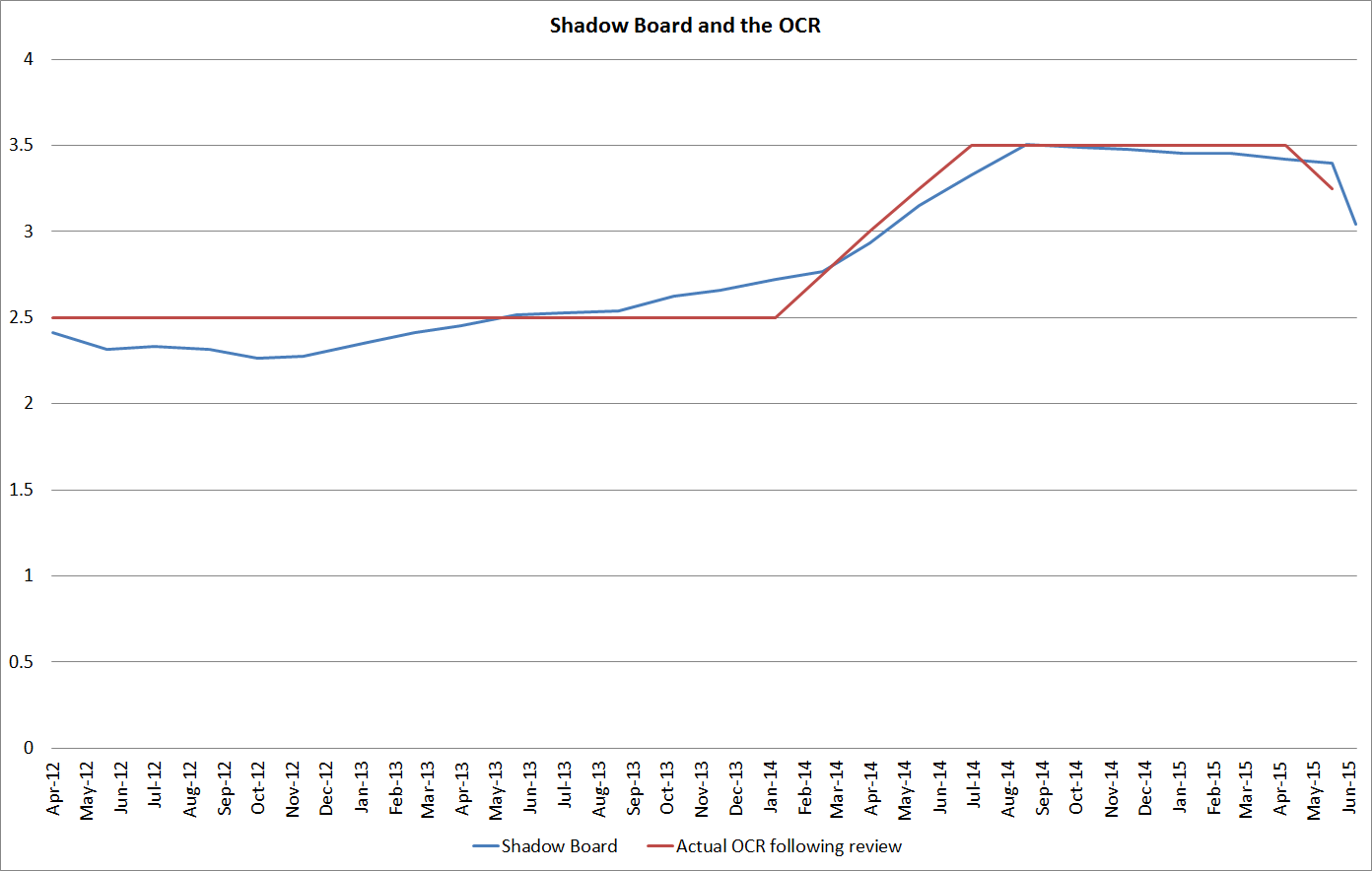
Perhaps the information is in the distribution of probabilities rather than in the median view?  Here is the mean of the views of the Shadow Board members. It does deviate a little from the actual OCR, and perhaps during last year the Shadow Board’s views were a little more cautious than the Reserve Bank was. The Shadow Board’s mean view was a little below the actual OCR, while the Reserve Bank itself was still stressing upside risks and the probable need for further rate increases.

shadow board 2

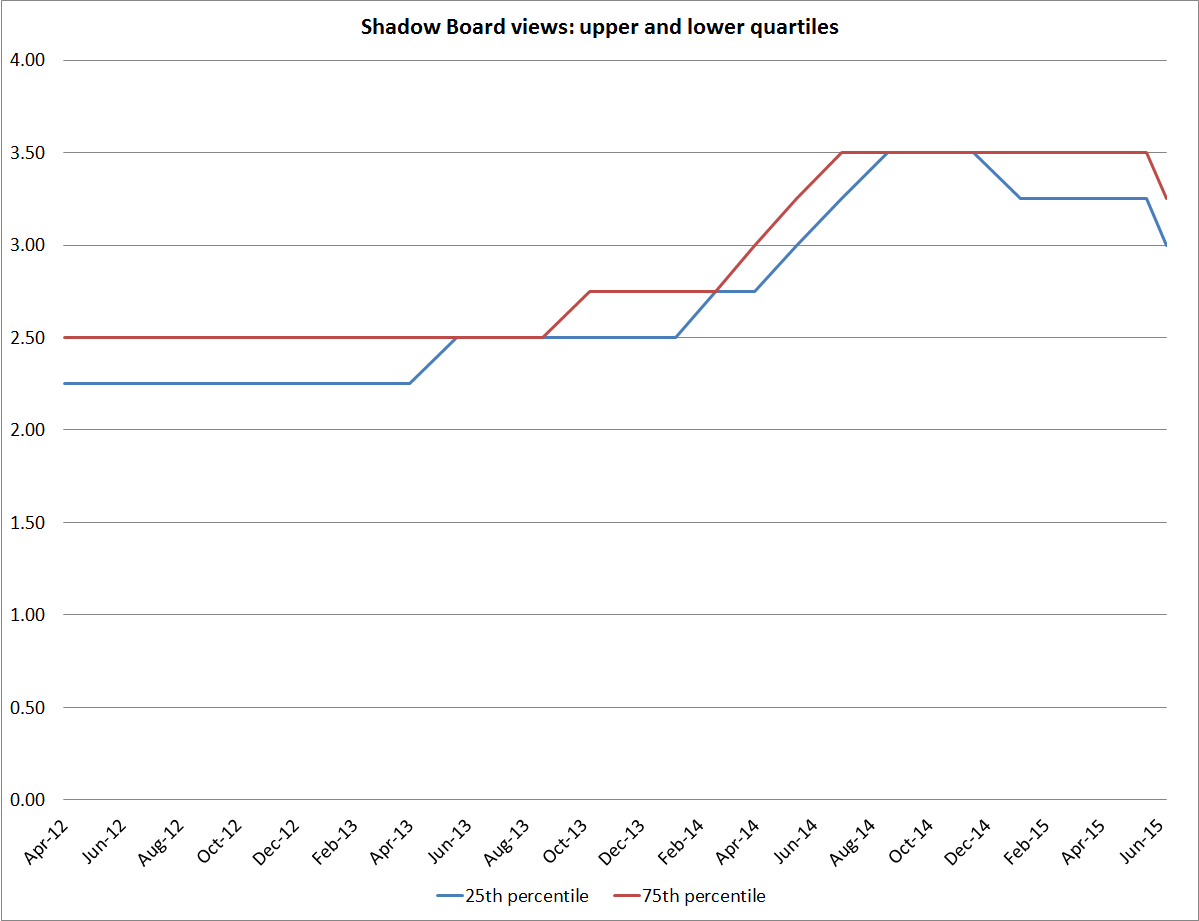
And here are the 25th and 75th percentiles. Respondents collectively put at least a 25 per cent chance on something at or below the 25th percentile being appropriate, and at least a 25 per cent chance on something at or above the 75th percentile.

shadow board 3

It is striking just how tight these ranges are. I noted back in June that most individual respondents’ views seemed excessively tightly bunched, given the huge historical uncertainty about the appropriate OCR. This time around there is a little more dispersion. The Shadow Board exercise has now been running for 27 reviews, and this is one of only three in which respondents collectively put a less than 50 per cent weight on one particular OCR (the other two were January last year, when the Reserve Bank was just about to commence raising the OCR, July last year which proved to be the last of the OCR increases).  I doubt, if I’d been assigning my own probabilities, if I would ever have put even a 40 per cent weight on any particular OCR in any particular review.

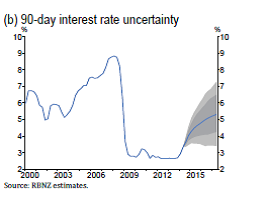
One other way of looking at the scale of the uncertainty around the OCR is the fan charts that the Reserve Bank published in the June MPS last year.  These were somewhat controversial, and are hedged around with lots of caveats in the technical notes, but the Governor presumably regarded them as a sufficiently useful device to run prominently in the main policy analysis chapter of a Monetary Policy Statement.   On the subset of shocks and uncertainties considered in that exercise, the 90 per cent confidence interval for the 90 day rate (proxy for the OCR) two years ahead was some 400 points wide. Perhaps a little embarrassingly for the Bank, that range did not even encompass an OCR of 3 per cent or less by July 2015.

fan chart

What do I take from all this?   I’d probably make only two points:

  • There is a huge amount of uncertainty in running discretionary monetary policy.  Some would argue that it is a mug’s game and only likely to introduce additional volatility.  That isn’t my view, but the uncertainty (across a range of different dimensions) is large enough that in general everyone should be a little cautious in taking a stand on a particular OCR (of course, under the current regime, the Reserve Bank must take a view, in actually setting the OCR). Mistakes won’t be uncommon –  whether by commentators or central banks – and that should be recognised, with appropriate humility, by all involved.  Of course, Reserve Bank mistakes matter more because they are charged with the power to take decisions that affects all of us in one way or another.
  • That very uncertainty highlights just how important it is that there is robust debate around a range of perspectives.  In this post, I haven’t looked at the diversity in the individual respondents’ views (partly because the panel of respondents has kept changing, and the sample is quite short), but looking through that data there hasn’t been much diversity of view across respondents either (with the creditable exception earlier in the period of Shamubeel Eaqub).    It is very easy for consensus views to form – both within the Reserve Bank – and in the wider New Zealand debate more generally.  And yet those consensus views will often be wrong.  Sometimes those looking at New Zealand from the outside have had a better take on things, but I doubt that has been consistently true (in the last year, HSBC in Sydney has been running the “rockstar economy” story, while other offshore players were rather more sceptical of the Reserve Bank’s continuing tightening cycle).  Encouraging that diversity of perspective is particularly important within the Reserve Bank, and yet it can be hard to maintain.  That is probably true in all central banks, but is a particular risk in our system, in which the Bank’s chief executive controls resources and rewards and is also single monetary policy decision-maker.  A very good single decision-maker would probably want as much debate and challenge as possible, recognising just how uncertain the game is.  A less-good one would find it too easy to discourage debate and challenge –  while never explicitly saying so, or perhaps even meaning to – preferring material that supports the decision-maker’s own priors and predilections.

David Parker and non-resident housing demand

David Parker has an interesting piece in the Herald, on how the various free trade agreements New Zealand governments have signed affect the ability of New Zealand to restrict non-resident purchases, should it wish to do so.  The heart of his argument is here:

The most favoured nation provision in article 139 does apply to existing investments and controls on new investments. If we want to further restrict the sale of farmland or houses to Chinese investors, we can. Article 139 simply requires NZ to treat China no less favourably than other countries. Clause 3 of article 139 means earlier agreements with our Australian and Pacific Island neighbours are not affected, and do not flow into the China FTA. Later agreements do flow through.

National does not believe there should be more restrictions on foreign buyers, and so the South Korean FTA does not contain the protections found in the China FTA. This creates risks if New Zealand moves to restrict or ban South Korean investment in residential property. Screening or bans are allowed for existing categories but not new categories, that is farms but not houses.

Article 139 of the China FTA means NZ can’t properly ban sales to Chinese investors but allow them to South Korean investors. Even the South Korean FTA does not limit the sovereignty of a future New Zealand government to restrict house sales to foreigners, but it does create a risk of South Korean claims.

If Parker’s reading is correct, it does appear to leave some options open. According to the MFAT website, the New Zealand-Korea FTA has not yet been ratified, and so is not yet in force.

Rodney Jones proposed a 20 per cent stamp duty on non-resident purchases in Auckland. Such restrictions or taxes are not a first-best solution. Particularly if the non-resident demand from China is likely to persist over the medium to long term, it would be much better to liberalise land-use restrictions and make it much easier to supply new houses and apartments. It is an export industry.  (But if the demand was likely to prove pretty short-term in nature, it might actually be preferable to simply absorb excess demand in temporarily higher house prices.)

But I don’t see any sign of wide-ranging liberalisation of land-use restrictions in the next few years. As I’ve noted previously, I’m not aware of other countries or major cities that have had tight supply restrictions and materially and sustainably liberalised them. Surely it must come some day, but regulation once established tends to linger for a long time. Import controls, from New Zealand’s history, were another good example.

I don’t think there is any obvious welfare gain for New Zealand in allowing extensive non-resident purchases of houses/apartments if governments also make it hard to bring new urban land to market and utilise it intensively in response to changes in demand. There is none of the technology transfer that might be associated with FDI. There is simply a redistribution – windfall gains to those who happen to own property in Auckland before the demand picked up, and windfall losses to those who would have wanted to purchase in the future. And the gain is simply the result of government-imposed and maintained supply restrictions. In that climate, I see no major problem in principle with some sort of restrictions.

And yet, I remain a little uneasy. In terms of accommodation itself – surely more important than home ownership – it is purchases of houses that are then left vacant that have the stronger adverse effects. Houses that are bought and put back on the rental market maintain the supply of accommodation. And yet we have no data on how important this “left vacant” component might be, and I don’t think the new post-October information requirements will provide any data on this split. Given that demand for house-buying seems relatively price-inelastic, even if the “left vacant” component is itself quite small, as a marginal boost to demand it could still be having quite an impact on price.

Perhaps this is where advocates of the Australian rule (“you can buy, but only a new build”) come in. The Australian rule doesn’t seem to have been very effective, but perhaps a similar one could be much more effectively policed if the authorities were serious about doing so? Perhaps it really is the minimally distortive approach if there is to be new regulation at all? The caveat to that proposition is that if the offshore demand were to prove short-lived we could be left with a nasty over-supply of the sort of housing not overly popular with most New Zealanders. An ample supply of (cheap) apartments sounds good, but real resources will have been diverted into building the properties, skewing the rest of the economy. Real resource misallocation tends to be more costly than changes in asset prices in isolation.  Perhaps that should be less of a concern starting from current house/land prices than in other circumstances?

I’m usually reasonably settled in my views as to appropriate policy responses. For now, on this issue, I’m not. Waiting for October’s data is a convenient line, but I suspect it is a bit of a cop-out. I am left rather closer to Rodney’s 20 per cent stamp duty than I was previously.