New Zealand and the PRC: some US testimony

For almost 20 years now, the United States has had

The United States-China Economic and Security Review Commission is a congressional commission of the United States government. Created through a congressional mandate in October 2000, it is responsible for monitoring and investigating national security and trade issues between the United States and People’s Republic of China. The Commission holds regular hearings and roundtables, produces an annual report on its findings, and provides recommendations to Congress on legislative actions related to China.

The twelve commissioners are appointed to two-year terms by the majority and minority leaders of the U.S. Senate, and by the minority leader and speaker of the U.S. House of Representatives.

Not long ago, the Commission was hearing testimony about PRC activities in both Europe and in east Asia and Australasia. I only noticed this in a story this morning running under (what turns out to be) a somewhat exaggerated headline of

NZ should be kicked out of Five Eyes – ex-CIA analyst

As it happens, all the relevant testimony –  written and oral – is online, in a document  – the report of the Commission to leaders of the House and Senate – published a few weeks ago.

I’m not sure how often New Zealand comes up in testimony before Congress, or congressional committees.  One hopes that when we do, it is generally more favourable than what the Commission heard a few weeks ago.

The key relevant witnesses were a couple of people from US think-tanks, specialists in PRC-related issues.   In respect of New Zealand, there wasn’t much very new, mostly drawing on the work of Anne-Marie Brady (and John Garnaut in primarily an Australian context).   And yet it is sobering to see your own country described in these terms, and to reflect on the extent to which our political leaders have allowed themselves to be compromised in ways that serve the ends of the PRC.

Here was how the co-chair of the Commission, former senator Jim Talent, opened the session

The activities of the United Front Work Department, which coordinates the CCP’s overseas influence operations, deserve more scrutiny–and a careful response. Australia and New Zealand, members of the “Five Eyes” intelligence-sharing network, have seen a sharp rise in political donations and media investment from United Front Work Department-affiliated entities, and even individuals affiliated with the United Front Work Department and People’s Liberation Army holding office. Beijing also incentivizes political figures in Australia and New Zealand to parrot its line on issues it deems important.

And comments from Amy Searight of the Centre for Strategic and International Studies, whose testimony related primarily to South East Asia.  These were from her oral testimony.

Recent studies on Australia and New Zealand have demonstrated the extensive and centrally coordinated efforts through CCP-led mechanisms to influence public debates and policy outcomes in these countries. John Garnaut and Anne-Marie Brady have both described their respective countries as “canaries in the coal mine” of Chinese political influence efforts. If countries with strong democratic institutions like Australia and New Zealand are vulnerable to Chinese influence and domestic political interference, one can imagine that countries in Southeast Asia, which have weaker governance, less transparency, and in some cases higher levels of corruption, would be even more susceptible.

She asserted that

Ultimately, China seeks to build a new order in Asia on its own terms where countries in the region will enjoy the benefits of economic linkages for the price of paying political deference to China’s interests and prerogatives.

In terms of the instruments of influence that China deploys, it primarily uses traditional tools of statecraft–aid, investment, commercial linkages and active diplomacy. The Belt and Road Initiative, along with the Asia Infrastructure Investment Bank, have become the primary tools for China’s economic diplomacy…..

It’s also important to note that China resorts to economic coercion, both to directly punish countries that act in defiance of its interests and to demonstrate to others the cost of defiance, and the most notable example here is in the case of the Philippines. When the Philippines challenged Chinese seizure of Scarborough Shoal in the South China Sea in 2012, Beijing sought to punish Manila by cutting off imports of bananas and other farm goods.

and

Recent examinations of Chinese political influence activities in Australia and New Zealand have revealed a number of mechanisms through which the CCP seeks to influence domestic debate in these countries. At the heart of most influence activities is the United Front Work Department, UFWD. UFWD efforts have focused heavily on overseas Chinese populations in Australia and New Zealand, including businessmen, community leaders, and students, but their efforts are not limited to ethnic Chinese and increasingly target the non-ethnic Chinese people in these countries. And we’ve seen allegations that have caused some real concern and public debate over a number of incidents, which include things like Beijing-linked political donors buying access and influence with party politicians; universities being coopted by generous donors for research institutions that have dubious neutrality in their academic pursuits; and voices that are coerced and silenced by networks on college campuses and elsewhere that are mobilized to silence criticism of Beijing. So these cases, the recent revelations in Australia and New Zealand, I think point the way for questions that should be investigated in the cases of U.S. allies and partners in Southeast Asia.

And these comments were from her written submission

Recent examinations of China’s political influence activities in Australia and New Zealand have revealed a number of mechanisms through which the CCP seeks to influence domestic debate in these countries. At the heart of most influence activities is the United Front Work Department (UFWD). UFWD efforts have focused heavily on overseas Chinese populations in Australia and New Zealand, including businessmen, community leaders and students. But their efforts are not limited to ethnic Chinese, and increasingly target non-ethnic Chinese people in these countries. Influence activities are broad and varied in these countries, but the allegations that have sparked the most concern include Beijing-linked political donors buying access and influence with party politicians; universities being coopted by financial largesse for research institutions that have dubious neutrality in their academic pursuits; and voices that are coerced and silenced by networks on college campuses and elsewhere that are mobilized to silence criticism of Beijing.

The second expert to testify was Peter Mattis, apparently a former CIA analyst but now Fellow in the China Program at the Jamestown Foundation.

First point is that Australia and New Zealand both face substantial problems with interference by the Chinese Communist Party. In both cases, the CCP has gotten very close to or inside the political core, if you will, of both countries. The primary difference between the two has simply been their reaction. The problems that are there include the narrowing of Chinese voices, the CCP’s essential monopolization of the media outlets, the takeover of community organizations, and in a sense denying the rights of Chinese Australians and Chinese New Zealanders to exercise the rights of freedom of association and freedom of speech in public forums. And this relates to the political systems of these countries primarily because if these are the–if CCP backed people are the heads of these Chinese community organizations in those two countries, and politicians use them as their sort of advisors or their guide to what the Chinese community is thinking, it means that they really essentially have a CCP firewall, if you will, between the political class in both countries and the Chinese communities that live within them.

There is the supporting of those voices that speak productively, in Beijing’s terms, about China, and there is the issue of suppressing voices that don’t through denial of visas, through pressure placed on institutions, and in some cases sort of calls directly to those individuals. There’s also the issue of what you might call a three-way transaction where retired officials or politicians take on consulting jobs, if you will, ….. it’s a bit of a proof to the pudding of Lenin’s apocryphal comment that only a capitalist will pay for the rope that’s used to hang him.

With respect to the reactions, in New Zealand, both the last prime minister, Bill English, and Jacinda Ardern, have denied that there’s a problem at all, and although the current prime minister has said that the attempts to intimidate and to steal materials from scholar AnneMarie Brady will be investigated, that’s a far cry from any sort of productive action when you have people who have lied on immigration forms that are now sitting as members of parliament.

And to quickly move to a recommendation, I think that at some level the Five Eyes or the Four Eyes need to have a discussion about whether or not New Zealand can remain given this problem with the political core, and it needs to be put in those terms so that New Zealand’s government understands that the consequences are substantial for not thinking through and addressing some of the problems that they face.

The Commission also reproduces the interchange between witnesses and Commission members.  Some excerpts

HEARING CO-CHAIR TALENT: Mr. Mattis, two questions. Mr. Mattis, you said that you noted that New Zealand is part of the Five Eyes arrangement, and you, I think you said in your oral testimony that the United States should consider that on an ongoing basis, and I think the suggestion here is that there is some risk that they may have been compromised to the point that perhaps we shouldn’t continue that arrangement. Am I reading you correctly that that’s an option we ought to take into account, and how high would you assess the risk? …

MR. MATTIS: The answer is yes, that’s precisely what I was implying, that it should be considered on an ongoing basis, and the way some of what was described to me is that, yes, some of these individuals had not, don’t have direct access to the product of NZSIS or the Ministry of Defense, but because they were close to the prime minister, in the case of Bill English, that anything on China that was briefed to Bill English was briefed to Mr. Yang Jian, and therefore it may not be sort of official day-to-day access, but in terms of the conversations, the briefings, it was entirely present within the system. And I think because it has gotten very close to the political core, one of the major, one of the major fundraisers for Jacinda Ardern’s party has United Front links, that you have to say this is close enough to the central political core of the New Zealand system that we have to think about whether or not they take action and what kinds of action, what do they do to reduce the risk

and

DR. SEARIGHT: Can I just add something on the New Zealand point? You know Peter raises some really important concerns, and he’s more knowledgeable about some of the specifics than I am, so I don’t discount his concerns, but I would say that the Five Eyes relationship with New Zealand is extremely important to New Zealand, and it’s one of the few pillars we have in our relationship.

We don’t have a free trade agreement with New Zealand. Obviously we walked away from TPP. We haven’t exempted them inthe steel and aluminum tariffs. I heard an earful about this when I was just in New Zealand two weeks ago. But I think there may be a disconnect between the political level and the bureaucratic level, I mean the government. The bureaucratic level is really turning on China and sees its connection with the United States and Australia as really significant in that sharpening of their policies, their thinking about China, and we heard a lot of thinking that was encouraging. And so I would just say I would be very cautious about cutting off a Five Eyes relationship because I think that really could have some tremendous negative blowback and push New Zealand in a direction that we would not be happy about.

MR. MATTIS: Two other points. I didn’t say cut it off. I said consider it because we–and you just highlighted a number of carrots that are on the table. There are sticks and carrots that we have with New Zealand, and I think on this issue we need to consider how to apply them and sort of encourage New Zealand to find the political will if they can find it because it does, especially in their system, given what has to come from the prime minister’s office, it is a question of politics, not a question of knowledge at the bureaucratic level.

Pretty sobering stuff, to have affairs in your own country described thus.

What was, perhaps, new was Dr Searight’s comments from her recent visit to New Zealand, in which she noted

The bureaucratic level is really turning on China and sees its connection with the United States and Australia as really significant in that sharpening of their policies, their thinking about China, and we heard a lot of thinking that was encouraging

It would be interesting to know who, and what, she meant by that (perhaps the intelligence agencies or Defence, rather than MFAT?).  To the public, there is no sign of any unease, or any change of course.  And of course our political leaders –  of all parties –  keep blithely on, preferring (for example) to avoid awkward issues like Jian Yang or Raymond Huo (the latter now chairing a major parliamentary committee) and to pretend that there are no issues.

I was reading yesterday the New Zealand China Council’s report on options for New Zealand to participate in the Belt and Road Initiative (the one in which the previous government agreed to work with the PRC towards a “fusion of civilisations”).  This report was paid for by the Ministry of Foreign Affairs and Trade, and the Secretary of Foreign Affairs and Trade and the head of NZTE sit on the board of the China Council.

It was quite as obsequious, and deferential, as ever.  In the preface, Council chair (and former Deputy Prime Minister) Don McKinnon gave a single mention to the need for New Zealand’s involvement to be considered in the light of New Zealand’s “deeply held values”.  That sounded briefly encouraging, but throughout the rest of the 40 page report there was no further mention of, or identification of, values.  One was left assuming that for the China Council, and perhaps their sponsors, the only “value” that mattered was the dollar one – as much trade as possible, never upsetting the interests of the Council’s corporate membership.

I’ve also been reading over the last few days, Clive Hamilton’s book on PRC influence activities in Australia (although with some references to New Zealand), Silent Invasion.  This was the book that the author’s long-time publisher pulled out of publishing at the last minute worried about the threat of (PRC-related) legal action.  Based on where I’ve got to so far, the book does have its weaknesses, but it also gathers a wide range of well-documented information on PRC activities in this part of the world, and we’d be foolish to think that things here are materially different than they are in Australia.  But as I read, it occurred to me that I hadn’t seen a single review of the book –  or article about its substance –  in any New Zealand outlet (although the Beijing-aligned New Zealand China Friendship Society did link to a negative review from an Australia paper).  It is as if the willed-blindness to the nature of the PRC regime, and its interests in keeping New Zealand and Australia quiescent by whatever means, and its attempts to use ethnic Chinese abroad in its interests (whether they really want to or not) extends not just to our political and business leaders but to all or most of our media as well.

I can’t see how kicking us out of Five Eyes helps anyone, except perhaps the PRC.  And in the current climate, the US Administration certainly doesn’t help the case of those interested in a serious sustained pushback against PRC influence activities, and aggression in and around the South and East China Seas, and in countries like Pakistan, the Maldives, Cambodia etc.  But the flakey and inconstant nature of the US at present doesn’t change the character of the issue, and shouldn’t distract us from the nature of the reprehensible regime our politicians and business leaders constantly want to make nice to.  Our Foreign Minister is in Beijing this weekend, but presumably will be as deferential as ever, seeking new deals with the regime, and keeping very quiet about what it seems to be doing here and abroad.

As I noted a week or two back, this government seems more like Neville Chamberlain than Michael Joseph Savage (whose government took a strong stand in the late 1930s).  The previous government was, of course, just as bad (and remain so now in Opposition), but I don’t suppose comparisons with Savage mean much to them.

UPDATE: A Herald story on this material, including some reactions from politicians  –  “nothing to see here”   – and academics.


Lifting productivity (and fixing housing, etc): what I’d do

When, a week or so ago, I wrote about how our political (and bureaucratic) leaders appeared to have given up hope, and to have lost any serious interest in turning around New Zealand’s dismal long-term productivity performance (and even worse short-term performance), and linked to my recent speech on such themes, a few commenters asked what policies I would implement, given the option.  One was specific enough to invite a “top 10 policies” list.

In what follows, I’m not suggesting that all these proposals are equally important.  It is also worth recogising that some are designed to directly improve economic performance, at least one is primarily about compensating some potential losers who might otherwise be a roadblock in the way of overdue reform, and some at improving confidence in our political system and associated institutions.   Part of what needs to accompany any significant reform package is a strong accepted sense that the politicians making the changes are working first and foremost in the interests of New Zealanders and their families, people of all ages, stages, and levels on the socioeconomic scale.  Change is, almost inevitably, costly and disruptive to some –  one reason why it doesn’t happen –  but people can be ready to accept disruptive change if they recognise it as something we do together, rather than something being done to them.

Some of these policies were included in a call to embrace radical reform I outlined (and elaborated on more than I can do in this longer list) shortly after Jacinda Ardern became Labour Party leader.

  1. Cut the residence approvals target from the current 45000 per annum to a range of 10000 to 15000 per annum (in per capita terms, something similar to policy in the United States
    • within the residence policy, eliminate the preferential Pacific and Samoan quotas, to focus solely on skills, refugees (and foreign spouses of NZers)
    • make temporary work visas (maximum three years) generally available, subject to the employer paying an annual fee to the Crown of $20000 per annum per worker, or 10 per cent of salary whichever is larger,
    • eliminate most work rights for foreign students (other than Master/Phd)
    • remove the substantial subsidy for foreign PhD students
  2. Move to a Nordic system of taxing income, in which income from capital (profits, interest etc) is taxed at a considerably lower rate than income from labour (and considerably lower than at present –  say 15 per cent).
    • a progressive consumption tax would also have considerable appeal but (a) hasn’t been tried anywhere, and (b) a shift to such a system has major distributional implications.
    • eliminate R&D grants and/or tax credits.
  3. Legislate to allow two-storey houses to be built, at the owner’s discretion, on any land (subject only to narrow exclusions around, say, flood plains or serious land instability).
  4. (To the extent not inconsistent with 3 above) legislate to entrench existing planning restrictions at a neighbourhood level, while allowing neighbourhoods to vary such restrictions on a 75 per cent favourable vote of affected land owners.  (As a reminder, such provisions would parallel to a considerable extent the covenants that are voluntarily established on-market for many private residential developments.)
  5. Because I would expect 1 and 3 above together to result in a sharp sustained reduction in house and urban land prices, establish a compensation scheme under which, say, owner-occupiers selling within 10 years of purchase at less than, say, 75 per cent of what they paid for a house, could claim half of any additional losses back from the government (up to a maximum of say $100000).  It would be expensive but (a) the costs would spread over multiple years, and (b) who wants to pretend that the current disastrous housing market isn’t costly in all sorts of fiscal (accommodation supplements) and non-fiscal ways.
  6. Establish a Commerce Commission inquiry (or a Royal Commission if necessary) to get to the bottom of why building product prices appear so high in New Zealand, not ruling out direct government intervention in the market if the issue is found to be primarily one of lack of sufficient competition.
  7. Lift the age of eligibility for NZS to 68 (increasing by, say, four months a year, so that it would take nine years to get to that age) and beyond that index the age to future improvements in life expectancy.
    • tighten the residency requirements, so that receipt of full NZS would require 30 years of residence in New Zealand itself (and not treating, as at present, residence in Australia as counting as residence in New Zealand for these purposes).
  8. Institute a congestion-pricing regime for Auckland and Wellington.
  9. Reinstitute interest on student loans, perhaps at a government bond rate (still in effect concessional), while lifting amounts that can be borrowed
    • replace fee-free policy, with a somewhat more generous robustly means-tested student allowance for high-achieving students.
  10. Consider instituting a universal child allowance (radical as this may sound, it was an option covered in the 2025 Taskforce report)
  11. Replace the Secretary to the Treasury, appointing someone with a mandate to build an excellent institution, providing robust advice on lifting economic performance.  The Prime Minister or Minister of Finance can’t do it alone, and the current Treasury doesn’t appear to be up to, or that interested in, the job.
  12. Wind-up the New Zealand Superannuation Fund, using the proceeds to repay public debt
    • consider shifting ACC to a pay-as-you-go basis (public money-pots are corrosive of good government and a wise allocation of resources)
  13. End industry assistance (such as film subsidies), except when the government is purely a vehicle for collecting and enforcing industry levies to fund themselves).
  14. Since this package would be likely to be net fiscal negative (at least in the short-term), adopt as a medium-term target an operating deficit of 1 per cent of GDP, and be willing to allow net debt (currently around 7 per cent of GDP) to rise to 25 per cent of GDP.  (A modest deficit of that size will be consistent with stable debt to GDP ratios over time.)
  15. Prioritise a substantial improvement in water quality in streams and rivers.
  16. Require postal ballots of residents for all major new items of local authority spending (some size threshold to be determined, perhaps relative to annual rates revenue), and establish provision for recall petitions for members of local authorities.
    • prohibit local councils from undertaking investments in individual commercial operations.
  17. Overhaul the Official Information Act, to provide for pro-active release of major documents (notably Cabinet papers) as the default standard, and to amend existing provisions frequently used to delay or prevent release of official information (with parallel changes to the LGOIMA for local government).
  18. Mandate the (all but real-time) disclosure of all political donations in excess of $200, and ensure that the political donations law is written in such a way that it encompasses (for example) donations through charity auctions.
  19. Prohibit former politicians and senior government officials taking paid roles in organisations controlled, directly or indirectly, by foreign governments, and impose a three-year stand-down period on any former minister taking a position in an enterprise s/he was involved in regulating (directly or indirectly) as a minister.

There are all sorts of other policy changes I’d no doubt be happy with, and whole areas I haven’t even touched on.  One is infrastructure finance. I have no particular problem with the interesting ideas that are around on innovative vehicles (used in the United States) allowing infrastructure debt to be tied to the specific landowners where the development is occurring, rather than as a general charge on local councils).  But on my set of policies, expected population growth for the country as a whole would drop to something less than half a per cent a year, reaching zero before too long (as the total fertility rate is now well below replacement) so that action on that issue is much less pressing than if we continue with the deeply flawed “big New Zealand” policy of successive governments.

I haven’t mentioned emissions targets either, but such targets would be hugely easier, and less costly and disruptive, to meet under this set of policies, than under the set we are actually operating.  I haven’t mentioned capital gains taxes: I don’t really believe the case for them has been made, but equally a well-designed CGT probably won’t do much harm.  But with the land market fixed, there wouldn’t be much revenue, at least from the housing side (which attracts so much attention).  Having fixed the land market, one could even follow the US example and include owner-occupied houses in a CGT net (with rollover relief): again it would raise very little revenue, but it might better meet some people’s sense of fairness.

The macroeconomic bottom line of this set of policies I would expect would include:

  • affordable houses,
  • materially lower real interest rates (relative to the rest of the world),
  • a substantially lower real exchange rate,
  • materially more business investment (including foreign investment), especially in the tradables sector, and in time
  • higher exports and imports as a share of GDP,
  • higher productivity, and
  • higher wages.

And a New Zealand that was really working for New Zealanders.

Thoughts/comments/reactions welcome.


Over-egging the pudding

Yesterday it was one of our leading political journalists suggesting of the proposed agreement between the EU and New Zealand

But a free trade deal with Europe has the potential to be transformative for the entire country, with the potential to grow this little rock-star economy even further.

And today on Stuff we find Business New Zealand’s chief executive Kirk Hope, suggesting that such a deal would be the “holy grail” (this is in fact the headline in the hard copy version), and ending by asking

Could now be NZ’s long-awaited hour?

That scale of benefits is about as well-grounded in fact, and unlikely, as the creative literature around the grail itself.

It would be one thing if a genuine free-trade agreement were in prospect –  although even then the scale of the possible would scarcely be transformative for New Zealand –  but Kirk Hope, and everyone else from the Minister on down, knows it isn’t.

But he seems determined to keep up the spin

Such deals are central to NZ’s prosperity

Well, no.  There are, probably, some modest economic benefits that have flowed from some of deals done over recent decades, but not even MFAT would claim for the China-New Zealand deal the scale of benefits Kirk Hope wants to claim (the entire increase in New Zealand exports since then).   Such assertions are nonsensical, without foundation, and arguably worse than that.   People discredit the worthy, indeed noble, cause of free trade with such over-egged claims.

And ‘central to our prosperity” in a country that has experienced barely any productivity growth for five years, and where overall exports and imports as a share of GDP have been shrinking?

Then there is the questionable, not entirely straightforward, representation of New Zealand’s trade with the EU countries.

New Zealand is well known as an agricultural producer, but we are more than just that – our services trade to the EU made up 41 per cent of our total exports in 2017.  These ranged from the education and training industry to financial and insurance services, alongside professional services such as engineering and architectural consultancies.

Well, yes, no doubt.  But as I pointed out yesterday by far the largest component of New Zealand services exports to the EU (or the euro-area) is in the form of Europeans taking holidays in New Zealand.  Export education also ranks quite high on the list.  Neither is likely to be affected at all by any EU-New Zealand deal.

Canada and the EU reached an agreement a few years ago (the Comprehensive Economic and Trade Agreement), still not fully in force because of obstacles in the ratification process.  I had a quick look round to see what the estimates were of the gains to Canada.

I found a study by the Canadian Parliamentary Budget Office. It won’t be the last word by any means, but equally it wasn’t just done by a couple of backroom opponents of the deal.  This is some of what the study says of that deal

  • CETA will lead to some gains for Canada, but they will be modest.
  • Canada and the European Union have different tariff levels going into the agreement. Canada’s tariffs are higher on average (weighted). Canadian and European exporters both faced tariffs greater than 10 per cent on almost 500 products (Harmonised System, 6-digit level).
  • Canada will gain in terms of increased economic output (almost $8 billion, or 0.4 per cent of GDP, over the long term) and investment (0.6 per cent of GDP), even though the trade balance deteriorates. Greater specialisation and increased production efficiency lead to net economic gains.
  • The diversion of trade to the EU will reduce Canada’s exports to the United States by more than a billion 2015 dollars over the long term. To the rest of the world, by another third of a billion dollars.

The predicted gain (in the quantifiable areas) to GDP is 0.4 per cent (not very different from the 0.5 per cent estimate –  from an EU study –  bandied around in talk of a New Zealand deal), for a country that is reducing its tariffs by more than the EU will be.  That wouldn’t be the case in a New Zealand deal –  and recall that tariffs mostly hurt the citizens of the country that imposes them.  It is also good to see, amid all the talk of possible increased EU-NZ trade, estimates of the extent of trade diversion: one of key risks/costs of such preferential agreements.

None of this is to suggest that the Canada deal is bad for Canadians (or Europeans for that matter), just that if there are gains, they are small.  It is most unlikely to be any different for a New Zealand-EU agreement.    And whatever the trade effects, reaching behind respective borders to constrain the freedom of governments to regulate, or not, is pernicious, chipping away at the flexibility of elected governments.  That might be part of the raison d’etre of the EU hierarchy, but it isn’t supposed to be the New Zealand way.

Perhaps the clue to this over-egged, utterly unconvincing, piece is in the final paragraph.

To pull off an FTA with the EU would be an outstanding achievement for this still-new Government.

Anyone can do a deal, the question (as yet unknown) is the character and quality of any deal.  But from the tone of that final comment, one might deduce that Hope’s column is more about trying to curry favour with the new government –   business and the government being offside on various other issues –  than it is about serious analysis.  Stuff should probably have charged him for the sycophancy: advertising space rather than the business op-ed pages would have been a better positioning for it.

(What was going to have been today’s more substantive post will be along later.)

Some scepticism about EU trade

Count me more than a little sceptical about the agreement the government and the EU are planning to negotiate over the next few years (should be EU itself survive long enough –  the latest threat being Italy).   It isn’t even clear how to describe the proposed deal.  Champions seem to like to talk of “free-trade agreements”, but of course this will be anything but on the trade side (no free trade in agriculture is in prospect), with lots of more regulatory stuff in the agreement as well, often in areas that are likely to impose additional burdens on economic activity or constrain the government’s future freedom of regulatory action.  Throw in some additional bureaucratic overhead in various areas, and perhaps the proposed agreement should just be called “Agreement between New Zealand and the EU on sundry matters”.  New Zealand officials and ministers have long been aggrieved that the EU wouldn’t negotiate such an agreement with New Zealand, so for them it is, no doubt, a win.  Whether it is much, if any, of a win for New Zealanders is another matter.

Peak hype seemed to be reached in Stacey Kirk’s column in the Dominion-Post this morning in which we are told

But a free trade deal with Europe has the potential to be transformative for the entire country, with the potential to grow this little rock-star economy even further.

That would be the “rock-star economy” that has had almost no productivity growth for the last five years, and where exports and imports as a share of GDP have been shrinking?

And when Kirk says “transformative”, it must just be intended to sound good.  A couple of paragraphs later, we read

But early estimates suggest an EU free trade agreement could add another $1b-$2b to New Zealand’s annual GDP over time, with a 10 to 22 per cent increase in trade volumes.

Since annual GDP is already around $280 billion, even on those numbers it is a gain of perhaps 0.5 per cent.  I know productivity gains have been in short supply in New Zealand recently, but on no measure is a 0.5 per cent gain (probably arising over 10-20 years) anything resembling “transformative”.

Government releases have noted that total two-way trade with the EU is around $20 billion at present ($22 billion in 2017). Of that, around $4.5 billion is with the UK, which is leaving the EU next year (and where the New Zealand and British governments plan to sign their own agreement).

But it is worth noting that we import a lot more from the EU than we export (exports are about two-thirds of imports).  That isn’t a problem at all, but it is a reminder that from a New Zealand perspective, this agreement isn’t about $22 billion of trade, but about $5.6 billion of exports to EU countries other than the UK.  Stacey Kirk tells us that “the cost of importing European goods would be significantly reduced”.  That doesn’t seem very likely as most of our tariffs are low already.  More importantly, if we wanted to achieve those particular gains (however large they are) we could do it tomorrow: just lift the tariffs we impose, and which tax our own people.

And what is it that New Zealand firms export to the EU?

Major goods exports $m 2017
Meat and edible offal           1,543
Fruit              649
Wine              562
Fish, crustaceans, and molluscs              233
Optical, medical, and measuring equipment              205
Major services exports
Travel services           2,369
      Business travel               91
      Education travel              209
      Other personal travel           2,069
Transportation services              437
Other business services              224

By far the largest items are “other personal travel” (holidays) and meat.    There are no tariffs (or quotas) on EU people holidaying here –  so no gains from the mooted agreement there –  and meat seems likely, on past EU form, to be a considerable sticking point, where any gains are small and quite a long time coming.   “Educational travel” also seems unlikely to offer any gains.

If we focus just on trade with the euro-area (the summary numbers SNZ provides –  and the biggest difference between the EU and the eurozone is the UK) personal travel and meat are still by far the biggest exports.

But, as already noted, it is just goods and services.  On Kirk’s telling

The final deal with include requirements around sustainability and climate change, labour standards and animal welfare.  Parker has already suggested that New Zealand might face barriers over whether its goods and deemed to be environmentally friendly or sustainable enough.

Intellectual property isn’t an area in which the EU is known for its liberal approach. Thus, in the same newspaper this morning, trade consultant/lobbyist and former MFAT staffer Charles Finny notes that

Patents for medicines, geographic indications (such as Parmesan cheese), data localisation rules and investment will all be difficult to resolve.  This will also be one of the first negotiations where New Zealand will be arguing for provisions on gender and indigenous issues.

What?  Finny points out that we have an indigenous chapter in the New Zealand agreement with Taiwan.   In it the two sides commit (p199) as follows

2. The Parties shall, through their coordinating authorities:

(a) hold at least one meeting each year for the planning of measures designed to enhance economic, cultural and people-to-people contacts between the indigenous peoples in the Separate Customs Territory of Taiwan, Penghu, Kinmen and Matsu and New Zealand’s Māori;

(b) promote and facilitate the exchange of experiences relating to indigenous peoples’ issues, including the following areas: economic and business development, tourism, natural resource development, artistic performances, agricultural production, culture, language promotion, education, human rights, land ownership issues, employment, social policy, biodiversity, sports and traditional medicine;

(c) promote and facilitate the development of direct contacts with or between academic institutions, non-governmental organisations, local government bodies and tribal authorities, to support these endeavours;

(d) promote indigenous personnel exchanges in academic, cultural and business exchanges through conferences on a rotation basis, including educators, cultural workers, language instructors, writers and artists, linguists, and ethnologists;

(e) promote stronger relationships between Māori exporters and importers in the Separate Customs Territory of Taiwan, Penghu, Kinmen and Matsu;

It might be mostly bumpf, but it all costs money, and involves the state going where it really has no business.  Then again, I don’t suppose the EU will be agreeing to recognise that rights and interests of the Catalans.

Perhaps too we’ll find everyone in New Zealand required to adopt something very like the incredibly onerous new data protection and privacy regime just coming into effect in the EU.  And for what?

Assessing any economic benefits depends a lot on the specific details of any agreement that might be reached (and ratified –  as the EU/Canada agreement illustrates, ratification is no sure thing in Europe).  But I noticed some results from a paper ,with an interesting discussion of the potential issues relevant to New Zealand and including some modelling, done a couple of years ago by some Lincoln University researchers.  I can’t speak to the quality of the modelling, so am just passing on what I read.

A scenario of full trade liberalisation between the EU and New Zealand was modelled. Whilst an unlikely outcome of the free trade negotiations between the EU and New Zealand, it is an important indicator of the most extreme potential economic outcomes of more likely moderate agreements. This scenario can be thought of as the upper-bounds of any trade agreement outcomes.

(remarkably, this scenario includes New Zealand removing remaining tariffs on milk powder imports)

And here is their summary of the modelling results (again, for a full liberalisation scenario)

Importantly these results show that for the agricultural commodities considered in the modelling exercise, total producer returns in both the EU and New Zealand are expected to increase, be it marginally. The most significant changes would be for apple production and returns in New Zealand which rise significantly, whilst sheep and wool returns are expected to drop slightly. Most other changes are marginal, although wine producers in New Zealand are expected to experience an increase in returns of almost 10 per cent even given a drop in production.

In another article in the last couple of days we read

Dairy Companies Association executive director Kimberly Crewther said New Zealand dairy exports to the EU were “highly constrained” and the elimination of all existing tariff barriers should be a priority.

“In 2017, just 9000 of the more than two million tonnes of butter consumed in the EU was imported. Maintaining this level of protection does not make sense when the EU is a competitive dairy exporter in its own right.”

A laudable goal –  indeed, getting to the crux of the issue – but I doubt anyone thinks it is going to happen.  This simply won’t be any sort of agreement providing for free-trade.

I would commend the government on its decision to exclude ISDS provisions from future agreements, and the Minister’s comment here

“At the start of negotiations, we’ll be releasing a package of information outlining our negotiating priorities for this agreement and how we will be engaging with New Zealanders as negotiations progress,” David Parker said.

suggests the beginnings of a more transparent approach.  But it is far from clear that there are net benefits to New Zealanders from the sort of deal the government is actually likely to conclude.  No doubt, some classes of firms will be a bit better off –  and those gains will be concentrated, so those interests will be vocal –  but there are many areas in which New Zealanders as a whole could find themselves potentially worse off, and with the potential for future governments to take a different stance constrained by an ever-more-complex web of international agreements.

I’m all for free trade.  Among an group of (genuine) market economies and democratic countries, I’d also have a pretty much open-slather approach to foreign investment.   New Zealanders would benefit from that. But we’d also benefit from retaining a freedom to regulate, or not, domestic activities according to our own analysis, and our own preferences.  And leaving citizens and governments in other countries free to govern themselves.   But that isn’t what is on offer in this agreement.  There is a risk that it is more about political symbolism –  the interests of politicians –  that of substance that benefits citizens as a whole.

Conduct among the regulators

As we know, the Reserve Bank and the Financial Markets Authority have been playing the populist politicians, “demanding” that banks (in particular) prove that they are not guilty of the sort of misconduct coming to light in the Australian Royal Commission.  The Governor had told us he thought New Zealand banks were different, until either he saw which way the political winds were blowing, or saw the FMA getting on the bandwagon and didn’t want to be left behind.  But proving your own innocence is simply not something anyone in a free society should be required to do.

But what about the regulatory agencies themselves?  They don’t deal directly with the general public very much, but if they are mounting their bully pulpits and demanding banks (private businesses) prove themselves, we might first reasonably expect the highest possible standards from them.  After all, the FMA and the Reserve Bank are public institutions; they work for us.

How can you say to your brother, ‘Brother, let me take the speck out of your eye,’ when you yourself fail to see the plank in your own eye? You hypocrite, first take the plank out of your eye, and then you will see clearly to remove the speck from your brother’s eye.

How, for example, do the boards of these institutions handle conflicts of interest?   This is a particularly significant issue for the FMA, where the Board has direct responsibility for all the agency’s decisionmaking (the administration of things like the Financial Markets Conduct Act and associated rules and regulations).  They make decisions directly affecting specific businesses, and interests.

It is less of a direct issue at the Reserve Bank, where the Board itself has few powers.  But Board members are still privy to considerable amounts of inside information, and have preferential access to the ear of the Governor.  The Bank runs a commercial business (NZClear), and has significant property interests (the building on The Terrace) and major commercial contracts around notes and coins.

A few months ago when the Independent Expert Advisory Panel reviewing the Reserve Bank Act reported, they included in their report this reference

114. The Board has a code of conduct. The Panel recommends that this be reviewed in light of the legislative changes.

So I asked for it, lodging a simple request

Please supply me with a copy of the code of conduct.

And the Bank responded quite quickly.   There was, I was told,

no Board document of that name, but the Charter outlines conduct expected of Directors.

The text of the “Charter” is at that previous link.   I’ve written about the so-called charter previously.  But one thing I didn’t notice then –  and recall, they say this document describes expected behaviours of directors –  is that there was nothing dealing with possible conflicts of interests, and how those should be handled.    That seems more than a little surprising.

I’ve previously had minutes of Board meetings released to me under the Official Information Act, and there was no sign in any of them that conflicts of interest are appropriately disclosed, and handled, or rules meaning that no member with a conflict is able to participate in matters relevant to that discussion. For example, one Board member is also a director of an insurance company, and the Bank is prudential regulator of insurers.  The Board, and the Bank, can’t control who ministers appoint to the Board, but they have clear responsibility to manage any conflicts.

I’m not suggesting actual impropriety –  I assume they must (surely?) have some unwritten practices –  but I wonder how they would prove their innocence to some crusading bureaucrat or politician?  Paper trails matter and, as I’ve noted previously, the Board has form in that area, being in clear breach of the Public Records Act in the way it conducts its regular business.  For a government agency, that is pretty clear misconduct.

What of the FMA Board?  They get marks for this explicit statement on their website

The FMA Board recognises conflicts of interest as serious governance issues. The FMA maintains a Board Conflicts Policy which manages how interests are to be disclosed, registered and properly managed in relation to any matter that the FMA is considering.

So I asked specifically for this document, which they released in full a few days ago.

FMA Board Conflicts Policy

For the most part, it looks pretty good. They seem to define conflicts reasonably broadly (at least in some respects), and recognise that such conflicts might arise from the interests and activities of spouses, partners, and children.   There is active requirement to disclose, and an encouragement to be open and broad in applying the policy –  members are even referred to a relevant Supreme Court case.

6. A Member who is interested in a matter:
(a) must not vote or take part in any discussion or decision of the Board or any Committee relating to the matter or otherwise participate in any activity of FMA that relates to the matter;
(b) must not sign any document relating to the entry into of a transaction or the initiation of the matter; and
(c) is to be disregarded for the purpose for forming a quorum for that part of a meeting of the Board or Committee during which a discussion or decision relating to the matter occurs or is made.

And they are required to advise the Minister of any breach of the policy.   I was quite impressed.  Until I came to this, near the end.

The Chairperson may, by prior written notice to the Board permit one or more Members to remain involved in a matter to which they have an interest if the Chairperson is satisfied that it is in the public interest to do so. Such permission may be subject to any condition which the chairperson considers necessary. All such permissions must be disclosed in FMA’s annual report.

Not even a majority of the Board has to agree, just the chair.  How can it ever be appropriate for someone with a conflict of interest to be, or remain, involved in the FMA’s determination of a matter in which they have an interest?  The Board has a range of members, and presumably can call on outside expertise on any matter on which it needs advice.  It seems almost unconceivable that there could be a circumstance in which a person’s contribution was so unique and irreplaceable that they should remain involved despite having declared and established a conflict of interest.    It is, perhaps, some small comfort that any such occasions have to be disclosed in the Annual Report (I didn’t see any in the latest Annual Report) –  but the Annual Report comes out with a considerable lag (and probably isn’t widely read).  Since making this sort of exception isn’t a breach of the rules, it doesn’t even need to be disclosed to the Minister at the time.

That rule, set up by the Board to govern its own conduct, falls well short of the sort of expectations we should have for a powerful public agency.  It should be clear and straightforward: if you have a conflict, you take no further involvement, and go out of your way to stay clear of this issue.  At very least, it is potential misconduct –  inappropriate conduct –  by the Board of the FMA, an institution content to demand that banks prove their innocence.

I could go on.  Compliance with the letter and the spirit of the Official Information Act is one of those standards of conduct we might expect from our regulatory agencies.  The Reserve Bank falls a long way short of the mark on that one (they are, for example, still fighting to keep secret their analysis, from last November, of the extent to which Kiwibuil might crowd out other construction).

And then there were some of the issues I wrote about a couple of weeks ago, whether neither the Bank nor the FMA could reasonably be considered to have met the sort of standard they expect –  under law, or not –  from others.

Wasteful and ill-disciplined councils

Mostly this blog is focused on national policy issues and national economic developments.  But local government matters too.  Often the choices local government make affect us at least as much as questionable central government choices do, and  –  so it seems –  they are typically based on less-robust analysis, and with less transparency and serious accountability.  The cavalier approach towards the use of our money –  from people who would not be so rash in their private lives, with their own money –  would almost beggar belief.   “Almost” except that public choice literature has been analysing for decades the incentives, and absence of constraints, that lead to such behaviour.

In the headlines this week have been the efforts of the Auckland Council.  The Mayor, it appears, commissioned a $1 million report on a possible new ($1.5 billion) sports stadium, which his own fellow councillors have not been allowed copies of.  The Mayor and his office –  again – defy for months the provisions of the Local Government Official Information and Meetings Act (the local government equivalent of the OIA).   The first element of the purpose statement in the LGOIMA is

The purposes of this Act are—

(a) to increase progressively the availability to the public of official information held by local authorities, and to promote the open and public transaction of business at meetings of local authorities, in order—

(i) to enable more effective participation by the public in the actions and decisions of local authorities; and

(ii)to promote the accountability of local authority members and officials,—

and thereby to enhance respect for the law and to promote good local government in New Zealand:

Something that too many mayors, councillors, and local government bureaucrats seem to treat with contempt.

The Wellington City Council is at least as bad as any of them.  On the LGOIMA, I gather that requesters have still not been able to get from the council documents relating to the subsidy the residents of Wellington are paying to Singapore Airlines (now to provide additional flights between Wellington and Melbourne).   It is as if councillors  –  and their staff –  believe we work for them, not the other way round.

On spending, we don’t have anything quite as expensive as a $1.5 billion stadium –  not happening for now, but presumably only a matter of time.  But that is about $1000 per Aucklander.    Here, we’ve had the desperate desire of councillors to kick in $100 million or so to extend (privately-owned) Wellington airport’s runway (a project fortunately stymied, at least for now, by the courts), $90 million to refurbish and strengthen the Wellington Town Hall, $165 million for a convention centre and film museum.  Not one of those projects would be likely to survive the scrutiny of a proper cost-benefit analysis, but that, of course, doesn’t deter our council.

And the waste –  and the arrogance – flows all the way down to individual neighbourhoods.  I live in Island Bay, a pleasant seaside community of about 8000, where the residents as a group tend to vote for big-government parties (around 60 per cent of the party vote in last year’s election went to Labour and the Greens).  We had the misfortune to be the test-bed for the Council’s cycleway policy (which I wrote about here).

The plan was for a cheap cycleway all the way from Island Bay to the city.  Never mind that the supporting analysis never stacked up, or that hilly Wellington is one of the least propitious places for cycleways anywhere.  Years later, we have a deeply unpopular cycleway to nowhere (running a couple of kilometres along one of the safer wider roads in Wellington, before petering out just as things start to get tricky for the few potential cyclists).  The Council spent $1.7 million putting the thing in –  originally they thought to spend less than that getting the whole way into the city –  and is about to spend another $4 million to change the scheme, and in doing so they still avoid responding to the clearly expressed preferences of residents in a fairly well-designed and run “vote” organised by the residents’ association.   $700 per resident –  almost as bad as a sports stadium on Auckland’s waterfront, and a great deal of aggravation later – all to impose something that local residents simply don’t want, and wouldn’t choose to spend their money on.  But councillors have a dream……while we have a nightmare (expensive, unattractive, and dangerous).  One might suppose that on an issue that affects no one outside the local neighbourhood, majority local preferences should be an absolute basis for not proceeding, not wasting public money.  As it is, there is next to no effective accountability, since Island Bay is subsumed in a larger ward and of the local councillors who voted for the scheme, one resigned shortly afterwards to become an MP in rock-solid Labour seat, and the other has announced he is moving to Christchurch and will be standing down at the next election.  The Residents’ Association is reduced to taking costly and risky legal action against their own council.

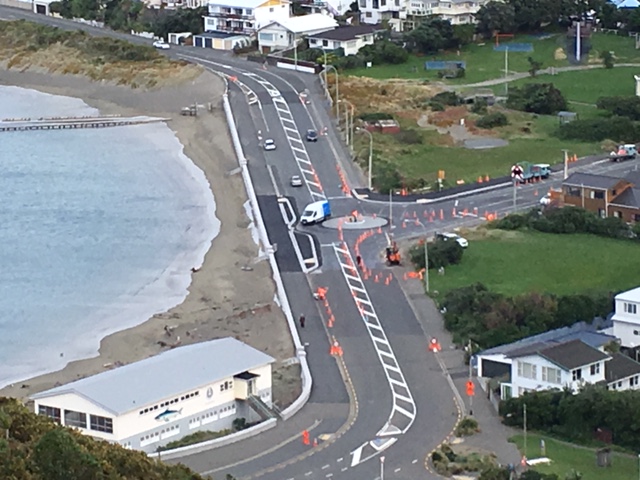
But today I wanted to highlight another small Wellington City Council excess.  It is of no wider interest, except as symptomatic of the way our money is wasted by councillors up and down the country.  As I said, Island Bay is a pleasant seaside place.  Just to the left of the photo, fishing boats lie at rest, and the eponymous island guards the entrance.  There is a pleasant sandy beach, good for swimming (if somewhat bracing).   There weren’t a lot of people around when I took this photo on a cool late-autumn morning, but on summer afternoons the beach is often crowded and finding somewhere to park can be a challenge.

island bay

And so what is the Wellington City Council in the process of doing?  Why, removing probably half a dozen carparks  on the main road (you can see where the dark new seal is by the van) –  and others on the side street –  as part of putting in a new roundabout.  This little project is said to be costing $400000.  There was, it appears, no consultation with either residents or beach users.

Both roads are wide, and neither is particularly busy (I walk down there most days).  There is no obvious problem, no apparent record of accidents, but that doesn’t stop the Council frittering away public money.  I guess we should be grateful for small mercies: a few years ago when the sea wall was damaged in a storm, some councillors wanted to rip up the road (past the new roundabout) altogether and let the sea “take back its own”.  Fortunately, they lost that battle.

Each individual project like this doesn’t sound like much.  But they add up, and before you know where you are, hundreds of millions of hard-pressed ratepayer’s money is being lavished on the big stuff with little rigour, less transparency, and not much accountability.   It is a shame there is no way to have councillors put rather more of their own money on the line: perhaps for each new initiative they vote for councillors could consider making a personal contribution equal to, say, ten times the average per capita cost of the project in question.   When the mayor, Justin Lester writes a personal cheque for $4000 as a contribution to the convention centre, and another for $2500 for the town hall refurbishment or the runway extension, I’d start taking the views that underpin his wastefulness (with other people’s money) a little more seriously.  Of course, even then it might just be considered a campaign expense on a journey towards Parliament.  Instead, we go on with citizens being plundered to pursue the whims of councillors and specific vested interests.


Amy Adams and the National economic model

National Party finance spokesperson Amy Adams was interviewed on TVNZ’s Q&A programme on Sunday.   Amid the to-ing and fro-ing on aspects of the government’s Budget, there was an odd exchange about the underpinnings of economic growth in New Zealand.

AMY Can I just finish, though? Can I just finish? Even Treasury is saying that the GDP growth that they’re forecasting is only held up because of strong and, in fact, growing immigration numbers — something that Grant Robertson went on about for nine years in opposition. So it’s been driven by immigration, industrial law changes, foreign direct investment, new taxes. Those things will slow the economy.

CORIN Are you seriously criticising this government for relying on immigration to grow its economy when your government relied on immigration and housing?

AMY Am I going to get a chance to answer? Okay, so what I’m going to say, Corin, is that for nine years in opposition, Grant Robertson made a big deal about the fact that immigration and the net flow of migrants into New Zealand was what was holding up the economy. What I’m pointing out is that Treasury, in its own estimates in the Budget, has said it is continuing strong immigration that is going to continue to see GDP held up. We’ve always argued that you need a good inflow of skilled workers. We’ve never made any bones about that, but this is a government, again, that talked one game in opposition and is entirely going the other way in government.

CORIN Fair enough — that’s a fair point, but it’s a bit rich to criticise them for relying on immigration.

AMY I’m not criticising them for doing it; I’m saying I’m criticising them for breaking their promises about what they said. They said in the campaign they would slash immigration, and now it’s strong immigration numbers that they’re looking at, or at least, Treasury are looking at to support those figures.

If I’m reading Adams correctly she appears to be

  • criticising the government for not carrying through on what she describes as their promises to “slash migration”,
  • arguing that, on Treasury’s account, continued migration-led population growth is a key element in the GDP growth forecast over the next few years (Treasury having revised up its medium-term immigration assumptions), and
  • acknowledging that in National’s term in government, the numbers relied very heavily on large immigration inflows.

I’m mostly interested in that final point.  On my analysis of Labour’s manifesto, there was never a promise to “slash” migration, or even to take steps that would cut the net inflow for more than a year.  And those were policies put in place when Andrew Little was still leader; from her silence on the issue once she became leader it was pretty clear Jacinda Ardern didn’t really believe in those policies.  There was no change promised in the centrepiece of our immigration policy: the residence approvals target number of 45000 non-citizens per annum.    (There hasn’t yet been any sign of the modest changes Labour did promise –  some sensible, some not – although we are told they are coming.)

But what of National’s approach to economic policy.   A couple of weeks ago, the National Party leader was touting his party’s economic credentials

When I was Economic Development Minister, our plan for the economy was set out in the Business Growth Agenda.

The BGA comprised over 500 different initiatives all designed to make it easier to do business by investing in infrastructure, removing red tape, and helping Kiwis develop the skills needed in a modern economy.

Some of those were big, some were small. I’ll admit some weren’t as exciting spending a billion dollars every year.

But together they were effective.

New Zealand has one of the best performing economies in the developed world.

But, in fact, what it came down to mostly was a lot more people, and the activity that a lot more people generate.  At least Amy Adams seems to recognise that.

In the five years to the end of 2012, New Zealand’s population is estimated to have increased by 4.3 per cent, and in the five years to the end of 2017 the increase is estimated to have been 9.3 per cent.    More than all that increase resulted from changes in net migration (the natural increase was smaller in the second period than in the first).  Coping with a lot more people – especially when the increase is unexpected – generates a lot of economic activity (people need houses, schools, shops, offices etc), but not necessarily a lot more long-term economic opportunities to support the increased number of people.

Note that I deliberately used the words “not necessarily”.  At some times, and in some circumstances, migrants can help create or tap whole new opportunities, helping to lift economywide productivity, increase the outward-orientation of the economy (and the associated investment), and so on.  But it is an empirical question, that has to be reviewed in the light of experience.  Sadly, there is little or no sign that we’ve seen those sorts of gains here.

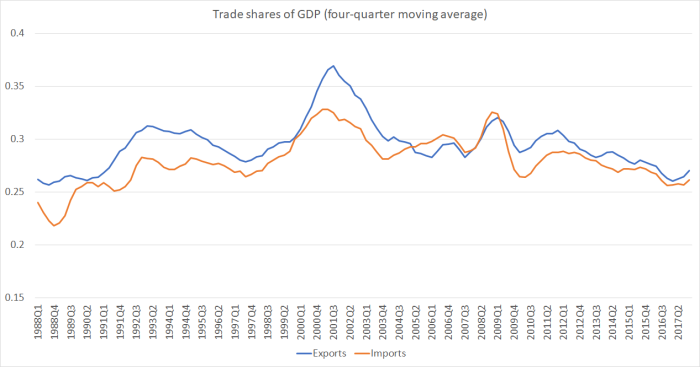
I’ve pointed out previously (perhaps ad nauseum) that total labour productivity growth in New Zealand in the last five years was only about 1.5 per cent.  Over that period, too, trade with the rest of the world (exports and imports) have been shrinking.

trade shares may 18

When National first came to office 10 years ago they recognised that sustainably successful economies tend to be ones that find more and better products and firms that successfully take on the world (in turn, enabling us to import and consume more from the rest of the world).  Perhaps unsurprisingly, foreign trade rated no mention from Amy Adams.

So we’ve had

  • little or no productivity growth in the wake of the population surge,
  • a shrinkage in the proportion of our economy traded with the rest of the world, and
  • increasingly ruinous house prices in much of the country.

Twenty years ago when people first started to worry a bit that there wasn’t much sign of New Zealand catching up again with the rest of the advanced world, one hypothesis that did the rounds for a while was that of ‘the cheque is in the mail” –  just be patient, and the gains would materialise soon.   They didn’t then, but perhaps this time is different?

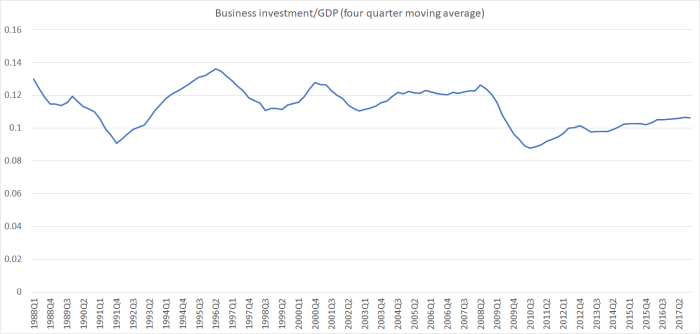
One place we might look for signs of that is business investment.  But, as even the Reserve Bank Governor has been pointing out, that has been pretty muted.   Here is business investment (total gross fixed capital formation less government and residential investment spending) as a share of GDP.

bus investment may 18

That mightn’t look too bad to you –  after all, the line has been edging up over the last few years.  But even now the share of the economy devoted to business investment is lower than in every quarter from 1993 to 2008, and we’ve had much larger and more sustained total population increases this time round than in the previous couple of cycles.  More people need more capital.  It doesn’t look as if business has been planning for even better times ahead, more or less just meeting the domestic demands of the rising population itself.  (And as I illustrated on Friday, Treasury doesn’t expect any recovery in the export/import shares of GDP in the next few years.)

Consistent with that, here is a chart I’ve shown previously, using SNZ’s annual capital stock data.

cap stock growth may 18Growth in the per capita “productive” capital stock –  public and private, but excluding houses –  has been low and has been trending downwards.  I’ve also shown (orange line) a proxy for natural resources per capita: since natural resources themselves are fixed, this is just the inverse of the rate of population growth.  Per capita natural resources are falling.  That mightn’t be a problem –  it is, after all, true of every country with a growing population – if other resources were taking the place of the natural ones.  But there has been no sign –  in business investment, productivity, or the foreign trade data –  of that here.
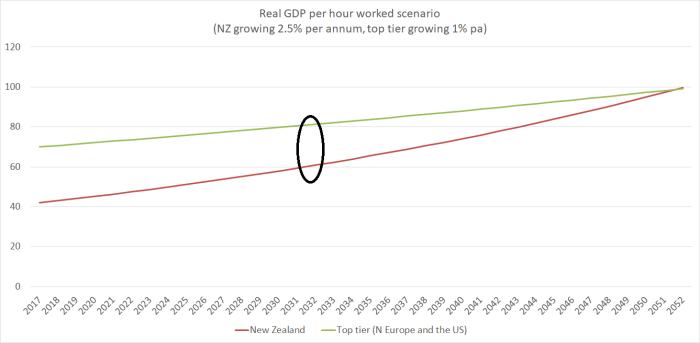
Productivity growth here (real GDP per hour worked) in the last five years was 1.5 per cent in total.  The best-performing eight OECD economies averaged 11.3 per cent over the most recent five years (some to 2016, some to 2017).  Most of those countries are still a bit poorer and/or less productive than New Zealand –  but not all (the list includes Turkey, Slovakia, and Korea). And those gaps are now a greater deal smaller than they were even five years ago.  New Zealand GDP per capita is currently around $60000.  If we’d managed 10 per cent productivity growth over the last five years –  instead of 1.5 per cent – the economy would be around $5000 bigger per man, woman, and child.  Just think of the possibilities that would have opened up, individually and collectively.

Instead, pretty much all we had was the activity generated by a lot more people, and more working hours for those already here.  Probably inadvertently, the National Party finance spokesperson has finally acknowledged it.

Of course, the outlook under the current government is more of the same, or even worse.  The immigration policies of the two main parties are all but identical in substance (although the cyclical dimension does appear to be turning), but the new government throws into the mix the ban on oil and gas exploration, a determination to do more on water standards, and to do much more around emissions.  Perhaps each of those policies is individually worthy, but they are all likely to come at an economic cost, a cost exacerbated if policy keeps on trying to drive up the population –  in a location that hasn’t shown the (beneficial) economic fruits of such a policy for a long time now.  And should the government somehow manage an acceleration of the rate of housebuilding, that too will only squeeze out –  through higher interest and real exchange rates – more of the business opportunities that might otherwise have supported a growth in material living standards.

More people, at least in New Zealand, isn’t a path to higher productivity, and higher productivity is what aspirations for higher material living standards rely on.  More people is just a path to more activity to accommodate more people –  skewing the economy inwards again, and undermining our prospects of ever getting back towards that upper tier of advanced economies.  On this score, Amy Adams (and her leader) appear quite as blind as Grant Robertson (and his). It is only two years until the next election campaign will be getting underway: the Adams interview doesn’t suggest any sign of a rethink of policy, or even a recognition that activity is no substitute for productivity.  And the latter is sorely lacking in New Zealand.


Orr defends himself

There seems to have been almost no media coverage of an extraordinary statement put out late on Wednesday by the going-rogue Governor of the Reserve Bank, Adrian Orr.  Perhaps he was fortunate that all eyes were already on Thursday’s Budget.

I’ve been drawing attention to the way in which Orr has been speaking out on all and sundry issues – often contentious political issues – for which neither he nor the Bank has been assigned responsibility by Parliament.   We’ve had climate change issues, infrastructure spending, both sides of the bank conduct issue (where he was defending the banks only to flip sides and start poking a stick at them), sustainable agriculture, and capital gains taxes. (Various posts touching on the Governor’s comments are here.)

Last week he was at it again, giving an interview to Stuff’s Hamish Rutherford in which he took the opportunity to attack the way the Christchurch rebuild had been done, including in particular the lack of opportunities for his former employer, the New Zealand Superannuation Fund.  And a couple of days out from the Budget, he took another opportunity to call for more government infrastructure spending, more government borrowing, and to offer his thoughts on public procurement processes.  Anyone would think he was a party leader at election time.

There were two separate classes of issues arising out of the interview with Hamish Rutherford.  The first was around the details of what Orr was saying about the Christchurch rebuild and the substance of NZSF’s involvement or lack of it.    The former minister, Gerry Brownlee, understandably took umbrage at the substance of Orr’s remarks, but the details of that particular spat weren’t my concern (although a commenter in detail here suggests Brownlee was on the stronger ground).

The second class of issues –  and the focus of my concern – is around the appropriateness of the Governor speaking out at all on these (and the other) issues.   As I summed it up the other day, the Governor’s comments are very unwise and quite inappropriate –  and would be so regardless of any substantive merits in his views.   The Governor holds an important public office, in which he wields (singlehandedly at present) enormous power in a limited range of areas.  It really matters –  if we care at all about avoiding the politicisation of all our institutions –  that officials like the Governor (or the Police Commissioner, the Chief Justice, the Ombudsman or whoever) are regarded as trustworthy, and not believed to be using the specific platform they’ve been afforded to advance personal agendas in areas miles outside the mandate Parliament has given them.   We don’t want a climate in which only partisan hacks have any confidence in officeholders, and only then when their side got to appoint the particular officeholder.  And that is the path Adrian Orr seems –  no doubt unintentionally – to be taking us down.  As I’ve noted previously, as his time in office lengthened, Don Brash made something of the same mistake.    That was unfortunate and inappropriate, but in 14 years in office I’d be surprised if Don managed as many overtly political comments as Adrian Orr has delivered in less than two months.

I’ve had conversations with people, including journalists, who can’t really see a problem.  I guess Orr is still in his honeymoon phase, and the journalists are still just grateful they no longer face a Governor who wouldn’t even communicate properly on issues that were his clear and specific responsibility.  Perhaps it helps to see the problem by supposing that a new Governor had come to office and was giving interviews calling for, say,:

  • doing nothing about climate change,
  • cutting capital taxes,
  • lamenting that the government had not just stayed out of central Christchurch and had just landowners get on with it,
  • suggesting that the state stay out of housebuilding,
  • promoting irrigation schemes, and (for the sake of argument)
  • attacking light rail

That new Governor might be perfectly technically capable of doing monetary policy and financial regulatory tasks.  But nonetheless, there would almost certainly be an outcry –  people from the left attacking the Governor for his attacks on policies of the government of the day, and people on the right using the Governor’s comments to buttress their anti-government rhetoric.  It  would be unwise, and should be quite unacceptable for a Governor to be making such comments.  And it is no more wise, or acceptable/appropriate, for him to be making comments on the other side of such issues.

I’m not suggesting that the Governor is an active Labour/Greens partisan, making the comments he does to try to advance the interests of the governing parties.  Probably he believes he is better than them anyway.  But clearly his personal views on all manner of issues seem to align with those of Labour (in particular), and since he has lots of turf battles to win (around the reform of the Reserve Bank) he probably judges that it doesn’t hurt his personal cause to be speaking as he has.  But even if that works out for him in the short-term it isn’t desirable.  His interests aren’t the national interest.  It is conceivable that the second half of his term could see him working with a National government, and he’ll have made that more difficult with these overtly political comments, ranging well beyond his brief.  And he will have increased the risk that future Reserve Bank Governor appointments will be made on an overtly partisan basis –   “if the Governor feels free to speak on absolutely anything, we want someone who’ll be championing our particular causes”.  That would be highly undesirable.

After Orr’s comments last week, there was an outraged response from Gerry Brownlee (on the specifics) but there was also a response from the Opposition leader, Simon Bridges.  That upped the ante quite a bit, even though Bridges’ statement was pretty moderate.

Bridges did not directly answer questions about whether he believed Orr comments were a sign he had sided with the new Government, or on the tone of Brownlee’s comments, but said Orr would have taken a lesson from the episode.

“I am sure he [Orr] will have seen what Mr Brownlee has said, and you know, there’ll just be a lesson there in terms of sticking to the knitting in terms of what his remit is.

“I’m sure he’ll want to be very careful about not wanting to step into legitimate political debates, rather than his mandate as Reserve Bank governor.”

Bridges said National had supported Orr being appointed governor.

“He’s a good guy, he’s a clever economist, he’s a great communicator, so he’s got the skills to be governor.”

That “stick to his knitting” line was particular welcome, but it was still a pretty emollient statement. Opposition leaders don’t wade in every day criticising the Governor –  in fact, memory suggests (perhaps incorrectly) it is really quite unusual –  but it was clearly a statement that was seeking a de-escalation.  There was no criticism of Orr’s appointment or his basic skills and qualities, and really just a quite moderate call for a minor course correction.   When I saw the Bridges comments, I assumed that would be the end of the matter: the Opposition would take it no further, Orr would retire to lick his wounds and reflect, and perhaps in time emissaries might be dispatched to make clear that the Bank recognised where its core responsibilities did and didn’t lie.  Others at the Reserve Bank, meanwhile, (better schooled in the responsibilities and limits of a central bank) would breath a sigh of relief

But no.  Instead late on Wednesday the Governor put out a full page statement under the Reserve Bank name defending himself, and if anything taking the offensive, claiming the freedom (nay, responsibility) to speak out on almost anything.   “Doubling down” was my quick summary.

The Governor began

I greatly respect and appreciate the operational independence of the Reserve Bank.

Maybe, but talking so freely on all manner of contentious political issues does nothing to foster long-term public support for that operational independence.

My comments about infrastructure investment reported in the recent Stuff article of 15 May related not only to my previous role as CEO of the NZ Super Fund, but also to my current role as Governor of the Reserve Bank.

There are two points here.  First, as Governor he shouldn’t be giving interviews about his previous job –  we didn’t hear Don Brash giving interviews about Trustbank or Alan Bollard about Treasury once they were Governor. It is all the more important to maintain that clear separation given that in this case the Governor had previously had another government job.    But, second, this is where he begins to double-down, claiming that it is right and appropriate, as Governor, to be talking openly about these contentious political issues, for which he has no direct policy responsibility.

He disagrees

I spoke openly and frankly because that is a desired feature of the role of Reserve Bank Governor.

Yes, we would welcome a Governor who spoke clearly, and accessibly, on the issues Parliament has assigned to him.  His immediate predecessor didn’t do that bit of the job well at all. But that is very different from a Governor sounding off, without nuance, on all manner of highly contentious issues.   The Governor himself may “desire” to do so –  and no doubt it makes good copy so journalists won’t say no –  but perhaps the Governor could point to any other indication that the public interest is being served by the approach he is taking?

There follow a couple of paragraphs about the specifics of NZSF and Christchurch rebuild issues, including

Any lack of investment by the NZ Super Fund was not caused by lack of commitment from either Mr Brownlee or the NZ Super Fund. Rather it was due to no access for third-party capital into the core infrastructure space, for example, ports (air and sea), transport, electricity distribution and so on. These were decisions made by the appropriate authorities at the time.

It still isn’t clear why NZSF involvement (or any third-party capital) would have been appropriate in any of the major public aspects of the rebuild process,  most of which were (as my commenter points out) well below the size threshold NZSF itself says it is looking for (and bigger ones, notably the convention centre and the stadium remain of questionable economic value).    But, even setting that to one side, there is something extraordinary about this issue being fought on the website of the operationally-independent Reserve Bank.  It is, quite simply, none of the Bank’s responsibility.

But here the Governor pivots to try to claim that this is all very much part of his new responsibilities.

That challenge is not unique to Christchurch or New Zealand. It is a global financial challenge and one that leads to financial instability at times, especially stressed balance sheets.

This is a stretch, to say the very least.    Even if we were to allow that it was a “global financial challenge”, it wasn’t one in Christchurch, and certainly posed (and poses) no threat to financial stability in New Zealand.     One might, as well, worry about pots of government money, and the way they can be used to subvert good decisionmaking, robust allocation of capital, and so on –  perhaps especially if the Governor of a central bank starts championing the causes of such government funds.

The Governor attempts to generalise

The Reserve Bank Act requires us to promote a sound and efficient financial system. The Policy Targets Agreement that I have signed with the Minister of Finance also requires that, along with maintaining low and stable inflation, the Reserve Bank must contribute to maximising sustainable employment.

But even here he, no doubt deliberately, skates over some important language in the Act and the Policy Targets Agreement.  For example, the Act does not require the Reserve Bank to “promote a sound and efficient financial system” .  Here is the key provision of the Reserve Bank Act

68 Exercise of powers under this Part

The powers conferred on the Governor-General, the Minister, and the Bank by this Part shall be exercised for the purposes of—

(a)  promoting the maintenance of a sound and efficient financial system; or

(b)  avoiding significant damage to the financial system that could result from the failure of a registered bank.

In other words, it isn’t a general obligation, but a constraint on how the Bank’s statutory powers are used.  The specific statutory powers to regulate banks must be used in a way that promotes the maintenance of a sound and efficient financial system.  There is quite a difference from weighing in championing PPPs, more government debt, or specific solutions to particular Christchurch rebuild issues.

Similarly, in the Policy Targets Agreement –  a provision governing the conduct of monetary policy – there is just this descriptive statement

The conduct of monetary policy will maintain a stable general level of prices, and contribute to supporting maximum sustainable employment within the economy.

and a requirement to explain in each MPS

The conduct of monetary policy will maintain a stable general level of prices, and contribute to supporting maximum sustainable employment within the economy.

No one thinks that offering interviews on PPPs, sustainable agriculture, or the Christchurch rebuild is what is meant by “the conduct of monetary policy”.

Well, no one other than the Governor that is. Because he goes on

I have spoken about specific issues recently because increased infrastructure investment opportunities provide sound investment choices, risk diversification for financing goods and services, and improves maximum sustainable employment by relieving capacity constraints.   These are all core components of the Reserve Bank’s role and something we often speak about in our Financial Stability Reports.

I almost fell off my chair laughing when I read that line.  When I was young at the Bank we used to occasionally argue that we were free to talk about absolutely anything because almost anything could be argued to affect price stability, in some form or another (resource usage and all that).  There was even a statutory provision.

10 Formulation and implementation of monetary policy

In formulating and implementing monetary policy the Bank shall—

(a)  have regard to the efficiency and soundness of the financial system:
(b) consult with, and give advice to, the Government and such persons or organisations as the Bank considers can assist it to achieve and maintain the economic objective of monetary policy.

But no one took that sort of ambitious –  rather silly – argument very seriously.  At least, it appears, until the Governor came along.    Now, it seems, the Governor wants to openly argue that absolutely anything if within his purview.

Even then he seems confused. For example, he claims that

…..increased infrastructure investment opportunities………improves maximum sustainable employment by relieving capacity constraints.

Well, maybe eventually if the infrastructure investment itself is robust and cost-effective (a test much infrastructure spending in New Zealand fails).  But, as no doubt his economists could point out to him, in the short to medium increased infrastructure spending puts more pressure on resources, and exacerbates capacity constraints and inflationary pressure (all that additional spending before the capacity comes on line).  And then he goes on to assert that these are “core components” of what the Reserve Bank does. and are “something we often speak about in the our Financial Stability Reports”.   Which is an odd claim, since issues about relieving capacity constraints would appear more naturally to belong in Monetary Policy Statements.  And doubly odd in that when I checked the most recent Financial Stability Report, there was a but one reference to “infrastructure” in the entire document, and that a reference to something they call the “retirement saving infrastructure”.   But there is a new FSR out next week, so I guess the Governor will be ensuring it does touch on infrastructure issues?

It all smacks of a statement pulled together in a rush, under pressure.  He clearly hasn’t stopped to think of the total non-viability of a Governor addressing such issues in ways the government of the day doesn’t like (and thus the inappropriateness of only addressing it in ways they do like) or of the implications of his position –  at future press conferences or FEC hearings he’d have no grounds to refuse comments on almost any aspect of policy some mischevious questioner wanted to ask about.  Immigration policy Governor?  Welfare policy Governor?  And so on.  It is a reckless path.

It isn’t unlawful, of course, for the Governor to speak on these issues.  Perhaps, over time, a Governor could develop a sufficient reputation in office for his stewardship of his core responsibilities that people look to him or her to comment occasionally on a slightly wider range of issues. But to wade in, on so many contentious issues, in an utterly non-nuanced way, so early in his term seems extremely unwise and quite inappropriate.  The Minister of Finance and the chair of the Bank’s Board should be making that point forcefully to the Governor, as often as is necessary until his behaviour changes.

Back when the Reserve Bank Board advertised the job last year, two of the qualities they claimed to be looking for were:

  • Personal style will be consistent with the national importance and gravitas of the role.

  • The successful candidate will also demonstrate an appreciation of the significance of the Bank’s independence and the behaviours required for ensuring long-term sustainability of that independence.

Orr’s approach at present isn’t consistent with either of those.

And he appears to be carrying on as he started. In the Sunday Star-Times yesterday, Orr was again being quoted on things that are little or none of his responsibility.

Last year, New Zealand banks reported a combined $5.19b in profits, up just over $355 million year-on-year.

New Reserve Bank governor Adrian Orr said he was perplexed by the ongoing strength in bank profits.

Perhaps he might be “perplexed” but it really isn’t anything to do with a prudential regulator.  If there are competition issues, we have a Commerce Act and government ministers.  He went on

Checks on whether bank profits were sustainable would form a significant part of the “culture check” being undertaken by the Reserve Bank and Financial Markets Authority, Orr said.

A Royal Commission of Inquiry into Misconduct in the Banking, Superannuation and Financial Services Industry in Australia revealed serious misconduct by New Zealand banks’ parent companies.

That prompted New Zealand regulators to demand more information from New Zealand banks, which they had until May 18 to deliver.

“I think you’ve always got to be sure that they are competing properly and they are behaving responsibly,” Orr said.

“If they’re making profits, good on them, but let’s make sure they’re long-term sustainable profits and there’s true competition in the markets.”

To repeat, almost none of this is anything to do with the Reserve Bank’s statutory areas of responsibility.  Perhaps it plays to a populist mood, but it fails to respect boundaries, including the reasons why we assign different functions to different agencies.  And the public mood is a fickle mistress.

Perhaps comments on bank profits are slightly less egregious, in some circumstances, than those on climate change, sustainable agriculture, capital gains taxes, PPPs or whatever, but none of its suggests a Governor with the sort of self-discipline and recognition of limits that the role demands.  Much of it seems more attuned to grabbing headlines, than to offering the sort of nuanced reflection that might occasionally provide a useful contribution to a thoughtful debate on some important issues.

It is still early days in the Governor’s term, but a change of approach is already well overdue.  It is not as if there aren’t plenty of issues that the Governor is most definitely responsible for –  and accountable for –  that he could be getting quietly on with.


A wager for the Minister of Finance to consider

In the speech I linked to in yesterday’s post, I noted that

…from all appearances, our leaders (political especially, but also bureaucratic) have largely given up, perhaps idly hoping that something will turn up. And occasionally inserting “higher productivity” into a speech isn’t evidence of serious intent – if anything, it seems more like a substitute.

and

Judging by the inaction of our leaders in tackling the persistent productivity failure it seems that when it comes to crunch ours (regardless of party) care much less about the kids – of this generation and the next – than the cheap rhetoric of election campaigns might suggest. Giving up on productivity – in practice, and whatever the rhetoric – is a betrayal of our kids (and their kids). And most especially it betrays the children towards the bottom of the socioeconomic scales, those who typically end up paying the most severe price of economic and social failure.

I’d written that a few days ago, but if anything events of the last few days just confirm my concern.

I gave the speech the first time over breakfast on Thursday morning.  I’d just read Amy Adams’ pre-Budget op-ed on Stuff.    There was nothing in that at all about productivity (word or idea), only self-satisfied comments about the allegedly wonderful economy National had bequeathed labour.  That, you’ll recall, was the one with 1.5 per cent productivity growth in total over the past five years.

I didn’t listen to her boss’s speech in Parliament, but I get Simon Bridges’ emails and this was his post-Budget line

This Government was gifted an incredible legacy by hard working New Zealanders and by National. They inherited a strong, growing economy improving the lives of New Zealand families. They inherited a much more prosperous and outward looking country.   

Yet today they’ve delivered a Budget that is strewn with broken promises. No universal cheaper doctor’s visits, 1800 extra cops that aren’t coming anytime soon, no money to build Dunedin Hospital, not to mention a raft of new taxes from a Government that promised ‘no new taxes’ in its first term.

Again, nothing at all about productivity, or the possibilities that it can offer all of us.  This was, after all, the man of whose first economics speech as leader, I noted

500 initiatives [something he’d boasted of in the speech] and we still had barely any productivity growth in the last five years.  And, as I recall, one of the BGA goals was a big increase in the export (and, presumably, import) share of GDP: those shares have actually been shrinking.  Productivity levels languish miles behind the better advanced economies, and the gaps showed no sign of closing.

But what of the current government?

Sure enough, there were quite a few references to productivity, and lifting it, in the Minister’s material.    Eight (to “productive” or “productivity”) in the speech alone.  In the Minister’s Fiscal Strategy Report (with the subheading “Foundations for the future”) there were 17 references to productivity (quite a few of them mentions of the Productivity Commission) and another fifteeen uses of “productive” (often prefaced by the aspiration “more”).

Which is fine and good as far as it goes.  But what backed it up?  Not much.

On the very first page of the Fiscal Strategy Report, the government’s priorities are described

The Government’s priorities were set out in the Budget Policy Statement in December 2017. They are:

• Building quality public services for all New Zealanders and improving access to core services, such as health and education.
• Taking action on child poverty and homelessness.
• Supporting families to get ahead and sharing the wealth generated by our economy with a wide range of New Zealanders.
• Sustainable economic development and supporting the regions.
• Managing our natural resources and taking action against environmental challenges, such as climate change.

That document outlined the Government’s ambitious plan to reduce child poverty, protect the environment, create decent jobs, and build more affordable houses.

And not a word, not even an allusion, to beginning to close those productivity gaps.  The Budget material as a whole looks as if referring quite often to lifting productivity was a substitute for actually doing anything serious about it creating a better climate for it.

If I recall correctly, there were a couple of references to things that might help.  For example, there was mention of tax reform flowing out of the Tax Working Group’s recommendation.  We all assume a limited capital gains tax will emerge at the end of the process, and not much more (land taxes, for example, became infeasible once the land under the family home was ruled out).  There might be a decent case for a limited capital gains tax, at least on grounds of (apparent) equity, but no one thinks a CGT is going to make any material difference to New Zealand’s productivity performance.  If the Minister really did, he’d be making the case, documenting the evidence etc.

There was also mention of the new R&D tax credit.  I guess reasonable people can differ on how much impact that will have –  my doubts are here and here – but I don’t know anyone who thinks it is a big part of changing the overall picture of productivity performance in New Zealand.

And then, of course, there is the Provincial Growth Fund. I guess the Minister’s party is in a coalition with New Zealand First, so he has to talk up the benefits of spending all that money.  Everyone else recognises that it is no part of a serious growth (in productivity) strategy.

And, on the other hand, there is not a mention of the (real) exchange rate, one of the more pressing imbalances in the New Zealand economy.

But don’t just take it from me.  The Treasury does the  economic forecasts.   They do expect a bit more productivity growth in the next few years than in the last few years, but (a) mostly that looks like an assumption that things just get back to less-bad “normal”, and (b) the assumed rates of productivity growth aren’t going to make any inroads at all on the huge gaps to the rest of the advanced world.   And although an increasingly open economy –  trading more with the rest of the world –  is usually part of any successful catch-up strategy, as I showed yesterday the Treasury forecasts suggest no reversal in the decline in the export/GDP share that took place over the last few years.

Treasury does its forecasts on the basis on government policy, but that doesn’t take account of things that are still just political promises (even if quite likely to be), like the capital gains tax.

So perhaps the Minister of Finance –  like his colleague the Minister of Housing – thinks The Treasury has it all wrong, and is far too pessimistic.  Perhaps he’s really convinced that his government will successfully turn round our productivity performance, and get us on the track for catching the OECD top-tier.   As I noted in my speech, with the sorts of productivity growth rates various catch-up OECD economies have managed over the last 15 years (crisis, recession, and all) we could halve that gap in fifteen years, and close it altogether by 2050.

US economist Bryan Caplan encourages people who really believe an argument to express it in the form of a wager (typically for reasonably modest amounts, of around $100).  Doing so forces the parties to identify clearly what they do and don’t believe, and think carefully about the probabilities.  In that spirit, I’d be happy to offer a wager to the Minister of Finance (and/or his colleagues, the Prime Minister, or the Minister for Trade and Export Growth).

Conditional on them remaining in government, I’d expect that, if they are really serious about productivity –  lifting the possibilities for our kids –  and believe they have the strategy to do it (even if not all the bits are yet on the statute books), they would be willing to wager that New Zealand will average annual labour productivity growth over the next six years of at least 2 per cent.  I’d be only too happy to take the other side of such a bet, because I see no sign in government policy of anything that will substantially turn around our productivity performance.  No doubt, there will be the odd good year –  some of which might just be measurement –  but I’d be very surprised if we manage total labour productivity growth of anything close to even 5 per cent in the next five years.  Of itself, that wouldn’t be disastrous –  it would be quite a bit better than the last five years –  but, once again, it would mean no progress in closing those gaps.      (Of course, if I were to lose such a bet, I’d mostly be delighted –  better prospects for all of us and our kids.)

In fact, I’m sure the Minister of Finance knows his strategy won’t make any material difference to New Zealand’s dismal productivity performance.  If so, the words are just a substitute for action, and the betrayal of our kids stretches on through yet another government.


This is what productivity means

Presbyterian Support Northern is hosting a series of lectures on different aspects relevant to the wellbeing of children.  The first lectures were given by Australian Labor MP, and former economics professor, Andrew Leigh.  I wrote about his lectures here.

I was asked to speak on something around productivity and the wellbeing of children (thus there are huge areas highly relevant to child wellbeing that I simply don’t touch on).  This was how my talk opened.

Imagine a country in which the average age at death was only about 45, 6 per cent of children died before their first birthday, and another 1.5 per cent before they turned five.  Not many children are vaccinated.

Most kids get to primary school –  in fact it is compulsory –  but only a minority attend secondary school.  By age 15 not much more than 15 per cent of young people are still at school.   Only a handful do any post-secondary education (total university numbers are about 1 per cent of those in primary school).   Houses are typically small –  not much dedicated space for doing homework – even though families are bigger than we are used to.   Perhaps one in ten households has a telephone and despite the street lights in the central cities most people don’t have electricity at home.

Tuberculosis is a significant risk (accounting for seven per cent of all deaths).  Coal fires – the main means of heating and of fuel for cooking – mean that air quality in the cities is pretty dreadful, perhaps especially on still winter days.  Deaths from bronchitis far exceed what we now see in advanced countries. There isn’t much traffic-related pollution though – few cars, so people mostly walk or take the tram.  The biggest city is finally about to get a proper sewerage system, but most people outside the cities have nothing of the sort.      And washing clothes is done largely by hand – imagine coping with those larger families.

Maternal mortality rates have fallen a lot but are still ten times those in 2018 in advanced countries.  One in every 50 female deaths is from childbirth-related conditions –  which leaves some kids without mothers almost from the start.

Welfare assistance against the vagaries of life is patchy.  Most people don’t live long enough to be eligible for a mean-tested age pension.   Orphans aren’t in a great position either, and there is nothing systematic for those who are seriously disabled.  There is a semi-public hospital system, but most medical costs fall on individuals and families, and there just isn’t much that can be done about many conditions.

There are public holidays, and school holidays, but no annual leave entitlements.  No doubt the comfortably-off take the occasional holiday away from home, but most don’t, because most can’t (afford it). Only recently has a rail route between the two largest cities been opened –  but it takes 20 hours for cities only 400 miles apart.

I wouldn’t choose to live in that country.  Would you?

And yet my grandparents did live there –  they were all kids then.  This was New Zealand 100 years or so ago, just prior to World War One.  I took most of that data from the 1913 New Zealand Official Yearbook.

And if it all sounds pretty bleak, New Zealand was probably the wealthiest place, with best material living standards, of any country on earth.   In the decade leading up to World War One, New Zealand’s per capita income was (on average) the highest in the world (jostling with Australia and the US, with the UK a bit further behind).    The historical GDP estimates are inevitably a bit imprecise, but on statistic after statistic in that 1913 Yearbook, New Zealand showed up better than the other rich countries the compilers had data for.

The difference in material living standards between then and now is productivity –  the new ideas, new products, new ways of doing old stuff, making more from what we have.   Of other influences on material wellbeing, the terms of trade haven’t changed much taken over 100 years as a whole, and people work a shorter proportion of their lives now (whether in the market or in the home) than they did in 1913.  Then, most (who survived infancy) were in work by 14, and dead by 65.    Productivity is that enormous difference between what we enjoy today, and what my grandparent had as kids in middle-class New Zealand families on the eve of World War One.

And yet, by international standards we’ve done badly.  We’ve gone from top of class to perhaps 30th today.  It would take a two-thirds lift in average productivity for us to match today’s top-tier (a bunch of –  small and large –  northern European countries,  and the United States).

That’s bad.  On the other hand, think of the possibilities it leaves open.  We don’t need to blaze trails at the productivity frontiers: making significant inroads on the gap between us and the top-tier would make a big difference to us, and to our kids.  And economic failure tends to fall most heavily on those at the bottom, so getting a significant lift in productivity opens up possibilities for everyone, including the disadvantaged.

In this address I’m not focused on the how –  the specific policies that might make a real difference.  My focus is on highlighting the difference that could be made, and calling for our leaders –  political and bureaucratic –  to start acting as if they believe things can be better, getting in train processes that might identify what is really important for productivity here in New Zealand, and then getting on with it.  Despite occasional references in speeches, our political leaders seem to have more or less given up, focusing on other stuff.

There is a (valuable) place for redistribution and policies that address immediate needs now –  it isn’t an either/or – but just as no possible redistributive policies in 1913 could  possibly have given people today’s material living standards, so any new redistributive policies now will inevitably make much less difference than markedly lifting our productivity performace would.  I’ve banged on here about how dismal productivity growth in New Zealand has been in the last five years in particular (a total of 1.5 per cent).  The best-performing OECD countries over the most recent five years were averaging more than 2 per cent productivity growth per annum –  and all of them were countries catching up with the most productive economies, just as we once aspired to do.   If we’d managed 2 per cent productivity growth per annum in the last five years, per capita GDP would be around $5000 per head higher (per man, woman, and child) today.

Catching up to the top tier will, in a phrase from Nietzche, take a “long obedience in the same direction” –  setting a course and sticking to it.  But here is a scenario in which the top tier countries achieve 1 per cent average annual productivity growth, and we manage 2.5 per cent average annual productivity growth. Here’s what that scenario looks like:

scenario

I’ve marked the point, 15 years or so hence, where the gap would have closed by half.

Could it be done?  Well, on OECD numbers the G7 countries as a group have managed average productivity growth in the last 15 years of about 1.1 per cent per annum, and plenty of OECD countries –  each in catch-up mode (Korea, Turkey, and various eastern and central European countries) – have matched or exceeded 2.5 per cent annual productivity growth over that period as a whole.   Mine is just a scenario, but it doesn’t look like one that should be beyond New Zealand –  and unlike any of those other countries, we were the richest and most productive country in the world barely more than a century ago.

The full text of my address is here.  It includes a plug for fixing the manifest evil –  by outcome if not by intent –  that is our housing and urban land market, which systematically skews away from those at the margins, where (inter alia) our particularly disadvantaged children are typically found.

I end this way:

Judging by the inaction of our leaders in tackling the persistent productivity failure, it suggests that when it comes to crunch ours (regardless of party) care much less about the kids –  of this generation and the next – than the cheap rhetoric of election campaigns might suggest. Giving up on productivity –  in practice, and whatever the rhetoric – is a betrayal of our kids (and their kids).  And most especially it betrays the children towards the bottom of the socioeconomic scales, those who typically end up paying the most severe price of economic and social failure.

Productivity isn’t just some abstract plaything of economists. It makes a real and tangible difference, opening up whole new possibilities and options. We need, and should able to achieve, a whole lot more of it. Our kids deserve no less.